Infallible Characters of Time: Johann Heinrich Alsted's Treasury of Chronology
Johann Heinrich Alsted, professor at the Reformed Hohe Schule at Herborn, poured what he called a Herculean labour into a single instrument: the Thesaurus chronologiae of 1624, fifty numbered chronologies running from the creation of the world to eclipses, comets, and the Saturn–Jupiter conjunctions by which he proposed to check every date he had set down. It sorts the Roman pontiffs into three classes, converts Daniel's weeks into years falling around its own printing, enters the German war then raging under 1618 with a count of its dead, and closes by conceding that much of its arithmetic still calls for the sponge. Chronology, on Alsted's account, was the light and eye of history, and universality meant one ordered frame made to hold Scripture, the heavens, the annals of nations, and the history of learning together.
ExLatinis
September 12, 2026

Contents
Johann Heinrich Alsted, professor at the Reformed Hohe Schule at Herborn, poured what he called a Herculean labour into a single instrument: the Thesaurus chronologiae of 1624, fifty numbered chronologies running from the creation of the world to eclipses, comets, and the Saturn–Jupiter conjunctions by which he proposed to check every date he had set down. It sorts the Roman pontiffs into three classes, converts Daniel's weeks into years falling around its own printing, enters the German war then raging under 1618 with a count of its dead, and closes by conceding that much of its arithmetic still calls for the sponge. Chronology, on Alsted's account, was the light and eye of history, and universality meant one ordered frame made to hold Scripture, the heavens, the annals of nations, and the history of learning together.
Johann Heinrich Alsted (1588–1638), professor at the Reformed Hohe Schule at Herborn in the county of Nassau, published in 1624 a Latin technical treatise on universal chronology under the title Thesaurus chronologiae — a treasury of chronology "in which the entire series of times and histories, in every sphere of life, is set before the eyes." Catalogued as an octavo of 340 and [36] pages with a partly folding table, an index, and text set within line borders, it is a working instrument of learned reckoning rather than a narrative history: fifty numbered chronologies, running from the definition of epochs through biblical, imperial, ecclesiastical, and learned-professional successions to eclipses, great conjunctions, comets, and rules for establishing synchronism. It belongs to the same generation of scholarship as the great Scaligeran chronologies and to Alsted's own lifelong project of methodical encyclopaedism, in which every branch of knowledge was to be reduced to teachable, memorable order.
The problem the work confronts is easily stated and notoriously hard to solve: how to establish one continuous and checkable series of time, from the creation of the world to the present day and — by way of prophecy — beyond it, when the surviving records disagree with one another. Alsted's own catalogue of the obstacles is unsparing. Proper names are homonymous, so that historians multiply Saturns and Herculeses, Dariuses and Ptolemies; orthographies vary by nation; cities carry double toponyms; restored reigns are counted twice; numbers are rounded; reckoning may be inclusive or exclusive; rival claimants to empire, papacy, and kingship confuse every succession; and the computations from creation to the Messiah diverge in some two dozen incompatible totals. His recurring response is to convert every field of knowledge into a datable, tabulated succession. Epochs are defined as roots of reckoning; popes, Fathers, kabbalists, councils, heretics, jurists, physicians, historians, and philosophers are sorted into classes, orders, and ages; kingdoms are marshalled into the four monarchies and their successors; prophetic numbers are converted into dated intervals. Wherever possible the series is pinned to astronomical evidence — eclipses and Saturn–Jupiter conjunctions, which he calls the infallible characters of time — and collated against competing tables, with the divergences printed rather than quietly harmonized.
The stakes of that undertaking were not merely calendrical. Chronology in the early seventeenth century was the discipline through which scholars adjudicated the order of sacred history, the antiquity of ancient kingdoms, the succession of churches and empires, and the credibility of competing historical witnesses. Joseph Scaliger's technical apparatus — the Julian Period, the solar, lunar, and indictional cycles, the critical weighing of non-biblical testimony — had made such reckoning newly powerful and newly contestable, and Alsted inherits that apparatus while redeploying it within an explicitly Reformed and scripturally ordered universal history. The same series that fixes the vulgar and Dionysian era against what he takes to be the true year of the Nativity also ranks the Roman pontiffs in three classes and identifies the third of them with the body of the great Antichrist; the same tabular method that dates the invention of printing also converts Daniel's seventy weeks and the Apocalypse's 1260 days into terminal years. Universality here does not mean neutrality. It means that one ordered frame is made to hold Scripture, the heavens, the annals of nations, and the history of learning together.
What is most striking about the book is the sheer reach of what it tabulates, and the candour with which it exposes its own seams. Alongside patriarchs, judges, and the kings of Judah and Israel stand a biblical bibliography and a harmony of the evangelists; alongside the four monarchies stand German kings traced back to Tuisco on the authority of pseudo-Berosus and Aventinus, the dispersion of nations from Genesis 10, catalogues of inventors, cities, and schools. Whole chapters are given to kabbalists and rabbis from Sinai to the completion of the Talmud, to the Church Fathers and the scholastics, to jurists, physicians, alchemists, philologists, poets, and Sibyls, to a genealogy of philosophy, and to the births and deaths of famous men. Pope Joan appears in the papal series; the Magdeburg Centuries are set beside Baronius's Annals to be compared; the Hebrew vowel points are defended as coeval with the language itself against those who ascribed them to the Masoretes; the Bohemian and German war then raging is entered under 1618 with a count of its dead. And the apocalyptic reckoning issues in dated expectations — 1622, 1625, 1635, 1694, with the millennium running to 2694 — which Alsted advances while insisting that he does not thereby define the end of the world, and while conceding that God alone knows exactly the points of past and future time. He fortifies himself in advance against the judgements he expects, and closes by admitting that other things, especially among the numbers, call for the sponge.
That combination — a treasury meant to be embraced whole and at a glance, assembled by a method that prints its own uncertainties — runs through the book's vocabulary, its production, and its transmission alike. The noun thesaurus in learned Latin of the period denotes an ordered storehouse whose value lies in systematic accessibility, and the apparatus is built accordingly: ready-reckoner tables flanking the preface, a numbered index of the fifty chronologies, an index of memorable things whose entries are at once finding aids and confessional weapons, a compendium of the Apocalypse, and a list of corrigenda. The Herborn imprint of 1624 names no printer, and the attribution of the issue to the press of Christoph Corvin — who had died in 1620, his business continuing under his heirs — remains unconfirmed on the surviving evidence, as do the identity of any dedicatee and the work's reception in Lutheran territories. The text nonetheless remained in demand: a second, "polished and augmented" edition followed in 1628, further editions in 1637 and 1650, and in 1699 a four-page English selection on remarkable eclipses appeared in London, the only documented translation of any part of a work that has never been rendered whole. It should not be confused, as it sometimes has been, with Gerard Mercator's earlier and quite distinct Chronologia of 1569.
Read the full text and English translation on Leo
This text was transcribed and translated as part of the ExLatinis project, an effort by Leo to make free English translations of every text published in Latin in early modern Europe (1450–1750) available online. The complete transcription and English translation of this work can be read free of charge:
→ Read the original Latin text and full English translation on Leo
You can save a copy of this document into your Leo account to run deep text searches, conduct further analysis, or cross-reference it with your own research.
Giving the Thesaurus chronologiae an English Title: Treasury, Epoch, Synchronism
Editorial English title: "The Treasury of Chronology: Johann Heinrich Alsted's Reformed Universal Chronography." No fixed English title for the complete work is established in the modern bibliographical record. The Latin title is conventionally retained as Thesaurus chronologiae; the 1624 catalogue form gives the subtitle "in quo universa temporum & historiarum series in omni vitae genere ponitur ob oculos," or "in which the entire series of times and histories, in every sphere of life, is set before the eyes." A later expanded form adds that the foundations of chronology are extracted from Sacred Letters and astronomical calculation and that homogeneous subjects are arranged into classes for the aid of memory.
The noun thesaurus should not be reduced to the modern sense of a dictionary or lexical repository. In early modern learned Latin it denotes an ordered treasury of materials whose value lies in systematic accessibility. Alsted's own use of the word carries exactly this sense of quarried and arranged material, and he attaches to it a claim about the labour of extraction, remarking that in excavating this chronological treasury he seems to himself to have drained a Herculean labour, so much so that his remaining lucubrations are as it were play by comparison, Hanc ad rem conducit hic thesaurus chronologicus, in quo eruendo Herculeum laborem exantlasse mihi videor, adeò quidem, ut reliquæ lucubrationes sint veluti ludus, si ad hanc referantur. Alsted's title therefore presents chronology as an organized storehouse of temporal and historical relations, not merely as a sequential list of dates. The phrase ponere ob oculos likewise carries an epistemic force: to place something before the eyes is to make an otherwise dispersed order available to inspection, comparison, and memorization. The programmatic statement of the preface makes that visual and synoptic ambition explicit — history, whose soul is truth, whose light and eye is chronology, and specifically the sort of chronology that exhibits the continuous series of all ages and centuries in such a way that whoever reads it may at once embrace its idea in his mind, Historiæ dico; cujus anima est veritas, lux & oculus, Chronologia. Intel ligo autem hoc loco ejusmodi Chronologiam, quæ omnium ætatum & seculorum continuam seriem ita exhibet, ut qui illam legit, statim ideam ipsius mente complecti,. Chronography becomes a visible technology of learned judgment, joining textual testimony, calendrical calculation, and classificatory method.
The work's technical vocabulary belongs to the post-Scaligeran discipline of chronology. The foundational term is epocha, which Alsted defines as an illustrious beginning of time from which years, months, and days are numbered backward and forward, otherwise called the root, ara, and hera of time, Pocha temporis est illustre temporis initium, unde annos, menses & dies in antecedentia & consequentia numeramus. Aliâs appellatur radix, ara & hera temporis.; the metaphor of the radix marks the epoch as a computational origin rather than a merely commemorative date. On the same technical footing rests the distinction between vulgar and true reckoning, which the treatise applies to the central Christian epoch itself, holding that the epoch of Christ's nativity begins on 1 January of its year because Christ is thought to have been born on 25 December in the year of the world 3949, this being the vulgar and Dionysian epoch, while the true one falls in the year of the world 3948, Epocha nativitatis Christi incipit 1 Ianuarii hujus anni: quia Christus natus putatur 25 Decembris an. M. 3949. Hæc est epocha vulgaris & Dionysiana. Vera incidit in annum M. 3948. Terms such as synchronismus designate the establishment of contemporaneity among events, rulers, peoples, or scriptural histories; they imply that history becomes intelligible through carefully controlled correspondences rather than through isolated annals. The associated concepts of the Julian or Scaligeran Period, solar, lunar, and indictional cycles, and the Dionysian era belong to an effort to reconcile heterogeneous systems of reckoning.
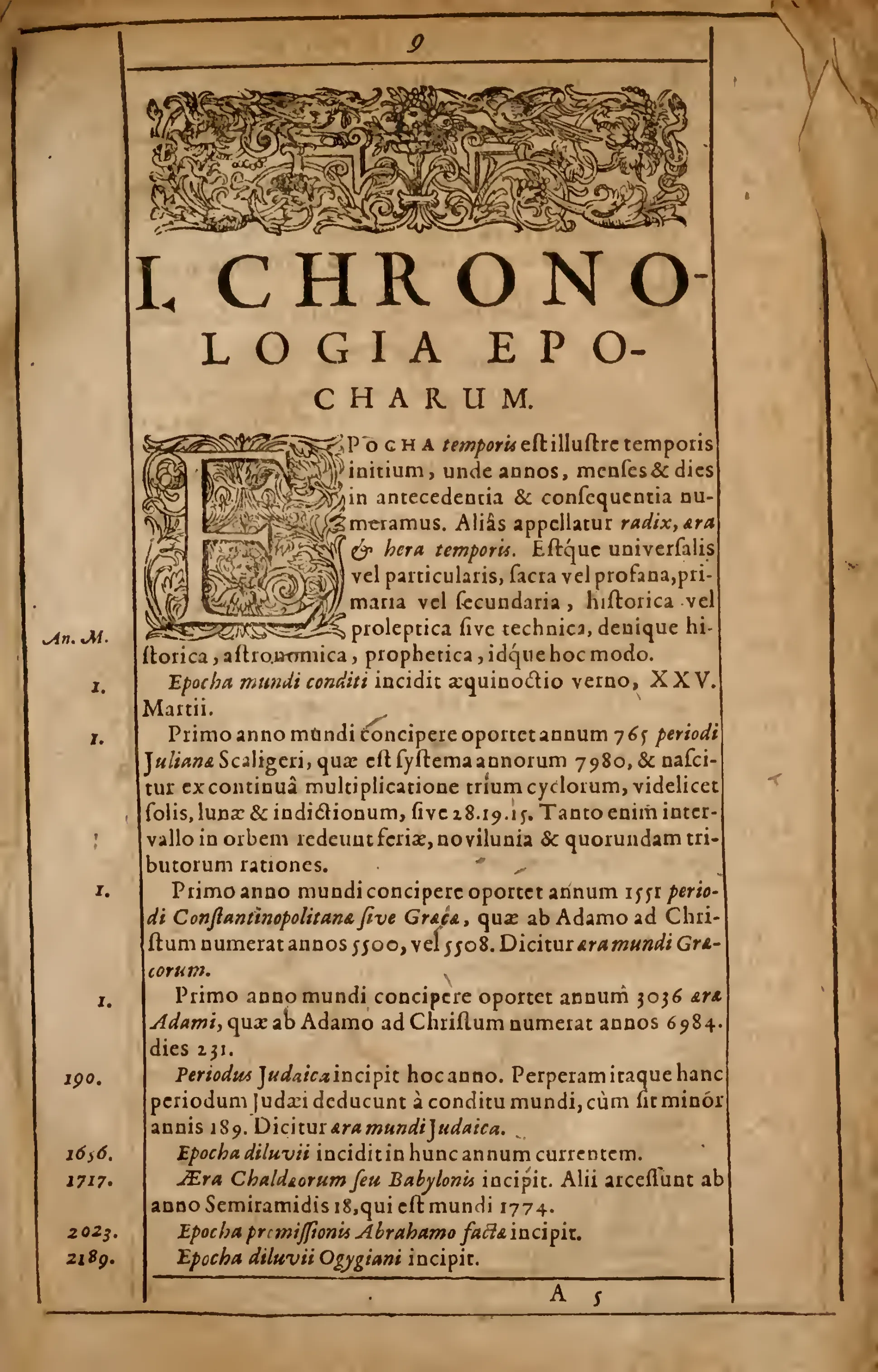
Opening the first chronology, Alsted defines the epocha as the "illustrious beginning" from which years, months, and days are counted backward and forward — the radix of time. The tabulated entries that follow, from Creation to Scaliger's Julian Period, supply the computational grid on which heterogeneous systems of reckoning could be aligned. Source ↗.
The vocabulary of ordering is inseparable from this technical lexicon, since Alsted's method proceeds by definition followed by classification into classes, orders, and ages. Succession itself becomes a chronological form applicable well beyond the reigns of kings: the transmission of doctrine among the Jews is presented as a datable chain, kabbalists being so called among the Jews by a special prerogative, namely those who propagated the sacred doctrine from Mount Sinai down to the completion of the Talmud, in the order he then sets out, Kabbalistæ Iudæis peculiari prærogativâ dicuntur, qui à monte Sinai usque ad Talmud confectum propagarunt doctrinam sacram, hoc ordine. The same procedure governs ecclesiastical materials, where the Roman bishops are, in his formulation, rightly distributed into three classes, the first containing simple pastors without mitres and nearly all of them martyrs, from Linus to Sylvester I, that is from the year of Christ 70 to the year 314, Episcopi Romani rectè distribuntur in tres classes. Prima continet pastores simplices sine mithris, & ferè martyres, à Lino ad Sylvestrum I, id est ab anno Chr. 70 ad an. 314. Classification is thus not ornament laid over the tables but the means by which heterogeneous successions are rendered commensurable and memorable.
The lexicon of the discipline also includes its own catalogue of hazards, and here the work is at its most explicitly philological. First among the pitfalls Alsted enumerates is homonymy: among historians and chronologers there is great confusion of proper names, for there are many Saturns, Joves, Mercuries, Herculeses, Ulysseses, Apollos, Ogygeses, Atlases, Dariuses, Xerxeses, Osirises, Artaxerxeses, Pharaohs, Antiochuses, Ptolemies, Caesars, and Herods, Prin- cipio, apud historicos & chronologos magna est nominum propriorum confusio. Sunt enim multi Saturni, Ioves, Mercurii, Hercu- les, Ulysses, Apollines, Ioves, Ogyges, Atlan- tes, Darii, Xerxes, Osirides, Artaxerxes, Pha- raones, Antiochi, Ptolemæi, Cæsares, He- rodes, &c.. The series of observations closes with an admission of method's limits and with the weaving metaphor that governs the whole enterprise: thirteenth, we are often led by conjectures in noting time, and whoever does not observe all these things will fare with little success in reading, weaving, or unweaving chronologies, Decimotertio, sæpe ducimur conjecturis in adnotatione temporis. Quæ omnia si quis non oblervet, parum feliciter in chronologiis legendis, texendis, vel retexendis versabitur. The verbs texere and retexere cast chronology as a fabric that can be woven and unpicked, a craft vocabulary that sits alongside the language of roots and cycles.
In this setting, chronology is simultaneously philological, astronomical, biblical, and confessional. Its "universal" scope does not signify modern neutrality: the ordering of time is also an argument about the authority of Scripture, the reliability of ancient historians, the succession of churches and empires, and the providential intelligibility of history. Several of the work's keywords are doctrinal rather than calendrical, and are defined with the same formal apparatus as epocha — thus the Mystery of Iniquity is defined as the doctrine of the Roman antichrist, which gathered its strength in the manner he goes on to date, Mysterium iniquitatis. est doctrina Romani antichristi, quæ hoc modo vires sumsit, so that a Pauline phrase becomes the heading of a datable historical process. Alsted's terminology thus joins the Herborn ideal of methodical encyclopaedism to a Reformed account of sacred and profane time.
What Alsted Printed at Herborn in 1624: The Thesaurus chronologiae in Brief
The Thesaurus chronologiae is a Latin technical treatise in universal and historical chronology by Johann Heinrich Alsted (1588–1638), printed at Herborn—Herbonae Nassoviorum—in 1624. Its stated purpose is to place the entire series of times and histories before the reader and to organize chronological knowledge through biblical testimony, astronomical calculation, synchronism, and mnemonic classification. The astronomical component is assigned a distinctly evidentiary role: eclipses, Alsted writes, are the most excellent treasury of astronomy and chronology, being indeed the infallible bases and characters of time, Eclipses sunt præstantissimus astronomiæ & chronologiæ Ethesaurus, quippe bases, & characteres temporis infallibiles, a claim that explains why the celestial chapters stand at the end of the work as its verification apparatus rather than as an appendix of curiosities. It belongs to the learned culture of the Reformed Hohe Schule at Herborn and to Alsted's broader program of encyclopaedic and pedagogical reform.
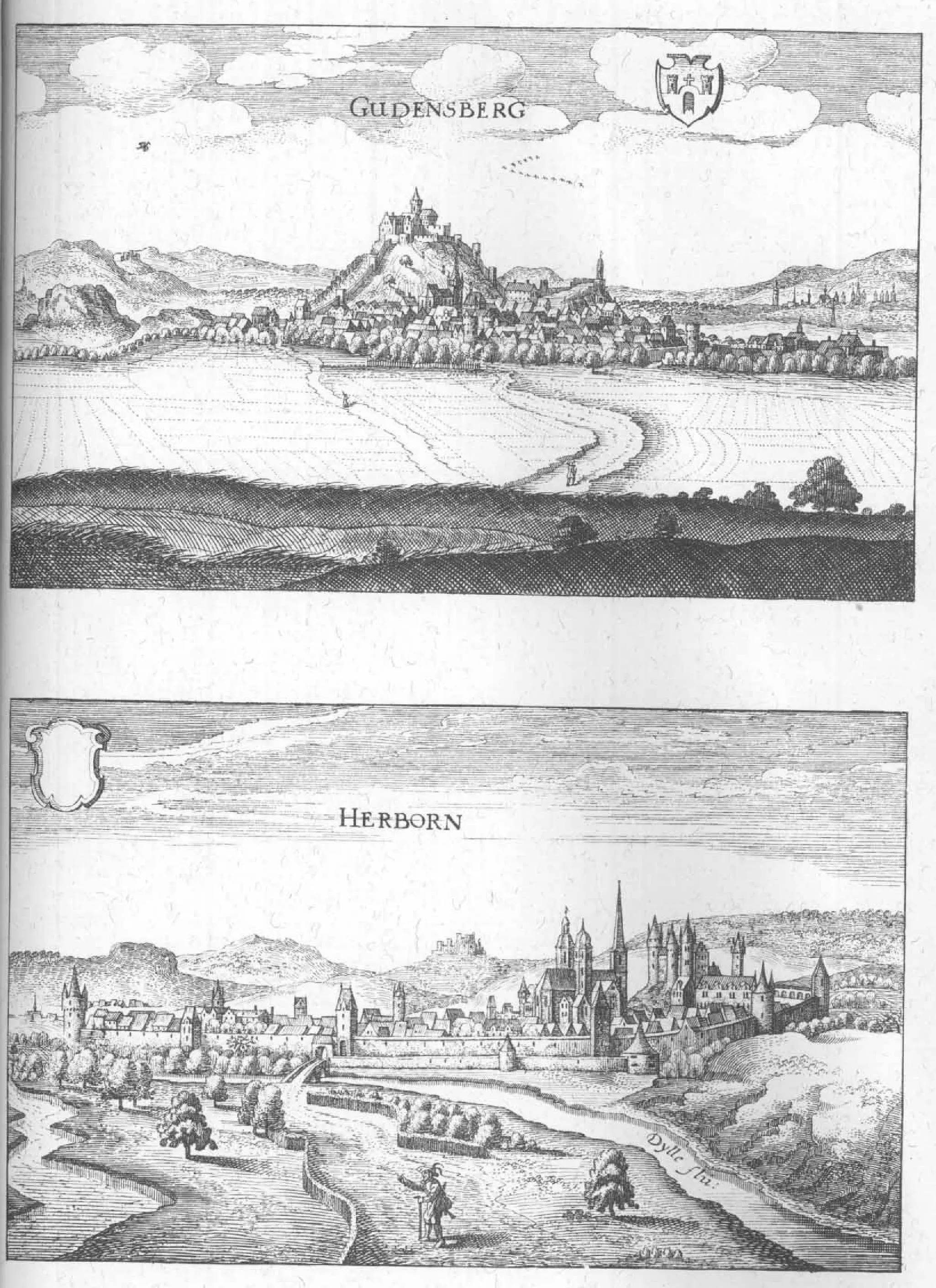
A seventeenth-century engraved town prospect labelled "HERBORN": the Nassau town whose Reformed Hohe Schule was the institutional setting for Alsted's teaching and for the 1624 printing of the Thesaurus chronologiae. Its clustered roofs, walls, and church-dominated skyline place his encyclopaedic project in a compact town rather than an abstract republic of letters. Source ↗.
The 1624 object is catalogued as an octavo of 340, [36] pages, with a partly folding table, an index, text within line borders, and signatures A–Z⁸ 2A⁴. The catalogue gives the printer or publisher as "[s.n.]"; a named printer for the 1624 issue has not been securely established. Christoph Corvin, the principal Herborn academic printer, died in 1620, and the Corvinus heirs continued the business, but the surviving catalogue evidence does not prove that they printed the 1624 issue.
The work is distinct from Gerard Mercator's Chronologia, first published at Cologne in 1569. Mercator's chronology belongs to the earlier generation of technical chronography and became foundational for the chronological component of his Atlas; Alsted's Herborn treatise is a later, larger Reformed work that participates in the same scholarly field. A complete translation of the Thesaurus chronologiae has not been located. A partial English translation, An Account of Some Remarkable Eclipses, was printed in London for George Conyers in 1699 and consists of four pages; that the sole documented English afterlife should have been drawn from the eclipse material is consistent with the standing Alsted himself gave to eclipses as the infallible characters of time.
Why the Thesaurus chronologiae Matters: Alsted, Scaliger, and Confessional Chronology
The Thesaurus chronologiae matters because it brings together several central forms of early modern learned practice: biblical exegesis, astronomical calculation, antiquarian source criticism, synchronistic arrangement, mnemonic classification, and confessional historiography. Chronology in this period was not merely auxiliary dating. It was a discipline for adjudicating the order of sacred history, ancient kingdoms, ecclesiastical succession, imperial authority, and the credibility of competing historical witnesses. That adjudicative function is visible in the categories the work creates: those are called witnesses of truth, Alsted writes, who from the beginning of the world down to our own age asserted the truth of the heavenly doctrine, Testes veritatis dicuntur, qui veritatem coelestis doctrinæ inde ab initi mundi ad nostram usque ætatem asseruerunt, a rubric that converts the question of doctrinal legitimacy into a datable succession running parallel to the papal one. The same convergence appears where confessional historiography is weighed as historiography: the Magdeburg Centuries can stand for all of them, he remarks, and are to be compared with the Annals of Baronius, Instar omnium possunt esse Centuriæ Magdeburgenses, quæ conferendæ sunt cum Annalibus Baronii. Providential periodization supplies the widest frame, and Alsted reports it as the received scheme of many historians, who establish three intervals according to the tradition of the house of Elijah, which runs thus: the world will endure six thousand years — two thousand void, two thousand law, two thousand Christ, Multi historici constitunt tria intervalla juxta traditionem domus Eliæ, quæ sic habet: Sex millia annorum durabit mundus: duo millia inane, duo millia lex, duo millia Christus. Alsted's universalizing title expresses the Herborn ambition to organize these materials into a methodically usable whole.
The principal modern interpretation of Alsted comes from Howard Hotson. In Johann Heinrich Alsted 1588–1638: Between Renaissance, Reformation, and Universal Reform, Hotson presents Alsted as a culmination of Herborn's intellectual achievement and places him within the movement for further Reformation. The book resists reducing Alsted to a single identity as either encyclopaedist, Reformed scholastic, or millenarian. Instead, it emphasizes the interaction of encyclopaedic method, Ramist and Lullist techniques, confessional orthodoxy, educational reform, and the political crises of the early seventeenth century. The chronology of theology in the Thesaurus shows that interaction at work in a single table, its fifth age of theology beginning under Luther, where there are Papist, Lutheran, and Orthodox theologians, of whom the chief are those he then lists, Quinta etas theologia incipit sub Luthero, ubi sunt theologi Papistæ, Lutherani, & Orthodoxi, è quibus præcipui sunt isti — the reservation of Orthodoxi for the Reformed making the classificatory scheme itself a confessional statement. The polemical anatomy of error is likewise cast in the form of a numbered definition: heretics and sectarians, he holds, have five byways under which they hope to hide themselves and impose upon men, namely the judgement of human reason, the dogmas of the philosophers, the traditions of the elders, enthusiasms, and miracles, Hæretici & sectarii habent quinque seu diverticula, sub quibus latere se posse; & hominibus imponere sperant: videl. judicium rationis humanæ, dogmata philosophorum, traditiones majorum, enthusiasmos & miracula.
Hotson's Paradise Postponed concentrates on the development of Alsted's millenarianism. Its argument is that Alsted's eschatological expectations changed through an interaction between learned, astrological, alchemical, and spiritualist traditions and the historical shock of the Bohemian Revolt and the Thirty Years' War. That shock is registered in the annals of the Thesaurus in the author's own voice, under the year 1618, when the Bohemian and Germanic war arises, which even today afflicts our fatherland Germany, and has carried off more than eighty thousand, 1618. Bellum Bohemicum & Germanicum oritur, quod hodieque affligit patriam nostram Germaniam, & sustulit supra 80000. This interpretation is important for the Thesaurus because it prevents apocalyptic chronology from being treated as an ornamental appendix to otherwise neutral historical calculation. Prophetic numbers, papal succession, imperial history, and the dating of eschatological events belong to the same confessional and providential ordering of time. The prophetic intervals are handled with the same arithmetic as the civil ones: the persecutors will trample the church for 1260 years, from the year of Christ 362 to the year 1622, and throughout this whole time the two witnesses, that is the Scriptures of the Old and New Testament, will prophesy in sackcloth, calcabunt ecclesiam annis 1260, inde ab anno Christi 362 usque ad annum 1622: & toto hoc tempore in sacco prophetabunt duo testes, i.e. Scripturæ V. & N. T, and the calculation is carried forward by subtraction, so that if from this sum the thousand years of Apocalypse 20 be subtracted, we shall arrive at the year of Christ 1694, whence he gathers that the seven phials are to be poured out from the year 1517 to the year 1694, Ab hac summa si subducantur mille anni Apoc. 20. perveniemus ad annum Christi 1694. Unde colligimus, septem phialas inde ab anno 1517 usque ad annum 1694 effundendas. The confessional identification that underwrites this reckoning is stated in the papal chronology itself, whose third class contains the Popes, or rather those constituting the body of the great antichrist, from Boniface III down to the year of Christ 1623, Tertia classis continet Papas, vel potiùs , constituentes corpus antichristi magni, inde à Bonifacio III usque ad an. Chr. 1623; within that class the Apocalypse's figure of the great whore becomes a dated regime, the entry for 855 reading: John VIII, or rather Pope Joan, two years, five months, four days, from which Pope begins the reign of the great whore, up to Sylvester II, 855. Johannes VIII, sive potiùs Johanna Papissa. an.2.m.5. d.4. Ab hoc Papâ incipit regnum meretricis magnæ usque ad Sylvestrum II. Hæc meretrix dæmoniacum adjurans, interrogabat quando dæmon recedere vellet: cui diabolus respondit,.
Anthony Grafton supplies the wider history of the discipline. His account of Joseph Scaliger emphasizes the methodological importance of the Julian Period, the critical examination of historical sources, and the recognition that non-biblical evidence could possess independent historical value. Grafton also describes a later tendency for chronological disputes to be argued increasingly through theological commitments. Alsted's work belongs precisely at this point of tension: it inherits the technical and astronomical resources of Scaligeran chronology while redeploying them within an explicitly Reformed and scripturally ordered universal history. His independence from Scaliger on particular questions is stated openly, as when two dynasties of Chaldaeans and Arabs in Babylonia are recorded by Joseph Scaliger as having preceded the Flood, but we do not linger over them, and hold them suspect, Commemorantur à Josepho Scaligero duæ dynastiæ Chaldæorum & Arabum in Babyloniâ, quæ antecesserint diluvium. Verùm illas non moramur, sed habemus suspectas — a dissent in which the scriptural boundary of admissible antiquity does the critical work. The same double commitment governs his handling of Hebrew philology, where he rejects a widely held position on textual grounds and then rests his own on the nature of the language: it is false that the Hebrew points were invented by the Masoretes; I judge thus, that the Hebrew points always existed from the very beginning of this language, although they were not always expressed in writing, falsum est, puncta Hebræorum à Massorethis inventa esse. Ego sic judico: Puncta Hebræorum semper fuerunt inde ib initio hujus linguæ, tametsi non semper scribendo expressa fuerunt. Against the whole apparatus stands a self-limiting epistemology that Alsted states as his first rule: God alone has reserved this to his majesty, that he should know exactly the points of time both past and future, and it cannot therefore be that a man, however perspicacious, should weave an accurate chronology, much less define the moments of future time, I. Solus Deus majestati suæ hoc servavit, ut puncta temporis tum præteriti, tum futuri exactè sciat. Fieri itaque non potest, ut homo, quantumvis perspicax, texat accuratam Chronologiam, nedum definiat futuri temporis momenta — the weaving metaphor of the prefatory observations returning here as the measure of what human weaving cannot achieve.
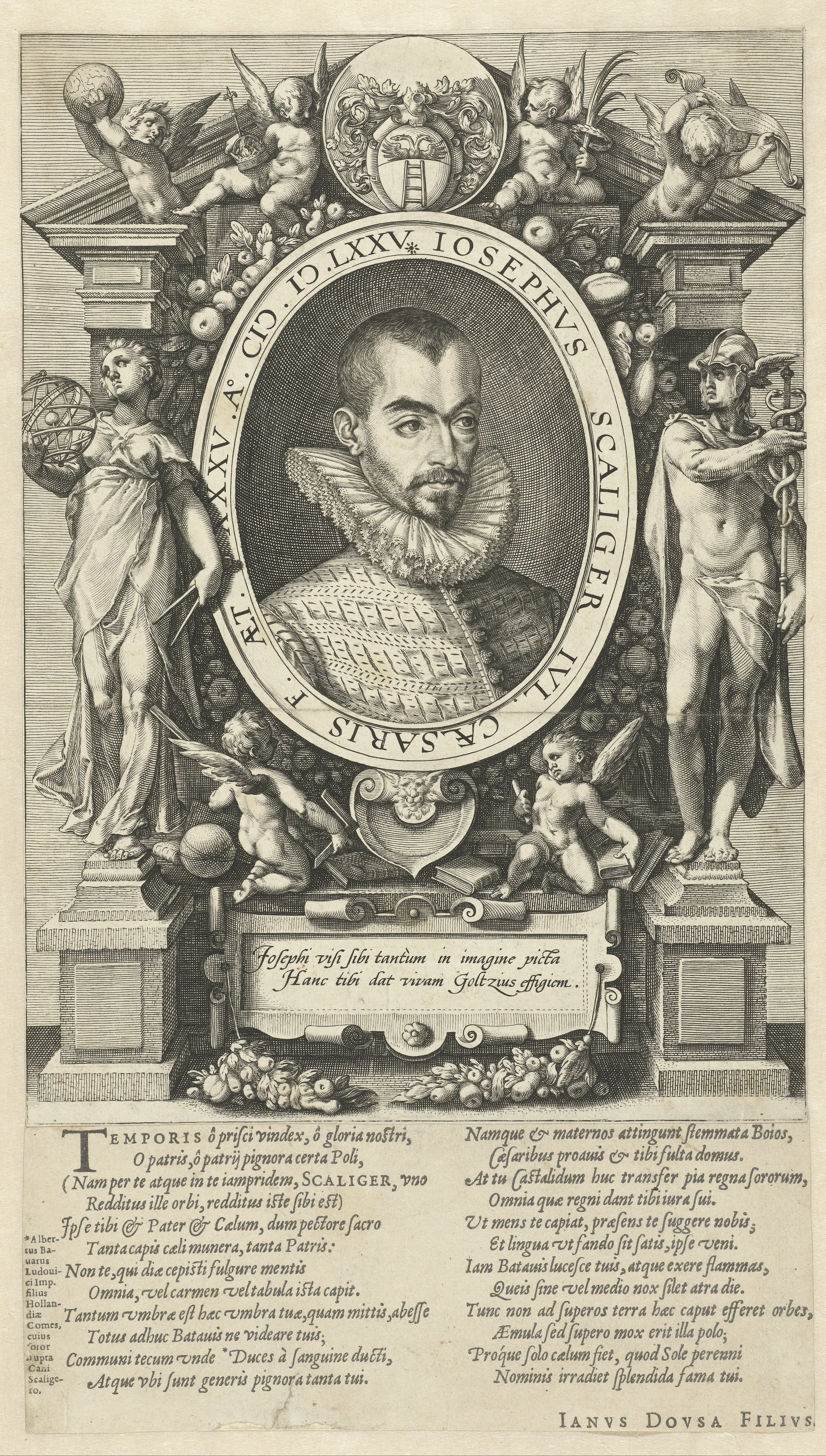
An engraved portrait of Josephus Scaliger, after Hendrick Goltzius. Scaliger is the predecessor at the centre of Grafton's history of the discipline, and the source of the technical apparatus — Julian-period calculation, calendrical cycles, the critical comparison of sources — that Alsted's Thesaurus chronologiae inherited and selectively revised. Source ↗.
A related historiographical strand concerns the intellectual architecture of Herborn. Recent scholarship treats Alsted's encyclopaedism as a deliberate synthesis of Aristotelian, Ramist, and Lullist methods rather than as an undifferentiated compilation. That synthesis explains why the Thesaurus is structured as a treasury and why chronology appears as an ordered method of relations, classes, cycles, and synchronisms. It also explains why divergence among authorities is printed rather than resolved by fiat: where the reckonings cannot be reconciled, the disagreement is entered as data, as when the Viennese mathematicians' table is quoted to the effect that the computation of the years down to the Messiah is various, Hoc loco Viennenses ista subnectunt: Varia est supputatio annorum usque ad Messiam. The work is therefore significant not only for the history of chronology but also for the history of method, pedagogy, encyclopaedism, and Protestant learned institutions.
The Mercator problem is bibliographical as well as historiographical. Mercator's Chronologia, published at Cologne in 1569, is an earlier and distinct work by a different author. Its chronological project later formed part of the architecture of the Atlas. Alsted's Herborn Thesaurus should not be catalogued as Mercator's Chronologia or as an edition of it. Mercator's work is best treated as an important predecessor and authority within the technical field from which Alsted worked; the precise extent of Alsted's textual borrowing, however, requires direct comparative collation rather than assumption. The surviving catalogue evidence is sufficient to establish distinct authorship, title, place, and date, but not to settle every question of intertextual dependence.
The historiography remains uneven. Alsted has received substantial treatment as an encyclopaedist and millenarian, while the Thesaurus chronologiae itself has not generated an equally developed monographic textual history. Questions concerning its dedicatee, printer, title-page state, prefatory apparatus, reception in Lutheran territories, and the exact transmission of its tables remain open. Those gaps are bibliographical findings, not grounds for conjectural reconstruction.
From Herborn 1624 to London 1699: Editions, Printers, and Afterlife of the Thesaurus chronologiae
The 1624 bibliographical record identifies the author as "Johanne-Henrico Alstedio" or Johann Heinrich Alsted and gives the title as Thesaurus chronologiae: in quo universa temporum & historiarum series in omni vitae genere ponitur ob oculos. The imprint is Herbonae Nassoviorum, 1624. The work is in Latin and is catalogued as 340, [36] pages, with a partly folding table, in octavo format, measuring approximately 19 cm. The recorded signatures are A–Z⁸ 2A⁴; the catalogue also notes an index and text set within line borders. A digitized copy is available through the Duke University full-view record associated with WorldCat OCLC 11653530, while the Internet Archive record identifies the item with the call number E A463TH and the external identifier urn:oclc:record:1085640419. These identifiers describe accessible records and digitized witnesses; they should not be confused with a definitive census of surviving copies.
The record does not securely preserve the full 1624 title-page transcription. The expanded title survives clearly in records for later editions: the 1628 issue is described as Editio secunda limata, & aucta and adds the clause concerning foundations drawn from Sacred Letters and astronomical calculation, together with the classification of homogeneous titles for memory. The 1637 record gives Herbornae Nassoviorum, 610 pages, and [15] leaves. A fourth edition dated 1650 is recorded as 500 pages and is identified as digitized from the Bavarian State Library. These later records establish an active transmission history extending beyond Alsted's death in 1638, but they do not by themselves establish the exact contents of every issue or the precise relationship between reset and revised formes. That a second edition should advertise itself as polished and augmented is at least consonant with the author's own closing estimate of his text, that there are indeed other things too, especially in the numbers, which call for the sponge, but of such a kind that anyone conversant in history even below mediocrity can gather them up, Sunt quidem & alia, præsertim in numeris, quæ spongiam requirunt: sed ita comparata, ut quilibet infra mediocritatem versatus in historiâ possit illa cumculare; the remark shows the numerical series being presented as revisable by the competent reader rather than as fixed.
The Corvinus connection requires careful chronological qualification. Christoph Corvin, also known as Christoph Rab or Rabe, served as academic printer at Herborn from 1585 and died there on 19 January 1620. His press operated under institutional oversight that included strict prior censorship by the Herborn school council or the count. The business was continued by his heirs, and the heirs' publishing activity is documented in the 1630s. Nevertheless, the 1624 Thesaurus record names no printer and supplies "[s.n.]"; the attribution of the first issue specifically to "typis Corvinianis" remains unconfirmed. No printer's device, shared Frankfurt or Hanau issue, or named successor has been securely established from the available catalogue evidence. The treatise itself, characteristically, assigns the art on which its own diffusion depended to a dated place in the German succession, recording that under Frederick III, Johannes Gutenberg of Strassburg invented the typographic art at Strassburg, and thence to Mainz, Sub Friderico III. Johannes Guttenberg Argentinensis artem typographicam invenit Argentinæ. Inde Moguntiam — one entry among the catalogues of inventors through which the work converts the history of learning into datable succession.
A named dedicatee, patron, privilege, prefatory letter, or formal receiving institution has not been located. The same evidentiary limitation applies to a contemporary reply-chain, refutation, or official proceeding directed specifically against the Thesaurus chronologiae. Alsted himself, however, plainly expected contradiction and wrote defensively into the text, observing that because he sees various judgements prepared against his prophetic chronology, it seemed best that he should fortify himself with the following shield of Holy Scripture, VII. Quia video varia parata judicia meæ Chronologiæ propheticæ, visum fuit faciendum ut sequenti clypeo Sacræ Scripturæ me munirem; the anticipation is internal evidence of a polemical horizon, not evidence that any particular attack followed. The institutional censorship attached to the Herborn press is documented, but no reliable evidence has been found that this work itself was placed on the Roman Index or formally suppressed in Lutheran territories. Mercator's earlier Chronologia belongs to a different bibliographical history and was condemned at Rome; that fact is relevant to the confessional reception of Protestant chronography but cannot be transferred to Alsted's book without direct evidence.
The catalogued index is itself part of the work's argument as much as of its furniture, since its entries carry the confessional case in compressed form: the heading for the papacy directs the reader to where the chronology and classes of the Roman pontiffs are recited, and adds that many of the popes were heretics, schismatics, necromancers, Simoniacs, lecherous, and so forth, Papa. Chronologia & classes Pontificum Romanorum recitantur. 146. & seqq. Multi ex Papis fuerunt hæretici, schismatici, hæretici, necromantici, Simoniaci, libidinosi &c. The finding apparatus that makes the treasury usable thus also makes it polemically legible at a glance, in keeping with the title's promise to set the series of times before the eyes.
The work stands within Alsted's larger program of Reformed encyclopaedism. Modern scholarship characterizes that program as an attempt to harmonize Aristotelian, Ramist, Lullist, and mnemonic procedures for the pedagogical reform of knowledge. The Thesaurus chronologiae should accordingly be read beside Alsted's encyclopaedic, theological, mnemonic, and apocalyptic writings, while keeping its specific bibliographical identity separate from those works. Its later English afterlife is partial rather than complete: the documented 1699 London publication translates a short selection concerning remarkable eclipses, not the entire treatise.
Working Through the Fifty Chronologies: Alsted's Structure, Argument, and Evidence
Front matter: a table made for daily use
The work opens not with argument but with instrumentation. Before the preface has said a word about what chronology is, the reader is handed a LATERCULUM, a synchronistic ruled table that carries each year from 1623 to 1650 across parallel columns of the year of the world, the indiction, the solar and lunar cycles, the Julian and Judaic periods, the Olympiad, and the year from the founding of the city — a table that Alsted describes as serving daily use, quotidiano usui inserviens, and as exhibiting the synchronisms of the various epochs, Exhibens synchronismos variarum epocharum,. Two features of the book's whole conception are already visible in this front-matter apparatus. The first is that the treasury is designed to be used rather than read through: the labour of conversion between incommensurable reckonings is performed once, in print, so that the possessor of the volume need only look across a row. The second is that the present moment is the point of entry. The reckoner begins at 1623, the year of computation repeatedly invoked in the text and one year short of the imprint, so that the reader's own year is the column from which all antiquity is reached backward.
The preface then supplies the theory for which the table is the practice. History is praised for its double utility and pleasure and at once subordinated to the discipline that renders it intelligible, in the programmatic formulation already discussed above, where truth is called the soul of history and chronology its light and eye, and where the chronology intended is specifically the kind that so exhibits the continuous series of all ages and centuries that whoever reads it may at once embrace its idea in his mind. The organic metaphor does careful work: as soul and eye, truth and chronology are not two goods of equal rank but a substance and the faculty by which it is apprehended. What follows from the demand for immediate mental grasp — statim, at once — is the tabular form of the entire volume. A narrative history cannot be seized in one act of attention; a ruled column can. The mnemonic requirement, not merely a taste for compendia, dictates the typographic disposition of the book.
Against that confident epistemology the thirteen numbered observationes mount an unusually candid inventory of everything that obstructs it: homonymous ancient names, national orthographies, double toponyms, restored reigns counted twice, round numbers substituted for exact, inclusive against exclusive reckoning of intervals, disagreement over whether a reign is dated from its beginning, middle, or end, the divergence of the vulgar era from the true, the disputed status of antipopes and anti-emperors, incomplete years, and several rulers within one year. The series closes on an admission that qualifies the whole enterprise, the thirteenth observation conceding that we are often led by conjectures in noting the time and warning that whoever fails to observe all these things will fare with little success in reading, weaving, or unweaving chronologies. That textile vocabulary of texere and retexere concedes what the eye-metaphor had obscured. A woven fabric is a made thing; it can be unpicked and rewoven by another hand. Chronology, on this account, is not simply seen but constructed, and the same technical competence that produces a series is required to undo a rival's. The tension between vision and craft, between a series grasped at a glance and a series assembled out of conjecture, is not resolved in the preface; it is printed.
Epochs, ages of the world, and the sacred tables
The first chapter converts these cautions into apparatus, defining the epoch as a computational root and then running the epochs in order from the creation, placed at the vernal equinox, through the Julian period of Scaliger, the Flood, Abraham, the Exodus, Troy, the Olympiads, Rome, Nabonassar, the Captivity, the Seleucid eras, and the Nativity, to the post-Christian series of Diocletian, the indictions, the Hegira, Yazdegird, the Alfonsine and the Gregorian. One remark within that list makes explicit that era-choice is a moral and confessional act and not a mere convenience of reckoning, namely that Dionysius Exiguus was unwilling to number the years from the reign of a persecutor and so introduced the epoch from the Incarnation of Christ, quo Dionysius Exiguus noluit annos numerare ab imperio persecutoris, introductâ epochâ ab incarnatione Christi. The Diocletianic era, elsewhere given its aliases as the era of the Martyrs and of the Copts, thus stands in the table as a reckoning whose arithmetic is sound and whose root is impious. The chapter then closes by setting rival periodizations side by side, among them the received scheme that Augustine posits six ages of this world as of a single man, through which this age will endure, just as it was founded in six days, Augustinus constituit sex hujus mundi velut unius hominis ætates, quibus hoc seculum sit duraturum, quemadmodum sex diebus est couditum — a hexaemeral analogy faithfully reproduced and then quietly displaced by Alsted's own six intervals and eight chronological chains, which are keyed to the succession of monarchies rather than to the days of creation. The organic figure of the ages of one man migrates from salvation history into political history without being abandoned.
That same figure governs the sacred tables. The affairs of the Jews from Adam to the destruction of the Temple by Titus in the year of the world 4017 are divided into four ages, the first of paternal power, like innocent infancy, the second of judicial power, like vigorous adolescence, Res Iudæorum inde ab Adamo usque ad excidium templi per Titum anno M. 4017 in quatuor ætates dividi possunt. Prima est potestatis patriæ, & est velut infantia innocens: secunda est potestatis judiciariæ, & est velut adolescentia vegeta, with the regal and pontifical ages completing the sequence as manhood and senescence. The classification looks purely mnemonic, but the analogy carries an argument: a constitutional sequence ending in the priestly régime is thereby assigned to decrepitude, and the fall of the Temple becomes the natural term of an organism rather than an accident of Roman arms. The polemical potential of periodization is here embedded in what presents itself as a neutral aid to memory.
Prophetic numbers and the polemical use of an interval
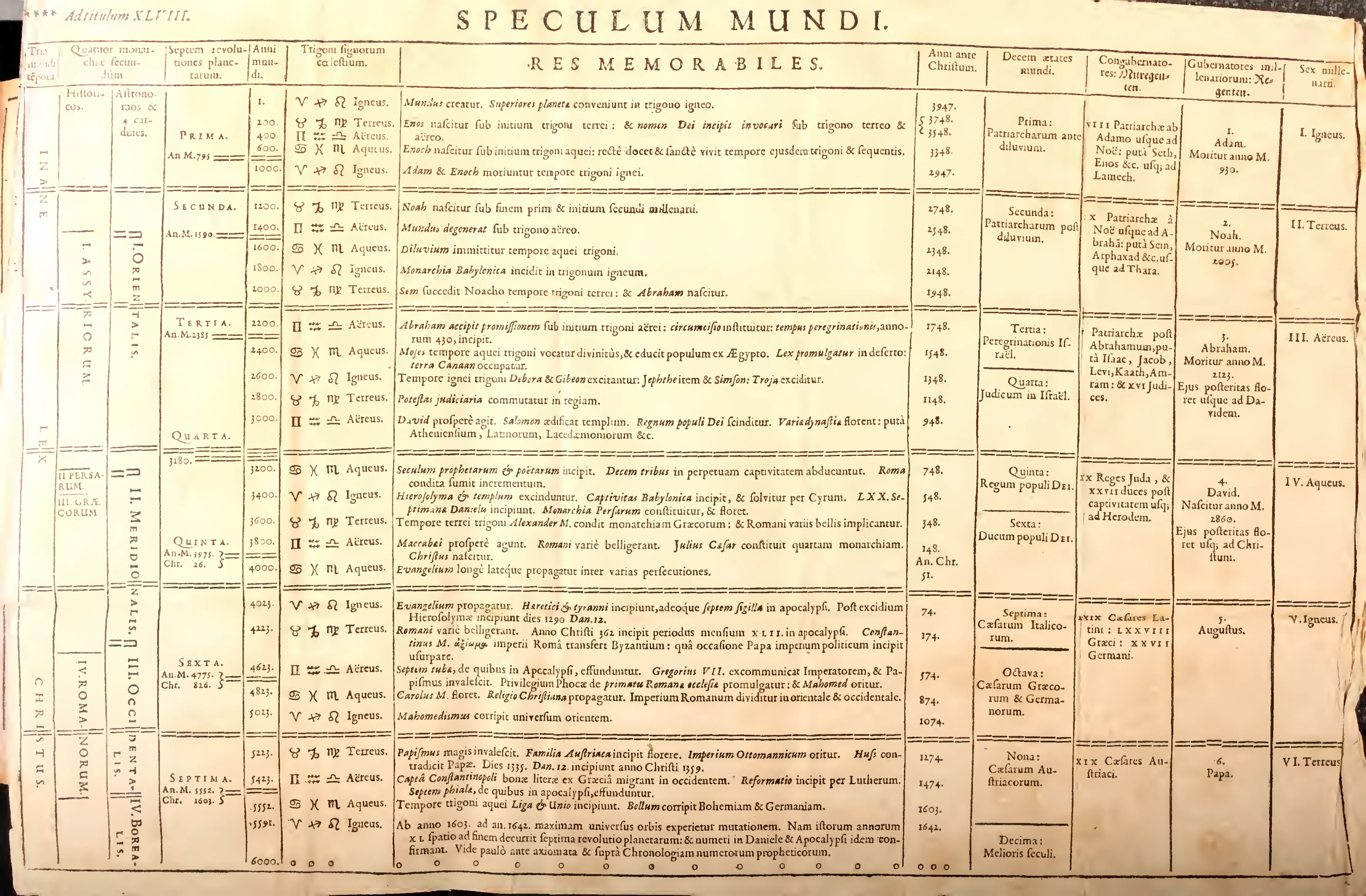
“SPECULUM MUNDI” makes chronology a ruled synoptic machine, aligning planetary trigon cycles, Anno Mundi reckoning, monarchies, “RES MEMORABILES,” and the biblical ages in one field. By setting Reformation history, apocalyptic intervals, and the Bohemian-German war inside a grid running from Creation to the year 6000, it makes duration itself a confessional argument. Source ↗.
That polemical potential becomes wholly explicit in the chronology of prophetic numbers, where Jeremiah's seventy years, Ezekiel's days, Daniel's weeks, and the Apocalyptic intervals are worked into dated totals. The computation already noticed above is the governing instance: the 1260 years during which the persecutors trample the church are run from the year of Christ 362 to the year 1622, with the two witnesses prophesying in sackcloth throughout. The date is arresting because the table places the crisis of the witnesses in the years immediately surrounding the book's own production; the handbook computes its own moment into the prophecy it tabulates, and the identification of the witnesses with the two Testaments rather than with persons converts the Apocalypse's figures into the Reformed appeal to Scripture alone. The number 666 is handled by the same fusion of arithmetic with jurisdiction, the threefold numeral being matched to a threefold claim, for the Pope claims for himself a power in heaven, which he opens and shuts at his pleasure, on earth, which he bestows at his pleasure, and in hell, into which he thrusts those whom he sees opposing his tyranny, Papa tibi vendicat potestatem in cælo, quod claudit & aperit pro suo lubitu: in terrâ, quam donat pro suo lubitu: in inferno, in quem detrudit, quos suæ tyraunidi videt adversari. Exegesis of a cipher becomes a description of canonical and temporal jurisdiction, dated in the same chapter to the Cæsaro-Papatus of 606. Immediately after producing such reckonings, and the terminal years that follow from them, Alsted enters the customary prophylactic against the charge of date-setting, wishing these things to be taken so that they serve to illustrate the prophecy of Daniel and the Apocalypse and not to feed curiosity, since he does not thereby define the end of the world — the disclaimer discussed below among the works of further reading. The disclaimer and the arithmetic sit in unresolved tension: the numbers are firm, the claim upon them modest, and the modesty is secured by relocating the authority for the dates from the chronologer to the prophet.
The polemical use of dating recurs where the chronology of Jubilees turns upon the papal institution, and there the evidence is the interval itself: Boniface VIII instituted that a jubilee be celebrated every hundredth year for obtaining full remission of all sins, but afterwards Clement VI, impatient of delay through greed for gain, reduced the jubilee to the fiftieth year, Tum enim Bonifacius VIII instituit, ut centesimo quoque anno celebraretur jubilæus ad obtinendum plenam remissionem omnium peccatorum. Verùm postea Clemens VI propter lucri cupidinem impatiens moræ jubilæum ad annum 50 reduxit. The successive contractions of the cycle, carried down to 1600, are made to demonstrate avarice without any need for invective; the shrinking number is the accusation. Chronological data here function as forensic evidence, which is precisely the adjudicative office that the discipline claimed.
The four monarchies, the migrations, and the chronology of learning
From the Jubilees the work passes to the grid of political history, announcing that there are four fated kingdoms and supreme empires of the world, Quatuor sunt regna fatalia, summaque mundi imperia,, and ruling the Assyrian, Persian, Greek, and Roman successions into parallel columns that run to Ferdinand II. The transition from the Roman monarchy to the modern kingdoms is narrated through the migrations, with the majesty of the Empire overthrown and various peoples pouring out of northern Germany — which Jordanes rightly called the sheath and workshop of peoples and nations — onto Roman soil, the city itself being taken and plundered, Sic itaque Imperii majestate eversâ variæ gentes è Germaniâ septentrionali (quam Iornandes meritò vaginam & officinam populorum nationumque dixit) in Romanum solum sele effuderunt, ipsâ etiam urbe captâ atque direptâ. The vagina gentium topos, endorsed with meritò, makes the German north the productive matrix of European peoples and the migrations the hinge on which universal history turns — a patriotic historiography that consorts easily with the chapter tracing the kings of Germany back to Tuisco.
The chronology of learning applies the same logic of unbroken succession to institutions. The schools of the patriarchs, private and domestic, are said to have begun after the year of the world 30, when Abel is reported to have been born, and to have been preserved in the family of Seth until the Flood, and in these schools theology above all and astrology were handed down, Scholapatriarcharum privata & domestica coeperunt post an. M. 30, quo Abel natus perhibetur: & in familiâ Sethi fuerunt conservatæ usque ad diluvium. In his scholis theologia inprimis & astrologia fuerunt traditæ. Pedagogy is thus given an antediluvian origin, and the two disciplines named — theology and astrology — are exactly the two on which the Thesaurus itself rests, so that the curriculum of Seth's household prefigures the method of the book that records it. The long series of academies that follows, from Bologna and Paris to Leiden, Franeker, and Geneva, terminates in the author's own institution, the school of Herborn being established by John, count of Nassau, Schola Herbornensis instituitur à Johanne Comite Nassovio under the year 1585. The entry is unemphatic, and its restraint is instructive: the Reformed academy of Nassau appears not as a claim but as one dated link in a succession reaching back before the Flood, which is the strongest form the argument could take within the conventions of a tabulated series.
The papal classes and the ledger of judgments
From the succession of schools the work turns to the succession of bishops, and there the chronology begins not with a date but with an act of division, and the division carries the argument. The tripartition already set out above — the first class containing the simple pastors without mitres, almost all of them martyrs, from Linus to Sylvester I, that is from the year of Christ 70 to the year 314 — is claimed with the adverb rectè, as drawn out of the record rather than imposed upon it, and the criteria of membership in that first class are deliberately material and biographical rather than doctrinal: the absence of the mitre and the presence of martyrdom. A single item of episcopal dress is made to carry the whole weight of an ecclesiological periodization, so that the later accumulation of jurisdiction can be dated by the moment when pastors began to be adorned. The bracket 70–314 closes precisely where the pre-Constantinian church closes, and the terminus at Sylvester I places the watershed at the pontificate around which the disputed grant of Constantine had long been argued, without the series having to argue it: the class boundary does the polemical work that a discursive refutation would otherwise require. The second and third classes then follow as declensions from this baseline, the third gathering the popes who in his reckoning constitute the body of the great Antichrist down to his own present, so that the papal succession is at once a list of names, a scheme of ages, and a prophetic identification.
Within the third class the apocalyptic labels are themselves converted into reigns with termini, which is the most revealing procedure of the chapter. The entry under the year 855, already before us, names John VIII, or rather Pope Joan, assigns her two years, five months and four days, makes her pontificate the beginning of the kingdom of the great whore up to Sylvester II, and then relates the exorcism in which she adjures a demoniac and receives the devil's reply. Three registers collide in that single tabular entry. The corrective formula sive potiùs belongs to the technical apparatus of the chronologer, whose ordinary business is the disentangling of confused names and duplicated reigns; here it is used not to resolve a homonymy but to substitute a legend for a name in the received series. The regnal arithmetic of years, months, and days is applied with the same exactitude accorded to any other pontificate, which lends the disputed figure the evidentiary standing of the column she occupies. And the figure of Revelation 17 is given a beginning and an end — from this pope to Sylvester II — so that a metaphor of prophecy becomes a datable regime with a measurable duration, precisely the operation on which the whole prophetic reckoning of the work depends. The entry then slides out of tabular form altogether into demonological narrative, the anecdote intruding into a series otherwise built of names and numerals: the ledger admits story where story serves to characterize an age.
The chronology of divine miracles and judgments that follows subjects secular and sacred catastrophe to one column. Its modern entries record, for 1572, that the Parisian Nuptials absorb some thousands of men in the Gauls, 1572. Nuptiæ Parisinæ aliquot hominum millia in Galliis absorbent. The designation Nuptiæ Parisinæ is the period's own grim metonymy, naming the massacre by the wedding festivities during which it began, and the verb absorbent — in the annalistic present, with the nuptials themselves as grammatical subject — makes the occasion rather than any human agent devour its victims. Equally telling is the imprecision of aliquot hominum millia, some thousands: where papal reigns are given to the day, the dead are given in orders of magnitude, and the difference is not carelessness but a calibration of what the sources will bear. Entered under a rubric of judgments, the massacre stands in the same series as plagues, famines, and the casualties of ancient battles, so that the ledger asserts a providential reading of history by juxtaposition alone, without a word of exposition.
Councils, witnesses of truth, and the mystery of iniquity
The institutional chapters proceed by the same means, but the decisive instrument there is definition. Councils are named, Alsted observes, as assemblies in which the presidents of the churches are gathered either from the whole Christian world or from the provinces of a single region, to treat of the cause of the church, cùm concilia nominentur conventus, in quibus congregantur præsides ecclesiarum vel ex toto orbe Christiano, vel ex unius regionis provinciis, ad tractandum de causâ ecclesiæ:. The definition is constructed in the scholastic manner, by genus (conventus) and differentia (the representative body, its geographical extension, and its proper end), and it silently establishes a test. Legitimacy is located in representation and in the causa ecclesiæ, not in convocation or confirmation by a single see; the alternative vel … vel admits both ecumenical and provincial assemblies while making universality a matter of the churches gathered rather than of the authority summoning them. Once the definition stands, the later medieval synods can be enumerated and dated without polemical comment, since the reader has already been given the measure against which their business — clerical celibacy, transubstantiation — will be found to fall outside the stated end.
The counter-series that answers the papal one is introduced with the same definitional gesture, and with a juridical vocabulary: those, as the definition discussed earlier runs, are called witnesses of truth who from the beginning of the world down to our own age asserted the truth of the heavenly doctrine. The temporal reach — from the world's beginning, not from the medieval dissidents — refuses to concede that the visible succession of Rome is the only continuous one, and the noun testes casts the chronology as something like a record of depositions, where the qualifying act is public assertion rather than office or ordination. Within this series the earliest entries give the invisible church a geography and a date: the Waldensians, on Waldo's authority, otherwise called the Poor Men of Lyon, institute a reform of doctrine and life at Lyon in Gaul, Waldenses, authore Waldo, aliâs Pauperes de Lugduno instituunt reformare doctrinam & vitam Lugduni in Gallia. The pairing of doctrinam & vitam matters: reform is defined from the outset as both dogmatic and moral, and the infinitive reformare is placed in the twelfth century, three and a half centuries before the term acquired its later confessional charge. Continuity is then secured by a verb of restoration under 1370, where John Wycliffe the Englishman teaches many things against the pope and restores the doctrine of the Waldensians, having translated the Bible into the English tongue and written two hundred books against the pope, 1370. Iohannes Wiclef Anglus multa docet contra Papam, & instaurat doctrinam Waldensium. Biblia transtulit in linguam Anglicanam, & scripsit 200 libros contra Papam. Instaurat converts a discrete English movement into a link in one chain, and the tally of two hundred volumes shows the chronology quantifying witness exactly as it quantifies reigns and casualties: bibliography becomes chronological evidence, the count of books standing in the same evidentiary position as the count of years.
The anatomy of error is built to the same numbered pattern, in the five byways already rehearsed above, under which heretics and sectarians hope to hide themselves and impose upon men — the judgement of human reason, the dogmas of the philosophers, the traditions of the elders, enthusiasms, and miracles. The governing image is spatial: a diverticulum is a turning aside from the road, and thus at once a deviation and a covert, which allows error to be described as concealment rather than open contradiction. The list is polemically double-edged, since traditions and miracles indict the Roman position while enthusiasmi indicts the spiritualists, and the two fronts are held within a single enumeration. There is also a tension the enumeration does not resolve, for a treatise that must reckon by human calculation and by the testimony of philosophers and historians places the judgement of human reason and the dogmas of the philosophers first among the hiding places of heresy — the difference on which everything turns being that these are faulted as hiding places for doctrine, not as instruments of reckoning.
What binds these chapters into one argument is the proposition that gives the following chronology its title, the definition of the Mystery of Iniquity already examined above, where the Pauline phrase from 2 Thessalonians is treated as a definiendum like epocha or concilium and the predicate identifies it with doctrina rather than with any single person. That identification shifts the object of the polemic from the character of individual pontiffs to a body of teaching that can be shown accumulating, and the relative clause is the hinge: strength was taken gradually, by increments each of which has a year, and the enumerated milestones of usurped spiritual and secular jurisdiction follow as the demonstration. On this account chronology is not an auxiliary to the confessional case but its only adequate form, since a power that grew by accretion cannot be exhibited except as a dated series — the same logic that then extends the method to the orders of monks and to the ages of theologians, where classification and date together do the work of argument.
Confessional columns, codification, and the ages of the learned
That extension governs the next movement of the book, and the chronology of theologians closes not on a date but on a confession. Having brought its list down through Capistrano, Æneas Sylvius, Bessarion, Thomas à Kempis and the Florentine Platonists, the chapter marks its final division with the announcement, already quoted above, that the fifth age of theology begins under Luther, where there are Papist, Lutheran and Orthodox theologians, of whom the chief are then named. The sentence performs two operations at once. It periodizes, making the last of five ages begin with a single man rather than with a round century, so that 1517 and 1519 function as roots of reckoning in precisely the computational sense the treatise elsewhere gives to epochs; and it classifies, distributing the age not chronologically but confessionally into three parallel columns. The lexical decision is the argument: by reserving Orthodoxi for the Reformed column, in which Zwingli, Bucer, Oecolampadius, Calvin, Bullinger, Ursinus, Olevianus and Beza stand, the table settles a contested question of ecclesiastical legitimacy without ever stating a proposition that could be disputed. Typographic parallelism does the polemical work, since the three columns are formally commensurable and only one is named for truth.
The chapter on Kabbalists and rabbis that follows supplies the work's operative model of how a tradition becomes a text. The notice on Judah ha-Nasi reports that he, as the compiler says, reduced all the traditions of the elders, that is the Kabbalah, into one volume divided into six parts, which was afterwards called Talmud, as it were "the doctrinal," hic, inquam, omnes majorum traditiones, sive Kabbalam, redegit in unum volumen, sex partibus distinctum, quod postea vocatum est Talmud, q. d. doctrinale. Three elements constitute the model: an oral deposit of indefinite antiquity, a named redactor who can be assigned a year, and a single volume with a fixed internal division, capped by an etymological gloss that translates the title into a Latin abstraction. This is the schema that governs the later chapters as well, where Gratian gathers the canons, Lombard the opinions of the theologians, and Tribonian's commission the Roman jurisprudence; codification is treated throughout as a datable event in the history of learning rather than as an atemporal authority.
The same chapter also exhibits most clearly the work's critical procedure, which is to pose a question, name the authorities on either side, and decide it by internal evidence. On the survival of pre-Christian rabbinic writings the text reports that John Garetius and some others affirm it, Bellarmine denies it, on the ground that in those writings which are said to have been published before Christ mention is made of the overthrow of Jerusalem and of the Temple by Titus son of Vespasian, Iohannes Garetius, & alii nonnulli ajunt, Bellarminus negat, quòd in iis scriptis, quæ dicuntur esse prodita ante Christum, fiat mentio eversionis Hierusalem & templi per Titum Vespasiani. The decisive consideration is anachronism in the content, not the weight of the attribution — dating by what a book knows rather than by whose name it bears. The identical criterion, turned to the opposite purpose, underwrites the excursus on the Hebrew vowel points, where the argument rests on the Zohar as a dated witness, agreed by the consensus of all the Hebrews to have been composed before the Talmud was published, librum Zohar omnium Hebræorum consensu ante editum Talmud esse conscriptum. Because that book names the vowels and accents, and because its date is secured by consensus rather than by conjecture, the ascription of the points to the Tiberian Masoretes is excluded. Chronology here is not the beneficiary of philology but its instrument: a relative date, once fixed, functions as a premise in a controversy over the integrity of the scriptural text.
The patristic chapter opens with a declaration of method that is a specimen of the whole book's technique. The Fathers, so called by way of excellence, are divided into three classes or orders, in such a way that almost every order comprises about three hundred years, Patres, qui sic per excellentiam vocantur, dividuntur in tres classes sive ordines, ita ut quilibet ferè ordo trecentos propemodum complectatur annos. An honorific title is first defined, then quantified; the qualifiers ferè and propemodum concede that the three-century modules are impositions of convenience rather than discoveries, yet the imposition is what makes the seventeen names of the first order, the twenty of the second and the seven of the third memorable as a set. Within that frame the individual notices apply criteria that are as much rhetorical as doctrinal, Lactantius being pronounced the Cicero of the Christians, just as Cyprian is their Caesar, on account of the resemblance of style, Hic est Cicero Christianorum, quemadmodum Cyprianus, eorundem Cæsar, ob similitudinem styli. The paired epithets show the patristic chronology doubling as a canon of Latinity: the same series that records Tatian's apostasy and Tertullian's lapse into Montanism also grades its authors by their classical models, so that ecclesiastical succession and humanist stylistics are registered in one apparatus.
The transition from Fathers to scholastics is effected by a pair of twelfth-century codifiers, of whom it is observed that as the one collected the canons and was as it were the master of the canonists, so the other collected the opinions of the theologians and is usually called the Master of the Sentences, and likewise of the Scholastics, & sicut iste collegit canones, & Canonistarum quasi magister fuit: sic ille collegit sententias theologorum, & magister sententiarum, item Scholasticorum dici solet. The rhetorical symmetry of sicut… sic converts two biographies into the joint foundation of two disciplines, and licenses the chapters that follow to treat theology and law as parallel institutional histories divisible into the same kinds of ages and sects.
In the chronology of jurists that consequence is fully drawn, and the chapter's most pointed observations concern the manufacture of authority. Of Numa it is noted that he said he had received his laws from Egeria, in order to win for them a venerable authority, Dixit autem, se leges suas accepisse ab Egeriâ, ut illis conciliaret venerandam authoritatem — one link in a chain of identical remarks on Minos, Lycurgus and Zaleucus, which builds by accumulation an argument from contrast: the systematic pretence of divine legislation among the pagans is what isolates the Mosaic polity as genuinely revealed. The same analytic is then applied to the canon law, whose beginning is dated and named: Gregory the Great, Roman pope, by writing decrees laid the foundations of pontifical law; Gratian the monk and Pope Gregory IX reduced it into a system, Gregorius Magnus, Papa Romanus, scribendo decreta jacit fundamêta juris Pontificii. Gratianus monachus & Gregorius IX Pontifex redigunt illud in systema. The technical vocabulary of fundamenta and systema is exactly that used of Justinian's compilation, and the effect of the equivalence is to present the jus Pontificium as a constructed corpus with an author, a date and a method of assembly — a polemical result reached entirely through the neutral idiom of the history of codification.
The chapters on the learned arts extend the same forms of legitimation to disciplines whose antiquity was itself contested. Alchemy receives a pedigree formally indistinguishable from the rabbinic succession, since Hermes or Mercurius Trismegistus received this art from Noah, and handed it on to his disciple Asclepius, Hermes sive Mercurius Trismegistus hanc artem accepit à Noë, & tradidit discipulo suo Asclepio: an antediluvian origin, a named first tradent, and an unbroken chain of disciples answer the charge of novelty with the structure of a succession-list. Medicine, by contrast, is narrated under the schema of decline and recovery that governs the work's account of every art and of the Church itself, Hippocratic medicine, boned as it were by these factions, having been restored to its former health by Galen, from AD 140 to 190, Medicina Hippocratica istis factionibus velut exossata, sanitati pristinæ fuit restituta per Galenum, an. Chr. 140 usque ad an. 190. The metaphor of a body deboned by the Empiric and Methodic sects makes faction the agent of corruption and a single restorer the agent of health, precisely the plot the theological chapters assign to the fifth age.
The celestial verification, collation, and the back matter
The astronomical chapters supply the verification apparatus on which the whole tabular enterprise leans, and the treatment of the darkness at the Passion shows how the instrument is handled with reference to its own mechanics: this was plainly supernatural, the argument runs, because eclipses of the sun ordinarily occur at the time of new moon, whereas that one happened at full moon, which is evident from the fact that the Jews by divine command celebrated their Passover at full moon, Fuit autem hoc planè supernaturale: quia eclipses solis ordinariè contingunt tempore novilunii, ista verò plenilunio contigit, quod inde patet, quia Iudæi pascha suum divino mandato celebrabant plenilunio. The regularity that makes eclipses the fixed points of chronology is here the premise from which a miracle is deduced, and the lunar phase of the Passover, itself a matter of divine precept rather than of observation, is what converts the anomaly into proof. Calculation and Scripture are not rivals in this argument; each supplies what the other cannot.
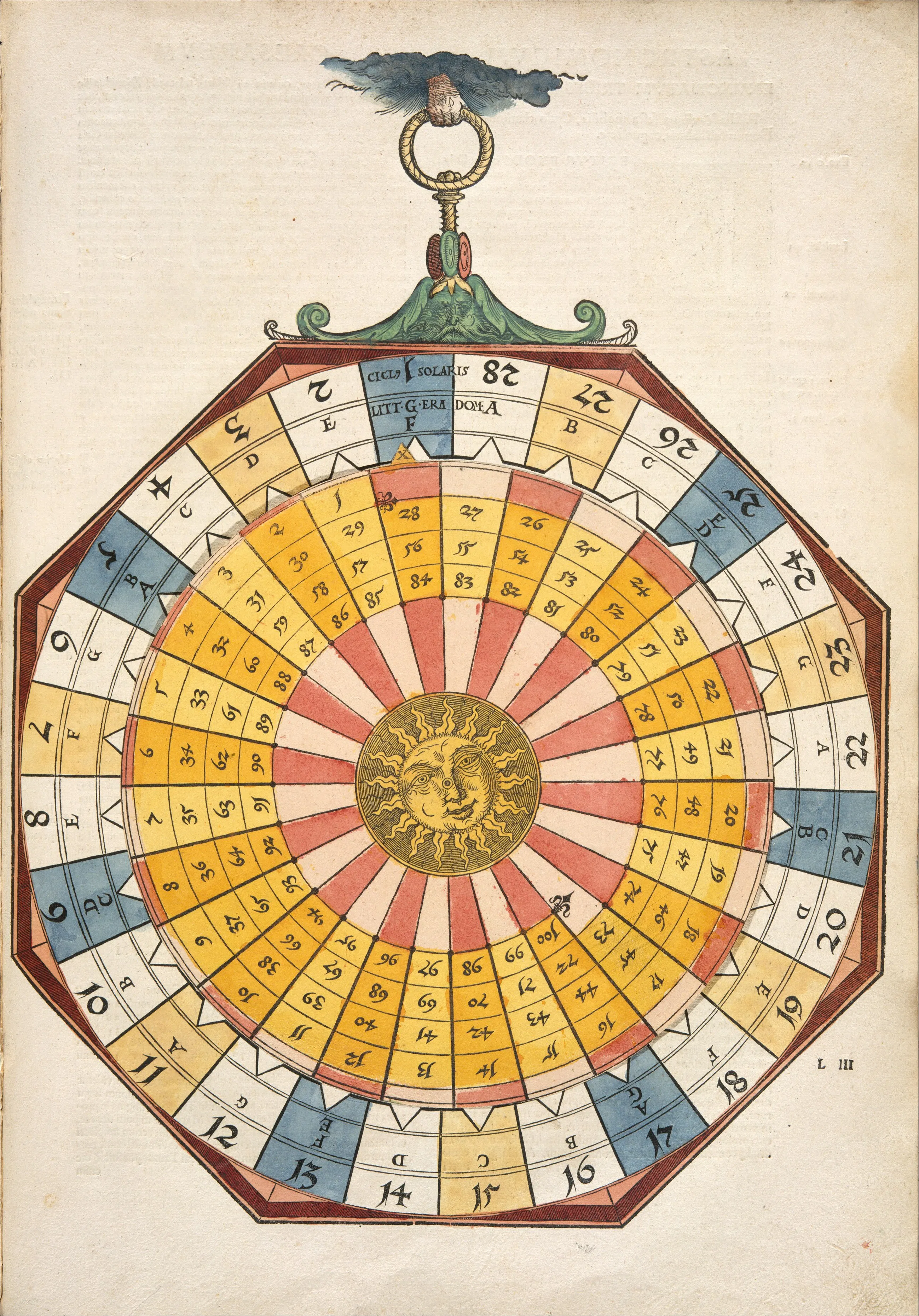
A plate from Peter Apian's Astronomicum Caesareum (1540), where chronological reckoning becomes a working paper instrument: solar cycles, dominical letters, and numbered arrays aligned through movable concentric disks. Its mechanical regularity belongs to the computational tradition on which Alsted drew, in which celestial order verified epochs without displacing Scripture. Source ↗.
The chapter on great conjunctions turns the same celestial material toward the future, announcing that the fire of this conjunction will consume all the dross and dregs of the city of Rome in the year 1635, when the revolution of the Roman empire under the trigons will run to its end, Hujus conjunctionis ignis consumer omnes scorias & fæces urbis Romæ anno 1635, quo ad finem decurret revolutio Romani imperii sub trigonis. The imagery is metallurgical — scoriæ and fæces are the slag and lees left by refining — so that the fiery trigon becomes a purgative furnace and the end of an imperial revolution is described as the removal of impurity rather than as destruction. Such dated expectation sits in evident tension with the aphorism, a page later, that God alone knows exactly the points of past and future time; the treatise does not dissolve the tension but holds both, arguing that numbers set down in Scripture may not be left unweighed.
The closing methodological gesture is correspondingly double. The synchronistic chapter breaks off with the proverbial dismissal of the painter's hand from the panel, and then immediately resumes: but hand from the tablet, unless perhaps it should be worth the effort to note down certain chronological heads from the Chronic Table published in 1571 according to the computation of the Viennese mathematicians, for in most things it agrees with our own reckoning, Sed manum de tabulâ: nisi fortè fuerit operæ pretium capita quædam chronologica enotare ex Tabulâ Chronicâ secundum Mathematicorum Viennensium computationem editâ anno 1571. In plerisque enim consentit cum nostro calculo. A rival printed table is appended not to be refuted but collated, and its substantial agreement is offered as external corroboration of the author's own calculus — the same practice that permits the book to end with a comparison of some two dozen irreconcilable totals from creation to the Messiah rather than with a single number.
Even the back matter is drawn into the argumentative economy. The appended epitome of Revelation is introduced with disarming candour about the exigencies of the final gathering: lest the following little pages should stand empty, it seemed good to add this breviary of the Apocalypse, which serves for the illustration of p. 47, Ne sequentes pagellæ vacarent, placuit hoc breviarium apocalypseos adjicere, quod facit ad illustrationem pag. 47 — blank leaves and cross-referenced apparatus in a single sentence, the accident of the forme producing a piece of genuine exposition. The alphabetical register of memorable things is no less committed: its heading for the Spanish Inquisition pronounces rather than locates, Inquisitio Hispanica. Est nocentissima pestis, declaring the institution a most noxious plague. A finding aid built for rapid consultation thus delivers verdicts at the speed at which it delivers page numbers, and the treasury's promise to set the series of times before the eyes is fulfilled in an apparatus where retrieval and judgement are the same act.
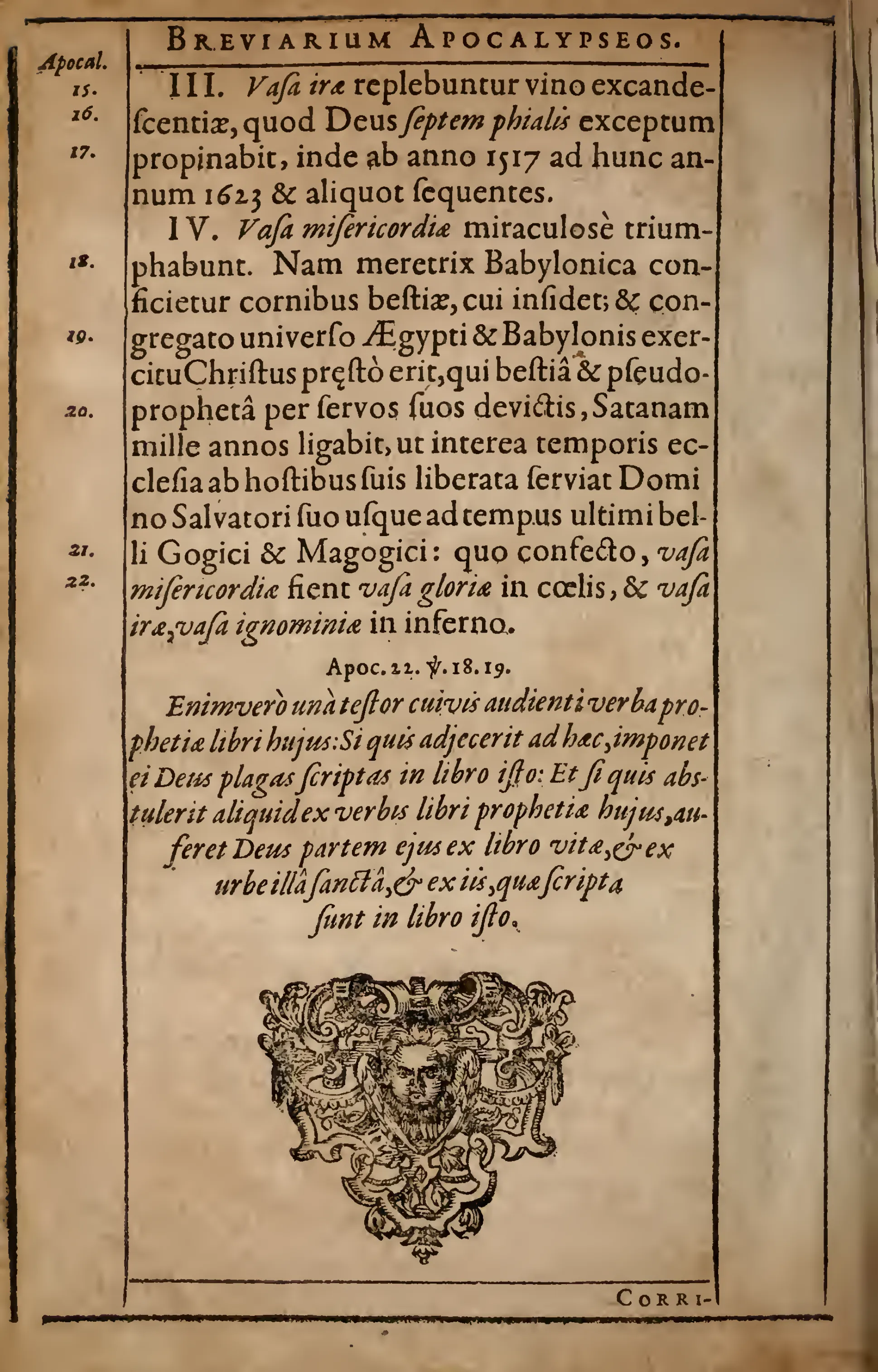
The closing leaf of the Breviarium Apocalypseos carries Revelation's seven phials into the book's own present — "inde ab anno 1517 ad hunc annum 1623 & aliquot sequentes" — then seals the apparatus with Apocalypse 22:18–19 against altering the prophecy, a woodcut tailpiece and catchword passing the reader to the corrigenda. Source ↗.
Frequently Asked Questions
What is Johann Heinrich Alsted's Thesaurus chronologiae?
It is a Latin technical treatise on universal chronology, printed at Herborn in Nassau in 1624, whose subtitle promises that "the entire series of times and histories, in every sphere of life, is set before the eyes." Catalogued as an octavo of 340 and [36] pages with a partly folding table, an index, and text within line borders, it is a working instrument rather than a narrative: fifty numbered chronologies running from the definition of epochs through biblical, imperial, ecclesiastical, and learned successions to eclipses, great conjunctions, comets, and rules for establishing synchronism.
Who was Johann Heinrich Alsted?
Johann Heinrich Alsted (1588–1638) was professor at the Reformed Hohe Schule at Herborn in the county of Nassau, and is best known for a lifelong program of methodical encyclopaedism that sought to reduce every branch of knowledge to teachable, memorable order. Howard Hotson's studies present him as the culmination of Herborn's achievement, resisting any single label of encyclopaedist, Reformed scholastic, or millenarian. The Thesaurus registers his own moment in his own voice: under 1618 it enters the Bohemian and Germanic war that "even today afflicts our fatherland Germany," with more than eighty thousand carried off.
Why did Alsted call eclipses the infallible characters of time?
Because eclipses can be calculated backward and so fasten disputed dates to something the manuscripts cannot corrupt. Alsted calls them the most excellent treasury of astronomy and chronology, indeed the infallible bases and characters of time, which is why the celestial chapters on eclipses, Saturn–Jupiter conjunctions, and comets stand at the end of the work as its verification apparatus rather than as curiosities. The same regularity supplies an argument about the darkness at the Passion: solar eclipses ordinarily fall at new moon, that one at full moon, since the Passover was celebrated at full moon by divine command.
What dates did Alsted derive from prophecy, and did he claim to know the end of the world?
He converted prophetic numbers into dated intervals with the same arithmetic he used for civil ones: the persecutors trample the church for 1260 years, from the year of Christ 362 to 1622; subtracting the thousand years of Apocalypse 20 yields 1694, with the seven phials poured out from 1517 to 1694; the fire of a great conjunction is to consume the dross of Rome in 1635; further expectations fall in 1622, 1625, and 1635, the millennium running to 2694. Yet he insists he does not thereby define the end, holding that God alone knows exactly the points of past and future time.
Is there an English translation of the Thesaurus chronologiae?
Only a fragment has ever been documented in English: An Account of Some Remarkable Eclipses, four pages printed at London for George Conyers in 1699, drawn from the eclipse material. No complete English translation has been identified. Separately, the Leo edition presents the full transcription together with a complete English translation generated by AI, published here for the first time. Leo is an effort to make freely available online, at no cost, English translations of every text printed in Latin in early modern Europe between 1450 and 1750.
This report was generated by an advanced AI assistant that conducted deep research alongside an extensive interpretation of the transcribed original text. Every effort has been made to preserve fidelity to the source and to guard against inaccuracy, but corruption in the text recognition process and model hallucination may nonetheless have entered the text. Treat every claim, quotation, translation, and citation as provisional, and verify each against the original source before relying on or citing it.
Bibliography
- Anthony T. Grafton, "Joseph Scaliger and Historical Chronology: The Rise and Fall of a Discipline," History and Theory: The standard short account of what Scaliger gave the discipline — the Julian Period, the exposure of forgeries, and the admission that non-biblical evidence could outrank Genesis on its own ground — which is precisely the toolkit Alsted inherits and then bends back toward Scripture. Grafton also traces the subsequent slide by which chronological quarrels came to be settled theologically rather than historically, and the Thesaurus stands squarely on that slope. Read it, too, for why Alsted prints irreconcilable totals side by side instead of quietly choosing one, reporting from his authorities that the computation of the years down to the Messiah is various.
- Anthony T. Grafton, "Some Uses of Eclipses in Early Modern Chronology," Journal of the History of Ideas: An examination of how chronologers used eclipse records and back-calculation to fasten disputed dates to something the manuscripts could not corrupt. It supplies the technical background to Alsted's placing of the celestial chapters at the end of his book as its verification apparatus, and to his ranking of eclipses as the infallible bases and characters of time. It also makes intelligible the otherwise odd fact that the only English rendering of any part of the work, in 1699, was drawn from the eclipse material.
- Howard Hotson, Johann Heinrich Alsted 1588–1638: Between Renaissance, Reformation, and Universal Reform: The indispensable intellectual biography, which refuses to file Alsted under any single label — encyclopaedist, Reformed scholastic, or millenarian — and shows instead how Ramist and Lullist method, confessional orthodoxy, and school reform operated together at Herborn. It is the necessary frame for reading the Thesaurus chronologiae as one component of that program rather than as a freestanding compendium of dates. The treatise itself, fittingly, supplies a pedigree for the selective procedure such a synthesis presupposes, tracing the elective sect, in Greek eklektikē, to Potamon of Alexandria, so called because it selects and excerpts the tenets from the individual sects, Secta electiva (Græcis επελητινή) à Potamone Alexandrino est introducta: sic dicta, quòd seligat & excerpat placita è singulis sectarum — a genealogy that places Alsted's own gathering of authorities within an ancient lineage of philosophical eclecticism.
- Howard Hotson, Paradise Postponed: Johann Heinrich Alsted and the Birth of Calvinist Millenarianism: Hotson reconstructs, from the full range of Alsted's works and scattered manuscripts, how a young man's hopes for a brief final illumination drawn from astrological, alchemical, and spiritualist prophecy hardened after 1618 into expectation of a literal millennium. The book is the reason the prophetic chapters of the Thesaurus cannot be dismissed as decorative appendices to sober calculation; the dated intervals and the papal classes belong to the same enterprise. Its account also gives full weight to the author's own framing of his purpose, since he would have these things so taken that they serve to illustrate the prophecy of Daniel and the Apocalypse, and not to feed curiosity, for he does not define the end of the world in this, Hæc autem ita velim accipi, ut ferviant illustrandæ prophetiæ Danielis & Apocalypticos, non autem fovendæ curiositati. Neque enim finem mundi hoc.





.jpg)

