Meras Tenebras: Seth Calvisius's Chronological Work, Continued to the Year 1685
Seth Calvisius, cantor of the Leipzig Thomaskirche, spent the hours left over from choir duty rebuilding the whole of universal history on the motions of the heavens. His Sethi Calvisii Opus chronologicum, ad annum 1685 continuatum, cui praemissa est Isagoge chronologica, et subjuncta appendix Epistolarum et Judiciorum de hoc opere pairs a technical manual on the reckoning of time with a year-by-year chronicle from Creation to the Reformation, testing every received date against computed eclipses, weekdays, and consular lists — and correcting Joseph Scaliger, the Jewish calendar, forged antiquities, and the papal annals wherever the arithmetic refused to agree.
ExLatinis
August 25, 2026

Contents
Seth Calvisius, cantor of the Leipzig Thomaskirche, spent the hours left over from choir duty rebuilding the whole of universal history on the motions of the heavens. His Sethi Calvisii Opus chronologicum, ad annum 1685 continuatum, cui praemissa est Isagoge chronologica, et subjuncta appendix Epistolarum et Judiciorum de hoc opere pairs a technical manual on the reckoning of time with a year-by-year chronicle from Creation to the Reformation, testing every received date against computed eclipses, weekdays, and consular lists — and correcting Joseph Scaliger, the Jewish calendar, forged antiquities, and the papal annals wherever the arithmetic refused to agree.
Seth Calvisius — in Latin Sethus Calvisius, in the vernacular Seth Kalwitz or Kallwitz — was born at Gorsleben in Thuringia in 1556 and died at Leipzig in 1615, having served as cantor and teacher at the Leipzig Thomana. He is remembered in two largely separate scholarly literatures, one musical and one chronological, and the Opus chronologicum belongs squarely to the second: a learned Latin treatise on the reckoning of time, joined to a universal annalistic chronicle running from Creation into the historical present of the sixteenth century. It first appeared at Leipzig in 1605. The volume treated here is the enlarged posthumous issue of 1685, printed at Frankfurt am Main and Leipzig for the bookseller-publisher Christian Gensch, its title announcing a text continued to the year 1685, prefaced by an Isagoge chronologica and followed by an appendix of letters and judgments concerning the work. The catalogue trail associates the continuation with Wolfgang Philipp Kilian, though the exact seam between Calvisius's own annals and the later extension has not been recovered, and the attribution rests on catalogue evidence rather than on demonstrated line-by-line proof.
The intellectual problem the work confronts is stated without euphemism: universal history is unusable so long as chronologers cannot agree, because received dates rest on conjecture, on corrupted authorities, and on calendars framed for civic convenience rather than for the motions of the heavens. Calvisius's answer is to refound chronology upon astronomy — computed conjunctions and oppositions, eclipses, sexagesimal reduction — and then to lay every era along a single reckoning spine: years of the World, Julian years, Olympiads, years ab urbe condita, the era of Nabonassar, the Seleucid and Diocletianic reckonings, the Hegira, the Yazdegird year, the Jewish sabbatical and jubilee cycles. The recurring move is verification by computation. A claimed date is tested against a calculable heavenly event, or against an independently attested annual sign — indiction, dominical letter, golden number, consular fasti — and where the received account fails the test it is corrected, whether the failure is charged to Joseph Scaliger, to Dionysius Exiguus, to the Jewish calendar, to the forged Berosus of Annius of Viterbo, or to the papal Annales of Cesare Baronio. The two halves of the volume cohere on that principle: the Isagoge supplies the instruments and the epochal reductions, and the annals apply them year by year.
The stakes are those of a discipline in the making. Anthony Grafton's account of Joseph Scaliger established chronology as an independent early modern science of evidence, in which astronomy was less a novelty than a critical instrument for organizing testimony; Calvisius stands within that tradition as a Lutheran schoolmaster who turned Scaligerian method to pedagogical and annalistic ends, and who corrected Scaliger where his own computations told against him. The calendrical stakes were live rather than antiquarian: Calvisius's Elenchus calendarii Gregoriani of 1612 and Formula calendarii novi of 1613 drew a printed response from Johannes Kepler in 1614, placing his chronology inside an active controversy over Gregorian reform, astronomical calculation, and confessional time. The evidentiary stakes are equally sharp, since the same computational tests that adjudicate an Olympiad also expose fabricated antiquity and impugn the chronology of the popes — which is why the work belongs to the history of forgery detection as much as to the history of astronomy.
What is most striking about the text is the range of material it drags into the same computational net. The annals date the flight of Muhammad and explain the purely lunar year that begins from it with the same technical care they bring to consular fasti; they follow imperial confirmation of popes, the deposition of Childeric, the origin of the papal patrimony, the antithesis of the emperor as lord of the world and the pope as servant of servants, the conciliar assemblies of Vienne, Constance and Basel, the fiscal apparatus of annates and jubilees, and the Ottoman advance to Mohács and Vienna, before closing on Luther's indulgence theses, the Diet of Speyer and the coining of the Protestant name. The apparatus is unusually candid about its own limits: eclipse computation is formally set aside once printed ephemerides suffice for the purpose, the chronologer's standard of precision is declared to be approximation rather than the exact minute, and irreducible uncertainties are conceded rather than concealed. Around the text stand the paratexts of a posthumous folio — a dedication to a duke of Saxony, conventionally identified with Friedrich I of Saxe-Gotha-Altenburg though the surviving wording documents no separate Gotha programme of chronological patronage; engraved portrait material including a portrait of the author engraved by Wolfgang Philipp Kilian; a reprinted Leipzig rectoral funeral Programma serving as the authoritative vita, its issuing rector and original date still unidentified; and an appendix promising the letters and judgments that the work provoked.
One thread ties the vocabulary, the production history, and the internal argument together. The technical lexicon — epocha, tempus astronomicum against tempus politicum, characteres chronologici, demonstratio against conjectura — exists to make dates transferable and testable; the annals exist to run that test across the whole of recorded time; and the volume's own long career in print, from Leipzig in 1605 through issues of 1620, 1629 and 1650 to the continuation of 1685, is the career of a working instrument that later hands kept extending because the instrument was still in use. That the boundary between Calvisius's text and its continuators remains unfixed is itself a consequence of the work's character: a chronology built to be corrected invites correction, and its bibliographical history records the invitation being accepted. No modern translation or critical edition of the work has been located, and no sustained modern study devoted specifically to its chronology was found.
Read the full text and English translation on Leo
This text was transcribed and translated as part of the ExLatinis project, an effort by Leo to make free English translations of every text published in Latin in early modern Europe (1450–1750) available online. The complete transcription and English translation of this work can be read free of charge:
→ Read the original Latin text and full English translation on Leo
You can save a copy of this document into your Leo account to run deep text searches, conduct further analysis, or cross-reference it with your own research.
Naming the Work: Calvisius's Latin Title and Technical Vocabulary
Editorial English title, supplied for convenience rather than an established translation: Seth Calvisius's Chronological Work, Continued to the Year 1685: An Introduction to Chronology and an Appendix of Letters and Judgments. The 1685 Latin title identifies the work as Sethi Calvisii Opus chronologicum, ad annum 1685 continuatum, with a prefixed Isagoge chronologica and a subjuncta appendix. The author's principal Latin forms are Sethus Calvisius and Sethi Calvisii; the vernacular name is Seth Kalwitz or Kallwitz. Gorscheleben is the Latinized place-name corresponding to Gorsleben in Thuringia, while Lipsia is Leipzig and Francofurti ad Moenum is Frankfurt am Main. Modern biographical records give 21 February 1556–24 November 1615, Gorsleben–Leipzig. No pseudonym or anagram was located, although the absence of one in the accessible records is not proof that no such usage ever existed.
In the Isagoge, epocha is not merely a vague historical age. It is a chronological starting point against which years and calendrical cycles are related, so that different systems can be brought into a common reckoning. The annals show the term operating exactly so when they treat the Hegira as a reckoning instrument, recording that Muhammad the pseudo-prophet is compelled from this year, through fear of his enemies, to flee from the city of Mecca, and that from this flight the Muhammadans begin their era or years, which are purely lunar years of twelve months, Mahumed Pseudoprophet ab hoc anno metu inimicorum suorum ex urbe Mocha cogitur profugere, & ab hac fuga ordiuntur suam aram sive annos Mahumedani, qui sunt anni merè lunares duodecimum mensium. What matters chronologically is not the narrative but the epochal point and the length of the year that runs from it. The purpose of establishing such points is transfer between them, and the work states as much in its own terms: he judges the whole sinew of chronology to consist in this, to know how to transfer a given year of any epoch to a different epoch, and to discern and adjudicate their agreement or discrepancy with one another, Nervum enim totius Chronologicæ in hoc consistere arbitror, scire datum alicujus Epochæ annum ad diversam Epocham traducere, convenientiam eorundem inter se, vel discrepantiam etiam cernere & dijudicare. Inter-epochal conversion is thus not an appendage to the discipline but, on the text's own account, its central nerve.
The paired expressions tempus astronomicum and tempus politicum make the underlying distinction explicit. Astronomical time is derived from the motions of the celestial luminaries and their eclipses, with beginnings and endings capable of exact reckoning; political time is adjusted to civic use and ordinary counting. The distinction therefore separates a celestial measure used as a control from the conventional reckoning by which communities organize their years, and the Isagoge presses it into a strong methodological claim and a boundary-marking rebuke: since it is manifest that the foundations of chronology are sought from astronomy alone, it follows that chronology cannot be rightly handled by anyone unskilled in astronomy, and that those are rash and shameless who dare pronounce about the ordering of time whose principle they do not know, Cum itaque manifestum sit, Chronologia fundamenta ex sola Astronomia peti: confectarium est, Chronologiam ab aliquo rectè tractari non posse, qui sit Astronomæ imperitus: & temerarios ac impudentes esse, qui de tempore digerendo pronunciare audent, cujus rationem ipsi ignorant. The priority of celestial over civic time is, in this formulation, simultaneously a doctrine about measurement and a claim about who is competent to practise the discipline at all.
Characteres chronologici are the recurrent annual signs by which one era can be connected with another. The accessible text calls them the most certain judges of times and contrasts them with claims that remain conjectura or opinio; the annals put the point in the sharpest form when they conclude that a heavenly character is the most certain index of consulships rightly applied to the years of the world, character cælestis, certissimus index est Consilium rectè ad annos mundi applicatorum. Demonstratio consequently has a technical and evidentiary force: a chronological result should be calculated, argued from the structure of the calendars, and made evident rather than merely proposed. The programmatic statement is unambiguous — students of chronology will do better if, leaving aside those who neglect all demonstration and hand down only their own conjectures and opinions, they pursue truth, and prefer demonstration to conjecture, authority to opinion, and certitude to doubts, Rectiùs facient studiùs Chronologiæ, si relictis iis; qui demonstrationem omnem negligunt, & suastantùm conjecturas & opiniones tradunt, veritatem sectentur, & demonstrationem conjecturæ, autoritatem opinioni, & certitudinem dubitationibus præferant. Historical testimony remains necessary, but its fides depends in part upon whether the reported sequence coheres with the reckonings of time.
Several of the polemical and methodological catchwords once flagged as unverified can now be attached to the text itself. The word nervus appears in the formulation of inter-epochal transfer quoted above, and the phrase certissimus index in the judgment on heavenly characters, both in the wording given there rather than in the abbreviated forms in which they have circulated. Likewise the trope of sheer darkness in papal history is present in the annals in the course of a dating dispute — Baronio admits this pope to the pontificate only in this year, and asserts he died the following year, whence it is plain that there is sheer darkness in the history of the popes, Baronius hunc Papam ad Pontificatum admittit tandem hoc anno, & mortuum asserit sequenti anno: unde patet, meras tenebras esse in historia Pontificum — where the text reads meras tenebras in the accusative rather than the nominative meræ tenebræ under which the phrase has been cited. The expressions figmenta Anniana and hallucinatur remain unrecovered in the accessible text and should still not be attributed to the 1685 witness without page-level verification, even though the substance of the Annian charge is unmistakably present in the exposure of forgery discussed below.
What the 1685 Folio Contains: A Summary of the Opus chronologicum
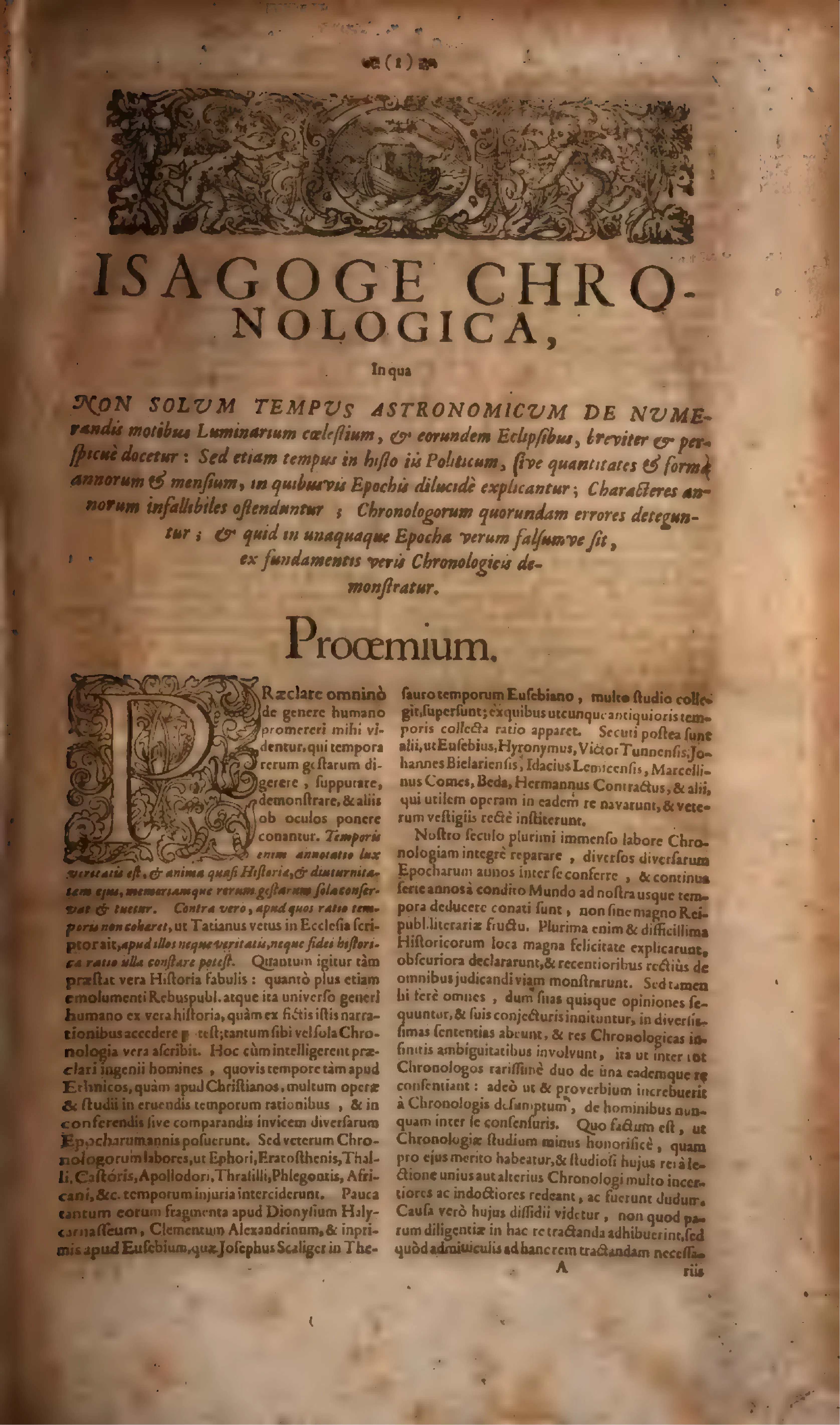
The decorated first page of the Isagoge chronologica marks a major structural threshold in the 1685 folio: beneath the ornamental headpiece and historiated initial, the Prooemium introduces the technical manual whose rules and reductions underwrite the annals that follow. Its printed assertion that "Temporis enim annotatio lux veritatis est" makes chronology the light of historical truth — not an auxiliary tool, but the form that preserves and orders historical memory. Source ↗.
Seth Calvisius's Opus chronologicum is a learned Latin chronological treatise joined to a universal annalistic chronicle, not simply a musical or biographical work. Its first edition appeared at Leipzig in 1605; the author, born in Gorsleben in 1556 and deceased at Leipzig in 1615, had been cantor and teacher in the Leipzig Thomana. The enlarged 1685 issue was produced posthumously at Frankfurt am Main and Leipzig and bears the imprint apud Christianum Gensch. The title ad annum 1685 continuatum establishes the intended terminal date of the enlarged continuation, although the accessible catalogue evidence does not expose the precise boundary between Calvisius's text and the later additions. The work's own justification for the whole enterprise is stated at the outset in the strongest possible terms, for the noting of time is the light of truth, and as it were the soul of history, and alone preserves and guards its permanence and the memory of things done, Temporis enim annotatio lux veritatis est, & anima quasi Historia, & diuturnitatem ejus, memoriamque rerum gestarum sola conservat & tueretur; chronology is thus presented not as an ancillary technique but as the form that makes history intelligible at all.
The volume is composite. A didactic Isagoge chronologica precedes the Opus proper; its recoverable opening treats astronomical time, political time, celestial motions, and eclipses, and its internal exposition distinguishes Chronographia from Canonica. The Opus presents a continuous chronological framework beginning with the earliest sacred history and extending through the later historical annals, whose recoverable text carries the sequence into the confessional history of the early sixteenth century: the indulgence controversy is entered under its year with Luther affixing ninety-five theses on the last day of October, when Pope Leo, having sent letters through all kingdoms, promised indulgences, that is, expiation of all offences, for money, and the criers of indulgences acted impiously, so far as to promise anyone absolution from any crime whatever and the redemption of a soul for ten shillings, Dr Martin Luther affixed ninety-five theses on indulgences to the castle church on the last day of October of this year, intending to dispute on them, D. Martinus Lutherus, cum Leo Papa, missis per omnia regna literis, Indulgentias sive omnium delictorum expiationem polliceretur, interventu pecunia, & præcones indulgentiarum impiè agerent, adeò ut unicuique absolutionem à scelere quovis, & redemptionem animæ, pro qua decem solidos solveret, promitterent, Themata 95. de Indulgentiis ultimo Octobris hujus anni templo archi affigit, de iis disputaturus:. The naming of the confession follows in the same annalistic register, the Elector John and the Landgrave and others protesting solemnly on 16 April, from which arose that widely current name of PROTESTANTS, Elector Iohannes & Landgravius alii die 16. Aprilis solemniter protestantur, hinc ortum pervulgatum illud PROTESTANTIUM nomen. An appendix of letters and judgments concerning the work, including chronological controversies, follows. The accessible text does not verify the often-repeated description of four parts and forty-nine chapters, nor does it establish a complete count of the astronomical tables.
A reprinted Leipzig rectoral funeral Programma functions as a vita. Its heading reads PROGRAMMA RECTORIS ACADEMIA LIPSIENSIS IN FUNUS AUTORIS, and its surviving text describes Calvisius as Chori Musici Magister and a colleague teaching in the Thomana. The rector's personal name and the date of the original Programma were not recoverable from the digitized text. Catalogue records label the book Latin. No modern English or German translation was located in the consulted records. The presence and extent of German, Dutch, Greek, Hebrew, and Turkish glosses, mnemonic verses, chronograms, and pasquinades require a page-by-page examination and are not asserted as established features on catalogue evidence alone.
Chronology as a Discipline: Calvisius between Scaliger, Kepler, and Baronio
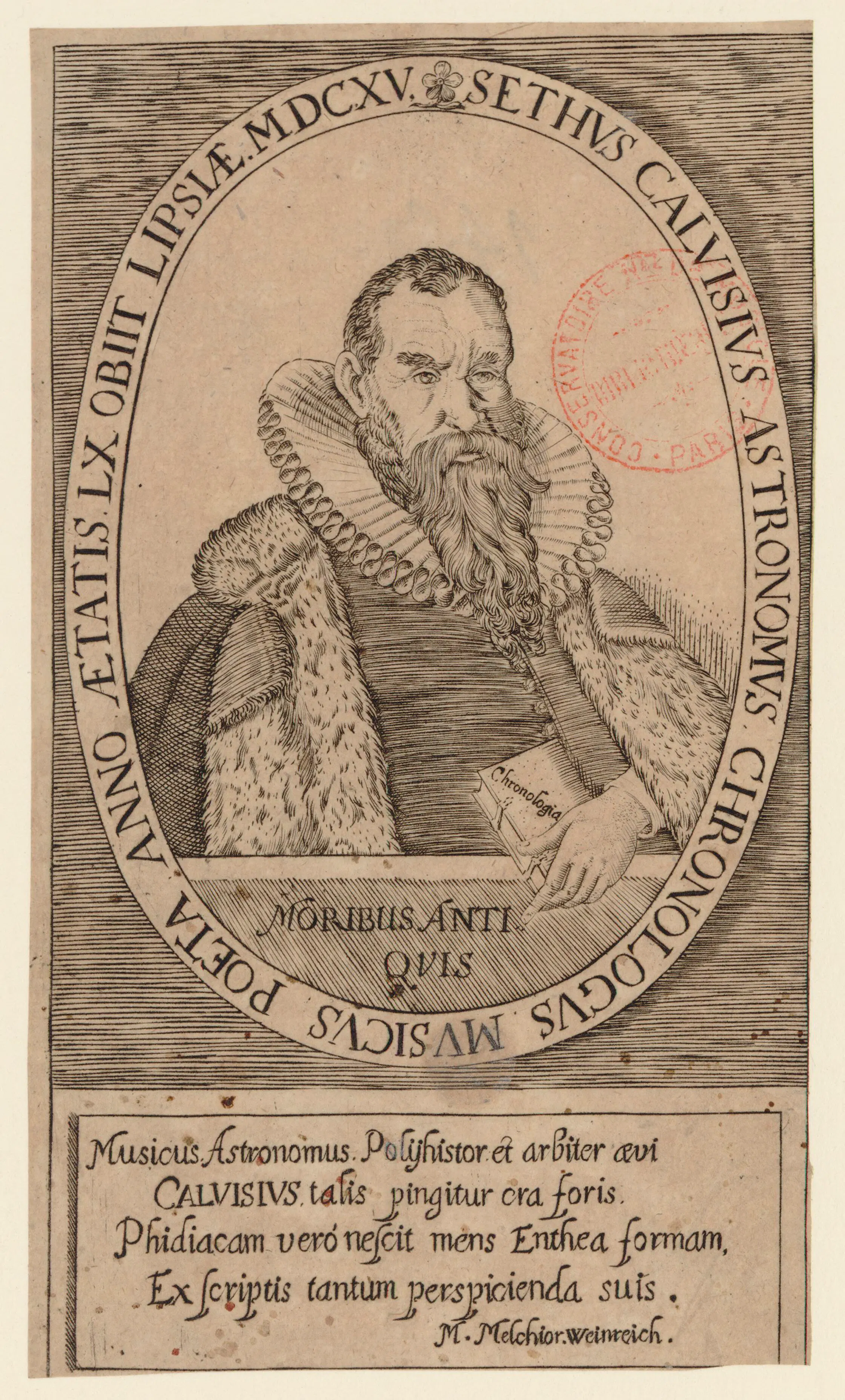
An engraved portrait of Seth Calvisius frames him not merely as a Lutheran schoolman but as a practitioner of chronology, the point underscored by the volume labelled "Chronologia" in his hand. As his work negotiated the learned terrain of Scaliger, astronomical calculation, and confessional history, the image makes visible the disciplinary identity the Opus chronologicum sought to consolidate. Source ↗.
The Opus chronologicum matters because it shows chronology being made into a technical discipline at the intersection of philology, calendrical computation, astronomy, and confessional historiography. The primary witness defines chronology through the notation and preservation of time, follows Scaliger in its opening methodological frame, divides the discipline between Chronographia and Canonica, and treats astronomical motions and eclipses as controls on historical sequence. The discipline's disgrace is what motivates the whole apparatus, so that among so many chronologers scarcely two agree about one and the same thing, to such a degree that a proverb has even become current, taken from the chronologers, about men who will never agree among themselves, ita ut inter tot Chronologos rarissimè duo de una eademque re consentiant: adeò ut & proverbium increbuerit à Chronologis desumptum, de hominibus nunquam inter se consensuris; the astronomical refoundation announced in the Isagoge is offered precisely as the remedy for that scandal. The work should not, however, be described without qualification as a modern exact science: its own demonstrative vocabulary belongs to early modern mathematical and historical practice, in which Scripture, ancient historians, calendrical cycles, and astronomical calculation were jointly weighed.
Anthony T. Grafton's account of Joseph Scaliger is the indispensable intellectual point of departure. Grafton presents chronology as an independent discipline and stresses that Scaliger's use of astronomy was not itself unprecedented; the innovation lay in the critical and methodological organization of diverse evidence. Calvisius is consequently best understood neither as a simple repeater of Scaliger nor as an isolated astronomer, but as a practitioner who adapted Scaligerian chronology to a Lutheran, pedagogical, and annalistic project — and one prepared to break with his fountainhead where computation required it, concluding that the Jewish calendar is rightly to be rejected in computing astronomical time, Meritò igitur Calendarium Iudaicum in computando tempore Astronomico est rejiciendum, a verdict that follows directly from the priority of celestial over civil reckoning set out in the work's technical vocabulary. C. Philipp E. Nothaft's work on the calendar problem supplies the longer history needed to situate Calvisius's calendar writings: it treats calendrical reform as a cultural and scientific problem rather than as a merely administrative dispute. Calvisius's Elenchus calendarii Gregoriani of 1612, Formula calendarii novi of 1613, and the 1614 printed response by Johannes Kepler show that his chronology entered an active controversy over the relation between Gregorian reform, astronomical calculation, and confessional time. That the technical acknowledgement of calendrical error did not entail acceptance of the Roman remedy is stated explicitly, for although he now sees and acknowledges these defects of the Paschal termini of the old calendar, he prefers still to retain the ancient usage of the Church, and leaves these defects to the liberty of the Church, Etsi igitur jam defectus terminorum Paschalium hosce nostri veteris Calendarii videmus & agnoscimus; malumus tamen adhuc retinere antiquum Ecclesiæ morem, & defectus hosce libertati Ecclesiæ permittimus. The precise arguments of the individual exchanges require consultation of the pamphlets themselves.
The treatment of forged antiquity belongs to the history of historical evidence. Nicholas Popper's study of sixteenth-century historical evidence places Annius of Viterbo within a methodological problem that later acquired importance in Baconian natural philosophy. Walter Stephens's work on Annius's forged antiquities and Ingrid Rowland's study of the afterlife of Annian fabrication illuminate different sides of the problem: Stephens emphasizes the falsified antiquarian dossier, while Rowland's Scarith of Scornello follows the social and intellectual persistence of such claims. The Calvisian text itself narrates the fabrication as a bid for glory that deceived nearly everyone, for Johannes Annius, a certain monk of Viterbo, while trying to catch some glory, forged within our fathers' memory a new Metasthenes, Berosus, Manetho and Philo, which, augmented with commentaries, he issued in public, and with these precious titles of ancient authors imposed upon almost the whole world, Iohannes enim Annus, monachus quidam Viterbiensis, dum gloriam quandam aucupari conatur, cudit Patrum nostrorum memoria novum Metasthenem, Berosum, Manethonem & Philonem, quos Commentariis auctos, in publicum emisis, & preciosis hisce veterum autorum titulis toti Mundo ferè impoluit — a diagnosis that treats the counterfeit as a failure of the same evidentiary test by which epochs are converted and dates demonstrated. These approaches complement rather than directly contradict one another, and neither constitutes a dedicated study of the 1685 Calvisius volume.
The confessional dimension requires similar care. The chronology's dependence on Scripture and ecclesiastical historians places it in the field of Protestant and Catholic competing histories, including the wider confrontation with Baronian ecclesiastical history, the Magdeburg tradition, conciliar reform, and arguments over papal and imperial jurisdiction. The polemic against Baronio is conducted as an accusation of tampering with the fasti: since therefore he could not eject emperors entirely from Roman history and from ecclesiastical history, he omitted two pairs of consuls, and took away two years of rule from that most upright emperor, Cùm igitur Imperatores penitus ex historia Romanorum, & historia Ecclesiastica ejicere non posset, duo paria Consulum omisit, & probissimo Imperatori, the charge being framed in the same currency of consular series and computation that governs the technical chapters. Confessional asides surface within the annals as consequences of philological observation, as when the reading of Scripture in many tongues among the Jews is turned into a question about present prohibition — from which it is clear that the sacred books were read even by the Jews in all languages, so that they might be understood, so why then is this forbidden to Christians by the papalists, Unde videre est, sacra Biblia etiam à Iudæis in omnibus linguis lecta fuisse, ut intelligerentur. Cur igitur id Christianis â Pontificiis interdictum?. The jurisdictional material runs along the same axis. The annals record the papal deposition of a Frankish king in pointedly critical terms, Zacharias, consulted about the state of the kingdom of the Franks, most audaciously pronouncing Childeric unworthy of the kingdom, and therefore absolving Pippin from the oath which he had given to king Childeric and the chief men of the realm, and handing the kingdom over to him, Zacharias de statu regni Francorum consultus audacissimè pronunciat, Hildericum indignum regno, atque ideo Pipinum à juramento, quod regi Hilderico & primoribus regni dederat, absolvit, cique regnum tradit, and they register the countervailing imperial doctrine in constitutional form, it being decreed that the emperor holds the empire from God alone, and that if he has been elected by all the electors, or by the greater part of them, he is by election alone to be reckoned so, quòd Imperator imperium habeat à solo Deo, & si electus sit ab omnibus Electoribus, vel à potiore parte Electorum, ex sola electione censeri. Conciliar history is handled with the same combination of precise dating and confessional judgement, the entry on Hus recording that John Hus, condemned in the council, is handed over against the faith given him to the political magistrate, and set upon the pyre on 6 July, a Saturday, Iohan Huss damnatus in concilio traditur contra datam fidem Magistratui Politico, & imponitur rogo die 6. Iulii, feriâ septimâ, pridie sextæ Dominicæ Trinitatis. Hist. Bohem, where the weekday is supplied as a chronological check and the entry closes with an abbreviated source reference of the kind the annals characteristically append. The accessible catalogue and textual evidence establish the technical and confessional setting but do not permit every claimed reference to Baronio, the Annian forgeries, papal chronology, councils, or imperial constitutional texts to be authenticated line by line. Stefan Bauer, Simon Ditchfield, Markus Völkel, Ronald Asch, Robert Evans, Anthony Ossa-Richardson, and Jean-Louis Quantin are therefore contextual comparanda rather than securely identified commentators on this edition; no direct Calvisius-focused treatment by them was located. Adam Mosley's scholarship on early modern astronomy is useful for the astronomical setting, but it does not replace a study of Calvisius's historical method.
Musicological and chronological historiographies remain only partly connected. Calvisius is regularly presented as teacher, composer, music theorist, astronomer, and chronologer, while the musicological literature concentrates on Melopoeia, musical theory, and the Thomaskantorat. The review literature on Tempus Musicæ, Tempus Mundi explicitly separates studies of Calvisius as musician from "Calvisius as chronologist." That separation is an inference about the organization of modern scholarship, not proof that the early modern author himself regarded music and chronology as unrelated. No sustained modern monograph devoted specifically to the Opus chronologicum's chronology was located.
Tracing the Editions: From Leipzig 1605 to the Gensch Folio of 1685
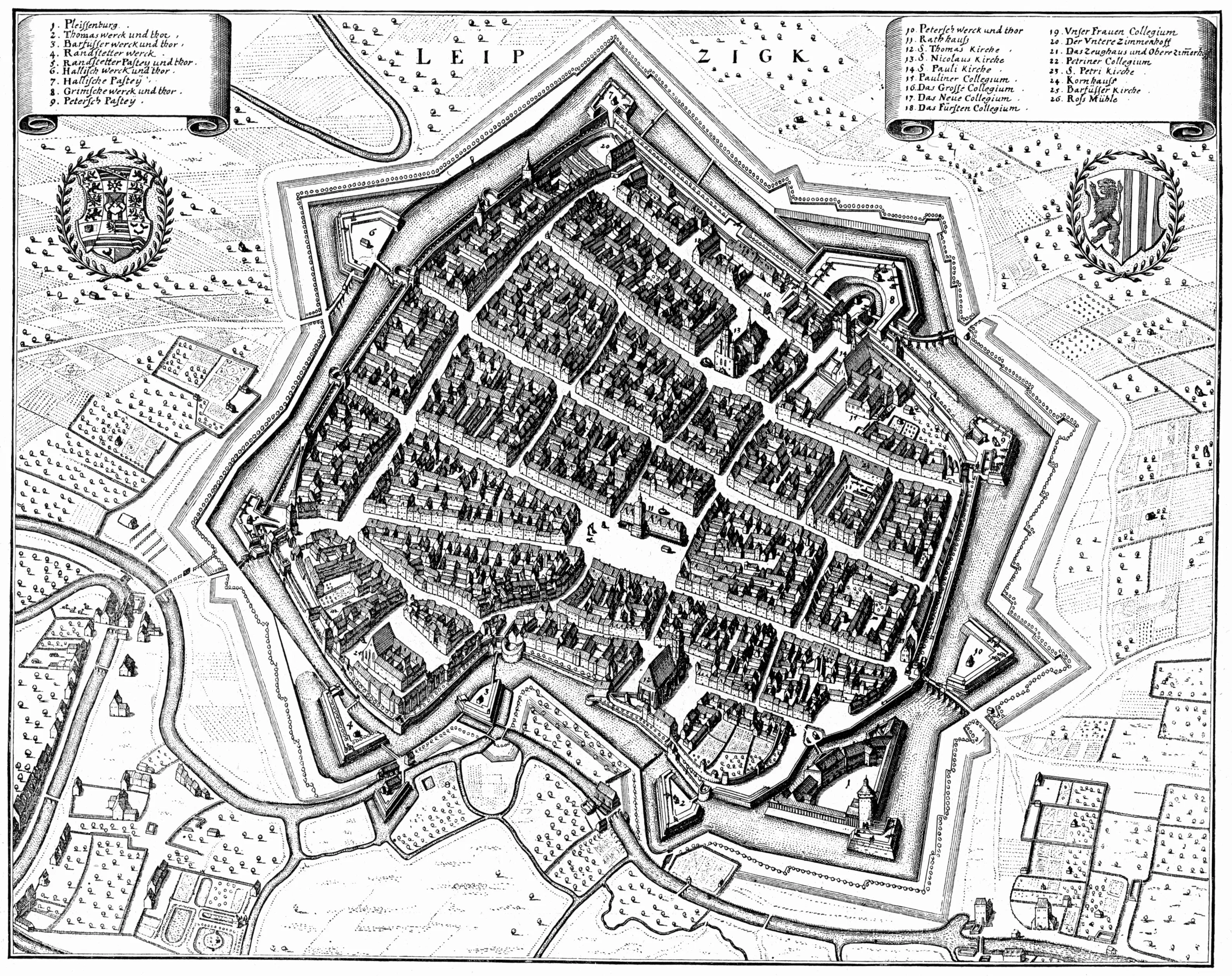
Matthäus Merian's 1650 engraved plan of Leipzig offers a near-contemporary view of the walled Lutheran city where Calvisius served at the Thomaskirche and where the Opus chronologicum first appeared in 1605. Its plotted churches, gates, and academic precincts anchor the book's later Frankfurt–Leipzig publication history in the institutional landscape that shaped Calvisian chronology. Source ↗.
Bibliographical history. The Leipzig 1605 issue is consistently identified in the biographical and catalogue trail as the first edition, although one antiquarian listing assigns a different issue to 1601; the 1601 assertion was not independently confirmed. The 1620 record describes an Opus chronologicum issued impensis Johannis Thymii bibliopolae and gives 1,078 pages in the accessible Google Books metadata; another catalogue gives a different extent and places it at Francofurti, so the 1620 collation and complete imprint remain unsettled. A WorldCat record identifies a 1629 issue with Thymius Lanckisch and a Frankfurt/Frankfurt-an-der-Oder/Leipzig imprint context, with Johannes Thym as dedicatee. The 1650 issue is recorded under Christian Gerlach and Simon Beckenstein, Francofurti ad Moenum et Embdae; an antiquarian description gives folio format, four preliminary leaves, 1,030 pages corrected to 1,032, fifty leaves, an engraved title vignette, and numerous tables. That description is useful but derives from the trade rather than a critical bibliographical collation.
The 1685 issue is titled Sethi Calvisii Opus chronologicum, ad annum 1685 continuatum, cui praemissa est Isagoge chronologica, et subjuncta appendix Epistolarum et Judiciorum de hoc opere. The catalogue imprint is Francofurti ad Moenum et Lipsiae: apud Christianum Gensch, 1685. WorldCat records two parts and the extent [16], 1050 [i.e. 1052], 84; 74, [2] pages, in folio. Repeated pagination at pages 191–192 is also recorded. The Royal Collection describes a full-leather copy and gives 35.0 × 8.0 cm as an inventory measurement; the unusual measurement should be retained as catalogue data rather than silently normalized. A Royal Collection catalogue entry identifies a portrait of the dedicatee and a portrait of the author engraved by Wolfgang Philipp Kilian.
Continuation and production. Wolfgang Philipp Kilian (1654–1732) is the associated editor or continuator in WorldCat and Internet Archive records, and the 1685 title's ad annum 1685 continuatum makes him the most defensible candidate for the posthumous extension. The exact division between Calvisius's original annals, Kilian's additions, and editorial intervention was not recovered; the attribution should therefore be stated as catalogue-supported rather than as a demonstrated line-by-line fact. Kilian must not be confused with the older Augsburg engraver Wolfgang Kilian. Balthasar Christoph Wüst is listed in the 1685 record as a contributor or editor and is independently described as a Frankfurt printer-publisher. The accessible Calvisius records do not, however, expose a title-page printer line, so Wüst cannot be declared the printer of this issue with certainty. Christian Gensch is the bookseller-publisher named in the imprint. Authority data place his activity broadly in 1679–1722, with Frankfurt activity from 1685 and Leipzig activity beginning no later than the late seventeenth century; a dependable list of his other publications was not recovered.
The dedication names Fridericus dux Saxoniae. The conventional modern identification is Friedrich I of Saxe-Gotha-Altenburg, but the accessible catalogue wording alone does not document a separate Gotha program of patronage for chronological or astronomical publishing. The Leipzig funeral paratext is headed as a rectoral Programma and describes Calvisius's Thomana offices, but the issuing rector and original date remain unidentified. No secure evidence was recovered for an engraver other than Kilian, and the accessible records do not confirm folding plates, twelve astronomical tables, or a printed sigla apparatus, though the annalistic entries themselves close with abbreviated source references. They do confirm a folio object, engraved portrait material, and tables in the 1650 description. One layer of the technical apparatus is retired by explicit authorial decision rather than by editorial abridgement, the text declaring that he judges it superfluous to append any further computation of the eclipses of these times, Porro Epilogismum eclipsium horum temporum ulterius apponere supervacaneum arborior, a statement consistent with the availability of printed ephemerides for the later centuries and with the work's declared standard of sufficient rather than maximal precision.
Transmission, reception, and control. The 1685 appendix promises letters and judgments about the work and chronological controversies, while a separate 1614 Frankfurt publication, Johannes Kepler's Ad Epistolam Sethi Calvisii Chronologi Responsio, confirms a contemporary printed exchange involving Calvisius and Kepler. The accessible evidence does not establish the full chain of replies or whether Kepler's text should be characterized as a refutation rather than a response. The transmission of a London manuscript of Ptolemy's canon through Abraham Scultetus and John Overall is asserted by the text in the first person — he received this Mathematical Canon of Ptolemy, whole and uncorrupted, from a manuscript exemplar of Ptolemy kept at London in England, by the kindness of that most distinguished man Dr Overall, Dean of St Paul's church there, through the reverend and most distinguished Abraham Scultetus, preacher and ecclesiastical councillor to the Elector Palatine, Ego hunc Canonem Mathematicum Ptolomæi integrum & incorruptum ex manuscripto Exemplari Ptolomæi, quod habetur Londini in Anglia, beneficio Clarissimi viri D. Overalls Decani Ecclesiæ Paulinæ ibidem, per Reverendum & Clarissimum virum Abrahamum Scultetum, Electori Palatino à concionibus & Contiliis Ecclesiasticis accepi — while the route itself was not independently documented in the records consulted, so the claim stands for the present as the author's own statement about how he obtained his text of the canon. Scaliger and the Prutenic astronomical tradition are secure as contextual authorities in the work's methodological setting, but the precise roles of Reinhold, Tycho Brahe, and the other named scholars require direct textual collation. The identities of "Crentzheim" and "Mollerus" remain unresolved; they should not be normalized to Elias Crentzheim or Tobias Möller without manuscript evidence. The figure named Mollerus is nonetheless engaged directly over the reliability of the Prutenic tables, the text replying that he ought to have known that this fault of the chronologers resides not in the Prutenic tables, which are most perfect according to the hypotheses of Copernicus, but in those chronologers who either would not or could not seek out these eclipses, Sed scire debebat Mollerus, culpam hanc Chronologorum non in tabulis Prutenicis, quæ perfectissimæ sunt ad hypotheses Copernici, residere; sed in Chronologis istis. qui ecclipses hasce quærere aut noluerunt. aut non potuerunt, which locates the astronomical instruments squarely within the Copernican-Prutenic tradition while placing the blame for chronological error on the practitioners rather than on the tables.
The 1612 Elenchus calendarii Gregoriani and the 1613 Formula calendarii novi belong to the same calendrical program as the Opus, while Melopoeia and the other music-theoretical writings belong to Calvisius's musical career; they should remain separate bibliographical works. The consulted records for Juan de Cárdenas's Crisis theologica bipartita describe a distinct Jesuit moral-theological book, printed in 1670 and attributed to Cárdenas. No specific catalogue or digitization record that actually conflates it with Calvisius's chronology was located. The proposed Cárdenas attribution is therefore unsupported by the consultable records found, not a second title or alternate edition of the Opus.
Repository evidence is partial. The 1685 digitization is represented through the Internet Archive/Google Books record associated with the National Library of Naples; WorldCat also exposes records for the University of Bologna and the Biblioteca Nazionale Centrale di Roma, while other catalogue trails point to Leipzig, Leiden, and Bavarian State Library copies. Full shelfmarks were not surfaced for the 1685 witnesses in the accessible records and should not be invented. No separate Calvisius edition of the Isagoge was established; the recoverable evidence treats it as the prefixed component of the Opus. No modern translation or critical edition was located, and no Index entry or territorial privilege against Calvisius was identified. The text's own interest in censorship runs the other way, reporting of the Baronian Annales that he adds moreover that the kingdom of Spain was a fief of the Roman pontiff, which today the king of Spain denies, and for that reason the Annals of Baronio are proscribed from Spain, addit insuper, regnum Hispania fuisse feudum Romani Pontificis, id quod hodiè rex Hispania negat, & propterea Annales Baronii ex Hispania proscriptæ; such notices concern the fortunes of an opposing chronology and cannot be converted into evidence of censorship of the Opus itself, any more than can the text's references to the condemnation of other theological propositions.
Reading the Isagoge and the Annals: Structure, Argument, and Evidence
The paratexts of a posthumous folio
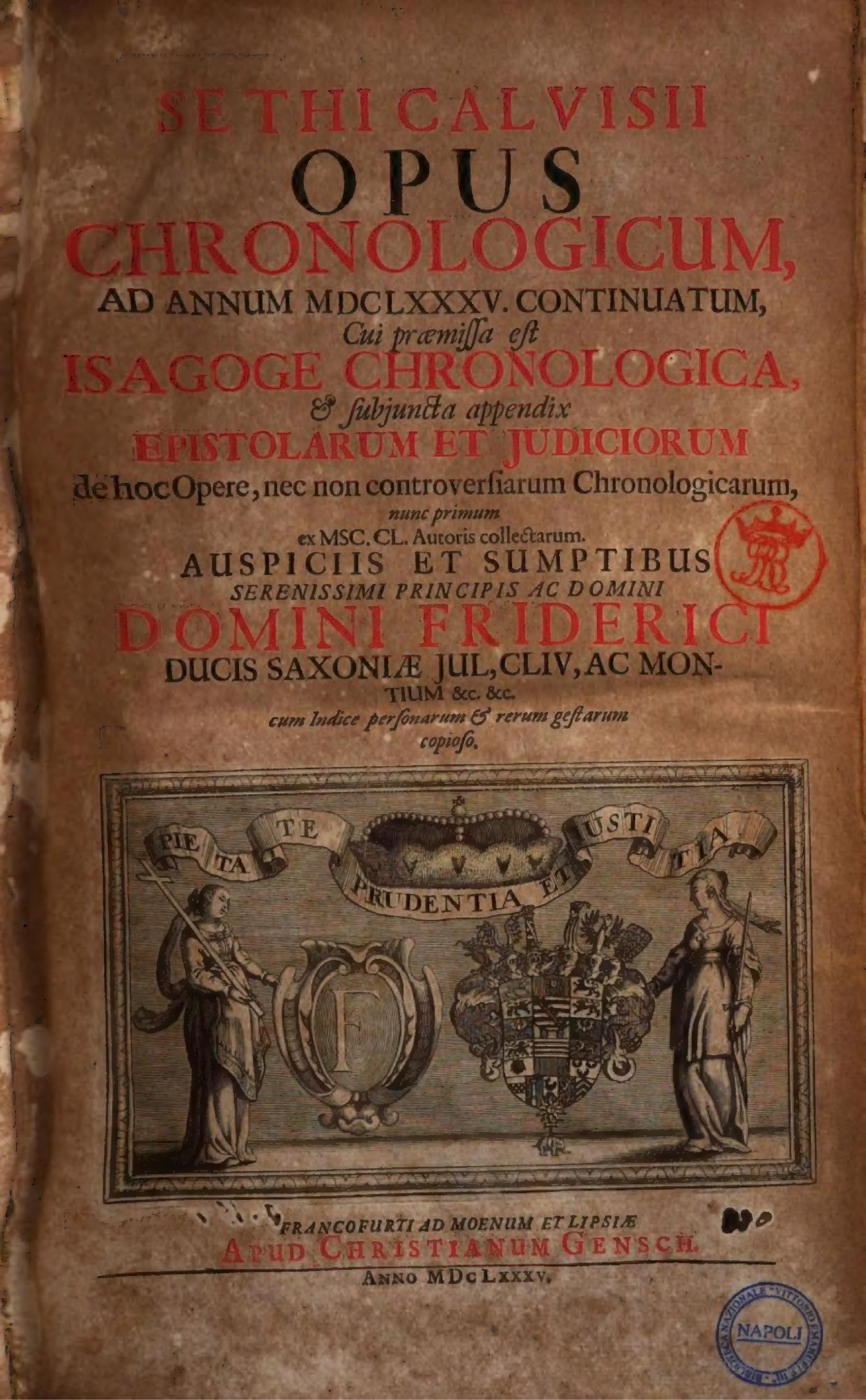
The 1685 title page presents Calvisius's posthumous chronology as a visibly reissued instrument: it announces the continuation to 1685, the prefixed Isagoge, and the appended letters and judgments, and names Christian Gensch at Frankfurt am Main and Leipzig. Beneath that publishing grammar, the ducal arms and the figures of Pietas and Iustitia make Friedrich, Duke of Saxony, the visual guarantor of the folio's renewed authority. Source ↗.
The volume opens not with the chronologer's voice but with the apparatus of a late-seventeenth-century folio reissue. The title-page names the two cities of production and the bookseller under whose sign the enlarged text appears, FRANCOFURTI AD MOENUM ET LIPSIÆ APUD CHRISTIANUM GENSCH, and the dedicatory epistle that follows the engraved ducal portrait is spoken in the first person by that same bookseller-publisher rather than by the author dead seventy years: because I owe it to your kindness, most indulgent Lord, that I have been able to bring this book out into the public light again, with a notable enlargement, runs the justification, Quia Tuæ benignitati DOMINE INDULGENTISSIME debeo, quod hunc librum luci iterum publicæ, cum insignia augmento, exponere potuerim. The grammar of patronage is thus transferred from author to trade: the auspicia of a Saxon duke legitimate not the composition of a chronology but its re-emission cum insigni augmento, and the phrase quietly acknowledges that what the purchaser holds is a continued and augmented instrument rather than the text of 1605. The subscription that closes the epistle carries an irony appropriate to a book about the notation of time, since the date as printed reads a century short, Francofurti ad Moenum Cal. Maj. A. CHR. MDLXXXV. Christianus Genschius — a compositor's omission of the C corrected by the title-page's own imprint, and a reminder that the transmission of dates is a matter of the case and the forme as much as of the tables.
The reprinted Leipzig rectoral Programma that follows serves as the volume's vita, and it constructs Calvisius's career as a genealogy of method. His formation is presented as a self-directed descent to the sources: since he took the greatest delight in reading histories, he at once applied his mind to the study of chronology, and whatever time was left over from his ordinary duties he devoted to this alone, that he might draw the true sources of that science from the most learned books On the Emendation of Times by that incomparable man Joseph Scaliger, Sed cum maximè Historiarum lectione delectaretur, simul animum ad Chronologiæ studium appulit, & quicquid temporis ab ordinariis laboribus reliquum ei fuit, id solum eò contulit, ut illius scientiæ fontes veros ex JOSEPHI SCALIGERI, viri incomparabilis, eruditissimis libris, de emendatione temporum hauriret. Two things are established at once. The fontes veri of the discipline are located in a single modern book, not in Eusebius or Bede; and chronology is the labour of hours left over from the ordinarii labores of the cantorate — an avocation pursued by a schoolman, which the Isagoge itself will later avow when it makes pedagogical accessibility a governing criterion. The Programma also fixes the confessional register of the technical work, presenting the calendrical pamphlet as counter-expertise: three years ago there was added to the Chronology the Elenchus of the Gregorian Calendar, a work no less learned and outstanding, in which our Calvisius not only demonstrated most evidently very many errors of the Pontifical Calendar, but also proposed a new and much better and readier form of calendar, Chronologiæ accessit abhinc triennio Elenchus Calendarii Gregoriani, opus non minus eruditum atque egregium, in quo non solùm plurimos Calendarii Pontificii errores Calvisius noster evidentissimè demonstravit; sed etiam novam Calendarii formam, multò meliorem atque expeditiorem, proposuit. The designation Calendarium Pontificium does the polemical work: the Roman reform is not the calendar but a party's calendar, and the reply is not refusal but a rival forma. The same paratext characterizes the resulting disputes in the idiom of siege: there exist in this field the learned commentaries and chronological letters of D. Pareus, Reusner and Kepler, by which the Calvisian chronology was indeed vehemently attacked, but by no means stormed, Extant in hoc genere doctissimorum hominum D. Parei, Reusneri, Kepleri commentationes atque epistolæ Chronologicæ eruditæ, quibus oppugnata quidem vehementer Calvisiana Chronologia, attamen expugnata minimè fuit. The play of oppugnata against expugnata concedes the assault while denying the capture, and it names precisely the correspondence whose dossier the 1685 title-page promises to append — the controversy is thus advertised as part of the merchandise.
The Prooemium and the astronomical criterion
The Prooemium moves from commemoration to diagnosis. Chronology is defended as the formal principle of history, and its present condition described as a public scandal of the learned: the proverbial dissent among chronologers already noticed in this report, in which scarcely two of so many agree about one and the same thing. That the discipline has become proverbial for irresolvable disagreement is not offered as a rhetorical flourish but as the premise of the remedy: where each practitioner follows his own conjecturæ, only a criterion external to the practitioners' judgement can end the dispute.
Chapter I supplies both the frame and the criterion. The architecture of the discipline is taken over from Scaliger without alteration, its two parts being Chronographia and Canonica, Duæ ejus sunt partes, Chronographia scilicet, & Canonica, ut vult Iosephus Scaliger in animadversiouibus in Eusebium pag. 4 — the first weighing intervals and epochs, the second setting out archons, consuls and kings year by year, which is exactly the division of labour between the Isagoge and the annals of the Opus. The criterion, however, is stated as an exclusion, in the terms already set out above: since the foundations of chronology are sought from astronomy alone, it follows that no one unskilled in astronomy can rightly handle it, and that those who dare pronounce upon the ordering of time without knowing its principle are rash and shameless. The vocabulary of temeritas and impudentia converts a want of technical training into a fault of character, and the confectarium form gives the exclusion the appearance of a deduction rather than a boast. Having erected the standard, Calvisius immediately turns it against his own master. The Jewish computus is praised as most elegant, and Scaliger's improvement of it acknowledged, before its month is shown to be too long by twelve thirds and incapable of fixing a Julian month unambiguously, whence the verdict, quoted earlier in this report, that the Jewish calendar is deservedly to be rejected in computing astronomical time. The rejection is not confessional but instrumental — the vehicle of computation becomes Tycho's restored lunisolar motions reduced to the Julian year — and it demonstrates that the principle of astronomical priority binds the tradition's founder no less than its opponents.
The instruments: tables, constants, and the calendars of the nations
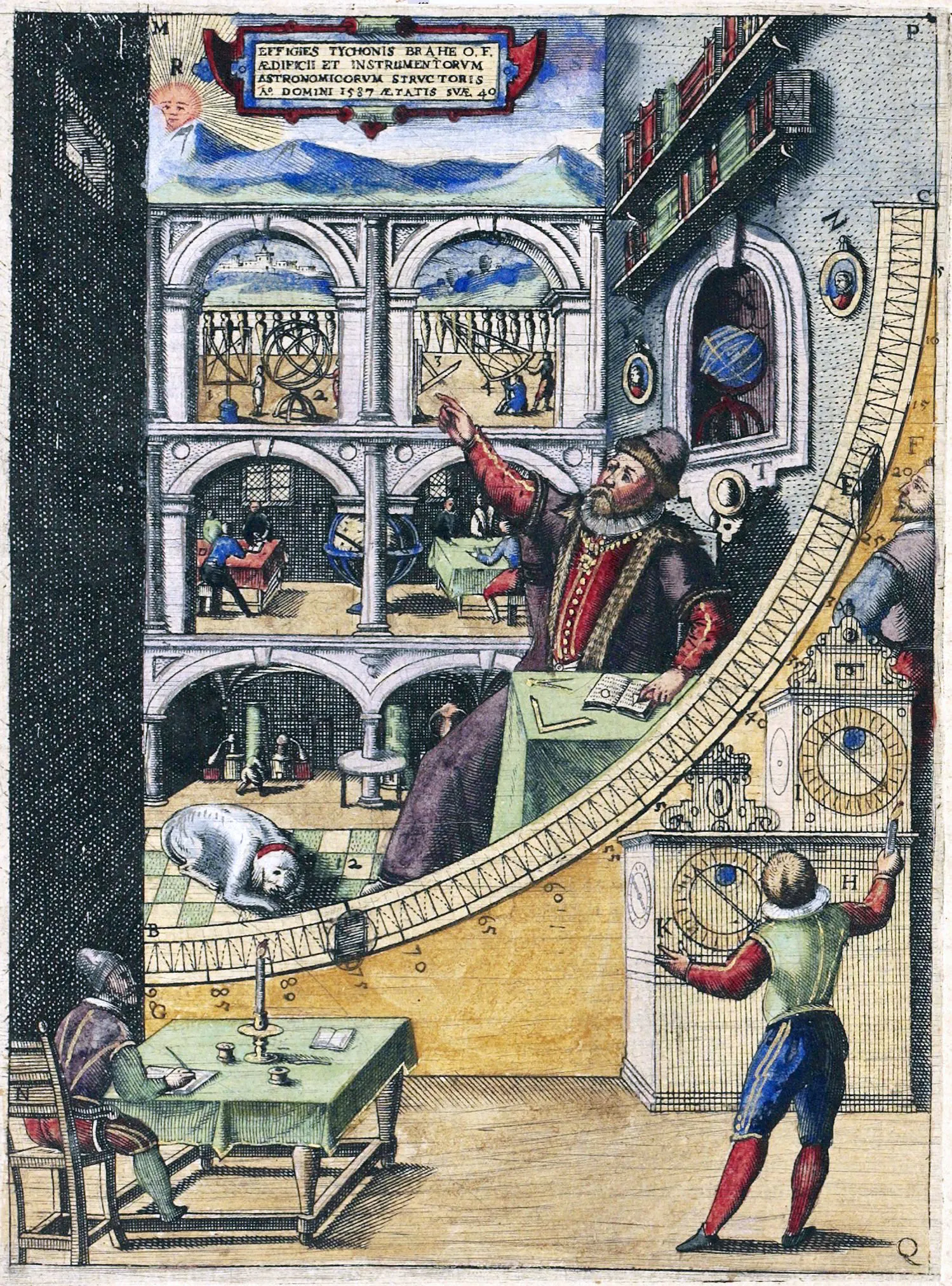
A period engraving of Tycho Brahe's mural quadrant at Uraniborg makes visible the observational regime behind the tables and constants Calvisius treated as authoritative, with sighting, timekeeping, and recording divided among observer and assistants around a wall-mounted arc. Instrument, clock, and written measurement together evoke the practical foundations of the Tychonic data drawn on for lunar corrections and chronological calculation. Source ↗.
The long table apparatus of Chapter II, and the tutorial in sexagesimal logistica that closes the theoretical section, present chronology as an artisanal practice with its own instruments; and where the instruments' authorities disagree, the text adjudicates openly. On the semidiameters at full moon the procedure is explicitly one of compromise, weighing his own sight of solar eclipses, Kepler's argument from the occurrence of total obscurations, and Tycho's doctrine of irradiation: therefore, to concede something to each, I have subtracted from the moon's semidiameter at full moon not a fifth part, as Tycho holds, but only a tenth, so that the semidiameters of sun and moon are nearly equalised in magnitude; but if anything else should be demonstrated about this quantity, I shall gladly change my opinion, Ideò, ut utrique aliquid concedam, non quintam partem, ut Tycho habet, sed decimam partem tantùm semidiametro Lunæ in pleniluniis detraxi, ut ita semidiameter Solis & Lunæ quantitate færè æquetur. Si quid tamen aliud de hac quantitate demonstratum fuerit, sententiam lubens mutabo. The clause on revisability is doing real work: the numerical constants of the tables are held as provisional settlements answerable to future demonstratio, which is the same standard the Prooemium opposed to conjectura. The self-critical responsiones that close Part I press the point further, and lodge a suspicion against Tycho himself, namely that he devised the second equation for the moon doubtless because the moon's motion did not answer to calculation and observations, and thus threw the cause onto the equation of time, which rather lies hidden in the moon's motion, not sufficiently explored, on which matter let the craftsmen think more diligently, Excogitavit autem alteram ad Lunam procul dubio, quòd motus Lunæ calculo & observationibus non responderet; atque ita causam in æquationem temporis conjecit, quæ potiùs in motu Lunæ non satis explorato latet, de quâ re diligentiùs cogitent artifices. That a Leipzig cantor should refer a difficulty back to the artifices is characteristic: the chronologer uses the astronomers' tables while declining to guarantee their theory, and marks the unresolved defect rather than absorbing it silently into his own numbers.
Part II turns from the measure to the measured, and its opening chapters read civil calendars as expressions of political temperament. Greek particularism is diagnosed in a single sentence: there was, so to speak, a wonderful confusion of times in the whole of Greece, a region not large if you consider its compass, for every commonwealth had its own peculiar method in establishing the year and in naming the months, from which you may recognise that they were both greedy of empire and tenacious of their own opinion, Mira temporum confusio, ut sic loquar, fuit in totâ Græciâ, in regione, si ambitum spectes, non magnâ. Qualibet enim Respubl. suam peculiarem rationem habuit in constituendo anno, & mensibus nominandis; unde cognoscas, eos fuisse & imperii cupidos, & sententia tenaces. Temporal incommensurability is here the residue of civic ambition, and the chronologer's tables of tetraeterides, exæresimi days and Metonic and Calippic cycles are the means of rendering such particularism commensurable after the fact. The Roman chapter is governed by an equally compressed epigram — the Romans, lords of the lands but crude in the heavens, had a most disordered year, which squared neither with the sun nor with the moon, and so tossed the head of the year into one time after another, Romani terrorum Domini, coelorum rudes, perturbatissimum annum habuerunt, qui nec ad Solem, neque ad Lunam quadraret, atque ita caput anni in alia atque alia tempora trajiceret — and the antithesis of terrestrial dominion and celestial ignorance underwrites the chapter's boldest thesis, that the four apparently missing consular pairs of the fasti are an artefact of a drifting caput anni measurable by dated eclipses rather than evidence of lost years. The same apparatus is then extended without adjustment of tone to the Egyptian equable year, the Nabonassar epoch, the Armenian, Yazdegird and Jalali reckonings, the Jewish computus with its scrupula and postponements, and finally to Islamic time, whose epoch is registered with the full complement of check-characters: the Turks number the epoch of their years from the night which followed the fifteenth day of July, the sixth weekday beginning, in the year of the Christian era 622, solar cycle 15, Turbæ epocham annorum suorum numerant à nocte, quæ secura est diem 15. Iulii, seria sexta ineunte, anno Æra Christianæ 622. cyclo Solis 15, the printed Turbæ and secura standing for Turcæ and secuta. A rival sacred era is thereby reduced, with no more ceremony than an Attic month-list receives, to a weekday, a Julian date and a cycle number — the operation on which the whole Isagoge rests.
The nerve of chronology: inter-epochal transfer
The third part of the Isagoge announces itself as a treatise on chronological characters, but its opening movement is already at work on the harder problem that governs everything after it: how a year counted in one era can be stated as a year counted in another. The treatment of Turkish reckoning that begins this stretch of the book sets out the twelve lunar months with their cumulative day-totals, fixes the working constants of 365 days and 6 hours for the Julian year against 354 days and a fraction for the lunar, and then confronts the residue that no rule of thumb can dissolve, since the years of the Hegira never come exactly into friendship with the years of the Christian era, Anni Hegiræ nunquam exactè coeunt in amicitiam cum annis Æræ Christianæ. The choice of amicitiam is not idle ornament: the incommensurability of a purely lunar year with a solar one is immediately moralized as an omen of perpetual discord between the Roman empire and the Turks, so that an arithmetical remainder of ten days and fifty-three minutes acquires a political gloss. What keeps the chapter from being merely an exercise in curiosity is the documentary illustration with which it closes, a Turkish imperial diploma renewing the peace with Rudolf II and dated in both reckonings at once. Conversion between eras is thus presented not as antiquarian refinement but as a competence that treaties themselves already presuppose; the chronologer only systematizes what the chancery does under pressure.
Before the third part proper opens, a brief chapter on the annus coelestis supplies the conceptual foil for everything that follows, defining the celestial year as that which is not distributed by human arbitrament into uncertain parts, but which is distinguished by the sun itself into the twelve parts of the Zodiac, Annus coelestis est, qui non arbitrio hominum incertas partes distribuitur, sed qui à sole ipso distinguitur in duodecim partes Zodiaci. The antithesis of arbitrio hominum and à sole ipso is the axis along which the whole taxonomy of years has been arranged, and it would seem to point toward the zodiacal year as the true measure. Yet the chapter, having derived the division from Dionysius the mathematician in Egypt and checked its length against Tycho Brahe's value, immediately concedes its civil unusability by sketching a hypothetical scheme of thirty-one, thirty-two, thirty and twenty-nine days assigned to particular signs. The most natural year is the least serviceable one, and the recognition of that gap prepares the reader for a decision that is frankly practical rather than physical.
That decision is the programmatic core of the part. Having observed that epochs begin variously at midwinter, at the vernal equinox, at the summer solstice, at 29 August or at the Kalends of October, the text states the discipline's central operation in the single sentence already cited in this report, judging the whole sinew of chronology to consist in knowing how to carry a given year of any epoch over to a different epoch, and in discerning and adjudicating their agreement or discrepancy with one another. The anatomical metaphor of the nervus, the tendon that transmits force, subordinates all antiquarian erudition to a single articulating function; and the pairing of cernere with dijudicare — perceiving and then judicially determining — makes the chronologer an assessor of competing testimonies rather than a compiler of them. The common measure into which every era is to be reduced follows at once: that, however, is the Julian form of the year, to which we are all accustomed in the years of the Christian era, and this alone is the most certain vehicle of time, since it is known to all, most familiar, easiest to know and observe, Ea autem est forma anni Juliana, cui omnes assue vimus in annis æræ Christianæ. Hæc sola est certissimum temporis vehiculum, cum omnibus sit notissima, familiarissima, cognitu & observatu facillima. The figure of the vehiculum is precise and slightly deflationary: the Julian year is a conveyance, privileged for its carrying capacity rather than for astronomical exactness. The three supporting grounds are of the same order — it begins in a season void of affairs, so that events are easily assigned to one year or another; it approximates the tropical year closely enough to hold equinoxes and solstices nearly fixed; and it alone admits the distinguishing marks that individuate a year. Thucydides earns praise here for dividing the Peloponnesian War by summers and winters rather than by Olympiads, on the reasoning that he thereby came nearest to the Julian form. The commendation reveals the criterion at work: an ancient historian is judged good not by his eloquence or his access to witnesses but by the reducibility of his time-scheme.
Those distinguishing marks are the subject of the chapter that follows, which sorts them into the periodic — the solar cycle of twenty-eight years, the lunar cycle of nineteen, the indiction of fifteen, together with sabbatical and jubilee years — and the event-specific, chiefly the positions of the luminaries and eclipses. Rules of computation are supplied with worked examples, including the demonstration that the Hegira must begin in A.D. 622 because only in that year does the dominical letter permit 22 July to begin a Friday at sunset. The insistence that these marks are not one aid among several but the very organ of judgement is pressed home by a simile of unusual force, for those who are ignorant of this doctrine or despise it, and yet dare to treat chronological matters, to write and pronounce about them, since it cannot but be that they confound the times, he judges no less rash than some blind man disputing about the diversity of colours, Qui verò hanc doctrinam ignorant, aut contemnunt, & tamen Chronologica tractare, de iis scribere & pronunciare audent, cum sieri non possit, quin tempora confundunt, eos temeritate non inferiores arbitror coeco alicui de colorum diversitate disputanti. The comparison makes the characteres an instrumentum on the model of a sense-organ: without them chronological judgement is not merely liable to error but formally impossible, its practitioner debarred from the object of discourse. This is what licenses the wholesale dismissals that follow, since a want of the requisite organ cannot be repaired by learning or reputation. It is worth noting that the same chapter carries an interpolated editorial notice recording that the author died before completing this Isagoge and that the remainder of the third and fourth parts was taken from the earlier Isagoge of 1605 — a candid admission, printed within the technical exposition, that the instrument the reader is using is a composite of two campaigns of work.
The same chapter's long narrative of the Paschal controversy shows how readily the computistical register turns confessional. The sequence runs from the divergence of the Asiatic churches, which followed John and the apostles, from the Europeans of Italy and Gaul, through the Roman edict of 157 and Polycarp's irenic mission of 165, to Victor's renewal of the quarrel in 197 and his condemnation of the Asiatics, and it is at that point that the technical account yields a verdict, that so promptly, at the very beginning, did the Roman Pontiffs aspire to dominion over the remaining Churches, adeò Pontifices Romani statim in initio imperium in reliquas Ecclesias affectarunt. The force lies in affectarunt, an aspiring that connotes usurpation, and in statim in initio, which converts a dispute over the lunar terminus into datable evidence for the growth of a jurisdiction. The corollary drawn from the accumulated cycle-history — Hippolytus' sixteen-year cycle, Anatolius' nineteen, the Nicene decision, the Alexandrian tables of Theophilus and Cyril, the great period of 532 years and its retraction to the Nativity by Dionysius Exiguus — is not, however, a call for reform, and here the argument makes its most revealing turn, in the passage noticed earlier in this report: the defects of the Paschal termini of the old calendar are seen and acknowledged, and yet the ancient usage of the Church is preferred, the defects being left to the liberty of the Church. The astronomical case is granted in full and then declared not to be decisive, the question being transferred from computation to libertas Ecclesiæ. That a treatise which has just made astronomy the sole organ of chronological judgement should reserve the liturgical calendar to ecclesiastical custom is the sharpest internal tension in this part of the book, and it is stated without embarrassment.
Characters, forgery, and the discipline of Scripture
The polemical chapters that carry the argument into the fourth part apply the same evidentiary standard to the credentials of sources. The exposure of the Viterban forgeries turns on a point of letter-forms rather than on doctrine: the impostor Annius here openly betrayed his ignorance in this matter, when he writes "Metasthenes" for "Megasthenes," deceived by certain versions, and because, unskilled in Greek letters, he could not distinguish between the letter thau and small gamma, impostor Annius apertè hic prodidit suam in hac re insectiam, dum Metasthenem scribit, pro Metasthene deceptus versionibus quorundam, & quod rudis Græcarum literarum, inter literas thau et gamma minutum, discernere non posset. The forger is convicted by a mechanism, a specific confusion of minuscule shapes, and the demonstration then licenses the printing of the genuine fragments of Berosus from Josephus and of Megasthenes from Eusebius in the following chapter — the counterfeit displaced by the attested text. The irony that the printed page here carries the name in two spellings within a single sentence is an artifact of the compositor's work rather than of the argument, but it registers how exacting a demand such philological forensics places on the press.
The hermeneutical rule governing the sacred epochs is stated with corresponding austerity: therefore the authority of Sacred Scripture, as everywhere so also in these passages, is to be held sacrosanct, nor is one to recede from its express sense, which the words properly understood beget, Ideò autoritas etiam Scripturæ sacræ, ut ubique, ita in hisce etiam locis sacrosancta habenda est, nec ab expresso ejus sensu, quem verba, propriè intellecta gignunt, recedendum, the sensus expressus yielding only where other scriptural passages or the condition of things conflicts outright. It is this rule, and not physical fitness, that decides the autumnal beginning of the world, the objections about germination and Noah's provisions being set aside as futile conjectures; and it is the septenary arithmetic of Leviticus, yielding a jubilee of forty-nine solid years as a week of weeks rather than fifty, that supplies an independent test upon the years of the kings. Applied to contemporaries, that test produces an accusation not of miscalculation but of motivated tampering: at this place Bucholzer and Crentzheim intrude three years into the chronology of the kings of Judah, and affirm against the express words of Scripture that Amaziah began in the fifth year of Joash king of Israel, which nevertheless is nowhere written, Hoc loco intrudunt Bucholzerus & Crenzheimius in Chronologiam regum Iudæ tres annos affirmantque contra expressa Scripturæ verba, Amaziam coepisse quinto anno Iosas regis Israelitici quod tamen nuspiam scriptum est. The verb intrudunt charges an insertion made against the text, and the reconstruction of the opponents' motive that follows — the years were needed to make a jubilee fall where their scheme required it — turns the sabbatical cycle from a devotional datum into an instrument of criticism directed at living scholars. The septenary character functions here exactly as the dominical letter did in fixing the Hegira: an independently attested annual sign against which a claimed sequence either holds or fails.
Sacred epochs and the burden of proof
The exposition passes next into a contest over Persian royal onomastics, and the manner in which that contest is settled discloses the evidentiary hierarchy governing everything that follows. Confronted with Josephus's account of the Persian succession against the plain sequence of Ezra, the text does not begin by weighing the historian's sources but by asking what weight human testimony can bear at all when set against the divine, Quid enim testimonium humanum est si cum divino comparetur?. The question is rhetorical in form and jurisdictional in force: it removes Josephus from the class of competing witnesses before any arithmetic is performed. What follows — the regnal computation of Nebuchadnezzar, Evilmerodach, Niglissar, Labosordach and Belshazzar, which drives the captivity to an impossible hundred and one years — therefore functions as corroboration rather than as the ground of the verdict, and the historian is dispatched with the work's characteristic verb for chronological derangement, Deinde Iosephus historicus in illorum temporum historia valdè hallucinatur. Yet the priority of Scripture is not permitted to license laxity in the opposite direction. The burden of proof is stated with unusual precision: from this express sense of Scripture, anyone to whom piety is dear who wishes to withdraw and to derogate from Ezra's historical credit must assuredly have not only a great cause underlying the attempt, but must also demonstrate that Ezra, with truth preserved, cannot at all be brought into agreement with the pagan writers, Ab hoc expresso Scripturæ sensu, ut quispiam, cui pietas cordi est, recedere, & Esra fidem historicam derogare velit, profectò necesse est, non tantum, ut magna subsit causa: sed etiam, ut demonstretur, quòd Esras, salva veritate, cum Ethnicis Scriptoribus, omninò convenire non possit. Two features of this sentence carry the argument. First, the operative term is fides historica: Ezra is arraigned as a historian whose credit stands or falls with the coherence of his sequence, not merely invoked as a prophet exempt from scrutiny. Second, the escape clause is a demonstration of impossibility, not a preponderance of authorities — the same standard the Isagoge elsewhere sets against mere conjectura.
Having fixed the standard, the text submits its own reconstruction to it with disarming candour. The identification of the scriptural Darius as Darius nothus, the son of a concubine standing between two Artaxerxes, obliges the author to allow implausibly long tenures to Joshua and Zerubbabel, and rather than conceal the strain he suspends the reader's verdict: but, kind Reader, suspend your judgement a little while, I beg, until we demonstrate the same inconvenience also in Josephus's opinion, Sed, benevole Lector, suspende quæso, aliquantisper judicium, donec eandem Zorobabel , & inconvenientiam etiam in opinione Iosephi demonstremus. The direct address is a device of controversial rhetoric, but it also concedes something structurally important: on the contested Persian interval no hypothesis is free of longevity problems, and the choice between them is comparative rather than clean. The rival scheme is then shown to require that Nehemiah and Sanballat survive to the age of Alexander, and the argument from the ransacking of the royal libraries and archival cases to recover Cyrus's edict — a search unintelligible if the decree were of recent date — converts an administrative detail into a chronological measure of elapsed time.
The diagnosis of why chronologers disagree is the methodological centre of the whole part, and it is stated as a fault of procedure rather than of erudition: the chief cause of the diversity of these opinions seems to be that they did not first number the time itself in its own right and afterwards apply the events to it, Diversitatis harum sententiarum causa videtur esse præcipua, quòd non prius tempus ipsum per se numerarunt, & postea res gestas ei applicarunt. The order of operations is everything. Time is to be constituted independently — by cycles, conjunctions and computable intervals — and the narrative fitted into the resulting frame; the alternative, harmonizing the sources first and inferring the frame from the harmony, is precisely what produces the proverbial discord of the discipline. The same passage indicts the reverse procedure in exegesis, where interpreters twist Daniel's words to a preconceived opinion instead of eliciting the prophecy's sense from them. On the seventy weeks the author accordingly refuses to let the terminus be settled by the weight of commentators, and installs Christ as his own interpreter of Daniel: therefore Christ openly testifies that Daniel's prophecy of the seventy weeks terminates in the destruction of Jerusalem, and so the end of the weeks is certain, nor does he think anyone can rightly doubt it, Ergò CHRISTUS apertè testatur, vaticinium Danielis de septuaginta hebdomadibus terminari in excidio Hierosolymitano. Itaque finis hebdomadum certus est, nec arbitror quemque de eo rectè dubitare posse. The Synoptic apocalypse is thus made an authoritative gloss fixing a terminus ad quem — the fall of the city under Vespasian and Titus — from which the four hundred and ninety years are subtracted to reach the year of the world. The weeks cease to be an object of prophetic speculation and become a measured interval fixed at its far end by a datable siege.
The chapters on the nativity restate the disciplinary stakes in affective and confessional terms before restating them technically. That Christians should not know the year from which they number their own salvation is presented as a scandal rather than a difficulty: is it not now almost ignominious for us Christians to disagree in differing opinions about this so celebrated, so solemn, so necessary epoch of Christ, from which we number the years of our salvation, and to be ignorant what the true year of Christ's nativity finally is, Nonne jam ignominiosum propè est nobis Christianis, de hac Christi tam celebri, tam solenni, tam necessaria epocha, à qua annos salutis nostræ numeramus, diversis opinionibus dissidere, & qui verus tandem nativitatis Christi annus sit, ignorare?. The rhetoric of shame does real work: it licenses a conclusion — that the received era is two years out — which would otherwise appear an impious novelty. The pivot from testimony to computation is then made explicit through a forensic simile. Having enumerated the five received opinions and their sponsors, from Eusebius and Clement to Dionysius Exiguus, the author refuses to hear more, fearing lest there befall him what might befall an ignorant judge who sets out to investigate the truth of some fact from witnesses disagreeing among themselves and relating only their own opinions about a matter not yet known, Sed si plura audiverimus, vereor, ne nobis eveniat, quod Iudici ignaro, veritatem alicujus facti ex testibus inter se dissentientibus, & suas tantùm opiniones de re mondum cognita narrantibus, exploraturo, accidere posset. The simile is exact in its jurisprudence: witnesses of equal standing who report opinion rather than fact cannot be adjudicated by counting heads, and a judge who tries to do so merely ratifies the loudest. The remedy is to leave the courtroom of auctoritas for the workshop of demonstratio, fixing the fifteenth year of Tiberius by Augustus's death, by Tiberius's lifespan, and by the Claudian solar eclipse, and then reading Luke's quasi triginta annorum backwards from it. The conclusion arrives in syllogistic dress, with the received era's author reduced to an appositive: since the fifteenth year of Tiberius rests, as this report has already had occasion to note, on demonstrations that cannot fail, the error must have been committed by Dionysius Exiguus, the monk who framed the Christian epoch. The word monacho is not descriptive padding; it locates the fault in a specific ecclesiastical transmission, and prepares the further complaint that the era was obtruded upon the Church by pontifical authority.
Nothing in this polemic is a blanket dismissal of the received historians, and the treatment of Josephus in the Herodian chapters shows the author's readiness to distinguish zones of reliability within a single source. The historian discredited on the Persian period is here defended on the ground that record-keeping among the Jews was a priestly office: nor was it permitted to just anyone among the Jews to record history, but only to priests, and indeed the chief ones, and therefore Jewish history was written by the best men and those most zealous for truth, Non cuivis enim licebat apud Iudæos historiam consignare, sed tantùm sacerdotibus, & quidem primariis. Ideò ab optimis, & veritatis studiosissis historia Iudaica conscribebatur. The criterion is institutional rather than personal: a source is credible where it depends on a documented custody of records, and untrustworthy where it does not. That principle, applied to Herod's thirty-seven Passovers and to the Jewish practice of counting regnal years by Passovers, permits the reconstruction of the reign against which the nativity is dated.
Even at its most computational the Isagoge marks the frontier of its own competence. After tabulating five Passovers of the ministry from the Calippic period and true lunar motion, and fixing the Passion to a Friday in early April, the author declines to legislate for the exegetes: although this is rather the theologians' business than the chronologer's, he has nevertheless noted a manner of that distribution in the Chronology itself, by which he wishes nothing prescribed to the theologians who treat these matters professionally, etsi id Theologorum potius est, quam Chronologi, tamen modum quoadam in ipsa Chronologia annotavimus ejus distributionis, quo tamen Theologis, qui hæc ex professo tractant, nihil præscriptum volumus. The chronologer supplies the frame of years and hours; the harmonization of the evangelical narratives within it belongs to another faculty. Such a demarcation is a genuine methodological gesture in a genre where computation and doctrine were habitually fused, and it is of a piece with the work's other self-limitations.
The annals open: Creation, the Olympiads, and the year as apparatus
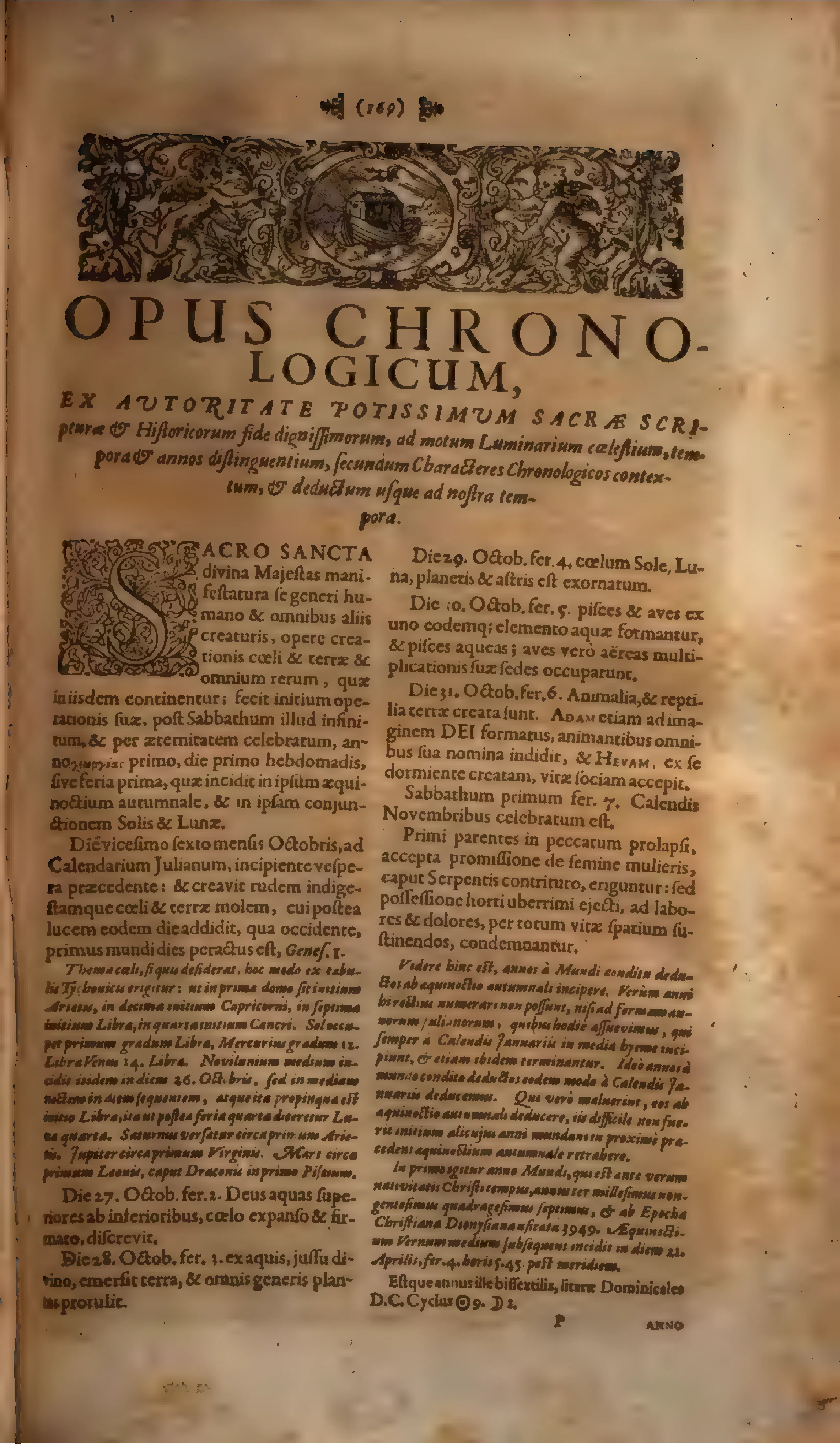
The opening of the Opus chronologicum proper announces its method as much as its subject: beneath the ornamental headpiece and display title, Creation begins not as an isolated date but as a computed convergence of weekday, autumnal equinox, and solar-lunar conjunction. The same page's references to Tycho's tables and to Anno Mundi, Dionysian, solar, and lunar cycles make the chronicle's first moment a test case in the transferable apparatus of chronology. Source ↗.
When the annalistic Opus opens, the instruments forged polemically in the earlier chapters become constitutive. Creation is not asserted as a bare year but constructed from a coincidence of characteres, the beginning of God's working being placed, after that infinite Sabbath celebrated through eternity, in the first year, on the first day of the week, or feria prima, which fell upon the autumnal equinox itself and upon the very conjunction of Sun and Moon, anno: primo, die primo hebdomadis, sive feria prima, quæ incidit in ipsum aquinoctium autunnale, & in ipsam conjunctionem Solis & Lunæ. Weekday, equinox and syzygy together make the epoch verifiable in the only currency the work accepts, and the immediately following invitation to cast a thema coeli from Tycho's tables for anyone who desires it, Thema coeli, si quis desiderat, hoc modo ex tabulis Typhonis erigitur, shows how continuous the computational culture of the annals was with contemporary astronomical practice. The same page is candid that the annalistic year is a convention chosen for convenience: the years are deduced from the Kalends of January, with instructions for readers who prefer to draw the world-year back to the preceding autumnal equinox. Further into the annals, the epochal grid is justified by an argument from record-keeping rather than from astronomy alone, since by the Hellanodicae there were inscribed on tablets the names of those who had been victors and other memorable things, so that we may deservedly credit to this epoch whatever certainty we have in histories both before and after it, Ab Hellamodicis præterea in tabulis perscribebantur nomina, qui victores fuissent, & alia memorabilia, ut ita huic epochæ meritò acceptum feramus, quicquid certi in Historiis & ante & post eam habeamus. Certainty is here made a function of a documentary institution: the Olympiad matters because someone wrote things down under oath and kept the tablets, and Greek chronology before and after it borrows its credit from that practice. Astronomy supplies the tests, but the archive supplies the testable series — and where neither is available, as in the weighing of Homer's date, the annals concede that the matter is not exactly established and admit conjecture under its own name.
The annalistic year in the classical stretches of the chronicle is a printed form as much as a narrative unit, and its parts are always the same. A heading gives the year of the World and the years before Christ's nativity; beneath it stand the recurrent annual signs — dominical letter, and the numbers of the solar and lunar cycles — and the running heads of these leaves carry both the reigning Persian monarch and the date of the vernal equinox, so that the astronomical frame is present on the page even where no computation is performed. Then come the Roman magistrates, introduced by a formula which is itself a computation: at Rome about the twenty-eighth day of May the military tribunes with consular power enter upon their magistracy, Romæ circa diem 28. Maji Magistratum ineunt Tribuni militum consulari potestate. Livy, cited immediately afterwards for the campaigns, supplies the names of the tribunes but no such date; the Julian day is the chronologer's own product, obtained by reducing the Roman civil year to the uniform Julian reckoning. That the reduction is governed by a rule rather than by testimony becomes visible when the same formula recurs some thirteen years later and now reads that at Rome about the twenty-first day of August they enter upon the magistracy, Roma circa diem 21. Augusti Magistratum ineunt. Between the two the entry date advances by a strictly uniform five days each year, a slippage that presupposes a civil year of unequal length with the solar year and that no ancient source states. The governing adverb is circa: the computed date is offered as an approximation, in keeping with the treatise's own standard of coming near enough to the matter rather than touching the exact minute.
Threaded between the years, and typographically separated from the narrative, run the other epochal lines, each stated with the same three data — an ordinal year, a Julian day, and a weekday. The Babylonian era appears as the notice that the 340th year of Nabonassar begins on the third day of December, the first day of the week, Annus Nabonassaris 340. incipit die 3. Decembr. feria prima.; the Greek era as the notice that the ninety-third Olympiad was held on the fourth day of August, the third day of the week, and is the 369th Olympiadic year, Olympias 93. acta die 4. Aug. feria 3. Est annus Olympiadicus 369.; the Hebrew cycles as the notice that the second sabbatical year of the twenty-second Jewish jubilee begins on the second day of October, the fifth day of the week, in the Jewish year 3355, Annus sabbathicus secundus Iobelæi Iudaici 22. incipit die 2. Octobris, feria 5. anno Iud. 3355.. The feria is not ornament. Weekdays run continuously and can be computed independently of any era, so their inclusion turns each conversion into a statement that can be falsified by anyone willing to repeat the reckoning; the plurality of epochs is thus laid along a single spine with a built-in control at every join. It is worth noting that the sabbatical and jubilee cycles are retained here as a historical reckoning to be converted, even though the Isagoge refuses the Jewish calendar as a measure of astronomical time — the two positions are consistent only because conversion of a civil cycle and adoption of it as a celestial standard are, in this system, entirely different operations.
The same apparatus is brought to bear on the great terminus of Greek history. The surrender of Athens is dated by the Attic month and then converted: this was done on the sixth day of the Attic month Munichion, which in the Julian calendar fell this year on the twenty-first day of April, on which same day seventy-six years earlier the naval victory at Salamis had been won; thus the Peloponnesian War was ended, its twenty-seventh year just beginning, Factum hoc die 6. Munichionis Attici mensis, qui in Calendario Iuliano hoc anno incidit in diem 21. Aprilis: sub quo etiam die ante annos 76. victoria navalis ad Salaminem parta fuerat. Ita finitum Peloponnesiacum bellum, anno 27. ineunte.. Three distinct operations are compressed into one sentence: the reduction of a lunisolar Attic date to the Julian calendar, the calculation of an interval of seventy-six years between two events transmitted in different reckonings, and the assignment of an ordinal year within a war whose numbered years head every annal in this run. The coincidence of Athens's fall with the anniversary of Salamis is precisely the kind of observation that only inter-epochal conversion can produce; it is not in the sources, and it exists solely because both dates have been brought onto a common measure. The rhetorical charge of the coincidence — the day of deliverance become the day of subjection — is left entirely to the reader, the annalist confining himself to the reckoning.
The dynastic spine of the eastern kingdoms is handled by regnal arithmetic secured against a canon. Darius Nothus, king of the Persians, having reigned nineteen years, dies; his successor is his son Artaxerxes Mnemon, who reigns forty-three years, Darius Nothus rex Persarum, cùm 19. annos regnâsset, moritur: Successor filius Artaxerxes Mnemon, qui regnat annos 43. Diod. lib. 13. Ptolomæus in Canone.. The double citation is the methodological point: a narrative historian for the event, and Ptolemy's canon of kings for the length of the reign, the canon functioning as the tabular instrument against which the historian's report is checked. Because each following year is headed by the regnal ordinal of Artaxerxes, the reign becomes the local counter for a whole run of annals — which also exposes the system's vulnerability to a compositor's slip, since in this sequence the ordinal jumps from the first year to a numeral out of place before resuming with the third, a defect of the printed numerals rather than of the reckoning, but one that in a book of this kind corrupts precisely what the reader is invited to verify.
The most demanding entry in the run abandons narrative altogether for the collation of an ancient observation with modern tables. Citing Ptolemy's third book, the text reports Hipparchus's computation, from astronomical observations, of a winter solstice in the 355th year of Nabonassar at the beginning of the night of the twenty-seventh of the month Mechir, more or less, and then performs the reduction: the same day falls in the Julian calendar on the twenty-seventh day of December, the fifth day of the week, at the meridian of Alexandria, at the beginning of the night, the sixth hour after noon, Idem dies incidit in Calendario Iuliano in diem 27. Decembris, feriam quintam, ad Meridianum Alexandrinum, per initium noctis, hora 6. post meridiem.. Place is reduced along with time — the meridian is specified because an hour is meaningless without it — and the weekday again supplies the independent check. The recomputation follows: but according to the tables of equable tropical years this solstice falls, by today's computation, on the same day at the third hour and forty-seventh minute after noon at Alexandria, Ad tabulas verò annorum tropicorum æquabilium, cadit solstitium hoc, secundum computationem hodiernam, in eundem diem hora 3. minutis 47. Alexandriæ post meridiem.. Day and weekday agree; the hour does not, by more than two hours. The residue is not suppressed, and it is not charged to a negligent chronologer as the polemical passages elsewhere charge error to practitioners rather than to tables. It is converted into an open astronomical question, with the frankest concession in the whole stretch: but the winter solstice is investigated with less certainty; yet this at least would appear from these observations made on the matter, that it is not sufficiently established whether tropical years are entirely equable, and whether tropical years are not somewhat altered over so great a span of years, Sed & solstitium hyemale minus certò investigatur. Illud tamen appareret, ex hisce observationibus, hac de re factis, non satis esse compertum, an anni tropici sint plane æquabiles, & an anni tropici in tanto annorum spatio non aliquid immutentur.. The instruments are here turned upon themselves: the tables that adjudicate historical dates are themselves put on trial by an ancient observation, and the assumption of an invariable tropical year — the very premise that makes retrospective computation possible — is declared unproven. Precision and candour about its limits are, in this practice, two faces of the same method.
The same conversion technique is applied to the Roman civil calendar in its pre-Julian state, at the disaster on the Allia: this was done on the sixteenth day of July of the Roman calendar, which in the Julian calendar fell this year on the twentieth day of July, the sixth day of the week, which day was afterwards called the Alliensis and held as a black day, Factum hoc die 16. Iulii Romani Calendarii, qui in Calendario Iuliano hoc anno incidit in diem 20. Iulii, feriam sextam, qui dies postea Alliensis dictus est, & ater habitus.. The old Roman reckoning is treated as a foreign calendar requiring reduction, exactly like the Attic; the weekday is supplied where no source supplies it; and the religious afterlife of the date, its status as dies ater in the Roman fasti, is preserved as a historical datum in its own right. Around this computed core the annal keeps a quantity of material that no computation can test — the voice heard on the new road and disregarded on account of the speaker's low station, the Veientine seer's prophecy that Rome would be taken by the Gauls, the swelling of the Alban lake and the responses of the Delphic oracle — each with its citation to Livy. The annals do not purge such testimony; they transmit it with its authority named, while reserving the apparatus of reduction, weekday, meridian and hour for what can be brought under a rule. The line between what is demonstrated and what is merely reported is drawn, in this stretch, by the presence or absence of a computation, not by the silencing of the marvellous.
From Athens to Alexander: the Greek side of the same architecture
Seen from the side of its Greek material, the same run of annals displays an identical architecture. The year does not arrive as a bare number but as a composite head in which several reckonings are stated together and made mutually convertible, as when the archon at Athens is Euclemon, the ninety-second Olympiad having been held on 4 August, on the seventh weekday, being the year 369 of the Olympiads, Archon apud Athenienses Euclemon. Olympias 92. acta die 4. Aug. fer. 7. Est Olympiad. 369. Four distinct quantities are packed into a single line: the eponymous Athenian magistracy, the ordinal Olympiad, the Julian day on which the festival fell, and the weekday. The last is the least conspicuous and the most revealing of method, since the feria is not information transmitted by any Greek source but a value computed from the Julian day-count; it functions as one of the recurrent annual signs by which an era can be tested against another, and its presence converts a merely reported synchronism into a checkable one. The same architecture governs the eastern reckoning, the 344th year of Nabonassar beginning on 2 December, on the fourth weekday, Annis Nabonass. 344. incipit die 2. Dec. fer. 4. The Nabonassar era matters here not for any Babylonian narrative — none is told — but because it is the reckoning in which the surviving corpus of ancient astronomical observation is expressed; its inclusion year by year keeps the historical annals permanently commensurable with the observational record that alone can adjudicate between them.
Sacred and Gentile time are brought into the same frame by the same technique rather than by any theological argument. The sabbatical year is entered with its position within the jubilee cycle, its Julian commencement, its weekday, and its year of the Jewish reckoning: the fourth sabbatical year of the twenty-second jubilee begins on 24 September, on the third weekday, in the Jewish year 3355, Annus sabbathicus 4. Iobeli 22. incipit die 24. Sept. fer. 3. anno Iud. 3355. Nothing in this line is polemical, and that is precisely its force. The cycles of Leviticus are handled as a periodic structure of exactly the same formal type as the Olympiad or the era of Nabonassar — an epoch with a known starting point and a known interval — so that scriptural chronology enters the universal timeline as one convertible reckoning among several rather than as a privileged frame into which the others must be fitted. The technical rejection of the later Jewish calendar for astronomical computation and the retention of the sabbatical and jubilee cycles as chronological quantities are, on this showing, entirely compatible positions: what is rejected is a rule of civil intercalation, what is retained is a countable period.
Within this scaffolding the narrative entries are radically compressed, and the compression is itself an argument about what an annal is for. The death of Socrates occupies one sentence in which the philosopher, accused of impiety towards the gods and of corrupting the youth, is condemned to death, and his accuser is shortly afterwards put to death by the judgment of the people, Socrates Philosophus, læsæ pietatis in Deos & corruptæ juventutis accusatus, capite damnatur, cujus accusator paulò post judicio populi jugulatur. The Platonic apparatus of the Apology and Phaedo is entirely absent; what survives is the charge in its two juridical heads, the sentence, and the reversal — the sequence, in other words, that can be assigned to particular years and thereby tested. The Roman entries are treated identically. The fall of Camillus is given as a prosecution over the Veientine spoils: a day was appointed for Camillus on account of the Veientine booty, which by publishing and tithing it he had reduced to nothing, as was alleged, and since he could not be acquitted he refused to pay the fine but went into exile at Ardea, Camillo, propter prædam Vejentanam, quam publicando & decimando ad nihilum, ut insimulabatur, redegerat, dies dicitur. Cùm absolvi non posset, noluit solvere multam, sed in exilium abiit Ardeam. The Livian material is retained only so far as it supplies a dateable civic act — the dies dicta, the refusal of the multa, the departure to Ardea — and the qualifying ut insimulabatur preserves the distinction between what was charged and what was established, a habit of marking the epistemic status of a report that belongs to the same discipline as the distinction between demonstration and conjecture.
Against this deliberately thin narrative surface, the astronomical entries stand out by their density of numerical detail. The solar eclipse which Helicon of Cyzicus predicted occurred at Syracuse on 29 February, two hours before noon, with a true latitude of 24° 47′, Eclipsis Solis, quam Helicon Cyzicenas prædixit, Syracusis accidit die 29. Februari. horæ duabus ante meridiem. Latitudo vera 24. 47. The anecdote as transmitted by the ancient biographical tradition is a courtly curiosity about a mathematician rewarded for a successful prediction; here it is reconstituted as a datum. The place is specified because parallax and visibility depend on it, the hour is reduced to local apparent time, and the computed latitude of the luminary is appended as the quantity from which the magnitude and reality of the obscuration follow. Where the historical entries are abbreviated, the celestial entry is expanded, because it is the celestial entry that does evidentiary work: an eclipse fixed by calculation converts a floating anecdote into an absolute point to which the surrounding Sicilian and Greek years can be tied.
The two great Macedonian dates receive the same treatment through calendar conversion rather than eclipse. Alexander the Great is born on the sixth day of Hecatombaion, that is, if one looks to the Julian calendar, on 6 August, on the third weekday, and on that very day the temple of Diana among the Ephesians, set on fire by Herostratus, burned down, Alexander Magnus nascitur die sexta Hecatombionis, hoc est, si ad Calendarium Julianum respicias, die 6. Augusti, fer. 3. Eo ipso dię templum Dianæ apud Ephesios, ab Herostrato incensum, conflagravit. The conditional clause si ad Calendarium Julianum respicias is the methodological hinge of the whole entry: the Attic month-name is not simply glossed but reduced to the uniform Julian day, and the feria is again supplied as an independent verification. The coincidence with the burning of the Ephesian temple, a topos of the rhetorical tradition, is retained not for its portentous colour but because two synchronous events in different reckonings are worth more to a chronologer than either alone. The death is handled by the same reduction from the Macedonian calendar: he perished on the tenth day of his illness, on the twenty-second day of Daesius, which for us is roughly the eighteenth of April, when he had lived thirty-two years and eight months, Et quòd decimo morbi die perierit, die vicesimo secundo Dæsii, qui nobis ferè est decimus octavus Aprilis, cùm vixisset annos triginta duos, menses octo. The hedging adverb ferè is not carelessness but the declared standard of the discipline applied in a hard case: where the Macedonian month cannot be locked to the Julian day with certainty, an approximation is stated as an approximation, and the stated lifespan in years and months supplies the independent constraint by which the interval between the two Macedonian dates can be checked.
The chronicle extends its serial logic beyond kingdoms and magistracies to the schools. Plato the philosopher dies, and Speusippus, his nephew by his sister, succeeds him and presided over the Platonic school for eight years, Plato Philosophus moritur, succedit ipsi Seusippus, ex sorore nepos, qui octo annis scholæ Platonicæ præfuit. The scholarch is treated exactly as a monarch is treated: named, related to his predecessor by a stated line of connection, and assigned a numbered term of years. The succession of the Academy thus becomes a countable series that can be laid alongside the Persian and Macedonian regnal lists and used, like them, to bridge gaps in other reckonings. Jewish history enters the Macedonian years by the same principle of intersection, the high priest Jaddus, having proclaimed a solemn fast for the people, going out to meet the angry Alexander adorned in his pontifical robe, whereupon Alexander, immediately changed in mind at the sight, received the pontiff kindly and in a friendly manner, Pontifex JADDAA, cùm populo jejunium solenne indixisset, irato Alexandro obviam procedit, ornatus stolâ pontificali. Sed Alexander eo viso statim animo immutatus est, Pontificem benignè & amicè suscepit. The episode is valuable to the compiler because it is a documented contact point: a named high priest and a datable conqueror in the same year, which allows the pontifical succession to be pinned to the Macedonian series at a single verifiable node.
The Hellenistic aftermath is entered in the same clipped register, with the orator's end reported in full circumstantial detail because the circumstances are what date it — Demosthenes, seeing that this peace would be ratified by the Athenians with his own blood, fled, and being sought out by Antipater through a certain Archias, when he could not escape, drank poison from a writing reed and, with his head wrapped, expired, Demosthenes pacem hanc cum Atheniensibus suo sanguine sancitum iri videns, fugit. Quæsitus autem ab Antipatro per Archiam quendam, cum effugere non posset, ex calamo scriptorio venenum hausit, & involuto capite expitavit. Death is tied to a treaty, the treaty to a campaign, and the campaign to the regnal year of a successor, so that even the most literary of ancient death-scenes is retained chiefly as a link in a chain of dateable civic acts. Across these pages the governing principle is consistent: narrative is abridged to what can be located in time, while computation — Julian day, weekday, eclipse latitude, reduction of Attic and Macedonian months — is given in full, because it is computation that holds the several eras in a single reckoning.
The Successors and the Republic: instruments given a history
As the annals pass into the age of the Successors, the unit of composition remains the year, and the year arrives as a typographical formula before it arrives as narrative. Each annual entry opens with a display line reducing the whole of world history to two commensurated numbers, the year of the world and the years before the Christian nativity, ANNO MUNDI 3632. ante C. N. 316, and beneath it stand the cyclical sigla and the parallel era-lines that convert that single point into every reckoning a reader might bring to it. The result is that the page itself performs the doctrine of inter-epochal transfer: an Athenian archonship, an Olympiad with its named stadion-victor, a Roman consular college, a Babylonian regnal year and a Jewish sabbatical count are all made to name one and the same interval. The Jewish spine is the most heavily freighted of these, because it carries prophecy as well as calendar, the entry registering a sabbatical year within a numbered jubilee and simultaneously locating it inside the Danielic seventy weeks, Annus sabbathicus secundus, Iobelei vicesimi quarti, quo est septima decima hebdomadum Danielis, incipit die 26. Septemb. fer. 5. anno Iud. 3431. Two things are worth noticing in that line. First, the prophetic week is treated as a chronometric unit of exactly the same order as the sabbatical cycle, so that eschatological reckoning is absorbed into the apparatus rather than reserved for commentary. Second, the entry supplies a Julian day and a weekday — the ferial number — which is precisely the kind of independently computable datum by which the whole scheme can be tested. The same discipline governs the technical eras proper: the Babylonian era of Ptolemy's canon is set down with the Macedonian era of Alexander's death and, again, with a weekday, Annus Nabonass. 448. & annus Philippi & mortis Alexand. 24. incipit die 6. Novemb. fer. 6. Nothing in these headings is narrative; everything in them is checkable, and that is their function.
The excursuses that interrupt the annals show what the checking looks like. The pivotal case in this portion is a phrase of Livy converted into an astronomical observation and then used to adjudicate the Roman consular series. The printed line is corrupt in its middle, but its argument is legible: no one doubts that by these words of Livy, "night seemed to be drawn out," a solar eclipse is signified, one which, falling either at the beginning or at the close of the day, added a portion of darkness to the night, Cæterùm verbis hisce Livii: Nox visa est intendi, eclipse solare om, quæ vel incipiense die vel definense fætasis; atq[ue] ita nocti partem senebrarum addiderit, significari, nemo ambigit. The move is a double translation. A literary and quasi-portentous expression in a Roman historian is first read as a description of a physical event, and the event is then reduced to a computable position of the luminaries; the ambiguity of the phrase is resolved not by philological parallel but by the physics of an eclipse near sunrise or sunset. Having secured the observation, the text draws the epistemological conclusion that governs the whole annalistic project and that has already been registered in this report: that a heavenly character is the most certain index of consulships rightly applied to the years of the world. The consular fasti, that is, do not authenticate themselves by the authority of the manuscripts that transmit them; they are authenticated by their agreement with a sky that can be recomputed at will. The controversy attached to this conclusion is named rather than left abstract: the rival computation is reported, Herwart von Hohenburg having sought this eclipse elsewhere, namely six years earlier, where he finds a solar eclipse with the Sun in the seventeenth degree of Cancer, Herbactus ab Hohenburg Eclipsin hanc alibi quasfrut; videlicet sexennio elapsô, ubi invenire eclipsin Solis, cùm Sol esset in 17. Cancri, and then refuted on the ground that the eclipse he proposes would have finished before sunset and so could not have lengthened any night. The refutation is instructive because it does not deny that an eclipse occurred in the rival's year; it denies that the eclipse satisfies the descriptive constraint of the historian's phrase. Computation and philology are made to constrain one another in both directions.
The instruments so used are themselves given a history, which is one of the more revealing features of this portion. Under its computed year the chronicle explains the origin of the cycle it prints on every page: Callippus of Cyzicus the mathematician, seeing that the Metonic year was longer than the true year and therefore generated error, turned his mind to correcting it and joined four enneadecaeterides, that is four Metonic years, which would make seventy-six Julian years, Calippus Cyzicenus Mathematicus, cùm videret annum Metonicum, qui justo major erat, vitium facere, animum ad ejus emendationem appulit, & quatenor Enneadecaeteridas, sive quatuor annos Metonicos conjunxit, qui officerent annos Iulianos 76. The narrative of an ancient astronomer detecting a small secular error in an inherited luni-solar cycle and repairing it by aggregation is exactly the narrative the volume tells about its own calendrical labours, and the annalist's decision to record it as an event, dated like a battle, incorporates the history of measurement into the history measured. The Callippic period then does its work in the reduction of ancient observations, as when Ptolemy's report is unfolded of a lunar observation made by Timocharis the astronomer in the thirty-sixth year of the first Callippic period, which begins in this year on the first of July, and which he observed on the twenty-fifth of Posideon according to the Athenians, Ptolomæus annos ac observationem Lunarem factam à Timochate Astronomo, anno 36. prima periodi Calippicæ, quinicipis hoc anno die primo Iulii, qua occiderit die vigesimo quinto Posideonis secundum Athenienses. Three calendars — Callippic, Athenian civil, and the Julian scale of the reduction — are made to coincide on a single night, and elsewhere in these pages such observations are carried further and referred to the meridian of Frankfurt, so that an Alexandrian datum is re-expressed in the local time of a German computist's own place of working.
Where no celestial control is available, the annals show the same critical temper operating on testimony alone. Alexander's death is presented as a conflict of authorities rather than as a fact: Justin and others contend that he perished by poison, of which no one dared make mention because of the power of Antipater, who is believed to have administered it, but Plutarch refutes them and affirms that he had obtained a diary of Alexander's illness, Iustim. & alii veneno peruisse contendunt, cujus mentionem nemo ausus fuit facere, propter Antipatri, qui venenum subministrasse creditur, potentiam. Plutarchus hosce refutat, affirmatq[ue], se diarium morbi Alexandri accepisse. The decisive consideration is documentary: the majority is set aside because one authority claims access to a contemporary record, while the majority's silence is itself explained away as the product of political fear. That is a ranking of witnesses by the quality of what stands behind them, and it is the historiographical analogue of preferring a recomputed eclipse to a received date. The criterion is applied with notable severity to the most famous piece of Hellenistic bibliographical legend, where the whole Aristeas dossier is declared spurious — the things adduced concerning Ptolemy's envoys to the high priest, and concerning the seventy interpreters gathered from the several tribes, concerning the cells, concerning Demetrius of Phalerum, and the rest, are all fabricated by the Egyptian Jews in order to win authority for their version, Quæ afferuntur de legatis Ptolomæi ad summum Sacerdotem, & de leptuaginta Interpretibus ex singulis tribubus collectis, de cellulis, de Demetrio Phalerxo, qui in initio Ptolomæi aspidis mot superiit, & de aliis, omnia conficta sunt ab Ægyptiis Iudæis, ut suæ versioni autoritatem conciliarent. The imputed motive — the manufacture of autoritas for a text — is the classic diagnosis of forgery, and it is applied here to a legend deeply embedded in patristic tradition. Yet the same page shows that scepticism is not uniform. The Josephan encounter at Jerusalem is transcribed without demur, Alexander on seeing the high priest being at once changed in mind, receiving him kindly and in friendly fashion, and, when asked the reason, replying that a certain divinity had appeared to him by night in Macedonia which had promised him victory over the Persians, Sed Alexander eo viso statim animo immutatus est, Pontificem benignè & amicè suscepit, & interrogatus causam, respondit, sibi in Macedoniâ numen quoddam noctu visum, quod victoriam de Persis sibi promisisset, and the episode is then made to yield a Danielic confirmation of the fall of the Persian monarchy. The asymmetry is not concealed by the text and repays notice: a legend that would authorize a translation is dismantled, while a legend that ratifies prophetic chronology is retained.
The dating of authors follows the same logic of instruments. Berosus is placed by the calendar he presupposes: Pliny reports that he preserved among the Babylonians the memory of things done for four hundred and eighty years, and those years, the chronicle infers, were without doubt Nabonassarian, the years in use among the Babylonians, BEROSIUS, inquit Plinius lib. 7. cap. 56. apud Babylonios memoriam rerum gestarum ad annos quadringentos & octoginta conservavit; procul dubio autem anni illi fuerunt Nabonassarii, qui apud Babylonios usitati erant. An interval of years is treated as evidence of era, and the era as evidence of date — a procedure that cuts in both directions, since a text whose implied reckoning does not exist at the moment it claims to write cannot be what it claims.
The Roman thread of these annals supplies the complementary demonstration that the apparatus can absorb juridical as well as astronomical material. The Illyrian embassy is reported in the technical vocabulary of the law of nations: Teuta replies that it is not the custom of kings to restrain pirates and that the sea is free to anyone, whereupon the envoys press the injuries of the merchants and demand restitution, and when it is not made they declare war on Teuta, who, the frankness of the Romans having been displayed, throws the envoys into chains against the law of nations and kills one of them, Teuta respondet non esse morem regibus, ut prohibeant piratas, mare cuivis liberum esse: Legati contra urgent injurias mercatorum, & res repetunt: cùm non redderentur, bellum Teutæ indicunt, quæ libertate Romanorum ostensâ legatos contra jus gentium in vincula conjicit, & alterum occîdit. The categories of res repetere, of a sea open to all, and of an offence contra jus gentium frame the episode in terms that a jurist of the annalist's own century would recognize as the grammar of just war, and the annal thereby records not merely what happened in a year but under what legal description it is to be entered. Finally, the constitutional and calendrical strands converge in the explanation of the shift of consular entry, the text observing that hitherto the consuls at Rome entered office on the Kalends of Quintilis, that is July, which had drifted almost to midsummer, when it is more convenient to conduct campaigns than to elect commanders, Roma Magistratum interant hactenus Consules Calendis Quintilibus sive Iulii, quæ ferè ad medium æstatis descenderant, ubi res geri, non Duces eligi conveniencium est. Faulty intercalation, and not policy, is made the cause of the drift, and the remedy is a change in the civil year; the passage thus explains why the year-heading of each annal must carry its Julian equivalent, since a Roman magistracy dated by a slipping civil calendar cannot be laid against the sky until it has been so converted.
The middle and late Republic: prodigy, indictment, and the Julian reform
Deeper into the Republican annals, each year is laid out as a block whose upper register is a lattice of reckonings rather than a narrative. Beneath a running head that couples an equinox datum with the name of the reigning Ptolemy, and beneath a year-heading giving the year of the World and the year before Christ, the compiler sets a line of annual signs — dominical letter with solar and lunar cycle numbers — and then the era-lines proper. The Greek astronomical spine is stated in the flat idiom of a computed table, the forty-seventh year of the second Calippic period beginning on 30 June, Annus quadragesimus septimus periodi Calippica secunda, incipit die 30. Iunii,, and it is joined by the Babylonian and Macedonian counts, the year of Nabonassar 548 and the year of Philip, Annus Nabonassar. 548. & annus Philippi ac, by the Olympiad with its stadium victor, Pyrrhias the Aetolian, Victor Stadii Pyrrhias Æolus, and by the Jewish cycles taken as hard chronological data, the fourth sabbatical year of the twenty-sixth Jewish jubilee beginning, Annus sabbathicus 4. Iobeli Iudaici 26. incipit, with the prophetic reckoning enumerated in the same mechanical series as the thirty-third week of Daniel, Est hebdomas Danielis 33. The effect of this stacking is precisely the operation the Isagoge names as the sinew of the discipline: a single line of the page holds four or five mutually independent epochs in fixed relation, so that any one of them can be carried over into any other by inspection. The inclusion of Daniel's weeks in the same column-logic as the Olympiads is the more striking for being unargued; a scheme laden with eschatological freight is here reduced to an ordinal that must simply agree with its neighbours. The Roman institutional pulse is supplied by the censorial lustrum, the censors having closed the fortieth lustrum, Condiderunt Lustrum quadragesimum, with its census figures — a five-yearly beat that gives the Republican material an internal periodicity comparable to the Olympiadic one.
Against that framework the astronomical verification functions as a refrain rather than an excursus. The compiler's characteristic move is to treat an ancient prodigy notice as coded observational testimony and then to convert it: by these words an eclipse of the sun is signified, which occurred on 6 May Julian, feria 4, Quibus verbis eclipsis solis significatur. Ea accidit die 6. Majo Iuliani fer. 4. The demonstrative force lies in the reduction: a Livian portent, whose original function was religious and civic, is stripped of its prodigial character and re-entered as a datable celestial event with computable elements, given down to residual scruples of 26, 42 and eclipse digits of 9, 51, scrupula residua 26, 42. digiti eclipsi 9, 51. The same procedure is applied to verse. Ovid's line at the close of the Metamorphoses, the Moon's chariot sprinkled with blood, Sparus erat, sparsi Lunares sanguine currus — the transcription is visibly degraded in the opening word — is not read as poetic ornament but as a witness to a lunar eclipse, whose computed elements the compiler then supplies. What licenses this is the conviction, argued in the technical chapters, that astronomical time can be reckoned exactly while civic and literary notations cannot; a poet's portent and a historian's prodigy are equally admissible as testimony once the celestial event behind them has been recovered by calculation.
The corollary is a sustained and unusually blunt indictment of Roman civil reckoning. The chronicle records the Romans' own recognition of the defect, that they perceived they were using a year shorter than the true one, whereupon the consul Acilius Glabrio appealed to the people concerning intercalation, senserunt Romani, se anno uti breviore justo. Ideo Consul Acilius Glabrio populum de intercalatione appellavit, and it presses on from the diagnosis to a verdict when the accumulated drift is measured, so ineptly did the Romans use their calendar, adeò inepso Calendario usi sunt Romani. The judgment is not an aside but the justification of the entire conversion apparatus: if the Roman Kalends of January could fall in September of the preceding year, then every consular date in the annals is unusable until reduced, and the labour of the era-lines is not pedantry but repair. The whole movement resolves at the point toward which the Republican section has been building, Caesar correcting the Fasti and adapting the year to the sun's course as he had learned in Egypt, Inde Fastos correxis, annumque ad cursum Solus, ut in Ægypto didiceras, accommodavit. That the reform is credited to Egyptian instruction fits the chronicle's larger hierarchy of authorities, in which the astronomical traditions of Alexandria and Babylon outrank Roman civic custom, and it converts a political act into a chronological watershed: from this year forward the compiler's Julian reductions cease to be corrections imposed from outside and become the calendar of the sources themselves.
Alongside this computational business the chronicle keeps a didactic and antiquarian register. It pauses to define an archaic institution rather than merely record it — the sacred spring being livestock born between the Kalends of March and the day before the Kalends of May, Est autem var sacrum pecus, quod nascum est inter Calendas Martii, & pridie Calendas Maji — and it habitually renders ancient sums into the coin of its own readers, two and a half florins, duobus florenis cum dimidio, Dritthalb Gilden, the German gloss standing beside the Latin. Both habits belong to the same instinct as the era-lines: an unfamiliar measure, whether of time, of ritual, or of money, is made commensurable with a known one so that the reader may handle it.
The narrative body of the annals is nevertheless not reducible to computation, and its moral register is conspicuous. Livy's Isthmian proclamation is retained almost intact, that there should exist some nation on earth which at its own expense, its own labour and its own peril wages war for the liberty of others, esse videlicet aliquam in terris gentem, quæ lus impensâ, suo labore & perculo belli gerat pro libertate aliorum — a rhetoric of disinterested liberation preserved without visible irony. Yet the same chronicle transmits the counter-voice from the Samnite line at the Colline Gate, that there would never be lacking those plunderers of Italian liberty, the Roman wolves, unless the forest to which they were accustomed to flee were cut down, nunquam defuteros raptores Italica libertatis, lupos illos Romanos, nisi sylva, in quam refugere solerent, Roma esset excisa. The juxtaposition is not resolved; the compiler's obligation is to the record, and the antithetical judgments stand where their sources placed them. The obituary formula shows the same technique of balanced antithesis applied to individuals, of Marius that he overthrew by every kind of fraud, and at last in arms as an enemy, the very republic he had saved by arms, Rempublicam enim, quam armis servaverat, togatus omni genere fraudis, & postremò armis hostiliter evertu, and of Sulla, on Velleius's authority, that while conquering he was gentler than the gentlest and justest, but after victory crueller than the cruellest, Dum enim vincit, ut Vellejus asse, mississimo & justissimo lenior fuit, sed post victoriam, crudelissimo crudelior.
The sacred-historical thread is where dating and judgment converge most tightly. Antiochus IV's assault on the cult is entered in a chain of finite verbs, that he plunders the temple itself, burns the sacred books, and erects new altars where profane sacrifices might be performed in the Greek manner, templum ipsum spoliat, Biblia sacra exurit, nova altaria erigit, ubi profana sacrificia Græcorum more fierent, and the entry is immediately furnished with an exact Julian equivalent for the profanation — the outrage is not left as narrative but pinned to a computable day, the Macedonian and Jewish month-names reduced like any other datum. The moral counterweight follows in the compiler's own framing, that there were nevertheless some who remained constant, as Mattathias with his sons, Fuerunt tamen etiam quidam constantes, ut Matathias cum filiis suis, a formulation that places divine law above the sovereign's command in terms readily intelligible within early modern debate on obedience and impious authority. The later Roman intrusions into the Temple are handled with a marked evidentiary caution: of Pompey it is said that into the Holy of Holies, as some affirm, he did not enter, nor did he remove anything from the temple, sed in Sanctum Sanctorum, ut quidam affirmant, non introiit, nec quicquam ex templo, abstulit, where the qualifying clause openly registers divergent testimony instead of adjudicating it; whereas Crassus, against the pledge given, carried off from the temple more than ten thousand talents, Sed Crassus contra datam fidem aufert ex templo ultra decem millia talentorum, and the entry proceeds to a consequence, the Jews thereafter depositing little or nothing there — a causal note rather than an annalistic one. Chronological placement does explanatory work of the same kind when John Hyrcanus decrees that all males be circumcised and conform in other rites with the Jews, ut masculi circumciderentur omnes, & ritibus aliis etiam convenirent cum Iudæis: set at its year, the notice silently supplies the antecedent for the Idumaean descent of the Herod whose journey to Rome the annals reach as the triumviral settlement takes shape.
The Augustan and early imperial annals
From the triumviral years onward the annalistic template holds firm, and its every deviation carries argumentative weight: each entry opens with the year of the world and its equivalent before or after the Nativity, admits the dominical letter and epact in abbreviated sigla, names the consular pair, and only then distributes the year's matter into Roman, Jewish, Olympic, and epochal columns. The running heads themselves declare the astronomical register in which the whole is pitched, since a change in the vernal equinox is registered not as a scribal adjustment but as a celestial datum, the vernal equinox which hitherto stood on 23 March having moved up to 21 March, Æquinoctium vernum, quod hactenus baseras in die 23. Martii, ascendit ad die 21. Martii. This is the Isagoge's doctrine of tempus astronomicum operating at the level of page furniture: the reader who follows the heads is reading a sky as much as a series of reigns. The same double consciousness governs the day-dates of the triumviral and Augustan years, which are reported twice over, once in the corrupted pontifical reckoning and once in the true, so that the battle is said to have fallen on 2 September, the third feria, in the faulty calendar, whereas in the true calendar it would have been 3 September, Accidit prælium 2. Sept. fer. 3. in vitioso Calendario: in vero fuisset dies 3. Sept. The technical term vitiosum Calendarium concedes that ancient civil dating was, for a stretch of decades, systematically wrong; the compiler's response is not to discard the received day but to print both, letting the civil datum stand as testimony while the computed datum stands as fact.
The method by which such conflicts are adjudicated is stated most sharply in the refutation of Johann Georg Herwart von Hohenburg, where the argument runs that since after two years, under the consuls Gellius and Cocceius, a solar eclipse occurred which is noted in the Sicilian fasti, and likewise after six years under the consuls Ahenobarbus and Sosius a similar eclipse is noted in the same fasti, and these eclipses cannot be moved from their consular positions, it is necessary that Herwart be mistaken, Sed cum post biennium Coss. Gellio & Coccejo eclipsis Solis acciderit, quæ annotatur in fastis Siculis, item post sexennium ad Coss. Ahenobarbuni & Sosium similes eclipseis in iisdem fastis annotata sit, & ha eclipses aut Coss. loco movere non possint, necesse est Hervvartum falli. The force of the demonstration lies in the compound character of the datum: an eclipse is computable and therefore immovable, while a consular pair is a documentary series and therefore also immovable; where the two are welded together in a single record, the join cannot be prised apart to accommodate a hypothesis. The necesse est is the vocabulary of demonstration rather than of preference, and the person of the opponent is named without circumlocution — the annals do not merely record time, they arraign chronologers.
Narrative matter is converted into arithmetic with the same insistence. The death of Antigonus is reported as a dynastic terminus reckoned from a fixed sacred event, Antigonus having been captured and beheaded at Antony's order, because the Jews seemed otherwise unlikely to tolerate a foreign king, so that the principate of the Hasmoneans thus failed, one hundred twenty-eight years after the dedication by Maccabaeus, Antigonus captus, mandante Antonio, securi percutitur, quòd Iudæi alias non viderentur toleraturi peregrinum regem, & principatus, Asmonæorum ira desit post encænia Maccabæi, annis 128. The political explanation is compressed into a subordinate clause; the interval, by contrast, is stated as a number, because the interval is what can be tested against the other epochs running in parallel down the page. Yet the compiler is not indifferent to rhetoric where his sources supply it. The settlement of 27 BCE is given in Velleius's asyndeton, preserved intact, that with Augustus's return the civil wars were ended, foreign wars buried, peace recalled, force restored to the laws, authority to the courts, and majesty to the Senate, cum Augusto redeunte finita sunt bella civilia, sepulta externa, revocata pax, restituta vis legibus, autoritas judiciis, Senatuique majestas; and Augustus's building programme is summed up in the Suetonian boast, so that he could deservedly boast that he had received a city of brick and left one of marble, meritò gloriati potuit, se lateritiam urbem accepisse, marmoream reliquisse. What distinguishes this from bare annal is the willingness to interrupt the sequence for philology, as when the imperial title receives an etymological excursus: the name Augustus signifies something sacred and to be venerated, and today it is thought to be derived from augere, of which opinion Eutropius seems the first author, who thinks Augustus was so called because he enlarged the republic, Nomen autem Augusti sacrum quid significat & venerandum: & hodie ab augendo dictum putatur, cujus rei primus autor videtur Eutropius, qui Augustum ita dictum putat, quòd Rempubl. auxerit. The gesture is characteristic: a received opinion is not refuted but traced to the earliest author who can be shown to hold it, so that its authority is measured by its pedigree rather than by its currency.
The apparatus is at its most exposed where sacred chronology is at stake. The Nativity is placed by the festal calendar rather than by liturgical custom, Jesus Christ the Son of God, our Lord, being born about the beginning of the month of October, the feast of tabernacles being ended, of the Virgin Mary, Iesus Christus filius Dei, Dominus noster, nascitur circa initium mensis Octobris; finito festo tabernaculorum, ex Maria virgine, — a date derived from the priestly courses and the Jewish festal year, and set down without apology against the received 25 December. The associated crux of Luke 2 is handled by fiscal history rather than by harmonizing paraphrase: for this census cannot simply be called the first, since from Pompey, who first reduced Judaea into the power of the Roman people, up to this year sixty years had elapsed, in which tribute had been paid to the Romans, Nam descriptio hæc prima simpliciter dici non potest. A Pompejo enim, qui primus Iudæam in ditionem populi Romani redegit, usq[ue] ad hunc annum, effluxerant anni sexaginta, in quibus tributum Romanis pensitatum fuerat. The argument turns on grammar disciplined by documented sequence: prima must be construed comparatively, because sixty years of attested tribute make an absolute reading impossible. The Passion is subjected to the same treatment at the finest available resolution, the entry recording that on 3 April, the sixth feria, the pontiffs assemble and condemn Christ at the sixth hour of the morning, and then about the seventh hour from midnight lead him to Pilate, where he is variously examined, excused, shown to be innocent, and nevertheless condemned to scourging, Die 3. Aprilis, feria sexta, conveniunt Pontifices Christumque hora sexta matutina damnant; indeque circa horam septimam à media nocte, ad Pilatum deducunt, ubi variè examinatur, excusatur, innocens demonstratur, & tamen ad flagellationem condemnatur. Here the annalistic instrument, built to reconcile epochs, is turned to reconciling evangelists, and the hours from midnight are supplied as the common measure across divergent narratives. The darkness is then corroborated by pagan witness, it being reported that in that eclipse of the sun stars shone in the whole heaven during daylight hours, and Phlegon the computer of Olympiads asserting in his thirteenth discourse that in the fourth year of the 202nd Olympiad there occurred the greatest failure of the sun, and that night fell at the sixth hour of the day, In Eclipsi illa Solis, stellas diurnis horis toto coelo falsisse, refertur: idque anno Tiberii decimo nono, & Phlegon supputator Olympiadum, in sermone decimo tertio, asserit, quarto anno Olympiadis 202. factum esse defectionem Solis maximam, & noctem hora diei sexta ingruisse. Phlegon's value is precisely that he speaks in Olympiads: a testimony framed in one epoch confirms an event dated in another, which is the operation the Isagoge calls the central business of the discipline.
The Roman attestation of the same events is entered with its attribution formula preserved, therefore, to abolish that rumour, says Tacitus, he substituted certain guilty parties whom he afflicted with the most exquisite punishments, whom the crowd called Christians, the author of the name being Christ, who under the rule of Tiberius had been executed by the procurator Pontius Pilate, Ei igitur Rumori abolendo, inqvis Tacitus, subdidit quosdam reos, quos exquisitissimis poenis afficiebat, quos vulgus Christianos appellabat. Au[n]ctornominis Christus, qui Tiberio imperante per procuratorem Pontium Pilatum supplicio affectus erat. The Neronian entry then converts computation into confessional argument: Peter and Paul appear to have been crowned with martyrdom above all in this persecution, whose martyrdom however has been postponed by writers to later years, so that twenty-five years of his pontificate, as they had persuaded themselves, could be given to Peter, PETRUS & PAULUS in hâc persecutione inprimis videntur martyrio coronati, quorum tamen martyrium à Scriptoribus in sequentes annos dilatum est, ut Petro viginti quinque annos sui Pontificatûs, ut sibi persuaserant, dari possent. The imputation is not of error but of accommodation: a date has been moved to protect an institutional reckoning, which is the exact inverse of the discipline the annals practise, where the reckoning must yield to the date.
The destruction of Jerusalem receives the fullest deployment of the apparatus. Its sacred terminus is the lapse of the Temple offering, on 17 July the perpetual sacrifice having ceased from want of priests, Die 17. Iulii ex penuria Sacerdotum cessavit juge sacrificium, and its prophetic frame is the Danielic grid, the seventieth week of Daniel being completed, which the destruction of the Jewish polity follows, Est hebdomas Danielis 70. completa, quam sequitur excedum politia Judaica. The Josephan narrative is retained with its exculpatory detail, the Jews taking refuge in the temple and fighting from it, and a certain soldier setting fire to the temple in order to resist them, which so suddenly caught fire that the blaze could be extinguished by no means, sed Iudæi in templum perfugiunt, & ex eo pugnant, quib[us] ut resistere posset, miles quidâ templo ignem infert, quod adeò repente ignem co[n]cepit, ut nulla ope ignis deleri potuerit. Alongside it stands a piece of quantitative reasoning drawn from cult practice, Josephus writing that Cestius Gallus, in order to know the multitude of Jews who came to the Passover, ordered the paschal lambs to be counted, of which there were found two hundred and fifty-six thousand five hundred, Iosephus scribit, Cestium Gallum, ut multitudinem Iudæorum, qui ad Pascha venirent, scire posset, jussisse, agnos paschales numerari, quorum inventi sunt ducenta & quinquaginta sex millia & quingenti. Sacrificial statistics are treated as a census surrogate: a ritual number, because it was administratively generated, can be made to yield a demographic magnitude, exactly as an eclipse record, because it was astronomically generated, can be made to yield a year.
The imperial sequence continues to be read for its dating instruments and its evidentiary yield alike. Domitian's cult title is quoted as an edictal formula, Domitian proceeding to such madness that he ordered himself to be called God, and so ordering it to be prescribed in his edicts, Our Lord and God so orders it to be done, Domitianus eò velanix procedit, ut se Deum julsit appellari. Ita enim edictis suis præscribi jussit, Domestus & Deus noster sic fieri jubet, and Tertullian's account of popular fury is adduced to explain the persecutions of the reign, for if the Tiber rises, says Tertullian, if the Nile does not rise, if the sky stands still, if the earth quakes, if famine, if plague, at once "Christians to the lions!" is shouted, Si Tiberis, inqvisi Terenillianus, ascendit, si Nilus non ascendit, si coelum stetit, si terra movit, si fames, si lues, statim Christianos ad leones, &c. clamatur. Under Trajan the juridical position is reduced to a single clause of rescript, Trajan writing back that Christians were not to be sought out, but that those accused and obstinate were not to be dismissed unpunished, Trajanus rescripsit, inquirendos Christianos non esse, accusatos verò & obstinatos impunitos non dimittendos — the correspondence compressed until only the operative rule remains, which is how the annals habitually treat documents whose date matters more than their texture. Under Hadrian the doxographical notice performs the same compression on doctrine, very many heresies having arisen in the Church in Hadrian's time, as Carpocrates, who wished all possessions to be common, likewise those of Basilides and Marcion, who posited two coeternal principles, Good and Evil, and introduced Stoic necessity, Hæreses plurimæ tempore Hadriani in Ecclesia ortæ sunt, ut Carpeocrates, qui facultates omnes communes esse voluit: Item Basilidis & Marcionis, qui duo principia statuerunt coæterna. Bonum & malum, & Stoicam necessitatem induxe. Each error is given a single defining proposition and a year, so that the history of doctrine enters the annals on the same terms as a consulship or an Olympiad: as a datable item, placed on the reckoning spine, available for comparison with everything else standing in that year.
From Hadrian to Theodosius: the tables on trial
The annalistic stretch running from Hadrian to Theodosius shows the instruments of the Isagoge in continuous operation, and its most revealing feature is the fixity of the printed template rather than any narrative it carries. Each year opens with a paired heading giving the year of the world and the year after Christ, ANNO MUNDI 4080. Post C. 131, that is, year of the world 4080, after Christ 131 — two reckonings set side by side before a single event has been reported, so that the notices which follow are lodged in a double frame from the outset. Beneath the heading stands a line of cycle-characters (dominical letters, solar and lunar cycle numbers, and from 313 the indiction), then the consular pair, then a block of concurrent eras. The block is where the ambition of the enterprise is most visible: the year is restated in the era of Nabonassar, in the years of Philip and the death of Alexander, in the Seleucid reckoning in both its Alexandrian and Antiochene styles, in the year of the city, the Julian year, the Olympiad and its cycle number, the Actian year, the sabbatical and jubilee cycles with the Anno Iudaico, and in the Iberian and imperial reckonings, the Spanish Era being 171 and that of the Augusti 168, Æra Hispanica 171. Augustorum 168. Nothing in the historical notices requires the Spanish Era; it is printed because the discipline's declared nerve is the transfer of a given year from one epoch to another, and a table of concurrences printed at every year makes that transfer mechanical rather than occasional. The same logic governs the running heads, which combine the reigning emperor's name with a standing equinox notice, HADRIANUS. Æquinoct. 21. Martij. 473; because that date slides from 21 March to 20 and finally 19 March as the chronicle advances, the head of the page silently records the drift of the Julian year against the heavens, and the reader who follows the folios watches the calendrical error accumulate as a printed fact rather than as an argument.
Interleaved with the eras is the technical operation that most sharply distinguishes this chronicle from a narrative epitome: the re-computation of Ptolemy's dated observations. A planetary notice states the Egyptian-calendar date and Nabonassar year, gives the observed longitude, converts to the Julian calendar with its weekday, and then reports what the modern tables yield for the same moment, as where the Prutenic Tables place Mercury for this time in the seventeenth degree, ubi ad tabulas Prutenicas Mercurius ad hoc tempus invenitur in gradu 17,. Lunar eclipses are reduced further still, with latitude, semidiameters, scrupula residua and digits of obscuration, and the equation of centre invoked by name where mean and true place diverge. What matters is the conclusion drawn from the pattern of results, namely that from this example, as from others, it nearly appears that Ptolemy was not in error in his observations, and that therefore a variable eccentricity must be conceded, since he collected the Moon's mean motion not from the instrument but from perpetual tables, Ptolomaum in observationibus suis fallum / non esse, & proinde necesse est, Eccentricitasem diversam concedit: medium / enim motum Luna non ex instrumento collegis, sed ex tabulis perpetuis. The move is doubly instructive. Ancient observation is treated as datum and preserved intact; the discrepancy is charged to the model, an eccentricity permitted to vary, and to the manner in which Ptolemy's own mean motions were derived — from tables rather than from the sighting instrument. The critical severity so freely spent on chronologers is thus withheld from the observer, and the tables, whether Prutenic or the compiler's own, are treated as revisable hypotheses while the recorded sky is treated as evidence. This is the same distribution of blame that elsewhere exonerates the Prutenic tables and arraigns those who would not or could not seek out the eclipses.
The historical notices are compressed to the point of formula, each ending in an abbreviated authority-tag, yet the compression does not preclude analytical care. The Hadrianic entry on the refoundation of Jerusalem states that Hadrian raises the city Aelia Capitolina on the very site where Jerusalem once stood, and where the Temple of the Lord had been he builds a temple of Jupiter Capitolinus, at which the Jews, seeing a place they held sacred so polluted by the gentiles, were so inflamed with rage that, had the emperor not been present or nearby, they would have snatched up arms at once, Hadrianus Æliam Capitolinam urbem, in eodem / loco ubi Hierosolyma quondam fueret, excitat, & / ubi templum Domini fuerat, extruit templum Iovis / Capitolini; quæ re Iudæi, cùm sacet ille locus, ut / putabant, adeò à gentibus pollueretur, adeò furore / accensi sunt, ut nisi ipsi Imperator præsens aut in / vicinia fuisset, arma statim arripuissent. The whole causal chain of the revolt — desecration, rage, deferred insurrection — is carried by a single periodic sentence, and the interposed ut putabant, "as they supposed," performs a small but exact operation: the sanctity of the site is reported as the belief that moved the actors, not as a judgement the chronicler shares, so that motive is preserved as historical cause while confessional assent is withheld. The rabbinic material is handled with comparable technical interest, the entry recording that Rabbi Akiba flourished at this time, who thought Bar Cochba to be the son of the Star, that is, the Messiah, but afterwards named him Bar Cotzba, son of a lie, and that this Akiba, tortured by the Romans with strings, died, Rabbi Akiba hoc tempore floruit, qui putavit, Bar Cochba filium Stellæ, sive / Messiam esse, sed postea nominavit eum Bar Cotzba, filium mendacii. Hic Akiba à / Romanis fidiculis excarnificatus obiit. Thalmud. The tag Thalmud is the point of scholarly interest: the Hebrew paronomasia of star and lie is fetched from rabbinic tradition and cited as an authority in its own right, which is of a piece with a chronology that computes the sabbatical and jubilee years even while rejecting the Jewish calendar as an instrument of astronomical reckoning.
Where the sources conflict, the annalistic register momentarily opens into argument. Under Marcus Aurelius the chronicle reports that in this year, at midsummer, the Emperor Marcus obtained a signal victory over the Quadi and Marcomanni, aided by the prayers of the Christians, who obtained rain for their own in their greatest thirst and thunderbolts against the enemy, Hoc anno media aestate Marcus Imperator de Quadis & Marcomannis insignem victoriam consequitur, / precibus Christianorum adjunctus, qui impetrarunt suis / in maxima sibi pluviam, & contra hostes fulmina. Nine hexameters assigned to Claudian are then set out in full, and Julius Capitolinus is contradicted on the strength of Tertullian and of the emperor's own letter, so that neither magical operation nor the prince's private prayer is allowed to displace the Christian intercession. A miracle is thus established by the ordinary means of source-criticism — weighing of witnesses, preference of the earlier and the interested-against-interest testimony — and the same procedure that adjudicates a consulship adjudicates a prodigy.
The methodological centre of this stretch is the excursus at 238, where the annual frame is suspended for a block quotation from Censorinus. The passage states that this year, whose title as it were is the consulship of Ulpius and Pontianus, is by Varro's reckoning the one thousand and fourteenth from the first Olympiad, counted only from the summer days on which the Olympic contest is celebrated, Hic annus, cujus velut / index titulus quidem est ULPII & Pontiani / Consulatus secundum Varconis rationem, ab / Olympiade primâ est annus millesimus & decimus / quartus, ex diebus duntaxat æstivis, quibus agon / Olympicus celebratur. Censorinus is valued precisely because he gives an ancient synchronism of eras dated by a consulship — a fixed intersection of the very reckonings the chronicle prints year by year — and it is treated as the touchstone against which any competing scheme must be laid. The polemic follows at once and in the first person: someone will object that others affirm the same of their own chronology, who nevertheless place this testimony of Censorinus in the following year, as Onuphrius, Bucholcerus and others; the answer is that they are mistaken, however grandly they boast of their certainty, for this reason, that they do not observe the chronological characters, Sed dicat aliquis, alios idem de suâ Chronologia / affirmare, qui tamen hoc Censorini testimonium / in sequentem annum collocant, ut Onuphrius, / Bucholcerus, & alii. Respondeo, eos falli, / quamtumvis magnificè de suâ certitudine glorientur, / hâc de causâ: quòd characteres Chronologicos / non observant. The rebuttal is not a counter-assertion but a computation: the dominical letter for the twenty-third year of the solar cycle forces 25 June onto its weekday, and the rival dating cannot accommodate the result, the root error being traced back to a wrong start for the first year of the Christian era. The rhetorical shape deserves notice — rival confidence is characterized as boasting, magnificè... glorientur, and set against a test any reader with the cycle-tables can repeat — for it is exactly the opposition of demonstrated certitude to self-satisfied opinion on which the work's whole claim to discipline rests.
The ecclesiastical strand is subjected to the same evidentiary severity, including where it costs the chronicle its own principal source. On the Diocletianic persecution the text observes that Eusebius the historian described this persecution, and noted many things about the martyrs, but concerning those who denied was altogether silent, for the reason that he himself had denied in this persecution, Eusebius Historicus hanc persecutionem descripsit, & de martyribus quidem multa annotavit, / de abnegantibus verò prorsus tacuit, propterea / quod & ipse in hac persecutipne abnegasset. The argument is one from motivated silence, supported from Epiphanius and extended to Eusebius's later handling of the Arian question; the historian whose fasti and episcopal successions supply much of the chronicle's ecclesiastical furniture is thereby credited as a recorder of dates and impeached as a witness to conduct. That two-level assessment — usable for computation, suspect in judgement — is the practical form the work's distinction between testimony and demonstration takes. The persecution notices are meanwhile stitched to Paschal computation and the technical taxonomy of the lapsed, so that martyrology and calendar argument occupy the same page. The critical edge turns on Rome as readily: immediately after the Damasus–Ursinus schism, with its hundred and thirty-seven corpses found in one church, the chronicle admits Ammianus in his own words, that it is no wonder men seek the pontificate with great ambition, since they are enriched by the offerings of matrons, go forth seated in carriages, elegantly dressed, and provide such lavish banquets that their feasts surpass royal tables, Non mirum / magna ambitione Pontificatum pess, cum decensur / oblationibus matronarum, procedantq[ue] veliminiis / insidentes, circumspectè vesties; epulas curantes profusas, / adeò ut eorum convivia regales superem mensas. A pagan officer's satire is left to do the editorial work, positioned so that a computed papal succession and a documentary indictment of its wealth stand in the same annual entry. Even the narrative catastrophes are recaptured by the apparatus: Valens is burnt in a fortified hut before Adrianople, and the notice closes not with pathos but with a reign-length reckoned to the day and the estimate that a third of the army escaped, the counting resuming the instant the story ends.
The fifth and sixth centuries: councils, catastrophe, and corrected authorities
The stretch of annals opening at ANNO MUNDI 4338. Post C. 389. continues that continuous employment of the instruments, and the printed page itself carries the argument before any notice is read. Each year is set out as a grid of coordinates — the year of the world paired with the year after Christ, then the dominical letter, the golden number and the indiction, then the consular college, then at intervals the year of the City, the Julian year, the Spanish era and the year of the Augusti, with Olympiads, the Diocletianic year from 29 August, Nabonassar, the era of Philip, and the Seleucid count in its Alexandrian, Antiochene and Constantinopolitan recensions from the Kalends of October. Above this apparatus the running head fixes the reign and repeats a solar datum, THEODOSIUS & VALENTINIANUS. Æquinoct. 19. Martij. 535, and the value silently shifts from 19 to 18 March as the sequence advances into the sixth century. That shift is not ornament: it registers the precession of the equinoxes as a typographic fact, so that a reader turning pages is continuously reminded that the civil year drifts against the heavens and that the drift is measurable. The heading thus performs in miniature what the technical vocabulary asserts in principle — the subordination of civic reckoning to a celestial measure that can be computed rather than merely received.
Within that frame the notices are terse, each closed by an abbreviated siglum, and the moral judgements are correspondingly compressed. The most fully shaped entry of the Theodosian years is the Thessalonian massacre and its sequel, where the chronicler reports that the emperor was therefore shut out of the church by Ambrose for the space of eight months, in which he so performed penance that the people praying for him wept more at seeing the emperor prostrate than they had feared him angry when sinning, as Augustine says, quapropter ab Ecclesiâ Imperator ab Ambrosio excluditur octo mensium spatio, quibus poënitentiam sic egit, ut populus pro illo orans magis fieret videndo Imperatorem prostratum, quàm timeret peccando iratum, ut Augustinus loquitur. The care taken to supply the casualty figure and the bishop's prior remonstrance before the exclusion is reported has an evidentiary function: the discipline appears as a warranted response to a documented crime rather than as an assertion of clerical jurisdiction over the imperial office, which in a Lutheran chronology is precisely the distinction that must be kept visible. Augustine is named as the authority for the antithesis of prostratum and iratum, so that even the rhetorical high point rests on a citation.
The same year's material shows the two registers of the work operating side by side. The battle of the Frigidus is marked as providentially decisive by the insertion of verse, the poet Claudian singing thus, O too greatly beloved of God, for whom Aeolus pours armed storms from his caves, for whom the sky does military service and the conspiring winds come to the trumpet-call, Onimium dilecte Deo, cui fundit ab antris Æolus armatas hyemes: cui militat æther Et conjurati veniunt ad classica venti. Immediately afterwards the pagan historian Zosimus is refuted for reporting an eclipse during the battle, on the ground that the moon's latitude at that date forbids it. The juxtaposition is instructive rather than incongruous. Poetry may certify the meaning of an event; only computation may certify the phenomena attached to it. A reported eclipse is not testimony to be weighed against other testimony but a claim about the heavens, and the heavens can be interrogated directly. The annals repeat this operation across the whole span, computing solar and lunar eclipses with parallax of latitude, apparent latitude, the sun's semidiameter, residual scruples and digits obscured, localised to Rome, Rheims, Paris, Salamanca and Constantinople — the technical apparatus of the Isagoge discharged into narrative history.
The literary and doctrinal notices are handled with a comparable documentary instinct. The quarrel of Chrysostom and Eudoxia is conveyed not by summary but by the incipit of the offending sermon, where the bishop, boiling over, thus begins his address, HERODIAS is stirred up again, she rages, she goes on dancing, again she seeks to receive the head of John on a platter, quare Chrysostomus effervescens suum concionem ita inchoat: HERODIAS denuò commovetur, insanit, saltare pergit, denuò capus Iohannis in disco accipere quaris, &c. The capitalisation reproduced in the print marks the words as a quoted document rather than a paraphrase, and the trailing &c concedes the citation's incompleteness openly — a small instance of the candour about limits that characterises the volume's apparatus. Under the year of the sack of Rome the same economy produces the occasion of the greatest work of Latin Christian historiography in one clause: when the pagans said that the Roman disaster had come about because the worship of the gods was neglected and the Christian religion received, Augustine, in order to refute them, writes the books On the City of God, Cùm Pagani cladem Romanam dicerent factam ob cultum Deorum neglectum, & religionem Christianam receptam, Augustinus, ut eos refutaret, scribit libros de civitate Dei. Placed directly after the notice that those who fled to the churches were spared during the three days of pillage, the entry converts a work of theology into a dated event with a causal occasion, which is what an annalistic frame can do for intellectual history that a treatise cannot.
The Christological councils are entered in the same idiom of dated acts and defining terms. The Ephesine crisis is pivoted on a single noun, introduced as a novelty first advanced by a presbyter, who first put forward that paradox, that Mary is not to be called God-bearer, primum protulit illud paradoxon Mariam non dicendam Desparam — the printed form garbled, but the doctrinal test unmistakable, since John of Antioch's admonition that Nestorius confess Mary to be Deipara is then reported as the minimal condition of orthodoxy. Where a conciliar decision bears on confessional controversy the chronicler adds the chronological datum that carries the polemical weight: of the addition to the creed against the Priscillianists he observes that at Rome nothing was added to the Symbol, nor were those words received until nearly six hundred years later, At Romæ nil additum Symbolo, nec verba illa recepta nisi post annos terè 600. The argument is made by interval rather than by invective. The Three Chapters receive the most precise handling of any doctrinal item in the sequence, itemised by author and text and then bisected by a distinction that decides the whole Vigilian affair, namely if the matter had concerned only the condemnation of the doctrine in the writings of these men, and had not concerned the condemning of the persons themselves, si actum fuisset tantùm de doctrina in horum scriptis damnandâ, & non actum fuisset de personis ipsis damnandis. Separating censure of propositions from censure of persons already received into communion is a jurisprudential move, and it belongs to the same habit of mind that distinguishes a demonstrated date from a received one.
Political catastrophe is treated with the same preference for documentary form. Attila is introduced through his own titulature and a diplomatic stratagem, for he himself wrote that he was king of the Huns, Medes, Goths and Danes, the terror of the world and the scourge of God, and sent envoys to Valentinian asking to be permitted to invade the Goths as faithless allies of the Romans, Ipse Actilia scripsit se regem Hunnorum, Medorum, Gothorum, Danorum, Metum orbis. Deiq[ue] flagellum, & mittit legatos ad Valentinianum rogatum ut patiatur, ut invadat Gothos, infidos Romanorum socios. The epithet, a commonplace of divine chastisement in early modern historiography, is here quoted as a chancery style rather than supplied as the chronicler's own theology of scourges. The end of the Western empire is likewise rendered as arithmetic: Odoacer drove Momyllus Augustulus, who had abdicated, into exile in the Campanian fortress of Lucullanum, and so an end was made of the Western empire, which had stood, beginning from Julius Caesar after Pompey was defeated, for 522 years, & Momyllum Augustulum, qui se abdicaverat, in Muculanum Campaniæ castrum in exilium ejicit; atq[ue] ita finis factus est imperio Occidentali, quod steterat post victum Pompejum, incipiendo à Iulio Cæsare annos 522. The translatio imperii is thus dated not by prophecy or legend but by a subtraction from Pharsalus, which is to say that the most heavily freighted event in Christian political chronology is made into a theorem with a stated epoch and a stated interval.
Where the received authorities fail such tests they are corrected by name and by method. The foundation of Venice is entered under its year with a documentary warrant, the most illustrious city of Venice being founded this year on the Rialto, for there first a temple was dedicated to St James, as appears from the annals of that city, on 24 March, Venetiarum urbs clarissima hoc anno condicatæ est in revo alto. Primùm enim ibidem templum ad D. Iacobum dedicatum est, ut ex annalibus illius urbes constat die 24. Martii, whereupon Onuphrius's date is rejected because in the following year 24 March fell on a Saturday, and the general rule is added that older writers habitually reckon one year more than the Christian era yields. A weekday computation and a systematic bias in earlier reckoning together overturn an accepted date: method made visible. The Annales Ecclesiastici are dispatched on the same grounds, Baronio placing this disagreement in the preceding year by a gross error, since the first of April, where the Paschal limit fell, and the fourth of February are established, so that he himself did not understand the Paschal limits, Baronius hoc dissidium collocat in præcedentem annum crasso errore. Cùm constet de die 1. Aprilis, ubi terminus paschalis fuit, & de 4. Febr. Ipse igitur terminos paschales non intellexit. The charge is technical incompetence rather than confessional malice, and it follows the doctrine that only the astronomically skilled may pronounce on the ordering of time. The longest piece of source-criticism in the sequence is prosopographical rather than computational: Baronio denies that Narses fell from favour with Justin and therefore summoned the Lombards, on the argument that the poet Corippus, who was then living, sings thus of Justin's armour-bearer in this year, Baronius negat Narsetem gratiâ excidisse apud Iustinum, & propterea Longobardos evocâsse; hoc argumento, quòd Corippus Poeta, qvi tum vivixit, de satellite Iustini ita canat hoc anno — met by the observation that the Narses of that year must be an aged eunuch and cannot be the golden youth of the panegyric, so that a contemporary poet's testimony is disqualified not by impugning the poet but by dating his subject.
The confessional charge latent in all this surfaces once with full explicitness, where a Justinianic provision that the Jews read the sacred books not in Hebrew but in the language of their place of residence yields the inference and the question already noticed in this report: that the Bible was read among the Jews in all languages so that it might be understood, and why, then, should this be forbidden to Christians by the papalists. The move is characteristic of the whole stretch: a legal document is dated, its content reported, and its implication drawn against present practice, the polemic arising from the record rather than being imposed upon it. Under the same year the annals register the inception of yet another reckoning, noting that the Armenians begin their era this year on the ninth of July, on a fixed weekday, Armenii ordiuntur hoc anno die 9. Iulii feria certa suam eram — a new epoch entered with its ferial datum so that it can be converted, tested, and carried forward with the rest.
The seventh and eighth centuries: new epochs, new jurisdictions
Into the Byzantine and Lombard centuries the rubric remains so regular that it functions as the visible form of the whole chronological doctrine: each year is opened by the paired reckoning from Creation and from the Incarnation, ANNO MUNDI 4540. Post. C. 591, in which the year of the world carries the structural weight and the Post Christum figure serves as the reader's convenience. Beneath the rubric runs a compressed line of computistical signs — dominical letter, solar and lunar cycle figures, indiction — and beneath that a series of short paragraphs, each closed by an abbreviated siglum naming its authority (Cedr., Miscell., Beda, Diac., Anastas.). The running heads add the reigning emperor's name and a vernal-equinox datum which itself migrates from the eighteenth to the seventeenth of March across the reigns, so that the calendar's drift is registered not by argument but by the mechanical repetition of the heading. What the Isagoge establishes as doctrine — that the characteres chronologici are the surest judges of times — is here converted into typographic routine: every year arrives already furnished with the independent annual signs by which it can be tested against any other era, and the narrative material is subordinated to that grid rather than the grid being fitted to the narrative.
Within this frame the compilation's jurisdictional interests emerge as glosses appended to bare dynastic and papal facts. The election of Gregory I attracts an observation on the secular ratification of papal elections, namely that this pope was confirmed by the emperor Maurice, since the Gothic kings had arrogated to themselves this power of confirming the pontiff, and the Greeks, having expelled the Goths, reserved the right to themselves, Confirmatus est hic Papa ab imperatore Mauricio. N. m Gothorum reges hanc potestatè confirmandi Pontificis sibi sumserant, & Graci, qui Gothos expulerant, ius hoc sibi servabant. The remark is chronological in form and constitutional in force. It does not argue against papal independence; it dates a practice, and by dating it makes the practice historical rather than immemorial, transferring the right of confirmation from Goth to Greek as a possession that changed hands with political mastery of Italy. The same technique governs the notice of the Roman synod of seventy-two bishops under Boniface III, where a decree was promulgated that not the patriarch of Constantinople, who had for many years striven to obtain this title, but the Roman pontiff should be called Œcumenical, and further that nothing should be attempted concerning the election of a new pontiff until the third day after the death of the previous one, non Patriarcham Constantinopolitanum, qui titulum hunc jam multis annis obtinere conatus fuerat, sed Romanum Pontificem dicendum Occumenicum: & deinde de Electione novi Pontificis nihil attentandum, nisi tertio die post prioris obitum. Two things are done at once. The universal title is given a year and a conciliar act, so that a claim advanced as perpetual acquires a birthdate; and the electoral waiting-period is entered in the same breath, as though the title and the procedural rule were of one order — items of dated ecclesiastical legislation, subject to the same annalistic handling as an Avar campaign or a Persian treaty.
The apparatus that authorizes such re-dating is not left implicit. Fully worked eclipse computations are set into the flow of the annals, with parallax of latitude, true and apparent latitude, summed semidiameters and residual minutes, terminating in a figure of eclipse magnitude expressly reduced to the Prussian tables, Digisi eclipsici 10,26. ad tabulas Pruten. That a chronicle of Lombard dukes and Toledan councils should carry, year by year, the digits of obscuration computed from the Prutenic tables is the clearest sign that the annals are conceived as the application of the introductory doctrine rather than as a separate genre appended to it. From this apparatus follows the recurrent polemical formula against Cesare Baronio, who nevertheless, abandoning these demonstrations and following his own judgment, throws the event into the previous year, Baronius tamen, relictis hisce demonstrationibus, suum secutus consilium, id in superiorem annum conjicit. The vocabulary is precisely that of the methodological chapters: demonstrationes on one side, consilium — private judgment — on the other, with the charge being not that the Annales Ecclesiastici err in doctrine but that they prefer opinion to computation. The reproach is thus internal to the discipline, and its confessional utility is a by-product of its technical form; the reader is invited to convict the cardinal by arithmetic.
The doctrinal spine of the Eastern entries is the Monothelete controversy, and it is introduced with a striking attribution of initiative. The question is raised, whether one or two wills were to be affirmed in Christ, God and man, whereupon the emperor, to whom these matters seemed novel, consults Cyrus bishop of Alexandria and Sergius of Constantinople, and when he saw them agreeing on one will he too embraced this opinion, Inde quæstionem movet: An una, vel dua voluntates in Christo Deo & homine dicenda essent. Imperator, cui hæc nova videbantur, consulit Syruin Alexandriæ Episcopum, & Sergium Constantinopolitanum, quos cùm videret consentientes de una voluntate, ipse etiam hanc sententiam amplectitur. The heresy is thereby given a genealogy that runs through a lay ruler's consultation of compliant prelates, and the phrase cui hæc nova videbantur quietly does the polemical work: novelty is the diagnostic mark, and the emperor's inability to recognize it as such is what allows the error to be adopted. The sequel is the imperial instrument of enforced silence, for Constans puts forward an edict which he called by the special name Typus, in which he orders both parties in the controversy over the will in Christ to be silent, proponit Edictum, quod peculiari nomine Typum appellavit, in quo jubet utramque partem in controversia de voluntate Christo tacere. The interest in the peculiare nomen is the same lexical interest that elsewhere records the technical name of a communion cloth or of Peter's Pence: the compilation collects the coined term as a datable object, and treats the naming of an edict as itself an event to be entered under its year. The consequence drawn is that silence about the will cannot be enjoined without silence about the two natures, so that a measure of policy is exposed as a doctrinal position in disguise.
Against this the annals set the judicial ordeal of Martin I, narrated with forensic exactness of day, venue and interval: Martin the pope is at length heard on 19 February in the consistory at Constantinople, and when he had failed to prove his case to the emperor he is again shut up in prison, and after eighty-five days sent into exile, namely to Cherson in Pontus, that he might be worn down there by hunger, Martinus Papa tandem die 19. Febr. in Consistorio Constantinopoli auditur, & cùm causam suam Imperatori non probasset, iterum in carcerem includitur, & post dies 85. in exilium mittitur, Chersonam scilicet in Pontum, ut ibi famem aceraretur. The counted days are not ornament. In a chronicle whose competence is measured by its ability to fix intervals, the eighty-five days between sentence and deportation function as the same kind of evidence as an indiction or a dominical letter, and the entry demonstrates that the technique of precise interval-reckoning is available for ecclesiastical persecution as readily as for eclipses. It is also, on the compilation's own confessional terms, an inconvenient episode handled without softening: a Roman pontiff appears as the victim of imperial coercion in a matter of faith, immediately after imperial ratification of papal elections has been recorded as a fact of constitutional history.
From the years of Heraclius onward each rubric acquires a further column, the year of the Hijra, and the new era is not merely tabulated but mechanically explained, this era of the Arabs, or years of the Hijra, beginning on the evening of 15 July at sunset, after the manner of the Jews, hæc xra Arabum, sive anni Hegiræ die 15. Iulii vesperi occidente Sole, Iudaorum more. Three technical determinations are packed into a single clause: the epochal day, the evening commencement of the civil day, and the analogy with Jewish practice that renders the convention intelligible to a Latin reader trained on the paschal computus. The flight from Mecca itself is entered, as this report has already had occasion to observe, not as narrative but as the establishment of a reckoning point with a distinct year-length, the Muhammadans beginning their era from that flight in purely lunar years of twelve months; and the polemical epithet applied there to the founder of the era does nothing to weaken the reduction. The era is admitted into the reckoning spine on exactly the terms accorded to Nabonassar, Diocletian or Yazdegird. Confessional hostility and technical hospitality here occupy the same sentence without embarrassment, because the criterion of admission is computability rather than confessional standing.
The Western movement of these years turns on the same axis of competence that governed the Typus. Confronted with the iconoclast edict, Gregory the Roman pope dissuades the emperor by a lengthy letter, in which he affirms that it is not the emperor's business to pronounce upon faith, nor by any novelty to violate the ancient dogmas of the Church which had been preached by the holy fathers, Gregorius Papa Romanus prolixâ Epistolâ Imperatorum dehortatur, ubi affirmat, Imperatoris non esse, pronunciare de fide, & novitate aliquâ violare antiqua dogmata Ecclesiæ, quæ à sanctis patribus essent prædicata. The argument is reported in its own idiom — novitas against antiqua dogmata — and reproduces the very test applied earlier to the one-will doctrine, so that the annals credit the pope with the correct principle at precisely the moment when the Eastern emperor has abandoned it. Yet the sequence does not resolve into vindication of Rome, because the immediately following years record the withholding of Italian tribute, the extinction of the Greek viceroyalty of Italy, dated to the year and to its total duration, Exarchatus Imperatorum Græcorum in Italia desit, cum annis 182. duravisset, and the transfer of the recovered territory to a new proprietor. Pippin's answer to the Byzantine legates is given as the juridical crux, for Pippin replies that he had undertaken these labours and made such great expenses not in order to defend the empire, but so that whatever he should wrest from the Lombards he might acquire for St Peter, Sed Pipinus respondet, sese hosce labores suscepisse, & sumptus tantos fecisse, non ut imperium defenderet, sed ut si quid Longobardis eriperet id Divo Petro acquireret. Placed where the annals place it — a hundred and eighty-two counted years of exarchal government having just been closed off — the reply reads as the dated origin of a territorial claim, and the whole movement from imperial confirmation of popes to the papal absolution of a Frankish oath, whose audacity the annals record in the entry on Childeric's deposition already cited in this report, is presented as a reversal traceable year by year. The chronicle's polemic is at its most effective not where it names an adversary but where the grid itself carries the argument: the same numbered spine that admits the lunar years of the Arabs and the digits of an eclipse also fixes, to the year, when a jurisdiction began and when it ceased.
The same movement supplies the fullest statement of the chronicle's verdict on papal chronology, in the dating dispute where Baronio's admission of a pope to the pontificate in one year and his death in the next yields the conclusion, quoted above in this report, that there is sheer darkness in the history of the popes; and it tracks the Annales themselves as a book with a political fortune, since the notice of the Spanish proscription, likewise cited earlier, records the fate of a rival chronology whose feudal claim on the kingdom of Spain the Spanish crown denied. The philological observation on the Jewish reading of Scripture in many tongues, which the annals convert into a question about the present prohibition of vernacular Bibles, belongs to the same file. In all of these the mechanics are constant: an abbreviated source siglum closes the entry, a weekday or a liturgical coordinate supplies the chronological check, and the confessional inference is drawn from a dated document rather than asserted over it.
The high medieval annals: the year as self-auditing series
The annalistic year in the eleventh-century stretch of the Opus is not a single number but a small apparatus of numbers, printed as a heading and then repeatedly interrupted by further epochal notices as the year proceeds. The basic frame couples the year of the world to the Christian era and appends the recurrent annual signs: the year of the world 5036, after Christ 1087, dominical letter C, cycle 5, indiction 10, ANNO MUNDI 5036. Post C. 1087. C. 5. D 5. Ind. 10.. These are precisely the characteres chronologici of the technical exposition, here doing their work in silence: the dominical letter, the number in the nineteen-year lunar cycle, and the indiction advance by one at each heading, and the letter doubles at bissextile years, so that any single year of the series can be tested against its neighbours without recourse to the narrative at all. The indiction in particular is a pure arithmetical control — it runs to fifteen and begins again — and its appearance in every heading turns the chronicle into a self-auditing series in which a misplaced year would announce itself as a broken cycle. Nothing in these headings is narrated; they are the instrument by which the narration is held in place.
Interleaved with the Christian frame are the epochs of other peoples, each entered not as a date but as a beginning, with the weekday of that beginning supplied. The Hegira is registered in exactly this form: the year of the Hegira 481 begins on 27 March, on the first weekday, Annis Hegira 481. incipit die 27. Martii, fer. 1.. The feria is the point of the notice. A purely lunar year of twelve months cannot be aligned to the Julian year by any fixed rule, and the annals accordingly recompute its incipit for every year — 19 April, 8 April, 27 March, 16 March, 4 March in successive entries, the eleven-day retrogression of the lunar reckoning made visible on the page — while the weekday functions as an independent check on the computation, since the day of the week is a quantity that can be propagated forward from any known point and compared. The same procedure governs the eras of the East, where the difficulty is not the length of the year but its boundary: the years of Alexander 1400, of Antioch 1137, and of Constantinople 6597 begin on 1 October, Annis Alexandr. 1400. Antioch. 1137. & Constantinop. 6597. incipit 1. Octobr.. Three distinct reckonings share one autumnal incipit and are therefore convertible among themselves by simple subtraction, but each of them straddles two Julian years, and the annalist's notice of the day on which they open is what allows an event dated in the Seleucid or Constantinopolitan style to be assigned to the correct side of the January boundary. The Yazdegird and Armenian years are handled in the same manner further on, with their own February incipits and their own weekdays. What the Isagoge calls the sinew of the discipline — knowing how to carry a given year of one epoch across to another — is here not argued but performed, several times in each annual entry, as the ordinary furniture of the page.
Against this computed frame the narrative material is set, and it is characteristically brief, terminal, and quantified: a ruler dies on a stated day, having reigned so many years, and a successor enters with the length of his own tenure already declared. Regnal durations are treated as chronological quantities rather than biographical ornament, since each pairing of a terminus with a length permits the series to be run in either direction and checked against the annual signs. The papal series receives the same treatment, and it is here that the annals are most exposed, because the pontifical fasti of the eleventh century were contested ground. The election of Desiderius of Monte Cassino is entered with its liturgical date and its brevity, a pope is at length elected, Desiderius abbot of Cassino, and he is consecrated Roman pope on 24 May, Pentecost Sunday, and is named Victor III, but he lived scarcely a month in the pontificate, at which time there had to be fighting in the city itself with Guibert, that is Clement, Papa tandem eligitur Cassinensis Abbas Desiderius, & consecratur Papa Rom. die 24. Maji Dominica Pentecostes, & Victor III. nominatur; sed vix mensem in Pontificatu vixit, quo tempore in ipsa urbe cum Guiberto Clementis pugnandum erat. Baron.. Three chronological instruments are stacked in one sentence: a calendar day, a movable feast that can be recomputed from the Paschal terms, and a duration. The adverb tandem quietly registers the vacancy that preceded the election, and the closing clause records that two men held the title at once — the conditions under which a continuous pontifical series becomes, in the vocabulary the work uses elsewhere of papal history, a matter of darkness rather than of demonstration. The successor's entry supplies the missing duration in the form the fasti require, a pope is elected on 12 March, Otto of Ostia, and is named Urban II, and he sits eleven years and four months, Papa eligitur die 12. Martii Otto Ostiensis, & nominatur Vrbanus II. sedet annos undecim, mens. 4. Onuf., the years and months being cited not to Baronio but to Onuphrius Panvinius, whose tabulated pontifical years were the standard instrument for the purpose. The abbreviated sigla that close nearly every entry — Baronio, Spangenberg, Zonaras, the Flemish annals, Cosmas, Buchanan, William of Tyre — constitute the work's economy of proof at its most compressed: the frame is computed and owned by the chronologer, while the narrative is testimony and remains attributed.
That economy produces a striking asymmetry in the confessional register. The polemical charge elsewhere levelled at the Baronian Annales does not prevent their being the principal quarry for eleventh-century ecclesiastical matter here; instead, the Roman source is made to supply the damaging material itself, and the annalist adds no gloss. The Apulian council is entered flatly: the pope celebrates a council at Melfi in Apulia in the month of September, in the presence of Duke Roger, in which he decrees that deacons are not to have wives, and that if they do not dismiss them, their lords may carry them off into slavery, Papa concilium celebrat Melphi in Apulia mense Sept. præsente Duce Rogerio, in quo sancit, ne diaconi uxores habeant, & si eas non dimittant, ut Domini eas in servitutem abducant. Baron.. For a Lutheran reader the entry needs no commentary, and receives none: the enforcement of clerical celibacy by the enslavement of wives stands as a datum vouched for by the adversary's own historian. Polemic by selection, rather than by invective, is the annals' habitual mode.
The same restraint governs the entry on the Council of Clermont, where the year's principal event is registered through its institutional mechanism: at length he was heard by Pope Urban in the council of Clermont in Gaul in the month of November, where the zeal of all was so moved that an expedition to the Holy Land was decreed, and a plenary indulgence was promised to all who should undertake this expedition; many at once took the vow, and among them Godfrey of Bouillon, tandem à Papa Urbano in Concilio Claromontano in Gallia mense Novembri auditus est, ubi mota sunt studia omnium, ut expeditio in terram sanctam decerneretur, & indulgentia plenaria omnibus, qui hanc expeditionem susciperent, promissa fuit; multi statim votum susceperunt, atque inter eos etiam Godefridus Bullonius. Baron.. The indulgentia plenaria is placed at the origin of the enterprise as its efficient cause, and its appearance under 1095 in a chronicle that will later enter the ninety-five theses under 1517 gives the annalistic form a polemical utility no discursive treatise could match: the indulgence is not denounced, it is dated, and the reader is left to run the series. The second Clermont notice is sharper still, recording that the pope in the same council, having decreed many other things, also decreed that henceforth in the Roman Church, in place of the word Pope or Roman Pontiff, the word of the Cardinals and of the Roman Curia should be used, since it would thus be less invidious, Papa in eodem concilio, cum multa alia statuisset, etiam decrevit, ut deinceps in Ecclesia Romana loco vocabuli Papa vel Pontificis Romani, vocabulum usurpetur Cardinalium & Curiæ Romanæ, quod ita minus invidiosum esset. Baron.. The interest of the entry lies in the motive clause: nomenclature is adjusted to manage odium. Set beside the annals' recurrent attention to papal titulature and to the language of jurisdiction, the notice reads as evidence that the curia understood its own names to be instruments, and it belongs to the same file as the observations on the emperor's lordship and the pontiff's self-description.
The crusading material is not permitted a devotional register. The German consequences of the vow are entered as plunder and slaughter: when that vow of the expedition to the Holy Land had been undertaken by many Germans, a certain Count Palatine, in order to procure funds for himself, oppresses the Jews of Cologne and strips them of their goods, and thereafter butchers very many Jews in Germany, Cum votum illud expeditionis in terram sanctam susceptum esset à multis Germanis, quidam Comes Palatinus, ut sumptus sibi acquireret, Iudæos Coloniæ opprimit, & bonis exuit, & inde plurimos in Germania Iudæos trucidat. Baron.. The causal hinge is ut sumptus sibi acquireret: the vow supplies the occasion, the financing of the journey supplies the motive, and the annalist places the two in immediate sequence without moralizing. As the narrative moves eastward with the armies, the reckoning apparatus moves with it, the Yazdegird, Armenian, Seleucid and Constantinopolitan years continuing to be entered alongside the Hegira and the indiction, so that the campaign through Hungary, Bulgaria and Bithynia is carried in a frame that already contains the calendars of the peoples through whose lands it passes.
The fourteenth century: constitutions, plague, and the limits of prediction
In the fourteenth-century annals the template is visible in its first entry, where the electors at last convene in November in the village of Rhens and after long deliberation create Henry, count of Luxembourg, king of the Romans on 27 November, a prince not greatly furnished with wealth but industrious, magnanimous and prudent, crowned at Aachen on 6 January, having reigned four years and nine months, Electores Imp. tandem mense Novemb. conveniunt in villa Rente, & regem Romanum post longam deliberationem creant Heinricum Comitem Lutzelburgensem, die 27. Nov. principem ab opibus non magnoperè instructum, sed industriam, magnanimum & prudentem, is coronatur Aquisgrani, die 6. Ian. Imperavit annis 4. mens. 9. Four operations are performed in a single sentence: an exact day, a three-adjective character notice of the kind inherited from the imperial biographical tradition, a coronation place, and — decisively for the work's purpose — a summed reign-length. The last of these is not ornament. Reign-lengths are the connective tissue by which a series of imperial years can be checked against the years of the world in the rubric, so that the narrative notice doubles as a chronological datum. The annals are thus not a history illustrated by dates but a table of dates carrying just enough narrative to identify what is being dated.
Around that spine runs the synchronistic apparatus that gives the chronicle its comparative reach. Under each year the reader finds not only the Christian and Anno Mundi reckonings but the years of Nabonassar and Philip, of Alexander, Antioch and Constantinople, of Diocletian and of the city of Rome, the Julian year, the Spanish era, the Armenian and Persian years, and the Islamic year attached to an Indian reckoning, as in the compact entry recording that the year of the Indians 1396 and the Hegira 709 begins on a stated day, Annis Indorum 1396. & Hegira 709. incipit die. The presence of the Hegira and the Nowruz of the Jalali calendar reckoned from the true vernal equinox, alongside the drifting equinox datum printed in the running heads, shows that the annals are executing in practice the doctrine of inter-epochal transfer announced in the technical part of the volume: an event is not securely placed until it can be expressed in several mutually independent eras. What is a doctrine in the Isagoge becomes, here, a typographical routine repeated hundreds of times.
The second technical layer is eclipse reduction, and it is where the annalist most openly overrides his sources. A remark by Platina about a solar eclipse following a coronation on 5 July at 7 hours 47 minutes after midnight is immediately submitted to full computation, with parallax of latitude, true and apparent latitude, the sun's semidiameter, residual scruples and digits of obscuration set out in sequence, Platina meminis eclipsis Solaris, qua secura sit coronationem, die 5. Iulii, horis 7.47. post mediam nolem. Parallaxis latiend. 21. 31. Latiendo vera 43. 36. Visa 22. 5. Semidiano Solis 15. 2. Scrupula residua 8. 28. Digisti tuncum 3. 23. The digit count is small, which is to say the obscuration was partial; and it is precisely such a figure that decides whether a chronicler's report can be retained, since a barely visible eclipse is a weak witness and a large one a strong control. The humanist historian supplies the testimony, the tables supply the verdict.
That the same computational competence is deployed against divinatory astronomy is one of the sharper ideological turns in this stretch. The annals report that the astronomer John son of David of Toledo and all the masters of that place announced by public programme to all men that in the year 1329, in the month of September, all the planets would be conjoined in Libra, and that thereafter there would be an eclipse of sun and moon, whence they predicted wars, dearth, earthquakes and such storms of winds that no place would be safe, Astronomus Iohannes Davidis Tolstanus, & omnes magistri quo loci, publico programmate per servabunt ad omnes homines, futurum esse, ut anno 1329. mense Septembri, omnes planeta in Libra conjungantur, & post futurum eclipsin Solis & Luna, unde prædicunt futura bella, & annonæ cariatem, terram ocum, & tantas venorum procellas, ut nullus locus sit inus futurus — the notice closes by observing that the year, when it came, passed quiet and temperate throughout. The refutation is empirical and deflationary: the conjunction may be calculated, but its predicted effects are simply falsified by the event. Astronomy retains its authority as a measure of time and loses it as a science of contingent futures, and the boundary is drawn from inside the discipline rather than imposed on it from theology.
The jurisdictional matter is handled with equal economy and far more heat. Under Henry VII the annals record his decree that the Roman emperor ought not to swear an oath to the Roman pontiff, since it is a thing of most unheard-of and novel example that the prince and lord of the world should be bound by an oath of fidelity to the servant of servants, Imp. Heinricus septimus decernit, Imperatorem Romanum Pontifici Romano juramentum præstare non debere, cum sit res inusitatissimi exempli & novi, principem & Dominum orbis terrarum servo servorum fidelitatis juramento obstringi. Const. Imp. The force of the notice lies in a single antithesis: princeps et Dominus orbis terrarum against servus servorum, the curia's own humility formula turned into the minor term of a syllogism about rank. Nor is the argument merely rhetorical, for the siglum Const. Imp. signals that the compiler is drawing on a printed corpus of imperial constitutions rather than on a narrative chronicler — the annals cite documents where documents exist, and the choice of authority is itself part of the demonstration. The constitutional doctrine that the emperor holds the empire from God alone, and that election by all or by the greater part of the electors suffices without papal confirmation, is entered in the same documentary register, in the terms already quoted in this report.
The same dossier governs the treatment of Louis IV, where the papal demands are reproduced as a numbered series: at length six conditions were prescribed for him by Pope Clement, that he should first surrender William of Ockham to the pontiff, rescind his acts against the pontiff, sanction by edict that the empire is a benefice of the pope, confess himself a heretic, lay down the empire and not resume it save by the pope's will, tandem ei à Pontifice Clemente sex h[uius] præscribuntur condiciones: ut primùm Wilhelmum Occam Pontifici dederet, acta contra Pontificem rescinderet, edicto sanciret, imperium esse beneficium Papæ, fatetur se hæreticum esse, imperium deponeret, nec nisi ex voluntate Papæ resumeret. Enumeration is the polemic: by setting the conditions out as articles the annalist invites the reader to weigh them one by one, and the recorded reply of the princes that the demands were prava, inepta, antiquata supplies the constitutional counter-doctrine without editorial paraphrase. The technique recurs in the handling of ecclesiastical revenue, where annates are traced to their appropriation and the jubilee is presented in fiscal rather than penitential terms; the notices are short, but the vocabulary consistently converts spiritual instruments into transactions in money and property.
That habit of reading institutional acts as transactions shapes even the most sensational episode of the early years. The abrogation of the Templars is reported with a careful epistemic marker: in a private session of the papal consistory the order was abrogated, the abrogation being afterwards promulgated in another session in April, and this abrogation was made, as was thought, for the sake of Philip king of France, to whom their goods in France were assigned, In Concilio Vienensi iterum haberur sessio die 22. Martii, sed privata in Consistorio Papæ, in qua abrogavit ordinem Templariorum, quæ abrogatio, postea mense Aprili, in alia sessione promulgatur. Facta hæc abrogatio, ut putabatur, in gratiam Philippi. regis Galliæ, cui censerunt eorum bona in Galliis. The parenthetical ut putabatur is exactly the distinction the methodological part of the volume insists upon, transposed into narrative: the session dates are asserted, the motive is reported as opinion. Where the annalist can compute or cite a constitution he pronounces; where he can only relay a construal of intention he flags it as such.
Catastrophe is measured rather than lamented. The plague which had hitherto raged in Asia at length came into Europe, most violent, pervading the whole world in six years, and so devastating Europe that scarcely a third part of mankind survived, Pestis, qua hactenus grassata fuerat in Asia, tandem venit in Europam: violentissima fuit, & totum mundum pervasit in annis sex. Europam ita vastavit, ut nec terra pars hominum superesset, with the entry going on to give sixty thousand dead at Florence, ninety thousand at Lübeck, a thousand and five within twenty-four hours, and unherded livestock wandering the fields. The mortality is converted into a duration of six years and a set of enumerated totals, because those are the forms in which a chronological work can hold an event; the pastoral image of the abandoned herds is the one concession to affect, and it is sourced like everything else.
The ecclesiastical crisis of the later fourteenth century receives the same schematizing treatment, mapped onto obediences: hence arose a great schism which lasted forty years, the Italians, Germans and English following Urban, the French and Scots preferring Clement, the Spaniards approving neither, inde ingens Schisma ortum, quod duravit annis 40. Itali. Germani, & Angli Urbanum secuti sunt; Galli & Scoti Clementem prætulerunt; Hispani neutrum probarunt. The tabular arrangement by nation does argumentative work: unity of obedience appears as a function of political geography rather than of spiritual jurisdiction, and the forty-year span is registered as a measurable interval, a schism with a length like a reign.
The conciliar epoch and the fifteenth century
The conciliar assemblies are entered on the same terms as the constitutions and the eclipse computations, and they show the technical and the confessional strands at their closest. At Constance the reform agenda is registered in its astronomical aspect, in the proposal of Pierre d'Ailly, cardinal of Cambrai and distinguished mathematician, that the paschal terms be brought back to the vernal equinox — the passage cited elsewhere in this report — so that the calendrical grievance which the Elenchus would press two centuries later is shown to have been articulated within a general council by a man the annals identify first of all as a mathematician. The same council supplies the chronicle's most exactly dated act of confessional violence, the condemnation of Hus and his delivery to the political magistrate against the faith given him, set upon the pyre on 6 July, a Saturday, the day before the sixth Sunday of Trinity, and closed with its abbreviated Bohemian source reference: a weekday and a movable-feast coordinate deployed as chronological checks on an entry whose judgement needs no adjective.
The Ottoman thread is carried with the same technical seriousness, including the Islamic dating and the Greek historians among the sigla. It culminates in the notice that in the third year of his reign, in the year of the Hegira 857, at the first spring, Mehmed attacks Constantinople with a very great army of four hundred thousand, having the largest bombards, which fired balls of four hundred pounds, and one of which was drawn by seventy yoke of oxen and two thousand men, Muhammed anno tertio regni, anno Hegira 857. vere primo, Constantinopolin aggreditur maximo exercum quadringenitorum millium, bombardas habuit maximas, qua globos emitterent librarum 400. unam habuit, quæ à septuaginta jugis bonum trahebatur, & viris bis mille. Ordnance is described with the precision of a technical report, and the entry ends by dismissing those who place the capture a year earlier as arguing nullius momenti — the fall of the city being, for this work, first of all a date to be secured. Immediately adjacent in the same movement stands a moral question posed historically rather than casuistically: it vexed Pope Eugenius that Ladislaus had confirmed a ten-year peace with Murad, and so he sent the legate Julian to break the peace and to persuade Ladislaus that an oath made to the enemies of the Church was of no moment, Pontificem Eugenium male habet, quod Ladislaus decennis pacem cum Amurathe firmasset, quapropter musis legatum Julianum, qui pacem infringat, & Ladislao persuadeat, juramentum hostibus Ecclesiæ factum nullius esse momenti. No refutation is offered; the ensuing narrative of Varna, in which the king is killed and the legate falls in flight, is allowed to serve as the verdict, an annalistic argument from consequence that leaves the doctrine of dispensable oaths standing beside its outcome.
One notice in this stretch turns the chronicle back upon its own medium, recording that the typographic art was devised about this time by Johann Gutenberg, a goldsmith of Strasbourg, and first published at Mainz at great expense to its author, and afterwards enlarged by Johann Mentel at Strasbourg, Typographica ars excogitatur circa hoc tempus à Iohanne Gutenbergio, austrifice Argentinensi, publicatur primum Mogunti magnis autoris sumptibus, eandem poltea auxit Iohannes Mentel Argentinæ. The hedge circa hoc tempus is telling in a work that elsewhere insists on the day and the weekday: the origin of printing is one of the few events the annalist cannot fix by a heavenly character, a consular series, or a document, and he says so by declining to give a date he cannot defend.
The sixteenth century and the terminus of the annals
In the last century of the work's own composition the annals remain dated frames filled with narrative, and the printed page declares as much before a single event is reported. Each annual unit opens with a stacked header giving the year of the world and the year of the Christian era, in the year of the world 5410, of the Christian era 1461, ANNO MUNDI 5410. Æræ C. 1461, and each opening is immediately followed by the line of recurrent annual signs — dominical letter, golden number, indiction — by which the year can be tested against any independent attestation that happens to preserve one of them. The running head above extends the same logic sideways rather than downwards, coupling the reigning Western emperor with the reigning Ottoman sultan and repeating the equinoctial datum, thus the vernal equinox on 11 March, under Frederick III and Mehmed, 890 Æquinoct. 11. Martij. FRIDERICUS III. MUHAMED; as reigns turn over, the heads shift to Bayezid, to Maximilian and Selim, and finally to Charles V and Süleyman. Two consequences follow from this typographical arrangement. First, the sovereign pair functions as a chronological character no less than the golden number: a year is located by the intersection of two dynastic series, so that Latin and Ottoman history are not adjacent subjects but co-ordinates of one grid. Second, the equinox is carried on every opening as a standing reminder that the civil year through which the entries are counted is answerable to a celestial event whose date can be computed — the priority of astronomical over political time is thus not merely asserted in the introductory matter but reprinted at the head of every page of the chronicle.
The same principle governs the era-tables interpolated into the annual entries. Rather than assembling the reductions into a separate synopsis, the compiler inserts each conversion at the very month in which the foreign era begins, so that the Indian year 1552 and the year 865 of the Hegira begin on 17 October, Annus Ind. 1552. & Hegira 865. incipit 17. Octob; the same practice is followed for Nabonassar, Philip, Alexander, the Antiochene and Constantinopolitan reckonings, Yazdegird, the Armenians, the jubilee, Diocletian and the Olympiads. The effect is to make the transfer of a given year from one epoch to another a matter of reading down the page rather than of consulting a canon, and to expose the fact that the eras do not commence together: a Muslim year opening in October cannot be equated with a Christian year without specifying the overlap, and the annals refuse the convenience of pretending otherwise. Inter-epochal conversion is here not an appendix to the chronicle but its typographical substance.
Where the grid becomes an instrument of criticism rather than of arrangement is in the audit of reported prodigies. A darkening of the sun taken from the Turkish annals is entered with an explicit marker of its evidentiary status — on a certain Friday, at first light, the sun so lost its light that everything was wrapped in darkness, so they say — quodam die Veneris, primo diluculo Sol adeò lucem suam amisit, ut omnia tenebris involverentur, ut loquuntur. Annal. Turc. The tag ut loquuntur does two things at once: it attributes the marvel to the source rather than to the compiler, and it holds the report open pending verification. The verification follows at once, with the day, the weekday and the time reckoned from midnight: this solar eclipse occurred on 18 July, a Friday, at five hours and 32 minutes after midnight, Eclipse his Solis accidit die 18. Iulii, die Veneris, horis quinque, & minus 32. post mediam noctem. The concordance of the computed weekday with the dies Veneris of the hearsay report is what converts rumour into datum; and because the calculation is carried out with the ordinary furniture of tabular astronomy — semidiameter of the sun, residual scruples, parallax of latitude, digits of eclipse — the marvel is not explained away but relocated, from the register of portent to the register of computable phenomena that may serve as a check on human testimony. The asymmetry deserves emphasis: an Ottoman chronicle is admitted as a witness, but only after its date has been made to answer to the heavens.
The chronicle is equally candid about where this layer of work stops. At the point where printed ephemerides — those of Stöffler, Cyprianus, Leovitius, Stadius and Origanus — cover the ground, the computational apparatus is deliberately retired by the explicit authorial decision noticed earlier in this report, which judges any further appending of the eclipse-computation for these times superfluous. This is a statement about the economy of proof rather than a confession of fatigue. The epilogismus was never an ornament: it existed to supply astronomical control where no printed instrument was available to the reader, and once such instruments exist the labour is redundant, since the reader can perform the audit himself. The declared sufficiency is thus continuous with the discipline's own standard of approximation: enough precision to fix the year and the weekday, no more than the purpose requires.
That same instinct for documentation governs the treatment of the ecclesiastical-fiscal material, which the annals assemble not as invective but as a dossier of enactments. The crusading indulgence proclaimed by Paul II against the Bohemians and their king is recorded with the terms of the grant intact, for he absolves such soldiers from all sins committed and to be committed, and promises the same benefits to their offspring to the third and fourth generation, Insuper hujusmodi milites absolvit ab omnibus peccatis commissis & committendis & suboli in tertiam & quartam generationem eadem bona promittit. The formula commissis & committendis is left to do its own polemical work; no gloss is added, because the juridical wording is itself the charge. The jubilee is handled in the same documentary key, the bull cited as the legal foundation of the cycle: Pope Paul II, in the sixth year of his pontificate, decreed that henceforth, for all future time, a jubilee year with each and every indulgence should be celebrated every twenty-fifth year, Paulus II. Papa, anno Pontificatus sexto statuit, ut de extero perpetuis futuris temporibus annus jubilæus, cum omnibus & singulis indulgentiis, vicenis quinis singulis annis celebretur;. What is notable is that the twenty-five-year jubilee is thereby entered into the chronicle twice over — as a confessional grievance and as a periodic cycle usable for dating, exactly as the sabbatical and jubilee reckonings are used elsewhere. An institution the compiler regards as an innovation is nevertheless admitted as a chronological character, because its legal establishment is precisely datable.
The venality of the patriarchate of Constantinople under Ottoman rule is tracked with the same accountant's exactness, bid by bid, from Crusius: but that Simeon of Trebizond is again admitted to the patriarchate, on paying two thousand gold pieces, Sed Simeon ille Trapezuntius iterum ad Patriarchatum admittitur, cum duo aureorum millia daret. Here, however, the documentary register gives way to a verdict, and so it may be seen that the Greeks were themselves the cause of their own calamity, atque ita videre est, Græcos ipsos esse calamitatis suæ causam, Crus. The moral is providential in form and confessional in application: simony within the Greek church is made to explain the political extinction of Greek liberty, and the reader is invited to draw the parallel to a Latin church whose indulgence traffic the preceding entries have just recorded. The dossier is, in other words, constructed teleologically. When the entry for 1517 arrives, it does not introduce the abuse but names its termination: the annalistic notice of the ninety-five theses affixed to the castle church on the last day of October, quoted earlier in this report with its long subordinate clause on the letters sent through all kingdoms, the money, and the impious criers of indulgences, carries the whole preceding dossier, since the præcones indulgentiarum and the soul redeemed for ten shillings answer, at fifty-six annual intervals, the sins committenda of the Bohemian crusade. The entry is dated to the day, as the chronicle dates eclipses, and it closes by declaring this the beginning of purified doctrine in the churches — a periodizing judgement lodged in an annalistic slot.
The limits of this critical machinery are visible where it is not applied. The Trent accusation of 1475 is transmitted with the same apparatus of weekday and source siglum that certifies an eclipse, and with no interrogation whatever: on 23 March, a Thursday, at Trent the Jews steal a two-year-old boy, whom on the following day they torture and kill; being caught they suffer fitting punishment, Iudæi die 23. Martii, feria 5. Tridenti furantur puerum bimulum, quem sequenti die excarnificant & occidunt; deprehensi poenas dignas luunt Annal. Suev. The chronological precision here does duty as credibility: the feria 5 validates the date, and the compiler treats the dating of the report as though it settled the substance of the report, a slippage the eclipse entries expressly refuse. The scrutiny lavished on curial finance and on Turkish annals is withheld from a narrative the compiler had no motive to test, and the same holds for the accompanying notices of the Castilian Inquisition and the expulsion edict, which are reproduced with their sources' own rationale of dissimulated conversion.
The final movement of the annals shows the form registering the emergence of the very vocabulary by which its own confession would be known, when the Elector John and the Landgrave and others protest solemnly on 16 April — the notice, given earlier in this report, that derives from this act the widely current name of Protestants. Printed in capitals and introduced by hinc ortum, the notice is etymological as much as historical: a term is given a date of birth, a legal act is identified as its origin, and a confessional designation is thereby made into a datable object of the same order as an era or a jubilee. It is the chronicle's characteristic gesture, performed on its own name. Beyond it the sixteenth-century entries run on through the Diet of Worms, the Peasants' War and the Turkish siege of Vienna, until the annals give out and the volume passes into its terminal matter: the appendix of letters and judgments concerning the work, with its chronological controversies, and the closing indexes and errata that a folio of this kind requires. The instrument ends, as it began, with an invitation to be checked.
Frequently Asked Questions
What is Seth Calvisius's Opus chronologicum?
It is a learned Latin treatise on the reckoning of time joined to a universal annalistic chronicle running from Creation into the sixteenth century. First printed at Leipzig in 1605, it appeared in an enlarged posthumous folio at Frankfurt am Main and Leipzig in 1685, published by the bookseller Christian Gensch, with an Isagoge chronologica prefixed and an appendix of letters and judgments promised at the end. Its method is verification by computation: received dates are tested against calculated eclipses, weekdays, dominical letters, indictions and consular lists, and corrected where the arithmetic disagrees.
Who was Seth Calvisius?
Seth Calvisius — in Latin Sethus Calvisius, in the vernacular Seth Kalwitz or Kallwitz — was born at Gorsleben in Thuringia in 1556 and died at Leipzig in 1615, having served as cantor and teacher at the Leipzig Thomana. The reprinted Leipzig rectoral funeral Programma that serves as his vita presents chronology as the labour of whatever hours remained from his ordinary duties, its true sources drawn from Joseph Scaliger's books on the emendation of times. His Elenchus calendarii Gregoriani of 1612 and Formula calendarii novi of 1613 drew a printed response from Johannes Kepler in 1614.
What is the difference between astronomical and political time in the Isagoge?
Astronomical time is derived from the motions of the celestial luminaries and their eclipses, its beginnings and endings capable of exact reckoning; political time is adjusted to civic use and ordinary counting. From this Calvisius draws a hard consequence: since the foundations of chronology are sought from astronomy alone, no one unskilled in astronomy can rightly handle it, and those who pronounce on the ordering of time without knowing its principle are called rash and shameless. The same priority obliges him to reject the Jewish calendar as a measure of astronomical time, while still retaining the sabbatical and jubilee cycles as countable periods for conversion.
How does the work expose the forged Berosus of Annius of Viterbo?
By a point of letter-forms rather than doctrine. Annius, a monk of Viterbo, is described as having forged, within our fathers' memory, a new Metasthenes, Berosus, Manetho and Philo, issuing them with commentaries and imposing on almost the whole world. His ignorance is said to betray itself where he writes "Metasthenes" for "Megasthenes," being unskilled in Greek letters and unable to distinguish thau from small gamma. The demonstration then licenses the printing of the genuine fragments — Berosus from Josephus, Megasthenes from Eusebius — so that the counterfeit is displaced by attested text.
Is there an English translation of Calvisius's Opus chronologicum?
No modern English translation or critical edition of the work has been located, and no sustained modern study devoted specifically to its chronology was found; catalogue records label the book Latin. Separately, the Leo edition presents the full transcription of the 1685 folio together with a complete English translation, generated by AI, for the first time. Leo is an effort to make freely available online, at no cost, English translations of every text printed in Latin in early modern Europe between 1450 and 1750.
This report was generated by an advanced AI assistant that conducted deep research alongside an extensive interpretation of the transcribed original text. Every effort has been made to preserve fidelity to the source and to guard against inaccuracy, but corruption in the text recognition process and model hallucination may nonetheless have entered the text. Treat every claim, quotation, translation, and citation as provisional, and verify each against the original source before relying on or citing it.
Further Reading on Chronology, Calendars, and Forged Antiquity
- Anthony T. Grafton, "Joseph Scaliger and Historical Chronology: The Rise and Fall of a Historical Discipline," History and Theory: The single most useful entry point for understanding what Calvisius thought he was doing, since Grafton shows that Scaliger's recourse to astronomy was not itself new and that the innovation lay in organizing discordant testimony critically. Read alongside the Calvisian willingness to overturn the received Christian era on computational grounds — the fifteenth year of Tiberius resting on the most certain demonstrations, which cannot fail, therefore the error was committed by the author of the Christian epoch, Dionysius Exiguus, the monk, Verùm annus quindecimus Tiberii certissimis demonstrationibus, quæ falli non possunt, nititur: Ergò error commissus est ab autore epochæ Christianæ Dionysio Exiguo, monacho — it explains why a Leipzig cantor felt entitled to correct a monk of the sixth century.
- Dane Heuchemer, review of Gesine Schröder, Tempus Musicæ, Tempus Mundi: Untersuchungen zu Seth Calvisius, Renaissance Quarterly: A short but pointed guide to the split personality of Calvisius scholarship, which still treats the composer of the Melopoeia and the computist of the Opus chronologicum as two men who happened to share a name. The chronological writings themselves keep the schoolroom in view, since he wished also to pursue ease in transmitting astronomical doctrine, so that students drawn on by it might embrace astronomy with greater zeal, and he holds it enough for a chronologer if he comes close to the matter, even if he does not touch the very minute of time precisely, Ego etiam facilitatem in tradendâ doctrinâ Astronomicâ sectari volui, quâ allecti studiosi Astronomiam majori studio amplecterentur; statuoque, satis esse Chronologo, si propè ad rem accedat, etiamsi præcisè ipsum minutum temporis non attingat — a sentence that binds vocation and method together and rebukes the disciplinary partition in advance.
- C. Philipp E. Nothaft, Scandalous Error: Calendar Reform and Calendrical Astronomy in Medieval Europe: The comprehensive account of the medieval literature on the calendar problem, and the necessary corrective to any reading that makes Calvisius's Elenchus a purely confessional reflex. That the grievance long predates the Reformation is visible in the annals themselves, which credit the conciliar generation with proposing reform on astronomical grounds, noting that Pierre d'Ailly, bishop and cardinal of Cambrai, a distinguished mathematician and historian, proposed at the very beginning of the council the emendation of the calendar in this form, that the paschal terms be brought back to the vernal equinox, Petrus de Aliaco Episcopus & Cardinalis Cameracensis, insignis Mathematicus & Historicus, præter alia, quæ de Clericorum vitiis emendanda censuit, statim in initio Concilii proposuit emendationem Calendarii, hâc formâ, ut termini Passchales ad equinoctium vernum revocentur.
- Nicholas Popper, "The Problem of Historical Evidence in the Sixteenth Century," Huntington Library Quarterly: Popper traces how the evidentiary difficulties raised by Annius of Viterbo were reconfigured by Francis Bacon into a programme for natural philosophy, which situates Calvisius's forgery-detection within a much larger argument about what counts as proof. Useful precisely because it refuses to treat the exposure of a fake as a self-contained triumph of erudition.
- Walter Stephens, "Etruscans: Annius of Viterbo — and His Forged Antiquities," Modern Language Notes: The indispensable study of how Annius manufactured a national antiquity and of the imitators, notably Curzio Inghirami, who kept the trade alive into the seventeenth century. Set beside the Calvisian conviction of Annius on a confusion of Greek letter-forms, it shows that forgery and its detection developed as a single technical craft with two hands.