Death Without Effusion of Blood: Johannes ab Indagine's Apotelesmatic Introductions to Chiromancy, Physiognomy, Natural Astrology, Human Complexions, and the Natures of the Planets
In 1522 a parish dean from Steinheim near Hanau published at Strasbourg an illustrated Latin manual, Introductiones Apotelesmaticae elegantes, in Chyromantiam, Physiognomiam, Astrologiam naturalem, Complexiones hominum, Naturas planetarum, cum periaxiomatibus, that taught readers to treat the lines of the palm, the set of a forehead, the four humoral temperaments, and the qualities of the planets as one connected system of natural signs. Johannes ab Indagine's wager was that divination from the body could be defended as physics — the planets acting through the body's own heat — and his book carried that wager into Dutch, French, and English for well over a century. Forty years later Jean Taisnier absorbed much of it into a vast Cologne folio, whose Latin lets us watch the argument, the case histories, and the theological escape hatches at full length.
ExLatinis
September 17, 2026
Contents
In 1522 a parish dean from Steinheim near Hanau published at Strasbourg an illustrated Latin manual, Introductiones Apotelesmaticae elegantes, in Chyromantiam, Physiognomiam, Astrologiam naturalem, Complexiones hominum, Naturas planetarum, cum periaxiomatibus, that taught readers to treat the lines of the palm, the set of a forehead, the four humoral temperaments, and the qualities of the planets as one connected system of natural signs. Johannes ab Indagine's wager was that divination from the body could be defended as physics — the planets acting through the body's own heat — and his book carried that wager into Dutch, French, and English for well over a century. Forty years later Jean Taisnier absorbed much of it into a vast Cologne folio, whose Latin lets us watch the argument, the case histories, and the theological escape hatches at full length.
Johannes ab Indagine — also recorded as Johannes Rosenbach, active about 1467 to 1537 and associated with Steinheim near Hanau — produced in 1522, at Strasbourg and from the press of Johann Schott, an illustrated Latin handbook whose full title announces its ambitions with unusual precision: Introductiones Apotelesmaticae elegantes, in Chyromantiam, Physiognomiam, Astrologiam naturalem, Complexiones hominum, Naturas planetarum, cum periaxiomatibus. It is an introductory work of the kind a sixteenth-century reader would recognise as an isagoge, an entrance to an art, but it is also a working manual: it teaches the reader to read the lines of the hand, the features of the face, the temperament of the body, and the qualities of the planets as a single interlocking system of signs. Forty years later, at Cologne, the Hainaut jurist, poet, musician, and mathematician Jean Taisnier of Ath gathered comparable materials into the eight-book folio Opus mathematicum (Johann Birckmann and Werner Richwin, 1562), a compendium whose seventh book professes openly to follow Indagine's physiognomy and whose later books carry natural-astrological and medical matter of the same family. The two books are distinct bibliographical objects and must be kept apart, but they belong to one continuous effort, and it is in Taisnier's expansive Latin that the intellectual programme of this tradition can be watched at its most articulate.
That programme addresses one problem above all: how divination from the body might be made to count as a demonstrative science of nature rather than superstition or the guesswork of the marketplace. The recurring move is to ground the signs in a physical causal chain — the influxus of the planets acting through the body's calor naturalis, the natural heat that draws or fails to draw a line perfectly across the palm — and then to discipline that claim on two fronts at once. Downward, toward the reader, the discipline takes the form of apparatus: numbered figures with lettered verdicts, a handbook of short chapters answering set questions put by a client, tables and axioms governing judgement, a physiognomy ordered anatomically from the head downward. Upward, toward the authorities who might condemn the art, it takes the form of evidence and of limit: dated and witnessed experimenta gathered as a verification of the art, a frank admission that one rule has failed under testing, a concession that the physician and not the chiromancer determines particular causes, and the insistence that God has fixed terms which cannot be passed and that the stars incline without compelling. Polemic holds the two fronts together — against rival chiromancers, against physicians ignorant of the heavens, and against the vulgus to whom what the wise call natural appears miraculous.
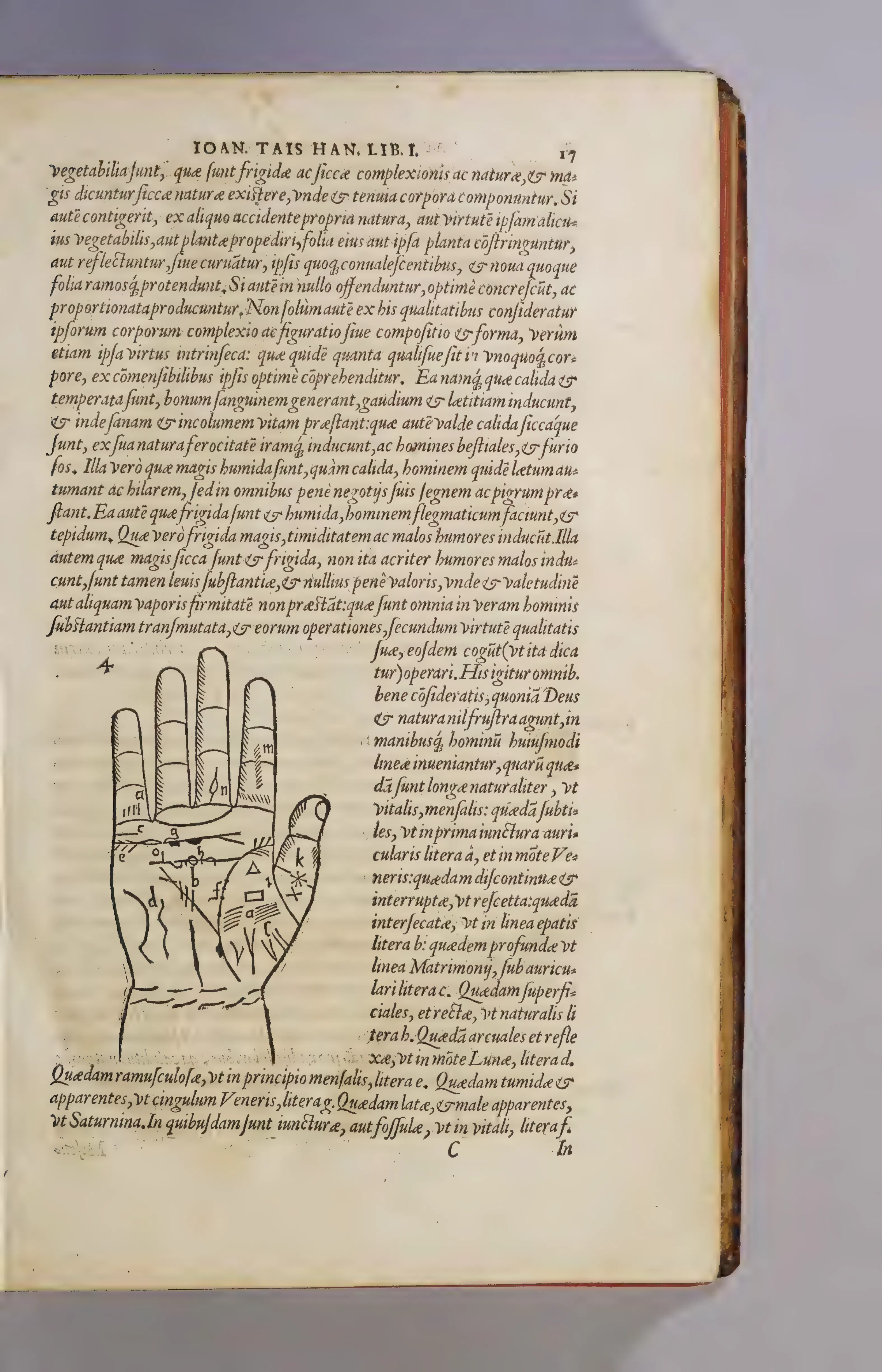
A page of Taisnier's Absolutissima Chyromantia, where the numbered hand and its lettered palmar features turn chiromantic reading into an apparatus of reference. The surrounding discussion of complexion and natural qualities gives the lines a medical footing, presenting the hand as evidence ordered by nature rather than loose emblem. Source ↗.
The stakes of that problem were neither small nor merely technical. The generation after Giovanni Pico della Mirandola's assault on judicial astrology had to negotiate a distinction between astrologia naturalis, the study of physical celestial influence upon bodies, and astrologia iudiciaria, the prediction of particular human acts and events; the first could be defended as natural philosophy, the second was exposed to theological attack. A handbook that reads a man's lifespan, his preferments, his crimes, and his manner of death from the surface of his palm sits uncomfortably astride that line, and the tradition's own vocabulary registers the pressure. Its complexio is the Galenic-Avicennan mixture of qualities producing a bodily temperament, a term that binds the sanguine, choleric, phlegmatic, and melancholic constitutions to the natures of the planets and so makes celestial causation corporeal, observable, and — crucially — medical. Its apotelesmata are the determinations and outcomes of celestial influence in the Ptolemaic sense, not vague results. The title of the 1522 handbook thus records a classificatory ambition and a porous boundary in the same breath.
What makes this tradition memorable is the concreteness with which it tried to close that gap. In Taisnier's folio the art is furnished with an alphabetical catalogue of numbered hand-figures, each keyed to a lettered verdict; with a long interrogatory handbook designed to be consulted faster than a question can be spoken; with a book of witnessed case histories offered as the seal and verification of the whole; with decan axioms, decumbiture charts, critical days, climacteric years, and a materia medica arranged by planet; and with an autobiographical undertow — Rome under Paul III, the African campaign of 1550, Andrea Doria's galleon, the author's anticipation of his own death — that keeps the art tethered to a life. The 1522 handbook has its own claims on attention: it was illustrated on a scale that made hands and faces into instruments of instruction rather than ornament, Hans Baldung cut a woodcut portrait of its author around the year of its publication, and it travelled far in translation — Dutch at Utrecht in 1536, French at Lyon in 1549 under the name of Antoine Du Moulin, English in Fabian Withers's version of 1558, still reprinting in London in 1651 and, as The Book of Palmestry and Physiognomy, in 1666. Much else that circulates under Indagine's name remains unconfirmed against the surviving text, and catalogue tradition has sometimes confused him with an earlier Carthusian homonym; the specialist literature on him is correspondingly thin.
The throughline runs through all three registers of the work at once. Its conceptual vocabulary — apotelesma, complexio, influxus, astrologia naturalis — is chosen to make bodily divination continuous with medicine and natural philosophy. Its production, as an illustrated printed book with a stable repertoire of figures reproducible across editions, languages, and decades, is what allowed a practice of comparing and remembering bodily signs to be taught at a distance. And its internal argument moves from cause, to sign, to catalogue, to consultation, to verified case, to the theological limit that keeps the whole enterprise inside orthodoxy. Whether the boundary it claimed to police could actually be held is the question the tradition puts to its readers, and it is the question its later history — vernacular afterlives, compendious absorption at Cologne, and the general post-Tridentine prohibitions against chiromancy, geomancy, and hydromancy — did not allow it to escape.
Read the full text and English translation on Leo
This text was transcribed and translated as part of the ExLatinis project, an effort by Leo to make free English translations of every text published in Latin in early modern Europe (1450–1750) available online. The complete transcription and English translation of this work can be read free of charge:
→ Read the original Latin text and full English translation on Leo
You can save a copy of this document into your Leo account to run deep text searches, conduct further analysis, or cross-reference it with your own research.
Translating Indagine's Title: Apotelesmata, Complexio, and the Grammar of Natural Astrology
Johannes ab Indagine's Apotelesmatic Introductions to Chiromancy, Physiognomy, Natural Astrology, Human Complexions, and the Natures of the Planets
The English title supplied here is an editorial translation for scholarly convenience, not an established modern title. The early modern English translation tradition is instead associated with The Book of Palmestry and Physiognomy, a title that should not be used to designate the Latin work as a whole. The 1522 Strasbourg record gives the Latin title as Introductiones Apotelesmaticae elegantes, in Chyromantiam, Physiognomiam, Astrologiam naturalem, Complexiones hominum, Naturas planetarum, cum periaxiomatibus… and attributes it to Johannes ab Indagine.
The title's apotelesmatic language derives from the Greek-Latin vocabulary of astrological effects or outcomes. Apotelesmata are not merely abstract "results": in the Ptolemaic tradition they designate the determinations, configurations, and consequences produced through celestial influence. Introductiones apotelesmaticae therefore presents the work as an introductory entrance into a learned art of reading effects—especially effects expressed through the hand, the face, bodily constitution, and planetary nature. The title's complexio belongs to Galenic medicine, where it means the qualitative mixture producing a bodily temperament, not a modern psychological personality. Indagine's complexions—sanguine, choleric, phlegmatic, and melancholic—form a hinge between bodily signs, medical diagnosis, and the qualities attributed to planets. The work's astrologia naturalis likewise claims a particular disciplinary status. It emphasizes physical and corporeal celestial influence, although the book's practical and prognostic materials bring it close to forms of judicial astrology that learned authors often attempted to distinguish from natural causation. The title thus records both a classificatory ambition and a porous boundary: natural astrology, medicine, physiognomy, and chiromancy are presented as mutually supporting modes of knowledge rather than isolated arts.
The physical mechanism implied by that vocabulary is stated with unusual explicitness in the Cologne compendium that later transmits much of this material, where a defective line is read as the trace of a defective celestial influx, because such a sign shows the influx of that planet to be worst, in whose sign it cannot, by the vigour of natural heat, perfectly produce the line itself, quia tale signum ostendit influxum illius Planetæ pessimum esse, in cuius signum non potest vigore caloris naturalis perfectè producere ipsam lineam. The formulation shows how influxus and calor naturalis were made to carry the weight of the claim that the hand is a natural effect and not an arbitrary cipher: the planetary cause acts through the body's own heat, so that the line is an apotelesma in the strict sense, a completed effect, and its imperfection is diagnostic of the cause. This is the philological hinge on which the tradition's claim to demonstrative status turns, and it recurs wherever the arts of the body are defended as natural knowledge.
The same tradition's insistence that judgement be procedurally constrained is equally legible at the level of vocabulary. Six things especially are to be observed in every and any theme of the heaven, neglecting which no due consideration nor judgement can be made, and they are: year, month, day, hour, place, and the planet ruling the hour, Sex præcipuè in omni & quouis coeli themate obseruanda sunt, quibus neglectis nulla potest fieri debita consideratio, nec iudicium, & sunt: Annus, mensis, dies, hora, locus, Planeta horæ dominans. The technical lexicon that governs such judgements — radix and dominus genituræ, horoscopus, cardines, Hylech and Alcochoden, dignitates and debilitates, via combusta, pars fortunæ — is drawn from the Arabic-Latin astrological inheritance, and its presence alongside the language of hands and faces is itself an argument: the arts of the body are being outfitted with the apparatus of a mathematically articulated discipline.
What the 1522 Strasbourg Handbook Contains: Structure, Printing, and Translations
Johannes ab Indagine's Introductiones apotelesmaticae elegantes is an illustrated Latin technical handbook and introductory isagoge that incorporates consultative practica in chiromancy, physiognomy, natural astrology, planetary qualities, and human complexions. Its first securely documented impression was produced at Strasbourg by Johann Schott in 1522. The Bayerische Staatsbibliothek record identifies the author, place, printer, year, 159 pages, and VD16 identifier R 3108; the copy is recorded as Res/2 Anthr. 3.
The surviving Dutch translation, printed at Utrecht by Jan Berntsz in 1536, preserves a six-part organization: chiromancy; physiognomy; periaxiomata; rules concerning diseases; natural astrology and horoscopes; and complexions or the four temperaments. Its illustrations closely follow the Indagine tradition, although the Utrecht curator notes differences in quality and additional figures. This evidence confirms the work's integrated architecture, but the detailed sequence of interrogatory chapters and case reports—concerning life, wealth, office, sexuality, crime, imprisonment, disease, wounds, character, and death—requires direct collation of a primary Latin copy before it can be treated as securely established. What such an interrogatory apparatus claimed to accomplish is stated programmatically in Taisnier's Cologne compendium, which announces its fifth book as one in which any accidents past and future of a man of whatever condition and of either sex, prosperous or adverse, can be elicited quicker than speech, Liber Quintus, in quo accidentia quæuis præterita & futura cuiusuis conditionis, & vtriusq; sexus, hominis prospera aut aduersa, dicto citiùs elici possunt; the boast of speed identifies the genre as a consultative instrument for answering set interrogata, and it indicates what kind of arrangement collation of the Strasbourg handbook would need to test.
The language of composition was Latin. A Dutch version appeared in 1536; a French translation, attributed to Antoine Du Moulin and printed by Jean de Tournes at Lyon in 1549, is documented in catalogue records; and Fabian Withers's English translation appeared in London in 1558 as Briefe introductions… unto the art of chiromancy… and physiognomy. Later English witnesses include the 1651 Briefe introductions and the 1666 Book of Palmestry and Physiognomy. A German translation is reported in secondary catalogue notices, but its precise bibliographic record was not independently confirmed. No modern critical edition or modern-language scholarly translation was located.
Why Indagine Matters: Chiromancy, Medicine, and the Historiography of Natural Astrology
The importance of Indagine's handbook lies in its printed conjunction of arts that modern disciplinary histories often separate: chiromancy and physiognomy as arts of bodily interpretation; astrology as a theory of celestial qualities; medicine as the management of complexion and disease; and print as the vehicle that stabilized figures, propositions, and practical instructions. The book is consequently valuable not because it represents an isolated curiosity, but because it shows how learned and practical forms of knowledge could be assembled within one illustrated volume.
Its historical setting belongs to the long dispute over the legitimacy of divination after Pico della Mirandola's attack on judicial astrology. The distinction between astrologia naturalis and astrologia iudiciaria provided one means of defending celestial influence: natural astrology could be presented as a study of physical qualities and bodily effects, while determinate predictions about individual acts and events remained more vulnerable to theological criticism. The polemical form this defence could take is visible where the natural art is commended over the artificial and image-based kinds: the sum of this art is to know the nature of the signs and planets, then to erect the figure and practise what has been read; let whoever wishes make trial, and he will see that it not only agrees with the artificial astrology but far surpasses it, not so much for ease as for certainty, Summa huius artis est, scire naturam signorum & Planetarum, deinde erigere figuram, et exercere quod lectum est. Experiatur qui velit, videbit hanc cum artificiali non solùm conuenire, sed etiam longissimè excedere, non tam propter facilitatem, quàm certitudinem. Indagine's combination of bodily signs, planetary qualities, horoscopic material, and medical judgment shows that the boundary was conceptually important but operationally unstable. The theological guard rails erected around the art are equally explicit in the tradition, which closes its case-book with the orthodox formula that God is above all, that the wise man will rule the stars, and that the stars incline but do not compel, Deus super omnia, sapiens dominabitur astris. Astra inclinant, non cogunt, and which grounds the same restraint in providence: therefore one must not judge rashly, because God has appointed his terms, which cannot be passed, which may in some measure be seen in the lineaments, Propterea non est temerè iudicandum: quia cõstituit Deus terminos eius, qui præteriri non poterunt, qui in lineamentis aliqua[m]ter videri possunt. The qualification aliquanter, in some measure, is precisely calibrated: the lineaments disclose the divinely fixed term partially, which preserves both the legibility of the sign and the sovereignty of the cause.
The book also bears on the status of physiognomy and chiromancy in relation to academic medicine, since complexion and bodily form supplied a language through which astrological causation could be made corporeal and observational. That relation was negotiated as a division of competence rather than a merger: the physiognomist or chiromancer does not reach such particularity, and it is enough for him to say "a lesion", even if he does not determine the cause or origin of that lesion, wounding, or blow, Verum Physiognomus, aut Chanomanticus ad talem particularitatem non peruenit: sat enim est illi dicere læsionem, etsi non determinet causam, aut originem illius læsionis, vulnerationis, seu percussionis. The same prudence governs prognostication of death, where the practitioner is instructed to speak of proneness to grave and doubtful sicknesses within a given year or month rather than of death absolutely — a self-limitation that belongs to the same strategy as the appeal to divinely fixed terms, and one that made the art defensible by making it modest.
The work is also significant for the history of visual and practical knowledge. Stephanie Leitch's studies of chiromancy, physiognomy, metoscopy, and printed images show how such arts depended upon the relation between visual representation and procedural instruction. Her analysis helps explain why the hand figures and physiognomical cuts mattered materially: they were not decorative appendices but components of a practice of comparing, judging, and remembering bodily signs. The Dutch witness, which follows the Indagine tradition while modifying the quality and number of images, offers particularly useful evidence for studying translation as a material and pedagogical transformation. Alongside the figures, the tradition developed a distinctively evidentiary rhetoric, appending a book of witnessed cases as proof: this sixth book we have appended as a seal, and as a verification of the art, Librum hunc Sextum tanquam sigillum, & artis Verificatorium adiunximus. The word Verificatorium, together with the recurring formulas of attestation — expertum est, probatum est, testes fide digni — borrows the language of notarial proof for a divinatory art, and it is accompanied, remarkably, by an admitted falsification: of those who have ten or more lines in such a place, and yet not one has ever been found who in the course of his life had six wives; therefore it is not so entirely certain, qui habent in tali loco decem aut plures lineas, & nunquam inuentus est vnus, qui in vitæ suæ periodo sex vxores habuit, ideo non est vsqueadeo certum. A rule is here reported as tested against the run of cases and found wanting, which shows the appeal to experience operating as something more than ornament. The corresponding apologetic register defends the practitioner against his critics by historical precedent: therefore Socrates, Aristotle and many other most learned men suffered persecution from the unskilled, because what is natural to the wise seems miraculous to the crowd, Ideo Socrates, Aristoteles, & multialij doctissimi viri ab imperitis persecutionem passi sunt: quoniam, quæ sapientibus naturalia sunt, vulgo miracula videntur. The opposition of sapientes to vulgus is doing the same work as the distinction between natural and judicial astrology: it reclassifies as natural what the uninstructed take for the miraculous, and so removes the art from the jurisdiction of those who would condemn it.
The broader historiography has moved away from treating astrology and related arts as undifferentiated survivals of "magic." Older synthetic histories by Lynn Thorndike and Wayne Shumaker remain useful for identifying texts and traditions, but later work by Anthony Grafton, William Newman, H. Darrel Rutkin, Germana Ernst, Paola Zambelli, Monica Azzolini, Steven Vanden Broecke, Jean-Patrice Boudet, and Nicolas Weill-Parot has emphasized the learned, mathematical, medical, institutional, and confessional contexts in which astrology operated. Rutkin's account stresses astrology's status as a structured form of natural knowledge; Grafton and Newman place astrology and alchemy within early modern natural philosophy; and Boudet, Collard, and Weill-Parot clarify the medieval and Renaissance intersections of medicine, astrology, and magic. Leitch's work provides the most direct framework for the printed visual culture of chiromancy and physiognomy. Martin Porter's history of physiognomy and Lauren Kassell's work on practical and occult knowledge offer complementary contexts for bodily interpretation, learned expertise, and the circulation of case-based knowledge.
Several claims associated with the larger textual tradition remain unverified. The accessible records do not establish the complete sequence of Indagine's interrogatory chapters, the alleged case reports concerning executions, sexual offenses, or royal injuries, the polemic against "new Christians," or the identification of the unnamed wounded king with Henry II of France. Those subjects may belong to the expanded Taisnieran compilation, to later redaction, or to passages not exposed by the catalogue records consulted. That suggestion receives some support from the Cologne compendium itself, whose interrogatory and case materials do encompass a penal and sexual lexicon (suspendium, decollatio, patibulum, tortura, submersio, luxuria nefanda, incestus), polemic directed at rival chiromancers and at the "new Christians," and a prognostication concerning an unnamed sovereign, presented as the art's crowning vindication: I predicted the misfortune of this Most Serene King (alas!) at Rome thirteen years before his fall, when Gemma Frisius of pious memory had sent me this present theme to be calculated by a certain French astrologer, whose judgement I have set down here word for word, Huius sereniss. Regis (prob dolor) i. fortunium Romæ 13. annis ante casum prædixi, cum ad me piæ memoriæ Gemma Frisius hoc præsens thema à quodam Gallo Astrologo calculandum misisset, cuius Galli iudicium verbatim hîc apposui. The sovereign is not named in the passage, and the identification with Henry II therefore remains an inference rather than an established reading; what the passage does establish is that such a prognostication, together with a reported exchange with Gemma Frisius, belongs to the Cologne compendium. None of this should be assigned to the 1522 handbook without direct textual collation. Similarly, the proposed relationship to Corvo, Cocles, Tricasso, Pontano, Lichtenberger, Stromer, Gemma Frisius, and the Arabic and Latin astrological authorities requires examination of the actual preliminaries and chapters rather than inference from shared subject headings.
The historiographical problem is therefore twofold. Indagine's work has been under-described when treated merely as a catalogue title for palmistry, while Taisnier's much larger Cologne compendium can absorb related materials and obscure their distinct bibliographical identities. A reliable history must keep the Strasbourg handbook, its vernacular translations, the later Latin issues, and Taisnier's eight-book Cologne folio in separate bibliographical columns before comparing their texts, images, paratexts, and claims of authority.
Tracing the Book from Schott's Strasbourg Press to Taisnier's Cologne Folio
The 1522 Strasbourg impression is the firm bibliographic starting point. The Bayerische Staatsbibliothek record gives the title, Johannes ab Indagine as author, Strasbourg (Argentoratum), Johann Schott as printer, 1522 as date, 159 pages, shelfmark Res/2 Anthr. 3, and VD16 R 3108; its digital object bears the URN urn:nbn:de:bvb:12-bsb00085171-6. The record does not itself supply a full collation, signature formula, or format statement. No independently verified 1521 or 1523 Latin impression was located. A 1543 Cologne/Regnault record is visible in digital-library cataloguing, but its full bibliographic details and identifier require further copy-level verification. A later Strasbourg issue from the heirs of Lazarus Zetzner is documented for 1630; its metadata explicitly states that the work was first published at Strasbourg in 1522, but the digital scan does not establish the physical features of the princeps.
The transmission record is separate from Jean Taisnier's Opus mathematicum. Taisnier's eight-book folio was published at Cologne by Johann Birckmann and Werner Richwin in 1562. The HathiTrust record describes a folio of [12], 624, and [6] pages, with two blank leaves, while the 1583 digital witness preserves the eight-book title and records [12], 624, and [8] pages in a volume approximately 31 cm high. Its eighth book treats periaxiomata, planetary houses, remedies for diseases, natural and judicial astrology, and related divinatory arts; the seventh concerns physiognomy, qualities, and complexions. The 1583 witness records the signature sequence dagger⁶, A–4K⁴, a blank 4K⁴, and a missigned dagger leaf. These features demonstrate a large, separately produced Cologne compendium, not a new edition of the 1522 Strasbourg handbook.
The relation between the two works is historically plausible but must be stated with bibliographical caution. Their shared subject matter, their treatment of chiromancy and physiognomy, and the recurrence of natural-astrological and medical materials make textual comparison essential. On one point the Cologne text speaks for itself: introducing the physiognomical book, Taisnier declares that the seventh, on physiognomy, is to be elucidated, in which he has followed the most illustrious examples of Johannes Indagine, once dean of Frankfurt, a man most expert in the disciplines of mathesis, to which, if he has added anything from his own quiver, the reader will easily perceive it at first glance, Septimus de Physiognomia elucidandus est, in quo Ioannis Indagine, Decani quondam Franckfordiensis, viri in Mattheseos, disciplinis expertissimi, exempla clarissima secutus sum, quibus, si quid è nostra pharetra propria addiderim, primo intuitu facilè percipies. The acknowledgment is open, it names Indagine with his office, and it distinguishes between followed exempla and material è nostra pharetra propria, from the author's own quiver. What it does not do is delimit the borrowing: the accessible evidence still does not establish by direct collation the exact extent of Taisnier's dependence, or the boundary between Indagine's material and Taisnier's additions, in this or in any other book of the folio. Claims that the Cologne work openly follows, reorders, and supplements Indagine throughout should therefore remain provisional until title pages, preliminaries, and the relevant books are compared leaf by leaf.
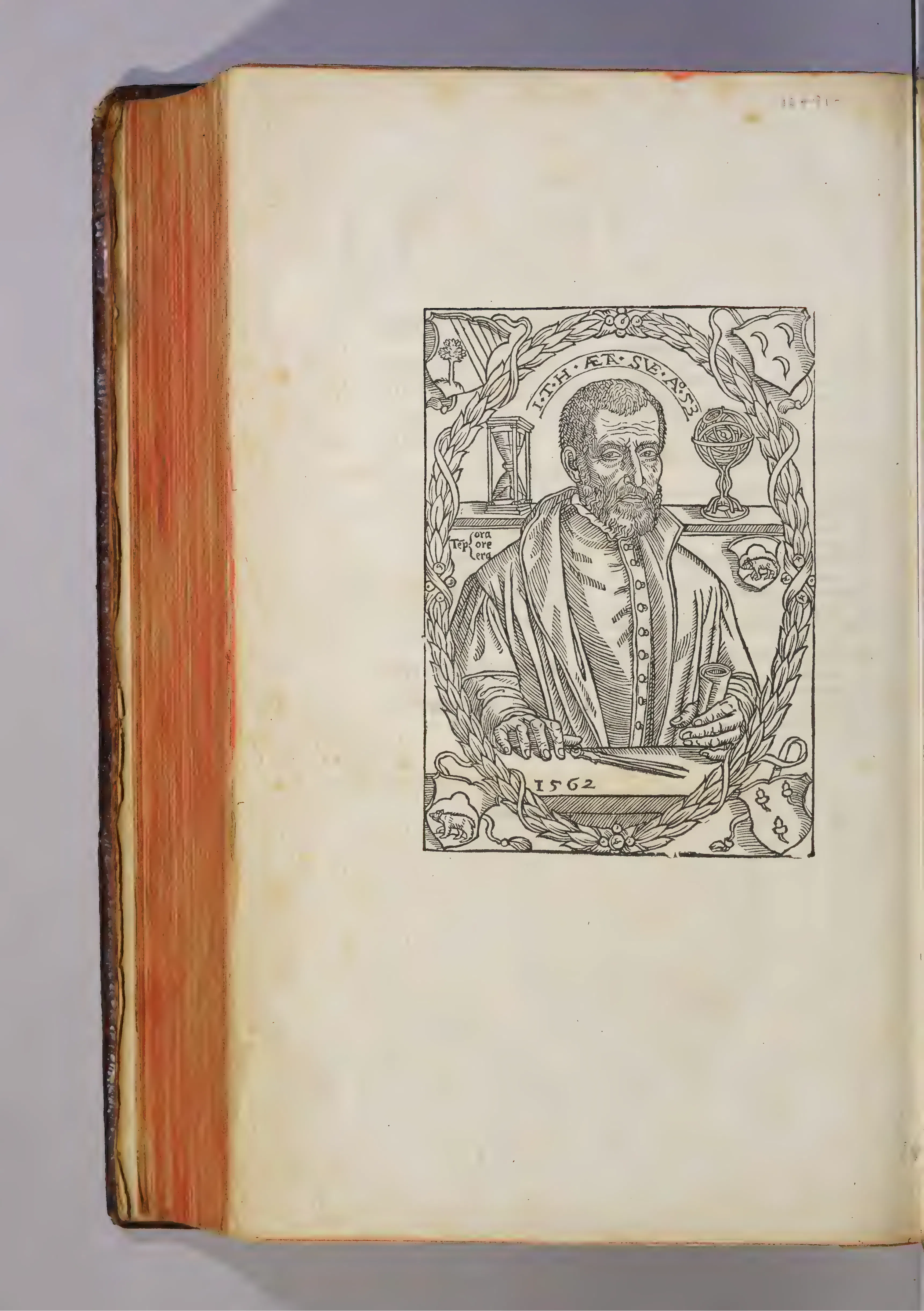
Taisnier's 1562 woodcut author portrait in the Cologne Opus mathematicum makes authorship a programme of learned authority: scroll, laurel frame, hourglass, armillary sphere, and measuring instrument align him with mathematical and poetic order rather than practical divination — the self-presentation that accompanies his open acknowledgment of Indagine. Source ↗.
The vernacular transmission is better documented. The Dutch translation, Chyromantia Joannis Indaginis, was printed at Utrecht on 10 February 1536 in the sign of the Golden Lion. A surviving Utrecht copy is recorded under R fol 456 rar; another Netherlands copy is noted at Groningen University Library under uklu NAUTA 60. The French Chiromance & physiognomie par le regard des membres de l'homme is attributed to Antoine Du Moulin and was printed at Lyon by Jean de Tournes in 1549. Catalogue records sometimes attach the title to the wrong Johannes de Indagine, apparently the earlier Carthusian theologian associated with dates 1415–1475; that homonym must be separated from the author of the Strasbourg book, who is identified in modern specialist reference as Johannes ab Indagine, also Johannes Rosenbach, active about 1467–1537 and associated with Steinheim near Hanau.
The English lineage begins with Fabian Withers's 1558 translation, printed in London by John Day for Richard Jugge. The English Short Title Catalogue describes it as a translation of Indagine's Chiromantia and classifies it under astrology, early printed palmistry, and physiognomy. ESTC R17161 records a 1651 London edition printed by J. Cottrel for Edward Blackmore, with 224 pages and illustrations in octavo. The Folger copy of the 1666 Book of Palmestry and Physiognomy was printed in London by Robert Ibbitson for Thomas Passenger, is in octavo, and preserves a provenance inscription associated with Narcissus Luttrell dated 1767. These English titles represent the vernacular afterlife of Indagine's handbook, not evidence that the whole of Taisnier's eight-book Opus mathematicum had been translated.
The illustrated material deserves separate treatment. A woodcut portrait of Johannes Indagine by Hans Baldung, dated about 1522, is independently recorded. The broader book tradition is described as extensively illustrated with hands and physiognomical figures, and the Dutch witness confirms close dependence on the earlier figurative program. Exact counts of blocks, the identity of the block-cutter, the sequence of recutting, and the reuse of individual formes in Taisnier's Cologne volume remain unverified here. Likewise, the identities of dedicatees, privileges, university approbations, and particular Habsburg patrons have not been securely established from the accessible records. No direct Index entry for Indagine or Taisnier, and no documented expurgation of the English translations, was confirmed. A broader post-Tridentine regulatory context is nevertheless relevant: one modern study describes general prohibitions against chiromancy, geomancy, and hydromancy in an Inquisition context. That general evidence cannot be converted into proof that a particular Indagine impression was suppressed. It does, however, make intelligible the defensive counsel embedded in the tradition's own practical instruction, that the chiromancer should never despair of any individual, whether he will die or not, but ought to say that in such a year, month, and so on, such a man is prone to certain sicknesses, even grave and doubtful ones, not without danger of death, and not to speak absolutely of death, ne aliquando Chyromanticus desperet de aliquo indiuiduo, vtrumoriatur nec ne, sed debet dicere tali anno, mense, &c. talis est procliuus ad infirmitates aliquas, etiam graues & dubias no[n] sine mortis periculo, & non dicere absolutè de morte. Such internal restraints are evidence of how practitioners positioned their art in relation to censure; they are not evidence of any particular censorial action against these books.
The bibliographic identifiers are uneven. VD16 R 3108 is securely attached to the 1522 Strasbourg record. ESTC records are securely available for the 1558 and 1651 English issues; the Folger record supplies copy-specific information for 1666. No reliable USTC, EDIT16, or WorldCat identifier for the 1522 Latin impression was confirmed in the available evidence. USTC 850319, encountered in searching, belongs to a 1514 Pontano imprint and must be excluded from the Indagine bibliography. The specialist literature on Indagine remains comparatively thin, often consisting of catalogue records, bibliographical notices, and passing references within the history of astrology, physiognomy, and the occult sciences. Taisnier's wider reputation for unattributed borrowing is reported in tertiary accounts, but that reputation is not by itself evidence of the precise textual relationship between Taisnier and Indagine, and it must be weighed against the explicit acknowledgment of Indagine that the physiognomical book of the Cologne folio contains.
Reading the Palm as Demonstration: Structure, Argument, and Textual Evidence
The quadrangle, the ratio, and the demonstrative form of the art
The final chapters of the third book of Taisnier's Absolutissima Chyromantia work through the signs of the quadrangle — the space bounded by the mensal and natural lines — and they display, in miniature, the demonstrative form to which the whole art aspires. Each verdict is followed by a ratio, a stated cause, so that a reading of the palm is never left standing as bare correspondence. The reason offered is this: since such a sign is near the mensal line, which serves the liver itself, it must of necessity be subject to that line's dominion and consequently to the dominion of Jupiter and Mars, so that if such signs are not intersected through the middle they denote an inheritance, and if otherwise, they bring on lawsuit and contention, Ratio hæc est: cum enim tale signum sit prope mensalem, quæ ipsi hepati deseruit, neceße est, vt eiusdem subiaceat dominio, & ex consequenti dominio Iouis ac Martis: si igitur talia signa non intersecantur per medium, notant hæreditate[m]: si secus, litem ac contentionem inducunt. Three distinct orders of assignment are chained here in a single period. A region of the palm is first tied to an internal organ on the physiological principle that a line "serves" a viscus; the organ then carries with it the planetary lords proper to it — Jupiter and Mars answering to the sanguine and choleric humours of the hepatic region; and only at the third remove does geometry enter, the presence or absence of an intersection dividing benign inheritance from litigated inheritance. The connective tissue is scholastic: necesse est, ex consequenti, si igitur. What might have been an inventory of shapes is presented as a deduction from bodily and celestial dominion, which is precisely the move that allows the art to be described as natural knowledge rather than arbitrary cipher.
The same doctrine is then printed twice over. Having expounded the quadrangle's signs in continuous exposition, the text restates them as numbered propositions, one through seven, the sequence carrying across the turn of the leaf, and repeats the ratio verbatim at the end of the enumerated series. This doubling is not redundancy of thought but of format: the discursive paragraph teaches the reasoning, the numbered list furnishes the practitioner with rules retrievable at a glance, and the printed apparatus of chapter headings, numerals, and running heads sustains both readings of the same page. The enumerated form closes with a maxim of striking severity, for signs which are otherwise disposed never terminate in good but always end in some evil, Signa enim, quæ aliter se habent, in bono nunquam terminantur, sed semper in aliquo malo finiuntur. The vocabulary of what follows from the palm is juridical throughout — hæreditas, lis, controuersia, contentio — and it discloses the range of questions the consultative art expected to field: property, succession, and the litigation that attends them. The semiotics are asymmetrical in a way worth marking. An uncut figure yields the good outcome; every form of division — cross, star, transverse section — converts inheritance into quarrel, and the maxim generalises that asymmetry into a law of the art, in which the intersected sign has no benign terminus available to it.
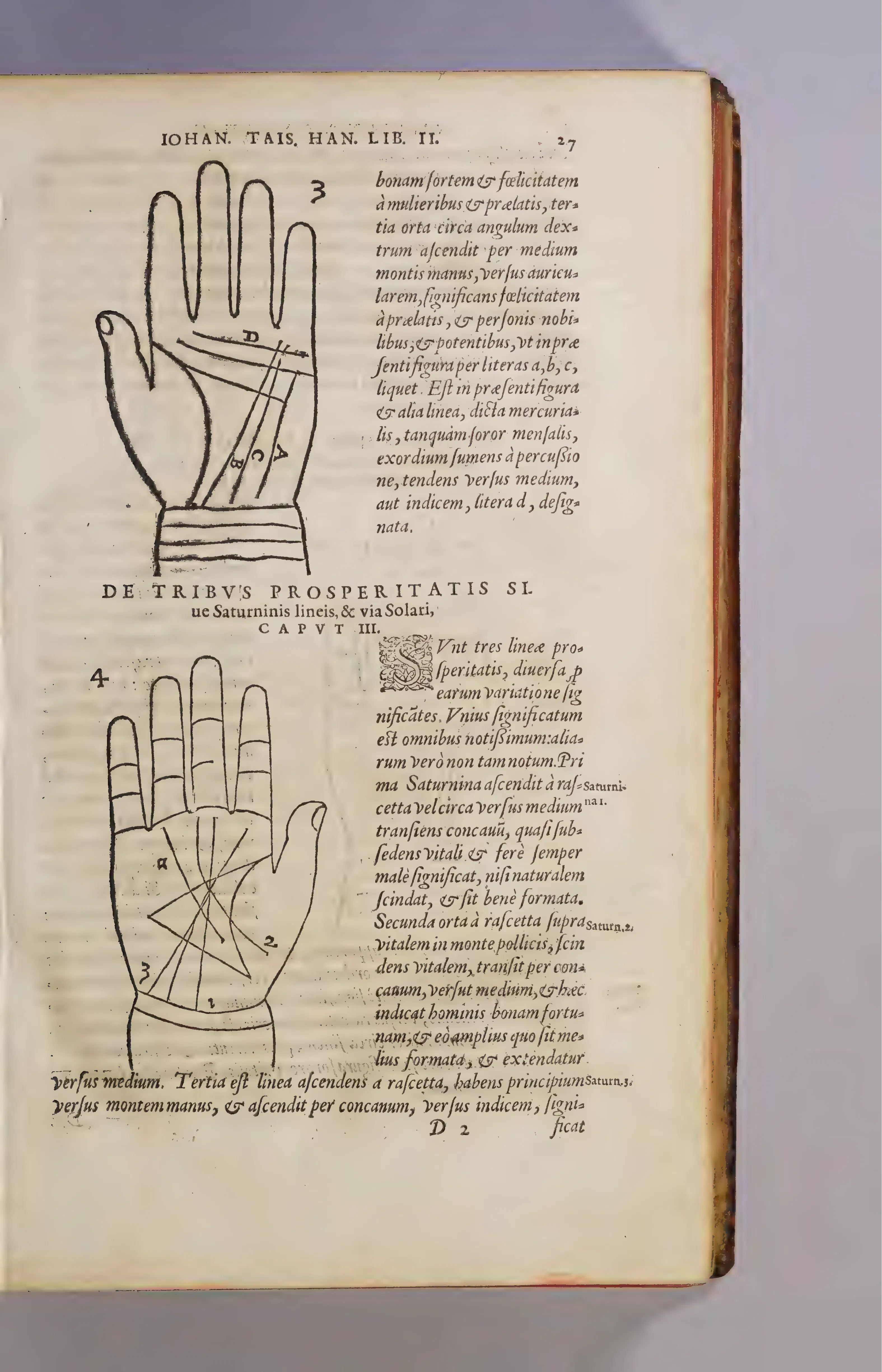
Two keyed woodcut palms make Taisnier's planetary taxonomy of the hand usable as a rule-system: figure 3 relates the mensalis and mercurialis through lettered paths, figure 4 the three Saturnine prosperity lines rising from the rascetta. Numerals and Latin exposition turn illustration into citable apparatus. Source ↗.
The eighteenth chapter, on the transverse lines of the fingers, pushes the same causal machinery toward the gravest of prognostications, ruling that a transverse line in the first joint of the thumb marks a man who is to be hanged or strangled, the reason being that since such a line is in the thumb, which stands under the dominion of Venus, it signifies a death without effusion of blood, on account of the humidity and coldness of the sign, Linea igitur transuersalis in prima iunctura pollicis, notat hominem suspendendum vel strangulandum. Ratio est, quia ex quo talis linea est in pollice, quæ sub dominio existit Veneris, significat mortem sine sanguinis effusione, propter humiditatem & frigiditate[m] signi. The elegance of the inference and its exposure are one and the same. The manner of death is derived not from custom or from the diviner's intuition but from the elementary qualities of the planet governing the digit: Venus being moist and cold rather than hot and dry, the death she marks cannot be the sanguinary death of iron, and what remains within the qualitative logic is the bloodless death of the rope. This is the doctrine of the genus mortis imported from the astrological tradition and grounded in complexional physics. It is also, by any reckoning available to the period's critics, a determinate judgement about a particular human act and its penal consequence, and it sits at exactly the seam where natural astrology's claim to treat corporeal qualities strains against the prohibited species of prediction. The chapter offers no theological qualification at this point; the restraint characteristic of the tradition is deferred to other parts of the work, and here the qualitative derivation is allowed to do all the argumentative labour.
The nineteenth chapter, on further accidents, then turns to the difficult cases in which the figures lie outside or upon the principal lines, and in doing so it borrows the technical vocabulary of surgery. Grains or beads along a line do not interrupt it, and the reason offered is that while the line is thus continued through the grains it induces no breach of continuity, although it does display an unequal operation of nature, Ratio est, quia dum ipsa linea sic per grana continuatur, non inducit aliquam solutionem continui, licet inæqualem operationem naturæ ostendat. Solutio continui is the standard Galenic-Avicennan term for the wound or lesion as a dissolution of a part's continuity, and its transfer to the reading of the palm establishes an exact criterion: only a genuine discontinuity registers an offensio naturæ, while a merely irregular formation registers a disturbance of the natural heat's operation without amounting to a lesion. The distinction is graded rather than binary, and it is what permits the chapter's further refinements — that signs on the vital line always denounce something evil because that line regards the natural heat and its principle, the heart, and that a sign's position at the beginning, middle, or end of a line locates its effect in youth, in the second age, or in old age. The line is thereby read twice, as a physiological trace and as a chronological axis.
Book III closes on a polemic that makes the physical warrant explicit. It is false, the text declares, what certain persons say, that figures or signs existing outside the principal lines are not to be considered, for if there is no breach of continuity no offence of nature is marked — indeed signs of this kind consist rather in good than in evil — and if these effects did not proceed from the natural heat itself, such lines or figures would not come into being at all, Falsum est, quòd aliqui dicunt, non esse cōsiderandas figuras, vel signa existentia extra lineas principales. Nam si non est solutio continui, non notatur ipsa naturæ offensio, imò huiusmodi signa, magis in bono, quàm in malo consistunt. Et si ipsi effectus (vt sæpè dictum est) nô prouenirent ab ipso calido naturali, non fierent tales lineæ, aut figuræ. The compositor's nasal suspensions in cōsiderandas and nô are the ordinary economies of the printed page, but the argument they carry is the keystone of the book. It is framed counterfactually: the very existence of the marks is adduced as proof of their cause, since nothing would be inscribed on the palm at all unless the natural heat inscribed it. The refutation of unnamed rivals who would restrict judgement to the principal lines is thus conducted not as a dispute over observational practice but as a claim about efficient causation, and the full extension of the art's evidentiary field — every grain, circle, and stray figure — is made to follow from it.
Complexion as the hinge between the chiromancer and the physician
The fourth book opens by rehearsing what the preceding three have accomplished — nomenclature and the principles of the art, then the lines, mounts, and significations of the fingers, then their several natures and the accidents that befall them — and its head reasserts the author's standing as doctor of both laws, laureate poet, and most excellent musician before announcing its own subject. The pivot is stated as a claim of necessity: now the four complexions must be treated, and by what signs and in which hand each complexion may be recognised and what each signifies, especially since there is nothing in chiromancy more necessary than the knowledge of complexion, which is most needful not only to chiromancers but also to physicians, Nunc de quatuor complexionibus, & quibus signis, in qua manu quæuis complexio cognoscatur, & quæ à qualibet significentur, tractandum est: maximè cùm nihil sit in Chyromantia magis necessarium, quàm complexionis cognitio, quæ non solum Chyromanticis, verum etiam Medicis est pernecessaria. The sentence performs the disciplinary alignment on which the tradition's respectability rests. Complexion is the one object shared by the chiromancer and the physician, and by declaring it the most necessary knowledge of the art the proemium places the reading of hands inside the medical enterprise rather than alongside it — while conspicuously leaving the two competences distinguishable, since the claim is one of shared necessity and not of identical jurisdiction.
The first chapter then supplies the template, beginning from the Galenic definition: the sanguine complexion, which consists of a temperate heat and moisture, is recognised in the hand by these signs, SANGVINEA complexio, quæ ex caliditate & humiditate temperata constat, in manu his signis cognoscitur. What follows is not a list of omens but a diagnostic grid, and its order is fixed: the hand's size in proportion to the whole body, its quality to the touch, its flesh and colour, the fingers and nails, the general character of the lines, then the vital, natural, mensal, and hepatic lines in sequence, the triangle, the quadrangle, the rascetta, the line dividing hand from arm, and finally the mounts. Every item is answered in the register of measure — temperate, duly proportioned, neither too many nor too few, straight, continuous, deep, well coloured. The chapter on the choleric complexion repeats the identical sequence point for point, substituting the values proper to heat and dryness: the small, lean, hard, and rough hand of citrine colour, the many subtle and tortuous lines, the vital line long and dispersed, the hepatic forked, the triangle small and rough, the rascetta wrinkled, the mounts depressed and crossed by many lines. The grid is what converts complexional doctrine into a legible procedure, since the same fourteen observations are put to every hand and the temperament is read off from the pattern of answers. Its interpretive terms remain causal throughout: the long and slender vital line is glossed as signifying the predominance of dryness and heat over the natural heat, so that even here the palm is being read as the register of a physiological contest rather than as a table of arbitrary marks.
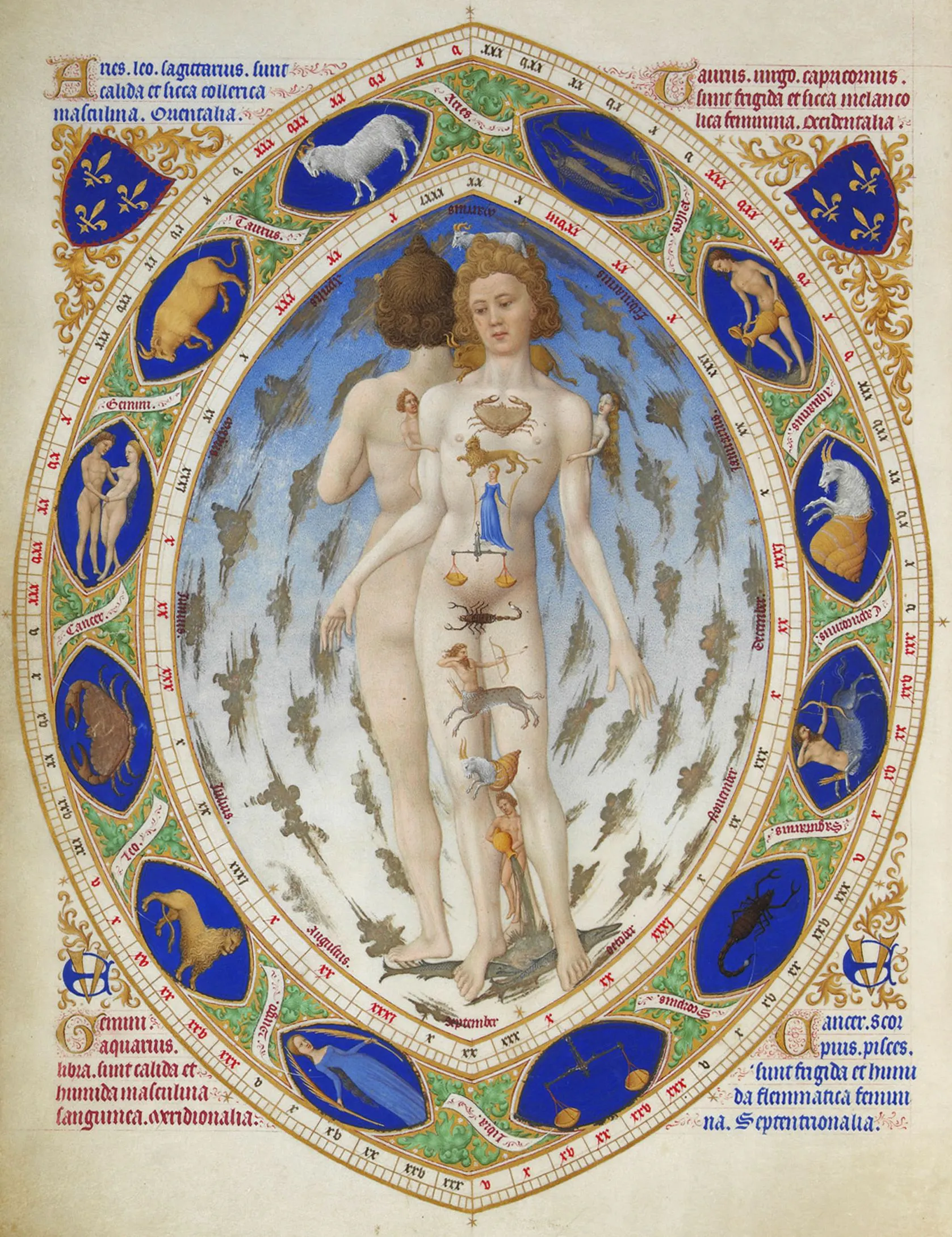
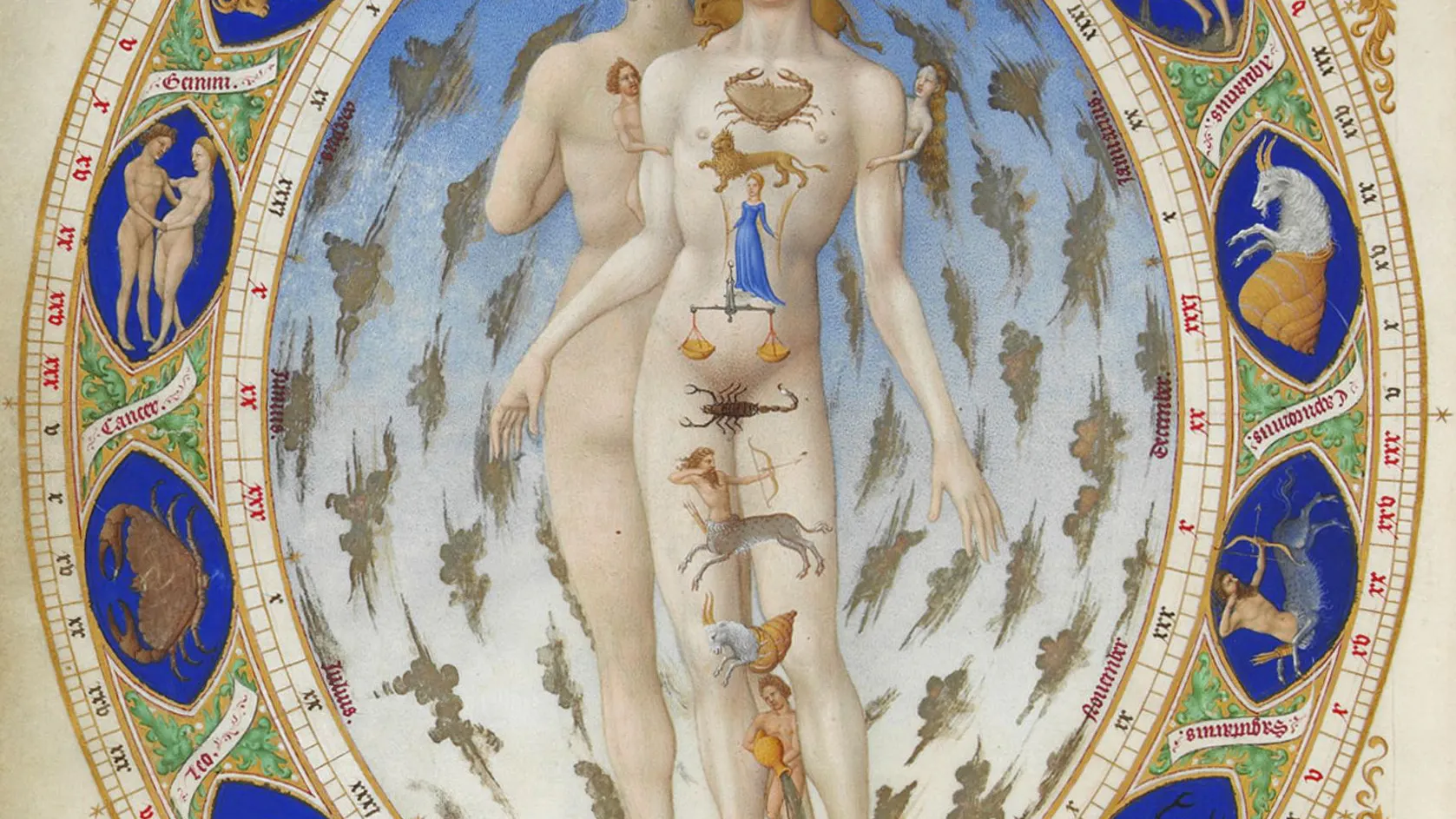
A fifteenth-century manuscript illumination mapping the zodiac onto a human body, from Pisces at the feet to Aries at the head. Its visual grammar makes concrete the premise behind complexionary palmistry: bodily signs as products of celestial qualities acting through heat, moisture, and humoral constitution rather than arbitrary omens. Source ↗.
The mounts, their planetary lords, and the sixty exemplary hands
The doctrine of the mounts completes a planetary topography of the palm in which each eminence is assigned a ruling body and each ruling body lends the eminence its physical qualities. The seat of the Moon is defined by its humour before any sign is read from it, in the statement that the mount of the hand is the Moon's own place and principal dominion, whence it is seen to be more humid and watery, MONS manus, est Lunæ proprius locus & principale dominium: vnde & magis humidus aqueusque conspicitur. The inference that follows is not analogical but qualitative in the strict Aristotelian-Galenic sense: because the region is wet, its defective figures threaten the greatest misfortune, in water or a watery place, or at sea, or in a river, and loss of substance and of merchandise, minatur maximum infortunium, in aqua aut loco a quo, aut mari, aut flumine, & amissione sub stantiæ, & mercimoniorum. The slide from drowning to mercantile ruin within a single clause is the characteristic operation of the manual: the humidity of the lunar region governs water, water governs navigation, and navigation governs the merchant's capital, so that a claim about elemental quality discharges directly into a verdict about fortune. The same logic constitutes the neighbouring mount as a norm rather than a mark, for the mount of the thumb, together with the thumb itself, dedicated to Venus, ought to extend lines only lengthwise from its very root toward the life-line, and those sparse, not very deep, and it signifies a temperate complexion and a man lovable, MONS pollicis cum ipso pollice, Veneri dicatus, debet tantummodò per longum ab ipsa radice versus vitalem lineas extendere, & quidem raras, non multum profundas, & significat complexionem temperatam hominemque amabilem. The prescriptive debet is decisive for the epistemology of the art: what signifies is departure from an ideal lineation, so that every subsequent verdict on lust, incest, or theft is formally a measurement of deviation from a temperate Venereal norm.
Precisely because the sign registers only such deviation, the manual must confront the coarseness of its own resolution, and it does so with an unexpected comparative excursus. Where the palm indicates a mortal offence to the head, no finer determination is possible, since there is no distinction between beheading and hanging, because they are not distinguished among the authorities; for in different regions the kind of death is varied: as in Spain the throat only is opened, as for a chicken, until death; in other places the whole head is cut off; others strangle with their own hands; others, like the English, shoot with missiles, Nulla est distinctio inter decapitationem & suspensionem, quia apud autores non distinguuntur: nam in diversis regionibus diuersificatur genus mortis, prout in Hispania, guttur tantum aperitur sicut pullo ad mortem vsque: in alijs locis integrum caput amputatur: alij proprijs manibus suffocant: alij, vt Angli, telis sagittant. The argument converts an indeterminacy of the sign into a datum of penal geography: since the mode of capital execution is a local custom and not a natural kind, no natural cause could be expected to inscribe it, and the prediction's vagueness is thereby licensed rather than excused. The same book secures its rules upward, to the authority of natal astrology, in the maxim that the goodness of Jupiter, as the astrologers say, is so great that, were it not impeded by the malice of others, whoever was born under Jupiter's dominion would be in a manner immortal, Nam bonitas Louis, vt aiunt Astrologi, est tanta, vt, nisi impediret aliorum malitia, qui sub dominio Louis nasceretur, esset quodamodo immortalis. The counterfactual form is instructive: benefic influence is never observed unmixed, and the doctrine of impediment guarantees that no reading of a Jovial finger can be falsified by a short-lived subject. It also furnishes the polemical premise against palmists who consult the thumb alone, since every finger carries the attribution of its own planet. The solar finger carries the art's own social ambitions, for some call that line the Solar line, of riches and of mastery, and it denotes the seven liberal arts, especially Philosophy, an investigator of the various arts, and induces an excellent disposition in those arts, Aliqui vocant eam lineam, lineam Solarem, diuitiarum & magisterij, & denotat septem artes liberales, præsertim Philosophiam diuersarum artium indagatorem, & optimam in ipsis artibus inducit dispositionem. The palm is here made to certify the university curriculum and the fortune to be won at princely courts, so that the reader of hands and the reader of books are placed under one celestial patron.
That claim to learned standing is asserted typographically as well, in the display title that styles the work as belonging to the most absolute chiromancy of Ioannes Taisnier of Hainaut, Doctor of Both Laws, Poet Laureate, most excellent Musician, CHYROMANTIAE IO ANNIS TAISNIER HANNONIJ V. I. Doctoris, Poëtæ Laureati, Musici excellentissimi, Liber. The triad of doctorate, laurel, and musicianship is a claim to competence in the mathematical and liberal disciplines rather than to practical cunning, and it prefaces the most machine-like portion of the work: sixty numbered figures, each carrying lettered verdicts from A through Q. The methodological appendix that closes the series reveals how these plates were meant to be used, ruling that first, when it happens that the life-line is disjoined or discontinuous, if nevertheless in that discontinuity it extends a branch toward the mount of the thumb, as appears in the forty-fourth figure of this fourth book, it always indicates the term of life at that same time, PRIMO, cum accidit vitalem esse disiunctam, an discontinuam, si tamen discontinuatione ramum versus montem pollicis extenderit (prout in huius Libri quarti, quadragesima quarta figura patet) semper in eodem tempore terminum vitæ indicat. The internal cross-reference is the hinge of the whole apparatus: the printed figure is not illustration but citable evidence, and the numbered plate functions within the argument as a proposition does within a demonstration. The same appendix polices the vocabulary on which such citation depends, warning that sixthly, many are deceived in this term 'swollen line', thinking it signifies the same as 'thick line', whereas they differ: whence a line is properly called thick when it is deep and keeps on the surface the same breadth that it has in depth, Sextò, multi decipiuntur in hoc termino linea tumida, arbitrati idem significare quod linea grossa, cùm tam[m]e differant: vnde propriè linea dicitur grossa, quando profunda est, et in superficie eandem latitudine[m] seruat, quam etiam habet in profunditate. Definition by the relation of surface breadth to depth is the most rigorously morphological moment in this stretch of the work, and it shows where the art located its claim to exactitude: not in the prophecy but in the description of the mark.
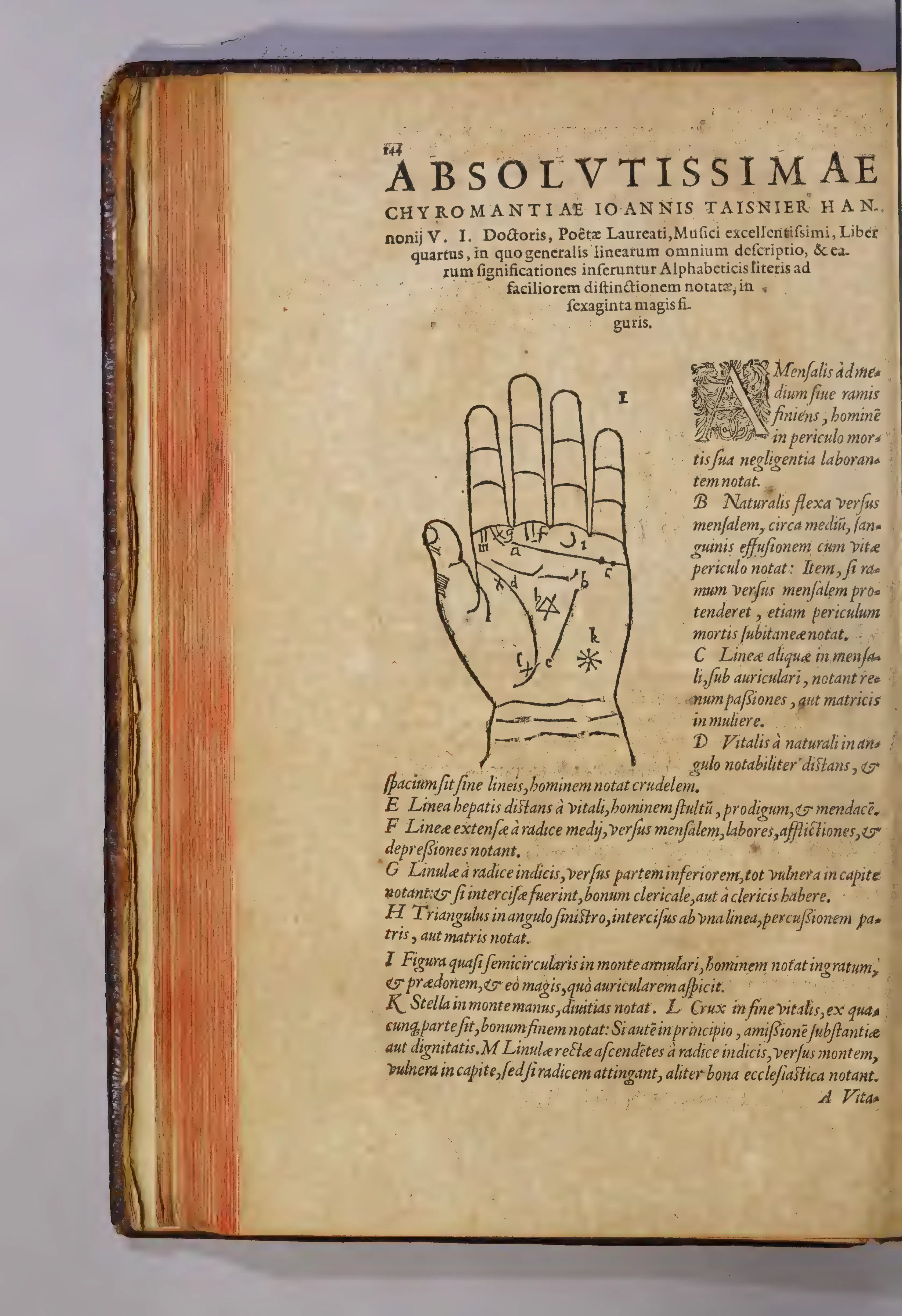
Book IV opens with a display heading announcing Taisnier's credentials — Doctor of Both Laws, Poet Laureate, musician — immediately before a woodcut palm whose alphabetized marks answer to the adjacent column of glosses. Chiromantic signs are thus organised as retrievable, citable data rather than ornament. Source ↗.
Book V as a consultative instrument
Book V converts this descriptive apparatus into a consultative instrument, and its warrant is a case conducted at a distance: an absent friend too can be helped by this fifth book, as happened when the author was at Rome in the time of Paul III of pious memory, supreme pontiff, when a certain most intimate Hainauter friend, doubting about a certain matter, extorted an opinion from him by his letters, Potest & absens amicus hoc quinto Libro iuuari, prout accidit cum Romæ, temporepiæ memoriæ Pauli III. pontificis Maximi agere[m], dum amicus quidam Hannonius familiarissimus de accidente quodam dubitans, à me suis literis sententiam extorsit. The episode presupposes exactly the standardisation the numbered plates provide, since a drawn figure sent by post is legible only against a shared printed repertoire; the canonry obtained seven months later then serves as the outcome that validates the method. Yet the book opens its first chapter by refusing the strongest form of its own competence, insisting that he errs who persuades himself that he can know the period and term of anyone's life by any measurement, Erra[m]: qui sibi persuadet se posse cognoscere periodum ac terminum vitæ alicuius cu[m] aliqua mensuratione. Directed against named rivals, the disclaimer performs two functions at once: it distinguishes the author's qualitative reading of line-form from the quantified palmistry he rejects, and it prepares the theological restraint that follows, whereby the sign discloses a divinely fixed term without ever computing it.
The chapters that follow are shaped by the same double motion of ambition and restraint, and their content exposes the social distribution of the art's suspicions. Women are read predominantly through fertility and prostitution, to the point that a poverty of marks becomes itself a verdict, since scarcity of lines in a woman's hand implies an unfortunate and wretched harlot, a prostitute, and a life almost like that of the brutes, Paucitas linearum in manumulieris, infortunatam miseramq[ue] meretricem, & prostitutam innuit, & vitam ferè brutis similem. The absence of signs, which elsewhere would leave a judgement suspended, is here made positively significant, and the slippage toward the bestial betrays how far moral classification, rather than natural causation, governs the female hand. Against this the chapter on lust rises into full scholastic medicine, grounding erotic obsession in the humours on the authority that this love is, on Avicenna's testimony in the third book of the Canon, a melancholic solicitude similar to melancholy, Est enim iste amor (teste Auicenna in tertio Canone) sollicitudo Melancholica similis Melancholiæ. By routing desire through the physicians' amor heroicus, the manual makes a sign of the palm answerable to a recognised nosological entity, and so recruits the prestige of the medical faculty for the reading of a line.
The evidentiary register shifts again where the author appeals to what he has seen, prefacing the chapter on suffocation with his presence in the Arsenaria expedition, when the very great ship in which they were sixteen hundred persons, besides horses, oxen and sheep, and three hundred bombards of the greater weight, and the provisions, was called the Galleon of Andrea Doria, in expeditione Arsenariæ: cùm nauigium nostrum maximu[m], in quo eramus 1600. personæ, præter equos, boues, & oues, & trecentas maioris ponderis Bombardas, & Commeatum, dictu[m] Galeon Andreæ Doria. The enumerated freight does the work of attestation: a witness who can count the bombards is a witness whose report of three sailors suffocated in the bilge may be credited, and the sign of submersion is thereby fastened to a dated, public, and militarily notorious occasion rather than to bookish precedent. Such experiential confidence coexists with a carefully drawn boundary against the physician's competence, stated flatly in the admission that the chiromancer does not discern the species of arthritis, since it suffices to understand and predict the pains, and the causes that torment such members, Charomanticus non discernit species Arthreticæ: sufficit enim intelligere et prædicere dolores, et causas quæ talia mebra cruciant. The concession is strategic as well as candid: by renouncing specific differentiation, the art avoids trespass upon a faculty that could discredit it, and it secures a domain — the affected member and the fact of suffering — where its own signs remain adequate. The reduction of character to complexion at which the later chapters arrive is governed by the same economy, for a nefarious and profane wit is caused by the hot and dry, or by the cold and dry, that is, by choler and melancholy, as was said above, and it is that which always works evil, at least appetitively or imaginatively, if it cannot by deeds, NEFANDVMatque profanum ingenium causatur à calido & sicco, aut à frigido & sicco, id est, à Cholera & Melancholia, vt supra dictum fuit, & est illud quod semper malum operatur, saltem appetitiuè seu imaginatiuè, si non potest cum actionibus. The qualification that the vice may subsist in appetite or imagination alone rescues the rule from refutation by conduct, and in doing so it relocates the object of the art from the deed, which courts and confessors judge, to the disposition, which only the qualities of the body — and the lines they write — are said to disclose.
Aphorisms, the vices, and the loss of a kingdom
The terminal chapters of the fifth book proceed as an almost unbroken sequence of numbered aphorisms, each yoking a single manual sign — a line, a mount, a letter, a cross, a star — to a moral or biographical verdict, and the rubrics run in strict succession through liberality, inconstancy, digestion and indigestion, journeys, justice, temperance, folly, courtly honours, royal and military dignity, imprisonment, tyranny, hypocrisy, and envy before compressing into three columns of one-sign chapters. The effect of such an arrangement is to make the palm exhaustively indexable, and the rare chapters that break into discursive argument are therefore the ones in which the compiler's assumptions surface. The chapter on inconstancy opens by grading the vice rather than simply detecting it: excessive instability is to be detested, since many men leave many undertakings unfinished, carrying in their course a haste that is imperfect or oblique, whereas moderate instability deserves praise, MAXIMA instabilitas detestanda est: quia multi multa cepta, imperfecta linguunt, celeritatem in suo discursu habentes imperfecta aut obliquam: mediocris instabilitas laudanda est. The distinction is prudential rather than semiotic: what the hand discloses is a disposition whose value depends on measure, and the vulgus insipiens that cannot tell a wise man's change of counsel from mere fickleness is precisely the audience against which the learned interpreter defines himself. The same opposition of sapientes to the crowd that elsewhere licenses the art against its detractors here operates internally, as a rule for reading signs correctly.
The moralizing register of the rubrics is frankly homiletic where the vices are graver. The chapter on dissemblers begins by defining its object before offering a single sign, declaring that hypocrites, under the appearance of goodness and devotion, secretly deceive men like ravening wolves, and that their signs in the hands are the following, HYPOCRITAE sub specie bonitatis & devotionis, homines latenter, vt lupi rapaces, decipiunt, quorum signa in manibus sunt sequentia. The Matthean tag imports the vocabulary of pastoral discernment into a manual of bodily semiotics, so that the chiromancer's verdict does the work of a confessor's suspicion. The political reach of the same method is greater still, and it is in the chapter on the loss of a kingdom that the manual abandons the single-sign formula for compound inference: if in someone's hand the vital, natural, and table lines are bare without branches, and the mounts depressed and without lines, and moreover the Saturnine ill-conditioned with an exuberance of lines in the place of Saturn, and the fingers separated with thick joints, it must be said absolutely that whoever has a hand so disposed will, by natural inclination, lose kingdom and life, Si in alicuius manu vitalis, naturalis & mensalis sint nudæ sine ramis, & tubercula sine lineis depressa, insuper Saturnina malè conditionata cum exuberantia linearum loco Saturni, & sit disgregatio digitorum cum articulis crassis, dicendum est omninò, qui sic habet manum dispositam pro naturali inclinatione eum per diturum esse regnum & vitam. The two qualifiers pull against one another with some force. Dicendum est omninò licenses an unhedged pronouncement on the deposition of princes, while pro naturali inclinatione retracts the necessity and reassigns the outcome to a tendency of nature; the convergence of five independent signs is what authorizes the boldness, and the language of inclination is what keeps the boldness inside the doctrine that the stars dispose without compelling.
Book VI: witnessed cases and the ethics of publication
The sixth book converts that doctrine into documentation, and its address to the reader states an ethics of publication before a single case is told: nothing in this book has been derogated from anyone's honour, for what is done publicly it will not be unlawful to depict in our public characters, but what has been more secretly experienced by us will remain shut in the secret place of the heart as long as life survives, Nec in hoc Libro alicuius honori derogatum est: quod enim publicè fit, & nostris publicis Characteribus depingi non erit illicitum: quod verò secretiùs à nobis expertum est, in cordis arcano conclusum, quoad vita supersit, remanebit. The sentence is doing several things at once. It answers the juridical objection that naming the executed, the drowned, and the diseased injures fama; it distinguishes the publicly notorious act, which print may reproduce because the public square has already reproduced it, from the privately obtained confidence, which the practitioner holds under something like the seal; and it makes the practitioner's discretion itself an argument for his reliability, since a man who withholds what he knows is a man whose depositions may be trusted. The evidentiary apparatus is correspondingly notarial, resting on time, place, and trustworthy witnesses cited by first and family name, tempus, locum, & fide dignos testes, nominibus & cognominib. citauimus, a formula transposed from instruments and depositions into divinatory apologetics, where the reader who doubts is invited not to repeat a trial but to interrogate a witness.
The case narratives are built on a fixed rhetorical pattern — an occasion of social encounter, palms offered with reluctance, a grim prognostication, a period of mockery, and fulfilment reported with circumstantial precision — and their most telling feature is the self-portrait of a prognosticator who does not wish to prognosticate. His mind moved and grieving at the pitiable fall of so great a man, he could not at first expose the matter to the man pressing him, but dissembling and smiling he wished to defer the judgement for a time, unwilling to foretell so great a misfortune, meus comotus animus, tanti viri miserabilem casum dolens, non potuit prima fronte rem ipsam instanti exponere: dissimulato tamen animo subridens, iudicium ad tempus differre volui, nolens tantum infortunium prognosticari. Reluctance functions here as a warrant of good faith: the practitioner who suppresses his reading cannot be accused of courting reputation by prophecy, and the delay leaves the sign standing while the prediction remains unspoken. The same candour records the resistance the art met among the clergy, where a religious could not, after repeated attempts, be brought to show his palms, thinking that judgements of this kind could not be without sin, his conscience resisting, but at last, diluted with a larger cup of wine, purged the note of pusillanimity with a bolder spirit, reiteratis vicibus non potuit ad ostendendas volas adduci, arbitratus huiusmodi iudicia no[n] posse peccato carere, repugnante co[m]scientia: sed ampliori cyatho vini tande[m] dilutus, pusillanimitatis nota[m] audaciori animo purgauit. The passage preserves both the scruple — the suspicion that chiromancy is peccatum, not a licit natural inquiry — and the convivial table at which the scruple was overcome, and it thereby locates the practice socially rather than only doctrinally.
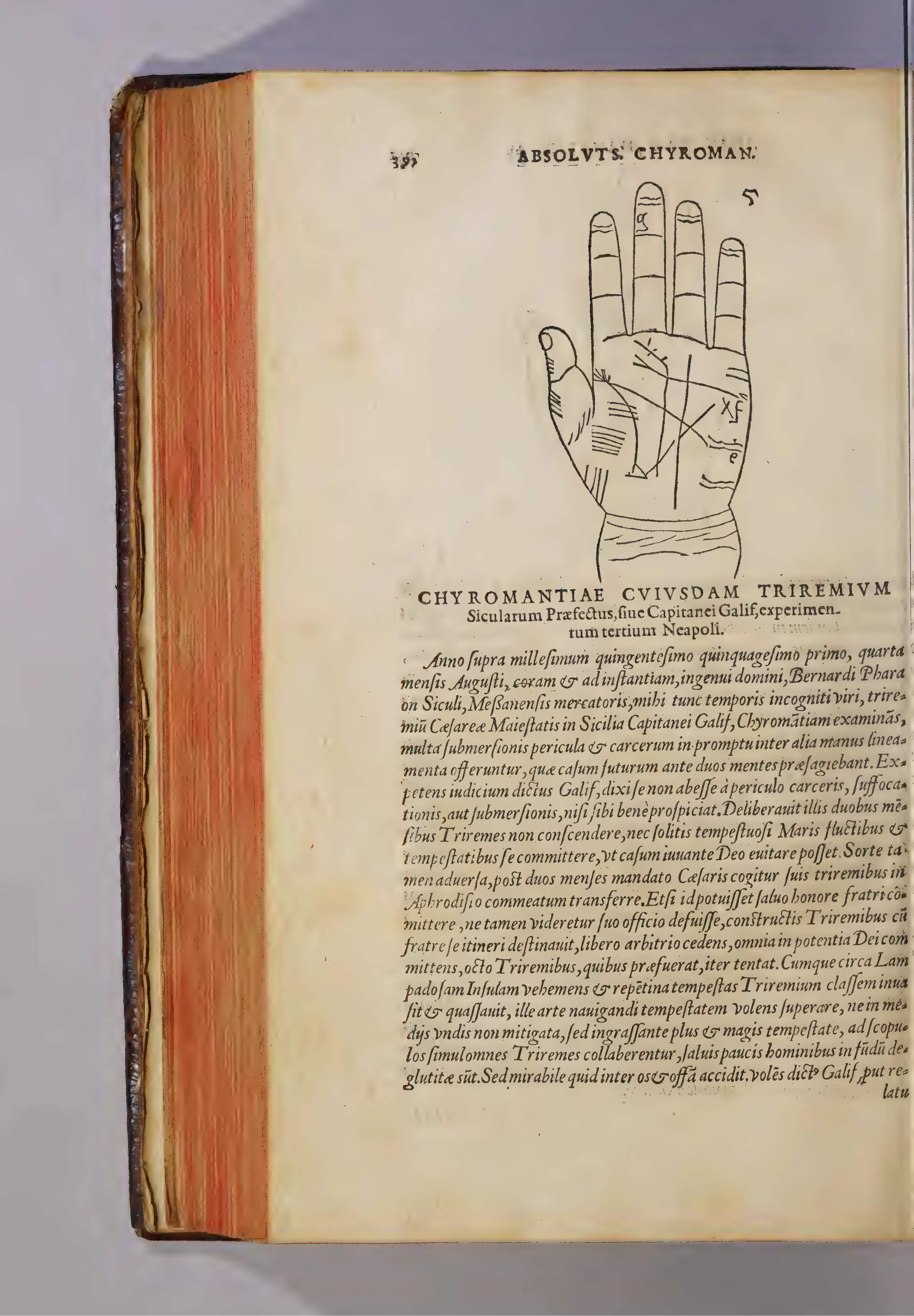
Opening the third experimentum of Book VI, a woodcut palm stands above the heading for Bernardus Pharaon, captain of the Sicilian galleys, examined at Naples in 1551. Diagram and dated narrative make the hand evidence: a reluctant prognostication of imprisonment and drowning, answered by the wreck near Lampedusa. Source ↗.
Such settings also open the book to matter that exceeds its divinatory purpose. Appended to the drowning of a galley captain is an excursus on the island cave whose perpetual lamps give it its name, in which, if Christians and Moors and Turks come together at the same time, forestalling a coming storm, they never attack one another, but each after the accustomed manner pours oil into the perpetually burning lamps, and there the greatest enemies become friends for a while, In quo antro Christiani, & Mauri, & Turcæ si simul & eodem tempore conueniant, tempestatem futuram præcauentus, nunquam se mutuo inuadunt, sed qui libet pro consueto more Oleum in perpetuò ardentes Lampadas infundu[n]t ibique summi inimici tantisper amici fiunt. The etymological and ethnographic detour is of a piece with the testimonial method: circumstantial knowledge of the Mediterranean, its islands, shrines, and truces, is the same currency as the named witness, establishing that the author was where he says he was. The book then closes by handing the method to the reader and immediately fencing it: concerning other accidents the ingenious reader will be able to measure and examine the symmetry of the lineaments, and will easily perceive what is yet to come to him, reserving what must be reserved — God above all, the wise man will rule the stars, the stars incline, they do not compel, De alijs accidentibus poterit Lector ingeniosus lineamentorum Symmetriam commetiri & examinare, & facile percipiet quid ei adhuc (reseruatis reseruandis) euenturum sit. Deus super omnia, sapiens dominabitur astris. Astra inclinant, non cogunt. The parenthesis reseruatis reseruandis is the hinge: the reader is trained to judge and simultaneously instructed that something is withheld from judgement.
Physiognomy and the two fronts of natural astrology
The physiognomic book that follows, acknowledging its dependence on Indagine's examples while claiming a few additions from the author's own quiver, begins not with method but with the faces of the apostles, and turns hagiography directly into confessional polemic: these were true sowers of the word of God, who publicly set forth the holy Gospel to the whole world, not like those new Christians who under the title of the Gospel think themselves first of all men, Hifuerunt veri verbi Dei seminatores, qui sanctum Euangelium vniuerso orbi publicè exposuerunt, non vt noui isti Christiani, qui sub titulo Euangelij se omnium primos esse arbitrantur. The contrast is built on publicity — the apostolic publicè against preaching in conventicles — and it thus reuses the same distinction between the public and the concealed that governed the case-book, now to confessional ends, with a prediction of one flock and one shepherd attached. Against this assurance, the anatomical chapters register a genuine methodological scruple. The author is not unaware how little trust is to be placed in the forehead, which changes at once with every passion, yet he observes that most men are not better discerned than from the forehead, Non sum nescius, quàm nihil fidendum in fronte sit, quæ ad quamlibet statim passionem mutatur. Illud tamen obseruandum video, plerosque non meliùs dignosci, quàm ex fronte. The concession that the most legible member is also the most mutable is not resolved but absorbed: the mobility that undermines the sign is precisely what makes it expressive, and the catalogue of frontal significations proceeds undiminished. The learned pedigree of such reading is asserted by open citation of Ficino, whose account of the Saturnine temperament is reproduced verbatim: Saturnines indeed turn out unclean, ignorant, envious, sad, exposed to unclean demons, whose company must be fled, for Saturn's poison lies asleep and hidden elsewhere, like sulphur removed from flame, Saturnini quidem euadunt immundi, ignari, inuidi, tristes, daemonibus immundis expositi, quorum commercium effugiendum est: nam Saturni venenum alibi sopitum latet, ceu sulfur à flamma remotum. The simile carries the argument: the planetary quality is a latent combustible material rather than an agent of compulsion, inert until the proper occasion ignites it, and the reader's practical duty is avoidance of the company that supplies the flame.
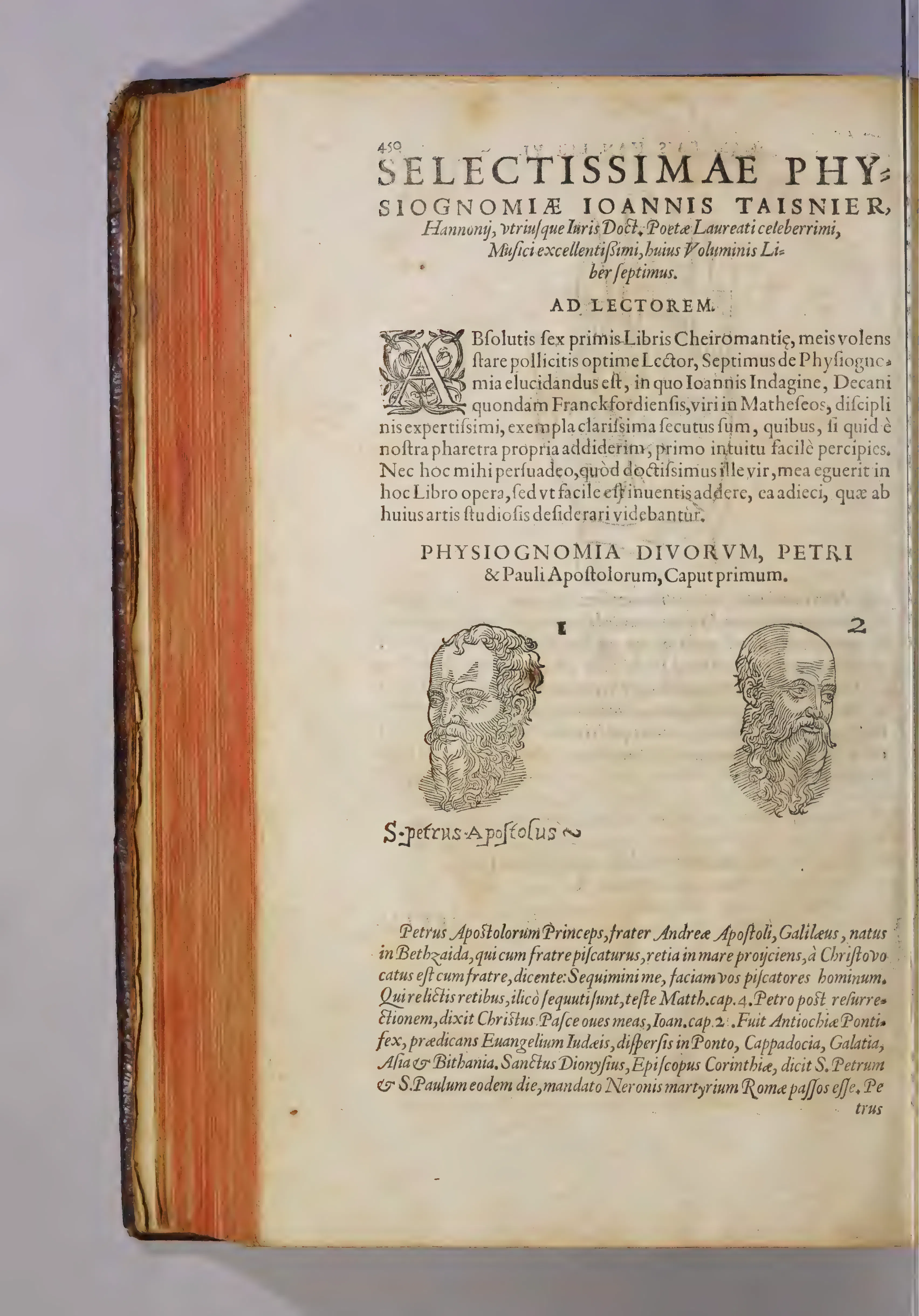
Book VII opens with an "Ad Lectorem" and paired numbered woodcut heads of Saints Peter and Paul, framing physiognomy as an apostolic and confessional exercise before the anatomical method begins. The page also stages the declared dependence on Indagine, while the portraits serve comparison and memory rather than ornament. Source ↗.
The astrological book states the two-front strategy most plainly. Toward judgement it counsels restraint: let nature and fate incline as they may, yet judgement must be so tempered that, unless all things have been inspected exactly, you do not easily rush it, Inclinent licet natura & fatum, ita tamen temperanda sententia est, vt nisi prospectis ad amussim omnibus, facilè hanc non præcipites — with the instance of a man born under Aries who governs his own anger, so that moral agency defeats astral inclination in the individual case. Toward rival practice it claims superior standing for the naturalist's restricted method, in which greater praise is owed to natural than to artificial astrology, partly because it is more faithful and less superstitious, maior naturali laus debeatur, quàm artificiali, partim quòd fidelior est, & superstitiosa minus. Yet the theological justification offered a page later claims far more than the modest observation of Sun and Moon would suggest, asking what else the astrologer seems to do, when he predicts future things, than that he communicates to men the more secret things of nature, known to God alone, insinuating to us God's will and counsel through prophecy, Quid enim aliud videtur tibi agere Astrologus dum futura prædicit, quàm quòd quæ secretiora sunt naturæ, ac soli Deo nota, hominibus insinuat, per prophetiam Dei voluntatem, & consilium nobis insinuans. The claim that natural astrology is superstitiosa minus and the claim that its practitioner conveys per prophetiam what is known to God alone stand in evident tension, and the appeal that follows to Moses and Abraham as astrologers is what the argument requires to hold them together: scriptural precedent converts prophecy from a rival of natural inquiry into its highest instance.
Anniversary revolutions and the annexation of complexional medicine
The technical doctrine that succeeds this defence is already under way when the reader is routed through the twelve houses of an anniversary rather than of a momentary revolution, and the unit closes not with a technical flourish but with a disclosure of source. The procedure, the text insists, is not the author's invention: what we attested in the preface we now repeat a second time without shame, that Lichtenberger, the most learned man of his age in natural mathematics, by this art alone drove all astrologers out of their wits and performed astonishing things by it, testati, id iam secundò repetimus citra pudorem, Liechtenbergium suæ ætatis doctissimu[m] in naturali Mathematica, hac arte sola Astrologos omnes dementasse, ex hac egisse stupenda. The phrase citra pudorem is doing careful work. Attribution to Johannes Lichtenberger, the prognosticator whose reputation rested on prophetic rather than computational virtuosity, simultaneously answers two opposite reproaches: that the art is a novelty without pedigree, and that the writer has appropriated another man's labour. The claim that this technique alone confounded the professional astrologers converts its computational poverty — an annual revolution requires almost nothing of the tables — into a proof of superiority, and the accompanying invitation to extend the eighty-four-year Aries table indefinitely, Supputationem Lector, si velis, in infinitum exaggera, hands the reader an open-ended instrument rather than a closed set of results. The printed object here is not merely a report of doctrine but a device to be operated.
The dedicatory epistle that follows redirects the whole enterprise toward medicine. Addressing the Leipzig physician Heinrich Stromer, Indagine opens on a diagnosis of deficiency in the medical literature itself: among the things learnedly and usefully handled by physicians, the chief are those adduced concerning the complexions, which he could wish had been so written by their own authors that there had been no need to add his colouring from elsewhere, INTER ea quæ doctè & frugi solent à medicis tractari (Stromere doctissime, ea præcipua sunt quæ de Complexionibus adducuntur, quas quidem sic optarim ab suis authoribus scriptas fuisse, ne aliunde nostrum addidisse fucum fuisset opus. The metaphor of fucum addere, adding pigment or rouge from outside, is double-edged and knowingly so: it concedes that the astrological supplement is cosmetic overlay upon an existing body of doctrine while asserting that the body was left unfinished by its own custodians. That posture — deferential in form, annexationist in substance — governs everything that follows, including the distribution of national temperaments among the planets and the assignment of the Greek quadripartition of affective susceptibility, Propathiæ, Metriopathiæ, Dispathiæ et Idiopathiæ, to planetary rather than merely elemental causes.
The formal preface to the book on recognising planets from the complexions stages the objection it expects. The reproach is proverbial and professional at once: that he has put his sickle into another's harvest, and they will perhaps throw this at him, let the cobbler not go beyond his last, to whom we in turn growl back, cemmisisse me, atque illud mihi opprobriabunt fortassè: Ne sutor vltra crepidam. Quibus nos obganimus vicissim. The Apelles anecdote is the standard early modern formula for policing disciplinary competence, and the retort supplied against it — that the gardener too sometimes speaks to the point — is a plea for the standing of the unlicensed practitioner within a faculty-ordered knowledge economy. Yet the preface immediately secures its flank in the opposite direction by taking its central term from the most authoritative medical source available: complexion is, on Avicenna's authority, a quality resulting from the mutual action and passion of the contrary qualities found in the elements, Est autem Complexio, authore Auicenna, qualitas, quæ ex actione ad inuicem & passione contrariarum qualitatum in elementis inuentarum resultat. With a precise reference to book, fen, doctrine and chapter of the Canon, the text signals that it accepts the curricular definition wholesale; the innovation lies not in redefining complexio but in adding a causal storey above it.
That addition is stated methodologically at the head of the choleric chapter, where three modes of evidence are made co-ordinate: heat and dryness make the choleric complexion, whence those who are hot and dry are called choleric, and they are recognised from physiognomy, from urine, and from the horoscope of the nativity, Cholericam complexionem facit caliditas & siccitas. Vnde qui calidi sunt & sicci, Cholerici vocantur. Agnoscuntur autem ex Physiognomia, & vrina, & ex horoscopo natiuitatis. Physiognomy and uroscopy were uncontroversial semiological instruments; placing the natal figure third in the same series is the treatise's decisive manoeuvre, since it makes the chart a diagnostic sign of the same order as the visible body and the voided humour. The cross-tabulation of each complexion with each of the seven planets then yields entries in which bodily surface and moral prognosis are fused without seam: if Mars obtains rulership in any nativity, he makes the person red in colour, as though scorched by the Sun, round-faced, cat-eyed, of fierce aspect, insolent, untameable, inconstant, trifling, an impostor, Mars si dominium in genitura aliqua obtinuerit, facit colore rubeum, veo luti combustum ab Sole, rotunda facie, felinis oculis, atroci aspectu, insolentem, indomitum, inconstantem, nugacem, impostorem. Colour, facial geometry and the animal simile of the cat's eye slide without argument into insolentem, impostorem: the grammar of the sentence, a single string of accusatives governed by one verb facit, is itself the assertion that complexion, appearance and character are one effect of one cause. The inference, moreover, is designed to run backwards, so that a sanguine man observed to be a robber betrays a Saturn or a Mars in the root of his nativity.
The conclusio to this book states the relation to academic medicine in explicitly architectural terms: we do not here condemn the writings of the physicians on the complexions, but presuppose these as already formed, building the edifice on a foundation already laid, No[n] igitur Medicorum hic scripta damnamus, quæ circa complexiones scripserunt: sed hæc velut iam formata præsupponimus, iacto fundamento superstruentes ædificium. Astrology is superstructure, medicine substructure; the metaphor grants priority in order while claiming the higher storey, and the immediately following expectation that any public building will be assaulted from every side acknowledges that the settlement is unlikely to be accepted. The Hermetic medical material that follows abandons that diplomatic register altogether. Its concluding formula makes the sympathy of the heavens exhaustive: one must therefore scrutinise exactly both the day and hour of taking to bed and examine the position of the world, for nothing befalls a man that does not arise and take its origin from celestial consent and sympathy, Scrutari igitur & die & hora decubitus exactè oportebit, & mundi positum examinare. Nihil enim homini superuenit, quod ex cælesti consensu & sympathia non oriatur & originem ducat. The universal negative, nihil enim homini superuenit, leaves no residue for chance or for unmediated particular causes, and it sits in evident tension with the division of competence and the reservation of divinely fixed terms that the tradition elsewhere maintains. The twenty-four lunar entries preceding it, each pairing an aetiology with a dated crisis, show what such a claim looked like in operation: prognosis by day-count, conditional upon the testimony of the benefics.
The judicial isagoge, instrumentation, and the apparatus of attestation
With the Astrologiae iudiciariae ysagogica the authorial voice changes and so does the rhetoric of authority. Where Indagine appealed to Lichtenberger and to the poverty of calculation, Taisnier advertises apparatus and instrumentation, claiming that far more certain in this operation will be the newly invented use of our material sphere, a sphere never hitherto seen or handled by anyone, as he will lucidly demonstrate in his eight books on its use, and that many have obscured things by confusion of language, abusing obscure terms so as to soothe their ignorance with affected words, longè tamen certior in hac operatione fuerit nostræ Sphæræ materialis nouiter inuentus vsus, quæ Sphæra à nullo hactenus vnquam visa, nec tractata est, prout in nostris octo libris de eiusdem vsu lucidè demonstrabimus: & quod multi sermonis confusione offuscarunt, terminis obscuris abutentes, vt ignorantiam suam affectatis verbis lenirent,. The accusation of jargon as a screen for ignorance is made by a writer whose ensuing pages enumerate haiz, Almuten, azemene, via combusta and some two dozen weighted dignities and debilities; the contradiction is not concealed but managed, since the numerical weighting of each dignity is precisely what converts opaque Arabic terminology into a quasi-arithmetical procedure any reader can execute.
The compilation's appeals to experience are correspondingly concrete and are permitted to cut against authority. Against the Ptolemaic rule restricting the giver of life, the nativity of the late Emperor is produced as it was tested in the genesis of the Emperor Charles the Fifth, who had only the Moon horoscoping and the remaining planets beneath the earth, and yet lived fifty-eight years and more, Vti in genesi Imperatoris Caroli Quinti expertum est, qui vnicam Lunam horoscopantem habuerit et reliquos Planetas sub terra, vixit tame[n] Anno 58. & amplius. The verb expertum est places the case in the same evidentiary register as the witnessed experimenta elsewhere in the folio: a famous and independently datable life is treated as a test instance capable of falsifying a rule of the Tetrabiblos. A comparable candour governs the treatment of the text's own transmission, where the compiler warns that the chapters that follow he found in another copy, not in that most ancient one of his, and has nevertheless appended them because they were long since ascribed to this author's name, leaving it to the reader's judgement whether the copyists of the exemplars did this rightly or unjustly, QVÆ SEQVNTVR CAPITA, IN ALIO EXemplari inuenimus, non in nostro illo vetustissimo. Adiunximus autem ideo, quòd ea iam olim huius autoris nomini asscripta fuere, Lectoris iudicio permittentes iure ne id, an verò iniustè fecerint Exemplarium Scriptores. This is philological method of a recognisably humanist kind — collation of copies, a flagged attribution, devolution of judgement — applied to divinatory doctrine, and it reinforces the claim that the art possesses a textual tradition worthy of critical handling.
What the same doctrine could authorise is visible in the elections attached to the lot of fortune, where the eleventh house's rulership over the substance of the great yields an alarming pair of alternatives: but it is especially auspicious then to seek wealth from princes, or to slaughter them, for the eleventh house signifies the substance of kings, princes and lords, Præcipue vero auspicatum est tum à Principibus opes petere, aut eos trucidare. Nam vndecima domus significat substantiam Regum, Principum & Dominorum. The clause is delivered without comment, as one election among others, and it exposes exactly why judicial astrology attracted magisterial suspicion: a technique for timing petitions to princes is, by the same rule, a technique for timing regicide. The closing showpiece then stakes the credibility of the whole compilation upon a single royal prognostication, for Saturn, on Ptolemy's testimony, threatened a lethal injury in the head coming from the air, which, alas, also happened on the day, month and year foretold, Saturnus etenim (teste Ptolemæo) offensionem lethalem in capite ex aëre venientem minabatur, quod & (prob dolor) accidit Die & Mense, & anno à me prognosticato. The interjection prob dolor, repeated in this final movement and already met in the announcement that the misfortune of the Most Serene King had been foretold at Rome thirteen years before his fall, performs the grief that the accuracy of the prediction might otherwise seem to relish, and witnesses are invoked at Cologne, in Brabant and in Italy to convert a private judgement into attested fact before the volume ends in doxology.
The back matter completes the argument in a different register. The analytical catalogue enumerates, book by book, the lines and mounts, the sixty exemplary hands, the thirty-one experiments with their named places, times and witnesses, and the physiognomies, and its very first entry names the defence that the whole folio has been mounting, an apology for chiromancy, physiognomancy and natural astrology, strengthened by many authorities of the most learned men and even from sacred scripture, Apologia Cheiromâtiæ, Physiognomantiæ & Astrologiæ naturalis, multis authoritatibus doctissimorum etiam ex sacra scriptura roborata. Placing the apologia at the head of the finding-list makes it the interpretative key handed to a reader who consults the volume piecemeal: before any figure is located or any judgement extracted, the catalogue announces that the arts thus indexed have already been vindicated, and by scriptural as well as philosophical testimony.
Frequently Asked Questions
What is Johannes ab Indagine's Introductiones Apotelesmaticae elegantes?
It is an illustrated Latin handbook on chiromancy, physiognomy, natural astrology, human complexions, and the natures of the planets, first securely documented in an impression of 159 pages printed at Strasbourg by Johann Schott in 1522. It works as an introductory entrance to an art while also serving as a practical manual, teaching the lines of the hand, the features of the face, bodily temperament, and planetary qualities as one interlocking system of signs. Its complexio, the Galenic mixture of qualities producing a bodily temperament, binds the sanguine, choleric, phlegmatic, and melancholic constitutions to the planets.
Who was Johannes ab Indagine?
Johannes ab Indagine, also recorded as Johannes Rosenbach, was active about 1467 to 1537 and associated with Steinheim near Hanau; Jean Taisnier later named him "once dean of Frankfurt" and a man most expert in the mathematical disciplines. Hans Baldung cut a woodcut portrait of him dated about 1522, the year of his handbook's Strasbourg printing. Catalogue tradition has sometimes confused him with an earlier Carthusian homonym associated with the dates 1415 to 1475, and the specialist literature on him remains comparatively thin, consisting largely of bibliographical notices and passing references.
Why does a line on the thumb signify "death without effusion of blood"?
Because the thumb stands under the dominion of Venus, and Venus is moist and cold rather than hot and dry. A transverse line in the thumb's first joint is therefore read as marking a man to be hanged or strangled: the qualitative logic excludes the sanguinary death of iron and leaves the bloodless death of the rope. The manner of death is derived from the planet's elementary qualities rather than from intuition or custom. It is also a determinate judgement about a particular human act and its penal consequence, sitting exactly where natural astrology strains against prohibited prediction.
How did this tradition try to prove its claims, and did it ever admit that a rule failed?
Through witnessed cases presented in notarial form, citing time, place, and trustworthy witnesses named by first and family name, with a whole book appended as a seal and verification of the art. Remarkably, the same tradition records a falsification: of those who have ten or more lines in a certain place, not one had ever been found who took six wives in his lifetime, and the rule is accordingly declared "not so entirely certain." A parallel modesty governs medicine, where the chiromancer concedes he cannot discern the species of arthritis and need only name the affected member and its pain.
Is there an English translation of Indagine's work?
Yes, in an early modern form: Fabian Withers's translation appeared in London in 1558, printed by John Day for Richard Jugge, with later English issues in 1651 and, as The Book of Palmestry and Physiognomy, in 1666. No modern critical edition and no modern-language scholarly translation has been identified. Separately, the Leo edition offers the complete Latin transcription together with a full English translation that is generated by AI. Leo is an effort to make freely available online, at no cost, English translations of every text printed in Latin in early modern Europe between 1450 and 1750.
This report was generated by an advanced AI assistant that conducted deep research alongside an extensive interpretation of the transcribed original text. Every effort has been made to preserve fidelity to the source and to guard against inaccuracy, but corruption in the text recognition process and model hallucination may nonetheless have entered the text. Treat every claim, quotation, translation, and citation as provisional, and verify each against the original source before relying on or citing it.
Critical Further Reading and Contextual Resources
- Jean-Patrice Boudet, Franck Collard, and Nicolas Weill-Parot, eds., Médecine, astrologie et magie entre Moyen Âge et Renaissance: autour de Pietro d'Abano: This collection is particularly valuable for reconstructing the medical, astrological, and magical traditions that underlie the language of complexions, planetary causation, disease, and astrological medicine in the Indagine tradition, including the polemical claim, itself descended from the Conciliator's milieu, that he is so far from medicine who is ignorant of astrology that he ought not to be called a physician but an impostor, tam longe ab medicina est, qui Astrologiæ ignarus est, vt non Medicus dici debeat, sed impostor. Read it to see how much of Taisnier's medical bravado was inherited rather than invented.
- Anthony Grafton and William R. Newman, eds., Secrets of Nature: Astrology and Alchemy in Early Modern Europe: The essays situate astrology and related arts within early modern natural philosophy and help clarify why chiromancy, physiognomy, and medical astrology could be presented as learned disciplines while remaining vulnerable to theological and confessional criticism, the double exposure that the tradition's own apologetics and its orthodox disclaimers were designed to manage. It is the best single corrective to the habit of filing these books under "superstition" and closing the drawer.
- Stephanie Leitch, "Getting to How-To: Chiromancy, Physiognomy, Metoscopy and Prints in Secrets' Service," Quid est secretum? Visual Representation of Secrets in Early Modern Europe, 1500–1700: Leitch's analysis of printed images and practical procedures offers the most direct methodological context for studying Indagine's illustrated hands, physiognomical figures, and the relationship between visual form and consultative practice, where a figure had to be matched against a printed exemplar before a verdict could be read off it. Essential for understanding why Taisnier can cite his forty-fourth plate the way a logician cites a proposition.
- Stephanie Leitch, "Visual Acuity and the Physiognomer's Art of Observation," Oxford Art Journal: This article helps explain physiognomy as a disciplined practice of observation and interpretation, while also providing a useful basis for examining how printed images claimed to make bodily signs legible — a claim that rests on generalized semiotic rules of the kind ascribed in the tradition to Egyptian authority, namely that it is a general teaching among the Egyptian speculators that irregular figures made of transverse lines are an evil and worst sign, and mark an unfortunate planet, and consequently misfortune, Est autem generale documentu apud Aegyptios speculatores, quòd inordinatæ figuræ ex transuersis lineis, sunt malum et pessimum signum, notantque planetam infortunatum, & per consequens infortunium. It supplies the vocabulary for treating trained looking, rather than prophecy, as the art's real claim to expertise.
- H. Darrel Rutkin, Sapientia Astrologica: Astrology, Magic and Natural Knowledge, ca. 1250–1800: Rutkin's account of astrology as a mathematically articulated form of natural knowledge, rather than an undifferentiated "occult" residue, provides an essential framework for interpreting Indagine's conjunction of celestial influence, bodily signs, medical judgment, and predictive practice — and in particular for reading the tradition's insistence that natural astrology surpasses the artificial kind in certainty rather than merely in convenience. Its treatment of the institutional and theological structures also explains why the disclaimers about divinely fixed terms are argument rather than decoration.