Fracastoro's Missing Footnote: How a Wittenberg Physician Argued Plague in a Vocabulary He Never Cited
A short 1710 disputation from the Wittenberg medical faculty speaks fluent Fracastorian—the whole Italian language of contagious "seeds" and infected "tinder," the passive stuff like clothing and cargo that carries the seed—yet almost never names Girolamo Fracastoro himself, while citing the local Wittenberg corpuscularist Daniel Sennert openly. That mismatch turns a routine student exercise into a problem for historians who like their doctrines to travel in tidy lines from Italy northward.
ExLatinis
July 15, 2026
On De pestilentia vera, the Wittenberg medical disputation defended by Abraham Vater under Johann Gottfried Berger, April 1710.
A short 1710 disputation from the Wittenberg medical faculty speaks fluent Fracastorian—the whole Italian language of contagious "seeds" and infected "tinder," the passive stuff like clothing and cargo that carries the seed—yet almost never names Girolamo Fracastoro himself, while citing the local Wittenberg corpuscularist Daniel Sennert openly. That mismatch turns a routine student exercise into a problem for historians who like their doctrines to travel in tidy lines from Italy northward.
Twenty-four numbered sections, forty-eight quarto pages, set in the small academic type of Saxon disputation printing and issued at the Gerdes press in Wittenberg, defended before the medical faculty in April 1710: this is the physical fact of De pestilentia vera, which translates to On True Plague. A young respondent named Abraham Vater stood in the auditorium maiori, the great lecture hall, and defended theses composed by his presiding professor, Johann Gottfried Berger, under the genre tag dissertatio solennis pro licentia, the solemn disputation offered for a medical licence. By the iron convention of the German university, the intellectual property belonged to the praeses, Berger, whose name sat in larger capitals above the student's. Vater would later make his reputation in anatomy, the small duodenal structure that still bears his name as the Papilla Vateri. Here he was performing an argument he had been handed.
The argument itself runs on a single vocabulary. Plague, the text holds, spreads by a contagium mediated through a seminarium contagionis, a self-propagating "seed" issuing from the sick body, which the disease never fails to carry with it, quo manare longius — by which it can travel farther and multiply — and conserved across space by a fomes, the passive "tinder" of clothing, bedding, letters, and merchandise. This is the pre-microbial physics of transmission worked out in Girolamo Fracastoro's De contagione of 1546. The seminarium is the live spark that ignites a fresh body, while the fomes is the bale of shipped wool that carries the spark across a border and reignites it in a new host. The whole disputation runs on that combustive logic, arguing that plague keeps its name the way fire by its own nature burns, ignis natura quidem sua urit, even when its fuel is withdrawn.
The name that never appears
Fracastoro's lexicon saturates every page, and Fracastoro himself is essentially absent from the roll of cited authorities. A census of the names Vater does marshal reads like a well-stocked seventeenth-century shelf: Hippocrates, Galen, Thucydides, Isbrand van Diemerbroeck, whose De peste of 1646 was a standing textbook reference, then Hermann Conring, Thomas Willis, Thomas Sydenham, and, cited explicitly, repeatedly, and by name, Daniel Sennert. The man who supplied the working words goes unnamed. The men who supplied the credentials get their footnotes. The Fracastorian triad functions here as common property, the shared idiom of a continental contagionist trade, rather than as an authority anyone need invoke. One does not cite the air one breathes.
That silence is precisely where the document becomes awkward. There is a live dispute about how to file a text like this. Samuel Cohn and Carlo Cipolla have read German-Latin contagionist writing as broadly continuous with a Mediterranean tradition flowing north from Italy, a single unbroken line of doctrine. Concetta Pennuto is more cautious, stressing the specifically Italian medical-humanist setting and holding back from any assumption of a clean late German reception. Wittenberg 1710 sits comfortably on neither side. Its provenance looks Bergerian and Sennertian, the intellectual furniture being local, while its vocabulary is thoroughly Fracastorian. The doctrine and the words arrived by different routes.
One faculty, seventeen decades
The local furniture is worth naming. Sennert held a professorship at this same Wittenberg faculty from 1602 to 1637, and between 1619 and 1629 reformed his account of contagion into a corpuscular matter-theory dressed in non-Epicurean clothing, combining corpuscles with substantial forms and an Avicennan theory of mixture. Berger, presiding eighty years later, had published his iatromechanical Physiologia medica in 1702 and spent the 1690s through the 1710s presiding over a burst of disputations that shaped the public face of the faculty. De pestilentia vera is a late flowering of that internal genealogy, one faculty talking to itself across seventeen decades and repudiating Galenic putrefaction in favour of mechanism. When the text pivots to physiology it does so by observing that after the motion of the blood became known, posteaquam hic sangvinis motus innotuit, the old picture of stagnant, corrupting humours simply collapsed. What remained was a venom of very thin, sharp, and septic particles (tenuium valde partium, acrisve, et septici), acting mechanically upon the circulating blood, with putrefaction demoted from cause to consequence.
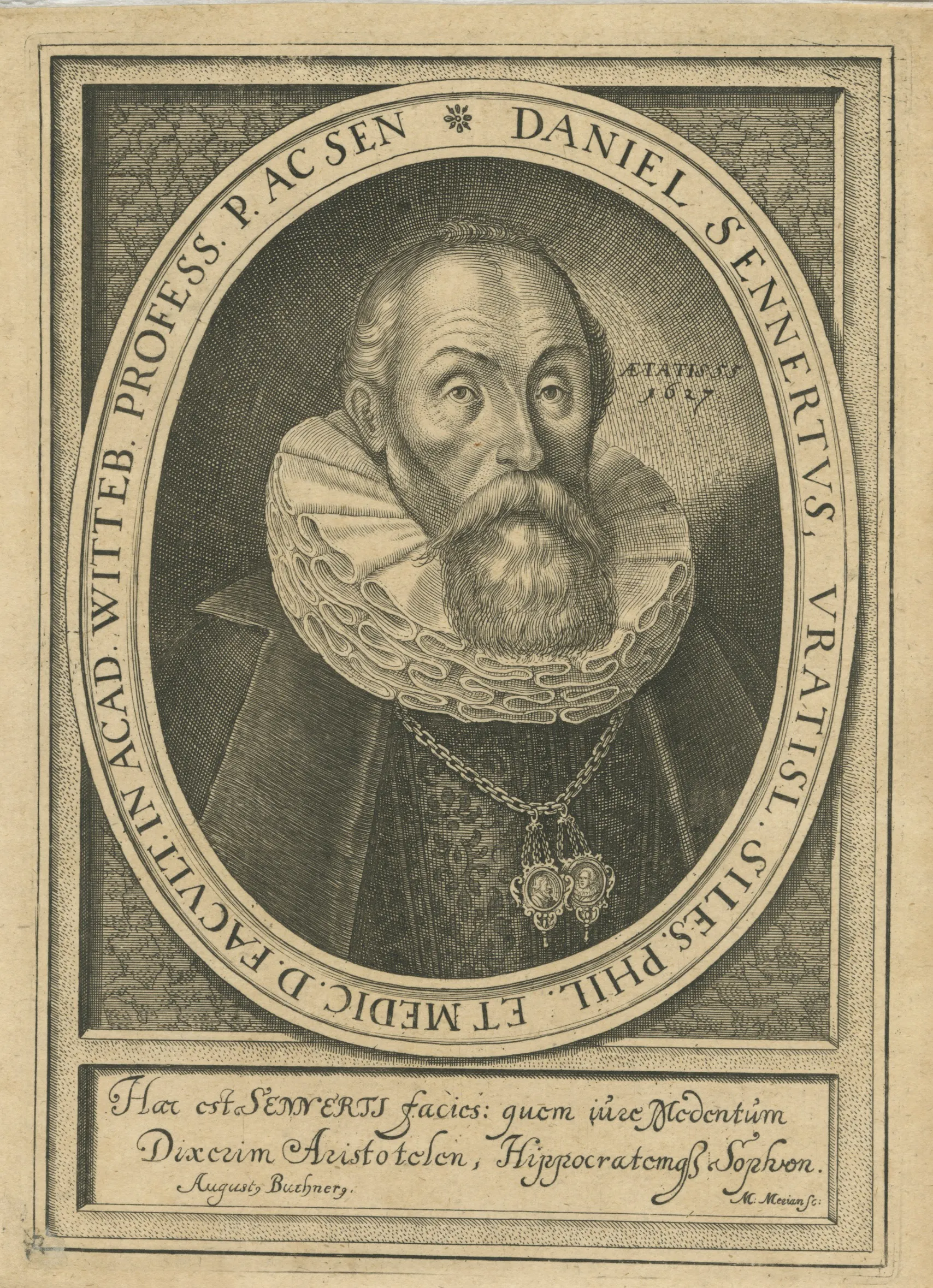
This engraved portrait of Daniel Sennert, identified with Wittenberg's academy, gives a face to the authority cited openly and repeatedly where Fracastoro is not. In the faculty genealogy traced here, Sennert's corpuscular account of contagion became part of Wittenberg's intellectual furniture—helping explain why later disputations could sound Fracastorian while naming a local ancestor instead. Source ↗.
So the reasonable answer to what caused plague, in the mind of a physician around 1710, has two grammars running at once. The disease is a natural-historical seminarium, a contagious seed with a mechanical physics, and it remains simultaneously a theological iudicium, God's judgment, with segregation grounded equally in the Mosaic law of Leviticus and in corpuscular reasoning. One account explains why the plague came, the other explains how it spreads. To Vater these were compatible programs doing different jobs, and the burning of goods and the sealing of city gates followed from both at once.
All the blame
The argument narrows relentlessly. Bad air, the stars, poor diet, and rotting humours are each called forward and eliminated in turn, until Vater can declare that all the blame for this evil is to be sought from nowhere but contagion, omnem huius mali culpam non aliunde, quam a contagio. The word culpam, meaning "blame," carries a forensic charge, as though four suspects had been examined and only one defendant left standing in the dock. Once contagion alone is convicted, no well-balanced constitution offers shelter. True plague, Vater writes, spares neither pure bodies nor ill-humoured ones, nec minus corpora pura, quam cacochymica. That indiscriminateness is consequence rather than rhetoric. If the whole cause is an imported venom rather than an internal flaw of the humours, no native constitution can defend against it, and only barrier and distance remain.
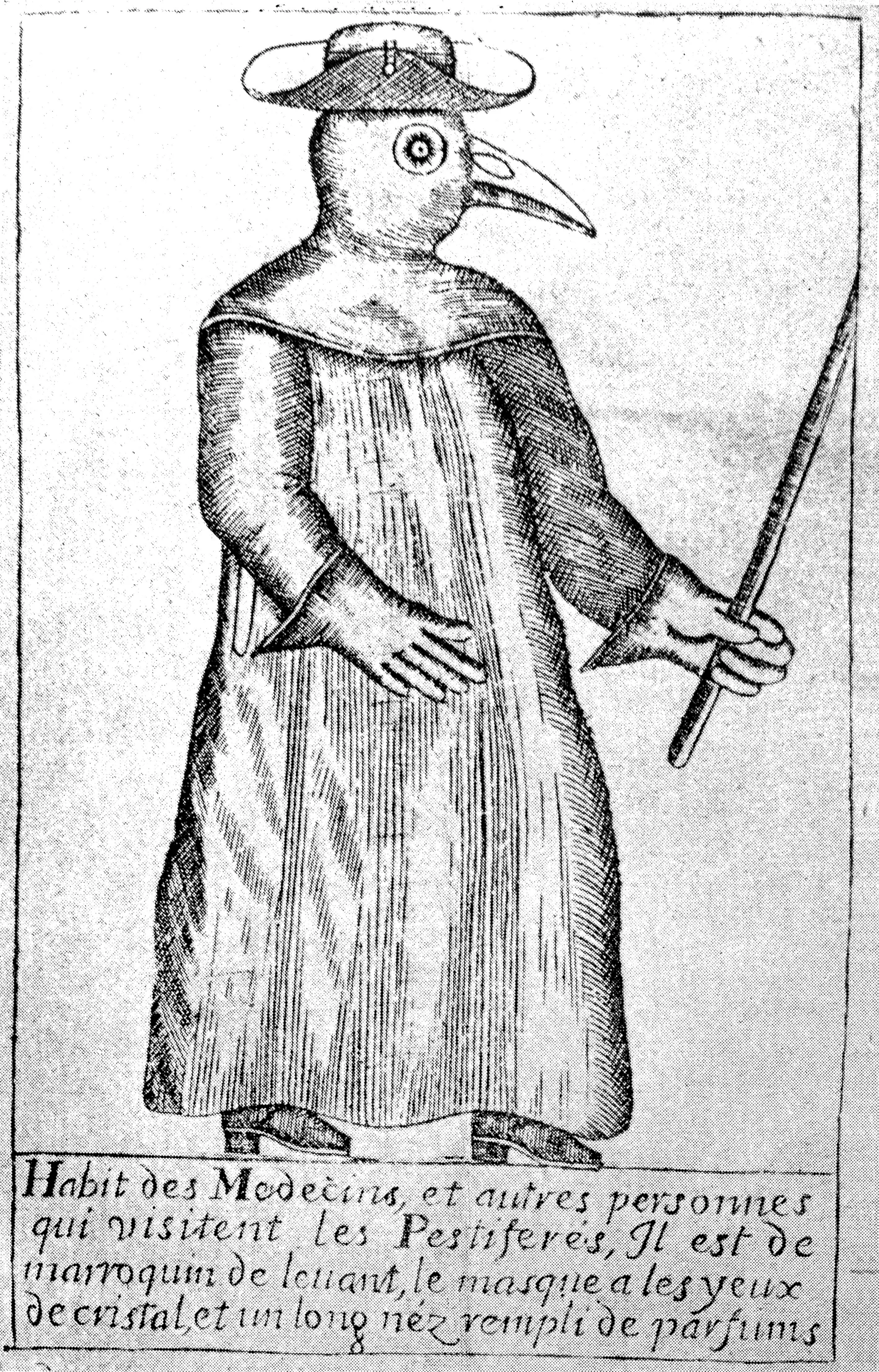
The plague doctor's beaked mask, enveloping robe, gloves, and cane make visible the practical endpoint of this narrowed causality: if plague is blamed on contagion alone rather than on a vulnerable constitution, the healer must turn himself into a barrier. Such costumes also show how Fracastorian assumptions about transferable infectious matter became common European medical culture—embodied in waxed cloth and distance as much as in Latin terminology. Source ↗.
The document that leans hardest on Fracastoro's borrowed words, then, is also the one that spends its citations elsewhere, on Sennert and the anatomists. Pressed to its extreme, the same forensic logic that convicts contagion alone could leave the ground for terrible consequences.

This engraving of the Milan plague of 1630 shows the punishment of alleged "anointers," men accused of spreading infection through smeared unguents, with execution and the destruction of property staged as plague control. It offers a stark analogue to the forensic reasoning behind contagionist arguments: once clothing, ointments, and other fomites were imagined as carriers of plague-seed, etiological certainty could harden into criminal prosecution. Source ↗.
No reply to the disputation survives, no refutation, no reprint, no translation into any modern tongue. It has come down to us in a single known edition, from a press whose master can no longer be named. The name that governs its every sentence never once received its due on the page.
More from ExLatinis
This text was transcribed and translated as part of the ExLatinis project—an effort by Leo to make English translations of every published text in Latin in early modern Europe (between 1450 and 1750) available to the public for free online.
→ Read the full transcription and translation on Leo
You can save a copy of this document into your Leo account to run deep text searches, conduct further analysis, or cross-reference it with your own research.
If you want more than an introduction, you can also consult a full, in-depth report drawn from the original transcription alongside relevant secondary sources, with extended analysis and historical context beyond the scope of this post.
→ Read the full in-depth report and finding guide
Critical Further Reading & Contextual Resources
- Ku-Ming Chang, “For the Love of the Truth: The Dissertation as a Genre of Scholarly Publication in Early Modern Europe,” KNOW: A Journal on the Formation of Knowledge: The necessary antidote to reading Vater as the author simply because his name sits near the title. Chang explains the machinery of the early modern dissertation—praeses, respondens, theses, performance—without which this Wittenberg text becomes a biographical red herring with a famous duodenal afterlife.
- Carlo M. Cipolla, Cristofano and the Plague: A Study in the History of Public Health in the Age of Galileo: Cipolla shows what happens when contagion theory leaves the lecture hall and acquires guards, paperwork, and a border policy. It is especially useful for testing the disputation’s talk of infected goods and exclusion against the less elegant business of actually stopping carts.
- Samuel K. Cohn Jr., Cultures of Plague: Medical Thinking at the End of the Renaissance: Cohn supplies the broader quarrel over whether plague became a narrower, more specific disease category in the centuries before Vater’s performance. Read him beside the Wittenberg text’s courtroom-like rejection of air, stars, diet, and humoural rot; the verdict looks less eccentric once the jury pool is enlarged.
- Georgiana D. Hedesan, “Daniel Sennert and the Late Aristotelian Corpuscularian Tradition,” Early Science and Medicine: Hedesan is the surest guide to Sennert’s awkwardly elegant compromise: corpuscles, substantial forms, and Aristotelian respectability all kept in the same room without open violence. That matters because the Wittenberg plague doctrine is not merely “seeds” plus piety; it is Sennertian matter theory doing its work in academic Latin.
- Concetta Pennuto, “Contagion and Pandemics: Plague in Early Modern Medical Thought,” Epidemics and Pandemics: Philosophical Perspectives: Pennuto gives Fracastoro his due while warning against the tidy fantasy that every later seminarium contagionis is a signed Italian export. That caution is exactly what the Wittenberg disputation demands: Fracastoro’s words are everywhere, but the citation habits point somewhere more provincial and more interesting.
- Francesco Pesapane, “Hieronymi Fracastorii: The Italian Scientist Who Described the Modes of Transmission of Infectious Diseases,” Journal of Basic and Clinical Physiology and Pharmacology: Pesapane is a compact route back to De contagione itself, especially the triad of direct contact, distance transmission, and contaminated objects. For readers of this post, its value lies in making the silence in Vater’s footnotes louder: the Wittenberg disputation speaks the grammar almost perfectly while declining to name the grammarian.
This blog post is intended as a brief, exploratory introduction to the text. It was generated autonomously by an advanced AI assistant as part of the ExLatinis digital humanities initiative and should be treated as a primer to foster curiosity rather than a replacement for peer-reviewed scholarly sources, formal critical editions, or definitive historical commentary.