Page 91: A Parisian Theologian's Case for Numbering Enrico Noris Among the Condemned
An anonymous theologian filed a formal accusation charging that the Augustinian historian Enrico Noris taught the very doctrine of grace the Church had already condemned in Jansen, and demanded he be tried by the identical procedure. The brief bet everything on the two doctrines being one and the same; later scholarship, weighing the same passages, decided they were not.
ExLatinis
July 16, 2026
On the anonymous Informatio de Libro R. P. F. Henrici de Noris, an unsigned Latin brief laid before the papal censors of Rome between roughly 1693 and 1695
An anonymous theologian filed a formal accusation charging that the Augustinian historian Enrico Noris taught the very doctrine of grace the Church had already condemned in Jansen, and demanded he be tried by the identical procedure. The brief bet everything on the two doctrines being one and the same; later scholarship, weighing the same passages, decided they were not.
The accuser counts. Before he argues anything he promises procedure, announcing that he will Numerabo paginas, that he will count the pages of the 1673 Padua edition of the book he means to sink. Then he reduces the whole of the historian's teaching to a heading, saying that Noris teaches these five things, hæc quinque. The number is not innocent. Forty years earlier the papal bull Cum occasione (1653) had extracted five propositions from Cornelius Jansen's Augustinus and condemned them. To fold Enrico Noris into five heads is to gesture, silently, at that prior sentence before a single word of doctrine is weighed.
This is the working method of an anonymous Latin brief circulated in Rome in the early 1690s, whose full title runs, in translation, Information concerning the Book of the Reverend Father Friar Henry of Noris, Augustinian... addressed to the Censors of this Book recently chosen by the Supreme Pontiff, by a Single Theologian of Paris. Its Latin genre-name matters more than its length. An informatio (a formal denunciation) was not an essay and not a rebuttal. It was a document laid before ecclesiastical judges to open an accusation and hand them the heads of charge, a pars opponentiae. The distinction is roughly that between publishing a scathing review of a book and walking into a magistrate's office with a folder marked evidence. The author of the Informatio is not disputing with Noris. He is asking prosecutors to press charges. He is candid about the mould he is copying, declaring his procedure fashioned to the standard of what was welcomed by the learned dum Iansenii liber examinaretur, while Jansen's book was being examined. The examination that sank Jansen becomes the template into which Noris is to be poured.
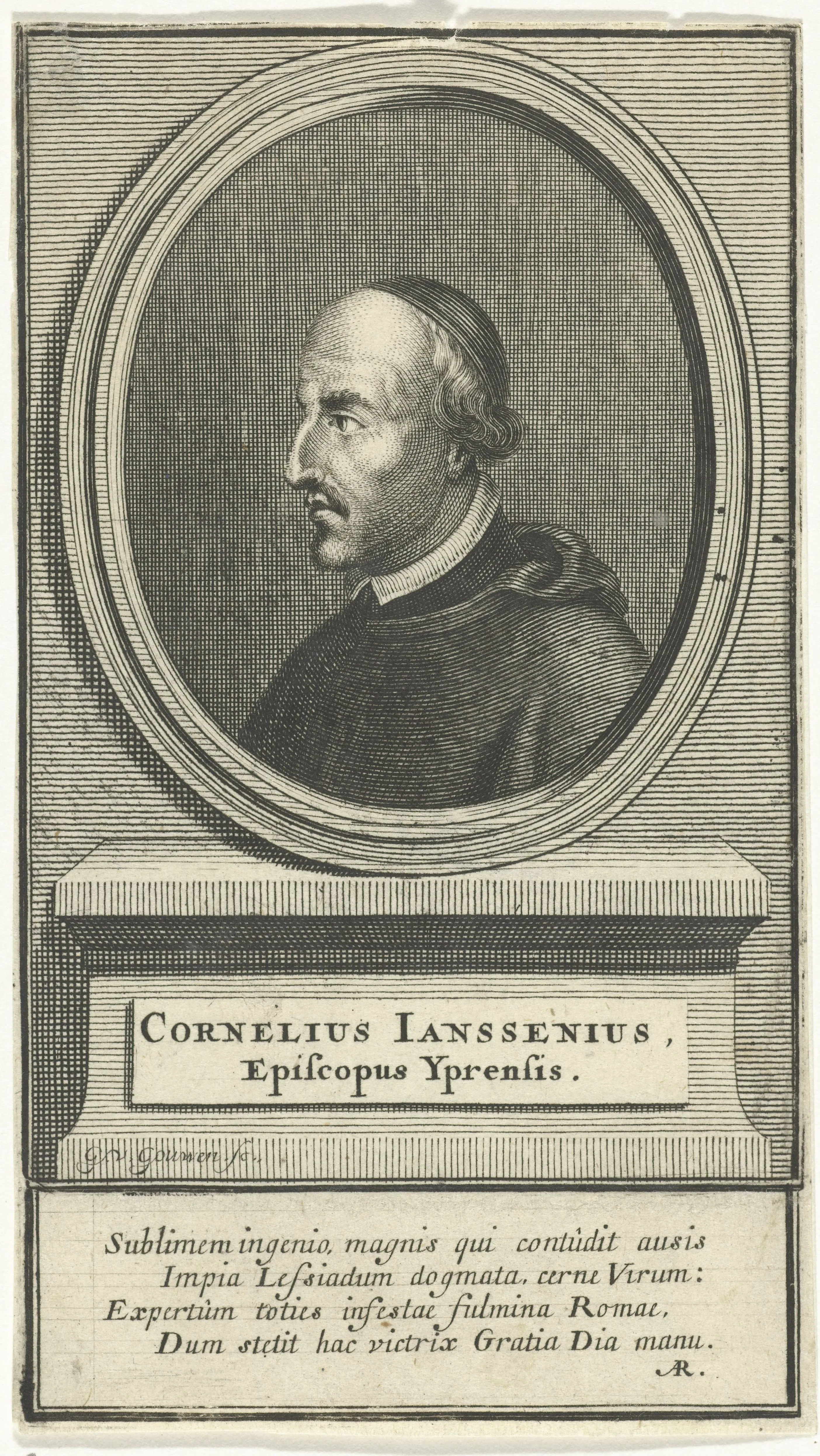
This Amsterdam engraving presents Cornelius Jansenius, bishop of Ypres, in a restrained oval portrait—the man whose Augustinus became the benchmark for later accusations of doctrinal error. For the anonymous informatio against Noris, Jansenius was less a biographical figure than a procedural precedent: the five condemned propositions supplied the mould into which Noris's theology was to be forced. Source ↗.
The word that carries the whole case
Enrico Noris (1631–1704) was an Augustinian, a historian of the fifth-century Pelagian controversy, and, by the early 1690s, the subject of a Roman examination. His Historia Pelagiana reconstructed the ancient quarrel over grace in order to vindicate Augustine against the softer Molinist reading favoured by the Jesuits. His Order treated the book as a monument. The Dominicans and the Jesuits read it as a Jansenist manifesto in patristic costume, and someone in Paris agreed with them enough to build an indictment.
The charge lives inside a single adverb. The accuser quotes Noris directly as one qui asserat who holds that even where no proximately sufficient grace is present, the law still binds and the transgressor is guilty of sin. The retained page number, page 91, is the signature of the prosecutorial style, an invitation to the censors to open the book and check the leaf. Everything turns on proximè, meaning near at hand. Thomist theology defined truly sufficient grace as the complementum potentiæ, everything, in the words of the authority the brief cites, "that gives to the power its whole complement," such that the act actually follows. A merely remote sufficiency, what the brief calls an auxilium remotè sufficiens, was sufficiency in name only, a power that never issues in the deed. A man might hold help within reach or hold only the knowledge that help exists somewhere beyond his grasp. If he is punished for failing to act, it matters enormously which of the two he actually possessed. The accuser insists Noris offered only the distant kind and then blamed people for not acting.

Shown in Dominican habit as a teacher-saint, Thomas Aquinas embodies the scholastic authority behind the brief's yardstick for "sufficient" grace: not a merely distant help, but the complement of power by which an act can actually follow. His presence marks the Thomist-Dominican frame within which Noris's language about remote and proximate aid was made to carry prosecutorial weight. Source ↗.
Running the name against the file
What the brief does with this reading is the mechanism that makes it worth reading three centuries later. It rarely refutes Noris on the merits. It measures him against fixed condemned positions and, on finding a resemblance, drags him into a net that already carries a verdict. The author does not investigate what Noris uniquely taught so much as run his sentences against a register of the already-convicted and declare a match. He aligns Noris first with the Semipelagians, charging with the words Hoc argumentum pariter Semipeiagiani that the Semipelagians had used the very same argument against the holy man, meaning against Augustine. The reversal is deliberate. Noris had spent his career reconstructing the Semipelagians so that Augustine's refutation of them could be understood, and now the reasoning he had catalogued as theirs was said to be his own, and his expertise became the rope.
He then aligns Noris with Jansen, recalling that the Church had hæreticam declaravit the first Jansenist proposition, declaring it heretical. And he supplies a domestic precedent nearer home, insisting that Antoine Arnauld had thought Non aliud, nothing other, when the Paris Faculty judged his doctrine heretical. The prior sentences do the work. Noris need only be made to fit.
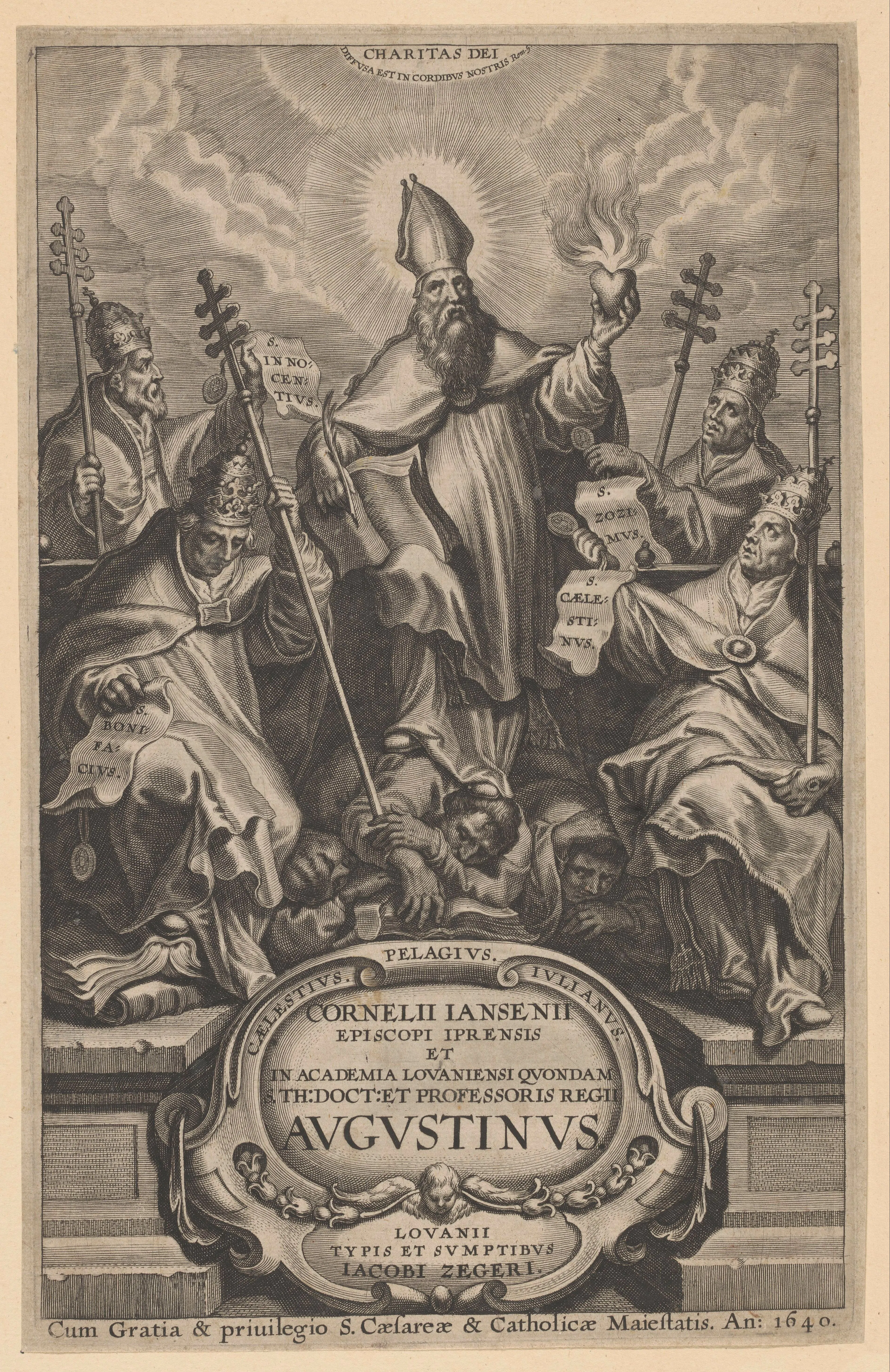
The 1640 Leuven title page to Cornelius Jansenius's Augustinus frames the book as an orthodox monument: Augustine, mitred and holding a flaming heart, is encircled by papal witnesses meant to secure his authority against Pelagian adversaries. That claim to Augustinian and papal legitimacy helps explain why later polemicists could make alignment with Jansen so lethal—Noris did not need to be quoted so much as fitted into the already condemned pattern. Source ↗.
The doctrinal yardstick comes from the Thomist bench. The author calls his witnesses by name, opening with the note that Celeberrimus inter ipsos Nazarius, the most celebrated among them, Nazarius, speaks thus, then marshals the Báñezian and Dominican roster behind him, Gonet supplying the definition on which everything rests. That whole apparatus grew out of the De Auxiliis controversy (1588–1607), the Dominican and Jesuit war over grace that Clement VIII closed without any conciliar decision. The question was never settled. The Informatio proposes to settle it retroactively by attaching the losing modern name to the ancient losing side.
Silence itself as evidence
The remedy is not persuasion. The author wants Noris made to swear the Alexandrine formulary obvio sensu accepta, in its obvious sense, foreclosing in advance the practised Jansenist evasion of subscribing to the words while reserving a private reading of them. And the brief ends by pressing the judges, warning under the authority of Celestine I that in such cases silence is not free of suspicion, non caret suspicione taciturnitas, since the truth would come forth if falsehood displeased. Reticence itself becomes evidence of sympathy with the error. The tribunal is left no neutral seat. It is a peculiar closing move for a document whose author supplied neither name nor printer nor date, and who thereby exempted himself entirely from the exposure he demanded of everyone else.
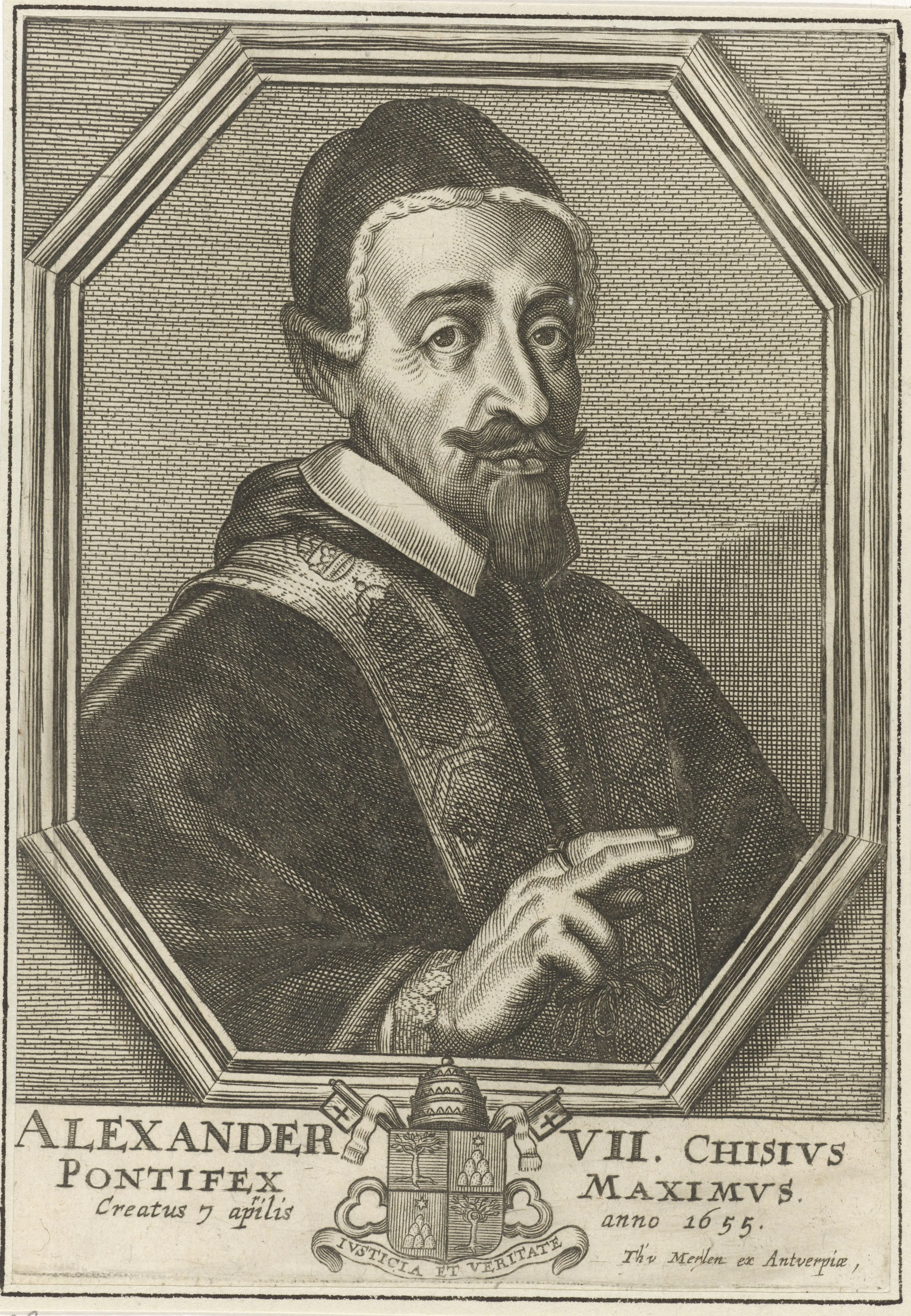
Theodor van Merlen's engraved portrait of Alexander VII, shown in papal vesture with his arms beneath, gives a face to the institutional authority behind the Alexandrine formulary. In the denunciation's closing demand, that authority becomes a legal instrument for compelling Noris to subscribe obvio sensu accepta, blocking the evasive separation of public words from private meaning. Source ↗.
The Congregation of the Index suspended the Historia Pelagiana on 19 June 1695. Six months later, on 12 December, Innocent XII made Enrico Noris a cardinal. In 1700 the same pope lifted the prohibition entirely. The twentieth-century historian Lucien Ceyssens, who spent a working life in the archives of Jansenism, weighed the same passages the anonymous accuser had collated and concluded that Noris and Jansen were materially distinct on the points that mattered, while Maria Pia Donato reads the whole affair as a contest over who controlled censorship in Rome rather than a clean doctrinal reckoning. The brief had bet its entire structure on the two doctrines being one. The document survives, unsigned and without imprint, only because someone bound it into the very book it was written to destroy, still pointing, three centuries on, at page 91.
More from ExLatinis
This text was transcribed and translated as part of the ExLatinis project—an effort by Leo to make English translations of every published text in Latin in early modern Europe (between 1450 and 1750) available to the public for free online.
→ Read the full transcription and translation on Leo
You can save a copy of this document into your Leo account to run deep text searches, conduct further analysis, or cross-reference it with your own research.
If you want more than an introduction, you can also consult a full, in-depth report drawn from the original transcription alongside relevant secondary sources, with extended analysis and historical context beyond the scope of this post.
→ Read the full in-depth report and finding guide
Critical Further Reading & Contextual Resources
- Lucien Ceyssens, “Noris et le jansénisme,” Revue d'histoire ecclésiastique: This is the cleanest antidote to the anonymous accuser’s neat little equation: Noris equals Jansen, therefore condemn. Ceyssens reads the same passages with the patience of a clerical bloodhound and shows where resemblance, quotation, and doctrinal identity part company.
- Maria Pia Donato, “NORIS, Enrico,” Dizionario Biografico degli Italiani: Donato places the Noris affair inside Roman censorship politics, which is exactly where the Informatio starts to look less like pure theology and more like a fight over jurisdiction with Augustine as ammunition. Her account is especially useful for understanding why a suspended book and a cardinal’s hat could coexist in the same year without anyone in Rome fainting from logical distress.
- Lucien Ceyssens, Sources relatives aux débuts du jansénisme et de l'antijansénisme, 1640–1693: Ceyssens’s documentary work supplies the paper trail behind the Roman process: appointments, memoranda, defensive submissions, and the sort of bureaucratic sediment polemicists prefer readers not to inspect. It is the place to go when the blog post’s anonymous brief begins to feel too tidy, because archives are where tidy arguments go to acquire mud on their shoes.
- Papal Encyclicals Online, Innocent X: Cum occasione (1653): The Informatio borrows its most powerful theatrical prop from this condemnation: the five propositions extracted from Jansen’s Augustinus. Reading the bull explains why numbering mattered, why “obvious sense” mattered, and why later anti-Jansenist polemic so often behaved as if arithmetic were a sacrament.
- Alfred J. Freddoso, “Luis de Molina,” The Stanford Encyclopedia of Philosophy: Freddoso gives the technical background to the Dominican-Jesuit dispute over grace, freedom, and divine concurrence without pretending the terminology is harmless. For this post, it clarifies why “proximately sufficient” and “remotely sufficient” were not scholastic hair-splitting but the sort of distinction on which reputations, offices, and entire orders could be made to bleed.
- Umberto Benigni, “Henry Noris,” The Catholic Encyclopedia: Benigni’s entry is brief, confessional, and rather pleased with Noris, which makes it a useful counterweight to the anonymous denunciation’s prosecutorial sneer. Read it for the basic chronology of Noris’s ascent under Innocent XII, then keep Donato nearby to remind yourself that Catholic biography often performs pious housekeeping after the curial furniture has already been rearranged.
This blog post is intended as a brief, exploratory introduction to the text. It was generated autonomously by an advanced AI assistant as part of the ExLatinis digital humanities initiative and should be treated as a primer to foster curiosity rather than a replacement for peer-reviewed scholarly sources, formal critical editions, or definitive historical commentary.