Pænitentia ductus: How a Borrowed Cabinet of Bronzes Governed a 1654 Argument About the Toga
Ottavio Ferrari built a treatise on ancient clothing around the principle that surviving statues and coins outrank the words of quarreling grammarians. Then a benefactor took back the bronzes and marbles Ferrari had borrowed, leaving the scholar who had championed objects with nothing but the words he distrusted.
ExLatinis
July 5, 2026
On Ottavio Ferrari's De re vestiaria libri septem, printed at Padua in 1654.
Ottavio Ferrari built a treatise on ancient clothing around the principle that surviving statues and coins outrank the words of quarreling grammarians. Then a benefactor took back the bronzes and marbles Ferrari had borrowed, leaving the scholar who had championed objects with nothing but the words he distrusted.
Near the close of his book on military garments, Ottavio Ferrari paused to explain a defect in his own work. A benefactor, once impossibly generous, had been pænitentia ductus, moved by regret, and had stripped him of the bronzes and monuments by which the rest of the work was to be illustrated. The verb he reaches for is spoliauit, the word a Roman would use for plunder, for the violent stripping of arms from a corpse on the field. Having been despoiled, Ferrari confesses that he laid down his pen against his will (invitus calamum abijcerem), leaving the final polish undone for want of the nobler material.
The complaint is not a footnote to the project. It is the project, turned inside out. Ferrari's whole method depended on physical objects he did not own, and the suite of engraved plates that was meant to carry his argument has gaps in it that correspond precisely to the moment his access lapsed. The man who had spent seven books insisting that things outrank words was, at the end, reduced to words by the withdrawal of the things.
The case file of a dead civilization's wardrobe
The book is De re vestiaria libri septem (Seven Books on the Vestiary Matter of the Ancients), printed at Padua in 1654 in the shop of Paolo Frambotti. Its author, Ottavio Ferrari (1607–1682), Milanese by birth and professor of humanities at Padua under the Venetian Republic, took as his subject the dress of Greece and Rome, and his title page made the wager explicit, promising matter set before the eyes through images. That phrase, res vestiaria, names something larger than clothing. It designates a recognized sub-branch of antiquitates, the systematic dossier on ancient garments, their vocabulary, weave, dye, rank, and ritual use, organized into a coherent field. Ferrari inherited the label from Lazare de Baïf and Charles Estienne, who had used it a century earlier, and meant it as a discipline with its own evidentiary standards. It functioned as a kind of forensic record of the dress of a vanished world, in which the only witnesses were silent stone and worn coin, and the case file was the entire wardrobe of the dead.
Where his predecessors had quarreled, Ferrari proposed to look. His governing figure was oculis subicere, to place before the eyes. He stated his priorities as a sequence rather than an aspiration. First the ancient statues and old coins set the toga's form before the eyes, and though these prove it satis id superque, amply and more than amply, he would add arguments of no slight weight only as reinforcement. The visual proof came first and stood on its own, and the discursive argument was demoted to backup. Where the grammarians had endlessly wrangled, delitigant, over whether the toga was square and open or round and closed, Ferrari rolled out the sculpted figure and declared the surviving monument always wins. From the marbles he pronounced the garment a closed and round garment, vestimentum clausum, & rotundum, against Carlo Sigonio's long-standing thesis that it was square-cut and open. When he reconstructed how it was worn, he appealed not to a lexicographer but to the sculpture itself, as the togate statues demonstrate (quemadmodum togatæ statuæ demonstrant). An object like this is exactly the sort of witness he produced mid-argument, in place of a grammarian's quibble.
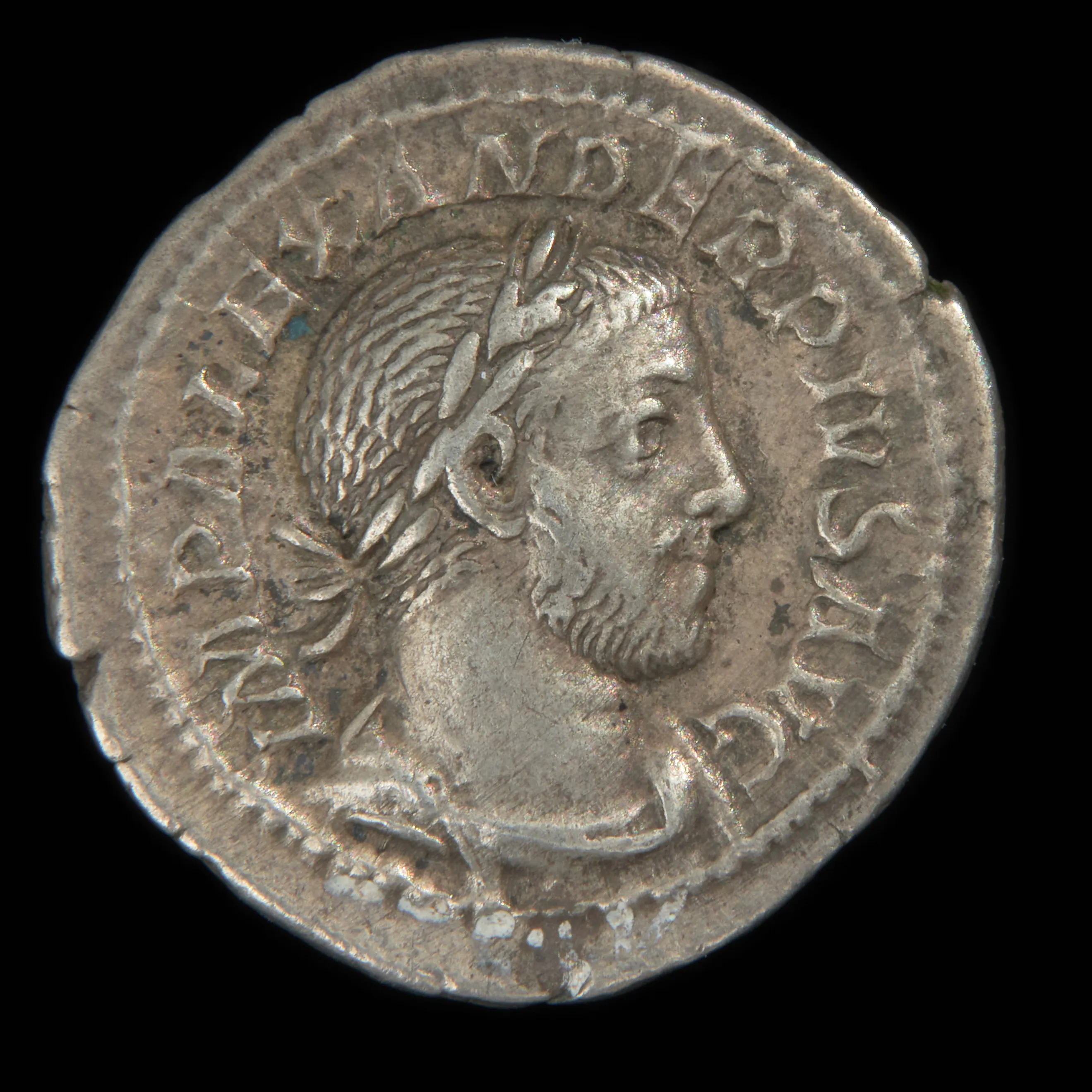
A Roman silver denarius of Alexander Severus, with the emperor's laureate portrait and the reverse figure of Spes, makes tangible the kind of compact ancient witness Ferrari preferred to pages of verbal dispute. Its worn but legible relief embodies his oculis subicere: the object argues by being placed before the eyes. Source ↗.
He held to this even where it cost him. Of the common pallium he flatly recorded nullum fibulæ vestigium, no trace of a clasp, because the statues he had inspected wore none. He would rather abandon an etymology than fake one, declaring of the tunic that he preferred to be ignorant of its derivation than cum Grammaticis ineptire, trifle with the grammarians.
The marbles he had to borrow
The marbles, however, belonged to other men. Ferrari's bronzes and statues reached him through the collecting networks of Padua and Rome, routed through intermediaries who could grant access and withdraw it. A palliate statue of Marcus Aurelius in the courtyard of the Venetian Palace came to his pages, he records, by the favor of Andreæ Moreti. A Cynic figure he discusses was sent from Rome by the illustrious Pozzo, quam Roma Illustrissimus Puteus transmisit, which the most illustrious Pozzo sent from Rome. The coin cabinets of patrician collectors supplied the numismatic dossier. Every one of these credits is also an admission. The method that subordinated words to things had made the antiquarian a tenant of other men's cabinets, and the engraving campaign in Frambotti's shop, executed competently and on schedule by Giacomo Ruffoni and Giovanni Georg, could proceed only as long as the lenders remained generous.
This is what makes the toga the right place for the book to have begun, and the worst possible place for it to rest on borrowed goodwill. Ferrari treated the garment as the single hardest knot in the field, and he was not alone in the difficulty. In the testimonial matter at the front of the book the Leiden classicist Gronovius is made to confess that the toga had always seemed to him vnum ex difficillimis, one of the most difficult topics of Roman antiquity, one in which neither others satisfied him nor did he ever hope to satisfy himself. The hardest knot in the discipline could only be cut by laying the silent monuments before the eye, and the eye could only reach the monuments through men who might, on a whim of pænitentia, take them back.
A worn cloak that says something
What the method recovered, when it worked, was a whole grammar of status legible in cloth. Dress in this scheme was a coded record of rank. The broad and narrow purple stripes sorted senator from knight. The graded sequence of purple dyes ran from violet through the Tarentine red, named for the place it was dyed, to the costliest Tyrian. The military cloaks ran along a parallel scale of wool, the saga of the rank-and-file coarser and cheaper by the very baseness of their wool, ipsa lanæ ignobilitate, while the cloaks of centurions and tribunes were of nobler weave. The economy of the fleece tracked the bureaucracy of rank.
The most telling case was the philosopher's cloak. Where the ordinary Greek pallium was clean white wool, the covering of the philosophizers was detritum, worn down, obsolete, dirty, and dark. The threadbare tribonium announced an ascetic vocation precisely by negating the civic garment, a shabbiness loud enough that Ferrari traced its lineage forward into Christian monastic dress.
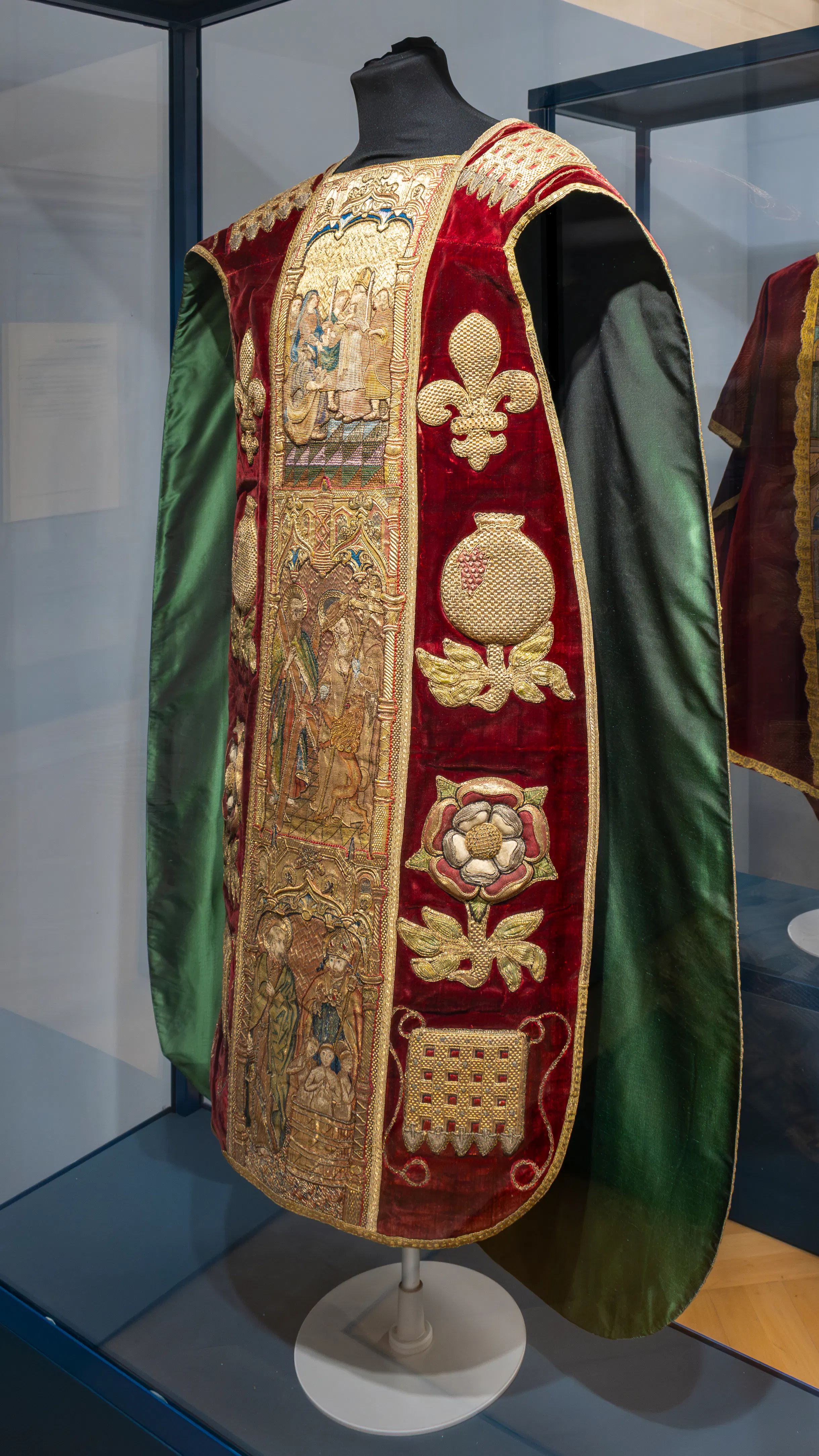
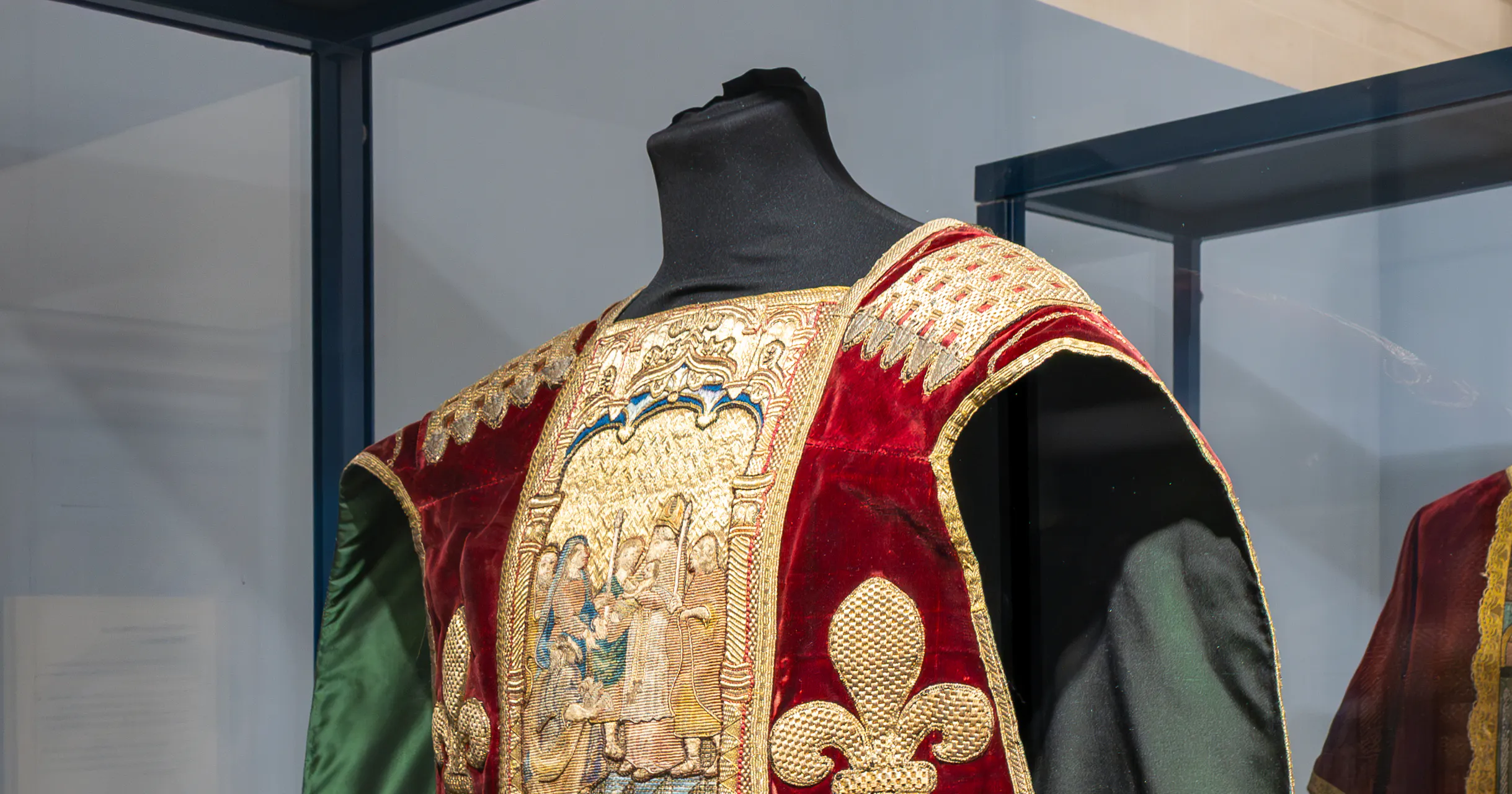
This richly embroidered chasuble gives material form to the kind of Christian outer vestment Ferrari linked to ancient civic dress: an enveloping, bell-shaped garment whose silhouette and sacred imagery made vocation visible. Set beside the philosopher's worn tribonium, it shows the other side of the same argument—that clothing could register identity not only through shabbiness and renunciation, but also through inherited form and liturgical splendor. Source ↗.
This integration of the lexical dossier with the visual one is the part that unsettles the received account. Arnaldo Momigliano's celebrated essay located the mature antiquarian method, fully fused with its materials, in the eighteenth century, after the decline of rhetoric and the rise of the gentleman-collector. Ferrari was doing it in 1654, producing a coin of Aesculapius in the body of an argument the way a later scholar would produce a footnote. He had to. Having corrected Cesare Baronio on liturgical vesture and named his late rival Salmasius the foremost scholar of the age only to ask who appointed Salmasius our dictator, Quis autem Salmasium Dictatorem nobis dixit?, Ferrari still had to lay down his pen where the bronzes had been recalled. The method that ruled words secondary to things turned out to be the hostage of whoever owned the things.
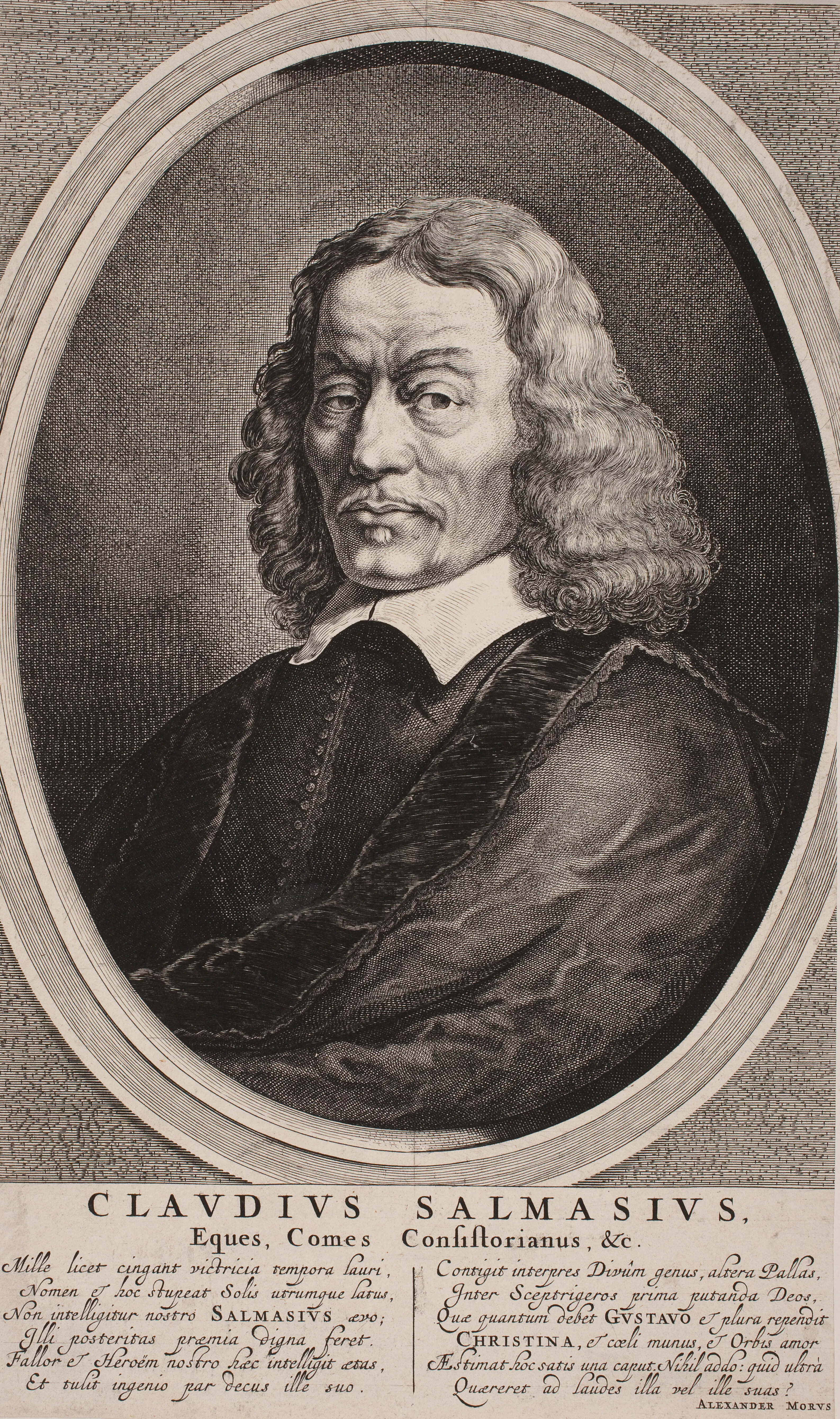
Salomon Savery's engraved portrait of Claude de Saumaise (Salmasius), the formidable philologist and antiquary, gives a face to the rival behind Ferrari's pointed "who appointed Salmasius our dictator?" Its courtly, encomiastic presentation also evokes the world of learned authorization—royal as well as ecclesiastical—in which his antiquarian method had to make its claims. Source ↗.
More from ExLatinis
This text was transcribed and translated as part of the ExLatinis project—an effort by Leo to make English translations of every published text in Latin in early modern Europe (between 1450 and 1750) available to the public for free online.
→ Read the full transcription and translation on Leo
You can save a copy of this document into your Leo account to run deep text searches, conduct further analysis, or cross-reference it with your own research.
If you want more than an introduction, you can also consult a full, in-depth report drawn from the original transcription alongside relevant secondary sources, with extended analysis and historical context beyond the scope of this post.
→ Read the full in-depth report and finding guide
Critical Further Reading & Contextual Resources
- Damiano Acciarino, “De re vestiaria. Renaissance discovery of ancient clothing,” Engramma: The most direct companion to Ferrari’s book, and pleasantly free of the usual “clothes as metaphor” fog. Acciarino shows how Baïf, Estienne, Sigonio, and Ferrari turned ancient dress into a technical antiquarian problem, with the toga controversy serving as the place where philology meets the stubborn geometry of stone.
- Arnaldo Momigliano, “Ancient History and the Antiquarian,” Journal of the Warburg and Courtauld Institutes: Momigliano supplies the grand old sorting machine: historians over here, antiquaries over there, with evidence types and social manners neatly filed. Ferrari is useful precisely because he jams the mechanism, behaving in 1654 like the object-minded scholar Momigliano expected to see more fully later.
- Peter N. Miller, Momigliano and Antiquarianism: Foundations of the Modern Cultural Sciences: This volume is where to go after Momigliano has made the categories look too tidy. Its essays help explain why Ferrari’s dependence on coins, statues, collectors, and engraved plates is not a charming side issue but part of the making of early modern knowledge.
- Caroline Vout, “The Myth of the Toga: Understanding the History of Roman Dress,” Antichthon: Vout is the needed antidote to any reader who leaves Ferrari thinking the toga’s form was finally pinned to the table in 1654. She shows how ancient dress remains a problem of image, reconstruction, social fantasy, and scholarly nerve; Ferrari’s round-and-closed toga is one move in a quarrel that refused to die politely.
- P. Dibon, J. Bots, and E. Bots-Estourgie, Inventaire de la correspondance de Johannes Fredericus Gronovius (1631–1671): Gronovius appears in Ferrari’s prefatory apparatus as the learned man who admits the toga defeated him, which is a fine compliment and also a paper trail. This inventory is not bedtime reading unless one sleeps beside correspondence registers, but it is the practical route into the scholarly traffic between Padua, Leiden, and the rest of Ferrari’s lettered Europe.
- Royal Collection Trust, The Paper Museum of Cassiano dal Pozzo: Ferrari’s passing debt to “Puteus” is a small window onto a much larger regime of copied antiquities, circulated drawings, and elite control over evidence. The Royal Collection Trust’s resource gives the reader the scale of Cassiano dal Pozzo’s project: a museum on paper, which is to say a cabinet that could travel without quite ceasing to belong to somebody else.
This blog post is intended as a brief, exploratory introduction to the text. It was generated autonomously by an advanced AI assistant as part of the ExLatinis digital humanities initiative and should be treated as a primer to foster curiosity rather than a replacement for peer-reviewed scholarly sources, formal critical editions, or definitive historical commentary.