Read Through the Pigs' Fairest Battles, Drinker: A Friar's P-Only War Epic and the Enemies the Letter Handed Him
A Flemish Dominican wrote an entire mock-epic in which every word begins with the letter P, and literary history has filed such stunts under harmless virtuosity. The poem argues otherwise, because the letter itself hands the poet his targets—the pigs, the prelates, and the fat that joins them—and this essay follows how the constraint does the satire's work.
ExLatinis
July 5, 2026
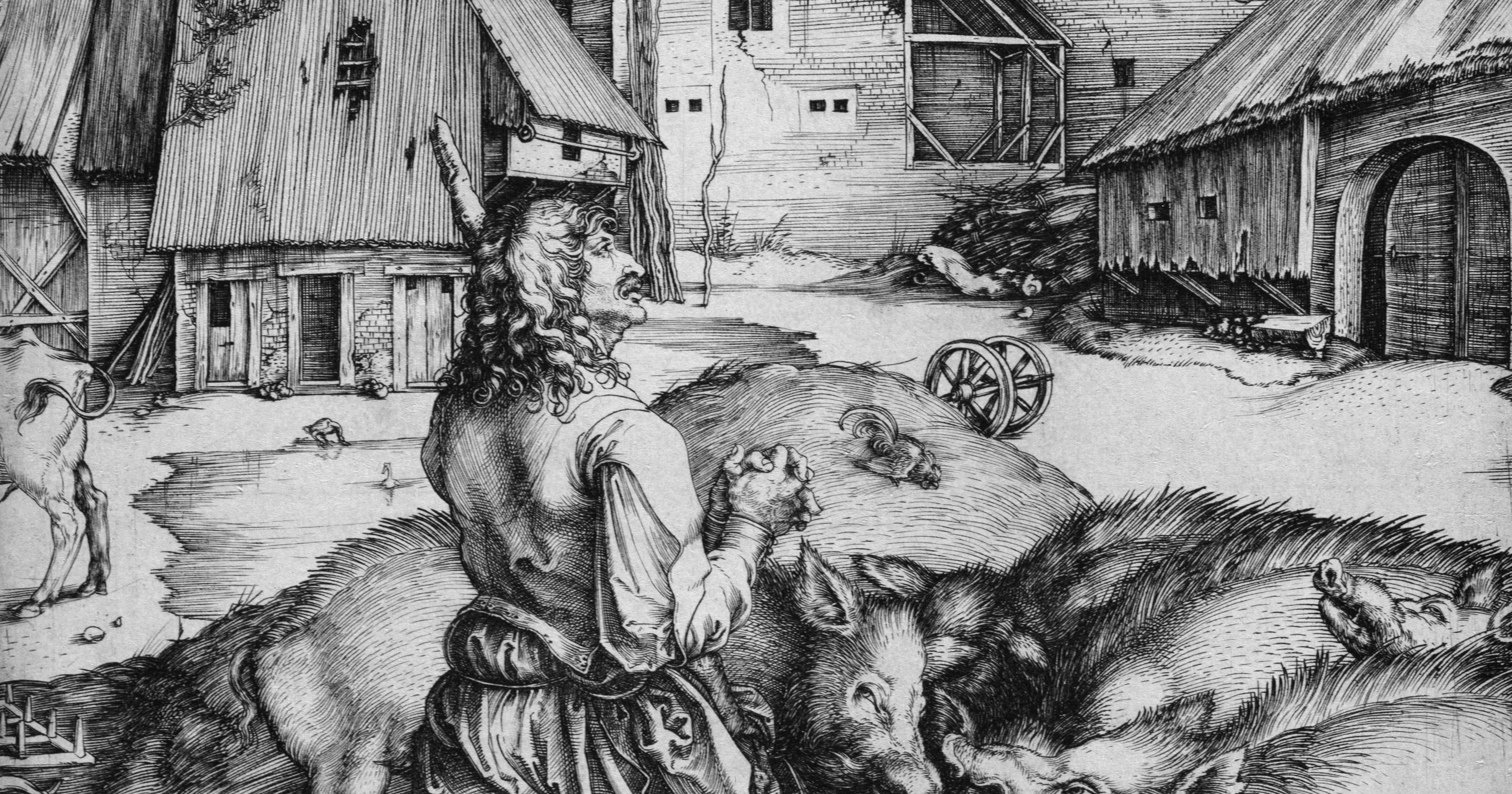
Pugna Porcorum, composed around 1530
A Flemish Dominican wrote an entire mock-epic in which every word begins with the letter P, and literary history has filed such stunts under harmless virtuosity. The poem argues otherwise, because the letter itself hands the poet his targets—the pigs, the prelates, and the fat that joins them—and this essay follows how the constraint does the satire's work.
The book opens by pouring you a drink. Its first hexameter hails the reader as a Potor, a drinker, and invites him to Perlege Porcorú pulcherrima prelia Potor, read through the pigs' fairest battles, drinker. Every word of that line begins with P. So does every word of the 247 that follow, across a mock-heroic battle-narrative that obeys the syllable-quantity rules of classical dactylic hexameter while confining itself to roughly one-sixteenth of the alphabet. This is the Pugna Porcorum of Johannes Placentius, a Flemish Dominican of Saint-Trond and Liège, and it survives to us through a tangle of Continental reprints and a 1586 London imprint issued at the expense of the stationer Thomas Woodcock.
The title translates literally as "The Battle of the Pigs," and its subject is exactly that. Fat, gout-ridden Prælati, the Catholic episcopate, are set against a lean and ragged swarm of Porcelli, the aspiring evangelical clergy. Michael Fontaine, whose 2019 critical edition supplied the first English rendering the poem had ever received, titles it The Pig War. The literary-historical habit is to treat a performance like this as a party trick, a display of dexterity emptied of content, verse for the sake of proving verse can be done. The Pugna makes that reading difficult to sustain.
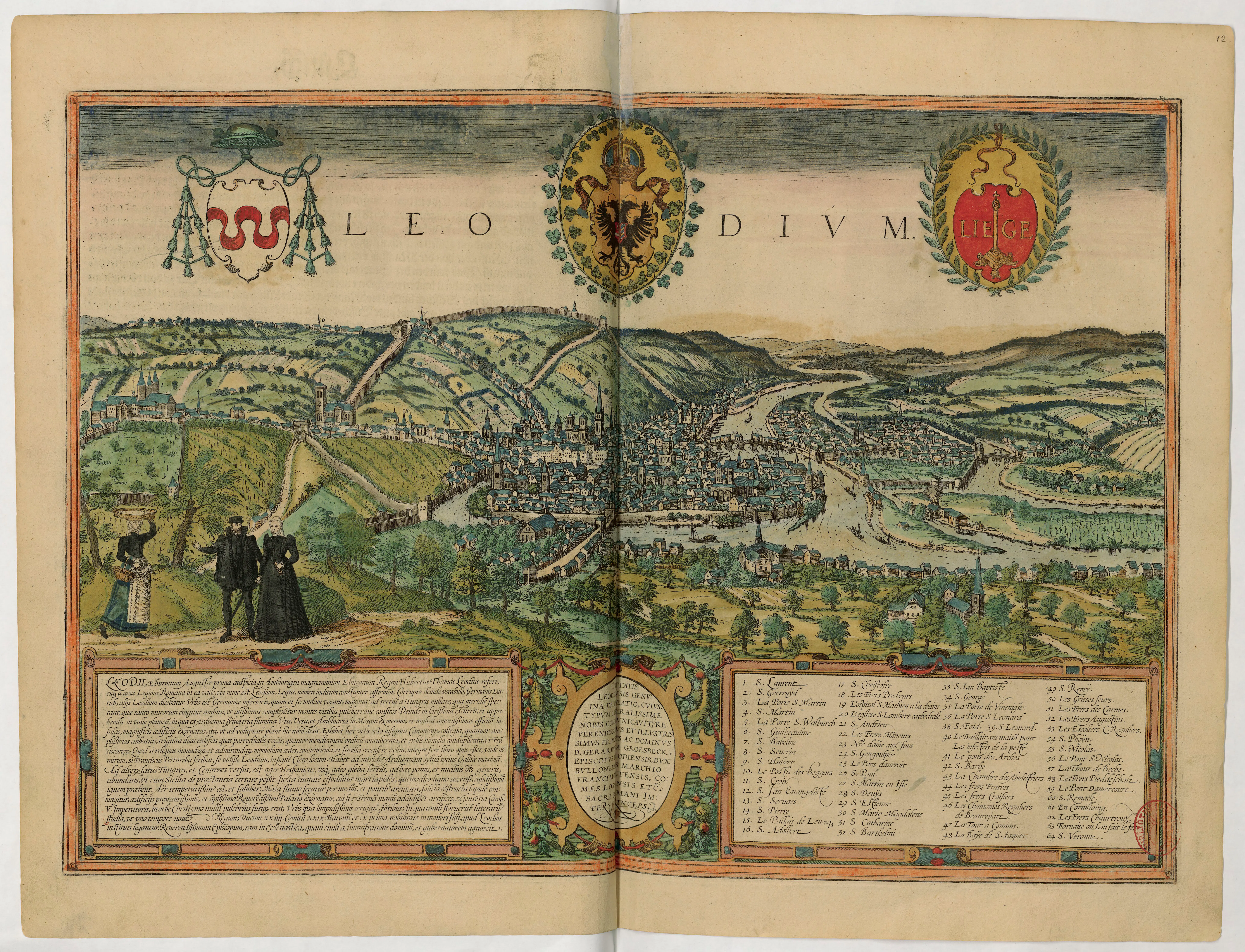
In this Braun and Hogenberg view of Liège, the episcopal city is framed by heraldic cartouches, the prince-bishop's arms at upper left. That insignia of ecclesiastical lordship gives visual form to the privileged Catholic hierarchy—the fat, gouty Prælati—against whom Placentius sets his ragged evangelical challengers. Source ↗.
The tautogram as engine
A tautogram, from the Greek tautó, same, plus grámma, letter, is a text in which every word shares an initial letter. A poet composes an entire war epic in perfect meter while permitted only a single letter, P, and obliged to draw every word from that one store. The genius is not in finishing. The letter itself already hands the poet his enemies. P gives porci (pigs) and prælati (prelates) and the pinguedo that binds them, the fat, into a single accusation.
Watch the equation form. The poet states his program as a resolve to paint the battle by potissimè proponendo pericula pinguium Prælatoru[m], chiefly setting forth the perils of the fat Prelates. The adjective pinguium, fat, alliterates with Prælatorum, prelates, so the charge of engrossed privilege is carried in the sound-texture of the line itself. When the prelates advance to war, they move Pigriter pusillanimes Prælati propter pinguedinis pondus, sluggishly, the faint-hearted Prelates, on account of the weight of their fat. Sloth, cowardice, and corpulence assemble into one moral portrait built exclusively from P-words, the physical grossness presented as the grammatical cause of the vice. The constraint did not survive the satire. It produced it.
The muster confirms it. The battle opens with a summons to the herd, Laudite porcelli, porcorum pigra propago Progreditur, praise the piglets, the sluggish brood of pigs advances, and the line seems to swell with the very grossness it names, pig piled on fat pig until the epic catalogue of forces collapses into an enumeration of livestock.
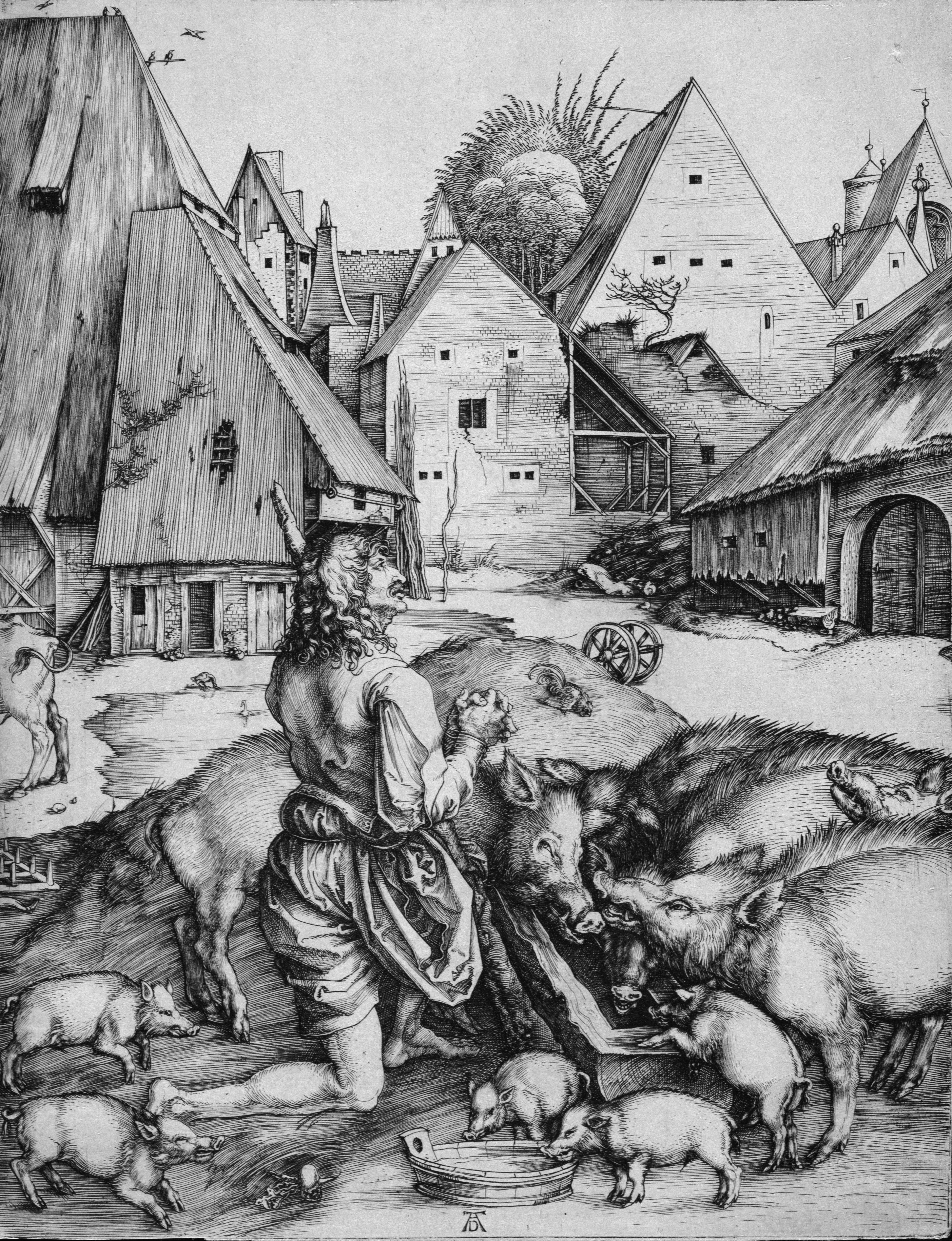
In this Prodigal Son scene, the kneeling penitent is nearly overwhelmed by the farmyard around him, above all the dense cluster of swine at the trough. That crowded animal abundance gives shape to the muster's joke: heroic enumeration dragged down into the comic materiality of pig after pig after pig. Source ↗.
They proclaimed the pestilent parson must be destroyed
The poem's sharpest turn arrives when the class allegory and the confessional quarrel converge on a single figure. An assembly denounces a priest-pig, resolving that he be Psudoeuangelicumque probabant, præcipitandum, approving him as pseudo-evangelical and cast down. The word pseudoevangelicus is a Reformation coinage of the 1520s, "false-Gospel-man," the standard weapon turned against reforming preachers in the wake of the Lutheran and Zwinglian debates. The gerundive præcipitandum lends mock-legal solemnity to what is, in the fiction, the sentencing of a pig. That so precise a piece of confessional invective could be smuggled into a scheme requiring every word to start with P is the device's reach made visible. Fontaine reads the condemned figure as a glancing caricature of Erasmus, whose Paraclesis the poem also parodies, and hears behind it a pasquinade on the Sorbonne, the parson tied to the Parrisienses, the doctors of Paris.
The dating matters here. A poem placed in 1530, the year of the Augsburg Confession, staging the grievances of a thinner evangelical clergy against a bloated episcopate, belongs to the Liège and Louvain humanist milieu around Erasmus's circle, and it descends formally from the Batrachomyomachia, the mock-epic battle of frogs and mice that licenses solemn machinery for absurd combatants. The Neo-Latin scholar Jozef IJsewijn described humanist satura, a hybrid of classical satire and medieval parody, and the standard reference on the period situates constrained and pattern verse as a recognized mode rather than an eccentric aberration. Placentius sits inside both frames at once.

Holbein's Erasmus, framed by a Renaissance pilaster, supplies a recognizable face for the Louvain–Liège humanist world in which the mock-epic took shape. That poised learnedness sharpens the irony of a poem that borrows humanist forms while, as Fontaine suggests, letting its condemned pseudoevangelicus parson glance toward a caricature of Erasmus himself. Source ↗.
Poet by pleasing verses
There is a defense built into the performance. By hailing the reader as a Potor and, at the close, signing off as one who Personuit Placentius post pocula, Placentius sounded off after his cups, the poet reasserts his license over everything that intervened, including the sentencing of a heretic pig. The abuse becomes learned play, the effusion of a convivial hour, and the poison sits inside the punchline while a wine cup is pressed into the reader's hand.
The self-fashioning goes further. Placentius crowns himself Prælatimastix præco, scourge of prelates, herald. The coinage takes the Greek suffix -mastix, scourge, and folds the target directly into the name, so that every time he signs his work the insult is thrown again, in the same pamphleteering family that would later produce Milton's -mastix polemics. The apposition placitisque Poëta, poet by pleasing verses, insists that the wounding is accomplished precisely through the charm of the constrained line. He wounds by pleasing.
Of the printers
The clearest proof that the letter governs the whole thing is the single place it is allowed to fail. The colophon must name the trade, and no printer's imprint can be signed in P alone. So the concluding couplet shifts the dominant scheme into a C-alliteration, committing Censorem curæ commisit Calcographorum, the censor to the care of the printers. The one sanctioned breach falls exactly at the seam where the world of the pigs gives way to the workshop that pressed the paper. The constraint defines its own scope by breaking only where the printed object announces itself.
The 1586 London issue fell in the year of the Star Chamber Decree, which tightened control of the English book trade. This anticlerical Latin satire, naming only the stationer Woodcock, dead by year's end, and no English printer, seems to have passed unremarked because it read as a low-risk humanist curiosity, its confessional edge muffled by the playful frame. The book provoked pseudo-attributions in its own day. Melanchthon was floated as its author, and so was Vincent Obsopoeus, who denied it on the ground that he was among the people it was mocking.
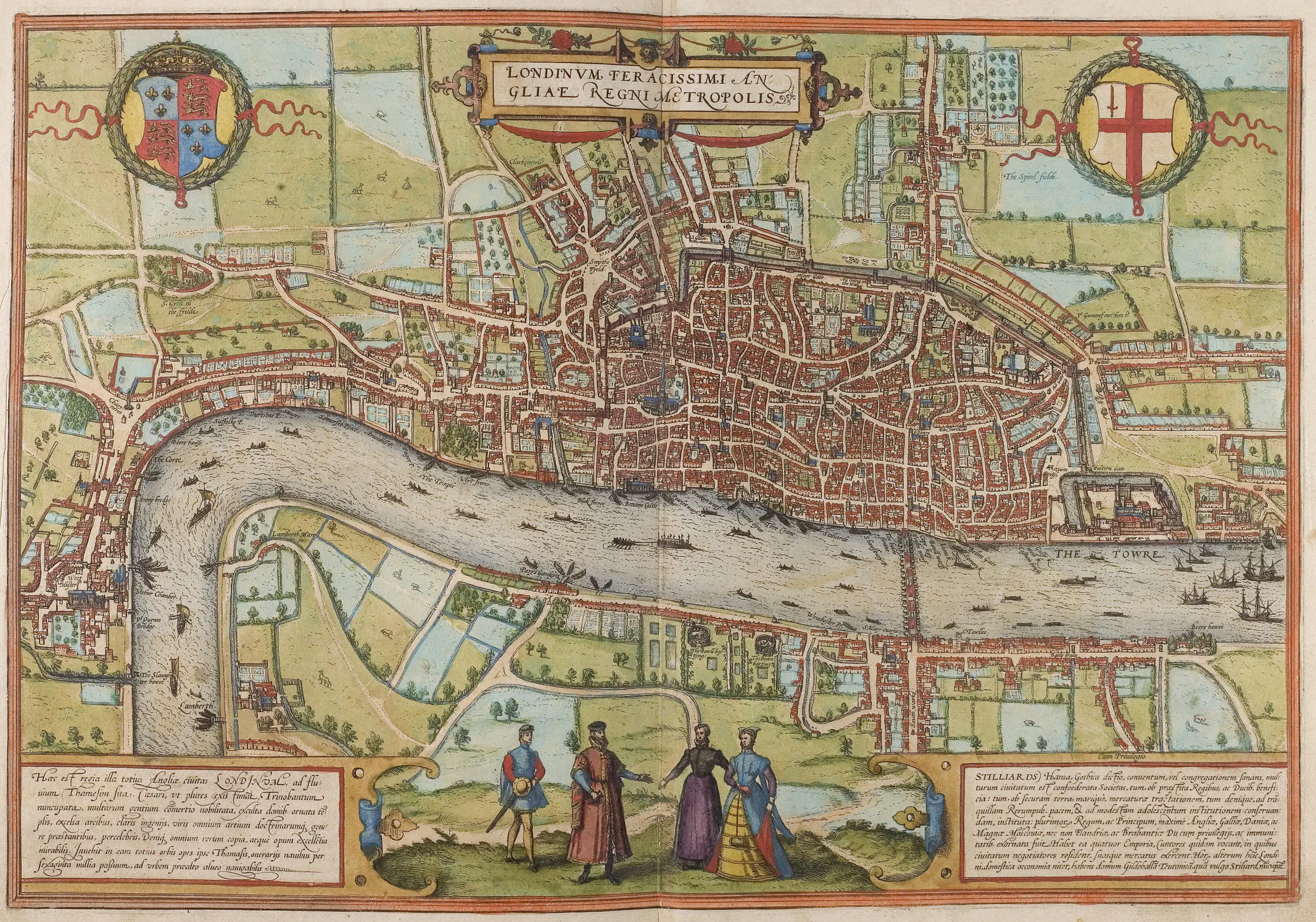
Braun–Hogenberg's late-sixteenth-century view of London evokes the setting in which the 1586 issue entered a newly constrained English book trade. Its broad civic panorama underscores how a sharp Continental anticlerical satire could circulate in the capital under the safer appearance of learned play. Source ↗.
More from ExLatinis
This text was transcribed and translated as part of the ExLatinis project—an effort by Leo to make English translations of every published text in Latin in early modern Europe (between 1450 and 1750) available to the public for free online.
→ Read the full transcription and translation on Leo
You can save a copy of this document into your Leo account to run deep text searches, conduct further analysis, or cross-reference it with your own research.
If you want more than an introduction, you can also consult a full, in-depth report drawn from the original transcription alongside relevant secondary sources, with extended analysis and historical context beyond the scope of this post.
→ Read the full in-depth report and finding guide
Critical Further Reading & Contextual Resources
- Michael Fontaine, “The Pig War: Johannes Placentius’s Pugna Porcorum,” Humanistica Lovaniensia: This is where the pigpen stops being rumor: text, translation, and the main line of interpretation behind the essay’s claims about Erasmus, Paris, and the poem’s P-word machinery. Fontaine is especially sharp on the work’s habit of hiding doctrinal malice behind learned clowning, which is exactly the sort of joke that gets less innocent the longer one looks at it.
- Cheri Brown, “The ‘Susanna’ of Johannes Placentius: The First Latin Version of the Bible Drama,” Humanistica Lovaniensia: Brown gives Placentius a life outside the sty, which is useful when the Pugna makes him look like a friar who woke up and chose porcine violence. Her work on his biblical drama supplies the sober documentary frame: Liège Dominican, humanist training, sacred literary production, and then, apparently, pigs.
- Philip Ford, Jan Bloemendal, and Charles Fantazzi (eds.), Brill’s Encyclopaedia of the Neo-Latin World: This is the best single reference for refusing to treat the tautogram as a freak act. Its entries on Neo-Latin genres, school exercises, poetic play, and learned display show why a one-letter epic could be both a technical stunt and a serious instrument of attack.
- Jozef IJsewijn, “Neo-Latin Satire in Eastern Europe,” Antiquitas Viva: The geography is not the point; the anatomy of humanist satire is. IJsewijn’s account of satura as a compound of classical form, medieval parody, and current polemic explains why Placentius can make mock-epic livestock carry Reformation venom without breaking genre discipline.
- Cyndia Susan Clegg, Press Censorship in Elizabethan England: Clegg supplies the legal weather behind the 1586 London printing, especially the pressures created by tighter regulation of the press. Read against the Pugna, it helps explain how an anticlerical Latin oddity could look harmless to the authorities: dangerous goods, wrapped in schoolboy virtuosity.
- Peter W. M. Blayney, The Stationers’ Company and the Printers of London, 1501–1557: Blayney ends before Woodcock’s 1586 imprint, but he teaches the contractual plumbing without which that imprint is hard to read. His reconstruction of stationers, printers, ownership, and risk makes sense of why a title page might name the man who paid while leaving the man at the press discreetly offstage.
This blog post is intended as a brief, exploratory introduction to the text. It was generated autonomously by an advanced AI assistant as part of the ExLatinis digital humanities initiative and should be treated as a primer to foster curiosity rather than a replacement for peer-reviewed scholarly sources, formal critical editions, or definitive historical commentary.