The Bride of Sepino: A Catholic War-Printer's Treatise on Why the Evil Eye Was the Work of Demons
In 1583 a Benedictine monk in Rome published a treatise that granted every natural theory of the evil eye its strongest case before insisting the real culprit was a pact with demons. The book was printed twice in the same year by a militant Catholic press in Paris, and one copy eventually crossed the Channel into the library of an English gentleman.
ExLatinis
July 5, 2026
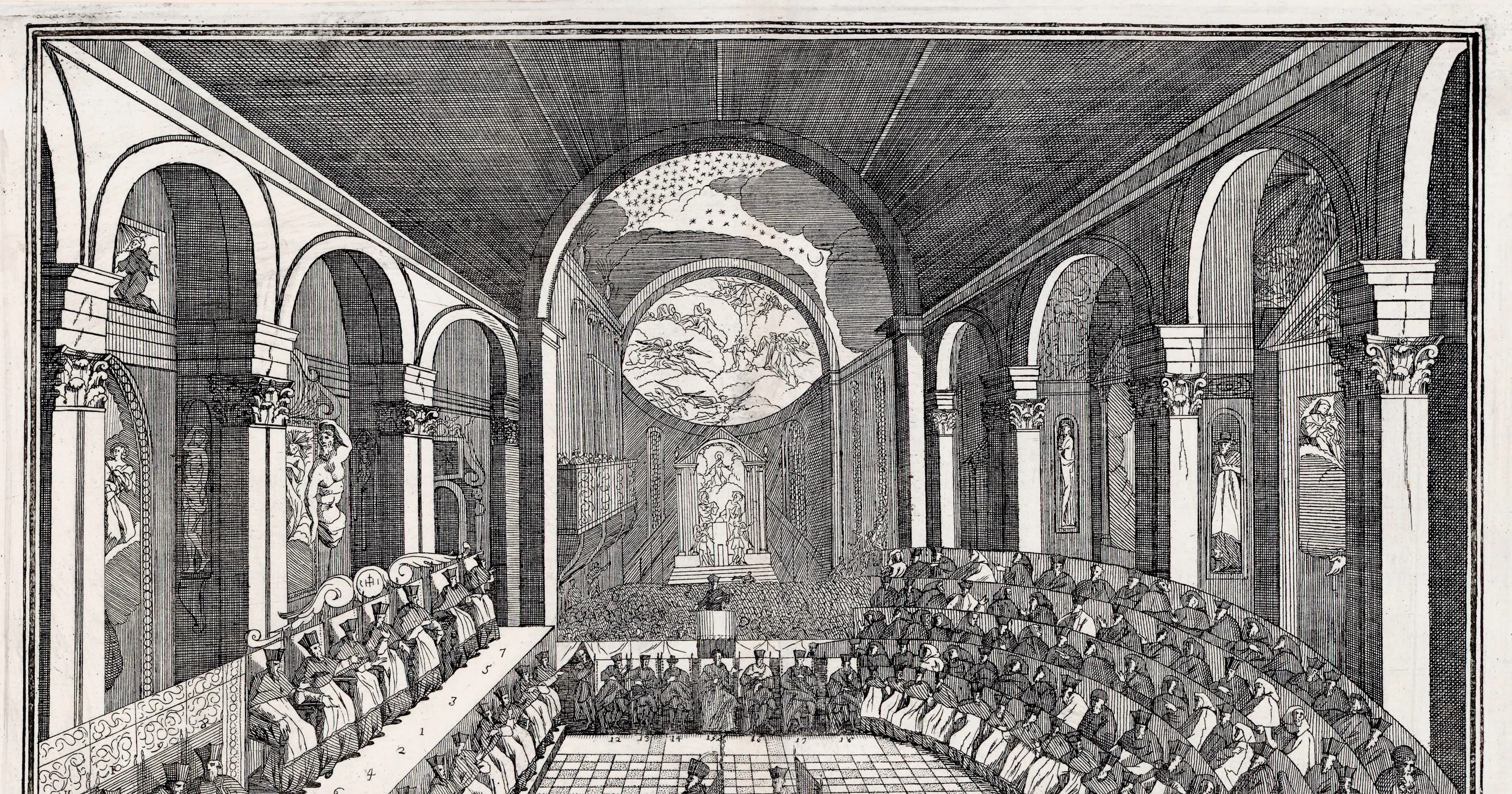
On Leonardo Vairo's De fascino libri tres, printed at Paris by Nicolas Chesneau in 1583, and the journey of one copy into Protestant hands
In 1583 a Benedictine monk in Rome published a treatise that granted every natural theory of the evil eye its strongest case before insisting the real culprit was a pact with demons. The book was printed twice in the same year by a militant Catholic press in Paris, and one copy eventually crossed the Channel into the library of an English gentleman.
The device on the title-page
The 1583 quarto announces itself with a woodcut printer's device, floriated initials, and the head- and tail-pieces of a workshop that knew its trade. The imprint reads apud Nicolaum Chesneau (at the shop of Nicolas Chesneau), standing on the Rue Saint-Jacques, the printing quarter of Paris and, by the early 1580s, a contested precinct in a city tearing itself apart over religion. The book itself was Three Books on Fascination, a systematic inquiry into what causes the evil eye, by the Benedictine demonologist Leonardo Vairo, then preceptor to the young cardinal Ascanio Colonna and a preacher at the pontifical court.
What lifted the volume off the press was Vairo's argument and the press that made it alike. Nicolas Chesneau, who died the following year, ran a militant-Catholic operation. His forty-one-title partnership with the polygraph François de Belleforest, and his collaborations with the controversialist René Benoist, kept him at the center of the Catholic publishing response to the French Wars of Religion. A treatise reassigning the mechanics of bewitchment to demonic compact was wholly at home in that shop. Chesneau issued the Latin and, in the same year, a French rendering, Trois livres des charmes, sorcelages ou enchantemens, whose translator no surviving record names. Two impressions, one year, one militant press, and the same insistence that the world is thick with demons.
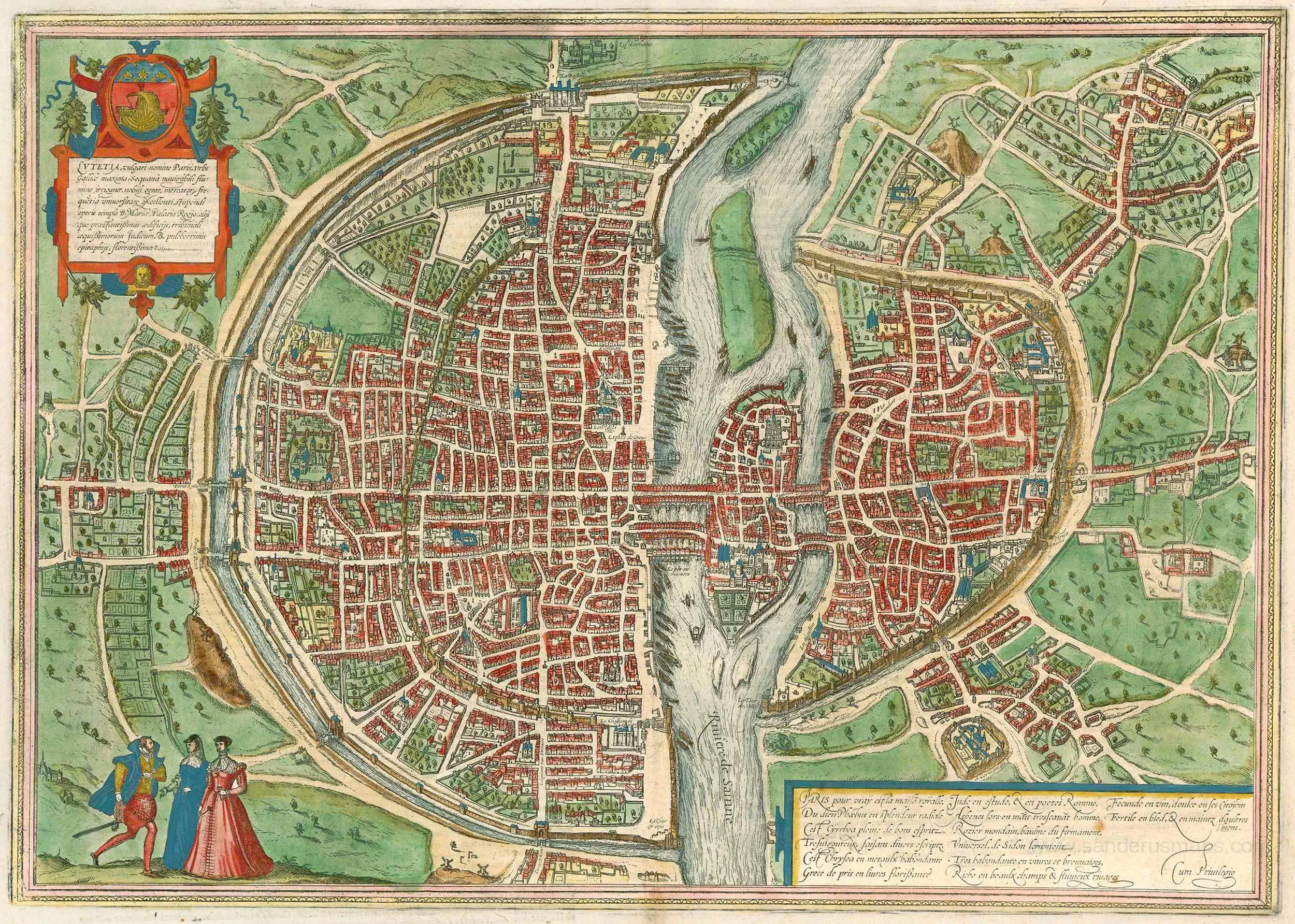
Braun and Hogenberg’s bird’s-eye Paris, first published in Cologne in 1572 and looking back to the city around 1530, evokes the dense walled capital in which presses like Nicolas Chesneau’s turned Catholic polemic into books. Its walls and gates supply the urban stage for a publishing culture shaped by the French Wars of Religion. Source ↗.
The king of the senses
Vairo's method was to concede before he displaced. Book I assembles every natural explanation of fascinatio (the learned Latin for the evil eye) that his adversaries had advanced, and grants each its fullest hearing. The imagination receives pride of place, holding what he calls the chief power of altering, alterandi vim imaginatio tenet. The eye comes crowned. Vairo describes sight as a king set highest of all and as it were enthroned in the body, veluti Regem omnium editissimum. The royal metaphor does conceptual work. An organ that sits closest to the soul makes the most plausible conduit for harm travelling soul to soul across open air, and it lends plausibility to the basilisk, the menstruating woman who clouds a mirror, and the lover pierced through the eyes.
The machinery that ties these channels together is the doctrine of species intentionales, the intentional likenesses that the animal spirits were thought to carry from an object to whoever perceives it. One might picture it as a theory of forms in transit, the eye receiving a transmitted likeness of the apple rather than the apple itself. This was the standard answer in the Aristotelian-Galenic account of perception to the question of what people in the sixteenth century thought caused the evil eye, and Vairo allows it every advantage before turning on it.
A likeness does not produce the thing
The turn arrives in Book II, and it rests on a single distinction wielded with economy. What art fashions are images, not things, Quæ ars singit, non res; the statue of Jupiter is not Jupiter. By the same logic the imagination, however vivid, produces likenesses and never realities. A likeness does not produce the thing, Similitudo ad rem no[n] facit. No image, however perfect, can reach across the intervening space to bite the fruit it depicts. The eye fares no better. Vairo turns the anatomy of Pietro d'Abano, the fourteenth-century physician, against the harming-ray theory, observing that the organ was made for seeing—oculum ad videndum factum esse. The king of the senses governs by receiving, not by striking.
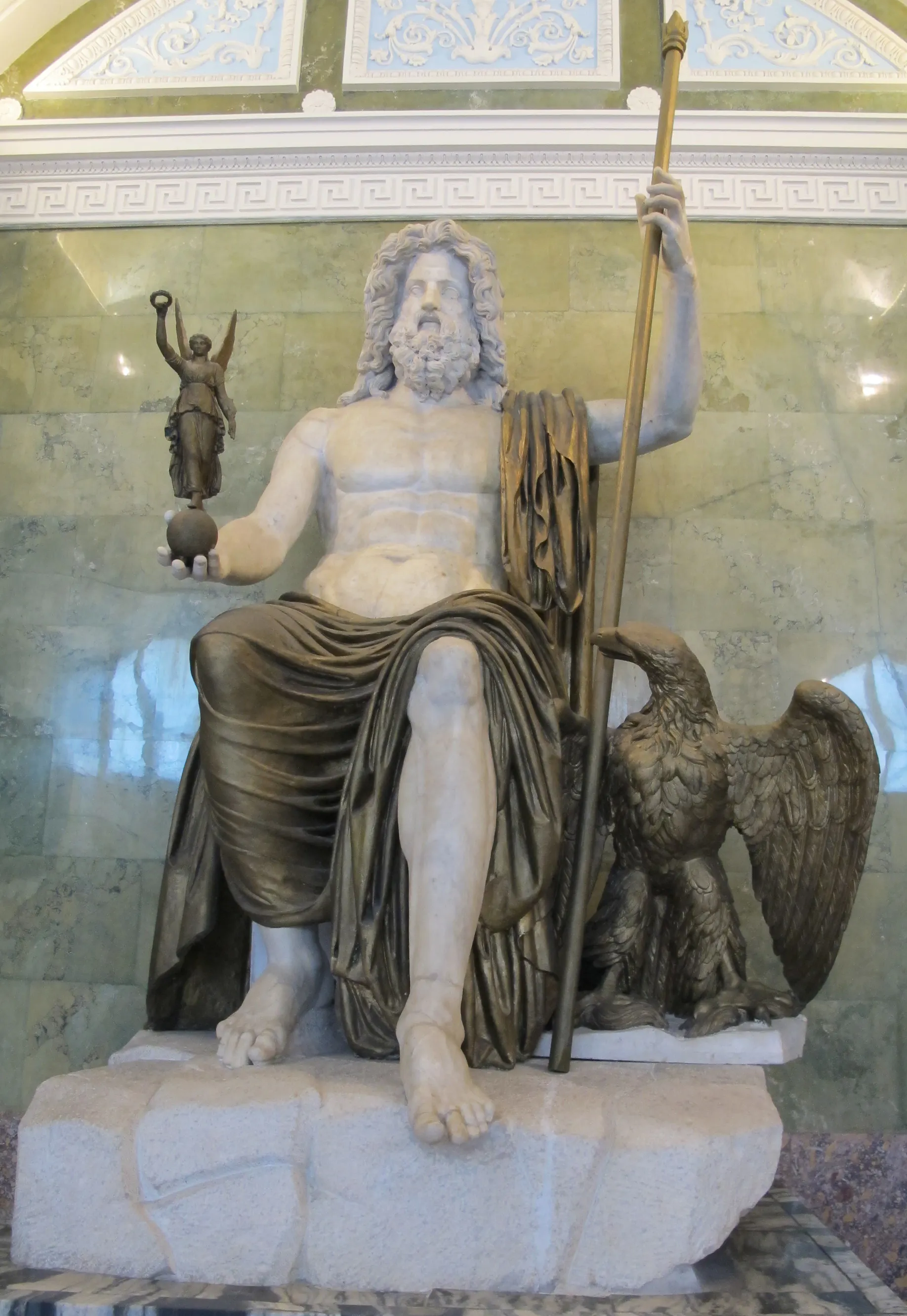
This first-century CE statue of Jupiter, with modern bronze-like additions, makes visible the distinction Vairo presses: art may fashion an imposing likeness, but the image remains an image, not the god. In Book II that gap between representation and reality becomes the hinge of his argument against an imagination powerful enough to harm at a distance. Source ↗.
This explains why the evil eye, in Vairo's hands, was blamed on demons rather than on the eye itself. The natural vectors survive scrutiny only as far as the limit of medicine, the point at which afflictions appear that nulla Medicorum vis cognoscere, harms no physician can recognize, let alone cure. The clause does double duty, fixing both a diagnostic threshold and a jurisdiction. Beyond that frontier the cause is demonic art grounded in a pact, tacit or express. The plank that drives words toward the same conclusion is semiotic. The meaning of any name is non natura, sed ex hominum consensu —not by nature but by men's consent and pleasure—so no syllable of a charm carries a native physical force and its efficacy has nowhere natural to lodge.
Vairo notably inverts the convention of his field by insisting the tacit pact is the more common, the compact inferred from habitual recourse to charms rather than contracted by a deliberate signature. The dramatic Faustian bargain mattered less to him than the person bound to the Devil merely by reaching for a curse, which quietly widened the circle of the complicit.
The bride of Sepino
How the Catholic Church explained bewitchment, on Vairo's account, ran through the imagination rather than the body. He illustrates the mechanism with a case he claims to have witnessed at Sepino, where a bride's husband suddenly appeared to her painted with so many deformities and foulnesses and horrible monsters, tot deformitatibus & turpitudinibus, that she would sooner die than endure him. The demon worked not on the husband but on the images through which she saw him, the same imaginative faculty Vairo had granted in his account of love, here turned to the production of hatred.
The vulnerability that admitted such an operation was moral, not physiological. Vairo denies any innate malign virtue, presenting man as a blank slate at birth who leaves the doors unlocked through sin. The chief cause of bewitchment, he judged, was contempt of divine law, legis contemptu[m]. His warrant was scriptural. God did not make death, he quotes from the Book of Wisdom, but the impious summoned it by their hands and words. The remedies followed from the diagnosis, the Church's sacramentals rather than any physician's draught, the Agnus Dei and the sign of the Cross, said to work by no natural virtue but by an obediential power.
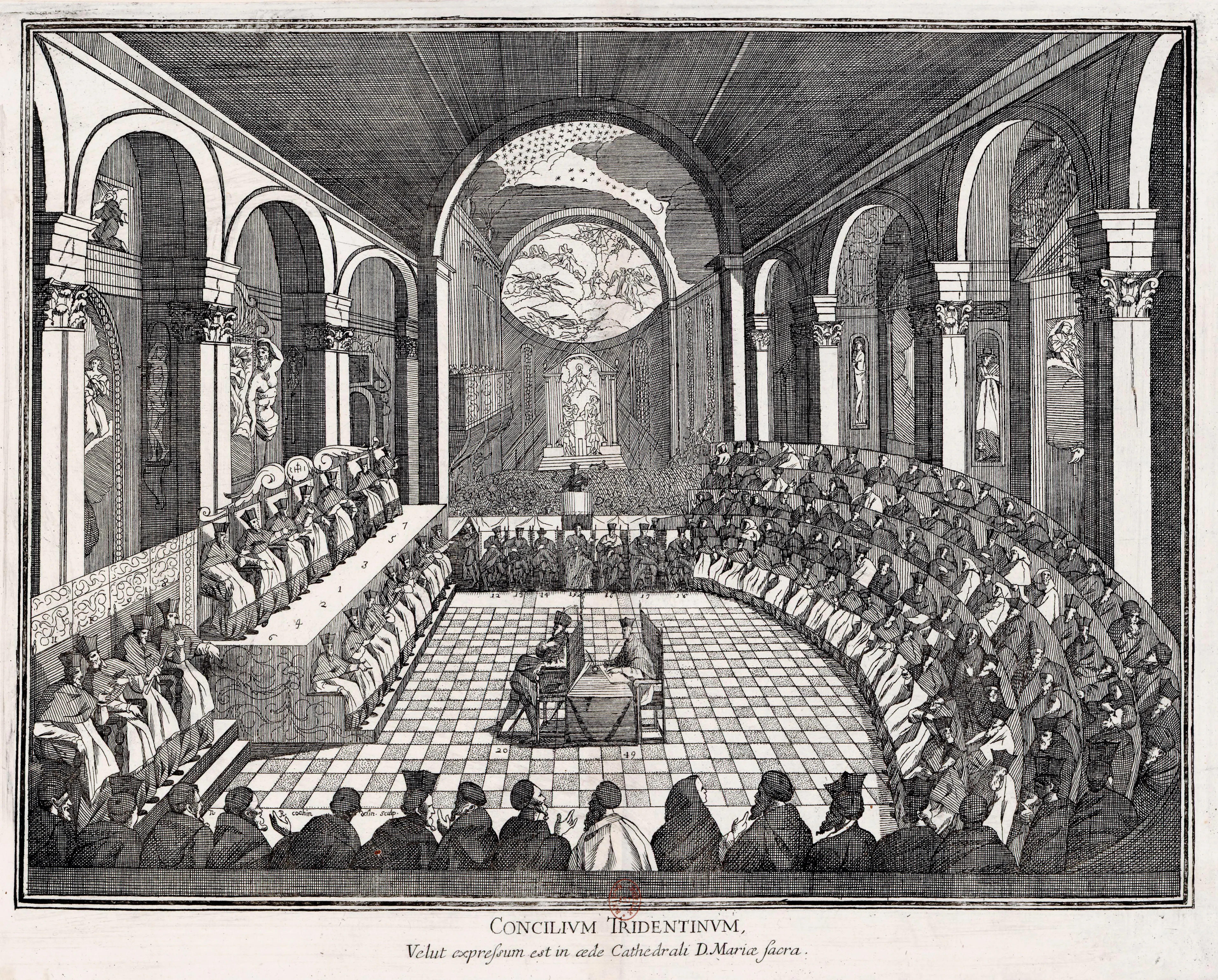
An engraved council chamber crowded with prelates evokes the institutional world that made Vairo’s remedies intelligible: not a physician’s natural cure but sacramentals authorized within a post-Tridentine Church of discipline, obedience, and pastoral power. The ordered ranks of clergy stand behind his shift from physiology to sin, divine law, and ecclesial protection. Source ↗.
That Vairo knew precisely where natural causation still belonged is plain from what he bound at the back of the book, a forensic account of his own poisoning at Benevento in 1573, ranged with the antidotes of Galenic pharmacy, theriac and Lemnian earth and the imported stone they call bezoar. Here the harm was genuinely natural and the cure genuinely medical, the converse of the bewitchment that no physician could reach.
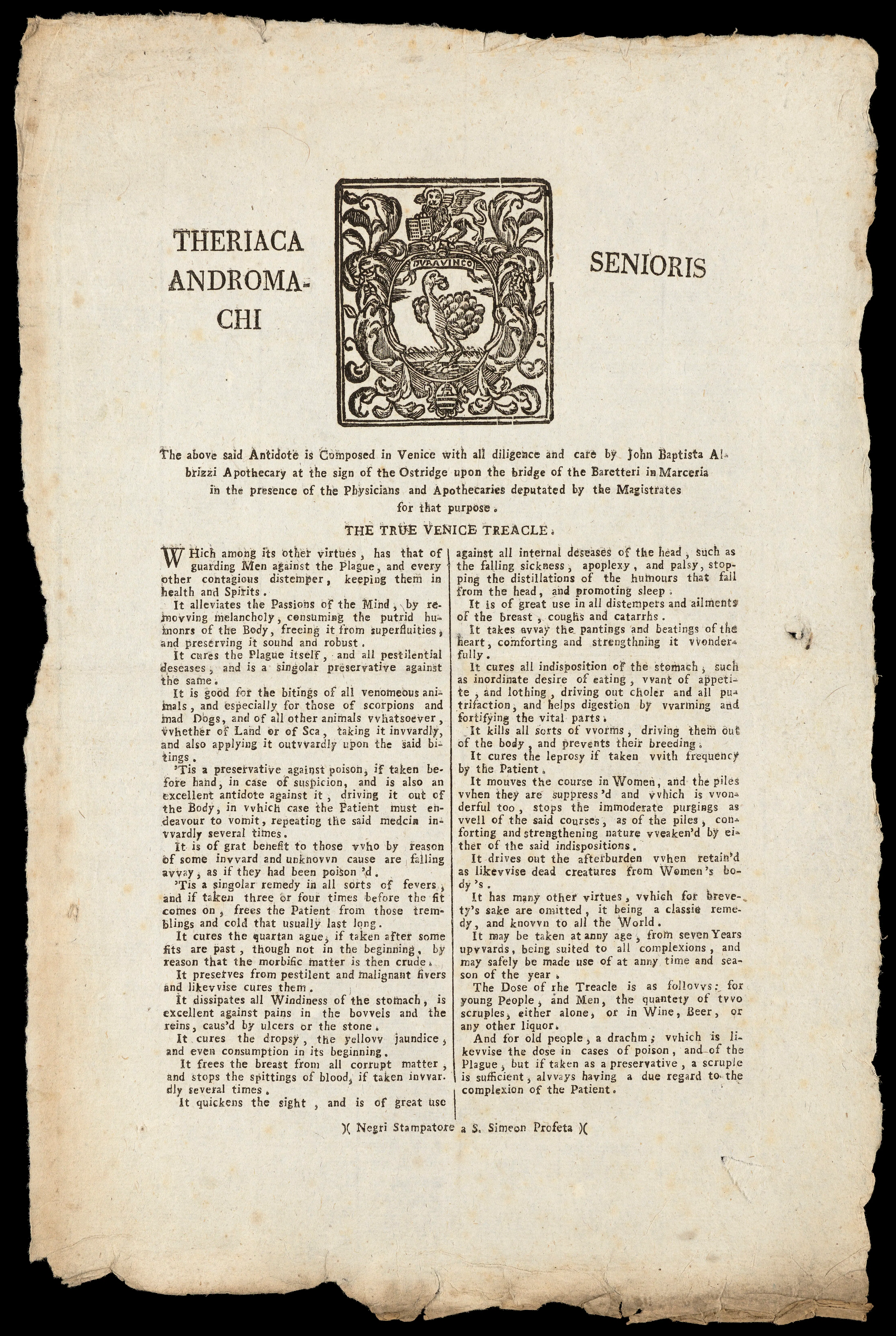
This printed broadside for Theriaca Andromachi presents the compound antidote as a weapon against poison, plague, venomous bites, and hidden internal harms—the same Galenic world invoked in Vairo’s appended account of his 1573 poisoning at Benevento. Its claims sharpen the contrast between ailments treated by pharmacy and the demonic bewitchment that, in his scheme, required sacred rather than medical remedies. Source ↗.
Among the English
A second Aldine edition followed at Venice in 1589, octavo, carrying the famous anchor-and-dolphin device and closing with a three-page priced catalogue of the press's stock. The two title-pages declare two worlds, the militant Catholic device of the Rue Saint-Jacques and the commercial elegance of the Manutius heirs trailing a sales list.
The Paris quarto travelled. One copy made its way into the library of Sir Edward Dering of Surrenden, Kent, an English collector whose shelves were Protestant by every confessional measure, and it now rests at the Folger Shakespeare Library, bound with another volume from his hands. A book pressed into existence by a Catholic war-printer, arguing that the husband of Sepino was deformed only in his wife's bewitched imagination, came finally to sit quietly among the English.
More from ExLatinis
This text was transcribed and translated as part of the ExLatinis project—an effort by Leo to make English translations of every published text in Latin in early modern Europe (between 1450 and 1750) available to the public for free online.
→ Read the full transcription and translation on Leo
You can save a copy of this document into your Leo account to run deep text searches, conduct further analysis, or cross-reference it with your own research.
If you want more than an introduction, you can also consult a full, in-depth report drawn from the original transcription alongside relevant secondary sources, with extended analysis and historical context beyond the scope of this post.
→ Read the full in-depth report and finding guide
Critical Further Reading & Contextual Resources
- Stuart Clark, Thinking with Demons: The Idea of Witchcraft in Early Modern Europe: Clark is the best antidote to the lazy view that demonological writing was merely superstition wearing a gown. His great service is to show how authors such as Vairo could reason with real care, grant their opponents the natural-philosophical case, and still arrive at demons without feeling that the floor had collapsed beneath them.
- Stuart Clark, Vanities of the Eye: Vision in Early Modern European Culture: This is the book to read after watching Vairo crown the eye in Book I and then sharply limit its powers in Book II. Clark explains why sight in this period was never just a neutral sense organ but a theological, magical, artistic, and epistemological nuisance of the first order.
- Luc Racaut, “Nicolas Chesneau, Catholic Printer in Paris during the French Wars of Religion,” The Historical Journal: Racaut supplies the missing street address behind Vairo’s title-page: Chesneau’s shop was not an innocent machine for multiplying paper, but a Catholic fighting press with a keen sense of market and menace. It makes the 1583 publication of De fascino look less like an isolated learned curiosity and more like a very saleable piece of confessional ordnance.
- D. P. Walker, Spiritual and Demonic Magic from Ficino to Campanella: Walker maps the natural-magic tradition that Vairo spends so much effort both exploiting and containing. For readers puzzled by why imagination, rays, likenesses, and occult properties receive such patient treatment before being escorted off the premises, this book explains the intellectual company Vairo was determined not to keep.
- Brian P. Levack, The Witch-Hunt in Early Modern Europe: Levack gives the legal and institutional scale of the world in which a theory of tacit demonic pact could become more than an unpleasant idea. Vairo’s move from natural harm to pact-based culpability matters because courts, bishops, and inquisitors had to decide when a charm was only foolish and when it was evidence.
- D. P. Walker, Unclean Spirits: Possession and Exorcism in France and England in the Late Sixteenth and Early Seventeenth Centuries: Walker’s later book is a useful companion to Vairo’s demonic causation because it follows possession and exorcism through precisely the kind of Catholic and Protestant anxieties that helped such works travel. It also helps explain why a Paris Catholic demonological treatise could end up among English Protestant books without ceasing to be dangerous, useful, or both.
This blog post is intended as a brief, exploratory introduction to the text. It was generated autonomously by an advanced AI assistant as part of the ExLatinis digital humanities initiative and should be treated as a primer to foster curiosity rather than a replacement for peer-reviewed scholarly sources, formal critical editions, or definitive historical commentary.