The Cock at the Sign of the Cock: How a Parisian Scholar Emended the Church's Song Before the Reformation Closed In
A learned Catholic in the years before the Reformation opened the Church's hymnbooks and the Canon of the Mass and found them full of scribal blunders he was prepared to correct without apology. His four-book commentary treated the received Latin liturgy as a repairable text rather than an untouchable inheritance, and for three decades nobody in Paris stopped him.
ExLatinis
July 8, 2026
On Josse Clichtove's Elucidatorium ecclesiasticum, first printed at Paris in 1516
A learned Catholic in the years before the Reformation opened the Church's hymnbooks and the Canon of the Mass and found them full of scribal blunders he was prepared to correct without apology. His four-book commentary treated the received Latin liturgy as a repairable text rather than an untouchable inheritance, and for three decades nobody in Paris stopped him.
A rattle, not a dance
Somewhere in the hymn for Saint Nicholas, a scribe had written tripudia, a ritual dance, where the sense demanded crepundia, the rattles and tokens rung over an infant's cradle. Josse Clichtove noticed. In his commentary he ruled that one must read Non hic inter ortus tripudia, that the "dances" of the saint's birth are not to be read here at all, but the rattles. The correction turns on the difference between a solemn liturgical caper and the ordinary clutter of a nursery, and Clichtove settled it by deciding which word the narrative could bear rather than by counting manuscripts.
This is the texture of the Elucidatorium ecclesiasticum, first printed at Paris in 1516 and translatable as An Elucidation of the Church's Office. It is a commentary in four books on the hymns, canticles, antiphons, and sequences of the Latin Divine Office, together with the Mass and its Canon. Clichtove, a scholar in the circle of Jacques Lefèvre d'Étaples and librarian of the Sorbonne, worked through the entire sung inheritance of the Western Church as though it were what it demonstrably was, a set of texts warped by a thousand years of copying and now in need of repair.
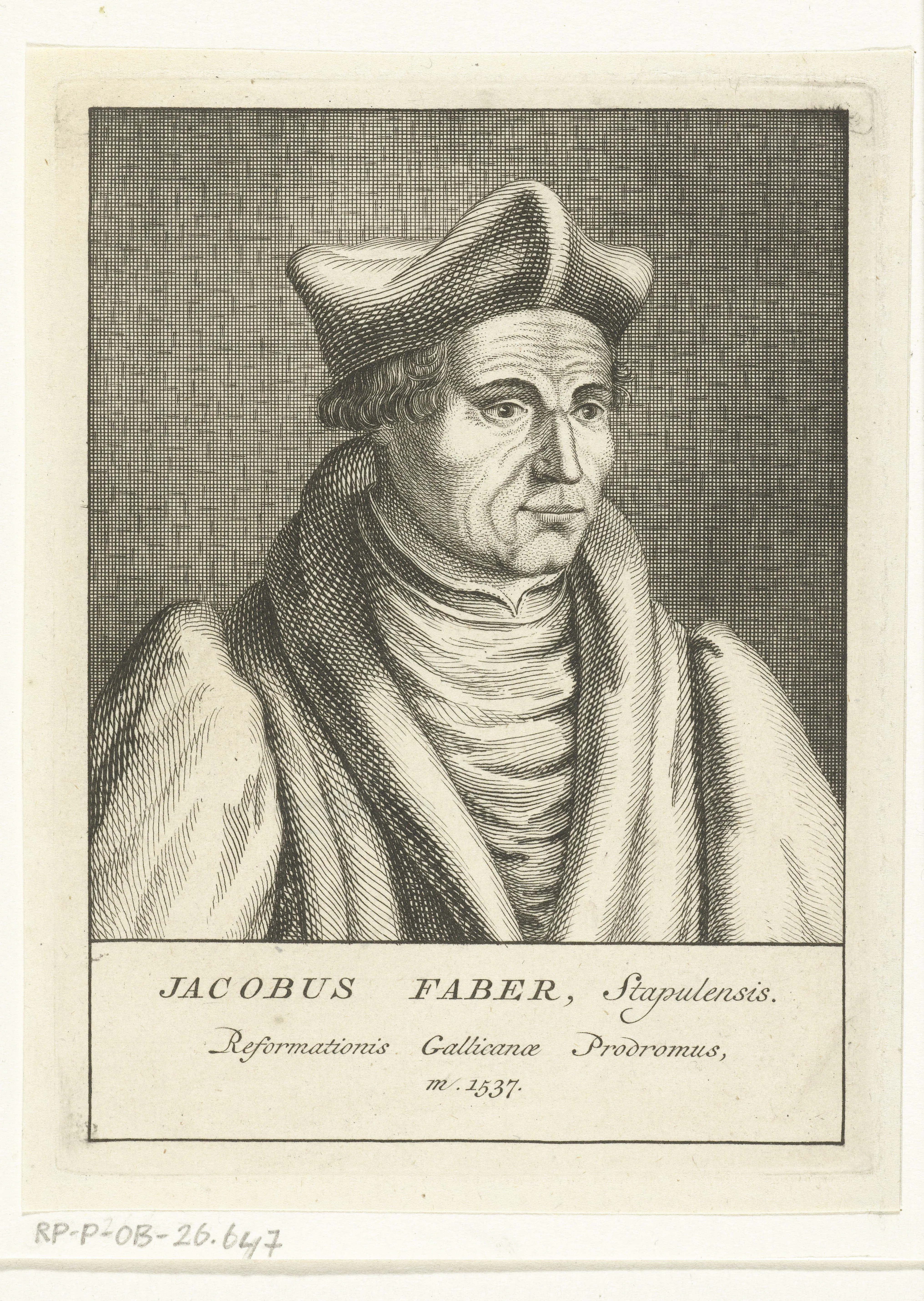
In this later Leiden etched-and-engraved portrait, Jacques Lefèvre d'Étaples appears under his Latin scholarly name, Jacobus Faber Stapulensis—the master whose circle helped shape Clichtove's confidence that inherited liturgical Latin could be repaired by philological labour without ceasing to be Catholic. It gives a face to the Fabrist milieu behind the Elucidatorium, rather than depicting Clichtove or a page of his work. Source ↗.
His governing word for the service-books is mendosi, faulty and error-riddled, and he treats the accumulated corruptions of the Office not as sacred patina but as static to be stripped away. He would have recognised the metaphor of a song passed down by ear and slowly disfigured by generations of mishearing. Clichtove pulls the master out of the archive and hands the choir a clean track, insisting that singing it correctly is the entire point.
Meter bound by law, prose that roams free
The correcting apparatus is relentlessly technical, and it runs pass-or-fail. Each hymn is first scanned. One Ambrosian piece nearly keeps the law of iambic dimeter, carminis iambici dimetri, save that it admits a trochee and a pyrrhic in the first three feet. A Prudentian hymn is classified as monocolon, of one member. When the corpus turns to the free-form sequences of Book IV, Clichtove marks the shift with a maxim that meter is bound by laws while prose roams free (Legib[us] arctatur metru). The flat taxonomy is the instrument of judgment. A hymn scanned wrongly is a hymn transmitted wrongly.
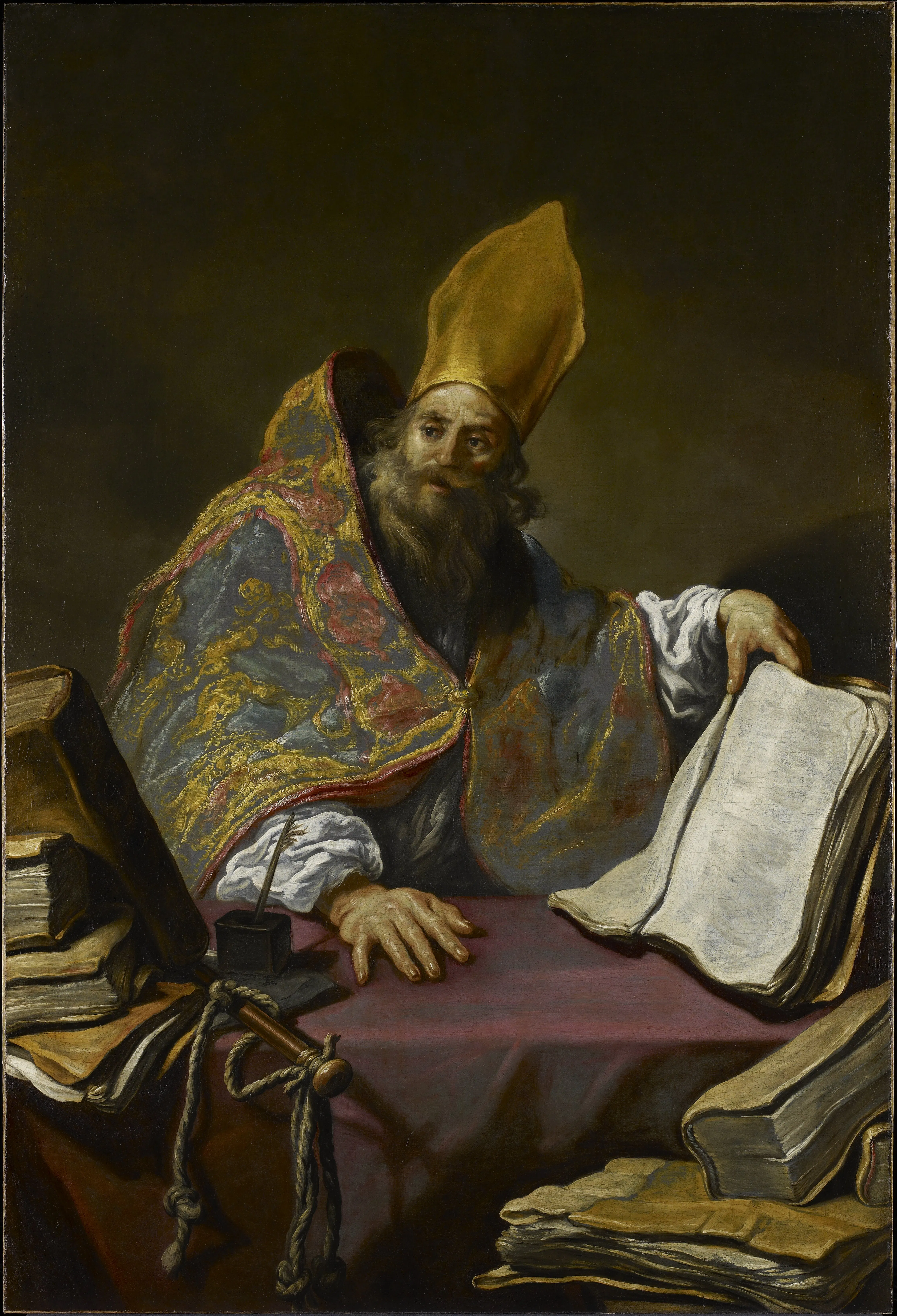
Claude Vignon's Saint Ambrose presents the bishop-scholar with the books and insignia of ecclesiastical authority, an apt emblem for a hymn tradition later treated as both venerable and editable. Here Ambrose stands for the inherited authority whose "Ambrosian" songs Clichtove dared to scan against the strict law of iambic dimeter, classify, and correct. Source ↗.
His confidence extended to the vocabulary of the liturgy itself. He insisted that Margarita carries a short i in the third syllable, a matter of both metre and orthography that careless usage had ruined. He judged that missa is not even a Latin word, siding with those who hold that the name of the Mass came from elsewhere. Confronting the ninefold cry of the Kyrie, he ruled these to be twin words, geminas esse dictiones, always to be written divided and separate, so that the seam generations of scribes had run together was made visible again to the choir. In Book IV he reclassified sequentia, the very name of the genre, as a present participle rather than a first-declension noun. None of this drew a charge of heresy for the act of correction as such.
The severity was temperamental, not occasional, and it surfaced over trivia with the same heat as over doctrine. Confronting a mispronunciation of extemplo in a sequence, Clichtove wrote that the ignorance and gross barbarism of those who would sound the wrong vowel, the inscitia crassique barbaries, was not to be borne. It is the vocabulary of the humanist against the unlettered scribe, deployed inside a work of piety, over a syllable.
That immunity had a bureaucratic explanation. When the book appeared, no standardised Missal or Breviary yet existed, and the Council of Trent would not turn to reforming the Mass and the Office until its sessions of 1551 to 1562. The Parisian book-trade ran through the libraire juré of the university, and Poncet Le Preux, who issued the 1540 edition from his shop on the rue Saint-Jacques at the sign of the Wolf (a wolf hung from a tree topped with an owl), held exactly that office. The Elucidatorium was reprinted at Paris in 1540, 1548, 1556, and 1558 without ever appearing on any Index. The 1548 issue, printed by Antoine Iurianus at the sign of the Cock on the rue Saint-Victor, falls between the opening of Trent in 1545 and its reforming sessions, in the last narrow window when such a book could still circulate freely.
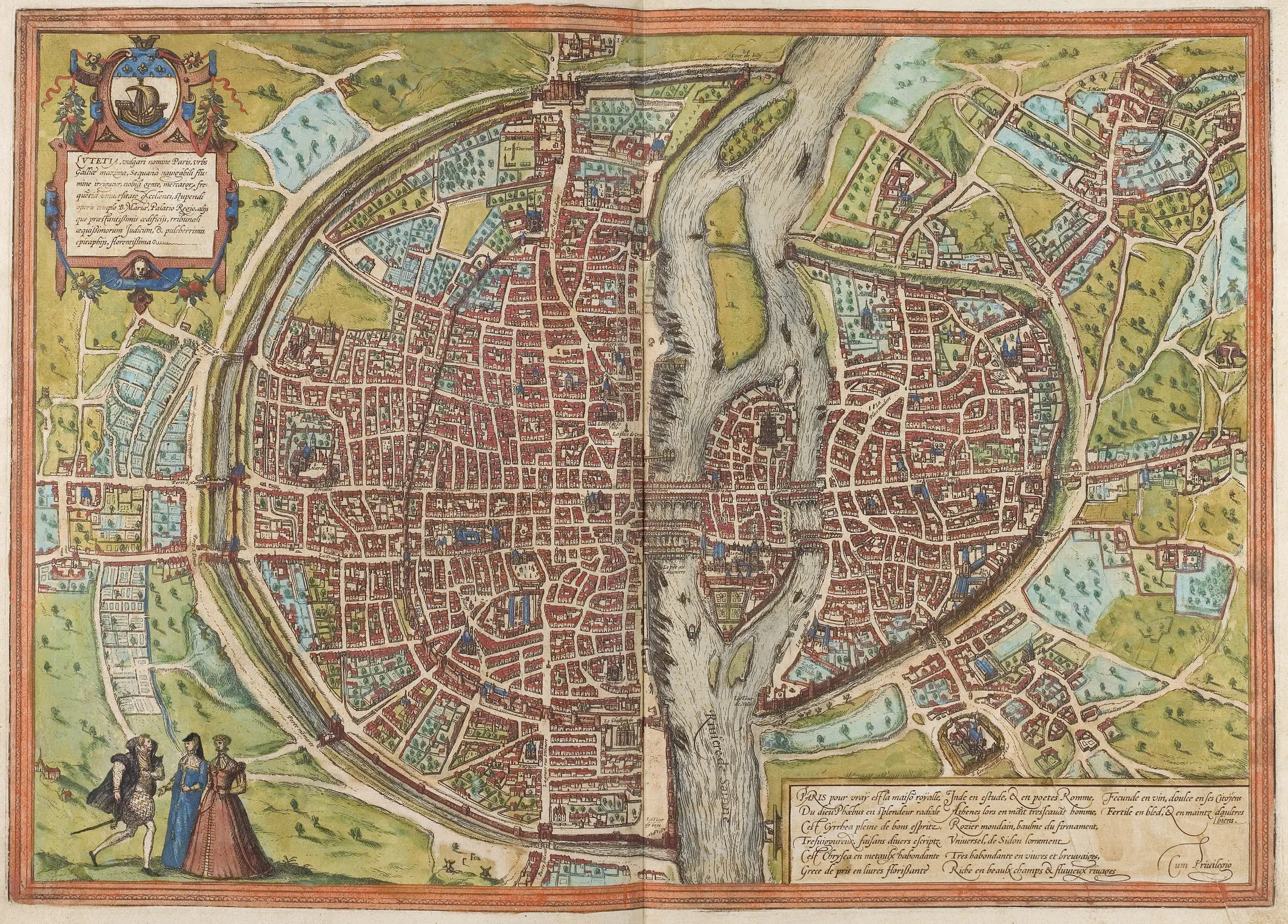
This bird's-eye view of mid-sixteenth-century Paris makes tangible the world of university-licensed printers and booksellers clustered around the Left Bank, where the rue Saint-Jacques, the rue Saint-Victor, and the Sorbonne formed part of one scholarly and commercial ecosystem. The Seine's division of the city and the proximity of university, presses, churches, and royal power help explain how a liturgical-humanist work could circulate freely in Paris just before Trent narrowed the space for such experiments. Source ↗.
Those who are not to be borne
The correction hardened, at times, into refusal. Reading the Exultet, the great Easter proclamation sung at the blessing of the paschal candle, Clichtove would not tolerate the cherished line "O happy fault, by which nature was redeemed." His verdict was that those who read the passage so are not to be borne, Neque ferendi sunt illi. Not to be borne, a curious verb to level at a line that half of Latin Christendom had been singing, contentedly, for centuries. This was precisely the intervention that drew Noël Beda and the Sorbonne against him. The charge was that Clichtove was substituting human history for matters of faith, that where the devout saw a settled deposit, he saw a set of datable claims open to correction.
He knew the exposure his method created. Turning in Book Two to the Easter blessings of meats and of birds, he paused to anticipate the reader's contempt before it could arrive. Those who read the titles of these two blessings, he conceded, primo fortasse nominis eorum contuitu mouebuntur in risum, will perhaps, at the first sight of their name, be moved to laughter. A program committed to correcting everything must also defend the worth of expounding anything.
The philology never floated free of doctrine. Reading the divine names, Clichtove treated the Greek homoousion alongside its Latin consubstantialis, keeping the Greek visible the way a treaty keeps an untranslatable clause in the source language, so that no paraphrase could open a loophole. The retained term is the anti-Arian weapon, pressing the Nicene phrase genitum non factum, begotten not made, against the denial. He read the cock of the dawn hymn, the rod of Aaron, and the fleece of Gideon as figures whose fulfilled truth is Christ, the early clue that decodes the finale. The rooster crows in the hymn because a rooster wakes sleepers, and Christ wakes the dead, so the gallus Christum becomes the cock read as Christ.
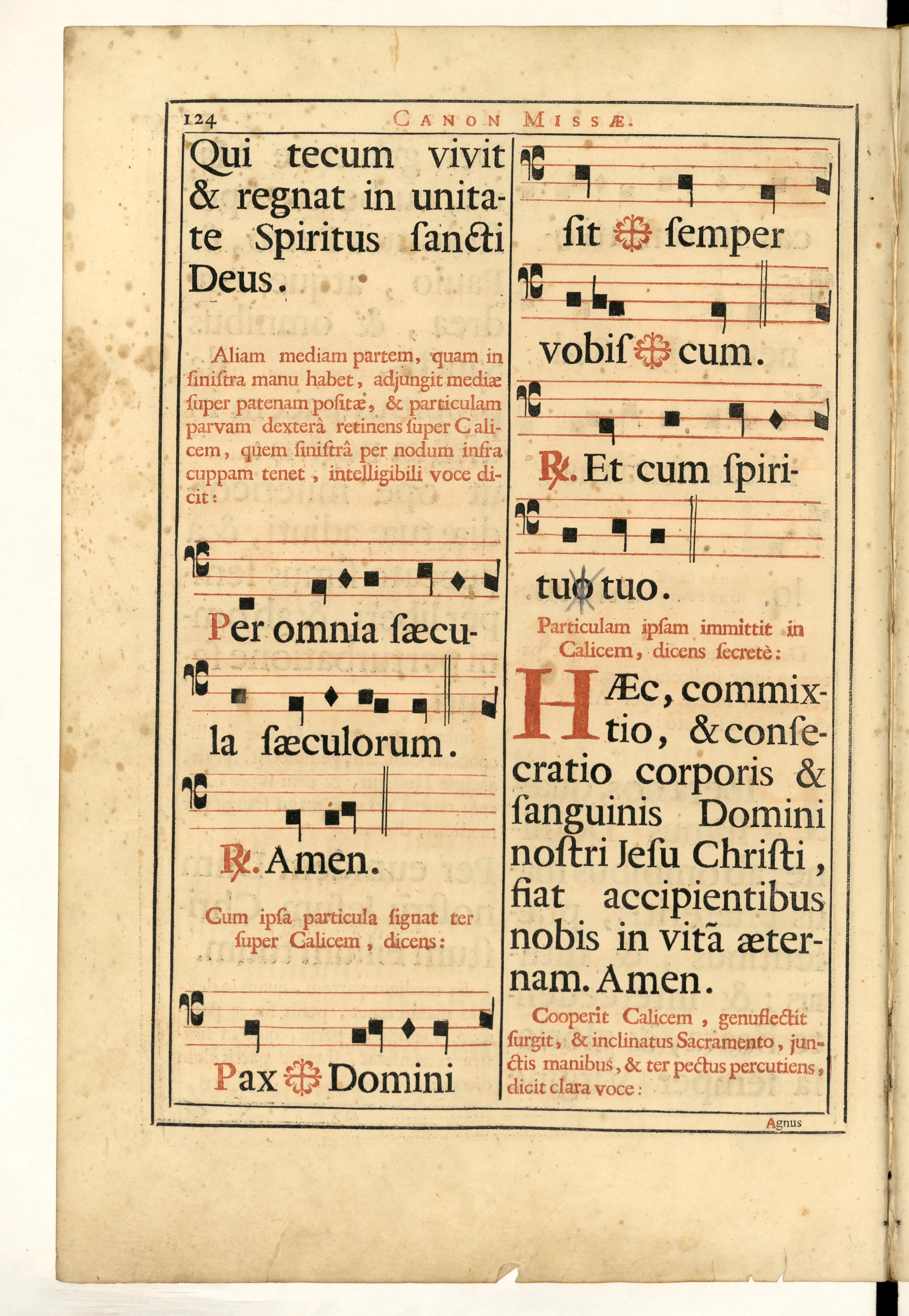
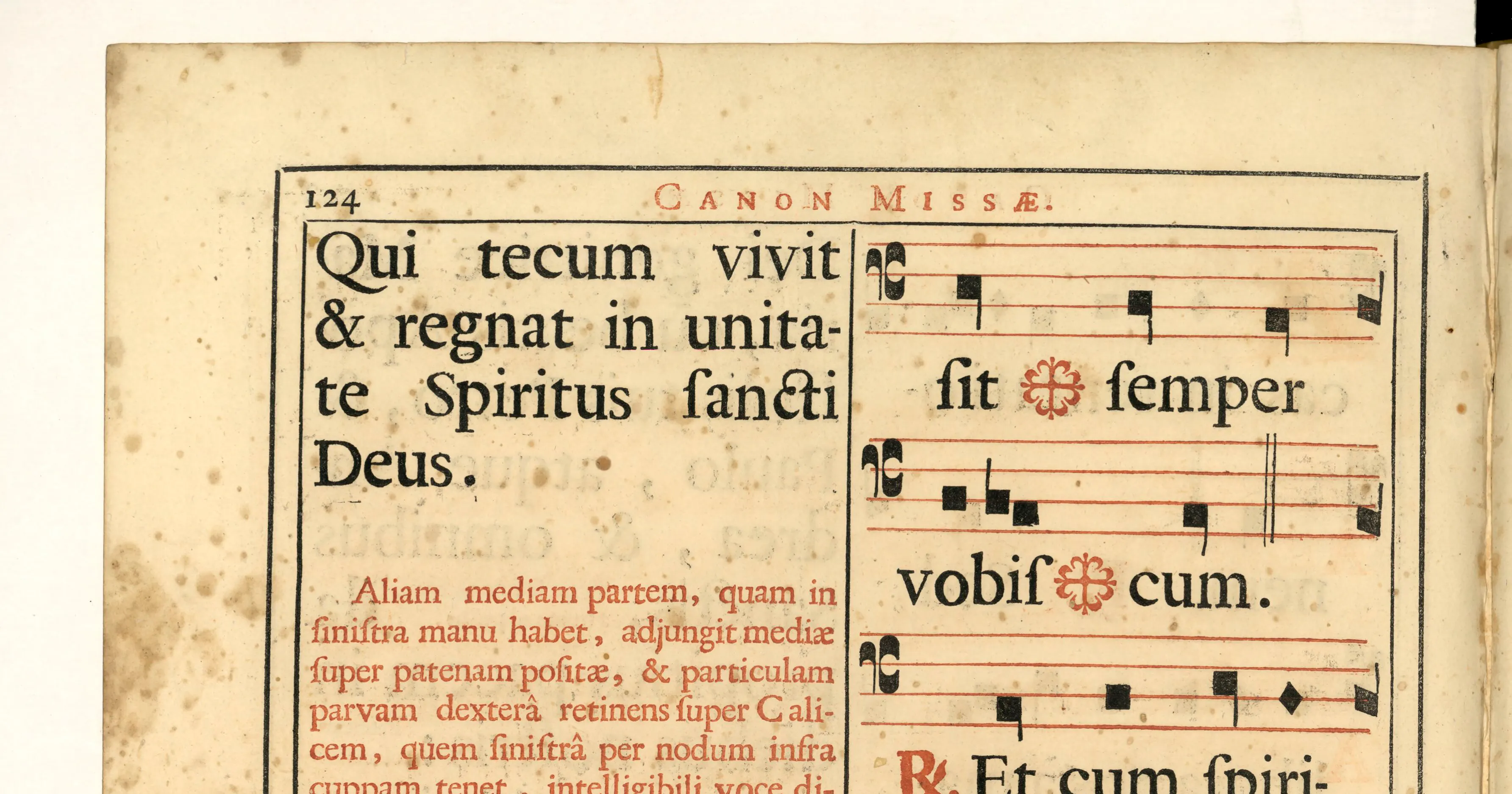
A 1729 Roman printing of the Canon Missae—later than Clichtove, but from the same service-book tradition he scrutinized—sets chant, rubrics, and consecratory formulas into the controlled typographic space where philology became doctrine. In such pages, words like "pro multis" were not decorative liturgical language but sacramental speech, making textual precision inseparable from Eucharistic theology. Source ↗.
The window that closed
By the fourth edition the horizon had darkened. Into a commentary otherwise governed by prosody and the Fathers, Clichtove admitted the losses of Christendom, naming Muhammad a monstrous beast and recording the conquest of totam Asiam & Aphricam, all Asia and Africa, with the Church pressed into the farthest corner of the world. The same doctrinal materials that Book III had grounded in the running text of the Canon, transubstantiation and the reading of pro multis with its scholastic distinction between a blood poured out sufficiently for all and efficacious only in the elect, the man who had once quibbled over a short i in a saint's name transposed into open polemic. By the 1520s he was writing the Antilutherus, and defending the Eucharist against Oecolampadius with the very apparatus already laid down in the commentary on the Mass.
The window in which a Parisian humanist could reclassify sequentia as a participle and declare a beloved liturgical line insupportable closed within a decade of the book that did both. It closed not on the strength of any Index but under the weight of a controversy that made everyone's philology suddenly a matter of faith.
The dedication tells the quieter story. The book was addressed to János Gosztonyi, Bishop of Győr, and the later Paris editions preserved the salutation faithfully into the 1540s and beyond. Gosztonyi had been dead since 1527. A man who spent his life refusing to tolerate readings that had outlived their warrant left, on the front matter of his own book, a greeting to a man long past receiving it, reprinted by a printer who saw no cause to correct it.
More from ExLatinis
This text was transcribed and translated as part of the ExLatinis project—an effort by Leo to make English translations of every published text in Latin in early modern Europe (between 1450 and 1750) available to the public for free online.
→ Read the full transcription and translation on Leo
You can save a copy of this document into your Leo account to run deep text searches, conduct further analysis, or cross-reference it with your own research.
If you want more than an introduction, you can also consult a full, in-depth report drawn from the original transcription alongside relevant secondary sources, with extended analysis and historical context beyond the scope of this post.
→ Read the full in-depth report and finding guide
Critical Further Reading & Contextual Resources
- Richard J. Oosterhoff, “Jacques Lefèvre d’Étaples,” The Stanford Encyclopedia of Philosophy: The cleanest entry into the Fabrist circle that formed Clichtove’s habits of correction, especially the move from reverent reading to philological surgery. It helps explain why a Catholic commentator could treat sacred Latin as damaged copy without imagining that he had left the Church.
- James K. Farge, Orthodoxy and Reform in Early Reformation France: The Faculty of Theology of Paris, 1500–1543: Farge is indispensable on the Sorbonne as an institution with procedures, rivalries, paper trails, and a gift for making grammar dangerous. Read him after Clichtove’s “not to be borne” moments, and Noël Beda stops looking like a cartoon censor and starts looking like a highly trained bureaucrat with doctrinal nerves.
- John Harper, The Forms and Orders of Western Liturgy from the Tenth to the Eighteenth Century: Harper supplies the practical anatomy of the Office and Mass before standardisation made everything look more inevitable than it was. This is the corrective for modern readers tempted to picture one tidy Roman book sitting on every lectern, patiently awaiting Clichtove’s red pencil.
- Andrew Hughes, Medieval Manuscripts for Mass and Office: A Guide to Their Organization and Terminology: Hughes explains the physical and textual machinery through which hymns, antiphons, sequences, collects, and blessings actually moved. It makes Clichtove’s irritation with scribal blunders feel less fussy: the service-books were not glass cases of perfection, but working tools copied by human beings with eyes, habits, and deadlines.
- F. J. E. Raby, A History of Christian-Latin Poetry from the Beginnings to the Close of the Middle Ages: Raby gives the poetic background behind Clichtove’s scansion, from Ambrosian hymns to later medieval sequence-making. The book is especially useful for seeing why a wrong quantity or mangled form was not a tiny blemish to a humanist reader, but a cracked beam in the choir loft.
- Joseph A. Jungmann, The Mass of the Roman Rite: Its Origins and Development: Jungmann remains the grand, sometimes stern, guide to the Mass, its Canon, and the inherited phrases over which early modern scholars and theologians could quarrel with impressive stamina. His treatment of liturgical development gives the needed scale for Clichtove’s comments on the Kyrie, the Canon, and pro multis: small words, large consequences, no shortage of people ready to notice.
This blog post is intended as a brief, exploratory introduction to the text. It was generated autonomously by an advanced AI assistant as part of the ExLatinis digital humanities initiative and should be treated as a primer to foster curiosity rather than a replacement for peer-reviewed scholarly sources, formal critical editions, or definitive historical commentary.