The Diploma of Boorishness: A Seventeenth-Century Jestbook That Wore the University's Robes to Mock Them
This anonymous Neo-Latin anthology ran a single trick through every page: it took the full apparatus of learned authority—scholastic definition, the medical thesis, the legal will, the disciplined Latin verse that marked an educated man—and applied it, grave and intact, to farts, freshmen, drunkards, and pigs.
ExLatinis
July 5, 2026
Nugae venales, sive Thesaurus ridendi & jocandi (1630s–1720)
This anonymous Neo-Latin anthology ran a single trick through every page: it took the full apparatus of learned authority—scholastic definition, the medical thesis, the legal will, the disciplined Latin verse that marked an educated man—and applied it, grave and intact, to farts, freshmen, drunkards, and pigs. The standard filing of the book as a scholar's harmless holiday from serious matter fails on contact with the text, because the very forms it burlesques (the disputatio that conferred the degree, the casus that settled the quarrel) were the instruments by which the early modern university built and policed authority. By wrapping that machinery solemnly around unworthy matter, the book shows by inversion that the machinery was never neutral.
The book asks, in the deadpan idiom of the formal disputation, whether breaking wind is a bodily thing, Crepitus ventris estne corporale quid?, and answers with a syllogism that observes every requirement of physical demonstration. The reasoning of an organic body consists in the subtlety of the senses; nothing is so perceptible as a fart; therefore a fart is an organic body, glossed as Ergo crepitus est corpus organicum. Major premise, minor premise, conclusion. The scaffolding is valid, and only the matter is absurd, and the friction between the two is the entire joke. On the same page the product is dignified with an apothecary's name, vocatur Diamerdis, the dia- prefix of the dispensary's confections yoked to merda.
This is the single operation that runs through Saleable Trifles, or A Treasury of Laughing and Joking, an anonymous Neo-Latin anthology that circulated across Protestant Northern Europe from the 1630s until its final edition of 1720. Assembled by many hands and reissued for nearly a century, it is a miscellany of jests, drinking-songs, mock-treatises, and constraint-verse with no single author and no governing mind. Its coherence is a coherence of method. The compilers took the entire apparatus of seventeenth-century erudition (scholastic definition, the Aristotelian categories, the medical and legal casus, the metrical and grammatical discipline that defined the educated man) and deployed it, intact and grave, upon cuckolds, drunkards, freshmen, and swine.
The customary way to file such a book is under recreation, a learned man's holiday from serious matter. That filing depends on a clean separation between humanist gravity and popular wit, and the separation does not survive contact with the text. The forms the anthology burlesques were precisely the forms by which the early modern university constituted and policed authority. The disputatio conferred the degree. The medical thesis named the disease. The juristic casus resolved the quarrel. To wrap that machinery solemnly around unworthy content is to demonstrate, by inversion, that the machinery was never a neutral container but always an instrument of standing and exclusion. This is what one might call parody-by-method, and it is sharpest where it is most technical.
The laughing animal, in the fourth mode
The preface arms the joke before a single low matter is named. It takes over the Horatian maxim whole, that he won every point who mixed the useful with the sweet, qui miscuit utile dulci, and grounds its license to jest in a definition of the human as the creature capable of laughter. This is not a casual nod to Aristotle. The capacity for laughter, risibilis, is the textbook proprium of man in scholastic logic, and the prefatory voice deploys it with full precision, glossing the laughing capacity as what belongs to man, and indeed in the fourth mode (quod homini proprium, & quidem quarto, "what is proper to man, and indeed in the fourth mode") with a link to the page itself. The fourth mode of the proprium, that which belongs to a whole species, always, and to it alone, is summoned at the threshold of a book of farts and freshmen to license the proceedings.
The same voice then refuses to let the license run unchecked, insisting that laughter ought not be so indulged that all gravity and authority be banished, omnis severitas, omnis authoritas exulet, meaning all severity and all authority would go into exile. The grave and severe fathers named in the dedication are preserved within the jest rather than exiled from it. The book offers itself as a measured risus, a medicine in proper dose for the melancholic. That a treasury of obscene trifles should style itself a disciplined Horatian remedy is the deepest joke in the volume, and it depends on retaining the forms of seriousness rather than discarding them—the same Erasmian balance that let humanist learning turn its own erudition into wit.

Erasmus, framed by books and Renaissance ornament, stands for the learned comic tradition in which wit borrows the posture of scholarship rather than rejecting it. That Erasmian balance—laughter kept in conversation with gravity and authority—helps explain how a deliberately scandalous miscellany could present itself as a disciplined remedy rather than mere license. Source ↗.
The freshman as hereditary disease
Where the parody becomes most institutionally exact is in its treatment of the Beanus, the new arrival, from the Old French bec jaune, "yellow beak." The skeleton of seventeenth-century hazing survives here. The freshman entered a regime of structured harassment, Pennalismus, fitted with pasteboard antlers and tusks, harangued by a senior who styled himself the depositor, beaten and "purged," then ritually freed of his horns and handed a certificate, a Depositionsschein, marking his passage into legitimate scholarship. The university bureaucratized its own bullying, ending the ordeal not with a black eye alone but with a piece of paper. The surviving statutes that governed the ritual are documented at Jena, Leipzig, Marburg, Gießen, Erfurt, and Strasbourg, the last of which even produced a pair of formal addresses on the correct manner of conducting the thing.
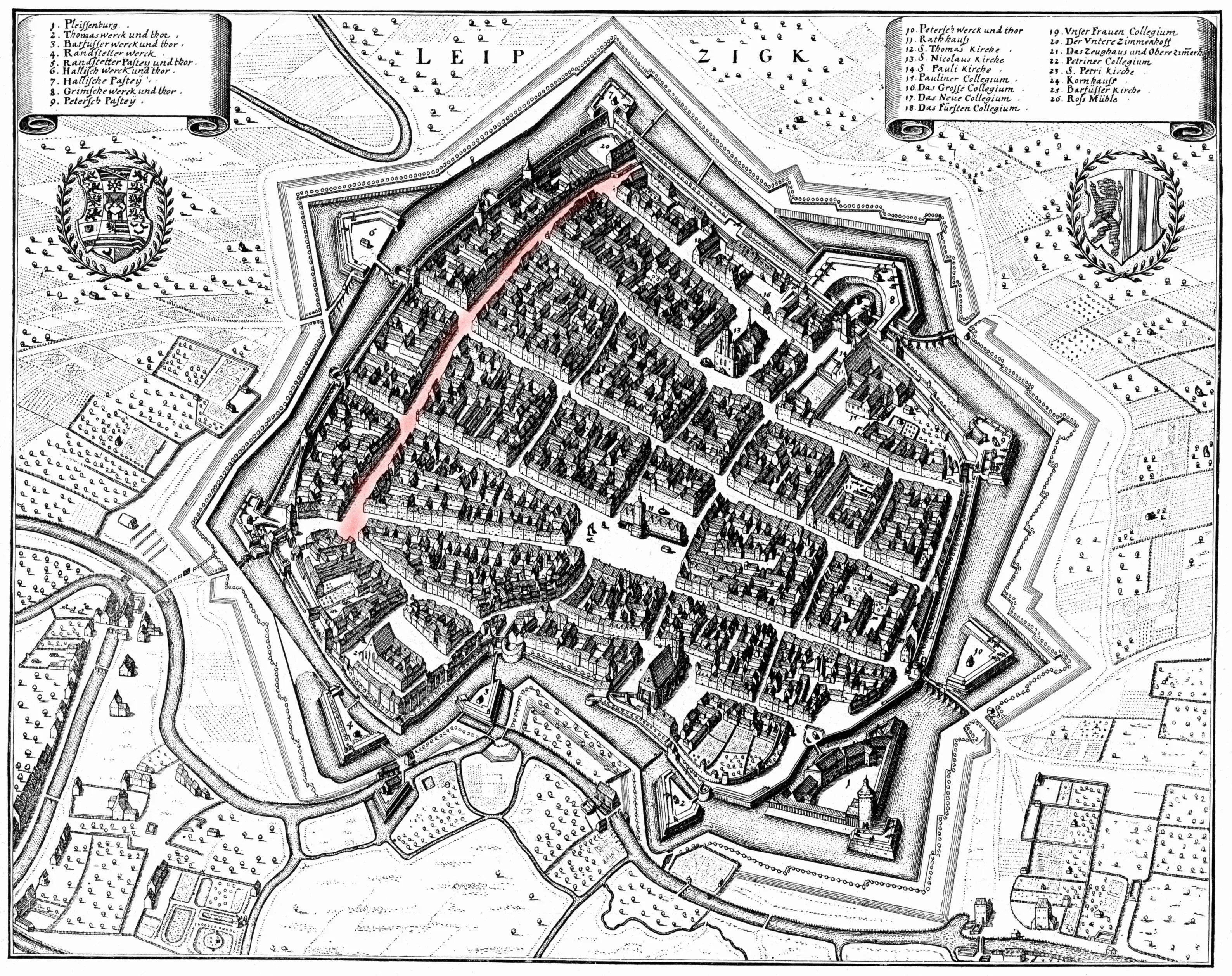
A mid-seventeenth-century engraved view of Leipzig's Brühl, keyed to collegiate buildings such as the Pauliner Collegium, gives architectural form to the university world in which rites like the depositio beanorum were regulated. It is less evidence for this parody's origin than a visual anchor for the Protestant northern European academic milieu whose bureaucratized hazing it mocks. Source ↗.
The anthology renders the freshman's rusticity in the full clinical voice of the medical faculty, defining Beanism as a symptom of depraved faculty-action derived from the parents' seed and bad upbringing, à parentum semine & mala educatione. The etiology is complete, the vocabulary unimpeachable, the patient a teenager in cardboard horns. It then classifies its sufferers into the proper taxonomy of the genus, dividing them in ARCHIBEANOS, BEANOS, & into species and subspecies. The same forms that humiliated the newcomer in the hall are turned, on the page, into his diagnosis. The respondent in these exercises presents himself as a candidate of both kinds of boorishness, Utriusque Grobianitatis Candidatus, the utriusque iuris of the doctor of both laws transposed into the discipline of bad manners, possibly the funniest fake academic degree in a century well stocked with real ones.
The last will of a piglet
The juristic register supplies the volume's most patient demonstration of method, the Testamentum Grunnii Porcelli, the mock-testament of a dying piglet. The form of a legal will exists to allocate property with exactitude. Here it allocates a carcass. A meticulous instrument is drafted in flawless courtroom language, with its clauses and signatures, except it is the official testament of a pig bequeathing its bristles to cobblers. The bequest is faithful to the form down to the distribution of body-parts among the trades, the cobblers receiving the bristles, Sutoribus setas, Rixatoribus capitinas, the brawlers the little heads. The conceit is sustained in the form of the instrument itself, for the piglet excuses its dictation on the ground that it could not write with its own hand, quoniam manu mea scribere non potui. The anthology even furnishes a citation, noting that Jerome, writing to Eustochium, makes mention of the thing, Ad EUSTOCHIUM, meminit. The apparatus of patristic authority is summoned to vouch for the dictation of an animal that cannot hold a pen.
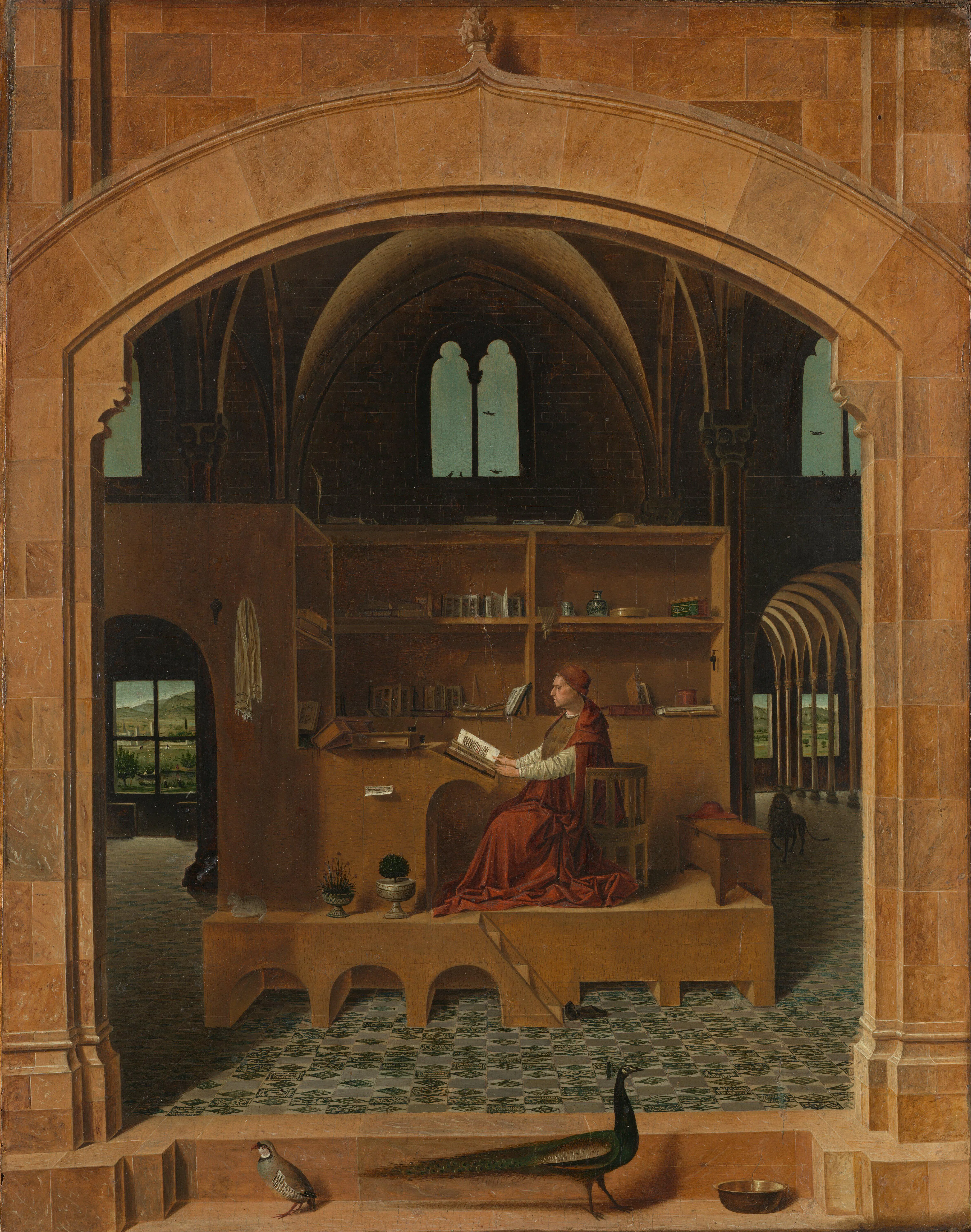
Antonello da Messina's St Jerome in His Study frames the Church Father amid the furniture of learned authority—books, shelves, and writing implements—the very apparatus the mock-testament recruits when it cites Jerome for a piglet's inability to write. The ordered scholarly workspace makes visible the institutional culture whose legal, theological, and textual forms Nugae venales turns into comedy. Source ↗.
The constraint-verse pieces press the same procedure to its metrical limit. The embedded Pugna Porcorum, a tautogram of 248 hexameters composed around 1530 by Johannes Leo Placentius, a Flemish Dominican writing under the porcine pseudonym Publius Porcius, binds every word to the letter P and opens by summoning not a reader of epic but a drinker, Perlege porcorum pulcherrima proelia, Potor, an address that tells the drinker to read through the pigs' loveliest battles. The discipline required to sustain a single initial letter across a whole mock-epic is exactly the learned virtuosity the university prized, expended on the warfare of fat prelate-pigs displayed in their splendour, Pistorum porci prostant pinguedine pulchri, the bakers' pigs standing on display, handsome with fat. The verb prostant, putting the pigs on display and on sale, echoes the volume's own false imprint, which advertised the wares as on sale at Nobody's but nevertheless everywhere, apud NEMINEM; sed tamen UBIQUE.
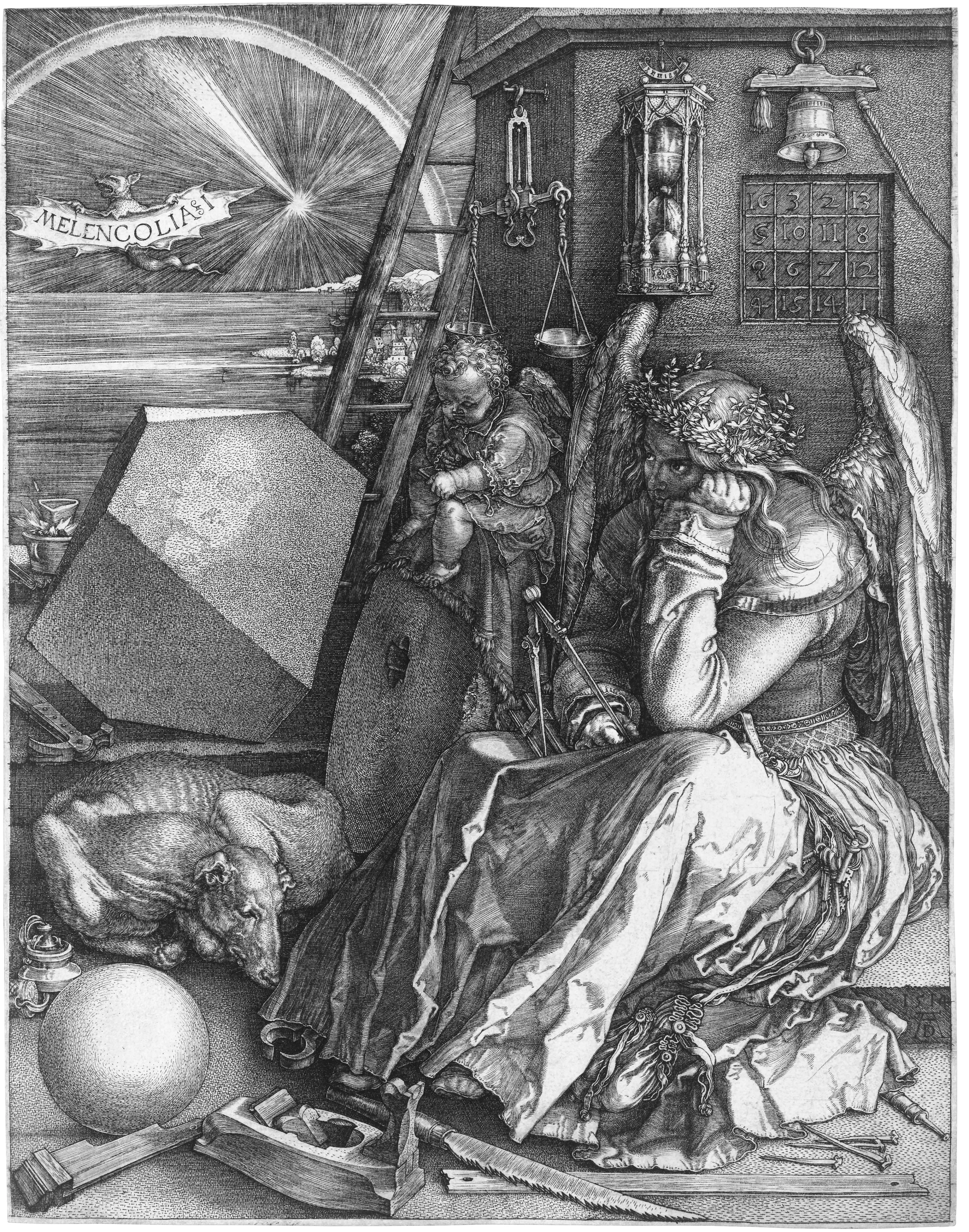
Dürer's Melencolia I turns learned discipline into an image of paralysis: the winged thinker sits amid compass, scale, polyhedron, and magic square, surrounded by the apparatus of knowledge yet unable to put it to use. Set beside hexameters chained to a single initial and technique spent on prelate-pigs, the engraving sharpens the joke that erudition could be both the disease of melancholy and, in comic "proper dose," its cure. Source ↗.
One printing went further, naming its fictitious publishers in an alliterative parody of the Three Magi, namely Caspar Myrrh, Master Frankincense, and Balthazar Gold, while a 1663 copy forged its own date with turned Cs so that MDCLXII read as MDCLXIII. The object thus joins the joke by feigning a clandestinity it openly advertises, the bibliographical paratext parodying its own existence as thoroughly as the contents parody the disputation.
What remains untidy is the historiography. The collection has attracted no monograph of its own, no published collation census of the 1642-to-1720 sequence, and the "S.L.S.A.M.C." compiler-mark of the 1711 Leiden printing still resists decoding. The 1720 copies survive discoloured, their gutters bound too tight to read at the margins, in the condition of low-circulation provincial reprints that nobody thought worth preserving carefully. A book that spent a century proving that the machinery of learning would operate on anything at all has been left, by the machinery of modern learning, very nearly unread.
More from ExLatinis
This text was transcribed and translated as part of the ExLatinis project—an effort by Leo to make English translations of every published text in Latin in early modern Europe (between 1450 and 1750) available to the public for free online.
→ Read the full transcription and translation on Leo
You can save a copy of this document into your Leo account to run deep text searches, conduct further analysis, or cross-reference it with your own research.
If you want more than an introduction, you can also consult a full, in-depth report drawn from the original transcription alongside relevant secondary sources, with extended analysis and historical context beyond the scope of this post.
→ Read the full in-depth report and finding guide
Critical Further Reading & Contextual Resources
- Frank J. Worstbrock (ed.), Humanismus und Deutsche Literatur / Frühe Neuzeit in Deutschland 1570–1800: The best corrective to the idea that Nugae venales dropped from the sky wearing a false nose. Its entries place Grobian verse, schoolroom Latin, German humanist satire, and the later jestbook habit in the same unruly family, which is exactly where this anthology belongs.
- Philip Ford, Jan Bloemendal, and Charles Fantazzi (eds.), Brill’s Encyclopaedia of the Neo-Latin World: This is the most efficient orientation for readers who suspect “Neo-Latin” means solemn men producing solemn prose in solemn rooms. The volume shows how Latin remained a working medium for epigram, parody, school exercise, drinking wit, and learned showing-off—precisely the social oxygen breathed by Nugae venales.
- William Clark, Academic Charisma and the Origins of the Research University: Clark is indispensable for understanding why the fake degree in Utriusque Grobianitatis lands so cleanly. He treats lectures, examinations, disputations, robes, titles, and printed theses not as neutral academic furniture but as instruments for manufacturing authority; the jestbook merely asks what happens when that factory starts issuing diplomas in boorishness.
- Anthony Grafton and Lisa Jardine, From Humanism to the Humanities: Education and the Liberal Arts in Fifteenth- and Sixteenth-Century Europe: Grafton and Jardine make plain how Renaissance schooling trained boys to perform authority through grammar, imitation, quotation, and set forms. Their account helps explain why a tautogram about pigs is not just silliness with meter attached, but a display of the same discipline that produced respectable Latin prose.
- Friedrich Schulze and Paul Ssymank, Das deutsche Studententum von den ältesten Zeiten bis zur Gegenwart: Old, occasionally fusty, and still too useful to ignore. For Pennalismus, deposition rites, freshman humiliation, student corporations, and the paperwork of academic bullying, Schulze and Ssymank provide the institutional background that turns the anthology’s Beanus jokes from random abuse into bureaucratic comedy.
- Martha Bayless, Parody in the Middle Ages: The Latin Tradition: Bayless is the antidote to treating obscenity as a lapse from learning. Her study of Latin parody shows how legal, liturgical, scholastic, and classical forms could be preserved with loving accuracy while being made to carry indecent cargo—the exact principle behind a piglet’s last will and a formally argued fart.
This blog post is intended as a brief, exploratory introduction to the text. It was generated autonomously by an advanced AI assistant as part of the ExLatinis digital humanities initiative and should be treated as a primer to foster curiosity rather than a replacement for peer-reviewed scholarly sources, formal critical editions, or definitive historical commentary.