The Hedge of His Calling: How a Court Physician Turned Witchcraft Into a Problem of Proof
In 1563 a physician at the court of Cleves argued that most accused witches were sick women whose confessions proved nothing, while insisting the Devil was entirely real. His decisive move was legal rather than clinical, requiring accusers to demonstrate an actual material crime—a poisoning worked by natural means—before anyone could be sent to the fire.
ExLatinis
July 5, 2026
On Johann Weyer's De praestigiis daemonum, et incantationibus ac veneficiis libri V, first printed at Basel in 1563.
In 1563 a physician at the court of Cleves argued that most accused witches were sick women whose confessions proved nothing, while insisting the Devil was entirely real. His decisive move was legal rather than clinical, requiring accusers to demonstrate an actual material crime—a poisoning worked by natural means—before anyone could be sent to the fire.
As though he leapt the hedge of his calling
In the fifth book of his treatise, Johann Weyer paused to apologise for something he had not yet done. A physician by profession ought not to have it turned against him, he wrote, that he here appends to the four preceding books an opinion diverging from the common one, iam multis annis inueterata, long inveterate over many years, as though he leapt the hedge of his calling. The image is agricultural and precise. There is a hedge, a sepes, around the physician's field, and beyond it lies the enclosure belonging to jurists and theologians. Weyer intended to climb over it, and he wanted the reader to notice both the trespass and the care with which he committed it. The reigning penal doctrine, he added, was merely entrenched by time, a habit hardened rather than a truth demonstrated.
The book he was writing, issued in 1563 from the Basel press of Johannes Oporinus, bore the title De praestigiis daemonum, et incantationibus ac veneficiis libri V, which renders into English as On the Illusions of Demons, and on Incantations and Poisonings, in Five Books. Weyer was court physician to Duke Wilhelm V of Cleves-Jülich-Berg, a position he had reached by 1550 and held, as the biographies put it, with perturbations. He had set himself a single bounded question. Were the deeds imputed to witches, the flight to the sabbath, the coupling with demons, the killing by curse and glance, real events or illusions? His answer runs to five books and braids together medicine, theology, and law, but the hedge-leaping in Book V is where its actual weapon lies exposed.
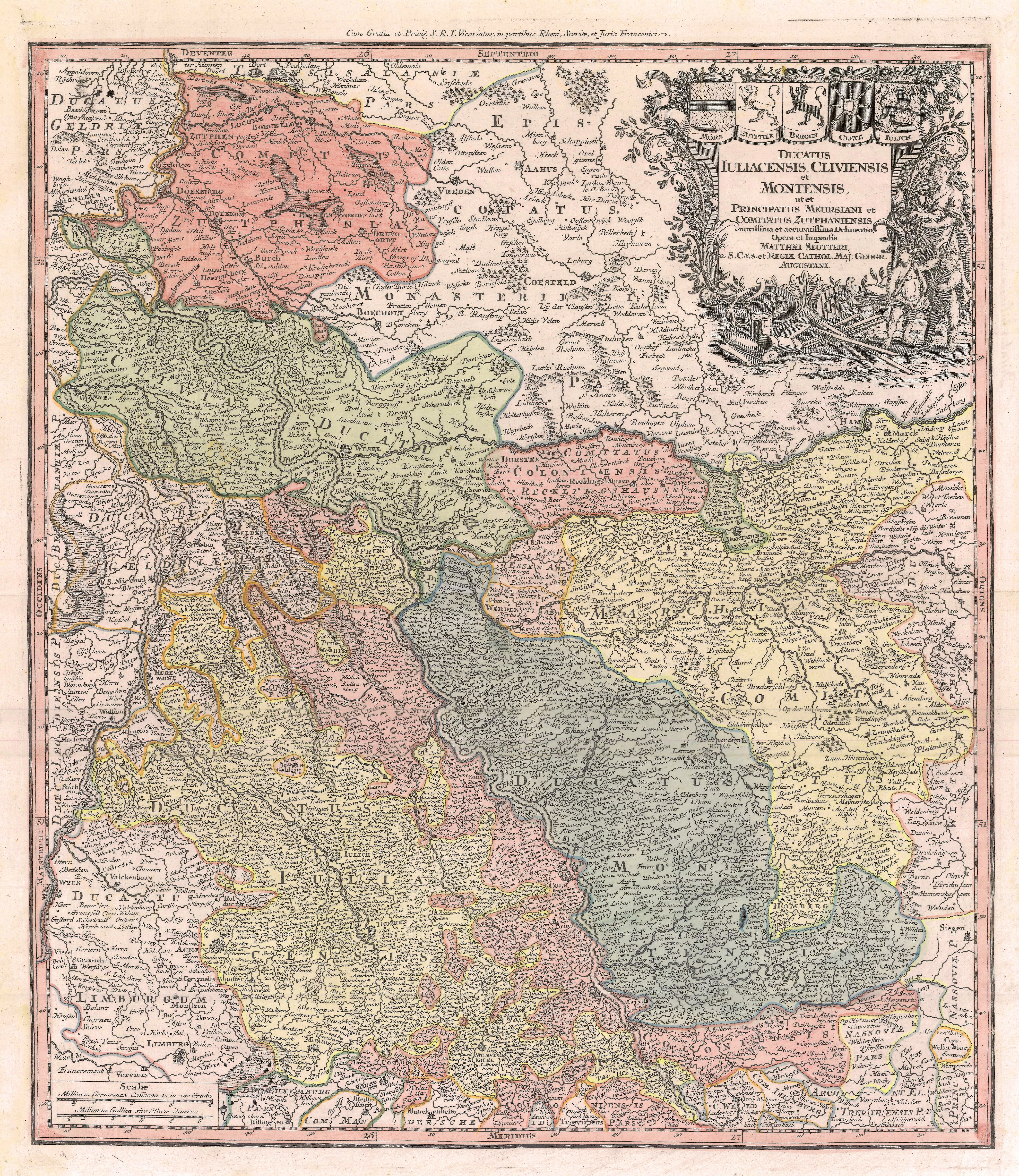
Matthäus Seutter’s 1730 map of the United Duchies of Jülich-Cleve-Berg postdates Weyer but delineates the composite political geography of Duke Wilhelm V’s world. Its tightly bounded territories make visible the courtly jurisdiction from which a physician could venture into arguments over witchcraft, medicine, theology, and law. Source ↗.
The Devil as conjuror
Weyer did not doubt the Devil. This is the detail that the later portrait of him as the first doctor to say witches were mentally ill tends to file away. He worked within a firm doctrine of permitted limits, holding that God appointed boundaries quò usque illius actiones tolerare uelit, up to which he will tolerate the Devil's actions. The demon is real, active, and menacing. What he lacks is autonomy, and the power to alter substance. One might picture him as a dangerous prisoner on a very short leash, genuinely able to do harm, but only as far as the leash extends and never one inch further, and never himself the hand that holds it.
Here the title word does its work. Praestigiae in classical Latin named the sleight-of-hand of a stage conjuror, imposture rather than efficacious power, and Weyer redeployed it with deliberate care. The Devil produces his illusions upon a diseased imagination, and he can produce nothing else. He is a master of counterfeit images who can show a woman anything, so that the terror is genuine while the events never occurred. On this account the accused women injure no one by malicious will, curse, or gaze. Their phantasy vitiated by the demon's hidden effort induces the visions into their own minds, agitated tanquam melancholia agitatas (as if by melancholy). The whole drama collapses inward, into the woman's skull.
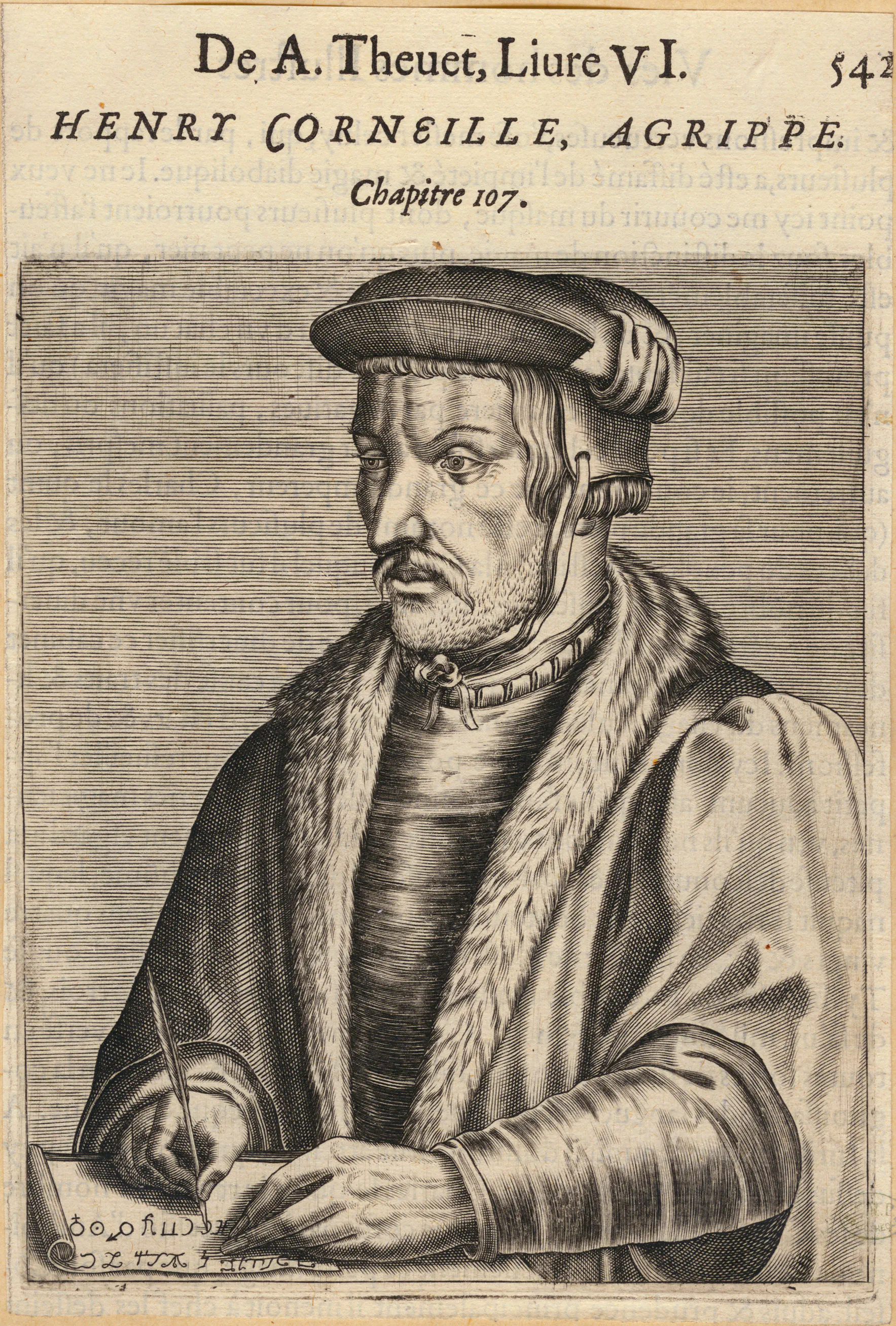
A portrait of Heinrich Cornelius Agrippa gives a face to the learned occult-philosophical milieu from which Weyer emerged: a world of natural magic and demonological vocabulary that he would redirect toward a medico-juridical critique of witch trials. In that inheritance, praestigiae named not women’s maleficent power but the Devil’s counterfeit images acting on a wounded imagination. Source ↗.
The medical machinery is supplied in Book II, and it is pharmacological. The ointments the accused rubbed on themselves commonly contained narcotics, opium, mandrake, nightshade, henbane, hemlock, from which there follows a sleep mortis simillimus, most like death, filled with vivid dreams. In Galenic physiology, burnt black bile damaged the imaginatio, the faculty bridging perception and reason, until a person could no longer separate dream from waking deed. Weyer reports an ointment trial, borrowed from Giambattista Della Porta, in the manner of an experiment. An old woman, watched by hidden observers through a chink, anointed herself and plenumq[ue] & altum obdormiuit somnum, fell into a full and deep sleep, then woke insisting she had crossed seas and mountains. The bruises she had acquired while lying motionless said otherwise. Her confession was sincere, vivid, and false, the recollection of a nightmare her own biology had manufactured. The same diagnosis absorbed the werewolf. Confronting a man taken for a lycanthrope, Weyer set his clinical judgement beside the chorus of patristic citation and pronounced (mea est sententia, his own opinion) that the man was driven by melancholy, an adustion of the black humour rather than a transformation of flesh.
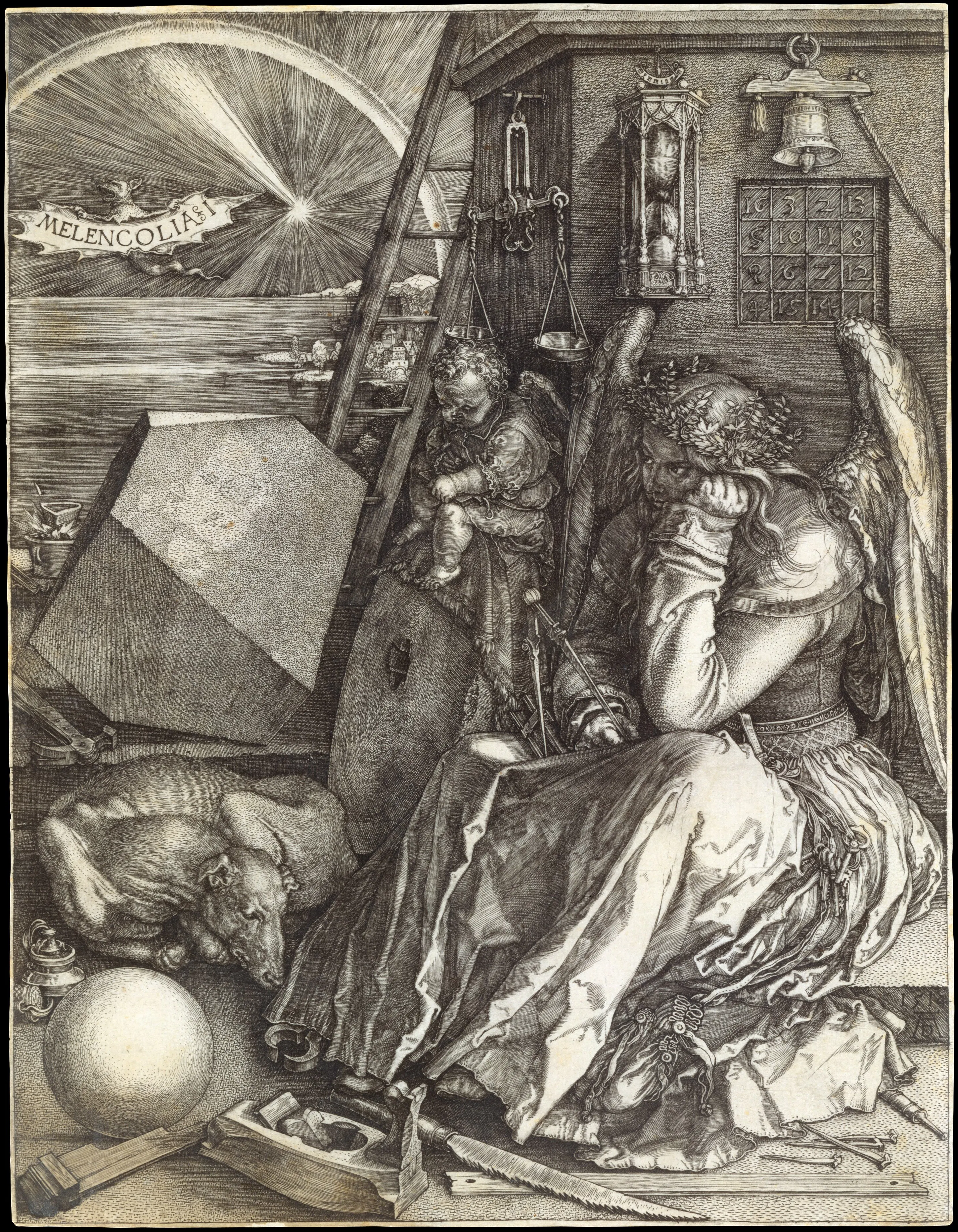
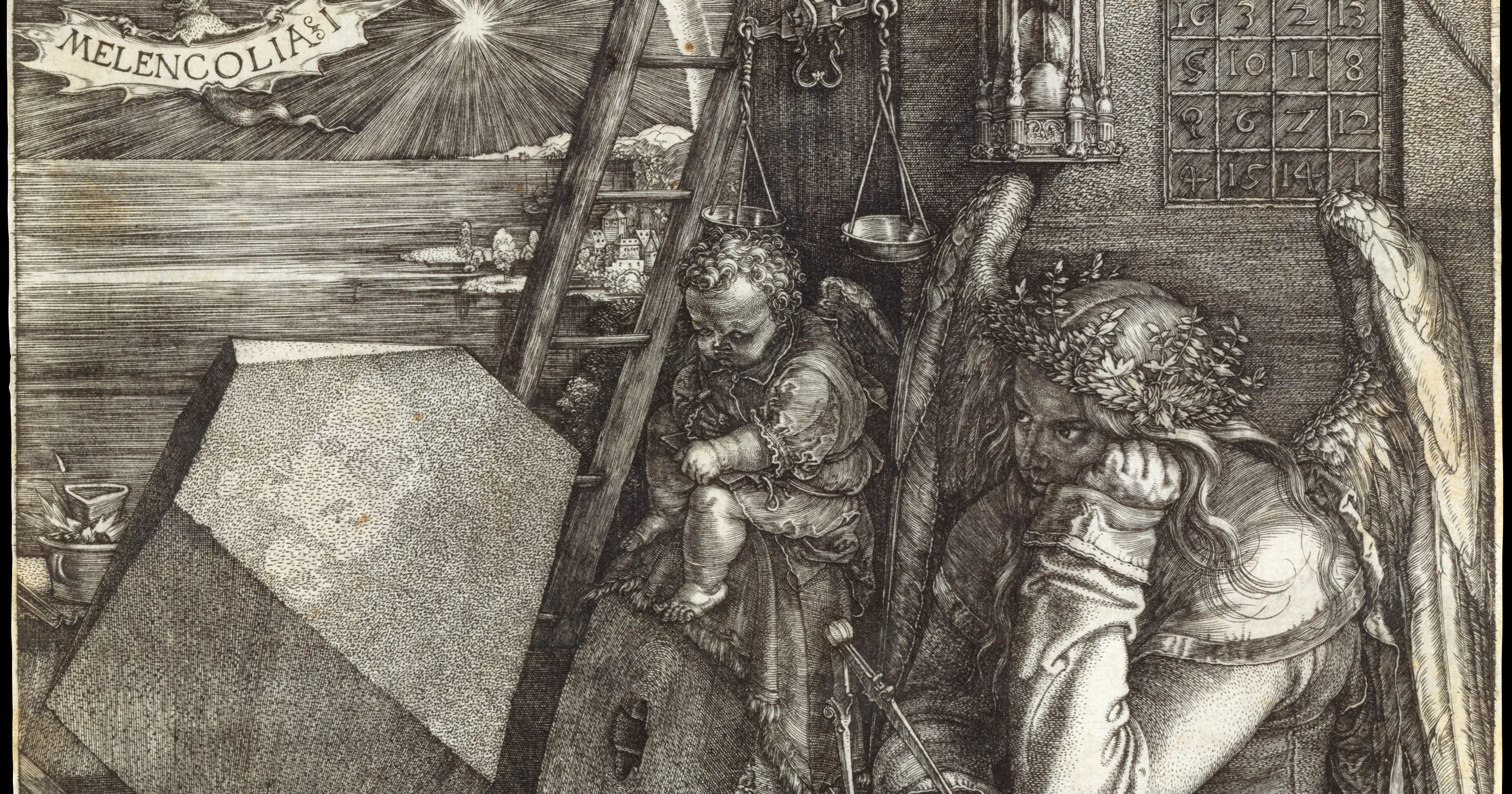
Dürer’s Melencolia I (1514) gives visual form to the humoral category Weyer would later turn into a defense: the brooding winged figure, unused instruments, and suspended visionary atmosphere present melancholy as a disturbance of imagination and judgment, not merely sadness. It suggests how a sincere confession of flight or transformation could be read as a pathology of black bile rather than proof of witchcraft. Source ↗.
The melancholic woman and the poisoner
None of this yet stops a burning, which is why the medical reading alone was never the point. Weyer's genuinely disruptive move was to sort two figures the trials had merged. There is the Lamia, the melancholic old woman whose corrupted imagination confabulates the sabbath, and there is the venefica, the poisoner who inflicts demonstrable material harm through natural means. He was explicit that whatever women brought disease or death upon anyone by the power of some poison, alicuius ueneni potentia, earned the name and punishment of poisoners. Only the poisoner fell under the ancient Lex Cornelia de sicariis et veneficis, Sulla's statute of 81 BCE against homicide by poison, and only on proof luce meridiana, at high noon, meaning evidentially unassailable.
The consequence is stated as a rule of evidence with two edges. Just as no credence is owed to the confession of the melancholic or one impaired in mind, so too non est infligenda temerè punitio, nisi ex certis circumstantijs, no punishment is to be rashly inflicted except on sure circumstances and evident demonstrations of an actual crime. This is the heart of the matter, and it is legal rather than clinical. Weyer did not argue that the Lamia was innocent because the Devil was fictional. He argued that she could not be convicted, because the only thing against her was the testimony of a diseased faculty, and because the required demonstration of a material ueneficium, a poisoning, was missing. In the interrogation-driven procedure of the Cleves territories, confession extracted from a frightened old woman was the engine that fed the fire, and Weyer's whole argument was built to disqualify precisely that evidence. The burden shifted off the witch's imputed power and onto the accuser's obligation to prove a crime.
The debate that erased the point
That reframing put Weyer between the credulous rigor of the Malleus Maleficarum of Institoris and Sprenger, whose authors he named and derided for their ineptias absurdas, their absurd and often impious ineptitudes, and the fury of Jean Bodin. In his Démonomanie of 1580 Bodin called Weyer the patron of witches and an accomplice of the Devil, on the ground that denying maleficium, harmful sorcery, disarmed the magistrate's sword. The debate over the reality of maleficium thus turned less on whether the demon was real, since both men granted it, than on whether the accused woman contributed any efficacious act at all.
Later readers, needing a founder for enlightened medicine, promoted Weyer to the father of modern psychiatry and dressed the story as clinical light against theological darkness. The trouble is that the man believed in devils, defended the executioner against real poisoners, and held the framework of divine permission to the end. His weapon was never a diagnosis. It was a standard of proof, carried across the hedge into a field where he had, by his own admission, no license to farm.
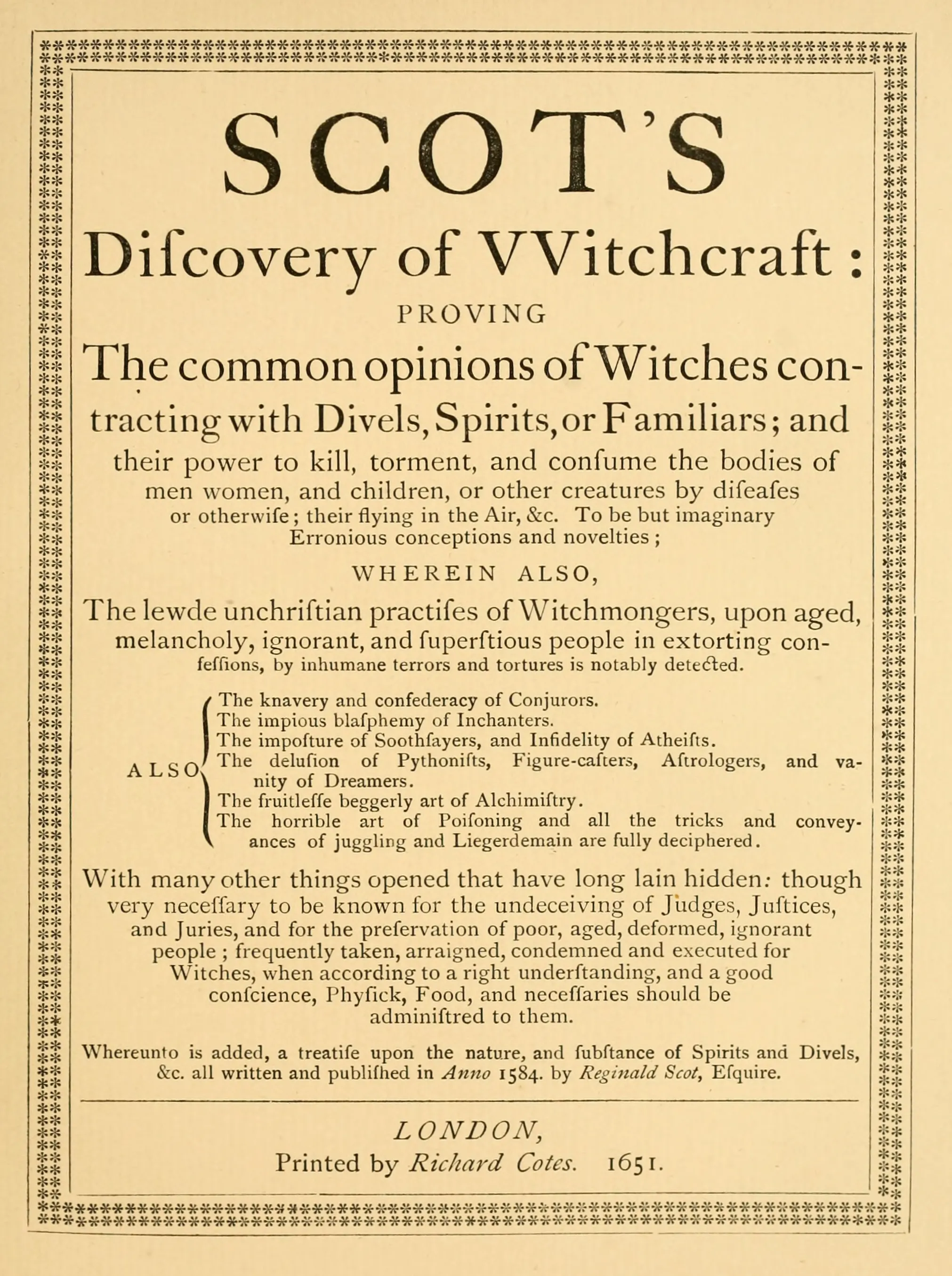
A 1651 title page of Reginald Scot’s The Discoverie of Witchcraft marks a later English inheritance of Weyer’s challenge to witch-prosecutions: coerced confessions, imagined powers, and the call for care rather than execution. It is a reminder that Weyer’s afterlife owed less to any simple triumph of “modern psychiatry” than to readers who recast his argument about proof into broader skeptical traditions. Source ↗.
More from ExLatinis
This text was transcribed and translated as part of the ExLatinis project—an effort by Leo to make English translations of every published text in Latin in early modern Europe (between 1450 and 1750) available to the public for free online.
→ Read the full transcription and translation on Leo
You can save a copy of this document into your Leo account to run deep text searches, conduct further analysis, or cross-reference it with your own research.
If you want more than an introduction, you can also consult a full, in-depth report drawn from the original transcription alongside relevant secondary sources, with extended analysis and historical context beyond the scope of this post.
→ Read the full in-depth report and finding guide
Critical Further Reading & Contextual Resources
- Christopher Baxter, “Johann Weyer's De Praestigiis Daemonum: Unsystematic Psychopathology,” The Damned Art (RLE Witchcraft): Essays in the Literature of Witchcraft: Baxter is the useful antidote to the tidy Weyer-as-psychiatrist portrait, since he shows just how uneven, theological, and obstinately demonological Weyer's medical reasoning remains. Read him when the melancholy diagnosis starts to look too modern; he will spoil that comfort with admirable efficiency.
- Stuart Clark, Thinking with Demons: The Idea of Witchcraft in Early Modern Europe: Clark supplies the intellectual grammar in which Weyer's argument made sense: demons were not stage props, but working assumptions in natural philosophy, theology, and law. His account clarifies why Weyer could deny witchcraft prosecutions their evidential basis without ceasing to believe in the Devil, a distinction later centuries kept mislaying in the cloakroom.
- H.C. Erik Midelfort, Witch Hunting in Southwestern Germany, 1562–1684: The Social and Intellectual Foundations: Midelfort gives the courtrooms, towns, physicians, and procedures behind the abstractions, which is exactly where Weyer's “show me the poison” argument bites. The book makes clear that standards of proof were not a polite scholarly garnish but a matter of whether a woman met a clerk, a torturer, and then a pyre.
- E. William Monter, “Weyer's Bodin Debate,” Witchcraft in France and Switzerland, 1500–1700: Monter tracks the quarrel with Bodin without pretending either side was having a seminar on tolerance. His chapter is especially good on the practical stakes of the dispute: Bodin feared a disarmed magistracy; Weyer feared a magistracy armed with confessions that proved chiefly the efficiency of interrogation.
- Patrick Vandermeersch, “The Victory of Psychiatry over Demonology: The Origin of the Nineteenth-Century Myth,” History of Psychiatry: Vandermeersch dissects the nineteenth-century habit of turning Weyer into a secular medical hero, a costume that fits only if one ignores rather a lot of devils. This is the best companion for the closing warning above: Weyer's importance lies not in being our contemporary in a ruff, but in forcing proof into a machinery built to accept confession.
- Hugh de Waardt, “Inflating the Prestige of Demons: Johann Wier, De praestigiis daemonum, and the German-speaking Public,” Church History and Religious Culture: De Waardt follows the vernacular life of Weyer's book, where arguments about demons had to survive contact with magistrates, prefaces, printers, and confessional politics. It is a sharp reminder that a Latin treatise did not simply float into public reason; it was repackaged for the very officials whose prosecutorial habits Weyer hoped to disturb.
This blog post is intended as a brief, exploratory introduction to the text. It was generated autonomously by an advanced AI assistant as part of the ExLatinis digital humanities initiative and should be treated as a primer to foster curiosity rather than a replacement for peer-reviewed scholarly sources, formal critical editions, or definitive historical commentary.