The Little Loaves of Pope Julius: On Guillaume Budé's Refusal to Keep His Numbers Apart from His Verdict on the Church
A royal insider who had dined at the Pope's table set a balance and a handful of ancient coins on his desk and used them to correct the sacred texts of antiquity, then turned the same instrument against the wealth of the Church and court he served. He professed loyalty and hoped for reform from within, even as his scholarship named the veneration of authority itself a piaculum, an act of sacrilege.
ExLatinis
July 5, 2026
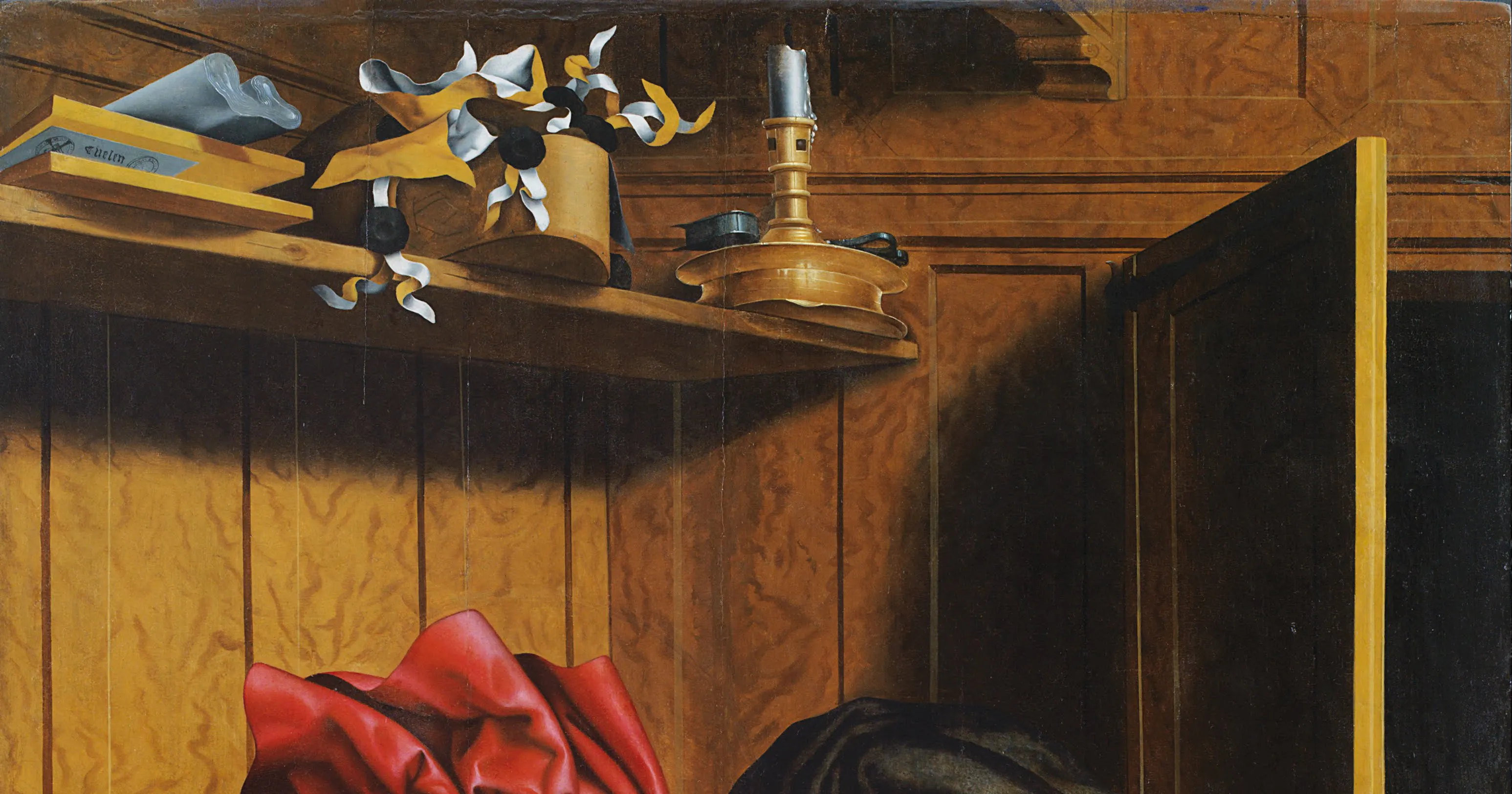
On Guillaume Budé's De Asse et partibus eius, first printed in Paris in March 1515
A royal insider who had dined at the Pope's table set a balance and a handful of ancient coins on his desk and used them to correct the sacred texts of antiquity, then turned the same instrument against the wealth of the Church and court he served. He professed loyalty and hoped for reform from within, even as his scholarship named the veneration of authority itself a piaculum, an act of sacrilege.
The balance and the little weights
Around 1513, somewhere in Paris, a lawyer kept a small brass balance and a set of tiny weights on his desk, laid out beside a scatter of ancient gold and silver coins. He wanted them where he could see them. When he was setting these things forth, Guillaume Budé wrote, in order to weigh everything the more exactly, he kept libellam & ponduscula in conspectu habui, the balance and the little weights, in view. This is not the posture of a man consulting an authority on a shelf. It is the posture of a man who intends to check the authority against the metal.
The book that resulted, On the As and Its Parts, takes its name from the as, the Roman bronze coin and, by extension, the pound of twelve ounces. Across five books Budé set out to recover the true value of Roman coinage, weights, and measures by physical measurement, then to convert those findings into the currency and Parisian modules of his own day. He interrogated a Parisian baker about how many loaves a modius of grain would yield. He walked into the gold-washing works, the chrysoplysium of some artisan of humble station, to watch how water separated the metal. He set three counting-pounds in a pan to test the sextarius. The question of how Renaissance scholars figured out ancient Roman money has a fairly precise answer, and it begins with this desk, and with objects like the coins Budé weighed on it.
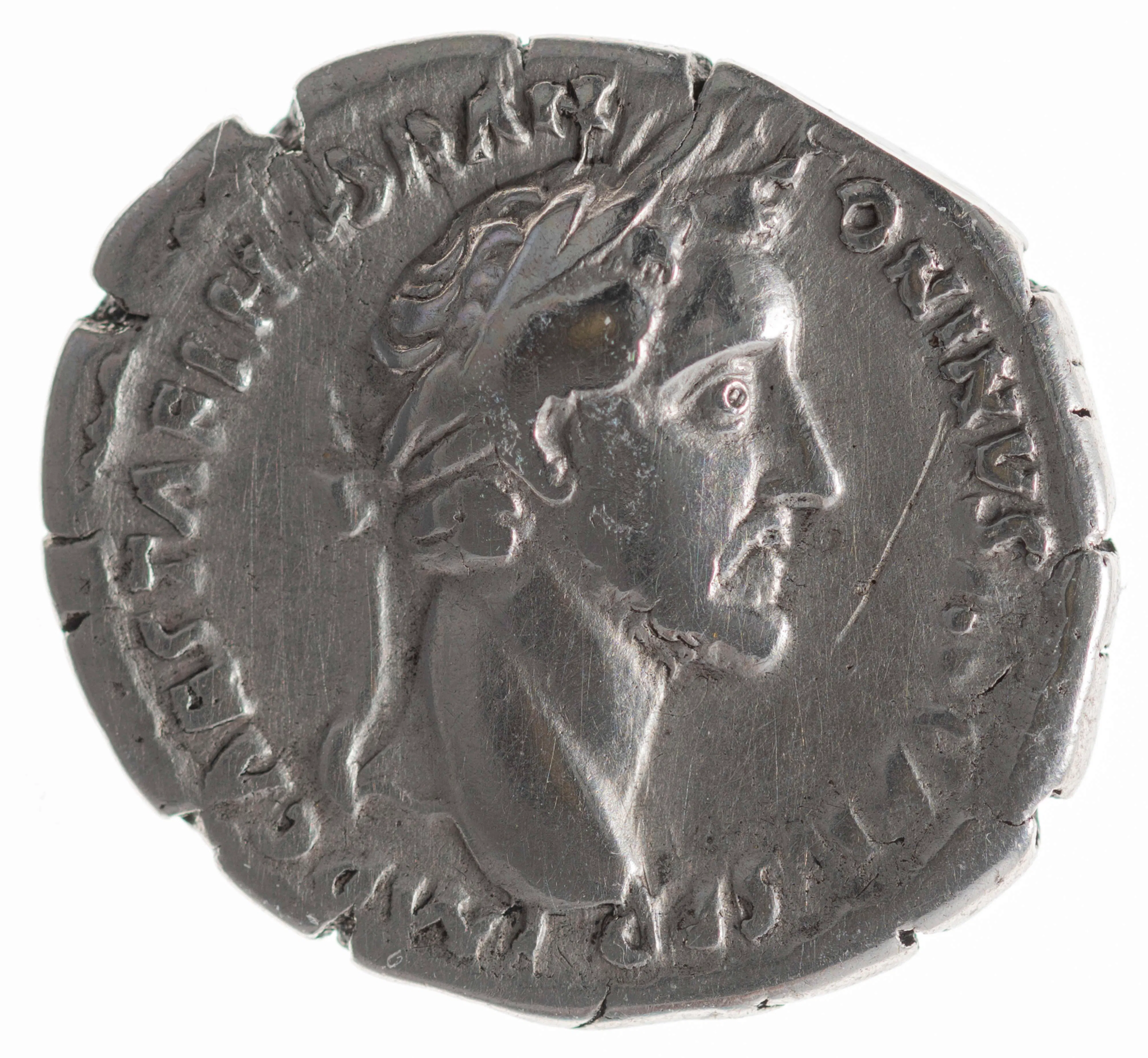
A Roman silver denarius such as this one, struck under Antoninus Pius, makes tangible the kind of evidence Budé brought to his desk: an imperial image and inscription joined to a measurable quantity of metal. In his hands, coins were instruments of correction, capable of weighing inherited manuscript numbers against the physical standards of Rome itself. Source ↗.
Why should I not?
What made the desk dangerous was the principle behind it. In medieval learning one did not correct Pliny. One deferred to him, along with the whole canon of ancient authors whose authority approached the sacral. Budé's method treated the ancients as fallible men and let a weighed coin overrule a revered text. Picture a culture in which the encyclopaedia can never be wrong, and then someone arrives with a measuring tape, checks the entry against the object itself, and demonstrates that the encyclopaedia had been misprinting the same figure for a thousand years. Budé was the man with the tape.
He knew exactly what he was doing. Confronting the objection that no modern had standing to doubt Pliny, he framed the act as sacrilege and then dared it anyway. Shall I bind myself to so great a piaculum, an act of sacrilege, he asked, as to deny or doubt that Pliny's authority stands above even the strongest arguments? Quidni id faciam? — why should I not do so? The word piaculum does the work. Budé names the veneration of authority in the vocabulary of the profane precisely to strip it of its holiness, and the clipped counter-question performs the very liberty it claims. The ground of that liberty is flat and deflationary. Those ancients too, he wrote, were homines ut nos, men as we are, who wrote down some things they had merely understood from their fathers. If we never depart even a nail's breadth from the words of received authors, he warned, posterity will have nothing to add to the discoveries of its forebears.
The hinge of the whole work
The payoff was a single grammatical distinction, which Budé called the cardo totius operis, the hinge of the whole work. A plural noun, sestertia centum, means one hundred thousand sesterces. A multiplicative adverb, sestertium centies, means ten million. Because scribes conflated the two forms for a thousand years, entire Roman state budgets in the surviving manuscripts were off by a factor of one hundred. It is the ancient equivalent of a typo that moves a decimal point, the difference between a government spending a modest sum and a colossal one, hidden inside a grammatical form copyists kept getting wrong. Here a fact of grammar became a fact of state finance. Ancient Roman numbers came down so badly mangled not through ignorance of arithmetic but through the silent decay of a single inflection.
The corruption surfaces in individual figures once one knows to look. Reading Suetonius on the equestrian census, Budé finds the qualifying fortune à quingentis sestertijs ad quadrin[g]enta contractum, contracted from five hundred thousand sesterces to four hundred thousand. He tracks such thresholds against one another until the inconsistent figure betrays itself, a forensic audit conducted on a broken ledger—and conducted, always, in a specific city.
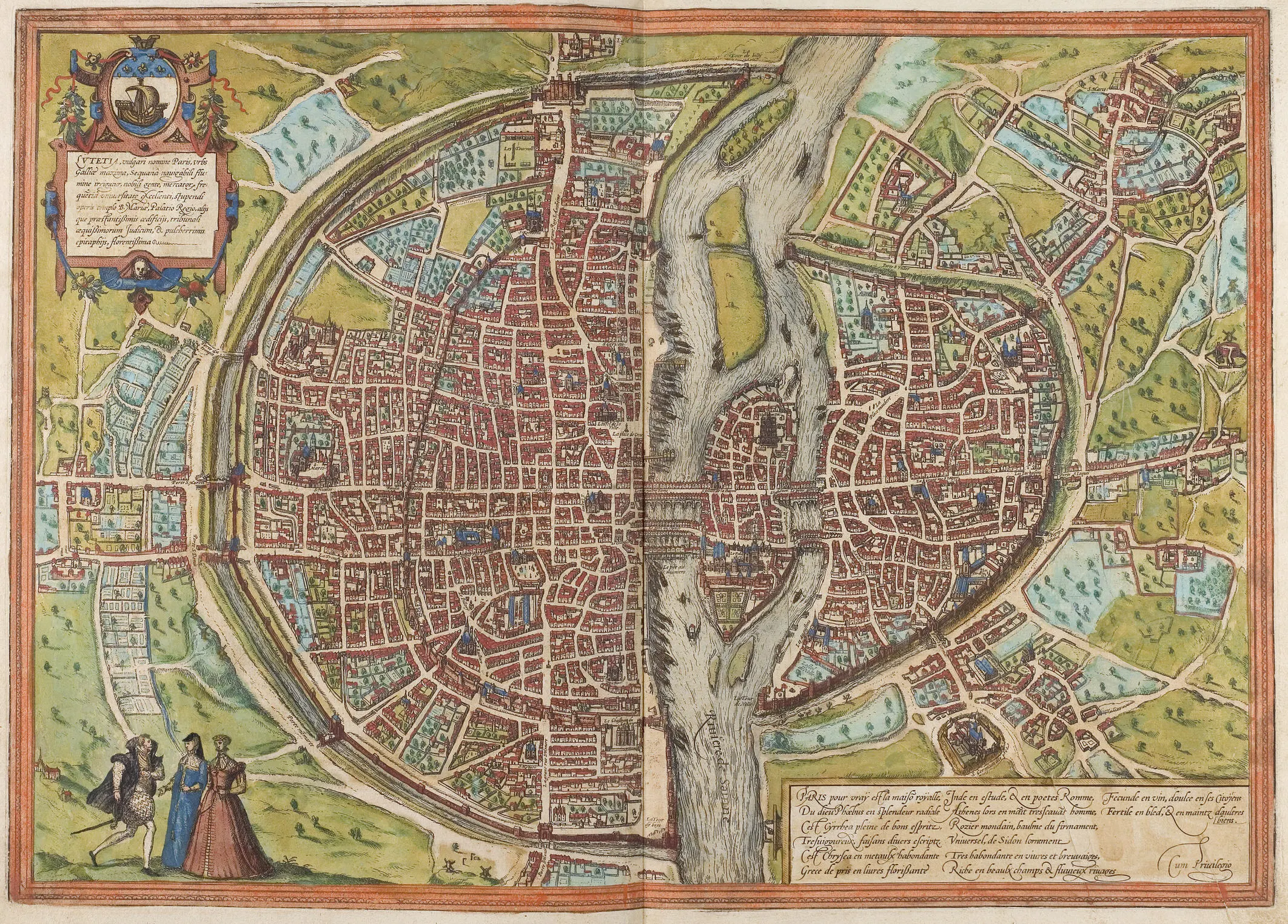
Braun and Hogenberg’s bird’s-eye view presents Paris as a compact city of courts, markets, bridges, and learned institutions—the urban setting whose everyday weights and reckonings helped Budé test ancient monetary figures. Against such a commercially dense backdrop, his correction of corrupted Roman census thresholds looks less like antiquarian guesswork than a Parisian audit of numbers gone wrong. Source ↗.
The little loaves
The measuring did not stay confined to money. Adjudicating a claim of Pliny's about the yield of fine flour, Budé reached for a memory. When he was at Rome ten years earlier, he recalled, he daily ate the bread that Pope Julius ate. They were panes paruuli, little loaves, such as one could easily snatch up in the hand. The recollection resolves a textual crux by appeal to what the author himself had held and eaten. It also quietly reminds the reader who is speaking. The man weighing Roman antiquity on a brass balance had been an ambassador to Leo X, had sat at the Curia, and would become chief royal librarian and prévôt des marchands of Paris. He was an insider of both court and Church.
And it is the insider who arraigns them. The same comparative machinery that priced a drachma against the French grossus now weighed the wealth of the modern church against the poverty of Christ, and found it grotesquely in surplus. Budé set the champion of poverty, ever girt with a black-clad band, against the prelates of his own day, men opibus circunfluentes, awash in riches and torpid with delights, conspicuous at court in their silken retinue. He drew the contrast with a soldier's vocabulary, a disciplined cohort of the poor against a soft comitatus of the rich. Three years before Luther's theses, this is already a scholar arraigning rich clergy, and it complicates the tidy assumption that such critique arrived only from outside the establishment. Budé's came from a man who had eaten the Pope's bread.
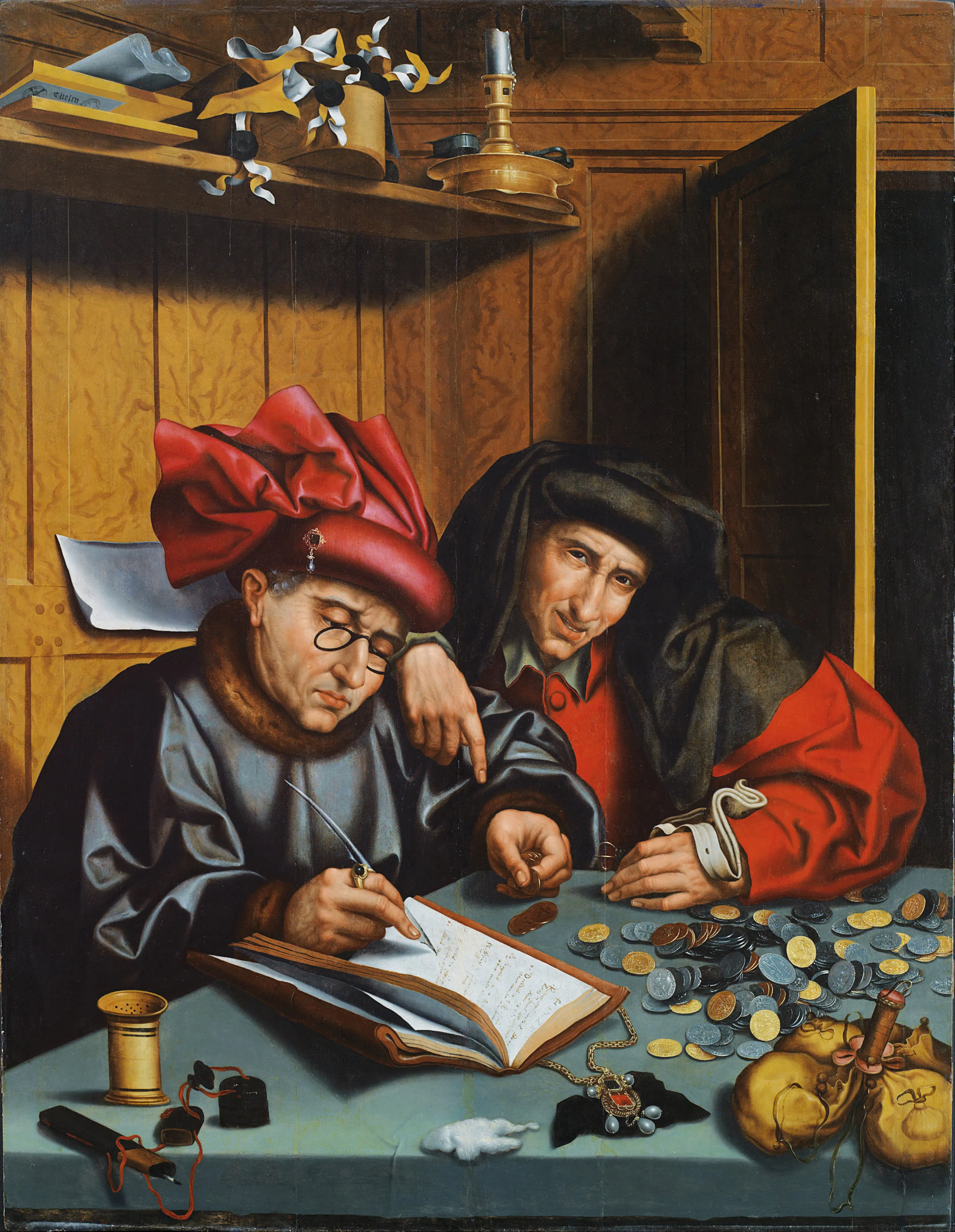
In this follower of Marinus van Reymerswaele’s Money Changers, coins are handled, counted, and entered into a ledger under a second figure’s wary gaze. Its moralizing fascination with reckoning makes a sharp visual analogue for Budé’s double move here: using the tools of monetary comparison to measure—and indict—the surplus wealth of clergy against the poverty of Christ. Source ↗.
Yet it remained reform from within. He prayed and hoped that some summum quendam pontificem, some supreme pontiff, would soon arise to be ennobled with the name of Hercules the averter of evil. He wanted the office cleansed, not toppled. The invective was no digression. The index of the folio files it as a discrete head-word, Aulæ elogiu[m] et crimina, the eulogy and crimes of the court, catalogued for retrieval like any technical term, the moral matter filed on the same shelf as the weights.
Letters grow cold at court
The book carries its own closing scene, a disputation with the humanist François Deloin that Budé decided to weave into the work both for pleasure and as an eternal monument of their friendship, for Deloin and Budé were held a notable pair in the city. In the dialogue Deloin presses him to abandon his studies, since letters "grow cold" at court, and Budé refuses to become a chameleon-scholar taking every colour. Then the death of Louis XII on the first of January 1515 interrupts the exchange, and it resumes under the accession of Francis I, upon whom the hope for letters is now fixed. The whole meditation on the vanity of the court hangs suspended between disenchantment and a genuine expectation that the new reign might reverse the cooling.
He had watched the machinery closely. Budé had enumerated the three heads of French royal exaction, the Canonem, Oblationem, & Indictionem, together with the calendar manipulations that multiplied them, and then described his countrymen as peculiarly compliant subjects who submit for their king's sake. The very docility he offered as a national virtue was the condition that made the exactions possible. He never quite dissolved that strain. He dedicated the book not to a patron but to the Genius of France, kept the balance in view, and left the contradiction on the desk beside it.
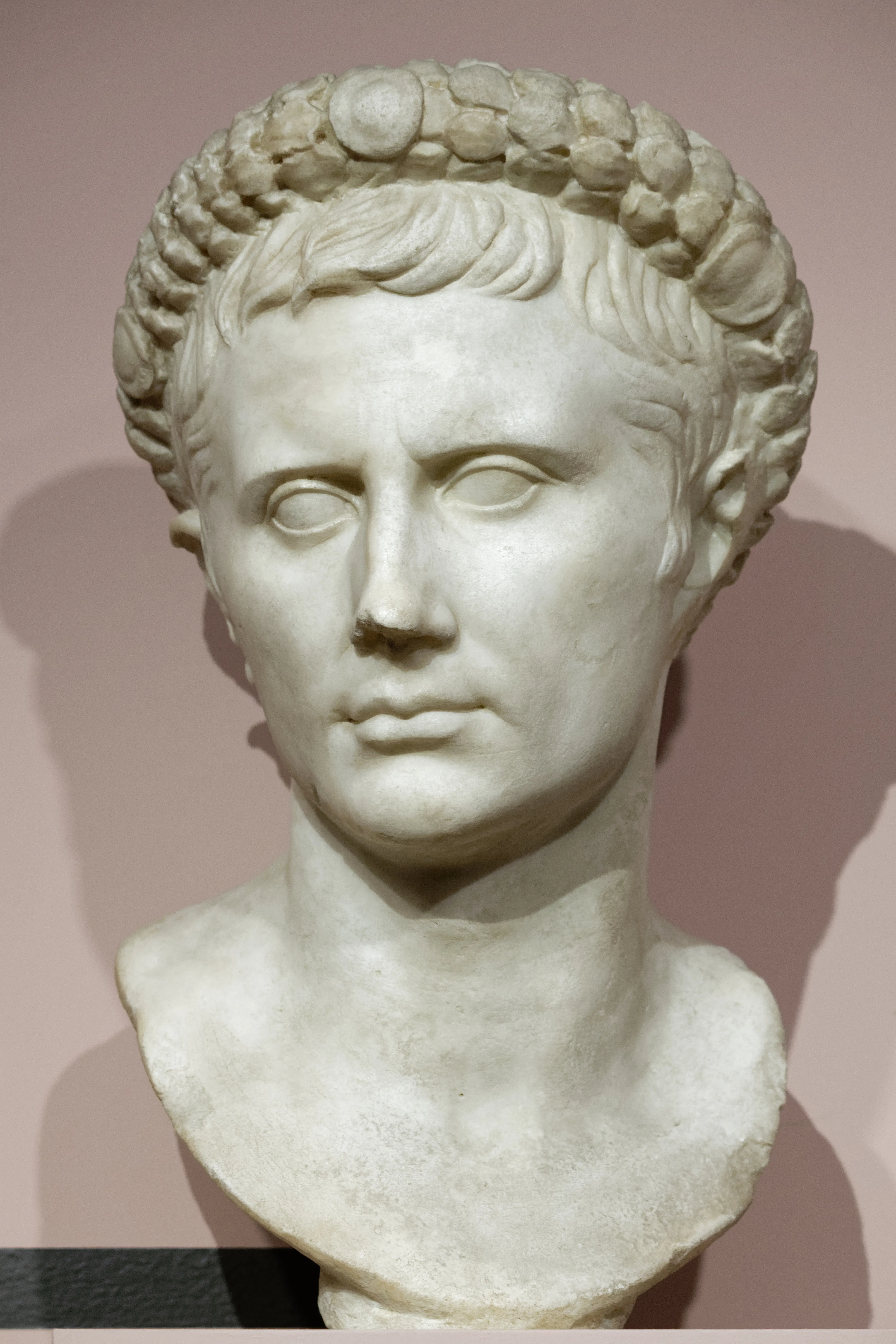
A gem-crowned marble portrait of Augustus evokes the imperial fiscal world that gave Budé his ancient point of comparison: census ratings, revenues, and monumental opulence weighed against the exactions of his own France. Its calm, idealized face is less a direct illustration of his argument than a reminder that his critique of modern taxation depended on turning Roman administrative memory into a measuring rod. Source ↗.
More from ExLatinis
This text was transcribed and translated as part of the ExLatinis project—an effort by Leo to make English translations of every published text in Latin in early modern Europe (between 1450 and 1750) available to the public for free online.
→ Read the full transcription and translation on Leo
You can save a copy of this document into your Leo account to run deep text searches, conduct further analysis, or cross-reference it with your own research.
If you want more than an introduction, you can also consult a full, in-depth report drawn from the original transcription alongside relevant secondary sources, with extended analysis and historical context beyond the scope of this post.
→ Read the full in-depth report and finding guide
Critical Further Reading & Contextual Resources
- Guillaume Budé, Épitomé du livre De Asse, ed. Marie-Madeleine de La Garanderie and Luigi-Alberto Sanchi: This is Budé trimming his own formidable metrological thicket for a French-reading courtly audience, which is to say: the author caught revising his own public usefulness. Because the full Latin De Asse still lacks a modern critical edition, this edited epitome is the nearest safe foothold for checking how the coin tables, fiscal comparisons, and moral pressure-points survived compression.
- Wesley Burnett, “Budé's Breviarium: Authorship, Date and Sources,” Bulletin of the Institute of Classical Studies: Burnett does the unglamorous work without which grand claims about Renaissance measurement tend to float away on Latin vapor. His comparison of Budé, the 1522 epitome, and Tunstall shows how metrological knowledge moved by copying, pruning, and quiet recalculation—the exact sort of clerical arithmetic this post depends on.
- Wesley Burnett, “A Science on the Margins of Numismatics: A History of Metrological and Metallurgical Studies,” The Metallurgy of Roman Silver Coinage: If Budé’s little balance seems too theatrical, Burnett explains why it was in fact a method. The chapter places him among the early modern coin-weighers and metal-testers who made antiquarian learning answer to matter, not merely to manuscript pedigree.
- Louis Delaruelle, Guillaume Budé: les origines, les débuts, les idées maîtresses: Delaruelle is old enough to have acquired a patina, but not old enough to be safely ignored. His biography remains valuable for the years in which De Asse took shape, especially Budé’s odd position as court servant, Christian reformer, and man perpetually tempted to scold the institutions that employed him.
- Marie-Madeleine de La Garanderie, “Guillaume Budé, A Philosopher of Culture,” Journal of the History of Ideas: Garanderie gives the most compact English account of why Budé should not be filed away as a clever technician of Roman money. Her Budé is a Christian humanist trying to make philology, politics, and moral discipline speak in the same room, which helps explain why a book about ounces keeps flaring up over ecclesiastical wealth.
- Marie-Madeleine de La Garanderie, “L'harmonie secrète du De Asse de Guillaume Budé,” Bulletin de l'Association Guillaume Budé: This is the essay to read when the anticurial passages start to look like an accidental sermon smuggled into an accountant’s manual. Garanderie argues that the moral indictment is built into the measuring itself: Budé’s numbers do not merely price antiquity; they put modern Christian luxury in the scales and let it look ridiculous.
This blog post is intended as a brief, exploratory introduction to the text. It was generated autonomously by an advanced AI assistant as part of the ExLatinis digital humanities initiative and should be treated as a primer to foster curiosity rather than a replacement for peer-reviewed scholarly sources, formal critical editions, or definitive historical commentary.