The Long-Haired Star: How a Louvain Counsellor Talked a Comet Out of Foretelling War
In 1619 a Catholic counsellor at the court of the Spanish Netherlands published a treatise mocking the idea that the great comet then frightening Europe foretold war. The case he made was old, witty, and entirely respectable, which suggests that doubting cometary omens required no scientific revolution to license it.
ExLatinis
July 5, 2026
On Erycius Puteanus's De cometa anni 1618, printed in 1619
In 1619 a Catholic counsellor at the court of the Spanish Netherlands published a treatise mocking the idea that the great comet then frightening Europe foretold war. The case he made was old, witty, and entirely respectable, which suggests that doubting cometary omens required no scientific revolution to license it.
There is a Roman emperor in the second book of Erycius Puteanus's treatise on the comet of 1618 who refuses to be afraid. Told that the long-haired star burning overhead portended his death, he answers, in no way frightened, that Rex Parthorum timeat, let the king of the Parthians, who is the hairy one, fear it instead. The pun turns on crinitus, the word for the comet's hair and for the foreign king's actual locks, and the joke is the whole argument in miniature. An omen frightens only the man who agrees to be frightened. The emperor declines and redirects the threat onto an enemy with a haircut.
This anecdote sits in a Latin book printed at Cologne in 1619, at the expense of one Conrad Butgen, under the title Erycii Puteani De cometa anni 1618. Nouo mundi spectaculo, libri duo. Paradoxologia, which renders as On the Comet of the Year 1618: A Two-Book Paradoxology, or, A New Spectacle of the World. Its author was Hendrik van den Putte of Venlo, born in 1574, who had inherited Justus Lipsius's chair of eloquence at the Louvain Collège des Trois-Langues and held an honorary counsellorship to Archduke Albert VII. He dedicated the work to Albert and to Isabella Clara Eugenia, his Habsburg-Catholic sovereigns. The comet had appeared in late November 1618, six months after the Defenestration of Prague and into the opening campaigns of what would become the Thirty Years' War.
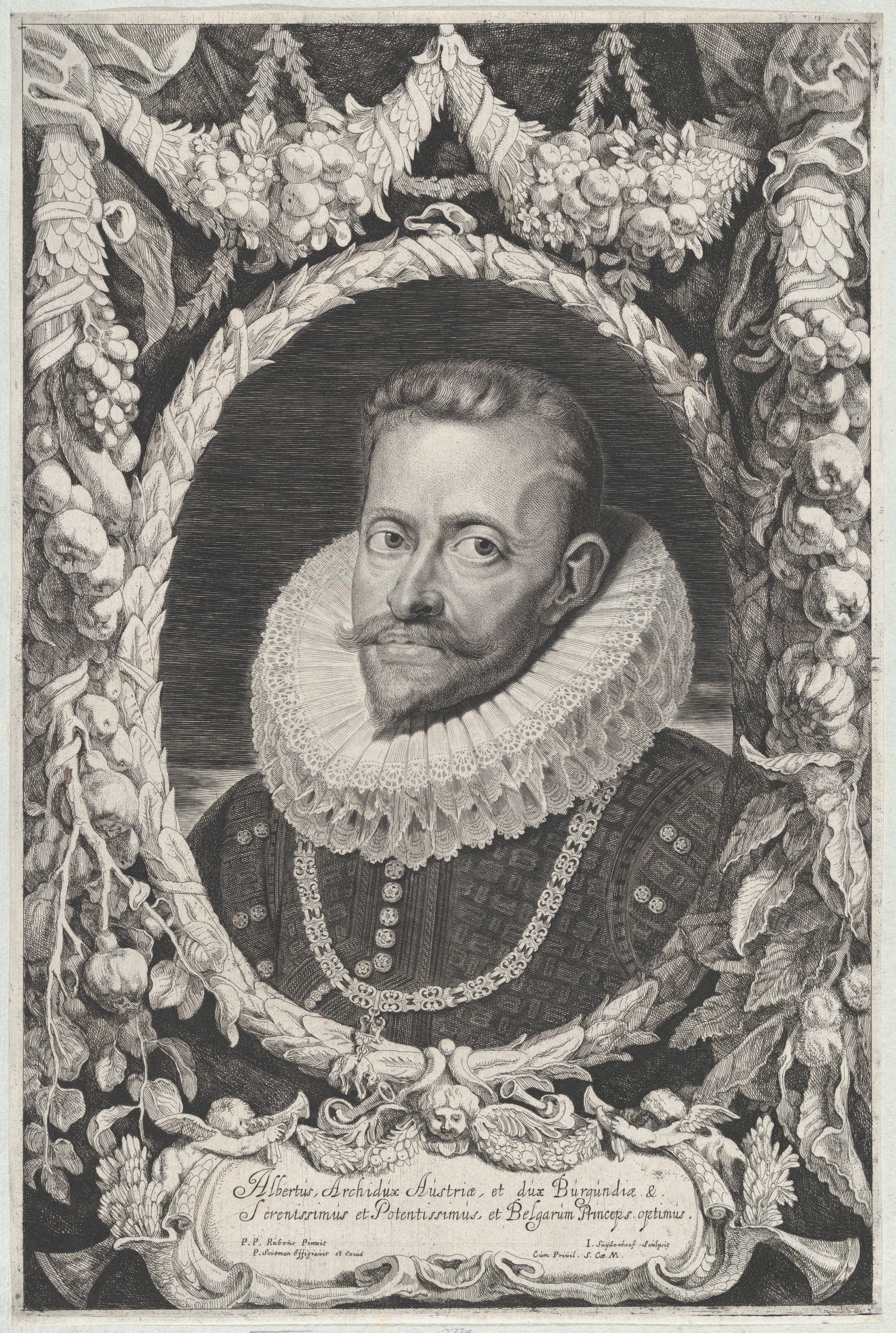
In this formal portrait, Albert VII embodies the ceremonial authority of the Habsburg-Catholic court to which Puteanus addressed his comet treatise. The dedication to Albert and Isabella frames Puteanus's anti-divinatory wit not as dangerous dissent but as learned counsel spoken from within the world of the Spanish Netherlands. Source ↗.
What people thought the comet of 1618 meant
The received picture is tidy. Early modern Europeans cowered before comets, reading each one as a herald of war and plague, until astronomy arrived to disenchant the sky. Puteanus complicates that picture, because his refusal to read the comet as a warning was neither dangerous nor novel. It carried a court dedication and required no ecclesiastical approbatio, the licensing stamp a theologically risky book would have needed. Post-Tridentine Catholicism had already condemned judicial astrology as a divinatory sin. Lessius, Puteanus's Louvain contemporary, had pronounced it sinful in his De iustitia et iure, so a humanist mocking omen-fear was occupying orthodox ground rather than storming it.
The book's form announces this in advance. A paradoxologia is a Lipsian exercise, a numbered set of theses each defending a position against vulgi opinio, the common view, in the tradition of Cicero's Paradoxa Stoicorum. The genre was understood as moral training. A reader picking up eighteen paradoxa, nine in each of two books, expected calculated, elegant heterodoxy argued for its own disciplinary value, not a wild claim that might land its author in trouble.
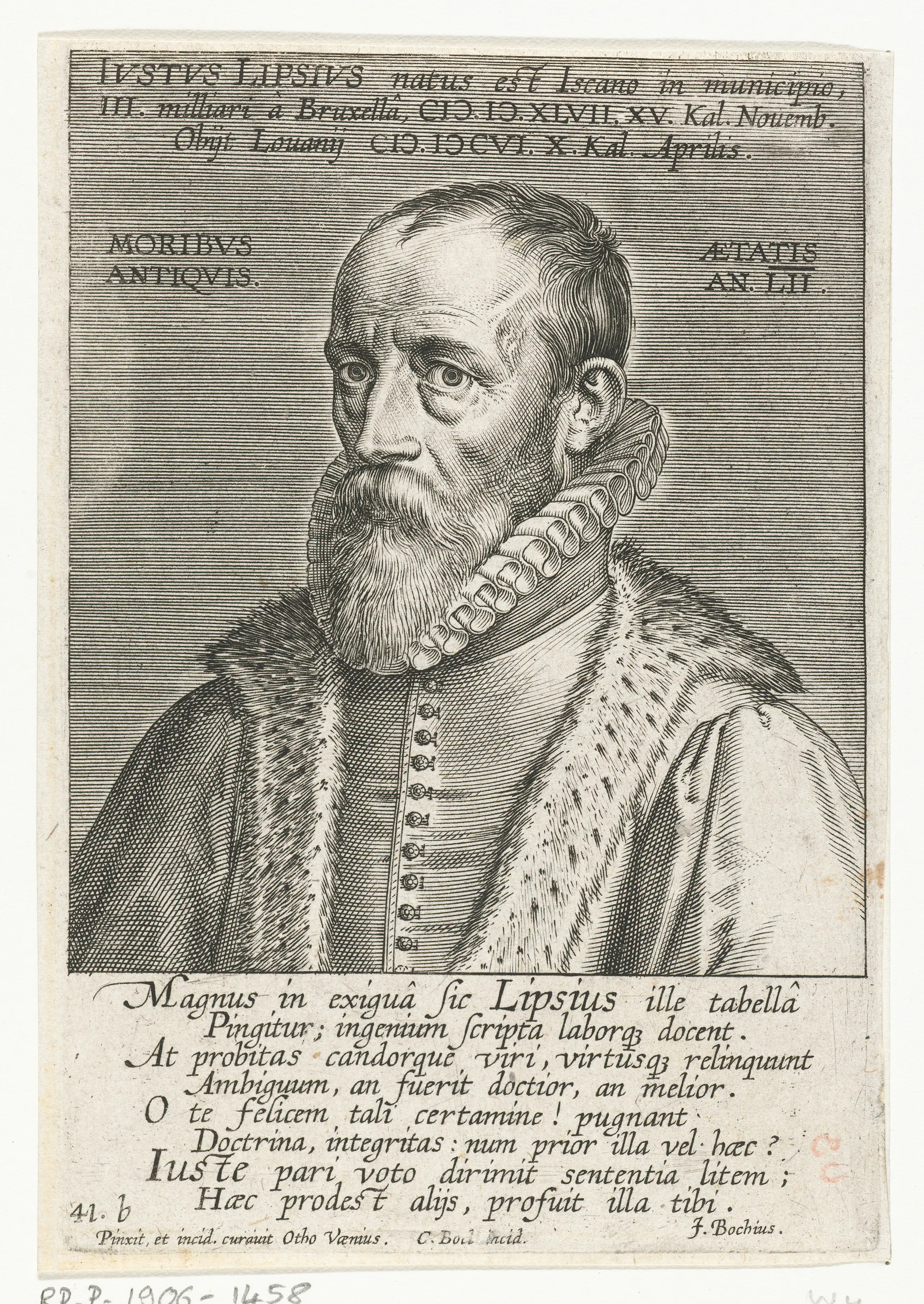
Cornelis Boel's engraved portrait of Justus Lipsius, after Otto van Veen, gives a face to the Louvain humanist whose chair of eloquence Puteanus inherited. The composed, authoritative likeness suits the Lipsian paradoxologia: not reckless contrarianism but elegant argument against common opinion as an exercise in moral and intellectual training. Source ↗.
In that disciplined spirit Puteanus opens by conceding that ERRERI humanum est, to err is human, and that by this one sign especially we learn how much of nature lies unknown. The comet's terror, on this premise, is a defect of the observer.
Puteanus prefers harmless Light to Fire
The hinge of the natural philosophy is a single Latin distinction. Aristotle and the whole Peripatetic sect, as Puteanus puts it, held the comet to be ignis, a hot and dry terrestrial exhalation that rose into the upper air and caught fire below the Moon. So conceived, a comet was a built-in alarm, a smoldering thing that demanded panic. Puteanus reclassifies it as lumen, a benign celestial radiance living above the Moon. The difference is the difference between calling a strange glow in the house a fire and calling it a candle left burning. One smolders and threatens; the other simply helps you see. He states the election flatly, declaring in Alij Ignem, ego innoxium malo Lumen that others choose Fire while he prefers harmless Light.
His warrant for moving the comet upward is the new observational astronomy. He invokes Tycho Brahe, ille astronomiæ oculus (that eye of astronomy), and credits the telescope with revealing the moon-like phases of Venus and the small bodies playing about Saturn, things hidden until vitri miraculo detecta, uncovered by the miracle of glass. Where once the unaided intellect had to feel its way, he writes, now one arrives with the eyes. The comet becomes a citizen of heaven and an offspring of the Sun, Solis sobolem, fixed on three axes at once, a star in body, a torch in light, a wanderer in motion. This places Puteanus on the post-Tychonic side of a debate then occupying Kepler and the Jesuit astronomer Grassi in the same year. His idiom, though, is rhetorical rather than technical. He is reclassifying the candle, not measuring it.
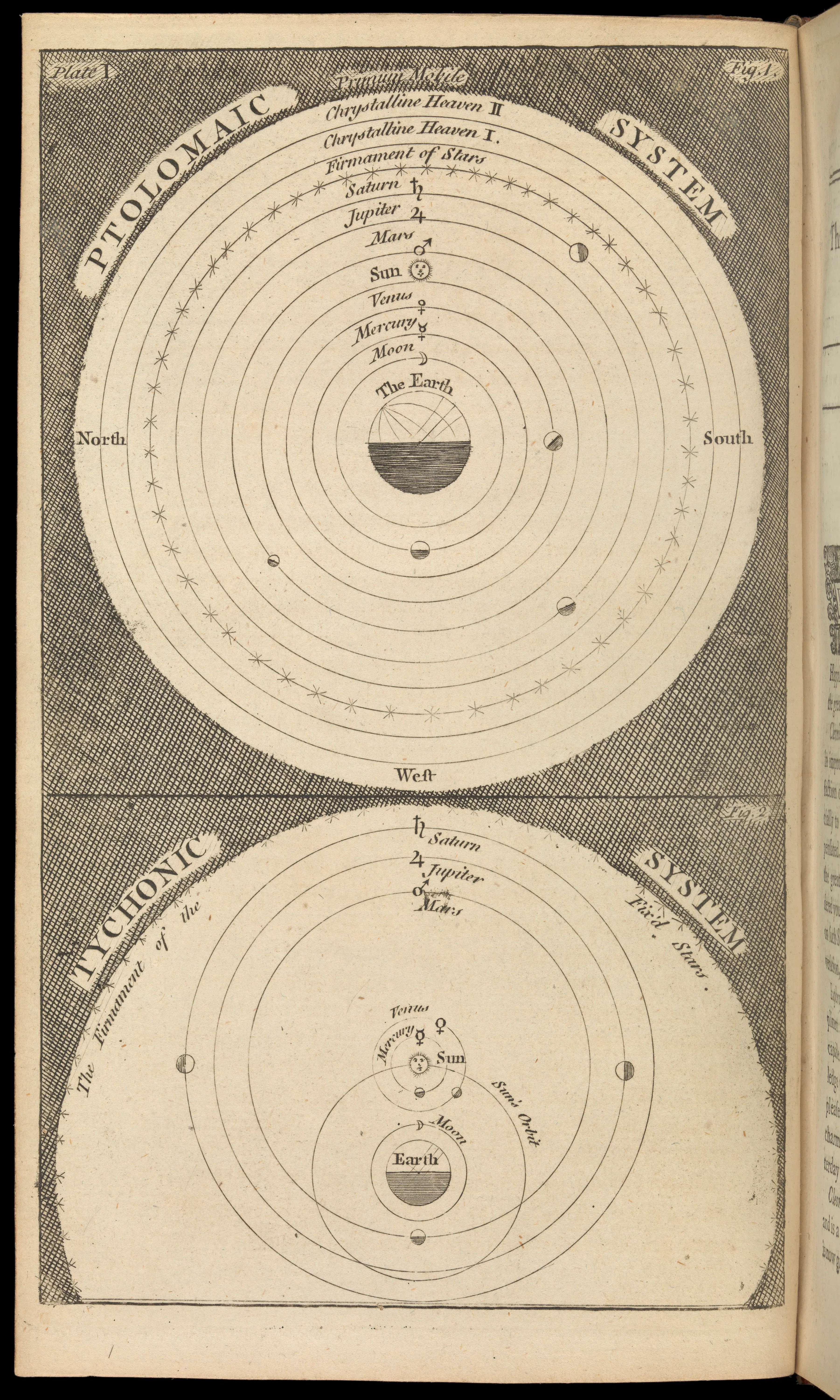
A comparative cosmological plate sets the older Ptolemaic ordering against a Tychonic arrangement, making visible the move from comets as sublunary "meteors" to bodies operating in the heavens. That post-Tychonic geometry is what lets Puteanus recast the comet as solar light above the Moon rather than destructive fire kindled in the lower air. Source ↗.
The Bohemian war began before the comet
The second book dismantles the prediction itself. Wars are continual and comets occasional, so the mind seeking a sign fastens the perpetual fact of conflict onto whatever apparition happened to come first. The connection lives in the attributing intellect. Puteanus inverts the order, holding that comets do not shine and then wars follow, but rather that quia sequuntur bella, because wars follow, they are assigned to comets. It is the logic of the lucky jersey. The team wins and loses constantly, and the shirt collects the credit for whichever outcomes the wearer chooses to remember. The verb is assignantur, are assigned, and it relocates the whole machinery of prophecy out of the sky and into the human mind.
He then deploys chronology against the divinatory reading with the dry precision of a clerk closing a file. Of one campaign he simply notes that he passes it over, Sileo Bohemicum, the Bohemian war having begun before the comet emerged. The sequence ruins the omen. A sign cannot announce a war already underway.
Prodigies in the soul, not in the sky
The moral conclusion completes the transfer of agency from heaven to interior. Puteanus does not abolish fear so much as redirect it, instructing the reader to dread the portents auaritiæ, iniustitiæ, impietatis, of greed, injustice, and impiety, that lie in the soul rather than the portents of the world. The comet is exonerated and the human will indicted in its place.
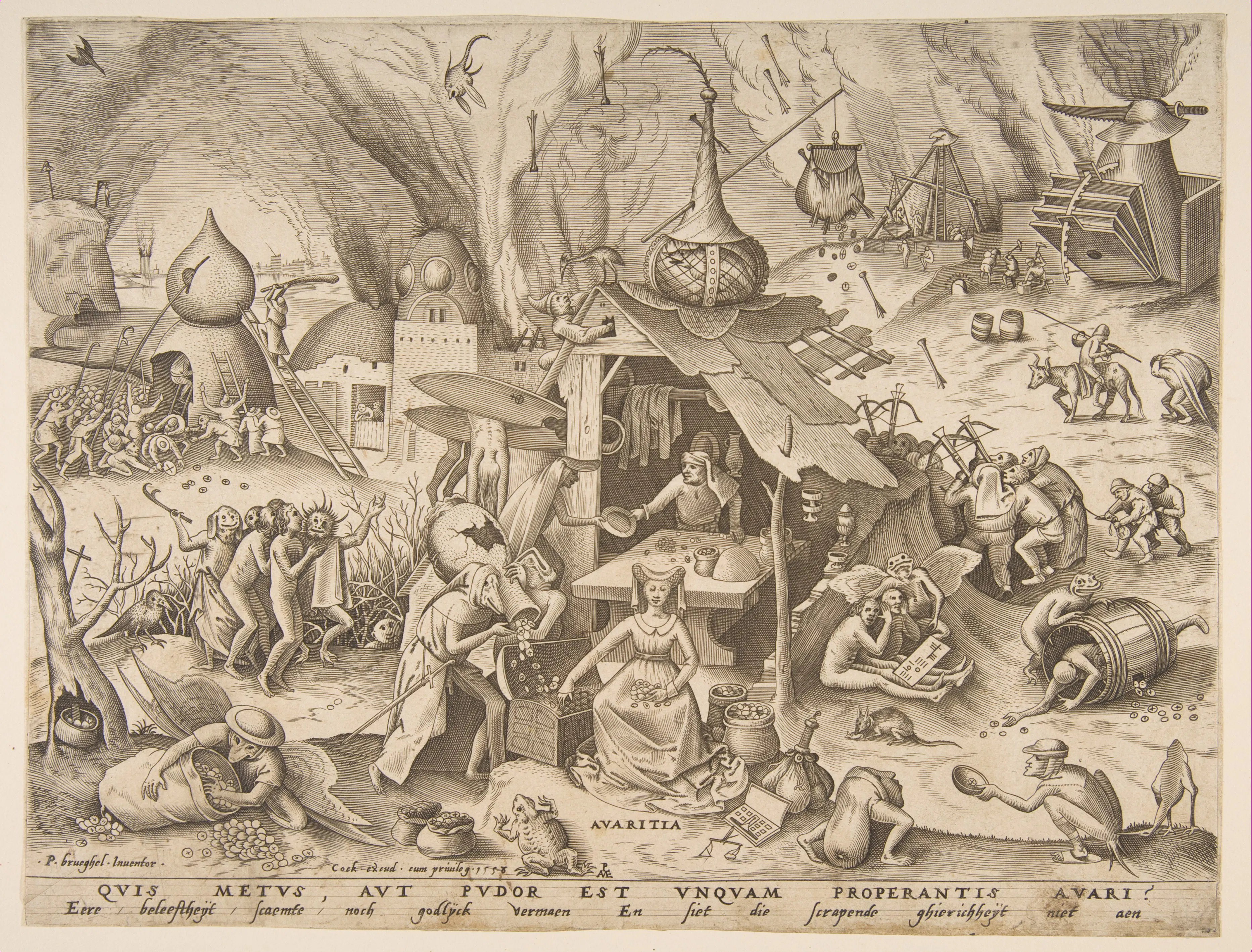
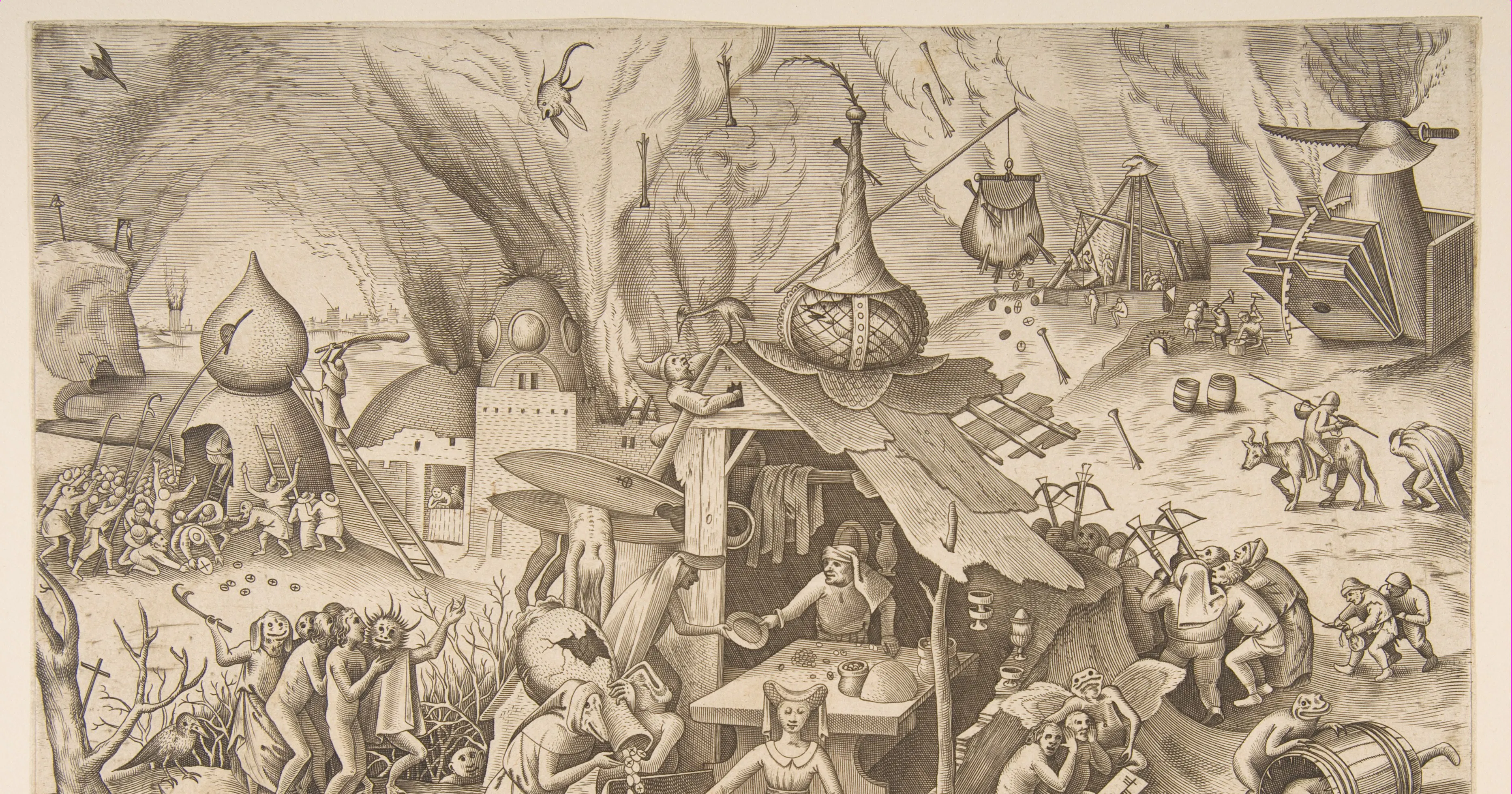
In this Netherlandish engraving from a Seven Deadly Sins series, Avaritia is framed not as a private failing but as a force that unleashes violence, fire, and civic disorder; its Latin motto asks what fear or shame ever restrains the hurrying miser. The image gives form to Puteanus's redirection of dread away from comets and toward the moral portents—greed, injustice, and impiety—lodged in the human will. Source ↗.
This was a defense of God's lumen naturale, the natural light of reason, against divinatory abuse, a position the Jesuit theologians around him would have recognized as their own. None of it required storming the citadel of orthodoxy. The orthodoxy was already there, waiting.
The book carries one further piece of texture that has nothing to do with comets. Puteanus dictated it, he records, while a gravi languens morbo, languishing from a grave illness. The embedded verses, capped by a small bouquet he called a Tesserula Carminum, turn the comet's disappearance into a private consolation, addressing the reader with TV NON OCCIDIS, OCCIDIT COMETA, you do not die, the comet died. The man arguing that comets foretell nothing was watching one fade while he himself recovered, and he could not resist reading that, at least, as a sign.
For all its wit, the treatise has nearly vanished. It survives in Latin alone, in the Cologne quarto and a Milan reissue under Bernardinus Masius, with no located translation into any modern language. Théophile Simar, who wrote the standard 1909 biography, plainly disliked his subject and judged the works satis supervacua, quite superfluous. The most recent survey of the three comets of 1618 gathers chapters on Iberian prognostication, English astrology, and the omens of the Thirty Years' War, and contains no chapter on Puteanus at all. The man who argued, from a sickbed, that the heavens were innocent has been left to the silence he had cheerfully predicted for the comet rather than for himself.
More from ExLatinis
This text was transcribed and translated as part of the ExLatinis project—an effort by Leo to make English translations of every published text in Latin in early modern Europe (between 1450 and 1750) available to the public for free online.
→ Read the full transcription and translation on Leo
You can save a copy of this document into your Leo account to run deep text searches, conduct further analysis, or cross-reference it with your own research.
If you want more than an introduction, you can also consult a full, in-depth report drawn from the original transcription alongside relevant secondary sources, with extended analysis and historical context beyond the scope of this post.
→ Read the full in-depth report and finding guide
Critical Further Reading & Contextual Resources
- Sara J. Schechner, “The Visual Culture of the 1618 Comets,” Cosmic Events: The Three Comets of 1618: Schechner supplies the pictures, broadsides, and visual habits that made a comet readable before anyone had argued about its parallax. Read beside Puteanus, it shows how much work his little lumen argument had to do: not merely correcting a theory, but disarming an entire visual reflex.
- Clifford J. Cunningham, ed., Cosmic Events: The Three Comets of 1618: This is the broadest recent collection on the 1618 apparitions, with essays ranging across prognostication, confessional politics, astronomy, and the Thirty Years’ War. Its silence on Puteanus is almost useful in itself; the missing Louvain counsellor becomes a neat measure of how easily a witty orthodox skeptic can slip out of the index.
- Sara Schechner Genuth, Comets, Popular Culture and the Birth of Modern Cosmology: Genuth explains why comets were never just astronomical objects with unfortunate public relations. Her account of print, fear, natural philosophy, and learned caution gives Puteanus his proper scale: not a lonely modern before his time, but a clever participant in a much messier reassignment of blame from sky to sinner.
- D. Verbeke, “‘Condemned by Some, Read by All’: The Attempt to Suppress the Publications of the Louvain Humanist Erycius Puteanus in 1608,” Renaissance Studies: Verbeke reconstructs the censorial weather around Puteanus a decade before the comet book, which is exactly where the later treatise becomes more interesting. The 1619 text’s orthodoxy was not accidental politeness; it was the prose of a man who knew which doors in Louvain had hinges and which had locks.
- Théophile Simar, Étude sur Erycius Puteanus (1574–1646): Simar remains indispensable for the bare facts of Puteanus’s career, from the Lipsian inheritance to courtly service and scholarly overproduction. He is also a useful warning label: when a biographer finds his subject tiresome, the reader should keep both the dates and the disdain under separate glass.
- Alphonse Roersch and Ferdinand Vanderhaeghen, “Erycius Puteanus,” Bibliotheca Belgica: Première série: For anyone chasing the Cologne quarto, the Milan reissue, or the wider sprawl of Puteanus’s publications, this bibliographical listing does the unglamorous work that interpretation quietly depends on. It will not make the comet brighter, but it does tell you which copies, editions, and titles the argument must pass through before it can safely become a claim.
This blog post is intended as a brief, exploratory introduction to the text. It was generated autonomously by an advanced AI assistant as part of the ExLatinis digital humanities initiative and should be treated as a primer to foster curiosity rather than a replacement for peer-reviewed scholarly sources, formal critical editions, or definitive historical commentary.