The Ointment-Bearer at Ephesus: How a Sorbonne Doctor Threw Out a Saint's Tomb on a Point of Chronology
In 1643 a Sorbonne theologian took a Jesuit's defense of Mary Magdalene's Provençal tomb and dismantled it with a single rule: that no testimony holds unless a writer recorded it before the year 600. His obscure Latin quarrel over a saint's grave shows critical source-criticism working out in the open years before the great monastic scholars are usually credited with inventing it.
ExLatinis
July 5, 2026
On Jean de Launoy's Disquisitio disquisitionis de Magdalena Massiliensi advena, 1643
In 1643 a Sorbonne theologian took a Jesuit's defense of Mary Magdalene's Provençal tomb and dismantled it with a single rule: that no testimony holds unless a writer recorded it before the year 600. His obscure Latin quarrel over a saint's grave shows critical source-criticism working out in the open years before the great monastic scholars are usually credited with inventing it.
The first volume of the Acta Sanctorum, the Bollandists' monumental sifting of the saints, appeared in 1643 with its treatment of the January calendar. In the same year, from an unlocated press, came a slighter object of ninety-five pages signed Auctore Ioanne Delaunoy. The Bollandist enterprise is where the textbooks locate the birth of critical hagiography, in a workshop of Jesuit scholars methodically weeding the calendar. The ninety-five-page pamphlet suggests the discipline was already being practiced elsewhere, in a street fight over a corpse.
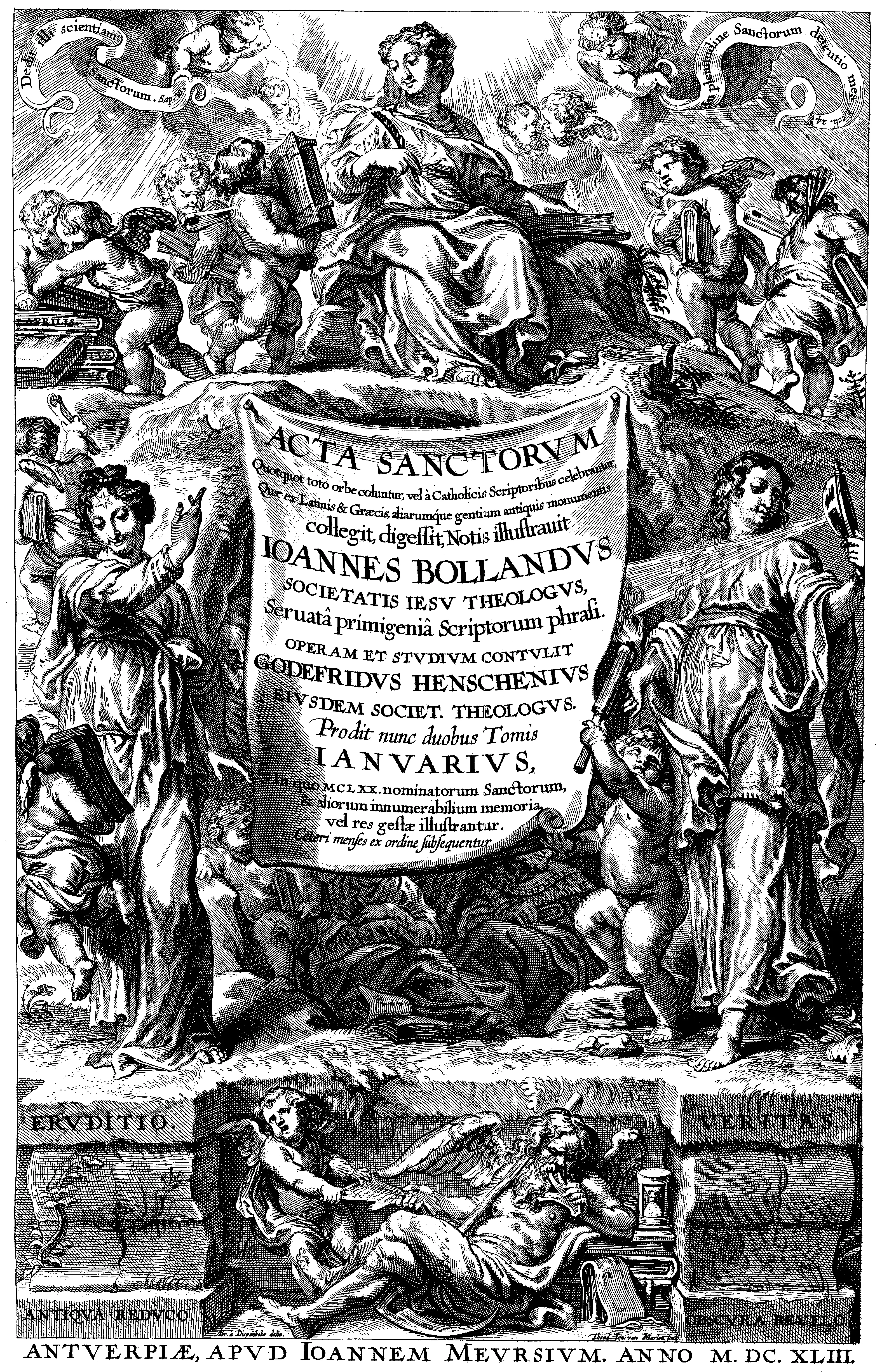
The 1643 January volume of the Acta Sanctorum announces a program of learned truth, framed by the virtues Eruditio and Veritas, that would become synonymous with critical hagiography. Set beside Launoy's slighter attack on the Provençal Magdalene, its title page shows how a single year could produce both institutional scholarship and pamphlet-scale demolition. Source ↗.
Jean de Launoy, a Norman doctor of the Sorbonne with Jansenist sympathies whom his contemporaries called le Dénicheur de saints, the debunker of saints, had read Jean-Baptiste Guesnay's freshly printed defense of the tradition that Mary Magdalene, along with Lazarus, Martha, and Maximinus, had sailed to southern Gaul, retired to the cave of La Sainte-Baume, and been buried at Saint-Maximin. Guesnay had titled his book Magdalena Massiliensis advena, casting the saint as a newcomer to Marseille. Launoy answered with An Inquiry into the Inquiry on Mary Magdalene as a Newcomer to Marseille. The genre-name of learned dispute, disquisitio, was thereby aimed twice, the inquiry turned back upon the man who had written one, and Launoy kept Guesnay's word advena, a newcomer, because such a figure, by the logic of the term, holds no ancient title to a tomb. He took the book, he wrote, as the thing to examine and cancel in passing, so filled with errors and trifles, tot erroribus, nugisque oppletæ est.
The auditor, not the historian
The verb Launoy chose for his method, dispungere, belongs to accountancy. It means to strike a settled item from a ledger. He did not present himself as a rival historian offering a better account of where the Magdalene died. He presented himself as an auditor who had found the books cooked. Under the heading he calls a malæ fidei syllabum, a syllabus of bad faith, he promised an itemized register of misrepresentations, each cited authority charged and struck through in turn. The phrase mala fides carries the sense of willful deception rather than honest error. The charge was stated fourfold. Guesnay's party had contended with audacity, ignorance, calumny, and dissimulation, audacia, ignorantia, calumnia, & dissimulatio, two vices aimed at the will and two at the handling of sources. This is the forensic audit of a fraudulent expense report, where the point is never whether the story is edifying but whether every receipt was faked, until the whole claim collapses under its own falsified paper.
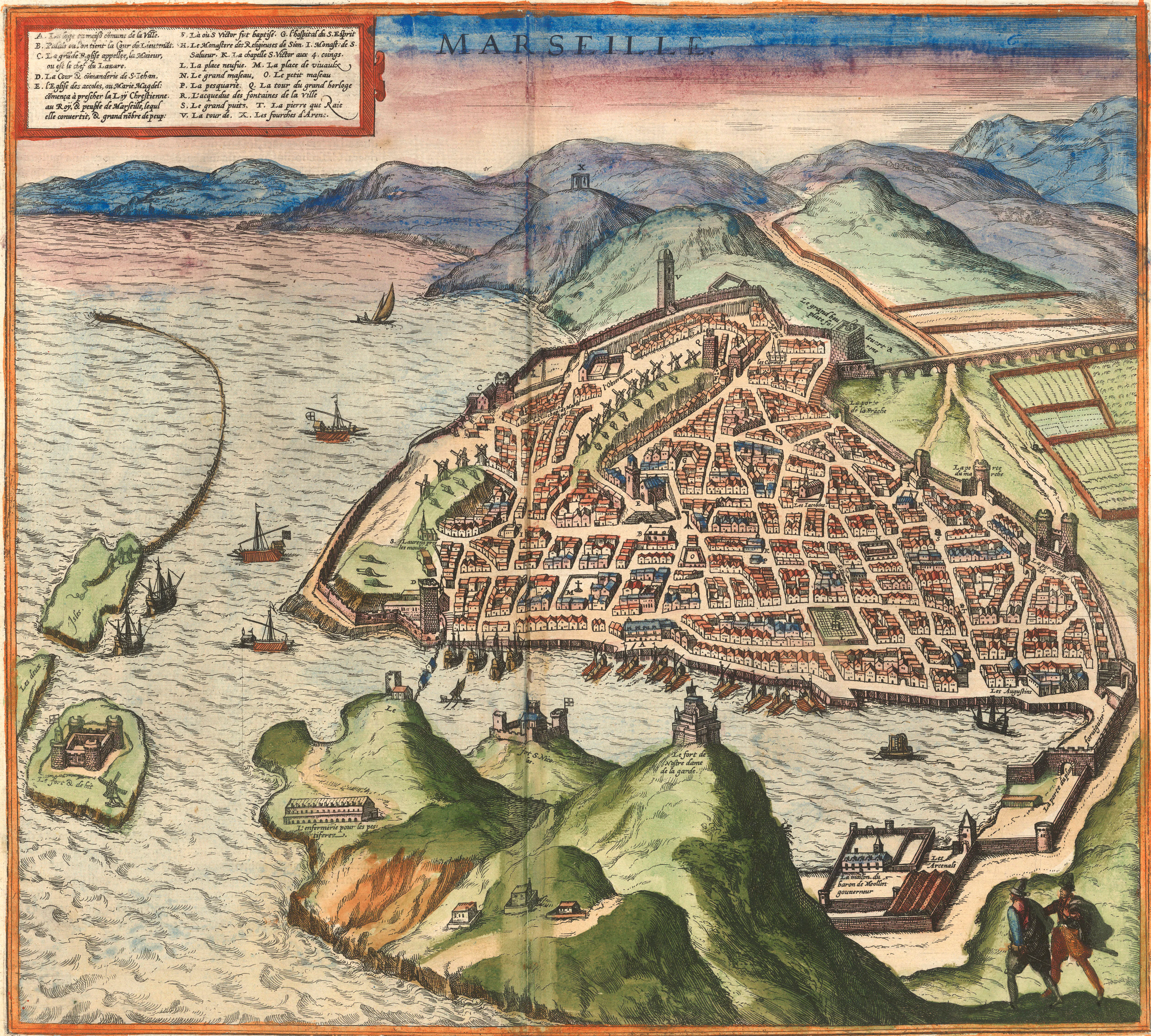
Braun and Hogenberg's sixteenth-century engraved panorama of Marseille turns the Magdalene legend from doctrinal abstraction into an urban claim. Against such a living devotional landscape, Launoy's accountancy verb dispungere reads as an attempt to strike Marseille's prized apostolic inheritance from the books. Source ↗.
The year 600, run backwards
Beneath the invective sat one positive rule, and it did all the work. Citing the annalist Baronius, Launoy laid down that what a recent writer asserts about very ancient matters, without an older author to back him, is simply held in contempt, contemnitur. The passive verb is deliberate. Late testimony is not weighed and found wanting. It is disqualified before it can enter the record. The threshold below which a witness fails was fixed at the six-hundredth year of Christ, the test being whether anyone had handed the matter down before that date, qui ante annum Christi sexcentesimum prodiderit.
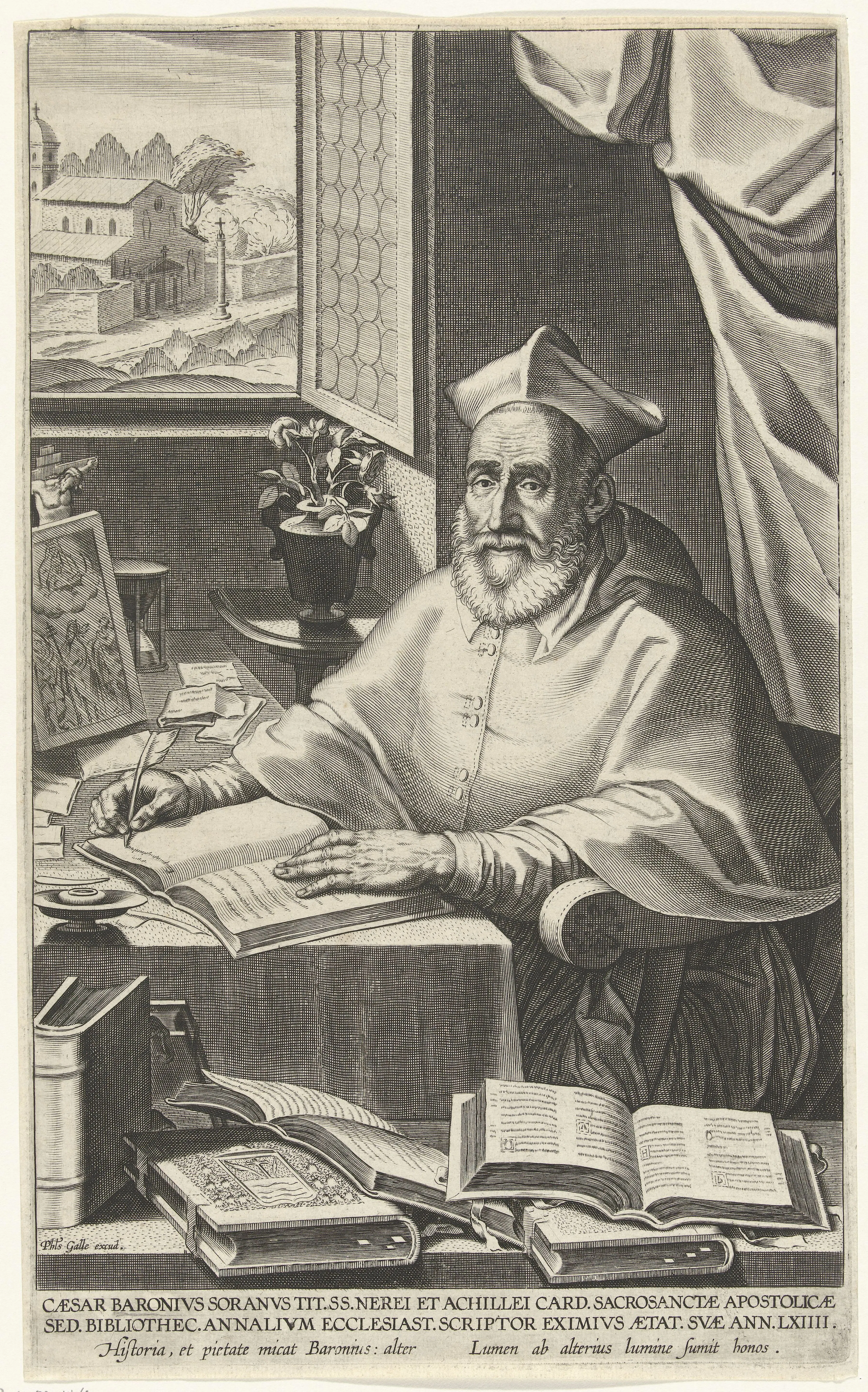
An engraved portrait of Cesare Baronio, the cardinal-annalist, seated at a desk among folio volumes in the visual idiom of Counter-Reformation erudition. Launoy's year-600 test draws its force from precisely this kind of authority, even as he turns Baronius's standard for early testimony into a weapon against late medieval claims. Source ↗.
This is a statute of limitations run in reverse. The ordinary version protects a defendant grown too old to prosecute. Launoy's version throws out a story grown too new to trust. If an account of the Magdalene's grave cannot produce a witness who filed his report before the cutoff, the case is dismissed unheard, and the Provençal landing, attested only in later medieval texts, was dismissed on its date rather than its content. Against it Launoy set the Greek witness of Modestus, Patriarch of Jerusalem in the 630s, who recorded that after the falling-asleep of the Mother of God the ointment-bearer Mary went to Ephesus, to the beloved disciple, and there completed her apostolic course through martyrdom, cursum Apostolicum per martyrium vnguentifera Maria perfecit. The epithet vnguentifera, ointment-bearer, binds the historical woman to the gospel scene of the anointing, so that the Greek account claims exactly the figure Provence claimed and answers the old question of whether Mary Magdalene was really buried in France with a flat chronological no.
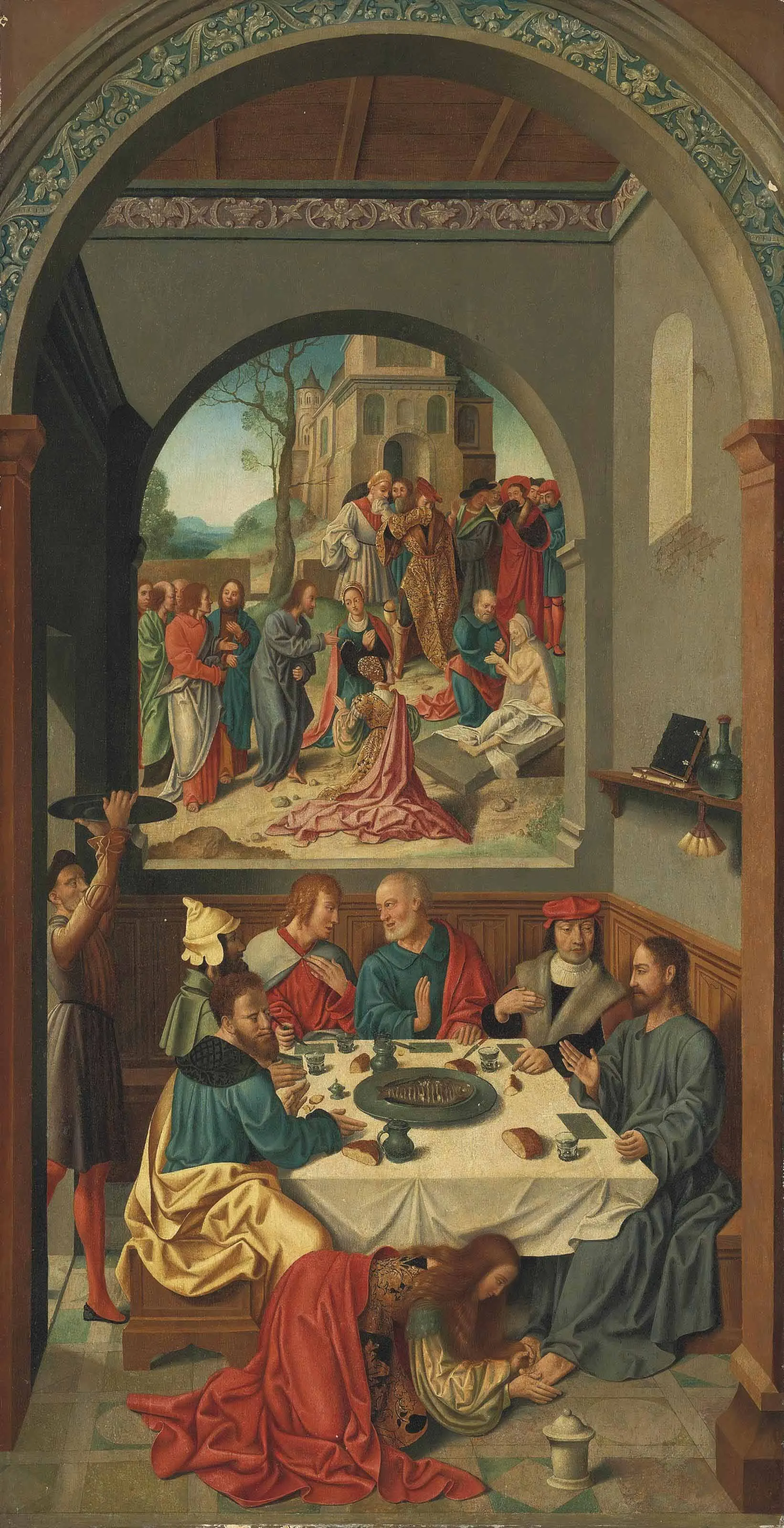
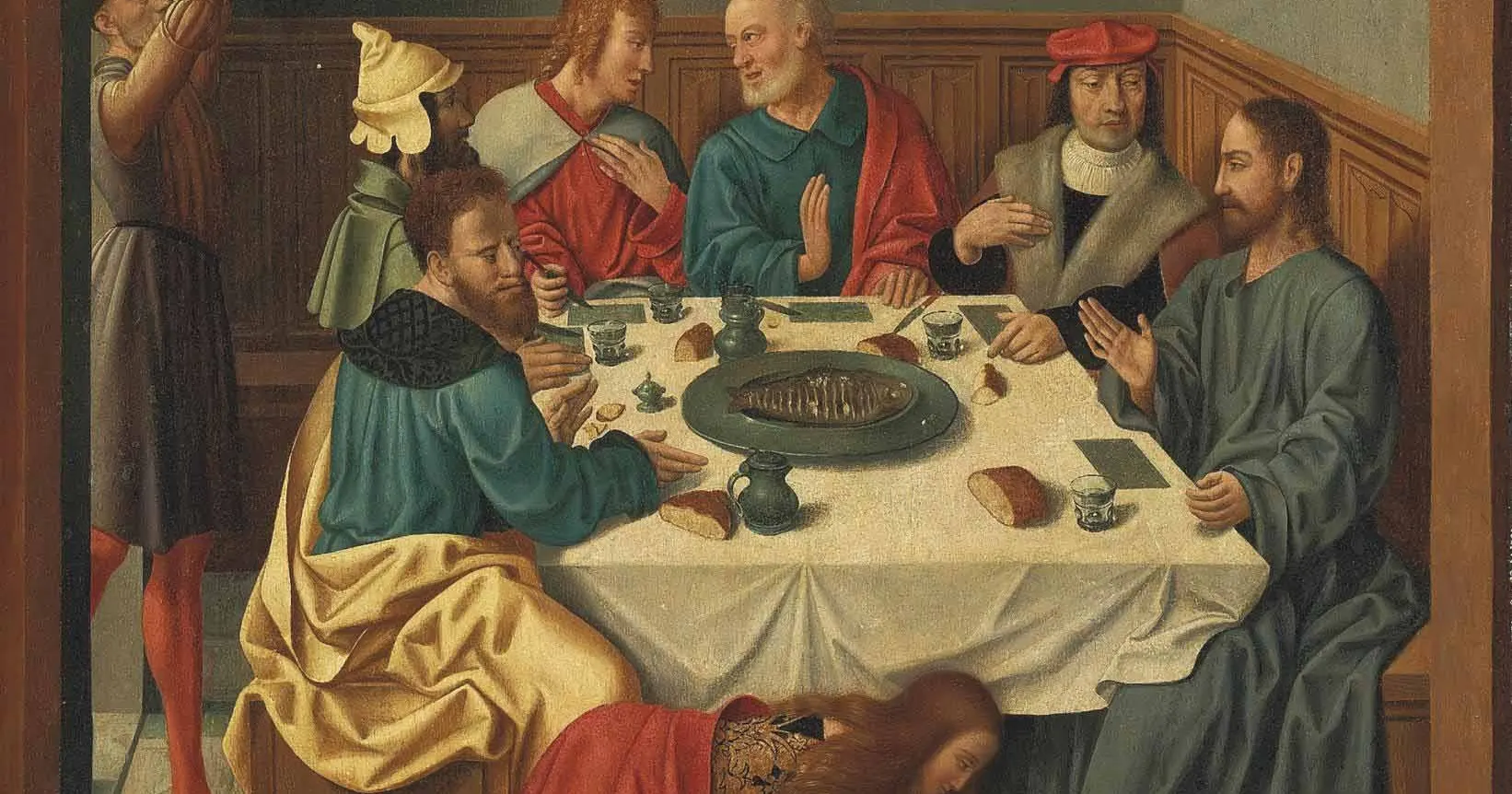
In this sixteenth-century German painting, Mary Magdalene kneels as the ointment-bearer at Christ's feet while, beyond the chamber, Lazarus is raised from the dead. The pairing makes visible the two poles of Launoy's argument: the gospel identity marked by vnguentifera and the Provençal tradition that bundled Magdalene with Lazarus's circle, only to be rejected as too late. Source ↗.
The warrant, and its danger
The metaphysics behind the rule came from Tertullian, around the year 200. From the very order of things, Launoy quoted, it is manifest that what was handed down earlier is true, but that whatever was introduced later is extraneum & falsum, quod sit posteriùs immissum, foreign and false. The opposition of traditum, what is handed down, to immissum, what is inserted afterward, is the priority-of-tradition principle in its purest form. The earliest entry in the record is authentic. Everything appended later is a graft, flagged as tampering no matter how many people have since come to believe it. The paradigm case in the pamphlet is a set of forged deeds, the acta quæ sub nomine Marcellæ pedissequæ scripta sunt, written under the name of Marcella the handmaid, dismissed not by argument over their contents but by the demonstration that they were a late insertion under an ancient name.
This is where the pamphlet turned dangerous rather than merely learned. At its Fourth Session, on 8 April 1546, the Council of Trent had declared unwritten apostolic traditio worthy of the same reverence as Scripture. A Gallican doctor who made temporal sequence the sole test of an authentic tradition was taking the very category the Provençal cult invoked in its defense and converting it into the instrument of its disqualification. The devotional patrimony of a diocese, tended by its Dominicans, was being adjudicated by a man who needed only a calendar.
The closing pages betray the strain in the method. Having evicted the Magdalene from Provence, Launoy appended the rival Burgundian dossier from Vézelay, papal and royal letters attesting that there her body rests, CORPVS QVIESCIT, and shining with miracles. Those letters are themselves medieval documents, sitting well below the year-600 line that had just condemned Saint-Maximin. Applied with the rigor he had spent ninety-five pages demanding, Launoy's own rule would press against Vézelay as hard as against the Provence he had thrown out. The debunker who cancelled one fraudulent entry left another, of the same late date, standing in the margin of his own book.
More from ExLatinis
This text was transcribed and translated as part of the ExLatinis project—an effort by Leo to make English translations of every published text in Latin in early modern Europe (between 1450 and 1750) available to the public for free online.
→ Read the full transcription and translation on Leo
You can save a copy of this document into your Leo account to run deep text searches, conduct further analysis, or cross-reference it with your own research.
If you want more than an introduction, you can also consult a full, in-depth report drawn from the original transcription alongside relevant secondary sources, with extended analysis and historical context beyond the scope of this post.
→ Read the full in-depth report and finding guide
Critical Further Reading & Contextual Resources
- Victor Saxer, Le culte de Marie-Madeleine en Occident, des origines à la fin du moyen âge: Saxer is the unavoidable court of appeal for the Western Magdalene cult, including the Carolingian and later evidence that makes Provence look suspiciously punctual in its lateness. Read him to see Launoy’s blunt year-600 guillotine replaced by patient documentary surgery, with roughly the same corpse on the table.
- Victor Saxer, “Les Saintes Marie Madeleine et Marie de Béthanie dans la tradition liturgique et homilétique orientale,” Revue des sciences religieuses: This is the essential check on Launoy’s Greek counterclaim, especially the Ephesian tradition that he deploys against Saint-Maximin. Saxer sorts liturgical and homiletic evidence without pretending that an Eastern source automatically wins because it looks older and speaks Greek, a useful tonic after Launoy’s confidence.
- Victor Saxer, Le dossier vézelien de Marie Madeleine. Substratum hagiographique et culte de la sainte à Vézelay à l'apogée du moyen âge: Launoy’s anti-Provençal zeal ends with a Burgundian escape hatch, and Saxer is the scholar to close it politely but firmly. This study explains why Vézelay’s documents, however splendidly sealed, belong to the same medieval evidentiary world Launoy had just taught readers to distrust.
- Theresa Gross-Diaz, “The Cult of Mary Magdalen in the Medieval West,” Loyola University Chicago eCommons: Gross-Diaz gives the quickest reliable orientation to the Western Magdalene cult: relic lists, local ambitions, monastic promotion, and the slow hardening of claims into “tradition.” It is especially useful for readers who want to know why Launoy’s chronological objection was not mere pedantry, though pedantry was certainly among his gifts.
- Thomas Head, “The Development of Hagiography and the Cult of the Saints in the Later Middle Ages: The Example of the Kingdom of France,” Hagiography Society: Head supplies the French institutional setting in which saints’ bodies became local capital, monastic advertising, and occasionally a paperwork problem. His account helps explain why a quarrel over Mary Magdalene’s burial place could become a fight over jurisdiction, prestige, and who got to write the past on diocesan stationery.
- David Knowles, “Great Historical Enterprises II. The Maurists,” Proceedings of the British Academy: Knowles places Launoy’s habits beside the larger seventeenth-century rise of learned source-criticism, especially among the Maurists. The comparison is salutary: Launoy looks less like a lone crank with a calendar and more like an early practitioner of methods soon made respectable by monks with better filing systems.
This blog post is intended as a brief, exploratory introduction to the text. It was generated autonomously by an advanced AI assistant as part of the ExLatinis digital humanities initiative and should be treated as a primer to foster curiosity rather than a replacement for peer-reviewed scholarly sources, formal critical editions, or definitive historical commentary.