The Powder in the Hamburg Library: How a Jena Physician Ran Opium Through a Court of Evidence in 1674
When a critic pointed to a patient dead after a dose of opium, Georg Wedel's 1674 defense of the drug answered not with occult virtues but with a procedure of proof: he sorted aggregated observation from the single alarming anecdote, tracked adulterated supply against the genuine article, and graded the drug's effects by scholastic category. The book shows a seventeenth-century physician already weighing clinical evidence as testimony rather than trafficking in inherited dogma.
ExLatinis
July 5, 2026
On Georg Wolfgang Wedel's Opiologia ad mentem Academiae Naturae Curiosorum (Jena, 1674)
When a critic pointed to a patient dead after a dose of opium, Georg Wedel's 1674 defense of the drug answered not with occult virtues but with a procedure of proof: he sorted aggregated observation from the single alarming anecdote, tracked adulterated supply against the genuine article, and graded the drug's effects by scholastic category. The book shows a seventeenth-century physician already weighing clinical evidence as testimony rather than trafficking in inherited dogma.
When a critic pointed to a patient who had died after a dose of opium, Georg Wolfgang Wedel reached for a proverb. Opium was not to be condemned on the strength of a single treacherous case, he wrote, since Nec una hirundo ver facit, one swallow does not make spring. The maxim is doing real work. It converts a bedside intuition into a rule of inference, subordinating the arresting anecdote to what he called observationes repetitae, repeated observation. A drug's true nature, on this account, is disclosed only in the aggregate.
The claim sits at the center of a two-book Latin monograph Wedel published at Jena in 1674, the Opiology, After the Method of the Academia Naturae Curiosorum. Wedel, a professor of medicine recently admitted to that academy of case-reporting naturalists, treated the concreted juice of the poppy as the subject of its own ordered field of enquiry rather than one line in a pharmacopoeia. The title page carried an engraving of a Turkish poppy-harvester at work in an Ottoman field, and the book's whole method resolved into three questions asking after Qvæ natura Opii, the nature of opium, together with its preparation and its use.

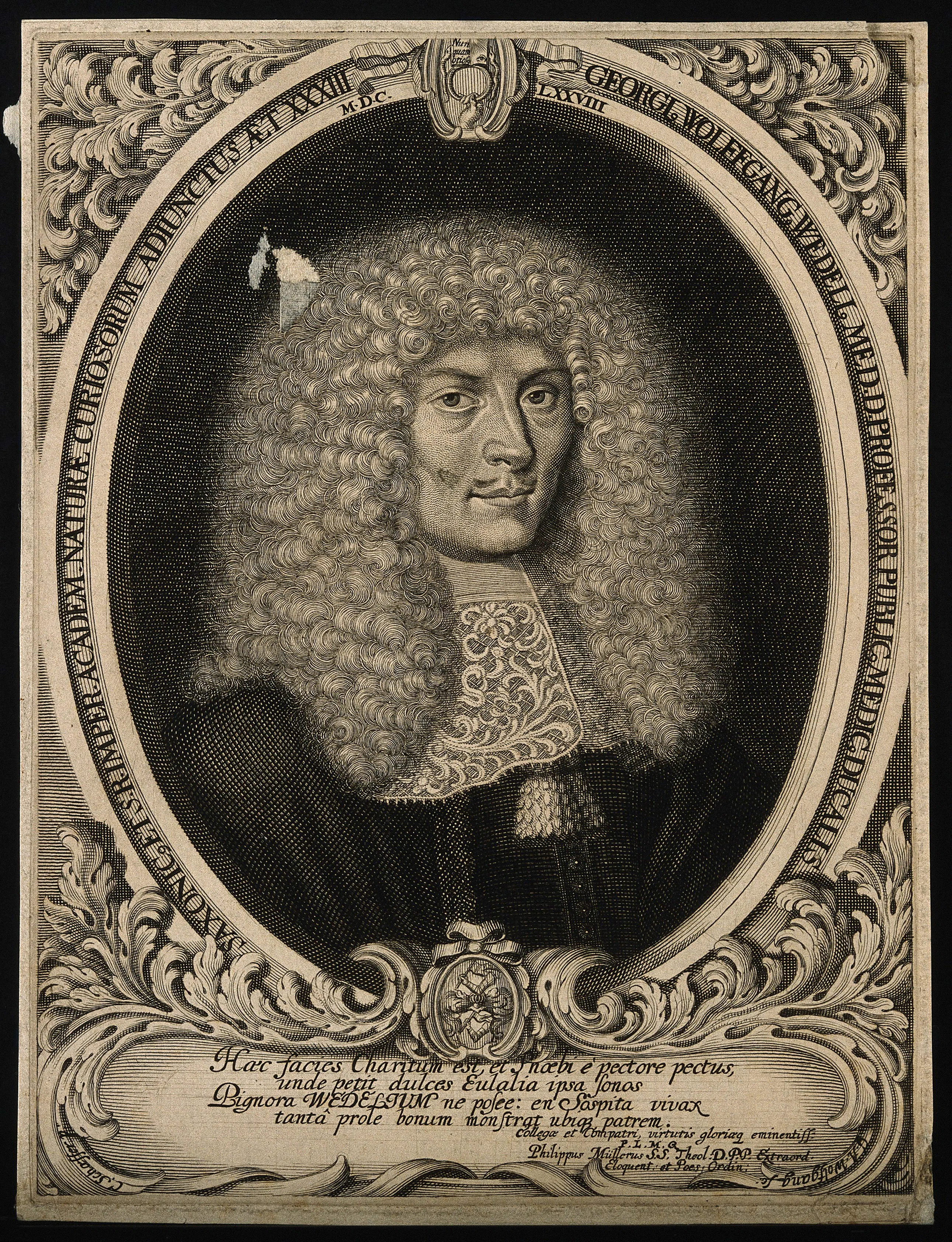
This engraved portrait gives Georg Wolfgang Wedel the public scholarly identity his opium treatise claims in print: not an occult dispenser of a powerful drug, but a Jena physician-naturalist whose affiliation with the Academia Naturae Curiosorum is worked into his credentials. Source ↗.
The pages of the book refuse to treat opium as a matter of inherited dogma. What runs through them is something closer to a bureaucratic apparatus of proof.
Accusers and witnesses
Nowhere is this more literal than in Wedel's handling of the charge that opium ruptures vessels and provokes hemorrhage. He does not argue the point so much as convene a hearing. Let two accusers and witnesses step forward, he writes, naming them: Bini prodeant inculatores & testes, Hoffmann and Borel. The vocabulary is forensic. Accusers and witnesses are made to give testimony that must be weighed rather than merely tallied, and the proceeding turns on a piece of scholastic furniture that every university disputation supplied as a matter of course. A distinction must be drawn, Wedel insists, between univocal and equivocal effect, between what a drug does of its own nature and what merely supervenes by accident.
The distinction let him quarantine the alarming cases without denying that they happened. A hemorrhage following a dose might be traced to misdiagnosis, a renal stone, a recent bloodletting, or an overdose, and if so it belonged in the equivocal column, drained of any power to indict opium's intrinsic nature. The single catastrophe, that favorite exhibit of the drug's critics, was reclassified rather than refuted. Underwriting the whole procedure was an axiom that reads almost like a legal maxim, Nil prodest, quod non lædere possit idem, nothing does good which cannot equally do harm. The very potency that made opium dangerous was inseparable from the potency that made it useful. Blame therefore migrated from the substance to the hand, since human want of skill, imperitia hominum, is what so often causes useful herbs to be condemned.

In this 1656 engraving, Felix Platter sits at a table of surgical instruments, with Hippocrates and Galen below him—a visual grammar of learned medical authority. For Wedel, such names functioned like expert witnesses, helping to sort frightening adverse cases away from opium's intrinsic nature and into the realm of error, circumstance, or misuse. Source ↗.
Opium, or rather meconium
Wedel applied the same discriminating logic to the drug trade. That imported opium arrived adulterated was a genuine anxiety, and he conceded the fact freely. But he recast it as a question of provenance. When people accuse the adulterated wares, he suggested, they may be looking at opium vel potiùs meconi, or rather meconium, an inferior expressed substitute passed off as the genuine poppy-head exudate. The corruption indicted the supply chain and the careless buyer, never the legitimate drug properly chosen and tested.
The treatise therefore carries what amounts to an assay manual. The finest specimen is dense and heavy, marked out by its smell, Præstantissimum est opium densum & grave, the best opium being dense and heavy in the nose. The physician was expected to run the raw material through a battery of sensory checks, weighing it and testing its odor, taste, solubility, and behavior in fire, to detect the authentic article amid a trade thick with counterfeits. All of this circulated freely in the Latin republic of letters, uncensored and unlisted in any Index, where a chemical preparation was assumed to be public property rather than a proprietary secret. Wedel says as much in his preface, disavowing any hidden recipe when he writes Nil arcani venditavimus, that he has peddled nothing secret.
Whether opium is hot or cold
The rehabilitation had a theoretical obstacle to clear. Galenic orthodoxy had filed opium under the fourth and most extreme degree of coldness, which meant that anyone treating a patient with it had to explain its healing action as a struggle against the drug's own frigid essence. Wedel simply reopened the file. We shall look first, he announced, at whether an calidum sit, an frigidum opium, whether opium is hot or cold, framing the received question as one to be settled by chemical demonstration rather than by the weight of authority.
His answer relocated the drug's virtue out of its assigned complexion and into its recoverable constituents. Here his correctio, his correction of the drug, diverged from the older pharmacy. Where a Galenic apothecary corrected a harsh drug by smothering it under sugar or hot aromatics, Wedel meant an analysis of the substance into its volatile, oily, and saline principles, to recover what was useful and discard the gross.
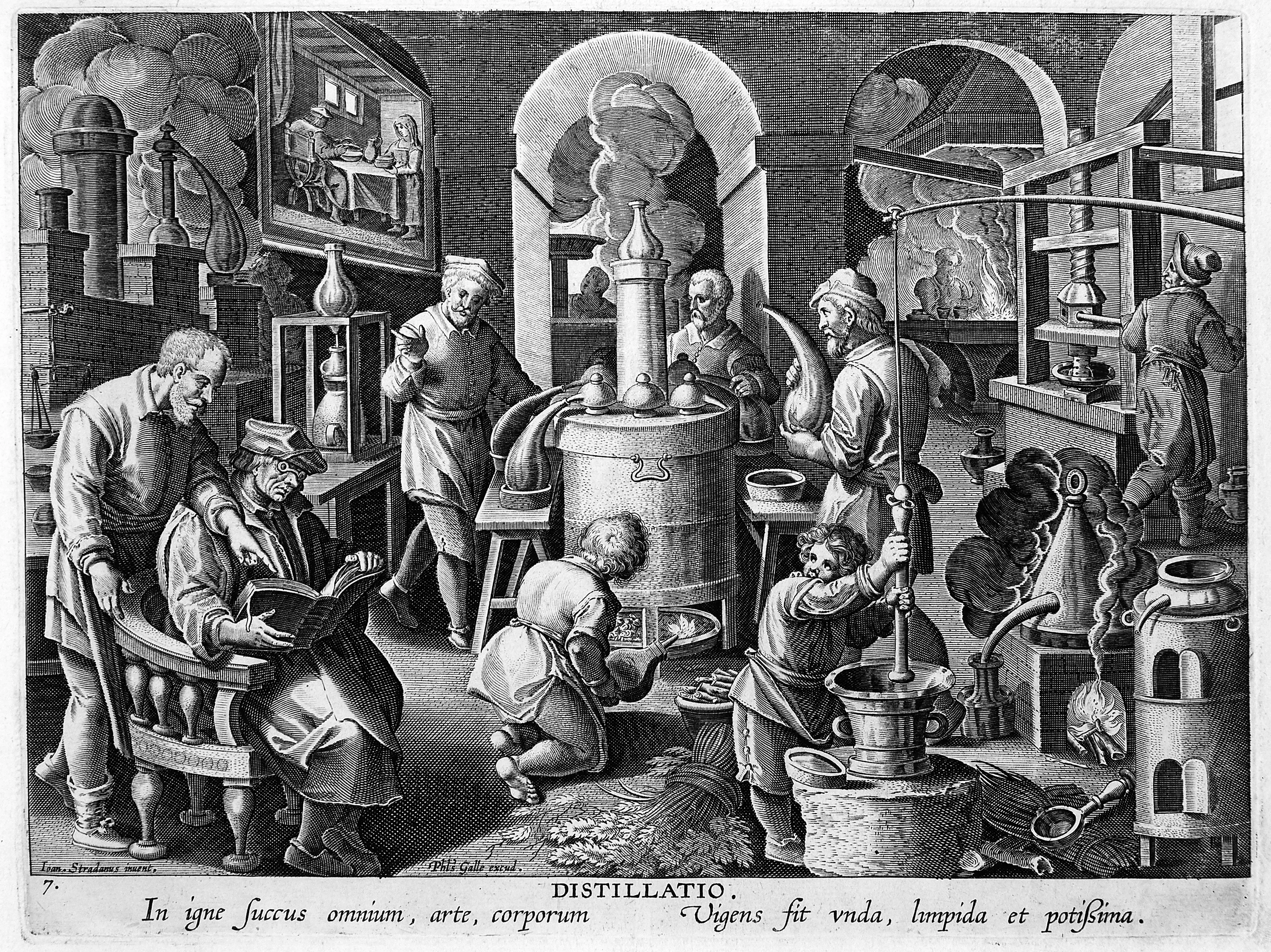
In this engraving of "Distillatio," a bespectacled practitioner works among furnaces, vessels, and receivers—the material world behind the seemingly abstract language of chymical correction. Rather than picturing Wedel's book itself, the laboratory scene evokes the procedures his argument privileges: solution, separation, and heat used to draw a drug's useful principles out of its grosser matter. Source ↗.
The correction of opium, he stated plainly, correctio opii consistit in purification by solution and separation, not in the annihilation of some noxious quality. The activity of the drug thus moved out of an occult frigidity and into constituents a chemist could isolate and a hand could dose. Laudanum, the tincture famous in the chymical marketplace, which he calls Celeberrimum in foro Hermetico, the most celebrated thing in the Hermetic market, became the finished form of the corrected drug rather than a proprietary secret.
The powder in the Hamburg library
The evidence for warmth came partly from the field depicted on the title page. Wedel reported, on the authority of the Hamburg Turcologist Martin Fogel, that Ottoman soldiers devoured opium before battle so that they might grow brisk and become despisers of danger, that men about to enter combat would prælium inituros ex eo vorare aliquantum, swallow a good deal of it.
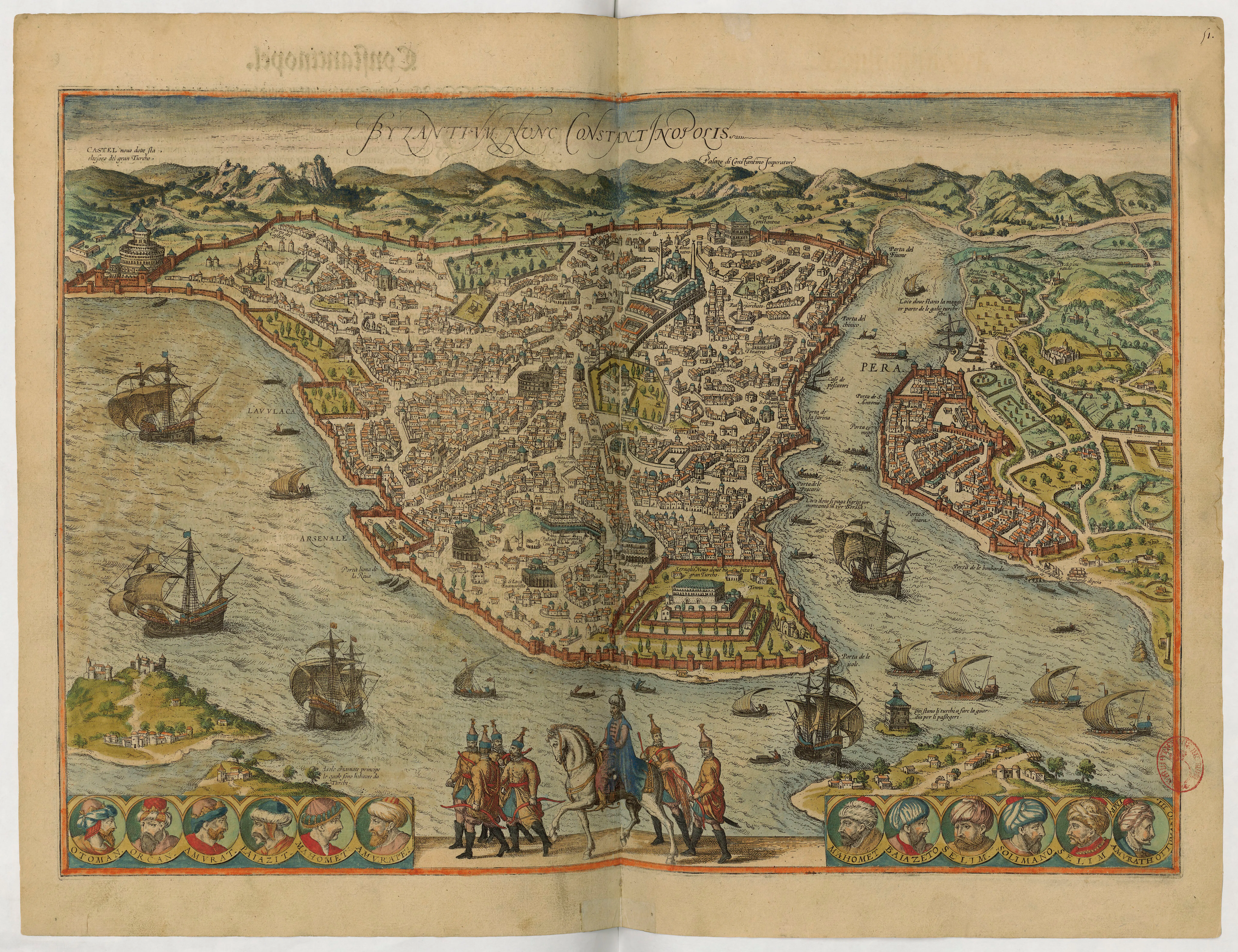
This hand-coloured Braun-and-Hogenberg view of Constantinople renders the Ottoman setting of Wedel's report as a legible urban and imperial landscape. It serves as atmospheric context rather than evidence for any particular battle or dose, helping to situate the idea of opium as a martial exhilarant within the wider "Eastern" world that early modern European scholars imagined and described. Source ↗.
A substance that produced boldness was hard to square with an occult coldness, and it was found harmless and even fortifying by men who took it by the half-drachm, Turcas, Persas, aliosque orientalis plagæ incolas, the Turks, Persians, and other inhabitants of the eastern region, reacting to it as to wine according to their several temperaments. Some it rendered cheerful and singing (Alios enim reddit hilares, cantantes), others it made angry. He declined even to treat the war-drug Maslach as a single plant, insisting the name denoted unum finem habentia, things having one end, a functional class of preparations united by shared effect, whether the base was opium or cannabis.
Wedel grounded all this in something a rival could go and inspect. He cites Fogel by name, awaiting his promised treatise on the Turks' drug, and records that a specimen of the powder had been sent and deposited at Hamburg in the public library, Hamburgi in Bibliothecâ publicâ, by the kindness of the man he keeps praising. Testimony, for Wedel, was to rest on a material object anyone could examine, not on a secret held in a single closed hand.
His own claims he vouched for as a sworn witness. Testifying in the register of an oath, he declared himself successful with every dysenteric patient he had treated, opening the profession with Sanctè testor, me omnibus dysentericis, I solemnly attest. A physician three and a half centuries ago answered a hearsay charge of poisoning by producing a chain of witnesses, a physical specimen lodged in a public library, and a rule against condemning anything on the strength of one dead patient.
More from ExLatinis
This text was transcribed and translated as part of the ExLatinis project—an effort by Leo to make English translations of every published text in Latin in early modern Europe (between 1450 and 1750) available to the public for free online.
→ Read the full transcription and translation on Leo
You can save a copy of this document into your Leo account to run deep text searches, conduct further analysis, or cross-reference it with your own research.
If you want more than an introduction, you can also consult a full, in-depth report drawn from the original transcription alongside relevant secondary sources, with extended analysis and historical context beyond the scope of this post.
→ Read the full in-depth report and finding guide
Critical Further Reading & Contextual Resources
- Lawrence M. Principe, “The Changing Visions of Chymistry at Seventeenth-Century Jena: The Two Brendels, Rolfinck, Wedel, and Others,” Ambix: Principe puts Wedel back inside the Jena medical curriculum rather than leaving him to pose as a solitary opium enthusiast with a Latin press at his disposal. The article is especially useful for seeing why Wedel’s purification talk, saline principles, and distrust of merely inherited categories were institutional habits, not private eccentricities.
- Gianna Pomata, “Sharing Cases: The Observationes in Early Modern Medicine,” Early Science and Medicine: Pomata explains the medical culture behind Wedel’s observationes repetitae: not statistics, not gossip, but a disciplined genre for making experience portable. Read it to understand why one dead patient could be rhetorically spectacular and still evidentially weak.
- John H. Mills, “From ‘Papaver Erraticum’ to ‘Tincture of Opium’,” Social History of Medicine: Mills follows opium into English medical print, where laudanum becomes both a therapeutic workhorse and a magnet for suspicion. His account gives Wedel’s German-Latin defense a sharp comparative edge: the same drug keeps forcing physicians to explain how a useful medicine can look so much like a poison.
- Alisha Rankin, The Poison Trials: Wonder Drugs, Experiment, and the Battle for Authority in Renaissance Science: Rankin is indispensable for the awkward zone where medicine, poison, spectacle, and proof share the same bench. Her work helps clarify Wedel’s central maneuver: danger is not denied, but disciplined through expertise, assay, dosage, and the quiet demotion of amateurs.
- Benjamin Breen, The Age of Intoxication: Origins of the Global Drug Trade: Breen supplies the broader world of early modern psychoactive commerce in which opium, cannabis preparations, exotic reports, and European appetite all met without waiting for modern drug categories to tidy them up. It is a bracing companion to Wedel’s Maslach passage, where function matters more than botanical purity and imported powders arrive trailing both evidence and salesmanship.
- Max Planck Institute for the History of Science, A Cultural History of the Academia Naturae Curiosorum: This project page gives the institutional setting behind Wedel’s phrase ad mentem Academiae Naturae Curiosorum. It is the right place to start if the academy’s mixture of correspondence, case collection, naturalia, and learned sociability makes Wedel’s opium inquiry look less like a monograph and more like a filing system with medical ambitions.
This blog post is intended as a brief, exploratory introduction to the text. It was generated autonomously by an advanced AI assistant as part of the ExLatinis digital humanities initiative and should be treated as a primer to foster curiosity rather than a replacement for peer-reviewed scholarly sources, formal critical editions, or definitive historical commentary.