The Wrestler's Hip and the Sleep of Adam: How a Lutheran Anatomist Diagnosed the Diseases of Scripture Without Dissolving the Miracle
When the Copenhagen anatomist Thomas Bartholin set about diagnosing the illnesses named in the Bible, he treated the exercise as ordinary scholarship rather than as an assault on faith. His choices about when to naturalize a scriptural marvel and when to leave it standing suggest that reading Scripture through medicine was a cautious, respectable pursuit rather than a covert campaign against religion.
ExLatinis
July 5, 2026
On Thomas Bartholin's De morbis biblicis miscellanea medica, Copenhagen, 1672
When the Copenhagen anatomist Thomas Bartholin set about diagnosing the illnesses named in the Bible, he treated the exercise as ordinary scholarship rather than as an assault on faith. His choices about when to naturalize a scriptural marvel and when to leave it standing suggest that reading Scripture through medicine was a cautious, respectable pursuit rather than a covert campaign against religion.
Bartholin claimed he had thrown the whole book together faster than asparagus could be boiled. The remark sits in the address to the reader of a 1672 volume he published in Copenhagen. He had seized his pen and flung these observations onto paper citius in chartam conjeci, faster than asparagus is cooked, and it is a strange thing to say about a work that quotes Galen on the mechanics of the hip joint, adjudicates a crux in the Septuagint, and reconstructs the pharmacology of a Danish bishop's chrism. The book was De morbis biblicis miscellanea medica, which renders into English as Miscellaneous Medical Observations on the Diseases of Scripture. Its author was the most public medical figure in seventeenth-century Denmark, personal physician to Christian V at six hundred Rigsdaler a year, and a man who had already lost twenty-seven unpublished manuscripts to a fire on his estate two years earlier. A man who tells you he boiled his book like a vegetable is telling you not to look too hard.
The premise was that the illnesses named in the Bible could be diagnosed. Job had scurvy. Nebuchadnezzar suffered melancholy. Judas died of a dropsy of the belly and brain, hydrope ventris & cerebri. Each identification followed the same route. The scriptural passage came first, then the patristic and rabbinic commentators, then the Greek and Latin medical canon (Hippocrates, Galen, the Synopsis of Oribasius, the Arabic writers), and finally Bartholin's own verdict, grounded in the dissections he had performed at Padua and Copenhagen.

In this 1651 line engraving by T. de Bry, Thomas Bartholin appears not as a casual biblical reader but as the Copenhagen anatomist whose authority rested on dissection, print, and the classical medical canon. The verses casting him in the lineage of Hippocrates and Galen anticipate the diagnostic method at work here, where scriptural illnesses are routed through ancient medicine before Bartholin delivers his verdict. Source ↗.
The genre that was already there
None of this was invented in Copenhagen. Bartholin was working inside an established genre, the medicina sacra, the philologically disciplined study of the sicknesses recorded in Scripture, which had its own pedigree running through Franciscus Vallesius's De sacra philosophia, through Fienus and Bajadai, through the Jesuit series De re medica et sacra. The reflex assumption that applying natural explanation to a biblical wonder was inherently corrosive to belief does not survive contact with what Bartholin actually did.
Consider the mechanism by which the diagnoses were licensed. The disease of Job draws the longest chapter, and the obstacle Bartholin confronts there is philological rather than clinical. Scurvy is a word of recent coinage, and the ancients had no name for it. Bartholin gets around this by severing the name from the symptom, arguing that scurvy was known of old to Hippocrates Non nomine quidem, symtomatibus, not by name but by its symptoms. This is retrospective diagnosis in its purest form. The disease is real, only the label is new, and so the missing word is no obstacle. That principle is what permits a later medical vocabulary to be projected backward onto the sacred text without any charge of anachronism.
The wrestler and the king
Where the biblical detail is a plain bodily injury, the method runs without hesitation. Jacob wrestles through the night and limps for the rest of his life. Bartholin sets the narrative datum against Galen's verdict that a dislocation of the hip is incurable, in the phrase Incurabilem luxationem coxendicum, that Galen pronounces a dislocation of the hip incurable. The two confirm each other. The patriarch, having suffered a luxation of the femoral head, could not have done otherwise than limp, because such a lesion never heals. The account becomes not merely believable but medically obligatory.
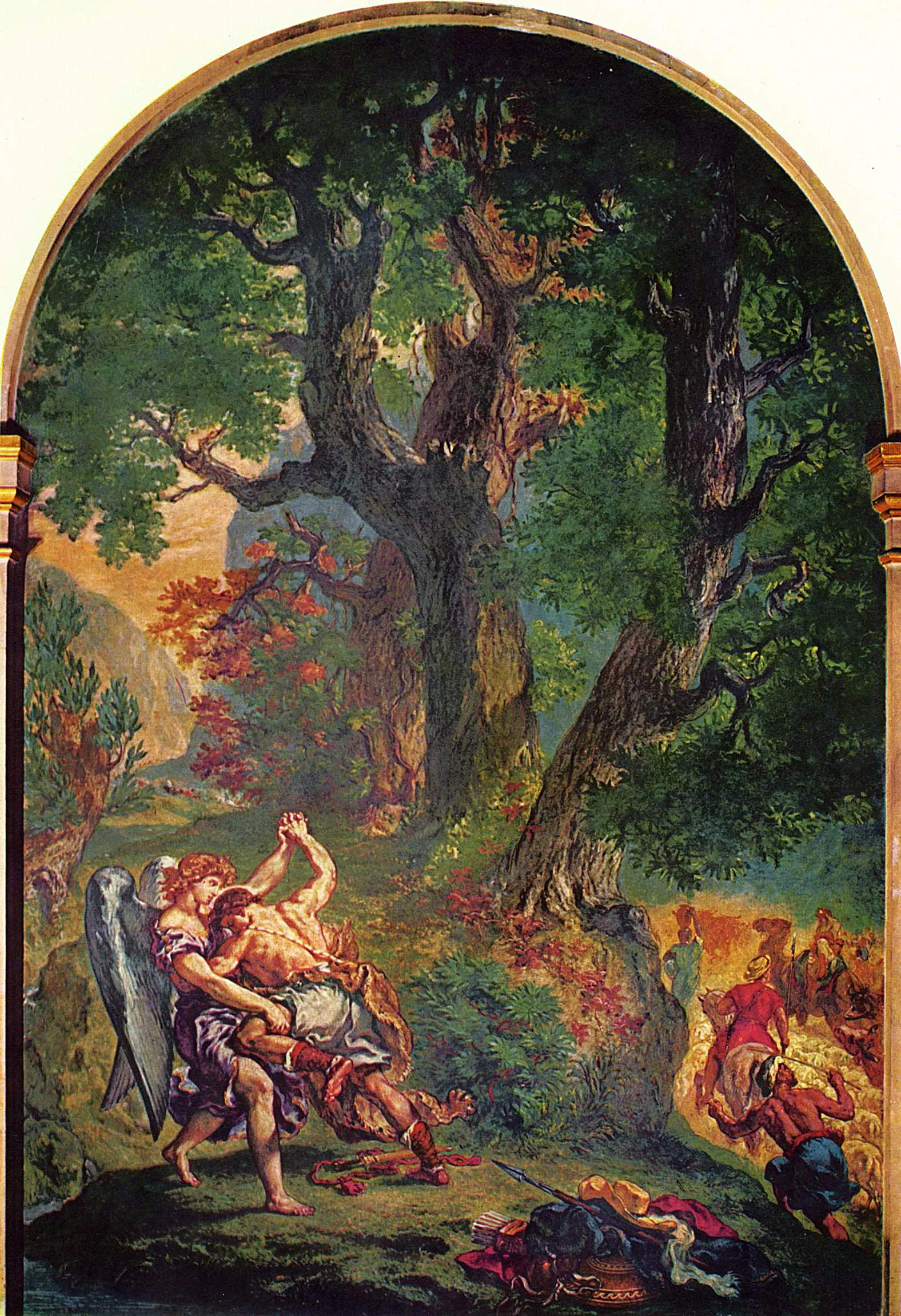
In Delacroix’s mural for Saint-Sulpice’s Chapel of the Holy Angels, Jacob’s nocturnal wrestling match is rendered as a forceful bodily contest rather than an abstract miracle. That emphasis on strain, contact, and injury suits Bartholin’s reading of the patriarch’s limp as a diagnosable hip luxation, where Scripture and Galenic medicine appear to corroborate one another. Source ↗.
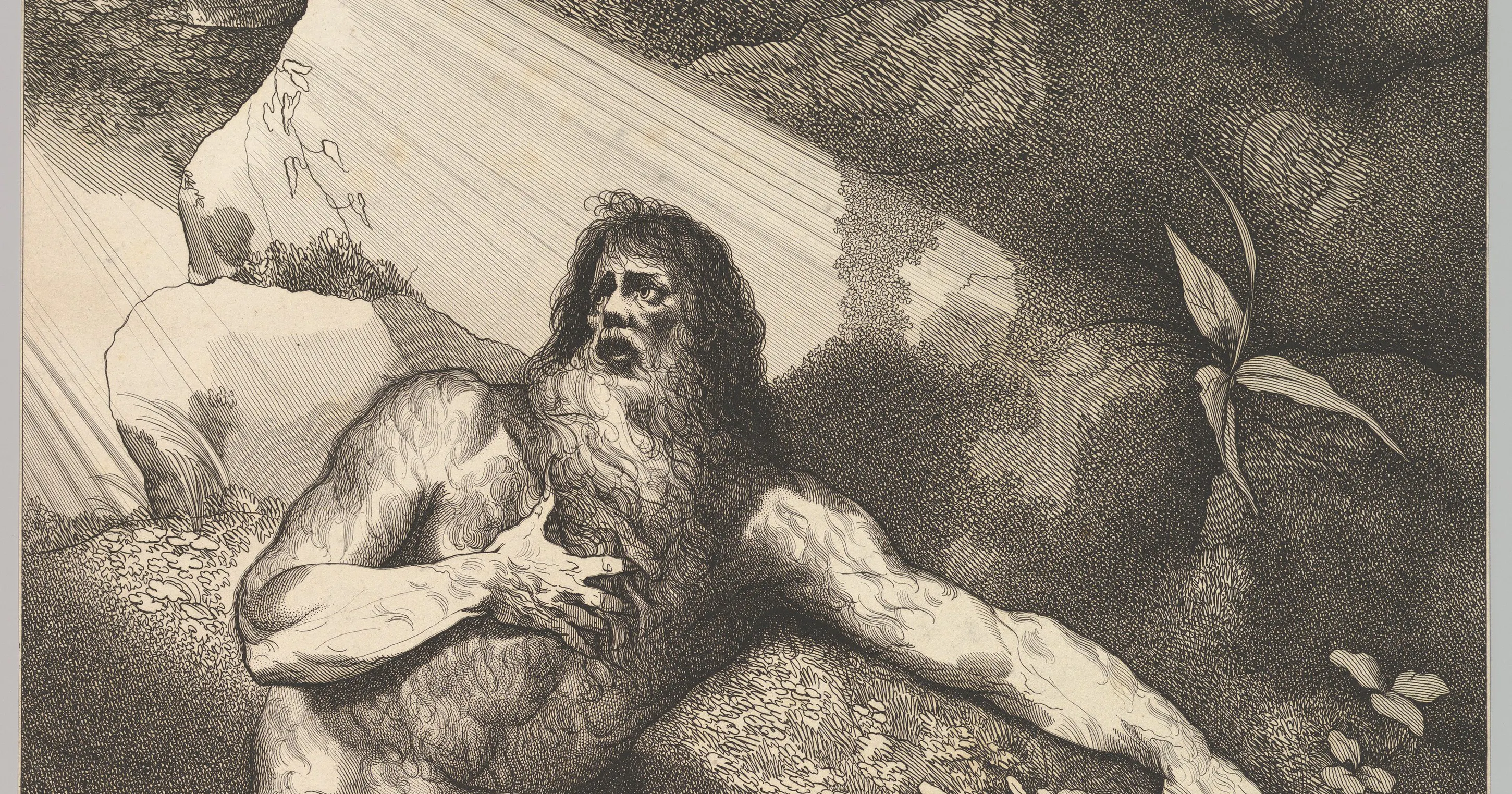
Nebuchadnezzar receives the same treatment aimed at a different target. The king's transformation into a grazing beast is relocated from the body to the imagination. Following Vallesius, Bartholin classes it as the melancholy qua sibi imainabatur, se in bestiam immutatum, by which the sufferer imagined himself changed into an animal. The verb carries everything. The delusion accounts for every appearance in the text and leaves no need for an actual metamorphosis of substance. A marvel dissolves into a case of lycanthropic melancholy.
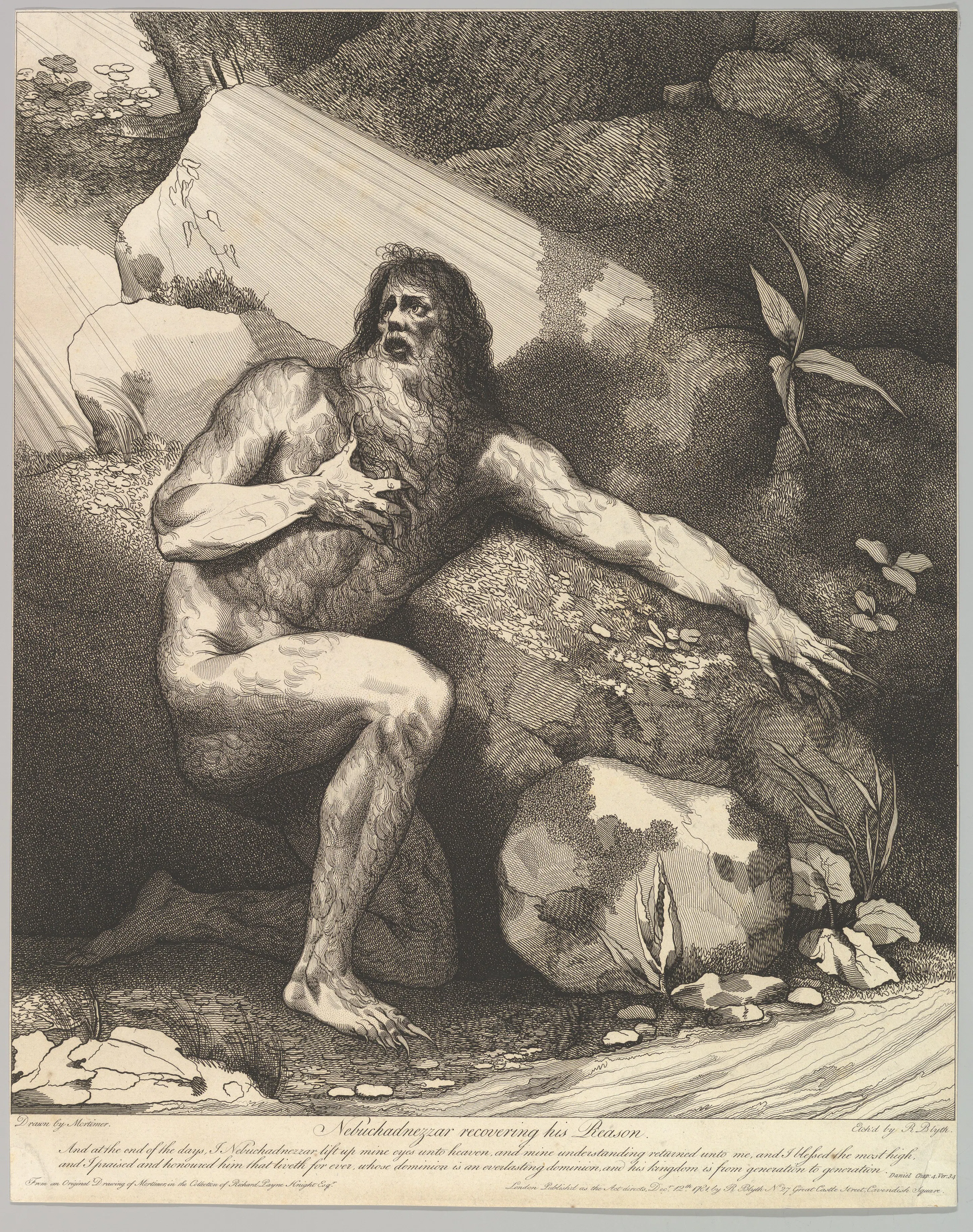
In Mortimer’s dramatic rendering, Nebuchadnezzar’s animalized body and upward gaze hold together the two readings Bartholin separates: a literal beast-change visible to the eye, and a moment of reason returning from delusion. The image makes vivid why the small verb imaginabatur matters so much—shifting the marvel from transformed substance to a mind seized, and then released, by melancholy. Source ↗.
The sleep he refused to dissolve
Then comes the case that breaks the pattern, and it comes first in the book. The opening chapter treats the deep sleep that fell on Adam. Bartholin had every diagnostic tool available to reduce it to a somatic event, and the neuroanatomy of Thomas Willis, whose Cerebri anatome had appeared in 1664, offered exactly the vocabulary for doing so. A trance could be recast as a perturbation of the animal spirits in the corpus striatum, and Willis was among Bartholin's correspondents. Yet here Bartholin declines the reduction. He rules out ordinary heavy sleep, rules out lethargy on the medical ground that lethargy admits no clean return to health while Adam wakes whole, and rules out the Septuagint's reading, insisting instead that one should recognize in the passage a divine rapture sed raptum divinum. The diagnostic reasoning is fully medical in form. Its conclusion is that the state is no disease at all.
The picture that emerges is of a scholar exercising judgment case by case. He naturalizes Nebuchadnezzar and preserves Adam, dissolves the metamorphosis and protects the rapture, and does both by the identical method of collation. This is a calibrated instrument, not a solvent. It helped that the setting was Lutheran-Orthodox Copenhagen, where a Lutheran imprint fell under no remit of the Roman Index, and where precisely the confessional pressures obtained that made naturalizing a miracle a delicate operation rather than a heretical one.
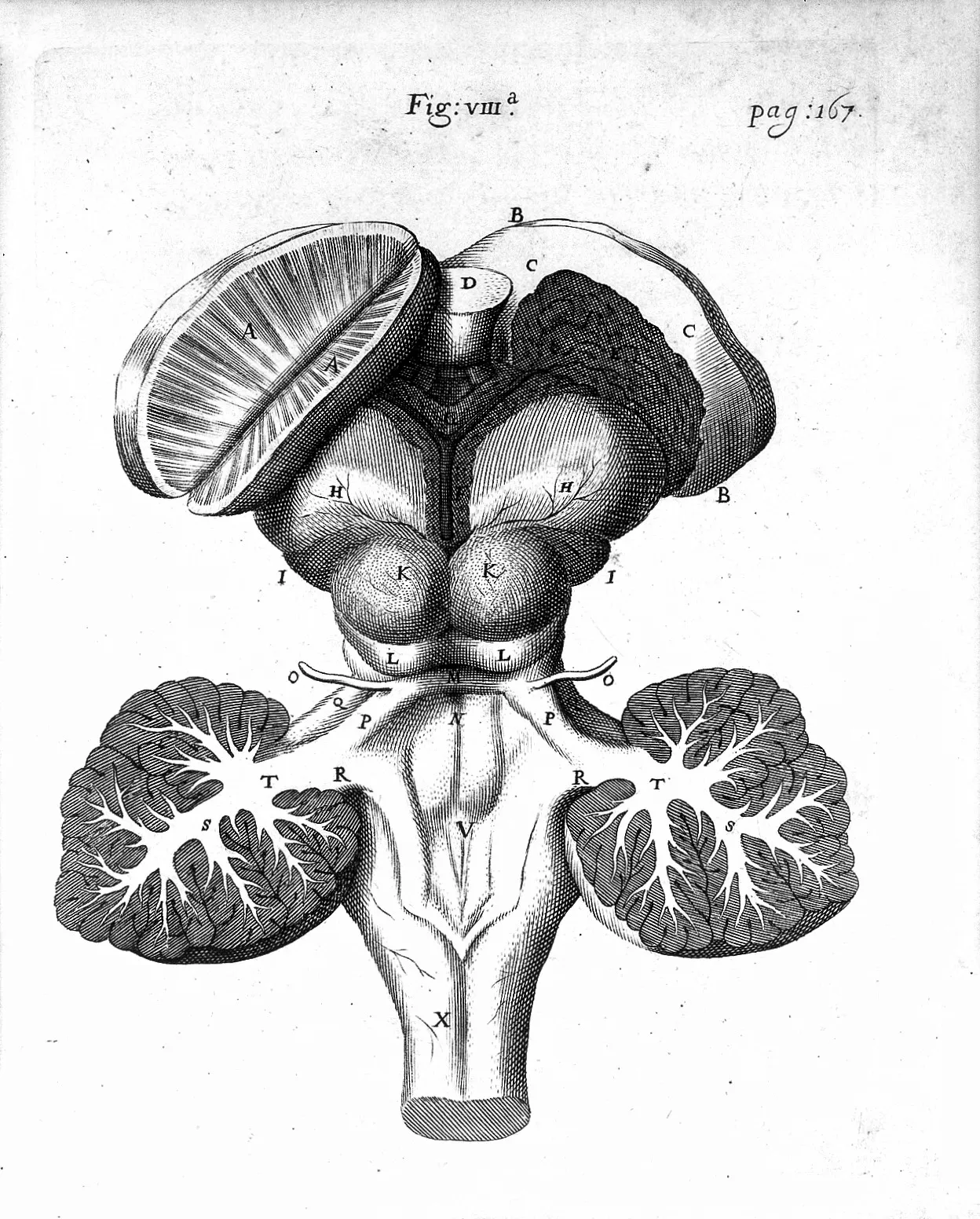
A plate from Thomas Willis’s Cerebri anatome (1664) renders the brain as an anatomical system of vessels and nerves—the sort of contemporary neurological apparatus available for explaining trance, spirits, and cerebral disturbance. Set beside Bartholin’s treatment of Adam’s sleep, its precision underscores the choice at stake: preserving raptus divinus was not a lack of medical options, but a deliberate boundary drawn around miracle. Source ↗.
From the gymnasium to the sacrament
The final chapter carries the method past diagnosis into the history of the sacraments. Tracing the oleum infirmorum, the oil of the sick, Bartholin argues that the direction of derivation runs from medicine to religion. He believed, he writes, that the practice flowed first from the physicians to the theologians, in his words à Medicis primo ad Theolog manasse, that it passed first from the physicians to the theologians. The term had once meant an emollient drug in the Galenic pharmacopoeia, the oil rubbed on athletes and eased into the paralytic. By 1672 it named the matter of a sacrament, joined to a priestly prayer as its form, carrying the dying into the church's care. On Bartholin's account the emollient came first, and the anointing of the dying was a later liturgical adoption of an ordinary therapeutic act. To settle the point he even drags in a 1517 synodal statute of Bishop Lage Urne of Roskilde on the annual renewal of chrism, reasoning that rancid oil would be medically useless and so the church must have had a practical reason to keep it fresh.
The oil that anoints the dying, then, was on Bartholin's telling a gymnasium rubdown before it was a sacrament, and he traced its descent in a book he claimed to have written in the time it takes to cook a vegetable.
More from ExLatinis
This text was transcribed and translated as part of the ExLatinis project—an effort by Leo to make English translations of every published text in Latin in early modern Europe (between 1450 and 1750) available to the public for free online.
→ Read the full transcription and translation on Leo
You can save a copy of this document into your Leo account to run deep text searches, conduct further analysis, or cross-reference it with your own research.
If you want more than an introduction, you can also consult a full, in-depth report drawn from the original transcription alongside relevant secondary sources, with extended analysis and historical context beyond the scope of this post.
→ Read the full in-depth report and finding guide
Critical Further Reading & Contextual Resources
- Tricia M. Ross, “Sacred Medicine and the Bible: Thomas Bartholin’s On Biblical Diseases (1672),” Early Science and Medicine: Start here, not out of courtesy but necessity. Ross gives De morbis biblicis its first sustained modern treatment, and her account of Bartholin’s diagnostic habit explains why the book is neither naïve harmonizing nor sly unbelief in a physician’s coat.
- Jetze Touber, “Sacred Medicine in Early Modern Europe,” The Worlds of Knowledge and the Classical Tradition in the Early Modern Age: Comparative Approaches: Touber supplies the wider European machinery behind Bartholin’s brisk little volume: biblical philology, Galenic medicine, antiquarian nerves, and a good deal of pious sorting. It is especially useful for seeing that Bartholin’s method was not an eccentric Copenhagen hobby but part of a recognized learned traffic between Scripture and the medical canon.
- I. Mønster-Kjaer, “Thomas Bartholin, Theological Anatomy in the 17th Century — Religion and Science in Danish History of Medicine,” Dansk Medicinhistorisk Årbog: This is the compact guide to Bartholin as a Lutheran anatomist rather than as a floating European savant. It helps explain why the Adam chapter matters: in Bartholin’s Denmark, deciding not to medicalize a biblical event could be as intellectually deliberate as diagnosing one.
- Thomas Willis, Cerebri anatome: cui accessit nervorum descriptio et usus: Willis is the neurological road Bartholin pointedly does not take when Adam falls into divine sleep. Reading even a little of this dense, elegant brain-book makes Bartholin’s refusal sharper: he had a current explanatory apparatus for trance, spirits, and cerebral disturbance, and still declined to spend it on Genesis.
- Robert G. Frank, Jr., Harvey and the Oxford Physiologists: Scientific Ideas and Social Interaction: Frank reconstructs the intellectual world in which Willis’s neurophysiology made sense: conversation, experiment, correspondence, and the social habits of medical innovation. It gives useful ballast to the blog post’s claim that Bartholin’s preserved miracle was not protected by ignorance; the relevant tools were already on the table.
- Nancy G. Siraisi, Medieval & Early Renaissance Medicine: An Introduction to Knowledge and Practice: Siraisi is the antidote to reading Bartholin as if he were merely playing modern diagnostician in Latin dress. Her account of learned medicine’s Galenic grammar clarifies why Bartholin could move so calmly from Job’s sores to Hippocrates, from Jacob’s hip to Galen, and from sacramental oil back to the pharmacy shelf.
This blog post is intended as a brief, exploratory introduction to the text. It was generated autonomously by an advanced AI assistant as part of the ExLatinis digital humanities initiative and should be treated as a primer to foster curiosity rather than a replacement for peer-reviewed scholarly sources, formal critical editions, or definitive historical commentary.