What Records Digitization Cost Really Covers: Line Items, Recurring Costs, and Where the Money Goes
Records digitization cost as a full pipeline budget for archives and courts, covering every one-time and recurring line beyond the per-page scan rate.
Leo Team
August 6, 2026
Contents
This is a working breakdown of records digitization cost for archives, court clerks, and registry offices — every line a defensible budget has to name, from condition assessment through fixity checks a decade out. It matters because the per-page rate you were quoted prices one line and leaves the rest to you, and the gap usually surfaces after the money is committed.
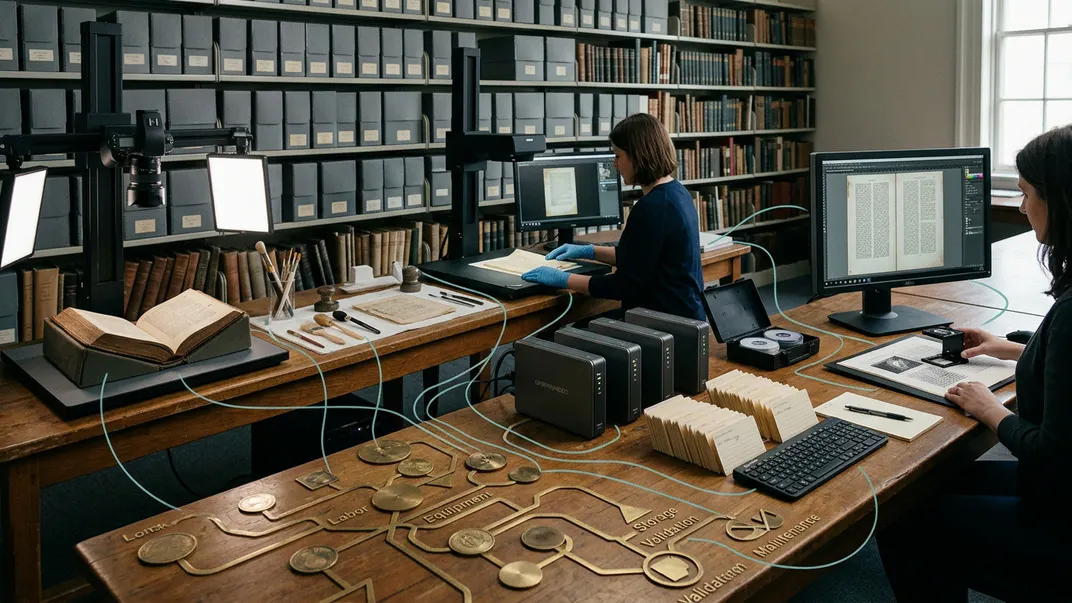
Records digitization cost is not a scanning rate. It is a pipeline cost with a one-time capital half and a recurring operating half, and the scan invoice is only one line in it. A defensible budget runs: selection and project management; rights and risk review; condition assessment and preparation; capture of preservation masters; post-processing and access derivatives; text generation (OCR, HTR, manual or crowdsourced transcription); metadata and indexing; image, metadata and text QC with rework; ingest; then storage, replication, fixity, migration, repository and delivery costs for as long as you intend to keep the records. Anyone quoting you a single per-page number has priced one line and left the other twelve to you.
That is the honest headline, and it is why per-page figures you find online mislead. The public price examples circulating are not archival benchmarks: the University of Tennessee's records management office lists document imaging starting at 3¢ per page, and a commercial estimate quotes $0.08–$0.12 per page for scanning plus about $0.01 per page for OCR on a $2,200–$3,300 project. Neither describes a fragile bound deed volume, an oversized plat, or a mixed handwritten case file with a certified index requirement. They describe modern loose office paper fed through a duplex scanner.
Why the line items exist: the standards define the work
If you are procuring, the cost structure is not something you invent. Two authorities already enumerate it, and a budget that maps to them survives review.
The Federal Agencies Digital Guidelines Initiative's technical guidelines name the workflow explicitly: selection of materials, condition evaluation, cataloging, metadata creation, production scheduling, digitization prep, digitization, post-processing, quality review, archiving, publishing. NARA's 2023 Digitization Quality Management Guide groups the same work into four phases — project planning, before digitization, digitization, after digitization — and requires a quality management plan documenting how image quality is inspected, how metadata quality is inspected, what corrective action follows a deviation, and how conformance is verified.
Definitions worth fixing before the numbers
Procurement documents use these loosely. Pin them down first.
- Foliation is the budget task of assigning or confirming page and folio sequence identifiers and reconciling them to the physical order. On unindexed judicial series this is real labor, not a formality.
- Capture is creating the image master. A derivative is anything produced from that master — a display JPEG, an OCR or HTR text layer, an ALTO or PAGE file.
- Ingest is validated transfer into the managed repository.
- Fixity, in the Digital Preservation Coalition's definition, is the assurance that a digital file has remained unchanged — normally verified with checksums, on ingest and then at intervals.
- TCO is capital plus operating cost across the service life. Not the scan invoice.
The one-time lines
Selection, scope and project management
Which series, which date range, what gets excluded. This is where a project either becomes affordable or quietly triples: a decision to digitize whole volumes rather than sampled instruments changes every downstream line.
Rights and risk review
For court and vital-records series, this includes redaction policy, sealed-record handling, and chain-of-custody documentation. Its magnitude is jurisdictional and has to come from your own counsel and procurement specification. There is no published range worth trusting.
Condition assessment and preparation
IFLA/ICA/UNESCO's digitization project guidelines are unusually concrete here: preparation includes retrieval of materials and their return to the shelf, documentation, flattening, cleaning, repair of minor tears, disbinding of volumes and possible subsequent rebinding or protective enclosure. Fragile deed books and bound dockets sit at the expensive end of this line, and it is the line most often absent from a first draft.
Equipment or capture bid
FADGI's four star levels are quality tiers, not a price list: for unbound general-collection documents it specifies 150, 300, 300 and 400 ppi for one through four stars, and notes that a basic system can be assembled for a few hundred dollars while stepping up to a digital camera system moves a workable system to a few thousand. Those are capital examples for context, not per-page rates. Higher stars demand greater operator and system performance, which is a labor and validation cost, not just a resolution setting.
Initial capture labor
The oldest usable productivity data is still instructive for mechanism. Cornell's 1991 joint study with Xerox and the Commission on Preservation and Access logged 1.72 hours per brittle book, an average straight scanning rate of 175 pages per hour with observed rates from 92 to 264 depending on volume size, illustrations and print consistency, and two technicians sustaining 5,000 images per week while also doing collation, disbinding and inspection. Rescans averaged under 1%. Read the spread, not the average: the 92-to-264 range is what condition and format variance does to a schedule. Note the study's own caveat as well — technicians did not log selection, preparation or inspection time, so this is not a full project cost.
Text generation
See the section below on transcription. This is the line that behaves least like the others.
Initial metadata and indexing
The IFLA guidelines report that in their source context metadata and indexing were disproportionately high — 60% of total cost — because the work is done by qualified information specialists who often need reskilling in new standards. That 60% is a case, not a constant, and should not be lifted into your budget as a coefficient. A 2013 Randtke article reports digitization at 6% of total project time against 86% for metadata creation plus final database audit, but the accessible evidence doesn't identify the project, material or unit. Treat it as a lead. What both point at is directionally sound and matches what most archives find on their own: description costs more than capture.
Transport, insurance, training, acceptance QC, initial ingest
Small lines individually. Collectively they are where first projects overrun. NEDCC's advisory rule of thumb for in-house work — estimate, double it, and if it's your first project double that again — is not an empirical ratio, but it exists because the pattern is common. FADGI adds a correction worth reading twice: avoid assuming in-house will cost less, because insourcing may cost more than outsourcing.
The recurring lines
Storage is the misconception that does the most budgetary damage, because it presents as a purchase and behaves as a subscription.
Raw list prices are easy to find and are floors, not budgets. Google Cloud's dual-region standard example is $0.022 per GB-month — roughly $264 per TB-year at 1,000 GB/TB. AWS S3 Standard is $0.0265 per GB-month for the first 50 TB, about $318 per TB-year, with internet transfer at $0.09/GB. Backblaze starts at $15 per TB-month, about $180 per TB-year. Every one of those numbers is one copy, no labor, no fixity, no migration.
Preservation-grade cost is a formula, not a rate. The STFC lifecycle cost model parameterizes it plainly: storage cost equals duration in months × cost per GB-month × volume; fixity check cost equals cost per test × (duration ÷ test frequency); test duration equals volume ÷ processing rate. Supply your own duration, volume, copy count, test frequency and hourly rate. Then add format-obsolescence work, repository software and infrastructure, bandwidth, retrieval, staffing and governance. The DPC's storage guidance notes IT storage lifetimes are typically short — on the order of three to five years — so refresh is scheduled, not hypothetical.
Even a well-instrumented, published figure resists generalization. Harvard's Library Innovation Lab reports 1/100 to 2/100 of a penny per average object per month and about $0.05 per link over 100 years for Perma.cc — while explicitly excluding infrastructure creation, labor, an additional copy, the Internet Archive copy, and retrieval effects, and saying it cannot speak to other archives' costs. Use it as a lifecycle illustration and nothing more.
Delivery is its own recurring line. If public access runs through a IIIF viewer, the IIIF Presentation API supplies the structural and presentation information for the objects — and someone has to build, host, and maintain the manifests and the viewer indefinitely.
QC is a line item, and it recurs per batch
The instinct to put quality review at the end, cheap, is where schedules break. NARA's requirements are specific enough to cost: 100% automated file-level checks, plus a random visual sample of at least 10 files or 10% of each batch, whichever is larger. If 1% or more of examined records fail any criterion, you determine the source and scope of errors, correct or re-digitize the affected records, and reinspect until the sample reaches 100% success. That rework loop is a budgeted contingency, not an exception.
Two things follow. First, QC is both batch-based and recurring: every batch needs automated validation, sampling, acceptance and possible rework, so the line scales with volume rather than sitting once at the end. Second, NARA's guide does not prescribe a verification method for derived text files. Image QC is specified; transcription acceptance is yours to define. If your budget has no line for it, you have implicitly accepted whatever error rate your text pipeline produces.
That is a planning decision as much as a costing one. The broader question of how court and government record series become searchable at scale sits behind every number in this section.
Where transcription cost actually lands
Nothing in a digitization budget is misquoted as often as the text line, because three different things get priced as if they were one.
Printed forms and typescript
Conventional OCR handles clean modern print well and cheaply, but it is a text-generation and verification line, not a property of the image. GPO's study of older documents found printed material could meet a 99% character accuracy requirement under specified capture conditions — 400 dpi for color and greyscale, 600 for bitonal — and also that bitonal capture of older material produced unacceptable accuracy while greyscale and color were essentially equal. It flags the failure mode that matters for acceptance testing: characters recognized wrongly but above the software's confidence threshold pass undetected. Capture decisions therefore price your OCR line before you buy any OCR.
Handwritten entries
This is the volume problem in judicial and land series, and the reason crowdsourcing became the default. It works, but it is not free. FromThePage and Zooniverse represent two different patterns — collaborative review versus multiple keying with owner reconciliation — and the platform side of that comparison reports about 57 pages transcribed per hour and 352 total contributions per hour, with Zooniverse's DIY builder free to use. What no published figure covers is your staff cost for recruitment, moderation, reconciliation and acceptance sampling, or the schedule risk of depending on volunteer availability for a statutory access mandate.
Software pricing is not project cost
Transkribus publishes a free tier of 50 credits per month, around 50 pages, and paid plans from €8.25/month. That prices consumption. It does not price ground-truth production, model training or fine-tuning time, human correction, or acceptance QC — and for the trained-model tools, that setup labor is a real line in a first-year budget.
Machine transcription costs on handwriting are also moving quickly enough that a 2023 assumption is no longer safe. A 2024 study of 18th- and 19th-century English handwritten documents reported LLM-based transcription at 5.7–7% CER, with a self-correction result as low as 1.8% CER, at compute costs of roughly a fraction of a cent per page against a cited $0.26/page for the Transkribus models tested — figures the authors present as experimental model and API estimates on a single English-language corpus, with error rates that are non-zero, no demonstration of generalization to vernacular legal hands, and human verification still required. Useful evidence, then, that the compute component of this line has fallen, and no basis at all for a procurement rate on French notarial, Spanish, German or Dutch record series. Price the accepted transcript, not the inference.
Costing the handwritten line without a per-office training project
For a government or judicial series, the practical approach is hybrid: preserve a high-quality image master, route printed forms and typescript to OCR, and route handwritten entries to a specialist handwritten text recognition path with a defined human review step over the fields that carry liability — names, dates, legal descriptions, amounts.
What changes the cost of that path most is whether it requires you to build a model first. Trained HTR tools ask you to produce ground truth and fine-tune per hand or per series, which is a staffed project before a single page of production output exists. Leo's model, ATR-1, is zero-shot: it reads Latin-script material — any language written in the Latin alphabet, whatever the language on the page, with performance strongest in English and strong across French, German, Spanish, Italian, Dutch and Latin among others — with no per-office training step, no preprocessing and no segmentation. Non-Latin scripts (Greek, Cyrillic, Hebrew, Arabic, Indic, East Asian) are out of scope. Transcription and translation are separate operations: the base transcription stays in the language of the record, and translation is a distinct one-click Transformation that writes to a new tab rather than altering it.
On accuracy, the comparison worth citing is a randomized 97-image sample of early-modern English manuscripts from the Folger Shakespeare Library at ATR-1's release, where Leo scored roughly 5% character error rate against Transkribus (Text Titan I) at about 13%, Claude Opus 23.3%, Gemini 2.5 Pro 24.8% and GPT-4.1 56.7% — 61% fewer errors than the next-best model. One corpus, one language, one point in time. Benchmark your own series before you scale, as you would with any vendor.
Two things matter more to a budget than the headline. The first is what kind of error you are correcting. ATR-1 transcribes what is on the page — strikethroughs, interlineations, marginal notes, editorial expansions, archaic spelling preserved rather than normalized — and checks its own output for failure patterns, hiding suspect results, retrying automatically, and refunding the credit if a page cannot succeed. Errors that get through are the recoverable kind: a wrong character or word, caught against the image displayed beside the text. Fluent fabrication from a general chatbot is the expensive kind, because a reviewer has nothing to catch it on. Your review line is priced by which failure mode you inherit.
The second is honesty about the weak spot, because it bears directly on this material: pages that mix dominant printed structure with dense handwriting — pre-printed ledger and deed-book forms — are where the model can favor the printed headers over the manuscript entries, and complex tabular layouts vary. Sample those series specifically in a pilot rather than assuming the general figure holds. Pricing is per image (a page or double-page spread) with plans from free upward and custom pricing above 5,000 credits; academic and archival projects can apply for up to 100,000 free credits under the Transcription Grant, on condition the transcriptions and images are published openly within 24 months — which means applying with material you hold or have cleared the rights to publish. Printed-only material is not eligible; that runs on the free tier or a paid plan.
Leo's place in the pipeline is narrow and worth stating plainly: it begins at upload and ends at export (TEI XML, Word, PDF, HTML), with a document workspace, fixed archival metadata fields, fuzzy search and public share links in between. It does not capture images, and it does not do IIIF, OAIS packaging or EAD/METS/PREMIS. Those remain separate lines in your budget, handled by other systems.
Build the formula, then buy the pilot
The deliverable your finance office needs is not a total. It is a formula with named assumptions:
loaded labor hours for prep, foliation, metadata, QC and management + capture bid or equipment plus maintenance + text generation and human correction + transport, rights and training + initial ingest — followed annually by storage × copies, fixity testing at frequency, migration reserve, repository and delivery hosting, bandwidth and support.
Any total produced without page count, page dimensions, condition profile, FADGI target, metadata depth, file-size assumptions and local labor rates is a guess wearing a decimal point.
Then buy the measurement. A paid pilot or a structured RFP exercise on a real sample of your worst series should produce the seven numbers that make the formula defensible: hours per box or volume, hours per page at your quality target, image failure rate under NARA's sampling rule, metadata minutes per item and per series, text error rate on both printed and handwritten paths, correction minutes per page, and annual repository operations. Vendor and market rates found online belong in the proposal only after a current procurement or service-bureau quote corroborates them.
The discipline here is the same one that governs the records themselves. You are being asked to stand behind a figure the way you stand behind a certified copy — traceable to a source, with the assumptions visible and the gaps named rather than smoothed over. A budget built that way survives the grant cycle, the audit, and the staff turnover in between, because the next person can see exactly what you measured and what you assumed. That is worth more than a lower number.
Frequently Asked Questions
How much does records digitization cost per page?
There is no defensible per-page rate, because records digitization cost is a pipeline cost rather than a scanning rate. Published examples — 3¢ per page from a university records management office, or 8–12¢ per page plus about a penny for OCR — describe modern loose office paper fed through a duplex scanner, not fragile bound deed volumes, oversized plats, or mixed handwritten case files with certified index requirements. A quoted page rate prices capture and leaves selection, condition preparation, metadata, QC, ingest, storage, fixity and migration to you. Build a formula with named assumptions, then buy a paid pilot on your worst series to fill in the numbers.
What line items belong in a records digitization budget?
A defensible budget names both a one-time capital half and a recurring operating half. One-time: selection and project management; rights and risk review; condition assessment and preparation; capture of preservation masters; post-processing and access derivatives; text generation through OCR, HTR or transcription; metadata and indexing; image, metadata and text QC with rework; transport, insurance, training; and initial ingest. Recurring: storage multiplied by copy count, fixity testing at a defined frequency, format migration, repository software and infrastructure, delivery hosting, bandwidth, retrieval, staffing and governance for as long as you intend to keep the records. FADGI's technical guidelines and NARA's quality management guidance enumerate substantially the same workflow.
Why does metadata cost more than scanning?
Because description is skilled labor performed item by item, while capture is largely mechanical. IFLA's guidelines report metadata and indexing reaching 60% of total cost in their source context, since the work is done by qualified information specialists who often need reskilling in current standards. A 2013 Randtke article reports digitization at 6% of total project time against 86% for metadata creation plus final database audit, though the accessible evidence doesn't identify the project or material. Neither figure is a coefficient to lift into your own budget. The direction, however, matches what most archives find: description costs more than capture.
What does it cost to store digitized records long term?
Cloud list prices are floors, not budgets: roughly $264 per TB-year for a dual-region standard tier, about $318 per TB-year for one major provider's standard storage under 50 TB, around $180 per TB-year at the low end. Each of those figures buys one copy with no labor, no fixity checking and no migration. Preservation-grade cost is a formula — duration × cost per GB-month × volume, plus fixity cost per test across the retention period — with your own copy count, test frequency and hourly rates supplied. Add format-obsolescence work, repository software, bandwidth, retrieval and governance. Storage presents as a purchase and behaves as a subscription.
How should we price transcription of handwritten records?
Price the accepted transcript, not the inference. Software consumption pricing, crowdsourcing throughput and machine compute costs each cover one slice; none covers ground-truth production, model training, human correction, or acceptance sampling — and NARA's guidance specifies image QC but prescribes no verification method for derived text, so that line is yours to define. Trained HTR tools require ground truth and fine-tuning per hand or series before any production output exists. Leo's ATR-1 is zero-shot on Latin-script material with no per-office training step, priced per image. Whichever path you choose, sample pre-printed ledger and deed-book forms specifically in a pilot before scaling.