Digitizing County Deed Books: A Working Plan for Recorder Offices with Fragile Volumes and No Index
Working plan for digitizing fragile, unindexed county deed books: triage and overhead capture standards, rebuilding grantor–grantee indexes, and what reads nineteenth-century clerks’ hands.
Leo Team
August 6, 2026
Contents
This is a sequencing plan for digitizing county deed books when the volumes are bound, fragile, and unindexed — what to capture, in what order, to what image standard, and what actually reads a nineteenth-century clerk's hand. It matters because an image-only deed collection satisfies no one: not the title searcher, not the genealogist, and not the statutory obligation to make the record findable.
Digitizing county deed books is two projects, not one. The first is non-destructive image capture — overhead planetary or camera capture of a supported bound volume, measured against a published image-quality standard. The second is building the access layer that makes those images findable: stable book/page identifiers, grantor–grantee index data, and full text where the hands allow it. Offices that fund only the first end up with a well-photographed collection nobody can search. The defensible plan sequences both, validates transcription accuracy on your own clerks' hands before scaling, and keeps human review on the fields where an error becomes a liability — names, legal descriptions, and instrument references.
What follows is a working plan: how to triage, how to capture bound volumes without stressing them, how to rebuild an index that was never machine-readable, and how to decide what reads the handwriting.
Start by separating "digitized" from "accessible"
A deed book is a bound run of recorded instruments whose authoritative locator is normally volume/book and page. That locator is the hinge of the whole project. Digitized means an image or derivative exists. Accessible means a user can find the relevant book and page through stable metadata and an index, then inspect the image. At deed-series scale, an image-only collection is not effectively searchable.
The Property Records Industry Association frames index data as the card-catalog layer that leads a user to the primary document image — and in most states, specific index elements such as grantor and grantee names are statutorily required. Its recommended field set for aggregated indexes runs wider: grantor, grantee, document type, recording date/time, document number, consideration, and parcel information. A working public service reflects the same split — the District of Columbia's Recorder of Deeds exposes both index information and document images online from 1921 forward.
So plan two workstreams with separate budgets, separate QC, and separate acceptance criteria. Capture is not the deliverable. Retrieval is.
Note also that a general index gives you name-based access only. A tract or geographic index — organized by parcel or location — is a distinct additional layer that title searchers routinely need, and one that legacy books rarely support without new data creation.
Triage: what goes first, and on what grounds
Chronological order is the default because it feels neutral. It is usually the wrong queue. A defensible sequence, consistent with the framing in NARA's strategy for digitizing archival materials and IFLA's digitization project guidelines, runs:
- Risk and demand triage. Document both: which volumes are physically deteriorating, and which are pulled most often by title searchers and genealogists. Demand is evidence, not popularity.
- Conservation and handling assessment, volume by volume, before any camera is booked.
- Capture.
- Image QC against a stated standard.
- Metadata and preservation provenance.
- Indexing and text recognition, or keying.
- Human QC on high-stakes fields.
- Public search.
No head-to-head study comparing demand-first with chronological sequencing in recorder offices has been published, so treat this as reasoned practice rather than settled finding. What it buys you is a project that produces usable access early, which matters when funding arrives in cycles.
One legal point belongs in triage, not at the end. A digital surrogate does not authorize destroying the original. North Carolina's 2026 Register of Deeds schedule states plainly that many Register of Deeds records are permanent, with high legal, administrative, and historical value; at the federal level, NARA permits disposition of digitized permanent paper only under specified standards and schedule authority. County law and state evidentiary rules govern your office, not NARA's rules — but the direction of travel is the same. Guillotine or sheet-fed conversion of a bound permanent deed book is a disposition decision, and should be made as one, in writing, by whoever is authorized to make it.
Capture: bound volumes, overhead, on a cradle
The fragile-volume constraint narrows the equipment question considerably.
FADGI's Technical Guidelines for Digitizing Cultural Heritage Materials, Third Edition (May 2023) recommends planetary book scanners or digital cameras for bound general collections and marks flatbeds as not recommended for that class. NEDCC's reformatting and digitization guidance explains why in physical terms: flattening bindings and feeding fragile leaves damages them, and gutter shadow can render text illegible even when the volume survives the process.
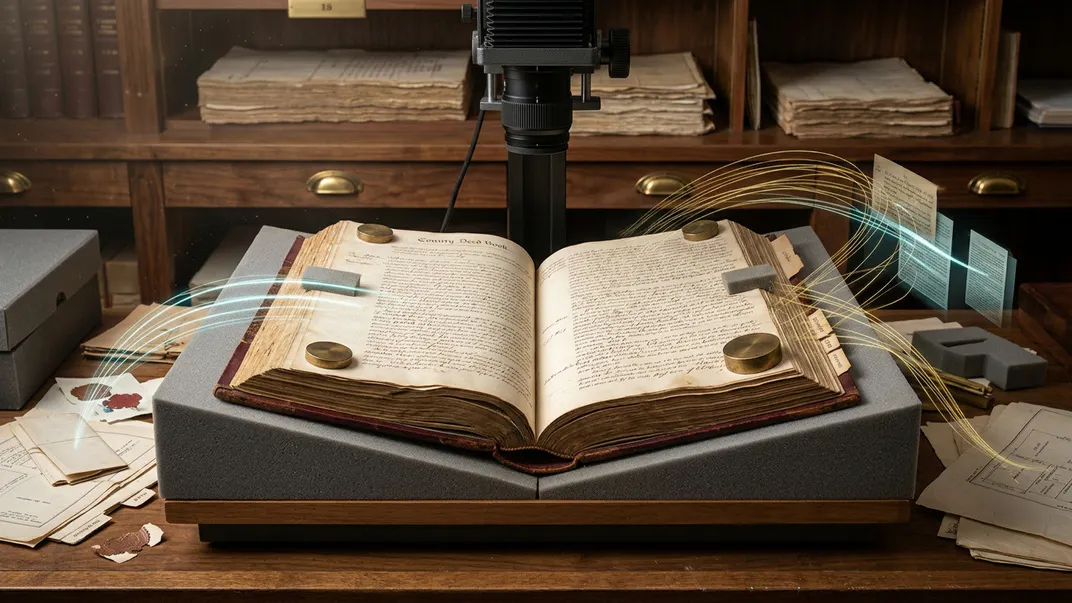
That leaves overhead capture on a supported cradle or V-cradle, which holds both boards and limits strain on the spine. A controlled platen can reduce page curl, but only where a conservation assessment permits it and only where it does not crush the binding. Never open a volume beyond the angle at which the sewing is stressed — and expect that angle to differ across a run of books recorded decades apart in different bindings.
For resolution, FADGI's Third Edition sets sampling thresholds for bound volumes: for rare and special materials, ≥242.5 ppi (1-star), 294 ppi (2-star), and 396 ppi (3-star); for general collections, ≥190 ppi (1-star), 242.5 ppi (2-star), 294 ppi (3-star), and 396 ppi (4-star). Where you land is a policy choice about how many times you intend to touch these volumes. Since the whole point of a non-destructive project is to avoid a second capture pass, capture higher than you think you need — resolution is also what your text-recognition step has to work with.
Two objective QC layers sit on top of capture. The Metamorfoze Preservation Imaging Guidelines v2.0 (April 2025) supply image-quality targets and, usefully for deed books, address the reality that the left and right pages of an open volume may sit slightly skewed relative to each other. ISO 19264-1:2021 defines a method for analyzing imaging-system quality in cultural heritage imaging. Write one of these into your specification and into your vendor acceptance terms. "Legible" is not an acceptance criterion.
Be straightforward with your finance office about what is not known. There is no robust, independently measured cost-per-page or pages-per-hour figure for oversized, tight-bound county deed books captured overhead. Public procurement documents specify scope and QC without publishing awarded prices — Sedgwick County's 2025 Register of Deeds RFP addendum describes roughly 2,600–2,800 books and requires indexing to include book type, book number, document number where available, and page number, but no award price. Pilot a representative sample of your own volumes and derive your own rate. Anyone quoting you an industry-standard per-page number for bound handwritten deed books is extrapolating.
The same discipline applies if capture is happening in-house with a camera rather than a scanner; the geometry, lighting, and focus decisions are the ones covered in any careful field method for photographing archival documents without stressing the original.
Rebuilding the index that was never there
With images in hand and no index, you are creating data, not converting it. Three routes exist, and most offices end up using more than one.
Manual keying to a defined field set
Slow, auditable, and still the baseline for the fields that carry liability. PRIA's Indexing Best Practices supplies the rule that matters most for historical names: key it as you see it. Preserve the recorded form. Document corrections rather than overwriting silently. Retain notes and audit history. This is the same principle a paleographer calls source integrity, arriving from a different direction: the recorded spelling is the record, and a modernized name breaks the search that a title examiner will run against a variant.
Volunteer transcription
Crowdsourced platforms have staged transcription, peer review, and staff escalation, and they work well on bounded, appealing collections. The Library of Congress By the People program had, as of 1 November 2021, 392,000 images completed and 102,000 awaiting peer review, with more than 620,000 documents made available since October 2018 and 63,400 incorporated into loc.gov; reported accuracy included roughly 98% on a small Branch Rickey sample and about 98% inter-volunteer agreement in aggregation tests. Those are real results with real quality controls. What they do not establish is volunteer retention, stable throughput, or completion probability for a multi-volume deed backlog under a fixed public-access obligation. Deed books are also not the material volunteers self-select into. Use volunteers where enthusiasm exists; do not schedule against them.
Machine transcription of the manuscript text
This is where a full-text layer becomes affordable — and where the technology choice matters most.
What actually reads a nineteenth-century clerk's hand
Sort out the vocabulary first, because procurement language often blurs it. OCR denotes optical recognition of printed, laid-out text. Handwritten text recognition (HTR) denotes recognition of handwriting, where letterforms, line segmentation, and writer variation require handwriting-specific training. Latin-script means the alphabet, not the Latin language — which matters if your early volumes carry Spanish, French, Dutch, or German entries inside an otherwise English series. Those entries need separate evaluation; the alphabet is the same, the orthography and formulae are not.
Cloud OCR services do advertise handwriting extraction — Amazon Textract states that it extracts text, handwriting, layout elements, and data, and Google Cloud Vision's documentation includes handwriting extraction. Advertised support is not validated performance on heterogeneous American deed hands, and no published evaluation demonstrates it on that material. The practical failure mode in a recorder's office is that these services return confident output on a page they have partly misread, and nobody checks because there is no ground truth to check against. If you are already routing records through Textract, the specific question of what it reads and where the pipeline breaks on manuscript series is worth working through before you extend it across a deed run.
Specialist HTR platforms — Transkribus, eScriptorium — are the closer comparison, and both are built around training or fine-tuning a model on your material. Transkribus's own guidance recommends 25–50 representative pages for initial training, at least 10,000 words per variable hand, 10% validation data, and 20 further pages for retraining a smaller model (50–100 for larger ones). That is vendor guidance, not an independent benchmark, and it does not quantify staff hours or how many distinct clerk models a long deed run requires. A single county's deed books may pass through dozens of hands, inks, and layouts. Plan for model drift, or plan to avoid the training step.
General multimodal chatbots are the wrong instrument here, and it is worth saying why precisely. In a 2024 study of handwriting recognition in historical documents, a general model was reported at 34% character error rate on an English test set against reproduced comparison systems at 6.8% and 7.5%, alongside hallucination and generation errors — a single-corpus result, not a general verdict, and one that still leaves every reading in need of verification. The relevant point for a recorder's office is the shape of the error, not its size. Garbled output announces itself. A fluent, plausible, wrong grantee name does not, and it will be indexed, searched, and relied upon. That failure mode is worth understanding in detail if a chatbot is anywhere in your pipeline: fluent but wrong is the specific risk profile that makes general models unsuitable for index creation.
Benchmark literature will not settle this for you either. The 2024 HTR survey reports the IAM English benchmark at 1,539 pages and a best WER of 9.3% — English handwriting, but not American county deeds, and best-case benchmark error is not production accuracy. Nobody has published a reliable character error rate for nineteenth- and early-twentieth-century county clerks' hands with mixed inks, gutter-obscured lines, and recurring legal formulae. Which means the only figure you can defend is the one you measure on your own books.
Where Leo fits, and where it does not
Leo is a purpose-built HTR platform, and the argument for it in a back-file conversion is narrow and practical: its transcription model, ATR-1, is zero-shot. There is no per-office or per-clerk training step. You upload page images — JPEG, PNG, HEIC, or multi-page PDFs, a thousand at a time — and transcribe. For an office facing dozens of hands across hundreds of volumes, removing the training burden removes the main reason full-text conversion gets deferred indefinitely.
It reads material written in the Latin alphabet, which covers the mixed-language entries in early series, and it reads printed matter as well as manuscript. It transcribes what is on the page: archaic orthography, strikethroughs, marginal additions, and expansions survive rather than being normalized into modern prose. That is the same discipline as PRIA's key-it-as-you-see-it rule, enforced at the transcription step. Around the model sits the workflow the access layer needs — folders, per-document metadata fields (Title, Creator, Date, Archive, Type, Collection, Box, Folder, Identifier, Rights), fuzzy search with adjustable sensitivity across all transcriptions, and export to Word, PDF, HTML, or TEI XML for ingest into your delivery system. Translation, if early entries need it, is a separate operation that writes to a new tab; the base transcription stays untouched.
On accuracy, the published evidence is a manuscript benchmark, not a deed benchmark: on a randomized 97-image sample of early-modern English manuscripts from the Folger Shakespeare Library at ATR-1's release, Leo recorded roughly 5% character error rate against Transkribus (Text Titan I) at ~13%, Claude Opus ~23.3%, Gemini 2.5 Pro ~24.8%, and GPT-4.1 ~56.7% — 61% fewer errors than the next-best model, with the full comparison published here. Early-modern English secretary hand is harder material than most deed clerks produce, but it is not your material. Run a sample of your own volumes and score it.
Two honest boundaries. Leo begins at upload — it does not capture, so the cradle, camera, and FADGI conformance remain yours or your vendor's. And the model's known weak spot is directly relevant to this project: pages where dominant pre-printed structure meets dense handwriting, which is exactly what a printed deed form with manuscript entries looks like. On those forms the model can favor the printed headers over the written text. Test your form-heavy volumes separately from your free-text ones and route them differently if the results diverge.
Human QC, targeted where liability lives
No transcription route — volunteer, machine, or keyed — removes the review step. It changes where you spend it.
Review everything and you have rebuilt the original bottleneck. Review nothing and you have published an index that will generate escapes. The defensible middle is field-based triage: 100% human verification against the image for grantor and grantee names, legal descriptions and bearings, recording dates, book/page and document numbers, and marginal releases and satisfactions. Body prose and recitals get sampled. That priority list is not arbitrary — it maps onto the known sources of title search error: misread index names, misindexed instruments, missed marginal releases, and miscopied bearings.
Record the review. Who verified, when, against which image, and what was changed. PRIA's guidance to document corrections rather than overwrite silently is what makes the resulting index defensible when someone contests a chain of title years from now — and it is the same reason preservation metadata matters. Capture standards and metadata standards do different jobs and both need budget: FADGI, Metamorfoze, and ISO 19264 address image quality; METS packages the digital object; Dublin Core and MODS describe it for discovery; PREMIS records preservation objects, events, agents, and rights; EAD describes archival hierarchy. The layered relationship between these is worth mapping out before procurement, and the broader planning frame for deed and land-records conversion sits on top of it.
Test retrieval before you call it done
The last step is the one most often skipped: search your own system the way a title abstractor would. Take twenty instruments you already know from the paper books. Search each by grantor surname, by grantee surname, by book and page, and by a variant spelling. Count how many you find and how many hops it took. If a known deed does not surface, the failure is in the index or the transcription, and you would rather learn that during acceptance testing than from a claim.
Then document the gaps you did not close. Which volumes were skipped for condition. Which hands transcribed poorly and were left image-only. Which series lack parcel data. A recorder's office that can state precisely what its digital collection does and does not support is in a far stronger position — with the public, with title professionals, and with the next funding cycle — than one that has quietly declared the backlog finished. The books outlast every system you will build around them; what you owe the next clerk is an accurate account of what was done to them, and what is still waiting.
Frequently Asked Questions
How do you go about digitizing county deed books that are bound, fragile, and unindexed?
Treat it as two funded workstreams, not one. First, non-destructive image capture — overhead planetary scanner or camera on a supported cradle, measured against a published image-quality standard. Second, the access layer: stable book and page identifiers, grantor–grantee index data, and full text where the hands allow. Sequence the work by risk and demand rather than chronology: triage deteriorating and heavily requested volumes, assess handling condition, capture, run image QC, add metadata, then index or transcribe, then apply human review to high-stakes fields, then publish search. An image-only collection satisfies neither title searchers nor genealogists.
Can you use a flatbed scanner on bound deed books?
No — flatbeds are not recommended for bound general collections. FADGI's Third Edition guidelines point to planetary book scanners or digital cameras instead, and NEDCC explains the physical reason: flattening bindings and feeding fragile leaves damages them, and gutter shadow can make text illegible even when the volume survives. The workable method is overhead capture on a supported cradle or V-cradle that holds both boards and limits spine strain. A controlled platen can reduce page curl only where a conservation assessment permits it. Never open a volume past the angle at which the sewing is stressed.
What resolution should county deed book scans be captured at?
FADGI's Third Edition sets sampling thresholds by material class. For rare and special materials: at least 242.5 ppi for one star, 294 ppi for two, and 396 ppi for three. For general collections: at least 190 ppi for one star, 242.5 ppi for two, 294 ppi for three, and 396 ppi for four. Where you land is a policy decision about how many times you intend to handle the volumes. Because the point of a non-destructive project is avoiding a second capture pass, capture higher than you think you need — resolution is also what your text-recognition step has to work with.
Does OCR work on handwritten deed books?
Not reliably. OCR means optical recognition of printed, laid-out text; handwritten text recognition (HTR) is the handwriting-specific technology, trained on letterforms, line segmentation, and writer variation. Cloud services such as Amazon Textract and Google Cloud Vision advertise handwriting extraction, but no published evaluation demonstrates their performance on heterogeneous American deed hands. The practical danger is confident output on a partly misread page with no ground truth to check it against. Specialist HTR platforms typically require training on your material; Leo's ATR-1 model is zero-shot, so there is no per-clerk training step across dozens of hands.
Can a county destroy the original deed books after digitizing them?
A digital surrogate does not by itself authorize destruction. North Carolina's 2026 Register of Deeds schedule states that many Register of Deeds records are permanent, with high legal, administrative, and historical value, and NARA permits disposition of digitized permanent paper only under specified standards and schedule authority. County law and state evidentiary rules govern a recorder's office, not NARA's rules, but the direction is consistent. Guillotine or sheet-fed conversion of a bound permanent deed book is a disposition decision and should be made as one — in writing, by whoever is authorized to make it, during triage rather than afterward.