The Roundness of the Balance: Bernardino Baldi's Exercises on the Mechanical Problems attributed to Aristotle
A late-Renaissance mathematician's demolition and repair of an ancient text, Bernardino Baldi's Bernardini Baldi Vrbinatis Guastallæ abbatis In mechanica Aristotelis problemata exercitationes (Mainz, 1621) reworks the pseudo-Aristotelian Mechanica question by question, refusing to let the authority of a revered name stand in for demonstration. Baldi — mathematician, hellenist, poet, and Abbot of Guastalla, trained in the Urbino school of Commandino and Guidobaldo del Monte — argues that Aristotle's causal footing failed because he lacked the Archimedean science of the centre of gravity, and re-founds every mechanical marvel on the lever and the balance. It is a work in which humanist learning and mathematical rigour discipline one another, memorable for the boldness with which its author fights "with reasons and truth against authority."
ExLatinis
27 July 2026

Contents
A late-Renaissance mathematician's demolition and repair of an ancient text, Bernardino Baldi's Bernardini Baldi Vrbinatis Guastallæ abbatis In mechanica Aristotelis problemata exercitationes (Mainz, 1621) reworks the pseudo-Aristotelian Mechanica question by question, refusing to let the authority of a revered name stand in for demonstration. Baldi — mathematician, hellenist, poet, and Abbot of Guastalla, trained in the Urbino school of Commandino and Guidobaldo del Monte — argues that Aristotle's causal footing failed because he lacked the Archimedean science of the centre of gravity, and re-founds every mechanical marvel on the lever and the balance. It is a work in which humanist learning and mathematical rigour discipline one another, memorable for the boldness with which its author fights "with reasons and truth against authority."
When Bernardino Baldi of Urbino died in 1617, he left behind a set of Latin exercitationes on the pseudo-Aristotelian Mechanica that had been drafted decades earlier and taken up again late in his life, but that had never left the condition of manuscript. Four years later, in 1621, the work appeared in print at Mainz, far from the Italian mathematical culture that had shaped it, under the honorific title Bernardini Baldi Vrbinatis Guastallæ abbatis In mechanica Aristotelis problemata exercitationes, with an appended brief narrative of the author's life and writings. Baldi — mathematician, hellenist, poet, translator, and Abbot of Guastalla from 1585 — was among the last representatives of the Urbino school of mathematics that ran from Federico Commandino through Guidobaldo del Monte, and the Exercitationes is his one major mathematical-mechanical commentary to reach print in the immediate wake of his death. It is a learned, question-by-question engagement with one of antiquity's most influential yet troublesome scientific texts.
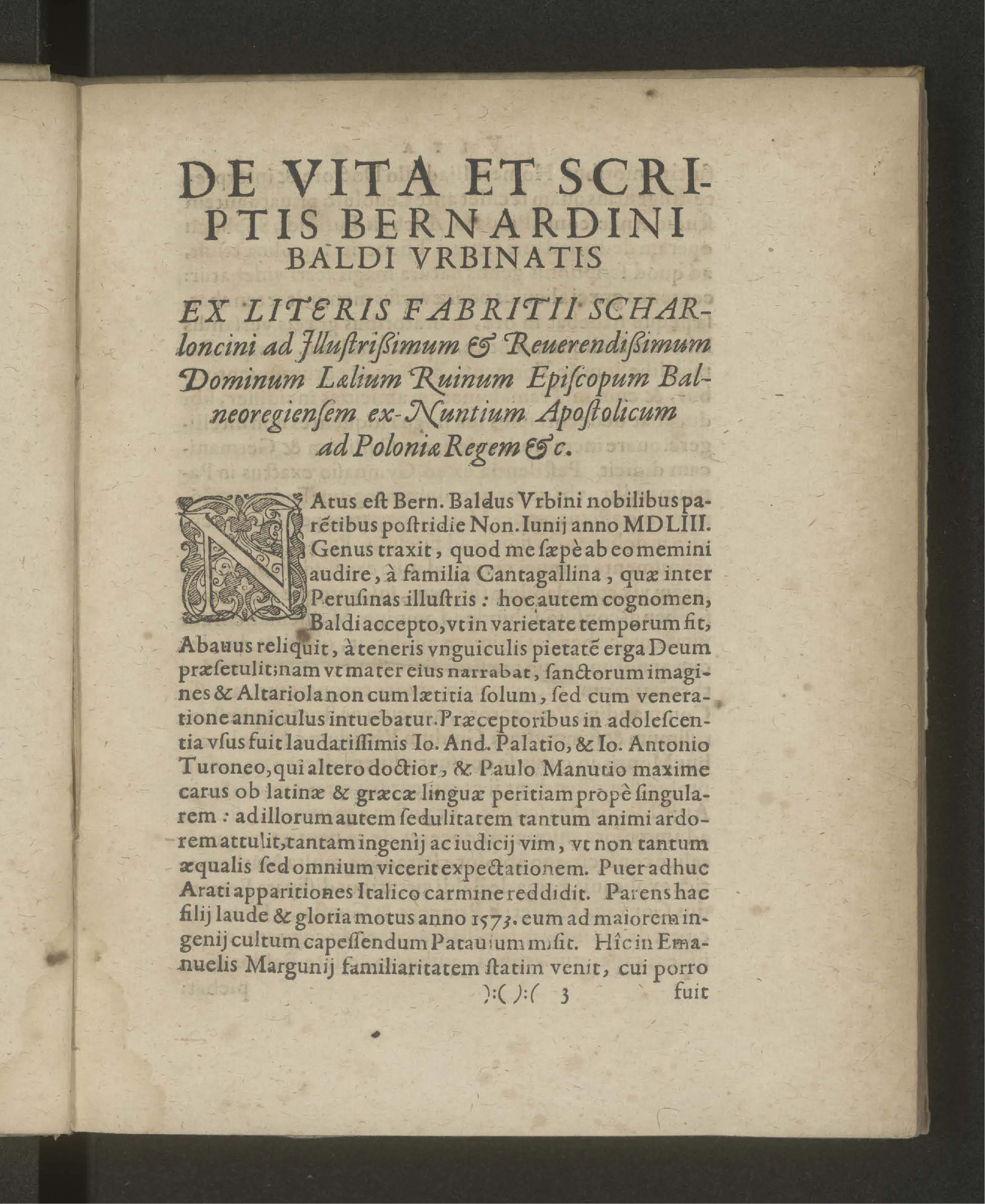
The opening of the appended life of Baldi makes visible the editorial apparatus promised on the Mainz title page: Fabrizio Scharloncini's letter to Lelio Ruini is set off in display type before the decorated initial that begins the account of Baldi's birth and education. By placing Urbino, Greek learning, and Padua at the threshold of the biography, the page anchors the posthumous Exercitationes in the intellectual formation that linked Baldi to the Commandino–del Monte mathematical tradition. Source ↗.
The intellectual problem the work confronts is at once philological and physical. The Quaestiones mechanicae attributed to Aristotle had long been prized for the acuity of its problems, yet Baldi judged its causal footing inadequate at the root, because — as he argues — Aristotle lacked the science of the centre of gravity. From this diagnosis flows the recurring move that gives the work its shape: Baldi concedes the authority and partial truth of the received text while systematically re-founding its explanations on Archimedean centrobarica, the science of centres of gravity, reducing every mechanical device to the lever and the balance and confirming each answer by geometric demonstration rather than by appeal to velocity or to authority. He treats mechanics as a facultas, a disciplined power mediating between natural matter and geometric proof, one that by its own resources "seconds or surpasses Nature." The commentary proceeds through the problems in sequence, testing received doctrine against demonstration and against Baldi's own observation, and reaches its most striking moments where reason parts company with the text it honours.
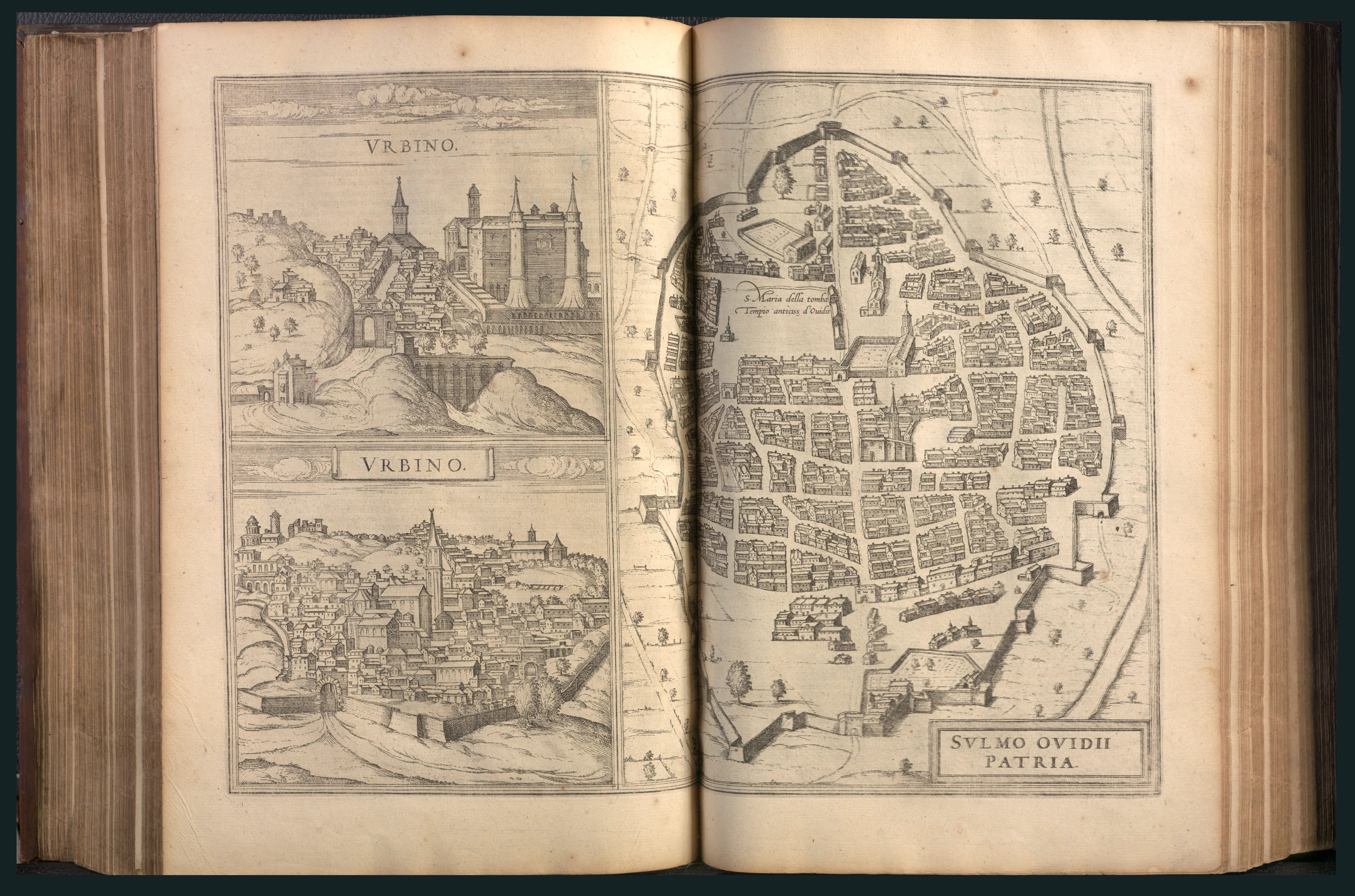
The Urbino views on this 1612 engraved atlas sheet evoke the walled hill city that gave Bernardino Baldi his identifying epithet, Vrbinatis. Set beside his re-founding of Aristotelian mechanics on Archimedean centres of gravity, the image anchors that abstract program in the Urbino milieu of Commandino and Guidobaldo del Monte from which his habits of geometrical demonstration emerged. Source ↗.
.jpg)
The stakes of this undertaking belong to one of the central developments in the history of early modern science: the mathematisation of mechanics and the passage from late-scholastic statics toward a new science of motion. Baldi's insistence that the marvels of the Mechanica — the roundness of the balance, the power of the lever, the paradox of the wheel — be resolved not by the Aristotelian appeal to the wonderful properties of the circle but by the Archimedean geometry of equilibrium places the Exercitationes at a hinge in that story. The vocabulary in which he works still carries the period's distinctions between natural and violent motion, between grauitas naturae and grauitas violentiae, and between impetus and impressio; but these inherited terms are made to serve a Euclidean–Archimedean frame in which the centre of gravity remains the explanatory pivot. Precisely how Baldi stands to the Aristotelian dynamical tradition, as against the Archimedean statics he champions, remains a matter on which the modern literature has not reached agreement, and the question of his exact place in the lineage that leads toward Galileo is likewise unsettled.
What a first-time reader will find most memorable is how far Baldi is willing to press criticism under the cover of deference. He announces that one must "fight with reasons and truth against authority and probability," and he does so — declaring that velocity cannot be the cause of the lever's power ("what velocity is there in a thing at rest?"), that the force of the wedge must be referred to other principles, that a rebounding ball can never return to its starting point because that would grant an eternal rebound, and, most boldly, that Aristotle's whirlpools are not circles about a fixed centre but spirals that coil inward — a dissent he grounds in his own crossings of the Po and the Adda. These empirical touches, the great rivers navigated from Guastalla, the leaning towers of Pisa and Bologna invoked to ask why walls "prone to ruin" do not fall, give the work an observational texture unusual for a textual commentary, even as Baldi wraps his boldest departures in a humility topos, confessing that to contradict a philosopher of such authority "seems a matter of great audacity, or rather of madness." The volume closes with an appendix declaring the ancient Delian problem of the two mean proportionals "necessary" for mechanics — justified by the practical need to scale artillery with the ratio of weight preserved — and claiming an original ruler-construction said to supersede the conchoid of Nicomedes.
Across all of this, the philological and the physical are inseparable: Baldi's care over the transmission and authenticity of the Mechanica — the questions of who wrote it and how the text survived — is bound up with his campaign to reform its physics. The polysemy of the work's governing terms, the patronage and confessional setting of its posthumous Mainz printing, and the internal march of its argument from lever to whirlpool to the duplication of the cube all answer to a single ambition: to honour an ancient text by refusing to let its authority stand in for demonstration. It is a work in which humanist learning and mathematical rigour are made to discipline one another, and it rewards the reader willing to follow a late-Renaissance mathematician as he argues his way, question by question, out of the doctrine he inherited.
Read the full text and English translation on Leo
This text was transcribed and translated as part of the ExLatinis project, an effort by Leo to make free English translations of every text published in Latin in early modern Europe (1450–1750) available online. The complete transcription and English translation of this work can be read free of charge:
→ Read the original Latin text and full English translation on Leo
You can save a copy of this document into your Leo account to run deep text searches, conduct further analysis, or cross-reference it with your own research.
Assigning an English Title and Framing Baldi's Loaded Vocabulary
Assigned English title (editorial). Exercises on the Mechanical Problems attributed to Aristotle, with an appended brief narrative of the author's life and writings.
Editorial title (supplied for convenience). The conventional short reference in current Anglophone scholarship is In mechanica Aristotelis problemata exercitationes (1621) — "exercises" or "disputations" on the so-called Mechanical Problems — and accordingly the work is here entitled Exercises on the Mechanical Problems attributed to Aristotle, with an appended brief narrative of the author's life and writings. No canonical English title has been fixed by modern critical edition; the foregoing is an editorial title supplied for convenience, not an established one. The Latin running title on the 1621 Mainz imprint is In mechanica Aristotelis problemata exercitationes, with the full collation bearing the honorific author byname Bernardini Baldi Vrbinatis Guastallæ abbatis and the appended biographical tract as adiecta svccincta narratione de autoris vita & scriptis.
Philological framing of loaded terms. The text is anchored by three intersecting lexicons that the early-modern reader was expected to weigh together. The first is the period's framing of mechanice as a facultas — a power or disciplined capacity by which human art "seconds or surpasses Nature," to inherit the formulation Renaissance commentators took from Aristotle's Mechanica itself and from the pseudo-Aristotelian vocabulary of wonder at the balance. Baldi's own definition makes this framing explicit, characterising mechanics as a faculty which, dealing with natural matter and geometric demonstrations by the speculation of centrobarics and of things reduced to lever and balance, and serving human necessity and convenience, by its own power either seconds or surpasses Nature herself and works various marvels, MECHANICE, facultas quædam est, quæ naturali materiâ, Geometricisq[ue] demonstrationibus visa, excentrobaricâ, & eoru[m] quæ ad vectem & libram rediguntur, speculatione; humanæ consulens necessitati, commoditati que, suapte vi, Naturam ipsam vel secundans, vel superans, varia, ea que mirabilia operatur. In the late-Cinquecento Paduan–Urbino milieu in which Baldi was trained, mechanice had become a technical name for the demonstrative science of the simple machines, opposed both to the artisanal ars mechanica of the medieval faculties and to the Aristotelian doctrine of natural motion. Baldi's Exercitationes treat mechanice as the discipline in which an Archimedean centrobarica (the science of centres of gravity, after De planorum aequilibriis and De corporibus insidentibus) supplies the deductive basis for explaining every problem of the Quaestiones mechanicae; mechanics in this sense is "mathematised" rather than empirical, and it is this re-founding that distinguishes Baldi from earlier humanist paraphrasers. The re-founding is presented explicitly as a supplement to Aristotle's own equipment: that this centrobarics was unknown to Aristotle is, Baldi holds, sufficiently clear, for never in the mechanical demonstrations does he name the centre of gravity, ignotam fuisse Aristoteli, satis patet. nunquam enim in Mechanicis demonstrationibus, quod tamen est potissimum, grauitatis centrum nominat.
The second lexicon is the reduction of every simple machine to vectis et libra — the lever and the balance — a programme Guidobaldo del Monte had set in In mechanicas and Paraphrasis (1577, 1588) and that Baldi extends question by question through the Exercitationes. Here vectis is not the colloquial lever of the carpenter but the Archimedean magnitude of proposition I.6/7 of De aequilibriis, in which the commensurable magnitudes are balanced at reciprocal lengths; libra is the symmetrical balance with centre of suspension and centre of gravity coincident. Baldi treats the two as nearly interchangeable, distinguished only by the equality of the arms: in truth lever and balance are nearly the same, except perhaps that it is called a balance when the arms are equal, but a lever however they may be, Verum enimuero idem ferè sunt Vectis & Libra, nisi fortè quod Libra tunc dicitur, cum brachia sunt æqualia. Vectis vero quomodo cunque ea se habeant. By anchoring mechanice in this Archimedean pair, Baldi insists that the lever alone yields "conditions for the equilibrium of any balance" and, by extension, of any simple machine reducible to it (pulley, winch, wedge, axe); what is conventionally called the Aristotelian marvel of the circle (problem 1, the roundness of the balance) is recast as a consequence of the symmetry of the balance, not as the cause of its motion.
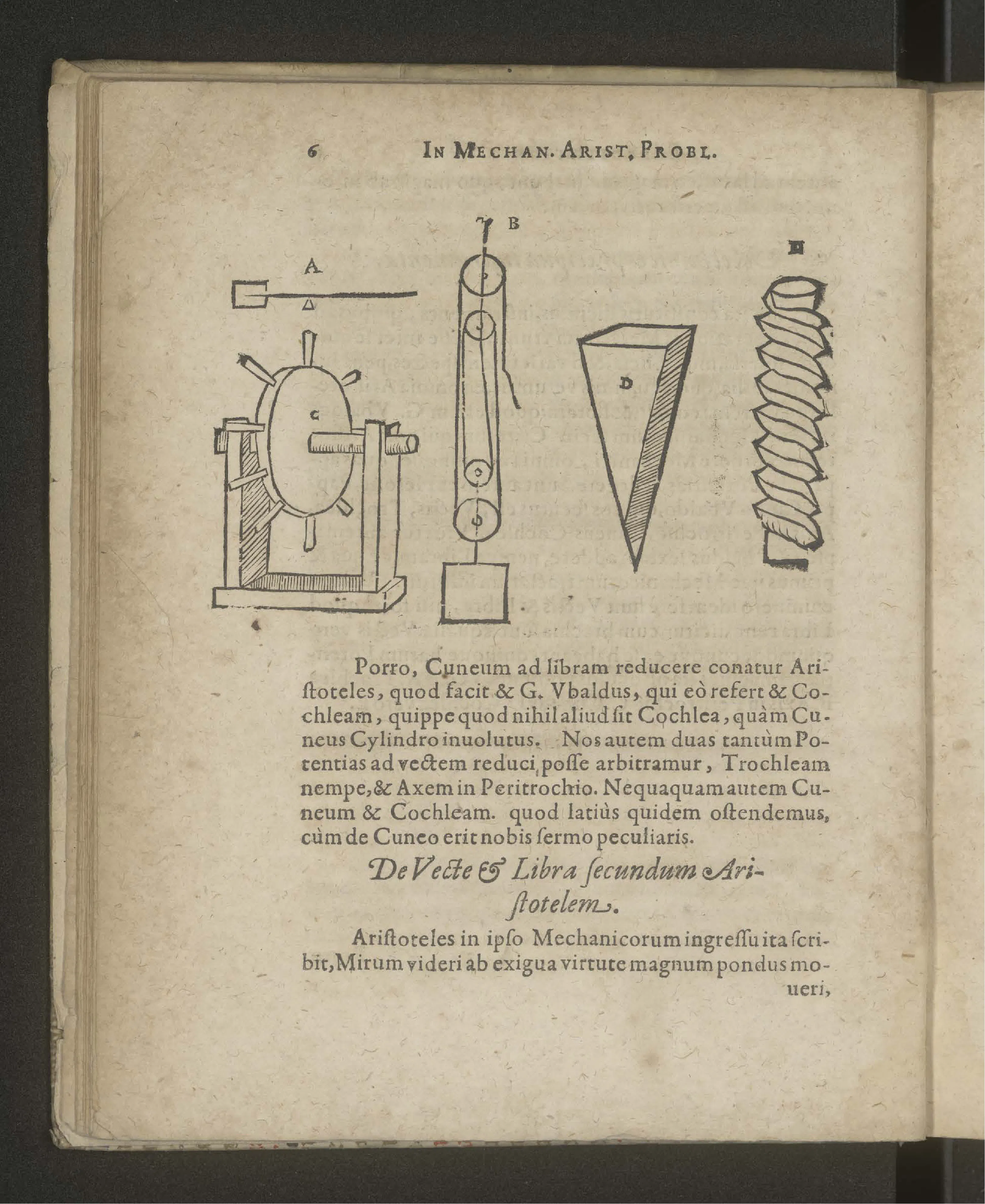
The horizontal series of woodcuts—axle-in-wheel, pulley, wedge, and screw—makes visible Baldi's taxonomy at the moment he narrows Guidobaldo's reductive mechanics: only the pulley and winch are allowed back to the lever, while the wedge and screw are set apart. The italic heading, "De Vecte & Libra secundum Aristotelem," then turns from this act of exclusion to the Archimedean pair on which the commentary will rebuild equilibrium. Source ↗.
The third lexicon — and the one in which Baldi's vocabulary most clearly diverges from Aristotle — is the language of projectile motion and the contrast between grauitas naturae and grauitas violentiae. The Aristotelian tradition distinguishes natural weight (the body's tendency to its proper place) from violent weight (the impetus impressed by the mover against nature); Baldi's Exercitationes retain this period distinction in vocabulary, but they read impetus and impressio not as substantial qualities but as describable trajectories within an Archimedean kinematic frame (notably in problems 12, 19, 23–24 and the appendix on the two mean proportionals). His account of why projectiles fail turns on just this vocabulary: projectiles cease from motion because the impression by whose impetus and force they are carried is not a natural projection but merely accidental and violent, Proiecta ideo à motu cessare, propterea quod impressio, cuius impetu & virtute feruntur, non sit proiectus quidem naturalis, sed mere accidentalis & violenta. The Aristotelian doctrine of violent versus natural motion, in short, is here subordinated to a Euclidean–Archimedean geometry of motion in which the centre of gravity remains the explanatory pivot. This terminological shift is one of the principal indices by which Renaissance historians mark the Exercitationes as a transitional moment between late-scholastic statics and the new science of motion.
Baldi at a Glance: Author, Imprint, and Driving Thesis
Author. Bernardino Baldi (Urbino, 5 June 1553 – Urbino, 10 October 1617), of the Urbino school, mathematician, hellenist, poet, translator, and Abbot of Guastalla from 1585.
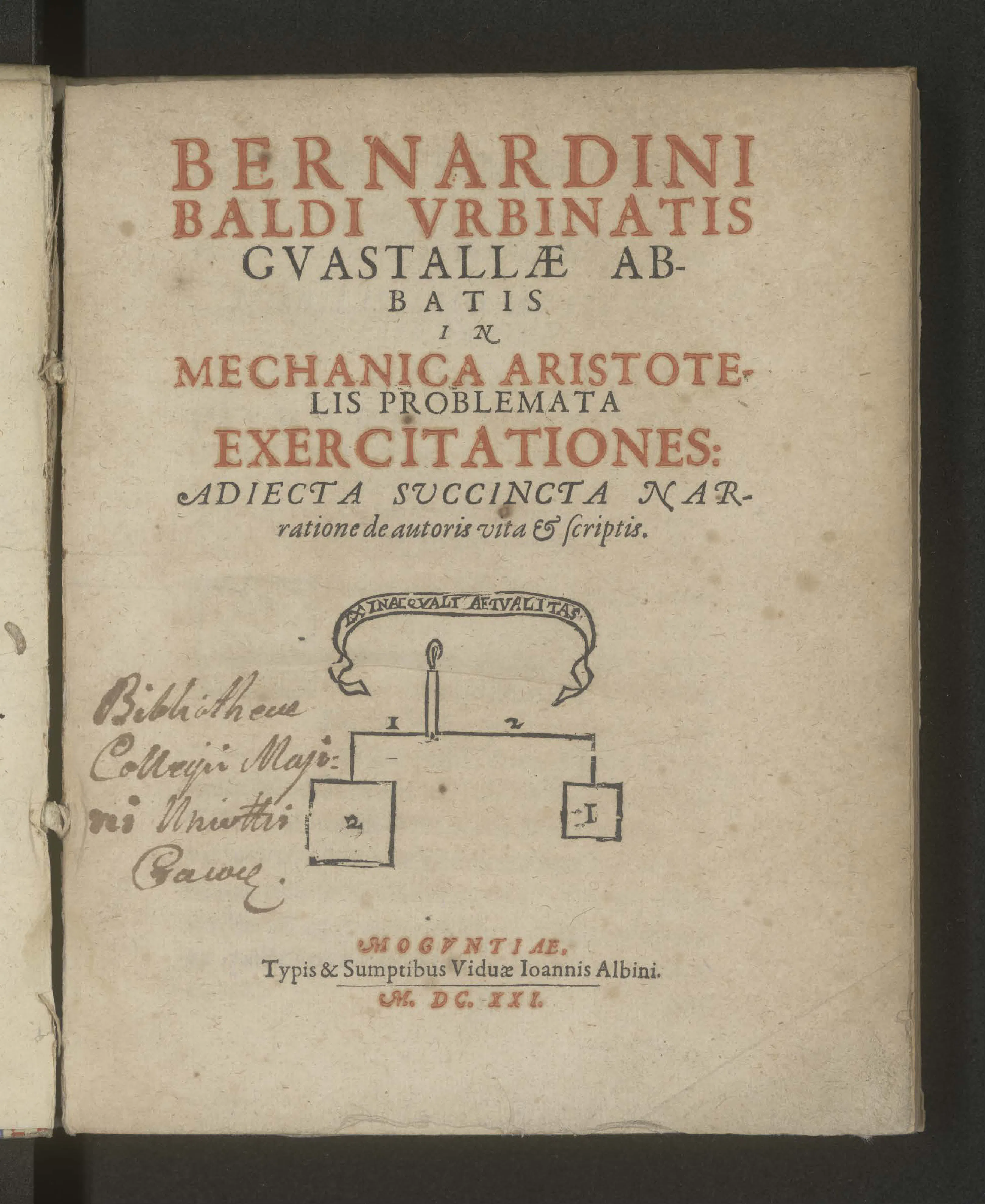
Baldi's 1621 Mainz title page stages his authority before the argument begins: the red display type identifies him as the Urbinate abbot of Guastalla, while the imprint places this posthumous edition with the widow of Johann Albin. Beneath the typography, a hand-drawn unequal-arm balance with suspended unequal weights turns the threshold of the book into a miniature emblem of the lever-and-balance principle at the center of the Exercitationes. Source ↗.
Title. Bernardini Baldi Vrbinatis Guastallæ abbatis In mechanica Aristotelis problemata exercitationes, adiecta svccincta narratione de autoris vita & scriptis — "Exercises on the Mechanical Problems of Aristotle, with an appended brief narrative of the author's life and writings."
Place and date of publication. Mainz (Moguntiæ), 1621; posthumous, four years after the author's death.
Printer. Typis & sumptibus viduæ Ioannis Albini, i.e. from the widow's press of Johann Albin at Mainz (è typographeio Viduae Albinianae).
Dedicatee. Adam Philipp XI. von Cronberg (1599–1634), nephew of Johann Schweikhard I. von Kronberg (1553–1626), Archbishop-Elector of Mainz (1604–1626).
Genre. A humanist-scientific commentary in the form of question-by-question exercitationes on the pseudo-Aristotelian Mechanica (the Quaestiones mechanicae), preceded by an editorial apparatus and followed by a mathematical appendix on the two mean proportionals (the Delian problem) and an appended brief biographical vita of the author.
Language. Latin. The 1621 Mainz edition is untranslated into English; the only modern critical edition is the 2011 Italian-language reprint-with-introduction by Elio Nenci in EOS Sources 4, which gives an Italian commentary but reproduces Baldi's Latin text. Baldi's earlier associated writings on mechanics — the Scamilli impares Vitruviani (1612) and the Di Herone Alessandrino de gli automati (1589) — have likewise remained untranslated into English.
Driving thesis. To re-found the science of mechanics on Archimedean statics — in particular on the doctrine of centres of gravity and the reduction of all simple machines to the lever and the balance — and to do so by a critical, reason-over-authority engagement with the pseudo-Aristotelian Quaestiones mechanicae, not by paraphrase (Piccolomini 1547) nor by mere translation (Leoniceno/Tomeo 1524), but by systematic question-by-question exercitatio in which each quaestio is resolved by an Archimedean demonstration. Baldi states the method plainly, judging that he would oblige students of the faculty if he confirmed those same questions by mechanical, that is, Archimedean proofs, morem huiusce facultatis studiosis gesturos nos fore arbitratis sumus, si easdem illas quæstiones Mechanicis, hoc est, Archimedeis probationibus confirmaremus. The volume closes with a mathematical appendix proposing an original mechanical solution to the problem of the two mean proportionals (the duplication of the cube), drawing on Pappus's collection of a construction by Nicomedes, together with a vita of the author supplied by the editors.
The Urbino School, Archimedean Statics, and the Historiography of the Exercitationes
The Exercitationes matter to modern scholarship for three interlocking reasons. As a late representative of the Urbino school, the work closes the lineage of Federico Commandino (Urbino, 1509–1575), under whom Baldi studied from c. 1570, and Guidobaldo del Monte (1545–1607), whose programme of rigorous foundation of mechanics on Archimedean statics the Exercitationes carries into the early seventeenth century. As a document of the Archimedean revival in statics, the volume marks the moment at which the demonstration programme of De aequilibriis and De corporibus insidentibus is applied systematically to the 36 problems of the pseudo-Aristotelian Mechanica, including the roundness of the balance, the lever, the sling, and the river-eddy of problem 35 — the same reductive programme by which lever and balance become the two governing principles of the whole commentary. As an instance of critical humanist engagement with the Aristotelian corpus, the text exemplifies how a late-Cinquecento reader refuses both the wholesale authority of Aristoteles Mechanicus and the merely philological approach of the paraphrasts: Baldi accepts the problem-collection as a useful heuristic but re-justifies each of its answers on a non-Aristotelian basis. His programmatic willingness to depart from the received text is stated without equivocation — one must fight with reasons and truth against authority and probability, which he vows to do fearlessly, Rationibus igitur & veritate contra auctoritatem & probabilitatem est nobis pugnandum: quod & intrepide faciemus — even as he tempers the same boldness with a topos of humility, proposing his conclusions as true yet allowing that perhaps he is deceived, and that to contradict a philosopher of such authority seems a matter of great audacity, or rather of madness, Hæc nos, vt vera proponimus, & fortasse decipimur. Certe Philosopho tantæ auctoritatis contradicere, magnæ videtur audaciæ, aut potius insaniæ. This same critical posture governs his treatment of the text's authorship: the commentary, he notes, is ascribed to the name of Aristotle, although some have hesitated to affirm whether it is the work of that most distinguished philosopher or not, Aristotelis nomini ascribitur Commentarius, licet nonnulli, sitne Philosophi illius præclarissimi & acutissimi labor, an non, adfirmare subdubitauerint.
The historiography of the Exercitationes is thin in absolute terms and uneven in distribution. The scholarly literature on the pseudo-Aristotelian Mechanica and its Renaissance reception is rich — the twin touchstones being Marshall Clagett, The Science of Mechanics in the Late Middle Ages (Madison: University of Wisconsin Press, 1959), and Paul Lawrence Rose & Stillman Drake, "The Pseudo-Aristotelian Questions of Mechanics in Renaissance Culture," Studies in the History and Method of Science 2 (1971): 53–71 — but these studies treat Baldi as one terminus of a translation-and-commentary tradition rather than as the object of a dedicated monograph. Walter Roy Laird's work on Guidobaldo del Monte (Laird 1986; repr. in MPRL Proceedings 4, 2013) is the closest the modern literature comes to a sustained discussion of Baldi's mechanics: Laird shows how Guidobaldo's In mechanicas and Paraphrasis established the Archimedean reduction of simple machines to the lever/balance that Baldi carries into the Exercitationes, and how Baldi's text thereby stands as the Urbino school's late complement to Galileo's Discorsi of 1638. Jürgen Renn and Peter McLaughlin, "The Balance, the Lever and the Aristotelian Origins of Mechanics" (in R. Feldhay et al., eds., Emergence and Expansion of Preclassical Mechanics, Boston Studies in the Philosophy and History of Science 333, Cham: Springer, 2018, pp. 111–138) situate the Exercitationes within the long-term historiography of the Aristotelian tradition and the rise of preclassical mechanics; the work explicitly groups Baldi with Clagett (1959), Laird (1986), and Rose & Drake (1971) as foundational points of reference.
The principal primary edition is Elio Nenci (introd.), Bernardino Baldi's In mechanica Aristotelis problemata exercitationes, Sources 4 (Berlin: Max-Planck-Gesellschaft zur Förderung der Wissenschaften, 2011), which reprints the 1621 Mainz text with an Italian-language introduction; the EOS platform also hosts the introductory commentary, an Online Sources page, and a Bibliography for this edition. Beyond these, scholarly attention specifically on the Exercitationes is thin: there is no dedicated English-language monograph, and the question of Baldi's relation to the Aristotelian dynamical tradition (as opposed to Archimedean statics) remains under-examined. Disagreements in the historiography cluster around three loci: (a) the authenticity of the Quaestiones mechanicae — nineteenth-century philologists (Rose, Tannery) judged the text "trivial and confused," whereas twentieth-century historians (Clagett, Laird, Rose & Drake) treat it as a Peripatetic compilation of great historical importance for the early-modern mathematisation of mechanics; (b) the relative priority of Archimedes versus Aristotle in Guidobaldo's and Baldi's foundations of mechanics — Bertoloni Meli argues for a strictly Archimedean priority, while Renn and McLaughlin emphasise a more nuanced continuity with Aristotelian dynamical resources; and (c) Baldi's place in the intellectual lineage leading to Galileo — Bertoloni Meli reads him as a direct ancestor of Galileo's mature mechanics, whereas some Galilean scholars (Rose & Drake 1971) treat Baldi as a peripheral terminus. None of these disagreements is settled, and any responsible reading must take account of the disagreement rather than smoothing it over.
Textual History, Materiality, and the Object Biography of the 1621 Mainz Imprint
The 1621 Mainz imprint is the editio princeps and, so far as is known, the only early-modern printed edition of the Exercitationes. According to the standard reconstruction in Elio Nenci's introduction to EOS Sources 4, the work was probably drafted in 1582 and taken up again in 1614, but it circulated only in manuscript during Baldi's lifetime; it was first printed four years after his death in 1617. The imprint reads Moguntiæ, typis & sumptibus viduæ Ioannis Albini, anno 1621 (or, in the parallel form on the title-page, è typographeio Viduae Albinianae): from the widow's press of Johann Albin at Mainz, a German ecclesiastical-printer imprint of the standard early-modern widow-press type combining type with capital.
The volume carries a dedicatory epistle addressed to Adam Philipp XI. von Cronberg (1599–1634), imperial baron (Freiherr) and Reichsgraf, nephew and ward of Johann Schweikhard I. von Kronberg (1553–1626), Archbishop-Elector of Mainz (1604–1626). The dedicatee's choice reflects the patronage logic of the Mainz electoral court and the close relation between Archbishop and nephew in the years during which the 1621 edition was prepared. No censorship, suppression, or expurgation is recorded in VD17, USTC, or WorldCat. The appended vita of Baldi was supplied by the editors; surviving editorial hands include Fabrizio Scharloncini and Lelio Ruini (Bologna b. sec. XVI, d. 30 December 1621; son of senator Carlo Ruini and Vittoria Pepoli; bishop of Bagnoregio from 1612). The name Fabrizio Scharloncini is preserved in the editorial apparatus but a full biographical record of him could not be located in the present search.
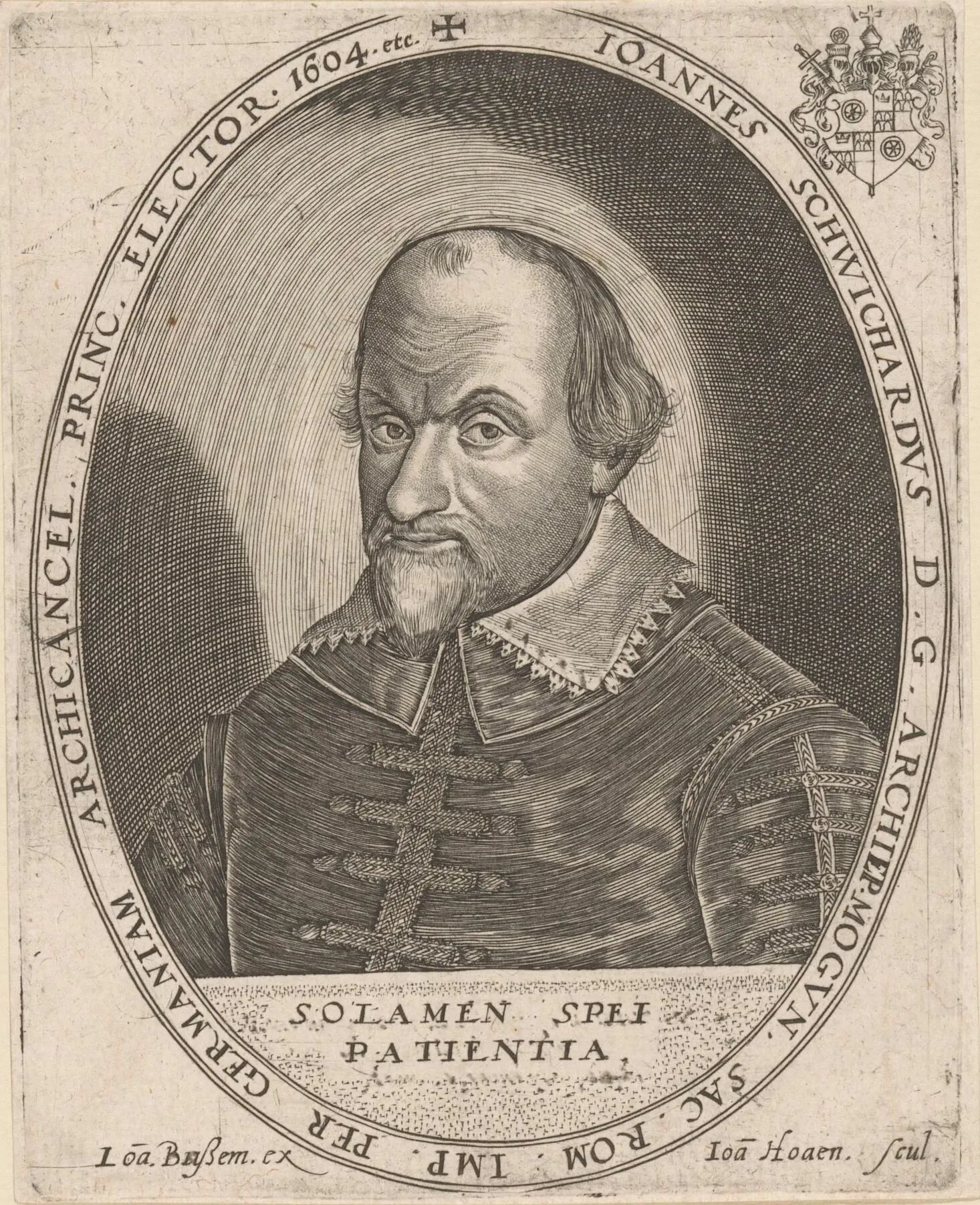
Johann Hogenberg's engraved portrait presents Johann Schweikhard von Kronberg, Archbishop-Elector of Mainz, as the courtly and ecclesiastical authority behind the milieu in which Baldi's posthumous Exercitationes reached print. Through his nephew and ward Adam Philipp von Cronberg, the volume's dedicatee, Schweikhard's patronage network helps explain why an Italian mathematical-humanist work was issued at Mainz in 1621. Source ↗.

Format and collation. The 1621 Mainz imprint is catalogued in OCLC (record 8527067) and WorldCat as a quarto in Latin, microform-reproduced in US libraries; full collation (gatherings, signature-markings, printer's ornaments) was not retrieved here and should be consulted in VD17 directly. The format (4°) is consistent with the quarto convention for learned Latin commentaries of the period.
Holding repositories and physical copies. Original copies are held at: ETH-Bibliothek Zürich, shelfmark Rar 3182 (verified via e-rara); and the Jagiellonian University Library, Cracow, catalogued in the Cracow discovery system as Mogvntiae : typis Ioannis Albini / è typographeio Viduae Albinianae, Anno 1621. US microform reproductions exist across the consortium of libraries indexed in WorldCat under OCLC 8527067 (Michigan State University Libraries, University of Akron, Grand Valley State University, University of Notre Dame – Landmarks of Science Microform Series, Ohio State University Libraries, Ohio University Libraries, University of Toronto Media Commons, University of Wisconsin–Milwaukee, and Indiana University of Pennsylvania). A digitised facsimile is publicly accessible via the Internet Archive under the Ioannis Albini Collection, record identifier bub_gb_26Q3s_4Yy1sC.
Material and institutional context. The Mainz imprint is the only print produced outside Italy in Baldi's lifetime. The Exercitationes was printed in a German ecclesiastical electorate at a moment (1617–1621) when Italian presses were politically constrained by the outbreak of the Thirty Years' War, and the choice of Mainz as the place of publication reflects the patronage of Adam Philipp and his uncle, the Archbishop-Elector, rather than any Italian publishing house. The volume is therefore part of the German reception of Italian mathematical humanism in the early seventeenth century.
Reception and interlocutors. No direct contemporary reply or refutation of the Exercitationes could be traced in the searches undertaken; the most likely early-modern reader was the Discorsi e dimostrazioni matematiche of Galileo (1638), which cites Guidobaldo but does not cite Baldi by name. The named or implied interlocutors in the Exercitationes itself are Leoniceno (Niccolò Leonico Tomeo, versio Latin translation, 1524), Piccolomini (Alessandro Piccolomini, paraphrase, 1547), Guidobaldo del Monte, Federico Commandino, Pappus of Alexandria, Nicomedes, Archimedes, Eutocius, Jordanus de Nemore, Cardano, Tartaglia, and Stevin (under the Latin Simon Sticinus) — the entire Italian and Paduan mathematical-humanist tradition of the late sixteenth century. The philological dimension of that engagement extends to the very transmission of the text Baldi comments upon, whose editorial-critical frame weighs the authenticity of the Mechanica against the received Leoniceni versio and the underlying Græca lectio.
Place among Baldi's works. The Exercitationes belongs to a cluster of late-Baldian mathematical-mechanical writings which include the Scamilli impares Vitruviani (Urbino, 1612) and the De verborum Vitruvianorum significatione (Urbino, 1612), and the Heronis Ctesibii Belopoeeca (Urbino, 1616). Baldi's earlier non-mechanical output comprises the Italian Di Herone Alessandrino de gli automati (o sia della machina da moversi) (Venice, 1589), the Cento apologi (1590), and the La nautica (1590). The Vita di Federigo Commandino was composed in manuscript during his lifetime and first printed posthumously in 1714; the encyclopaedic Vitae mathematicorum circulated in manuscript and was partially published in 1707. The Exercitationes is therefore the only major mathematical-mechanical commentary of Baldi to reach print during his lifetime or in the immediate posthumous period.
Reading the Argument from Lever to Whirlpool to the Duplication of the Cube
Front Matter, Patronage, and the Threshold of the Argument
Bernardino Baldi's treatise opens, past its damaged prefatory leaves and the imprint of the widow's press at Mainz, Typis & Sumptibus Viduæ Ioannis Albini, into a dedicatory epistle addressed to Adam Philipp von Cronberg, D. ADAMO PHILIPPO / BARONI A CRONBERG, subscribed in the year of publication, Anno 1621.26. Martij. The address binds the posthumous printing to the Cronberg patronage network of the Mainz electoral court, and the dated subscription fixes the moment at which a decades-old Italian mathematical labour was made a German ecclesiastical imprint. What follows the front matter is a treatise whose intellectual programme is stated with unusual compression at its very threshold, and it is there that the analysis of Baldi's argument must begin.
The preface establishes at once that the physical reform Baldi intends is inseparable from a philological verdict on the text he undertakes to expound. The Mechanica comes to him under Aristotle's name but under a cloud of doubt, a hesitation already noted above as to whether the work is genuinely the labour of that most distinguished and acute philosopher or not. The hesitation is not idle antiquarianism. By registering the authenticity question at the outset — and buttressing it with the transmission narrative he draws from Strabo, the tale of the books of Neleus passing to Apellicon and thence to Sulla — Baldi loosens the grip of the name that would otherwise settle every dispute in advance. The doubt about who wrote the text prepares the reader to accept that its causal explanations may be found wanting, for a text of uncertain paternity cannot claim the unqualified deference owed to the Philosopher himself.
The Central Diagnosis: Aristotle's Missing Centre of Gravity
That preparation issues in Baldi's central historical-critical thesis, which is at once a diagnosis and a licence. As noted in the philological framing above, the defect he identifies is precise and, in his account, demonstrable from the text's own silence — that Aristotle never once names the centre of gravity in the mechanical demonstrations, where it would matter most. The argument from absence is philological in form — an inference from what the text never says — but physical in consequence, for the centrobarica whose absence Baldi detects is the Archimedean science he takes to be the true foundation of the whole discipline, that which he names the science pertaining to the centre of gravity, quam dixere Centrobaricam, quæ quidem ad Centri grauitatem. Baldi supplies his own compressed definition of the pivotal concept, declaring most briefly that the centre of gravity is a point of every magnitude, situated within or outside it, through which if the magnitude be divided by a plane, line, or point, it is cut into equally-weighing parts, Centru[m] grauitatis, vniuscuiusq; magnitudinis punctum esse intra extraue magnitudinem positum, per quod si plano linea punctoue diuidatur, in partes secatur æqueponderantes. The Heronian and Commandine lineage of the formulation is compressed into a single sentence that makes equilibrium, rather than the wonderful properties of the circle, the explanatory ground of all that follows.
From this diagnosis flows the method that governs the treatise's every article. As the executive summary above records, Baldi does not propose to displace the Quaestiones but to re-prove them, confirming the received questions by mechanical, that is, Archimedean proofs. The gesture is characteristic of the whole undertaking: the received problems are retained as a useful heuristic while their answers are re-founded on a basis their supposed author never possessed. The equation of Mechanicis with Archimedeis in that programmatic clause is itself the argument in miniature — to demonstrate mechanically is, for Baldi, to demonstrate after the manner of Archimedes.
The Programmatic Definition and the Reduction to Lever and Balance
The programmatic definition that opens the treatise proper gathers these commitments into one dense formula, the characterisation of mechanics as a facultas dealing with natural matter and geometric demonstrations that, discussed above in the philological framing, either seconds or surpasses Nature herself and works various marvellous things. Three of Baldi's load-bearing terms are lodged there at once. The word facultas claims for mechanics the standing of an autonomous discipline poised between natural matter and geometric proof, neither merely physical nor merely mathematical. The phrase Naturam ipsam vel secundans, vel superans attributes to that discipline a power that either assists or exceeds Nature by its own resources — a claim of considerable ambition, since it makes human art a rival, not merely a servant, of natural process. And the reduction to vectem & libram names the reductive strategy by which the whole catalogue of devices will be resolved. Baldi presses that reduction explicitly, collapsing the traditional five powers toward a minimal pair in the observation, already cited above, that lever and balance are nearly the same but for the equality of the arms. The balance is thus a special case of the lever, distinguished only by the equality of its arms, and every machine reducible to the lever is thereby brought under the single law of equilibrium.
The Lever: Reason Against Velocity
The critical temper of the enterprise emerges most sharply where Baldi turns from foundations to particular problems, and here his method of qualified dissent becomes visible. On the lever he concedes what Aristotle observed while denying that it does the explanatory work Aristotle assigned it: the small addition made to the depressed part of the lever in the depression itself is, he grants, of least moment for so great a force, Veruntamen minimi est momenti ad tantam vim parua illa adiectio, quæ parti vectis depressæ in ipsa depressione adiungitur. The concession is genuine but disarming, for it isolates the received account's true observation from its false cause. The false cause is then named and rejected outright. Baldi refuses to locate the lever's power in the greater velocity of the longer arm, and he does so with a question that cuts to the root of the Aristotelian dynamical account: nevertheless, he writes, we do not affirm that the cause of this marvellous effect is the velocity which follows the length of the arm — for what velocity is there in a thing at rest?, Veruntamen, causam huiusce mirabilis effectus, esse velocitatem, quæ brachij longitudinem consequitur, non affirmamus. quæ enim velocitas in restante?. The rhetorical question turns the Aristotelian appeal to velocity against itself: a balance in equilibrium moves not at all, yet its equilibrium is precisely what the account must explain, and no velocity can be the cause of a state of rest. The alternative Baldi favours, already lodged in the term hypomochlion he glosses as the fulcrum, the point from which the weight will stand at a greater distance, ab hypomochsio (id est, fulcimento) distabit magis, refers the effect instead to distance from the fulcrum and to the geometry of the balance.
This willingness to correct the text he honours is raised to a principle, the martial resolution — already quoted above — to fight with reasons and truth against authority and probability, fearlessly. The martial vocabulary — pugnandum, intrepide — casts the commentator as a combatant against the twin forces of auctoritas and probabilitas, the very supports on which a deferential reading of Aristotle would rest. The declared fearlessness is enacted in the problem of the wedge, where Baldi parts company not only with Aristotle but with his own master Guidobaldo del Monte: he holds it as established, he writes, that the force of the wedge is to be referred to other principles, Nos cunei vim, ad alia esse principia referendam pro comperto habemus. To deny that the wedge reduces to the lever is to admit a limit to the very reductive programme that governs the treatise, and Baldi accepts the exception rather than force the device into a scheme it will not obey.
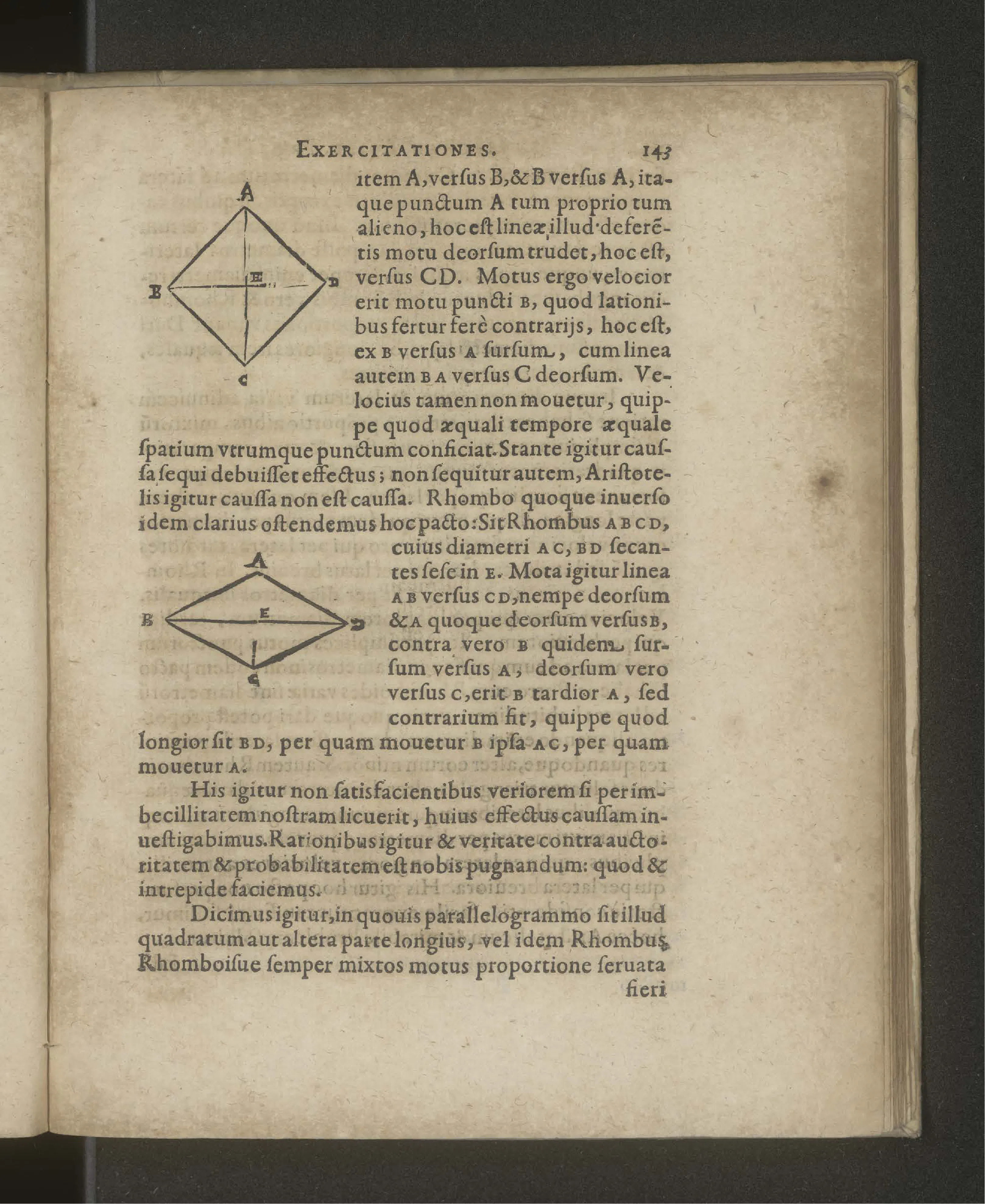
Baldi's paired rhombus diagrams, lettered around intersecting diagonals, turn the problem of mixed motion into a proportional geometry of diameters rather than an Aristotelian account of velocities. On the same page, the printed declaration that one must fight "with reasons and truth against authority and probability" gives the figures their polemical force: demonstration, not deference, is made the arbiter. Source ↗.
The Wheel, the Leaning Towers, and the Testimony of the Practitioner
The commentary's most celebrated cruces confirm this pattern of stating the received marvel precisely before refounding it. The wheel paradox is set out in its canonical form as the question for what cause a larger circle rolls out a line equal to a smaller circle when the two are placed about the same centre, Dubitatio est, quam ob caussam maior circulus æqualem minori circulo circumvoluitur lineam, quando circa idem centrum fuerint positi. The problem of the leaning towers is framed with the same rhetoric of wonder that Baldi means to dissolve by demonstration: it seems marvellous indeed, he writes, that walls prone to ruin should not fall, quod sane mirabile videtur, muros nempe, in ruinam pronos, ruinam non facere — the campanili of Pisa and the Garisenda of Bologna posed as a puzzle to be resolved through the disposition of the centre of gravity rather than left as a standing marvel. What lends these analyses an observational texture rare in a textual commentary is Baldi's readiness to ground theory in his own experience. Treating the river-crossing device, he recalls that it is a most beautiful thing, and thoroughly known to him, who, when he lived at Guastalla, his residence, a town on the Po, going to Mantua very often crossed the very wide bed of that same Po at the Castle of Borgoforte by the contrivance described, Pulcherrima enim res est, & nobis perspectissima, qui Guastallâ residentiæ olim nostræ oppido ad Padum, Mantuam pergentes sæpissimè ad Castrum Burgi Iusis ea qua diximus machinatione latissimum eiusdem Padi aluum transiecimus. The autobiographical detail — the abbot's own crossings of the Po between Guastalla and Mantua — converts a mechanical quaestio into reported observation and lends the demonstration the authority of a thing seen and done.
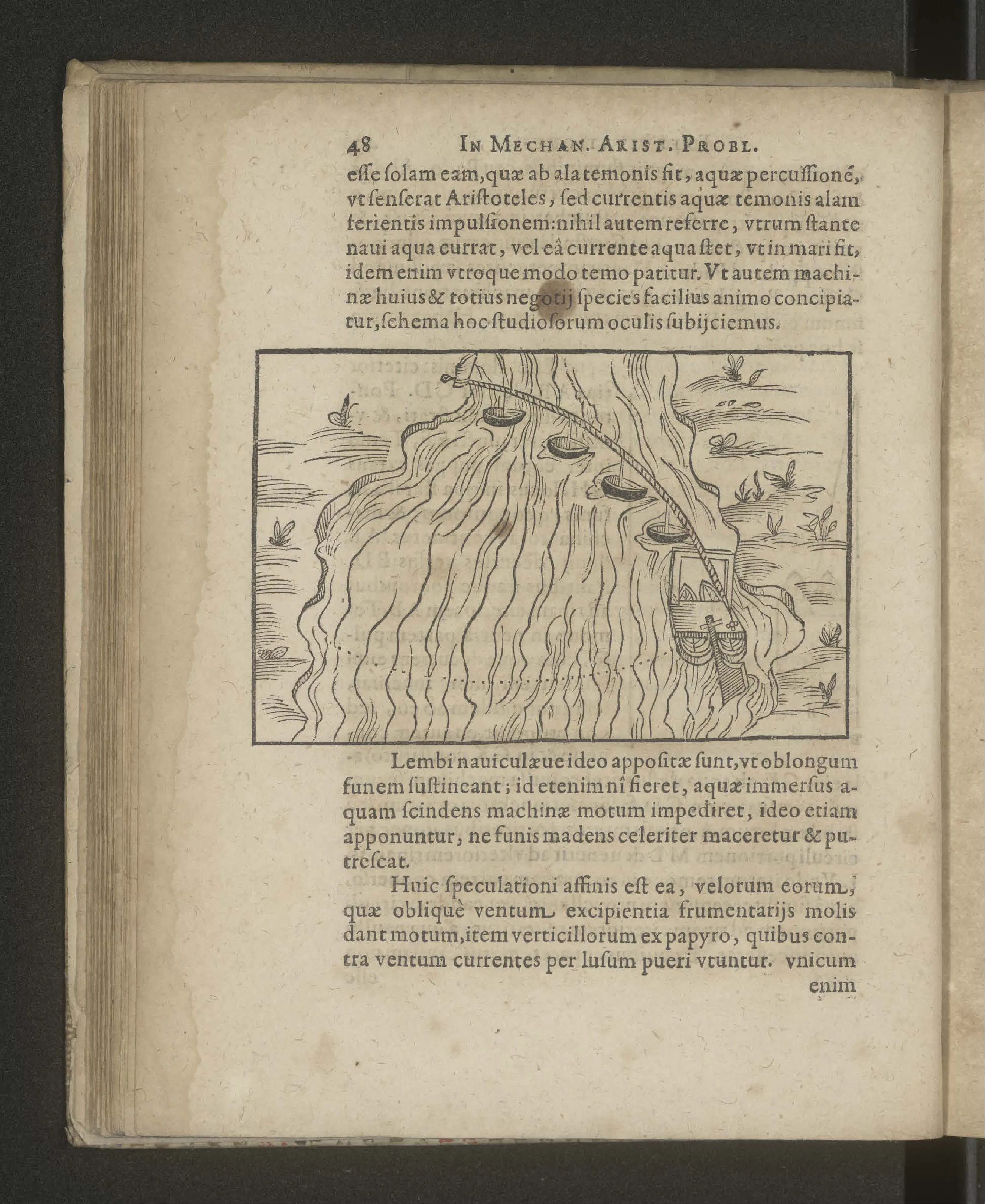
At the center of Baldi's page, the woodcut turns the Po ferry from a reported marvel into an analyzable machine: flat-bottomed boats hold an oblique rope above the current, while the suspended vessels make visible the river's impulse as a mechanical cause. The surrounding printed discussion extends the same principle from this remembered crossing to oblique sails and children's pinwheels, showing how firsthand observation could be folded into a broader program of mechanical reduction. Source ↗.
Projectile Motion and the Inherited Lexicon of Impetus
The treatise's closing problems carry the reform into the physics of projectile motion, where Baldi's inherited vocabulary of impetus and impressio is made to serve his account of why thrown bodies fail. As the philological framing above records, projectiles cease from motion because the impression by whose impetus and force they are carried is not a natural projection but merely accidental and violent. The distinction between the natural and the violent that structures the sentence is the period's own, and the impressed force is described as accidentalis & violenta precisely to mark it off from the body's natural tendency to its proper place; a motion sustained by an impressed and violent quality must exhaust itself, since nothing accidental can be perpetual. The terminology is Peripatetic, but it is here bent to explain the trajectory and cessation of a thrown weight rather than to name a substantial quality, and it is in just such adaptations of an inherited lexicon — the duplex graue, natural and violent, that Baldi announces among the objects of the faculty — that the treatise shows itself refounding an old physics on a geometry of gravity while continuing to speak in the older tongue.
Impact, Rebound, and the Refusal of Perpetual Motion
The final movements of the commentary carry the Exercitationes through its last physical problems and into a self-contained geometrical appendix, and it is precisely here — at the outer edge of the received text, where the Quaestiones mechanicae trail off into problems of rebound and river-eddy — that Baldi's programme of re-founding Aristotelian mechanics on demonstration is most sharply visible. The physics of impact and rebound gives him occasion to display the geometrical method in miniature. Taking up the question of why stones cast onto water do not sink at once, he frames the problem in language that already announces his empirical temper, asking why stones thrown onto a water surface do not immediately sink but, grazing the surface several times, rebound from it, Curlapides ad superficiem aquæ proiecti non statim demergantur, sed aliquot vicibus aquæ superficiem radentes, ab eadem resiliant. The verb radere, to graze or scrape, is doing precise work: the stone is not described as bouncing off a wall but as skimming tangentially, and the lettered diagram that follows converts this observed motion into a sequence of tangencies and resilitions until, the violent motion exhausted, the body sinks by its own gravity. The vocabulary of resilire and resilitiones thus becomes the technical armature on which Baldi hangs a geometrical account of elastic return.
That account reaches its clearest form in the analysis of the playing-ball rebounding from a horizontal plane, where the symmetry of the rebound is derived not from any occult property but from the statical bisection of the body. The ball, divided by the perpendicular through its centre of gravity into equal and equally-weighting parts, rebounds as it fell, so that it rebounds in reacting just as it had acted in falling, that is, at equal angles, which was to be demonstrated, ita resilit repatiendo, vti egerat in cadendo, hoc est, ad angulos pares; quod fuerat demonstrandum. The closing formula, quod fuerat demonstrandum, is the signature of Baldi's whole enterprise: an empirical regularity is not merely reported but folded into the deductive apparatus of a proof. The Archimedean lexicon of æqueponderantes parts is here imported into a problem of dynamic impact, and the equality of angle is made a consequence of the equality of weight on either side of the perpendicular. When Baldi tilts the plane, the same reasoning yields a corollary tying the rebound angle to the inclination: he gathers that the more a plane recedes from parallelism with the horizon, the more the ball thrown upon it is divided into unequal parts and rebounds at smaller angles to the plane, Hinc colligimus, quo magis planum ab æquidistantia horizontis recesserit, eo pilam in eo proiectam in partes inæquales diuidi & ad minores ipsi plano angulos resilire. The generalization is elegant precisely because it is entirely internal to the geometry of bisection: inequality of angle follows from inequality of the divided parts.
Yet Baldi does not let the idealized result stand unqualified, and the concession he makes is methodologically among the most revealing moments of this stretch. He observes that because the projected ball is material and therefore neither equal nor equally-weighting and resistant by its gravity, it does not rebound at exactly equal angles, but somewhat smaller in the rebound, the force being remitted in the very reaction, Veruntamen quoniam proiecta pila materialis est, & ideo nec æqualis, nec æqueponderans & sua grauitate resistens, non ad pares ex amussi resilit angulos, sed minores aliquantulum in resilitione, remittente nimirum vi in ipsa reactione. The phrase ex amussi, "exactly, by the plumb-line," marks the boundary he is careful to police: the demonstration holds for the geometrical ball, while the material ball, being heavy and resistant, falls short of the ideal. This admission of a gap between the mathematised object and physical matter is characteristic of the discipline as Baldi conceives it — a facultas mediating between natural matter and geometric proof — and it does the further work of grounding his rejection of perpetual motion. Because the impetus is progressively remitted in each reaction, he concludes that it cannot happen that a ball rebounding from a plane reach the point whence it first departed, for if that were granted, an eternal rebound of the ball would also be granted, potest, pilam à plano resiliententem eo peruenire vnde à principio discesserat; Id enim si daretur, æterna quoque pilæ ipsius daretur resilitio. The impossibility of eternal rebound is thus not asserted as a physical axiom but deduced from the observed diminution of force, the remissio of impetus carrying the argument to the necessity of eventual rest.
The Whirlpool: Spirals Against the Fixed Centre
The commentary's final problem provides the most dramatic instance of reason parting company with the text it honours. Baldi states the received question directly, that Aristotle asks in this last problem why things borne in whirling waters are all at last driven to the middle, Quærit hoc ultimo Problemate Aristoteles, Cur ea quæ in vorticosis feruntur aquis, ad medium tandem agantur omnia?. Having rehearsed Aristotle's three explanations, he registers a dissent that is at once deferential and firm: these are the reasons, though most obscurely propounded, which Aristotle uses — acute indeed, yet by no means to be admitted outright, Hæ sunt rationes, licet obscurissime propositæ, quibus, vt diximus, vtitur Aristoteles. acutæ sane illæ quide[m], attamen haudquaquam vltro admittendæ. The concessive acutæ sane pays the customary tribute to Aristotelian acumen even as haudquaquam vltro admittendæ withholds assent; the rhetorical balance enacts in a single sentence the reason-over-authority posture that governs the whole work. What follows is Baldi's substantive correction, which turns on a redescription of the geometry of the phenomenon: the vortex is not a circle about a fixed centre but a spiral. They are rather spirals, he argues, which beginning from the outer and more remote part, coiled spirally around, at last arrive at the innermost part, which is the middle and plays the role of the centre, Spiræ enim potius sunt, quæ ab exteriori parte remotioreq; incipientes spiraliter circumuolutæ, ad intimam tandem partem, quæ media est & centri vices gerit, deueniunt. The phrase centri vices gerit, "plays the role of the centre," is the crux: the vortex has no fixed centre in the Aristotelian sense, only an innermost point toward which the inward-coiling Spira tends, and the reconception dissolves Aristotle's difficulty by denying the very geometry on which his three rationes rested.
What lends this dissent its distinctive weight is that Baldi anchors it in his own observation rather than in counter-authority. He reports that these whirlpools or spirals, as he has observed while navigating the Po, the Adda, and great rivers, do not stay in the same place, Porro vortices isti spiræue, quod nos per Padum, Abduam, & magna flumina nauigantes obseruauimus, non eodem permanent loco. The naming of the Padus and the Abdua introduces the first-person witness of the practitioner into a textual commentary, and the observation that the vortices do not remain fixed in place is precisely the datum that undermines Aristotle's premise of a stationary centre. This observational grounding stands in tension with the humility topos Baldi deploys to soften the audacity of correcting so venerable an authority — the confession, already quoted above, that to contradict a philosopher of such authority seems a matter of great audacity, or rather of madness. The escalation from audaciæ to insaniæ is a calculated rhetorical excess: by naming his own dissent as near-madness, Baldi disarms the charge in advance while pressing the correction all the same. The topos does not retract the spiral thesis; it frames it, negotiating the confessional and scholarly propriety owed to Aristoteles Mechanicus against the evidentiary claim of a man who has watched the rivers turn.
The Appendix on the Two Mean Proportionals
The appended geometrical treatise on the two mean proportionals shifts register from physical problem to pure construction, but it prosecutes the same ambition to subordinate inherited method to demonstrable utility. Baldi opens by asserting the indispensability of the classical device, insisting that the method of finding two mean proportionals is not only useful but altogether necessary, as those know who have been even a little versed in the mechanical disciplines, Modum inueniendarum duarum mediarum proportionalium non tantum vtilem esse, sed prorsus necessarium, illi norunt, qui in Mechanicis disciplinis vel paru[m] fuerint versati. The claim of necessitas is then given a concrete warrant in the domain of ordnance: he replies that in no other way can the balls of bronze ordnance be enlarged or diminished with the ratio of weight preserved, Respondemus, nulla alia ratione æneorum tormentorum pilas augeri imminuiue seruata ponderis ratione posse. The Delian problem of duplicating the cube is thereby rooted in the practical requirement of scaling projectiles while conserving the weight-ratio — a datum that binds the ancient geometry of Ballistarum, Catapultarum, Scorpionum to the contemporary casting of æneorum tormentorum, and that makes the appendix an extension of the mechanical facultas rather than a digression from it.
Within this frame Baldi advances his boldest claim of the appendix, a claim not of new theorem but of simplified praxis. Setting his method against the elaborate instrument and curve of Nicomedes, he asserts that he neither constructs an instrument nor describes a conchoid, and accomplishes the matter with almost two lines, so that almost anyone would say that what he teaches is entirely foreign to the Nicomedean praxis, Nos autem nec instrumentum construimus nec Conchoidem describimus, & duabus fere lineis rem absoluimus, vt nemo fere non dixerit, hoc istud quod docemus, à Nicomedea praxi esse prorsus alienum. The emphasis falls squarely on praxis: Baldi's originality is presented not as a departure from the underlying geometry, which he draws faithfully from Pappus, but as an economy of construction that strips away the Conchoide and its instrument. The point is reaffirmed in the direct second-person address that closes the treatise, where he tells the reader outright that they see that he has cut away the superfluous from Nicomedes' demonstration, so far as it pertains to praxis, and accomplished the thing without the instrument or line of the conchoid, Vides igitur tu quilegis, nos ex Nicomedis demonstratione (quatenus ad praxin pertinet) superflua resecasse, & absque Conchoidis instrumento lineaue rem ipsam confecisse. The parenthetical quatenus ad praxin pertinet is a careful limitation: Baldi does not claim to have improved the demonstration as demonstration but to have pared it, superflua resecasse, to what the working mechanician requires. The turn to the reader, closing the treatise on the note of practical economy, gathers the whole of the appendix under the same governing conviction that runs through the physical problems — that the honouring of an ancient text consists in refining its results to demonstrable and usable form rather than in preserving its apparatus intact.
Frequently Asked Questions
What is Bernardino Baldi's In mechanica Aristotelis problemata exercitationes?
It is a Latin scholarly commentary, printed at Mainz in 1621, that works through the pseudo-Aristotelian Mechanica (the Quaestiones mechanicae) question by question. Rather than paraphrase or merely translate, Baldi re-founds each answer on Archimedean statics — the science of centres of gravity, or centrobarics — reducing every simple machine to the lever and the balance and confirming each solution by geometric demonstration. He argues that Aristotle's causal explanations failed at the root because Aristotle lacked the centre-of-gravity concept, never once naming it in the mechanical demonstrations where it would matter most.
Who was Bernardino Baldi?
Bernardino Baldi (Urbino, 5 June 1553 – Urbino, 10 October 1617) was a mathematician, hellenist, poet, translator, and Abbot of Guastalla from 1585. He belonged to the Urbino school of mathematics, having studied under Federico Commandino from around 1570 and carrying forward the programme of Guidobaldo del Monte. His varied output included the Italian Di Herone Alessandrino de gli automati (1589), La nautica (1590), and the Scamilli impares Vitruviani (1612). The Exercitationes is his one major mathematical-mechanical commentary to reach print in the immediate wake of his death, four years after he died.
Why did Baldi reject Aristotle's explanation of whirlpools?
Baldi denied that things carried in whirling water move in circles about a fixed centre, arguing instead that the vortices are spirals which, beginning at the outer edge and coiling inward, arrive at an innermost point that merely "plays the role of the centre." This redescription of the geometry dissolves Aristotle's difficulty by removing the stationary centre his reasoning assumed. Baldi grounded the dissent in his own observation, reporting that while navigating the Po and the Adda he saw that such whirlpools do not remain fixed in place — the very datum that undermines Aristotle's premise.
What did Baldi say about velocity and the power of the lever?
Baldi conceded Aristotle's observation of the lever's power but rejected the proposed cause. He refused to locate that power in the greater velocity of the longer arm, cutting to the root with a pointed question: what velocity is there in a thing at rest? A balance in equilibrium does not move at all, yet its equilibrium is precisely what the account must explain, so no velocity can be its cause. He referred the effect instead to distance from the fulcrum (the hypomochlion) and to the geometry of the balance, treating the balance as a lever with equal arms.
Is there an English translation of the Exercitationes?
No modern English translation has been identified. The 1621 Mainz edition remains untranslated into English, and the only modern critical edition — Elio Nenci's 2011 reprint-with-introduction in EOS Sources 4 — supplies an Italian-language introduction while reproducing Baldi's Latin text. Separately, the Leo edition presents the full transcription and a complete English translation of the work, freely available online at no cost. That translation is generated by AI. Leo is an effort to make freely available online English translations of every text printed in Latin in early modern Europe between 1450 and 1750.
This report was generated by an advanced AI assistant that conducted deep research alongside an extensive interpretation of the transcribed original text. Every effort has been made to preserve fidelity to the source and to guard against inaccuracy, but corruption in the text recognition process and model hallucination may nonetheless have entered the text. Treat every claim, quotation, translation, and citation as provisional, and verify each against the original source before relying on or citing it.
Bibliography
- Elio Nenci (introd.), Bernardino Baldi's In mechanica Aristotelis problemata exercitationes: The indispensable modern critical edition, reprinting the 1621 Mainz text with an Italian-language introduction that places the Exercitationes against the Urbino school, the transmission of the pseudo-Aristotelian Mechanica, and the Archimedean revival in statics. If you read only one secondary work alongside the treatise, read this one; every claim in the present report about the dating, drafting, and printing history rests on Nenci's reconstruction. Note that the "critical edition" here is scholarly apparatus wrapped around Baldi's own untranslated Latin, so it deepens the context without doing the translating for you.
- Domenico Bertoloni Meli, "Guidobaldo, Galileo, and the History of Mechanics," Guidobaldo del Monte (1545–1607): Theory and Practice of the Mathematical Disciplines from Urbino to Europe: Reconstructs the doctrinal bridge from Guidobaldo's In Mechanicis and Paraphrasis (1577, 1588) to Galileo's mature mechanics, with sustained attention to the equilibrium of the balance where centre of suspension and centre of gravity coincide. Consult it to see the strong version of the "strictly Archimedean" reading of the Urbino tradition against which the report weighs Renn and McLaughlin's more hedged continuity thesis.
- Marshall Clagett, The Science of Mechanics in the Late Middle Ages: The standard survey of medieval statics into which the pseudo-Aristotelian problem-collection descends, cited throughout the modern historiography as a fixed point of reference. It treats Baldi only as a terminus of a longer tradition rather than as its subject, so approach it as the deep background to the Quaestiones mechanicae, not as a study of the Exercitationes proper.
- Walter Roy Laird, "Guidobaldo del Monte and Renaissance Mechanics," Guidobaldo del Monte (1545–1607): The authoritative study of Guidobaldo's In mechanicas and of Baldi's continuation of his master's project, originally published in Physis in 1986 and reprinted here. It is the closest the modern literature comes to a sustained account of Baldi's mechanics, and it is essential for understanding why the reduction of every simple machine to the lever and the balance carries the argumentative load it does.
- Jürgen Renn and Peter McLaughlin, "The Balance, the Lever and the Aristotelian Origins of Mechanics," Emergence and Expansion of Preclassical Mechanics: Sets the pseudo-Aristotelian Mechanica and its Renaissance commentators — Leoniceno, Piccolomini, Baldi — within a long-term account of the Aristotelian tradition and the rise of preclassical mechanics, expressly grouping Baldi with Clagett, Laird, and Rose & Drake. Read it for the framing of the authenticity-and-reception debate around the Quaestiones mechanicae and for the case that Aristotelian dynamical resources persist within the Archimedean reform rather than being simply displaced by it.
- Paul Lawrence Rose and Stillman Drake, "The Pseudo-Aristotelian Questions of Mechanics in Renaissance Culture," Studies in the History and Method of Science: The foundational study of the Latin translation-and-commentary tradition and of Baldi's place within it, and a touchstone cited across the later literature. Its comparatively deflationary verdict on Baldi as a peripheral terminus is precisely the reading the report stages against Bertoloni Meli's, so consult it to weigh both sides of the "how close to Galileo?" question for yourself.