Stirring Camarina: Georg Caspar Kirchmaier's On the Universality of Noah's Flood: A Preliminary Dissertation
Nobody, the author of this 1667 Geneva quarto complains, had ever argued the point ex professo: whether the Flood of Noah drowned the entire globe or only one inhabited corner of it. De diluvii universalitate dissertatio prolusoria measures the water a global inundation would require — ten oceans and more — refuses in turn every reservoir the schools had invented to supply the deficit, and then re-reads the Mosaic "whole earth" as hyperbole for an Asia walled in by seas. The conclusion is materially radical and its packaging impeccably obedient: a conjecture submitted to what its author calls the Senate of the Learned, by a man who declares he wishes to die an exterminator of new dogmas.
ExLatinis
August 14, 2026
Contents
Nobody, the author of this 1667 Geneva quarto complains, had ever argued the point ex professo: whether the Flood of Noah drowned the entire globe or only one inhabited corner of it. De diluvii universalitate dissertatio prolusoria measures the water a global inundation would require — ten oceans and more — refuses in turn every reservoir the schools had invented to supply the deficit, and then re-reads the Mosaic "whole earth" as hyperbole for an Asia walled in by seas. The conclusion is materially radical and its packaging impeccably obedient: a conjecture submitted to what its author calls the Senate of the Learned, by a man who declares he wishes to die an exterminator of new dogmas.
Printed at Geneva in 1667 under the title De diluvii universalitate dissertatio prolusoria — "On the Universality of Noah's Flood: A Preliminary Dissertation" — this is a short Latin work of learned disputation, some 109 pages in the surviving record, that sets out to ask a question its author insists nobody had troubled to ask: whether the Flood of Noah covered the entire globe of the earth, or only one inhabited region of it. Modern catalogue records attach the work to Georg Caspar Kirchmaier and Abraham van der Myle; an older strand of scholarship, notably D. R. McKee's 1944 study of Isaac La Peyrère, describes a 1667 De diluvii universalitate as anonymous. That disagreement has not been settled, and the place and date of composition, the dedicatee, and the circumstances that produced the work remain unestablished. What survives with certainty is the text itself, and the text is remarkable.
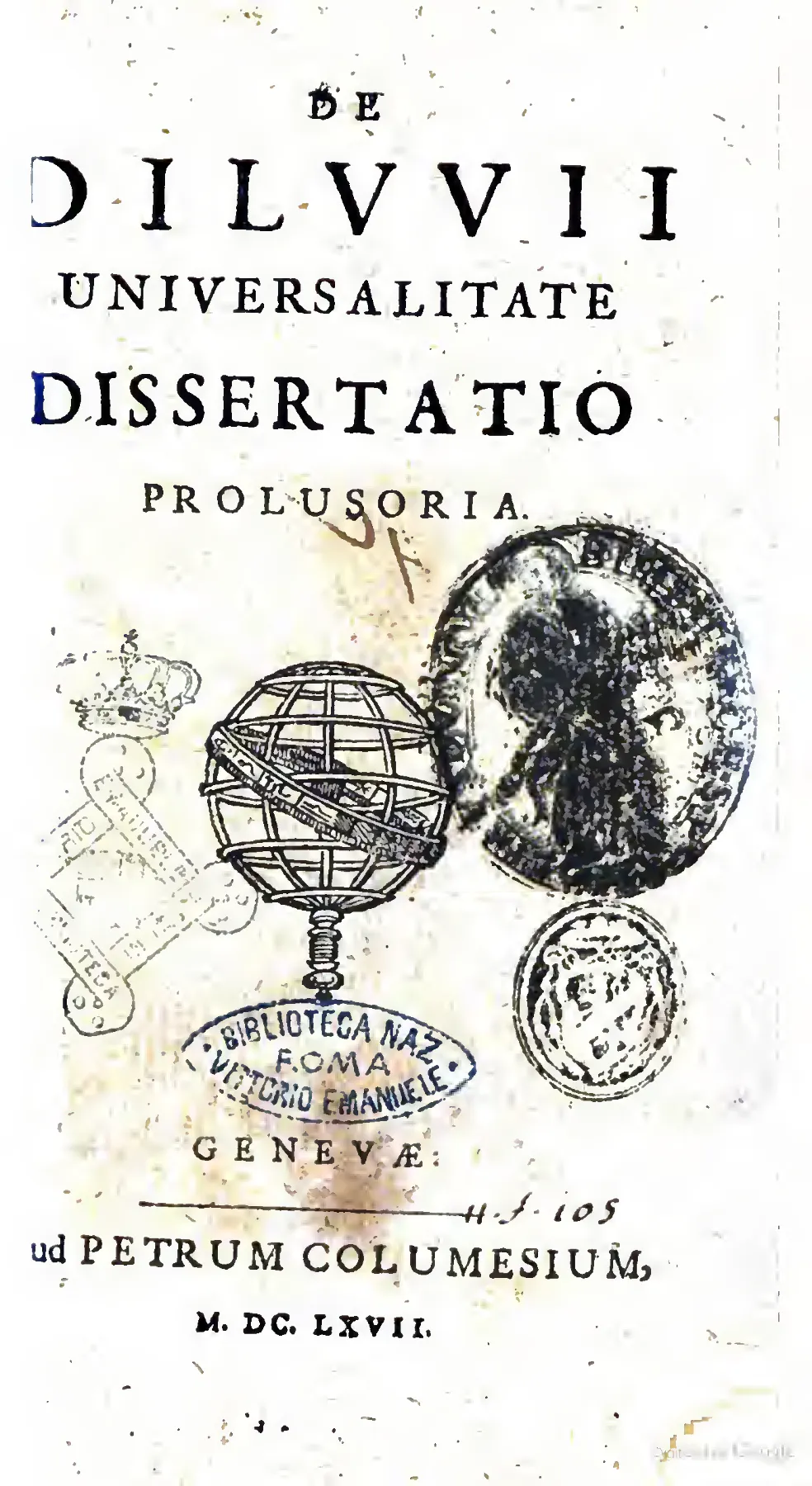
The 1667 Geneva title page fixes the work's identity in print: De diluvii universalitate dissertatio prolusoria, issued apud Petrum Columesium, with universality as its formal problem and prolusoria framing the inquiry as a preliminary exercise rather than a doctrinal pronouncement. The armillary-sphere device beneath the title aptly echoes the dissertation's cosmographical reasoning. Source ↗.
Its central problem is not exegetical curiosity but the status of a consensus. Universal inundation, the author observes, had never been argued ex professo, precisely because it passed for a Catholicum dogma — something so fixed among the common sort that it never occurred to anyone even to call it into doubt. The recurring move of the dissertation is to convert that assumed consensus into a question answerable by evidence, and then to answer it by subtraction. The author audits the physical requirement of a global inundation against measured quantities of water, in miles and cubits, and finds that the necessary volume would equal ten oceans and more; he then successively refuses the resources by which the schools had supplied the deficit — the sea, a subterranean abyss, rarefaction, the Aristotelian decuple conversion of air into water, supercelestial reservoirs — and refuses too the "sacred anchor" of miracle wherever natural causes might suffice. Having drained the physical case, he re-reads the Mosaic universals as synecdoche and hyperbole, disciplining them against a series of parallel scriptural universals: the famine of Genesis 41, the world-kingdom of Daniel 2, the Augustan census of Luke 2, the darkness at the Crucifixion, the "every nation under heaven" of Acts. What remains is a Flood commensurate with an antediluvian humanity confined to a small corner of Asia, unpropagated because unnavigating, its memory refracted in the pagan record through a euhemerist etymology that makes Theba the ark, Janus Noah, Prometheus on the Caucasus a Cainite caricature of the patriarch, and Enoch the Atlas of the ancients.
The stakes of that argument were considerable in the 1660s. The extent of the Deluge was the hinge on which several controversies turned at once: La Peyrère's pre-Adamite chronology, Isaac Vossius's shortened and lengthened ages of the world, Martin Schoock's defence of a universal Noachian Flood, Edward Stillingfleet's sacred history, and — shortly afterwards — Athanasius Kircher's Arca Noë. Reports of lions, bears, and tigers in America and New Guinea had made the dispersal of animals from a single Armenian landfall a problem of physical plausibility rather than pious assumption, and the accumulating antiquity claimed for Egyptian, Chaldean, and Asian records pressed against the received chronology from the other side. Sacred geography, hydrostatics, comparative mythography, and conciliar authority are all mobilized here within a hundred-odd pages, and the mobilization is deliberate: cartographic autopsy establishes Asia's water boundaries — the eastern Ocean dividing it from America, the Mediterranean from the Nile's mouth to the Pontus and the Maeotis, the Tanais, the frozen Scythian sea, the Persian and Arabian gulfs — so that "the whole world" of Moses can be made to coincide with a region genuinely encircled by waters.
What gives the work its particular flavour is the elaborate care with which its author insulates a materially radical conclusion inside an impeccably conformist frame. The Sicilian proverb of Camarina, the stagnant marsh one must not stir, supplies the governing image of inherited consensus, and he announces himself freed of that superstitio while still calling the whole performance a suspicio, a conjectura, a commentatio — nothing defined, everything referred to the reader as judge and to what he calls the Senate of the Learned. Gerardus Mercator's testimony, though useful, is refused as coming from a witness of disapproved faith. A closing corollary assembles a catalogue of interpretations the Church has licitly changed — the sons of God and daughters of men, traducianism once held throughout the Western Church and now reckoned heresy, the Sixtine emendation of Wisdom 12, the repunctuation of the second day of creation, the sleeping tomb of St John at Ephesus, the Seven Sleepers as corrected by Baronius, Constantine's leprosy as resisted by Cajetan — in order to distinguish novelty in exposition from novelty in dogma. The volume ends with a self-anathema: its author wishes to die not merely a hater of new dogmas but, so far as in him lies, their exterminator.
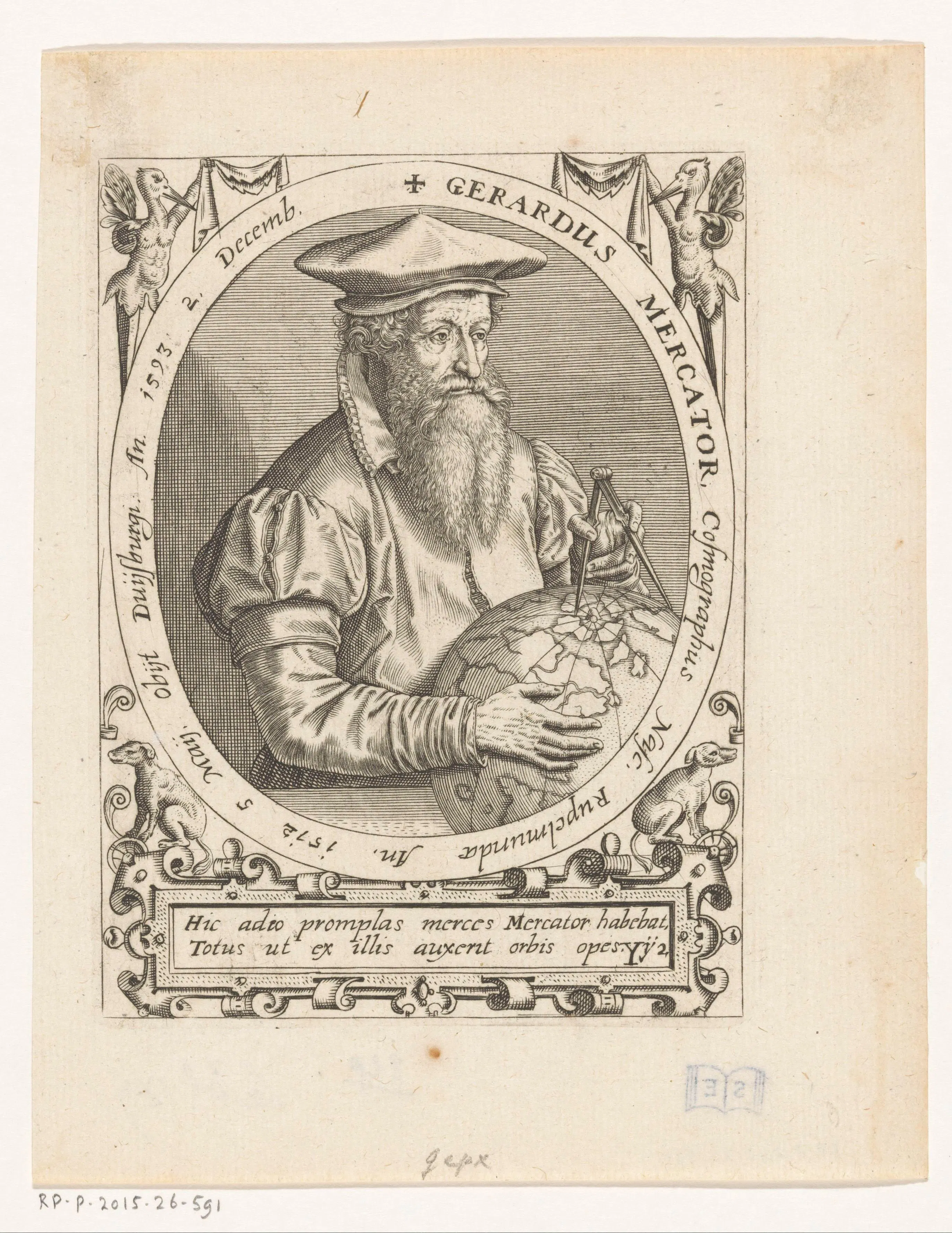
A period engraved portrait presents Gerardus Mercator as cosmographer — the geographer whose authority the dissertation both acknowledges and sets aside. His testimony would have served the regional hypothesis, yet it is refused as coming from a witness of disapproved faith: cartographic learning barred by a confessional boundary. Source ↗.
,_RP-P-2015-26-591.jpg)
That posture is the thread that binds the work's vocabulary, its bibliographical situation, and its internal argument together. Universalitas is narrowed by philology into the oecumene, the inhabited earth, on the analogy of an oecumenical synod; the genre marker prolusoria licenses inquiry into received opinion without promulgating a definition; and the Geneva imprint of 1667, whose authorship modern cataloguing and older scholarship still describe differently, carries a text that repeatedly declines to claim more for itself than a conjecture submitted for judgement. Whether the reticence was tactical, sincere, or both cannot be determined from what survives, and the absence of any located contemporary reply, censure, or refutation directed at this item leaves the question of its reception open.
Read the full text and English translation on Leo
This text was transcribed and translated as part of the ExLatinis project, an effort by Leo to make free English translations of every text published in Latin in early modern Europe (1450–1750) available online. The complete transcription and English translation of this work can be read free of charge:
→ Read the original Latin text and full English translation on Leo
You can save a copy of this document into your Leo account to run deep text searches, conduct further analysis, or cross-reference it with your own research.
Rendering De diluvii universalitate into English: Diluvium, Universalitas, and the Oecumene
"On the Universality of Noah's Flood: A Preliminary Dissertation" is a scholarly English rendering of the established Latin title De diluvii universalitate dissertatio prolusoria. It is a translation supplied for English use, not an established English title. The title belongs, with high probability, to the Geneva work of 1667 catalogued as USTC 1948515, not to the 1661 Kirchmann–Rigault volume. The corrective identification is strong but not absolutely final: modern catalogue records name Georg Caspar Kirchmaier and Abraham van der Myle, whereas older scholarship describes a 1667 De diluvii universalitate as anonymous.
In this title diluvium is the Latin scriptural Deluge or inundation, yet the work treats that event as a problem open to physical, geographic, demographic, and exegetical examination rather than merely as a devotional narrative. The opening words already fix that register, announcing that in preparing to speak of the Flood which they call Noachian, in the context of the Mosaic Genesis, many things truly difficult and almost paradoxical present themselves, DE Diluvio, quod vocant Noëticum, in Genesis Mosaicæ contextu dicere paranti multa occurrunt sanè difficilia ac poene paroxa, — a formulation in which quod vocant already holds the received name at a slight philological distance. Universalitas denotes the extent claimed for the biblical inundation—whether it embraced the whole terrestrial or inhabited world, or could be restricted to Asia—not an abstract modern notion of totality. The body of the 1667 text explicitly asks whether Asia, and only Asia, was covered. The phrase Catholicum dogma records the status of universal inundation as received Catholic consensus in the author's polemical framing; it should not automatically be translated as a formally defined conciliar dogma. The text's own account of that status is sociological rather than juridical: that this Noachian Flood was utterly universal, that is, raged over the whole globe of the earth, has been held so certain and fixed among the common sort that it never entered anyone's mind even to call it into doubt, Diluvium hoc Noëticum Universale prorsus, id est, toto terrarum orbe grassatum fuisse, atque hoc tam certum fixumque est habitum in vulgus, ut nemini in mentem umquam venerit, vel in dubium vocare, where in vulgus and habitum locate the doctrine in custom and common estimation rather than in definition. The Camarina proverb supplies the social rhetoric: to disturb the supposedly settled swamp is nefas, and the regional hypothesis is therefore presented as a conjectural disturbance of inherited consensus. The epistemic register of a prolusoria dissertation, together with suspicio and conjectura, permits an inquiry into received opinion without claiming to promulgate a new doctrinal definition.
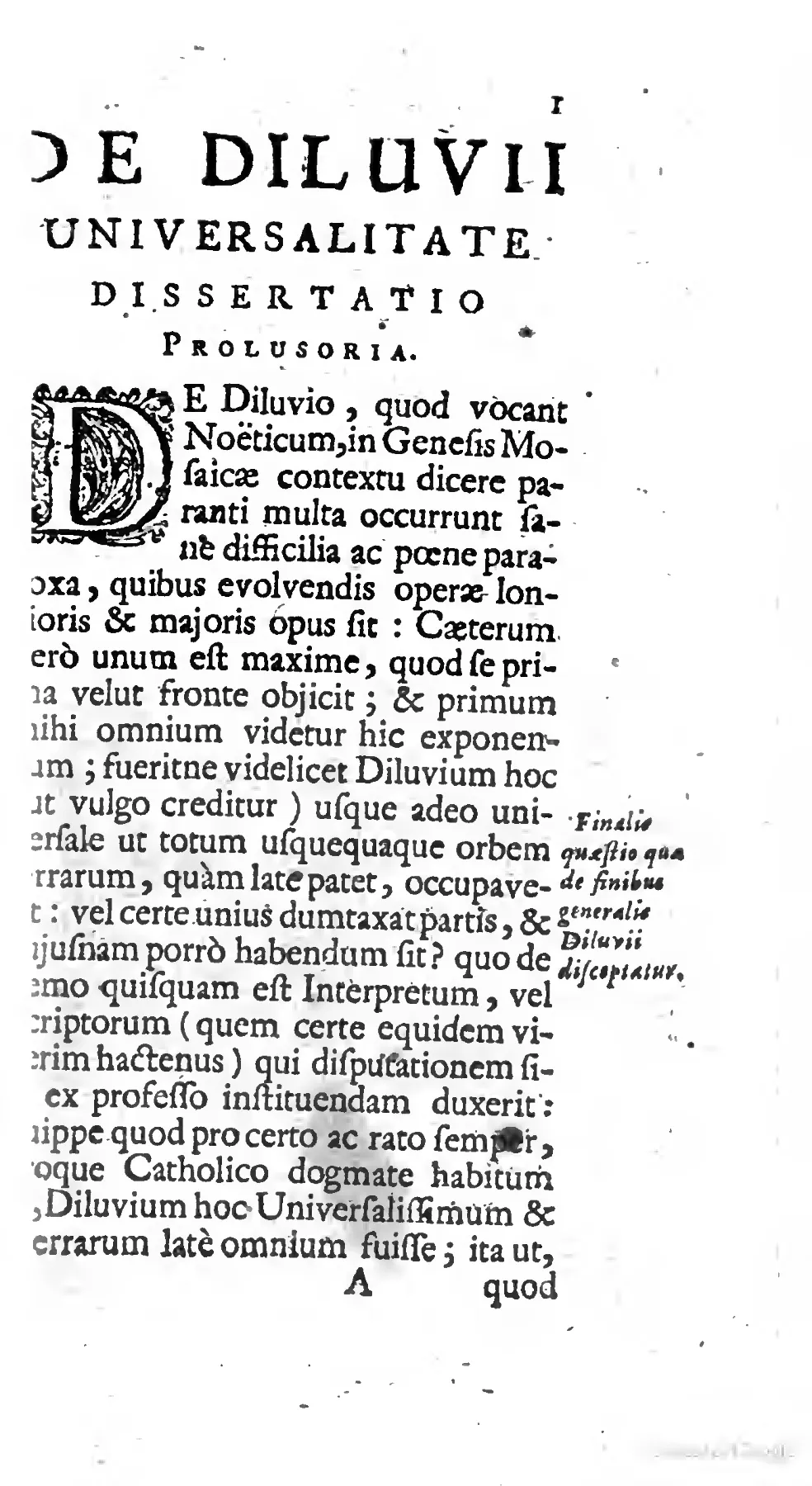
The dissertation proper opens beneath the display heading "DE DILUVII UNIVERSALITATE" and an ornamental initial, framing the Noachian Flood not as inherited certainty but as a question of geographical limits. The printed marginal note on the Flood's boundaries makes the methodological pivot visible: from presumed universal inundation toward an event possibly confined to Asia alone. Source ↗.
The decisive philological work is done on the vocabulary of universality itself, and it is here that the title's second noun is redefined from within. The text takes the ecclesiastical usage as its model, observing that "oecumenical" is commonly said of what pertains to the whole globe of the earth, as an oecumenical synod is a general council, which coalesces from all parts of the universe, Hinc oecumenicum vulgo dicitur quod ad universum terrarum orbem pertinet, ut oecumenicam synodum generale concilium, quod ex omnibus universi partibus coalescit; the Greek οἰκουμένη, the inhabited earth, thus licenses a sense of "universal" that is extensive within its own domain without being global. That redefinition is prepared by a series of scriptural control cases in which the same universal particles are demonstrably restricted. Of the Augustan census the text notes that "there went out a decree from Caesar Augustus that the whole world should be enrolled": that a synecdoche is present here, whereby the greater part is taken for the whole, all admit, and the thing is manifest, says Maldonatus; nor could the whole world be enrolled at a Roman emperor's command, since not all of it obeyed his rule: on Suetonius's testimony, Augustus did not rule Goths, Armenians and Indians, exiit Edictum à Cæsare Augusto ut describeretur universus orbis: in quo synecdochen inesse, qua major pars prototo accipitur, omnes monent, & res manifesta est, inquit Maldonatus; nec etiam totus orbis Romani Imperatoris jussu describi poterat, cum totus ejus non pareret imperio: teste Suetonio, Augustus Gotthis, Armenis, & Indis non imperabat. The darkness at the Crucifixion supplies a patristic warrant for the same procedure, since Origen rightly answers that that universal particle, "whole" or "entire," is to be understood as accommodated to the place at issue: the matter was transacted in Judaea, therefore "over the whole earth," that is, over the whole of Judaea, darkness came, particulam, Universam, aut Totam, accommodate ad locum de quo agebatur intelligendam esse, gerebatur res in Iudæa, super universam ergo terram, id est, super universam Iudæam tenebræ factæ sunt;. The application to Genesis follows as an inference in the conjectural register the title's prolusoria announces: therefore it is next that we should suspect hyperboles to lie hidden here too; and so let us expound what Moses said hyperbolically — that the waters were over the whole earth and that all the high mountains under the whole heaven were covered — as indicating the magnitude of this Flood, Quare proximum est ut nos latere hic quoque Hyperbolas suspicemur: sicque exponamus dictum à Mose Hyperbolicôs, aquas fuisse super universam terram, opertosque omnes montes excelsos sub universo Coelo, ad indicandam Diluvii hujus magnitudinem;. The verb suspicemur is not incidental: the same lexicon of suspicio and conjectura that governs the title's genre governs its central hermeneutical claim.
What the 1667 Geneva Dissertation Claims: A Restricted Deluge in Brief
The identifiable work is a Latin dissertatio prolusoria, a preliminary learned dissertation or disputational exercise, printed at Geneva in 1667. USTC 1948515 records De diluvii universalitate dissertatio prolusoria, Genevæ, [s.n.], 1667; Google Books records 109 pages and prints the publisher statement apud Petrum Columesium. Catalogue records attach the work to Georg Caspar Kirchmaier and Abraham van der Myle, but the precise division of authorial responsibility is unresolved. D. R. McKee's older study calls a 1667 De diluvii universalitate anonymous; "anonymous" is therefore a historiographical description in tension with the surviving modern catalogue attribution, not a settled identification of the author. Geneva is the publication place; the place and date of composition, dedicatee, and circumstances of composition have not been established.
The argument centers on a restricted Deluge hypothesis. The text asks whether Asia alone was inundated and thereby challenges, or at minimum systematically destabilizes, the received universal interpretation. Its negative thesis is stated in exactly those terms, and with a characteristic apotropaic hedge: but (be it said without offence) to me, examining these very words a little more sharply, no reason at all has yet been found or perceived why we should be compelled to assert that the Flood raged over the whole globe of the earth, Verùm (ut præfiscini, id quidem dixerim) mihi ipsa hæc verba paulo acrius dispicienti, nulla dum omnino reperta, perspectave ratio est, cur asserere cogamur, toto terrarum orbe Diluvium fuisse grassatum — a denial not of the event but of the compulsion to read it globally. The positive side of the case rests on the claim that mankind was not yet spread across the earth when the waters came, the text affirming that there are many and very great arguments by which it seems to be established that before the Flood the human race was in no way spread over the whole globe of the earth, Permulta perque magna sunt argumenta quibus effici videtur, ante Diluvium neutiquam toto terrarum orbe diffusum fuisse hominum genus:. Throughout, the work submits itself to the reader rather than to the schools: certainly there are some exceptions; and while I bring them forward I make you my judge, Reader, so that by your fairness you may pronounce what seems more equitable in this case — sure that I stand by your judgment, Certe exceptiones aliquæ haud desunt, quas dum in medium profero, te judicem, Lector, fero, ut pro tua æquitate, quod in hac causa æquius videbitur, pronuncies; tuo stare judicio certus, a stance consonant with the prolusoria genre named on the title page. Its genre and subject are distinct from Johann Kirchmann's Roman funerary antiquarianism and Nicolas Rigault's satirical Funus parasiticum. No English, German, French, or other modern translation was located in the catalogue and digital records examined; the work remains bibliographically a Latin text without a located translation.
Why the Flood's Extent Mattered in the 1660s: La Peyrère, Vossius, and the Historiography
The work is significant as a compact instance of mid-seventeenth-century Catholic biblical inquiry in which scriptural language, natural philosophy, historical geography, chronology, and the distribution of human and animal populations are tested against one another. The Deluge is not treated solely as a miracle or as a chronological datum. Its extent becomes a question of hermeneutics and physical possibility: what universal expressions mean in biblical usage, how water could cover the relevant lands, how survivors and animals could disperse, and how accounts of Asia and the newly reported parts of the world affect the inherited reading. The synthesis is historically important precisely because it holds confessional fidelity and learned conjecture together.
The physical side of that synthesis proceeds by quantification, and it is here that the work's method is most visible. Reckoning the depth required to cover the mountains against the volume of the terrestrial sphere, the text concludes that the waters equalled ten oceans and even more; and since this is so, it is by no means apparent whence so great a force and abundance of waters could have arisen without the new creation of some new matter — which the schools of the theologians would not readily approve, Oceanos decem eoque etiam amplius æquasse. Quod cum ita sit, non apparet profecto, unde tanta vis & copia aquarum existere potuerit, absque nova procreatione novæ alicujus materiæ, quod Theologorum scholæ haud facile approbarint. The refusal to close that gap by appeal to the miraculous is stated as a rule of method rather than as scepticism, since to flee at once to miracles, as to the sacred anchor (as they say), belongs only to those whose safety is already despaired of and who have no other hope left, ad miracula enim continuo, ceu ad sacram, ut dicitur, anchoram confugere, non est nisi eorum quibus deplorata jam sit salus, nec alia restet spes. Where a physical mechanism is admitted, it is admitted by graduated concession rather than by denial: we do indeed judge that some rarefaction is to be admitted here, by whose benefit whatever waters there were in the Flood occupied far more space than usually happens; but that it happened to the extent they wish is what we can by no means prove, nor even ought to, Rarefactionem aliquam nos certe quidem hic admittendam ducimus, beneficio cujus quicquid aquarum in Diluvio fuit, plus multo sane loci occupaverit, quam alias usu veniat: at tanto excessu id factum quanto ipsi volunt, id verò est quod probare nequaquam possumus, vel etiam debemus. The two Mosaic causes are correspondingly naturalized, the cataractæ Coeli being glossed meteorologically: by the opened cataracts of heaven are understood rain-bearing and stormy clouds, teeming with violent waters, which being opened and as it were broken, such a force of rain was poured out that it seemed to be hurled onto the lands not drop by drop but as from open windows, Per cataractas autem Coeli apertas intelliguntur nubes imbriferae & nimbosae, aquis vehementibus foetae, quibus apertis ac veluti effractis tanta vis pluviae profusa est, ut non jam guttatim, sed quasi è fenestris patentibus ruens præcipitari in terras cerneretur. This audit by measured quantity is the physical face of the same move that Section 1's philology performs on the word universalis: in both registers, a claim of totality is reduced to what evidence will bear.
The confessional discipline under which that inquiry operates is itself part of its historical interest. Even a geographical authority whose testimony would have served is set aside on doctrinal grounds: the suffrage of Gerardus Mercator, like the pebble of Conna, could be added; but, following Christ's example in forbidding demons to speak even when they told the truth, it irks me in a sacred matter to use profane witnesses of disapproved faith, His Gerardi mercatoris suffragium, tanquam Connæ calculus, addi posset; ni exemplo Christi dæmonia etiam dum vera dicerent, loqui vetantis, pigeret in re sacra uti prophanis & improbatæ fidei testibus. The demographic and geographical reconstruction that follows turns on the claim that dispersal is post-diluvian: therefore the first propagation of the human race took place after the Flood: for before the Flood only that region was populous which Adam had held, namely near Paradise, igitur humani generis propagatio facta est post Diluvium: nam ante Diluvium sola ea regio hominibus erat frequens, quam tenuerat Adam, propescilicet Paradisum;. Related questions of sacred topography are handled with the same conjectural instrument, as when the whereabouts of the translated Enoch are settled neither in a surviving terrestrial Paradise nor among the eight souls of the ark: I am at last brought to believe that Enoch's seat is to be placed somewhere in the highest region of the air, say on the summit of some lofty mountain, of those which are said to transcend the clouds, eo tandem adducor ut credam, Enoch sedem in suprema aeris regione alicubi, puta in sublimis alicujus montis vertice, ex iis qui feruntur nubes transcendere,.
The work belongs to the mid-century sequence of disputes involving Isaac La Peyrère's pre-Adamite chronology, Isaac Vossius's chronology of the world, Martin Schoock's defense of a universal Noahic Deluge, Edward Stillingfleet's sacred history, and Athanasius Kircher's later Arca Noë. The 1667 dissertation is best placed within, rather than outside, that controversy, but a direct exchange of letters, a formal refutation, or a censorial proceeding directed specifically against this item has not been located. Its regional or Asian argument also intersects the broader problem of how biblical chronology and sacred geography should respond to Egyptian, Near Eastern, Asian, and American antiquity.

Kircher's Arca Noë (1675), the most celebrated Latin Noachian treatise of the decade after 1667, translates Genesis into measured architecture, subdividing the vessel into orderly compartments for animals and stores. It makes visible the practical question behind the mid-century disputes: how every creature could be housed, and afterwards dispersed across the globe. Source ↗.
.jpg)
The post-Tridentine self-defence appended to the argument is among the work's most historically revealing features, since it shows an author calculating in advance the charge of privata interpretatio. The corollary opens by conceding the objection in order to dissolve it: come then, it is held impious and rash to depart from ancient and received interpretations of Scripture, to bring forward or devise anything new: this, forsooth, is unsafe and close to the danger of erring! Be it so! Yet we see new things daily uncovered in Scripture and new interpretations arising in turn, Agedum igitur, nefas & temerarium habetur, à vetustis & receptis Scripturæ interpretationibus recedere, novi quippiam proferre, vel comminisci: nempe intutum hoc est & errandi periculo proximum! Esto ita sane! at nova videmus indies detegi in Scriptura & novas subinde interpretationes existere. The catalogue of licit changes that follows includes the reversal of a doctrine once held ecumenically in the Latin West, for on Jerome's testimony the whole Church of the West held this for more than three hundred years, and it long afterwards remained undefined; today it is held for heresy, as may be seen in Bellarmine, Hieronymo teste, tota Occidentis Ecclesia tenuit annis plus trecentis, perque diu post indefinitum remansit, hodie pro hæresi habetur, uti perspicere est apud Bellarm. Controvers. lib. 4. de amiss. grat. & statu peccati c. 11 — an argument that turns the very fact of undefinedness, which the author had earlier ascribed to the universality of the Flood, into a licence for reopening it. The closing submission is correspondingly formal: this was done not with the intention of defining, as if I wished to be believed absolutely, but from zeal for attaining the truth; I have chosen to refer my treatise, as it were, to the Senate of the Learned, that it may be examined by their judgments, and that my conjecture may stand or fall, factum est non animo definiendi, ut mihi prorsus credi velim, sed veritatis assequendæ studio, commentationem meam quasi ad Senatum Eruditorum referre placuit, quorum judiciis examinetur, & stet, cadatve suspicio mea;.
The central historiographical disagreement concerns attribution and status. McKee's 1944 discussion of La Peyrère treats the 1667 work as anonymous and notes that it denied the universal Flood while locating the relevant event in the higher regions of Asia. USTC and Google Books, by contrast, attach the title to Kirchmaier and van der Myle. The responsible formulation is consequently "the 1667 work catalogued under Kirchmaier and van der Myle, formerly treated in some scholarship as anonymous," rather than a confident assertion of sole authorship.
Philip C. Almond's modern history of Noah and the Flood supplies the broadest framework for the changing early-modern meanings of the Ark, its dimensions, the animals, and the historical status of the Flood. Zur Shalev's work on geographia sacra clarifies how humanist geographical learning and biblical scholarship were joined in sacred topography. Felix Schlichter's study of Flavius Josephus and early-modern biblical chronology illuminates the chronological disputes in which Vossius and La Peyrère participated. These modern approaches make the dissertation valuable not as an isolated curiosity but as evidence for the interaction of confessional exegesis, antiquarian authority, and natural-philosophical reasoning.
Tracing the Geneva 1667 Imprint: Copies, the Kirchmann Confusion, and the van der Myle Problem
The 1661 object is bibliographically distinct. Its title page reads, in substance, Johan. Kirchmanni Lubecensis De funeribus Romanorum libri quatuor: cum appendice. Accessit & Funus parasiticum Nicolai Rigaltii, third edition, corrected. It was printed at Brunswick (Brunsvigae) in 1661, with Johann Henrici Dunckeri named as printer and Thomas Henricus Hauensteinus/Hauenstube as the Hannoverian bookseller or publisher in the scan's reading. The recorded extent is [32], 737, [39], 31, [1] pages in octavo. The final 31-page item is separately titled Funus parasiticum sive L. Biberii Curculionis parasiti mortualia, by Nicolas Rigault.
The complete Internet Archive OCR of the Brunswick copy (identifier A0862313; catalogue metadata gives A 086(2)/313) contains Kirchmann's four-book funerary work, its appendicial material and indexes, and Rigault's separately paginated satire. It contains no distinct title or continuous text on diluvium, Noah, the universality of the Flood, Asia, or a roughly 120-page dissertation. The physical description is therefore a single 1661 edition with appended matter, not a Sammelband that preserves the Flood text. The Bavarian State Library/MDZ record sometimes associated with the 1661 search trail, BSB11096200, is instead a Hamburg 1605 Kirchmann copy of different extent and cannot serve as the 1661 witness. Johann Kirchmann's Roman funerary antiquarianism and Nicolas Rigault's parasite-satire explain the catalogue title; neither provides authorship for a Deluge dissertation.
The much stronger candidate is Georg Caspar Kirchmaier, De diluvii universalitate dissertatio prolusoria, Geneva, 1667, USTC 1948515. The Google Books record gives 109 pages and the imprint phrase apud Petrum Columesium; USTC normalizes the same publication as Genevæ, [s.n.], 1667. The discrepancy means that the bookseller/publisher attribution is visible in one record but the printer is not established by the USTC record. Google OCR supplies two particularly diagnostic features. The first is the Camarina passage, which frames the whole undertaking as a deliberate disturbance of a settled consensus in which universal inundation had been treated as a Catholicum dogma, the author declaring that yet we, freed from this superstition, or at any rate relying on better auspices, undertake to move not that Camarina indeed, but this question of the Flood's universality, Nos tamen superstitione hac soluti, vel certe melioribus fretis auspiciis, non Camarinam quidem illam, sed quæstionem hanc de Diluvii Universalitate movendam suscipimus. The second is the later passage on the restriction of the inundation to Asia and Asia alone, which states the geographical thesis directly: therefore I lay it down that the whole of Asia was surrounded by waters, even if perhaps not all of it was yet held by men, Totam itaque Asiam aquis circumfusam statuo, etsi nondum forte tota usque quaque ab hominibus teneretur. Those features closely match the dissertation as otherwise described, although a complete page-by-page collation against every alleged section and paratext has not been completed.
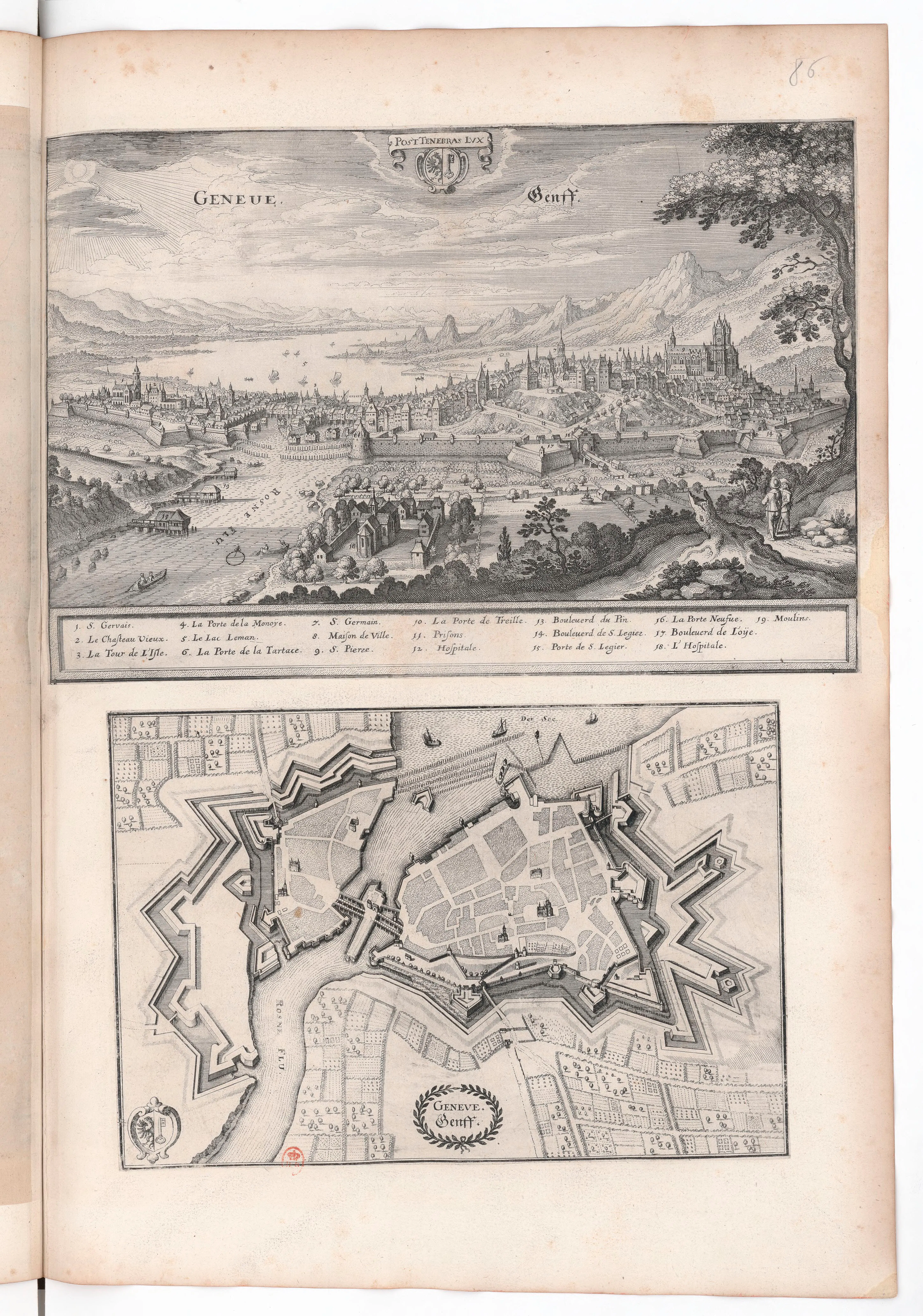
A near-contemporary engraved view and plan of Geneva, in the Merian Topographia tradition, places the dissertation in the city named in its imprint. It illustrates not the Flood argument but the printing milieu — "Genevæ, apud Petrum Columesium," 1667 — that brought the work into circulation. Source ↗.
.jpg)
A related CCFR/BnF record (ARK ark:/16871/0016880417) describes Abraham van der Myle's De origine animalium, et migratione populorum, Geneva, 1667, 68 pages, in duodecimo, with signatures A–C12 and the final leaves blank, as associated at the end of the De diluvii universalitate. That record helps explain why Kirchmaier and van der Myle appear together in modern cataloguing, but it does not prove that every surviving copy has the same binding or that van der Myle wrote every part of the 109-page dissertation. The thematic fit is nonetheless close, since the origin of animals and the migration of peoples are precisely the two problems on which the regional hypothesis places the heaviest explanatory burden. No authenticated physical shelfmark for a surviving 1667 copy, manuscript exemplar, modern translation, dedication, privilege, censorship file, or direct contemporary reply was located. The object biography therefore remains partly reconstructable: a Geneva 1667 printed work with a strong textual match to the regional-Flood dissertation, a related van der Myle item, and unresolved questions about authorial division and copy-specific binding.
Following the Argument: From Ten Oceans to an Asia Enclosed by Waters
The editorial preface and the division of responsibility
The volume's argumentative work begins before the disputation proper, in the editorial address Æquo Lectori, and the terms of that preface govern everything that follows. An unnamed editor reports that the treatise reached him from its author, that he read it and passed it among learned friends who judged it worth printing, and that the author resisted, calling the piece a merely conjectural commentatio which he would not expose to malevolent censure, insisting that it was, in the editor's report of his words, a birth its parents never smiled upon, foetum esse, cui nec risere Parentes, — a Vergilian tag turned into a claim about literary paternity, reinforced by the figure of an absent Lucina and by the author's comparison of himself to the mother of Ichabod pronouncing her own offspring inglorious. The editor's counter-topos is exact and revealing: the judgement of a birth belongs to the midwife, not to the parent, and suppression of what one knows to be true falls under the Pauline reproach of holding the truth in unrighteousness. What the paratext therefore stages is a division of responsibility, in which the reluctance is the author's and the publication another's — a structure that supplies plausible deniability to a thesis whose danger both parties evidently understood.
The question posed: Pentecost, Camarina, and the received case
The treatise proper opens on the difficulty of the Mosaic text and moves quickly to name what has never been asked ex professo, and it dresses that unasked question in an occasional conceit of considerable delicacy: as Noah left the ark under the auspices of a dove, so the author writes at Pentecost, and therefore by the instinct or auspice of that same Spirit or wholly divine Dove will we attempt this question of the Flood's universality, Itaque ejusdem Spiritus seu Columbae prorsus divinæ instinctu auspiciove quæstionem hanc de Diluvii Universalitate attentabimus. The conceit is not ornament: it converts a potentially impious disturbance of settled opinion into an act performed under the auspices of the very bird that announced the receding waters, and it pairs with the Camarina proverb to make novelty into piety.
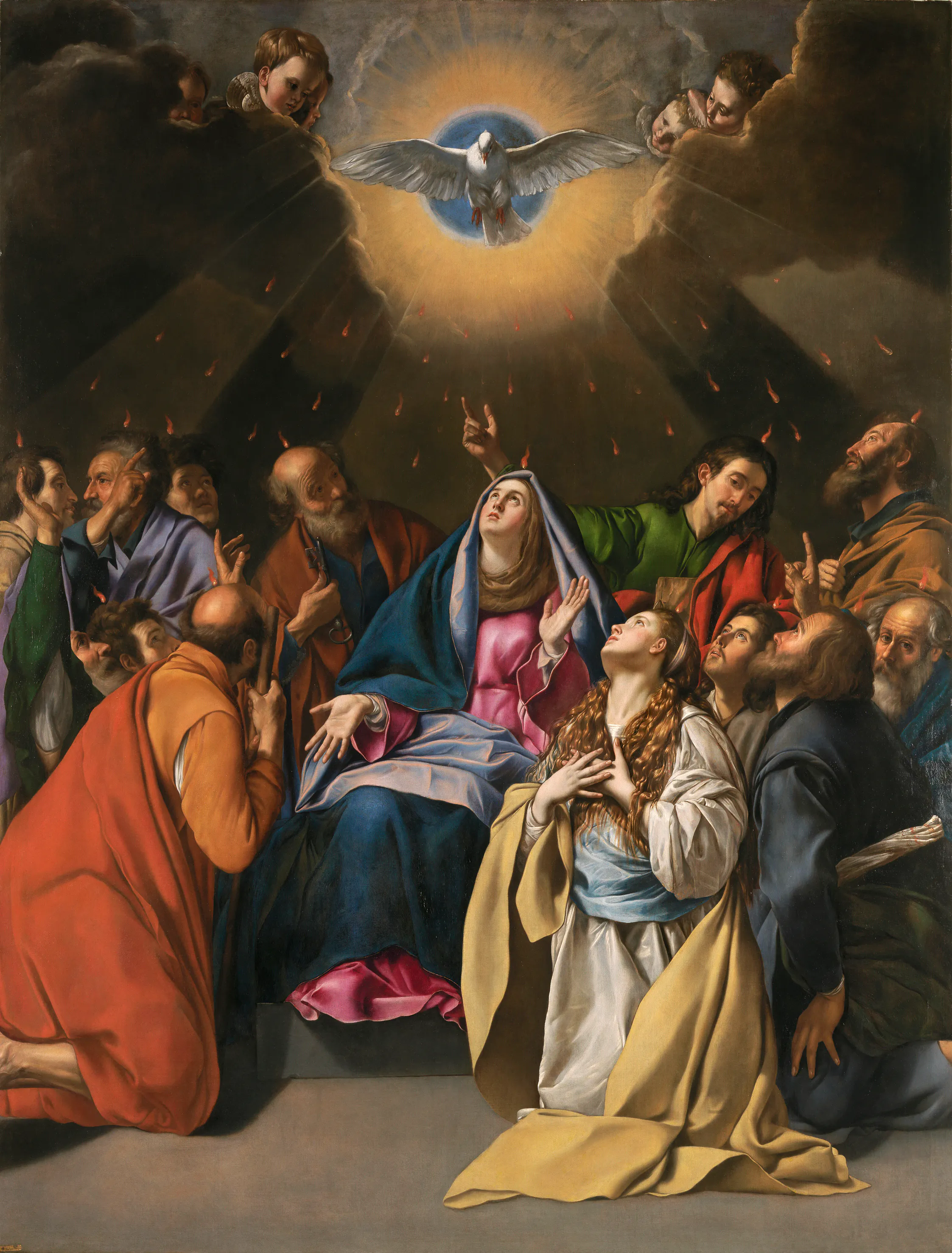
Juan Bautista Maíno's Pentecost (c. 1620–25, Museo del Prado) sets the descending dove of the Holy Spirit at its centre. Painted only decades before the Geneva dissertation, it shows how readily that emblem could join Pentecost to Noah's ark, licensing a challenge to settled opinion as divinely sanctioned rather than merely novel. Source ↗.

Pars I then discharges the obligation of a disputational exercise by stating the received case at full strength — the covered mountains of Genesis 7, the waters over the whole earth of Genesis 8, the destruction of omnis substantia, the eight souls of the Petrine epistles, and the physical argument that birds at least would have escaped a partial inundation — before the author concedes that he would yield to so weighty a consensus but for the exceptions he now submits to the reader's arbitration.
Measurement, the void, and the economy of miracle
Those exceptions begin in the register of measurement rather than exegesis, and the shift of register is the treatise's decisive methodological event. Taking mountain heights from the experiments of mathematicians and the narrations of historians, the author establishes his baseline, that the summit of the highest mountain rises perpendicularly above the level of the Ocean to two miles, while it is established from Scripture that the water stood fifteen cubits higher than the loftiest mountains, montis altissimi verticem supra Oceani libramentum perpendiculariter erectum eminere ad duo millaria: ex Scriptuta autem constet quindecim cubitis altiorem fuisse aquam super montes celsissimos;. A scriptural datum in cubits is here placed on the same scale as a cosmographical datum in miles, and once the water is distributed spherically about the globe the deficit becomes a quantity rather than a mystery. What forbids the deficit from being filled by fiat is a double principle, physical and theological at once, since one must not admit a vacuum and void, which the nature of things, as boys know, cannot bear, and it is by no means proper to accomplish everything by miracles, forte vacuum & inane admitti placeat, quod rerum natura, ut pueri sciunt, ferre nequit; miraculis autem cuncta emoliri haud sane attinet. The scholastic commonplace of nature's abhorrence of the void closes the exit by which the sea or the subterranean abyss might be drained without leaving an equivalent emptiness behind; the economy of miracle closes the second exit. That economy is not buried in the argument but advertised in the printed margin of the page, where the compositor set the rule as a heading, Non est passim & promiscuè ad miracula suffugiendum, that one must not flee to miracles everywhere and indiscriminately — an instance of the book's side-notes functioning as an index of method rather than merely of content.
Draining the reservoirs
The dismantling of the successive reservoirs proceeds by turning each defender of universality into a witness against his own thesis. The most economical case is Agostino Steuco, whose recourse to waters above the starry heaven is quoted precisely for the admission it contains, that neither forty years of rains, much less forty days, nor whatever things exist beneath the heavens, had they been turned into water, would have sufficed, Quoniam, inquit, nec quadraginta annorum imbres, nedum quadraginta dierum, nec quicquid rerum est infra Coelos, si in aquam verti contigisset, satis fuisset. The extravagance of the remedy measures the size of the problem: an authority reaching above the firmament concedes, in the act of reaching, that the sublunary world holds no sufficient supply. The same technique governs the treatment of rarefaction, admitted within experimentally attested proportions and refused at the magnitude universality requires, and the appeal to the Aristotelian decuple conversion of air into water, which is allowed to stand as a ratio and thereby to indict the quantity demanded.
From physics to philology: hyperbole and graded universality
Having drained the physical case, the treatise turns the question over to philology, and here its boldest claim is a claim about Mosaic style rather than about the Flood: nowhere, the author holds, does Scripture contain more hyperbolic expressions, plus locutionum Hyperbolicarum, than in this narrative. The dossier of restricted universals — the spring watering the whole face of the earth, the famine over all the earth, Nebuchadnezzar's world-kingdom, the census of the universus orbis, the darkness over all the land — is assembled to make that stylistic claim a rule rather than an evasion, and the comparative diluvialism that follows shows how the resulting notion of universality is graded rather than binary: the author sets beside the Noachian event that most celebrated flood which happened under Deucalion in Thessaly some seven hundred and seventy years later, and another a little more ancient, by some two hundred and thirty years, which occurred in Attica under Ogyges, illudque adeo celeberrimum quod sub Deucalione in Thessalia septingentis fere & septuaginta annis post accidit; nec non & alterum paulo antiquius, puta ducentis triginta annis, quod in Attica sub Ogyge fieri contigit;. The Greek floods are confined to a shore or a province; the Mosaic flood covers by far the greatest part of the world. Magnitude, not totality, is what the sacred text is made to assert, and the pagan comparanda supply the scale on which magnitude can be read.
Chronology, settlement, and the euhemerist chain
The positive reconstruction rests on chronology welded to historical geography. Génébrard is quoted for the year of the world 1656 and for the settlement pattern it implies, since it is plain that the farthest shores of Asia were not yet occupied by men, this first age having been passed in Syria and neighbouring places, that is, Egypt, Arabia, Petraea, Chaldaea, Mesopotamia, Assyria, Armenia and such inland parts of Asia, Venio propius ad nostros, è quibus Genebrardi hæc sunt Chronol. lib. 1. sub anno mundi 1656. qui fuit annus Diluvii. Nondum extremas Asiæ oras ab hominibus fuisse occupatas palam est; nam, inquit, prima hæc ætas traducta est in Syria & locis vicinis, id est, Ægypto, Arabia, Petræa, Chaldæa, Mesopotamia, Assyria, Armenia, & ejusmodi Asiæ Mediterraneis. Since the marginal notes insist that the sole cause of the Flood was human guilt, the punishment can extend no further than the guilty, and the geography of settlement becomes the geography of inundation. The argument from the absence of navigation seals that confinement, and it generates the euhemerist chain in which pagan antiquity is read as corrupted sacred memory: Berosus of Annius thinks this Janus should be held identical with Noah, who, whether from the mark of drunkenness or because he was the author of planting and tending the vine, deserved to be called Janus, that is, Wine-bearer, from the Hebrew iain or ien, that is, wine, Hunc porro Ianum Berosus Annii lib. 3. eundem habendum esse cum Noëmo putat, qui vel ob ebrietatis notam, vel quod vitium serendarum aut colendarum autor fuit, Janus, id est, Vitifer sive Vinifer ab Hebr. Iaim, vel Jen, hoc est, vinum, dici meruit,. That the forged Berosus of Annius of Viterbo is deployed without hesitation, in the same pages where rabbinic reports are dismissed as old wives' tales, exposes the confessional rather than critical criterion by which testimony is admitted here.
Asia enclosed: the geographical thesis and its epistemic guard
The geographical thesis is then fixed by cartographic autopsy, Asia being described as a basin walled by waters: to the east it is seen to be divided from America by the immense eastern Ocean; to the west it has the Mediterranean seas, from the mouth of the Nile as far as the Pontus and the Maeotic marsh, then the river Tanais; and not far to the north is the frozen sea, nempe ad ortum oceano orientali immenso ab America discludi cernitur, ad occidentem maria habet mediterranea, ab ostio Nili ad Pontum usque, & Mæotim paludem, inde fluvium Tanaim, nec procul est ad septentrionem mare congelatum. The enclosure does double duty: it defines a region that can be flooded without flooding the globe, and it forecloses escape by a people without ships.
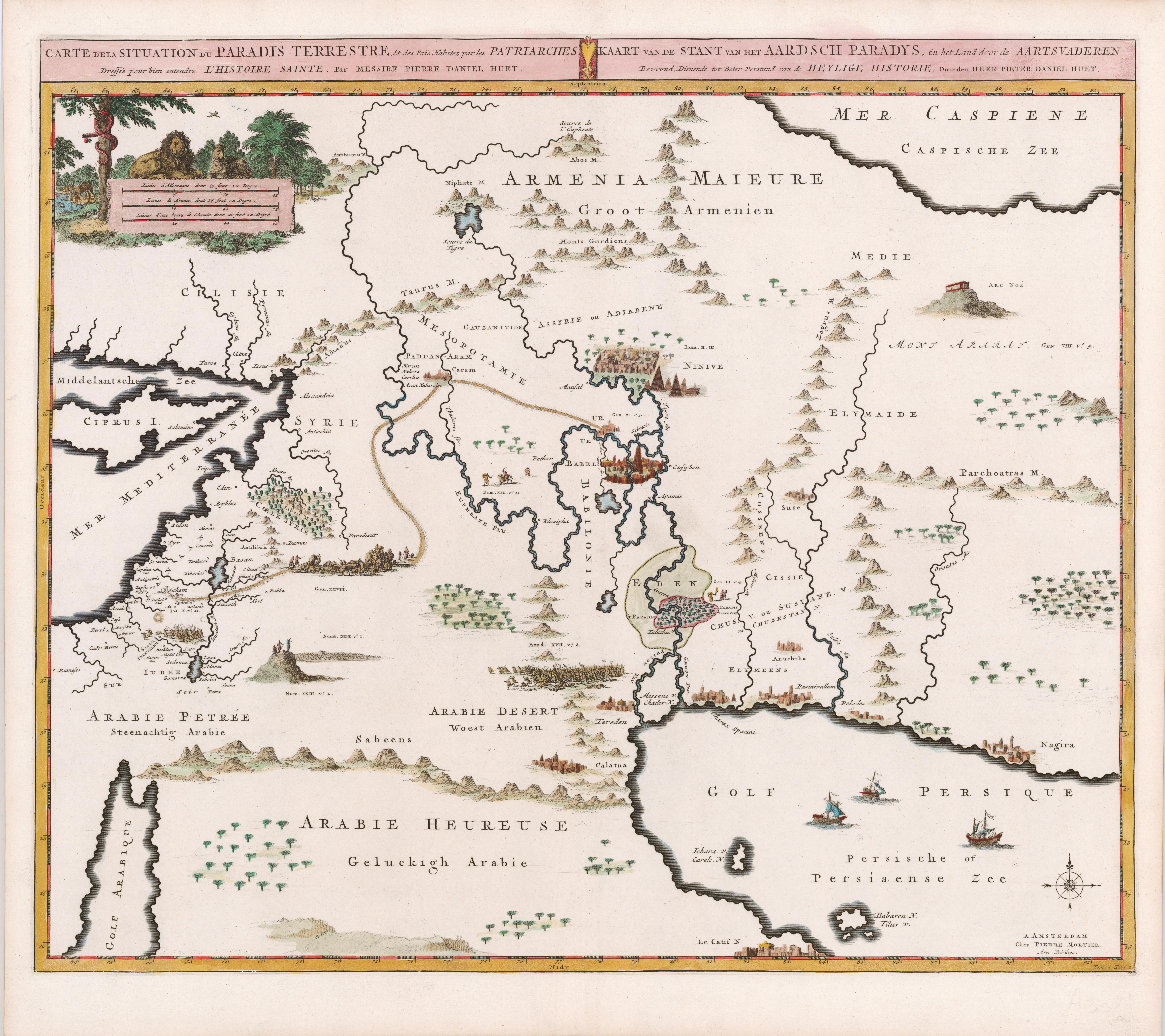
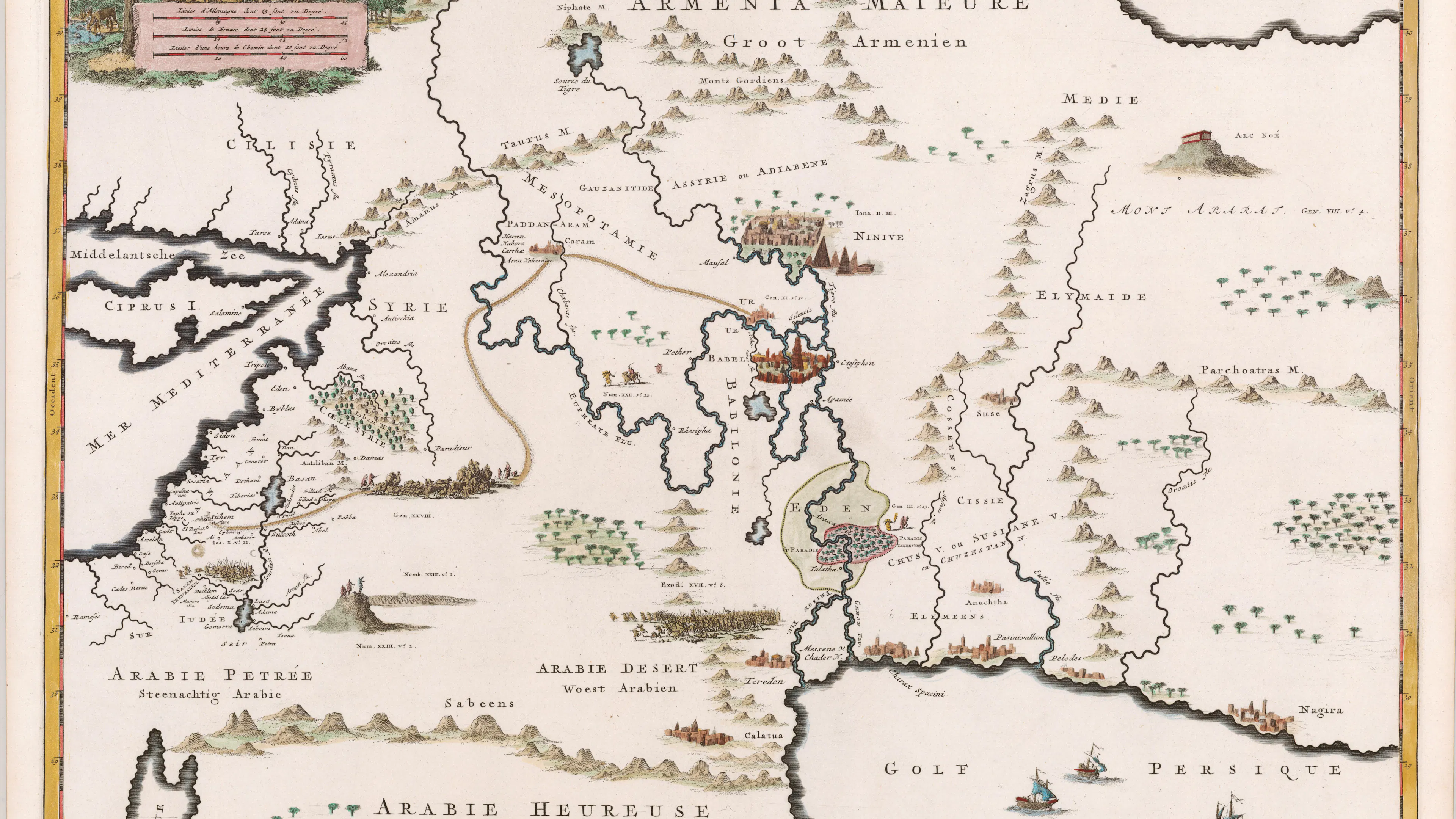
Mortier's Situation du Paradise Terrestre (c. 1700) maps Asia as a bounded biblical theatre, marking Eden and Mont Ararat amid the seas, rivers, and gulfs that could make a regional Flood look cartographically plausible — waters that both enclose the inundation and trap a people without ships. Source ↗.

The conclusion is accordingly stated in fractional terms, that this Noachian Flood happened in the land of Asia, which is the fourth part of the globe of the earth, terra Asia, quæ quarta orbis terræ pars est, accidisse; — a formulation that preserves the inherited epithets while quartering their referent, since "universal" is retained by synecdoche hyperbolica and by the redefinition of the flooded region as the oecumene. Immediately the epistemic guard returns, the author professing to wish nothing said except by way of suspicion, nihil nisi ex suspicione dictum velle,, even as he claims the honour of being first to attempt the road — a pairing of maximal modesty in mode with maximal ambition in priority that recurs at every exposed point of the argument.
Objections answered and the corollary's pre-emption
The remaining objections are met in the same measured style, the strongest of them stated at full force before it is answered: Lessius had urged that, given antediluvian longevity, it could not but be that an immense multiplication took place, which Asia would not have sufficed to contain, and therefore they had to be distributed into other lands too, fieri haud potuerit, quin multiplicatio ingens facta sit, cui capiendæ non suffecerit Asia, ideoque in alias quoque terras distribui oportuerit. Ita Lessius lib. 13. de perfect. divin. cap. 6. The reply is demographic and philological rather than dismissive — late first paternity, with Noah's firstborn at five hundred; the Mosaic formula genuit filios et filias as covering any earlier issue; and Genesis 6 read to say only that men had begun to multiply — which shows the treatise conducting its defence within the same quantitative discipline it imposed on the water supply. The gravest scruple is reserved for the Corollarium, and it is raised in the voice of one of the pre-publication readers rather than the author's own: whether it is not arrogance that words unanimously understood otherwise should at last, on no authority, be taken by private interpretation, tandem aliquando, autore nullo, privata interpretatione senis accipi,. Naming the post-Tridentine charge before an adversary can is itself the defensive strategy, and the historical catalogue of licitly altered expositions that follows is calculated to answer it in kind — by demonstrating that the Church's own practice distinguishes a new exposition from a new dogma, and that consensus at any given moment has never been sufficient to close a question the text itself leaves undefined.
Frequently Asked Questions
What is De diluvii universalitate dissertatio prolusoria?
It is a short Latin work of learned disputation, printed at Geneva in 1667 and running to some 109 pages, which asks whether the Flood of Noah covered the whole globe of the earth or only one inhabited region of it. Its author complains that nobody had ever argued the point formally, because universal inundation passed for a Catholicum dogma — a received Catholic consensus so fixed among the common sort that no one thought to doubt it. The conclusion, offered as conjecture rather than definition, confines the waters to Asia, "the fourth part of the globe."
Who wrote the 1667 Geneva dissertation on the Flood?
Authorship is unresolved. Modern catalogue records, including USTC 1948515 and Google Books, attach the title to Georg Caspar Kirchmaier and Abraham van der Myle, while D. R. McKee's 1944 study of Isaac La Peyrère describes a 1667 De diluvii universalitate as anonymous. A BnF record associates van der Myle's De origine animalium, et migratione populorum, Geneva 1667, bound at the end of the dissertation, which helps explain the paired attribution without settling the division of responsibility. Place and date of composition, dedicatee, and circumstances remain unestablished.
How does the dissertation argue that the Flood was not global?
By measurement, then by subtraction. Taking the highest mountain summit as rising two miles above the level of the Ocean, and adding the fifteen cubits Scripture places above the peaks, it reckons that a global inundation would require water equal to ten oceans and more. It then refuses in turn every reservoir the schools proposed — the sea, a subterranean abyss, rarefaction (allowed only within attested proportions), the Aristotelian decuple conversion of air into water, and Agostino Steuco's waters above the starry heaven — while declining to flee to miracles wherever natural causes might suffice, and refusing to admit a vacuum.
What does "universality" mean in this work?
It is narrowed by philology into the inhabited earth, the oecumene, on the analogy of an oecumenical synod, which is called universal because it draws from all parts without covering the globe. That redefinition is prepared by scriptural control cases in which the same universal particles are demonstrably restricted: the famine of Genesis 41, Nebuchadnezzar's world-kingdom in Daniel 2, the census of the "whole world" under Augustus — who, on Suetonius's testimony, ruled neither Goths nor Armenians nor Indians — and the darkness at the Crucifixion, which Origen limits to Judaea. Moses's "whole earth" is accordingly read as hyperbole indicating magnitude.
Is there an English translation of De diluvii universalitate dissertatio prolusoria?
No English translation, nor any German, French, or other modern rendering, has been identified in the catalogue and digital records examined; the work remains bibliographically a Latin text without a located translation. Separately, the Leo edition now presents the full transcription together with a complete English translation for the first time. That translation is generated by AI. Leo is an effort to make freely available online, at no cost, English translations of every text printed in Latin in early modern Europe between 1450 and 1750.
This report was generated by an advanced AI assistant that conducted deep research alongside an extensive interpretation of the transcribed original text. Every effort has been made to preserve fidelity to the source and to guard against inaccuracy, but corruption in the text recognition process and model hallucination may nonetheless have entered the text. Treat every claim, quotation, translation, and citation as provisional, and verify each against the original source before relying on or citing it.
Critical Further Reading on Noah's Flood, Sacred Geography, and Post-Tridentine Exegesis
- Almond, "The Late Medieval and Early Modern Noah," Noah and the Flood in Western Thought: Almond's chapter tracks the size and shape of the ark, the identity of its animal passengers, and the shifting historical status of the Flood across the long period into which this dissertation drops. It is the fastest way to see inherited exegetical motif hardening into a problem of physical possibility — the pressure behind the treatise's zoogeographical objection about by what means, since the times of the Flood, certain animals — such as lions, bears, tigers and the like — came to be carried into parts of the world far removed and cut off by vast expanses of seas and Ocean, America, say, and New Guinea, quædam animalia, ut leones, ursi, tigres, aliaque id genus, in procul remotas, ingentibusque adeo marium atque Oceani spatiis disclusas orbis partes, Americam puta, novamque Guineam,, where the capacity of the ark is converted into an argument about the extent of the waters.
- McKee, "Isaac De la Peyrère, A Precursor of Eighteenth-Century Biblical Criticism," PMLA: McKee is the indispensable older witness for the 1667 De diluvii universalitate, which he treats as anonymous, places in La Peyrère's orbit, and summarizes as denying a globally terrestrial Flood in favour of an Asian localization. Read it against the current catalogue attribution to Kirchmaier and van der Myle, and against the conformist seal with which the text closes — as a son and worshipper of God, so also of the Church, I wish to die — not only a hater and adversary of new dogmas, but, so far as in me lies, their exterminator, Ut Dei, ita & Ecclesiæ filius, & cultor, mori volo, novorum dogmatum, non osor modo & adversarius, sed, quantum in me fuerit, etiam exterminator — which bears directly on how such a work could circulate and why its authorship might have stayed obscure.
- Schlichter, "Flavius Josephus and Early Modern Biblical Chronology," Intellectual History Review: Schlichter reconstructs the quarrel over the true age of the world and the uses to which Josephus was put in it, the debate in which Vossius and La Peyrère are the familiar names. His account explains how a Flood dissertation could recruit chronology, pagan antiquity, and antiquarian testimony without breaking confessional ranks — precisely the manoeuvre behind the Eupolemus fragment, that Enoch was commonly called Atlas among the ancients, Adde huc demum quod ait Eupolemus, Enochum vulgo appellatum esse apud priscos Atlantem; ut videatur nihil meæ porro conjecturæ admodum deesse.
- Shalev, "Early Modern Geographia Sacra in the Context of Early Modern Scholarship," The Oxford Handbook of the Bible in Early Modern England, c. 1530–1700, ed. Kevin Killeen, Helen Smith, and Rachel Willie (Oxford: Oxford University Press, 2015), 196–208: Shalev sets out the learned procedures by which biblical places, peoples, migrations, and boundaries were collated with humanist geography, which is exactly the toolkit deployed to wall Asia in with seas. It is also the best guide to the dissertation's Hebraizing onomastics — and hence I suspect arose that famous and everywhere-current name of Thebes: for Theba, as is clear from Montanus, is the proper name of Noah's ark; whence among the Phoenicians theba means a ship, and thence, in my opinion, the name of Thebes is derived, Atque hinc porro ortum suspicor celebre illud ac pervulgatum ubique gentium Thebarum nomen: Theba enim, ut ex Montano constat, nomen est arcæ Noëmi proprium: unde apud Phoenices Theba navigium significat, indeque Thebarum nomen deductum opinio est — where etymology, migration, and sacred toponymy corroborate one another in the conjectural register that governs the whole.
- Smolinski, "Mather's Biblia Americana (1693–1728)," JSTOR: Useful for a reason that has nothing to do with New England: Smolinski cites Kirchmaier's De diluvii universalitate dissertatio prolusoria (Genevae, 1667) with page references, which is independent confirmation that the Geneva imprint circulated under that name and was read by transatlantic commentators. Anyone testing the attribution question raised in Section 4 should start with citations of this kind rather than with catalogue headers.
- Vandenhoeck & Ruprecht, Jesuit Biblical Studies after Trent: Scripture, Science and Theology: The publisher's preview of this volume argues that humanist scriptural scholarship did not stop at Trent but carried on inside Catholic institutions, which is the institutional setting a reader needs for the Corollarium and its anxiety about privata interpretatio. It also supplies context for the exegetical authorities the dissertation leans on, Maldonatus among them, and for why a Jesuit-trained reader might treat a new exposition as licit while treating a new dogma as intolerable.