Chaff on the Hinge: Domenico Magri's Hierolexicon, or Sacred Dictionary
Domenico Magri (Valletta 1604 – Viterbo 1672), a Maltese priest, consultor of the Sacred Congregation of the Index, and traveller to Syria and Mount Lebanon, spent his career building a dictionary that claimed to be a sacred object in its own right. His Hierolexicon, sive Sacrum Dictionarium — an alphabetical Neo-Latin encyclopaedia of ecclesiastical, liturgical, canonistic, and antiquarian vocabulary, completed at his death and issued posthumously at Rome in 1677 through his brother Carlo, then reprinted in this 1735 Venetian folio — fixes the ancient meaning of every word of Catholic rite in order to prove, against the Protestant Novatores, that the vocabulary itself carries the pedigree of the undivided Church. That single wager, that to fix a word is to defend a thing, governs the whole book from its etymologies of the cardinalate to its appended treatise harmonising the apparent contradictions of Scripture.
ExLatinis
29 July 2026

Contents
Domenico Magri (Valletta 1604 – Viterbo 1672), a Maltese priest, consultor of the Sacred Congregation of the Index, and traveller to Syria and Mount Lebanon, spent his career building a dictionary that claimed to be a sacred object in its own right. His Hierolexicon, sive Sacrum Dictionarium — an alphabetical Neo-Latin encyclopaedia of ecclesiastical, liturgical, canonistic, and antiquarian vocabulary, completed at his death and issued posthumously at Rome in 1677 through his brother Carlo, then reprinted in this 1735 Venetian folio — fixes the ancient meaning of every word of Catholic rite in order to prove, against the Protestant Novatores, that the vocabulary itself carries the pedigree of the undivided Church. That single wager, that to fix a word is to defend a thing, governs the whole book from its etymologies of the cardinalate to its appended treatise harmonising the apparent contradictions of Scripture.
Few works of the Catholic Reformation press their central conviction so literally into their own title as the Hierolexicon, sive Sacrum Dictionarium of Domenico Magri (Valletta 1604 – Viterbo 1672), a Maltese priest, theologian, and consultor of the Sacred Congregation of the Index who spent his career in the orbit of Rome's Propaganda Fide. The book is an alphabetically arranged Neo-Latin encyclopaedia of ecclesiastical, liturgical, canonistic, and antiquarian vocabulary, completed in manuscript at its author's death and issued posthumously at Rome in 1677 through the editorial labour of his brother Carlo; the folio reprint issued at Venice by the Typographia Balleoniana in 1735 is the copy under study here. It is, in the plainest terms, a dictionary — but a dictionary that names itself a sacred one, and the wager of that adjective governs everything that follows.
The intellectual problem the work confronts can be stated simply: how is the true meaning, origin, and authority of the Church's ritual, juridical, and doctrinal vocabulary to be fixed against error — whether the corruptions charged by heretics, the innovations of the Protestant Novatores, the misreadings Magri lays at the door of the "Greek sophists," or the equivocations latent within words themselves? Magri's characteristic response is philological. Each lemma is grounded in an etymology traced through Latin, Greek, Hebrew, Syriac, Arabic, and further tongues, then secured by patristic, conciliar, and canonistic authority, with a signed critical voice — the siglum FR. — adjudicating disputed points. Running beneath this method is a single criterion: antiquity. What is prior, what stands from the beginning, what descends from the Apostles, is on Magri's account the truer; and so the recovery of a word's ancient sense doubles as a Tridentine defence of Catholic rite and Roman primacy. The same procedure extends into an appended exegetical treatise, the Antilogiae, which harmonises the apparent contradictions of Sacred Scripture through a fixed Respondeo.
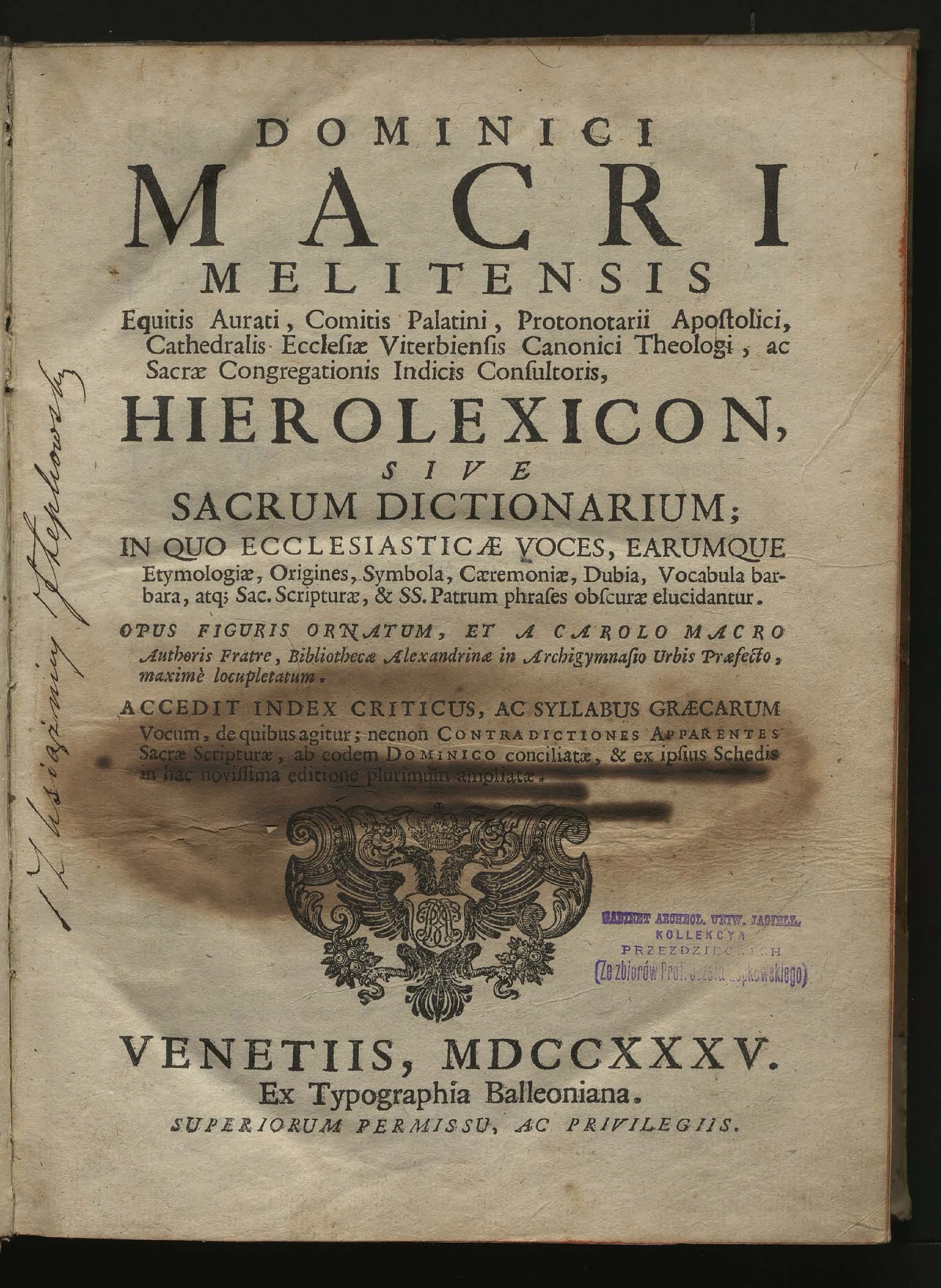
The title page of the 1735 Balleoniana folio makes Magri's project visible at a glance: stacked ecclesiastical titles, the coined title HIEROLEXICON, SIVE SACRUM DICTIONARIUM, and the announcement of appended scriptural harmonizations all frame sacred vocabulary as a matter of institutional authority and doctrinal repair. The printer's device and Venice imprint anchor that program in a material book uniting philology, antiquity, and sanctioned correction in a single post-Tridentine enterprise. Source ↗.
The historical stakes of this move belong to the confessional contests of the seventeenth century. Where Protestant polemic charged that Catholic rite, hierarchy, and sacrament were post-apostolic accretions, Magri's lexicon answers at the level of the word, arguing that the vocabulary itself carries the pedigree of the undivided Church. The book thus sits alongside the polemical and catechetical works of Bellarmine and Becano, but it does a different kind of labour: it supplies the historical, antiquarian, and etymological foundation those works presuppose, organising Catholic doctrine not by theological loci but by the terms in which that doctrine is spoken. That the antiquarian energy of the enterprise coexists with firm Tridentine apologetics is part of what makes the work a revealing witness to the intellectual texture of Counter-Reformation Rome.
What a first-time reader will find most striking is the sheer reach of the material Magri draws into a reference work. Alongside the expected entries on vestments, canonical hours, and ecclesiastical rank stand a dissertation on the suffocatum crux of Acts 15, a tolerated discussion of Kabbalah and the number of the Antichrist concealed in the word Mammona, an ethnography of the muezzin who "supplies the lack of bells," a digression on the invention of gunpowder, and a philological defence of the Maltese islanders of Acts 28 built on the Syriac etymology of barbarus. These are not idle curiosities: they issue from a life that included an itinerarium to Syria and Mount Lebanon and sustained collaboration with the Maronite and Arabist scholars of the Roman colleges, and they feed directly into the appended treatise, whose stated genesis lies in Urban VIII's commission to revise the Arabic Bible for the instruction of Eastern Christians. Magri writes himself into the book as well — Knight of the Golden Spur, Count Palatine, Apostolic Protonotary, canon of Viterbo, consultor of the Index — and as an eyewitness to events from the miracle-associated sites of Orvieto and Bolsena to the exhumation of Boniface VIII.
The throughline that unites these disparate registers is the conviction announced by the title itself: that the words of the Church are sacred objects, that their history is an argument, and that to fix a word's ancient meaning is to defend the institution that speaks it. The polysemy of a keyword, the juridical force of a canon, the production of the book under post-Tridentine institutional apparatus, and the internal movement from lexicon to scriptural harmonisation are, on this account, facets of one enterprise. The literature on Magri himself remains strikingly thin, and no monograph-length study of the Hierolexicon has yet appeared; what follows draws the work's macro-history together with a body of its own Latin to show why the text rewards the sustained attention it has not often received.
Read the full text and English translation on Leo
This text was transcribed and translated as part of the ExLatinis project, an effort by Leo to make free English translations of every text published in Latin in early modern Europe (1450–1750) available online. The complete transcription and English translation of this work can be read free of charge:
→ Read the original Latin text and full English translation on Leo
You can save a copy of this document into your Leo account to run deep text searches, conduct further analysis, or cross-reference it with your own research.
Assigning an English Title and Framing Magri's Sacred Vocabulary
The Hierolexicon, or Sacred Dictionary of Domenico Magri of Malta: A Latin Encyclopaedia of Ecclesiastical, Liturgical, Canonistic, and Antiquarian Terminology, with an Appended Treatise on the Apparent Contradictions of Sacred Scripture.
This editorial English title is supplied for convenience; no settled English-language convention exists in the existing scholarship, and the work is habitually cited under its Latin short-title or by the author's name.
Several Latin terms that load the early modern Counter-Reformation lexicon repay close philological attention, because the senses they bear in Magri's text diverge from their inherited classical meanings and carry programmatic weight for the entire work.
Hierolexicon itself is a seventeenth-century Latinized compound, formed from the Greek ἱερός, "sacred, pertaining to the rites," and λεξικόν, a diminutive of λέξις, "word, speech, phrase." The coinage is not a mere variant of lexicon sacrum or vocabularium sacrum. By naming the book a hierolexicon, Magri claims that the words it collects do not merely describe sacred realities but participate in them; the lexicographic repository itself belongs to the sacred order. The coinage thus performs a polemical move against Protestant polemicists who accused Rome of having overlaid scriptural and patristic diction with scholastic and ceremonial accretion: the very vocabulary Magri catalogues, he implies, was always already sacred, and the Tridentine settlement has only brought its order to light. In Magri's mouth, hierolexicon is not a neutral title; it is a confession that the lexicon is itself a sacred object. That the words of rite are held to participate in the sacred realities they name is precisely what makes Magri's philological method an apologetic instrument: to fix a word is to defend a thing.
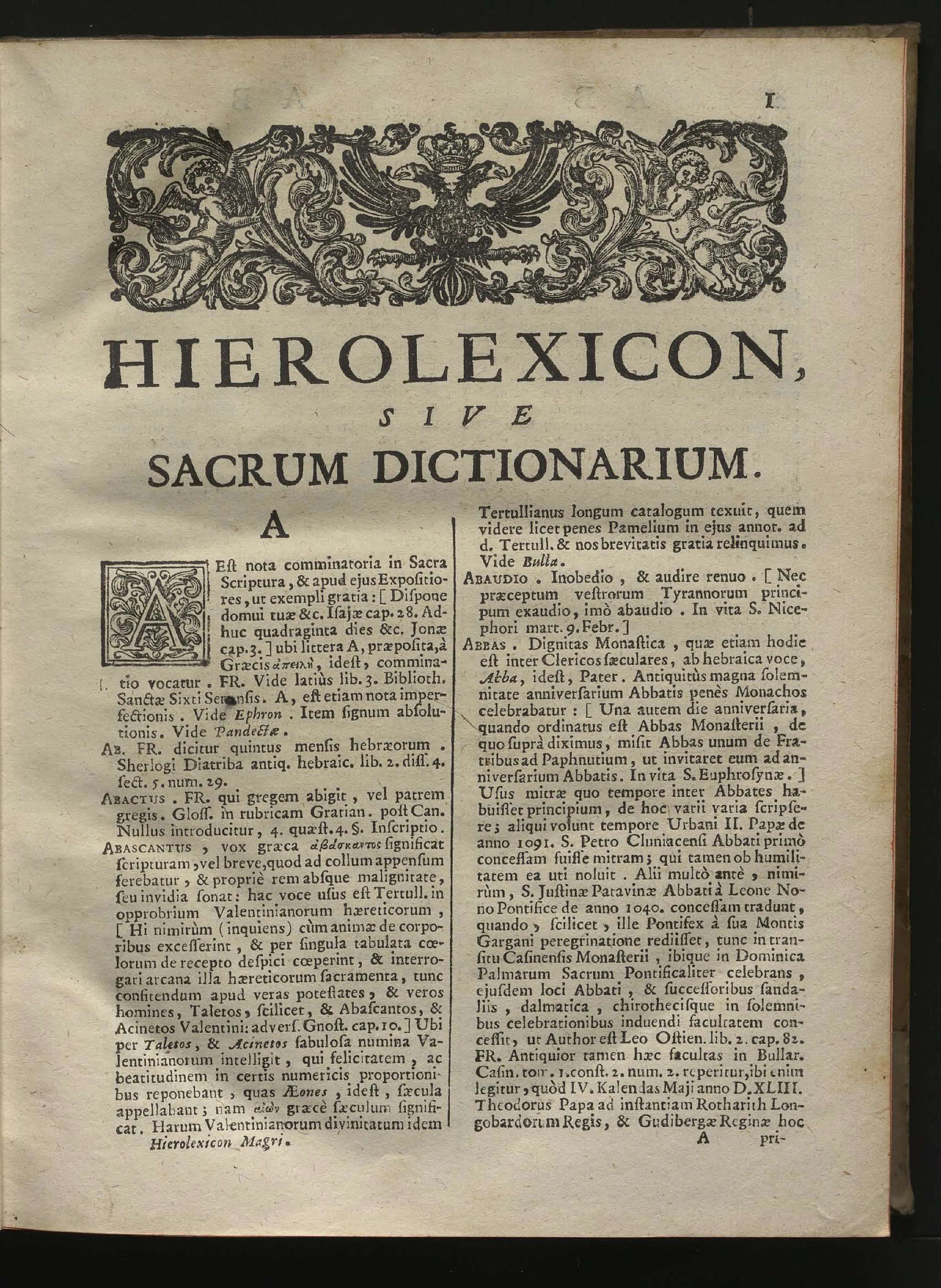
At the threshold of the dictionary proper, the heading HIEROLEXICON, SIVE SACRUM DICTIONARIUM appears beneath a baroque woodcut of putti, foliage, and a crowned double-headed eagle, elevating Magri's coinage from reference title to sacred claim. The ornamented initial A and dense double-column entries make the alphabet's first letter a ceremonial opening for the work's apologetic premise: to define sacred words is to defend the realities they name. Source ↗.
Novatores is Magri's standard polemical label for the Magisterial Reformers. The term is built on the Latin novare, "to make new," and in its Ciceronian and post-Ciceronian usage it always carried the connotation of illegitimate innovation against established order; res novarum molitor in classical prose is one who stirs up revolution against the res publica. Early modern Catholic controversialists inherited and sharpened this vocabulary. When Magri calls Luther, Calvin, and their followers the Novatores, he casts them as breakers of the consuetudo of the undivided Church, recentiores standing against the unanimous antiquitas of Fathers and Councils. The label is chronological as well as moral: the Novatores are those who have departed from what the Church was for a millennium and a half. Every Tridentine settlement that Magri defends — communion under one kind for laity, the veneration of images and relics, the invocation of saints, the sacrificial character of the Mass — is defended against the Novatores precisely on the ground that it is not new. The rhetorical force of the term is on open display where Magri defends even the most conspicuous papal ceremonial by refusing the charge of pride: the rite of bearing the pope aloft, he insists, is no mark of arrogance, as the innovators rashly try to allege, but is performed for the mystery of pastoral vigilance, non est quidem fastus, vel superbiæ nota, ut temerè Novatores inficere conantur; sed ad mysterium pastoralis vigilantiæ agitur. The pairing of antiquitas against novitas is the rhetorical axis of Magri's apologetic entries, and Novatores is its master term.
Symbolum is the third term whose early-modern sense diverges most sharply from its antique inheritance. In classical Latin symbolum denotes a token, a tessera, a mark of identification carried by allies or guests; the Greek σύμβολον has the same field of meaning. Magri's entry on Symbolum operates in three registers at once. First, in the antique civil register: the symbolum as the password of Roman soldiers, the tessera of identity, the sign by which friend is distinguished from stranger. Second, in the credal register: the Symbolum Apostolorum, the Symbolum Nicaenum, the baptismal profession of faith. Third, in the sacramental register: the symbolum fidei spoken at baptism, where the verbal sign constitutes the Christian as Christian. The philological conceit underlying the entry is that the symbolum names the act by which the Christian is recognized, named, and confessed: to bear a symbolum is to have been symbolically constituted. Magri makes this explicit in glossing the term as sign and deriving the credal sense from the act of profession — symbolum, that is, sign, whence the doctrine of faith handed down by the Apostles, beginning with Credo, is called symbolum, because by that profession we give to those who hear a sign that we are Christians, SYMBOLUM, , id est, signum: hinc fidei doctrina ab Apostolis tradita, quæ à verbo Credo incipit, dicitur symbolum, quia ea professione audientibus signum præbemus nos Christianos esse. In this register, Magri absorbs the Tridentine decree on the symbolum fidei and the sacramental theology of baptism as signum sacrum into a single lexicographical meditation on Christian self-naming.
What the Hierolexicon Is: A Posthumous Latin Encyclopaedia of Catholic Rite
The Hierolexicon, sive Sacrum Dictionarium of Domenico Magri (Valletta 1604 – Viterbo 1672) is an alphabetically arranged Neo-Latin encyclopedic lexicon of ecclesiastical, liturgical, canonistic, and antiquarian terminology, accompanied by an appended exegetical treatise, the Antilogiae, seu contradictiones apparentes Sacrae Scripturae, harmonising the apparent contradictions of Sacred Scripture. Its author was a Maltese priest who held a doctorate in theology, served as consultor of the Sacred Congregation of the Index, and held the canon-theologate of the cathedral chapter of Viterbo; he bore the courtly titles of Knight of the Golden Spur, Count Palatine, and Apostolic Protonotary, a self-identification the text itself carries in full where he is named as DOMINICO MACRO MELITENSI Equite Aurato, Com. Palatino, Proton. Apostolico, Cathedr. Ecclesiæ Viterbien. Canonico Theol. ac Sacræ Congregationis Indicis Consultore. The work's textual genesis is bipartite. An Italian-language antecedent, Notizia de' vocaboli ecclesiastici, was first published at Messina in 1644 and reprinted nine times by 1751 in Italian vernacular scholarly culture. The Latin Hierolexicon itself was completed in manuscript at the author's death in 1672 and published posthumously at Rome in 1677 (sumptibus Pontii Bernardon), edited and expanded by his brother Carlo Magri (c. 1617 – 25 October 1693), archpriest of the Cathedral of the Assumption at Victoria (Gozo) and a Latin and Italian dramatist writing under the pseudonym Marco Largi. The 1735 imprint under study is a folio reprint issued by the Typographia Balleoniana at Venice; it is one of the later eighteenth-century printings that circulated the work across Catholic Europe, with further Bologna reprints attested in 1765–1767. The text's principal thesis is the Tridentine defence of the continuity of Catholic vocabulary, rite, and institution with apostolic antiquity, against the Protestant Novatores; the appended Antilogiae defends the harmony of Scripture against Protestant charges of internal contradiction. Composition is principally in Latin, with substantial embedded Greek, Hebrew, Syriac, Arabic, and Italian, the last particularly in entries on vernacular custom and Maltese liturgical usage. No translation of the Hierolexicon into another language has been identified; the Italian Notizia, by contrast, circulated independently in vernacular Catholic scholarship.
Placing Magri's Lexicon in Post-Tridentine Scholarship
The Hierolexicon occupies a defined and important position within post-Tridentine Catholic lexicography. As a comprehensive repository of the technical vocabulary of Catholic rite, canon law, and ecclesiastical antiquity, it belongs to the same genre as Martino Becano's Promptuarium and the catechetical compilations of the Jesuit and Theatine schools, and it complements Roberto Bellarmino's polemical and catechetical works by providing the lexical apparatus those works presuppose. Where Bellarmine's Disputationes and Becano's manuals organize Catholic doctrine by theological loci, the Hierolexicon organizes it by vocabulary, supplying the historical, antiquarian, and etymological foundation on which Tridentine sacramental and liturgical argument rests. That the criterion undergirding this method is antiquity Magri states in nearly aphoristic form, arguing that that is truer which is prior, prior which is from the beginning, from the beginning which is from the Apostles, so that whatever was sanctioned among the Churches of the Apostles is thereby established as apostolic tradition, In summa si constat id verius, quod prius; id prius, quod ab initio; id ab initio, quod ab Apostolis: pariter utique constabit, id esse ab Apostolis traditum, quod apud Ecclesias Apostolorum fuerat sancitum; this equation of priority with truth is the connective principle running through the whole lexicon.
Several major seventeenth-century debates intersect the Hierolexicon. First, the criterion of antiquitas against the Protestant charge of post-apostolic corruption: Magri's entries repeatedly argue that what the Reformers condemned as medieval accretions are in fact continuous with the apostolic and patristic deposit, citing the Greek Fathers and the ecumenical councils. This defence extends to the very ceremonies the Reformers derided, which Magri secures directly by the anathema of Trent against any who would call them incitements to impiety rather than offices of piety — Si quis dixerit, cæremonias, vestes, & externa signa, quibus in Missarum celebratione Ecclesia utitur, irritabilia impietatis esse magis, quàm officia pietatis, anathema est — and grounds in the conciliar rationale that human nature cannot easily rise to the meditation of divine things without external aids, and that holy mother Church therefore instituted certain rites, as he puts it in borrowing the words of the Tridentine synod, ut Tridentinæ Synodi effatis utar: Cùm natura (inquit) humana ea sit, ut non facilè queat sine adminiculis exterioribus ad rerum divinarum meditationem sustolli, proptereà pia mater Ecclesia ritus quosdam. Second, the suffocatum crux of Acts 15, a confessional shibboleth in the early modern period: Magri treats the apostolic decree's prohibition on blood and suffocated meat in terms consistent with Tridentine scriptural apologetics, pivoting the whole dispute on a double signification of the verb, for one must know that the word suffocare, in both Latin and Greek, signifies to strangle, to burn incense, to fumigate, and that from this double signification so many ambiguities have arisen, Quare sciendum est, quòd Verbum Suffocare tam latinè, quam græcè strangulare, thurificare, sumigare, seu suffumigare significat, ex qua duplici significatione tot æquivoca orta sunt. From this philological pivot he mounts a pointed anti-Greek polemic, charging that these three commandments the Greek sophists, not understanding them yet knowing that one must abstain from blood, adulterated Scripture by adding a fourth, that one must also abstain from what is strangled, Hæc tria mandata Sophistæ Græcorum non intelligentes, scientes tamen à sanguine abstinendum, adulterarunt Scripturam, quartum mandatum addentes, & à suffocato observandum. Third, the question of Christian Kabbalah and gematria: Magri touches on these in entries touching on sacred names and numerology, within the bounds permitted by Roman censorship, noting that today by the science of Kabbalah is understood only the numerical production extracted from the letters of words, and that so long as it does not exceed the bounds of Catholic discipline it is tolerated by the Church, & dum Catholicæ disciplinæ terminos non excedat, ab Ecclesia toleratur; the method is then applied in the entry on Mammona, where he concludes that in this word lies hidden the number of Antichrist, since the riches it signifies furnish the occasion of, or rather are, the Antichrist of the soul, Ex quibus liquet in hac dictione Mammona latere numerum Antichristi, quod optimè convenire potest; nam divitiæ, quas hæc dictio significat, occasionem præbent, seu potiùs sunt Antichristus animæ. Fourth, the Immaculate Conception, then still contested within the Catholic schools; and fifth, the doctrine of faith and works as it bears on Tridentine soteriology — here Magri sets the Tridentine formula that the just man lives by faith, not indeed by faith alone, which is dead, but joined with good works and the other virtues, sed ex fide, non quidem sola, quæ mortua est, sed etiam conjuncta cum bonis operibus, cæterisque virtutibus, directly against the Lutheran inference he reports and rejects, namely that Luther deduces that all works of man are sins, because if man cannot speak truth, which is easier, then neither can he do good, Hinc deducit Lutherus omnia opera hominis esse peccata, quia si homo non potest verum dicere, quod facilius est, ergo nec bonum facere. Sixth, the philology of the Eastern Christian churches, on which Magri's embedded Arabic, Syriac, and Hebrew material bears witness to the Propaganda Fide milieu and his collaboration with the Maronite College scholars.
The immediate intellectual context is the milieu of the Maronite College in Rome. Magri's visit to Syria in 1623, in the company of Cardinal Orsini and with twelve Maronite students whom he brought back to the College of the Propaganda, is well documented and informs the embedded Eastern material in the Hierolexicon. This firsthand Levantine expertise surfaces in the ethnographic entries, as where he explains that each mosque has one priest of the first rank and one minister called the Muerdem, meaning "herald," who supplies the lack of bells, Quælibet Mesquita habet unum Sacerdotem de primis, & unu[m] Ministrum, qui vocatur Muerdem, quod sonat preco, qui supplet defectum campanarum, quas licèt Sarraceni multùm comendent. The collaboration with Abraham Ecchellensis (Ibrahim al-Haqilani, 1605–1664), Faustus Naironus (Murhij bin Nimr al-Bani, 1628–1707), and Giovanni Battista Giona (formerly Judah Jona, 1588–1668) is part of the wider programme of Arabic and Syriac textual scholarship conducted under Propaganda Fide auspices.
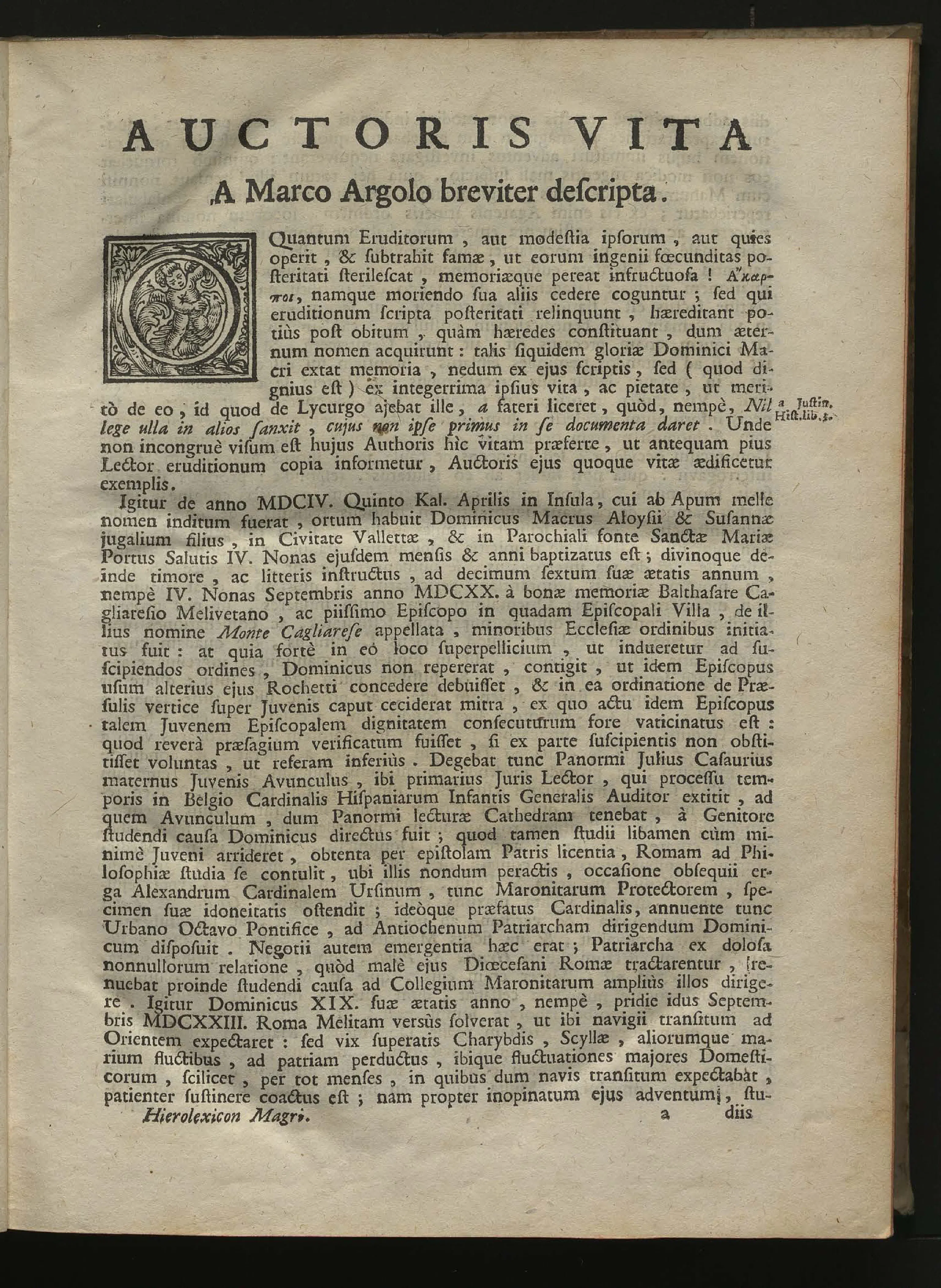
The opening leaf of the AUCTORIS VITA in the 1735 Balleoniana folio turns biography into scholarly credential: beneath its formal heading and large historiated initial, the narrative moves from Magri's Maltese birth and ordination toward the 1623 departure for the East that underwrote his Arabic and Maronite learning. Placed before the lexicon proper, this life casts the posthumous Hierolexicon as the survival of a learned man's memory through the institutional networks of Rome, Propaganda Fide, and the Levant. Source ↗.
The same programme of Arabist and Syriac scholarship shaped the appended treatise, whose own account of its origin situates it squarely within it: a convention of most learned men was constituted at Rome by Urban VIII to revise the Arabic Bible, that it might afterwards be printed for the instruction of the Eastern Christians, Constitutus enim Romæ fuit conventus doctissimorum virorum à Sanctissimo Pontifice URBANO VIII. qui Biblia recognosceret Arabica, ut ea postmodùm ad Orientalium Christianorum institutionem imprimerentur.
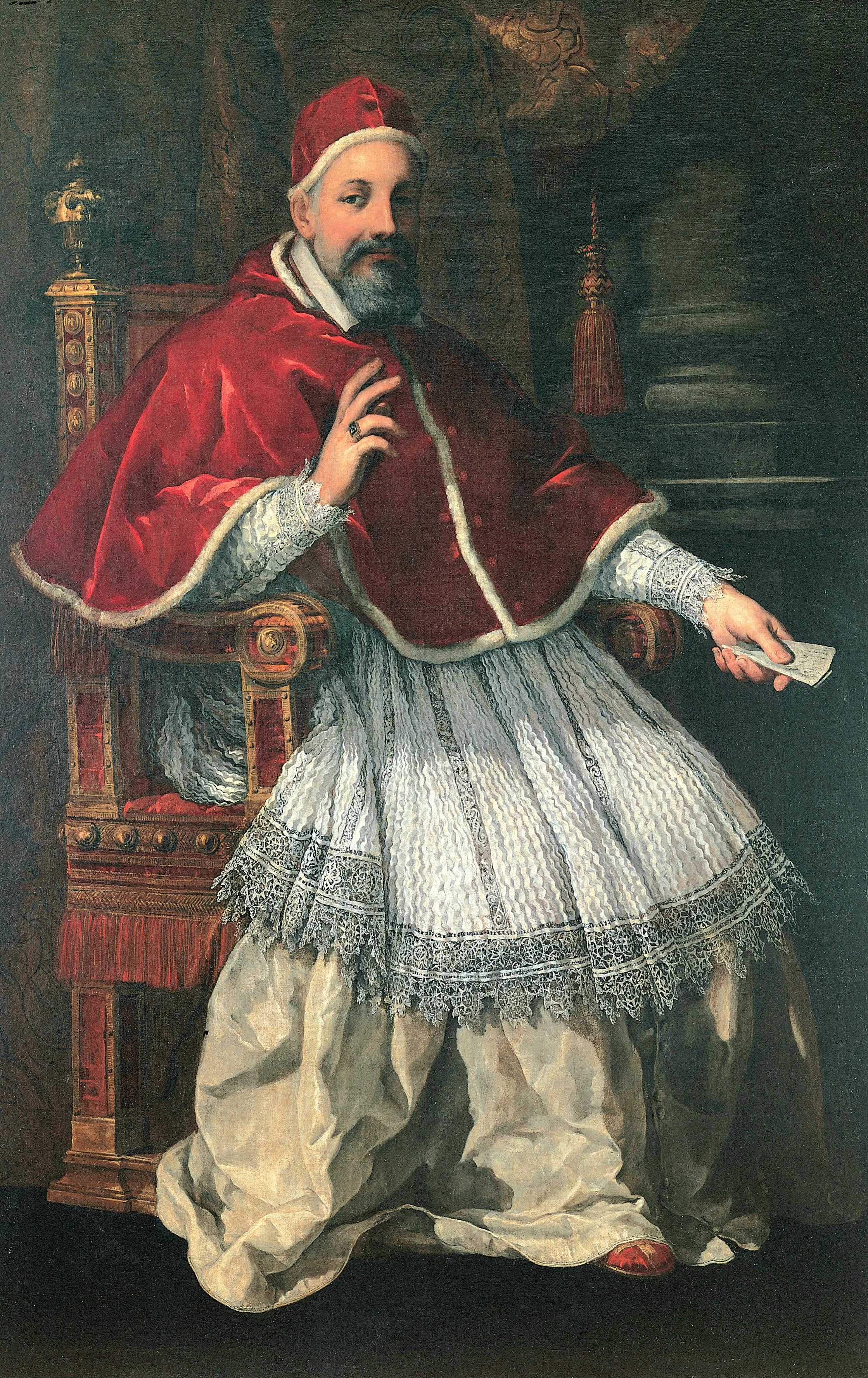
Pietro da Cortona's contemporary portrait of Urban VIII presents the Barberini pope whose Roman patronage underwrote the learned commission Magri identifies as the source of the Antilogiae: the revision of an Arabic Bible for printing and instruction among Eastern Christians. The image anchors that philological enterprise in the papal court and Propaganda Fide milieu linking Magri, Maronite scholars, and Levantine expertise. Source ↗.
_-_Google_Art_Project_-_edited.jpg)
The same milieu shapes the appended anti-Islamic treatise against Ahmad the Persian, which answers the Arabic polemic Dhahirat al-ḥaṭīya (Politor speculi); Magri names the exchange directly, observing that this difficulty was recently raised against Christians by Ahmed the Persian in his book titled Politor speculi, against whom Father Filippo Guadagnoli learnedly wrote an Apology, Hanc difficultatem nuper Christianis object Ahmed Persa in suo libro inscripto, Politor speculi, contra quem Apologiam eruditè, ut assolet, scripsit P. Philippus Guadagnola, the Apologia pro christiana religione that Guadagnoli had composed at Rome in 1631 and 1637.
The historiography on Magri himself is strikingly thin. No dedicated monograph on the Hierolexicon exists. The principal biographical treatments remain the older studies by Maltese historians (Vassallo, Bonello), and a modern Maltese-language study by Mario Pace. In the wider field of post-Tridentine lexicography, the standard references are the works of Adriano Prosperi on Italian religious culture and that of Gigliola Fragnito on Roman censorship; on Propaganda Fide and the Maronite College, the foundational scholarship is that of Bernard Heyberger, Giovanni Pizzorusso, and the volume edited by Rachida El Hour on the Maronite-Roman intellectual exchange. On the Roman martyrology and antiquarianism, the relevant scholarship includes the work of Vincenzo Fiocchi Nicolai and John Lansdale Osborne; on post-Tridentine sacramental and liturgical apologetics, the older studies of Heinrich Denzinger remain useful as a reference collection. Where scholars disagree, the principal axis of disagreement concerns the extent to which Counter-Reformation Rome should be characterized as a coherent confessional-bureaucratic project (the older Habsburg-Bourbon paradigm) or as a more pluralistic and contested field of competing spiritual and intellectual energies; the Hierolexicon's combination of Tridentine apologetic firmness with antiquarian openness is more easily accommodated by the latter reading.
For the philology of the Eastern Christian churches and the Arabic Bible tradition, the standard reference is G. J. Toomer's Eastern Wisedome and Learning; for the Roman martyrology and the antiquarian cult of the catacombs, the indispensable scholarship is that of Vincenzo Fiocchi Nicolai. For Counter-Reformation polemics in the Roman key, the relevant scholarship includes that of Simon Ditchfield on the Roman Counter-Reformation more broadly, and that of Peter Burke on the early-modern lexicon as cultural form. The thinness of the literature on Magri specifically is itself a historiographical fact: the Hierolexicon has been used as a reference work but has not been the subject of sustained scholarly monograph-length treatment.
Tracing the Text: Editions, Materiality, and the Life of the 1735 Folio
The textual history of the work is bipartite. The vernacular antecedent, Notizia de' vocaboli ecclesiastici (Messina, 1644), circulated in nine Italian editions between 1644 and 1751, expanding from approximately 909 entries in the editio princeps to 1,379 entries by 1650; it served as a parish-clergy reference tool distinct from but related to the later Latin compilation. The Latin Hierolexicon was completed in manuscript at Domenico Magri's death in 1672 and issued posthumously at Rome in 1677 in folio (sumptibus Pontii Bernardon, printed by Niccolò Angelo Tinassi). It was reprinted in folio at Venice in 1712, again in folio at Venice by the Typographia Balleoniana in 1735, and in two folio volumes at Bologna in 1765–1767. The 1735 Balleoniana imprint, the object of this study, is recorded in WorldCat (OCLC 17390203) as a folio of approximately 692 pages with twelve wood-engraved illustrations distributed through the text; the work is bibliographically attested at the Biblioteca Nazionale Marciana (Venice), the British Library, the Bayerische Staatsbibliothek, the Bibliothèque nationale de France, and the Houghton Library at Harvard, with digital surrogates accessible via HathiTrust (record 100235017).
The materiality of the 1735 imprint conforms to the conventions of Venetian folio scholarship in the first half of the eighteenth century. The format is quarto-to-folio; the collation recorded in the HathiTrust bibliographic record yields [24], 692 pages. Twelve wood-engraved illustrations, attributed by Carlo Magri in his prefatory letter to his own hand, are distributed through the running text under entries on vestments, insignia, and ceremonial implements (Pontificalia, Ornatus, Sacra supellex). The entries these illustrations accompany are themselves saturated with the sacred-sign theology that animates the whole lexicon, as in Magri's reading of the salt and water of the holy-water rite, where this sacramental element signifies the hypostatic union of Christ, salt being the mystery of uncreated Wisdom and water the symbol of human nature, Hoc sacramentale elementum unionem Christi hypostaticam significat; Sal enim infusum est Sapientiæ increatæ mysterium, aqua verò humanæ naturæ symbolum. The imprint bears the typographical imprimatur and privilege of the Venetian magistracy. The internal marker FINIS TOMI PRIMI at page 550 of the 1735 copy suggests that the Balleoniana reissue reproduced the two-part internal structure of the original 1677 folio, with the second part containing the Antilogiae. No evidence of formal censorship or expurgation has been located; the absence of entries on the Index of prohibited authors is consistent with Magri's standing as a consultor of the Sacred Congregation of the Index itself. That institutional apparatus is not merely biographical but visibly present within the lemmata, as where a lexical entry records that if a certain superstitious codex is found in the possession of any of them, it is punished by the Holy Office of the Inquisition, si penes aliquem ipsorum invenitur hic superstitiosus Codex, à Sancto Inquisitionis Officio punitur.
The object biography of surviving copies traces a Mediterranean and Central European trajectory. Holdings include the Biblioteca Apostolica Vaticana (multiple copies), the British Library, the Bayerische Staatsbibliothek (VD17 imprints), the Bibliothèque nationale de France, the Biblioteca Nazionale Marciana, and the Houghton Library at Harvard. The 1735 Balleoniana imprint is digitised on the Getty Research Institute's HathiTrust mirror (record 100235017). The dedications and patron networks visible across the editions mirror the Tridentine confessionalisation of Catholic scholarship in the Mediterranean basin: the 1677 dedication to Cardinal Francesco Maria Brancaccio, Bishop of Viterbo and Magri's patron, who had earlier facilitated Magri's brief tenure as Viterbo canon theologian; the 1735 Balleoniana dedication to a member of the Venetian patriciate. Allies cited within the text include Cardinal Sforza Pallavicino (Magri's near contemporary and fellow Tridentine apologist), the antiquarian Flavio Biondo, the Vatican manuscript scholar Latino Latini, and the Byzantine historians Georgios Pachymeres, Kedrinos, and Nikephoros Gregoras. Named or implied opponents include Luther and Calvin as exemplars of the Novatores, William Whitaker against Edmund Campion in the long-running Anglican-Catholic disputation on the rule of faith and Scripture, and implicitly the author of the Persian anti-Christian polemic answered by Filippo Guadagnoli. The confessional edge of the enterprise is audible even in the antiquarian entries, as where Magri complains that an inept innovation seized the occasion to call St George the papists' Perseus, as if Mother Church herself did not reckon this history among the apocrypha, niositas inepta occasionem arripuit hunc Sanctum Papistarum Perseum appellare; quasi verò ipsamet Mater Ecclesia hanc historiam inter apocryphas non recenseret.
The editorial siglum FR. that appears in some entries has been variously interpreted. In the absence of direct evidence, the most defensible reading is that FR. designates Carlo Magri himself, the posthumous editor and continuator of his brother's lexicon, whose initials would be appropriate as a marker of editorial supplementation; the alternative, that FR. marks a Franciscan friar or a member of a religious order (the conventional reading of frater), cannot be excluded but is less consistent with the editorial history of the work. The attribution should be regarded as open.
Walking the Alphabet: How Magri Builds His Argument Word by Word
The Front Matter: A Programme Announced
The front matter of the 1735 Balleoniana folio does not merely preface the lexicon but rehearses, in advance and in concentrated form, the apologetic wager the title carries. The dedicatory prologue, the Promulsio Operis, establishes at the outset that the elucidation of ecclesiastical vocabulary is inseparable from the defence of the rites those words name. Its doctrinal keystone is the citation of the twenty-second session of the Council of Trent — the same passage, already noted above in framing the work's criterion of antiquity, that explains why the Church surrounds her worship with sensible ceremony, holy mother Church having instituted certain rites because fallen nature cannot easily be raised to the meditation of divine things without external aids. The move is programmatic for everything that follows. The concession embedded in the argument — that fallen human nature non facilè queat rise unaided — is precisely what converts the outward sign into a theological necessity rather than an ornament, and it licenses the lexicon's governing habit of reading every vestment, gesture, and implement as a carrier of significatio. The premise announced here is that ceremony is not the opposite of interior devotion but its indispensable scaffolding, and the whole encyclopaedic labour of the volume becomes, on this reasoning, a service to piety rather than a catalogue of externals.
Having grounded ceremony in the disability of nature, the prologue advances to its second and sharper claim, the criterion by which the antiquity of a rite establishes its legitimacy. Magri reaches for Tertullian's rule and states it in a cascading series of equivalences, that is truer which is prior, prior which is from the beginning, from the beginning which is from the Apostles — the aphoristic chain already set out above as the connective principle of the whole lexicon. The rhetorical architecture of the sentence is itself the argument: a chain of predications in which verius is bound to prius, prius to ab initio, and ab initio to ab Apostolis, so that truth and antiquity are made to coincide by a series of transitive steps that admit no gap for later corruption to enter. This is the intellectual engine of the entire Hierolexicon stated in miniature at its threshold — the conviction that to recover a word's or a rite's earliest sense is to prove its apostolic warrant, and that the shared usages of the divided Eastern and Western churches, standing on both sides of a schism, testify to a common origin no post-apostolic novelty could have produced.
The polemical force latent in the antiquity-criterion is then made juridically explicit. The prologue seals its defence of ceremony with the Tridentine anathema against those who would deride it, the canon already invoked above that pronounces excommunicate anyone calling the ceremonies, vestments, and external signs of the Mass provocations to impiety rather than offices of piety. The antithesis on which the canon turns — irritabilia impietatis set against officia pietatis — is the exact inversion of the charge that the Reformers pressed against Catholic worship, and by quoting the conciliar anathema Magri answers a hermeneutic dispute with a juridical verdict. The scoffing at rite that the prologue has already catalogued among its three types of adversaries is here not merely rebutted but placed under sentence of exclusion; the philological enterprise and the disciplinary apparatus of the post-Tridentine Church are shown to be continuous, the one supplying the historical demonstration the other presupposes.
Yet the prologue does not rest on polemic alone. Its constructive aim is stated in a borrowing from Jerome that frames the lexicon as an instrument of priestly self-understanding: let there be present, as Jerome used to say, the whole assembly of holy thoughts, so that the minister may perceive within the sanctuary of his own heart what a pontiff is, what the anointing is, what his vestment is, Adsit (ut Hieronymus ajebat) omnis congregatio sanctarum cogitationum, ut quid sit Pontifex, quid unctio, quid indumentum ejus, conferens intra Sacrarium cordis sui possit advertere. The metaphorical schema here is telling: the Sacrarium cordis, the sanctuary of the heart, is made the interior counterpart of the material sanctuary in which the rites are performed, so that the reader who learns quid sit Pontifex, quid unctio, quid indumentum re-enacts within himself the significations the lexicon expounds. The didactic-devotional purpose thus completes the circuit begun with the Tridentine concession about human nature: external signs raise the mind to divine things, and the dictionary that explains those signs is the means by which the mind is raised. The reference work is offered not as erudition for its own sake but as an aid to the very meditation the adminicula exteriora were instituted to serve.
This principled subordination of learning to piety carries a corresponding suspicion of learning pursued for vanity, which surfaces in a moral aside embedded in the body of the lexicon under the entry on the cairn of Mercury. Magri turns the ancient image of the heaped stones into a rebuke of mere compilers who arrogate to themselves the name of authors: such men, he says, do nothing other than cast stones onto Mercury's heap, in the name of the sciences, and uselessly pile up fruitless books in libraries, isti (inquam) nil aliud faciunt, quàm mittere lapides in acervum Mercurii, scientiarum nominis, ac frustraneos libros inutiliter in bibliothecis coacervant. The passage is doubly revealing. As a piece of self-positioning it distances the Hierolexicon from the sterile accumulation it condemns, implicitly claiming that its own etymological and doctrinal labour constitutes genuine understanding rather than the heaping of frustranei libri; and as a methodological confession it registers the fine line a compiler must walk, since a dictionary is by nature a work of gathering, and the charge of casting stones onto the acervus Mercurii is one a lexicographer must be at pains to disarm. The image insists that the value of collected learning lies not in its bulk but in the discernment that orders it toward use.
The front matter also documents, with unusual candour, the material and editorial history of the object itself. The Typographus Lectori accounts for the passage of the work from vernacular to Latin and from Italy outward: this work, while the author yet lived, was thrice published in the Italian tongue, and then, out of a desire for the benefit of foreigners, was for a fourth time divulged in the Latin language outside Italy, Hoc Opus, Authore vivente, ter Italico idiomate editum, desiderio tamen alienigenæ utilitatis quartò extra Italiam latino sermone divulgatum fuit. The note situates the Latin Hierolexicon as a deliberate act of transconfessional reach, the shift of language a shift of audience toward the alienigenæ whose benefit justifies the recension, and it is in the same editorial breath that the convention marking the augmenting brother's supplements is declared, so that later hands can be distinguished from the original author's within a single continuous text. This transparency about the layering of the work belongs to the same intellectual temper as the moral aside on the acervus Mercurii: a compilation that acknowledges its own accretions, and marks where the copyist's stones have been added, positions itself as the discerning ordering of learning rather than its mere heaping.
The Opening Lemmata: Ritual Objects as Carriers of Significatio
The lexical body proper begins to enact these principles from its opening entries, where the loading of every ritual object with doctrinal significatio is displayed in exemplary form. The entry on holy water reads the two elements of the rite as a christological figure — the passage already cited above, in which the salt is decoded as the mystery of uncreated Wisdom and the water as the symbol of human nature, so that the mundane act of blessing water becomes a compressed statement of Chalcedonian christology. The method is precisely the one the prologue announced: a material composite of sal and aqua is decoded into the two natures joined in the unio hypostatica. Nothing in the rite is permitted to remain merely functional; the very salt carries the mysterium of the divine, the water the symbolum of the human, and the priest who consults the entry learns to see in the aspersion a rehearsal of the Incarnation. The same interpretive habit governs the entry on the altar, where symbolic reasoning explains a historical development in the arrangement of churches: formerly, to signify the unity of Christ, there was a single altar in the churches, Antea ad significandam unitatem Christi, unicum erat in Ecclesiis Altare. Here the significatory logic is made to bear on the fabric of the church itself, the singularity of the ancient altar reading as an image of the unitas Christi, so that even the multiplication of altars in later practice is framed against an original that spoke unity.
The lexicon's treatment of contested images shows the antiquity-criterion at work on a genuinely difficult case. Under the Agnus Dei the entry confronts the canon of the Sixth Synod bearing on the depiction of Christ, and Magri labours to hold together the conciliar text with the wax sacramentals that bear the lamb's image: the lamb who is pointed out by the finger of the Precursor is depicted, the one assumed as a figure of grace, foreshowing to us through the law the true Christ our God, Agnus Dei, qui digito Præcursoris monstratur, depingitur, qui ad gratiæ figuram assumptus est, verum à nobis per legem Christum Deum nostrum præmonstrans. The delicacy of the entry lies in its need to accommodate a synodal reservation about the figural depiction of Christ as a lamb while preserving a devotional object of long standing; the resolution turns on the language of figura and præmonstratio, casting the lamb as a lawful foreshadowing rather than a substitution for the incarnate Lord. The passage exemplifies how the criterion of antiquity operates not as a blunt instrument but as a demand for reconciliation, requiring the lexicographer to show that established usage and conciliar authority, rightly construed, do not conflict.
The confirmatory theology of the sacraments receives a parallel philological treatment in the entry on Amen, where Magri draws on Ambrose to expound the word as the communicant's assent to the reality of the Eucharist: therefore not idly, when you receive, do you say Amen, already in spirit confessing that you receive the Body of Christ; the priest says to you, the Body of Christ, and you say, Amen, that is, it is true, Ergo non otiosè cùm accipis, tu dicis, Amen, jam in spiritu consisteris, quòd accipias Corpus Christi: dicit tibi Sacerdos, Corpus Christi, & tu dicis, Amen, hoc est, verum. The gloss hoc est, verum fixes the whole weight of the word on its function as an affirmation of eucharistic truth, so that the single Hebrew particle becomes the layperson's profession of the real presence at the moment of reception. The choice of an Ambrosian witness is itself an argument in the antiquity-key: the confirmatory sense of Amen is shown to descend from the patristic age, its use in communion no innovation but an inheritance, and the reader is left to see the ordinary liturgical response as a compressed confession of faith carried unbroken from the Fathers.
From Canon to Communio: The Method in Full Operation
Grounded firmly in the alphabetical run from canon to communio, this stretch of the Hierolexicon shows Magri's method operating at its most sustained: each lemma is a small apologetic engine in which etymology, patristic testimony, and conciliar authority converge to demonstrate that the vocabulary of Catholic rite descends unbroken from the apostolic and patristic deposit. The entry on the Canon of the Mass sets the terms for everything that follows. Magri opens by refusing any late or merely human authorship of the Roman Canon, arguing that its most ancient institution is established by the testimony of a pope who preceded Gregory the Great, so that the Canon of the Mass was a most ancient institution, since Pope Vigilius, who came before Gregory I in the pontificate, confesses that he received the Canon of the Mass from apostolic tradition, Nam revera Missæ canon antiquissimum institutum fuisse constat; Vigilius enim Papa, qui Gregorio I. in Pontificatu præcesserat, canonem Missæ ex traditione Apostolica acceptare fatetur. The chronological argument is precise and deliberate: by fixing a witness before Gregory, Magri forecloses the reading that the Canon was a Gregorian composition, and pushes its pedigree back into the apostolic traditio itself. This is the criterion of antiquity — that what is prior is truer — worked out at the level of a single liturgical text, and it is the load-bearing move of the whole entry.
Having secured the Canon's antiquity, Magri turns to a characteristic philological correction, the kind of small lexical operation on which the entire enterprise rests. Confronted with the tradition that a certain "Scholasticus" composed part of the Canon, he dissolves the apparent proper name into a common noun, insisting that the word Scholasticus is not the proper name of a man but the designation of a profession and of the doctorate, of an advocate or assessor, Neque illud nomen Scholastici est proprium viri, sed professionis, & Doctoratus, Advocati, seu Assessoris. The move is emblematic of Magri's confidence that misapprehension about the Church's inheritance is frequently a misapprehension about words: what looks like evidence of a named, datable, human author collapses under lexical scrutiny into a mere title of office. To fix the sense of the noun is to remove the pretext for doubting the text's antiquity.
The Canon entry then proceeds clause by clause, glossing individual phrases against the objections Magri attributes to the reformers. The naming of the Novatores discharges its full polemical charge here, as he reports that the phrase concerning the sacrifices is assailed by the more recent innovators as gratuitously predicated over the Body of Christ, quæ à recentioribus Novatoribus impugnantur tanquam gratis super Corpus Christi. The label does its accustomed double work of chronology and censure: the recentiores are, by definition, latecomers set against the antiquitas that Vigilius embodies, and their objection is answered not by novel argument but by exhibiting the greater age of the thing they impugn. Woven into the same clause-by-clause exposition is the doctrinal freight of Tridentine eucharistic theology, condensed into an adverb: glossing the verb Sanctificas, Magri explains that from pure creatures God transubstantially creates the most admirable Sacrament, Sanctificas, quia de puris creaturis transubstantialiter in admirabilissimum Sacramentum creat Deus. The coined adverb transubstantialiter carries the whole dogmatic settlement of Trent into the interstices of a liturgical gloss, so that the definitional apparatus of the dictionary silently enacts the doctrine it defines.
The glossing of individual Canon phrases repeatedly turns on the recovery of a lexical distinction. Interpreting the paired words Hæc dona, hæc munera, Magri draws on Hugh the Cardinal to fix the difference between the two nouns, that a gift is what is given by a superior, a reward what is given by an inferior, Donum enim, quod à Superiori datur; munus, quod ab inferiori. What might appear as mere liturgical pleonasm is thereby shown to encode a directional theology of exchange between God and the offering Church, and the distinction is presented not as Magri's invention but as inherited authority. In the same register he adduces Optatus of Milevis against the Donatists to gloss the Canon's prayer pro Ecclesia tua sancta, quoting the charge that the schismatic cannot rightly claim to offer for the one Church, for to call one what he has divided into two is itself part of the lie, Nam quis dubitet vos illud legitimum in Sacramentorum ministerio præterire non posse? Offerre vos dicitis pro Ecclesia, quæ est una. Hoc ipsum mendacii est pars, unam te vocare, de qua feceris duas. The Donatist controversy is enlisted here as a template: the ancient argument for ecclesial unity against schism is made to bear, by implication, against the contemporary breach, so that a fourth-century African text becomes a weapon in a seventeenth-century contest. The same entry preserves a specimen of liturgical development in the humble self-naming Clement is said to have used at the altar, still we beseech thee for me, who am nothing, Adhuc obsecramus te pro me, qui nihil sum, which Magri sets beside the later formula to show growth in the wording without rupture in the substance — change that confirms rather than undermines continuity.
The entry on canonization transposes the same logic from liturgy to jurisdiction. Magri fixes the term by a formal definition that reserves the act wholly to the papacy, defining it as the ceremonial act of the Supreme Pontiff by which he declares some Servant of God to be held as a Saint by the Universal Church and to be enrolled among the Calendar of the Saints, cæremonialis actio Summi Pontificis, qua aliquem Dei Servum Universali Ecclesiæ pro Sancto haberi, & inter Sanctorum Kalendarium connumerari declarat. The definition is juridical to its core: canonization is an actio of a single, supreme authority with universal scope, and the terminological precision performs the very Roman primacy the work everywhere defends. Against this Magri then mounts an antiquarian rebuttal, correcting the chronology of a named humanist authority by insisting that Polydore Vergil errs in asserting, in book six chapter eight, that the first canonization of saints was performed by Alexander III, Errat siquidem Polydorus Virgilius, qui, lib. 6. cap. 8. primam canonizationem Sanctorum ab Alexandro III. celebratam fuisse asserit. The refutation is not doctrinal but historical, and it follows the same pattern as the Canon entry: the antiquity of the practice, demonstrated by a catalogue of earlier cases, is itself the apologetic point, since to show that canonization long predates the twelfth century is to show that the reserved papal act is no medieval innovation.
The immense entry on the cardinalate grounds an entire ecclesiastical order in a single etymology. Quoting Leo IX's letter to the emperor of Constantinople, Magri derives the dignity from the cardo, the door-hinge, so that just as the whole door is governed by its hinge, so to Peter and his successors is committed the profit of the whole Church, whence his clergy are called Cardinals, adhering more closely to that hinge by which the rest are moved, Sicut cardine totum regitur ostium; ita Petro, & successoribus ejus totius Ecclesiæ deponitur emolumentum. Unde Clerici ejus Cardinales dicuntur, cardini utique illi, quo cætera moventur, viciniùs adhærentes. The etymology is theological argument in miniature: the word itself locates the whole hierarchy on the Petrine axis, and mere proximity to that hinge becomes the principle of rank. Magri extends the symbolic reading to the seven suburbicarian bishops, whom he interprets numerologically as representing the seven Angelic Spirits who stand in the sight of God, septem illi Episcopi, septem Angelicos Spiritus repræsentabant, qui in conspectu Dei assistunt, binding the administrative geography of the Roman sees to the seven eyes of Zechariah's vision so that ecclesiastical order mirrors a celestial pattern.
Two entries admit the author's own voice and complicate the otherwise unbroken preference for antiquity. In the treatment of church chant, Magri offers a first-person defense of contemporary polyphony against patristic strictures on lascivious music, arguing from a natural image that just as bees and serpents licking moisture from the same flower draw out honey and poison respectively, so from those modulations which appear lascivious to some he has often seen the pious and devout stirred to spiritual meditations, sicut apes, & serpentes ex eodem flore humorem lambentes, illæ mel, & isti venenum erahunt, sic ex modulationibus, quæ aliquibus apparent lascivæ, per easdem sæpè vidi pios, ac devotos ad spirituales meditationes excitari. The moment is telling precisely because it cuts against the grain: here the recentiores Cantors are defended rather than impugned, and the criterion shifts from antiquity to spiritual effect confirmed by the author's own eyewitness experience, the honey drawn from the same flower that yields the serpent its venom. The tension is not resolved but simply held, a reminder that Magri's antiquarianism coexists with a capacity to license the modern where devotion is served. A complementary vernacular note surfaces in the entry on the chasuble, where Magri borrows from Vespasiano da Bisticci the Italian praise that it is one very great praise of the Greeks that they have never changed their garments, temporal as well as spiritual, though a thousand years and more have passed, Non ponerò qui una lode grandissima de Greci, che mai non hanno mutato abiti, cosìi temporali, come i spirituali, sono passati anni mille, e piu. Greek immutability in vestments becomes an argument for the antiquity of the round chasuble the Latins have altered — a rare instance where the Greeks are held up as exemplary conservators rather than, as elsewhere in the work, sophists who corrupted the text.
The canonical entries on the lesser hierarchy and on initiation display the same lexical exactitude directed at office and discipline. On the chorbishop, Magri reproduces a pseudo-Leonine text that delimits the office with jurisdictional precision, distinguishing that bishops may be ordained only in cities, chorbishops also in villages, that bishops confer formed letters while chorbishops may give only commendatory and pacific ones, Inter Episcopos autem, & Chorepiscopos hæc est differentia, quòd Episcopi nonnisi in Civitatibus, Chorepiscopi & in Vicis ordinari possunt. Episcopi formatas tribuunt litteras; Chorepiscopi nnonnisi commendatitias, & pacificas dare valent. The graded enumeration of powers is itself the argument: the chorbishop's authority is defined by what it lacks against the episcopal fullness, and the hierarchy is secured by drawing the line exactly. The entry on the catechumen opens, as ever, from the Greek, deriving the term from the act of hearing so that a catechumen is so called because he requests baptism, being as it were a hearer of the word of God, CATECHUMENUS, græcè , qui baptismum postulat, ita appellatur: quia quasi Auditor est verbi Dei, the etymology from audire silently constituting the catechumen by the very act of hearing that his name records. The entry on the collect closes this stretch by deriving the liturgical prayer from colligere, explaining, after the Micrologus, that the priest, performing an embassy for the people to the Lord, gathers together in the prayers the petitions of all and concludes them, Sacerdos, qui legatione fungitur pro populo ad Dominum, omnium petitiones in orationibus colligit, atque concludit. The name of the prayer and the priestly act it denotes are once again shown to be the same thing seen from two sides, the term recovering the gathering it performs — the recurrent conviction of the lexicon that to name a rite rightly is already to expound it.
The Communio Cluster and the Discipline of the Letters C and D
The cluster of entries under communio opens with a normative principle that governs the ordering of liturgical life. Treating the omission of an antiphon in the Mass of Holy Saturday, Magri lays down that this antiphon is not said because there is no communion for the people, and that it must be reckoned an abuse of those who grant communion on this day, since the ecclesiastical rite is to be preferred to particular devotions, Sic in Missa Sabbati Sancti hæc Antiphona ideò non dicitur, quia communio populo non sit. Itaque abusus etiam censendus est illorum, qui communionem concedunt in hac die: præponendus enim est particularium devotionibus ecclesiasticus ritus. The force of the passage lies in its subordination of private piety to fixed observance: the ecclesiasticus ritus is not one devotional option among others but the standard against which even well-meaning acts of devotion are measured and found to be abusus. The loaded juridical charge of that word — deviation from proper order — establishes at the outset that the lexicon adjudicates practice, and does so by an appeal to established rite rather than to individual fervour.
Having fixed the primacy of rite, Magri secures the antiquity of its forms by recovering the archaic choreography of reception. He adduces from the Ordo Romanus the direction that the priests and deacons, kissing the bishop, should receive the body of Christ from him by hand on the left side of the altar, about to communicate, Presbyteri ergo, & Diaconi osculando Episcopum, corpus Christi ab eo manibus accipiant in sinistra parte Altaris communicaturi. The precision of the detail — the kiss, the manual reception, the placement to the left of the altar — is not antiquarian idling but evidentiary: a practice preserved in the oldest ordines and, on Magri's account, still observed among the Greeks carries the weight of continuity. The same evidentiary strategy governs his handling of a rite the Reformers derided. Against the polemic he figures as inarticulate barking — the recentes Hæretici who bark at the ceremony — he enlists the Seraphic Doctor's rationale that Christ suffered in common and with all beholding, whence the pope, when he receives the Body of Christ in a solemn Mass, receives it with all beholding, Christus in communi, & omnibus videntibus passus est: unde Papa quando sumit Corpus Christi in Missa solemni, sumit omnibus videntibus. The papal throne-communion, charged with pride by its detractors, is here reinterpreted as an imitation of the public character of the Passion, the visibility of the act made theologically expressive rather than ostentatious.
The same defensive method turns critical when Magri confronts a hostile legend, and here his source-criticism is at its most exacting. He reports the tale that Bernard of Montpellier killed Henry VII with a poisoned Host in communion in 1313, Bernardus à Monte Pesulano Henricum VII. Imperatorem Hostia veneno mixta in communione necavisset ann. 1313, only to dismantle it as a fiction unattested by contemporary historians, observing that the emperor died at Buonconvento while under excommunication. The demolition serves a double end: it clears the Dominican order of a calumny and it models the discriminating use of authority — the appeal to Rinaldi's chronology against a story that lacks contemporary witness. Magri then supplies the true rationale for the Dominican usage the legend had sought to explain, quoting the rubric that, bowing the head and holding the chalice in the right hand, the friar should take the sacred Body of Christ from the left, Inclinato capite, dextra manu tenens calicem, de sinistra sumat Sacrum Christi Corpus. The left-hand reception, far from a penance imposed after an alleged poisoning, is shown to answer a practical necessity: the right hand is already occupied with the chalice. Legend gives way to liturgical reason.
The criterion of antiquity cuts in both directions, and Magri is equally ready to document a practice the ancient Church itself abandoned. He preserves the decree of the Third Council of Carthage that the Eucharist not be given to the bodies of the dead, since it was said by the Lord, "Take and eat," but corpses can neither take nor eat, Placuit, ut corporibus defunctorum Eucharistia non detur. Dictum est enim à Domino, Accipite, & edite: cadavera autem nec accipere possunt, nec edere. The entry demonstrates that Magri's antiquarianism is not indiscriminate reverence for the old: an early usage may itself be a departure from the dominical institution, corrected by conciliar authority on the plainest exegetical grounds. The words of institution govern the sacrament, and the philologist's fidelity to those words disciplines even venerable custom.
Where the vocabulary is juridical, the lexicon documents the mutability of the Church's own law. The entry on concubina records, through Gratian, a conciliar canon that he who does not have a wife, and has a concubine in place of a wife, should not be repelled from communion, provided he is content with the union of one woman, whether wife or concubine, Is, qui non habet uxorem, & pro uxore concubinam habet, à communione non repellatur; tamen, ut unius mulieris, aut uxoris, aut concubinæ sit conjunctione contentus. The passage carries a delicate historical burden: it attests a pre-Tridentine juridical world in which the concubina named not a mere illicit liaison but a genuine, if inferior, marital bond, tolerated at the altar so long as it was monogamous. Read after the Tridentine decree on clandestine marriage, the canon marks precisely the distance the Church's discipline had travelled — a case in which the lexicographer records the antique sense of a word in order to explain a usage no longer in force.
The theme of divine versus merely traditional institution, which structures so much of the confessional argument, receives its sharpest statement in the entry on sacramental confession. Endorsing the Postillator's correction of a laxer gloss, Magri affirms that by divine law (John 20) oral confession was instituted, which is the second part of penance, and not by tradition, as the Gloss here wrongly says, and consequently is necessary to all, both Greeks and Latins, jure divino Io. 20. instituta est oris confessio, quæ est secunda pars poenitentiæ, & non per traditionem, ut hîc male dicit Glossa, & consequenter omnibus tam Græcis, quàm Latinis necessaria. The correction is programmatically weighted: to derive confession from traditio would concede that it might be dispensed with as a human ordinance, whereas grounding it in jus divinum renders it universal and inescapable, binding Greek and Latin alike. The explicit repudiation of the gloss — male dicit — shows the signed critical voice adjudicating a disputed point against a received authority, and the invocation of the Greeks extends the claim across the confessional divide within Christendom.
The scholastic entries reveal Magri handling a proposition where the very words threaten heresy. Opening the question of whether Christus est creatura may be uttered, he sets out that it is a question debated among theologians, whether this proposition — Christ is a creature — can be uttered simply, Est tamen quæstio inter Theologos agitata, utrum hæc propositio: Christus est creatura, possit simpliciter proferri. The danger is entirely a matter of the word's unqualified use: uttered simpliciter, the proposition slides toward the Arian denial of Christ's divinity, whereas hedged with the proper distinction between his natures it is orthodox. The entry canvasses Aquinas, Bonaventure, Cajetan, Suárez, and Vázquez and resolves the difficulty by attention to context and the avoidance of Arian scandal — a demonstration that, for Magri, the fixing of a word's admissible sense is itself a defence of doctrine, since a true predicate becomes a heretical utterance when detached from its qualifying frame.
The apologetic payoff of the whole method becomes explicit in the entry on the diocese, where Magri makes the antiquity of a structure into an argument for its apostolic warrant. Deploying Jerome, he argues that once each of the Apostles thought that those whom he had baptized were his own, and not Christ's, it was decreed throughout the whole world that one of the presbyters should be set over all, so that the seeds of schisms might be removed, unusquisque eorum, quos baptizaverat, suos esse putabat, & non Christi, in toto orbe decretum est, ut unus de Presbyteris superponeretur omnibus, ut schismatum semina tollerentur. The patristic text is made to bear the full confessional weight of the entry: diocesan and episcopal structure is not a post-apostolic accretion of papal ambition but a remedy against schism decreed in toto orbe at the very origin of the Church. The etymological care with which Magri distinguishes the abstract sense of dioecesis, as jurisdiction over souls, from its concrete sense as territory serves precisely this end, allowing him to locate the institution's birth in apostolic practice rather than in later territorial division.
Two further registers of these entries display the breadth of material the lexicon absorbs without abandoning its method. The historical narrative of the Conclave opens with the claim that the first conclave of this kind was convened at Viterbo after the death of Clement IV, Primùm hujusmodi Conclave Viterbii post Clementis IV. mortem coactum fuit — a thesis Magri immediately qualifies by arguing that enclosures of electors predated this occasion, so that even his own headline assertion is submitted to source-critical correction. The entry preserves the living formula of proclamation, that I announce to you a great joy: we have a pope; the Most Reverend Lord Cardinal N. has been elected Supreme Pontiff, and has chosen for himself the name N., Annuntio vobis gaudium magnum: Papam habemus; Reverendissimus Dominus Cardinalis N. electus est in Summum Pontificem, & elegit sibi nomen N, set against an older form documented in an earlier disputed election — the lexicon registering the evolution of a ritual utterance across the centuries. Finally, the antiquarian energy of the enterprise turns autobiographical in the treatment of the Bolsena corporal, where Magri reports his own inspection of the Orvieto relic and transcribes the inscription he read upon it, that the Body of Christ was scattered upon this corporal, and it must be kept with the utmost diligence, Corpus Christi sparsum fuit super hoc corporale: cum summa diligentia debet custodiri. The first-person witness grafts eyewitness testimony onto the citation of authorities, so that the lexicon's evidentiary base includes not only the ordines, the councils, and the Fathers but the compiler's own examination of a venerated object — the philologist doubling as antiquary, verifying with his own eyes the material relic that a keyword names.
From Lauds to the Mass: Liturgy, Heresiology, and Eastern Learning
The lexicon's method is at its most transparent in the stretch of entries that runs from the liturgy of the canonical hours into the philology of ritual, hereseological, and antiquarian vocabulary, because here the equation of ancient sense with true meaning is not stated as a maxim but performed lemma by lemma. The entry on morning praise opens on the question of when the Church detached Lauds from Matins, and Magri answers by producing Cassian as an eyewitness to monastic origin, reporting on the authority of the Collationes that in that one monastery alone which the region of Bethlehem contains, where our Lord, born of the Virgin, deigned to take up the infancy of human flesh, it was so constituted that the brethren who had been occupied with the daily matins, that is, the three psalms before dawn, should rest a little after completing the morning hymns at the close of the customary prayer, Igitur, ut dixi, in illo tantùm monasterio, quod terram Bethlemiticam continet, ubi Dominus noster natus ex Virgine, humanæ carnis infantiam suscipere dignatus est, hoc modo est constitutum, ut fratres qui matutinis, id est, tribus antelucanis psalmis, ut in principio hujus libri diximus, quotidiè dicendis vacaverant, cùm hymnos matutinos, in conclusione consuetæ orationis expleverint, paululùm quiescant &c. cap. 6.. The geographic precision is doing apologetic work: the practice is anchored not to a later Roman decree but to the site of the Nativity itself, so that the liturgical hour carries within it a topography of the Incarnation. From this Magri derives a twofold symbolic reading of Lauds, teaching that they signify first the praises the Church renders for the accomplished Resurrection of Christ, since by the common opinion of the holy Fathers the Lord had risen at earliest morning, and second the praises rendered by the congregation of the blessed in the joys of paradise; and he explains that the Church separates Matins from Lauds on the first night of the Nativity as a sign of the future Resurrection, adducing precedent in the fact that Judith, Holofernes defeated, sang praises to God as a sign of gladness, and Solomon rendered praises to the Lord when the building of the Temple was completed. The procedure is characteristic: a ritual detail is grounded in patristic consensus, harmonized with a scriptural type, and thereby shown to be neither arbitrary nor recent.
The same reflex governs the string of shorter entries that follow, where the lexicon's antiquarian energy is most visible in its treatment of vocabulary the Reformers had condemned or the classical past had bequeathed. The entry on the Lauretan litanies converts a lexical gloss into a piece of Tridentine disciplinary history, recording that they must not be printed without the Ordinary's license, since various litanies are composed under the pretext of new devotion which, as often happens, are superstitious rather than pious, and that Clement VIII accordingly prohibited such novelties while leaving the ancient litanies of the Breviary and the Lauretan litanies of the Blessed Virgin freely permitted, ideò per Clementem VIII. in Congr. Sac. Rit. sub die 6. Sept. 1601. hujusmodi novæ Litaniæ prohibitæ fuerunt; sed tantùm illæ antiquæ, quæ in Breviario habentur, ac etiam Lauretanæ Litaniæ B. M. Virginis liberè permissæ sunt. Here the criterion of antiquity is made an instrument of censorship: what is old is permitted, what is newly invented is suspected of superstition, and the institutional apparatus of the Congregation of Rites is invoked to enforce the distinction. The entry belongs recognizably to the same regulatory horizon in which Magri himself served as consultor of the Index.
Magri's philological confidence is nowhere more on display than where the lexicographer turns corrector of received error. The long entry on Lazarus assembles Baronius, Onuphrius, and the verses of Fortunatus to demolish the Provençal legend that the resurrected friend of Christ became bishop of Marseille, and the argument turns on a piece of confessional reasoning rather than mere source-criticism: if Christ had truly wished to sow the word of the Gospel among the Gauls at Marseille through Lazarus and the holy women, as these authors suppose, he would not then have left those same Gauls free from the error of idolatry for several centuries, Sane si Christus Redemptor jam olim Massiliæ apud Gallos verbum Evangelii disseminare voluisset per Lazarum, & sanctas mulieres, ut isti autumant, non proindè eosdem Gallos per plura sæcula ab errore idololatriæ liberos reliquisset. The historical implausibility of a Gaul left idolatrous despite an apostolic evangelization becomes the lever by which the legend is dislodged, and the misreading is then diagnosed philologically as a fabrication spun out of a couplet of Fortunatus that says only that Lazarus had a tomb at Marseille. The move exemplifies the lexicon's larger wager that the recovery of a word's or a source's true sense is simultaneously a defence of the coherence of sacred history.
The hereseological entries that punctuate this stretch reveal how the label Novatores operates by a chronological logic that reaches back to the earliest sects. Magri glosses the Logomachi as heretics who denied that Christ was the Word, citing Isidore's etymology that they were so called because they deny the logos, which in Greek means both word and reason, Logomachi eò, quòd verbum negent, λόγος enim græcè, & verbum dicitur, & ratio: Christum autem verbum negant, and he is careful to distinguish them from the Alogii, correcting Grialus on the point. The entry on the Lucianistae is characteristically precise about the genealogy of error, noting that these followers of Marcion introduced not one God, as Marcion did, but three or more, and refused by any reasoning to be persuaded of the resurrection of souls. The catalogue of sects functions as a negative image of the criterion of antiquity: each heresy is fixed to its founder and its date, so that its novelty relative to the apostolic deposit is made a matter of chronological record.
It is in the entry on Mammona that the lexicon's antiquarian openness and its apologetic firmness meet most spectacularly, and the passage rewards close reading precisely because it shows Magri operating at the outer edge of what Roman censorship would tolerate. Having established from Augustine, Jerome, and Tertullian that the Syriac word signifies lucre and was even taken among the Jews for a god of money, he turns to the kabbalistic method he had elsewhere declared permissible so long as it does not exceed the bounds of Catholic discipline, and applies it here to extract a mystical number. He announces that since it is customary among the rules of the Kabbalah to gather a certain number from the letters, he has judged that a mysterious number lies hidden in the name Mammona, and he then walks through the letter-values with pedantic care — the initial M with its superscript stroke valued at fifty, the A at five, and so through the word — until the sum emerges. His conclusion, already cited above, is that the number of Antichrist lies hidden in the word, the riches it names being the occasion of, or rather the very Antichrist of, the soul. The reading is doubly guarded: the gematria is licensed only because it terminates in a moral truth about avarice, and Magri immediately balances the calculation of 666 in Mammona against the corresponding extraction of 888 from the Greek letters of the name of Jesus, so that the numerical method is shown to serve Christ as readily as it exposes Antichrist. The entry is a compact demonstration of the whole enterprise: a Semitic etymology, a patristic dossier, a technique borrowed from Jewish learning, and a Christological moral, fused into a single lemma that catalogues the word while defending the doctrine.
The lexicon's Eastern-Christian competence surfaces plainly in the entry on the Melchitae, where Magri explains that the Orthodox Catholics of the East were so called from the Syriac and Hebrew word for king, a label fastened on them contemptuously by the followers of Eutyches after the Council of Chalcedon, on the ground that they held the faith of that council not out of truth but to please the emperor Marcian; he reports that the heretics called the Catholics Melchites, that is, royalists or imperialists, from the word Melchi, which in Syriac and Hebrew signifies king, appellarunt Catholicos Melchitas, quasi Regios, seu Imperiales, à verbo Melchi, quod Syriacè, ac Hebraicè Regem significat. The gloss turns a term of confessional abuse into a badge of conciliar orthodoxy, and it does so through exactly the kind of Semitic philology that Magri's collaboration with the Maronite and Arabist scholars of the Roman colleges had equipped him to command. The same Levantine expertise organizes the extended treatment of the Hebrew months, where the entry lays out the sacred calendar month by month, distinguishing the sacred reckoning that the Jews numbered from the Exodus from the civil reckoning numbered from the creation of the world, and identifying the first month, Nisan, as the one in which they went out of Egypt, corresponding to March or April, and noting that it was also called Abib, that is, of the ears of corn, because then the ears or crops began to ripen. The care lavished on the intercalation of the month Veadar every third year, so that the mobile feasts might proceed in order and agree among themselves, shows the lexicographer treating the vocabulary of Jewish time-reckoning as a legitimate object of Christian antiquarian scholarship rather than as mere adversary lore.
The final movement of this stretch settles into the technical vocabulary of the Mass and its instruments, where the sacred-sign theology that animates the whole work is applied to the smallest liturgical objects. The entry on the maniple traces the vestment's descent from a plain linen cloth with which the priest once wiped sweat and tears from his eyes, citing Amalarius and Rabanus Maurus, and then follows Innocent III's account that the mappula, commonly called fano and by some the sudarium, was first made of silk while retaining the name and office of a napkin, since sweat and the flux of the nostrils were wont to be wiped with it. Magri establishes from Isidore of Pelusium that the cloth was anciently common to all who took part in the divine offices in choir, worn on the left shoulder as a token of humble service, before being reserved to bishops, priests, and deacons. The entry thus recovers the object's meaning by recovering its history, so that a strip of byssus becomes legible as a sign of humble ministry precisely because its ancient use can be documented; and the same logic informs the definition of the Mass itself, where Magri, canvassing the disputed etymologies of the word, insists on its antiquity by producing Ambrose's testimony that he remained at his office and began to say Mass, using the word plainly for the sacrifice, Ego mansi in munere, missam facere coepi. The whole progression from Lauds to the Mass thus enacts the conviction the lexicon everywhere presses: that to fix the ancient sense of a word for a rite, a vestment, or a sacrament is to establish that the thing itself stands in unbroken continuity with the worship of the undivided Church.
The Letter N: The Method at Its Most Granular
The final stretch of the letter N in Magri's lexicon shows the Hierolexicon working at what might be called its most granular register — entries so brief they occupy a single line, yet still bearing the twin machinery that governs the whole enterprise: etymological derivation and the securing of a word's ancient sense against corruption. Even the shortest lemma is made to carry the burden of demonstrating that the vocabulary of the Church descends, unbroken, from antiquity.
The entry on NOLA is instructive precisely because it stages a philological correction. Magri first reports the received tradition, transmitted through Baronius, that the church bell takes its name from the Campanian city of Nola, where bells were supposedly first invented by its bishop Paulinus. But the annotator's supplement demurs, insisting that the bell did not in fact draw its name from the Nolan bishop, since Paulinus flourished under Honorius and Arcadius around the year 403, whereas the use of the bell is older still, sed re vera à Nolano Episcopo nomen non habuit, quia hìc floruit sub Honorio, & Arcadio de anno 403.. The correction turns on chronological priority in exactly the manner the work's governing criterion demands: what is older is truer, and a proposed etymology that would make the object younger than its attested use must yield. The genuine derivation, Magri concludes, runs from the city not as the site of invention but as the source of the finest bronze from which such vessels were cast, so that the instruments were called campanae from their material and nolae from the place of their manufacture. The entry thereby converts a pious attribution into a metallurgical and toponymic account, disciplining hagiographic tradition by the harder evidence of the Liber Pontificalis and Sidonius Apollinaris.
That the bell should attract this care is not incidental, for it functions across these entries as a marker of Christian identity, and the adjacent entry on NOLARIUM, the bell-tower, makes the point with polemical sharpness. Magri quotes the Cassinese chronicle on the Saracen destruction of a bell-tower raised from its foundations, torn down utterly because they held the sound of the bells, which they call nolae, in abomination as a sign of the Christian religion, quia campanarum sonitum, quas ipsi Nolas nuncupant, tanquam Christianæ religionis signum abominabantur. Here the lexical entry becomes a vehicle for firsthand Levantine observation, the muezzin — the praeco who by voice supplies the office the bell performs by sound, in the passage already cited from the framing survey of the Propaganda Fide milieu — introduced not as a curiosity but as the functional antithesis of the bell whose Christian-confessional meaning the surrounding entries have established. He names this figure the muerdem, calls his office Salla or Salavat, and promises fuller treatment in his Eastern itinerary; the promised itinerarium signals the same Propaganda Fide horizon that shapes the work throughout.
A cluster of terms on the will demonstrates how Magri exploits the resources of scholastic distinction even in a work of lexicography. The paired entries NOLENTIA and NOLUNTAS build a small treatise on the varieties of volition. Drawing on the canon Voluntas and its Gloss, Magri lays out a fourfold scheme: there is efficacious volition, as when one wills to fast and does fast, and simple volition, as when one would will to be saved, which does not lie within one's power; and correspondingly efficacious noluntas, as when one does not will to sin and does not sin, and simple noluntas, ut cùm quis non vult mori, quod non est in potestate sua vitare, the unwillingness to die which one has no power to avoid. The analytic payoff comes in the application to the passions: fear and sadness are distinguished by the temporal object of the noluntas, sadness being the unwillingness to have a present evil and fear the simple unwillingness to have a future evil, sed timere est habere simplicem noluntatem, id est, nolle habere futurum malum: nam metus est de malo futuro. The lexicographer thus enfolds a piece of moral-psychological doctrine into the definition of a single word, treating fear itself as a species of the voluntary and grounding the whole distinction in the axiom that the will would not be will unless it lay within our power.
The entry on NOMEN exhibits a different technique, the cataloguing of a term's semantic range across juridical, liturgical, and military registers. Magri gathers its senses in rapid succession: nomen signifies dignity, as imperial or royal rank; it stands for title; and in the language of the jurisconsults it is taken for debts, whence nomen facere means to lend, from which a debt arises. Most telling for the work's sacral concerns is the liturgical sense, where to recite names means to recite in the Mass the names of the dead or of those making the offering, cross-referenced to the diptychs and the oblation; and the metaphor of enrolment in the Christian militia, where Tertullian's phrase that you have given your name to the Christian soldiery, Nomen dedisti militiæ Christianæ, glosses baptism as an act of military enlistment. The single word becomes a hub from which lines run out to the diptych, the sacrament, and the whole apparatus of Christian self-inscription, a compression that shows the lexicon organising doctrine by vocabulary rather than by theological locus.
The extended entry on NONA reveals the practical, corrective ambition that lies beneath even the driest horological detail. Magri reconstructs the ancient division of the day into four parts of three hours each and argues that None was originally recited immediately after Sext, the two hours being conjoined, so that the opening Pater, Ave, and Deus in adjutorium were never said at the beginning of None because they had already been said at Sext. From this reconstruction he draws a disciplinary conclusion about present-day choral practice, warning that clergy who separate the hours risk committing what he strikingly names an anachronism, an error concerning the time due to each hour, committant anachronismum, id est errorem circa tempus uniuscujusque horæ debitum. The two hours, he insists, are as it were sisters and brothers, born of the same birth, and ought always to be recited together, sunt enim quasi soror, & fratres, id est ex eodem partu prodeuntes — a familial metaphor that lends the technical claim an air of natural necessity. The recovery of ancient practice here is not antiquarian idleness but a program for the correct performance of the Office, and Magri caps it with a philological flourish deriving the Italian Merenda, as though Nerenda, from Nona, the hour at which the fast was broken, the name transferred from the time to the very act of eating.
The philological method that governs the smallest entries is on open display in the treatment of NUMMUS, where Magri endorses the conjecture of Latino Latini that in certain Lombard legal texts the word nummus stands corruptly for the Greek nomos, that is, law — so that the phrase In illius nummi capitulo means in truth the chapter of that law, hoc est, legis capite. Ex quo colligitur veram esse Latini Latinii conjecturam, quòd, nempè, dictio Nummus posita fuit pro Nomos, id est lege. The correction of a corrupt legal reading through Greek etymology exemplifies the whole enterprise in miniature: a word is restored to its true sense, and with it a text is stabilised against the errors of transmission.
The heresiological entries that punctuate this stretch anchor the lexicon's confessional purpose. Under NOVATIANI Magri identifies the sect denominated from Novatus the African and Novatian the Roman, who denied penance to those who had lapsed in persecution and boasted themselves alone pure; the Isidorian citation records that the Novatians rebaptise the faithful and boast themselves alone clean and do not pray for the dead, quia se solos mundos jactant, & pro mortuis non orant. The rigorist claim to exclusive purity and the refusal of prayer for the dead are precisely the points on which the sect is condemned, and the entry situates the ancient error within the same penitential and intercessory economy the work everywhere defends. Alongside it the NOETIANI fixes the modalist heretics denominated from a certain Noetus, who said that Christ was the same as the Father and the Holy Spirit, and received the Trinity itself in the names of offices rather than in persons, A quodam Noeto vocati, qui dicebant, Christum eundem esse ac Patrem, & Spiritum Sanctum; ipsamque Trinitatem in officiorum nominibus, non personis accipiunt. The formulation is doubly diagnostic. It isolates the modalist reduction — three offices predicated of a single person — and, in doing so, converts a heresiological label into an argument about the very grammar of the sacred vocabulary the lexicon exists to fix: to confuse the nomina officiorum with the personae is to mistake the semantic order of the Godhead itself. The entry then extends the charge to its consequence, that from this teaching the Noetians are also called Patripassians, because they say the Father suffered, Unde & Patripassiani vocantur, quia Patrem passum dicunt, threading the label through a single doctrinal genealogy that gathers Sabelliani and Unionitae under one error; a name is never merely recorded but traced to its generative fault and then linked to the sects that share its logic.
The letter closes with a run of Greek-derived medical and antiquarian terms — NYCTAGES for the lethargic sleeping sickness, NYCTELIA for the nocturnal rites of Bacchus, NYSSA for the Athenian place of execution illuminated through a verse of Prudentius on the martyr Cassian — before the single word FINIS marks the terminus of this alphabetical sequence. That the final entries should range across Greek pathology, pagan mystery cult, and the topography of ancient punishment, all secured by citation to Isidore, Aristotle, and the martyrological commentators, is a fitting emblem of the whole: every word, however remote, is drawn into the same disciplined apparatus of etymology and authority, and none is admitted to the sacred lexicon without first being traced to its origin.
Adjudication in the Letters N, O, and P: Jurisdiction, Primacy, and Rite
The sweep of entries from N through P offers a concentrated demonstration of how Magri's lexicon converts each headword into an occasion for doctrinal, juridical, or antiquarian adjudication, with the criterion of priority silently governing which reading is admitted and which is condemned. Here the comparative liturgical ethnography of the NOLARIUM entry shows its philological texture most plainly. Against the traveller Dandini's report of seven daily prayers, Magri corrects with counted precision, specifying that the faithful are summoned only at dawn, at midday, at Vespers, at sunset, and at the first hour of night once past, nam ad preces solùm illi convocantur ad auroram, ad meridiem, ad Vesperas, ad Solis occasum, & ad primam noctis horam transactam. The correction is not idle erudition; it is the philologist's reflex of substituting enumerated observation for received approximation, and it draws its authority from the same Levantine expertise that informs the work's embedded Eastern material — the same expertise that identifies the muezzin as the functional counterpart of the Christian bell, the praeco who performs by voice what the bell performs by sound, and so files even the alien rite within the sacred-sign economy that governs the whole work.
The juridical and philological entries of the letter N sustain the same discipline of adjudication. The treatment of the notarial office culminates in a flat thesis reconciling the disparate testimony of the Greek Menaion, the Roman Martyrology, and Balsamon, that Lector and Notary were synonyms in the Roman Church, Itaque Lector, & Notarius erant synonima in Ecclesia Romana. The Itaque is the signature of the method: a settled equivalence issued only after the sources have been weighed against one another, the identity of the martyr-notaries Marcianus and Martyrius secured by collating rather than by asserting. A comparable procedure governs the citation of decretal law, where Magri prefers to let the juristic authority speak in its own framing voice. Under NOVALE he reproduces the pope's own words opening the inquiry, that Your Fraternity has asked what ought to be understood by the term novale, Quid per novale vocabulum intelligi debeat, tua fraternitas requisivit. The value of the citation lies in its form as much as its content: a definitional dispute over a single word — newly cultivated land subject to the tithe — is resolved not by the lexicographer's fiat but by the recorded response of Innocent III, so that the entry stages the very act of authoritative word-fixing that the Hierolexicon everywhere models.
With the letter O the material pivots into liturgical theology and the hierarchy of ecclesiastical value. The entry on obedience distils a canonical maxim into an argument about the relative weight of two forms of self-offering, that obedience is rightly preferred to sacrifices, because through sacrifices another's flesh is slain, but through obedience one's own will is slain, Obedientia victimis jure præponitur, quia per victimas aliena caro, per obedientiam verò voluntas propria mactatur. The antithesis is exact and deliberately paradoxical: sacrifice immolates aliena caro, another's flesh, while obedience immolates voluntas propria, one's own will, and the superiority of the latter follows from the greater cost of the offering. The verb mactatur, applied to the will, transfers the vocabulary of ritual slaughter to the interior act, so that obedience is figured as the truer sacrifice precisely because its victim is the self. This is the monastic and clerical value hierarchy compressed into a single sentence, and it belongs to the same logic that governs Magri's treatment of the sacramental signs elsewhere in the alphabet.
The most sustained juridical argumentation of the O and P entries concerns the twin questions of jurisdiction and title, where the lexicon's Tridentine defence of Roman primacy becomes explicit. The pallium entry labours to define a hierarchy of office through the very formula of its conferral, recording that the pallium is handed to the metropolitan with the words, We hand to you the pallium taken from the Body of Blessed Peter in the plenitude of Pontifical dignity, Tradimus tibi pallium de Corpore B. Petri sumptum in plenitudinem Pontificalis dignitatis. The distinction Magri draws turns on the verb: Tradimus, "we hand over," marks the derivative, delegated character of the metropolitan's share in jurisdiction, set against the Accipe reserved to the pope alone, so that the pallium becomes, as the entry asserts, the insignia of the fullness of the pontifical office held only at Rome and distributed thence. The insignia itself is thereby read as a sacred sign whose grammatical mood encodes the structure of the Church's authority. The argument reaches its apex in the PAPA entry, where the title is claimed for the Bishop of Rome by conciliar decree: Gregory VII in the Roman Council of 1073 sanctioned that the title of Papa be attributed to no one except the Roman Pontiff alone, which even the Greek schismatics themselves observe, sancivit, nisi solo Romano Pontifici titulum Papæ nemini attribui, quod ipsimet Græci schismatici observant. The rhetorical force of the clause lies in its final concession: the very schismatics who reject Roman jurisdiction are made to testify to the exclusivity of the Roman title, so that the argument for primacy is buttressed by the involuntary witness of its opponents. This is the same polemical economy that runs through the work's defence of contested vocabulary — the ancient and universal usage, even that of adversaries, is marshalled to establish that the Roman claim is not an innovation but a recognition.
The ceremonial data Magri preserves are frequently at once antiquarian and admonitory. The coronation of the pope furnishes one of the most arresting notices, where the burning tow is carried before the newly elected pontiff and the admonition pronounced, Most Holy Father, thus passes the glory of the world, Beatissime Pater, sic transit gloria mundi. The stuppa consumed in an instant supplies the visible sign of the sentiment, and Magri records the rite as a datum of papal ceremonial in which the highest earthly elevation is met, at its very moment, with the memento of its transience — a sign that instructs even as it exalts.
Two further movements show the lexicon's critical and pastoral registers. In the entry bearing on Gratian's Decretum, Magri weighs the reliability of the interpolated matter and finds it wanting, explaining that those who thought Palea signifies something frivolous and of little moment were led to this because apocryphal matters are not rarely adduced there, which are indeed chaff, Qui autem existimarunt Paleam significare rem frivolam, ac parvi momenti, ex eo inducti sunt, quia res apocryphæ non rarò afferuntur ibi, quæ palea siquidem sunt. The pun on palea, chaff, licenses the critical verdict: the interpolations are chaff both in name and in substance, and Magri's readiness to weigh chronological impossibility as evidence of forgery displays the same text-critical instinct that animates his etymologies. Finally, the treatment of the kiss of peace closes this stretch in the register of moral admonition, appending to the liturgical rite Augustine's warning that not everyone who says "Peace be with you" is to be heard as though a dove, for ravens feed on death, which the dove does not, Non omnis, qui dicit: Pax vobis: quasi columba est audiendus: corvi de morte pascuntur, hoc columba non habet. The patristic contrast of dove and raven turns a rubrical gesture into a caution against hypocrisy, so that the signum pacis is qualified by the reminder that the outward sign may cloak an inward corruption — a fitting instance of Magri's insistence that the sacred word and gesture must answer to the reality they profess to name.
The Letters R and S: Rome, Splendour, and the End of the First Volume
This stretch of the lexicon, running through the closing reaches of the letter R and the whole of S — entries on wine-measures, roofing-shingles, weeds, and cooking-vessels — is where Magri's conviction, that the words of the Church and of Christian antiquity are objects whose history is itself an argument, does much of its quietest but most characteristic work. The method is visible at the very threshold, where the entry on the responsory refuses to let a piece of liturgical vocabulary rest as a bare term and instead reconstructs its rationale: the responsories are so called from the choir that answers in the singing, Responsoria autem propter respondentem chorum in cantu sic dicebantur. The gloss is philological before it is liturgical — the name is derived from the act it performs — and the whole entry is built as a chain of authorities, Bede and Rupert cited by book and chapter. A neighbouring notice traces the same term to a further origin, that the responsories were long ago discovered by the Italians and given this name because, with one singing, the choir answers in consonance, Responsoria ab Italis longo ante tempore sunt reperta, & vocata hoc nomine, quòd uno canente, chorus, a derivation that discreetly annexes a point of national and ecclesial prestige, attributing the invention of the form to the Italians and thus, implicitly, to the Roman liturgical tradition; that the entry proceeds to correct rubrical errors by a dated instance from the liturgical calendar, the misordering noted on Sabbato 31. Ianuar. anno 1665, shows how the antiquarian and the practical coexist.
The signed critical voice that adjudicates the Hierolexicon is present throughout under the siglum FR., which marks off the editorial and etymological interventions from the body of citation. Its most sustained exercise here is a comparative etymology on the word reverentia, where Magri weighs whether the term should be written with an aspirate. He lays out the fork with care: it should be written with an h if it is derived from the Latin verb revereor, which means to fear again, but otherwise if it is compounded from the ancient word Rhe and vereor, and he then explains that to revere is properly to fear, and Rhe in Greek sounds "honourable and seemly," so that to Rhevereor is to fear whatever might happen contrary to what is seemly, Vereri autem propriè est timere, & Rhe græcè honestum, ac decorum sonat, quare Rhevereor idem est, ac timere quicquid contra decorum accidere possit. What might look like antiquarian fussiness over an orthographic detail is in fact the method in its purest form: the correct spelling of a word is made to turn on the recovery of its true origin, and the moral content of reverentia — reverence as the fear of transgressing decorum — is derived from that origin rather than imposed upon it. Here the criterion of priority that governs the whole work operates at the level of a single letter.
The same procedure repeatedly draws the sacred vocabulary of Christian rite back into contact with the pagan and civil antiquity from which its terms were borrowed, and Magri is entirely candid about the pre-Christian pedigree of Christian usage. The entry on the Roman new-year gift closes with an explicit statement of continuity, noting that the custom of gifts on the Kalends of January is most ancient and endures among us today, having passed into Christian usage, ita ut vetustissimam sit strenarum in Kalendis Ianuarii munus, quæ hodie etiam apud nos usu venit, ac in Christianam consuetudinem transiit. For an apologist whose master term against the Reformers is Novatores, the innovators, the admission is strategically important rather than embarrassing: antiquity of usage, even usage inherited from the gentiles and baptised into Christian practice, is precisely what secures a custom against the charge of novelty. The lexicon can afford to display the pagan roots of a Christian observance because on its own logic what is oldest is most defensible.
The Rome-centred cluster of entries makes explicit the confessional freight that the whole work carries — that a word's history is an argument about the institution it names. Nowhere is this more concentrated than in Magri's observation that the single adjective Romanus carries a doctrinal charge: among Catholic writers it signifies the orthodox believer, At apud Catholicos Scriptores Orthodoxum significat. Here the geographical and the confessional collapse into one term, so that to be "Roman" is to be right-believing, and the lexical entry silently performs the equation of Roman communion with orthodoxy that is the polemical premise of the entire enterprise. The adjacent coinage Romanus morbus turns the same word to diagnostic use. Schism, Magri explains, is called the Roman disease arising from Rome, because schism for the most part springs from the discord of those electing a new pontiff, vel Romanus morbus ex Roma prove[n]iens, quia schisma ut plurimum ex discordia electorum novi Pontificis. The metaphor of pestilence is not idly chosen: it casts schism as a contagion issuing from the very centre of unity, and it locates the institutional cause of the disorder precisely in the disputed papal election, so that the word simultaneously names the malady and identifies its aetiology.
The ecclesiology latent in these Rome-entries is made doctrinally exact in the treatment of schism itself, where Magri draws on the etymology of the Greek term to close off any possibility of legitimate separation. Schism sounds a rending, he reasons, but in unity there can be no rending, and therefore he who communicates with schismatics does not communicate with unity, that is, with Catholicism, sed in unitate scissura esse non potest: non ergo unitati, (id est, Catholicismo) communicat, qui schismaticis communicat. The argument is a syllogism built out of a word: because the very name of schism denotes a tearing, and because unity by definition cannot be torn, the schismatic stands outside the one thing he claims to divide. The parenthetical gloss equating unitas with Catholicismus discloses the apologetic intent without disguise, and the Cyprianic resonance of the seamless-garment ecclesiology gives the philological point the weight of patristic authority.
Woven into this fabric are entries that carry a sharper Tridentine and disciplinary edge, and these show the reference work performing its confessional labour directly. The entry on the belch is a small monument to post-Tridentine liturgical exactitude: reporting that some think such sounds signify something at the moment of consecration, Magri records the reproof of the Congregation of Rites, that belches and similar so-called elevations of the voice in the canon of the Mass, and most of all in the words of consecration, if they arise from a bad and depraved habit, are wholly to be corrected and done away with, Ructus, & similes, quas vocant, elevationes vocis, in canone Missæ, & maximè in verbis consecrationis, si fiant ex mala, & prava consuetudine, omninò corrigendi, & de medio tollendæ sunt. He then draws the fine casuistic distinction the decree implies — that an involuntary elevation of the voice is not to be corrected, but a habitual one is, since the words of consecration must be said silently — and in doing so shows the lexicon functioning as a conduit for the regulatory decrees of the Roman congregations. The disciplinary reach extends to the darker margins of pastoral concern, as in the entry on the witch, defined as a malefic or poisoning woman who, by the aid of the demon, works maleficia and is believed to harm infants above all, mulier maléfica, seu venéfica, ac saga, quæ, dæmonis ope, maleficia exercet, ac infantibus, imprimis, nocere creditur; the entry is terse, but it registers the same institutional world of censorship and correction that runs beneath the whole compilation.
The entry on the Sacrarium is the great set-piece of this stretch, and it discloses a register the lexicon elsewhere keeps in check: Magri's own eyewitness participation in the ceremonial magnificence of Roman Catholicism. What begins as a sober definition of the place where sacred things are reposed swells into an extended encomium of the sacristy of the Vatican Basilica, endowed by Cardinal Francesco Barberini, and Magri's prose abandons lexicographic restraint to insist on its unexampled splendour, declaring that from the founding of Christianity such precious vessels, so many silver and gilded candelabra, so great a mass of crosses, so many statues and images of carved and solid silver, and so great a magnificence of sacred furnishings as exists in that same Sacrarium were never seen or gathered together in any church of the world, ita ut à condito Christianismo tam pretiosa vasa, tot argentea, & inaurata candelabra, tanta cruciu[m] moles, tot statuæ, ac imagines cælaturæ, & solidi argenti, tantaque paramentorum multitudo, & pretiositas, tanta demùm sacræ supellectilis magnificentia, quanta in eodem Sacrario existit, in aliqua Orbis Ecclesia numquam visa, aut simul collecta fuerit. The superlatives — à condito Christianismo, numquam visa — are the visible sign of an apologetic conviction that material splendour is itself a defence of Catholic worship against the iconoclastic austerity of the Reformers; the same entry then turns back to philological business, tracing how Sacrarium once named the place where emperors were adored because they were called sacred, and citing Nicephorus Gregoras and Sidonius on the throne-rooms of Byzantine and Gothic rulers.
The apologetic use of antiquity becomes most vivid where Magri answers the Novatores not with a text but with a material artefact. In the entry on the papal sandals, he answers the innovators who fable the cross upon them to be a recent invention by adducing a physical object: a marble half-foot discovered in the Sabine countryside, engraved, as he puts it, for striking with this stone the teeth of the barking innovators who fable the placing of the cross on the feet of the Roman Pontiff to be a recent invention, ad percutiendos hujusmodi lapide Novatorum latrantium dentes, qui tanquam inventionem recentem appositionem Crucis in pedibus Rom. Pontificis esse fabulan.
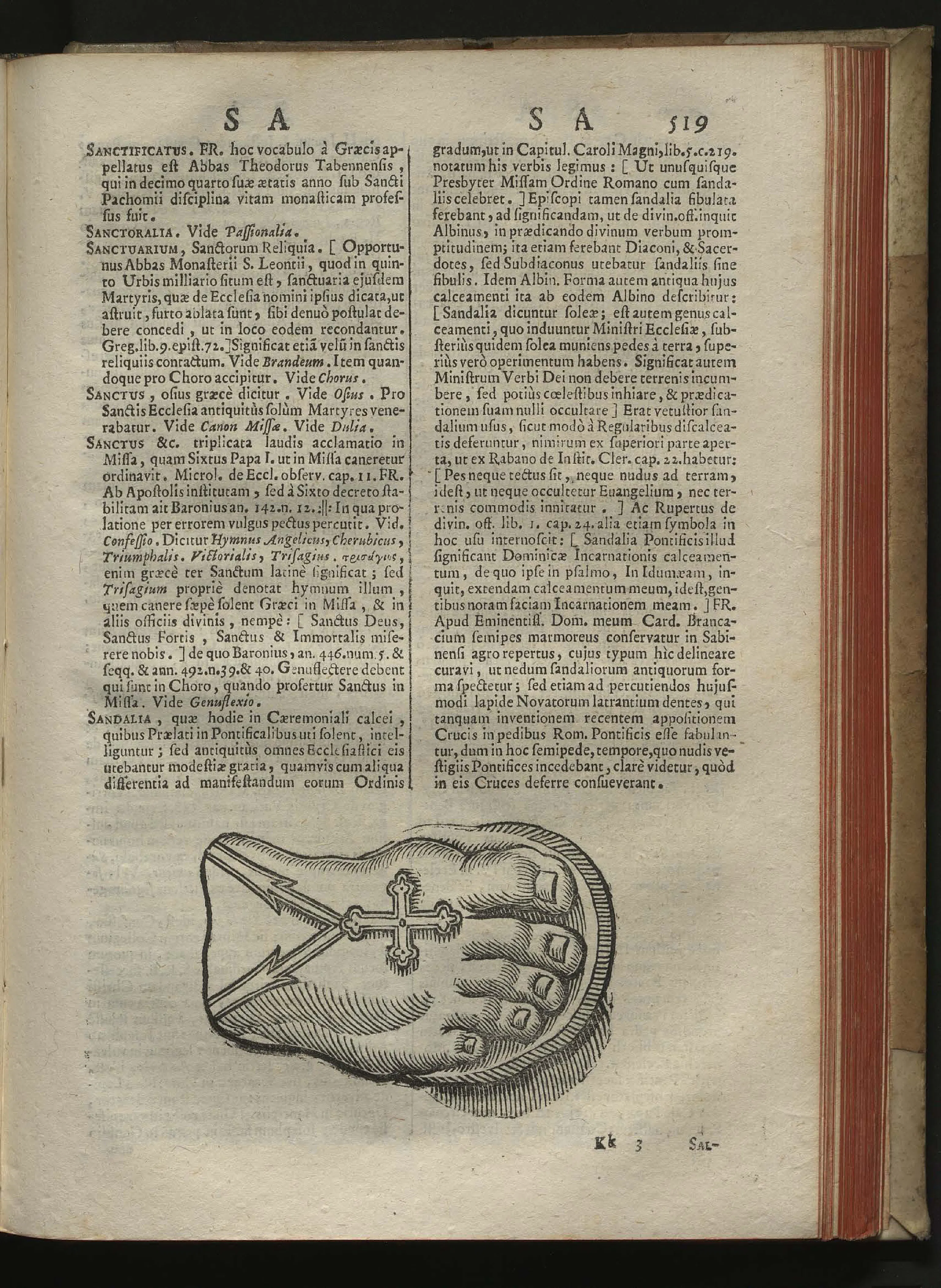
In Magri's SANDALIA entry, the wood-engraved marble half-foot—its sandal marked with a cross and bound by straps—turns antiquarian illustration into confessional evidence. Rather than merely explaining papal footwear, the page makes the stone object an argument for the rite's antiquity, visually enacting the lexicon's habit of answering charges of novelty through material remains. Source ↗.
The violence of the image — a stone flung to break the teeth of barking dogs — measures the polemical temperature of the confessional dispute, and its logic is instructive: the antiquarian object is not a curiosity but a weapon, the archaeological witness to the antiquity of a rite serving directly to refute the charge of novelty. This is the criterion of antiquitas operating at the level of stone rather than text. The same antiquarian energy produces the most vivid documentary set-piece in the entry on the rochet, where the linen vestment's history is anchored to an eyewitness report of the 1605 exhumation. When the altars of the ancient Basilica of St Peter were being demolished, Magri records, behind the altar of St Boniface IV, in an elevated place, the nearly intact body of Boniface VIII was found, dum demolirentur altaria antiquæ Basilicæ S. Petri, post altare S. Bonifacii Papæ IV. in loco eminenti. The purpose of the report is precisely lexicographic: the preserved vestments of a pontiff dead since 1303 furnish material evidence for the antiquity and form of the long rochet, so that the incorrupt body becomes, like the Sabine marble, a piece of physical testimony marshalled to establish the pedigree of a Catholic usage.
Turning from ceremonial to the boundary of sacred space, the entry on the sanctuary reproduces the celebrated dictum framed by the confrontation of Ambrose and Theodosius: the sanctuary is open to priests alone, inaccessible to all others, Sacrarium solis Sacerdotibus pervium est, aliis omnibus inaccessum. The formulation is uncompromising in its binary, dividing the whole world into the priesthood who may enter and the omnes alii who may not, and the Ambrosian setting supplies the decisive precedent, the emperor himself turned back at the rail. In a lexicon so concerned to defend clerical privilege and the distinctness of the sacred order against the levelling tendencies it attributes to the Novatores, this entry fixes in a single sentence the principle that the sacred is bounded and that its boundary is guarded by the clergy alone.
The canonical entries pursue the same protective logic at the level of crime and penalty. Simony Magri defines as the most grievous offence of the selling of a spiritual thing, an offence entailing the incurring of ecclesiastical censures, the obligation of restoring the price received, and the loss of the fruits of a benefice obtained in bad faith, quæ incursionem censurarum Ecclesiasticarum, obligationem restituendi pretium acceptum, & fructus beneficii obtenti mala fide perce. The definition is exact in its enumeration of penal consequences, moving from censure to restitution to forfeiture, and it exhibits the juridical precision the lexicon brings to the vocabulary of canon law. But Magri does not rest in the register of penalty; he escalates the offence into a doctrinal enormity by comparing simonists unfavourably with the Pneumatomachian heretics, for the Simonians make the Holy Spirit not the servant of God but their own servant, at Simoniani efficiunt Spiritum Sanctum non Dei, sed eorum servum. The comparison is theologically pointed: worse than the Macedonians who denied the Spirit's divinity are those who, by trafficking in his gifts, reduce him to their own instrument.
The numismatic and exegetical entries show Magri's philological method resolving difficulties in Scripture through the recovered meanings of ancient terms. The stater of the temple tribute is read, on Urban's gloss, to establish the immunity of the Church's head, for the tribute is rendered from the Church's external goods, and the pontifical apex, which pre-eminent stands in the mouth of the head of the Church, cannot be subjected to kings, quia non Ecclesia dari Imperatori, non Pontificalis apex, qui in ore capitis Ecclesiæ præeminet, subjici potest Regibus. From a single coin drawn from a fish's mouth Magri extracts a doctrine of ecclesiastical immunity, distinguishing the external goods from which tribute may be paid from the pontifical dignity which no secular power may subject. The Sabbath entries display the same procedure applied to a lexical crux, where Magri notes that the word Sabbath in Sacred Scripture not rarely signifies a week, Hæc vox Sabbatum in sacra Scriptura hebdomadam non rarò significat. This observation on the polysemy of the term resolves an exegetical difficulty by philological means, recovering the sense of a Gospel passage through the recognition that a single word bears more than one temporal meaning. The entry on the sabbath also enters directly into the Hebraist and anti-Judaic polemic of the period, glossing the "circumcised sabbath" and marshalling Rutilius, Martial, Horace, and Juvenal to gloss the epithets recutiti and verpi, before grounding the whole in the covenantal sign: for with the skin cut away, in sign of the covenant between God and Abraham, they were made verpi, Nam recisa pelle in signum foederis inter Deum, & Abraham verpi facti sunt. The classical satirists are pressed into service as witnesses to how the ancients named the Jews, so that a lexical entry becomes a small dossier of testimonia. The entry on the suffocatum — the strangled meat of the apostolic decree — is by contrast compressed here into a precise definition rather than the full dissertation the crux receives elsewhere: the suffocated animal is one killed not by the effusion of blood but by strangling, whose eating was forbidden among the Jews and in the primitive Church together with blood, dicitur animal, quod, non effuso sanguine, sed strangulatione, occiditur, cuius esus, apud Iudæos, ac in primitiva Ecclesia, prohibitus erat, una cum sanguine.
The alphabetical march of the first volume closes, fittingly, on a run of Greek-derived terms that display the work's polyglot foundations most openly — symbolum, synagoga, synaxis, syncellus, synodus — each entry opening from the Greek etymon and moving outward into the Christian institution it names. The treatment of the credal Symbolum is characteristic, deriving the profession of faith from the Greek σύμβολον as sign and token before glossing it as the articles of faith briefly collected, id est, signum, seu nota, ac indicium; imprimis autem significat professionem fidei, seu articulos fidei, breviter collectos. The final entry of this run, on the stauropegium, joins a Greek liturgical practice to the Latin canonical order of consecration through a prohibition that reserves the founding of a sacred building to the episcopal act: let no one dare to build a church or oratory before the bishop of the city comes and, there making his vows, has fixed the most holy cross, Nullus audeat ædificare Ecclesiam, vel Oratorium, antequam Civitatis Episcopus veniat, & ibi vota faciens, Sanctissimam Crucem infixerit. That the first volume should end amid this dense cluster of Greek ecclesiastical vocabulary, with the colophon FINIS TOMI PRIMI marking the close, is emblematic of the whole enterprise: the sacred lexicon reaches its first terminus not with a doctrinal flourish but with a patient sequence of etymologies, each one enacting the conviction that to trace a word back to its Greek, Hebrew, or Latin origin is to secure the thing it names within the antiquity that vindicates it.
The Second Volume: From STAURO- to the End of the Alphabet
The stretch of the Hierolexicon running from the STAURO- cluster through the TRIB- entries proceeds by the strict discipline of the alphabet rather than by the ordering of a treatise, yet its lemmata are far from inert: at nearly every headword the criterion of antiquity reasserts itself, and the signed critical voice adjudicates between what the undivided Church held and what later corruption or vanity has introduced. The opening cluster on the cross demonstrates at once how a physical ceremonial act can be made to carry juridical weight. Because the erection of a cross belonged to episcopal prerogative and could be performed only within diocesan limits, the term migrates by metonymy toward the sense of territory and authority, so that, as Magri observes, not rarely this word is used for "diocese," as some councils attest, and thus it sometimes signifies the extension of jurisdiction, hinc non rarò pro Diocesi hoc vocabulum etiam usurpatur, ut in aliquibus Conciliis habetur; itaque significat jurisdictionis extensionem aliquando. The semantic drift is here made an instrument of ecclesiological argument: the immunity of a possession from the local Ordinary is figured in the sign planted upon it, and the lexicographer's task of tracing a word's usage becomes indistinguishable from the recovery of a jurisdictional principle.
The Byzantine material clustered nearby shows the same conviction operating in a polemical, anti-apostatic register. In the entry treating the crowning at the imperial table, Magri retells from Georgius Cedrenus how the emperor Constantine Copronymus coerced the Patriarch Anastasius, persuading him to become a stephanita rather than a monk, to eat meat, and to endure the sound of flute-players at the royal table, ut pro Monacho fieret stephanita, carne vesceretur, & regia mensa tibicines audire sustineret,. The crowning here is read not as honour but as the outward sign of a manifested apostasy from the monastic profession — a reversal in which the diadem, ordinarily a mark of dignity, signifies the abandonment of vows. The passage exemplifies Magri's habit of reading ceremonial gesture semiotically: an object or act stands for an interior spiritual condition, and the historian's business is to expose which condition the sign truly encodes.
The vestment entries make the symbolic method explicit. Glossing the coloured flumina borne on episcopal tunics, Magri, citing Nicephorus Gregoras, explains that the bishops bear on their tunics scarlet and white rivers, because from Christ's side flowed blood and water, Episcopi ferunt in tunicis fluvios coccineos, & albos, quia fluxit è latere Christi sanguis, & aqua: Gregoras, lib. 6. c. 1. The procedure is representative of the lexicon in miniature: a named authority licenses the datum, and a Christological reading secures its meaning, so that a feature of Greek liturgical dress is neither dismissed as an alien curiosity nor left as mere ornament but folded into a shared sacramental theology of the pierced side. The garment is a legible text, and its colours are exegesis worn upon the body.
Within the entries on ecclesiastical rank, the same recovery of ancient sense serves the defence of Roman primacy, and here the critical voice does not hesitate to correct even the highest canonistic authority. Under the subdeacon Magri notes that Gratian erred in asserting that the subdiaconate was anciently not an order, an error corrected by his own glossator, Gratianus tamen erravit, asserens subdiaconatum antiquitus non fuisse ordinem, qui ab ejus Glossatore corrigitur. The willingness to charge the compiler of the Decretum with error, and to invoke the Glossa against him, reveals the temper of the whole apparatus: no authority short of the patristic and conciliar consensus stands beyond correction, and the criterion by which correction proceeds is precisely what obtained antiquitus. That criterion is then turned to apologetic use in the citation of Gregory the Great, who rebukes the Sicilian clergy that accused him of importing Greek usages by demanding whence they themselves have it that subdeacons process in linen tunics, unless because they received this from their mother, the Roman Church, Unde habent ergo hodie, ut Subdiaconi lineis in tunicis procedant, nisi quia hoc à matre sua Romana Ecclesia perceperunt? lib.7. epist.63. The rhetorical force of the maternal image is considerable: the very rite the Sicilians treated as a foreign intrusion is shown to descend from Rome as from a parent, so that the charge of novelty is reversed and Roman ritual usage is established as the source rather than the borrower.
The intellectual centre of this stretch is the vast dissertation on suffocatum, the disputed dietary prohibition of Acts 15, where Magri's philological method reaches its most concentrated apologetic application. The whole discussion turns on the double signification of the verb suffocare and on the charge that the Greek sophists, not understanding the three commandments, adulterated Scripture by adding a fourth — the twin passages already set out above in the survey of the seventeenth-century debates the lexicon engages. The move is quintessential: the ambiguity is not in the thing but in the word, and the recovery of the word's full range is what recovers the apostolic sense; the vocabulary of adulteration casts the Greek reading not as an honest divergence but as a falsification. The polemic is extended into the domain of the canons, where Baronius is enlisted to expose an alleged forgery: in the Cresconian collection, the most ancient of all, only fifty canons of the Apostles are reckoned, which Dionysius the Roman abbot called Exiguus rendered into Latin, the rest being thought fraudulently foisted in by the Greeks, quinquaginta tantummodò adnumerati habentur canones Apostolorum, quos Dionysius Rom. Abbas cognomento Exiguus in latinum vertit: cæteri enim à Græcis putantur dolosè suppositi. Here the criterion of antiquity operates as a tool of textual criticism: the older collection is the truer, and the surplus canons stand condemned by their absence from it, the philologist's demonstration doing the work of doctrinal defence.
Among the juridical-historical entries, the treatment of the Truce of God preserves a medieval institution with its penal machinery intact, defining that peace which we call the Truce of God as one to be faithfully observed as constituted by the archbishops and bishops of each province, with the provision that whoever breaks it shall be subjected to excommunication, Pax verò illa, quam treugam Dei dicimus, fideliter observetur, sicut ab Archiepiscopis, & Episcopis uniuscujusque provincia constituta est: qui autem eam infregerit excommunicationi subdatur, can. illi, qui, 24. quæst.3. The entry exemplifies the canonistic layer of the lexicon, where a word opens directly onto a conciliar canon and its sanction. In the neighbouring entry on the surrenderer of sacred books Magri gives a clean definition rooted in the age of persecution, noting that traditor was the name sacred writers gave to one who, from fear of torments, handed over the sacred codices to the persecutors of the faith to be burned by them, TRADITOR, ita à sacris Scriptoribus appellabatur ille, qui præ timore tormentorum fidei persecutoribus tradebat sacros Codices ad eos comburendos. The definition is technically loaded, for the term belongs to the Donatist controversy and its bearing on the validity of orders conferred by lapsed ministers; by anchoring the word in its persecution-era origin, Magri recovers the historical situation that gave the polemic its force.
The institutional apparatus of post-Tridentine Rome surfaces directly within the lexical fabric where the entry on the Talmud registers the reach of the Inquisition, in the notice — already cited above from the survey of the work's censorial materiality — that the superstitious codex found in anyone's possession is punished by the Holy Office. That a censorial sanction should appear as a datum within a dictionary entry marks how thoroughly the lexicon absorbs the machinery of confessional discipline into its account of what a word means. The entry on the Creed carries the same fusion of philology and confessional identity, defining symbolum as sign and deriving the credal sense from the act of profession — the passage set out at the head of this report in the framing of Christian self-naming, where the Creed is read as a semiotic act by which the Christian is recognised and named before the entry turns to its liturgical history.
If the suffocatum dissertation shows the lexicographer at his most polemical, the entry on the tonsure reveals him breaking into reformist complaint about the clergy of his own day. Having established the tonsure as an image of the Saviour's crown of thorns and of the royal priesthood, Magri asks what should be said of the priests of his time, who are ashamed to bear so glorious a sign, or who wear so tiny a tonsure that it can scarcely be seen, At quid dicendum de Sacerdotibus nostris temporis, quos pudet tam gloriosum signum deferre? seu tam exiguam tonsuram ferunt, ut vix cerni possit?. The lament discloses the moralising undercurrent of the enterprise: the sign is glorious precisely because it participates in the reality it figures, so that its diminution is not a matter of fashion but a failure of devotion, an unwillingness to be marked visibly as belonging to the sacred order. In this outburst the same logic that governs the whole lexicon — that the outward sign carries and defends the inward reality — is turned inward upon the Church's own ministers.
The final stretch of the alphabetical dictionary discloses, perhaps more plainly than any of the more celebrated apologetic entries, how thoroughly Magri's method binds a word to the institution that speaks it and to the monumental fabric in which that institution displays itself. This chunk opens in the midst of an entry that fastens a lexical gloss to a piece of contemporary Roman fabric, recording that Pope Alexander VII magnificently installed the Chair of the Prince of the Apostles in the tribune of the Vatican Basilica, and that the space is called the Calcidica or Hemicyclus, & Alexander Papa VII, in tribuna Basilicæ Vaticanæ Cathedram Principis Apostolorum magnificè collocavit: dicitur Calcidica, Hemicyclus. The move is characteristic: an architectural terminus is defined not by antiquarian recovery alone but by anchoring it to a living Roman monument, so that the ancient word and the newly monumentalised relic of the Cathedra Petri authenticate one another. The very object whose name Magri glosses — the chair of the Princeps Apostolorum — is the material token of Roman primacy, and its ceremonial installation under a reigning pope becomes, within the entry, philological evidence.
Against this monumental register stands the entry's other characteristic mode, the philological adjudication that corrects received authority under the signed critical voice. On the vexed proverb Tricae Tellenae, Magri sets aside the reading that traces the phrase to a tedious trumpeter and rules that it must be restored to two cities, the first in the territory of Brindisi, from which the proverb was drawn on the testimony of Pliny, sed restituendum est Tricæ, Tellenæ, quæ sunt duæ Civitates, prima in Brundusino territorio, à qua proverbium desumptum fuit teste Plinio. The verb restituendum est carries the full weight of the method: a corrupted or misapprehended reading is to be restored, and the criterion of restoration is the most ancient testimony available, here Pliny set above the accumulated glosses of Erasmus's Chiliades and Calepinus. What in a lesser compilation would be a bare crux becomes a small enactment of the whole book's logic — priority secures truth, and the recovery of the earlier witness overrules the later consensus.
The doctrinal entries in this stretch apply the same discipline of precision to the vocabulary of heresy. The Tritheites are defined with clinical economy as a sect of heretics which asserted a threefold nature in God, and understood the same thing by hypostasis and by nature, TRITHEITÆ, Hæreticorum secta, quæ asserebat trinam in Deo naturam, ac idem intelligebat per hypostasim, & naturam. The precision is itself the polemic: the error is located exactly in a collapse of two technical terms, hypostasis and natura, whose distinction the orthodox settlement of the Trinity depends upon. The same confessional edge sharpens into open controversy in the antiquarian entry that turns Protestant ridicule of St George back upon itself — the passage on the "papists' Perseus" already cited above in the survey of the work's named opponents — where the charge that Catholic devotion has merely rebaptised a pagan hero is disarmed by conceding the legendary character of the George-and-dragon narrative and attributing that very discrimination to the Church's own critical judgement, so that the Novatores are caught accusing Rome of a credulity Rome had already disowned.
The dictionary's antiquarian reach extends confidently into juridical and technical vocabulary that has nothing sacred about it save its place in the Church's historical fabric. The dense feudal cluster under V opens its etymology of the vassal from the military standard, deriving Vassallus from vexillum and explaining that he was therefore called Vaxallus, Vassallus à Vexillo; ideò Vaxallus dicebatur. Grounding the feudal bond in the banner under which service is rendered, Magri marshals the Bullarium Casinense and Sigonius to gradate the ranks of the valvasores, treating Lombard-Germanic law with the same etymological seriousness he brings to liturgical terms. Still more striking is the excursus that carries the lexicon to the frontier of a history of technology, where under the blowpipe-turned-cannon he records that in these same vessels were carried very many bombards, which they call zarabotanas, on the authority of Chalcondyles, In iisdem vehebantur bombardæ plurimæ, quas Zarabotanas vocant. Chalcondyla, lib. 7. That a sacred dictionary should pause over the disputed invention of gunpowder — canvassing Archimedes, a Cologne alchemist, and Petrus Libs — testifies to the genuinely encyclopaedic ambition of the enterprise, in which the semantic drift of a word from a hollow tube to an engine of war is itself a philological datum worth recording.
The liturgical and sacramental entries in this stretch return the method to its native theological ground. Within the vast treatment of Vesperae, Magri embeds a piece of relic-lore, noting that the bronze serpent fashioned by Moses and broken by Hezekiah is still preserved in the metropolitan church of Milan, Æneus serpens à Moysi fabricatus, & ab Ezechia fractus, adhuc in Ecclesia Metropolitana Mediolanensi conservatur. The claim of continuous preservation — adhuc conservatur — is the antiquarian gesture in its purest form, asserting an unbroken material thread from the Mosaic economy to the present Ambrosian rite. The entry on the Viaticum opens a genuinely disputed question by defining it as the Eucharist which is bestowed on the faithful at their passage from this life, a term the Fathers used at the Synod of Nicaea, VIATICUM, Eucharistia, quæ fidelibus elargitur in hujus vitæ transitu; quo vocabulo in Nicæna Synodo usi sunt Patres. By fixing the word's pedigree at Nicaea, Magri secures the sacramental practice with the criterion of antiquity even as he weighs whether the conciliar term denotes the Eucharist or reconciliation, setting Albaspinaeus, Zonaras, and Balsamon against one another. The polemical use of antiquity becomes explicit in the entry on Vigilia, where the defence of nocturnal vigils is mounted against the heresiarch Vigilantius, whom Magri brands the most impure enemy of his own name for having attacked the vigils, sed impurissimus hæresiarcha Vigilantius vigilias, sui nominis hostis, impugnavit. The play on the man's name — Vigilantius, the assailant of vigiliae — condenses the whole apologetic strategy into a pun: the enemy of the ancient practice is convicted by his very appellation.
The alphabetical body closes on its terminal doxology, the centred FINIS followed by LAUS DEO, after which a fresh title page opens the appended treatise and names its author in his full titulature — the string already quoted in the executive summary above, the Maltese Knight of the Golden Spur, Count Palatine, Apostolic Protonotary, theologal canon of Viterbo, and consultor of the Congregation of the Index. The self-inscription is not idle ceremony: it locates the harmonising treatise that follows within the same institutional apparatus that authorised the lexicon, and in particular within the office of the Index whose critical remit the enterprise everywhere presupposes.
The Appended Antilogiae: Harmonising the Apparent Contradictions
The Antilogiae announce their governing concept in the very insistence that the contradictions they treat are apparent. Magri gathers the apparent contradictions or repugnancies of the sacred volumes, Apparentes Sacrorum Voluminum Antilogias, seu repugnantias, and the adjective bears the entire theological wager: Scripture cannot truly contradict itself, so every discrepancy is a problem of reading to be dissolved, never a defect to be conceded. The epistle to the reader roots this labour in a concrete institutional occasion — the convention of learned men constituted at Rome by Urban VIII to revise the Arabic Bible for the instruction of the Eastern Christians, the account already set out above in the survey of the Propaganda Fide milieu. The apparent contradictions, on this account, surfaced in the working sessions of that commission and were resolved for the benefit of preachers; the treatise thus carries into its very genesis the Eastern-Christian programme, and the philological resources of that milieu are visibly at work in its resolutions.
Those resolutions display a consistent technique of harmonisation drawing on patristic, scholastic, rabbinic, and Arabist authority in turn. The first Genesis entry, on whether woman bears the divine image, resolves the difficulty by the Thomist distinction that the divine image is found in both man and woman with respect to what the notion of image principally imports, that is, as regards the intellectual nature, tam in viro, quàm in muliere inveniri imaginem divinam secundùm id, quod importat ratio imaginis principaliter, id est, quoad naturam intellectualem, a solution that couples Aquinas with the Historia Arabum of Abraham Ecchellensis and so exhibits the treatise's signature blend of Latin scholasticism and Eastern erudition. Numeric discrepancies receive philological treatment: the conflict over the years of famine offered to David is eased by appeal to textual corruption and rabbinic reckoning after David Kimchi, pivoting on the king's own resolution that it is better to fall into the hands of the Lord, Melius est, ut incidam in manus Domini. A moral-doctrinal tension is handled by scholastic distinction where the Tobit dictum that almsgiving frees from all sin and from death, Quoniam eleemosyna ab omni peccato, & à morte liberat, is reconciled with Pauline teaching through the difference between dispositive and formal efficacy, citing Aquinas and Augustine. The confessional stakes surface most sharply where the angel Raphael's self-identification as Azarias is defended against the charge of falsehood, Magri arguing that an angel bearing the likeness of Azarias could indeed say that he was Azarias, just as in Genesis 31 an angel bearing the likeness of God said, Angelus præferens similitudinem Azariæ poterat quidem dicere se esse Azariam, sicut Gen. 31. Angelus præferens Dei similitudinem, ajebat: Ego sum Deus. Directed against the Protestant Whitaker in his controversy with Campion, this defence shows the harmonising method serving the same confessional end as the lexicon proper: the integrity of the sacred text, like the antiquity of Catholic rite, is vindicated word by word.
The closing movement of the treatise discloses, more plainly than any single lemma of the lexicon proper, the machinery by which Magri converts philology into apologetic defence. The treatise proceeds in a fixed juridical rhythm — a scriptural lemma cited, a tension posed against another passage, and a resolution delivered under the formula Respondeo — and the cumulative effect is to demonstrate that the apparent contradictions of the sacred text are precisely that: apparent, dissolving under the pressure of textual, historical, and etymological analysis. The organizing category is announced in the very running head, Contradictiones apparentes, a phrase whose adjective carries the entire evidentiary burden of the enterprise: to concede that the difficulties are real would be to surrender the harmony of Scripture, and so each entry is constructed to reclassify the difficulty as a problem of reading rather than a defect in the text.
The method is at its most economical in the geographical and onomastic cruxes. The confusion of two cities in the book of Tobias is resolved by a simple topographical distinction, Tobias igitur, & Angelus erant in regione Rages in civitate, quæ vocabatur Ecbatanis; Gabelus autem habitabat in ipsa civitate Rages, establishing that Tobias and the angel were in the region of Rages in the city called Ecbatana while Gabelus dwelt in Rages itself — an apparent inconsistency reduced to the difference between a region and a city within it. More revealing of the work's philological apparatus is the treatment of an onomastic error in Judith, where the received Latin is corrected against the versions: one must read "Israel" for "Ruben," as the Greek renders it, Respondeo, pro Ruben legendum esse Israel, ut vertit Græcus. Here the Respondeo does not harmonize by distinction but by emendation, and the appeal to the Greek — supplemented, as the surrounding argument indicates, by the Arabic Bible of the author's own Congregation — exhibits the polyglot toolkit that separates this treatise from a merely scholastic reconciliation of loci. The truth of the sacred text is recovered not by assertion but by collation across the versional witnesses, and the corrupt Latin reading is treated as an accident of transmission rather than a wound in Scripture itself.
The confessional edge of the enterprise surfaces wherever a scriptural difficulty has been exploited by heterodox readers. Under the Psalms, the treatise reports and rejects the Lutheran inference drawn from the verse that every man is a liar — the fallacious a fortiori argument, already cited above in the survey of the Tridentine soteriological debates, by which Luther is made to deduce that all human works are sins. The naming of Luther as the author of that inference transforms an exegetical crux into a set-piece of anti-Protestant polemic, and the resolution proceeds by distinguishing an actual state of lying from the mere proclivity of corrupt nature — a vice, but not a formal sin. The same soteriological front is held at the close, where the Pauline and Jacobean statements on justification are harmonized in the Tridentine formula, likewise already cited above, that the just man lives by faith joined with good works and the other virtues, not by faith alone, which is dead. The two passages frame the treatise's soteriology within a single arc: an apparent contradiction between Romans and James is not a fissure to be exploited by the Novatores but the occasion for the settled Catholic doctrine of faith formed by charity.
One entry departs sharply from the exegetical register into curial satire. Glossing a Psalm on those who fish in the dark, the treatise turns its allegory against a contemporary abuse: such are the fishers of ecclesiastical benefices, who with false documents undertake unjust suits, and though poor in talent and virtue, strive to fish in the nocturnal darkness, Tales sunt piscatores beneficiorum ecclesiasticorum, qui falsis documentis suscipiunt lites injustas, & cùm sint pauperes ingenio, ac virtutibus, piscari in tenebris satagunt nocturnis. The metaphor of nocturnal fishing is drawn directly from the lemma and redeployed as a moral indictment of the piscatores beneficiorum ecclesiasticorum, and the passage names the supreme papal tribunal as the body that ought to discipline them. That an exegetical treatise on scriptural harmony should descend, however briefly, into the language of benefice-litigation and the sacra Rota Romana attests to the porousness between the antiquarian-philological and the institutional-juridical registers that runs throughout Magri's work.
The chronological and geographical cruxes of the Prophets extend the same repertoire of solutions. The application of christus, anointed, to the pagan Persian king generates a difficulty resolved by balancing partial knowledge against enduring idolatry: although Cyrus knew God, he nonetheless did not know him as the one and only, for he simultaneously worshipped idols up to his death, Respondeo, licèt cognoverit Deum, non tamen cognovit eum unicum, & solum, nam simul etiam idola colebat usque ad mortem. The resolution preserves the propriety of the divine title conferred on a heathen monarch by carefully qualifying the mode of his theological knowledge — a knowledge real but incomplete, sufficient to warrant the epithet yet insufficient to remove the taint of idolatry. Elsewhere the anachronistic appearance of a city name is dissolved by naming a rhetorical figure, the prolepsim or anticipation by which Ezekiel could speak of Alexandria before its foundation, and the invention of Judas's field is explained as a catachresis; the deployment of technical terms of rhetoric shows the treatise reaching into the grammarian's lexicon whenever the historical difficulty resists a purely factual answer.
The Gospel section carries the treatise's most ambitious philological gestures, and it is here that the work situates itself within a living seventeenth-century apologetic. The genealogical divergence between Matthew and Luke is framed as an objection first raised by Julian the Apostate and answered by Jerome, while the omission of three kings from Matthew's fourteen generations is resolved on the Jeromian ground that he did not wish to exceed the fourteen persons, quia noluit excedere tesseradecadem personarum, a numerical scheme reinforced by the argument that the excised kings descended from the accursed line of Athaliah and Achab. More striking is the treatise's engagement with a contemporary Muslim controversialist, the exchange with Ahmed the Persian and Guadagnoli's Apologia already noted above in the survey of the anti-Islamic polemic. The adverb nuper, recently, collapses the distance between the ancient scriptural crux and the active Christian-Muslim disputation of the Roman colleges, and the citation of Guadagnoli as the author's collega embeds the treatise in the Propaganda Fide milieu of Arabist scholarship.
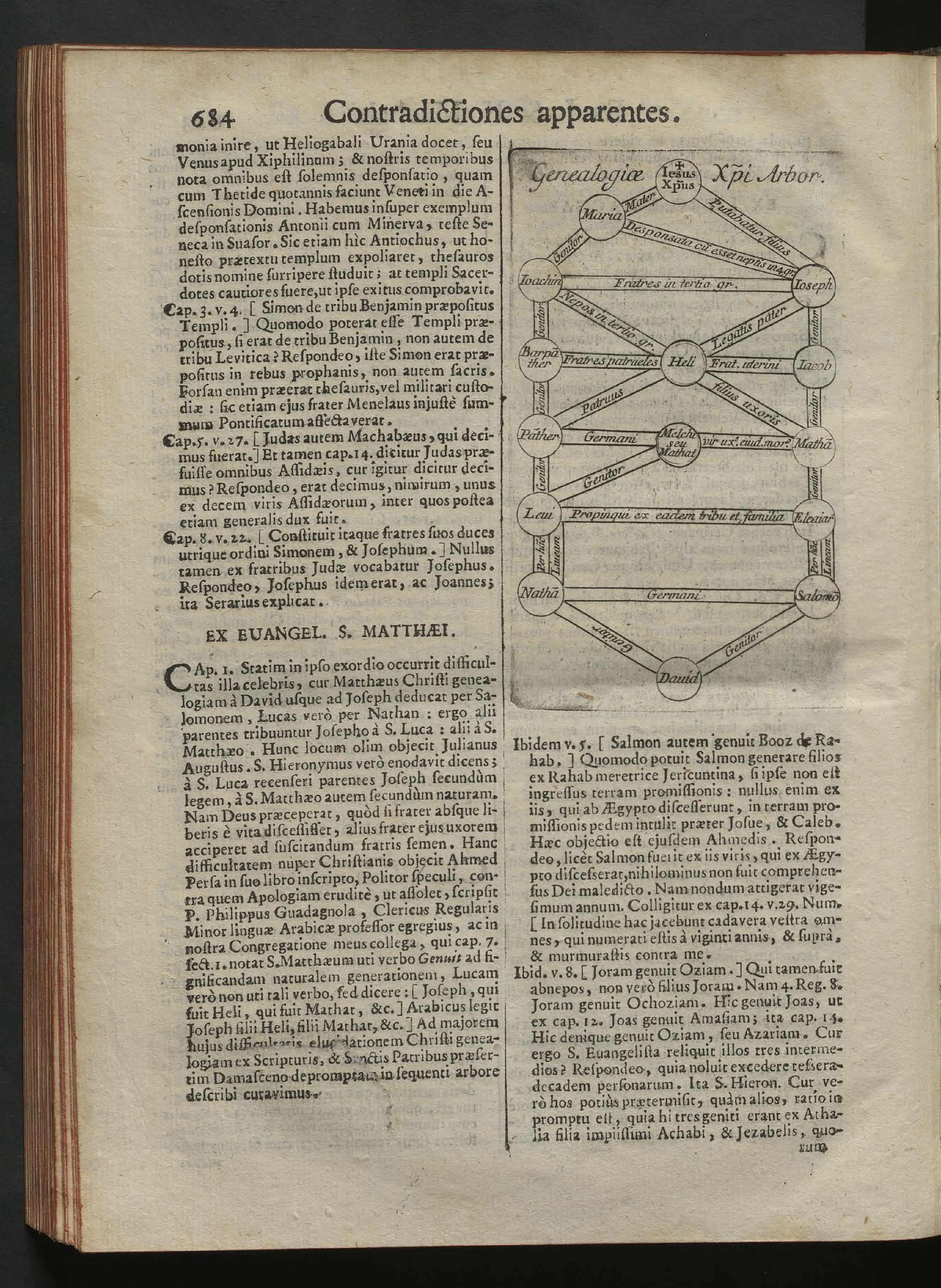
Opening the Matthew section under the running head "Contradictiones apparentes," this page turns the apparent conflict between Matthew's and Luke's genealogies into both a patristic exercise and a contemporary apologetic problem, the printed Latin discussion invoking Ahmed the Persian and Filippo Guadagnoli. The woodcut "Genealogiae Xpi Arbor" renders that harmonizing method visually, converting disputed lines of descent—from David through Joseph, Mary, and Jesus—into a diagram of reconciled relationships. Source ↗.
That Oriental-philological method reaches its most conspicuous point in the treatment of the notorious misattribution at Matthew 27:9, where the evangelist ascribes to Jeremiah a prophecy that stands in Zechariah. The lemma is stated as the maximal difficulty, Tunc impletum est, quod dictum est per Ieremiam Prophetam, then it was fulfilled which was spoken through Jeremiah the prophet, and its resolution mobilizes both a hypothesis of scribal error and an appeal to a rare manuscript witness. Among this scholar's Arabic manuscripts, the treatise reports, there exists a singular one titled Book of Precious Pearls, and it concerns the works of the Lord, inter complures libros arabicos manuscriptos quidam singularis existit inscriptus, Liber margaritarum pretiosarum, estque de operibus Domini. The invocation of the Liber margaritarum pretiosarum, alleged to preserve a Jeremianic prophecy that the Jews had erased, deploys an Oriental codex as a decisive apologetic instrument; the harmony of the Gospel text is defended not by conceding a lapse of memory in the evangelist but by positing a lost prophetic source recoverable only through the Arabic tradition — a strategy that turns the very polyglot resources of the Roman colleges into a bulwark of scriptural inerrancy.
The Acts section carries the most personally invested passage, the etymological vindication of the Maltese islanders whom Acts 28 calls barbari. The treatise refuses the pejorative modern sense: for "Barbarus" does not mean inhuman, as it now commonly sounds, but rustic and boorish; for it is a Syriac word, Bar Bar, that is, son of the desert, nam Barbarus non significat inhumanum, ut vulgò nunc sonat, sed agrestem, & rusticum; est enim vox Syriaca Bar Bar, id est, filius deserti. The reasoning follows the criterion that governs the whole lexicon: the recovery of the ancient, Semitic sense of a word disarms a slur founded on its later vulgar drift, and the philological correction carries an evident patriotic charge for a Maltese author defending his own islanders against the imputation of savagery. The chronological crux of the Passion narrative is handled by the same instinct for distinguishing recovered fact from received assumption: Christ, having set aside the traditions of the Rabbis, ate the lamb on Thursday, when the fourteenth day of the moon of the first month fell, At Christus Dominus relictis Rabbinorum traditionibus comedit agnum feria V. quando incidebat decimaquarta dies Lunæ primi mensis, so that John's Parasceve Paschæ and the Synoptic Supper are reconciled by separating Christ's observance from the rabbinic reckoning of that particular year.
The final entries turn to Christological and eschatological cruxes and close the treatise on the note of doctrinal fixity that has governed it throughout. The Arian reading of Colossians is refuted by parsing the disputed epithet: "Primogenitus," that is, begotten from eternity before all creatures, Primogenitus, id est, genitus ab æterno ante omnes creaturas, the resolution hinging on the Greek distinction between the first-created and the first-begotten so as to deny the heretics any inference that the Son is a creature. The last crux, drawn from the Apocalypse, resolves the flight of earth and heaven before the divine face by insisting that no annihilation is intended: the earth and heaven do not flee, but only the former face of earth and heaven, because they will change their state and acquire a more beautiful form, non fugit terra, nec coelum; sed tantùm facies pristina terræ, & coeli, eò quòd statum mutabunt, ac pulchriorem formam acquirent. The distinction between substance and facies, the former face that changes rather than perishes, supplies a final instance of the treatise's characteristic move — reclassifying an apparent contradiction as a matter of qualified sense — before the whole is sealed with an emphatic FINIS. The resolution of the last difficulty by the same Respondeo logic that opened the sequence confirms that the treatise's unity lies not in its scriptural itinerary but in the invariant procedure by which every tension is shown to be reconcilable, the harmony of Scripture standing intact from the historical books of the Old Testament to the closing vision of the renewed cosmos.
Frequently Asked Questions
What is the Hierolexicon, or Sacred Dictionary of Domenico Magri?
The Hierolexicon, sive Sacrum Dictionarium is an alphabetically arranged Neo-Latin encyclopaedic lexicon of ecclesiastical, liturgical, canonistic, and antiquarian vocabulary, completed at its author's death in 1672 and issued posthumously at Rome in 1677. Each entry grounds a word in etymologies traced through Latin, Greek, Hebrew, Syriac, and Arabic, then secures it by patristic and conciliar authority. Its governing wager is that fixing a word's ancient sense defends the thing it names, so recovering apostolic vocabulary becomes a Tridentine defence of Catholic rite against the Protestant Novatores. An appended treatise, the Antilogiae, harmonises the apparent contradictions of Scripture.
Who was Domenico Magri?
Domenico Magri (Valletta 1604 – Viterbo 1672) was a Maltese priest and theologian who served as consultor of the Sacred Congregation of the Index and held the canon-theologate of the cathedral chapter of Viterbo. He bore the courtly titles of Knight of the Golden Spur, Count Palatine, and Apostolic Protonotary. He travelled to Syria and Mount Lebanon in 1623 in the company of Cardinal Orsini, bringing back twelve Maronite students, and collaborated with the Arabist scholars of the Roman colleges. The historiography on Magri remains strikingly thin: the principal biographical treatments are older Maltese studies, and no dedicated monograph on the Hierolexicon has appeared.
Why does Magri call his dictionary a "sacred" one?
The title claims that the words the book collects do not merely describe sacred realities but participate in them, so that the lexicographic repository itself belongs to the sacred order. Hierolexicon is a seventeenth-century compound of the Greek ἱερός, "sacred," and λεξικόν, "word-collection." The coinage performs a polemical move against Protestant critics who charged Rome with overlaying scriptural diction with ceremonial accretion: the vocabulary Magri catalogues, he implies, was always already sacred. This is why his philological method functions as an apologetic instrument — to fix a word is to defend a thing.
How does Magri defend the Maltese islanders of Acts 28?
Magri refuses the pejorative sense of barbarus applied to the islanders who received the shipwrecked Paul. He argues that the word does not mean inhuman, as it commonly sounds, but rustic and rural, since it is a Syriac expression, Bar Bar, meaning "son of the desert." Recovering the ancient Semitic sense disarms a slur founded on the word's later vulgar drift. The correction carries an evident patriotic charge for a Maltese author defending his own islanders against the imputation of savagery, and it exemplifies his conviction that recovering a word's original meaning resolves an apparent difficulty.
Is there an English translation of the Hierolexicon?
No translation of the Hierolexicon into another language has been identified; by contrast, the Italian antecedent, the Notizia de' vocaboli ecclesiastici, circulated independently in vernacular Catholic scholarship. Separately, the Leo edition now presents the full transcription of the work together with a complete English translation, generated by artificial intelligence and made available for the first time. Leo is an effort to make freely available online, at no cost, English translations of every text printed in Latin in early modern Europe between 1450 and 1750. The Leo rendering can be read free of charge.
This report was generated by an advanced AI assistant that conducted deep research alongside an extensive interpretation of the transcribed original text. Every effort has been made to preserve fidelity to the source and to guard against inaccuracy, but corruption in the text recognition process and model hallucination may nonetheless have entered the text. Treat every claim, quotation, translation, and citation as provisional, and verify each against the original source before relying on or citing it.
Bibliography
- Peter Burke, Languages and Communities in Early Modern Europe: Burke's account of how learned Latin, vernaculars, and specialist jargons carved out competing speech-communities gives the theoretical frame for reading a dictionary that treats its own vocabulary as a sacred possession. It clarifies why Magri's shift from the Italian Notizia to a Latin Hierolexicon was a deliberate act of audience-selection rather than mere translation.
- R. Po-Chia Hsia, The World of Catholic Renewal, 1540–1770: The standard synthesis of Catholic reform across the exact period that produced and reprinted Magri's lexicon, useful for locating the Hierolexicon within the disciplinary and devotional machinery it everywhere presupposes. Hsia's pluralistic reading of the movement accommodates the coexistence of antiquarian curiosity and Tridentine rigour that makes Magri so hard to pigeonhole.
- John W. O'Malley, S.J., Trent: What Happened at the Council: Since Magri repeatedly settles a lexical dispute by quoting the twenty-second session or an anathema of Trent, O'Malley's blow-by-blow reconstruction of what the council actually decided is the indispensable check on those citations. It shows precisely how much doctrinal weight the adverb transubstantialiter and the canon on ceremonies were being asked to carry.
- Giovanni Pizzorusso, "Rome in the Indies: The Jesuit Mission to the Maronites and the Making of Orientalism in the Seventeenth Century," The Roman Orient: Pizzorusso maps the Propaganda Fide and Maronite-College network out of which Magri's Syriac, Arabic, and Hebrew erudition emerged, the same milieu that produced the Antilogiae and its Arabic-Bible commission. Read it to understand why a Maltese canon of Viterbo could command the Liber margaritarum pretiosarum and the etymology of Bar Bar.
- G. J. Toomer, Eastern Wisedome and Learning: The Study of Arabic in Seventeenth-Century England: Though centred on England, Toomer's history of seventeenth-century Arabic scholarship reconstructs the shared European philological world — printing types, manuscript hunts, Maronite intermediaries — in which Ecchellensis, Naironus, and Guadagnoli operated. It supplies the technical backdrop against which Magri's polyglot etymologies and his answer to Ahmad the Persian become legible.
- Counter-Reformation, Wikipedia: A serviceable orientation to the terminology — "Tridentine," "post-Tridentine," "Counter-Reformation" — that the report deploys throughout, and a reminder of how contested those labels remain. Consult it for the fast overview, then distrust it and go to O'Malley and Hsia for anything load-bearing.
- Religion and the Power of Scholarship and Publishing in the 17th Century, Brewminate: A general-audience survey that notes how the Roman Maronite orientalists grasped early the value of their manuscript collections, the very network of collectors and printers that lies behind Magri's Eastern material. It is a starting point rather than an authority, best used to confirm the shape of the story before turning to Pizzorusso and Toomer.