Like a Certain Hectic Fever: Thomas Stapleton's A Methodical Demonstration of the Doctrinal Principles of Faith
Thomas Stapleton was the English Catholic exile who held Douai's new chair of controversies. In the Principiorum fidei doctrinalium demonstratio methodica he set out to find the one certain rule that could close every quarrel over doctrine, and he located it in the living voice of a visible, perpetual Church. Read alongside his quodlibetic orations against the Reformers, the treatise shows a sixteenth-century polemicist turning the question of who may judge Scripture into a question of method, the question that had already split England from Rome.
ExLatinis
October 3, 2026
Contents
Thomas Stapleton was the English Catholic exile who held Douai's new chair of controversies. In the Principiorum fidei doctrinalium demonstratio methodica he set out to find the one certain rule that could close every quarrel over doctrine, and he located it in the living voice of a visible, perpetual Church. Read alongside his quodlibetic orations against the Reformers, the treatise shows a sixteenth-century polemicist turning the question of who may judge Scripture into a question of method, the question that had already split England from Rome.
Thomas Stapleton, a theologian of the English Catholic exile, wrote the Principiorum fidei doctrinalium demonstratio methodica in Latin as a work of Catholic controversial theology concerning the principles and authority of faith. A bibliography records it by 1578, and a second edition, revised by the author, was printed in Paris by Michel Sonnius in 1582. It belongs with a companion Latin work, the Speculum pravitatis haereticae, which its title identifies as six quodlibetic orations and which has a separately attested Douai imprint of 1580 by Jan Bogart. The first work is a systematic treatise; the second consists of academic disputations and orations delivered within a university. Together they show a professional controversialist working at once as a builder of systems and as a public academic voice. The relationship of these titles to an earlier and distinct work, Albert Pigge's Hierarchiae ecclesiasticae assertio (Cologne, 1538), raises both a bibliographical and an intellectual question. The two must not be conflated, and how far Pigge shaped Stapleton has not yet been documented.
The Demonstratio confronts one problem. Where several confessions each claim the Gospel, where can a single and certain rule be found for settling every doctrinal controversy? Stapleton answers by a recurring regress. Each dispute over a particular article is traced back to a prior question: who has the authority to teach? The article concerning the Church is then raised to the status of a governing "principle of doctrinal faith." His solution identifies that rule with the voice, testimony and judgement of a visible, perpetual and numerous Church guided by the Holy Spirit.
He builds this solution from several sources:
- Aristotelian axioms about principles;
- a Thomist account of the resolution of faith, in which the Church is the condition through which God speaks and a witness to revelation rather than its author;
- a juridical and testamentary vocabulary of heirs, deposits, prescription and possession;
- an Augustinian ecclesiology of the mixed body.
On these foundations he places Scripture, the canon, interpretation and unwritten tradition beneath the Church's judgement, at least as regards believers' knowledge of them.
The stakes are those of the sixteenth century's central ecclesiological quarrel. The question of where authority lay in the Church had divided Henry VIII from Rome. Catholic writers such as Pigge had answered it under the heading of hierarchia ecclesiastica. In Stapleton's hands it becomes a question of method: what kind of proof can close a controversy at all. The polemical side of his project is equally pointed. Protestantism is diagnosed as the overthrow of all doctrinal authority. It is presented as a merely negative and shifting doctrine, and the orations treat it as a disposing cause of Antichrist. The Protestant appeal to the first centuries alone is met by the claim that the Church's consensus has equal force in every age.
The texts offer several particulars that stay with a first-time reader:
- Stapleton turns the vocabulary of "reformation" against its users. Doctrine, he holds, may be restored when lost but never reformed, and a pretended Reformatio is in truth a Transformatio and a Deformatio.
- He distinguishes the pope as a private person from the pope exercising his pastoral office.
- He describes the canon as growing in the Church's acceptance rather than in itself.
- He claims that there were Lutherans before Luther spoke.
- The orations record, as an act of institutional self-understanding, the founding at Douai of a professorship devoted specifically to controversies.
A single question about authority unites the work's conceptual vocabulary, its circumstances of production and its internal argument: who may judge, by what rule, and on whose testimony. The vocabulary of norma, regula, principium and authoritas is the lexicon of that question. The circumstances of production are its institutional embodiment: a teaching chair created to answer heretics, quodlibetic disputation as an academic form, and the Paris and Douai presses of the exile. The argument moves from the Church considered in itself toward the means and agents of judgement, and only then toward the canon, interpretation and tradition. It thereby enacts the priority it defends, in which the teacher is known before the doctrine. Much about the editions remains unsettled: their collations, the precise content of the later impressions, and any physical relationship between the two works. The intellectual design, by contrast, is coherent and consistently pursued.
Read the full text and English translation on Leo
This text was transcribed and translated as part of the ExLatinis project, an effort by Leo to make free English translations of every text published in Latin in early modern Europe (1450–1750) available online. The complete transcription and English translation of this work can be read free of charge:
→ Read the original Latin text and full English translation on Leo
You can save a copy of this document into your Leo account to run deep text searches, conduct further analysis, or cross-reference it with your own research.
Naming Stapleton's Demonstratio: Principium, Regula and the Vocabulary of Authority
A Methodical Demonstration of the Doctrinal Principles of Faith is an editorial English rendering of Thomas Stapleton's Principiorum fidei doctrinalium demonstratio methodica, not an established English edition title. The associated Speculum pravitatis haereticae may likewise be rendered, editorially, A Mirror of Heretical Depravity. Neither title denotes Albert Pigge's distinct Hierarchiae ecclesiasticae assertio, the Assertion of the Ecclesiastical Hierarchy.
Each key term in the title carries technical weight.
Principium. The principia of the title are meant in a strict, Aristotelian sense. Stapleton justifies the design of the whole work by the axiom that argument is futile with an adversary who denies first principles, penditur, quia qui errat circa principia, impersuabilis est: the point is weighed, because one who errs about principles cannot be persuaded. The article concerning the Church is accordingly elevated above the other articles. He treats it tanquam transcendens quoddam & generale Principium, etiam ad ipsos primarios, as a certain transcendent and general principle even with respect to the primary ones themselves. The plural principia doctrinalia thus names the ground on which all other doctrinal claims are to be adjudicated, not a set of doctrines.
Regula and norma fidei. In these controversies regula or norma fidei means a rule by which disputed religious teaching may be judged, not simply a catalogue of doctrines. Whether Stapleton assigns that judgement to the Church's authoritative interpretation, and precisely how he relates it to Scripture, requires citation from the relevant passages rather than deduction from his title. The text itself is explicit on both points.
- The work announces its programme as a search for one such rule for settling controversies, diuidicandas sola & certissima Norma, & ad easdem semel, a sole and most certain Norm, given once for all.
- Its concluding definition locates that norm in the Church: Ecclesiæ Catholicæ Spiritu Sancto ad hunc finem imbutæ, edoctæ, animatæ vocem, testimonium, iudicium. The rule is the voice, testimony and judgement of the Catholic Church, imbued, taught and animated by the Holy Spirit for this end.
- Scripture's relation to that rule is stated as a distinction of category, Nam Scriptura est vnum ex iis quæ creduntur, vox Ecclesiæ est regula omnium quæ creduntur. Scripture is one of the things believed, while the voice of the Church is the rule of all things believed.
The polysemy of regula is therefore resolved in the work by a deliberate shift. Elsewhere the word can denote a summary of credal content. Here it denotes a living judging authority, set against the Protestant principle of sola scriptura. Collation against a checked edition would fix whether these formulations stand identically across the recorded impressions.
Authoritas. The term is used diagnostically. Stapleton judges that no earlier heresy has done more to clear the road for ruin than the present one, strauerit, quàm hodierna; quæ omnem in doctrina religionis Authoritatem, which overthrows all authority in the doctrine of religion. On this reading heresy is defined less by any single erroneous article than by its dissolution of the principle of authority itself. The Church that holds this authority is defined in terms that stress visibility and number: Ecclesia Christi secundum statum noui Testamenti, est multitudo collecta, the Church of Christ under the state of the New Testament is a gathered multitude.
Juridical idiom. The conceptual vocabulary of the work draws on a juridical and testamentary idiom: hæres, testamentum, depositum, praescriptio, possessio, testis, causa finita. These terms give the language of the rule of faith the force of title and inheritance, and connect the philological question of what norma means to the procedural question of who may pronounce a cause closed.
Hierarchia ecclesiastica. The phrase names the ordered authority defended by Pigge against Henry VIII's separation from Rome. The shared ecclesiological question makes Pigge a pertinent antecedent, but does not by itself establish textual borrowing by Stapleton.
Reformatio, transformatio, deformatio. Reformatio and the opposed terms transformatio or deformatio carry a confessional judgement: restoration of received doctrine is distinguished from a change alleged to disfigure it. Their exact deployment in Stapleton's text remains to be established from a checked edition. The text as it stands states the distinction in two steps.
- First, doctrine may be recovered but never improved. Nam doctrina fidei quum eius regula vniformis semper & inuariabilis sit non secus ac scientia in naturalibus restaurari vel redintegrari deperdita potest, reformari corrupta non potest. Because the rule of the doctrine of faith is always uniform and invariable, that doctrine can, like natural knowledge, be restored when lost but cannot be reformed when corrupted.
- Second, the alleged reform is renamed by a descending series of terms: non erit ista quæ prætenditur pia aliqua Reformatio, sed peregrina & prophana erit Trasformatio, ideoq[ue] horrida & Satanica Deformatio. This pretended reform will be no pious Reformation but a foreign and profane Transformation, and therefore a horrid and Satanic Deformation.
The wordplay depends on the invariability of the regula. The keyword of the title thus governs the semantics of the confessional vocabulary as well.
What Stapleton Claims: The Church as Living Judge of Controversies
Thomas Stapleton's Latin Principiorum fidei doctrinalium demonstratio methodica is a Catholic theological controversy concerning the principles and authority of faith. Its governing claim is that controversies cannot be closed by a written text alone. In its own formulation, Viuæ vocis interpres & Iudex desideratur. Illa, si Christiani sumus, non alia quàm ipsa Ecclesia esse potest: an interpreter and judge of living voice is required, and if we are Christians that can be none other than the Church itself.
A bibliography records the work by 1578. A documented second, author-revised Paris edition was published by Michel Sonnius in 1582. Stapleton's Latin Speculum pravitatis haereticae, a collection identified by its title as six quodlibetic orations, has a separately attested Douai imprint of 1580 by Jan Bogart. In it the systematic argument about authority is carried into academic polemic. Pigge's Hierarchiae ecclesiasticae assertio is instead a Cologne work first published in 1538 and dedicated to Paul III.
The available records therefore distinguish the works decisively. They do not, however, identify a particular Google Books record whose catalogue description demonstrably assigns Pigge's title to scanned leaves of Stapleton. No complete translation of either Stapleton work was established in the consulted evidence.
Why Stapleton Matters to the History of Catholic Controversy and the Rule of Faith
Exile print culture and specialist scholarship. Stapleton's Paris and Douai publications belong to the scholarship and print culture of English Catholic exile. Their juxtaposition of a sustained theological controversy with academic quodlibetic orations makes them relevant to the history of teaching, polemical method, and religious publication across the Channel. Alexander Soetaert's research supplies a securely identified Douai printing context for the Speculum; it does not, by itself, establish the composition or binding history of a particular copy. Marvin R. O'Connell's Thomas Stapleton and the Counter Reformation remains the identified specialist monograph. Anthony Milton's later-period study offers context for English Protestant perceptions of the Roman Church rather than direct evidence for Stapleton's wording.
Method. The significance of the Demonstratio for the history of polemical method lies in its explicit ordering of knowledge. Stapleton insists that the identity of the authoritative teacher must be settled before any disputed doctrine can be weighed: mihi de Doctore debet, quàm de doctrina quæ ex Doctore petenda est. The teacher must be known to me before the doctrine that is to be sought from the teacher. Methodically, this is the regress by which particular controversies are referred back to the question of the true Church. It also explains why marks of the Church derived from doctrine are, on his account, circular.
The resolution of faith. The work's account of the act of faith is carefully qualified, and it guards against the charge that the Church is made superior to God's word.
- The Church's voice is described as the medium of revelation rather than its source: Apostolorum & Ecclesiæ, seu etiam Christi incarnati, est conditio & modus loquentis Dei. The voice of the Apostles and of the Church, or even of Christ incarnate, is the condition and mode of God speaking.
- A sharp line is drawn between the apostolic generation and its successors: Ecclesia successorum testis tantum est credendorum non etiam Author, vt erant. The Church of the successors is only the witness of what is to be believed, not also its author, as the Apostles were.
- The Augustinian dictum appears in the form Ergo evangelio non crederem, nisi me Ecclesiæ commoneret Authoritas: therefore I would not believe the Gospel unless the authority of the Church moved me. It is qualified within this Thomist framework of Deus reuelans as the formal object of faith.
- The resulting ranking is expressly relative to the knower: quoad nos facta comparatione, maior est certitudo, authoritas, & infallibilitas Sanctæ. When the comparison is made as regards us, greater is the certainty, authority and infallibility of the Holy Church.
The limiting phrase quoad nos is the hinge on which Stapleton's subordination of Scripture to the Church's judgement turns. Any reading of him that omits it would overstate his position.
Canon and tradition. The same distinction governs canon and tradition. The canon, which the work divides into protocanonici and deuterocanonici, is said to have grown only in its reception: Creuit sane vt reliqua fides, non in se, sed in acceptatione nostra. It grew indeed, like the rest of the faith, not in itself but in our acceptance. Unwritten tradition is presented as completing Scripture rather than competing with it: sic sacra scriptura non euacuatur per Traditionem, sed statuitur; quia Traditio subministrat sensum, juxta quem scriptura intelligatur. Sacred Scripture is not emptied by Tradition but established, since Tradition supplies the sense by which Scripture is to be understood.
Relation to Pigge and Bellarmine. Pigge's response to Henry VIII and Stapleton's later treatment of doctrinal authority belong to a connected history of disputes over ecclesiastical authority. A direct genealogical claim requires comparison of the printed texts, that is, specific passages adopted, altered, or rejected by Stapleton. So too do proposed distinctions concerning papal error, the canon, tradition, and the rule of faith.
Stapleton's own formulations on two of these points can now be stated from his text, though their relation to Pigge's remains to be tested.
- Infallibility and jurisdiction. He separates them: aliud esse in fide errare non posse, aliud de rebus fidei iudicandi potestatem habere. It is one thing to be unable to err in faith, another to have power of judging matters of faith. This distinction allows him to exclude laity and princes from the judging office while affirming the indefectibility of the whole body. It bears directly on the royal supremacy that had occasioned Pigge's Assertio.
- Papal error. He distinguishes the pope's two capacities: etsi tâquam priuata persona, errare & falsa de rebus fidei opinari possit; tamen Pastorali suo officio fungens. Although as a private person the pope may err and hold false opinions on matters of faith, yet he does not do so when exercising his pastoral office.
No sourced comparison in the evidence establishes that Stapleton simply reproduced Pigge's position, or substantiates a particular disagreement with Bellarmine. The firm historical distinction is bibliographical: an author and Cologne work of 1538 must not be conflated with Stapleton's later Paris and Douai imprints. The more detailed intellectual relationship remains an important, but presently under-documented, question.
The mixed body and succession. The Augustinian strand of the work also bears on its historiographical interest, since it supplies the polemical analogy with the Donatists. Stapleton holds that the true Church cannot be a hidden remnant: non tamen Ecclesia paucorum est: sed communio multorum tenenda in paucitate. The Church is not of the few, but a communion of many is to be held amid the fewness of the good. In the succession debate directed against William Fulke, he anticipates the objection that succession of office alone proves nothing: Respondeo personalem successionem à Catholicis non vrgeri sine coniunctione Doctrinæ. He answers that personal succession is not urged by Catholics without the conjunction of doctrine.
The orations: polemic and eschatology. The orations extend the diagnosis of heresy into eschatology and into a logic of negation. This aspect of the corpus is significant for the history of confessional rhetoric.
- Stapleton states his judgement that horum temporu[m] hæreses planè huiusmodi esse iudico, vt hæ solæ & proximam & paratissimâ Antichristo viam parent: the heresies of these times are such that they alone prepare both the nearest and the readiest way for Antichrist. He treats them as disposing causes while disclaiming prophecy.
- He characterizes Protestant teaching as vt verè nihil sit illa aliud, quàm mera contradictio, doctrina negatiua, & ablatiua religio. It is truly nothing other than mere contradiction, a negative doctrine and an ablative religion.
- He presents it as variable over time, so that facta est fides temporu[m] potius quàm Euangeliorum: faith has become a faith of the times rather than of the Gospels.
- His heresiology explains the reception of the new doctrines by prior dispositions of pride and disobedience: iam antequam Lutherus loqueretur, erant homines Lutherani. Already before Luther spoke, there were men who were Lutherans.
Each of these characterizations is the negative image of the systematic argument. A doctrine without a stable regula is, on Stapleton's terms, necessarily negative and shifting.
Antiquity and consensus. The final strand of significance concerns the authority of antiquity. Stapleton refuses to accept a chronological limit on the Church's testimony. He concedes the reverence due to the early centuries while denying them exclusive weight: Antiquitati quidem certè multum defertur: sed Ecclesiæ consensus à quocu[m]que ille tempore petatur, eandem vim habet. Much is indeed owed to antiquity, but the consensus of the Church, from whatever time it is sought, has the same force. He goes further and claims an advantage for the later Church: Illud sanè extra controuersiam est, ad dubia fidei clarè & euidenter discutienda, certius & copiosius ex hac ætate nobis suppeditari, quàm ex primis illis seculis. It is beyond controversy, he argues, that this age supplies more certain and copious resources for discussing doubts of faith clearly and evidently than those first centuries did. The position follows from the systematic claim that the rule of faith is a perpetual living voice rather than a fixed body of early texts.
Tracing the Paris and Douai Editions of the Principiorum and the Speculum
The Principiorum. A 1578 Principiorum is recorded in a later bibliography; that evidence does not establish the proposed 1579 first-edition date.

Braun and Hogenberg's 1574 view of Paris shows the city where, eight years later, Michel Sonnius printed the revised 1582 edition of Stapleton's Principiorum. A contemporary city view rather than an image of the book itself, it places that edition within the Parisian print world of Catholic exile scholarship. Source ↗.

The Paris edition itself is better documented. A descriptive catalogue of rare books at the Franciscan convent of St Catherine, Krapina, records a copy of the work with the following particulars:
- Title: Principiorum fidei doctrinalium demonstratio methodica. Per controversias septem in libris duodecim tradita.
- Edition: an editio altera, revised and enlarged by the author.
- Imprint: Paris: Michel Sonnius, 1582.
- Extent and format: [32], 700, [38] pages, quarto, approximately 33 cm. Folio should not be assigned to this recorded copy merely by presumption.
The catalogue also mentions a Successionis ecclesiasticae defensio accuratior. Its item boundary and shelfmark should be checked against the full catalogue before an exact Krapina call number is assigned. The work's subtitle, seven controversies in twelve books, bears on its argumentative architecture: the progression from the Church to its judgement, and thence to canon, interpretation and tradition. Full signature collations for the 1578 and 1582 impressions, and an independently verified account of the proposed thirteenth book, were not established.
The Speculum. An independently cited imprint identifies the Speculum pravitatis haereticae per orationes quodlibeticas sex ad oculum demonstratae as Douai: Jan Bogart, 1580. Separate imprint evidence does not prove that any particular Speculum was issued with, subsequently bound beside, or reissued as part of a Sonnius Principiorum. The proposed incomplete copy ending in its third quodlibetic question, its binding, and its holding-library shelfmark remain unverified. Neither the dedicatee and approbations nor the proposed Charles IX privilege's application to the 1582 impression was established.
The occasion of the orations. The textual occasion of the Speculum is stated within the orations themselves, and it illuminates the academic setting that Soetaert's printing research situates. Stapleton presents the quodlibetic exercise as redefined by the circumstances of the controversialist's office: Sed alias disputationes, quæstiones alias, hæc ætas postulat; hic locus desiderat; hoc auditorium à me præsertim, qui hæreticorum antagonistem me publicè profiteor, meritò expectat. Other disputations and other questions are demanded by this age, desired by this place, and rightly expected by this audience, especially from one who publicly professes himself the antagonist of heretics.
He also commemorates the institutional innovation that created that office. Credit is given to those who de ista præsertim celeberrima Academia Duacensi meriti sunt; qui nouo quidem sed necessariò & saluberrimo instituto, Controuersiarum Professionem in schola hac theologia erexerunt. They deserved well especially of this most celebrated Academy of Douai, having by a new but necessary and most wholesome institution erected the Professorship of Controversies in its theological school.
These statements concern the composition and delivery of the texts, not the history of any surviving copy. They show that the academic form of the orations was itself shaped by the same question of doctrinal authority that governs the Demonstratio.
Pigge's Assertio and the digitized record. The identifiable Google Books record titled Hierarchiae ecclesiasticae assertio names Albertus Pighius, Melchior Nouesianus, and 1538, and describes its source as the National Central Library of Rome. Its metadata alone does not show that its scanned leaves contain Stapleton. Consequently, a specific erroneous catalogue attribution cannot yet be demonstrated, nor can the suggestion that a citation of Pighius within Stapleton caused it.
Pigge's Assertio was dedicated to Paul III and responded to Henry VIII's separation from Rome. A separately described 1558 Cologne printing is attributed to Johann Birckmann; its folio dimensions and binding describe that copy, not the 1538 impression. A verified VD16 identifier, collation of the 1538 edition, and a physical-copy comparison needed to establish any Pigge–Stapleton misbinding were not located.
Following Stapleton's Argument from the True Church to Tradition and the Douai Orations
The Title Page, the Dedication and the Preface
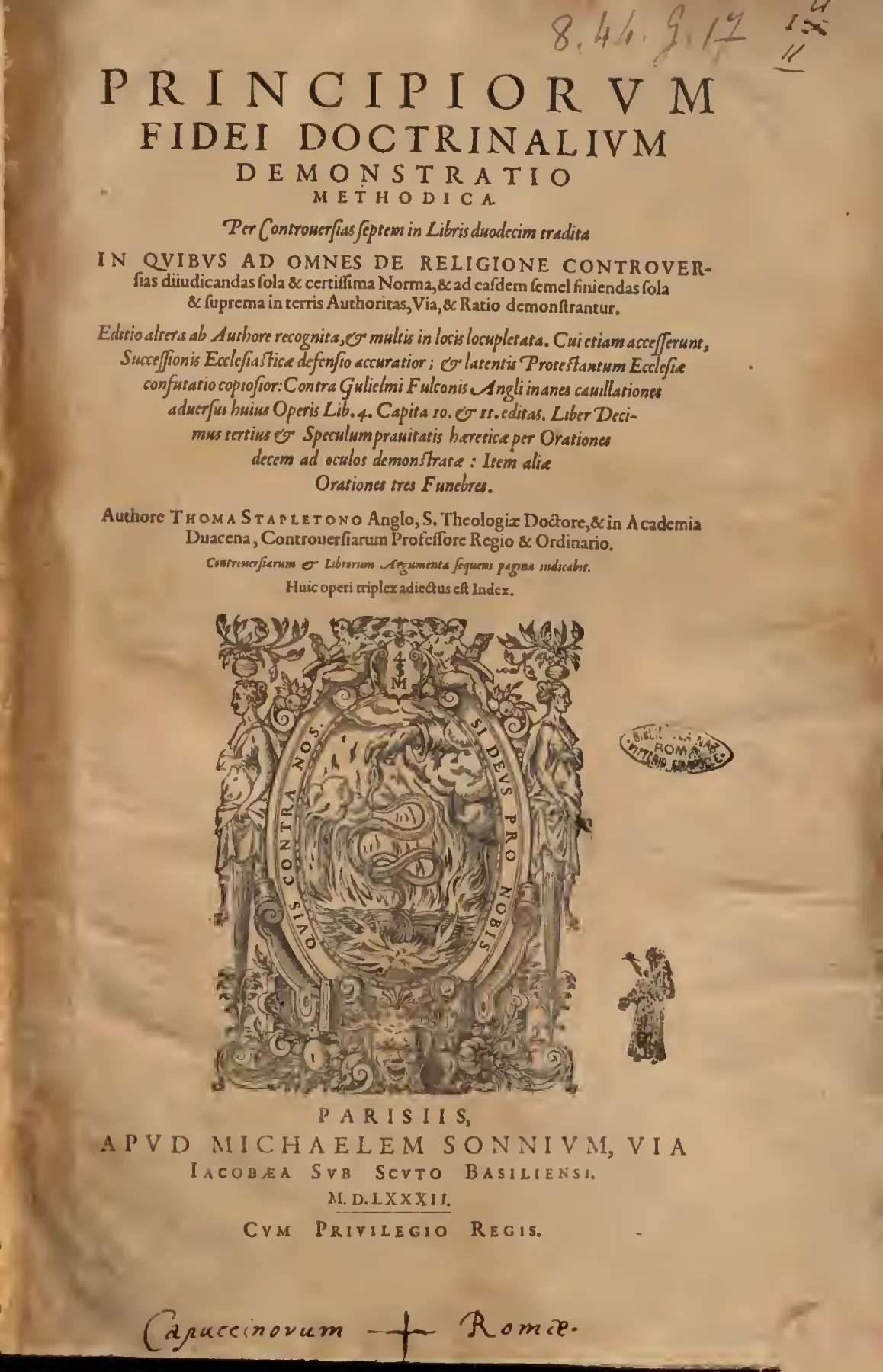
The title page of the 1582 Paris edition, printed by Michel Sonnius, presents an editio altera revised and enlarged by the author and promises a sole and most certain Norm for judging controversies. It names Stapleton royal professor of controversies at Douai and announces the appended matter, including the reply to Fulke. Source ↗.
The work announces its demand for a single rule from the title page onward. Every religious controversy is to be settled by one certain criterion, a sole and most certain Norm for judging them, given once for all, in the formula already examined among the terms of the title. The singular Norma, intensified by sola and the superlative certissima, sets the terms of everything that follows. The author does not promise a fresh catalogue of correct doctrines. He promises a criterion of judgement that is fixed, unique, and given in a single act. Even before the dedication, the printed apparatus lays out the order of the proof. The synopsis of seven controversies in twelve books moves from the Church considered in itself, through the subject and means of judgement, and only then to canon, interpretation and unwritten dogma. The front matter thus states, in the form of a table of contents, the priority the treatise will argue: the judging authority must be identified before the texts it judges.
The dedicatory epistle to Gregory XIII applies this ecclesiology to the paratext itself. Stapleton justifies offering the book to the pope by an Augustinian formula: the keys were given to Peter quia Ecclesiæ sacramentum in Petro erat, & totius, because "the sacrament of the Church," and of the whole, "was in Peter." The logic is corporate. A work written for the good of the whole body belongs by right to its head, so the act of dedication already performs the thesis of Book VI. The panegyric that follows joins the juridical primacy to personal virtue. Gregory is hailed as Vicarius amoris Christi, & alter singulari feruore Petrus, the "vicar of Christ's love" and "another Peter in singular fervour." The office the treatise will defend by argument is here shown confirmed in the person who holds it. The catalogue of his benefactions does the same work: the German, Roman and Greek colleges, the Greek version of the Tridentine catechism, and the Jubilee. Papal authority appears as an active, provident teaching power that reaches out to schismatics, Jews and the English alike.
The English section of the epistle carries the exile's grievance into nuptial typology. England, once a fair bride, has been seuerissimè compulsam, ad hanc, inquam, ita bodie deformatam meretricem, ita, "most severely compelled" to become "this harlot, I say, so deformed today." The participle compulsam matters. The apostasy is presented as imposed by royal coercion and statute, not freely chosen by the nation, and this lets Stapleton blame the regime while preserving the nation's Catholic substance. That is why the passage can turn at once to consolation. England, he claims, now holds more risque Catholicos, quàm vnius alicuius sectæ serios professores, more Catholics, at home and abroad, "than serious professors of any one sect." The comparison is chosen carefully. Catholics are not set against Protestants as a whole but against the adherents of any single sect. The fragmentation that the treatise will diagnose as the mark of heresy is thus written into the arithmetic of the dedication.
The author's preface turns this grievance into a diagnosis. Reading Hebrews 5:12, Stapleton casts contemporary Christendom as returned to the condition of infants who need milk, and he makes the heretics' failure one of perception. The hæreticorum hodie cæcitas qui Ecclesiam non vident, quàm Iudæoru[m] qui, the blindness of today's heretics "who do not see the Church," is greater than that of the Jews who did not see Christ. The comparison is deliberately shocking, and it rests on a hermeneutical claim held over until the close of Book I: that Scripture speaks more plainly of the Church than of the Messiah. A classical exemplum supplies the anthropology behind this. Plato's Egyptian priest reproached the Greeks exprobratum est, quòd pueri semper essent, senex autem Græcorum nemo, "that they were always children, and no Greek was an old man." Stapleton turns the Timaeus into an argument about authority. Inquiry without a received teaching office never reaches maturity, so private judgement, however restless, amounts to a perpetual intellectual infancy. The milk metaphor is then aimed back at the author. His book, too, offers Lac enim certè est, non solidus cibus, paruulis, "milk indeed, not solid food, for little ones." This is less modesty than an admission that the times call for a return to first teaching.
From this diagnosis follows the preface's defining judgement on the age. No earlier heresy, Stapleton holds, has done more to open the way to ruin than the present one, the heresy of today that overthrows all authority in the doctrine of religion, a judgement whose diagnostic force has already been weighed among the terms of the title. Here heresy is defined by what it dissolves, not by what it asserts, and that definition prepares the eschatological claim that such a dissolution clears the road for Antichrist. The remedy is architectural. firmiter & fortiter de nouo fundamenta sunt, si euersam penitus Ecclesiasticæ: foundations must be laid "anew, firmly and strongly," if the "utterly overthrown" edifice of ecclesiastical discipline and doctrine is to be restored. Moral reform is left to others. The controversialist's task is to rebuild the base. The reason earlier Catholic polemic failed is then stated in the Aristotelian axiom already cited, that the matter is weighed because one who errs about principles cannot be persuaded. Proofs from Scripture and the Fathers had piled up to no effect because the adversary had never granted the premises on which they rested. The axiom is the methodological charter of the whole demonstratio, and it explains why the book opens with the Church and not with any disputed sacrament.
The preface also explains why the present crisis needs this general approach. Ancient heresies attacked single articles, but hodiernæ vniuersales quodammodo sunt, & vniuersam religionem Catholicam, those of today "are in a manner universal," assailing "the whole Catholic religion." A medical image gives the claim its force: Ita quasi febris quædam Ethica vniuersum Religionis Christianæ, "thus like a certain hectic fever" heresy has taken hold of "the whole" of the Christian religion. In Galenic pathology the hectic fever was a wasting, consumptive heat lodged in the solid parts of the body. It could not be cured by treating a single local symptom, and the metaphor therefore justifies a general remedy, the locus of ecclesiastical authority, against a disease of the whole constitution. Within this frame Stapleton places his predecessors. He acknowledges that Idem præstitit Albertus Pighius vir magni zeli & acris iudicij, in libris de, that "Albertus Pighius, a man of great zeal and keen judgement, achieved the same in his books on" the ecclesiastical hierarchy. He then marks his own distinctness: Pighius demonstrated the Church's authority in general, without showing where the true Church is to be found. The tribute thus also limits Pighius's achievement. Stapleton claims for himself the further step of identification, which his order of knowing requires. The preface ends with a statement of style that is also a statement of genre. It is one thing to teach from the scholastic chair and quite another aliud in Cathedra oratoria perorare, "to perorate in the orator's chair." The plain, dictated prose of the Douai lecture hall is presented as the proper vehicle of demonstration, in contrast with the eloquence reserved for the orations bound into the same edition.
The First Controversy: The Church in Itself
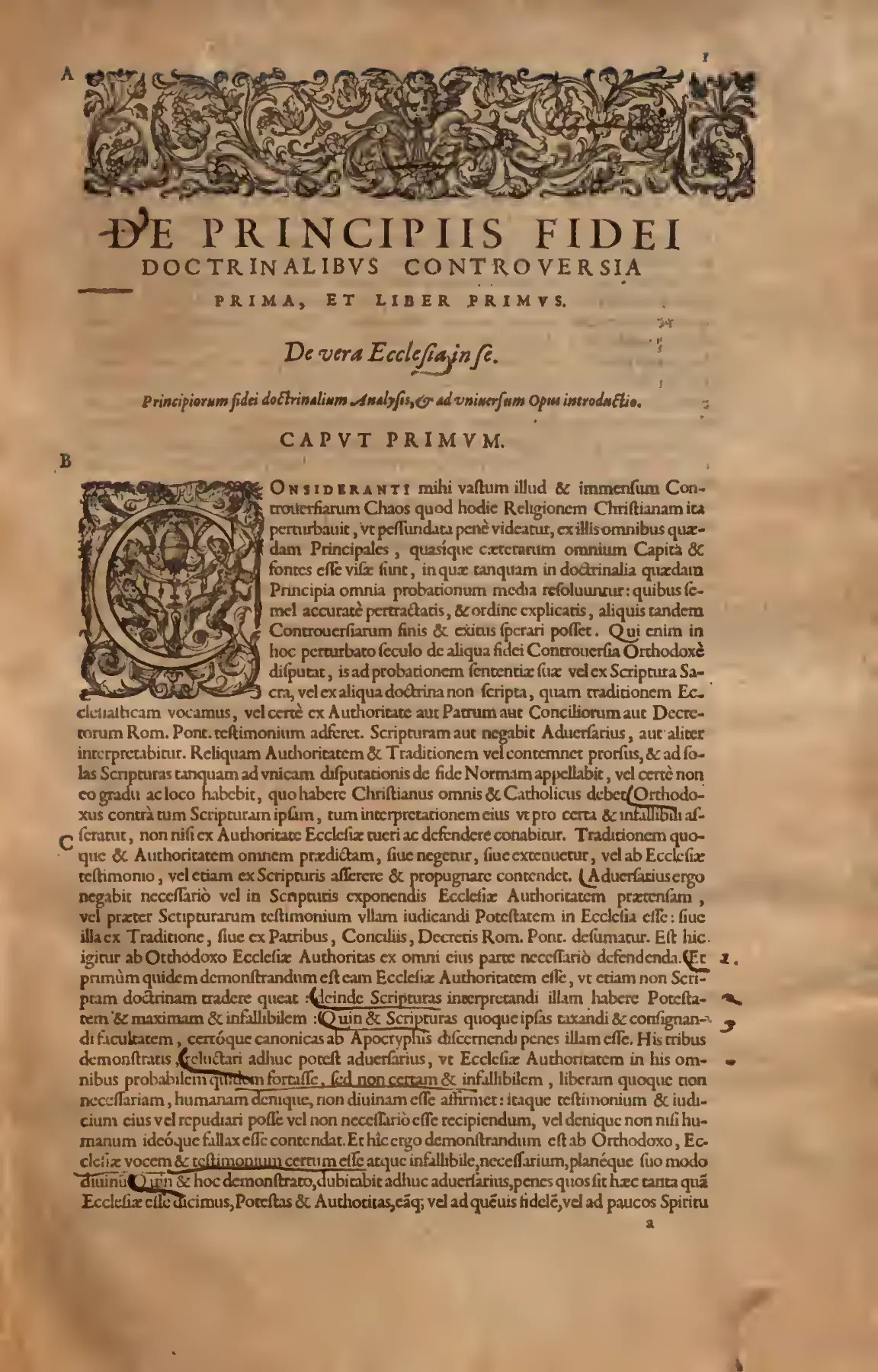
The opening of Controversia Prima, Liber Primus, headed "De vera Ecclesia in se," begins "Consideranti mihi vastum illud & immensum Controversiarum Chaos." Here Stapleton traces controversy back to its principles of proof, Scripture, tradition and ecclesial authority, and so sets the Church itself at the head of the demonstration. Source ↗.
The first book of the First Controversy opens with a reductive ambition. ONSIDERANTI mihi vastum illud & immensum Controuersiarum, "considering that vast and immense chaos of controversies," Stapleton seeks their heads and fountains. The first chapter carries out this search by regress. Each proof rests on Scripture, tradition or authority. Each denial by the adversary forces a retreat to a prior question, about tradition, interpretation, canon, the nature, subject and means of authority, and finally the location of the true Church. Exposition then reverses the order of discovery. The terminus of the regress is raised above ordinary heresy: denying the Church would deserve no more hearing estet, quàm si Christum venisse, aut Deum esse, vel res humanas curare, than if one denied "that Christ came, or that God exists, or that he cares for human affairs." To place the Church beside the existence and providence of God is to rank its denial with atheism. The status of the article is fixed in technical terms: the Church is raised, as already noted, to the rank of a transcendent and general Principle even with respect to the primary principles themselves. Particular principles such as original sin or the Trinity govern their own doctrines. The ecclesial principle governs how any of them is known. Its exact contrary is the Protestant claim solas scripturas esse sufficientissimam fidei regulam & Normam; & hoc tanquam, that "the Scriptures alone are the most sufficient rule and Norm of faith," held "as" a first principle. The Norma of the title page now meets its rival on equal formal terms, principle against principle.
The central chapters build this principle into an ecclesiology of the visible, mixed body, drawn chiefly from Augustine's anti-Donatist arsenal. The polemical identification is explicit: Non est ergo dubitandum magna ex parte eâdem esse, "there is therefore no doubt that they are in great part the same," the Lutheran and the Donatist heresy. Recasting the Reformers as revived Donatists lets Stapleton turn the Fathers' verdict on a schism of purity against the Protestant Church of the predestined or the perfect. The decisive distinction is Augustinian: Ecclesiæ vnitatem pertinent mali; ad fructuosam, ad internam vnitatem non, the wicked "belong to the unity of the Church," its corporal and external unity, but "not to the fruitful, the internal unity." Jerome's typology gives the doctrine an image, Arca Noè typus Ecclesiæ fuit, "Noah's ark was a type of the Church," in which leopards and kids, wolves and lambs are carried together. Holiness lies in faith and sacraments, not in the integrity of each member, so the Church can be numerous and conspicuous without being pure.
The argument against the Protestant notae draws all this together into an epistemological claim. Pure doctrine and right sacraments cannot be marks of the Church, because certainty must exist for me about the Teacher before it does about the doctrine which is to be sought from the Teacher, the order of knowing whose methodological weight has already been considered. To define the Church by its doctrine is, Stapleton argues, Quod perindè est ac si rogatus quis viam quæ ducit Thebis Athenas;, "just as if someone asked the road that leads from Thebes to Athens" were to answer that it is the road from Athens to Thebes. The homely image convicts the marks of defining a thing by itself. The same reasoning is put in dialectical form for the simple faithful, who know the Church without knowing the Scriptures: Ergo si per verbum innotescit Ecclesia, ignotum per, "therefore if the Church becomes known through the word," the unknown is made known through the more unknown. The stakes are stated without qualification. To err in finding veram Ecclesiam, est errare circa vnuersam fidem, quam sola vera docet, "the true Church is to err about the whole faith, which only the true Church teaches." The book closes on the providential hermeneutic promised in the preface. With Augustine, Stapleton holds Obscurius doxerunt Prophetæ de Christo, quàm de Ecclesia, that "the prophets spoke more obscurely of Christ than of the Church." Scripture is clearest where the greatest dispute was foreseen, so the comparison with Jewish blindness made in the preface is finally given its scriptural grounding. The same closing pages show the controversialist working as a philologist. He disarms a Württemberg proof-text by declaring non sunt veri Chyfostomi verba, sed ex opere imperfecto, that "these are not the true words of Chrysostom, but from the Opus imperfectum." The defence of a living judging authority does not, in Stapleton's practice, set aside the critical weighing of the patristic record.
These closing pages of the controversy on the true Church "in itself" also carry an extended simile of inheritance, and that simile sets the juridical terms for everything that follows. Christ is the testator, Scripture the written will, and the Church the heir and executor. The concession on which the analogy turns is put as something no opponent can refuse: no one doubts, he writes, that the whole Church is the heir written into God's will, Ecclesiam enim totam hæredem esse testamento Dei scriptam nemo dubitat. The device works on the reformers' own premise of scriptural clarity. If the will is clear in naming its heir, the heir's title is not in question. In the jurisprudence Stapleton is drawing on, a named heir and administrator holds the right to settle what the instrument leaves unwritten or obscure. Clarity is therefore conceded on a single point, the identity of the heir, and that concession becomes the warrant for the heir's interpretive authority over everything else.
The same logic turns a historical contingency into evidence of providential design. Christ taught briefly, in Judaea alone, and wrote nothing. Stapleton reads this as deliberate: Christ acted so as to display more fully the authority of the Church, his heir, Nempe Christus vt pleniorem Ecclesiæ & hæredis sui Authoritate ostederet. What might have counted as a gap in the written record becomes the founding act of a delegated office. The Pauline depositum, Irenaeus's image of the Church as a rich treasury, and Pseudo-Dionysius's twofold written and unwritten transmission are then gathered under Tertullian's praescriptio. This is the procedural plea by which a possessor in good title need not argue the merits with an intruder.
Tertullian's polemic is not merely cited but reapplied without adjustment. Stapleton declares that its words can be addressed, word for word, to Luther, Calvin, Melanchthon and the other arch-heretics of today, verbis Luthero, Caluino, Melanchthoni, cæterisque hodie archihæreticis dici. This collapse of historical distance is the characteristic hermeneutic of these chapters. Marcion and Valentinus become types whose antitypes have appeared at Wittenberg and Geneva, and the reformers are denied the novelty they might claim.
The book ends on a carefully balanced model of reciprocal testimony, modelled on John the Baptist and Christ bearing witness to each other. Scripture demonstrates the Church, while the Church nonetheless judges which Scripture is legitimate and canonical, and also what its sense is: nihilominus Ecclesia quæ sit Scriptura legitima arque canonica, item quis sit. The concessive nihilominus carries the weight. Scripture's evidentiary priority in proving the Church is granted, and the Church's judicial priority over canon and meaning is preserved alongside it. The asymmetry Stapleton then adds is telling. The Church, unlike the Baptist, is also "minister and dispenser," so that the reciprocity of witness leans toward the agent who administers.
The second book takes up two remaining errors, that the Church is hidden and that it consists of few. Stapleton chooses to fight ex Scripturis, on the ground his adversaries profess to occupy. His opening move updates Augustine's argument against a Donatist Church confined to Africa. He imagines how the Scriptures would have to read if they had foretold a Church in the Palatinate of the Rhine and the island of Britain, pagis, & in comitatu Palatino Rheni, & in Britanniæ insula Ecclesiam fore. The list is a confessional map of the Reformed and Lutheran territories: Geneva, the Swiss cantons, the Palatinate, Britain, Wittenberg, Prussia, Silesia and Moravia. Its rhetorical force lies in the absurdity of prophecy reduced to provincial geography. Reformation churches are thereby cast as regional bodies, structurally identical to the sects Augustine refuted.
The scriptural demonstration that follows runs from the patriarchs through the Psalms, the Prophets and the Gospel. It rests on an organic principle: the Church of God becomes more manifest in step with the revelation of Christ. Stapleton sharpens the Donatist parallel at the point where the Protestant claim exceeds it. The Donatists thought the Church had perished for barely a century, whereas his opponents today condemn the Church of the whole world for more than a thousand years, hodie totis & amplius mille annis Ecclesiam totius orbis damnant. The comparison also serves as an apology for method. A heresy that annuls a millennium must be answered with a proportionate accumulation of testimony, and Stapleton excuses on these grounds the "farrago" of texts he has assembled.
Universality, however, invites an obvious objection, and the treatment of catholicity shows the work's scholastic precision. The Church was never present in every nation simul & semel, not even in the apostolic age. Stapleton therefore borrows the distinction between becoming and being: the Church spreads like a vine through all nations in fieri, by growth and succession, & diffunditur, instar vitis per omnes gentes, in fieri (vt. This allows the Roman Church to remain catholic while embracing fewer peoples than before. Its catholicity lies in communion with what all nations once held, and in its comparative excess over any single sect when the whole world is considered. The distinction is defensive. It absorbs the territorial losses of the century without surrendering the predicate.
The reasons for visibility are rooted in Augustine's De utilitate credendi, where the remedy offered to the human race proceeds in stages. Christ first won authority by miracles, then by authority merited faith, medicinam humano generi, primùm miraculis conciliauit authoritatem, dein Authoritate meruit fi. Once miracles cease, authoritas must be carried by something perceptible: multitude, antiquity, consensus. Stapleton supplies contemporary evidence for this abiding attractive power from the Iberian missions. Just as in our own age, he writes, very many and very large nations in the so-called new world have been drawn in, fuisse sicut & nostra hac ætate plurimæ & amplissimæ gentes, in nouo, quem. The argument quietly reverses the European picture of loss. Defection in Germany and England is set against conversion overseas, and the reckoning across the whole world still falls in the Church's favour.
The third reason raises the stakes to a Christological level. Following Augustine's parallel between the manifest Christ and the manifest Church, Stapleton declares that whoever denies the Church to be illustrious and visible is no less anathema, prophetatur. Nempe qui Ecclesiam illustrem ac visibilem negat, non minus, than one who denies the Incarnation. Visibility is no longer an ecclesiological datum. It becomes an entailment of the Incarnation itself, so that a hidden Church implies a hidden Christ. The visible multitude is then treated as the reward owed to the Passion, and Optatus supplies the rhetorical climax in his challenge to those who restrict it: allow the Father to fulfil his promises; why do you set bounds, why do you fix limits? Patri promissa complere. Cur ponitis metas? Cur figitis limites?. To narrow the Church is thus figured as defrauding Christ of his inheritance, which closes the circle with the idiom of inheritance developed at the end of Book I.
The catalogue of fourteen opposing arguments, gathered from the Magdeburg Centuriators, Musculus, Melanchthon, Calvin, Luther and Brenz, is answered chiefly by one Augustinian distinction. Every text on fewness concerns the elect within the Church, not the Church itself. In Augustine's formula, already cited, the Church is not of the few, but a communion of many must be held amid the fewness of the good. The doctrine of the mixed body separates two orders. Holiness and election belong to the few and are hidden. Faith, sacraments and public vocation belong to the many and are seen. The Protestant "hidden Church" is thereby reclassified as a confusion of the invisible order of predestination with the visible order of communion. Luther's image of the devil's great chapel built beside God's Church is dismantled by a terminological retort, si sacellum, quomodo magnum?: if it is a chapel, how can it be great? Heresy is by definition the part, the corner, the latibulum.
The longest historical test is the Arian crisis, the standard Protestant instance of a Church reduced to a handful. Stapleton argues that it was a deception rather than a heresy, Western, brief and divided. He then resolves it with Hilary of Poitiers: it is proper to the Church to conquer when wounded, to understand when refuted, to prevail when deserted, hoc Ecclesiæ est vt tum vincat cùm læditur, tum intelligat cùm arguitur, tum obtineat cùm deseritur. Adversity becomes a mode of conspicuousness. The patristic material then turns autobiographical, as Hilary's warning against love of church buildings is applied to the present state of Germany and above all England, where heretics occupy the buildings, hodie de Germania, & maximè de Anglia, vbi paretes quidem occupant hæretici &. The visible Church of the exile is thereby located not in fabric and endowments but in persons. The argument for visibility is made to accommodate a dispossessed community without conceding that it is hidden, a tension the text handles but does not dissolve.
Brenz's jibe that the Creed should then read Video Ecclesiam receives a precise epistemological answer drawn from Augustine on Thomas, who saw a man and believed God. Stapleton writes that we see the Church spread everywhere in its members and parts, sic Ecclesiam vbique diffusam in membris & partibus suis cernimus, and believe it to be the true Church. Sight and faith attach to the same object under different formalities. The body is perceived; its truth is believed. The prologue to the third book consolidates the gain into a provisional definition, that the Church of God is a conspicuous multitude throughout all nations, Iam enim tenemus Ecclesiam Dei multitudinem esse conspicuam per omnes gentes, and proceeds to its next property, perpetuity in truth.
Here the polemic exploits the instability of the adversaries' chronologies. The reformers' dates for the Church's fall recede under patristic pressure from Constance to Gregory I and beyond, until defection is placed not at three hundred, six hundred or a thousand years, but at fully fifteen hundred, vt non trecentis aut sexcentis aut denique mille annis, sed totis planè mille quingentis annis,. The theory is shown to consume itself, ending in the apostolic age. Its terminal form Stapleton finds at home: a certain sect of Puritans, he reports, has arisen against the Calvinists in our unhappy England, quædam hodie Puritanorum secta contra Caluinistas in Anglia nostra. In its rejection of Fathers and councils he sees the logical consequence of the theory of "stubble" built upon a sound foundation. The possessive nostra marks the exile's voice. The Puritan is the last stage of a regress whose end is the abolition of all intermediate authority.
Indefectibility is finally modelled on the persistence of species beneath the perishing of individuals. Many particular churches have perished, yet the whole Church cannot perish, sic multæ Ecclesiæ particulares interierunt, tota tamen Ecclesia interire non potest,. The analogy concedes the loss of Africa and the East while securing the universal. The argument then turns to a regressive history aimed against Flacius's catalogue of witnesses to the truth. It asserts that before Luther's apostasy in Saxony, begun in 1517, Constat ergo ante Lutheri in Saxonia apostasiam, quæ anno 1517. coepit,, the Church stood unanimous. The claim must at once be qualified by Hus, Wyclif, the Waldensians and Berengar. Stapleton's answer is to show that these figures never formed a continuous body, and to argue that even had such a remnant existed, it could not have been the Church, since a scattered and discontinuous minority lacks the very visibility and perpetuity the preceding books have made constitutive.
The closing chapters of the third book then press the Church's perpetuity against the Protestant claim that the true Church survived the medieval centuries as a hidden company of the elect. Stapleton treats this claim as a question of definition: what form must a body possess to be a Church at all? His answer turns on public ministry, and he raises Melanchthon's objection against himself. Melanchthon, he reports, dismisses the whole apparatus of pastors and offices as a preposterous imitation of human polity, Sed vocat hoc totum Melanchthon humanæ politiæ præposteram æmulationem,. Stapleton does not reject the political vocabulary. He accepts it and changes its source. All these things, he concedes, are indeed matters of polity, Doctores, &c. Hæc omnia politica sunt, non quidem, though not a polity of human decree.
The concession is characteristic of the treatise's method. The Church's visible order is granted to be a politia in the full sense, but a polity instituted by God, so that the opponent's term of reproach becomes a description of divine law. The syllogism then closes quickly: the alleged elect wholly lacked that form, and therefore they were not the Church of God, Quâ tota formâ electi isti penitus caruerunt. Non erant ergo Ecclesia Dei. The Aristotelian language of form is decisive here. A Church without pastors is not a defective Church but a body missing the form that would make it a Church at all.
The refutation of the "secret elect" in the following chapter is built as a dilemma. If the hidden faithful professed their faith openly, history would record either their success or their suppression. If they conformed outwardly while dissenting inwardly, they fall under the Pauline requirement that confession be made with the mouth. Stapleton gives the Protestants their own justification for open separation in direct speech: truth, they say, has now been revealed to us and the light of the Gospel restored, which no longer allows us to do this, Reuelata, inquiunt, jam nobis veritas, & lux Euangelij restituta, hoc nos. The voicing turns against its speakers. If the light was restored only now, the ancestors who lacked it stand condemned.
Nor can those ancestors be rescued by the scholastic category of invincible ignorance, Inuincibilis enim ignorantia non versatur circa ea quæ tenetur quis. Such ignorance does not extend to what one is bound to know. Wolfgang Musculus's distinction between damnable and venial error fails in the same way, and it fails on Musculus's own words. Stapleton quotes him calling Rome the harlot of Antichrist and the slave of evil spirits, Vocat enim illâ Musculus scorrum Antichristi, mancipium maloru[m]. Invective of that kind cannot describe light error, so the Protestant charge must be one of total apostasy. Total apostasy is exactly what the doctrine of perpetuity rules out.
Calvin's middle position draws Stapleton's sharpest logical scrutiny. In the Institutes Calvin had allowed that churches remain within the Papacy, Ecclesias esse dico, quatenus populi sui reliquias vtcunque miserè dispersas,, insofar as the Lord preserves the remnants of his people, however miserably scattered. Stapleton calls this a monster, and he exposes it through a series of reductio analogies: offspring in a house that is not their parent's, pupils in Plato's school without Plato as master, members in a body that is not a body. The chapter ends on a grammatical point that becomes an ecclesiological one. The promise of Matthew 16 and the article of the Creed concern not members but the whole body: membris, sed de toto corpore. Credimus enim Ecclesiam non Ecclesias. Christus ædificavit, that is, we believe the Church, not churches, and Christ built one.
The singular Ecclesiam carries weight across the whole work. A rule of faith that is single and certain needs a single, identifiable bearer. A scatter of reliquiae cannot judge controversies. The same reasoning governs the treatment of Antichrist in the temple of God. If Rome were Antichrist's kingdom, it would follow that Christ himself had been taught to the Protestants by Antichrist, Christum ipsum Antichristus nos docuit. Nam à Romana Ecclesia hæc omnia acce, since Creed, Scripture and baptism were all received from the Roman Church. The apocalyptic identification fails because it destroys the very channel through which its holders received their faith.
The Prooemium of the fourth book brings the argument together. It names the three properties established so far, sunt, videlicet, Multitudo, Visibilitas, Perpetuitas: Et quicquid pro: multitude, visibility and perpetuity. It then sets out a deductive programme. The Creed's epithets are to be derived from these properties, a full definition is to be built from them, and the argument is then to pass "from thesis to hypothesis," from the Church in general to the question of where it stands today.
This is the methodical demonstratio of the title at small scale. The creedal notes are deduced from prior properties rather than simply asserted. "Catholic" is taken first, through Augustine's etymology of diffusion through the whole world, Catholica enim, inquit, appellatur, eo quòd per totum terraru[m] orbem. It is then extended into time through Vincent of Lérins's canon of what has been believed everywhere, always and by all, vbique, quod semper, quod ab omnibus creditum est. With Vincent beside Augustine, catholicity becomes a measure of time as well as place, and perpetuity and multitude are fused into one test.
The chapter on the name develops a semantics of naming in which the confessional insult is turned back on those who use it. Heresies take their names from founders, places or doctrines, while the Church alone bears a name that even heretics must use if they wish to be understood. The term Papistae, Stapleton argues, unintentionally calls Catholics nothing other than the sheep or subjects of Peter's successor, nihil aliud quàm oves aut subditos nos nuncupant illius.
His typological reading of the Fathers emerges just as clearly in the chapter on patristic prescription. Into Tertullian's question, whether liberated truth had waited for some Marcionites and Valentinians, Stapleton inserts his own parenthesis, hodie Lutheranos & Caluinistas) liberada veritas expectabat?, instructing the reader to say "today, Lutherans and Calvinists." The insertion is a small gesture of great consequence. De praescriptione is treated not as a historical record of second-century quarrels but as a juridical form that can be applied to any later claimant. This fits the juridical idiom of prescription and possession that runs through the treatise.
The full definition of the sixth chapter is the doctrinal culmination of the whole stretch. It opens, in the words already quoted in discussing Authoritas, with the Church of Christ under the state of the new dispensation as a gathered multitude. Among its clauses is the Augustinian core, the Church mixed of good and evil, elect and reprobate, and holy by faith and sacraments, & manifesta; mixta bonis & malis, electis & reprobis; fide & sacramentis. The corpus permixtum answers the "hidden elect" directly. If the Church contains the reprobate, it cannot be identified with the number of the predestined, and its boundaries must be drawn by visible profession and sacrament.
A further clause is notable for what it holds back. Stapleton names the vicar-Head, Peter's successor, only so that the Body should not seem to be defined without a Head, huius multitudinis vicario Capite, Petri successore, ne Corpus absque Capite. He reserves the question of primacy for a later book. This creates a deliberate tension. The argument is meant to end at Rome, yet the definition is kept to marks that a reader who does not yet grant the papacy could recognise. Primacy is postponed so that it does not beg the question at issue.
Stapleton defends the definition's length on epistemological grounds. It describes how the Church is known, not what it is in essence. A collective body must be known by properties proper to a multitude, and he presents the three properties as dimensions of a body, his tribus dimensionibus constans. Longitudo enim & latitudo huius corporis in. The geometrical figure gives the Church extension, and so makes it something that can be perceived. Stapleton also anticipates an objection that the figure invites. He admits that visibility and multitude may seem political rather than sacred, human rather than divine, qualitates videantur politicæ potius quàm Sacræ, & humanæ magis quàm diuinæ,.
The admission returns to the Melanchthon exchange and gives the same answer: the visible qualities are divinely ordained. The underlying justification, however, is pastoral and concerns knowledge. The Church must be known not only by the learned but also by the unlearned, Debet autem Ecclesia cognosci, non solùm à peritis sed etiam ab imperitis,. Purity of doctrine, the Protestant mark, can be judged only by experts. Here, in its plainest form, is the priority that governs the whole work, that the teacher be known before the doctrine. A mark that only theologians can verify cannot guide the infant or the unbeliever. Stapleton's illustration makes the same point: infants, adults and the wise can all tell a man from a beast, whatever their level of understanding.
The long demonstration that the Protestants are not the Church applies each property in turn. Its most effective evidence is drawn from the opponents themselves. The dated chronicle of Eucharistic controversy, running from Marburg to Altenburg, reaches its climax in Luther's anti-Zwinglian curse: cursed be such charity and concord for all eternity, Maledicta sit in omnem æternitatem ista charitas & concordia. The note of unity is thereby denied by the Reformer's own mouth.
A still more pointed self-incrimination appears in the chapter on derogation from the Church's authority. Stapleton turns to De servo arbitrio, where Luther, answering Erasmus, admits that he laboured for ten whole years to remove the scruple of hearing the Church, and that this Troy could scarcely be taken at last, Ideo ingenuè scripsit Lutherus in lib. de seruo arbitrio, respondere volens Erasmo Ecclesiæ authoritatem vrgenti, se totis decem annus laborasse, vt hanc de audienda Ecclesia serupum animo eximeret, excuteret, & superaret: & vix tandem hanc Troiam capi potuisse. For Stapleton the epic image condemns Luther. A conscience that must be besieged for a decade before it will stop hearing the Church shows that the authority it fought was natural and binding. The passage illustrates in a single figure the diagnosis of Protestantism as the overthrow of doctrinal authority.
The positive case for Rome begins from the claim that external marks are preferred because they cannot be counterfeited. Heretics have always feigned doctrine and piety, but not universality of place and time, omnes hæretici hactenus fecerunt) sed vniuersalitas locorum, & temporum,. The argument from perpetuity then reaches its rhetorical height in the papal catalogue. We can count, Stapleton writes, from St Peter down to Gregory XIII, who sits at Rome today, Numerare enim postlumus à S. Petro, vsque ad Grægorium 13, qui hodie Romæ. Succession becomes something that can literally be counted, a series running down to the present day that any reader can check.
The final movement closes the case ad hominem. Protestants grant that Roman baptism is valid. They also teach that sacraments are administered only by the true Church. Stapleton concludes that they in fact acknowledge Rome to be God's Church, Ecclesia administrari posse concedunt, profecto & ipsam quoque vetam esse Dei Ecclesiam re. The definition drawn from visible properties thus ends in a conclusion the opponents are made to supply against themselves. Stapleton then turns to their objection that Catholics are rebels usurping the magistrate's office.
With this argument from baptism the first controversy reaches its close. Stapleton presses the conclusion with Augustine's anti-Donatist taunt, recast so that a "Genevan corner" now presumes to exclude the world. He then explains why the whole architecture of the Demonstratio has turned on this single point. Win it from the adversaries today, he argues, and you will easily make a Catholic of a heretic; fail to win it, and all other labour is vain: facilè profecto ex hæretico catholicu effeceris. Hoc vnum nisi obtinueris, vanus profecto & irritus omnis alius labor erit. The sentence states the regress that governs the treatise. The controversy over the Church is not one dispute among others but the one whose resolution disposes of the rest. Every particular quarrel over doctrine is referred back to the prior question of the teacher.
The Second Controversy: The Subject of the Church's Power
That victory, however, leaves a further question open. If the Church judges controversies, which Church judges, and in whom does the power reside? Stapleton opens the second controversy by giving the Protestant grievance at full length. Having proclaimed great things of the Church's power, authority and firmness, Catholics are said at once to reduce everything to a few bishops or to the one Roman Pontiff, stripping the rest of the Church of all power: quòd quum de Ecclesiæ Potestate, Authoritate, firmitate, multa magnificè prædicauerimus, statim omnia ad paucos Episcopos, vel ad vnum Romanum Pontificem reuocemus, reliquámque omnem Ecclesiam hac omni Potestate spoliemus. The fairness of the statement is tactical. Books V and VI go on to defend exactly the narrowing the objection describes, first to the episcopate and then to the papacy.
To manage the problem, Stapleton applies scholastic faculty analysis. The power is to be considered by reason of the subject in which it inheres, or on the side of its means, vel ratione subiecti sui in quibus est; vel ex parte mediorum. Treated this way, ecclesiology becomes an inquiry into a power and the persons who bear it, not a description of a community. Against this framework he sets four Protestant locations of doctrinal judgement:
- the whole congregation;
- each believer;
- all ministers equally, the "Saxon Papacy" mocked by rigid Lutherans;
- the prince.
Each is to be overturned by an Assertion.
The first Assertion turns on the distinction on which the whole of Book V depends, already noted for its bearing on the royal supremacy: that to be unable to err in faith is one thing, and to hold the power of judging matters of faith another. The distinction lets Stapleton grant the premise his opponents most value, the indefectibility of the whole body, while denying the conclusion they draw from it. Stability in faith is a condition the whole Church enjoys. The office of judging is an activity, and it is distributed unequally. He grounds this inequality in the mode of the Spirit's indwelling. The Holy Spirit is the soul of the whole Church, chiefly and principally, sic Spiritus Sanctus est anima totius Ecclesiæ maximè & præcipuè. The analogy is Aristotelian and Thomist. The soul is wholly present in every member but does not exercise sight in the foot or locomotion in the eye. Read through it, hierarchy is no human addition to a spiritual communion but follows from how the Spirit animates it. The organic image of the soul in the body is paired with an architectural one: a house firm as a whole that takes its firmness from its foundations and pillars.
The lay consequence follows with deliberate economy. The Spirit is given to individuals so that they may believe the teaching pastor and obey revealed faith, not so that they may judge the pastor or the faith itself: dari Spiritum singulis, vt docenti Pastori credant, & fidei reuelatæ obediant; non autem, vt de pastore docente, aut de ipsa fide iudicent. Directed against Brenz, the formula removes private judgement by definition rather than by refutation. Believing a teacher and judging him are presented as different acts, and the Spirit is said to prompt only the first. Stapleton then gives this a philosophical basis that turns the Aristotelian definition of scientia into a theory of who may judge doctrine. Since to know is to know through causes, he argues, knowing belongs to the wise and few, while believing belongs to the people and to all the faithful: quia scire est per causas cognoscere, hoc sapientu[m] est & paucorum, credere autem populi & fidelium omnium. The people may hold that an article is true. Only the learned few grasp it through its causes. Elsewhere in the treatise the act of faith rests on the Church's voice; here the inequality of hearers and judges rests on the epistemology of the schools.
The third Assertion, the longest unit of the book, sets out the positive thesis. Priests lawfully ordained in the Catholic Church and keeping its unity have power to judge matters of faith and to discern true from false: Præsbyteri in Ecclesia Catholica legitimè ordinati, & eiusdem vnitatem retinentes, Potestatem habent de rebus fidei iudicandi, verúmque à falso discernendi. The two conditions, lawful ordination and retention of unity, are built to exclude two different rivals: the Protestant minister who lacks the first, and the schismatic bishop who lacks the second. Stapleton then reverses the order of dependence his opponents expect. In the printed text, which reads side for fide, the Church judges rightly of faith because the pastors of the Church do not err and judge rightly: Ecclesia rectè iudicat de side, quia Pastores Ecclesiæ non errant, & rectè iudicant. The pastors' soundness is not derived from the Church's; the Church's derives from theirs. The pastors meant are taken collectively, as those holding unity together, not this or that individual.
The objection from the moral unworthiness of prelates, pressed by Luther, Calvin, Musculus, Melanchthon and Brenz, is answered by a typology drawn from John 10. Stapleton openly enlarges an Augustinian triad into a tetrad. The Pastor is to be loved, the hireling tolerated, the thief guarded against, says Augustine; and, Stapleton adds, the wolf is to be driven off: diligendus est Pastor, tolerandus est Mercenarius, cauendus est latro, ait Augustinus; Addidetim autem, abigendus est lupus. The added clause carries the weight. The hireling, validly placed however self-seeking, must still be heard, so moral critique of the clergy cannot unseat the chair of unity. The thief, who ordained himself, and the wolf, who was ordained but has fallen into heresy, are excluded. These two categories correspond to the two conditions of the thesis. They also leave no place for the Reformation's preachers except outside the fold.
The Protestant appeal to the ancient participation of the people in episcopal elections, drawn from Cyprian and Leo, is met by redefining a single term. Stapleton holds that every vote, suffrage or election of the people was nothing other than a consent of minds, good testimony and a form of petition, quam consensus animorum, testimonium bonum, & petitionis cuiusdam forma. The people's voice survives as testimony but loses all force of jurisdiction. The argument is philological and liturgical as well as canonical: he presses the ordination rite of the Roman Pontifical and the meaning of cheirotonia as imposition of hands, though the Greek has dropped out of the digitized text.
When Brenz retreats from the question of succession to the claim that Rome is an enemy of true doctrine, Stapleton names the move in dialectical terms. Here, he says, the state of the question is shifted from succession to the Church, and the principle is also begged: Hic ergo mutatur quæstionis status à successione ad Ecclesiam, & petitur quoque principium. The charge depends on the order of the work. Because the first controversy has already established Rome as the true Church, any argument that assumes the contrary can be convicted of petitio principii.
The Protestant claim to an extraordinary apostolate, which Stapleton finds admitted in Calvin's Institutes, receives the sharpest judgement of the Assertion. We say, he declares, that this is the very voice of Antichrist, Dicimus igitur esse hanc ipsissimam Antichristi vocem. His reasoning is christological. Only Christ, as mediator of a new covenant, could end one succession and found another. To make new apostles is therefore to preach a new Christ. Here a dispute about the validity of ministers becomes an eschatological charge, and the argument from order passes into the language of the last times.
The fourth Assertion turns to the prince and to the English "Laicocephali," the "lay-headed" who make the sovereign head of the Church. Stapleton isolates the English settlement by citing Luther, Calvin and the Magdeburg Centuriators against it, and then builds a patristic and imperial consensus. Its classic text is Hosius of Córdoba's rebuke to Constantius: to you God has entrusted the Empire, to us he has committed the things of the Church, Tibi Deus Imperium commisit. Nobis quæ sunt Ecclesiæ concredidit. The argument then becomes historical and personal. A miserable example of royally determined religion, he writes, is our neighbouring England, made schismatic under Henry VIII and soon carried further under the boy Edward: Cuius rei miserabile exemplum vicina est nostra Anglia, quæ sub Henrico 8. schismatica facta, mox sub Edouardo puero. The possessive nostra shows the exile's investment in the case. The sequence of reigns serves as empirical proof of the systematic claim that a faith fixed by princes varies with each kingdom and each succession to the throne, and so cannot be a single invariable regula.
Stapleton does not, however, deny the secular arm all part in religion, and here he draws one of the finest distinctions of these books. In such coercion, he argues, assent is not compelled but restrained, Qua in re assensus non cogitur, sed eôtinetur. Temporal penalties do not produce new belief; they hold back departure from the old. The distinction lets him condemn Protestant princes who make confessions while defending Catholic princes who punish heretics. It rests on the same separation of judging from executing that governs the whole book. The exemplars of royal reform drawn from the kings of Israel are set aside by the distinction between power of order and power of jurisdiction, and by the imperfections of the Synagogue.
The sixth book moves to the "primary subject" of the power and argues that the order Christ instituted is monarchical. Its thesis completes the narrowing the opening grievance foresaw, but with the qualification already noted, which keeps the office distinct from the man: the pope may err and hold false opinions on matters of faith as a private person, but not when exercising his pastoral office. The private and public person of the pontiff stand in the same relation as the hireling and the chair of unity in Book V: the occupant's defects do not reach the office. Stapleton also builds subordination into the primacy itself. He observes that to Christ himself Peter was not Peter, that is Head, but Simon, that is obedient and subject: Nam ipsi Christo non erat Petrus, id est, Caput, sed Simon, id est, obediens & subditus. The observation turns on the names of address: Christ never calls Peter by his new name when commanding him. It forestalls the charge that the vicar displaces the Lord.
The reconciliation of Petrine headship with Cyprian's pari consortio comes in the most technical formulation of the sixth book. Peter was given preceptive power, or power of rule, while the apostles received only executive power, or power of governance: quòd petro data est potestas præceptiua seu regiminis, Apostolis autem tantùm executiua seu gubernationis. The apostles may be equal in what they can do and yet not equal in order, since one prescribes what the others carry out. The pairing repeats, at the summit of the hierarchy, the differentiation Stapleton has traced throughout these two books: indefectibility from judgement, believing from knowing, assent from coercion, order from jurisdiction. At each level, power in the Church is stable as a whole and is exercised through a determined order of bearers.
The Petrine argument reaches its exegetical centre in the commission of John 21, and the decisive move is philological rather than devotional. Stapleton reads the triple Pasce oves meas as the formal investiture of the power promised in Matthew 16 and Luke 22. He secures that reading by appealing to scriptural usage, a usage in qua Pascere & Regere pro eodem frequen, in which "to feed" and "to rule" frequently stand for the same thing. The Davidic shepherd, the pastors of Ezekiel 34 and the ruler from Bethlehem in Micah and Matthew all supply the equivalence. With it the pastoral metaphor ceases to be a figure of care and becomes a term of jurisdiction.
The distinction between βόσκειν and ποιμαίνειν works in the same direction. So does the separation of lambs from sheep, which Stapleton glosses as laity and clergy. Because the commission is unqualified, it embraces the whole flock, elect and reprobate alike. That last point quietly sustains the Augustinian mixed body against any ecclesiology of the hidden elect. Having inflated the metaphor into sovereignty, Stapleton at once guards against the inference his adversaries would draw. Peter's is a rule principatu fidei, & regimine spirituali siue Ecclesiastico; non terreno, atque pompatio, a principate of faith and a spiritual or ecclesiastical regime, not an earthly and pompous one. The defensive clause registers a real anxiety. The juridical vocabulary that makes the papacy a judge of faith borders constantly on the language of temporal dominion, which Protestant polemic attacked as a principal corruption of the Roman see.
The same anxiety governs Stapleton's handling of the episodes that seem to tell against Petrine supremacy. At the Council of Jerusalem James's ego iudico threatened to place the decisive sentence in other hands. Stapleton answers through Jerome: Auditio, inquit, Petro tacuit omnis multitudo; id est, in sententiam Petri Iacobus & omnes simul præbyteri transierunt. Once Peter had been heard the whole multitude fell silent, which is to say that James and all the presbyters together passed over into Peter's sentence. The verb transire matters, for it describes concurrence as movement into a sentence already pronounced. This is the template Stapleton will later apply to the voting of general councils, and in that sense the apostolic synod at Jerusalem prefigures Trent.
The Galatians rebuke is handled with comparable economy. Stapleton turns an embarrassment into a proof: Respondemus reprehensionem hanc Petri nihil eius vel authoritati vel stabilitati fidei præiudicasse, sed modestiam pastoralem plurimùm commendasse. The rebuke, he replies, did nothing to prejudice Peter's authority or the stability of his faith, and greatly commended his pastoral modesty. Tertullian's distinction between a fault of conduct and a fault of preaching carries the argument. It is the apostolic form of the distinction, drawn elsewhere in the work, between the pope's private failings and his pastoral office.
Into this defence Stapleton breaks with the voice of the exile. He applies a patristic complaint against false pastors to the Elizabethan episcopate: Quod sanè in nostræ Angliæ pseudoepiscopis verissimum esse, tum viginti iam fere annotum experientia docuit. This is most true of the pseudo-bishops of our England, as the experience of now almost twenty years has taught. The possessive nostræ and the reckoning of nearly two decades since the settlement of 1559 locate the writing in the late 1570s. They also show that the abstract question of the primarium subiectum of judgment was, for its author, a question about his own country. Against Calvin's charge that the papacy claimed imperium, Stapleton restates the primacy in finalist terms. It is sed authoritatem in & super Ecclesiam, idque propter summum bonum Ecclesiæ, pacem videlicet & vnitatem conseruandam, authority in and over the Church, held for the Church's supreme good, namely the preservation of peace and unity. Papal power is thereby justified by its end. That definition becomes the hinge of the later arguments from unity.
The most technically consequential material in the sixth book comes in the stretch on the discrimina between Peter and the other apostles. Here Stapleton defuses the Protestant argument from apostolic parity by a concession rather than a denial: In Apostolatu tamen omnes æquales erant. Sed ipsius Apostolatus nulla successio fuit. Finitur enim legatio cum legato, nec ad successores ipsius transit. In the apostolate all were equal, he grants, but of the apostolate itself there was no succession, for an embassy ends with the envoy and does not pass to his successors. The diplomatic image of legatio is a deliberate juridical choice. An ambassador's commission is personal and extraordinary and lapses with its bearer, and so parity can be granted without cost because it is confined to an office that dies with the Twelve.
Over against this he sets the ordinary office: Petrus verò accepit hanc plenam potestatem, non vt Apostolus, non vt missus extra ordinem, sed vt Pastor Ecclesiæ ordinarius, per suos successores perpetuò duraturam. Peter received this full power not as apostle, nor as one sent outside the order, but as the ordinary pastor of the Church, to endure perpetually through his successors. The canonistic contrast between ordinary and extraordinary jurisdiction is what makes succession thinkable at all.
The distinction already met in the reconciliation with Cyprian is then sharpened from degree into kind: Tertium discrimen est, idque maximum, quòd petro data est potestas præceptiua seu regimenis, Apostolis autem tantùm executiua seu gubernationis. The third and greatest difference is that Peter was given preceptive power, the power of rule, while the apostles had only executive power, the power of administration. The opposition between commanding and executing transfers into ecclesiology a distinction familiar from the theory of princely sovereignty and its delegated magistracies. Calvin's objection from Peter's own exhortation to the presbyters is met by exactly this analogy, that of the king who delegates without sharing.
The same stretch exhibits Stapleton's conscious method as a reader of sources. Of the Protestant appeal to Cyprian's pari consortio he complains, Hoc fragmentum ripiunt Protestantes, nec sensum quo dicta sunt, vt iam explicare capimus, quicquam curantes. The Protestants snatch this fragment, caring nothing for the sense in which it was said. The printed ripiunt stands for rapiunt. His remedy is to transcribe the whole passage of the De unitate, and in doing so he answers fragmentary citation with integral quotation. This is the philological counterpart of the larger claim that Scripture itself must be read in a context, and that context is supplied by the Church.
The arguments for succession that follow rest on the semantics of office-names. The first ratio reads Ephesians 4 typologically: Solus pastor, quia Ecclesia oviile est, perpetui officij nomen est, quo carere Ecclesia nunquam & nusquam potest. Only "pastor", because the Church is a sheepfold, is the name of a perpetual office, which the Church can never and nowhere lack. Apostles, prophets and evangelists may pass, but a fold without a shepherd is a contradiction in terms, and the image thus generates institutional perpetuity.
Calvin's reductio, that no single prefect could govern the whole world, provokes Stapleton's most revealing concession. He allows that civil polity legitimately varies among monarchy, aristocracy, democracy and oligarchy, but he denies any such latitude to the Church: Ar in Ecclesia Christi, vnitas fidei, sacramentorum & doctrinæ vni formitas, non solum possibilis ac co[n]ueniens, sed & summè necessaria est. In the Church of Christ, unity of faith and uniformity of sacraments and doctrine is not only possible and fitting but supremely necessary. The printed Ar is a misreading of At. The asymmetry is instructive. Stapleton has no stake in a single temporal order and freely grants political pluralism, so long as the doctrinal order is exempted from it. That exemption is the whole substance of his ecclesiology.
The charge that papal headship injures Christ is answered by the scholastic distinction between two heads, which Stapleton presents as one his adversary already knows: Agnoscit nos hic distinguere inter Caput vnicum proprium, principale, vitale; & caput ministeriale. Calvin, he says, knows that the Catholics distinguish between the unique, proper, principal and vital Head and a ministerial head. Calvin is thereby convicted of begging the question rather than refuting the distinction.
The objection from the silence of Ephesians 4 receives an answer that compresses the hermeneutic of the entire treatise. Stapleton invokes Augustine's rule, Solere scripturam breuatis causa multa tacert, quæ ex serie traditionis sunt intelligenda: Scripture is accustomed, for brevity's sake, to pass over many things that are to be understood from the series of tradition. The argument from silence fails because silence is never final where tradition speaks. Stapleton presses the point further by noting that English Puritans used the same argument against archbishops. Conformist divines then refuted them as Catholics refute Calvin, so that the Protestant objection is shown to dissolve within Protestantism itself.
The patristic dossier that closes the book culminates in Augustine's verdict on the Pelagian cause: Iam de hac causa, duo Concilia missa sunt ad Sedem Apostolicâ; Inde etiam rescripta venerunt, Causa fuita est. Two councils have been sent to the Apostolic See on this matter, rescripts have come back from there, and the case is finished. The printed fuita stands for finita. The formula causa finita is the purest expression of the juridical idiom of the work. Doctrinal controversy is cast as litigation and the Roman see as the court beyond which no appeal lies.
The Third Controversy and the Nature of the Church's Voice
With the opening of the third controversy the inquiry turns from who judges to by what means. The new term of art is announced in the heading De Mediis Iudicij Ecclesiastici, on the means of ecclesiastical judgment. Its first function is to protect the infallible judge from the charge of illuminism. The Church does not judge sed solis vel Enthusiasmis & afflatibus à Deo expectandis, vel (quod deterius est) priuatis animorum sententiis ac iudiciis, relying solely on enthusiasms and inspirations awaited from God, or, what is worse, on the private opinions and judgments of minds. The pairing is polemically pointed. The two rejected alternatives, enthusiastic inspiration and private judgment, are precisely the two foundations Stapleton attributes to his adversaries, so that even infallibility is described as working through determinate instruments.
The first of these instruments is the regula fidei, which Stapleton deliberately widens: Sed latius adhuc patet regula fidei, quàm Apostolorum Symbolum, & eam omnem doctrinam significar,. The rule of faith extends further than the Apostles' Creed and signifies all that doctrine publicly received from the apostles. Its operation is a test of conformity, not of demonstration: Quod enim ab illa publica fide aberrare conperitur, illud certissimè falsum; quod ei conuenire ostenditur, indubitata veritas iudicabitur. Whatever is found to stray from that public faith is most certainly false, and whatever is shown to agree with it will be judged undoubted truth. Vincent of Lérins then supplies the ethic of the guardian, and Stapleton adopts his rhetoric wholesale. The custodian of the deposit is one who non Author debes esse sed custos; non institutor, sed sectator, non ducens sed sequens, who must be not author but guardian, not founder but follower, not leading but following. The triple antithesis fixes the image of doctrine as a trust held on deposit, which can be kept or betrayed but never improved.
The councils are presented as the most celebrated of the means, and here the polemic becomes most direct. Against sola scriptura Stapleton insists, in the formula already cited in summary of the whole work, that a text cannot adjudicate its own disputes: an interpreter and judge of living voice is required, and for Christians that can be none other than the Church itself. Against the objection to majority voting at Trent he distinguishes two phases of conciliar sentence: Deliberatiua enim Sententia certè plurium est: definitiua autem Sententia omnium est. The deliberative sentence belongs to the majority, but the definitive sentence belongs to all. The definitive phase is the Jerusalem pattern of transire once more, in which the minority passes over into the common sentence.
A depiction of the Council of Trent, catalogued on Wikimedia Commons as "Council of Trent (Chemnitz)." Trent is the council Stapleton defends as the Church's living judge, distinguishing the deliberative sentence of the majority from the definitive sentence that belongs to all. Source ↗.
.jpg)
The Protestant demand for impartial judges is dismissed by reductio: Certè si non partiales vultis hoc examen facere, christianum orbem exire debetis. If you want non-partisans to conduct this examination, you must leave the Christian world. Stapleton's reinterpretation of præiudicium lies behind the retort. Bishops necessarily arrive with an inherited judgment, and that prior judgment, far from vitiating a council, is the mark of its fidelity to the rule. The judging office is then confined to the episcopate by Chalcedon's acclamation, Synodus Episcoporum est, non Clericorum: superfluos foras mitte: the synod belongs to bishops, not clerics, so send the superfluous outside. Theologians and presbyters are left a consultative voice and lay officials the roles of witness and executor.
The treatment of the Fathers as a means requires a careful concession. Stapleton adopts Augustine's graded scale of error, Homines sumus. Vnde aliquid aliter sapere quàm se res habet humana tentatio est: we are men, and so to think otherwise than the matter stands is a human temptation. This allows individual Fathers to err on disputed points while their consenting witness to the public rule of faith remains secure.
The final means in this sequence, the consent of the faithful people, is introduced through Augustine against Julian. Stapleton cites the universal knowledge of what baptism remits, a knowledge shared by Diuites & pauperes, excelsi atq[ue] infimi, docti atque indocti, mares & foeminæ nouerunt, quid eniq[ue] ætati in baptismate remittatur. Rich and poor, high and low, learned and unlearned, men and women all know what is remitted to every age in baptism. Yet Stapleton grades this evidence with precision. It is a Medium autem non quidem semper certissimum, & demonstratiuum, probabile tamen & suo loco ac tempore sufficiens & validum, a means not always most certain or demonstrative, yet probable and, in its proper place and time, sufficient and valid. The qualification is characteristic of the whole design. The voice of the many is admitted as evidence of the faith, but it is ranked below the episcopal and Roman judgment that alone closes a cause, and so the hierarchy of means reproduces the hierarchy of subjects established in the preceding book.
The case from the testimony of the faithful people is developed at length, as Augustine, Basil and the hymns of the early brethren are made to show that popular devotion witnessed to doctrine. Stapleton refuses to let this concession become a lay share in judgement. He adopts Thomas Netter's view that the laity are contained within the Church's faith, but he turns on Melchior Cano for reading Waldensis as if Canus, quasi laicus Iudicium fidei tribuere voluerit. Longè enim res alia est,. On this reading Cano would have Netter grant the layman the judgement of faith, whereas, Stapleton insists, bearing testimony on a doubtful matter is something quite different from passing sentence on it.
The distinction is not incidental. It reproduces, at the level of the people, the juridical separation between witness and judge that governs the work's entire theory of authority. The laity belong among the media of ecclesiastical judgement, never among its subjects. That the correction is aimed at a fellow Catholic shows Stapleton policing the internal coherence of his own camp, not merely repelling Protestants.
The preface to the eighth book then shifts from the location of judging power to its nature in itself. Having settled what and where the Church is, in whom its power resides and by what means it judges, Stapleton now asks whether the Church's voice is free or binding, probable or certain, and infallibilis; denique humanâne tantum, an etiam quodam modo diuina: infallible, and finally whether merely human or in some manner divine. The cautious quodam modo is a deliberate hedge. It reserves a space between a purely human report and a divinity that would make the Church a rival author of revelation, and the whole book is spent defining that intermediate mode.
Before reaching his thesis, Stapleton lays out a taxonomy of error that maps the confessional divisions with polemical economy. The rigid Lutherans opposed to the Interim are Antadiaphoristæ nuncupati. In Anglia hodie Puritani vocantur, named Antadiaphorists and in England today called Puritans. The identification binds the Flacian party of German Lutheranism to the English nonconformity Stapleton knew from exile, and it folds a domestic quarrel into a continental genealogy of error.
Against Schwenckfeldian immediatism, strict scripturalism, Melanchthon's softer view and Pelagian self-sufficiency, as well as certain scholastics who vel eandem nimium extollunt vt posteriores. Vna est media & sana sententia,, those who exalt the Church's voice too much, he declares that there is one middle and sound opinion. The posture of moderation is rhetorically significant. The thesis that follows is uncompromising, yet it is presented as a mean between Protestant depreciation and scholastic excess. This lets Stapleton claim the authority of balance while advancing a maximal claim for the Church's voice.
The anthropological premise beneath that thesis is stated compactly. Stapleton observes that heretics die readily for falsehood because quàm adhæret errori. Error enim in rebus fidei est consentaneus naturæ,: error in matters of faith agrees with nature, whereas the truth of faith exceeds it. Fallen nature therefore inclines toward heresy, and assent to supernatural truth requires both an infused habit and external help.
The fourth and fifth chapters carefully separate absolute from ordained necessity. Infused faith could, absolutely speaking, produce assent without any teacher, as with the patriarchs or Antony the Hermit, and this lets Stapleton deny Calvin's charge that Catholics bind God to the Church. By God's ordinance, however, terna media illi contemnenda non sunt. Contemptor enim eorum veram fidem nullo: those external means are not to be despised, for their contemner can in no way have true faith. The Augustinian formula for the despiser of the sacrament is transferred wholesale to the teaching office. The Church's voice thereby acquires a quasi-sacramental standing: one may be sanctified invisibly, but not in contempt of the visible ordinance.
The positive thesis of the book follows. The Church's voice functions in fide, vt sit medium ad credendum planè necessarium, infallibile & diuinum,, as a means to believing that is wholly necessary, infallible and divine. This triad structures the remainder of the controversy.
Calvin is engaged through close reading of the Institutes. Stapleton tracks how praise of the ministry slides toward the written word alone: cuius ministerium illis est commissum. Ecce iudicium de rebus fidei non iam in, behold, judgement on matters of faith is no longer placed in the ministers to whom the ministry was committed. The exposure of this sleight is then personalised. Calvin is a man who multa quidem in vtramque partem videt, sed quid concludat aut resoluat, non, seeing much on either side but not what he should conclude or resolve. Dialectical subtlety is thus recast as the very indecision that a living judge exists to cure.
The argument from human infirmity, drawn from Augustine's De utilitate credendi, gives authority an epistemic office. In Stapleton's citation of Augustine, sola est authoritas (ait August.cap.16.libri citati) quæ commouet stultos, vt ad: authority alone moves fools to hasten toward wisdom. The Church is the wise man to whom the foolish must submit. In the controlling image of the book, she is a lamp: verbi Dei. Talis quoque lucerna nobis est Ecclesiæ vox & testimonium, such a lamp of the word of God to us is the voice and testimony of the Church. The lamp suits the argument closely. It serves eyes too weak for the sun without being the sun, and so prepares the later refusal to make the Church the formal object of faith.
The Thomist core of the controversy appears in the chapter on divine ordinance. Stapleton distinguishes the two habits by their formal aspect: science regards de Deo vt est; fides vt verax est. Hinc ergo sequitur, vt ratione fidei,, God as he is, faith God as truthful, and from this the formal ground of faith follows. If faith adheres to God as the first truth revealing, every created voice must be located in relation to that revelation, not beside it. Stapleton's solution is that Scripture and the Church's voice are not rival authorities: per quam Deus reuelat. Totum enim hoc, vnum est medium; sicut quoddam, the whole is one means through which God reveals, like an aggregate of partial causes. The technical formula follows, already cited for its account of the voice of the Apostles and of the Church, or even of Christ incarnate, as the condition and mode of God speaking. The aggregation of Scripture and Church into a single medium is the conceptual pivot of the entire work. It denies the Protestant disjunction between written word and living voice by refusing to treat them as separable sources.
Scripture is then explicitly demoted to the material order. It is not obiectum aliquod fidei formale, siue medium per quod credimus, sed est, not some formal object of faith or the means through which we believe. The Pauline vocabulary is recruited to the same end: the Apostle Obedientiam vocat ipsam fidem, qua prædicationi Apostolicæ credebant, calling faith itself obedience, by which the hearers believed the apostolic preaching. If faith is obedience to preachers, then unbelief is disobedience, and the Mosaic narrative of Numbers is read to show that id est, primæ veritati testificanti fides non habetur, quando testibus eius: faith is withheld from the first truth bearing witness when its witnesses are not believed.
The movement from necessity to infallibility turns on a single argument from the purpose of the remedy. A fallible guide for the infirm would be a fraud: Alioqui enim, ignorantiæ non succurritur, sed imponitur, for otherwise ignorance is not relieved but deceived. Divine providence cannot have instituted a deceiving aid, so the medium must be unerring. The Church is accordingly named Christi, Sponsa Christi, veritatis denique Columna & firmamentum, the bride of Christ and finally the pillar and firmament of truth.
Stapleton's account of how infallibility operates is notably concessive. Pastors, he holds, autem conclusione diuinitus adiuvantur, ideóque eorum doctrina in Mediis est: they are divinely assisted in the conclusion, and therefore their doctrine is discursive in its means and prophetic in its conclusion. This disarms Protestant attacks on weak patristic or conciliar arguments by conceding them, while placing the conclusion beyond reach.
The consequence for the ordinary believer is stated without softening: Quæ quum ita sint, bonus Ecclesiæ filius, docentem Ecclesiam securus & tutò, this being so, the good son of the Church will hear the teaching Church securely and safely. The faithful are not to audit the procedures by which the Church reaches truth. Zacharias, punished for asking how he might know, is the cautionary type.
The distinction between Apostles and successors gives the theory a hydraulic shape: Apostolorum Authoritas fontana fuit, successorum translata aut derivata est,, the Apostles' authority was a fountain, that of the successors transferred or derived. Hence the Church of the successors, in the formula already cited, is only witness and not also author of what is to be believed, as the Apostles were. The same water flows in the stream as at the source, but the stream does not originate it.
This explains why councils publish decrees rather than demonstrations. Huius autem rei & alia causa est. Ecclesia non docet ex arte, sed ex: there is another cause, that the Church teaches not from art but from authority. The political corollary is weighty. The apostolic principle of obeying God rather than men is conceded against princes, obedire oportet ego, quàm hominibus. Ecclesia verò, quia non ratione, sed Authoritate, assistetia,, but denied against the Church, which rests not on reason but on authority and divine assistance. For an English exile writing under a Protestant crown, the asymmetry licenses resistance to secular command in matters of faith while foreclosing any appeal of conscience against the Church.
The third term of the triad, the divinity of the Church's voice, is established by mode rather than origin. Ecclesiastical laws are human and dispensable because in making them the Church acts as a prudent pastor. In doctrine, by contrast, she fidem de nouo non condit; sed veterem promulgat, vt à nobis acceptetur:), founding no new faith but promulgating the old for our acceptance. Her ministers are therefore instruments, and the act is diuinus actus est. Non enim homines sed Deus per homines loquitur, a divine act, for it is not men but God through men who speaks. The examples of Balaam's ass and Caiaphas press this doctrine of instrumentality to its limit. The worthiness of the speaker becomes irrelevant to the divinity of what is spoken.
The chapter on the Church as mother then gives this juridical structure an affective, generative register. Obstetric and nursing imagery culminates in Cyprian's maxim, Habere iam non potest Deum patrem, qui Ecclesiam non habeat matrem: he cannot have God for father who does not have the Church for mother.
The controversy closes with its most delicate move, a limit placed on everything it has claimed. Augustine's celebrated sentence, already cited, that he would not believe the Gospel unless the authority of the Church moved him, appears not as Stapleton's banner but as an objection. It is cited among the arguments of those who would resolve faith finally into the Church. His answer locates the Church precisely: it is not the case that by her ipsum fidei lumen infunditur, sed manifestatio fidei sit per Ecclesiam, that the very light of faith is infused, but rather that the manifestation of faith comes through the Church. The lamp image returns here in its strict sense. Interior teaching is likewise reserved to God, for Cashedram in eælo habet qui corda docet, he who teaches hearts has his chair in heaven.
Yet this qualification sharpens rather than softens the polemic against Scripture as self-interpreting: Verbum enim Dei non loquitur, sed per locutionem auditur: non dicit, sed dicitur:, the word of God does not speak but is heard through speaking, does not say but is said. A text needs a voice. The heretic, whose very name signifies choosing, is one who hears that voice only on conditions of his own. Pacian's formula, Christianus mihi nomen est, Catholicus verò cognomen, Christian is my name and Catholic my surname, supplies the badge that separates the obedient from the selective.
The concluding definition narrows the bearer of judgement decisively. It resides with the Church Catholicæ & Apostolicæ Romanæ: non in toto suo Corpore aut quouis Corporis, the Catholic and Apostolic Roman Church, not in its whole body or any member of it, but in its pastors and chiefly the pope. The indefectibility of the whole and the judging office of the few, separated at the outset in the matter of lay witness, are thus formally reunited at the close.
Canon, Interpretation and Unwritten Tradition
The opening of the ninth book applies this apparatus at once to the canon. Calvin's charge that Catholics subject God's truth to human verdict is answered by the quoad nos distinction in its plainest form: Nunc autem Ecclesia non facit vt vera sint; sed vt pro veris credantur. The Church does not make the scriptures true but makes them believed as true. The sentence compresses the whole preceding controversy, in which the Church is witness and condition, never author, and yet remains the only means through which the truth of the books becomes known.
The refutation of Calvin continues, and its first decisive sentence compresses the whole epistemology of the treatise into the antithesis already cited among the terms of the title: Scripture is one of the things believed, whereas the voice of the Church is the rule of all things believed.
The force of the formula lies in its change of logical category. Scripture is moved from the rank of principium, the undemonstrable starting-point that Calvin's fifth argument had claimed for it, to the rank of creditum, an object of faith alongside others. The rule that measures all such objects is assigned to a living voice. Stapleton then blunts the obvious rejoinder that the Church is thereby made the author of God's word. He does so with a scholastic distinction between essence and existence as known to us. The Scriptures are demonstrated through the Church not as to what they are but as to the fact that they are, so that they may be accepted by us, not so that they may subsist as sacred and divine in themselves: Sic Scripturæ per Ecclesiam demonstrantur non quid sunt, sed quia sunt: vt à nobis videlicet acceptentur non vt in seipsis sacræ & diuinæ subsistant. The Aristotelian contrast between knowing quid and knowing quia thus carries the whole weight of the reply. The Church's demonstration is confined to the order of reception, and the sanctity of the text is left untouched in itself.
The chapter closes with a retorsion that is characteristic of Stapleton's polemical economy. The Schwenckfeldians and Anabaptists had turned against Calvin's Scripture-principle the very objection Calvin raised against the Church: that the Spirit is dishonoured if it is measured by something else. Calvin answered them that the Spirit is not dishonoured by comparison with its own image. Stapleton takes over that answer and transfers it, observing that the same Spirit of God who speaks in the Scriptures speaks through the Church, Idem enim Dei spiritus qui in Scripturis loquitur, per Ecclesiam loquitur. The argument is formally a tu quoque, but its substance is pneumatological. If Scripture and Church share one speaking Spirit, then testing the canon by the Church is, on Calvin's own premises, the Spirit compared with itself.
The fourth chapter converts this defensive position into a positive assertion, set in the juridical vocabulary that gives Book IX its running head. The Church's authority must seal the canon of the Scriptures, Necessarium esse, vt Ecclesiæ authoritas scripturarum canonem consignet. The verb consignare is the language of the notary and of the last will. It means to ratify a document that already exists, not to compose it. The proof is again drawn from the logic of the schools: every proof proceeds from what is better known, Probatio enim omnis à notioribus procedit. Scripture, being the thing in question, cannot be better known than itself.
Stapleton then refines the point with a distinction of some theological delicacy. No written sacred book is the immediate voice of God; it is the word of God, one of the things believed as pronounced by God, Non est enim scriptus aliquis liber sacer, immediata Dei vox, sed est verbum Dei;. The separation of immediata vox from verbum places the written text at one remove from revelation. Its divine origin is therefore a matter of testimony, like any other article. The "grave question" Stapleton raises against himself belongs to this movement: could the Church not be denied as easily as Scripture? His answer is that one who wholly denies the Church is no Christian at all, whereas many Christians are ignorant of Scripture. The answer reveals the intended audience. The demonstration is addressed to the body of believers and to the judgement they owe assent to, not to the persuasion of pagans.
The catalogue of apocrypha that follows is more than an inventory. It sorts disputed writings into books once held sacred by some, heretical forgeries, and heretical mutilations of genuine books. This tripartite scheme supports an exercise in heresiological genealogy. Stapleton places the Protestant critical stance toward the canon in direct line with Faustus the Manichaean as Augustine reports him. This, he declares, is today the faith of the Lutherans and of all Protestants: not to believe, but to test, Hæc est hodie Lutherana & omnium Protestantum fides; non credere, sed probare;. The antithesis of credere and probare is aimed with precision. To make faith wait on examination is, in his terms, to reverse the order of the believing act.
The Calvinist alternative is then dismantled through a single substitution. Calvin had said that Scripture is discerned by the voice of the Lord in the Scriptures. Stapleton reproduces the formula and exchanges the final term: it is discerned by the voice of the Lord in his Church, in which and through which he wills to be recognized by us, Discernitur autem voce Domini in Ecclesia sua, in qua & per quam vult à nobis recognosci. The method of the whole controversy is visible here in miniature. The adversary's own words become the vehicle of the Catholic thesis.
Against the "Babylonian confusion" of pagan philosophy, where no public authority ever settled a dispute, Stapleton sets the judicial institutions of Synagogue and Church in a terse double negative. It was not so with the Israelites of old, and it is not so with Christians today: Non sic olim Israëlitæ. Non sic hodie Christiani. The parallel gives the Church the forensic character of the Mosaic tribunal. A dispute over Scripture is a cause that a competent court brings to an end.
The sixth chapter introduces the technical vocabulary for which the treatise is remembered. Its tentative potential subjunctive gives the coinage the air of a proposal rather than a decree. Books always held canonical "you might rightly call Protocanonical," quos meritò Protocanonicos dixeris. Those received later "you might not badly call Deuterocanonical," no[n] male Deuterocanonicos dixeris. The two terms give historical form to the earlier distinction between in se and quoad nos. They record differences in the time of reception, not degrees of inspiration.
The patristic dossier assembled behind them reaches its locus classicus in Augustine against the Manichees. In the full form in which Stapleton cites it, Augustine says he would not believe the Gospel unless the authority of the Catholic Church moved him: Ego Euangelio non crederem, nisi me Ecclesiæ Catholicae commoneret authoritas. Calvin and Musculus read the sentence as spoken in the person of an unbeliever. Stapleton's six counter-arguments insist that Augustine speaks as a believer and in the present tense. If the dictum describes a permanent condition of Christian faith, it cannot be dismissed as a stage of conversion that is later left behind.
The eleventh chapter then raises the rule of faith above Scripture itself as the measure for discerning true books from false. Stapleton holds that the Scriptures are not so much the rule of faith in themselves as that the presupposed and pre-existing faith of the Church is, as regards our acceptance, the rule of the Scriptures: non tam ipsius fidei Regulam in se esse Scripturas, quàm ipsarum Scripturaru[m] Regulam (quoad acceptationem nostrâ) esse fidem Ecclesiæ præsuppositam & præexistentem:. The bracketed qualification is the hinge of the sentence. Without it the claim would subordinate God's word to men; with it, the claim concerns only the order in which believers come to know. The parenthesis therefore marks the limit within which Stapleton's inversion of the Protestant ordering is meant to hold. The same passage prepares the later defence of unwritten tradition, since a faith that pre-exists the writings cannot depend on them alone.
The closing assertion of Book IX applies this reasoning to the present Church. It is directed against Catholic dissenters such as Durandus, Driedo and Netter, not against Protestants. Stapleton separates doctrine new in substance from doctrine new only in explicitation, and on that basis he can say of the canon, in the sentence already cited, that it grew like the rest of the faith, not in itself but in our acceptance. The principle permits a striking concession. The Church might still canonize a book never condemned, for example the book of Hermas, disciple of Paul, inscribed with the name Pastor, Exempli causa librum Hermæ discipuli Pauli, Pastoris nomine inscriptum,. The example shows how seriously Stapleton means the claim that the canon is closed for us by the Church's act. The power of consignation is not exhausted in antiquity but persists while the "fullness of time" lasts, which he extends to Christ's return.
Book X shifts from the identity of Scripture to its sense. Its prooemium limits the inquiry with a distinction that governs everything that follows. Exhortatory or speculative exegesis is left to the doctors, and only interpretation necessary for faith and binding upon it is claimed for the Church. This, finally, is scholastic, that is Catholic: Hoc denique scholasticum est, illud Catholicum. The contrast separates probable opinion from obligatory belief, and with it the learned exegete from the judging Church.
The necessity of such a judge is grounded in a patristic definition of heresy as wrong sense rather than wrong text. Hilary supplies the formula that heresy concerns understanding, not Scripture, and that the sense, not the word, becomes the crime: De intelligentia hæresis est, non de scriptura: sensus non sermo fiet crimen. On this definition, possessing a correct text in the wrong hands secures nothing. Against it Stapleton sets Luther's axiom from De servo arbitrio, Ego de tota Scriptura dico: nullam eius, "I say of the whole of Scripture: no part of it" do I wish to be called obscure. He then traces Luther's successive retreats: from perfect clarity to merely grammatical obscurity, then to the reader's blindness, and finally to a distinction between the pious and the impious. Brenz and Flacius are shown conceding against themselves that interpreters are needed. Each retreat is presented as an implicit admission of the judge whom Luther refuses.
The polemical centre of the book is the spiritus priuatus. Stapleton defines it broadly, so that pastor, doctor and layman fall under it alike: he gives the name private spirit to one who excludes the common sense of the Church, Priuatum autem spiritum hic vocamus, vel qui communem excludit,. Among his seven reasons against it, the deepest is drawn from the Confessions. Augustine had written that the truth of God is neither his, nor this man's, nor that man's, but belongs to all: Veritas, inquit, tua Domine nec mea est, nec illius, aut illius, sed omnium,. Here the argument becomes ontological. Truth of faith is common by nature, and to privatize it is already to falsify it.
The fifth chapter draws the social consequence of the earlier claim that the teacher is known before the doctrine. The faithful are commanded throughout the Gospel to beware of persons rather than of doctrine, iuberi passim in Euangelio fidelem populu[m], de personis cauere magis quàm de doctrina. The justification rests on a division of offices in knowing. Judging doctrine belongs to art and industry, which are of the few, whereas recognizing legitimate teachers belongs to faith, which is common to all: Nam hoc artis & industriae est, quæ paucorum est: illud fidei, quæ omnium communis est. The appeal to what is common to all thus serves a hierarchical end. The simple believer is released from exegetical judgement precisely by being bound to recognize authority.
The Protestant appeal to Paul's charismata in 1 Corinthians and Romans is answered by turning the image of the body into an ecclesiology of office. This is the true and very unity of the Church, Stapleton writes: that the spirit of interpretation and teaching be given only to those whose office it is to interpret and teach, Nempe hæc est vera & ipsissima Ecclesiæ vnitas, vt non aliis Spiritus ille interpretationis & docendi detur, quàm quibus ex officio interpretari & docere incumbit. On this reading the gift follows the vocation. The English "prophesyings," which Stapleton discusses together with the resistance of the archbishop of Canterbury to their suppression, are thereby classed as a usurpation of office.
The closing chapters of Book X set the relation between learning and authority in a military figure. Nothing is more dangerous, Stapleton warns, than to fight with the arms of erudition outside the rampart of faith, Nihil est enim peticulosius, quam eruditionis armis extra vallum fidei pugnare. He concludes that the citadel and bulwark of faith is the authority of the Church, Arx ergo & propugnaculú fidei est Ecclesiæ Authoritas,. The figure assigns humanist and scholastic learning a necessary but subordinate place. Learning supplies the weapons, but it fights only from within the walls.
The opening of Book XI carries the argument from the judge of interpretation to its means. Its first principle is that orthodox faith must precede the understanding of Scripture. Against Luther's claim that the Spirit is found in the text itself, Stapleton reverses the direction of the hermeneutical act: this Spirit of God is therefore not to be sought in the Scriptures but brought to them, Non ergo in scripturis quærendus, sed ad Scripturas afferendus est hic Spiritus Dei. The sentence completes the inversion this whole stretch has pursued. The canon was sealed for us by the Church, and its sense is fixed by the Church. Even the Spirit who opens the text is received from the Church's faith before the reader comes to the page.
Stapleton's argument about the rule by which Scripture is to be read then shows how far the controversy over interpretation depends on the prior question of authority. Augustine is presented as the model exegete who settles ambiguities of punctuation and pronunciation by consulting the Regula fidei, and Stapleton glosses the source of that rule with a deliberately expansive qualification. It comes, he says, Non sane ex solis Scripturis, sed præterea ex Ecclesiæ Authoritate, not indeed from the Scriptures alone, but besides from the authority of the Church. The phrase is small, but it carries the weight of the whole book. Augustine's hermeneutical principle in De doctrina christiana is redescribed as twofold, scriptural and ecclesial, so that the patristic authority most often invoked by Protestant readers for the clarity of Scripture is enlisted against sola Scriptura.
The diagnostic premise follows from another Augustinian text. In the tractates on John, Stapleton finds the axiom that Non aliunde natæ sunt hæreset, & quæda[m] dogmata peruersitatis illa quætis animas, & in profundum præcipitantia; nisi dum Scripturæ bonæ intelliguntur non bene. Heresies and certain perverse dogmas that ensnare souls and cast them headlong have arisen from no other source than this: that good Scriptures are not well understood. The fault lies not in the text but in its reading. Once that is granted, the argument requires a reading authority, and the question of exegesis becomes the question of the teacher. Stapleton presses the point with a concession that anticipates the thesis of the following book. Catholica fides habet, quòd patru & filij opera inseparabilia sunt. Quod quidem est verissimum, quanquam in Scriptura nusquam id reperatur, he writes: the Catholic faith holds that the works of Father and Son are inseparable, which is most true, although it is nowhere found in Scripture. A cornerstone of Trinitarian doctrine is admitted to lie beyond the letter. The admission serves the argument rather than embarrassing it, since it proves that the Church already lives by an interpretive possession that the text alone does not supply.
The first of the certain "means" (media) of interpretation is the universal practice of the Church. Here Stapleton offers a methodological clarification of real subtlety. Vbi obiter nota quæda[m] dogmaticè & publicè ab Ecclesia non docen, quia de illis non controuertitur; in praxi tamen & vsu religionis publico obseruari:. Note in passing, he says, that certain things are not taught dogmatically and publicly by the Church, because they are not disputed, yet they are observed in practice and in the public use of religion. Liturgy thus becomes a latent archive of doctrine. Exorcism and insufflation of infants witness to original sin, and the Church's prayers for perseverance refute the Pelagians. What has never needed formal definition is nonetheless held, and the Church's worship testifies to it.
The rebaptism controversy then gives the principle a juridical form. Cyprian erred by deserting a universal custom, and the question had to be sustained, ergo Controversia Augustini iudicio, solo consuetudinis robore defendi: donec aliquid in Concilio generali ad clariorem rerum intelligentiam definiatur. By Augustine's judgement, therefore, the controversy had to be defended by the strength of custom alone, until something should be defined in a general council for a clearer understanding of the matter. The logic is that of interim possession. Custom holds the field until a competent tribunal pronounces, which fits closely with the possessory vocabulary of inheritance that runs through the treatise as a whole.
The consenting interpretation of the Fathers rests on a "natural axiom," that every discipline has its masters. Stapleton turns Augustine's rebuke to the Manichaean Honoratus, who would not read Terentianus Maurus without a teacher, against the Protestant reader. Tu in libros sanctos diuinarumque rerum plenos, sine duce irruus; & de hu sine præceptore auder ferre sententiam: you rush upon the holy books, full of divine things, without a guide, and dare to pass judgement on them without a teacher. The argument works through the ordinary pedagogy of the humanist schools. If a grammarian requires a master, Scripture requires one all the more, and the claim to understand by reading alone becomes a breach of the order of learning itself.
Conciliar interpretation is the highest of the means, and Nicaea is the test case. The bishops first chose scriptural phrases such as ex Deo, virtus and imago. When the Arians evaded them, the bishops sharpened them into ex substantia and homoousios. Stapleton's verdict is the strongest claim of this book: Hæc interpretatio iam de fide est: nec minus certa & irrefragabilis, quâ est ipsa. This interpretation is now of faith, no less certain and irrefragable than Scripture itself. A non-scriptural word is raised to the epistemic rank of the text it interprets. The homoousios thereby becomes the hinge between the doctrine of interpretation and the doctrine of unwritten dogma that follows.
The claim does not, however, make every conciliar act irreformable. Through Athanasius, Stapleton distinguishes the disciplinary decree on the date of Easter from the dogmatic declaration: De fide verò non scripserum, visum est: sed: Sic credit Catholica Ecclesia;. Concerning faith, he notes, the fathers did not write "it seemed good," but "Thus the Catholic Church believes." The formula of decision marks the kind of act. A council legislating discipline deliberates; a council declaring faith witnesses to what is already believed.
The same caution governs his handling of an Augustinian dictum that could have been turned against him. Stapleton reports, Nam & concilia posteriora prioribus apud posteros præponuntur, for later councils are preferred by posterity to earlier ones. He immediately confines the principle to the relation of regional to plenary councils, or to matters of practice, and never to defined faith. The containment answers in advance any appeal, conciliarist or Protestant, to the revisability of councils. It also preserves the distinction between the Church as witness, which cannot alter what it has received, and the Church as legislator, which can.
Against this structure he sets the heretics' handling of councils. Having quoted Calvin's professed reverence for the early synods in Institutes IV.9, a reverence offered only insofar as they agree with his own light, Stapleton exclaims, Iam certè detracta latua est, & quid quantumcun superbus hic hæreticus Concliis tribuat,. Now indeed the mask is pulled off, and it is plain how much this proud heretic grants to councils. The rhetoric of unmasking presents apparent deference as strategy, and so assimilates Calvin to the ancient heretics catalogued alongside him.
The treatment of the merely probable means is perhaps the most intellectually pointed part of the book, because it engages humanist philology on its own ground. Context, parallel passages, phraseology and the original languages are not rejected. They are declared confessionally neutral, and for that reason confessionally indecisive. Illi enim omnes conferunt loca, considerant antecedentia & consequentia, inspiciunt fontes, obseruant phrases, & similia, à vera tamen intelligetia Scripturarum quàm longissimè absunt. They all compare places, consider what precedes and follows, inspect the sources, observe phrases and the like, yet they are as far as possible from the true understanding of the Scriptures. Jews and heretics wield the same instruments; the instruments therefore cannot discriminate between them.
The collation of places, which Flacius had celebrated in his Clavis, receives a sharper formulation still. Ideóque nisi prævia fides ad conferendum adferatur, non ex fide, sed ex errore & hæresi quam is qui confert ad collationem adfert, collatio fiet: unless a prior faith is brought to the comparing, the collation will be made not from faith but from the error and heresy that the collator brings to it. This is a hermeneutic circle stated with considerable clarity and turned to polemical use. Every comparison of texts presupposes a governing sense, and the only question is whose.
The survey of rival Protestant readings of the Eucharistic words, by Luther, Karlstadt, Zwingli, Peter Martyr and Calvin, provides the empirical proof. Sed quia pro palato vnusquisque suo & affectu priuato, non ex fide publica contulit. Each, he concludes, compared according to his own palate and private affection, not from the public faith. The antithesis of priuatus and publicus gives the whole methodological dispute its moral shape. Private judgement is not merely fallible; it is appetite masquerading as exegesis. Protestant disagreement thus becomes evidence against the method that produced it.
The long case against Chemnitz on 1 Timothy 5:12 reaches its climax in an apostrophe answering the Examen's contrast between fountains and cisterns. Catholicæ sententiam & iudicium, cisternas humanarum commenationum vocas?. Do you call the judgement of the Catholic Church cisterns of human commentaries? The reformers' metaphor of fontes, the pure spring set against stagnant reservoirs, is contested directly. The patristic and conciliar consensus is presented not as derivative water but as the very channel through which the spring has been received.
The same contest over the "sources" frames the treatment of Hebrew and Greek. Inspection of the originals is admitted, but for the sake of the Vulgate, quia vna nunc est certa & authentica veriusque instrumenti versio, non solùm longo v[er]su recepta, & magna ex parte à doctissimo interprete S. Hieronymo trâslata, sed etiam diversè ab Ecclesia in Concilio Generali approbata. There is now one certain and authentic version of each instrument, the Old and the New, he explains, not only received by long use and largely translated by the most learned interpreter St Jerome, but also approved by the Church in a General Council. Philological expertise, which Stapleton plainly possesses and displays in a dense run of textual cases, is placed beneath an authenticity that the Church has conferred.
The close of the sixth controversy opens directly onto the question that Stapleton calls the fount and head of all present dissension. The question is an aliquid in Scriptura non expressum, sed ex sola Ecclesiæ Authoritate traditum, pro verbo Dei habendum & necessariò credendum sit: whether anything not expressed in Scripture, but handed down by the authority of the Church alone, is to be held as the word of God and necessarily believed. His answer makes the parity explicit. Of what we receive by the Church's authority alone, Ecclesiæ solius Authoritate accipimus, non minus nobis certò cõstat ipsum esse Dei verbum, & ab omni humano commento aut figméto alienum, quàm ipsamet Scriptura, it is no less certain to us that it is God's word, alien from all human invention or fiction, than Scripture itself. The phrase nobis matters. As elsewhere in the treatise, the certainty is stated relative to the knower, which echoes the Tridentine parity of reverence without collapsing tradition into Scripture.
The first foundations of the argument proceed historically: faith preceded any Scripture among the patriarchs; the Apostles preached without writing; and barbarian nations believed without books. From this Stapleton draws an epistemological reversal. Scripturæ enim fidem præsupponunt; siue vt illis credatur, siue vt creditæ rectè intelligantur. The Scriptures presuppose faith, he argues, both in order to be believed and, once believed, in order to be rightly understood. This is the same circle that defeated the collation of places, now raised to a principle of the order of knowledge. Faith comes first, Scripture second, and the Church that transmits faith governs both.
The refutation of sola Scriptura culminates in a vivid simile of military treachery. The slogan is Non secus sane ac si versipellis hostis quispiam ad certamen prouocans, aduersario persuaderet arma deponere, ac ipse eum postea bene armatus aggrederetur, just as if some crafty enemy, challenging to combat, persuaded his adversary to lay down his arms and then attacked him well armed. The Church is to surrender tradition while the heretics keep their own unwritten instruments. Stapleton names those instruments with a tu quoque borrowed from Athanasius against the Arians: Vbi legitur canalis Caluini circa existentiam Corporis Christi in Eucharistia, vbi energia Zvuinglii, vbi metonymia Melanchthonis. Where, he asks, is Calvin's "channel" concerning the existence of Christ's body in the Eucharist read, where Zwingli's "energy," where Melanchthon's "metonymy"? The reformers' technical vocabularies are exposed as non-scriptural terms of art, and so as unwritten interpretation under another name.
Against this charge Stapleton secures the Church's own neologisms with Augustine's reading of 1 Timothy 6:20: Sunt enim & doctrinæ religionis congruètes verboru[m] nouitates. For there are also novelties of words congruent with the doctrine of religion. The distinction is not between scriptural and non-scriptural language but between novelties that agree with the received rule and those that depart from it. The homoousios, defended earlier as an interpretation equal in certainty to the text, thus returns as the paradigm of a legitimate new word. In it the two movements of this stretch meet: interpretation is governed by the Church's rule, and the Church's rule speaks a word that Scripture contains but does not utter.
In the twelfth book, Stapleton's closing refutation of Martin Chemnitz turns on a historical claim: unwritten tradition cannot be blamed for the corruptions of Israel's religion, because idolatry, oppression and apostasy flourished as much after the written law as before it. Ezekiel 20, the cycle of oppressions in Judges and the Babylonian and Assyrian captivities serve less as exegesis than as a dossier of evidence. From that evidence Stapleton draws a causal distinction on which the rest of his answer depends: Sed alia est causa traditæ nobis diuinæ scripturæ, & aliæ fuerunt corruptelarum. One cause explains why divine Scripture was handed down to us; quite other causes explain the corruptions of God's word. The distinction separates the giving of the written word from any supposed remedy against tradition. If malice and pride corrupted religion both before and after Moses wrote, then the Lutheran account fails. On that account Scripture was given to correct a tradition that had decayed, and Stapleton now leaves that account without its historical premise.
He then turns the obscurity of Scripture, usually treated as a difficulty for the Catholic side, into a sign of providential design. God made the text hard in order to tame pride and ad ordiné præterea in Ecclesia seruandu[m], ne vniusquique scriptum pasceret, aut suo iudicio verbu[m] veritatis tractaret, that is, to preserve order in the Church, so that no one would feed himself on Scripture or handle the word of truth by his own judgement. The pastoral metaphor matters. The image of the reader who "feeds himself" casts private reading as a sheep that pastures without its shepherd. Obscurity is therefore not a defect to be overcome by better philology. It is the condition that makes a teaching office necessary.
A threefold parallel modelled on Romans 3:31 completes the argument, in the formula already quoted: sacred Scripture is not emptied by tradition but established, since tradition supplies the sense by which Scripture is understood. Faith establishes the law, grace establishes free will, and tradition establishes Scripture. Placing the three relations side by side has a polemical effect. Jews, Pelagians and Protestants become a single lineage of readers who mistake a completing principle for a rival one.
Stapleton next tests Chemnitz's claim that the written word was sufficient from the beginning. He makes a concessive reply about the book of Genesis: it embraces the heads of the patriarchs' doctrine and faith, librum illum Geneseos capita quidem doctrinæ & fidei patriarcharu[m] complecti, sed nô omnia & vniuersa, but not all of them and not every one. He presses the "yes, but" structure with examples. Original sin and its sacramental remedy are not expressly taught before Abraham. The reference of the patriarchal sacrifices to the coming Messiah is written nowhere.
The decisive case is Deuteronomy 17, which Stapleton reads as an institution provided in remedium insufficientiæ scriptæ legis, as a remedy for the insufficiency of the written law. He addresses Chemnitz directly in the second person: En tibi Chemniti præter scriptæ legis Canonem & Normam, etiam Sacerdotis Iudicium pro altero Canone & altera Regula. Here, Chemnitz, besides the canon and norm of the written law, is the judgement of the priest as a second canon and a second rule. The phrasing is pointed. Chemnitz had reserved canon, norma and regula for Scripture alone. Stapleton applies the same terms to a living judicial office within the Mosaic dispensation itself, which makes the priestly tribunal a prototype of the magisterium within the Law itself. The acts of Hezekiah and the liturgical ordinances of David, Gad and Nathan, none warranted by any Mosaic text, extend the point. Stapleton also marks the limit of the analogy. The Synagogue was never called the pillar and ground of truth, so the Church's judgement surpasses, and does not merely repeat, its Mosaic type.
Chemnitz's comparison of papal traditions with Pharisaic and Talmudic ones produces the most sustained movement of this part of the book, and also the most revealing. Stapleton first mocks the Talmudic chain of transmission that Chemnitz had copied from Petrus Galatinus, exposing its chronological absurdities. He then turns to the method behind the comparison: that resemblance between Catholic practice and pagan or Jewish custom proves contamination. His answer rests on Augustine and Tertullian: Nempe veritatis simia semper est falsitas, for falsehood is always the ape of truth. The image of the ape is patristic, drawn from the devil who mimics the sacraments in Tertullian's De praescriptione, and it reverses Chemnitz's comparative method entirely. On this view, pagan Elysium, the Vestals, and the Decii and Scaevolae as quasi-martyrs show that purgatory, the cult of saints and the veneration of relics are older than their counterfeits, not derived from them.
The same reasoning yields a reductio. If resemblance discredited an original, the Mosaic tables would fall because Muhammad claimed a heavenly Qur'an. It also yields a constructive principle linking canon and tradition: Nam vt germanos S. Scripturæ libros à confictis & apocryphis, sic & falsas vanásque traditiones à veris & Apostolicis, Ecclesia spiritu S. edocta semper discreuit. Just as the Church, taught by the Holy Spirit, has always distinguished the genuine books of Scripture from forged and apocryphal ones, so it has distinguished false and empty traditions from true and apostolic ones. The parallel is the strategic core of the controversy. Whoever accepts the Church's discernment of books has already conceded the faculty by which it discerns traditions.
The appendix that closes the twelfth book takes up the comparison of Scripture and Church directly. Stapleton's three modes of comparison are a scholastic device for disarming an intra-Catholic embarrassment. He recalls that Protestants had invidiously exploited the dictum that causam dedid Alberto Pighio dicendi, Scripturas fidei nostræ non præesse sed subesse, the formula that gave Albert Pighius occasion to say that the Scriptures are not above our faith but beneath it. Stapleton does not disown Pighius. He confines the formula to one mode of comparison: whether the Church's authority reaches further than Scripture's. Within that mode the formula can stand.
He then identifies the Protestant framing of the question as a fraus: Nam Scripturam semper considerant vt verbum Dei, Ecclesiam verò vt homines, for they always consider Scripture as the word of God and the Church as men. The correction is logical as well as theological. Both terms of the comparison are composite: on one side the word of God written, on the other men authorized by God. Compared in themselves, the two are equal, and this Stapleton holds de fide. Compared in relation to the believer, the balance shifts: in the sentence whose limiting quoad nos has already been weighed, the certainty, authority and infallibility of the Holy Church is greater when the comparison is made with respect to us. He states this as certain but declines to give it the status of an article of faith, and that graded claim is what holds the position together.
The objection drawn from Thomas Netter of Walden, that Christ speaking through Scripture cannot be inferior to his ministers, draws out the finest distinction in the appendix: Scripturæ verò quatenus scripturæ sunt, id est, verbum scriptum, nunquam sic internè loquuntur nobis, vt potius propter Scripturam quàm propter Ecclesiam credamus. Scriptures taken precisely as writing, as the written word, never speak inwardly to us in such a way that we believe on account of Scripture rather than on account of the Church. The quatenus clause separates Christ's inward speech through the Spirit from the material text, and grants the Church priority only over the latter.
A series of juridical and artisanal analogies follows. The Church stands to Scripture as legislator to law in the sense of its promulgator, as artisan to his rule, and as guardian to the ark, and above all as witness to testimony: quòd hæc testis est, illa testimonium, because the one is the witness and the other the testimony. The forensic idiom is deliberate. A testimony has no force in court apart from the witness who stands behind it.
The Conclusion of the Work and the Book against Fulke
The Conclusio totius operis rests the whole demonstration on that same courtroom reasoning. Every human lawsuit needs laws, customs or arbitrators, and religion is no different: there must be a procedure vt Norma aliqua & regula certa exquiratur, so that some norm and certain rule may be sought out. Against Luther's enthymeme that whatever lacks Scripture is of the devil, and against the tacit human norms of the Altenburg disputants and the Calvinist Institutes set in English parish churches, Stapleton states the definition already set out among the terms of the title: the norm is the voice, testimony and judgement of the Catholic Church, imbued, taught and animated by the Holy Spirit for this very end.
The definition is built from two triads that answer one another. The three participles name the Spirit's action on the Church; the three nouns name the Church's action toward the believer. The opposing principle receives an equally formal label. Recalling Augustine against Faustus, Stapleton prints in capitals the execrable foundation of private judgement, (quod est Svvs CVIQVE ANIMVS), "which is each man's own mind," and the typography itself performs the exposure. The practical compendium that ends the conclusion follows directly. Now that Trent has defined the controversies, hoc solum sufficit dicere & respondere ad omnia, Ecclesia Catholica aliter sentit ac docet: it is enough to say and answer to everything, "the Catholic Church thinks and teaches otherwise." The long method thus issues in a single formula for closing controversy, which is exactly what the regress toward a first principle had promised.
The appended book against William Fulke shifts the same question from authority to visibility and succession. Stapleton dismisses Fulke's refuge in a Church of hidden faithful ministers as a retreat ad nescio quas ideas inuisibilis Ecclesiæ veluti ad somnia & chimæras, to some ideas or other of an invisible Church, as if to dreams and chimaeras. He sets against it registers, diptychs and church buildings that could not all have been forged. His most effective evidence is English Protestant self-description. He cites the tract The Harbourough, in which England speaks as a mother quæ beatu illum videbarum Ioanne V viclephu genuit, qui genuit Hus, qui genuit Lutheru[m], qui genuit veritatem, who bore that blessed John Wyclif, who begat Hus, who begat Luther, who begat truth. Stapleton reads the parodic genealogy of Matthew 1 as an unintended confession. A truth that was begotten late admits that the Church had a new beginning.

The opening of Liber 13 announces a fuller defence of ecclesiastical succession and a confutation of the "fugitive and hidden" Protestant church. Its preface links the reply to Fulke with Michel Sonnius's request for copy for the second Paris edition, writing the dispute over visibility into the book's publication history. Source ↗.
To keep the argument from succession from proving too much, as Fulke's Greek counter-example threatened, he joins it to doctrine, answering, in the words already noted, that Catholics do not urge personal succession without the conjunction of doctrine. Tertullian's doctrinal consanguinity becomes a necessary second mark alongside lineal descent. On this ground, separate assemblies and novelty of doctrine identify the false successions of the Novatians, Donatists and Arians.
The final movement sets persecution against heresy within a theology of history. Persecution is brief and makes the Church grow. Heresy corrupts from within, and its outcome, once it has long prevailed, is vel paganismus vel Atheismus, either paganism or atheism. Stapleton's evidence is the fall of the Arian, Nestorian, Jacobite and Monothelite provinces to Islam, against the resistance of the orthodox Armenians, Iberians, Alans, Cantabrians and Asturians. In this argument the visible Church's endurance under persecution and the collapse of heretical churches into unbelief become historical confirmation of the rule of faith the treatise has defended.
The book against Fulke, the thirteenth, closes with a single criterion, conspicuous visibility, set against Fulke's claim that the true Church survived the medieval centuries as a hidden and fugitive body, a latitans & fugitiua Ecclesia. Stapleton begins from a concession his opponent cannot refuse. The primitive Church was persecuted, yet it was never concealed. He addresses Fulke by his initials and asks him to contemplate, as the illustrious and conspicuous face of that first Church against which men raged with laws and punishments without prevailing, Vides ergo G.F. illustrem & conspicuâ facie illius primæ Ecclesiæ, cõtra quâ legibus, & suppliciis seuitum quidem est, sed non præqualitum.
The adjective conspicua carries the whole book. It separates two conditions that the Protestant historiography of a "church under the cross" had fused. One is suffering, which the early Church plainly endured. The other is invisibility, which it never had. Persecution, on this account, is compatible with public existence. The hidden church claims the persecution without the visibility, and so cannot rest on the precedent of the martyrs at all.
The evidence of that visibility is documentary, not mystical. Stapleton catalogues, from Eusebius and Jerome, the episcopal successions, apologists and exegetes of the pre-Constantinian centuries. He insists that so great an abundance of ecclesiastical writers then existed that Christians furnished libraries in the very midst of crosses, tata tûc copia erat, vt in mediis crucibus, Bibliothecas Christiani instruerint. The image of the library built under persecution turns literary production into proof that the Church existed. It is the same evidentiary logic of the testis and the monument that runs through the treatise's juridical idiom.
The standard is then turned on the adversary as a demand for evidence. Fulke is told to produce and show a single synod of his church convened against the Roman one he calls a harlot, or against any other, profer denique & ostende vel vnicâ Synodu[m] Ecclesiæ vestræ quæ vel contra Romanam hanc, quâ dicitis meretricem vel contra alia[m]. The imperatives profer and ostende belong to the procedure of proof. What cannot be exhibited is treated as not having existed.
From this Stapleton draws a modus tollens on Matthew 16:18. Fulke had admitted that his church was impeded for centuries from preaching, administering sacraments and exercising discipline. Stapleton turns the admission into proof of defeat. Hence it follows that this church cannot be the true one, for neither Roman power nor the gates of hell will ever so prevail against the true Church that it nowhere appears: vnde consequitur veram Ecclesiam illam vestram esse non posse. Contra vetam enim ecclesiam sic vt nusquam appareat, nec Romana potentia, nec ipsæ inferiorum portæ vnquam præualebunt. The printing errors vetam and inferiorum, for veram and inferorum, do not obscure the force of nusquam appareat.
The Protestant reading of the promise had been that the Church would survive. Stapleton reads it more strongly: the Church would survive in public. A church driven wholly out of sight has been "prevailed against" in exactly the sense the promise excludes. Indefectibility thus becomes visibility, and visibility becomes the precondition of the Church's office as judge of controversies.
The chapter on whether Protestantism now "prevails" reverses the argument from the present. Stapleton surveys Catholic and divided Europe and then argues that the English settlement maintains itself only by coercion. He offers as proof the frequent royal visitations, still continuing after twenty years of schism confirmed by law, which the English call commissions: Argumento sunt frequentes vestræ, etiam adhuc post viginti annorum schisma legibus confirmatum, visitationes regiæ, quas comissiones vocatis,. A doctrine that must be upheld by visitation and fine shows, on his terms, that it lacks any authority of its own, and so it must borrow the prince's.
Against this he sets the conciliar closure of the question. At the general Council of Trent, in a most crowded session of Fathers and with the unanimous consent of the pastors and prelates, all their heresies were struck with anathema, and there their cause was ended, would that the error also were ended: in Concilio generali Tridentino, in frequentissimo Patrum confessu vnanimi Pastorum & propositorum Ecclesiæ Dei consensu, vestras omnes hæreses anathemate percussas esse: vbi & causa vestra finita est, vtrinam & error finiatur. The Augustinian causa finita est is here applied to Trent. Stapleton thereby distinguishes the juridical end of a cause, which a council can pronounce, from the end of the error itself, which persists in the will of those condemned. The optative vtrinam records the gap between these two kinds of closure.
The ridicule of the hidden church's "monuments" sharpens the evidentiary demand into satire. Fulke offers five medieval witnesses: Bertram, Waldo, John of Ghent, Wyclif and Hus. Stapleton greets them with Horace's tag that the mountains labour and a ridiculous mouse will be born, Parturiút mótes, nascetur ridiculus mus. Fulke had also excused his church's failure to record its pastors. Stapleton converts the excuse into a confession: Fulke's church will show no bishops and pastors because it can show none, tua Episcopos & Pastores suos ostendere nullos vult, quia nullos potest. The jingle of vult and potest reduces the professed choice not to record pastors to inability, the fable of the fox and the grapes in syllogistic form.
A more substantive distinction follows, and it ties the polemic to the treatise's doctrine of the judging office. Patient endurance cannot stand in for the repression of heresy. The endurance and patience of the saints belongs to all the faithful and pertains to a personal victory. The office of pastors is greater and looks to a certain doctrinal victory: Tolerantia autem & patientia Sanctorum, omnium fidelium est, & ad victoriam personalem pertinet; pastorum officiu[m] adhuc amplius est, & ad victoriâ quandam Doctrinalem spectat:. The opposition of personalis and doctrinalis parallels the treatise's separation of the inability to err in faith, which belongs to the whole body, from the power of judging matters of faith, which belongs to pastors.
Martyrdom is a virtue of persons. Refuting heresy is the act of an office exercised through sentences, books and synods. A church that can claim only the former has not yet shown that it holds the authority to judge.
The long chapter on papal schisms presents the gravest internal difficulty. Fulke argued that the great schisms made Rome as obscure as his own congregation. Stapleton answers with a distinction of kind: Quia aliud est de supremo Ecclesiæ capite dubitare, quæ persona locum legitimè occupet, aliud nullum Ecclesiæ pastorem per mille amplius annos proferre posse. It is one thing to doubt which person lawfully occupies the place of the supreme head, another to be unable to produce any pastor for more than a thousand years. Uncertainty about an incumbent presupposes the office, while the absence of all pastors denies it.
The ecclesiological ground of this answer is the pope's status as a ministerial rather than a vital head, ministeriale Caput sit, non vitale (quod Christus est), since Christ alone is the vital head. The Church can therefore survive a vacancy or a doubtful claimant, as the Empire survived its anti-emperors and interregna. The analogy belongs to the period's political theology of corporate continuity, in which the body outlasts any defect in its visible head.
The treatment of Basel shows how far Stapleton will go to keep the regress to authority from foundering on conciliarism. He calls the later Basel assembly a conciliabulum, not a lawful council. He then minimises the question of pope versus council itself: Nego hanc Controuersia esse de præcipuo nostræ religionis articulo, sed vna esse ex minimis aio. He denies that the controversy concerns a principal article of religion and calls it one of the least.
The concession is striking in a work that makes the location of judging authority the governing principle of doctrinal faith. Stapleton resolves the tension historically. The conciliarist error, he suggests, rested on a merely human-law primacy, whereas now no Catholic doubts that the primacy rests wholly on divine law and on illustrious testimonies of the Gospel, Nunc autem nemini amplius Catholico dubium est, prorsus diuino iure & quidem illustribus Euangelij testimoniis hunc primatum niti. The question is settled, on his account, by the tacit consensus of doctors rather than by decree. That is a quiet instance of the treatise's wider claim that the Church's consensus in any age carries probative force.
The chapter on temples carries continuity back to Constantine. Stapleton issues a challenge to name the pope who altered his predecessors' faith. He asserts that the Roman faith existing when Sylvester I sat flourishes now at Rome under Gregory XIII, Romana autem fides quæ tunc erat sedente Siluestro 1. eadem nunc Romæ viget sedente Gregorio 13. The two pontificates frame the Church's whole public history as one unbroken possession, which is the juridical figure of prescription applied to the papal succession.
The Quodlibetic Orations of the Speculum
The appended Speculum pravitatis hæreticæ moves the same argument from rebuttal into the academic oration. The first quodlibetic question begins with a tripartition of religion. All religion by which God is piously worshipped concerns either the divinely transmitted doctrine of faith, or the external and public cult prescribed by God, or life and morals ordered by God's laws: Religio enim vniuersa qua Deus piè colitur, aut circa fidei doctrinam diuinitus traditam, aut circa cultum externum & publicum à Deo præscriptum aut denique circa vitam & mores iuxta Dei leges institutos versatur. The division decides in advance where "reform" can apply at all.
Doctrine is excluded at the outset. Because its rule is uniform and invariable, the doctrine of faith can, as the formula already examined among the terms of the title has it, be restored when lost like natural knowledge, but cannot be reformed when corrupted. The comparison with scientia in naturalibus is deliberate. A demonstrated truth may be forgotten and recovered, but it is not improved by being changed. The regula of the treatise thus becomes the premise of the oration's wordplay.
External cult admits reform only by reference to a pre-existing model, and Stapleton holds Calvin to his own. In the Letter to Sadoleto, Calvin had conceded that the ancient Church might seem like the one that flourished under David and Solomon, and the present one like the Church corrupted under Zedekiah and Jehoiakim: videri sanè potest, illam fuisse Ecclesiam qualu sub Dauide & Salomone floruit; hanc vero qualu sub Sedechia & Ioacim vitiata erat. Stapleton takes this as a commitment to the fourth-century Church as the normative form, and that Church the Protestants in practice repudiate.
The oration therefore ends in formal conclusion. It follows most evidently that what they preach is not Reformation but Transformation, and that they are to be called and held not Reformers but Transformers: profectò euidentissimè, non esse illam quam loquuntur & prædicant Reformationem, sed Transformationem; nec hos homines Reformatores sed Transformatores vocandos & habendos esse,. The superlative euidentissimè claims for a quodlibetic oration the rigour of demonstration, the same methodical ambition the treatise's title announces.
The second and third questions extend the critique to liturgy and to heretical method. Augustine's dictum that our bread and cup become mystical by a certain consecration and are not born so, Noster autem panis & calix certa consecratione fit mysticus, no[n] nascitur, is turned against a Protestant supper without consecration. On this account such a supper is nourishment rather than mystery.
In the analysis of heretical astuteness, Augustine's antithesis on Manichaeans and Pelagians is transferred to Protestants and Pelagians. Both, he says, are endowed with a dissimilar will but a similar vanity, separated by diverse opinion but close in perverse mind: Denique vtrique præditi sunt dissimili voluntate, simili vanitate, separati opinione diuersa, sed propinqui mente peruersa. The rhymed cadence makes patristic typology into a diagnostic instrument. Contemporary heresy is read as a flight from one extreme to its opposite, and that oscillation is the mark of a doctrine with no invariable rule to hold it in place.
A further series of academic exercises follows, announced under the heading TRES IN COLLEGIO REGIO MENSE DECEMBRI, that is, three questions disputed in the royal college in the month of December. The form is the scholastic quodlibet. The presiding Quodlibetarius argues the contrary case, the orator answers in continuous oration, the Praeses replies, and the orator responds again. This apparatus matters to the work's governing question of authority. It stages controversy as a regulated academic procedure in which a presiding judge and a respondent dispute before an audience under fixed rules, and the procedure itself presupposes the ordered judging authority that the Demonstratio defends.
The first question asks whether the heresies of the age prepare the nearest way for Antichrist. The Praeses opens with a strong negative. The ancient Christological heresies culminated in Islam, whose creed is God's solitary unity, vnum esse Deum sine Particpe, one God without a partner. The Protestants, by contrast, keep orthodox Christology and exalt Christ through Scripture alone and faith alone. Hence, he concludes, Est ergo incredibile ad Antichristum hos homines viam parare: it is therefore incredible that these men prepare the way for Antichrist.
The orator's exordium does not meet the argument at once. He first redefines the genre that frames it. Quodlibets in peacetime dealt in scholastic subtleties, but now, in the passage already cited for the occasion of the orations, other disputations and other questions are demanded by this age, desired by this place, and rightly expected by this audience, especially from one who publicly professes himself the antagonist of heretics. The triple anaphora of hæc ætas, hic locus and hoc auditorium binds the academic form to time, institution and hearers. The self-designation as antagonistes turns a university office into a confessional combat role.
The thesis is then stated in the exclusive and superlative terms already quoted: the orator judges the heresies of these times to be such that they alone prepare both the nearest and the readiest way for Antichrist. The phrase hæ solæ carries the burden of the whole oration. It must exclude the Praeses's Islamic counter-example, and to do so the orator needs a conception of heresy wide enough to rank an assault on worship and Church above an assault on Christ's divinity. He finds it in Pauline exegesis. vocat hæreses Paulus mysterium iniquitatis quod operatur tantisper: Paul calls heresies the mystery of iniquity which is at work for the present. Read in this way, 2 Thessalonians makes heresy a single, progressive diabolical operation with a history, a direction and an end.
The decisive conceptual move follows, the extension of Christ to his body. Fides autem in Christum totu[m] planè Christum complectitur: no[n] personam eius tatum, sed & mysticum corpus eius quod est ecclesia: faith in Christ embraces the whole Christ, not his person only but also his mystical body, which is the Church. The Augustinian doctrine of the totus Christus is converted into a historiographical schema. The mystery of iniquity attacks the Head through Simon Magus, Ebion, Arius, Nestorius, Eutyches and the Monothelites, ending in Muhammad. It attacks the Body through Jovinian, Vigilantius, the Iconoclasts, Berengar, the Waldensians, Albigensians, Lollards and Hussites. The schema answers the Praeses's argument by changing its terms. Protestant orthodoxy about Christ's person no longer acquits them, because the mysterium has a second half that is ecclesiological, and the ecclesiological half is precisely what the systematic treatise identifies as the principle of all doctrinal faith.
From this follows the orator's open dissent from a common identification. hunc Mahometem magnum illum esse Antichristum qui Christi nomen ac fidem toto orbe subuerteret. A quoru[m] tamen sententia vt semper alienissimus fui,. Many have held Muhammad to be that great Antichrist who would overthrow the name and faith of Christ throughout the world, an opinion from which, he says, he has always been most alien. Rejecting the identification frees the summit of the eschatological sequence for the Reformation. The medieval heresies of the Body are diminished accordingly through the military idiom of velitationes, preliminary skirmishes before the pitched battle. Their last term is harum velitationu[m] colophon, detestandæ memoriæ Ioannes Vvicleph, the finishing stroke of these skirmishes, John Wyclif of detestable memory. The rhetoric of escalation then empties even that colophon of weight: Sed ludus ac iocus hæc omnia sunt prout hæreticoru[m] nostrorum rabies postea dedit, all this was play and jest compared with what the rage of our heretics later produced. The argument sets up a tension it does not resolve. The medieval sectaries must be continuous enough with Luther to form a single mysterium, yet trivial enough to make the present heresies unprecedented.
Among the roughly twenty "proper" reasons, the abolition of the Mass is singled out as the decisive sign. Identifying Daniel's iuge sacrificium with the eucharistic sacrifice, the orator declares, Hæc est enim abominatio desolationu, siue desolatio abominanda, stans in loco sancto: this is the abomination of desolations, or the abominable desolation, standing in the holy place. The chiasmus turns Daniel's phrase upon itself and locates the prophetic horror not in an Eastern invader but in the Western altar left empty. The catalogue closes with the formula, already cited, that compresses the whole diagnosis: Protestant teaching is truly nothing other than mere contradiction, a negative doctrine and an ablative religion. The grammatical metaphor of ablatiua describes a religion that exists only by taking away, the negative image of a faith governed by a positive and invariable regula. The political reasons are just as pointed. apud Anglos sedet hodie in templo Dei fæmina: qualis fæmina? formam religionis præscribit, edicta promulgat, leges fert. Among the English, he says, a woman now sits in the temple of God, and what a woman: she prescribes the form of religion, promulgates edicts, makes laws. Elizabeth's supremacy is read directly onto 2 Thessalonians 2:4. The lay judgement of doctrine that the systematic work excludes from princes thus becomes in the orations a prototype of Antichrist's self-enthronement.

Elizabeth I in coronation robes: a portrait of the sovereign whose supremacy over the English Church Stapleton's oration recasts, through 2 Thessalonians, as a woman seated in the temple of God, prescribing the form of religion and making laws. Source ↗.

The Praeses's reply, that no one knows the day or the hour, compels the orator to clarify what kind of claim he is making. He answers with a causal distinction drawn from the schools. Wars and famines are mere signs, but discrimen. Hæreses enim, non solum signa præcurrentia sunt, sed etiam cooperantia & disponentia: heresies are not only forerunning signs but also co-operating and disposing ones. A disposing cause can be known in its nature without its terminus being dated, so the eschatology is kept from becoming prediction. The orator then states the purpose of the whole exercise with unusual candour. He spoke not aliquid singulare stultè & temerè proferrem, sed vt præsentes hæreses quam detestandæ & excrabiles sint, that is, not to utter anything singular, foolishly and rashly, about Antichrist's coming, but to show how detestable and execrable the present heresies are. The apocalyptic architecture is thereby avowed as deterrent rhetoric serving the pastoral and disciplinary ends of the academy.
The second question, whether the present heretics hold any certain and constant doctrine, turns the formula of "negative doctrine" into a formal thesis. Doctrine is first defined as a necessary dogma held by all of them at all times. The orator then argues that where Protestants agree, ter conveniunt, negatiua est tota, affirmatiua nulla, their agreement is wholly negative and in nothing affirmative. The premise is logical, since negations conclude nothing, but the conclusion is eschatological, since denial is the character of Antichrist. A long survey of disagreement follows. It covers the visibility and notes of the Church, the seat of authority, the number of the sacraments and the competing eucharistic doctrines of Luther, Calvin, Zwingli, Oecolampadius, Karlstadt and Brenz. To this the orator adds a history of confessional opportunism: the invisible Church while Protestants were few and the visible Church once they were many, toleration in weakness and persecution in strength. The second half of that pairing is given local force. quorum etiam de seminario P[ræ]tificio in hac Alma vniuersitate iam dudum posito duo extiterunt: of the papal seminary long established in this university, two were among those put to death. The English executions are presented as evidence of doctrinal inconstancy rather than simply as martyrdom. The verdict follows: sed planè ambulatoria est horu, their doctrine is plainly a walking, shifting thing. Hilary's complaint against the Arians, already cited, supplies its patristic seal: faith has become a faith of the times rather than of the Gospels. The opposition between tempora and Euangelia restates in polemical form the treatise's insistence on a rule of faith that is invariable and therefore restorable but never reformable.
The third question pushes the regress one step further, from whether the heretics have doctrine to whether they have religion at all. It opens with a wager that discloses the practical end of the disputation. If the case is proved, the audience must pledge vt hos homines tanquam certissimas & teterrimas Reip. Christianæ pestes vnsuisque pro virili sua totis viribus persequatur, ac longè latèque a finibus suis exterminet: that each, according to his capacity and with all his strength, pursue these men as the surest and foulest plagues of the Christian commonwealth, and drive them far and wide from his borders. The argument rests on a definition taken from Cicero by way of Aquinas, Religio est quæ superioru cuiusdam naturæ, quam diuinam vocant, curam ceremoniamque affert: religion is that which brings care and ceremony to a certain superior nature that men call divine. Since ceremonia is constitutive of religio, the abolition of external worship counts as the abolition of religion itself. Bodily adoration is the first test, and the orator finds among the Reformed only sedentariam quandam Religionem vbi que videas, a kind of sedentary religion that one may see everywhere. The satirical coinage reduces a dispute over kneeling to a definitional failure.
The Inaugural, Licentiate and Doctoral Orations
The inaugural oration for the Douai chair carries the same reasoning from particular disputes to a theory of heresy as such. The present heresy is declared vt no[n] tam hæresis, qua[m] Apostasia quædâ, aut Atheismus potiùs, not so much a heresy as a kind of apostasy, or rather atheism. The term is extended to cover false worship even of the true God. Heresy in general is then defined comprehensively: omnis hæresis, omne in se malum complecti, & co[m]pleta quædam esse Malitia, vel potius malorum quoddam Compendium, every heresy seems to embrace every evil in itself, to be a completed malice, or rather a compendium of evils, because it destroys faith and charity together. Etymology confirms the voluntarism of the charge: Hoc enim sonat vox hæresis, quæ electionem notat, for this is what the word heresy signifies, since it denotes choice. Heresy is belief chosen against a rule received from another.
Yet the oration closes on providence. Error has a use, and Augustine is called as witness: Nunquid perfectè de Trinitate tractatum est (ait Augustinus) antequam oblatrarent Arri ani?, was the Trinity perfectly treated, says Augustine, before the Arians barked against it? On this ground the new office is justified, and its founders are honoured, in the commemoration already quoted, as those who deserved well of the most celebrated Academy of Douai by erecting, through a new but necessary and most wholesome institution, the Professorship of Controversies in its theological school. The concessive nouo quidem is striking in a work that equates novelty with heresy. Institutional innovation is excused by necessity, and doctrinal innovation never is.
The oration delivered at the licentiate comitia shifts from doctrine to the moral psychology of those who receive it. Whoever examines the springs of each heresy non aliam eius originem, fontem, primumque parentem esse videbit, quàm solam inobedientiam, contumaciam, superbiam, will see that its origin, source and first parent is nothing other than disobedience, contumacy and pride alone. Medieval quarrels between emperors and popes produced no schism, the orator argues, because charity still held. The Reformation succeeded because the disposition preceded the preaching: in the sentence already cited, there were men who were Lutherans already before Luther spoke. On this account heresy is explained by its reception, and hatred and private feud are what open the door to it. The English instance is the sharpest example: the prince's priuatum contra Rom. Pont. odium, turpe repudium approbare nolentem, his private hatred of the Roman Pontiff for refusing to approve a shameful divorce, brought schism first and heresy after it.
The doctoral oration turns these principles into rules of conduct for Catholics living among heretics. Membership is defined sacramentally, Ad illam enim sectam vnusquisque pertinet, in qua, for each man belongs to that sect in which he receives the sacraments, and from this follows the prohibition of every communicatio in sacris. The ban on attending heretical sermons is supported by recent memory of the Netherlandish open-air preachings, which left foris quidem extra mænia repletos populis agros, domi desertas Ecclesias, the fields outside the walls filled with people and the churches at home deserted. That image of a displaced congregation, gathered outside the walls while the consecrated churches stood empty, gives physical form to the ecclesiology the whole sequence of orations defends, in which belonging is determined by place, rite and obedience to a visible Church.
The doctoral oration closes on an exhortation against communion with heretics. Once heresy prevails, its speaker binds the "good and Catholic man" to a set of duties:
- to adhere to the one Church and profess the faith openly;
- to refuse the sacraments, prayers, sermons and company of schismatics;
- not to read their books without licence.
Omitting any one of these is to incur the guilt of schism. The peroration rises through Jeremiah's call to flee from the midst of Babylon and Augustine's warning that a Christian should fear nothing so much as separation from the body of Christ. It then excuses itself to its "dearest sons" for sounding an alarm amid festivity, invoking Job's sacrifices during his children's feasts. The juxtaposition of academic celebration and confessional warning is characteristic of this whole group of orations. Here the university's ceremonial oratory is the vehicle of controversial theology, and the boundary of communion is drawn in the same breath as the festal greeting.
The Encomium of the Later Church and the Douai Funeral Orations
The intellectual centre of these final orations is a licentiate oration that the subject index registers as an encomium of the more recent Church. It is directed, as its heading announces, Contra Præscriptionem Potestantum, qua veteris tantùm, against the Protestant prescription by which only the testimony of the old Church is admitted. The choice of praescriptio is pointed. It is Tertullian's juridical plea that bars an opponent's case before it is heard, the classic Catholic weapon against heresy, and here it is reassigned to the adversary as a procedural device to be overthrown.
The speaker states the opposing thesis in a deliberately lurid register. The heretics, he says, go so far vt dicant, hos toto mille annos, in tenebris plusquàm Cymmeriis volutatos, ac fædis superstitionibus penitus immeros, Christianæ professionis nomen tantùm, as to say that for the whole thousand years men wallowed in more than Cimmerian darkness and, sunk in foul superstitions, retained only the name of the Christian profession. The Homeric darkness of the Cimmerians renders the Protestant periodization grotesque before any argument is offered against it.
The evidentiary consequence follows, in the formulation already cited among the works of further reading: only the Fathers of the first Church, only the writers of the first four, five, or at most six centuries, are to be heard. The sliding terminus is the oration's first quiet weapon. A boundary that cannot fix its own date already betrays its arbitrariness.
What makes the oration more than invective is its careful concession. Catholics, too, prize antiquity. What the speaker rejects is the exclusivity of the appeal: Nam ita antiquiorum seculoru[m] testimonia perquirere, vt posteriora impietatis & cæcitatis dânemus, vel illis nos solis astringi debere putemus, illud verò & impium & iniquissimu[m]. To search out the testimonies of the older ages so as to condemn the later of impiety and blindness, or to think ourselves bound to the earlier alone, is both impious and most unjust. The two adjectives organize the partition. The prescription is first iniquitous and then blasphemous, and the first charge opens, Primu[m] ergo, iniquâ esse hâc Præscriptione dicimus, propter paucitate[m], with the claim that the prescription is unjust because of the scarcity of early writers.
There follows an argument that might be called antiquarian in the full sixteenth-century sense: reasoning from the survival and loss of monuments. The persecutions, the speaker observes in a neat chiasmus, non minus librorum erant, quâ hominum non minus codicum, quàm corporum. They were directed no less against books than against men, no less against codices than against bodies. The silence of the extant record therefore cannot be read as the silence of the early Church.
The argument turns sharply polemical when heresy itself becomes an agent of loss. Ariani Bibliothecam Alexandrinam, optimis, & antiquissimis Authoribus instructissimam, penitus incenderunt: the Arians burned to the ground the Alexandrian library, furnished with the best and most ancient authors. The documentary gap on which the modern heretics rest their case was opened by their predecessors. Their appeal to the meagre record of antiquity thus profits from the destruction their own kind accomplished.
The second reason shifts from the survival of texts to the manner of their composition. The early Fathers wrote under the discipline of the secret, and whatever fuller treatment of the mysteries they gave was reactive: id hæreticorum sola importunitas extorsit, only the importunity of heretics extorted it. This is a theory of doctrinal articulation in which explicit formulation follows attack. It quietly supports the larger claim of the treatise that the Church's later definitions are not innovations but responses.
The patristic dossier is assembled to show that reticence was a deliberate rule rather than an accident. Theodoret supplies the warrant: Est enim verisimile adesse aliquos mysteriis non inicatos, for it is likely that some uninitiated in the mysteries are present. The elliptical eucharistic and sacramental language of the Fathers, on which Protestant readers built arguments from silence, is thereby converted into positive evidence of a guarded mystery.
The second head of the partition changes register entirely. The measured antiquarian voice yields to apostrophe, and the Protestants are addressed as apostate sons. The texts of indefectibility (Matthew 28 and 16, John 14, the Psalms and Isaiah) are marshalled against the thesis of the Church's collapse, and the speaker sharpens them into satire. An fortè portæ inferi præualere non potuerunt, sed portæ Romanæ poterant?: could the gates of hell perhaps not prevail, but the gates of Rome could? The pun turns the Protestant identification of Rome as the seat of defection into a reductio against Christ's own promise.
The same dilemma is pressed in pneumatological terms. Si Spiritum veritatis in æternum, quomodo spiritum errores per tot Centenarios?: if the Spirit of truth was given for ever, how then a spirit of errors through so many centuries? The term Centenarii returns here with irony. The periodizing unit of the adversaries' history becomes the measure of the absurdity they must accept.
The decisive historical analogy then falls into place: hæc vox omniu[m] vestrum est, perusse his nongentis annis, veram Christi Ecclesiam. This is the voice of all of you, that the true Church of Christ perished in these nine hundred years. The sentence echoes the Donatist claim, refuted by Augustine, that the Church "was, and is not". Through it the whole Augustinian anti-Donatist archive is mapped onto the Reformation, and the Augustinian ecclesiology of the mixed body that sustains the treatise acquires its polemical edge.
Calvin is then brought in to testify against himself. His commentary on Isaiah 54 is quoted at length: innumeris superstitionibus omnia polluta sint, vt propemodum obrutum fuerit Christianum nomen, aliqua tamen Ecclesiæ forma, quamnis mutila in orbe remansit. Although all things were polluted with countless superstitions, so that the Christian name was almost buried, some form of the Church, though mutilated, remained in the world. The speaker sets this remnant ecclesiology against the prophet's promise of everlasting mercy. When Calvin elsewhere concedes that God never leaves the Church deprived of doctrine, the trap closes: Hæc te nostra, imò tua te ipsius cruentat oratio, this speech of ours, nay your own, bloodies you. It is the forensic topos of the opponent slain by his own sword, and the index elsewhere records it under exactly that formula.
The epilogue converts refutation into encomium and states the oration's dogmatic principle, in the words already cited: much is indeed owed to antiquity, but the consensus of the Church, from whatever time it is sought, has the same force. The speaker then goes beyond parity, claiming, as has also been seen, that it is beyond controversy that for discussing doubts of faith clearly and evidently more certain and copious resources are supplied by this age than by those first centuries.
This is the systematic thesis of the treatise, that the rule of faith is a perpetual living voice, translated into a valuation of the scholastic and conciliar centuries. It also inverts the humanist privileging of the fontes. The peace of the later Church, its learned men, its councils, its religious orders and its methodical theology appear not as decline but as accumulated resources for judgement.
The three funeral orations that follow move from the defence of the Church's diachronic continuity to the commemoration of a single new institution, the University of Douai. Yet the ecclesiological vocabulary passes into them almost unaltered.
- Richardot. In praising François Richardot, bishop of Arras, the speaker commends a prudence that is itself Augustinian: & canes in Ecclesia propter pacem Ecclesiæ interdum toleraret, that he sometimes tolerated dogs in the Church for the sake of the Church's peace. The mixed body, defended in the treatise as a doctrine, here becomes a maxim of episcopal government in the troubled Netherlands.
- Lentailleur. The oration for Jean Lentailleur, abbot of Anchin, prays for the continuation of benefaction, & similium Mecænatum aptata successio, a fitting succession of like Maecenases. The word successio, so heavily charged in the controversy over apostolic continuity, is transferred to patronage as the lifeline of the young university. The same oration claims the vocabulary of reform for the Catholic side, describing the abbot's labour as directed reformationem, in collapsæ disciplinæ restaurationem, in Regulæ D. Benedicti, toward reformation, toward the restoration of collapsed discipline, toward the Rule of St Benedict. Reform is legitimate here precisely because it is restoration to a fixed rule, which is the semantics the treatise elsewhere uses to deny that doctrine itself can be reformed.
The panegyric for Matthaeus Galenus, chancellor of Douai, opens with a conceit typical of humanist funeral oratory: Itaque præclarè se res habet. Vestra expectatio Galenus est: mea oratio Galenus est. All is therefore well arranged, says the speaker: your expectation is Galenus, my speech is Galenus. The speech makes the dead present and, by its stated aim, sets him before the theology candidates as a model.
That model is explicitly controversialist. Galenus is styled Zelator, & alter Phinees, ancipiti illo gladio verbi Dei, a zealot and another Phinehas, armed with that two-edged sword of the word of God. The priestly zealot of Numbers supplies the hagiographic type for the anti-Protestant scholar. The ideal of the theologian that the academy commemorates is therefore the same as the office its professorship of controversies was created to fill.
The apparatus closes the volume in the same key. The subject index gathers its heaviest concentrations under Ecclesia, Protestantes, Successio, Scriptura and Traditio, and it registers the oration examined above as Ecclesiæ recentioris encomium 669.b, an encomium of the more recent Church. The academic orations are thus integrated into the doctrinal finding-aids of the treatise rather than left as ornamental appendages. The privilege of Charles IX, granted to the Paris bookseller Michel Sonnius, protects quis opera Thom.Stapletonij, antè sexennium à die primæ. It forbids anyone to print the works of Thomas Stapleton within six years reckoned from the day of first issue, and so names the author whose living voice, in treatise and oration alike, the whole printed volume carries.
Reading Further on Stapleton, the Douai Press and English Catholic Exile
- O'Connell, Marvin R. Thomas Stapleton and the Counter Reformation. Yale Publications in Religion 9. New Haven and London: Yale University Press, 1964. The principal book-length study of Stapleton provides a starting point for assessing his career and theology, including his doctrine of the Church as the living rule of faith. Its interpretations should be checked against the particular editions at issue.
- Soetaert, Alexander. "Catholic Refuge and the Printing Press: Catholic Exiles from England, France and the Low Countries in the Ecclesiastical Province of Cambrai." British Catholic History 34 (2019). Its study of exile printing explicitly identifies the 1580 Douai Speculum as a Jan Bogart imprint. It places such publications within the region's Catholic printing networks, the same Douai milieu in which the orations locate the professorship of controversies.
- Milton, Anthony. Catholic and Reformed: The Roman and Protestant Churches in English Protestant Thought, 1600–1640. Cambridge: Cambridge University Press, 1995. Although its period begins after Stapleton's death, its treatment of English Protestant conceptions of Rome offers a carefully bounded context for the later reception of controversies over ecclesiastical authority. Among these is the dispute over the weight of the early Church. Stapleton formulates the Protestant position he opposes as the claim solos illos primæ Ecclesiæ Patres, solos primorum quatuor, vel quinque, vel ad summum sex centenariorum Scriptores esse audiendos: only the Fathers of the first Church, only the writers of the first four, five, or at most six centuries, are to be heard.
- Lokmer, Juraj, and Fila Bekavac Lokmer. "Zbirke stranih rijetkih knjiga 16. stoljeća u knjižnicama Hrvatske franjevačke provincije sv. Ćirila i Metoda: Franjevački samostan sv. Katarine u Krapini" (2017). This descriptive study records a physical copy of the 1582 Principiorum and is particularly useful for checking its title, extent, format, and surviving-copy evidence.
Frequently Asked Questions
What is Thomas Stapleton's Principiorum fidei doctrinalium demonstratio methodica?
It is a Latin treatise of Catholic controversial theology that searches for one certain rule capable of settling every dispute over doctrine. A bibliography records it by 1578, and Michel Sonnius printed a second edition, revised and enlarged by the author, in Paris in 1582. It is arranged as seven controversies in twelve books. Stapleton traces each quarrel back to a prior question: who has authority to teach? He answers that the rule is the voice, testimony and judgement of a visible, perpetual and numerous Catholic Church guided by the Holy Spirit. In his formula, Scripture is one of the things believed, while the Church's voice is the rule of all things believed.
Who was Thomas Stapleton?
Thomas Stapleton was an English Catholic theologian in exile who held the professorship of controversies at the University of Douai. That chair had been newly created in the theological school specifically to answer heretics. He publicly styled himself the antagonist of heretics and delivered quodlibetic orations, collected as the Speculum pravitatis haereticae and printed at Douai by Jan Bogart in 1580. He dedicated his Demonstratio to Pope Gregory XIII. His remark that the English "pseudo-bishops" had been tested by nearly twenty years' experience places the writing in the late 1570s. Marvin R. O'Connell's Thomas Stapleton and the Counter Reformation (1964) remains the principal book-length study of him.
Why did Stapleton call the Protestant Reformation a "Transformation" and a "Deformation"?
Stapleton held that true doctrine can be restored but never reformed. He argued that the rule of the doctrine of faith is always uniform and invariable. Like natural knowledge, such doctrine can be recovered when lost, but it cannot be improved by being changed. A pretended Reformation is therefore, in his words, a foreign and profane Transformation, and so a horrid and Satanic Deformation. On this reasoning its leaders should be called Transformers, not Reformers. The same distinction allowed him to praise a legitimate kind of reform. In his funeral oration for Jean Lentailleur, abbot of Anchin, he commends the restoration of collapsed monastic discipline to the Rule of St Benedict.
What do "protocanonical" and "deuterocanonical" mean in Stapleton's account of the biblical canon?
The terms distinguish books always held canonical from books received into the canon later. Stapleton offers them tentatively: such books "you might rightly call" protocanonical, and others "you might not badly call" deuterocanonical. The distinction records differences in the time of reception, not degrees of inspiration. It rests on his claim that the canon grew, like the rest of the faith, "not in itself but in our acceptance." The Church does not make the Scriptures true. It makes them believed as true. He pressed the principle far enough to allow that the Church might still canonize a book never condemned, such as the Shepherd of Hermas.
Is there an English translation of Stapleton's Principiorum fidei doctrinalium demonstratio methodica?
No complete modern English translation of either the Demonstratio or the companion Speculum pravitatis haereticae has been identified. The English title "A Methodical Demonstration of the Doctrinal Principles of Faith" is an editorial rendering, not the title of an established English edition. The Leo edition is a separate undertaking. It presents the full Latin transcription and a complete English translation for the first time, and that translation is generated by AI. Leo is an effort to make English translations of every text printed in Latin in early modern Europe between 1450 and 1750 freely available online, at no cost.
This report was generated by an advanced AI assistant that conducted deep research alongside an extensive interpretation of the transcribed original text. Every effort has been made to preserve fidelity to the source and to guard against inaccuracy, but corruption in the text recognition process and model hallucination may nonetheless have entered the text. Treat every claim, quotation, translation, and citation as provisional, and verify each against the original source before relying on or citing it.
Bibliography
- Juraj Lokmer and Fila Bekavac Lokmer, "Zbirke stranih rijetkih knjiga 16. stoljeća u knjižnicama Hrvatske franjevačke provincije sv. Ćirila i Metoda: Franjevački samostan sv. Katarine u Krapini," Hrčak: Portal of Croatian Scientific and Professional Journals: A sober descriptive catalogue of a Franciscan library in Krapina, and the only witness in this report to an actual surviving copy of the 1582 Sonnius editio altera. Readers who want to know what the book weighs on the shelf, rather than in the scales of controversy, should start here, chiefly for the title transcription, pagination and format discussed under the editions. That a Douai polemic against private judgement should be best documented in a Croatian friary is the kind of irony Stapleton, a believer in catholicity in fieri, might have relished.
- Anthony Milton, Catholic and Reformed: The Roman and Protestant Churches in English Protestant Thought, 1600–1640: Milton's study begins after Stapleton was buried. It shows how the English divines he berated went on arguing, among themselves, over exactly the questions he raised: whether Rome was a true Church, and how far the early centuries could bind the later. Read it as the other side of the Channel answering back a generation late, and as a check on any temptation to treat Stapleton's caricature of a monolithic "Protestant" position as reportage.
- Marvin R. O'Connell, Thomas Stapleton and the Counter Reformation: Still the only book-length study of Stapleton, O'Connell supplies the career, the Louvain and Douai settings, and a reading of the Church as living rule of faith that the structural outline above presupposes at every turn. The link leads to the Journal of Ecclesiastical History notice of the book, a useful gauge of how a Catholic monograph on a Catholic controversialist was received in 1964. Six decades on it remains the indispensable starting point, which says something about the field's interest in exile theology.
- Alexander Soetaert, "Catholic Refuge and the Printing Press: Catholic Exiles from England, France and the Low Countries in the Ecclesiastical Province of Cambrai," British Catholic History: Soetaert moves the exile from the pulpit to the print shop, and in doing so pins the Speculum to Jan Bogart's Douai press in 1580, the imprint this report relies on to separate it from the Paris Principiorum. His account of the Cambrai printing networks makes the professorship of controversies look less like a lonely bastion and more like one stall in a crowded refugee marketplace. For anyone tempted to treat the orations as disembodied rhetoric, this is the necessary corrective.