Our Scales, Such as They Are: Antonio Musa Brasavola's Examination of All Simple Medicaments Used in the Apothecaries' Shops
In 1536 the Ferrarese court physician Antonio Musa Brasavola set out to weigh, item by item, every medicinal substance stocked in the drug-drawers of his city, and published the result as Examen omnium simplicium medicamentorum, quorum in officinis usus est, a dialogue in which a physician, an aged apothecary and a herb-gatherer walk into the Apennines arguing about what things are really called. The problem they confront is lethal as well as learned: hemlock seed taken up where wild rue was prescribed, glass sold as gem, a gum labelled myrrh that turns out not to be myrrh. Brasavola's answer is neither to obey the ancient authorities nor to abolish the Arabic ones, but to hold the substance in one hand and Dioscorides in the other and report, honestly, whether the two agree.
ExLatinis
August 27, 2026

Contents
In 1536 the Ferrarese court physician Antonio Musa Brasavola set out to weigh, item by item, every medicinal substance stocked in the drug-drawers of his city, and published the result as Examen omnium simplicium medicamentorum, quorum in officinis usus est, a dialogue in which a physician, an aged apothecary and a herb-gatherer walk into the Apennines arguing about what things are really called. The problem they confront is lethal as well as learned: hemlock seed taken up where wild rue was prescribed, glass sold as gem, a gum labelled myrrh that turns out not to be myrrh. Brasavola's answer is neither to obey the ancient authorities nor to abolish the Arabic ones, but to hold the substance in one hand and Dioscorides in the other and report, honestly, whether the two agree.
Antonio Musa Brasavola — Antonius Musa Brasavolus in his own Latin, Antonio Musa Brassavola in some catalogue forms — was born at Ferrara on 16 January 1500 and died there on 6 July 1555. He taught and practised medicine in his native city, served Duke Ercole II d'Este, moved in the orbit of the Este court and its Belvedere garden on the Po, and wrote, in Latin, a dialogue on the medicinal simples stocked in apothecaries' shops. The earliest dated witness of that dialogue located here is the Rome edition printed by Antonio Blado in 1536; a Lyon issue followed in 1537 from the presses associated with Jean and François Frellon, sub scuto Coloniensi, with a colophon naming Jean Barbou, also called Le Normand. The title under which the work travelled, Examen omnium simplicium medicamentorum, quorum in officinis usus est, is best rendered for an English-speaking reader as an Examination of All Simple Medicaments Used in the Apothecaries' Shops, though no established English translation of the title, and no published translation of the work into any modern language, was located in the sources consulted.
The problem the dialogue confronts is at once verbal and material: the words of the medical canon no longer reliably name the things that pass across the counter. On one side stand Dioscorides, Galen, Theophrastus and Pliny; on another, Serapion, Avicenna and Mesue in the Latin dress given them by medieval translators; on a third, the drug-drawers of the Ferrarese shops, stocked from Alexandria by way of Venice, and increasingly from the newly reached islands and the Portuguese sea-routes. The same name covers different substances, and the same substance answers to as many names as there are provinces and, within provinces, towns. Brasavola's recurring response is a judicial and metrological weighing — the examen of the title, the trutina or balance of the text — in which each simple is arraigned in turn before three speakers who conduct their survey as a walk through the Apennines: a physician bearing the author's own name, an elderly apothecary, and a herbarist. Textual witnesses are collated, the oldest copies obtainable being preferred; the thing itself is looked at, smelled, tasted, weighed, and subjected to repeatable marks of adulteration, on patients, on animals, and on the author himself; and the verdict then assigns the discrepancy to a cause — a Latin translator's fault rather than an Arab author's, a modern's rashness rather than an ancient's silence, a shopkeeper's margin, or the degeneration of one and the same species grown under a different sky and in a different soil. Authority in this scheme is neither abolished nor simply obeyed. It is corrected; and new things are admitted as evidence in their own right.
The stakes of that procedure were not merely academic. Ferrara had been, since the later fifteenth century, the setting of a sustained effort — associated above all with Niccolò Leoniceno and Giovanni Manardo — to make medical names and medicinal substances correspond precisely, and the historiographical category conventionally used to describe that effort, "medical humanism," is itself unstable enough that scholars have questioned whether it names one thing at all. Brasavola's dialogue sits inside that tradition while resisting reduction to it, because its court of appeal includes the shop as well as the library. Mistaken identification was not a scholarly embarrassment but a lethal hazard: hemlock seed taken up where wild rue was prescribed, glass sold as gem, a spike passed off for a root. The dialogue accordingly treats the apothecary's premises as a site of knowledge and of moral obligation together, invoking a maxim of the trade — that it is not lawful to sell one thing for another — and setting the merchant's oath, the buyer's ignorance, and the patient's life on the same scales. It also treats the Arabic-Latin authorities with a discrimination worth noting: rather than joining those who urged that the Arabs be abolished outright, it relocates the error to the Latin interpreters who rendered them, so that Serapion's carui and Dioscorides' caros can be shown to be one substance mangled by a faithless translator.
What makes the text memorable, beyond its method, is the density of its particulars. It ranges from the flowers, herbs, seeds, fruits, roots, barks and woods of the classed books through juices, gums, bones, metals, stones, gem-fragments, earths, salts, fats, marrows and oils, giving vernacular name-lists in French, German, Spanish, Portuguese and the Ferrarese idiom; it names Alexandria, Venice, Murano, Comacchio, Bondeno, Monte Gargano, Chioggia, the Garfagnana, the Lemnian earth sealed under Ottoman authority, the German and Hungarian mines, Calicut, Borneo and Taprobana. It records that guaiac cannot be found in the ancients because the island where it grows had been reached less than forty years before. It dismantles a series of inherited marvels — the fable of pepper and serpents, the lynx-stone, the self-castrating beaver, the mandrake shaped like a man as displayed by mountebanks — and reports that a fragment venerated by certain religious as wood of the Cross was shown, on inspection, to be stone. It observes that the nitre the ancients used to heal is now prepared to kill men and depopulate nations. It declares that the number of species living in the world exceeds what the ancient repertory recorded, and that art conquers nature, provided it will spend itself: the marshland that was Ferrara's soil in Columella's day has been made into the most fertile of fields by unremitting cultivation.
The conceptual vocabulary of the work, its production, and its internal architecture converge on the same governing image. Officina denotes the apothecary's shop where substances are stored, valued and dispensed, and it also denotes the printer's workshop, so that the Lyon publisher's letter — which reports that a book on simple medicines had lately been brought from Rome, defines the printer's office as a service to learned readers, and advertises the marginal annotations and a most copious index added in Lyon — describes its own labour in the same terms the dialogue uses for the counter it audits. Under that same sign the classed books proceed, an appended pseudo-Aristotelian Problemata on plants and pot-herbs follows the FINIS, and the closing pages announce a sequel that would put compound medicines on the same scales. Much about the object and its circulation remains open: the date and place of composition are not established by the accessible records, the intermediary said to have supplied the Lyon copy cannot be confirmed from the surviving transcription, the relation of the Problemata to the Rome text awaits a page-image collation, and no critical edition, complete census of Lyon copies, or secure account of any censorship has been located. Those are the boundaries of present knowledge rather than proofs of absence.
Read the full text and English translation on Leo
This text was transcribed and translated as part of the ExLatinis project, an effort by Leo to make free English translations of every text published in Latin in early modern Europe (1450–1750) available online. The complete transcription and English translation of this work can be read free of charge:
→ Read the original Latin text and full English translation on Leo
You can save a copy of this document into your Leo account to run deep text searches, conduct further analysis, or cross-reference it with your own research.
Rendering the Latin Title: Brasavola's Examen and the Language of the Balance
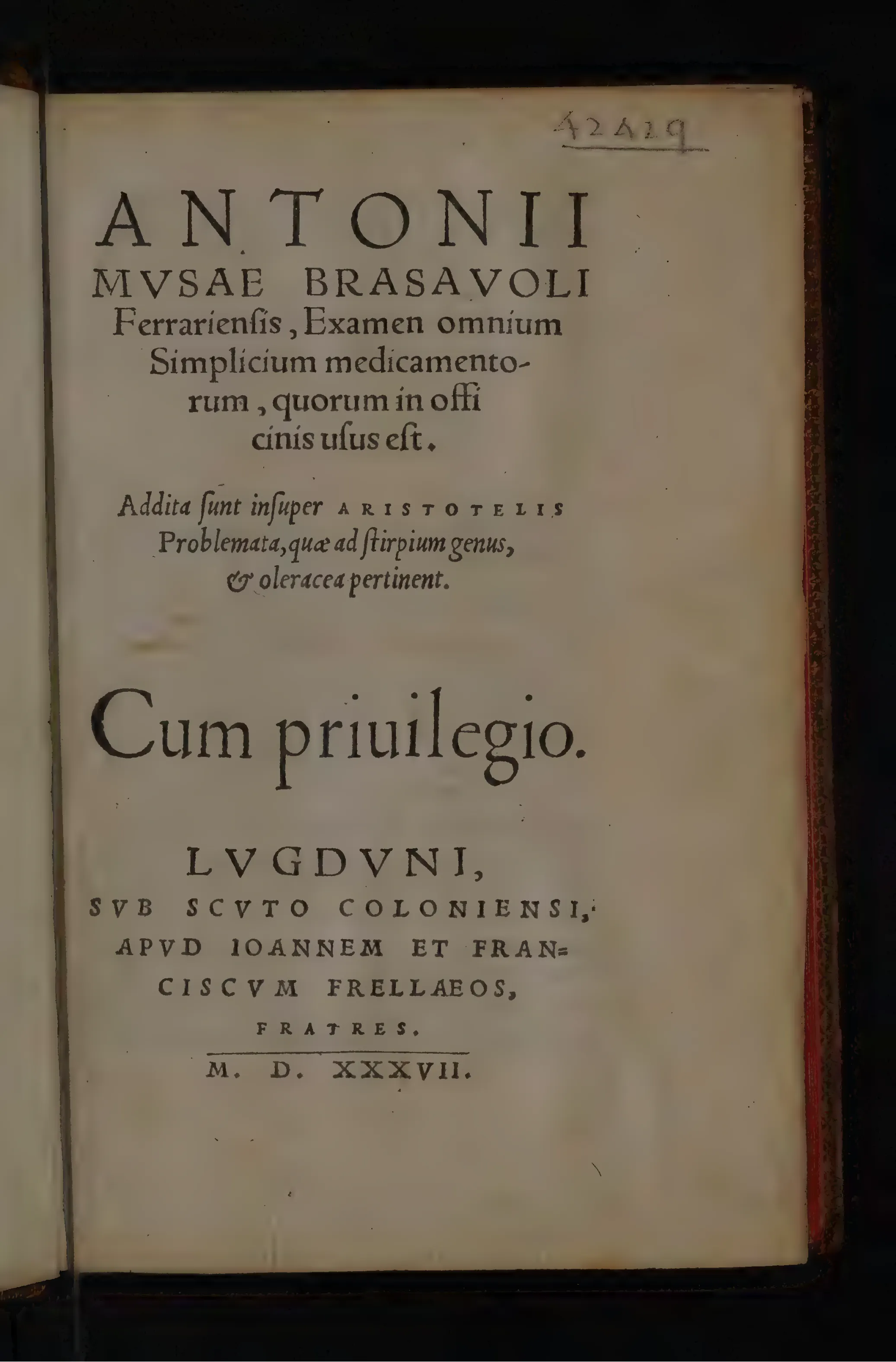
The Lyon title page fixes Brasavola's Examen omnium Simplicium medicamentorum in the workshop of Jean and François Frellon, sub scuto Coloniensi. Its notice of added Aristotelian Problemata on plants and pot-herbs, and the prominent Cum priuilegio, make the leaf a compact witness to the expanded Lyon issue. Source ↗.
"Antonio Musa Brasavola, Examination of All Simple Medicaments Used in the Apothecaries' Shops" is an editorial English title supplied for convenience; no established English translation of the title was located. It translates Examen omnium simplicium medicamentorum, quorum in officinis usus est. The author appears in modern and catalogue forms as Antonio Musa Brasavola or Antonio Musa Brassavola, and in Latin as Antonius Musa Brasavolus; Ferrara appears as Ferraria or Ferrariensis, Rome as Roma, and Lyon as Lugdunum.
The noun examen gives the title a stronger force than the neutral English "survey." Its period range includes trial, scrutiny, weighing, and assay. The title therefore presents the work as a discriminating examination of substances that enter the pharmacy, not as a merely literary inventory. That reading is an interpretive philological conclusion from the title and from the work's described program of systematic observation and experiment, and the text's own account of its procedure supplies the metrological register directly: in recent months, the principal speaker reports, they began to review at Ferrara, on their own scales such as they are, all the simple medicaments that are in use in the shops, Superioribus mensibus omnia simplicia medicame[n]ta, quoru[m] in officinis usus est, Ferrariæ, nostra trutina, qualiscunq[ue]; sit, percensere coepimus — where trutina, the balance, doubles the judicial-metrological sense of examen, and percensere imports the vocabulary of the census, the whole stock of the shops being enumerated and rated item by item. The same weighing sits behind the work's indictment of what is sold under a borrowed name, all the things they falsely sell under an ancient appearance, and misuse, omnia quæ sub antiqua specie falsò uenditant, quibusq[ue] abut[n]utur, a formulation in which species, at once "appearance" and, in the pharmacist's usage, "drug-kind," binds the philological question to the commercial one.
The object of the examination, simplicia medicamenta, does not mean "easy medicines." Simplicia are medicinal substances considered as individual materiae before, or apart from, their combination in compound preparations; the phrase consequently joins textual description to the stocks and practices of the shop. The term officina is equally capacious. In this work it denotes the apothecary's shop as a place where substances are stored, identified, valued, and dispensed, while in the Lyon publisher's letter the same word denotes the printer's workshop. The lexical overlap makes the book's material setting especially legible: knowledge is being organized both in the pharmacy and in the press.
The instability that the examen is designed to reduce is, in the first instance, onomastic. The dialogue states the difficulty as one of provincial multiplicity, for there are almost as many names as there are provinces, and as many different cities or strongholds within provinces, so many different names are found, Nam quot prouinciæ sunt, tot ferè nomina, & quot etiam in prouincijs diuersæ urbes aut castra, etiam nomina diuersa reperiuntur, which is why the classed books carry vernacular name-lists in French, German, Spanish, Portuguese and the Ferrarese idiom alongside the Greek, Latin and Arabic-Latin terms. Where the divergence runs between the learned authorities themselves, the weighing issues in a philological verdict of the kind Leoniceno and Manardo had made a medical instrument: from these things it is certainly established, the speaker concludes, that Serapion's carui and Dioscorides' caros are the same, since exactly the same things are said by Serapion, though barbarously, of his carui as by Dioscorides of careos, and perhaps, had Serapion had a faithful translator, he would not have fallen into so many errors, Ex his certe deprehenditur, carui Serapionis, & caros Dioscoridis idem esse: quoniam eadem penitus à Serapione (quamuis barbarè) in suo carui dicuntur, quæ à Dioscoride in careo: fortè si fidum interpretem habuisset Serapio, in tot errores non incidisset. The barbaries of the Latin Arabs is thus registered as a defect of transmission rather than of doctrine — a distinction to which the work returns repeatedly.
The terminology belongs to the medical-humanist effort to make names and substances correspond more precisely. Vivian Nutton's account of Leoniceno and Manardo stresses that lexical investigation was a central instrument of medical reform, while the broader Arabic-Latin controversy shows why "humanism" cannot be reduced to a simple rejection of everything Arabic. The safest historical description is thus one of philological correction joined to practical scrutiny. The cognomen Musa should also be handled cautiously: the biographical account consulted attributes its conferral to Francis I after Brasavola's Parisian success, rather than to a pope. That attribution is a report in the biographical tradition, not an independently established etymology.
What the Examination of Simple Medicaments Sets Out to Do
The work is a Latin medical-pharmacological dialogue, not a private letter or a purely bibliographical catalogue. The principal speaker is Brasavola's learned alter ego, opposed in dialogue to an elderly apothecary, with a herbarist as third voice; the work joins classical authorities, lexical criticism, field observation, and the practical knowledge of substances in the pharmacy. The dramatic idiom is that of genuine exchange rather than catechism, as when the physician's finding provokes the apothecary's incredulity — know that the gum we use, though called myrrh, is not myrrh; SEN.: What a strange thing, myrrh is not myrrh? — Scito gummi, quo utimur, myrrha nuncupatum, myrrham non esse. SEN. O mira res, myrrha non est myrrha?, a moment that states the book's whole problem in six words: the shop-word and the thing have come apart. Antonio Musa Brasavola was born in Ferrara on 16 January 1500 and died there on 6 July 1555. He served Ercole II d'Este, taught and practised medicine at Ferrara, and was associated with the Este court and with the Belvedere botanical garden.
The date of composition and the exact place of drafting are not established by the accessible records. The earliest dated witness located is the Rome edition of 1536, printed by Antonio Blado; its catalogue description is in Latin and records a folio physical object. The Lyon issue followed in 1537: its title-page imprint places it at Lyon, "sub scuto Coloniensi," with Jean and François Frellon, while the colophon names Jean Barbou, also called Le Normand. The Lyon publisher's prefatory letter says that a book on simple medicines had recently arrived from Rome and that the Lyon shop supplied it with marginal annotations. This establishes a Rome-to-Lyon transmission claim, but the exact interval and the alleged intermediary Benoît Court were not recovered from the available preliminary-text transcription.
The driving purpose is to examine the medicinal simples in use in apothecaries' shops by combining the ancient materia medica with direct study of plants and substances. The work's significance lies in the conjunction of textual correction and practical verification: Brasavola advocates field study and acknowledges that the number of species exceeds what the ancient authorities recorded. Testing is presented not as an occasional expedient but as a standing rule of the household of inquiry — we have most plainly detected male and female among them, the speaker says, since it is our settled practice to test everything we can, sparing neither cost nor labour, Nos autem manifestissime in his marem & foeminâ deprehendimus, quippe institutu est nobis, omnia quæ possumus, experiri, nulli sumptui, nec labori parcentes — and the silence of the ancients is explicitly denied the force of a prohibition: there is no need for everything to be written by the ancients, or for us to seek everything from them, since this was recently discovered, and everyone knows it to be so, sed non est opus, omnia ab antiquis scribi, & nos ab eisdem omnia petere: nuper inuentum est hoc, & ita esse nemo non scit. The language is Latin. No published English, Italian, or French translation was located in the sources consulted; a claim that no translation has ever existed would exceed the evidence, so the translation history remains unestablished rather than definitively negative.
Placing Brasavola in Ferrarese Medical Humanism and the Arabic-Latin Dispute
The work matters because it makes the reform of learned medicine visible at the level of substances, shops, names, and printing. It is at once a Ferrarese court text, a work of Neo-Latin dialogue, a contribution to the renewal of materia medica, and a document about the credibility of apothecary practice. Its method does not simply substitute one book-authority for another. The catalogue and scholarly descriptions emphasize field trips, personal study, the comparison of plants with ancient descriptions, and the recognition that living nature contains more species than the inherited textual repertory. That combination makes the work valuable to historians of medicine, pharmacy, natural history, learned Latin, and the book trade.
The most useful historiographical frame is Ferrara's long medical-humanist tradition. Vivian Nutton's "The Rise of Medical Humanism: Ferrara, 1464–1555" treats the Ferrarese setting as a sustained intellectual environment rather than an isolated episode. His later essay, "Medical Humanism, a Problematic Formulation?", qualifies the category itself: "medical humanism" can mean devotion to Greek and Roman medicine, terminological precision, or several different uses of classical authority, and it becomes especially unstable when applied broadly. The tension between these two approaches is productive for Brasavola. The Ferrara label identifies the institutional and intellectual milieu; Nutton's methodological warning prevents the work from being described as a simple return to Greece. The dialogue's own maxim on the ordering of loyalties bears out that caution, since it subordinates every authority, Greek included, to the evidence of the senses: for Socrates is a friend, Plato is a friend, but truth is more a friend, since I do not perceive that astringency which dryness in the third degree requires, Nam amicus Socrates, amicus Plato, sed magis amica ueritas: non enim stipticitatem illam persentio, quam siccitas in tertio gradu exigit — the humanist adage put to work as a rule of pharmacological grading rather than as a flourish.
The work also belongs to the sixteenth-century dispute over Arabic-Latin medicine. Nutton's discussion of Leoniceno and Manardo shows how corrections to Galen, Dioscorides, Pliny, and medical terminology operated within Ferrara. Abdul Haq Compier's study of Rhazes and Vesalius reconstructs a wider early-sixteenth-century change in attitude: some humanists advocated abolishing Arabic literature, whereas another, more common strategy was to purify, reinterpret, and integrate it. That distinction supplies the proper comparative setting for Brasavola's reported concern with errors of transmission and translation, and the dialogue takes an explicit position within it, declining the abolitionist programme in favour of correction: hence I not only do not approve but strongly disapprove the counsel of those who urge that the Arabs be utterly abolished, we judge rather that they should be corrected wherever faults appear, Vnde consilium id non modo non probo, sed ualde improbo, quo nonnulli Arabes penitus abolendos suadent: nos uero potius corrigendos iudicamus, ubi mendæ aliquæ appareant. That irenic stance is set against a satirical portrait of the polemical extremes on both sides, including the shop's own devotional canon, in which the fashionable gesture is to curse our Evangelist, that is, the divine Mesue, to reprehend the Pandectae, to censure Avicenna, to demolish Serapion, and to hiss Averroes off the stage, Euangelistam, id est, diuinum Mesuem, execrari, Pandectas reprehendere, Auicennam taxare, Serapione[m] demoliri, & Auerroim exibilare. It would be excessive, however, to assign every anti-Arab or irenic formulation to Brasavola without a reliable reading of the relevant passages; the accessible transcription is too defective for that level of textual attribution across the whole work.
Correction, in this dialogue, falls as readily on the compilers the shops actually used as on the Greeks or the Arabs. The declared loss of confidence in Matteo Silvatico's Pandectae is stated as a change of mind reached under the pressure of collation and inspection — now I am compelled to change my view, so that henceforth I shall put no faith in our Pandectarius concerning simples, Nunc sententiam mutare cogor, ut deinceps in simplicibus Pandectario nostro fidem non adhibeam — and where the authorities contradict one another manifestly, the remedy is bibliographical: it has always been my practice, the speaker says, whenever I see such manifest contradictions in authors, to consult many books, and especially the most ancient ones, for I cannot believe that any honest man should hallucinate so stupidly in so well-known a matter, Mihi autem semper mos fuit quoties cõtradictiones adeò manifestas in autoribus uideo, multos libros consulere, & præsertim antiquissimos: non enim credere possum uirum aliquem probum, in re tam notâ adeò stupide hallucinari. The charitable premise embedded there — that a uir probus does not blunder grossly — is what licenses the diagnostic move that recurs throughout: when the received text is absurd, suspect the copy or the interpreter, and the same logic yields the work's judgement on the anti-Arabist moderns, that one must marvel greatly at these moderns, who so rashly blame the blameless Arabs and accuse the Moors, when it is the men who translated perversely from their tongue into Latin who are at fault, Vnde de his recentibus apprime mirandum, qui ita temere sine culpa Arabes reprehendant, & Mauritanos accusent, qui è sua lingua in Latinam peruerse interpretati sunt.
The work's empirical dimension should likewise not be assimilated to a modern idea of experimental science. Its fieldwork, observations, and tests remain within a sixteenth-century order in which Dioscorides, Galen, Pliny, Arabic-Latin authorities, local experience, and the moral obligations of the apothecary could all be weighed together. Within that order, however, the tests are specified with a precision that makes them repeatable at the counter: first, if true opobalsamum is dripped on a woollen garment it leaves no stain or trace of a stain, whereas the adulterated sticks and makes a stain, and genuine juice, if dripped into milk, curdles it, which the adulterated does not, Primo, si laneæ uesti instilletur uerum opobalsamum, maculam, aut maculæ uestigium no[n] relinquit: adulteratum inhæret, & maculam facit. Syncerus succus si lacti instilletur, coagulat: quod non facit adulteratus. Diagnostic notae of this kind are the practical counterpart of the philological collation: both are procedures for deciding whether a name and a thing belong together.
The shop is both a commercial institution and an epistemic site. Questions of adulteration, substitution, merchants' oaths, and the reliability of imported substances consequently bear on life, professional honour, and the interpretation of authorities at the same time. The dialogue's governing rule of trade is stated as a legal maxim and enforced by the threat of withdrawal — I would abandon such men and bid them look for another shop and prescribe there what they pleased, since it is not lawful to sell one thing for another, tales uros derelinquerem, iuberemq; aliam officinam quærere, & ibi quæ luberent ordinare, quoniam pro re rem alteram uendere non licet — and the moral arithmetic of substitution is put to the apothecary as a direct question: so you choose rather to deceive, and to cheat men at so great a cost, their very life, than to lose one buyer or two? Ergo eligis decipere potius, & in tam magno hominu[m] dispendio, uit a scilicet fallere, quàm unum uel alterum emptorem amittere?. What is at stake is not only fraud but iatrogenic death, since the misreading of a name can put a poison in the mortar: in seeds the greatest error of the moderns has taken hold, the speaker reports, in that where they ought to use the seeds of wild rue in certain "receipts" they take the seed of hemlock, a most destructive herb, In seminibus autem maximus recentioru[m] error inualuit, ut quum rutæ syluestris seminibus, in nonnullis receptis (ut dicunt) uti debuissent, semen cicutæ accipiunt herbæ perniciosissimæ. The same ethical register extends beyond the shop to the uses to which learned knowledge of substances is put, as in the observation that the ancients used nitre for healing men and preserving life, whereas we prepare our nitre for slaying them, for overthrowing cities, for depopulating nations, Antiqui pro sanadis hominibus, & in uita seruandis utebantur: nos pro necandis, pro eruendis urbibus, depopulandis gentibus nostrum nitrum paramus — a remark that belongs to the moralised natural philosophy of the period rather than to any programme of reform.
Where a substance is genuine but weak, the examen returns a different verdict, and it is here that the work's natural philosophy is most explicit. Identity is distinguished from efficacy, so that failure of virtue is attributed to degeneration rather than to misnaming: therefore it was not to be denied that our aloe is aloe, but it should have been said that it is ineffective and has degenerated, Ideo non erat negandum aloën nostram esse aloën, sed inefficacem esse, dicendum, & degenerasse. The cause assigned is the joint action of sky and soil, extended without embarrassment from plants to animals, minerals and men: it matters very greatly where herbs are born, and likewise beasts, stones, metals and men, for those born in the mountains are rough, without manners, not easily tolerant of any slight cause, Quo loco herbæ nascantur, plurimum refert, imò & quo bruta, lapides, æra, & homines: quippe qui montibus nascuntur, rudes sunt, absque moribus, non facile patientes à qualibet leui causa. Yet the determinism is not absolute, since cultivation can remake a solum: for in Columella's time the soil of Ferrara was marsh, but our fathers by unremitting cultivation have now turned it into most fertile fields, nature resisting up to these times — but art conquers nature, provided it will spend itself, Tempore enim Columellæ Ferrariense solum ualles erat: patres autem nostri culturæ assiduitate, nunc in fertilissimos campos deduxere, natura usque ad hæc tempora repugnante: sed ars naturam uincit, modo impense uelit — a passage in which Ferrarese local pride, agronomy, and the theory of degeneration are held together in a single sentence, and in which the ars of the physician-philologist and the ars of the drainage works answer to one another.
The same weighing that corrects texts and tests drugs also dissolves a number of inherited marvels, and it does so without licence for irreverence being claimed: the report that a fragment was given to us with great veneration by certain religious as wood of the Cross, but we warned them and showed that it is stone, not wood, Nobis frustulum à quibusdam Religiosis magna ueneratione datum est, pro ligno crucis, sed eos admonentes lapidem esse ostendimus, non lignum, turns on the mineralogical identification of amianthus and is framed as an act of correction offered to the devout rather than as a challenge to devotion. Alongside it stand the naturalising treatments of the lynx-stone, the eagle-stone, the beaver, the mandrake root shaped by mountebanks, and fascinatio.
The specific passages concerning guaiacum, Portuguese voyaging, and New World materia medica require direct textual analysis; Teresa Huguet-Termes offers a valuable comparative study of how New World drugs moved from learned reception toward practical impact, but her Spanish case does not by itself prove Brasavola's position.
A Ferrara-school portrait of Alfonso I d'Este, ruler of the court in which Brasavola made his career. It shows no New World plant; it anchors the question of exotic drugs in the ducal setting that received — and tested — claims arriving from far away. Source ↗.
Gionata Liboni's 2024 monograph is the principal recent dedicated study located. It presents Brasavola as a major figure of sixteenth-century medical humanism, connects logic, natural philosophy, medicine, religion, and the Este court, and explicitly seeks to clarify the biobibliographical tradition and the transmission of his writings. Leonardo Graciotti's 2025 review confirms continuing scholarly attention to that reconstruction. The historiography remains thinner for the individual 1537 Lyon object than for Ferrara and medical humanism generally: no critical edition of the dialogue, complete census of Lyon copies, secure account of its censorship, or established translation history was located. Those absences are bibliographical findings, not evidence that no such work exists in less accessible collections.
Tracing the Book from Blado's Rome, 1536, to Frellon's Lyon, 1537

A late-sixteenth-century city view, supplied here as contextual matter, evokes Lyon less as a place-name than as the commercial and intellectual printing centre to which Blado's Roman edition travelled and where Frellon repackaged it in 1537. Source ↗.
The earliest dated witness located is Examen omnium simplicium medicamentorum, quorum in officinis usus est, Rome, Antonio Blado, 1536. The Wellcome catalogue identifies a Latin folio copy with 12 unnumbered pages, 120 pages, and two unnumbered leaves, the last blank, under shelfmark EPB/D/1044. That copy is held by the Wellcome Collection. On the evidence located, Rome 1536 is the earliest dated edition and therefore the practical candidate for the editio princeps; a separate formal privilege was not located, so that designation should remain an evidence-based bibliographical conclusion rather than an assertion about a surviving privilege.
The 1537 Lyon issue was published at Lyon (Lugdunum) by Jean and François Frellon, "sub scuto Coloniensi." Its colophon reads, in the surviving transcription, "LYGDVNI, Excudebat Loannes Barbous, alias Le Normand," followed by the year 1537. The digital copy identified as b33349939 is described as a Latin octavo containing 12 unnumbered leaves, 542 pages, and eight unnumbered leaves. Its Internet Archive metadata identifies the source collection as the Frellaeus Collection and the contributor as the Wellcome Library. The public digital metadata does not expose a separate Wellcome local shelfmark for this Lyon copy; EPB/D/1044 belongs to the distinct Rome 1536 catalogue object and should not be transferred to it.
The Lyon publisher's letter is an important piece of object biography. François Frellon defines the printer's office as a service to learned readers rather than merely a source of profit, praises the renewal of the arts, and says that a work on simple medicines had recently been brought from Rome — and so in these last few days the book of Antonius Musa was brought here to us from Rome, Superioribus itaq[ue] proximis diebus Roma huc ad nos allatus est ANTONII MVSAE — the wording placing the arrival of the exemplar within days of the reprint being undertaken. He also advertises marginal annotations. This is evidence for a rapid Rome-to-Lyon reprint and for the commercial presentation of learned indexing and annotation as part of the book's value, and it is worth noting that the officium typographi here claimed for the press is described in the same vocabulary of service and public utility that the dialogue applies to the officina of the apothecary. The available transcription does not reliably recover the full preliminary matter: the names of Benoît Court, Francesco Bovio, and the complete sequence of the Argenterius and Cistarellus material cannot be verified from it alone. Catalogue metadata does, however, associate Giovanni Argenterio with the book as editor and Alphonsus Cistarellus as dedicatee. The author's dedicatory address to Ercole II d'Este and Renée of France is also recorded in the scholarly description of the Rome text. Among the recoverable verse paratext is a couplet defining the book's double audience, urging that whoever sweats in the medical art should read this through, and that the apothecary should turn it with unremitting hand, Perlegat hunc Medica quisquis desudat in arte: Verset & assidua Pharmacopola manu, which states in epigrammatic form the twofold readership — learned physician and working pharmacopola — that the dialogue's two principal speakers embody. A page-image collation is needed before treating every paratextual attribution as secure.
The work's relation to the appended Problemata is bibliographically complex. The 1537 Lyon catalogue record at Pisa gives the expanded title with "Addita sunt insuper Aristotelis Problemata, quae ad stirpium genus, et oleracea pertinent," and the scanned Lyon object's transcription recovers a heading for De stirpibus et oleribus and Aristotelis Problemata. A separate WorldCat record likewise gives the expanded 1537 title. The Rome 1536 Wellcome title record does not list the appendix, while an EDIT16 record for Venice 1539 does. The safest conclusion is that the Lyon object under study contains an appended plant-and-vegetable Problemata section, whereas the accessible Rome record does not advertise one; whether this represents an expanded Lyon issue, a title-page or catalogue variation, or a separately bound textual unit cannot be decided without comparing the Rome and Lyon images. The appended matter is recognisably problem-and-answer in form and Peripatetic in doctrine, resolving questions of ripeness and wholesomeness by a single axiom, for they are less concocted, and concoction is nothing other than perfection, Sunt enim minus concocta. Concoctio autem non nisi perfectio est, and it applies the same reductive procedure to popular belief, asking on what account they say that rue is a remedy for fascination, and whether it is because men believe themselves bewitched when they eat greedily, or are held by suspicion of some discomfort, or have food they suspect, which they take, Qua de causa rutam, fascinationis remedium esse aiunt? An propterea, quia tum effascinari se credunt, cum aut uoraciter edunt, aut incom[m]oditatum aliquarum tenentur suspicione, aut cibum habent suspectum, quem capiunt — a naturalising move continuous with the dialogue's own treatment of marvels, whatever the appendix's textual status proves to be. No source located here establishes the exact number of Problemata sections or identifies a translator. Argenterio is catalogued as editor, not securely as translator.
The closing pages of the dialogue project a continuation, announcing an intention to compare all compounds with the compositions of the ancients, and, where any compositions are modern, to examine them by the rules of compounding, composita omnia ad antiquorum compositiones comparare, & ubi recentes sunt aliquæ compositiones, eas per componendi normas examinare — that is, to extend the same examen from simplicia to composita, with the normae componendi replacing the collation of names as the standard of judgement. This is a statement of programme within the text and does not by itself settle which of the author's later printed titles fulfilled it.
The copy census remains institutional rather than shelfmark-level. WorldCat record OCLC 14326580 describes the Frellon 1537 printed book and reports 18 editions in 114 libraries; the public display shows, among others, Thüringer Universitäts- und Landesbibliothek, Weimar, Dresden, Erfurt/Gotha, Berlin, Wolfenbüttel, Göttingen, Rostock, Osnabrück, and Heidelberg. OCLC 422054415 describes a 1537 expanded-title record and reports six editions in nine libraries, including Erlangen, the Bibliothèque interuniversitaire Sainte-Geneviève, Neuburg, Leeds, the Bibliothèque municipale de Lyon, and Harvard's Ernst Mayr/Botany and Countway libraries. The public records consulted expose institutions but not the local shelfmarks, and the two OCLC records may represent different catalogue treatments of an edition, state, or bound appendix. A comprehensive surviving-copy census therefore remains outstanding.
A separate MDZ record identifies Philippe Briet, or Philippus Brietius, with Annales mundi sive chronicon universale, printed at Augsburg by Bencard in 1696. That record is a late-seventeenth-century universal chronology, not a 1537 Ferrara medical dialogue. The true Lyon identification is fixed by the Brasavola title and author, the Frellon imprint, the Barbou colophon, the medical contents, and the physical description of the octavo. The exact catalogue or metadata event that introduced the Briet attribution could not be located; the correction is therefore secure, but its provenance remains undocumented.
The work's court network is clear in outline. Brasavola's dedicatory address is directed to Ercole II and Renée, and the text's Ferrara material names Alfonso I as an earlier instigator or patronal presence. Isabella of Aragon is most plausibly Isabella del Balzo, queen consort of Frederick I of Naples, who died at Ferrara on 22 May 1533; because the relevant primary passage was not recovered, this identification is provisional. No reliable record located here demonstrates a contemporary refutation, censorship proceeding, or expurgation of the 1537 book, and no secure sixteenth-century Index entry for the title or author was found. This negative result must not be converted into proof that no copy was ever censored. The author's larger printed and manuscript corpus was extensive, but the exact relationship of all advertised sequel-titles and related treatises to this dialogue requires a bibliographical catalogue beyond the records exposed here.
Walking the Apennines: How the Dialogue Argues, Simple by Simple
The preliminaries: two dedications and a statement of method
The Lyon preliminaries state the book's problem before a single simple is weighed. Giovanni Argenterio of Asti, writing from Lyon in January 1537, opens his dedication to Alfonso Cistarelli with a diagnosis of the discipline rather than a compliment to it: everything in medicine was well set out by the ancient Greek and Latin authors, yet it is not yet sufficiently known to us, and the difficulty presses hardest of all upon what they handed down about foods and medicaments, omnia, in medicina ab antiquis autoribus Græcis & Latinis bene explicata, à nobis nòdum satis cognita: tum in primis. The sentence concedes the completeness of the ancient achievement and denies its present availability in the same breath, which is precisely the space in which an examen becomes necessary: the fault lies not in the doctrine but in the chain of transmission and in the men — barbarous intermediaries, unlettered handlers of materia medica — through whom it must pass to reach the counter. Argenterio's account of what recent scholarship still leaves undone then narrows the target from books to premises. Those who had undertaken to illuminate this part of medicine had confined themselves to res herbaria; what was wanted was a physician not ignorant of the apothecaries' own guild, one who would put to the ancient test everything sold under a borrowed antique appearance and misused — the indictment already set out above. The phrase sub antiqua specie carries that charge in miniature, since species is at once the outward look of a thing, its logical kind, and, in the trade's own idiom, a drug-sort: the fraud is simultaneously visual, taxonomic and commercial, and only a reader competent in all three registers can detect it. The letter closes on the book's own diffusion, reporting that once its very great usefulness had been inspected, we did not allow others to lack it any longer, utilitate eius maxima inspecta, no[n] passi sumus ut eo alij diu carerent — the verb inspecta quietly applying to the exemplar the same procedure of examination that the exemplar applies to drugs, so that the press's decision to reprint is itself presented as the outcome of an inspection.
Brasavola's own dedication to Ercole II and Renée of France reaches the same operation by a different route, moving through the Socratic mirror, the tripartition of goods, and a genealogical encomium before arriving at the statement of method already discussed above: that in recent months, at Ferrara, on scales of the author's own such as they are, the review of all the simple medicaments in use in the shops was begun. Three terms do the work there. Trutina names a balance rather than a metaphorical tribunal, and the self-deprecating qualiscunque sit concedes that the instrument is the author's own and no more authoritative than its bearer. Percensere imports the language of the census, an enumeration that rates as it counts. And quorum in officinis usus est fixes the population to be enumerated not by the ancient repertory but by actual shop practice at Ferrara, which is why the resulting inventory will include substances the ancients never named and exclude ones they did.
The long citrus excursus that prolongs the dedication, occasioned by the freezing of the trees on the Po island of Belvedere, shows the method claiming jurisdiction well beyond pharmacy. Its lexical core is the demonstration that the cedrus of the authorities is not the vulgar citron, and the error is charged first of all to scriptural commentators: there occurs the common error of all, and especially of those who interpret Holy Scripture, who suppose cedar-wood to come from this tree, communis omnium error menti occurrit, eorum præsertim qui sacras literas interpretantur, ex hac arbore ligna cedrina putantium. That a physician's identification of a tree should correct the exegetes is a considerable assertion of competence, and it is made without apology, on the assumption that whoever knows the thing controls the word. The instrument of correction is then armed in explicitly martial terms — let Dioscorides' judgment in the first book of his herbal be our spear and sharpened sword, speaking in this manner, Principio sit nobis Dioscoridis sententia telu[m] & aculeatus ensis primo rei herbariæ uolumine in hunc modum inquientis — a figure that reveals the argumentative form of the whole book: a text is quoted, and the specimen in hand is then held against it, so that authority functions as a weapon wielded by the observer rather than as a verdict he receives.
The mountain dialogue: flowers, herbs, and seeds
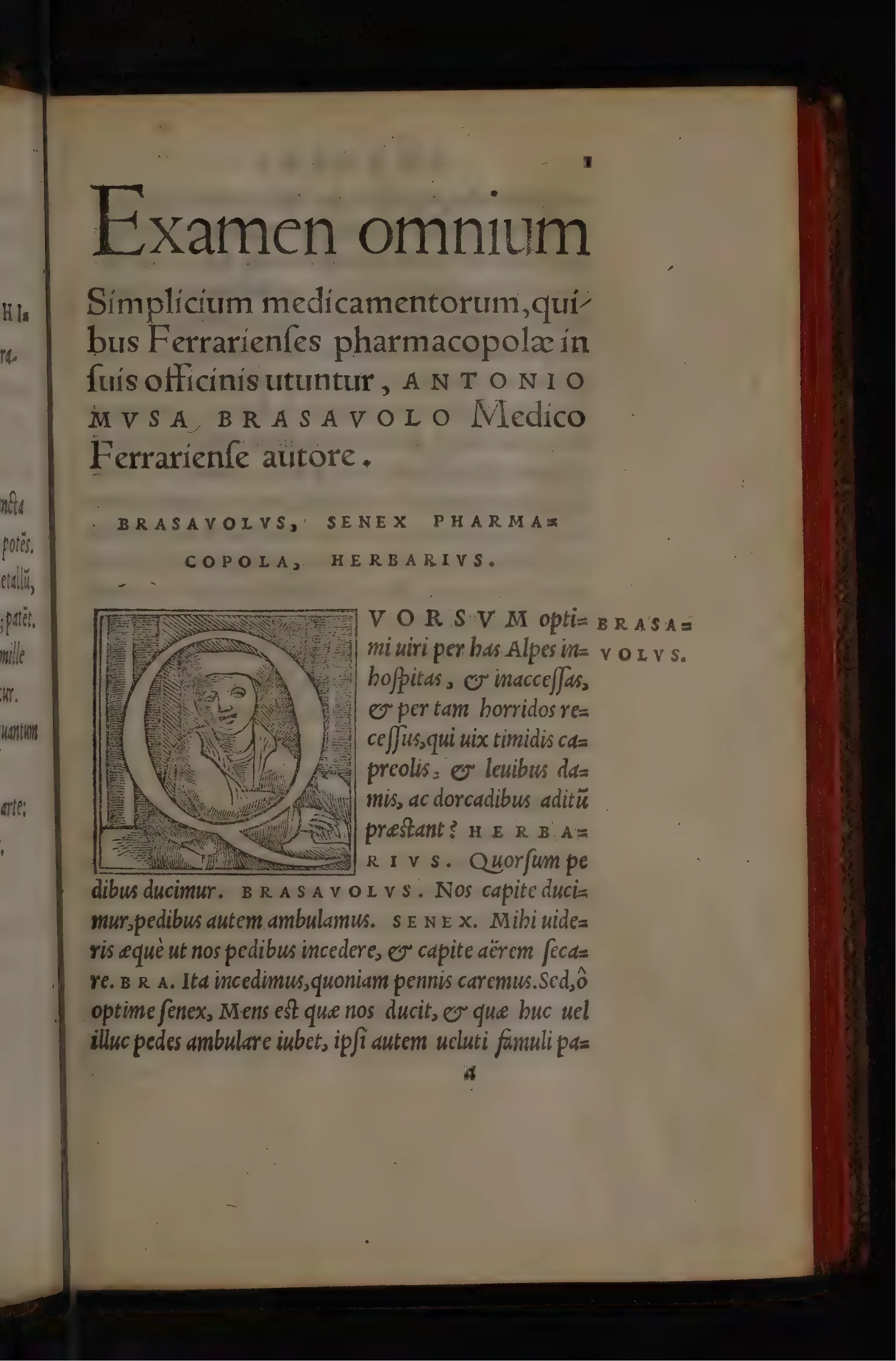
The dialogue opens with a display title naming the examination of simples used in Ferrara's apothecaries' shops, followed by the cast of physician, aged apothecary and herbarist. Beneath the historiated initial Q, the first speech sends them into the inhospitable Alps, making the mountain walk both setting and method. Source ↗.
The dialogue proper opens in the high mountains, and its first substantive exchange justifies the walk on grounds of material decay. The herbarists gather living plants because what reaches Ferrara arrives so dried out that scarcely a whole leaf or a slender stalk can be made out, quæ ad nos adeò sicca feruntur, ut uix integru[m] folium, aut tenuis cauciculus cerni possit. This is the physical precondition of the entire crisis of names: identification requires diagnostic parts, and the long carriage from Alexandria by way of Venice destroys exactly those parts, leaving the shop with a powder or a fragment whose only identity is the label on its box. The first test-case, the shops' "Reuponticum," accordingly provokes an outburst against inherited practice — O wondrous error of the moderns, and wondrous sloth of the apothecaries, who for so many centuries have been deceived in this herb and are deceived still, yet refuse to learn, O mirus Recentiorum error, & mira pharmacopolaru[m] ignauia, per tot secula in hac herba decepti sunt, & nûc decipiuntur, tamen addiscere nolunt,. The pairing of error with ignauia is diagnostic of the book's moral economy: mistakes are venial, but the refusal to learn converts them into culpable sloth. The Senex answers in defence of the shop's canonical authors, and it is against that grievance that Brasavola formulates his refusal to abolish the Arabs in favour of correcting them, before the demonstration proceeds by reading Dioscorides aloud, smelling, weighing and tasting the root in hand, and correcting the shop's pronunciation — until the apothecary abandons his faith in the Pandectarius altogether. The sequence is the book's method in little: collation, autopsy, orthography, capitulation.
A methodological interlude then supplies the natural philosophy that licenses the geography of the inventory. Against the Senex's expectation that the mountain will furnish everything, habitats are divided, and the division is grounded in a hylomorphic aetiology in which the soil is mother and matter while the sky, that is the air, is form and agent, especially together with the celestial influx, coelum uero, id est, aër, forma est, & agens, præsertim cu[m] influxu coelesti. Casting coelum as the active and formal principle explains why the same species differs in strength from province to province without ceasing to be the same species, and it thereby supplies the conceptual instrument that lets the examen distinguish a false name from a true name attached to a feeble thing.
Under the printed headings that open the flowers, the herbs and the seeds — with running heads and marginal side-notes naming each simple, and with tabulated lists for the parts of the rose to be kept — the entries hold to a fixed rhythm of shop-name, ancient name, collation, parts and season, and vernacular synonyms. The stakes of that apparently dry sequence are stated where the oil of jasmine is confused with oil of elder, to the great peril of the sick, through the gross sloth of many physicians who, not knowing the names of things, take elder-oil for it, though the powers of the two are different, magno ægroru[m] discrimine, ex crassa plurium medicoru[m] ignauia, qui rerum nomina nescientes pro eo sambucinu[m] oleu[m] accipiunt, quu[m] diuersæ sint huic & illi uires. Here nomenclature is not a scholar's refinement but the proximate cause of discrimen, the patient's danger. The converse fault is equally exposed, where redundant names have been mistaken for real distinctions: you apothecaries have divided into four a thing distinguished into only two species, and only the names differ, not the things, nam uos pharmacopolæ rem in duas species tantum distinctam, in quatuor diuisistis: nomina solum diuersa sunt, res minime. Multiplied names inflate the inventory, and an inflated inventory generates spurious rarities to be charged for; the philological correction is thus also a deflation of the shop's price-list.
That the market shapes the drug-stock is made explicit in the nard entry, where the missing part is missing for reasons of profit: the root is never brought to us, nor do the merchants care to carry it, though it is more effective in medicine, because they make greater gain from the spike than from the root, Ad nos tamen nunquam desertur radix, nec mercatores illam portare curant, etsi in remedica efficacior sit: quoniam maius lucrum ex spica, quàm radice faciunt. Efficacy and availability have come apart, and the cause lies neither in the ancient text nor in nature but in the freight economics of the trade — an observation that makes the merchant a party to the corruption of therapy without accusing him of outright fraud. The same entry then turns the analysis back upon a famous crux of sacred philology, noting that Valla, wishing to correct the received error, read nardi spicati when rather spicæ nardi should be read, that is, from the spike of nard, quem errorem Valla corrigere uolens, Nardi spicati legit: quum potius spicæ nardi, id est, ex spica nardi legendum esset. The correction of the greatest of philological correctors is offered on strictly pharmacognostic grounds: only a reader who knows that spike and root are distinct commodities can see that the genitive, not the participle, is required. Knowledge of what the merchants carry becomes the arbiter of a reading in the Gospels, and the book's two jurisdictions — the library and the counter — are shown to be one.
From seeds to woods: the protocol and the evidence admitted
The stretch of the dialogue that carries the survey from the seeds through fruits, roots, barks, woods and liquid juices to the condensed juices works by a fixed protocol, repeated several hundred times: the apothecary names an item from his stock, the physician arraigns it against Dioscorides, Galen, Theophrastus, Pliny, Serapio and Avicenna, the herbarist is told where it grows, and the lemma closes with an instruction for gathering or purchase. What varies is the kind of evidence admitted to break a deadlock, and it is in those variations that the examen discloses its epistemology. One recurrent kind is the named clinical case, offered without apology as probative: the powder of the seeds, the speaker reports, violently expels gravel from the kidneys, provokes urine and reduces the stone of the bladder, of which he very lately took proof in the case of Master Pietro of Argenta, who passed more than sixty stones from his kidneys by the help of this powder alone, seminum tamen puluis, lapillos uehementer ex renibus eijcit, urinam cit, & uesicæ lapidem minuit: cuius rei nuperri me experimentum sumpsi in domino Petro de Argenta, qui plures quàm sexaginta è renibus lapides minxit, solo huius pulueris auxilio. The particulars do the work that a citation would otherwise do: a patient identified by his town, a countable result, and solo huius pulueris auxilio to isolate the agent from the rest of a regimen. The verb experimentum sumpsi places the observation in the register of an assay, not an anecdote, and a second case follows immediately in the same form.
The other governing move is diagnostic in the philological sense, and it consistently locates the disease of the tradition in transmission rather than doctrine. Where a chain of authorities repeats an absurdity, the fault is traced to the man who put an Arabic lemma into Latin, and the derivative writers are convicted of a collective delusion: he translates, he goes astray, and led by this error all the moderns hallucinate, interpretatur, aberrat, & ab hoc errore ducti recentiores omnes hallucinantur. The verb hallucinari is not casual abuse; it belongs to the medical vocabulary of disordered perception, so that the compilers are described as suffering a defect of the faculty by which names and things are matched, and the interpres is the vector of the disorder. The same discrimination allows the shops' own errors to be catalogued by an anaphoric refrain of exposure — they are deceived who contend that vetch is meant, they are deceived also who take what is commonly called rubiglia, Decipiuntur qui uiciam sumi contendunt. Decipiuntur, & qui uulgò uocatam rubigliam — where repetition converts a lexical judgement into a rhetorical drumbeat, each stroke removing one candidate from the field.
Identification, once secured, must be followed by supply, and here the dialogue reveals how thoroughly the court is built into its method. A drug unavailable in Ferrara is not thereby abandoned; it is routed along a household's traffic, since it will be easy to have it from Marseilles, for every day some of the household of the most illustrious Renée, our Duchess, that most upright and most holy lady, travel into France, facile autem erit ex Massilia habere, nam quotidie nonnulli ex Illustrissimæ RENATAE Ducis nostræ probissimæ, ac sanctissimæ mulieris familiaribus Gallias petunt. The dynastic marriage becomes a channel of materia medica, and the encomiastic pair probissimæ ac sanctissimae does the diplomatic work of the sentence while the familiares do its logistical work; ducal woods, ships and diplomatic correspondence elsewhere in the survey serve the same function. The horizon of the enterprise is nevertheless kept local and institutional rather than universal, as the display heading opening the book of fruits announces those, of which there is need in the shops of the Ferrarese apothecaries, quorum in Ferrariensibus Pharmacopolarum officinis opus est — a delimitation by stock and by usus, not by the extent of nature.
The book of fruits also supplies the sharpest theatre of the dialogue's method. The apothecary's carpobalsamum is destroyed by a catechism on colour, weight, taste and smell, capped with a retort whose comic violence is calculated: it is carpobalsamum just as much as you are a fly, since the seed of balsam is red, Ita car pobalsamum est, ut tu es musca, quippe balsami semen ruffum est. The absurd predication makes the point that misnaming is a category error and not a venial imprecision, and the sensory criterion that follows — the redness of the true seed — converts the joke immediately into a test performable across the counter. The same corrective energy is turned against inherited marvels: it is fabulous, the speaker says, that pepper is black because it is scorched by fire, on the ground that it cannot be gathered for the multitude of serpents unless these are first driven off by fire, which makes the grains black and wrinkled, but these are old wives' tales rather than truth, Id autem fabulosum est, nigrum esse piper, quia igne aduratur, na[m] ob serpentum copiam colligi non potest, nisi prius igne fugentur, qui piperis grana nigra & rugosa efficit: sed hæc anilia fabulamenta sunt potius, quàm uera. What replaces the fable is not scepticism but a causal account — drying in the sun — corroborated by the testimony of sailors who saw the grains green on the plant, so that eyewitness report from the new sea-routes and natural causation displace a transmitted narrative in a single stroke.
That confidence in report and cause does not extend into hostility toward the Arabic-Latin corpus; on the contrary, the dialogue states the irenic position here with unusual directness, arguing that thanks are owed to the Arabs, who committed these things to writing and pointed them out to us, while those who are wont to cry out in disparagement of the Arabs he vehemently rebukes, ideo Arabibus gratiæ agendæ, qui hæc scriptis mandarunt, & nobis indicarunt. Illos autem uehementer reprehendo, qui inclamare solent Arabibus derogantes. The charge answered here is that the Arabs polluted medicine by describing poisons, and the answer is a counter-catalogue drawn from Dioscorides himself; the debt language of gratiæ agendæ frames the Arabic writers as informants who enlarged the repertory, precisely the service the dialogue claims for the Portuguese pilots. Yet the hierarchy is not thereby levelled. A brief scholastic joke fixes the ranking: asked whom he calls prince of physicians, the physician says Hippocrates, the apothecary says Avicenna, and is told not to say Avicenna prince of physicians, but a physician and a prince, BRA. Quem appellas tu principem medicorum? Ego Hippocratem. SEN. Ego autem Auicennam. BRA. Ne Auicennam principem medicorum, sed medicum & principem dicas. The correction turns on the fallacy of composition, and the apothecary's honorific is dismantled by logic rather than by polemic — Avicenna's princely rank and his medical competence are conceded separately and refused as a compound title.
Testing extends to the examiner's own household, and the results are reported with a candour that makes the body of the investigator an instrument. Handling colocynth left the party purged by touch alone and by its smell, so that there was none of them whose belly was not moved ten times with great disturbance, from which it is established that it is a most violent drug, solo tactu, illæ ex odore adeò soluti sumus, ut nullus nostrum fuerit, cui uenter decies magna perturbatione non eduxerit: ex hoc uehementissimum pharmacum esse constat. The inference marker constat claims demonstrative force for the episode, and the practical conclusion — abstention from the drug — is drawn against the practice of the most ancient Greeks, an instance in which the sensory evidence overrules not a corrupt translator but an unimpeachable source.
The book of woods brings the newly reached islands into the same procedure. Guaiac, the speaker reports, grows chiefly in the islands lately discovered, in the one called Corterati, and in Hispaniola, which lies little distant from the equator, and in many others; where it grows they have a disease like that which is called the French scab, and to recover health they eat the fruit, Equide[m] in insulis nuper repertis potissimu[m] oritur, in ea quæ Corterati appellatur, & Hispaniola, quæ ab Acquinoctiali parum distat, & in alijs plurimis, ubi nascitur, similem morbum habent, ut is est, qui Gallica scabies uocatur, pro recuperanda sanitate fructu uescutur. The remedy is placed geographically where the disease is placed, an argument by coincidence of habitat and affliction that requires no ancient warrant and could receive none. The evening that closes the woods yields the survey's most precise self-location, the speaker declaring that he has now completed his thirty-fourth year, having come into the light in the year fifteen hundred from Christ's birth, on the sixteenth day of January, at half past the sixth hour of the night, before the feast day of St Anthony, Nunc trigesimumquartum annum impleui. Nam in lucem prodij Millesimo quingentesimo anno à CHRISTI ortu, decimasexta Ianuarij luce, hora sexta noctis cum dimidia, ante diui Antonij festum diem. The astrological exactness of the hour, the saint who explains the name, and the surrounding genealogy of grandfather, brothers, wife and children set the dramatic present at about 1534 and bind the whole audit of the shops to a documented Ferrarese life rather than to an anonymous authorial voice.
That book applies the same weighing to substances whose very class is disputed. Against the objection that pressed cane-sugar is a modern thing unknown to the ancients, verses attributed to Varro are entered as chronological documentation — in India a reed grows on a tree not too large, and moisture is pressed from its pliant roots, with whose juice sweet honeys could not compete, Indica non magna nimis arbore crescit arundo, Illius & lentis premitur radicibus humor, Dulcia cui nequeant succo contendere mella — so that poetry serves as evidence for the antiquity of a technique, and Galen's silence is converted from testimony into ignorance. The corresponding taxonomic decision for manna is stated with lapidary economy in the distinction between the honey of bees, which is our honey, and the honey of dew, which is the manna we have, Mel apum, est nostrum mel: Mel roris, est manna, quam habemus, a classification that assigns the Calabrian product to a meteorological rather than a vegetal cause and thereby makes the ancient mel roris, the Hebrew manna and the Arabic tereniabim candidates for one and the same thing under three vocabularies.
Juices, gums, metals, stones, earths, salts, fats, and oils

In this woodcut associated with Andreas Vesalius, a crowded dissection theatre gathers around a female cadaver while a book lies open nearby, staging the contest between inherited learning and direct inspection. Anatomical rather than pharmaceutical, it evokes the milieu in which Brasavola weighed juices, gums, metals, stones and oils. Source ↗.
From the thickened juices onward the survey proceeds under printed running heads that themselves declare the classificatory logic of the work — EXAMEN SVCCORVM, PRAEDENSORVM, then GVMMIVM, METALLORVM, Lapidum, GEMMARVM, TERRARVM, SALIVM, PINGVEDINVM, OLEARVM EX MINERIS — with shoulder-notes naming each simple as it comes to the balance and the sigla BRA., SEN., HER. marking a three-cornered interrogation in which the physician questions, the aged apothecary answers for his drawers, and the herbarist fetches and shows. The signature alphabet begins afresh at the gums, so that the classed books are also units of the printed object. Within this frame the juices immediately force the work's sharpest conceptual distinction. Confronted with an aloe that answers to every description in Dioscorides yet fails at the bedside, the physician refuses the easy verdict of misnaming, declaring instead — in the judgement already discussed above — that the aloe in use is indeed aloe, but ineffective and degenerated. The formulation does delicate work. It saves the ancient description, since the notae still fit; it saves the modern practitioner's experience of failure, since the drug genuinely does not act; and it locates the discrepancy in soil and sky rather than in the lexicon. Identity and virtue, in other words, are separable predicates, and the examen must therefore report two verdicts on every simple, one onomastic and one dynamic.
Where the dynamic verdict cannot be reduced to the manifest qualities of the Galenic scheme, the dialogue accepts an avowedly incomplete causal account rather than deny the effect: with Mesue and Serapio, the speaker judges that aloe opens the mouths of the veins by some innate power whose cause we do not know, Cum Mesue & Serapione aperire ora uenarum censeo, ex quadam insita uirtute, cuius causam ignoramus. Two things follow from this formulation. First, the Arabic-Latin authorities are rehabilitated here on experiential rather than textual grounds — they are believed because the effect is observed, not because their manuscripts are old — which is precisely the reverse of the procedure applied to their nomenclature. Second, insita uirtus with causa ignota functions as a licensed limit to explanation within the period's natural philosophy, and the dialogue marks that limit explicitly, conceding elsewhere that it has only shaded the matter in as through a lattice rather than opened it by reasoning. The polemical epithet Mesue mastix, the "scourge of Mesue," is deployed in the same neighbourhood against those who would settle such questions by abolition, and it is met not with counter-invective but with the offer of self-experiment.
The book of gums opens the work's governing paradox in its most compressed form. The physician's instruction that the gum in use, though called myrrh, is not myrrh, and the old apothecary's recoiling exclamation at the news — the exchange already quoted above — show why the dramatic form is essential to the epistemology: the apothecary's incredulity is the voice of the inventory, for which the label on the drawer is not a hypothesis but a fact, while the physician's scito converts every shop-word into a claim requiring proof. The exclamation O mira res also registers the specific discomfort of the trade, since a name that fails is not merely an error but a defect of title in goods already sold. The diagnosis that follows is consistently philological, and it is directed less at the Arabic authors than at their Latin dress: the astonishment already noted at those moderns who so rashly blame the blameless Arabs and accuse the Moors, when the fault lies with the men who translated perversely from their tongue into Latin, is analytically exact rather than merely irenic, for it distinguishes the doctrine of a text from the accidents of its transmission, and makes collation — Serapio's Latin set against the Greek of Dioscorides — the instrument by which the two are prised apart. The same section supplies the counter-evidence to any suspicion that the method is merely bookish, in the amber entry, where Pliny and Martial are verified against a specimen at home: very often, the speaker reports, we have seen amber holding enclosed bees, flies, ants and straws, and indeed we have at home one in which an ant is so wonderfully and entirely present that not the least leg is missing, hoc nos frequentissime uidimus ambrum, apes, muscas, formicas, festucas inclusas habentem: imò & domi habemus, in quo adeò mire formica, & integrè inest, ut nec minimum crus desit. The domestic cabinet is thus enrolled as a court of appeal alongside the shop and the library, and the ancient testimonium is neither dismissed nor simply accepted but confirmed by inspection of an object in hand.
The metals extend adulteration from the pharmacy to the mint, and the extension is argued, not merely asserted. Asked for refined gold of coinage standard, the speaker answers that it is not to be had; instead they all adulterate the coinage, so that there is now none that is not fraudulent, non habetur, sed omnes monetas adulterant, ut nulla nuc sit præter fraudem. The remark has a technical point — a pharmacopoeial recipe calling for obrizum cannot be filled from current specie — and a moral one, since the prince who debases his coin and the apothecary who sells glass for sapphire commit the same species of offence against a public standard. The satire on gold in physic that accompanies it, with melancholics better relieved by a basinful of coins than by swallowing gold powder, keeps the two registers deliberately entangled. When the survey reaches the stones and gem-fragments the reproach is turned directly on the interlocutor and generalised into a habit of the trade: you always keep the worst sort, the speaker charges, which is scabby, stony, and wholly hollow, co[n]tinuò pessimum genus habetis, quod scabiosum est, petrosum, & totum inane. The three adjectives are diagnostic marks as much as insults, describing exactly what the eye and the hand are to look for; the shop's failure is thus not ignorance of a text but refusal of an inspection it is fully competent to perform.
The book of earths is where correction reaches furthest beyond the drawer. Mumia, the shops' most sensational item, is redefined by ethnographic report against its own etymology: mummy, the speaker insists, is not a dried Moor or Syrian, but a certain compound of myrrh, aloes, saffron, balsam and more or fewer things of that kind together with human fat, mumia non est Maurus exiccatus, uel Syriacus, sed compositio quædam, ex myrrha, aloë, croco, balsamo, & alijs huius generis pluribus uel paucioribus cum humana pinguedine. The substance is not abolished but reclassified: what the counter treats as a simple is in truth a compound, and one whose components are already separately stocked — a finding that quietly anticipates the projected examination of composita. The same movement yields the work's most striking self-referential aside, embedded in an ink recipe, where the substance is also called painters' ink, although it is not yet the eightieth year since the method of printing the characters of letters was discovered, appellatq[ue] pictorium atramentum, quamuis adhuc non sit octuagesimus annus, quod modus imprimendi literarum characteres inuentus est. A printed book on simples here dates the art that carries it, and does so in the same idiom of recent invention it uses for guaiac: novelty is measured in years, and the ancients' silence about a thing eighty years old requires no apology. Authentication by seal receives comparable treatment in the Lemnian earth, where the guarantee has passed from the temple of Diana to Ottoman administration and the supply from commerce to diplomacy — the Emperor of the Turks, having built a fort in that place, bestows this earth on princes, Turcharum imperator arce facta eo loco, principes hac terra donat — so that a drug's identity now depends on a political authority no physician can inspect.
Court history is not an ornament in this technical structure but one of its evidentiary strands, and it surfaces most densely in the miscellaneous Nonnulla, where a digression from a foul fumigant opens a fully dated obituary sequence: Pope Clement the Seventh pursued the most illustrious prince Alfonso with inward hatred, and the pontiff died on the seventh Kalends of October, in the year 1534 from Christ's birth, Clemens pontifex septimus, intestino odio ALPHONSVM Illustrissimu[m] principem prosequebatur, septimo Calendas Octobris obijt pontifex, anno à CHRISTI ortu milleno quingēteno trigesimoquarto. The precision of the reckoning, continued through the hour of the duke's own death and Ercole II's acclamation, is of a piece with the metrological habit of the drug entries; the declamatory lament that follows shows how readily the register of the examen modulates into funeral panegyric without abandoning its documentary manner. The fats supply the corresponding social documentation, including the Ferrarese ordinance against complaisant husbands and, more consequentially for the ethics of the trade, an undertaking that binds pharmacy to the scaffold: as for preserving human fat, the physician promises, I will see that you obtain it when the dissection of some hanged man takes place, Pro humana autem pinguedine seruanda, quum suspensi alicuius sectio, fiet, ut assequaris curabo. Anatomy, penal spectacle and the shop's shelf are presented as one continuous provision, and the defence of human-derived remedies against contemporary objectors is conducted, characteristically, by distinguishing approved authors from charlatans rather than by appeal to sentiment.
The oils and the closing miscellany end the survey as it began, with a rule of procedure rather than a doctrine. Overturning the received account of hermaphrodite hares, the speaker generalises the ground of his dissent in the declaration already cited above, that male and female have been most plainly detected among them, since it is the settled practice of the household to test everything it can, sparing neither cost nor labour. The word institutum is the load-bearing term there: testing is a standing arrangement of the household, funded and laborious, not an occasional expedient, and it is what entitles a Ferrarese physician to contradict a canonical text. Yet the same voice closes on a therapeutic argument drawn wholly from authority and analogy, adding finally that the ancient physicians affirm that breath nowhere lasts longer than in sponges, Deniq[ue] illud addam, antiquos medicos affirmare, nusquam diutius spiritum durare, quàm in spongijs, whence the vinegar-soaked sponge held at nose and mouth in time of plague, named apospongismon after Archigenes. The juxtaposition is instructive rather than inconsistent: where a repeatable inspection is available the ancients may be corrected, and where none is, their affirmation stands and is put to use. After the FINIS the printed object turns to a different genre altogether, the appended problem-and-answer questions on plants and pot-herbs, whose cur and an formulas resolve ripeness, acridity and even the proverbial avoidance of mint in wartime into causes of concoction and temperament — a Peripatetic idiom continuous with the dialogue's naturalising of marvels, though conducted without the balance, the shop, or the witnesses that give the examen proper its evidentiary weight.
The appended Problemata on plants and pot-herbs
Those appended questions deserve closer attention in their own right, for the final movement of the printed volume argues in a manner recognisably cognate with the examen it follows. The governing form is the interrogative Cur…? An quòd…, a question posed against a resistant particular and answered by refining a causal criterion until the exceptions fall into place. Thus the problem of why the onion draws tears where sharper substances do not is resolved by multiplying the required qualities rather than intensifying one of them: oregano and things of its kind are mildly hot and dry, but whatever is to move tears must be biting, moist, and viscous, Origanis cæteraq[ue]; id genus calida sunt leniter, & sicca. quod lachrymas aute[m] moueat, mordax id esse debet, & humidu[m] & lentu[m]. The move is diagnostic in exactly the sense the dialogue's notae of adulteration are diagnostic: a single quality, acrimonia, had been doing too much explanatory work, and the counter-instance forces the analyst to specify a conjunction of three. The mechanism is then given in terms of penetration rather than mere quality, for creeping in and stealing along, because of its viscosity and its fineness, it stirs pain and thereby dissolves the humour, subiens enim, irreptansq[ue]; suu[m] ob lentitiu[m], atq[ue] tenuitatem dolore[m] mouet, ac proinde humor[m] tabificat — lentor and tenuitas together permitting the substance to insinuate itself into the tissue, sensation following penetration and secretion following sensation. What confirms the refined criterion is a second trial, deliberately chosen because it satisfies the discarded conditions and fails the new one: garlic is indeed hot and sharp and contains some moisture, but it is not viscous, and so it cannot move tears, Alliu[m] calidu[m] quidem est, & acre, & humoris aliquid contines: sed lentu[m] no[n] est, itaq[ue]; lachryma[m] mouere no[n] potest. The reasoning is Peripatetic in its vocabulary of qualities and degrees, yet its shape — hypothesis, counter-case, emended criterion, confirming test — is the same shape that governs the weighing of a suspect drug at the counter.
Beneath the local explanations lies a single physiological engine, concoctio, the "cooking" by which nourishment is matured and a body brought to its proper state. The appendix states it as an axiom of such generality that it functions less as a physiological description than as a definition of form — the equation, already noticed above, of concoction with perfection itself, invoked to explain why certain fruits fall short. From that equation the inference runs downward with great economy: small myrtle-berries and stoneless dates, sweetness unequally distributed between root and crown, the behaviour of fruit packed in seaweed, all become symptoms of a maturation arrested short of its term. Alongside concoctio stands a second principle in which time is not a mere frame for change but a condition of its efficacy: bulbs begin to increase only then, when the time is at hand by whose agency that thing can be brought about, augeri tum duntaxat incipiunt, cum tempus ad id adest, cuius opera res illa effici potest, a formulation supported by the analogy of crocodile eggs left to be hatched by the season itself. Stored nourishment explains the potentiality; the season supplies what actualises it.
These principles are then turned on questions the working husbandman would recognise, and here the appendix's continuity with the dialogue's interest in solum and coelum becomes plain. The problem of why garlic and onions turn out better the drier they are sown, while other crops turn out worse, Cur allia & cepæ quo sicciora serantur, eo meliora possint euadere. cætera autem deteriora?, is settled by a humoral balance-sheet: the alliums carry an excess of innate moisture, and drying reduces the liability to putrefaction. The corresponding paradox of the melon-cucumbers is stated with a classical geography attached, for what reason are the cucumbers surnamed pepones usually best in marshy plains, that is moist ones, as at Orchomenus and in Egypt, since we reckon Egypt a land abounding in waters, Quam ob causam cucumeres cognomento pepones, optimi palustribus planis, id est, humidis fieri soleant ut apud Orchomenu[m], & in Aegypto? Aquarum etenim uberem terram esse Aegyptum putamus. That a moist plant should flourish in the wettest of soils looks tautological until the solution introduces the hardness of the ground and the deeper rooting it compels; the place of growth is thus made into a cause of quality in the same register in which the dialogue attributes weakness to degeneration under an altered sky.
The most consequential item in this closing movement is the quaestio on the evil eye, because it applies the same reductive procedure to a belief rather than to a plant. The question is put in the deliberately distanced idiom of report noticed earlier: rue is said to be a remedy for fascination, and the reason offered is that men believe themselves bewitched when they eat greedily, or are held by suspicion of some discomfort, or have food they suspect — the verb credunt relocating the whole phenomenon from the world to the mind of the eater. The social occasion is described with unusual ethnographic precision: when they take something privately for themselves from the same table, they make some onlooker a sharer, itaque cum de mensa eadem quid priuate sibi assumunt, participem intuêtem quempiam faciunt, and the formula spoken at the moment of sharing is quoted as living speech, cum impertiant, ne me fascines, "when they hand a portion over, do not bewitch me." Having secured the observation, the analysis converts the whole complex into a disorder of digestion — anxious, hurried eating under a watching gaze producing wind and gripes — and assigns the cure to a familiar pharmacological faculty: therefore rue, eaten beforehand, by its own force and heating power relaxes the vessel that receives food, and likewise affects the rest of the body, Igitur ruta præesitata, ui sua & potestate calfactoria, uas quod recipit cibos, elaxat: & reliquum corpus itidem afficit. The vocabulary of uis and potestas calfactoria is precisely the grading language by which simples are rated, and it performs here the same office that the naturalising of the lynx-stone or the mandrake performs in the dialogue: the remedy is retained, the marvel dismissed, and the efficacy re-founded on a quality that can be tasted and graded. The technical register persists into the neighbouring oenological problem, where the quaestio form absorbs a measured dose outright — what is the cause that oregano thrown into must makes the wine sweet, two heminae thrown into an amphora being enough, Quænam causa sit, ut origanus musto iniecta uinum dulce efficiat? duas in amphoram iniecisse heminas satis est — a quantified prescription confirmed by the household practice of sun-drying grapes before pressing.
The Lyon apparatus: printer's epistle, index, and colophon
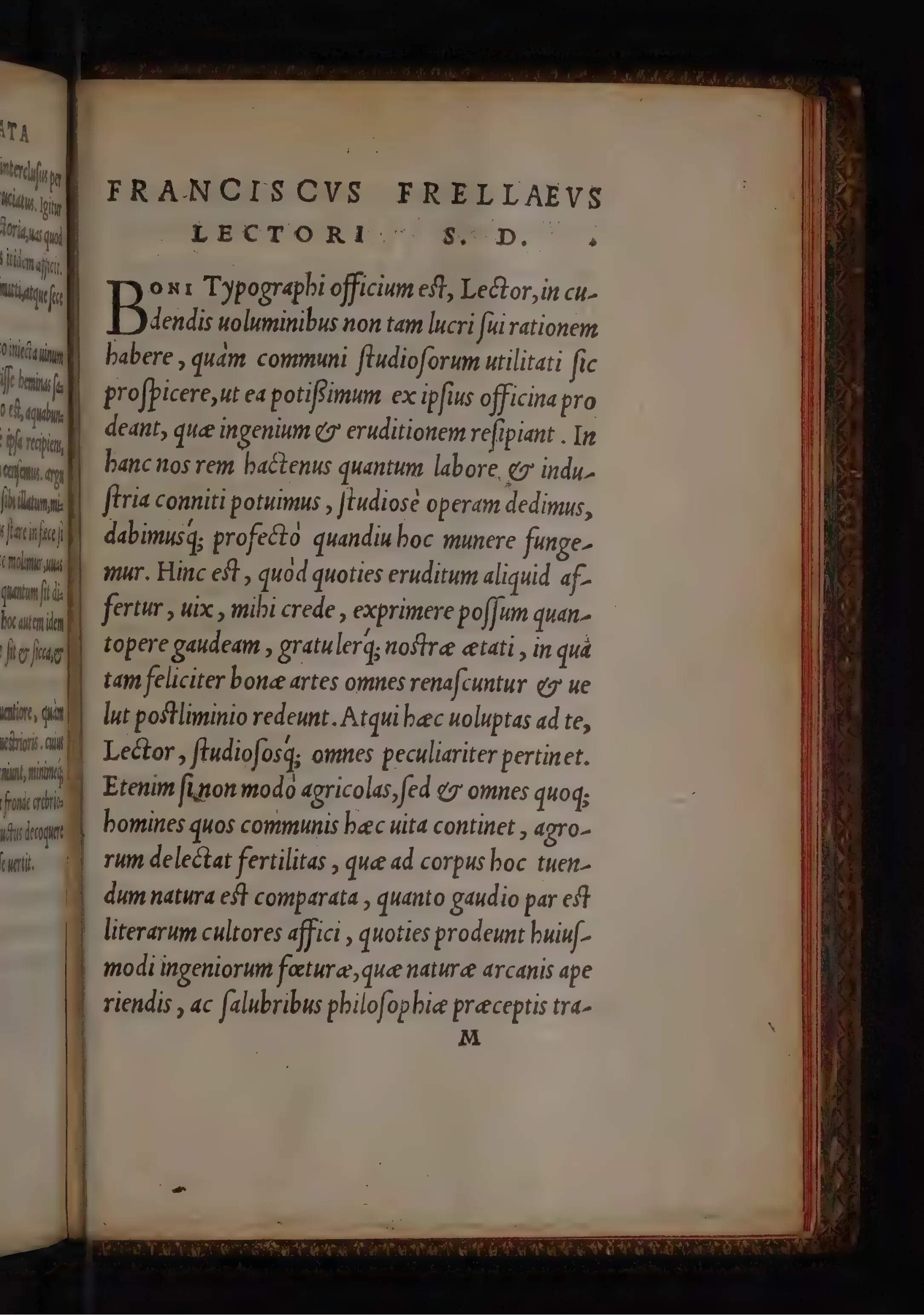
François Frellon's italic epistle to the reader opens beneath a decorated initial and makes the press part of the book's moral argument: the good typographer is defined by service to the common utility of students rather than by private gain — the ethic the dialogue imposes on the apothecary's officina. Source ↗.
After the FINIS that closes the appended problems, the volume's voice changes from the schoolroom to the press, and the epistle of François Frellon states the trade's obligation in the language of office: the duty of a good typographer, reader, BONI Typographi officium est, Lector,, is not so much to consider his own profit as so to look to the common utility of students, non tam lucri sui rationem habere, quàm communi studiosorum utilitati sic prospicere. The construction is exactly parallel to the ethic the dialogue imposes on the apothecary, where profit is subordinated to the buyer's safety; here the same subordination governs the other officina, and the utilitas studiosorum replaces the patient's life as the good against which gain is weighed. The claim is then set within the age's flattering self-description, and I congratulate our age, in which all the good arts are so happily being reborn, gratulerq[ue] nostræ ætati, in quâ tam feliciter bonæ artes omnes renascuntur, a renascentia extended by the epistle's own logic beyond letters to natural philosophy and pharmacy. The occasion follows with a dating so tight it reads as a commercial boast — the report, discussed above, that the book of Antonius Musa had been brought to Lyon from Rome within the last few days. Two further formulae complete the transaction. The exemplar is credited to a learned intermediary's generosity, for he, with his customary liberality, gave me the use of this book, is enim pro solita sua liberalitate, libri huius mihi copiam fecit, which converts a private loan into a public benefaction; and the act of printing is described as a release into common possession, in uulgus damus, the Lyon shop presenting itself as the agent by which a Roman folio becomes generally available.
What the press adds is displayed immediately in the apparatus, whose heading advertises a most copious index into the examination of all the simples contained in the book, MVS IN EXAMEN OMNIVM Simplicium quæ in hoc libro continentur. The index is not a bare word-list but an analytical instrument that reproduces the dialogue's discriminations in miniature: it enumerates kinds, as with the four kinds of quicksilver, Argenti uiui quatuor genera; it records the marks by which good balsam-juice is known; and it carries philological sub-entries into the pharmacy, asking what manna signifies among the Hebrews, Māna apud Hebræos quid significet, so that scriptural lexicography sits beside dosages. Its geography is that of the shop's supply, registering pepper from Calicut, Piper ex Calechut, alongside guaiac under both its island name and its devotional one, mummy, Armenian bole, Illyrian iris, and long runs of distilled oils and animal fats — the whole stock, in short, that the examen had arraigned, now made retrievable by a single alphabet. The volume then closes on the imprint that fixes its manufacture, Excudebat Ioannes Barbous, aliàs Le Normand, ANNO M. D. XXXVII, the printer's alias standing as the last word of a book whose argument had been, throughout, that a thing may carry more than one name and must still be correctly known.
Frequently Asked Questions
What is Antonio Musa Brasavola's Examination of All Simple Medicaments Used in the Apothecaries' Shops?
It is a Latin medical dialogue, first witnessed in the Rome edition printed by Antonio Blado in 1536, in which a physician bearing the author's own name, an elderly apothecary and a herbarist walk through the Apennines weighing, one by one, the medicinal simples stocked in Ferrara's shops. The title word examen carries the sense of trial, scrutiny and assay; the speaker describes reviewing the whole stock at Ferrara on his own scales, such as they are. The survey runs from flowers, herbs, seeds, roots, barks and woods through gums, metals, stones, earths, salts, fats and oils, and admits substances the ancients never named, such as guaiac.
Who was Antonio Musa Brasavola?
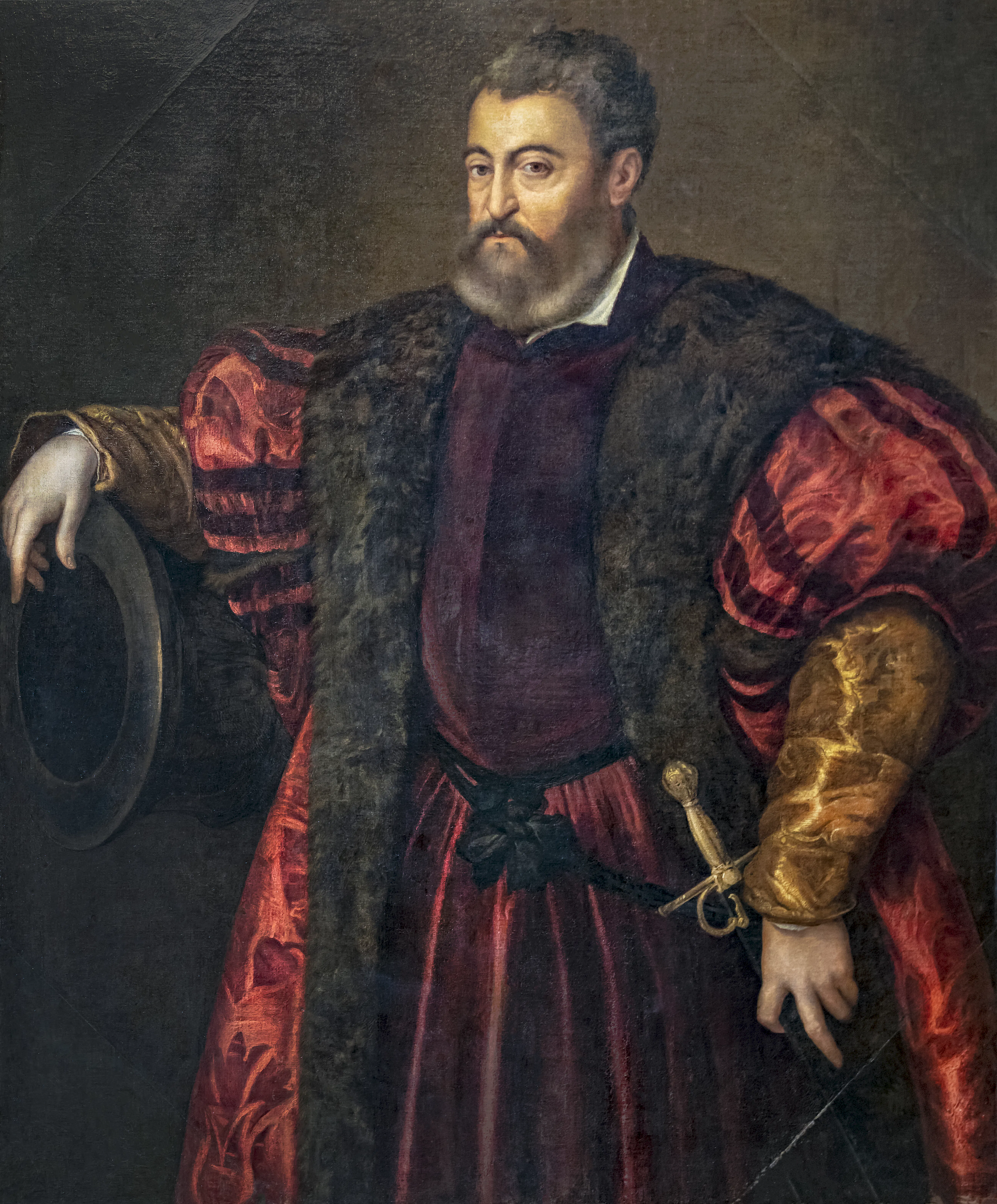
Identified as Titian's portrait of Alfonso I d'Este, this likeness evokes the martial and dynastic authority of the Ferrarese court into which Brasavola's career was woven, and the continuity between his service under Ercole II and the earlier Este world the dialogue repeatedly recalls. Source ↗.
A Ferrarese physician, born at Ferrara on 16 January 1500 and dead there on 6 July 1555. He taught and practised medicine in his native city, served Duke Ercole II d'Este, moved in the orbit of the Este court and its Belvedere garden on the Po, and dedicated his dialogue on simples to Ercole II and Renée of France. The dialogue itself records his birth to the hour — half past the sixth hour of the night, before the feast of St Anthony — alongside his family. The cognomen Musa is attributed in the biographical tradition to Francis I after a Parisian success, a report rather than an independently established etymology.
What dangerous errors in the apothecaries' shops does the dialogue expose?
Fatal confusions of name and thing. Where wild rue seed was prescribed, moderns were taking hemlock seed, called a most destructive herb; oil of elder was dispensed for oil of jasmine, to the great peril of the sick, though the powers of the two differ; glass was sold as gem, a spike passed off for a root, and the gum in common use, though called myrrh, was shown not to be myrrh. The trade's maxim that it is not lawful to sell one thing for another is enforced by a blunt question to the apothecary: does he choose rather to cheat men of their very life than lose one buyer or two?
How does Brasavola treat the Arabic authorities such as Avicenna, Serapion and Mesue?
He declines the abolitionist programme in favour of correction, saying he not only does not approve but strongly disapproves the counsel of those who urge that the Arabs be utterly abolished; faults should be corrected wherever they appear. The blame is relocated to the Latin interpreters who rendered them perversely, so that Serapion's carui and Dioscorides' caros can be shown to be one substance mangled by a faithless translator. Thanks, he adds, are owed to the Arabs for committing such things to writing. Because the accessible transcription is defective in places, not every irenic formulation can be securely attributed across the whole work.
Is there an English translation of Brasavola's Examen omnium simplicium medicamentorum?
No published translation of the work into English or any other modern language has been identified in the sources consulted, and no established English rendering of the title was located; the translation history is best described as unestablished rather than proved negative. Separately, the Leo edition presents the full Latin transcription together with a complete English translation for the first time, that translation being generated by AI. Leo is an effort to make English translations of every text printed in Latin in early modern Europe between 1450 and 1750 freely available online at no cost.
This report was generated by an advanced AI assistant that conducted deep research alongside an extensive interpretation of the transcribed original text. Every effort has been made to preserve fidelity to the source and to guard against inaccuracy, but corruption in the text recognition process and model hallucination may nonetheless have entered the text. Treat every claim, quotation, translation, and citation as provisional, and verify each against the original source before relying on or citing it.
Critical Further Reading on Brasavola, Ferrara, and Renaissance Materia Medica
- Abdul Haq Compier, "Rhazes in the Renaissance of Andreas Vesalius," Journal of Medical Biography: Compier reconstructs the early-sixteenth-century dispute over Arabic authorities and distinguishes abolitionist rhetoric from the more common practice of purifying, reinterpreting, and integrating Arabic learning. That distinction supplies a disciplined comparative framework for Brasavola's place in the Ferrara controversy without forcing every passage into an anti-Arab category, and it is the frame within which the dialogue's relocation of blame from the Arabs to their Latin interpreters — correction rather than abolition of the received Arabic-Latin corpus — becomes legible as a considered position rather than a rhetorical concession.
- Teresa Huguet-Termes, "New World Materia Medica in Spanish Renaissance Medicine: From Scholarly Reception to Practical Impact," Medical History: Huguet-Termes offers a comparative model for studying how newly circulating substances such as guaiacum were received by learned medicine and then assessed in practical settings. The problem she analyses is precisely the one the dialogue confronts when it ridicules those who scorn to use a decoction of guaiac because the ancients are silent about it, asking how they could have written of it, when it is not yet forty years since the island in which it grows was discovered, wholly unknown before, qui decocto guaiaci uti despiciunt, quoniam ab antiquis sileatur. At quomodo ab illis scribi poterat, quum adhuc quadraginta anni no[n] sint, quòd insula, in qua nascitur reperta est, prius penitus incognita. The article should nonetheless be used comparatively: it illuminates the problem of novelty and pharmacological practice but does not constitute evidence for Brasavola's specific text.
- Gionata Liboni, Antonio Musa Brasavola e la sua opera: Umanesimo, medicina e spiritualità alla corte estense del Cinquecento: The central modern monograph on Brasavola, running to 438 pages in the UnifeStum series (Mimesis, 2024). Its biographical, bibliographical, court-historical, and transmission-oriented approach is indispensable for testing older celebratory biographies, reconstructing the author's wider corpus, and situating the Examen among his medical and philosophical writings — including the companion treatises on wine, on vinegar, on the times for gathering herbs, and on Porphyry's Isagoge that the dialogue itself names, and the projected examination of compound medicines announced in its closing pages.
- Vivian Nutton, "Medical Humanism, a Problematic Formulation?," Arts et Savoirs: Nutton's methodological critique prevents "medical humanism" from becoming a period label without analytical content. His treatment of terminology, Greek medical authority, Leoniceno, and Manardo is particularly useful for reading examen as a program of philological precision rather than as a simple antiquarian revival — a reading the dialogue supports where it makes the consultation of many books, and especially the most ancient ones, the standing response to manifest contradiction among authors, on the premise that no honest man would hallucinate so stupidly in so well-known a matter.
- Vivian Nutton, "The Rise of Medical Humanism: Ferrara, 1464–1555," Renaissance Studies: The essential institutional and intellectual context for Brasavola's Ferrara, situating him within a succession of Ferrarese medical scholars and clarifying how court, university, classical learning, and medical practice interacted. The continuity of that milieu is audible in the dialogue's own recollection of Leoniceno's teaching, cited for the barbed observation that the physicians are not the ones who heal, but those women who find the herbs, as Leoniceno used sometimes to argue in jest, non sunt ipsi qui medeantur, sed mulieres illæ, quæ herbas inueniunt, ut Leonicensus quandoq[ue] per iocum disceptabat, a remembered iocus that carries the Ferrarese reform programme's central complaint about the learned physician's ignorance of the substances he prescribes.





.png)


.jpg)