Questioning the Ethiopians at S. Stefano: Giovanni Bona's The Harmony of the Psalm-Singing Church: A Historical, Symbolic, and Ascetic Treatise on Divine Psalmody
Giovanni Bona — Cistercian abbot general, consultor of the Roman Congregations of Rites and of the Index, later cardinal — published at Rome in 1653, and again at Paris in 1663, a treatise on the psalmody of the Divine Office that he called De divina psalmodia, eiusque causis, mysteriis et disciplinis, deque variis ritibus omnium ecclesiarum in psallendis divinis officiis, tractatus historicus, symbolicus, asceticus sive Psallentis Ecclesiae harmonia. Its procedure takes every element of the daily hours three times over — traced to a documented origin, read for its mystery, then converted into a rule for the mind of the reciter — and admits patristic, Hebrew, astronomical and comparative learning only after each authority has been weighed and, where warranted, discredited. What results is one of the sharpest seventeenth-century attempts to make the liturgy a matter of proof, running from the first institution of Compline to the Eastern usages Bona learned by questioning Ethiopian clergy at S. Stefano through an interpreter.
ExLatinis
August 28, 2026

Contents
Giovanni Bona — Cistercian abbot general, consultor of the Roman Congregations of Rites and of the Index, later cardinal — published at Rome in 1653, and again at Paris in 1663, a treatise on the psalmody of the Divine Office that he called De divina psalmodia, eiusque causis, mysteriis et disciplinis, deque variis ritibus omnium ecclesiarum in psallendis divinis officiis, tractatus historicus, symbolicus, asceticus sive Psallentis Ecclesiae harmonia. Its procedure takes every element of the daily hours three times over — traced to a documented origin, read for its mystery, then converted into a rule for the mind of the reciter — and admits patristic, Hebrew, astronomical and comparative learning only after each authority has been weighed and, where warranted, discredited. What results is one of the sharpest seventeenth-century attempts to make the liturgy a matter of proof, running from the first institution of Compline to the Eastern usages Bona learned by questioning Ethiopian clergy at S. Stefano through an interpreter.
Giovanni Bona of Mondovì — D. Ioannes Bona è Monte Regali on his own title page, abbot general of the Reformed Cistercians of St Bernard, consultor of the Roman Congregations of Rites and of the Index, and later cardinal — published in 1653 at Rome, and again at Paris in 1663 through the press of Ludovicus Billaine, a long Latin treatise on the psalmody of the Divine Office. The Paris book announces itself as a second, enlarged and corrected edition appearing for the first time in France; its full title promises a tractatus historicus, symbolicus, asceticus on divine psalmody, its causes, mysteries and disciplines, and on the varied rites of all the churches in the singing of the divine offices, and gives the whole the emblematic name Psallentis Ecclesiae harmonia, the harmony of the psalm-singing Church. It is neither a manual of chant nor a commentary on rubrics, but a work of learned liturgical inquiry addressed to clerics and religious who were bound, daily and for life, to the recitation of the hours.
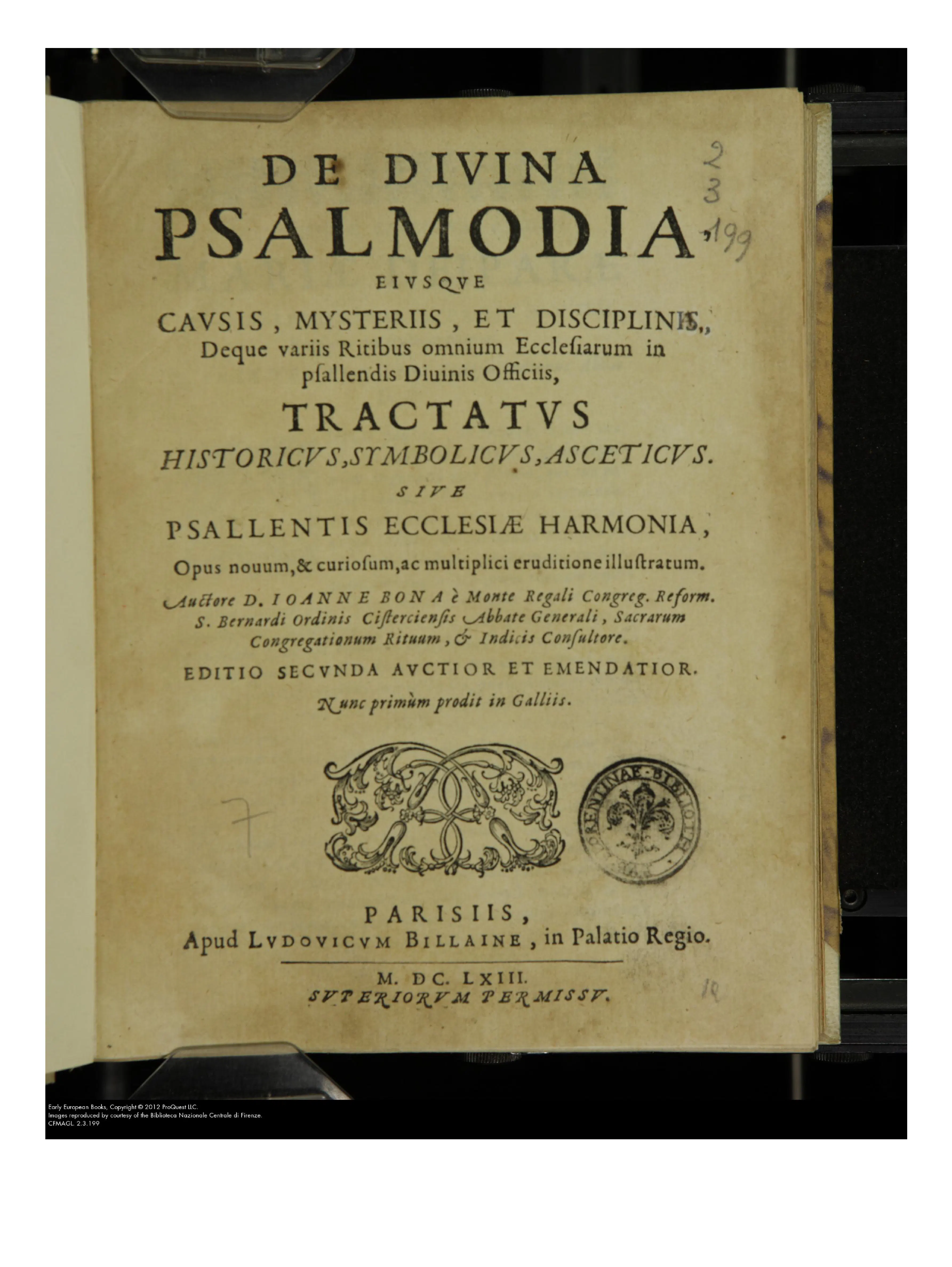
Bona's Paris title page sets the treatise's programme in type: divine psalmody as a tractatus historicus, symbolicus, asceticus, gathered under the emblematic Psallentis Ecclesiae harmonia. The printed Cistercian and curial offices, the second-edition formula, and the 1663 Billaine imprint mark a French reissue, not a first publication. Source ↗.
The problem the treatise sets itself is precise and, in the mid-seventeenth century, urgent: the Divine Office is obligatory everywhere and identical nowhere, and its defenders had long been content to rest it on inherited custom and on the accumulated allegorical exposition of the medieval commentators. Bona's response is a declared method rather than a new body of matter. Every element of psalmody is taken three times: traced first to a documented origin, then read for its mystery, then converted into a rule for the mind of the reciter. The sequence is the spine of the book, and the recurring move throughout is the subordination of erudition to it. Immense borrowed learning — patristic and conciliar texts, Hebrew and Greek philology, astronomy and the reckoning of hours, music theory, comparative liturgy from Milan to Malabar — is admitted only after what he calls censure: attributions are corrected, spurious works named as such, silences pressed as arguments, chronological impossibilities exposed, fables reported without assent, and allegories refused unless confirmed by the authority of scripture. Novelty is claimed for the method and not for the materials; the timber and stones came from others, the building is his.
The stakes of that procedure are historiographical as well as devotional. In the Rome of the Congregation of Rites, of Propaganda Fide, of the Maronite College and of the steady accumulation of Oriental liturgical materials and informants, the question of what could be proved about a rite had acquired institutional weight. Bona's practice of evaluating each authority before citing it, and of measuring received traditions against the possibility of their transmission, belongs to the same seventeenth-century movement toward critical ecclesiastical history later associated with Maurist and Oratorian erudition, though no direct line of influence from this treatise to particular Maurist publications has been established. Equally consequential is what he does with symbolism: he does not discard the tradition of Amalarius and Durandus, but relocates it, allowing symbolic reading only where historical proof has been secured first and where scripture licenses the figure, and declining what he judges mere curious subtlety.
What a reader is likely to remember, however, are the particulars. There is the claim — advanced as observed by no one before him, and offered for weighing in a fairer balance — that St Benedict was the first institutor of Compline, supported by a survey of the Greek writers in which the argument from silence is used with unusual candour about the limits of the author's own reading. There is the correction of those who make Urban II the author of the Little Office of the Virgin, on the ground that he was its promoter and not its founder. There is a mathematical definition of the artificial day taken from the astronomers so as to sidestep controversy; an arithmetical rationale for the number twelve in the canonical hours; a report of an ancient derivation of the hours that Bona thinks smells of fable and prints anyway because authors of the first rank approve it; a flat rejection of the Cabala as a species of theurgic magic; a normative aesthetic of chant that must be grave without rusticity and sweet without levity; and, in the comparative chapters, an account of Armenian, Maronite, Ethiopian and Coptic usage in which the author questions Ethiopian clergy at S. Stefano beside St Peter's through an interpreter. Both of the claims about Benedict and about Urban II remain, on present evidence, without any securely documented contemporary reply, refutation, or censorship proceeding; they are open research questions rather than known controversies.
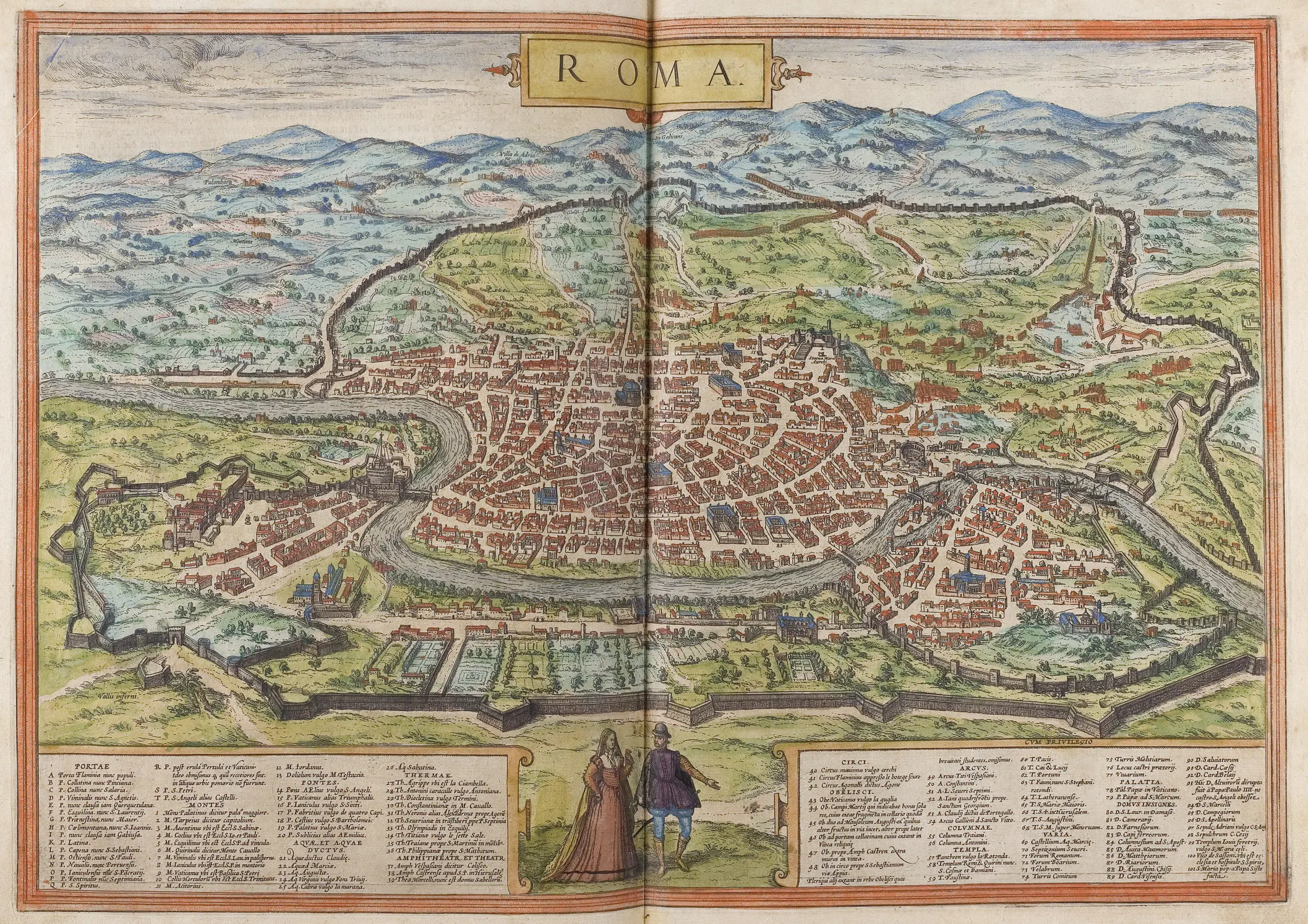
A view of Rome in the Braun and Hogenberg tradition, evoking the city in which Bona's inquiry took shape: curial approval, learned colleges, and the precinct near St Peter's where S. Stefano brought him into conversation with Ethiopian clergy. Source ↗.
The word harmonia in the title carries the whole design. It names musical concord, the intelligible order of time and rite, and the unity of the Church across its legitimately divergent usages — the voice discordant, in Jerome's phrase that Bona adopts, the religion one. That same layering runs from the treatise's conceptual vocabulary through its Roman approbation, its Marian dedication to the Virgin venerated near Mondovì, and its Parisian re-issue as an enlarged and corrected edition, to the internal movement of its chapters, which pass from the antiquity of praise and the causes of the hours, through the individual offices, to the twenty component parts of the Office, chant, the comparative survey of rites, and finally the discipline of psalm-singing itself. The invariant at which the historical and symbolic labour is aimed is stated as an ascetic rule and not as a scholarly result: that the mind of the one who sings should be in harmony with his voice.
Read the full text and English translation on Leo
This text was transcribed and translated as part of the ExLatinis project, an effort by Leo to make free English translations of every text published in Latin in early modern Europe (1450–1750) available online. The complete transcription and English translation of this work can be read free of charge:
→ Read the original Latin text and full English translation on Leo
You can save a copy of this document into your Leo account to run deep text searches, conduct further analysis, or cross-reference it with your own research.
Naming the Work: Psalmodia, Harmonia, and the Title of Bona's Treatise
The Harmony of the Psalm-Singing Church: A Historical, Symbolic, and Ascetic Treatise on Divine Psalmody is an editorial English title supplied for convenience; no established English title was located. The bibliographically safer Latin identification is De divina psalmodia, eiusque causis, mysteriis et disciplinis, deque variis ritibus omnium ecclesiarum in psallendis divinis officiis, tractatus historicus, symbolicus, asceticus sive Psallentis Ecclesiae harmonia. The title page attributes the work to D. Ioannes Bona è Monte Regali, identifying him as general abbot of the Reformed Cistercians of St Bernard and consultor of the Congregations of Rites and of the Index. Psalmodia here denotes more than musical performance: it is the Church's ordered, corporate praise in the Divine Office, treated through the causes, mysteries, disciplines, and rites of ecclesial prayer. The treatise pushes that sense to its theological limit by grounding all created praise in a divine self-praise anterior to creation, God, God I say, in that most august solitude, before he made anything from the beginning, most gloriously blessed in himself alone, was continually praising himself, in the words Deus, Deus, inquam, in augustissima illa solitudine, antequam quicquam faceret à principio, se solo gloriosissimè beatus seipsum iugiter collaudabat; psalmody is thereby framed not as a human institution merely regulated by the Church but as participation in an eternal act, which is why its history, its mysteries, and its discipline can be treated as one subject. Harmonia carries a deliberately layered sense, joining musical concord, the intelligible order of time and rite, and the unity of the Church amid legitimate ritual variety. Each of those registers is audible in the text itself. The musical register governs the prescriptive account of ecclesiastical song, where the chant is to be full of gravity, sounding neither wantonness nor rusticity, so sweet that it is not light, so soothing to the ears that it moves hearts, Cantus plenus sit grauitate, nec lasciuiam resonet, nec rusticitatem. Sic suauis, vt non sit leuis: sic mulceat aures, vt moueat corda — a concord defined by moral effect rather than by technical elaboration. The ecclesiological register appears in the reading of the psalmist's many-coloured garments as an image of rite: what else are the garments, what else the many-coloured flowers, if not the variety of sacred rites by which ecclesiastical men render praises to God, in the text's own formulation, Quid autem vestes, quid flores multicolores sunt, nisi varietas sacrorum rituum, quibus Ecclesiastici viri Deo laudes persoluunt?, where diversity is not a defect to be tolerated but an ornament of the one Church. The descriptors historicus, symbolicus, asceticus distinguish three modes of inquiry: historical establishment of origins and usages, symbolic interpretation disciplined by ecclesial and scriptural authority, and ascetic application to prayerful practice. Bona himself binds the three into a single declared undertaking, writing that he has attempted to explain by a new method the sacred and divine Psalmody, its history, its mysteries, and its ascetic instruction, and that with divine aid he has at last completed what he had hoped he could by no means do: Sacram siquidem, & diuinam Psalmodiam, eiusque Historiam, mysteria, & asceticam institutionem noua methodo explicare conatus sum: teque coeptis aspirante, te vires subministrante, quod ne quaquam me posse sperabam, tandem perfeci. The third term is the operative one, since the ascetic end is stated as a norm of recitation rather than as an object of erudition — how we ought to be in the sight of the Godhead and of the angels, and so to stand to sing psalms that our mind may be in harmony with our voice, qualiter oporteat nos in conspectu Diuinitatis, & Angelorum esse, & hic stemus ad psallendum, vt mens nostra concordet voci nostræ, a Benedictine formula that supplies the treatise with the invariant its historical and symbolic parts serve. The book's Notitia auctorum makes censura an evaluative act of learned reading—assessing authorities, detecting doubtful attribution, and warning that an author may be cautè legendus—not the juridical penalty commonly meant by ecclesiastical censure. The Præmonitio states the practice and its rationale directly, in a passage that concedes the taste of the age while turning it to method: he complies with the temper of this age, which is pleased by nothing unless it is sprinkled with critical salt, and therefore does not prefix bare names of authors as others are wont, but has dared to add a censure to each and to state what he thinks of them, Bsequor genio huius sæculi, AMICE LECTOR, cui nihil placet, nisi critico sale respersum sit. Quare non nuda Auctorum nomina præfigo, quod alij solent: sed singulis ausus sum adijcere censuram, & de ijs proferre, quid sentiam. The work therefore belongs to the seventeenth-century overlap of liturgical history, criticism of sources, and spiritual discipline, rather than to a purely musical treatise.
Placing the 1663 Paris Edition: Bona's Subject, Format, and Claims
This is a Latin printed scholarly and devotional treatise on Divine Office psalmody, not a manuscript and not a medical work. Giovanni Bona's Paris edition was printed by Ludovicus Billaine in 1663 and presents itself as an editio secunda auctior et emendatior and as appearing nunc primum prodit in Galliis. Its declared subject is the history, symbolic meaning, ascetic discipline, and diverse rites of the offices by which churches sing divine praise, and the author's own claim for the book is located in its arrangement rather than its contents: should he say that in these writings he has kept a method wholly different from the method of others, it will be a free utterance rather than a proud one, Quod si dixero me in his scriptis methodum seruasse, ab aliorum methodo prorsus diuersam, magis libera vox erit, quàm superba. The apologetic aim behind that method is stated with equal directness in a cumulative defence of the practice itself — let the faithful therefore count psalmody as nothing, it which contains the greatest praises of God, recalls the secrets of our religion, nourishes contemplation, begets love, exercises the perfect form of prayer, puts demons to flight, gladdens the angels, and supplies spiritual delights, in the ironic reversal Psalmodiam igitur nihili æstiment fideles, quæ maximas Dei laudes continet, nostræ Religionis arcana commemorat, contemplationem nutrit, gignit amorem, perfectam orandi formam exercet, dæmones fugat, letificat Angelos, delicias spirituales subministrat, which indicates that the historical and comparative erudition of the volume is mounted in service of an obligation under contemporary criticism. The 1663 witness is catalogued as a print book in Latin; one digitized copy is described as 4º, with [24], 534, [16] pages, so the common description of it as a folio should not be repeated without qualification. The place of composition is not established; Paris is the place of production. The first edition is identified by surviving catalogue and digitization records as a 1653 Roman printing by Petri/I. P. Collinius, with 584 pages and, in one record, 72 preliminary pages. No reliable evidence located here establishes a complete translation of this specific treatise. Bona's wider oeuvre circulated in several vernaculars, but that fact must not be transferred to this title without title-specific proof.
Making Liturgy Historical: Bona's Critical Method and Its Place in Seventeenth-Century Scholarship
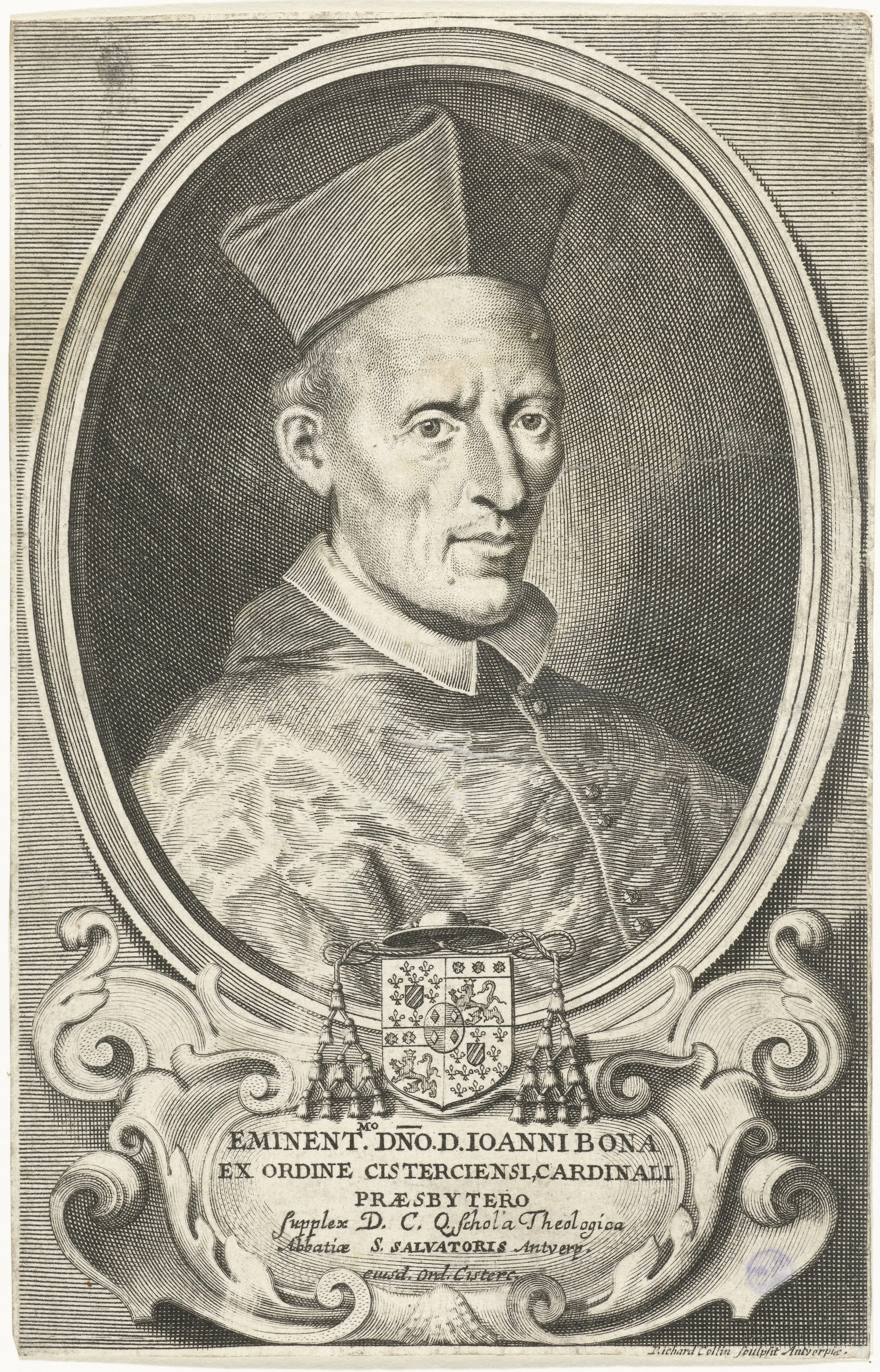
An engraved portrait of Giovanni Bona as cardinal, identified by inscription and by his Cistercian affiliation. It presents the liturgical scholar in the formal idiom of ecclesiastical authority — the same institutional world whose worship he subjected to historical scrutiny. Source ↗.
The work matters as an early modern attempt to make liturgy historical, comparative, philological, and spiritually formative at once. Its method joins the Roman curial culture of examining rites and authorities to the Cistercian concern with ordered prayer. That double allegiance is articulated as an ethics of compilation: timber indeed and stones for this structure he received from others, but the form and construction of the building are his, Ligna quidem, & lapides ad hanc structuram ab aliis accepi: at ædificii forma, & constructio mea est — a formula that concedes dependence on prior erudition while claiming the architecture, and that corresponds precisely to the tripartite ordering described in Section 1.
The surviving evidence shows a broad learned horizon: patristic and medieval writers, Byzantine historians, astronomers such as Tycho Brahe, and authors whose reliability is explicitly assessed. The admission of non-Christian learning is defended on patristic precedent and in scriptural figure: he has not hesitated to join profane erudition to sacred doctrine where it was necessary, following the example of the Church's most distinguished leaders, for Wisdom calls her handmaids to the citadel, and a gentile girl is taken in marriage by a Jew, Sacræ doctrinæ profanam coniungere eruditionem, vbi necesse fuit, non dubitaui præclarissimorum Ecclesiæ procerum insistens exemplo. Sapientia enim vocat ancillas ad arcem, & gentilis puella in coniugium assumitur à Iudæo. In practice this licence is exercised on technical questions where the liturgical tradition supplies no determination, as when the reckoning of the day is settled by definition rather than by disputation: so that, omitting controversies, he may proceed clearly and distinctly in the treatise, he defines the artificial day with the mathematicians from the point at which the sun, really emerging above the horizon in body and substance, rises to us, to the point at which, hidden from our horizon, it deserts this hemisphere with its body, Sed vt omissis controuersiis clarè, & distinctè in hoc tractatu procedam, ego diem artificialem cum Mathematicis definio ab illo puncto, quo sol realiter secundum corpus, & substantiam suam super Horizontem emergens nobis exoritur, ad illud punctum, quo Horizonti nostro absconditus hemisphærium istud suo corpore deserit. The same willingness to reason numerically underwrites the account of the twelve hours, where a cited authority explains that they chose this duodenary number as the most useful of all, since it contains a half, a double, a fourth, a sixth, and a twelfth, which no other number after it up to the twenty-fourth seems to contain, Porro, inquit, numerum hunc duodenarium tamquam omnium vtilissimum delegerunt. Dimidium enim continet, & duplum, & quartum, & sextum, & duodecimum, quæ nullus alius post ipsum numerus vsque ad vigesimumquartum continere videtur. The licence has firm limits, however: Jewish esoteric tradition is admitted as material and then repudiated in doctrinal terms, with the warning that the Cabalistic art, which the Hebrews celebrate with the highest praises, is nothing but sheer superstition, and a kind of theurgic magic invoking evil demons under fictitious names of angels, Hoc tantum moneo artem Cabalisticam, quam Hebræi summis laudibus celebrant, nonnisi meram superstitionem esse, ac theurgicam quamdam Magiam sub fictis Angelorum nominibus Cacodæmones inuocantem.
The critical practice itself is more distinctive than the breadth of reading, and it operates by several identifiable techniques. Antiquity is handled as a criterion that must be conceded in principle before it can be used in argument, with Arnobius and Tertullian invoked to the effect that the authority of religion is not to be assessed by time but by divinity, and that divine matters ought to be judged by their truth rather than their antiquity, Scitè quidem dictum est ab Arnobio Religionis auctoritatem non esse tempore æstimandam, sed Numine: scitè quoque Tertullianus scripsit, res diuinas debere potius de sua veritate, quam de vetustate censeri — a concession that frees the historical chapters to date usages without conceding that the later usage is thereby the weaker. Reported traditions are transmitted with assent withheld: an ancient derivation of the hours is pronounced to smell of fable, and yet not passed over in silence, because authors of the first rank report and approve it, Mihi fabulam redolere videtur hæc foetida horarum institutio, quam tamen tacitus præterire nolui, quod eam primi nominis Auctores referant, & probent. Chronology is used as an instrument of refutation, as when the ascription to Jerome of the Western introduction of the Gloria after the psalms is dismantled by the observation that if Cassian, the most sagacious observer of sacred rites, nowhere heard the Gloria sung after the psalms in the East, one may ask how Jerome, who flourished nearly fifty years before Cassian, could transfer to the West a usage that did not exist, Si Cassianus sagacissimus sacrorum rituum obseruator nusquam audiuit gloriam post Psalmos in Oriente cantari, quomodo potuit Hieronymus, qui quinquaginta ferè annis ante Cassianum floruit, vsum qui non erat in Occidentem transferre?. Received attributions are recast by distinguishing patronage from foundation, as in the judgement that the error of certain persons is refuted who make Urban the Second the first author of these prayers, since he brought into the light of the nations, as their promoter and not their institutor, that which had been born and educated in the cloisters of monks, Ex dictis error quorumdam conuincitur, qui Vrbanum Secundum primum harum precum faciunt auctorem, cum earum promotor, non institutor, quod natum & educatum in claustris Monachorum fuerat, in lucem gentium sapienter eduxerit. And where the author judges himself to be advancing something new, he says so and invites weighing: since mention has been made of St Benedict, he will opportunely note here what, so far as he knows, has hitherto been observed by no one, namely that this most illustrious Father was the first institutor of Compline, an assertion which, since it will occasion astonishment among some not everywhere learned, must be weighed in a fairer balance and established by solid weight of reasons, Quia verò S. Benedicti mentionem fecimus, illud hic opportunè monebo, quod à nemine, quod sciam, hactenus est obseruatum, ipsum videlicet præclarissimum Patrem primum Completorij institutorem fuisse: quæ assertio, quia apud aliquos non vsquequaque eruditos admirationem habebit, æquiori lance libranda, & solidis rationum momentis stabilienda est. That practice anticipates the source criticism and comparative liturgical history associated with later Maurist and Oratorian erudition, although a direct line of influence between this treatise and particular Maurist publications was not established.
A further defensive front runs through the historical chapters, since deriving Christian hours from ancient usage risked the charge of pagan imitation. The objection is raised and refused in the author's own voice: did the Catholic Church therefore strive to imitate the condemned rites of the nations in this matter? Far from it — there are other causes of the most holy institution, which the orthodox Fathers observed, An igitur Catholica Ecclesia damnatos gentium ritus hac in re studuit imitari? Absit. Aliæ sunt causæ sanctissimi instituti, quas orthodoxi Patres obseruarunt. Underlying such moves is a general claim about the place of worship in human nature, that religion alone it is, of which no trace exists in the beasts, Sola religio est, cuius in brutis nullum extat vestigium, which allows commonalities between Christian and gentile observance to be read as evidence of a natural impulse rather than of borrowing.
The medieval allegorical tradition associated with Amalarius and Durandus remains an important polemical background. Bona does not simply abandon symbolism; he places it beside historical proof and ascetic use, with allegory requiring control rather than unrestricted ingenuity. Two features of that control are visible in the text. First, the symbolic reading is explicitly the destination of the historical labour and not its ornament, as when a long technical excursus is justified by asking to what end all this, and so laboriously sought out, and answering that it is surely so that the treatment of Vespers undertaken may be pursued more clearly, illustrated with symbolic explanations, Sed quorsum hæc tam multa, tamque conquisitè? Nempè vt susceptam de vesperis tractationem symbolicis explicationibus illustrem clarius exequamur. Second, the figures themselves are policed for theological adequacy, the solar analogy for divinity being checked with the reminder that there is no exact likeness of the finite and the infinite, since the sun burns, harms the head, and once darkened the bride, is obscured by shadows, fails by the interposition of the moon, and is varied by the alternation of day and night, whereas God is a light that does not fail, Non est exacta finiti, & infiniti similitudo. Vrit sol, capiti nocet, & sponsam olim decolorauit, vmbris offuscatur, Lunæ obiectione deficit, diei ac noctis alternatione variatur. At Deus lumen est indeficiens.
The book's attention to Greek, Armenian, Maronite, Ethiopian, Coptic, and other rites belongs to the Roman world shaped by Propaganda Fide, the Maronite College, and the accumulation of Oriental materials and informants. The ecclesiological principle governing that survey is stated as a doctrine of liberty rather than of concession: no one ought to be offended that different ceremonies are in use in different churches, for in this matter the liberty of the churches has always been greatest, flowing from that spiritual liberty which Christ won for his beloved Spouse the Church by his death, Neminem, inquit, offendere debet quod in diuersis Ecclesiis diuersæ ceremoniæ in vsu habentur. Etenim maxima in hoc genere semper fuit Ecclesiarum libertas ex libertate illa spirituali profluens, quam Christus dilectæ Sponsæ Ecclesiæ sua morte vindicauit. Applied to the Eastern churches, the same principle yields the epigrammatic formula that gives the treatise's title its ecclesiological sense — the voice indeed is discordant, as Jerome puts it, but the religion is one, Vox quidem dissona, vt loquitur Hieronymus, sed vna Religio — so that ritual variety and the unity of faith are held together under the single term harmonia. The contextual scholarship located includes A. Girard on the Maronite College and Propaganda Fide, M. D. Knowles on Maurist historical scholarship, and A. Even-Ezra on the history of systematic allegorical liturgical interpretation. These are useful frameworks, not evidence that any one scholar has produced a monograph on Psallentis Ecclesiae harmonia. The modern literature on this particular treatise is thin: Bona's reputation as a founder of modern liturgical studies and the scholarship on Rerum liturgicarum libri duo and his devotional works are substantially better documented than title-specific reception history. No securely documented contemporary counter-text, refutation, censorship proceeding, or chain of replies concerning the claims about Benedict and Compline or Urban II and the Little Office of the Virgin was located. Those matters should remain open research questions, not asserted episodes.
Editions, Printers, and a Catalogue Confusion: The Bibliographic Life of Psallentis Ecclesiae harmonia
The 1663 Paris book has a stable bibliographic identity: Giovanni Bona, De divina psalmodia ... sive Psallentis Ecclesiae harmonia, editio secunda auctior et emendatior, apud Ludovicum Billaine, Parisiis, 1663. Its title-page language identifies the author and his Cistercian and curial offices; the edition formula and Nunc primum prodit in Galliis mark a second, enlarged and corrected edition that claimed French novelty, not a first composition. The strongest physical description located is an Italian state-library digitization record from the Biblioteca Nazionale Centrale di Firenze, shelfmark CFMAGL, identifier ita-bnc-mag-00002327-001: 4º, [24], 534, [16] pages, with an OCR-transcribed signature formula. Because the signature line is machine-read and was not checked against page images here, it should be treated as provisional. Other witnesses are associated with the British Library, the Bavarian State Library, the Lyon Public Library/Bibliothèque jésuite des Fontaines, and the Montserrat Abbey Library, but complete local shelfmarks were not recovered. The first edition is represented in catalogues as Romae, Petri Collinii, 1653; records variously give P. Callini or I. P. Collinii and 584 pages, while one Italian record gives 72 preliminary pages followed by 584 pages. The conflicting abbreviated forms require consultation of title-page images before a definitive collation is printed. A later 1677 witness and a 1678 Paris Opera omnia demonstrate continued transmission, but the exact issue history and the work's full place in collected editions remain incompletely established.
The book's paratext is materially significant: the OCR exposes a reader's preface, a metrical index extending through Metr XL–L, an Errata graviora section, a Notitia auctorum et librorum with a Præmonitio, and a Roman imprimatur. The preface performs a specific rhetorical task, justifying a further treatise on a much-treated subject by an argument about the cumulative character of learning — those who preceded seem to him not to have snatched away in advance what could be said, but to have opened it up, since material grows daily and things found do not obstruct things to be found, Qui præcesserunt, non præripuisse mihi videntur, quæ dici poterant, sed aperuisse. Crescit in dies materia, & inuenturis inuenta non obstant — which is the same claim about method rather than matter that the title's second-edition formula makes in bibliographical terms. The approbation names Ascanius Rinaldi as Vicesgerens and Fr. Vincentius Cepolla as associate of the Master of the Sacred Apostolic Palace; no date for the approbation was recovered. The OCR also records Bona's critical practice of evaluating authorities rather than merely repeating them.
The internal articulation of the volume is likewise declared rather than left implicit, and it governs the disposition of the chapters from the antiquity of praise and the causes of the hours, through the several offices, to the component parts of the Office, chant, comparative rites, and the discipline of psalm-singing. The transition to the analysis of the Office into its constituent elements is announced through a figure drawn from dissection: it is established in the custom of anatomical dissectors that, after the exact consideration of the whole body and its integral parts, they should divide and investigate most minutely even the least particles, and this custom must be adopted by him at present, ST hoc in more positum anatomicis dissectoribus, vt post exactam totius corporis, eiusque partium integrantium considerationem, alias etiam vel minimas particulas minutissimè diuidant, & inuestigent. Hoc moris vsurpandum mihi est in præsentiarum. The comparative chapter states its own principle of selection in historical terms, noting that with many breviaries abolished the diversities of the ecclesiastical office were reduced to a much smaller number, and that his purpose in that chapter is to describe those rites because they are still in force, Sic pluribus Breuiariis antiquatis Ecclesiastici officij diuersitates ad multo minorem numerum redactæ sunt. Porrò hoc capite eos ritus describere, quia adhuc vigent, propositum mihi est — a criterion that ties the survey of usages to the post-Tridentine reform of the breviary and its exemptions, and that keeps the comparative material within the ambit of living observance rather than antiquarian curiosity.
The period bookseller's list and any privilege under which Billaine printed were not securely recovered. The Marian dedication to the Virgin venerated prope Montem Regalem connects the book's authorial self-presentation to Vicoforte near Mondovì and to Piedmontese/Cistercian religious patronage, but the precise patronage relationship cannot be reconstructed from the evidence recovered. The cataloguing correction is categorical: the liturgical title, its author, printer, date, Latin subject matter, and tripartite description are incompatible with Antonio Musa Brasavola's Examen omnium simplicium medicamentorum, a medical dialogue recorded separately as a 1536 Blado imprint (often dated 1537 in bibliographic discussion). The Brasavola record belongs with sixteenth-century pharmacological and medical printing, not with Bona's Parisian liturgical book. The conflation can be detected immediately by comparing the title-page subject and author: psalmodia, ecclesiastical rites, and Bona are absent from Brasavola's pharmacological title, while Brasavola and medicamenta are absent from Bona's. A specific institutional catalogue history proving how the conflation arose was not located; the correction is therefore a finding about bibliographic identity and a warning against merging records on the basis of digitization metadata alone.
Inside the Treatise: From Eternal Praise to the Discipline of the Choir
The Votive Address, the Preface, and the Grounding of Praise
The treatise states its own programme not in the preface but in the votive address to the Virgin honoured at the miracle-working sanctuary near Monte Regale, where Bona reports, in the words already noticed above, that he has attempted to explain by a new method the sacred and divine Psalmody, its history, its mysteries and its ascetic instruction, and that with her breathing upon his undertaking and supplying strength he has at last accomplished what he had by no means hoped he could. The placement is not accidental. By lodging the tripartite object of inquiry — history, mysteries, ascetic instruction — inside a prayer rather than inside a scholarly apology, Bona makes the threefold division of labour announced on the title page as tractatus historicus, symbolicus, asceticus into an act of devotion rather than a taxonomy of disciplines, and he attributes the completion of a work of massive erudition to Marian agency rather than to industry. Erudition is thereby placed under the same obligation as the recitation it studies: it is offered, not exhibited.
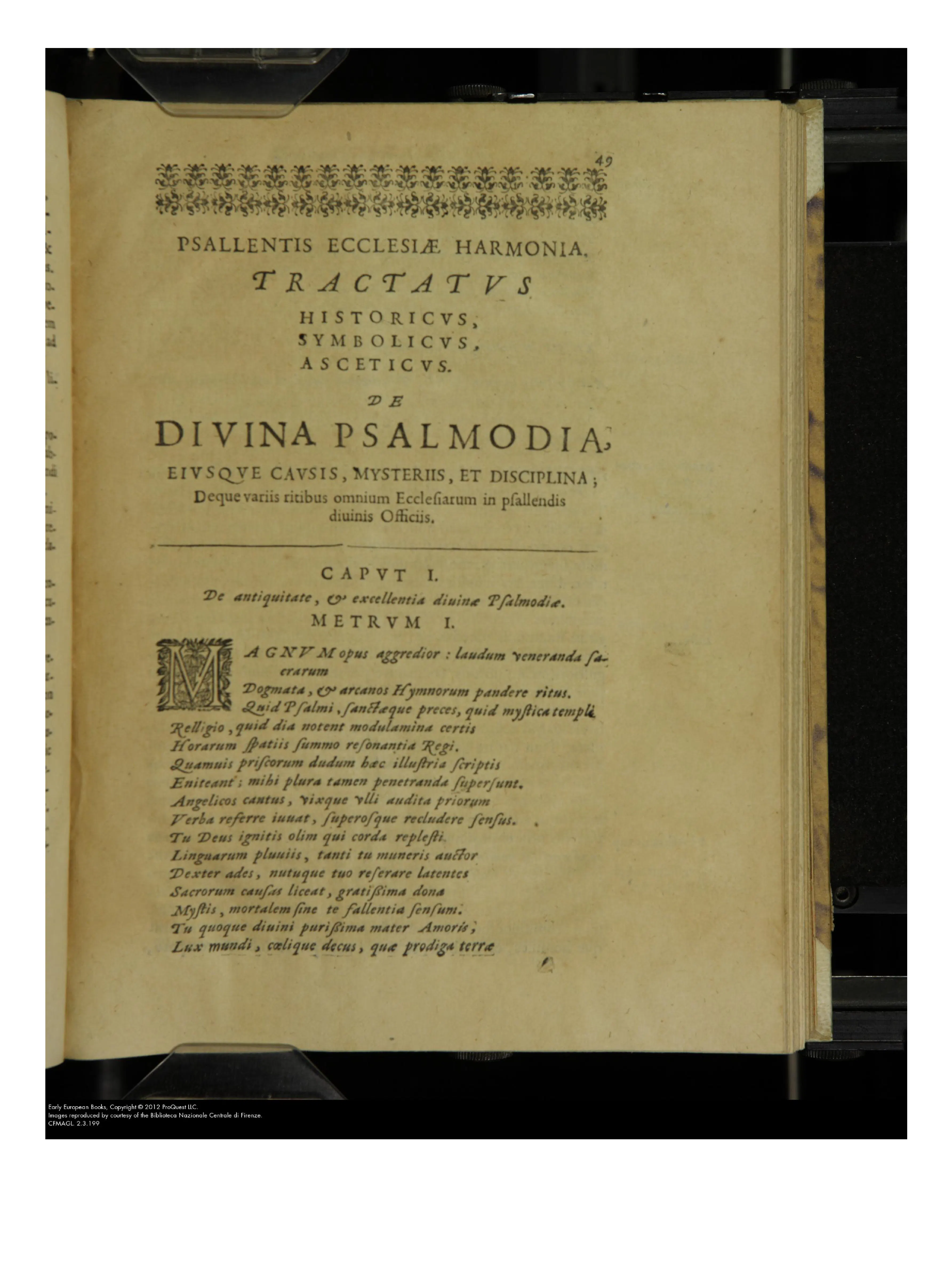
The opening of the treatise proper turns Bona's programme into typography: the title declares a tractatus historicus, symbolicus, asceticus, while a hexameter proem announces the "great work" of unfolding sacred praise and hidden rites. Its visible close turns toward the Virgin — erudition framed as devotion. Source ↗.
The reader's preface then confronts the objection that a subject already handled by Isidore, Amalarius, Rabanus Maurus and Rupert of Deutz leaves nothing to be said. Bona's answer is a genealogy of licensed succession, in Jerome's own words: but is it shameful to follow, because they went before? did Tertullian deter the blessed martyr Cyprian, or Cyprian Lactantius, or Lactantius Hilary, from writing? — Sed an ideò sequi pudet, quia illi præcesserunt? Nunquid, vt verbis vtar D. Hieronymi, aut Tertullianus B. Martyrem Cyprianum, aut Cyprianus Lactantium, aut Lactantius Hilarium deterruit à scribendo?. The rhetorical form matters: the interrogative chain reproduces in miniature the very succession it defends, each named Father standing to his predecessor as Bona stands to his, so that the argument's structure enacts its claim. What might have been a topos of modesty becomes an argument about the mode of theological knowledge — cumulative, serial, and not exhausted by any single treatment — and it prepares the extended disquisition on literary borrowing that follows, in which Terence, Virgil, Cicero, Homer, Ambrose and even Aquinas are shown to have taken from others.
That excursus is unusually candid, since Bona concedes his own share in the common fault before converting it into a craft, distinguishing borrowed material from the plan imposed on it in the formula already cited: the timber and the stones for this structure came from others, but the form and construction of the building are his. The architectural figure is the load-bearing conceit of the whole apparatus. It concedes everything on the level of matter — the quotations, the patristic dossiers, the astronomical and musical technicalities — and claims everything on the level of disposition, which is precisely where the historical, symbolic and ascetic registers do their work. The metaphor also carries a subtler implication: stone and timber do not determine the building, so the same authorities may be rebuilt to a different design, and an author's originality consists in the ordering intelligence that decides where each is set. This is the self-understanding of the learned compiler in its most articulate seventeenth-century form, and it explains why the treatise's novelty is never claimed for its facts.
The claim is tested immediately by the Notitia auctorum et librorum, whose alphabetical entries do not merely list the works cited but adjudicate them: authorship is reassigned, forgeries named, heresies flagged, and dangerous books permitted with a warning, as when a work is admitted to the reader's hands only under caution — his book on the ecclesiastical hierarchy must be read cautiously, sed liber eius deEcclesiastica Hierarchia cautè legendus est. The formula is worth pausing over, because it is the vernacular of the Index applied entry by entry to a private working library rather than pronounced by a tribunal. A consultor of the Congregation of the Index here performs, in the prefatory matter of his own book, the discrimination he would elsewhere perform officially — not prohibiting but calibrating, so that Cabalistic and occult writers, schismatics and apostates remain available as material while their authority is withdrawn in advance. The consequence for the body of the treatise is that citation ceases to be an appeal to authority in the undifferentiated medieval manner: every name has already been weighed, and the reader is told with what confidence to receive it.
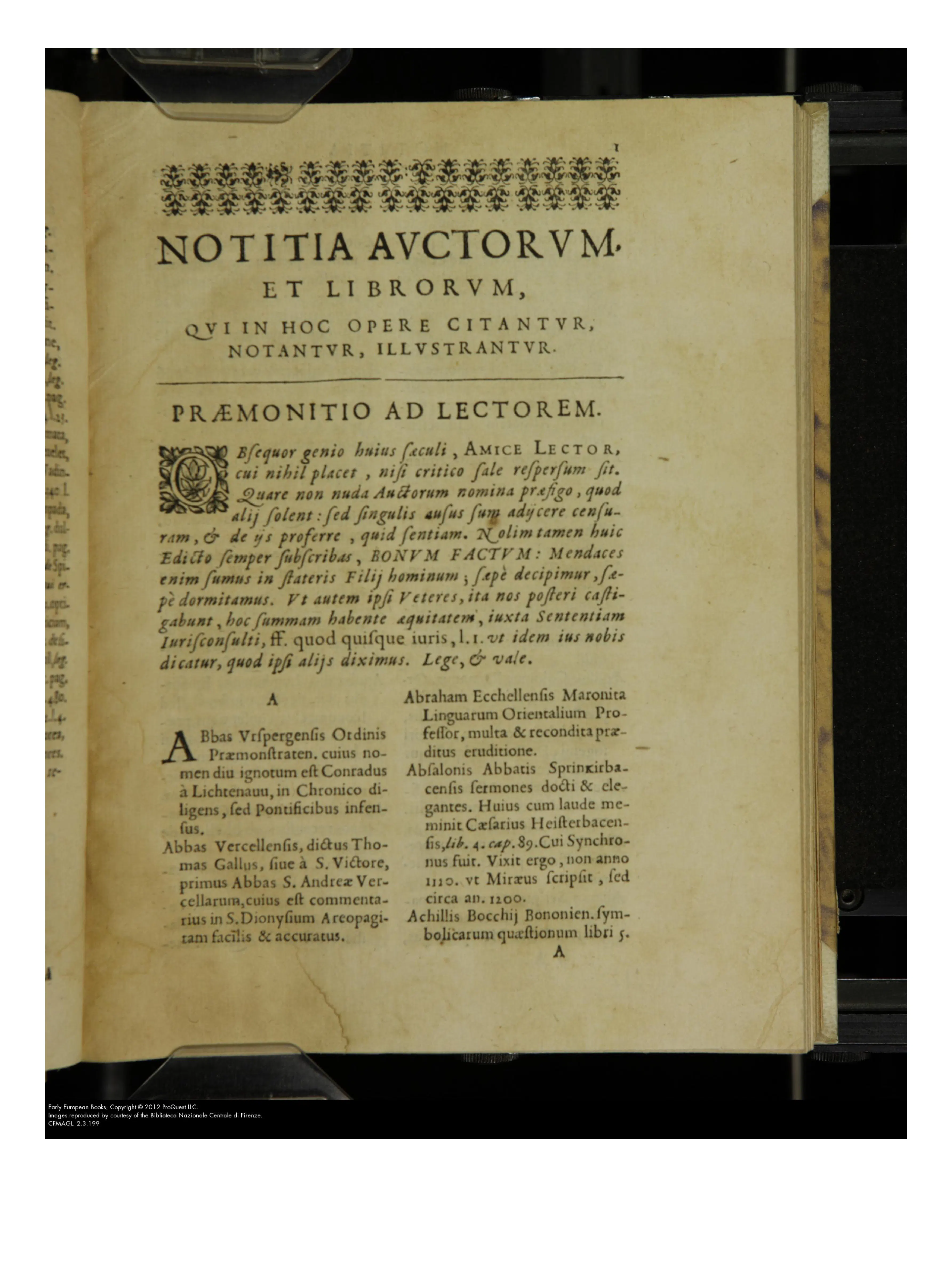
The printed opening of the Notitia auctorum et librorum, where the Præmonitio gives way to alphabetized entries under "A." In that transition from preface to register, citation becomes discrimination: authors and books enter Bona's learned archive only once their authority has been weighed. Source ↗.
The first chapter opens the historical register by pushing the question of psalmody's origin behind institutional memory into anthropology. Having conceded that speech, laughter, foresight and even a species of reasoning appear in animals, Bona locates human specificity in cult, and then grounds cult in the body's very carriage: other living things are bent prone toward the earth, because they follow only the pleasures of the belly, toward which they stoop, whereas man stands with body upright and looks down upon the earth, since with lifted face he gazes on heaven, Cætera animantia prona facie incuruantur in terram, quia ventris, in quem deflectuntur, solas sequuntur voluptates: Homo recto stat corpore, despicitque terras, vt qui erecto vultu intuetur coelum. The topos is ancient, but its function here is ascetic rather than merely encomiastic: posture is treated as a disposition of the soul made visible, so that erectness becomes an obligation and its contradiction — head raised, heart lowered — a reproach. The physiology of praise established in this chapter is what later licenses prescriptions about bodily bearing in choir; the argument from the frame of the body is not ornament but the anthropological premise of a discipline.
The same chapter carries the treatise's boldest speculative movement, in which praise is traced past the angels and past the division of light from darkness to an eternal act within God, whose propriety must then be defended against the ethical objection that self-praise is vicious. Augustine's epigram supplies the resolution: for a man to praise himself is arrogance, for God to praise himself is mercy, Vt homo se laudet arrogantia est, vt Deus se laudet misericordia est. The antithesis does more than parry Plutarch. It converts divine self-praise into pedagogy — God makes himself lovable by declaring his own glory, and thereby teaches the creature the grammar of praise — with the effect that the Office is not a tribute rendered upward from below but a participation in something already complete without it. This is the theological premise that permits Bona to treat the history of psalmody and its mysteries as one subject: what is being historicized is the temporal shape of an act whose origin is not temporal at all.
Against that speculative height the chapter sets a deliberately forensic apologetic, adducing hostile and indifferent witnesses to the antiquity of Christian antelucan singing, among them Pliny's report to Trajan that the Christians were accustomed to assemble on a fixed day before dawn, and to sing a hymn to Christ as to a god among themselves in turn, and to bind themselves by oath not to any crime, but that they should not commit thefts, robberies, adulteries, quod soliti essent stato die ante lucem conuenire, carmenque Christo quasi Deo dicere secum inuicem, seque sacramento non in scelus aliquod obstringere; sed ne furta, nelatrocinia, ne adulteria committerent. The evidentiary logic is explicit in the selection: a pagan magistrate reporting under interrogation has no motive to invent, and the phrase secum inuicem is made to yield alternating choirs — antiphony documented, not inferred from allegory. The polemical target of the chapter, however, is not pagan or Protestant but domestic, and Bona states the adversary's position in its own voice: they say that so many offices are superfluous, devised merely for the honourable occupation of religious otherwise languishing in idleness and inertia, Aiunt superuacua esse tot officia, ad honestam dumtaxat Religiosorum alioquin otio, & inertia languentium occupationem adinuenta. The indignation that follows — that he would not have believed such men existed among Catholics had their books not been printed — identifies the pressure the book is written under: choral obligation criticized from within, on grounds of utility, by writers whose works were in circulation.
Veiling, Mystery, and the Reckoning of Time
The second chapter turns from proof to concealment, and grounds the symbolic register in the Dionysian principle that revelation must be mediated: nor was it otherwise permitted that the divine ray should shine upon our weakness, except veiled by the variety of sacred coverings, Neque aliter fas erat infirmitati nostræ lucere diuinum radium, nisi sacrorum varietate velaminum opertum. This is the theoretical warrant for allegory, and it is stated as a necessity of accommodation rather than a licence for ingenuity — the veil exists because of infirmity, which implies that a figure which does not illuminate has no claim on the reader. Among the nine rationales for the canonical hours that follow, the principal one is memory of the Passion, transmitted in the familiar mnemonic hexameters: Matins binds Christ, who purges crimes; Prime fills him with spittle; Terce gives the cause of death; Sext nails him to the cross; None divides his side; Vespers takes him down; Compline lays him in the tomb, Matutina ligat Christum, qui crimina purgat. Prima replet sputis. Causam dat Tertia mortis. Sexta cruci neclit. Latus eius Nona bipertit. Vespera deponit. Tumulo Completa reponit. The verses are given as the chief mysteries on which the psalmodist should dwell, which makes the day's structure a mnemonic architecture; but Bona at once observes that the competing canonists' verses cannot be reconciled with the Gospel sequence — the historical register auditing the devotional one, exactly the subordination the treatise's method requires.
The third chapter descends to horology, and here ritual time is made to carry doctrine directly, on Athanasius' account that from the creation of the world down to Christ day preceded and night followed, but that from Christ's coming night precedes the day, since beginning from the evening we solemnly celebrate the days that follow: A creatione mundi vsque ad Christum præcessit dies, sequuta est nox... A Christi verò aduentu nox diem præcedit: nam à vespera incipientes solemniter celebramus dies sequentes. The inversion is presented as a consequence of the Fall and its repair — humanity fell out of light into darkness, and worship now moves from darkness into light — so that the mere convention of beginning the liturgical day at Vespers becomes an enacted soteriology. That such a claim requires technical support explains the comparative survey of civil reckonings that surrounds it, where the Athenians, whom the Italians now follow, and likewise, as Origanus asserts, the Silesians, Bohemians, Austrians and Marcomanni, said that all that intervening time from sunset to sunset again was one day, Athenienses, quos nunc Itali sequuntur, itemque, vt Origanus asserit, Silesij, Bohemi, Austriaci, & Marcomanni, ab occasu solis ad solem iterum occidentem, omne id medium tempus, vnum diem esse dixerunt. The passage shows the method under load: a doctrinal reading of Vespers is secured only by ethnographic and astronomical comparison, and the comparison is conducted with a Protestant astronomer cited without hesitation on a matter of measurement. The censorial vigilance of the Notitia and this freedom of technical citation are not in tension but complementary — an author's confession governs what may be received from him in doctrine, not what may be received from him in the reckoning of hours.
The chapters on the hours themselves reach the reader already deep inside an antiquarian dossier — the mythological Horæ of Nonnus, Orpheus, Hesiod and Pausanias, then sundials, clepsydræ, Chinese incense-clocks and modern automata — and the first thing that dossier does is declare a limit to itself. Against the philological maximalism of Claudius Salmasius, whose Plinianæ exercitationes had gathered every ancient notice of hours and horologia, the author lodges an aside at once deferential and dismissive, remarking that the Plinian disputant has heaped together whatever is found about hours and clocks among the ancient writers, and that whoever wishes to know these things more fully, and to exercise his patience upon the man's garrulity, may read him: Congessit Plinianus exercitator quæcunque de horis, & Horologijs apud priscos Scriptores reperiuntur. Ipsum legat, qui hæc fusius scire, eiusque loquacitate patientiam exercere desiderat. Selectivity is thus claimed as a scholarly virtue precisely where the temptation to exhaustiveness is greatest, and the censura announced in the book's prefatory matter is applied not only to attributions but to the proportions of erudition itself. The same instinct governs the technical turn of the following section, where controversy over the status of twilight is not resolved but bypassed by stipulation. The definition of the artificial day discussed above — taken with the mathematicians from the point at which the sun really emerges above the horizon in body and substance to the point at which, hidden from our horizon, it deserts this hemisphere with its body — does its work through the adverb realiter, whose scholastic weight excludes refracted and residual light from the definition and so fixes a boundary that the ensuing computation of unequal hours, measured in the practical idiom of the horologium Italicum and reckoned from sunset, can actually use.
That computation is not an ornament but the evidentiary substructure of the book's central historical claim, that the canonical hours crystallized out of the civil division of the Roman day. The keystone is Tertullian, quoted to the effect that always and everywhere and at every time one must pray, yet those three hours, Third, Sixth and Ninth, as being more notable in human affairs, they made more solemn in divine prayers, Semper, & vbique, ait ille, & omni tempore orandum, tamen tres istas horas Tertiam, Sextam, & Nonam, vt insigniores in rebus P — a run that carries the sheet's signature letter into the text, a reminder of how thoroughly the argument here is embedded in the mechanics of the printed page. The logic of the citation is delicate: obligation is universal, solemnity is conventional, and convention is historically traceable to the forum, the market and the law-court. Precision about such civil vocabulary consequently becomes a duty rather than a pedantry, which is why a lapse in a respected commentator draws an unusually blunt rebuke — he marvels at the learned man's drowsiness in a matter perfectly clear, for Lucan writes that the second watchmen rose at the third hour, not in the third watch, as is evident, Miror viri docti oscitantiam in re clarissima: Tertia etenim hora, non tertia vigilia surrexisse vigiles secundos scribit Lucanus, vt patet. The pun on oscitantia, yawning inattention, is aimed at an error about watches and so keeps the polemic within the semantic field of vigilance; and the correction matters structurally, since the transfer of the military vigiliæ and stationes to ecclesiastical fasting and night prayer can only be argued once the ancient terms are held steady.
From the Nocturnal Office to Vespers
When the treatise turns to the nocturnal office, the historical register yields to an ascetic anthropology of the night, compressed into a sequence of present-tense verbs in which darkness is not merely the occasion of prayer but its adversary: the ambushes of invisible enemies creep, the enticements of the flesh boil, the power of darkness thrives, impure desires steal upon the mind, in the text's own cadence, uisibilium hostium insidiæ, feruent carnis illecebræ, viget tenebrarum potestas, subrepunt animo impuræ cupiditates. The vigil is thereby justified not by the beauty of the night but by its danger, which converts an observance into a tactic. The chapter's polemical section then genealogizes contemporary contempt for vigils through Jerome's Vigilantius, rebaptized Dormitantius, and through Wycliffe, and dispatches unnamed recentiores who, worshipping their belly for a god, find night offices and the divine law alike unbearable. What is striking is the immediate reflexive turn, in which the same charge is levelled at the author's own communion: and would that certain men even among Catholics and the Orthodox did not imitate the obstinacy and softness of those men, men who feign Curii and live Bacchanals, Atque vtinam istorum peruicaciam, & mollitiem, etiam inter Catholicos, & Orthodoxos non imitentur quidam, qui Curios simulant, & Bacchanalia viuunt. The Juvenalian tag, borrowed from a satirist's attack on hypocritical austerity, is redirected against religious laxity within the observant orders themselves; the confessional front and the reforming front are worked with a single instrument, and the sarcastic naming of sleep-loving monks as Endymiones belongs to the same rhetorical economy.
The chapter on Lauds shows the characteristic manner of dissolving a disputed question by distinguishing observances rather than adjudicating between them. The problem is stated with arithmetical clarity — if we separate the Nocturns from Matins, so that they constitute a whole hour by themselves, it is clear that the horary prayers are defined by the number eight, but if we make one office out of both, we conclude there are only seven, Si enim Nocturnos à Matutinis seiungimus, ita vt integram horam per se constituant, clarum est octonario numero preces horarias diffiniri: sin autem ex vtroque officio vnum facimus, septem dumtaxat esse concludimus — and answered by transcribing Benedict's sixteenth chapter and assigning the two computations to the Monastic and Roman uses respectively. The author's own position in that division is not concealed, since he writes as one of us who keep the Monastic rite in the Cistercian Order, nos qui ritum Monasticum in Ordine Cisterciensi seruamus, a self-location that makes the irenic solution also a defence of his own choir. The same chapter pushes the horological apparatus to its outer limit, where the crepuscular arc of eighteen degrees and Clavius's Gnomonice confront a latitude at which the instruments fail: but in the most oblique sphere, where the pole is elevated ninety degrees above the horizon, in which for the space of six months, while the sun runs through the northern signs, there is continuous day, and for another six months continuous night while it lingers in the southern signs, At in sphæra maximè obliqua, vbi polus supra Horizontem eleuatur gradibus 90. in qua sex mensium spatio, dum sol signa borealia percurrit, continua dies est, & per alios sex menses continua nox, dum in signis australibus moratur. That the response is a conventionally marked noon and midnight, kept by bells and gnomons, concedes something the treatise elsewhere resists: at the poles the legitimate hour of an office rests on stipulation, not on the sun.
The chapter on Prime carries the treatise's most delicate apologetic burden, since the massed evidence of pagan eastward sacrifice threatens to make Christian orientation a borrowing. Of the five causes advanced, the first is the most theologically freighted: and first indeed we pray turned to the East for this reason, because we profess that we are exiles and pilgrims, and we sigh after our homeland whence we were cast out, namely the earthly paradise which God planted in Eden toward the East, Et primò quidem ad Orientem conuersi hac de causa oramus, quia nos exules esse, & peregrinos profitemur, & ad patriam nostram, vnde eiecti sumus, ad terrestrem scilicet paradisum, quem Deus plantauit in Eden ad Orientem suspiramus. Orientation is here read as a bodily posture of exile, and the argument is closed off from the charge of imitation by locating the practice in a scriptural topography rather than in solar cult — the sun-worship catalogued at length under the heading of a false apotheosis solis is thereby excluded from the genealogy of the rite even as it is documented in detail.
From Sext onward the symbolic mode assumes the lead, though always after the historical and astronomical groundwork has been laid. Amalarius supplies the psychological key to None, where the state of the time at which the office is celebrated signifies that the fervour of zeal which the mind was exercising in the height of the virtues has been somewhat cooled on account of supervening temptations, Status temporis quando Nona celebratur designat feruorem studiorum, quem exercebat mens in altitudine virtutum, aliquantulum tepefactum esse propter tentationes accidentes — the declining sun figuring not decay merely but the passage from contemplative height to self-knowledge. The long dossier on ancient meal-times attached to that same chapter, running from Tertullian's Psychici through the Rule's forty-first chapter to the papal responses to the Bulgars, then discharges its erudition as reproach: alas, how far we have receded from the ancient rite of fasts; then there were true fasts, hard and austere, now they are light and scarcely worthy of the name of fast, a game and a shadow of a fast, Heu quantum à prisco ieiuniorum ritu recessimus! Tunc vera ieiunia erant, dura, & austera: nunc leuia sunt, & vix ieiunij nomine digna, ludus, & vmbra ieiunij. Historical reconstruction and ascetic exhortation coincide exactly at this point, and the reproach is again turned homeward with the admission that his own brethren scarcely wait for noon. The movement culminates in the interiorization of the entire astronomical framework at Vespers, where the celestial motion measured in the earlier chapters is made a psychology of grace: but the sun also rises for each of us, and sets, and returns to its place; it rises when, by pouring his grace into us, he has said that light should shine out of darkness, Sed & nobis singulis oritur sol, & occidit, & ad locum suum reuertitur. Oritur cum suam nobis infundendo gratiam dixerit de tenebris lucem splendescere. The oblique sphere, the equinoctial hour and the eighteen-degree twilight are not abandoned in this transposition; they are the measured order within which the withdrawal of light becomes intelligible as an instrument of humility, so that the reciter's own alternation of fervour and desolation is read by the same clock that fixes the legitimate hour of his office.
Vespers, Compline, and the Votive Offices
The closing movement of the Vespers chapters supplies the treatise with one of its frankest procedural statements. After pages of Roman antiquarian, Hebrew and patristic matter, the author interrupts himself with the question already noticed above — to what end all this, and so laboriously sought out? — and answers that it is precisely so that the treatment of Vespers already undertaken may be pursued more clearly, illustrated with symbolic explanations. The self-interruption is rhetorically calculated: by voicing the objection of a reader impatient with digression, the author converts what might look like display into instrumentality. Erudition is not the terminus but the material cause of symbolica explicatio, and the ordering he announces here — evidence gathered, then figure drawn — governs every chapter that follows. It also discloses the vulnerability of the arrangement, since the symbolic reading remains, by his own admission, the thing for whose sake the historical labour is performed, and the historical labour must therefore be extensive enough to secure a figure that could otherwise be produced by ingenuity alone.
The Vespers material demonstrates both halves of that economy. On the profane side stands the comparison of the olive-bearing dove of Noah with an institution of the Roman republic and principate, that Roman consuls and emperors, after the enemies of the Empire had been defeated, used to send laurelled letters to the Senate as messengers of triumphal victory, so that the mere sight of the letter should signify nothing but prosperity and good fortune, Consules, & Imperatores Romani post debellatos Imperij hostes literas laureatas ad Senatum mittebant triumphalis victoriæ nuncias, vt solus epistolæ aspectus non nisi prospera, & felicia indicaret. Documented from Julius Capitolinus, Aelius Lampridius and Tacitus, the parallel does not argue derivation; it supplies a semiotic model in which an object announces its message before being read, which is exactly the property the author wants for the olive branch and, by extension, for liturgical signs generally. On the devotional side, the same chapter rises into a doxological register in which argument gives way to antithesis, the exclamation on the Last Supper — O wondrous supper, O surpassing grace, the same Lord is both guest and banquet, feeder and food, offerer and oblation, victim of his own priesthood and priest of his own victim — reading O coenam admirandam, ô gratiam superexcellentem! Idem Dominus conuiua est, & conuiuium; cibans, & cibus; offerens, & oblatio; victima sacerdotij sui, & suæ victimæ sacerdos. The chiastic pairs compress the sacrificial theology of priest and victim into a form designed for recitation rather than dispute, and they sit within a few pages of a technical Christological aside on the communication of idioms — the doctrinal apparatus is present, but it is subordinated to the cadence that a reciter of the hour might carry away.
The Compline chapter is where the treatise's critical machinery is most fully exposed, because there the author advances a positive historical thesis of his own: the claim, already set out above, that Benedict was the first institutor of Compline, put forward as something hitherto observed by no one so far as he knows, and offered to be weighed in a fairer balance and established by solid weight of reasons. Three features of that formula of scholarly self-exposure deserve notice. The qualifier quod sciam concedes in advance that the claim of novelty is a claim about the author's own reading, not about the totality of the tradition. The anticipated admiratio is attributed not to the learned but to those "not everywhere learned," a manoeuvre that pre-emptively assigns resistance to insufficient erudition rather than to countervailing evidence. And the image of the æquior lanx, the fairer scale-pan, sets the terms on which he wishes to be judged: not by the prestige of received opinion but by weighed reasons — a metrological metaphor that recurs, tellingly inverted, at the close of the analytic chapter on the parts of the Office.
The reasons themselves are exercises in internal-evidence criticism. Confronted with a text that would sink the thesis at once, he disqualifies it on liturgical grounds: nor is there anything to disturb anyone's mind in the second Rule of St Augustine, which in explicit words mentions Compline, for that has been wrongly attributed to so great a Doctor and seems to have been fabricated by some unskilled person, since it assigns eighty-eight psalms to morning prayers, distinguishes the Lucernarium from Vespers, and contains many other absurdities about the divine Offices, Nec est quod animum cuiuspiam moueat secunda Regula D. Augustini, quæ disertis verbis meminit Completorij, nam illa perperam tanto Doctori tributa est & ab aliquo imperito conficta videtur: precibus enim matutinis Psalmos assignat octoginta octo, Lucernarium distinguit à Vesperis, & multas alias continet de diuinis Officiis absurditates. The test applied is coherence with attested practice: a text that prescribes an impossible psalter and that splits the lamp-hour from Vespers betrays a hand ignorant of the usages it purports to legislate. Since the identity of lucernarium with Vespers had been established in the preceding chapter through a phalanx of patristic witnesses, the earlier philological labour is here converted directly into a criterion of authenticity — erudition doing evidentiary rather than ornamental work. The complementary move addresses not forged texts but corrupted transmission, warning that if one should find some Greek writer among the more ancient who, rendered into Latin, uses the name of Compline, this must be attributed to the fault of the translators, who, attending to the custom of their own times, whenever they find in the Greek text this word τὸ λύχυνον or another like it, render it as Completorium, Quod si quempiam Græcum Scriptorem ex antiquioribus repereris, qui Latinè redditus Completorij nomine vtatur, id vitio Interpretum tribuendum est, qui nostrorum temporum consuetudinem attendentes, quoties in textu Græco hanc vocem τὸ λύχυνον, vel aliam similem inueniunt, Completorium vertunt. The diagnosis is precise and methodologically ambitious: apparent attestation is identified as an artefact of the Latin versions through which Greek liturgical texts were commonly read, so that the historian must interrogate the vehicle of the evidence before the evidence itself. The same instinct governs the treatment of the Greek Apodipna, glossed by the coinage Postcænia rather than assimilated to the Latin hour.
Having secured the history, the chapter turns to the mystery and thence to the discipline, and the pivot is the doctrine of the mors viuificans, the life-giving death by which one dies to self and to the world's activity while still in the body. Its witnesses are drawn from Platonic philosophy, the Fathers, and — strikingly — near-contemporary women, the last of whom is introduced as María Vela, a nun of the Cistercian Order who flourished at Ávila in Spain in this age with outstanding sanctity, and who thus describes, writing to her confessor, the death which she underwent while living, burnt up by the fire of love, Denique Maria Vela Ordinis Cisterciensis Sanctimonialis, quæ Abulæ in Hispania eximia hoc seculo floruit sanctitate, mortem, quam viuens subiit incendio amoris combusta sic scribens ad suum Confessarium describit. The citation is significant on two counts. It admits a private letter to a spiritual director as evidence in a treatise otherwise built on councils, rules and printed authorities, thereby extending the category of admissible testimony to documented interior experience; and it recruits a woman of the author's own Order, and of the recent past, as a doctrinal confirmation of an ascetic thesis, aligning the treatise's Cistercian self-presentation with the Spanish mystical literature of the preceding century.
The chapters on the Little Office of the Virgin and on the Office of the Dead apply the same triple procedure to devotions of contested origin and contested doctrine. In the Marian chapter the dating of the Office's imposition to the Council of Clermont under Urban II is coupled with the insistence — pressed against those who make him its first author — that he was its promoter and not its institutor, a distinction the author uses repeatedly to reconcile conflicting attributions by separating the act of diffusion from the act of foundation. In the chapter on the dead, the doctrinal ground is laid before the rite is described, with Purgatory defined according to the doctrine of the Church as a place in which souls are punished with temporal penalty, souls which at death were neither excluded from God's grace and love by mortal fault nor so purified that they might at once be admitted to the sight of the Lord, since nothing defiled shall enter the kingdom of heaven, Purgatorium igitur ex doctrina Ecclesiæ locus est, in quo animæ temporaria poena plectuntur, quæ in obitu, nec ob mortalem culpam à Dei gratia, & amore sunt exclusæ, nec adeò defæcatæ, vt confestim ad conspectum Domini possint admitti: nihil enim coinquinatum intrabit in regnum coelorum. The definition is bounded twice over, negatively on each side, and the scriptural clause supplies the necessity of the middle state; only after this is the ritual peculiarity of the Office — its lack of invitatory and doxology — and the comparative ethnography of funerary custom among Persians, Pontic peoples and Celts admitted, the latter serving to present Christian burial piety as the right ordering of a universal human instinct rather than as one custom among many.
The chapter on the Penitential Psalms shows how narrative sources are made to yield liturgical-historical proof. The antiquity of the seven is established from Possidius' account of Augustine's last days, that when, with Hippo besieged by the Vandals, he lay near death, he ordered these psalms, as received from all antiquity, to be written out on a tablet and fixed on the wall before his eyes, so that by assiduous reading of them he might prepare himself for the final struggle with the devil, Nam cum Hippone à Vandalis obsessa morti proximus decumberet, hos tanquam ab omni iam antiquitate susceptos in tabella describi, sibique ob oculos in patiete affigi iussit, vt assidua eorum lectione se ad extremam cum diabolo luctam præpararet. The evidential weight rests on the phrase ab omni iam antiquitate susceptos: a biographical anecdote is read as testimony that the set was already traditional in the early fifth century, and the deathbed setting simultaneously furnishes the ascetic application, since the psalms are shown functioning as they are meant to function. The same chapter's censure of a modern commentator as having written not for piety but for the display of talent marks the limit the author sets to his own erudition.
The Anatomy of the Office and Its Least Particles
That limit is restated as the treatise turns to its final analytic chapter, which is announced through the simile drawn from the dissecting theatre already noticed above: as anatomical dissectors, after the exact consideration of the whole body and its integral parts, divide and investigate most minutely even the least particles, so this custom must now be adopted by the author. The figure is more than decorative. It licenses the disaggregation of the Office into some twenty minimal components — Pater noster, Ave, Creed, sign of the Cross, Gloria Patri, Alleluia, invitatory, hymns, antiphons, versicles, lessons, chapters, collects, and the rest — on the model of an inquiry whose legitimacy depends on the prior integrity of the whole body it divides, so that analysis is presented as the completion of the preceding synthetic chapters rather than as their dissolution.
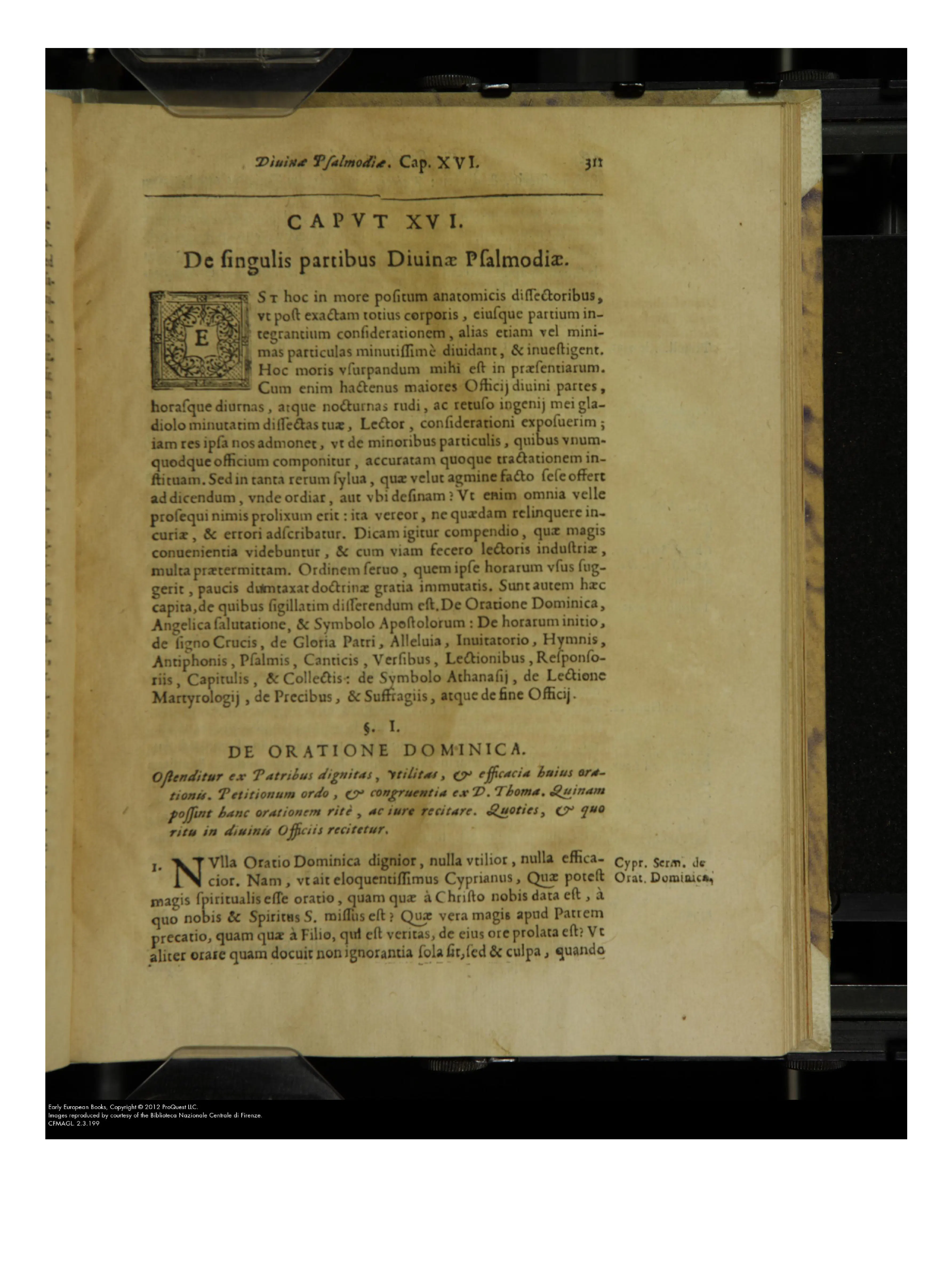
The opening of Caput XVI, with its decorated initial and marginal patristic citation, marks the turn from the Hours as composite structures to the smallest particles of the Office. The section on the Lord's Prayer begins the patristic sequence that makes the analysis devotional as well as historical. Source ↗.
Within that dissection, the excursus on symbolum supplies the treatise with its own name, the term's range — a contribution to a shared meal, a military watchword, a family emblem, an allegorical sign, a Pythagorean maxim, a token-coin — being surveyed before the author appropriates the last sense for his own title. The chapter's final movement, on the opening versicles of the hours, turns the phrase Conuerte nos Deus salutaris noster into an occasion for doctrine, resolved in Bernard's antithesis, that if you take away free will there will be nothing to be saved, and if you take away grace there will be nothing by which it is saved, since none but God can give salvation and none but free will can receive it, Tolle liberum arbitrium, non erit quod saluetur. Tolle gratiam, non erit vnde saluetur. Nec dare potest salutem nisi Deus, nec capere valet nisi liberum arbitrium. The resolution is adopted precisely because it is patristic and formulaic rather than scholastic, and it is immediately followed by the counsel that such matters are safer simply believed than examined in the lying balance of men — a deliberate inversion of the fairer balance invoked for the Compline thesis. Where a question of liturgical fact is at stake, the author demands weighing; where a question of grace and freedom is at stake, he withdraws the scales. The asymmetry is not an inconsistency but the working boundary of the whole enterprise: criticism is deployed on the history of rites, and withheld from the mysteries those rites exist to enact.
Within that same analytic chapter, the treatment of the sign of the cross opens with a declaration about the condition of the evidence rather than about the rite, and the declaration is worth pausing over because it states the working predicament of the whole treatise: if he wished to recount accurately, from testimonies gathered here and there out of the holy Fathers and other ecclesiastical writers, how great is the power, antiquity and might of this dread and most sacred sign, a whole volume would have to be written, so abundant is the material he has prepared for the purpose, and therefore he will make a gleaning from a most rich harvest, Huius tremendi, ac sacratissimi signi quanta sit virtus, quanta antiquitas, quanta potentia, si collectis hinc inde è sanctis Patribus, aliisque Scriptoribus Ecclesiasticis sententiis, & testimoniis accuratè recensere voluero, integrum volumen scribendum erit, adeò multa mihi est in hanc rem parata supellex. Ex vberrima igitur messe spicilegium faciam. The metaphor of the spicilegium, the gathering of what remains after the reapers, is not modesty but a claim about method: the difficulty of ecclesiastical antiquity is superabundance, and the compiler's virtue lies in principled abbreviation of a harvest he asserts to be already in hand. The catena that follows — from Clement of Rome and Ignatius through Tertullian, Cyprian, Cyril of Jerusalem and Damascene down to Thomas à Kempis and the Sibylline verses — is thus offered as a selection under discipline, not an accumulation for its own sake, and the reader is invited to measure the citation by the granary behind it.
That deliberate movement from testimony to determination governs the section's second half, where the collected authorities give way to a contested point of present practice. The disputed question of how the sign is to be traced and formed by the hand is settled by appeal to what the Latin churches in fact do: the common usage of the Western Church is that the tracing of the cross be drawn with the right hand from the forehead to the belly, and from the left to the right, Vsus tamen communis Occidentalis Ecclesiæ est, vt dextera manu Crucis expressio à fronte ad ventrem, & à sinistra ad dexteram producatur. The adversative tamen carries the argumentative weight, conceding the divergent Greek and older usages just rehearsed — three fingers for the Trinity, two extended against the Monothelite error — and then resolving the divergence not by adjudicating which is more ancient but by registering which is current, after which a trinitarian rationale is supplied for each station of the hand. The sequence is characteristic: history establishes the field of variants, custom fixes the norm, and symbolic exposition follows the norm rather than generating it.
The section on the Gloria Patri converts this antiquarian competence into overt textual criticism, and here the register of the prose changes markedly. Three received accounts of the doxology's origin are dismantled in turn, and the third is dispatched by disqualifying its documentary basis: they are deceived, he says, for as was noted from Baronius at the end of the aforesaid letter in the Councils printed at Cologne, by scholars weighing Jerome's works more carefully it is exploded as adulterated and plainly fictitious, Decepti sunt, inquam, nam vt in calce prædictæ Epistolæ in Conciliis Coloniæ editis ex Baronio notatum est, ab eruditis Hieronymi res accuratius expendentibus eatanquam adulterina, ac planè commentitia exploditur. Three features of this sentence belong to the mature critical culture of the mid-seventeenth century. The evidence adduced is not a manuscript but an annotation in a printed conciliar collection, cited by place of publication; the judgement is attributed to a collective of eruditi weighing an author's corpus as a whole, so that style and habit function as criteria of authenticity; and the verbs are those of forensic expulsion — exploditur, driven off the stage. A liturgical attribution that had circulated on the authority of a papal correspondence is thereby removed not by counter-authority but by destroying the standing of the document, and the positive canonical history of the doxology is then rebuilt from Vigilius and the conciliar canons of Vaison and Narbonne. The refusal of a text is presented as a service to the rite, since what survives the sifting rests on canons that can be dated.
With the Alleluia the treatise turns from proof to philology and to the theology latent in a loan-word. Rupert of Deutz supplies the governing formula, that Alleluia is a word foreign to the Latin tongue, Alleluia, inquit, Latinæ linguæ peregrinum nomen est, and the whole subsequent discussion — the Hebrew analysis of Hallelu and Iah with the Piel imperative, the correction of Durand of Toulouse for calling the word Greek and even of Anselm for calling it angelic, the excursus on the ten divine names and the rejection of the vocalization Iehoua — is an unpacking of that peregrinum. The untranslated Hebrew retained on Latin lips is read as a linguistic residue of pilgrimage, a fragment of the supernal Jerusalem's speech sounding in exile, which is also why its melismatic prolongation can be described as jubilation rather than singing and why its suspension in Septuagesima and Lent carries penitential meaning. The philological apparatus here is not ornamental: the strangeness of the syllables is the argument, and the Hebrew learning is admitted precisely to secure it, while being fenced at its edge by the censure of the Kabbalists as ridiculous and to be read only with caution.
The chapters on the Office's constituent texts each seek a definition that will do normative work. For hymnody the Venerable Bede's metrical definition is set aside in favour of Augustine's threefold criterion, given in the interrogative form of catechesis: do you know what a hymn is? it is song with praise of God; if you praise God and do not sing, you do not utter a hymn; if you sing and do not praise God, you do not utter a hymn, quid est? Cantus est cum laude Dei. Si laudas Deum, & non cantas, non dicis Hymnum. Si cantas, & non laudas Deum, non dicis Hymnum. The definition is chosen because it is operative: by requiring song, praise, and God as its object, it excludes on principle both metrical composition without praise and poems addressed to the saints, and so yields a criterion for the liturgical repertory that no prosodic definition could supply. The antiphon receives a comparable treatment, though the determination is drawn from allegory rather than from lexicography: the antiphon is alternated by two choirs, since charity cannot be less than between two, and the cantors who raise the antiphons alternately from either side signify this reciprocity of charity, Duobus choris alternatur Antiphona, quoniam non potest minus esse charitas, quam inter duos. Hanc vicissitudinem charitatis significant Cantores, qui alternatim ex vtraque parte Antiphonas leuant. Amalarius' reading is endorsed here, where elsewhere his ingenuities are declined, because it interprets a physical arrangement — the divided choir, the alternating intonation — as the enactment of a doctrine, and thereby serves the ascetic end rather than multiplying correspondences.
The encomium of the Psalter states the humanist ambition of the enterprise in the boldest terms available to it, in a cumulative quicquid-series that runs the liberal arts through the sacred text: whatever the grammarian discusses of correct speech, whatever the dialectician reasons of the operations of the mind, whatever the rhetorician brings forth of elegance, whatever the arithmetician philosophizes of the mystical account of numbers — all of it is found stored up, as in a most ample treasury of all the sciences, in the Psalms of David, Quicquid literator Grammaticus de congrua differit oratione, quicquid subtilis Dialecticus de operationibus mentis ratiocinatur, quicquid venustatis facundus promit Rhetoricus, quicquid perspicax Arithmeticus de mystica numerorum ratione philosophatur. The claim is double-edged, and the treatise seems aware of it: if the Psalter contains all the disciplines, then the erudition lavished on the Office is not extraneous to it but drawn out of it, and the reciter's daily task becomes the exercise of a total science. Yet the same rhetoric could license unlimited invention, and the counterweight arrives in the chapter on the canticles, where the author interrupts his own symbolic exposition with the admission of distaste already noticed, hating these offspring of a wanton wit and refusing allegories unless they are confirmed by the authority of sacred letters. The vocabulary of that admission is deliberately physiological — foeturas, the litter born of a lascivum ingenium — and the criterion offered in its place is scriptural confirmation, immediately balanced by Jerome's dictum on Origen that both to spurn all allegory and to press it too far are faults. The tension is not concealed: a work saturated with figures declares the figures illegitimate unless licensed, and the reader is left to see that the licence is what the historical labour is for.
The philological temper reaches its most granular expression in the excursus on monastic titulature, where the Rule's prescription generates a history of honorific address: after he has ordered that no one may address another by his bare name, he then bids the seniors be called Nonni by the juniors, and decrees that the Abbot, because he holds Christ's place, be called Domnus, Is enim postquam præcepit nulli licere alium puro nomine appellare, iubet deinde à iunioribus seniores vocari Nonnos, Abbaté verò, quia Christi vices agit, Domnum appellari decernit. An entire theology of deference is loaded onto the elision of a single letter: the heavenly Dominus keeps his full form, the earthly prelate receives the syncopated Domnus, and the orthographic difference becomes a standing act of Christian modesty, traced from Tertullian and the epitaphs through Smaragdus into contemporary Iberian and Italian usage.
Chant and the Aesthetics of Ecclesiastical Song
A late medieval antiphonary leaf, its illuminated initial and chant notation laid out for singers, evokes the choirbooks that ordered the Divine Office — the psalm-singing Church of Bona's title. Its formal layout makes visible the communal psalmody and choral discipline underlying his aesthetics of sacred song. Source ↗.
The chapter on ecclesiastical chant carries the same procedure into a field where the treatise's normative commitments are most exposed. Aelred of Rievaulx's invective is transcribed at length and without softening: whence, now that types and figures have ceased, whence in the Church so many organs, so many cymbals? to what purpose, he asks, that dreadful blast of bellows, expressing rather the crash of thunder than the sweetness of the voice? Vnde, inquit, cessantibus iam typis, & figuris, vnde in Ecclesia tot organa, tot cymbala? Ad quid, rogo, terribilis ille follium flatus tonitrui potius fragorem, quam vocis exprimens suauitatem?. The rhetorical questions rest on a typological premise — instruments belonged to the ceased economy of figures — which, if granted, would settle the case; the treatise nonetheless declines to be settled by it, setting Clement, Prudentius and John of Salisbury against the Cistercian and observing that while the papal chapel and the church of Lyons admit no organs, Trent permits moderate use. Behind the compromise stands the historical thesis that governs these chapters, stated as an observation about the whole literature: for this reason all who have written on music have always rejected the more recent and commended the ancient, Ideò quotquot scripserunt de musica semper recentiori reiecta, antiquam commendarunt — a consensus assembled from Plutarch, Basil, Athenaeus, Sextus Empiricus, Boethius and Cicero, and clinched by the Spartan ephors' fining of Terpander and Timotheus for adding a string. The doctrine that every alteration of music is an alteration of morals thus does not remain a topos: it becomes the criterion by which novelty in the choir is judged.
Where the argument descends to prescription, allegory drops away entirely and the idiom becomes that of statute: let us not draw out the psalmody too much, but sing roundly and with living voice; let us intone the mid-verse and the end of the verse together, and release them together, Psalmodiam, inquit, non nimium protrahamus, sed rotundè & viua voce cantemus. Metrum & finem versus simul intonemus, & simul dimittamus. Tempo, ensemble, and the discipline of the common cadence are regulated in a single sentence, and the effeminate nasal tone is forbidden by name; the whole apparatus of patristic testimony and modal theory is here reduced to instructions executable by a choir. That descent to practice is the point at which the historical and symbolic labour discharges itself, and it prepares the final movement, which reads the accumulated record of divergence — Roman, Ambrosian, monastic, Mozarabic, Gallican, Greek — as figure rather than defect, asking what else the garments and the many-coloured flowers can be if not the variety of sacred rites by which ecclesiastical men render praises to God. The interrogative form performs the conversion it asserts, transforming a catalogue of discrepancies into the ornament of a bride varietatibus circumamicta, and thereby making the enclosed garden of the Song of Songs the ecclesiological warrant for the comparative survey that the treatise is about to undertake.
The Comparative Survey of Rites
The comparative chapter's governing principle is juridical before it is irenic: where Scripture has not determined a practice, consuetudo has the force of law, and the diversity of usages that follows is therefore lawful rather than merely tolerated. The dossier assembled to prove it runs from Isidore and Ratramnus through Augustine's canonical texts to Leo IX and Nicholas I, and it culminates in the maxim with which Gregory the Great instructed Augustine of Canterbury to gather what was best from many churches for a newly converted people — for things are not to be loved on account of places, but places on account of things, Non enim pro locis res, sed pro rebus loca amanda sunt. The maxim does more than license eclecticism; it detaches liturgical value from local prestige and so makes comparison itself a legitimate operation, since no usage can claim authority simply by being the usage of a great see. Fulbert of Chartres then supplies the epigram under which the whole survey proceeds, that diversity of observance does not offend where the unity of faith is not torn apart, and that in many things Greece differs from Spain, and from both the Roman and the Gallican Church, Nec tamen nos offendit observantiæ diuersitas, vbi fidei non scinditur vnitas. Porrò in multis Græcia ab Hispania, ab illis Romana, & Gallicana discrepat Ecclesia. The formula is load-bearing because the chapter must simultaneously celebrate variety and endorse its curtailment: the same pages narrate the decline of metropolitan uniformity, bishops assuming private rites without the Roman Pontiff's knowledge, and the Pian promulgation of the corrected Breviary abolishing all uses not approved from their origin or older than two centuries. Reform history thus furnishes the author's criterion of selection — he will describe only what still stands in law and in practice — and Rome is placed first not by convenience but by primacy, so that the comparative method is enclosed within, and not set against, the hierarchy whose reform has just been narrated.
Within the Roman section, technical inventory alternates with interpretation held under restraint. The distribution of the psalter across the hours, the ordo of Nocturns, the twelve psalms of Cassian's angelic revelation and the numerological gloss on twelve and six all belong to the descriptive register; the allegorical expositions of Amalarius, Honorius and Durandus are noticed and declined as curious subtlety rather than solid instruction. What the author does admit is a philological mystagogy grounded in the structure of the Hebrew text itself, observing of the great alphabetic psalm that it is composed with such artifice that all the verses of the first octonary begin with the first letter Aleph, the eight following with Beth, and so on, done literally to aid the memory but mystically so that, as children's minds learn reading from the first elements of letters, we may learn from such elements the use of living, Eo enim artificio compositus est, vt omnes Versus primi octonarij incipiant à prima litera Aleph, octo Versus sequentes à litera Beth, & sic deinceps; quod factum est literaliter memoriæ iuuandæ gratia: mysticè vero vt quemadmodum paruulorum ingenia primis literarum elementis legendi vsum addiscunt: ita nos huiusmodi elementis vsum discamus viuendi. The moral sense is not imposed on the text but derived from a formal feature of it that can be demonstrated: the acrostic is first a fact of Hebrew composition with an ascertainable purpose, and only then a figure. This is precisely the discipline that the refusal of the older allegorists implies — figure permitted where the letter has already been established.
The monastic section makes the author's partisanship explicit and then shows that partisanship is not a suspension of criteria. On the scholastic question whether the divine essence may be seen in this life he sides with the minority for his own patriarch, declaring that he could never be brought by their arguments to deny this prerogative to his father Benedict, to say nothing for the present of Moses and St Paul, since such singular sanctity had to be marked by some singular gift, nunquam tamen argumentis illorum adduci potui, vt Patri meo Benedicto hanc prærogatiuam denegarem, vt Moysem interim, & D. Paulum omittam: Debuit enim singularis illius sanctitas singulari aliquo munere insigniri. The filial idiom (Pater meus) is unembarrassed, and the argument is one of congruence rather than proof. Yet a page later the same order-allegiance fails to protect a legend flattering to Benedict, that of his singing in the womb with Scholastica, which is dismissed on strictly documentary grounds: since they produce no ancient witness for the matter, it deservedly seems suspect, though other not dissimilar things written by approved authors lend credit to the prodigy, Sed quod nullum huius rei antiquum proferant testem, merito suspecta videtur. Faciunt tamen prodigio fidem alia non dissimilia à probatis Auctoribus scripta. The two criteria — antiquity of testimony, approbation of the reporting author — are the same used elsewhere against received attributions, and the concessive clause is instructive: credit withheld on documentary grounds is partially restored by analogy with attested prodigies, a hedge that keeps the marvellous in view without endorsing the unsupported instance. The same habit governs the chapters on the Latin orders, where Cîteaux's foundation in 1098 is set beside a Carthusian date given as 1086 by Baronius or 1084 on the Order's own records as gathered by Theophilus Raynaud, the disagreement registered rather than resolved; where Ambrosian decuriae, lucernarium and psallenda are glossed as local technical terms for a readership that will not know them; and where the Mozarabic rite's very name is made to carry its history, the Christians mixed among the Arabs, its restoration under Cisneros described as an editorial and typographical act — Visigothic characters driven out, the texts transliterated, set in type, and endowed clergy provided to sing them.
The Eastern chapters, prefaced by Jerome's tag on the discordant voice and the one religion, extend the documentary practice from books to persons. Alongside Leo Allatius, Clemente Galano's bilingual Conciliatio from the press of Propaganda Fide, and materials transmitted from Grottaferrata, the author names his living witnesses and vouches for them by kinship and communion: from Galano's disciple Der Garabiet, an Armenian monk, own brother of Cyriacus the recently deceased Catholic patriarch of the Armenians, a Catholic man, he learned what he here faithfully describes of that Church's rites, & ab eius discipulo Der Garabiet Monacho Armeno Cyriaci Armeniorum Patriarchæ Catholici nuper defuncti fratre germano viro Catholico ea didici, quæ de illius Ecclesiæ ritibus hic fideliter describo. Oral testimony is thus authenticated by the same operations applied to authors — identification, standing, confessional reliability — and its limits are admitted where the informants possess no sacred codices. Confessional sorting is performed liturgically rather than doctrinally in the abstract, churches being classified by whom their offices anathematize or commemorate. The chapter on the books themselves then treats the office as a shelf, Greek and Latin, and closes with a lexicographical disquisition in which humanist purism is raised as an objection and answered: Breviarium is the same as summary, compendium, a concise work, and Seneca censures the word as insufficiently Latin, saying that in the days when we spoke Latin a breviarium was called a summarium, Est autem Breuiarium idem ac summarium, compendium, opus concisum. Seneca calumniatur hanc vocem tanquam minus Latinam: Breuiarium, inquit, olim cum Latinè loqueremur, summarium vocabatur — the objection then met from Pliny, Suetonius and Einhard, so that the name of the reformed office-book is secured philologically as well as canonically.
The Discipline of Psalm-Singing and the Close of the Volume
The turn to the discipline of psalm-singing converts all of this into obligation, and the polemical energy rises accordingly. Against the reality of choir practice the author writes with unusual asperity of those who, with utterly unrestrained rolling of the eyes, unseemly bearing of the body, licentious levity of gesture, reproduce the manners of pagans and infidels, liberrima oculorum iactatione, inconcinna corporis habitudine, licentiosa gestuum leuitate Ethnicorum, ac infidelium exprimunt mores? — the catalogue of sprawling limbs, yawns, quarrels over a single note and voices swallowed in haste being the negative image of the ordered harmony the treatise exists to define. The governing rule is borrowed from Gerson and glossed grammatically, namely that God is the rewarder not of verbs but of adverbs, that is, that the Lord looks not so much to the substance of a good action as to its manner and circumstances, Deum scilicet esse non verborum, sed aduerbiorum remuneratorem: hoc est Dominum non tam respicere ad actionis bonæ substantiam, quam ad modum, & circumstantias,. From this follows the scholastic calibration of attention as material, formal and final, graded by capacity so that the illiterate satisfy the precept while the learned incur guilt for negligence, and from it too the resolution of the hardest case, that of the reciter carried out of himself: against Gerson and Biel he holds that one who so attends to the spiritual sense that he does not consider the words does truly pray vocally and satisfies the Church's precept, sentio illum, qui sensui spirituali ita attendit, vt verba non consideret, verè orare vocaliter, & Ecclesiæ præcepto satisfacere,. The judgement protects contemplative absorption from canonical anxiety while holding the integral utterance of the words as the condition of the office being an office at all.
The final chapter's forty anecdotes, strung together without order of matter or time, translate these distinctions into images. The doctrine of graded attention becomes visible in the vision at Bernard's Nocturns, where he beheld single angels standing by single monks, who, catching on writing-tablets the words of the singers with not the least syllable omitted, wrote them down with the utmost speed, singulis Monachis, singulos Angelos astare conspexit, qui psallentium verba, ne minima quidem syllaba prætermissa schedulis excipientes velocissimè conscribebant — the hierarchy of inks that follows, gold, silver, common ink, water and nothing, rendering merit quantifiable in a way the scholastic apparatus cannot. The negative case is Peter Damian's damned prelate, whose confession names the abuse exactly: because, placed in the royal court, he entangled himself vehemently in imperial counsels, he did not perform the offices of the canonical synaxis through their distinct intervals of hours, but heaping all together in the morning, had the whole day free with untroubled liberty for pressing business, Canonicæ synaxis Officia per distincta horarum spatia non persolui Manè quippè simul omnia coaceruans tota die negotiis ingruentibus secura libertate vacabam. The offence is against the temporal architecture the earlier chapters had established: the hours signify because they are distributed, and to bundle them is to void the very causes assigned to their number and their moments. Even here the critical apparatus intrudes, Baronius being cited to correct the bishop's name on chronological grounds, so that the edifying tale is transmitted with its documentary defect marked. The volume then closes on the topos of insufficiency — these are the things he had to bring forward concerning divine psalmody, not according to the majesty of the subject but according to the slenderness of his powers, Hæc habui, quæ de diuina Psalmodia non pro rei maiestate, sed pro virium inearum tenuitate proferrem — immediately qualified by the claim that much has been deliberately reserved to the industry of posterity, and sealed by Augustine's Trinitarian submission formula. The printed apparatus that follows, the Roman licence subscribed by the Vicegerent and countersigned by the socius of the Master of the Sacred Palace, the alphabetical index of things and words keyed to the pagination, and the Parisian bookseller's list of theological titles in which the treatise is entered under its author's Cistercian and curial styles, continues the same logic by other means: a book of comparative rite and disciplined attention is delivered to its readers with the instruments of retrieval and the marks of approbation that its own method demands.
Further Reading on Maurist Criticism, Liturgical Allegory, and the Maronite College in Rome
M. D. Knowles, “Great Historical Enterprises II. The Maurists,” 1959. The article supplies a concise historiographical framework for the Maurist development of critical ecclesiastical history and helps position Bona's source-evaluating method within the wider seventeenth-century movement; the complete journal and pagination should be verified from the JSTOR record before formal citation. The comparison is best drawn at the level of technique, since Bona already argues from documentary silence while stating the limits of his own collation — let anyone who wishes unroll all the Greek writers, he says, and he will find deep silence everywhere about Compline, the author of the book æydos, whom Jodocus Coccius in his Thesaurus Catholicus says to have written in the year of the Lord 1480, being the first of those he has seen who mentions Compline, Denique qui voluerit omnes Scriptores Græcos euoluat, & inueniet de Completorio altum vbique silentium. Auctor libri æydos, quem Iodocus Coccius in Thesauro Catholico scripsisse ait anno Domini 1480. primus est ex his quos vidi, qui Completorij meminerit, a candour about the scope of the evidence that invites precisely the comparison with later congregational scholarship, without establishing any line of dependence.
A. Even-Ezra, 2023, study of the historical development of systematic allegorical interpretation of liturgy. Its argument is directly useful for distinguishing Bona's controlled symbolic exposition from the older Amalarius–Durandus tradition; the complete title and publication details should be verified from the scholarly record. The distinction is one Bona himself draws in blunt terms, professing that he hates, to confess the truth, these offspring of a wanton wit, and that allegories do not please him unless they are confirmed by the authority of sacred letters, Odi enim, vt verum fatear, has ingenij lasciuentis foeturas, nec placent allegoriæ, nisi sacrarum literarum auctoritate confirmentur — a criterion of scriptural confirmation that subordinates the symbolic mode to the historical and ascetic ones without discarding it.
A. Girard, 2017, study of the Maronite College and the Roman world of Propaganda Fide. It provides institutional context for the Eastern Christian materials, informants, and comparative-rite interests that surround Bona's liturgical scholarship; full chapter or article details should be checked before publication. Bona's own account of how such information reached him makes that institutional setting concrete, since the Ethiopians have at Rome the church of St Stephen near the Basilica of St Peter, in which he found three men, two priests and a monk, whom, through an interpreter, he questioned more than once about the rites of their Church, Æthiopes autem habent Romæ Ecclesiam S. Stephani propè Basilicam S. Petri, in qua tres viros reperi, duos Presbyteros, & vnum Monachum, quos de ritibus suæ Ecclesiæ adhibito Interprete non semel interrogaui; — oral testimony gathered in the same Roman milieu of colleges, national churches and missionary congregations that Girard's work reconstructs, and the practical means by which the treatise's doctrine of licit ritual diversity was supplied with matter. These recommendations are secondary contextual resources, not editions of Bona's book. The specific secondary bibliography on Psallentis Ecclesiae harmonia remains too sparse to support a longer title-specific reading list without risking fabricated citations.
Frequently Asked Questions
What is Giovanni Bona's De divina psalmodia, also called Psallentis Ecclesiae harmonia?
It is a long Latin treatise on the psalmody of the Divine Office, printed at Rome in 1653 and again at Paris in 1663 by Ludovicus Billaine as a second, enlarged and corrected edition announcing itself as appearing for the first time in France. Its title promises a historical, symbolic and ascetic treatment of divine psalmody — its causes, mysteries and disciplines — together with the varied rites of all the churches, under the emblematic name Psallentis Ecclesiae harmonia, the harmony of the psalm-singing Church. It is neither a chant manual nor a commentary on rubrics, but learned liturgical inquiry addressed to clerics and religious bound daily to the hours.
Who was Giovanni Bona?
Giovanni Bona of Mondovì appears on his own title page as D. Ioannes Bona è Monte Regali: abbot general of the Reformed Cistercians of St Bernard, consultor of the Roman Congregations of Rites and of the Index, and later cardinal. He writes explicitly as one of those who keep the Monastic rite in the Cistercian Order, and dedicates the book to the Virgin venerated near Mondovì, at the sanctuary associated with Vicoforte. His standing as a founder of modern liturgical studies, and his Rerum liturgicarum libri duo, are far better documented than the reception history of this particular title.
What does Bona mean by censura, and how does his critical method work?
Censura here is evaluative learned reading, not the juridical penalty of ecclesiastical censure: in the Notitia auctorum et librorum he reassigns authorship, names forgeries, flags heresies, and warns that a given book is cautè legendus, to be read cautiously. Every element of psalmody is then taken three times — traced to a documented origin, read for its mystery, converted into a rule for the reciter's mind. Chronology refutes the ascription to Jerome of the Gloria's Western introduction; Urban II is called promoter, not institutor, of the Little Office; and silence among the Greek writers supports his claim that Benedict first instituted Compline, offered to be weighed in a fairer balance.
How did Bona learn about Ethiopian and other Eastern liturgical usages?
By questioning living informants in Rome as well as reading books. The Ethiopians had at Rome the church of S. Stefano near the Basilica of St Peter, where he found three men, two priests and a monk, whom he questioned more than once through an interpreter about the rites of their Church. For Armenian usage he names Der Garabiet, an Armenian monk and own brother of Cyriacus, the recently deceased Catholic patriarch of the Armenians, alongside Clemente Galano's bilingual Conciliatio from the press of Propaganda Fide and materials transmitted from Grottaferrata. He admits the limits where informants possessed no sacred codices.
Is there an English translation of Psallentis Ecclesiae harmonia?
No complete translation of this specific treatise has been identified; no reliable evidence establishes one. Bona's wider works circulated in several vernaculars, but that cannot be transferred to this title without title-specific proof. Separately, the Leo edition presents the full transcription of the Latin text together with a complete English translation, generated by AI, for the first time, free of charge. Leo is an effort to make freely available online English translations of every text printed in Latin in early modern Europe between 1450 and 1750.
This report was generated by an advanced AI assistant that conducted deep research alongside an extensive interpretation of the transcribed original text. Every effort has been made to preserve fidelity to the source and to guard against inaccuracy, but corruption in the text recognition process and model hallucination may nonetheless have entered the text. Treat every claim, quotation, translation, and citation as provisional, and verify each against the original source before relying on or citing it.
Bibliography
- Academia.edu, "The Latin Literature of Liturgical Interpretation: Defining a Genre and Method," Studia Liturgica 43, no. 1 (2013): 76–92: A genre map of exactly the literature Bona inherited and then disciplined — Amalarius, Rupert, Durandus and their successors — with attention to what counts as a method rather than a heap of correspondences. Read it before deciding whether Bona's "new method" was genuinely new or a rearrangement of an old genre's furniture; the hosted copy carries no author field, so confirm attribution from the journal itself before citing.
- A. Girard, "The Maronite College in Early Modern Rome," Manchester Hive: Reconstructs the Roman institutional machinery — Propaganda Fide from 1622, the national colleges, the presses, the resident Eastern clergy — that made Bona's comparative chapters possible at all. It explains, better than any liturgical handbook, how an abbot in Rome came to interrogate three Ethiopians at S. Stefano through an interpreter and treat the result as evidence.
- M. D. Knowles, "Great Historical Enterprises II. The Maurists," Transactions of the Royal Historical Society: The standard short account of how the Congregation of Saint-Maur turned ecclesiastical history into a documentary discipline, with Mabillon placed in a class of his own. Useful here as a control case: Bona's argument from Greek silence about Compline shows the same instincts a generation earlier, which makes the absence of any demonstrated line of influence worth pondering rather than papering over.