Make Mercury by Mercury: Johann Joachim Becher's Subterranean Physics
Johann Joachim Becher — physician, laboratory operator, mine projector, and adviser on princely revenue — published in 1669 the two books later known as Physica subterranea profundam subterraneorum genesin, e principiis hucusque ignotis, ostendens, a work that replaces the elements of the schools with three material earths and insists that no one understands a metal who cannot make one. Its second earth, the terra pinguis, was reworked by Georg Ernst Stahl into phlogiston, and the 1703 Leipzig recension carries Stahl's own critical specimen bound in at the back. What holds the volume together is a single demand: that mineral knowledge prove itself at the crucible, before sworn assayers, and in the public accounts.
ExLatinis
August 30, 2026

Contents
Johann Joachim Becher — physician, laboratory operator, mine projector, and adviser on princely revenue — published in 1669 the two books later known as Physica subterranea profundam subterraneorum genesin, e principiis hucusque ignotis, ostendens, a work that replaces the elements of the schools with three material earths and insists that no one understands a metal who cannot make one. Its second earth, the terra pinguis, was reworked by Georg Ernst Stahl into phlogiston, and the 1703 Leipzig recension carries Stahl's own critical specimen bound in at the back. What holds the volume together is a single demand: that mineral knowledge prove itself at the crucible, before sworn assayers, and in the public accounts.
Johann Joachim Becher (1635–1682) — born at Speyer, trained and self-trained as a physician, active as a chymist, laboratory operator, projector of mines and manufactures, and writer on princely revenue — published in 1669 at Frankfurt a Latin treatise in two books, issued as the acts of a court laboratory: Actorum Laboratorii Chymici Monacensis, seu Physicae Subterraneae Libri Duo. The first book treated the genesis of subterranean things, the second their special nature and resolution. Over the following decade three separately issued supplements were attached to it — an experimental demonstration of the artificial and instantaneous generation and transmutation of metals (1671), a set of chymical theses on the truth and possibility of metallic transmutation (1675), and a report on a perpetual sand-mine (1680) — and in 1703 the whole was gathered at Leipzig by the printer Johann Ludwig Gleditsch under the title by which the work has since been known, Physica subterranea, with Georg Ernst Stahl's Specimen Beccherianum subjoined. This is the recension in which the work has chiefly been read: a thick octavo of subterranean natural philosophy, laboratory report, medical speculation, transmutational apologetic, and fiscal projection bound into one argument.
The problem the work sets itself is a problem of certainty rather than of nomenclature. How can the composition and generation of earths, stones, salts, and above all metals be known — demonstratively, and not merely labelled with the terms of the schools? Becher's answer is twofold and consistent. First, he replaces the received principles, both the Aristotelian elements and the alchemists' salt, sulphur, and mercury taken as substances, with a corpuscularian doctrine of three earths: a first, vitrifiable and diaphanous earth; a second, fatty and opaque — the terra pinguis whose later fortunes made this book famous; and a third, fluid, which he says is improperly called Mercury. Second, he makes artificial production the test of understanding: one has not grasped a mixture until, given its principles and the other requisites, one can compose it and dissolve it by fire above ground. Mixtion and solution are therefore analysed as a single system, with putrefaction, fermentation, and liquefaction as its modes, and the whole is warranted by first-hand laboratory inspection, by assay, and by named witnesses rather than by compiled authorities. The same criterion pushes the argument outward: into medicine, where a universal being is proposed as remedy; into a defence of transmutation staged before the Emperor Leopold I, and offered explicitly by reasons and experiments rather than by testimonies; and into cameralist finance, where mines worked above ground promise revenue without usury or taxation.
The historical stakes are correspondingly wide.
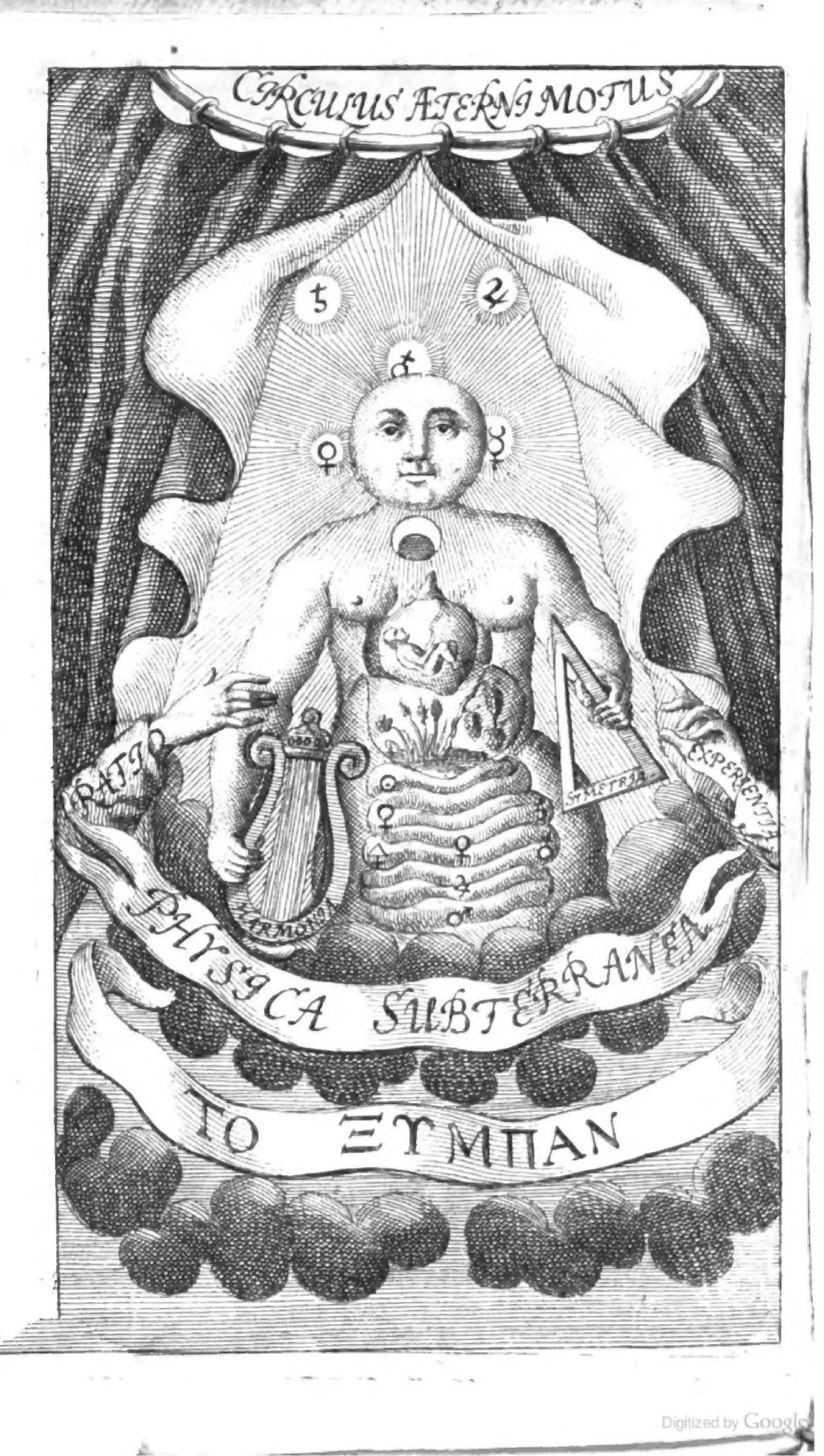
The allegorical frontispiece condenses Becher's project into one emblem: beneath the banner "CIRCULUS AETERNI MOTUS," a solar body marked "PHYSICA SUBTERRANEA" gathers minerals, plants, measuring instruments, and music. Its watchwords — RATIO, EXPERIENTIA, HARMONIA, SYMMETRIA — declare an ambition to ground subterranean physics in experiment, proportion, and universal order. Source ↗.
For the history of chymistry, the work is an unusually concentrated specimen of an enterprise that later disciplinary boundaries cut in half: transmutation, corpuscular theory, docimasy, mineral generation, and public credit are argued here in one breath, which is precisely why the older opposition between a supposedly irrational "alchemy" and a rational "chemistry" cannot be applied to it without distortion. For the genealogy of eighteenth-century chemistry, the second earth matters because Stahl reworked it into the phlogiston of his own system — though the relation is better described as selective appropriation and reinterpretation than as anticipation, and the 1703 volume, where Stahl appears as named editor and critic rather than as a distant reader, complicates any straight line from terra pinguis to phlogiston. For the history of cameralism and court culture, the work shows a projector arguing that mineral knowledge is a matter of public wealth, in a world of territorial princes, imperial commissions, and negotiations with the States of Holland.
What a first-time reader will find most striking is how thoroughly the book is built for verification. Each chapter opens with a numbered SYNOPSIS of heads, followed by a TEXTUS keyed to those numbers by marginal glosses, and the volume closes with an index of authors, a catalogue of writers cited, a syllabus of experiments, and an index of chapters and sections — several distinct finding systems for the same material. Around that armature lie the concrete particulars: a coinage-rich technical vocabulary (lapideitas, metalleitas, the terra mercurificans or fluidificans); an appeal to the "alphabet of nature," in which few letters yield very many combinations; an experiment on putrefaction and vitality performed in a receiver evacuated by the pneumatic engine of Otto von Guericke of Magdeburg; wagers of ducats and sworn assayers' attestations; a dossier of Dutch and Hague commissioners, printed resolutions of the States, purchases of silver, and a stipulated reward of ten thousand florins; a lapidary section frankly excerpted, with acknowledgement, from Jan Jonston; and a running polemic against those Becher calls the haters of chymistry, matched by an equally sharp verdict on its charlatans. The book also draws its own boundaries: certain preparations are withheld lest the wicked be helped along with the good, and one mine is declared to have been created for philosophers only, so that turning it to political use would be a sacrilege.
These features hang together rather than merely accumulating. The terminological reform — distinguishing a principium from a decompositum, decoding the cover-names of the adepts, insisting that common salt, sulphur, and mercury are compounded while the philosophers' are simplest — is what makes the criterion of making intelligible, since one can only claim to compose a body from its principles if the word "principle" has been fixed. The juridical vocabulary of proba, the publicly witnessed assay, is what makes it enforceable, tying laboratory demonstration to commissioners, resolutions, and rewards. And the material history of the volume, from a court laboratory's acts through three supplements to a posthumous Leipzig recension carrying an editor's critical specimen, is the history of a text that kept accreting the documents its own argument demanded. Much about that history remains open: the 1669 imprint is recorded under two different printers in the accessible bibliographical record, the standalone 1680 unit's collation is unresolved, the German translation lineage is provisional, and no modern scholarly translation of the physical books or the transmutation theses has been traced.
Read the full text and English translation on Leo
This text was transcribed and translated as part of the ExLatinis project, an effort by Leo to make free English translations of every text published in Latin in early modern Europe (1450–1750) available online. The complete transcription and English translation of this work can be read free of charge:
→ Read the original Latin text and full English translation on Leo
You can save a copy of this document into your Leo account to run deep text searches, conduct further analysis, or cross-reference it with your own research.
Assigning an English Title and Construing Becher's Vocabulary of Earths
Editorial English title, supplied for convenience rather than established usage: Subterranean Physics: Showing the Deep Genesis of Subterranean Things from Hitherto Unknown Principles, with the Supplements and Georg Ernst Stahl's Specimen Beccherianum. The title translates the central clause of Physica subterranea profundam subterraneorum genesin, e principiis hucusque ignotis, ostendens and identifies the posthumous editorial addition without pretending that an established English title exists.
Becher's vocabulary of terra does not simply reproduce the Aristotelian four-element scheme. In the 1703 text, terra functions as a principial material category: the synopsis distinguishes a first, lapidifying earth, a second terra pinguis, and a third fluid or mercurial earth. The text states the mineralogical thesis in exactly these terms, declaring that in this section we do nothing else than demonstrate that metallic mixts are earthy and have a threefold earth for their principle, hac enim sectione / nihil aliud agimus, quam quod demonstremus, / mixta metallica, terrea esse, & terram trinam pro / principio habere, so that "earth" is here the name of a principle rather than of a sensible clod. The third member of the triad is asserted with the strongest epistemic marker the work commands: that there is some third thing which mingles itself with the two prior principles, whence they obtain their species, is not merely probable but most certain, Dari aliquod tertium, quod prioribus duobus principiis se intermisceat, unde speciem suam nanciscuntur, non verisimile modo, sed / & certissimum est. The claim that a stable specific character persists through material change is likewise carried by the vocabulary of earth, Becher holding himself convinced by his argument and therefore necessarily maintaining that there lies hidden in things a certain immortal form preserving its own characterism, and that this is the subtle earth will shortly be proved, Quo argumento convictus, necessario statuo, latere in rebus immortalem quandam formam, characterismum suum observantem; hanc vero subtilem terram esse, paulo post probabitur — a promise of proof that already exhibits the work's governing standard, that a principle is warranted by what can be shown of it in operation.
Terra pinguis is therefore not ordinary soil and not a modern chemical substance.
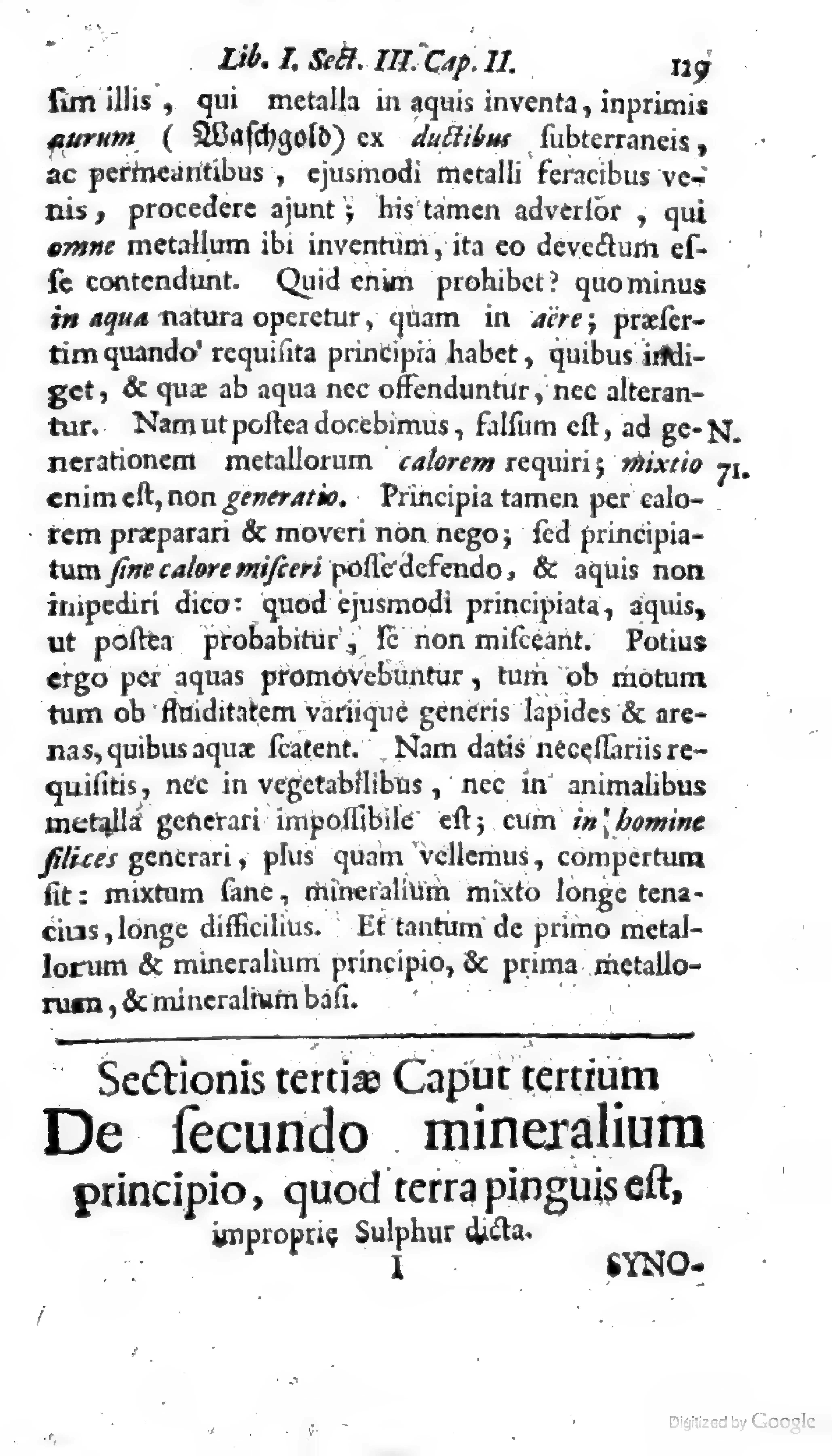
Page 119 turns from Becher's rejection of metallic "generation" in water — "mixtio enim est, non generatio" — to the display heading for the second mineral principle, the terra pinguis "improperly called Sulphur." Centred chapter title, marginal proposition marker, signature, and catchword show the 1703 recension giving typographic form to a conceptual distinction: sulphur names this richer, combustible earth only imperfectly. Source ↗.
Becher calls it, improperly, sulphur; it names the rich, combustible, adhesive principle that, in his account, helps constitute metals and other subterranean bodies. Its later historiographical importance lies in the relation drawn between this Becherian principle and Stahlian phlogiston, but identity should not be assumed: the continuity is a historical transmission and reinterpretation, not proof that Becher had already formulated Stahl's later theory. The third earth carries an analogous freight of expectation, since it is around its purity that the work locates the adepts' secret: and indeed in this wonderful sympathy of the fluidifying earth with metals the whole secret of the Philosophers lies hidden, which consists in this, that the fluidifying earth be had pure, that is, in the state before mixture with any metal, Et sane in hac mirabili sympathia terræ fluidificantis cum metallis, totum Philosophorum secretum latet; quod in hoc consistit, ut terra fluidificans pura habeatur, id est, in statu ante mixtionem cum ullo metallo. The naming here is deliberately functional — the earth is designated by what it does, fluidifying or mercurifying — which is one reason the term resists translation into any later substance-name.
The term decompositum likewise belongs to Becher's effort to regulate the language of composition. The text defines an earth as a principle and describes the result of its combination with other principles as a decompositum, and it applies the distinction directly to the alchemists' three: common salt, sulphur and Mercury are decomposites, but the Philosophers' salt, sulphur and mercury are the simplest principles, commune sal, sulphur & Mercurius decomposita, Philosophorum vero sal, sulphur & mercurius simplicissima principia sunt. The reform is not merely lexical: it converts a doctrinal dispute into a determinate question about what can be extracted from a body without addition, framed as the single point at issue, whether all the parts constituting the compound of salt, or sulphur, or mercury lie hidden in metals, so that of themselves, without any addition, those subjects and compounds can be drawn out of them, Hoc unicum ergo in quæstione est: utrum omnes partes constituentes mixtum salis vel sulphuris, vel Mercurii, in metallis lateant; ita ut per se, sine ulla additione, salia subjecta & mixta, ex illis elici possint?. Mixtio and solutio consequently name operations and histories of material constitution within a corpuscular account; they should not be silently equated with the later textbook distinction between mixture and compound. The corpuscular sense of solutio is explicit where the work defines the action of the alkahest: the solution effected by the liquor Alkahest is nothing else than the penetration of a body and its reduction into the subtlest atoms, without any reaction or communication with the dissolved, so that its parts may freely subside, their crasis remaining entire, Solutio ergo, quæ fit per liquorem Alkaest, nihil aliud est, quam corporis penetratio, & in subtilissimas atomos reductio, sine ulla reactione aut communicatione cum soluto, ut ejus partes libere subsidere queant, crasi earum integramanente. Becher's terminology is an attempt to say when a named material is a constituent principle and when it is a body constituted from such principles.
In the sand-mine dossier, proba carries the practical and juridical sense of an assay or publicly witnessed test. It is attached to commissioners, sworn attestations, printed resolutions, and a promised reward, so that metallurgical testing becomes part of the work's argument about credibility and public utility. The juridical charge of the word is made a premise of the transmutational argument itself, on the ground that the assay of the Roman Empire for discerning gold is founded upon the accidents, not upon the matter of gold; for the Roman Empire supposes that if some metal has the true accidents of gold, it also contains the true form and matter or essence of gold, Proba enim Imperii Romani pro auro dignoscendo, super accidentibus non super materia auri, fundatur; supponit enim Romanum Imperium; si metallum quoddam vera accidentia auri habeat, illud etiam veram auri formam & materiam seu essentiam continere:. The word thus joins experimental demonstration to the administrative language of princely and provincial finance; it is not merely an abstract synonym for logical proof, and it is the hinge by which the criterion of making — knowledge shown in production — is made answerable to public authority.
What Physica subterranea Argues: Becher's Two Books, Supplements, and Editions
Physica subterranea is a printed natural-philosophical and chymical treatise, originally organized as two books and subsequently enlarged by separately issued supplements. Johann Joachim Becher (1635–1682), the Speyer-born physician, chymist, projector, and cameralist, presents subterranean bodies as generated from three material principles and explains their transformations through operations such as mixture, dissolution, rarefaction, condensation, fermentation, putrefaction, and liquefaction. The governing standard of explanation is stated as a criterion of competence rather than of doctrine, since he does not perfectly and evidently know the mixture of subterranean things, especially of metals, who, having their principles and the other requisites, cannot also produce metals above ground by art, Nam is non / perfecte & evidenter subterraneorum, præsertim / metallorum, mixtionem scit, qui, habitis eorum / principiis & reliquis requisitis, etiam supra terram / per artem metalla producere non potest. The treatment of ancillary arts is expressly disciplined by that subterranean object, the author noting that thus we have described fermentation with a simple outline, so far as suits our undertaking; for it is not our purpose to treat these and similar matters specially, except so far as they serve the knowledge and better explanation of subterranean things, ita simplici graphide Fermentationem descripsimus, quatenus instituto nostro convenit; neque enim specialiter hæc & similia pertractare animus est, nisi in quantum cognitioni & meliori explicationi, pro subterraneis inserviunt. The work also makes a practical and fiscal case for chymical knowledge by treating assay, mineral production, transmutation, and the proposed Argentaria or bank as matters of public consequence: the transmutational claim is put in its strongest and least tincture-dependent form, that it is possible, even without a tincture, by the operation of fire alone, really to transmute the species of metals, Possibile ergo est, etiam sine tinctura, sola ignis operatione, metallorum species revera transmutare, while the fiscal case is stated as a comparison of yields, namely that mines can be worked which in point of profit in no way yield to subterranean mines, fodinas coli posse, quæ fodinis subterranei s ratione lucri nullo modo cedant.
The original two-book work appeared under the Munich-laboratory title Actorum Laboratorii Chymici Monacensis, seu Physicae Subterraneae Libri Duo in Frankfurt in 1669.
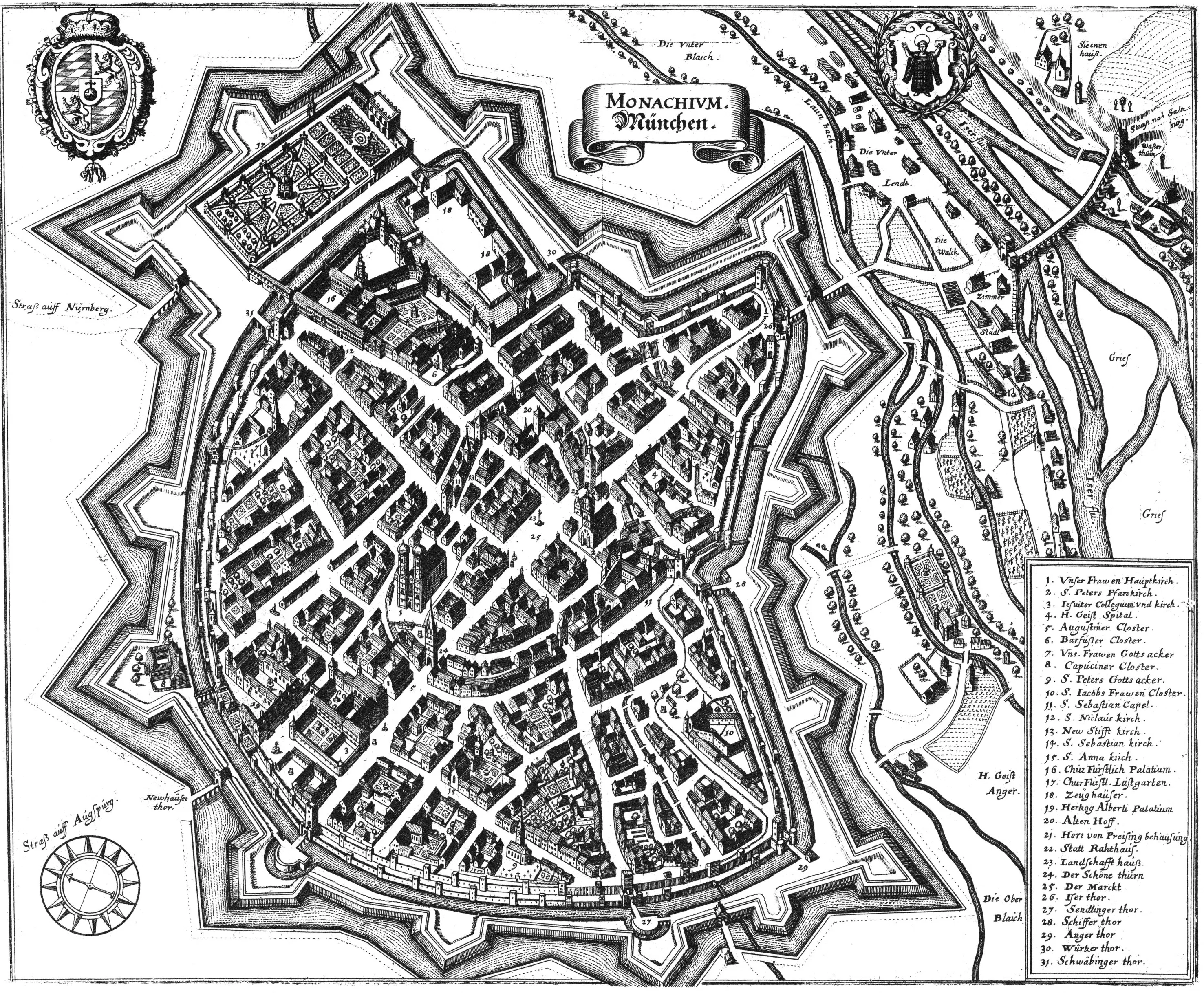
Matthäus Merian the Elder's 1642 engraved plan of Munich evokes the urban and courtly setting behind the Munich-laboratory title, placing the 1669 Actorum Laboratorii Chymici Monacensis within the geography of Bavarian electoral patronage rather than in an abstract republic of learning. Source ↗.
The 1703 Leipzig volume is a posthumous expanded recension: its title identifies Physica subterranea, calls itself an editio novissima, and adds Georg Ernst Stahl's Specimen Beccherianum. The catalogue record for a Rome digitization gives Leipzig, Johann Ludwig Gleditsch, 1703, Latin, octavo, and the complex description “[30], 1008 [i.e. 1000, 44], 304, [16] p.” No single place of composition is securely established; the original title associates the books with the Laboratorium Chymicum Monacense, while the surviving edition was produced in Leipzig.
The 1703 recension is in Latin. A secondary reference asserts that a German rendering of the Physica subterranea, attributed to Becher, appeared in Friedrich Roth–Scholtz's Deutsches theatrum chemicum, II, but it supplies neither a full title nor a date, so the German translation lineage remains provisional. An English Becher-attributed work, Magnalia naturae, or, The philosophers-stone lately exposed to public sight and scale, was printed in London in 1680 by Thomas Dawks and sold by Lawrence Curtis; the Wellcome record describes an English book of six unnumbered pages and thirty-one pages. Its title concerns Wenceslaus Seilerus and projection at the Viennese imperial court, but the accessible catalogue evidence does not establish that it is a direct translation of the Latin Minera arenaria perpetua supplement. No verified Dutch or French translation, and no modern scholarly translation or partial translation of the physical books or the transmutation theses, was located.
Why Becher Matters: Chymistry, Stahl's Phlogiston, and Cameralist Historiography
The work matters because it preserves an unusually concentrated encounter between seventeenth-century chymistry, corpuscular natural philosophy, medical speculation, princely service, mining, assay, and public finance. Its three-earth account is neither a merely practical recipe book nor an abstract system detached from the laboratory. The numbered synopsis, the experimental syllabus, the cited authorities, and the dossier of assays show how Becher attempted to make material theory answer to observed transformations and to networks of witnesses. That evidentiary ambition is stated polemically against learned compilation, the author insisting that we have spent some years upon the practice of fermentation, so that everything might come accurately before our eyes; for we do not write out of Angelo Sala and other compilers, nam aliquos annos circa fermentationis praxin insumsimus, ut accurate omnia ob oculos venirent. Non enim ex Angelo Sala aliisque compilatoribus scribimus. The work is consequently valuable for historians of natural knowledge, book history, court culture, and cameralist political economy at once.
The principal historiographical correction concerns the old opposition between “alchemy” and “chemistry.” William R. Newman and Lawrence M. Principe, in “Alchemy Vs. Chemistry: the Etymological Origins of a Historiographic Mistake” (1998), argue that selective use of those labels has generated anachronism and recommend recovering the early modern term chymistry. Their intervention is directly relevant to Becher, whose discussions of transmutation, projection, mineral generation, and public assay cannot be divided neatly into a supposedly irrational alchemical part and a supposedly rational chemical part. The text's own quarrel is not with a rival chemistry but with the explanatory adequacy of school physics: for if we take the Aristotelians' doctrine concerning the mixture of subterranean things, what else does it teach than commonplaces, or rather furnish little boxes and names that might be imposed on things once these have been explained?, Nam si Aristotelicorum / doctrinam circa mixtionem subterraneorum / sumamus, quid aliud illa docet, quam communia, / seu potius capsulas præbet, & nomina, quæ enucleatis / rebus imponi possent — a complaint that names are supplied where explanation is owed, which is the negative face of the criterion that understanding must be shown by production. Bruce T. Moran similarly reconstructs alchemy and chemistry within the shared practices and conceptual territory of early modern natural inquiry rather than treating them as sealed disciplines. Antonio Clericuzio's study of elements, principles, corpuscles, atomism, and seventeenth-century chemistry supplies the intellectual setting for reading Becher's principles as part of a broader corpuscular enterprise; the work's willingness to test corpuscular claims by apparatus is visible in its report that flesh was placed in a receiver very well evacuated by the pneumatic engine according to the instruction of one Guericke, a citizen of Magdeburg, and well luted; within a few days it began to putrefy and at length worms to grow, but not living nor moving themselves; the valve being at last opened, they immediately began to live and to move, Vale ergo / recipienti, juxta Gerriken Magdeburgensis cujusdam / civis instructionem, per antiam pneumaticam optime / evacuato, impositæ sunt carnes, & optime lutatæ, / intra paucos dies inceperunt pucrefieri, & tandem / vermes crescere: sed non viventes, neque se / moventes: vale tandem aperto, illico vivere, & se / movere inceperant.
The relation between Becher and Stahl is historically consequential but should not be narrated as a simple precursor story.
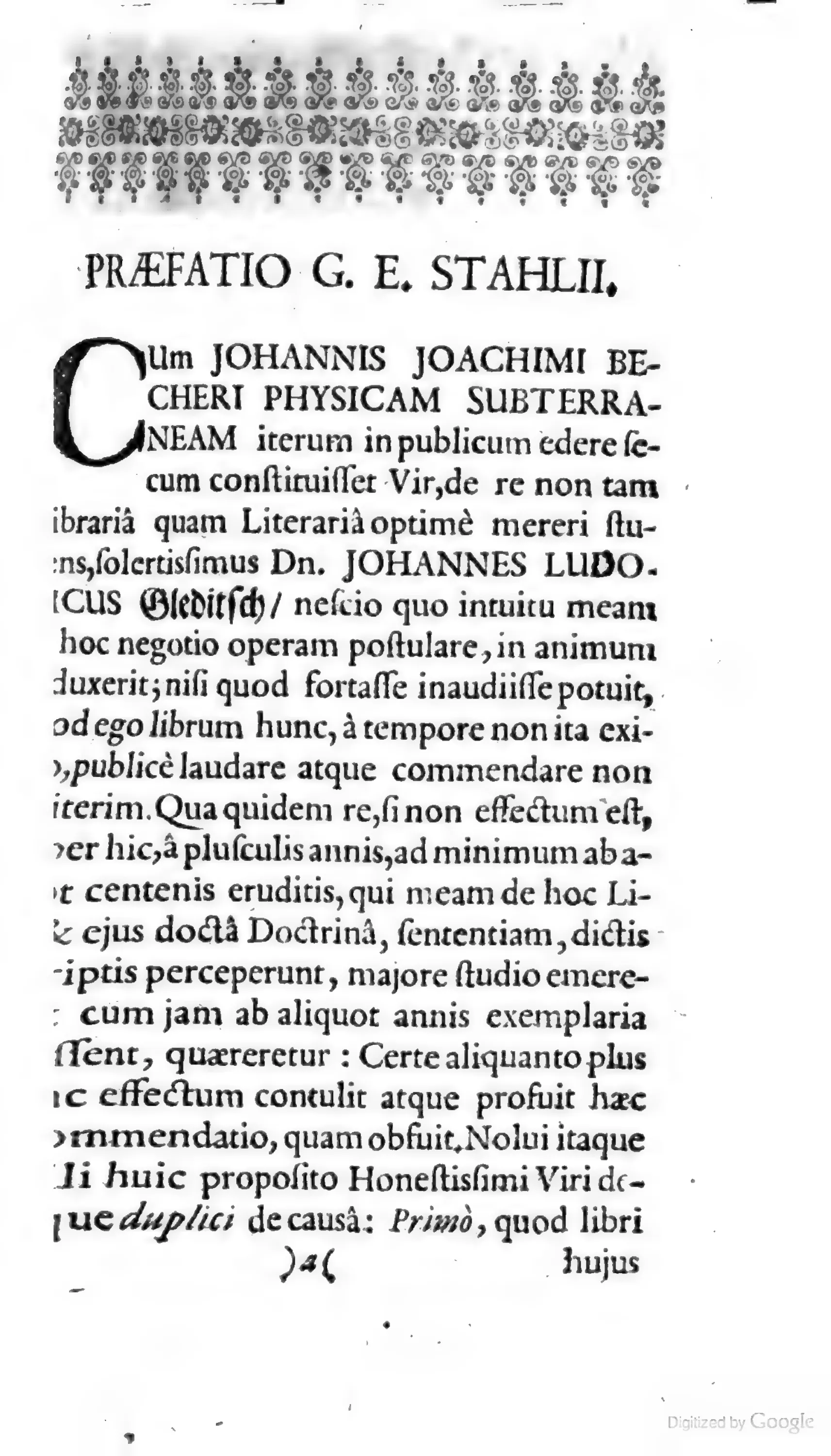
The prefatory leaf headed "PRAEFATIO G. E. STAHLII," with its ornamental headpiece and large initial, makes Stahl's editorial presence materially explicit at the threshold of the 1703 Leipzig recension. Its opening paragraphs name Johann Ludwig Gleditsch as the printer-bookseller behind the reissue, tying the volume's later authority to a deliberate act of republication and editorial framing rather than to a simple Becher-to-Stahl lineage. Source ↗.
A standard reference formulation says that, in Stahl's hands, Becher's terra pinguis became the basis of phlogiston theory. The 1703 object itself complicates the genealogy: Stahl is not merely a later reader but the named editor who adds Specimen Beccherianum, and his intervention is materially visible in the posthumous recension. The cautious conclusion is that Becher supplied an important conceptual resource that Stahl reworked within a different explanatory system. Whether the relation is best described as continuity, selective appropriation, or a retrospective construction remains a historiographical question; terra pinguis should not be treated as phlogiston already fully formed. The surrounding transmutational doctrine, in any case, is not reducible to a theory of principles alone: the tincture is explained by distinguishing what penetrates from what specifies, that is, it tinges because it has been penetrated, but it makes gold or silver because it is gold or silver, and the metallic form is held to subsist outside metallic bodies, so that the very form of gold lies hidden, embryonically and potentially, in the Philosophers' Mercury even outside corporeal gold, iplam formam auri, etiam extra aurum corporale, embryonaliter & potentialiter in Mercurio Philosophorum latitare.
The cameralist significance is equally important. Herbert Hassinger's Johann Joachim Becher, 1635–1682: Ein Beitrag zur Geschichte des Merkantilismus established the central importance of Becher's economic and mercantilist identity. Later contextual work, including Amadeo Murase's provisional encyclopedia treatment, presents Becher as a polymath serving territorial princes weakened by the Thirty Years' War and as an agent of a court culture in which empirical natural inquiry operated outside the universities. In the 1703 text, the argument for an Aerarium and Bancum, together with the claim that mineral production and transmutation could serve public wealth, makes the economic dimension explicit rather than incidental, and the fiscal argument is framed as an alternative to the ordinary instruments of revenue: there is no base moneylending or usury, no aggravation of subjects, no draining of another's purse, but the production of gold or silver, non est turpis foeneratio, aut usura, non subditorum exaggeratio, non alterius marsupii exsuctio; sed auri vel argenti productio. The same practical ambition is bounded from within by declarations of reticence, the author concluding that silence therefore must be kept, lest, while I wish to profit the good, I aid the wicked, Tacendum ergo erit, ne, dum bonis prodesse volo, malos juvem — a limit that sits in evident tension with the appeal to public utility and to publicly witnessed assay.
The Habsburg and projecting context should be kept equally precise. The English Magnalia naturae describes Wenceslaus Seilerus as a projection-maker at the emperor's Viennese court and frames the narrative through witnesses and public projection. That evidence illuminates the courtly setting in which projection was discussed, but it does not by itself establish the full archival history of the Habsburg Kunst- und Werkhaus, Becher's alleged commissions, or every Dutch concession. The accessible evidence confirms Dutch and Hague commissioners, assays, printed resolutions, and a promised reward in the sand-mine dossier; it does not yield a complete prosopography of the imperial or Dutch offices.
The same restraint applies to medical and confessional claims. The scan contains natural-philosophical and physiological language, including humidum radicale, and invokes learned and scriptural authorities, but the accessible transcription did not securely establish every alleged discussion of the alkahest, ens universale, Galenist phlebotomy, or a sustained hostile response by academic physicians. On two of these heads the text itself is more forthcoming than the catalogue-level evidence suggested: the alkahest is defined in the corpuscular terms quoted above, and a universal being is named as the medical agent from which the chrysopoetic argument then proceeds, the author announcing that now I proceed to the other part of this chapter, about to defend the metallic transmutation which is effected by this universal being, Nunc ad alteram hujus capitis partem progredior; defensurus metallicam transmutationem, quæ hoc ente universali fit. The universalist frame in which that agent is set is explicitly theological and comparative: for just as there is one universal, Catholic, harmonic, primordial Religion of all religions, one language of all languages, one science of all sciences, so too of all matters there is one universal, Catholic, harmonic, primordial matter, which they call the Philosophical, Prout enim omnium Religionum una universalis, Catholica, harmonica, primigenia Religio; omnium linguarum una lingua; omnium scientiarum una scientia datur: ita etiam omnium materiarum una est materia universalis, Catholica, harmonica, primigenia, quam Philosophicam vocant. Scripture is likewise enlisted as physical warrant rather than mere ornament, since toward this earth we incline by nature, by the divine command, "thou art earth, and unto earth shalt thou return", Ad hanc terram à natura inclinamus, mandato dito divino, terrae, & in terram reverteris, which shows how the doctrine of earths absorbs authorities of a quite different order. Rolfinck's notes are directly identified as the object of Becher's 1671 response, and Kircher is directly invoked in the polemical apparatus; a larger chain of refutations, trials, or university proceedings could not be documented from the sources located.
Tracing the Text from the 1669 Munich Laboratory Acts to the 1703 Leipzig Recension
Bibliographic sequence. The 1669 title is secure: Actorum Laboratorii Chymici Monacensis seu Physicae Subterraneae Libri Duo, whose first book treats the genesis of subterranean things and whose second treats their special nature and resolution. A Google Books record gives Frankfurt and 1669, Mauritii Georgii Weidmanni, and 633 pages; a modern bibliographic entry gives Johann David Zunner, Frankfurt, for the same 1669 work. The discrepancy is material: the accessible evidence does not permit a confident decision between printer, issue, or catalogue error, and the imprint should be settled by title-page and copy comparison rather than by repeating one record.
The first separately issued supplement located is the 1671 Experimentum chymicum novum, quo artificialis et instantaneae metallorum generatio et transmutatio ad oculum demonstratur, explicitly described as occupying the place of a supplement to the Physica subterranea. Its title also announces a response to Werner Rolfinck's notes on the non-being of the mercury of bodies. The accessible Google record dates it 1671, reaches page 172 in its contents, and leaves the publisher unidentified. The 1675 Supplementum secundum in Physicam subterraneam, the Demonstratio philosophica seu theses chymicae on the truth and possibility of metallic transmutation, is held by the Wellcome Library; that record gives Frankfurt am Main, Johann David Zunner, 1675, Latin, octavo, twenty-four unnumbered leaves and 136 pages. A separate dedication formula to Leopold I was not legible in the accessible catalogue evidence and should be checked on the title-page scan rather than asserted as independently verified; the text of the apologetic itself, however, addresses the emperor directly as the forum of its demonstration, asking first, why I have undertaken to defend and vindicate Alchemy — a science hateful, suspect and ludicrous to almost all, and indeed to the greatest men, banished from all literary commerce, full of deceptions and frauds, of buffoons and impostures — nevertheless before the whole world, and indeed in the sight of the August Caesar Leopold, not by words and testimonies but by reasons and experiments, Primo, cur Alchymiam, scientiam omnibus fere, & quidem maximis viris exosam, suspectam, ludicram, & omni commercio literario proscriptam, deceptionibus & fraudibus, scurris & imposturis plenam; nihilominus coram toto Mundo, & quidem in conspectu Aug. Cæs. Leopoldi defendendam, & vindicandam, non verbis &c testimoniis, sed rationibus & experimentis susceperim [IMAGE ID: bub_gb_covAIw32HC4C-png-0783.png]. The theses themselves proceed by a descending chain from first cause to metallic change: God exists, whence the life of all things, from which motion, from this action and passion, hence alteration, whence the transmutation of all bodies and things, even of metals, Datur Deus, unde omnium rerum vita, ex qua motus, ex hoc actio & passio, hinc alteratio, unde omnium corporum & rerum, etiam metallorum transmutatio.
The 1680 unit is catalogued as Experimentum novum de Minera arenaria perpetua and is associated with a Bavarian State Library digital witness. Mikuláš Teich's bibliography identifies the German Bericht von dem Sande als einem ewigwaehrendem Metall oder Berg-Wercke and the Latin Experimentum novum ac curiosum de Minera Arenaria Perpetua. Teich also describes a second edition in 1681 incorporating the three supplements that had appeared separately in 1671, 1675, and 1680. The 1680 standalone imprint's printer, complete collation, and relation to every 1681 copy remain unresolved in the accessible records.
The 1703 Leipzig volume is the key transmitted recension. Its title names Johann Joachim Becher, Physica subterranea, the editio novissima, and Georg Ernst Stahl, who “subjunxit” the Specimen Beccherianum. The Internet Archive record for a digitization from the National Central Library of Rome gives Lipsiae: Apud Joh. Ludov. Gleditschium, 1703, Latin, octavo, and “[30], 1008 [i.e. 1000, 44], 304, [16] p.” A Google Books record identifies Johann Ludwig Gleditsch, 1703, 1008 pages, and the Bavarian State Library at Bamberg as the source of its scan. These are catalogue and digital-witness records, not a full collation: signatures, gatherings, and a definitive issue statement were not recovered.
The 1738 Leipzig witness is bibliographically distinct in the accessible record. HathiTrust describes an Editio novissima, published at Leipzig by the Weidmanniana press in 1738, with “[14], 504, [22], 161, [9] p., [1] leaf of plates: port.; 22 cm.” The same record states that the work was first published in 1669 under the Actorum title and published in 1703 under Physica subterranea. It is safest to call 1738 a later Leipzig edition or reissue in the catalogue tradition, not to call it an unchanged impression of 1703 without copy-level comparison. Full shelfmarks were not exposed by the accessible catalogue pages. The located witnesses include a Rome National Central Library scan of 1703, a Google/BSB Bamberg scan of 1703, a Wellcome copy of the 1675 supplement, a Deutsches Museum-origin Google record for the 1669 title, a BSB-origin record for the 1680 unit, and Getty Research Institute full-view records for 1738; record identifiers are available, but complete local shelfmarks were not.
Material form and consultation. The Google page-level witness confirms the characteristic sequence of a chapter heading, a numbered SYNOPSIS, and a subsequent TEXTUS. The 1703 scan also exposes an INDEX Sectionum & Capitum, an Index Autorum, a Catalogus scriptorum hoc opere citatorum, and a Syllabus Experimentorum. The numbered synopsis and the indexes make the volume suitable for selective consultation as well as continuous reading: propositions, authors, experiments, chapters, and sections can be approached through distinct finding systems. That finding apparatus corresponds to a declared citation practice within the text, which acknowledges wholesale borrowing where it occurs, announcing that in this chapter we shall follow that most noble and famous investigator of Nature of our time, not merely a polygraph but a man of many sciences, Dr Jonston, with whose leave we shall extract certain things for this chapter from his mineral survey concerning the difference of stones, Nos hoc capite nobilissimum & clarissimum ac nostri temporis præcipuum Naturæ Indagatorem, non Polygraphum modo, sed & multiscium, virum D. Ionstonum sequemur, cujus pace quædam pro hoc capite, ex ejus notitia minerali de lapidum differentia extrahemus — an admission that sits pointedly beside the work's own polemic against compilers, and that helps explain why the volume needs a catalogue of writers cited as well as a syllabus of experiments. The transcription confirms the apparatus and the numbered entries, but not a complete set of marginal numeral glosses, catchwords, or signatures.
Copy-specific features of the kind that would establish a cancellation operation — an instruction to excise a leaf, duplicate leaf settings, or a cancellans and cancellandum pair — were not independently located in the accessible transcription or catalogue descriptions. They remain claims requiring examination of page images and comparison of at least two physical or digital witnesses. No licence, privilege, imprimatur, definite censorship intervention, or loss of a textual unit was securely established. The reported suppression of a poison-yielding preparation and the typographical treatment of German technical expressions likewise remain unverified here, although the work's own declarations of reticence, quoted above, show that suppression of particular preparations was at least a stated editorial principle of the author.
Institutional footprint and reception. The title's Munich laboratory is the principal institutional marker of the original books. The later apparatus connects practical chymistry to Amsterdam and The Hague: the sand-mine material mentions commissioners, assays, printed resolutions of the States, the purchase of silver, and a stipulated reward of 10,000 florins. A sworn assayer's attestation is also visible in the scan. The 1671 supplement directly answers Rolfinck; the 1703 Specimen Beccherianum is Stahl's posthumous editorial and critical intervention; Athanasius Kircher appears as a named polemical authority. These are firm points of reception. A full chain of hostile academic-physician responses, anti-transmutation proceedings, or later German chymical replies was not located.
The English Magnalia naturae of 1680 extends the object biography into London print culture and the Viennese court world: it is an English Becher-attributed narrative about Wenceslaus Seilerus, projection, witnesses, and the emperor's court, printed by Thomas Dawks and sold by Lawrence Curtis. It is related thematically to projection and courtly proof, but the accessible records do not prove that it is a direct translation of the Latin sand-mine supplement. The Latin text's own handling of courtly projection displays the same structure of witnessed effect coupled with withheld or absent art, reporting of one possessor that of this too he has seen, as often as he wishes, the memorable effect, and the true Transmutation of Metals into gold; but he does not know how to prepare or to multiply that powder, nor does he know what he possesses, for he found it already prepared by chance, hujus etiam, & quotiescunque vult, memorabilem vidit effectum, veramque Transmutationem Metallorum in aurum: at non scit illum pulverem vel præparare, vel multiplicare, neque ille, quid edit, scit, casu enim reperit jam præparatum, which is precisely the case in which, by the work's own criterion, possession of an effect falls short of knowledge of a mixture. The broader biographical association of Becher with cameralist and projecting writings is secure in modern reference literature; the specific Munich, Vienna, Dutch, and English archival dossiers require further archival work.
Catalogue identity. The correct identity of the 1703 volume is established by the conjunction of Becher's name, the title Physica subterranea, the Gleditsch Leipzig imprint, Stahl's named Specimen Beccherianum, the SYNOPSIS and TEXTUS, and the distinctive indexes and supplements. A reproducible catalogue record that actually assigns this volume to Giovanni Bona's De divina psalmodia was not located in the accessible search results. Consequently, no digitization project or union catalogue can responsibly be named as the carrier of that alleged mismatch on the present evidence; the Bona attribution should be treated as unverified until a specific record identifier and image are produced.
Following Becher's Argument: Three Earths, Mixture, Fermentation, and the Sand-Mine
The third earth: from probability to certainty

Hendrick Goltzius's early seventeenth-century Mercury, marked by the winged cap and caduceus, gives visual form to the classical figure whose name early modern alchemy turned into a principle of motion, fluidity, and metallic change. In Becher's scheme the third earth is not ordinary quicksilver but the mercurifying agent through which probability becomes operative certainty. Source ↗.
The doctrine of the third mineral principle opens not with a conjecture but with a claim pitched at the highest degree of assurance the work commands — the declaration already examined above, that some third thing mingles itself with the two prior principles, whence they obtain their species, and that this is not merely probable but most certain. The rhetorical movement from verisimile to certissimum is the whole burden of the chapter compressed into a single clause, and it announces a debt: everything that follows — the jasper crucible, the over-mercurified silver, the anecdotes of penetration — is owed as payment against that promissory certainty. The third earth is identified by what it confers rather than by what it looks like, and the identification requires coinages the schools do not supply. Opaque stones receive from it the idea of their species, that is, of stoniness, while in metals the same admixture yields a nature malleable and extensible, in short that in which metalleity consists, nempe naturæ malleabilis & extensibilis, paucis id, in quo metalleitas consistit. Lapideitas and metalleitas are not idle abstractions: they are the terms by which a corpuscular principle is made answerable to an observable specific character, so that a principle counts as identified only when the property it imposes can be named and traced.
The proof offered is autobiographical and material. Jasper melted under a covered crucible yielded a milky semi-opaque mass beneath while the lid and sides took on the stone's natural coloration, and the fragments were kept in the author's chymical archive; from this Becher draws the ontological conclusion already noticed above, that there lies hidden in things a certain immortal form preserving its own characterism, and that this immortal form is the subtle earth, as he promises shortly to prove. The move is characteristic and worth pausing over: an "immortal form" is asserted, but it is asserted as something that migrated visibly onto a crucible lid and can be held in the hand. Form is not abolished in favour of corpuscles; it is relocated into a material carrier and thereby made subject to the same tests as any other body. The corollary is a discipline over inherited names. The third earth is called Mercury, Becher insists, only by denomination from a quality: rather it must be concluded that this earth is called Mercury on account of its mercurial quality, namely volatility, as we proved in our Oedipus Chymicus, Potius ergo concludendum est, hanc terram Mercurium dici ob qualitatem mercurialem; nempe volatilitatem, ut in nostro Oedipo Chymico probavimus. Traditional vocabulary is retained but demoted to a denominatio à potiori, because a genuine principle must be simple, homogeneous, and unique — a requirement that immediately disqualifies the substances the shops sell under those names.
The alkahest, reticence, and the grammar of composition
The same requirement governs the long treatment of the alkahest, which Becher identifies with the third earth in its pure state and defines by a mode of action rather than by a recipe, in the formula already discussed above, according to which the solution effected by that liquor is nothing else than the penetration of a body and its reduction into the subtlest atoms, without any reaction or communication with the dissolved, so that its parts may freely subside with their crasis remaining entire. The definition is analytically motivated. Ordinary menstrua act by reaction and require precipitants, and therefore contaminate the evidence of what a body contains; a solvent that merely penetrates and lets the parts settle by gravity is an instrument of resolution in the strict sense, an assay of composition. Set beside the mine-damp the miners call Bergschwaden and the wasting diseases attributed to it, the doctrine of penetrancy links a laboratory desideratum to an occupational pathology, both explained by the same subtlety of corpuscles. Yet the chapter also draws a line around itself with the declaration of silence quoted earlier, lest in wishing to profit the good he should aid the wicked. The justification offered is not adept privilege but the near-certainty that a poison could be derived from the withheld water — a reasoning that nonetheless sits uneasily with the treatise's own insistence that knowledge be demonstrable in public and useful in the commonwealth. The reader is asked to credit a preparation precisely where verification is refused.
The fifth chapter of the section converts these results into a grammar of composition. The ancients' three are placed a rank below the principles: for salt, sulphur and Mercury are decomposites, and are accordingly so called, Sal / enim, sulphur & Mercurius, decomposita sunt, & / proinde sic vocantur. Only a separated part of the vulgar substance qualifies as principle, and from this grading follows the whole scale of imperfect and perfect mixtures — realgar and arsenic, the predominance of the third earth in lead and tin which flow before they glow, of the second in copper and iron which glow before they flow, their equality in gold and silver. The section states its thesis without hedging, in the words already cited: in this section nothing else is done than to demonstrate that metallic mixts are earthy and have a threefold earth for their principle. Everything in the surrounding argument — the calcined tin exceeding its original weight, the madder dissolved in spirit of salt to a white mud yielding a martial tincture, the Bergmildi consolidating into native silver — is enlisted against the aqueous cosmologies and against the vegetation experiment of Boyle's Chymista Scepticus.
Mixture: the schools, the criterion of making, and a combinatorial pedagogy
The section on mixtio begins by clearing polemical ground. Against the schools the charge is the one already registered above, that Peripatetic doctrine on the mixture of subterranean things furnishes little boxes and names where explanation is owed. The image of capsulæ is exact and damaging: a name is a container awaiting a content that only practice can furnish, and the Peripatetic error is to mistake the empty box for the thing. The positive counterpart is the spagyric art, far other and most noble, that science which is founded upon practical things, Longe ergo alia est scientia / nobilissima illa Spagyrica, quæ ex practicis funda, the honorific etymologized from separation and deployed with unmistakable professional edge against the gallery of censured authors that follows. The criterion that makes the polemic more than abuse is then stated flatly, in the sentence quoted earlier that governs the whole treatise: no one perfectly and evidently knows the mixture of subterranean things, and of metals above all, who cannot, having their principles and the other requisites, also produce metals above ground by art. Knowledge is thus indexed to production, and the gardener who can raise the tulip becomes the model of the natural philosopher who can raise the metal.
The pedagogy that follows makes this criterion teachable. The eight classes of simple bodies are presented as the letters from which everything else is spelled, in the passage on the alphabet of nature noticed above, where few letters are said to yield very many combinations. Combinatorial abundance from a small stock is the answer to the obvious objection against a doctrine of only three principles, and the reckoning of eight numbers permutable forty thousand times over is the arithmetical form of the same reply. The tyro is accordingly told to prepare his own materials, warned off astrological timing, and shown by the example of spirit of salt, oil of tartar and sal ammoniac that the order of operations alters the result; frugality is made a credential, the author's three thousand combinations in two years costing scarcely a hundred ducats set against those who glory in having squandered thousands. The general axioms then supply the operational distinction that all this presupposes: mixture is called superficial when things are mixed, but in such a way that they can be separated again, superficialem voco, cum res / miscentur, sed ita, ut rursus separari queant, while central mixture yields cohering new decomposites such as cinnabar. Reversibility, a matter to be settled at the furnace, replaces a distinction that had been merely verbal, and the two are gathered under a single physicalized sympathy: therefore the magnetism of nature has two poles; rare things seek dense, dry things desire moist, Duos ergo, Magnetismus / Naturæ, Polos habet; rara appetunt / densa, sicca desiderant humida.
Resolution: putrefaction, fermentation, liquefaction
Resolution is treated as the exact counterpart of composition, and its animal species, putrefaction, is referred to the failure of a vital principle rather than to any mere absence of heat: but putrefaction happens whenever the balsamic spirit of the blood is hindered, Putrefactio autem contingit, quotiescunque / balsaminus sanguinis spiritus impeditur. Interception, whether internal by obstruction and revulsion or external by ligature and wound, is made the primary cause and the ambient air only the secondary, which is why the long practical excursus on antiseptics, on shipboard scurvy and over-salted Bavarian diet, belongs to physics rather than to household advice. The taxonomy that closes the chapter is where the natural and the chymical registers are joined: beyond putrefaction proper and corruptio stands a third species which makes the seminal power die only for a time, ad tempus tantum seminalem vim emori faciat, the fertile mortificatio of metals whose return with interest the chain of alchemical dicta is summoned to attest. The same corpuscular scheme then differentiates the vegetable solution: fermentation therefore is defined as being the rarefaction of a denser body and the interposition of aerial particles, Fermentatio ergo definitur, quod sit corporis / denstoris rarefactio, particularumque aërarum / interpositio. Putrefaction, fermentation and liquefaction become one system distinguished by the kind of corpuscle intercepted, aqueous, aerial or igneous. And the irreversibility of the process is defended by an instrument drawn from the world of assay and contract rather than of disputation: having spent a whole year in this study, I promise a hundred ducats, indeed two hundred, at once, and will keep the promise in best faith, if anyone shall have successfully taught me one or the other of these two propositions, Ego, insumpto toto anno in hoc studio, / centum ducatos, imo ducentos, spondeo statim, & optima fide servatur[um] sponsionem, si quis unum vel alterum / ex his dubus proposuis me feliciter edocuerit. The wager is not bravado but evidence of a particular kind: a negative result, purchased with a year's labour and offered for public refutation at a stated price, is turned immediately against Glauber's claimed concentration of must and beer, and it makes the standard of production cut both ways — what cannot be remade, on this reckoning, is not yet understood by anyone.
From the cellar to the mine: fermentation in vessels, in bodies, and at its limits
The demonstration proceeds with wine, and its manner matters as much as its content. Having divided any fermentable body into a highest, a middle, and a lowest substance, Becher tests whether the effervescence produced by pouring oil or salt of tartar into wine attacks the spirit or the middle substance by isolating that fraction and repeating the operation upon it alone: let the pure middle substance be taken, separated from the rest, diluted with a little water, and mixed with oil or salt of tartar, and the same hiss will occur, the same precipitation, and all the sourness of the middle substance will vanish, sumatur substantia media pura, & à reliquis separata, modica tamen aqua diluta, & misceatur oleo vel sale tartari; fiet idem sibilus, eadem præcipitatio, omnisque acor substantiæ mediæ evanescet. This is the criterion of making applied in miniature and in reverse: the composition of the mixed body is established not by naming its qualities but by resolving it, isolating a portion, and reproducing the effect at will. The same analytic scheme then absorbs the vernacular of the cellar — the ropy, sluggish wine the vintners call jahre Wein is explained as a fixation of the volatile salt and sulphur, and the sulphur-fume remedy is derived from that explanation rather than reported as custom — so that a craft term is not merely recorded but converted into an instance of the theory of rarefaction and density.
The fermentation doctrine then crosses from vessels into bodies. Blood is assigned the role of middle substance, semen that of highest, bile and chyle that of lowest, and febrile pathology is rewritten as a fermentative history of a viscid residue named, with a nautical metaphor, saburra, ship's ballast. Declaring that Willis has already written accurately on fevers and that he will add only his own, Becher redefines the most familiar term of clinical description in purely processual terms: every time of the inflow of moisture, of imbibition, and of the resolution of the saburra, and of its fermentation, and of the shivering and heat that follow, is called a paroxysm, Quodlibet autem tempus affluxus humiditatis, imbibitionis, & resolutionis faburræ, ejusdem jue fermentationis, & consequentis horroris ac caloris, paroxysmus vocatur. The manoeuvre is the medical counterpart of the terminological reform pursued elsewhere in the work: a word inherited from the physicians is not abolished but re-founded on an operation, and once so re-founded it generates the further distinctions — period, crisis, intermittent and continuous, cold and hot — as consequences rather than as classifications received on authority. The therapeutic conclusion follows the same logic: if the fever is a fermentation of a resolvable residue, then resolution and evacuation, sudorifics, diaphoretic antimony, crab's eyes and burnt hartshorn are indicated, and the waiting upon crisis is superfluous. The polemic against phlebotomy that occupies the following pages is argued on two registers at once, physiological and pecuniary — the anecdote of the Frankfurt colonel who paid thirty-one imperials for three bleedings is offered as evidence of a fee-driven abuse — which shows how readily this text moves from a claim about material process to a claim about the credit and honesty of a profession.
The extension of fermentation across the three kingdoms is nevertheless bounded by an explicit concession, and the concession is one of the most consequential moments of the argument: minerals are said to ferment improperly, since, on account of their very homogeneous parts, they can scarcely be torn into diverse substances or altered out of their own nature, Mineralia autem improprie fermentare dicuntur; cum, ob partes valde homogeneas, vix in diversas substantias discerpi, & ex propria natura alterari queant. The analogy between wine and ore is thereby preserved as an analogy and denied as an identity. What in minerals appears to be fermentation is corrosive solution, that is, rarefaction produced by the addition of subtle bodies: nitre and vitriol in their dense state dissolve nothing, and only when distilled and rarefied do they attack metals, whence the elective solubilities — silver in aqua fortis, gold in spirit of salt, copper in either — that the text catalogues. Yet the parallel is then vindicated experimentally rather than abandoned, when copper dissolved in aqua fortis is made to yield the whole sequence of vinous fermentation: red fumes, a mineral Gas, a yellow sediment answering to lees, a green spirit answering to spirit of wine, and a green salt burning with green flame. The concession and the demonstration together display the discipline the book imposes on its own analogies: a likeness is admissible only where the operations can be shown to run in parallel step by step.
The solution of metals, the polemics of liquefaction, and the descent to bodies
The turn from the vegetable to the mineral kingdom is staged with unusual rhetorical deliberation. Hitherto, he writes, we have lingered in a rich vintage, not without pleasure pressing various grapes and wringing out various sweet juices, and when we had committed them to fermentation, intoxicated by the penetrating vapours we could scarcely leave the cellar again; now, with a mind cleared of its lees, we shall hasten from Bacchus to Vulcan, from wine to gold, from vegetables to metals, HAdenus, ut speramus, in divite vindemia morati sumus, non sine jucunditate varias uvas exprimentes, variosque dulces succos extorquentes; quos cum fermentationi commisimus, vix, penetrantibus vaporibus inebriati, cellam rurlius egredi potuimus: nunc defæcato animo, à Baccho ad Vulcanum properabimus à vino ad aurum, à vegetabilibus ad metalla. The pun on defæcatus — a mind purged of dregs, as a wine is racked off its sediment — binds the ornamental mythology to the chemistry just expounded, and the transition is not merely decorative: it announces that the same corpuscular vocabulary of rarity, density and separation will now govern the harder subject. The chapter it introduces, on the solution of metals which is liquefaction, arrives with the full display apparatus of the volume — a chapter head, a numbered synopsis of one hundred and thirty-one heads, then a text keyed to them by marginal numerals — and it distinguishes three liquidities, mercurial, aqueous and igneous, against three grades of solidity. Mercurial flux is attributed to an earthy principle lodged in metallic pores, and the attribution is argued from the contrary case: that it is earthy particles which mercurify, or liquefy, is plain from the opposite, Particulas vero terreas esse, quæ mercurificant, seu liquefaciunt, ex contrario patet. From this follows the strict consequence that common quicksilver, being metal joined to this earth, is a decompositum and not a principle at all — the same regulative distinction the work applies to the alchemists' salt, sulphur and mercury — while the adepts' object is redescribed as that identical earth in its unmixed state.
The doctrine is defended in the idiom of the schools it attacks.
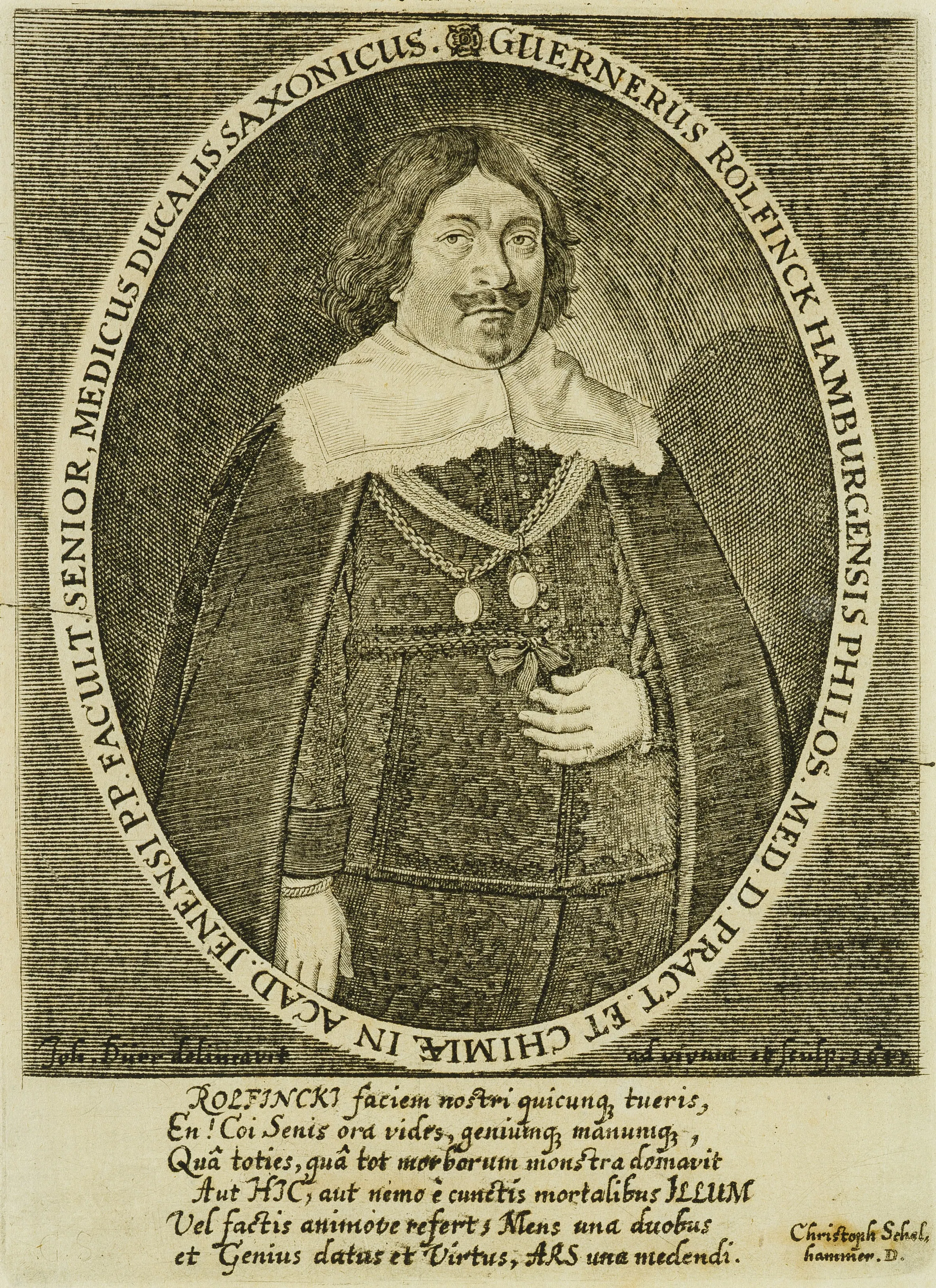
In this 1661 engraved likeness, Werner Rolfinck is presented through the formal conventions of learned university medicine — the very academic authority Becher mocked while answering Rolfinck's objections to corporeal mercury. The portrait catches the irony of the polemic: an attack on academic chemistry conducted in the disputational idiom of the schools it opposed. Source ↗.
Werner Rolfinck of Jena is introduced with a portrait whose sarcasm fuses academic with confessional satire, as that other Aesculapius of Jena, Werner Rolfinck, Doctor of Philosophy and Medicine, practitioner, public Professor of Chemistry, distinguished anatomist, indeed a Hermes among the rude common folk, who is believed to be as little able to err in his sayings and writings as Luther himself, alterum illum Æsculapium Ienensem, Guernerum Rotfincium, Philosophiæ & Medicinæ Doctorem, Practicum, & Chymiæ Professorem publicum, Anatomicum insignem, imo apud rudem plebeculam Hermetem, qui tam parum in dictis & scriptis errare posse creditur, quam ipse Lutherus. The gibe is precisely calibrated: a professor of chemistry is charged with holding a chair rather than a crucible, and the imputation of infallibility marks the target as an authority to be deferred to rather than a practitioner to be tested. Against Angelo Sala the procedure is to quote the adversary in his own words — if by any means you shall have drawn out even the least little drop of quicksilver from antimony which you have not yourself mixed into it, show me your work in the thing itself, Si omnibus modis vivè argenti vel tantillam guttulam ex antimonio elicueris, quam illi ipse non permiscueris, ostende mihi re ipsa opus tuum — and then to strip the demand of its force by narrowing the question, since no chymist claims extraction without addition, and by exposing the appeal to personal non-observation as an argument from ignorance. The refutation of Ludovico de Comitibus works by the same combination of logical hygiene and workshop practice, culminating in the deflation of the legend of malleable glass by seizing a fragment, heating it and drawing it with a hot hammer in the presence of the disputant.
Fire receives the same treatment, and here the polemic touches a celebrated rival system. The perpetual lamp is described in Kircher's own terms, as Fr. Kircher proposes in his Mundus subterraneus, in the chapter on the perpetual light, where in places from which oil flows perpetually he applies a wick of asbestos and so constructs a perpetual lamp by the perpetual influx of new oil, Ut R. P. Kircher proponit in Mundo subterraneo, capite de lumine perpetuo; ubi in locis, è quibus perpetuo oleum fluit; illychnium ex asbestos applicat; atque sic lampadem construit perpetuam, ob perpetuum affluxum novi olei. The refutation is deduced from a general axiom, that nothing burns which is not supremely rarefiable, and it ends by giving a mechanical account of the lights reported in opened tombs — antiquarian marvel subordinated to chemical principle, exactly as the report of light-rays precipitated by glasses into a dusky powder is admitted because it supports the corpuscular and ponderable nature of fire.
The chapter's boldest claim rests, characteristically, not on doctrine but on a witnessed trial and its provenance: the experiment is of no slight moment, communicated to us by the most distinguished Gerhard Thilenus, formerly town physician of Frankfurt, now carried off by the plague raging there, a man most worthy of trust, Experimentum non est levis momenti, communicatum nobis à Clarissimo Viro D. Gerbardo Thileno, quondam Physico Francofurtensi, nunc peste illie grallante absumpto, Viro fide dignissimo. The named informant, his office, his death and the author's own repetition of the trial constitute the whole apparatus of credit on which the inference then rests, and the inference is stated without hedging, in the words already quoted: it is possible, even without a tincture, by the operation of fire alone, really to transmute the species of metals. That the chrysopoetic conclusion is here detached from the tincture — the very agent the surrounding pages honour in the veiled vocabulary of Lathon and Azoth — is the sharpest internal tension of this stretch of the argument: transmutation is made to follow from cupellation and chalybification, operations any assayer could repeat, rather than from a secret possessed by few.
The sixth section begins the descent from operations to bodies, ordering being by a trinitarian scheme and dividing minerals into simples, composites and decomposites before treating earths by their dominant principle. Here the evidentiary base widens to include recent voyage literature as technical testimony on ceramics, since how porcelain is prepared and worked, Heinrich Neuhoff teaches in his embassy to the Emperor of the Chinese, page 105, where he asserts that a huge Tower was built of porcelain, quæ quomodo præparetur & tractetur, Heinrich Neuhoff in legatione ad Sinarum Imperatorem, pag. 105. docet. Ubi ingentem Turrim ex porcellana constructam esse asserit. The lapidary chapter that follows abandons demonstration for nomenclature altogether, running from adamas and crystal through the coloured and figured stones in an onomastic catalogue avowedly excerpted from Jonston, who had himself drawn on Boodt, and breaking off unfinished among the figured stones. The juxtaposition is instructive rather than merely untidy: where the argument can be carried by operations it is, and where it cannot — in the naming of gems and medicinal earths — the text openly borrows, and marks the borrowing as borrowing.
The universal being: medicine, its limits, and its passage into chrysopoeia
A different order of argument governs the supplementary matter. Its final chapter is organized around a double use of the ens universale, medical and metallic, and it opens on the terrain of medicine. Becher's medical claim is that a remedy which is homogeneous with, and equal to, the vital spirit may be used with confidence, because it does not enter the body as a contrary to be matched against a disease but as the body's own conservator taken inward. The rhetorical force of the argument lies in an image of the vital fire fed by fire: as the flame of a lamp-wick set near other vaporous matter rarefies it and converts it into flame, so an exalted igneous medicine should consume depraved humours and digest what is impure. This is the point at which the chapter pauses to fend off a specific charge from learned medicine, that chymical remedies would abolish the ordinary dietetic regimen — a caution to be understood, he says, not as if we were doing away with daily food and drink, as Sennert and a few object this against the Chymists, Quod tamen non ita intelligendum, ac si quotidianum victum & potum tolleremus, prout Sennertus & pauci in Chymicos hoc objiciunt. The reply is disarmingly literal: the medicine renders the body fit for the alteration of food and drink, and as for consuming food and drink by daily use, he removes them no less than the Galenists do. The joke conceals a real polemical strategy. Rather than defending a chymical medicine against Galenic pathology on the level of humoral doctrine, Becher shifts the question from the disease-object to the vital fire, so that the universal remedy is not a specific for any complaint but an agent operating on the subject in which all complaints are seated. Named opponents are thereby answered without conceding the humoral framework in which their objection was formulated.
The chapter's technical core follows immediately, and it turns on a distinction of exactly the kind the work elsewhere imposes on the language of principles: this universal being is simple in essence, although in matter and mixture it is composite, and therefore it must be purified and at length exalted; for the whole business of this art consists in this, that what nature commonly supplies be purified and exalted, Ens hoc universale simplex in essentia est, licet in materia, & mixtura sit compositum, adeoque debet purificari, & tandem exaltari; nam totum negotium hujus artis in eo consistit, ut illud, quod natura vulgariter subministrat, purificet & exaltet.. The formulation is doing two jobs at once. It preserves the simplicity required of a principle while conceding that the material in which the operator actually finds it is a mixed and impure body — which is why the art can be described as consisting almost wholly in separation, purification, and exaltation rather than in synthesis. And it makes the materia prima a quantitative as well as a qualitative variable: it is present in all things generally, known by few, and small in quantity, so that the material of the philosophers is the more excellent the greater the quantity it holds, though burdened with the more impurities. The sequence of operations is then set out in three stages — extraction and separation, in which the philosophers' matter is dissolved, coagulated, and liquefied; a second operation in the bath, through the black, white, and finally red colours with which the elixir tinges itself; and a third, exaltation by multiplication, the repeated solution and coagulation by which the elixir is said to be increased tenfold in quantity and virtue, and which can be carried on indefinitely. Within this scheme the doctrine of solution reappears in its strictest form, since solution is held to be the foundation of the philosophers' art and must be effected in the body's own principles alone, on the authority of the whole philosophical Cabala and of Count Bernard in particular — a demand that makes the acquisition of the solvent as difficult as the acquisition of the matter, and that binds the operational stage of the art to the terminological reform governing the word principium itself.
What is most striking in the medical half is that the universalist claim is immediately hedged by limits drawn from within the same theory. Because the exalted vital fire consumes the fabric it inhabits, bodies constituted from elements cannot bear a continuous alteration for the better, and must always lose something: hence those in whom it is strongest are in the best health, but cannot live long, hinc quibus fortissimus est, illi optime valent, sed diu vivere nequeunt. The consequence is stated without embarrassment — the medicine cannot assist in death itself nor avert death, but can retard it, as a lamp deprived of oil goes out yet shines longer when oil is added — and it is reinforced by the admission that in the aged and the extremely feeble the same remedy would be poison, since flooding a nearly dry lamp with oil smothers the flame rather than nourishing it. A universal medicine is thus redefined as universal only with respect to the vital fire and not with respect to disease or humour, and its dosage is bounded by what that fire can bear. The move is characteristic of the work's argumentative economy: the strongest possible claim is advanced and then made determinate by a physiology that specifies the conditions under which it fails.
The pivot from medicine to chrysopoeia is executed by an identity rather than an analogy, and it is here that the coined vocabulary of the physical books does its work: since the said essence of this universal being is the same in metals as in the human body, namely that which is conserving and acting, which gives to metals their metalleity and consistency, it follows that by its addition imperfect metals are perfected and changed into more perfect ones, Cum ergo dicta hujus Entis Universalis Essentia, in metallis idem sit, quod in corpore humano; nempe illud, quod conservans & agens est, quod metallis metalleitatem & consistentiam dat: sequitur, quod illius adjectione, metalla imperfecta perficiantur, & in perfectiora mutentur.. Metalleitas is not decoration but the load-bearing term: it names what the third principle contributes, as distinct from the lapidity and terreity supplied by the first and second, and it licenses the inference from healing to perfecting. The supporting evidence offered is deliberately humble and first-hand — he has often seen a white earth turned red by a small quantity of red earth, the red serving as mother and as tincture — and it is used to press the question why the third metallic principle should not do as much. The same functional style of definition governs the treatment of quicksilver, since Mercury is nothing else than that which makes a metal run, nam Mercurius nihil aliud est, quam id quod metallum currere facit; because currency belongs to a metal only by virtue of this being, the mercurial being is the metal's own principle, and were it added to tin it would at once be changed into it as into its proper metallic form.
The transmutational doctrine is then given a quantitative structure that distinguishes augmentation from alteration and yields a consequence rarely advertised in chrysopoetic literature. Imperfect metals have much of the first principle and little of the third, perfect metals little of the first and second and much of the third; therefore, if imperfect metals are to be perfected, two of their principles must not so much be corrected as removed, and so metals will necessarily be diminished in bulk in transmutation, that is, so much less perfect metal must be made as there lies more of the first and second principle in the imperfect metal, si imperfecta perfici debeant, duo eorum principia, non tam corrigi quam auferri debeant: adeoque necessario metalla in transmutatione mole minuentur, id est, tanto minus perfecti metalli fieri debet, quanto plus de primo & secundo principio, in metallo imperfecto latet.. The two impure principles are reclassified as slag which the perfection of the metal will not tolerate, and the operator is told to expect a loss of mass. This is a claim that submits itself to the balance and to the sworn assayer, and it explains the ensuing account of why the philosophers work on imperfect rather than perfect metals, separating the third principle from the two prior ones and then concentrating it by multiplication. On the same accounting Becher locates the failure of his predecessors in a category error, holding that the errors of all consist in this, that they take the power and virtue of this principle for a metallic body, whereas its force is so great that the whole earth could be turned into gold, quod potentiam & virtutem hujus principii pro corpore metallico sumant, cum tamen ejus tanta sit vis, ut tota terra in aurum mutari possit. Virtue is not to be weighed as body: the more concentrated a principle, the more excellent it is, and a particle might in principle transmute the whole globe. The two propositions are consistent within the system — bulk diminishes because dross is removed, while efficacy scales with concentration — yet together they mark the point at which the doctrine's promise outruns anything an assay could settle.
The chapter closes by compressing the whole enterprise into a single conditional that restates the work's standard of knowledge as a standard of separation. Transmutation is pronounced not only true but easy and conformable to nature, its practical labour left to the estimate of the prudent, and then: in one word, whoever can have and separate one of the metallic principles purely and simply already has the Philosophers' stone, possessing as much power of transmuting as that principle exists pure and simple; but to extract the metallic principles from metals themselves is labour, Uno ergo verbo, quisquis unum ex principiis metallicis pure & simpliciter habere & separare potest, is jam habet Philosophorum lapidem, tantam vim transmutandi habentem, quantum illud principium purum & simplex existit. Sed principia metallica ex ipsis metallis extrahere, labor est.. The stone is thus dissolved into the theory of principles: it is not a distinct arcanum but a principle held pure, and the search is redirected to minerals, stones, and earths where such principles may be found outside metals and so spare the labour of extraction. The address to the benevolent reader that follows concedes that the author could not be fuller or more faithful, however much he wished, and the unit ends with a subscription and an exclamation on the measure of human ignorance — a reticence formally identical to the withholdings declared elsewhere in the volume, and one that leaves the operative step of the art on the far side of the disclosure.
That difficulty is itself documented by the printed paratext appended here. A letter from Friedrich Funck, addressing Becher as councillor of His Sacred Caesarean Majesty and archiater to the Elector of Mainz, reports repeated readings of the treatise on the simple generation of metals undertaken partly to fish out its author's real mind, complains that its words were to the palate but not to the mind, and closes by asking for a plain declaration: I do not know whether you are still of the same opinion which you once so constantly defended; but this I know, that if you have changed it, you will bless me with a great favour, if you disclose it to me, Nescio, an tu adhuc ejusdem sis sententiae, quam olim tam constanter defendisti: sed hoc scio, si eam mutasti, magno me beabis beneficio, si mihi eam patefeceris.. Printed immediately after a chapter that declares its own incompleteness, the letter functions as an evidentiary exhibit of learned reception: a correspondent conversant with the difficulty of educing anything metallic into a mineral state, who accepts the author's competence yet cannot extract a doctrine from the text. The unit then gives way to an INDEX CAPITUM ET SECTIONUM for the first book, laying out the three sections on the principles of subterranean things in general, on the state of the upper and subterranean world, and on the generation of subterranean things, with the chapters and their page references — the finding apparatus by which propositions arrived at in a supplement can be traced back to the principial doctrine that authorized them.
The same chapter repays a second pass, taken from the joint on which it turns, the single sentence — already noticed above — in which Becher announces that he now proceeds to the other part of the chapter, about to defend the metallic transmutation which is effected by this universal being. The economy of that sentence conceals how much it asserts. The preceding pages had defined a universal remedy in terms of an unctuous innate heat and a permanent radical moisture incorporated into a subtle earthy body, and had refused the Galenists any recourse to "metaphysical qualities" on the ground that man is neither constituted nor conserved by such things; the same being, without redefinition, is now made the subject of chrysopoeia. The ens universale is thus not two doctrines loosely joined but one material claim serving two operational fields, and the criterion of competence that governs the whole treatise — that one knows a mixture only if, given its principles, one can produce it — is applied indifferently to the human body and to the metallic body. What follows in the chapter is therefore not an excursus but the second half of a single demonstration.
The transition is licensed by an axiom about the tractability of matter in the making. It is always easier, Becher holds, to alter mixtures at the beginning of their mixing than to change those already fully composed in their form, quare semper facilius est, mixta in principio suæ mixtionis alterare, quam jam plene composita in forma suæ mutare. The axiom generates the chapter's controlling division between transmutation worked upon generation itself and transmutation worked upon things already generated, and it is followed by a concession of real cost: formed animals and trees cannot be led back to their seminal principles, which is why hereditary diseases resist cure and why therapy in the adult must operate upon accrementum, by milk cures, transfusion, and in plants by grafting. The concession is candid and awkward at once. If fully composed forms resist resolution, then metals — which the argument needs to be reducible — must be shown to occupy a different class of solidity, and the burden of the remainder of the supplement falls precisely on demonstrating that they do, by way of a penetrating and subtilizing agent rather than by any return to seed.
That agent must be described in the language of principles, and here the treatise's terminological reform surfaces as an appeal to consensus immediately qualified. The reader has, Becher writes, not only perceived that they are three in number in the preceding chapters of this book, but the whole of Chymical Philosophy agrees upon them, calling them salt, sulphur and Mercury, percepistis non modo, sed & universa Philosophia Chymica in illa compromittit, vocando ea sal, sulphur & Mercurium. The consensus is invoked only to be stripped of its ordinary referents: the names are borrowed, a container standing for its contents, so that the salt, sulphur and mercury of the Philosophers are simplest principles while the substances sold under those names are decomposita. The rhetorical position is delicate — the whole of chymical philosophy is said to agree upon principles it cannot correctly name — and Becher exploits the awkwardness polemically, charging that this denomination has done more harm than good and that lifetimes have been consumed in distilling common salts, sulphurs and mercuries. The reform is thus not lexical hygiene but a redistribution of authority: agreement is granted to the tradition, competence to the operator who can say which body is a principle and which a compound of principles.
With the principles fixed, the chapter states nature's own requirement for a metal with unusual flatness, and in doing so opens the door to art. I say therefore in truth, Becher declares, that for the generation of any metal whatsoever nothing else is required, either naturally or artificially, than that doubled subterranean aerial and aqueous, or sulphurous and mercurial vapour, Dico itaque in veritate, quod ad generationem cujuscunque metalli, aliud nihil neque naturaliter neque artificialiter requiratur, quam duplicatus ille subterraneus aereus & aqueus, seu sulphureus & mercurialis vapor. The phrase neque naturaliter neque artificialiter is the load-bearing member: by making the requisites identical in the mine and in the laboratory, it converts a cosmological account of the two metal-generating vapours — the male and female, red and white, agent and patient whose magnetic embrace yields the doubled mercury the text also names Bramazar — into a set of instructions. Nothing more is needed than what nature uses; therefore whatever nature does underground can in principle be done above ground, which is the exact proposition the treatise elsewhere makes its test of understanding. The Aristotelians and Albertus are enlisted in support of the definition of the metallic mixture, so that school physics is not overthrown but conscripted, its formula retained while its explanatory sufficiency is denied.
The metal-by-metal analysis that follows renders nobility itself a matter of proportion. Gold, on this account, has a most pure red earth, diluted and tending to citrine, by nature most fixed, united to a most pure and most perfect mercurial substance by the mediation of a forming, mixing, subduing, penetrating, fixing sulphur, Aurum, dilutam & ad citrinitatem vergentem terram rubram habet purissimam, natura sua fixissimam, unitam substantiæ Mercuriali purissimæ, perfectissimæ, mediante sulphure formante, miscente, subigente, penetrante, figente. The five participles are not epithets but a sequence of offices, describing what the sulphur does in the mixture rather than what quality it possesses; gold's excellence is accordingly relocated from an occult dignity to the purity and concoction of three commonly available principles. Once described in this register, gold differs from iron or lead in degree of digestion and in the proportion of stiptic earth to unctuous sulphur and mercurial humidity, and the artificial production of the noblest metal becomes a problem of workmanship rather than a metaphysical impossibility.
The theory of the tincture then delivers the chapter's sharpest analytic move. Having located the whole efficacy of the powder in penetrantia — illustrated by a cochineal grain tinging vast quantities of water, by silver penetrating copper coin, and by two ducats drawn out over a silver rod into some hundred thousand feet of gilt wire — Becher separates the two functions that had been conflated in the received disputes about what the tincture is, in the formula discussed earlier: the powder tinges because it has been penetrated, but it makes gold or silver because it is gold or silver. Penetration is contributed by the fixed spirit, specification by the noble metal itself; the tincture is therefore a compound office, not a single mysterious quality, and the projection of a minute powder ceases to be a wonder and becomes an extreme case of extension. The formulation also protects the argument against the obvious objection that gold is being presupposed: it is presupposed, openly, and the art claims only to make it spirit and body by turns.
The back matter of the supplement makes the evidential base of all this explicit rather than leaving it implied. Among the finding-lists — an alphabetical index of authors, a catalogue of works cited, and a syllabus keyed to chapters — the syllabus is headed by the principal experiment, of making, by the power of fire alone, true and copious iron, solius ignis ope, verum & copiosum ferrum faciendi. capite secundo, the production of iron from common clay and linseed oil. The placement is argumentative: a single artificial metal, produced from ignoble materials by fire without additament, is offered as the fact from which the whole deduction about principles, proportions and tinctures hangs, and the syllabus makes it retrievable independently of the discursive order of the chapters.
The Demonstratio before Leopold: theses, mercurification, and the decoding of the adepts
The second supplement restages the case as a formal Demonstratio, and its first thesis compresses the deduction into the chain already set out above, descending from the existence of God through the life of all things, motion, action and passion, and alteration, to the transmutation of all bodies and things, metals included. Each link is a commonplace of school natural philosophy; the effect of the concatenation is to make the contested conclusion follow from premises no opponent can deny without denying the first. Becher secures that first premise by removing it from argument altogether, holding that whoever denies that God exists is to be convinced rather by the executioner's hand than by the philosopher's demonstration, D Eum dari, qui neget, carnificis potius manu; quam Philosophi demonstratione convincendus est. The gesture is rhetorically shrewd and doctrinally conventional in equal measure: it places the apologetic for a suspect art under the protection of a proposition whose denial is a capital matter, thereby transferring some of that immunity to the chain descending from it.
The theses then narrow from this metaphysical altitude to a workshop rule. Since gold in its solid state cannot tinge and must be subtilized without permitting reconcentration, the operative conclusion is the adepts' own maxim: and this is what the Philosophers so often inculcate, make Mercury by Mercury, Et hoc est, quod Philosophi toties inculcant, fac Mercurium per Mercurium. Becher's habitual exegetical method is on display here — the enigma is retained as a formula and simultaneously decoded into a determinate operation, the reduction of gold to the mercurial liquidity of its subtilizer — and the same method governs the grading of solidity into consistence, coagulation and fixation, each with its own route to mercurificatio. The chain ends where the treatise's public claims require it to end, in assayable metal: know, Philalethes is quoted as saying, that our Mercury of itself gives gold; and if you do not know this, that our secret subject is such, you must sell it for common gold, Scias Mercurium nostrum de se dare aurum; quod si non noris, quod sic secretum nostrum subjectum, oportet ut pro sole vulgi vendas. The philosophical mercury is validated by the fact that its product passes as the gold of the vulgar and can be sold as such — a test conducted not in the schools but at the cupel and in the market, which is precisely the order of proof, at once docimastic and fiscal, that the Demonstratio asks the Emperor to accept.
The thesis has by this point done its metaphysical work and is being cashed out in operations. Becher's governing claim, in the terms already quoted, is that the form of gold is not confined to gold, the very form of the metal lying hidden embryonically and potentially in the Philosophers' Mercury even outside corporeal gold. The two adverbs carry the whole redescription. Embryonaliter imports the vocabulary of generation, licensing the treatment of a mineral operation as a gestation to be nursed rather than a violence to be inflicted; potentialiter imports the Aristotelian couple of potency and act, so that transmutation ceases to be the imposition of a foreign quality upon a base body and becomes the maturation of a form already seminally present. The operative consequence is that digestion, not projection, becomes the central concept: what the artisan supplies is not the gold but the time and the heat. That is precisely where the culinary comparison enters, common water being at length digested by long boiling, Sicut enim aqua communis, diu cocta tandem, and turning quickly to broth if a piece of flesh be added. The homeliness of the image is not incidental: it is the vehicle of a claim about acceleration, since adding actual gold to potential gold is presented as shortening the labour without altering its nature — the ferment does not change the kind of process, only its rate. Method here is a function of degree, and Becher accordingly insists that reason and experience alike teach that there is such a subtiliation and preparation of gold that it may be more easily mercurified with mercury, Dari autem talem subtiliationem & præparationem auri, ut facilius cum Mercurio mercurificetur, ratio & experientia docent. The doubled warrant, ratio paired with experientia, is the same evidentiary signature that governs the whole enterprise: a claim about latent form is admissible only if it can be made to show itself in a manipulation.
The chapter then does what the work's criterion of making requires of it, converting an occult end into a numbered sequence of workshop acts: the requisites are named as amalgamation, sublimation and revivification, nempe amalgamatio, sublimatio & revificatio. Each member is given a corpuscular rationale rather than an emblematic one. Amalgamation matters because contact is the precondition of interior change, all penetration of the passive nature being, as he says he demonstrated above, the foundation of intimate transmutation, Omnis autem, ut supra demonstravi, penetratio naturæ passivæ, est fundamentum intimæ transmutationis. Fluidity is thereby demoted to a superficial index of a deeper communication of qualities between particles, and the failure of amalgamation is explained mechanically, by an interposed arsenical sulphur figured with startling physiological literalism as a membrane: these arsenical particles of the salts, some call the Nymph, or the hymen impeding coition, Quas particulas arsenicales salium, quidam Nympham vocant, seu hymen impediens coitum. The nuptial-generative schema that governs the whole thesis is thus not ornament but explanatory apparatus: obstruction, coition, revivification form a single conceptual series, and revificatio fails, he notes, wherever the third requisite is wanting, præterquam tertium requisitum, nempe revificatio desit.
Because the doctrine is offered as novel, it must simultaneously be shown to be old, and Becher secures it in the medieval Latin Geber, observing that metals can be raised into cinnabar by means of mercury and sulphur, as Geber long ago noticed in book 2, part 1, chapter 6, on gold, when he says that sulphur is tinging, Quod autem metalla mediante Mercurio & sulphure in cinabrium elevari possint, jam pridem observavit Geber lib. 2. part. 1. cap. 6. de auro, cum ait: quod vero sulphur sit tingens. The same double gesture — appropriation with translation — governs the long gloss on Eirenaeus Philalethes that follows. Here the terminological reform that runs through the work reaches its most concentrated application, since the adepts' cover-names are not repudiated but decoded: Philalethes calls antimony the magnet, and the purer substance of Mars the steel of the Sophists, Antimonium ergo Philaletha magnetem, & puriorem Martis substantiam, chalybem. The most programmatic instance dissolves what looks like a tautology into a procedure, for by "make Mercury by Mercury, by Mercurial water" the adepts mean resuscitative salts that separate the arsenical sulphur, fac Mercurium per Mercurium, per aquam Mercurialem, salia resuscitativa intelligunt, arsenicale sulphur separatia. Yet the moral colouring of the adepts' idiom survives the decoding intact: the external, burning, vaporous sulphur he calls a thief and a scoundrel, armed with arsenical malignity, whom the winged youth, Mercury, abhors, vocat furem & nequam, arsenicali malignitate armatum; quem juvenis alatus, Mercurius, horret. Impurity remains malignant and personified even after its referent has been fixed as a determinate corpuscular constituent — evidence that Becher's demystification is a discipline of reference, not a purge of the tradition's imaginative vocabulary.
The doxographical close ranks six positions on mercurification and reserves the last for himself. Against the deniers the reply is ostensive rather than dialectical: others hold that quicksilver can in no way be prepared, even from metals, such as the Author of the "Non-entia" and Rolfinck, but this man he has publicly convicted and refuted, by reasons as well as by experiments, præparari posse negant, ut Autor nonentium & Rolfincius; sed hunc publice convici, & refutavi, tum rationibus, tum experimentis, and the proposed trial with vitriol of Mars digested in urine is presented as admitting no exception, Ecce experimentum sole meridiano clarius, contra quod nulla exceptio. The metaphor of the noonday sun makes the epistemic demand explicit: what is claimed is not probability but ocular compulsion, an experiment before which objection is not refuted but silenced. The claim of autopsy that governs his own reports — had I not seen this with my own eyes, nisi hoc propriis oculis vidissem — is precisely the credential he withholds from his adversaries, and the thesis ends by converting evidentiary standing into priority: this opinion, as the firmest, he has hitherto defended, demonstrated, and set before the reader's eyes, Hanc opinionem, utpote firmissimam, hactenus defendi, demonstravi, & Lectori ob oculos posui, asking of the reader only that he confess him to be the first who writes thus of mercurification, fateaturque, me primum esse, qui de mercurificatione taliter scribat. The piece then closes with its imperial address, the explicit of the philosophical demonstration concerning the truth of the transmutation of metals into gold, written to the most august Emperor Leopold, Explicit demonstratio Philosophica de veritate transmutationis metallorum in aurum, scripta ad Augustissimum Imperatorem Leopoldum — the tribunal before which the ocular standard is finally to be enforced.
The sand-mine: perpetual mines, the bank, and the reserved knowledge
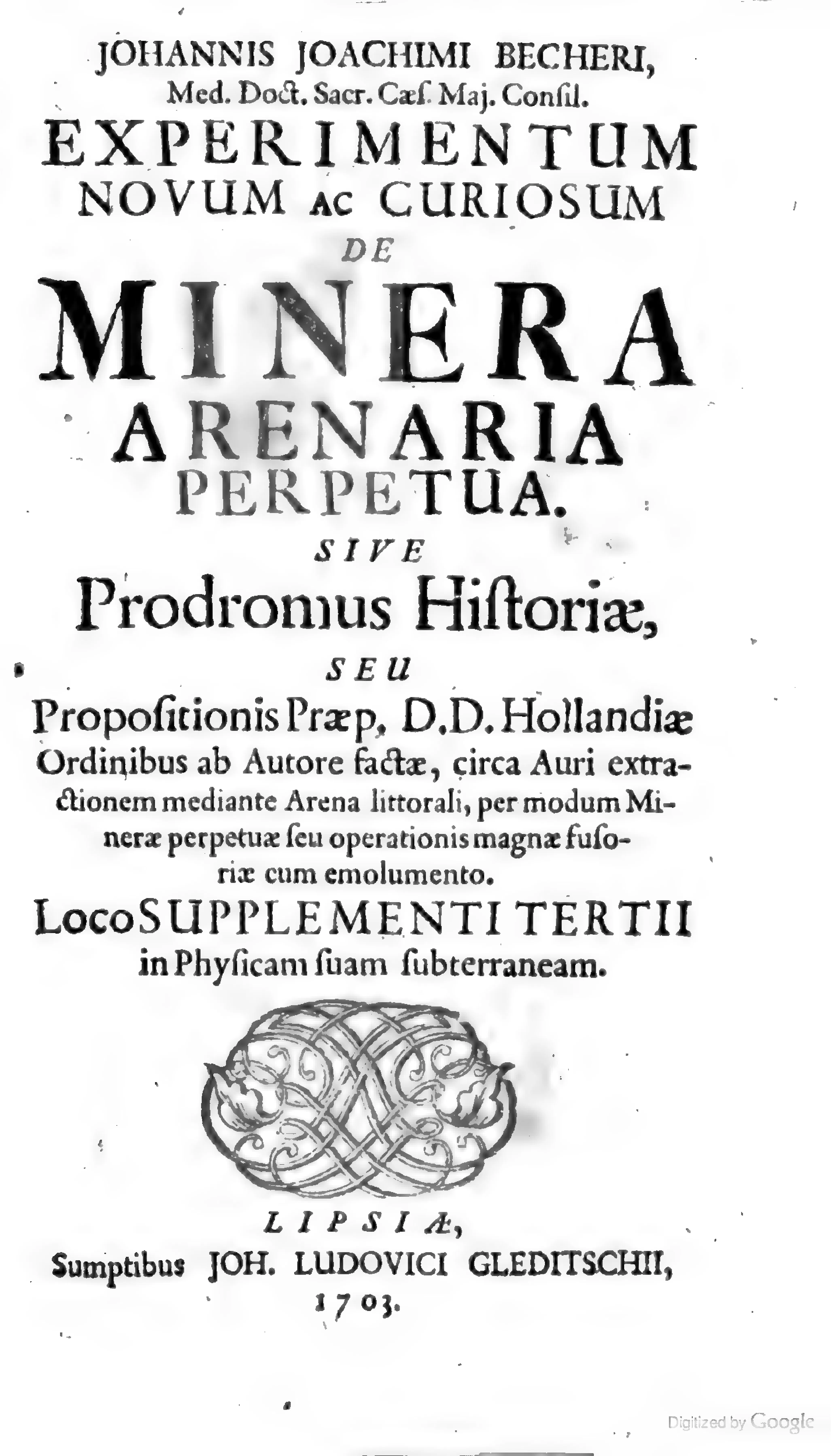
The 1703 Leipzig title page of the Experimentum Novum ac Curiosum de Minera Arenaria Perpetua announces the sand-mine dossier "Loco SUPPLEMENTI TERTII in Physicam suam subterraneam," turning a physical break in the volume into a formal bibliographic claim. Its display hierarchy, the styling of Becher as "Sacr. Cæs. Maj. Consil.," and its reference to a proposal before the States of Holland present coastal sand as a cameralist fiscal resource set beside subterranean mining. Source ↗.
The volume's own manufacture then interrupts the argument, a printed German direction surviving in the sequence to the effect that this leaf is to be cut away, Dieses Blat wird weggeschnitten, after which a fresh title page presents a distinct treatise offered in place of a third supplement to his subterranean physics, Loco SUPPLEMENTI TERTII in Physicam suam subterraneam. The seam is doctrinally continuous even though bibliographically abrupt, for the sand-mine Præfatio narrates the whole enterprise as an unfolding of one 1669 proposition, namely that the principles of metals were earthy and consisted of a threefold earth, quod nempe Metallorum Principia terrea essent, & ex triplici terra constarent, with Geber again enlisted as consenting witness, since he confesses at the very beginning of his book that the principles of metals cannot come together unless they become earthy, fatente nempe Gebro statim sub initium sui libri Quod Principia Metallorum non coire possint, nisi terreasiant. From that premise the Introitus draws a striking conclusion about value: separated clock-wheels are not valued as highly as when, composed, they constitute a perfect clock, quemadmodum rotulæ Horologii separatæ tanti non æstimantur. The horological simile does economic work as well as physical, explaining how particles obtainable from common clay at negligible cost become precious solely in virtue of composition — which is the theoretical warrant for the fiscal proposition already cited, that mines can be worked which in point of profit in no way yield to subterranean mines, with the proceeds directed to a bank at great assured interest, Argentariam seu Bancum magno assecurato interesse. The appended documenta are the evidentiary correlate of this argument rather than its decoration, opening with a demonstration that in every clay from which bricks are baked there is iron and gold, Demonstratio, quod omni Argillæ, ex qua Lateres coqui solent, Ferrum insit & Aurum, and proceeding by an executable protocol beginning: take common clay, form pellets with linseed oil, Sume vulgarem Argillam, forma Globulos Oleo lini.
The survey of seven artificial perpetual mines that follows is a bibliographical genealogy designed to make the offensive phrase minera perpetua respectable, and it is here that Becher's handling of authority becomes most instructive. Bacon is claimed and then corrected: the most sagacious Verulam already sensed this, when he wrote on the matter and in his natural history, century 4, jam sagacissimus Verulamius suboluit, cum hac de re scripserit, & in Historia sua naturali cent. 4, yet the practical objection is immediate, for who ever saw or heard of silver kept liquefied with mercury for six continuous months, quis enim unquam vidit, vel audivit, Argentum cum Mercurio continuos sex Menses liquefactum — a judgement that the intention of a philosophical authority must be salvaged against his letter. Canepari's process supplies the model of true perpetuity, since every twenty-fourth hour the same order is renewed, unto infinity, reintegratur Ordo ipse, usq[ue] ad infinitum, its intervals measured devotionally by the space in which the psalm Miserere mei Deus might be said, quo dici possit Psalmus: Miserere mei Deus — liturgical time serving as laboratory timekeeping, and perpetuity understood as an indefinitely repeatable cycle rather than a violation of nature.
The hermeneutic that licenses such reconciliations is stated openly in the maxim already noticed, that circumstance alters the law no less in Hermetic philosophy than in jurisprudence. Borrowing thus from legal interpretation, Becher authorises reading adepts by sense rather than letter, which is what permits Gaston DuClo's apparent self-contradictions to be harmonised and permits a term like animated mercury to be defined without occult residue: it is so called by transference, not because it has a soul, for it is soulless, but because, as a soul renders an animal warm so long as it is in the body, so gold wards off and tempers the coldness of quicksilver, non quod animam babeat, est enim inanimum, sed quod veluti anima calidum reddit animal, quamdiu est in corpore, sic Aurum argenti vivi frigiditatem arcet, & temperat,. Yet the same movement that domesticates the tradition also fences it off, for the highest of the seven mines is withdrawn from the fiscal argument altogether, on the ground quoted elsewhere in this report that God created this mine for philosophers only, so that drawing it into political use would be a crime and a sacrilege. The contradiction with the projected bank is left standing and unmediated: the same doctrine of earths that grounds a public revenue also grounds a reserved knowledge whose commercial exploitation is impiety. The treatise's final systematisation keeps both registers in view, quantifying the philosophical mercury — the bodies containing in themselves as much mercury as they approach the weight of gold, the remainder being separable earth, tantum in se continere Mercurii, quantum accedunt ad pondus auri: reliquum esse terram separabilem: — and then conceding that in the whole work nothing is more difficult than the government of the fire, quod nempe in toto opere nihil difficilius sit nisi regimen Ignis, so that the decisive variable of the art turns out to be not a substance to be named but a practice to be mastered.
Frequently Asked Questions
Who was Johann Joachim Becher?
Johann Joachim Becher (1635–1682) was a physician, chymist, laboratory operator, projector of mines and manufactures, and writer on princely revenue, born at Speyer and trained partly by himself. In 1669 at Frankfurt he published a Latin treatise in two books issued as the acts of the Munich court laboratory, on the genesis of subterranean things and their special nature and resolution. He defended metallic transmutation before the Emperor Leopold I by reasons and experiments rather than testimonies, and his sand-mine dossier involves Dutch and Hague commissioners, printed resolutions of the States, purchases of silver, and a stipulated reward of ten thousand florins.
What is terra pinguis, and did it become phlogiston?
The terra pinguis, or fatty earth, is the second of Becher's three material earths: rich, combustible, adhesive, opaque, and called sulphur only improperly. It stands between a first vitrifiable, lapidifying earth and a third fluid earth, said to be called Mercury only from its volatility. Georg Ernst Stahl reworked this principle within his own system, and a standard formulation holds that it became the basis of phlogiston theory. The relation is better described as selective appropriation and reinterpretation than as anticipation: Stahl appears in the 1703 Leipzig volume as named editor and critic, adding his Specimen Beccherianum, so identity with phlogiston should not be assumed.
Why did Becher insist that no one understands a metal who cannot make one?
Because he treated artificial production as the test of understanding. No one, he holds, perfectly and evidently knows the mixture of subterranean things, especially of metals, who cannot, having their principles and the other requisites, also produce metals above ground by art. The negative face of this criterion is his charge that Peripatetic doctrine on mixture furnishes only commonplaces, little boxes and names where explanation is owed. The standard cuts both ways: after a year spent on fermentation he offered a hundred, indeed two hundred ducats to anyone who could teach him what he had failed to accomplish, turning a negative result into public evidence.
What was the sand-mine, and how did it link chymistry to public finance?
The sand-mine was Becher's proposal for a perpetual mine worked above ground, presented in place of a third supplement in 1680. Its documents open with a demonstration that every clay from which bricks are baked contains iron and gold, with a protocol beginning: take common clay, form pellets with linseed oil. The fiscal claim is that such mines yield profit in no way inferior to subterranean ones, feeding a bank or Argentaria without base moneylending, usury, or the aggravation of subjects. Yet one of the seven perpetual mines is withdrawn as created for philosophers only, its political use called a crime and a sacrilege.
Is there an English translation of Becher's Physica subterranea?
No modern scholarly translation, and no partial translation, of the physical books or the transmutation theses has been traced. A German rendering said to appear in Friedrich Roth-Scholtz's Deutsches theatrum chemicum is reported without full title or date, so that lineage remains provisional, and the English Magnalia naturae printed at London in 1680 has not been shown to be a direct translation of the Latin sand-mine supplement. Separately, the Leo edition presents the full transcription together with a complete English translation for the first time. That translation is generated by AI. Leo aims to make English translations of every text printed in Latin in early modern Europe between 1450 and 1750 freely available online.
This report was generated by an advanced AI assistant that conducted deep research alongside an extensive interpretation of the transcribed original text. Every effort has been made to preserve fidelity to the source and to guard against inaccuracy, but corruption in the text recognition process and model hallucination may nonetheless have entered the text. Treat every claim, quotation, translation, and citation as provisional, and verify each against the original source before relying on or citing it.
Further Reading on Becher, Early Modern Chymistry, and Cameralism
- Clericuzio, Antonio, Elements, Principles and Corpuscles: A Study of Atomism and Chemistry in the Seventeenth Century: Clericuzio's treatment of principles, elements, corpuscles, and seventeenth-century chemistry supplies the conceptual background for Becher's three-earth theory and his language of composition and resolution, including the combinatorial image by which few principles are made to yield indefinitely many bodies: for here you have the chief letters of nature, and as it were the whole alphabet, though in few letters, yet with very many combinations arising from them, Habes enim hic præcipuas naturæ literas, & quasi / totum Alphabetum, licet in paucis literis, plurimis / tamen inde provenientibus combinationibus. Read it before deciding whether Becher's earths are a corpuscular theory or a scholastic one wearing laboratory clothes. Some library records date the book 2001, so the publication year should be checked against the copy being cited.
- Hassinger, Herbert, Johann Joachim Becher, 1635–1682: Ein Beitrag zur Geschichte des Merkantilismus: Hassinger's monographic treatment (Vienna, 1951; accessible here through the Journal of Economic History review notice) remains the essential biographical and economic starting point for interpreting Becher's mineral projects, princely service, and mercantilist language. It helps prevent the Physica subterranea from being isolated from Becher's cameralist and projecting activity — while also throwing into relief the limits the text itself sets on fiscal exploitation, since, as Becher writes, but since God created this mine only for philosophers, it would be a crime and a sacrilege to draw it into political use, verum quoniam Deus hanc Mineram tantum pro Philosophis creavit, in Politicum eam usum deducere nefas, & piaculum esset.
- Moran, Bruce T., Distilling Knowledge: Alchemy, Chemistry, and the Scientific Revolution: Moran reconstructs alchemy and chemistry through their actual early modern practices and shared intellectual territory. That method illuminates Becher's combination of experiment, testimony, courtly projection, and natural philosophy, while keeping the Viennese and Dutch episodes within their period categories; it also makes intelligible the period logic of a formula such as his account of tincture — that is, it tinges because it has been penetrated, but it makes gold or silver because it is gold or silver, Id est, tingit, quia penetratum est, sed aurificat vel argentificat, quia aurum vel argensum est — in which a corpuscular mechanism of penetration and a doctrine of specific form are held together rather than opposed.
- Newman, William R., and Lawrence M. Principe, "Alchemy Vs. Chemistry: the Etymological Origins of a Historiographic Mistake," Early Science and Medicine: Newman and Principe's argument for recovering the early modern category chymistry (vol. 3, no. 1, 1998, 32–65) provides the methodological safeguard needed for reading Becher's transmutation claims, laboratory procedures, and corpuscular theory without imposing a later opposition between alchemy and chemistry. The point is sharpened by Becher's own refusal of both available polemical positions, in the dictum he offers as a most firm thesis: he is an ass who speaks against Alchemy, but he is a fool and a knave who puts it up for sale in practice, Concludo enim pro Thesi firmissima; Asinus est, qui contra Alchymiam loquitur, sed stultus est & nebulo, qui illam practice venalem exponit.
- Teich, Mikuláš, "Interdisciplinary in J. J. Becher's Thought," History of European Ideas: Teich (vol. 9, no. 2, 1988, 145–160) places the chemical, economic, and natural-philosophical writings in one intellectual field and supplies a useful bibliography of the 1669 work, the German 1680 sand text, and its Latin counterpart. The article is particularly useful for tracing the sequence of separately issued supplements and for resisting disciplinary compartmentalization — a resistance the text itself models when it borrows a maxim of legal interpretation for chymical reading, observing that no less in Hermetic philosophy than in jurisprudence does circumstance alter the law, nec minus enim in Philosophia Hermetica, quam in Jurisprudentia, circumstantia jus variat.