Six Hundred Authors in the Margin: Johannes Clüver's Epitome of the Histories of the Whole World, from the First Origin of Things to the Year of Christ 1630
A Lutheran pastor of the Holstein towns, dead at forty in 1633, left behind a universal history that outlived him by decades: Johannis Cluveri Historiarum totius mundi epitome: a prima rerum origine usque ad annum Christi MDCXXX, printed at Leiden in 1631 and reset at Amsterdam as late as 1668 with its terminal date pushed forward to the Anglo-Dutch peace of 1667. Johannes Clüver's method was to keep the narrative short and put the proof in the margin, where the title boasts of more than six hundred sacred and profane authorities. What survives is less a fixed authorial statement than a working instrument of the Latin book trade — providential in architecture, philological in apparatus, and commercially durable enough to be enlarged long after its author could object.
ExLatinis
September 15, 2026

Contents
A Lutheran pastor of the Holstein towns, dead at forty in 1633, left behind a universal history that outlived him by decades: Johannis Cluveri Historiarum totius mundi epitome: a prima rerum origine usque ad annum Christi MDCXXX, printed at Leiden in 1631 and reset at Amsterdam as late as 1668 with its terminal date pushed forward to the Anglo-Dutch peace of 1667. Johannes Clüver's method was to keep the narrative short and put the proof in the margin, where the title boasts of more than six hundred sacred and profane authorities. What survives is less a fixed authorial statement than a working instrument of the Latin book trade — providential in architecture, philological in apparatus, and commercially durable enough to be enlarged long after its author could object.
Johannes Clüver — who wrote in Latin as Johannes Cluverius or Cluverus — was a Lutheran theologian, pastor, and academic of the Holstein towns, born at Krempe on 16 February 1593 and dead at Meldorf on 25 December 1633, at forty. The work that carries his name longest is not a sermon collection or a dogmatic treatise but a universal chronicle: Historiarum totius mundi epitome, an abridgement of the histories of the whole world reaching from the first origin of things to the year 1630, first printed at Leiden in 1631 and still being reset and reissued a generation after its author's death, most conspicuously at Amsterdam in 1668 by Johann Ravestein, printer to the city and to its illustrious school. It is a book of a recognisable seventeenth-century kind — Latin, compact, densely annotated, indexed for retrieval — and it belongs to a genre that has largely dropped out of the modern reading canon while remaining indispensable for understanding how learned Europeans of the period held the whole of time in a single frame.
The intellectual problem such a book confronts is severe. A universal history that begins at Creation must join scriptural chronology to the classical past, then to imperial, dynastic, ecclesiastical, and regional histories, and must do so on terms that a critically minded reader will accept. To abbreviate is to court the charge of superficiality; to document fully is to abandon abbreviation. Clüver's characteristic answer is visible already in the shape of his title and in the physical disposition of his page: compression in the body, authority in the margin. The word epitome announces not a popular digest but an act of ordered selection, and the volume's own advertisement of more than six hundred sacred and profane authors cited at the margin makes the claim explicit — the narrative is short because the apparatus carries the proof. Printed marginalia, two-column setting, and a copious index are of a piece with that strategy: the abridgement is designed to be consulted and verified, not merely read through.
The stakes of that design were confessional and technical at once. Protestant universal chronography descended from Carion's Chronicle as reshaped by Philipp Melanchthon and Caspar Peucer, and it inherited from Daniel 2 and 7 the succession of four monarchies — Babylonian, Persian, Macedonian, Roman — together with the translatio imperii by which imperial authority was understood to migrate across peoples. It also inherited a live scholarly quarrel: Joseph Justus Scaliger, Sethus Calvisius, and Dionysius Petavius had turned the dating of Creation, the annus mundi, and the synchronisation of sacred with profane events into a discipline of source criticism rather than arithmetic. A chronicle that claimed to derive its events from hundreds of authorities was staking a position in that culture of comparison and authentication. How consistently Clüver's text actually develops the four-monarchies architecture, and how it distributes weight among papal, imperial, Ottoman, and Protestant material, cannot yet be settled; those questions await confirmation against the surviving text, and the span of pages so far examined transmits no continuous running text from which to settle them.
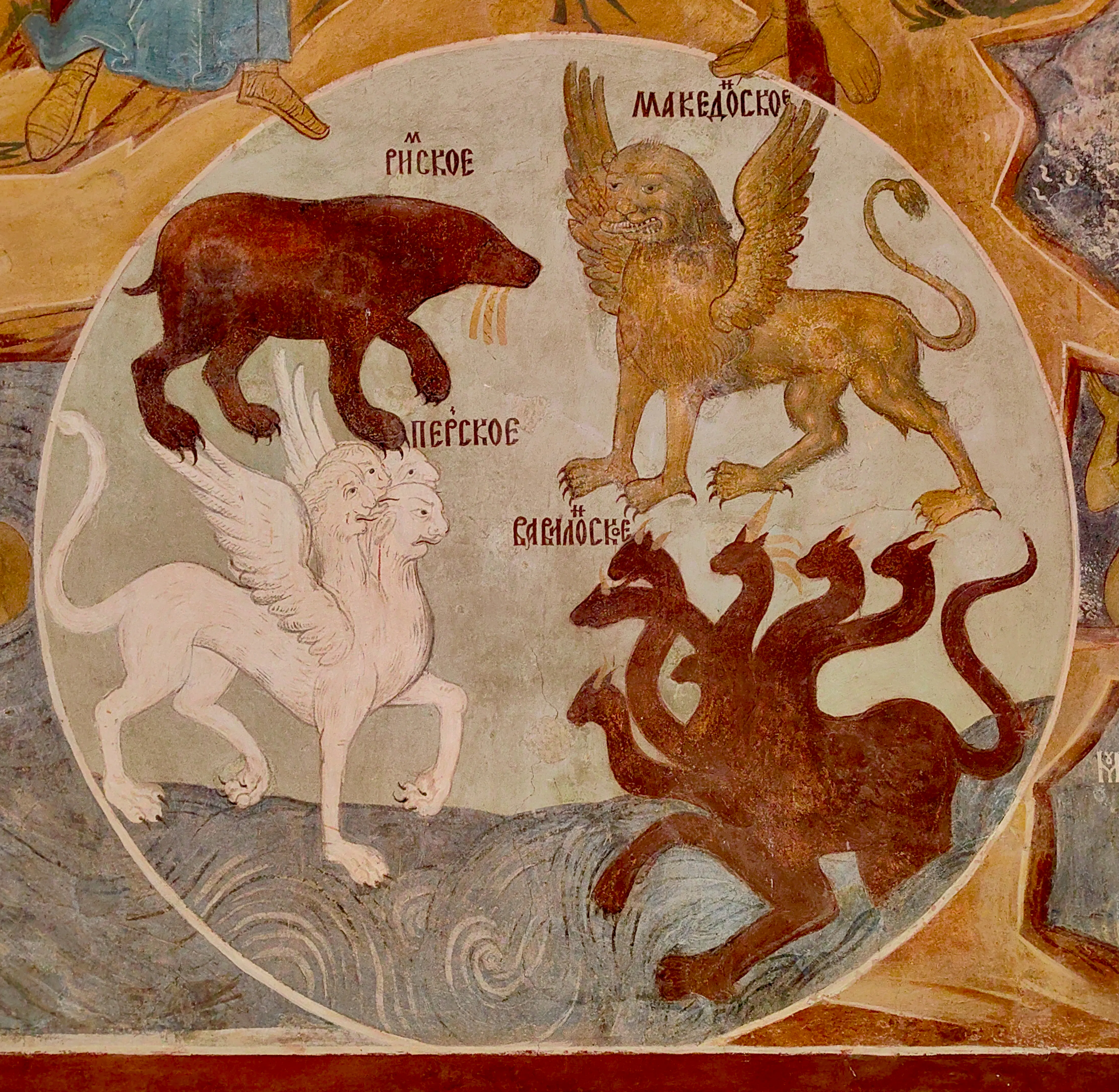
In the Church of the Saviour at the Rostov Kremlin, an early modern Orthodox fresco gives Daniel's vision of the four beasts monumental form. Far from Clüver's Lutheran print milieu, it nonetheless dramatizes the same succession of world empires that Protestant chronographers used to order sacred and profane history. Source ↗.
What is most striking about the object is the way its horizon keeps moving. The title retains 1630 as the terminal date of the history proper, then announces a continuation by Clüver himself to 1633 — the year he died — and then a further extension to the conclusion of the peace between England and the Dutch Republic in 1667, more than three decades after the author's death, with no later continuator identified in the surviving records and no secure evidence as to whether that post-1633 material was newly composed, editorially compiled, or reprinted from an earlier enlarged state. The 1668 volume presents itself as the seventh edition, much corrected and emended, with a most copious index, and bears on its title page the formula of an imperial privilege; yet a 1662 issue is likewise recorded as a seventh corrected edition, so the true sequence of editions, issues, and reset states remains unreconstructed. The chronicle also has to be kept distinct from the work of the Danzig-born geographer Philippus Cluverius, author of Italia antiqua and Germania antiqua, and from the later mathematician Detlev Clüver — a confusion the shared Latinised surname has invited for centuries.
Those facts are not incidental to the book's argument; they are continuous with it. The same logic that governs the title's vocabulary — abbreviation in form, universality in scope, authority delegated to the margin — governs its production history: a school printer's shop, an imperial privilege, a two-column page built for reference, an index that makes the compressed narrative navigable, and a title willing to be enlarged repeatedly so that the "whole world" of the heading keeps pace with the present. A book of this sort is legible less as a fixed authorial statement than as an instrument maintained in service across four decades of the Latin book market, and its interest lies in exactly that combination of providential architecture, philological apparatus, and commercial durability.
Read the full text and English translation on Leo
This text was transcribed and translated as part of the ExLatinis project, an effort by Leo to make free English translations of every text published in Latin in early modern Europe (1450–1750) available online. The complete transcription and English translation of this work can be read free of charge:
→ Read the original Latin text and full English translation on Leo
You can save a copy of this document into your Leo account to run deep text searches, conduct further analysis, or cross-reference it with your own research.
Titling Clüver's Universal Chronicle: Epitome, Historiae, and the Whole World
An editorial English title supplied for convenience is An Epitome of the Histories of the Whole World, from the First Origin of Things to the Year of Christ 1630. No established modern English title was located in the catalogues consulted. The Latin title is Johannis Cluveri Historiarum totius mundi epitome: a prima rerum origine usque ad annum Christi MDCXXX; later issues expand the title by announcing a continuation to 1633 and an update to the Anglo-Dutch peace of 1667.
The noun epitome, derived from Greek epitomē, signifies an abridged or cut-down presentation, but in seventeenth-century historical practice it did not necessarily imply superficiality. Cluver's title presents compression as an act of ordered selection: a large historical field is reduced into a usable sequence while authorities are retained through extensive marginal citation. The term therefore belongs to the pedagogical and scholarly culture of the historical compendium rather than to a merely popular summary. The polysemy is functional rather than incidental: epitome names at once the brevity of the narrative and the scholarly discipline that licenses it, which is precisely the division of labour between text and margin that the volume's printed apparatus embodies.
Historiae in historiarum totius mundi retains the period's double force of narrative and authenticated account. The plural indicates not a single continuous story in the modern literary sense but a concatenation of histories—sacred, civil, dynastic, imperial, and regional—arranged into a chronological whole. Mundus denotes the ordered totality of human history as received through biblical and classical authorities; it should not be reduced to a modern geographical notion of the globe. Finally, a prima rerum origine places the work within the Christian chronographic convention of beginning with Creation, so that ancient history, biblical history, and later political history form one providentially ordered temporal sequence. The title's language thus announces both abbreviation and universal scope: the work is concise in form but maximal in chronological ambition.

A detail from an illuminated Bible manuscript, Walters W.805, depicting the Creation of Eve — the biblical beginning of human history. It stands for the chronographic premise carried by Clüver's phrase a prima rerum origine: universal history opens at Genesis and unfolds from Creation as one providentially ordered sequence. Source ↗.
The philological texture of the volume as printed is consistent with that programme, though it is also, in places, resistant to reading. Where the page carries apparatus rather than narrative, the Latin survives in the heavily abbreviated and contracted forms characteristic of marginal citation, catchwords, and running heads, so that what is legible may amount to no more than isolated word-forms — primus, praecipuum (chief, principal), mater (mother) — detached from any syntax that would fix their reference. Such forms are evidence of the citational machinery described in the title rather than of the narrative it supports, and they set a real limit on how far the work's vocabulary can be characterised from apparatus alone.
What the Epitome Is: Clüver, Leiden 1631, and the Amsterdam Issue of 1668
Johannes Clüver—Latinized as Johannes Cluverius or Cluverus—was a Lutheran theologian, pastor, academic, and historian born at Krempe on 16 February 1593 and deceased at Meldorf on 25 December 1633. The work is a Latin universal chronicle in epitome form, extending from Creation or the "first origin of things" to 1630. The first publication is consistently catalogued as Leiden (Lugdunum Batavorum), 1631; the surviving 1668 issue was produced at Amsterdam by Johann Ravestein.
The 1668 volume is described as the seventh, much corrected and emended edition, with an extensive index. Its long title retains the original terminal date of 1630, announces an authorial continuation to 1633, and adds a further continuation to the conclusion of the peace between England and the Dutch Republic in 1667. The work's driving purpose is to compress sacred and profane history into a chronological, source-supported account, with authorities cited in the margins—the same coupling of brevity with documentation that the title's key term epitome encodes.
The language of composition and transmission is Latin. No complete modern English or German translation was located. The English title above is therefore an editorial translation rather than an established translated title. The place of composition cannot be established securely from the catalogues consulted; Amsterdam is the securely attested place of production for the 1668 issue.
Placing Clüver's Epitome in Protestant Universal Chronography
Clüver's Epitome matters because it preserves a mature form of Protestant universal chronography at the point where biblical chronology, classical erudition, confessional history, and school-oriented historical synthesis meet. Its structure belongs to the tradition associated with Johannes Carion, Philipp Melanchthon, and Caspar Peucer. Scholarship on Carion's Chronicle emphasizes that Melanchthon and Peucer reshaped an earlier chronicle over an extended period and that the work became a formative printed history textbook. This tradition made universal history a disciplined arrangement of sacred and profane authorities rather than a mere annalistic list—the very arrangement that Clüver's title advertises when it subordinates narrative brevity to marginal documentation.
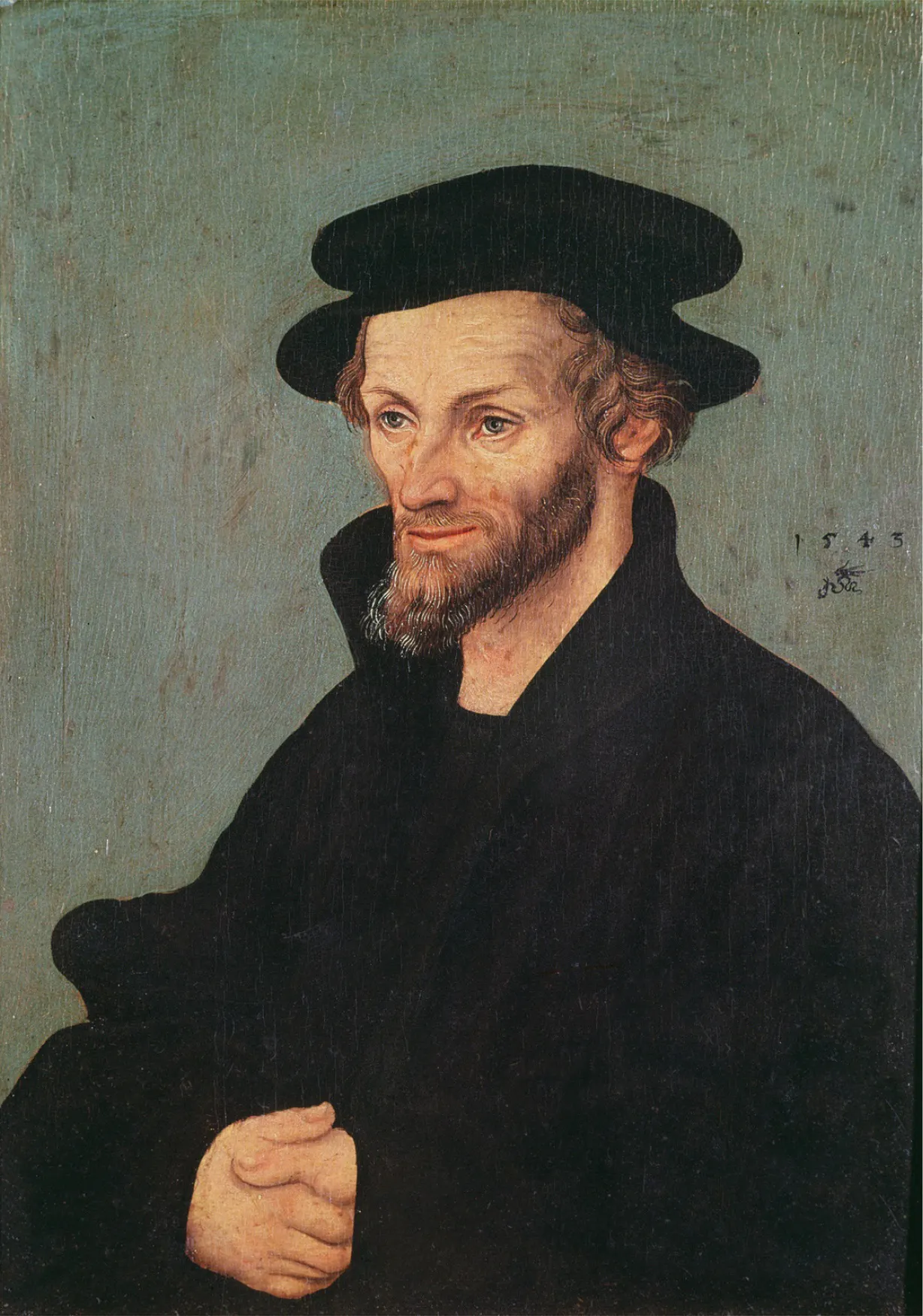
A period portrait of Philipp Melanchthon, evoking the Wittenberg milieu in which universal history was remade as a disciplined synthesis of biblical chronology, classical learning, and confessional interpretation. Clüver's Epitome inherits that Carion–Melanchthon–Peucer tradition, four monarchies and school-oriented ordering of authorities included. Source ↗.
The four-monarchies framework derived from Daniel 2 and 7 is especially relevant. In Reformation historiography, the succession of Babylonian, Persian, Macedonian, and Roman empires supplied a providential and political architecture for world history. The related idea of translatio imperii allowed historians to interpret the movement of imperial authority across peoples and regions. Clüver's title and marginal source practice place him within this inherited architecture, although the accessible evidence does not yet permit a secure claim about how consistently the Epitome develops the scheme or how it balances papal, imperial, Ottoman, and Protestant histories.
The work also belongs to the technical history of chronology. Joseph Justus Scaliger's chronological criticism, Sethus Calvisius's chronological systems, Dionysius Petavius's chronology, and related debates over the date of Creation, the annus mundi, the Julian period, and the synchronization of sacred and profane events formed the scholarly environment in which a universal chronicle could claim authority. Anthony Grafton's account of Scaliger is particularly useful because it shows chronology becoming a field of source criticism rather than a simple calculation of elapsed years. Clüver's claim to derive events from hundreds of sacred and profane authors should be read against this culture of comparison and authentication: the margin is where the compressed narrative discharges its critical obligations.
The confessional dimension remains important but should not be overstated. Lutheran universal histories inherited polemical pressures from both the Magdeburg Centuries and Caesar Baronius's Annales ecclesiastici, yet the records consulted do not establish the exact theological position of every passage in Clüver's Epitome. Likewise, the work's possible use in gymnasia and academies is historically plausible given the form, language, index, and repeated editions, and it is reinforced by the 1668 issue's production under a printer holding the office of typographer to the city and its illustrious school; but direct institutional evidence for classroom adoption was not located. The 1668 reappearance nevertheless demonstrates sustained bibliographical life in the post-Westphalian book market.
Modern scholarship on the surrounding intellectual world is stronger than scholarship devoted specifically to Clüver. Asaph Ben-Tov reconstructs the relationship between Lutheran humanism, Greek antiquity, universal history, and pedagogy. Mark A. Lotito reconsiders the Wittenberg model of historical thought through Melanchthon, Carion, and Peucer, while W. S. Reid's study of Daniel's four monarchies clarifies the scriptural and political genealogy of the framework. Grafton's work on Scaliger supplies the methodological history of chronology. These scholars do not offer a single consensus interpretation of Clüver; rather, they provide complementary contexts—pedagogy, Reformation historiography, confessional history, and chronological criticism—within which the Epitome can be situated.
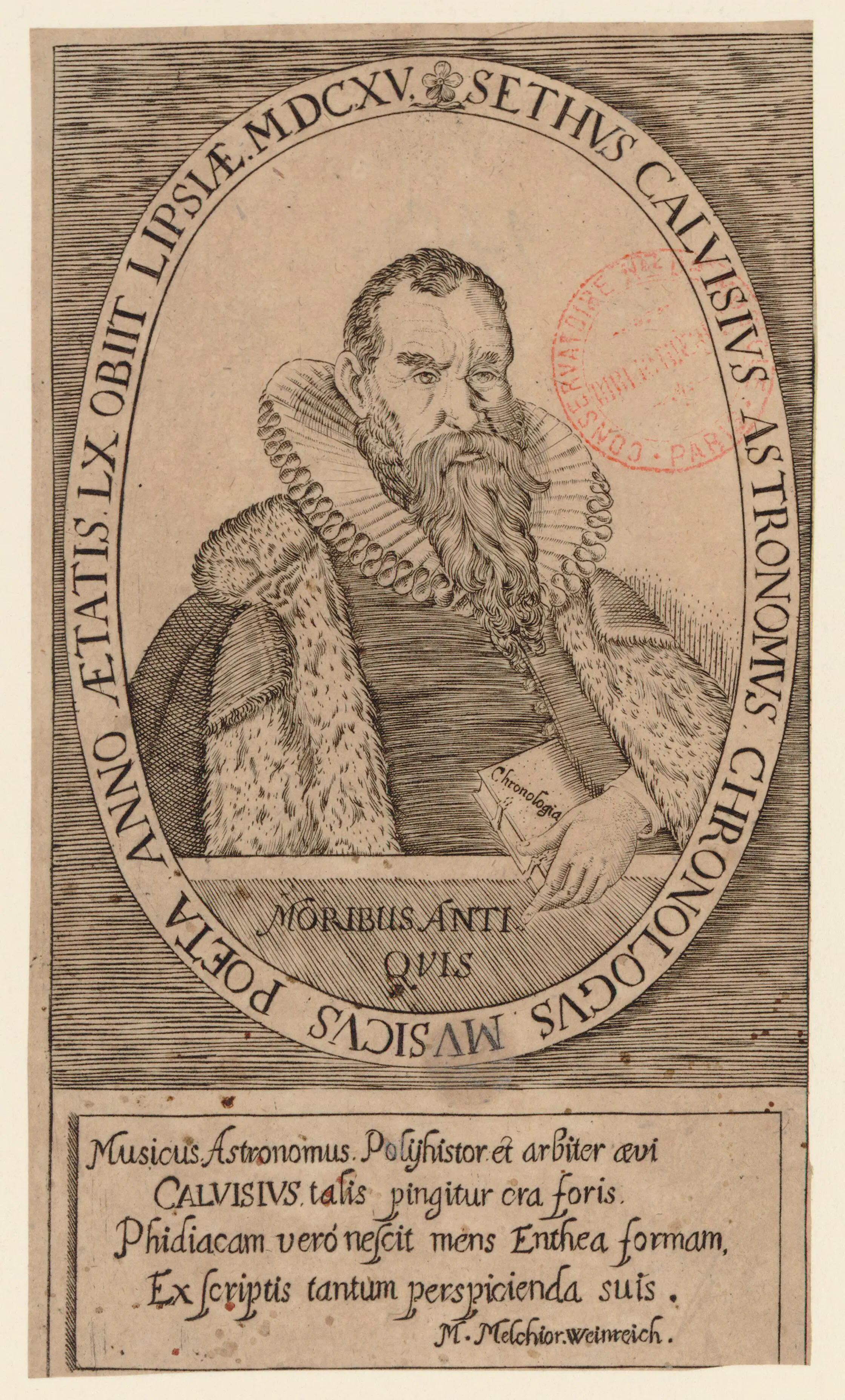
An engraved portrait of Sethus Calvisius, shown with a volume of his Chronologia — emblem of a scholarship that made chronology a technical discipline of proof rather than a convenient ordering device. With Scaliger and Petavius, Calvisius set the standard against which Clüver's Epitome could relegate synchronization and source criticism to its margins. Source ↗.
The specific onomastic questions concerning a truncated Scipio and Paulinam or Paulina remain unresolved, and the state of the text where those forms occur explains why. The relevant span transmits no continuous running text; what is legible there consists of detached and heavily abbreviated Latin word-forms of the kind generated by printed marginalia, signature and catchword debris, and running-head remnants, among which the accusative Paulinam is the only fully legible proper name and the truncation scipi is not securely attested as Scipio at all. Without the running text and its local narrative contexts, it would be methodologically unsound to identify the figures as Scipio Africanus, Scipio Asiaticus, Scipio Aemilianus, Nasica, Pompeia Paulina, Lollia Paulina, the woman in Josephus's Decius Mundus episode, or a Christian-era Paulina. Those identifications require primary-text analysis rather than catalogue inference, and any thematic continuity across this span will have to be established from adjacent evidence rather than from the lacuna itself.
Tracing the Text from Leiden 1631 to Ravestein's Quarto and the Eton Copy
The bibliographic evidence establishes Leiden as the place of first publication in 1631. A 1640 Leiden issue associated with Jacob Marci is recorded at 852 pages and eighteen preliminary or final leaves; the 1641 Leiden record identifies an editio tertia correctior produced by or for Jacob Marci in connection with the Elzevir press. A 1645 issue is represented by a digitized copy of 850 pages. A catalogue record describes a 1662 issue as a seventh corrected edition of 900 pages, while the 1668 Amsterdam issue is also explicitly described as the seventh, corrected and emended edition. These conflicting edition numbers show that the full sequence of editions, issues, and reset states cannot yet be reconstructed with certainty from the records located. A complete USTC or VD17 sequence was not confirmed.
The 1668 imprint reads, in catalogue form, Amstelædami: Apud Joannem Ravesteinium, civitatis & illustris scholæ typographum ordinarium, MDCLXVIII. Johann Ravestein is therefore securely identified as the printer, and Amsterdam—not Leiden, Wolfenbüttel, Helmstedt, Hamburg, or Frankfurt—is the established place of production for this issue. The Eton catalogue describes the physical copy as quarto, measuring approximately 20 cm, with [6], 900, and [32] pages. Its collation is given as [pi]⁴(-[pi]1) A–6A⁴ 6B². Another catalogue describes the preliminaries and end matter differently as [4] leaves and [16] leaves; this discrepancy may reflect different counting conventions or a variant record and should not be silently harmonized.
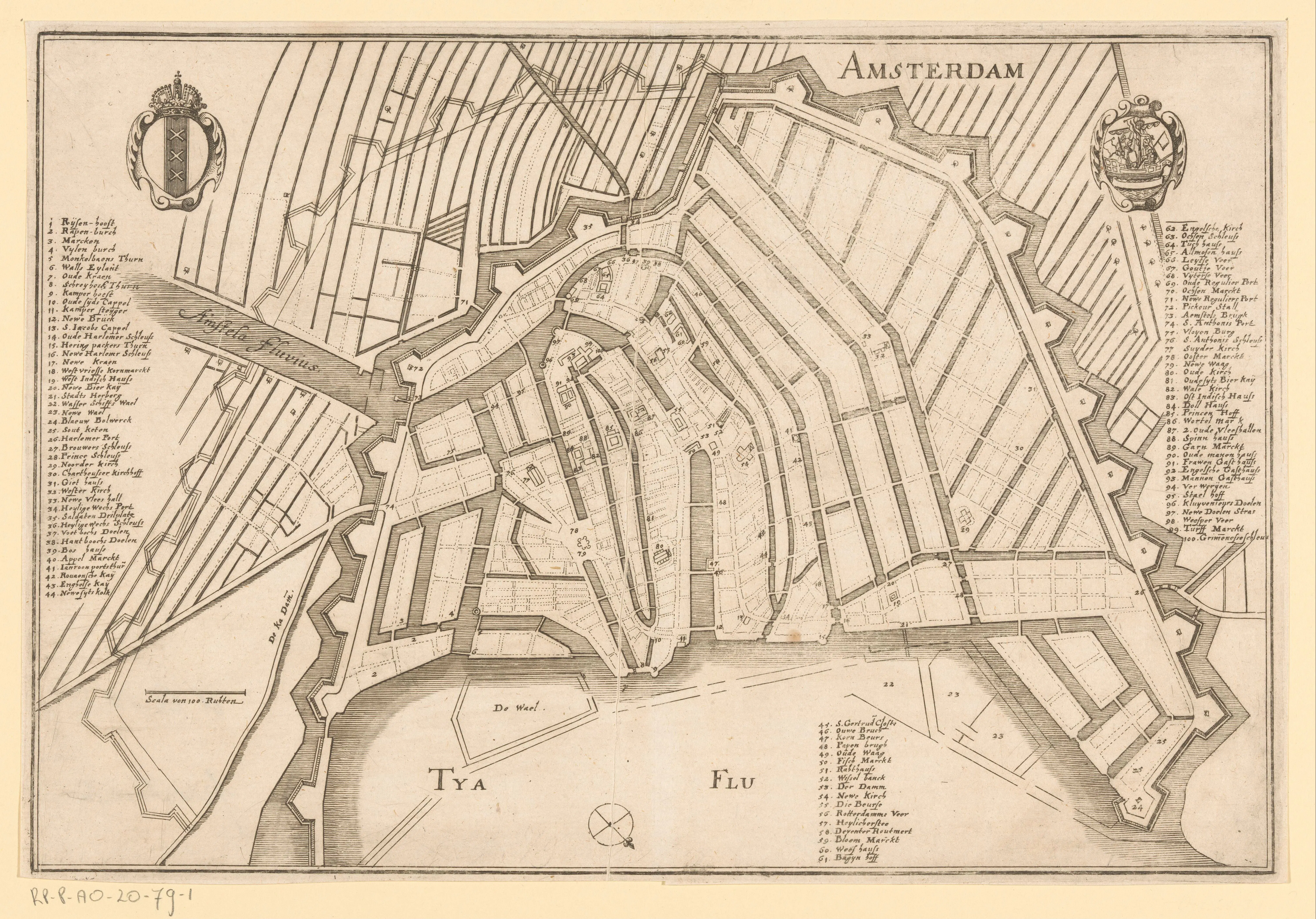
A seventeenth-century fortification plan of Amsterdam: not the book, but the civic landscape named in the 1668 imprint. Engraved plans of this kind situate Johann Ravestein's edition within the urban and institutional world of the city whose official printing he conducted. Source ↗.
The 1668 copy recorded at Eton has two-column setting, printed marginalia, woodcut head- and tail-pieces, initials, and a woodcut printer's device on the title page. The title page also bears the formula Cum sacræ Cæs. Majest. privilegio, indicating an imperial privilege. The edition is described as Editio septima multo correctior & emendatior, cum uberrimo indice. Its expanded title states that the history reaches 1630, that Clüver himself supplied a continuation to 1633, and that the volume was further enlarged to the Anglo-Dutch peace concluded in 1667. No named later continuator was located, and the records do not establish whether the post-1633 material was newly composed, editorially compiled, or reprinted from an earlier expanded issue. The two-column layout and the copious index are the material correlates of the work's governing strategy: a narrative kept short enough to be traversed, fitted with the machinery required to be consulted.
A digitized 1668 copy is available through the Internet Archive from a Boston Public Library holding associated with the John Adams Library; its catalogue data give the call number 39999052969126 and record Johann Ravestein as printer. The copy carries a John Adams bookplate. The Eton copy, shelfmark Ge.5.10, has a more fully documented object biography: it was formerly owned by John Reynolds, whose book label records its donation to Eton College in 1751; it remains in contemporary parchment over boards with a red goatskin spine label bearing the title Cluverii Historia.
Not every proposed shelfmark survives scrutiny, however. A Wellcome Collection record describes a 1645 issue in Early European Books, not the 1668 Amsterdam issue. Its accessible catalogue display did not confirm the proposed "3399/A" shelfmark, a ProQuest copy statement, or a provenance chain for a 1668 Wellcome copy. Full shelfmarks for the Herzog August Bibliothek, Bayerische Staatsbibliothek, Staatsbibliothek zu Berlin, Göttingen, Koninklijke Bibliotheek, Leiden, British Library, Bodleian, and Scandinavian holdings were likewise not exposed by the records located. Those institutions may hold copies, but their shelfmarks should not be supplied without direct catalogue confirmation.
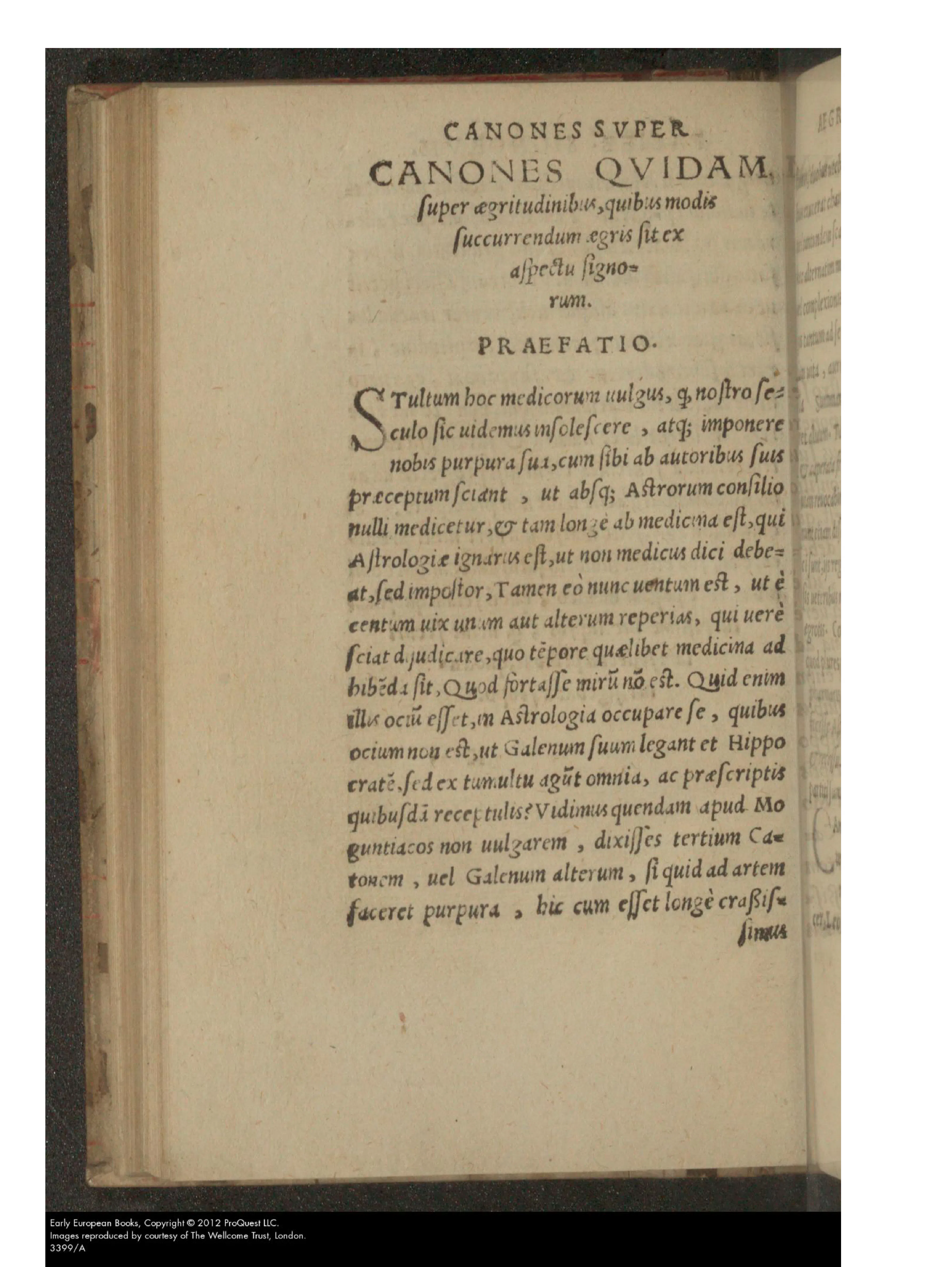
The shelfmark "3399/A" stands at the foot of a printed opening headed "CANONES" and "PRAEFATIO" — not a page of Clüver's chronicle, but of a medical-astrological treatise on treating illness by the signs. A useful negative finding, and a reason to keep unverified Wellcome copy statements out of the bibliography of the 1668 Amsterdam Epitome. Source ↗.
The marginal apparatus is bibliographically attested but not yet textually classified. The catalogue evidence establishes printed marginalia and the title's claim that more than six hundred sacred and profane authors were cited at the margin. It does not establish whether the abbreviated running heads and marginal forms were prepared by Clüver, revised by a later editor, or regularized by the Amsterdam compositor. That question is sharpened by the state of the surviving apparatus itself, which in places yields only detached, contracted forms — expansions such as p[er]f primus in pr[a]ecip[uum], p[er]feptum, a[n]t[e] scipi, and mater et p[er] remain conjectural, and the abbreviation practice they display is precisely what would have to be classified before authorship of the margin could be assigned. No dedicatory addressee, commendatory poem, Lutheran consistorial approbation, or contemporary refutation was securely identified in the records consulted. The safest conclusion is that the 1668 volume's institutional footprint is demonstrated by its privilege, school-printing context, extensive index, and durable circulation, while its precise paratextual network and reception remain underdocumented.
Johannes Clüver must be distinguished from Philippus Cluverius, the Danzig-born historical geographer associated with Italia antiqua, Germania antiqua, and Introductio in universam geographiam, and from the later mathematician and natural philosopher Detlev Clüver. The chronicle's attribution to Johannes is supported by the biographical and catalogue records; no reliable evidence was located for a pseudonym, anagram, or praeses/respondens disputation that would alter the attribution.
Reading the Epitome's Surviving Apparatus When the Narrative Is Gone
The state of the text: apparatus severed from narrative
The slice of the volume under examination here transmits no continuous narrative at all. What survives is the residue of the book's apparatus: a short sequence of detached, heavily contracted Latin forms of exactly the kind generated by printed marginalia, running heads, signature and catchword debris in a tightly set quarto, followed by a span of leaves from which no text is recoverable. This is, in the strict sense, negative evidence — but it is not therefore evidence of nothing. It is the citational machinery of the Epitome caught in isolation from the compressed narrative it was designed to authenticate, and it exposes with unusual clarity both the compositorial conventions of the Amsterdam setting and the methodological limits that those conventions impose on the modern reader.
Contraction, line-break, and the vocabulary of selection
The first form divides across a line break, P[er]f pri / mus in pr[a]ecip[uum], and the division is itself informative: the word primus is broken after its first syllable, the standard recourse of a compositor working a narrow measure, whether the outer marginal column or one of the two text columns. The bracketed expansions register two distinct kinds of contraction. The p with a stroke or tail resolving as per- belongs to the repertoire of abbreviations inherited by seventeenth-century Latin printing from the scribal and incunable traditions, retained precisely where space was at a premium — that is, in the margin and in reference matter rather than in the body of a narrative. The suspension resolved as pr[a]ecip[uum] is of a different order: it truncates a word after its initial cluster and its medial consonants, leaving the reader to supply the ending from the syntax. Where the syntax has been lost, as here, the expansion remains a conjecture. Praecipuum, "the chief" or "principal" thing, is a term of evaluative ordering, the vocabulary of a compiler ranking what matters most within a mass of material; coupled with primus, "first," it suggests a phrase of enumeration or precedence rather than of event. Enumeration and precedence are precisely the operations an epitome must perform constantly, since abbreviation is nothing other than the sustained judgement of what is praecipuum.
The second form, p[er]feptum, is not a Latin word, and its interest lies in that fact. The medial f is almost certainly not an f: in a type-founded Latin text of this period the long ſ is the likeliest original, and the sequence should be read as a per- contraction followed by a syllable in -sept- or, if the letterforms have been misread twice over, as the participle perfectum. Either resolution alters the sense entirely — a numeral form in septimus would belong to a reckoning of years or reigns, a participle in perfectum to the completion of an action. The form therefore demonstrates, in miniature, why the marginal apparatus of this volume cannot yet be classified as to authorship or editorial layer: the abbreviation practice and the typographic conventions must be established before one can ask whether Clüver, a later editor, or the Amsterdam compositor is responsible for the form of the margin.
Onomastic traces and the discipline of restraint
The remaining forms carry the greatest temptation and require the greatest restraint. The truncation a[n]t[e] scipi preserves a nasal suspension in the preposition and then breaks off. It is worth insisting that scipi- need not be onomastic at all: scipio is a common noun, a staff or ceremonial rod, and the Roman cognomen derives from it. Even granting a proper name, the field of candidates among the Cornelii Scipiones is wide, and ante would place whatever follows in a relation of temporal or spatial priority that only the lost running text could specify. Beside it stands Paulinam, the sole fully legible proper name in the sequence and the only form whose morphology is unambiguous: a feminine accusative singular, and therefore a grammatical object, governed by a verb or a preposition that has not survived. A name in the accusative is a name acted upon, and in a universal chronicle that is a meaningful trace — it points to a narrative or anecdotal register in which a woman figures as the object of someone's action — but it identifies no one. The final form, mater et p[er], offers a common noun of kinship, "mother," joined by et to a further per- contraction, and its register is domestic or genealogical rather than annalistic.
The economy of the epitome seen from its underside
Taken together these forms illustrate the governing economy of the work from its underside. The title's promise that more than six hundred sacred and profane authorities stand at the margin presupposes that the margin can be read against the text; where only the margin's contracted debris survives, the authorities cannot discharge their evidentiary function, and the abbreviation that made the apparatus physically possible becomes the very thing that renders it mute. The epitome's strategy — brevity in the body, proof in the margin — is thus revealed to be a strategy of mutual dependence, in which neither register is self-sufficient. To identify the figures behind scipi or Paulinam from these traces alone would be to supply from inference precisely what the printed object here withholds, and the sound procedure is to record the forms, expand them only conjecturally, and leave their reference open pending the adjacent running text.
Frequently Asked Questions
What is Johannes Clüver's Historiarum totius mundi epitome?
It is a Latin universal chronicle, first printed at Leiden in 1631, that runs from Creation — "the first origin of things" — to the year 1630. The design is compression in the body and authority in the margin: a short, two-column narrative fitted with printed marginalia and a copious index, so that the book could be consulted and verified rather than merely read through. Its title advertises more than six hundred sacred and profane authorities cited at the margin. The Latin term epitome, an abridgement, signals ordered selection within the scholarly compendium tradition, not a popular digest.
Who was Johannes Clüver, and how is he different from Philippus Cluverius?
Johannes Clüver, who wrote in Latin as Johannes Cluverius or Cluverus, was a Lutheran theologian, pastor, academic, and historian of the Holstein towns, born at Krempe on 16 February 1593 and dead at Meldorf on 25 December 1633, aged forty. He must be kept distinct from Philippus Cluverius, the Danzig-born historical geographer of Italia antiqua, Germania antiqua, and Introductio in universam geographiam, and from the later mathematician and natural philosopher Detlev Clüver — a confusion the shared Latinised surname has invited for centuries. The chronicle's attribution to Johannes is supported by biographical and catalogue records.
What does it mean that more than six hundred authors stand in the margin?
It means the chronicle's evidentiary burden was shifted from the narrative to its apparatus. Protestant universal chronography, descending from Carion's Chronicle as reshaped by Philipp Melanchthon and Caspar Peucer, had to join scriptural chronology to classical, imperial, dynastic, and ecclesiastical history before critical readers — and after Joseph Justus Scaliger, Sethus Calvisius, and Dionysius Petavius, the dating of Creation and the synchronising of sacred with profane events had become a discipline of source criticism rather than arithmetic. A narrative could therefore be brief only if the margin discharged its critical obligations. Whether Clüver, a later editor, or the Amsterdam compositor shaped that margin remains unclassified.
Why does the 1668 Amsterdam edition reach events after Clüver's death in 1633?
Because the book's horizon kept moving while its author did not. The long title retains 1630 as the terminal date of the history proper, announces a continuation by Clüver himself to 1633 — the year he died at Meldorf — and then adds a further extension to the peace concluded between England and the Dutch Republic in 1667. No named later continuator has been located, and the records do not establish whether that post-1633 material was newly composed, editorially compiled, or reprinted from an earlier enlarged state. The volume was produced at Amsterdam by Johann Ravestein, typographer to the city and its illustrious school.
Is there an English translation of Clüver's Epitome of the Histories of the Whole World?
No complete modern English or German translation has been identified in the catalogues consulted, and no established modern English title was located either; the English title used for the work is an editorial rendering. Separately, the Leo edition presents the full transcription together with a complete English translation for the first time, and that translation is generated by AI. Leo is an effort to make freely available online, at no cost, English translations of every text printed in Latin in early modern Europe between 1450 and 1750.
This report was generated by an advanced AI assistant that conducted deep research alongside an extensive interpretation of the transcribed original text. Every effort has been made to preserve fidelity to the source and to guard against inaccuracy, but corruption in the text recognition process and model hallucination may nonetheless have entered the text. Treat every claim, quotation, translation, and citation as provisional, and verify each against the original source before relying on or citing it.
Critical Further Reading on Clüver, Chronology, and Protestant Universal History
- Asaph Ben-Tov, Lutheran Humanists and Greek Antiquity: Melanchthonian Scholarship between Universal History and Pedagogy: Ben-Tov shows how Lutheran schoolrooms turned Greek antiquity into curriculum and universal history into a teachable sequence, which is the exact institutional world implied by Clüver's Latin, his index, and his printer's office as typographer to the city's illustrious school. Read it to understand why an epitome was a scholarly genre rather than a shortcut. It also usefully deflates the assumption that pedagogy and erudition were separate enterprises.
- Anthony Grafton, "Joseph Scaliger and Historical Chronology: The Rise and Fall of a Discipline," History and Theory: The classic short statement of how technical chronology briefly became the most demanding of the historical sciences and then collapsed under its own apparatus. It explains why a chronicle beginning a prima rerum origine in 1631 could not simply count years but had to argue from authorities — the burden Clüver shifted into his margins.
- Anthony Grafton, Joseph Scaliger: A Study in the History of Classical Scholarship, vol. II: Historical Chronology: The full-dress reconstruction of the source-critical machinery — regnal lists, eclipses, Olympiads, the Julian period — that Protestant chronographers borrowed, contested, and quietly simplified. Consult it when you want to measure the distance between Scaliger's forbidding erudition and the workable compendium a school printer could sell in seven editions.
- Nicholas Hardy and Dmitri Levitin, eds., Confessionalisation and Erudition in Early Modern Europe: An Episode in the History of the Humanities: A corrective volume arguing that confessional allegiance and technical scholarship advanced together rather than at each other's expense. It supplies the framework for the insistence above that Clüver's Lutheran commitments cannot be read off his page without evidence, and that learned apparatus was itself a confessional instrument.
- Mark A. Lotito, The Reformation of Historical Thought: Philipp Melanchthon, Carion's Chronicle, and the Wittenberg Model of History: Lotito traces the decade Melanchthon and Peucer spent rewriting Carion, and the chapter on the Chronicle's transmission and reception maps the printed afterlife into which Clüver's Epitome inserted itself. Indispensable for the four-monarchies scheme and translatio imperii as working editorial structures rather than abstract doctrines.
- W. Stanford Reid, "The Four Monarchies of Daniel in Reformation Historiography," Historical Reflections / Réflexions Historiques: A compact genealogy of how Daniel 2 became a chronological grid, with Carion identified as the decisive figure in fixing it for Protestant use. Short enough to read in an afternoon and precise enough to keep one honest about what the scheme did and did not commit a chronicler to.





,_Creation_of_the_world,_and_Eve,_Walters_Manuscript_W.805,_fol._6v_detail.jpg)


,_RP-P-AO-20-79-1.jpg)