A Drug-Shop Lasting for Years: Georg Pictorius's The Virtues of Herbs
In March 1559 the Basel printer Heinrich Petri issued a pocket-sized Latin herbal, De herbarum virtutibus Aemilii Macri Veronensis elegantissima poësis, in which an eleventh-century hexameter poem on the powers of plants arrives wrapped in the prose notes of Georg Pictorius, physician at the imperial court at Ensisheim. Pictorius kept the poem's borrowed classical author-name while fitting it out with a table of Galenic degrees, an index, and a register of ailments running from the crown of the head to the soles of the feet, converting a poem to be admired into a drug-shop to be consulted. He then closed the volume with a mock-elegy on "the herb whose name is woman," heated to a sixth degree and dried to a seventh — degrees that appear nowhere in the doctrine his own tables teach.
ExLatinis
September 16, 2026

Contents
In March 1559 the Basel printer Heinrich Petri issued a pocket-sized Latin herbal, De herbarum virtutibus Aemilii Macri Veronensis elegantissima poësis, in which an eleventh-century hexameter poem on the powers of plants arrives wrapped in the prose notes of Georg Pictorius, physician at the imperial court at Ensisheim. Pictorius kept the poem's borrowed classical author-name while fitting it out with a table of Galenic degrees, an index, and a register of ailments running from the crown of the head to the soles of the feet, converting a poem to be admired into a drug-shop to be consulted. He then closed the volume with a mock-elegy on "the herb whose name is woman," heated to a sixth degree and dried to a seventh — degrees that appear nowhere in the doctrine his own tables teach.
The Virtues of Herbs — Georg Pictorius’s Basel commentary of March 1559 on the medieval didactic poem transmitted as Macer Floridus — is a small octavo book with a double life. Its core is a Latin hexameter herbal of the eleventh century, generally attributed in modern scholarship to Odo of Meung (Odo Magdunensis), a French cleric and physician, but circulated for centuries under the resonant and misleading name of Aemilius Macer, the Augustan poet of Verona whose lost verses on venomous creatures gave the medieval poem a classical pedigree it did not earn. Around that inherited poem Georg Pictorius of Villingen (1500–1569), physician and archiater at the imperial court at Ensisheim in Upper Alsace, built a prose exposition of its difficult and obscure places, a compendious table of Galenic degrees, an index, and a closing elenchus of ailments from the crown of the head to the soles of the feet. Heinrich Petri printed the whole at Basel, illustrating it with a set of small plant woodcuts already used in his editions of Pietro de’ Crescenzi’s De agricultura. The programme is declared on the first leaf.
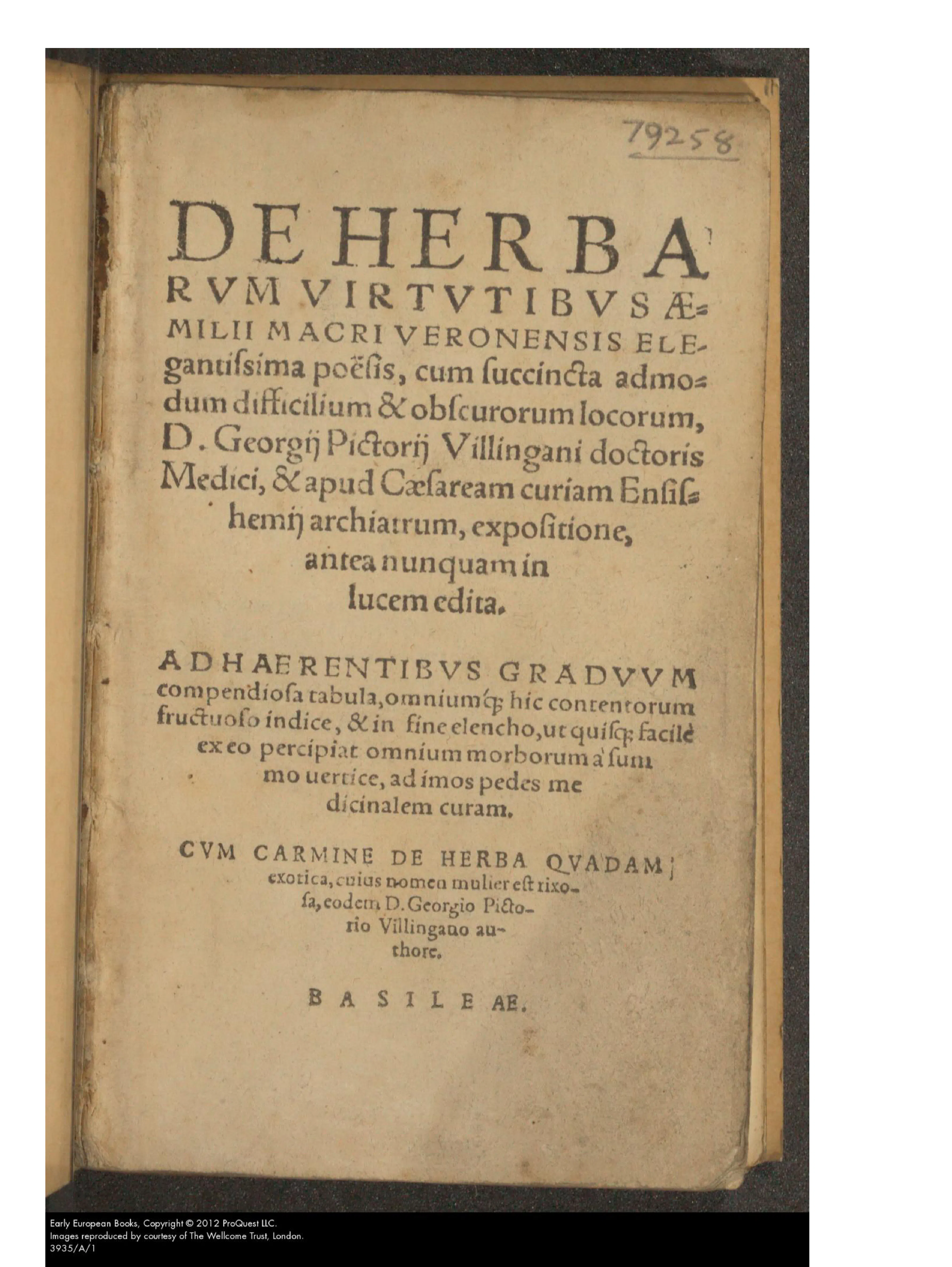
The Basel title page stages Macer as an instrument of retrieval rather than a revived poem: it advertises the table of degrees, index, and head-to-foot elenchus, and names Pictorius’s office at the Ensisheim court. The closing notice of a satirical carmen on an exotic “herb” foretells the volume’s self-parodying end. Source ↗.
The intellectual problem the book confronts is exactly the problem of its own composite form: how a rough-metred, pseudonymously transmitted medieval poem can be made a reliable and usable instrument of sixteenth-century learned medicine. Pictorius’s recurring move is to wrap the verse in matter that simultaneously legitimates and disciplines it. Legitimation comes from precedent — scriptural (the herbal art bestowed on Adam and Eve, Solomon’s knowledge from cedar to hyssop), mythic and divine (Mercury and parthenion, Apollo and hyoscyamus, Aesculapius and panacea), and zoological (the stag that knows dittany, the swallow that knows celandine, the weasel that knows rue) — reinforced by humanist biography, by the reprinting of Pietro Crinito’s life of Macer, and by an unembarrassed defence of verse as the best seasoning of learning. Discipline comes from Galenic degree doctrine and its candidly acknowledged limits, from dosage qualified by climate, age, strength, and season, from defined technical vocabulary supplied with Greek etymologies and German equivalents, and from a policed boundary at which magical and old-wives’ claims are reported and then dismissed, amulets admitted only where repeated trial compels assent, lethal knowledge deliberately withheld, and adulterating drug-sellers and itinerant mountebanks denounced against the ideal of the rationalis medicus.
The stakes of that double operation are large for the period. Galenic and Avicennian pharmacology promised that the action of a simple medicine could be quantified — heat, cold, dryness, and moisture ranked in degrees and even in finer mansiones — yet the authorities disagreed, sometimes flatly, over where a given plant belonged; the onion sat in one station for one authority and a different degree for another. At the same time the identification of plants was in flux across Greek, Latin, German, and Arabic-derived nomenclatures, with the buglossum-and-borage dispute a standing example of how textual names and observed plants refused to align. And the boundary between licit pharmacy and superstition was being drawn, not inherited: learned medicine of the mid-sixteenth century did not divide cleanly into the tested and the credulous, and the same apparatus that refutes the popular belief in houseleek as a shield against lightning retains the peony amulet because Galen reports having tied it on, taken it off, and tied it on again.
What is most distinctive about the volume is the way its conceptual vocabulary, its printed shape, and its argument converge on a single image. Pictorius refuses the horti Adonidis, the forced and short-lived gardens of Adonis, in favour of gardens on the Lucullan or Pompeian model, and then recasts even those as a macellum or, better, a pharmacopolium lasting for years: a provision-stall or drug-shop rather than a pleasure-ground. The book is that shop. Seventy-six verse chapters with prose scholia, a table of degrees, an index, and a terminal elenchus make it a store to be consulted rather than a poem to be admired, and the closing promise is that a reader will learn the virtues of the several herbs even without the powder. The register shifts near the end from garden simples to imported aromata — pepper, ginger, galangal, zedoary, cloves, cinnamon, spikenard — with the wry observation that the kitchen has made pepper better known than medicine has. Then the whole apparatus turns on itself in an appended elegiac iocus on “the herb whose name is woman,” rated at a sixth degree of heat and a seventh of dryness, degrees that exist nowhere in the doctrine the book has just taught.
Much about the object remains open. The attribution to Odo Magdunensis is a widely accepted working consensus rather than a closed question, and a definitive modern critical edition of the poem is still wanting. The dedication of the 1559 volume, and the precise relation of the Alsatian nobleman Wilhelm Böcklin von Böcklinsau to the Ensisheim regency, are not confirmed by the bibliographic evidence available. The claim that 1559 is the first edition to carry Pictorius’s notes rests on a dealer’s description alongside the catalogue’s own statement that the exposition had never before been published, and a full census of variant issues and later reissues awaits compilation. Pictorius himself is thinly studied beside Fuchs, Bock, and Gessner, and the reception of this herbal — its readers, its use, its fate in the confessional and censorial politics of the later sixteenth century — has yet to be reconstructed. What the surviving text does establish, and establishes vividly, is the ambition: to convert an old poem into a durable pharmacy of words.
Read the full text and English translation on Leo
This text was transcribed and translated as part of the ExLatinis project, an effort by Leo to make free English translations of every text published in Latin in early modern Europe (1450–1750) available online. The complete transcription and English translation of this work can be read free of charge:
→ Read the original Latin text and full English translation on Leo
You can save a copy of this document into your Leo account to run deep text searches, conduct further analysis, or cross-reference it with your own research.
Fixing an English Title: Macer Floridus, Odo of Meung, and the Vocabulary of Virtues and Degrees
The Virtues of Herbs: Georg Pictorius’s 1559 Basel Commentary on the Medieval Macer Floridus. This is an editorial English title supplied for convenience; no single established English title for the complete sixteenth-century object was located. The principal Latin title is De herbarum virtutibus Aemilii Macri Veronensis elegantissima poësis, followed by Pictorius’s exposition of difficult and obscure passages. The catalogue tradition also uses the short form De viribus herbarum and identifies the volume as a Latin book by the alleged Macer Floridus with Georg Pictorius as commentator. The title itself does not stop at naming poem and commentator: it advertises the finding aids, promising an adjoining compendious table of degrees, a fruitful index of everything contained in the volume, and an elenchus at the end, so that anyone may easily reach what he seeks, AD HAERENTIBVS GRADVVM compendiosa tabula, omniumq[ue] hic contentorum fructuoso indice, & in fine elencho, ut quisq[ue] facilè, so that the book is presented from its first page as an instrument of therapeutic access rather than as a literary monument alone.
The title’s virtutes does not mean “virtue” in an exclusively moral sense. In materia-medica Latin it denotes the effective powers or properties by which a plant acts upon the body. The older authorial name Aemilius Macer supplies a classical and Nicandrean genealogy, but the medieval poem is not the work of the Augustan poet Aemilius Macer of Verona. Modern cataloguing therefore treats “Macer Floridus” as a conventional name or pseudonymous attribution, while the poem is generally associated with Odo of Meung, or Odo Magdunensis, an eleventh-century cleric and physician.
The term gradus belongs to the Galenic and Avicennian language of qualities: heat, cold, dryness, and moisture are assigned degrees in order to make the action of a simple medicine intelligible and prescribable. The commentary states the doctrine in its standard form, dividing the faculties of simple medicines into four degrees according to perceptibility and injury to function — the first working in the human body an operation of its quality not perceived by sense, the second a quality perceived by sense but without harm to the functions — Medicinarum simplicium facultates in quatuor gradus, Galenus & aij naturarum in dagatores distinguuit, sic ut primus in corpore humano suæ efficiat qualitate operationem sensu no[n] perceptam. Secundus qualitatem sensu preceptam, citra tamen læsionem functionum. In Pictorius’s volume, however, gradus is not left as an abstract physiological doctrine. It is converted into a reader’s instrument through the graduum compendiosa tabula, while the title simultaneously promises an index and an elenchus by which diseases and their remedies can be located. The resulting apparatus joins learned classification to practical consultation. The evidence establishes the presence of the table and finding aids; the finer argument about mansiones, and the extent to which Pictorius suspends confidence in exact gradation when Galen and Avicenna disagree, requires examination of the complete text rather than catalogue metadata alone. On this point the text itself speaks directly: the finer stations are reported and then set aside, since these limits are seen to be fixed by an almost uncertain judgement of the authors — the onion being assigned by the one to the third station of the third degree of heat and by Avicenna to the first station of the fourth — so that the commentator deliberately keeps silence in describing such matters, tamen quia illas ex autorum iudicio fermè incerto limitatas cernimus, ut Cepe indicat, quam autor præfatus in tertia mansione tertij gradus calori assignat: Auicenna in prima quarti gradus, data opera in harum rerum descriptione quiescimus. The quantifying vocabulary is thus retained as a scheme of order while its last refinements are withheld as unverifiable — a reserve that will matter again when the volume closes by parodying the scale it has taught.
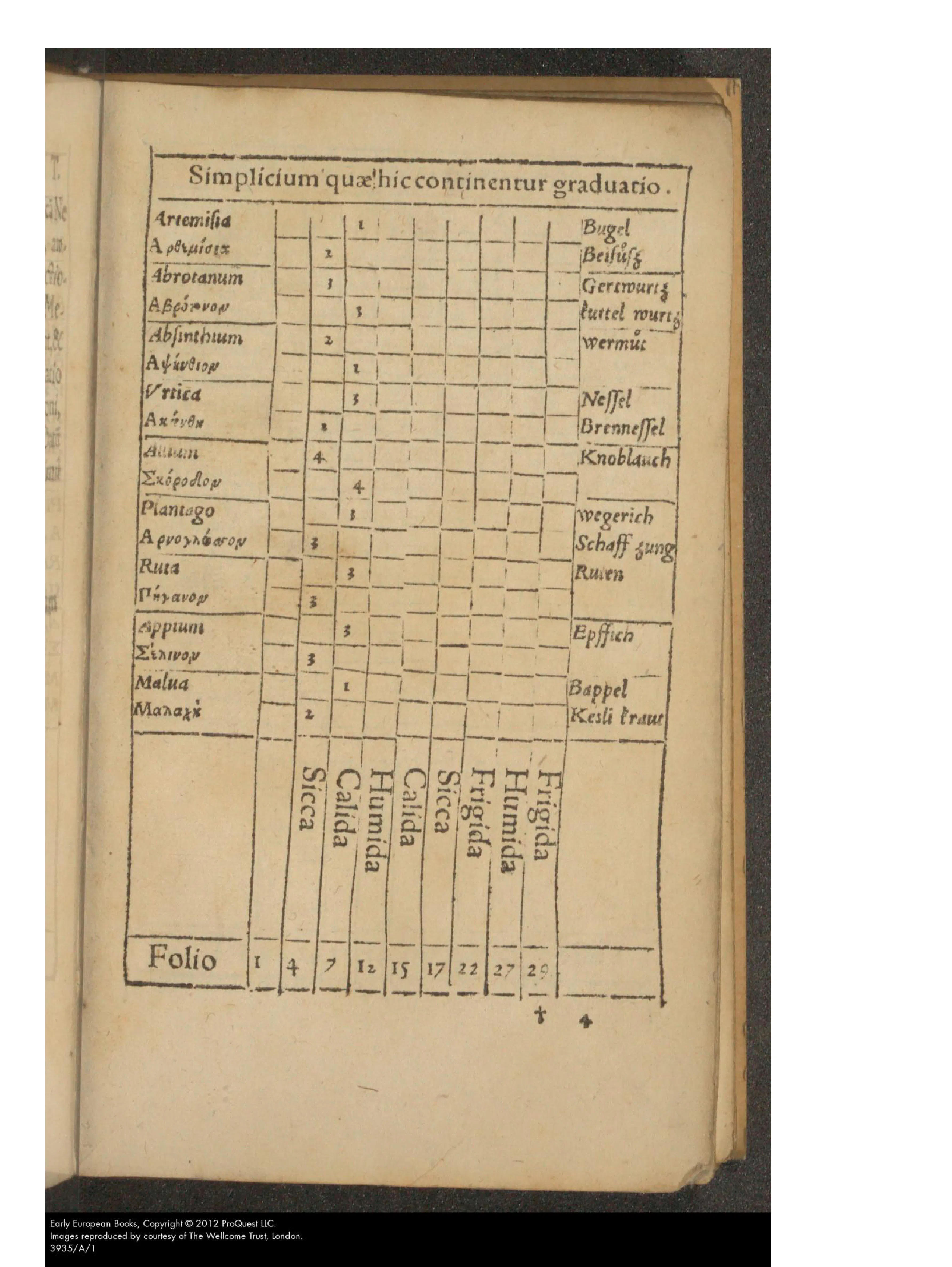
The leaf headed “Simplicium quæ hic continentur graduatio” turns Galenic qualities into a working grid, assigning each simple a single degree under columns for the four qualities while coordinating Latin and Greek names with German ones. It embodies Pictorius’s compromise: gradus preserved for retrieval, the unstable mansiones left uncertified. Source ↗.
The paired terms pharmacopolium and macellum belong to a different but related semantic field. A pharmacopolium is literally a place where medicines are prepared or sold, while macellum evokes a market or provision-stall. When such terms are set against the short-lived horti Adonidis and the durable gardens of Lucullus or Pompey, the garden becomes a figure for ordered preservation, selection, and use rather than mere ornament. The prefatory prose makes the choice explicitly, preferring not pleasure-gardens but Lucullan or Pompeian ones, which may serve a man dismissed from public as much as from private business as a gentle retreat, and sometimes as a meat-market, or rather a drug-shop lasting for years, ptare hortulos: sed Lucullianos potius uel Pompeianos, qui tâ à publicis quàm priuatis negocis dimisso, lene diuerticulum sint, & macellum quandoq[ue], seu pharmacopolium in annos durabile potius. That vocabulary is particularly apt for a printed herbal whose index, table, and elenchus turn heterogeneous authorities and plant lore into a navigable store of remedies. This is an interpretive claim about the rhetoric of the apparatus, not a claim that the catalogue record itself proves a deliberate metaphor of the book as a marketplace.
Further, ars herbularia and rationalis medicus mark a professional boundary. The former dignifies the learned handling of simples; the latter distinguishes the physician who reasons from authorities and experience from the seplasiarius, radicularius, or agyrta, figures associated with commercial compounding, root-selling, or itinerant practice. In this vocabulary, anilia dismisses remedies as credulous old-wives’ lore — the verse conceding that fevers are said to be driven off and many such things invented, which, although powerful nature might grant them, yet rightly seem to us empty and old-wives’ stuff, Et pelli febres & plurima talia fingunt: Quæ quamuis natura potens concedere possit, Vana tamen nobis, & anilia iure uidentur — whereas bezoar is best read as a functional category of counter-poison rather than as a simple botanical substance, as when strong wine is named the bezoar for hemlock provided vomiting has gone before, Cicuta bezoar est forte uinum si uomitio præcedat. These distinctions belong to the period’s effort to separate tested medicinal efficacy from magical or popular claims without eliminating inherited authorities altogether.
The same discipline of vocabulary extends to the pharmaceutical and nosological lexicon that the scholia supply for the poem’s compressed hexameters: cataplasma, apozima, pessarium, dropax and sinapismus, secundae, sacer ignis, morbus caducus with its Greek and Latin synonyms, elephantiasis and lepra. Definitions are given flatly, as when the commentary explains that an apozema is a decoction of various medicines, Apozima decoctio est diuersorum medi caminum. Occasionally the verse itself performs the definitional work, as in the account of the foetal membranes, where the chick not yet born is said to be encircled by the shell of the egg just as the infant in the mother’s belly is clothed in a membrane made from the mother’s seed, which at birth it breaks like an eggshell — membranes that physicians have called the secundae: Vt non dum natus testa circundatur oui Pullus, sic infans matris uestitur in aluo Quadam pellicula matris de semine facta, Quam nascens rumpit quasi testam pullulus oui: Istas pelliculas medici dixere secundas,. Such passages show the poem and its commentary functioning together as a glossary, fixing the terms in which the index and elenchus can then be searched.
What the Basel 1559 Volume Contains: Poem, Commentary, and Satirical Coda
The object is a Latin Neo-Latin-and-medieval composite herbal: a medieval didactic poem on the powers of plants, transmitted under the name Macer Floridus or Aemilius Macer, printed together with Georg Pictorius of Villingen’s prose exposition. The identified volume was printed at Basel by Heinrich Petri in March 1559. Its full catalogue title begins De herbarum virtutibus Aemilii Macri Veronensis elegantissima poësis and describes Pictorius’s exposition of difficult and obscure passages. The volume also contains a table of degrees, an index, an elenchus, and Pictorius’s poem De herba quadam exotica, the satirical “herb whose name is woman,” whose powers are pitched deliberately off the received scale: a sixth degree of heat is read to belong to this herb and a seventh in dryness, so that it surpasses poisons, Sextus huic herbæ legitur gradus esse caloris, Septimus in sicco, toxica sic superat.
The medieval core is a Latin hexameter herbal poem generally attributed in modern scholarship to Odo of Meung, or Odo Magdunensis, an eleventh-century French cleric and physician. “Macer” is an allusive and ultimately misleading author-name, recalling the Augustan poet Aemilius Macer and helping to give the poem a classical literary pedigree. The sixteenth-century prose apparatus is by Georg Pictorius, whose authority record gives his life dates as 1500–1569, birthplace as Villingen im Schwarzwald, deathplace as Ensisheim, and profession as physician. The 1559 title and related catalogue evidence identify him as a doctor and archiater at the imperial court in Ensisheim. Both claims — the borrowed name and the new commentary — stand together where the poem begins.
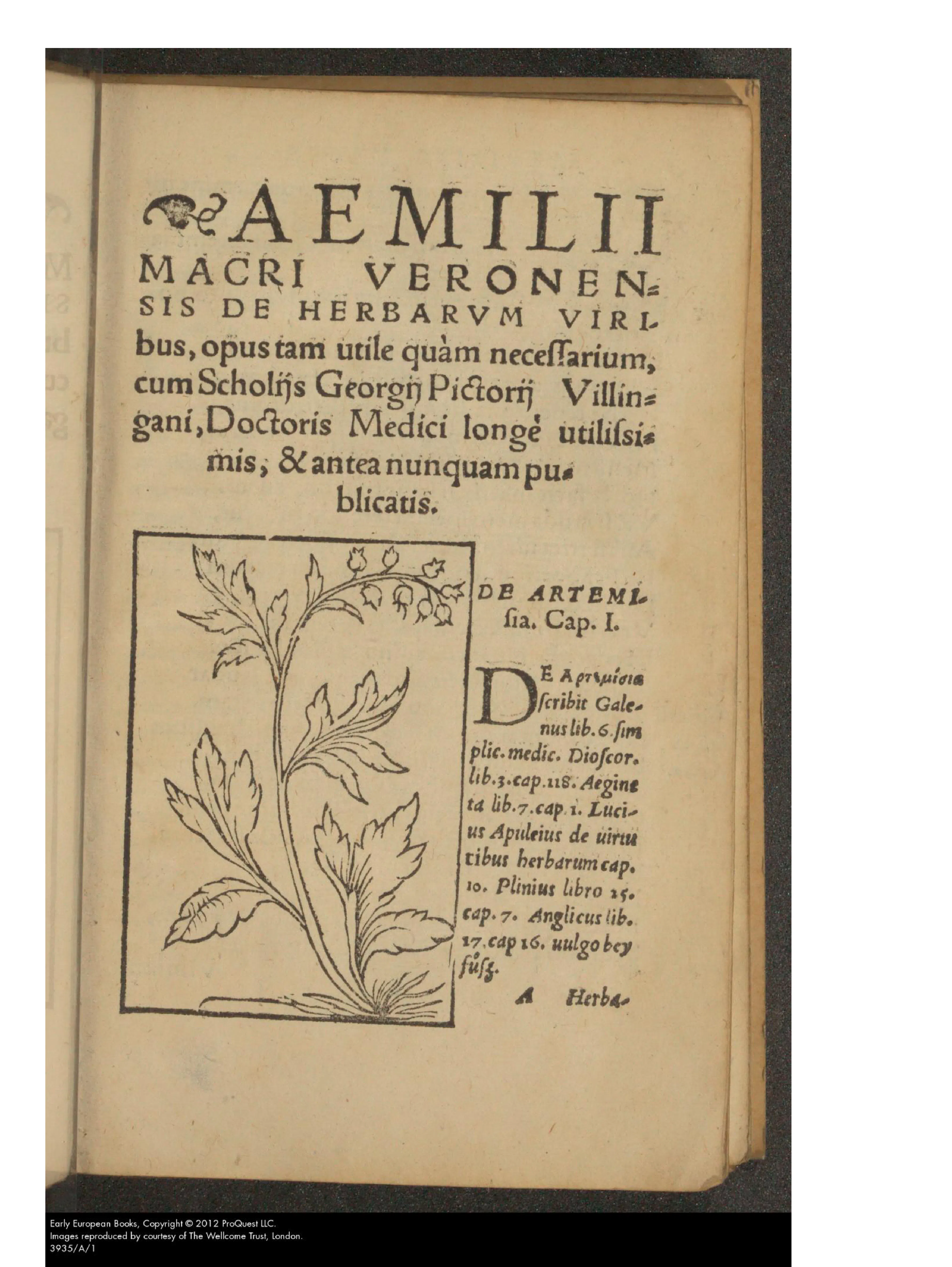
The opening leaf of the poem proper names the pseudonymous “Aemilius Macer of Verona” in display type while presenting Pictorius’s scholia as newly published. The artemisia woodcut and adjoining authority list, with its German gloss, show reused Henricpetri blocks and new commentary turning a hexameter herbal into a cross-referenced instrument. Source ↗.
The place of composition of the medieval poem is not securely established by the evidence consulted. The place of production of the surviving 1559 object is Basel, and its colophon dates the impression to March 1559. The book is therefore not a newly composed herbal but a humanist-medical re-presentation of an older poem through Pictorius’s commentary, bibliographical apparatus, and professional concerns.
The poem circulated widely in manuscript and print. The Hunt Institute records a mid-twelfth-century manuscript fragment, a first print edition issued by Arnaldus de Bruxella in 1477, a Milanese edition of 1489, and an illustrated edition of 1500. Translation history is more complex than the catalogue record for the Basel volume. Vernacular traditions are documented in the broader Macer Floridus scholarship, and the Hunt materials specifically point to a modern English translation of the wild-thyme section. A complete, authoritative census of translations into all European languages, and a complete modern English translation of both poem and Pictorian apparatus, was not established in the sources consulted. No translation of Pictorius’s sixteenth-century prose commentary was located.
Why Pictorius's Herbal Matters: Attribution, Galenic Pharmacology, and the Making of the Rational Physician
The volume matters because it preserves a medieval medical poem within the institutional and material world of sixteenth-century humanism. It is neither simply a medieval herbal nor simply a Renaissance medical treatise. Its importance lies in the superimposition of a hexameter materia-medica text, humanist philology, Galenic and Avicennian pharmacology, botanical identification, professional polemic, and the practical information architecture of the printed book. The prefatory matter announces that superimposition as a programme of legitimation, proposing to build up the authority of herbs and flowers in three ways, the first being that from the beginning of things the knowledge of the herbal art was held in the highest esteem and was bestowed from above, by the Spirit’s guidance, upon Adam and his consort Eve, Trifariam enim herbaru[m] florumq[ue] exaggeremus autoritatem. Primò, quòd à reru[m] initio artis herbulariæ cognitio maximè in pre cio fuerit, & Adam suæq[ue] coniugi Heuæ, ductu pneumatis desuper elargita:. Scriptural and mythic warrant is then joined to an argument from animal behaviour that treats the beasts as the first teachers of pharmacy: who taught the use of dittany against the phalangium’s bite but the stags, who taught that celandine heals the eyes but the swallows, and how should the power of rue against poisons have been known had the weasel been wanting, Quis enim dictami usum contra phalangis ictu[m] docuit quàm cerui? Quis chelidoniam oculis mederi quàm hirundines? Qui cognouissemus ruta[m] uenenis obsistere, si mustela defuisset?. This is a natural-historical epistemology in the service of a textual project: the herbal art is made old, divinely sanctioned, and empirically grounded before a single verse is expounded.
The attribution problem is foundational. The poem circulated as Macer Floridus and Aemilius Macer, but the Hunt Institute describes “Macer Floridus” as the alleged pseudonym of Odo of Meung, an eleventh-century French cleric and physician. The name “Macer” invokes the Augustan poet Aemilius Macer, whose association with remedies for poisonous wounds helped authorize the later herbal’s classical appearance. Modern scholarship therefore distinguishes the medieval poem from the historical Roman poet. The attribution to Odo Magdunensis is widely accepted as a working consensus, but the transmission history remains sufficiently complex that a definitive modern critical edition is still an important desideratum. Notably, the sixteenth-century apparatus does not present the authorship as closed either: it records that there are those who testify that a different Macer from this one existed, Sunt qui ab hoc alium fuisse Macrum testantur,, so that a doubt registered in 1559 stands at the head of the modern problem rather than being invented by it. The accompanying defence of the poem’s literary quality is equally candid, conceding one verse and another to be leonine and in need of the file, yet not so deplorable that the whole work of Macer should on that account be judged fit for rejection, Fatemur uunum & alterum uersum leoninum, ac lima indigentem: non tamen adeò deplorandum, ut totum inde Macri opus repudiandum censuerim — a humanist admission of metrical roughness that is turned into an argument for utility rather than elegance. B. P. Flood’s 1976 study remains a major point of reference, while Thomas M. Capuano’s work shifts attention toward Iberian vernacular versions and the movement between Latin text, translation, and adaptation.
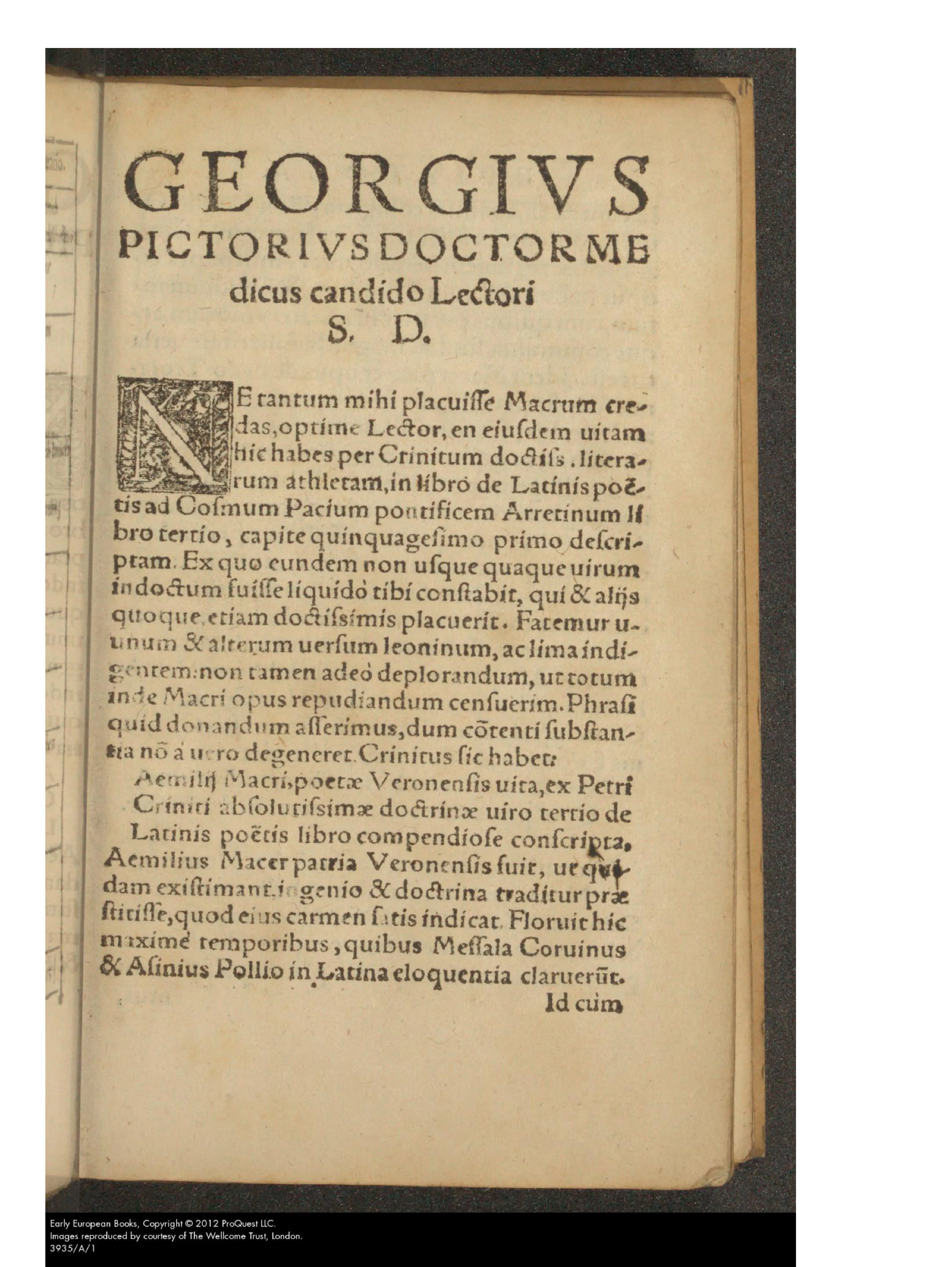
Pictorius’s address to the reader opens with a candid defence: it concedes the poem’s rough, even leonine, versification, then refuses to let that fault disqualify a useful text. Crinito’s life of Aemilius Macer, appended on the same leaf, turns biography into legitimation while the authorship remains a live problem. Source ↗.
The book also belongs to the sixteenth-century reform of botanical knowledge. Its world is one in which plant names are disputed across Greek, Latin, German, and Arabic-derived vocabularies; authorities must be compared; and the identification of a plant has consequences for medicinal use. The buglossum or borage controversy is therefore historically significant as an example of the period’s struggle to reconcile inherited textual names with local plants and observed forms. The available catalogue evidence does not permit a secure reconstruction of Pictorius’s complete treatment of that dispute, so the controversy should be used as a textual and historiographical problem rather than as a catalogue-proven conclusion. The text does, however, refer the question explicitly to the moderns, observing that no agreement of authors is to be found about this herb, as Leoniceno, Manardo, Marcello Virgilio, and Leonhart Fuchs well show, since almost all contend that borage is buglossum, Quam nulla in herbæ istius reperiæ tur autorum symmetria, Leonicenus Manardus, Vergilius Macellus, & L. Fuchsius bene ostendunt, dum omnes fermè Boragine, Buglosson esse contendunt, which places the commentary squarely inside the contemporary philological-botanical debate rather than merely inheriting a medieval name. The same negotiation of registers appears where the discussion turns from garden simples to imported aromata, introduced with the remark that pepper comes first, a substance which the kitchen makes better known than medicine does, and whose powers must therefore be discussed, Atq[ue] prius piperis, quod notius ipsa coquina Quam medicina facit, uires puto discutiendas; the culinary familiarity of a drug is treated as a reason for careful pharmacological definition, not as a substitute for it.
The same caution applies to amulets and magical remedies. Learned medicine in the period did not divide neatly into “scientific” and “superstitious” compartments. Pictorius’s apparatus places inherited authorities, repeated trial, pharmacological reasoning, and rejection of anilia in proximity. The retention of a remedy could depend on Galenic authority or reported experience, while other claims—such as magical protections against lightning—could be rejected as empty credulity. The refutation is stated as such, noting that a superstition unworthy of heaven has long crept in among the common people, namely that this herb, by reason of its coldness, so opposes the celestial fires, Et frigida ualde) irrepsit iampridem uulgaribus, indigna coelo superstitio: quippe hanc herbam propter suam frigiditatem sic coelestibus aduersari ignibus,. Against that stands the peony amulet, retained precisely because the report satisfies a criterion of repeated trial: the boy soon relapsed, and when the root was tied on again in the accustomed way he at once escaped; but Galen, wishing to prove the matter fully, took the root away again from the boy’s neck, whereupon he fell, and when it was taken up again he throve, so that the power of this herb was made manifest, Mox puer recidit, solito quo more ligata, Protinus euasit: rem uero probare Galenus Hanc plenè cupiens, radicem denuò dempsit De collo pueri, cecidit, uiguit resumpta, Cognita uis herbæ fuit huius sic manifesta. What separates the two cases is not the presence or absence of the marvellous but the evidential form in which the claim arrives. Pictorius’s separate demonological and magical writings make this boundary especially important, but the sources consulted do not establish that the 1559 volume itself was censored or placed on the Roman Index.
Professional demarcation is another major theme. The vocabulary of ars herbularia and rationalis medicus presents learned medical practice against the seplasiarius, pharmacopola, radicularius, circumforaneus, and agyrta. The polemic is not merely social invective: it concerns the authority to identify simples, determine dosage, distinguish counter-poisons from dangerous substances, and mediate between household practice and learned medicine. Adulteration is alleged in passing and as a matter of course, of a substance which is falsely sold, as they are wont to do, by the drug-sellers, quod falso, ut solent, à seplasiarijs uenditur, while the irregular practitioners are catalogued with relish as the sort of thing wandering physicians do — ballad-girls, jugglers, mountebanks, twopenny old women, gallows-bailiffs, and root-sellers roaming here and there, medici solent, ambubaiæ, præstigiatores, agirtæ, triobulares uetulæ, patibularij lictores, & hinc inde ambulantes radicularij. The polemic is given a historical origin myth drawn from Roman tradition: because the Greek practitioners thought the Romans barbarians they used false and deceitful treatment upon them, and for this reason all were disgracefully banished together from the City, and in their place, as Macer is here taken to hint, rational physicians were planted, Qui tamen, quod Romanos Barbaros ducerent, in eos falsa dolosaq[ue] usi sunt medicatione, et ob hoc adunum omnes turpiter ab Vrbe proscripti, eorumq[ue] in locum rationales medici, sicu[m] hoc loco Macer innuit, plantati. The text’s treatment of gradus and finer subdivisions also exposes a tension within Galenic-Avicennian pharmacology: numerical precision promises order, but disagreement among authorities and variation by age, climate, constitution, season, and strength limit the stability of that order. The commentary converts that limitation into a rule of practice, beginning from the principle that the climates are to be distinguished, a cold one calling for strong medicine, Climata distinguo, gelidum fortem medicina. Toxicology marks the outer edge of the same professional competence. Hemlock is said to exceed the measure of coldness so far as to be an immediate poison — the public penalty, as Pliny says, of the Athenians, by which Socrates too gave up his life, Lætiferæ cicutæ) Cicuta algoris modum sic excedit, ut præsens uenenum sit: publica, inquit Plinius, Atheniensium poena, qua & Socrates uitam dedit — yet the mechanism is withheld on principle, since how this happens the author does not judge it his to tell, nothing that harms but only what helps being fit to be reported, Qualiter hoc fiat non æstimo dicere nostrum, Cūn nil quod noceat, sed quod iuuat est referendu[m]. Where the bezoar passage already cited supplies the counter-poison, this reticence supplies the corresponding silence: the printed store of remedies is deliberately not a store of methods for killing.
The volume is equally important for the history of the book. Ann Blair’s work on early modern scholarly information management, tables, indexes, and note-taking offers a strong framework for understanding Pictorius’s graduum compendiosa tabula, fructuosus index, and elenchus. These are not decorative additions. They organize a dense body of plant names, qualities, ailments, remedies, authorities, and cross-references, turning a poem into a consultable medical instrument. The title’s own promise of table, index, and elenchus for easy access, quoted above, is the programmatic statement of that design, and the garden recast as a lasting pharmacopolium is its governing figure. The relationship between paratext and medical practice is therefore central to the book’s historical significance.
Georg Pictorius himself remains less thoroughly studied than the major German herbalists Leonhart Fuchs, Hieronymus Bock, and Conrad Gessner. The 1895 study by Ernst Georg Kürz is valuable but historiographically dated. It characterizes Pictorius as a learned physician and writer whose works are scientific, historical, critical, and literary in character. Modern work should place him within, rather than outside, the German botanical and medical Renaissance: a regional physician connected to Ensisheim and the Habsburg Vorlande, yet participating in the broader humanist practice of editing, annotating, translating, classifying, and republishing older knowledge.
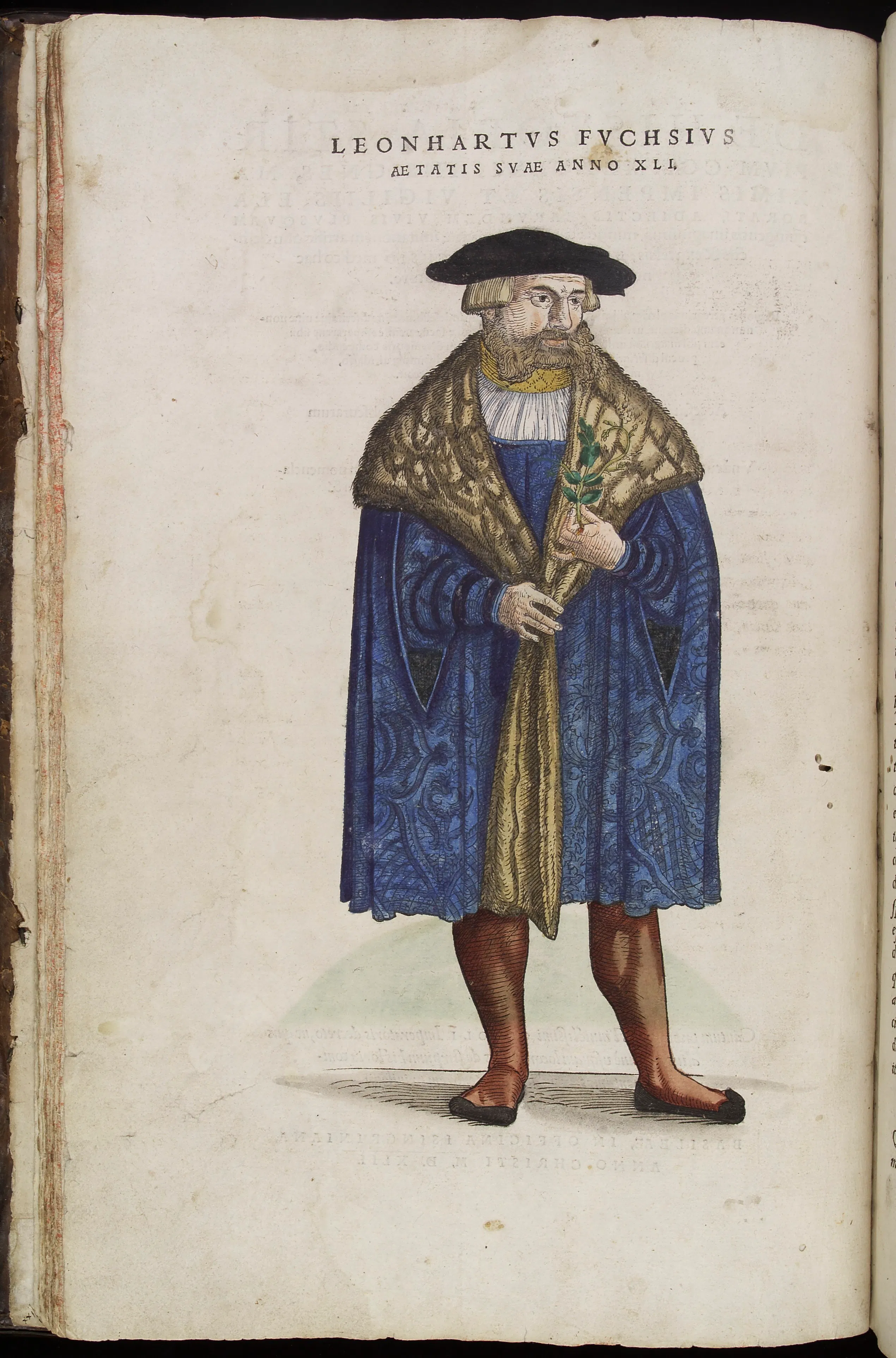
A portrait of Leonhart Fuchs at forty-one, from the Wellcome Collection. Fuchs stands for the better-known German herbalist tradition against which Pictorius has usually been measured — a reminder that Pictorius belonged not outside that world but within its shared culture of learned medicine and plant identification. Source ↗.
The Henricpetri press supplies the material setting for that activity. The 1559 book’s reused Crescenzi woodblocks, its compact octavo format, and its navigational apparatus show how a Basel printer could combine inherited illustration stocks with a newly commissioned commentary. The surviving evidence supports a connection between Petri’s botanical production and the volume, but the broader output profile of the shop in medical and natural-philosophical publishing requires fuller study through Basel printing histories and press catalogues. The historiography is therefore strongest for the poem’s general transmission and for the book’s bibliographic identity, thinner for Pictorius’s reception, censorship, dedicatee network, and the exact mechanics of production.
Tracing the Object: Heinrich Petri's Octavo, Its Crescenzi Woodcuts, and Its Bibliographic Identity
The correct bibliographic identity is the Basel 1559 volume catalogued under De herbarum virtutibus and De viribus herbarum, not Giovanni Battista Riccioli’s much later geographical work. The principal title is De herbarum virtutibus Aemilii Macri Veronensis elegantissima poësis, cum succincta admodum difficilium & obscurorum locorum, D. Georgii Pictorii Villingani doctoris medici, & apud Caesaream curiam Ensishemii achiatrum, expositione, antea nunquam in lucem edita; adhaerentibus graduum compendiosa tabula, omniumque hic contentorum fructuoso indice, & in fine elencho, ut quisque facile ex eo percipiat omnium morborum a summo vertice ad imos pedes medicinalem curam. The title concludes with Pictorius’s De herba quadam exotica.
The Basel University record gives the imprint as Basileae: [Heinrich Petri], [1559] and records the colophon: “Impressum Basileae per Henricum Petri mense Martio. Anno M.D.LIX.” Its physical description is [24], 199, [1] pages, illustrated, approximately 16 cm in height. The recorded signatures are: †⁸, †⁴, A–L⁸, M⁴, N⁸. The same record identifies the printer as Heinrich Petri’s Basel office, cites VD16 O 271 and Hieronymus/Petri no. 322a, and gives the copy signature Bot 2451:2. That copy is bound with two other printed works. The wording of the colophon as it stands in the text agrees with the catalogue transcription, recording that the book was printed at Basel by Heinrich Petri in the month of March, in the year 1559, IMPRESSVM BASILEAE PER HENRICVM PETRI MENSE MARTIO, ANNO M. D. LIX.
An auction description independently identifies the volume as an octavo measuring 156 × 104 mm. It records a printer’s device on the verso of the final leaf, a blank leaf, and fifty-two small plant woodcuts. The description states that the woodcuts were taken from Petri’s editions of Pietro de’ Crescenzi’s De agricultura of 1538 and 1548. It calls the 1559 issue the first edition with Pictorius’s notes and commentary and the first of at least two editions of Macer Floridus illustrated with that woodcut series. Because that “first edition” claim occurs in an auction description while the Basel catalogue itself only records that the exposition was “previously never published,” it should be reported cautiously: 1559 is the earliest securely documented Petri edition located for Pictorius’s apparatus, but a complete census of variant issues and later reissues was not established.
The prefatory matter also carries the volume’s own justification of its form, defending the reading of verse at leisure by appeal to imperial precedent: how profitable is the reading of things that delight us, Alexander Severus declares more emphatically, who never awaited the meal’s end but always read at table, judging reading the best seasoning of foods, lectio, Alexander Seuerus propensius declarat, qui mensæ finem nunqua[m] expectans, semper in me[m]sa legebat, optimum ciborum lectionem ratus condimentum. The convivial-reading topos is doing structural work in a medical book: it explains why an old poem, metrically imperfect, is worth reprinting at all — verse is the condimentum that fixes learning in memory, while the prose scholia and the finding aids supply the exactness the verse cannot.
The surviving object thus has several material layers: a medieval poem assembled from classical, late antique, and early medieval authorities; a humanist commentary attributed to a physician working in the Upper Alsace imperial sphere; a Basel commercial production by Henric Petri; reused botanical blocks; and navigational paratexts designed for consultation. How loosely the earlier layers of that tradition were dated in the commentary itself can be seen where Walahfrid Strabo is introduced as one who flourished in the time of the emperor Louis, in the year of the Virgin’s childbearing 1440, Strabus Gallus, qui tempore floru it Ludouici imperatoris, anno Virginei partus 1440 — a formulation whose internal tension between the Carolingian reign-name and the stated year the commentary does not resolve, and a reminder that the philological control exercised over the poem’s language was not matched by a secure chronology of its sources. The catalogue evidence confirms illustrations, a table of degrees, an index, an elenchus, decorative initials, and a printer’s mark. It does not confirm catchwords, a compositor or corrector, title-page pagination, or the alleged irregularities in chapter numbering. Those matters require inspection of a complete digital or physical copy.
The Hunt Institute’s associated manuscript material should not be confused with the 1559 printed copy. Its finding aid describes two cropped handwritten leaves of De viribus herbarum, estimated to date from about 1150. The Hunt materials also record the poem’s 1477, 1489, and 1500 print milestones. These records establish a transmission environment for the medieval poem but do not by themselves establish ownership or location of a 1559 Pictorius copy.
Georg Pictorius is documented by the Deutsche Biographie under the forms Pictorius, Georg; Georgius Maler; and related variants, with dates 1500–1569, birth in Villingen im Schwarzwald, death at Ensisheim, and occupation as physician. The 1559 title identifies him more specifically as a medical doctor and imperial-court archiater at Ensisheim. Ernst Georg Kürz’s 1895 study presents Pictorius as a physician and learned writer whose works included scientific, historical, philological, and literary investigations. Pictorius’s separate writings on magic and demonology belong to his wider bibliography, but the evidence consulted does not establish a complete bibliography, a later Roman-Index condemnation, or a direct censorship proceeding concerning this herbal volume.
Wilhelm Böcklin von Böcklinsau is a historically identifiable Alsatian nobleman, born at Strasbourg and deceased in 1585. The Deutsche Biographie record lists him as imperial councillor, Hofpfalzgraf, marshal, and cathedral provost. The specific dedication of the 1559 volume, the individual office held by Böcklin in relation to the Ensisheim regency, and the precise form of his name in the dedicatory epistle were not confirmed by the catalogue evidence consulted. They should therefore remain open questions rather than be stated as settled facts.
The unrelated Riccioli imprint is Geographiae et hydrographiae reformatae libri duodecim, by Giovanni Battista Riccioli, S.J., first published at Bologna in 1661 and reissued in a later seventeenth-century edition. Its subject is geography and hydrography, not materia medica, medieval Latin verse, or Pictorius’s commentary. The bibliographic record consequently supports a firm identification of the 1559 item as the Petri/Pictorius De herbarum virtutibus; the precise catalogue or shelving pathway by which it became associated with Riccioli’s work was not located.
Reading the Argument from Title-Page Programme to Closing Iocus
The title-page programme and the garden of the dedication
The volume declares its own genre on its first leaf, and it declares it as an instrument rather than as a literary monument. The clause that promises the adjoining table of degrees, the fruitful index of everything contained in the book, and the terminal elenchus by which anyone may easily find what he seeks — the promise already set out at the head of this report — is syntactically subordinate but programmatically primary: the three finding-aids are named before the poem's contents are described, and the path they advertise runs from the crown of the head to the soles of the feet, that is, along the order of a nosological handbook rather than of a hexameter poem. Everything that follows — the columnar graduation tables, the alphabetical index keyed specifically to the prose scholia, the terminal register of indications — realizes that opening announcement, so that the medieval verse arrives already framed as the searchable matter of a printed medical octavo.
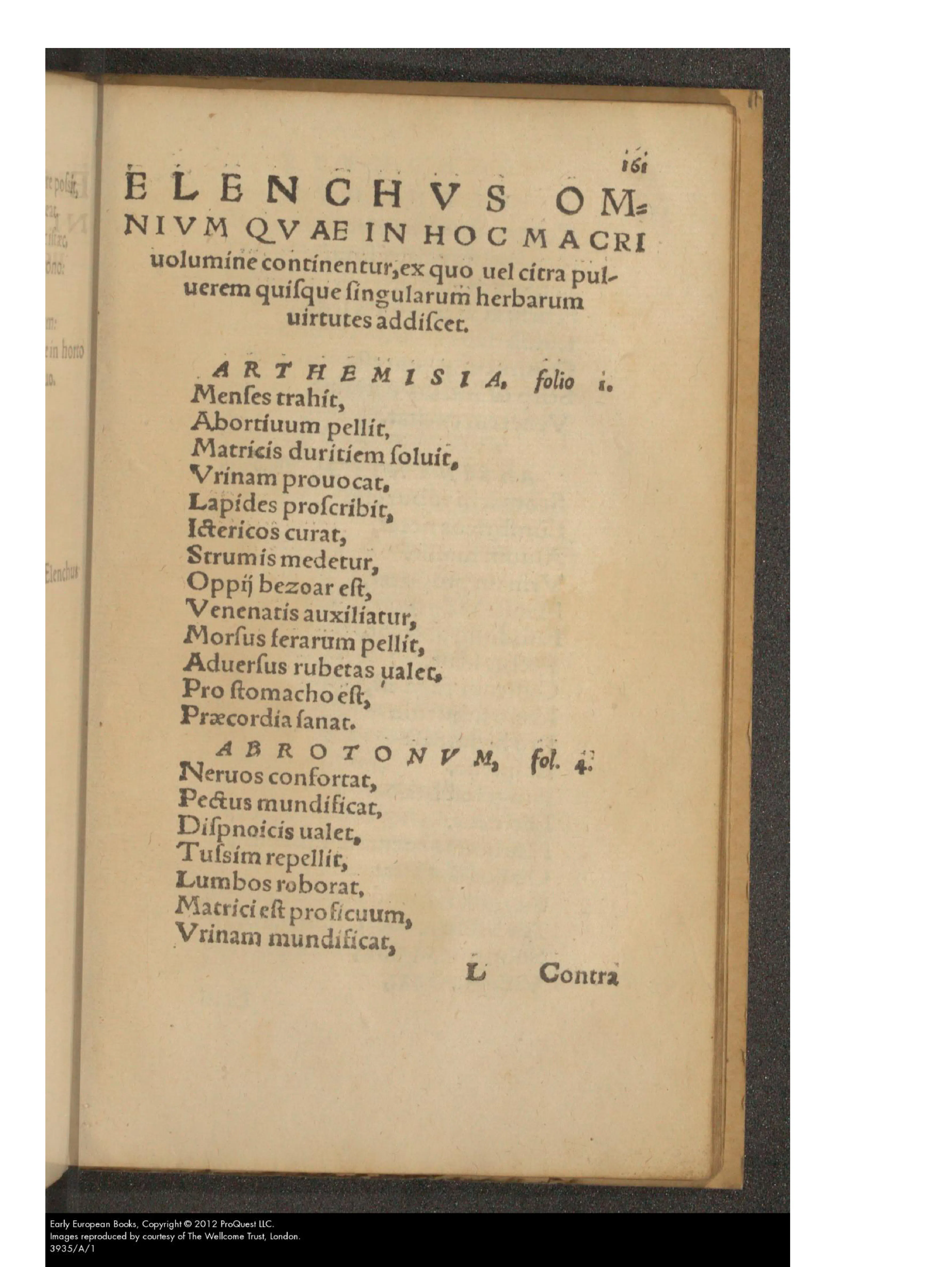
The terminal elenchus delivers the promised apparatus as a working page: alphabetized entries for ARTHEMISIA and ABROTONVM itemize therapeutic uses so that a reader may learn herbal virtues “uel citra puluerem,” even without the powder — the old poem made a searchable storehouse for consultation rather than admiration. Source ↗.
The dedicatory epistle then supplies the governing figure for that conversion. In refusing pleasure-gardens for Lucullan or Pompeian ones, which are to serve a man dismissed from public as much as from private business as a gentle retreat, and sometimes a macellum, or rather a pharmacopolium lasting for years, the period layers three registers at once. The horti Adonidis rejected just before stand for forced growth and quick death; the Lucullan and Pompeian gardens supply aristocratic Roman warrant for otium; and then the conceit is deliberately downgraded from villa to market and corrected again — potius — to drug-shop. The correction is the argument: a garden justified by pleasure is replaced by a garden justified by provision, and the temporal qualifier in annos durabile transfers durability from the plot to the book, which alone can keep its simples in stock through winters. The anti-apothecary polemic of the later scholia is already implicit here, for a pharmacopolium in codex form competes with the shops it will go on to accuse of adulteration.
Warrants: revelation, myth, and the instruction of animals
Before a single verse is expounded, the epistle establishes that herbal knowledge needs no apology beyond its pedigree. The proposal to build up the authority of herbs and flowers in three ways, beginning from the claim that the knowledge of the herbal art was held in the highest esteem from the beginning of things and was bestowed from above upon Adam and his consort Eve, is candid about its own rhetorical operation: the verb exaggeremus concedes that authority is to be heaped up, and the three warrants are graded from revelation through myth to observed nature. The third is the most consequential for a book of remedies, since it grounds pharmacy in animal behaviour; the series of interrogatives about the stags and dittany, the swallows and celandine, and the weasel without which the power of rue against poisons would have gone unknown puts the Plinian inventa animalium to epistemological rather than decorative use. The questions concede that no human author invented these uses, and thus locate the origin of materia medica in a nature that instructs without text. The same aetiology recurs in the chapters on celandine and rue, where the beast's discovery is then subjected to degree doctrine — inherited lore taken up and disciplined.

Dürer’s engraving of Adam and Eve, dated 1504: an early modern German vision of paradise. Here the first couple stands as the scriptural warrant for divinely bestowed herbal knowledge, while Eden’s creatures evoke the companion claim that nature itself teaches the uses of remedies. Source ↗.
The editorial hinge of the reprint is a metrical concession, the admission that one verse and another is leonine and in need of the file, though not so deplorable that Macer's whole work should be judged fit for rejection on that account. The vocabulary is strictly humanist — lima, the file of Horatian revision — and the admitted fault, internal rhyme, is precisely the feature that betrays the poem's medieval date and undercuts the Augustan attribution the surrounding vita labours to secure. Pictorius neither files the verses nor abandons the ascription; he shifts the criterion from phrasis to use, which is the move the whole apparatus then underwrites.
Degrees and the withheld refinements
The doctrinal centre of the commentary arrives in the second chapter, in the division of the faculties of simple medicines into four degrees, the first effecting in the human body an operation of its quality not perceived by sense, the second a quality perceived by sense yet without injury to the functions. That definition, already set out above, is worth weighing carefully: degrees are calibrated not by any property of the plant but by two thresholds in the patient, sensation and impairment of function, so that the scale is at bottom a clinical rather than a botanical measure. Immediately after expounding it, the commentary withdraws from its refinements, on the ground that the limits of the finer mansiones are fixed by an almost uncertain judgement of the authors, the onion being placed by the one in the third station of the third degree of heat and by Avicenna in the first of the fourth. The phrase data opera makes the resulting silence a policy rather than an omission; a single disagreement about a kitchen vegetable is allowed to suspend the mansiones altogether. Yet the tables at the front of the book assign a number to every simple. The volume thus retains the quantitative scheme as an order of arrangement while disclaiming its last decimal of precision — a working compromise rather than a contradiction, but one the book never resolves in theory.
Virtue, superstition, and the form of evidence
Where the scale cannot decide, the commentary turns to other criteria, and the boundary it patrols is that between virtus and superstitio. The complaint that a superstition unworthy of heaven has long crept in among the common people, that the houseleek by reason of its coldness so opposes the celestial fires, refutes the plant set on the roof against lightning by an argument from proportion within the qualitative physics the book teaches, not by denying that cold opposes heat. The peony amulet, by contrast, is retained, and retained on the strength of the Galenic report already discussed, in which the boy relapsed, escaped when the root was tied on again in the accustomed way, fell once more when Galen removed it from his neck in order to prove the matter fully, and throve when it was taken up again. What distinguishes the two cases is the evidential form: a repeated removal and replacement, reported on Galen's authority, counts where a widespread belief does not. The poem itself draws the line in the same terms over vervain, conceding that fevers are said to be driven off and many such things invented, yet judging them empty and old wives' stuff; the subjunctive concedere possit in that concession is a real one, since nature's powers are not circumscribed, so that the verdict anilia is a judgement about testimony rather than about possibility.
The same discrimination governs the book's philology of plant names, where the sixteenth century intrudes upon the eleventh. In observing that no agreement of authors is to be found concerning borage and buglossum, and referring the reader to Leoniceno, Manardo, Marcello Virgilio, and Leonhart Fuchs, the commentary chooses its noun tellingly: what is lacking is not truth but symmetria, commensuration among authorities, and Pictorius sends the reader to the moderns without emending the verse he is printing.
The rational physician and his rivals
Professional identity is constructed by a myth of origins in the cabbage chapter, in the account of the Greek practitioners who, thinking the Romans barbarians, used false and deceitful treatment upon them, were for that reason banished together and disgracefully from the City, and in whose place, as Macer is taken to hint, rational physicians were planted. The horticultural verb plantati quietly binds the professional narrative to the book's garden figure. The long scholion on asarum, the volume's most polemical passage, then supplies the ethical premise for restricting purgation to such physicians, in the joint appeal to Galen and Plato by which man is known to be no stone, no leather, nor wood, but a certain divine miracle almost to be adored. Indiscriminate dosing is thereby reclassified from technical error to irreverence. The rule of practice that follows is versified for memory in the injunction to distinguish the climates, a cold one calling for strong medicine, and its violators are catalogued with Horatian relish as ballad-girls, jugglers, mountebanks, twopenny old women, gallows-bailiffs, and root-sellers roaming here and there. The charge is specific rather than merely abusive: the fault of these figures is to give one dose to every age, sex, region, and constitution, which is the negation of the distinguishing rule just stated.
Silences, imported aromata, and the closing iocus
The same competence entails a deliberate silence. In the hemlock chapter the mechanism of the poison is withheld on the principle, quoted earlier in this report, that nothing which harms but only what helps is to be reported, while the counter-remedies are given in full in the accompanying scholion. A store of remedies is thus defined partly by what it declines to stock. The final movement of the poem announces its own change of register with the remark that the kitchen has made pepper better known than medicine has, and that its powers must therefore be discussed — culinary ubiquity treated as the very reason for pharmacological precision about imported aromata.
The apparatus then turns upon itself. The appended elegiac iocus on the herb Macer omitted assigns it powers off the received scale, a sixth degree of heat and a seventh in dryness by which it surpasses poisons. The joke works only because the reader has been trained by the tables to expect four degrees, and its mock-precision exposes how schematic the measure is; the passive legitur of that reckoning even mimics the citation of authority that the commentary elsewhere demands. The poem ends by inverting the garden conceit with which the dedication began, in the plea that the author has described this green thing so that the reader may never allow it to flower in his own garden, Hanc tibi descripsi uiridem, ut florescere in horto Permittas nunquam Lector amice tuo. Against that single exclusion stands the promise with which the terminal register opens, that from the things contained in the volume each reader will learn the virtues of the several herbs even without the powder — the pharmacopolium of the dedication delivered as a list of indications, a shop of words in which knowledge circulates in place of compounded drugs.
Frequently Asked Questions
What is Georg Pictorius's The Virtues of Herbs (De herbarum virtutibus)?
It is a pocket-sized Latin herbal printed at Basel by Heinrich Petri in March 1559, whose core is an eleventh-century hexameter poem on the powers of plants, transmitted as Macer Floridus. Around that poem Georg Pictorius built a prose exposition of difficult and obscure passages, a compendious table of Galenic degrees, an index, and a closing register of ailments running from the crown of the head to the soles of the feet. The dedication calls such a garden a pharmacopolium — a drug-shop — lasting for years, and the volume ends with a satirical elegy on "the herb whose name is woman," rated at a sixth degree of heat and a seventh of dryness.
Who was Georg Pictorius of Villingen?
Georg Pictorius (1500–1569), also recorded as Georgius Maler, was a physician born at Villingen im Schwarzwald who died at Ensisheim in Upper Alsace. The 1559 title page names him a doctor of medicine and archiater at the imperial court at Ensisheim. He also wrote separately on magic and demonology. He remains thinly studied beside the major German herbalists Leonhart Fuchs, Hieronymus Bock, and Conrad Gessner; Ernst Georg Kürz's 1895 monograph, which presents him as a learned physician whose work was scientific, historical, philological, and literary, is still the fullest account, though historiographically dated.
Who actually wrote the Macer Floridus poem, and why is it ascribed to Aemilius Macer of Verona?
The poem is generally attributed in modern scholarship to Odo of Meung (Odo Magdunensis), an eleventh-century French cleric and physician, though this remains a working consensus rather than a closed question, and a definitive modern critical edition is still wanting. The name "Macer" borrowed the prestige of the Augustan poet Aemilius Macer of Verona, whose lost verses on venomous creatures lent the medieval poem a classical pedigree it did not earn. The doubt is not a modern invention: the 1559 apparatus itself records that some testify a different Macer from this one existed.
How does the commentary separate genuine plant powers from superstition?
By the evidential form in which a claim arrives, not by the strangeness of the claim itself. The popular belief that houseleek set on a roof repels lightning is dismissed as a superstition unworthy of heaven, refuted from within the same qualitative physics of hot and cold that the book teaches. Yet the peony amulet is retained, because Galen is reported to have tied the root on, removed it, and tied it on again, the boy relapsing and recovering each time. Elsewhere remedies are rejected as old wives' stuff — a verdict about testimony rather than about what nature might allow.
Is there an English translation of Pictorius's De herbarum virtutibus?
No complete modern English translation of the poem together with Pictorius's sixteenth-century prose apparatus has been identified, and no translation of the commentary itself was located; only a modern English rendering of the poem's wild-thyme section is documented. Separately, the Leo edition presents the full Latin transcription alongside a complete English translation, generated by AI, for the first time. Leo is an effort to make freely available online, at no cost, English translations of every text printed in Latin in early modern Europe between 1450 and 1750.
This report was generated by an advanced AI assistant that conducted deep research alongside an extensive interpretation of the transcribed original text. Every effort has been made to preserve fidelity to the source and to guard against inaccuracy, but corruption in the text recognition process and model hallucination may nonetheless have entered the text. Treat every claim, quotation, translation, and citation as provisional, and verify each against the original source before relying on or citing it.
Critical Further Reading on Macer Floridus, Pictorius, and Basel Printing
- Ann Blair, Too Much to Know: Managing Scholarly Information before the Modern Age: Blair's account of tables, indexes, excerpting, and scholarly information management supplies the history-of-the-book framework in which Pictorius's graduum compendiosa tabula, index, and elenchus stop looking like padding and start looking like the point of the volume. The terminal elenchus itself states the retrieval promise in these terms, that these things are contained in the volume, from which each reader will learn the virtues of the several herbs even without the powder, uolumine continentur, ex quo uel citra puluerem quisque singularum herbarum uirtutes addiscet — the book offered as a durable pharmacopolium of knowledge in advance of any compounded drug. Yale University Press, 2010; Blair's publications page also lists her later synthesis on managing information for the Oxford Illustrated History of the Book.
- Thomas M. Capuano, "Medieval Iberian Vernacular Versions of the Herbal Called Macer Floridus," Manuscripta: Capuano (Manuscripta 35, no. 3, November 1991, 182–202) tracks the poem out of Latin and into Iberian vernacular adaptation, and is indispensable for keeping translation, rewriting, and scribal drift analytically distinct. He also supplies the comparative frame for the Basel volume's own multilingual habits, where Greek etymologies and German plant-names sit inside a Latin commentary without apology.
- B. P. Flood, "The Medieval Herbal Tradition of Macer Floridus," Pharmacy in History: Flood's 1976 article remains the standard orientation to the poem's medieval transmission, its attribution to Odo Magdunensis, and the long shadow cast by Ludwig Choulant's 1832 edition, which Flood notes rests almost entirely on manuscripts. It is also the natural place to test the classicizing genealogy the 1559 apparatus takes over from humanist biography, where the same Macer is said to have written, besides the work on the Trojan war, books on venomous animals and on herbs, following Nicander the poet of Colophon, in which he won no mean praise, Idem Macer præter opus de bello Troiano. scripsit etiam libros de uenenatis animantib. ac de herbis, secutus Nicandrum poetam Colophonium,. Verify the journal volume and pagination against the JSTOR record before citing.
- Ernst Georg Kürz, Georgius Pictorius von Villingen: ein Arzt des 16. Jahrhunderts und seine Wissenschaft: This 1895 monograph, digitized by the Wellcome Collection, is still the fullest reconstruction of Pictorius's medical, philological, historical, and literary output, and its nineteenth-century categories are worth reading as evidence in their own right. The learned deontology behind the herbal's objection to indiscriminate dosing belongs to that profile, resting as it does on a joint appeal to Galen and Plato: since we know man to be, as Galen says, not a stone, not leather, nor wood, but a certain divine miracle almost to be adored, as Plato says in the book of Laws, quum hominem nouerimus (ut Galenus ait) non lapidem, non corium, nec lignum, sed diuinum quoddam miraculum fermè adorandum, ut Plato ait in lib. de Legib.
- P. F. Tschudin, "Basle Letterpress Printing: The Cradle of Agricola's Main …" (1994): A useful way into the mechanics of Basel printing and the Henricpetri shop, which is where the reused Crescenzi blocks and the 1559 octavo format actually come from. No stable URL was recovered, and the full article title and publication venue should be confirmed from the JSTOR record before formal citation.