Inserting a Year Without Consuls: Carlo Sigonio's Consular and Triumphal Fasti from Romulus to Tiberius, with a Commentary on the Whole of Roman History and a Treatise on the Names of the Romans
Carlo Sigonio built his FASTI CONSVLARES, AC TRIUMPHI acti à Romulo Rege usque ad Ti. Cæsarem (Basel, 1559) out of broken marble rather than out of Livy: a folio grid of consuls, censors, dictators and triumphs running from Romulus to Tiberius, reconstructed from inscriptions lifted out of the Roman Forum in 1546–1547. Where the stones and the annalists disagreed he printed the stones in larger type, set his own supplements in smaller, and at one point inserted an entire year without consuls that no ancient writer records, purely to keep the marble's arithmetic intact. What emerges is among the earliest thoroughgoing works of documentary history, and simultaneously an argument, conducted through the technical vocabulary of Roman public law, about how a commonwealth becomes a monarchy while retaining all its old names.
ExLatinis
July 30, 2026

Contents
Carlo Sigonio built his FASTI CONSVLARES, AC TRIUMPHI acti à Romulo Rege usque ad Ti. Cæsarem (Basel, 1559) out of broken marble rather than out of Livy: a folio grid of consuls, censors, dictators and triumphs running from Romulus to Tiberius, reconstructed from inscriptions lifted out of the Roman Forum in 1546–1547. Where the stones and the annalists disagreed he printed the stones in larger type, set his own supplements in smaller, and at one point inserted an entire year without consuls that no ancient writer records, purely to keep the marble's arithmetic intact. What emerges is among the earliest thoroughgoing works of documentary history, and simultaneously an argument, conducted through the technical vocabulary of Roman public law, about how a commonwealth becomes a monarchy while retaining all its old names.
Carlo Sigonio of Modena (c. 1524–1584) was, by the middle of the sixteenth century, one of the most technically formidable Latinists in Italy: a schoolmaster's son who taught at Modena, lectured publicly at Venice under the Scuola di San Marco from 1552, held the chairs of rhetoric and then Greek at Padua, and in 1563 became the first professor of history at Bologna. The volume printed for him at Basel in 1559 by Nikolaus Episcopius the Younger, in the old Froben house at the Zum Sessel, is not a narrative history at all. It is a folio instrument in three parts: a tabular register of the Roman consuls and triumphs running from Romulus to Tiberius; a year-by-year Commentarius on the whole of Roman affairs, reckoned from the fourth year after the foundation of the city to the year of Tiberius's death; and a short closing treatise on the technical vocabulary of Roman personal names. Behind it stands the enlarged and author-revised reissue of the Venetian first edition that Paolo Manuzio had printed in 1556.
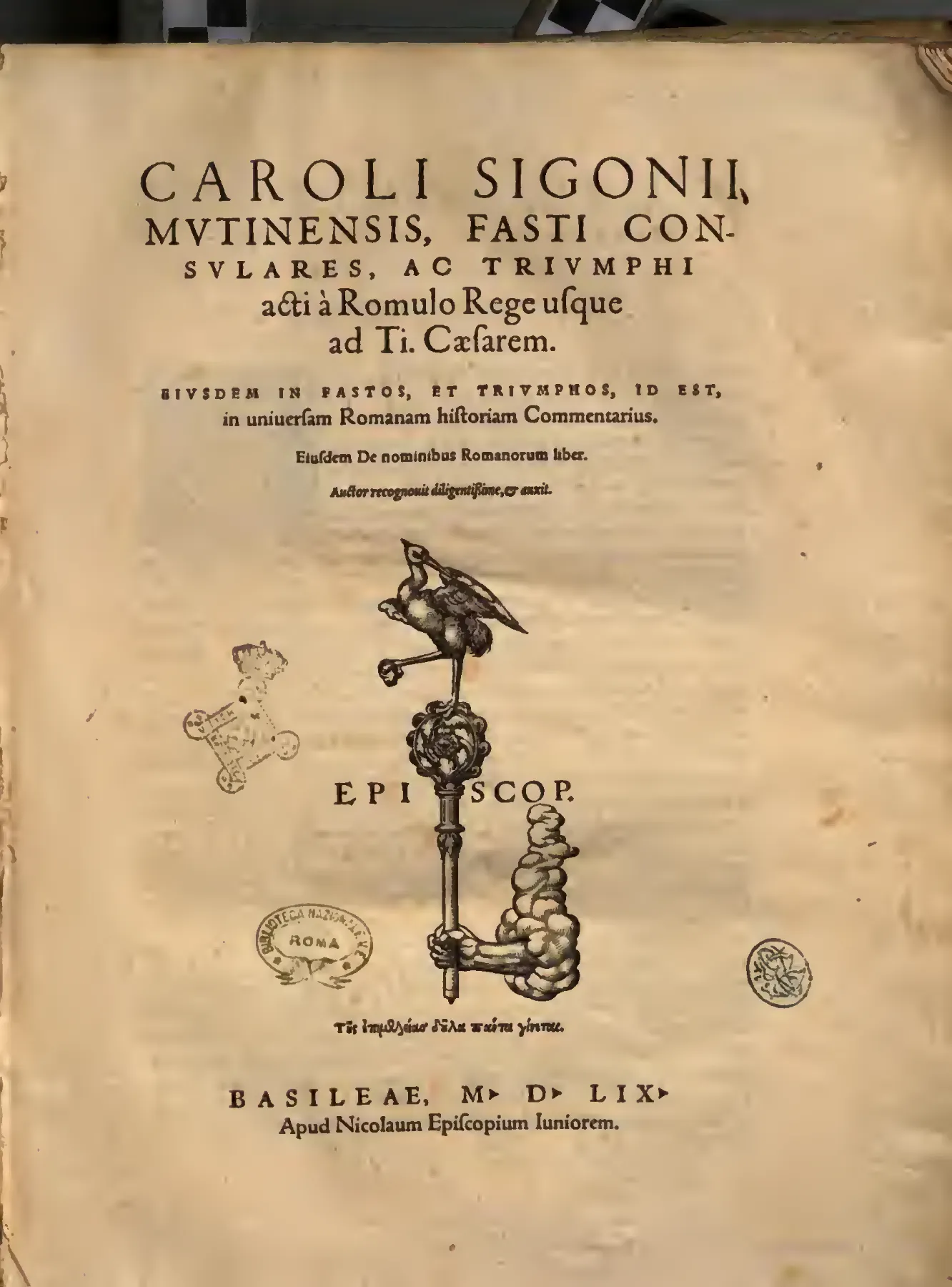
Sigonio’s Basel title page announces the volume’s three-part architecture: the consular and triumphal fasti, a commentary on Roman history, and a treatise on names. Bearing Nikolaus Episcopius the Younger’s device, the 1559 imprint places this author-revised reissue firmly within the transalpine orbit of the former Froben press. Source ↗.
The problem Sigonio set himself is easily stated and was, in his day, genuinely unsolved. The annual framework of Roman public office — who was consul, who censor, who dictator, who triumphed and for what — survives in the literary historians as a wavering, inconsistent and in places mutilated series, and even the count of years from the founding of the City was in open dispute among the authorities. His recurring move, and the spine of the entire book, is to make the newly recovered Capitoline marbles the court of final appeal over the annalists, and then to rebuild a continuous annual grid upon that documentary base. The stones in question had been lifted from the Roman Forum in 1546–1547 and set up, under Michelangelo's direction, in the Palazzo dei Conservatori; Sigonio read them not as illustrative curiosities but as the surviving skeleton of a public register, to be corrected, recomposed, and preferred to Livy where Livy failed. Where the literary spine gives out altogether — after the tenth and the forty-fifth books of Livy — he says so and changes his apparatus, taking up Cassiodorus, the Sicilian fasti, the epitomators, Zonaras, Eutropius, Orosius, Frontinus, and Appian in their place.
What makes the volume memorable is the visible discipline with which that preference for documents is carried into print. The marble's words are set in a larger type and the editor's own in a smaller, so that the reader can see at a glance where the witness ends and the restorer begins; the numerals of iterated magistracies carry a supralinear stroke while the numerals of iterated triumphs do not, a distinction Sigonio took from the Capitoline tables and undertook to preserve with the utmost care; the epigraphic formulae are reproduced without departing from them by so much as a point. He physically recomposes two Capitoline fragments that had been torn apart and wrongly placed by those who arranged them on the Capitol. And, most strikingly, where the total of years demanded by the stones cannot be reconciled with the literary record, he interpolates a year without consuls, unattested in Livy or in anyone else, expressly in order to save the marbles' reckoning. The counterpart of that boldness is a running confession of uncertainty: conjecture is flagged as conjecture, errors of the copy are named as errors, and the reader who has anything more certain is invited to follow it instead, a discipline made immediately visible in the opening tabular grid.
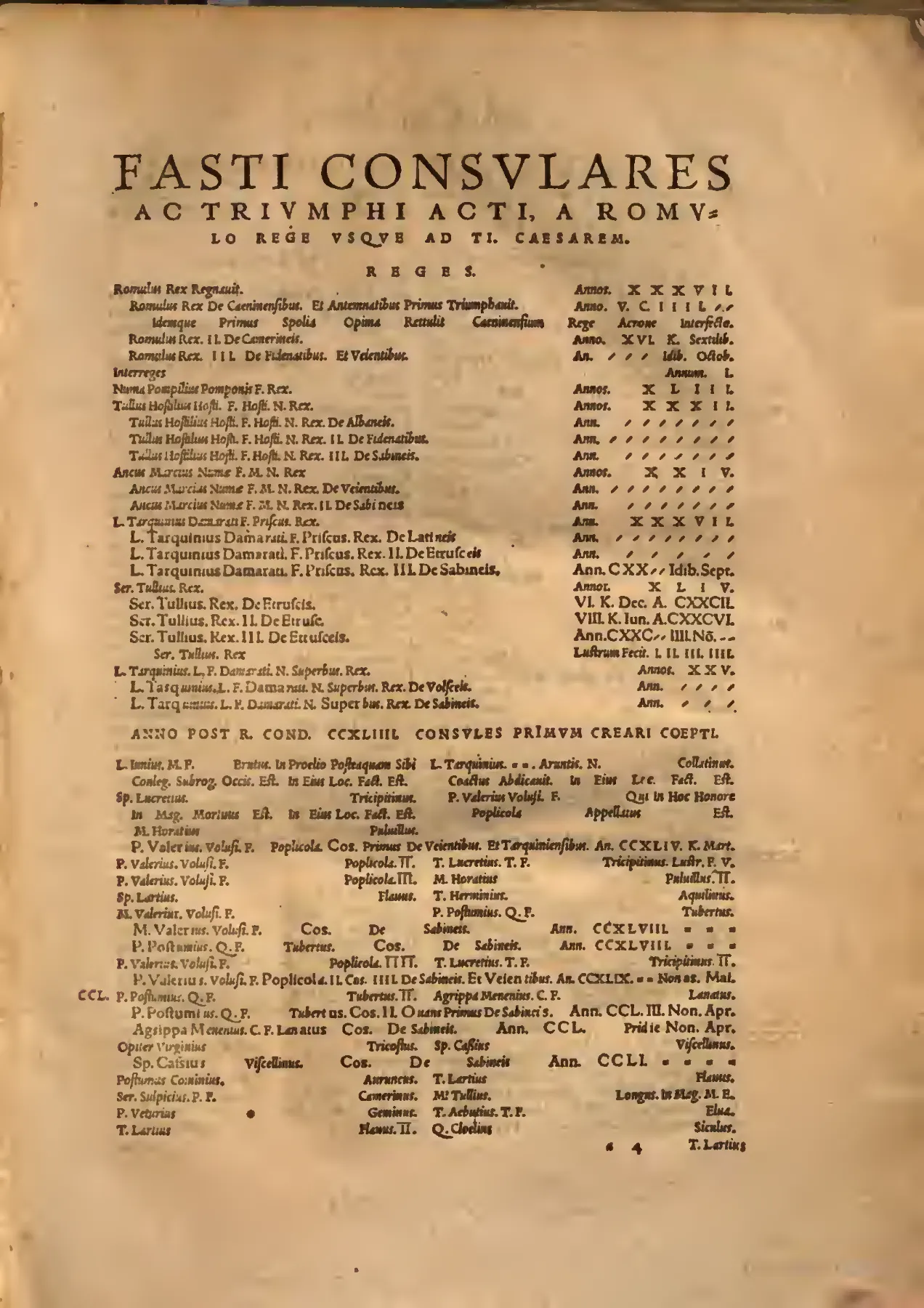
The opening tabular grid distinguishes the Capitoline witness from Sigonio’s restorations through larger and smaller type. Tracking the transition from Romulus's triumphs to the first consuls, the page serves as a compact demonstration of the volume’s method, making constitutional chronology, triumphal law, and editorial conjecture visible as typographic evidence. Source ↗.
The stakes are not merely chronological. Once the tables are built, the same documentary method is turned upon the vocabulary of Roman public law, and the register becomes an argument about how the republic was ordered and how it ended. Sigonio declines the inherited Polybian and Ciceronian judgement that the Roman constitution had attained the best form, treating the res publica instead as a describable distribution of powers among one, a few, or many; he makes the triumph a juridically conditional event governed by the ius triumphandi, auspices, and the requirement of a properly declared war against a lawful enemy; he traces the dictatorship from its old causal formulae to the open-ended office Sulla obtained by law, and the word Imperator from a soldiers' acclamation to the designation of one who has obtained supreme power in the state. The tables end where the republic end: with the victor of Actium holding the commonwealth alone, and with royal power exercised once the hatred of the royal name has been removed. Even the treatise on names belongs to this argument, since the scrupulous Roman system of praenomen, nomen, cognomen, and agnomen is presented as having stood while the commonwealth stood and to have decayed along with liberty.
The book was born into controversy and has remained inside one. Bartolomeo Marliani had published the fragments at Rome in 1549 and Onofrio Panvinio issued his own Fasti et triumphi at Venice in 1557 and a revised edition of Sigonio's Fasti in 1558, so that questions of priority and credit attended the Basel volume from the outset; a separate quarrel with Francesco Robortello over precedence and philological method ran through the Paduan years; and the Consolatio affair of 1583, in which Sigonio's claim to have recovered Cicero's lost work drew Antonio Riccoboni's charge of forgery, still colours assessments of his reliability, with the Fasti serving as the stylistic baseline against which modern computational tests are calibrated. Modern historiography is likewise divided on what the volume is: whether, with Momigliano, the high-water mark of an antiquarian tradition about to be separated from historical writing proper; whether, with Grafton, a foundational case of learned conjectural reconstruction; whether, with Bartolucci, juridical antiquarianism carrying a covert republican politics; or whether, with McCuaig, professional philology whose constitutional readings serve chronology rather than theory. These readings have not been reconciled, and the volume rewards attention precisely because it can sustain all of them at once.
Read the full text and English translation on Leo
This text was transcribed and translated as part of the ExLatinis project, an effort by Leo to make free English translations of every text published in Latin in early modern Europe (1450–1750) available online. The complete transcription and English translation of this work can be read free of charge:
→ Read the original Latin text and full English translation on Leo
You can save a copy of this document into your Leo account to run deep text searches, conduct further analysis, or cross-reference it with your own research.
Naming the Book: Sigonio's Res Publica, Ius Triumphandi, and Fasti
Editorial title (supplied for convenience, not an established historiographical usage). Consular and Triumphal Fasti from Romulus to Tiberius, with a Commentary on the Whole of Roman History and a Treatise on the Names of the Romans (Basel, 1559).
Sigonio's volume pivots on three Latin terms whose technical senses carry the weight of the entire enterprise. The first is res publica. Where Polybius and Cicero had read the res publica through the optic of the mixed or optima constitution, in which consuls, senate, and tribunate or popular assembly hold one another in equipoise against the cyclical collapse into monarchy, oligarchy, or democracy, Sigonio refuses that normative inheritance. In the Commentarius and in his near-contemporary De republica Atheniensium (1564), res publica does the work of a constitutional taxonomy rather than of a normative ideal: every magistracy is described as a descriptio ac constitutio civitatis, a distribution of powers whose legitimacy depends on the proper delimitation of office, jurisdiction, and auspice, not on the equilibrium of social estates. The taxonomic premise is stated flatly in the preface to the commentary, where the whole account of a republic is called manifold, since the city itself, whose description and constitution the republic is said to be, must necessarily lie in the power of one, of a few, or of many, Multiplex ergo omnis fere ratio reip. existimatur. etenim ciuitas ipsa, cuius descriptio, ac constitutio quædam esse respub. dicitur uel unius, uel paucorum, uel multorum in imperio sit necesse est. The divergence from the Ciceronian premise is deliberate, and Sigonio makes it explicit: neither Polybius nor Cicero, he writes, seems to him to have adequately grasped in mind or expressed in speech the form of that republic when in a single word they handed down that it was the best, aut Polybius, aut Cicero satis mihi speciem eius teip. uidentur, aut mente comprehendisse, aut oratione expressisse, cum uno uerbo eam optimam fuisse tradiderunt. He treats the Roman constitution not as having arrived at its optima forma but as a working administrative order whose coherence is reconstructed from documentary traces, and the philological unpacking of imperium, auspicium, and potestas inside the Commentarius is the technical expression of that refusal.
The second is ius triumphandi, the body of technical conditions under which a Roman magistrate might lawfully enter the city in triumph. Sigonio makes this juridical apparatus the grammatical spine of his consular tables: the supralinear stroke that distinguishes an iterated magistracy from an iterated triumph, the doubled type that distinguishes epigraphic text from editorial supplement, and the running marginalia that register, year by year, which magistrate entered the city suis auspiciis, which held his franchise pro aucto imperio, which returned from a bellum rite indictum against a iustus hostis. The category itself is divided before it is applied: there were two kinds of triumph, one greater, which is properly the triumph, the other lesser, called the ovation, and of these some were on land and some naval, some celebrated in the City and some on the Alban Mount, Triumphorum uero duo genera fuerunt. unus maior, qui præcipue triumphus, alter minor, quæ o[mn]i uatio nominata est. Ex his autem alij terrestres, alij nauales, itemq[ue] alij in urb e, alij in monte Albano acti sunt. The auspicial condition governs the adjacent honour of the spolia opima as strictly as it governs the triumph, since spoils are rightly held opima, Sigonio insists, only when a commander has stripped them from a commander, and no one is a commander save he under whose auspices the war is waged, primum quòd opima spolia ea rite habentur, quæ dux duci detraxerit, nec dux est, nisi cuius auspicio bellum geritur. A triumph, in this technical reading, is not a ceremonial honour but a juridically conditional event whose constituent elements — the ritual capite velato, the clipeus carried by the servi publici, the formula io triumphe in Saturnian rhythm, and the deposition of the manubiae in the aerarium — are individually verified against the epigraphic and literary record before the entry is admitted to the table. The graphic discipline of that verification is itself declared: the numerals by which repeated magistracies are noted have a line placed above them in the Capitoline tables while the numerals of triumphs have none, and this, Sigonio writes, must be most carefully preserved for the sake of the distinction, Est autem hoc à nobis obseruatum, numeros quibus magistratus multiplicati notantur superimpositam habere lineam, hoc modo, II. III. III. in Capitolinis tabulis, triumphorum uero numeros nullam, sic II. III. III. Quod ipsum differentiæ caussa nobis diligentissime custodiendum esse putamus. The same juridical logic carries through to the Augustan terminus, where the private triumph is closed off and replaced by a surrogate honour: from that time, on the authority Sigonio cites, the rest followed the example as though it were a law, neither sending public dispatches nor obtaining a triumph, so that thereafter no one else of equal rank was granted a triumph but only triumphal ornaments were decreed, Ex quo tempore, inquit, reliqui exemplum eius quasi legem quandam sequuti, necq[ue] publice literas miserunt, necq[ue] triumphum obtinuerunt. ac propterea nemini alij pari dignitate triumphus in posterum, sed triumphalia rantum ornamenta decreta sunt. This forensic treatment of triumphal law is what separates Sigonio's register from Marliani's earlier readings of the same fragments and what exposes him to Panvinio's rival claims.
The third is fasti itself. In classical usage the fasti denote both the calendar of festivals and the register of magistrates; Sigonio takes the second sense as primary and only, and the volume is built on that exclusion. The marbles he transcribes are not the fasti of Ovidian priestly calendar but the consular and triumphal fasti inscribed under the Empire on the tabulae now known as the Fasti Capitolini. Within that exclusion, the term carries three further technical inflections worth marking. Nota in its epigraphic sense is a siglum or shorthand mark on stone, not the censoria nota of the moralists, and the recovery of such sigla is presented as a service to history rather than to grammar alone: moved by these considerations, Sigonio writes at the head of the onomastic treatise, he restored both the praenomen and its ancient siglum to the Latin language, and by that very act relieved Roman history itself, which had suffered a great loss, Quibus rebus adductus tum prænomen, tum ejus antiquam notam linguæ Latinæ restitui, eaq[ue] ipsa re historiam ipsam Romanam, quæ magnam iacturam fecerat, subleuaui. That fidelity to the received epigraphic idiom is a stated rule rather than an accident of transcription: he took his manner of writing from the Capitoline consuls, where it stands elsewhere in the formula recording that a man was called Messalla, or Censorinus, in this office, and from that formula he judged that he must not depart by a single point, Hanc aut rationem scribendi ex Capitolinis consulibus sumpsi, in quibus est alio loco ita. QVI IN HOC HONORE MESSALL. APPELLAT. EST. & QVI IN HOC HONORE CENSORIN. APPELL. EST. à qua formula ne punctum quidem mihi discedendum esse duxi. Monumentum names a witness-bearing marble rather than a literary work of memory, and its defectiveness is the acknowledged limit of the whole undertaking, for from all these things it will appear how much he wished to benefit others, since he could not achieve as much as he desired, because, as he had said, the monuments of Roman affairs are themselves defective, certissimæ propagines cognoscentur. Atq[ue] ex his quidem rebus omnibus, quantum nos prodesse uoluerimus alijs, apparebit, necq[ue] enim omnino quantum cupiebamus, consequi propter manca ipsa, ut dixi, Romanarum rerum monumenta potuimus. And coniectura is the legitimate idiom of restoration when the marble is broken and only philological reason can fill the gap — an idiom Sigonio marks openly wherever he uses it, conceding that perhaps, as often elsewhere, he is prophesying, and that whoever has more certain things may follow them for all he cares, Sed fortasse, ut sæpe alias, uaticinamur. Qui certiora habet, ea sequatur, per me licet. These three inflections, taken together, transform the volume from a chronicle into an instrument: the fasti, in Sigonio's hands, are the calendar of res publica reduced to the offices of year and imperium.
Sigonio's Fasti at a Glance: Genre, Author, and the Basel Printing of 1559
Genre. Antiquarian-epigraphic and chronological treatise, organized as a tabular fasti of consuls and triumphs, a year-by-year commentarius running from the fourth year after the foundation of the city to the year of Tiberius's death (AUC IIII–DCCLXVII, conventionally 753/750 BC to AD 37), and an ancillary treatise on the technical vocabulary of Roman personal nomenclature. The generic ambition is stated as the weaving of a single continuous series: what among every weightiest writer is today interrupted, Sigonio declares, he has woven together from the first origin of the City down to the death of Augustus, with the times carefully preserved and noted, quæ apud grauissimum quenq[ue] illarum scriptorem hodie interrupta est, à primo urbis ortu usq[ue] ad Augusti interitum, seruatis diligenter, notatisq[ue] temporibus contexui.
Author. Carlo Sigonio (Carolus Sigonius Mutinensis), born in Modena c. 1524, died near Modena on 27 August 1584 (a residual tradition places the birth c. 1520 and some reference works give 28 August as the death day); successively professor at Modena, public lecturer at Venice under the Scuola di San Marco (1552), professor of rhetoric and (from 1560) of Greek at Padua, and from 1563 first professor of history at Bologna, where the volume in hand was already being prepared.
Date and place of composition / production. Printed at Basel in 1559 (apud Nicolaum Episcopium Iuniorem), in the former Froben workshop at the Zum Sessel; the printing followed Sigonio's Venetian first edition of 1556 by Paolo Manuzio and constitutes the enlarged and author-revised reissue.
Core thesis. To reconstruct, on the basis of the Fasti Capitolini marbles recovered in the Roman Forum between 1546 and 1547 and their arrangement under Michelangelo's direction in the Palazzo dei Conservatori, the consular and triumphal chronology of the Roman Republic from Romulus to Tiberius; to embed each entry in a constitutional and juridical commentary; and to fix, in a closing treatise, the technical vocabulary of Roman personal nomenclature (praenomen, nomen, cognomen, agnomen) against the contemporary work of Francesco Robortello. The diagnosis that prompted the undertaking is given in the opening dedication: understanding that the whole annual description of Roman magistrates was wavering, inconsistent and in many parts imperfect in all writers of Roman affairs, and observing the greatest disagreement and error among them in counting the years from the founding of the City, Sigonio undertook a labour he thought would be most useful to all, cum totam magistratuum Romanorum descriptionem annuam labantem, & inconstantem, eandemq[ue] multis partibus imperfectam apud omnes rerum Ro. scriptores esse intelligerem, cumq[ue] summam in annis ab Vrbe condita numerandis eorum dissensionem, & errorem esse animaduerterem: suscepi laborem hoc tempore omnibus, ut putavi, futurum utilissimum. The remedy is documentary, and Sigonio names it as such: in this matter, he writes, he used the aid of other ancient monuments, but above all of certain noble stones which a few years before had been transferred from the Roman Forum, where they had long lain hidden, to the Capitol, and which he had not only followed but diligently interpreted, Hac autem in re cum aliorum ueterum monimentorum subsidio usus sum, tum maxime nobilium quorundam lapidum, quos paucis ante annis è foro Romano, ubi diu in occulto latuerant, in Capitolium translatos ego non solum sequutus, sed etiam diligenter interpretatus sum — the sentence in which the elevation of epigraphy above the literary annals, the throughline of the whole volume, is put most economically.
Language. Latin throughout. No vernacular translation of the 1559 Basel text is recorded in the consulted catalogues; the eighteenth-century Argelati Opera omnia reprints the Latin text with added apparatus, and the technical terminology of the work entered eighteenth- and nineteenth-century Italian and English antiquarian vocabulary rather through paraphrase and translation of excerpts than through complete translation.
How Modern Scholarship Reads Sigonio: Momigliano, Grafton, Bartolucci, McCuaig
The volume occupies a foundational place in the antiquarian revolution of the mid-Cinquecento — the moment at which documentary and epigraphic evidence began to supersede literary annals in the technical reconstruction of Roman history. Sigonio himself frames the enterprise as exposed on two flanks at once, since those who undertake it must greatly fear being charged with impudence by those who think Roman affairs have splendour enough from the ancient monuments, and with imprudence by those who think the lost ornaments can in no way be restored, nam & ab ijs, qui eas satis habere splendoris ex antiquorum monumentis putant, impudentiæ; & ab ijs, qui amissa earum ornamenta nulla restitui ratione posse censent, imprudentiæ ne accusentur, eis ualde pertimescendum est. Modern scholarship treats it as a primary witness in three converging debates.
The first is the question of credit for the reconstruction of the Fasti Capitolini. Bartolomeo Marliani published the editio princeps of the fragments at Rome in 1549; Onofrio Panvinio issued his own Fasti et triumphi at Venice (Giacomo Strada) in 1557 and then a revised edition of Sigonio's Fasti in 1558; Sigonio's first Venetian edition (Paolo Manuzio, 1556) and the 1559 Basel reissue stand as the third term of this rivalry. William McCuaig's Carlo Sigonio: The Changing World of the Late Renaissance (Princeton, 1989) follows Sigonio's career and method in detail and argues that his critical procedure — joining the marbles to the literary tradition rather than treating either alone — is the principal engine of his contribution. That procedure is announced in the Commentarius itself as a debt to antiquity: thanks are owed to antiquity, Sigonio writes, which, though it consumed nearly all the historical monuments of this period, has left the consular and triumphal tables entire down to the Second Punic War, and these he undertakes to confirm with such testimonies of the ancient annals as he can, utustati gratia est, qua cum omnia prope historiaru[m] huius temporis monimeta consumpserit, integras nobis consulares, triumphalesq[ue] tabulas usq[ue] ad secundum bellum Punicum reliquerit. quas quibus poterimus antiquorum annallum testimonijs confirmabimus — the documentary base first, the literary tradition brought in as corroboration. Jean-Louis Ferrary's studies of Panvinio and Stefan Bauer's Invention of Papal History (Chicago) situate Sigonio against Panvinio's parallel labours and treat the dispute not as plagiarism but as a working partition of a common field. William Stenhouse (Reading Inscriptions and Writing Ancient History, 2005; PBSR 2012, "Panvinio and Descriptio") argues that Renaissance antiquarianism was not the dry accumulation of evidence but a creative, visual and rhetorical practice in which Sigonio, Panvinio, Marliani and Pirro Ligorio used images, coins, and architectural settings alongside text, and that this visual turn is what later modern historians have read as the inauguration of technical chronology. Ingo Herklotz (Cassiano dal Pozzo und die Archäologie, 1999) maps the same antiquarian practice into the following generation. Attilio Degrassi's critical editions — Inscriptiones Italiae XIII.1 (Fasti Consulares et Triumphales, Rome, 1947) and the monograph Fasti Capitolini (Florence, 1954) — supply the modern standard against which the readings of Sigonio, Panvinio, and Marliani are still measured.
The second debate is the historiography of the separation and later fusion of antiquarian and historical enquiry. Arnaldo Momigliano's "Ancient History and the Antiquarian" (republished in Studies in Historiography, 1966, and in Settimo contributo alla storia degli studi classici, 1984) argues that antiquarianism and historiography diverged in the late Renaissance and were only re-fused in the nineteenth century; he names Sigonio the last great Italian antiquarian and the most consequential bridge figure, even though his constitutional works in some respects already anticipate the fusion. Anthony Grafton's Defenders of the Text (Harvard, 1991) and Bring Out Your Dead (Harvard, 2001) situate Sigonio within the longer arc of technical chronology and of the scholarly persona of the conjecturing philologist. That persona is legible in the Commentarius wherever the evidence gives out and Sigonio declares the fact rather than concealing it: these things, he writes at the close of one campaign, are about all he has found concerning so great a war, the rest hostile antiquity has, as he sees, not merely obscured but utterly buried in perpetual oblivion, Hæc fere de tanto bello repperi reliqua enim inimica uetustas obliuione, ut video, in perpetuu[m] no[n] dico obscurauit, sed penitus etia[m] obruit. Where Momigliano reads the Fasti as the high point of a declining antiquarian tradition, Grafton reads the Commentarius as a foundational case of learned conjectural reconstruction.
The third debate is the mixed-constitution tradition. The work enters the Polybius-Cicero debate at two points: in the tabular matter, where the constitutional status of each magistracy is presupposed, and in the Commentarius, where Polybius's cyclical account of anacyclosis and Cicero's optima res publica are taken as foils rather than as authorities. What replaces the cyclical scheme is a documented narrative of the concentration of powers, tracked through the technical vocabulary of office. Sigonio marks the decisive alteration of the dictatorship as a legislative act: a law was carried to the people that it seemed to Sulla to be in the interest of the republic that a dictator be named to set the disturbed republic in order, and that he be created not for a fixed time, as before, but until the citizenry and all Italy and the whole republic should be ordered and constituted, legem ad populum tulit, Sullæ è rep. esse uideri, dictatorem dici, qui perturbatam remp. constituere, eumq[ue] non ad quoddam tempus, ut ante, creari, uerum quousq[ue] ciuitas, àc uniuer sa Italia, & tota resp. ordinata, ac constituta esset. The terminus of the series is described in the same juridical register: with the two triumvirs removed, the third, Octavius, transferred to himself in perpetuity, as the prize of the civil wars he had waged, the whole right, power and command of the republic which from the beginning had belonged to the kings, later to the magistrates, the senate and the people, Triumviris aut duobus sublatis, tertius Octauius tanqua[m] bellorum ciuislu[m], quæ ipse confecerat, præmiu[m] totius ad se reip. ius, potestate[m], atq[ue] imperiu[m], quod ab initio regum, post magistratu[m], senatus ac populi fuerat, in perpetu[m]. The lexical counterpart of that transfer is the conversion of a military acclamation into a title of rule, for they wished 'Imperator' to be understood not of one who had won it by good service, whether by soldierly zeal or senatorial authority, but of one who had obtained supreme power and authority in the state, Imperatorem autem intelligi uoluerunt, non eum, qui re bene gesta id nominis uel militari studio, uel senatus auctoritate consequutus, sed qui potentiam, & auctoritatem in rep. summam adeptus esset; and Sigonio draws the constitutional consequence in a formula that names monarchy while withholding the regal title, since the princeps thus holds royal power with the hatred of the royal name removed, the appellations of Caesar and Augustus adding no proper power of their own, the one indicating succession of family and the other the splendour of dignity, Ita regiam potestatem habet regij nominis odio exempto. Nam Cæsaris, & Augusti appellatio nullam eis propriam addit potestatem. id enim generis successionem, hoc dignitatis splendorem indicat. Sigonio's De republica Atheniensium (1564) makes the dissent from the mixed-constitution tradition explicit; the modern reception begins with Bartolucci's Storicamente article ("Historian Engagé: Republicanism and Oligarchy in Sigonio's Political Histories", 2012), which reads the Commentarius as juridical antiquarianism with a covert political theory — Sigonio's reading of the res publica as a balance of optimates and populares that, transposed to his contemporary Bologna, gave him a republican-engagé stance against papal temporal power. McCuaig reads the same material in the opposite direction, as professional philology working inside constitutional history rather than as constitutional theory using philology as vehicle. Where Bartolucci and the Italian historiographical line treat Sigonio as a covert theorist of republican liberty, McCuaig treats him as a working philologist whose constitutional readings are instrumental to chronology. The scholarship consulted does not adjudicate between these positions.
Printing, Reissuing, and Contesting the Marbles: The Object Biography of the 1559 Basel Folio
Transmission of the text. The work exists in three principal states. (i) The first or Venetian state, printed by Paolo Manuzio at Venice in 1556, in folio, Roman type, with collation recorded on the auction description of the Bibliotheca Brookeriana copy as aa–dd⁴ a–z⁴ A–S⁴ T² = 181 of 182 leaves, and described by the auction house as "Third edition." (ii) The Basel state of 1559, printed apud Nicolaum Episcopium Iuniorem, in folio (2°), with the collation [36] 388 [24] pp., USTC 619615, and corresponding to the digitized BSB copy (URN bsb11912202, with 370 image frames for 388 pp. of letterpress). (iii) The eighteenth-century collected edition, Caroli Sigonii Opera omnia edita et inedita, cum notis variorum illustrium virorum, et ejusdem vita a Lud. Antonio Muratorio conscripta, ed. Filippo Argelati (Milan, 1732–1737, 6 vols), which prints the Fasti, the Commentarius, and the De nominibus Romanorum together with the apparatus accumulated by earlier annotators and prefixed by Muratori's biographical vita.
The internal history of the composition is itself narrated in the prefatory matter, and it turns on a coincidence Sigonio reports with evident satisfaction: on the recovered marbles, he writes, was incised almost that very scheme of magistracies which he had himself designed in his mind and already begun, in quibus hæc ferè magistratuum ratio, quam ipse animo designaueram, iamq[ue] inchoaueram, erat incisa — the stones arriving to corroborate a plan already under way rather than to originate it. The editorial labour that followed included the physical rearrangement of the epigraphic evidence: in one place, Sigonio reports, he has composed two Capitoline fragments torn apart from each other and not placed in their proper position by those who arranged them on the Capitol, from which that year and the following are especially illuminated, Hoc loco fragmenta duo Capitolina inter se diuulsa, nec suo loco ab ijs, qui ea in Capitolio digesserunt, posita, composui; ex quo hic, & insequens annus maxime illustratur.
Materiality. The 1559 Basel edition is printed in folio on a single column of running text for the Commentarius and in a two-column tabular setting for the Fasti, with a larger module used for the epigraphic text proper and a smaller module used for editorial supplement and conjecture; the doubling of type-size functions as the principal graphical device distinguishing the witness from the restorer. Sigonio states the convention himself in the prefatory account of his procedure, distinguishing the words of the marbles in larger and his own in smaller letters, marmorum uerba maioribus, mea uerò, ut minoribus literis distin, so that the evidentiary hierarchy governing the whole volume is made visible in the setting of the page. The tabular sequence carries the epigraphic voice through to the constitutional terminus, where the register records in its own lapidary formulae that Imperator Caesar, son of the Divine, grandson of Caius, from the third day before the Nones of September, M. Antonius, triumvir for settling the republic, having been defeated at Actium, held the republic alone, IMP. CAESAR DIVI F. C. N. EX A. D. III NON. SEPT. VICTO AD ACTIVUM M. ANTONIO IIIIVRO R. P. C. II. SOLVS REMP. TENVIT. A printer's address headed Chalcographus amico lectori S. supplies errata keyed by page, marginal column-letter (A–D), and line, and a five-year imperial privilege is recorded on the verso of the title or its preliminary leaf. The dedicatory apparatus is tripartite: a Ferrarese dedication to Ercole II d'Este, Duke of Ferrara (who died on 3 October 1559, weeks after the Basel printing), a Venetian dedication to Lorenzo Priuli, Doge of Venice 1556–1559, and a Venetian patrician dedication to Matteo Dandolo, together with prefatory matter addressed to named informants and contributors (Andrea and Bernardino Loredan, Paolo Manuzio, Cardinal Rodolfo Pio da Carpi, Orazio Malaguzzi of Reggio, Geminiano Patini of Modena, and Lodovico Castelvetro). The volume closes with an Index rerum et vocum memorabilium.
The tabular apparatus also registers, in the running commentary, the two junctures at which the reconstruction is put under greatest strain. Where the arithmetic of the marbles cannot be squared with the narrative sources, Sigonio interpolates rather than emends the stones: in this place, he writes, we are compelled to insert a year without consuls, even though there is no mention of it in Livy or in anyone else, and we do this in order to keep the reckoning of years established in the Capitoline tables, which we follow, HOC loco annum cogimur interponere sine consulibus, etiam si eius neq[ue] apud Liuium, necq[ue] apud quenquam alium ulla merio sit. Hoc autem facimus, ut rationem habeamus summæ annorum, quæ in Capitolinis tabulis, quas sequimur, instituta est:. Where the literary spine gives out, the change of apparatus is declared in the text rather than performed silently, since henceforth, he announces, Cassiodorus and the Sicilian fasti will serve as the foremost authorities in arranging the years by consuls, Itaque abhinc Cassiodori, & Siculis fastis in primis auctoribus utemur in annis per consules digerendis.
Institutional footprint. Nikolaus Episcopius the Younger (active 1553–1565) operated the former Froben house at the Zum Sessel in Basel, the direct continuation of the partnership of Johann Froben, Hieronymus Froben, and Nikolaus Episcopius the Elder; the 1559 imprint sits within Episcopius's programme of transalpine classical editions (Philo, Polybius, and other Greek and Latin texts) and places Italian antiquarian scholarship in a Basel book at the moment the Tridentine Index was tightening the conditions of publication in Venice and Rome. No record of suppression, expurgatio, or institutional loss attaches to the 1559 edition in the consulted sources. The principal surviving exemplar is the BSB (shelfmark bsb11912202, digitized 7 August 2012, URN bsb11912202, surrogate at Google Books id soVSAAAAcAAJ).
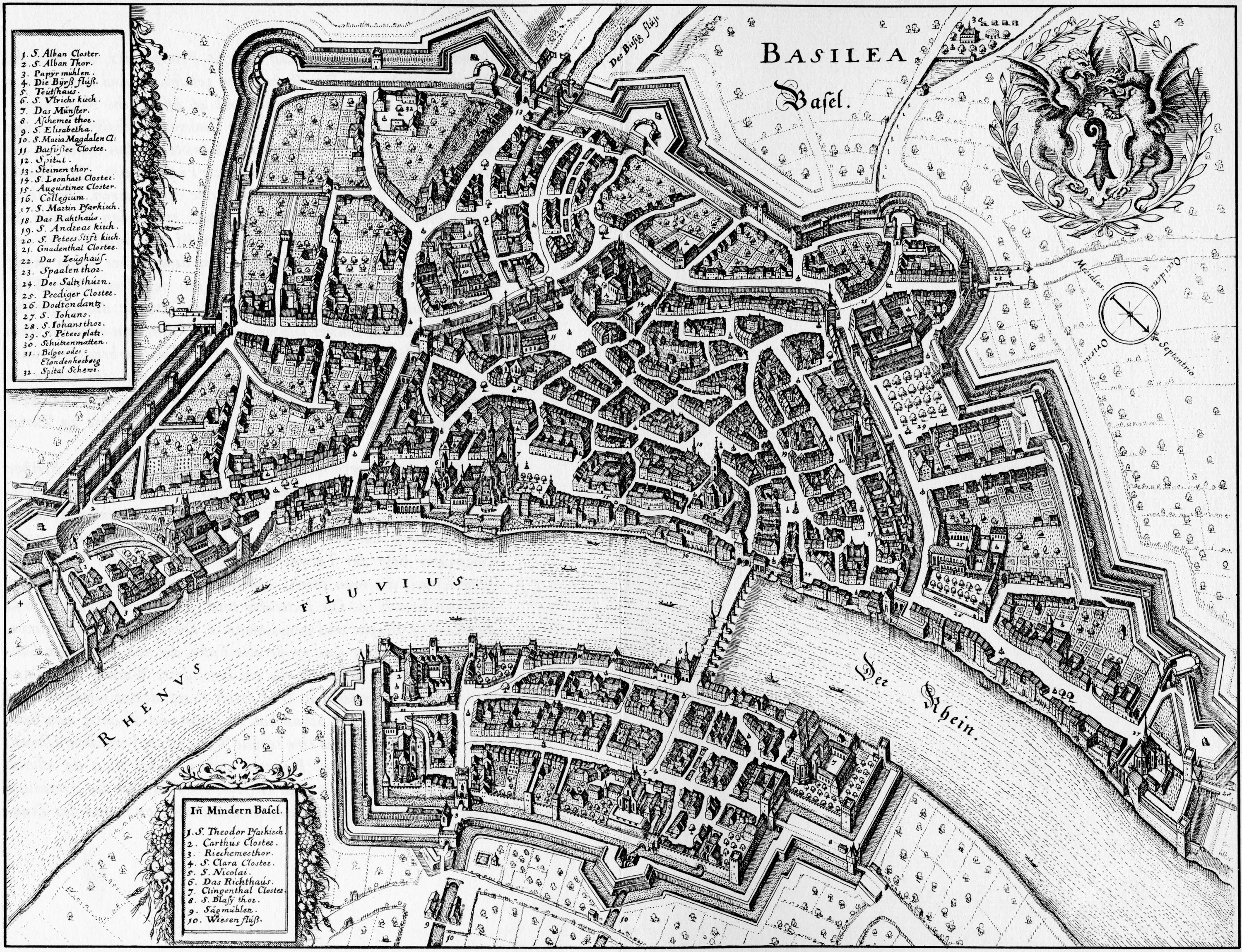
Matthäus Merian’s 1642 engraved prospect depicts the walled Rhine city of Basel. Though produced eighty years after Sigonio’s volume, the view evokes the northern printing environment that offered Episcopius and the former Froben house an alternative to the tightening censorial controls of Venice and Rome. Source ↗.
Immediate reception and the rivalry network. Three controversies coincide with the volume. (a) The priority dispute over the reconstruction of the Fasti Capitolini: Bartolomeo Marliani published the first editio of the fragments at Rome in 1549, Onofrio Panvinio published his Fasti et triumphi at Venice (Giacomo Strada) in 1557 and then a revised edition of Sigonio's Fasti in 1558, and Sigonio's 1556 Aldine and 1559 Basel reissues form the third term of the rivalry. (b) The methodological quarrel with Francesco Robortello (1516–1567) over academic precedence and philological method at Padua in the 1550s, which continued through the Bolognese chair to which Sigonio moved in 1563. (c) The later Ciceronian Consolatio affair of 1583, in which Sigonio claimed to have discovered a complete text of Cicero's lost Consolatio and was answered by Antonio Riccoboni, who accused him of forgery; the Fasti and the De nominibus Romanorum supply the philological baseline against which the modern stylometric defence of Sigonio's claim (Forsyth, Holmes, Tse 1999) is calibrated.
Place among the author's works. The 1559 Basel volume collects three pieces and stands within a broader antiquarian-historical programme. To it succeed, in the order of the Opera omnia, the De antiquo iure civium Romanorum (Venice 1560), the De antiquo iure Italiae (Venice 1560), the De republica Atheniensium (Basel 1564, with an Aldine counterpart in the same year), the De Atheniensium et Lacedaemoniorum temporibus (1565), the De Romanae jurisprudentiae judiciis (1574), the Historiae de occidentali imperio (1579), the De regno Italiae (1580), and the contested M. Tullii Ciceronis consolatio (1583). The Fasti and the Commentarius together constitute the foundational document on which the juridical and constitutional monographs of the 1560s and 1570s are built; the De nominibus Romanorum functions as their technical lexicon, and it closes by binding the onomastic system to the constitutional narrative of the tables, since it must be understood, Sigonio writes, that the system of names he has described was preserved chiefly while the commonwealth stood, and that afterwards, together with liberty, this scrupulous ordering too began to collapse in every part, Est igitur intelligendum, hanc, de qua diximus, nominum rationem, stante potissimum rep. conseruatam esse; post autem cum libertate hanc etiam religiosam descriptionem labi ex omni parte. All are reprinted, with accumulated annotation, in the Argelati Opera omnia of 1732–1737, with Muratori's vita as biographical vade mecum.
Reading the Commentarius Year by Year: Structure, Argument, and Textual Evidence
The title, the dedications, and the warrant for a new kind of book
The volume names its own genre before it argues anything, and the naming is already a technical claim: FASTI CONSVLARES, AC TRIUMPHI acti à Romulo Rege usque ad Ti. Cæsarem, consular fasti and triumphs celebrated from Romulus the King down to Tiberius Caesar. Two distinct epigraphic series — the register of magistrates and the register of triumphs, physically separate on the Capitol — are here yoked into one annual frame, so that a triumph ceases to be a free-standing honour and becomes an entry subjoined to a year and to the men who held office in it. The terminus is chosen on the same principle: the series stops not at a reign's convenience but at the point where the annual magistracy ceases to be the vehicle of imperium.
The Ferrarese dedication that follows converts a defect in the sources into a warrant for a new kind of book. What Sigonio claims to have found in every writer of Roman affairs is not ignorance of events but instability in the annual grid itself — a wavering, inconsistent and in places mutilated descriptio magistratuum annua, compounded by open disagreement over the count of years from the founding of the City. The remedy is then licensed by a rhetoric of providence: when in this writing, he explains, he felt the want of the lost monuments both of histories and of stones, he believes it came about by divine counsel, Nam cùm in hac scriptione ueterum & historiarum, & lapidum amissa monumenta desiderarem: tum diuino credo esse consilio factum,. The clause is doing more work than piety. The arrival of Greek exemplars of Dionysius and Dio from Gaul and, almost at the same time, the lifting of inscribed marbles from the Roman Forum are gathered into a single providential dispensation, so that documents recovered by excavation and codices recovered by chance acquire the same evidentiary dignity: both are supplements sent to repair a canon that had failed of itself. Against that confidence the same epistle sets an unusually flat admission of limit — the concession already discussed above, that he could not accomplish as much as he desired because the monuments of Roman affairs are themselves defective. Incompleteness is displaced from the enquiry onto the evidence — manca monumenta, defective monuments, and not a manca ratio, a defective method — which is precisely what permits the tables to be published as an instrument rather than withheld as an unfinished argument.
The lapidary voice of the tables
The tables themselves speak in an orthography deliberately unlike the prose that surrounds them: abbreviated, pointed, capitalised, filiation and grandfather's name compressed into initials. Two habits of that register carry most of the constitutional freight. The first is the cause-clause attached to extraordinary command, as at the first appearance of the office, Dictator Primus. Sedit. Sedandae. Et Rei Gerundae Caussa, dictator for the first time, for the sake of quelling sedition and of conducting the business: the dictatorship is never entered as a bare name but always with the motive that authorised it, so that the table records not only who held power but on what ground the ordinary annual constraint was suspended. The second is the notation of defective title, as in the formula recording that men resigned because they had been made with a flaw and that consuls were made in their place, Vitio Facti Abdicarunt. In Eorum Loc. Facti Sunt Cos. Such entries preserve, inside a chronological register, a doctrine of magisterial legitimacy: an office wrongly conferred is not merely a political embarrassment but a vitiated act that the year's record must mark, and the substitution must be entered so that the annual sequence remains continuous while the flawed tenure remains visible. The same lapidary voice is allowed the last word in the tabular series, which closes on a succession rather than on a consulship, since in this year Imperator Caesar Augustus died on the thirteenth day before the Kalends of September and Tiberius Caesar Augustus received the imperium, HOC ANNO IMP. CAESAR AVGVSTVS ANTE DIEM XIII K. SEPT. MORT. B. TI CAESAR AVGVSTVS IMPERIVM EXCEPIT. The verb excepit is the register's own quiet verdict: power is now received, not created annually by election, and a table organised on annual magistracy has therefore reached the end of what it can measure.
Between the tables and the commentary the press interposes its own voice, reporting that while the index was being compiled it noticed menda aliquot, operarum incuria admisse, a number of errors admitted through the workmen's carelessness, and appending a correction list keyed by page, column-letter and line. The address is a small piece of evidence about how such a book was meant to be used: a text referenced by column and line, not merely read through, and a printing house willing to advertise its own corrections as a competitive virtue in a genre whose authority rests on the exactness of letters and numerals.
The preface to the Commentarius: gloria, factio, and the refusal of the best constitution
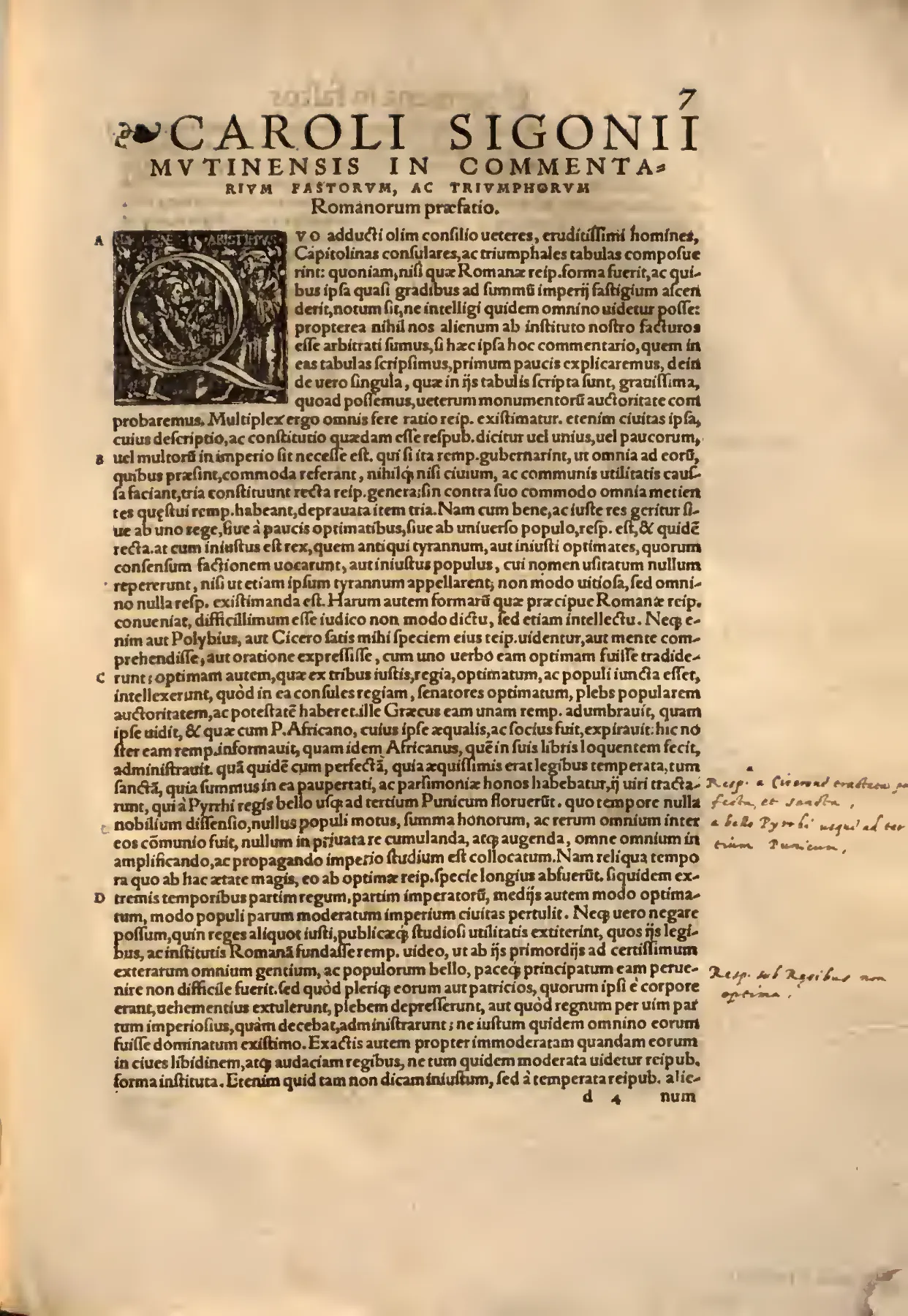
The opening page of Sigonio’s preface frames the work as a constitutional argument rather than antiquarian chronology alone. Classifying forms of rule, the text challenges the Polybian and Ciceronian ideal of the "best" republic, anticipating the commentary’s habit of reading Roman magistracies as evidence for changing political orders. Source ↗.
The Venetian dedication prefixed to the Commentarius supplies the ethical premise that antiquarian labour otherwise leaves implicit, grounding commemoration in a theory of gloria: the historian's register is what secures the immortality that virtue requires, since human nature, slippery and headlong, is recalled from outrage and led to honourable action by love of dignity and honour alone. That premise then modulates into a political comparison of some delicacy. Rather of those who by admirable wisdom afterwards fortified this republic with such laws and resources that, safe from internal seditions, it might one day be the firmest bulwark of a labouring Italy, Sigonio judges the fame to be immortal, eorum, qui admirabili postea sapientia hanc rempublicam ijs legibus, atq[ue] opibus munierunt, ut ab intestinis tuta seditionibus, firmissimum aliquando laborantis Italiæ præsidium esset, famam futuram immortalem existimo. The clause ab intestinis tuta seditionibus is the pivot: the very disease that the preface will diagnose as the ruin of the Roman res publica is here declared to have been legislated away at Venice, so that the addressee's commonwealth occupies the position of achieved form which Rome, on Sigonio's own showing, never held stably. The compliment thus performs a piece of constitutional argument obliquely, and it does so without invoking the language of the best or mixed constitution that the preface is about to refuse.
That refusal is prepared by a taxonomy sharpened for diagnostic use. The just and unjust species of each regime are distinguished by their received names, for when the king is unjust the ancients called him a tyrant, and unjust nobles, whose agreement they called a faction, at cum iniustus est rex, quem antiqui tyrannum, aut iniusti optimates, quorum consensum factionem uocarunt. Factio is thereby made a technical term of constitutional pathology rather than a term of abuse, and the vocabulary is then applied without indulgence to Rome's own beginnings: that the plebs was excluded from every public function of the republic, that the patricians alone held the consulship — that is, regal power — the rites, virtually the assemblies, and every power of life and death over the plebs, plebem omni prorsus reip. munere excludi, patricios solos eôsulatum, id est regium impetium, sacra, comitia fere, atq[ue] omnem in plebem & uitæ, & necis potestatem habere. The gloss consulatum, id est regium imperium is the hinge on which the tables' first great rubric turns: the expulsion of the kings did not abolish regal power but redistributed it within a closed order, and the early Republic is accordingly judged as unjust as the tyranny it replaced. The subsequent history is then written as a sequence of juridical concessions rather than of social sentiment, beginning with the instrument the plebs was granted for its own protection, since a sacrosanct tribunate had to be conceded to it by the patricians, by which, as by a most piercing weapon, it might defend itself, its liberty and its chastity against the power and caprice of the nobles, sacrosanctus ei fuit tribunatus à patribus concedendus, quo ipsa tanquam acerrimo quodam telo contra optimatum potentiam, atq[ue] libidinem se, libertatem, ac pudicinam suam tueretur. The military metaphor of the telum is exact rather than decorative: the tribunate is described as a counter-force lodged inside the constitution, and the process it inaugurates is completed only when nothing further remains for equalising the law of the whole republic than that plebiscites should bind all the Quirites — an arc from exclusion to ius adaequatum that the rubrics of the tables register office by office.
Collation as method in the early annals
In the commentary proper the same procedures are applied to individual years, and the chronological dissension named in the dedication becomes an explicit object of study: it must be noted, Sigonio writes, that there was great disagreement among ancient writers in counting and arranging the years from the founding of the City, which Cicero too reports in the Brutus, and which he has found to be so from the observation and comparison of the various computations, Est autem illud admonendum, magnam in annis ab urbe condita numerandis, ac digerendis inter antiquos scriptores dissensione[m] fuisse. Quod & Cicero tradit in Bruto, & nos ita esse ex uariaru[m] supputationum observatione, ac comparatione deprehendimus. Observatio and comparatio supputationum describe a method: discrepancy is not adjudicated by preferring the gravest author but by collating the reckonings and identifying the mechanism of divergence — the insertion by some annalists of consuls, and of dictators without consuls, whom others omit. The triumphal digressions are governed with equal formality, since the ovation is defined negatively by the failure of triumphal right, when there is no ground for a triumph, either because wars were not duly declared, or not waged with a lawful enemy, or because the enemy's name is lowly and unfit, as of slaves and pirates, or when a sudden surrender occurred and the victory was won, as they say, in the dust and without blood, Quando non triumphandi caussa est, cum aut bella non rite indicta, nec cum iusto hoste gesta sunt, aut cum hostium nomen humile, & non idoneum est, ut seruorum, piratarumq[ue], aut deditione repente facta, in puluere (ut dici solet) incruentaq[ue] victoria obuerit. These criteria are not offered as antiquarian curiosities: they are the tests by which a contested entry is assigned to the greater or the lesser column of the table, and they make the classification of an honour depend on the legal status of the war and of the adversary rather than on the scale of the victory.
The most revealing move of this opening stretch is the treatment of Livy's own hesitation over an early campaign, where the historian confesses that he would not dare affirm as certain that the consul L. Cornelius waged that war and took the town, since there is no mention of the matter among ancient writers, L. Cornelium consulem bellum id gestisse, oppidumq[ue] cepisse, certum affirmare, quia nulla apud ueteres scriptores eius rei mentio est, nô ausim. Sigonio quotes the aporia in full and then resolves it against its author, on the combined testimony of Dionysius and of the triumphal fragments. The gesture displays his hierarchy of proofs with unusual clarity: an admission of ignorance in the most authoritative annalist is treated not as a limit on knowledge but as a gap that documentary witness may close, and the historian's scruple is answered by evidence he did not possess.
The repeating unit and the decemviral years
That hierarchy of proofs governs the long annalistic stretch that follows. From the consulships of the later 270s AUC to the settlement of the Tarentine war in 481 the Commentarius is built out of a single repeating unit, applied without variation across some two centuries of Roman years: a rubric announcing the consuls, the military tribunes with consular power, the censors and their lustrum, a triumph or ovation, or a dictator; beneath it a collation of the name-forms as they stand in Livy, Dionysius, Diodorus, Cassiodorus, the Sicilian fasti, the list of Cuspinianus and the Capitoline fragments; and beneath that, in one or two sentences, the year's business. The unit is not narrative but forensic, and its recurring problem is what to do when the witnesses disagree. Sigonio's habit is to decide openly and to record the decision as a decision rather than to smooth it away, as when, faced with the divergent accounts of the honours of L. Lucretius and T. Veturius, he closes the entry by declaring that we have followed Dionysius, Nos Dionysium sequuti sumus. The first person plural is the voice of the register itself: the tables are a made object, and the maker signs each of his choices.
The decemviral years supply the most sustained narrative movement of this early stretch, and they show the commentary handling a legal event rather than a campaign. The codification is presented as a corpus in the making, when, the ten tables of laws having been set forth by the decemvirs, a rumour then spread that two tables were wanting, by whose addition the whole body of Roman law could as it were be completed, PROPOSITIS decem legum tabulis à decemuiris, uulgatur deinde rumor, duas deesse tabulas, quibus adiectis absolui posse uelut corpus omnis Ro. iuris. The phrase corpus omnis Romani iuris is doing conceptual work well beyond Livy's narrative: it lets Sigonio treat the Twelve Tables not as an episode in the struggle of the orders but as the first constitution of a legal totality, the point from which the technical vocabulary of magistracy and jurisdiction that the rest of the volume anatomises can be said to begin. The abuse of Verginia, the second secession and the abdication follow as a compressed causal chain, and then the movement turns from narrative to arithmetic. Against Livy's three decemviral years Sigonio contracts the college to a biennium, and states the ground of the contraction as an authority rather than a preference: that we should not write so in these tables was determined by the authority of others and above all of the Capitoline writers, for Rufus says that the decemvirs governed the commonwealth for two years only, nos in his tabulis ne scriberemus, & aliorum, & maxime Capitolinorum scriptorum mouit auctoritas. Rufus enim tantum per biennium decemuiros reip. præfuisse;. The formula in his tabulis is precise: the ruling governs what may be printed in the grid, and the grid answers to the marble.
The same year yields a constitutional first that Sigonio marks as such, for when the consuls failed to obtain a triumph from the senate they turned to the people and were the first to triumph by order of the people against the senate's will, Idemq[ue] cum à senatu triumphum non impetrarent, ad populum conuersi primi iussu populi, inuito senatu triumpharunt. Because the triumph is for him a juridically conditional act and not an honour in the gift of goodwill, the identity of the granting body is a datum of public law, and the entry quietly opens a series that the tables will track for two centuries: the transfer of competences from patrician senate to plebeian assembly, registered not as a thesis but as a sequence of dated firsts — first plebeian dictator, first plebeian censor to close a lustrum, first plebeian praetor, first proconsular triumph.
The auspicial doctrine that underwrites this treatment of the triumph is stated in the excursus on the spolia opima, where the question is whether A. Cornelius Cossus dedicated his spoils as tribune, as master of horse, or as consul. The rule is given in lapidary form: one could not be carried in a four-horse chariot except when triumphing, nor triumph except one who had conducted the campaign under his own auspices, Quadrigis a[n]i[m]t uehi, nisi triumphans, poterat, triumphare uero, nisi qui suo auspicio rem gesserat. The argument runs backwards from the visible ritual to the office: the chariot implies the triumph, the triumph implies independent auspices, and independent auspices imply the consulship, so that a detail of ceremonial iconography becomes a proof of magisterial rank. This is the characteristic operation of the whole commentary in miniature — a ritual particular converted into a criterion of eligibility, and the criterion then used to correct a date.
The census-and-lustrum series, instituted in these years, gives the tables their second chronological spine alongside the consular list, and the gaps in it provoke the sharpest of Sigonio's complaints against his principal literary source: the seat of the fifteenth lustrum is uncertain, and the names of the censors who closed it are to this day unknown to us, which must be ascribed to Livy's negligence, by whom these matters, like much else, were deliberately neglected, LUSTRI XV sedes incerta est. & nomina censorum, qui id condiderint, adhuc nobis incomperta sunt. Id est Liuij negligentiæ tribuendum, à quo hæc, ut multa alia, consulto neglecta sunt. The charge of negligentia, and still more of neglect consulto, is a reversal of the ordinary hierarchy of respect: the classical historian is arraigned for failing to keep the kind of record that the antiquarian requires, and the deficiency is not concealed but converted into an argument for reconstructing the missing censorships from quinquennial intervals and inscriptions.
The marble as a structured document
That preference becomes explicit doctrine when Sigonio describes how the marble is to be read as a structured document rather than a mere list of names: I have observed that in the Capitoline consular tables each of the greatest wars is noted, such as is this Samnite war, ANIMADVERTI in tabulis consularibus Capitolinis maximum quodq[ue] bellum notari, quale est hoc Samniticum. The stone is credited with an editorial intelligence of its own — a convention of notation whose regularity can be inferred and then used predictively, so that the presence or absence of a war-notice in a damaged section becomes evidence. The consequence of granting the marble that status is drawn without flinching at the year 420, where the numbers will not reconcile and Sigonio, as already remarked, declares himself compelled to interpose a year without consuls of which neither Livy nor any other writer makes mention, expressly in order to keep the sum of years established in the Capitoline tables he follows. The verb cogimur carries the whole ideological weight: the compulsion is exerted by the sum of years on the stone against the unanimous silence of the books, and the restorer's boldest fabrication — a year that no author ever recorded — is performed precisely in the name of fidelity to a document.
The counterweight to that confidence is a rhetoric of declared perplexity, most conspicuous at the double-dictatorship crux of 452: while I was completing the Capitoline fasti I fell upon many obscure and difficult places, but no other seemed to me equally difficult and obscure as this very one which I now handle, CVM fastos Capitolinos perficerem, in multos incidi locos obscuros, atq[ue] difficiles, sed nullus alius æque mihi difficilis, & obscurus uisus est, atq[ue] hic ipse, quem nunc tracto. The admission is not ornamental modesty; it prefaces the display of the technique on which the whole reconstruction depends, an argument from the abbreviation-habits of the stone, since first, those letters M. F. N. N. MAX. can be referred to no one else than to Q. Fabius Maximus, primum enim illæ literæ M. F. N. N. MAX. ad neminem alium referri possunt, quam ad Q. Fabium Maximum. Filiation-letters, unintelligible as prose, are treated as a closed and regular notation whose combinations can be matched against the prosopography; the epigraphic siglum becomes the decisive evidence in a dispute that no literary text can settle.
Nor is the documentary base confined to inscriptions. In establishing the consul who reduced Privernum, Sigonio adduces an object in a living collection, introducing his evidence with the report that he finds in a very ancient silver coin, in the keeping of that most distinguished man Andrea Loredan, a Venetian patrician, these words, autem in numo argenteo perantiquo apud clarissimum uirum Andream Lauredanum, patricium Venetum, hæc uerba:. Naming the owner is part of the proof: a coin legend can be checked, and the citation of a Venetian patrician's cabinet places the reader within a verifiable circuit of antiquarian sociability in which numismatic and lapidary testimony carry the same evidentiary rank.
The failure of the Livian spine

This early modern print of a Roman triumphal procession evokes the vivid classical past that Livy helped make authoritative for Renaissance historians. Yet for Sigonio, Roman glory was not enough; when narrative accounts failed, the republic's chronology had to be painstakingly rebuilt from fragmented documentary evidence. Source ↗.
The methodological hinge of this stretch arrives with the failure of the literary spine, announced rather than concealed: since from this consulship the books of Livy have broken off, whom we have had hitherto as the richest authority for this history, CVM EX HOC consulatu Liuij libri X interciderint, quem locupletissimum auctorem huius historiæ hucusq[ue] habuimus. What follows is a declared change of apparatus rather than a silent one, and the texture of the ensuing years alters accordingly: the epitomators, Cassiodorus, Zonaras, Eutropius and Frontinus replace a continuous narrative with fragments to be triangulated. The constitutional entries nonetheless keep their juridical precision, as when the third secession is closed by a statute of the widest reach, Q. Hortensius as dictator, when the plebs had seceded to the Janiculum, carrying a law in the Esquiline oak-grove that whatever it had ordained should bind all Quirites, Q. Hortensius dictator cum plebes secessisset in laniculum, legem in Esculeto tulit, ut quod ea iussisset, omnes Quirites tenerent. The formula omnes Quirites tenerent completes the movement begun with the popular triumph: the assembly that had once had to override a hostile senate for a single honour now issues enactments binding on the whole citizen body.
Working in this thinner documentary air, Sigonio also generalises about the causes of error itself, observing that these faults and other graver ones of the same kind are produced either by the negligence of writers or by the variety of the historical record, Sed hæc atq[ue] eiusmodi alia grauiora uictia uel scriptorum negligentia, uel historiæ uarietas contrahit. The distinction is a working typology of corruption: negligentia is a fault of transmission, remediable by collation and by preference for the more careful witness, while uarietas is a fault in the tradition itself, where the ancients already disagreed and no amount of collation will yield a single reading. Diagnosing which of the two is at work in a given entry determines whether the commentary emends, chooses, or — as with the interposed consul-less year and the persistently unlocated lustrum — records the defect and leaves the grid to carry the burden of the reckoning.
From the subjection of Italy to the Punic wars
Beyond the Tarentine settlement the cell of the entry remains constant — a rubric collating the consular names as they stand in Cassiodorus, the Sicilian fasti, the Cuspinian book, the Capitoline marbles, Zonaras, Polybius and the Livian epitome, followed by subsidiary headings on the campaign, the triumph, the census and the dictatorship of the year — and the argumentative weight falls on the adjudications performed inside it. The run opens on an episode in which Roman discipline is turned against Rome's own body: in this year, as Sigonio has it from Orosius, Roman severity cut away a great part of her own vitals, HOC anno (ut ait Orosius) magnam uiscerum suorum partem seueritas Romana concidit. The chapter on the Campanian legion destroyed at Rhegium is assembled around that paradox: the epitome's lapidary notice of siege, surrender and the axe is set beside Valerius Maximus on the fifty beheadings a day, the denial of burial and the prohibition of mourning, so that an exemplary punishment becomes a datable public act with a magistrate's name attached, not a moral fable. Severity here is treated as an instrument of state, subject to the same evidentiary handling as a triumph.
The same procedure governs the Volsinian rising, where the last of the Italians to remain in loyalty were the Volsinians, richest of the Etruscans, imploring aid against their own former slaves, who had turned against their masters the liberty those masters had given them and, having transferred the commonwealth to themselves, were now the rulers, Postremi Italicorum in side mansere Vulsinij opulentissimi Estruscoru[m] implorates opem aduersus seruos quondam suos, qui libertatem à dominis datam in ipsos erexerant, translataq[ue] in se rep. dominabant. Sigonio prints this compressed Floran epigram against a far longer and more circumstantial account from Zonaras — freedmen marrying their mistresses, entering the senate, holding the magistracies — and the juxtaposition is itself the argument: a moral-rhetorical witness and a narrative one are made to stand side by side so that the reader may weigh their kinds, while the date of the war's end is fixed neither by the one nor the other but by the Capitoline triumph of M. Fulvius Flaccus. The formula translata in se re publica is worth marking, since it describes the commonwealth as an object that can pass into the hands of a party — precisely the grammar in which the closing years of the tables will describe the concentration of ius, potestas and imperium in one man.
At the outbreak of the Punic war the analytic voice separates alleged grounds from motive: the true cause, Sigonio writes, was that each held the other in suspicion, and each placed his own safety in subduing the other, uera autem caussa erat, quod se inter se suspectos haberent, atq[ue] uterq[ue] salutem suam in eo poneret, si alterum subegisset. The remark is his own, interposed between the belli caussæ ferebantur of the sources and Polybius on Rhegium and Messana, and it shows the commentator willing to arbitrate causation as well as chronology. Immediately after it comes the sentence on which the entire apparatus turns, the thanks owed to an antiquity that, having consumed nearly all the historical monuments of the period, left the consular and triumphal tables entire down to the Second Punic War — tables which Sigonio undertakes, in the words already discussed above, to confirm by such testimonies of the ancient annals as he can. The verb confirmabimus carries the whole inversion: the annalists no longer supply the frame that inscriptions illustrate, but the corroboration that stone requires. Everything the commentary subsequently permits itself — the restoration of triumphs no author records, the correction of ethnonyms, the interpolation of censors — follows from that reassignment of evidentiary rank.
The consequences are visible in the smallest inferential moves. Pliny's conceit that then the fields were tilled by the very hands of the generals, as it is right to believe, the earth rejoicing in a laurelled ploughshare and a triumphal ploughman, Ipsorum tunc manibus imperatorum colebantur agri (ut fas est credere) gaudente terra uomere laureato, & triumphali aratore, is not quoted for its pathos. Because the ploughing consul is styled triumphalis arator, Sigonio treats the epithet as testimony that this Atilius held the consulship and triumphed, and then locates the triumph in the Capitoline naval notice — an ornamental phrase converted into prosopographical evidence and closed by the marble. The treaty ending the war receives the opposite treatment, being reproduced not as narrative but as statute: the following laws were laid down, that the Carthaginians withdraw from Sicily and from all the islands lying between Italy and Africa, pay two thousand two hundred talents over twenty years and one thousand at once, and return Roman prisoners without ransom, Leges aut hæc latæ sunt. Poeni Sicilia, & omnesbus insulis quæ inter Italiam, & Africâ sunt excedunto. duo millia & ducenta talenta in annos x x pendunto, in præsens mille. Captiuos Romanos sine pretio reddunto. The archaic jussive futures excedunto, pendunto, reddunto restore to the peace the form of a legal instrument, and the choice is of a piece with the reading of the fasti themselves as public record: what can be given in its documentary shape is given in that shape rather than paraphrased.
Stone, coin, and elogium: the grading of honours
Inscriptions transcribed from a book of epigrammata of the ancient city work in the same register, and are set in majuscule against the surrounding roman: L. Metellus, pontifex, twice consul, dictator, master of the horse, one of the fifteen for assigning land, who first led elephants in triumph in the First Punic War, foremost warrior, best orator, bravest commander, L. METEL. PONT. II. COS. DICT. MAG. EQ. XV. VIR. AG. DAND. QVI PRIMVS ELEPHANTOS PRIMO PVNICO BELLO DVXIT IN TRIUMPHO, PRIMARIVS BELLATOR, OPTVMVS ORATOR, FORTISSIMVS IMP. The elogium is used as a cumulative record of office: its sigla confirm both the dictatorship of the year and the elephant triumph, while its superlatives are left as the epigraphic idiom they are, and the change of type performs on the page the same distinction between witness and restorer that governs the tabular matter.
That documentary discipline coexists with a live scholarly conversation, which occasionally breaks the annalistic surface. On the vexed question why the consuls entered office on the Ides of March, Sigonio reports that when Horatius Malegutius of Reggio, a young man most accomplished in character and letters, recently asked him the reason for this, he answered that it was as follows, cuius rei rationem cum à me paulo ante Horatius Malegutius Regiensis, inuenis moribus, & literis ornatissimus, quæreret, hanc esse respondi — and the reply is a chronological demonstration, resting on Flaminius' entry on the Ides and Pomponius' triumph on the same date, that the practice was established between those years. The register is thus made to date an institution, not merely to list names. The rarest honour in the series is settled on the same authority: in the Capitoline tables it is also written, Sigonio notes, that M. Marcellus triumphed over the Insubrian Gauls and the Germans and brought back the spolia opima, the enemy leader Virdumarus having been killed at Clastidium, In tabulis Capitolinis etiam scriptum est M. Marcellum de Gallis Insubribus, & Germanis triumphasse, atq[ue] spolia opima rettulisse duce hostium Virdumaro ad Clastidium interfecto. Here the stone corrects the epitome, which had assigned Virdumarus to the Insubres, and its Germani are harmonized with Polybius' Gaesatae; silver coins shown to Sigonio in the house of a Venetian patrician are adduced as a further, independent class of testimony, so that a single triumphal notice is verified across marble, text and metal.
Where the honour is defective the gradations are treated as jurisprudence. Of Marcellus' contested claim Sigonio reports that, since the army that would witness a deserved or undeserved triumph was absent, a middle course seemed right, that he should enter the city celebrating an ovation, cum exercitus testis meritè, atq[ue] immeriti triumphi abesset, medium uisum, ut ouans urbem iniret. The medius honos is not a diminished ceremony but the remedy prescribed when one condition of the ius triumphandi fails while the others hold, and the case is the more instructive because the same commander combined the ovation, the Alban Mount triumph and the triumph proper in the course of his career.
The commentary's most exposed moment is the collapse of its literary spine, announced rather than concealed: from this point the Livian history is wholly wanting, and had he it, Sigonio writes, he would arrange the fasti and triumphs that follow far more easily, yet in such penury of annals he will take care to omit nothing that can bring help to this history, EX hoc loco Liuiana historia tota desideratur. quam si haberemus, facilius multo fastos, triumphosq[ue], qui sequuntur, digeremus in magna autem annalium penuria dabimus operam, ne quid, quod opem ferre huic historiæ possit, prætermittamus. The declaration is immediately qualified by the admission that truncated ethnic names in the Capitoline fragments remain undeciphered, and answered by a counting argument: against Cicero's disparagement of the castellani triumphi of Liguria Sigonio sets a tally of more than fifteen documented instances. In this impoverished stretch the compensating technique is lexical statistics — a triumph may be restored, he explains, because he has observed that in the epitomes the word Subigi is hardly used except of those who have triumphed, uel quia in epitomis hoc uerbum, Subigi, sere 110 nisi de ijs, qui triumpharint, usurpari obseruaui [reading uncertain] — an inference from a compiler's habitual diction to an institutional fact, openly flagged as such. The same years yield the institutional terminus of the practice earlier established, when Q. Fulvius and T. Annius were the first consuls to enter office on the Kalends of January, on account of the sudden rising in Celtiberia, T. Annius consules primi K. Ian. propter subitum Celtiberiæ motum inierunt. Contingency, not design, moves the Roman year: a frontier emergency displaces the entry-day, and the register that recorded the old usage is the instrument by which the change is dated.
Conquest abroad and crisis at home: from Carthage to Sulla
From the consular year DCVI to DCLXXI the apparatus is put under its heaviest evidentiary strain, and the run opens with an admission of defeat rather than a claim of mastery. Closing the dossier on the false Philip, assembled out of Eutropius, Appian, Obsequens, the epitoma XLIX, the Liber de viris illustribus, and Velleius, Sigonio draws a line under what can be known with the declaration noticed earlier, that these things, roughly, are what he has found concerning so great a war, since hostile antiquity has not merely obscured the rest but utterly buried it in perpetual oblivion. The personification of uetustas as inimica is more than rhetorical colour: it converts the gaps in the record into the acts of an adversary, and thereby licenses everything that follows. The formulaic scaffolding of these pages — the rubric DE COS. AN. with its consular pair, then the sub-rubrics on deeds done, triumphs held, censors and lustra completed, wars and seditions — is a device for making loss visible year by year, so that the reader can see which cells of the grid are filled by testimony and which by inference. The distinction between obscurauit and obruit is itself a working one: what is obscured may be recovered by collation, what is buried may not, and the whole method consists in deciding to which category a given year belongs.
Within that framework the first great movement, the extraordinary consulship of Scipio Aemilianus, is treated less as a military prelude to the Third Punic War than as a constitutional precedent. Sigonio dwells on the moment when the lex annalis is set aside by acclamation, reporting that the people began to ask, to press, and at length even to shout that by the laws of Romulus and Tullius the right of the assemblies lay with them, so that they might confer or withdraw a magistracy on whomever they wished by their own right, tum populus rogare, instare, demum etiam clamare coept, & ex Romuli, & Tullij legibus penes se comitiorum esse ius dicere, ita ut cui uellet, mandare, cui uellet, abrogare magistratum suo iure posset. The ascending tricolon rogare, instare, clamare marks a slide from petition to compulsion, but the argument the crowd is made to voice is strictly juridical, and it reaches behind the statutory age-limits of the second century to the regal leges of Romulus and Tullus as the source of comitial competence. Read against the taxonomic premise on which the whole volume rests — that a city must lie in the power of one, of a few, or of many — this episode is the first documented instance in this stretch of the multi asserting an unlimited ius over office, and the verb pair mandare/abrogare is precisely the pair Sigonio will need again for the abrogation of Octavius's tribunate. The precedent is not celebrated; it is registered, as a datum about where power in fact resided.
The conquests of the same decade are handled with the same preference for the juridical hinge over the narrative event. On the origins of the Achaean War, Sigonio adopts from Justin the account that the ostensible embassy carried a second, unpublished brief: secret instructions were given to the legates, that they should dissolve the body of the Achaeans and make the individual cities of their own jurisdiction, sed legatis occulta mandata data sunt, ut corpus Achæorum dissoluerent, singulasq[ue] urbes proprij iuris facerent. The metaphorical schema is anatomical — the league is a corpus to be dissolved into members — and the operative phrase proprij iuris discloses the technique: enfranchising the constituent cities as autonomous jurisdictions is the instrument by which the federal concilia are abolished. Sigonio does not editorialize; he sets the occulta mandata beside the published mission and lets the discrepancy stand, which is the same procedure he applies to discrepant consular names.
The Carthaginian set-piece shows that this technical register does not soften the material it transmits. Following Appian through the street-fighting toward Byrsa, Sigonio reports that the workmen and the others sent in at Scipio's order to open a path for the soldiers made the business much more bitter still, since meanwhile they filled the ditches and the other low-lying places of the city with the dead and the living indiscriminately, with the utmost cruelty, quin etiam fabri, ceteriq[ue], qui iussu Scipionis ad aperiendum militibus iter immissi erant, rem multo etiam acerbiorem efficiebant; cum interim fossas, reliquaq[ue] depressa urbis loca mortuis, uiu[n]cribusq[ue] sine discrimine crudelitate summa replerent. The syntax makes the horror an administrative by-product: the fabri are engaged in clearing a route, and the indiscriminate filling of ditches is grammatically subordinate to that task. Sine discrimine is the pivot, since discrimination — between witness and restorer, magistracy and triumph, dux and latro — is the governing virtue of Sigonio's own procedure, and its absence here is what makes the sack legible as atrocity rather than as disciplina.
The Spanish sequence supplies the clearest demonstration in these years of how a chronology is built where none is given. Viriathus enters through the epitoma in an ascending series of social conditions, first in Spain a hunter out of a shepherd and out of a hunter a brigand, soon made leader even of a regular army, occupying the whole of Lusitania, Viriathus primum in Hispania ex pastore uenator, & ex uenatore latro, mox iusti quoq[ue] exercitus dux factus uniueriam Lusitaniam occupauit. The tricolon poses exactly the problem that the triumphal law of the tables must answer, since a latro cannot be a iustus hostis and a war against brigands cannot yield a lawful triumph; the phrase iusti exercitus dux is the term that converts suppression into war. From the roster of commanders defeated before Laelius, Sigonio then extracts a date the sources never state: if all these things are truly written, it plainly appears that before Laelius the affair was conducted by four praetors, Vetilius, Plautius, Claudius, and Nigidius, and if single years are assigned to each of them, it follows that the Viriathine war was begun not in this year but three years earlier, Quæ si uere omnia scripta sunt, profecto apparet ante Lælium à quatuor prætoribus rem gestam esse, Vctilio, Plautio, Claudio, & Nigidio. quibus singulis si annos singulos tribuamus, relinquitur Viriathinum bellum non hoc anno, sed triennio ante initum. The annuality of the praetorship is here used as a measure of elapsed time, so that a list of persons becomes a count of years — the same conversion of magistracy into chronology on which the tabular fasti depend. The conditional protases (si uere omnia scripta sunt, si annos singulos tribuamus) are not decoration; they expose the two assumptions on which the inference rests.
The same pages make the documentary ambition of the commentary explicit. Introducing an inscribed soldier's will, Sigonio addresses his constituency directly: it pleases him at this point, so that he may win favour from those who study Roman antiquity, to append the will of a certain soldier, in which mention is made both of the Viriathine war and of these consuls, which is said to have been dug up in Lusitanian territory, Placet autem hoc loco, ut gratiam ineam ab ijs, qui Romanæ antiquitati student, testamentum cuiusdam militis apponere, in quo &c belli Viriathini, atq[ue] horum consulum mentio fit. quod in agro Lusitano dicitur esse effossum. Two things are worth marking. The document earns its place by naming the consuls and the war, that is, by intersecting the grid; and the passive dicitur esse effossum holds the find-report at arm's length, so that the text is printed with its provenance of testimony flagged rather than asserted — the same discipline that elsewhere separates the marble's words from the editor's.
Numantia furnishes the second great siege narrative of these years, and Sigonio organizes it around a single reported saying. When Scipio was charged by some with excessive slowness, he replied above all that he had been begotten by his mother a commander, not a fighter, cumq[ue] id circo à nonnullis nimie quasi tarditatis arguetetur, id potissimum respondebat, se à matre sua imperatorem genitum esse, non bellatorem. The antithesis imperator/bellator is doing technical work: it distinguishes the holder of imperium, whose office is to dispose of an army, from the man who fights, and it thereby explains the entire apparatus of ditch, wall, towers, and the spiked barrage across the Durius as the proper exercise of command rather than as timidity. Yet the outcome is left unresolved, since the sources diverge and Sigonio declines to harmonize them: thus the report about the destruction of Numantia is twofold, some writing that it was burned by the Numantines, others that it was destroyed by Scipio, and that even without the authority of the senate, Ita de Numantiæ interitu fama duplex est: alij à Numantinis eam incensam scribunt, alij à Scipione deletam, idq[ue] etiam sine auctoritate senatus. The clause sine auctoritate senatus raises the constitutional stake, since it makes the destruction an act of imperium exceeding its warrant, and fama duplex is the formula by which the commentary declines to purchase narrative coherence at the price of the evidence.
That same year DCVX bracket in which Numantia falls also carries the tribunate that Sigonio treats as the opening of the internal crisis, summarized with legal precision and a distinctly hostile idiom of motive: Tiberius Sempronius Gracchus, of a most distinguished family and with the best examples of his ancestors, as tribune of the plebs, in order to hunt the popular breeze, carried a law against the will of the senators and the knights, that no one should possess more than five hundred iugera of the public land, Ti. Sempronius Gracchus clarissima familia, atq[ue] optimis maiorum exemplis tribunus pl. ad popularem aucupandam auram legem tulit inuitis senatoribus, atq[ue] equitibus, ne quis ex agro publico plus quàm D iugera possideret. The sentence sets ancestral exempla against the fowler's metaphor of aucupandam auram, and locates the breach not in the content of the lex but in its passage inuitis senatoribus, atq[ue] equitibus — that is, in the disruption of the concurrence of orders. The counter-instrument appears in the parallel section on the younger Gracchus, where the senate charges the consul to see that the commonwealth take no harm, mandat consuli, ut uideat, nequid detrimenti resp. capiat; the formula is quoted as a datum of public law, and its subsequent employment against Saturninus shows Sigonio tracking it as an office-like power that accrues by precedent rather than by statute.
The sequence closes its constitutional arc in the Sullan year, where Sigonio first registers the moral verdict of his sources — Sulla, having recovered the commonwealth, defiled a most beautiful victory with a cruelty such as never existed in any man, butchered eight thousand of those who had surrendered in the villa publica, posted the tablet of proscription, and filled the city and the whole of Italy with slaughters, Sulla recuperata rep. pulcherrimam victoriam crudelitate, quanta in nullo homine unquam fuit, inquinauit; Octo millia deditorum in uilla publica trucidauit; stabulam proscriptionis fixit, urb[us], & uniuerlam Italiam cædibus repleuit — and then isolates the legislative clause that matters for the grid, the law examined earlier, by which it seemed to Sulla to be in the interest of the commonwealth that a dictator be named to set the disturbed commonwealth in order, and that he be created not for a fixed time, as before, but until the citizenry, all Italy, and the whole commonwealth should be ordered and constituted. The verbal echo is exact and pointed: ordinata, ac constituta is the vocabulary in which the volume defines a res publica as the descriptio ac constitutio of a city, so that the dictatorship is here granted precisely the power of constituting that the taxonomy reserves to the distribution of office itself. The substitution of an open condition (quousque) for a term (non ad quoddam tempus, ut ante) is what the annalist's grid registers as rupture, since an office without an end date cannot be entered in a year-cell.
Across these two hundred pages the critical persona is consistently double. Sigonio convicts received texts of mendum without hesitation, correcting Eutropius on the triumphing Metellus and Florus on a legate misprinted as consul, and he asserts authority even over the disposition of the stones themselves; yet at the point where triumphal dates must be assigned by inference he withdraws the claim in the single sentence considered earlier, conceding that perhaps, as so often elsewhere, he is prophesying, and that whoever has more certain things may follow them for all he cares. The verb uaticinamur concedes that the reconstruction has passed from demonstration into divination, and the concessive per me licet transfers the burden to a better-equipped reader. The two gestures are not in contradiction: it is because conjecture is marked as conjecture that the corrections can carry weight, and it is because loss has been declared at the outset that inference is admissible at all.
Commands extra ordinem and the conversion of the offices
From DCLXXII to the Augustan settlement the juridical vocabulary assembled in the prefatory matter is put under its severest strain, since nearly every year from Sulla's dictatorship onward yields an office, a command, or a triumph that the inherited formulae do not fit. Sigonio's response is not to relax the categories but to sharpen them, and the first sharpening is moral as well as technical. Sulla, he records, is wondrously praised for having celebrated no triumph over defeated citizens, the point being taken from Valerius Maximus, who wrote that L. Sulla, who brought to completion very many civil wars, when he led his triumph with his power consummated and consolidated, carried in it many cities of Greece and Asia but no town of the Roman citizens, Hoc autem mirifice laudatur in Sulla, quòd nullum de ciusbus uictis triumphu[m] egerit. id quod Valerius notauit lib. 111, his uerbis: L. Sulla, qui plurima bella ciuilia consecit, cum consumata, ac constructa potentia sua triumphum duceret, ut Græciæ, & Asiæ multas urbes, ita ciuium Romanorum nullum oppidum uexit. The criterion is the identity of the vanquished, not the magnitude of the victory: a triumph presupposes a iustus hostis, and civil bloodshed, however decisive, generates no title to the honour. What deserves notice is where the rule comes from. The tables themselves cannot state it — a register of names and years has no syntax for approbation — so a moralizing exemplum from Valerius Maximus is promoted to the status of a juridical maxim, and it is by this borrowed rule that Caesar's later Spanish and African entries will be measured.
The same year produces the converse case, an honour whose form is impeccable and whose bearer is constitutionally impossible. Pompey's African triumph is documented by an appeal to Cicero's incredulity, for what was so unheard-of as that a Roman knight should triumph, and yet the Roman people not only saw it but thought it a thing to be seen with every eagerness, quid uero tam inauditum, quàm equitem R[ecipe] triumphate? at eam rem populus R. non modo uidit, sed etiam omni studio uisendam putauit. The manoeuvre is characteristic of the whole enterprise: an orator's figure of amplification, deployed originally to flatter, is read as a documentary statement about precedent, on the reasoning that the rhetorical force of inauditum depends upon the fact being unprecedented in the record. Popular enthusiasm then supplies a species of ratification, as though the studium of the spectators cured the defect of the celebrant's status. Sigonio's own summary is deliberately bare of comment, registering that thus Pompey triumphed without a magistracy, not yet a senator, and still a youth, Ita Pompeius sine magistratu, non dum senator, atq[ue] adolescens adhuc triumphauit. Three disqualifications are stacked in a single clause — no office, no senatorial rank, insufficient years — and the sentence leaves them standing unresolved beside the entry in the tables. The fasti record what happened; the commentary names precisely which conditions were suspended.
Against such anomalies the apparatus works with an openly declared margin of doubt. On Murena's Asian triumph Sigonio separates the certain from the merely probable in as many words, since that Murena triumphed from that war is sufficiently established, but in what year is not established, and it has seemed to him that the triumph can be conjectured into this year because it appeared probable that Murena returned to Rome at the time when Sulla was recalling him from the war, Ex eo bello Murenam triumphasse satis constat. at quo anno, non constat. Mihi quidem uisum est triumphum eius in hunc annum conijci posse, quòd probabile uideretur, eum Romam reuertisse, tum cum Sulla à bello eum reuocaret. The satis constat / non constat antithesis draws the boundary of testimony; conijci posse names the operation performed beyond it; and the causal clause exhibits the ground of probability so that the reader may weigh it. The entry stands in the grid with the same typographic authority as any other, but the commentary refuses to let it pass as fact, and this candour about the seams is what makes the tables usable as an instrument rather than merely persuasive as a construction.
The countervailing confidence appears where the marble itself can be made to speak, and there Sigonio claims a licence extending to the physical disposition of the stones: here, he writes, he has put together three Capitoline fragments which were widely separated by those who arranged them in the Capitol, Hoc loco fragmenta tria Capitolina composui, quæ ab ijs, qui ea in Capitolio digesserunt, longe diuulsa sunt. The sentence quietly distinguishes two authorities that a less exacting antiquarian would have conflated: the ancient register incised on the tabulae, and the modern judgement of the men who mounted the surviving pieces on the Capitol. The former is a witness; the latter is an editorial hypothesis, and one that the printed page may correct, since in print the fragments can be set in columns and then recombined into a reading that the wall cannot display. The dividend is immediate and lexical. Confronted with a consular name transmitted in the literary tradition with an adoptive cognomen, Sigonio reports that he fears that those who call his colleague Brutus 'Iulianus' do so rashly, since on the Capitoline tables that man is furnished with no fourth name, so that the fourth name should rather be transferred to Mamercus and Liuianus written for Iulianus, Itaq[ue] uereor ne, qui collegam huius Brutum Iulianum appellant, temere id faciant, quòd is in Capitolinis tabulis nullo quarto nomine afficiatur, atq[ue] illud ad Mamercum potius transferendum sit, & pro Iuliano Liuianus scribendus sit. The argument is an argument from silence, but from a silence of a particular kind: the epigraphic formula is complete in its own terms, so the absence of an agnomen on the stone is not a lacuna but a datum, and it overrides the copies. The onomastic categories of the closing treatise are thus not ornamental appendices to the tables but the very tools by which entries are corrected.
Textual salvage of the literary kind proceeds by the same logic of preferring the primary voice, and it is at its most conspicuous where Sigonio recovers Pompey's dispatch to the senate from the fragments of Sallust's Historiae, in which the commander confesses that he set out to this war with more zeal than judgement, since, having received from them only the name of command, he equipped an army within forty days and drove the enemy, already operating on the neck of Italy, from the Alps into Spain, Equidem fateor me ad hoc bellum maiore studio, quàm co[n]silio profectu[m] quippe qui nomine modo imperij à uobis accepto diebus X L exercitum paraui, hostesq[ue] in ceruicibus iam Italiæ agentes ab alpibus in Hispaniam summoui. The passage earns its space twice over: it fixes the campaign's chronology and it preserves a fragment of a lost historian, but it also supplies, in the phrase nomine modo imperij, the constitutional formula of the whole late-republican crisis — a command conferred as a title upon a man who holds no office to which it belongs. The pirate war repeats the pattern and shows how the exception was justified, for the emergency is first characterized as a disgrace, that war being for the Roman people not only calamitous but also shameful, whereupon A. Gabinius, tribune of the plebs, in the consulship of these men, carried a law to the people, essetq[ue] id bellum populo Romano non solum calamitosum, sed etiam turpe, tum A. Gabinius trib. pl. his cos. legem ad populum tulit, a law by which it handed over command to Cn. Pompeius outside the ordinary course against the pirates, with fifteen legates, qua imperium Cn. Pompeio extra ordine[m] aduersus piratas cum legaris X V tradidit. Turpe does the work of legitimation: shame is the premise from which the suspension of ordinary procedure follows, and the imperium extra ordinem is thereby entered in the record not as usurpation but as a legislated remedy.
Yet the honours themselves remain graded with great exactness, and the grading is where Sigonio's taxonomy shows its teeth. The suppression of the servile war yielded not a triumph but an ovation, and even its emblem was resented, for Crassus insolently spurned the myrtle crown when he entered in ovation on the completion of the war of the fugitives, Myrteam coronâ M. Crassus cum bello fugitiuorum confecto ouans iniret, insolenter aspernatus est. The refusal is instructive precisely because it failed: the enemy's status as slaves fixed the category of the honour irrespective of the victor's dignity, and myrtle rather than laurel was the visible index of that juridical fact. Against this scrupulous economy of gradations, the accumulation of Pompey's honours is made to signify something else entirely, since his three triumphs are witnesses that the whole world is held by our empire, Item: Pompeij tres triumphi testes sunt totum orbem terrarum nostro imperio teneri. Set at the close of a rubric that has just reproduced the enumerated regions of the triumphal præfatio, the Ciceronian dictum converts a ceremonial series into a description of territory — which is exactly the use to which the reconstructed register is put throughout, the triumphal column of the tables functioning as a chronological geography of conquest.
From this point the annals record not the suspension of forms but their conversion, and Sigonio interprets rather than merely reports. Where the sources give no titulus for Caesar's second dictatorship, he offers a political construction: he thinks Caesar seized the dictatorship for no other cause than that by that power, which was supreme, he might draw to himself alone all the right of the commonwealth which before belonged to many, ego non alia caussa dictaturam inuasisse Cæsarem opinor, quàm ut ea potestate, quæ summa erat, omne ad se unum ius reip. traheret, quod ante multorum erat. The verb inuasisse and the antithesis of ad se unum against multorum place the office outside the old causal formulae altogether: the dictatorship is no longer an instrument for a named emergency but the vessel of an undivided ius. The measure of the change is furnished by the neighbouring year in which Sulla, who had taken the dictatorship in perpetuity, abdicated it, HIS consulisbus L. Sulla, qui dictaturam in perpetuum ceperat, se ea abdicauit — the same open-ended power, voluntarily surrendered, and therefore the standing counter-example by which the later seizure is judged. The lexical consequence follows once the name of dictator is abolished: as we have already seen, 'Imperator' was thereafter to be understood not of the man who had won that name by good service, whether through soldierly zeal or through the authority of the senate, but of the man who had obtained supreme power and authority in the state. A single word is shown to exchange its juridical content while retaining its old acclamatory use alongside the new, so that the tables must carry both senses at once.
The same years threaten the instrument itself. From this year, as Dio relates, honorary consuls began to be created, E X hoc anno, ut narrat Dio, honorarij co[n]sules creari coepti sunt, and the notice is institutionally decisive for a register built on the assumption that a year is named by one pair of consuls. Once the office is held for months or days and distributed as a favour, the fasti cease to be a transparent grid of years and become a list requiring reconstruction from within, which is why Sigonio undertakes to recover the minores consules whom no annalist troubled to record: the corruption of the institution generates precisely the labour his method exists to perform.
The settlement of 27 BC is then anatomized in the register of pretence. In a very full senate, in a speech adapted to the occasion, Augustus said that he was abdicating the empire and handing it over to senate and people, senatu frequentissimo, oratione ad tempus accommodata, se imperio abdicare, idq[ue] senatui, & populo tradere dixit, the qualifying phrase ad tempus accommodata marking the oration as calculated to the moment rather than sincere, and the senators' compliance being sorted into disbelief, dread of popular government, and reluctance to give offence. The name assumed in place of the regal one is read in the same key, for he suffered himself to be called Augustus, as one who was greater than a man, Augustum se dici passus est, quasi qui major esset homine — a title of numinous elevation chosen precisely because it carries no constitutional content and therefore provokes no oath. The substance lies elsewhere, in the aggregate of prerogatives, and above all in the claim that they wish themselves released from all the laws, so that the princeps holds royal power with the hatred of the royal name removed, quòd ipsi se legisbus omnibus solutos esse uolunt. Ita regiam potestatem habet regij nominis odio exempto. Exemption from the laws is the point at which a summation of republican offices ceases to be republican, since no magistrate of the free commonwealth stood outside the statutes he administered. Appianus is then enlisted to explain why the euphemism was needed at all, since those in whose power the whole commonwealth lies they call imperatores, not kings, deterred by an ancient oath, Eos, inquit, in quorum potestate tota resp. est, imperatores appellant, non reges, uertusto iureiurando deterriti. The circle closes: the oath sworn against kingship at the expulsion of the Tarquins survives with force enough to govern nomenclature and no force at all to govern power, and the annual grid of consuls and triumphs, having been built up from the marbles year by year, is made to terminate in an account of how the offices it registers were emptied while their names were preserved.
The Augustan register: power without magistracy
The final quires of the Commentarius in Fastos proceed by a structural unit of relentless regularity: a rubric of the form DE COS. AN. followed by the year ab urbe condita, then a collation of the consular names as they stand in Cassiodorus, the Sicilian fasti, Dio, the fragmentum Capitolinum, the lapis Colotianus and the fasti of Cuspinianus, with suffects, cognomina and filiations reconciled entry by entry. Into this grid Sigonio inserts thematic De… rubrics at the points where an institution changes shape, so that the Augustan years are simultaneously a chronological register and a running account of how the offices whose incumbents it names ceased to be what the earlier tables had recorded. The interpretative key to the whole sequence is a formula he takes from Dio, in a passage reporting that Augustus accepted the grain commission of necessity but refused the dictatorship, tearing his robe from his breast, and that though he had more power in the commonwealth than a dictator, he wisely avoided the odium of the dictatorship, ille autem procurationem frumentariæ suscepit necessario, dictaturâ uero ueste à pectore rescissa repudiauit. & cum plus, quàm Dictator in rep. posset, sapienter dictatoris inuidia declinavit. The clause plus quàm Dictator in rep. posset states an inverse ratio between title and power that governs everything Sigonio does with the Augustan material: the refusal of names is not modesty but technique, and the historian who works from a register of magistracies must therefore learn to read power where the magistracy is absent. He does not rest the point on Dio alone; Suetonius and Velleius are stacked upon the same gesture, so that a constitutional fact is triangulated from independent narrative witnesses before it is admitted to the table and used to license the reconstruction of a mutilated Capitoline fragment recording the abdication and the first assumption of tribunician power.
That tribunician power is the juridical keystone of the Augustan chronology, since it functions less as an honour than as a dating instrument whose count decides between Tacitus and the Capitoline compilers. Precisely here Sigonio declines to close the case, posing the difficulty as a formal question — with the power granted, a new question now arises, from what year it is to be reckoned, whether from the earlier year in which it was conferred on him, or from this one, in which he first exercised the power conferred — Hoc posito, tum noua existit quæstio; à quo anno ea repetenda sit, an à priore anno, quo ei delata est, an ab hoc, quo eam delatam primum usurpauit. The distinction between delatio and usurpatio, between the senate's decree and the incumbent's first exercise of what was decreed, is a lawyer's distinction imported into chronology, and Sigonio leaves it standing as a quaestio, noting that the same problem will recur in the tribunician years of Tiberius. The register thus carries its own unresolved cruces on its face rather than presenting a smoothed numeration.
The documentary preference that underwrites the tables is restated most sharply where three successive African triumphs surface with no narrative support whatever, all of them handed down, as observed earlier, by the Capitoline writers while the Roman annals keep silence about wars of that magnitude. The rhetorical force lies in the participial silentibus: the annalists are not merely incomplete but convicted of silence about tanta bella, campaigns of a magnitude that ought to have compelled narration. Inscribed stone, on this showing, is not illustrative supplement to literature but the sole surviving witness to entire wars, and the epigraphic entry is admitted to the fasti on its own authority.
The Augustan rubrics then trace, one institution at a time, the detachment of function from magistracy. The censorship supplies the clearest case: after the discordant and disastrous tenure of the last private censors, Sigonio adopts from Suetonius the description of a supervision of morals and laws equally perpetual, by which right, though without the honour of the censorship, Augustus nevertheless conducted the census of the people three times, the first and third with a colleague and the middle one alone, regimen æque perpetuum, quo iure quanquam sine censuræ honore, censum tamen populi ter egit, primum ac tertium cum collega, medium solus,. The phrase sine censuræ honore is exactly the paradox the commentary wants, and the five-year praefectura morum renewed per interualla temporum is its administrative form: the censorial potestas survives while the censorial honor lapses, which is why a register organised by named magistracies must be supplemented by rubrics on powers that no magistracy names. A comparable inversion governs the pontificate. On the death of M. Lepidus, Sigonio records, Augustus was made pontifex maximus in his place, and when the senate wished to confirm the pontificate to him by decree he left the curia and refused, nor did he accept any public house, but made part of his own house public, MORTVO M. Lepido pont. maximo, Augustus in elus locum pont. maximus factus est. cum senatus pontificatum ei decreto saneire uellet, ipse curia egressus renuit, necq[ue] domum aliquam publicam accepit, sed partem suæ publicauit. The sacral-legal requirement that the chief pontiff reside in publico is left to do the analytic work unaided: rather than the office absorbing the man into public property, the man's property is made public to satisfy the office. The compositor's saneire for sancire and elus for eius are among the uncorrected slips that the volume's own errata leaf was designed to catch.
The triumph undergoes the same transformation, and the commentary declines to conceal the disagreement among its authorities about when it happened. Tiberius, on one view, was the first to be honoured with triumphal ornaments, a new kind of honour granted to no one before, yet Dio is the authority that Agrippa was the first affected with this honour, Tiberius primus (ut quidam putant) triumphalibus ornamentis honoratus est, nouo nec antea cuiquam tributo genere honoris. Dio tamen Agrippam primum hoc honore affectum, auctor est. The parenthetical ut quidam putant set against Dio tamen … auctor est is characteristic of Sigonio's handling of primus claims: the register notes both, since the substitution of honorific insignia for the ceremony itself is a datable constitutional event and the establishment of its precedent belongs to the evidence, not to the commentator's preference. From this point the ovation, carefully distinguished from entry curru, becomes the instrument for disentangling the several celebrations of Tiberius, and the triumph itself, as the ornaments proliferate within the ruling house, ceases to be an aristocratic honour open to competition. The seventy-third lustrum closes the periodising apparatus, and the commentary's last datum is delivered with the precision proper to a chronological instrument: in this consulship Augustus, by the unanimous opinion of all, died at Nola on the thirteenth day before the Kalends of September, aged seventy-five years, ten months, twenty-six days, HIS consulibus Augustus constanti omnium opinione Nolæ mortuus est XIII K. Septembris, annos natus LXXV, menses X, dies XXVI. The constanti omnium opinione marks the rarity of unanimity among the authorities; the age is given to the day because the death-date is immediately tied back to a consulship as the birth-year, the terminal entry thus performing the same collation as every entry before it.
De nominibus Romanorum: the sigla and the decay of the name
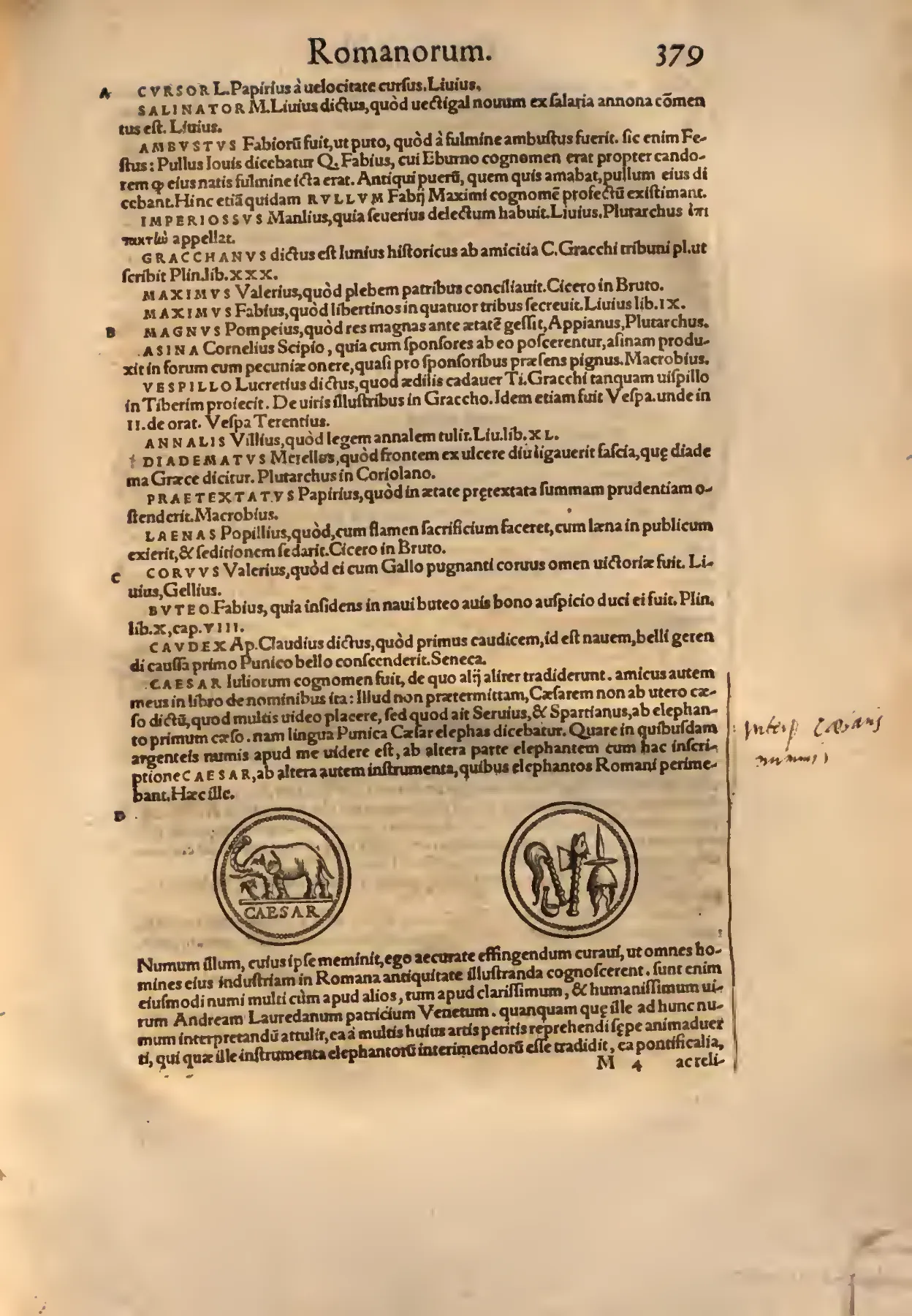
Paired woodcuts of a Caesarian elephant coin interrupt the alphabetical list of cognomina, turning disputed etymology into a lesson in Sigonio’s method. Attributed to Andrea Loredan’s Venetian collection, the engraved specimen allows readers to weigh competing visual interpretations, grounding antiquarian claims in converging textual, onomastic, and material evidence. Source ↗.
The treatise on names that follows is justified not as an independent curiosity but as the instrument without which the tables cannot be read: it seems to us, Sigonio writes, that we must set out in this place what we have discovered concerning the Names of the Romans, faciundum esse nobis uidetur, ut hoc loco, quid de Nominibus Romanoru[m] inuenerimus, exponamus. He begins from the grammarians' fourfold scheme, that there are four kinds of appellation by which the Romans registered persons, praenomen, nomen, cognomen, agnomen: the praenomen, which is set before the gentile name, as Publius; the nomen, which declares the origin of the gens, as Cornelius; the cognomen, which is subjoined to gentile names, as Scipio; the agnomen, which is usually added from outside, sought from some circumstance or event, as Africanus, quatuor genera sunt, prænomen, nomen, cognomen, agnomen. prænomen, quod nomini gentilicio præponitur, ut Publius; nomen, quod originem gentis declarat, ut Cornelius; cognomen, quod nominibus gentilicijs subiungitur, ut Scipio: agnomen, quod extrinsecus addi solet aliqua ratione, uel euentu quæsitum, ut Africanus. The scheme is adopted as scaffolding and then partly dismantled, since on Ciceronian evidence everything after the first two names is properly a cognomen and the agnomen has no separate standing — a demolition performed on the same principle that governs the fasti, that a late grammatical taxonomy yields to the usage attested in the sources.
The technical heart of the treatise is the recovery of the epigraphic sigla, and its epistemology is stated as a convergence of three independent classes of witness: that some Roman praenomina were customarily written with single letters, some with two, some with three, has been both handed down by the ancients and so preserved by every most ancient stone and coin that nothing in this matter can be clearer, Romanorum igitur prænominum alia singulis, alia binis, alia ternis literis scribi solita, cùm à ueteribus traditum, tum ab antiquissimo quoq[ue] lapide, numeroq[ue] ita retentum est, ut nihil ea re possit esse illustrius. Grammatical testimony, marble and coin agreeing, the nota becomes a recoverable fact rather than a scribal accident, and the recovery of the lost marks for Manius, Numerius, Caeso, Tiberius, Mamercus, Tullus and Opiter repairs a defect that had silently falsified whole family series in the fasti. The same rule of evidence is stated negatively against the unnamed amicus meus, author of a libellus de nominibus, whose fault is announced as a fault of method: because my friend, induced by no authority of the ancients, taught on his own authority that Roman women altogether lacked praenomina, quòd amicus meus nulla antiquorum auctoritate adductus suo iure feminas Romanas omnino caruisse prænominibus docuit. Suo iure is the polemical hinge — assertion on one's own warrant is worthless where ancient authority is available — and the refutation is built entirely from Valerius, Festus, Varro, Plutarch and transcribed stones from Modena, Reggio, Venice and Padua, including the universal female praenomen Caia written with a reversed letter. The volume's own materiality is drawn into the same evidentiary regime when Sigonio remarks of the CAESAR elephant coin that he had it accurately engraved, Numum illum, curus ipse meminit, ego accurate effingendum curaui: the woodcut is inserted so that the reader may inspect the reverse and judge the counter-reading, that its instruments are pontifical insignia rather than implements for killing elephants.
From the sigla the treatise moves outward into kinship and status, where onomastic morphology is made to bear an entire sociology: between gens and familia there is this difference, that gens refers to the nomen, familia to the cognomen, Inter gentem, & familiam illud interest, quòd gens ad nomen, familia ad cognomen refertur. Whole and part in the name reproduce whole and part in descent, and the same proportion is then said to hold between gentiles and agnati, so that the law of intestacy and succession is read off the shape of a name. The constitutional excursus that follows takes Romulus' assignment of rites, courts, magistracies, senate and administration to the patricians as its baseline, with the auspicia as the patrician monopoly and transitio ad plebem among the causes of homonymous patrician and plebeian houses; and it arrives at a definition of nobilitas which detaches rank from blood, for nobility was not procured from birth but from images, since those were called noble who possessed images of their ancestors, neq[ue] enim ex genere nobilitas, sed ex imaginibus parabat. siquidem ij nobiles dicti, qui maiorum suorum imagines haberent. Nobility so defined rests on a documentable record of curule office rather than on descent — a formulation with evident edge for a sixteenth-century readership, and one entirely consistent with a book whose whole method treats attested office-holding as the only firm ground.
The treatise closes by binding onomastics back to the constitutional narrative of the tables, in the declaration already cited: the system of names of which he has spoken was preserved chiefly while the commonwealth stood, and afterwards, together with liberty, this scrupulous ordering too began to collapse in every part. The adjective religiosam in that sentence is precisely chosen: the fourfold nomenclature was a scrupulous, quasi-sacral order of registration, and its dissolution — cognomina worn as praenomina by Iullus Antonius, Paullus Fabius Maximus, Cossus Cornelius Lentulus — is offered as a symptom legible in the very names the Augustan fasti had just recorded. The circle closes: the years in which the dictatorship was refused while more than dictatorial power was held, and in which the census was taken sine censuræ honore, are the years in which the naming system that made the register possible begins to decay. The apparatus of retrieval follows the second FINIS, and the imprint closes the volume, BASILEAE APVD NIC. EPISC. IVNIOREM, at Basel from the press of Nicolaus Episcopius the Younger, with the alphabetical index of things and memorable words converting the whole into something to be consulted by heading rather than read through — the final confirmation that what has been built is an instrument of reference rather than a narrative of Rome.
Frequently Asked Questions
What is Carlo Sigonio's Fasti consulares ac triumphi (Basel, 1559)?
It is a folio reference instrument in three parts rather than a narrative history: a tabular register of Roman consuls, censors, dictators and triumphs from Romulus to Tiberius; a year-by-year commentary on Roman affairs reckoned from the fourth year after the foundation of the City to the death of Tiberius; and a closing treatise on Roman personal names. Its evidentiary base is the marbles known as the Fasti Capitolini, lifted from the Roman Forum in 1546–1547 and set up under Michelangelo's direction in the Palazzo dei Conservatori. Printed at Basel by Nikolaus Episcopius the Younger, it enlarges the Venetian first edition of 1556.
Who was Carlo Sigonio?
Carlo Sigonio of Modena (c. 1524–1584) was one of the most technically accomplished Latinists in sixteenth-century Italy, a schoolmaster's son who taught at Modena, lectured publicly at Venice under the Scuola di San Marco from 1552, held the chairs of rhetoric and then Greek at Padua, and in 1563 became the first professor of history at Bologna. He died near Modena on 27 August 1584, though a residual tradition places his birth about 1520 and some reference works give 28 August for his death. A quarrel with Francesco Robortello and the disputed Ciceronian Consolatio of 1583, which Antonio Riccoboni called a forgery, marked his career.
Why did Sigonio insert a year without consuls that no ancient author records?
Because the total of years demanded by the Capitoline marbles could not be squared with the literary record, and he chose to save the stone's reckoning rather than emend it. He states plainly that he is compelled to interpose a year without consuls, though neither Livy nor anyone else mentions it, in order to preserve the sum of years established in the tables he follows. The same preference for documents led him to recompose Capitoline fragments that had been torn apart and wrongly placed by those who arranged them on the Capitol, and to print the marble's words in larger type and his own supplements in smaller.
What does the work argue about how the Roman republic ended?
It replaces the inherited Polybian and Ciceronian judgement that Rome had reached the best constitution with a taxonomy: a city must lie in the power of one, of a few, or of many. Through the technical vocabulary of office it then tracks a concentration of powers — the dictatorship passing from its old causal formulae to the open-ended office Sulla obtained by law, the word Imperator passing from a soldiers' acclamation to the designation of one holding supreme power. The tabular series closes with the victor of Actium holding the commonwealth alone, exercising royal power once hatred of the royal name has been removed, while Caesar and Augustus add no power of their own.
Is there an English translation of Sigonio's Fasti consulares ac triumphi?
No English translation has been identified; no vernacular translation of the 1559 Basel text is recorded in the consulted catalogues, and the eighteenth-century Argelati Opera omnia (Milan, 1732–1737) reprints the Latin with added apparatus rather than translating it. The technical terminology entered later antiquarian usage through paraphrase and excerpts instead. Separately, the Leo edition presents the full transcription together with a complete English translation, generated by AI, for the first time. Leo is an effort to make freely available online, at no cost, English translations of every text printed in Latin in early modern Europe between 1450 and 1750.
This report was generated by an advanced AI assistant that conducted deep research alongside an extensive interpretation of the transcribed original text. Every effort has been made to preserve fidelity to the source and to guard against inaccuracy, but corruption in the text recognition process and model hallucination may nonetheless have entered the text. Treat every claim, quotation, translation, and citation as provisional, and verify each against the original source before relying on or citing it.
Further Reading on Sigonio, the Fasti Capitolini, and Renaissance Antiquarianism
- Bartolucci, Guido, "Historian Engagé: Republicanism and Oligarchy in Sigonio's Political Histories," Storicamente: The sharpest statement of the case that the constitutional vocabulary of the Commentarius carries a political programme, with Bologna under papal government as its unnamed subject. Read it against McCuaig to see how far the same Latin can be pulled in opposite directions.
- Bauer, Stefan, The Invention of Papal History: Onofrio Panvinio between Renaissance and Catholic Reform: The fullest modern account of Sigonio's chief rival in the race to publish the Capitoline fragments, and the best corrective to reading the 1557–1559 sequence of editions as simple plagiarism. Panvinio emerges as a colleague competing for the same stones rather than a thief.
- Centro Primo Levi, Momigliano and Antiquarianism: A concise orientation to why Momigliano's category of the antiquarian mattered so much to twentieth-century historiography, useful before tackling the 1966 essay itself. Helpful for readers who want the stakes of the antiquarian/historian split without the full apparatus.
- Degrassi, Attilio, Inscriptiones Italiae XIII.1: Fasti Consulares et Triumphales: The modern critical edition of the very marbles Sigonio transcribed, restored, and occasionally rearranged with his own hands. Consult it to grade his readings entry by entry, and to see which of his conjectures the stones have since vindicated.
- Forsyth, Richard S., David I. Holmes, and Emily K. Tse, "Cicero, Sigonio, and Burrows: Investigating the Authenticity of the Consolatio," Literary and Linguistic Computing: Establishes the computational and stylistic methodology for adjudicating Sigonio's contested authorship claims, using the Fasti and related works as the baseline against which the disputed 1583 Consolatio is measured; indispensable for any assessment of Sigonio's philological reliability. The uncomfortable corollary is that the prose of the Fasti is what makes the forgery case testable at all.
- Grafton, Anthony, Bring Out Your Dead: The Past as Revelation: Essays on how early modern scholars made dead documents speak, several of them directly relevant to the conjectural restoration of mutilated inscriptions. Useful for understanding why Sigonio's flagged guesses were a professional virtue rather than an embarrassment.
- Grafton, Anthony, Defenders of the Text: The Traditions of Scholarship in an Age of Science, 1450–1800: Places Sigonio within the longer arc of learned conjecture and technical chronology, essential for understanding the Commentarius as a case of forensic-philological reconstruction rather than narrative history. The chapters on chronology explain why a single interpolated consul-less year mattered to the whole edifice.
- Herklotz, Ingo, Cassiano dal Pozzo und die Archäologie des 17. Jahrhunderts: Traces what became of Sigonio's methods once antiquarian documentation passed into the hands of seventeenth-century collectors and draughtsmen. The continuities are more striking than the ruptures, which is itself an argument against too tidy a periodisation.
- McCuaig, William, Carlo Sigonio: The Changing World of the Late Renaissance: The only monograph-length treatment of Sigonio's career and method, indispensable for situating the 1559 Basel volume within his broader antiquarian-political project and the Modenese-Paduan-Bolognese intellectual milieu in which the Fasti were composed. It also supplies the documentary spadework on the Robortello quarrel and the Consolatio affair that most later interpretations simply borrow.
- Momigliano, Arnaldo, "Ancient History and the Antiquarian," Studies in Historiography: The canonical statement of the late-Renaissance separation and nineteenth-century fusion of antiquarianism and historiography; frames Sigonio as the last great Italian antiquarian and reads the Fasti as the high-water mark of the technical-chronological tradition before its absorption into formal historical writing. Sigonio's own measure of the gain is the tally of losses recovered — how many and how great triumphs have been lost that no one but the Capitoline writers has recorded, as anyone who reads the commentary will easily understand, Quor autem, & quàm magnos triumphos amiserimus, quorum nemo, præter Capitolinos scriptores, meminerit, facile qui hunc comm[m]etarium leget, intelliget.
- Stenhouse, William, Reading Inscriptions and Writing Ancient History: Historical Scholarship in the Late Renaissance: Argues that Renaissance antiquarianism was a creative, visual, and rhetorical practice, not bare accumulation; treats the Capitoline-marble reception by Marliani, Panvinio, Sigonio, and Ligorio as a single analytical frame and devotes explicit attention to the 1559 Basel Fasti. The claim on which that reception rests is Sigonio's own repeated assertion of the superiority of the stones to the literary tradition, all these triumphs having been handed down by the Capitoline writers while the Roman annals are silent about such great wars, quos triumphos omnes nobis Capitolini scriptores tradiderunt, silentibus in tantis bellis annalibus Romanis. The linked BMCR review gives a fast survey of the book's argument and its epilogue on the legacy of sixteenth-century epigraphy.
- Stenhouse, William, "Panvinio and Descriptio," Papers of the British School at Rome: A close study of how Panvinio described and organised inscribed evidence, and therefore of the descriptive conventions Sigonio was competing against in print. Read it for the mechanics of how a stone became a printed page in the 1550s.