A Plank Sufficient for One: Christoph Haunold's Speculative Theology Adapted to Scholastic Lectures and Exercises, in Four Books Corresponding to Parts of St Thomas's Summa
Christoph Haunold, a Bavarian Jesuit who lectured at Ingolstadt, published his Theologiae speculativae scholasticis praelectionibus et exercitiis accommodatae libri IV, partibus Summae D. Thomae respondentes as a four-book Latin course keyed to Aquinas's Summa and built for the lecture hall and the disputation floor. In it he defends Molinist freedom, the lawfulness of acting on a probable opinion, and the authority of Trent by recasting theology in the language of law: Adam's sin becomes a pact, absolution a judicial sentence, and a doubtful papal election a defect cured by universal acceptance. The course has never been translated into a modern language, yet it shows in close detail how a seventeenth-century Catholic professor fitted the hardest doctrines to the conscience of the ordinary believer, the peasant included.
ExLatinis
October 5, 2026

Contents
Christoph Haunold, a Bavarian Jesuit who lectured at Ingolstadt, published his Theologiae speculativae scholasticis praelectionibus et exercitiis accommodatae libri IV, partibus Summae D. Thomae respondentes as a four-book Latin course keyed to Aquinas's Summa and built for the lecture hall and the disputation floor. In it he defends Molinist freedom, the lawfulness of acting on a probable opinion, and the authority of Trent by recasting theology in the language of law: Adam's sin becomes a pact, absolution a judicial sentence, and a doubtful papal election a defect cured by universal acceptance. The course has never been translated into a modern language, yet it shows in close detail how a seventeenth-century Catholic professor fitted the hardest doctrines to the conscience of the ordinary believer, the peasant included.
Christoph Haunold (1610–1689), a Jesuit theologian of the Bavarian province, wrote Theologiae speculativae scholasticis praelectionibus et exercitiis accommodatae libri IV. It is a Latin printed course of scholastic theology in four books, arranged in relation to the parts of Thomas Aquinas's Summa theologiae and made for the lecture hall and disputation exercises of a Jesuit university. It was printed at Ingolstadt, the seat of Bavaria's Jesuit-directed university. A printing of 1670 names the academic printer Johann Simon Knab. A further printing of 1678 names Johann Philipp Zinck and carries Vindiciae attributed to Haunold's fellow Jesuit Jakob Illsung. The book is not the Commentarii theologici of Gregorio de Valencia, the older Ingolstadt master. Its own pages cite Valencia as one authority among many, and the identified catalogue records index the digitized 1678 volume under Haunold. No translation into any modern language has been confirmed, so the course remains accessible only in its original Latin.
The problem the course works on throughout is a defensive one with constructive ambitions. Haunold asks how received Catholic doctrine can be upheld against the competing placita, the "positions," of the recentiores theologi while three things remain intact: the freedom of the created will, the binding force of moral obligation, and the teaching authority of the Church. He answers with a recurring two-part move.
- Epistemic. Haunold seldom stakes a question on a single demonstration. He prefers to gather several probable explanations, each insufficient on its own, until together they merit prudent assent. He grades certainty as metaphysical, physical, moral, or congruent. He places firm limits on dissent in the consensus of the Doctors, papal mandate, and the wording of the Council of Trent.
- Constructive. He repeatedly recasts theological relations as moral and juridical structures. Adam's relation to his posterity becomes a pactum. Marriage becomes a civil contract raised to sacramental dignity. Absolution becomes a judicial sentence. A doubtful papal election becomes a defect cured by universal acceptance, on the model of Roman usucapion.
Underneath both moves lies a Molinist doctrine of God and grace, built on scientia media and libertas indifferentiae, set against Thomist physical predetermination and against Jansenism.
The stakes of this approach were high in the second half of the seventeenth century. The papal prohibition on further public dispute de auxiliis, concerning the efficacy of grace, still bound Catholic theologians. Condemnations of Jansenist propositions were recent. The legitimacy of acting on a probable opinion was becoming one of the most fiercely contested questions in Catholic moral theology. Haunold's course addresses all of these at once. It also shows how a Jesuit theologian at a German university handled the boundary between speculative theology and the practical judgments of the confessional. Modern scholarship on probable opinion, Jesuit moral necessity, and the theologians' use of law supplies a frame for reading the course. A settled scholarly account of Haunold's own positions on grace, probabilism, or sacramental causality has not yet been established.
What makes the work memorable is how concrete its juridical and practical reasoning becomes. Haunold grounds a natural right of secrecy among the angels in the social character of intellectual nature. He argues that a peasant's faith can be more meritorious than that of the learned. He makes the test of a moral obligation whether being obliged brings more good to the whole human race than not being obliged. He takes test cases for sacramental form from the missions in Tonkin and from Dalmatian usage. He weighs a Galenic temperament as a factor bearing on salvation, and he discusses "Spanish wine" at Augsburg in treating the matter of the Eucharist. He also defends probabilism by name against the canonist Prospero Fagnani.
The object carries its own small puzzles. The 1678 printing bears an engraved title dated 1670, which must not be confused with the printed imprint. A separately paginated component associated with Illsung's Vindiciae awaits examination: its occasion, argument, and relation to any disputation remain unconfirmed.
One logic connects the title's vocabulary, the book's production, and its argument, and that logic is accommodation. The title presents speculative theology accommodatae, fitted to lectures and exercises. The text explains mysteries in a manner fitted to common understanding. Its doctrine fits sacramental and moral obligation to human freedom and to the ordinary estimation of prudent people. Its production history, from an Ingolstadt course reissued with a named defense, points to a teaching text that was refitted and defended over time. Exactly what that later defense answered is a question the surviving evidence has yet to settle.
Read the full text and English translation on Leo
This text was transcribed and translated as part of the ExLatinis project, an effort by Leo to make free English translations of every text published in Latin in early modern Europe (1450–1750) available online. The complete transcription and English translation of this work can be read free of charge:
→ Read the original Latin text and full English translation on Leo
You can save a copy of this document into your Leo account to run deep text searches, conduct further analysis, or cross-reference it with your own research.
Translating Haunold's Title: Speculation, Lectures, and Accommodation
Speculative Theology Adapted to Scholastic Lectures and Exercises, in Four Books Corresponding to Parts of St Thomas's Summa is an editorial English rendering of Christoph Haunold's Theologiae speculativae scholasticis praelectionibus et exercitiis accommodatae libri IV, partibus Summae D. Thomae respondentes, not an established English publication title.
Here speculativa names inquiry into theological doctrine through scholastic reasoning. It should not be read as a claim that the work consists of unsupported conjecture. The text's own account of speculative method confirms this. Haunold refuses to rest a question on a lone proof. He rejects the practice of those wholly bent on attacking others' views and admitting only one explanation, and he commends gathering several explanations which, though singly insufficient, jointly clarify the matter enough to merit prudent assent: Quapropter non possum probare consilium eorum, qui toti sunt (& non est difficile) in aliorum placitis impugnandis: nec volunt nisi vnicam explicationem admittere; cùm potiùs laudabile videatur plures admittere, quarum etsi singulæ non plenè satisfaciant, simul tamen junctæ rem eousque declarant, vt mereantur prudentem assensum. "Speculation" in this course is therefore the disciplined accumulation of probable reasons toward a judgment of prudence. It is not free invention.
Praelectiones are lectures or formal readings for instruction, while the accompanying exercitia point to the exercises for which the printed course was arranged. The participle accommodatae deserves equal weight. It describes doctrine fitted to a pedagogical setting, and the same verb returns inside the work as a hermeneutical principle: the mysteries, Haunold holds, explicanda sunt accommodatè ad sensum communem, that is, they are to be explained in a manner accommodated to common understanding. The title's promise of accommodation to the schools and the text's accommodation of doctrine to common sense are two faces of a single editorial and theological habit.
The adjective scholasticis also marks a boundary Haunold draws explicitly. He distinguishes the work of the schools from that of the Fathers, whose purpose, he says, was to explain the mysteries of faith to the people rather than to settle disputed questions: eorum enim institutum erat, Mysteria fidei populo explicare, non scholasticas quæstiones definire.
The title's assertion that selected positions of recentiores theologi are controvertuntur makes controversy part of that pedagogical purpose. The author undertakes to dispute particular claims of more recent theologians, rather than merely reproduce inherited teaching. Yet the originality he claims lies in procedure rather than doctrine. He would be content, he writes, if his manner of proving old views, defending them, and setting out others' findings won approval: mihi erit, si modus antiqua probandi, defendendi, aliorum inventa.
Controversy with the recentiores also has a fixed outer limit. In a purely theological matter, the common consent of the Doctors must carry the greatest weight, so that one may not depart from it without rashness: Communis ergo DD. consensus in re purè Theologica debet habere plurimum momenti, vt siue temeritate recedi non possit.
The catalogue title belongs to Haunold, not to Gregorio de Valencia's Commentarii theologici. Within the text, "Valentia" appears among the cited authorities, alongside Juan de Lugo, Sforza Pallavicino, Rodrigo de Arriaga, Gabriel Vázquez, Domingo Báñez and others.
What Haunold's Speculative Theology Argues, and Where It Was Printed
Christoph Haunold SJ's Theologiae speculativae ... libri IV is a Latin printed course of scholastic, speculative theology arranged in relation to Thomas Aquinas's Summa. Its stated purpose includes disputing selected positions of recent theologians.
The course's governing method combines two elements:
- an epistemic preference for cumulative probable explanations within limits set by doctrinal consensus and ecclesiastical authority;
- a habit of recasting theological relations in moral and juridical terms.
Its doctrine of God rests on a Molinist footing. Haunold states that God knows free conditional futures certainly and infallibly through middle knowledge: Dicendum nunc est, DEVM futura conditionata libera cognoscere certò & infallibiliter per scientiam mediam, hoc est, quæ est. That commitment orients the treatment of grace, freedom, and the sacraments that follows.
A 1670 printing names the Ingolstadt academic printer Johann Simon Knab. A separately catalogued Ingolstadt printing of 1678 names Johann Philipp Zinck and includes Vindiciae attributed to Jakob Illsung SJ.
The Google Books volume identified by 9Su7UBODULYC, and its Internet Archive counterpart, are indexed under Haunold and dated 1678, not under Valencia and dated 1600. A Valencia misattribution or its proposed cause cannot be established for that identified surrogate. No translation of Haunold's course was confirmed.
Why Haunold Matters for the History of Molinism, Probabilism, and Theological Law
Haunold's title presents a late-seventeenth-century Jesuit course that relates instruction to Aquinas's Summa while expressly engaging selected recent theological opinions. Deference to Aquinas does not preclude open dissent. On the matter of a sacramental question, Haunold declines to follow Thomas where the practice of the churches points elsewhere: Quocirca non existimo injuriam fieri D. Thomæ, si propter multarum Ecclesiarum & Liturgiarum auctoritatem ab ejus opinione discedamus, judging that no injury is done to St Thomas if, on the authority of many churches and liturgies, one departs from his opinion.
The securely identified 1670 and 1678 printings make it possible to study both continuity in Ingolstadt scholastic teaching and later adaptation of a printed course. Valencia is relevant as an earlier Jesuit theologian associated with Ingolstadt, not as author of this volume. Illsung's named Vindiciae make the 1678 printing especially important for investigating whether objections and defenses were assembled with the course. The title alone does not disclose whom or what they defend.
The course's significance for the history of natural theology begins with a sharply drawn epistemic limit. Haunold denies that God can be demonstrated to the satisfaction of a determined unbeliever without starting from creatures: 18. Censeo, nullam hujusmodi Demonstrationem adduci posse, quæ Atheum convincat, quam diu non assumitur Existentia alicujus Creaturæ. In his view, no demonstration of this kind convinces the atheist so long as the existence of some creature is not assumed. The figure of the atheist thus becomes the touchstone of what counts as a proof. This is consistent with the course's wider preference for graded certainty over claims of single demonstrative closure.
In the doctrine of grace, the text places Haunold on the Molinist side of the debates that the papacy had ordered silenced, and it treats that silence as binding. He declines a line of treatment à qua tractatione ex Mandato sedis Apostolicæ nunc est abstinendum, quidquid nuper scripserit R. P. F. Philippus à SS. Trinit: from such treatment one must now abstain by mandate of the Apostolic See, whatever Fr Philip of the Most Holy Trinity has recently written.
Against Jansenist readings of Augustine, he presents the bishop of Hippo as a defender of liberty of indifference: Hunc errorem acerrimè impugnavit S. Augustinus, nunquam tamen in suis impugnationibus aut responsionibus negavit fundamentum à Pelagio assumptum, nimirum Libertatem Indifferentiæ, sed semper negavit consequentiam. Augustine fought the Pelagian error vigorously, Haunold argues, but never denied the foundation Pelagius assumed, namely liberty of indifference; he denied only the consequence. The same concern for freedom shapes his account of the salvation of those outside explicit revelation. To one who for some time keeps the natural law by natural acts, God in his goodness will infallibly provide grace morally and proximately sufficient for salvation, if the person will cooperate: Homini per actus naturales aliquandiu servanti Legem Naturalem, Deus ex sua Bonitate infallibiliter providebit Gratiam supernaturalem, moraliter ac proximè sufficientem ad consequendam salutem, si illi homo velit cooperari.
The juridical recasting that runs through the course is especially visible in Haunold's treatment of the following doctrines.
Original sin. Original sin is defined through the language of covenant and non-remission: Peccatum Originale consistere in peccato Adami cum negatione condonationis respectu posterorum, qui includebantur in pacto. It consists in Adam's sin together with the negation of condonation regarding those of his posterity who were included in the pact.
Satisfaction. In Christology, the language of offence and satisfaction is handled with comparable precision. Implacability in the condign sense for grave offence is, by its very concept, a pure perfection, which neither implies harshness nor conflicts with clemency: Implacabilitatem de condigno pro offensa gravi esse perfectionem simpliciter simplicem, ex conceptu suo; non enim sonat inclementiam, nec pugnat cum clementia.
The papacy. Ecclesiology receives the same treatment. A doubtful election is resolved by appeal to the public good of the Church: Melius quippe est, Ecclesiam habere pro vero Pontifice aliquem, qui fuerit invalidè electus, quàm ignoranter carere vero Pontifice. It is better, Haunold reasons, that the Church hold as true pontiff someone invalidly elected than unknowingly lack a true pontiff.
The angels. Even the angelic order is read through natural law and political life. The natural right of secrecy rests on the claim that Natura intellectualis ordinatur ex se ad vitam politicam in communitate ducendam, cum quiete, concordia, confidentia &c. Intellectual nature, in this claim, is ordered of itself to political life led in community, with quiet, concord, and trust.
Haunold's estimation of faith is equally attentive to ordinary believers. He holds that the faith of peasants is esse majoris meriti, quàm fidem Sagacium, habentium motiva inenervabilia, of greater merit than the faith of the learned who possess motives that cannot be weakened.
Modern work on probable opinion offers context rather than a settled interpretation of Haunold. Schüssler traces debates over what makes an opinion sufficiently probable. Knebel situates probability and moral necessity within Jesuit scholasticism. Maryks investigates an earlier intellectual history of Jesuit moral probabilism.
Several of Haunold's own formulations show why these frameworks are pertinent. His definition of the honest is strikingly compressed: Illud est Honestum, quod expedit licere,, that is, that is honest which it is expedient to be licit. Its test of obligation looks to the common good of humankind. One asks an ipsa obligatio, sive, hocipsum quod est, obligari, plus boni sit allaturum toti generi humano, quàm non obligari: whether the obligation itself, the very fact of being obliged, will bring more good to the whole human race than not being obliged.
His reading of conciliar texts follows a related logic of presumption from silence. On the question of whether contrition requires a motive of love of God as final end, he observes that Trent nullum verbulum habet de motivo dilectionis Dei tanquam finis CVI. quod tamen tacendum non erat, sed exprimendum, si requireretur, alioquin totam ferè Ecclesiam graviter decepisset. The Council has not a single word about such a motive, which ought not to have been passed over but expressed if it were required, since otherwise it would have gravely deceived almost the whole Church.
Decock's study of theologians and legal reasoning offers a way to assess any juridical comparisons in Haunold, such as the Adamic pactum, the cured papal election, and the civil contract of marriage. Its principal period, however, ends before this printing. These approaches ask different questions and should not be presented as documented disagreements about this particular book.
The available bibliographic evidence does not establish a scholarly consensus on Haunold's precise positions concerning grace, probabilism, or sacramental causality. Nor does it establish that Illsung's appendix was an anti-laxist defense. The passages above show the direction of Haunold's own text on several of these questions. Those claims nevertheless require examination of the relevant passages and their contemporary replies before any wider historiographical conclusion is drawn.
Tracing the Ingolstadt Printings of 1670 and 1678
The identified print history includes a 1670 Theologiae speculativae associated with Johann Simon Knab, academic printer, and an Ingolstadt 1678 printing by Johann Philipp Zinck. The latter is recorded as VD17 12:122350Y. Its catalogue describes a quarto with a copperplate title and the extent [15] leaves, 719 pages, [6] leaves, [5] leaves, 124 pages, [2] leaves.
Crucially, that record distinguishes 1678 on the printed imprint from 1670 on the engraved title. The plate's date must not silently replace the printing date. The title associates Jakob Illsung's Vindiciae with Haunold's work, and the separately paginated 124-page component warrants examination as an appendix. Its precise occasion, argument, and relationship to any Freiburg disputation remain unconfirmed.
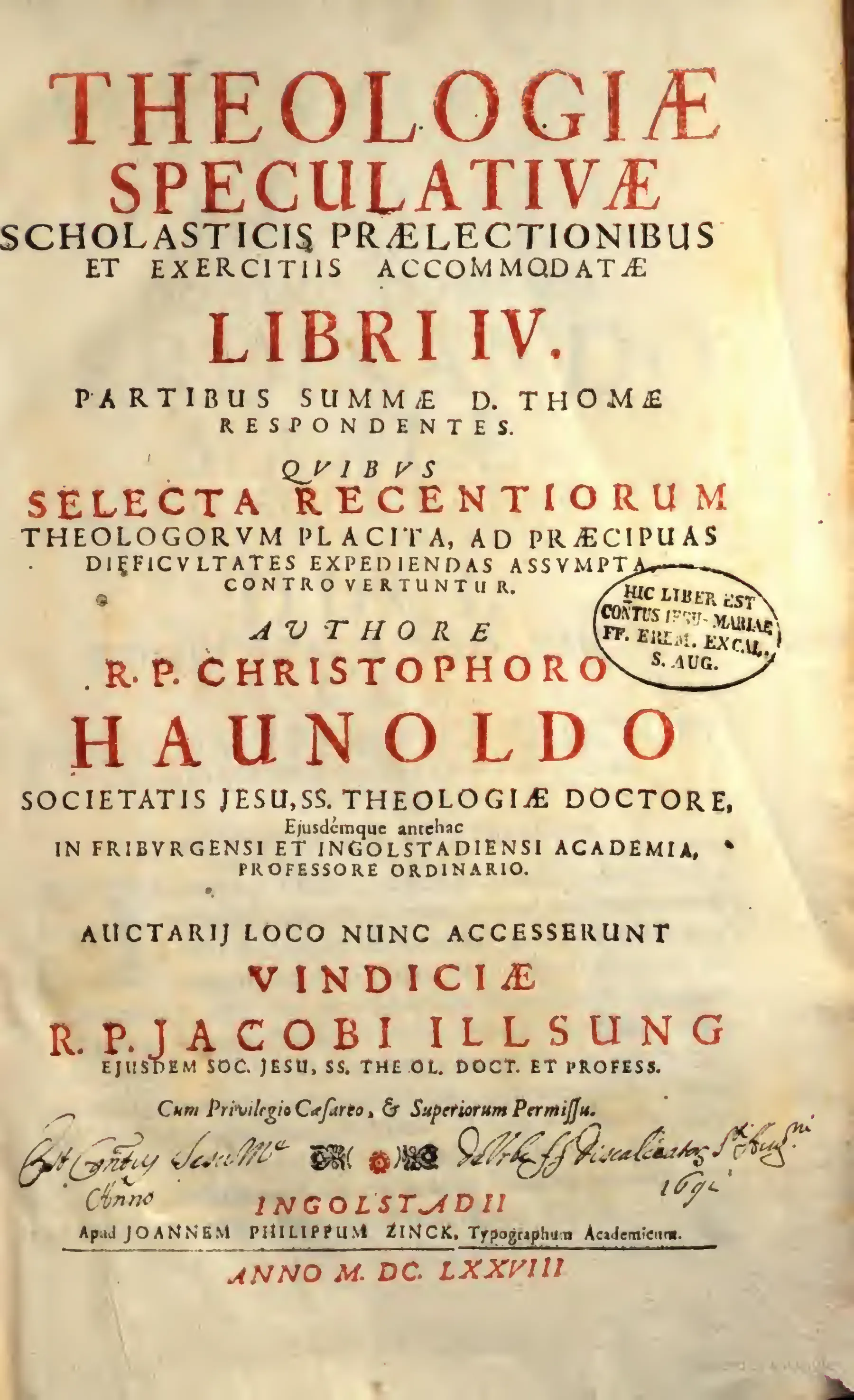
The printed title page, set in red and black, bears the 1678 date of Zinck’s Ingolstadt printing, not the engraved plate’s 1670, and advertises Jakob Illsung’s added Vindiciae. Its promise of prelections and exercises places the course in the classroom; a later stamp and ink marks record its library life. Source ↗.
The four books that the title keys to the parts of the Summa carry the course from God, the Trinity, and the angels, through human acts, sin, and grace, and through the theological virtues, to the Incarnation and the sacraments. The sacramental treatise is where the course's accommodating method meets its firmest limits.
Sign and causality. Haunold holds that Sacramenta novæ legis simul sunt Caussa & Signa, & ideo est, quòd, sicut communiter dicitur, efficiunt quod Figurant. The sacraments of the New Law are at once cause and sign, and hence, as is commonly said, they effect what they figure. He construes their causality in moral rather than physical terms: sunt quidam cultus Dei, quatenus sunt petitiones Christi. They are a kind of worship of God, inasmuch as they are petitions of Christ.
Matter and form. On the Church's power over rites, he sets an explicit boundary. Catholica doctrina est, Materiam & Formam Sacramentorum aliquo modo à Christo ita esse deteminatas, vt nec licitè nec validè possit ab Ecclesia in aliam mutari: it is Catholic doctrine that matter and form were in some way so determined by Christ that the Church can neither licitly nor validly change them into others.
The minister's intention. He gives the minister's intention constitutive force across the whole sacramental order: Intentio Ministri est intrinsecè constitutiva omnium Sacramentorum, etiam Eucharistiæ. The minister's intention is intrinsically constitutive of all the sacraments, even of the Eucharist.
Positions of this kind, set out in a course whose 1678 printing carries a named defense, are precisely the sort of claims that might have attracted the objections Illsung's Vindiciae answered. Whether they did remains unconfirmed.
Google Books identifies the original scanned for volume 9Su7UBODULYC as belonging to the National Central Library of Rome and dates its digitization to 2 July 2013. Internet Archive identifies its copy by the corresponding Google identifier. Both present the item as Haunold's work of 1678. A separate digital reproduction of the Zinck printing appears in the University Library of Paderborn's digital collections.
These records do not establish that the Rome scan and the Paderborn reproduction represent the same physical copy. No shelfmark for either physical exemplar was confirmed, and a named contributor in the Google record should not be mistaken for a demonstrated chain of ownership.
Haunold's course belongs to the later Ingolstadt setting in which Valencia's authentic Commentarii theologici was an earlier Jesuit theological work. The identified 1678 surrogate is not that work. No evidence establishes how a Valencia/1600 description became attached to this particular scan, or establishes a binding confusion.
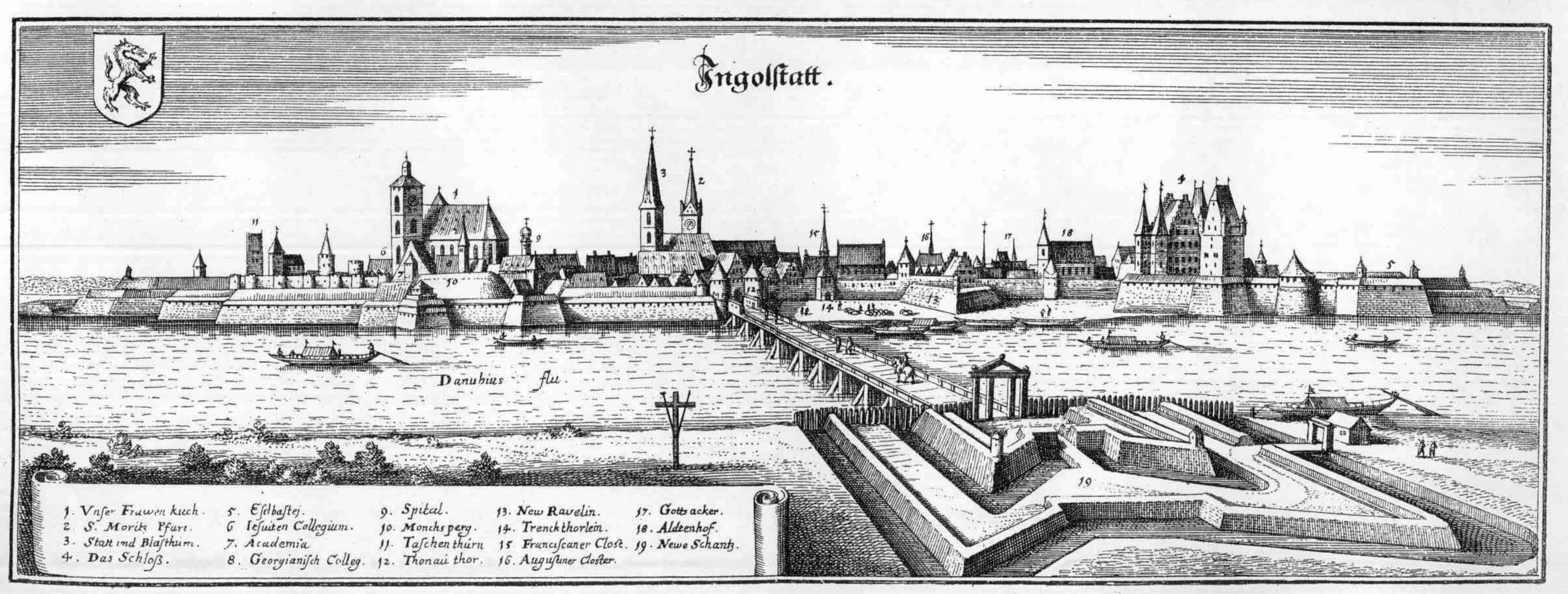
Merian’s seventeenth-century view of Ingolstadt shows the Bavarian university city where Haunold taught and his course was printed, its engraved key marking the Jesuit college and the academy. It illustrates the setting of the course, not a page of the work itself. Source ↗.
.jpg)
Beyond the question of setting, several matters require examination of further copies and records:
- the dedicatee Ferdinand Maria;
- any approbations or imprimatur;
- the full sequence of editions;
- specific censorship proceedings;
- contemporary counter-texts;
- a translation history.
General anti-laxist measures cannot, without such evidence, be described as a censorship of Haunold's book.
Following Haunold's Argument from the Existence of God to the Index of Matters
Preface and Book I: The Existence and Attributes of God
Haunold opens his course by disclaiming doctrinal novelty and claiming originality only in procedure. Having invoked Alexander VII's complaint, relayed by Prospero Fagnani, against the flood of premature new books, and having borrowed Fernando Vázquez's image of compilers as winds and floods that merely shift what others produced, he states, in the sentence already cited, what he would count as his own: it will be enough for him if the manner of proving old views, of defending them, and of setting out others' findings can be called his. The protestation is conventional, but it is precise. It locates authorship in the modus, the ordered sequence of proof, defence, clarification and refutation that the scholastic exercitium rehearsed. It also anticipates the cumulative, adjudicative method that the rest of the course enacts.
The Ingolstadt faculty's censure reads the book in the same key, as a work of currency rather than invention. It commends the book to those Studiis hisce Theologicis addicti sunt: Tum quia præcipuas Difficultates, hac: to those devoted to these theological studies, because the author has gathered the chief difficulties debated in the schools of this age. Accommodation here has a temporal dimension. The course is fitted to the live disputes of its decade. That is why its basic unit is not the article of commentary but the numbered Controversia, in which "recent" positions are weighed against one another.
The first treatise, on God as one, immediately tests this method against the most fundamental question of natural theology. Controversy I denies any immediate natural knowledge of God's existence: Dicendum est, non posse à nobis naturale judicium evidens immediatum in hac vitâ comparari, quo independententer ab omni connexione cum creaturâ,. It must be said, Haunold writes, that no evident, immediate natural judgment can be acquired by us in this life independently of every connection with a creature. The ground is Aristotelian and Thomist. Cognition requires the physical influx of an existing object, and every species available to the wayfarer is alien to the divine essence. The Anselmian argument is therefore not rejected outright but reduced, through Aquinas, to a conditional sense. The position is restrictive, but it does not concede scepticism. Controversy II affirms the demonstrability of God in the strongest terms the schools allowed: 13. Posse probari Existentiam Dei Argumentis quemvis intellectum benè dispositum Convincentibus, est constans Theologorum assertio,. That God's existence can be proved by arguments convincing any well-disposed intellect is, he says, the constant assertion of theologians. The qualifier benè dispositum is load-bearing. Demonstration is objective, yet it is measured against a mind free of obstinacy, and the treatise then weighs, with Valencia and Suárez against Vázquez, whether the proposition belongs to faith.
The figure who sets the standard of rigour is the atheist, and here the polemic turns against Haunold's own confrères. He introduces his opponents with an ironic compliment, 17. R Ecentiores Hispani, elucubrationibus suis in Germania celebres, & ob ingenij acumen: the recent Spaniards, famous in Germany for their lucubrations and for the sharpness of their wit. Against their a priori proofs he sets the flat verdict already noted: no demonstration of this kind can be adduced that convinces the atheist, so long as the existence of some creature is not assumed.
Antonio Pérez's "being lacking every defect," Esparza's proof from eternal truths, and Pérez's argument from God's own contradictory all fall under this rule. Haunold parodies them with the impossible "greatest finite number." His own a posteriori demonstration of an unproduced being depends instead on a piece of the logic manual imported into theology: Quærenda ergo est Regula, cognoscendi, quandoq[ue]. A rule must therefore be sought, he writes, for knowing when an inference from the distributive to the collective sense holds. With stones, beggars and eyes he shows that some properties pass from each member of a series to the whole while others do not. On this rule the atheist's infinite regress of produced beings is made to yield an unproduced first. The cosmological argument thus stands or falls on a disciplined theory of collections rather than on rhetorical appeal.
The atheist is also defined with care. Haunold follows a colleague in distinguishing degrees of unbelief: Ant: de Quiros, qui concederet dari Ens Improductum. The clause concerns one who would concede that there is an unproduced being. Following Quirós, Haunold holds that such a person, even if he denied providence or omnipotence, would be a blasphemer rather than an atheist. This taxonomy explains why the demonstration aims so narrowly at the concept of ens improductum: to establish that concept is, by definition, to defeat atheism, whatever errors remain.
The polemic also yields one of the course's rare dated self-references. Haunold insists on his priority: scholis discussi & rejeci, anno 1651, postmodum anno 1666. pleraque vidi relata, itidemque tanquam. He had discussed and rejected these arguments in the schools in 1651, and only in 1666 saw most of them reported, and likewise dismissed, in Izquierdo. The printed course discloses its origin in the lecture hall and asserts the independence of a German professor's judgment from the Spanish literature it engages.
The same candour governs the controversy on virtual distinction among divine predicates, where Haunold corrects himself in print. Of a doctrine on contradictory predicates he writes, mihi aliquando placuit, nunc autem displicet: it once pleased me, but now displeases me. Revision is not instability, however, because the outer limit is dogmatic: 77. DICO. Quomodocunque explicentur propositiones, ne evadant contradictoriæ, non potest salvo Trinitatis Mysterio negari, inter Naturam & Relationes dari majorem distinctionem, quàm rationis ratiocinatæ,. However the propositions are explained to keep them from becoming contradictory, it cannot be denied, without prejudice to the mystery of the Trinity, that there is a greater distinction between the Nature and the Relations than a distinction of reasoned reason. A metaphysical thesis is thereby made obligatory by revealed doctrine. The epistemic consequence is drawn at once: Non posse ea clarè dissolvere, est inculpabilis ignorantia. Not to be able to dissolve the objections clearly is inculpable ignorance. The professor may fail to answer an argument without fault, but he may not deny the distinction. The asymmetry is exactly the course's broader settlement between probable reasoning and fixed authority. Speculation is free in its explanations and bound in its conclusions.
Chapter II carries this settlement into the doctrine of the supernatural. Its thesis denies any creatable nature seu Naturam creatam, cui connaturaliter debeatur Visio intuitiva, that is, any created nature to which the intuitive vision of God would be connaturally owed. The gratuity of beatitude is defended partly by a Thomist axiom about participated being, but most vividly by social and juridical reasoning. Rodrigo de Arriaga had argued that grace need not dignify its recipient, as when mancipio vili donaret ex favore Imperator pulchram plumam pro pileo, aut calceos,: an emperor, out of favour, might give a vile slave a fine plume for his cap, or shoes. Haunold answers that such courtly trifles confer no right to a friend's goods, whereas sanctifying grace removes the condition of mere servant and grounds the inheritance of sons.
The world of the princely court thus becomes a theological instrument. The distinction between gift and title, servant and friend, organises the relation of creature to God. The argument against a naturally impeccable creature completes the picture in the vocabulary of sovereignty: Ad majestatem DEI spectat, posse omnem personam, quæ DEVS non sit, legibus coërcere, obedientiam exigere sub interminatione inimicitiæ & poenæ:. It pertains to God's majesty, Haunold argues, to be able to constrain by laws every person that is not God and to exact obedience under threat of enmity and punishment. A creature incapable of sin would stand outside the reach of law, and therefore outside majesty. Here the course's juridical recasting of theological relations appears already in its first book.
The same chapter also limits the claims of natural hierarchy. On the vision of angels and men, Haunold concludes, Dicendum est, Visiones has futuras esse formaliter æquales, non obstante Intellectuum inæqualitate, si lumen gloriæ sit ejusdem rationis: these visions will be formally equal, notwithstanding the inequality of intellects, if the light of glory is of the same kind. Glory follows merit and the infused light, not native rank. The conclusion quietly corrects the hierarchical imagery of the preceding pages.
When natural philosophy enters, it does so to discipline the use of authority rather than to replace it. Treating the claim that creatures are seen in God, Haunold reduces the Council of Sens's "mirror of divinity" to a weak analogy by applying the true principles of optics: sicut ergo speculum reflectit species, ita DEVS supplendo concursum objectorum fungitur aliquo modo officio speculi. Just as a mirror reflects species, God, by supplying the concurrence of objects, performs in some way the office of a mirror. The qualifier aliquo modo signals how far the conciliar metaphor can be pressed. Haunold's own account rests instead on an intrinsic transcendental connection between God and possibles.
He states the sharpest objection to that account in Izquierdo's own sardonic terms: egregia profectò indepentia divinitatis ab omnibus, quæ ipsa non sunt, vt nequeat divinitas existere in rerum natura, si Musca desinat esse possibilis?. A splendid independence of the divinity from all things that are not itself, the objection runs, that the divinity could not exist if the fly ceased to be possible. Haunold's reply, that such connection is a perfection rather than an indigence, depends on his willingness to give the objection its full force first. Here the modus claimed in the preface is visible in operation.
Foreknowledge, Middle Knowledge, and the Divine Will
Chapter III reaches the controversy that the course's Molinism makes most urgent. Haunold frames it plainly: liberos, in tempore futuros, difficultas est in concilianda hac præscientia cum nostra libertate;. Since our free acts will occur in time, the difficulty lies in reconciling this foreknowledge with our freedom. He at once draws the parallel with Thomist physical predetermination, the doctrine the Jesuits accused of imposing an antecedent necessity. The received axiom, Non ideo peccatum est futurum, quia Deus vider, sed ideo Deus videt futurum, quia futurum est, states that sin is not future because God sees it, but God sees it as future because it is future. Haunold accepts it while noting that it requires further precision, since predefinition is in some sense causal.
His solution is the formula already met: the freedom of our acts is not harmed, because that foreknowledge is in some way impedible by our will. A patristic catena from Origen to Augustine supports the claim. So does the distinction, taken from the Louvain theologians, between a purely past fact and a past that depends on the future, which answers the objection that no one has power over the past.
The consequence is pressed to its limit in the doctrine of election. Haunold holds that it was in the power of the reprobate fuerit, facere ut fuissent prædestinati,: to bring it about that they had been predestined, and conversely. With this formulation the counterfactual dependence of divine knowledge on created choice reaches predestination itself, without denying the infallibility of God's foreknowledge. In this sense the opening controversies of Book I establish, at the level of the doctrine of God, the defence of libertas indifferentiae on which the course's later treatment of grace and obligation depends.
The treatment of middle knowledge proper begins by fixing the precise object of dispute. Of the several kinds of conditional proposition Haunold distinguishes, only one matters to the controversy on God's knowledge: the contingent conditional in free matter, in which the fulfilment of a condition would occasion a free act. The ordering principle on which the rest of the controversy depends follows at once. Conditional futurity, he holds, precedes absolute futurity, Prius tamen est, prioritate Logicâ, aliquid esse sub conditione futurum, quàm esse futurum: it is prior, by a priority of logic, for something to be future under a condition than for it to be future. The priority is logical rather than temporal, a sequence of "signs" in the divine intellect rather than a succession in God. Because the knowable truth of what a free creature would do can be placed before any absolute decree, Haunold can later make middle knowledge directive of the decrees instead of dependent on them.
The first adversaries are Thomists, reported through Bernardo Aldrete, who allowed God only conjectural knowledge of such acts. They rested this on the Scriptural particle Fortè. Haunold answers with philology drawn from the Fathers. He invokes Augustine's observation that forsitan is dubitationis verbum est, cùm dicitur ab homine, ideo dubitante, quia nesciente: quando verò dicitur à Deo,: a word of doubt when spoken by a man, who doubts because he does not know, but when spoken by God it signifies otherwise. The argument works through the speaker. The same adverb changes its force according to whether a nescient or an omniscient subject utters it. Haunold then adds a confessional charge, Est enim teste Stapletono, hæc interpretatio Calvini, namely that on Thomas Stapleton's testimony this interpretation is Calvin's. Within a few lines, an exegetical disagreement among Catholic schools has been placed beside heresy.
The formal conclusion follows: Dicendum proinde est, omnes eventus liberos sub conditione futuros, certò cognosci à, that it must therefore be said that all free events future under a condition are known with certainty by God. Haunold proves it from David at Keilah, from the woe on Chorazin and Bethsaida, and from the righteous man of Wisdom 4 "snatched away lest wickedness alter his understanding." These are cumulative Scriptural testimonies, each building on the last, in keeping with the course's preference for converging reasons over a single proof.
The same genealogical strategy returns against the modern Thomist alternative, the conditioned predeterminating decree. Haunold calls on a witness who wrote before the quarrel between Báñez and Molina began, Franciscus Penna Episcopus, opusculo contra dogma Calvini pag. 62. & 63. anno 1551. priusquam orta: Bishop Franciscus Penna, in a little work against Calvin's dogma, in 1551, before the controversy arose. The date carries the argument. If a Catholic bishop had already rejected foreknowledge grounded solely in decree, then Molinism cannot be dismissed as a recent invention. Penna's words, as Haunold reproduces them, name the error directly: duntaxas Deum omnia prævidere, quòd ita ut fieret decrevit, ut temerè asserit Calvinus:, that God foresees all things only because he decreed that they should so happen, as Calvin rashly asserts. Haunold never calls the Thomist decree Calvinist. He lets the chronology suggest the kinship.
The positive proof is just as concerned with ownership of authority. After the Fathers comes Aquinas, and the conclusion is pressed ad hominem, Ergo S. Thomas stat pro Scientia media: therefore St Thomas stands for middle knowledge. The claim fits the course's habit, visible throughout, of keeping Aquinas as the frame of instruction while contesting the Thomists' title to him.
The proof from reason rests on the concept of providence. Perfect providence over everything that will ever happen, Haunold says, can be denied to God only nisi impiè aut imperitè negari DEO perfectissima Providentia circa omnia quæ unquam eventura, that is, impiously or ignorantly. He then states a test in the voice of a disappointed planner, a sentence God must never be able to utter: si scivissem hoc eventurum, hoc non fecissem, "had I known this would happen, I would not have done it." In this picture providence is a governor's prudence. It is perfect only if nothing it brings about can surprise it. Haunold reinforces the point by analogy between attributes: enim ad Omnipotentiam spectat, posse producere quidvis non repugnans, ita ad infinitam Providentiam spectat, prævidere omnia. As it belongs to omnipotence to produce whatever is not contradictory, so it belongs to infinite providence to foresee everything.
The hardest objection, put by Diego Álvarez and William Twisse, demands a determining ground for the truth of a conditional. Haunold answers with the technical vocabulary of the schools: phrasi jam receptâ, quodnam sit verificativum, asking, in a phrase now received, what the verificativum is, that which makes such a proposition true. His illustration places the lecture-room in the argument, quâ dico hîc Ingolstadij: Petrus existit Romæ: est, the proposition by which I say here at Ingolstadt, "Peter exists at Rome." The proposition is true from the existence of its object, not from any causal link between speaker and object. A conditional can likewise be true from its object without a decree to make it so.
The chapter on the divine will opens with a heightened estimate of its difficulty. Where God's free act consists est ex gravissimis, si non omnium gravissima difficultas totius Theologiæ,, is among the gravest, if not the gravest of all, difficulties in the whole of theology. The rejection of rivals is brisk. Against the "objective eternal truths" attributed to Antonio Pérez and Sforza Pallavicino he states flatly 331. DICO 3. Hujusmodi veritates ab aliis omnibus meritò censeri chymæricas, that such truths are rightly judged chimerical by everyone else. His own position is an intrinsic free terminatio, really identical with the deity yet virtually distinct.
He presents this view as a recent shift in school opinion: nou multis retrò annis cum for. nidine docebatur, nunc planè invaluit;, a view which not many years ago was taught with fear but now plainly prevails. The setting here is garbled in the printing, but the sense of cum formidine is clear. The sentence records an opinion moving from hesitant assent to dominance, in the course's own vocabulary of graded assent. It is joined to a claim about regional priority, etiam nunc Romæ doceri, quæ prioribus annis in Germania docta fuerunt, that what was taught in Germany in earlier years is now taught even at Rome. An Ingolstadt course here claims to have led, not followed, Roman Jesuit teaching.
The main justification for the termination doctrine is economy. A view is preferable when its difficultas est prorsus affinis difficultati repertæ in Mysterio Trinitatis, when its difficulty is wholly akin to a difficulty already found in the mystery of the Trinity. A mystery that faith already obliges the theologian to accept may be extended, but a new one should not be created. Haunold is candid about the cost. His view carries plus verò periculi errandi in modo loquendi, quam sit in sententia Aureoli, more danger of erring in manner of speaking than Auriol's opinion. Sound substance is conceded to carry perilous terminology. He judges the once-common proliferation of virtually distinct decrees more harshly still: Hæc sententia seminarium fuit infinitorum & inextricabilium argumentorum, this opinion was a seedbed of endless and inextricable arguments. The critique is methodological. Multiplied distinctions breed the disputes the schools then exhaust themselves in settling.
From this follows a principle of accommodation. Having reduced God's free decrees to one, Haunold declares Itaque Ordo ille decretorum non est intrinsicus DEO, sed merè extrinsecus, that the order of decrees is not intrinsic to God but merely extrinsic. The familiar "order of signs" is kept as an instrument of human understanding, useful sicut serviunt picturæ rerum spiritualium, as pictures of spiritual things serve. Here the course's accommodating logic appears in its plainest form. Scholastic apparatus is legitimate as a representation suited to the finite mind, provided it is not mistaken for the structure of God. A homely image shows how one act can join merit and reward. The donor says Do tibi gladium vt cras pugnes & vincas hostem;, "I give you a sword so that tomorrow you may fight and conquer the enemy," with a field promised as the prize. A single gift, conditioned on future victory, already contains the reward. No later decree, prompted by merit once seen, is required.
The controversy on whether God must do the best brings the course's juridical recasting to the surface. Haunold rejects absolute necessity of the optimum, and he regards the opposite extreme as monstrous: Martín de Esparza's spectre of a God who might fill heaven scarabeis, aut araneis, per totam æternitatem:, with beetles or spiders for all eternity. If God's choices had no rational fittingness, the satirist's tag would apply to him, de Deo dixisset Poëta: est pro ratione voluntas. quod, that the poet would have said of God, "will stands in place of reason." Between these extremes Haunold places a determinate obligation. Once God has created, he is bound by justice, understood as debitum, never to dispense from the laws of nature without compensation. His example is the furnace of Babylon, Deus, quando noluit concurrere cum igne Babylonico, where God, in refusing to concur with the Babylonian fire, suspended a natural law only with a corresponding good. Miracle is reconceived as a dispensation duly compensated, a relation of debt and satisfaction between creator and created order.
The treatise on predestination applies the same apparatus to the elect. Predefinition presupposes middle knowledge, so the created will can impede it, which physical predetermination does not allow. For the permission of sin with a view to penitence, Haunold adopts the term of Card. de Lugo, vocantis eam Prædefinitionem virtualem, Cardinal de Lugo, who calls it virtual predefinition. God's special benevolence toward the elect is proved from Trent, where bonum perseverantiæ vocatur magnum bonum, the good of perseverance is called a great good. Haunold binds predestination to determinate means, against Suárez, and supports this with a popular maxim of exhortation: non es prædestinatus, fac vt prædestineris, if you are not predestined, act so that you may be predestined. The maxim makes the doctrine serve the practical exhortation to cooperation that the course everywhere defends.
Haunold's deference to Augustine has an acknowledged limit. He cites Denis Pétau, who sincerè faterur, se in hoc puncto ab Augustino recedere:, sincerely confesses that on this point he departs from Augustine. Augustine's authority is great, but it is not exempt from candid qualification where his texts resist harmonisation.
The Trinity and the Angels
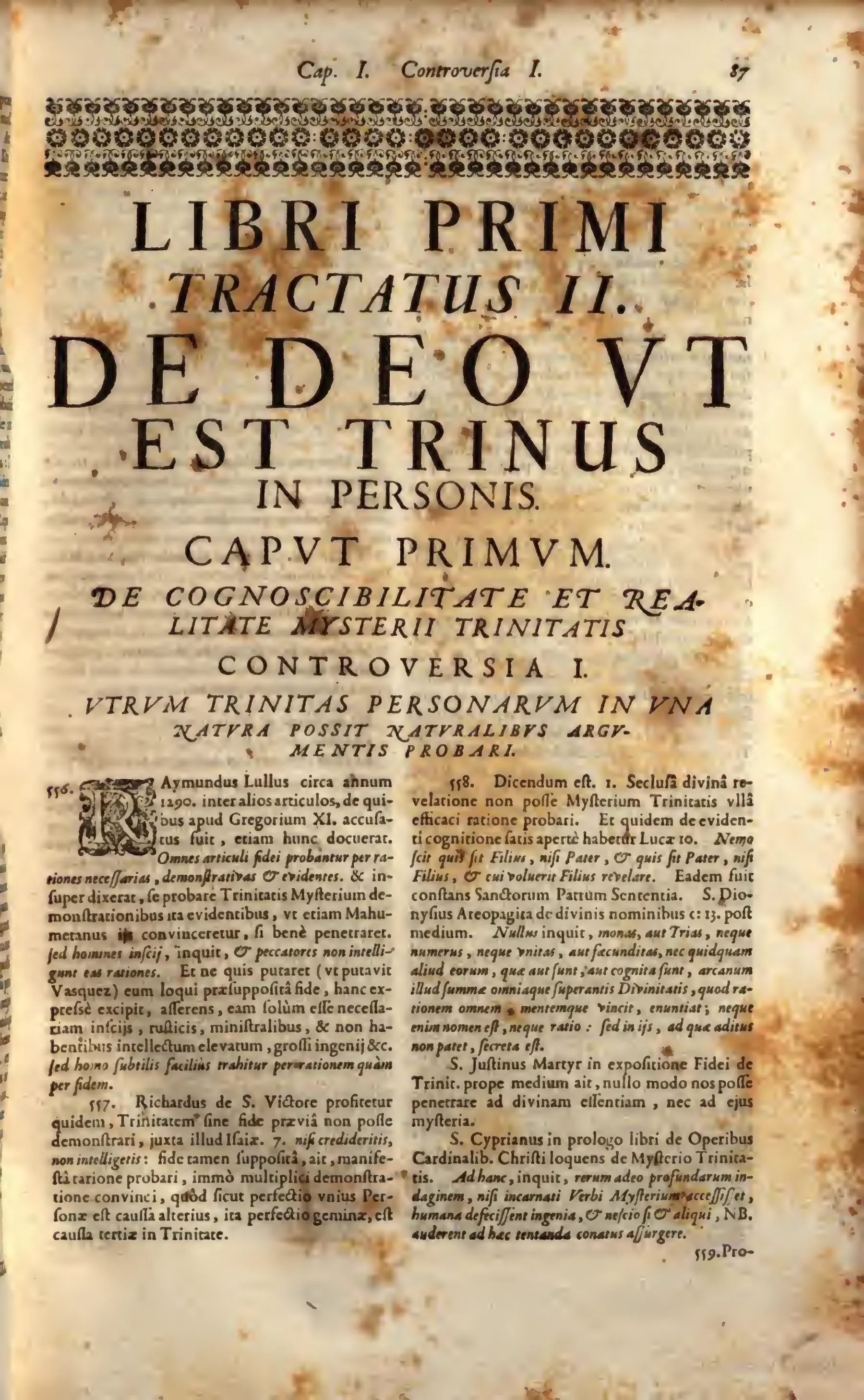
The ornamental headpiece and large display headings open Haunold’s second treatise, where the argument turns from proving God’s existence to the more guarded problem of the Trinity. Against Llull’s demonstrative ambitions, its thesis holds that, apart from divine revelation, the mystery cannot be proved by any efficacious reason. Source ↗.
The opening of the treatise on the Trinity reverses the direction of the argument. Here the task is to set limits to reason rather than extend it. Against Ramon Llull's demonstrative programme Haunold concludes Dicendum est. 1. Seclusâ divinâ revelatione non posse Mysterium Trinitatis vllâ efficaci ratione probari, that without divine revelation the mystery of the Trinity cannot be proved by any efficacious reason. Even after revelation, theology's achievement is carefully graded: Evidens est, non repugnare. Et: Non est evidens repugnare. "It is evident that there is no repugnance" differs from "it is not evident that there is repugnance," and only the weaker claim can be secured.
Yet Haunold refuses the opposite escape of declaring syllogistic rules void in divine matters, since it belongs to true religion Religionis esse debeat, nullum asserere dogma rationi contrarium, to assert no dogma contrary to reason. His solution returns to the termination doctrine. Identity combined with virtual distinction is impossible in creatures for a determinate reason that does not hold in God: itaque in Deo ratio repugnantiæ Identitatis cum virtuali distinctione, quæ militat in creatis, nempe Perfectibilitas, since the ground of the repugnance that tells against such identity in creatures, namely perfectibility, ceases in God. The analogy that earlier supported the doctrine of the divine will now supplies the Trinitarian solution. The mystery of the three Persons and the liberty of the one God are made to explain each other.
The closing stretch of the Trinitarian treatise turns on whether the divine essence generates absolutely or only "under the aspect of relation." Haunold takes the second view, making Paternity the proximate formal principle of generation against Rodrigo de Arriaga, who assigned that role to the essential Intellection and reduced Paternity to a condition. The rational proof rests on one axiom of real distinction: between the formal principle by which something is produced and the term produced by a real production there must be a real distinction, Inter Principium formale Quo, & terminum productum productione reali, debet esse realis distinctio;. Because the essence is common to Father and Son, it cannot by itself be the Quo of a production whose term it already is; only a relative, incommunicable principle can be. The polemic against Arriaga is not conducted by proof alone. Arriaga had imagined numerically one heat placed in a fire at Rome and a fire at Prague. Haunold answers with a counter-case of his own: if God raised him to act at a distance, it would be true that ego (vbicunque tandem existens) produco ignem cum vbicatione Indica, that "I, wherever I may exist, produce fire with an Indian ubi." The thought-experiment is answered on its own terrain, and the first person makes the author himself the test case. That is the scholastic habit of meeting an opponent's hypothesis rather than refusing it.
The chapter on the processions in particular then asks why the Word is Son and generated while the Spirit is not. The inquiry opens on a definition that every subsequent argument tests: generation is the origin of a living being from a living being, by a conjoined principle, in likeness of nature, Viventis, & est hæc. Generatio est Origo Viventis à Vivente, principio conjuncto, in similitudinem naturæ. Before testing it, Haunold declares his method in the passage already cited, in terms that govern far more than this question. He cannot approve those wholly bent on attacking others' positions and admitting only one explanation; it seems more praiseworthy, he writes, to admit several which, though singly insufficient, jointly clarify the matter enough to merit prudent assent.
The parenthesis in that sentence, & non est difficile, "and it is not difficult," carries a quiet barb: refutation is the easy art, and construction the harder one. The structure that follows is built to that plan. Three successive "rationes" are each presented as partial: the unity of the producer against the duality of spirators, the Word's fecundity to spirate, and intentional similitude. None is offered as decisive, and their convergence is what is meant to persuade.
Haunold also has to defuse the patristic warnings against prying into the Son's generation, and he does so with a calibrated reading. The Fathers, he holds, disapproved only an inquiry so contentious that it would rest in no probability but only in evidence, sed solùm improbarunt investigationem adeo contentiosam, vt acquiescere nolis vlli probabilitati, sed soli evidentiæ. The move is subtle. The vice the Fathers condemned is redefined as an excess of demand for certainty, not an excess of curiosity. Sober probable reasoning thus becomes the pious mean between silence and rationalist presumption.
The third ratio reaches the boldest philosophical claim in this part of the course. Enlisting Aquinas, for whom the procession of the Word has the nature of generation because it proceeds by way of intelligible action, which is an operation of life, Igitur processio Verbi in divinis, habet rationem Generationis, procedit enim per modum Intelligibilis actionis, quæ est operatio vitæ,, Haunold must show that the "likeness" of a mental word to its object is genuine, not metaphorical. He does so by reversing the ordinary hierarchy of images. It has always seemed beyond doubt to him that cognition is properly an image of its object, and more so than a painted image: Sanè mihi semper (abstrahendo à præsenti quæstione) indubitatum fuit, quòd cognitio sit Imago propriè dicta objecti, & quidem magis quàm Imago picta:. Representation becomes the paradigm of likeness, and the painter's panel a derivative case. The Word's sonship is thereby secured on ground that Lugo and Arriaga had treated as figurative.
The third controversy defends the impossible hypothesis as an instrument of theology by recalling that the theologians at Florence used it against the Greeks. It asks whether the Spirit would be distinct from the Son if he did not proceed from him, and answers with the Florentine axiom that in God all things are one where the opposition of origin does not intervene, In Deo omnia sunt vnum, vbi non obviar Originis oppositio:. The printed text reads "obviar" for obviat. The axiom makes the Filioque the condition of the Spirit's personal distinctness, and the anti-Greek polemic of the fifteenth-century council becomes the frame of a seventeenth-century school question.
The treatise on angels opens by putting the same graded epistemology to work against Haunold's fellow Jesuits, the Recentiores, chief among them Martín de Esparza. Their arguments for the natural demonstrability of angels are weighed and found wanting: Ego tamen, illis diu expensis, existimo vim congruentiarum non excedere, having long weighed them, he judges they do not exceed the force of congruences. The diu expensis insists that the verdict follows deliberation and is not reflexive scepticism. When the opponents claim that without angels God would have acted like a musician performing for the deaf, or a painter showing a picture to the blind, alioquin Deus egisset instar Musici exhibentis Musicam surdis, aut Pictoris exhibentis picturam cæcis, Haunold turns their image back on them with Seneca. Human spectators suffice for the display of nature, and the teleological argument proves only fittingness. The accommodation is here a restraint. Haunold lowers the epistemic claim in order to keep the doctrine secure from overstatement.
Political commonplaces then enter angelology. Defending, against the Thomists, the multiplication of angels within a species, Haunold argues that an order mixing per se and per accidens ranking is better than a pure one, because a mixed form of commonwealth from both is, in many people's opinion, more perfect than pure monarchy, mixta tamen forma Reipublicæ ex vtraque, est multorum opinione perfectior quàm pura Monarchia. The guarded multorum opinione is characteristic. Haunold borrows the authority of a received opinion without endorsing it as constitutional doctrine, yet the analogy shows how readily the course reads the hierarchy of spirits through the categories of civil order.
The same civic imagination appears in the question of locomotion. If bodies could pass between places without traversing the medium, the greatest confusion of things would arise; no commonwealth could stand; the world would be uninhabitable: summa enim enasceretur confusio rerum; nulla Respublica consistere posset, immò mundus inhabitabilis esset:. Physical possibility is measured against the conditions of ordered social life.
That measure becomes explicit, and juridical, in the controversy on the secrets of hearts. That angels do not know the free interior acts of men or of other angels is certain. Haunold, however, grounds the impossibility not only in the limits of angelic species but in a claim about intellectual nature as such. Such nature, as he puts it in a sentence already quoted, is ordered of itself to political life led in community, with quiet, concord and trust. Such a life would be impossible if every thought lay open, so the opacity of the heart is something nature itself demands, by a kind of natural right. Following Lugo, Haunold supplies a domestic proof: we judge by instinct of nature that the right is violated jus naturale secreti, si alius epistolam à me ad alium scriptam aperiat,, if another opens a letter I have written to someone else. The epistolary norm of the learned and mercantile world is lifted into the order of spirits. A question of angelic cognition is resolved by converting a natural limit into a moral entitlement, the constructive juridical move at its most concrete.
The treatment of angelic grace extends the moral register to the divine side. Angels disposed themselves to grace de congruo, because it is more perfect not to enter friendship except with one who merits it than to thrust one's friendship on one who does not seek it, nam perfectius est, non inire amicitiam nisi cum promerente, quàm suam amicitiam obtrudere non ambienti. The honour of the divine offer is modelled on the decorum of human friendship. That is precisely why Haunold must then fend off the charge that the consequence savours of Pelagianism.
On Lucifer's sin the posture toward Aquinas becomes explicit. Thomas's view that the sin was a preference of natural over supernatural beatitude receives formal homage and substantive resistance: Veneror sententiam ob reverentiam D. Thomæ debitam; adhuc tamen in ea defendenda difficultatem experior, he venerates the opinion out of the reverence due to St Thomas, yet finds difficulty in defending it. His own thesis is that it is more likely Lucifer's sin was refusing subjection to Christ as man-to-come, which God had commanded, DICO, veri similius esse, peccatum Luciferi fuisse, quòd Christo, vt homini venturo, recusaverit subjectionem, quam Deus illi præcepit. The comparative veri similius keeps the thesis within the register of probability. Its coherence depends on the Molinist apparatus: middle knowledge showed which precepts men and angels would obey, Scientia Media ostendit, quibusnam præceptis tum homines tum Angeli essent obtemperaturi;. The fall of the angels thus becomes a case of free disobedience to a conditional precept foreknown, not predetermined.
Where speculation reaches its limit, Haunold says so. Having weighed local binding and a spiritual quality as accounts of how fire torments demons, he rests with Augustine, believing that demons are tormented by fire in true but wondrous, that is unknown to us, ways, credentes Dæmones ab igne torqueri veris quidem, sed miris, hoc est nobis incognitis, modis. The gloss hoc est nobis incognitis converts the patristic "wondrous" into a frank confession of ignorance. The same accumulation of probabilities that licensed bold speculation also marks where it must stop.
Book II: Human Acts, Freedom, and the Rule of Morality
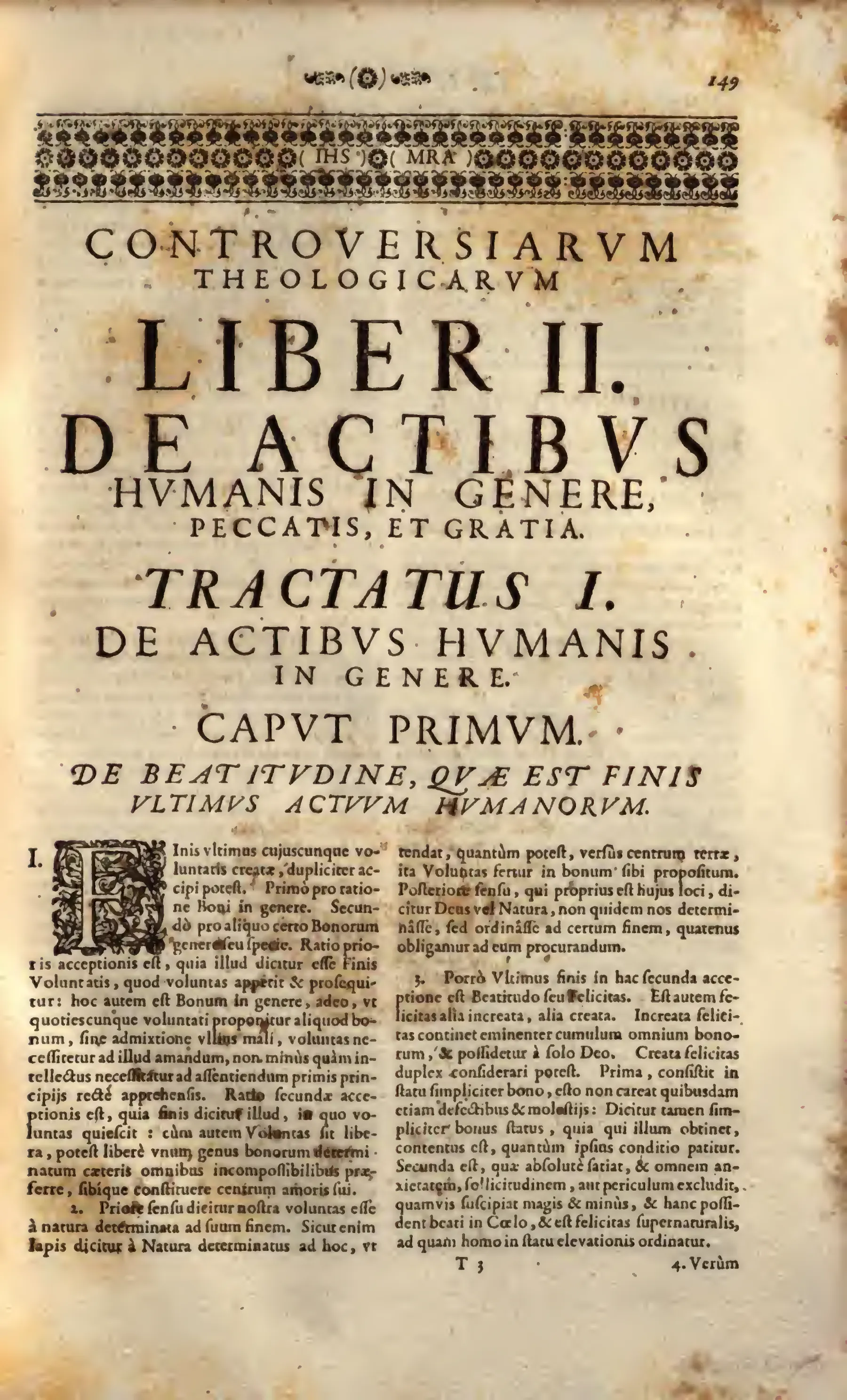
The opening of Book II, headed “De actibus humanis in genere, peccatis, et gratia,” begins with beatitude as the ultimate end of human acts before turning to freedom, conscience, sin, and grace. A Jesuit headpiece bearing the IHS device frames this scholastic analysis of the will. Source ↗.
Book II, on human acts, carries the method into moral theology. Defining formal beatitude as "possession," Haunold first excludes the narrowly legal sense, Possessionem hoc loco non accipi in sensu Iuridico,. He then grounds a broader sense in the common sense of mankind expressed in adages, Amicorum omnia communia. Amicus alter ego: Anime dimidium meæ, "friends hold all in common; a friend is another self; half of my soul." By love of friendship the blessed appropriate God's goods, and Thomist, Scotist and Suarezian positions are reconciled as legitimate senses of one term, the eirenic consequence of the method announced in the Trinitarian treatise.
The chapter on the voluntary is the most densely juridical of Book II's opening chapters. Interpretative consent is tested against the Digest's title de furtis: it is rightly said that whoever thought he touched a thing with the owner's will is not a thief, Rectè, inquit, dictum est, qui putavit, se domini voluntate rem attingere, non esse furem;. Haunold immediately restricts the principle for observant religious houses, where presumption must yield to express leave. Otherwise religious discipline would be weakened and dissolved, and the vow of poverty would be observance in name only, licentiâ; alioquin enervaretur, & dissolveretur Religiosa disciplina, ac votum Paupertatis esset observantia de solo titulo. The speculative distinction bears directly on the government of religious orders.
Fear is then shown to cause a qualified involuntary through the evidence of criminal procedure. A confession extracted by torture does not stand nisi reus post viginti quatuor horas confessionem confirmet,, unless the accused confirms it after twenty-four hours, which Haunold treats as civil recognition that pain diminishes liberty. Finally, invincible ignorance is redefined in moral rather than absolute terms, Ignorantiam invincibilem non accipi à Theologis in sensu stricto,, as ignorance one is not bound to dispel. This last redefinition fits the category to the ordinary capacities and obligations of agents, and in it the logic of accommodation that runs from the Word's likeness to the angels' secrecy reaches the practical judgment of human acts.
Haunold's treatment of culpable inadvertence completes his account of the involuntary. It is less concerned with the abstract metaphysics of the will than with the forensic question of when an agent may be held answerable. Rejecting Arriaga's way of separating the two defects, he states his own criterion: the difference between inconsiderateness and ignorance is that ignorance is the absence of true cognition of the object, Discrimen ergo inter Inconsiderantiam & Ignorantiam hoc est, quòd Ignorantia sit absentia cognitionis veræ de objecto. Inconsiderateness, by contrast, is a voluntary failure to inquire. Its measure is not an ideal of exhaustive scrutiny but the social norm of prudent conduct, the diligence investigationis tantæ, quantam communiter homines cauti solent in similibus casibus adhibere, an investigation as great as cautious men commonly apply in similar cases. The standard of culpability is thus fitted to the ordinary estimation of the prudent. This is the accommodating habit of the course operating at the threshold of moral theology, and it explains why Haunold can welcome, with Arriaga, the prospect that many sins are excused through inconsiderateness.
The chapter De humanæ voluntatis libertate then raises the stakes from imputability to the nature of freedom itself, and it is framed throughout against the Jansenist reduction of liberty to freedom from coercion. Haunold's master definition is exact in its scholastic qualifications: Libertas Indifferentiæ est potentia ad actus oppositos & incompossibiles, non quidem in sensu composito sibi conjungendos. Liberty of indifference, on this definition, is a power for opposed and incompossible acts, not, of course, to be joined together in the composite sense. The distinction between composite and divided sense protects the definition from the charge that it makes contradictories simultaneously actual. The doctrinal warrant comes first from papal authority. Innocent X in 1653, Haunold notes, placed this among the five condemned propositions of Jansen, bishop of Ypres, in the third position: Deinde Innocentius X. Anno 1653. inter quinque propositiones damnatas Iansenij Episcopi Iprenis, tertio loco hanc ponit. Here the course's epistemic boundary appears in its starkest form. On this point, dissent is closed not by demonstration but by a juridical act of the Holy See.
Papal condemnation alone does not satisfy Haunold, however. The decisive contest was over Augustine, whom Jansen's Augustinus had claimed for the opposing side, and Haunold's hermeneutical move is bold. As already noted, he argues that Augustine fought the Pelagian error most vigorously, yet never denied the foundation Pelagius assumed, namely liberty of indifference; he always denied the consequence. The argument converts Augustine's silence into tacit concession, and it does so by appeal to the norms of the schools. Haunold's own formulation of those norms is: Absurdus enim disputator est, qui benè intelligens, quo sensu proferat adversarius propositionem, eam absolutè concedit, sciens esse falsam. He is an absurd disputant who, understanding well in what sense his adversary advances a proposition, grants it absolutely while knowing it to be false. The procedure is revealing. The ethics of the disputation hall, in which the exercitia of the title were conducted, become an interpretive key to patristic texts, and Augustine is read as though he too were bound by the conventions of scholastic concedo and nego.
The same chapter also marks the limits Haunold imposes on himself. Having reached the threshold of grace, he declines to cross it, abstaining, as he says in the sentence already cited, by mandate of the Apostolic See from such treatment, whatever the Discalced Carmelite Philip of the Most Holy Trinity has recently written. The rebuke shows that the silencing of the de auxiliis dispute under Paul V and Urban VIII was still felt as binding by a Jesuit teacher. It shows too that the claim of its lapse was itself a contested move. Freed from the obligation to tie liberty to grace, Haunold also unties it from morality. Against Pallavicino's teleology, which held liberty to be instituted for praise and blame, he insists: fundamentum hujus probationis semper falsum judicavi, dixique, dari exercitium libertatis etiam seclusâ honestate & inhonestate. He has always judged the foundation of that proof false, he says, and has held that liberty is exercised even apart from honesty and dishonesty. Freedom thereby becomes a property of rational nature as such rather than an instrument of moral economy.
Where liberty fails, Haunold turns again to a juridical-theological category. Infantis Theologicè sumpti definitio est: Persona cui ob defectum dispositionis & ætatis deest libertas honestatis & inhonestatis: the infant in the theological sense is a person who, through defect of disposition and age, lacks the liberty of honesty and dishonesty. The definition joins a physiological criterion, cerebral indisposition, to the canonical presumption of the seventh year, so that a status in law is grounded in the condition of the body. When Haunold models the free act positively, he chooses an example from the life of the college: Volo studere, non obstante difficultate, non quidem vt vanum plausum obtineam; sed vt me honestè occupem, & aliquando promovear. The student wills to study despite the difficulty, not to win vain applause, but to occupy himself honestly and someday be promoted. The free act embraces at once an attracting motive, a deterring one, and a neglected one. Choice appears as a kind of victory among competing reasons, offered to an audience of students as an analysis of their own deliberations.
The fourth chapter turns from freedom to its rule. It begins, characteristically, with the proximate: Incipiendum à Regula proxima, quæ vocatur Conscientia, one must begin from the proximate rule, which is called conscience. Conscience does not constitute morality, however. A lie, Haunold argues, is not dishonest because reason dictates it so; rather reason dictates it dishonest because, on the side of the thing, with no one affirming it, it is dishonest: neque enim mendacium est in honestum, quia ratio dictat, sed econtra, ideo ratio dictat esse in honestum, quia à parte rei, nemine affirmante, inhonestum est. This realist thesis governs the treatment of probability that follows. A probable opinion requires fundamentum positivum magni momenti, a positive foundation of great weight. That weight, moreover, is relative, assessed against counter-motives, so that revealed truth can reduce an apparently weighty argument to nothing: ideo opinio hæretica vocatur simpliciter improbabilis, hence a heretical opinion is called simply improbable. Probability is therefore not a measure of how many hands an opinion has passed through. Haunold is pointedly suspicious of the printed digests through which casuistical opinion circulated: constat enim hujusmodi compendia corruptissimè, & cum magno præjudicio fieri eorum authorum. It is established, he says, that such compendia are made most corruptly and to the great prejudice of the authors whose doctrine they profess. The objection is philological as much as moral: an abridgement corrupts the very authority on which an opinion's probability depends.
The defence of probabilism proper, the longest polemical unit of this stretch, is marked by an explicitly Jesuit evidential register. To show, against the pseudonymous "Candidus Philalethes Madritanus," that the will can bend the intellect toward the less probable opinion, Haunold invokes Et primò authoritate S. P. Ignatij, qui ex sensu planè communi, ac tunc temporis indubitato, in aurea sua Epistola de Obedientia. The argument proceeds first, he says, from the authority of our holy father Ignatius, who in his golden Letter on Obedience spoke from a plainly common sense, undoubted at that time. The obedience of judgment, an ascetical ideal of the Society, becomes psychological proof in a speculative controversy. The chief adversary, however, is named directly: causam dedit Prosper Fagnanus, Canonista famosissimus hujus temporis. Prosper Fagnani, the most famous canonist of the age, gave occasion to the dispute. Against the canonist Haunold deploys the civil law: Sic Jureconsulti frequenter vtuntur hoc principio, cùm quærunt v. g. Quis possit facere testamentum? quis possit res suas alienare &c. respondent: qui non prohibetur. Jurists, he observes, frequently use this principle when they ask who can make a will or alienate his goods, and they answer: whoever is not prohibited. The legal presumption of capacity becomes the natural ground of liberty's claim to act on a probable opinion. Haunold cites Fagnani's charge that lax opinions tanquam ex equo Troiano in dies prodeunt, that they issue daily as from a Trojan horse, precisely in order to deny that the consequence follows. The doctrine of possession then completes the juridical construction. Semper ergo possessio bonæ fidei reddit jus certum de continuanda possessione, donec contrarium probetur: possession in good faith always yields a certain right to continue in possession until the contrary is proved. Its political rationale, taken from Pallavicino, is stated with frank conservatism: Expedit enim, inquit, Reipublicæ, vt res permaneant eo modo, quo manent, it is expedient to the commonwealth, he says, that things remain as they are.
The fifth chapter, on the remote rule of morality, complicates the realism of the fourth. Haunold now holds that magis formaliter est desumenda honestas objectiva à voluntate signi, that objective honesty is more formally to be taken from the will of sign. The view leans visibly toward divine signification and stands in some tension with the earlier claim that the lie is dishonest with no one affirming it. The tension is managed rather than dissolved through the "rule of expedience." He sets the final end of all law in a maxim of Roman public law: Summus omnium legum finis est, salus publica. Salus populi suprema lex esto, the highest end of all laws is the public welfare; let the safety of the people be the supreme law. Rational creatures are imagined deliberating on laws before knowing their own lot, and by such reflection they discover the judgment of the Author of nature, cujus lumen signatum est super nos, whose light is signed upon us, in the words of the fourth Psalm. The scriptural verb signatum quietly joins the expedience test to the voluntas signi. The definition that follows is compressed into the formula already discussed: that is honest which it is expedient to be licit. The test is applied to kinds of act, not to single cases. Haunold concedes that posset contingere, vt levi mendacio hostis iniquus averteretur, that it could happen that by a slight lie an unjust enemy would be turned away, and yet the lie remains illicit. What is weighed is the licence to lie, not the particular lie.
Sin, Original Sin, and the Treatise on Grace
Brief chapters on the external act prepare the transition to sin, and their thesis is consistently interior. Chrysostom heads the authorities with the maxim opera autem sunt testimonia voluntatis, works are testimonies of the will, so that the external deed adds no merit beyond the efficacious intention. The treatise De Peccatis opens with a flash of pedagogical impatience at fashionable puzzles about essentially irremissible sin, by which students' wits are exercised but loco granorum colliguntur paleæ, chaff is gathered instead of grain. Haunold's own definition of mortal sin is relational: Voluntaria electio Boni creati præ amicitiâ Dei, the voluntary choice of a created good in preference to the friendship of God. The real distinction of venial sin, denied by Baius and Calvin, then follows from the natural ethics of friendship, in which light offences do not dissolve amity: atqui Deus est amicorum syncerissimus, but God is the most sincere of friends. The rule of expedience returns at this point to fix the gravity of the lie. A wholly permitted mendacity would mean that tanta singeretur licentia mentiendi, vt tandem omnis humana fides nutaret, that so great a licence to lie would be imagined that at last all human faith would totter. A venial prohibition suffices to avert that harm, so the lie is always sinful but only lightly. The theology of sin is thus measured by the same calculation of social trust that governed the honest, and the same reasoning carries Haunold into the gravest question of the treatise: how God concurs immediately in the act of sin without becoming its author.
The sin controversies then open on the oldest difficulty in the Molinist account of providence: how God can concur in every created act without becoming the author of the evil ones. Following Cardinal de Lugo, Haunold places the "true reason" not in any appeal to God as a merely universal cause, which he rejects, but in the intention with which concurrence is offered. God acts applicando suam Omnipotentiam ad concursum disjunctivum, ita tamen, vt potiùs ex se intendat & desideret actum bonum: he applies his omnipotence to a disjunctive concurrence, yet in such a way that of himself he rather intends and desires the good act. The disjunction is the hinge of the solution. Divine power is offered toward either member, but divine desire is not neutral. Responsibility therefore follows whoever closes the disjunction.
Lugo had developed this point through an elaborate model of the habit of charity subordinated to the will. Haunold reduces it to a single criterion. God is determined by man ideo Deum determinari ab homine, quia homo vitaliter influit in actum, & verè movetur ab objecto illius, eligitque inter illa, habens in sua potestate proxima actum oppositum, that is, because man vitally flows into the act, is truly moved by its object, and chooses among alternatives while holding the opposite act within his proximate power. In this compression, the libertas indifferentiae that grounds the course's doctrine of God becomes a rule of moral attribution: the effect is ascribed to the agent who holds in himself the power to the opposite.
Haunold is careful to present this as continuous with Thomas rather than as a Jesuit novelty. Of his three analogies, the most traditional is the limp, of which sed claudicationis quâ talis causâ simpliciter dicitur esse curvitas tibiæ, non potentia, the cause of limping as such being called, without qualification, the crookedness of the shin and not the locomotive power. The other two analogies are more telling for the course's habits of mind. One is the borrower at usury. The other is the co-combatant in a just war, set beside the priest who gives the Eucharist to an occult sinner. Both are juridical and pastoral cases. Before any later treatise names the confessional, the defence of divine innocence is already being argued in the idiom of licit cooperation.
That practical horizon becomes explicit when the course turns to the specific distinction of sins. Haunold separates his inquiry from the philosophers' question of physical specification. He asks about difference in ordine ad explicandam vel dijudicandam differentiam peccatorum pro tribunali sacramenti Poenitentiæ, with a view to explaining or judging the difference of sins before the tribunal of the sacrament of penance. He reviews the four received rules and finds that none is final: the judgement of the prudent, diverse dictates of conscience, diverse precepts, and opposition to diverse virtues. The last of these is the rule he attributes to Valentia, Becanus, and Bonacina.
His own rule is that sins differ in species where specialis ratio illud prohibendi reperitur, where a special reason for prohibiting each is found. The rule is operational rather than definitional. Haunold tests it by a counterfactual dispensation: imagine one sin made licit, and ask whether a reason to forbid the other still survives. When the test is applied, its grounds prove strikingly concrete. Drunkenness joined to fornication yields two species, nam privatio vsus rationis non facilè reparabilis, est malum nullo modo contentum in malo fornicationis, because the loss of the use of reason, not easily repaired, is an evil in no way contained in the evil of fornication. The governing principle is stated in terms of & in hac diversitate & separabilitate incommodorum impedientium felicitatem humanam, the diversity and separability of the harms that impede human felicity.
This is the same reasoning that elsewhere in the course makes the honest coincide with what it is expedient to permit. The moral species of an act is read off from the distinct injuries that prohibition guards against. A natural kind of the act plays no part in the test. The controversy nonetheless closes without dogmatism: Et hæc in hac obscura quæstione sufficiant, in qua libenter ab alio meliora edocebor, so let these things suffice in this obscure question, in which I will gladly be taught better things by another. The formula is conventional, but it is not empty. It marks the conclusion as preferable rather than demonstrated, which is the epistemic register the course consistently claims.
The treatment of the numerical distinction of sins shows that register at work in practice. Against Ledesma and Zanardo, Haunold requires penitents to confess the number of homicides, copulations, and blasphemies. He then immediately limits the force of his own stricter opinion: Quodsi praxis seu Pænitentium, seu Confessoriorum alia est, illa defendi potest probabilitate contrariæ sententiæ, if the practice of penitents or confessors is otherwise, it can be defended by the probability of the contrary opinion. The speculative theologian proposes a view, but the confessor's practice is not bound by it. This is the probabilist settlement in miniature, set inside a lecture course and not a manual for confessors.
The criterion for when an act is morally interrupted is equally accommodated to ordinary human conduct. Haunold measures interruption a communi modo operandi hominum, by the common manner in which people act. His illustration is the official at solemn Mass, quando inter Missarum solemnia sit Concio etiam per horam, & ibi Officialis attendit, immò etiam obdormiscit, when during the solemnities of Mass there is a sermon lasting even an hour, and the official attends there and even dozes off. The common estimation still judges his hearing of Mass to be one continuous act. Here the unity of a moral act is assigned by the shared judgement of the community, much as the species of a sin was assigned by its separable harms.
Haunold's account of habitual sin carries this method into the doctrine of sin itself. His starting point is a datum of Christian estimation: Evidens est, hominem post peccatum manere habitualiter maculatum & dignum odio, it is evident that after sin a person remains habitually stained and worthy of hatred. He then refuses to locate that stain in any physical quality. He also treats as merely probable the widely held view that it is the privation of grace dependent on past sin. His "truer sentence" defines habitual sin as the past sinful act together with the negation of condign satisfaction and of gratuitous condonation. The analogies are debt and the civil stains of infamy, illegitimacy, and excommunication. The macula thus persists the way a legal condition persists. Its continuance is a matter of moral aestimatio, not of any entity inhering in the soul.
The definition of original sin is built on the same pattern. It holds, in the covenantal formula already quoted, that the sin consists in Adam's sin with the negation of condonation regarding those of his posterity who were included in the pact. What makes the inclusion intelligible is the preceding argument for the "binding" of posterity's wills to Adam's. That argument draws on Roman-law tutelage, curatorship, patria potestas, adoption, and pupillary substitution. On this model, a magistrate may constitute a pupil's will in the person of another, and God's dominion over his creatures exceeds any commonwealth's authority over its members. Haunold does not leave the pactum as a figure of speech. It is a jurisdictional construction, and he argues that inclusion in it was objectively to posterity's advantage.
When the course reaches the fate of unbaptised infants, its juridical confidence gives way to a policing of conjecture. Haunold surveys the topographies proposed for the infants' abode, Salas's swimming infants, and Arriaga's suggestion that God would give them a language. He then dismisses the whole display: Retuli hæc, vt appareat, quousque liceat in hac materia divinare, I have reported these things so that it may appear how far one may go in divining in this matter. The irony serves a methodological limit. Accumulating probable explanations is commendable, but speculation unsupported by authority or reason becomes divination.
Haunold's own position remains restrained. Following Thomas and Innocent III, he holds that the infants suffer no pain of sense. Among the explanations of whether they grieve, he prefers joy at having escaped hell, together with their capacity to turn their attention elsewhere.
The controversy on whether the temporal debt of the damned is punished eternally shows how far the course's penal reasoning can unsettle a common opinion. Haunold examines the standard arguments for perpetual punishment and finds them weak. One of them assumes that punishment aims at correction, and he breaks it with a distinction drawn from criminal theory: Duplex enim est poena, Medicinalis, & Exterminativa, vt aliqui vocant, for punishment is twofold, medicinal and exterminative, as some call it. A threatened penalty, like a capital sentence, must be executed even on the incorrigible, lest the threat become empty ceremony.
Against Pallavicino's ingenious a priori proof from Thomas, Haunold is sharper still. He quotes his confrère at length and charges that the reasoning falls into petitio principii. He adds that the proof est contra communem sensum fidelium, it is against the common sense of the faithful. The sense of the faithful operates here, as in the casuistry of number, as a criterion of truth. Haunold ends by leaning toward the probability of Scotus's sentence that such punishment ceases. A Jesuit thereby inclines against the common view while carefully remaining within the space of the probable.
The treatise on grace opens on firmly Tridentine ground. Haunold defends inherent justice against forensic imputation, and he quotes the Council's definition that Iustificatio, inquit, non est sola peccatorum remissio, sed & sanctificatio,, justification is not the remission of sins alone but also sanctification. The formula does double work in his hands. It refutes the Protestant reduction of justification to non-imputation. It also shows that remission and sanctification are conceptually separable. That separability prepares the long argument that mortal sin could probably be remitted by "extrinsic condonation" without the infusion of any incompossible gift.
Method surfaces candidly when Haunold decides whether grace is really distinct from charity. Finding the arguments on both sides inconclusive, he settles the question by deference: ob reverentiam Angelico Doctori specialiter debitam, magis placet sententia affirmativa, out of the reverence specially owed to the Angelic Doctor, the affirmative opinion is preferred. Where reason leaves the question open, authority may tip prudent assent, and the passage admits this without apology.
The defence of extrinsic condonation is where the juridical recasting reaches its densest form. The objection holds that a human remission which leaves the debtor's intrinsic state unchanged would imply fiction, and therefore falsehood, if it were transferred to God. Haunold answers it on the opponent's own terms, turning the opponent's own premises back against him: Deus tuâ lege & pacto finxit nostras voluntates esse voluntates Adami, God by your law and pact feigned our wills to be the wills of Adam. If the fictio iuris already underlies the doctrine of original sin without imputing mendacity to God, it cannot be refused to condonation.
The disparity between human and divine remission then rests on a maxim of the Roman law of wills. Among humans voluntas Testatoris sit semper revocabilis & ambulatoria vsque ad mortem, the will of a testator is always revocable and ambulatory until death. God's immutable will, by contrast, extinguishes the right outright.
Haunold also has to meet the sophism attributed to Averroes, that an eternal act cannot ground denominations which change in time. He answers with an example from the law of property: ego volo librum hunc esse meum per hanc horam, sed post horam volo esse primò occupantis, I will this book to be mine for this hour, but after the hour I will it to belong to the first occupant. A single unchanging volition yields successive legal states.
The same resources explain why grace, as a sign, can never be false. Sacraments, he argues, signify ad placitum and conditionally, like the vendor's Vendo tibi equum centum florenis, I sell you a horse for a hundred florins. That declaration signifies truly even when the buyer's consent is wanting, so a sacramental sign is not falsified when grace is not conferred.
The opening of the treatise on the necessity of grace shows that the juridical vocabulary sits alongside the natural philosophy of the schools. A modern theologian, active first in Spain and then at Rome, held a position that Haunold aligns with Baius's condemned twenty-seventh proposition. Against him, Haunold defends God's power to create man with unsubjected concupiscence. His a priori ground is drawn from faculty psychology. Sense acts before reason, and per sympathiam operatur etiam phantasia & appetitus sensitivus, through sympathy the imagination and the sensitive appetite also operate. The rebellion of the lower powers is thus natural to a composite creature. Its subjection, in the state of integrity, appears as a supernatural favour and not as a debt owed to nature. The argument completes the pattern of these treatises: what the opponent treats as necessity Haunold reclassifies as gift or as legal disposition, preserving at every step both the freedom of the created will and the gratuity of God's dealings with it.
The same treatise then measures fallen nature against the hypothetical state of pure nature, and that comparison is phrased throughout in the vocabulary of debt. Haunold distinguishes what nature is owed determinately from what it is owed only indeterminately. As to the first, fallen man is no weaker than pure man would have been, for the despoiled man is not thereby less a man than the naked one. As to the second, the fall has altered the economy of secondary causes. Sin has handed the demon a new jurisdiction over human weakness, adeo quidem, vt ipsi esset moraliter impossibile resistere, nisi adjuvarentur gratiâ per Christum: atqui hanc potestatem non habuisset demon in statu Naturæ puræ. Resistance, in other words, becomes morally impossible without Christ's grace, a power the demon would never have held over pure nature.
The qualifier moraliter carries the weight of the whole later argument. Fallen nature is not physically incapacitated. Its powers remain formally intact while their effective exercise is placed beyond reach. When an objector protests that a nature unable to reach its end without outside favour would be badly made, Haunold answers with Pallavicino that a thing is non id esse malum, quod non potest consequi suum finem proprijs viribus, secluso omni favore extrinseco: not bad merely because it cannot attain its end by its own powers, all extrinsic favour set aside.
He then reverses Pliny's lament over human helplessness into a providential design. Nature voluit nectere homines inter se arctissimâ charitate, ex qua existeret Societas humana, willing to bind men together in the closest charity so that human society might arise. Insufficiency is thus recast as a principle of sociability, the same move by which the course elsewhere grounds rights in the communal ordering of intellectual nature. The section closes on the parable of the Good Samaritan. Man lies stripped and wounded, half-dead, nisi supervenisset Samaritanus Christus, qui vires ad resistendum auxisset, unless Christ the Samaritan had come and increased his strength to resist. The verb auxisset is exact: grace augments natural powers rather than replacing them, so the patristic image is made to carry a Molinist anthropology.
The heresiological survey that opens the third controversy treats the history of error as a sequence of failed reconciliations of grace and liberty. Pelagius, vt tueretur libertatem, negavit Gratiam, & hocipsum, denied grace in order to protect liberty. The Predestinarians committed the opposite fault: & sic sub specie & titulo Gratiæ, induxerunt fatalem necessitatem, vocatique sunt (satis ineptè) Prædestinati. Under the appearance and title of grace they brought in a fatal necessity, and were rather ineptly named Predestinarians. The genealogy runs from these ancient fatalists to the reformers and Jansenists, which implicitly places the Jesuit course at the mediating point that every heresy missed.
The tone shifts, however, when the survey reaches Michael Baius. Of the Louvain theologian Haunold writes qui laudandus ex eo est, quòd cum debita Sedis Apostolicæ observantia revocaverit propositiones, vt jussus erat: he is to be praised because, with due reverence for the Apostolic See, he revoked his propositions as he had been commanded. Doctrinal error is here partly redeemed by obedience, and that standard of submission binds the author himself. On the efficacy of grace he declines to write, since writing on it de qua scribere veritum est à Sede Apostolica, vt jam superiùs monuimus, has been forbidden by the Apostolic See, as he has already warned. Baius's retraction and Haunold's own silence on the De auxiliis question are presented as two forms of a single virtue.
The fifth controversy, on the late-medieval axiom that God does not deny grace to one who does what lies in him, is where Haunold's constructive theology of the unevangelized takes shape. Having weighed and dismissed rival readings, he dispatches Esparza's with the curt Hanc explicationem ego non capio, "this explanation I do not grasp." He then states the common view in carefully hedged form, the thesis already quoted: to one who for some time keeps the natural law by natural acts, God in his goodness will infallibly provide supernatural grace morally and proximately sufficient for salvation, if the person will cooperate.
The infallibility rests on divine goodness, not on any claim the agent possesses. Its warrant is Aquinas's child raised in the forest: Si aliquis in sylvis nutritus, duclum rationis naturalis sequeretur in appetitu boni & fugâ mali, certissimè est tenendum. The printed text reads duclum for ductum. The sense is that if one raised in the woods followed the guidance of natural reason in seeking good and fleeing evil, it must be held most certainly that God would provide what is necessary.
The difficulty is to make natural virtue matter without making it merit, which Trent's condemnation of the Semipelagians forbids. Haunold first tests Pallavicino's courtly analogy of congruity, Eodem modo si Rex ex sua humanitate vellet ducere vxorem aliquam ex privatis subditis, congruum esset, vt eligeret meliùs moratam: if a king out of benevolence wished to marry one of his private subjects, it would be fitting for him to choose the better-mannered. He finds a flaw in it. The woman's virtues would in truth merit the royal choice de congruo, so the analogy collapses back into the merit it was meant to avoid.
His own solution borrows a term from natural philosophy. Natural moral works habere se vt Removens prohibens in ordine, standing as a remover of an impediment in the order of grace. What they remove is not the entity of sin but a degree of unworthiness. In his words, seu, faciunt ex magis indigno minùs indignum quoad æstimationem: they make the more unworthy less unworthy as regards God's estimation. The decisive term is æstimatio. As with condign merit later, the theological relation is located in a judgment of value rather than in a physical change, and that judgment is in turn grounded in Christ's merits and a congruent divine decree. The dossier on Proverbs 16 then closes with an Augustinian maxim that guards the boundary, Quapropter multa facit Deus in homine bona, quæ non facit homo, nulla autem facit homo, quæ non facit Deus, vt faciat homo: God does many goods in man that man does not do, but man does none that God does not do so that man may do them.
The sixth controversy brings the medical vocabulary of the schools into soteriology. Against Martín de Esparza, who held all temperaments equally disposed to salvation, Haunold maintains a difference ratione Indolis & Complexionis Naturalis, secluso omni extrinseco, by reason of natural disposition and complexion, everything extrinsic set aside. He enlists Galen and the ascetical writers for this position. The argument discloses the assumptions of a learned culture, for it holds that Idololatria, quæ est peccatum gravissimum, sicut & infidelitas, faciliùs icurratur ab idiotis, quàm à doctis & ingeniosis: idolatry, the gravest sin, like infidelity, is more easily incurred by the ignorant than by the learned and talented. The printed text reads icurratur for incurratur.
This claim sits in evident tension with the course's elsewhere-stated esteem for the meritorious faith of peasants. The two positions are reconciled only by distinguishing ease of access to faith from merit in holding it. Haunold then turns Esparza's own social typology against him: Hinc sequitur, quòd qui est inclinatus ad Mercaturam, sit in majore periculo damnationis, quàm qui est inclinatus ad militiam. It follows on Esparza's premises, he argues, that one inclined to commerce stands in greater danger of damnation than one inclined to soldiering. Esparza had dismissed the opposing majority as the "infinite" number of fools in Ecclesiastes, and Haunold closes with rare wit, Et hac mihi in hac quæstione sufficiunt, vt non erubescam esse ex numero Infinitorum: these considerations suffice for him not to blush at being counted among the infinite.
Controversies VII to X return to moral impossibility and set an argument from experience beside the a priori account of fallen weakness. Among so many thousands, Haunold observes, ex tot millenis vix vns aut alter reperitur, qui longo vitæ tempore, inter frequentes peccandi occasiones potius, non peccet mortaliter, scarcely one or two are found who, over a long life amid frequent occasions, do not sin mortally. Yet he refuses to let such frequencies define what the Church teaches.
The governing text is Trent's canon on venial sin: Si quis, inquit, hominem semel justificatum, dixerit posse in tota vita peccata etiam venialia vitare, nisi ex speciali Dei privilegio, quemadmodum de B. Virgine tenet Ecclesia, anathema sit. It anathematizes anyone who says a justified man can avoid even venial sins through his whole life except by a special privilege of God, as the Church holds of the Blessed Virgin. Esparza had reduced moral necessity, by an analogy with dice thrown a thousand times, to nothing more than quàm summa improbabilitas oppositi, the supreme improbability of the opposite. Haunold replies with a hermeneutical principle, Non enim credo, voluisse Patres definire hanc veritatem philosophicam: he does not believe the Fathers of the Council wished to define this philosophical truth. The episode is instructive for the course's probabilism. Haunold accommodates readily to probable reasoning in moral judgment, but he denies that a conciliar definition can be dissolved into calculation of likelihood.
The chapter De Merito recasts the relation of reward to work within an explicitly civic frame. The baseline is Aquinas's definition, Dicitur aliquis, inquit mereri ex condigno, quando invenitur æqualitas inter præmium & meritum secundùm rectam æstimationem: one merits condignly when equality is found between reward and merit according to right estimation. Estimation returns here as the measure, and Haunold supplies a political rationale for it, Quia in omni Republica bene ordinata, expedit non solùm proponi poenas ad absterrendum ab operibus malis, sed etiam præmia. In every well-ordered commonwealth, he argues, it is expedient to propose not only penalties to deter from evil works but also rewards.
Lugo's soldiers, generals, stable-boys and graded nobility belong to this frame, but the deepest ground of condignity is filial rather than mercenary. In Haunold's words, Gratia est semen Gloriæ, & constituit filium adoptivum ac Hæredem vitæ æternæ: grace is the seed of glory and constitutes the adopted son and heir of eternal life. Hence the chapter's recourse to inheritance law, with the legitima, the heir ex asse, and the peculium. A second juridical premise, taken from Esparza, then restricts merit to the wayfarer: Præmiatio est quædam compensatio operis in alterius gratiam exhibiti. Reward is a kind of compensation for a work performed in another's favour, so strict merit entails forgoing some temporal good. The blessed, who have nothing left to renounce, therefore cannot merit.
Book III: Faith, Hope, and Charity
Book III opens by giving the vocabulary of debt its metaphysical form. 6. DICO, Ens Supernaturale est illud, cujus existentia nullius substantiæ creatæ viribus aut exigentiæ debetur: a supernatural being is that whose existence is owed to the powers or exigency of no created substance. The supernatural is thus defined by the absence of any title, the same juridical idiom that structured the treatise on fallen and pure nature.
From this footing Haunold attacks a recent theory meant to secure the faith of simple believers. Its authors, he says, qui uescio quale Discerniculum objectivam supernaturale pro stabilienda fide Rusticana in scholas invexerunt, brought into the schools some supernatural objective discriminator, he knows not what, to stabilize rustic faith. The printed text has uescio for nescio. His scorn is for the novelty of the device, not for the faith of the peasant it purports to protect.
The analysis of the resolution of faith reaches its climax in Haunold's adoption of Lugo's solution. On this view, motiva credibilitatis non habere meram rationem Auctoritatis Humanæ, sed esse reverà testificationem & locutionem divinam: the motives of credibility have not the mere character of human authority but are in truth divine testimony and speech. The structure that makes this possible is again a juridical one. Revelation reaches believers sicut per totum Imperium propagatur Edictum Imperatoris, mediantibus Ministris, Prætoribus, just as an emperor's edict is propagated through the whole empire by ministers and praetors.
Under this figure, the Church's transmission becomes the lawful promulgation of a sovereign word. Mediation does not dilute the authority of the speaker, just as a praetor's proclamation remains the emperor's law. The image completes this stretch of the course's argument. Grace has been treated as owed and unowed favour, merit as reward in a well-ordered commonwealth, and the supernatural as existence owed to no creature. Faith, finally, rests on a divine edict carried to every subject of the realm.
The treatise on faith turns, as this solution shows, on one technical problem. The formal object of divine faith is God revealing, yet almost no believer hears God speak; the faithful receive their articles from councils, preachers, parents, and parish priests. Haunold's answer is to treat every channel by which a past revelation reaches an individual as itself a mode of divine speech, a locutio Dei mediated through human instruments. He claims Thomas Aquinas for this position with a dictum from the Sentences commentary that he regards as beyond further clarification: we believe a man not as a man, but inasmuch as God speaks in him, Nos credere homini non vt homini, sed quatenus in eo loquitur Deus, seu Deo in homine loquenti. The appeal to Thomas is strategic. The resolution of faith he defends is substantially that of Juan de Lugo, and enlisting the Angelic Doctor lets a Jesuit position present itself as the plain sense of the common master of the schools. To this he adds an observation he flags as possibly his own. Every external and sensible divine speech, he argues, contains a constituent that carries, taken by itself, only human authority or natural certainty. Even Christ's human voice signified through humanly instituted words, and even Peter's healing at the Beautiful Gate was apprehended through ordinary perception. Human mediation is therefore not a defect peculiar to post-apostolic belief. It is built into revelation from the beginning.
The test case for this account is the unlettered believer. If peasants and children taught by parish priests are to believe by divine rather than human faith, the difference between their assent and the theologian's must be one of explicitness, not of kind. Haunold borrows Lugo's formulation to make the point: what the peasant conceives confusedly and crudely, the theologian conceives too, Hoc ergo ipsum (inquit Lugo) quod rusticus concipit confusè, & crasso modo, concipit Theologus. His own "very brief" supplementary argument is juridical in structure. A pastor who imposes a grave obligation to believe is, by that very act, doing nothing other than declaring that he speaks in God's name, quam dicere, se loqui nomine Dei. The parish priest is cast as an envoy whose words bind by delegated authority, in the way a praetor's promulgation carries the emperor's edict or a proxy concludes a contract. In this way the course's habit of recasting theological relations as legal ones reaches into the act of faith itself. Ministerial preaching is modelled on the law of agency, and the question of whether the pastor must personally intend to speak as God's legate is answered from the analogy of the promulgation of human law.
The objection of a vicious circle presses hardest on this construction. Scripture seems to be believed on the Church's word, and the Church's infallibility on Scripture's. Haunold replies that the Church "with its whole apparatus" is credible ex terminis, even to a pagan who has never read Scripture, and he works the reply out as a graded itinerary. Its first step lies wholly within natural reason: the Gentile can know by the light of nature that it is prudently undeniable that some true religion pleasing to God must exist, Potest insuper Gentilis Lumine Naturæ cognoscere, esse prudenter innegabile, quòd debeat existere aliqua Religio vera, Deóque grata. Comparison of the Roman Church's "arguments" with those of rival sects follows. Then, under illumination, comes a sequence of beliefs: the Church's freedom from error about its own foundation, the canon, its monarchical constitution, and finally the infallibility of its head. The movement culminates in an exclamation, behold how universal infallibility can be believed on account of particular infallibility, Ecce! quomodo Infallibilitas Vniversalis credi possit propter Infallibilitatem particularem. The argument thus escapes the circle by stages. A narrow, self-referential immunity from error, concerning what the Church is, grounds the broad doctrinal authority that would otherwise presuppose it. Because papal monarchy is treated as essential to the Church's constitution, the pope's infallibility becomes a consequence of ecclesial self-knowledge rather than a separate premise.
Haunold is aware that a theory of God speaking to each believer through the Church may look like the Protestant spiritus privatus under another name. He deflects the charge by retorsion, quoting the Wittenberg edition of Luther to show that the common sense of the faithful, even in Luther's own day, held that since the mouth of God is the mouth of the Church, and God cannot lie, neither can the Church: cùm os Dei sit os Ecclesiæ, & Deus non potest mentiri, ita nec Ecclesia. The confessional boundary becomes a frontier he polices in both directions throughout the treatise. Divine speech must reach the individual, but it may do so only through public, ecclesial mediation.
That frontier governs his treatment of revelation that is "virtual" or given only in genere. Here he constructs, with Sforza Pallavicino, a rule distinguishing two kinds of general revelation. Some are made only so that they be believed in general. Others are made so that they be believed of particular individuals, and in these cases moral evidence enters the very structure of the revelation. The formula is compact: & sic certitudo illa moralis est complementum locutionis divinæ, and thus that moral certainty is the complement of the divine locution. The notion of a "complement" allows him to account for dogmatic definition without conceding an expansion of the deposit. In this sense, he affirms, the common axiom holds true, est effatum commune: Non datur nova revelatio in Ecclesia, that there is no new revelation in the Church. A conciliar definition supplies a new locution that completes what was revealed generically. It adds no new matter, which is why councils cannot produce canonical Scripture.
The rule cuts in more than one direction. Haunold denies that the consecration of a particular host, or one's own state of grace, is de fide, breaking here with Suárez, Hurtado, Lugo, and Ripalda. Yet he affirms, against Torquemada, Cajetan, and Cano, that the legitimacy of the reigning pope and of Trent is matter of faith. To show how a particular can fall under a general promise, he draws on the material conditions of the printed book. God did not formally reveal that the printed Gospels we hold in our hands, in the text in which they are printed, are the Word of God, Evangelia impressa, quæ nos in manibus habemus, eo contextu quo impressa sunt, esse Verbum Dei. The integrity of the printed text is nonetheless believed through moral certainty completing a general revelation. The same logic then descends to the present moment. The minor premise of his syllogism names the man whom the whole Church receives as Peter's successor, qualis est hodie Clemens IX, such as Clement IX is today. With this concrete term, abstract fundamental theology is fixed to the year in which Haunold says he is writing.

Carlo Maratti’s portrait of Clement IX, now in the Hermitage, depicts the pontiff Haunold names as reigning: “qualis est hodie Clemens IX.” The phrase ties an abstract doctrine of papal succession to a living pope, and so to the year of writing. Source ↗.
_-_Hermitage_Museum.jpg)
The hardest objection to this appeal to the reigning pope concerns an occult canonical impediment invalidating an election. Haunold answers with the course's characteristic pragmatism, endorsing Pallavicino's judgment, already quoted, that it is better for the Church to hold as true pontiff someone invalidly elected than unknowingly to lack a true pontiff. Universal acceptance works as a quasi-second election, likened to usucapion or prescription. It is then fortified from the Digest, where Ulpian, considering the fugitive slave who served as praetor under the lex Barbarius, declares that none of his acts should be rejected, verum puto, nihil eorum reprobari: hoc enim humanius, because this is the more humane course. The transfer of a ruling from the imperial magistracy to the papal see shows Roman jurisprudence supplying the theory of the Church's visible head. It also exposes a tension the argument carries without resolving. The supernatural certainty of faith is secured here by a legal fiction of public utility.
Haunold's second chapter turns from the formal motive of faith to the credibility of the mysteries, and here the argument becomes historical and comparative. Of the eight general motives that rank one religion above another, he presents the last as the most powerful: the manner of propagating religion without force, without arms, without blandishments, Octavum, Modus propagandi Religionem, sine vi, sine armis, sine blanditijs. The claim sits uneasily beside the coercive confessional order of seventeenth-century Bavaria, and the text does not acknowledge the tension. Its evidential weight rests instead on the primitive Church and the Japan missions.
The longest polemic of the treatise is directed against the Discerniculum, a supposed supernatural inner criterion by which simple believers could distinguish a pastor's true articles from false ones. Haunold reports the Pallavicinian version, developed by his own Jesuit colleagues, in the form of the voice such an illumination would utter: "I am the voice of God, inimitable by nature, and I certify you (that is, the peasant) that the pastor now speaks the truth," Ego sum vox Dei, inimitabilis à natura, & certifico te (hoc est rusticum) quòd Parochus nunc verum dicat. Against it he sets a test of public credibility, asking whether the Jew would not laugh at such an instructor, Iudæus rideret talem instructorem?. A motive of faith must be one that can be alleged to an outsider. An incommunicable illumination fails that test, and in failing it collapses into the heretics' private spirit. The opponents are fellow Jesuits, and the dispute is an internal one. Haunold's refusal of an experiential criterion protects the public, ecclesial mediation on which his whole theory depends. In its place he holds that "respective" motives, chiefly the pastor's authority, suffice for the simple to elicit supernatural faith.
The chapter on certainty shifts the source of faith's firmness from intellect to will. Haunold defines formido, the fear of error, as a reflex judgment by which we judge that, in assenting to an obscure matter, we stand in proximate danger of erring, in Iudicio reflexo, quo judicamus, nos assentiendo rei obscuræ versari in periculo propinquo errandi. Because this judgment can be voluntary, and even imprudent, doubt is not excluded by the intrinsic mode of faith's act. Instead the will's command suppresses it. His analogy comes from his own university, where Professores Ingolstadiani jurant, se velle Immaculatam: the Ingolstadt professors swear that they will uphold the Immaculate Conception, conditionally on the Apostolic See not defining the contrary, and yet with firm adhesion. The voluntarist thesis yields the treatise's most pointed inversion of intellectual hierarchy. Assent on weaker, "weakenable" motives demands greater affective firmness, so the faith of peasants is, in the formula already cited, of greater merit than the faith of the learned whose motives cannot be weakened. The epistemic disadvantage of the rusticus, which the treatise laboured to show did not disqualify his faith, becomes a positive title to merit.
The closing chapter secures the outer boundary of the whole edifice against the nominalists Holcot, d'Ailly, Wodeham, Almain, and Biel. God cannot reveal falsehood, and no supernatural act of faith can tend toward a merely apparent revelation. The warrant is Trent's teaching that the certainty of faith is such that falsehood cannot underlie it, falsum subesse nou posse. The final controversy therefore guarantees, at the level of divine veracity, the infallibility that the preceding chapters had distributed across pastors, councils, printed Gospels, and an accepted pope.
Within that chapter, the essential truth of the act of faith is first secured by a philosophical argument and then fenced in by an institutional one. Against Ripalda's concession that a supernatural act might be a per se cause of a false conclusion, Haunold prefers Lugo's reply that faith is only an accidental cause of error. He finds the deeper reason in Pallavicino, for whom every true cognition is ordered to the good of the intellect. Such a cognition is something that potest esse semen novæ Scientiæ & veritatis acquirendæ, that is, something that can become the seed of new knowledge and truth still to be acquired. The image is agricultural and generative. Truth is valued here as a principle of further growth within the intellect, not merely as a correspondence achieved.
When the question rises to whether faith could be false even by divine absolute power, demonstration recedes and consensus takes command. Haunold declares, in the principle already noted, that the common consent of the Doctors in a purely theological matter must carry the greatest weight, so that one cannot depart from it without rashness. The principle is stated in the language of temeritas, the technical note of censure in the theological schools.
Its disciplinary edge becomes visible in a remarkably candid notice about a fellow Jesuit: Eandem tandem tenet Oviedo, licet quodammodo invitus, & territus Censuris, quas esset subiturus, si aliter doceret. Oviedo, he reports, at last holds the same view, though somewhat unwillingly and frightened by the censures he would have incurred had he taught otherwise. Haunold records the coerced assent without embarrassment. In his account, the convergence of the schools is a fact produced partly by the threat of censure, and he treats that fact as evidentially weighty all the same. The cumulative, probabilist epistemology of the course therefore has a firm outer wall. Probable reasons may be multiplied freely inside it, but the boundary itself is held by the authority of the Doctors and the machinery of censure.
The sixth chapter narrows a question that sounds abstract into a contest between scholastic method and patristic caution. The issue is not whether conclusions deduced from revelation may be believed. It is an actus Fidei possint constituere formalem Discursum, whether acts of faith can themselves constitute a formal discourse, a syllogism of faith. Haunold sides with Lugo and Ripalda in the affirmative and must then neutralise the Fathers' warnings against an inquisitive faith. He does so by historicising them as homiletic counsel aimed at a particular audience: volebant ergo populum dehortari, ne circa Mysteria Fidei sese curiosiùs gererent, volendo ea fundare rationibus naturalibus, sine quibus nollent credere. The Fathers wished, he argues, to dissuade the people from busying themselves too curiously about the mysteries, as if seeking to ground them in natural reasons without which they would refuse to believe. Patristic restraint thus becomes pastoral accommodation to popular curiosity, not a prohibition binding on the schools.
The objection that discursive faith would then rest on the rules of logic is answered from the marketplace. The untutored rustic reasons validly without any knowledge of Aristotle: si emi bovem quatuor aureis, non debeo vendere tribus, quia sic facerem jacturam vnius aurei. If I bought an ox for four gold pieces, the peasant reckons, I ought not to sell it for three, since I would lose one. Natural inference precedes and underlies the art of logic, so that a believer may reason from divine veracity without the formal apparatus of the schools. The ox anticipates a pattern that runs through these chapters, in which commercial reckoning repeatedly serves as the ordinary analogue of theological judgment.
The seventh chapter's treatment of supernaturality turns on the same concern for the preached Word. Against the hypothesis that faith requires supernatural impressed species, Haunold adopts Lugo's reductio: inquit Lugo, prædicatio est apparentia sola phantastica, ad hoc solùm serviens, vt tegatur operatio Dei, infundentis species sine concursu prædicationis. On that hypothesis, as Lugo puts it, preaching would be a merely phantasmal appearance, serving only to conceal the operation of God infusing species without any concurrence of preaching. For a teaching order whose ministry was the pulpit and the mission, the objection was decisive, and the argument from parsimony is reinforced by an argument from apostolate.
Where supernaturality is affirmed, it is lodged in the will. Of the pious affection that commands assent, Haunold reasons syllogistically: 379. Ratio est, quia Fides est meritoria: atqui hoc meritum non potest consistere in alio, quàm in pia affectione: meritum autem omne est supernaturale. Faith is meritorious, this merit can consist only in the pious affection, and all merit is supernatural. Faith's merit is located in a voluntary act, the post-Tridentine counterweight to fiducial faith. This also prepares the ground on which an unlettered believer's assent can be ranked above that of the learned.
The eighth chapter sets the limits of that accommodation. Against Ripalda's broad faith, which would count any supernatural illumination as faith, Haunold insists: 382. Dicendum est, nullum adultum justificari posse sine actu Fidei strictè dicto. No adult can be justified without an act of faith in the strict sense. His argument from patristic preaching back to doctrine is characteristic: Quodsi Patres judicâssent, omnia opera honesta esse supernaturalia & meritoria, determinante Deo ad supernaturales actus potiùs quàm naturales, quorsum quæso hæ exhortationes & inculcationes fidei? Had the Fathers judged all honest works supernatural and meritorious, he asks, to what purpose would they have urged and inculcated faith at all? The practice of exhortation becomes evidence for the insufficiency of natural virtue.
The chapter then descends to the catechetical minimum binding ordinary Christians, and here heraldry supplies the governing metaphor. The obligation to know the Crucifixion includes the gesture that confesses it, since sed etiam Crucis signum velut insigne gentilitium Christianorum est à Christo constitutum: the sign of the Cross was instituted by Christ as a kind of family coat of arms of Christians. The image converts a devotional act into a mark of lineage and allegiance, which is precisely the register in which the following controversy on outward confession proceeds.
Public profession is grounded in the relations of household and court, & sicut non debet servum pudere Domini sui, ita non debet fidelem pudere suæ subjectionis erga divinam Auctoritatem. Just as a servant ought not to be ashamed of his master, so the believer ought not to be ashamed of his subjection to divine authority. Yet the same semiotic analysis that grounds the duty also limits it. Because garments, unlike words, are not primarily signs, Haunold concludes, Vnde insertur posse aliquem ex caussa gravi sic occultare fidem suam, that someone may, for a grave cause, conceal his faith by wearing the dress of heretics or Jews. The casuistry of survival in confessionally hostile lands is generated directly from a theory of signification. The line falls between the spoken word, which is a sign by nature, and outward appearance, which signifies only by convention and circumstance.
The chapter on heresy marks the treatise's most explicitly juridical turn. Its definition is canonical in form: 451. Definitur Hæresis, Voluntarius & Pertinax Error, contrarius fidei Catholicæ, in homine qui se Christianum profitetur. Heresy is a voluntary and pertinacious error contrary to the Catholic faith in one who professes himself a Christian. Everything hinges on pertinacity, and Haunold applies to it the full weight of the excusing power of ignorance. Following Lugo, he holds that de Lugo n. 194. plures reperiri apud hæreticos, qui verè & propriè Hæretici non sunt,, that many are found among the heretics who are not truly and properly heretics. The mitigation sits alongside an unsoftened catalogue of eight penalties from the written law. Their rationale is drawn from the law of treason, cùm longè gravius sit, Æternam, quàm Temporalem offendere Majestatem, since it is far graver to offend the eternal than the temporal majesty.
The tension is genuine. The external forum keeps its severity while the internal forum widens its excuses, and the theologian holds both without reconciling them. The regional orientation of the course then surfaces in a note addressed to its German readers: Adverto hîc pro Germanis, Becanum relatum à Dianâ. The note, reporting Becanus through Diana, explains that the Bull's censure on reading heretical books does not bind quia in multis locis vsu recepta non est, because in many places it has not been received in usage. Customary reception, a category native to canon law, here limits the reach of papal legislation in the Empire.
The treatise on hope opens by defending faculty psychology against those who fold hope into fiducial faith: Sed hoc tam absurdum est, quàm dicere, actum Voluntatis esse actum Intellectûs, which is as absurd as saying that an act of the will is an act of the intellect. Haunold's own definition is economic in conception: 489. DICO 8. Formalis ratio Spei consistit in Amore vel Gaudio appreciativo seu æstimativo. The formal ratio of hope consists in an appreciative or estimative love or joy, a valuation that prizes an uncertain good above incompatible certain ones. Its illustrations come from the market and from ecclesiastical careers: v.g. Canonicus aliquis non commutaret sæpè probabilitatem de consequendo Episcopatu. A canon, for instance, would often not exchange the probability of obtaining a bishopric for a small but certain benefice.
The rigour of the definition is shown by its hardest consequence. If despair is the valuation of an impossible good at nothing, then one to whom damnation had been revealed would act rightly in despairing: 516. DICO 2. Imò talis homo memori hujus revelationis, licitè desperater desperatione positivâ. Indeed such a man, mindful of the revelation, would licitly despair with positive despair. Haunold follows the estimative account to its end without flinching, and he lets a counterfactual case test the definition rather than allowing the definition to bend.
On charity, the same appeal to estimation serves a disinterested love of God, freed from the motive of God's participability. Experience is called in as a witness: Potest enim quis contemplando pulchritudinem Dei, dignam judicare eandem amore superante amores omnium aliarum pulchritudinum transitoriarum; quis hoc ueget, cùm experientia hoc clamet? One contemplating the beauty of God, he asks, may judge it worthy of a love surpassing the loves of all transitory beauties, and who would deny this when experience proclaims it? The possibility of friendship between radically unequal parties is secured by adapting Aristotle. Friendship esse amicus secluso favore indebito, & amicitiâ vulgari, concedo, non potest esse per favorem & amicitiâ supereminentiæ, nego: talem enim agnoscit etiam Aristoteles inter Regem & subditum. Haunold concedes that friendship is impossible on the terms of common friendship, but denies that it is impossible as a friendship of supereminence, which Aristotle himself acknowledged between a king and his subject. Once more a political relation is the template for the relation of God and the soul.
When the increase of charity through the mere duration of an act drives the argument into the composition of the continuum, Haunold draws a jurisdictional line between disciplines: 577. Verùm quia nostri instituti non est determinatæ quænam ex his sententijs philosophicis sit vera. It is not the purpose of his undertaking to decide which of these philosophical opinions is true, and the theological question is left standing whichever account of the continuum prevails.
The practical casuistry of charity closes this movement with a striking concern for the commonwealth. An obligation to give alms out of superfluous goods without limit is rejected because nam talis obligatio esset pernitiosa, minueret enim curam civium & parentum ad augendas divitias: such an obligation would be pernicious, diminishing the care of citizens and parents to increase their wealth. The text adds that & exteris esset occasio exhauriendi provinciam, exigendo magnas summas pro captivis &c, that it would give foreigners occasion to drain the province by demanding great sums for captives. The extent of obligation is measured by its consequences for the public good, the same test that elsewhere in the course decides whether being obliged profits humankind more than not being obliged.
Book IV: Sin, Satisfaction, and the Incarnate Word
The fourth book opens by preparing the case for the Incarnation through a question about sin, and its thesis is a limitation: 4. DICO, Malitiam peccati non esse simpliciter infinitam, sed solùm secundùm quid. The malice of sin is not infinite simply, but only in a qualified respect. Its a priori ground is a principle of measure, Malitia peccati tanta & non major est, quàm sic bonitas debita, quæ per peccatum formaliter excluditur: the malice of sin is as great as, and no greater than, the due goodness that sin formally excludes. The Anselmian route from infinite offence to an infinite satisfier is thereby narrowed. The eternity of punishment must then be grounded otherwise, and it is relocated from intensity to duration: Cùm enim peccatum duret æternùm, hoc ipso æternùm constituit inimicum Dei. Since sin lasts eternally, it by that very fact constitutes the sinner an eternal enemy of God. Damnation is thus explained through the vocabulary of enmity and unremitted offence, a relational and quasi-juridical state rather than an infinite quantity of evil. The opening of the Christological book carries forward the moral and juridical construction that governs the treatises on faith, hope, and charity.
The treatise on the Incarnation proper reaches its central question only after dismantling a tempting shortcut. Against the claim that sin must be infinitely evil because it is infinitely "ineligible," Haunold answers that the ineligibility of sin does not arise from an infinity of malice, Ineligibilitatem peccati non provenire ex Infinitate malitiæ. He traces it instead to sin's opposition to God's legislative will. The move is characteristic. A quantitative metaphysics of evil, in which sin's gravity is measured by an infinite magnitude, gives way to a juridical relation between a lawgiver and a transgressor. Having stripped the received argument of its force, Haunold does not deny the conclusion it was meant to secure. He relocates its ground. Whatever is granted, he concedes, peccatum sit infinitæ malitiæ, sed aliam Rationem quærendam esse: that sin be of infinite malice, yet another reason must be sought for the necessity of the Incarnation. The treatise thus begins by declining to stake the mystery on a single demonstration. That restraint governs everything that follows.
The new reason is built from definitions borrowed as much from the law of persons as from the schools. Controversia II opens by insisting that satisfaction presupposes an offence properly so called, Satisfactio supponit offensam propriè dictam. Redemption is therefore framed from the outset as the repair of a personal injury rather than the discharge of a quantified debt. From this follows the requirement that satisfaction demand equivalence or equality with the work rendered, Quapropter satisfactio requirit æquivalentiam seu æqualitatem inter opus. Merit obeys a different logic. It looks, by contrast, to a reward to be conferred by another's liberality: Meritum econtra respicit præmium alterius liberalitate conferendum.
Haunold illustrates the gap between the two with an image drawn from the princely court. When a courtier receives a prefecture or a fief, conferatur Præfectura vel Feudum, erit præmium proportionatum, sed non æquale, the reward is proportionate but not equal. The illustration does real argumentative work. Patronage supplies a model of reward that is fitting without being strictly owed, and so lets Haunold keep the giver's freedom intact even within condign merit. The social world of Ingolstadt and Munich, with its fiefs, offices and ducal favour, becomes the analogical grammar through which divine reward is understood.
The decisive asymmetry follows. Merit grows with the excellence of the rewarder, but Econtra valor satisfactionis decrescit & vilescit ex respectu ad excellentiam majorem: the value of satisfaction decreases and cheapens in proportion to the greater excellence of the one offended. On this inverse relation rests the paradox of the whole controversy. God is easier to merit from than to placate.
Haunold then digresses on whether a just person can condignly merit first grace for another. He meets Lugo's objection from prudent self-love with the stock case of a shipwreck, in which one grasps, together with a grave sinner or an unbaptised man, a plank sufficient to keep only one afloat: in casu naufragij apprehenderet vnà cum alio, gravi peccatore, vel non baptizato, tabulam, quæ non nisi vni sufficeret ad enatandum. The case belongs to the common stock of moral theology. Haunold uses it to show that yielding one's own growth in holiness for another's salvation is the summit of charity rather than a lapse of prudence. Speculative theology here borrows its evidence directly from the confessional casebook.
The formal thesis is uncompromising: Dicendum est, purum hominem ne quidem de potentia absoluta posse condignè satisfacere pro peccato Mortali alieno. No mere human, even by God's absolute power, can condignly satisfy for another's mortal sin. Haunold observes, however, that those who hold the thesis disagree about its reason. The sections that follow therefore sort proofs by their probative weight, and Lugo's argument from the deterrence of sinners receives the sharpest scrutiny. Haunold's verdict depends on the scholastic grading of necessity: Lugonis ratio non evincit physicam aut metaphysicam implacabilitatem, sed tantummodo moralem. Lugo's reason, he judges, establishes not a physical or metaphysical implacability but only a moral one. Haunold does not dismiss moral necessity. He refuses to let an argument from the fittingness of governance pass for a demonstration about the divine nature. The modal precision that elsewhere distinguishes the degrees of certainty here becomes an instrument of internal Jesuit criticism, directed at a master Haunold otherwise reveres.
His own positive proof returns to the hierarchy of honour. Implacability de condigno, he argues, is a pure perfection proper to infinite being. He makes it intelligible by reasoning from the lesser to the greater: if a peasant and a king alike receive a blow from a peasant, si Rusticus & Rex ambo patiantur à rustico colaphum, the king is harder to placate. The early modern economy of status, in which the gravity of an insult rises with the rank of the injured, is extended without remainder to the infinite.
Haunold is equally careful to fix the purpose of satisfaction so that the doctrine does not swallow venial sin. Satisfaction for guilt, he writes, was introduced only so that the guilty party might have a means, Satisfactio pro culpa non est introducta nisi in hunc finem, vt reus haberet medium, a means of abolishing guilt even against the will of the offended. The distinction between restitution and placation is made vivid in a political exemplum: si quis Regi coronam vi auferret, vtique non placaret Regem restituendo coronam. Whoever took a king's crown by force would not placate him by returning it. Restoring the object leaves the offended party's right to indignation untouched. Sinners do in fact return to justice, Haunold concludes, non quidem per satisfactionem de condigno, sed per Meritum de congruo: not by condign satisfaction but by congruous merit. Justification thereby rests on divine liberality rather than human equivalence.
Controversia III must then explain how Christ, being God, can satisfy God. The answer is again juridical: Ad satisfactionem non requiritur alteritas Physica, sed sufficit alteritas civilis seu Moralis. Satisfaction requires not physical otherness but only civil or moral otherness, the kind of distinction of role familiar from tutors, executors of wills and public officers. The satisfaction becomes "ours" through Aquinas's corporate ecclesiology, according to which Caput & membra sunt quasi vna persona mystica, head and members being as it were one mystical person. Haunold extends this into an explicitly political register: Satisfactio Capitis est satisfactio membrorum & totius corporis, & hoc tam in physico quàm in politico & mystico corpore verum est. The head's satisfaction is that of the members and the whole body, and this holds of the physical, the political and the mystical body alike. Placing body politic and Church in a single series, as instances of one rule of representation, is perhaps the clearest instance in this stretch of the course of theology recast as juridical structure.
The infinite value of Christ's merits rests on a principle of personal dignity: Opera meritoria & satisfactoria dignificantur in ordine ad præmium à dignitate Personæ. Meritorious and satisfactory works are dignified toward reward by the dignity of the Person who performs them. Papal authority secures the point. Clement VI teaches that the treasury the Church holds from the merits and satisfaction of Christ Thesaurum quem Ecclesia habet ex meritis & Satisfactione Christi, non posse exhauriri aut minui cannot be exhausted or diminished. Indulgence doctrine thus underwrites a speculative thesis.
Haunold nonetheless limits the principle with a rare personal observation. A prince serving as a soldier under a noble commander debet sinistrum latus occupare, vt ipse spectavi, must take the left side, as Haunold says he has himself seen. Dignity raises reward only where it is the proper principle of the act. Military protocol becomes evidence in Christology.
Controversia IV turns the analysis toward God's side of the exchange. Commutative justice cannot bind God to creatures, omnis enim obligatio est vinculum morale potestatis, since every obligation is a moral bond upon power, and such a bond would diminish perfect dominion. The Fathers who call God just are reconciled with those who deny it by a distinction: Deum dici Iustum Iustitiâ providentiali & Gubernatrice, God being called just by a providential and governing justice. Bernard supplies the decisive patristic voice: Deus, inquit, merenti negaret præmium, nulli faceret injuriam. Were God to deny a reward to one who merited it, he would wrong no one.
Yet the relation is not symmetrical, and here Haunold partly sides with his anonymous rival, the Spanish Recentior. He quotes that writer's epiphonema with approval, Non ergo sumus adeo inutiles pro divina felicitate homines, "we men are not, then, so useless for the divine felicity." He then pushes past him, rejecting the Recentior's view that God's infinite wealth renders every injury light: nihil in toto Mundo esse tam vile, quòd non possit esse Materia Gravis Iustitiæ Deo debitæ. Nothing in the whole world is so vile that it cannot be grave matter of justice owed to God. God cannot be bound in justice to creatures, but creatures can be bound to God, and gravely so. The juridical frame is asymmetrical by design, and the asymmetry protects divine dominion while preserving the full seriousness of human obligation.
The later chapters keep this method while moving into metaphysics. Against the Scotist motive of the Incarnation, Haunold assembles a catena of Fathers that culminates in Leo: had man remained in the honour of his nature, creator mundi creatura non fieret, the creator of the world would not have become a creature. The cumulative weight of patristic consensus does the work that no single proof could.
On subsistence, Haunold makes a striking claim about the relation of dogma to philosophy: Personalitatem superaddere aliquid Naturæ, quod fortâsse ante Mysterij hujus notitiam nemo suspicatus est. Personality adds something to nature which perhaps no one suspected before this mystery became known. Revelation, on this account, does not merely receive philosophical categories. It generates a metaphysical discovery.
The treatment of Christ's freedom brings the juridical method to its most delicate test: how Christ could be commanded to die and yet die freely. Haunold resolves it by importing the jurisprudence of religious rules. He distinguishes Leges esse duplicis generis; alias obligatorias in conscientia, alias merè poenales, laws of two kinds, some binding in conscience and others merely penal. He concludes that Christum habuisse præceptum comminatorium privationis alicujus Boni alioquin conferendi. Christ, on this view, received a comminatory precept, threatening the privation of some good otherwise to be conferred, rather than an obligation in the strict theological sense.
The solution is sealed by Anselm, read alongside Ignatius's Letter on Obedience: Hæc est enim perfecta & liberrima Naturæ humanæ obedientia. This is the perfect and freest obedience of human nature, an obedience that anticipates the superior's will without being bound by it. The obedience of the Society thus becomes the hermeneutic key to the Passion. Liberty and mandate are reconciled not by a new demonstration but by fitting a received category of religious law to the mystery, the same accommodation that governs the course as a whole.
The treatment of the Incarnate Word then reworks a concept inherited from the doctrine of original sin, the fomes peccati, the "tinder" of concupiscence. Haunold first sets aside Durandus' identification of the fomes with the sensitive appetite itself, and then the view that it is a morbid quality left in the soul by Adam's fault. He then states his own position. The true view, he writes, is that the fomes in first act is nothing other than an appetite unhindered and proximately furnished with the concurrence of the first cause, Tertia igitur, & vera Sententia est, Fomitem in actu primo aliud non esse, quàm Appetitum expeditum & proximè instructum concursu causæ primæ.
The definition is economical and strategic. If the fomes were a physical entity, its absence in Christ would threaten the reality of his passions. If it is instead a modal condition, then it is the lack of the subordination that reason enjoyed over appetite in the state of innocence. On that account Christ can be granted genuine sensitive motions while the disordered readiness that forestalls reason is denied him. The construal is moral rather than physical, and it parallels the course's preference elsewhere for moral over physical causality.
The same redefinition explains the persistence of concupiscence after baptism. The baptized retain the fomes as matter for combat, quòd in Baptizaris maneat Fomes ad Agonem,. A residue of the Fall is thereby recast as an arena of merit, the agonistic setting in which free cooperation with grace is exercised.
Haunold judges Aquinas' two proofs that Christ lacked the fomes insufficient. He also rebuts Suárez's alternative point by point, and then substitutes an "easier" argument that generalizes into a method. The rule for admitting defects in Christ, he holds, is to be drawn ex fine Incarnationis, scilicet ex remedio, from the end of the Incarnation, namely the remedy of sin. The criterion is teleological. Christ assumed only those consequences of sin that served merit and satisfaction. Ignorance, error, peccability and the fomes therefore fall outside what he took on. This single principle governs the chapter's selection of defects, and it makes the economy of redemption, rather than abstract possibility, the measure of Christological doctrine.
The fourth controversy turns to the conformity of Christ's human will with the divine, and here conciliar authority sets the outer limit. Haunold grounds the anti-Monothelite position in the letter of Pope Agatho read at the Sixth Council, Prædicamus duas naturales Voluntates, "we preach two natural wills." The agony in Gethsemane, however, seems to show some contrariety. He reconciles the two not by a single demonstration but by five advertenda, a set of distinctions which jointly dissolve the apparent conflict:
- the legitimate recoil of the sensitive appetite;
- the difference between necessary complacency and elective will;
- the division of the divine will into signum and beneplacitum;
- the harmlessness of conditional willing, as in the case of the Ninevites;
- a definition of culpable difformitas.
The last of these is illustrated not from the schools but from the household. Culpable difformity arises when parents lament immoderately over the death of their children although they know, sciant, non nisi Deo volente id accidisse. Et hæc, that it happened only by God's will. The intrusion of so ordinary a grief into a controversy on the hypostatic union shows the pastoral horizon of the course. Speculative distinctions about the divine will are tested against the consolation a confessor or preacher might owe to the bereaved, and they are accommodated to it.
The seventh chapter, on the rewards of Christ's merits, is the most sustained argument of the stretch and the most characteristic of Haunold's juridical habit of mind. He builds a typology of merit in which the decisive innovation is the meritum compensativum, merit rewarded before it exists, as distinct from "attractive" merit that is naturally prior to its reward. Its founding illustration is drawn from military patronage. Someone gives a soldier a sword as a reward because he foresees its good use, si quis militi daret gladium. Elsewhere in the chapter Haunold offers a courtly analogue, a prince paying a noble youth's studies in advance.
The whole relation between Christ and those who preceded him in time is thus conceived on the model of a benefactor's anticipatory liberality. It is a relation of desert and remuneration rather than of efficient causation. Haunold himself then sets a limit on the device. Christ could not merit the hypostatic union condignly, since his merits draw their dignity from the union itself, and he could not merit it even compensatively, which tells against Suárez's double decree.
The question of the Virgin's maternity requires a further distinction, between merit and fitness. Condign merit, Haunold explains, moves the liberality of the rewarder, whereas fitness moves governing providence: mover liberalitatem Remunerantis, Idoneitas verò. The distinction lets him honour the patristic and liturgical language that calls Mary "worthy" of bearing God without conceding that she merited it de condigno. Ecclesiastical benefices supply the analogy: a benefice may be conferred on one not yet ordained because he is apt for it, not because he has earned it. The vocabulary of patronage and appointment thus serves to adjudicate between devotion and scholastic rigour.
The deeper difficulty is a seemingly inescapable mutua caussalitas between Christ's merits and those of his ancestors and mother. Haunold reports the "dispositive merit" solution of Prepositus, Wadding, Esparza and Compton, and then the scriptural objections of the German recentiores. His verdict on the whole exchange is sharply ironic: the debate reduces to choosing which absurdity is harder. On the rival scheme Christ would be a grown man in the seventeenth year of Tiberius and yet, by posteriority of nature, have been an infant beforehand, priùs fuisse infantem, vt vult sententia illo.
Lugo's attempted escape fares no better. It posits a miraculous "independent state" near Christ's death, from which he merits retroactively his own infancy. Haunold dismisses it as an invention he regards as chimerical, chimericum vt ego existimo) quem excogitavit Lugo. The parenthetical vt ego existimo is telling. It marks a personal judgment against the most authoritative Roman Jesuit of the preceding generation, and its tone of measured dissent is also visible in the course's willingness to depart from Thomas.
Haunold's own thesis attacks the premise shared by all his opponents. He holds repugnant any combination of priority of time with posteriority of nature, or the converse, posterioritate naturæ, vel econtra, prioritatem. The scholastic orders of priority, which his adversaries had treated as freely separable "signs of nature," are bound back to temporal reality. He supports the thesis with Aquinas and three syllogisms, and gives the second a deliberately grotesque concretion. During Christ's infancy it could not truly be said, Existit statura virilis septem pedes longa, habens barbarum, that a manly stature seven feet tall and bearded exists. To affirm it of the child in the cradle would invite derision.
Here the course's appeal to common estimation does logical work. What prudent people would laugh at cannot be a true proposition about the infant Christ. The passage also carries a rare personal dating. Haunold claims priority for the doctrine and notes its later reception, Ergo &c. Tradideram hæc anno 1665. quæ deinde, "I had taught these things in the year 1665, which afterwards" professors of philosophy embraced. The remark records the lecture-hall origin of the printed text and so confirms, from within, the title's description of a course fitted to praelectiones.
Haunold's positive solution recombines the elements he has prepared. Christ's merits are naturally posterior to those of his ancestors, but the ancestors' merits were themselves given to them as an anticipated reward, by compensative merit. That privilege belongs to Christ alone, because his merits deserve to be rewarded in every possible way, Christi digna sunt, quæ omni modo possibili. The infinite dignity of the Redeemer's desert thus licenses a mode of remuneration that would be presumptuous for any ordinary believer.
Seven objections follow, including the charge of Semipelagianism and the axiom that the principle of merit does not fall under merit, and each is answered in turn. The rival apparatus earns a final dismissal: a circulation of signs of nature running contrary to signs of time, quæ sine vertiginis periculo vix concipi potest, which can scarcely be conceived without risk of vertigo. The jibe is more than ornament. It makes conceivability itself a criterion, and it prefers a solution intelligible on the pattern of ordinary patronage to one that strains the mind's capacity.
The treatment of Christ's knowledge applies a related criterion of decorum and authenticity. Christ possessed the beatific vision and infused science, yet he also acquired knowledge successively. Scripture attests it, Didicit ex iis quæ passus est obedientiam, "he learned obedience from the things he suffered." The decisive consideration is that a simulated infancy or feigned conversation would be unbecoming to the Word. His wonder was real, & non simulata admiratio, vt tradit S. Thomas:, true and not simulated wonder, as St Thomas teaches. Against Mendoza and Arriaga, Haunold therefore refuses species infused for objects Christ never encountered. Moral fittingness here controls what speculative possibility might otherwise permit.
The chapters on priesthood, filiation and adoration extend the juridical lexicon of the course. Christ's temporal dominion is examined against Marsilius of Padua and John of Jandun, and his natural sonship is clarified by the Roman-law categories of adoptio and arrogatio. On adoration, Haunold follows Lugo in requiring that signs addressed to God be publicly instituted rather than privately devised. He illustrates the point with a comparison drawn from the missions: the Lord's Prayer signifies much in brief, significat Oratio Dominica, sicut Chinenses vno, just as the Chinese express in a single word what Europeans can barely say in a long period. The economy of a sign depends on public convention, and this is precisely why a private gesture cannot constitute worship.
The Sacraments in General
The Christological chapters close at the threshold of the treatise on the sacraments in general, where the problem of definition carries confessional stakes. A merely nominal unity among the sacraments would empty the Tridentine article of its content. In that case the article on the number of the sacraments of the New Law would be, Sacramentorum novæ Legis, non tam esset articulus de Re, quàm de Nomine, an article not so much about the thing as about the name.
Haunold therefore rejects the definitions of Lombard, Suárez, Dicastillo, Pallavicino, Lugo and Arriaga in turn. Against Lugo he insists, with the Florentine decree, that Sacramenta novæ Legis multùm differre à Sacramentis antiquæ legis, that the sacraments of the New Law differ greatly from those of the Old, so that the rites of the Old Law did not cause grace. He accepts Conink's formula as an analogous definition. The univocal ratio his opponents sought thus gives way to an analogy of attribution, which secures both the reality of the sevenfold number and the distinctiveness of the Christian rites.
The treatise proper accordingly opens on a question of naming. Can Mosaic rites and the sacraments of the Gospel be called "sacraments" in the same sense? Haunold decides it by a semantic test, not a metaphysical one. He takes from Aquinas the principle, already cited, that the New Law's rites are at once cause and sign, so that, as is commonly said, they effect what they figure. The Old-Law rites signified without effecting. They therefore share the name only by analogy, in the way that "healthy" is said of food and of the animal. The essential and differentiating predicate is the causing of holiness, Caussare Sanctitatem, est prædicatum essentiale & differentiale.
Dicastillo and Coninck object with stock counter-examples: the "laughing" meadow set beside the laughing man, the wolf of the land set beside the wolf of the sea. Haunold sets these aside as beside the point. The issue, he says, is not whether some generic notion of "cause" is common to both kinds of rite. The issue is whether the differentiating notion is carried by the name itself. Univocity, he concludes, requires quia ad vnvocationem requiritur, vt illa ratio communis in qua conveniunt, per tale nomen primariò & ex institutione sua significetur: the common ratio in which the things agree must be signified by that name primarily and by its institution. The decision foreshadows the whole treatise. What a sacrament is will repeatedly be settled by what words mean through institution and use.
The controversy on matter and form makes the course's juridical habit plain. Haunold starts from Eugenius IV's Decree of Union and its hylomorphic vocabulary of matter "from which" and "about which," remote and proximate. He then turns to matrimony, where the categories of Roman contract law govern almost everything. The principle is stated without reserve in the sentence already quoted: in raising the marriage contract, civil in itself, to the rank of sacrament, Christ did not wish to alter the nature of the contract itself.
Much follows from this. Formal words are unnecessary, since gesture or writing can express consent. Marriage by proxy is licit. Lugo's objections, drawn from the sale of a house and from stipulation for a book not yet written, are answered on the ground of the civil law itself. The decisive consequence concerns the minister. Against Melchor Cano, the spouses themselves are the ministers, and the parish priest, when he is present under the Tridentine decree, Parochus autem quando adhibetur ex constitutione Tridentini, tantùm fungitur officio Testis, discharges only the office of a witness. The reduction is a delicate one. It preserves the Council's annulment of clandestine unions as a law governing the contract, without making the priest's blessing a constituent of the sacrament. In this way the contract-sacrament identity stays intact.
The limits of ecclesiastical power are fixed in the next controversy, and with a qualification that matters. It is Catholic doctrine, Haunold holds in the passage already cited, that matter and form were in some way so determined by Christ that the Church can change them neither licitly nor validly. The phrase aliquo modo, "in some way," is where the argument turns. Christ fixed certain predicates of the matter. The Church may alter matter only materially and remotely, never formally.
The test case is ordination. The Greeks ordain by imposition of hands alone, while the Latins hand over chalice and paten. Haunold answers Tanner with liturgical and papal fact, not speculation, recalling that Clement VIII Insuper Sanctissimus Dominus noster constituit, Romæ habendum esse Episcopum Græcum, decreeing that there should be at Rome a Greek bishop to ordain Greeks in their own rite. Rome tolerates the Greek rite. The Latin handing-over of the instruments therefore cannot be Christ's exclusive matter. What Christ designated, Haunold concludes, was only an external rite signifying the conferral of power, and he left its determination to the Church. Authority here does more than limit speculation. The documented practice of the Apostolic See supplies the premise from which the speculative conclusion is drawn.
The controversies on variation of matter and form extend this reasoning into what is in effect a theory of sacramental language. Haunold separates physical substance from theological substance. Leavened bread, he writes, differs substantially from unleavened in physical terms, and yet theologically the difference is only accidental: Econtra panis fermentatus differt physicè substantialiter à non fermentato, & tamen Theologicè tantùm est diversitas accidentalis. Substantial change in sacramental matter is thus not a category of natural philosophy. It is measured by whether the thing still falls under the proper and common meaning of the words that Scripture, the Fathers, and the Councils use. On the same ground he rejects Esparza's rule of "symbolic analogy," because no parish priest could apply it.
The same logic governs form, and it sharpens into an explicit contrast with magic: Nam verba non sunt assumpta propter Materialem Sonum, qualis fortassis attenditur in incantationibus. Words were taken up for the sacrament not for their material sound, such as is perhaps attended to in incantations, but for their power to signify. The contrast carries real weight. A sacrament is not an efficacious formula of syllables but a significant act. Mistranslation and corruption are therefore to be judged by whether the sense survives. The case of Pope Zachary's Bavarian priest, who baptised in faulty Latin, belongs here. So do the baptisms of neophytes in Tonkin, where the local word for "name" seemed to lack the sense of "authority."
Haunold resolves the Tonkin difficulty with the jurist's distinction. Whether the word had acquired the ecclesiastical sense, he writes, An autem acquisiverit, vel non acquisiverit, est potiùs quæstio facti quàm juris, is a question of fact rather than of law. The general rule stands secure. Only its application to a particular mission depends on how words are actually used. The mechanism is "adscititious" or acquired meaning: public and authoritative use gives words new senses, as when Sic Theologi vtuntur voce Dotis & Aureolæ in alio sensu quàm qui primævus est, theologians use the words "dowry" and "aureole" in a sense other than the original one. A vernacular from the missions in Asia enters the Ingolstadt lecture hall under the same principle that governed the analogy of "sacrament" at the outset: meaning by institution.
The chapter on the power and effects of the sacraments marks a change of register. On obediential potency, Haunold abandons his usual pose of reconciling probable opinions and declares his independence in the first person. Having long considered the matter, and having read and reread all the opponents' arguments, Ego, re diu consideratâ, lectis &c relectis omnibus, he could not bring his mind to agree with Pallavicino and Esparza. Against them he defends a universal active obediential potency in creatures.
His most vivid argument turns on divine veracity. Suppose the mud, the salt, and the floating axe were only occasions on which God acted, while the visible instruments contributed nothing. God would then deceive, perinde sicut illuderet histrio, qui foris simularet, ponderosissimum saxum sursum trahi, just as an actor deceives when he feigns outwardly to draw a very heavy stone upward. The comparison with the stage is an argument from the honesty of signs. God does not put on spectacles of causation that are false, and so what appears to act in a miracle truly acts.
That conviction about the real power of creatures does not, however, carry over into a physical account of sacramental causality. Haunold reviews and rejects three physical theories: an intrinsic quality, Pallavicino's exigent quality, and extrinsic elevation. He then clears the way for moral causality with a hermeneutical principle. The patristic language of washing and healing seemed to favour physical efficiency. But the Fathers' purpose, he observes in a sentence already quoted, was to explain the mysteries of faith to the people, not to settle the questions of the schools.
His positive thesis is the one already noted, that the sacraments are a kind of worship of God inasmuch as they are petitions of Christ. Their dignity comes from Christ's institution and merits, and it moves God as a petition moves one who hears it. To keep this moral cause distinct from a bare condition, he gives a domestic illustration: Dominus mandat servo, vt quoties audiverit cantantem gallum, det eleemosynam, a master orders his servant to give alms whenever he hears the cock crow. The cock-crow sets the time for the alms but does nothing to bring them about. A sacrament, by contrast, moves by its own worth.
The same chapter admits plainly how far apart lay piety and scholastic precision stand: simplices fideles non sunt solliciti de modo quo Sacramenta causant Gratiam, the simple faithful are not concerned with the mode by which the sacraments cause grace. Haunold uses the point polemically. Paul could not have disparaged circumcision merely because it caused grace morally rather than physically, since no believer would have noticed the difference. The concession also defines the course's own accommodation: the schools refine what the people need not know.
Character, the indelible mark of baptism, confirmation, and orders, receives the political imagery of the period. As in armies and in princely courts, sicut in militia & aulis Principum, certis quibusdam signis discernuntur diversi officiales, distinct officers are known by certain signs. The three characters accordingly become deputations to office in Christ's household: membership, soldiery, and magistracy. Ecclesial order is pictured on the pattern of the court and the army.
The treatment of the minister returns once more to the juridical meaning of words. A drunken priest is thought to baptise invalidly, while a merely distracted one baptises validly. Haunold explains the difference with Pallavicino's formula, the only answer he finds sufficient: Verba requisita ad actum legitimum, debent vel ex vsu, vel ex pacto humano esse signa interioris animi. The words required for a legitimate act must be, by usage or by human pact, signs of the inner mind. Sacramental utterance is thereby assimilated to the binding declarations of contract. The distracted minister's words still stand as signs of an intention given earlier and never revoked. The drunkard's words have lost that standing.
The treatise on the recipient closes the arc with one further borrowing from law. A sacrament received validly but fruitlessly, because of an obex or impediment, can later bear its fruit, and this revival is explained by the jurists' notion of retroactive effect: Reviscentia est quasi quædam Retrotractio, revival is as it were a kind of retroaction. With the formula Et hæc de Sacramentis in genere, "and so much on the sacraments in general," the general doctrine is concluded. The Eucharistic treatise then opens under the heading DE AVGVSTISSIMO EVCHARISTIÆ SACRAMENTO, "on the most august sacrament of the Eucharist." There Haunold takes up the constitutive parts of that sacrament and again separates what is present by force of the words from what merely accompanies it, the same semantic criterion with which the whole treatment of the sacraments began.
The Eucharist
The Eucharistic treatise soon reaches the point where the course's habit of extending a single structural rule across the whole sacramental order is most visible. The governing controversy asks whether the minister's intention is a part of the sacraments. Juan de Lugo had answered yes for every sacrament except the Eucharist, and he reached that conclusion from the so-called rule of parts. That rule holds that whatever, all else being posited, removes the whole when it alone is removed must count as a constitutive part. Lugo deduxit ex Regula partium: Nam cæteris, deducing his position from that rule and from the case of the remaining sacraments.
The reception history Haunold reports is itself revealing. Juan de Dicastillo had attacked Lugo's doctrine P. Dicastillo tanquam singularem, toti anquitati, & manifestæ rationi contrariam, branding it singular and contrary to all antiquity and to manifest reason. Yet the censure did not hold, because the leading recent theologians sided with Lugo. Antiquity is invoked by the critic, and the consensus of the moderns overrules him. This is a small but exact illustration of how the recentiores, whom the course sets out to dispute, also form a court of authority in their own right.
Haunold then outruns Lugo with the thesis, already quoted, that the minister's intention is intrinsically constitutive of all the sacraments, the Eucharist included. The reasoning turns on representation. Only intention makes the words count as spoken in Christ's name, and only words so spoken are signs that cause grace. The juridical logic of agency, of acting on another's mandate, thus becomes the hinge of sacramental efficacy.
The danger of such a thesis is regress. If the minister's power is a part of the sacrament, then every character in the episcopal succession behind him threatens to become one too. Haunold blocks this with a distinction: the character dici potest Potestas Ordinis intrinseca, Voluntas verò Christi Potestas extrinseca. The character may be called the intrinsic power of Order, and Christ's will its extrinsic power. Validity rests on the present character and on Christ's institution, not on the historical chain treated as a constitutive element.
The same logic of representation permits a strikingly bold concession, adopted from Lugo. There is, Haunold says, nullum esse inconveniens, quòd Sacramentum constituatur & componatur partialiter ex peccato: no difficulty in a sacrament being constituted and composed partially of a sin. A sinful minister's act moves God not as the minister's own act but as an act done in Christ's name, much as a servant's alms given on his master's order are the master's gift. The analogy keeps the sacramental order intact while leaving the minister's moral state fully in view, and it shows how far the juridical frame can stretch before it would strain against the holiness of the rite.
The question of reception is settled by direct appeal to Trent. The other sacraments sanctify only in use, whereas the Eucharist holds its holiness before use: Sacramenta tunc primùm sanctificandi vim habent, cùm quis illis vtitur: at in Eucharistia ipse sanctitatis auctor ante vsum est. The other sacraments first have the power of sanctifying when someone uses them, but in the Eucharist the very author of holiness is present before use. Reception (sumptio) is therefore not constitutive, and the conciliar text closes a question that scholastic analogy, in this case the parity with Extreme Unction, might otherwise have kept open.
The treatment of the Eucharist's necessity draws on the soteriological vocabulary of the schools in its most technical form. Haunold defines the decisive category with care: Necessitate medij necessaria sunt, quæ conducunt ad salutem non præcisè removendo peccatum tanquam obicem gratiæ. Things necessary by necessity of means lead to salvation not merely by removing sin as an obstacle to grace. The contrast class is the merely negative cause, illustrated by the restitution of stolen goods, which is merum removens prohibens, nempe removens: a mere remover of what hinders, nothing more. With that line drawn, the doctrine of desire follows. Conveniens vtique erat, vt voluntas reputaretur pro facto, quando factum est nobis impossibile: it was surely fitting that the will be reckoned for the deed when the deed is impossible for us.
The maxim is juridical in form, and it grounds baptism in voto in divine convenience rather than in strict demonstration. Haunold adds a subtle further step. Because baptism stands under precept, every act of charity becomes an implicit desire for it. The conclusion is then stated without qualification: Eucharistiam nec in re nec in voto esse necessariam necessitate medij, sed solùm necessitate præcepti. The Eucharist is necessary neither in fact nor in desire by necessity of means, but only by necessity of precept. John 6 and Aquinas are then read so as to agree with this conclusion. The effect is to keep the sacrament's obligatory force without making salvation hang on access to it, a reasoning consonant with the course's broader concern for the salvation of those whose circumstances limit them.
The chapter on remote matter brings the most concrete texture of this part of the course, and the texture is regional. Wheat is identified by its vernacular name, Germanis VV aizen vocatur, that is, called Weizen by the Germans. The discussion proceeds through rye, spelt and Dinkel in the terms a German-speaking audience would recognize from its own fields and bakeries. The validity of the rite is thus tested against the grain economy of the lecturer's own world.
The objection that wheat and wine do not grow everywhere receives a providentialist reply. It is rather the case that potius admiranda est divina Providentia, quæ Vniversum ità disposuit, vt vbique Terrarum, etiam vbi Triticum & Vinum in proprio solo non crescit, aliunde tamen in ea copia afferatur. Divine Providence is to be admired, Haunold writes, for having so ordered the universe that everywhere on earth, even where wheat and wine do not grow in their own soil, they are brought from elsewhere in sufficient supply. The universality of a rite fixed by Christ is secured not by changing its matter, which the course elsewhere forbids, but by reading trade and transport as instruments of providence.
The same attentiveness to commerce surfaces in Haunold's reservations about consecrating in wine sold as Hispanico, prout Augustæ Vindelic: venditur, "Spanish" as it is sold at Augsburg. Here the market's labels and the question of what counts as vinum de vite press on one another. The theologian's caution reflects how practical judgment about valid matter depended on knowledge of how goods were actually made and named.
The long controversy on whether the water mixed into the chalice is converted immediately into Blood is the most polemical unit of the treatise, and it is also a statement of method. Martín de Esparza had judged that the Fathers' testimonies were weighed auctoritates Patrum subtiliter potiùs & contentiosè quàm nervosè expendi: in quo ego huic auctori neutiquam assentior. In Esparza's view, the authorities of the Fathers were handled more subtly and contentiously than forcefully, and Haunold declares that on this he in no way agrees with that author. Patristic argument is to outrank the "philosophical principle" on which Esparza had rested his preference.
Haunold does not, however, dismiss natural philosophy. He sets it within its proper competence. Through a canonist gloss backed by the Digest, he endorses trusting physicis in arte sua, & quibuslibet etiam peritis, physicians in their own art and any experts whatever. Whether water can turn into wine is a question for those skilled in nature. What the Fathers teach about the sacrament is a question for the theologian. The boundary between disciplines is drawn with the legal maxim of deference to experts, which is again a juridical instrument applied to an epistemic problem.
The chapters on presence and conversion state the governing hermeneutical principle of the Eucharistic treatise. Against Lugo's proposal of a qualitas quasi magnetica physically binding Christ's Body to the species, Haunold insists, in the principle already noted, that mysteries are to be explained, as far as possible, in a manner accommodated to common understanding. He therefore prefers the nominalists' bare divine decree. Christ is the final cause of the accidents' conservation, as gold is the reason a purse is kept, and nothing further is required. A mystery should not be made harder by resting it on uncertain physical principles.
The same economy governs his defence of Trent's inference of transubstantiation from the truth of Christ's words. Miracles enim fiunt ad instructionem fidelium, ad ostensionem divinæ potentiæ & bonitatis, are wrought for the instruction of the faithful and the display of divine power and goodness. It follows that the Church may define which miracles do not occur, and the conciliar definition is thereby freed from dependence on contested philosophy. The presumption against unknown miracles works here as a rule of moral evidence, of a piece with the course's preference for prudent assent over brittle demonstration.
The same independence appears in Haunold's handling of his predecessors. When Gregorio de Valencia condemns an opposing view, P. Valentia vocat primam ineptam quorundam RR. opinionem, calling the first an inept opinion of certain recent theologians, Haunold replies scribunt; quam censuram non probo. Secundam, that he does not approve that censure. Theological notes, like doctrines, are weighed rather than inherited.
Transubstantiation itself is then defined from the introduction rather than the production of the substantial terminus. Haunold argues by analogy, sicut etiam augmentatio quantitativa non denominatur: just as quantitative augmentation is not named from the production of the new matter, so conversion is not named from any new production of Christ's Body.
On the form of the chalice, liturgical comparison limits Thomist fidelity. Haunold quotes with approval Suárez's judgment, already cited, that no injury is done to St Thomas if, on the authority of many churches and liturgies, one departs from his opinion. The Greek, Ethiopian and Mozarabic rites thus serve as evidence for what is essential, and the universal practice of the churches carries more weight than the opinion of the Angelic Doctor.
On the denial of the chalice to the laity, the argument turns to history and to testimony at one remove. Experience among the Bohemians, Haunold reports, taught the danger of spilling the chalice, hocque docuisse experientiam apud Bohemos, testatur P. Dicastillo, as Dicastillo attests from what he heard from survivors. Ecclesiastical discipline is defended from the remembered consequences of Utraquism rather than from first principles alone.
Penance
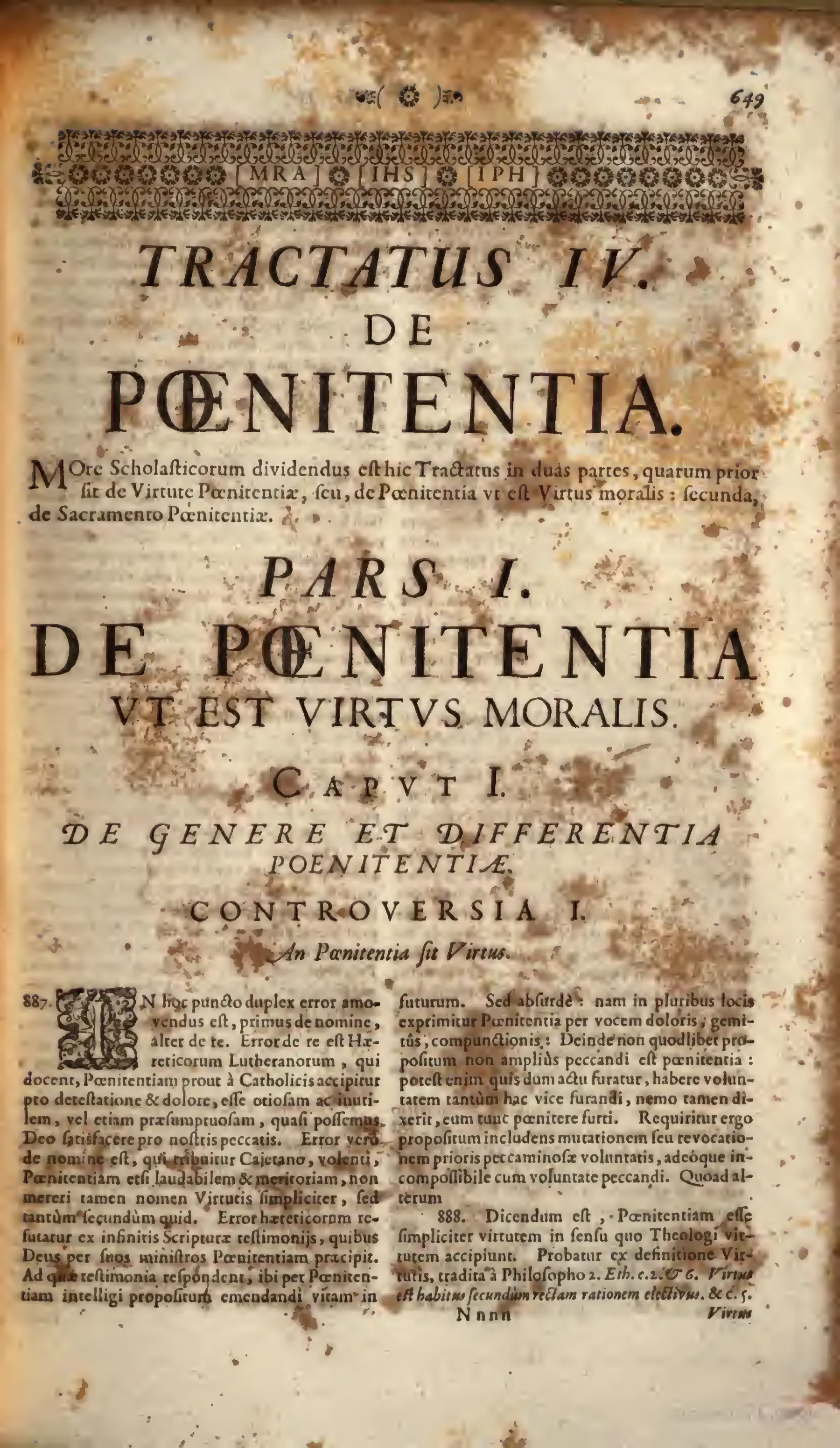
Beneath a Jesuit ornamental headpiece, the opening of Tractatus IV, “De Poenitentia,” moves from virtue, genus, and difference to the question “An Poenitentia sit Virtus.” Its first refutations, of Lutheran and Cajetanist positions, show Haunold drawing confessional boundaries from the outset. Source ↗.
The opening of the treatise on Penance carries the same habits into moral psychology. Gregory the Great's definition, that penance is ta mala plangere, & plangenda non perpetrare, to bewail evils committed and not to commit what is to be bewailed, is reread as referring to the commanding act of the will rather than its external result. On the stricter reading, any relapse would retroactively void earlier penance, and Haunold's interpretation shields the penitent from that consequence.
The gravity of sin is then measured against punishment through Pseudo-Dionysius, Puniri non est malum, sed esse pœnâ dignum est: to be punished is not an evil, but to be worthy of punishment is. On this ground guilt is shown to exceed even the evil of hell. The rigour of that conclusion is balanced at once by consolation. To resolve Lugo's dilemma of the tyrant, Haunold says that he first supposes suppono priùs doctrinam pulchertimam & consolatorium, the most beautiful and consoling doctrine of Pallavicino: no one who cooperates with the final supernatural help is damned. The hard case is answered by an appeal to providence and to the cooperating will, not by a casuistic licence. In this respect the opening of the penitential treatise arrives where the course's Molinist doctrine of grace and freedom predicts it should, with salvation hinging on the meeting of divine help and human consent.
The treatise then draws a sharp boundary between what may be wished and what may be chosen. Against Arriaga's suggestion that a light lie might rightly be elected to avoid hell, Haunold follows Lugo and Pallavicino in separating speculative affect from practical, elective affect. One may wish a friend temporal harm for his spiritual good. Augustine, in Haunold's citation, went further, daring to say that it is useful for the proud to fall into some manifest sin so that they may become displeasing to themselves: Audeo dicere, superbis vtile esse cadere in aliquod manifestum peccatum, vt sibi displiceant. The patristic paradox is admitted only at the level of speculation. Election of sin is never licit. The distinction sets the tone for the whole treatise, in which the deliberating will is the unit of analysis and the theologian's task is to fix exactly where moral responsibility begins.
The chapter on the necessity of penance then sets out its first thesis: some retraction, whether formal or virtual, is in fact necessary by necessity of means, Aliqua retractatio, vel formalis vel virtualis, est defacto necessaria necessitate. The pairing formalis vel virtualis already carries the accommodating instinct visible across the course. Penance need not be a specially elicited act of the virtue. Against Tanner and Melchor Cano, a virtual revocation contained in an act incompatible with the sin can suffice. Necessity is thus affirmed in principle and economized in practice.
The argument from absolute power exposes the metaphysical machinery beneath this economy. Haunold holds that God could justify a sinner without prior penance, because infinite goodness outweighs the finite resistance of sin. The objection that sin persists so long as it remains "habitually voluntary" he meets with a lexical distinction. These are, he warns, theological phrases very similar in wording but entirely different in meaning, phrases theologicæ verborum tenus valde similes, sed quoad significationem diversissimæ. Sin persisting habitually, as the ground of God's just displeasure, is not the same as a merely conditional disposition to repeat it.
The clarifying model is juridical rather than physical. It is Lugo's vow: whoever has made a vow contracts the obligation of the vow, and in this obligation the vow persists habitually, Qui fecit votum, contrahit obligationem voti, & in hac obligatione perseverat votum habitualiter. A pope can dispense the vow without the vower's knowledge. The obligation then ceases while the willingness that created it remains. Canon-legal dispensation thereby becomes the paradigm for understanding how guilt can be lifted independently of the sinner's present psychology.
The same passage shows Haunold's dialectical temper at its least yielding. Esparza had claimed that infused grace inclines the soul "almost as if" a contrary act had been elicited. Haunold collapses the approximation: Sed quæso, quid est: ferè sic inclinare? ego dico, esse simpliciter non inclinare, sicut ferè tangere, est simpliciter non tangere, sed aberrare. What, he asks, is it to "almost so incline"? It is simply not to incline, just as almost to touch is simply not to touch, but to miss. The cumulative, probable method Haunold favours elsewhere does not extend to tolerating vague intermediate entities.
He applies the same rigour when he denies, against Lugo and Ripalda, that God could remit a sin at the very instant of its commission. Arguments showing that our grace cannot coexist with actual sin, he insists, prove this of every possible sanctifying grace or of none: Censeo enim argumenta quæ probant, nostratem Gratiam non esse conjungibilem cum peccato actuali, probare de omni possibili Gratia sanctificante, vel de nulla probare. Hypothetical "other graces" may not be invented to escape a difficulty.
Behind this lies a confessional concern. Pardon is God's real cession of a right. It is not what would rather be a covering or non-imputation, as the heretics speak, potiùs esset tectio seu non imputario (vt loquuntur hæretici). The juridical vocabulary of condonatio is therefore not a concession to Protestant forensic language. It is a Catholic alternative to it, in which remission alters a real relation between God and the sinner.
The controversies on the precept of penance contain the treatise's most consequential methodological statements. Haunold admits a natural precept to repent, against Vitoria, but confines its binding force to danger of death. His first ground is a posteriori: a stricter obligation would run against the sense of the faithful and against the practice of the Church, quia talis obligatio est contra sensum fidelium, & contra praxin Ecclesiæ. His second is a "general rule" for discerning natural obligations, the test already quoted: whether the very fact of being obliged will bring more good to the whole human race than not being obliged. On this reasoning, a precept that would multiply transgressions defeats its own end and cannot be presumed to exist.
The two criteria are bound together by providence. A constantly recurring obligation unknown to every pastor would convict the Church of culpable ignorance. certè hoc non potest prudenter de Christi providentia præsumi: certainly this cannot prudently be presumed of Christ's providence. Received confessional practice thus acquires quasi-dogmatic weight, and "prudence," the course's governing term for assent, now governs the reading of ecclesial custom. The same ground underlies his refutation of Pallavicino's thesis that a sin must be retracted whenever it comes to mind, which he charges with circular reasoning.
Natural analogy also has a place, provided it serves the doctrine. To explain why eternal punishment is more easily escaped than the small remnants of temporal penalty, Haunold reports with approval Pallavicino's image: Sic etiam natura præbuit cunctis artes, quibus arcerent leones & tigres, non ità quibus arcerent muscas & culices. So too nature has given all creatures arts to ward off lions and tigers, but not flies and gnats. The physical order is read as a book of congruences, and the analogy persuades by fittingness rather than demonstration, which is the very grade of certainty the course assigns to such arguments.
The question of the revival of merits brings school rivalry into the open. Haunold quotes Tomás Hurtado's taunt, Valeat ergo schola Jesuitarum, & oret Deum, vt mentem D. Thomæ illis aperias: let the school of the Jesuits fare well, and pray God to open the mind of St Thomas to them. He answers it with the help of a Carmelite ally, which shows that the polemic is fought by enlisting other orders. It is not a simple Jesuit–Dominican binary.
His refutation of Báñez's "title only" theory is pastoral in method. He imagines it preached from the pulpit and asks whether such a preacher would not pour cold water rather than kindle fervour: nunquid hic talis frigidam affunderet, potiùs quàm servorem excitaret?. Homiletic effect becomes a test of doctrinal adequacy. His own thesis is correspondingly maximal: Reviviscentiam meritorum esse metaphysicè necessariam, suppositâ restitutione amicitiæ, the revival of merits is metaphysically necessary once friendship is restored. The highest grade of certainty is thus claimed where the stakes are consolation and devotion.
With the sacrament proper, the governing metaphor becomes explicit. Penance is a tribunal, cujus essentia est: esse Iudicium, whose essence is to be a judgment. Yet probable reasoning reaches into the matter of the sacrament itself. With Lugo, Haunold holds that contrition presupposes only probable cognition of past sin: sicut enim honestum est, dare eleemosynam illi, qui probabiliter est pauper, licèt à parte rei non sit pauper. Just as it is honest to give alms to one who is probably poor though in reality he is not, so it is honest to detest a sin probably committed. Moral probability, not the objective state of affairs, grounds the virtuous act.
The difficulty of how Ego te absolvo can be true of sins already forgiven is resolved by appeal to ordinary usage, including a local custom. As is customarily done in Germany, a son about to approach confession would first ask his father's pardon, (vt solet in Germania fieri) accessurus ad sacram Confessionem peteret priùs veniam à patre. Lived Catholic practice in the Empire becomes a grammatical witness. Haunold also reports the Recentior Hispanus's theory that judicial formulas and the formulas of wills signify reflexively. The formula "I bequeath to Peter my suburban garden," he writes, reflects upon itself: Lego Petro hortum meum suburbanum: reflectit supra seipsam. The sentence of absolution is thereby assimilated to the operative words of a Roman will.
Accommodation is most contested in the doctrine of attrition. Against Pallavicino's requirement of a motive of charity, Haunold reads Trent's silence as normative exclusion. The Council, as already observed, has not a single word about love of God as the end for whose sake one acts, which, if it were required, ought to have been expressed rather than passed over, since otherwise it would have gravely deceived almost the whole Church. The argument from providence returns here in conciliar form.
Pallavicino's further claim, that some love of God arises in everyone, is disarmed by an analogy from involuntary motion. Because we all habitually close our eyes very quickly if dust or a fly flies into them, Ex eo quòd omnes soleamus oculos festinantissimè claudere, si pulvis aut munica involet in oculos, no one concludes that such closing is free. A love that arises necessarily in everyone cannot be the free, meritorious motive.
The chapter on confession brings the juridical apparatus to bear on doubtful obligation. Haunold invokes the maxim that the condition of the possessor is better, Melior est conditio possidentis, and applies it to conscience: in our case, he says, innocence is in possession, In casu nostro dubius est in possessione innocentia. A negatively doubtful mortal sin therefore need not be confessed.
The polemical motive is avowed. A rigorist reading would confirm Calvin's slander that the obligation to confess is a torture-chamber of consciences, Calvini calumnia, quòd obligatio confitendi sit conscientiarum Carnificina. The anxiety is thus not only pastoral but confessional: a burdensome confession would hand Protestant critics their argument. Trent is read with a canonist's maxim, the inclusion of one is the exclusion of the other and conversely, Inclusio vnius est alterius exclusio & vicissim. Because the Council named species-changing circumstances, merely aggravating ones are taken to be excluded.
Jurisdiction is explained through Haunold's own institution. Magistratus Academicus Ingolstadiensis habet Iurisdictionem vniversalem, & ordinariam: the academic magistracy of Ingolstadt has universal and ordinary jurisdiction over students. Reservation of sins is then likened to the Elector's power to call cases to his own court, quæ Avocatio aliud planè non est, quàm quod est peccatorum Reservatio pro sacro Pænitentiæ Tribunali, an avocation that is nothing other than the reservation of sins for the sacred tribunal of penance. Bavarian territorial and university law here becomes the visible pattern of sacramental order.
The seal marks the point where accommodation stops. No harm to the commonwealth, however great, exempts the confessor from its rigour, ab illo rigore non eximit quantumvis magnum Reipublicæ detrimentum imminens ex observatione. Even so, the case of naming an accomplice, where a probable duty to reveal meets a probable duty to conceal, becomes Haunold's showpiece against rigorism. He addresses the reader directly, in the apostrophe already cited, offering a most clear example against the doctrine of the most illustrious Prospero Fagnani on probable opinion. The demonstration rests on the claim that, when probabilities conflict, one sometimes cannot avoid acting on a merely probable opinion.
Satisfaction, finally, must proceed from freedom and not from mere hardship. Sanè omnes judicamus, eum qui dormit humi, præcisè quia non habet lectum, non satisfacere Deo: we all judge that one who sleeps on the ground merely because he has no bed does not satisfy God. The common estimation of prudent people, "omnes judicamus," once more decides the theological point. The treatise closes under the Society's device, Ad Majorem DEI Gloriam, and the printed course passes into its alphabetical index of matters, keyed by book and paragraph, which turns the disputations into a reference apparatus for consultation.
The Index of Matters
Beneath a dense floral headpiece, the heading “INDEX MATERIARUM IN HOC OPERE CONTENTARVM” opens the alphabetical apparatus. Its first entries under A, among them actus, adoratio, amicitia, amor, and angeli, key the course’s arguments on divine action, freedom, friendship with God, and the angels to book and paragraph number. Source ↗.
That closing apparatus, the Index Materiarum, turns the course's own argument into an alphabetical finding-aid. The running heads Index and Materiarum face each other across the openings. Each headword is keyed to a tome in Roman numerals and a section in Arabic numerals, so that the four books of the cursus can be consulted as a single body of disputed questions. The index is no neutral appendage. Its compilers repeatedly chose to phrase an entry either as an open question (An...) or as a settled thesis. They also used the rubric Authoris Sententia to mark where Haunold states his own view after surveying the aliorum Sententiæ. In both ways the index registers the commitments of the work and the places where it disputes. Read as a sequence, the apparatus shows how the course's accommodating method and its Molinist foundation were meant to be found, taught, and defended by the student who used the book in lecture and exercise.
The large Fides block of the third tome sets out the analysis of faith as a set of pressure points rather than a catechetical summary. Its first question is the post-Tridentine problem of the rule of faith, An resolvatur fides in auctoritatem Ecclesiæ, whether faith resolves into the authority of the Church. The question cuts two ways. Against Protestant controversialists it concerns the visible Church as the bearer of revelation. Within Catholic schools it concerns where the final motive of assent lies: in God revealing, or in the Church proposing. A second entry presses the problem to a contingent limit, An sit fide divinâ credibile, modernum Pontificem, whether it is credible by divine faith that the present pontiff is the true pontiff. In the scholastic analysis fidei this question tests whether a singular historical fact, the validity of one man's election, can fall under the formal object of divine faith. It fits naturally beside the course's juridical treatment of doubtful elections cured by the Church's acceptance. Both concern how certainty about the papacy can rest on something other than inspection of the election itself.
The most pastorally weighted heading in the block is Motivum fidei quale simplicibus sufficiat, the question of what kind of motive of faith suffices for the simple. It belongs with the index's earlier entries on the discerniculum fidei, the means by which an unlearned believer tells a true article from a false one. There the positions of Antonio Pérez, Pallavicino, and Esparza are reviewed and set aside. The index thus shows that the problem of the peasant's faith was not an isolated rhetorical flourish. It was a structured locus with a survey of rival solutions, and it was the epistemological counterpart of the course's insistence that mysteries be explained in a manner accommodated to common understanding. Faith must be rationally grounded, yet not at the price of reserving rational grounding to the learned.
The Gratia block, by contrast, states a thesis outright: Gratia habitualis est qualitas physicè inhærens, habitual grace is a quality physically inhering in the soul. The adverb physicè carries the weight. Against a merely imputed or extrinsic justice, the course holds the Tridentine view that justification places a real created form in the soul. The contrast with the sacramental entries later in the index is pointed. Haunold is willing to call grace a physical quality while denying, or at least questioning, that the sacraments cause it physically. The distinction between the ontology of the gift and the mode of its conferral is one of the hinges of the work.
A methodological entry then makes explicit a habit that governs much of the course: Hypotheses impossibles tanquam ad argumentandum vtiles adhiberi posse, probatur, it is proved that impossible hypotheses may be employed as useful for argument. The authority invoked is a fellow Jesuit, auctoritate P. Antonij Perez. I. 749, on the authority of Father Antonio Pérez. Defending reasoning per impossibile matters for a theology built on scientia media. If God knows what a free creature would do in circumstances that never obtain, then disciplined reasoning about non-actual and even impossible cases is not idle subtlety. It is the logical medium in which the doctrine of God's knowledge is worked out. The defence placed in the first tome thus licenses the counterfactual architecture of the whole.
That architecture reaches as far as the relation between God and creatures. The index asks Iustitia commutativa an habeat locum in Deo erga hominem, whether commutative justice has place in God towards man. The Aristotelian-Thomist category of exchange between equals is here tested at its absolute limit. The question belongs to the course's characteristic juridical recasting of theological relations, though in this case it is framed as a question whose answer must measure the distance between human contract and divine liberality.
The entries on liberty open with the foundational Molinist question, AN detur Libertas Indifferentiæ. II. 141, whether there exists a liberty of indifference. It is followed by a set of threshold cases, An Libertas exerceatur ab Infantibus, Ebrijs,, whether liberty is exercised by infants and the drunk, the entry continuing to the insane and to dreamers. These marginal figures are the casuist's instruments. Each marks a point where the use of reason is absent or impaired, and so where imputability, and with it moral and penitential obligation, may lapse. Speculative doctrine on freedom here meets the practical judgments of the confessional directly.
The same reach is visible in Mariology, where the vocabulary of merit is driven to its highest object. The index divides merit, Meriti divisio in Congruum & Condignum, into merit by fittingness and merit by justice. It then asks AN B. V. meruerit Maternitatem Dei de condigno, whether the Blessed Virgin merited the maternity of God condignly. The difficulty is logical as well as devotional. Condign merit presupposes grace, yet the grace that would make Mary's merit condign seems to flow from the very maternity it would merit. The index's neighbouring headings on mutual priority and compensative merit show the course solving that circle with the same apparatus of ordered priorities that governs its account of the divine decrees.
The probabilist block is the point at which the index records the course's entry into the most contested moral question of its decades. The heading An liceat sequi Opinionem probabilem relictâ, whether it is lawful to follow a probable opinion leaving aside the more probable, states precisely the issue that divided probabilists from probabiliorists. A separate headword names the most formidable curial opponent of the benign view. Under Fagnani the index reads Opinio hujus auctoris circa Probabilitatem opinionum, the opinion of this author concerning the probability of opinions. That a Roman canonist of the Congregation of the Council should receive his own entry in an Ingolstadt course shows that the debate was conducted by name, and that the course's preference for cumulative probable reasons was understood as bearing on practical licitness, not merely on speculative assent.
The predestination entries, among the most finely worded in the index, carry the doctrinal weight of the polemic de auxiliis. The heading on predefinition sets the Jesuit term against its Dominican rival: Quomodo differat à Prædeterminatione Physica, how it differs from physical predetermination. It asks plainly Prædefinitio nostrorum actuum an lædat nostram libertatem, whether the predefinition of our acts harms our liberty. Predestination itself is given a carefully hedged formula, Prædestinatio quo sensu sit facta ante prævisa merita: & quo sensu nec antè, in what sense predestination was made before foreseen merits, and in what sense neither before. The phrasing refuses to be captured by either school's slogan. It distinguishes senses rather than choosing sides, which is the index's compressed image of the course's distinction-drawing method. Immediately beside it stands Quæ circa hoc fuerit mens S. Augustini, what the mind of St Augustine was on this matter. In the decades after Augustinus and the condemnations of its propositions, no Catholic theologian could leave the bishop of Hippo's mind uncontested. The index shows the course claiming Augustine within its predestination treatise, under the papal restraint on public dispute about efficacious grace.
Several neighbouring entries return to the hypothetical method. One records that adeóque Adamo non peccante Christus non venisset, vide. Incarnatio, and therefore, had Adam not sinned, Christ would not have come, and refers the reader to the Incarnation. This counterfactual on the motive of the Incarnation is exactly the kind of non-actual case the methodological entry had licensed. Another tests the foundation of faith itself, An possit à DEO revelari falsum, whether something false can be revealed by God. The press's capitals mark the divine name even as the question probes whether divine veracity, the formal motive of faith, admits any exception. In the sacramental treatise the index records a definitional thesis, Conveniunt tantùm Analogicè antiqua cum novis, the old sacraments agree with the new only analogically. This preserves the efficacy proper to the sacraments of the New Law against any univocal definition, alongside a defence of a Flemish Jesuit predecessor, Defenditur definitio P. Conink. 488, the definition of Father Coninck is defended.
The question of sacramental causality is then posed in its classic disjunction, An Sacramenta caussent gratiam physicè, an solùm moraliter, whether the sacraments cause grace physically or only morally. The period spelling caussent belongs to the press. The question situates the course on the line dividing Thomist physical instrumentality from the moral causality favoured by many Jesuits. The juxtaposition with the earlier thesis on grace as a physically inhering quality is instructive. The effect may be physical while its sacramental cause operates in the moral order, as a petition that God infallibly honours.
The Scientia block marks the culmination of the index's doctrine of God, and its phrasing is distinctive. Where most headings ask, this one asserts: Datur Scientia Media, directiva decretorum divinorum, middle knowledge exists, directing the divine decrees. Its sub-entries lay out the course's standard proof by Fathers, Thomas, and reason. The second of them is a polemical claim compressed into four words, Ex D. Thoma. 294, it is proved from St Thomas. To prove scientia media from Aquinas is to deny the Dominican school exclusive possession of the Angelic Doctor. It also fits the course's habit of keying its books to the Summa while departing from Thomas's opinions where it judges this warranted. That the index states this doctrine as a thesis, and not as a question, confirms it as the course's settled foundation.
Among the last entries the juridical temper returns in the treatment of the confessional seal. The index asks Sigillum Confessionis quo jure sit introductum in toto suo rigore, by what right the seal of confession was introduced in its full rigour. Inquiry into the seal thus becomes inquiry into its legal source, whether natural, divine, or ecclesiastical, and so into the extent of its binding force. The practical limit case follows: An obliget ad non manifestandum complicem, whether it obliges one not to disclose an accomplice. This question had sharp consequences wherever confession and penal jurisdiction met. In the course's handling of the seal, as in its treatment of liberty and probable opinion, speculative theology is fitted to the confessor's case. The juridical framing of sacramental obligation stands at the end of the index alongside the Molinist thesis on God's knowledge, the two commitments the apparatus shows to run through the whole course.
Reading Haunold Alongside Modern Scholarship on Probable Opinion and Law
Rudolf Schüssler, The Debate on Probable Opinions in the Scholastic Tradition (Leiden: Brill, 2019). Its history of probable opinion supplies a framework for investigating Haunold's treatment of disputed moral judgments. It does not, by itself, establish his position on a particular proposition. That position must be read from Haunold's own polemical moments, as when he presents a case to his reader with the words Et hîc habes, lector, exemplum clarissimum contra doctrinam Clarissimi viri Prosperi Fagnani de Opinione probabili,, offering a most clear example against the doctrine of the most illustrious Prospero Fagnani on probable opinion.
Sven K. Knebel, Wille, Würfel und Wahrscheinlichkeit: Das System der moralischen Notwendigkeit in der Jesuitenscholastik 1550–1700 (Hamburg: Meiner, 2000). Knebel places questions of will, probability, and moral necessity within the Jesuit scholastic period in which Haunold wrote. His framework bears directly on Haunold's claim that divine foreknowledge leaves human freedom intact, since non lædi nostrorum actuum libertatem, quia illa præscientia est aliquo modo à nostra voluntate impedibilis,: the freedom of our acts is not harmed, because that foreknowledge is in some way impedible by our will.
Wim Decock, Theologians and Contract Law: The Moral Transformation of the Ius Commune (ca. 1500–1650) (Leiden: Brill, 2013). Decock's account of theologians' engagement with legal reasoning offers context for reading juridical analogies in Haunold, although its principal chronology ends before the 1678 printing. The most direct point of contact is Haunold's teaching on marriage. Christus elevando contractum Matrimonij, qui secundùm se erat contractus civilis, ad rationem Sacramenti, noluit immutare Naturam ipsius contractûs: in raising the marriage contract, civil in itself, to the rank of sacrament, Christ did not wish to change the nature of the contract itself.
Robert A. Maryks, Saint Cicero and the Jesuits: The Influence of the Liberal Arts on the Adoption of Moral Probabilism (Aldershot: Ashgate, 2008). Maryks provides a longer history of Jesuit moral probabilism against which Haunold's later arguments can be tested. These include his defense of probable opinion against Fagnani and his rule that the honest is what it is expedient to be licit.
Frequently Asked Questions
What is Christoph Haunold's Theologiae speculativae?
It is a Latin printed course of scholastic theology in four books, arranged to correspond to the parts of Thomas Aquinas's Summa theologiae and designed for lectures and disputation exercises at the Jesuit-directed university of Ingolstadt. Organised in numbered controversies, it defends received Catholic doctrine against selected positions of recent theologians. Throughout, it seeks to keep intact the freedom of the created will, the binding force of moral obligation, and the teaching authority of the Church. Its foundation is Molinist, resting on middle knowledge and liberty of indifference, and it is set against Thomist physical predetermination and Jansenism. Printings of 1670 and 1678 are known. The work is distinct from Gregorio de Valencia's Commentarii theologici.
Who was Christoph Haunold?
Christoph Haunold (1610–1689) was a Jesuit theologian of the Bavarian province who taught at Ingolstadt. His printed course preserves traces of his teaching career. He says he discussed and rejected certain Spanish proofs of God's existence in the schools in 1651, and that he taught a doctrine on the priorities of Christ's merits in 1665 before others took it up. He names Clement IX as the reigning pope at the time of writing and cites the oath by which Ingolstadt professors swore to uphold the Immaculate Conception. He also recalls having seen for himself that a prince serving as a soldier under a noble commander must take the left side.
Why did Haunold argue that a peasant's faith could be more meritorious than a scholar's?
He held that the firmness of faith comes chiefly from the will rather than the intellect. The learned possess motives for belief that cannot be weakened. The unlettered believer assents on weaker motives, chiefly the authority of the parish priest, and so needs greater affective firmness to hold fast. Since faith's merit lies in this pious affection of the will, the peasant's assent can merit more. Haunold insisted that such a believer holds divine, not merely human, faith. Following Juan de Lugo, he argued that the rustic conceives confusedly what the theologian conceives explicitly. He scorned the supernatural "discriminator" some fellow Jesuits devised to secure rustic faith.
How did Haunold defend probabilism against Prospero Fagnani?
He defended the lawfulness of acting on a probable opinion against Fagnani by name, calling him the most famous canonist of the age. His arguments were largely juridical. Jurists hold that anyone not prohibited may make a will, and liberty may likewise act where no certain law forbids. Possession in good faith gives a right to continue until the contrary is proved, so in doubt innocence is "in possession." His showpiece was the confessional case of naming an accomplice, where a probable duty to reveal meets a probable duty to conceal. The case shows that one sometimes cannot avoid acting on a merely probable opinion. He still required such an opinion to rest on a positive foundation of great weight.
Is there an English translation of Haunold's Theologiae speculativae?
No translation of the course into English or any other modern language has been confirmed, so it has remained accessible only in its original Latin. The Leo edition is a separate undertaking. It presents the full transcription of the Latin text and a complete English translation for the first time, and that translation is generated by AI. Leo is an effort to make English translations of every text printed in Latin in early modern Europe between 1450 and 1750 freely available online, at no cost.
This report was generated by an advanced AI assistant that conducted deep research alongside an extensive interpretation of the transcribed original text. Every effort has been made to preserve fidelity to the source and to guard against inaccuracy, but corruption in the text recognition process and model hallucination may nonetheless have entered the text. Treat every claim, quotation, translation, and citation as provisional, and verify each against the original source before relying on or citing it.
Bibliography
- Wim Decock, Theologians and Contract Law: The Moral Transformation of the Ius Commune (ca. 1500–1650): Decock shows how Spanish and Low Countries theologians reworked Roman contract doctrine in the confessional and the classroom, which is the workshop where Haunold's civil-contract marriage, his testamentary maxims, and his Adamic pactum were forged. The book stops at 1650, so it describes the generation Haunold inherited from rather than Haunold himself. That limit is useful: it lets the reader see which of his juridical moves were common stock and which were his own.
- Sven K. Knebel, Wille, Würfel und Wahrscheinlichkeit: Das System der moralischen Notwendigkeit in der Jesuitenscholastik 1550–1700: This is the closest thing available to a map of the conceptual terrain Haunold works across: moral necessity, the dice analogies Esparza used and Haunold rejected, and the Jesuit habit of grading certainty by degrees. Readers puzzled by why "morally impossible" is not a polite way of saying "impossible" should start here. It is dense, German, and indispensable for the period 1550–1700 that Haunold's course closes.
- Robert A. Maryks, Saint Cicero and the Jesuits: The Influence of the Liberal Arts on the Adoption of Moral Probabilism: Maryks traces Jesuit probabilism back to the humanist classroom and its Ciceronian taste for arguing in utramque partem, a lineage that makes Haunold's preference for converging probable reasons look less like casuistic convenience and more like rhetorical training. The account concerns the Society's early generations, so it supplies prehistory rather than commentary. It is the right book for anyone who suspects that Haunold's quarrel with Fagnani was also a quarrel about how to read.
- Jacob Schmutz, "Bartolomeo Mastri et la mouche," "Rem in seipsa cernere": Saggi sul pensiero filosofico di Bartolomeo Mastri (1602–1673): Schmutz follows the improbable seventeenth-century career of the fly as a test case in debates over divine knowledge and the possibles, the same insect Izquierdo set loose against the doctrine of God's intrinsic connection with possibles, and which Haunold had to answer. The Scotist Mastri is Schmutz's subject, but the chapter shows that Haunold's fly belonged to a pan-scholastic argument rather than a private joke. Few essays repay their oddity of title so well.
- Rudolf Schüssler, The Debate on Probable Opinions in the Scholastic Tradition: Schüssler reconstructs what scholastics meant by calling an opinion probable, and why it mattered whether a less probable opinion could be followed, the exact question indexed in Haunold's course and fought out against Fagnani. The book supplies the vocabulary needed to place Haunold among probabilists without simply taking his word for it. It will not tell you what Haunold thought; it will tell you what he was arguing about.
- Universitäts- und Landesbibliothek Düsseldorf, Catalogue record: Theologiæ Speculativæ Scholasticis Prælectionibus Et Exercitiis Accommodatæ Libri IV: The Düsseldorf record transcribes the full title, including the clause promising that selected placita of recent theologians are disputed, which is the course's own statement of purpose. It is a modest resource, but bibliographic modesty is precisely what the tangled 1670/1678 dating and the Valencia misattribution call for. Consult it alongside the VD17 entry before trusting any digitized surrogate's metadata.