Amussis, the Builder's Straightedge: Johann Daniel Mylius's The Medico-Chymical Work: Three Basilicas of Medicine, Chymistry, and Philosophy
Johann Daniel Mylius, a Hessian physician and lutenist who signed his title page as a candidate in both Hippocratic and Hermetic medicine, spent the years from 1618 to 1630 publishing the Opus medico-chymicum, a Latin encyclopedia that lodged medicine, chymistry, and philosophy in three graduated halls, or basilicae. His complaint was not that the age lacked recipes but that it had far too many: particulars on offer in every corner, the universals silent, and no straightedge against which any single case or preparation could be measured. What he offered in their place was arrangement — a printed system in which potable gold, mine-demons, dreams, wine, the passions, and the nine orders of angels each acquire a determinate seat.
ExLatinis
August 6, 2026
Contents
Johann Daniel Mylius, a Hessian physician and lutenist who signed his title page as a candidate in both Hippocratic and Hermetic medicine, spent the years from 1618 to 1630 publishing the Opus medico-chymicum, a Latin encyclopedia that lodged medicine, chymistry, and philosophy in three graduated halls, or basilicae. His complaint was not that the age lacked recipes but that it had far too many: particulars on offer in every corner, the universals silent, and no straightedge against which any single case or preparation could be measured. What he offered in their place was arrangement — a printed system in which potable gold, mine-demons, dreams, wine, the passions, and the nine orders of angels each acquire a determinate seat.
In 1618 the Frankfurt printer Lucas Jennis began issuing an enormous Latin compendium of medicine, chymistry, and philosophy by Johann Daniel Mylius, a Hessian physician from Gemünden an der Wohra — born, on the varying attestations, in 1584 or 1585 — who signed himself on his title page as a candidate in both Hippocratic and Hermetic medicine, and who was also, as the musicological record independently establishes, a lutenist and composer of some standing. The Opus medico-chymicum is not a treatise on a single question. It is a systematic encyclopedia, announced as three basilicae or halls: a Basilica medica running from physiology through pathology to therapeutics and Galenic regimen; a Basilica chymica in seven books ascending from gold through silver and mercury, the remaining planetary metals, gems, minerals, and vegetables to animals; and a Basilica philosophica of cosmology, angelology, astrology, and dogmatic theology. Its transmission was itself staged: the imprint spans 1618 to 1630, with the first volume carrying the earlier medical and chymical books and a second part, Operis medico-chymici pars altera, carrying the later chymical books and the philosophical basilica.
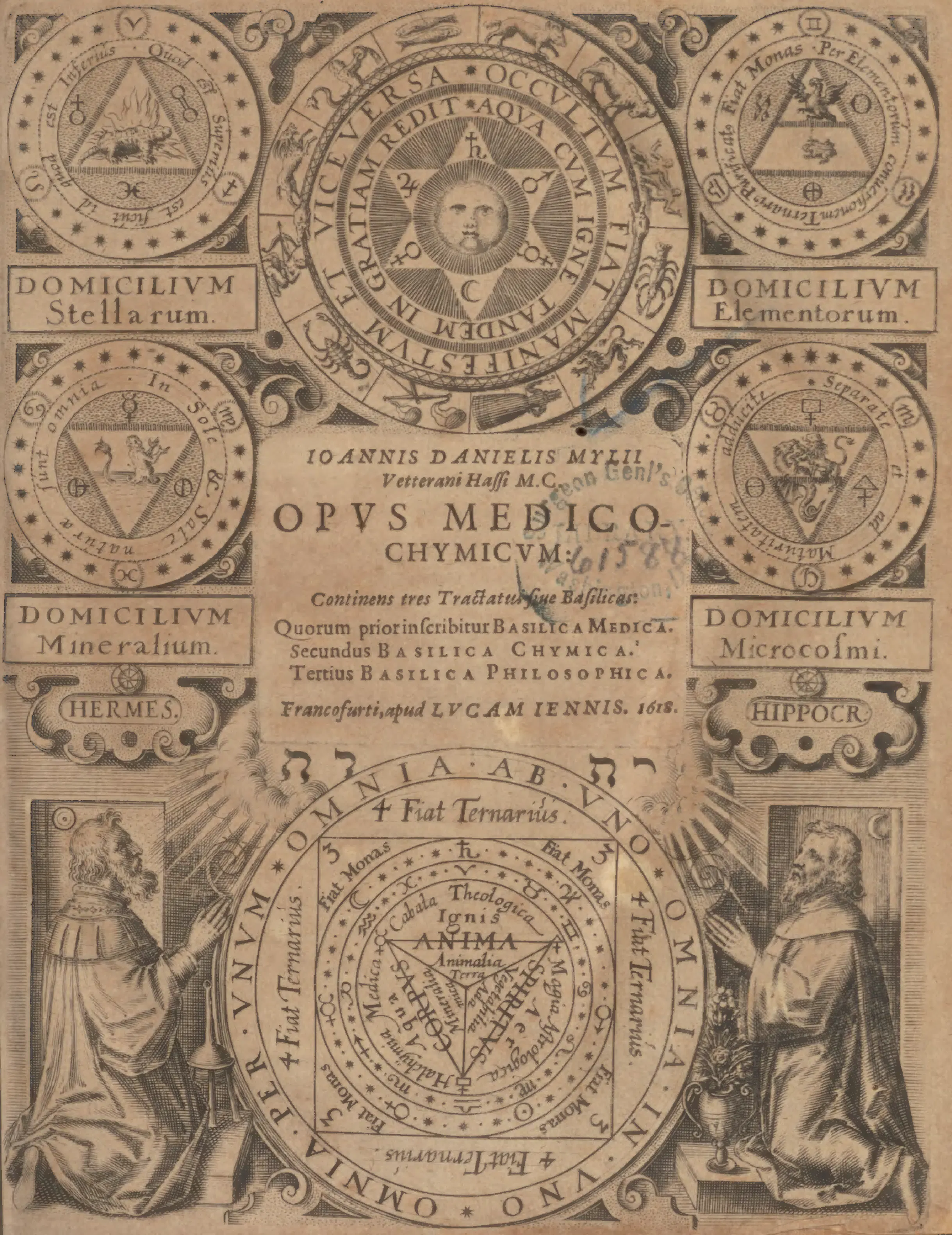
The engraved title page of Mylius's Opus medico-chymicum (Frankfurt: Lucas Jennis, 1618) fixes the medical-chymical opening volume in the Jennis shop, before the pars altera extended the work to 1630. Around the title, the four DOMICILIA, Hermes and Hippocrates, and the wheel inscribed "VNO OMNIA AB VNO OMNIA" state the same ambition emblematically: medicine, chymistry, philosophy, and the microcosm ordered as one system. Source ↗.
The intellectual problem the work sets itself is stated at its outset and governs everything that follows. Medicine and chymistry, on Mylius's diagnosis, are not impoverished but glutted: recipes, workshop operations, purchased secrets, and reported particulars are available in every corner, while the universals that would govern them are silent and there exists no amussis — no straightedge, no rule — against which a singular case or a singular preparation might be measured and judged. His response is deliberately modest in one respect and immodest in another. He disclaims discovery: the art he sets out is not his own but one already proved by the practice of ancient artificers. What he claims as his own is dispositio, methodus, and modus docendi — arrangement, method, and the manner of teaching. The recurring move by which he executes that claim is architectural. Against the Basiliscus, the basilisk of unmethodical and predatory practice, he raises a Basilica, a legitimate system of the art built in graduated tiers, so that the terms systema and Basilica come to gloss one another. The joint that holds the tiers together is the microcosm axiom: man is made from the world, contains the world and is contained by it, and is therefore called by some a fourth world in which whatever exists in the other three is found again. From that axiom the work draws its licences — anatomy terminating in the knowledge of God, correspondence between heavens, metals, and organs authorizing astro-medicine, and an art capable of doing by industry what nature does by property, so that a Sol artificialis prepared in the laboratory may exert what the celestial sun exerts by natural power.
The historical interest of that programme lies in how much it holds together and how visibly it strains. Around 1618 chymia was still a heterogeneous field spanning medicine, pharmacy, metallurgy, natural philosophy, theology, and the reading of signatures, and the Opus is unusually explicit evidence of an attempt to make that field teachable in print without either surrendering its arcana or dissolving into recipe lore. Publication is itself part of the method: secrets are placed inside a public sequence of definitions, classifications, authorities, and images, and cover-names inherited from the Hermetic corpus are printed and decoded — the wolf of Basil Valentine as antimony, the lion as gold — even as the chymical books continue to insist that not all are worthy and that certain matters remain under the seal of silence. The tension between Croll's emblematic Paracelsian instruction and Libavius's school-compatible pedagogy, which historians have used to organize the period's chymical didactics, runs directly through this volume rather than to one side of it, and its Galenic scaffolding — the natural things, the non-naturals, the things contrary to nature — is retained rather than repudiated even where the received ordering of the material is set aside.
A first reader will find the work's particulars as striking as its architecture. Physiology closes not in function but in doxology, the fabric of the human body offered as testimony of divine Wisdom, Goodness, and Justice. Regimen is stratified by estate and moralized into a public duty of temperance, and the therapy of the passions is argued out against the Stoics, on the ground that uprooting the causes of disordered motions of the mind must not render men stupid or strip them of all feeling; music enters as Pythagorean therapy, from an author who knew the lute from the inside. Dreams are sorted into divine, diabolical, supernatural, and natural, with a calibrated credulity that limits rather than dismisses the old counsel not to trouble oneself with dreams. The philosophical basilica argues creation ex nihilo against the eternal world of Aristotle, catalogues nine angelic orders from both Talmudic and Dionysian authorities, insists that "angel" is the name of an office and not of a nature, and records the mine-demons of Annaberg and Schneeberg among the marvels a physician must classify. In the chymical books, diggers, smelters, roasters, and assayers are preferred as witnesses to those who catch at idle little arguments in their lecture-halls, and the materia medica reaches its extremes in the spagyric arcanum of the homunculus and in preparations from the cranium of the hanged or beheaded. At least one folded plate of the set bears the signature of Matthäus Merian the Elder, whose workshop supplied the emblematic idiom through which much of this material later circulated.
Much about the object and its afterlife remains unresolved, and the unresolved parts are worth knowing at the outset. Whether the set should be described as folio or octavo cannot be settled from the catalogue records so far consulted; the collations of its parts differ because they describe different units; and the civic dedicatee, Respublica Helonopolitana, conceals a German town whose identification has not been established and should not be supplied by etymological guesswork. A portrait verse gives the author's age as thirty-three in 1618, but a checked title-page transcription has not been recovered. No standalone modern translation of the Opus medico-chymicum has been located, no censorship proceeding or Index entry against it has been found, and no chain of contemporary refutation has been traced — none of which proves that reception, translation, or opposition did not occur, only that the records have not surfaced. Dedicated scholarship on Mylius remains thin beside the literature on Croll, Libavius, Maier, and Fludd, and the twelve engravings of his later Philosophia reformata have travelled far more widely than the prose of the Opus they postdate. What survives, in any case, is a printed attempt to place the whole of medico-chymical knowledge inside one graduated order — and to make the placing itself the contribution.
Read the full text and English translation on Leo
This text was transcribed and translated as part of the ExLatinis project, an effort by Leo to make free English translations of every text published in Latin in early modern Europe (1450–1750) available online. The complete transcription and English translation of this work can be read free of charge:
→ Read the original Latin text and full English translation on Leo
You can save a copy of this document into your Leo account to run deep text searches, conduct further analysis, or cross-reference it with your own research.
Translating the Title: Why Mylius Called His System a Basilica
Editorial English title, supplied for convenience rather than established in current historiography: The Medico-Chymical Work: Three Basilicas of Medicine, Chymistry, and Philosophy. The title-page record identifies Joannis Danielis Mylii Vetterani Hassi M. C. Opus Medico-Chymicum: Continens tres Tractatus sive Basilicas; quorum prior inscribitur Basilica Medica, secundus Basilica Chymica, tertius Basilica Philosophica. The modern author form is Johann Daniel Mylius; Vetteranus HAssus locates him in the Wetterau and Hesse.
Basilica is not merely a decorative synonym for a book.
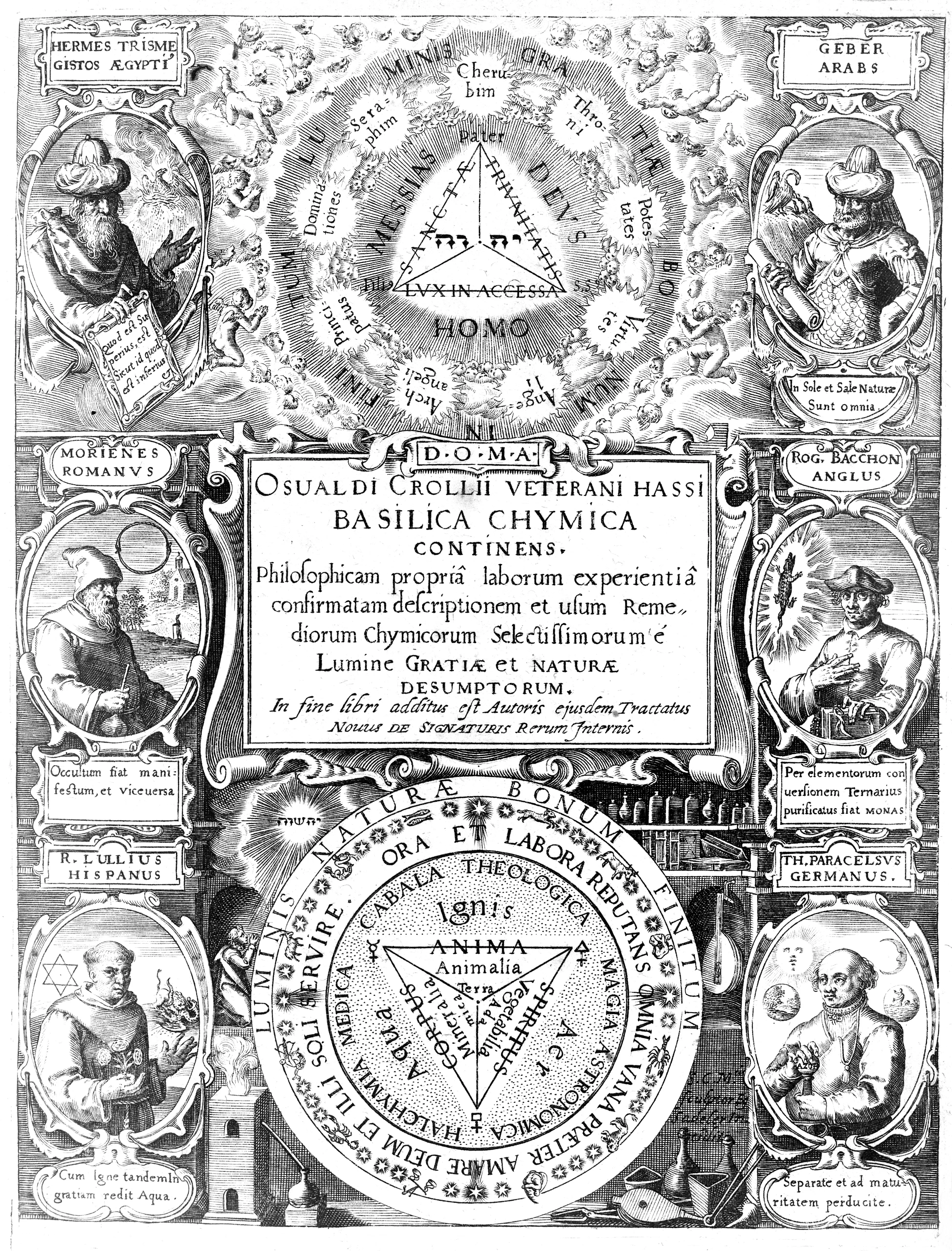
Engraved title page of Oswald Croll's Basilica chymica — Mylius's immediate Paracelsian-Hermetic precursor, not a page of the Opus medico-chymicum itself — framing chymical medicine through learned authorities, emblematic architecture, and cosmological order. Its visual programme suggests why "Basilica" signalled a comprehensive temple of sacred natural knowledge rather than an ornamental title. Source ↗.
In Latin usage it names a royal or public hall and, in Christian usage, a consecrated monumental space. In Mylius's title it becomes a figure for an ordered doctrinal building: medicine, chymistry, and philosophy are presented as adjoining but internally articulated halls. The term therefore transposes architecture and liturgy into method. Its force is also polemical. Against scattered recipes, isolated observations, and the disordered practice symbolized by the basilisk, a basilica promises an intelligible structure in which particulars acquire a place. The opposition is drawn in the text itself, which judges that against this basilisk, or evil, help and a remedy have been found through a legitimate system of the art, that is, a Basilica, Huic Basilisco seu malo, auxilium & medicina inuenta per artis legitimum systema, siue Basilicam, arbitror, so that systema and Basilica stand as reciprocal glosses and the architectural figure carries an explicitly methodological burden: the hall is the rule made visible. The title participates in the wider early-seventeenth-century habit of treating a disciplined body of learning as an edifice, while the proximity of Croll's earlier Basilica chymica makes Mylius's choice part of a recognizable Paracelsian-Hermetic title tradition rather than an isolated invention.
The paired expressions lumen naturae and arcanum belong to a different but complementary register. In Paracelsian medicine, the light of nature is an interiorly available instructor: it authorizes the investigator to learn from created things and from operative experience, not only from the Academici libri. It is not a modern metaphor for subjective intuition; it is a claim about a divinely ordered natural light capable of disclosing correspondences, virtues, and processes. The work states this in terms borrowed explicitly from Croll — the physician must be born, born of the light of grace and of nature, from the inward and invisible man, the inward angel, the light of nature, which instructs men after the manner of a true teacher, as the Holy Spirit instructed the apostles with fiery tongues, Medicus nasci debet, inquit Crollius, nasci debet è Lumine gratiæ ac naturæ ab interno & inuisibili homine, interno Angelo Luce naturæ, quæ instar veri Doctoris homines instruit, prout spiritus Ianctus Apostolos linguis instruxit igneis — where the light of nature is cast in a frankly pedagogical role, a Doctor interior to the practitioner and analogous to, though distinguished from, the light of grace. Arcanum names what that light makes available only through disciplined preparation and guarded transmission. It may designate a hidden principle, a concentrated virtue, or a prepared remedy; the same word thus joins epistemic secrecy to pharmaceutical efficacy. The tension between public method and guarded secret is central to the work's attempt to make chymical knowledge teachable without reducing it to unexamined recipe lore, and it is the same tension that the architectural figure of the Basilica is designed to hold: an open building whose inner chambers are not equally open to all.
Res non naturales should likewise be read in its Galenic period sense, not as a simple opposition between natural and artificial things. The phrase denotes the external conditions of health conventionally ordered around air, food and drink, sleep and waking, exercise and rest, evacuation and retention, and the passions or accidents of the soul. Their value lies in regimen: they mediate between bodily constitution and disease. Mylius's systematic reordering of this material, insofar as the proposed sequence is confirmed by a checked primary text, would be a methodological intervention within Galenic hygiene rather than a rejection of Galen. At least one such rearrangement is attested in the text's own words, which announce that, setting aside that order of the physicians in which sleep is put before waking, the discourse will begin from waking and assign it the first place, Idcirco posthabito ordine illo Medicorum, quo somnus præmittitur vigiliæ, nos contra sermonem inchoabimus à vigilia, eiq; priorem locum destinabimus, a departure justified by the demands of orderly exposition rather than by any quarrel with the doctrine of the non-naturals as such — the amussis applied to the arrangement of a received topic. Page-level OCR sufficient to verify every proposed phrase and every claimed local rearrangement has not been recovered; these explanations are therefore philological framing of the title and intellectual vocabulary, not a substitute for a critical edition.
What the Opus medico-chymicum Contains, and What Mylius Claimed for It
Johann Daniel Mylius's Opus medico-chymicum is a Latin printed compendium of medicine, chymistry, philosophy, theology, and natural knowledge, produced in Frankfurt am Main under Lucas Jennis. It is not securely describable as a single volume issued wholly complete in 1618. The bibliographical evidence instead shows a continuing multi-part publication: the first volume bears the 1618 Frankfurt imprint and contains the first three books of the Basilica medica and the first four books of the Basilica chymica; Operis medico-chymici pars altera contains the three later books of the Basilica chymica and the Basilica philosophica. NLM metadata gives the overall publication span as 1618-1630, and records special title-page dates of 1620, 1618, and 1630 for components associated with the later chymical book, the philosophical basilica, and the index. The third tract was therefore issued, but within a staged transmission rather than as an undifferentiated 1618 folio.
The hybrid genre is best called a printed summa or systematic encyclopedia of medico-chymical knowledge. Its declared architecture joins a physiological, pathological, and therapeutic medicine to a Galenic regimen; a practical chymical sequence moving through metals, minerals, plants, and animals; and a philosophical-theological cosmology. The work's programmatic claim is that medicine and chymistry do not chiefly suffer from a lack of particulars, but from the lack of universals and of a legitimate rule by which particulars may be ordered and judged. The diagnosis is delivered in the work's own terms: examples of operations teem in every corner, particulars are everywhere on offer and some lie hidden, while the universals are silent and there is no rule to which singularities may be referred and by which they may be judged, Exemplis operationum nullus non scatet angulus, singularia vbiuis prostant, & in abditis partim latitant: Catholica silent, nec est amussis ad quam reuocari singularitates & iudicari queant. Mylius's originality consequently lies less in claiming unprecedented substances than in dispositio, methodus, and modus docendi; he says as much in disclaiming invention, confessing that he does not teach an art of his own but arranges the chymical art proved and cultivated by the practice of the ancient wise artificers and expounds it with God's help, and that for the exposition, the methodical transmission, and the manner of teaching to be his own is enough and sufficient, Confiteor sanè me meam artem non decere, sed artem chymicam vsu artificum antiquorum sapientum comprobatam excultamque, dispono, & Dei auxilio, quantum ille vult expono: Meam expositionem methodicam traditionem, modumque docendi esse, sat est ac sufficenter. This is an interpretive account of the work's architecture; while the programmatic statements quoted here are attested in the text, a complete primary-text transcription is still needed before the account as a whole can be treated as verified.
The conceptual hinge is man as microcosm, and in the wider vocabulary associated with the work as a quartus mundus: human anatomy, medicine, and natural theology meet in the human being's position between the created orders.
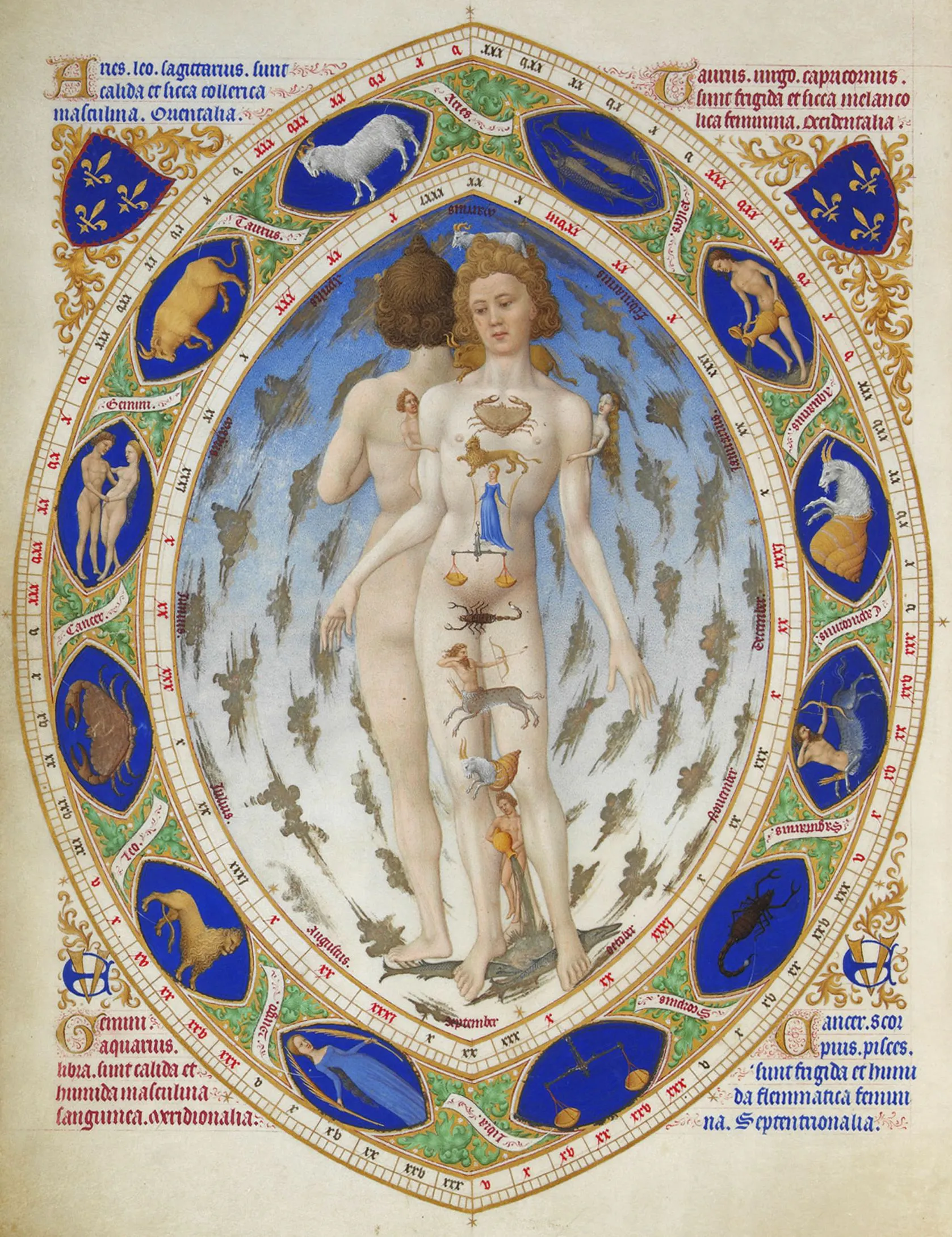
In this early fifteenth-century "Anatomical Man" illumination, zodiac emblems are distributed across the human body, framed by heraldry and dense script, rendering the body as a miniature cosmos. Though earlier than Mylius, it gives visual form to the microcosmic logic by which anatomy, celestial order, temperament, and healing could be treated as one system. Source ↗.
The axiom is stated without reserve — man embraces all things in his compass and bears all within himself; made from the world, he comprehends the world in himself and is comprehended by the world, Homo complexu suo omnia compræhendit, & ipse gerit omnia in se: Ex quo enim factus est homo, illud in se quoque gerit & continet. E mundo factus est, & mundum in se compræhendit, & à Mundo compræhenditur — and it is elaborated into the fourth-world formula in the philosophical tier, where the text notes that by some he is therefore called the FOURTH WORLD, in which all those things are found which are in the remaining three, Ideò à quibusdam QVARTVS MUNDVS vocatur, in quo omnia illa inueniuntur, quæ sunt in reliquis tribus, the attribution to unnamed others marking the formula as received Cabbalistic-Hermetic vocabulary rather than a personal coinage. The corresponding art-nature claim is that a properly informed art can reproduce or complete operations that nature performs, so that the laboratory's sol artificialis can be described as doing by art what the celestial sun does by natural property: since nature has brought forth nothing which art may not fashion in imitation, what the celestial sun can accomplish by natural property, the artificial sun too, prepared by chemical industry, can in some manner exert, Siquidem nihil natura progenuit, quod idem ars imitatione non effingat, & quæ potest Sol coelestis naturali proprietate præstare, eadem & Sol artificialis, chymica industria paratus. These claims place Mylius within the Paracelsian and Hermetic effort to reconcile operative chymistry with a Christian account of nature, while the work's title and systematic arrangement also retain Galenic physiology and humanist encyclopedic method.
The language is principally Latin, with Greek and technical vernacular material in the surrounding lexical environment; the NLM record lists Latin, Greek, German, and Hebrew among the languages associated with the set. No standalone German, English, or French translation of the Opus medico-chymicum was located in the consulted catalogues and searches. That negative result is not proof that no partial translation has ever existed. The contrast with Mylius's Philosophia reformata is material as well as textual: its twelve alchemical engravings have circulated extensively in digital and iconographic collections, whereas no comparably well-attested modern translation of the Opus medico-chymicum was found.
Placing Mylius Among Croll, Libavius, and the Historians of Chymistry
The Opus medico-chymicum matters because it gives unusually visible form to a problem that is often separated into different histories: how Paracelsian medicine, Galenic physiology, artisanal practice, Christian cosmology, and encyclopedic method could be made to inhabit one printed system. The seam is visible even in the medical tier, where the anatomical and physiological exposition terminates in natural theology — the use of this doctrine being, first, that in this fabric of the human body we may behold testimonies of divine Wisdom, Goodness and Justice, Vsus huius Doctrinæ 1. Est vt in ista Fabrica Corporis Humani conspiciamus Testimonia Sapientiæ, Bonitatis, & Iustitiæ Diuinæ, with the cure of disease and the preservation of health following as subsequent uses rather than as the doctrine's first end. The work's significance is not that it single-handedly marks the birth of modern chemistry. It is evidence for a period in which chymia remained a heterogeneous field of medicine, pharmacy, metallurgy, natural philosophy, theology, and the interpretation of signs. The work also makes publication itself an epistemic claim. Recipes and secrets are placed within a public sequence of books, authorities, images, definitions, and classifications, even though arcana remain partly protected by the rhetoric of secrecy.
Allen G. Debus's chemical philosophy framework remains useful for locating the work within Paracelsian attempts to replace or supplement Aristotelian qualities with a chemically articulated account of matter and medicine. Its limitation, identified by later historians, is the danger of treating "chemical philosophy" as a unified movement with a single developmental direction. Owen Hannaway's account of the Croll-Libavius opposition is particularly important for Mylius: Croll represents an emblematic, Paracelsian, and signature-oriented mode of teaching, while Libavius seeks a more explicit, school-compatible, linguistic and logical pedagogy. Bruce T. Moran complicates that binary by emphasizing Libavius's method, humanist learning, moral vocabulary, and effort to bring old and new knowledge into a disciplined whole. Mylius's three-basilica structure belongs precisely at this point of tension: it is Hermetic and Paracelsian in its authorities and secrets, but scholastic-humanist in its ambition to order knowledge, and its claim to contribute arrangement rather than discovery is exactly the kind of claim that both traditions could recognize.
William R. Newman and Lawrence M. Principe have challenged the retrospective opposition between "alchemy" and "chemistry," arguing for the period's broader term chymistry and for attention to what practitioners actually did and claimed. Their intervention prevents the Opus from being classified either as failed chemistry or as an undifferentiated occult text. Newman's work on the homunculus and the art-nature debate is relevant to the work's interest in artificial generation, and the term does appear within the volume's register of spagyric arcana; but a page-checked Mylius passage is still required before a specific redefinition of homunculus can be attributed to this volume. The art-nature question is nonetheless posed in the work in its strong form, since the artificial sun of the laboratory is said to exert what the celestial sun exerts by natural property. Didier Kahn and Joachim Telle's work on Paracelsian textual transmission and pseudepigrapha supplies an equally necessary warning: authorities such as Basil Valentine, Isaac Hollandus, and other Hermetic names cannot be treated as transparent historical authors simply because Mylius invokes or transmits them — a caution sharpened by the fact that he prints and decodes their cover-names, the wolf and the lion, as though they were a stable lexicon.
The print and confessional setting expands the problem. Carlos Gilly and Susanna Åkerman illuminate the Rosicrucian print networks and the circulation of reforming, apocalyptic, and Hermetic texts around 1614-1620. Urszula Szulakowska's work on alchemy and Protestant apocalyptic discourse, Peter J. Forshaw's studies of cabala chymica and Khunrath, and Wilhelm Schmidt-Biggemann's work on Christian Kabbalah help situate the four-world and correspondence vocabularies without treating them as detachable esoteric curiosities; the volume's own warrant for those vocabularies is the Hermetic axiom itself, invoked as the most true conception of our thrice-great Hermes in the emerald tablet, that things above are as things below and things below as things above, Hinc verissimum Hermetis nostri Trilmosyni in tabula smaragdina conceptum: Superiora sunt sicut inferiora, & inferiora sicut superiora, which does the licensing work for the astro-medical correspondences of planets, metals, and organs. Sachiko Kusukawa, Ann Blair, and Charlotte Methuen show how Melanchthonian and Lutheran natural philosophy could authorize close study of nature while policing divination, astrology, and theological boundary-crossing. That policing is anticipated within the text rather than merely applied to it from outside: much, the author concedes, would have to be disputed here with the theologians, who will perhaps not all concede the point, but let a distinction be made between the created corporeal work of nature and the eternal uncreated spiritual, since where the created harms, there the eternal teaches, Multa sanè hic forent disputanda cum Theologis, qui omnes hoc non concedent forsan; sed dico, fiat distinctio inter opus naturæ creatum corporale, & æternum increatum spirituale, vbi creatum nocet, ibi æternum docet, a pre-emptive distinction that keeps astrological correspondence inside the order of created nature and thus, on the author's argument, inside the boundaries a Lutheran natural philosophy would permit. Howard Hotson's work on Johann Heinrich Alsted clarifies why systema, method, and encyclopedic completeness were not neutral filing devices but parts of a Protestant project of ordering disciplines — the same conviction that makes a Basilica the answer to a surfeit of unruled particulars.
The medical and material debates are equally important. L. J. Rather and Heikki Mikkeli on the non-naturals, together with Sandra Cavallo and Tessa Storey's studies of regimen and household medicine, provide the Galenic context for the Basilica medica. Within that context the treatment of the passions is notably argued rather than merely catalogued: when the author says that the causes of such motions of the mind are to be plucked up by the roots, he adds that he would not, in the manner of the Stoics, render men wholly stupid, as though they were to be stripped of all sense of the affections, Cum autem causas eiusmodi motuu[m] animi radicitus euellendas esse dico, nolim stoicorum more stupidos homines prorsus reddere, quasi omni affectionu[m] sensu spoliâdi sint, positioning the regimen of the accidentia animæ with the Peripatetic and Platonic case for moderated affect against apatheia. Nancy Siraisi and Andrew Wear explain the institutional forms of learned medicine against which a self-described Hippocratic and Hermetic candidate had to position himself. Pamela H. Smith's artisanal epistemology makes the authority of miners, smelters, assayers, and workshop practitioners historically legible rather than treating them as merely empirical precursors of university science, and the Basilica chymica stakes its evidential preferences explicitly on such witnesses over lecture-hall disputation. Stuart Clark's work on demonology and the classification of prodigies is pertinent to mine demons, dreams, and the theological management of marvels, the Annaberg and Schneeberg apparitions being handled as a problem of classification rather than of mere report. Richard Sugg and Karl Dannenfeldt illuminate corpse medicine and mumia, while Penelope Gouk's research on musical therapy helps contextualize the intersection of medicine, passions, harmony, and the musical identity of Mylius himself.
These historians do not agree on whether Paracelsian chemical philosophy was a coherent intellectual movement, how far Croll's Hermetic rhetoric could coexist with Libavian pedagogy, or whether later disciplinary boundaries clarify or distort early modern practice. Those disagreements are productive for Mylius. The volume is best read as a site where rival forms of authority are assembled, not as evidence that one side had already won. Its 1618 setting also matters: the Rosicrucian controversy, the Frankfurt-Oppenheim publishing world, the Bohemian crisis, and the opening of the Thirty Years' War supplied a volatile political and confessional horizon, although direct causal links between the volume and particular wartime events have not been established.
Dedicated scholarship on Mylius is thin compared with the literature on Croll, Libavius, Michael Maier, and Robert Fludd. The most secure modern resources are biographical and bibliographical: the Neue Deutsche Biographie, the specialist musicological literature on Mylius as physician, lutenist, and composer, library records for the multi-volume Opus, and studies or catalogues of the Jennis-Merian image tradition. These resources establish his medical, musical, and publishing profile, but they do not yet amount to a critical intellectual biography or a sustained monograph on the Opus medico-chymicum. No direct evidence of a formal censorship proceeding, an Index entry, or a documented contemporary refutation by Sennert, Libavius, Wittenberg, or Marburg was located in the consulted searches; the absence of a located record should not be converted into proof that no response existed.
Printing, Plates, and Cataloguing the Frankfurt Opus medico-chymicum, 1618–1630
The identification of the work is secure at the level of title, author, imprint, and internal architecture.
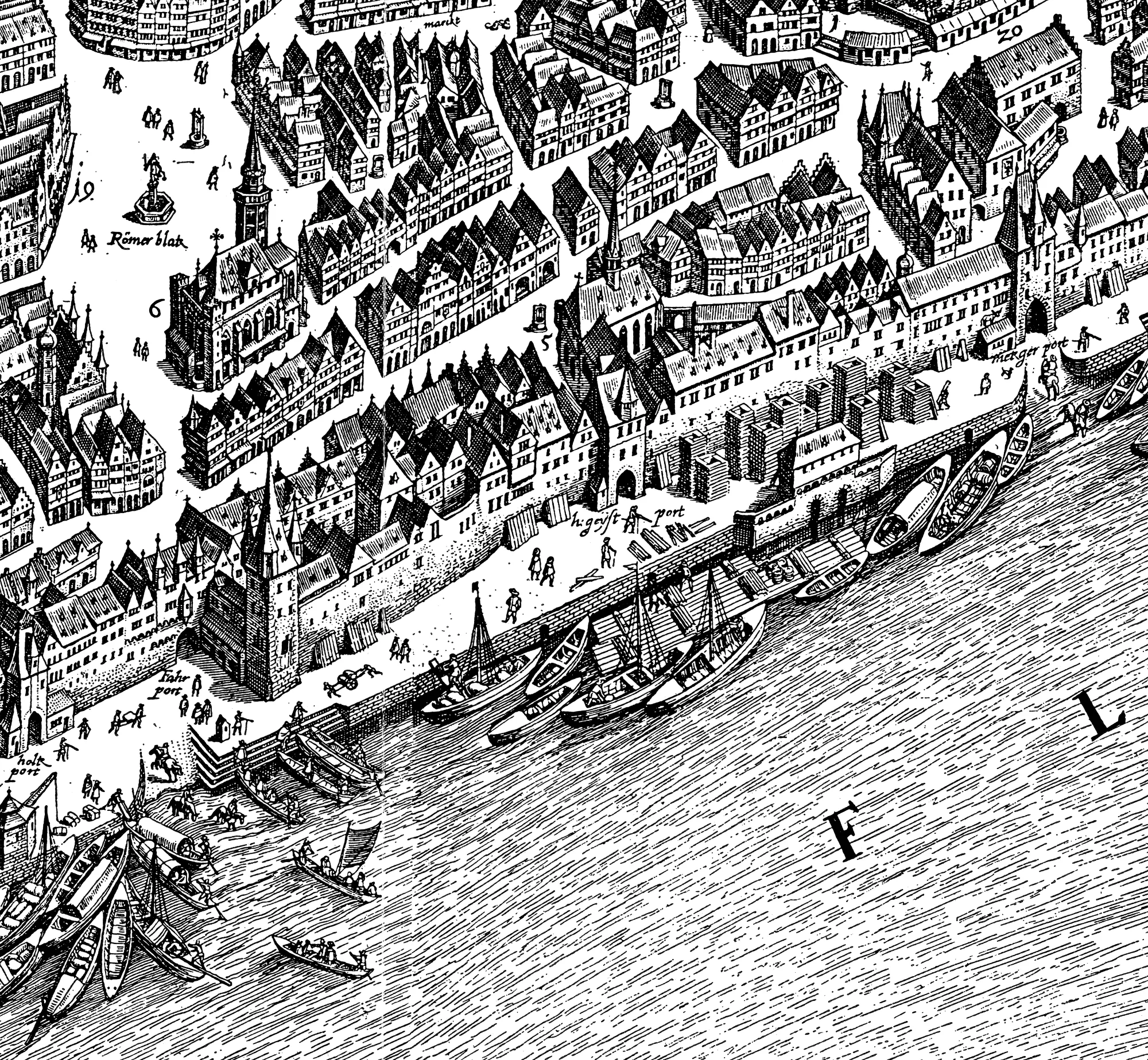
Merian's engraved view of Frankfurt am Main, with its dense riverfront architecture, places the secure Frankfurt imprint of the Opus medico-chymicum in the urban and workshop world of Lucas Jennis and the Jennis–Merian publishing network that helped furnish the volume's images. Source ↗.
The Frankfurt University Library record gives the title beginning Joannis Danielis Mylii Vetterani Hassi M. C. Opus Medico-Chymicum, names Johann Daniel Mylius, and records "Francofurti: Iennis, 1618." It separately describes Tractatus II seu Basilica Chymica as containing seven books: gold; silver and mercury; Jupiter, Mars, and Venus; gems; minerals; vegetables; and animals. The record supplies the exact VD17 identifier VD17: 39:145613F for that tract. The NLM and Internet Archive metadata establish the larger transmission: volume 1 contains the first three books of the Basilica medica and the first four books of the Basilica chymica, while volume 2, titled Operis medico-chymici pars altera, contains the three later chymical books and the Basilica philosophica, divided into three books. The three basilicae therefore were not all issued as one completed physical unit in 1618, but the promised third tract was issued within the continuing set. The catalogued sequence of the chymical books matches the therapeutic orientation the text gives them, since the metallurgical operations are directed toward medicine — in this way, says the author, you reduce metals to the first matter, from which very salutary remedies are drawn for removing diseases, Hoc modo, inquit author, reduces metalla in primam materiam, ex qua remedia admodum salutaria depromuntur ad tollendos morbos — so that the ascending series from gold to animals is a pharmaceutical as much as a metallurgical ordering, and the division of the chymical tier across two published parts cuts a single graduated argument rather than two separate subjects.
The publication chronology is materially complex. NLM metadata gives the set as Francofurti, apud Lucam Jennis, 1618-1630, and records special title-page dates associated with 1620, 1618, and 1630: the seventh chymical book, the philosophical basilica, and the index respectively. The NLM collation for volume 1 is [44], 428, [250], 184, 492 pages, with [2] folded leaves of plates. The second-volume description gives [5] pages, pages 494-1470, [2] pages, a further 154 pages described as 150, [90], 271, [5], 44, and [98] pages, with [20] leaves of plates, some folded. Frankfurt University Library's tract-II record gives [124] leaves, 184, and 492 pages with [3] folded leaves. These differences reflect descriptions of parts and volumes rather than a contradiction in the title or author, but they make a single simplified collation unsafe.
The format is not securely verified. The Frankfurt record does not state "folio," while a Wellcome catalogue description calls the online resource four parts and gives "8vo." The scale, engraved title pages, plates, and very large pagination do not by themselves establish a bibliographical format. The volume is often described in working bibliographies as a folio, but the responsible catalogue statement is that the format remains unresolved until a copy is examined or a reliable bibliographical record is found. Roman, italic, and Greek type, marginalia, indices, and the complete plate count likewise require copy-specific collation; the consulted catalogue records establish illustrations, portraits, plates, and indices but do not provide a full type or marginalia census.
The object has a strong digital and institutional footprint. Frankfurt University Library places the tract in its Sammlung Occulta and records a 2020 digitization with the URN `urn:nbn:de:hebis:30:4-217403`; the same record supplies the VD17 number above. NLM/Internet Archive metadata identifies a digitized first volume with ARK `ark:/13960/s2sx8p6n1km` and NLM identifier `2389063RX1`, while MDZ/BSB records the later volume and its scan pages. The NLM record notes the special engraved title page and author portrait in volume 1. An image database identifies a 1618 "Alchemical World Landscape" from the Opus medico-chymicum as by Matthäus Merian the Elder, and NLM metadata records a folded plate engraved and signed "M. Merian." That establishes Merian's responsibility for at least one plate, not necessarily for the entire emblematic programme.
The portrait is commonly described in image catalogues as showing Mylius at age thirty-three, consistent with the ÆTATIS SVÆ 33 verse associated with the 1618 portrait, but the accessible catalogue records did not provide a checked title-page transcription. The dedication to Respublica Helonopolitana is consequently not securely documented in the records consulted. No responsible identification of Helonopolis as Hanau, Wetter, Marburg, Butzbach, or another Hessian or Wetterau town has been established; it should remain unidentified rather than be resolved by etymological guesswork. The same caution applies to privilege, errata, prefatory poems, and the full dedication.
The alleged catalogue circulation of a Mylius digital object under Abraham Ortelius's Thesaurus geographicus could not be independently substantiated in the consulted records. The conflation is bibliographically impossible on the evidence of the works themselves: Mylius's title names three medico-chymical basilicae and Lucas Jennis at Frankfurt in 1618, whereas the genuine Ortelius record gives Abrahami Ortelii Thesaurus geographicus recognitus et auctus, printed by the Plantin office at Antwerp in 1596. WorldCat and Google Books records confirm the 1596 Plantin identity. A primary catalogue record for the earlier 1587 state was not recovered, so the 1587 Thesaurus geographicus should be treated here as a bibliographical lead rather than a newly verified record. The correct identification of the Mylius object is secure; the specific history of its alleged cross-catalogue misfiling is not.
No located record establishes suppression, expurgation, an Index entry, or Frankfurt or imperial Bücherkommission action against this imprint. Searches likewise did not locate a demonstrable chain of contemporary replies or refutations by Sennert, Libavius, the Wittenberg faculty, or the Marburg faculty, nor a securely documented later citation in Borel, Manget, Lenglet Dufresnoy, or Ferguson that can be tied to a particular copy without further bibliographical work. These are gaps in the accessible evidence, not claims that reception or censorship did not occur.
The work belongs to a broader Mylius corpus. The NDB records the Antidotarium medico-chymicum reformatum (1620), Philosophia reformata (1622), Thesaurus gratiarum (1622), and Anatomia auri (1628), among other works. Specialist musicological evidence identifies the author of the lute anthology Thesaurus gratiarum as the same Johann Daniel Mylius born at Gemünden an der Wohra: the dates vary between 24 May 1584 and 1585, and the latest attestations vary between after 1628 and not before 1631, but the physician-lutenist-composer profile and the publication record converge. The evidence supports a likely medical licentiate, probably in 1616, but no medical doctorate has been located; the self-description as candidatus on the title page is consistent with, though not proof of, that status. Philosophia reformata is especially important for object biography because Princeton's record documents its twelve alchemical engravings and their adaptation of a Scala philosophorum sequence; those plates, and the Merian image tradition, have circulated more widely than the prose of the Opus.
WorldCat record URLs consulted expose OCLC identifiers 165805765 for the first 1618 tract, 631408627 for the 1620 pars altera, and 28469848 for a general record. The page text consulted did not itself transcribe those numbers, so they are reported as URL-level catalogue identifiers rather than as independently read shelfmarks. No verified USTC identifier or copy-specific physical shelfmark beyond the repository records and the Frankfurt VD17-linked record was located.
Walking the Three Basilicas: Mylius's Argument from Preface to Potable Gold
The prefatory apparatus: dedication, portrait, and the diagnosis of surplus
The opening leaves of the first treatise set the terms of everything that follows before a single medical proposition is stated.
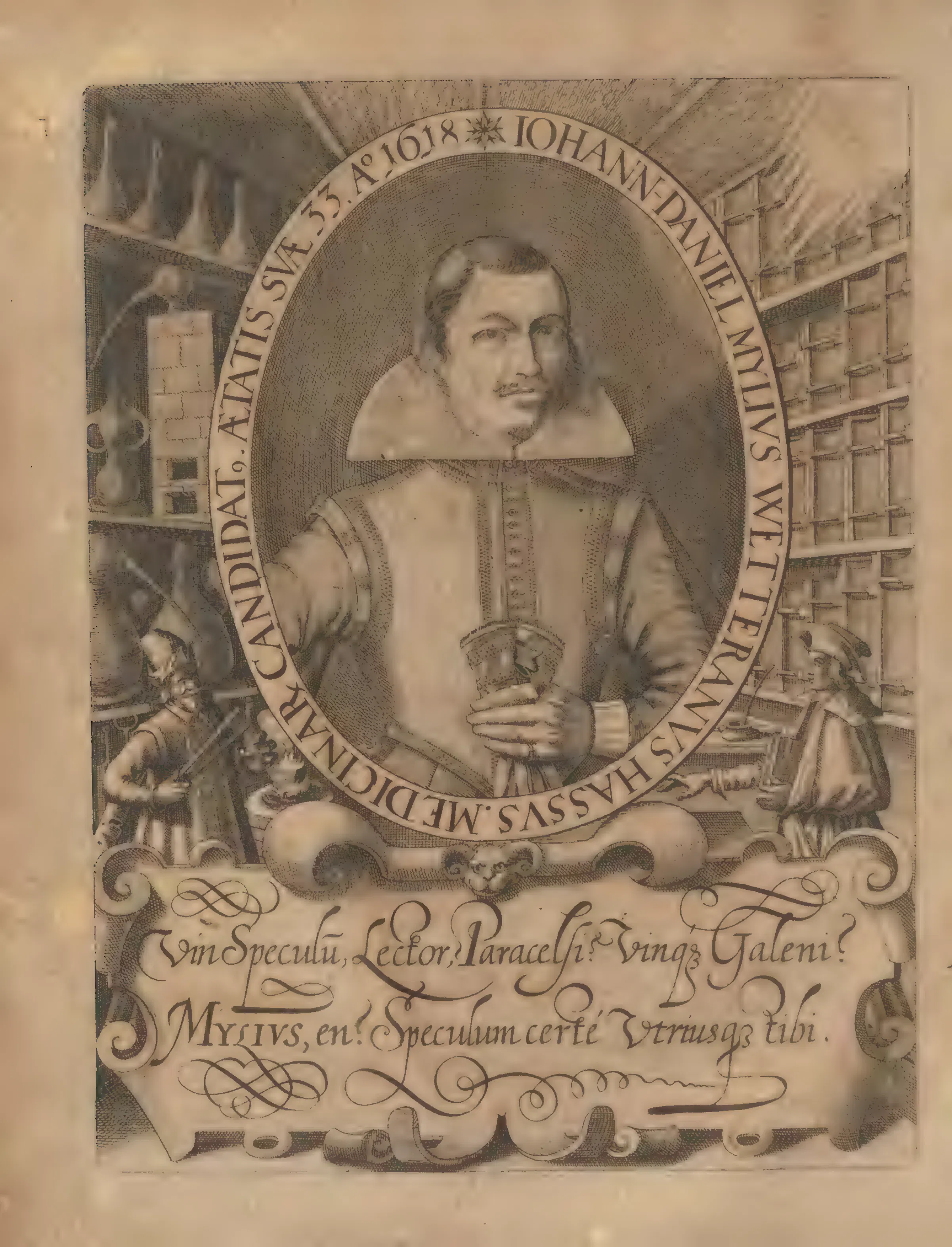
Mylius's engraved portrait sets the young medicinae candidatus, aged thirty-three in 1618, among furnace, still, and shelves of vessels, placing medical authorship inside an operative chymical workshop. The printed distich beneath the oval — casting him as a mirror of both Paracelsus and Galen — condenses the syncretic programme of a medicine at once Hippocratic and Hermetic. Source ↗.
An engraved plate divides creation into four domicilia — of the stars, of the minerals, of the elements, and of the microcosm — and sets the names of Hermes and Hippocrates on either side of the maxim VNO OMNIA AB VNO OMNIA, so that the human being is not appended to the cosmological scheme but constituted as one of its four dwellings. The dedication that follows is addressed not to a patron but to the Creator, and its petition is epistemological rather than merely devotional: it asks God to revive the little sparks of reason and wisdom surviving after Adam's fall, subscribing the author as the least worthy of creatures, Homo. The whole encyclopedia is thereby framed as an exercise in repair — knowledge pursued under the condition of a damaged intellect, which is precisely why it will require method rather than genius. The engraved portrait verse then compresses the programme into a question and its answer: whether the reader seeks a mirror of Paracelsus or of Galen, Mylius is offered as the mirror of both. The civic dedicatory epistle converts that syncretism into a bibliographic claim, promising not a portion of the art but the whole of medicine, Hippocratic as well as Hermetic, sed totam Medicinam tam Hipocraticam quam Hermeticam — a totality justified in the same epistle by the argument that empires flourish only so long as the liberal arts flourish in them, which makes the systematization of medicine a civic as much as a scholarly good.
The address to the reader is the polemical hinge of this front matter, and it opens with the diagnosis of surplus rather than scarcity already set out above: corners everywhere teeming with examples of operations, particulars on offer or half-hidden, the universals silent, and no rule to which singularities might be referred and by which they might be judged. Two vocabularies are fused there. Catholica and singularia are logician's terms, imported to describe a practical art as suffering from an inversion of the proper order of knowing; the amussis, the builder's straightedge, is an artisan's tool, and its absence names the same defect in the idiom of the workshop. The remedy answers in kind, and it is architectural: against the basilisk, that is against this evil, help and remedy are declared to lie in a legitimate system of the art, a Basilica, in the equation of hall and system already discussed. The paronomasia is doing genuine conceptual work rather than decorating a title. The basiliscus is a creature whose lethality is passive and diffuse, killing by look and breath — an apt figure for a literature that poisons by mere proximity and disorder — and the cure proposed is not an antidote but a building, a systema whose walls and tiers give each particular a determinate place. To gloss a legitimate system as a Basilica is to make the two words interchangeable, and it establishes that in this work architecture is a synonym for method.
From this diagnosis follows the most consequential editorial decision in the prefatory matter, the refusal of the discipline's inherited secrecy. The reader is told that he will no longer be compelled to inquire after and buy back secrets from impostors, nor to extract useless or shadowy gold and copious paper from the ignorant at great cost, nor anxiously to beg, nor to adjure all the gods and goddesses not to divulge, since everything will lie open to him himself, Non cogeris amplius inquirere & redimere arcana ab impostoribus, non magna vi Aurum inutilem aut vmbratilem copiosamq; schedulam ab Imperitis impetrare, non solicite rogare, non omnes Deos Deasq; de non manifestando adiurare, omnia patebunt tibi ipsi. The sentence is an anatomy of a market in arcana with three components — the impostor who sells, the purchased sheet of paper that disappoints, and the oath of non-disclosure that keeps the cycle turning — and it is notable that the promised alternative is not a cheaper secret but a public book. The theological warrant for disclosure is delivered as an eschatological reproach: to what will it profit if those mysteries and secrets are first discovered only when the world is ablaze, when their authors, or rather their concealers, are rotting among the serpents, Ad quid proderit, si tunc illa mysteria atque arcanæ primum inveniantur, cum mundus conflagrabit? cum authores vel potius occultatores inter serpentes putrefient?. The self-correction authores vel potius occultatores is the argument in miniature: the adept who withholds forfeits the title of author, and the serpents among which he putrefies quietly recall the basilisk of the preceding page. Against the reproach that he has stolen others' secrets, Mylius stages and answers the objection in the idiom of the strongbox rather than of the library, and against the reproach that he claims too much he makes the concession on which his whole enterprise rests — the confession, noted earlier, that he does not teach an art of his own but arranges and expounds, with God's help, a chymical art proved and cultivated by the practice of the ancient wise artificers, and that for the exposition, the methodical transmission, and the manner of teaching to be his own is enough and sufficient. Originality is relocated from content to dispositio and modus docendi — the self-understanding of the systematizing compiler, and the only kind of novelty compatible with an art whose authority is ancient. That the same pages can turn a barbed glance at those who might promise something better, Forsan Fraternitas Rosæ crucis? si Diis placet intra centum annos, asking whether it will perhaps be the Fraternity of the Rosy Cross, within a hundred years if it please the gods, situates the volume sharply in 1618: promised reformations deferred to another century are precisely what a printed method is offered against.
The preface to Book I supplies the anthropological ground for a medicine that claims to be total. Man is described, in imitation of his creator, as the centre of creatures and the circle of all of them, since all things in the machine of the world look to him as to a leader and ruler, on whose account all things were also created, Ita etiam homo ad creatoris sui imitationem, est centrum creaturarum, & circulus omnium earundem. Nam non solum ad ipsum omnia, in mundi machina respiciunt, tanquam ad Ducem & Rectorem, propter quem omnia etiam sunt creata. The figure of centre and circumference belongs to the theological tradition's language for God, and its transfer to man is guarded only by ad creatoris sui imitationem; the microcosm here is not analogy but an office within creation, and it is what licenses the long catalogue of correspondences between bones and stones, hair and forests, blood and seas. Yet the preface immediately qualifies the erudition it has been massing, insisting that essential inward knowledge is not from flesh and blood, nor in a multitude of books and of reading, nor in a plurality of experience and length of days, nor in the persuasions of human speech and the contention of reason, but in the very undergoing of divine things, since the mind of man is perfected not in learning but in suffering the divine, Ipsa autem essentialis intrinseca cognitio non est ex carne & sanguine, neque in multitudine librorum & lectionis, nec in pluralitate experientiæ & antiquitate dierum, nec in persuasionibus humani verbi, & contentione rationis, sed in ipsa passione Diuinorum, non in discendo, sed in patiendo Diuina, hominis mens perficitur. The formula is quasi-Dionysian, and its placement inside a compendium built from citations produces the sharpest tension in these prefatory leaves: a book that ranks medicine above the other arts as the handmaid of God and nature, and requires its practitioner to be theologian, jurist, astronomer, and musician besides, nonetheless denies that multiplied reading yields essential cognition. The resolution implied throughout is that method and erudition prepare a knower whom the light of nature must still teach from within.
Book I of the Basilica medica: definition, division, and the terminus in doxology
With Chapter I the register changes completely, and the shift is itself an argument, since the promised amussis now becomes visible as scholastic definition and division. Medicine is defined from the Ars parva, A Galeno definitur in arte parua quod sit scientia salubrium, Insalubrium & Neutrorum, as the science of healthy, unhealthy, and neutral things, and the art is partitioned into physiology, pathology with its aetiology and semeiotics, and therapeutics with its dietetic, pharmaceutical, and surgical branches. What follows — elements, temperaments, humours, the parts, spirits and innate heat, the faculties, the non-naturals, generation — is Galenic in scaffolding and doxographic in manner, weighing Peripatetic against medical positions and citing Fernel, Sennert, Scaliger, and Laurentius alongside the ancients. The doxography of the soul is exemplary of the procedure: a parade of opinions from Plato and Aristotle to Democritus and Critias is resolved into a scholastic definition, a living mind understanding all things and assimilating itself to all, indeed also a part of the substance of man because it is the essential form of man, through and on account of which man is living and understanding, Mens viua describitur omnia intelligens, omnibusque sese assimilans; imo & pars substantiæ Hominis, quia Hominis essentialis Forma, per & propter quam Homo est vivus atque intelligens — the assimilative mind of the Peripatetic tradition quietly underwriting the microcosm thesis of the preface, since a soul that makes itself like all things is the psychological correlate of a body that contains all worlds.
The book closes by declaring what all this anatomy is for, and the ordering of ends is deliberate. Its first use, as observed earlier, is that in the fabric of the human body we should behold testimonies of divine Wisdom, Goodness, and Justice; the cure of the body follows second, and the preservation of nature and health third, the last justified because a healthy man can most conveniently serve God, the commonwealth, and his neighbour. Physiology thus terminates in doxology and in civic duty before it terminates in therapy. The final chapter, on physiognomy, then extends the same correspondence logic outward from function to appearance, reading heads, brows, eyes, hands, nails, and voice as legible signs, with the brain compared to a sea requiring a vessel proportioned to it and the mallet-shaped head attributed to the Spanish. The tabular monotony of these judgements is not a lapse from the systematic manner but its application: if man is the centre and circle of creatures, his outward figure must be as ordered and as interpretable as his humours, and the physician who has learned to refer singulars to universals may read a face by the same rule with which he reads a pulse.
The dietetic chapters: temperance, wine, sleep, and motion
As the exposition moves into the regimen of the non-natural things, the same rule is applied to food and drink, to sleep and waking, and to bodily motion; the argument of these chapters is best followed through the sentences that carry it.
- [temperance as remedy's origin / intemperance as source of disease] Since gluttony is so great a destruction of men, and from it flow many dangerous diseases as from a most evil fountain, it is affirmed by many that medicine was deservedly discovered and first born from intemperance — Cum enim gula tanta sit hominum pernicies, hincq[ue] plures periculosi morbi manant, tanquam à pessimo Fonte, meritò inuentam fuisse Medicinam, & primo natam esse, à multis affirmatur
- [wine and the passions / Galen on youth] For repletion by it prepares an occasion not only for diseases of the body but much more for vices of the soul — Nam ipso repletio, non solum ad corporis morbos, sed multò magis ad animæ vitia, valetudinemq[ue] paret occasionem
- [the mutinous-sailors image / reason overthrown] For reason, which is weak, cannot command the irrational faculties of the soul themselves, but just as sailors with their fists cast the helmsman out of the ship, so in ourselves the affections, brought up by much wine as by an evil tutor, spurn the reason which they ought naturally to obey — Neque enim ratio, quæ imbecilla est, ipsis irrationalibus animæ facultatibus imperare potest, verum sicut nautæ suis pugnis ex nauigio gubernatorem cum eiiciunt, ita in nobis ipsis affectus, à multo vino, tanquam à malo pædagogo educati, spernunt rationem, quam ipsi naturaliter obtemperare debebant
- [wine as divine gift, not simply prohibited] So that there be no doubt, as is established from what has been said, that wine was given to us by God himself for the refreshment of the heart, and for the nourishment of our body, and also as medicine — Ne dubium sit, vt ex prædictis constat, à Deo ipso vinum nobis in cordis recreationem, ac nostri corporis alimentum, ac in medicinam etiam datum esse
- [sleep classed with aliment, not merely with the non-naturals] Sleep is to be placed not only among the non-natural things but also among nourishment, for since through it all the faculties of the members recollect themselves, it refreshes and restores no otherwise than aliments nourish — Somnus non tantum inter res non naturales, sed etiam inter alimentum est reponendus, cum enim per ipsum sese omnes membrorum facultates recolligant, non secus reficit ac restaurat, quam alimenta nutriunt
- [Actuarius's vaporous humour / physiological definition of sleep] Sleep consists in this, that a certain vaporous humour enters into the nerves of the eyes, or into those parts of the brain which preside over discharging their office, and therefore overwhelms them, so that they must rest and grow torpid from the functioning of their office — Somnus, inquit, in eo consistit, vt vaporosus quidam humor in oculorum neruos, aut in cerebri partes, quæ ipsis obeundo mune-ri præsunt, subeat, obruatque idcirco ipsos, ita vt à sui muneris fun-ctione quiescere, & torpescere illos oporteat
- [against the vulgar view of sleep / providential institution] Sleep is not to be reckoned like a foolish phantom according to the opinion of the vulgar, but to be a true rest of the parts, so instituted by Divine providence — Somnum autem non ex vulgi opinione fatuo simulacro similem esse censendum, sed veram esse partium quietem à Diuina prouiden-tia sic institutam
- [the world-machine is not confused / order as the ground of regimen] just as in the whole machine of the world, which is not confused and, as the vulgar suppose, rashly founded by God, but most beautifully disposed and ordered — prout in tota mundi machina, quæ non est confusa, & vt vulgus opinatur, temerè à Deo condita, sed pulcherrimè disposita & ordinata
- [the three parts of the world / cosmological warrant] This very thing the three parts of the whole world teach: of which the first, the Elementary, comprehending under itself all elementated things: the second, the celestial, in which the Sun, Moon, and Stars have fixed courses and an order prescribed by God — Hoc ipsum docent totius mundi tres partes: quarum prima Elementaris omnia sub se comprehendens Elementata: secunda cœlestis, in qua Sol, Luna, & Stellæ certos cursus, ordinemq[ue] à Deo præscriptum habent
- [Wisdom 11:21 as the rule of measure] as in the book of Wisdom, God disposed all things in number, weight and measure — vt in libro sap. Deus omnia in numero, pondere & mensura disposuit
- [nothing pleases God except by order and measure] consequently all our things cannot be accepted and pleasing to God himself unless by the same order and measure which he has imposed on all things — consequenter nostra omnia Deo ipsi accepta esse & grata non possunt, nisi eodem ordine & mensura, quam ipse omnibus rebus imposuit
- [the hygienic corollary drawn from cosmic order] Hence therefore it follows that all those things are harmful and adverse to health which exceed either measure or order, and especially as regards sleep and waking — Hinc igitur consequitur, ea omnia sanitati esse noxia, ac aduersaria, quæ vel modum, vel ordinem excedunt, & præsertim quod ad somnum & vigilias attinet
- [Hippocratic aphorism as seal] On this matter Hippocrates said: Sleep, waking, both are evil if they exceed measure — Ea de re dicebat Hippocrates: Somnus, vigiliæ, vtraq[ue] modum si excedant, malum
- [benefits of moderate waking] Moderate wakings are indeed beneficial, while they render the spirits and senses more vigorous, distribute heat into the parts of the body, assist the distribution of aliment, and promote the expulsion of excrements — Prosunt quidem moderatæ vigiliæ, dum spiritus & sensus reddunt vegetiores, calorem in partes corporis distribuunt, alimenti distributionem adiuuant, ac excrementorum expulsionem promo-uent
- [the harms of excessive sleep] Excessive sleep obscures the spirits and renders them torpid, induces sluggishness of memory, heaps up crude humours, and suffocates the native heat — Somnus nimius spiritus obscurat, atque torpidos reddit, inducit segnitiem memoriæ, crudos humores cumulat, & calorem natiuum suffocat
- [motion divided / the scholastic division applied to exercise] Motion is either general or special: General, of the whole body, which either helps or harms: It helps while it is moderate, and either brings solidity to the body from the mutual attrition of the members: or increases heat, whence nutrition is more successful: or moves the spirits, whence vapours and excrements are dispersed through the pores — Motus generalis est vel specialis: Generalis totius Corporis, qui vel conducit, vel nocet: Conducit, dum est moderatus, & vel soliditatem corpori affert ex mutua membrorum attritione: vel calorem auget, vnde felicius sit nutritio: vel spiritus mouet, vnde vapores & excrementa per poros discutiuntur
- [special motion / singing as thoracic exercise] Special motion is of individual parts, and thus running benefits the feet, singing and shouting the chest, throwing the arms — Motus specialis singularium partium est, & ita confert pedibus cursus, thoraci cantus & vociferatio, brachiis iactatio
The authorities marshalled in the dietetic chapters
The learning drawn upon in this stretch is correspondingly wide, and the roster of authorities cited there indicates how the material was assembled:
- Josephus on the Essenes and on Bannus the hermit; Josephus, De bello iudaico lib. 3, on the endurance of the Jews at Jotapata
- John the Baptist on locusts and wild honey; Hilarion's fifty years of fruit
- Baptista Ferrarius, De navigatione Colombi et Vesputii cap. 21, on the Spaniards in Cuba and their longevity
- Plato, De legibus 1, on simple diet; Plato on wine and boys
- Aristotle, De longitudine vitae cap. 5, on animals that eat less living longer; Aristotle on wine and beer
- Ecclesiasticus 27 on gluttony and abstinence
- Hippocrates, De prisca medicina / De vetere medicina, on the origin of the medical art and on harmless aliments; Hippocrates, De morbis 3; the Hippocratic aphorism on sleep and waking
- Galen, De sanitate tuenda lib. 5, on wine and children
- Aetius, Tetrabiblos 1, sermo 4, cap. 29, on the diet of youths
- Actuarius, De spiritu animali lib. 1 cap. 6, on the nature of sleep
- Wisdom 11:21 on number, weight, and measure
Book Three of the Basilica medica: waking before sleep, dreams, exercise, and the passions
The book from which those passages come proceeds by the paired items of the Galenic canon of non-natural things — waking and sleep, exercise and rest, repletion and inanition, and the passions of the soul — and its first substantive move is not physiological but methodological. The chapter on waking and sleep opens with the announcement already noticed above, that the order of the physicians, in which sleep is put before waking, is to be set aside so that the discourse may begin from waking and assign it the first place. The verb posthabere there is precise: the received sequence is not refuted but demoted, ranked below a consideration that governs it. What governs it is a doctrine of human vocation stated immediately before, that night should succeed the waking hours for rest was done by God rather for the sake of animals than of men, who ought to be occupied in perpetual vigils in contemplating and admiring the works of the supreme craftsman and in singing his greatest praises, In vigilias certe succedat nox in quietem, id in animalium potius gratiam à Deo factum est, quam hominum, qui perpetuis vigiliis in contemplandis, admirandisque operibus summi opificis, illiusque maximis decantandis laudibus versari debent. The rearrangement is therefore axiological rather than clinical: dignity of subject dictates order of exposition, and the ordering rule of the regimen tier is a claim about what man is for. Sleep loses its priority not because its physiology is doubted but because it belongs to the animal share of the composite creature, while vigil belongs to the contemplative. This is the treatise's characteristic operation in miniature — a received Galenic topic left materially intact and re-hung on a different frame.
The consequence is that dietetics is immediately moralized and politicized. The exempla of vigilance are magistrates and commanders, and the Epaminondas anecdote gives the argument its sharpest form: asked why he did this, he replied that he was sober and awake so that the rest might be allowed to be drunk and to sleep, Rogatus vero, cur id faceret? respondit, sobrium esse se, & vigilare, quo reliquis liceret tumulentos esse ac dormire. Temperance here is not the private economy of a single body but an office discharged on behalf of bodies that are not temperate; the physician's counsel becomes indistinguishable from advice to the ruler, and the long preceding catalogue of Persian shame-culture, Spartan sumptuary law, and Roman garden fare acquires its function as a repertory of civil rather than merely hygienic examples.
When the exposition turns to sleep proper, the same double frame reappears as an explicit change of register. Poetic mythography is assembled at length — the Orphic hymn making Sleep king of gods and men, Hesiod's son of Night, Ovid's Cimmerian cave, the Virgilian brother of Death whose bed is a tomb — and is then set aside by a metadiscursive signal: on this reckoning sleep, to speak in a sounder and Christian manner, is an outstanding and most excellent gift of God, given to the human race in place of rest, Hac ratione somnus, vt saniori & Christiano more loquamur, est Dei donum eximium & præstantissimum, generi humano in quietis locum datum, with Adam's deep sleep at the creation of Eve supplying the scriptural instance. The phrase saniori more loquamur does not discard the mythographic material; it subordinates it, exactly as the physicians' order was subordinated. The pagan fable is retained as ornament and as evidence of what antiquity felt about sleep, while the operative account is scriptural.
The same technique of retention-under-limitation governs the treatise-within-the-chapter on dreams, which is the most elaborate structure in this stretch of Book Three. Dreams are divided into divine, diabolical, supernatural, and natural, with Peucer's fourfold division noted, and the diabolical species is further split into the solicited dreams of incubation shrines and the unsolicited promptings of the Devil — a demonological taxonomy that carries the temples of Amphiaraus, Isis, and Asclepius, with their inscribed cure-columns, into the same classificatory grid as the sleep of Epimenides and the Seven Sleepers of Ephesus, which are reported and then tagged as wholly beyond the reach of the understanding. The methodological hinge comes when the author refuses both credulity and contempt: these things are not said by us to the end that we should entice anyone to an excessive and superstitious diligence in observing dreams, since dreams can sometimes deceive, Hæc tamen à nobis non dicuntur in eum finem, quasi ad nimiam superstitiosamque somniorum obseruandorum diligentiam quamuis pellicere velimus, cum somnia interdum fallere possint, the same paragraph in which Cato's Somnia ne cures is admitted only with a certain fixed limitation. The calibration is intelligible only against confessional pressure: a Lutheran natural philosophy could license the physician's use of dreams as passionum animi & corporis indicia while proscribing divinatory observance, and the text secures the medical use precisely by narrowing the divinatory one. Natural dreams are accordingly handed back to the physician together with a causal apparatus — vaporous foods, melancholic humours, somnambulism — that keeps them inside the order of created nature.
The chymical vocabulary of the wider work surfaces inside this Galenic tier at the level of pharmacology rather than doctrine. Hypnotic simples — chamomile, poppy heads, mandrake leaves, henbane seed — are explained not by their manifest moisture but by an active principle: they provoke sleep not so much by reason of that moist quality as by the virtue of the narcotic sulphur which for the most part abounds in those simples, quæ non tam ratione humidæ qualitatis istius, quam virtute sulphuris narcotici, quod vt plurimum abundat in illis simplicibus, somnum prouocant. The construction non tam… quam performs a small but real displacement of the elementary qualities by a chymical principle, and the same register returns at the very end of the run in the spagyrically prepared hellebore prescribed against the melancholic humour, so that the regimen books and the Basilica chymica are joined at the point of the prepared remedy while the Galenic framework of qualities is nowhere denounced.
The chapter on exercise and rest is where the compiled character of this material becomes most visible, because the first-person voice localizes itself. Ancient athletics are recovered antiquarian-fashion — the ars Gymnastica, the five genera, the classes of runners — and then verified against present observation: for in our Gascony you will scarcely find any village in which the inhabitants do not yearly celebrate some solemn festival, In nostra enim Vasconia vix reperies vllum pagum, in quo incolæ non quotannis solenne aliquod festum celebrent, with its arquebusiers, crossbowmen, and prizes of a calf, a fat wether, and a coral-trimmed cap. The same voice cross-refers to works of its own, sending the reader on falconry and on the power of harmony to the fourth book of my poems, which are entitled the great mirror of the world, 4. lib. meorum poematum, quæ magnum mundi speculum inscribuntur. A Gascon standpoint and a poem-cycle of that title are not features of the Hessian author named on the general title page, and the honest inference is philological rather than biographical: the Basilica medica's regimen book incorporates a substantial dietetic text whose authorial "I" it has not levelled out. That is entirely consistent with the work's own claim to contribute dispositio and modus docendi rather than invention, but it also shows how little the compiler intervened in the internal voice of what he arranged.
Regimen in this chapter is stratified by estate as a matter of physiology, not merely of decorum: as regards persons and ages, violent exercises suit young men and the robust rather than the old, and above all those who seek their daily bread in sweat, such as farmers, workmen, and porters, Sed quoad respectum personarum & ætatum violenta exercitia conueniunt iuuenibus, & viris robustis potius quam sen bus, potissimum vero iis, qui in sudore victum quotidiamum quæritant, quales sunt agricolæ, operarii, baiuli, while middling exercise is assigned to the rich, the learned, and men of arms, and light exercise — reading, music, cards, tables, walking — to women, delicate constitutions, and the old. Labour and recreation are thus made commensurable as species of one hygienic genus, and the social order enters the doctrine as a diagnostic category.
The final and longest movement, on the passions, is also the place where the treatise defends its own copiousness. Against an imagined carping censor the author answers that to the fairer reader, having grasped our design, the matter will appear otherwise, for he will see well enough that a universal, not a particular, treatment of diet is here delivered by us, Sed æquiori lectori, institutum nostrum assecuto, res secus videbitur. Satis enim perspiciet, vniuersalem hic à nobis, non particularem tradi de diæta tractationem. The distinction between universalis and particularis is the same one on which the work's whole programme rests, and here it licenses precisely what a reader of particulars would call digression: the histories of avarice and ambition, the enchantments and love-philtres, the consolatory exempla of Spartan mothers and Roman magistrates. Copiousness is defended as universality.
That universality has a limit which the text states with unusual force. After a full sequence of somatic prescriptions for lovesickness — phlebotomy, purges, milk, sweet baths, section of the saphena, cordials — the author cancels them: but all these things are in vain, since a spiritual disease is not helped by bodily aids; here the physician's knowledge, industry and experience are required, here a sure knowledge of the causes of the disease is wanted, Sed frustra hæc omnia, cum spiritualis morbus corporeis auxiliis non iuuetur. Hic Medici scientia, industria, experientiaq[ue]; requiritur: hic certa cognitio causarum morbi desideratur. The passage is doubly loaded. It preserves the classic diagnostic exempla of Hippocrates with Perdiccas and Erasistratus with Antiochus as triumphs of sagacitas, while insisting that the cure they proposed must be replaced by remedies that do not offend the divine majesty; and it makes the therapy of the accidentia animæ dependent on a discernment that no pharmacopoeia supplies, which is why the theologian is elsewhere named the true physician of the soul. Somatic medicine is not abandoned but bounded.
What fills the space so bounded is, at the close of the run, harmony. The encomium of vocal and instrumental music against melancholy and tarantism is grounded in a psychology rather than in mere consolation: since like is chiefly affected by like, and our soul, according to Pythagoras' opinion, is a certain nature consisting of harmony and numbers, it is certainly not slightly refreshed and helped by them in its perturbations, Cum enim simile simili plurimum afficiatur, animusq[ue] noster ex Pythagoræ sententia sit natura quædam ex harmonia & numeris constans, non modicum certe illis recreatur & iuuatur in suis perturbationibus. The principle of simile simili is the same correspondence axiom that authorizes astro-medical practice elsewhere in the work, transferred from planets and metals to number and soul; David's lyre before Saul and the concerted sound that answers the tarantula's bite are consequences of it rather than anecdotes appended to it. Immediately after, the exposition returns to purgative preparatives against the atrabiliary humour — syrups of fragrant apples, violet, bugloss, epithymum, quince, fumitory, with lapis Lazuli and hellebore prepared by the spagyric art — so that Pythagorean psychology and chymical pharmacy stand side by side as remedies for one disorder, which is as exact a picture as this stretch of Book Three affords of how much the system is asked to hold in a single graduated order.
The Basilica philosophica: creation, the four worlds, the angels, and the sun
The philosophical tier proceeds by a comparable technique of retention under subordination, and it does so first in the register of dogmatics. The first part of its preface ends in a patristic florilegium, a chain of extracts from Augustine, Ambrose, John Damascene, Cyril, Cyprian, Chrysostom, and Basil marshalled on the two natures of Christ and on the person of the Holy Spirit. The mode of argument is compilation rather than demonstration: authorities are stacked, keyed to book and chapter, and allowed to gloss one another, and the similitudes chosen are conspicuously material — divinity in the man as light in a candle, as breath in a trumpet, as wine in a vessel, and the body of Christ related to other bodies as gold to iron. A reader who has come for chymistry is thus trained, before any furnace appears, to read material relations as vehicles of doctrinal ones. The doxology that closes the section functions as a hinge, announcing that what follows treats the creation of the world; the trinitarian dogmatics is not an ornament prefixed to cosmology but its stated premise.
The second part of the preface accordingly opens with a definition of mundus etymologized from munditia and from the Greek sense of ornament, the universe being a most polished mirror in which the wisdom, power, goodness, and majesty of God shine out. Upon that definition rests the doctrinal claim that governs the remainder: this totality of things was fused together out of God's primary and utterly free will, not out of any necessity of nature, nor out of any pre-existence of matter, Fuit autem hæc rerum vniuersitas conflata, ex primaria & liberrima Dei voluntate, non naturæ necessitate, aut Materiæ vlla præexistentia. The refutation offered immediately afterwards is a neat reductio on the philosophers' own vocabulary: if there is a first matter, then it too was created from nothing, since otherwise it would not be first but second, third, or fourth. The polemical register is unusually sharp for a preface — Aristotle and his sectaries are said to be deceived by a fog of error in imagining the world eternal — and the warning attached to it, that no one stray from the true path and end by offering himself as prey to the devil, converts a cosmological error into a spiritual hazard. This matters for the volume's architecture, because an eternal, self-standing nature would leave no room for the graduated dependency of lower things on higher that the chymical and medical books will everywhere presuppose.
The demonstration proceeds by an accumulation of arguments from mutability, from Ecclesiastes' vanitas, from the Timaeus, and from a long roster of gentile witnesses from Zoroaster and Trismegistus to Pythagoras and Plato, and it culminates in a striking figure: let the argument adduced from Aristotle suffice, by which, as with iron and fire, we do not fear to cut Aristotle's own throat with his own sword, since the truth shines out, Hactenus & de his adducta ratio Aristotelis sufficiat, quibus tanquam ferro & igne, ipsummet Aristotelem suo gladio jugulare non timemus, cùm veritatem eluceat. The metaphor deserves notice, because ferrum et ignis is the working idiom of the assay and the forge, the pair of agents by which impure bodies are opened and tried; dialectic here is described in the vocabulary of the operative trades, and Aristotle is subjected to a test he cannot survive. The gesture is characteristic of the whole preface: the same practitioner's lexicon that will later govern digestion, coagulation, and fixation is used to describe the ordering of doctrine itself.
Having established that the world is made, the text divides it. Beneath the tripartite regional scheme of invisible and visible things a second, distinct division is introduced by reason of order: now also, by reason of the order of the world, according to the distinction of order there are in it four worlds, namely archetypal, intellectual, celestial, and elemental, Nunc etiam ratione ordinis Mundi, in eo secundùm ordinis distinctionem, quatuor sunt Mundi. Nempe 1. Mundus, Archetypus. 2. Intellectualis. 3. Coelestis. 4. Elementaris. The four-world scheme, inherited from the Christian Cabbalistic and Hermetic tradition, is presented here as a corollary of ordo rather than as an esoteric revelation, and it is immediately made to carry the microcosmic axiom, since man is created in the middle of all creatures and in the centre of the whole world, with supercelestial, celestial, elemental, animal, vegetable, and mineral things all subsisting essentially in his fabric. From this the text draws its conclusion about service: hence every creature ought to serve man, since he is the end of every creature, and King and Lord, and thus the epilogue of all creatures, Hinc omnis creatura homini seruire debet, cùm ille sit finis omnis creaturæ, & Rex ac Dominus, & sic omnium creaturarum epilogus. The chosen noun is rhetorical rather than physical: an epilogus is the recapitulation with which a discourse is summed, so that man is figured as the closing summary of a created oration. The microcosm is thereby made continuous with the work's own bookish and architectural understanding of nature, and the doctrine acquires a practical edge — the subordination of creatures licenses the whole apparatus of extraction, preparation, and medicinal use that the chymical books will unfold.
The section on creation ends by referring the reader elsewhere for what has been omitted: let Josephus in the first book of the Jewish Antiquities, Sixtus Senensis in the fifth book of the Holy Library, and Alsted's Encyclopaedia supply the rest, and besides these Robert Fludd and others of that kind, physicists, metaphysicians, and theologians alike, Cætera de creatione Mundi & rerum, tibi Lector optime, suppleat Iosephus lib. 1. Antiquit. Iudaic. Item Sixtus Senensis lib. 5. Biblioth. sanctæ, & Alsted. Encyclopæd. lib. 12. Pantomel. Præterea & Robertus Fludd, & alii id genus, plures, tam Physici, Metaphysici, quam Theologi. The bibliography is a self-placement. Reformed encyclopedism and Hermetic cosmography are named in one breath, and the deferral confirms that the preface claims completeness of arrangement rather than of matter: the cosmological tier is sketched only as far as the medico-chymical argument requires, and the reader is sent to the specialists for the remainder.
The third part turns to angels, defined as spirits endowed with reason not by bodily pleasure but by the intelligence of mind, immortal, subtle, created for God's honour and ministering to the protection of his Church.
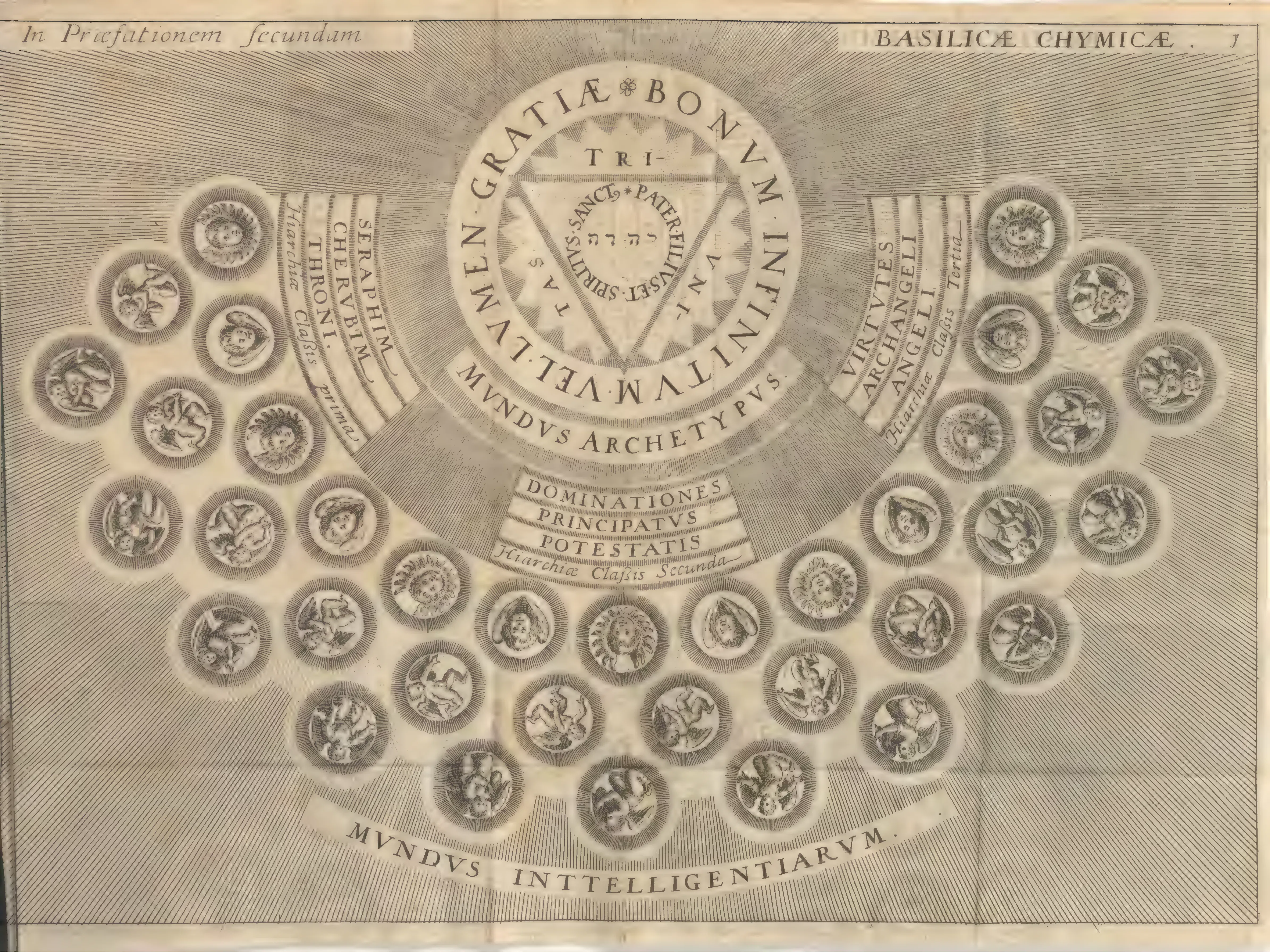
Opening the second preface, this engraved schema sets the Trinitarian "MUNDUS ARCHETYPUS" above the "MUNDUS INTELLIGENTIARUM," where the nine angelic orders are grouped in three ranked classes of medallions. Its descent from divine light to ministering intelligences gives emblematic form to the claim that angels are defined by office rather than nature. Source ↗.
Their names are derived from their operation, and the doctrine is deliberately trilingual — Angelus in Greek, Nuntius in Latin, Malach among the Hebrews — before being distributed into nine orders, each with a named head and a second column of sacred names glossed by their Hebrew etymologies, Raphael as the medicine of God, Camael as one seeing God. The first entry is the most consequential: they are the Seraphim, whose head was LUCIFER, and now JESUS CHRIST, 1. Sunt Seraphim, illorum caput fuit LVCIFER, & nunc IESVS CHRISTVS. The Dionysian hierarchy is thus historicized by the fall and re-headed christologically, which keeps the angelic tier inside the trinitarian frame set at the outset while preserving the whole apparatus of angelic mediation: it is by angels, in the presence of God, that the ordinary and natural operation descends through the celestial bodies into these lower ones.
The fourth part moves to the first mobile and the planets, and states the sun's primacy in regal terms: it must be known that the sun subsists in the middle of all the planets, and thus as a King in the midst of his nobles, and so too here the astronomers Ptolemy, Alfonso, Copernicus, and others have said, Sciendum autem est, Solem in medio omnium Planetarum consistere: & sic tanquam Regem in medio Nobilium suorum. Sic quoque hîc Astronomi Ptolomæus, Alphonsus, Copernicus, & alij dixerunt. Copernicus is enrolled beside Ptolemy and the Alfonsine tradition as a witness to a claim of dignity rather than of orbital arrangement; the medium invoked is the middle of a court, not of a system. The distinction the text then insists upon is more technical and more revealing: the sun is not to be understood as the element of fire, because it is not merely simple but a fifth essence, whereas elemental fire is simple matter. Preserving the sun's quintessential status is what allows solar power to be described as vivifying and conserving rather than merely calefacient, and it is the premise on which the following part builds the correspondence between the sun and gold.
That correspondence is cashed out therapeutically. Gold, generated in the earth's womb from purified sulphurous and mercurial vapour by long decoction under solar influence, retains celestial and even supercelestial virtues, and when duly prepared according to the order of nature its arcanum — potable gold — is credited with an extraordinary jurisdiction: therefore it also removes, cures, and expels from our bodies diseases from divine impression, such as epilepsy, apoplexy, paralysis, mania, melancholy, hydrophobia, and the rest of the like afflictions, which not only God sends into our bodies by means of the heaven, but which the evil angels themselves also impress upon our bodies, in some execration or some special punishment, Ideò etiam morbos ex Diuina impressione, vt sunt Epilepsia, Apoplexia, Paralysis, mania, melancholia, hydrophobia, & reliqui similes affectus, quos non solum Deus mediante coelo in nostra corpora immittit, sed etiam quos ipsi Angeli mali in nostra corpora imprimunt, in aliqua execratione, aut in aliqua speciali punitione, tandem tollit, curat, & ex nostris corporibus expellit. The angelology of the third part is here converted into an etiology, and the etiology into a pharmacy: the same graduated chain that carries influence downward carries remedy upward, and a prepared metal is made competent against causes that are not, in the ordinary sense, natural. The classification is nonetheless disciplined, since these diseases are assigned to divine and diabolical impression as a species within a scheme, not adduced as prodigies.
The address to the studious reader that follows the preface supplies the operative definitions the cosmology has been preparing. Alchemy is an art working in metals and minerals, likewise also in vegetables and finally in animals, from which true medicine can be drawn and made, and from which also the true arcana, tincture, and transmutation of metals and minerals can be produced, Alchymia est ars, in metallis & mineralibus, tam quoq; in vegetabilibus, & tandem in animalibus operans, ex qua vera Medicina possit elici & fieri, ac ex qua etiam vera metallorum, atque mineralium arcana, tinctura, ac transmutatio produci ac fieri possit. The definition is exactly congruent with the seven-book plan announced a few leaves later, so that the classification of the art and the table of contents are one and the same act; medicine is named first among its products, and transmutation second. The principle of generation within kind — gold from gold, as man from man and lion from lion — then forces the distinction between vulgar and philosophical Sol, Luna, and Mercurius, and the philosophical matter is described in terms that press analogy toward identity: there is one thing in which Sol, Luna, and Mercurius subsist, and thus these three are in one and proceed from one, which at length is one, in which three principles body, soul, and spirit are found, which also are God the Father, God the Son, and God the Holy Spirit, Est vna res, in qua Sol, Luna & Mercurius consistunt, & sic hi tres, in vna sunt & ex vna prodeunt, quæ tandem est vna, in quibus tribus principiis, corpus, anima & spiritus reperiuntur: quæ etiam sunt Deus Pater, Deus Filius, & Deus Spiritus sanctus. The copula sunt, rather than a comparative particle, is the boldest move in this stretch of text, and it sits uneasily beside the preface's own insistence on divine simplicity and on the gulf between creator and creature; the trinitarian vestige in matter, elsewhere a figure, is here written as an equation.
Against the philosophical matter stand the vulgar alchemists, who labour on common vitriol, salts, antimony, arsenic, and marcasite, and on glass, urine, dung, eggs, blood, hair, and worms, and find nothing in them but false and empty speculation, useless toil, sweat, poverty, and their own death. The rhetorical function of this catalogue is to certify the author's own restraint by exhibiting the wreckage of unmethodical practice. It also prepares the disclosure claim with which the address closes, and that claim is calibrated with some care: in this chymical tract of ours we have hidden nothing from you, because in it there is nothing of what pertains to Alchemy, whether in metals, minerals, vegetables, or animals, but all things are chymical and thus pertain to chymical medicine, Hîc autem in hoc nostro tractatu chymico, nihil tibi occultauimus, quia in illo, id quod ad Alchymiam pertinet, tam in metallis, tam in mineralibus, tam in vegetabilibus, tam in animalibus, nihil est: sed omnia sunt chymica, & sic ad medicinam chymicam pertinentia. Openness is secured by partition rather than by disclosure. The chymical tract can promise to conceal nothing precisely because the philosophical magisterium — the universal medicine, the tincture, potable gold as the philosophers' stone — has been reserved for a third tract, to be printed, if God grants it and grants life, under the name of the Basilica Philosophica. Secrecy is thus relocated from the sentence to the structure of the work, and the deferral is itself an act of the dispositio the author claims as his own contribution.
The prefatory treatise read from its head: testimonia, hexaemeron, and the passage to gold
Read again from its own beginning, the same prefatory treatise shows the modus docendi the work claims as its own contribution operating at its most exposed. Nothing is argued in the discursive sense; doctrine is stated as a rubric and then discharged into a chain of citations, so that the rubric itself performs the ordering work. The Christological sequence proceeds by exactly this device when it announces the testimonies of Holy Scripture that the Son is coeternal with the Father, beginning from John 6:62, "If you shall see the Son of Man ascending where he was before," Testimonia Scripturæ sacræ, Filium esse coæternum Patri, hæc sunt: Ioan. 6. v. 62. Si videritis Filium hominis ascendentem, vbi erat prius. The heading supplies the universal; the sigla supply the singulars; no exposition intervenes. This is the amussis applied to dogmatics — a rule against which particulars may be referred and judged — and it is the same procedure that will later govern the arrangement of metals, organs, and receipts. The consequence is that the theological tier of the work is not a devotional preamble detachable from the chymical books but a demonstration of the compiler's method on material where the universals are least disputable.
Within that frame the compilation nevertheless allows itself analogies of a very particular texture. Against Jewish objections the treatise reproduces Augustine's harp: three things appear together, art, hand, and string, and yet one sound is heard, art dictating, the hand touching, the string resounding, Tria pariter adesse videntur, Ars, manus, chorda, & tamé vnsus sonus auditur: ars dictat, manus tangit, chorda resonat. The figure does a precise dogmatic job — securing that all three Persons operate in the Incarnation while only the Son assumes flesh — but it also discloses the intellectual habit that unites the parts of this preface: a single audible effect produced by distinguishable co-operating causes, which is the structure of correspondence itself. That an author who published a lute anthology should transmit the analogy of ars, manus, and chorda is not incidental to the compilation's sensibility; the instrument furnishes a model of unity-in-distinction that the later solar and metallic analogies will exploit in the register of natural philosophy rather than of grammar.
The pneumatological section reveals how little the florilegial method screens its sources. Tertullian is quoted at length on the maturation of justice: justice was first in the rudiments of nature, fearing God, then advanced into childhood through law and prophets, then boiled up into youth through the Gospel, and now through the Paraclete is composed into maturity, Sic & justitia (nam idem Deus justitiæ & creaturæ) primò fuit in rudimentis naturæ Deum metuens. Dehinc per legem & Prophetas promouit in infantiam. Dehinc per Evangelium efferbuit in juuentutem. Nunc per Paracletum componitur in maturitatem. The passage comes from De uirginibus uelandis, and its periodisation belongs to the New Prophecy: revelation is staged, and the present stage is pneumatic rather than evangelical. Absorbed without polemical marker into a compilation whose doctrinal signature is otherwise Wittenberg's, the dictum leaves an unresolved seam at the heart of the pneumatology. It is precisely the seam a reader of 1618 might exploit, since a progressive economy of the Spirit is what licenses appeal to an inward instructor — the light of nature teaching instar veri Doctoris — beyond the settled canon of academic books. The compiler's silence here is not carelessness so much as the price of the testimonia form: an authority admitted for one clause arrives with its whole architecture intact.
Part I closes with the only navigational aid the reader is given, an explicit architectural signpost: here we will have the First Part of this Preface completed, and now we shall proceed to the Second Part, which treats of the Creation of the World, Hic Primam Partem hujus Præfationis absolutam volumus; nunc ad Secundam Partem accedemus, quæ agit de Creatione Mundi. Such formulae, repeated at each part-boundary and matched by display headings and closing Finis lines, are the working joints of the printed system: in an otherwise unbroken florilegium the boundary must be typographically declared or it does not exist. The architecture promised by the word Basilica is here realised as a sequence of announced thresholds.
The hexaemeral commentary supplies the compilation's own theory of why such thresholds are necessary. God, it argues, willed in his immense goodness to distinguish the work of creation into six days, so that he might set forth his workmanship for us to behold and consider piece by piece, as in a tablet, Sed voluit immensa bonitate distinguere opus creationis in sex dies, vt per partes tanquam in tabella spectandum & considerandum nobis proponeret opificium suum. The six days are read as an accommodation to human cognition, a division introduced not by the nature of the act — which required no succession — but by the requirements of finite understanding. This is a remarkable authorisation of the encyclopedic project. If God himself taught per partes tanquam in tabella, then graduated arrangement is not a human convenience imposed upon knowledge but an imitation of the divine manner of teaching, and the compiler's claim to contribute dispositio and methodus acquires a theological warrant rather than a merely pedagogical one. Creation becomes the first tabella, and the printed system its analogue.
The same part shows the concordist technique that will later join Hermetic to patristic authority. The scholastic definition of prime matter as a primordial being, infinite, formless, in potency as much to something as to nothing, of no quantity or dimension, Materia prima est ens primordiale infinitu[m], informe, in potentia tam ad aliquid, quàm ad nihil; nullius quantitatis seu dimensionis, is set down with maximal negativity and then identified with the terra inanis et vacua of Genesis and with the abyss. The move harmonises the philosophers' hyle with Moses at the cost of leaving the doctrine of creation ex nihilo, defended a few pages earlier against the poets' chaos, in tension with a first matter that is ens and infinitum. That tension is native to the material rather than manufactured by the compiler, but the testimonia method offers no instrument for adjudicating it: definitions are collected, aligned, and left standing side by side.
The cosmographical excursus that follows is where the second part most clearly justifies the breadth of learning the whole work demands. After noting that half the globe was unknown a hundred years earlier, the text presses the point in moral terms: we ought to remember that not to know the magnitude of the earth and the situation of regions is nothing else than to be ignorant of one's own house, meminisse nos oportet, terræ magnitudinem & regionum situs nescire, nihil aliud esse, quàm iam ipsius domum ignorare. The figure of the domus converts geography from curiosity into stewardship, and it does so within a treatise on the Creator: to know the house is to know the housebuilder's work. Measurements accumulate around it — the world's age, the distance to the Moon and to the sphere of fixed stars, the earth's circumference after Eratosthenes and Hipparchus, a census of known stars — numbers whose function is less predictive than architectural, filling the tiers of the created machine that the Cabbalistic division into elemental, intellectual, and archetypal worlds will then name.
Angelology tightens the method's discipline before the astrological material loosens it. Gregory's dictum that the word "angels" is a name of office, not of nature, Angelorum vocabulum nomen est officii, non naturæ, governs the third part and does considerable work: it permits the later assimilation of preachers and of the faithful to angelic function, and it keeps the nine orders — given twice, once in a Talmudic-Cabbalistic and once in a Dionysian arrangement — within the order of ministry rather than of substance. On the question of when the angels were created, the treatise declines to decide, saying with Ambrose that we should willingly not know what we neither ought nor are able to know, cum Ambrosio aiamus; Libenter nesciamus, q[ui] scire nec debemus nec possumus. This is a deliberate brake, and its placement is instructive: the docta ignorantia is invoked where Scripture is silent about spiritual creatures, yet no comparable restraint is applied to the lunar elections for bloodletting, sowing, and marriage, or to the assignment of governing angels to the planets, in the part that follows. The limit is drawn by the presence or absence of a scriptural datum, not by the difficulty of the subject — a criterion that leaves the astrological correspondences unprotected by anything except the two-orders distinction the author will offer to his theological critics.
The transition into gold shows how the parts are meant to interlock. The pneumatological vocabulary of Part I returns transposed, gold being said to contain a most secret and celestial spirit, In Auro spiritus est secretissimus ac coelestis, the vehicle by which life is imparted to creatures — the spiritus now a virtue seated in a metal and extractable by art. Scripture is read in the same operative register: the golden calf set up by Aaron was burnt at the divine command, its powder sprinkled in water and given to the people of Israel to drink, which the author suspects was not done without a miraculous artifice, whether divine or chymical, tamen à Moyse, ex jussu diuino, aureum vitulum (in Eremo idololatriæ obiectum, ab Aarone erectum, Exod. cap. 23.) combustum, eiusque puluerem aquæ inspersum, populo Israëlitico propinatum fuisse, quod non absque miraculoso artificio, siue diuino siue chymico, factum suspicamur. The disjunction siue diuino siue chymico is the hinge of the whole enterprise stated in four words: the art does by industry what the divine power does by prerogative, and a scriptural narrative accordingly furnishes evidence for the solubility and potability of gold. The chapter reference is misgiven, Exodus 23 for 32.
Against ancient authority the same commitment produces an explicit arbitration. Aetius, the text notes, wonders how swallowed gold can heal and help, which is certainly against experience, since the author confesses that not without reason do great princes swallow gold itself in the form of pills, Aëtius vero miratur, quî deglutitum aurum medicari & opitulari possit, quod quidem contra experientiam, fateor enim non sine ratione viros Principes etiam aurum per se deglutire in forma globulorum. The refutation is completed not by counter-citation but by a disqualification of the witness: Aetius never set hand to chymical labour. Here the criterion that elsewhere prefers diggers and assayers to disputants is applied inside the canon of learned medicine itself, and the formulary that follows — the Aurea Alexandrina, the Confectio Alkermes, the Electuaria de gemmis, the Puluis Bezoarticus contra pestem — takes its place as the practical terminus of a sequence that began with proof-texts for the coeternity of the Son.
The quintessence and potable gold
The tenth chapter of the first chymical book opens not with an operation but with a definition, and the definition is framed as a defence of a contested name: the quintessence is so called, the text says, not because it is something beyond the four elements but because it is more exalted, Quinta essentia sic vocatur non quia sit præter quatuor Elementa, sed quia sit exaltatior. The move is small and consequential. By denying the Aristotelian sense of a fifth body proper to the heavens, the chapter removes the most obvious ground on which a philosophical faculty could object that chymists had invented a new element; what remains is a claim about degree, purity, and exaltation within the received elemental order. The chapter then arranges its authorities in ascending fullness — Beguin's compact formula, the definition of "our iatrochymia," and finally Paracelsus cited by tome and book of the Archidoxis — so that a doctrine of Paracelsian provenance is presented through the ordinary apparatus of the lecture hall: a term, competing definitions, a preferred definition, a briefer equivalent. That briefer equivalent already discloses the chapter's destination, since the quintessence is glossed as the last and subtlest resolution of the elements and as the long-sought arcanum, which is potable gold. Definition here is not ornament but the instrument by which arcane matter is made to occupy a place in an ordered exposition, and it is precisely the contribution the work claims for itself when it disclaims discovery.
The mechanics that follow are analytic rather than additive. Extraction, the text explains, when a thing is extracted, it is divided into four elements, three of which are left behind in the body, so that the fourth alone is carried up, and in it the whole quintessence is contained, Cum autem extrahitur res, ipsa in quatuor elementa diuiditur, quorum tria quidem in corpore relinquuntur, ita vt quartum solum euehatur, in eoque sit tota Q. essentia contenta. Nothing is introduced into the subject; what is highest in it is separated out from what is gross. The worked example is generous white wine, whose water is drawn off by distillation, whose earth is repeatedly dissolved and coagulated in the athanor until it passes into glass, and whose air harbours the essence. Two guards are set around this doctrine. The quintessence is likened to the spirit of life, but with the express distinction that the spirit of life is permanent while the quintessence is perishable — a discrimination that keeps an operative chymical entity firmly inside corruptible created nature and out of the territory that would provoke the theologians. And the wine paradigm is immediately declared transferable: the same course is to be followed with gold, divided into three parts, its elemental water drawn off by strong waters and its earth remaining as dregs. The graduated architecture of the chymical books, ascending from gold to animals, is thus underwritten by a single portable procedure, which is why the same chapter can move without embarrassment between a vegetable and a metallic subject.
The first of the numbered solar quintessences puts the work's governing axiom into the hands of the operator: take the warm blood of a healthy man and make from it a distilled water, and dissolving in it commit gold leaf to it, and if you repeat this labour over three days you will at length see the leaves dissolved, in a quantity such as you could not have believed or dared to hope, Recipe sanguinem hominis sani calidum & fac ex eo aqua[m] destillatam, in ea soluendo trade fol. auri, hunc laborem per triduum si repetieris tandem folia solui videbis, in quantitate quantum credere non posses aut ausus fuisses. The microcosm doctrine is nowhere argued in this chapter, and it does not need to be: the sympathy between the fourth world and the solar metal is presupposed by the choice of menstruum, and the qualification hominis sani makes the human body a criterion of purity for a mineral operation rather than merely its beneficiary. The clause of incredulity is a topos of wonder, but it is doing evidential work — it forestalls the reader's disbelief by naming it in advance, and it locates proof in the operator's own repeated three-day labour rather than in the reader's assent. What follows in the series quietly abandons the animal solvent for mineral ones — aqua regis, distilled vinegar rectified fourteen or fifteen times, spirit of salt, oil and quintessence of antimony, liquor of corals and of pearls — without any statement that the register has changed. The ordering principle of the sequence is procedural, not taxonomic.
That procedural ordering is the chapter's most visible response to the diagnosis with which the whole work begins. Twenty solar quintessences and then a fresh sequence of potable golds are set out in a nearly invariant grammar: laminate the purest gold, purged through antimony; calcine with sulphur and salt in the crucible; sweeten in hot spring water until the saltness is gone; pour on the chosen menstruum to the height of four fingers; seal the phial hermetically; digest in the bath of Mary; draw off by the alembic; keep the liquor in the bottom as your treasure; the dose is one grain, or half a grain, in Malmsey wine. Longer processes are further articulated into a numbered opus primum through opus sextum, so that a single preparation is itself given a syllabus. The remedy offered to a discipline drowning in unruled singulars is therefore not the suppression of singulars but their subjection to a repeatable syntax, with the register of quantity, vehicle, and indication closing every entry. Yet the same pages concede where the written rule runs out, since after one liquor of gold the reader is told that other medicaments may be added, and we commit it to your judgement and pleasure, together with the reason of the whole matter, and in these things the work and judgement of a philosopher is required, atque; tuo iudicio ac libitui committimus, cum totius rei ratione, & in his opus & indicium philosophi requiritur. The template governs the hand; the iudicium philosophi governs the template. Alongside this stands a recurrent profession that the virtues of the product cannot be set down at all — no pen suffices, the power is not describable — so that the text is at its most explicit about manipulation and at its most reticent about efficacy, an asymmetry that keeps the arcanum arcane even in the act of printing it.
Nomenclature is treated as an open question rather than a settled lexicon. Reporting on one antimonial preparation, the author records that a certain neighbour of his held this solution of the quintessence, that is, the prepared liquor of gold made by oil of antimony, to be the Elixir of life of Paracelsus, while certain others call the liquor of gold the Balsam of life, Aliquis proximus meus, huius solutionem quintæ Essentiæ, seu Auri præparatum liquorem, videlicet per Antimonij oleum factum, tenuit pro Elixirio vitæ Paracelsi, verum quidam Auri liquorem Balsamum vitæ appellant. Local report, unnamed authorities, and Paracelsian titles are here weighed against one another in a single sentence, and the adjudication is deferred to correct execution: perform the same process rightly and you will have a true elixir among the solar medicines. The stakes of the naming are not merely medical. One culminating combination yields, the text says, the truest medicament among the arcana, which you ought to guard as your treasure, for among them it is the greatest and highest and the best of all in the use of medicine, availing also for the transmutation of metals, wherefore it is also called Gold or the Elixir of life, & sic reperies verissimum inter arcana medicamentum, quod pro tuo thesauro custodire debes; nam est apud eos maximum ac summum & in vsu medicinæ omnium optimum, valens etiam ad transmutationem metallorum, quapropter etiam vocatur Aurum vel Elixirium vitæ. Therapeutic and transmutatory power are not two applications of two arts but one virtue under one name, and the injunction to guard it as a treasure sits on the same printed page as the recipe that makes it — the tension between open method and reserved secret held, not resolved.
The chapter on potable gold proper begins with a survey conducted in the manner of a scholastic collation of opinions and a complaint about the corruption of a term: no one, the text observes, will easily give a description of that potable gold which is now commonly bandied about, Verum non facilè quisquam Auri potabilis descriptionem qua nunc vulgo circumfertur, dabit, and many, it charges, profane the name and the nature of the thing in various ways. There follows a doxography — solution by corrosive acids that deposit their spirits and coagulate into salts, precipitation with salt of tartar, gold dissolved in spirit of salt and abstracted with spirit of wine, menstrua compounded from alkali, sal ammoniac and tartar, calces dissolved by animal juices — capped by Drebbel's judgement that gold is nothing but a fixed salt, a purest composition of salt, sulphur and mercury, and therefore fixable and resoluble only by salts akin to itself. The doctrine of the three principles is thus recruited as the criterion by which competing workshop practices are sorted, and the negative criterion of a preparation made wholly without corrosive supplies a further test. The resolution offered is neither authority nor definition but industry: all these things, if they are not ready to hand, the diligence of faithful and true Philosophers will at last track down in practice, so that not only may the true extraction and preparation of what has hitherto been sought under this name of potable gold be discovered, but that it may be an excelling medicine in what follows, Quæ omnia si non prompta, ea tandem sedulitas fideles atq[ue] veri Philosophi in praxi indagabunt vt sic non solum vera huius nominis huc vsque quæsita Auri potabilis extractio ac præparatio inueniatur, sed vt sit medicina sequentia præstans. Fidelity and diligence, exercised in praxi, are made the warrant of the definition itself; and the sovereign remedy so warranted is then discharged into the ordinary furniture of the prescription — four to six or eight grains with appropriate vehicles, against leprosy, falling sickness, apoplexy, palsy, phthisis, arthritis, gout and the French disease, the diseases the common sort reckons incurable. The arcanum enters the printed page as a line of posology, which is exactly how a secret is made teachable without being surrendered.
The gold chapters: division of products, the anvil of truth, and the seminal virtue
The distinctions on which that whole sequence rests are laid down at its head, and the priority given to them is deliberate. Gold is called potable, the text specifies, as often as it is reduced together with other spirits and liquors into a substance that can be drunk, while its oil is when from its own substance alone, without addition, it has already been made a golden oil, Aurum potabile, quoties vna cum alijs spiritibus & liquoribus in substantiam, quæ bibi possit, redigitur. Oleum eius est, cum ex sola sui substantia præter additionem, oleum iam factum est Aureum. What looks like a lexical fussiness is in fact the dispositio the work claims as its own contribution, applied to the most crowded and least disciplined region of chymical literature. Three products — potable gold, its oil, its quintessence — are distinguished by whether additions participate in the reduction, and that distinction then governs the sequence of chapters that follows, so that a heap of received recipes acquires an order external to any single authority who transmitted them. The measure by which the enterprise is disciplined is immediately pharmaceutical rather than metallurgical: the dose of potable gold is one scruple at each administration, and the dose of the golden oil is not to exceed the weight of ten barley grains, Dosis Auri potabilis est scrupulus vnus qualibet vice. Olei dosis Aurei pondus granorum hordei decem non excedat. Scruple and grain belong to the apothecary's weights, not the assayer's; by attaching them to the products of the gold chapters the compiler places the whole series under the jurisdiction of the Basilica medica and quietly subordinates chrysopoeia to therapeutics.
Within the operations themselves the governing anxiety is the loss of the volatile, since it is the volatile that carries the virtue. The reader is warned above all to beware lest the nobler spirits perish by flying off in the distillation, so that all the labour be in vain, caue autem summe ne nobiliores spiritus in destillatione euolando pereant & sic omnis opera sit frustranea. The hierarchy embedded in nobiliores is not merely descriptive: the spirits are noble because they are the bearers of the arcanum, and the regimen ignis is therefore an ethical as much as a technical competence, the point at which the operator's understanding of what he is handling becomes visible in what remains in his vessel. This is why failures within the art can be counted as failures of persons rather than of doctrine, a move the text will make explicitly later.
Against those outside the art, the register turns polemical, and the criterion of judgement is displaced from the schools onto operative test. If the matter is recalled to the rule and norm of their philosophy, the text concedes, it will indeed be plainly ridiculous — but not if it be referred to the anvil of truth, well known to genuine and legitimate philosophers, for whom alone these things are written, vtique ridiculum plane futurum est: non autem si ad incudem veritatis, genuinis ac legitimis Philosophis probe cognitam, & quibus Solis hæc scribimus, referamus. The incus veritatis is a workshop figure doing epistemological work: truth is what survives being struck, and the forge replaces the disputation as the site of adjudication. The clause quibus Solis hæc scribimus simultaneously narrows the readership to the initiated and puns on Sol as gold, so that the restriction of audience and the subject matter are made to coincide in a single word. Yet the same book prints, in the vernacular of plain declarative Latin, precisely what such restriction ought to protect. Basil Valentine's allegory of the grey wolf devouring the lion is quoted and then dissolved on the spot: the wolf is antimony, but the lion is pure gold, and gold purified in such a manner is to be beaten into leaves like paper, Lupus est Antimonium, Leo autem purum Aurum: aurum tali modo purgatum, laminetur instar papyri. The decoding is the compiler's characteristic gesture and the sharpest evidence of what he means by a manner of teaching: the emblematic idiom is retained as inherited text and immediately supplied with an operative gloss, so that the reader is given both the authority and the key. The contradiction between guarded arcanum and published lexicon is not resolved so much as distributed across the page.
The claims themselves are graded with a care that repays attention. Of one preparation it is said that its whole drachm, as the chymical philosophers claim, will transmute a thousand drachms of Venus into pure gold, but that it is the highest medicine is placed beyond every hazard of controversy and doubt, Eius drachma integra vt Philosophi Chymici prætendunt mille drachmas Veneris in aurum purum transmutabit... esse autem summam medicinam, positum est extra omnem controuersiæ & dubitationis aleam. The metallurgical assertion is attributed — prætendunt leaves the philosophers holding it — while the medical assertion is asserted in the compiler's own voice and fortified with the language of legal certainty, extra omnem controuersiæ aleam. Two different epistemic warrants are thus operating within a single sentence, and the therapeutic one is the stronger.
The theological ground for the whole undertaking is laid at the head of the chapter on the mercury of gold. Although man through the Fall was for the greatest part deprived of his perfection in knowing natural secrets, the text argues, nonetheless by divine mercy it was granted him that he should inquire and search out with diligent labour what things and of what sort are of profit to him, Et quanquam homo per lapsum perfectione sua in occultis naturalibus cognoscendis maxima ex parte fuerit priuatus, nihilo tamen minus diuina ipsi misericordia concessum, vt diligenti in eam labore inquirat & scrutetur quæ & qualia sibi prosint. Laboratory labour is here construed as licensed remedy for an epistemic wound: what Adam knew by intuition his posterity must recover by diligens labor, and the furnace becomes an instrument of that partial restitution. The same page-logic that makes knowledge a divine concession also makes its distribution a matter of prudence, and the compiler admits as much in the first person, recording that he was unwilling to disclose to a certain colleague the manner of fixation, because he had a heteroclite head, Modum fixationis ipsi aperire nolui, quia caput habebat Heteroclitum. The grammarian's term for an irregularly declined noun is turned into a diagnosis of intellectual temperament, and the anecdote lets us see the rationing of secrets as it actually occurred between practitioners, inside the very volume that publishes so much of it.
The second book changes register from recipe to definition, and its central doctrinal thesis is anti-reductionist. Metals are said to be constituted by the force of the seminal virtue of metals, since they could not come to be unless a certain plastic principle had been implanted by God from the beginning of creation in the caverns of the earth, Dicuntur autem Metalla constitui vi virtutis seminariæ metallorum: Non enim fieri possent nisi quoddam plasticum principiu[m] ab initio creaturæ terræ Cauernis à Deo esset inditum. The vis seminaria and the plasticum principium transpose the vocabulary of generation from the animal and vegetable orders into the mineral, and they do so with a creationist proviso: the seed is not native to matter but implanted, which keeps subterranean generation inside providence and makes the miner's ore a product of divine institution rather than of blind elemental concourse. This is also what licenses the artisanal preference of the chapter, in which diggers, smelters and assayers are weighed against the disputants of the lecture-halls; witnesses who work where the seminal principle operates are held to know more of it than those who reason about elements in the abstract.
The long Paracelsian discourse that follows draws out the consequence with a horticultural image. If a pear tree is grafted into an apple, then from the pear comes not a pear but an apple, because it has been carried out of its own element into another, Verum si Pyrus in Malum inseratur, tunc de pyro non pyrum, sed malum, quia ex Elemento extra proprium suum Elementum in aliud est translatum. The grafting analogy, reinforced throughout by the parallel figure of fishes that live and change only within their element of water, converts transmutation from a violent imposition into a species-change permitted by nature and executed within a proper medium — mercury standing to metals as water to fishes and as the stock to the scion. The image is generous to the art and restrictive at once, for it entails that no operation may cross between orders, and the text duly polices its own boundary by condemning attempts to pass from stone to metal or metal to tree. Failure within the permitted range is then attributed not to the doctrine but to the practitioner: the art itself is disgraced and reviled, yet the evil lies not so much in the labours as in the operator, who does not rightly understand the art and seizes it as it were by the tail like an eel, ars ipsa dedecoretur & vituperetur, in ipsis vero, iaboribus non est adeo malum, sed potius in ipso Operatore, quod nempe artem non recte intelligat, & tanquam Anguillam per caudam prehendat. The eel belongs to the same aquatic imagery that carried the theory of the element, so that the apologetic defence of the art and its physics are figured in one continuous vocabulary: the man who grasps the slippery creature by the wrong end has misunderstood not merely a procedure but the nature in which he is working.
After that discourse the silver chapters return to the numbered protocol, and the contrast is instructive. Fixations, solutions and sublimations of Luna are set out in strictly serial form — first, second, third, and onward through twenty modes of solution and five of sublimation — each specifying reagent, proportion, vessel, degree of fire and the number of reiterations, and closing with a simple pointer forward to the alphabetical index. Doctrine and recipe are thus kept typographically distinct while being bound into a single graduated sequence, the theory of the metallic element standing at the head of operations it is meant to explain. The architecture the work advertises is here visible at the smallest scale: not new substances, but received matter numbered, defined, decoded and placed.
Luna: mortification, assay, and the economy of disclosure
The second book of the chymical basilica takes up Luna as a single graduated subject, and it prefaces its operations with the theory that authorizes them. The text asks what body the metallic spirits receive when celestial influx first works upon them, and answers that it is a stone of mean appearance, Dicendum est vlterius, qualenam huiuscemodi spiritus metallici corpus, in sui primitiua generatione per coelestem influxum acquirant, nempe lapidem aspectu vilem. The claim matters far beyond mineralogy. Generation, on this account, is already a kind of burial: the spirit is clothed in an unpromising body, and the ore is the tomb in which a noble virtue lies mortified. From this the artisan's warrant follows immediately, since the alchemist arrives and again corrupts, mortifies, and skilfully prepares that metallic body, Accedit Alchimista, qui tale corpus metallicum rursus corrumpit, mortificat & artificiosè præparat. The adverb rursus carries the whole argument: the laboratory does not violate nature but repeats a movement nature has already made, so that calcination, cementation, and dissolution are not destructions but second deaths from which a nobler body is expected to rise. This is the art-nature axiom of the wider work brought down to the level of the crucible, and it is what allows an ascending series of metals to be simultaneously a pharmacopoeia: what the miner extracts and the smelter reduces, the chymist mortifies once more, and only after that third death is the metal fit to be a medicine.
The chapter on fixation that follows is where the book's two declared ends — health and gold — press hardest against each other. Fourteen numbered procedures of cementation and stratification culminate in claims of frank transmutation, as when the operator is told to project the prepared matter upon well-cemented silver so that it becomes for the greatest part gold, materiam proiice super Lunam pure cementatam & fiet maxima ex parte Aurum. Yet the same chapter admits a countervailing voice at length. The borrowed Libavian assessment ranks the metals by measurable properties rather than by promise, observing that silver is less noble than gold chiefly in fixity and colour, Auro enim ignobilius est, fixione & colore potissimum aiunt artifices, and extends the comparison to subtlety of substance, weight, and affinity with mercury, conceding that fixation alone will scarcely furnish all of these. The juxtaposition is not editorial carelessness. The compendium's declared contribution is arrangement, and arrangement here consists precisely in placing a chrysopoetic recipe and a sceptical metallurgical comparison within one chapter, where the assayer's quartatio stands as the procedure by which the difference between them is to be settled. The text thus polices its own boldest claims by fire-assay while continuing to print them, and the reader is handed both the promise and the test.
The transition to the next chapter shows the same method operating at the level of the book's fabric, for the discussion moves on by listing what fixation has not covered — fulmination, granulation, and the rest — and by importing testimony that is neither printed nor ancient. The fusion of silver through antimony is introduced as a communication received in person, Fusio vero Lunæ per Antimonium, talis mihi commendata est �� probato quodam artifice:, which is to say that the oral report of a tried practitioner is admitted into a printed system alongside Paracelsus and Libavius, without apology and without a lesser rubric. The epistemology of the workshop then turns back upon classical natural history. Pliny's wonder that silver leaves a black line is not denied but explained away, since the marvel is referred to impure metal that still carries with it certain spirits of crude mercury and unfixed sulphur, Plinius miratur lineam nigram ab argento relinqui. Sed id sit ab impuro, quod crudi Mercurij & sulphuris non fixi aliquos spiritus adhuc secum habet. The ancient mirabile survives as an observation and dies as a wonder: what had been a curiosity of learned compilation is absorbed into the sulphur-mercury theory of metals, and the authority of antiquity is preserved by being made a datum for a doctrine antiquity did not hold.
With the chapter on extraction the register turns decisively medical, and the therapeutic ambition it announces is not modest. Drawing on Paracelsus on the powers of the members, the text presents the liquor of silver as the highest thing, by which the substance of the brain is fostered and a new or extraneous brain is engrafted, Hoc summum est, quo cerebri substantia fouetur, & nouum seu extraneum cerebrum inseritur. The verb inseritur belongs to horticulture, and the graft metaphor is doing genuine conceptual work: the remedy is imagined not as an alteration of humoral balance but as the implantation of a substance into an organ, a restitution rather than a temperament-correction. That such a power should reside in silver is guaranteed by signature, the metal of the moon being matched to the diseases of the moon, so that the preparation expels melancholy, induces sleep and rest, and is supremely beneficial to lunatics, pellit melacholiam, inducit somnum ac quietem, & confert summe Lunaticis. Astral correspondence, mineral classification, and the nosology of the disordered mind are here fused into a single indication, and the planetary nomenclature that governs the book proves to be therapeutic doctrine rather than decorative habit.
The chapter on solution exhibits most clearly how the compendium handles its inherited textual capital. Introducing the thirteenth solution, the compiler records the acquisition of an exemplar and then reproduces it: he will hand on the philosophical counsel of Isaac Hollandus for extracting the quintessence from sugar, whose Manuale opus, praise be to God, has recently been brought to him, tradam tibi hic Philosophicu[m] consilium Isaaci Holandi ad extrahendum Q. Essentiam ex sacharo, cuius Manuale opus (Laus Deo) recenter ad me delatum est, talia refert ille verba. The parenthetical thanksgiving marks the arrival of a text as a providential event, and what follows is transcription with the source's own chapter divisions intact — a practice that renders the basilica a container for other books as well as an argument, and that makes the pseudonymous Hollandus speak in his own second-person voice of adept instruction within a work that elsewhere claims only dispositio for itself. A few solutions later the plainness of the recipe corpus is abandoned altogether for allegory, the operator being told to take the star-bearing sphere or dwelling rotated by Saturn, which is the water of the Philosophers, Recipe sphæram seu domicilium stelliferum à Saturno rotatum, quod Philosophorum est aqua. That an intelligible protocol and a deliberately veiled one stand a few pages apart is the sharpest formal evidence of the tension the work builds into its architecture: publication does not entail disclosure. The allegory is sealed by a doxology that supplies the justification, thanks being owed to God alone since to the pious is granted the knowledge and wisdom of this declared magistery, soli Deo agamus gratias: piis data est scientia, ac sapientia huius declarati Magisterii. Secrecy is thereby moralized rather than merely practised: the veil is not a trade defence but a filter for worthiness, and the participle declarati insists, against appearances, that the magistery has been declared.
Among the oils of silver the warrant shifts once more, from received authority and divine gift to the compiler's own bedside observation, for he states that he has known and perceived by the very effect that the virtues in this celestial medicine are not much less than in gold perfectly dissolved according to the art, Nam non multo minores virtutes in hac coelesti Medicina quam in perfecto, iuxta artem parato, soluto Auro in esse effectu ipsissimo cognoui & perspexi. The comparison is calculated: potable gold was the prestige remedy of Paracelsian practice, and to rank an oil of silver near it in pestilential and tertian fevers is to argue for a cheaper arcanum on experiential grounds within a book otherwise governed by hierarchy of metals. The composite magisteries that follow escalate the vocabulary toward panacea and universal medicine, and they do so while keeping the same double posture. A methodological credo is stated — Paracelsus took essences in place of the crude species, and this was the abbreviation of the work — and immediately capped by refusal, Paracelsus loco crudarum specierum Essentias sumpsit, hæc fuit operis abbreviatio: clarius equidem loqui possem, sed non omnes sunt digni. The substitution of extracted essences for raw drugs is a genuinely didactic principle, offered as the shortening of the great work; the sentence that could complete it is withheld by the same criterion of worth that sealed the allegory. In this register the microcosm axiom becomes literal materia medica, the operator being directed to take the whole and fresh brain of the microcosm, or that of one hanged or beheaded, Recipe Cerebrum microsmi integrum ac recens, vel de suspenso aut decollato — a prescription that depends on the scaffold for its supply and that treats the human body, named as the little world, as the last and highest term of a mineral pharmacy.
The book closes on the doctrine that has silently governed its sequence. Gold is pure and most perfect mercury, while silver is not, being of imperfect concoction and crudity, whose cause lies in Vulcan and the fire of Nature, Aurum merus est Mercurius perfectissimus, Luna vero non, sed imperfectæ concoctionis & cruditatis, in qua causa est vulcanus & ignis Naturæ. The statement performs two functions at once. It explains the differing yields of running mercury obtained from the two metals as a consequence of unequal subterranean cooking rather than of operator error, converting a laboratory disappointment into confirmation of theory; and it supplies the rationale for the therapeutic reductions with which the chapter ends, since a metal returned to its first matter is a metal released from the crudity that concoction failed to remove — which is why the reduced substance can be offered for leprosy, epilepsy, gout, and the venereal disease, curat etiam luem veneream, si quis quinquies aut sexies vtatur. Chrysopoeia and medicine are not, in the end, two programmes uneasily bound together in one book: both rest on the conviction that the metal as dug is an incomplete natural product, and that the fire of art may finish what the fire of nature left crude.
Frequently Asked Questions
What is Johann Daniel Mylius's Opus medico-chymicum?
It is a vast Latin encyclopedia of medicine, chymistry, and philosophy printed at Frankfurt am Main by Lucas Jennis, with an imprint spanning 1618 to 1630. Its architecture is three basilicae or halls: a Basilica medica running from physiology through pathology to therapeutics and Galenic regimen; a Basilica chymica in seven books ascending from gold through silver and mercury, the remaining planetary metals, gems, minerals, and vegetables to animals; and a Basilica philosophica of cosmology, angelology, astrology, and dogmatic theology. It was not issued complete in 1618: a second part, Operis medico-chymici pars altera, carried the later chymical books and the philosophical basilica.
Who was Johann Daniel Mylius?
A Hessian physician from Gemünden an der Wohra, born on varying attestations in 1584 or 1585, who signed his title page as a candidate in both Hippocratic and Hermetic medicine. The evidence supports a medical licentiate, probably in 1616, though no doctorate has been located, which is consistent with that self-description as candidatus. He was also, on independent musicological evidence, a lutenist and composer, author of the lute anthology Thesaurus gratiarum (1622). Other works include the Antidotarium medico-chymicum reformatum (1620), Philosophia reformata (1622), and Anatomia auri (1628); the latest attestations of his life vary between after 1628 and not before 1631.
Why did Mylius call the parts of his work "basilicas," and what is the amussis?
Because he thought his discipline needed a building rather than more recipes. His diagnosis was surplus, not scarcity: examples of operations teem in every corner, particulars lie everywhere on offer, the universals are silent, and there is no amussis — the builder's straightedge — against which a single case or preparation can be measured and judged. Against the basiliscus, the basilisk of unmethodical and predatory practice, he raises a Basilica, a legitimate system of the art, so that hall and system gloss one another. He accordingly disclaimed discovery and claimed only arrangement, method, and the manner of teaching.
What did Mylius claim for potable gold?
He distinguished three products with care: potable gold, reduced together with other spirits and liquors into a drinkable substance; the oil of gold, made from gold's own substance without addition; and the quintessence, defined not as a fifth body beyond the four elements but as their most exalted resolution. Doses are apothecary's weights — one scruple of potable gold, no more than ten barley grains of the oil. Duly prepared, its arcanum was credited with removing diseases from divine impression, including epilepsy, apoplexy, paralysis, mania, melancholy, and hydrophobia, whether sent by God through the heaven or impressed by evil angels.
Is there an English translation of the Opus medico-chymicum?
No standalone modern English translation has been located in the catalogues and searches consulted, and no German or French translation either; that negative result does not prove none has ever existed. Separately, the Leo edition presents the full Latin transcription together with a complete English translation of the work for the first time. That translation is generated by AI. Leo is an effort to make freely available online, at no cost, English translations of every text printed in Latin in early modern Europe between 1450 and 1750.
This report was generated by an advanced AI assistant that conducted deep research alongside an extensive interpretation of the transcribed original text. Every effort has been made to preserve fidelity to the source and to guard against inaccuracy, but corruption in the text recognition process and model hallucination may nonetheless have entered the text. Treat every claim, quotation, translation, and citation as provisional, and verify each against the original source before relying on or citing it.
Further Reading on Mylius, Paracelsian Medicine, and Early Modern Chymistry
- Columbia University Department of History, Pamela H. Smith: The faculty page tracking Smith's continuing projects on craft knowledge and reconstruction, including the Making and Knowing initiative that tests early modern recipes by performing them. For readers of the Opus, whose gold chapters read as executable protocols, it is a useful reminder that such texts can be assessed at the bench as well as in the archive.
- Allen G. Debus, The Chemical Philosophy: Paracelsian Science and Medicine in the Sixteenth and Seventeenth Centuries: Debus supplies the classic account of Paracelsian chemical philosophy and its medical-natural-philosophical setting. It helps place Mylius's fusion of Hippocratic, Galenic, Hermetic, and chymical authorities historically, while later qualifications should be used to avoid treating "chemical philosophy" as a single uniform movement.
- Owen Hannaway, The Chemists and the Word: The Didactic Origins of Chemistry: Hannaway's contrast between Croll's Paracelsian and emblematic mode of instruction and Libavius's school-oriented, systematic pedagogy illuminates the central tension in Mylius's attempt to turn arcane practice into an ordered printed discipline — a tension the Opus does not so much resolve as build into its architecture, since its claim to contribute only arrangement and manner of teaching is a didactic claim made on behalf of an emblematic and Hermetic body of material.
- Sachiko Kusukawa, The Transformation of Natural Philosophy: The Case of Philip Melanchthon: Kusukawa clarifies how Lutheran natural philosophy joined the study of nature to theological pedagogy, order, and confessional discipline. The book is particularly useful for interpreting the Opus's treatment of astrology, providence, cosmology, and the limits imposed on natural magic without importing later secular categories. The confessional register of the philosophical basilica is unmistakable where the whole of Scripture is reduced to a single hermeneutical scheme — in sum, the subject of all Scripture is the knowledge either of God or of man: of God as he is in himself, one in essence and three in persons, or as he is toward man, whom he accuses and terrifies through the Law and consoles and raises through the Gospel, In Summa, subjectum vniuersæ Scripturæ, est cognitio vel DEI, vel hominis: DEI, qualis sit aut Per se: scilicet vnus in essentia, & trinus in personis: aut ad Hominem, quem vel accusat & terret per Legem, vel co[n]solatur & erigit per Euangelium — the Law-Gospel distinction serving here as the ordering rule for theology in the same way that method and arrangement serve as the rule for medicine and chymistry.
- Bruce T. Moran, Andreas Libavius and the Transformation of Alchemy: Separating Chemical Cultures with Polemical Fire: Moran is essential for understanding method, polemic, humanist learning, and the institutional shaping of chymistry in the German lands. His account prevents the Croll-Libavius contrast from becoming a simple opposition and offers a sharper context for Mylius's architectural organization of knowledge.
- PubMed Central, Book Review: Andreas Libavius and the Transformation of Alchemy: Separating Chemical Cultures with Polemical Fire: A concise, freely available assessment of Moran's monograph that also summarizes Hannaway's earlier juxtaposition of Croll and Libavius, making it the fastest route into the historiographical quarrel that frames Mylius. Its sampling of Libavius's insults toward Johann Hartmann of Marburg — "Paracelsian muck" and the rest — conveys, better than any paraphrase, the polemical weather in which a Hessian compiler of Hermetic recipes had to publish.
- Pamela H. Smith, The Body of the Artisan: Art and Experience in the Scientific Revolution: Smith's account of embodied making and artisanal knowledge provides a method for reading Mylius's miners, assayers, laboratory operators, and material preparations as epistemic authorities. It also complements the volume's art-nature claims and helps connect its chymical procedures to workshop practice rather than treating them as merely symbolic or literary. The Opus poses the question of testimony in precisely these terms — whom is one rather to believe: those occupied with metals by their own study, diggers, smelters, roasters, assayers, and the rest, or those who catch at idle little arguments in their lecture-halls? — Cui credendum potius est? Hisne qui proprio studio circa metalla occupantur, nempe fessoribus, excoctoribus, vstoribus, probatoribus, &c. an qui otiosas ratiunculas in suis theatriis captant? — a rhetorical question that makes operative competence, rather than academic station, the warrant for evidence within the system the work is building.
- SpringerLink, "Chemistry and Alchemy in Early Modern Philosophy," Encyclopedia of Early Modern Philosophy and the Sciences: A compact reference survey that maps the terminological quarrel over "alchemy," "chemistry," and chymistry and situates Debus's framework among its later correctives. It is the quickest orientation for a reader who wants to know why classifying the Opus as either proto-chemistry or occultism would be an error of period vocabulary rather than of taste.