Forty Firs in a Turpentine Retort: William Davisson's Pyrotechnic Philosophy, or a Chymiatric Course
William Davidson — a Scot who made his career in Paris teaching chemical medicine to paying auditors — wrote Philosophia pyrotechnica, seu cursus chymiatricus to prove that work conducted with furnaces, retorts and hands was a demonstrative science and not a distiller's knack. His course defines chymistry as an art created by the Most High and instituted in nature, traces the impurity of matter to the stain of original sin, and concludes that a physician who fails to separate the poison from the remedy is not merely incompetent but impious. The result is a book in which Euclidean propositions borrowed from Proclus stand beside weighed distillations of ebony and cork, and a turpentine retort crowded with miniature fir trees is offered as a public fact attested by five hundred witnesses.
ExLatinis
August 23, 2026
Contents
William Davidson — a Scot who made his career in Paris teaching chemical medicine to paying auditors — wrote Philosophia pyrotechnica, seu cursus chymiatricus to prove that work conducted with furnaces, retorts and hands was a demonstrative science and not a distiller's knack. His course defines chymistry as an art created by the Most High and instituted in nature, traces the impurity of matter to the stain of original sin, and concludes that a physician who fails to separate the poison from the remedy is not merely incompetent but impious. The result is a book in which Euclidean propositions borrowed from Proclus stand beside weighed distillations of ebony and cork, and a turpentine retort crowded with miniature fir trees is offered as a public fact attested by five hundred witnesses.
William Davidson — who appears in the records as Davisson, and in his own Latin as Gulielmus Davissonus — was a Scottish physician who made his career in Paris, and the book by which he is chiefly known is a Latin course in chemical medicine: Philosophia pyrotechnica, seu cursus chymiatricus, printed by Jean Bessin and catalogued as a Paris book of 1640, with bibliographic evidence also recording a sequence of part-issues in 1633–1635 and a Bessin issue of 1635. It is not a recipe-book, though recipes are in it, and not a work of speculative metaphysics, though metaphysics governs it. It is a cursus: a course of instruction in the art of working through fire, written by a practitioner who taught, and designed to make that art teachable, defensible, and — the word matters — scientific. The Oxford Dictionary of National Biography identifies Davidson as the first professor of chemistry and director of the Jardin des Plantes in Paris, and later physician to a king; the precise chronology and the exact form of the institutional title still require consultation of the complete entry and of contemporary records.
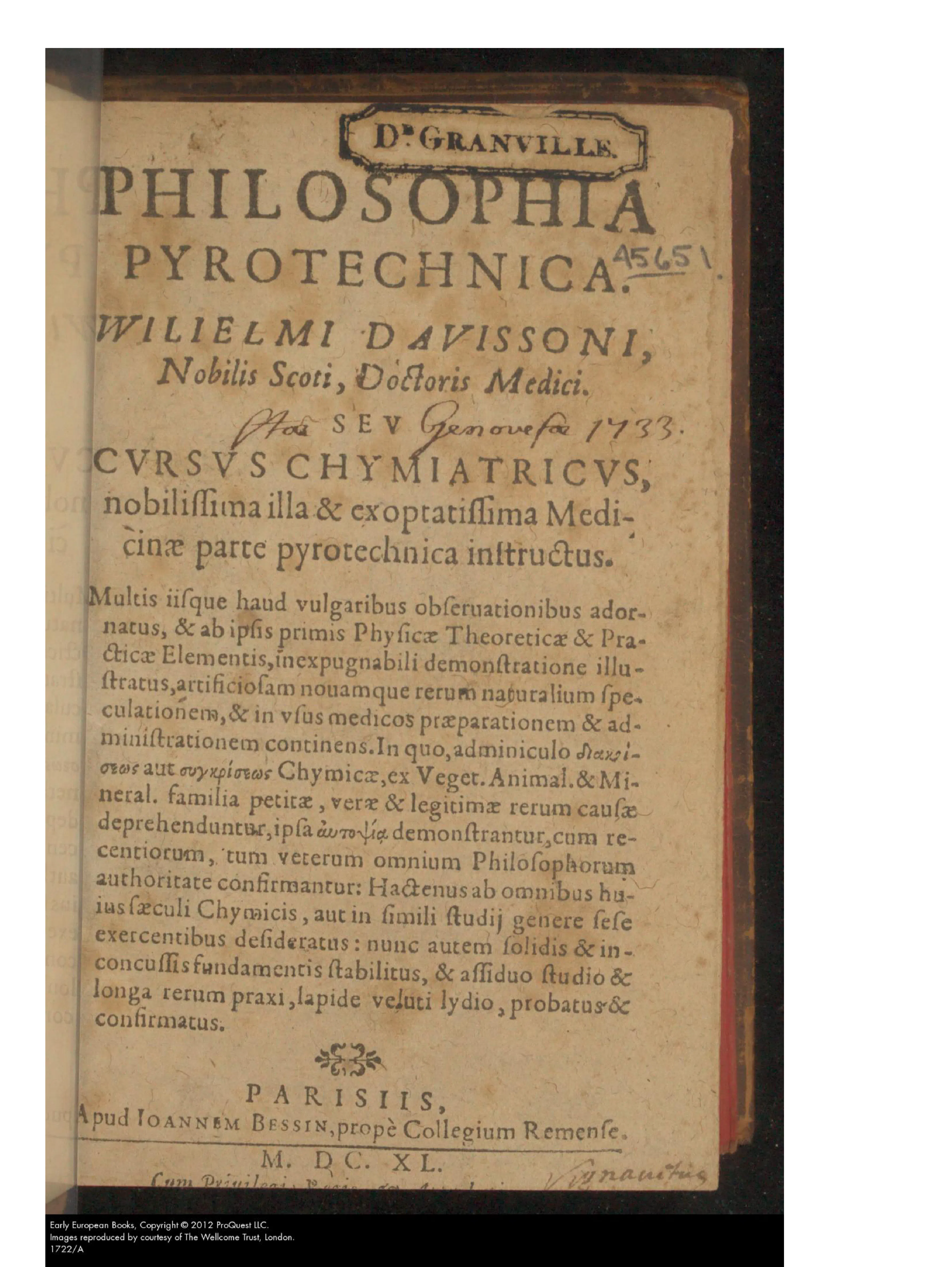
Davisson's title page declares the programme at once: pyrotechnic work presented as a chymiatric course in the noblest part of medicine, the author styled Wilielmi Davissoni, Nobilis Scoti, Doctoris Medici, and Bessin's Paris imprint near the Collège de Reims dated 1640. A later "Dr. GRANVILLE" ownership stamp marks the copy's afterlife. Source ↗.
The intellectual problem the book sets itself is double, and the two halves are inseparable. The first is a question of status: how can an art conducted with furnaces, retorts and hands — an art whose practitioners the learned world lumped together with distillers, empirics and mountebanks — be established as a true science rather than a craft of trial and luck? The second is a question of legitimacy before God: how can remedies prepared by fire, including the violent mineral preparations that the Paris Faculty had fought over for a generation, be justified as physically sound and theologically innocent? Davidson's recurring move is to answer both at once by lifting operative fire-work into a metaphysical and demonstrative frame. Chymistry is defined not as a human invention but as an art created by the Most High and instituted in nature; its proper object is the separation of the pure from the impure; and impurity is referred to the labes peccati, the stain of sin left in fallen material nature. From that referral follows the argument's characteristic torque: separation ceases to be a technique and becomes an officium, a duty of the physician's office, so that failing to separate the poison from the remedy is not incompetence but impiety. The art's principles — Salt, Sulphur and Mercury, the elements, the quintessence — are then validated not by the senses, which on his account yield no true science at all, but by their correspondence to exemplars in the first Mind; and this Platonic-Hermetic warrant is deployed inside an apparatus of definitions, theorems, propositions and corollaries borrowed more Mathematico from Euclid and, expressly, from Proclus.
The stakes of that manoeuvre are historical as well as philosophical. Paris in the 1630s was the sharpest arena in Europe for the dispute over chemical remedies: the Medical Faculty and the Parlement had moved against the internal use of antimony, Paracelsian therapeutics had been contested, selectively appropriated and institutionally negotiated rather than simply accepted or rejected, and the question of who was entitled to prepare and prescribe a mineral medicine was simultaneously a question of jurisdiction, doctrine and social standing. A book that defines the chymist as one who manifests and detects what lies hidden in things, that turns Galen's own words against the Galenists on the destructiveness of purgative drugs, and that ranks reason and experience above the authority of the ancients, is intervening in that arena rather than describing it from outside. It is also a document of pedagogy: Didier Kahn's reconstruction of the earliest private and public courses of chymistry in Paris identifies Davisson as a teacher and probably the instructor of eight students in 1640–1641, among them Annibal Barlet, which places the printed course inside a practice of instruction rather than leaving it as a speculative treatise.

A seventeenth-century plan of Paris by Derveaux and Tavernier sets Davisson's chymiatric teaching within an actual city: the University quarter where auditors gathered lay in the same civic fabric as the Faculty, the Parlement and the printers who made the dispute over chemical remedies public. Source ↗.

What is most memorable about the book, though, is the texture of its argument — the way high metaphysics and bench work are made to touch. Ancient cosmogonies, Orphic and Hermetic material, the Emerald Tablet, and Cabalistic doctrine are admitted, but admitted expressly as emblemata, emblems of the work and not principles of it, with the reader told that nothing is lost to the art if he declines to accept them; and the same guarding instinct produces a double refusal, of Aristotle's prime matter and of Paracelsus's Great Mystery from eternity, both rejected as incompatible with creation ex nihilo and with the dogmas of Christian faith. Against the physician museo inclusus, shut up in his study among the empty authorities of writers, Davidson sets encheiresis, hands-on handling, and he adjudicates by it: Aristotle is convicted of inexperience in the handling of natural things; weighed distillations of ebony and cork are made to overturn the axiom that earth is the cause of gravity in mixed bodies; and a turpentine retort in which some forty or fifty distinct forms of fir trees appear around the walls of the vessel — yellowish-green, with pine-cone clusters, tufted foliage and roots bursting from the earth — is offered as a public fact attested by five hundred and more trustworthy men. Fire itself is analysed as a plunderer with no body of its own, feeding always on what belongs to another; the elements are matched to the Platonic solids by way of hexagonal snow, salt of hart's horn, honeycomb and crystal; and eighteen species of corruption and twelve grades of fire are set out as the working vocabulary of a discipline that claims, without embarrassment, to teach more in a single month than years of vulgar physics can supply.
That claim of pure against impure runs through everything in the work and everything that has happened to it. It shapes its conceptual vocabulary, where pyrotechnia, chymia, chymiatria, ars separatoria and encheiresis all name aspects of a single operation of disclosure. It shapes the polemics, where the true chymist must constantly be separated from the Agyrta and the pseudochymicus whose existence has disgraced the name. And something of the same problem attends the book's own transmission: the collected Parisian issue, the earlier part-issues, a French descendant catalogued as Les elemens de la philosophie de l'art du feu ou chemie and attributed to Jean Hellot in 1651, and a scatter of retrospective claims about later editions all require sorting before the textual history can be called secure, while a catalogue linkage between Davidson's chymiatric course and Johann Ewich's sixteenth-century plague-and-magistracy treatise is an association without evidential foundation in the records so far retrieved — a mixture, one might say in the author's own idiom, still waiting to be separated.
Read the full text and English translation on Leo
This text was transcribed and translated as part of the ExLatinis project, an effort by Leo to make free English translations of every text published in Latin in early modern Europe (1450–1750) available online. The complete transcription and English translation of this work can be read free of charge:
→ Read the original Latin text and full English translation on Leo
You can save a copy of this document into your Leo account to run deep text searches, conduct further analysis, or cross-reference it with your own research.
Translating Philosophia pyrotechnica: Fire, Handling, and the Language of Purity
Editorial English title supplied for convenience: The Pyrotechnic Philosophy, or a Chymiatric Course: William Davisson's Parisian Program of Chemical Medicine. No established English title was located. The Latin title joins Philosophia pyrotechnica to Cursus chymiatricus: pyrotechnia is not merely "fireworks," but the learned art of working through fire so as to disclose and transform the hidden properties of bodies; chymia names the broader art, while chymiatria directs that art toward medicine. The text supplies the gloss itself, deriving the name from the work fire performs — it is called pyrotechnia because it manifests the hidden nature of things by the instrumentality of fire, Pyrotechnia, quoniam absconditam rerum naturam, ignis adminiculo, manifestat — so that the title-word is presented not as a metaphor but as a definition of method. The same disclosive sense governs the definition of the practitioner, who is described in reported terms as one of those who manifest and detect the things hidden in things, Chymici, inquit, appellantur, qui quæ occultæ sunt in rebus, manifestant & detegunt. The title therefore presents chemical practice as a philosophical and medical discipline rather than as an isolated collection of recipes. Chymiatricus is a period formation that places therapy, preparation, and the physician's officium within this practical art.
That instrumentality of fire is itself given a physical analysis in the course, and one that resists any simple identification of fire with the visible burning body: a coal is not fire but ignited wood, nor is flame fire but kindled smoke, and the element is characterized as a plunderer that always feeds on what is another's, in the text's wording Carbo enim / inis non est, sed lignum ignitum; neque flamra ignis est, sed fumus accensus: denique aliesemper prædo ille depascitur, ex præda vit: qua deficiente extinguitur, vnde alatur ex / non habens. Pyrotechnia in this vocabulary names work with an agent that has no proper body of its own, which is precisely why its effects must be read as disclosures of the bodies it consumes rather than as additions to them.
Encheiresis, the Greek-derived language of handling by the hands, is best read against the figure of the physician enclosed in study: knowledge claims authority through disciplined manipulation, observation, and demonstration, although the exact occurrence and polemical deployment of museo inclusus in the 1640 text could not be verified from catalogue-level evidence. The text itself supplies the phrase in the ablative plural, in a clause excluding from the perfection of this knowledge those who, devoted only to their books and studies, shut up in their study and relying on the empty authorities of writers, despise it, non autem ab illis, qui suis libris solum & studiis / dediti, museo inclusi, vanisque scriptorum authoritatibus innixi, huius / cognitionis perfectionem spernunt. The corresponding positive term likewise appears in operation, and polemically, when it is said to be plain how unskilled Aristotle was in the hands-on handling of natural things, patet quam fuerit Arist. in enchiresi rerum naturalium imperitus; the noun thus functions as a criterion of judgement applied even to the greatest ancient authority, and not merely as a term of art for manual technique.
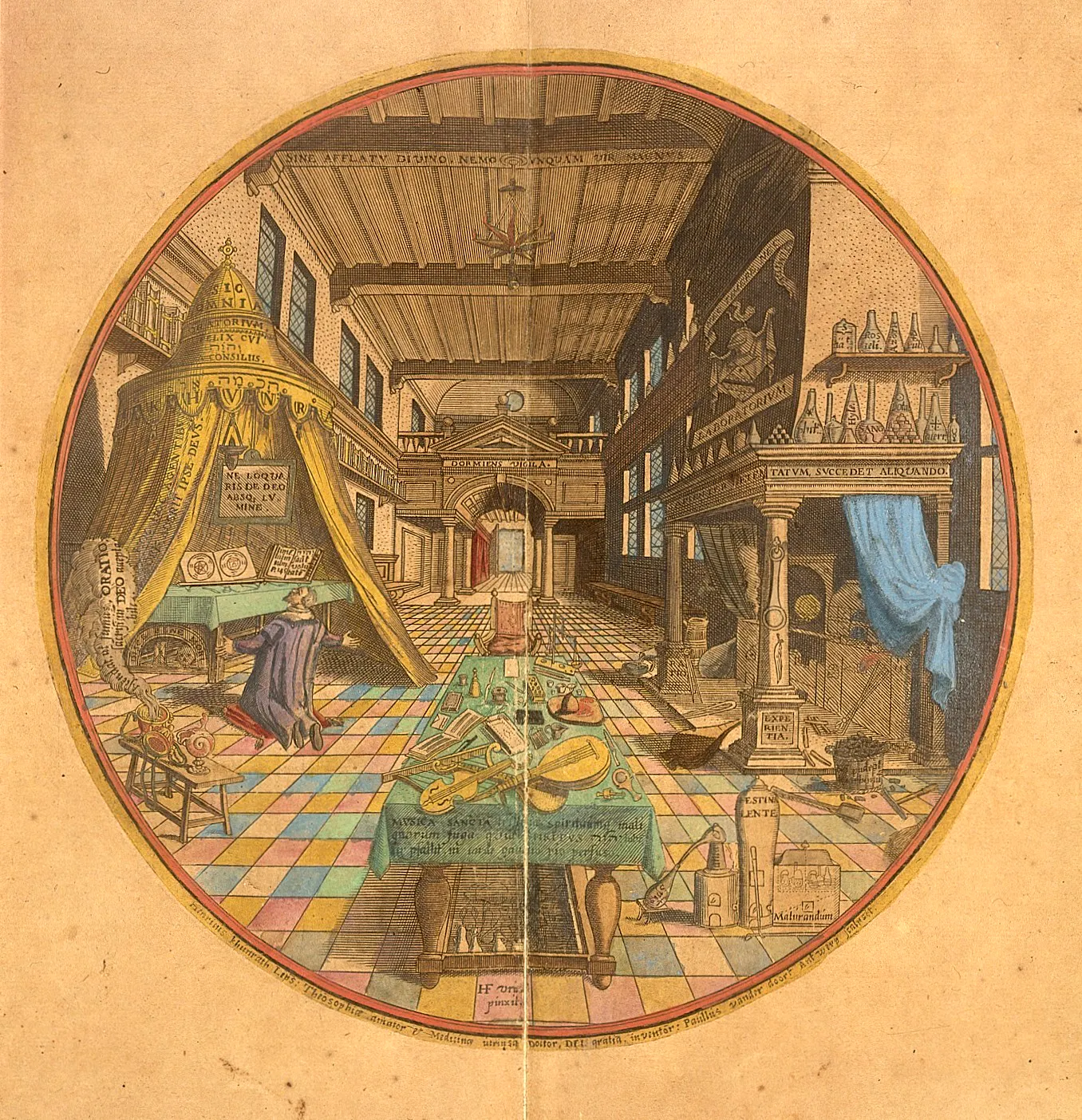
An engraving from Khunrath's Amphitheatrum sapientiae stages the problem Davisson's language of encheiresis sharpens: oratory and laboratory in one room, prayer and books set beside furnaces and vessels under the inscriptions EXPERIENTIA and LABORATORIUM — chymical knowledge presented as a disciplined practice fit to judge inherited authority. Source ↗.

The recurrent opposition of purum and impurum likewise carries theological weight when joined to labes peccati. That opposition is stated as the formal object of the discipline, under the heading on the object of the art, that is, the consideration of the pure and the impure, DE ARTIS OBJECTO, hoc est, consideratione puri & impuri. Separation is not simply a technical operation; within a Christian account of fallen material nature it can be construed as a medical duty to distinguish and restore what mixture and corruption have obscured. The text draws exactly that inference, and in the strongest terms available to it: we should be impious and deserters of our office if we did not labour vigorously at separation, so that, the poison removed, we might safely undertake cures friendly to nature with pure and salutary balsams, impij vtique essemus, & officij nostri desertores, nisi separationi strenuam operam nauaremus, vt ablato veneno, puris & salutaribus balsamis amicas naturæ curationes tutò aggredi possimus. The joining of separation to the stain of sin is made explicit elsewhere, where a twofold end is assigned to separation because the chymists detected a twofold stain of sin in mixed bodies, one on account of impurity of substance and of quality, the other on account of the stubborn hardness of the body, D VPLICEM ob finem, Chymici, / sicuti duplicem peccatilabem / deprehenderunt, in mixtis / separationem instituerunt. / Vnum propter impuritatem, / tam substantiæ quam qualitatis: alterum propter / contumacem corporis duritié. Purity and impurity are accordingly not only chemical predicates but the hinge on which the physician's obligation turns.
The philological field of the title also includes the disgraced synonyms from which the author must extricate his art, since the same operations were named differently by different constituencies: the text laments the wicked and pitiable disaster suffered by this divine art, and the insane stupidity of the crowd, such that on hearing the name of chymical operations they at once imagine a deserter of the Galenists, an operator, an alchemist, an empiric, a quack, a distiller, Hinc tam / improba et commiseranda diuinæ huius / artis clades nata est, et vesana / vulgi stupiditas, vt audito Chymicarum / operationum nomine, statim Galenicorum / desertorem, operatorem, / Alchymistam, Empiricum, Ægyrtam, / destillatorem. The polysemy of the keyword is thus not merely a modern lexicographical observation but a difficulty the author himself confronts and attempts to legislate. These interpretations are historically plausible readings of the title and intellectual setting, and where the text supplies the terms directly they are reported as such; they remain, however, no substitute for a complete transcription. The author appears under the modern forms William Davidson and William Davison and the Latin form Gulielmus or William Davissonus; the evidence does not establish a pseudonym or anagram.
What Davisson's Chymiatric Course Is: Imprint, Language, and Purpose
Philosophia pyrotechnica, also catalogued as Philosophia pyrotechnia / Philosophia pyrotechnica seu cursus chymiatricus, is a Latin printed chymiatric treatise or course by the Scottish physician and chymist William Davidson/Davisson (Davissonus), associated with Paris. The collected copy is catalogued as Paris, 1640, while bibliographic evidence also records a multi-part publication sequence in 1633–1635 and a 1635 Bessin issue. A catalogue record identifies the imprint as Apud Joannem Bessin, propè Collegium Remense and gives 393 pages for a 1635 issue; the Wellcome record identifies a 1640 book by Davison, and Stanford and Princeton describe reproductions of a Wellcome copy. The work's purpose was to articulate chemical medicine as a learned philosophical and practical discipline, and its opening definition makes that ambition explicit by assigning the art a divine institution before any operation is described: chymistry is an art created by the Most High and instituted in nature, which resolves mixed natural bodies, CHYMIA est ars ab Altissimo creata, & in natura instituta, quæ corpora naturalia mixta. The definition sets the terms for everything that follows, since an art so instituted can be held to a standard of demonstration and to a duty of separation at once. Its language is Neo-Latin. A French descendant, Les elemens de la philosophie de l'art du feu ou chemie, is attributed in catalogue and secondary evidence to Jean Hellot and dated 1651, but successive issues and the precise textual relation require further bibliographical verification. No reliable English translation was located.
Placing Davisson in the Historiography of Chymistry and Parisian Medicine
The work matters because it records an early attempt to give Parisian chymistry a comprehensive philosophical, medical, and pedagogical form. It belongs to a period in which Paracelsian and chemical remedies were being disputed, selectively appropriated, and institutionally negotiated rather than simply accepted or rejected. Allen Debus's history of chemistry and the universities documents the opposition of the Paris Medical Faculty and Parlement to the internal use of antimony and the subsequent debate involving Joseph Duchesne; this provides essential institutional context, but the accessible evidence did not establish a direct debate between Davidson and a named opponent. What the text does establish is the author's own placement of himself within that contested field, and his insistence on separating his position from the discredited practitioners who share his vocabulary: while I praise true chymistry, he writes, I in no way wish to patronize the pseudo-chymists, quod dum veram Chymiam laudo, nullo modo patrocinari volo pseudochymicis. The disclaimer is the polemical counterpart of the pure/impure distinction that governs the art's definition: the discipline must be purified of its own impostors before its remedies can be trusted.
Didier Kahn's study of the first private and public courses of chymistry identifies William Davisson as a Paris teacher and probably the instructor of eight students in 1640–1641, including Annibal Barlet. That evidence situates the book within teaching practice rather than treating it solely as a speculative text, and the text's own pedagogical claims are pitched accordingly, promising that within a single month students will surpass by a long interval, in clarity and magnitude of knowledge, the most accomplished students of vulgar physics who have spent many years' study in that kind, vt vnius mensis spatio, consummatissimos vulgaris Physicæ studiosos, qui multorum annorum studia in illo genere impenderunt, longo interuallo, cognitionis perspicuitate & magnitudine, superaturi sint. The rhetoric is that of a course competing for auditors against the established curriculum, which is consistent with the setting Kahn reconstructs.
Modern historiography has increasingly used chymistry as a historically appropriate umbrella for practices that contemporaries did not consistently divide into "alchemy" and "chemistry." William R. Newman and Lawrence M. Principe's reformulation, especially in Alchemy Tried in the Fire, emphasizes continuity between alchemical and chemical practice and reconstructs laboratory procedures on their own historical terms; critics have warned that a unified category can obscure differences of confession, genre, institution, and philosophical commitment. Davidson is valuable precisely because his title and program combine pyrotechnia, chymia, medicine, natural philosophy, and learned polemic, and because he reduces the manifold products of the art to a single triad, all of which nevertheless are reduced to Salt, Sulphur and Mercury, Quæ tamen omnia reducuntur ad Salem, Sulphur, & Mercurium — a reduction that belongs equally to the alchemical inheritance and to the pharmaceutical programme, and that therefore illustrates why a divided category struggles with such texts.
The epistemological argument that supports this programme is unusually explicit, and it is the point at which the work's metaphysics and its bench practice are welded together. Sensible things, considered as sensible, are said to be presented to our senses not truly but by an imaginary account, so that no true science of them is given, Sensibilia, quatenus sensibilia, non verè, sed imaginaria ratione sensibus nostris obijciuntur, & proinde illorum nulla datur scientia vera. The principles of the art therefore require a warrant of another order: fire and air, salt and sulphur will not be such because they are presented to touch, sight, taste or the other senses, but because they are found to correspond to their exemplars in the first Mind, Non erunt igitur ignis & aër, sal & sulphur talia, quia tactui, visui, gustui aut aliis sensibus obijciuntur: sed quia exemplaribus eorum in prima mēte correspondere deprehenduntur. This is what allows an operative discipline to claim the name of science without resting that claim on the very sensory reports its furnaces generate; and it explains why the demonstrative apparatus and the appeal to hands-on trial coexist without contradiction in the author's own understanding.
The work also invites comparison with scholarship on Paracelsianism, the Paris Faculty, Neoplatonic and Hermetic matter theory, and the movement of Scottish learned and medical personnel through continental patronage networks. The Neoplatonic and Hermetic materials are handled with a stated reservation that bears directly on how such comparisons should be framed: pagan cosmogonies and allied wisdom are introduced not so much as principles as certain emblems, as it were, of the work, with the reader assured that if he does not acquiesce in them he will nonetheless have done no harm to the necessity of the whole art, non tam vt principia, quàm operis quædam quasi emblemata appingam. Quibus si non acquieueris, artis totius necessitati nihil tamen offeceris. Within that limit the Hermetic axiom is affirmed in the standard form, that rightly did Hermes affirm that what is below is like that which is above, Recte proinde Hermes, id quod inferius est, simile ei quod est superius affirmauit, and the Platonic doctrine of the world soul appears in the familiar mediating role, since the third essence is such that it holds fast to higher things and does not desert lower ones, but binds the supernal to the infernal, Verum essentia tertia talis existit, vt superiora teneat, inferiora non deserat, sed superna infernis colliget. A corresponding doctrinal boundary is drawn on the other side, lest with Aristotle we be forced ineptly to admit prime matter, or with Paracelsus his Great Mystery from eternity, against the dogmas of the Christian faith, ne cum Arist. Materiam primam, vel cum Paræcelso Mysterium eius magnum ab æterno, contra Christianæ fidei dogmata ineptè admittere cogamur. The double refusal is the metaphysical form of the same purifying gesture that governs the therapeutics: what is eternal and uncreated must be separated out from an account of matter that begins in creation.
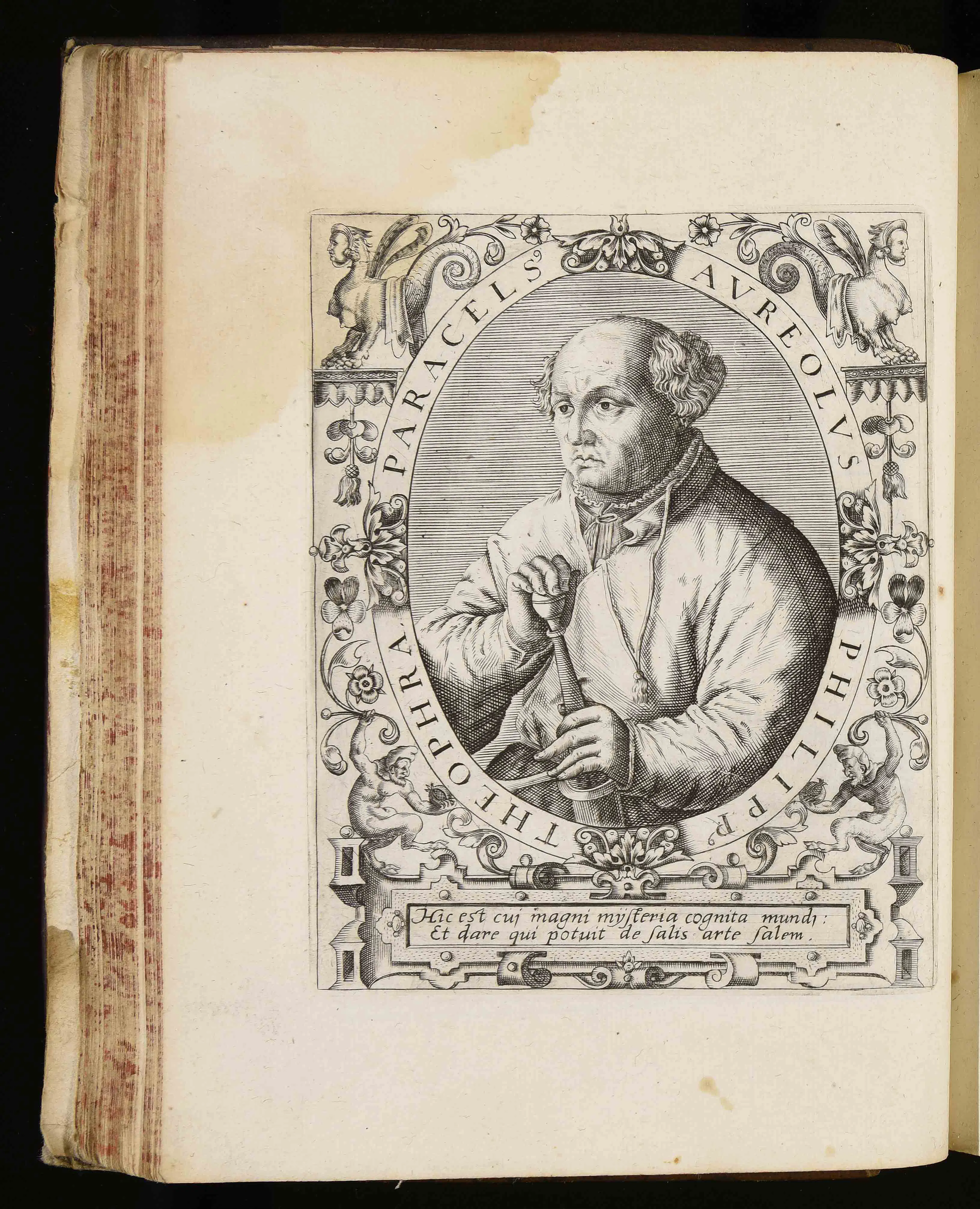
An engraved portrait of Paracelsus, with verses beneath praising the man to whom the mysteries of the great world were known and who could give salt from the art of salt. Set against Davisson's refusal of the eternal Great Mystery, it marks how selective his Paracelsianism is. Source ↗.

Claims about Ficinian amor, Proclean mos geometricus, Christian Kabbalah, atomism, palingenesis, the 1623 Rosicrucian placards, and specific patronage relations were framed as contextual hypotheses pending confirmation against the full text and documentary apparatus, and several of them are now met directly by the text while others are not. The demonstrative apparatus is avowed in the author's own words, proceeding in the mathematical, that is Euclidean, manner, illustrated by Proclus with a wonderful necessity of demonstrations, more Mathematico, hoc est Euclidæo, à Proclo miræ demonstrationum necessitate illustratas, which places the Proclean geometrical model beyond conjecture as a feature of the work's method. Palingenetic phenomena likewise appear as reported observation rather than as inference from context: a third history is said to have become known first by the labours of the author's own experience, then by the testimonies of five hundred and more honest and trustworthy men, Tertia autem historia propriis meæ experientiæ laboribus, primo innotuit, tum quingentorum & vltra proborum & fide dignorum hominum testimonijs, and the phenomenon in question is described with a specificity that invites the reader to repeat it, so excellently do some fifty or forty distinct forms of firs appear around the walls of the vessel — from the yellowish-green colour, the pine-cone clusters, the tufted and cypress-like foliage, indeed the roots bursting from the earth, Tam egregiè apparent circa vasis parietes / 50. aut 40. distinctæ formæ abietum, vt ex / colore vitidi subflauescenti, pineis racemis, / foliis comatis & cyperissatis, imo radicibus / ex terra erumpentibus. Ficinian language of the soul as bond of the world is present in the form quoted above. The remaining items in that list — Christian Kabbalah as a doctrinal commitment rather than an emblem, a developed atomism, the Rosicrucian placards, and named patronage relations — remain contextual hypotheses on the accessible evidence, and the emblem clause quoted earlier should temper any reading that converts the work's Hermetic and Cabalistic citations into load-bearing principles.
The cosmological matter theory shows the same combination of high metaphysics with claims about observable behaviour. Fire is described as circulating through the whole frame of things, so that the very fire we see flying upward proceeds as far as the heaven and, its journey repeated, is rolled back down to these lower things, but by many degrees purer and more refined, ri, eundem illum ignem, quem auolantem cer / nimus, ad cælum vsque progredientem, atque / itinere repetito, rursus ad hæc inferiora deuo / lutum, sed multis partibus puriorem, atque de / fæcatiorem — a cosmic refining that reproduces at the scale of the universe exactly the purification the chymist performs in the vessel, and which shows how tightly the theme of purity binds the work's physics to its therapeutics.
Against that speculative background the polemical epistemology is thoroughly practical. Three guides of human life are said to have been established by the ancient sages: the first, reason long and diligently examined; the second, experience confirmed by long familiarity with things; the third, the authority of the ancients, Tres / enim priscis sapientibus humanæ vitæ / duces constituuntur. Quarum prima / est ratio, diu diligenterque examinata: / Secunda experientia, rerum diuturna / consuetudine confirmata: Tertia authoritas antiquorum; the ranking, with authority placed third, licenses the confrontations that follow. Consensus is met with operation — the mistress of natural things everywhere proves the contrary, the author writes, as will be made known to all by my own operation, rerum naturalium magistra contrarium vbique euincat, vt me operante omnibus notum euadet — and a specific Aristotelian axiom is declared overturned on those grounds: in mixed bodies earth or sand is not the cause of gravity, as has been shown by irrefragable experience, but rather their intrinsic salt, In mixtis, terra seu arena non est causa grauitatis, vt experientia irrepugnabili demonstratum est, sed Sal potius eius intrinsecum,. Such passages are of direct interest to the historiography of laboratory practice, since they exhibit a weighed, repeatable trial being used to unseat a received physical doctrine within a text whose ultimate warrant is nevertheless exemplarist rather than empirical.
The modern biographical record is itself uneven: the Oxford Dictionary of National Biography identifies Davidson/Davisson as the first professor of chemistry and director of the Jardin des Plantes in Paris and later physician to a king, while the precise chronology and institutional title require consultation of the complete entry and contemporary records.
Tracing the Editions: Bessin's Imprints, the French Translation, and a Mistaken Ewich Link
The secure bibliographical core is a Parisian Davidson/Davisson book. A Google Books catalogue record gives William Davison, Jean Bessin, the imprint Apud Joannem Bessin, propè Collegium Remense, the date 1635, and 393 pages. Other evidence describes Philosophia pyrotechnica as a 1633–1635 publication, consistent with part-issues preceding a collected 1640 issue. The Wellcome Collection record identifies Philosophia pyrotechnica, Davison, William, 1593–1669, date 1640, and the Early European Books series. Stanford's record states that its item is a reproduction of an original in the Wellcome Library, London; Princeton likewise identifies the Wellcome original. The accessible catalogue excerpts do not supply a Wellcome shelfmark, signatures, sheet count, complete collation, binding history, or reliable format statement. A 1875 notice reported a 12mo Paris 1635 issue and editions in 1640, 1641, and 1646, while later search evidence mentions a 1657 edition; these retrospective bibliographical claims should be treated as provisional until checked against Ferguson, Duveen, USTC, BnF, CCFr, and physical exemplars. The accessible evidence confirms neither the four-part collation attributed to the work nor illustrations, tables, the Index capitum, printed erratum, approbation by H. Maillard, nine-year privilege of Louis XIII, nor the precise subscription under Pierre Séguier, although those features may be verifiable from the digitized copy. No evidence of suppression, expurgation, or loss was located.
The French translation is catalogued as Les elemens or Les éléments de la philosophie de l'art du feu ou chemie, translated by Jean Hellot and dated 1651 in the accessible scholarly search evidence; Hellot's personal dates and later career are well known, but the translation's complete issue history and bibliographical relation to each Latin issue remain unverified here. It is worth noting for the study of that rendering that the French title's art du feu answers directly to the Latin work's own etymological gloss of pyrotechnia as the art that manifests hidden natures by the instrumentality of fire, so the vernacular title preserves the definitional claim rather than merely paraphrasing the Greek compound.
Davidson's associated writings include a work on salt/Oblatio salis and a later work on plica polonica; the accessible evidence supports a 1641 salt-related item and a 1668 plica polonica treatise, but did not securely establish a Severinus commentary or a full bibliographical chain. A salt-centred sequel would in any case extend a doctrine already given definitional prominence in the course, where salt is that which is found to be most intrinsic to a thing, containing savour within itself and conferring consistency and weight upon mixed bodies, Sal illud est quod reperitur esse maximè Intrinsecum rei, continens in se saporem, præbens consistentiam & grauitatem mixtis — the same principle that carries the weight of the argument against earth as the cause of gravity. As for the commentary on Severinus, the course does contain a narrative of altered judgement upon rereading, in which, having turned the author over again for the elegance of his style, the writer began to suspect that something not commonplace lay hidden there, Verum / authore iterum propter styli elegantiam / reuoluto, suspicari incepi / aliquid haud vulgare ibidem latere; the passage as it stands does not by itself identify the author in question or establish any separate publication, and the bibliographical question remains open.
The Ewich association is bibliographically distinct. Johann Ewich (1525–1588) is the author of De officio fidelis et prudentis magistratus tempore pestilentiae rempub. à contagio praeservandi liberandique libri duo, catalogued with Matthaeus Harnisch in 1582 and separately represented in the MDZ record as De officio ... magistratus tempore pestilentiae ... libri duo, with GND 116618310 and BSB manifest key bsb10179055. The available Ewich record contains no mention of Davidson, while the available Davidson records contain no demonstrable Ewich connection. The safest finding is that the association is a catalogue or digitization linkage requiring correction or investigation; the evidence does not establish whether it arose from a sammelband, shelfmark collision, or simple cataloguing error. The two works are separated by author, genre, date, and subject: Davidson's Parisian chymiatric course is not Ewich's plague-and-magistracy treatise. The Stuart, Percy, Gaulmin, Maillard, and Séguier dossiers, the Bessin shop's output, and exact exemplar locations remain incompletely documented in the sources retrieved.
Reading the Course: From the Duty of Separation to the Mineral Remedies
Paratext: license, patronage, and the plan of the course
The book's legal and doctrinal packaging already states the argument the course will make. The theological censor of the University of Paris does not merely certify the absence of error; he praises the work for a specific intellectual operation, that it weds chymistry to Aristotelian and Galenic philosophy and adorns it with flowers interwoven from the doctrine of the most ancient philosophers, eamdem cum Aristotelica & Galenica Philosophia maritat; intextis, ex vetustissimorum Philosophorum doctrina, floribus exornat. The nuptial metaphor is not the censor's invention so much as his reading of the book's own posture: what is licensed is not a novel art but a concord, and the flores of prisca sapientia are figured as ornament woven into an existing fabric rather than as a rival doctrine. The French privilege that follows, granting nine years' exclusivity under a penalty of fifteen hundred livres and requiring deposit copies for the royal library and for the Keeper of the Seals, situates the same claim within the machinery of the realm: a course in chemical medicine appears here as a licensed commodity of the Parisian book trade, addressed to a public that includes the Crown's officers as well as auditors. The two Stuart dedications, to the Duke of Lennox and then to his four brothers, do more than solicit patronage; the second explicitly registers that the work falls into two parts and assigns each its dedicatee, so that the bipartition of the argument is inscribed in the paratext before the reader reaches the Partitio, where the plan runs from the nature of the art, through its object in the pure and the impure traced quasi à synthesi ad analysim, to its vocabulary and finally to the operative handling of the three kingdoms.
The definition of the art and the duty of separation
The opening definition is calibrated to answer both censor and faculty at once, declaring chymistry an art created by the Most High and instituted in nature and defining it by its resolution of mixed natural bodies into the things of which they consist, in the formula already set out above. Divine creation supplies theological immunity; institution in natura supplies the claim that the art does not impose upon bodies but follows a disposition already laid down in them; and resolution supplies the epistemic warrant, since to divide a mixture into its constituents is, on this account, to arrive at causes. The nomenclature chapter then performs a rhetorical manoeuvre of considerable nerve. Rather than suppressing the art's disreputable genealogy, Davisson concedes it under one of its own names, explaining that the art is also called Empiric because it was first discovered by empiric distillers without observations or knowledge of causes, Empirica etiam, quia absque obseruationibus, aut cognitione causarum ab Empiricis destillatoribus fuit primò detecta. The concession is strategic: by dating the empiric phase to the art's origins, he makes causal demonstration the historical remedy for it, and his own cursus the instrument of that remedy. The list of synonyms — Alchymia, Spagyrica, ars destillatoria, Pyrotechnia, ars separatoria — is thus not lexicography but a sorting of the discipline's past into what must be retained and what must be outgrown.
The second chapter converts this taxonomy into polemic, and it does so by a theological route. Galen's own dictum that the faculty of purging medicines is contrary and destructive to our bodies is cited to make the reformer's premiss issue from the opposing school's canon; but the deeper warrant is Paracelsian, in the claim that the taint and malignant quality of such remedies was inflicted by God as a punishment for sin, Paracelsus quoque labem & malignam istorum remediorum qualitatem, ob peccatum, poenæ loco, à Deo fuisse inflictam. Impurity is thereby historicized: it belongs not to matter as created but to matter as fallen, which is why it can in principle be removed and why its removal has a redemptive colouring. From that premiss the deontological conclusion follows with unusual violence for a pharmaceutical argument, in the declaration already quoted that we should be impious and deserters of our office were we not to labour vigorously at separation, so that, the poison removed, cures friendly to nature might be safely undertaken with pure and salutary balsams. Impietas and desertion of officium are the vocabulary of professional and religious failure rather than of technical shortcoming, and the pairing is exact: because the poison is the residue of sin, leaving it in the draught is not clumsiness but complicity. The satire of Galenic compounding that surrounds this passage, with its Lucretian image of honey smeared on the cup's rim to disguise wormwood, drives the same point: sugars and aromatics act on the palate, not on the poison, and are therefore accused of a deception that separation alone can dispel.
The criterion, once formulated, is turned inward upon chymistry's own fashionable products, and this is the chapter's least expected move. Glass of antimony is arraigned by the very standard that licenses the art, since it deserves accusation because it does not admit the separation of the pure from the impure, Antimonij vitrum producemus, cum accusationem mereatur, quia puri ab impuro separationem non recipit. Vitrification fuses rather than divides; a preparation that merely alters the body's consistency without discharging its venom is, by the definition of the art, not a chymical medicine at all. This is the same discriminating gesture that produces the polemical category of the pseudochymici, from whom the author disclaims patronage even while praising true chymistry: the discipline is defended by being purified, and the boundary is drawn as sharply against enthusiasts within as against Galenists without.
Cosmogony, the exemplary cause, and the doctrine of matter
The second part shifts register from therapeutics to cosmogony, and immediately erects a doctrinal fence on both flanks: the double refusal, noted earlier, of Aristotle's prime matter and of the Paracelsian Great Mystery from eternity, both barred as inept admissions contrary to the dogmas of the Christian faith. The symmetry is the doctrinal signature of the whole part: the eternal and uncreated must be separated out of the account of matter exactly as poison must be separated out of the remedy. The pagan cosmogonies that follow — Hermetic, Orphic, Cabalistic — are admitted only under an explicit reservation, as emblems of the work rather than principles of it, a clause that insulates the operative core from any objection to Hermes or to the Cabala; and the strain such material places on the printing is visible, since the Greek citations in this stretch, including the Aristotelian passage and the Orphic hymn, survive only in degraded form, legible in their Latin renderings alone. What is not merely emblematic is the demonstrative apparatus. A formal exercitatio proves by elimination that the four Aristotelian causes cannot account for the likeness of a portrait, concluding that therefore a fifth cause is granted, so that the question "on account of what" may be resolved, which was to be proved, Ergo datur quinta causa, vt soluatur quæstio propter quid, quod probandum fuit. The exemplary cause enters the physics through a proof rather than an appeal to authority, and with it the Platonic Ideas acquire standing inside a discipline claiming rigour; the numbered propositions with their demonstrations, drawn from Proclus, then supply the form in which that standing is exhibited chapter by chapter.
The chapter on the Ideas is where this metaphysics is made to touch the bench, and the palingenetic historiae are its evidentiary bridge. Quercetanus's frozen lixivium is reported in language that already belongs to the doctrine of species, a thousand species of nettles being seen in the congealed lye, appearing not in a corporeal but an incorporeal manner, mille vrticarum species in lixiuio congelato conspiciebantur, non corporeo, sed incorporeo more apparentes. The phrase incorporeo more is doing precise work: what the vessel displays is not a resurrected plant but a form, so that the observation confirms exemplarism rather than mere vegetative persistence. To the two reported histories Davisson adds his own, and with it a claim of durability and secrecy: this vessel, adorned with these forms, can be preserved for a thousand years, Vas hoc hisce formis ornatum, ad mille annos seruari potest, a boast immediately hedged by the formula citra iactantiam and grounded in the testimony of hundreds of witnesses. The rhetoric is characteristic of a public course: the secret is announced as a secret, yet its warrant is the repeatable exhibition of a stable object before an audience.
The epistemological consequence is stated without embarrassment, and it inverts what one might expect of a furnace-based discipline, since, as the passage discussed earlier maintains, fire and air, salt and sulphur are what they are not because they are presented to touch, sight or taste, but because they are found to answer to their exemplars in the first Mind. Sensible resolution is thus not the ground of the principles but the path back to them; the retort discloses, it does not certify. This is precisely the marriage the censor commended, effected at the level of warrant rather than of citation, and it explains how the same author can insist on weighed trials and yet deny true science of sensibles.
Matter itself is then defined in Timaean rather than scholastic terms, as an incorporeal and formless essence, a lap capacious of all things, Totam igitur huius materiæ notionem ex Platonis Timæo sic definiemus, esse incorpoream quandam essentiam & informem, sinum omnium capacem — a formulation that keeps Hyle receptive and indeterminate while refusing the eternity that the orthodoxy clause had barred. Above matter the four orders are ranged, and the soul is given the mediating office on which the operator's power ultimately rests: the third essence which, in the words already cited, holds fast to higher things without deserting lower ones and binds the supernal to the infernal. The Ficinian copula mundi is not decorative here: it supplies the continuity along which forms descend into bodies and by which, correspondingly, the chymist's separations can reach what is intelligible in them. The long psychology that follows — the mental, rational and phantastic faculties, the flow of species through the diaphanum, intellection defined negatively and resolved into representation — extends that continuity into the operator himself, so that the doctrine of the pure and the impure is at last a doctrine about what the physician's mind can receive as well as about what his fire can divide.
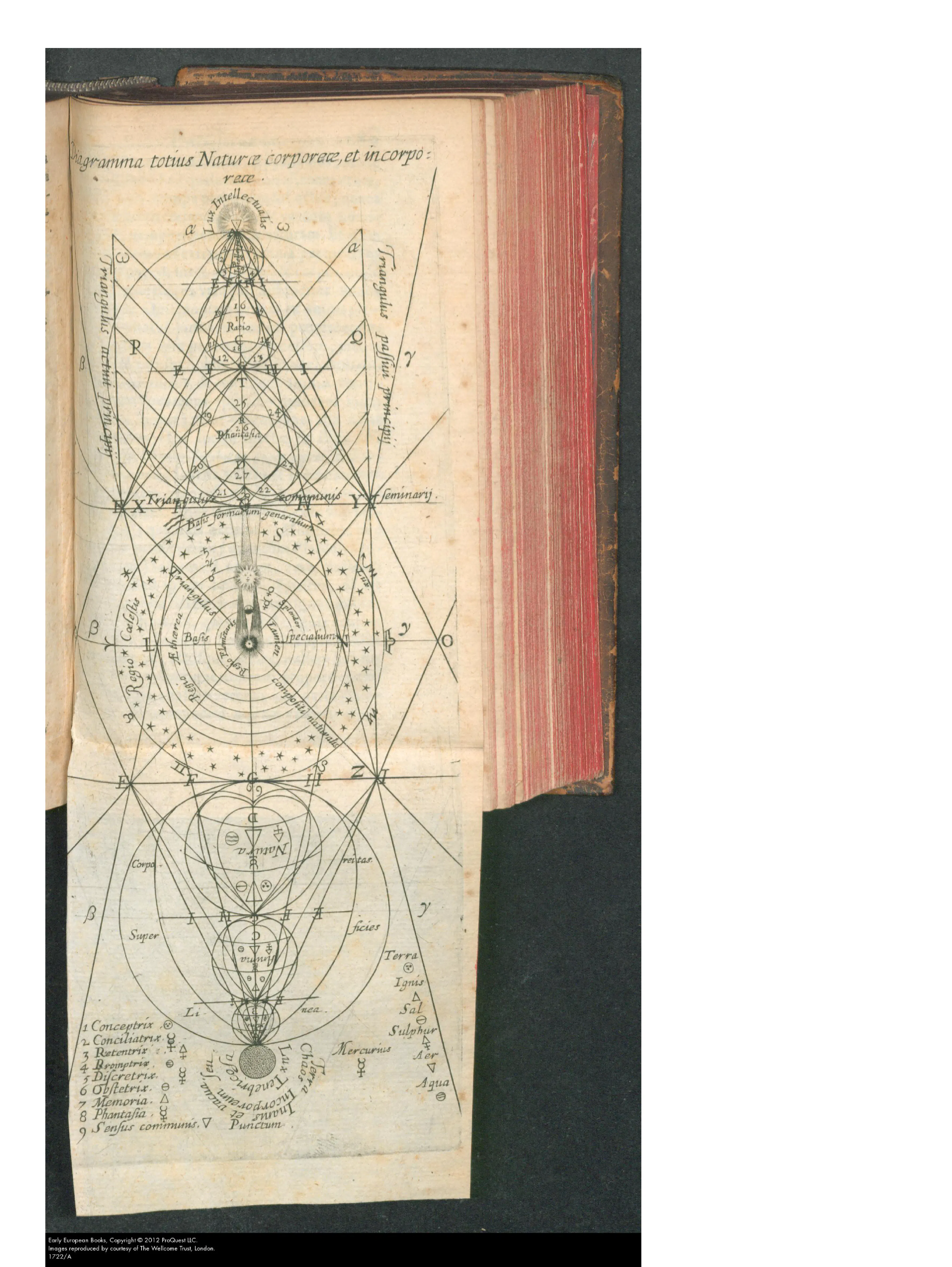
The full-page Diagramma totius Naturæ corporeæ, et incorporeæ draws that descent: Lux Intellectualis presiding over rational and phantastic triangles, celestial zones, and the lower circles of nature and body, with numbered faculties and elemental symbols binding the physician's receptive mind to the separations of salt, sulphur and mercury. Source ↗.
The elemental ladder: fire, air, water, earth
The closing chapters of the second part descend the elemental ladder from fire to earth, and they do so by a single repeated procedure: a formal definition cast in a fixed grammatical mould, followed by a series of short predications that convert the definition into working consequences. What holds this stretch together is not a doctrine of the four elements inherited whole from the schools but a stratified analysis of fire that then governs everything said about air, water and earth. The chapter on fire refuses to let one word stand for one thing. Having argued that the heavenly fire carries its own material and nourishment with it and so can neither coalesce nor be consumed, the text distributes the term across three species, and the distinction is announced as a conclusion drawn from what precedes: from these things it is clear that a threefold difference of fire must be established, one celestial, which is agreed to be most active and most pure, the other sublunary and corporeal, but so hiding itself in bodies that it is not detected by sense except by the mediation of Sulphur, which is its food and kindling, for the celestial fire is a spark imprisoned in mixed bodies, as in a prison and dark workhouse, in which it preserves itself by its own nourishment, that is Sulphur, Ex his patet triplicem ignis differentiam esse statuendam. Vnum cælestem, quem constat esse actiuissimum & purissimum: alterum sublunarem & corpoream, sed ita se se in cor poribus abscondentem, vt sensui non depre- hendatur, nisi mediante Sulphure, quod eius pabulum est & fomes: est enim ignis coeleste scintilla incarcerata in mixtis, tanquam in car- cere & tenebroso ergastulo, in quo per suam alimoniam, id est Sulphur, sese conseruat.
The carceral figure is doing serious work. If the fire latent in mixed bodies is a celestial spark held in a dark ergastulum, then the operations of the furnace are not the imposition of an alien violence on matter but the release of a captive that belongs, by origin, to the purest of the three fires; and the sulphur that feeds it in confinement is simultaneously its jailer's provision and the sign by which sense can detect it at all. The scheme also protects the higher fire from the reproach attaching to the lowest. Only the third species — corporeal, manifest, loosed from the nourishment of its prison and dignified with the common name — burns, acts, penetrates and consumes, and it is on this species alone that the chymists' pejorative verdict falls: therefore it is called by the chymists unnatural fire, because it accomplishes nothing without loss of its own substance, Idcirco à Chymicis dicitur ignis in- naturalis, quia nihil sine deperditione suæ substantiæ perficit. The predatory, self-wasting fire of common experience is thus quarantined as the degenerate term of a series whose head is inconsumable; the operator who works at the hearth handles the lowest and least natural of three, which is precisely why his art requires a theory of degrees rather than mere heat.
The celestial term of the series is then given a name drawn from the mythological and Paracelsian lexicon at once, and assigned a generative office in the centre of the earth: the celestial Vulcan always acts, always moves and fosters, the illustrious Archeus of the whole world, by whose help in the centre of the earth the seed of Vegetables, Animals and Minerals is conceived from two visible elements and other incorporeal ones, Vulcanus cœlestis semper agit, semper mo- ttat & fomentat. Illustris totius mundi Ar- chæus, cuius ope in centro terræ, ab elementis duobus visibilibus & alijs incorporeis semen Vegetabilium, Animalium, & Mineralium concipitur. [reading uncertain] The vital fire is described immediately after as an inextinguishable spark implanted in all creatures by God, and the sequence — divine implantation, subterranean seed-making, imprisonment in mixts, release by the operator's hearth — supplies the physical underwriting for the claim that the art is instituted in nature rather than invented by men. It also fixes the moral asymmetry that runs through the elemental chapters: vital and elemental fire are said to be incorruptible like the soul, the vulgar fire alone corruptible.
The doctrine is not left in the cosmos. Its most consequential application in this stretch is a rule of pharmacy, and one that turns critically on the chymist's own preparations. Because the degree of heat used in making a body determines the degree required to dissolve it, remedies distilled or extracted at temperatures above bodily heat will not yield to the body they are meant to work in: hence it appears, among many other abuses in Medicine, in what manner the subtler materials of Balsam, oil, spirit and the like have not been found more praiseworthy in use than that of Rhubarb and so forth, for no other reason indeed than that their material was prepared at a greater degree of heat than the degree of the heat of our body is, in which they ought to act, Vnde apparet inter alios plurimos abusus in Medicina, quo modo materiæ subtiliores Balsami, olei, spiritus & similium, non magis laudabiles inuentæ sunt in vsu, quam Rha- barbari &c. Non alia sanè ratione, quam quod eorum materia præparata fuit maio- ri caloris gradu, quam gradus caloris nostri corporis sit, in quo debent agere. The concession is remarkable in a course written to defend chemically prepared medicines: the balsams, oils and spirits that are the pride of the art are conceded to have performed no better than a common purgative simple, and the fault is located not in the class of remedy but in the operator's mismanagement of fire. The remedy proposed is correspondingly technical — that such bodies be first broken, then reduced by temperate digestion to the degree of the body's own heat, fermented at that same heat, and their spirits better extracted — and it converts a metaphysical hierarchy of fires into a bench protocol, with distilled waters and wax-and-oil unguents adduced as cases where excessive heat has fixed the parts beyond dissolution.
The definitions of the remaining elements are cast in a single template whose terms are exemplarist rather than sensory, as the chapter on air shows: air is a vital, sensible, incorporeal element, of lesser composition, of the faculty of the sensitive soul, and an offshoot of that sidereal and occult spirit, corresponding to Mercury, or the Breeze, as its nearest exemplar, by image and wrapping, produced from the evenness of the motion of spirits into a material of smooth, transparent atoms drawn from the middle to the circumference, whence arises its diaphanous, thin, subtle, penetrating, volatile nature and disposition, obtaining marvellous force and power of resuscitating, vivifying, and also of fostering fire and the like, AER est elementum vitale, sensibile, incorporeum, minoris compositionis, facultatis animæ sensitiuæ, spiritusque illius syderei & occulti pro- pago; Mercurio, seu Auræ, vt proximo exemplari, per imaginem & inuolucrum correspondens: pro- ductum ex æquabilitate motus spirituum in mate- riam atomorum lenem, perspicuam & à medio ad circumferentiam protractum: vnde exsurgit eius na- tura & indoles diaphana, tenuis, subtilis, penetrans, volatilis: mirabilibus vim & potestatem obtinens, resuscitandi, viuificandi, tum ignis fomentandi & similia. Each element is thus specified by five coordinates — composition, a faculty of the soul, descent from the sidereal spirit, correspondence to a nearest exemplar by image and wrapping, and a mode of atomic motion, even or uneven, centrifugal or centripetal — from which its sensible properties are then derived rather than read off. Fire and earth are produced from unevenness of motion in rough atoms driven from circumference to centre; air and water from evenness in smooth atoms drawn from centre to circumference. The sensible qualities appear at the end of the definition as consequences, which is exactly what an epistemology that denies true science of sensibles as sensibles requires.
That same discipline governs the two moments where the text confronts the claim that an element might be prime matter. Water is granted every traditional credential — the philosophers' and poets' Chaos, the Mosaic recital of heavens, water, earth and light, the Spirit of the Lord brooding upon the waters — and then denied the title: now whether water is this prime matter common to all things I leave to each man's opinion; I altogether doubt it, because a simple and single faculty cannot be the principle of so many generations and changes, Nunc autem, an aqua sit hæc materia prima communis rerum omnium, id opinioni cuius- que relinquo, ego prorsus dubito, quia sim- plex & sola facultas non potest esse principium tot generationum & mutationum. The second reason given is formal: Chaos names a subject actually devoid of all forms and potentially possessed of all, and therefore necessarily formless, which cannot be attributed to water. Earth is refused on the same ground a few pages later — it and water are corporeal and maximally material, but not first, since the first must be wholly formless — so that the elemental chapters end by declining to promote any element to the office of prime matter, in exactly the register in which the course elsewhere refuses both Aristotelian prime matter and an eternal Great Mystery.
What earth receives instead is a division that restates the governing distinction of the whole work at the lowest rung of the scale: earth is twofold, one vulgar and elementated, the other pure, white, clear, bright and shining, but veiled with very many wrappings and by no means manifest to our senses, which is properly named the Element of earth, and which lies hidden in atoms under the appearance of sand or of glass, yet is at length elicited by Salt out of its earthiness, Est autem terra duplex; vna vulgaris & ele- mentata; altera pura, alba, clara, nitida & splendens, sed quamplurimis obducta inuolu- cris & sensibus nostris haud manifesta, quæ Elementum terræ propriè nominatur, quæque in atomis sub arenæ, siue vitri specie latitat, quæ tamen à Sale extra suam terrestreitatem tandem eliciuntur. The heaviest, darkest and most opaque of the elements turns out to conceal a bright and pure body invisible to sense and recoverable only by operation, and the agent of recovery is Salt — the same principle credited elsewhere in the course with savour, consistency and weight. The elemental doctrine therefore terminates where the therapeutics begins: every element, like every mixed body, is a wrapped thing whose proper nature is disclosed only by separation, and the vocabulary of inuolucra, of what lies hidden in atoms, and of eliciting the pure from its earthiness belongs to the same conceptual family as the imprisoned spark of the fire chapter. The part closes by referring the reader forward: the remaining matters concerning the elements' coition, mixture, proportion and fecundity, and their resolution and separation, are deferred to their own places in the Pyrotechnic principles, the sentence itself running across the sheet so that its compound is completed at the head of the next page, technicis principiis suis locis obseruabis. Elemental theory, on this arrangement, is propaedeutic; the operations that would resolve and separate the elements are held back for the book of principles, and the second part ends having supplied the doctrine of degrees, exemplars and wrappings that such operations presuppose.
The circuit of fire and the definition of mixture
Behind that stratification lies a question about the matter of the heavens, and the answer given to it governs everything else in the second part: fire is not confined to a natural place beneath the moon but travels a complete circuit, ascending as far as the heaven and, its journey repeated, rolling back down to these lower things by many degrees purer and more refined, in the passage already discussed. The text as transmitted there is defective at the line-breaks, but the doctrine is unmistakable, and what matters is the verb defæcare: the cosmos is described in the vocabulary of the workshop, and the ascent and return of fire is a refining, the same operation the operator performs in a vessel, conducted at the scale of the whole frame of things. The immediately following analogy makes the transposition explicit and, in doing so, exposes the method by which such cosmological claims are secured: and just as the sea enters the earth, permeable by blind channels in every direction, and thence gushes forth into springs and rivers, so one must think of that vast celestial body, iemadmodum mare terram subit, cæcis quauaversum meatibus peruiam, atque inde in / ntes & flumina scaturit: similiter de illo vassimo corpore cælesti cogitandum. A terrestrial hydraulics visible to anyone who has watched a spring is lifted wholesale into the heavens, where the stars become fountains vomiting purified fire and the poles the banks against which the impure is cast. The inference runs from the known lower to the unknown higher, which is precisely the direction the Hermetic axiom of correspondence licenses, and it allows a celestial physics to be built without any appeal to a fifth, incorruptible substance.
The analysis of fire itself is the most rigorous physical reasoning in this stretch, and it works by denying fire any body of its own: a coal, as noted earlier, is not fire but ignited wood, nor is flame fire but kindled smoke, and the plunderer feeds always on what is another's, living on plunder and extinguished when the plunder fails, since it has nothing of its own from which it might be nourished. The argument is quantitative as well as definitional — adding fire to wood adds nothing to its bulk — and its consequence is that fire must be classed among spirits rather than bodies. That classification is not an idle scholastic placement. If the agent of the art contributes no substance of its own, then everything the furnace yields must have been in the subject beforehand, and pyrotechnic operation can be defended as disclosure rather than fabrication. The perennial charge against the fire-workers, that their products are artefacts of the heat and not constituents of the thing, is answered here at the level of the element itself.
The elemental chapters that follow run on a fixed template — nature, offices, the division into pure and impure, the astrum resident in each — so that the pure/impure distinction is not applied to matter after the fact but built into the description of each element. Air is defined as the true place, seed-bed and receptacle of every single thing, and just as in man there is an imaginative seed, so in the same way in this element there is likewise a seed, Hoc elementum est verus locus, seminarium / & receptaculum vniuscuiusque rei. Et / sicut in homine est semen imaginarium: eodem / pacto in hoc elemento itidem est semen; microcosm and element are made to share a single seminal vocabulary, which is why the elements can carry formative powers ordinarily reserved to substantial forms. The chapter on earth pushes the fusion of registers furthest, naming the central subterranean heat as the fire of Gehenna, which preserves this machine, ignis Gehennæ, qui conseruat machinam hanc. The eschatological name is not decorative: it identifies the world's conserving heat with the fire of punishment, so that the same agent that concocts gold and sulphur in the earth's veins is the one theology assigns to the wages of sin — an exact cosmological counterpart to the doctrine that the impurity the operator removes is the residue of the Fall.
The second part is epilogized by a definition of mixture that supplies the bridge to operative practice: it is the motion of vital and seminal nourishment into the smallest or atomic parts of matter toward mutual contact, so that union may result, the proximate instrument of all generation, menti vitalis & seminarij, in minimas seu atomipartes materiæ, ad mutuum contactum motus, vt / vnio; proximum omnis generationis instrumen. Mixture is here contact among minima directed by a seminal principle, not the fusion of qualities into a homogeneous whole; and on that account the ingredients retain their identity within the compound, which is what makes separation intelligible as recovery rather than as new production. The whole operative programme of the succeeding parts rests on this corpuscularian concession, and the dialogue later staged between Peripatetic and Spagyrist is the working out of its cost.
The third part: a taught course, its patron, and the twofold stain
The third part opens with its own title-page, which describes the treatise as Ex curriculo W. D. Doctoris Med. in / vsum auditorum suorum excerpta, excerpted from the curriculum of W. D., Doctor of Medicine, for the use of his auditors: the printed book presents itself as the deposit of a taught course, and it behaves accordingly, since the construction of furnaces is expressly withheld and reserved for private hearers. The dedication to Henry Percy converts clinical success into a claim on patronage with unusual directness, recalling that when here at Paris you had fallen ill of a grave, not to say lethal, fever, it pleased you to summon my services, cùm hic Lutetiæ Parisiorum graui, ne dicam lethali, febre correptus decubuisses, meam libuit / operam adsciscere. For a Scot practising in Paris who elsewhere styles himself a guest and newcomer, the cured aristocrat functions as evidence rather than ornament: the therapeutic efficacy of the doctrine is certified by a named body restored to health, and the book's philosophical ambitions are underwritten by a bedside.
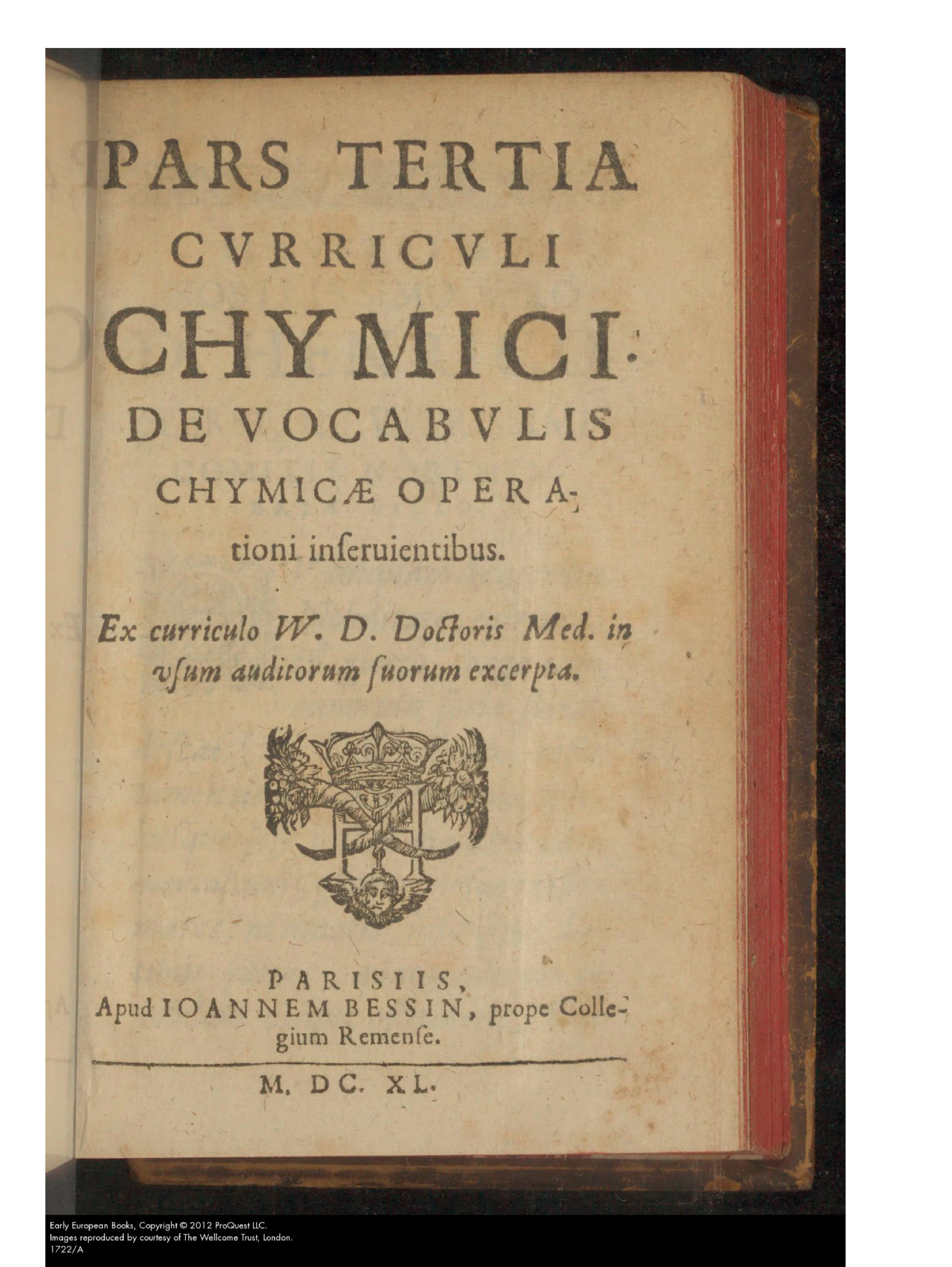
The separate title page to the third part makes the classroom frame explicit: matter excerpted from W. D.'s medical curriculum for the use of his auditors, printed above Bessin's Paris imprint of 1640. Its heading on the vocabulary of chymical operations marks the turn from practice to the disciplined naming of the art. Source ↗.
The doctrinal head of the third part states the theological ground of the whole art in the terms already set out, namely that separation was instituted in mixed bodies for a twofold end because the chymists had detected a twofold stain of sin, one on account of impurity both of substance and of quality, the other on account of the stubborn hardness of the body. The second member deserves attention, because it does more work than the first. Impurity of substance is what any purifier removes; but contumax duritia, the obduracy of a metal or stone that resists opening, is here also referred to the labes peccati, so that recalcitrance to the operator's art is itself moralized. Fallen matter is not merely dirty; it is stubborn, and the violence of calcination and corrosion is thereby justified as answering a resistance that is theological in origin. In the same movement the alchemical slogan is domesticated, since the philosophers' precept of killing the dead thing and reviving it is said to have been enclosed under life and death, sub vita & morte incluserunt, iuxta illud Philosophi — the enigmatic dictum is translated into the schools' paired terms of generation and corruption, which is exactly the guarding operation performed elsewhere on Hermetic material admitted only as emblem.
The exhortation prefacing the fourth part supplies the intellectual autobiography behind this synthesis, in the report already noticed of a first contempt for Severinus overturned when the author, turning the writer over again for the elegance of his style, began to suspect that something not commonplace lay hidden there. The verb latere is telling: the reader's experience reproduces the art's own object, since what the chymist does to bodies — manifest what lies hidden — is here done to a book, with the Platonists supplying the solvent. Reading is assimilated to operation, and the resolution of Hippocrates, Galen and Paracelsus into one doctrine is presented not as an eclectic compromise but as the outcome of a personal course of trial and correction.
The practical chapters then show what such trial looks like when turned against a received doctrine. Against the Aristotelian derivation of the sea's salinity from adustion, the objection is a repeatable lixiviation: for if by combustion ashes received their acrimony from fire, then having made a lye of those same ashes and once removed the acrid parts, if you burned them again you would always impress the same acrimony, but this is repugnant to experience, Si enim per adustionem cineres ab igne acrimoniam acciperent, eosdem cineres lixiuio facto, & partibus acribus semel ademptis, si rursus adusseris, semper eandem acrimoniam imprimeres. / Sed hoc experientiæ repugnat. The form of the argument is a conditional whose consequent can be tested at the bench, and the exhausted ash — which will not yield salt a second time — is made to prove that salt was in the thing rather than imparted by the fire. The demonstration is the therapeutic doctrine's physical guarantee, since a medicine can only be separated out of a body if its virtues were resident there beforehand.
The geometrical excursus that interrupts the animal preparations is advertised as Opus nouum, & à nullo ante me, / quod sciam, elaboratum, a new work elaborated by no one before him so far as he knows — an unusually bare claim of priority in a text otherwise dense with authority. Its argument moves from observed regularities to their cause, surveying six-angled snow, the salt of hart's horn, the cells of bees and the figures of crystals, and then demanding: who would be so foolish as to say that these numbers and figures, since it never happens otherwise, are fortuitous, Quis / tam faruus dixerit hos numeros & figuras, / m n / quum nunquam aliter contingat, fortuitos / esse?. The clause quum nunquam aliter contingat carries the weight: invariance across kingdoms of nature is treated as a signature of design, and the correspondence of the five regular solids to the elements and the quintessence is thereby presented as read off matter rather than imposed upon it. Here the two warrants of the work meet without friction — the figures are found by inspection of salts and snow, and they are validated by their exemplars, so that the geometer's science and the operator's handling turn out to be exercises of one discipline.
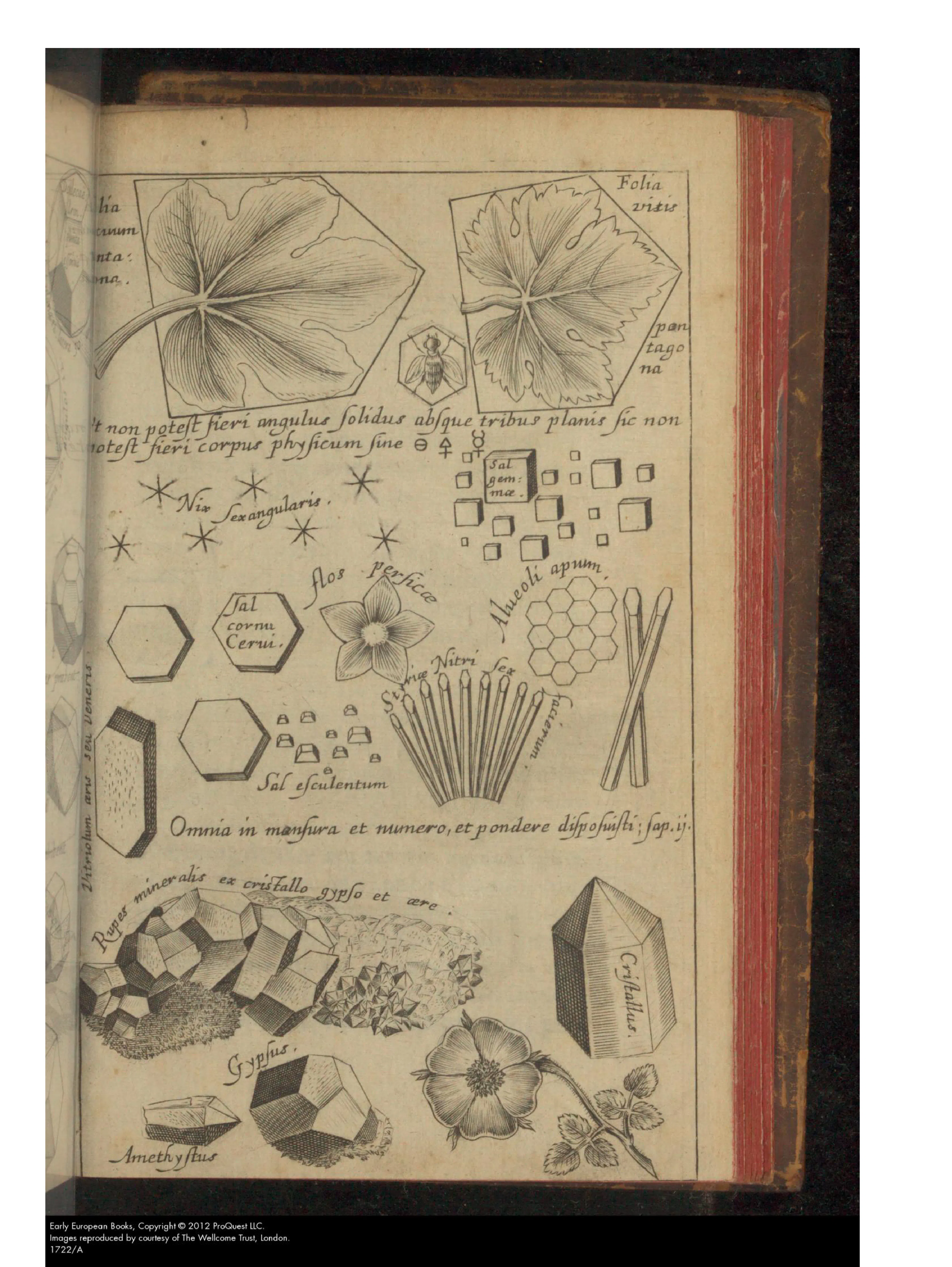
The engraved plate makes that claim of invariance visible: six-angled snow, salts, honeycomb cells, crystals, leaves and flowers arrayed in recurring hexagonal, cubic and pentagonal schemes, with the printed Wisdom text "Omnia in mansura et numero, et pondere disposuisti" framing observed forms as signs of exemplary order. Source ↗.
The fourth part: recipes, the doctrine of salts, and the mineral remedies
The closing chapters of the fourth part hold to a compositional unit of unusual regularity: a numbered chapter heading, a recipe voiced in the operative imperative with weights, vessels and degrees of fire, a brief register of indications and dosage, and then, set off from the working matter, a list of natural-philosophical questions deferred rather than answered — why our edible salt in coagulating chooses a particular form, as the interrogative coda has it, Sal noster esculentus cur in coagulatione eligat. These codas are not ornament. They mark the seam at which the printed course admits that it is the residue of a taught course, and they are explicit about where the missing matter has gone, since the remainder of the doctrine is reserved to what has been entrusted to the written notes of the hearers, cum scriptis auditorum commis. The printed book thus presents itself as one member of a pair, the other member being the notebooks of auditors who received the demonstrations by hand; the quaestiones are the visible scar of that division of labour, and they explain how a text so committed to demonstration can leave so many of its own theorems suspended.
The theoretical centre of this stretch is the treatise on salts that opens the fortieth chapter, and its first sentence does the work of the whole, defining salt, in the words quoted earlier, as that which is found to be most intrinsic to a thing, containing savour in itself and conferring consistency and weight upon mixed bodies. Gravity is thus assigned to salt in the definition itself, long before the demonstration that will be offered at the end of the part; the conclusion is planted in the terminology, and the later trial functions less as discovery than as vindication of a definition already in force. What immediately follows is a methodological move rarer in this literature than one might expect: because the name is highly equivocal, it is worth the effort to propose several distinctions of it, among which occur that of fixed salt from volatile, of elementary from essential, of natural from artificial, Sed quia eius nomen est valde æquivocum, operæ pretium est aliquot eius distinctiones proponere: inter quas occurrit, salis fixi à volatili, elementaris ab essentiali, naturalis ab arte facto. The diagnosis is logical and the remedy scholastic: an equivocation in workshop vocabulary is met with a triple division of the term. The same purifying gesture that governs the art's object — pure from impure — is here turned upon its language, and the ordering of the tract's own nomenclature is presented as a precondition of its scientific standing.
The divisions are then made to yield rules. From paired trials of salt of tartar with distilled vinegar in a sealed digestion vessel the text derives a proposition of proportion, that every spirit, or any volatile thing joined to a fixed body when it is present in the smaller dose, volatilizes the fixed body to which it is joined, Ex quo oritur certa positio, quod omnis spiritus, siue volatile quid adiunctum fixo quod est in minori dosi, volatilisat corpus illud fixum cui adiungitur. The quantitative clause — in minori dosi — is what converts a bench observation into a general positio: the outcome is made to depend on relative proportion rather than on the natures of the reagents taken absolutely, and the vessel becomes an instrument of universal inference. The complementary rule governs precipitation, formulated in the strongest logical currency available, so that from that action arises the axiom that whatever is dissolved by spirits is precipitated by salts, and conversely, actione oritur axioma, quod quicquid dissoluitur à spiritibus, præcipitatur per salia, & contra,. Calling a regularity of the laboratory an axioma is a claim about genre as much as about nature: axioms belong to demonstrative science, and by minting them from operations the chapter enrols furnace practice in the same order of knowledge as the geometrical apparatus the course elsewhere professes. The authorities marshalled alongside these rules are notably recent — the Sendivogian Cosmopolita is cited for the doctrine that everything that congeals in the cold has the nature of salt, Nam, vt asserit doctissimus Cosmopolita, omne illud quod congelatur in frigido, habet naturam salis — a pseudonymous modern quoted with the epithet doctissimus and given the evidential weight of an ancient. The chapter closes by drawing the disciplinary consequence in the form of a rhetorical question, who thereafter will doubt the necessity of the chymical art, quis deinceps dubitabit, necessitatem artis Chymi, the point being that fixation and volatilization cannot be known from books at all, so that the physician who has never distilled is disqualified from physics as well as from medicine.
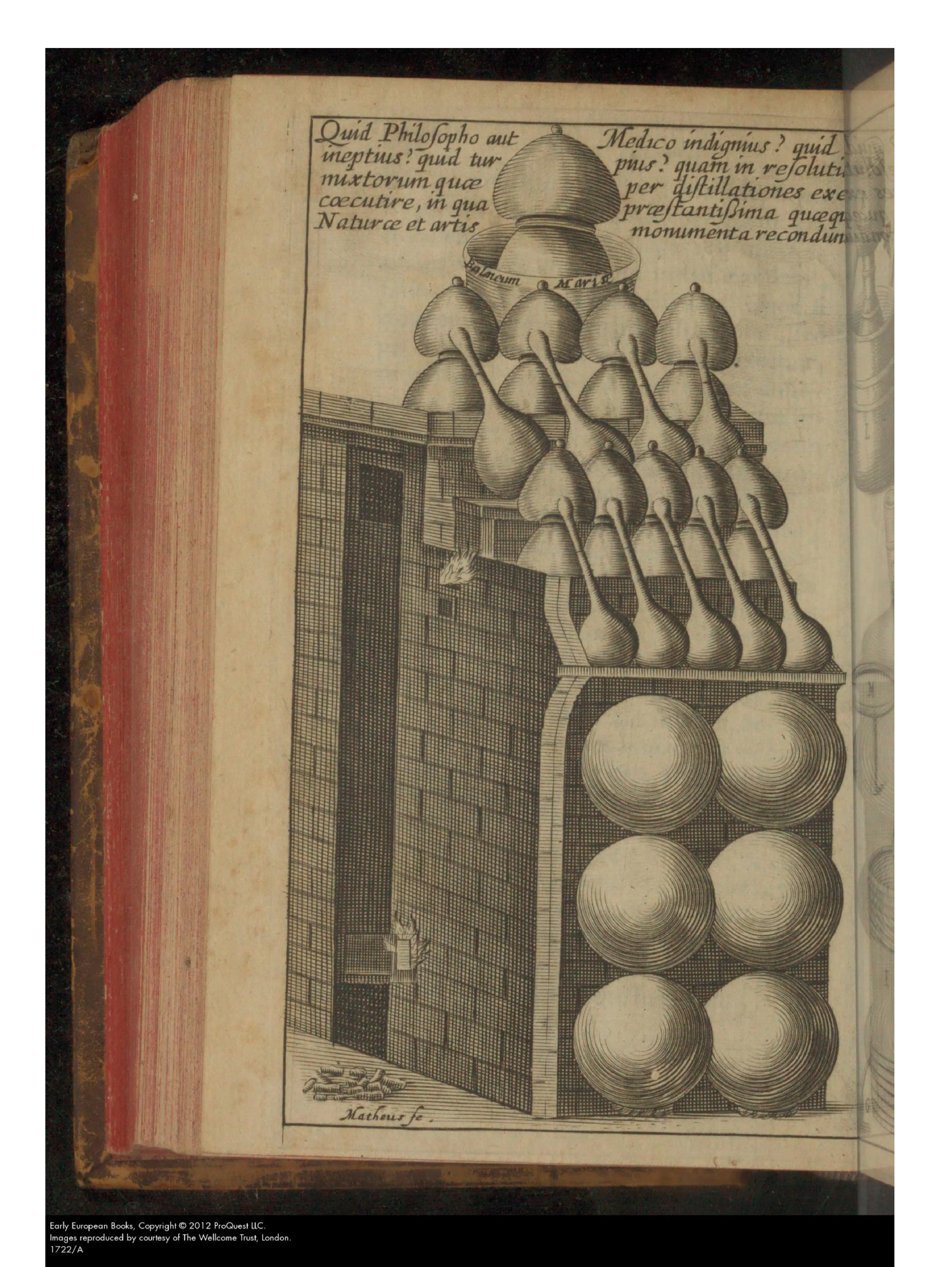
The engraved furnace plate turns those rules into machinery: rows of cucurbits and curved retorts ranged above a working firebox, with the labelled Balneum Maris marking the controlled heat on which graduated preparation depends. Its accompanying polemic against neglect of distillation gives the apparatus a moral as well as a technical force. Source ↗.
The chapters on nitre exhibit the same double register, and one of them states the pharmacological dialectic on which the whole therapeutics rests: unless it be prepared, it is nothing but sheer poison, whereas in burning fevers it is a most excellent remedy, sit præparatum. Alioqui nihil est nisi purum putum venenum. In febribus ardentibus est præstantissimum remedium,. Substance and virtue are decoupled: what a body is pharmacologically depends not on its species but on the operations performed on it, which is precisely the claim that makes the chymist's labour a medical necessity rather than a mere convenience. Immediately thereafter the text turns polemical against a consensus that includes chymists themselves, denying nitre's intrinsic inflammability on the ground, recalled above, that the mistress of natural things everywhere proves the contrary, as all will learn from the author's own operating. The appeal is not to experience in general but to a performance the author undertakes to stage: the phrase me operante makes the demonstration personal, repeatable and public, and shifts the burden of proof from the received opinion to the witnessed trial.
Having secured nitre against the fire, the chapter reads it upward. Its substance is declared twofold, one essential and incorporeal, the other corporeal, Eius substantia est duplex. Vna essentialis, & incorporea: altera vero corporea, and with that division a saltpetre recipe becomes the vehicle of a doctrine of seminal reasons descending from Unity through Mind, Soul and Nature into bodies. The proof-texts are chosen to make the doctrine look like the common possession of the learned rather than a Paracelsian novelty: Virgil's Anchises is quoted for the fiery vigour and heavenly origin of those seeds, so far as harmful bodies do not retard them, Igneus est illis vigor, & cælestis origo Seminibus, quantum non noxia corpora tardant,, and Aristotle is enlisted on his own account of generation, that there is in the seed of all things that which makes seeds fertile, namely what is called heat, and this is not fire nor any such faculty but a spirit contained in the seed and in its foamy body, Inest, inquit, in semine omnium quod facit, vt foecunda sint semina, videlicet quod calor vocatur: idque non ignis, neque talis aliqua facultas est, sed spiritus, qui in semine spumosoque corpore continetur,. The appropriation is deft and unembarrassed: the Peripatetic denial that vital heat is fire is made to underwrite an astral pneuma, so that the philosopher indicted a few chapters later for inexperience is here a witness for the prosecution's own case. The same universal spirit is then given its chymical cognomen, this being the green lion of the chymists, Hic est Chymicorum Leo viridis,, a name that carries the doctrine over from natural philosophy into the emblematic idiom of the adepts without acknowledging any change of register.
Where the mineral remedies are most contested, the prose becomes conspicuously judicial. The defence of the antimonial emetic powder concedes its danger in the act of praising it: given in the stated grains, if rightly administered it is a most excellent thing, if badly, a most pernicious remedy, grana, si rectè exhibeatur, præstantissimum; sin malè, perniciosissimum est remedium. Safety is thus located neither in the substance nor in the preparation alone but in the prescriber's judgement and the choice of the opportune moment, which quietly converts the antimony question from a dispute about a drug into a dispute about who is competent to give it. The author's own prior hostility is narrated as an object lesson, after the example of those who began to hate before they came to know, eorum exemplo, qui prius odisse cæperunt quam cognoscere; the conversion narrative makes the opponents' position not false so much as premature, a verdict passed in advance of the handling that alone could ground it. That the criterion cuts both ways is shown at once by the flat prohibition of glass of antimony, grouped with arsenic and corrosive sublimate as poisons, wherefore he would advise no one to use it, & alia venena: proinde nulli suaderem eius vsum — a refusal that lends credibility to the promotions elsewhere by demonstrating that the same test can condemn.
The excursus on glass that follows reduces the whole of analysis to a pair of agents, there being two instruments for the separation of all bodies, namely fire and water, duo esse separationis omnium corporum instrumenta, ignem nempe, & aquam,. On that binary the argument builds to its paradox, that vitrified sand is the incorruptible earth, and so it must be concluded that glass is the purest and simplest element, Concludendum ergo, vitrum esse elementum purissimum, & simplicissimum: — purity, the governing value of the art, here migrating from the medical preparation to the element itself, with scriptural and Hermetic supports recruited to a claim first suggested by the furnace. Salt is correspondingly redefined in igneous terms, for what is salt if not a potential and watery fire, that is, a terrestrial water impregnated with fire, Quid est enim Sal, nisi ignis potentialis & aqueus, nempe aqua terrestris, igne impregnatus,, a formula that assimilates the corrosion of the acids to combustion and gathers the mineral menstrua under a single concept; the Paracelsian specifying spirit, inner artificer and substrate are glossed in the same movement as a Platonic hierarchy, quas Paracelsus, Ares, Archæu[m], & Iliasten vocat.
The excursus then delivers the sharpest confrontation in the part. The charge against Aristotle, in the sentence already noticed, is not of faulty inference but of never having worked — his unskilledness in the hands-on handling of natural things — and the instrument of conviction is a comparative distillation-analysis of ebony and cork resolved on the balance, from which follows the verdict recalled earlier, that in mixed bodies earth or sand is not the cause of gravity, as irrefragable experience has shown, but rather the intrinsic salt of the thing. The conclusion closes the circuit opened by the definition of salt at the head of the tract, and it does so by a route the schools could not travel: a textbook axiom of physics is unseated not by dialectic but by weighing what the retort yields. That the last chapter should nevertheless end in allegory — a copper-cementation performed with vitriol of Venus and read as a Pythagorean secret hidden under the riddle of the loves of Mars, Venus and Vulcan, sub ænigmate amorum, Martis, Veneris & Vulcani — is characteristic rather than incongruous: the planetary names have been the ordinary operative vocabulary of the metals throughout, so the fable is decoded with the same lexicon by which the recipes were written. The part closes by announcing its own end in the single word for it, FINIS, after which the printed index of chapters and a single corrective note, instructing the reader to amend this error before the others, Erratum hoc præ cæteris corrigito pag. 209. lin, leave the volume performing in its own back matter the small labour of purification it has demanded of its readers throughout.
Frequently Asked Questions
What is Philosophia pyrotechnica, seu cursus chymiatricus?
It is a Latin course in chemical medicine by the Scottish physician William Davisson, printed in Paris by Jean Bessin and catalogued as a Paris book of 1640, with bibliographic evidence also recording a sequence of part-issues in 1633–1635 and a Bessin issue of 1635 bearing the imprint "Apud Joannem Bessin, propè Collegium Remense" and 393 pages. It is a cursus — a course of instruction, meant to be taught — rather than a recipe collection, and it opens by defining chymistry as an art created by the Most High and instituted in nature, which resolves mixed natural bodies into the things of which they consist.
Who was William Davisson?
A Scottish physician who made his career in Paris, appearing in the records as Davidson, Davison and, in his own Latin, Gulielmus Davissonus, with the Wellcome record giving his dates as 1593–1669. The Oxford Dictionary of National Biography identifies him as the first professor of chemistry and director of the Jardin des Plantes in Paris and later physician to a king, though the precise chronology and the exact form of the institutional title still require checking against the complete entry and contemporary records. Didier Kahn's reconstruction of the first Parisian courses of chymistry names him as a teacher and probably the instructor of eight students in 1640–1641, among them Annibal Barlet.
Why does the course call a physician who fails to separate poison from remedy impious?
Because impurity is traced to the stain of sin, labes peccati, left in fallen material nature: Paracelsus is cited for the claim that the taint and malignant quality of remedies was inflicted by God as punishment for sin, and Galen's own dictum that purging medicines are contrary and destructive to our bodies is turned against the Galenists. Separation therefore ceases to be a technique and becomes a duty of the physician's office, so that, in the text's own terms, we should be impious and deserters of our office if we did not labour at separation, so that with the poison removed cures might be undertaken with pure and salutary balsams.
What are the fir trees said to appear in the turpentine retort?
They are a reported observation offered as public fact: some fifty or forty distinct forms of firs appearing around the walls of the vessel, recognizable by their yellowish-green colour, pine-cone clusters, tufted and cypress-like foliage, and roots bursting from the earth. The claim rests on the author's own experience and then on the testimonies of five hundred and more honest and trustworthy men, with the further boast — hedged as made without vaunting — that such a vessel can be kept a thousand years. It stands beside Quercetanus's frozen lixivium, where a thousand species of nettles were seen appearing not corporeally but incorporeally.
Is there an English translation of Philosophia pyrotechnica, seu cursus chymiatricus?
No reliable English translation has been identified, and no established English title was located; a French descendant, Les elemens de la philosophie de l'art du feu ou chemie, is attributed to Jean Hellot and dated 1651, though its issue history and exact relation to the Latin issues remain unverified. Separately, the Leo edition presents the full transcription of the Latin text together with a complete English translation for the first time. That translation is generated by AI. Leo is an effort to make English translations of every text printed in Latin in early modern Europe between 1450 and 1750 freely available online at no cost.
This report was generated by an advanced AI assistant that conducted deep research alongside an extensive interpretation of the transcribed original text. Every effort has been made to preserve fidelity to the source and to guard against inaccuracy, but corruption in the text recognition process and model hallucination may nonetheless have entered the text. Treat every claim, quotation, translation, and citation as provisional, and verify each against the original source before relying on or citing it.
Critical Further Reading and Contextual Resources
- Bryn Mawr College, The Paracelsian Issue: Alchemy and Chemistry in Early Modern Europe: An open-access thesis from the Tri-College repository that pushes back against the Newman–Principe consolidation of "chymistry" as a single historical category. It is the most convenient statement of the objection a reader of this report needs to hold in mind, since Davisson's course is exactly the sort of text — Paracelsian in its pathology of sin, Galenic in its citations, Platonic in its warrant — that a unified category flattens.
- Debus, Allen G., "Chemistry and the Universities in the Seventeenth Century," Estudos Avançados: Debus supplies the institutional and confessional background for university chemistry, Paracelsian medicine, and the Parisian antimony controversy, allowing Davisson's chymiatric claims to be placed within tensions between chemical practice and Galenic authority — tensions the text exploits by citing Galen against his followers, reporting that he says the faculty of purging medicines is contrary and destructive to the nature of our bodies, ait: Medicamentorum purgantium facultatem corporum nostrorum naturæ contrariam & deleteriam esse, and thereby making the requirement of chymical separation follow from Galenic premises themselves.
- Kahn, Didier, "The First Private and Public Courses of Chymistry in Paris (and Italy) from Jean Béguin to William Davisson," HAL open archive: This is the most directly relevant resource for reconstructing Davisson's teaching, the transition from private chemical courses to public instruction, and the relation between the printed course and Parisian institutional settings; it is against this background that the work's promise of rapid mastery over the students of vulgar physics should be read as a recruiting claim addressed to an actual Parisian audience.
- Newman, William R., "The Chemical Revolution and Its Chymical Antecedents," Endeavour: Newman's reassessment of Paracelsian principles and early modern chemical traditions helps frame Davidson's mixture theory, medical applications, and relationship to later narratives of the Chemical Revolution; the operational form of the tria prima in this text is a useful test case, since there is scarcely anything from which the chymists do not elicit three natures greatly differing among themselves, the subtler and more volatile called spirit or Mercury, the coarser and fatter oil and sulphur, Vix vlla res est, ex qua non / eliciant Chymicitres naturas valde inter se / differentes: quarum quæ subtilior & volatilior, spiritus dicitur, seu Mercurius: quæ vero / crassior & pinguior, oleum & sulphur, a formulation in which the principles function simultaneously as metaphysical constituents and as fractions recovered from the retort. Its claims should be read alongside critics of teleological continuity.
- Newman, William R., and Lawrence M. Principe, Alchemy Tried in the Fire: Starkey, Boyle, and the Fate of Helmontian Chymistry: The book's reconstruction of laboratory practice and its argument for using "chymistry" as a historically capacious category provide a methodological framework for reading Davidson without imposing a later separation between alchemy and chemistry; the utility of that framework is illustrated by the text's own complaint that the mere name of chymical operations conjures a deserter of the Galenists, an operator, an alchemist, an empiric, a quack, a distiller, in the wording Hinc tam / improba et commiseranda diuinæ huius / artis clades nata est, et vesana / vulgi stupiditas, vt audito Chymicarum / operationum nomine, statim Galenicorum / desertorem, operatorem, / Alchymistam, Empiricum, Ægyrtam, / destillatorem is used only as reported above, the point being that the boundaries later historiography inherited were themselves objects of contemporary dispute.
- Small, John, "Notice of William Davidson, M.D. (Gulielmus Davissonus), First Professor of Chemistry, and Director of the Jardin des Plantes, Paris, Afterwards Physician to the King of Poland," Proceedings of the Society of Antiquaries of Scotland: Although retrospective and therefore provisional, Small's notice remains a useful bibliographical and biographical starting point for Davidson's aliases, Scottish identity, Paris career, Polish service, and reported edition history — including the 12mo Paris 1635 issue and the claimed editions of 1640, 1641 and 1646. Every one of those claims should be checked against contemporary catalogues and archival evidence before it is repeated.