Ill-Occupied Craftsmen: Jean Daillé's On the Writings Circulated under the Names of Dionysius the Areopagite and Ignatius of Antioch
In 1666 the Genevan press of Jean-Antoine and Samuel de Tournes printed De scriptis, quæ sub Dionysii Areopagitæ et Ignatii Antiocheni nominibus circumferuntur, in which the Huguenot minister Jean Daillé set out to prove that two of Christianity's most venerable bodies of writing were manufactured centuries after the martyrs whose names they carry. His method was forensic rather than doctrinal: track who failed to cite a book when duty required it, then search the text for words, rites and offices that belong to a later century than its title claims. The governing principle was borrowed from Roman law — against the truth of things there is no prescription — and no length of pious possession could convert a false title into a good one.
ExLatinis
August 24, 2026

Contents
In 1666 the Genevan press of Jean-Antoine and Samuel de Tournes printed De scriptis, quæ sub Dionysii Areopagitæ et Ignatii Antiocheni nominibus circumferuntur, in which the Huguenot minister Jean Daillé set out to prove that two of Christianity's most venerable bodies of writing were manufactured centuries after the martyrs whose names they carry. His method was forensic rather than doctrinal: track who failed to cite a book when duty required it, then search the text for words, rites and offices that belong to a later century than its title claims. The governing principle was borrowed from Roman law — against the truth of things there is no prescription — and no length of pious possession could convert a false title into a good one.
Jean Daillé (1594–1670), who signed himself in Latin as Ioannes Dallaeus, was a French Reformed minister long attached to the Huguenot church at Charenton outside Paris and one of the most formidable patristic scholars the Reformed ministry produced. In 1666 the Genevan house of Jean-Antoine and Samuel de Tournes issued his two-book Latin treatise De scriptis, quæ sub Dionysii Areopagitæ et Ignatii Antiocheni nominibus circumferuntur, a work of patristic criticism and ecclesiastical history whose dedicatory epistle, addressed to the Huguenot orientalist Samuel Bochart, is dated Paris, 1 November 1665. Composition in Paris and manufacture in Geneva are thus separated in the documentary record itself.

The 1666 title page fixes Daillé's Paris-composed polemic in its Genevan material form: the de Tournes imprint and printer's device sit beneath a title that already announces the book's conclusion, that the writings ascribed to Dionysius and Ignatius are “subdititia.” A later Rome library stamp marks the path by which this attack on forged antiquity entered an institutional collection. Source ↗.
The book is a disputation, not a handbook: it takes two of the most venerable bodies of writing in the Christian tradition — the mystical corpus circulating under the name of Dionysius the Areopagite, the Athenian convert of Acts 17, and the seven-to-fifteen letters ascribed to Ignatius, bishop of Antioch and martyr under Trajan — and asks whether either can be shown, by evidence a historian may inspect, to belong to the age it claims.
The problem the work confronts is a general one that these two corpora merely test: whether the boundary between authentic Christian antiquity and later fabrication can be drawn by evidence at all, or whether it rests finally on long ecclesiastical possession of a text. Daillé's answer takes the form of a recurring two-stage forensic procedure, applied dossier by dossier. The first stage is external and negative. He reconstructs a chain of silence among the writers who, had the books existed and been known, would have had occasion and obligation to cite them, and from the point at which citation at last begins he fixes a terminus for the corpus's demonstrable existence. The second stage is internal. The text is searched for what he calls the smack of paint or cosmetic — words, ecclesiastical offices, rites, doctrinal formulae, and rhetorical mannerisms that belong to a later horizon than the alleged author's. Governing both stages is a stated canon of testimony, that a book requires witnesses of its own age or the next, and a juridical principle borrowed from Roman-law vocabulary: against the truth of things there is no prescription, and no length of credulous possession can convert a false title into a good one.
The stakes were confessional as well as scholarly, and in the mid-seventeenth century they were sharp. Patristic testimony was the common currency of controversy between Rome and the Reformed churches, and a text that could speak in the voice of an apostolic disciple carried weight no later author could match. The Ignatian letters in particular were read as first-century warrant for the monarchical episcopate and for a fixed distinction between bishop and presbyter; the Areopagitic corpus underwrote a hierarchy of angelic and ecclesiastical orders and a sacramental vocabulary of mystery and unction. Daillé's operation is not an abandonment of the Fathers but a relocation of the point at which their authority begins to bind: a Father may be cited once the identity and integrity of the witness have been established, and not before. That posture explains why he can dismantle a corpus and in the same breath insist that even apocrypha, provided they really are ancient, are not to be despised.
What makes the volume memorable is the density and specificity of its dossiers. For Dionysius, Daillé assembles roughly five centuries of silence, notes that the nine angelic orders are unattested before the corpus itself, records Hypatius of Ephesus rejecting the books at the collation of 532, and places their publication around 520, dismissing the Parisian identification of Dionysius with Saint Denis as a ninth-century monastic fiction. For Ignatius he traces a corpus he calls two-bodied, silent through Irenaeus, Clement, Tertullian and Origen, first certainly attested by Eusebius, and swelling from six letters to twelve and finally fifteen as it recedes from its source. Anachronism dossiers on the title Hierarcha, on chrism, on the Quadragesima, on subdeacons and lectors, on Chalcedonian epithets and on the cognomen Theophorus sit alongside a sustained treatment of style as forensic evidence — the tragic buskin, the dithyrambs and inflated flasks of a rhetoric that will not pass for the second century. Two appendices carry the method further: a censure of the Pseudo-Cyprianic De cardinalibus operibus Christi, and a closing examination of Rufinus of Aquileia's Latin Origen, where the verdict is not rejection but separation, sorting what is Rufinus's from what is Origen's by collation against Greek controls. The immediate reply came from John Pearson's Vindiciae epistolarum S. Ignatii of 1672; the Dionysian question was transformed only in 1895, when Hugo Koch and Josef Stiglmayr independently showed the corpus dependent on Proclus — a result that confirms Daillé's broad late dating without validating each of his particular inferences.
The same throughline that organizes the argument runs through the book's vocabulary and its history as an object. The lexicon of subdititius, supposititius, spurius, nothus and impostura is legal and commercial before it is literary: it describes goods and titles passed off, coin found counterfeit, names substituted under cover. The volume was produced by a Genevan partnership for an international readership of controversialists, dedicated to a scholar who had asked for it, and stocked with the names of Blondel, Ussher, Vossius, Hammond, Saumaise, Halloix, Pétau, Sirmond, Launoy, Morin, Torres and Bellarmine, so that the argument is itself an act within a republic of learned theology. Copies survive at the Bibliothèque nationale de France, in the National Trust library at Blickling Hall in a seventeenth-century sprinkled calf binding bearing an early price inscription, and in a digitized exemplar whose opening leaf records an earlier Jesuit provenance in the Collegio Romano — a book against forged antiquity read and shelved by the order whose controversialists it names. No modern critical edition, complete census of copies, or dedicated study of its material transmission has been established, and a number of production particulars remain open to inspection rather than settled by inference.
Read the full text and English translation on Leo
This text was transcribed and translated as part of the ExLatinis project, an effort by Leo to make free English translations of every text published in Latin in early modern Europe (1450–1750) available online. The complete transcription and English translation of this work can be read free of charge:
→ Read the original Latin text and full English translation on Leo
You can save a copy of this document into your Leo account to run deep text searches, conduct further analysis, or cross-reference it with your own research.
Naming the Work: Daillé's Latin Title and Its Forensic Vocabulary
Editorial English title supplied for convenience, not a stable established English title: On the Writings Circulated under the Names of Dionysius the Areopagite and Ignatius of Antioch: Two Books. The principal Latin title is Ioannis Dallaei De scriptis, quæ sub Dionysii Areopagitæ et Ignatii Antiocheni nominibus circumferuntur, libri duo; the extended title states that these writings are subdititia, fabricated after the martyrdom of the men to whom they are falsely attributed, and adds a notice on the Rufinian interpretation of certain works of Origen.
The phrase sub nominibus circumferuntur does more than identify a mistaken author. It describes writings as circulating under names that confer authority upon them. Subdititia, from the language of something put under or substituted for another, is consequently a forensic judgment about provenance and title, not merely a modern-sounding synonym for “inauthentic.” In Daillé's usage the name attached to a book is evidence to be tested against chronology, witnesses, vocabulary, style, ecclesiastical practice, and the history of transmission. The term also retains the moral and legal force of an allegation that a work has been passed off under another person's authority. That force is audible where Daillé introduces the Areopagitic corpus and holds that far more dangerously did some ill-occupied craftsman of the fifth Christian century delude men, one who did not blush to write several little works on divine matters with most laborious fraud, and to publish and hawk them under the name of Dionysius the Areopagite, periculosius hominibus illusit malè feriatus nescio quis de quinto Christianismi seculo artifex; quem non piguit aliquot de rebus divinis opuscula operosissima fraude scribere, eaquè Dionysij Areopagitæ nomine edere, ac venditare; the verbs of publishing and hawking situate the offence in the domain of passing off rather than of mere literary error, which is precisely the sense in which authority conferred by a name must be earned by evidence.
The argumentum negantis is Daillé's most self-conscious methodological claim. An argument from silence is not treated as an automatic proof: the silence becomes probative when an earlier writer stood near enough to the alleged event, knew the relevant writers or controversy, and had an evident occasion to mention the book. Daillé therefore turns absence into a disciplined form of negative testimony. Its period significance lies in the attempt to make historical non-mention answerable to rules of opportunity, proximity, and decorum rather than to mere accumulation of omissions. The rule is stated as a canon received from his opponents themselves, that here the canon prescribed by them for recognizing the genuine books of the ancients is carefully to be observed, namely that books which no writers nearer to their alleged authors have mentioned are to be held false, or at least doubtful and uncertain, especially if those who kept silent had a just and legitimate occasion for mentioning them, Quo loco diligenter observandus est canon ab istis ad agnoscendos veros veterum libros præscriptus, vt quos nulli auctorum propiores scriptores memoraverint, eos vel pro falsis, vel certè pro dubijs ac incertis habemus; maximè si, qui eos tacuerunt, ijs fuerit iusta ac legitima illos commemorandi ratio. Applied to a particular witness, the inference is compressed to a single clause — Jerome therefore, who did not adduce it, did not know it, Hieronymus ergò qui non attulit, nescivit — where the force depends entirely on the prior demonstration that Jerome had occasion to cite. Daillé also states and weighs the standing objection: the books lay hidden somewhere, as many other things often lie hidden for a long time and are at length afterwards discovered, Alicubi (inquit) latuerunt, vt multa alia sapè longo tempore delitescunt, & poste à tandem reperta sunt. Commoda sanè ac facilis responsio; sed nescio an satis vera, satisve uerecunda, the response he judges convenient and easy but of doubtful truth and doubtful decency — an evasion, in his terms, that would immunize any book whatever against the test of testimony.
When Daillé asks whether a passage fucum sapit, the verb evokes fucus, cosmetic coloring or deceptive embellishment. The expression means that a text “smacks of artifice”: an impostor may conceal his design, but diction, rhetorical excess, anachronism, or an ill-fitting ecclesiastical institution can betray the fraud. The image belongs to an early modern rhetoric of counterfeit and detection. It does not reduce stylistic criticism to taste; style is being treated as material evidence of historical manufacture. The transition from external to internal proof is announced in these terms as he turns to the Ignatian letters, proposing that they be inspected somewhat more closely, that it be seen whether they agree entirely with the character and manners both of the age in which and of the man by whom they are said to have been written, and that it be explored whether anything in them smacks of paint, since it is hard even for the most skilled and cunning impostor so to guard himself at every point that nothing escapes him unawares which betrays the trick, epistolas deinceps ipsas paulo accuratius inspiciamus, & videamus, an & sæculi, quo scriptæ, & viria quo scriptæ esse dicuntur, ingenio ac moribus, plane congruant; & exploremus si quid forte insit, quod fucum sapiat. Difficile enim est, etiam peritissimum ac callidissimum impostorem ita sibi vndequaque cavere, vt non ei aliquid imprudenti excidat, quod dolum prodat.
The lexical criticism on which such detection depends is itself given an explicit rule. Against etymological or analogical defences of a suspect term — the standard resort when a word attested only in later ecclesiastical Latin or Greek is found in a supposedly apostolic text — Daillé holds that words are to be estimated not from origin alone, nor even from analogy, but also, and indeed chiefly, from usage, Verba non ex sola origine, vel etiam analogia, sed etiam, & quidem præcipue ex vsu æstimanda sunt. The principle converts the anachronism dossiers on titles such as Hierarcha, on myron, Copiatae, Quadragesima and epopsia, from lists of oddities into datable evidence: a word's historical horizon is fixed by the community that used it, not by what it could in principle have meant.
What Daillé Argued: Geneva, 1666, and the Case Against Two Corpora
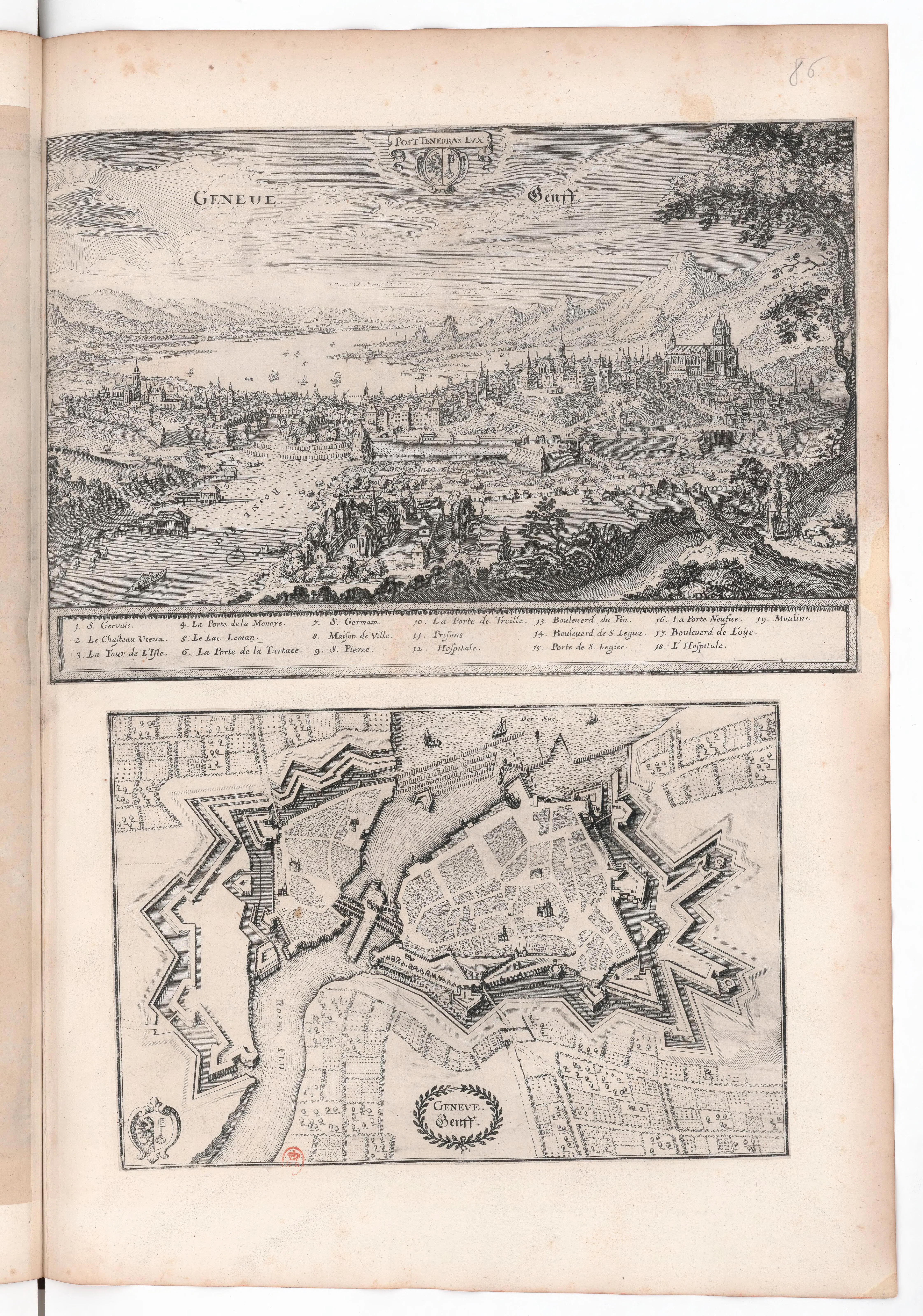
An engraved view and plan of Geneva, framed by ornamental cartouches and the city's arms, evoking the civic and confessional setting in which the 1666 de Tournes imprint was made. The motto “Post Tenebras Lux” marks the Reformed city that made a fitting home for Daillé's polemic against Catholic appeals to patristic authority. Source ↗.
De scriptis, quæ sub Dionysii Areopagitæ et Ignatii Antiocheni nominibus circumferuntur, libri duo is a Latin, two-book polemical treatise in patristic criticism and ecclesiastical history by Jean Daillé (Ioannes Dallaeus; 1594–1670), the French Reformed minister associated with Charenton. It was printed at Geneva in 1666 by Jean-Antoine and Samuel de Tournes, sumptibus Ioannis Antonii & Samuelis de Tournes. The dedicatory epistle is dated Paris, 1 November 1665, so the documentary evidence separates Parisian composition from Genevan manufacture.
The driving thesis is that the writings circulated under the names of Dionysius the Areopagite and Ignatius of Antioch are not apostolic or first-century witnesses in the form claimed for them. Daillé argues from the history of citation and non-citation, internal diction and style, ecclesiastical anachronism, recension history, and the incompatibility between alleged authorship and the date at which the writings first become visible. The volume also extends the same critical operation to material attributed among the works of Cyprian and concludes with a notice on Rufinus of Aquileia's Latin rendering of Origen: Rufinian additions, omissions, and alterations must be distinguished from Origen's own text rather than accepted as transparent translation or discarded wholesale. That conclusion is stated in the text in exactly this two-sided form — that from what is read in the Rufinian works Origen's meaning cannot be gathered with certainty, yet the Rufinian works are not on that account to be thrown away, but in them what is Rufinus's is to be separated from what is Origen's, Conclusio; Ex iis, quæ in Ruffinianis leguntur certo non colligi Origenis sensum, non ideo tamen abijcienda Ruffiniana; sed in ijs quæ Ruffini sunt ab Origenis secernenda — so that the same test which condemns a false title elsewhere here yields a rule of salvage rather than of rejection.
The dedicatee is Samuel Bochart, named in the Latin dedication as Samuel Bochartus. The work is written in learned Neo-Latin, with Greek and patristic materials used as evidence. No separate English or French translation of this particular 1666 treatise was located in the catalogues and digital bibliographies consulted. That negative result does not prove that no translation exists. A translation into English by Thomas Smith is catalogued for Daillé's distinct treatise on the use of the Fathers in religious controversies; it should not be confused with a translation of De scriptis.
The identity of the digitized book is secure as Daillé's work. The Google/Internet Archive item 9c1H7ETd3mcC is metadata-linked to Jean Daillé and to the National Central Library of Rome, and its scanned title-page and contents are patristic-critical, not chymiatric. William Davisson/Davison belongs to a separate bibliography, centered on Philosophia pyrotechnica seu curriculus chymiatricus. The particular catalogue record that allegedly produced the Davisson association has not been recovered, so whether the error was a mis-key, a Sammelband description, or a conflated union-catalogue entry remains unproved.
Why the 1666 Treatise Matters: Confessional Controversy and Modern Historiography
Daillé's book matters because it records a mature seventeenth-century attempt to make historical criticism answerable to rules of evidence while the authority of antiquity remained central to Christian controversy. The issue is not simply whether a text is “old.” It is whether a book can be shown to belong to the person, period, ecclesiastical setting, and linguistic world that its title claims. That question joins patristics to chronology, philology, textual criticism, liturgical history, rhetoric, and the law of possession and prescription. The declared posture of the inquiry is deliberately stripped of partisanship — let us inquire simply and in good faith, without any partiality or prejudice of mind, Simpliciter, ac bona fide, absque villo animi uel studio, vel præjudicio quæramus — and its positive rule of admission is correspondingly austere: that nothing be admitted concerning ancient matters or writings unless it has witnesses of the same or at least the next age, and that what lacks this authority be left undecided, ne de rebus vel scriptutis antiquis quicquam admittamus, nisi quod testes habet vel eiusdem, vel certe proximi ævi; quæ hac auctoritate carent, ea in medio relinquamus. The suspension of judgment written into that rule is as significant for the history of criticism as the negative verdicts it licenses. Where a positive attribution cannot be reached, the counterfeit-coin analogy supplies the asymmetry that makes rejection possible without it: for me to reject the coin it is enough that I find it counterfeit, Mihi vero vt nummum repudiem, satis est, quod adulterinum esse comperio;, the critic being under no obligation to name the mint before refusing the piece.
The confessional setting is decisive. Roman Catholic controversialists could invoke the Fathers as witnesses to doctrine and ecclesiastical practice, while Reformed writers needed both to use patristic testimony and to limit its force when the testimony was forged, interpolated, mistranslated, or historically remote. Daillé's reputation as a patristic scholar should therefore not be reduced to hostility toward the Fathers. His intervention relocates authority: a Father can be cited only after the identity and textual integrity of the witness have been established. In interpretive terms, the book is a work of confessional source criticism rather than an abandonment of antiquity. The polemical edge is nonetheless explicit where he sets an older Catholicism against a recent one — let Bellarmine consider which Catholicism is the better, the old or the recent; we shall never be ashamed to prefer and to follow the old, Viderit Bellarminus, vter melior sit Catholicismus, vetus nè, an recens? Nos nunquam pudebit veterem præferre ac sequi — a formulation that claims antiquity for the Reformed side rather than conceding it. The juridical corollary is the refusal of possession as a title to authenticity: against the very truth of things there is no prescription, and it is plainly foolish, as Halloix here seems to have dreamed, that by long human credulity things at last become true, Sed adversus ipsam rerum veritatem nulla præscriptio est; & plane stultum est, quod hic Halloixius somniasse videtur, longa hominum credulitate vera tandem fieri,. The Roman-law vocabulary of praescriptio and possessio is here transposed to the evaluation of texts, which is the sharpest formulation of the work's governing conviction that authority must be established by evidence rather than conferred by custody.
The Dionysian question was later transformed by the independent 1895 studies of Hugo Koch and Josef Stiglmayr. Their demonstration of substantial dependence on Proclus, who died in 485, made a first-century authorship impossible and established the corpus as a pseudonymous late fifth- or early sixth-century production. Modern introductions commonly treat that discovery as the starting point of the modern authenticity debate. The historiographical relationship to Daillé is therefore asymmetrical: later scholarship substantially confirmed the late character of the Dionysian corpus, but modern historical criticism does not simply inherit all of Daillé's arguments about every anachronism, every intermediary, or the Saint Denis tradition.

In this late-medieval Parisian Book of Hours illumination, Saint Denis carries his severed head — the cephalophoric image that made the patron of Paris instantly recognizable in devotional culture. That tradition is exactly what Daillé's critique put under historical pressure, though later scholarship, while confirming the late date of the Areopagitic writings, has treated the layered Denis legend more cautiously than he did. Source ↗.
His own dating reasoning proceeds by cultural horizon as much as by citation, as when he argues that a given speech convicts its author of having lived not in the times of the Apostles, when the impiety of gentilism ruled far and wide among the nations and truth, pressed and afflicted by the cruelty of tyrants, suffered dire persecutions everywhere, but long after the reign of Constantine himself, when Christianity flourished everywhere with paganism routed and almost extinguished, hominem hic sermo arguit, non Apostolorum temporibus, cum Gentilismi impietas longe lateque apud gentes dominabatur, ueritas tyrannorum crudelitate pressa, atque afflicta diras persecutiones passim patiebarur, sed diu post Constantini ipsius imperium vixisse. cum Christianismus, profligato ac pæne extincto gentilismo, vbique florebat — an inference from the social condition of the church presupposed by a text rather than from its verbal sources, and thus a mode of argument distinct from the philological demonstration later mounted by Koch and Stiglmayr.
The Ignatian dossier produced a more protracted controversy. John Pearson's Vindiciae epistolarum S. Ignatii (Cambridge, 1672) answered Daillé with a systematic defense, giving particular weight to the testimony of Eusebius and to the ecclesiastical implications of the letters. Thomas Smith's Oxford edition of 1709 belongs to the continuation of that English learned reception. Later critical scholarship, especially the work associated with J. B. Lightfoot, changed the terms of the dispute by reconstructing textual recensions and separating shorter, earlier material from later interpolations. The result was neither a simple vindication of the full medieval corpus nor a complete acceptance of Daillé's totalizing conclusion. Exact dates, forms, and stages of interpolation have remained matters for critical editions and ongoing debate. What made the dispute so difficult to contain was that Daillé's decisive Ignatian proof bore directly on church order: the argument he labels the fifty-seventh and the palmary one, that the writer, contrary to the usage of the Apostles and of ecclesiastical writers down to the year 200, always and consistently and never otherwise says bishop of a priest of the first grade and presbyter of one of the second, which proves the man to have lived long after the second Christian century, Argumentum LVII. idque palmarium; Quod scriptor præter Apostolorum, & Ecclesiasticorum ad a. D. 200. scriptorum consuetudinem Episcopum & Presbyterum, illum de primi, hunc de secundi gradus sacerdote semper ac constanter, nunquam aliter dicat; quod arguit hominem diu post secundum Christianismi sæculum vixisse. The same terminological observation supplies the imputed motive for the fabrication, namely to establish the episcopate such as it then was, episcopatum nimirum qui qualisque tum erat, constituere, — which is why an argument about the usage of two Greek nouns could not remain a matter of lexicography alone, and why Pearson's reply was framed as a defence of the letters' authority as well as their authenticity.
Irena Backus's work on the reception of the Fathers and on Reformed orthodoxy supplies the most useful historiographical corrective to a simple Protestant-versus-Catholic narrative. It shows why patristic tradition could be methodologically indispensable to Reformed theologians even when its uncritical use was attacked. Paul Rorem and Charles Stang provide complementary modern approaches to the Dionysian problem: Rorem emphasizes textual structure and influence, while Stang emphasizes pseudonymity and the relation between authorial persona and theological discourse. John Lookadoo's study of Ignatius in Britain clarifies the institutional and national setting in which Pearson, Smith, and related scholars received the controversy.
The book is also significant for the history of translation. Daillé's treatment of Rufinus refuses the easy opposition between faithful translation and useless forgery. Rufinus's Latin work is treated as a layered historical object containing omission, addition, paraphrase, and doctrinal alteration; the proper method is to sort the Rufinian material against Greek controls and other witnesses. The procedure is described as the construction of a standard from the securely Greek remains, so that one may attain and gather in the mind a certain form and idea of Origenic doctrine, which may then be used as a most certain canon in judging the Rufinian works, Ita enim quandam Origenicæ doctrinæ formam atque ideam mente attequi, ac tolligere licebar, qua veluti certissimo canone, in dijudicandis Ruffinianis vtramur. That principle anticipates a central modern editorial problem: the surviving text may preserve evidence precisely through the distortions that prevent it from being read as a transparent original.
The historiography is thinner for Daillé's own 1666 volume than for the ancient corpora that it discusses. The work is well represented in digital and general library catalogues, and its immediate importance in the Ignatian controversy is clear, but no modern critical edition, complete census of copies, or dedicated monograph on its material transmission was located. The absence of such a study makes the physical differences among the Rome, Lyon, BnF, National Trust, British Library, National Library of Scotland, and Boston records especially important. They preserve not only an argument about ancient authorship but also the history of how a controversial Neo-Latin book was catalogued, collected, rebound, digitized, and read.
Tracing the Object: Genevan Imprint, Jesuit Provenance, and Surviving Copies
Bibliographic identity and transmission. The title is consistently recorded in the principal records as Ioannis Dallæi De scriptis, quæ sub Dionysii Areopagitæ et Ignatii Antiocheni nominibus circumferuntur, libri duo, Geneva, sumptibus Ioannis Antonii & Samuelis de Tournes, 1666. The extended title announces the demonstration that the writings were subdititia and fabricated after the deaths of the figures to whom they were falsely attributed; it also names the appended brevis commonefactio de Ruffiniana Origenicorum aliquot operum interpretatione. The BnF authority record is FRBNF30295359, catalogue ark:/12148/cb302953598. WorldCat record OCLC 792778429 gives the same Genevan imprint and presents the item as one bibliographic edition, while PRDL records the 1666 title alongside several digital manifestations.
No separate manuscript witness, pre-1666 edition, or demonstrably revised issue of this particular two-book title was established in the catalogue evidence consulted. Multiple scans should not be treated automatically as multiple editions. One Google Books record, q1SUiWOUGP4C, identifies the Bibliothèque jésuite des Fontaines in Lyon as its source and reports 507 pages. The Internet Archive record for Google identifier 9c1H7ETd3mcC reports a 559-page scan and names the National Central Library of Rome as contributor/source library. These records are distinct Google objects; the differing counts may reflect pagination conventions, preliminaries, added matter, or scan metadata, and do not by themselves prove a new edition.
Physical copies and shelfmarks. The BnF record gives an in-quarto description, “pièces liminaires et 507 p.,” and the physical location and shelfmark “Tolbiac – Rez-de-jardin – magasin, C-2078.” This is the clearest public shelfmark located for a physical copy. A National Trust copy at Blickling Hall, Norfolk, is object NT 3168901 and is described as “[44], 501, [7] p.; 4to.” Its seventeenth-century sprinkled-calf binding has gilt rolls on the board edges, a gold-tooled spine with gilt title, and red-and-blue sprinkled edges. Its title-page inscription, “E libris Josiae King pret: 10 sol,” and the manuscript initial “M.” connect the object with John Mitchell's catalogue system and the library of Sir Richard Ellys. The National Trust object number is public; no additional shelfmark is exposed.
WorldCat displays the British Library, St Pancras, and the National Library of Scotland, George IV Bridge, as holding institutions for OCLC 792778429, but the public record supplies neither their local shelfmarks nor a physical description. Boston Public Library records a Latin rare-book copy in the Theodore Parker Library, available by request, again without a public call number in the accessible record. The evidence therefore supports several surviving institutional copies but not a complete census.
The Rome digitization and earlier provenance. The Internet Archive/Google item is identifiable by Google id 9c1H7ETd3mcC and Internet Archive identifier bub_gb_9c1H7ETd3mcC. Its opening leaf reads, in abbreviated form, “Ex Bibliotheca majori Collegii Romani Societatis Jesu,” documenting an earlier Jesuit Collegio Romano provenance. The digitization metadata names the National Central Library of Rome and records Google scanning. No Roman local shelfmark is supplied, and no public evidence has been found that matches this scan to a shelfmark in the National Central Library of Rome. The strongest defensible conclusion is therefore a provenance and metadata identification, not a shelfmark identification.
Production network and unresolved material questions. The printer record identifies Jean-Antoine and Samuel de Tournes as a Genevan/Swiss printing partnership; Samuel de Tournes is recorded as working with his brother until approximately 1673. The workshop is associated with more than one device, including a crown design and a two-serpent device bearing the motto Quod tibi fieri non vis alteri ne feceris. The surviving evidence does not establish which, if either, appears in the Daillé volume. The accessible records also do not securely establish a privilege or licence, price, engraved title, Greek-fount usage, sheet-by-sheet collation, or distribution history. Those particulars require inspection of the physical copies or high-resolution title-page and colophon images rather than inference from the imprint.
Authorship disambiguation. The title page, Internet Archive metadata, BnF record, Boston record, National Trust record, and WorldCat identity all assign the book to Jean Daillé, not William Davisson. Davisson/Davison was a Scottish physician and chymist associated with Philosophia pyrotechnica, a separately catalogued Paris chymiatric work; a 1635 Paris record gives the title Philosophia pyrotechnica and the publisher Joannes Bessin. No field in the 9c1H7ETd3mcC metadata names Davisson, Philosophia pyrotechnica, or a chemical course, and the scan's title page and contents are unambiguously Daillé's patristic treatise. The offending Davisson record itself has not been located. It is consequently unsafe to decide among a mis-keyed digitization record, a Sammelband binding, and a conflated union-catalogue entry. The catalogue error is demonstrable only as an unresolved external association, not as a proven physical feature of the Rome copy.
Dedication, intellectual network, and reception. The dedication to Samuel Bochart presents the work as undertaken at Bochart's request and counsel, in connection with discussion of a recent Ignatian edition. It also frames the book as a contribution to the purification of ecclesiastical antiquity from writings placed falsely under ancient names, the premise being that the purging of spurious and substituted books from all parts of ecclesiastical antiquity contributes greatly to the investigation of the truth of apostolic tradition, VM ad investigandam traditionis Apostolicæ veritatem plurimum conducat spuriis & supposititiis libris purgari omnes antiquitatis Ecclesiasticæ partes; the critical operation is thus presented at the outset as a service to tradition rather than a repudiation of it. Daillé's cited network includes David Blondel, James Ussher, Isaac Vossius, Henry Hammond, Claude Saumaise, Pierre Halloix, Denis Pétau, Jacques Sirmond, Jean de Launoy, Jean Morin, Francisco Torres, and Robert Bellarmine, alongside ancient witnesses such as Eusebius, Jerome, Origen, Irenaeus, Clement of Alexandria, Tertullian, and Theodoret.
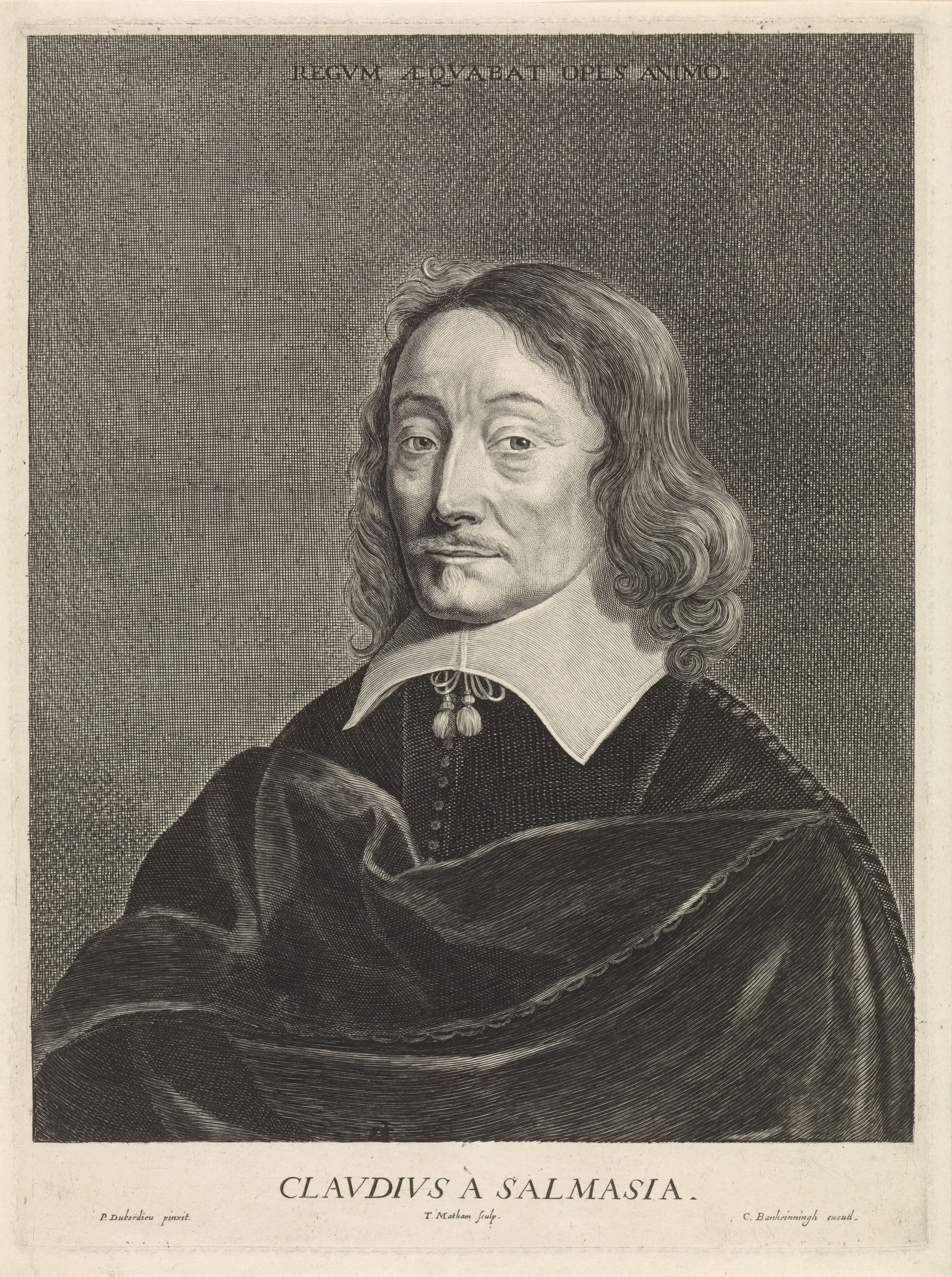
Theodor Matham's engraved portrait of Claudius Salmasius (Claude Saumaise), made in Leiden after a painting by Pieter Dubordieu, gives a face to one of the scholars in Daillé's cited network. In the Ignatian controversy Saumaise figures not as a principal but as a named ally, whose critical position Daillé paired with that of David Blondel. Source ↗.
The density of these citations shows that the volume is a disputation within an international republic of learned theology, not an isolated act of local polemic.
The most consequential immediate answer to the Ignatian portion was John Pearson's Vindiciae epistolarum S. Ignatii (Cambridge, 1672), a direct defense of the authenticity and authority of the Ignatian letters against Daillé. Thomas Smith edited Ignatius's letters at Oxford in 1709; the surviving reception evidence places that edition within the continuing English learned debate. Henry Dodwell belongs to the same wider Anglican and antiquarian reception, but the records consulted do not establish a separate Dodwell refutation of this exact volume and do not justify attributing every later Ignatian intervention to a direct reply to Daillé.
The nineteenth-century history divides the two dossiers. J. B. Lightfoot's critical work on the Apostolic Fathers treated the Ignatian problem through the distinction between recensions, authentic letters, and later interpolations, rather than through an unqualified choice between the entire traditional corpus and total invention. For the Dionysian corpus, Hugo Koch and Josef Stiglmayr independently demonstrated in 1895 that its author depended substantially on Proclus and that the corpus was therefore pseudonymous and late fifth- or early sixth-century. That later result strongly supports Daillé's broad late dating of the Dionysian writings, which he had himself stated as a narrow chronological verdict, holding that the man, whoever else he may have been, seems altogether to have lived either at the headlong close of the fifth century or even at the beginning of the sixth, and to have published these offspring of his, foisted upon Dionysius by monstrous fraud, not before about the year 520, omninoque videri istum, quisquis de cætero sit, vel quinto præcipiti sæculo, vel etiam ineunte sexro vixisse, neque ante an. D. circiter 520. foetus hos suos, Dionysio immani fraude suppositos edidisse; but the convergence does not retroactively validate every chronological, stylistic, or confessional inference in his polemic.
Censorship and related works. No title-specific entry for this 1666 book was located in the Roman Index librorum prohibitorum or in the Spanish expurgatory-index searches consulted. The result is an evidentiary limit, not proof that the book escaped every local or institutional restriction. The book itself discusses the practices of expurgating patristic and controversial writings, so censorship is part of its subject even though an official prohibition record has not been confirmed. No evidence of suppression or loss of the edition was located.
The volume belongs to Daillé's broader programme of testing patristic authority by historical provenance. It should be distinguished from De usu Patrum ad ea definienda religionis capita quae sunt hodie controversa libri duo (1631), its French treatment of the use of the Fathers, and De pseudepigraphis apostolicis libri tres (1653). The 1666 book narrows that programme into dossiers on Dionysius, Ignatius, the Cyprianic attribution, and Rufinus's mediation of Origen. Its appended Ruffiniana is especially important to the object biography because it turns the volume from a two-corpus polemic into a broader statement about sorting genuine ancient testimony from later translation and editorial accretion. The dating instrument deployed there is the same one used on the two main corpora, applied now to matter embedded in a translation, as where he concludes that these things were assuredly written after the Nicene Synod, and much more so after Origen, Ista profecto post Nicænam Synodum, multoque adeo magis post Origenem scripta sunt;, so that the interpolated stratum within a Latin Origen is exposed by the same test of ecclesiastical horizon that condemns a pseudonymous title page.
Reading the Two Books: Structure, Argument, and the Evidence Daillé Assembles
Title-page, dedication, and the argumentative apparatus
The volume declares its verdict before a single argument is made. The title-page does not merely name two disputed corpora; it converts the book's conclusion into its subtitle, promising a demonstration that these writings are substituted goods, QVIBVS DEMONSTRATVR ILLA SVBDITITIA esse, diu post Martyrum, quibus falso tribuuntur, obitum ficta — shown to be substituted, fashioned long after the death of the martyrs to whom they are falsely ascribed. Two temporal relations are asserted at once: a relation of substitution (a name put in the place of another) and a relation of interval (diu post). The whole of what follows is the labour of converting that asserted interval into a measured one, and the same title-page already extends the operation beyond the two corpora by appending a warning on Rufinus's Latin Origen, so that the categories of fabrication and of unfaithful translation are advertised as belonging to one inquiry.
The dedicatory epistle supplies the rationale in the language of hydraulics and purity rather than of erudition. What obstructs the recovery of apostolic tradition, Daillé writes, is nothing so much as the channels of a later age let in and mingled with these purest springs of the faith by the fraud of certain ill-occupied men, quam his purissimis fidei fontibus quorumdam maleferiatorum hominum fraude immissos & immixtos ævi recentioris rivos. The metaphor does considerable ideological work. It makes anachronism a species of contamination rather than of mere mistake, which is why the remedy is described as purgatio and why the critic's office can be presented as sanitary service to tradition rather than as attack upon it. It also localizes agency: the streams do not seep in, they are immissi, admitted by identifiable hands. The epithet maleferiati, men at leisure to no good purpose, will return in the body of the work as the description of the Areopagitic fabricator, binding the pastoral preface to the polemical demonstration by a single moral vocabulary.
Between the epistle and the treatise stand two pieces of apparatus that are themselves argumentative instruments: a chapter-by-chapter synopsis of both books and a full index of authors, matters and words. The synopsis is not a neutral finding-aid but a précis of proofs, and at its penultimate stage it states the hermeneutical licence that the entire enterprise presupposes, that one may depart from the judgement of the Fathers as often as they depart from the truth, XXXVI. Licere a Patrum judicio discedere quoties ii a veris discedunt. The placement is significant: the principle is announced not at the outset, where it would look like a confessional axiom, but at the end of the cumulative Dionysian demonstration, where it can appear as a consequence drawn from evidence already produced. Patristic consensus is thereby reclassified — it remains testimony, and testimony of the highest value when it is early and pertinent, but it ceases to be a tribunal whose sentence forecloses inspection. The synopsis then carries the same test forward into the censure of the pseudo-Cyprianic tract and into the treatment of Rufinus, whose faithlessness as a translator is to be established by comparison with his Greek original, so that the volume's final movement is not a rejection but a separation of layers within a text that must be kept.
Book I: the Dionysian dossier and the chain of silence
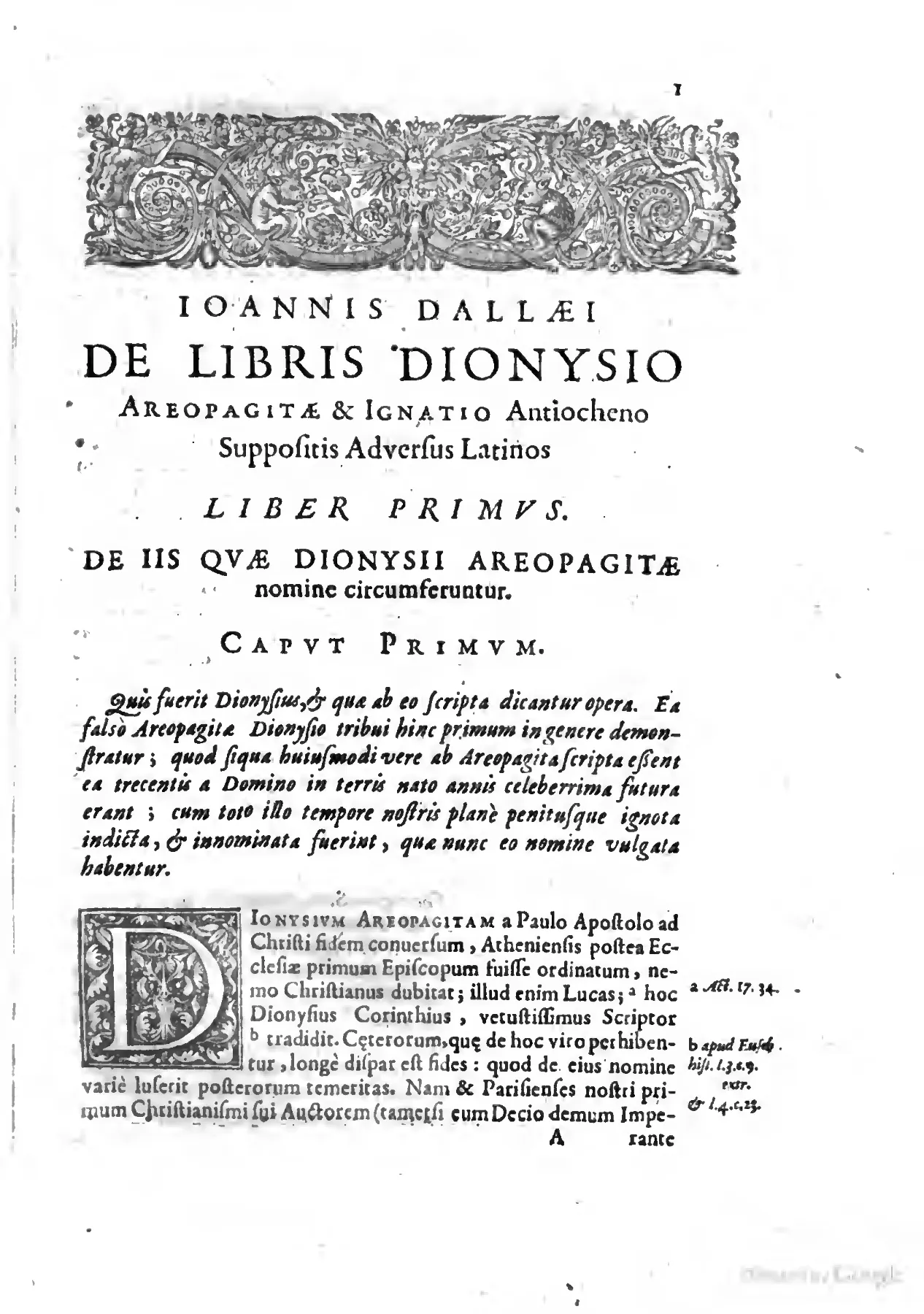
At the formal opening of Book I, woodcut headpiece and historiated initial frame Daillé's crucial move: he concedes the historical Dionysius converted by Paul and associated with the Athenian church, then detaches that apostolic figure from the writings circulating under his name. The italic chapter summary already states the chain-of-silence test — books genuinely by the Areopagite should have been famous for the first three centuries, not absent from the record. Source ↗.
The first book opens by conceding everything that can be conceded. No Christian, Daillé grants, doubts that Dionysius the Areopagite was converted to the faith of Christ by the Apostle Paul and afterwards ordained the first bishop of the church of Athens, DIONYSIVM AREOPAGITAM a Paulo Apostolo ad Christi fidem conuersum, Atheniensis postea Ecclesiæ primum Episcopum fuisse ordinatum, nemo Christianus dubitat. The concession is the pivot of the chapter, because it detaches the historical person, guaranteed by the Acts of the Apostles, from the books that bear his name. Once that separation is made, the question is no longer whether a venerable saint existed but whether a particular set of quires can establish title to his name; and the burden falls where a claim of title always falls, on the claimant. Against this Daillé sets his opponent's contrary construction of the dispute, quoted verbatim so that it may be tested as a factual assertion: only heretics, Lutherans, and certain smatterers — Erasmus, Valla, and a few others — deny that the enumerated works are the Areopagite's, Soli, inquit, hæretici Lutherani, & quidam Scioli, Erasmus, Valla, & pauci alij, opera supra numerata negant esse Sancti Dionysij Areopagica. By reproducing Bellarmine's sentence exactly, Daillé transforms a boundary-marking insult into a proposition with a truth-value, one that the closing chapters of the book will falsify by parading Catholic and humanist doubters, and that the historical chapters will falsify more damagingly by producing sixth-century Catholics who denied the attribution outright.
The middle chapters build the negative case by differential citation rather than by mere accumulation of omissions. The characteristic move is to set two witnesses side by side who had the same occasion and did not have the same book: the writings were known in the seventh century, in which Bede lived; in the fifth, in whose seventh year Chrysostom and in whose thirtieth Augustine died, they were not yet born, Dionysiana septimo, quo Beda vixit sæculo, nota erant; quinto, cuius anno septimo Chrysostomus, Augustinus triscessimo mortuus est, nondum erant nata. The phrase nondum erant nata is doing more than rhetorical duty. It treats books as objects with birth-dates, entities whose coming into existence can be located within a bracket fixed by the practice of readers, and it is precisely because Chrysostom and Augustine were expounding the passage of Acts in which Dionysius appears that their silence is not accidental. The same logic is then applied to doctrine rather than to persons, and here Daillé prefers to be convicted by his adversaries' own scholarship: Pétau's admission that Dionysius was the first to lay down the nine orders and grades of angels distinctly and definitely, Primus, inquit, Dionysius nouem Angelorum ordines & gradus distinctè ac definitè posuit, is turned into a chronological instrument. If the nine-fold celestial hierarchy begins with this author, and no writer of the first five centuries knows it, then this author wrote after them; the doctrine's originality, urged by its defenders as a mark of inspiration, becomes the very evidence of lateness.
What distinguishes the argument from a bare accumulation of silences is the frankness with which it fixes its positive terminus. Daillé concedes the point at which the corpus becomes visible, granting that the Dionysian writings came forth shortly after Gennadius, Fateor breui post Gennadium illa nostra Dionysiana produisse, and correcting Bellarmine for placing their emergence far later, in Gregory's time. The concession is strategically indispensable: a critic who claims only that a book is not old is arguing negatively, whereas a critic who names the decade in which it surfaces is offering a positive historical account that can itself be tested. The keystone of that account is the Constantinopolitan collation with the Severians, where the earliest datable mention of the corpus is an allegation by its opponents and a repudiation by their adversaries. Hypatius of Ephesus is quoted demanding of the Severians how they can show those testimonies which they call the Areopagite's to be genuine, since if they were his they could not have escaped blessed Cyril, illa (inquit) testimonia qua vos Dionysij Areopagitæ dicitis, vnde potestis ostendere vera esse, sicut suspicaminus? Si enim eius erant non potuissent latere B. Cyrillum. The passage is doubly valuable to Daillé. It dates the corpus's first appearance, and it supplies a sixth-century precedent for his own method, since Hypatius reasons exactly as Daillé does, from the silence of a writer who could not have overlooked such matter. The charge of critical novelty is thereby answered from within the tradition whose custody is at issue.
From this the first book proceeds to its most corrosive observation, that the corpus's earliest support was itself manufactured. Recounting how the Acephali, to give their citations standing, produced Cyrilline books that never existed, Daillé remarks that the cause was worthy — who would deny it? — of such defenders and patrons, that an impostor's work should be received and praised by none sooner than heretics, and defended by no other supports than lies and impostures, Digna (quis neget?) ralibus defensoribus, & patrocinis causa, vt impostoris opus non alij priùs exciperent, & laudarent, quàm hæretici; neque alijs tuerentur, aut commendarent præsidijs, quàm mendacijs, & imposturis. Beneath the sarcasm lies a serious methodological perception: authority in this domain can be generated recursively, one fabrication vouching for another, so that a chain of attestation may be as artificial as the text it attests. Testimony must therefore be weighed by the character and situation of each witness, not merely counted.
The refutation of the standard evasions follows, and its sharpest moment is the dismissal of an appeal to the mere will of the ancients. Asked why writers who knew the books never mentioned them, Halloix answers that it did not please them; Daillé replies that wise writers take no pleasure in what is foolish and alien to their office, Roganti vero cur ij illa, si sciverunt nuspiam memorauerint, responder quia (inquit) non libuit. At ô bone, qui sapiunt scriptores ijs nihil liber, quod stultum sit, & a suo officio alienum. The riposte converts a psychological excuse into a normative claim about authorial duty: a controversialist writing against the very heresies a book refutes is under an obligation of his office to cite it, and where obligation and opportunity coincide, silence becomes evidence rather than accident. Without such a doctrine of officium, the negative argument would indeed be worthless, since any omission could be referred to taste.
The final movement of this stage turns from the books to the man, and dates the true Dionysius' martyrdom under Domitian, showing that both the earliest impugners of the corpus and its earliest defenders presupposed that date. The dossier ends by fastening Halloix on the horns of his own construction, since he cannot both deny that the earliest writers left written testimony of the martyrdom and rest his chronology upon a martyrological notice ascribed to Aristides. Daillé simply waits: Exspecto vtram partem electuri sint Arcopagitici, I await which alternative the Areopagitici will choose. The posture is characteristic of the whole book. The critic does not undertake to supply the true author's name, nor to reconstruct the lost history he denies; he undertakes to show that the documents adduced cannot bear the weight placed upon them, and to leave the defenders of the attribution with a choice each branch of which destroys their case.
Martyrology, chronology, and the naming of Pseudodionysius
That same posture governs the chapters that carry the Dionysian chronology forward, and they open with a maxim about the behaviour of historical report itself. Having refused Halloix's suggestion that the ancient notices of a martyrdom under Domitian were conjecture rather than transmitted knowledge, Daillé states the principle on which the whole dossier will run: since from the beginning tradition concerning things done is wont to be single and simple, while variety of opinion about them commonly arises from men's partisan zeal, Itaque cum ab initio vna, simplexque esse soleat de rebus gestis traditio; opinionum de ijs varietas ex hominum studijs fere nascatur;. The formulation is deceptively modest. It converts traditio from a theological warrant into a historical object with a predictable morphology: an original report is unitary, and multiplication of versions is a symptom of interested manufacture rather than of rich attestation. The consequence for method is that a plurality of dates is not a treasury of witnesses to be harmonized but a deposit whose divergences must be dated and assigned to the interests that produced them, and the party of defenders — whom he names collectively as the Areopagitici, treating them as an interest group rather than as a bench of judges — is thereby placed inside the phenomenon it purports to adjudicate.
The argument from age that follows shows how carefully Daillé distinguishes possibility from attestation. Confronted with the hagiographical class of macrobii, the exceptionally long-lived saints marshalled by Baronio and Halloix, he does not deny them: far be it from me, he says, to deny these things when confirmed by suitable testimonies of writers; this only I say and maintain, that it seems incredible that what befell one or two of them, that men older than a hundred should undergo martyrdom, befell this our Dionysius, Ego vero hæc idoneis scriptotum testimoniis confirmata, absit vt negem. Hoc tantum aio, ac contendo, incredibile videri, vt quod istorum vni, & alteri contigit, vt centenario majores martyrium facerent, id ipsum Dionysio huic nostro contigisse. The concession is the load-bearing part of the argument. By granting Symeon, Polycarp, Narcissus and the rest their documented longevity, he removes the dispute from the terrain of the miraculous, where a Reformed critic could be accused of impiety, and relocates it in the terrain of record-keeping: what is rare gets written down, and the martyrologies that lavish the detail of extreme age on others are wholly silent about it for Dionysius. Silence is thus not treated as a blank but as the expected trace of a fact that did not occur, and the survey of Baronio's own Martyrologium Romanum, of Usuard, Ado and the Gallican compilations is designed to make the opponents' own instruments testify against the chronology they require.
The positive reconstruction that follows is prefaced by a declaration of critical hygiene: dismissing fables and the sweepings of the apocrypha, let us go to what is true and certain, if any such there be, Missis fabulis, & apocryphorum quisquiliis, vera certaque si qua sunt, adeamus. Quisquiliae — chaff, refuse swept from a floor — is a deliberate demotion: the apocryphal Dionysian lives are not weak evidence to be weighed at a discount but matter to be removed before weighing begins. What replaces them is a documentary chain assembled from the fragment of Dionysius of Corinth in Eusebius, from Jerome's notice that Quadratus succeeded the martyred Publius at Athens, and from the imperial itinerary: Hadrian's two Athenian sojourns, dated from the Chronicon and from Spartianus to the sixth and tenth years of the reign, which fix the presentation of Quadratus' Apology and therefore the terminus of his episcopate. The chronological squeeze that results is then pressed home by turning the adversary's own characterization of Athens against him: what sort of thing is this, Daillé asks, that in the very years in which that raging and drunken Rome, intoxicated with our blood, killed only one of our prelates, those Athens of yours, so dry and so chaste, butchered two, Quale quæso, istud est, vt quibus annis furens illa arque temulenta & nostrorum cuore ebria Roma vnum tantum nostrorum Antistitem occidit, tuæ illæ iisdem annis tam sicca, tamque castæ Athenæ duos trucidaverint?. The rhetoric of the drunken city and the sober one is not ornament: Halloix had himself insisted on Athenian judicial mildness, and the sentence makes that premise generate two Athenian martyrdoms inside a handful of years while imperial Rome managed one — an incoherence internal to the defence rather than imported by the critic.
Against the counter-testimonies Daillé applies a still blunter standard, staged as a small courtroom exchange over the lost Apology of Aristides: produce the book, that we may inspect the testimony; "I have no book," he says, "it perished, nor is there any report of its having been seen for some centuries back" — a fine proof indeed, and worthy of fable-mongers, Cedo librum, vt testimonium inspiciamus. Librum, inquit, non habeo, periit; neque vlla fama est eum ab aliquot retro sæculis visum esse. Bella profecto, ac fabulatoribus digna probatio. The dramatized demand for production makes visible the difference between a citation and an appeal to a citation: a witness who cannot be brought into court is not a witness of low authority but no witness at all. The same standard, applied serially, removes Ado's martyrology as a ninth-century accretion, Bede's as corrupt on the admission of the defenders themselves, Rosweyde's "old Roman" martyrology as an Aquileian compilation from Rufinus on Henri de Valois's showing, and the Chronicon of Flavius Lucius Dexter as a recent Spanish manufacture convicted out of its own anachronisms.
The external demonstration is then formally closed, and the closure is announced with the confidence of a completed proof: these things being established, it is now clear and certain that the books about which we have undertaken this disputation were in no way written by Dionysius, and thus falsely bear his name, His ita constitutis, nunc clarum certumque est eos libros de quibus hanc disputationem instituimus, nequaquam a Dionysio scriptos esse; falsoque adeo ejus nomen præfetre. From this hinge the argumentation turns inward, and the writer acquires a name of his own — he may aptly be called Pseudodionysius, who wishes to seem to have been a man of the Ignatian age, Pseudodionysius uerò apposite dixerit, qui se vult videri Ignatiani æui hominem fuisse. The coinage is a small act of critical bookkeeping: it separates the historical Athenian convert, whose existence is never in question, from the person who composed the corpus, and makes the gap between self-presentation and demonstrable date the subject of investigation.
Two of the sharpest exchanges in these chapters concern not the corpus but the licence its defenders claim in handling texts. When Halloix meets the citation of Ignatius' letter to the Romans by supposing either an interpolation or a posthumous second edition, Daillé answers with a distinction between what an author may do and what a hypothesis may require: who denies that authors, so long as they live, may change, diminish and enlarge their own work at their pleasure — but that men once dead should revise their own works is a portent hitherto unheard of, Quis negat auctoribus quandiu quidem vivunt, sua mutare, minuere, amplificare pro arbitrio suo licere? Homines semel mortuos sua ipsos opera recognoscere id verò portentum est hactenùs inauditu[m]. The joke encodes a rule: an editorial conjecture must be compatible with the biography of the person it invokes. The companion charge is directed at the excision of inconvenient sentences, and it exposes what Daillé takes to be a circularity at the heart of the defence — I do not wonder, he writes, that these men summon us to the books of the ancients, which they admit on this condition, that if anything they do not want occurs in them, they may be allowed to delete it as impudently thrust in, Ego vero non miror, si nos isti ad veterum libros provocant; quos hac lege admittunt scilicet, vt si quid in ijs quod nolint, occurrat, id sibi liceat, velut impudenter in eos intrusum delere. A text admitted on that condition can never testify against the party admitting it, and the polemical sting is doubled by the fact that the warning against such licence is borrowed from Gabriel Vázquez, who had deployed it against Latino Latini precisely because arbitrary deletion hands ridicule to Protestant controversialists.
The internal arguments proper turn on the temporal self-positioning of the text. The most economical of them fastens on the writer's appeal to an ancient tradition in defence of infant baptism: it was rather a tradition still fresh and but lately made, and therefore this Dionysius who speaks as we have heard was not the Areopagite, who is agreed to have flourished in the very times of the Apostles, Recens potius adhuc erat, & nupera traditio. Iste ergo qui sic, vt audivimus, loquitur Dionysius, Areopagira non fuit, quem ipsis Apostolorum temporibus floruisse constat. The reasoning is not about the legitimacy of the practice but about the grammar of temporal reference: a writer contemporary with the institution of a usage cannot invoke its antiquity, so the very word by which the corpus reaches for apostolic warrant measures its distance from the apostolic age. The same instrument governs the long series of liturgical and institutional dossiers that follow — the secrecy of the disciplina arcani, unattested in Justin and Tertullian; graded public penance; the elaborated baptismal rite; the consecration of chrism and of altars; the swarm of monks; the communion of infants — each treated as a practice with a datable horizon rather than as a doctrine to be approved or condemned.
The chapter on Hierotheus supplies the clearest statement of style as forensic evidence. Having argued from the identity of manner between the alleged master and the disciple that both are the work of one hand, Daillé concludes that the man was betrayed by his own trick, and driven, unwilling and struggling, into the very thing he wished to avoid, since it is not possible that a liar should guard himself on every side, Sed hominem sua ipsum techna prodidit, & in id ipsum quod uitare cupiebat, invitum ac reluctantem impegit. Neque enim fieri potest, vt qui mentitur sibi ab omni parte caveat. The fabricated authority invented to supply the corpus with a pedigree becomes the proof of fabrication, because the invented voice cannot help speaking in the inventor's own cadence. The chain of arguments then closes on the most technical datum of all: that this author wrote after the Council of Chalcedon itself is betrayed by the words he uses in setting out the union of the two natures in Christ, scripsisse hunc auctorem, produnt verba, quibus vtitur in exponenda duarum in Christo natutarum vnioue — the corpus reproducing the conciliar formula of 451, so that a vocabulary adopted to display orthodoxy fixes the earliest year at which the writer can have held the pen.
Diction, style, and the corpus after its emergence
The closing chapters of Book I press the internal stage of the procedure into its purest form, turning from institutions and doctrine to diction. Chapter XXX assembles a dossier of substituted names, in which every institutional term proper to the apostolic and sub-apostolic churches has been displaced by a coinage — what is called a baptistery or font, this man calls the mother of adoption; those who to everyone else are bishops are to him hierarchs, Quod baptisterium, vel fons dicitur, id ille matrem adoptionis dicit. Qui cæteris sunt Episcopi, ij huic sunt Hierarchæ. The list continues through hiereis for presbyters, hagiographus codex for Scripture, and epopsia for the Apocalypse. What gives the catalogue its evidentiary force is not the strangeness of the words as such but the direction of the substitution: each replaces a term securely attested in the apostolic writings with one that is not, and the aggregate pattern is read as a deliberate policy rather than an idiolect. The same reasoning governs the treatment of the monastic vocabulary, where the argument turns explicitly on isolated usage against universal usage — those whom all the Christians of that age are known to have called monks, this novel and quite extraordinary namer alone calls Therapeutae, Nam quos a Christianis illorum temporum omnibus Monachos vocatos fuisse constat, eos novus hic, planeque mirificus nomenclator Therapeutas, sed solus dicit;. The inference is a strict application of the rule that words are estimated from usage: a term found in one writer and in no contemporary is not archaic but eccentric, and eccentricity of this kind betrays a writer standing outside the community whose speech he claims.
Style is then admitted as evidence in its own right, and the admission is secured by turning a friendly witness against his own conclusion. Casaubon had called the writer most ancient and most elegant; the concession extracted from him is that he wrote of the sacraments in a certain new and unusual manner of speaking, one which seems not far removed from the tragic buskin or from dithyrambic bombast, fatetur tamen de sacramentis nouo quodam, & inusitato dicendi genere scripsisse, quod a cothurno tragico, vel dihyrambicis ampullis non multum videatur distare;. The cothurnus and the ampullae are not casual insults but terms of art from the rhetorical tradition, marking a register that ancient critics themselves reproved; deployed here they convert a literary judgment into a chronological one, since the manner they name belongs to the schools of the fifth century rather than to the plain speech of Clement or Polycarp. Chapter XXXI presses this into a full analysis of period-construction, epithet-heaping and homoeoteleuta, and the standing excuse — that the mysteries required veiled speech — is refused on the ground that the policy of concealing the sacraments is itself a fourth- and fifth-century development, so that the defence dates the text it was meant to save. The stylistic verdict is delivered as an epigram: he threatens many great things, but if you shake the man out, you will find words and leaves in abundance, of substance and true fruit almost nothing, Multa magnaque minatur; si hominem excusseris, verborum & foliorum abunde reperies; rerum & veræ frugis pæne nihil. Behind the derision lies a positive hypothesis about intention, and it is stated plainly: I should altogether think the man wished to unfold these riches of his talent for display, so that he might seem quite other than the mortals of his own age, Omnino hominem puraverim has sui ingenii copias ad pompam explicare voluisse; ut plane alius a sui ævi mortalibus esse videretur,. Strangeness of idiom is thus reinterpreted as archaising artifice — the very trait a naive reader takes for antiquity is the trait that convicts.
Chapter XXXII removes the strongest positive argument on the other side by reversing its direction. Halloix had urged the palpable parallels between the Areopagitica and Gregory Nazianzen and Clement of Alexandria as proof that the earlier Dionysius had been read by them. The parallels are conceded and the vector inverted by chronology: it is stupid and absurd, what he invents, that Gregory, who died in 389, found or perused at Athens books that were to be born a hundred years and more after his death, stultum & absurdum est quod singit, Gregorium a. D. 389. mortuum hos libros vel reperisse, vel pervolutasse Athenis, qui centum, & amplius post eius mortem annis erant nascituri. Once the terminus fixed by the chain of silence and by Hypatius's rejection in 532 is in place, borrowing can run in only one direction, and the adversary's evidence of resemblance becomes the critic's evidence of theft. The dating verdict that closes the chapter — publication no earlier than about 520, by a writer of the very end of the fifth or the beginning of the sixth century — is thus not asserted independently of the stylistic dossier but derived from the intersection of the two stages.
The chapters that follow trace what happened after the corpus entered the record, and they matter because they detach the question of authenticity from the question of ecclesiastical consent. Gregory the Great is shown citing the books only at second hand; Leontius, Anastasius Sinaita and Maximus are the first Catholic writers to receive them as genuine; the Roman synod of 649 consolidates the error. Against this the Greek tradition is recruited as a counter-witness: let it therefore stand firm and unshaken, as we have said, that Photius, patriarch of Constantinople, by far the most learned man of his own and of the following ages, judged the books circulating under the name of Dionysius to be a spurious offspring of uncertain parentage, Firmum ergo & inconcussum maneat, quod diximus, Photium Constantinopolitanum Patriarcham, virum & sui ævi, & sequentium sæculorum longe eruditissimum, libros, qui Dionysij nomine circumfertuntur, spurium incerti parentis foetum censuisse,. The metaphor of illegitimate birth belongs to the same commercial-legal register as subdititius: the book has no acknowledged parent, and no ecclesiastical usage can supply one. The Latin transmission is then narrated as an accident of translation and ignorance, and the doxography of Chapter XXXVI shows the doubt reviving with the recovery of Greek — Valla, Gaza, Grocyn recanting publicly in his own lecture-hall at St Paul's, Erasmus in a passage the Spanish expurgators erased, Cajetan, Cassander. The most telling item is a concession wrung from the chief adversary himself, who allows that even if certain letters and the book of Dionysius be surrendered, we have many other most certain and most approved authors; and these very ones are most ancient and best, although it is not certain whether they are those whose names they bear, tamen multos habemus alios certissimos, & probatissimos autores; & ISTI IPSI sunt antiquissimi & optimi, licet NON SIT CERTVM, an sint illi, quorum nomina præferunt. The capitals are the printing-house's rendering of the author's emphasis, and they fall exactly where the controversy turns: an authority may be praised as ancient and best while its title remains unproved, which is precisely the divorce between possession and title that the whole treatise exists to enforce. The volume's own manufacture surfaces here as well, when the discovery of Morin's fuller treatment is reported to have come when the entire disputation had been brought to its completion and was ready for the press, jamque nostra hæc omnis disputatio ad vmbilicum perducta, & ad prælum parata erat,.
Chapter XXXVII confronts the argument from long possession in its explicitly juridical dress, quoting the adversary's own foundation, that if in a doubtful and uncertain matter the condition of the possessor is the better, how much more so of one possessing in good faith for so long a time and through so many centuries, his right always defended, in re dubia & incerta melior est conditio possidentis, quanto magis ex tanto tempore & a tot saculis, defenso semper jure suo, bona fide possidentis?. The reply grants the maxim for estates and denies it for truth, adding the jurists' rule that what was invalid from the beginning cannot convalesce by lapse of time. The following chapters dismantle the moral objection that so pious a writer could not have deceived: the adversaries' own casuistry is turned into a concessive ladder — granted the writer's fraud was pious, his hypocrisy holy, his dissimulation salutary, Fuerit hæc scriptoris fraus, sed pia, fuerit hypocrisis, sed sancta, fuerit simulatio, sed salutaris; — the irony being that on such principles the forgery becomes not less probable but more. Motive is then supplied historically rather than psychologically, from the pagan taunt that the founders of Christian teaching were unlettered men, and from a documented precedent: Tertullian relates that, before his own memory, a presbyter in Asia was convicted of a writing wrongly ascribed to Paul and confessed that it had been composed by himself, Narrat Tertullianus extitisse jam ante suam memoriam quandam Scripturam Paulo perperam adscriptam presbyterum in Asia convictum, & confessum esse eam a se constructam,. Pseudonymous fabrication out of devotion is thereby shown to be an attested early practice, not an imputation invented for the occasion, and the modern parallels of Annius of Viterbo's Berosus and Inghirami's Fiesole fragments extend the type across the centuries.
Book II: the two-bodied Ignatius and the canon of admission
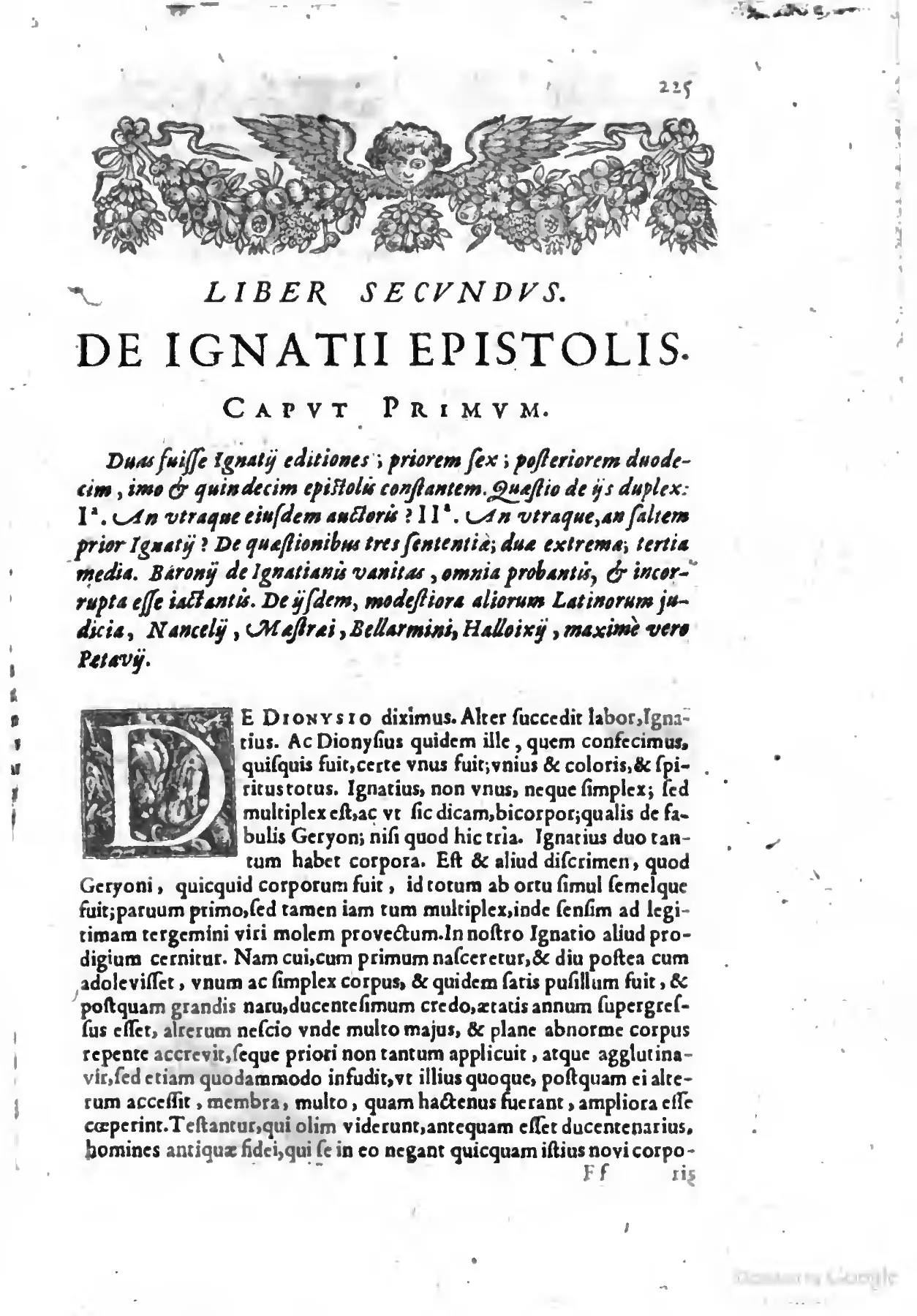
The formal opening of Liber Secundus, “De Ignatii Epistolis,” turns from Dionysius to Ignatius on the printed pivot “DE DIONYSIO diximus,” beneath a woodcut headpiece whose ceremonial scale marks the new dossier. The italic synopsis and ensuing argument frame the Ignatian letters as a contested, effectively two-bodied corpus, naming the Catholic controversialists whose claims Daillé will test against the rival recensions. Source ↗.
Book II opens with a formal turn and a mythological figure that governs everything to follow: we have spoken of Dionysius; another labour succeeds, Ignatius, DE DIONYSIO diximus. Alter succedit labor, Ignatius, who is called two-bodied like Geryon, a first corpus of six or seven letters known to Eusebius and a second of later manufacture. The recent recovery of the Florentine Greek text by Isaac Vossius and of the old Latin version by Ussher has made the two bodies separable, and the question accordingly divides. On the second question the position taken is a courteous but decisive break with the very editors whose labour has just been praised: I confess that, as I have pondered these matters, there has always seemed to me far preferable and nearer the truth the opinion of two likewise very great men, and while they lived most friendly to us, Salmasius and Blondel, who held that not only the rest but even those six Usserian and Vossian letters, drawn from old books, are all spurious and substituted, and falsely bear the name of Ignatius, having been fabricated not a few years after the martyr's death, Fateor enim mihi de his cogitanti multo semper potiorem, verique propiorem esse visam duorum item summorum virorum, & nobis, quamdiu vixerunt, amicissimorum, Salmasii, ac Blondelli sententiam, qui non modo cæteras, sed sex ipsas etia Vsserianas, Vossianasque ex veteribus libris erudiras epistolas, spurias esse omnes ac subsiditias censebant, & Ignatii nomen falso gerere, annis post Martyris mortem non paucis confictas. The dispute that follows over the stichometry ascribed to Nicephorus, which ranks Ignatius among New Testament apocrypha, is fought on lexical ground identical to that of Book I, and it produces a ruling on the disputed term: this word is not one of honour but of the lower rank, and is never taken otherwise than in a bad sense, Non ergo honoris, sed sequioris notæ hoc vocabulum est, neque vnquam aliter, quam in malam partem sumitur. Refusing the emollient redefinition offered by Hammond keeps the Byzantine list a genuine censure rather than a courteous shelving, and the argument then opens its Ignatian dossier proper by defending, against Hammond and Bellarmine alike, the very instrument the adversaries most fear: the inference from the silence of writers who had every occasion to speak.
That defence rests upon a canon of admission, and everything that follows is the disciplined application of it. Nothing is to be believed rashly, the author insists, and the utmost caution is to be used lest faith be lent to testimonies other than those ascertained and examined; from which follows the rule of evidence that governs the whole inquiry, that nothing be admitted concerning ancient matters or writings unless it has witnesses of the same or at any rate the next age, whatever lacks that authority being left undecided. That last clause is the least polemical and the most consequential: material without contemporary attestation is not condemned but placed in medio, held in suspense. The formula converts a destructive operation into a rule of prudence, and it allows the author to press an extremely aggressive case against the Ignatiana while claiming, procedurally, to demand nothing that his adversaries have not conceded in principle. The general theory of the argument from silence he pointedly declines to rehearse, referring it instead to Jean de Launoy's recent Sorbonne disputation — a genealogical hedge that situates the method within a Gallican, Catholic-critical lineage rather than a confessional Protestant one, and thereby denies opponents the reply that the instrument is a heretic's invention.
The case is then built by conceding, and indeed maximising, everything the letters' defenders claim. Ignatius heard the Apostles, held the primacy at Antioch, and suffered under Trajan within a decade of John's death; his correspondents are the most illustrious churches of Asia and Greece; the letters were written under sentence to the beasts. From these premises the author derives the scale of the expectation he intends to disappoint: setting aside Clement's letter to Corinth along with the apostolic and evangelical books, the Ignatian letters, if any are genuine, would beyond controversy be the most ancient monuments of Christianity, Hanc vnam si cum Apostolicis & Evangelicis libris exceperis, omnium Christianismi monumentorum antiquissimum absque controversia erunt Ignatii (si quæ veræ sunt) epistolæ. The parenthesis si quæ veræ sunt recurs formulaically through the chapter and functions as the hinge of the whole disputation: the greater the dignity granted to the supposed author, the louder the subsequent silence of Justin, Theophilus, Tatian, Irenaeus, Clement and Tertullian becomes. The empirical control for that expectation is drawn from Dionysius of Corinth's report that Clement's letter was still read publicly at Corinth on the Lord's day some eighty years after its despatch: a genuine sub-apostolic letter leaves precisely the liturgical and citational traces that the Ignatiana do not.
The inference is then set out with scholastic formality in two steps, that it must necessarily be confessed that the letters circulated today under that name were never truly written by Ignatius, as the title lies, since the ignorance of Irenaeus and the rest betrays the work's obscurity, and its obscurity proves that Ignatius was not its author, necessario illud quoque quod nos contendimus, confitendum est, epistolas quæ eo nomine hodie circumferuntur, nunquam fuisse ab Ignatio, quod titulus mentitur veré scriptas. Operis quidem apud nostros ignobilitatem prodit Irenæi, & cæterorum ignoratio; Ignobilitas vero operis Ignatium non fuisse eius auctorem vincit. The phrase quod titulus mentitur makes the ascription itself, the printed heading of each letter, the defendant; and the middle term of the syllogism, ignobilitas, is a historical rather than an aesthetic category — not the meanness of the writing but the invisibility of the book in the record of citation. The heresiological concordance that occupies the bulk of the chapter is the evidential floor beneath this: Irenaeus's roster of Simon, Menander, Ebion, Cerinthus, the Nicolaitans, Saturninus, Basilides, Valentinus, Marcion and the Encratites is laid alongside an Ignatian corpus that names or refutes nearly all of them, so that the man writing expressly against these very heresies is shown never to have reached for the letters that would have served him best. Crucially, the operation is not confined to the swollen Latin corpus: with a brisk Nunc Vsserianum, Vossianumque conveniamus, now let us come to terms with the Usserian and Vossian recensions, the author refuses the escape route of retreating to the shorter text published from Ussher's Latin manuscripts and Isaac Voss's Florentine Greek, and repeats the concordance against those recensions in turn.
The single apparent Irenaean echo receives the chapter's most exacting philological handling. The author quotes it in full — as one of ours said, condemned to the beasts for his martyrdom towards God, that I am the wheat of Christ, and am ground by the teeth of the beasts, so that I may be found pure bread of God — Quemadmodum quidam (inquit) de nostris dixit, propter martyrium in Deum adiudicatus ad bestias; Quoniam frumentum sum Christi, & per dentes bestiarum molor, vt mundus panis Dei inveniar — and concedes the allusion rather than explaining it away, only to rest the whole weight of his reply on a single verb: Irenaeus reports that the man said this, not that he wrote it, so the saying may have travelled orally or in a martyr-act without presupposing any letter whatever. The concession is tactically shrewd, since it demonstrates that the argument does not depend on denying that Ignatius was remembered, only on denying that the epistolary corpus was known.
From silence the argument turns to institutional incompatibility, and here the evidence becomes chronological rather than merely comparative. Jerome's account is adduced, that at Alexandria from Mark the Evangelist down to the bishops Heraclas and Dionysius — that is, to the years 246 and 264 — the presbyters always named as bishop one chosen from among themselves and set in a higher grade, as an army makes an emperor, Alexandria (inquit) a Marco Evangelista vsque ad Heraclam & Dionysium Episcopos (id est a.D. 246. & 264.) Presbyteri semper vnum ex se electum, in excelsiori gradu collocatum, Episcopum nominabant; quomodo si exercitus Imperatorem faciat. The parenthetical conversion of Jerome's episcopal names into absolute dates shows exactly how the passage is being used: not primarily as a weapon against episcopacy but as a terminus, since a church that elevated its own patriarch presbyterally into the mid-third century cannot have received the Ignatian sine Episcopo nihil from the age of the Apostles. The corroboration from Eutychius's Arabic annals, recently made available in England, and the appeal to the single Ethiopian Abuna, to Bavaria before its first bishop, and to the presbyter-abbot of Iona, extend the same demonstration geographically. Tertullian supplies a sharper variant, for here the incompatibility is not silence but legislation to the contrary: you yourselves are the church, though laymen, for each lives by his own faith, and the author observes that he could not have spat upon the whole law of our Ignatius more contemptuously nor shattered it more forcibly, Vobis res (inquit) Ecclesia est: licet laici. Vnusquisque enim sua fide vivit. Non potuit rotam Ignatii nostri legem, vel contemptius despuere, vel fortius confringere, atque elidere.
Once the argument passes to internal criteria and the numbered series of arguments begins, the author must also police his method against friendly emendation. Against Ussher's conjecture of an earlier "Theodades" for the excommunicated Theodotus the Cobbler he asks, if against the faith of all the Greek and Latin codices one may here substitute Theodades for Theodotus, why should it not likewise be permitted above to write Hermogenes, or Philetus, or any other heretic older than Basilides in Basilides' place, Si vero Theodadem, quo videtur ducere clarissimus Vsserius, præter omnium codicum Græcorum Latinorumque fidem pro Theodoto hic reponere licet; quidni & in loco superiore pro Basilide licebit Hermogenem, aut Philetum, aut quemvis alium Basilide vetustiorem hæreticum rescribere?. The point is that a criticism which permits apologetic conjecture against unanimous documentary transmission can never convict any apocryphon of anything. The obverse of that principle produces the most ingenious manoeuvre of the internal dossier, in which the interpolator's editorial activity becomes testimony against the corpus: he saw that this emanation of the Word from Sige, or Silence, smelled of Valentinus, who is later than Ignatius, and therefore judged it must be deleted lest it betray the drama of the counterfeit Ignatius, Vidit enim istam Verbi a Sage, sive silentio emanationem, Valentinum Ignatio recentiorem olere; eo delendam putavit, ne personati Ignatii drama proderet. The theatrical figure of the personatus Ignatius, the masked player, governs the entire internal dossier; and the argument is doubly economical, since the attempted concealment is read as an early reader's independent recognition of the anachronism.
The anachronism arguments themselves range from lexical fossils to social presuppositions. Among the subtlest is the gloss on the guards, bound to ten leopards, that is, a military order — quid hoc sit; V inclus (inquit) decem leopardis, quod est militaris ordo — where the incriminating element is not the word but the explanation of it: a writer addressing his own contemporaries does not annotate current military slang, and the forger's antiquarian courtesy betrays the distance between his age and the term's currency. Similar reasoning governs the copiatae, the subdeacons and lectors, the Quadragesima, and the injunction that soldiers, princes and Caesar obey the bishop, which presupposes a baptised emperor and hence a post-Constantinian pen. The confessional stake of the whole battery is registered when the author remarks that the letters overturn the chief hypothesis in almost the entire cause of the hierarchy, poene in tota Hierarchiæ causa præcipuam, hypothesin evertit — the corpus, on inspection, fails to support the very episcopal thesis it was enlisted to prove. Sharpest of all is the Paschal reductio, framed as a direct apostrophe to the martyr: he brings in the sentence, that whoever keeps Pascha with the Jews is a partner of Christ's murderers, and yet, Ignatius, that dearest friend of yours, Polycarp, your teacher, the divine John, your fellow-citizens the Antiochenes, all your Syrians, keep Pascha with the Jews, inducit; Si quis cum Iudæis Pascha egerit, is Christi intersectorum communicator est. Atqui tuus ille carissimus amicus, Ignati, Polycarpus, tuus præceptot, divinus Ioannes; tui cives Antiocheni, tui omnes Syri Pascha cum Iudæis agunt. The letters, on their own terms, anathematise the Johannine and Syrian usage to which their alleged author belonged.
What counts as the totality of witness in this criticism is stated with unusual explicitness when Bellarmine's suggestion of Greek interpolation is met by an appeal to the whole surviving stock: there are very many books of Ignatius, they are Greek, they are Latin, they are written by hand, they are struck off in type, and all with the highest consent mention the Sabbath equally with the Lord's day, Sunt Ignatii libri plurimi; sunt Græci; sunt Latini; sunt manu exarati; sunt typis excusi. Omnes summo consensu sabbati æque ac dominicæ meminerunt. Handwritten copies and printed editions are ranged under a single evidentiary rubric, and the consent of both, including copies in Roman keeping, is treated as an unassailable datum against which a conjecture of confessional tampering cannot stand. From this material demonstration the numbered series turns to doctrine, the chapter head announcing the twenty-ninth argument, that the writer says the eternal Word of God is a begotten essence of divine efficacy, Argumentum XXIX. Quod scriptor dicat æternum Dei verbum esse divinæ efficaciæ essentiam genitam — the same dating instrument now applied to theological locution, on the premise that a formula intelligible only within post-Nicene controversy fixes its author's horizon as surely as a grave-diggers' guild or an emperor in the pews.
The numbered arguments: sources, decorum, and datable institutions
The serial architecture of these chapters of Book II — chapter after chapter opening with an Argumentum rubric and numbering its objections consecutively — is not mere pedantry of arrangement. It converts the question of authorship into a docket of separately triable charges, so that no single item need bear the whole weight of the verdict. The first of them turns on the sources the writer treats as authoritative. Having shown that the Smyrnaean logion non sum daemonium incorporeum was untraceable to any canonical book and was assigned by Jerome to the Gospel read among the Nazaraeans, the argument presses the question of probability rather than possibility: now therefore I ask, why did this Ignatius of ours, disdaining the fountains of truth, choose to bring forth before the Smyrnaeans things forged out of the impure sinks of the apocrypha rather than true things from certain and divinely inspired books, Nunc ergo quæro, cur his noster Ignatius Christi verba, veritatis fontes fastidiens, ex impuris apocryphorum lacunis ficta, quam vera ex certis, ac divinirus inspiratis libris apud Smyrnæos promere maluerit?. The metaphorical schema is hydraulic and hierarchical — fontes against lacunae, springs against stagnant sinks — and it does the argumentative work that the philology alone cannot: it makes the citation not merely odd but unbecoming. The inference then contracts into the formula that governs almost every argument in these chapters, this, I believe, Ignatius would not have done; therefore, far be it from me to think that he who did it was Ignatius, Id credo, non fecisset Ignatius. Itaque qui fecit, absit vt eum Ignatium fuisse putem. The engine here is moral verisimilitude — what a saint's known character makes credible — rather than documentary testimony, and the syllogism's candid credo concedes as much. Aware that the charge could be read as a blanket condemnation of extra-canonical reading, the argument is immediately fenced: for we are not the sort who judge that nothing from the apocrypha may be adduced or mentioned by pious men, Neque enim nos ii sumus, qui nihil ex apocryphis a viris piis afferti, vel memorari licere censeamus. The concession isolates the real offence as substitution under cover: an apocryphal saying offered to an unwarned congregation as a dominical word, which is the same act of passing off, at the level of a sentence, that the whole book alleges at the level of a title page.
The following chapter shifts the ground from source-criticism to decorum, and with it the register of the prose. The three heads of the objection — that the writer forbids intercession on his behalf, that he undertakes to coax and if need be compel the beasts, and that he wishes to be wholly consumed — are prosecuted as failures of martyrial gravitas rather than as errors of doctrine, and the positive standard is stated in the agonistic vocabulary that early Christian martyrology itself furnished: Christ's martyrs await death, they do not fetch it; they are borne to the goal at a measured, not a headlong pace, nor do they force the instruments of death to rage upon them before the supreme umpire has commanded, Christi Martyres mortem exspectant; non accersunt; ad metam composito, non præcipiti gradu feruntur, neque morris instrumenta in se ante sævite cogunt; quam summus agonotheta iusserit;. The meta and the agonotheta are drawn from the stadium imagery of the Fathers themselves, so that the letter is convicted not by an imported standard but by the one its own genre supplies; the martyr who anticipates the signal usurps the umpire's office, and the theatrical bravado becomes, in this reading, a species of self-slaughter. Hammond's defence, that a martyr too may use hyperbole, is granted in principle and refused in the instance, the permitted range being fixed by the qualifiers rectis, & modestis, & visitatis. The chapter then closes with a thrust aimed squarely at the letters' Roman defenders: indeed the relic-mongers, whose colleges have long been most numerous among Christians, and especially our own Latins, ought to abominate so sad and so deadly a vow, and condemn it as manifest impiety, Reliquarii quidem, quorum jampridem frequentissima sunt apud Christianos collegia, præsertim vero Latini nostri, tam triste tamque funestum votum, abominari debent, ac velut impietatis manifestum damnare. The satire is exact rather than merely abusive: a wish to leave no fragment of the body behind would abolish the material basis of the cult that the letter's champions maintain, so that the defenders are shown defending a text hostile to their own practice.
Where character and decorum yield only probability, the argument reaches for a datable institution. The Trallian precept enjoining that the bishop be venerated as Christ is ascribed by the letter to the Apostles; Torres had located it in the Apostolic Constitutions, and that identification is accepted and turned against him — for if that is so, the writer of the epistle must have lived after those so-called Constitutions of the Apostles were composed, and thus not only was not Ignatius, but lived two hundred years after Ignatius was consummated in martyrdom, Nam si ita est, epistolæ scriptorem necesse est post conditas illas vt vocant, Apostolorum constitutiones vixisse, adeoque Ignatium non modo non fuisse, sed etiam ducentis post eum martyrio consummatum annis vixisse;. The dismissive vt vocant withholds assent from the Constitutions' own title even while their fourth-century date is used as a fixed point; the opponent's premise is left standing precisely because it yields a terminus post quem that the opponent cannot disown.
The dossier on Paul's marriage supplies the densest evidentiary work in the series, and here the argument descends from inference to inspected object. Against the Latin editions that omit PAVLVS from the Philadelphian catalogue of married saints, the report of the Balliol parchment book is adduced as proof that the name once stood there and was removed by design: for there an empty space left by the erasure survives, and there clung in the margin, written in an old hand at that place, this annotation, Jerome denies this about Paul, istic enim & vacuum esse relictum raturæ spatium, & hæsisse in margine antiqua manu exaratam ad eum locum hanc annotationem, Hoc de Paulo negat Hieronymus;. The blank space and the annotation together constitute a legible motive: a reader who found the statement contradicted by Jerome, and a hand that acted on the finding. Baronius' counter-charge, that the Novatores inserted the name, is answered by chronology and by motive, and the exchange is then generalized into a contrast of scholarly conscience — yours think it lawful to withdraw some name from a book, if it is useful to them; ours deny that it is permissible to employ these frauds, which you call pious, even where it is expedient, Tui nomen aliquod ex libro subducere, si sibi sit vrile, fas putant; Nostri has fraudes, quas vos pias vocatis, usurpare, etiam vbi expedit, licere tamen negant. The pia fraus is named as an adversary's principle and disowned as one's own, which converts a dispute over a single word in a codex into a controversy over the ethics of handling texts at all — the same conviction that refuses possession as a title to authenticity, applied now to the emendator's knife. The chapter ends by explaining the forger's calculation, since the paradox about Paul was lifted from Clement of Alexandria to give an air of remote antiquity: such are many other things in him, taken up to give an appearance of archaism, but often unhappily, Qualia sunt apud hunc alia non pauca ad archaismi speciem sed sæpe infæliciter assumpta;. This is the treatise's most compact theory of forgery: the counterfeiter must over-correct toward the age he impersonates, and the over-correction is itself the tell, so that the very marks meant to certify antiquity become the evidence of its manufacture.
A further movement abandons res for oratio, and the case from style is built on an image of visible seams. The six letters of the Usserian recension, described as harsh and rugged, unpolished and uncultivated, are set against the smooth expansiveness of the rest, and the collection as a whole is figured as a garment: as if some cloth were made up not of gold and silver and silk and linen and cotton threads mixed and packed together with great art, but pieced together at random out of rags of various colours and different workmanship, fastened to one another with a clasp or tied with a knot — such as beggars' cloaks and garments usually are, Vt si pannus sit aliquis non ex aureis & argenteis & sericis, & lineis, lancisque & bombycinis filis magna arte mixtis ac confertis contextus; sed ex variis coloris, diversique operis centunculis temere, inter se vel fibula constrictis, vel nodo vinctis, coagmentatus; qualia esse solent mendicabulorum pallia, & vestimenta. Woven cloth admits variety without discontinuity; a patchwork betrays the number of hands by the joins, and the simile therefore argues, and does not merely illustrate, the plurality of authors. From style the argument passes to technical vocabulary, and the reception test is dramatized by prosopopoeia, the imagined second-century congregation being made to stumble over terms the letter uses as though they were settled: presbyters, be subject to the bishop? but who, they would say, are these presbyters of his, and what bishop is he telling us of? yet the bishop is a presbyter, and the presbyter a bishop, Presbyteri subdici esse Episcopo? Quos vero iste nobis (dicerent) presbyteros, & quæ narrat Episcopum? Atqui & episcopus presbyter est; & presbyter Episcopus. The device puts the burden where usage-criticism requires it: a genuine letter must be intelligible to its first hearers, and a terminology that would have needed glossing in 110 convicts the writer of addressing a later church. That this reasoning runs against Hammond, whose defences are dismantled one by one, prompts an unusual disclaimer of motive-imputation — for here it is fitting that the reasons and arguments of the disputants be weighed, and that their motives and affections be left to God, who alone sees our minds, and that nothing be rashly pronounced to the disadvantage of the brethren, Hic enim disputantium rationes & argumenta expendi, studia & affectus Deo, qui animos nostros vns vider, relinqui decet, neque quicquam secius de fratribus temere pronuntiari — a courtesy extended to a Protestant frater and conspicuously withheld from Baronius and Torres, whose intentions are read freely throughout. The diction chapters end with the sharpest of the stylistic instruments, a maxim on imitation borrowed from the rhetorical tradition and given the force of a rule: for, as Seneca most truly observed, what is rare in an author is wont to be frequent and almost continual in his imitators, Nam, quod est a Seneca verissime observatum, quæ apud auctorem rara sunt, en apud imitatores crebra ac pæne perpetua esse solent;. Illustrated from Arruntius' aping of Sallust and applied to the compulsive recurrence of the Pauline ὀναίμην, the principle transforms frequency itself into evidence: fidelity to a model, pressed past the model's own measure, is what distinguishes the ape from the author, and the writer whom these chapters repeatedly call Ignatii simius is convicted less by any single word than by the statistical shape of his devotion to one.
The close of the Ignatian case: silence, Eusebius, and two impostors
The last chapters of the Ignatian dossier open on the least glamorous kind of evidence, the salutation formula, and make it carry a chronological verdict. Having set aside Symeon Metaphrastes' claim of verbatim transcription and Ussher's plea that a prisoner writing in chains may be forgiven a broken construction, the argument closes with a comparative rule about epistolary convention: this is proved by the fact that no one in the whole memory of Christianity after the apostles is found to have prefixed such inscriptions as his to his letters, Id vero vel hinc etiam patet, quod nemo ex omni Christianismi post Apostolos memoria reperitur, qui huiusmodi inscriptiones quales istius sunt, suis epistolis prefixerit. The premise is that a formulary belongs to an age rather than to a temperament, so that deviation is not idiosyncrasy but imitation gone wrong — a pseudonymous writer straining after Pauline hyperbata he has not mastered. The control adduced is Clement's letter to Corinth, whose plain address supplies the sub-apostolic norm against which the disputed superscription is measured; the appeal to haste is refused precisely because haste explains slips in hard places, not blunders in the one place convention had made mechanical.
The same chapter concedes what it can afford to concede. Only two sayings of the martyr are held certain, and their authenticity is admitted so that their literary re-use may be turned into evidence. Both belong to the arena at Rome, and the corpus places them in letters written from Smyrna, with the result that the writer, absurdly, brings him in saying this in the present tense, "I am ground by the teeth of the beasts," Absurde ergo scriptor eum inducit hæc in præsenti tempore dicentem, dentibus bestiarum molar,. Grammatical aspect is thus made to do historical work: a verb form intelligible only when the lions are already audible betrays the fictional stage-setting of a letter composed weeks and hundreds of miles away. The procedure is characteristic of the whole book — the authentic fragment is not the fabricator's alibi but the instrument of his conviction, since the borrowed material retains the marks of its original occasion.
The sixteenth and last argument makes a vice of style into a criterion of date. Its thesis is stated with deliberate brevity, things which he says only once are rare with him, Rara sunt apud eum, quæ semel dicat, and it is then substantiated by dossier: the Magnesian delegation named twice within a few lines, and a catena of exhortations to episcopal obedience gathered across the Ephesian, Magnesian, Trallian, Philadelphian and Smyrnaean letters and collated through the Usserian, Vossian and vulgate states of the text. Within that catalogue of battologia stands the sentence on which so much confessional weight had been laid, and: Wherever the bishop appears, there let the multitude be; just as, wherever Christ Jesus is, there is the Catholic Church. It is not lawful without the bishop either to baptize or to hold an agape, Et, 2 Vbi vtique apparet Episcopus, illic multitudo sit; quemadmodum vti que vbi est Christus Iesus, illic Catholica Ecclesia. Nor. licitum est sine Episcopo, neque baptizare, neque agapen facere. Quoting it as item in a list of wearisome iterations is itself a manoeuvre: the most cited proof-text of the corpus is neither denied nor exegeted but drowned in its own duplicates, its singularity dissolved by saturation. The peroration then performs the treatise's signature separation of the man from the books — beware, then, of supposing that he whose name he usurps was Ignatius, a man, as all agree, most holy and most grave, and therefore assuredly a stranger to these battologies and repetitions proper to triflers or downright impostors, Hunc ergo cave eum, cuius nomen meritur, fuisse putes Ignatium; virum, quod omnes consentiunt, sanctissimum arque gravissimum; adeoque ab his, vel nugatorum, vel certe impostorum propriis battologiis & repetitionibus haud dubie alienum. Sanctity is not attacked; it is protected by being detached from a text unworthy of it, which is what allows a Reformed critic to dismantle a corpus while professing reverence for the martyr whose feast the Roman Breviary keeps.
With the offensive case complete, the disputation turns defensive, and the pivot is the one ancient text on which the defenders' case rests, Polycarp's request that letters be carried to Syria, quoted in the old Latin version, you too, and Ignatius, wrote to me that if anyone goes to Syria he should carry my letters, which I shall have made to you, Scripsistis mihi (inquit) & vos, & Ignatius, vt si quis vadit ad Syriam, deferat litteras meas, quas secero ad vos;. The reply is deliberately two-pronged, and the fork is what gives these chapters their architecture: the passage is impeached, and even if unimpeached it is shown not to prove what is wanted. The impeachment rests on the seam between the body of Polycarp's letter and its appendix, and the contradiction is pressed to the point of demonstration: from these things it is clearer than the noonday sun that they are different men who speak such discordant, mutually contrary and repugnant things about the same matter, Ex his sole merediano clarius est diversos esse homines, qui eadem de re tam dissentanea, tamque inter se contraria ac repugnantia loquuntur — the letter counting Ignatius among the consummated martyrs while the appended paragraph asks for news of him as living. The second prong is the more consequential for method, because it isolates the status quaestionis with unusual precision: the question is whether he wrote these which we now have; the alleged passage does not say he wrote them, and that he wrote them the letters themselves most plainly deny, Quæritur, an has, quas nunc habemus, scripserit. Has scripsisse non dicit locus abjectus; scripsisse, ipsæ luculentissime negant; vt est a nobis supra satis superque demonstratum. A general testimony that a bishop wrote letters cannot identify the extant collection with them; the defenders' inference, illustrated by the schoolroom example of the ox that shares predicates with man without being man, mistakes shared attributes for identity.
The external case is then rebuilt on the chain of silence. Where Hammond finds Irenaeus attesting the corpus, the text insists on what the passage actually says: Irenaeus makes no mention of Polycarp, of the Philippians, or of a letter to the Romans, and reports a saying, not a writing. From that reading the argument widens into its general form, that in this century, that is, in the hundred years next after the martyr's death, the Ignatiana were utterly unknown among our people, which is proved by the constant silence about them not only of Irenaeus but of all others of the same memory, Ita siqua iam extabant, Ignatiana; Hoc sæculo, id est centum proximis post Martyris mortem annis, Ignatiana apud nostros plane penitusque ignota fuisse vincit non modo Irenæi, sed & cæterorum ejusdem memoriæ omnium constans de iis silentium,. The silence is probative not by accumulation but by occasion: these were exactly the weapons the anti-heretical writers of the second century needed and did not reach for. The positive terminus follows, for the first out of all antiquity to have known any Ignatiana certainly and indubitably is Eusebius, who in the last years of his life wrote that Ecclesiastical History in which an explicit testimony to the Ignatiana stands, Qui enim aliqua Ignatiana certo & indubitato norit, ex omni antiquitate primus occurrir Eusebius, qui postremis vitæ (quam ad a. D. 340. produxit) temporibus Historiam illam Ecclesiasticam scripsit, in qua disertum extat de Ignatianis testimonium. Everything before that date is silence and everything after is dependence — Athanasius, Jerome, Theodoret transmitting rather than corroborating.
Eusebius, having been made the sole pillar, is then weakened from within by his own rule, your golden canon, Eusebius, by which you rule that books ascribed to the ancients are not to be held by us as genuine, Aureus canon tuus Eusebi, quo tu definis, ne pro veris a nobis habeantur inscripti veteribus libri, — the criterion by which he had rejected the second epistle ascribed to Clement, turned back upon his acceptance of the Ignatian letters. The argument ex ore adversarii is more than a debating flourish, since it converts the dispute from a contest of authorities into a question of consistency in applying a shared canon. That shift requires a warrant for dissenting from the Fathers at all, and it is found in an unimpeachably patristic text, Augustine's letter to Jerome: I confess to your charity, he says, that I have learned to render this fear and honour to those books of the Scriptures alone which are now called canonical, Ego (inquit) fateor caritati cuæ solis eis Scripturarum libris, qui jam Canonici appellantur, didici hunc timorem honoremque deferre,. The distinction between canonical and patristic authority is thus not asserted against antiquity but quarried out of it, and reinforced by the observation that the celebrated corona of unanimous Fathers reduces, on inspection, to three names.
The reconstruction that closes the book is stratigraphic rather than simply negative. A first fabricator at the turn of the third and fourth centuries produced the shorter recension to serve the emerging monarchical episcopate; a second, around the beginning of the sixth, added letters and the ritual furniture of Lent, fast-days and minor orders, hence the summary formula, thus over a space of three hundred years two impostors sported with the name of Ignatius, Ita annorum trecentorum spatio duo de Ignatii nomine luserunt impostores. Two agents at two dates explain what a single hypothesis cannot: the unevenness of style and the coexistence of third-century church order with sixth-century liturgy.
The appendices: Pseudo-Cyprian, the Rufinian Origen, and the printed back matter
The censure of the Pseudo-Cyprianic treatise that follows the closing doxology applies the identical instruments to a Latin case, and there style is stated as a criterion in its own right: in Cyprian the style flows pure and unclouded, while this writer's is muddy, teeming with the worst phrases and words, and decked out with nothing but barbaric ornaments, Cypriano putus & illimis sermo fluit, hujus scriptoris lutulentus, phrasibusque ac vocabulis deterrimis scatens; neque nisi barbaricis ornamentis instructus. The judgement is not left as taste: it rests on a marginal lexicon of cardinalis, intimare, certificare, possibilitas and potestative, words datable by usage, and is supported by doctrinal and textual markers — the Vulgate rather than the Old Latin, the Nativity feast — until a positive attribution to Arnaud of Bonneval becomes possible. The turn to Rufinus's Latin Origen extends the operation to a subtler species of misattribution, in which no title page lies. Rufinus's own prefaces are quoted as self-incriminating, and the consequence drawn is a general one about translated evidence: no one fails to see that Origen as translated by Rufinus testifies not to the faith and manners of his own age but of Rufinus's, nemo non videt a Ruffino interpretatum Origenem, non de sui, sed de Ruffinianiævi fide ac moribus testari;. A doctored version silently reassigns fifth-century usage to the third, and the same test of ecclesiastical horizon that unmasks a false name unmasks an interpolated stratum inside a version — with the difference that here the remedy is collation against Greek controls, the Philocalia printed by Jean Tarin serving in parallel columns to expose expansion, softening and dogmatic retouching, so that the finding is separation rather than rejection.
What that programme requires in practice is set out under a six-fold rubric: the Latin Origen circulated by Rufinus of Aquileia is said to contain much alien to Origen in doctrine, in learning, in manner and style, in gravity and modesty, in age, and in language. Each head is then worked as a separate dossier, and the doctrinal head opens with a manoeuvre characteristic of the whole enterprise — the enlistment of a Roman Catholic adversary's own thesis as a premise. Petau, most learned of men, will readily grant that these Trinitarian passages are not truly Origen's, since he contends and argues at length that Origen thought ill of the eternal divinity of the Son and the Holy Spirit, concesserit eruditissimus Petavius, qui contendit, ac fuse disputar Origenem de æterna Filii, & Spiritus Sancti divinitate male sensisse,. The concession is then declined as a resting place: Daillé refuses to adjudicate between Petau's reading of a heterodox Origen and Halloix's defence of an orthodox one, because his own argument does not require either. Even an impeccably orthodox third-century Alexandrian could not have spoken with the definitional exactness of the passages in question before the controversy that produced that exactness existed. The result is the chapter's sharpest formulation, the verdict already noticed in the account of the appended Ruffiniana, that such things were assuredly written after the Nicene Synod and much more so after Origen. Doctrinal precision is here treated as itself a datable artefact: a formula has a history, and precision out of season betrays the century that manufactured it. Nicaea functions less as a theological standard than as a chronological watershed against which any full-dress Trinitarian statement in a pre-Nicene author becomes prima facie suspect.
The same logic governs the eschatological dossier, but by contradiction rather than by horizon. Origen's known penology — that all punishments, even those of the age to come, are decreed and inflicted by God for the purging of sinners — is established from the securely transmitted works and universal ancient testimony; against that control the Latin homilies on Leviticus speak in another voice, for in the Rufinian books the writer affirms for certain that the punishments which are deferred, that is, those exacted from sinners not in this life but after death, will be eternal and extended along with the ages, vbi scriptor pro certo affirmat poenas, quæ differuntur, id est quæ de peccatoribus, non in hac vita, sed post mortem exiguntur, aternas fore, & cum sæculis extensum iri;. The demonstration depends on a prior operation the reader is expected to grant: that an author's doctrinal profile can be reconstructed inductively from undisputed remains and then used as evidence about disputed ones. Contradiction of that profile is not read as inconsistency in a living mind but as the seam between two hands.
The dossier on period is the richest, and its most inventive stroke concerns not what the Latin text says but what it declines to say. The reticence of the Rufinian homilies about the matter and rite of the sacraments is referred to the rule of silence before the uninitiated, as though it were already customary in Origen's own day for our people to conceal the sacraments and not to speak openly of their matter and rite, nostris solenne esset sacramenta occultare, neque de eorum materia & ritu aperte loqui;. The evidential force lies in the demonstrable absence of any such discipline in the third century, proved from Origen's own frank naming of the eucharistic bread in the work against Celsus. What follows is a piece of stylistic forensics conducted entirely on a withheld word: you see him first anxiously avoiding naming the thing itself; he says "the body of the Lord" and "the consecrated gift"; he nowhere says "bread," ipsam proprio nomine eloquatur. Corpus Domini dicit, & consecraturum munus. Panem nusquam dicit. Silence, elsewhere in the treatise a property of external witnesses, is here internalized: a euphemism becomes a lexical fossil of the fourth and fifth centuries, and reverence itself is converted into a dating criterion.
The linguistic head rests on a biographical premise stated with deliberate flatness: he was a Greek born at Alexandria, and whatever he published he wrote in his native tongue, nor is it likely that he knew Latin, and certainly no trace of the Latin language survives in his genuine and undoubted works, Græcus etat Alexandriæ natus, & quæcumque edidit, ea patrio sermone conscripsit; neque Latine eum scivisse verisimile est; nullum cerre sermonis Latini vestigium in sinceris ac indubitatis ejus operibus extat. Against that premise the Latin corpus is combed for observations that only a Latin speaker could frame — the count of twenty-three letters against the Greek twenty-four, discriminations between Latin verbs, and above all etymologies that live and die in Latin. If kings are so called from ruling, the text argues, then all who rule the churches of God will deservedly be called kings, Si Reges (inquit) a regendo dicuntur, omnes vtique, qui Ecclesias Dei regunt, Reges meriro appellabuntur, a derivation that has no purchase whatever on the Greek word it purports to explain. The mockery that follows, imagining herdsmen of sheep and oxen enrolled as kings by the same rule, is not decoration: it shows the inference to be defective as logic as well as impossible in Greek, and the sarcastic title of Etymologist fixes the intruder as an amateur Latinist rather than a Greek theologian.
The forty-third chapter converts these findings into a rule of evidence, and the formulation is juridical rather than dismissive: whatever has been translated into Latin from Origen by Rufinus has of itself no force to prove that what is read in it was truly Origen's, Ruffino ex Origene Latine translata, ea nullam sola ac per se habere vim,. The corpus is not condemned as false; it is demoted from the rank of independent proof, which is precisely what deprives Halloix's defence of Origen's orthodoxy, and the Latin church's appeal to these books for contested traditions, of their documentary basis. Yet the demotion is paired with an insistence on salvage, carried by a deliberately coarse image: as no one thinks gems to be despised because they lie in mud or even in a dunghill, covered and defiled with much filth, Vt ergo gemmas nemo ideo spernendas putat, quod eæ in luto, vel etiam in sterquilinio, multis sordibus obstitæ, ac contaminatæ jaceant;, so the Rufinian books retain what is genuinely Origen's within them. The accompanying figures — roses gathered from a thornbrake under a tag from Nazianzen, gold washed from mine-spoil — all share a structure in which the valuable substance is unchanged by its matrix and recoverable by labour, which is the metaphorical charter of the separative method. That method is then given its motive from the translator's own pen, for Rufinus professed to have filed away stumbling-blocks so that the Latin reader should find nothing in these works that differed, as he says, from our faith, that is, from the faith of the Latin church as it then was, vt Latinus lector nihil in illis invenitet quod a fide nostra, inquit, (id est Latinæ quæ tumerat Ecclesiæ) discreparet. The parenthesis is the whole argument in miniature: "our faith" is not a timeless standard but a fifth-century Latin one, and a translator who edits to it leaves the marks of his own age on every emendation.
The forty-fourth chapter demonstrates the procedure on two disputed institutions. In the first, a long homily on the Day of Atonement fast is quoted entire and pronounced wholly worthy of the first three centuries, so that the surgery may be confined to a single trailing sentence: lest these things should trouble his Lenten observers, Rufinus adds of his own the words that follow, "Nor however do we say this in order to loosen the reins of Christian abstinence, for we have the forty days consecrated to fasts," adjicit; Nec hoc samen ideo dicimus, vt abstinentia Christiana frana laxemus. Habemus enim quadragesima dies jejuniis consecratos. Three tests convict it at once — the unattested vocabulary of quadragesima, the flat opposition to the preceding condemnation of observing days and months, and the resulting absurdity by which Rufinus, bringing Origen in as sanctioning both alike, plainly makes him blow hot and cold with one and the same mouth, vt Origenem Ruffinus quem vtraque pariter sancientem inducit, aperte faciat vno eodemque ore & calidum & frigidum stare. Internal incoherence is thus formalized as a criterion, and the exhibited authenticity of the surrounding homily is what makes the excision precise rather than wholesale.
The second example, the invocation of the saints, is handled with the same economy: of three loci speaking of aid from the holy dead, the fullest is accepted as genuine and read as promising help by doctrine and example only, while in the other two the two words for prayers and supplications are diagnosed as inserted to the taste of the interpreter's own century, since Rufinus feared that his Latin readers, accustomed to this novel tradition, would be disturbed if no mention of it were made in Origen, Ruffinus veritus ne huic novitiæ traditioni assueti sui illi Latini lectores turbarentur, si nulla eius apud Origenem mentio fieret;. Calling the practice a novitia traditio relative to the third century is the polemical point, and it is buttressed once more from an opponent: on the admission of Peresius himself, who denies that he found it among any of the earlier writers before Cornelius bishop of Rome, ipso fatente Peresio, qui eam negat apud illorum quemquam se invenisse, ante Cornelium Romæ Episcopum; — and the single exception is removed by rejecting the letter attributed to Cornelius as worthless straw, so that a rhetorical "who doubts?" is shown to be unutterable in Origen's century.
The printed back matter continues the argument by other means. The addenda supplement a chapter of the second book with a chronological table appended to a Paris liturgical publication of 1669, noting that nothing was adduced from the book on the Lord's Supper, although it was formerly held and cited as a genuine work of Cyprian, even by some of our opponents, Nil ex libro de Cana Domini adductum fuit, tametsi is antehac, pro genuino Cypriani opere, etiam a nonnullis adversariorum, habitus sit & laudatus — a withdrawal made by Catholic editors on the evidence of copies from Oxford and France, and harvested here as independent corroboration that the treatise's method is the one its adversaries in fact practise. The emendanda repair a defective passage in the first book by restoring a witness of the highest Catholic standing, arguing that John Fisher, bishop of Rochester and cardinal, did not greatly recoil from Erasmus's opinion on the Areopagitic writings, Ioannem Fischerum, Roffensem Episcopum ac Cardinalem, ab Erasmi de Areopagiticis sententia non valde abhortuisse; ex iis probabile est,, since in replying to Velenus he answered only that spuriousness of authorship does not entail condemnation of contents. That correction, and the six pages of errata keyed by page and line that follow it, belong to the same discipline the book preaches: a text is a made thing whose defects are to be identified and located rather than passed over, and the volume submits its own sheets to the standard it applies to Rufinus.
Frequently Asked Questions
What is Jean Daillé's De scriptis, quæ sub Dionysii Areopagitæ et Ignatii Antiocheni nominibus circumferuntur?
It is a two-book Latin treatise of patristic criticism printed at Geneva in 1666 by Jean-Antoine and Samuel de Tournes, in which the French Reformed minister Jean Daillé (1594–1670) argues that the mystical corpus circulating under the name of Dionysius the Areopagite and the letters ascribed to Ignatius of Antioch were fabricated long after the martyrs whose names they carry. Its dedicatory epistle, addressed to the Huguenot orientalist Samuel Bochart, is dated Paris, 1 November 1665. Two appendices extend the inquiry to a pseudo-Cyprianic tract and to Rufinus of Aquileia's Latin Origen.
How did Daillé try to prove that a book was not written by the author named on its title page?
By a two-stage procedure applied dossier by dossier. First, externally, he reconstructed a chain of silence among writers who had both occasion and obligation to cite a book, holding as a canon that nothing be admitted about ancient writings without witnesses of the same or the next age, and leaving unattested matter undecided. Second, internally, he asked whether a passage fucum sapit — smacks of paint or cosmetic — searching for words, offices, rites and doctrinal formulae belonging to a later century. Governing both was the juridical rule that against the truth of things there is no prescription.
Why were the Ignatian letters so explosive a target in the seventeenth century?
Because they were read as first-century warrant for the monarchical episcopate. Daillé's fifty-seventh and, as he called it, palmary argument was that the writer always says bishop of a priest of the first grade and presbyter of one of the second, contrary to the usage of the Apostles and of ecclesiastical writers down to the year 200 — which for him placed the author long after the second century and supplied the motive for the fabrication. John Pearson answered with his Vindiciae epistolarum S. Ignatii at Cambridge in 1672; Thomas Smith's Oxford edition of 1709 continued that English reception.
What did Daillé conclude about the Dionysian corpus, and did later scholarship agree?
He assembled roughly five centuries of silence, observed that the nine angelic orders are unattested before the corpus itself, cited Hypatius of Ephesus rejecting the books at the collation of 532, and dated publication to about 520, by a writer of the very end of the fifth or beginning of the sixth century; the Parisian identification with Saint Denis he dismissed as a ninth-century monastic fiction. In 1895 Hugo Koch and Josef Stiglmayr independently showed the corpus dependent on Proclus, a result that supports his broad late dating without validating each particular inference.
Is there an English translation of Daillé's 1666 treatise on the Dionysian and Ignatian writings?
No separate English or French translation of this particular treatise has been identified in the catalogues and digital bibliographies consulted, though that negative result does not prove none exists; a translation by Thomas Smith is catalogued for Daillé's distinct work on the use of the Fathers in religious controversies and should not be confused with it. Separately, the Leo edition presents the full transcription together with a complete English translation for the first time. That translation is generated by AI. Leo aims to make English versions of every text printed in Latin in early modern Europe, 1450–1750, freely available online.
This report was generated by an advanced AI assistant that conducted deep research alongside an extensive interpretation of the transcribed original text. Every effort has been made to preserve fidelity to the source and to guard against inaccuracy, but corruption in the text recognition process and model hallucination may nonetheless have entered the text. Treat every claim, quotation, translation, and citation as provisional, and verify each against the original source before relying on or citing it.
Further Reading on Daillé, Pseudo-Dionysius, and the Ignatian Controversy
- Backus, Irena, ed., The Reception of the Church Fathers in the West: From the Carolingians to the Maurists: Two volumes of reference-grade scholarship that place Daillé's simultaneous use and demolition of patristic authority inside the longer confessional history of reading the Fathers. It is the corrective for anyone tempted to read him as an enemy of antiquity rather than as a critic of bad title, a distinction he himself insists on when he grants that he does not think apocrypha are to be despised, provided only that they be ancient, Neque enim apocrypha, si modo vetera sint, spetnenda puto;, since a spurious attribution and a worthless document are for him two different findings.
- Killen, W. D., The Ignatian Epistles Entirely Spurious: A nineteenth-century Presbyterian broadside written expressly against Lightfoot's defence of the shorter recension, and effectively Daillé's Ignatian case restated for a Victorian audience. Its chief value here is comparative: it shows how durable the seventeenth-century arguments proved, and how tightly the question of authenticity stayed bound to the question of church government.
- Lightfoot, J. B., The Apostolic Fathers, Part II: S. Ignatius, S. Polycarp: The critical landmark that reorganized the Ignatian problem around recensions rather than around a straight choice between the whole medieval corpus and total invention. Read it against Daillé's own narrative of accretion — that the letters were unknown for two hundred years after Ignatius, that only in the two-hundredth year after his death were six first mentioned by Eusebius, that thereafter, as Athanasius, Jerome, Theodoret and Gelasius praised them, they began to be celebrated and grew the more famous the further one recedes from the source of the matter, until at length around the sixth century those which had first been six increased to twelve and finally to fifteen in number, tossed about and celebrated everywhere with great applause, Constat enim ex iis quæ diximus, eas annis post Ignarium ducentis ignotas fuisse, anno demum post eius mortem ducentesimo ab Eusebio primum sex fuisse memoratas; inde laudantibus Athanasio, Hieronymo, Theodoreto, Gelasio, celebrati coepisse, quoque longius a retum fonte receditur, eo magis inclaruisse; donec tandem circa sextum sæculum, quæ primo sex fuerant, ex ad duodecim, ac postremo ad quindecim numerum excteverunt, ingenti vbique plausu iactæ ac celebratæ — and note how much of the seventeenth-century chronology survives the reorganization. Lightfoot's verdicts should be dated and compared with later editions, not treated as final.
- Lookadoo, John, "Expanding the Narrative: The Reception of Ignatius of Antioch in Britain, ca. 1200–1700," Church History: The single most direct guide to what happened to Daillé's Ignatian challenge once it crossed the Channel, mapping Pearson, Ussher, Thomas Smith and the wider English learned scene. It supplies the institutional detail that explains why an argument about two Greek nouns provoked a Cambridge vindication rather than a shrug.
- Louth, Andrew, review of Paul Rorem, Pseudo-Dionysius: A Commentary on the Texts and an Introduction to Their Influence, Scottish Journal of Theology: A compact critical assessment by a scholar who has written his own book on the Areopagite, useful for gauging where Rorem's commentary is authoritative and where it is contestable. Consult it before treating any single modern handbook as the settled control on Daillé's Dionysian dossier.
- Rorem, Paul, Pseudo-Dionysius: A Commentary on the Texts and an Introduction to Their Influence: Rorem's text-by-text commentary and survey of eastern and western reception furnish the modern baseline against which Daillé's five centuries of silence can be measured. It permits an assessment of his conclusions without adopting his chronology or his polemical categories wholesale.
- Stang, Charles M., Apophasis and Pseudonymity in Dionysius the Areopagite: "No Longer I": Stang argues that the borrowed name is a theological device rather than merely a fraud, which is precisely the reading Daillé's forensic method forecloses. Setting the two side by side isolates what early modern criticism gained in rigour and what it declined to consider at all.





.jpg)

