Sold to Binders by the Pound: Franciscus Modius's New-and-Ancient Readings in Letters
Franciscus Modius of Bruges was twenty-eight when the heirs of André Wechel printed his Novantiquae lectiones, tributae in epistolas centum et quod excurrit at Frankfurt in 1584: more than a hundred learned letters, each carrying its own corrupt line of Silius Italicus, Censorinus, or Macrobius toward repair. Neither an edition nor a commentary, it is a working philologist's correspondence turned into an argument that nothing may be received against the books — the parchment witnesses he hunted through the cloisters of Flanders and the Rhineland, naming in every case the man who lent him one. It matters because so little sixteenth-century scholarship shows its hands this openly: the borrowed codices, the sheaf of notes stolen from him, and the printing-house correctors he calls a breed of men born for the ruin of letters.
ExLatinis
August 7, 2026
Contents
Franciscus Modius of Bruges was twenty-eight when the heirs of André Wechel printed his Novantiquae lectiones, tributae in epistolas centum et quod excurrit at Frankfurt in 1584: more than a hundred learned letters, each carrying its own corrupt line of Silius Italicus, Censorinus, or Macrobius toward repair. Neither an edition nor a commentary, it is a working philologist's correspondence turned into an argument that nothing may be received against the books — the parchment witnesses he hunted through the cloisters of Flanders and the Rhineland, naming in every case the man who lent him one. It matters because so little sixteenth-century scholarship shows its hands this openly: the borrowed codices, the sheaf of notes stolen from him, and the printing-house correctors he calls a breed of men born for the ruin of letters.
Franciscus Modius of Bruges (1556–1597), a Flemish philologist who spent much of his working life in the German lands under clerical patronage, published in 1584 at Frankfurt am Main, from the press continued by the heirs of André Wechel, a Latin volume he called Novantiquae lectiones, tributae in epistolas centum et quod excurrit — "new-and-ancient readings, distributed into a hundred letters and more." It is a work of textual criticism cast in an unexpected shape. Rather than an edition, a commentary, or a treatise, it is a sequence of more than one hundred learned epistles addressed to named correspondents in Germany, the Low Countries, France, Italy, and Spain, each carrying its own cargo of textual problems: a corrupt line of Silius Italicus, a garbled chapter of Censorinus, a disputed reading in Macrobius or Hyginus or Fulgentius, an antiquarian question about the Roman secular games, an obituary, an epigram. The epistolary form is not an accident of survival; the letters were written, or at least arranged, to be printed together, and Modius says plainly why he chose them, holding that matter tedious to read would come more welcome into men's hands and eyes if it were broken up by digressions on various subjects to various people.
The intellectual problem that organizes the whole is the one that defined philology in the generation of Muret, Vettori, Lipsius, and Joseph Scaliger: how the Latin classics, altered through centuries of scribal copying and then fixed, multiplied, and further damaged by the printing house, can be recovered on evidence rather than on ingenuity. Modius' answer is consistently evidentiary. He collates parchment codices written by hand against the printed vulgata; he names, in each place, the book he used and the person from whom he had the use of it, precisely because he expects readers to distrust exemplars that are praised but never seen; he dates codices from their closing subscriptions and from the material on which they are written; and he lays down as a rule that nothing may be received against the books. Corruption, on this account, is not an undifferentiated fog but a set of diagnosable types with distinct signatures: the emblemata of glossators absorbed into the text, interpolation by monastic copyists, the audacity of printing-house correctors who advertise their censures while ruining what they touch, and the plain negligence of compositors. Because corruption is typed, the critic's two duties become symmetrical — ejecting spurious verses is as much a service to an ancient author as restoring genuine ones — and both remain answerable to witnesses rather than to taste.
That evidentiary programme carries a social and institutional apparatus with it, and one of the most striking features of the volume is how much of that apparatus it puts on the page. Modius reports his own peregrinatio through the monastic and cathedral libraries of Flanders and the Rhineland — Cologne, Siegburg, Heisterbach, Ter Doest, Les Dunes, Saint-Bertin, Würzburg, Bamberg, the humanist library at Comburg — describing an ardour for hidden libraries that led him, as a very young man, to spare neither labour nor expense. He records the book trade that moved his materials, the Frankfurt fair, the presses of Wechel, Plantin, and Cholinus, and the inflated title-page rhetoric of rival editions forever promising new emendations and recensions. He records losses as well: a Flemish prior who cheerfully exchanged parchment codices for printed patristics, in the knowledge that the parchment could be sold to binders by the pound. And he casts the adjudication of disputed cases in juridical language — a senate of learned men, a suit still before the judge, restitution in integrum as though by the praetor's edict — so that the epistolary network becomes a kind of transalpine tribunal in which Italy's claim to sole jurisdiction over classical judgement is expressly refused on behalf of Germany and Belgica nostra.
The volume's more memorable particulars sit inside that frame. The coined title is a paradox the book itself stages, with an interlocutor asking why new things are called ancient; the answer is that contraries are joined, since what is newly legible is precisely what is oldest. Modius renounces arrangement as a principle, judging that in this book the best order would be no order at all, and then supplies the reader with a threefold index apparatus and marginal signals that make an unordered miscellany navigable — an eloquent conjunction of learned abundance and the technologies devised to manage it. He argues that Seneca was a pagan, and that the letters between Seneca and Paul are the invention of some monk or of Jerome himself, betrayed by their style, while holding the pagan moralist worthier of Christian hands than six hundred books of devotion. He assembles a dossier locating the Ara Ubiorum at Bonn out of Tacitus, Ptolemy, inscriptions, and local topography. He tells the story of a forger who came forward to claim verses that a most learned man had pronounced genuine, and draws from it the moral that in such matters nothing is to be decided rashly, least of all by those whose judgement functions as many men's prejudgement. Alongside these, without apology, stand funeral elegies, an epitaph cycle for a friend dead of plague at Strasbourg, consolations, and ten epigrams on the contempt and use of riches.
The dedication to Erasmus Neustetter, called Stürmer — provost of Comburg, canon of Würzburg and Bamberg, and patron of Posthius and Lotichius as well as of Modius — sets the volume within a Catholic collegiate world in which clerical office, a humanist library, and classical scholarship coexisted, and its opening pages argue that counsel at home is as necessary to a commonwealth as arms abroad. Much about the book nonetheless remains unsettled. The place of composition and the stages by which the individual letters were gathered are not securely established; one internal letter bears the date 1582, which fixes nothing about the whole. No privilege, licence, or censorship formula has been located, and no contemporary reply or counter-publication has come to light. Paul Lehmann's study of 1908 remains the one sustained modern treatment, and it approaches Modius chiefly as a searcher of manuscripts; a comprehensive account of this volume's sources, structure, and reception has yet to be written. What is not in doubt is the density of the witness it offers: a working philologist, writing letters, showing his hands.
Read the full text and English translation on Leo
This text was transcribed and translated as part of the ExLatinis project, an effort by Leo to make free English translations of every text published in Latin in early modern Europe (1450–1750) available online. The complete transcription and English translation of this work can be read free of charge:
→ Read the original Latin text and full English translation on Leo
You can save a copy of this document into your Leo account to run deep text searches, conduct further analysis, or cross-reference it with your own research.
Titling Novantiquae Lectiones: Modius's Coinage and the Language of Emendation
New-and-Ancient Readings in Letters: Franciscus Modius’s Novantiquae Lectiones (Frankfurt, 1584) is an editorial English title supplied for convenience; no established English title was located. The bibliographically secure Latin title is Novantiquae lectiones, tributae in epistolas centum et quod excurrit, commonly catalogued with the continuation describing how Silius, Censorinus, Hyginus, Macrobius, Fulgentius, and other authors are supplied, emended, illustrated, and noted.
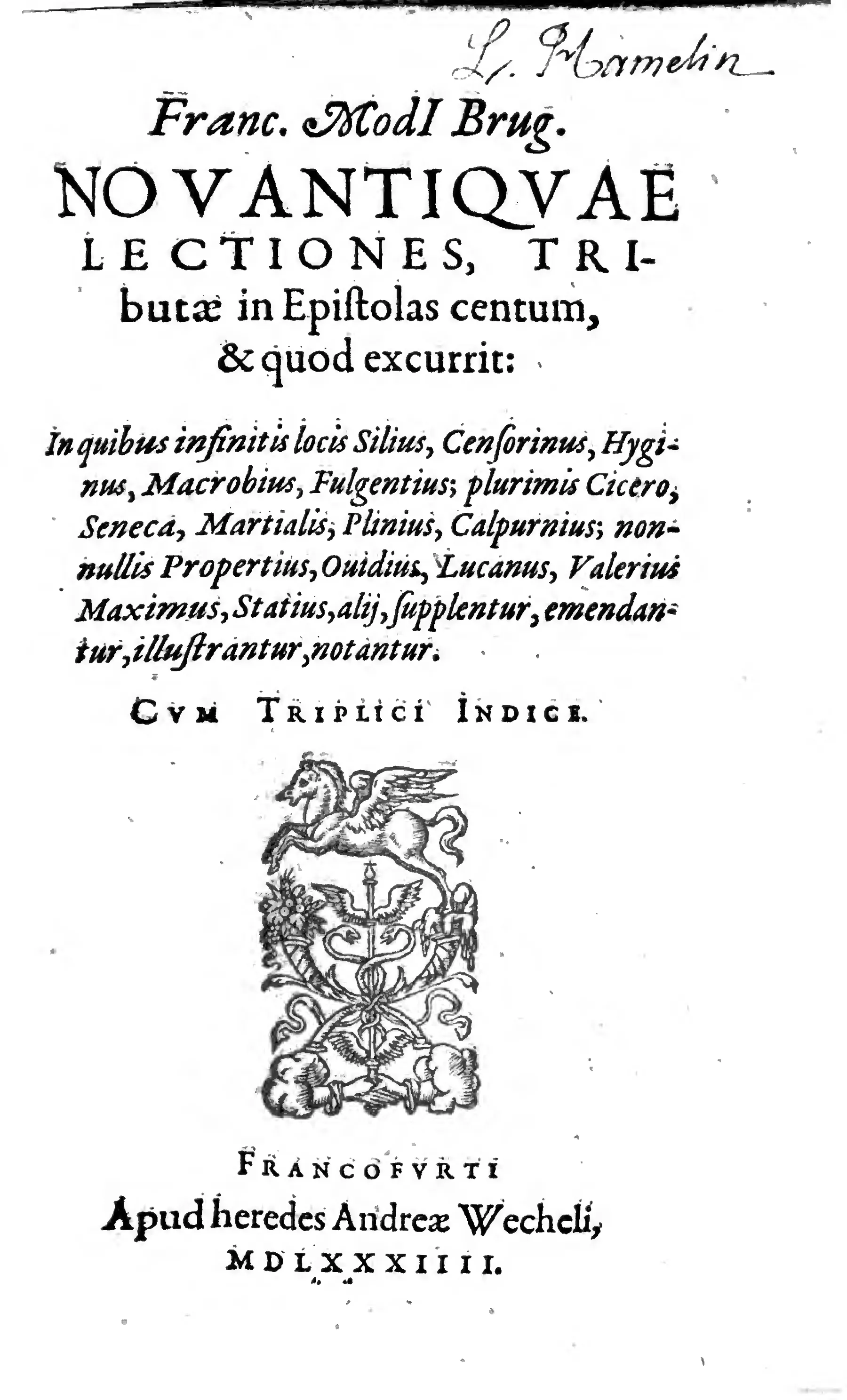
The title page fixes the work’s bibliographical identity: the coined Novantiquae lectiones, the sequence “supplentur, emendantur, illustrantur, notantur,” and the notice “CVM TRIPLICI INDICE.” The Wechel-heirs device, Frankfurt imprint, and date MDLXXXIIII establish the 1584 edition; the hand above the title is a copy-specific trace of later ownership. Source ↗.
The compound novantiquae lectiones is deliberately paradoxical, and the volume's own prefatory verse stages the objection rather than concealing it: it is a matter of the name, an interlocutor says — why are new things called ancient? — for here contraries are joined, Nominis est, inquis: noua cur antiqua vocantur? / Iunguntur hic pugnantia. Lectio means both a reading of a text and the act of reading or interpreting it; novantiquae therefore presents the philologist’s results as “new” readings of ancient authors, not as a claim to discover a new antiquity. The work’s prefatory and epigrammatic language makes the operation restorative: what has been obscured by transmission is made legible again, while an old literary object is figuratively renewed. Modius' own temporal poise is of a piece with the coinage — he venerates the ancients, he writes, but in such a way that he still admires the talents of later ages, and refuses to side with those who suppose that once the Ciceronian age is reached there is nothing further to learn, V Eneror antiquos, sed sic vt posteriorum temporum ingenia admirer tamen: nec cum illis faciam, qui simul ad Ciceronianum saculum ventum est. The title’s in epistolas also matters, and Modius uses the epistolary designation as part of the work's name when he refers to it in his own prose, telling his correspondents that how rightly he has handled these matters they will judge from the book to which he has given the title Novantiquae Lectiones per Epistolam, quam autem rectè ea tractauerim, ex libro hoc, cui Nouantiquarum Lectionum per Epistolam titulum feci, vos iudicabitis. The letters are not simply private communications preserved by accident; they are the chosen containers for discrete textual problems, observations, and learned judgments.
Within that form, variae lectiones has its technical early-modern force: it denotes the record and assessment of differing readings transmitted by manuscripts, earlier editions, scribes, and commentators. Modius’s procedure is comparative rather than merely conjectural. His discussion of manuscripts, marginal alternatives, older codices, and readings “from our parchments” makes the material witness a controlling authority, even though judgment remains necessary when witnesses disagree. He can state the hierarchy in the sharpest form, declaring that these things are emended from the parchment codex and that everything else standing in the common editions is pronounced spurious and illegitimate, inquam, hæc ex m. l. codice emedamus, reliquaque omnia, quæ in vulgatis exstant, spuria, & illegitima pronunciamus; and he formulates the underlying rule of evidence negatively, insisting that it cannot be approved by him that anything be adopted against the books, sed mihi non potest probaritamen, vt contra libros aliquid recipiatur. The received text is treated not as a neutral baseline but as itself a historical deposit with identifiable authors of its faults: the reading in circulation was in fact published by the glossographers, by whose insertions good authors are found interpolated more often than is expedient, nempè à glossographis erat vulgata lectio, quorum emblematis sæpius quam expedit boni auctores interpolati deprehenduntur. The related verb emendare is correspondingly stronger than casual correction. In this setting it means to remove textual fault and restore a passage toward an intelligible and historically defensible form; emendo ex membranis joins that act to the evidentiary authority of manuscript sources. Its complement is athetesis, the marking-out of what does not belong, and Modius presents the two as equal services: he does not think he will earn a lesser favour from the shade of Silius by ejecting spurious, surreptitious, and supposititious verses from his books than by restoring to him legitimate, genuine, and proper ones, nec arbitror sanè / leuiorem me à Silij manibus gratiam initurum, / spurios & subreptitios, supposititiosq[ue]; versus ex / libris eius eijciendo, quam legitimos, germanos, / & suos ei. The book thus gives critice a practical, judicial character: textual criticism is a disciplined weighing of testimony, not unrestricted ingenuity.
The dignity of such minute verbal labour is defended on explicitly semantic grounds. No less account is to be taken of words than of things, Modius reports the judgment of those he follows, for words are as it were the images of things, and if these are confused the whole scheme must be confused too, no[n] minorem verborum, quam rerum rationem / habendam statuerunt. sunt enim, vt rectæ ijdem / censent, verba velut imagines reru[m], quibus confusis, / confundatur & totu[m] schema necesse est. From that premise follows the scale of attention the letters demand, since nothing in those classical and, as it were, greater-gentes authors can be so slight that it does not deserve careful consideration, nihil in classicis illis, & quasi maiorum gentium scriptoribus tam exile posse occurrere. The technical vocabulary of the volume — glossema, emblema, interpolare, repurgare, emaculare, distinctio — belongs to this same programme of grounding judgment in documented witnesses rather than in ingenuity.
The forms Modius, Modius Brugensis, and Franciscus Modius are the secure Latin catalogue forms. Modern records also use François Modius and related vernacularized forms; the evidence consulted does not establish a distinct pseudonym, anagram, or academic sodality name. The biographical attribution to the Flemish philologist born in 1556 and deceased in 1597 is secure enough for the book, while the exact vernacular form “Frans de Maulde” should be treated as a variant identification rather than silently substituted for the Latin author-name in a bibliographic citation.
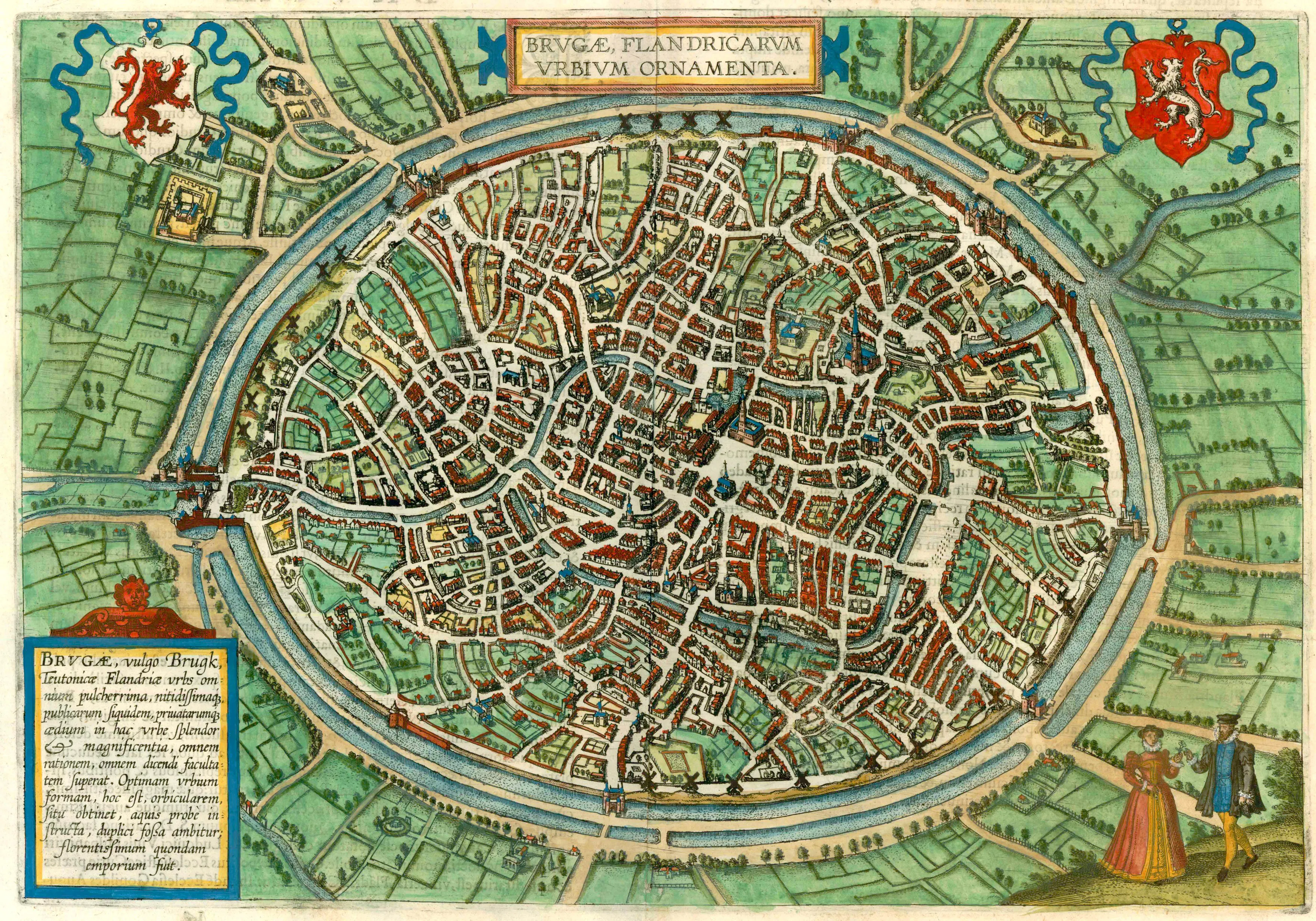
A Braun and Hogenberg–tradition plan of Bruges, printed in 1635, gives the byname Brugensis a setting: the fortified, canal-threaded Flemish city whose antiquarian networks shaped Modius. Contextual rather than evidentiary, it evokes the Low Countries milieu behind the Latin catalogue forms, not the philologist’s own book. Source ↗.
What the Novantiquae Lectiones Is: Modius, the Wechel Heirs, and the 1584 Frankfurt Imprint
Novantiquae Lectiones is a printed Latin philological miscellany organized as a sequence of more than one hundred learned epistles. It is not a surviving bundle of private letters in the ordinary documentary sense: the epistolary form is a deliberate literary and scholarly architecture for presenting textual conjectures, manuscript evidence, antiquarian notices, authorial judgments, obituaries, poems, and related observations. Modius states the rationale himself, reasoning that a subject otherwise tedious to read and full of tedium, such as he had undertaken to treat throughout the book, would come more welcome into men's hands and eyes if it were not finished off continuously but broken up by various digressions, on various subjects, to various people, by way of letters, tædiosam alioqui lectu, & fastidij plenam materiam, / qualé fere hoc perpetuo libro pertractandam / suscepimus, gratiorem in manus oculosque / hominum venturam, si non continue absolueretur, / sed varijs ad varios, de rebus tamen nô nimium / a studijs remotis, per litteras digressiunculis / interpolaretur. Franciscus Modius (1556–1597), the Flemish philologist styled Franciscus Modius Brugensis, is the author.
The authoritative title-page and catalogue evidence places production at Frankfurt am Main, apud heredes Andreae Wecheli, in MDLXXXIIII, that is, 1584. The frequently repeated date 1583 is not supported by the BSB/VD16, WorldCat, Google Books, or Internet Archive records located; no separate 1583 issue was identified. The place of composition and the stages by which the individual epistles were assembled are not securely established. One internal letter is dated 1582, but that does not prove that the whole work was composed then or at Frankfurt. The text does, however, describe its own genesis as a by-product of continuous collation: Modius reports that he is assiduously and diligently engaged in comparing manuscripts, of which he has so great a supply, against printed copies, and that all variant readings which seem not unworthy of the labour he carefully excerpts and throws into his Novantiquae, which he has now brought to the point where they will make a proper volume, A Ssiduè & diligenter sum in cõferendis manu exaratis, quoru[m] mihi tantum est copia, ad cuios, & typis descriptos codices: variantesq[ue] omnes lectiones, quæ quidem tales sint, vt hoc labore non indignæ videantur, cum cura excerptas in Nouantiquas meas conijcio, quas iam eo perduxi, vt iustum volumen facturæ videantur.
The driving purpose is the critical repair and explanation of ancient texts. The title and contents foreground Silius Italicus, while the work also treats Censorinus, Hyginus, Macrobius, Fulgentius, Cicero, Seneca, Martial, Lucan, Statius, Pliny, Ovid, Tacitus, Livy, Valerius Maximus, and other classical and late antique authors. Modius combines manuscript collation, palaeographical observation, comparison of printed witnesses, historical knowledge, and philological judgment. The volume ends with a tripartite index apparatus, an ordering device whose usefulness is heightened by the author's programmatic refusal of arrangement within the letters themselves.
The principal dedicatee is Erasmus Neustetter, called Stürmer, the Comburg provost and Würzburg/Bamberg canon who patronized Modius and other Würzburg humanists. Individual epistles have their own addressees, including Carolus Egmondanus; those addressees should not be confused with the volume’s principal dedicatee. The work is in Latin. No published translation record was located in the catalogues and digitized repositories consulted; that is a provisional negative, not proof that no translation has ever existed.
Why Modius Matters: Manuscripts, Print Correctors, and the Republic of Letters
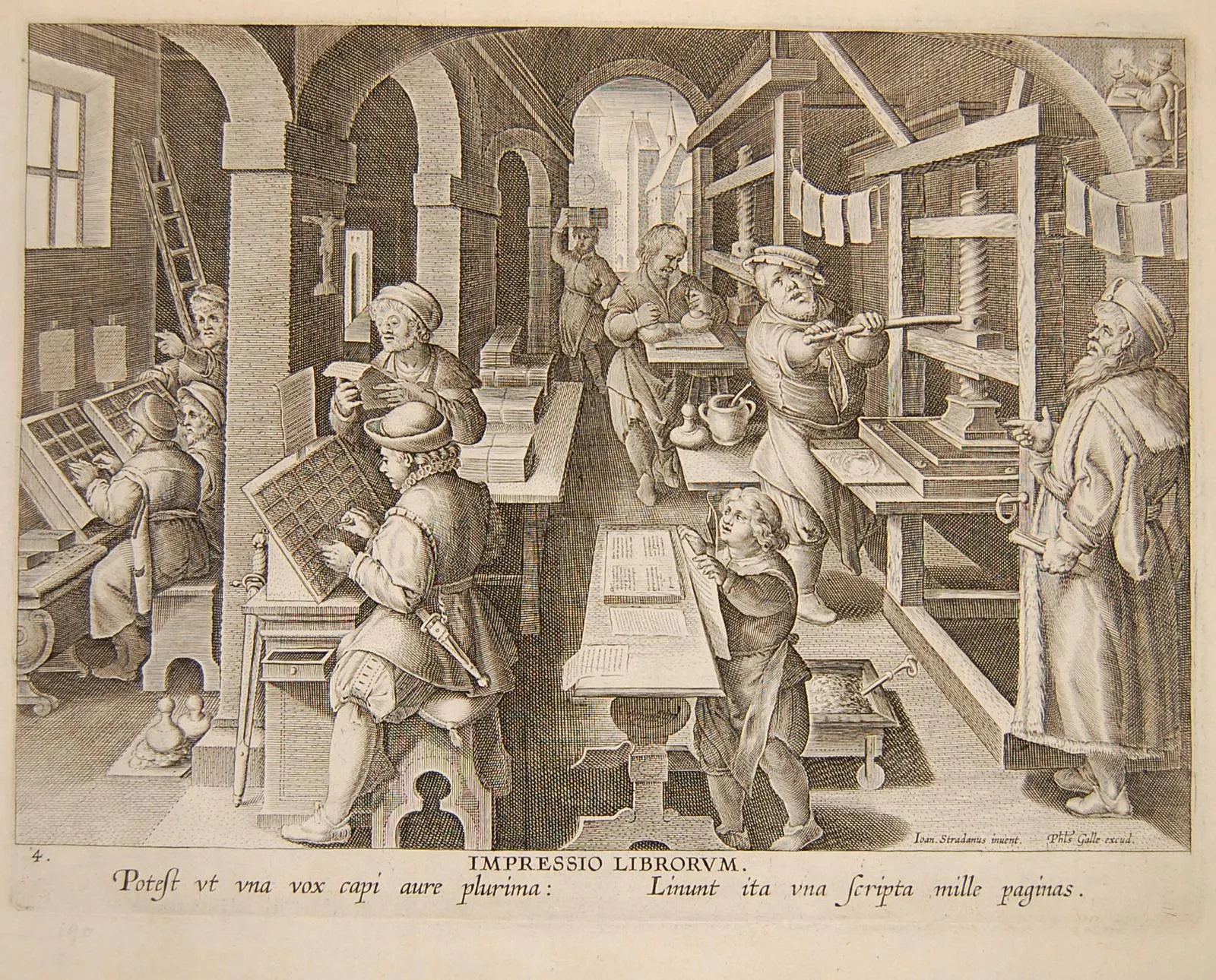
Stradanus’s engraving of a late-sixteenth-century printing shop lays out the whole chain of production, from compositors and proof-reader to pressmen and drying sheets. For Modius this machinery was indispensable and dangerous alike: the process that multiplied classical learning also multiplied the corruptions he blamed on printers and press correctors. Source ↗.
The book matters because it makes visible the working procedures by which late-sixteenth-century philologists converted scattered manuscript, printed, and antiquarian evidence into textual authority. Its importance is methodological as much as bibliographical. Modius does not present criticism as a sequence of abstract rules detached from books: he argues from parchment, scribal hands, dated subscriptions, marginal alternatives, compendia, punctuation, the history of editions, and the fallibility of press correctors. The diagnostic step comes first and is described in frankly medical terms: in corrupt books the first hope of aid and medicine dawns once it is established that they are corrupt, something that often cannot be rashly detected even by otherwise learned men unless recently printed copies are compared with those written of old — a truth he says he felt in Seneca only the day before, working after Erasmus and after Pincianus, who easily excels in judgement in this kind of writing, ita prima in libris corruptis opis & medicinę spes affulget, si corruptos esse constiterit. quod sæpè sanè ne à doctis quidé ceteroqui viris temerè deprehendi potest, nisi si editi recenter codices ad scriptos olim comparétur. sensi hoc verum esse, vt de me aliquid dicam, in Seneca heri; in quo post Erasmum, & qui in hoc genere scriptoru[m] iudicio facilè excellit Pincianum. The result is an unusually concrete witness to the material and evidentiary culture of Neo-Latin scholarship.
Several period frictions meet in the volume. The first is the contest between libri cusi and codices manu exarati: printed transmission offers circulation and authority, but manuscript testimony may preserve an older or less corrupted reading. Modius puts the asymmetry in almost visual terms, complaining that the virtues of an author have been so darkened by the audacity of correctors and the negligence of typographers that in printed books scarcely any appear, but lie hidden as under deep shadows in the homes of bookworms alone, the old parchments, sed quas correctorum audacia, & typographorum indiligetia ita infuscauit, vt in cùsis libris nullæ ferè appareant; sed in solis tinearum domibus, mebranis veteribus, vt sub altis tenebris delitescant. His invective against the printing house is fiercer still where he identifies an intruded word as a gloss on the word following, thrust in by men who, while they hawk their censures in printing-houses and swell with the name of correctors, are nothing less than what they profess, a breed of men born for the ruin of the republic of letters, misso permisceri quod sequentis verbi foederari glossema ab illis huc intrusum est, qui / dum in officinis typographicis censuras suas / venditant, & correctorum nomine tument, / nihil minus sunt, quam quod profitentur, genus hominum maloreip. litterariæ natum. The cloister receives the same treatment as the shop: those who rashly restore to their integrity, as by the praetor's edict unde vi, what monks once altered and interpolated to each man's own capacity are described in the juridical vocabulary that governs much of the volume's argumentation, qui temerè à monachis olim inmutata, & pro captu cuiusq[ue] interpolata, in integrum ex edicto vnde vi. Bound up with this is a proposal about the proper form of a learned book: Modius denies that commentators have any right to deal so with the writings of the ancients, and rules that if they wish hereafter to provide for themselves and their wisdom by such insertions, they should be content to have noted them at the edge of the book and not besmirch the text itself with their notes, sed nego hoc illis more in veterum scriptis versari ius fas esse. quare si quid sibi & sapientiæ suæ posthac prospectum his talibus emblematis volent, ad oram libri notasse contenti, notas suas, textum ipsum ne collutulent.
The second friction is the boundary between legitimate conjecture and philological license. Modius’s repeated demand for evidence places conjecture under the judgment of witnesses, history, grammar, and learned consensus, and his portrait of the alternative is deliberately violent: men who with he knows not what rabidness rage like Bacchants through good authors so boldly that, were old books not at hand to help, one might well go to the funeral of the most elegant writers, qui nescio quarabie in bonos auctores verissimè passim bacchantur ita audacter, vt, nisi libri veteres auxilio essent, exequias ire elegantissimis scriptoribus licuerit. The third concerns the social organization of knowledge. Dedication, correspondence, commendatory verse, manuscript lending, and book-trade relations allow a correction made in one locality to enter a wider res publica litteraria, while accusations of stolen notes, careless typography, or monastic interpolation mark the ethical limits of scholarly exchange. That commonwealth is imagined juridically and, pointedly, transalpinely: asked for his opinion, Modius answers that the matter is great, that he therefore adjourns it, and that a senate of learned men must be consulted — not of Italy only, which claims this judgement as hers alone by he knows not what right, nor of France, which has long contended with that mother of studies so that the suit is still before the judge, but of all Germany too, and of the Low Countries, quæris sententiam de eo meam? vt ait ille, res magna est, quare amplio, & censeo consulendum Senatum doctorum virorum non Italiæ tantum, quæ nescio quo iure iudicium hoc ad se solam pertinere arbitratur, & Galliæ, quæ iam olim cum ista studiorum matre ita de hac re contendit, vt etiam nunc sub iudice lis sit; sed Germaniæ quoque totius, & Belgicæ nostræ.
The institutional setting is Catholic and collegiate rather than confessional polemic in any narrow sense. Neustetter’s ecclesiastical offices at Comburg, Würzburg, and Bamberg provided a setting in which a humanist library, clerical patronage, and classical scholarship could coexist. Something of the same latitude appears in the way the volume handles religiously charged material by strictly philological means: of the letters exchanged between Seneca and Paul, Modius holds that the style itself easily proves they are not Seneca's, and judges them plainly the invention either of some monk or of Jerome himself, so that this most weighty author might be more commendable to Christians through a shared religion, de epistolis; stylus ipse facile conuincit non esse / eas Senecæ, planeq[ue] arbitror aut monachialicuius, / aut ipsius D. Hieronymi esse commentum, / quo auctor hic grauissimus Christianis comendatior / esset communione sacrorum, & religionis. Having removed the Christianizing forgery, he raises rather than lowers the moralist's standing, concluding that Seneca was therefore a pagan, but as pagans go the most holy and weighty, and worthy, by Hercules, to be thumbed by Christian hands rather than six hundred books on and about religion, Ethnicus igitur Seneca; sed vt in ethnicis sanctissimus, & / grauissimus, dignusq; me hercle qui Christianorum manibus / teratur potius, quam sexcenti in relligione, & de relligione nostra libri. The evidence located does not establish that Novantiquae Lectiones caused a censorship proceeding, a formal theological controversy, or a printed counter-text. Claims about suppression, episcopal licensing, or an Imperial privilege therefore remain unproven.
The most direct modern study located is Paul Lehmann’s Franciscus Modius als Handschriftenforscher (1908). Lehmann treats Modius principally as a researcher of manuscripts and reconstructs the philological publications, the history and character of his investigations, and the manuscripts he used. That emphasis supplies the necessary foundation for reading Novantiquae Lectiones as an archival and codicological project rather than merely an anthology of elegant Latin observations.
I. W. F. Maclean’s study of André Wechel at Frankfurt supplies the book-historical framework for the imprint and for the heirs’ continuation of the Frankfurt press. Ann Blair’s work on the management of scholarly information explains why indices, excerpting, classification, and controlled miscellany are central intellectual technologies of the period, without reducing Modius’s practice to a modern information model. Anthony Grafton’s work on Joseph Scaliger provides a closely related history of classical criticism as a social practice grounded in manuscripts, learned correspondence, editions, and arguments over priority. The approaches are complementary rather than opposed: Lehmann reconstructs Modius’s manuscript practice, Maclean reconstructs the production network, Blair analyzes the organization of learned materials, and Grafton traces the social and argumentative culture of criticism. All four bear on the same question the volume itself keeps posing — what counts as sufficient warrant for altering a classical text.
No sustained modern monograph or extended historiographical controversy devoted exclusively to Novantiquae Lectiones was located. The modern historiography is consequently thin and dispersed across Modius biography, manuscript studies, histories of classical scholarship, and histories of the early modern book. That silence is itself significant: the volume is rich enough to support major work on textual criticism, patronage, and book history, but its reception has not yet been comprehensively mapped.
Tracing the 1584 Frankfurt Edition: Copies, Collation, and Patronage at Comburg
Attribution and date. The book is Franciscus Modius’s Novantiquae Lectiones, not Johann Daniel Mylius’s Opus medico-chymicum. The two are distinct Frankfurt productions. The Modius volume bears the Wechel-heirs imprint and the date MDLXXXIIII (1584); Mylius’s Opus medico-chymicum is an alchemical-medical compendium issued by Lucas Jennis in Frankfurt in 1618, with later volume history. The title, subject, author, printer, date, and physical description do not support treating the two records as one work. The catalogue trail therefore contains a conflation, not an alternative attribution.
Bibliographical record and witnesses. The Bayerische Staatsbibliothek/MDZ record identifies the book as Franc. Modi[i] Brug. Novantiqvae Lectiones, Tributae in Epistolas centum & quod excurrit, by Franciscus Modius (1556–1597), printed by or for Wechelus at Frankfurt, apud heredes Andreae Wecheli, in 1584. It gives VD16 M 5739, BSB shelfmark Philol. 182, OCLC 165443406, and a B3Kat identifier. The digitized BSB object is bsb10192332, with 678 scans and a 2009 digitization date. WorldCat records also give the Wechel imprint and the longer title, including the “triplici indice”; OCLC 44830060 appears to be a related catalogue record rather than evidence of a 1583 edition.
A Google Books scan made from the Bavarian State Library is preserved at Internet Archive as bub_gb_yfk7AAAAcAAJ, with the ARK ark:/13960/t4sj6bq9q. The University of Pennsylvania record links the same 1584 book to a HathiTrust item, record 009305689. These records establish accessible digital transmission through BSB/MDZ, Google Books, Internet Archive, and HathiTrust. No further physical-copy shelfmark was confirmed from the accessible records.
Format and physical description. The BSB institutional record gives the extent as [26] leaves, 583, [1] page, [9] leaves, but does not independently state the format, signature sequence, catchwords, or collation formula. An antiquarian description calls a copy octavo and reports a different count, [52], 583, [18] pages, including errata. The discrepancy may reflect different counting conventions or copies; the commercial description cannot replace a copy-level collation. Octavo is therefore plausible but not independently secure on the present evidence. The presence of an index and correction material is supported by the catalogue title, the digitized text, and the closing correction passages, but a complete signature-by-signature description and verified catchword record remain to be supplied from a paginated scan or physical copy.
The digitized text preserves the running-head and title language FRANCISCI MODII NOVANTIQUAE LECTIONES and begins with EPISTOLA PRIMA. The work contains Index Epistolarum, Index Auctorum, and a summary/index component, corresponding to the catalogue’s cum triplici indice. Its corrections are not an afterthought: the text records errors, directions to correct them, and the practical relation between printed wording, marginal variants, and manuscript testimony. The apparatus of finding-aids answers a difficulty the author created deliberately, since he tells one correspondent not to expect him to keep any order, having judged that in the whole book that order would be best which is none at all.
Production and institutional network. The imprint belongs to the Frankfurt continuation of André Wechel’s press. The accessible Brill account of the Frankfurt firm identifies Claude de Marne and Jean Aubry, who married into Wechel’s family and became heirs after André Wechel’s death; the full chapter is not openly available in the retrieved record, so the precise division of editorial, financial, and printing responsibilities for this volume should not be overstated. No privilege, episcopal licence, imprimatur, or censorship formula was located in the catalogue records or searchable digitized text. That absence does not demonstrate that no authorization existed elsewhere in a surviving copy.
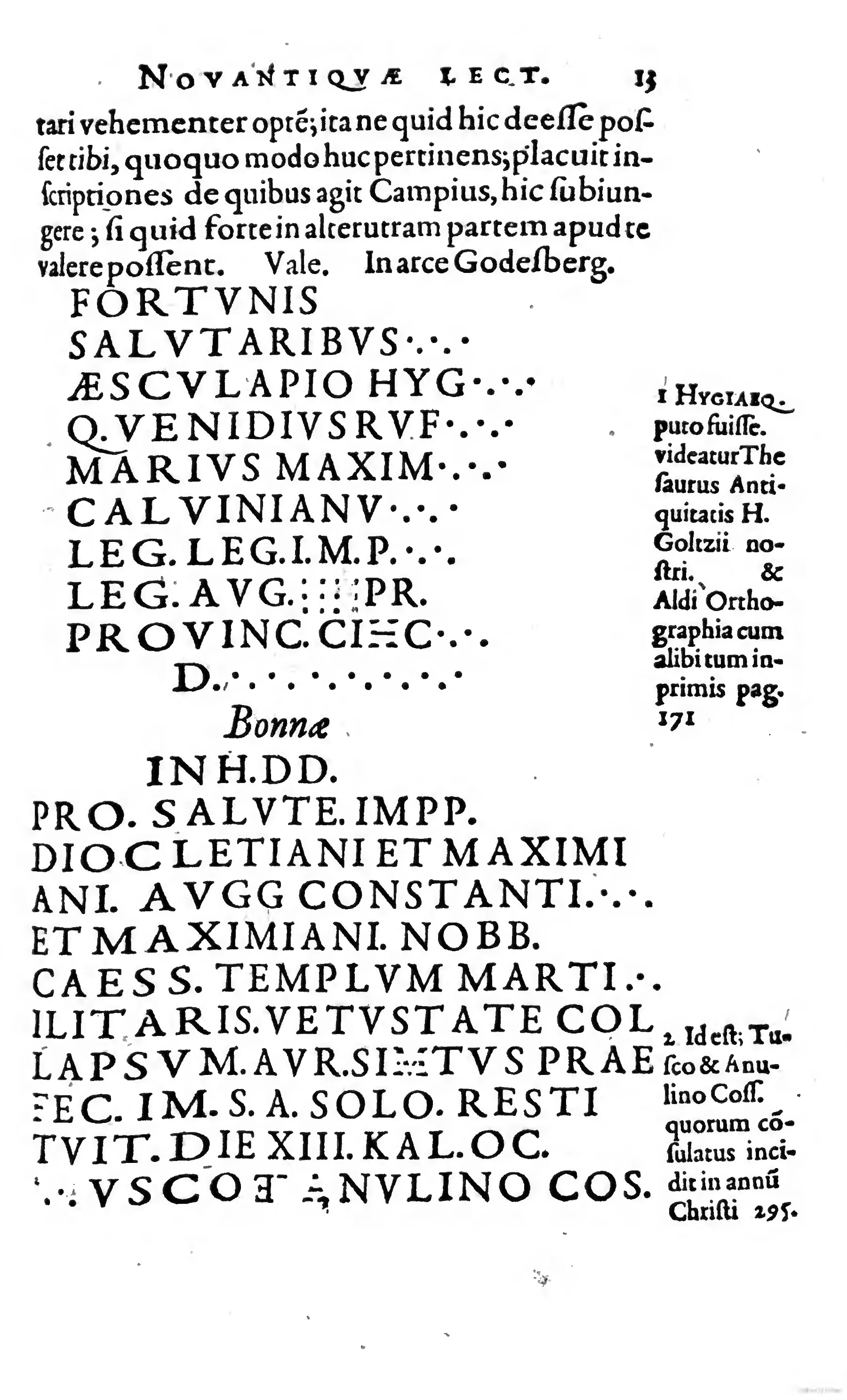
Beneath the close of Campius’s letter, two Roman inscriptions are set in large capitals imitating the lapidary originals, making Rhineland stones witnesses alongside manuscripts and ancient authors. Where formal licensing traces are absent, the page reveals another network of production: named correspondents and authorities, including the marginally cited Goltzius, printed into the argument. Source ↗.
Dedication, patronage, and reception network. The prefatory address names Erasmus Neustetter, called Stürmer, as the benign patron to whom the Novantiquae are offered, and it argues the patron's own case in Roman terms: in a commonwealth Modius finds roughly two chief kinds of the most outstanding citizens, one using bodily force the more and the other the force of mind, both plainly necessary to the state, since arms abroad avail nothing where counsel is lacking at home, in rep. ciuium duo fere summagenera reperio: quorum aliud corporis, animi aliud viribus / magis vtitur. Vtrumque reip. necessarium planè / fateor. quando nihil prosunt arma foris, vbi deest / consilium domi. Neustetter was born in 1522 and died in 1594; he became a Würzburg domicellar and canon, a Bamberg canon, provost of Comburg, and provost of the Würzburg Haugstift. His Comburg residence functioned as a humanist setting, and the biographical record specifically associates Franz Modius with the circle he hosted. Neustetter’s patronage also encompassed Johannes Posthius and Petrus Lotichius. The printed commendatory and epistolary network additionally includes Posthius, Johannes Weidner, and other scholars named in the volume.
Neustetter’s dedication must be distinguished from the addressees of individual epistles. The first epistle is addressed to Carolus Egmondanus; other letters address or mention figures such as Philipp de Croÿ and members of the Low Countries and German humanist networks. The book’s social form is therefore layered: a single patron frames a collection whose individual pieces circulate among many learned correspondents. Reputation circulates through the same channels as manuscripts, as Modius shows when he tells a correspondent that he knew from the conversation and letters of many that the man had diligently ransacked not only the libraries of the City but almost all those of the whole of Italy, whether in person or through friends, sciremque ex multorum sermonibus & litteris, non Vrbis tantum te bibliothecas, sed & Italiæ totius plerasq; omnes, vel per te ipsum, vel per amicos diligenter excussisse. The letters also carry offices other than criticism, among them consolation: what usually serves as an ornament for fame should now at least be, in a grief more heavy — would that it were not also more just — a solace, nimirum hoc potius; vt, quæ solent esse decus ad famam, nunc sint saltem in luctu, vtinam non iustiore, quam grauiore, solatia. No documented contemporary reply, refutation, formal proceeding, or counter-publication has been located.
Manuscript practice and related works. Modius’s method is explicitly manuscript-oriented. He compares competing readings, records marginal alternatives, attends to older codices and scribal practices, and emends from parchment witnesses. He also states the protocol of disclosure that goes with this, professing that very few things are guessed at outright and that most are supported by parchment codices written by hand, which — lest his good faith be doubtful to anyone, especially in a masked age in which most men praise exemplars that as they never existed so nowhere exist — he cites expressly in their places, adding everywhere from whom he had the use of them, pauca omnino, imo perpaucæ / ariolantes, pleraque adiuti membranaceis manu / exaratis codicibus (quos, ne ambigua hic fides / mea apud aliqué forte esset, tam personato hoc / præsertim seculo, quo plæriq[ue] ea laudant exemplaria, / quæ vt numquam fuerunt, ita nusquam / sunt, suis locis disertè, vbique a quibus illis vsus. That protocol rests on years of searching: in ransacking hidden libraries such, he tells his patron, has always been his ardour that even as a very young man he spared no labours or expense but went in person, most diligently, to whatever monasteries of the Low Countries he had heard tell of, INbibliothecis abditis excutie[n]dis is meus semper ardor fuit, amplissime patrone, vt & adolecés admodu[m] nullis aut laborib. aut sumptib. parceré, quin quotquot in Belgicæ nostræ monasterijs haberi vel fando audissem, diligentissimè ipse obirem. His related bibliographical output includes editions or scholarly works associated with Vegetius, Curtius Rufus, Poemata, Novantiquae lectiones, Gynaeceum, and Pandectae triumphales. The BnF authority record contains a conflicting “1536?” birth heading, but its listed works and the independent biographical evidence support identifying the author of the 1584 volume with the Modius who lived 1556–1597. The birth location itself is disputed between Oudenburg and Aardenburg; that uncertainty does not affect the book’s attribution.
The principal unresolved material questions are the exact collation, the copy-specific condition of the errata and index leaves, the complete census of surviving copies, and the existence of any unlocated privilege or censorship material. The accessible evidence supports a 1584 Wechel-heirs book by Modius, while not yet supporting a definitive account of every stage of its printing or reception.
Reading the Hundred Letters: Structure, Argument, and Textual Evidence
The Dedicatory Preface: Counsel, Arms, and Antiquarian Proof
The dedicatory preface with which the volume opens is not, as one might expect of a book of textual criticism, a statement of philological method but a sustained civic-ethical encomium, and the shape of its argument determines much of what follows. Modius divides the outstanding citizens of a commonwealth into those who serve by bodily force and those who serve by the force of mind, concedes that both are necessary, and then tilts the balance decisively toward counsel by making the toga the scarcer commodity: certainly among the Franks, a people born for arms and in arms, one will more easily find at any period a general skilled in war and a soldier strong of hand than a citizen in the toga who provides for his country by counsel, certè apud Francos, gentem ad arma, & in armis natâ, in quaq; ab omni memoria facilius peritum belli ducé, & strennum manu militem, / quam consilio patriæ prospicientem in toga ciué / inuenias. The sentence flatters and reproves at once. Franconia's martial reputation is granted as a compliment to the region and simultaneously converted into the ground of a deficiency that only the dedicatee repairs, so that Erasmus Neustetter's thirty years of counsel, his embassies to Rome and to the Imperial Majesty, and his service under three successive bishops of Würzburg become not one honourable career among many but the rare instance of a civic type the gens does not naturally produce.
What makes the argument characteristic of this author is that its supporting proof is itself an antiquarian citation. Rather than moralize about the seductions of glory, Modius reaches for Vegetius and reasons from Roman recruitment: legionary service was more honourable than auxiliary service, yet it also involved more campaigns, a stricter discipline was observed among the legionaries, and rewards were bestowed more slowly on those who deserved them, legionarioru[m] militia honoratior esset, quam / auxiliariorum, plurium tame[n] stipendioru[m] quoq; / erat, strictiorque disciplina apud illos obleruabatur, / tardiora tribuebantur meretibus præmia. The classification of Roman troop-types is made to explain a general truth about the distribution of ambition: the more honourable path is the less frequented because its discipline is harder and its recompense slower. The dedication thus performs in miniature what the letters will do at large — a technical detail recovered from a late Roman handbook is treated as evidence in an argument it was never written to serve — and it establishes the book's governing assumption that ancient texts, correctly read, yield usable knowledge rather than ornament. The catalogue of Roman exemplars that precedes it works the same way: Romuli, Tulli, Curii, Scipiones, Marii, Caesares can be multiplied at will, while against them the civil sphere can set almost no one but Numa and Cicero, and the asymmetry of the two lists is the proof.
Only at its close does the preface turn methodological, and the turn is justified on grounds of reception rather than of epistemology. In the sentence already noticed above, Modius concedes that his subject is intrinsically unpalatable — tedious to read and full of tedium — and proposes that such matter will come more welcome into men's hands and eyes if it is not finished off continuously but broken up by various digressions, on various subjects, to various people, by way of letters. The verb chosen for the operation is telling: interpolaretur, the same word that elsewhere in the volume names the crime of the monastic copyist and the printing-house corrector who thrust their matter into an author's text. Modius interpolates his own book deliberately, and by owning the technique in his own person he draws the distinction on which his criticism rests — not between a pure text and an adulterated one, but between insertions that are declared and insertions that are smuggled. The candour extends to a remarkable concession that the reader's objection is granted before it is made: if anyone says that this book contains many empty things, most of them almost rotten, and some even insipid, he will not wager against him but will admit that he speaks the truth, dem libro si quis multa inania, plæraq[ue] pene putida, quædam etiam salsa cōtineri dixerit, vt cum / illo pignus haud dabo, sed verum eum hic dicere / fatebor. The self-deprecation is strategic. By surrendering the aesthetic question outright, Modius reserves the only ground he intends to defend, which is that a fair number of passages will nonetheless help toward understanding the ancients; and by submitting the whole to the censura doctorum he defines his audience as a tribunal of the competent rather than a public of the entertained. The same posture explains the paradox of a book that renounces arrangement and then equips itself with an index of letters, an index of authors emended, and a running summary of contents: what the epistolary form scatters, the apparatus makes retrievable, and the disorder is a concession to the reader's appetite that the finding-aids are designed to neutralize.
Commendatory Verse and the Claim to Jurisdiction
The sheaf of commendatory epigrams that follows performs the placement the author cannot decently perform for himself. Its poets turn again and again on the oxymoron of the coined title, arguing that the readings are new to unlearned ears and ancient to learned ones, and Nicolaus Reusner supplies the genealogy explicitly, declaring that Muret and Manutius do this same thing, this Vettori, this too that censor Justus Lipsius, and that famous Joseph Scaliger accomplishes it, Hoc MVRETVS idem MANVTIVSQUE, / Hoc VICTORIVS, hoc & ille censor / IVSTVS LIPSIVS, & IOSEPHVS ille / Præstat SCALIGER. The list is a claim of jurisdiction as much as a compliment: it names the Italian, French, and Netherlandish practitioners whose company Modius is being admitted to, and Weidner's parallel roll of Canterus, Torrentius, Mekerchus, Lipsius, Ortelius, Cruquius, Dousa, Giselinus, Pighius, and Goltzius adds the specifically Low Countries constituency to which a Bruges scholar working in Franconia might appeal.
The First Letters: Scripts, Conjectures, and the Correctors' Stables
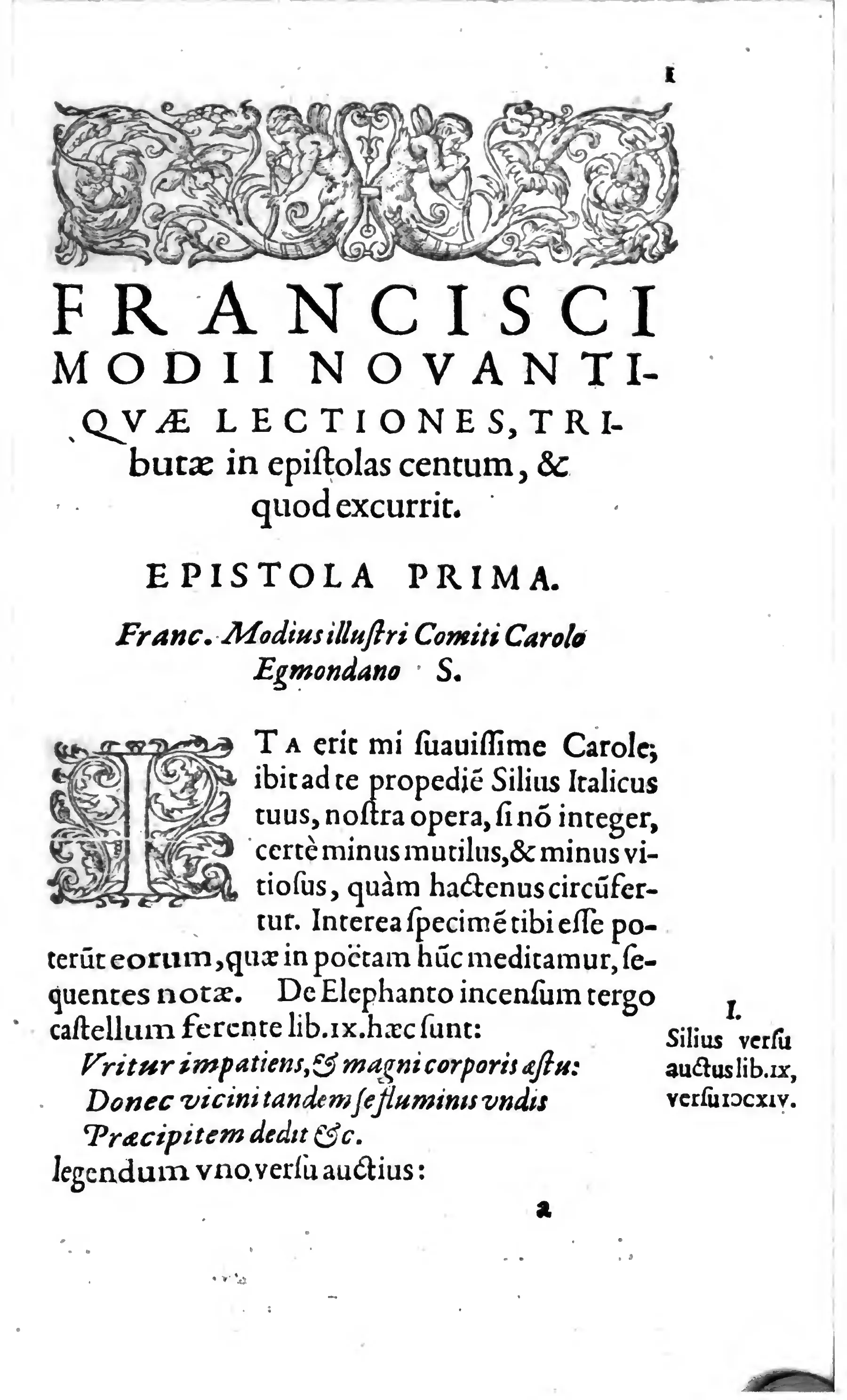
The opening leaf of the epistolary corpus shows the method at once: below the decorated headpiece and ornamental initial, Epistola Prima addresses Carolus Egmondanus and promises a Silius Italicus “minus mutilus & minus vitiosus.” The keyed marginal reference beside the first crux turns the letter into an edition in miniature. Source ↗.
The letters themselves make good the evidentiary promise in two distinct registers. The first is material and mechanical: corruption is traced to the physical behaviour of scripts and hands. Correcting Silius, Modius rules that one must read pastusque sonoro Ignis edax vento, since in Lombardic writing r is not distinguished from s, legendu[m] esse; pastusq[ue] sonoro Ignis edax vento. / Longobardicum r ab s scriptura non distinguitur. The emendation is not offered as a felicity of taste but as the reconstruction of a determinate scribal event in a nameable script; the critic argues from the shape of letters, and the conjecture is answerable to a fact about copying that others may check. The second register is frankly conjectural and is presented as such. Where the books give no help, as at the opening of Cicero's first Catilinarian, Modius will say that Cicero said elustrantur for "out of the lairs", that is, they are carried out from the brothels, dicemus Cicerone[m] dixisse elustrantur pro / è lustris, hoc est è lupanarib. p[er]feru[n]tur. The proposal manufactures a verb from a noun and pushes the sense toward the disreputable, and Modius accompanies it with a disclaimer that ingenuity is not truth — the very reservation that measures the distance between this class of suggestion and the parchment-backed corrections he prefers.
The polemic against those who corrupt while professing to correct reaches its highest pitch in the same letters, and it is directed at the printing house rather than the cloister: basest of men, who so correct books that you smear on good authors many evils, of which you always have the greatest supply at home, so that not even Hercules would suffice to remove them and cleanse the stables of the writers you have fouled, Postremi hominum, qui ita libros corrigitis, vt / bonis auctoribus multa mala, quorum vobis domi / maxima semper copia, ita affricetis, vt ad illa / tollenda, & repurganda scriptoru[m] stabula à vobis / inquinata ne Hercules q[ui]de[m] satis futurus / sit. The Augean image is doing precise work. Filth in the stable is not a defect of the animals but a deposit laid down by those charged with their keeping, and it accumulates faster than any labour can clear it; the metaphor converts textual corruption from an accident of time into an ongoing act of an identifiable trade, and it makes the critic's work Herculean by definition, that is, endless and imposed from outside.
That the epistolary form is an instrument of evidence and not merely of palatability appears most clearly where Modius suspends his own voice and prints another man's letter entire. Jacobus Campius's dossier on the Altar of the Ubii opens with the thesis and its Tacitean warrant, holding that the Altar of the Ubii was in that very place where the town of Bonn now stands, for Tacitus placed the altar by the camp of the First Legion, Aram Vbiorum, / inquit, existimo inibi loci fuisse, vbinunc est oppidum Bonna. / Nam Tacitus aram apud castra primæ legionis / posuit. What follows — legionary dispositions, distances reckoned in Roman miles, Ptolemy and Eumenius, coin-finds, aqueduct remains, and the local place-names of Dietkirchen, Vigelshouen, and Godesberg — treats the ground of the Rhineland as a witness collatable with the texts, and by reproducing it verbatim, with its correspondent's name and its dated subscription intact, Modius applies to a colleague's argument the same protocol of naming his source that he applies to parchment codices. The reader is put in a position to weigh the testimony rather than to accept a digest of it.
The criteria widen once more in the letter denying that Seneca was a Christian. Having disposed of the correspondence with Paul on the evidence of style, Modius adds an argument from character that his opponents cannot answer from the text: does fear and so mean a suspicion of spirit fall upon a philosopher, and one not of some soft sect but of that rigid one whose end was liberty in word and deed at whatever peril, & tam exilis animi suspicio in hominem / philosophum, non sectæ alicuius delicatæ, sed rigidæ / illius, cuius finis erat libertas in dictis & factis / quocumque periculo?. The reasoning is that a Stoic who concealed his profession would thereby have ceased to be a Stoic, so that the hypothesis of a secret Christian Seneca is refuted by the doctrine it would have to attribute to him. Here the same evidentiary temper that reads Lombardic letter-forms and cites the owner of every parchment is extended to a sect's ethical commitments, treated as a datum of the historical record; and a hagiographical tradition of long standing is set aside not by confessional argument but by the ordinary instruments of criticism.
The Letter as an Edition in Miniature
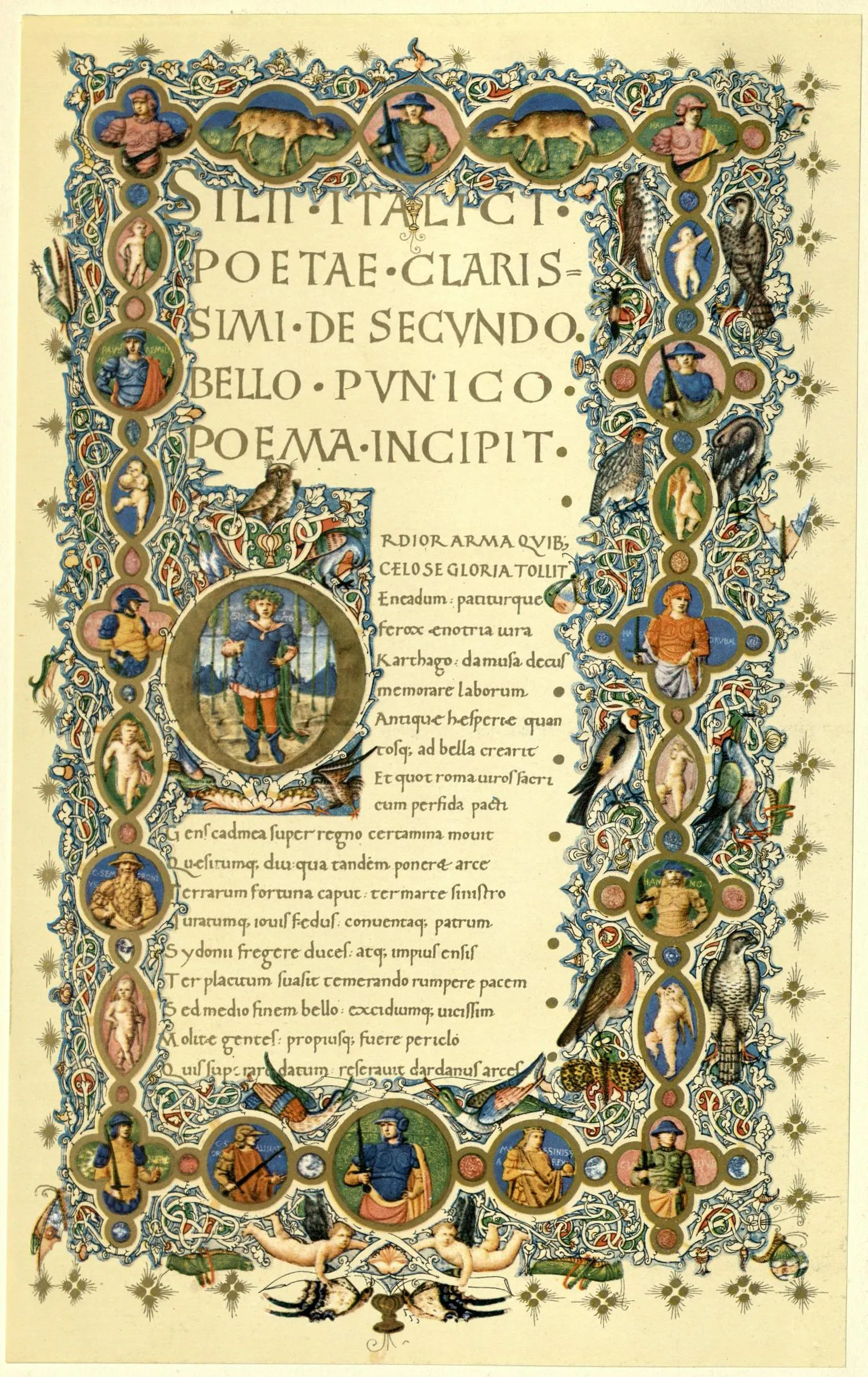
An illuminated opening leaf of Silius Italicus’s Punica, at Venice, evokes the kind of witness on which Modius built his letter-as-edition: not a neutral carrier of an ancient poem, but a physical authority to be collated, corrected, and set against corrupt print. Source ↗.
As the collection settles into its long middle, the working unit becomes a letter that behaves like an edition in miniature: a personal exordium to a named correspondent, then a numbered file of cruces, each flagged in the margin by a Roman numeral and a diagnostic label — emendatus, interpolatus, suppletus, bis, ter emaculatus — so that a reader may enter the book at any crux without reading the letter around it. Within each item the sequence never varies: the received reading is set out, shown to fail in sense, metre, idiom, or history, replaced from a named parchment witness, and then confirmed by parallels drawn from other authors or from inscriptions. Modius states the technique itself in a formula of three verbs, saying that he writes, emends, and distinguishes — that is, punctuates — in this way, scribo, emendo & distinguo, siue interpungo hoc modo. The third term carries more weight than its brevity suggests. Distinctio is placed on exactly the same footing as verbal emendation, an acknowledgement that in texts transmitted with little or unstable pointing the location of a stop is a conjecture like any other, and that a passage may be "corrupt" solely in its articulation. The diagnostic idiom that accompanies this work is riddling and medical by turns: a passage in Censorinus is, on his account, a most elegant one, by Hercules, but so foully corrupted that scarcely the shrewd acumen of some Oedipus could draw a serviceable sense from it, elegantissimus mehercule locus, sed ita turpiter deprauatus, vt sensum ex eo commodu[m] elicere Oedipi alicuius vix queat solers acumen. The Oedipus of the Sphinx, not of Thebes, is the emblem: corruption is a riddle posed by transmission, and the critic's claim to authority is a claim to have solved it, not to have improved the author.
That claim is precisely where the letters locate their risk, and Modius names the risk in the first person. Offering a reading, he writes that he writes at his own peril but on the faith of the parchments, Scribo meo periculo, sed fide membranar. The antithesis is the evidentiary hinge of the whole collection: periculum is personal, incurred by the man who signs the letter, while fides is documentary, lodged in an object that others may inspect and that he has already named. The formula quietly refuses the alternative on offer in the period — the critic who underwrites conjecture with his own ingenium — and it explains why the letters are so insistent about provenance, dating from subscriptions, and the person from whom a codex was borrowed. Where a witness is lacking, the sentence would collapse: peril without faith is exactly the condition he attributes to his adversaries.
The corresponding assignment of blame is aimed at the modern press rather than at antiquity, and in terms of some violence: the passage in question, he says, was not worse used by the typographers than Hippolytus was by his horses when the yoke was shaken off, non Hippolytum peius excusso iugo equi habuere, quam hunc locu[m] typographi. The dismemberment topos is doing analytical as well as rhetorical work, since the figure of a body torn apart by a team that has slipped its control is exact for what he means by a compositor's or corrector's damage: Hippolytus is destroyed not by malice but by the failure of a mechanism, which is Modius's diagnosis of print — multiplication without governance, in which a single misreading is fixed and propagated. The irony is structural rather than incidental, since the indictment is issued from a Frankfurt press whose reach he depends upon.
Against that mechanism he sets a juridical remedy borrowed from the praetor's edict, announcing that he will make an end with the most fortunate restitution of the passage to its integrity, by the edict, out of the white parchment book, & in felicissima eius in integrum ex edicto albi membranacei restitutione finem faciam. Restitutio in integrum is technical Roman law: the annulment of a transaction and the return of a party to his prior legal condition. Applied to a text, the metaphor casts the ancient author as an injured proprietor dispossessed by force or fraud, the interpolation as a void act, and the parchment codex as the title-deed proving the earlier state. It also implies that emendation is not creation but reversal — nothing is added, something is undone — which is the ideological premise the whole method requires.
The same evidentiary temper governs the antiquarian excursuses, where the warrant for a conjecture is Roman practice rather than Roman diction. Correcting Silius, Modius reminds his correspondent that the Romans, as he knows, used with a fixed and solemn formula, before taking any city by force, to call out its tutelary gods, promising them even greater honours at Rome than they had had there, & Romani, vt scis, Rattalere, certo & soleni carmine, antequam vrbem aliquam vi caperet, deos eius tutelares euocabant promissis amplioribus etiam ijs, quam illich habuissent, Romæ honoribus. A single letter is at stake in the reading, but the argument is entirely historical: the god must be departing, because Roman evocatio made departure the object of the ritual. Ritual knowledge here functions as a control on the letters of the text, and the reader is addressed as a fellow antiquarian competent to check it.
The Itinerary of Libraries and the Cost of the Labour
The long letter to his patron converts method into autobiography and supplies the collection's most concrete documentation of where such witnesses were to be found: besides the collections lately surveyed at Cologne, in the city itself those of the metropolitan church, of the abbey of St Pantaleon, of the Laurentian college and of the Minorites, and at about the third or fourth milestone from it Siegburg and Heisterbach, præter nuper lustratas Coloniæ Agrippinæ cui in vrbe ipsa eas, quæ sunt metropolitanæ ecclesiæ, abbatæ S. Páraleonis, Collegij Lauretiani, & Minoritaru[m]; tu ad tertiu[m] ferè aut quartum ab ea lapide Sigebergensem, & Aysterbachese[m]. The list is measured in milestones, not in prestige: it is an itinerary, and it makes the argument that the German and Netherlandish religious houses constitute a coherent field of research whose contents can be enumerated. Its counterweight is a candid report of loss, since the notes cost him no small labour, the better part of the slips having lately been lost by someone's crime — the slips on which he had committed his notes on various authors in that hasty writing which is his habit, amissa nuper scelere quorumdam meliore parte earum scidarum, quibus in varios auctores notas meas tumultuaria, qui est mos meus. The scidae are the true intermediate stage between codex and printed page, and their fragility — loose, unbound, portable, stealable — exposes how much of this scholarship existed nowhere but in a heap of paper. The letter then draws the practical moral for the man paying for it: he sees, most excellent patron, what it means to possess books as corrected as possible, vides, amplissime Patrone, quid sit libros quam emendatissimos habere. Textual accuracy is thereby presented as an object of patronage on a par with the library itself, and the emended text as a return on expenditure.
The Defence of Critice and the Widening Base of Evidence
The defence of the discipline is explicit where the letters turn to those who do not hesitate to condemn this criticism of ours as unfruitful and plainly useless, qui hanc nostram criticen, vt infrugiferam & planè inutilem damnare non dubitant. The possessive nostram is telling: critice, the naturalized Greek noun, is claimed as the property of a body of practitioners rather than a technique of individuals, and the charge answered is that of sterility — that the labour yields no fruit in doctrine or use. Modius's reply throughout is therapeutic, and he formulates its logic in a maxim: faults must be detected before they can be emended, deprehédantur enim vitia oportet, ante quam possint emendari — a sentence drawn from Epicurus on the knowledge of one's own disease and transferred without seam from moral to textual therapeutics, so that criticism becomes the diagnostic prerequisite of every other use of a book. The ethics attaching to that shared discipline are equally explicit: acknowledging a debt to Lipsius, he observes that caution must here rightly be employed by him, lest he be thought to have rifled the other man's writing-cases, cuius ne scrinia compilasse puter, mihi hic adhibenda est merito cautio. The scrinia are the same loose papers whose loss he lamented, and the anxiety is symmetrical: in a scholarship conducted on slips passed between friends, attribution must be performed in print because the material record cannot enforce it.
Two late passages show how far the evidentiary base extends beyond the classical library. Defending a reading of Ovid's Fasti, Modius appeals to living speech, arguing that it is the genuine idiom of that Netherlandish tongue of ours, vt sit phrasis germana isti Belgicæ nostræ da er stickt een man in; the vernacular proverb is admitted not as ornament but as testimony to a habit of expression that a Latin phrase may share, which presumes that idiom is a natural fact observable in any language. And in the letter reporting the death of Andreas Papius he records that the river Meuse swallowed Papius up as he was exercising himself in swimming, when he had just entered the thirtieth year of his age, a little after he had sent his little books on Music to their Plantin to be struck off in type, Et Papium quidem natatu se exercentem Mosa fluuius absorpsit: ingressum iam annum ætatis suæ tricesimum; cum paullo ante suos de Musica libellos Plantino nostro excudendos typismisisset. The obituary is exact about age, place, and the stage of production the man's book had reached, and its force in this collection is that scholarly life and printed transmission fail together: the drowned scholar and the sheets lost in transit belong to one accounting of what does not survive. Alongside such notices the letters keep company with the natural philosophers as readily as with the grammarians, closing with correspondence in which, as Modius says, much and long has been disputed between them concerning the nature and powers of the Lemnian earth, and of that which they call sealed, multu[m] enim & diu disputatum inter nos est de terræ Lemniæ, & quam sigillatam vocant, natura, ac viribus — a reminder that the res publica litteraria addressed by these epistles included physicians whose questions about a medicinal earth were settled by the same procedures of testimony, ancient citation, and named witness that settled a verse of Silius.
Letters LXIX–CXII: Correspondents, Mortality, and the Limits of Witness
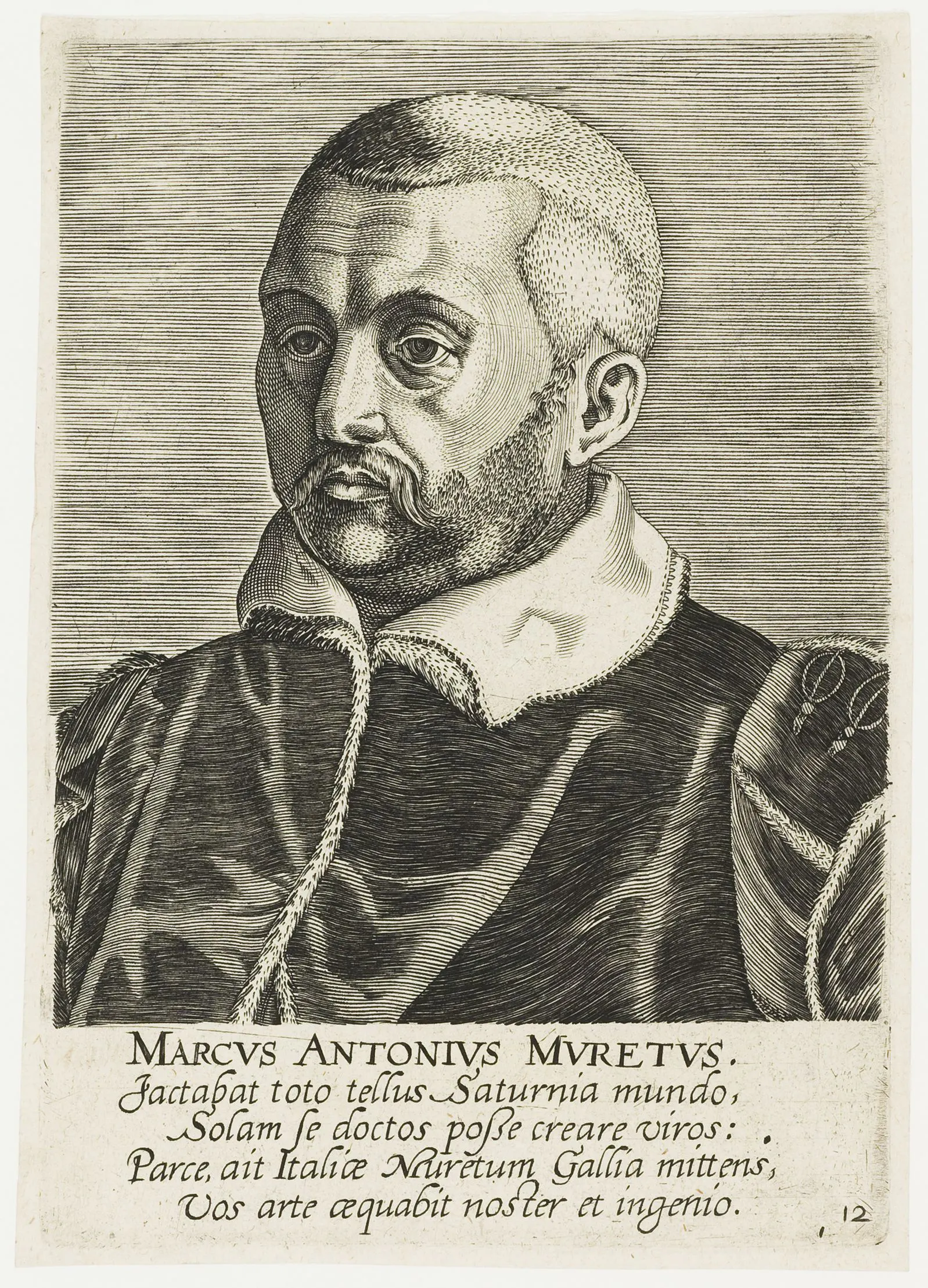
An engraved portrait of Marc-Antoine de Muret, the senior humanist at the centre of the volume’s circle of authority: Reusner’s commendatory verse places him first among the scholars whose company Modius enters, and Modius sends him at Rome the dispute over the rank of Silius Italicus. Source ↗.
The stretch of letters from EPIST. LXIX to EPIST. CXII shows the volume's method at its most workmanlike, and also at its most socially exposed. What holds the run together is not a subject but a procedure repeated across authors — Silius above all, then Cicero, Seneca, Macrobius, Censorinus, Hyginus, Martial, Lucan, Pliny the Younger, Tacitus, Fulgentius, Calpurnius — and the procedure is inseparable from the persons who supply its materials. The letter to Janus Lernutius opens with a complaint that lays that dependency bare, asking whether it is really true, Lernutius, that you — you, Giselinus, Goltzius I mean — answer nothing to my letters, nothing to what I was asking in them, Tane, Lernuti, verum est vos, te, Giselinum, Goltzium dico, nihil ad litteras meas, nihil ad id, quod in ijs quærebam, respondere. The reproach is doing evidentiary work as well as rhetorical work: it names three Bruges antiquaries as men from whom collations and answers were owed, and thereby certifies that the epistolary frame of the book is not a decorative fiction but the residue of an actual traffic in queries. Silence is a scholarly injury because a query unanswered is a witness unconsulted, and the letters register the frustration of a critic whose rule of evidence obliges him to wait on other men's parchments.
That obligation has a bodily cost, and the sequence pauses to reckon it. Writing to Victor Giselinus, Modius defends the alternation of work and rest on the authority of Seneca, and then generalizes: study wishes the mind to be exercised, not burdened, and you yourself know that excessive assiduity in reading, writing, and living among books has robbed many of the very capacity to handle letters, along with life, Exerceri vult ingenium, non onerari. & scis ipse nimiam legendi scribendiq[ue], atq[ue] habitandi in libris assiduitatem,. The formulation is precise in its dread: what over-application destroys is not merely health but facultas, the trained competence itself, so that the philologist's body and his judgement fail together. This is why night-work is renounced rather than boasted of — an inversion of the customary humanist pride in lucubrationes — and the renunciation is placed, tellingly, immediately before a run of emendations to Seneca's letters, as though the moralist were being made to underwrite the conditions under which he is corrected.
The theme of mortality is immediately given a concrete instance. The letter to Andreas Schott at Lisbon reports the death of Theodoor Poelman of Antwerp, mourned both as a friend and as a collator of manuscripts, and it closes the account of his career with the observation that death overtook him engaged in that pursuit and endeavouring to publish the commentaries of Caesar, in qua eum re deditum, & Cæsaris commentarios edere molientem, mors occupauit. The topos of the unfinished edition is conventional, but here it carries the specific weight of the volume's argument: since every restored reading depends on a particular man's access to a particular parchment, the death of such a man is a bibliographical event, subtracting from the common stock of testimony as surely as the loss of a codex would. The obituary letter and the collation letter are therefore the same genre performed in two registers.
Access, when it must be sought across the Alps, is transacted through rumour and intermediaries, and one letter documents the mechanism exactly. Writing to Fulvio Orsini at Rome, Modius reports the intelligence he has received, that a complete exemplar of the writer he mentioned is preserved by the most upright and most learned Pietro Vettori of Florence, eius, quem dixi, scriptoris exemplar integrum apud integerrimu[m] & eruditissimum Petrum Victorium Florentinum asseruari, and asks for verification. The interest of the passage lies in the epistemic status of the claim: an exemplar integrum of Curtius Rufus is precisely the kind of report that the volume elsewhere treats with suspicion, since praise of unseen exemplars is the standard vice of the age. Here the remedy is procedural — apply to a named scholar in the city where the book is said to be, and let him confirm or deny — and the request converts hearsay into a testable proposition without either crediting or dismissing it.
The positive statement of method comes in the letter to the physician Eucharius Seefrid, subscribed at Würzburg on the last day of June 1583, where a knot of astronomical nonsense in Hyginus is untied by a rhetorical question and a one-word answer: how then do we extricate ourselves from these difficulties and vindicate Hyginus from so abject an ignorance? Very easily: by restoring to him from the parchments his own writing, quomodo igitur extricamus nos ex his salebris, & Hyginum à tam proiecta ignorantia vindicamus? facillimè. restituendo illi ex membranis suam scripturam. Two things deserve notice. First, the critic's office is framed forensically as vindicare, the defence of an ancient author against a charge — the imputation of ignorance — which the transmission, not the author, has incurred; the parchments function as exculpatory testimony. Second, the ease claimed (facillimè) is not a boast about ingenuity but its opposite: the solution is easy because it requires no invention, only the production of a document. The adverb quietly disparages the labour of conjecture by making evidence look effortless.
The most ambitious critical essay in the run submits a question of canonical rank to arbitration. Addressing Marc-Antoine Muret at Rome, Modius sets out the dispute in its sharpest antithesis, observing that there are those who hold Silius Italicus, the writer of the Second Punic War, to be the last of the good poets, and indeed no poet at all, while one may find others who make him not merely next to Virgil but plainly his equal, Sillium Italicum belli Punici secundi scriptoré sunt qui postremum bonorum poëtarum, ac ne poëtam quidé esse statuant: inuenias alios, qui Virgilio illu[m], non dico proximum, sed iam parem planè faciant. The deference to Muret is formal; the adjudication is Modius's own, conducted by weighing Pliny's and Martial's ancient testimonies and by conceding Silius's inferiority to Virgil. What makes the essay more than a school exercise is the causal move it then executes: the poet's virtues have been effaced by the audacity of correctors and the negligence of typographers, so that aesthetic depreciation of Silius rests on a text that no longer represents him. Canon-formation is thus made a function of transmission history, and the critic who repairs the text is the precondition of any just verdict on the author.
Yet the same letters show that the rule against admitting anything contra libros does not exhaust the method, for the expulsion of verses proceeds on grounds of style and decorum where the codices are silent or complicit. Of three intruded Silian lines Modius writes that they are so foul, and so unworthy of their author Silius, that he judges those who have not seen that they must here be deleted as adulterine do not use their eyes well, quos tales, tam spurcos, & auctore suo non Silio dignos, qui hic delendos, vt adulterinos, non viderunt, eos ego oculis non benè vti arbitror. The vocabulary is that of illegitimate birth — adulterinus against the legitimi verses restored elsewhere — and the appeal is to sight, to a trained perception that recognizes barbarism by its smell and cannot be argued into or out of it. Here the evidentiary programme reaches its limit and hands the decision to connoisseurship, an unresolved tension in the volume rather than an inconsistency Modius concedes: athetesis, unlike emendation, has no positive witness to produce, and so must be defended by taste while taste is elsewhere distrusted.
The fullest definition of the editor's task in the run is offered not of himself but of another. Praising Pighius's Valerius Maximus, Modius asks whose talent it was, great gods, to see the cause of so many monstrously fouled passages, whose judgement, having found the sources of the errors, to restore everything to its pristine state, Cuius enim, dÿ magni, ingenij fuit tot locorum tam monstrose inquinatoru[m] caussam perspicere, cuius iudicij errorum fontibus inuëris, in pristinum omnia restituere,. The praise is analytical: ingenium is assigned to diagnosis, iudicium to restitution, and the criterion of excellence is aetiological — one must find the fontes errorum, the mechanisms by which a passage was spoiled, before altering it. Emendation that merely produces sense is thereby ranked below emendation that explains how the corruption arose. The corporate frame for such achievements is named in the same letter's neighbourhood, when Modius rejoices for himself and for the whole musical college, tum mihi totiq[ue]; collegio Musico gaudeo, a collegial formula that casts the scattered correspondents as a single body with a shared property in each recovered reading.
That body is sustained by carriage as well as by praise. The letter to Lipsius accompanies a collated Tacitus and apologizes for its lateness with the remark that, were it not for them, you would not receive the Tacitus later than I could wish, my Lipsius, nam absq[ue] illis esset, non serius Tacitum acciperes mi Lipsi — a sentence in which one of the century's most consequential editions is shown depending on parcels, couriers, and delays. The other pole of the infrastructure is patronal. Reporting his work on Pliny's letters, Modius describes two exemplars written of old by the hand of Rudolph Agricola of Frisia, without controversy the most learned man of his age, which the patron has, among countless other things, heroically dedicated in that distinguished library of his at Comburg, cuius scripta duo olim Rodolphi Agricolæ Frisij (virisua ætate citra controuersiam eruditissimi) manu exemplaria, quæ tu, amplissime Patrone, inter alia innumera in insigni illa tua Combergensi bibliotheca heroicè plane dedicasti,. The praise of heroica dedicatio fuses two claims that the volume needs to be true simultaneously: that the collection is a benefaction to letters, and that its contents are physically available to a working critic — a library praised as monument and used as archive in one clause.
The run closes its arc where philology and consolation meet. Writing to Paschasius Brismann at Speyer on a succession of deaths in his household, Modius sets the losses under a Stoic image, that we manikins enter this theatre on this condition, that as soon as it pleases the manager, the mask must be changed or even laid aside, sed hac lege in hoc theatrum ingredimur homulli, vt simul chorago placuit, persona aut mutanda, aut deponenda etiam sit. The diminutive homulli and the theatrical persona place human life among borrowed properties held on terms set elsewhere, and the letter turns from this to Fulgentius without any sense of incongruity. The juxtaposition is the point: within a single epistolary economy, a friend's bereavement, a colleague's edition, a stolen sheaf of notes, and a spurious hexameter are all matters to be adjudicated by the same correspondent in the same voice, and the mask laid aside at the manager's pleasure is the same fragile instrument that reading too assiduously among books is said to destroy.
The Closing Gathering: Witnesses Hunted, Judgement Corrupted, Print Attained
The closing gathering of the collection, running from Epist. CXIII to Epist. CXXXIII and issuing in an alphabetical index and a leaf of corrigenda, is where the evidentiary programme of the Novantiquae is most visibly enacted rather than merely announced. The letter to Hieremias Baunnachius at Bamberg opens on the emotional economy of the hunt for witnesses. A bookseller's list circulating in Bamberg advertised handwritten books for sale, and Modius reports that on lately seeing the catalogue of manuscript books which were announced as for sale among them, he leapt up at the name of Cornelius Tacitus in it, VT nuper viso catalogo librorum manu exaratorum, qui venales apud vos nuntiabantur, ad Cornelij Taciti in eis nomen exilui. The verb exilui is not ornamental: the desiderata of the critic are here registered as bodily reflex, and what follows makes the object of desire palaeographically precise, since his mind rejoiced exceedingly, dreaming of he knew not what monuments of venerable antiquity and of books written in Lombardic script, impendio animus mihi gaudebat, venerandæ antiquitatis nescio quæ monimenta, & libros Longobardico charactere exaratos somnians. Longobardicus character is a term of art, and its appearance in a reverie shows how far script-history had become an instrument of valuation: a hand names a date, and a date names an authority. The dream is disappointed by the physical inspection of the volume, which proved to be written on paper in an altogether recent hand and to contain not the Historiae and Annales but only the Germania. Support and hand together, not the author's name on a catalogue line, determine the worth of a witness.
That disappointment opens onto the letter's most disquieting matter, an anecdote of a Flemish house whose parchment books had passed out of the cloister in exchange for freshly printed patristic folios. The monk's reply is given in direct speech, grinning as he says it, Imo habuimus, inquit, renidens; sed venit nunc nuper quidâ ad nos, cuius de stultitia satis dici non potest, "we did have them; but lately a certain man came to us whose folly cannot be sufficiently described." The force of the passage lies in the inversion of who is the fool. From within the monastery, the visitor who covets illegible old skins and surrenders serviceable printed volumes for them is the dupe; from Modius's side of the transaction, the house has bartered away the only arbiters of the classical text. The scene dramatizes the axis on which the whole collection turns, scriptus against cusus, and shows that the two are not merely rival kinds of testimony but competing commodities in a single market, where parchment has a price by weight and print has a price by title. The philologist's authority is thus lodged in objects that the book trade is actively consuming.
Against this attrition the labour of emendation is figured as heroic and, pointedly, as unfinishable. Confronting the Poeticon astronomicum, Modius writes that he has to do with Hyginus and would rather have the Augean stable, since with a great part of what could be cleaned already cleansed the labour is so far from diminishing that it seems even to grow, C Vm Hygino mihi res est; malim cum Augiæ stabulo ita magna parte eius, quod poret, repurgata; labor hic adeo mihi n[on] inminuitur, vt etiam crescere videatur. The Herculean topos organizes the letter and casts the correspondent as a mild Eurystheus, but the joke conceals a genuine methodological claim: repurgare discloses further corruption as it proceeds, because each restored reading exposes the incoherence of what stands around it. Cleansing is progressive and self-multiplying, which is precisely why the work must be published in instalments of letters rather than withheld until complete.
The same letters that press for bold intervention insist on the fallibility of the intervener. Reporting the case of verses accepted as ancient by a scholar of the first rank, Modius records how a man came forward professing himself the author of those same verses, seeking glory for himself from the frustrated judgement of a most learned man and teaching by this example that nothing in this kind is to be decided rashly, least of all by those whose judgement functions as many men's prejudgement — the passage noticed elsewhere in this report. The play of iudicium against praeiudicium is the argumentative pivot: in a republic of letters where authority circulates faster than evidence, the pronouncement of an eminent critic does not merely settle a question, it forecloses one, converting a judgement into a prejudgement for everyone downstream. The same letter refers the disputed Ciceronian Consolatio not to Italy or France but to a wider senate of the learned, and the two moves are complementary: the collegial tribunal is proposed exactly because the single expert voice has been shown to be corruptible by forgery.
Where witnesses cannot decide, historical realia are made to. Emending Seneca for Iacobus Campius, Modius grounds a crux in the status hierarchy of the early Principate, observing that the wealth of freedmen was an object of envy under Tiberius and especially under Claudius, as is clear from all the writings of all the historians of that period, and that Campius knows it well, inuidiolæ sub Tiberio, & maxime Claudio erant libertinorum opes, vt ex omnibus omnium historicorum eius temporum scriptis constat, & tu Campi, optimè nosti. Restoring libertini recovers the social edge of Seneca's contempt, and the appeal to what the addressee already knows converts the correspondent from recipient into corroborating witness — the epistolary form doing evidentiary work that a bare commentary note could not.
The letter to Andreas Schott at Salamanca extends the search geographically and makes unexploited holdings themselves an argument, for Spain, in which Schott now is, will supply no small help to this end, in whose hidden libraries Modius does not doubt that this weightiest of writers lies in abundance, Et suppeditabit opinor non exiguum tibi ad hanc rem adiumentum Hispania, in qua nunc es: in cuiusq[ue]; bibliothecis abditis non dubito. Bibliothecae abditae names a resource conceived as latent rather than lost, and the recruitment of a correspondent stationed abroad is the practical form of that conception. The Senecan emendations that follow display the typology of corruption on which the collection depends, as when a sentence is ascribed to a monk who adorned the margin of his book with this intrusion, which was afterwards transferred into the text by the ignorant, hoc emblemate oram libri sui ornârit, quod postea in contextum ab imperitistranslatum sit. The emblema is diagnosed by its trajectory — margin to text, learned annotation to unlearned incorporation — so that athetesis rests on a reconstructed history of the page rather than on distaste for the sentiment.
Judgement of persons is handled with the same combativeness. Of Lambinus's treatment of his predecessors Modius asks, setting aside Muretus and countless others, whether he has not dared to accuse of plagiarism Turnèbe, that Turnèbe, than whom Gaul has seen none more learned, adding that it is well that nobody believes it, de quibus, vt Muretum, & infinitos alios mittam; an non aulus est Turnebum, illum, inquam, Turnebum, quo doctiorem Gallia non vidit, plagij acculare? sed benè quod nemo credit. The juridical term plagium marks the ethical boundary of scholarly exchange, and the sarcastic epanalepsis of the name enforces the counter-charge: to accuse Turnèbe is to convict oneself. The grievance is also territorial, since the same letter faults Lambinus for passing over Netherlandish and German work on Cicero, and it is answered practically by the Cicero corrections that follow, drawn from three handwritten codices, two of them belonging to the cathedral church of Cologne.
The final letter to Petrus Albinus functions as a coronis in which the volume registers its own passage into print, noting the time at which the last hand would be set to his Novantiquae at Frankfurt by the Wechel press, quo tépore Nouantiquis meis Francofurti supremâ manum à Wechelianis impositum iri. Here the disclaimer of all order is coupled with a scrupulous protocol of priority: Lipsius is credited with having detected a reading first, and Willem Canter is named with an obituary clause, since he emended this too before us, snatched too soon from us and from good letters, emendauit hoc quoq[ue]; sic ante nos Gulielmus Canterus, nimis cito nobis bonisq[ue]; litteris ereptus. Acknowledgement and mourning are performed in a single gesture, and the ledger of anticipations closes the miscellany by declaring that its findings belong to a shared enterprise rather than to a proprietor.
The Back Matter: Index and Corrigenda
What the letters refuse in arrangement the back matter restores. The alphabetical register of what seemed more memorable in these new-and-ancient letters indexes not only emended words but antiquarian questions and the itineraries that produced the evidence, preserving as a heading the survey of certain libraries of the Low Countries, Belgicarum aliquot bibliothecaru perlustratio. That a journey through cloisters should be alphabetized alongside emended lemmata is the collection's most economical statement of its own premise: the reading and the search for the book that yields it are entries of the same order. A short list of corrigenda, keyed by page and line, follows the index and admits the last link in the chain the letters have been describing, that even a book about the faults of printers is produced by printers.
Frequently Asked Questions
What is Franciscus Modius's Novantiquae Lectiones?
It is a printed Latin philological miscellany of more than a hundred learned letters, published at Frankfurt am Main in 1584 by the heirs of André Wechel. Neither an edition nor a commentary, it addresses named correspondents in Germany, the Low Countries, France, Italy, and Spain, each letter carrying textual problems in Silius Italicus, Censorinus, Hyginus, Macrobius, Fulgentius, Cicero, Seneca, and others, alongside antiquarian notices, obituaries, and epigrams. Modius chose the form deliberately, judging that matter otherwise tedious to read would come more welcome into men's hands if broken up by digressions to various people. A threefold index closes the volume.
Who was Franciscus Modius?
Franciscus Modius of Bruges (1556–1597), styled Franciscus Modius Brugensis, was a Flemish philologist who spent much of his working life in the German lands under clerical patronage. He searched the monastic and cathedral libraries of Flanders and the Rhineland — Cologne, Siegburg, Heisterbach, Ter Doest, Les Dunes, Saint-Bertin, Würzburg, Bamberg, and the humanist library at Comburg — saying that even as a very young man he spared neither labour nor expense. His patron was Erasmus Neustetter, called Stürmer, provost of Comburg and canon of Würzburg and Bamberg. His birthplace is disputed between Oudenburg and Aardenburg.
What does the coined title "novantiquae lectiones" mean?
It means "new-and-ancient readings," and the paradox is staged in the book's own prefatory verse, where an interlocutor asks why new things are called ancient and is answered that contraries are joined here. Lectio denotes both a reading of a text and the act of interpreting it, so the results are new readings of ancient authors rather than a claim to a new antiquity. The procedure is comparative: variant readings collated from parchment codices against printed copies, with the rule that nothing may be received against the books. Ejecting spurious verses is presented as a service equal to restoring genuine ones.
Why did Modius attack printing-house correctors so fiercely?
Because he held them responsible for ongoing damage to classical texts. He called them a breed of men born for the ruin of the republic of letters, men who hawk their censures in printing-houses and swell with the name of corrector while smearing evils onto good authors, so that not even Hercules could cleanse the stables they had fouled; one passage, he said, was no worse used by the typographers than Hippolytus by his horses. The cloister fared no better: a Flemish prior cheerfully exchanged parchment codices for printed patristics, knowing the parchment could be sold to binders by the pound.
Is there an English translation of Novantiquae Lectiones?
No published translation record has been located in the catalogues and digitized repositories consulted, which is a provisional negative finding rather than proof that none has ever existed. Separately, the Leo edition now presents the full Latin transcription together with a complete English translation, generated by artificial intelligence and offered here for the first time. Leo is an effort to make freely available online, at no cost, English translations of every text printed in Latin in early modern Europe between 1450 and 1750.
This report was generated by an advanced AI assistant that conducted deep research alongside an extensive interpretation of the transcribed original text. Every effort has been made to preserve fidelity to the source and to guard against inaccuracy, but corruption in the text recognition process and model hallucination may nonetheless have entered the text. Treat every claim, quotation, translation, and citation as provisional, and verify each against the original source before relying on or citing it.
Critical Further Reading on Modius, the Wechel Press, and Renaissance Textual Criticism
- Blair, Ann M., Too Much to Know: Managing Scholarly Information from Antiquity to the Early Modern Era: Blair's history of excerpting, note-slips, indexing, and the management of learned abundance explains why Modius's epistolary miscellany and its threefold index are intellectual instruments rather than mere packaging. The point is sharpened by his own instruction to a correspondent that, while he proceeds, he is not to be expected to keep any order, since in the whole book he had judged that order best which was none at all, Quod dum facio, Albine eruditissime, noli exspectare, vt ordinem aliqué seruem; qui in toto hoc libro eum ordinem statuerim optimum futuru[m], si nullus omnino esset. Read it as the manual for the filing system whose loss Modius mourned when his scidae were stolen.
- Blair, Ann, and Anthony Grafton, eds., The Transmission of Culture in Early Modern Europe: These essays situate learned texts among the institutions, objects, readers, and carriers that moved them across Europe, which is precisely the frame needed for Modius's monastic journeys, his Comburg patronage, and his Frankfurt printers. The volume also supplies the economic context for the exchange that consumed his witnesses, as when a prior remarks that although he understood these parchments could be sold to bookbinders for a penny a pound, he would nonetheless, as was his custom, bestow in return books from the best printing houses, etsi, inquit, mebranas has ijs, qui libros conglutinant nummo in singulas libras venditandas intelligam, faciam tamen, vt solito mihi more pro ijs vobis libros cuos ex optimis quibusque Typographicis officinis largiar.
- Grafton, Anthony, Joseph Scaliger: A Study in the History of Classical Scholarship: The standard reconstruction of how a first-rank critic of exactly Modius's generation handled manuscripts, correspondence, chronology, and the etiquette of priority, and thus the best available measure of what "sufficient warrant" meant in 1584. It also illuminates the cautionary tale Modius draws from the case in which there arose one who, by professing himself the author of the very verses in question, both sought glory from the frustrated judgement of a most learned man and taught by this example that nothing in this kind is to be decided rashly, least of all by those whose judgement is many men's prejudgement, est, ecce, qui se eorundem versuum auctorem profitendo, & ex hominis eruditissimi iudicio frustrato laudem sibi iret quæsitum, & exemplo hoc doceret, nihil in hoc genere temerè statuendum illis præcipuè esse, quoru[m] iudicium multorum est præiudicium.
- Lehmann, Paul, Franciscus Modius als Handschriftenforscher: Still the only sustained study devoted to Modius, and indispensable because it tracks the manuscripts he actually saw rather than the ones he praised. Use it to test his codicological claims, including his habit of dating a witness from its own closing note, as when he observes that parchment books rarely speak of themselves, yet this one plainly declared its own age, relating near the end that the final hand was set to it in the year 1217, membranacei libri, disertè ipse loquebatur, qua parte sub finem narrabat extremam sibi manum impositam anno cio. cc. xvii. A century old, 152 pages, and yet unreplaced.
- Maclean, I. W. F., "Chapter Eight. André Wechel at Frankfurt, 1572–1581," Learning and the Market Place: Essays in the History of the Early Modern Book: Maclean reconstructs the Wechel firm, its markets, and the succession that produced the "heirs of Andreas Wechel" imprint on the title page of 1584, which is also what keeps the catalogue record clear of Lucas Jennis and Mylius. Read it beside Modius's contempt for editions which now appear in rivalry, ever advertising new emendations, animadversions, recognitions, recensions, and explications, quæ nunc certatim prodeunt, nouas subinde emédationes, animaduersiones, recognitiones, recensiones, explicationes — the trade rhetoric he scorned was the trade that sold his book.





.jpg)

