An Anomaly Hitherto Noticed by No One: Gerard Mercator's Chronology: That Is, a Most Exact Demonstration of Times, from the Beginning of the World to the Year of Our Lord 1568, Compiled from the Eclipses and Astronomical Observations of All Ages, from Sacred Scripture, and from the Best Authorities
Gerard Mercator, remembered for reshaping the map, spent the 1560s reckoning the whole of time instead: his Chronologia, hoc est temporum demonstratio exactissima, ab initio mundi usque ad annum Domini M.D.LXVIII (1569) sets the years of the World, of Rome, of the Seleucids, of Christ and of the Hegira in parallel columns and settles their disagreements by eclipse. Where historians contradict Scripture, or copyists have mangled a numeral, the heavens serve as the court of final appeal — and where Ptolemy, the Alfonsine tables, Copernicus and the Prutenic tables themselves disagree, the compiler takes the mean between them. The reckoning closes with his own solar eclipse observed to the minute at Duisburg in 1567, and with a quantified verdict against the Church: its nineteen-year Easter cycle had drifted two days from the sky.
ExLatinis
September 10, 2026

Contents
Gerard Mercator, remembered for reshaping the map, spent the 1560s reckoning the whole of time instead: his Chronologia, hoc est temporum demonstratio exactissima, ab initio mundi usque ad annum Domini M.D.LXVIII (1569) sets the years of the World, of Rome, of the Seleucids, of Christ and of the Hegira in parallel columns and settles their disagreements by eclipse. Where historians contradict Scripture, or copyists have mangled a numeral, the heavens serve as the court of final appeal — and where Ptolemy, the Alfonsine tables, Copernicus and the Prutenic tables themselves disagree, the compiler takes the mean between them. The reckoning closes with his own solar eclipse observed to the minute at Duisburg in 1567, and with a quantified verdict against the Church: its nineteen-year Easter cycle had drifted two days from the sky.
Gerard Mercator (1512–1594) is remembered chiefly as a mathematician and maker of maps, but in 1569 there appeared under his name, and under the Birckmann imprint conventionally located at Cologne, a Latin volume of a quite different cast: a universal chronology reckoning the whole span of time from the creation of the world to the year 1568. Its title announces neither a chronicle nor a table-book but a temporum demonstratio exactissima — a most exact demonstration of times — assembled, as the title continues, from the eclipses and astronomical observations of every age, from sacred Scripture, and from the best authorities. It is a work of technical chronology in the fullest sixteenth-century sense: the coordination of scriptural, Greek, Roman, ecclesiastical and Islamic reckonings into a single computable order of years.
The problem the work confronts is that this received order does not cohere. Historians disagree with one another and with Scripture; the numerals in transmitted texts have been corrupted by copyists; consular fasti have gaps; and the Church's own nineteen-year paschal cycle has drifted measurably away from the heavens it was designed to track. Mercator's recurring answer is to make astronomy the court of final appeal. Syzygies, recorded eclipses and mean-motion tables — Ptolemy, the Alfonsine tables, Copernicus, the Prutenic tables — furnish fixed points; historical testimony is then tested against them, emended where a figure will not stand, averaged where two authorities are irreducibly split and the truth may be supposed to lie in the mean, or pronounced corrupt where scribal negligence is the likelier explanation. The result is a synoptic reckoning in which Olympiads, years from Nabonassar, years of the World, of Rome, of the Temple, of the Seleucids, of Christ, of the Hegira, and the indictions are made to run in parallel, ordered above by the Danielic scheme of four monarchies and the ages of Law and Grace, and carried down through papal and imperial succession to the confessional events of the compiler's own lifetime.
The stakes of that project were considerable. Chronology in the mid-sixteenth century was the discipline on which the intelligibility of sacred history depended: to date the Passion, or to fix the founding of Rome, was to decide how scriptural, classical and ecclesiastical authority stood in relation to one another. Mercator worked before the systematization associated with Joseph Scaliger's De emendatione temporum, and in the same decades in which the accumulated error of the ecclesiastical calendar was becoming a matter of public controversy. His volume therefore stands at a junction of practices — universal history in the manner of the Reformation chronicles, biblical philology, mathematical astronomy, and the antiquarian scholarship of fasti and papal succession — without being reducible to any one of them. How he negotiated those competing authorities, rather than whether he anticipated a later science, is the historically productive question.
What a first reader is most likely to remember are the particulars. Biblical chronology is the pivot: four years of public teaching, five Passovers reconstructed by collating John against the Synoptics, the Passion placed at Anno Mundi 4000, and an astronomical argument for the day of the Passion that weighs mean against true conjunction of the luminaries and reports an anomaly in the Moon's motion from the Sun said to have been noticed hitherto by no one. Scriptural names are pursued prosopographically until the Artaxerxes of Ezra 4 is identified with Cambyses and the Nebuchadnezzar of Judith with Darius son of Hystaspes. The evidentiary chain of eclipses runs from Babylon and the eve of Arbela through Timocharis, Hipparchus and al-Battānī at Raqqa to Regiomontanus, Copernicus at Frombork and Gemma Frisius at Louvain — and then into the compiler's own present, with observations timed to the minute at Duisburg. Alongside these stand the drift of the paschal computus, the Julian year of confusion, the indictions dated from Constantine's victory, the translatio imperii to Charlemagne, the rise of the Ottoman house, and finally Luther, Augsburg, Trent, Mühlberg and the Netherlandish iconoclasm of 1566, absorbed not as polemic but as entries in a universal order of time.
Much about the volume remains to be settled. The publication year of 1569 and the Birckmann imprint label are secure, and the title's terminal date of 1568 marks the chronology's endpoint rather than an alternative year of issue; but the full title-page and colophon formula, the collation, any dedicatee, and the relation of the 1569 issue to a later chronology of 1577 all await inspection of copies. No modern-language translation has been located, and no citation of this particular volume by Scaliger, Kepler or Calvisius has been traced, so its reception history is open rather than negative. The claim that it was prohibited or expurgated is likewise unverified. What the surviving text does display, with unusual consistency, is a single method binding its vocabulary, its architecture and its arguments together: the conviction that the discordant record of human time can be adjudicated, and where necessary corrected, by what the heavens can be computed to have done.
Read the full text and English translation on Leo
This text was transcribed and translated as part of the ExLatinis project, an effort by Leo to make free English translations of every text published in Latin in early modern Europe (1450–1750) available online. The complete transcription and English translation of this work can be read free of charge:
→ Read the original Latin text and full English translation on Leo
You can save a copy of this document into your Leo account to run deep text searches, conduct further analysis, or cross-reference it with your own research.
Establishing an English Title for Mercator's Chronologia and Its Terms of Art
Editorial English title supplied for convenience, not an established English title: Chronology: That Is, a Most Exact Demonstration of Times, from the Beginning of the World to the Year of Our Lord 1568, Compiled from the Eclipses and Astronomical Observations of All Ages, from Sacred Scripture, and from the Best Authorities.
The digitized catalogue records give the Latin title in the form Chronologia, hoc est temporum demonstratio exactissima, ab initio mundi usque ad annum Domini M.D.LXVIII, attribute it to Gerhard Mercator, and date the publication to 1569. The title’s endpoint is therefore 1568, while the publication year is 1569. The longer title presents the work as a chronologia, a learned ordering and reckoning of times rather than merely a narrative chronicle. Its chronological authority is claimed through the phrase temporum demonstratio exactissima: demonstratio carries the sense of orderly proof or showing, while exactissima announces unusually close calculation and comparison of authorities. The title consequently frames chronology as an evidentiary discipline grounded in the coordination of records rather than in annalistic succession alone.
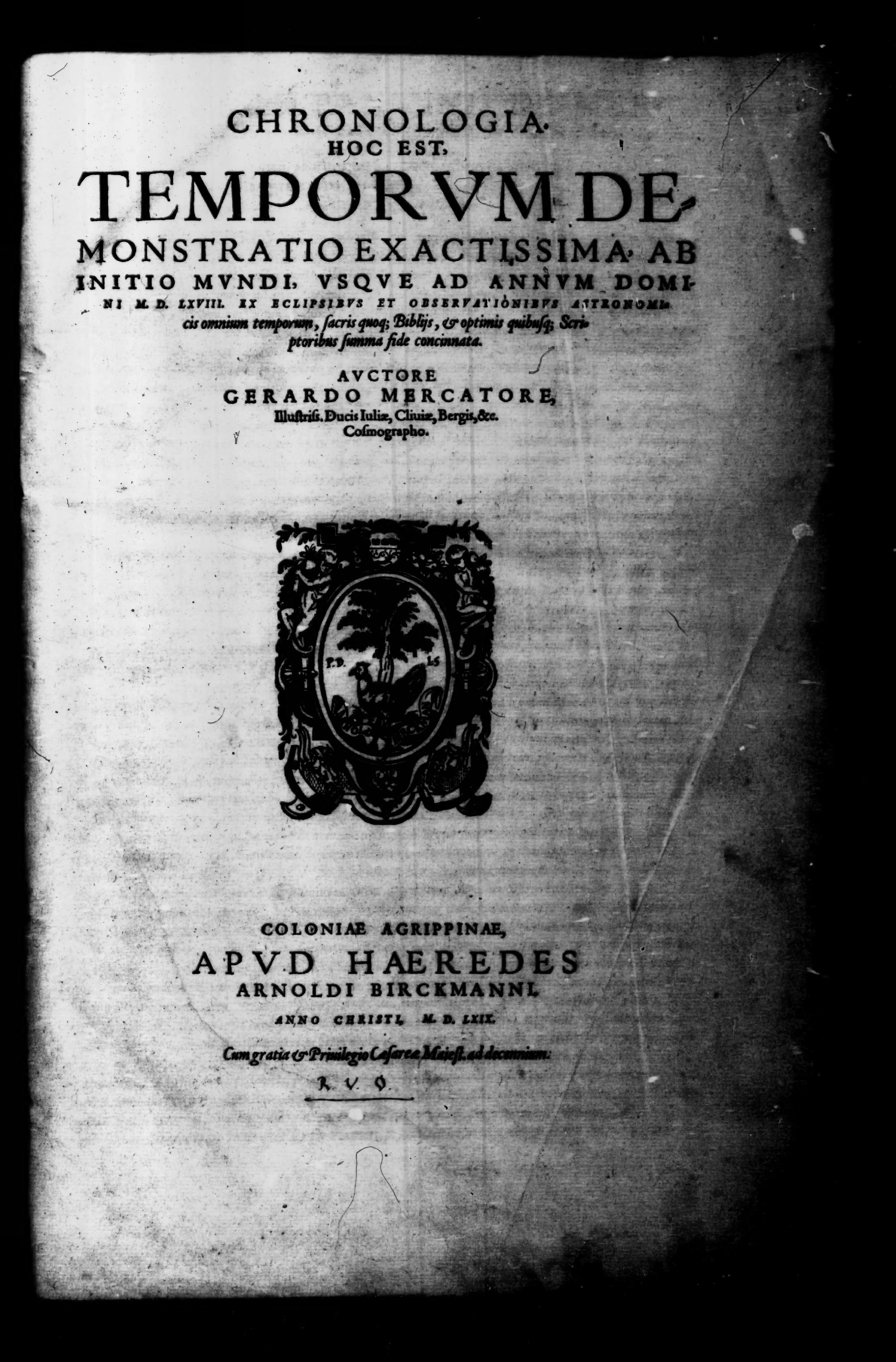
The title page announces the work's governing claim — TEMPORVM DEMONSTRATIO EXACTISSIMA — as a matter of proof and exact reckoning, running to 1568 while printed in 1569. Beneath the Birckmann hen device, the imprint COLONIAE AGRIPPINAE, APVD HAEREDES ARNOLDI BIRCKMANNI supplies the publisher and place. Source ↗.
That programmatic claim is cashed out lexically in the body of the work, where the compiler's characteristic formula of conjectural correction, legendum puto — "I think it should be read" — is applied directly to the numerals of a classical authority, as when the foundation of Cyrene is recorded in the 143rd year of the City with the immediate proposal that 153 be read instead, Cyrenæ oppidum conditum est anno Vrbis 143. (153. legendum puto) Plin. lib. 19. cap. 3. The same verb governs a distinct and more mathematical operation, the reconciliation of two irreconcilable testimonies by emending one of them to a figure equidistant from both: Amasis king of Egypt is assigned 55 years on Diodorus, 44 on Herodotus, and 54 by emendation, with the justification that once the mean is posited each authority speaks truly, Amasis rex Aegypti annis 55. Diod. Herod. 44. ponit, sed legendum puto 54. tunc enim posito medio vterq[ue] verum dicit. Demonstratio in this title is thus not a claim to have received a proof but to have constructed one, by textual criticism as much as by calculation.
The phrase observatio astronomica is likewise stronger than a generic reference to information. In the intellectual vocabulary of the period, an observatio could denote a recorded celestial occurrence, a calculated astronomical datum, or the result of an established observational tradition. All three senses operate at once where an ancient observation is collated with a modern computation and the modern computation corrected, the interval between two mid-eclipse moments being reckoned in equated time from the nineteenth year of Hadrian and the discrepancy assigned to Copernicus, Duflat huius medium à medio eius, quam Ptolomeus obseruauit anno 19. Hadriani, tempore æquato annis Aegyptijs 1. 88. diebus 102. horis 2. 34. Copern. Abundat hæc distantia apud Copernicum anno 1. Mercator’s title joins such observations to Scripture and the “best” authors, producing a hierarchy in which astronomical evidence, sacred history, and classical testimony are made mutually commensurable. The work’s period sense of aevum and monarchia, where those organizing terms occur in its chronological architecture, belongs to sacred and imperial periodization: an aevum is an epoch defined by a dispensation or historical condition, while monarchia refers to a succession of universal empires, especially within the Danielic model of historical sovereignty. These terms should not be read as neutral equivalents of modern period labels; they encode providential sequence, scriptural interpretation, and the transmission of imperial authority.
A second stratum of chronological vocabulary concerns the eras themselves, the counted year-series by which the periodization is made computable. Here the philological and the astronomical converge, since an era can only serve as a synchronizing instrument once the calendrical moment of its epoch has been established: the Seleucid years of Scripture are accordingly defined as beginning from the month Artemisius, that is, not far from the vernal equinox, on the pattern of the Hebrew year and on the authority of 2 Maccabees, Anni Seleucidarum in sacris literis initium suu[m] habent ab Artemisio mense, hoc est, no[n] longe ab æquinoctio verno, vt Hebræorum anni, quod patet ex 2. Mach.11. v.21. 33. Institutional cycles receive the same treatment, the indictions being introduced as a fifteen-year series whose first beginning is referred to a determinate point, constitutæ sunt Indictiones 15. annos complectentes, & primum earum initium ad. Terms such as indictio, aera, Alhegira and Sabbatum terræ are therefore technical operators within the work's reckoning, not ornamental period labels, and their definition is itself part of the demonstration the title promises.
Summing Up Mercator's Chronologia: Scope, Sources, and the 1569 Imprint
Gerardus Mercator’s Chronologia is a Latin universal chronological and astronomical treatise, not a private chronicle or narrowly mathematical table-book. Its title defines its chronological range as extending from the beginning of the world to 1568 and presents its method as a synthesis of eclipses, astronomical observations, sacred Scripture, and authoritative historical writing. That last category is visibly operative in the text, where the Nativity is dated by the regnal year of Augustus on the authority of a late-antique Christian universal historian, Christus Iesus natus anno 42. Augusti propemodumè menso. Paul. Orosius lib. 7. ca. 2, so that scriptural event, imperial fasti and patristic testimony are brought into a single dated series. The accessible bibliographic record identifies Gerhard Mercator as author, dates the publication to 1569, attributes the printing or publishing label to Birckmannus, and records a length of 340 pages. A second catalogue record gives the same author, title, year, and endpoint.
Cologne is the conventional bibliographic location associated with the 1569 issue, but the accessible digital metadata did not expose the title-page or colophon wording needed to verify the complete formula apud haeredes Arnoldi Birckmanni. The record therefore securely establishes the author, title, endpoint, year, and Birckmann imprint label, while the full place-and-colophon formulation remains to be checked against page images.
The work is composed in Latin. No complete English, German, French, or other modern-language translation was located in the accessible catalogues and digitized records. The evidence supports describing it as an early modern Latin synthesis of universal history and technical chronology, organized throughout by the subordination of historical testimony to computable astronomical and calendrical frameworks; it does not support assigning a confirmed place of composition, a securely identified dedicatee, or a specific translation history.
Placing Mercator Between Universal History and Scaliger's Chronology
The Chronologia matters because it occupies a productive border between several learned practices: universal history, biblical chronology, astronomical computation, humanist source criticism, and Mercator’s larger cosmographical enterprise. Its title does not describe a simple list of reigns. It claims an exact demonstration of temporal order assembled from celestial phenomena, Scripture, and historical authorities. The mechanism by which celestial phenomena do chronological work is visible where a lunar eclipse serves simultaneously as the epoch of a Greek astronomical period-scheme and as the fixed point dating a battle known from a biographical source, Eclipsis Lunæ, à qua Calippus suas periodos 76. annorum inchoat, & 2. post nocte, vt ait Plut. in vitis pag. 260. b. inita pugna cum Darij copijs prope Arbelam ab Alexandro, where the eclipse fixes both the calculated cycle and the narrative testimony that must be fitted to it. That combination makes the work valuable for studying how sixteenth-century scholars attempted to reconcile inherited chronographic systems with increasingly exact astronomical calculation.
Its historical significance is best understood as transitional rather than teleological. The work belongs to the tradition of universal history associated with Christian chronicle-writing and Reformation-era annals, yet its title also anticipates the more technical chronology associated with Joseph Scaliger and later seventeenth-century chronological scholarship. The relevant historiographical question is not whether Mercator was already practicing a modern science of chronology, but how he negotiated different kinds of authority: biblical sequence, classical testimony, ecclesiastical computation, astronomical observation, and the chronological claims embedded in political history. The negotiation is sometimes conducted openly, in declarations of editorial procedure — consuls omitted by other compilers are inserted on the authority of Vopiscus and their insertions marked, Hos Coss. ab alijs prætermisso hic in seruimus autoritate Vopisci, locis hic à — and sometimes by inference from silence, as where a consul-less year is defended on the strength of a narrative historian's account of civic disorder, sine consulibus hunc annum transactum esse, satis ex Dione magnas reip. deturbationes sub Caluini & Messallæ, maximas sub Ponipei III. consulatum describente, apparet,. Both procedures belong to antiquarian fasti scholarship rather than to calculation, and they sit inside the same apparatus as the eclipse computations.

An engraved portrait titles its subject “Gerardus Mercator Cosmographus” and pairs the bust with a globe and compasses rather than books alone. That identity helps situate the Chronologia’s hybrid method: the scholar who weighed biblical, classical and civic authorities also brought astronomical observation to bear on historical time. Source ↗.
Anthony Grafton’s scholarship on Joseph Scaliger and the history of chronology is the most directly relevant modern framework located in the available scholarship. Grafton treats chronology as a history of scholarly practice, source criticism, intellectual networks, and contested historical authority; his book is explicitly described as telling “the stories of chronology and of Scaliger himself.” That framework helps position Mercator’s work before the better-known systematization of chronology associated with Scaliger’s De emendatione temporum. It also cautions against treating astronomical exactness as a simple replacement of humanist philology: the period’s chronological arguments depended on the critical handling of texts as much as on calculation. The point is well illustrated by the work's biblical prosopography, in which a scriptural narrative is assigned to a reign by collation and onomastic argument rather than by computation, so that the Nebuchadnezzar whose deeds the book of Judith recounts is declared to be Darius, Darius hic omnino est ille, cuius res gestas historia Iudith complectitur sub nomine Nabugodonosoris. Astronomy adjudicates where it can reach; where it cannot, philology and the comparison of names and reigns carry the argument.
The work also bears on the historiography of Reformation historical writing. Its title and subject place it near the universal-chronicle tradition represented by Melanchthon and Carion, Johann Funck, and Heinrich Bucholzer, while its astronomical claims distinguish it from a purely confessional annal. The accessible scan metadata exposes references to Orosius and Paolo Giovio and terms associated with the Seleucid era, the nineteen-year cycle, the Sabbath of the land, and syzygies. Those clues are borne out by the text, which cites Orosius for the date of the Nativity, defines the Seleucid epoch against the vernal equinox, and turns the decemnovennal cycle into an object of astronomical criticism, concluding that the astronomical calculation and the reckoning of the nineteen-year cycle stand two days apart, Calculus igitur Astronomicus, & cycli decemnoualis ratio hoc tempore duobus. Such a demonstration situates the work squarely within the pre-Gregorian discussion of the ecclesiastical calendar's accumulated error, though the accessible OCR does not permit a reliable chapter-by-chapter reconstruction. The same critical temper governs the handling of modern historians of the Church and of the French monarchy, where the death of John of Valois and the length of his successor's reign are reported with the divergence of Onofrio Panvinio and Du Tillet and settled by the maxim that truth holds the middle, 6. Cal. Aprilis, an. 1364. obijt Ioannes Valesius rex Franc. succedit eius filius Carolus 5. Sapiens Valesius, qui regnat annis 17. Onuph. Til. scribit 16. medium habet veritas — the same arbitration principle already applied to Diodorus and Herodotus, now extended to sixteenth-century ecclesiastical and dynastic scholarship.
The confessional dimension remains important but must be stated cautiously. A chronology that records the sixteenth-century Reformation, imperial conflict, ecclesiastical succession, and calendar controversy would make confessional history part of a universal temporal order rather than isolate it as a separate polemic. Yet no located page image or scholarly source verified the precise treatment of Luther, Trent, the Schmalkaldic conflicts, the Netherlandish iconoclasm, or the alleged censorship rationale. Those topics should therefore be treated as questions for direct textual analysis, not as established conclusions from the accessible catalogue evidence.
No reliable evidence was located showing that Scaliger, Kepler, Calvisius, or another later chronologer directly cited, praised, or attacked this particular 1569 volume. The absence of a located citation is not proof that no such reception existed; it means that the reception history remains open. A comparable candour about the limits of the record is characteristic of the work itself, which marks the first appearance of the Turks in Roman history with an explicit qualification of the compiler's own knowledge, Hæc prima Turcarum in Romana historia (quantum ego sciam) mentio est. The work’s importance is consequently both positive and methodological: it is a substantial, apparently rare material witness to the intersection of Mercator’s cartographic humanism with technical chronological scholarship, but its full historiographical significance depends on recovering the primary text, its paratexts, and authoritative copy-level records.
Tracing the 1569 Birckmann Imprint: Copies, Conflations, and Open Questions
The strongest directly recoverable bibliographic evidence comes from two Google Books records for scans originating in the Bayerische Staatsbibliothek. They identify the work as Chronologia, Hoc Est Temporum Demonstratio Exactissima, Ab Initio Mundi, Usque Ad Annum Domini M.D.LXVIII, by Gerhard Mercator, published by “Birckmannus” in 1569, with a recorded length of 340 pages. Stable digitized records are available at Google Books, scan 1 and Google Books, scan 2. The catalogue metadata identifies the first scan as originating from the Bavarian State Library and records its digitization on 2 January 2022. The separate catalogue record for the title gives Google Books identifier Ck0znQEACAAJ: https://books.google.com/books?id=Ck0znQEACAAJ.
The title’s internal date, 1568, is not an alternative publication date in the accessible records; it marks the chronological endpoint. The publication year is consistently given as 1569. A later record identifies a 1577 Mercator chronology published per Thomam Guarinum and records 923 pages: https://books.google.com/books?id=vpIOjwEACAAJ. That record does not expose the place of publication, full collation, or a formal relation between the 1577 issue and the 1569 Cologne printing. A Basel reissue, a 1568 title-page state, and the precise incorporation of the chronology into the 1595 Atlas therefore remain bibliographic hypotheses requiring examination of individual copies rather than assertions established by the accessible records.
The material record is insufficient for a definitive collation. The accessible metadata does not expose the full signature sequence, leaf count, folio statement, ruled-table construction, woodcut inventory, or the claimed extended alphabetical signatures. Nor does it reveal a dedication, addressee, or patron. The 340-page figure is a catalogue length, not a substitute for a collational formula. No USTC number, VD16 number, or OCLC number for the 1569 issue could be located in the accessible search results, and no complete shelfmark for a physical copy was recovered. A copy census of four institutions therefore cannot responsibly be supplied without further catalogue verification.
The Birckmann context is nevertheless materially significant. A printer’s-device record describes Arnold Birckmann’s hen device as being used for a work printed by one of his heirs, while the British Museum authority record characterizes Arnold Birckmann as a Cologne publisher-printer whose heirs continued the business. This supports identifying “Birckmannus” as a family publishing and bookselling imprint, but it does not prove that the heirs themselves performed the presswork of Mercator’s volume. The actual Cologne printer, if different from the Birckmann firm, remains unestablished in the accessible evidence. The full wording sub pingui gallina and the complete colophon likewise require inspection of a page image.
The work has been vulnerable to bibliographic conflation with an unrelated homiliary. The record for D. Eusebii Emisseni homiliae in evangelia describes a collection of Sunday and Lenten homilies attributed to Eusebius of Emesa; it is not a chronological treatise by Mercator. Its subject, genre, authorial attribution, and title are distinct from the 1569 Chronologia. The accessible evidence does not, however, establish the precise catalogue history by which the two records may have been confused. Eusebius of Emesa must also be distinguished from the pseudonymous corpus known as Eusebius Gallicanus and from later attribution debates involving Faustus of Riez.
The accessible evidence does not establish a Roman, Spanish, or Netherlandish Index entry for the Chronologia, nor does it document expurgated copies, cancelled leaves, inked-out passages, or a prohibition grounded in the inclusion of Reformation events. Mercator’s arrest at Rupelmonde, emigration to Duisburg, and confessional positioning are important biographical contexts, but they were not independently documented by the located catalogue records. Similarly, the asserted 2 April 1567 Duisburg eclipse, the lunar anomaly, the use of Ptolemaic, Alfonsine, Copernican, and Prutenic tables, and direct citations by Scaliger, Kepler, or Calvisius require direct textual or specialist secondary-source verification. On the first of these the text itself speaks in the first person and to the minute, recording a solar eclipse of 2 April 1567 whose beginning and end were exactly observed at Duisburg, 2. Aprilis anno 1567. facta est eclipsis Solis, cuius initium exacte obseruauimus hora 10. antemeridiana & minuto 25. finem quoque hora 1. 0. pomeridiana Duysburgi, and the collation of a Ptolemaic observation against Copernicus quoted above shows the modern tables being used critically rather than merely cited; the remaining items in that list, and above all the alleged later citations, are still to be substantiated from authoritative bibliography.
Mercator’s wider corpus provides an interpretive setting rather than a fully documented transmission chain. The 1592 Evangelicae historiae quadripartita Monas is independently catalogued as a 1592 work of 204 pages originating from the National Library of the Czech Republic, but that record does not demonstrate its precise relation to the Chronologia. The accessible materials likewise do not establish, from the 1595 Atlas itself, the exact architectural place assigned to chronology within the projected Cosmographia. Claims about the 1554 map of Europe, the 1569 world map, the 1578 Ptolemaic tables, the Roman commentary, and the posthumous Atlas should consequently be treated as corpus-level research directions until corroborated by authoritative bibliographic or textual evidence.
How Mercator Builds the Argument: From the Gospel Harmony to the Ottoman Column
The Evangelical Harmony as a Chronological Instrument
The volume's movements are best followed in the order in which they are printed, beginning with the harmony of the evangelists on which its central date depends. The Passion and Resurrection material is presented not as continuous narrative but as a fourfold ruled comparison, the columns headed Matthæus, Marcus, Lucas and Ioannes, each carrying its evangelist's chapter numeral in the margin and each pruned by the printed &c. wherever the wording does not bear on the succession of events. The quire signatures d iii and d iiij running beneath these columns mark the apparatus as a discrete printed unit within the book, a speculum to be consulted rather than read through. What the layout makes visible is not concord but the precise points at which the four testimonies fail to agree, and the disagreements it exposes are overwhelmingly temporal: the hour, the day, the interval. Mark's women reach the tomb at first light with the sun already risen, Et valde mane vna sabbatorum veniunt ad monumentum orto iam Sole., whereas in the adjacent column Mary Magdalene comes early on the first day of the week while it is still dark and sees the stone taken away from the tomb, Vna autem sabbati Maria Magdalene venit mane, cum adhuc tenebræ essent ad monumentum, & vidit lapidem sublatum à monumento.. Set in parallel, orto iam Sole and cum adhuc tenebræ essent become a datum of the sort the rest of the volume is built to handle — two authorities irreducibly split on a measurable quantity. The harmony is thus not a devotional instrument but a chronological one, the scriptural counterpart of the collated fasti and the collated eclipse records: it converts sacred narrative into testimony that can be checked, hour against hour.
At the foot of the fourth column the compiler's own voice breaks into the scriptural text, and the note it makes is the methodological hinge of the whole exercise. John's twenty-first chapter, he observes, calls the appearance at the sea of Tiberias the third manifestation of Christ, whereas by his count it was the fifth; John numbers only the three later manifestations made in Galilee, passing over the two earlier ones at Jerusalem, from which it appears that the apostles' meetings with the risen Christ were more numerous than the ones written down, Ioan. 21. v. 14. tertiam Christi manifestationem dicit factam esse ad mare Tiberiadis, quæ tamen 5. erat, veru[m] posteriores tres tantum in Galilea factas hic numerat, priores duas Hierosolymis prætereundo. Ex quo apparet plures Apostolorum congressus fuisse quam scribantur.. The reasoning is worth unpacking, because it licenses everything that follows. An apparent numerical contradiction between an evangelist's ordinal and the compiler's tally is resolved not by emending the numeral — the procedure applied elsewhere to Pliny and Herodotus — but by positing selective enumeration: the sacred author counts within a restricted class, here the Galilean appearances, and is therefore true within his own frame while incomplete as a record. The corollary drawn is far stronger than the local problem requires, namely that events omitted from Scripture nonetheless occurred. Scriptural silence is thereby reclassified from evidence of non-occurrence into a mere gap in the register, and the chronologer acquires warrant to insert unrecorded events where the temporal structure demands them.
That warrant is immediately spent in the chapter on the day of the Lord's Passion and the conjunction of the luminaries that preceded it, De die passionis Domini, & coniunctione luminarium, quam præcessit, which opens by declaring what the harmony has shown, that a full four years and more of Christ's teaching appear from the mirror of evangelical harmony, so that he lived beyond thirty-three years, the matter resting on five Passovers of which the first four are manifestly gathered from John and the fifth from the other evangelists as well, the first being described most luminously by John in his second chapter, Apparet ex speculo harmoniæ euangelicæ quadriennium integrum, & quod excurrit Christum docuisse, atque adeo suprà 33. annos vixisse, quæ res in quinque pascatibus posita est, quorum quatuor priora manifeste ex Ioanne, quintum verò ex alijs quoque euangelistis colligitur, quorum primum ipse Ioannes 2. capite luculentissime describit.. The five Passovers are not equally attested, and the compiler concedes as much: two of them are recovered by inference. The second is reconstructed from the interval of four months to harvest given in the Samaritan episode, combined with the sheer quantity of Galilean preaching, healing and travelling that follows, from which it is concluded that Christ cannot have set out from Judaea without having kept a Passover at Jerusalem. The fourth is established by the same species of argument in a more explicit form: it is not likely, he writes, that Christ accomplished so many and so long journeys, with manifold teaching and healings, in six months rather than in a far greater time, and therefore it is necessary to interpose a fourth Passover between the third and the Feast of Tabernacles of John 7, this Passover being proved from Luke 9 to fall at the time of the Transfiguration, Tot autem tam varias & longas profectiones cum multiplici doctrina, & sanationibus non 6. mensibus, sed maiore longè tempore Christum peregisse verisimile est, sic ergo neceßarium est quartum pascha inter tertium & scenopegia Ioan.7. interponere, & hoc pascha in tempus quo Iesus transfiguratus est, ex Luca 9. probamus.. The pivot from verisimile est to neceßarium est within a single sentence is the argument's most exposed joint: a judgement of probability about how much itinerant activity can be compressed into half a year is converted, without further mediation, into a necessity governing the insertion of a feast the Gospels do not name. It is precisely the inference the note on John 21 had prepared, applied now not to appearances of the risen Christ but to the Passovers on which the length of the ministry, and hence the year of the Passion, depend.
The Year, the Day, and the Anomaly of the Moon
With the ministry thus extended, the year follows from the architecture of the book rather than from any fresh computation, and the tone shifts abruptly from laborious inference to declaration: since by the progression of times already determined no other year falls in that place than the four thousandth of the world, there is no doubt that the Passion must fall in that year, a matter so clear, and so established from the entire fabric of the work and from the synchronism of the years of the world and of Rome, that it needs no further proof, Iam vero cum ex progressu temporum antè determinato non alius annus in eum locum incidat, quàm 4000. mundi, dubium non est, quin passio Christi in eum annum incidere debeat. Quæ res ita clara est, & ex integro operis huius contextu, ac synchronismo mundi, & Romanorum annorum constat, vt vlteriore probatione non egeat.. The round figure of Anno Mundi 4000 is thus not argued for at this point but cashed out of the synchronismus — the parallel columns of eras that run through the volume — and the appeal to the integer contextus of the work makes the whole compilation stand surety for one of its own numbers. The day, by contrast, is conceded to require external adjudication, and astronomy is summoned in the formal idiom of consultation: the astronomical calculation has therefore been consulted, which shows, as will be demonstrated in the individual eclipses, that a conjunction of the luminaries occurred at the very Passion, for the day of Christ's Passion cannot be determined with certainty by any other reasoning than from the conjunction of the luminaries and what follows upon it, the full moon and the Passover of the Jews, Consultus est ergo Astronomicus calculus, qui vt in singulis eclipsibus ostendemus, coniunctionem luminarium in ipsa passione Christi factam esse ostendit. Neque enim alia ratione, quàm ex coniunctione luminarium, & quæ eam sequuntur, plenilunium & pascha Iudæorum, dies passionis Christi certo determinari potest.. The chain is explicit and strictly ordered: syzygy, first visibility of the crescent, the fourteenth day of the moon, the Jewish Passover, the weekday.
The execution of that programme immediately discloses an obstacle the compiler treats as his own discovery. The true motion of the Moon will not carry the reckoning to the day of the Passion, he explains, on account of the inequality of the Moon's motion from the Sun and an anomaly hitherto noticed by no one, mentioned in his third chapter, propter motus Lunæ à Sole inæqualitatem, & anomaliam a nemine hactenus animaduersam, cuius meminimus capite tertio. The claim to priority is remarkable in a compilation otherwise scrupulous about naming authorities, and its consequence is a deliberate methodological retreat: because the vera coniunctio computed from the tables of Ptolemy, the Alfonsine tables or Copernicus cannot fix the moment of midnight that he takes as the ordinary beginning of the Hebrew day, the mean conjunction is preferred as the safer instrument, for from the mean conjunction, at this period, a true and undoubted beginning of the day is taken, since the true conjunction falls upon it or very near it, Ex media autem coniunctione, hoc quidem tempore, verum & indubium sumitur diei principium, quia in ipsam vel proxime incidit vera.. The paradox is deliberate: a calculated abstraction is judged more trustworthy than the corrected true position, because the correction depends on a lunar theory known to be defective.
From this follows the chapter's most ingenious device, a differencing of errors. Since the Moon's motion from the Sun is nearly everywhere unequal, a more exact collection should be taken from a neighbouring Ptolemaic eclipse, yet so that the same error of motion be supposed in that eclipse as in the conjunction sought, and thus that accidental difference of the motions be removed from the computation, Verum quia motus Lunæ à Sole per omnia tempora fere inæqualis est, videtur exquisitior collectio ex vicina Ptolemæi eclipsi sumenda esse, sic tamen vt & in ea eclipsi eundem motus errorem, quem in quæsita coniunctione supponamus, atq[ue] ita motuum accidentalis illa differentia à computo tollatur, hoc modo.. An observed eclipse near in time to the target date is made to absorb the systematic defect of the tables, and only the interval between the two syzygies is trusted; the number of intervening syzygies is then counted out — 1051 in the Ptolemaic collection, 18760½ in the reduction from a mean conjunction of July 1567 — and the mean motions of anomaly, latitude and the Sun are subtracted term by term. The three sets of tables, worked through in parallel, yield conjunctions that do not coincide, Ptolemy giving 21 April and the Prutenic tables 6 May at a different hour, and the compiler resolves the divergence not by adjudicating between the authorities but by taking a middle place between them, exactly the arbitration by medium that governs his treatment of discordant historians. The day of the Passion is thus fixed by the same instrument that fixes a disputed regnal length: computation where computation reaches, and where the tables themselves disagree, the mean.
Emendation and the Arithmetic of the Columns
The same procedures are at work in the ruled tables that occupy the bulk of the volume. The closing pages of the first of the four monarchies, where the running heads still announce the divided Assyrian empire, display in miniature the operation that governs the whole apparatus. A classical authority is cited with full apparatus of book and chapter, and its numeral is then overruled in the same breath: the foundation of Cyrene is entered on Pliny's authority in the 143rd year of the City, with the correction to 153 proposed in the same line by the formula of conjectural reading already discussed above. The parenthesis is the characteristic device: it does not suppress the transmitted figure but sets the conjecture beside it, so that the reader of the columns can see both the datum received and the datum used. What licenses the correction is stated a page later, where the two years assigned to Evil-merodach on the authority of Berossus are replaced by twenty-three, the reason being that the reigns then square from Nebuchadnezzar to the monarchy of Cyrus, At idem Berosum citans 2. annos ponit. Crediderim hoc loco legendum 23. pro 2. nam sic quadrant anni regu[m] à Nabugod. ad Cyri monarchiam,. The verb quadrant is the pivot of the argument. No appeal is made to the state of any exemplar; the criterion is the arithmetical closure of the series as a whole, so that a single regnal figure is judged by whether it allows the sum of an era-column to meet its terminus. In a synchronistic table of this kind the columns are not a display of results but the instrument of proof, and an isolated testimony that will not sum is, by that fact alone, held to be defective.
The same subordination of the individual witness to the computable series shapes the treatment of Scripture, but with a different valence. At the release of the Babylonian captivity, the beginning of a new era-column, Jeremiah's oracle is entered as though it were itself a dated document, together with the leaders of the first return — when seventy years shall have begun to be fulfilled in Babylon, I will visit you, and so forth, Jeremiah 29:10, the leader of the first transmigration being Zerubbabel and the high priest Jeshua — Cum coeperint impleri in Babylone 70. an. visitabo vos, &c. Ierem. 29. v. 10. Dux trasmigrationis primæ fuit Zorobabel, & summus pontifex Iesua,. Prophetic arithmetic and administrative prosopography stand in one annotation, and the seventy years operate simultaneously as an oracle whose fulfilment is a theological fact and as an interval whose endpoints must be fixed if the Persian column is to be secured. That double status is what makes biblical names a chronological problem rather than a given. Where regnal titles in Scripture resist the sequence, the resolution is philological and internal: the Artaxerxes who halted the temple works is identified with Cambyses purely by collation of verses, Hic Cambyses vocatur Artaxerxes 1, Esdræ 4.v.7. vt constat conferendo. v. 23. & 24. eiusdem. Nothing here rests on doctrinal authority; the proof is a demonstration that one passage read against another compels the equivalence, with the substantial consequence that the interruption of the rebuilding falls in a determinate reign.
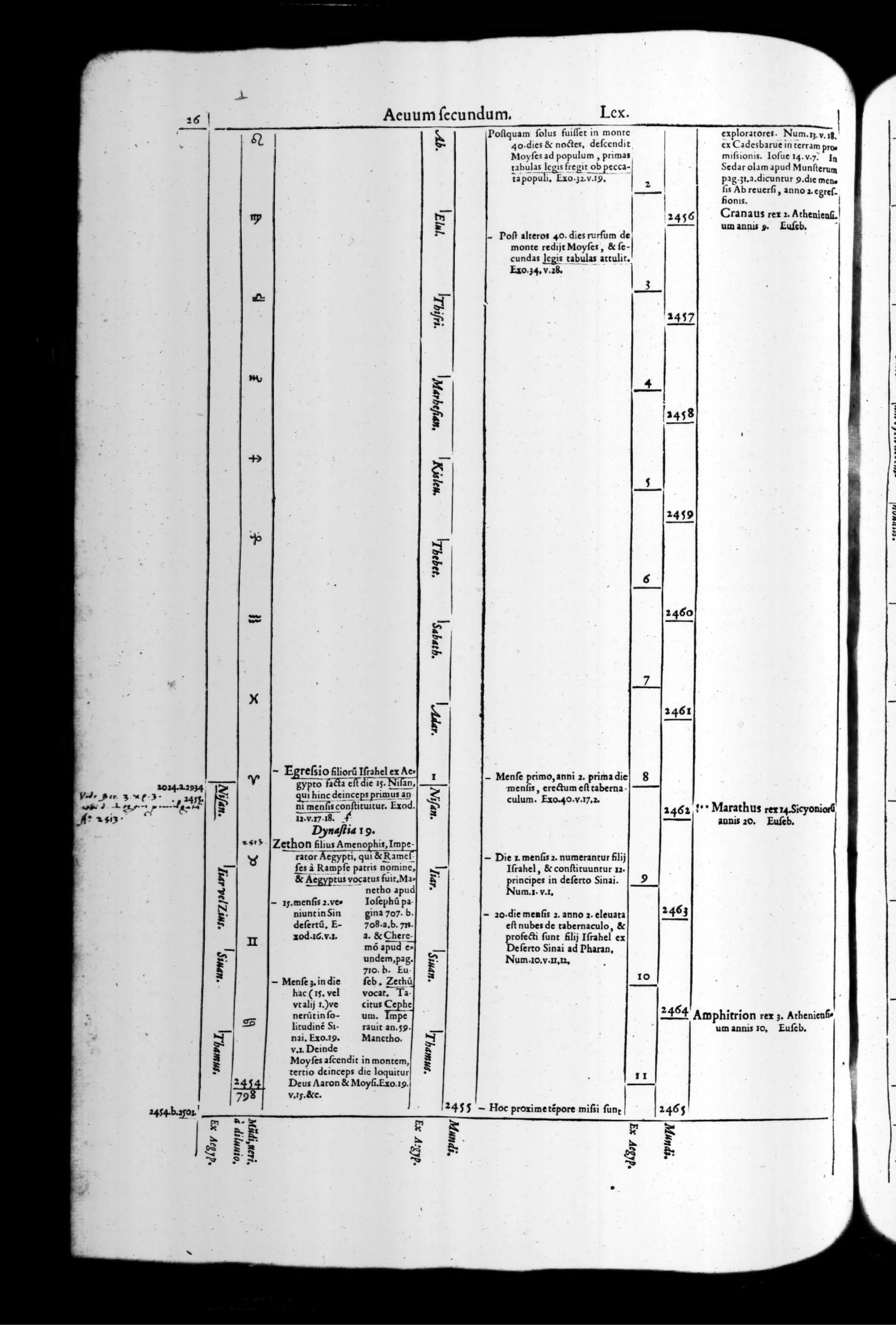
Under the running head “Aeuum secundum. Lex.”, ruled columns assign the Exodus and wilderness narratives to Anno Mundi and period years while Athenian kings and an Egyptian dynastic notice keyed to Manetho run alongside. Prophetic intervals and biblical names become data to be fixed within a computable series. Source ↗.
The most extended application of that technique is the argument that the Nebuchadnezzar of Judith is Darius son of Hystaspes, and its most delicate moment is not the identification itself but the explanation of how the name came to be transferred. Two mechanisms are offered disjunctively — either the Jews wished to designate in this king a cruelty plainly like that which was in the famous destroyer of the city, or Darius himself drove home by the name a terrible threat to rebels — Porro nomen Nabugodonosoris datum est Dario, siue à Iudæis volentibus crudelitatem in hoc rege designare similem plane illi quæ fuit in vrbis illo vastatore Nabugodonosoro, siue ab ipsomet Dario, terribilem hoc nomine comminationem rebellibus inculcante. The siue … siue construction is doing precise logical work: the thesis does not require either explanation to be established, only that some intelligible mechanism exist, and it therefore converts a chronological embarrassment into an onomastic phenomenon. "Nebuchadnezzar" becomes an appellation of tyranny rather than a personal designation, so that a scriptural book may be dated by the events it narrates instead of by the name it uses. The move is expensive in one respect and economical in another: it surrenders the transparency of the biblical text as a naming authority in order to preserve the integrity of the reign-series into which the narrative must be fitted.
Profane historians are handled with the same diagnostic vocabulary, though with less ceremony. An eleven-year figure in a printed Diodorus is dismissed outright, In Diod. pag. 381. b. leguntur 11. anni, sed mendu[m] est,. That the citation is by page and column of a particular edition matters: the object criticized is not an abstract "Diodorus" but a specific printed page, and the notion of mendum locates the fault in transmission — elsewhere in these annotations ascribed to the negligence of copyists — rather than in the historian's knowledge. The distinction protects the authority of the ancients while making their numerals endlessly revisable, which is precisely the freedom the tabular method requires.
Eclipse, Fasti, and the Cycles of Law and Grace
Against this background the astronomical annotations acquire their function. With Alexander's crossing the recto heads announce the third monarchy, that of the Greeks under the sign of the leopard, Græcorum monarchia tertia. Pardus. 115, and within that section stands the evidentiary centrepiece of the whole reckoning: the lunar eclipse already discussed above, from which Callippus begins his periods of seventy-six years and after which, two hours into the following night, Plutarch places the joining of battle with Darius' forces near Arbela. Three kinds of evidence are here made to intersect at one instant: a Greek astronomical period-scheme whose epoch is the eclipse, a computable celestial event, and a narrative detail of interval preserved by a biographer. The eclipse is not adduced as a portent but as the one term in the group that can be recomputed at will, so that the literary testimony of the hour becomes a check on the calculation and the calculation a check on the testimony. This is the mechanism by which a table of reigns claims the status of demonstratio.
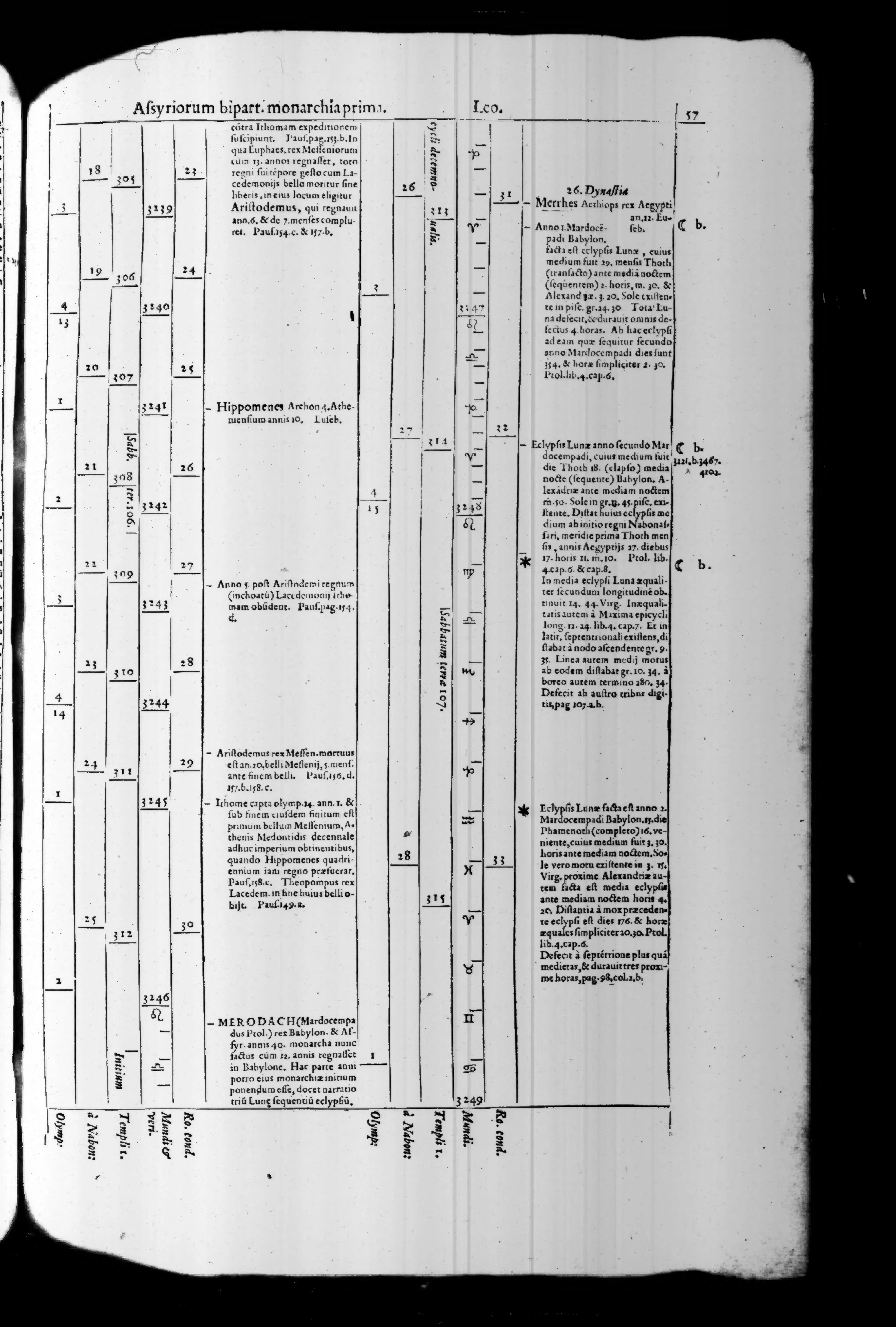
Ruled columns align Olympiads, Nabonassar years, Temple and world eras and Roman dating with notices on the Messenian kings and Ptolemaic Babylonian lunar eclipses under Mardocempadus. Historical testimony sits beside celestial events recalculable to hours, minutes and digits — the logic that makes a table of reigns a demonstration. Source ↗.
Yet the annotations are equally candid that many questions cannot be reached by computation, and there the appeal is to a community of scholars. Dismissing certain consuls from the fasti, the note assembles Livy's already quoted opinion, then Diodorus, the Fasti, the Greeks, Cassiodorus, Cuspinianus, and, in our own age, the most learned men Carolus Sigonius and Onuphrius Panvinius, sed ex Liuij iam recitata sententia, tum ex Diodori, Factoru[m], Græcorum, Cassiodori, Cuspiniani, & nostro sæculo doctissimorum virorum Caroli Sigonij, & Onuphrij Panuinij autoritate hos excludimus,. The sequence places sixteenth-century antiquaries of the fasti on the same evidential footing as ancient historians, and the accumulation is deliberately cumulative rather than hierarchical: authority here is a weight of converging opinion, the appropriate instrument where no eclipse can settle the matter.
The Levitical and Danielic cycles that run as their own columns are likewise made to bear evidential weight, not merely decorative parallelism. In the Maccabean sequence the sabbatical fallow year is used to confirm a placement, the sabbath of the land which is added in 1 Maccabees 6 falling in this year also, Et sabbatum terræ quod 1. Machab. 6. adijcitur in hunc quoq[ue] annum. A ritual institution with a fixed period thus behaves exactly as an astronomical cycle does: because it recurs at a computable interval, an incidental scriptural notice of a fallow year becomes a datable coordinate. The theological architecture is imposed in the same idiom. When the Temple falls, the verso heads that have carried the age of Law give way to the age of Grace, Acuum tertium. Gratia. 4034 a, the numeral of the year of the world standing immediately beside the name of the dispensation. Periodisation is thereby made a property of the page-layout itself: the reader learns which aevum he is in by looking at the head of the leaf, and the succession of dispensations is presented as no less measurable than the succession of monarchies.
The calendar receives the most technically exacting treatment of all, and its topical resonance in a century preoccupied with the drift of the ecclesiastical reckoning is unmistakable: Caesar established a year of 365 days and a quarter, to be compensated by a day intercalated every fourth year, but because the priests, not perceiving the error, made the intercalation at the beginning of the fourth year when they ought to have made it at the end, twelve days were intercalated in thirty-six years where only nine were owed, an error which the subsequent correction of Augustus removed, Constituit autem Iulius Cæsar annum 36. dierum & quadrantis vnius, quem quarto quolibet anno vno die intercalato compensari voluit, At verò cu[m] sacerdotes nô percepto errore initio quarti anni intercalationem hanc facerent, cum in fine debuissent, cun[n]it vt 36. annorum spacio 12. dies intercalarentur, cum 9. tantum debuissent, quem errorem Augusti subsequens castigatio sustulit — where the figure for the length of the year and one further word stand defectively in the printed line, though the sense of the computation is fixed by the fractional quarter and by the ratio of twelve days to nine. The narrative is structurally significant: an authoritative reform is shown accumulating error through the mishandling of its own rule by a priestly college, and being rectified only by a later intervention that restores the intention of the institution.
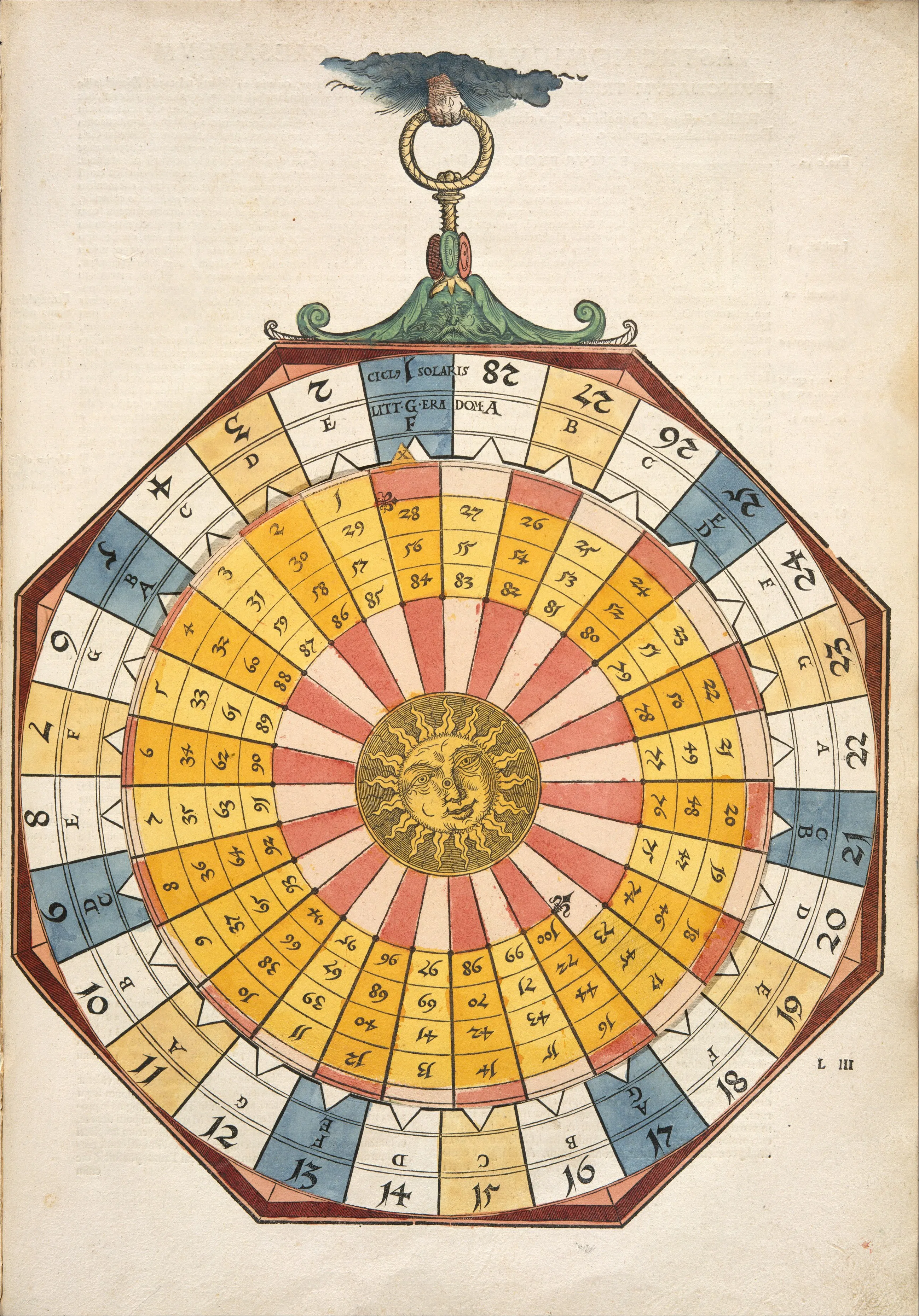
A rotating paper volvelle from Peter Apian’s Astronomicum Caesareum (1540) turns calendrical time into nested, manipulable cycles — the computational world in which dominical letters, epacts and Easter reckonings were tested against the heavens, and in which rules meant to regularize time accumulated error. Source ↗.
Ecclesiastical material enters the columns in the same annalistic register and with the same insistence on precision. Peter, prince of the Apostles, is recorded as first entering the City on the fifteenth of the Kalends of February in the second year of Claudius and as governing the Roman Church twenty-four years, five months and twelve days, on Panvinio, Petrus Apostolorum princeps primum ingressus est Vrbè 15. Cal. Febr. anno Claudij. 2. gubernauit Romanam Ecclesiam annis 24. mens. 5. diebus 12. Onuph. A datum of high confessional charge is thus entered without polemical marking, dated to the day and credited to a named modern authority, which is to say that it is offered as a chronological figure open to the same arithmetic as any regnal total. The sequence closes on a rare disclosure of the compiler's own valuation of eras, in a conjecture about imperial motive: it is altogether credible that Domitian wished to preserve the Olympiads of the Greeks, lest so convenient a means of distinguishing times should perish, Credibile omnino est Domitianum Græcorum olympiades voluisse conseruare, ne tam commoda temporum distinguendorum ratio intercideret,. The phrase temporum distinguendorum ratio names exactly what the columns of this book exist to supply, and the conjecture attributes to a Roman emperor the concern that animates the table: that an era, once broken, cannot be repaired by any later reckoner.
From Hadrian to the Fourteenth Century: The Table as Argument
From Hadrian to the middle of the fourteenth century the apparatus becomes still more strictly tabular, and its argument is carried as much by its printed architecture as by its notices. Each opening sets the year of Christ beside the year from the founding of the City, the year of the world in both a received and a veri or "true" reckoning, the Olympiads, the years from Nabonassar, the dominical letter and, from the fourth century, the indiction; the consular fasti run alongside, and against the year-columns stand dated notices on emperors, bishops of Rome, kings, amirae, eclipses and paschal computations. Governing every opening is a pair of running heads that fixes the whole apparatus within a providential scheme. The verso announces the third age, that of Grace, 162 Acuum tertium. Gratia, while the facing recto declares the fourth monarchy of the Romans under the sign of the Eagle, Romanorum monarchia quarta. Aquila. 163. The pairing is doctrinally exact and rhetorically economical: the dispensational division of sacred history (Law giving way to Grace) is printed against the Danielic succession of world-empires, with the beast-sign Aquila supplying the emblematic shorthand. Every consular year in this stretch is thereby doubly located — within a scheme of salvation and within a scheme of translated sovereignty — without a single line of commentary being expended on either. The heads are also mutable, and their mutation is itself a chronological statement: at the division of the empire the recto is reset and a rubric inside the table records the change, Bipartita Romanoru[m] monarchia b, the "bipartite monarchy of the Romans." What in a narrative history would require a chapter is here executed typographically, by altering a head and doubling the columns into Eastern and Western series.
Against this providential frame the technical apparatus operates on quite different principles, and the Antonine portion of the table devotes an entire page to the celestial data on which the political years depend. Observations are entered in Egyptian months and reckoned from Nabonassar and from the death of Alexander, beginning with a Venus observation made in the second year of Antoninus on Tybi 29, in the following night of the 30th, Obseruatio Veneris facta anno 2. Antonini Tybi 29. sequente 30. post. What follows on the same page is a chain of intervals rather than a series of synchronisms — Euctemon's solstice to Aristarchus's, Aristarchus's to Ptolemy's — and the demonstrative weight falls on the numbers of years between phenomena, which can be computed independently of any historian's testimony. That is why the page can turn its instrument against a modern authority as readily as against an ancient one: the interval Copernicus assumed between Ptolemy's autumnal equinox and his own observation is rejected, with the verdict that he therefore reckons one year more than is right, as was shown also at the year of Christ, quare vnum annum plus iusto computat, quemadmodum &c anno Christi. Two features of this brief sentence repay attention. First, the internal cross-reference (quemadmodum … anno Christi) presupposes a reader who will move backwards and forwards between entries: the table is constructed to be consulted as a cumulative argument, not read as a list. Second, the correction is directed at the very tables from which much of the work's own computation derives, which establishes the hierarchy the volume everywhere maintains — recorded observation adjudicates, modern computation is itself a witness liable to be found in error.
Where the astronomical record is silent, the compiler must fall back on the fasti, and the third-century movement shows what happens when those fail. The consular series thins, dated prose notices take its place, and usurpation is aggregated rather than narrated: the thirty tyrants who rose in diverse places and at diverse times under Aurelius Licinius and his son, 30. tyranni diuersis locis & temporibus sub Aurelio Licinio & eius filio, are gathered into a single tabulated notice ordered geographically from Antioch and Pannonia to Bordeaux and closed with a year of the City. The formula tyrannidem arripere, used impartially of pretenders in Gaul, Britain, Africa and Isauria, encodes a juridical presumption of rightful imperium against which each seizure is measured; but the tabular treatment does something further, absorbing a period of political disintegration into a frame that remains unbroken precisely because it is chronological rather than dynastic. The years continue to be countable even when the empire is not one.
The Paschal Series and the Repair of Damaged Witnesses
The fourth century supplies the institutional etiologies that the rest of the table will use as instruments, and with them the first entry in what becomes the most sustained technical controversy of this stretch. The divergence of Latin and Greek Easters in 330 — the Greeks reckoning the year embolismic and keeping the feast on 19 April, the Latins on 22 March — is entered not as a scandal but as a datable event, fixed to 21 March and identified as the first controversy concerning the Pasch, quod 21. Martij stabilitu[m] fuit. Hæc prima fuit controuersia de paschate. Calling it prima is a structural commitment: it opens a series, and the series (341, 360, 387, 403, 428, 445, 463 and onward) is what eventually permits a quantified conclusion about the ecclesiastical calendar itself.
The handling of that series discloses the philological temper of the work with unusual clarity, because its documents are not celestial but textual, and textual witnesses arrive damaged. In one case a discrepancy between eclipse notices in Marianus Scotus is diagnosed not as an author's mistake but as an artefact of the press, the eclipses being judged to belong to the consuls of the tenth year and to have been displaced by one year by the typographer, though even so the result will not stand, consules pertinere, & à typographo vno anno transpositu esse, tametsi ne sic. The reasoning is doubly critical: it distinguishes the transmitted state of a printed edition from the state of its exemplar, and then declines to accept even the emended figure. A comparable operation is performed inside a quoted document, where Ambrose's letter on the Pasch is reproduced with the compiler's correction interpolated into the text itself — in the eightieth year, read the seventy-eighth, from the day of Diocletian's reign, when the fourteenth moon fell on the ninth day before the Kalends, Anno 80. (78. lege) ex die imperij Diocletiani cum 14. Luna esset 9. Cal. The parenthetical lege makes the patristic testimony usable only after it has been repaired, which is the same subordination of witness to computation that governs the astronomical pages, transferred to the terrain of numerals in transmitted texts.
Two later notices mark the points at which the table changes its own method, and both are given as bare statements of institutional fact. The first records that after Decius Theodorus Paulinus, vir clarissimus, consuls ceased to be created in the West, on Panvinio's authority, Post Decium Theodorum Paullinum V. C. Consules in Occidente creari desiere. Onuph — after which the Western column must be dated post consulatum and the fasti yield to regnal, papal and exarchal series. The second is the coronation of 801, presented as a restitution rather than an innovation: the ancient manner of ruling the West being restored, he was the first to be called of the Romans, and was consecrated Augustus by Leo III, supreme pontiff, Romanorum Imperatorum auito Occidenti imperandi more restituto, primus appellatus, Augustusque consecratus est à Leone 3. pontifice Maximo. The vocabulary of restitutio and mos auitus keeps the monarchia quarta of the running heads intact across the rupture of 476: the empire has not ended and begun again but been resumed, and the interval since it failed in Italy is duly counted out in years, so that the Danielic scheme is sustained by arithmetic rather than by assertion.
The accumulated paschal and eclipse notices are then brought to their conclusion in the single quantified finding already discussed above, that the astronomical calculation and the reckoning of the nineteen-year cycle stand two days apart at this time. The force of the sentence lies in its igitur: the error is not alleged but inferred from the preceding series, its magnitude stated, its rate of growth measured against the centuries elapsed since Bede compiled his cycle, and its detection made reproducible by continuing Bede's own table forward. A liturgical instrument is thus arraigned before the heavens by the method the volume applies to historians and to printers alike. The same table that can convict the computus of a two-day drift is also open to political novelty, and it registers the newest of the monarchies by opening a fresh dynastic series: Othman, first king of the Turks, in the year of the Lord 1301, Othomannus primus rex Turcarum anno Domini 1301 — a house entered with the same columnar apparatus of years, indictions and authorities that had earlier served the consuls of Rome.
Popes, Sultans, and the Strain of the Schism
The closing stretch of the work compresses that apparatus further, presenting chronology in its most concentrated form: a synchronistic grid in which each printed opening carries, as running headline, the periodizing scheme within which every year beneath it is to be read. The recto head declares the present dispensation to be the fourth of Daniel's monarchies in its divided phase, Romanamonarchia quarta bipart, accompanied by the emblem-word Aquila., while the verso assigns the same years to the third age, that of Grace, 318 Acuum tertium. Gratia. Prophetic exegesis has here become page furniture. The Danielic monarchies and the three ages of sacred history are not argued but printed as standing headings, so that a fifteenth-century papal vacancy or an Ottoman accession is silently subsumed under a providential and imperial architecture; the columns beneath — Years of Christ, Mundi, veri, dominical letters, epact sigla, indiction marks — supply the calendrical machinery that makes each such year computable in several reckonings at once. The two world-year columns, one received and one "true," are the visible residue of the volume's central conviction that transmitted numerals require correction.
Within that frame the papal series is articulated by a fixed template, whose fullest form appears in the Avignon entries: on the day before the Ides of September 1362 Innocent VI died, the see stood vacant one month and fifteen days, and on the fifth of the Kalends of November Urban V succeeded, who sat, under the Emperor Charles IV Augustus, eight years, one month and seventeen days on Panvinius's authority, Pridie Idus Septemb. anno 1362. obijt Innocentius 6. Vacat sedes mensem 1. dies 15. Succedit 5. Cal. Nouemb. PP. Vrbanus 5. qui Imp. Carolo 4. Aug. sedit annos 8, mensem 1. dies 17. Onuph. Three features of the method are legible in this single cell. The vacancy is not a lacuna but a measured interval, reckoned in months and days like any other quantity; the pontificate's length is expressed relative to a named emperor with the abbreviated titulature Imp. … Aug., so that ecclesiastical and imperial time are mutually calibrated rather than merely juxtaposed; and the whole rests on a single cited modern authority, the Roman antiquary Onofrio Panvinio, whose fasti of popes furnish the spine of the series exactly as Ptolemy furnishes the baseline of the eclipse series.
That template is put under maximum strain by the Schism, and the compiler declines to smooth it. The Pisan proceedings of 1409 are entered with their outcome and their failure together: on the Nones of June the pontificate was abrogated in the council of Pisa for Benedict in the fourteenth year, third month and ninth day of his pontificate, and for Gregory XII; Alexander V was substituted in their place on the sixth of the Kalends of July, sitting ten months and eight days under Rupert Caesar Augustus — but they did not obey him and persisted in the pontificate, Nonis Iunij, anno 1409. potificatus abrogatus est in concilio Pisans Benedicto 9. anno pontificatus sui 14. m. 3. d. 9. & Gregorio 12. In illorum locum suffectus est Alexander 5. 6. Cal. Iulij eodem anno, qui Imp. Ruperto Cass. Aug. sedit m. 10. d 8. At non paruerunt illi, sed in pontificatu persuterunt. Onuph. The laconic adversative At non paruerunt illi discharges a genuine chronological obligation: if the deposed claimants continued to reign, their years must continue to be counted, and the table must carry three simultaneous obediences without adjudicating between them. Precision of reckoning here produces an admission that a purely juridical account of succession could suppress — and produces it in a Cologne imprint, where the numbering of antipopes was no indifferent matter.
The same enumerative discipline is extended, without apology or theological gloss, to the Ottoman house, which receives its own dynastic column headed as the empire of the Turks, Turcarum imperium. In 1373 Bayezid becomes fourth king of the Turks on Drechsler's authority, reigning twenty-five years according to Laonicus at page 52a, Anno 1373. Baiazethes sit 4. rex Turcarum. Drechsl. regnat annis 25. Laonicus pag. 52. a. The sultans are ordinally numbered like popes and emperors, their reign-lengths sourced to a Byzantine historian and a German chronologer cited by page, and set in the same ruled column as the Valois kings. Whatever eschatological weight the Turkish power carried in mid-century Germany, its function in this apparatus is that of a fourth or fifth parallel series of years, integrated because a universal reckoning cannot afford a gap.
Observation, Tables, and the Close of the Reckoning
The astronomical strand interleaved with these dynastic rows is where the volume's evidentiary hierarchy becomes explicit, and where the compiler distinguishes with some care between what he has computed, what he has inherited, and what he has seen. A conjunction of the luminaries of 18 February 1444, reduced to the meridian of Cologne, is reported with its provenance attached — thus, he says, he found it reckoned in an old codex and written by someone, 18. Febr. anno 1444. feria 3. fuit coniunctioluminarium, poll meridiem horis 7. 39. 28. ad meridianum Coloniensem. Ita in vetusto codice suppuratum, & scriptum à quodam inueni. The anonymity of the hand (à quodam) is not concealed; the datum is admitted as a computed, not observed, quantity, and its reduction to a local meridian is credited to its unknown author. Against inherited computation stands the audit of computation, applied without deference to the most authoritative modern tables: the interval separating the mid-point of a lunar eclipse from that observed by Ptolemy in the nineteenth year of Hadrian, reckoned in equated time and referred to Copernicus, is found in the collation already set out above to be in excess by a whole year. Ancient observation and modern reduction are treated as commensurable magnitudes precisely so that the modern may be found wanting by a determinate amount.
Observation may likewise overrule tables outright. The solar eclipse of the ninth of the Kalends of February 1544, whose mid-point at Louvain fell at 8h 53m before noon, is recorded with ten digits failing in the lower part although the common tables assign the upper, on Gemma Frisius in the Radius astronomicus, 9. Cal. Febr. anno 1544. facta est eclipsis Solis, cuius medium Louani hora 8. 53. ante meridiem. Defecerunt 10. digiti in parte inferiori, cum communes tabulæ superiorem designent. Gemma Fris. in Radio astronomico pag. 31 d. That a discrepancy between the communes tabulæ and the observed geometry of an eclipse should be registered inside a table of years is not incidental: the chronologer's fixed points are only as secure as the tables that convert them, and the notice functions as a caveat lodged against his own instruments.
The confessional history of the compiler's century enters this grid in the same idiom of dated documentary acts, on Sleidanus's authority. The Reformation's beginning is placed not at a public disputation but at a letter: Martin Luther, beginning to preach and teach against the preachers of indulgences, in a letter given on the day before the Kalends of November to the Archbishop of Mainz, Albert of Brandenburg, entreats him to order the Gospel to be expounded in place of indulgences, Martinus Lutherus contra Indulgentiarum precones cionari ac docere incipiens, literis pridie Cal.Nouembris ad Archiep. Moguntinum, Albertum Brandenburgicum datis, ipsum orat, vt indulgentiarum loco euangelium explicari iubeat. Sleid. initio lib.1. The verbs are those of petition (orat), not defiance, and the event is constituted by a datable instrument addressed to a competent ordinary — a construction that makes the origin of the schism assimilable to the same notarial precision that governs papal vacancies. Contested terminology is handled with comparable reserve: the imperial formula of reformation of 1548 is named only at one remove, Cæsare reformationis formula, quam Interim vocant, where the relative clause marks Interim as other men's byword rather than the compiler's own designation.
As the years reach the present, the register shifts twice — into the present tense of unresolved crisis, and into the first person. The Netherlandish image-breaking is entered with its cities and days and an open-ended consequence: statues were cast out of the churches everywhere throughout Belgium within at most fourteen days, at Antwerp on 20 August, at Ghent on 22, whence great commotions of the commonwealth are threatening, Statuæ 14. ad summum dierum spacio passim per Belgium templis eiectæ sunt Antuerpiæ 20. Augusti, Gandaui autem 22. vnde magni reip. motus imminent. The verb imminent breaks the retrospective grammar of the whole table: for once a year-cell records not a completed interval but an outcome still pending at the press. Beside it stands the compiler's own timed observation of the solar eclipse of 2 April 1567, whose beginning and end at Duisburg are reported to the minute and in the first person plural, in the notice already quoted above. That plural, obseruauimus, enrols the compiler in the series of named observers that runs back through Gemma Frisius, Copernicus and Ptolemy, and does so in the same vocabulary of hours and minutes; he becomes the terminal witness of the evidentiary chain his own table depends upon.
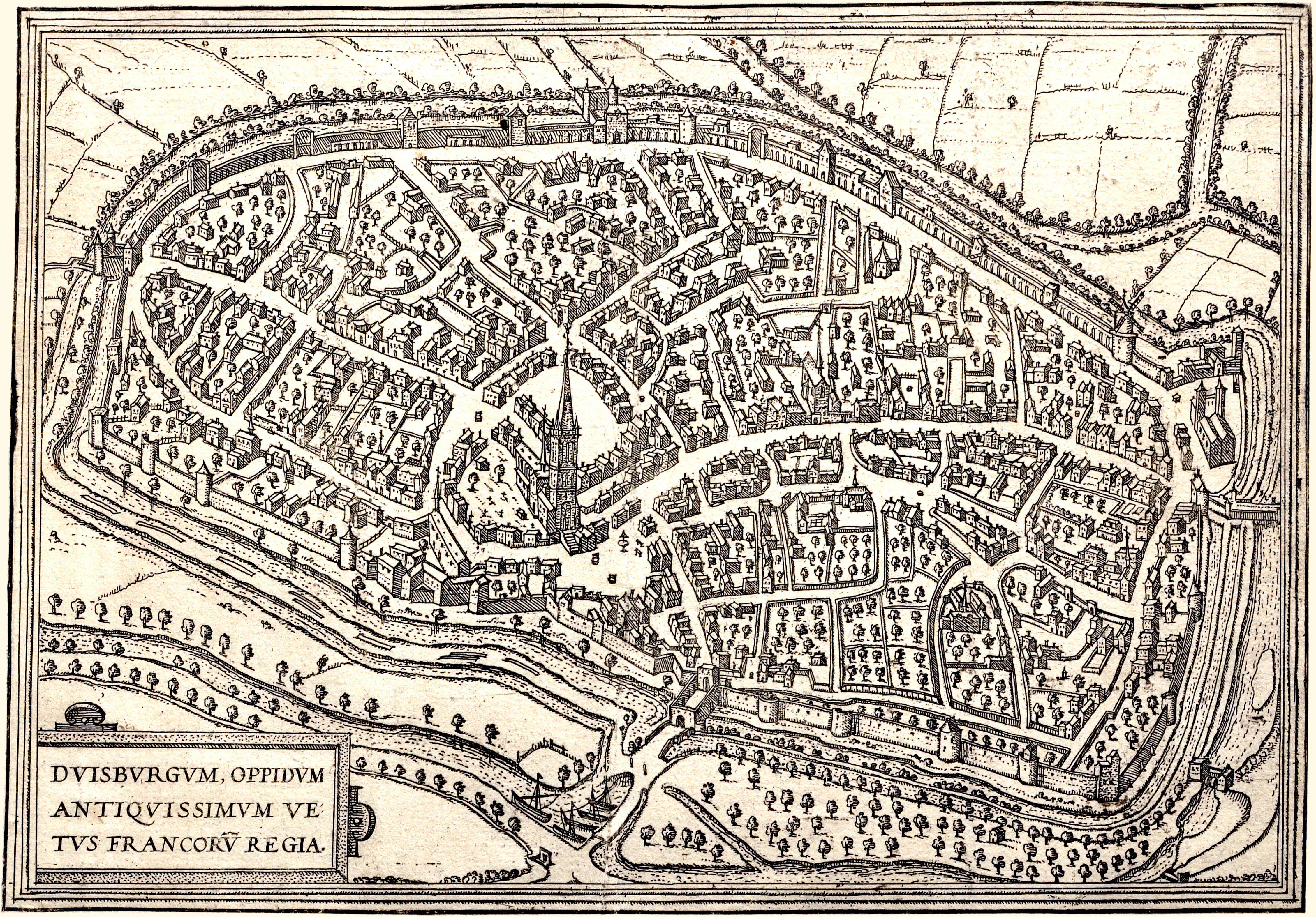
Hogenberg’s 1575 view of Duisburg supplies the civic setting for the eclipse notice of 2 April 1567, in which Mercator timed the phenomenon from this city and entered himself in his own chain of astronomical witnesses. Source ↗.
The grid then thins into empty year-cells and yields to the imprint, which supplies the volume's own place in the reckoning it has just compiled: at Cologne Agrippina, at the house of the heirs of Arnold Birckmann, APVD HAEREDES ARNOLDI, with the humanist dating formula that renders the year of the saving birth as 1569, Anno salutiferi partus, M. D. LXIX. That closing formula is itself an era-statement, styling the Incarnation as salutiferus partus rather than the conventional anno Domini, and it places the printed object one year beyond the last year its columns contain — the reckoning of times ending where the reckoning of the book begins.

The colophon gives place and publisher in display type — “COLONIAE AGRIPPINAE,” “APVD HAEREDES ARNOLDI BIRCKMANNI” — and closes with “Anno salutiferi partus, M. D. LXIX.” Once the tables have run out, this spare leaf folds the printed volume back into the temporal order it has just constructed. Source ↗.
Frequently Asked Questions
What is Gerard Mercator's Chronologia (1569)?
It is a Latin universal chronology, printed under the Birckmann imprint conventionally located at Cologne in 1569, reckoning time from the beginning of the world to 1568. Its title promises a most exact demonstration of times assembled from the eclipses and astronomical observations of all ages, from Scripture, and from the best authorities. In practice it sets years of the World, of Rome, of the Temple, of the Seleucids, of Christ, of the Hegira, Olympiads, years from Nabonassar and the indictions in parallel ruled columns, ordered by the Danielic scheme of four monarchies and the ages of Law and Grace.
Who was Gerard Mercator, and how does a chronology fit his work?
Mercator (1512–1594) is remembered chiefly as a mathematician and maker of maps, but the coordination of scriptural, classical, ecclesiastical and Islamic reckonings belongs to the same cosmographical enterprise. He appears inside his own book as an observer: the solar eclipse of 2 April 1567 is recorded in the first person plural, its beginning timed at 10h 25m before noon and its end at 1h 0m after noon at Duisburg. His arrest at Rupelmonde and emigration to Duisburg form important biographical context, though these were not documented by the located catalogue records.
How did Mercator settle disagreements between historians?
By emending numerals and, where two authorities were irreconcilable, by taking the mean. His recurring formula is one of conjectural reading: Pliny's 143rd year of the City for the founding of Cyrene is corrected to 153, and Berossus's two years for Evil-merodach become twenty-three because the reigns then square from Nebuchadnezzar to the monarchy of Cyrus. Amasis of Egypt, given 55 years by Diodorus and 44 by Herodotus, is assigned 54, so that each speaks truly once the mean is posited — medium habet veritas, truth holds the middle, a maxim he extends even to Panvinio and Du Tillet.
What did Mercator claim about the day of the Passion and the Moon's motion?
He extended Christ's ministry to four full years and five Passovers, two of them recovered by inference from collating John against the Synoptics, and placed the Passion at Anno Mundi 4000 on the strength of the whole work's synchronism of eras. The day, he held, could be fixed only from the conjunction of the luminaries. But the true motion would not carry the reckoning, on account of an inequality in the Moon's motion from the Sun and an anomaly said to have been noticed hitherto by no one; he therefore preferred the mean conjunction, and where Ptolemy and the Prutenic tables diverged, took a middle place.
Is there an English translation of Mercator's Chronologia?
No complete English, German, French or other modern-language translation of the 1569 Chronologia has been located in the accessible catalogues and digitized records, though this is a negative finding rather than proof that none exists. Separately, the Leo edition now presents, for the first time, the full transcription of the Latin text together with a complete English translation, which is generated by AI. Leo is an effort to make freely available online, at no cost, English translations of every text printed in Latin in early modern Europe between 1450 and 1750.
This report was generated by an advanced AI assistant that conducted deep research alongside an extensive interpretation of the transcribed original text. Every effort has been made to preserve fidelity to the source and to guard against inaccuracy, but corruption in the text recognition process and model hallucination may nonetheless have entered the text. Treat every claim, quotation, translation, and citation as provisional, and verify each against the original source before relying on or citing it.
Critical Further Reading on Mercator, Renaissance Chronology, and the Pre-Gregorian Calendar
- Crane, Nicholas, Mercator: The Man Who Mapped the Planet: A trade biography rather than a specialist study, useful chiefly for the life, the Rupelmonde imprisonment, and the Duisburg years from which the 1567 eclipse observation is reported in the first person plural. Read it for narrative orientation and then check anything it says about the Chronologia against catalogue records, since the chronological work is not where its interests lie.
- De Bujanda, J. M., ed., Index des livres interdits: The standard multivolume edition of the sixteenth-century Roman, Spanish, Portuguese and Low Countries indexes, and the only place where the persistent claim that Mercator's chronology was prohibited can be settled either way. Consult the pre-1600 volumes under Mercator; the verdict reached here is that no such entry has yet been located, which is an invitation to look rather than a conclusion.
- Grafton, Anthony, Joseph Scaliger: A Study in the History of Classical Scholarship, Volume II: Historical Chronology: The indispensable reconstruction of how sixteenth-century scholars built, criticized and repaired chronological systems, written explicitly as the joined stories of chronology and of Scaliger himself. Its analysis of conjectural emendation of transmitted numerals and of arbitration between discordant authorities describes, avant la lettre, exactly what Mercator does with Pliny, Berossus and Herodotus a generation before De emendatione temporum.
- Grafton, Anthony, New Worlds, Ancient Texts: The Power of Tradition and the Shock of Discovery: A study of how inherited authorities, manuscript testimony and new observational knowledge were made to share a single evidentiary space in the sixteenth century — the environment Mercator's compilation presupposes on every page. The Chronologia itself occasionally discloses that environment directly, reporting a datum as found noted at the end of a codex already cited, Sic in eo quem mox dixi codice in fine annotatum inueni, a formula that shows handwritten testimony entering the same evidentiary chain as printed histories and computed tables.
- Watelet, Marcel, ed., Gerard Mercator: Cartographer and Humanist: An exhibition-driven scholarly collection that treats the maps, the humanist learning and the projected Cosmographia as one enterprise, which is the frame within which the chronology stops looking like a detour. Verify its bibliographic details against a national-library record before formal citation, and use it primarily to test whether the coordination of computation with textual authority in the Chronologia belongs to the same programme as the projection of 1569.





,_RP-P-2015-26-591.jpg)

