Three Years of Three Hundred and Sixty Days: Johannes Temporarius's Chronological Demonstrations: Three Books
In 1596 the heirs of Andreas Wechel printed at Frankfurt a folio of Latin argument, Chronologicarum demonstrationum libri tres, in which the French jurist Johannes Temporarius — Jean du Temps — set out to prove, rather than merely recount, the order of time from the creation to 1580. His method was to refuse to settle disputes between texts by other texts: eclipses, equinoxes, and the era of Nabonassar were made the controls against which Greek archon lists, Roman fasti, Persian regnal years, and Daniel's seventy weeks all had to answer. The same observations that convicted Annius of Viterbo's forged Berosus and exposed "Metasthenes" as a mangled Megasthenes also produced a startling closing demand: that Europe's monarchs shorten the years 1597, 1598, and 1599 to three hundred and sixty days apiece.
ExLatinis
September 11, 2026
Contents
In 1596 the heirs of Andreas Wechel printed at Frankfurt a folio of Latin argument, Chronologicarum demonstrationum libri tres, in which the French jurist Johannes Temporarius — Jean du Temps — set out to prove, rather than merely recount, the order of time from the creation to 1580. His method was to refuse to settle disputes between texts by other texts: eclipses, equinoxes, and the era of Nabonassar were made the controls against which Greek archon lists, Roman fasti, Persian regnal years, and Daniel's seventy weeks all had to answer. The same observations that convicted Annius of Viterbo's forged Berosus and exposed "Metasthenes" as a mangled Megasthenes also produced a startling closing demand: that Europe's monarchs shorten the years 1597, 1598, and 1599 to three hundred and sixty days apiece.
Among the technical treatises produced by the late sixteenth-century revival of historical chronology, Chronologicarum demonstrationum libri tres — printed in Latin at Frankfurt am Main in 1596 by the heirs of Andreas Wechel, and rendered here for convenience as "Chronological Demonstrations: Three Books" — occupies a position that is at once representative and idiosyncratic. Its author, catalogued as Johannes Temporarius and known in French contexts as Jean du Temps (or Jean I du Temps), was a jurist, translator, publisher, and mathematically trained scholar whose authority record associates him with France and Lyon and whose specialist milieu has been reconstructed at Blois. The book is not a narrative history but a work of argumentative reckoning: three books that undertake to carry the sequence of times from the beginning of things to the year 1580 of the Christian era, to draw demonstrations from sacred writings and from the cycles of the heavens, and to compose universal history out of temporal orders that have first been explained and proved. An attribution of the title to the English controversialist Thomas Stapleton, which has circulated in some records, is incompatible with the converging catalogue evidence and is best explained as a conflation with a different book altogether.
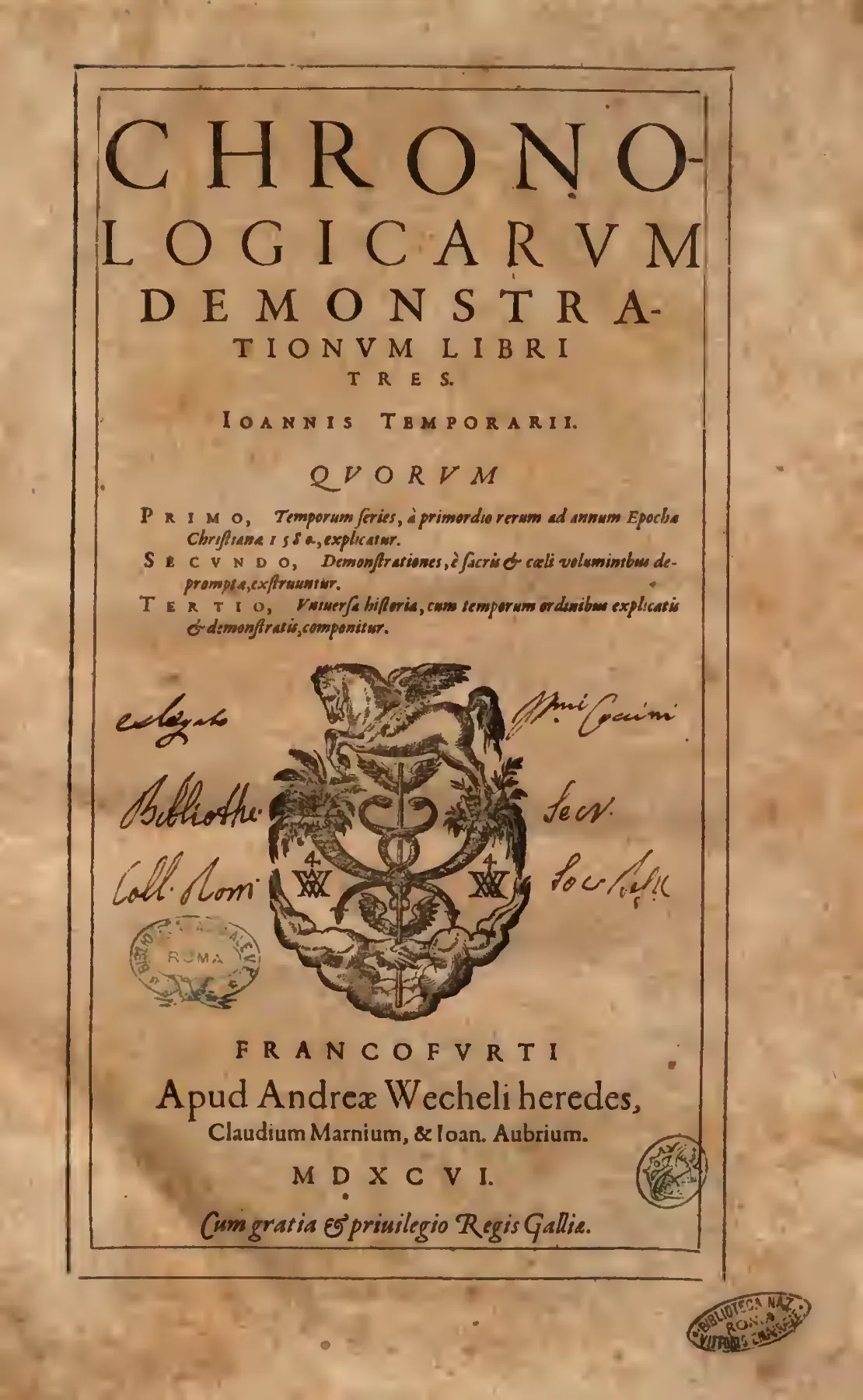
The 1596 Frankfurt title page fixes the work bibliographically, naming the Wechel heirs with Claudius Marnius and Johann Aubrius and carrying a printed French royal privilege. Its contents summary frames chronology as proof-work drawn from sacred writings and celestial cycles, while later ownership marks and institutional stamps record the copy's passage through learned collections. Source ↗.
The intellectual problem the work confronts is the one that made chronology a discipline rather than a convenience. The surviving record of sacred and profane antiquity is a mass of mutually contradictory reckonings — biblical narrative, Greek Olympiad and archon lists, Roman consular fasti, Chaldaean and Persian regnal years, rabbinic computation, and a body of fabrications circulating under venerable ancient names — and on nearly every disputed point no two authorities agree. Temporarius's recurring move is to refuse arbitration among texts alone. Instead of weighing testimony against testimony, he ties every contested sequence to fixed points that can be verified outside the textual tradition: the head of the Olympiads placed at 776 before the Christian era, the era of Nabonassar as a master reckoning-point, and above all dated celestial phenomena — eclipses, equinoxes, conjunctions — which no copyist can corrupt and no partisan historian can invent. Around this procedure the book's other operations cluster: the plain narration of Scripture is ranked above any merely cyclical or ingenious calculation; rival computists are contested; forged authorities are exposed by internal stylistic evidence; royal names are identified across Hebrew, Greek, and Persian forms; the sabbatical year, the Jubilee, and Daniel's seventy weeks supply a prophetic skeleton running to the Incarnation and the sequence of the four monarchies; and the same astronomical observations that discipline the past are made to ground a concrete proposal for emending the civil calendar.
The stakes of that procedure were considerable. Chronology in these decades was the meeting-ground of philology, positional astronomy, antiquarian scholarship, biblical exegesis, and the comparison of calendars, and it carried a heavy doctrinal charge: to fix the age of the world, the date of the Exodus, or the year of the baptism in the Jordan was to adjudicate between traditions of authority as well as between numbers. Joseph Scaliger's De emendatione temporum had recently reset the technical standards of the field, and Temporarius writes with that work in view, naming it as newly published while his own was in composition — evidence of awareness and engagement, though not in itself proof of methodological dependence. The fabricated antiquities published by Annius of Viterbo under the names of Berosus, Manetho, and "Metasthenes" were still in active circulation, still cited in political and ecclesiastical argument; and the Gregorian reform of 1582 had made the relation of solar observation to ecclesiastical time a live matter of institutional as well as astronomical dispute.
What is most striking in the book is the concreteness with which these commitments are executed. Annius's supposed ancient sources are convicted not by appeal to authority but by their own prose — a uniform diction, a single continuous narrative manner, the same puerility and the same errors running through all of them — and the fraud is caught in the act when Megasthenes' Indica, cited by Josephus, reappears under Annius's hand as the Iudicia of "Metasthenes." Daniel's seventy weeks are read as weeks of years and made to fall, by the author's own calculation, in the fifteenth year of Tiberius. A co-regency device, distinguishing two beginnings of a Persian reign, is introduced to make the prophetic arithmetic and the dynastic lists agree. Six dated equinox observations, running from the Chaldaeans through Hipparchus, Ptolemy, al-Battānī, and Bernard Walther to one the author claims for himself in 1577, underwrite a proposal to suppress twenty days across the years 1597 to 1599, to begin the year at the winter solstice, and to omit one intercalation every 160 years. The heavens through which all this is reckoned are declared to be liquid rather than furnished with solid carrying orbs. And at the end, where a reader of the period might most expect a number, the terminal date of the world is deliberately left uncomputed.
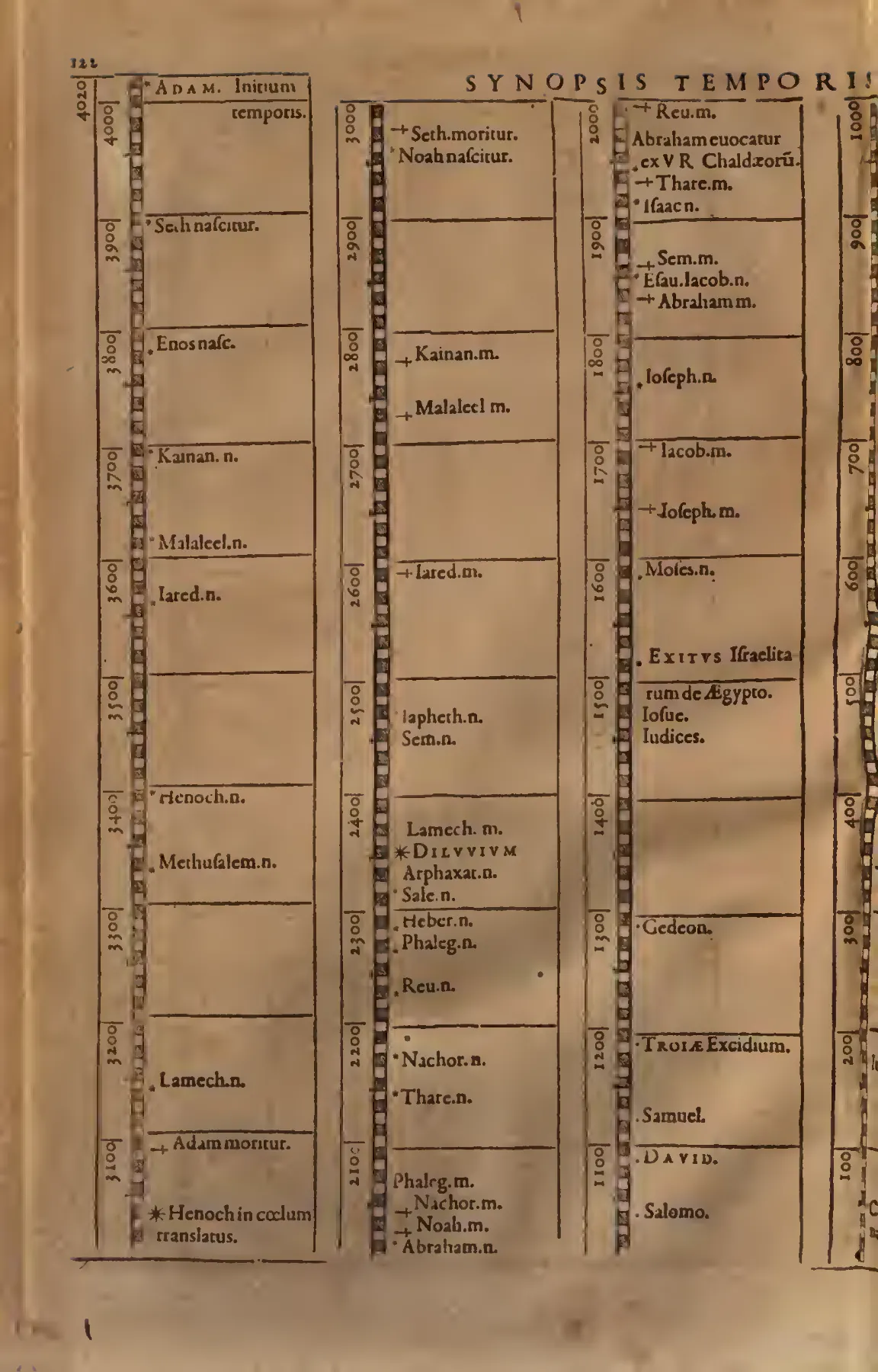
On this page headed "SYNOPSIS TEMPORIS," ruled columns convert sacred genealogy and early world history — from Adam and the Flood through Abraham, Moses, Troy, David, and Solomon — into a single numbered scale of world-years. The apparatus gives visible form to the book's method: fixing epochs and forcing heterogeneous authorities into synchronism. Source ↗.
A single throughline binds the book's technical vocabulary, its place in the learned book trade, and its internal movement. The keywords that recur across its pages — epocha, harmonia temporum, coeli phænomena, emendatio — are not ornaments but names for one operation: the establishment of origins from which heterogeneous series can be made commensurable, and the proof of that commensurability by evidence drawn from outside the disputed texts. That operation explains why a chronology of sacred and profane antiquity ends in a calendar proposal, why a work of biblical computation devotes itself to the stylistic unmasking of forgeries, and why its author, a scholar of mathematical books and instruments, should have thought a folio of demonstrations the right form for the argument. Much about the book remains open: its place of composition is not established, no dedicatee, patron, or privilege has been securely identified, no contemporary reply or censorship proceeding has been located, and the specialist scholarship devoted to Temporarius himself remains thin, consisting chiefly of a single chapter on his chronology and a reconstruction of his mathematical library rather than any monograph or critical edition.
Read the full text and English translation on Leo
This text was transcribed and translated as part of the ExLatinis project, an effort by Leo to make free English translations of every text published in Latin in early modern Europe (1450–1750) available online. The complete transcription and English translation of this work can be read free of charge:
→ Read the original Latin text and full English translation on Leo
You can save a copy of this document into your Leo account to run deep text searches, conduct further analysis, or cross-reference it with your own research.
Translating the Title: What Temporarius Meant by Chronological Demonstrations
"Chronological Demonstrations: Three Books" is an editorial English translation supplied for convenience; no established English title was located. The Latin title Chronologicarum demonstrationum libri tres identifies a work "of chronological demonstrations" arranged in three books. The authoritative 1596 record assigns it to Johannes Temporarius, while German authority data records the vernacular and Latin variants Jean Du Temps, Johannes Du Temps, Ioannes Temporarius, Temporius, Jean Temporal, and Jean Tempos. The title therefore belongs to the author identified in French contexts as Jean du Temps, not to Thomas Stapleton.
The plural demonstrationes carries a stronger evidentiary force than the modern neutral word "discussion." In late humanist Latin it could designate an ordered showing or proof produced by the coordination of authorities, calculations, textual testimony, and observable phenomena. The title consequently presents chronology as an argumentative discipline: temporal order is to be demonstrated through converging evidence rather than merely narrated. The work's own account of good chronological practice bears this out, in its praise of an authority who, in the books he wrote on Greek affairs, marks the Olympiads not only by the magistrates of the Athenians and Lacedaemonians but also adds the phenomena of the heavens, qui in libris quos de Græcorum gestis conscripsit, Olympiadas non solum magistratibus Atheniensium & Lacedæmoniorum designat, sed etiam adiungit coeli phænomena, — magistracy lists and celestial record are made to converge on a single reckoning, which is precisely the operation a demonstratio names. The same coordination is captured by the phrase that recurs as the treatise's programmatic formula, where the argument proceeds with the volumes of Scripture and of the heavens, and the harmony of times, cum scripturæ cælique voluminibus, & harmonia temporum, the two "volumes" being set side by side as complementary bodies of evidence. Grafton's account of Scaliger's chronological method is particularly relevant here, since it characterizes the period's new chronology through critical source work, astronomical reckoning, the exposure of forgeries, and the comparison of biblical and non-biblical evidence.
The technical noun epocha, inherited from Greek epochē, denotes a fixed point from which a sequence is reckoned. In a work concerned with Nabonassar, dynastic eras, biblical periods, Olympiads, indictions, and the Christian era, an epoch is not simply a date; it is the governing origin that makes otherwise heterogeneous temporal series commensurable. The treatise uses the word in exactly this constructive sense, declaring that the epoch of Nabonassar, consecrated to heaven by the Chaldaeans, demonstrates the beginning of the reign, Nabonassaris Epocha coelo a Chaldaes confecrata, demonstrat initium regni, where the verb of demonstration is attached not to a chain of historians but to an era whose validity rests on celestial record. The Greek series is fixed in the same manner, the author stating that we place the head of the Olympiads in the year 776 before the Christian Epoch, of the World 3247, the first year after an intercalary one, Olympiadum vero caput sistimus in anno 776, ab Epocha Christiana: Mundi 3247, primo ab intercalari, a formulation in which the Olympiad head, the Christian era, the year of the world, and the intercalary cycle are stated in one breath as mutually convertible coordinates. The work's subtitle describes the first book as extending the sequence of times from the beginning of things to the year 1580 of the Christian era, confirming that the title's "demonstrations" concern the construction and synchronization of temporal orders.
Finally, emendatio temporum should be understood in the period's broad technical sense of correcting the reckoning of time. In the Scaligerian context, emendatio encompassed the criticism of historical authorities, the reconciliation of calendars and eras, and the use of astronomical observations to identify chronological error. It was therefore more than a proposal to adjust the civil calendar. The title places Temporarius within that larger project of making sacred, classical, imperial, and astronomical time cohere, while the author's precise relation to Scaliger remains a matter for close primary-text analysis rather than an established claim of direct intellectual dependence. The text itself names the Leiden scholar and his book in terms of open admiration, observing that Scaliger, most learned and most thoroughly furnished in every kind of language, while we were composing these things, has lately published a new work, On the Emendation of Times, most erudite and outstanding, Scaliger doctissimus & vario linguarum genere instructissimus, nuper dum ista commentaremur, opus nouum edidit De emendatione temporum, eruditissimum & præstantissimum — direct evidence that the Scaligerian emendatio was present to the author as a recent and weighty intervention, though such an acknowledgement establishes awareness and engagement rather than methodological derivation.
Temporarius, the Wechel Heirs, and the 1596 Frankfurt Folio
Chronologicarum demonstrationum libri tres is a Latin technical treatise in historical and sacred chronology, printed at Frankfurt am Main in 1596. The author is Johannes Temporarius, also catalogued as Jean Du Temps or Jean I du Temps, a French jurist, writer, translator, publisher, and scholar associated in authority records with France and Lyon and in specialist scholarship with Blois. The work's title page describes three parts: a chronological sequence from the beginning of the world to 1580 of the Christian era; demonstrations drawn from sacred texts and the celestial cycles; and a composition of universal history through explained and demonstrated temporal orders. The second of these descriptions is not a formality: the argument repeatedly appeals to celestial evidence entered alongside the historical series, as the phenomena of the heavens, noted throughout, teach, docent coeli phænomena passim adnotata, the adverb passim indicating that such notices are distributed across the work rather than gathered into a separate astronomical appendix.
The 1596 printing is recorded as Francofurti: Wecheli Heredes, in folio, with [4] preliminary leaves, 304 pages, and [1] final leaf. The attribution to Thomas Stapleton is incompatible with the MDZ/BSB record, Google Books metadata, the German authority record, and the later USTC record for the same title. It is best understood as a cataloguing conflation with Stapleton's genuinely different Catholic preaching handbook, not as an alternative authorship claim supported by the surviving bibliographical evidence.
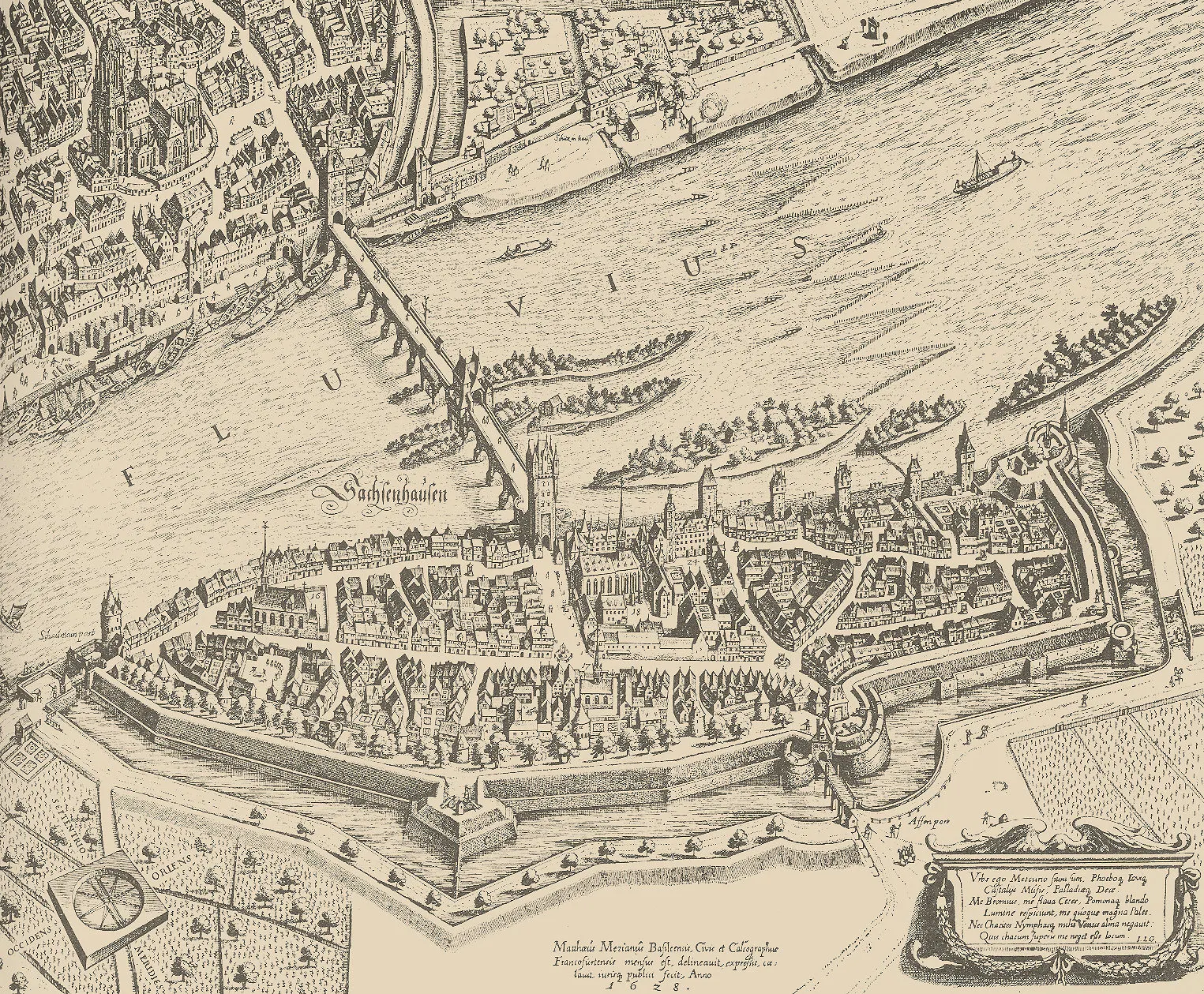
Matthäus Merian's 1628 engraved view of Frankfurt's Sachsenhausen, made thirty-two years after the folio appeared. It depicts neither the book nor the Wechel firm, but it shows the city named on the title page and evokes the commercial and learned milieu through which a 1596 Frankfurt imprint would first have circulated. Source ↗.
The language is Latin. No modern translation into English, French, German, or another vernacular was located in the catalogues and scholarly records consulted; the translation status should therefore be stated as "no translation record located," rather than as proof that no translation has ever existed. The place of composition is not established. Frankfurt is the place of printing, while the author's French identity and association with Lyon and Blois provide the relevant biographical context.
Why Temporarius Matters: Scaliger, Annius, and the Calendar Question
The work matters because it belongs to the period in which chronology became a technically ambitious discipline joining philology, astronomy, antiquarian history, biblical interpretation, and the comparison of calendars. Its three-part conception—temporal sequence, demonstrations from sacred and celestial sources, and the ordered composition of universal history—places it within the attempt to make distinct historical traditions mutually intelligible without reducing chronology to a simple annalistic list.
Anthony Grafton's historiography of Joseph Scaliger provides the central framework. Grafton argues that Scaliger introduced critical standards and methodological innovations into the extensive sixteenth-century interest in chronology, including the Julian Period, the exposure of historical forgeries, and recognition of the evidentiary value of non-biblical sources. A related account emphasizes that Scaliger's chronological work required both astronomical data and philological methods. Temporarius is therefore significant not merely as a minor chronological manual but as evidence for the circulation, adaptation, and possible contestation of the new technical chronology around the turn of the seventeenth century.
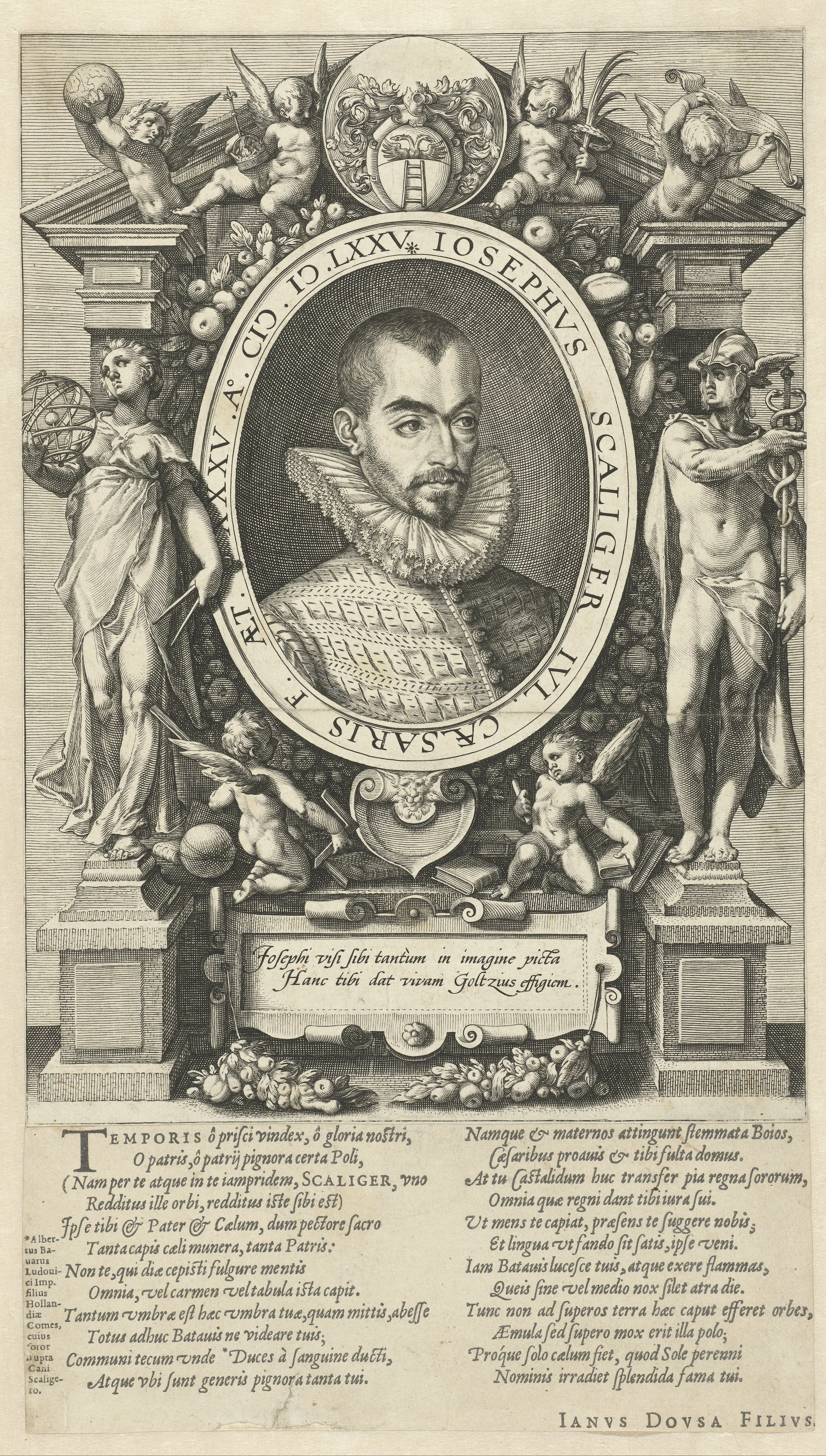
Hendrick Goltzius's engraved portrait of Joseph Scaliger, dated 1575, precedes the Frankfurt folio by two decades. For Temporarius, Scaliger was not merely an admired scholar but the benchmark against which epoch-setting, forgery detection, and calendar correction had to be measured. Source ↗.
The work also belongs to the history of sacred and profane history. Grafton's account stresses that chronology had served the instruction of Jewish and Christian history while increasingly incorporating classical, Egyptian, Persian, Babylonian, and astronomical materials. The central historiographical question is not whether early modern scholars were "religious" or "scientific" in a modern binary sense, but how they arranged different kinds of authority—scripture, ancient historians, dynastic lists, astronomical observations, calendars, and philological judgments—within a single providential account of time. Temporarius states his own ordering of that hierarchy without ambiguity, rejecting certain results on the ground that we rightly reject these absurdities, and prefer the simple narration of Scripture to any calculation whatever, cyclical or astronomical or fabricated out of one's own wit, Ista igitur absurda merito reiicimus, & simplicem Scripturę narrationem cuicunque calculo siue cyclico siue astronomico vel ex ingenio conficto præferimus — a ranking that subordinates cycle-mongering and private ingenuity alike, while leaving the celestial phenomena their distinct evidentiary role as corroboration rather than as competing narrative. That the primacy of Scripture does not translate into an assumption of scriptural completeness is equally clear where the author concedes the limits of his sources, noting that in what years the sabbaths were kept, Scripture does not express, sed quibus annis acta sint sabbatha, scriptura non exprimit, an admission that leaves the sabbatical and jubilee computations to be reconstructed by argument rather than read off the text. The same economy of authorities governs the treatise's messianic reckoning, where the prophetic arithmetic is made to terminate at a datable moment of sacred history: the 69 weeks, that is, 483 years, fall by our calculation definitely in the fifteenth year of Tiberius, in which Christ was washed by John in the Jordan, Hebdomades autem 69, hoc est, anni 483, definite cadunt nostro calculo, in annum 15 Tiberii, quo Christus in Iordane ab Ioanne ablutus est, the adverb definite marking the claim as a demonstration rather than a conjecture. Political history is folded into the same providential frame, the conquerors of the ancient monarchies being described as those who seized those kingdoms not so much by their own valour, as they themselves boast, as according to the utterances of the divine prophets, kingdoms which had to be subdued by them, Qui non tam sua virtute, vt ipsi gloriantur quam secundum diuinorum vatum effata, illorum regna occuparunt, quæ ab iptis subigenda erant,, a formulation that makes the dynastic stemmata and consular fasti serve a prophetic scheme of succeeding empires.
Annius of Viterbo provides a second major field of significance. Giuliano Mori's treatment of Annius's Antiquitatum variarum volumina XVII emphasizes that the forged antiquarian texts were presented as recovered ancient sources, accompanied by commentary and historical theses, and that their influence continued throughout the sixteenth century. That scholarship complicates any simple narrative in which forgery was immediately exposed and discarded: forged authorities remained active in political, religious, and antiquarian argument. Temporarius's attention to pseudo-Berosus, pseudo-Manetho, and pseudo-Megasthenes consequently belongs to the history of humanist source criticism, and the treatise's own procedure is stylistic rather than merely denunciatory: of the texts which Annius the peddler of trifles published, that they are spurious and supposititious and drawn from one and the same source, is proved by the everywhere similar diction, the tenor of the history continued in the same style, the same childishness, and the same errors in all of them, quos Annius nugiuendus edidit, spurios ac suppositos esse, & ex eodem fonte haustos, arguit dictio vbique similis, eodemque sermone continuatus historiæ tenor, eadem infantia, iidemque errores in omnibus — an argument from uniformity of diction and shared error that convicts several supposed authors of a single hand. The demonstration is then pressed to a documented instance of transmission: Josephus cites the Indica of Megasthenes; Annius transformed Megasthenes into Metasthenes and the Indica into Iudicia, by a wondrous metamorphosis, Citat Iosephus Indica Megasthenis, Annius Megasthenem transformauit in Metasthenem, & Indica in Iudicia, mira metamorphosi, where the corruption of a name and a title is exhibited as the trace of the forger's manufacture. Such passages show the polemic operating by the same logic as the epoch-setting: the disputed text is not weighed against another text of equal standing but tested against an independently secured control, here the attested citation in Josephus.
Calendar reform is a third axis. C. Philipp E. Nothaft's study of calendar reform and calendrical astronomy clarifies the long technical history behind disputes over the relation of solar observation, ecclesiastical cycles, lunar reckoning, and institutional authority. That context is directly relevant to the Temporarian proposal for calendar emendation, which is stated in fully operational terms: let the emendation therefore be made at the end of the sixteenth century from Christ, in this way: let three years be run through, namely 1597, 1598, 1599, each of three hundred and sixty days, Fiat igitur emendatio in fine decimæ sextæ a Christo Hecatontadis. hoc modo. Agantur annitres, nempe 1597, 1598, 1599, dierum singuli trecentorum sexaginta — a scheme that removes the accumulated discrepancy by shortening three consecutive years rather than by a single excision, and that draws its warrant from the same series of dated equinox observations used to discipline the historical sequences. No located source establishes the contemporary reception of Temporarius's particular proposal or identifies a censorship process arising from it.
The specialist historiography of Temporarius himself remains thin. John O'Brien's chapter explicitly treats the Chronologia of Joannes Temporarius "between theology and science," while Alexander Marr reconstructs Jean I du Temps's mathematical library and situates it within the Renaissance of mathematics and the international book trade. These studies provide important points of entry, but they do not yet amount to a sustained monograph or critical edition of Chronologicarum demonstrationum libri tres. No substantive modern scholarly disagreement over the attribution, exact biography, or reception of this particular book was located. The principal established conclusion is bibliographical: the work belongs to Johannes Temporarius/Jean du Temps, while the full intellectual and material history remains open to further primary-text study.
Tracing the Editions: Frankfurt 1596, La Rochelle 1600, and the Surviving Copies
The 1596 edition is securely identified by converging catalogue evidence. The MDZ record names Chronologicarum demonstrationum libri tres, gives Johannes Temporarius as author, records the imprint Francofurti: Wecheli Heredes, dates the printing to 1596, and describes the object as a Latin printed book in folio with "[4] Bl., 304 S., [1] Bl." The digital surrogate comprises 316 scans. Its identifiers include OCLC 43131174, B3Kat ID BV010865955, BSB ID 991093709669707356, and the MDZ object identifier bsb11196680. The record gives the call number "2 Gs 129#(Beibd. 2" and identifies the holding institution as the Staats- und Stadtbibliothek Augsburg. The record should therefore be cited as an MDZ/BSB digital object with Augsburg holding metadata, rather than assumed to be a physical BSB copy solely because the digitization is hosted through the Bavarian system.
A distinct later edition was printed at La Rochelle in 1600: Rupellae, ex officina Hieronymi Haultini, 1600. USTC 111459 assigns it to Du Temps, Jean; describes it as quarto; records [8] preliminary pages and 402 pages, paginated as 406; and supplies the signatures "ã4 A–M6 N8 O–Z6 2A–L6 (2L6 blank)." The differing format—folio for the 1596 Frankfurt edition and quarto for the 1600 La Rochelle edition—should not be harmonized into a single physical description. It may reflect a changed edition, although the catalogue records do not by themselves establish the nature of the revision. Nor do they establish whether the treatise's more delicate technical devices were reworked: the two-beginnings expedient by which the Persian regnal series is made to fit the prophetic arithmetic, stated as the principle that two beginnings of Longimanus' reign are to be considered by us: one in which he was made king by his father, the other in which, his father being slain, he stood forth as heir, Proinde nobis spectanda sunt principia duo regni Longimani. Alterum quo Rex a patre institutus est: alterum quo patre occiso hæres extitit, is the kind of load-bearing argument whose treatment in the later quarto would need to be established by collation rather than inferred from the catalogue descriptions.
The USTC record lists copies or catalogue traces at Copenhagen, Blois, Dijon, Paris, Toulouse, Troyes, Weimar, Rome, Groningen, Cambridge, London, and Oxford. Among the identifiable shelfmarks are Det Kongelige Bibliotek, Copenhagen, 11,19500348; Bibliothèque Abbé Grégoire, Blois, LI 82 and LI 80; Bibliothèque municipale, Dijon, 19845; Bibliothèque Sainte-Geneviève, Paris, FOL G 275 INV 400; Bibliothèque Mazarine, Paris, 2° 4939; Médiathèque José Cabanis, Toulouse, Fa B 407; Médiathèque de l'Agglomération Troyenne, aa.4.187; Herzogin Anna Amalia Bibliothek, Weimar, 2°XVIII16; Biblioteca Apostolica Vaticana, Stamp.Barb.Q.II.9; Bibliotheek der Rijksuniversiteit Groningen, uklu'KS'GA-1; Cambridge University Library, L.3.44(C); British Library, 215.a.12; and Bodleian Library, Oxford, AA 146 Th.Seld.
The 1600 Blois record in the Renaissance Typography Database identifies Jérôme Haultin as printer, stationer, or commercial editor and records one device, described as a 140 × 98 mm woodcut or metalcut ornament. This is evidence for a typographic device, not for the engraved chronological diagrams that have been associated with the work. No reliable catalogue evidence was located proving that such diagrams were separately engraved, that they survive as plates, or that copies vary in this respect.
The Frankfurt imprint names the heirs of Andreas Wechel. A related German digital record associates the Frankfurt production with Claude de Marne and Johann Aubry, but the precise division of labor among the Wechel heirs, Marne, and Aubry is not established by the evidence located. No dedicatee, patron, privilege, approbation, or receiving institution has been securely identified. No contemporary reply, refutation, defense, censorship proceeding, Index entry, or expurgated state was located under the title or the author's principal name. These are evidentiary absences, not proof that no such reception or institutional response existed. They are worth registering precisely because the work's calendrical and prophetic arguments—the proposal to shorten three years at the close of the sixteenth century, the dating of the seventy weeks—were of a kind that invited institutional notice in this period.
The author's authority record links Johannes Temporarius with multiple forms of the name—Temporarius, Ioannes Temporius, Johannes Du Temps, Jean du Temps, Jean Temporal, Jean Tempos, and Jean du DuTemps—assigns an approximate birth year of 1535, gives activity dates of 1570–1590, and associates him with France and Lyon. It describes him as a writer, translator, jurist, scholar, and French author and publisher. The record also lists Organon astronomicon ex hypothesibus Copernici extructum among his publications, a title consistent with the astronomical competence the chronological demonstrations presuppose. Alexander Marr's study of Jean I du Temps of Blois independently places the figure within the mathematical, chronological, cartographical, and international book-trade culture of late sixteenth-century France. The connection between the catalogued Johannes Temporarius and the Jean I du Temps studied by Marr is bibliographically compelling, but exact birth and death dates and a complete chronology of his activities remain unestablished.
The Thomas Stapleton attribution should consequently be rejected for this object. The catalogue evidence for the 1596 volume consistently identifies Temporarius, while the 1600 USTC record identifies Du Temps. The surviving records support a chronological treatise by Johannes Temporarius/Jean du Temps and do not support Stapleton authorship. No separate edition under the exact title Chronologicarum demonstrationum libri tres by another sixteenth-century author was located.
Reading Book III: From the Olympiads to the Emendation of the Year
The exposition that follows takes the treatise in the order of its own pages. It begins with the physical and typographic organization of the third book and the calendrical matter appended after its close; it proceeds to the recurring rhetorical and conceptual operations by which the arguments of that book are conducted, and to the passages that reward extended commentary; and it ends with a continuous account of the argument's movement from the Olympiad reckoning, through the sabbatical and prophetic computations and the polemic against forged authorities, to the proposal for emending the year and the terminal date that the author declines to compute.
The organization of Book III and its appended calendrical matter
The third book presents itself to the eye as a sequence of numbered problems rather than as continuous narration, and its typographic furniture registers that design.
- Numbered chapter divisions within Liber tertius — Explicit numbered headings divide Book III into discrete chronological questions, each opening with a statement of the point in dispute: "On Jubilees and Sabbaths," 5. De Iubilæis, & Sabbatis.; "Daniel's Weeks," 6 Danielis Hebdomades.; and "On Ahasuerus and Esther," 7. De Assuero & Esthera..
- Running heads and book identification — Verso and recto running heads alternate between the title of the work and the number of the book, "of the Chronological Demonstrations" and "Book three," Chronologicarum Demonstrationum and Liber tertius., confirming that this portion belongs to Book III.
- Typeset tabular apparatus (sabbatical and jubilee tables) — A ruled table sets out the seven-year cycle culminating in the fiftieth year, its interior labels reading "the first sabbath-keeping" (the compositor's prunus for primus) and "JUBILEE," Sabbatismus prunus. and IVBILÆVS.. A second and much larger multi-column table follows under a heading announcing the jubilees to be inspected on the reckoning-board, IVBILAEI IN ABACO VISENDL., its column rubrics giving the years from the division of the land, the sabbatical years, and the jubilees: Anni a terra diuisa, Anni sabbatici, and Iubilei.
- Catalogue-of-authorities format — This portion of the book opens with a dense list of conflicting authorities on the founding of Rome, each named with his Olympiad date: Cincius, in his book on Roman affairs, hands down the fourth year of the twelfth Olympiad, Fabius Pictor the second year of the eighth, Polybius the second of the seventh — Cincius, lib. Rom. tradit, anno Olympiadis duodecimæ quarto. Pictor, octauæ secundo. Polybius, secundo septimæ.
- Scriptural citation apparatus — Chapter-and-verse references are embedded inline throughout: Exodus 21, Leviticus 25 and 26, and Deuteronomy 15, Exod. c. 21. Leuit. 25 & 26, & Deuter. 15; 4 Kings 22 and 23 with 2 Chronicles 35, 4. Reg. 22 & 23, & 2. Paral. 35; and, as Ezra relates in his fourth chapter, vt narrat Esdras cap. 4.
- Arithmetical summation block — A stepped computation closed by a ruled total is set as a display element: the three-line account of the seventy weeks, reserved for extended analysis below.
- Terminal marker and appended matter — The word "The end," FINIS., is immediately followed by an appended calendrical discussion, indicating that the calendar-emendation material is presented as a supplement following the close of the chronology proper.
- Signature mark — A signature letter stands at the foot of the page, X, evidence of the folio's gathering structure.
Rhetorical and conceptual procedures
Within that frame the argument is conducted by a small repertoire of recurring moves, which can be set out in the order in which the book deploys them.
- The "ignorance of their own origins" topos — Temporarius turns the disagreement of the Roman authorities into an epistemological indictment: the Romans were themselves ignorant of their city's beginning, and no consistent account of times could stand until the Chaldaean tables were brought to light. The passage, quoted in full below, makes those tables the external control that reconciles all reckonings.
- Declaration of methodological allegiance — The author states his choice among the competing Roman computations by tying it to an era, holding that we follow the opinion of Varro, who steered his reckoning to the epoch of Nabonassar, Nos Varronis sententiam sequimur, qui adnauigauit Nabonassaris Epocham.
- Argument from obscurity: rejecting unreliable data — Where a historical event is poorly attested, it is excluded from evidentiary use: but since the Gallic war lay in obscurity, no reliance can be placed upon it, Sed bellum Gallicum quia in obscuro fuit, nihil ex eo fidei haberi potest.
- Systematic error-interval detection — Scattered disagreement is converted into a rule by the identification of a constant offset between rival systems: in every century, Fabius and Varro differ by sixteen years, a finding taken up among the core passages below.
- Providential-punitive theory of the sabbatical reckoning — The seventy years of captivity are read as God's recovery of neglected sabbaths, an inference set out in full below.
- Etymological philology — The Hebrew root is adduced to explain the institution's name: the origin of the word is from iobel, which is a Hebrew word and signifies a trumpet or ram's horn, at whose blast the Jubilee was to be proclaimed, Origo dictionis a lubel, quæ vox est Hebraica & significat buccinum seu cornu arietis, cuius clangore erat proclamandus Iubilæus.
- Precision about the reckoning point of the jubilee — A technical caution against a common computational error: but it must be observed that the Jubilee is the fiftieth year — not the second from the sabbatical year, and the forty-eighth, but the one next after the seventh sabbath-keeping, Sed obseruandum est Iubilæum quinquagesimum annum esse, non secundum ab anno sabbatico, & quadragesimum octauum, sed proximum post septimum sabbatismum.
- Correction of the starting point for the sabbatical series — The count must begin from the division of the land rather than the entry into Canaan: and since the sabbatical years are to be ordered from the division of the land, not from the entry into Canaan, the time in which Joshua subdued the Canaanites must be referred to the earlier years, Et quoniam anni sabbatici a terræ diuisione sunt ordinandi, non ab ingressu in Chananæam, tempus quo Iosua Chananæos debellauit, referendum est ad anteriores annos
- Chronology as the discipline that dispels exegetical darkness — The prophecy's obscurity is attributed not to the text but to chronological ignorance, in a formulation reserved for closer analysis below.
- Definition of the week-of-years, proved from Leviticus — The interpretive linchpin is established by scriptural analogy: the Prophet here records weeks not of days but of years; and a week of years is seven years, just as a week of days is a space of seven days, Hebdomades hic Propheta commemorat non dierum, sed annorum. Est autem hebdomas annorum septem, vt hebdomas dierum est spatium dierum septem.
- Identification of the terminus a quo against rival views — The seventy weeks are counted from Nehemiah's commission rather than from the Babylonian exile, a decision examined among the core passages below.
- Royal-name identification across traditions — Persian kings are matched to their biblical aliases by parenthetical equation: for the Samaritans persuaded Artaxerxes (who is Cambyses) to forbid the Jews the building, Persuaserunt enim Sa maritani Artaxerxi (qui est Cambyses) vt Iudæis ædificationem interdiceret.; and, after these things, in the twentieth year of Artaxerxes (who was Ochus), Nehemiah sought leave of him, Post hæc anno Artaxerxis (qui Ochus fuit) vicesimo, Nehemias veniam petiit ab eo
- Refutation of three rival positions in series — Alternative readings are dismissed together as insufficiently established: but those things seem not firm enough which hold that in Daniel the weeks are of days and not of years, that they are numbered from the Babylonian captivity, and that Christ celebrated the Passover only once after his baptism, Illa vero non satis firma esse videntur quæ tradunt, in Daniele esse hebdomades dierum non annorum, easque a captiuitate Babylonica numerari: & quod Christus semel tantum Pascha celebrauit post baptismum.
- Deferral formula — Discussion is closed with a promise to treat the matter elsewhere: but of these things in another place, Sed de his alias.
- Survey of scholarly opinion before adjudication — The identification of Ahasuerus is presented as a doxography followed by the author's own determination, the passage being given in full below.
- Argument from the extent of empire — Geographical scope serves as a criterion for dynastic identification: for the history of Esther relates that Ahasuerus reigned from India as far as Ethiopia, over a hundred and twenty-seven provinces, and such an amplitude of empire suits the Medes and Persians best of all, Nam Estheræ historia narrat Assuerum regnasse ab India vsque ad Æthiopiam, super centum viginti septem prouincias. Quæ amplitudo imperii Medis & Persis maxime conuenit.
- Insufficiency of the Julian year, argued from observation — The Julian intercalation is faulted by appeal to the tropical year: the form of the year which Julius Caesar established, that the year should be of 365 days and a quarter, is not exact enough, for the tropical year is less than 365 days and a quarter, as is manifest from observations of the equinoxes, Anni forma quam Iulius Cæsar instituit, vt annus esset dierum 365 & quadrantis, non satis exacta est. Nam annus tropicus minor est quam 365 dies & quadrans, vt ex obseruationibus æquinoctiorum manifestum fit.
- Roll-call of the observational tradition — Six named authorities, from the Chaldaeans to the author himself, are enlisted as one continuous evidentiary series; the sentence that enrols them is set out below.
Passages for extended analysis
- The Chaldaean tables as the resolver of Roman chronological chaos — The clearest statement of the work's governing method, and one that carries an implicit polemic against the standing of Roman antiquarian tradition, holds that thus the Romans themselves were ignorant of the rise of their own city, nor could any account of times hold firm until the tables of the Chaldaeans were brought into the light, by which the calculations of all are reconciled and much old error is taken away: Sic Romani ipsi vibis suæ ortum ignorarunt, nec constare potuit temporum ratio, quousque Chaldæorum tabulæ in lucem productæ fuerunt: quibus concilianiur oimium calculi, multaque vetus sublata est erratio. Textual testimony alone cannot settle chronology; the impasse is broken only by an externally secured body of celestial record.
- The sixteen-year systematic divergence — Rather than treating the discrepancies as random, Temporarius extracts a constant differential that allows rival systems to be converted into one another — chronology practised as the algebra of competing eras: thus in any given century Fabius and Varro differ by sixteen years, Ita quolibet seculo differunt Fabius & Varro annis 16.
- Providential accounting of the neglected sabbaths — The seventy years of exile are made an arithmetical consequence of 490 years containing seventy neglected sabbatical years, so that sacred history is rendered as a ledger in which divine justice is computed: since therefore the number of seventy years was fixed by God for the completing of the sabbaths, it appears that the Jews had assigned to the tilling of their fields four hundred and ninety years, through those seventy years which, being consecrated to God, ought to have been free of agriculture — Cum igitur numerus annorum septuaginta, ad complenda sabbata, a Deo definitus sit, apparet ludæos annos quadringentos & nonaginta in agrorum culturam attribuisse, per eos annos septuaginta, qui Deo consecrati, agricultura vacuere debuerunt.
- Chronological ignorance as the cause of prophetic obscurity — The claim inverts the usual hierarchy in which prophecy is mysterious by nature: here the difficulty is a defect in the reader's technical apparatus, and chronology becomes the discipline that renders Scripture legible. The prophecy of Daniel which contains the seventy weeks ought to be of the greatest light for explaining the time of the Messiah, were it not that darkness obscures it out of ignorance of chronology: Prophetia Danielis quæ Hebdomades septuaginta continet, ad Messiæ tempus explicandum, plurimæ luci esse deberet, nisi eam tenebræ obscurarent ex Chronologiæ ignoratione.
- The terminus a quo of the seventy weeks — The choice of starting point is the load-bearing decision of the whole messianic computation, and it is defended by the prophecy's own qualifying phrase in angustia temporum, which is then matched to the armed building described in Nehemiah: the seventy weeks, therefore, are for Daniel four hundred and ninety years, which he reckons not from the Babylonian exile but from the word that went forth to restore and build Jerusalem in the straitness of times — Hebdomades igitur septuaginta, Danieli sunt anni quadringenti nonaginta, quos definit non ab exilio Babylonico, sed a sermone qui exiit ad restituendam & ædificandam Ierosolymam in angustia temporum.
- The summation of the seventy weeks — The prophetic arithmetic is displayed as a three-line account with a ruled total, the Epocha Messiæ serving as an interior reckoning-point exactly as Nabonassar's era serves for profane history: from the twentieth year of Artaxerxes to the empire of Alexander, 90 years; from Alexander to the birth of the Messiah, 329; from the epoch of the Messiah to Vespasian, in the fourth year, in which he destroyed the Temple, 71; total 490 — Ab anno 20 Artaxerxis ad Alexandri Imperium anni 90 / Ab Alexandro ad Messiam natum 329 / Ab Epocha Messiæ ad Vespasianum, anno 4 quo Templum destruxit, 71 / Summa 490
- Adjudication of the Ahasuerus problem — A model of the treatise's doxographic method, in which the field is enumerated and then decided, the decision resting on cross-linguistic name identification and on the scale of the empire described in Esther: in the history of Esther the name of Ahasuerus occurs, about whom the learned think variously; some would have him to be Xerxes, others Artaxerxes Longimanus, others Darius son of Hystaspes, others Cambyses, others Astyages; we, as we said in the previous book, judge him to be Astyages, who was also called Cyaxares and Artaxerxes — In historia Estheræ nomen Assueri occurrit, de quo varie sentiunt eruditi. Quidam Xerxem esse volunt, alii Artaxerxem Longimanum, alii Darium Hystaspis, alii Cambysem, alii Astyagem. Nos, vt superiore libro diximus, Astyagem esse arbitramur, qui & Cyaxares & Artaxerxes appellatus est.
- The Julian year faulted by equinox observation — The calendrical appendix rests on the same evidentiary principle as the historical books. The judgment already quoted, that the Caesarian form of the year of 365 days and a quarter is not exact enough because the tropical year is shorter, as observation of the equinoxes makes manifest, subjects a received institutional reckoning to correction by dated observation.
- The observational series from the Chaldaeans to the author — The author places his own observation of 1577 at the end of a lineage reaching back to Babylon, constituting the observational record as a single continuous body of evidence that transcends any one tradition: I shall therefore note down the vernal equinoxes which have been observed by the Chaldaeans, Hipparchus, Ptolemy, al-Battānī, Bernard Walther, and by ourselves — Adnotabo igitur æquinoctia vernalia, quæ a Chaldæis, Hipparcho, Ptolemæo, Albategnio, Bernardo Walthero, & a nobis obseruata sunt.
Fixing the Greek series: Olympiads and the phenomena of the heavens
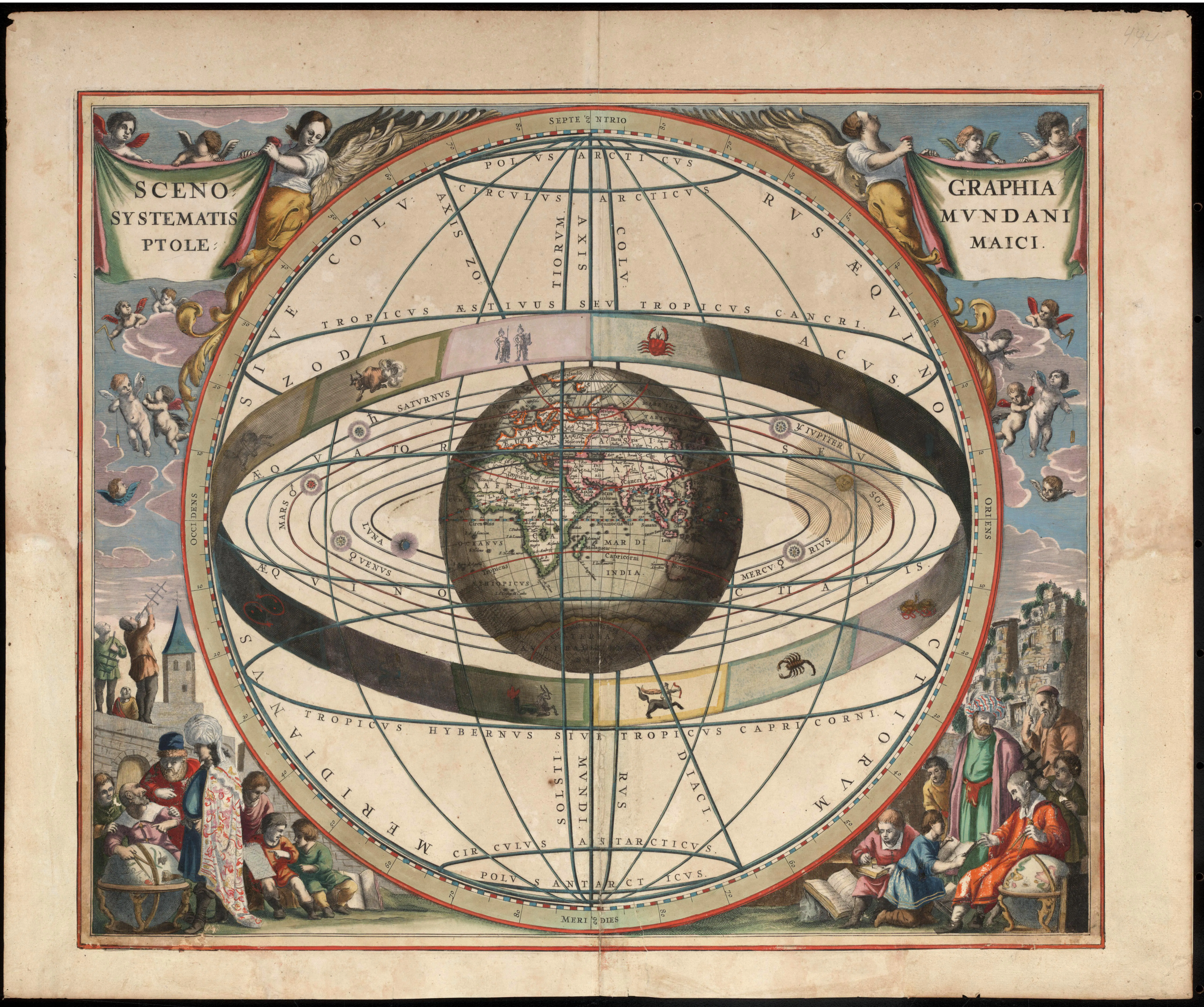
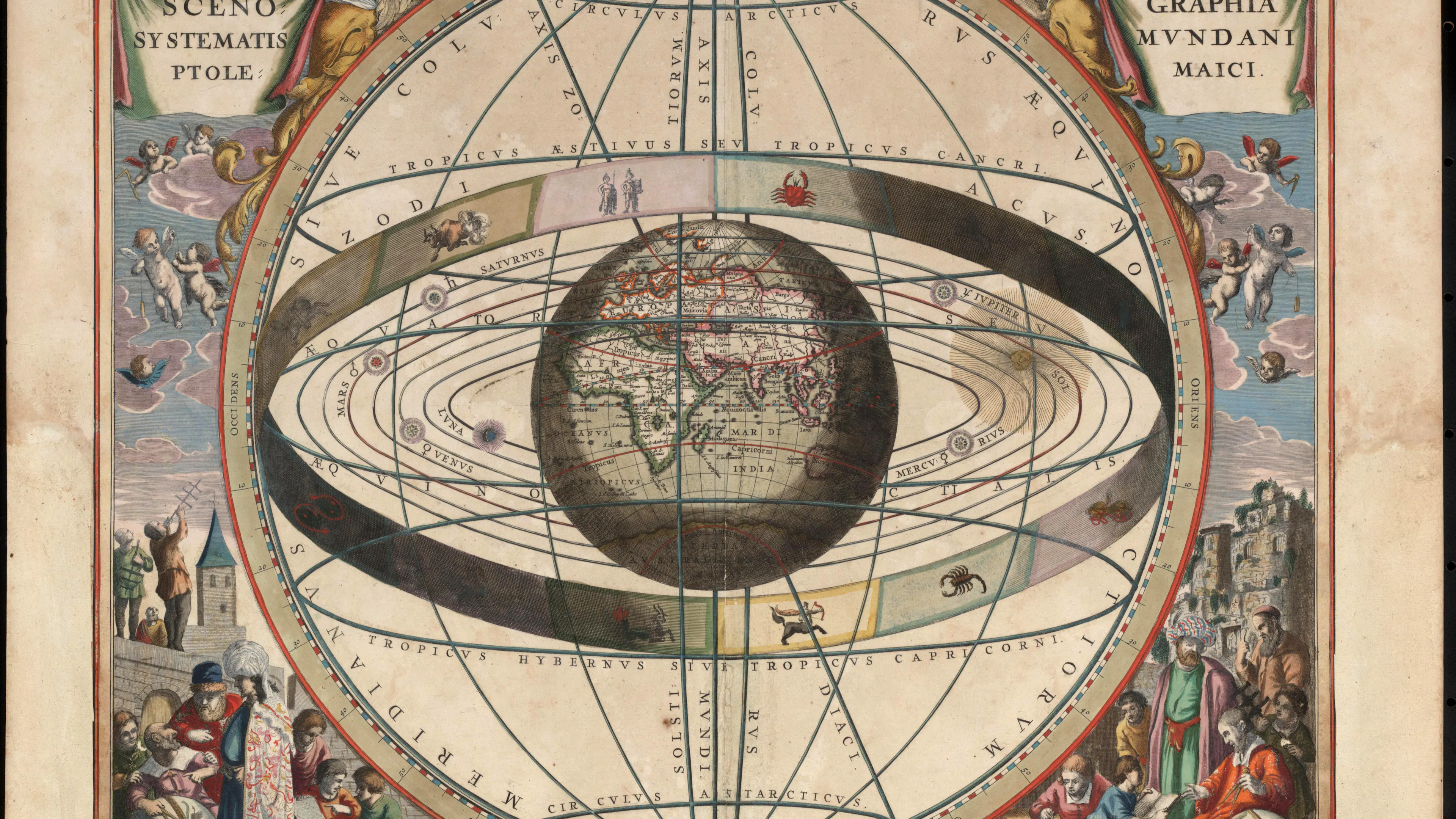
Andreas Cellarius's mid-seventeenth-century engraved plate of the Ptolemaic system presents the cosmos as an ordered geocentric machine of zodiacal band, planetary paths, and concentric spheres. Set beside Temporarius's reliance on equinoxes, eclipses, and the tropical year, it makes visible the architecture of solid orbs his "liquid heaven" refused. Source ↗.
The second half of Book III opens by converting a disputed literary tradition into a coordinate system. Having denied that Romulus was ever anything but a fabricated name, the author retains a Roman epoch verified against the Capitoline marbles as digested by Sigonius, and then fixes the Greek series with a formula whose economy is itself an argument — the head of the Olympiads set, as noted earlier in this report, in the year 776 before the Christian epoch, the year of the world 3247, the first after an intercalary year. Three reckonings — the Christian era, the year of the world, and the position within the four-year intercalary cycle — are stated as a single datum, so that the Olympiad head becomes not one date among competitors but a hinge on which Greek, sacred, and calendrical series can all be turned. The criterion by which such a hinge is secured is announced immediately afterwards in the praise of Xenophon, already registered above, for marking the Olympiads not only by the magistrates of the Athenians and Lacedaemonians but also for adding the phenomena of the heavens. That praise is methodological rather than literary: a historian who records an eclipse alongside an archon has produced a statement that can be tested by computation centuries later, and the coeli phænomena accordingly function throughout as witnesses immune to the corruptions of copyists and the interests of partisans. The point is at once demonstrated in practice, the lunar eclipse of the third year of the ninety-third Olympiad and the solar eclipse of the following Olympiad being worked through mean and true syzygy, anomaly, latitude, and parallax to fix the termini of the Peloponnesian War, with Thucydides' one-year divergence explained by his choice of the Spartan invasions rather than the deliberations as his starting point.
Sabbaths, jubilees, and the silence of Scripture
The section on jubilees and sabbatical years shows what happens when that criterion cannot be applied, and it is here that the treatise's hierarchy of evidence becomes visible in its most candid form. The author computes 833 years from the cessation of manna to Josiah's Passover, extracting 119 sabbaths and 17 jubilees, and then concedes the crucial gap already noticed in this report: Scripture does not express in what years the sabbaths were kept. The admission is not a retreat but a weapon. Because the sacred text is silent on the placement of the individual sabbatical years, any system that claims to read them off a tradition must be supplying what Scripture withholds, and the computists who have done so are convicted not of arithmetical error but of manufacturing data. The rabbinic chronologies are dismissed in exactly these terms, and the polemic hardens into confessional invective when the Persian period is reached: in the times of both the Chaldaeans and the Persians, under whom the series and continuation of the sabbaths was dislocated, the Jews are blinder than moles, Sunt vero Iudæi in temporibus tum Chaldæorum tum Persarum, sub quibus sabbathorum series & perpetuatio luxata est, talpa cæciores. The charge is technical in form and doctrinal in function. An alleged ignorance of Persian dynastic order is what disables a messianic reading of Daniel's weeks; the chronological deficiency is thus made to carry the whole weight of an exegetical disagreement, and the reader is prepared to accept the Persian reconstruction that follows as the precondition of a christological result.
That reconstruction proceeds by separating kinds of proof that a less disciplined argument would fuse. On the identity of the Ahasuerus of Esther, the author concedes his opponents' etymology while refusing their history: we utterly deny that Xerxes was the Ahasuerus who married Esther; we utterly deny that Esther was Amestris, Xerxes' wife, Sed pernegamus Xerxem fuisse Assuerum, qui Estheram duxerit. Pernegamus Estheram fuisse Amestrim, Xerxis coniugem. The doubled pernegamus is the rhetoric of a plea rather than a calculation, and the distinction it enforces — that a plausible derivation of a royal name settles nothing about which king bore it — is the same discrimination between converging and merely coincident evidence that governs the eclipse computations. Philology is admitted as evidence when it is independently controlled, as in the linguistic identification of Cyaxares with Ahasuerus credited to Scaliger, and refused when it is asked to do chronological work alone.
Forgery, authority, and the tribunal of the divine word
The polemic against Annius of Viterbo applies the identical logic to the question of authenticity, testing disputed texts not against rival testimony but against internal features their fabricator could not control. The four criteria set out earlier in this report — uniform diction, a single continuous narrative manner, shared puerility, shared error — are urged in combination, and their combination converts a plurality of supposed ancient authors into the traces of one modern hand. The demonstration is then completed by the documented instance of manufacture already discussed, in which the Indica of Megasthenes, cited by Josephus, reappear from Annius's hand as the Iudicia of "Metasthenes." The sarcasm of that "wondrous metamorphosis" conceals a precise evidentiary claim: what might pass for scribal drift is exhibited as deliberate alteration because an attested citation survives outside the forger's corpus to record the original form. Here, as with the eclipses, the disputed item is defeated by a control lying beyond the disputant's reach.
Yet the celestial and philological controls are not themselves sovereign. The final court is named in juridical language when the author parts company with the entire guild of computists: we indeed praise, honour and respect the diligence, skill and erudition of all of them; but their opinion we reject, and from the charge of obstinacy we appeal to the most holy tribunal of the divine word, Illorum sane omnium diligentiam, solertiam, eruditionem laudamus, colimus, obseruamus: sententiam vero improbamus, & a peruicaciæ iudicio appellamus ad sanctissimum diuini verbi tribunal. The metaphor of appellatio from a lower judgment to a higher bench is precisely chosen by a writer trained in law: consensus among the learned is treated as a verdict that can be appealed rather than as a proof, and Scripture is constituted not as one authority among the sources but as the jurisdiction in which they are all pleaded.
The seventy weeks and the Persian regnal series
The seventy weeks of Daniel are where this whole apparatus discharges its charge. After removing the starting points proposed by others and reassigning the obstructing "Artaxerxes" of Ezra to Cambyses, the author states his result with a deliberately forensic adverb, definite: the sixty-nine weeks, that is, four hundred and eighty-three years, fall by his calculation in the fifteenth year of Tiberius, the year of the washing in the Jordan, in the terms already quoted in this report. The terminus is the baptism rather than the rebuilding of the city or its destruction, and the arithmetic is claimed as demonstration, not conjecture. The claim is purchased, however, by the device introduced to make the dynastic lists yield the required interval and discussed above: two beginnings of Longimanus' reign are to be considered, the one in which he was made king by his father, the other in which, his father having been slain, he stood forth as heir. The co-regency is defended from Thucydides and from Hebrew royal practice, but its argumentative position is unmistakable: at the one point where the observed heavens cannot arbitrate, the reconciliation of prophecy with the regnal sums is achieved by a distinction internal to the reckoning itself — a tension between the work's professed method and its exegetical destination that the text does not thematize.
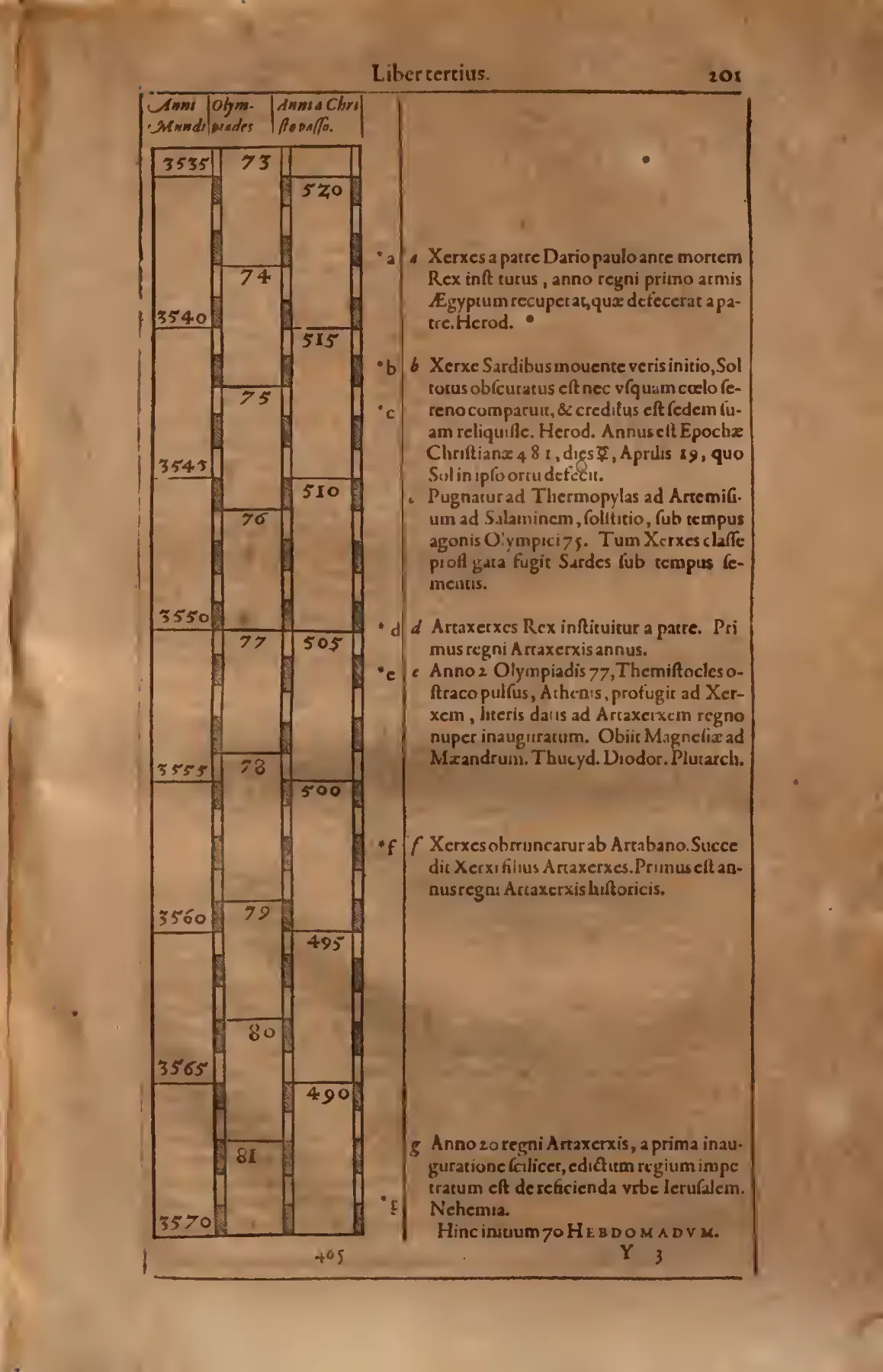
In this synchronistic table the marginal sequence runs from Xerxes and the Sardis eclipse to Artaxerxes' two beginnings, ending with the printed declaration "Hinc initium 70 Hebdomadum." The layout shows both the strength and the pressure point of the calculation: celestial dating as an external check, and a terminus a quo resting on the co-regnal distinction. Source ↗.
The dynastic and consular apparatus that follows is subordinated to the same prophetic scheme, and its pivot is typological. Antiochus IV, who is called the pre-eminent specimen of Antichrist, plundered the Temple of God and profaned it by setting up a statue of Jupiter in it, and burned the sacred volumes of the divine law, præcipuum Antichristi specimen, Templum Dei diripuit, & Iouis statua in eo collocata profanauit: Sacra legis diuinæ volumina cremauit:. The word specimen is doing exegetical rather than rhetorical work: the Seleucid persecutor is a pattern of which the eschatological adversary is the fulfilment, and the sequence of stemmata is thereby made a genealogy of prophecy as much as of kings.
The form of the year and the emendation of the calendar
When the treatise turns from reckoning past time to measuring the year itself, the argument runs on an anti-Roman polemic against any claim that the solar year was a human invention. The Romans, the author jeers, had to wait for a Romulus, begotten of a god and a vestal virgin, to disclose the secrets of heaven and found the year for mortals, Expectandus illis fuit Romulus, Deo & virgine vestali genitus, qui coeli arcana patefaceret, & annum conderet mortalibus; the irony serves the thesis, drawn from the day-counts of Genesis 7, that thirty-day months and weeks are coeval with mankind. Calendrical history is accordingly narrated as corruption and restoration, since Numa changed this year and corrupted it with magical vanity, while Caesar restored it, taught by the Egyptians, Annum hunc immutauit Numa & magica vanitate corrupit: Cæsar restituit ab Ægyptiis edoctus. The scheme licenses a further restoration in the present, grounded on the six dated equinox observations reaching from the Chaldaeans to the author's own of 1577 and on the consequent denial that the tropical year is constant. The agency assigned to that restoration is stated without circumlocution: first of all, then, let the monarchs emend the year; then let them enact that every hundred-and-sixtieth year, as the appended table shows, be passed without intercalation, Inprimis igitur annum emendent Monarchæ. deinde sanciant vt anni, quicque centesimi sexagesimi, quod edit tabella subiecta sine intercalatione transigantur. The verbs emendent and sanciant are those of sovereign legislation, and the competence they confer on secular princes — mirroring the pontifical authority over the fasti which the text ascribes to Caesar — leaves the papal reform of 1582 conspicuously unnamed in a proposal designed to supersede it.
The terminal date withheld
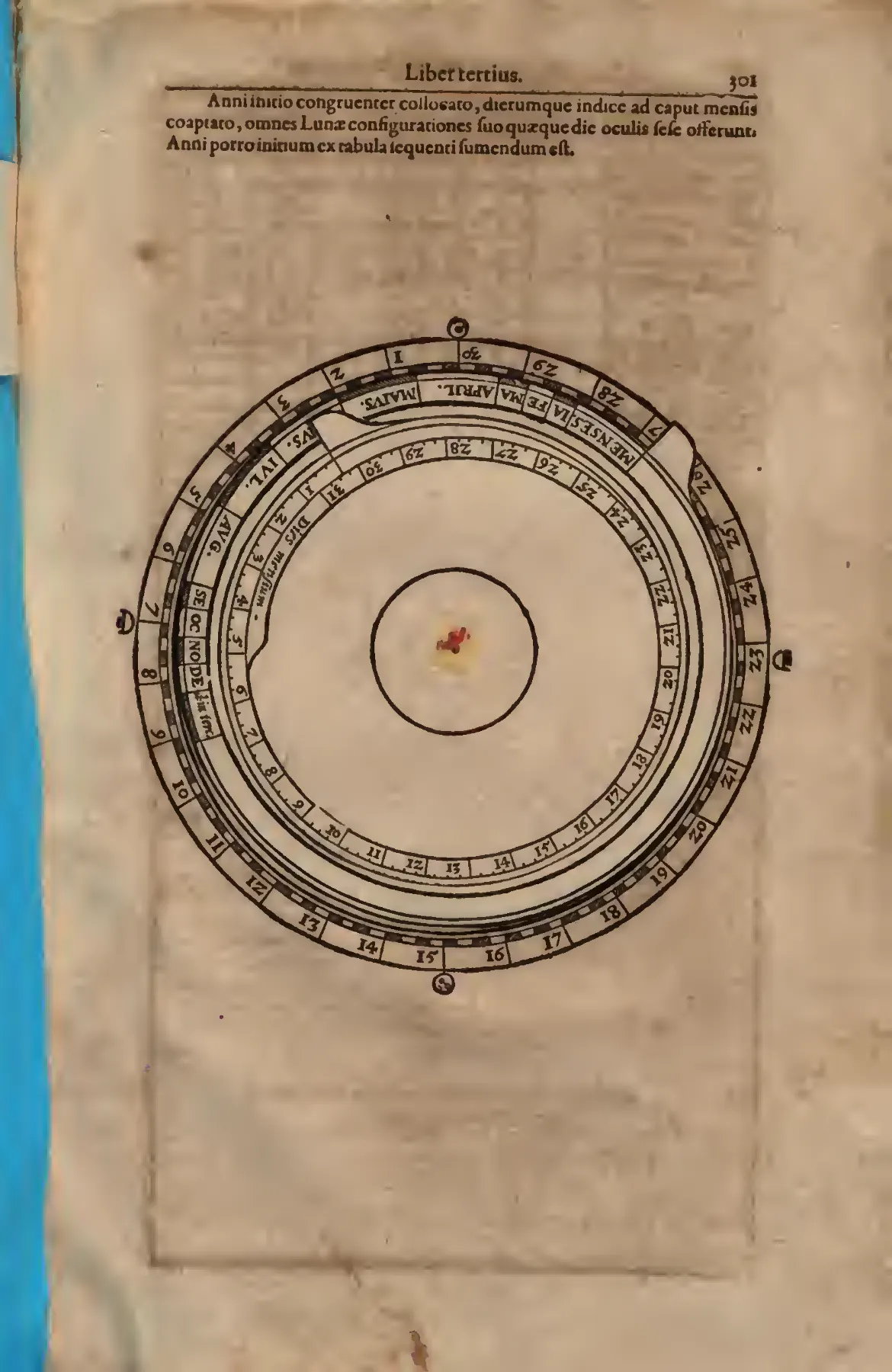
Printed among the calendrical appendices after the treatise's formal close, this lunar volvelle arranges months, day numbers, and solar and lunar phase signs into a concentric instrument, making good the promise that the Moon's configurations would present themselves "to the eyes" on their proper days — reckoning as procedure, not prophecy. Source ↗.
The closing section on the world's end submits eschatological curiosity to the same discipline that governed the sabbatical computations. The rabbinic millennial scheme is quoted in full, to the effect that six thousand years shall the world be, and again it shall be destroyed: two thousand of emptiness, two thousand of the law, two thousand of the days of the Messiah, Sex millia annorum erit mundus, & iterum destrueretur. Duo millia inanitatis. Duo millia legis. Duo millia dierum Messiæ, and set beside the hexaemeral reckoning of Lactantius — only for the computation of the day to be forbidden outright. A book that has just legislated a calendar to the year 4000 and dated the baptism definitely declines the one number its genre most invited, on the ground that the terminal date lies outside the evidence Scripture supplies and the heavens can verify. The instruments printed at the end enforce the same distinction between what may be computed and what may not: the rotating lunar index is supplied with its rule of operation, so that, the beginning of the year being suitably placed and the index of days fitted to the head of the month, all the configurations of the Moon present themselves to the eyes each on its own day, Anni initio congruenter collocato, dierumque indice ad caput mensis coaptato, omnes Lunæ configurationes suo quæque die oculis sese offerunt — a printed device that converts the treatise's reckoning into an object to be handled, and the last word of the volume is given not to a prediction but to the doxology, to God alone be honour and glory, SOLI DEO HONOR ET GLORIA.
Frequently Asked Questions
What is Chronologicarum demonstrationum libri tres by Johannes Temporarius?
It is a Latin technical treatise in historical and sacred chronology, printed in folio at Frankfurt am Main in 1596 by the heirs of Andreas Wechel. Its title page promises three things: a sequence of times carried from the beginning of things to the year 1580 of the Christian era, demonstrations drawn from sacred writings and the cycles of the heavens, and a universal history composed out of temporal orders first explained and proved. The book is argumentative reckoning rather than narration. No established English title has been located, so Chronologicarum demonstrationum libri tres is rendered for convenience as "Chronological Demonstrations: Three Books."
Who was Johannes Temporarius, or Jean du Temps?
A French jurist, writer, translator, publisher, and mathematically trained scholar, catalogued as Johannes Temporarius and known in French contexts as Jean du Temps or Jean I du Temps. Authority records give an approximate birth year of 1535, activity dates of 1570–1590, and associate him with France and Lyon, while specialist scholarship places him at Blois, where his mathematical library has been reconstructed. Among his publications is Organon astronomicon ex hypothesibus Copernici extructum, consistent with the astronomical competence his chronology presupposes. Exact birth and death dates remain unestablished, and an attribution of the 1596 treatise to Thomas Stapleton is incompatible with the catalogue evidence.
Why did Temporarius ask Europe's monarchs to make 1597, 1598, and 1599 years of 360 days?
Because dated observation showed the Caesarian year of 365 days and a quarter to be too long: the tropical year is shorter, as observations of the equinoxes make manifest. He therefore proposed that the emendation be made at the close of the sixteenth century by running three consecutive years of three hundred and sixty days each — 1597, 1598, 1599 — suppressing twenty days in all, beginning the year at the winter solstice, and omitting one intercalation every hundred and sixty years. Its warrant was six dated vernal equinoxes from the Chaldaeans through Hipparchus, Ptolemy, al-Battānī, and Bernard Walther to one he claimed for himself in 1577. Monarchs, not the pope, were to legislate it.
How did Temporarius expose the forged ancient histories published by Annius of Viterbo?
By internal stylistic evidence rather than appeal to authority. The texts Annius issued under the names Berosus, Manetho, and "Metasthenes" are convicted as spurious, supposititious, and drawn from one and the same source by their everywhere similar diction, a narrative tenor continued in a single style, the same childishness, and the same errors running through all of them — several supposed ancient authors betraying one modern hand. The manufacture is then caught in a documented instance: Josephus cites the Indica of Megasthenes, which under Annius's hand reappears as the Iudicia of "Metasthenes." The citation surviving in Josephus functions as a control beyond the forger's reach, exactly as eclipse records do elsewhere.
Is there an English translation of Chronologicarum demonstrationum libri tres?
No modern translation into English, French, German, or another vernacular has been identified in the catalogues and scholarly records consulted; this is a negative finding rather than proof that none has ever existed. Separately, the Leo edition presents the full transcription of the 1596 Frankfurt folio together with a complete English translation for the first time, and that translation is generated by AI. Leo is an effort to make freely available online, at no cost, English translations of every text printed in Latin in early modern Europe between 1450 and 1750.
This report was generated by an advanced AI assistant that conducted deep research alongside an extensive interpretation of the transcribed original text. Every effort has been made to preserve fidelity to the source and to guard against inaccuracy, but corruption in the text recognition process and model hallucination may nonetheless have entered the text. Treat every claim, quotation, translation, and citation as provisional, and verify each against the original source before relying on or citing it.
Further Reading on Temporarius, Scaliger, and Early Modern Chronology
- Anthony T. Grafton, "Joseph Scaliger and Historical Chronology: The Rise and Fall of a Discipline," History and Theory: The essay that set the terms for everything written since on why sixteenth-century chronology mattered and why it collapsed, tracing Scaliger's Julian Period, his exposure of forgeries, and his willingness to grant non-biblical sources independent evidentiary weight. Read it beside Temporarius's open admiration for De emendatione temporum to see how far the Frenchman adopted Scaliger's instruments while reserving the final verdict for Scripture.
- Anthony Grafton, Joseph Scaliger: A Study in the History of Classical Scholarship. Volume II: Historical Chronology: The fullest reconstruction available of how a late-Renaissance chronologer actually worked, from eclipse computation to the collation of regnal lists, and of the astronomical and philological competences the job demanded. It supplies the technical standard against which Temporarius's Nabonassar epoch, Olympiad head, and equinox series can be judged rather than merely admired.
- Alexander John Marr, "A Renaissance Library Rediscovered: The 'Repertorium librorum Mathematica' of Jean I du Temps," The Library: Marr transcribes a pupil's inventory of du Temps's mathematical books and uses it to reconstruct the Blois lawyer's working shelf, his interests in chronology and cartography, and his purchasing reach into the international trade. It is the closest thing we have to seeing which instruments and tables lay behind the equinox observations claimed in the Demonstrationes.
- John O'Brien, "Entre théologie et science: la 'Chronologia' de Joannes Temporarius," Esculape et Dionysos: Mélanges en l'honneur de Jean Céard: Nine pages that remain the only sustained study devoted to Temporarius's chronology, addressed precisely to the friction between his theological commitments and his technical apparatus. That friction is nowhere sharper than in his cosmology: the matter of the heaven does not consist of circles, epicycles, orbs, or wheels carrying the stars: it is altogether liquid, as Pliny truly reported, Cæli materia non constat circulis, epicyclis, orbibus, aut rotus sidera deferentibus. Illa omnino liquida est, vt verè prodidit Plinius,, a rejection of solid celestial spheres that bears directly on how the phenomena underwriting his chronology were thought to be produced.
- C. Philipp E. Nothaft, Scandalous Error: Calendar Reform and Calendrical Astronomy in Medieval Europe: A long view of the computistical quarrels, lunar cycles, and jurisdictional anxieties that made calendar reform a scandal centuries before 1582, and that explain why a chronologer could treat the civil year as a defective instrument awaiting legislation. It is the indispensable background to Temporarius's demand that monarchs, not the pope, shorten the years 1597 to 1599 and move the year's beginning to the winter solstice.