ExLatinis: Recovering the Early Modern Mind
Latin carried the learned conversation of Europe for three centuries after the printing press before slowly falling out of use. Today, very few are able to read the vast record of early modern thought. ExLatinis is an attempt to increase access to that history, beginning with five texts that share the humanist impulse behind the project itself: ad fontes, a return to the source.
Jon Cooper
Founder and CEO · July 5, 2026
Contents
From the Latin, into the open
Latin carried the learned conversation of Europe for three centuries after the printing press before slowly falling out of use. Today, very few are able to read the vast record of early modern thought. ExLatinis is an attempt to increase access to that history, beginning with five texts that share the humanist impulse behind the project itself: ad fontes, a return to the source.
The aspiration to gather up all knowledge and set it before the public is old and venerable. When Diderot and d'Alembert set hundreds of contributors loose on the Encyclopédie in eighteenth-century France, they did so in the belief that knowledge should circulate freely, within reach of any reasoning person. They knew, of course, that an encyclopedia containing all human knowledge would never be complete. The project stands just as much for the impossibility of total knowledge as for its promise. But it was by aiming at something that lay beyond reach that its makers accomplished more than a soberer effort could have.
It is with the same self-conscious hubris that we have begun to assemble public collections of archival material. Leo Collections is the foundation for a larger ambition, described elsewhere, to create a single, interoperable archive of the world's textual past, drawn from holdings scattered across national repositories, local archives, university libraries, and the hard drives of individual scholars.
ExLatinis is the first leg of this effort. It sets out to translate every Latin work printed in Europe between 1450 and 1750, a span bookended by the printing press, which enabled a single book to reach many more readers, and the turn to the vernaculars, which left command of the language to a shrinking few.

The lost language of the learned
In early modern Europe, a work printed in Basel could be read, annotated, and rebutted in Kraków or Salamanca without the need for any intermediary to translate it. Latin was the lingua franca of the learned, in which those who shared no mother tongue could puzzle together over the soul, the motions of the planets, and the words of God. Though the majority of printed works that enjoyed any significant circulation during this period survive, with having been scanned and made available in online repositories such as Google Books and the Internet Archive, they are little read, because the language that once facilitated communication across borders is now inaccessible to almost everyone.
Latin's demise as the common tongue of learning was not foreordained. Two impulses pulled at it from opposite directions. The first was the recovery of classical antiquity that began in northern Italy at the turn of the fourteenth century, summarized by its adherents in the phrase ad fontes, "to the sources." The humanists studied the texts of ancient Greece and Rome in their original forms, stripped of what they saw as corruptions accumulated over the intervening centuries. As the program spread northwards over the next two hundred years, its devotees hoped not just to imitate the greatness of the ancients but, by refining Latin as the medium of an international scholarly class, to restore the linguistic unity lost at Babel.
The second impulse worked from the same instinct, distrusting inherited assumptions and proposing to go back to the original source. When Luther initiated the break with Rome in 1517, he called for a return to the original word of scripture, untainted by the errors of the Vulgate and the accumulated gloss of the schoolmen. But where the humanists wrote for a learned class in purified Latin, the reformers wanted to bring the sense of the original to every believer, in their own tongues. The church's Latin, they argued, served less to transmit the word than to ration it.
Slowly, the champions of the vernacular won. Each successive generation would read less of it, rendering the written output of early modern European thinkers increasingly inaccessible and making way for a murky haze of secondhand impressions and convenient caricatures. Just as the humanists lamented the corruptions that had crept into the monuments of antiquity, so their own age thus came to be misrepresented as one of clean breakthroughs, of reason shrugging off medieval superstition.
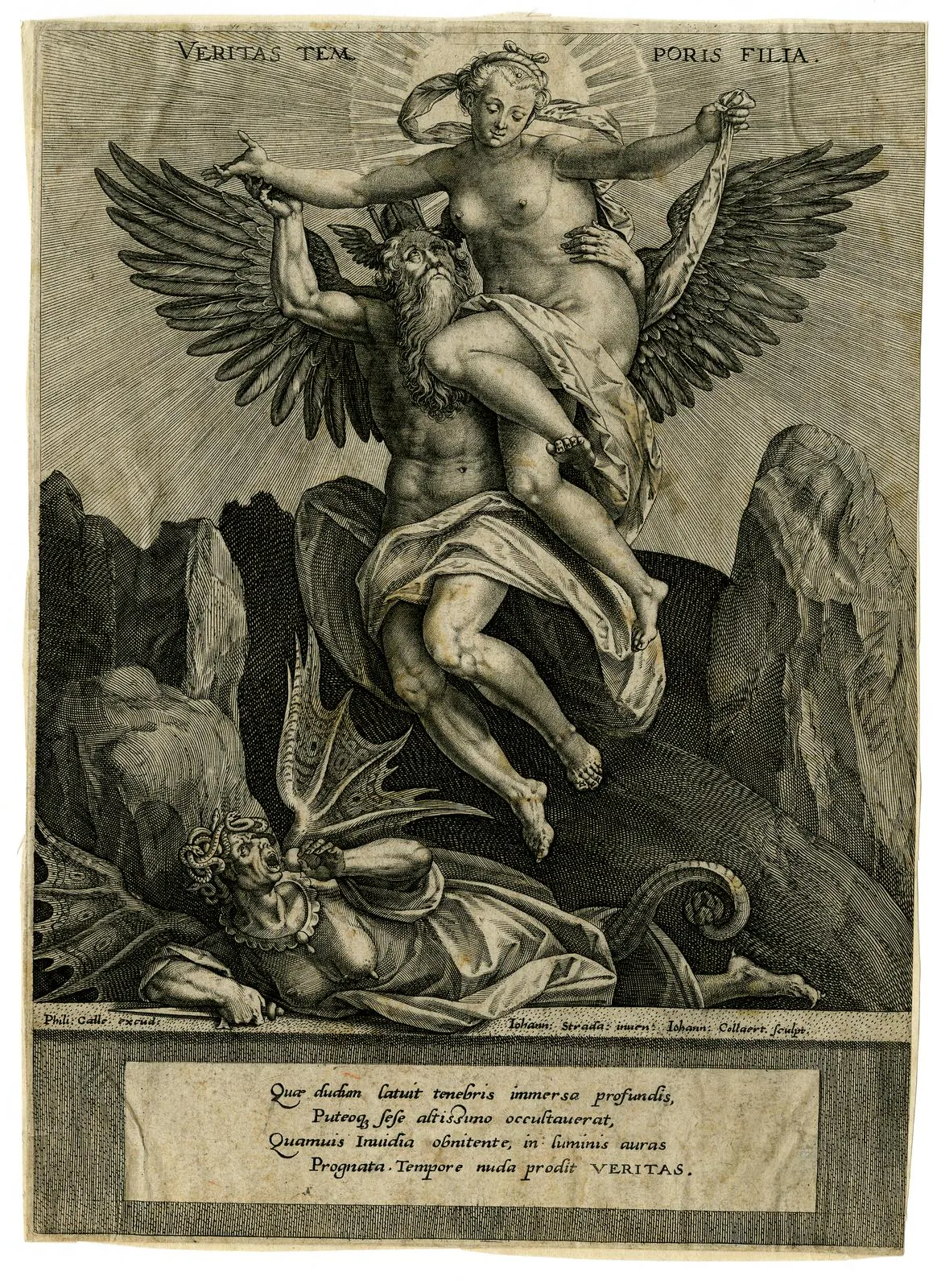
Veritas Temporis Filia ("Truth is the Daughter of Time"), engraved by Jan Collaert II. Time carries Truth up into the light while Envy lies defeated below. Source ↗.
Technology and the promise of recovery
Though humanists and reformers parted ways over whom the recovered word was for, they both asked whether to trust the text at hand and proposed to resolve the question by returning to the original source. ExLatinis adopts the same approach but turns it on the early modern record itself.
Digitization efforts since the 1990s have made vast numbers of these works widely and freely available. The problem is that actually reading them requires a working knowledge of Latin and translating them at scale depends on something apparently banal: the ability to turn photographs of pages into text that a machine can read.
Optical character recognition, the technology that converts an image of a page into searchable characters, was built for the type of the twentieth century and tends to malfunction on early modern print. The long ſ is easily read as an f; the ligatures that fuse two or three letters into a single character are rendered as confusable homoglyphs; abbreviations, in which a stroke above a vowel stands for a missing m or n and which often require contextual clues to parse, are effaced entirely.
A newer technology powered by AI, known as handwritten text recognition, or HTR, has in recent years made enormous progress, including on difficult print. Though not flawless, the best models now generate usable transcriptions for most purposes. They hold up on damp-stained paper, on ink bleeding from the far side of a leaf, on photos taken with phones in shaky hands. Helpfully, a model trained on handwriting can also read the marginalia, the underlinings, the interlinear glosses, to record how a text was read.
ExLatinis puts this technology to work in an automated pipeline: a chain of small, specialized steps in which the output of one becomes the material for the next, like a workshop dividing labor among hands. The process begins by searching open repositories for Latin works photographed decades ago but never translated. It then uploads each one to Leo, whose state-of-the-art automated text recognition (ATR) model—which shares the same architecture as general-purpose systems like GPT, Gemini, and Claude, but has been trained for the specialized task of reading historical documents—transcribes each page individually. An external large language model then translates the text into modern English, before a research stage summarizes, references, and interprets the work in passes. The final steps comb the volume for its illustrations like historiated initials and engraved title pages, weaving them into a final companion report, which is then posted to our website.
Left unchecked, the danger of an automated process like this is that it will tend to produce something fluent but unmoored, making confident claims with no basis in the original text. The pipeline therefore builds in verification at several points. The research stage works from chunks of the transcription rather than from what the model carries in memory. Throughout the drafting process, the pipeline checks each claim back against the source and catches stray passages before they reach the final report. Because these safeguards are not infallible, a second principle of discipline relies on the reader. The companion report is designed to make answerability to the source visible, tying claims to the exact place in the original text that ground them. Clicking a link in the report takes the user to the page it came from, where the image, its Latin transcription, and the English rendering appear together in Leo's interface. The reader is invited to take up the position of the skeptical humanist, to catch the error and to correct it.
It goes without saying that machine-generated transcriptions and translations are no substitute for those made by scholars with judgment honed over years. Of the three layers, the generated report is the most likely to make plausible-sounding errors and should be used as a prompt for discovery and a finding aid rather than taken as a work of scholarship. Though every effort has been made to ensure fidelity, all of these layers will sometimes produce flawed output. But it does not follow that because a rendering is imperfect, the material is better left unread altogether. That argument is suspiciously close to the one made by church- and schoolmen who preferred the laity dependent on those licensed to read for them than at liberty to misread on their own.
Even in an imperfect form, making this material available offers a way back into a vanished mental world. Where the famous, long-translated canonical works reveal an intellectual culture at its most deliberate and self-conscious, the broader literary hinterland is in many ways more revealing. To translate that work in bulk promises to put a whole texture of thought within reach of anyone, rather than reserving it for the few who can still read it in the original.
From coins to comets
We begin the project with a sample of five non-canonical Latin texts. Taken together, they span the project's arc, from the first decades of print to the eve of Latin's retreat. Their subjects range from coins to comets, but they are united by a habit of mind. The recovery of antiquity taught early modern scholars to distrust the text while confessional quarrels raised the question of who was entitled to make any given claim. Repeatedly in these texts, an old certainty is questioned on the strength of evidence presented by the source.
The summaries below were generated by the pipeline itself, from each work’s companion report and, behind that, from the raw transcription, demonstrating the process described above.
Guillaume Budé, De Asse et partibus eius libri quinque (Paris, 1515)
Guillaume Budé’s study of Roman coinage begins with the humble copper as but develops into a broader argument about how historical knowledge should be established. Budé weighed surviving coins, measured vessels, compared manuscripts, and even questioned a Parisian baker about grain measures. This evidence led him to argue that a misread inflection in Pliny had inflated modern estimates of Roman public finance a hundredfold. From there, De asse expands into a criticism of debased currency, clerical wealth, and the warlike papacy of Julius II. The work helped establish ancient coinage and metrology as disciplines in which material evidence could overrule inherited authority.
Leonardo Vairo, De fascino libri tres (Paris, 1583)
Leonardo Vairo accepts that the evil eye is real but systematically denies that any natural faculty can explain it. Across three books, he tests theories involving the imagination, rays emitted by the eye, touch, speech, bodily contagion, and celestial influence. Having ruled them out, he identifies the efficient cause as a demon acting through a pact. The result is not simply a collection of supernatural anecdotes but a post-Tridentine work of demonstration, bringing philology, medicine, faculty psychology, philosophy of language, and theology together to move the evil eye from the category of natural marvel into that of religiously dangerous superstition.
Erycius Puteanus, De cometa anni 1618 (Cologne, 1619)
When a brilliant comet crossed Europe in November 1618, many observers treated it as a warning of war, plague, or the death of rulers. Erycius Puteanus—Justus Lipsius’s successor in the chair of Latin eloquence at Louvain—argued instead that the fear itself was irrational. His two-book Paradoxologia reclassifies the comet as a citizen of the heavens rather than an earthly portent and attacks the habit of attaching subsequent disasters to whatever celestial phenomenon preceded them. Written at the opening of the Thirty Years’ War and dedicated to the Habsburg rulers of the Spanish Netherlands, the work redirects attention from supposed prodigies in the sky to disorder within the human soul.
Ottavio Ferrari, De re vestiaria libri septem (Padua, 1654)
Ottavio Ferrari reconstructs Greek and Roman clothing from literary testimony, legal texts, coins, statues, and reliefs—but insists that material remains should outrank grammarians when the evidence conflicts. The resulting seven-book study treats clothing as a legible social language: the toga declares citizenship and liberty, purple stripes distinguish rank, and differences in fabric communicate wealth, office, or philosophical austerity. Illustrated with thirty-two plates derived from Cassiano dal Pozzo’s “paper museum,” De re vestiaria is both an experiment in material philology and an early foundation for the scholarly history of dress.
This anonymous Neo-Latin jestbook applies the solemn machinery of university learning—syllogisms, legal testaments, medical diagnoses, etymologies, and disciplined verse—to flatulence, cuckoldry, drunkenness, pigs, and latrines. Its comedy depends on never breaking character: absurd subjects are treated with the impeccable gravity of the schools. Even the publication details join the joke. The book announces itself as available at Nobody’s shop, yet everywhere, and conceals its printer, place of publication, and real dedicatee behind an elaborate false imprint. First surviving in an edition dated 1642 and repeatedly enlarged through 1720, it exposes how easily the forms of learned authority can persist when their subject matter becomes ridiculous.
Back to the source
Each of these texts overturned a received authority by returning to the source: the weighed coin against the copied figure, the new astronomy against Aristotle, the marble against grammarians. ExLatinis turns the same appeal on the early modern record itself and promises, with the tools of the twenty-first century, to place what it recovers within reach of anyone.
ExLatinis will release new texts as they are translated. You can explore the collection on our dedicated site or via our shared folder on Leo. Follow the project on Instagram, Bluesky, X, and Facebook to know when the next text is ready.