Born Yesterday or the Day Before: Johann Eck's Homilies on the Seven Sacraments of the Catholic Church: Fourth Tome
Johann Eck passed the last two decades of his life as professor of theology at Ingolstadt, defending the Catholic seven sacraments from the pulpit, and the fourth tome of his declamatory works — Homiliarum clarissimi viri D. Ioannis Eckii adversus Lutherum, et caeteros haereticos, De septem Ecclesiae sacramentis: tomus quartus — is where that defence was packaged as model sermons for other preachers to reuse. Its method is startlingly juridical: because God alone can institute a sacrament, the number seven has to be proved not from any ecclesiastical enactment but from unwritten apostolic tradition and the constant custom of the Church, secured by the civilians' maxim that custom is the best interpreter of laws. The copy examined here was printed at Paris by Gabriel Buon in 1561, eighteen years after Eck's death, one witness in a reprint sequence that outlasted its author by a generation.
ExLatinis
September 6, 2026

Contents
Johann Eck passed the last two decades of his life as professor of theology at Ingolstadt, defending the Catholic seven sacraments from the pulpit, and the fourth tome of his declamatory works — Homiliarum clarissimi viri D. Ioannis Eckii adversus Lutherum, et caeteros haereticos, De septem Ecclesiae sacramentis: tomus quartus — is where that defence was packaged as model sermons for other preachers to reuse. Its method is startlingly juridical: because God alone can institute a sacrament, the number seven has to be proved not from any ecclesiastical enactment but from unwritten apostolic tradition and the constant custom of the Church, secured by the civilians' maxim that custom is the best interpreter of laws. The copy examined here was printed at Paris by Gabriel Buon in 1561, eighteen years after Eck's death, one witness in a reprint sequence that outlasted its author by a generation.
Johann Eck — better known to most readers as Luther's antagonist at the Leipzig disputation of 1519 than as a preacher — spent the last two decades of his life as professor of theology at Ingolstadt, producing not only the compact handbook of controversial loci that made his name across Catholic Europe but also a vast homiletic corpus intended for the pulpit. The work in view here belongs to that corpus. It is a Latin homiliary, that is, a collection of model sermons designed for reuse by preachers, forming the fourth tome of Eck's declamatory works and devoted entirely to the seven sacraments of the Catholic Church, its title announcing itself as directed against Luther and the other heretics. Its earliest independently attested form is an Ingolstadt edition printed by Georg Krapff, whose dedication is dated at Ingolstadt on 1 March 1535. The copy under study, however, was printed at Paris in 1561 by Gabriel Buon in the Clos Bruneau at the sign of Saint Claude — eighteen years after Eck's death in 1543 — and is therefore a posthumous reissue of an established Eckian text rather than a new composition, one witness among a long Parisian sequence that reaches from the 1540s into the 1570s.
The intellectual problem the work confronts is at once narrow and enormous: on what authority may the Church affirm exactly seven sacraments, each of them an instrument that genuinely confers grace, when its opponents demand that every article of faith be demonstrated from Scripture alone? Eck's recurring move is threefold and remarkably consistent across the sacraments. He first fixes a definition — a sensible, external sign that efficaciously signifies and confers the grace of God by divine institution, ordered to the salvation of man the wayfarer. He then reserves institution to God alone, with the striking consequence that neither an apostle, nor any council, nor even the whole world assembled could make a sacrament. And having narrowed the ground so severely, he relocates the evidentiary burden: what Scripture does not state explicitly is secured by unwritten apostolic tradition and by the constant custom of the Church, invoked under a maxim carried over bodily from the jurists — that custom is the best interpreter of laws. Councils, decretals, Fathers, and liturgical rubrics are then adduced not as the source of that tradition but as witnesses to it, while the Church's admitted power to abolish the Sabbath, fix the reckoning of Easter, and set aside circumcision is deployed to show that arguments from Scriptural silence prove nothing at all. The corollary is a temporal test of doctrine: teachings of those he calls the Neochristiani are disqualified precisely as novelty, newness being itself the mark of error.
The stakes of that argument were not academic. Luther's De captivitate Babylonica had reduced the sacraments from seven to two or three, and with them the whole visible economy of grace, ordained priesthood, and ecclesiastical jurisdiction that the septenary underwrote. Recent work on German Catholic preaching, particularly that of John M. Frymire, has shown that Catholic defence of ritual and ceremony did not wait upon the Council of Trent: preachers before and during the Council were already assembling scriptural and historical precedents for Catholic practice and issuing substantial model sermons and preaching aids. Work on the historical method of the early controversialists, notably David V. N. Bagchi's reassessment of Eck and Cochlaeus, has likewise revised the older judgment that these writers handled history crudely, pointing instead to an emergent insistence on documentary and archival proof in disputes such as those over the Council of Constance. A homiliary that argues the septenary from custom, councils, and decretals sits exactly at the junction of these two revisions — sacramental theology as a matter of historical evidence, delivered in a form built for the pulpit.
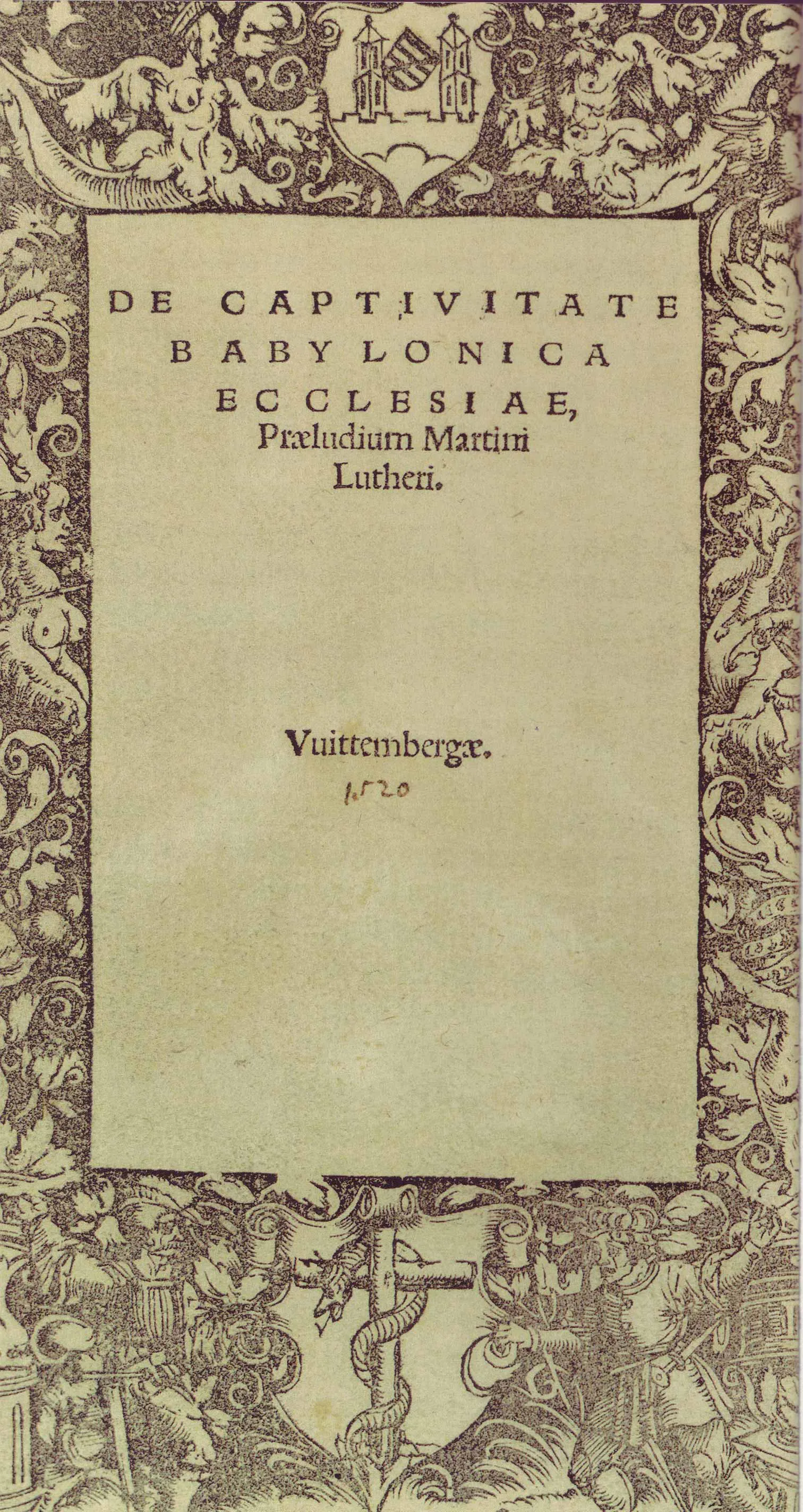
The title page of Luther's De captivitate Babylonica ecclesiae praeludium (1520), the tract that reduced the sacraments to two or three and so provoked the defence mounted here. By unsettling the septenary, it made Catholic rites, priesthood, and jurisdiction a matter of historical as much as doctrinal proof. Source ↗.
What a first-time reader is most likely to find memorable, beyond the architecture of the argument, is the sheer range of what Eck was willing to draw into a sermon. Canon law on reserved cases, irregularities, and the degrees of consanguinity and affinity sits beside Roman civil law and the Fathers; the objection that undoes Luther's own definition of a sacrament is credited not to Eck himself but to John Fisher, bishop of Rochester, who pointed out that on such a description almsgiving would be a sacrament too. The polemic is unsparing — baptisms performed with the Zwinglian form are pronounced no baptisms at all — and yet the same pages refuse to countenance forcing Jews to the faith, on the ground that services extracted by force do not please God. The geographical horizon runs from Wittenberg and Zurich to Hungary under Turkish attack and as far as Hispaniola and the Americas. That the tome comprises seventy-seven numbered homilies closing with a general conclusion, a register, and an alphabetical index is not corroborated by the accessible catalogue records, though the work's own back matter does announce a register of its homilies; the extent of Greek and Hebrew matter in the 1561 Paris witness, and the presence of a German front-matter address, likewise await direct examination of the text.
Held together, the work's conceptual vocabulary, its production history, and its internal argument tell a single story. The word sacramentum is made to carry juridical, liturgical, and dogmatic weight simultaneously, so that a maxim of the civilians can settle a question of exegesis; the argument's claim to authority rests on continuity of usage rather than on novelty of insight; and the material record bears that claim out in its own way, since the same text was reset and reissued from Ingolstadt to Antwerp, from Paris to Cologne, across a quarter-century and beyond its author's death, one Parisian copy passing eventually into the library of the Jesuit Imperial College. A book that argued for the authority of constant custom was itself sustained by the constant custom of preachers who kept reprinting it.
Read the full text and English translation on Leo
This text was transcribed and translated as part of the ExLatinis project, an effort by Leo to make free English translations of every text published in Latin in early modern Europe (1450–1750) available online. The complete transcription and English translation of this work can be read free of charge:
→ Read the original Latin text and full English translation on Leo
You can save a copy of this document into your Leo account to run deep text searches, conduct further analysis, or cross-reference it with your own research.
Reading Eck's Latin Title: Sacramentum, Efficacy, and the Charge of Novelty
Editorial English title supplied for convenience: “Johann Eck’s Homilies on the Seven Sacraments of the Catholic Church: Fourth Tome.” The title translates the bibliographically attested Latin form, “Homiliarum clarissimi viri D. Ioannis Eckii adversus Lutherum, et caeteros haereticos, De septem Ecclesiae sacramentis: tomus quartus.” Eckius, Eckius Ingolstadiensis, and Johann von Eck refer to Johann Eck, also Johann Maier von Eck; the catalogue tradition varies between Eck, Johann von and Eck, Johann, 1486–1543. The Latinate form of the name recurs in the work's own back matter, where the register of contents is headed as the register of the homilies of this fourth tome, on the sacraments, by Eck, REGESTVM HOMILIARVM HVIVS QVARTITOMI. DE SACRAMENTIS, per Eckium, so that the text's internal self-designation agrees with the shorter of the catalogue name-forms and with the tome-numbering of the title.
The governing noun sacramentum belongs to a juridical, liturgical, and theological vocabulary rather than denoting a merely symbolic observance. In the scholastic account presupposed by Catholic sacramental controversy, the sacrament is a sacred sign ordered to grace, and the insistence on the Church’s sevenfold enumeration distinguishes Catholic sacramental economy from reforming reductions. The polemical force lies precisely in refusing to treat the rite as an optional memorial sign: the sign is bound to ecclesial institution, visible matter and form, and the divine promise attached to its proper administration. The work states that definition in exactly these terms, holding that by the word “sacrament” is understood an external, sensible sign, which efficaciously signifies the grace of God, or a gratuitous effect, by divine institution, ordered to the salvation of man the wayfarer, dicimus sacramenti vocabulo accipi signum externum, sensibile, quódque efficaciter gratiam Dei significat, vel effectum gratuitum ex institutione Diuina, ordinatu[m] ad salutem hominis viatoris; the adverb efficaciter carries the whole controversial weight, since it is efficacy rather than signification that the Zwinglian bare sign is held to lack. From that definition the text draws an immediate restriction of the institutive power, namely that all the Church's sacraments were instituted by God alone, not by an apostle, not by any council, and that if the whole world came together now, it could institute no sacrament, Vnde sequitur primo omnia ecclesiæ sacram[en]ta tantum à deo esse instituta, non ab apostolo, no[n] ab aliquo concilio. Imo, si totus nunc conueniat mundus, sacram[en]tum instituere nullum posset — a maximalist reservation of institution to God that, far from weakening the appeal to ecclesiastical authority, is what obliges the argument to seek its warrant for the number seven in tradition and custom rather than in any positive ecclesiastical enactment. The enumeration itself is given in the conventional order, the names of the seven sacraments being baptism, confirmation, the sacrament of the altar, penance, order, matrimony, and extreme unction, Nomina septem sacramentorum sunt illa, baptismus, confirmatio, sacramentum altaris, poenitentia, ordo, matrimonium, & extrema vnectio.
The formula ex opere operato—literally, “from the work worked”—marks the distinction between sacramental efficacy and the personal activity or merit of the minister or recipient. It does not mean that intention, faith, or worthy reception are irrelevant to Christian life; rather, it protects the sacrament’s efficacy from being reduced to the moral quality of the celebrant. This is the conceptual field in which distinctions involving the minister’s action, the recipient’s disposition, and a causa sine qua non become polemically decisive. The terminology belongs to the scholastic apparatus that Catholic controversialists deployed against accounts of the rite as effective only through subjective faith or commemorative use. The technical precision such distinctions demand is visible in the definition of baptism, which specifies a washing of man the wayfarer, not dissenting, performed in flowing elemental water, by another using the appropriate form and having the right intention, ablutio hominis viatoris non contra sentientis, facta in aqua fluida elementari, ab alio quopiam conuenienti forma vtente, & rectam intentionem habente, where matter, form, minister, and intention are each named as conditions of validity while the recipient's positive faith is conspicuously not required — only that he not dissent. The correlative doctrine of an effect independent of the recipient's continuing disposition appears in the same sacramental treatment, which speaks of an indelible character in the soul of the baptized person, in animâ hominis baptizati character indelibilis.
The vocabulary of novitas and innovatio suspecta similarly turns chronology into a theological test. In Catholic controversy, a doctrine identified as novitas could be presented not simply as recent but as lacking the authority of continuous ecclesial usage; labels such as Neochristiani, Catabaptistae, and Capharnaitae functioned as confessional and polemical classifications rather than neutral descriptions. The accessible catalogue evidence confirms the work’s anti-heretical title but does not permit a responsible claim that every one of these terms occurs in the surviving 1561 witness without inspection of the full text. Two of them, at least, do appear in it: the argument for the septenary concludes with the inference how unjustly the Neochristians try to tear away that holy name of sacrament, Hinc sequitur quâ iniquè Neochristiani sanctum illud sacramenti nomen euellere con[n]etur, and the treatment of infant baptism identifies the other heresy which the Catabaptists have now introduced as new, namely that infants are not to be baptized, because they do not believe, do not yet know, and do not consent, Alteræ hæresis quâ nunc Catabaptistæ pro noua induxerunt, ea est, quod non sint paruuli baptizandi, quia nô credunt, nondum sciunt, neq[ue] cõsentiunt, where the phrase pro noua does the disqualifying work: the position is refuted in part simply by being dated.
That chronological test is matched by an explicit rule of theological diction, which the work states in its own defence. Philosophers, it observes, use free words and do not fear offending religious ears, but for us it is right to speak by a fixed rule, lest we transgress the ancient boundaries our fathers set, Liberis verbis vtuntur philosophi, nec offensionem aurium religiosarum pertimescunt, nobis autem ad certam regulam loqui phas est, ne qua re transgrediamur terminos antiquos, quos posuerunt patres nostri. The allusion to the ancient boundaries of Proverbs 22:28 makes terminological conservatism a species of the same argument from continuity that governs the doctrinal case, and it accounts for the work's preference for the received scholastic lexicon over humanist paraphrase even where its author's own philological interests might have suggested otherwise.
What the Fourth Tome Contains: Eck's Sacramental Homiliary at a Glance
The work is a Latin homiliary and anti-Lutheran controversial treatise by Johann Eck, issued as the fourth tome devoted to the seven sacraments of the Catholic Church. The tome grounds that number not in argument alone but in ecclesial teaching, holding it established that holy Church, mother of all the faithful, teaches us constantly to believe and profess that there are seven holy sacraments, constat Ecclesiâ sanctam, fidelium o[mn]im matre[m], Christiq[ue] adeo sp[eci]osam electissima[m] nos docere, vt co[n]stanter credamus & profiteamur septe[m] esse sancta sacramenta — the adverb constanter aligning the believer's constancy with the constancy of custom on which the larger argument rests. Its earliest independently attested form is an Ingolstadt edition by Georg Krapff, dedicated or subscribed at Ingolstadt on 1 March 1535; Eck’s author record gives his life dates as 1486–1543, so the Paris 1561 issue is a posthumous reprint or resetting of an established Eckian work rather than a composition newly produced in Paris.
The Paris witness was printed by Gabriel Buon at “in clauso Brunello,” at the sign of Saint Claude, in 1561. The strongest accessible catalogue records describe it as a Latin duodecimo of 251 leaves plus five unnumbered leaves, with a typographic mark on the title page and marginal apostilles. A separate 1561 Paris issue by Hieronymus de Marnef is recorded as an octavo, so the two should not be collapsed into a single bibliographical state. A quarto description is not confirmed by the surviving catalogue evidence.
The genre is best understood as a preaching collection whose homiletic form carries sustained controversial theology. The two registers are frequently inseparable within a single sentence: the exposition of the Mass turns without transition into denunciation, declaring it plain how full of error is what the Neochristians shamefully dream and rashly assert, that the Mass is a memorial not only of Christ's passion and death but also of the Last Supper, and indeed that they call the Mass a supper, though this is contrary both to reason and to the whole of Scripture, Hinc iam liquet, quàm careat erroru[m], quod turpiter somniant Neochristiani & temerariò affirmint, missam non tantùm esse memoriam Christi sux[us], passionis & mortis, sed & vltimæ coenæ: v[er]u[m] & missam, coena nominant, quum tame[n] hoc & rationi aduersetur & vniuersè scripturę. Alongside such polemic the collection retains the ordinary didactic scaffolding of catechetical preaching, announcing for instance that it will treat of the virtue of penance, which is a part of justice, and which itself again has three other parts, contrition in the heart, confession in the mouth, and satisfaction in deed, disseremus de virtute poenitentiæ, quæ iustitiæ pars est, habetque ipsa rursus alias partes tres, Contritionem in corde, confessionem in ore, & satisfactionem in opere. The work belongs to a larger corpus that circulated in German and Latin: the Cologne sermon series was translated into Latin by Johann Menzinger from sermons originally composed in German, and its fourth volume included sacramental material. A separate vernacular translation of the Paris sacramental tome itself, as well as the count of seventy-seven numbered homiliae and the terminal Conclusio, Regestum, and alphabetical index, could not be independently verified from the accessible catalogue records; the work's own back matter does head its register of homilies in the terms quoted above, an internal self-description that the catalogue records neither corroborate nor contradict. The language of the 1561 witness is Latin; claims concerning Greek and Hebrew matter and a German front-matter Syllabus require direct examination of the scan, even though philological argument from the biblical languages plainly forms part of the work's method as its Latin exposition presents it.
Why the Sacramental Homilies Matter: Custom, Councils, and the Historiography of Catholic Controversy
The fourth tome matters because it occupies the intersection of Catholic preaching, sacramental theology, confessional controversy, and the international book trade. Its repeated appearance in folio and octavo formats, its translation history, and its many Paris reissues show that Eck’s polemical theology was not confined to the immediate controversies of Ingolstadt. The homiliary supplied Catholic preachers with material that could be reused across generations while also presenting a learned response to Protestant challenges concerning the number, efficacy, and ecclesial administration of the sacraments. That response was itself drawn from an international Catholic controversial literature: against Luther's definition of a sacrament the work reports that, as the bishop of Rochester objected to him, on that description of a sacrament almsgiving too would be a sacrament, since it has a definite promise in Scripture, Quia vt episcopus Roffensis ei opposuit, iuxta istam sacramenti descriptionem, eleemosyna quoque foret sacramentum, quum certam habeat in scriptura promissionem — the argument advanced under John Fisher's name, and turning on precisely the point of definition that governs the tome's opening homilies.
John M. Frymire’s work on German Catholic preaching between the later Middle Ages, Luther, and Trent is particularly relevant. It argues that Catholic preaching on ritual and ceremony did not begin only after Trent: preachers before and during the Council established scriptural and historical precedents for Catholic practice, confronted the evangelical threat, and produced substantial model sermons and preaching aids. Frymire’s discussion of Luther’s Babylonian Captivity, with its reduction of the seven sacraments to two, supplies the essential confessional frame for Eck’s title and for the work’s defense of the Catholic septenary. The homiliary's own handling of ceremony shows how carefully that defence was calibrated, since it distinguishes what the Church may and may not institute: for even if the whole world should now come together, it still could not institute a sacrament, and therefore neither can a council, though the Church can nevertheless ordain sacramentals and accidental ceremonies, but not sacraments, nam etiam si totus nunc mun dus conueniret, sacramentum tamen instituere non posset, quapropter neque concilium: sacramentalia tamen, & accidentarias cæremonias ordinare potest Ecclesia, non auté sacramenta. Ceremonies are thus defended as ecclesiastical and mutable, sacraments as divine and fixed — a division that leaves the septenary immune to the charge of ecclesiastical invention while conceding a great deal about ritual accretion.
The historical method of Catholic controversy has also been reassessed. David V. N. Bagchi’s study of Eck and Johannes Cochlaeus revises Pontianus Polman’s influential judgment that early Catholic controversialists handled history immaturely. Bagchi shows that Eck, writing after Leipzig, insisted on consulting primary evidence in disputes over the Council of Constance, while Cochlaeus similarly appealed to original documentary material in controversies over Constance and Jan Hus. Their method was not modern critical historiography, but it displayed an emergent concern with archival authority and historical proof. That finding is important for reading sacramental arguments involving utraquism, ecclesial custom, and the historical authority of councils.
The sacramental tome bears that reassessment out in the way it handles its authorities. Conciliar language is quoted rather than summarized: the doctrine of the altar is given in the received conciliar formula that one and the same is both priest and sacrifice, Jesus Christ, whose body and blood are truly contained in the sacrament of the altar under the species of bread and wine, the bread being transubstantiated into the body and the wine into the blood by divine power, idem ipse est sacerdos & sacrificium Iesus Christus, cuius corpus & sanguis in sacramento altaris sub speciebus panis & vini veraciter continentur, transsubstantiatis pane in corpus, & vino in sanguinem, potestate diuina. On the contested question of the chalice the Constance decree is reproduced together with the concession it contains, that with mature deliberation of many doctors of both divine and human law premised, it declares, decrees and defines that, although Christ instituted this venerable sacrament after supper and administered it to his disciples under both species of bread and wine, matura pluriùm doctoru[m] tam diuini quàm humani iuris deliberatione præhabita, declarat, decernit, & definit: quòd, licet Christus post coenâ instituerit, & suis discipulis administrauerit sub vtraq[ue] specie panis & vini hoc venerabile sacramentum — the concessive licet granting the utraquist premise on the level of institution in order to reserve the disposition of the rite to ecclesiastical authority, and the decree's own appeal to doctors of both divine and human law mirroring the tome's habitual pairing of theology with jurisprudence. That pairing becomes explicit where an exegetical question is settled by a maxim of the civilians: from that foundation which is also customary in law, that custom is the best interpreter of laws, so the constant custom of the Church has established that this understanding of the Scriptures is the true one, ex eo fundame[n]to quod & in iure usurpari solet, quod consuetudo optima sit legum interpres: ita constans ecclesiæ consuetudo obtinuit, vt hic scripturarum intellectus sit verus. The same logic converts Scriptural silence from an objection into an argument, since great, truly great, is the authority of the Church, which Scripture itself concedes to her — for who abolished the Sabbath and put the Lord's day in its place? Not Scripture, surely, but the Church, Magna, re vera, magna est authoritas ecclesiæ, cui & scriptura ipsa concedit. Nam quis abrogauit sabbaru[m] &c in ei[us] locu[m] substituit die[m] dominicu[m] no[n] scriptura vtiq[ue], sed ecclesia. Custom, on this account, is not a supplement to Scripture but its authorized interpreter, and the historical record of the Church's practice functions as legal evidence of what the apostolic deposit contained.
The older confessional biography of Eck presented him chiefly as the relentless Catholic opponent of Luther. The more differentiated scholarly image, represented by the characterization “Scholastiker, Humanist, Kontroverstheologe,” treats him as a university theologian whose scholastic formation, humanist learning, preaching, and polemical practice were inseparable. The Corpus Catholicorum editions of the Enchiridion, edited by Pierre Fraenkel and Erwin Iserloh, provide a critical framework for studying the development of Eck’s terminology and argumentation across the years 1525–1543, although they are not editions of the sacramental homilies themselves.
The surviving evidence supports a cautious historiographical conclusion. The work clearly belongs to the Catholic response to Lutheran sacramental reduction and to the wider contest over ritual continuity, historical precedent, and ecclesial authority. It does not, without examination of the complete text, justify attributing every controversy one might expect of an anti-Lutheran sacramental treatise—such as the precise treatment of Zwinglian baptismal forms, Anabaptism, marriage impediments, coercion, Jewish children, usury, or the proposed council—to this particular tome. On several of those heads, however, the text does speak directly and in its own voice. The validity of Reformed baptismal practice is addressed without evasion in the inference that infants baptized by Zwingli and by others who use the Zwinglian form are not baptized, Sequitur inde quòd paruuli baptizati à Zuinglio & aliis qui Zuingliana forma vtuntur, baptizati non sunt, a conclusion that follows from the strict requirements of form and intention set out in the definition of baptism, just as the Anabaptist denial of infant baptism is stated and dated as a novelty in the passage cited above. On coercion the text is markedly restrained, disclaiming that I wish or advise that Jews be forced to the faith, since forced services do not please God, non quod velim aut consulam Iudæos vi esse cogendos ad fidem, quoniam deo coacta non placent obsequia. Marriage receives both a doctrinal and a jurisdictional treatment, holding that in the time of the Gospel, whenever matrimony is legitimately contracted and consummated by intercourse, so that the two become one flesh, even if afterwards they are separated by some judge for accidental causes, nevertheless the conjugal bond here remains, Tempore Euangelij quandocu[m]que matrimonium / legitimè co[n]trahitur, & per concubitum co[n]summatur, ita vt / siant duo in carne vna, etia[m] si deinceps ex accidet alibus causis separentur à iudice quopiâ, tamen hîc remanet vinculum / coniugale. The question of impediments is resolved by the same recourse to ecclesiastical authority that governs the septenary, refusing the Mosaic degrees on the ground that we will not suffer ourselves to be pushed back into the synagogue and brought under the Mosaic yoke, the more so because long ago, in the first council of Jerusalem, the legal precepts of Moses were abolished, except those which depend on the law of nature, & ecclesiam, non patiemur rursus nos intrudi in synagogâ, & sub iugum Mosaicum reduci. vel eò maximè quòd iam olim in primo concilio Hierosolymitano legalia Moysi præcepta sint sublata, exceptis iis quæ in lege naturæ, and locating the positive law of the degrees in the Church's own legislative act, since that Spirit therefore established laws through his Church and prescribed the degrees, Spiritus itaq[ue] ille per ecclesiam suam leges constituit & gradus præscripsit. The catalogue and secondary evidence establish the work’s confessional location, and these passages establish that several of the expected controversies are indeed engaged; but a chapter-by-chapter account of its theology, and the presence and extent of the remaining topics, remain dependent on direct textual analysis.
Tracing the Editions: From Krapff's Ingolstadt Folio to Gabriel Buon's Paris Duodecimo of 1561
The most secure bibliographical point of departure is the Ingolstadt edition attributed to Georg Krapff: the fourth tome of the fifth part of Eck’s declamatory works, “de septem sacramentis ecclesiae catholicae,” with the dedication dated Ingolstadt, 1 March 1535. Its recorded collation is four preliminary leaves, 144 numbered leaves, and two unnumbered leaves, totaling 150 leaves in folio. A distinct Antwerp 1535 issue, printed by Michael Hillenius at the expense of Johannes Stelsius, is recorded in octavo with seven preliminary leaves, 271 incorrectly numbered leaves, and one unnumbered leaf. An Ingolstadt 1540 Krapff issue is separately listed with four preliminary leaves and 108 leaves in erroneous numbering. These records establish a complex early transmission history rather than a single stable edition.
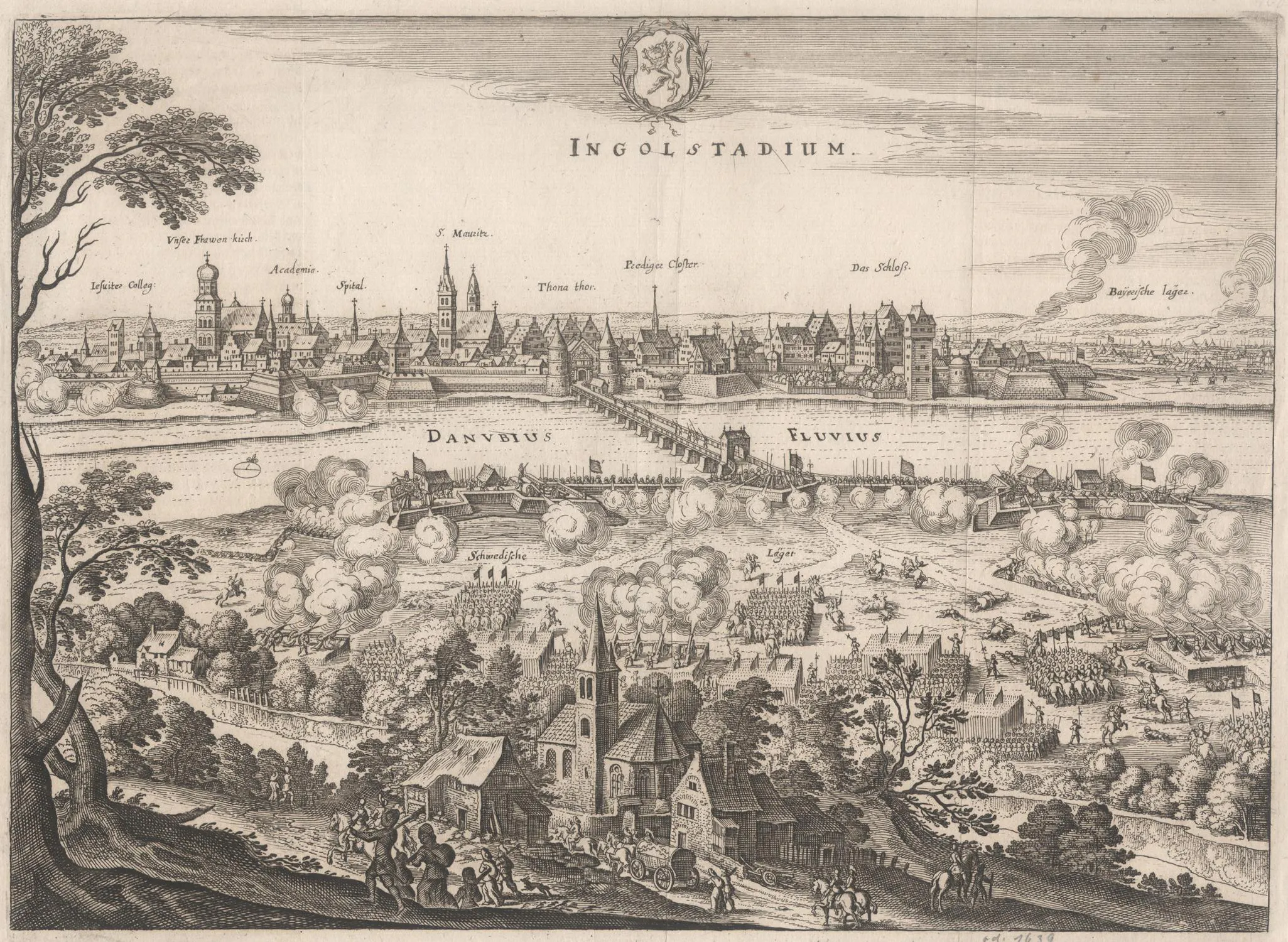
Matthäus Merian's engraving of the Swedish siege of Ingolstadt, published in 1632, preserves a labelled view of the city in which Eck held his chair and preached, with the university (“Academia”) and Jesuit college marked among its landmarks. Nearly a century after the Krapff folio, it still locates that edition's origin in an institutional setting where theology, preaching, and print converged. Source ↗.
Paris became a major centre for subsequent reproduction. The surviving bibliographical sequence includes issues associated with Jean Kerver in 1540; Pierre Regnault in 1541; Oudin Petit and Benignus Boisset in 1542; Ambroise Girault in 1545; Audoënus Parvus in 1546; Peter Gaulter and Jacob du Puys in 1549; du Puys and Poncet le Preux in 1553; Hieronymus de Marnef in 1561; Michael Sonnius in 1566; and later Paris and Cologne issues, including Maternus Cholinus in 1563 and Michael de Roigny in 1575. The evidence assembled here does not establish Antwerp, Lyon, or Venice reissues beyond the distinct Antwerp 1535 issue.
The Buon copy under study is catalogued as: “Parisiis: apud Gabrielem Buon, in clauso Brunello, ad D. Claudij insigne, 1561.” Gabriel Buon’s documented Paris activity runs from 1558 into the 1590s; his address is associated with the Clos Bruneau and the Saint Claude sign. The copy is described as 251 leaves plus five unnumbered leaves in duodecimo, with a title-page device and marginal apostilles. A full-view surrogate is identified as a copy from the Universidad Complutense de Madrid. One catalogue record preserves former Jesuit Imperial College provenance and the shelf notation BHI BH FLL 4146(2), giving the witness an institutional ownership history beyond its Paris production.
Other witnesses clarify the physical habits of the edition family. A 1545 Girault copy from the University of Granada is described as Latin octavo with a typographic mark, engraved initials, and marginal apostilles; it bears later manuscript ownership or use notes associated with Alonso de Figueroa and the Monastery of Silos, including a 1548 annotation. A separate Spanish catalogue description of a Nivelle issue records signatures A–Z8 and 2A–2I8, printing on both sides of the leaves, marginal apostilles, a two-column index, and woodcut initials. These details support the importance of examining individual exemplars rather than treating all Paris issues as mechanically identical.
The relation between the German and Latin traditions is also material and linguistic. The Cologne 1537 series identifies the sermons as originally composed in German and translated into Latin by Johann Menzinger; the four-volume sequence included sermons de tempore, de sanctis, further controversial and Turkish material, and a sacramental volume. This translation history establishes a German-to-Latin pathway for Eck’s homiletic corpus, but it does not prove that the specific 1561 sacramental tome was separately translated into German or another vernacular.
The catalogue history contains several hazards. USTC 139682 is not the Buon sacramental tome: it records a Paris 1566 issue by Sébastien Nivelle, in octavo and four parts, under a title concerning homilies on the temporal Gospel cycle. It should therefore be kept distinct from the fourth tome de septem Ecclesiae sacramentis. The accessible evidence likewise does not supply a full physical shelfmark for every repository associated with the edition family, nor does it confirm censorship, expurgation, suppression, Hebrew type, a shared Paris privilege, the Paul III dedication, Albert of Brandenburg’s commissioning role, or a documented chain of contemporary replies. Those matters require direct consultation of title pages, preliminaries, colophons, and institutional copies. On two of these heads the text's own dedicatory matter does make statements, without in itself settling the bibliographical questions: it exhorts its addressee that you may with unconquered spirit, together with His Imperial Majesty and the other Christian potentates, advance the holy business of an ecumenical council, often vainly promised and for some centuries not delivered, primis sanctum concilij Aecomenici negocium, vanè sæpe promissum, ab aliquot seculis non exhibitum, ita inuicto animo, vna cum Cæsarea maiestate, ac reliquis christianis potentatibus promoueas, and it accounts for the occasion of the volume by declaring that now indeed we present the fourth tome, on the sacraments, both useful and necessary for our people, at the order of the most reverend Cardinal of Mainz, Iam verò quar tum Tomum de Sacramentis, cum vtilem, tum nostris necessarium exhibemus, iussu reuerendiss. Cardinalis Moguntini. The text thus presents itself as commissioned work addressed into the politics of a general council, and the identification of the dedicatee and of the cardinal named only by his see, together with the composition of the preliminaries in the Buon issue specifically, remains to be established from the title pages and preliminaries themselves. The alleged confusion with Ansaldo Ansaldi’s later legal treatise is not itself documented in the records cited here; the secure conclusion is that the Eck homiliary and the Ansaldi commercial-law folio are bibliographically different works.
How the Seventy-Seven Homilies Build Their Case, Sacrament by Sacrament
The Dedicatory Epistle and the Program of the First Homily

Albrecht Dürer's 1519 engraved portrait of Albert of Brandenburg, Cardinal-Archbishop of Mainz, gives a face to the patron named in the dedicatory epistle as having ordered the fourth tome on the sacraments, and places that programme of sacramental preaching within the ecclesiastical politics of the early Reformation. Source ↗.
The volume's argumentative work begins before the first homily, in a dedicatory epistle whose opening gesture of jubilation, that Germany has been flooded with immoderate joy — IMMODICE perfusa est gaudio Germania (Beatiss. pater) quid Germania? totus, inquam, Christianus orbis cum Dei nutu ad summum illud pontificatus fastigium — converts congratulation into a demand for conciliar action. The rhetorical widening from Germany to the whole Christian world is not ornament: it establishes the constituency in whose name the sacramental septenary will subsequently be asserted, and it makes the pope the debtor of an expectation rather than simply its object. The accompanying Latin digest of the German letter to Albert of Mainz sharpens the point by naming disciplinary precedents rather than doctrinal ones. Lay recipients of the chalice, we are told, were first dismissed from the cardinal's court and then banished from his territories, Calicearios laïcos primùm ex curia sua amandauit, dein ex dominiis suis proscript, and the author underwrites the whole account with a claim of personal presence, being an eyewitness and earwitness to the diligence and zeal with which the cardinal laboured to bring the schismatics back to concord at the diets of Augsburg and Regensburg, Oculatus sum testis & auritus, qua diligentia, quanto studio schismaticos ad concordiam in Comitijs Augustæ & Ratisbonæ reducere sategerit. The paired verbs oculatus and auritus are a small but revealing signature of the evidentiary temper that governs the volume: authority is asserted as testimony, whether the witness be a bishop of the fourth century, a conciliar register, or the preacher himself standing in an imperial assembly.
The first homily then fixes the entire sacramental economy upon a single Gospel lemma, the Samaritan drawing near and binding the wounds of the injured man, pouring in oil and wine, Samaritanus appropians, alligauit vulnera eius, infundens oleum & vinum. Luc. 10. The choice is strategically economical. A parable of therapy supplies the metaphorical schema for everything that follows — grace as medicine, sin as wound, the Church as the inn — and it permits the sacraments to be introduced not as contested doctrinal items but as remedies whose refusal is self-harm: the remedies which he brought us are the most holy sacraments themselves, which he instituted, moved by such pity and with a more than fatherly heart, that we might use them for salvation, Medicamenta porrò quæ nobis attulit ipsa sunt sanctissima sacramenta, quæ ille tanta miseratione ductus, & animo plusquam paterno commotus instituit, vt iis vteremur ad salutem. Upon this affective foundation is laid a strictly scholastic divisio: something must first be premised about the word "sacrament," then the sacraments of the old law and their difference from the Church's must be discussed, de vocabulo sacramenti nonnihil prælibandum erit, deinde disserendum de veteris legis sacramentis, eorumque à sacramentis Ecclesiæ discrimine. The sequence — word, then Old Law comparison, then author and number, then the individual rites — is the skeleton of the whole tome, and it discloses the method's priority: lexical control precedes doctrinal enumeration.
The Word Sacramentum: Efficacy, Causality, and Number
That priority explains why so much weight rests on defending a Latin loan-word. The argument concedes that Germans who adopted the term knew perfectly well what it meant in the original tongue, since it signifies a certain holy and most efficacious sign in the working of grace, sonat enim sanctum quoddam & efficacissimum signum in operando gratiam. The concession is calculated: by lodging efficacissimum inside the very semantics of the borrowed word, the reduction of sacramentum to signum becomes not a translation but an amputation. The philological point is then reinforced by a chronological one, drawn from the canonists rather than the grammarians — for any novelty and sudden innovation is suspect and odious, and generally introduces discord and dissension, as Pope Honorius affirms, quæuis enim omnis nouitas & subita innouatio suspecta est, atq[ue] odiosa, & plerunq[ue] discordiam & dissensionem ingerit, vt affirmat Honorius papa. The maxim is disciplinary in origin, concerned with the peace of ecclesiastical communities, and its transfer to the field of dogma is precisely what allows the coinage Neochristiani to function as an argument rather than an insult: the appellation dates the opponent, and dating him is half of refuting him.
Once the vocabulary is secured, efficacy is defined with technical exactness. A sacrament efficaciously signifies the grace of God, that is, it must designate grace with an infallible effect, so far as lies in itself, Porro sacram[en]tum efficaciter significat gratiâ Dei, hoc est infallibili effectu debet gratiâ designare, quatu[m] in ipso est. The qualifying clause quantum in ipso est does considerable and easily overlooked work: it locates infallibility in the rite's own ordination rather than in the outcome for every recipient, thereby insulating the doctrine from the obvious objection of unfruitful reception. The same caution governs the language of causality, where the preacher retreats deliberately into the schools, noting that the doctors are accustomed to say that the sacraments are a causa sine qua non, doctores dicere quod sacramenta sunt causa sine qua no[n].). The parenthesis is itself an argument about genre: technical disputation is acknowledged, cited, and then bracketed, so that the pulpit retains the conclusion without the controversy over its metaphysical mechanism. The contrast with the Old Law is drawn along the same axis, holding that the work by itself merited nothing except according to the disposition of the doer, opus tame[n] per se nihil merebatur, nisi iuxta dispositione[m] facietis — the classic opus operans of the older rites set against the opus operatum of the new, with the whole burden of the septenary's dignity resting on that distinction.
The number itself is then referred not to demonstration but to conciliar consensus, as the apostolic Church holds and as was long ago concluded in that great Council of Florence by Latins and Greeks, sicut ecclesia tenet apostolica, atq[ue] vt ia[m] olim in magno illo concilio Florentino conclusum est à latinis & Græcis. Florence is chosen with care: as a union council it converts the septenary from a Latin peculiarity into an ecumenical datum, and it supplies documentary rather than merely customary warrant. Against this, the adversary's position is handled by definition-critique rather than by counter-assertion. Luther, it is said, too rashly declares a sacrament to be what has a divine promise in the sacred letters with an annexed sign of grace, temerè nimis sacramentum ait esse quod in sacris literis diuinam habeat promissionem, cum annexo signo gratiæ; and the refutation proceeds by quoting him against himself, where he freely admits that the recipient should believe he will obtain what the sacrament promises and gives, Credat se co[n]sequuturum id quod sacramentu[m] promittit & donat. The verb donat is the fulcrum: if the rite gives, it is not a bare sign, and the reduction collapses on its own admission.
Baptism: Matter, Form, and Pastoral Casuistry
Where the polemic yields to pastoral instruction, the homilies become casuistry of a very concrete kind, as in the ruling that the water must be pure and elemental, whereby all liquids that are not water in substance are excluded from the outset — wine, oil, blood, spittle, rose-water, Sciendum ergo quod debeat esse aqua pura, elementaris: vbi principio excluduntur omnia humida quæ non in substantia sunt aqua: vt vinum, oleum, sanguis, sputum, aquæ rosarum. Such enumeration is intelligible only in a pastoral setting of emergency baptisms, midwives, and improvised rites, and it is matched by the verbatim printing of the form for the officiant's use, Ego baptizo te in nomi[n]e patris & filij & spirit[us] sacti, Amé. Yet the same cycle also produces the volume's most exposed contradiction. On coercion the text is restrained where adults are concerned — the disclaimer already noticed above, that the preacher neither wishes nor advises that Jews be forced to the faith, since services extracted by force do not please God — but the narrative register admits an approved precedent that sits awkwardly beside it, in the chaplain of the Emperor Frederick who baptized Jews in the town of Linz, sicut ille sacellane Cæsaris Friderici, in oppido Lintz, baptizauit Iudæos. The tension is not resolved so much as managed by distinguishing the adult's will from the child's incapacity, and by shifting the practical grievance onto lending, since usury is not to be borne, by which these men maintain the whole dregs of mankind, gamblers, thieves, gluttons, attamen vsura ferenda no[n] est, qua isti vniuersum omnium hominum fecem, lusores, fures, ganeones.
The treatment of ritual variation reveals the same double movement. Diversity is licensed by Gregory's principle that in one faith a differing custom of the Church does no harm, quia in vna side, nihil officit Ecclesiæ consuetudo diuersa, while a conciliar decree simultaneously prescribes uniformity, that to avoid the scandal of schism or the use of a heretical dogma we should hold to a single immersion in baptism, propter vitandu[m] schismatis scandalu[m], vel hæretici dogmatis vsum, simplam teneamus baptismi mersionem. Custom is thus authoritative in respect of substance and negotiable in respect of ceremony — the very hinge on which ceremonial defence and sacramental fixity are held apart.
Chrism and Confirmation: Decretal, Liturgy, and Unwritten Tradition
That distinction underlies the a fortiori argument with which the chrism homilies open: if the synagogue was so richly endowed as to possess its own consecrated unction, why should not the Church also, Quòd si signagoga prædiues adeò fuit, vt propriâ eâmque sanctificata habuerit v[n]ctione[m], quor no[m] & Ecclesia, quæ mul. The Old Law here functions as a floor of ritual richness beneath which the New cannot decently fall, so that liturgical simplification is redescribed as impoverishment; and the corresponding jurisdictional rule follows immediately, that the confection of chrism and the consecration of virgins are not to be performed by presbyters, Chrismatis co[n]fectio & puellarum consecratio à presbyteris non fiat, binding the sacramental matter of confirmation to episcopal order and thereby to the hierarchy the septenary exists to sustain.
The homilies that follow take up that same disciplinary question — who may confect chrism, and when — and the way it is answered sets the evidentiary pattern for everything after it. A decretal of Honorius to the bishop of Siponto is quoted as the operative law, commanding that on the day of the Lord's Supper the bishop take care to celebrate the solemnities of the Masses only in the church of Siponto, in which he is bound to make the chrism, Ma[n]damus, quatenus die coenæ domini in Ecclesia Sipontina duntaxat, in qua teneris chrisma conficere, missarum studeas solennia celebrare. What is striking is the immediate disclaimer attached to it: the reader is forbidden to conclude that the practice was first instituted by Honorius. Papal legislation is thus admitted into the argument in a strictly declaratory capacity, as the written trace of a usage older than the writing, and the proof of that antiquity is then sought in Pseudo-Dionysius, described as Paul's disciple, whose account of the pontiff's procession and the unguent laid upon the altar under twelve coverings is transcribed at length. The juridical text is the more recent witness; the liturgical description is the earlier one; neither is the source.
The same homily makes the underlying epistemology explicit when it asks why all three oils are consecrated within a single Mass. The chief cause why these three, namely both oils and the chrism, are consecrated under the office of one and the same Mass is the will of the Holy Spirit himself, who governs the Church and inspires all truth into her; the doctors nevertheless assign reasons of congruence, Quor autem tria hæc, puta vtrunque oleum & chrisma, sub eodem vnius missæ officio consecrentur, præcipua cau sa ipsa est, voluntas spiritus sancti, qui regit Ecclesiam, & ei omnem inspirat veritatem. Rationes tame[m] congruëtiæ assignant doctores. This sentence orders the whole apparatus that follows it. The elaborate typology of David's three anointings — by Samuel while Saul yet lived, over Judah against Ishbosheth, and at Jerusalem over all Israel, mapped respectively onto baptism, confirmation, and unction — is offered not as demonstration but as congruentia, fittingness discerned after the fact. Scholastic ingenuity is granted a large field and simultaneously demoted: it cannot establish a rite, only display its aptness. The consequence for controversy is that an opponent who dismantles a particular typological reading has touched nothing load-bearing, since the ratio of the rite was never the argument in the first place.
That being so, the positive warrant must come from elsewhere, and it does, in the briefest and most consequential clause of the confirmation homilies: for many things, on Damascene's authority, have been handed down to us by the Apostles without writing, enim autore Damasc. sine scripto nobis tradita sunt ab Apostolis. The principle is introduced to answer two sharp objections — that Christ used no chrism at Pentecost, and that the apostles imposed hands only — and it is reinforced by a chronological calculation, that Acts records only some thirty years after the Passion and therefore cannot be treated as a complete inventory of apostolic practice. Scriptural silence is converted from an argument against the rite into an argument about the limits of the narrative. The move is then reused, without further defence, for the origin of the ordo missae, for private confession, and for communion under one kind, so that a single sentence about chrism carries a disproportionate share of the collection's method.
Confirmation's effect is developed through a bodily and military schema that is characteristic of late-medieval sacramental exposition. Concupiscence remains after baptism, and confirmation is said to take away that ruinous shame, in which we are signed with the seal of the cross on our foreheads, where the seat and dwelling of shame is, as it were, perniciosum istum pudore adimit co[n]firmatio, in qua. signamur signaculo crucis in frontibus nostris, vbi pudoris veluti sedes & domicilium est. The reasoning is topographical: because blushing is localized in the forehead, the remedy for shamefaced silence about the faith is applied to the forehead, and the anointing becomes a soldier's badge received from Christ as supreme commander. From this the homily draws unusually concrete pastoral consequences — that a confirmed infant who dies is the more blessed, and that bishops who neither confirm nor delegate suffragans act wickedly, defrauding children of a degree of beatitude — and a martyrological catalogue of women, Cecilia, Barbara, Catharina, Lucia, Agnes, adduced as exemplars of the constancy the sacrament is held to confer. Confessional courage, not private consolation, is the effect the rite is made to produce.
The polemical corollary of an argument built on continuity is that novelty is itself disqualifying, and the homily on institution states the test in terms of birth-dates: the faithful are not to be moved even in the least by those upstarts, born yesterday or the day before, perverse and heretical teachers, neque moueri vel in minimo à nouellis istis, heri tædem aut pridie natis, peruersis & hæreticis doctoribus. The same homily, however, imposes a severe limit on the authority it is defending, holding that neither the whole world assembled nor any council could institute a sacrament, while the Church may indeed ordain sacramentals and accidental ceremonies. The distinction is not decorative: it is what allows the ensuing discussion to weigh four rival opinions about when confirmation was instituted — by the apostles at Christ's command, at Pentecost, at the Easter insufflation, or at the blessing of the children before the Passion — as a genuinely open question of fact rather than of authority, and it is what will later license the Church's disposal of the chalice without conceding any power over the sacrament itself.
The Eucharistic Homilies: Patristic Proof and the Disposal of the Chalice
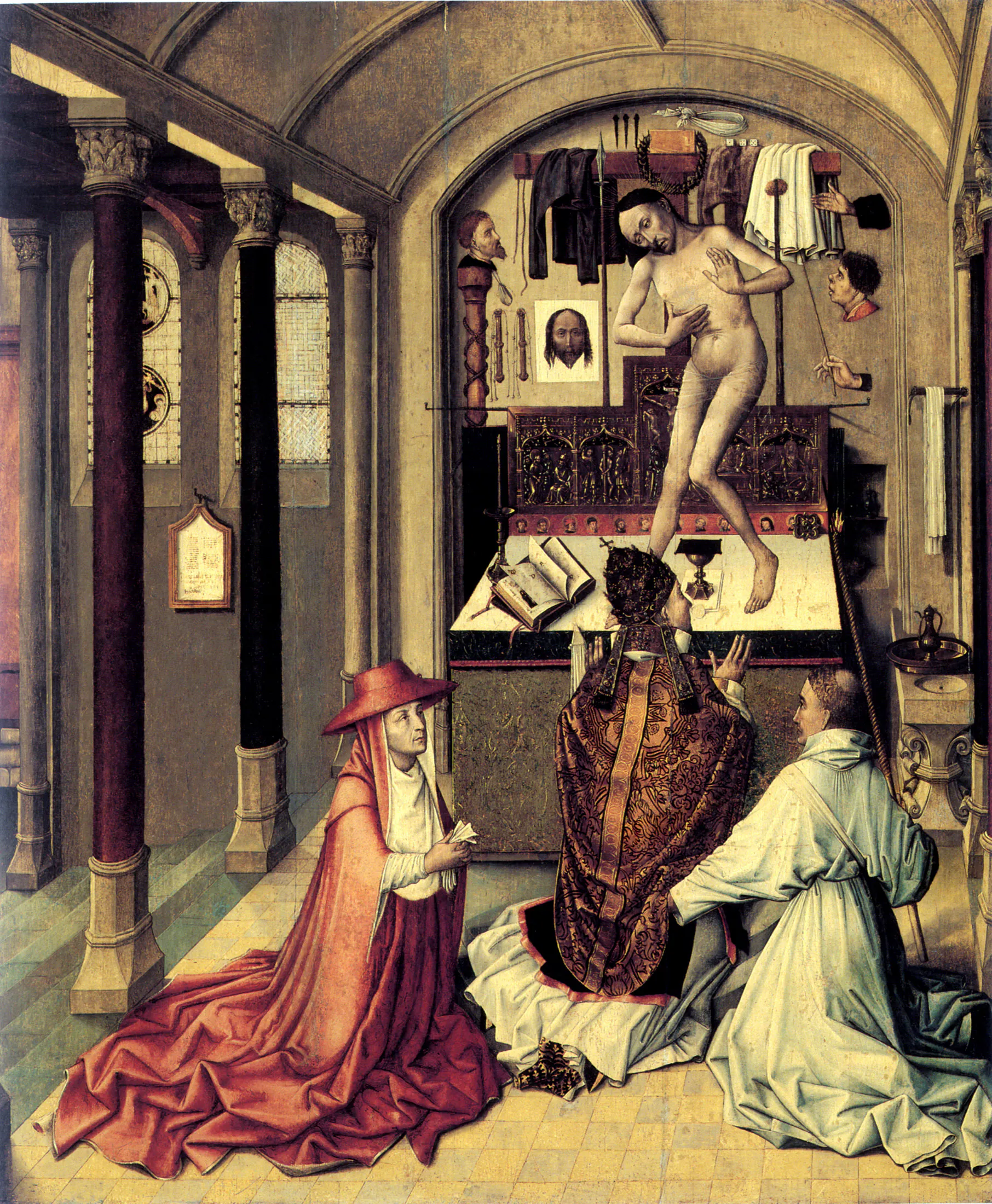
Robert Campin's Mass of Saint Gregory, c. 1440, belongs to the late-medieval devotion to Christ's real presence that Eck would later defend against Protestant reduction. Its altar-centred miracle anticipates the terrain of these homilies: transubstantiation, the sacrificial Mass, and the long-standing custom invoked in the dispute over the chalice. Source ↗.
In the eucharistic homilies the burden shifts from institution to possibility, and here the argument proceeds largely by preaching through patristic citation rather than around it. A long block from Ambrose's De mysteriis on the Red Sea, the Jordan, the waters of Marah, and Elisha's floating iron culminates in an a-fortiori question: we therefore observe that the grace of God is of greater power than nature, and if the word of Elijah availed so much as to bring down fire from heaven, shall the word of Christ not avail to change the species of the elements, Aduertimus igitur maioris potentiæ esse Dei gratiâ quàm naturam. Quòd si tantum valuit sermo Heliæ, vt ignem de coelo deponeret, non valebit Christi sermo, vt species elementorum mutet?. The rhetorical form matters as much as the content: a chain of scriptural transmutations ending in an unanswerable interrogative, delivered in a Father's own words, so that the pulpit voice and the authority coincide.
Against the strongest philological objection — that Paul and Luke go on calling the consecrated element bread — the reply is a hermeneutical rule rather than a doctrinal assertion, namely that they do so according to the custom of the sacred writings, which do not always call a thing what it now is, but what it was before, Quod autem Paulus & Lucas adhuc panem nominant, faciunt id sane pro more sacrarum literarum, quæ rem aliquam non semper appellant id quod iam est, sed quod ante fuit. Illustrated by Aaron's rod devouring rods that were already serpents, the principle disarms the objection economically, though it does so by making scriptural nomenclature a poor guide to sacramental ontology — a concession that cuts in more than one direction for a controversy conducted over the words of institution.
Communion under one kind is then secured by a technical term deployed with unusual precision for a homiletic text: it must still be considered that, from essential and natural concomitance, and from a certain inseparable union, somewhat more must be present under either species, tamen cogitandum est, quod ex essentiali & naturali concomitantiâ, & ex inseparabili quadam vnione sub qualibet specie aliquanto plus esse oportet. The distinction between what the words of consecration effect ex vi verborum and what accompanies the body by natural union is pressed to a striking counterfactual — had Peter celebrated on Holy Saturday, body and divinity but not soul or blood would have been present — which shows the doctrine functioning as a genuine analytic instrument rather than a formula.
Where doctrine ends, discipline begins, and the transcription of the Constance decree is followed by the juridical maxim that carries the practice: since a custom of this kind was reasonably introduced by the Church and the holy Fathers and has been observed for a very long time, it is to be held as law, which it is not permitted to reprove or to change at pleasure without the authority of the Church, vnde cum huiusmodi consuetudo ab ecclesia & S. patrib[us] rationabiliter introducta & diutissime obseruata sit, habenda est pro lege, qua[m] non licet reprobare aut sine ecclesiæ autoritate pro libito mutare. Consuetudo pro lege is a civilians' and canonists' principle here made to govern liturgy, and the penal clause naming inquisitors that immediately follows shows how completely the transfer is meant.
Penance: Faith, Confession, and the Forum of the Priest
The penance homilies apply the same technique of concession and distinction to the doctrine of justification by faith. The tripartite anatomy of contrition, confession, and satisfaction is defended precisely where Melanchthon had reduced penance to two members, and the reduction is answered by relocating faith rather than denying it: for faith is nothing less than a part of penance, because even the wicked have faith, who do no penance at all, but it is something antecedent, preceding all penance, quum tame[n] fides nihil minus sit qua[m] poenitentiæ pars: quia fidem habet etia[m] mali, nullam agentes poenitentiâ: est aut quoddam præuium om nem præcedens poenitentiâ. Faith is granted absolute necessity and the dignity of foundation, and refused the status of constituent part; the argument turns on the demonstration that faith is separable from penance, since the reprobate have the one without the other.
Auricular confession is grounded, in turn, on an inference from the grant of the keys rather than on custom alone: behold how Christ gave to his Apostles and their successors the power of remitting and retaining sins, but the priest can do neither if he does not first know the nature of the offence, Ecce quomodo Christus Apostolis suis, eorumque successoribus potestatem dedit remittendi peccata atque retinendi: neutrum autem facere potest sacerdos, si nesciat ante rationem delicti. The disjunction of John 20 is read judicially: a power to retain as well as to remit presupposes cognizance of the cause, and therefore enumeration of sins is required by divine law and not merely by ecclesiastical statute. It is the one place in this run of homilies where the evidentiary burden is discharged from Scripture directly, and the argument is correspondingly the tightest — a forensic reading of the commission that makes the confessional a court and the penitent's speech the indispensable evidence in it.
The homilies that carry that forensic reading forward, numbered XLIII through LX, proceed by a method announced in the text rather than left to inference, and the announcement is addressed not to a congregation but to a fellow preacher. Interspersed among the scriptural proofs for auricular confession stands a bracketed directive, which instructs the user to extend whatever passage he likes and adapt it to the condition of the hearer, Extende quêcunque locum & accommoda pro conditione auditoris. Such asides — and comparable formulae recur throughout the cycle — establish the volume's genre with unusual clarity: these are not transcripts of delivered sermons but modular argument, supplied with citations and expandable at the point of use, so that the same catena may be lengthened or compressed according to audience. The corresponding statement of purpose is equally frank, and it narrows the ambition of the tome considerably: since our purpose is not to trace the whole matter of penance and confession from its very roots, but only to expose and refute the errors of the Neochristiani, lest Catholics be scandalised thereby, At si instituti nostri non sit totam illam poenitentiæ & confessionis materiam ab ipsis inde radicibus funditùs repetere, sed errores tantùm Neochristianorum ostedere & confutare, ne inde offendantur catholici. The intended beneficiary is thus the Catholic layman exposed to evangelical preaching rather than the heretic to be converted, and the omission of systematic treatment is not a failing of the work but its declared economy.
That economy governs how evidence is handled. Having marshalled a long file of texts from the Hebrew Scriptures on the confession of sins — the concealer of his crimes who shall not prosper, David's promise to confess his iniquity against himself, Job, Solomon, Sirach — the preacher then withdraws the obvious inference before an opponent can turn it against him: I have not adduced these as though evangelical confession had been prescribed under the old covenant, but proposed them beforehand because it was always good and salutary, sometimes practised there too and foreseen and known in spirit by the prophets, Hæc non eo induxi quasi confessio Euangelica fuisset in veteri testamento præcepta, sed ideo & antea proposui, quia semper fuerit bona & salutaris. interdum quoque in veteri testamento vsurpata, & à prophetis in spiritu præuisa atque cognita. The concession is a piece of controlled argument: by conceding that the Hebrew texts establish congruence rather than institution, the preacher preserves the sacrament's evangelical novelty while retaining the rhetorical weight of the older witnesses as prefigurations. The distinction between præceptum and what is merely bona & salutaris is precisely calibrated to survive the objection that Catholic exegesis reads its own practice back into the Law.
Having limited what Scripture alone will yield, the argument must supply the deficit from elsewhere, and it does so by importing into biblical hermeneutics the maxim of the civilians already discussed above, that custom is the best interpreter of laws, so that the constant custom of the Church has established the true sense of the Scriptures. This is the hinge of the whole penitential cycle, and its logic deserves unpacking. The maxim is not adduced as an analogy but as a fundamentum: the Church's usage does not supplement the text of James or John but fixes their sense, so that the patristic catena which follows — Augustine, Leo, Gregory, Bede, Chrysostom, Jerome, Origen, Basil, Cyprian, Pseudo-Dionysius — functions as documentary evidence of interpretive continuity rather than as an independent authority. The consequence is a reversal of evidentiary burden that no sola scriptura opponent could accept: the disputed reading is not the one supported by usage but the one unsupported by it, and novelty rather than silence becomes the disqualifying mark.
The pastoral middle of the confession homilies works in a different register, and its governing metaphor is drawn from the counting-house. Urging deliberate premeditation before confession, the preacher observes that we see how carefully merchants and all traders bring everything to the reckoning, how often they compute lest they be cheated somewhere, and how much more diligently one ought therefore to unroll the catalogue of one's sinful debts, Videmus autè quàm curiosè mercatores & negotiatores omnes omnia ad calculum vocent, quoties supputet, ne alicubi fallantur, quantò diligentiùs oportet peccatorum debitorum suo rum cathalogum euoluere. The image is not ornamental. Sins are debita entered in a ledger, the penitent is the auditor of his own accounts, and the mnemonic apparatus that follows — recollection by feast, by station in life, by place, by person, by besetting vice, by the Decalogue and the seven capital sins — is the technique by which the audit is made exhaustive. The same accounting imagination reappears when satisfaction is defined, and it is worth noting that the commercial vocabulary here does no polemical work at all; it is simply the idiom in which obligation was thought.
Against that quantitative frame stands a doctrine of forum that is juridically startling. The seal of confession is stated in its strongest form: so hidden is confession that the confessor, if required to take an oath, may freely swear that nothing of it is known to him, for the judgement of God is one thing and that of men another, tam occulta est co[n]fessio, vt requisitus confessor ad iuramentum, liberè possit iurare sibi nihil de eo constare. aliud est enim iudicium Dei, aliud hominum. What would otherwise be perjury is licensed by the doctrine that knowledge acquired in the internal forum simply does not exist in the external one — the priest swears truly because, qua man among men, he knows nothing. The manoeuvre is only coherent if the confessional is understood as a genuine tribunal with its own jurisdiction, and the cycle says so explicitly: because this sacrament is as it were judicial, where the priest discharges the office of a judge between God and sinful man, just as Moses was judge between God and the people of Israel, quia hoc sacramentum est quasi iudiciale, vbi sacerdos veluti iudicis fungitur officio inter Deum & homine peccatore[m], sicut Moyles iudex erat inter Deu[m] & populum Israël. From this the argument draws a consequence that might seem to loosen sacramental precision but in fact reinforces the juridical model: no fixed verbal formula binds the absolving priest, since secular judges too vary the wording of their sentences. Form matters where matter and minister are at issue; where the act is one of judgement, discretion is proper to the office.
Satisfaction, Extreme Unction, and Holy Orders
Satisfaction is then built on a definition of deliberately contractual shape: satisfaction in general is the voluntary rendering of an equivalent, otherwise not owed, as Anselm defines it, Satisfactio ergo in com[m]uni est, redditio voluntaria, æquialentis, aliâs indebiti, vt definit Anselmus — each of the four terms then glossed in turn, and the whole declared to hold in all transactions and dealings, so that the theological concept and the commercial one are acknowledged to be the same concept differently applied. The Lutheran denial that any satisfaction remains after remission is met by an Augustinian axiom on the asymmetry of guilt and penalty, namely that punishment is more protracted than guilt, lest guilt be thought slight if it ended together with its punishment, productior enim est poena quàm culpa, ne parua putaretur culpa, si cum illa finiretur & poena. The reasoning is pedagogic rather than penal in emphasis: residual temporal punishment exists to measure the gravity of sin for the sinner's instruction, which is what allows the doctrine to be preached as consolation rather than threat. The keystone is the scholastic distinction between sufficiency and efficacy: although the merit of Christ is sufficient for all the sins of the whole world, it does not operate efficaciously in all, but only in those to whom it is applied and communicated, Quanuis meritum Christi sufficiens est pro omnibus peccatis totius mundi, non tamen in omnibus operatur efficaciter, sed iis tantùm quibus applicatur & communicatur. The polemical utility is immediate — the damnation of Judas, Nero, Pilate, and Arius is offered as proof that the Passion is not applied indiscriminately — but the doctrinal cost is that the whole sacramental economy becomes the machinery of application, which is exactly the conclusion the argument wants.
The treatment of extreme unction exposes a tension in the work's definitional strategy. Where the tome elsewhere narrows the notion of sacrament severely, here it is widened to admit the disputed rite: every medicine ordained by divine institution through an efficacious external sign for the assistance of spiritual life is indeed a sacrament, omnis medicina diuina institutione ordinata p[er] efficaci signo exteriori ad adiuvandam vitam spiritualem est vtiq[ue] sacramentu[m]. The formulation retains efficaci and diuina institutione, the two load-bearing terms, while the medical metaphor supplies the breadth on which the inference depends. Luther's objection that the anointing of James promises bodily healing which manifestly fails to follow is then answered by relocating the thing signified: the chief signification of that sacrament tends not to bodily health but to grace and the gifts of the soul, præcipua igitur illius sacramenti significatio tendit non ad sanitatem corporis, sed ad gratiam & dona animæ. The adjective præcipua does the delicate work, conceding occasional bodily recovery as a secondary effect without letting the rite's validity depend on it.
Holy orders receives the same treatment in compressed form. The definition is stated first — order is therefore a sacred sign with which spiritual power and office are conferred on the one ordained, Est igitur ordo signum sacrum, cum quo potestas spiritualis confertur & officium ordinato — and then justified cosmologically, since where there is no order, there is horror and perpetual confusion, so that in heaven too there is a certain order among the blessed, and therefore there ought rightly to be one in the Church militant as well, vbi enim nullus ordo, ibi horror & perpetua confusio est: sic in coelis est etiam ordo quidam inter beatos, ideóque & in ecclesia militanti meritò esse debet. The pun on ordo as both sacrament and cosmic arrangement is the argument: clerical grades are not an ecclesiastical convenience but the terrestrial instance of a hierarchy that obtains among the blessed, and the alternative to it is named as horror. What remains is to supply the visible element the received definition of a sacrament requires, and this the traditio instrumentorum furnishes, there being in order the visible signs of keys, of lamps, of the book, of the chalice, of bread and wine, Sunt autem in ordine signa visibilia clauium, lucernarum, libri, calicis, panis & vini. Each object is at once a rubric of the ordination rite and a term in a demonstration: the ceremony is adduced as the sensible sign whose presence the definition demands, so that liturgical practice again serves as the evidence from which doctrine is read.
That tract on holy orders proceeds by discrete, numbered units whose rubrics state their doctrinal burden before a word of exposition is offered, as when the sixty-first is headed on order, and that grace is there conferred, as in a sacrament, HOMILIA SEXAGESIMAPRIMA. / De ordine, & quòd ibi conferatur / gratia, vt in sacramento. The heading is already an argument: the homiletic form does not merely house controversial theology but organizes it, each thema drawn from Scripture serving as the occasion for a thesis whose conclusion has been announced in advance. What follows in this stretch of the tome is the working out of a single inferential pattern, applied first to ordination and then, with deliberate symmetry, to marriage.
That pattern is stated with syllogistic bareness in the exposition of Acts 13–14, where the reader is told to consider the grace of God, and that ordination was not accomplished without it, just as also now in all orders, so that if ordination confers grace, no one will be able to deny that it is a sacrament, considera gratiam Dei, & quod sine illa non facta sit ordinatio: sicuti etia[n] nûc in omnibus ordinibus. quòd / si ergo gratiam confert ordinatio, negare nemo poterit eâ / esse sacramentum. The major premise — that what efficaciously confers grace by divine institution is a sacrament — is not re-argued here; it is imported from the definitional work done at the head of the collection, with the consequence that the entire polemical labour of these homilies falls on the minor. Everything therefore depends on reading the apostolic commission at Antioch as more than a preaching mandate, and the text says so with unusual directness, insisting that the work to which Paul and Barnabas had been taken up was not only the ministry of word and doctrine, as Luther dreams, wishing to refer every priestly office to preaching alone, quòd opus illud, ad quod Paulus & Barnabas erant assumpti, non tantùm suit ministerium verbi & doctrinæ, (vt / somniat Lutherus, omne officium sacerdotale cupiens ad solam prædicatione referre.). The parenthesis identifies the adversary's thesis with precision — not a denial of ministry but a reduction of it to the ministerium verbi — and the exegetical counter-move is correspondingly narrow: Acts must be shown to record an ordaining act, with fasting, prayer, and imposition of hands, performed upon men who already possessed grace, so that the rite adds something and is not merely declaratory.
The same homilies show how quickly this dogmatic argument spills into historical and even fiscal reckoning. Weighing the confessional upheaval of the preceding decades against the grievance that had ignited it, the text asserts that besides the loss of a hundred thousand peasants and citizens and more, all Germany has suffered more inconveniences from Lutheran pamphlets alone than was given to indulgences in the preceding hundred years, Profectò enim præter iacturam / centum millium / rusticorum & ciuium atque vltrà, plus incommodoru[m] perpessa est vniuersa / Germania tantùm ex Lutheranis commentariolis, quàm antea 100. annis datum sit / ad indulgentias. The rhetorical structure is a ledger: casualties of the peasants' war on one side, a century of indulgence revenue on the other, with the diminutive commentariolis belittling the printed cause against the magnitude of the effect. The move is characteristic of the volume's temporal test of doctrine — novelty is not merely erroneous but destructive — and it converts a dispute over sacramental efficacy into an accounting of visible consequences that a congregation could be expected to recognize.
The reply to the principal Reformation proof-text proceeds not by denial but by concession and division. On 1 Peter 2:9 the homily grants the universal priesthood in full before relocating it, by the twofold distinction already noticed above, in which Scripture is said to speak of priesthood, and likewise of kingdom, in two ways, the internal and spiritual priesthood being now common to all Christians. The pairing with regnum is not decorative: since no reader supposed that the royal dignity ascribed to the baptized abolished civil magistracy, the analogy is meant to make the parallel inference about sacerdotal office look self-evident. The strategy is generous and risky at once, for it surrenders the scriptural language wholly to the adversary and stakes the external ministry on a distinction that the text must then supply from elsewhere — from Ambrose, from the revolt of Korah, from the councils, and from the practice of ordination itself.
Having secured the priesthood, the argument climbs a further and more contested step, promising that then indeed it will be plain that the episcopal dignity is not only superior to the priestly, but also a sacred order, and indeed a sacrament, as the other orders are, tunc sanè patebit episcopalem / dignitatem no[n] tantùm esse sacerdotali superiorem, / sed & ordinem sacrum, atq; adeò sacramentum, vt reliqui / sunt ordines. This was disputed within the Catholic schools as well as against the Reformers, and the strain is visible in the way the homily hedges its boldness by referring the decision to the whole Church rather than to its own judgement. What deserves notice is that the defence of hierarchy is not an unqualified defence of its holders. The same tract turns on the episcopate itself, urging that bishops therefore ought to love presbyters, not to prefer to them any sort of huntsmen, flatterers, musicians, Amare igitur debent episcopi presbyteros, no[n] eis quoslibet / præferre venatores, assentatores, musicos & animos, sed diligant / eos vt filios. The catalogue of courtly retainers is a standard target of late-medieval reforming complaint, and its appearance here indicates that the argument from constant custom was never understood as an argument that current usage was beyond correction: the order is divine, its incumbents are not.
Matrimony: Office, Remedy, and Indissoluble Bond
The matrimonial homilies begin from an anomaly rather than a proof, observing that since all sacraments began after and indeed on account of sin, marriage alone was instituted before sin, yet not as a remedy but only as a duty or ministry, Quum omnia sacramenta post & quidem propter peccatum coeperint, solum matrimonium est institutum ante / peccatum, non tamen in remedium, sed officium tantu[m] siue / ministeriu[m]. The Victorine distinction between officium and remedium is what makes the anomaly tractable: marriage can be older than the fall in one respect and coeval with the sacramental economy in another, which in turn generates the doctrine of marriage's three times and licenses the later moral conclusion that conjugal acts undertaken to avoid fornication are not sinful. The polemical yield comes with the reading of Ephesians 5:32, where the objection is turned back upon itself: Luther attempts to snatch the appellation of sacrament away from matrimony and to place it only in Christ and in the Church, and thus he makes eight sacraments, whereas Paul plainly says that matrimony is a sacrament, not Christ and the Church, Lutherus / appellationem sacramenti conatur rapere à matrimonio, & / in Christo atque in ecclesia tantùm constituere? sicque nobis / octo efficit sacramenta, cùm tamen Paulus apertè dicat / matrimonium esse sacramentu[m], non Christum & ecclesiam. The counter is a reductio: if the referent of sacramentum magnum is the union of Christ and the Church, then the reducer has enlarged the septenary rather than shrunk it. The dispute is thus conducted at the level of a single Latin lexical choice, which is precisely why the adversary's appeal to the Greek mystērion had to be met philologically rather than dismissed.
Marriage is then brought under the identical inference that established orders, on the ground that since every remedy against sin in the evangelical law is a sacrament, and matrimony is a remedy against the sin of fornication, on Paul's testimony, quum omne remediu[m] aduersus peccatu[m] in lege euangelica sit sacramentu[m], / matrimonium aut est remediu[m] cõtra peccatu[m] fornicationis, / Paulo teste, the argument being completed by the claim that such a remedy could not be efficacious unless it conferred grace. Efficacy, not signification, is again the operative criterion, and the repetition of the form across two sacraments shows the method to be genuinely systematic rather than opportunistic.
From sacramentality the tract passes to indissolubility, stated with a jurist's care for time, parties, and conditions in the ruling already discussed above, that whenever in the time of the Gospel a marriage is legitimately contracted and consummated, so that the two become one flesh, the conjugal bond remains even if the parties are afterwards separated by some judge for accidental causes. The clause conceding judicial separation is what carries the weight, since it distinguishes diuortium as separation from bed and board from the dissolution of the bond, and thereby allows the text to grant the practical remedy while denying the juridical one — a distinction it says even learned men untrained in law confuse.
Within this dossier the argument reaches its sharpest moral register through Jerome's Epitaphium Fabiolae, quoted to establish that the obligation is symmetrical: the laws of the Caesars are one thing, the laws of Christ another; Papinian prescribes one thing, our Paul another; among them the reins of unchastity are loosed for men, and with only rape and adultery condemned, lust is permitted everywhere through brothels and serving-girls, as though rank made the fault and not the will; among us, what is not lawful for women is likewise not lawful for men, Aliæ sunt leges Cæsarum, aliæ Christi, aliud / Papiniamus, aliud Paulus noster præcipit: apud illos viris / impudicitiae fræna laxantur, & solo stupro atque adulterio / condemnato, passim per lupanaria & ancillulas libido permittitur, quasi culpam dignitas faciat, non voluntas: apud / nos, quod non licet foeminis atque non licet viris. The passage does real work against those who allowed the innocent husband alone to remarry, and it also marks the one place where the tome's habitual alliance of theology with jurisprudence is turned against Roman law rather than sustained by it: culpa is referred to voluntas, not to dignitas, and the civilians are made to appear the party of privilege.
Alongside these juridical exertions the same homilies preserve a striking record of humanist working method. Disputing a rival construal of reconciliari, the text pauses to report that while I was noting these things, a friend not commonly learned in both languages conveniently came to me, and he was astonished that so learned a man should so twist the word reconciliari, so as to attribute it only to the offending party, when it is a general word for friendship to be restored, Dum hæc / annotarem, com[m]odè ad me accessit amicus in vtraque lingua no[n] vulgariter / doctus. Is mirabatur virum doctissimum sic torquere vocalem, recōciliari, vt / non nisi offendenti tribuat, quum generalis sit vox amicitiæ restituendæ. The disclosure of consultation — with the note afterwards sent in writing duly acknowledged, and the question settled from Cicero, Livy, Budé, and Valla — shows a controversial homily admitting collaborative philology into its texture, and it confirms that the argument from constant custom did not preclude the exercise of grammatical judgement even against received etymology, as the refusal of the Isidorean derivation of acolythus from wax-bearing likewise attests.
The Closing Homilies, the Conclusio, and the Finding-Apparatus
The tome's final two homilies carry the argument from custom onto its most densely juridical terrain, where the question is no longer what a sacrament is but who may lawfully marry whom, and under what law. Homilia LXXVI closes a numbered sequence of quaestiones on separation and remarriage, and its governing move is to derive a rule of jurisdiction from the theory of the sign rather than from a precept. The reason, the homilist explains, is this: because by the marriage of Christians the unity of Christ and the Church is perfectly signified, and since that is inseparable, the marriage of Christians cannot be dissolved during the life of both, Ratio illius hæc est, quia per matrimonium christianorum perfectè significatur vnitas Christi & ecclesiæ, quæ quia inseparabilis est, coniugium etiam christianorum in vita vtriusque dirimi nô potest. Indissolubility is thus a property inferred from what the sign signifies, not a disciplinary imposition; and the inference cuts both ways, since the marriage of unbelievers, being no complete sacrament, signifies imperfectly and may accordingly be dissolved by the Pauline privilege. The same efficaciter that governed the tome's opening definition of a sacrament here becomes a principle of matrimonial law: what a rite fully signifies, it fully binds.
The homily's handling of the exceptive clause of Matthew 19 exposes the method by which the collection subordinates dialectical form to substantive constraint. Having reported the common scholastic solution and dismissed Petrus de Palude's alternative, the homilist confronts John Mair's argumentum à contrario sensu and refuses it outright, remarking that he does not set much store by this reasoning, since that mode of arguing is easily broken, because it does not hold when the contrary sense is absurd or contradictory, Verùm ego non tanti facio hanc rationem, quoniam facilè infringitur modus iste argumentandi, quia no[n] valet, quando sensus à contrario est absurdus vel contrarius. This is an explicit statement of hermeneutic priority: a formally valid inference from the text is disqualified by the character of its conclusion, because divine law promulgated elsewhere — through Paul — sets the bounds within which inference may operate. The evidentiary relocation that governs the tome as a whole reappears here in miniature, for the argument from silence and the argument from contraries are refused on the same ground, namely that neither can establish anything against the settled substance of the law. In place of the dialectical instrument the homilist installs a patristic authority, quoting Augustine's judgement that the Lord wished to mention what is greater, for who denies that it is a greater adultery to marry another while one's wife has not committed fornication, Credo quia illud quod maius est, hoc dominus cõmemorare voluit, maius autem adulterium esse quis negat, vxcore non fornicante aliam ducere. The exceptive clause is thereby converted from a permission into a comparison of gravity — a reading that preserves the text intact while withdrawing from it the concession an opponent would draw.
Homilia LXXVII, on the degrees of consanguinity and affinity, opens with a piece of schoolroom reasoning whose oddity is precisely its demonstrative value: the doctors further conclude here, the homilist reports, that if Adam and Eve, Seth, or Noah were to come back to life, neither could Adam marry any wife nor could Eve marry anyone, Concludunt insuper hîc doctores, quòd si iam Adam & Eua, Seth, siue Noe reuiuiscerent, neque Adam posset vxorem aliquam ducere, neq[ue] Eua cuiquam nubere. The thought-experiment establishes that the direct ascending and descending line admits no computation of degrees at all, since every human being stands in that line to the first parents; degrees can therefore be reckoned only collaterally. The pay-off is historical as well as technical, for it licenses the ensuing explanation of the patriarchs' close marriages, set out with a printed genealogical stemma running from Terah down to Leah and Rachel — the press here supplying diagrammatic apparatus of a kind that the pulpit could hardly reproduce, but that a preacher consulting the book could read at a glance.
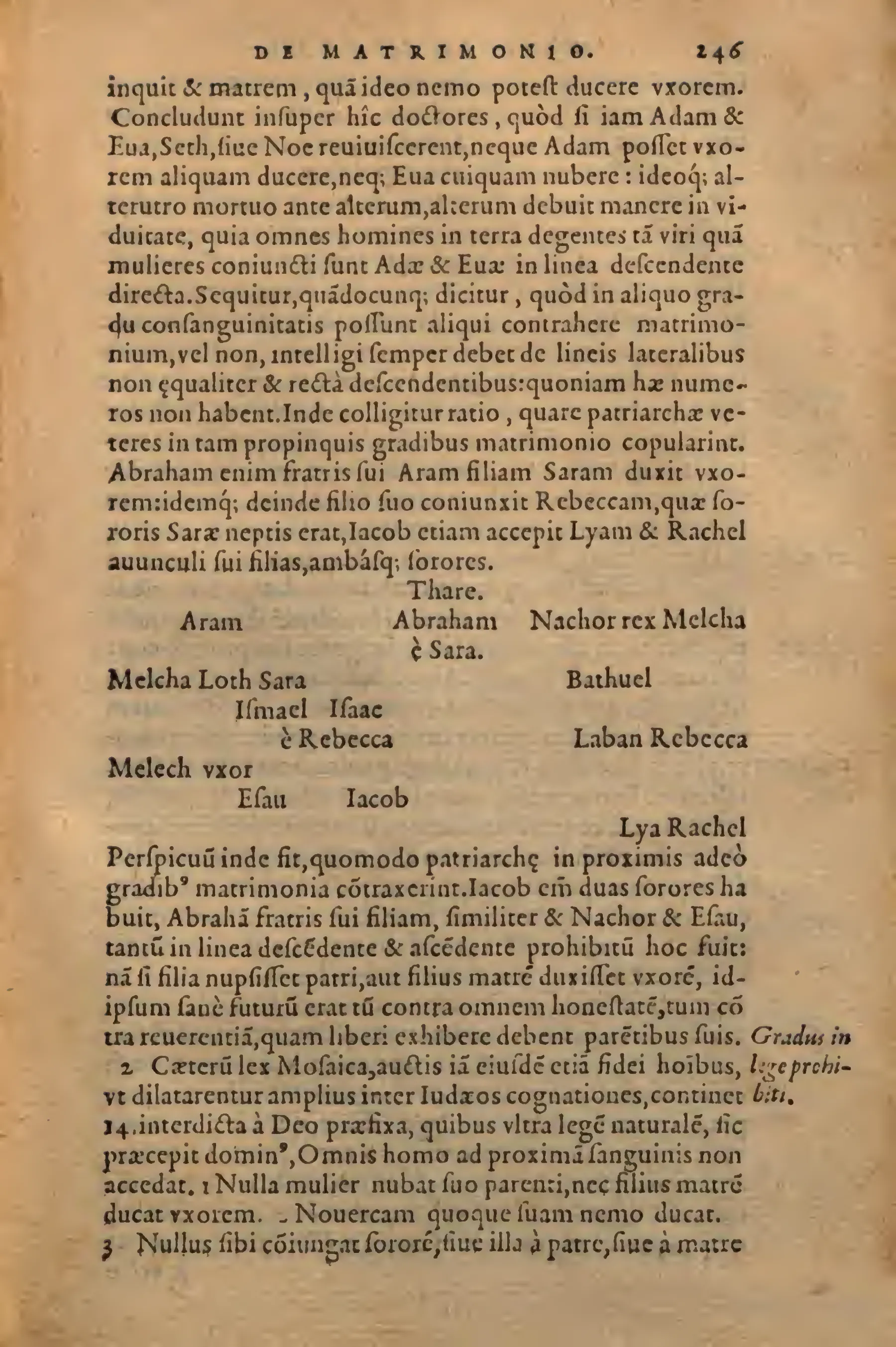
On this page of Homilia LXXVII, the argument that all humanity stands in the direct line from Adam and Eve gives way to a printed patriarchal stemma running from Terah through Abraham's kin to Leah and Rachel. The diagram makes the legal point visible: degrees cannot be counted in the universal line of descent, only in collateral relationships, and so prepares the enumeration of Mosaic prohibitions. Source ↗.
The homily then states its opponents' position as a legal thesis, in order to answer it as one. Now, in their usual manner, the homilist writes, the Lutherans rush in and shout that a marriage contracted between persons of the aforesaid degrees is void, Iam nunc suo more irru[n]t Lutherani & clamitât, matrimoniu[m] contractum inter personas prædictorum — the charge being that only the twelve Levitical bars void a marriage, and that the Church's extension to the fourth degree is mere human tradition. The refutation proceeds by a double squeeze on the sources of law. Natural law alone yields too narrow a set of impediments, since it would tolerate unions that the adversaries themselves call iniquitous; and the Mosaic code no longer binds, the principle being that Mosaic law does not bind except in so far as it depends on the law of nature, ligat lex Mosaica, nisi quantum ex lege naturæ pendet. From this polarity follows the reductio that gives the homily its polemical bite: a selective retention of Leviticus 18 is illegitimate because the Levitical corpus is indivisible, so that the opponent could not sow a field with double seed, nor wear a garment woven of wool and linen, neque possent agrum aliquem duplici semine conferere, neque vestem gestare ex lana, & lino cōtextam. The argument is not that Scripture is silent on the degrees but that its Levitical voice, if admitted as still-binding statute, must be admitted whole — a demand for consistency that leaves the opponent no middle position between the whole ceremonial law and none of it.
Having emptied both natural and Mosaic law of the capacity to generate the received table of impediments, the homilist supplies the positive source, arguing from John 16 that the Spirit promised to the Church legislates through her, in the clause already cited to the effect that that Spirit established laws through his Church and prescribed the degrees. What follows is the tome's characteristic conversion of doctrine into documentary evidence: a dossier of popes and councils, from Calixtus, Fabianus and Julius through Agde, Lérida, Meaux, Lyon, Chalon, Toledo, Worms, Thionville, Mâcon, Orléans and Cologne, to a Roman council of Gregory II with its anathema sit, the ancient seven-degree canon, and its reduction to four degrees by the general Roman council under Innocent III. Because that dossier displays variation rather than uniformity, the homily needs a theory of why variation does not discredit the discipline, and it takes one from Augustine's De civitate Dei, that for inclining or offending human sensibility, custom counts for very much, Ad humanum sensum vel alliciendum, vel offendendum, mos valet plurimùm. Custom is thereby made the medium through which the abiding rational grounds of exogamy — natural decency and the diffusion of human society — take historically determinate legal form.
That theory is tested rather than evaded by the pastoral counter-case the homily volunteers, Gregory the Great's relaxation of the degrees for the newly converted English, of whom the pope humbly replies and confesses that he did this because the English had then only recently been converted to the faith, lest they fall back again if perhaps they were treated too harshly, cui ille humiliter respondet, & co[n]fitetur fecisse se hoc, ideo quòd tum recêns ad fide[m] fuerat Angli conuersi, & ne reciderent rursus, si fortè duriùs tractarentur. A discipline dispensable for missionary reasons is manifestly not natural law, and the homilist absorbs the concession instead of suppressing it, because his case never required the impediments to be immutable — only to be validly enacted. Ambrose supplies the formula for that validity: he wishes those prohibitions concerning the degrees of consanguinity and affinity to bind us Christians too, yet not because Moses established them, but because the Church received them, Vult autem ille prohibitiones istas super gradibus consanguinitatis & affinitatis legare etiam nos christanos, non t[ame]n ideo quòd eas constituerit Moyses, sed quia recepit ecclesia. Reception, not origin, is the source of obligation — the same principle that elsewhere makes constant custom the interpreter of Scripture, restated as a doctrine of legal validity.
The juridical dossier closes on an unexpectedly organic note, with an argument from natural affection: why say more, the homilist asks, since there already exists among kinsfolk that natural bond of love, there is no need to seek another new one, lest that sap of native affection dry up, Quid multa?cùm iam antea inter consanguineos sit naturale illud vinculum amoris, non est quod quæratur aliud nouum, ne fortè succ[us] ille natiui amoris arescat. The metaphor of desiccated sap gives the exogamy rule a horticultural rationale: marriage is to graft new bonds where none exist, and to double an existing tie is to waste rather than to strengthen it. Around this the press sets tabular schemata of the persons interdicted to the husband and to the wife, so that the enumerative habit visible throughout the tome — seven sacraments, three parts of penance, twelve interdicted persons — receives typographic form.
The homily on the nuptial blessing prints the liturgical formulae themselves, including the Tobit prayer that God look, Lord, upon this joining through your angel Raphael, that they may be sound, worthy, and peaceable, and suffused with your blessing, through Christ, Respice domine super hanc coniunctionem per angelum tuum Raphaëlem, vt sint sani, digni, & pacisici, atque tua benedictione perfusi, per Christum; the text then argues from the formula's very antiquity, adducing Evaristus, an African council, Lyon, Augustine, Ambrose and Siricius as witnesses to immemorial usage. The polemical charge that accompanies this is one of practical self-contradiction: having desacramentalized marriage, the opponents afterwards, the matter being better considered, borrowed those blessings back from the Church as if by stealth, deinceps tame[n] re melius considerata, benedictiones illas rurius ab ecclesia velut furtim mutuârunt, with the new Brandenburg and Nuremberg church ordinances named as the documentary basis. Liturgical practice is here treated as evidence of doctrine, and the adverb furtim makes borrowing itself an admission.
The Conclusio of all the homilies on the sacraments abandons polemic for typology, resolving the septenary into the fulfilment of the old signs: for what else is it to renew the signs, than to make new things out of the sacraments of the old law — baptism out of circumcision, out of the paschal lamb, Quid aliud est innouare signa, nisi ex sacramentis veteris legis facere noua, ex circuncisione baptismum, ex agno paschali. Novelty, disqualifying when charged against opponents, is here licensed as innouatio in the precise sense of renewal, the seven sacraments standing to the Levitical signs as fulfilment to figure. The printed back matter then makes the tome navigable: the register, whose heading naming this fourth tome, its sacramental subject, and Eck himself has already been noticed, lists all seventy-seven homilies with folio references, and the alphabetical index that follows compresses the tome's theses into rubrics that function as polemical slogans, among them the ecclesiological thesis that the Church counts for more than Scripture, Ecclesia plus quàm scriptura, and the final ruling that those baptized in Zwinglian fashion are not baptized, but are to be baptized again, Zuingliano more baptizati, no[n] sunt baptizati, sed rursus baptizandi. The finding-apparatus is thus not neutral: it delivers the argument in a form a preacher could locate under a single word.
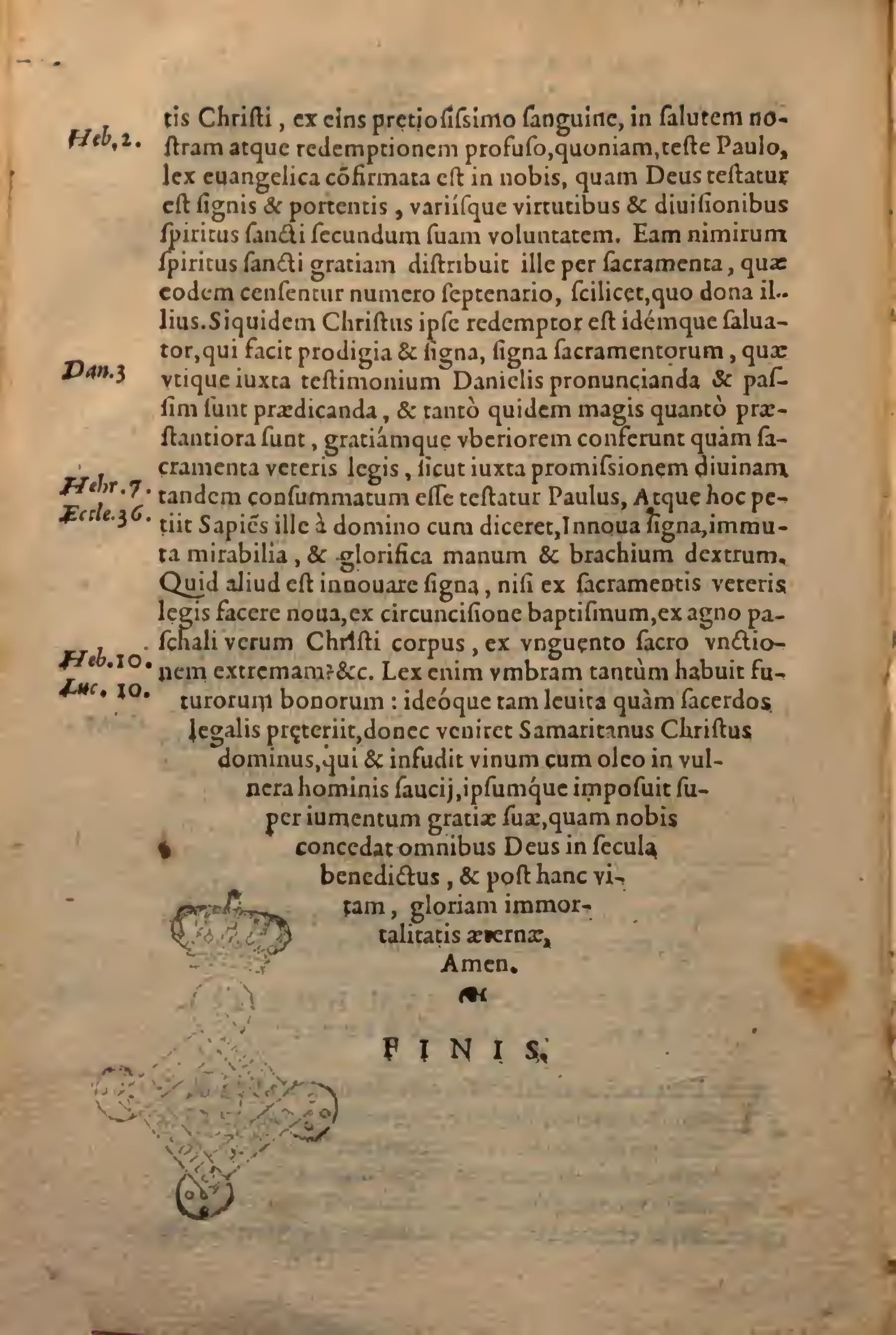
The final page folds the whole case into typology — the old signs renewed in the sacraments of the New Law — before returning to Christ as the Samaritan who treats wounded humanity with wine and oil. The ornament, emphatic printed “FINIS,” and institutional stamp below the text mark both a theological endpoint and the copy's later life in learned Catholic custody. Source ↗.
Frequently Asked Questions
What is Johann Eck's "Homiliarum ... De septem Ecclesiae sacramentis: tomus quartus"?
It is a Latin homiliary — a collection of model sermons designed for reuse by preachers — forming the fourth tome of Eck's declamatory works and devoted entirely to the seven sacraments of the Catholic Church: baptism, confirmation, the sacrament of the altar, penance, order, matrimony, and extreme unction. Its title announces it as directed against Luther and the other heretics, and it joins catechetical instruction to sustained controversial theology, canon and civil law, and patristic citation. Its earliest independently attested form is an Ingolstadt edition printed by Georg Krapff, whose dedication is dated at Ingolstadt on 1 March 1535.
Who was Johann Eck?
A Catholic theologian of 1486–1543, best known as Luther's antagonist at the Leipzig disputation of 1519, who passed the last two decades of his life as professor of theology at Ingolstadt. Besides the compact handbook of controversial loci, the Enchiridion, that made his name across Catholic Europe, he produced a vast homiletic corpus intended for the pulpit. The more differentiated scholarly image, captured in Erwin Iserloh's characterization "Scholastiker, Humanist, Kontroverstheologe," treats him as a university theologian whose scholastic formation, humanist learning, preaching, and polemical practice were inseparable rather than as Luther's professional adversary and nothing else.
How does the work prove there are exactly seven sacraments when Scripture nowhere lists them?
By moving the burden of proof from Scripture to tradition and usage. A sacrament is defined as an external, sensible sign that efficaciously signifies and confers the grace of God by divine institution, ordered to the salvation of man the wayfarer; institution is then reserved to God alone, so that neither an apostle, nor any council, nor the whole world assembled could make one. The number seven is accordingly secured by unwritten apostolic tradition and the constant custom of the Church, under the jurists' maxim that custom is the best interpreter of laws, with the Council of Florence adduced as Latin and Greek warrant. Scriptural silence is answered by asking who abolished the Sabbath and put the Lord's day in its place — not Scripture, but the Church.
Did Eck accept baptisms performed with the Zwinglian form?
No. The inference is drawn without evasion that infants baptized by Zwingli and by others who use the Zwinglian form are not baptized, and the alphabetical index at the back compresses this into a rubric: those baptized in Zwinglian fashion are not baptized, but are to be baptized again. The conclusion follows from a strict definition requiring flowing elemental water, the appropriate form, a minister with right intention, and a recipient who does not dissent. The Anabaptist denial of infant baptism is likewise refuted partly by being dated — introduced, it is said, as new.
Is there an English translation of Eck's homilies on the seven sacraments?
No modern English translation of the fourth tome has been identified; the known translation history runs in another direction, the Cologne sermon series having been rendered into Latin by Johann Menzinger from sermons originally composed in German. Separately, the Leo edition presents the full transcription of the 1561 Paris text together with a complete English translation for the first time, and that translation is generated by AI. Leo is an effort to make freely available online, at no cost, English translations of every text printed in Latin in early modern Europe between 1450 and 1750.
This report was generated by an advanced AI assistant that conducted deep research alongside an extensive interpretation of the transcribed original text. Every effort has been made to preserve fidelity to the source and to guard against inaccuracy, but corruption in the text recognition process and model hallucination may nonetheless have entered the text. Treat every claim, quotation, translation, and citation as provisional, and verify each against the original source before relying on or citing it.
Further Reading on Eck, Catholic Preaching, and Sacramental Controversy
- David V. N. Bagchi, "The Historical Argument in Early Reformation Controversy Revisited: The Council of Constance in the Writings of Eck and Cochlaeus," Renaissance Studies: Bagchi revises Pontianus Polman's comparatively negative assessment of the early Catholic controversialists, showing that Eck and Cochlaeus already displayed a substantial concern with documentary and historical evidence, especially in arguments over Constance and communion under one species. The sacramental tome's verbatim citation of the Constance decree, concession and all, is a specimen of exactly that documentary habit operating inside a preaching text. Read it before assuming that a homiliary arguing from decretals and conciliar registers was merely quoting from memory.
- Pierre Fraenkel and Erwin Iserloh, eds., Johannes Eck: Enchiridion locorum communium adversus Lutherum et alios hostes ecclesiae (1525–1543) and Enchiridion: Handbüchlin gemainer stell und Artickel der jetzt schwebenden Neuwen leeren, Corpus Catholicorum 34–35: These twin critical editions (the linked file is the Church History notice announcing them) provide the most useful modern control for Eck's evolving controversial method, terminology, citation practice, and reception, even though they concern the Enchiridion rather than the sacramental homilies themselves. On a locus common to both bodies of work, the priesthood of the baptized, the homiliary proceeds by concession and distinction, observing that as regards Peter's words, it must be known that Scripture speaks of priesthood in two ways, and likewise of kingdom — one being internal and spiritual, which each ought to have in and towards himself, and this now common to all Christians, Quantum ergo attinet ad verba Petri, sciendum est / scripturam dupliciter de sacerdotio loqui, simul & de regno: alterum enim internum est & spirituale, quod quisque / in seipso & erga se debet habere, atque hoc iam commune / est omnibus christianis, granting the evangelical reading of 1 Peter in one sense in order to reserve the sacramental order in the other; comparison with the Enchiridion's handling of the same text is the natural control for tracing that technique.
- John M. Frymire, "The Reformatio—and Deformatio—of Ritual: German Catholic Preaching on Ceremonies between the Later Middle Ages, Luther, and Trent," Reformation: Frymire's analysis places Eck's homiletic project within the Catholic preaching and ritual debates that preceded and accompanied Trent, emphasizing the use of scriptural and historical precedent against evangelical critiques of ceremony, and arguing that the postils printed en masse after 1530 had already worked out much of what is usually called post-Tridentine ritual theory. Eck's defence of the Mass illustrates the pattern Frymire describes, resolving the objection that a completed sacrifice cannot be repeated by holding that what was once offered as the price is still continually offered in mystery, for thus Christ remains a priest according to the order of Melchizedek forever, est in precium: iugiter adhuc offertur in mysterio: sic enim Christus perseverat sacerdos secundum ordinem Melchise dech in æternum, where a scriptural type is made to license the continuity of ceremonial practice.
- Erwin Iserloh, Johannes Eck, 1486–1543: Scholastiker, Humanist, Kontroverstheologe: The standard biographical and intellectual-historical framing, essential for situating Eck simultaneously within scholastic theology, humanism, university teaching, and Catholic controversy; the linked file is a Brill bibliography listing the volume, and the full imprint should be checked against the relevant library authority record. The homiliary's combination of enumerative scholastic definition, juristic maxim, patristic citation, and pulpit address supports that threefold characterization from within a single work — which is precisely why the older portrait of Eck as Luther's professional adversary and nothing else no longer holds.
- "Sermon Collections of Iohannes Eck in Transylvanian Libraries": A useful bibliographical and reception-oriented lead for tracing the movement, ownership, and institutional afterlife of Eck's sermon collections beyond the principal German and French printing centres, and a corrective to any account that stops at Ingolstadt, Paris, and Cologne. Complete publication details should be verified before formal citation, since the study circulates without a stable reference in the accessible records.





,_1519,_NGA_6662.jpg)
_by_Robert_Campin.jpg)