I Put the Storm-Cloud to Flight: Angelo Rocca's A Commentary on Bells: Their Invention, Names, Consecration, and Uses in the Church of God
The church bell acquired its own encyclopaedia in 1612, when the papal sacristan Angelo Rocca published De campanis commentarius at Rome — a book that began as one disputed case before the Congregation of Rites and swelled into twenty-six numbered inquiries into everything bronze could be made to signify. Rocca asks who may lawfully pull a rope, why the crowd was wrong to speak of baptizing bells, what to make of an Aragonese bell that rang with no hand upon it, and how thirty-three bells on an Antwerp tower could be tuned to sound like an organ.
ExLatinis
September 5, 2026
Contents
The church bell acquired its own encyclopaedia in 1612, when the papal sacristan Angelo Rocca published De campanis commentarius at Rome — a book that began as one disputed case before the Congregation of Rites and swelled into twenty-six numbered inquiries into everything bronze could be made to signify. Rocca asks who may lawfully pull a rope, why the crowd was wrong to speak of baptizing bells, what to make of an Aragonese bell that rang with no hand upon it, and how thirty-three bells on an Antwerp tower could be tuned to sound like an organ.
In 1612 the Roman press of Guillelmus Facciottus issued a Latin quarto with an unpromising subject and an extravagant range: De campanis commentarius, a commentary on bells by the Augustinian friar Angelo Rocca, titular bishop of Tagaste and prefect of the Apostolic Sacristy. Rocca was a curial insider — a papal sacristan associated with the Vatican printing office and founder, in 1604, of the Angelica Library — and the book bears the marks of that setting throughout. It grew out of a case examined in the Sacred Congregation of Rites, the Roman tribunal charged with liturgical regulation after Trent, and it turns that piece of curial business into something far larger: an encyclopaedic inquiry into the church bell, arranged in numbered Quaesita, furnished with an index of cited authors, a subject index, supplementary Paralipomena, and four folded plates with an explanatory Declaratio.
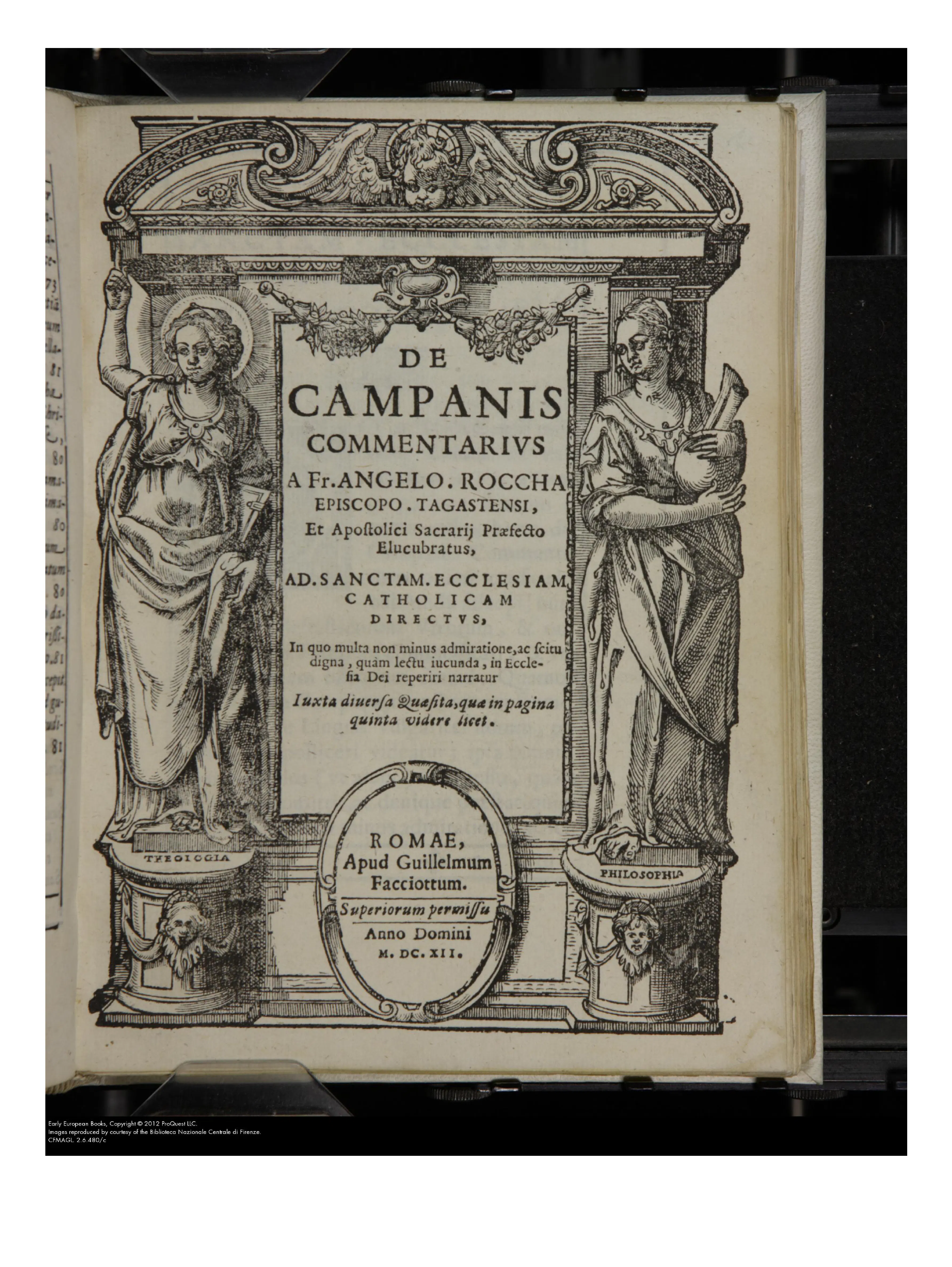
The title page names Guillelmus Facciottus as printer at Rome in 1612 and presents Rocca as bishop of Tagaste and prefect of the Apostolic Sacristy. Its woodcut frame, with Theologia and Philosophia flanking the title, gives form to the book's ambition: a liturgical question about bells enlarged into learned inquiry. Source ↗.
The intellectual problem the work confronts is not what a bell is but what authorizes it: whence its use came into the Church, what it is properly to be called, and by what right, rite, and rule it may sound. Rocca's characteristic move is twofold — first to gather every available witness, scriptural and typological, patristic and hagiographic, canonistic and liturgical, pagan-antiquarian and epigraphic, poetic, metallurgical, mechanical, and contemporary-testimonial, and then to adjudicate among them by a distinction between proper and improper usage. That single operation generates the treatise's recurring separations: consecration from the popularly alleged baptismus campanae, blessing from magic, clerical office from lay handling, permitted from forbidden ringing under interdict, Christian signal from Turkish, Greek, and heretical alternatives. Rocca knew the disproportion between the object and the apparatus and made a joke of it at the outset: the bell, he says, promises more in its recess than on its face, ipsa tamen Campana plus (vt aiunt) in recessu, quàm in fronte promittit, a pun on the bell's hollow interior and on the hidden depth of the subject.
The stakes of that inquiry are considerable, and they are not confined to liturgy. In distinguishing the authorized rites of benedictio and consecratio from the crowd's talk of baptizing bells, the treatise documents the Roman disciplining of sacramental language at a moment when Protestant polemic had made the efficacy of blessed objects a confessional battleground. In asking who may pull a rope, it treats sound as a matter of jurisdiction and clerical order. In compiling prodigies — bells that ring with no hand upon them, bells that turn storms, bells sworn upon more fearfully than the Gospels — it engages the period's contested criteria for testimony, notarial proof, providence, and superstition. And in describing alloys, moulds, clappers, towers, carillons, and automaton clocks, it belongs as much to the history of late Renaissance metallurgy and mechanical display as to liturgiology.
What a first-time reader is likeliest to remember, however, are the particulars. Rocca assembles twelve names for the instrument, from tintinnabulum and codon to squilla, crotalum, cloca, and campana, deriving the last two from Campania and from Nola and running his etymologies through Petrarch, Dante, Ariosto, French cloche, and inscriptions at Marino and Este. He reports that after the fall of Constantinople the bells were melted down for artillery, and that Greek Christians under Ottoman rule struck a "holy iron" instead. He records the self-ringing bell of Velilla de Ebro with its notarial and viceregal attestations, and the spontaneous ringing of the bells of Saint Paul Outside the Walls at Rome on 24 October 1610. He describes a carillon of thirty-three bells at Antwerp on a tower of 420 feet, cites Cardano on instruments at Brussels, Mechelen, and Liège played with hands and feet, discusses the clock of Saint Mark's in Venice, and relays a report — one the modern record treats as a misascription — that a clock of the Strasbourg kind was built by Copernicus. He notes, as a contemporary event in the fabric of Saint Peter's, the transfer of the old Vatican campanile bells in September 1610 into one of the four lesser domes; he quotes the bell's own Leonine verses in the first person, praising God, calling the people, gathering the clergy, mourning the dead, driving off the storm-cloud; and he closes his back matter with excommunication published by bell, book, and candle.
Holding these heterogeneous materials together is the conviction that the bell is a signum — a sign whose authorized sound gives notice of an action to be performed — so that lexicography, ritual form, jurisdiction, acoustics, and casting technique are all continuous with one another rather than separate curiosities. That same conviction shapes the book as an object: the plates and their Declaratio are demonstrative rather than decorative, and the Roman approbation recorded in the preliminaries places the whole undertaking within the curial order whose casework prompted it. The modern historiography of the treatise is very thin; no modern translation or annotated critical edition could be located, no formal suppression or contemporary refutation is documented, and the extent of its later reprinting in Rocca's collected works remains unproven. The work is therefore still to be read from its Latin witnesses and their digitized facsimiles, and much of what is asserted about it in older accounts awaits confirmation against the surviving text.
Read the full text and English translation on Leo
This text was transcribed and translated as part of the ExLatinis project, an effort by Leo to make free English translations of every text published in Latin in early modern Europe (1450–1750) available online. The complete transcription and English translation of this work can be read free of charge:
→ Read the original Latin text and full English translation on Leo
You can save a copy of this document into your Leo account to run deep text searches, conduct further analysis, or cross-reference it with your own research.
Titling and Translating Rocca's De campanis commentarius
Editorial title supplied for convenience: A Commentary on Bells: Their Invention, Names, Consecration, and Uses in the Church of God. The surviving title is De campanis commentarius, by "F. Angelo Rocca Camers," bishop of Tagaste and prefect of the Apostolic Sacristy. No settled short English title appears to have been established in Anglophone scholarship; "Rocca's De campanis" is the clearest scholarly form.
The title's commentarius is more capacious than a narrowly exegetical commentary. Rocca presents the work as arising from a case examined in the Sacred Congregation of Rites and enlarges that occasion into an encyclopaedic inquiry arranged according to an announced ordo naturae: invention, names, ritual status, effects, uses, marvels, and technical forms. He states the programme in his own words at the head of the first quaesitum — being about to speak of bells, on the occasion now offered him in the Sacred Congregation of Rites, he will keep the order of nature and treat first of the invention of bells, DE Campanis nos verba facturi, occasione sese iam nobis oblata in sacra Rituum Congregatione, ordine Naturæ seruato, De Campanarum inuentione sermonem primo loco habebimus, so that the sequence of topics is presented not as an editorial convenience but as following the nature of the thing itself. The word signum is central because Rocca defines the bell through its signifying function: its sound gives notice of an action to be performed in church or elsewhere. The term therefore operates simultaneously in liturgical, juridical, and communicative registers; the bell is a material object whose authorized sound summons clergy, congregates the people, and marks ecclesial action. The usage is not Rocca's coinage but the liturgy's own: the form he transcribes for the rite asks that this sign be sanctified and consecrated in the name of the Trinity and in honour of the patron saint, Sanctificetur & consecretur (Domine) Signum istud: In Nomine Patris & Filij & Spiritus Sancti. In honorem Sancti N. Pax tibi, the vocative address to the object itself being one reason the popular language of baptism could take hold.
Rocca also scrutinizes the popular expression baptismus campanae. His distinction between the improper terminology of "baptism" and the authorized rites of benedictio and consecratio reflects sacramental theology: baptism properly effects remission of sins in a rational creature, whereas a bell is blessed, anointed, named, and dedicated for ecclesiastical use. He assigns the misnomer to careless popular speech, conceding that by the error of the crowd, which uses words at its pleasure, bells are said to be baptized when they are thus blessed by the bishop, licet errore vulgi pro arbitrio vtentis Vocibus, dicantur baptizari Campanæ, cum ita ab Episcopo benedicuntur, and then locates the decisive defect in the absence of the sacramental form: the rite lacks the form of baptism, "I baptize thee in the name of the Father and of the Son and of the Holy Spirit," without which there can in no way be baptism properly so called, quia caret Baptismi forma, quæ est: Ego Te Baptizo in Nomine Patris, & Filij, & Spiritus sancti; sine qua forma Baptismus propriè dictus nullo modo esse potest. That the confusion was sustained by practice as well as by speech is registered in his notice of an Iberian variant, in which, especially in some parts of Catalonia, godparents are customarily admitted at the consecration of bells and a white cloth is laid on the consecrated bells to indicate a simple washing, in place of the baptismal white garment, præsertim verò in aliquot Cataloniæ partibus inter consecrandas Campanas admitti consuetos, candido linteo, ad simplicem lauatione[m] indicandâ, Campanis co[n]secratis imposito pro veste alba — a local rite whose very symbolism, godparents and chrisom-cloth, explains the improper name it invited. The work's citation of Charlemagne's maxim that bells are not to be baptized reinforces the historical antiquity of this terminological correction.
Finally, Rocca reads bells typologically alongside the trumpets of the Old Testament. Their material and ritual difference from those trumpets does not prevent him from assigning bells a comparable function as the sounding voice of Christian preaching and assembly. The phrase "Church Militant" is an appropriate interpretive gloss for this conception; it is also, as the text itself shows, the liturgy's own idiom, since among the reasons bells are blessed Rocca gives that they may be the trumpets of the Church Militant, by which the people is called to assemble in the temple and to hear the word of God, vt sint Tubæ Ecclesiæ militantis, quibus Vocetur Populus ad conveniendum in Templum, & audiendum verbum Dei. The surviving evidence cited here most securely establishes the comparison between bells, Old Testament trumpets, and the preaching clergy, a comparison Rocca presses to the point of making the bell the durable substitute for the preacher's voice: the mouths of our preachers, he writes, will endure to the end, and their sound is heard far off to the ends of the earth, Ora Prædicatorum nostrorum durabunt vsque in finem; & auditur longè sonus eorum vsque in fines terræ. Philology, ritual form, and typology thus converge on the same question that organizes the whole commentary: what makes the bell's sound an authorized sign rather than mere noise.
What the 1612 De campanis Contains
De campanis commentarius is a Latin curial and canonistic treatise by the Augustinian Angelo Rocca, printed at Rome by Guillelmus Facciottus in 1612. Its title page identifies Rocca as bishop of Tagaste and prefect of the Apostolic Sacristy, and announces the work's compilatory ambition, promising an account in which many things are related to be found in the Church of God, no less worthy of admiration and knowledge than pleasant to read, In quo multa non minus admiratione, ac scitu digna, quàm lectu iucunda, in Ecclesia Dei reperiri narratur. The preface states that the work originated in a case examined in the Sacred Congregation of Rites and was subsequently elaborated animi causa for the benefit of ecclesiastical readers and the Catholic faithful; Rocca's own formulation is that an occasion once offered him by a certain case under examination in the Sacred Congregation of Rites led him to undertake the elaboration of this commentary on bells for his own satisfaction, CCASIONE sese mihi olim oblata ex casu quodam in Sacra Congregatione Rituum examinando, hunc de Campanis Commentarium animi causa elucubrandu[m] suscepi, the verb elucubrare matching the elucubratus of the title page.
The work is a hybrid commentarius, consilium, antiquarian compilation, liturgical inquiry, and technical encyclopaedia. Its announced order proceeds from the invention and nomenclature of bells through their pagan and Christian uses, blessing and consecration, effects, wonders, symbolism, manufacture, musical arrangements, towers, clocks, and ecclesiastical discipline. The contents are presented through numbered Quaesita, followed by supplementary Paralipomena, a cited-author index, a subject index, and engraved or etched plates accompanied by a Declaratio.
The language is Latin, with Greek and vernacular terminology, including discussion of cloca, squilla, crotalum, Italian campanile and cuppola, Greek terms for the substitute signals of Christians under Ottoman rule, and vernacular literary citations from Petrarch, Dante, and Ariosto. The lexical range is itself part of the argument, since the propriety of a name is one of the criteria by which Rocca sorts legitimate from illegitimate usage. No modern English, Italian, French, German, or Spanish translation or annotated scholarly edition could be located in the surveyed catalogues and digital collections. The work is consequently still dependent on the Latin witnesses and digitized facsimiles.
Why Rocca's Bells Matter: Liturgy, Jurisdiction, and Testimony after Trent
Rocca's treatise matters because it makes the bell a meeting point of post-Tridentine liturgical regulation, canon law, antiquarian philology, material religion, acoustic order, and the history of technology. It does not merely describe an object. It asks who may ring, what ringing signifies, which words properly describe blessing and consecration, how bells relate to preaching and ecclesiastical jurisdiction, and how extraordinary sounds should be interpreted and authenticated. His answer to the first of those questions is characteristically jurisdictional: bells, inasmuch as they are consecrated and dedicated to divine worship, ought not to be rung by laymen but by those adorned with sacred or at least minor orders, quatenus consecratæ, ac diuino cultui dicitæ, non à Laicis pulsandæ forent, sed ab ijs, qui sacris Ordinibus, ac saltem minoribus decorati fuerunt, a rule he grounds in the object's consecrated status rather than in custom alone. The corresponding office is traced through the Roman church's own establishment, where many such ministers were to be found and the greater of them was styled first mansionarius, Multi ex his erant in Ecclesia Romana, quorum maior, Primus mansionarius vocabatur.
The text directly documents the Roman disciplining of sacramental language. Its discussion of baptismus campanae distinguishes the popular expression from the authorized rites of blessing and consecration, while its citation of the Roman Pontifical and Charlemagne's prohibition against "baptizing" bells gives the correction both liturgical and historical authority. The theological hinge is the incapacity of the subject: a bell, Rocca states, is not capable of baptism properly so called, but only a rational creature, proprij namque Baptismi Campana capax non est, sed sola creatura rationalis. The bell is simultaneously a signum, a summons to clergy and people, an instrument of ordered worship, and a consecrated object whose effects must be stated without confusing it with a sacrament administered to a rational subject. That composite office is summarized in the Leonine verses Rocca puts in the bell's own mouth: I praise the true God, I call the people, I gather the clergy, I lament the dead, I put the storm-cloud to flight, I honour the feasts, Laudo Deum verum, Plebè voco, Congrego Cleru[m], Defunctos ploro, Nimbum fugo, Festaq. honoro.
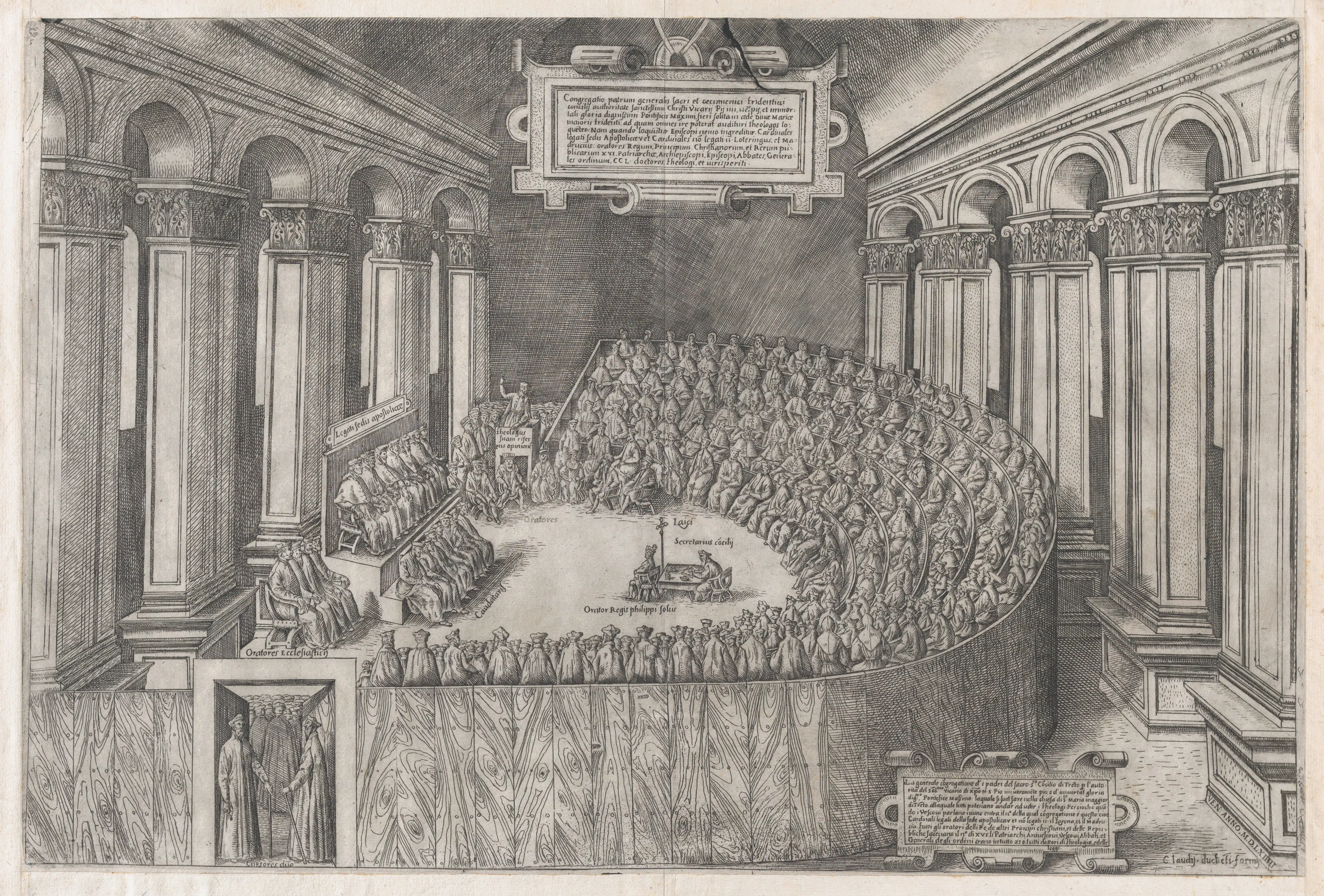
This engraving of a session of the Council of Trent evokes the conciliar framework that empowered Roman authorities to regulate worship and sacramental language. Rocca's insistence that a bell may be blessed but not properly "baptized" belongs to that disciplinary world, where even familiar devotional speech was tested against authorized categories. Source ↗.
Its historical account of Christian bell use is deliberately contested and cumulative. Rocca moves among Paulinus of Nola, the Campanian and Nola etymology, the pseudo-Hieronymian tradition, Alcuin, Durandus, Baronius, and the Roman liturgical books. The attribution to Paulinus is carefully hedged in his own phrasing — bishop of Nola, he is believed to have been the first to introduce the use of the bell into his own church, Episcopus Nolanus, Campanæ vsum primus in suam Ecclesiam inuexisse creditur — and is immediately complicated by the observation that sacred boards used in place of bells were still being struck some four hundred years afterwards, sacra tamen Ligna pro Campanis adhibita, post quadringentos circiter annos pulsari quoque solebant, a datum that keeps the history of the Christian signal from resolving into a single point of invention. He also places Christian bells beside Old Testament trumpets, interpreting the latter as figures of preaching and the former as the enduring sound of Christian proclamation. The work's treatment of names—campana, nola, squilla, crotalum, cloca, and related Greek or vernacular forms—shows how philology functions as historical argument rather than as ornament.
The comparative and polemical dimension of that history is explicit. Rocca reports, on Girolamo Maggi's testimony, that after the fall of Constantinople all the bells were assigned to the use of bombards, Campanæ omnes bombardarum vsui (teste Magio) fuerunt destinatæ, and records the substitute signal adopted by Greek Christians under Ottoman rule, which they call the hagiosiderum, that is, the holy iron, Hagiosiderum, hoc est, sanctum ferrum, vocant. Contemporary confessional conflict is assimilated to the same pattern: the Huguenots, or Hugonists, and the other heretics of the age have declared war on bells, breaking and shattering them in imitation of the Saracens, Sanè Huguenoti (vel Hugonistæ) & ceteri huius sæculi Hæretici, Campanis bellum indixerunt: Eas enim frangunt, & comminuunt, Saracenos imitantes, a claim he extends into a demonological corollary, that heretics and Turks have great likeness and agreement with demons, Hæretici, ac Turcæ magnam similitudinem, & conuenientiam habent cum Daemonibus. Iconoclasm, artillery, and the flight of demons before the blessed bell are thus drawn into a single argument in which the bell's sound marks the boundary of the Roman Church against its confessional and non-Christian rivals.
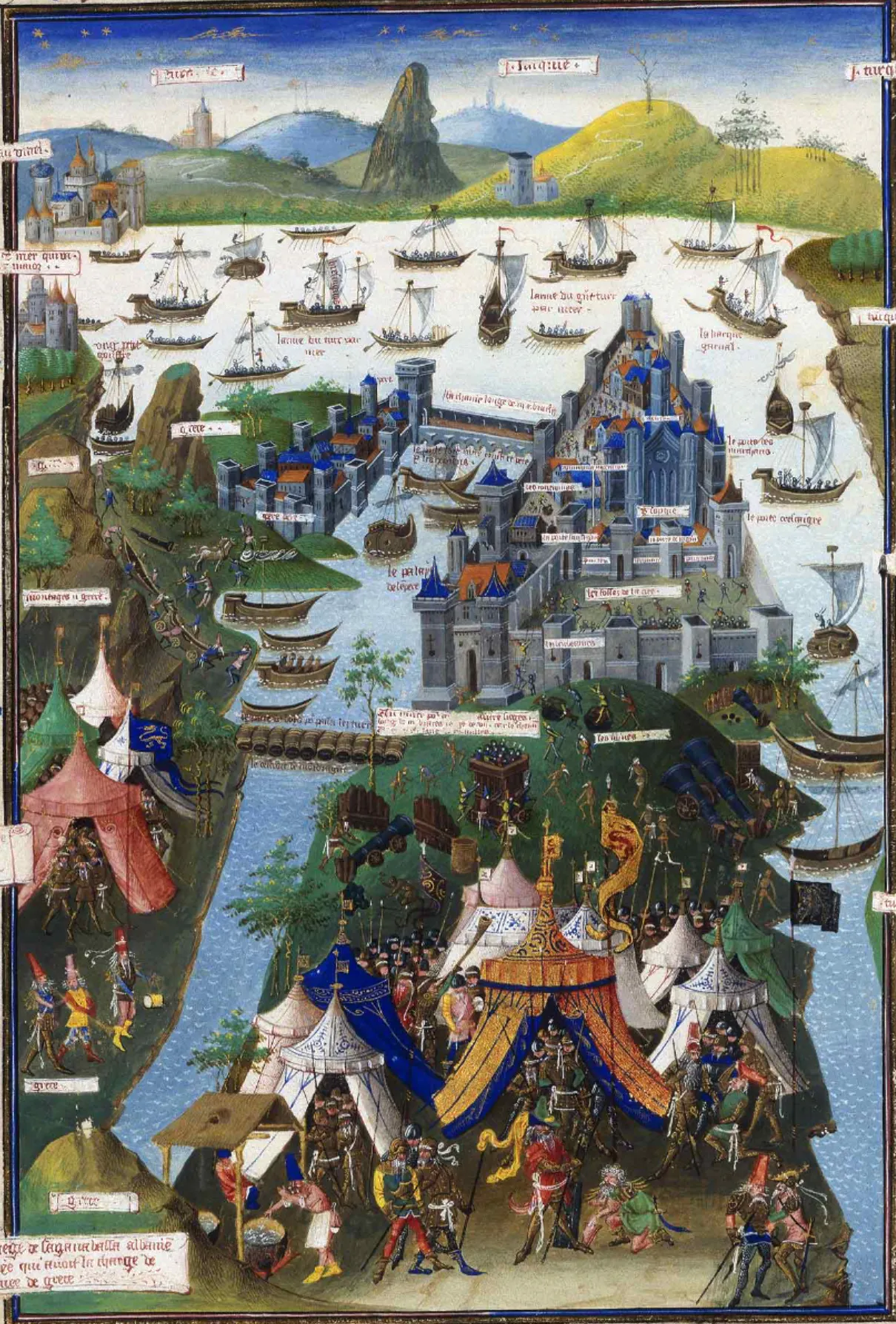
Jean Le Tavernier's illumination of the 1453 siege depicts the catastrophe Rocca later recast as a history of sound: church bells diverted from worship to bombards. In that confessional reading, the fall of the city explains both the silencing of bells under Ottoman rule and the Greek Christians' "holy iron." Source ↗.
The treatise is equally important for the history of testimony and learned credibility. Rocca records the spontaneous ringing of the bells of Saint Paul Outside the Walls in Rome on 24 October 1610 — the bells of the basilica of St Paul near and outside the walls of the city of Rome likewise gave a spontaneous sound, Spontaneum item sonitum dederunt Campanæ Basilicæ S. Pauli propè & extra muros Vrbis Romæ — emphasizes that the bells were normally rung only on solemn occasions or during a papal visit, and insists that no person had moved them. Such episodes are not presented as neutral acoustic observations; they are framed through ecclesiastical testimony, devotional interpretation, and the possibility of divine signification. The same evidentiary concern governs his account of bells as objects of oath in the Celtic lands, reported from Giraldus Cambrensis, where men fear both to swear upon these and to forswear far more than upon the Gospels, ita vt Sacramenta, (hoc est iuramenta) super hæc longè magis, quàm super Euangelia, & præstare vereantur, & peierare. Similar prodigy narratives, reports of ringing during atmospheric disturbance, and accounts of bells associated with protection from danger belong to the period's wider debates over blessed objects, natural causes, providence, and superstition; Rocca keeps such effects within the language of petition rather than of automatic power, noting that God is besought that by the sound of these bells the crash of hail, the whirl of storms, and the onset of tempests, lightning, and thunderbolts be tempered, obsecratur Deus, vt ipsarum Campanarum sonitu fragor grandinum, procellæ turbinum, impetus tempestatum, & fulgurum, ac fulminum temperentur.
The work also preserves evidence for early modern technical culture. Its references to Biringuccio, bell-founding, the forms and methods of casting, musical bell arrangements, towers, the Venetian clock of Saint Mark's, and the relation between bells and organs place it within the material culture of late Renaissance metallurgy and mechanical display. The discussion of clergy, congregated populations, ecclesiastical offices, excommunication by bell, book, and candle, and the Holy Thursday papal rite shows how sound was integrated into jurisdictional and ceremonial order. The Paralipomena record that on each Sunday and feast day, through bishops and archbishops, amid the ringing of bells and with candles lit, the excommunicate were publicly declared, Singulis namque Dominicis, & festiuis diebus per Episcopos, & Archiepiscopos inter pulsandas Campanas candelis accensis, excommunicati publicè declarabantur, so that ringing serves as the instrument of publication for a juridical sentence. Discipline extends even to the material endowment of churches: settling a long-running dispute over the number of bells proper to each rank of church, Rocca concludes that a collegiate church ought to have three, namely the greater, the middle, and the smallest, and a parochial church as many or at least two, si Collegiatæ, tres, grandiorem scilicet, mediam, & minimam; si Parochialis, totidem, aut duas saltem habere debet.
The direct modern historiography of De campanis is very sparse. The principal interpretive weight must therefore be carried by adjacent literatures. Alain Corbin's work on bells and social order is chronologically later but clarifies how control of ringing can express ecclesiastical, civic, and communal authority. David Garrioch's studies of early modern urban sound offer a more immediate methodological model, while stressing that written sources rarely reproduce a complete historical soundscape and that reports of extraordinary sounds are disproportionately preserved. Stefania Nanni's modern biography of Rocca is especially important because it warns that older accounts often repeat Rocca's own early self-presentation and later biographical traditions without sufficient source criticism. These adjacent approaches illuminate the treatise's concerns, but none replaces a critical study of its editions, authorities, and Roman institutional setting. Further work is needed on the Congregation of Rites, post-Tridentine sacramentals, Roman antiquarianism, Greek Christian sound practices under Ottoman rule, and the transmission of bell and carillon knowledge.
Tracing the 1612 Roman Edition: Printing, Plates, and Provenance
The principal edition is securely identified as: Angelo Rocca, De campanis commentarius a F. Angelo Roccha Camers, episcopo Tagastensi et apostolici sacrarii praefecto elucubratus, Rome, apud Guillelmum Facciottum, 1612. The catalogued format is quarto. The Florence copy records VIII preliminary leaves, 166 pages, [22] pages, 8 additional pages, and four folded plates; another catalogue describes the physical unit as VIII, 166 pages, [4] leaves of plates, and [28] pages of illustrations. The copy contains illuminated lettering, illustrated borders, printed and manuscript marginalia, and other graphic matter. HathiTrust records a full-view copy from the Biblioteca de la Universidad Complutense de Madrid, and WorldCat gives OCLC 602203586. No verified USTC, EDIT16, VD17, or ESTC record number was located in the available evidence.
The surviving Florence witness is identified by the digital identifier ita-bnc-mag-00002817-003 and the shelfmark CFMAGL 2.6.480/c. The archive's sibling identifiers are -001, a Rocca treatise on a particle of the True Cross, and -002, Rocca's commentary on the Holy Communion of the pope celebrating solemn Mass. The available archive-level enumeration does not return Christoph Scheiner's Pantographice. Consequently, the claim that the bell commentary is the third item in a miscellany headed by Scheiner's Pantographice cannot presently be confirmed. The evidence supports a sequence of digitized Rocca items at the Florence National Central Library, not a demonstrably Scheiner-hosted Sammelband. Binder's marks, ownership inscriptions, and the complete physical binding history remain undocumented in the located records. The bell commentary and Scheiner's pantograph treatise should therefore be treated as independent works by distinct authors; any apparent volume-level conflation remains a catalogue problem requiring direct inspection of the physical volume.
The book's preliminaries identify Thomas Pallavicinus as Magister and describe him alongside Ludovico Ystella, socius of the Master of the Sacred Apostolic Palace and a Dominican. This establishes a Roman approbation context, consonant with the treatise's origin in the casework of the Congregation of Rites. A separate licence attributed to Raphael, bishop of Zakynthos and Kefalonia, was not confirmed in the available textual and catalogue evidence. Nor was the printer, engraver, dedicatee, or patron beyond Facciottus and the named approbation officials independently established.
The material programme includes four folded plates and a Declaratio concerning clocks and bells represented in the commentary. The explanatory text discusses the clock of Saint Mark's in Venice, its hour bell and hammer, tower structures, and the musical concord of bells with organs, and it extends to the automaton clocks of the North, where Rocca relays the report that a clock of this kind is said to have been built by Nicolaus Copernicus, a man skilled in the mathematical art, who flourished in the year of the Lord 1540, Huius generis Horologium construxisse fertur Nicolaus Copernicus, Vir arte Mathematica peritus, qui Anno Domini 1540. floruit — an ascription Rocca himself marks as hearsay with fertur, and one that the mechanism's modern attribution does not support. The individual engraver's identity could not be securely documented from the available catalogue records; the plate matter of the commentary itself carries the demonstrative legend CAMPANÆ. XXXIII. ORGANI. SONVM. REDDENTES, thirty-three bells rendering the sound of an organ, which ties the engraved programme directly to the treatise's discussion of northern carillons and of the concord between bells and organs. Rocca's author index demonstrates an extensive network of cited authorities, including Girolamo Maggi, Biringuccio, Baronius, Durandus, Petrarch, and classical authors. Maggi is explicitly cited as a source from his De tintinnabulis and is not the author of Rocca's commentary.
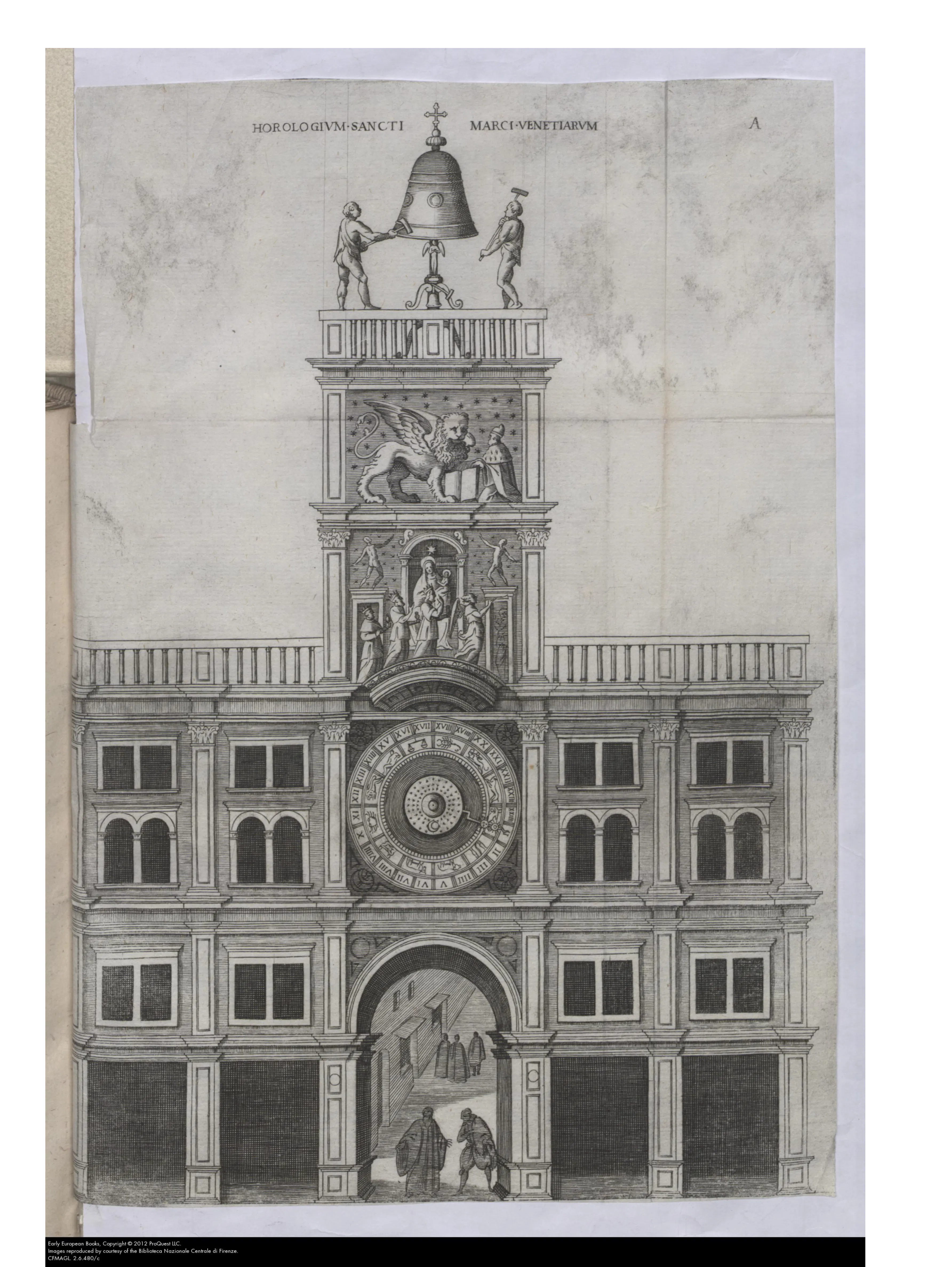
The folded plate headed "HOROLOGIVM SANCTI MARCI VENETIARVM" presents Venice's clock tower as a hierarchy of sacred imagery, astronomical display, and mechanical sound, culminating in the automaton figures over the hour bell. Lettered and explanatory, it belongs to Rocca's argument: the clock-bell as a self-acting signum. Source ↗.
The text's later history is partly visible through Rocca's collected works. An incomplete collection was issued at Rome in 1719 and 1745 under the title Thesaurus pontificiarum sacrarumque antiquitatum necnon rituum, praxium ac caeremoniarum. A 1745 catalogue record for the Thesaurus has been located, but the available evidence does not prove that De campanis is included in that volume or establish a complete reprint lineage. No evidence of formal suppression, censorship beyond routine approbation, or a contemporary refutation was located. The work's immediate reception is therefore best described as bibliographically traceable but historiographically underdocumented.
Rocca's institutional position is significant for the book's documentary method. He was an Augustinian, became associated with the Vatican printing office, served as papal sacristan, and was made titular bishop of Tagaste. The preface and later chapters invoke Roman papal registers preserved in the Vatican Library, while the account of the spontaneous ringing of the bells at Saint Paul Outside the Walls on 24 October 1610 shows how contemporary events were incorporated into the treatise's antiquarian and devotional argument. Proximity to the Vatican fabric supplies further such material: Rocca notes that now, in the year of the Lord 1610, in the month of September, the said bells were transferred above the new basilica of St Peter, into one of the four lesser domes which they commonly call the cuppola, Nunc autem, Anno scilicet Domini 1610. Septembri mense, dictæ Campanæ translatæ fuerunt supra Basilicam Sancti Petri nouam intra vnum ex quattuor minoribus Tholum, quem vulgò Cuppulam vocant, a notice that also exemplifies the vernacular vocabulary embedded in his Latin. His own presence in the palace enters the argument as evidence in its own right when he reports that not far from him the place of the Sala Regia was struck by lightning, not without great consternation of his mind, & à me non procul ictus est Aulæ Regiæ locus fulmine non sine magni animi mei consternatione, the eyewitness clause serving the same evidentiary function within the discussion of storms and storm-bells that notarial attestation serves elsewhere. His foundation of the Angelica Library in 1604 forms part of the same broader bibliographical and ecclesiastical programme, although direct proof that he consulted particular Vatican register volumes for this treatise remains unavailable.
How Rocca Builds the Argument: From the Ordo Naturae to Bell, Book, and Candle
The double occasion and the ordo naturae
The commentary announces its own point of departure twice, and the doubling is instructive. In the address to the Catholic Church, Rocca describes the book as a private elaboration of curial business: the occasion once offered him by a certain case under examination in the Sacred Congregation of Rites led him, in the formulation already noticed above, to take up this commentary on bells animi causa, for his own satisfaction — a phrase that quietly concedes the disproportion between a single contested point of rite and the twenty-six quaesita that follow. At the head of the first quaesitum the same occasion is restated in the plural of authorship and immediately converted into a principle of arrangement, since, keeping the order of nature, he will treat first of the invention of bells. The ordo naturae invoked there is not a modest disclaimer about arrangement but a strong claim: origin precedes name, name precedes use, use precedes marvel and mechanism, because that is the sequence in which the thing itself becomes intelligible. The numbered table of quaesita and the alphabetical index of cited authors that stand between these two statements make the claim navigable in print, so that the reader may enter the sequence at any point while the book retains its argument that the points are ordered by nature rather than by convenience.
Origins, confessional geography, and the propriety of names
The first chapter grounds the history of the Christian signal in a confessional geography. Bells are treated as the audible boundary of Latin Christendom: refused in the mosques, melted into artillery after the fall of Constantinople, replaced among Greek Christians under Ottoman rule by a struck board and a struck iron. Into this pattern Rocca folds the iconoclasm of his own century, alleging on Durantus's formula — the passage on the Huguenots and the other heretics of the age who have declared war on bells and shatter them in imitation of the Saracens, discussed above — a continuity between Ottoman and Protestant hostility to consecrated sound. The verb indixerunt, properly used of formally declaring war, makes bell-breaking an act of belligerent policy rather than local disorder, and the participle imitantes supplies the polemical logic: two otherwise unrelated hostilities are shown to share a form, and from shared form a shared nature is inferred, completed a page later by the assertion that heretics and Turks have great likeness and agreement with demons. The chain — Saracen, heretic, demon — is held together by nothing but aversion to consecrated sound, which is exactly why the treatise must later argue at length that the sound is genuinely consecrated and genuinely efficacious.
Against this polemical frame the chapter's historical scholarship is notably restrained. The attribution of the ecclesiastical use to the bishop of Nola is hedged, as noted earlier, by a verb of report, creditur, and the claim is deliberately narrow, concerning usus in one church rather than invention as such, so that the profane antiquities gathered from Josephus, Suetonius, Strabo, and Polybius do not embarrass it. Rocca then complicates his own chronology with material evidence drawn from the acts of Nicaea II, in the observation already cited that sacred boards used in place of bells were still being struck some four hundred years afterwards. That observation is methodologically consequential, since it treats liturgical hardware as datable independently of doctrine and prevents the history of the signal from collapsing into a single foundational moment; the same ligna sacra that mark Greek deprivation under the Turks turn out to be the ancient Christian practice itself.
Lexicography does comparable work in the second chapter, where twelve names are sorted and their propriety weighed. The canonical-liturgical name is the one that carries the treatise, and it is given flatly among the rest: the bell is likewise called a signum, SIGNVM item appellatur Campana. It is on this name that the ritual and jurisdictional chapters depend, for a signum is by definition a public notice of an act to be performed, so that questions of who may sound it and when it must be silent are already contained in the noun.
Rite, consecration, and the misnomer of baptism
The ritual chapters proceed from name to form. Rocca transcribes the rite of the Pontificale step by step, and its operative words, as already seen, address the object in the vocative, asking that this sign be sanctified and consecrated in the name of the Trinity and in honour of the patron saint. The washing, the oil of the infirm, the chrism, the seven and five crosses, the incense, and the naming for a patron together produce a ceremony so close in outward shape to Christian initiation that the popular misnomer becomes almost predictable, and Rocca's next chapter must therefore dismantle it not by denying the resemblance but by locating the precise point of difference. That point is verbal and sacramental, and it has been quoted above: the rite lacks the form of baptism, without which there can in no way be baptism properly so called. The distinction between proprie and improprie — the treatise's master instrument — is here made to carry a double burden, correcting the crowd's careless speech while conceding nothing to the Protestant charge that the blessing of metal is superstition. The blessing remains genuinely operative; only the name is wrong.
Prodigy and the criteria of proof
The seventh quaesitum shifts the evidentiary register from ritual form to testimony, and it is here that the compilation's criteria of proof become visible. Prodigies are not admitted merely because they are reported. The Aragonese bell, of which Rocca writes that some months before any adversity befalls the Christian commonwealth it is rung of itself with no one pushing it, arrives escorted by public notaries and viceregal letters. The clause nemine impellente is precisely what a notarial instrument can attest — the absence of a human hand — and the wonder is thereby made a matter of documented fact rather than of pious inference, while the interpretation of what the sound portends is left to the reader.
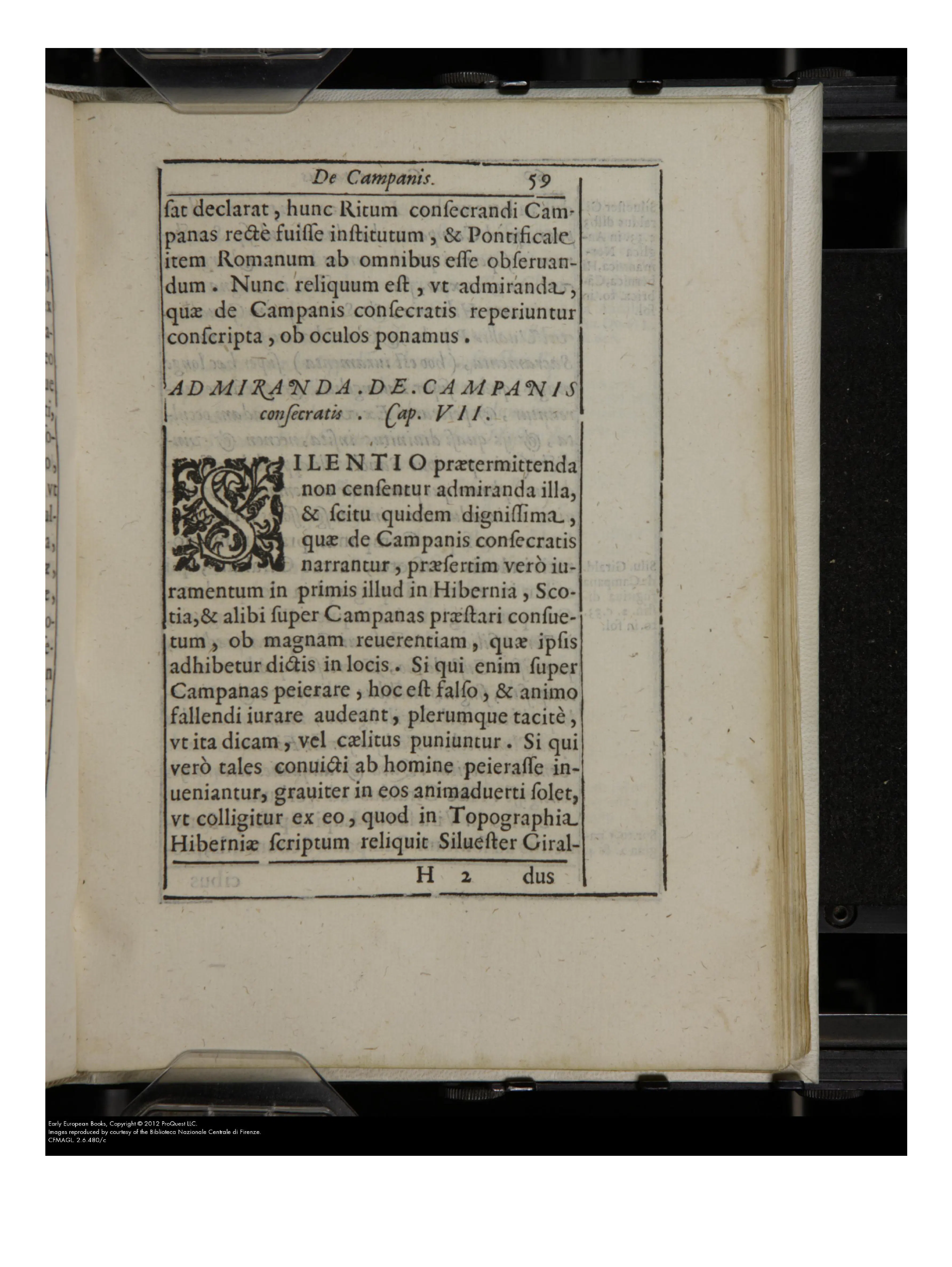
The opening of the seventh quaesitum, headed "Admiranda de Campanis consecratis" with a large ornamental initial, marks Rocca's turn from the consecration of bells to their marvels. Exempla from Giraldus Cambrensis on oaths sworn upon bells in Ireland and Scotland make consecrated bronze a site of proof, perjury, and reverence. Source ↗.
The ringer, the rope, and clerical office
Jurisdiction returns in the chapter on the ringer, where the consecration argued for earlier becomes the premise of a restriction: because bells are consecrated and dedicated to divine worship, they are not to be rung by laymen but by those adorned with sacred or at least minor orders, in the ruling discussed above. The reasoning is deductive rather than customary — because the object is holy, the hand upon the rope must be an ordered hand — and the Cologne provincial legislation against bearded ringers in lay dress follows as a matter of decorum consequent upon that principle. Amalarius then supplies the allegory that binds sound to office, since the rope that reaches all the way to the priest's hands means that Scripture ought to pass over into the works of priests, qui funis vsque ad manus Sacerdotis pertransit: etenim Scriptura ad opera Sacerdotum debet transire — a reading in which the physical linkage of bronze to hand becomes a figure for the descent of the written word into clerical action, so that the ringer is not an attendant to the liturgy but a minister within it.
The bell's own voice and the catalogue of uses
The catalogue of uses is introduced by a figure Rocca names explicitly, letting the instrument speak, as he says, by prosopopoeia, that is, by way of an assumed person, per prosopopoeiam, id est, per personam. Naming the figure is a precaution as much as an ornament: it marks the bell's first-person voice as rhetorical convention, not as animation of the metal, at the very moment the treatise is most exposed to the accusation of attributing power to a thing. The two Leonine verses that follow — the bell praising God, calling the people, gathering the clergy, lamenting the dead, putting the storm-cloud to flight, and honouring the feasts, in the lines already quoted — then serve as the outline of the ensuing chapters, each verb generating its own quaesitum. Of these, Nimbum fugo is the most contested, and Rocca reinforces it with his own experience, the report, discussed above, that the place of the Sala Regia was struck by lightning not far from him and not without great consternation of his mind. Composed, he notes, in the Apostolic Sacristy on the feast of Gervasius and Protasius, that sentence performs for the storm-bell what notarial attestation performed for the Aragonese prodigy: the compiler steps into his own compilation as a witness of record.
From survey to norm: discipline, publication, and the plates
The closing quaesita convert survey into norm. The long litigation over how many bells a church may possess is settled by Borromeo's Instructiones, in the ruling cited earlier that a collegiate church should have three, the greater, the middle, and the smallest, and a parochial church as many or at least two, so that the antiquarian question of how many bells anyone has had becomes the disciplinary question of how many a church of a given rank ought to have. The Paralipomena then recover the coercive face of the same sound in the notice, already discussed, that on every Sunday and feast day, through bishops and archbishops, amid the ringing of bells and with candles lit, the excommunicate were publicly declared: ringing here does not summon or protect but publishes, giving a juridical sentence its audible promulgation. The engraved plates that follow the licences complete the demonstration in another medium, their legends belonging to the argument rather than to its decoration, as with the thirty-three bells rendering the sound of an organ noticed above, where the northern carillon is shown to realize in bronze the concord that the text had claimed between bells and organs — the signum of the opening chapters, having passed through rite, jurisdiction, and prodigy, now exhibited as an instrument of measured harmony.
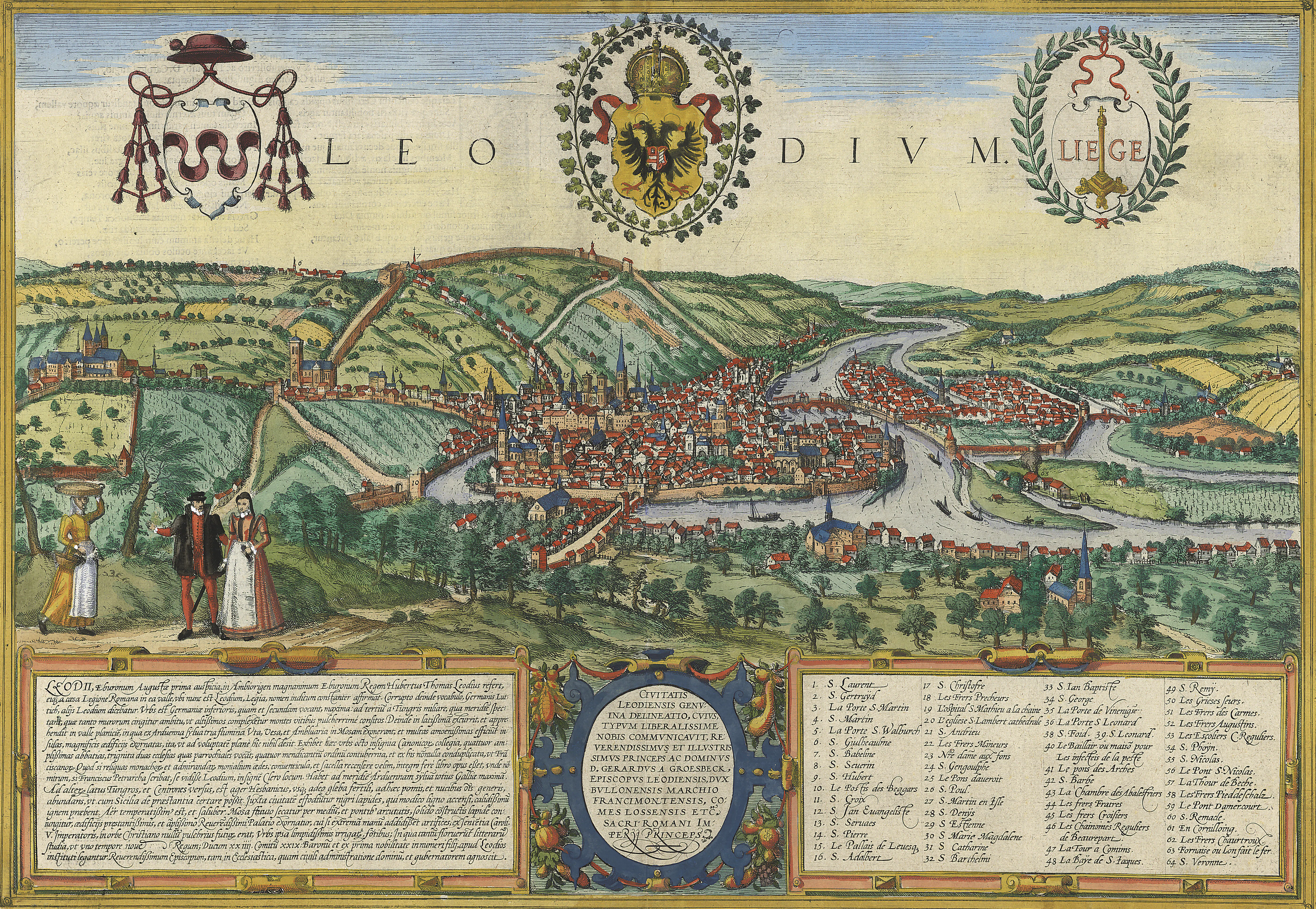
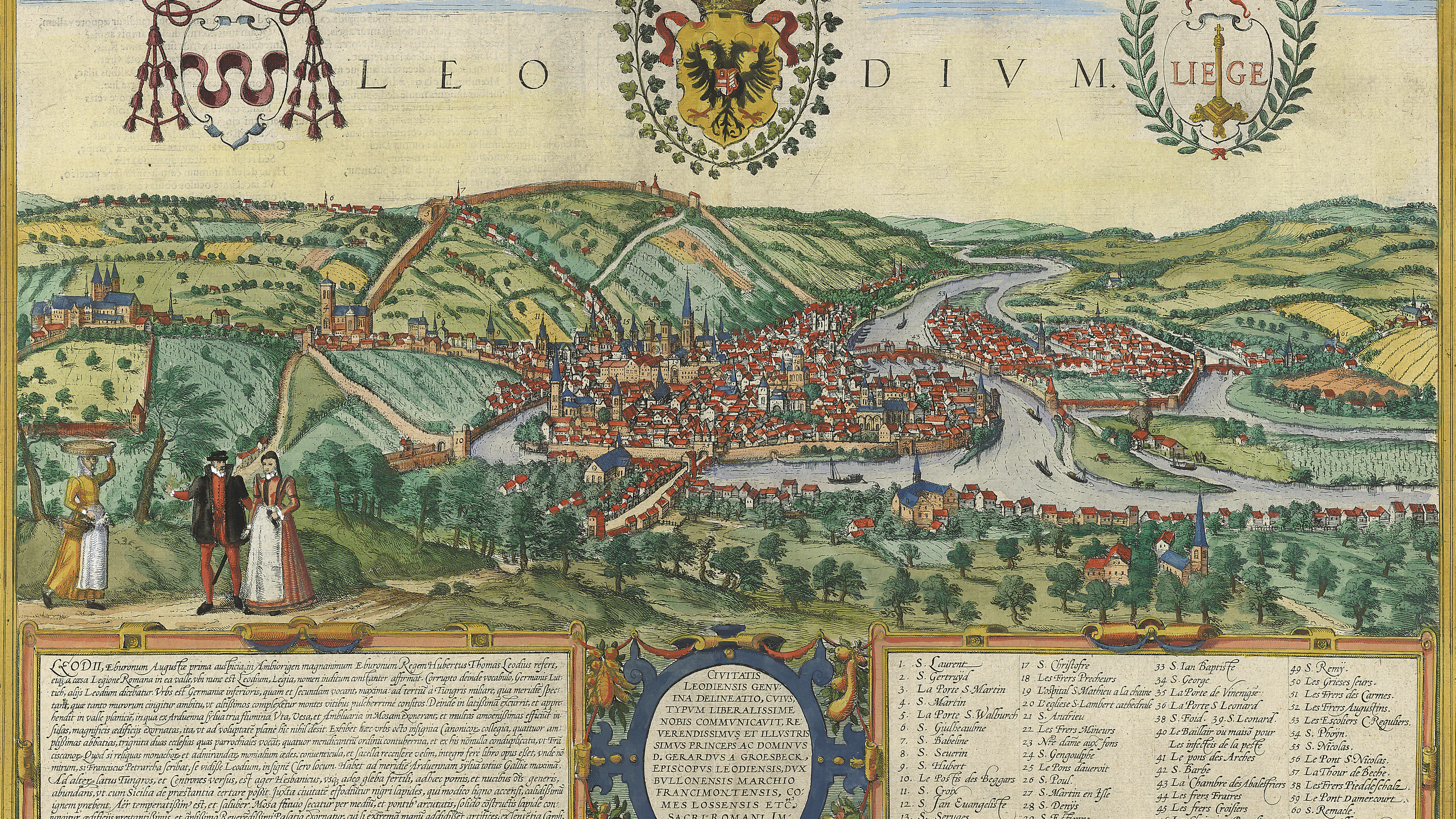
Braun and Hogenberg's 1572 view of Liège, from the era's most celebrated topographical series, shows a city thick with towers. Rocca places Liège with Brussels and Mechelen among the northern centres where carillons were played with hands and feet — bells realized as instruments of ordered harmony. Source ↗.
Reading De campanis Beside Modern Work on Sound, Sacramentals, and Curial Ritual
The direct historiography of Rocca's De campanis remains very thin. These works should therefore be supplemented by research on post-Tridentine sacramentals, Roman liturgical governance, ecclesiastical antiquarianism, and the history of bells and carillons; none of the recommended secondary works is a substitute for establishing the text from surviving copies.
Frequently Asked Questions
What is Angelo Rocca's De campanis commentarius?
It is a Latin quarto on church bells, printed at Rome by Guillelmus Facciottus in 1612, that grew out of a single case examined in the Sacred Congregation of Rites and expanded into twenty-six numbered inquiries. Rocca proceeds by an announced order of nature — invention, names, ritual status, effects, uses, wonders, mechanism — treating the bell as a signum, a sign whose authorized sound gives notice of an action to be performed. The volume carries supplementary Paralipomena, an index of cited authors, a subject index, and four folded plates with an explanatory Declaratio.
Who was Angelo Rocca?
Rocca was an Augustinian friar, titular bishop of Tagaste, and prefect of the Apostolic Sacristy in Rome — a curial insider associated with the Vatican printing office and founder, in 1604, of the Angelica Library. His position shapes the book's method: it draws on papal registers preserved in the Vatican Library and on events he witnessed, including the transfer of the old Vatican campanile bells in September 1610 into one of the four lesser domes of Saint Peter's, and lightning striking the Sala Regia not far from him, which he says caused him great consternation.
Why did Rocca reject the popular talk of "baptizing" bells?
Because baptism properly effects the remission of sins in a rational creature, and a bell is not a rational subject. Rocca grants that the crowd, using words at its pleasure, says bells are baptized when a bishop blesses them, but locates the decisive defect in the missing sacramental form, "I baptize thee in the name of the Father and of the Son and of the Holy Spirit." He therefore keeps benedictio and consecratio — blessing and consecration — apart from the alleged baptismus campanae, citing the Roman Pontifical and Charlemagne's maxim that bells are not to be baptized.
How does Rocca treat reports of bells that ring by themselves?
He admits them as documented fact rather than pious inference, and leaves their meaning open. The self-ringing bell of Velilla de Ebro, said to sound some months before adversity befalls the Christian commonwealth with no one pushing it, arrives escorted by public notaries and viceregal letters; the absence of a human hand is precisely what a notarial instrument can attest. He likewise records the spontaneous ringing of the bells of Saint Paul Outside the Walls at Rome on 24 October 1610, stressing that they were normally sounded only on solemn occasions and that no person had moved them.
Is there an English translation of De campanis commentarius?
No modern English translation or annotated critical edition has been identified, nor any Italian, French, German, or Spanish translation; the work has remained dependent on its Latin witnesses and their digitized facsimiles. Separately, the Leo edition now presents the full transcription together with a complete English translation, generated by AI, for the first time. Leo is an effort to make freely available online, at no cost, English translations of every text printed in Latin in early modern Europe between 1450 and 1750.
This report was generated by an advanced AI assistant that conducted deep research alongside an extensive interpretation of the transcribed original text. Every effort has been made to preserve fidelity to the source and to guard against inaccuracy, but corruption in the text recognition process and model hallucination may nonetheless have entered the text. Treat every claim, quotation, translation, and citation as provisional, and verify each against the original source before relying on or citing it.
Bibliography
- Alain Corbin, Village Bells: Sound and Meaning in the Nineteenth-Century French Countryside: Corbin works two centuries after Rocca and in a de-Christianizing French countryside, yet no other book explains so precisely how the right to ring, and the power to silence, functions as a claim to authority over a community. Read it against Rocca's canonistic ruling that the ringing of the bell is nevertheless conceded in the time of interdict, Pulsatio tamen Campanæ in tempore Interdicti conceditur, where sound withheld and sound restored are straightforwardly instruments of jurisdiction. The translation by Martin Thom (Columbia University Press, 1998) is the standard English text.
- David Garrioch, "What Was Urban about Urban Sound in Early Modern Europe (c. 1500–1800)?," Sound, Language and the Making of Urban Space: Garrioch, whose earlier "Sounds of the City: The Soundscape of Early Modern European Towns" appeared in Urban History 30 (2003): 5–25, supplies both the method and the warning: the written record captures signals and interruptions, not ambient noise, so the sounds we can still hear are the ones someone had a reason to write down. That bias is exactly what produces Rocca's Aragonese prodigy, of which he reports that this bell, some months before any adversity befalls the Christian commonwealth, is rung of itself, with no one pushing it, hæc per aliquot menses antequam aliquid aduersi in Christiana Republica contingat, ex se ipsa, nemine impellente, pulsatur, complete with notaries and viceregal letters. Use him to keep Rocca's civic towers, clocks, and marvels in proportion to the ordinary ringing he never bothered to describe.
- Stefania Nanni, "Rocca, Angelo," Dizionario Biografico degli Italiani: The indispensable modern life (vol. 88, 2017), and the only account that treats the older biographies as sources requiring criticism rather than as facts to be recopied. Essential for placing De campanis within Rocca's Augustinian career, his work for the Vatican press, the sacristy, and the founding of the Angelica in 1604 — the institutional setting that made a treatise stitched from papal registers and curial casework possible.
- Robert W. Scribner, "The Reformation, Popular Magic, and the 'Disenchantment of the World'," Journal of Interdisciplinary History 23 (1993): 475–494: Scribner reconstructs the Protestant attack on sacramentals and the Catholic defence of blessed objects, which is the confessional pressure that makes Rocca's proper-versus-improper method necessary rather than pedantic. Note where he locates the efficacy: God is asked that the demons, terrified by those very prayers, may rather depart, and, they being removed, that the crops, minds, and bodies of believers be preserved, so that hostile armies and all the snares of the enemy be driven far off, quin potius precibus ipsi territi, abscedant, illisq[ue] summotis, fruges, mentes, & corpora credentium seruentur, vt procul pellantur hostiles exercitus, & omnes insidiæ inimici — in the prayer, not in the bronze, which is precisely the line between blessing and magic that Scribner shows was under attack.





_by_Jean_Le_Tavernier_after_1455.jpg)
