Georgius's Compass: Christoph Scheiner's The Art of Drawing All Things by a Linear or Hollow, Mechanical, Mobile Parallelogram
Christoph Scheiner — the Jesuit astronomer who had already quarrelled with Galileo over sunspots — spent nearly three decades sitting on a trade secret he had prised out of a lame Dillingen painter: a jointed frame of rods that copies, enlarges, or shrinks any figure while the draughtsman never once looks at what his own hand is producing. In 1631 he printed it in Rome as Pantographice, an art of drawing all things whatsoever, half instrument manual and half geometrical treatise, fitted out with postulates, optical demonstrations, head-clamps, and a defence of local motion as a legitimate principle of mathematics. What the book stages, page by page, is the conversion of a guarded workshop mystery into an authorized, demonstrable science, licensed by the Society of Jesus and the Master of the Sacred Palace.
ExLatinis
September 3, 2026

Contents
Christoph Scheiner — the Jesuit astronomer who had already quarrelled with Galileo over sunspots — spent nearly three decades sitting on a trade secret he had prised out of a lame Dillingen painter: a jointed frame of rods that copies, enlarges, or shrinks any figure while the draughtsman never once looks at what his own hand is producing. In 1631 he printed it in Rome as Pantographice, an art of drawing all things whatsoever, half instrument manual and half geometrical treatise, fitted out with postulates, optical demonstrations, head-clamps, and a defence of local motion as a legitimate principle of mathematics. What the book stages, page by page, is the conversion of a guarded workshop mystery into an authorized, demonstrable science, licensed by the Society of Jesus and the Master of the Sacred Palace.
In 1631 the Roman press of Lodovico Grignani issued a Latin quarto whose title page announces both an author and a new discipline: Christoph Scheiner, styled Germano-Suevus, and Pantographice, an art of drawing all things whatsoever by means of a linear or hollow, mechanical, mobile parallelogram. Scheiner was a Jesuit mathematician and astronomer, by then long known in learned circles for his solar observations, and the book he brought out in Rome is at once an instrument manual and a mathematical treatise. It is divided into two books, the first devoted to Epipedographice, the delineation of plane figures, the second to Stereographice, the living imitation and projection of solid visible things; each book is further split between rules of use and the postulates, propositions, problems and lemmas that justify them. The device at its centre is what later usage would call the pantograph: a jointed frame of rods with one fixed centre, a tracing index and a drawing pen, so arranged that whatever the index follows the pen repeats, in equal size, enlarged, or reduced according to the ratio at which the three points are set.
The intellectual problem the work confronts is not how to build such a frame but how to classify what it does. Copying, enlarging, reducing, and casting solid bodies onto flat surfaces had belonged to manual talent and to guarded workshop knowledge; Scheiner's ambition is to lift that whole family of operations out of dexterity and secrecy and constitute it as a demonstrable science. His recurring move is twofold and always in the same order. The operation is first displaced from the hand into a mechanism, so that proportion is fixed by the geometry of the linkage rather than by the skill of the draughtsman, who by Scheiner's account cannot stray from his exemplar unless he wills it, and who may indeed draw without ever looking at what he draws. The mechanism is then immediately roofed with theory: praxis is followed by speculatio, the rules of use by demonstrations, and the demonstrations are supported by an optics of radiant points, visual angles, and a contact that is optical rather than physical, together with a defence of local motion as a legitimate principle of mathematics against those who would confine geometry to rule and compass.
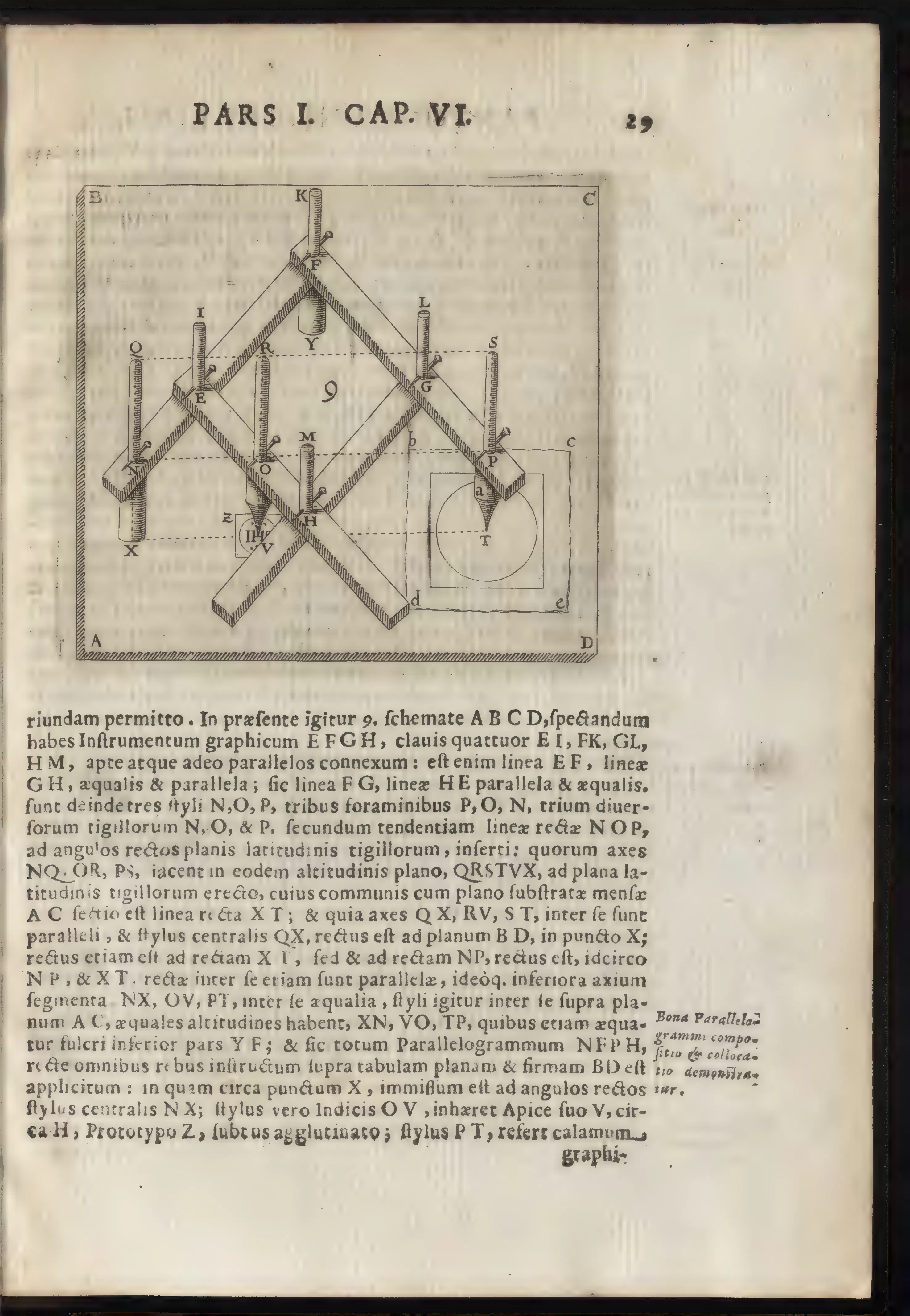
Schema 9 turns the pantograph from carpentered frame into object of proof: the engraved parallelogram, its fixed, tracing, and drawing points set over a base plane, lodges proportion in the geometry of the linkage. The demonstration beneath makes proportion a spatial fact to be proven rather than judged. Source ↗.
The stakes of that conversion were substantial in the intellectual world Scheiner inhabited. The status of mathematics within the Society of Jesus, the standing of the mixed mathematical sciences, and the question of what sort of organum might participate in a demonstration were all live matters; so was the relation between the older perspectivist account of vision and newer analyses of the image. Scheiner's insistence that a moving artificial frame belongs inside geometry, and that its traces can be made answerable to postulates, gives unusually direct evidence of how a seventeenth-century Jesuit author could turn an artificium into a scientia without abandoning the vocabulary of practical making. The same insistence carries him into the geometry of distorted images, where an oblique section of the visual pyramid loses the likeness of its figure and recovers it only from one determinate station — the mechanism of anamorphosis, which he treats not as a curiosity but as a manufacture to be commanded at will.
What is most memorable about the book, however, lies as much in its particulars as in its programme. Its invention narrative places the origin at Dillingen in 1603, in the company of a crippled painter named Georgius who held the principle of the device as a trade secret and judged it not a human but a divine invention; the disclosure is dated to the night preceding the feast of Saints Fabian and Sebastian, and the painter, confronted with images produced by others from his own guarded art, is reported to have stood a quarter of an hour mute and thunderstruck. Scheiner claims to have suppressed the art for decades and to publish it at last to the praise of God and for public utility, and he claims priority in the strongest terms, having seen, he says, no one who treats these matters in writing. The book records demonstrations before princes and prelates and the carrying of partial knowledge overseas by Jesuits bound for Spain and the Indies; it prescribes head-clamps, a forehead band, a girdle and a peephole board to hold the operator's eye at a fixed station; it anticipates the suspicion of magic that mathematical marvels attract; and it opens with a dedication to Paolo Savelli, prince of Albano, whose lineage is elaborated through Livy, Platina, Panvinio, Baronio and the Capitoline manuscript books into a genealogy of thirty-three cardinals, papal ancestry, and the hereditary marshalate of the Holy Roman Church. Its licensing apparatus names three Jesuit theologians and mathematicians as revisers under the Superior General Muzio Vitelleschi, and carries the signature of Niccolò Riccardi as Master of the Sacred Palace, the same office that would shortly be occupied with Galileo's Dialogo. Several of these threads remain unresolved: the painter's surname has not been recovered, the Vicegerent named only as bishop of Belcastro has not been securely identified, and no contemporary refutation or defence devoted to the treatise has been located.
A single movement therefore binds the work's conceptual vocabulary, its production, and its internal argument: the passage of a guarded marvel into public, authorized, demonstrable knowledge. The coined Greek names — Pantographice, Epipedographice, Stereographice, Scenographice — claim disciplinary territory for operations that had no learned name; the paired terms praxis and speculatio organize the exposition so that every rule of use acquires a proof; the Roman imprint, the Jesuit approbations, the papal Master of the Sacred Palace and the Savelli dedication supply the institutional and dynastic authorization that transforms a workshop secret into a printed ars; and the figures, the elenchi, and the engraved plates make the whole visible to inspection. The claim that likeness itself can be produced reliably, by a machine whose motions are geometrically intelligible, is the same claim that the frontispiece makes for the patron's lineage and that the licensing pages make for the Society's competence to certify mathematics.
Read the full text and English translation on Leo
This text was transcribed and translated as part of the ExLatinis project, an effort by Leo to make free English translations of every text published in Latin in early modern Europe (1450–1750) available online. The complete transcription and English translation of this work can be read free of charge:
→ Read the original Latin text and full English translation on Leo
You can save a copy of this document into your Leo account to run deep text searches, conduct further analysis, or cross-reference it with your own research.
Titling Scheiner's Pantographice and Framing Its Coined Vocabulary
Editorial English title supplied for convenience, not an established English title in current historiography: “The Art of Drawing All Things by a Linear or Hollow, Mechanical, Mobile Parallelogram: Christoph Scheiner’s Pantographice (Rome, 1631).” The title page identifies the author as Christophori Scheiner Germano-Suevi and names the work Pantographice; it presents an art of drawing all things by means of a linear or hollow, mechanical, mobile parallelogram, divided into two books, the first concerned with Epipedographice, or the delineation of plane figures, and the second with Stereographice, or the living imitation and projection of solid visible things.
Philologically, Pantographice is best understood as a learned disciplinary formation rather than merely the name of an instrument. It names an ars whose claim is comprehensive: the parallelogram is presented as a means by which res quaslibet, things of whatever kind, may be drawn. The text presses that comprehensiveness to its limit, asserting that there is nothing visible which cannot be drawn by this parallelogram, whether that thing be superficial or solid, nihil enim visibile est, quod delineari non possit hoc Parallelogrammo, siue iam illud superficiale siue solidum, existat. The formal definition of the device shows how carefully the nomenclature is built to carry that claim: a linear parallelogram is an artificial, mathematical, quadrangular instrument, aptly composed of straight lines, each two opposite ones always equal to one another, devised for infallibly imitating by drawing any seen thing whatever, and for transforming it in a given proportion, quicker than speech, in a plane, Parallelogrammum lineare, est instrumentum artificiosum, Mathematicum, quadrangulum, ex rectis lineis, binis quibusq[ue] oppositis semper inter sese æqualibus apte compositum, ad rem visam quamuis delineando infallibiliter imitandam, inq[ue] data proportione, dicto citius in plano transformandam, excogitatum, a formulation in which artificiosum and Mathematicum are set side by side without apology, and in which infallibility and a given proportion are written into the definition itself. The related formations Epipedographice, Stereographice, and Scenographice extend the nomenclature into distinct regimes of plane, solid, and perspectival representation; the second book presents its own name as a deliberate choice between coinages, of Stereographice, or, if you please, of Scenographice, for this art of drawing, Stereographices, vel si placet, Scenographices huic delineandi Arti. The title’s language therefore participates in the early modern practice of naming a new field by combining a Greek-derived technical compound with the Latin vocabulary of ars, scientia, and demonstratio. The novelty is not simply mechanical; it is taxonomic and intellectual, since the instrument’s motions are made to belong within geometry.
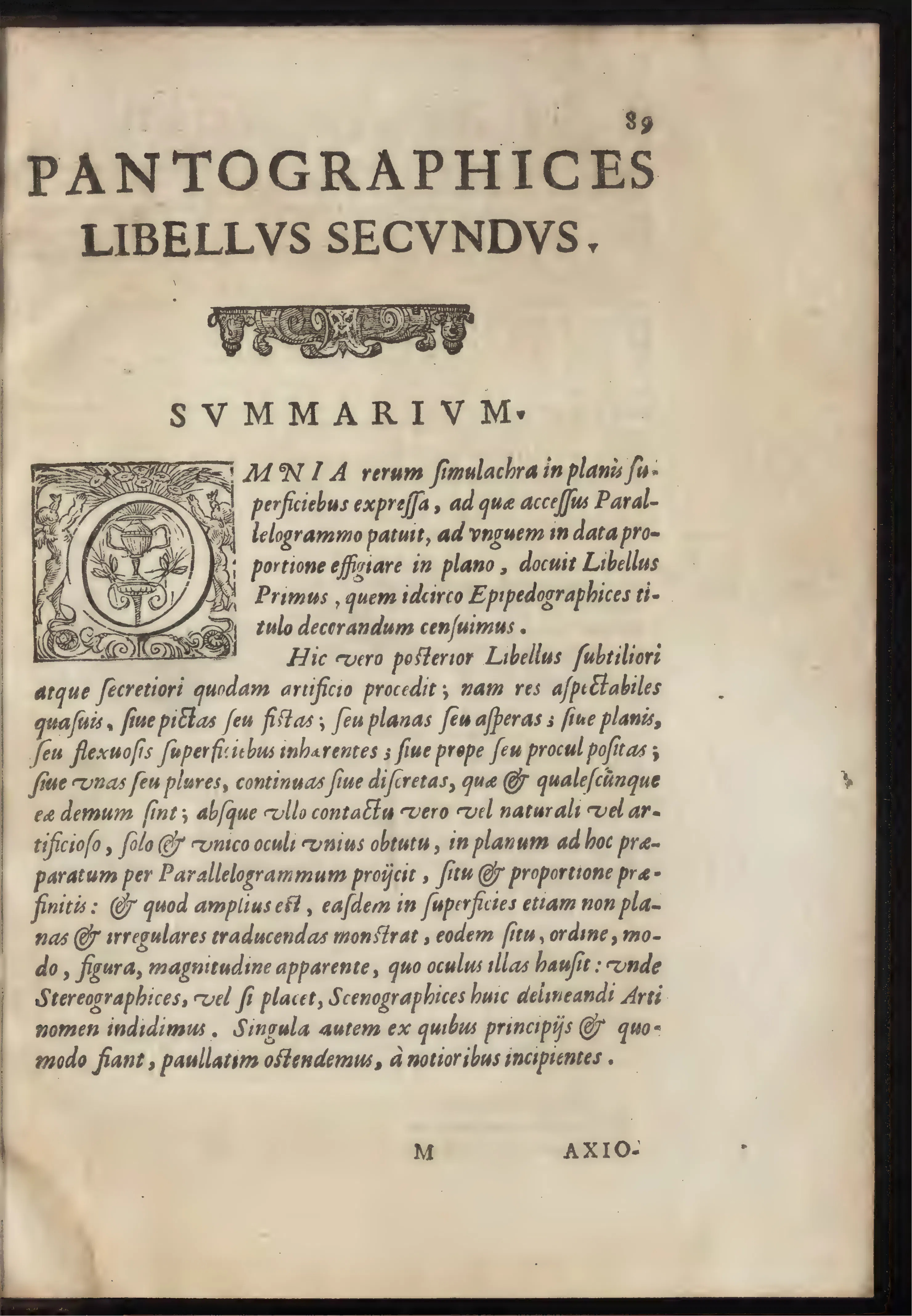
The formal opening of Book II, with woodcut headpiece and historiated initial, turns from the plane-copying of Book I to an optical art of projecting visible things without physical contact. Its Summarium — “Stereographices, vel si placet, Scenographices” — presents the terminology as an act of disciplinary naming. Source ↗.
Scheiner himself defines the book through the paired terms praxis and speculatio. The first part promises praxis, while the second supplies scientific speculation or theory. These terms do not reproduce a modern opposition between manual work and abstract thought. Praxis signifies a disciplined operation carried out through the instrument; speculatio supplies the postulates, propositions, problems, and optical reasons that render that operation intelligible and demonstrable. The passage from one to the other is announced as an obligation of proof rather than as a change of subject: it remains now, Scheiner writes, that we here demonstrate that those things which we said in the same place could be done and were to be done were rightly and truly said and taught, restat nunc, vt ea quæ fieri posse; & facienda esse ibidem diximus, rectè & vere dicta atque docta esse hic demonstremus. The sequence makes motion an object of mathematical reasoning rather than an embarrassment to geometry, and the same order — operation first, warrant immediately after — governs both books.
The invention narrative adds the morally charged vocabulary of secretum and mysterium. The artisan’s knowledge is guarded under seal and silence, and the device initially appears as a protected craft mystery whose possessor reads it in theological terms, holding namely that it was not a human but a divine invention, which he judged to have been brought into the world not by human study but by a heavenly genius, and disclosed to mortals, nimirum non humanum sed diuinum inuentum esse; quod non studio humano, sed genio cælesti orbi illatum, & mortalibus patefactum arbitraretur. Scheiner’s publication reverses that condition: what had been withheld as an arcanum becomes an ars made available for learned inspection, divine praise, and public utility, and he says so in exactly those terms, describing an art which, though most certain, most easy and most expeditious, he had hitherto disclosed to no mortal in detail, but had suppressed for so many years, and now at last brings forth to the praise of God and the illustration of his glory, quam tametsi certissimam, facillimam, expeditissimamq[ue] nulli adhuc mortalium patefeci in specie, sed tot annis pressi: nunc tandem in laudem Dei gloriamq[ue] illustrandam depromo. The movement from secret knowledge to printed discipline is not a modern celebration of openness; it is an early modern reclassification of a marvel from guarded artificium into legitimate mathematical knowledge, and it is the same movement that the coined Greek names, the two-part architecture, and the licensing pages each register in their own idiom.
What the 1631 Roman Quarto Contains: The Drawing Parallelogram in Brief
Pantographice is a printed, illustrated Neo-Latin mathematical treatise and instrument manual by the Jesuit mathematician and astronomer Christoph Scheiner. The 1631 Roman imprint was issued ex typographia Ludovici Grignani. Its title describes a linear or hollow, mechanical, mobile parallelogram for drawing things in proportion; the two-book arrangement moves from practical construction and use to geometrical and optical demonstration. The governing rule of proportion is stated as a single alternative turning on the placement of three collinear points: if the index is set in any middle place between the fixed centre and the writing stylus, the image will always be made larger than the prototype; if the drawing pen is placed between the stylus of the fixed centre and the index, the image will always come out smaller than the prototype, Si index statuetur medio vtcuq[ue] loco inter Cetrum fixum & Stylu Scriptorium; Imago fiet semper maior Prototypo. Si Calamus delineatoriis inter stylum centri fixi & Indicem versabitur; Imago semper consurget prototypo minor. The practical and theoretical parts together argue that a moving instrument can produce reliable representations of plane figures, solid visible objects, and perspectival or anamorphic forms, a reliability Scheiner states as a property of the device rather than of the operator: the use of this graphic parallelogram is such that the artificer cannot stray from his prototype unless he wills it, Vsus huius Parallelogrammi graphici talis est, vt Artifex a Prototypo suo, nisi sponte velit, aberrare non possit.
The work belongs to the Roman production environment of the Society of Jesus. Its colophon is read as Romae in Domo Societatis Iesu professa and is conventionally dated 2 February 1631, although the day is not cleanly recoverable from the surviving digitized text and should be checked against a facsimile; the closing formula as transmitted binds publication to divine glory and common use, all of which I wish to be published for the greater glory of God and for the public utility, at Rome, in the Professed House of the Society of Jesus, 1631, 2 February, Quæ omnia pro maiore Dei gloria, & publica vtilitate prolata volo. Romæ in Domo Societatis Iesu Professa. MDCXXXI. 2. Februarij. The preliminary approvals include Muzio Vitelleschi’s authorization dated Rome, 15 March 1631, and further Jesuit and Roman censorial approvals. The language is Latin. The principal located vernacular transmission is an Italian version associated with G. Troili, La Prattica del parallelogrammo da disegnare, dated 1652 in the relevant secondary bibliography. No complete English or German translation has been located in catalogue records.
Why Pantographice Matters: Jesuit Mathematics, Optics, and Savelli Patronage
Pantographice matters because it joins three domains that are often studied separately: Jesuit mathematical institution-building, the material practice of instrument-assisted drawing, and the optical theory of visual representation. Scheiner does not present the parallelogram as a merely convenient craft implement. He makes its moving parts, fixed eye-station, visual angles, and projected traces answerable to postulates, propositions, and problems. The epistemic consequence is stated as a paradox that only a mechanism could sustain, since with this device, while you make the image you cannot look at it; and if you look at it you cannot make it, In qua Imaginem dum facis non possis aspicere; & si aspicias non possis facere — the operator's eye is bound to the exemplar, and fidelity is transferred from judgement to linkage. The work is equally alert to how such performances were received, registering that the ignorant person doubts whether it is accomplished by the powers of nature or by the hidden frauds of magic, ignarus naturæne viribus, an occultis Magiæ fraudibus perpetrétur. It therefore offers unusually direct evidence for how a seventeenth-century Jesuit author could turn an artificium into a mathematical demonstration while retaining the language of practical making, and could do so under the shadow of the period's suspicio Magiæ.
The institutional context is illuminated by the scholarship on Jesuit mathematics. D. C. Smolarski’s study of the definitive 1599 Ratio Studiorum shows why the curricular place of mathematics must be examined through the Society’s educational legislation rather than assumed from the later reputation of Jesuit science. Sheila J. Rabin emphasizes that Jesuits were trained in the mathematical sciences and could both teach and practice them. Peter Dear’s formulation of Jesuit mathematical science as part of a reconstitution of experience provides a particularly productive frame for Scheiner’s insistence that motion, instrumentality, and visible effect may enter mathematical reasoning. The text’s explicit appeal to Apollonius, Archimedes, Euclid, and Clavius places its mechanical geometry within a learned lineage rather than outside geometry proper, and the appeal is made programmatically rather than decoratively: the procedure is adopted, Scheiner writes, and this not by our own arbitrary choice or by a new precedent, but under the guidance of Archimedes himself, prince of geometers, who writes thus at the beginning of the first book On the Sphere and Cylinder, neque id arbitrio nostro vel exemplo nouo, sed ipsius Archimedis Geometrarum principis ductu, qui ad initium libri primi de Sphæra & Cylindro ita scribit.
The central methodological friction concerns the status of local motion. Scheiner rejects the claim that motion is disqualifying for demonstration and argues from the practices of geometry and astronomy, stating the principle flatly, for mathematicians know very many things not only from motion, but also about motion and through motion, Nam Mathematici non tantum ex motu, sed & de motu & per motum plurima cognoscunt. Apollonius’s conic doctrine is presented as beginning from motion, while Clavius’s Euclidean authority is mobilized to legitimate the proportional operations of the instrument. A further reduction disarms the objection from a different direction, by resolving the machine into an accepted mathematical implement: indeed such a parallelogram is nothing other than two proportional compasses, in which the fixed centre stands for the stable leg, the index stylus and the pen for the two mobile legs, and the compass-heads for the mobile centres, imo Parallelogrammum eiusmodi nil aliud, quam duos circinos proportionales existere, quorum centrum fixum crus stabile, stylus Index & calamus duo crura mobilia, capita vero circini, centra mobilia referant. This is best read as a period dispute over what counts as a mathematical object and what kinds of organum may participate in demonstration, conducted against those neoterici who would restrict geometry to rule and compass. The term praxis names a controlled operation; the propositions and problems of the second book transform that operation into a scientia.
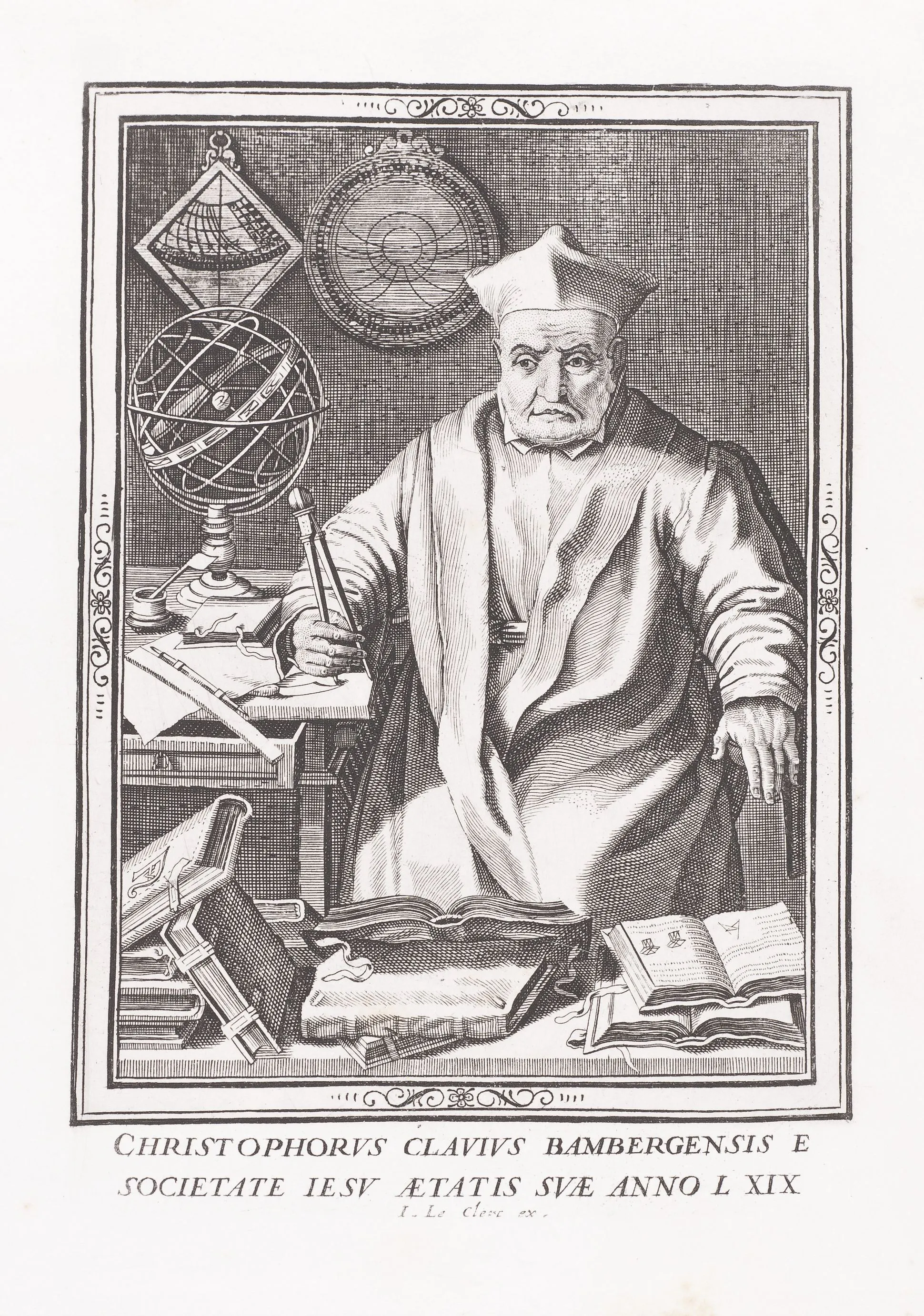
A portrait of the Jesuit mathematician Christophorus Clavius, whose Euclidean authority Scheiner could invoke when translating the pantograph's visible motions into legitimate proportional operations. He appears here as context rather than author: the institutional mathematical tradition within which a mechanical instrument sought credibility. Source ↗.
The optical doctrine is equally significant. The work begins from the principle non datur actio in distans, stated as a bare axiom, there is no action at a distance, Non datur Actio in distans, treats every visible point as emitting a sphere of rays, and defines optical contact through the coincidence of the pointer, the visual line, and the object seen: the rational and optical contact of a thing occurs when the thing seen appears indeed to be touched physically, yet is not touched physically but optically, Rationalis & opticus alicuius rei contactus tunc est, quando res visa physice quidem tangi videtur, physice tamen non tangitur, sed optice,. It fixes the eye in a determinate station, relates apparent magnitude to equality or inequality of visual angles — for to be optically equal is to be under equal visual angles, or under one and the same angle, as the text puts it, nam optice æqualia esse, est sub angulis visorijs æqualibus, aut sub vno — and distinguishes the visible prototype from the image projected upon a plane, as it distinguishes a mathematical from a physical plane and the obiectum quod from the obiectum quo. These claims connect Pantographice with the post-Alhacenian perspectivist tradition and with Scheiner’s later optical work; the text's own citation of d'Aguilon's Opticorum libri sex makes the affiliation explicit. Isabelle Pantin shows that Aguilonius and Scheiner knew the superiority of Kepler’s analysis of the camera obscura while remaining attached to an older account; T. Baker’s study of Oculus interprets Scheiner’s optical practice at the intersection of psychology and mathematics. Together they caution against treating Scheiner as either simply medieval or straightforwardly aligned with Keplerian optics.
The treatment of oblong and distorted images places the instrument within the history of anamorphosis. Scheiner explains that an image may lose the apparent likeness of its figure through elongation and recover its proper form only from a determinate point of vision, and he presents the resulting procedure as a prize of the art: hence you have the method of drawing elongated images, so that their true form may strike the sight from a direct view; the greatest secret in perspective, Hinc habes modum Imagines oblongas delineandi, vt vera ipsarum forma ex aduerso intuitu visum effigiet. Secretum in Prospectiua maximum — a formulation in which the vocabulary of secretum, elsewhere attached to the painter's guarded craft, is reclaimed for a demonstrable construction and extended to vault and ceiling projection. The relevant context includes Jean-François Nicéron’s perspectival and artistic work, as well as Roman practices of perspectival and catoptrical image-making. The precise relation between Scheiner’s demonstrations and any particular Roman or Parisian ceiling project remains an open question; the primary text establishes the optical mechanism more securely than a direct line of influence to a named decorative commission.
Patronage is not external ornament. The Savelli dedication and frontispiece make the instrument’s power part of a dynastic and ecclesiastical representation. Justina Spencer, drawing on Volker Remmert’s interpretation, identifies the frontispiece as an homage to Paolo Savelli, an elite Roman nobleman. The image and the dedication turn the act of copying after an exemplar into a meditation on genealogy, authority, and the production of likeness, and the dedicatory prose itself theorizes the substitution of image for text, Scheiner explaining that this I could not do by writing little; but I could by painting not much, after the manner of Timanthes, who always signified more than he expressed with the brush, Hoc non poteram scribendo pauca; potui vero pingendo non multa, idque Thymantis instar, qui plura semper significauit quam penicillo expressit. The Savelli claims to antiquity and ecclesiastical office thus belong to the same representational economy as the geometrical instrument: both organize visible evidence into an authoritative figure.
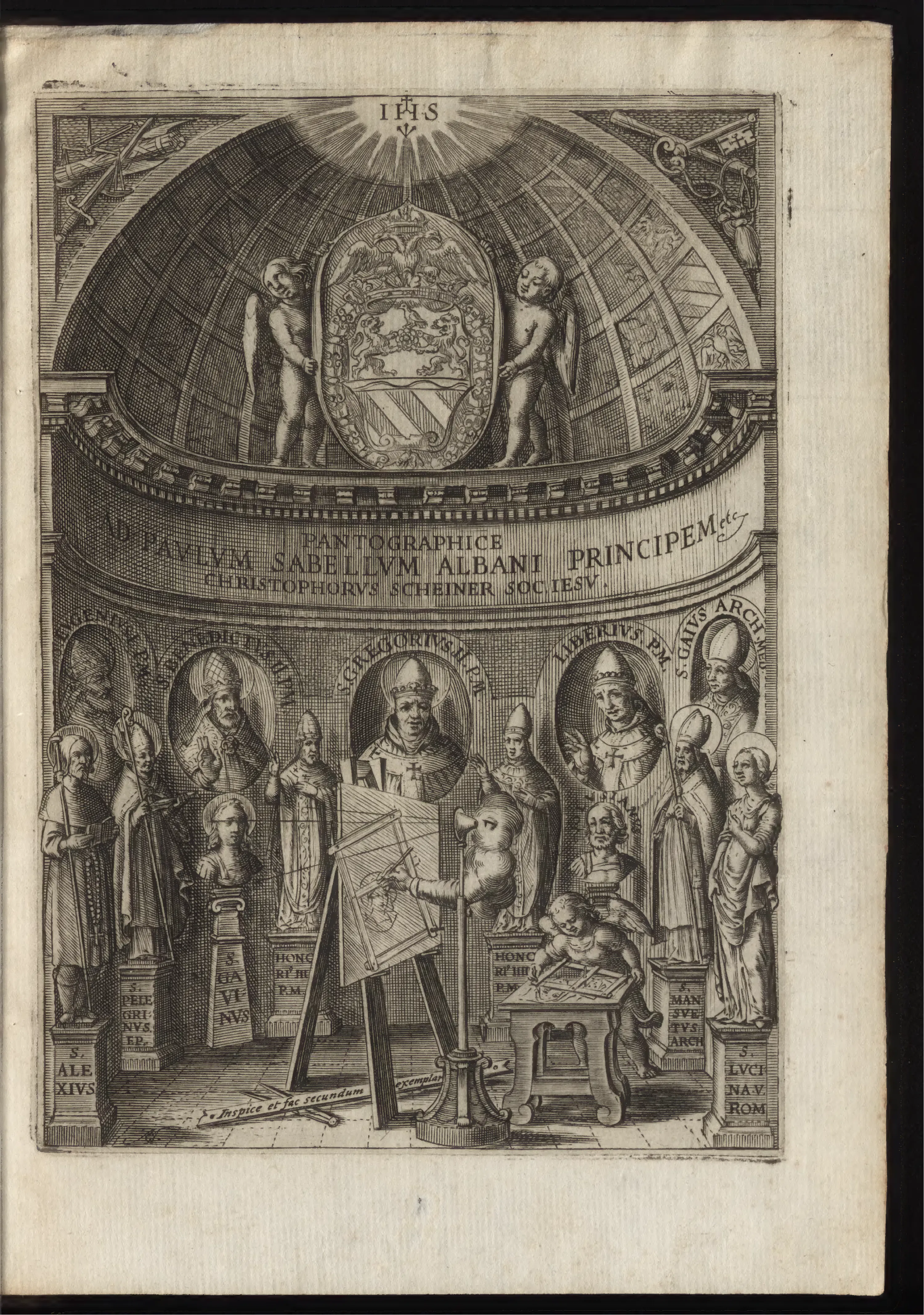
The engraved frontispiece stages Paolo Savelli's patronage as part of the instrument's authority: beneath the Jesuit IHS and the Savelli arms, a figure works the pantograph beside the command “Inspice et fac secundum exemplar.” Framed by heraldry and corner pantographs, mechanical fidelity, Jesuit sanction, and Savelli lineage reinforce one another. Source ↗.
Scheiner’s astronomical reputation supplies an important but distinct historiographical horizon. Elizabeth Reeves studies the translation of the 1611–1612 debate between Scheiner and Galileo over sunspots, a controversy that shaped later judgments of Scheiner’s originality and authority. Pantographice should not be collapsed into that solar controversy. The examined text contains no secure, legible reference to Rosa Ursina or to a specific sunspot tract, although an index of its topics registers a self-citation to a Phænomenon solare and to Rosa Vrsina, adduced in support of the claim that rational traces are not vain; that reference awaits confirmation against a facsimile before it can be treated as securely established. Its importance for astronomy is in any case indirect: it displays the optical, geometrical, and institutional competencies that formed part of the same authorial career.
The modern historiography is therefore plural rather than organized around a single Pantographice controversy. Curriculum historians emphasize the Society’s rules and training; historians of science emphasize experience and mixed mathematics; historians of optics examine the tension between Scheiner, Kepler, and Aguilonius; and historians of images and patronage read the frontispiece as a political and dynastic gift. These emphases are complementary but not interchangeable. The evidence supports a strong claim about the work’s integration of instrument, geometry, optics, Jesuit authorization, and Savelli patronage; it does not support a claim that the treatise itself provoked a documented contemporary controversy or that every optical and anamorphic association proposed for it has been demonstrated.
Tracing the Grignani Imprint: Printing, Licensing, and the Life of the Object
The surviving bibliographic evidence centers on the Roman 1631 edition: Christoph Scheiner, Pantographice, printed by Ludovici Grignani. Catalogue records describe an illustrated quarto of [12], 108 pages; the 108-page extent is independently repeated in Smithsonian and other catalogue records, while the exact sheet formula, gathering structure, and copy-specific states of the engravings still require examination of physical exemplars. Dimensions vary among records, and a catalogue-level description should not be substituted for a copy-level collation.
Located witnesses and surrogates include the Getty Research Institute copy circulated through the Internet Archive under barcode 33125008065183; the Smithsonian SIRIS/Dibner record 86232; WorldCat OCLC 21674523; the Italian SBN record LIGV017317; a HathiTrust record numbered 100877903; and Google Books records and scans. The public WorldCat interface records the item but does not expose a stable list of holding libraries. Full local shelfmarks for physical copies at the Smithsonian, Getty, Italian libraries, or other repositories were not recovered and should not be supplied by conjecture. USTC and VD17 numbers were likewise not securely located.
The object’s material program is more substantial than the page count suggests. The located surrogate has an engraved title-page or frontispiece, diagrams, a sequence of numbered figures, running heads, printer’s signatures, marginal annotations, two elenchi or tables of contents and references, and a terminal FINIS with colophon. The reported total of forty numbered figures and the states of the engraved title and genealogical imagery should be checked against more than one copy before being treated as a definitive analytical collation. The colophon identifies the Casa Professa of the Society of Jesus as the place associated with the book’s completion: Romae in Domo Societatis Iesu professa.
Lodovico Grignani was an established Roman printer rather than an isolated provincial operator. Biographical evidence places him in Rome by the end of 1622, records a Roman shop that moved among several premises, and describes a varied output of notices, local authors, theatrical and poetic works, music, and works with carefully designed engraved title-pages. In 1631 he also received permission, with Francesco Cavalli, to reprint and sell a new edition of the Roman Breviary. That fact establishes his standing in the Roman print market, but no direct archival evidence was located for a special personal relationship between Grignani and the Jesuit censorial offices.
The licensing apparatus is unusually informative. The title page bears SVPERIORVM PERMISSV. The Jesuit approbation names three Society theologians and mathematicians as revisers and is issued under Muzio Vitelleschi, Superior General of the Society of Jesus, with the date Rome, 15 March 1631; its formula makes the review internal to the order and specifically mathematical, since three theologians and mathematicians of the same Society, to whom the little work entitled Pantographice, or the Art of Drawing, by Fr Christoph Scheiner, was committed, have reviewed it and approved that it may be published, VM Opusculum cui titulus est PANTOGRAPHICE, siue ARS DELINEANDI, P. Christophori Scheiner, tres eiusdem Societatis Theologi, & Mathematici, quibus id commissum fuit, recognouerint; & in lucem edi posse probauerint. A further approval is attributed to Christophorus Burrus, the Jesuit mathematician and missionary Cristoforo Borri, and is dated at the Casa Professa on 1 April 1631. The Dominican Nicolaus Riccardius, Niccolò Riccardi, signs as Master of the Sacred and Apostolic Palace. Riccardi had held that office from 1629 and later participated in the licensing history of Galileo’s Dialogo of 1632. The printed form A. Episc. Bellicastren. Vicegerens identifies a bishop of Belcastro serving as Roman Vicegerent; the full name is not securely expanded in the imprint. Antonio Ricciulli remains a plausible identification, but it should be treated as a hypothesis pending confirmation in episcopal or Roman curial registers.
The dedication is addressed to Paolo Savelli, Prince of Albano, Knight of the Golden Fleece, and imperial representative in Rome. Its antiquarian rhetoric invokes Livy, Platina, Panvinio, Pius II, Ciacconius, Baronio, the Capitoline manuscript books, and other authorities. It constructs the Savelli family through claims of ancient Roman and royal descent, papal ancestry, ecclesiastical jurisdiction, thirty-three cardinals, and the hereditary marshalate of the Holy Roman Church; the descent from Gregory II is carried on Baronio's authority, and the family's honour is joined to St Boniface and the evangelization of Magna Germania. Giulio and Federico Savelli are also named. The dedicatory pages also state the epistemological warrant for preferring engraved genealogy to narrative, in the maxim that a small picture teaches what many writings do not say, Docet parua pictura, quod multæ scripturæ non dicunt. Modern visual scholarship reads the frontispiece as an homage to Scheiner’s patron Paolo Savelli and emphasizes the relationship between its emblematic imagery, the Savelli arms, and the gift economy of learned patronage — the same economy of authoritative likeness that the instrument itself is made to serve.
The object’s internal biography begins with an invention narrative placed in 1603, and the narrative situates itself precisely in an academic post: in the year 1603 of the passing century, Scheiner writes, having taught humane letters ordinarily and mathematics extraordinarily at Dillingen in the most celebrated academy of the Swabian nation, I entered into great familiarity with a certain excellent painter, Georgius, crippled and deprived of the use of his feet, ANNO labentis seculi milleximo sexcentesimo tertio, Dilingæ in Academia Sueuicæ Nationis celeberrima humaniorem litteraturam ordinarie, Mathesin vero extraordinarie professus, magnam cum quodam excellenti pictore, Georgio contracto atque vsu pedum priuato, familiaritatem iniui. Scheiner describes experiments with cord, iron, perforated and hollow pieces, and a moving arrangement of rods. An artisan guards the principle under a promise of silence and even characterizes the invention as surpassing demonic power. The disclosure, when it comes, is dated liturgically rather than by the civil calendar and is presented as the communication of theory along with technique, the informants having imparted most kindly the whole knowledge of the secret, together with its scientific foundations, on that very night which precedes the day sacred to Saints Fabian and Sebastian, sed totam areani cognitionem, vna cum fundamentis scientificis benignissimè impertiuerunt, ea videlicet nocte quæ diem Sanctis Fabiano, & Sebastiano sacrum antecedit. The narrative's dramatic pivot is the painter's reaction to seeing his own guarded art reproduced by others, for the painter, having seen the images and seen the instrument, stood for a quarter of an hour (as they reported back) mute and like one thunderstruck, Pictor visis imaginibus, viso instrumento, per horæ quartam partem (vti renunciarunt) mutus & attonito similis stetit. The text records the early date and the secretive encounter, but the surname of the lame Dillingen painter Georgius was not recovered, and no identification in Dillingen guild, parish, or academy records was confirmed. The text later connects the instrument with Scheiner’s teaching at Ingolstadt, with earlier display before Duke Wilhelm V of Bavaria at Munich and Archduke Maximilian at Innsbruck (Œniponti), with demonstrations in Rome to Paolo Giordano Orsini, Duke of Bracciano, and with the circulation of partial knowledge through Jesuits departing for Spain and the Indies, who, in the text's account, were about to go into Spain and thence to the Eastern and Western world, for the Catholic faith, ituri erant in Hispanias & inde Orientem atque Occidentem Orbem pro, the sentence running on into its statement of missionary purpose. Christophorus Borri is explicitly presented as an oral informant returning from the East.
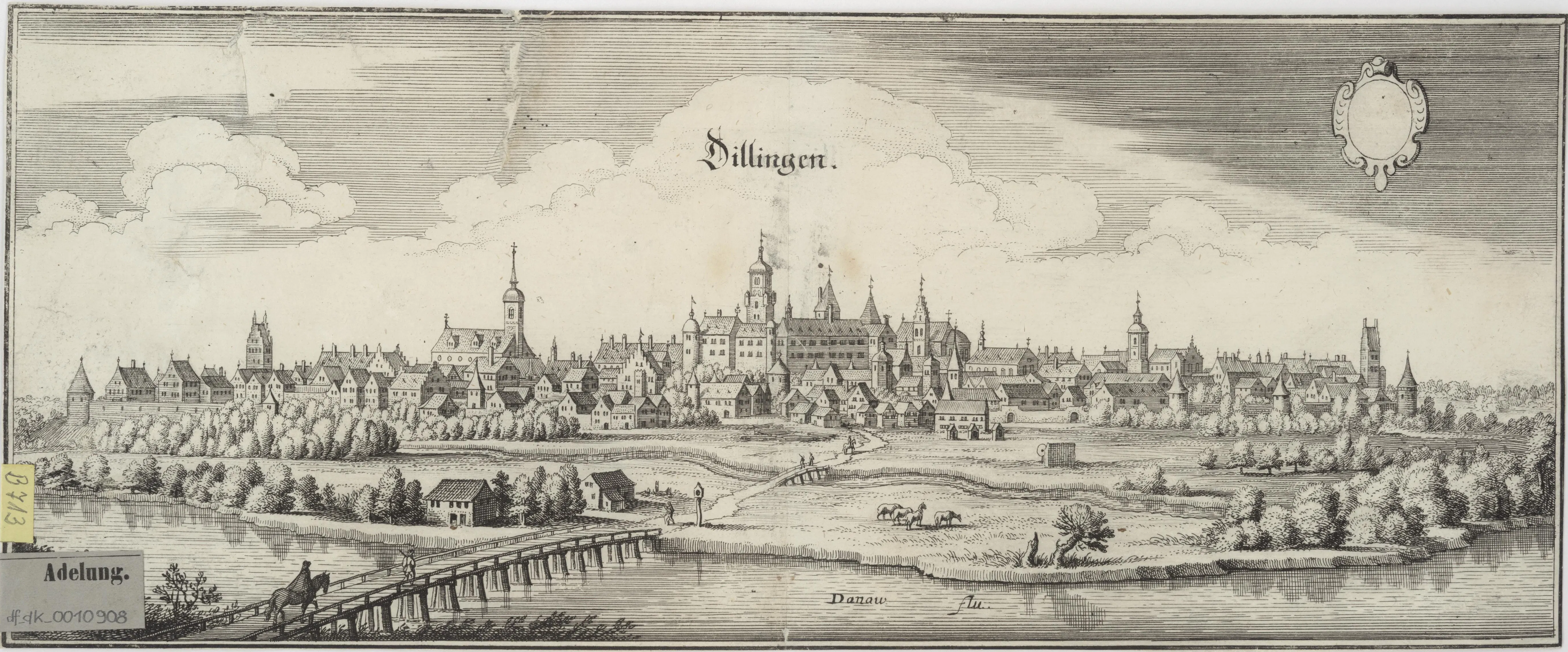
A c. 1650 view of Dillingen an der Donau, the academy town where Scheiner later recalled meeting the painter Georgius in 1603. It documents not the encounter but the setting: a Jesuit university town in which mathematics, teaching, and practical draughtsmanship met. Source ↗.
Against that history of partial and oral diffusion, the treatise stakes an emphatic claim of priority and of first written treatment: from the foundations therefore I dig out each thing and faithfully unfold it, Scheiner declares, and having illustrated it with solid demonstrations I share it, bringing forward nothing of another's but all things drawn from my own store, for up to now I have seen no one who treats these matters in writing, A fundamentis igitur singula eruo, & fideliter enodo, solidisq[ue] demonstrationibus illustrata communio, alieni nihil, sed omnia è penu mea desumpta profero: nam qui hæc scripto tractet hucusq[ue] ego vidi neminem. The claim is the author's own and is asserted most strongly for the Stereographice; it should be read as part of the work's self-presentation rather than as an independently verified bibliographical finding.
The book’s immediate transmission is better documented than its contemporary reception. Troili’s Italian La Prattica del parallelogrammo da disegnare provides evidence of vernacular afterlife. No specific contemporary refutation, counter-treatise, inquisitorial proceeding, suppression order, or direct defense devoted to Pantographice was located. The alleged circulation of a 1631 Scheiner surrogate under the unrelated title of Thomas Bartholin’s 1663 medical letters could not be tied to a securely identified database record or identifier; it should therefore be recorded as an unverified metadata conflation, not treated as a genuine alternate edition.
The relationship with Scheiner’s other writings must also be stated cautiously. The legible text of the located surrogate contains extensive optical discussion and repeated references to the eye, but no clean explicit citation to Rosa Ursina or to a particular solar-phenomenon tract. The separate 1619 Oculus, hoc est fundamentum opticum is an important associated work in Scheiner’s optical career, yet the scanned Pantographice text does not securely establish it as the title of an internal cross-reference. Consequently, no one of the proposed solar publications can responsibly be identified as the work’s supposed internal phaenomenon reference.
Following the Argument from Approbation to Anamorphosis
The authorizing matter as the argument's first movement
The book's authorizing matter is not a formality appended to a finished treatise but the first stage of the argument the treatise makes about itself. The reader's report entered among the Approbationes is issued in the name of the Roman censorial hierarchy while remaining internal to the Society: I have seen this Pantographice, invented by Fr Christoph Scheiner, a German of the Society of Jesus, by order of the Most Reverend Fr Niccolò Riccardi, Master of the Sacred Apostolic Palace, runs the attestation, PANTOGRAPHICEN hanc à R. P. Christophoro Scheiner Germano, Societatis IESV adinuentam, iussu Reuerendiss. P. Nicolai Riccardij Magistri Sacri Apost. Palatij, vidi;. Two features of the formula deserve notice. First, the coined word Pantographice is treated as a proper name capable of being seen, judged, and licensed — a discipline handled as a single censorable object, prior to any demonstration that such a discipline exists. Second, the reviewer who declares the work free of anything contrary to sound doctrine or good morals, and pronounces it valde ingeniosum, & Reipublicæ proficuum, is Cristoforo Borri, who reappears within Chapter I as an oral informant on the instrument's fortunes in the East. The certification of the ars and its transmission run through the same hands, so that the licensing pages do not stand outside the history the book narrates but form its last episode.
The dedicatory epistle then converts patronage rhetoric into a demonstration of the instrument's own epistemic claim. Scheiner announces that he plays the painter in this little book, and defends the engraved Savelli genealogy by the aphorism already considered above, that a small picture teaches what many writings cannot say — a maxim that governs the entire treatise. Buttressed immediately by the Horatian commonplace on eye against ear and by the example of Timanthes, whose brush was held always to signify more than it expressed, the maxim performs a double service. It excuses the dedication's brevity in the face of an immense antiquarian dossier — Livy, Platina, Panvinio, Pius II, Ciacconio, the Manuscripti Libri Capitolini — with the scrupulous disclaimer that he has read many authorities, seen all those cited by others, and cited not all he saw; and it makes the plate itself a specimen of the art whose theory follows. The genealogy of thirty-three cardinals, the hereditary marshalate during the Sacred Interregnum, and Baronius' verdict on Gregory II as the illuminator of Germany through Boniface are thus offered less as compliment than as evidence that visible figures carry propositional weight. The German Jesuit's claim on a Savelli benevolence toward his nation, and the family's present service to Ferdinand II against the northern kings, belong to the same argument: what the eye takes in at once, writing cannot deliver.
Chapter I: the Dillingen narrative and the graduation of priority
The invention narrative of Chapter I is the most concrete account in the volume of knowledge passing between workshop and college, and its rhetorical management is careful.
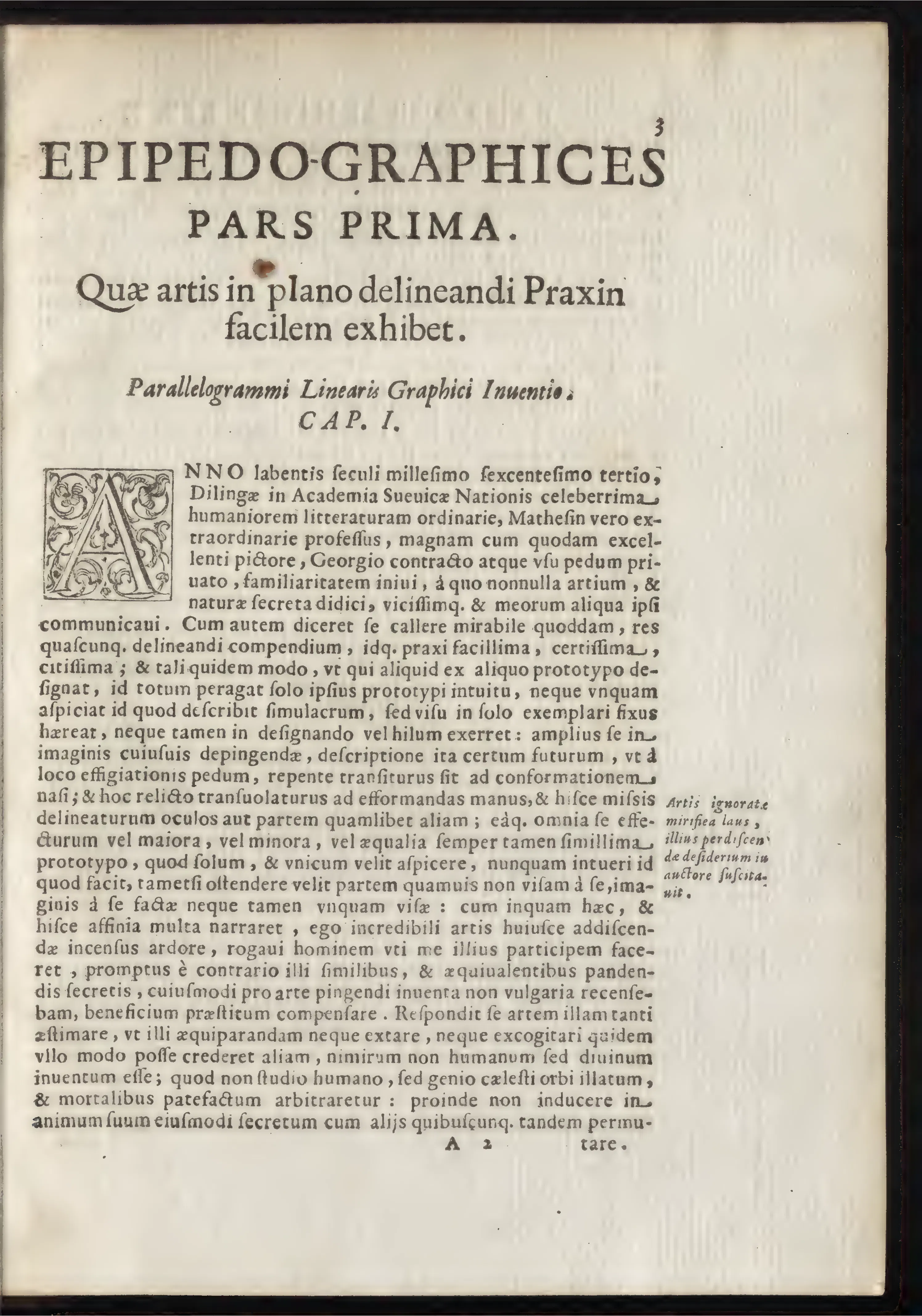
The opening of Chapter I, set off by a large ornamental initial and display headings, stages Scheiner's Dillingen encounter with the painter Georgius as the origin of Epipedographice. A guarded workshop marvel is recast in print as an art to be learned, demonstrated, and claimed. Source ↗.
The lame Dillingen painter Georgius, interrogated stage by stage as to whether his method worked by lines or by a material instrument, concedes only that all is done by the benefit of a compass from some fixed centre, refuses to display that compass, refuses disclosure even under seal, and finally removes the question from the human order altogether, holding — in the terms already examined — that the device was no human but a divine invention, brought into the world and disclosed to mortals by a heavenly genius rather than by human study. The painter's theology of the trade secret is reported in order to be expropriated. Scheiner's own breakthrough, after the failures of the cord with two bead-cursors, the iron rods, and the slats that placed index and pen upon one and the same member, comes by night and is ascribed not to himself but to God and his guardian angel, dated by the vigil of Saints Fabian and Sebastian rather than by the civil calendar. The idiom of divine gift is not refuted; it is transferred from the guarded arcanum to the published ars, where it doubles as a datable claim of precedence. The contest closes not with a proof but with a tableau — the painter, shown images made from his own secret and shown the instrument that made them, standing a quarter of an hour speechless — reported at second hand through the messenger Melchior Schenck, so that even the artisan's astonishment reaches print as testimony gathered by others.
Against that history of oral and partial diffusion — through Duke Wilhelm at Munich, the Ingolstadt classroom, and the Jesuits departing for Spain and the Indies — the chapter's closing claim is graduated with precision. Scheiner digs each thing out from the foundations, unfolds it faithfully, illustrates it with solid demonstrations, and brings forward nothing of another's but everything from his own store, for, as noted above, he has seen no one who treats these matters in writing. The claim is not that no one ever knew the device — the painter plainly did — but that no one has yet reduced it to writing with foundations and demonstrations. Priority is asserted in the medium of demonstrative exposition, not of contrivance, and Scheiner immediately declines to call himself author of the whole substance while affirming that nothing was ever communicated to him by word or writing.
Book I: the three cardines and the transfer of proportion to the linkage
The mechanical exposition is organized around three cardines, and its vocabulary is unmistakably that of governance. Of the immovable point the text says that the fixed one is a terminus that yields to none, and from which, and to which, and about which motion is reckoned, fixus est terminus qui nulli cedit, & à quo, & ad quem, & circa quem; the tracing stylus is triply named for its three offices, being called Index because it points out the lineaments of the prototype to be transferred, Cursor because it runs over them, Director because it governs eye and hand. The whole proportional doctrine then reduces to the ordering of these three collinear points, stated as bare precept long before any theorem is offered: if the fixed centre occupies precisely the middle place between index and pen, so as to be equally distant from each, the image will always be made equal to the prototype, I centrum fixum occupabit medium inter Indicem & Calamum præcise locum, vt ab vtroq[ue] æqualiter absit; Imago semper fiet æqualis prototypo, with enlargement and reduction following from the two remaining arrangements. Proportion has been removed from the draughtsman's estimation and lodged in a spatial fact about the linkage.
That displacement yields the epigram, discussed above, in which the treatise states its own strangeness: while you make the image you cannot look at it, and if you look at it you cannot make it. Sight is wholly committed to the exemplar, and the copy accrues unseen. Yet the same chapter's cautions expose the limit of the boast that the artificer cannot stray unless he wills it: the pen must not be pressed, the gaze must never leave the index's tip, the finer parts — eyes, lips, ears, brow, nose, hands — must be finished while the lead is still sharp, shadows indicated by their perimeters alone, and the lead's point kept always in the plane of direction. Infallibility belongs to the geometry of the frame; the operator remains responsible for everything that geometry does not determine.
From praxis to speculatio: the hollow figure and the defence of motion
The speculative half announces that a fabric already raised must now be roofed, and its opening definitions show how thoroughly the mechanical requirement shapes the mathematics: a hollow parallelogram is one that consists only of straight lines, joined by common points, enclosing no area, 1 Parallelogrammum cauum est, quod solis rectis constat lineas, quas puncta communia copulant, nullam aream includentibus — a reading to be verified, since the transmitted clause is quod solis rectis constat lineis. The justification is functional rather than formal: to think the enclosed area into the figure would be to make it rigid, and hence the instrument immobile. Abstraction here is not a gesture of purity but the condition of movement, and it prepares the reply to the gravest objection raised against the central theorem, that motion has no place in mathematical demonstration. Scheiner answers by grounding demonstration in the vestigium motus, the permanent trace left by a successive thing, then by surveying the sciences constituted through motion, then by dissolving the machine into two proportional compasses, and finally by stating the disciplinary principle at issue, already quoted in this report: the fields of mathematics are not to be narrowed but enlarged. The polemic is directed at neoterici who would expel from geometry whatever cannot be drawn with rule and compass, and its force depends on the prior reduction: the new organum is admitted because it can be shown to be an old one, reclined and doubled.
Book II: optical contact, the fixed station, and the release of the secret
Book II raises the stakes by severing prototype from instrument altogether, replacing physical with optical contact and enumerating what may be projected by a single gaze into a prepared plane. The inventory — seas, rivers, islands, cities, woods, fortifications, men and beasts, celestial, aerial, terrestrial and maritime — closes with a formula of complete generality, in a word, everything that falls into the eye belongs here, Vno verbo, Omne quod in Oculum cadit, huc pertinet. The price of that universality is the immobilization of the observer: since station is centred in the crystalline humour, the eye may rotate but the head may not move, whence the hollowed beam and forehead band, the girdle, and the bored board behind which the eye peers. The final corollaries then turn the failure of oblique sections to preserve likeness into a positive art — the method, already cited above, of drawing elongated images so that their true form strikes the sight from a direct view, which the text pronounces the greatest secret in perspective. The word secretum, first attached to the painter's guarded compass, now names a construction printed with its demonstration. Even so the reservation of further secrets curis secundis keeps something back, and the terminal formula binds what is released to its double warrant, publication for the greater glory of God and for the public utility, dated in the Professed House of the Society of Jesus at Rome in the words with which this report opened its account of the colophon.
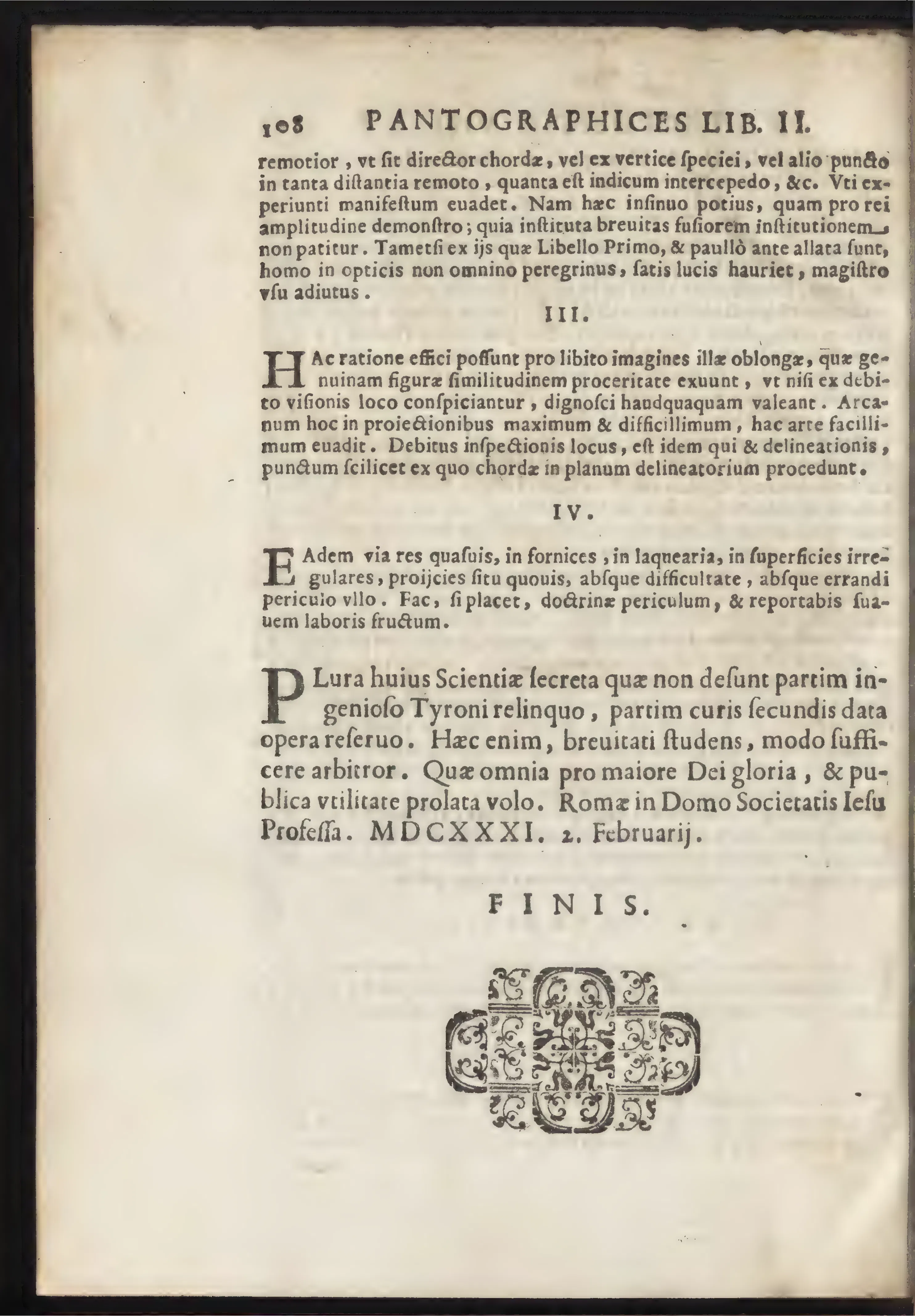
The terminal leaf of Book II carries projection beyond the flat copy to oblique anamorphic images and prepared surfaces, making the “secret” of optical displacement a rule-bound practice. The colophon's “pro maiore Dei gloria, & publica vtilitate” and the emphatic FINIS authorize publication even as further secrets are reserved. Source ↗.
Frequently Asked Questions
What is Christoph Scheiner's Pantographice (Rome, 1631)?
It is a Latin quarto printed in Rome by Lodovico Grignani in 1631, presenting an art of drawing all things whatsoever by means of a linear or hollow, mechanical, mobile parallelogram — the jointed frame of rods later called a pantograph. Two books divide the subject: Epipedographice, the delineation of plane figures, and Stereographice, the imitation and projection of solid visible things. Each pairs rules of use with postulates, propositions, problems and lemmas. A fixed centre, a tracing index and a drawing pen repeat any traced figure equal in size, enlarged, or reduced, according to how the three collinear points are set.
Who was Christoph Scheiner?
A Jesuit mathematician and astronomer, styled on his own title page Germano-Suevus, long known in learned circles for his solar observations and for the 1611–1612 dispute with Galileo over sunspots. In 1603 he was teaching humane letters ordinarily and mathematics extraordinarily at Dillingen. He later taught at Ingolstadt, showed the drawing instrument to Duke Wilhelm V of Bavaria at Munich and Archduke Maximilian at Innsbruck, and demonstrated it in Rome to Paolo Giordano Orsini, Duke of Bracciano. His separate optical work of 1619, Oculus, hoc est fundamentum opticum, belongs to the same career.
Who was the lame painter Georgius of Dillingen?
An excellent painter whom Scheiner met at Dillingen in 1603, crippled and deprived of the use of his feet, who guarded the principle of the drawing device as a trade secret. Pressed whether he worked by lines or by an instrument, he conceded only that all was done by the benefit of a compass from some fixed centre, refused to show it even under seal, and held the invention to be not human but divine, brought into the world by a heavenly genius. Shown images made from his own art, he is reported to have stood a quarter of an hour mute and thunderstruck. His surname has not been recovered.
Why did Scheiner have to defend local motion as a principle of mathematics?
Because objectors held that motion disqualified a construction from demonstration, and certain neoterici — newer writers — would confine geometry to what rule and compass alone can draw. Scheiner answers that mathematicians know very many things not only from motion but about motion and through motion; he grounds proof in the vestigium motus, the permanent trace a successive thing leaves, cites Apollonius on conics as beginning from motion, and Archimedes, Euclid and Clavius as precedent. Finally he dissolves the frame into two proportional compasses, admitting a new instrument by showing it to be an old one doubled.
Is there an English translation of Scheiner's Pantographice?
No complete English or German translation has been identified in catalogue records; the principal located vernacular transmission is an Italian version associated with G. Troili, La Prattica del parallelogrammo da disegnare, dated 1652 in the relevant secondary bibliography. Separately, the Leo edition presents the full transcription of the 1631 Roman quarto together with a complete English translation for the first time. That translation is generated by AI. Leo is an effort to make freely available online, at no cost, English translations of every text printed in Latin in early modern Europe between 1450 and 1750.
This report was generated by an advanced AI assistant that conducted deep research alongside an extensive interpretation of the transcribed original text. Every effort has been made to preserve fidelity to the source and to guard against inaccuracy, but corruption in the text recognition process and model hallucination may nonetheless have entered the text. Treat every claim, quotation, translation, and citation as provisional, and verify each against the original source before relying on or citing it.
Critical Further Reading on Scheiner, Jesuit Mathematics, and Early Modern Optics
- T. Baker, "Christoph Scheiner's The Eye, that is, The Foundation of Optics (1619): The Role of Contrived Experience at the Intersection of Psychology and Mathematics," Springer (2024): Baker’s study of Scheiner’s optical method helps connect the geometric procedures of Pantographice with the author’s broader attempt to discipline visual experience through controlled observation and mathematical construction; the appeal to a contrived and repeatable observation is visible where the reality of the aerial image is defended by candlelight, since it is certain that light carried from a candle into the eye through pure air shines everywhere in the whole intermediate air and reproduces the luminous body of the candle, est, lumen à candelæ in oculum per aërem purum delatum, in toto intermedio aëre vbique lucere, & corpus candelæ lucidum referre. Read it beside Book II and the head-clamps stop looking eccentric and start looking methodological.
- Peter Dear, "Jesuit Mathematical Science and the Reconstitution of Experience in the Early Seventeenth Century," Studies in History and Philosophy of Science: Dear’s account supplies the most useful institutional and epistemological context for Scheiner’s effort to make instrumentally produced motion and visual experience legitimate components of mathematical demonstration. It is a context in which the disciplining of the observer's body becomes itself a condition of demonstration, as when Scheiner rules that in this drawing artifice the draughtsman's head must be simply at rest, although the eye can well be moved while the head is at rest, without any danger of losing the station, in hoc delineandi Artificio, Caput delineatoris debere esse simpliciter quietum: tametsi oculus quieto capite moueri bene queat, absque vll stationis amittendæ periculo.
- Isabelle Pantin, "What Was Transported by Light into the Camera Obscura? Descartes and the Jesuits," Isis: Pantin’s comparison of Kepler, Aguilonius, and Scheiner illuminates the optical assumptions behind the treatise’s account of visual species, optical contact, the fixed eye, and the projected image, assumptions that the second book states as its first supposition, that every point of a visible thing emits from itself a radiant sphere, Omne punctum rei visibilis à se sphæram radiosam emittit. Her central point — that these Jesuits recognized Kepler's superiority and declined to follow him — is precisely the ambivalence one meets in Scheiner's postulates.
- Elizabeth Reeves, "Idiom and Image: Translating the Letters on Sunspots," Isis: Reeves’s treatment of the 1611–1612 Scheiner–Galileo controversy is useful for separating the pantograph treatise from Scheiner’s solar writings while situating its author within the longer historiography of Jesuit astronomy and optical authority. It is also a salutary reminder that reputations built in one dispute tend to distort the reading of everything else an author printed.
- D. C. Smolarski, "The Jesuit Ratio Studiorum, Christopher Clavius, and the Study of Mathematical Sciences in Universities," Science in Context: This study clarifies the curricular and institutional status of mathematics within the Society of Jesus, a necessary background for reading Scheiner’s insistence that the fields of Mathesis be enlarged — an insistence he states as a principle of method, because I judge that the fields of mathematics are not to be narrowed but to be enlarged, quod campos Matheseos non angustandos sed ampliandos censeam. Its examination of the definitive 1599 Ratio Studiorum and of Clavius's campaigning shows how much institutional argument stood behind a sentence that reads like a throwaway aside.