Two Ounces of True Opobalsam: Prospero Alpini's The Dialogue on Balsam: Authenticity, Provenance, and Egyptian Materia Medica
Prospero Alpini went to Egypt as a working physician and came back convinced that his Venetian colleagues had quietly written a real drug out of existence. His Venetian quarto of 1591, Prosperi Alpini Marosticensis medici De balsamo dialogus, stages a dawn conversation in the garden of Matarea outside Cairo, where an Egyptian physician and a Jewish physician show a sceptical Italian visitor the living balsam tree that Italian medicine had pronounced extinct. What follows is a fight about where reliable knowledge comes from — residence, gifted samples, caravan itineraries, and repeatable bench tests versus the printed authority of Dioscorides and Theophrastus — and about the theriac of Venice, from which the genuine ingredient had been silently removed.
ExLatinis
September 2, 2026

Contents
Prospero Alpini went to Egypt as a working physician and came back convinced that his Venetian colleagues had quietly written a real drug out of existence. His Venetian quarto of 1591, Prosperi Alpini Marosticensis medici De balsamo dialogus, stages a dawn conversation in the garden of Matarea outside Cairo, where an Egyptian physician and a Jewish physician show a sceptical Italian visitor the living balsam tree that Italian medicine had pronounced extinct. What follows is a fight about where reliable knowledge comes from — residence, gifted samples, caravan itineraries, and repeatable bench tests versus the printed authority of Dioscorides and Theophrastus — and about the theriac of Venice, from which the genuine ingredient had been silently removed.
Prospero Alpini of Marostica (1553–1617), a physician trained in the Venetian orbit and later associated with the University of Padua, spent several years in Egypt on medical business and there wrote a short Latin dialogue about a single drug. Printed at Venice in 1591 under the shop sign Sub signum Leonis, with its dedicatory epistle dated the previous year, De balsamo dialogus stages its conversation at the garden of Matarea outside Cairo, where three speakers — Alpini himself, the Egyptian physician Abdella, and the Jewish physician Abdachim — examine the balsam plant and the three commodities derived from it: opobalsamum, the juice; carpobalsamum, the fruit; and xylobalsamum, the twigs. It is a compact quarto of six chapters of dialogue, to which are appended two further chapters carrying an observation by the French traveller Pierre Belon; counted with that appendix, the work runs to eight chapters.
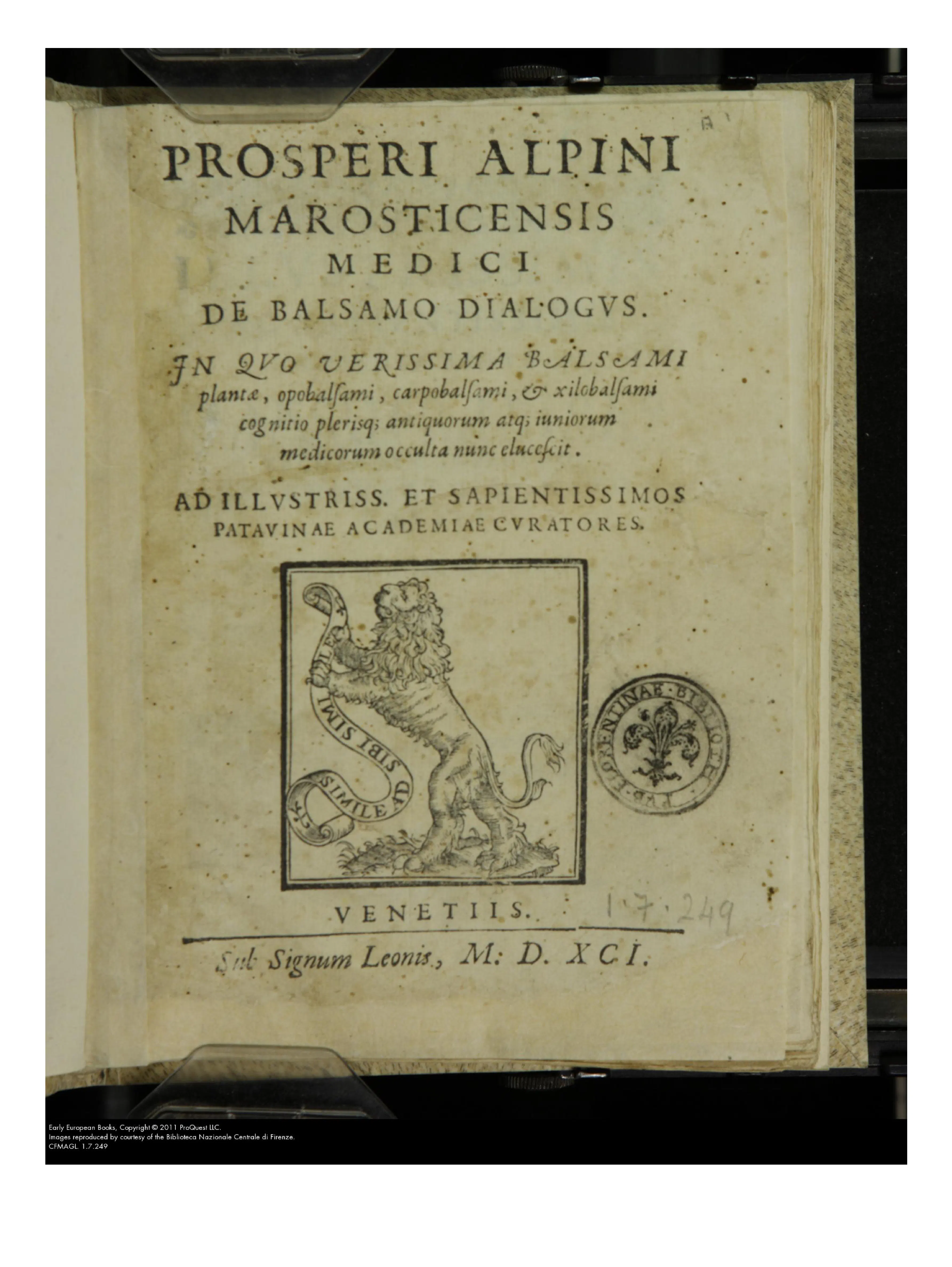
The 1591 Venetian title page of Alpini's De balsamo dialogus states its case before the dialogue begins, arranging balsam as a problem of nomenclature — planta, opobalsamum, carpobalsamum, xilobalsamum — and addressing the work to the curators of the Paduan Academy. The lion device below materializes the imprint's Sub Signum Leonis. Source ↗.
The problem the dialogue confronts is deceptively narrow and turns out to be very large. By the later sixteenth century a substantial body of Italian medical opinion had concluded that the balsam of Dioscorides and Theophrastus no longer existed anywhere — that the plant was gone, and that whatever was sold in Levantine markets under its name was something else. On that premise, the Venetian apothecaries, with the counsel of the college of physicians, had quietly reformed the city's annual compounding of theriac and mithridate around substitutes. Alpini's answer is that the plant lives, cultivated at Cairo and growing of its own accord in Arabia Felix, and that the drug carried by caravan and sold in the shops is the ancient drug. The recurring move by which he presses this claim is a relocation of authority from text to place. Residence and inspection, named local informants, the itinerary of the pilgrim caravan, gifted and retained samples of the juice, and repeatable trials — dissolution in water or milk, staining of cloth — are set above the classical authorities, who are demoted to witnesses reporting at second hand; and where the ancient descriptions of the juice disagree among themselves, they are reconciled rather than discarded, by a developmental scheme of four "ages" of the sap analogized to the ages of animals.
The stakes are simultaneously philosophical, pharmaceutical, and civic. Against the extinction thesis Alpini deploys the Aristotelian perpetuity of vegetable species and the constancy of the heavens and the elements; against the geographical confusion of the tradition he applies a criterion of indigeneity — native plants spring up spontaneously and need no gardener — which moves balsam's homeland away from Judaea and Egypt to Arabia Felix without impugning the authenticity of the cultivated Egyptian stock at Matarea. Against the trade in false wares he elaborates a technical vocabulary of the genuine and the adulterated, catalogues the substances used to falsify opobalsam, and coins pseudocarpobalsamum as a term of art for a fraudulent fruit. And against his Venetian colleagues he mounts a charge of professional dishonour: the removal of true balsam from theriac and mithridate is, in his phrase, an artis dedecus, a disgrace to the art, which implicates the reputation of physicians and the civic institutions that guaranteed public medicine.
Much of what makes the text memorable lies in its concrete particulars. Scarcity is explained not by extinction but by fiscal administration: the Ottoman treasury reserves the tree, forbidding private planting or gathering without public mandate, and farms the Cairo cassia crop in the same way. The trans-Atlantic "balsam" praised by Nicolás Monardes is rejected outright as the product of an altogether different and much taller tree. Civet is invoked as an analogy for a valuable animal secretion. The cloth-stain test is relativized to the fabric on which it is performed, the fine Egyptian weaves behaving differently from the coarser Italian ones — a caution about the instruments of proof as much as about the drug. The book's final gesture is documentary: Belon's independent, recently printed account of the Matarea balsam, read in Carolus Clusius's Latin, is appended as non-Italian corroboration, the testimony of a witness with no stake in Venetian pharmacy.
Several of the work's frames converge on one another. The polysemy of its keywords — verum and syncerum as titles to admission into learned practice, patria as spontaneous growth rather than successful cultivation — is the same operation performed at the level of vocabulary that the argument performs at the level of evidence, and the same operation the book performs materially by carrying Belon's chapter inside its own covers and by naming the Padua curators, the Venetian college, and the apothecaries as its addressees. The text's afterlife shows how durable that package proved: it was reissued with Alpini's De plantis Aegypti and reprinted repeatedly into the eighteenth century. Not everything about it is settled. The village Alpini calls Bedrunia, fifteen days from Cairo on the Mecca road, cannot be securely identified with Badr on present evidence; the juniper-berry substitution he reports, the standing of the apothecaries' appeal to the college, and the exact fortunes of his Ottoman fiscal vocabulary await fuller confirmation against the surviving text and the archives; and an attribution of the 1591 title to Sébastien Basson, which has occasionally shadowed the work's transmission, is incompatible with the book itself.
Read the full text and English translation on Leo
This text was transcribed and translated as part of the ExLatinis project, an effort by Leo to make free English translations of every text published in Latin in early modern Europe (1450–1750) available online. The complete transcription and English translation of this work can be read free of charge:
→ Read the original Latin text and full English translation on Leo
You can save a copy of this document into your Leo account to run deep text searches, conduct further analysis, or cross-reference it with your own research.
Naming the Drug: Alpini's Latin Title and the Vocabulary of Genuine Balsam
Editorial English title supplied for convenience: The Dialogue on Balsam: Authenticity, Provenance, and Egyptian Materia Medica. The Latin title is Prosperi Alpini Marosticensis medici De balsamo dialogus, "Prospero Alpini of Marostica, physician, Dialogue on Balsam," with the extended subject specified as the knowledge of the balsam plant and its opobalsamum, carpobalsamum, and xylobalsamum. In the dialogue, verum and syncerum are not merely chemical descriptions: they designate material worthy of admission into learned and pharmaceutical practice, opposed to what is falsum or adulteratum. The operative force of syncerum is displayed where a Dioscoridean criterion is invoked and vindicated by trial — Dioscorides, Alpini writes, spoke most learnedly when he said that moreover the genuine juice dissolves most swiftly in water or milk and turns milky in colour, Hincq; Dioscorides doctissime dixit: Quin etiam syncerus in aqua, aut lacte celerrime liquatur, coloreque lactescit — so that genuineness becomes a property demonstrable in the hand rather than a claim attached to a label. The terminology of the three products preserves the Galenic and Dioscoridean distinction between sap, fruit, and wood, while also making nomenclature a test of commercial identity; to that inherited triad the dialogue adds the coined pseudocarpobalsamum, a term framed expressly to name a counterfeit fruit, and it appeals to the Arabic Balessan as a claim of priority in naming. The book gives that grid a picture as well as a vocabulary.
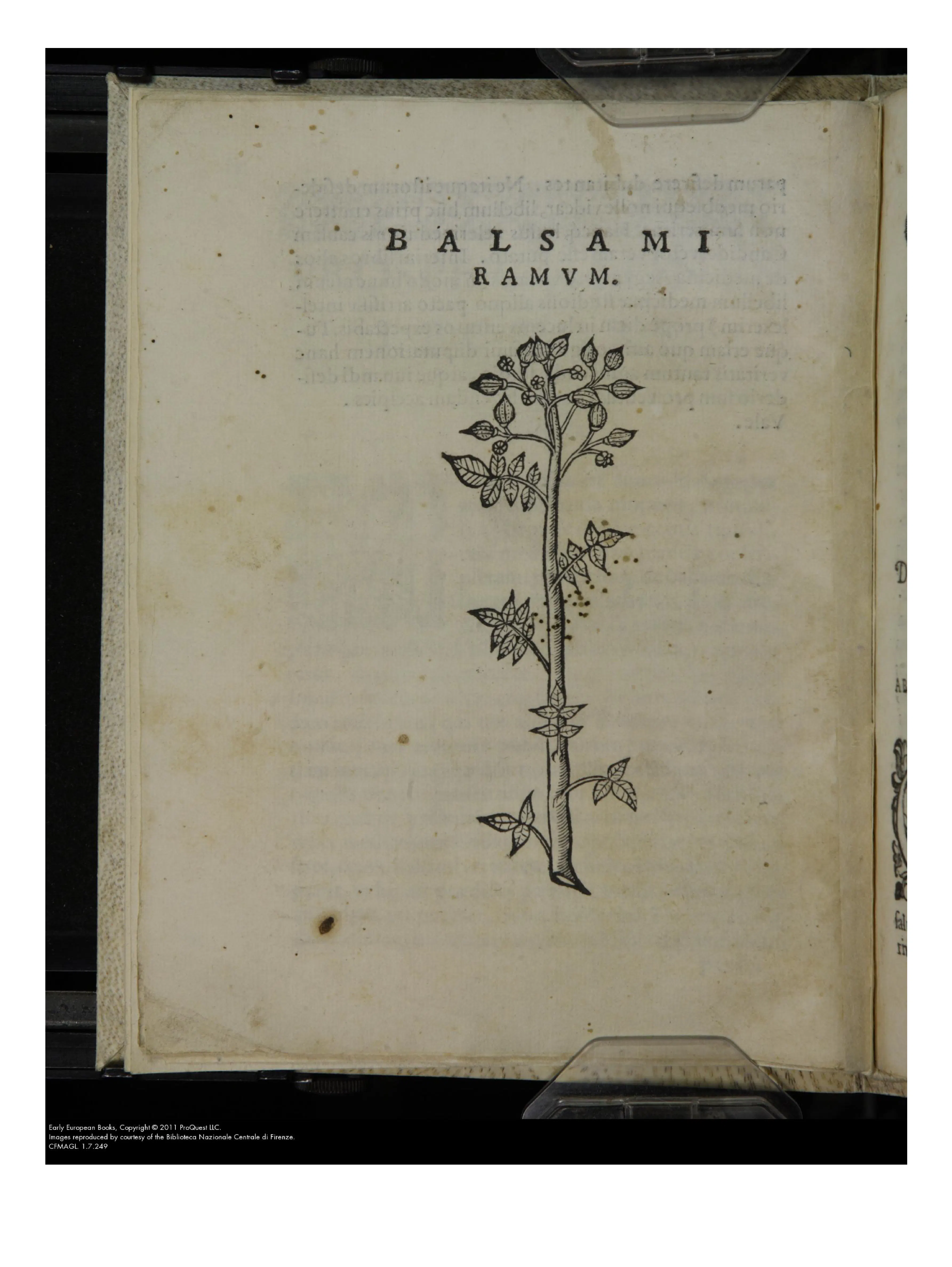
Captioned BALSAMI RAMVM, this balsam twig turns xylobalsamum — the wood and branch of Alpini's triad — into an object for inspection rather than a name inherited from authorities. As printed analogue to the branches, fruit, and juice he kept, it makes commercial identity a matter of material proof. Source ↗.
Artis dedecus gives the controversy a professional and civic register. Alpini argues that the absence of genuine balsam from contemporary Venetian preparations diminishes theriac and mithridate and dishonours the medical art; the phrase thus attaches pharmaceutical substitution to the reputation of physicians and the civic institutions responsible for public medicine. The formulation is his own and is tied directly to the compounding bench: balsam, he writes, completes the compounding of many antidotes, especially theriac and mithridate, which our people, with this ingredient removed, prepare not without disgrace to the art, Perficit enim multorum antidotum compositiones, præsertimque Theriacam, atque Mithridatium, quæ à nostris eo sublato, non sine artis dedecore parantur.
Finally, patriae and spontaneous growth mark a botanical criterion of indigeneity. A plant maintained in a garden is not thereby native: the text contrasts cultivated balsam at Cairo with balsam that grows sponte in Arabia Felix. The criterion is stated as a rule of nomenclature and of plant geography at once — no one, the dialogue insists, will call plants preserved with such labour and diligence in gardens native, since native plants everywhere spring up spontaneously, grow, and live in their own places without labour, Nemo plantas tanto labore ac diligentia in viridarijs adseruatas patrias dicet, quando patriæ vbique sponte nascantur, crescant, ac nullo labore in proprijs locis uiuant. The distinction relocates the plant's natural homeland without denying the authenticity of the cultivated Egyptian stock.
What De balsamo dialogus Argues: Living Balsam at Matarea against the Extinction Thesis
De balsamo dialogus is a Latin philosophical-medical dialogue by Prospero Alpini (Prosperus Alpinus; 1553–1617), first printed at Venice in 1591 under the sign Sub signum Leonis. Its dedicatory epistle is dated 1590, while the volume itself is dated 1591. Alpini presents knowledge acquired during several years in Egypt and stages the discussion in the garden of Matarea near Cairo, at dawn. The speakers are Alpini, Abdella, an Egyptian physician, and Abdachim, a Jewish physician. The position the dialogue is written against is stated plainly at the outset, that indeed most affirm that at this time the true balsam plant is nowhere in the world to be found, quinimo plerique affirment hoc tempore veram balsami plantam nusquam gentium inueniri,, and it is this extinction thesis, not merely a disagreement over descriptions, that the argument sets out to dismantle.
The work argues that the balsam known from antiquity still exists: it is cultivated near Cairo and grows naturally in Arabia Felix, and testimony from Egyptians, Arabs, and Syrians should not be rejected in favour of Italian physicians who have not seen the plant. That challenge to the hierarchy of witnesses is put as a direct question — will anyone contend that our Italians are to be preferred to Egyptians, Syrians and Arabs in the knowledge, use and experience of these same medicines, An verò quis Aegyptijs, Syris, & Arabibus in eorundem medicamentorum cognitione, vsu, & experientia præferendos contendet Italos nostros? — and the counter-thesis it licenses opens the second chapter with a claim of certainty about living trees and a functioning trade, that it is most certain that very many balsam trees now live in many places of Arabia, whose juice, fruits and twigs are brought here to us by many, VAMPLVRES balsami arbores in multis Arabiæ locis nunc viuere, quarum succus, fructus, ac virgæ huc ad nos à multis asportantur, certissimum est.
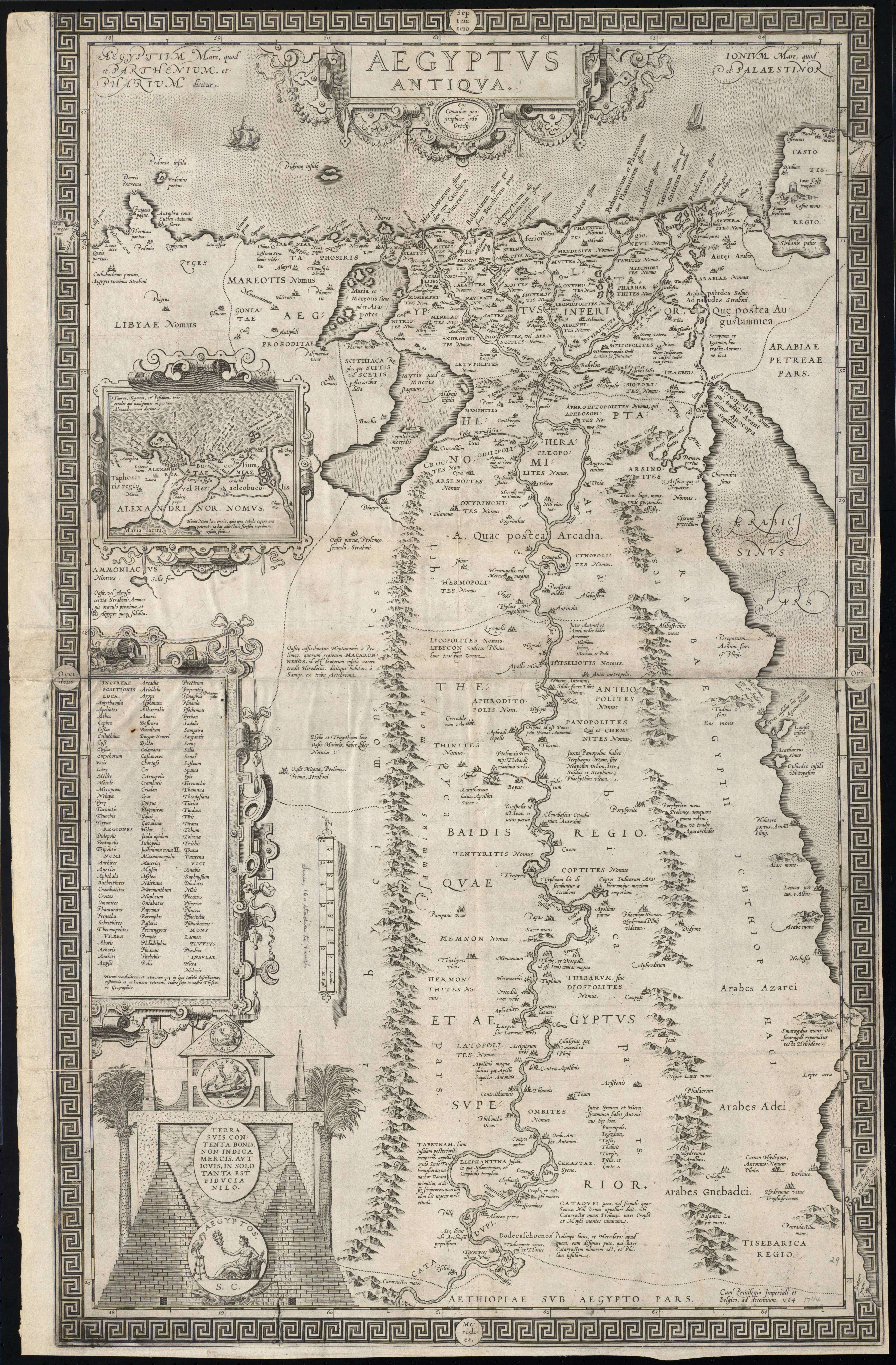
Ortelius's 1584 map of ancient Egypt sets out the Nile valley and Red Sea approaches that made Cairo — and the garden at Matarea — a hinge between Egyptian cultivation and Arabian provenance. For readers weighing local testimony against Italian medical authority, such cartography charted the networks through which balsam travelled. Source ↗.
The book is addressed to the curators of the University of Padua—Francesco Priuli, Zaccaria Contarini, and Leonardo Donà—and also appeals to Venice's medical college and apothecaries because balsam products were important ingredients in theriac and mithridate. Bibliographically, the work is counted as eight chapters when the concluding Belon material is included: six chapters form the dramatic dialogue and chapters VII–VIII constitute an appended account. The appendix is explicitly headed as an observation by Petrus Bellonius Cenomano, that is, Pierre Belon, from book II, chapter XXXIX of his Observations. Richard J. Oosterhoff identifies the Latin version as Clusius's translation, first published in 1589 and again in 1605. A modern Italian translation by Luciano Cremonini appeared as "Dialogo sul balsamo" in Acta medicae historiae Patavina, 8–9 (1961–63), pp. 174–201. A further Italian translation appears in Le piante dell'Egitto. Il balsamo (Venezia, 1592), edited with texts and notes by Elsa M. Cappelletti, Giancarlo Cassina, and Giuseppe Ongaro (Treviso: Antilia, 2009).
Why Alpini's Balsam Dialogue Matters: Local Witnesses, Theriac, and Open Questions in the Historiography
The dialogue matters because it makes a single medicinal plant a test case for early modern standards of knowledge. Alpini does not simply oppose ancient books to modern observation: he collates Dioscoridean and other classical testimony with residence, inspection, specimens, commercial reports, and the testimony of Egyptian, Arab, and Syrian practitioners. The result is a negotiated natural history in which local witnesses are treated as authorities and the garden at Matarea becomes a site where textual claims can be checked against living plants and material products. The demotion of the classical authorities is stated as a judgement about what they could have seen — he is of the opinion that perhaps none of them accurately saw this tree, and that most of what they committed to writing about it came from hearsay, Ego sum huius sententiæ, neminem illorum fortassè accurate arborem hanc vidisse, ex audituque pleraque de eis ab ipsis litteris prodita fuisse — a claim that reclassifies Dioscorides and Theophrastus as reporters at second hand rather than discrediting them. The same relocation of authority governs the evidentiary channels the text prefers: the Mecca caravan route is offered as an itinerary any traveller might retrace, for to those going hence to Mecca and reaching a certain village called by them Bedrunia, fifteen days' journey from the city of Cairo, a huge sandy mountain set near that village is at once seen, Nam Mecham hinc euntibus, & ad villam quandam Bedrunia ab his vocatam, quæ distat ab vrbe Cayri spacio dierum quindecim, accedentibus mons pergrandis, arenosus propè eam villam positus continuò conspicitur,, and the drug itself arrives with a named chain of custody and a quantity, since from Haly Bei himself, on his return to Cairo, he had as a gift two ounces of true opobalsam, and from another who had made that journey after him, three ounces, Ex ipso autem Haly Bei Cayrum reuerso veri opobalsami binas vntias dono habui, atque ab alio, qui post hunc illud iter confecerat vntias tres.
The controversy over extinction is likewise both botanical and philosophical. Alpini's interlocutors confront the claim that the true plant is found nowhere; the dialogue answers by distinguishing present cultivation at Cairo from spontaneous growth in Arabia Felix and by invoking the continued generative capacity of the terrestrial world. The natural-philosophical premise is made explicit and turned into a rebuke, that nor are those good philosophers who suppose that the species of plants, which by the philosophers' tenets are perpetual, can so easily be wholly abolished, Neque optimi illi sunt philosophi, qui ita facile vegetabilium species, quæ iuxta philosophorum placita perpetuæ existunt, tolli omnino posse, putent. The modern party held responsible for the opposite view is named, along with the New World substitute it proposed — Amatus Lusitanus, a physician not to be despised in other matters, and Nicolás Monardes the Spaniard greatly strengthened that opinion, affirming that Syrian and Egyptian balsam had perished and reporting that another kind of balsam grows in the West Indies, Quam sententiam valde auxere Amatus Lusitanus medicus in alijs non spernendus, & Nicolaus Monardus Hyspanus, qui Syriacum atq; Aegyptiacum balsamum perijsse affirmantes aliud genus balsami in Occidentalibus Indijs nasci, prodiderunt — so that the extinction thesis and the trans-Atlantic identification stand or fall together in his account. Where the ancient descriptions of the juice cannot be squared with one another or with what he handled, the dialogue harmonizes rather than chooses, by a scheme of stages: just as four ages are constituted in all animals, making the greatest difference in them, so without doubt four times are assigned by us to the balsam juice which is called opobalsam, Quare non secus quam in animalibus omnibus quatuor constituuntur ætates, quæ in ipsis maximam differentiam faciunt, non secus balsami succo, quod opobalsamum dicitur, proculdubio à nostris quatuor tempora tribuuntur.
Its pharmacological stakes are civic: the text claims that the removal or substitution of balsam products damages the excellence of theriac and mithridate and calls the resulting condition an artis dedecus. Barbara Di Gennaro Splendore's The State Drug supplies the most direct current context for this issue, showing that theriac in early modern Italy was both a Galenic remedy and an instrument through which authorities asserted regulatory power, while physicians and apothecaries contested recipes and control. Alpini's own explanation of scarcity runs along a parallel administrative track, since the drug's rarity is attributed to fiscal reservation rather than to the plant's disappearance: by law it is forbidden to those peoples that anyone should plant that tree except for the treasury, or take juice, flowers, twigs or fruit without public mandate, ne præter fiscum quis eam plantam ferere queat, neque succum, vel flores, vel ramulos, vel fructus sine publico mandato quis capiat. Richard J. Oosterhoff's study places Belon's Matarea account within the formation of natural history: Belon authenticated the plant through repeated observation, comparison, and the acquisition of a branch, while Clusius's Latinization enlarged Belon's authority and Alpini incorporated the account into his own argument. Barbara Di Gennaro Splendore's 2016 essay, "Prospero Alpini, il balsamo e le sue fonti egiziane," is the specialist study directly devoted to Alpini's Egyptian sources.
The historiography remains uneven. The evidence consulted supports a strong account of Alpini, Belon, Clusius, and theriac, but it does not establish a developed modern debate specifically over the supposed Basson attribution, the Ottoman fiscal vocabulary, the identification of Bedrunia with Badr, or the fate of the alleged juniper substitution. Those matters should remain open research questions rather than be presented as settled conclusions; the text itself supplies the fiscal terminology and locates Bedrunia fifteen days from Cairo on the Mecca road, but the modern identification of the place and the wider administrative history of state-farmed drug crops in Ottoman Egypt still require independent confirmation. The title and contents are incompatible with attribution to Sébastien Basson: catalogues and digitized records identify Alpini, and Basson's distinct Philosophiae naturalis adversus Aristotelem libri XII is a separate work. No traceable catalogue record has been found proving that the confusion arose from a Sammelband, a mis-linked surrogate, or a specific catalogue error.
Printing, Reprinting, and Circulating De balsamo dialogus, 1591–1750
The secure first-edition identification is Prosperi Alpini Marosticensis medici De balsamo dialogus, Venice, 1591, Sub signum Leonis. EDIT16 records the title and the Venetian statement "Venetiis: sub signum Leonis, 1591"; Noscemus likewise reports Venice, 1591, with no printer named beyond the shop sign. The printer's personal identity and any privilege have not been confirmed. The 1591 item is independently catalogued by the Wellcome Collection as a Latin quarto with six unnumbered preliminary pages, twenty-six pages, and one unnumbered leaf, with illustrations and woodcuts. A British Library copy is represented by a Google Books scan; a Paris Bibliothèque interuniversitaire de santé copy is available through the Medica digital library and Internet Archive, where the record gives call number 72438 (10), full-text and PDF downloads, and sixty-six scanned pages. A Princeton record describes an online reproduction of a Florence original in the Biblioteca Nazionale Centrale di Firenze as "[6], 26, [2] c., 4°"; the available catalogue data do not reveal the BNCF shelfmark.
The 1591 work was also transmitted in later forms. A Venetian 1592 issue was printed by Francesco de Francisci together with De plantis Aegypti, with its own title page but unified pagination and a dedication to Giovanni Morosini. A Padua 1639 version appeared with De plantis Aegypti and Veslingian observations; the Madrid Botanical Garden record identifies a 1639 printing by Paul Frambottus and records a volume of [1]–54 pages with two intercalated index leaves. The work also appears in a Padua 1640 collected state, Leiden 1718, Leiden 1745, and the Thesaurus Antiquitatum Sacrarum of 1750. Noscemus reports at least eight reprints before 1750, both independently and in combination with Alpini's Egyptian works.
The 1591 preface states that Alpini had spent years in Egypt for medical purposes and had written books on Egyptian medicine and plants; the decision to publish the balsam dialogue first was connected with the requests of learned friends. The preface also declares the book's genesis in the field and its remedial purpose, since he resolved, from zeal for knowing the truth, to dedicate to his patrons a book once written in Egypt on the balsam plant, juice, fruits and twigs, handed down by the ancient physicians for medical use and now nearly obsolete among his own countrymen, Decreui veritatis cognoscendæ studio, de balsami planta, succo, fructibus, & virgis, quæ sunt ad medicinæ vsum à veteribus medicis litteris tradita, atque nunc apud nostros ferè obsoleta, librum olim in Ægypto conscriptum. The dedication names Priuli, Contarini, and Donà as the Padua curators, while the dramatic dialogue uses the Egyptian physician Abdella, the Jewish physician Abdachim, and Alpini as speakers. The Venetian medical college and apothecaries appear as the practical audience: Alpini says that his Egyptian experience showed him that materials rejected in Europe could be genuine, and that publication might restore their medicinal use. He further represents the apothecaries themselves as wanting the question settled by their superiors, reporting that they desire that the truth and history of genuine opobalsam, carpobalsam and xylobalsam be acknowledged by the most excellent college of physicians of this renowned city, ab Excellentissimo huius inclytæ vrbis medicorum Collegio veri opobalsami, carpobalsami, & xilobalsami veritatem, & historiam agnosci exoptant; the terms of the three commodities thus reappear here in an explicitly institutional frame, as titles whose veritas is to be certified by a college.
The primary text confirms the general complaint about substitutions in contemporary pharmacopoeias and the diminished excellence of theriac and mithridate, but the evidence consulted does not safely establish a formal petition, a censorship proceeding, or a documented contemporary counter-text, and the standing of the appeal to the college accordingly remains a matter for further verification. On the substitution itself the dialogue does speak concretely, and in the mode of report rather than of documentary proof: he hears that now at Venice all the apothecaries, on the advice of the most excellent college of physicians, substitute juniper berries for the true balsam fruits in compounding theriac and mithridate, Audio nunc Venetijs omnes pharmacopolas consilio excellentissimi collegij medicorum in co[m]ponenda theriaca, atq; mitridatio pro veris balsami fructibus iuniperi fructus substituere. The passage places the juniper-berry episode in the text as Alpini's own hearsay-marked allegation against a named institution; independent corroboration of the practice, its authorization, and its duration has not been located, and the matter should be carried as an open question rather than as an established episode in Venetian pharmaceutical regulation.
The appendix is an intervention in the object's textual biography: Alpini places at the end of the dialogue Belon's Egyptian balsam observation, explicitly identifying book II, chapter XXXIX, and explaining that it had only recently appeared in print. The appended testimony closes on precisely the identification the whole dialogue has been working toward, that since they agree in all respects, and we are certain they are the same, we assert and conclude that what is sold under this name is like that which was in use from all antiquity, Nam cum in omnibus conueniant, certique simus idem esse, asserimus, & concludimus id, quod hoc nomine venale reperitur, simile ei esse, quod ab omni antiquitate in usu fuit — the equation of the shop drug with the ancient drug, now voiced by a witness outside the Italian medical community. Oosterhoff confirms that Alpini used Clusius's Latin translation of Belon. The 1591 title is not Basson's: the extant catalogue and scan evidence consistently identify Alpini. No evidence located proves that a digital surrogate was mis-linked to Basson or that a physical Sammelband generated the confusion. The precise shelfmarks of the Florence, Marciana, and Padua copies, and a complete copy census for the BnF, BL, BSB/MDZ, and Wellcome, remain unconfirmed in the accessible records.

An engraved portrait of Pierre Belon (Petrus Bellonius), from a series of famous learned men, presents the French naturalist as the eyewitness authority Alpini needed at the close of his dialogue. Appending Belon's Egyptian observation, in Clusius's Latin, moved the decisive identification beyond the Italian medical circle. Source ↗.
Following the Argument Chapter by Chapter, from Title-Page to Belon's Appendix
The title-page and the dedicatory epistle: setting the terms of the case
The title-page states the book's programme in the form of a nomenclature, promising knowledge of the plant and its three commercial derivatives, plantæ, opobalsami, carpobalsami, & xilobalsami — the juice, the fruit, the twigs — so that before any argument is made the reader is presented with a lexical grid onto which market goods must be mapped. Everything the dialogue subsequently does with testimony, itineraries, and trials serves to secure the joint between these three Graeco-Latin names and the substances actually sold in Cairo and Venice.
The dedicatory epistle to the Paduan curators moves from panegyric to indictment. Balsam's therapeutic range having been rehearsed and its imperial dignity established by the Vespasians' war, the letter turns to the consequences of its absence from the compounding bench: no one, Alpini writes, should be surprised that the theriac and mithridate of this present time no longer retain that ancient pre-eminence and nobility, Hincque multi mirari non debent si Theriaca, Mithridatiumque; huiusce temporis antiquam amplius illam præstantiam, ac nobilitatem non retineant, nor that those extraordinary powers celebrated by the elder Andromachus are preserved, neque eximiæ illæ vires à seniore Andromacho decantatæ conseruentur. The rhetorical architecture here is worth noting: the fault is located not in the recipe but in the ingredient, and the measure of loss is supplied by a first-century author whose formula the Venetian confection still claimed to reproduce. Præstantia and nobilitas are attributes of the compound as a public object, and the epistle thereby converts a question of drug identity into a question of institutional performance. The same movement produces the epistle's most aggressive turn, the rhetorical question already met above, which suspends the presumption in favour of learned European judgement by asking whether Italians are to be preferred to Egyptians, Syrians, and Arabs in the knowledge, use, and experience of these very medicines. The triad cognitio, usus, experientia is precisely calibrated: not doctrine but familiarity, and familiarity of a kind that residence confers and libraries cannot.
The staging at Matarea and the distribution of authority
The dialogue's staging enacts that inversion rather than merely asserting it. The scene at dawn is placed in the Cairo garden, named in its local form, per hoc viridarium el Mattharia, and the Italian speaker is made the least authoritative of the three, arriving with the Italian sceptics' objections to be answered by residents. The characterisation of the Jewish physician of Cairo registers the strain this places on the author's own social assumptions: he is a man of the most honourable character, vir honestissimis moribus (quamuis Hebreus), the parenthesis conceding as an exception what the dialogue's structure treats as the norm, since Abdachim will supply one of the argument's decisive philological moves. The disjunction between the parenthetical prejudice and the dramatic function assigned to the character is one of the text's unresolved tensions: expertise is relocated to non-Italian, non-Christian practitioners while the conventional hierarchies of esteem remain verbally intact.
Chapter II: three answers to the extinction thesis
Chapter II answers the extinction thesis on three distinct planes, and the layering is deliberate. The first is natural-philosophical and a priori: the rebuke already noticed above, in which those who suppose that the perpetual species of plants can so easily be wholly abolished are denied the name of good philosophers, is here placed in Abdella's mouth. The perpetuity of species, coupled with the unchanged constancy of the heavens and the elements, converts extinction from an empirical report into a philosophical impossibility; the interlocutor's opponents are disqualified not as poor observers but as poor Aristotelians. The second plane is administrative. Scarcity, which the extinction party reads as evidence of disappearance, is re-described as the effect of fiscal reservation, illustrated by the parallel case of the Cairo cassia crop, for it is customary here that the business of the cassias be farmed out to someone, and therefore no one is permitted to take cassia from the tree, to sell, to buy, or to carry elsewhere what has been bought, Solet etenim hic alicui cassiarum negotium locari, & ideo non licet quenquam cassiam ex arbore capere, vendere, emere, aut emptam aliquo deferre. The vocabulary of leasing and public mandate does substantial argumentative work: rarity in the Italian shops becomes a datum about Ottoman revenue administration rather than about the natural world, and the supply that does reach Europe is thereby rendered intelligible as a regulated trickle rather than a residue.
The third plane is a criterion of indigeneity that quietly redraws the map inherited from the ancients. The rule set out earlier in this report — that no one will call plants preserved in gardens with such labour and diligence native, since native plants spring up spontaneously and live without labour in their own places — is the hinge of the argument here. The irrigation and constant tending required at Matarea, which for the sceptics might have proved the plant's exhaustion, is turned into proof that Egypt was never its homeland; patria is redefined as a fact about spontaneity rather than about successful horticulture, and Arabia Felix acquires the title that Judaea and Egypt had held on classical authority. Abdachim's philological contribution completes the transfer: I add to these, he says, the name of this plant, which is Balessan, imposed on it by our people, His addo nomen huiusce plantæ, quod est Balessan à nostris ei fuisse impositum — priority in naming being treated as evidence of priority in acquaintance, with Greek and Latin reduced to transliteration.
Against this framework the chapter's specimen history acquires its evidentiary force, since what is offered is not a report of a drug but a documented act of collection: he sent fresh balsam branches, fruits, and juice, and signified by letters written in his own hand that he had gathered them there with his own hands, all of which are still preserved by the author, balsami recentes ramos fructus, ac succum misit, ac per literas sua manu scriptas, significauit proprijs manibus ibi ea collegisse, quæ omnia apud me adhuc asseruantur. Autograph attestation and retained material are deliberately paired, and the present tense of asseruantur offers the reader a standing invitation to inspection.
Chapter III: the four ages of the juice
Chapter III supplies the conceptual instrument that allows the ancient descriptions to be preserved rather than discarded. The scheme already set out above, in which four tempora are assigned to the juice on the model of the four ages that make the greatest difference in animals, transposes the physician's familiar division of the ages of man onto a secretion, allowing colour, density, odour, and specific gravity to vary lawfully over time, so that Dioscorides' white and milky juice and the green or honey-coloured samples in hand become observations of one substance at different stages. The device is conservative in effect and radical in principle: it saves the authorities by denying that any of them saw the whole. That denial is then made explicit in the judgement, already before us, that perhaps none of the ancient writers accurately saw this tree and that most of what they committed to writing about it came from hearsay — the classical corpus being reclassified as a body of secondary report, excused by the difficulty of ancient navigation rather than convicted of error.
Chapter IV: lawful variation and the exclusion of the West Indian rival
The fourth chapter presses this economy of variation to exclude a rival. Colour differences within the genuine juice are lawful; a black exudate from a tall tree is not, and the West Indian import is admitted into the discussion only under a hypothetical, unless perhaps that lately brought from the West Indies should be produced, taken by certain people for legitimate opobalsam, Nisi fortasse produceretur nouissime ab Occidentalibus Indijs delatum, à quibusdam pro legitimo opobalsamo. The concessive construction is itself the refutation: the transatlantic drug enters the argument already qualified as what quidam call legitimate. Where variation must be explained, an analogy from Egyptian pharmacological practice serves — the same thing is observed in civet, for immediately on extraction from the glands it is tinged with a milky colour, Idem in Zebet obseruatur, etenim statim è testibus extractus lacte colore inficitur — a valuable secretion whose appearance changes after collection being adduced to normalise the instability of the balsam sap.
Chapter V: the notae of the genuine and the limits of the trial
Chapter V converts these criteria into a protocol, and its heading announces the juridical-mercantile pair that governs it: on the marks by which true opobalsam is safely known and distinguished from the untrue, the genuine from the adulterated, DE NOTIS, QVIBVS VERVM opobalsamum à non vero, Syncerum ab adulterato tutò cognoscitur, ac discernitur. Notæ, syncerum, adulteratum: the language of proof and of fraud is imported wholesale into materia medica, and the catalogue of oils, resins, wax, and honey used to falsify the juice is matched by detection tests. The most searching moment comes when the protocol fails on the author's own authenticated sample, which adheres to cloth contrary to the received rule, and the failure is diagnosed as an artefact of the apparatus: the trial, as the caution discussed elsewhere in this report insists, must not be attempted on the cloths made in Italy, far coarser than the Egyptian ones. The rule presupposes a fine Egyptian weave; performed on Italian woollens it yields a false negative. The observation is doubly consequential, exonerating both the drug and Dioscorides while making the reliability of any trial contingent on materials that vary between markets.
Chapter VI: naming the counterfeit fruit
The sixth chapter extends the same discipline to the solid commodities, where fraud operates by resemblance rather than admixture, and requires a new name to be met: the other, the pseudocarpobalsamum, is very like the true fruit in size, colour, and shape, Alterum vero pseudocarpobalsamu[m] huic admodum magnitudine, colore, figuraq; est simile, the distinguishing mark being that the genuine seed is wholly enclosed in its follicle and the counterfeit only half. Coining a term is here a technique of policing: what cannot be told apart by the usual sensory marks is separated by a nomenclature that fixes a single structural criterion.
The appended observation and the closing index
The appended matter is presented as a stroke of fortune arriving at the press, Ecce in manus meas perueniunt doctissimæ itinerariæ obseruationes, behold, there come into his hands the most learned travel observations. Belon's chapter measures Egypt against France for a readership that knows neither Cairo nor Matarea: in a certain village they went to see a garden planted with balsam shrubs, no further from Cairo than Lendit is from Paris, IN quodam pago spectatum iuimus hortum balsami fruticibus consitum, qui à Cayro longius haud abest, quam Lendit à Lutetia. The domestication of distance by reference to a familiar fair marks the appendix's rhetorical independence from the dialogue it corroborates, and that independence is exactly its value: the identification of the shop drug with the ancient one is delivered by a printed, non-Italian witness with no interest in the Venetian confection. The volume then closes on its own apparatus, an index of all the chapters contained in this book, INDEX OMNIVM CAPITVM, QVAE IN HOC LIBRO CONTINENTVR, which counts the borrowed testimony among the eight and so binds the foreign observation into the structure of the argument it was summoned to confirm.
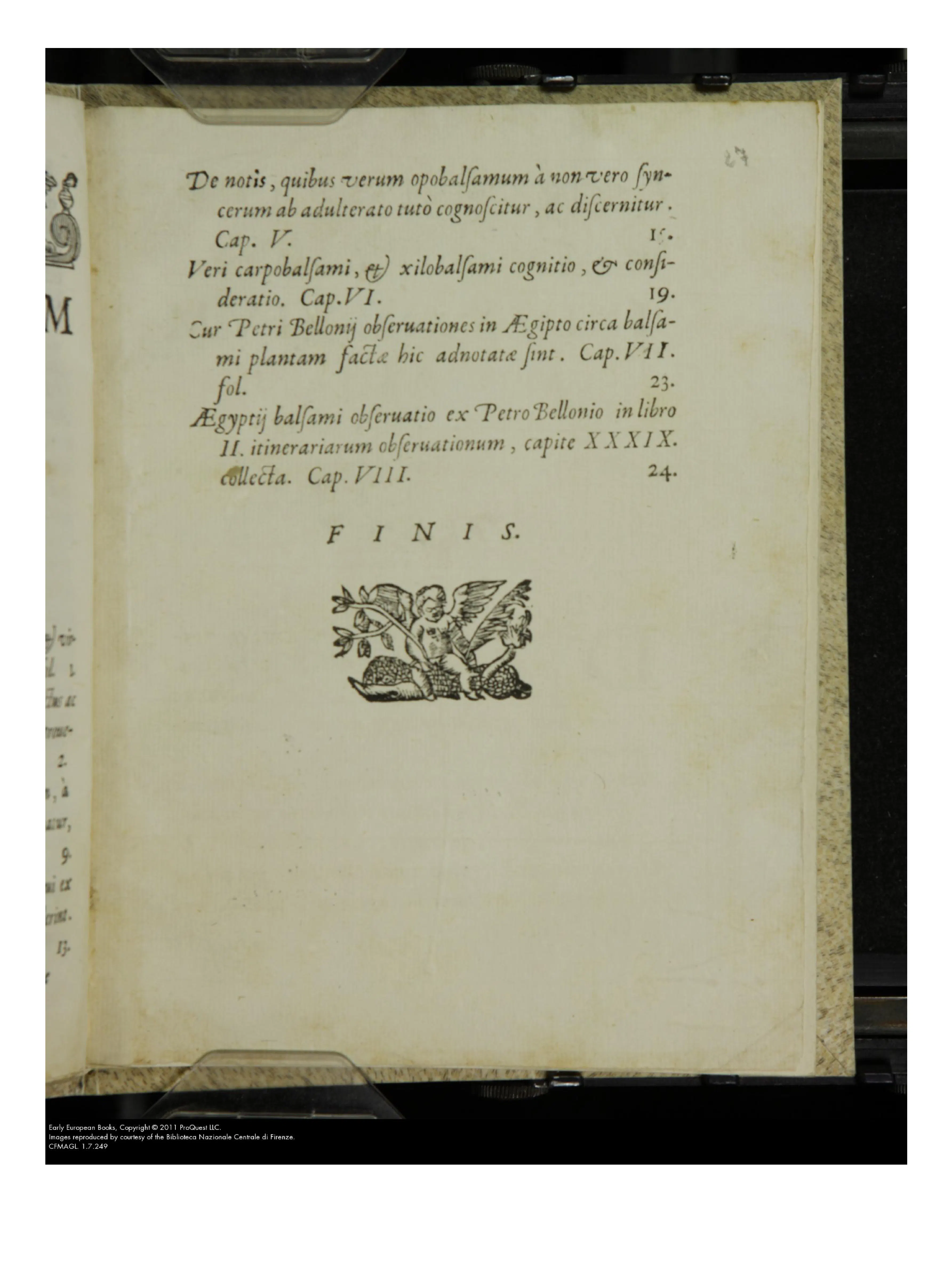
The closing leaf of the chapter index folds Belon's Egyptian observations into the book's eight-part architecture, making appended foreign testimony part of the argument rather than a loose supplement. Beneath FINIS, woodcut putti flanking a balsam-like sprig leave a last reminder that everything turns on authenticating one plant. Source ↗.
Frequently Asked Questions
What is Prospero Alpini's De balsamo dialogus about?
It is a short Latin dialogue on a single drug, printed at Venice in 1591 under the shop sign Sub signum Leonis, with its dedicatory epistle dated 1590. The conversation unfolds at dawn in the garden of Matarea outside Cairo between Alpini, the Egyptian physician Abdella, and the Jewish physician Abdachim, who examine the balsam plant and its three commodities: opobalsamum (the juice), carpobalsamum (the fruit), and xylobalsamum (the twigs). Against Italian opinion that the balsam of Dioscorides and Theophrastus had perished, it argues the plant still lives, cultivated near Cairo and growing of its own accord in Arabia Felix.
Who was Prospero Alpini?
Prospero Alpini of Marostica (1553–1617) was a physician trained in the Venetian orbit and later associated with the University of Padua. He spent several years in Egypt on medical business, and the 1591 preface states that he wrote there books on Egyptian medicine and plants, choosing to publish the balsam dialogue first at the request of learned friends. The volume is dedicated to the curators of the University of Padua — Francesco Priuli, Zaccaria Contarini, and Leonardo Donà — while Venice's college of physicians and its apothecaries appear as the practical audience whose compounding of theriac and mithridate the book means to correct.
Why did Alpini accuse Venetian physicians of a disgrace to the medical art?
Because true balsam had been dropped from the city's theriac and mithridate. Alpini writes that balsam completes the compounding of many antidotes, especially those two, which his countrymen prepare with the ingredient removed and so not without artis dedecus, a disgrace to the art. The dedicatory epistle draws the consequence: no one should be surprised that present-day theriac and mithridate no longer retain their ancient pre-eminence, nor preserve the powers celebrated by the elder Andromachus. He reports hearing that Venetian apothecaries, on the advice of the college of physicians, substitute juniper berries for balsam fruits — his own hearsay-marked allegation, which remains uncorroborated.
How did Alpini tell genuine opobalsam from adulterated, and why did his cloth test fail?
Chapter V sets out the marks by which true opobalsam is distinguished from false, cataloguing the oils, resins, wax, and honey used to falsify the juice and matching each with a detection test, including the Dioscoridean trial in which genuine juice dissolves swiftly in water or milk and turns milky. The staining test, however, failed on Alpini's own authenticated sample, which clung to the cloth contrary to rule; he diagnosed the fault in the apparatus, warning that the trial must not be attempted on Italian cloths, far coarser than Egyptian weaves. For counterfeit fruit he coined the term pseudocarpobalsamum, identified by a seed only half enclosed in its follicle.
Is there an English translation of De balsamo dialogus?
No modern English translation has been identified. Two Italian renderings exist: Luciano Cremonini's "Dialogo sul balsamo" in Acta medicae historiae Patavina 8–9 (1961–63), pp. 174–201, and a further translation in Le piante dell'Egitto. Il balsamo (Venezia, 1592), edited with texts and notes by Elsa M. Cappelletti, Giancarlo Cassina, and Giuseppe Ongaro (Treviso: Antilia, 2009). Separately, the Leo edition presents the full transcription of the 1591 quarto together with a complete English translation for the first time; that translation is generated by AI. Leo works to make free English translations of every Latin text printed in early modern Europe between 1450 and 1750 available online at no cost.
This report was generated by an advanced AI assistant that conducted deep research alongside an extensive interpretation of the transcribed original text. Every effort has been made to preserve fidelity to the source and to guard against inaccuracy, but corruption in the text recognition process and model hallucination may nonetheless have entered the text. Treat every claim, quotation, translation, and citation as provisional, and verify each against the original source before relying on or citing it.
Critical Further Reading and Contextual Resources
- Prospero Alpini, Le piante dell'Egitto. Il balsamo (Venezia, 1592), texts by Elsa M. Cappelletti, Giancarlo Cassina, and Giuseppe Ongaro, Italian translation by Giuseppe Ongaro and Luciano Cremonini: The modern edited presentation of the balsam dialogue alongside De plantis Aegypti, with botanical, biographical, and philological apparatus supplied by the Marostica research centre. It is the sane starting point for anyone who wants Alpini's Latin argument set beside a controlled Italian rendering and current identifications of his plants. Readers checking the quotations in this report against the 1591 quarto will find its notes considerably faster company than a digitized microfilm.
- Giovanni Aliotta, Natale G. De Santo, Giuseppe Ongaro, and Antonino Pollio, "Some Useful Plants for Renal Therapy Listed in De plantis Aegypti liber by Prospero Alpini in the 16th Century: Modern Considerations," Journal of Nephrology: A survey of Alpini's Egyptian materia medica from the standpoint of present-day pharmacology, useful for seeing how wide his botanical harvest was beyond the single drug argued over at Matarea. Its retrospective diagnoses belong to modern medicine rather than to Alpini's own categories, and should be read as a companion rather than a translation of his thought.
- Barbara Di Gennaro Splendore, "Prospero Alpini, il balsamo e le sue fonti egiziane," Alpiniana. Studi e testi: The specialist essay on where Alpini's balsam knowledge actually came from, and thus the closest scholarly examination of the dialogue's Egyptian and Arabic informants. Its subject is stated programmatically in the text, where the transfer of authority from ancient authors to inhabitants of the relevant places is made a methodological rule: therefore he judges that knowledge of balsam is by no means to be sought from Dioscorides, Theophrastus and other ancient writers, but from the Egyptians and Arabs, who have inhabited the places where by universal consent the balsam plants once lived, Quapropter Balsami cognitionem à Dioscoride, Theophrasto atque ab alijs antiquis scriptoribus minimè petendam iudico, sed ab Aegyptijs, & Arabibus, qui loca, in quibus balsami plantæ omnium consensu olim vixerunt, habitarunt. The same page of the Centro Studi bibliography lists the wider body of Alpini scholarship, which is otherwise scattered across local publications.
- Barbara Di Gennaro Splendore, The State Drug: Theriac, Pharmacy, and Politics in Early Modern Italy: The indispensable institutional history for grasping why Alpini's complaint about a missing ingredient was a political accusation, since theriac was simultaneously a Galenic remedy and a device by which Italian governments and colleges of physicians asserted control over pharmacy. Its framework also illuminates the imperial topos with which Alpini dignifies his subject — it is no wonder, he writes, that the tree was so dear to the Vespasian emperors, and that on its account they once fought with the Jews, mirum non est tantopere Romanis Imperatoribus Vespasianis caram eam arborem extitisse, eiusq; causa ab ipsis cum Iudæis aliquando dimicatum fuisse — a precedent that makes balsam an object of state before it is an object of the pharmacy, and that runs parallel to the Ottoman fiscal reservation he describes for his own day.
- Shigehisa Kusukawa, review of Fabrizio Baldassarri, ed., Plants in 16th and 17th Century: Botany between Medicine and Natural History, History of Pharmacy and Medicine: A short but current orientation to the renewed scholarship on plants at the junction of medicine and natural history, which now treats the hunt for true balsam as a significant episode rather than an antiquarian footnote. It is the quickest way to see where Alpini's dispute sits in present-day research agendas. The pagination and issue details reported for this review should be checked against the journal's final record before it is cited formally.
- Richard J. Oosterhoff, "Pierre Belon's Singularity: Pilgrim Fact in Renaissance Natural History," Mediterranean Historical Review: The study that reconstructs how Belon turned a garden visit outside Cairo into a fact solid enough for Alpini to bind into his own book, and how Clusius's Latin gave that fact European currency. It repays attention to the fragility of such procedures, which the dialogue itself concedes when it warns that the staining trial must not be tried on those cloths which you make in Italy, far coarser than ours, Verum non debet hoc experiri in pannis ijs, quos vos in Italia paratis, nostris longe crassioribus, a qualification that ties the outcome of a test of genuineness to the fabric available to the tester.





_Portretten_van_beroemde_geleerden_(serietitel)_Imagines_L._Doctorum_Virorum_(serietitel),_RP-P-1909-1063.jpg)