Clouds Rising over the Anatomical Field: Thomas Bartholin's Medical Letters
Thomas Bartholin, professor of anatomy at Copenhagen, spent the 1650s and 1660s turning his postbag into a scientific instrument, printing in his Epistolarum medicinalium a doctis vel ad doctos scriptarum the letters in which learned physicians across Europe traded dissections, diagnoses, insults, and claims of priority. The result is a working record of how seventeenth-century anatomy decided what counted as true: the thoracic duct redone in Copenhagen dogs, the unicorn's horn reduced to a Greenlandic whale's tooth, the water from Christ's side referred to the pericardium, and the bitter quarrel with Olof Rudbeck over who first saw the lymphatic vessels. Because a fire destroyed Bartholin's papers in 1670, these printed letters are now very largely the only surviving witness to the exchanges behind them.
ExLatinis
September 1, 2026

Contents
Thomas Bartholin, professor of anatomy at Copenhagen, spent the 1650s and 1660s turning his postbag into a scientific instrument, printing in his Epistolarum medicinalium a doctis vel ad doctos scriptarum the letters in which learned physicians across Europe traded dissections, diagnoses, insults, and claims of priority. The result is a working record of how seventeenth-century anatomy decided what counted as true: the thoracic duct redone in Copenhagen dogs, the unicorn's horn reduced to a Greenlandic whale's tooth, the water from Christ's side referred to the pericardium, and the bitter quarrel with Olof Rudbeck over who first saw the lymphatic vessels. Because a fire destroyed Bartholin's papers in 1670, these printed letters are now very largely the only surviving witness to the exchanges behind them.
Thomas Bartholin (1616–1680), professor of anatomy at Copenhagen and the most conspicuous medical figure of the Danish learned world in the middle of the seventeenth century, published in 1663 at Hafniae a collection of letters written by learned men or addressed to learned men: Thomæ Bartholini Epistolarum medicinalium à doctis vel ad doctos scriptarum, centuria I & II, printed by Matthias Godicchenius at the expense of the academic bookseller Peter Haubold, in octavo, and furnished with the indexes its title advertises as necessary. A third century followed at Hafniae in 1667 from the same printing and bookselling network, and a fourth appeared at The Hague in 1740 from the press of Peter Gosse. The form is consistent and unmistakable: numbered EPISTOLA units, each headed by a subject rubric in the form De …, an addressee-plus-destination line, a dated subscription and a signature formula; running heads that carry the author's name and the centuries' designation; lettered figure legends; and, at the close of the first two centuries, an INDEX RERUM compiled by Christophorus Frisius of Erfurt, which treats the whole correspondence as a searchable body of medical matter. This is not a systematic anatomy but an archive of exchange, retrospectively arranged for print.
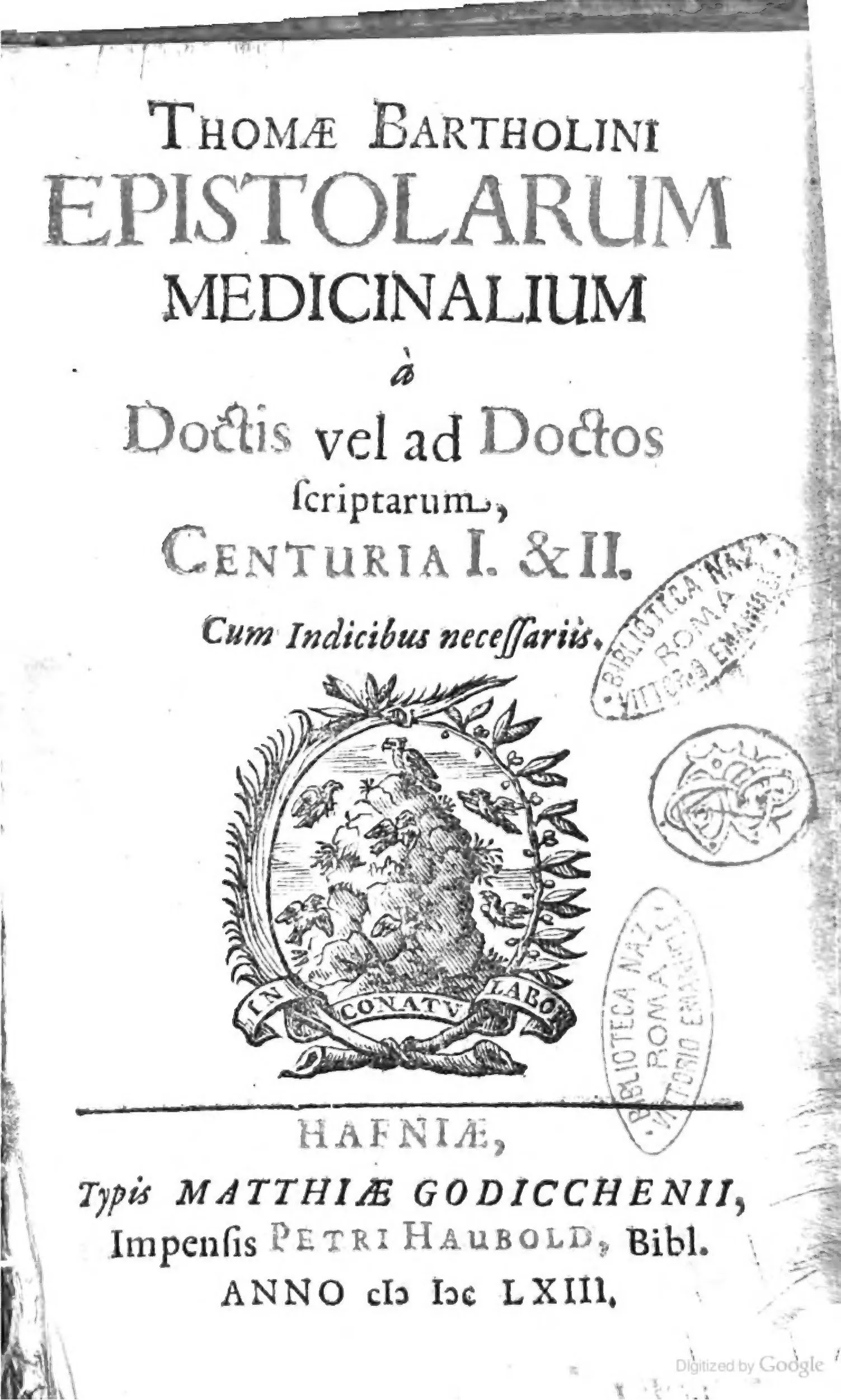
The 1663 Copenhagen title page presents the collection not as a continuous anatomical treatise but as letters "à Doctis vel ad Doctos scriptarum," gathered into Centuries I and II and supplied "Cum Indicibus necessariis." The imprint names Matthias Godicchenius and Peter Haubold; oval stamps record the copy's later Roman provenance. Source ↗.
The intellectual problem that gives the collection its coherence is the problem of credible novelty. By the 1650s anatomy had outrun the authorities it had inherited: the lacteals of Aselli, Pecquet's thoracic duct and chyle receptacle, and the lymphatic vessels had all been brought to light within a generation; Harvey's circulation had displaced the liver from its ancient office of sanguification; and no settled procedure existed for deciding what was true, who had seen it first, or how disagreement among physicians ought to be conducted. Bartholin's recurring move, across matter as various as anatomy, surgery, chymistry, monstrous births, scriptural exegesis and Roman law, is to convert the question into one of inspected evidence and documented witness — repeated dissection and vivisection, negative experiment, appeal to oculata experientia, verification delegated to sharper eyes than his own, the publication of manual technique against the secrecy of the guilds, and a refusal of conjectural emendation where manuscript authority is wanting. The epistolary form is not incidental to this programme but its instrument: a letter carries testimony, invites correction, fixes a date, and, once printed, submits both the claim and the disagreement it provoked to a wider bench of judges.
The stakes are those of the respublica literaria itself as a working institution rather than a compliment. Correspondence in these centuries is where anatomical observation became public property, where credit was assigned or contested, and where the etiquette of dissent was improvised under pressure. The lymphatic controversy that runs through the collection — Bartholin's 1652 publication, Olof Rudbeck's of 1653, and the acrimonious sequel — remains a disputed matter in modern scholarship, one line of interpretation stressing the cumulative differentiation of a vascular system, another the rhetorical and institutional struggle by which discovery was attributed to a person and a nation. What the letters supply to either reading is the texture of the process: concession and self-assertion in the same sentence, envy named as the predictable companion of discovery, and the deliberate deferral of unresolved questions to posterity as an honourable outcome rather than a failure.
Much of what makes the collection memorable lies in the sheer reach of what Bartholin was willing to submit to the same evidentiary discipline. The unicorn's horn is reduced to the tooth of a Greenlandic whale; the glossopetræ of Malta are weighed as mineral against organic; the generation of the basilisk, the luminous head of a decaying fish, and revival after hanging are examined rather than repeated. A tube of lead or silver is proposed for bronchotomy against the Spanish garrotillo; occult cancer, empyema, quartan fever, scorbutic bone, Virsung's pancreatic duct and cardiac polyps receive their own consultations; the Alkahest, the Menstruum Universale and the Helmontian latex are argued over alongside the standing of apothecaries and unlicensed practitioners. Sacred and classical texts are treated with the same instruments: the water from Christ's side is referred to the pericardium rather than the thoracic cavity, the hyssop of John 19 is pursued through Talmudic and Syrian testimony, and a crux in the Digest turns on whether the strainer is colum nivarium or colum vinarium. The correspondents include Rudbeck, Riolan, Pecquet, Ole Worm, Martin Bogdan, and the Danish translator and scholar Birgitte Thott, and the letters preserve travel dates from Padua to Copenhagen, so that the corpus doubles as an itinerary of learned life.
The vocabulary, the making of the book, and the argument inside it converge on one question. Naming is contested because it decides what a vessel contains and who made it visible; the printed collection is a work of selection and arrangement, in which prior separate printings are noticed, several epistles appear in duplicated settings, and the index converts private exchange into consultable public matter; and the 1670 fire at Hagestedgaard, which destroyed Bartholin's personal library and unpublished papers, means that the printed selection is now largely the only surviving witness to the exchanges behind it — a material accident that makes the editorial shaping of the corpus permanently difficult to see behind. Scholarship on Bartholin's letters is thin by comparison with the literature on lymphatic discovery and on Scandinavian collecting, and no sustained monograph devoted to the Epistolarum medicinalium has been located, so claims about the corpus's reception must remain provisional. So too must the resolution of a bibliographic confusion by which a digitized Bartholin set has become associated with a Leipzig 1703 volume of Becher and Stahl: the association appears to be a cataloguing or digitization-linking error rather than an established physical binding, and its precise mechanism is unconfirmed.
Read the full text and English translation on Leo
This text was transcribed and translated as part of the ExLatinis project, an effort by Leo to make free English translations of every text published in Latin in early modern Europe (1450–1750) available online. The complete transcription and English translation of this work can be read free of charge:
→ Read the original Latin text and full English translation on Leo
You can save a copy of this document into your Leo account to run deep text searches, conduct further analysis, or cross-reference it with your own research.
Framing the Title: Bartholin's Letters, Oculata Experientia, and the Politics of Naming
Editorial English title: Thomas Bartholin's Medical Letters: Learned Correspondence, Anatomical Observation, and the Republic of Letters. No established English title for the whole corpus was located; the title is supplied for convenience. The Latin Epistolarum medicinalium a doctis vel ad doctos scriptarum presents the work as letters written by learned men or addressed to learned men, not as a systematic anatomy. Its respublica literaria is consequently both a social ideal and a rhetorical jurisdiction: correspondence makes claims answerable to physicians beyond the immediate addressee, while the printed collection preserves disagreement for adjudication by posterity. The vocabulary of invidia and obtrectatio famæ names the dangers attached to priority claims, especially when anatomical credit is divided between observation, communication, and publication; the letters state the correlation as a law of the age, envy increasing in step with Nature's discoveries even as the century is congratulated on its abundance of diligence and its tireless study of unknown observations, ITa est, mi Bogdane. Cum Naturæ inventis I crescit & invidia. Seculi nostri est felicitas multis diligentiæ abundare exemplis, & indefesso ignotarum observationum studio efflorescere. The recurring demand for oculata experientia and refusal to affirm what has not been tested should be read in its seventeenth-century sense: disciplined appeal to sight, dissection, vivisection, and repeated inspection, rather than a later laboratory ideal abstracted from the body and the anatomist. The same ethos is put epigrammatically when Bartholin observes that Nature lies open to all and the heavens are everywhere overhead, yet few either search her out or contemplate them with keen eyes, Patet omnibus Natura, & coelum undiq; supra: Pauci tamen vel illam scrutantur, vel hoc acutis oculis intuentur — a formulation in which availability of evidence is worth nothing without trained and persistent looking.
In the lymphatic controversy, lympha and vasa lymphatica are not merely neutral anatomical labels. Naming participates in the argument over what the vessels contain, how their fluid differs from chyle, and who deserves credit for making them visible as a distinct system. The principle behind such disputes is stated directly in the letters, where a fluid is held to be not aqueous or lymphatic except as to outward appearance but sanguineous, indeed blood, to which not colour but its aptitude for nourishing gave its name, non aquosum aut lymphaticum (nisi quoad externam apparentiam) esse humorem, sed sangvineum, imo sangvinem, cui non color sed alendi aptitudo nomen dedit: nomenclature is to follow function rather than appearance, which is precisely why a name conceded is a claim conceded. The philological discipline that governs anatomical naming governs textual work as well, and here the demand for evidence takes the form of a refusal to emend without manuscript warrant, since without the authority of such witnesses a change made from conjecture alone is scarcely to be admitted even in profane writers, much less in the sacred Codex, to which a certain greater reverence is owed, sine horum autoritate, ne in profanis quidem scriptoribus ejusmodi facilè sit admittenda ex sola conjectura mutatio, multò minus in sacro Codice, cui major quædam debetur reverentiâ. The philological force of the title therefore lies in its coupling of correspondence with verification: a letter is a vehicle for testimony, correction, and reputation, while print turns dispersed observations into a durable intervention in learned medicine.
Summarizing the Corpus: Bartholin's Printed Centuries and Their Editions
The work is a Latin printed and editorially curated corpus of learned medical letters associated with Thomas Bartholin (1616–1680), distinct from private manuscript correspondence and from a continuous systematic treatise. That generic distinction has substantive consequences, since the letters function as a controlled channel for announcing work in progress: Bartholin can write that many new things are turning over in his mind and that, unless he is much mistaken, he will shortly disclose a new kind of vessels, about which he dares publish nothing yet before he has confirmed his thoughts by very many experiments, Mihi multa nova animo obversantur, & nisi valdè fallor brevi novum vasorum genus propalabo, de quo nihil publicè adhuc audeo proferre, antequam plurimis experimentis confirmaverim cogitationes — a stance in which the letter registers priority while withholding public assertion until inspection is complete. The principal identifiable issue is Thomæ Bartholini Epistolarum medicinalium à doctis vel ad doctos scriptarum, centuria I & II. Cum indicibus necessariis, published at Hafniae (Copenhagen) in 1663 by Matthias Godicchenius, at the expense of the academic bookseller Peter Haubold; USTC records the format as octavo. A catalogue description of a surviving Bamberg copy records [10] leaves, 739 pages, and [19] leaves, while the MDZ record identifies Bamberg Staatsbibliothek as the holding institution and gives OCLC 220240969. The 1663 corpus was followed by Centuria III at Hafniae in 1667, from the same printer/bookseller network, and by Centuria IV at The Hague in 1740, printed by Peter Gosse. The Google Books/Internet Archive object aph87som7kQC is bibliographically a Bartholin set: its title identifies Centuries I–IV, its metadata names Thomas Bartholinus, gives 1663, and records two volumes from the National Central Library of Rome. It is not the distinct Leipzig 1703 Becher–Stahl Physica subterranea, whose record names Johann Joachim Becher, Georg Ernst Stahl, Gleditsch, and the appended Specimen Beccherianum. The work is in Latin and incorporates the multilingual technical and scriptural vocabulary of early modern medicine and philology. A Danish translation of Bartholin's lymphatic writing is reported, but no translation of the complete Epistolarum or verified Danish translations of individual letters was located. Charles D. O'Malley's 1961 English translations concern On the Burning of his Library and On Medical Travel, not the complete medical-letter corpus.
Why the Letters Matter: Lymphatic Priority, Harveian Circulation, and Historiographical Debate
The corpus matters because it preserves the working social form of seventeenth-century anatomy: observations moved through letters, were tested by correspondents, converted into claims of priority, and then retrospectively arranged as a printed archive. Its importance is therefore not reducible to the discovery of a single vessel. The letters place post-Harveian circulation, the displacement of the liver from the older account of sanguification, the authority of autopsy and repeated dissection, and the relation between anatomical demonstration and sacred exegesis in one documentary field. The canonisation of Harvey's doctrine can be watched in progress in the correspondence, which declares that its addressee has earned the votes of all fair men by the circulation of the blood, than which mortal industry could discover nothing more elegant, nothing more useful, nothing truer, omnium calculos Circulatione Tua sangvinis, qua nihil elegantius, utilius nihil, nihil verius mortalis industria invenire potuit — praise that simultaneously ratifies a doctrine and models how credit is publicly awarded in the letters' economy of reputation.
The lymphatic controversy is the best-studied adjacent debate. Natale, Bocci, and Ribatti reconstruct the sequence from Aselli's lacteals through Pecquet's 1651 account of the thoracic duct and cisterna chyli, Bartholin's 1652 work, and Rudbeck's 1653 publication of hepatic and peripheral lymphatic observations. Their account emphasizes cumulative anatomical differentiation while acknowledging that priority remained disputed. C. T. Ambrose's studies instead foreground the controversy as a seventeenth-century priority dispute and give special weight to Rudbeck's complaint and claim to precedence. The disagreement is historiographically productive: one approach stresses the gradual clarification of a system, the other the rhetorical and institutional struggle through which discovery was assigned. Both readings find purchase in the letters' own layered handling of the question, where Bartholin writes that as for the history of the lymphatic vessels he is not unaware how much others labour to arrogate to themselves the praise of their first discovery, that this is a common vice, that his correspondent is nevertheless the first author for the Danes, and yet that it must be admitted that Dr Rudbeck was the very first to demonstrate them to him, Quod historiam Vasorum Lymphaticorum attinet non sum inscius, quantum alii sibi in eorum prima inventionis laude arroganda laborent, verum id commune est vitium, Tu tamen primus nobis autor existis, quanquam fatendum est, D. Rudbekium omnium primò ea mihi demonstrasse: concession, complaint about arrogation, and a competing attribution occupy a single sentence, which is why the printed corpus can sustain two such different historiographies without either being simply mistaken.
The etiquette that makes such coexistence possible is itself articulated as a method. In a free republic, the letters hold, each party freely puts forward, explains and defends what seems to him best, truest and most useful, well aware that the cause belongs to no man at all but to God and Nature, and that it is honourable to leave the decisive settlement of the question even to posterity, Uterq[ue]; scilicet in libera Reip[ublicæ] quæ sibi videtur optima, verissima, utilissima liberè profert, explicat, propugnat: probè memor, quod causa ipsa nullius omninò hominis, sed Dei & Naturæ, quod item decisivam quæstionis finitionem vel posteris resignare honestum sit. Deferral is here a positive procedure rather than an evasion, and it is the counterpart to the invidia that marks where civility fails. Niels W. Bruun's study of Bartholin's editorial principles is especially important because it addresses the corpus as an act of selection and arrangement rather than treating the letters as transparent transcripts of private exchange; a corpus that publishes unresolved disagreement for later adjudication is precisely the kind of object whose shaping demands editorial analysis. Cunningham's history of the anatomical Renaissance supplies a broader account of the period's return to anatomical projects and practices, while work on Ole Worm, Copenhagen medicine, Stensen, learned correspondence, and anatomical print supplies necessary context. The scholarship located is much richer for lymphatic discovery, Scandinavian collecting, and early modern anatomy than for a sustained monograph devoted exclusively to the Epistolarum medicinalium; claims about its complete reception history should consequently remain provisional.
The corpus also deserves study for its sacred philology, its criticism of marvels such as the unicorn and glossopetræ, its chymical and pharmaceutical disputes, and its policing of professional boundaries among physicians, surgeons, and apothecaries. Its theological anatomy is not credulous, but neither is it reductive: explaining the water from Christ's side, Bartholin insists that in saying "short of a miracle" he does not banish supernatural influx altogether, since it would be impious to think so with certain persons, but argues that the substance in question already persisted in the pericardium beforehand, without the production of new water, Dixi citra miraculum, non quod ablegem omnino supernaturalem influxum, hoc enim esset impium arbitrari cum nonnullis, sed quia substantia illa in pericardio perennabat antea, absq; novæ aquæ productione — an argument that reserves miracle while extending anatomical explanation as far as inspection of the body permits. The same evidentiary discipline extends to historical narrative, where a history is defended as being without laws because it was written with the freedom a free mind dictated, true nevertheless, weaving the sequence of the deed with sincere faith, Historia est sine legibus, quia ea libertate scripta fuit, quam liber animus dictabat. Vera tamen, & actæ rei seriem sincera fide pertexit: fidelity to what happened is separable from conformity to rhetorical rule, exactly as anatomical truth is separable from conformity to inherited authority. On the institutional side, the letters are unsparing about credentialing: of Salerno it is said that no other glory belongs to that school except that a laurea is conferred on some candidates after a perfunctory examination out of the texts of Hippocrates and Aristotle, Nulla alia hujus scholæ gloria, nisi quod nonnullis candidatis Laurea conferatur præmisso examine aliquali ex textibus Hippocratis & Aristotelis, a judgement that ties the corpus's concern with who may speak for medicine to its larger concern with what makes a claim answerable.
Tracing the Text: Print Runs, the Hagestedgaard Fire, and the Becher–Stahl Cataloguing Error
The secure bibliographic sequence is: an identifiable 1663 Hafniae issue containing Centuries I and II; a 1667 Hafniae issue of Centuria III; and an 18th-century collected or continuing Centuria IV issued at Hagae Comitum by Peter Gosse in 1740, [8], 512, [52] pages, octavo. A modern editorial description states that its textual basis is the first edition, published in three volumes in 1663 and continued in 1667; the catalogue and digitization evidence independently confirms the 1663 and 1667 records. The 1663 copy's title, imprint, octavo format, pagination, and Bamberg holding are recorded by MDZ and USTC/union-catalogue data. NLM also records an 1663 Centuria I under WZ 250 B286e 1663, and Wellcome records an original 1663 copy online. The aph87som7kQC scan is a two-volume Bartholin set from the National Central Library of Rome, with OCLC 614439633; its metadata and OCR show the Bartholin running head, numbered EPISTOLA units, dated subscriptions, anatomical subjects, an INDEX RERUM, and the compiler Christophorus Frisius of Erfurt. Those features establish the object's identity even where OCR is defective. The internal record also shows that the letters preserve travel dates and retrospective exchanges, including entries from Padua and Hafniae, and that the index treats the correspondence as a searchable body of medical matter.
The corpus is also explicit about the norms that govern what goes to press and why, which bears directly on how it was assembled. Publication is presented as owing a debt to trial: Kircher, Bartholin remarks, would long since have found the matter out himself, being wont to be more curious in smaller things and to publish nothing, as he writes, without an experiment, Si res ita haberet dudum hoc ipse expertus fuisset Kircherus, qui in minutioribus curiosior esse solet, & nihil, ut scribit, sine experimento prodere — a standard by which a printed claim implies a completed inspection. Against that norm stands the counter-pressure of craft secrecy, acknowledged when a correspondent's undertaking is defended in the expectation that there will perhaps be those who will not approve it, in which he sweeps away with a full hand the secrets of the art and the dexterity of cutting that ought, on the older view, to be left to practitioners alone, Erunt forsan quibus præsens opusculi Tui institutum non sis probaturus, in quo artis nostræ arcana & secandi dexteritatem solis artificibus relinquendam plena manu eliminas. The decision to print manual technique, like the decision to print unresolved disputes, is thus part of the corpus's argument and not merely a fact of its manufacture.
Earlier separate impressions cited inside the letters—Leiden and Paris in 1646 and Copenhagen in 1653 and 1658—were not independently identified with sufficient bibliographic certainty. They should be treated as internal publication notices or bibliographic leads, not as established editions. No authoritative evidence located the engraver of the numbered figures, a privilege, a dedicatee, a censorship intervention, a suppression, or a complete collation explaining the signatures P5, Q–Q5, and Yy–Ccc. The duplicated settings may indicate reimposition, cancels, or reuse of type, but that remains a material inference requiring page-by-page comparison of copies. The 1670 fire at Hagestedgaard is documented as destroying Bartholin's personal library and unpublished materials, an event that materially limits reconstruction of the papers behind the printed selection, and hence limits any test of how far the printed centuries represent the exchanges they preserve. The letters' network includes Rudbeck, Riolan, Bogdan, Worm, Pecquet, and other physicians, but a complete chain of contemporary replies and counter-texts was not established. The Becher question can be resolved at the level of object identity: the separate 1703 Leipzig record is an octavo Becher volume with Stahl's Specimen Beccherianum, Gleditsch, and a different title page and extent ([30], 1008 [i.e. 1000, 44], 304, [16] pages). The Bartholin scan's title, author, 1663 date, Rome provenance, and two-volume description contain none of those Becher/Stahl particulars. No source located a physical Sammelband joining the two works, nor a union-catalogue audit trail proving how an erroneous link arose. The most defensible conclusion is that any such association is a catalogue or digitization-linking error, not an established physical binding; the precise mechanism remains unconfirmed.
Reading the Centuries: Salerno, Vesuvius, Pecquet's Duct, and the Discipline of Witness
The Neapolitan letters: Salerno in decay and the case as evidence
The Italian sequence of the first century is best entered mid-letter, where a survey written from Naples passes without interruption from commerce to institutions to bodies. From the manna and spices of the Salernitan trade Bartholin turns to a documentary find in the Neapolitan library of Baldassare Pisanelli, reporting that he saw the school's ancient glory and learned statutes there in the manuscript ordinances on the examining and admitting of physicians and surgeons, cujus antiquam gloriam & instituta docta vidi in Bibliotheca Neapolitana Bald. Pisanelli, ubi Ordinationes ejus MS. de examinandis & admittendis Medicis Chirurgisq[ue]. The marble inscriptions that might have carried the record further are illegible, so chronology has to be fixed on the best textual authority to hand: so far as he could observe from Petrus Diaconus and others, the studies of the Salernitan school flourished under Constantinus Africanus of Cassino in 1050, and it was the first university of physicians, Ego enim quantum ex Petro Diacono & aliis observare potui, sub Constantino Aphricano Cassinensi 1050. floruerunt Salerni- tanæ Scholæ studia, primaq[ue] Medicorum Uni-. The letter then pivots to institutional decline with unusual bluntness, remarking that now its splendour is darkened, and although eight Doctors still survive there is not one among them who performs even moderately in medicine, since they are advanced to that office wholly through the court and canvassing, as in other towns of Italy, where even apothecaries are created Doctors of Medicine, and thereafter noblemen out of pure vanity, Nunc ejus splendor obscuratus, adeoq[ue] licet 8. Doctores adhuc supersint, ne unus tamen inter eos est qui vel mediocriter aliquid præstet in re Medica, sed per curiam & ambitum omnino ad hoc munus provehuntur, ut in aliis oppidis Italiæ, ubi etiam Aromatarii creantur Medicinæ Doctores, & subinde Nobiles ex pura vanitate.. This is the same stretch of the letter from which the judgement on Salerno's one remaining glory, the perfunctory laurea, has already been cited above: the school survives as a ceremony of conferral, and the corruption of the ceremony is what remains of the institution.
From institutions the letter passes directly to two cases seen with Marco Aurelio Severino at the Hospital for Incurables, and the transition is not decorative, since both cases test what observation can be made to yield where cure is out of reach. In a boy of fifteen with an excrescence at the anus, Bartholin ventures an aetiology that ties an individual malformation to the whole class of prodigious births: he suspected such an excrescence to have arisen from an error of nature in the youth at birth, and that from an excrescence of that kind, formed by nature's negligence, come the so-called monsters of the Cyclopes and others, in whom the anus appeared in the place of the genitals, on account of the extremity of the peritoneum and the nerves, Ego suspicabar excrescentiam ejusmodi ex naturæ errore in juvene nato, & ex istiusmodi excrescentia Naturæ negligentia formata monstra sic vocata Cyclopum & aliorum, quibus Anus in loco genitalium apparuit, propter Peritonæi & Nervorum extremitatem. — a conjecture marked as such by suspicabar, and one that treats the monstrous as an extreme of ordinary embryological error rather than as a portent. The second case, an adolescent with a urethral fistula, perineal wounds, caries of the pubic bones and sacral bedsores, is closed by the surgeon's judgement rather than by any further intervention: Severino judged that labour would be spent in vain and reckoned the patient would shortly die, because with the perpetual irritation of the wounds and the loss of blood the danger in him was greatest, quare inanem impendere operam Severinus judicavit, & moriturum brevi æstimavit, quia perpetua vulnerum irritatione & sanguinis emissione periculum in illo sit maximum.. The prognosis is itself evidence, entered on the authority of a named practitioner at a named hospital, and dated by the subscription from Naples of 1 June 1644.
Epistola LV, De vomitu ex vesicæ dolore, & ossibus crassioribus in scorbuto, is directed by its address line to Giuseppe Donzelli at Naples, JOSEPHO DONZELLO Neapolim, and answers three questions in the order received. On whether vomiting accompanies pain of the bladder, the authorities are canvassed first, and their silence is made to count: Hippocrates in the book on the affections of the kidneys and bladder will be witness, who, though he recounts their sensation among the signs by which diseases are recognised, nevertheless does not set out vomiting, Testis erit lib. de affect. renum & vesicæ Hippocrates, qui, quorum sensum inter agnoscendas morborum notas commemorat, vomitum tamen non exponit. The consensus of stomach and bladder is then grounded anatomically, through nerves and vessels and, as Sennert says, on account of a certain continuity of the membranes, & (ut inquit Sennertus) propter membranarum aliqualem continuitatem; but the greater sympathy of stomach with kidneys is distinguished from it, and irritation of the bladder is argued to produce hiccup or convulsion rather than vomiting, with fuller treatment deferred. The second question, on the sudden restoration of strength after food, is referred to the heart and neighbouring vessels exhausted of their nourishing lymph. The third turns on the bones, and here reason and dissection are made to converge in a single clause: that in the dissection of cadavers the bones are found thicker in scurvy, not only reason persuades, but observation has confirmed, as is found in other long-lasting diseases whose course is closed, In Anatome cadaverum, ossa in scorbuto crassiora inveniri, non tantum ratio suadet, sed & observatio confirmavit, uti idem experimur in aliis morbis diuturnis quibus periodus clauditur. The pairing of ratio and observatio, with the second carrying the confirmatory verb, states the letter's evidentiary order; it is subscribed from Naples on 8 June 1644.
The two letters on Wirsung's pancreatic duct show the epistolary consultation working at full stretch, because on this question Bartholin has nothing settled to report. Epistola LVI is addressed to Johann Vesling at Padua, IOANNI VESLINGIO Patavium, and after an elaborate captatio benevolentiæ it declares its own inconclusiveness as a working state: concerning the pancreatic duct he has as yet settled nothing, but with the young men who give themselves to anatomy alongside him he is occupied in searching it out, De Ductu Pancreatico nihil adhuc constitui, sed cum juvenibus, mecum Anatomiæ vacantibus, in illius rimatione occupor.. Naples is a city distracted by war, the dissections are collaborative, and the questions put to Vesling are exact: whether the duct is constant across animals, what kind of lymph it holds, and by what route chyle, if chyle it be, could reach it. Three routes are canvassed and each is refused on anatomical grounds, the sequence ending in a profession of ignorance framed as an invitation — for does it come through the substance of the pancreas? He does not grasp it, since the pancreas has no vessels anastomosing with the neighbouring intestines. Or through the lacteal veins? But its insertion into the intestines suggests the contrary, and the vessels sought in vain from the lacteals to the pancreas. Or through the nerves at last? He does not know; he says what he does not know, so that his correspondent's truer opinion may come out in public, An enim per pancreas substantia? Non capio, quia nulla ejusdem vasa cum vicinis intestinis anastomosis: An per venas lacteas? Sed contrarium innuit ipsius insertio in intestina, & quæ frustra à venis lacteis ad pancreas quæsivimus vasa: An per Nervos tandem? Nescio, quæ nescio dico, ut prodeat in publicum verior sententia Tua.. Confessed ignorance is here a solicitation of print, and the letter of 20 June 1644 is answered from Padua on 15 July. Vesling's Responsio (Epistola LVII) begins from constancy across species as the ground of certainty, reporting that he has found that duct of the pancreas so constantly in various animals that he judges it never to be doubted, Ductum illum Pancreatis, adeo constanter in variis reperi animalibus, ut de eo nunquam ambigendum censeam. — dog, cat, ox, sheep and wild beasts, together with human cadavers, an old man and an adolescent female, no male section having come his way that year. On the contained matter he compares it to gallbladder bile while noting that it is limpid and differs in quality, and on its origin he hedges with care: whether that juice arises from the little branches of the splenic artery, which he has more than once observed to pass into the substance of the pancreas, or from elsewhere, he still doubts, and rather suspects a certain likeness to the chyle borne between the coats of the mesentery, though unlike in respect of origin, Utrum verò succus ille ex arteriæ splenicæ ramulis, quos & in Pancreatis substantiam abire non semel observavi, aut aliunde nascatur, adhuc dubito suspicorq[ue] potius chylo qui inter mesenterii tunicas fertur, similitudinem quandam adesse, etiamsi ratione originis dissimilem.. He leaves the question to those with leisure and defers the rest to conversation on Bartholin's return, so that the exchange closes not with a resolution but with an appointment.

Johann Vesling in a mid-seventeenth-century line engraving, the kind of formal portrait that fixed a Paduan anatomist's identity within the world carrying Bartholin's queries by letter. As addressee and respondent on Wirsung's pancreatic duct, he anchors the consultation network in dissection at Padua rather than textual authority. Source ↗.
Epistola LVIII, addressed to Ole Worm at Copenhagen, OLAO WORMIO Hafniam, is tripartite, and each of its parts is built on personal inspection. The first is the ascent of Vesuvius: they climbed the mountain itself and walked in the top of its belly, from which it once vomited fires and stones, both the ancient crater and the modern, Vesuvium ipsi conscendimus & in ejus ventre summo, ex quo ignes olim & lapides evomuit, tam antiquo quam moderno, deambulavimus., with sulphur exhalations, vitriol ore, pyrites, ash and burnt and sulphurated earth noted as the grounds for an inference about the incredible force of subterranean fire. The second concerns two 'monsters': conjoined twins born on 20 June, baptized and dying, dissected by Bartholin, whose account of duplicated and single parts — one liver, one stomach, one spleen, two hearts, two lungs, umbilical vessels merging — is tied to the engraved plates, since he wondered that the diaphragm had been so rightly and exquisitely disposed by nature, as the reader will see in the second figure, Miratus tamen sum diaphragma tam recte & exquisitè à natura fuisse dispositum, uti in figura secunda videbis.. Three sterile wombs with globose tumours follow, one from a woman of sixty who died of dropsy, and here the figure is made to carry a negative finding: from the largest vessels he saw the broad ligaments issue, likewise the testes, in which the vesicles were notable, but he found nothing in them, nor eggs, but spaces internally hollow and empty, as the reader will see on inspection in the third figure, Ex vasis maximis vidi ligamenta lata prodire, item testes, in quibus insigniter vesiculæ, sed nihil in illis inveni, neq[ue] ova, sed spatia interne cava & vacua, ut inspiciendo videbis, in figura tertia.. The plate is thus not illustration but the means by which an absence is made verifiable at a distance. The third part reports the morbus Neapolitanus, distinguished from the venereal disease: a suffocating angina of children, contagious and epidemic, killing nineteen in twenty, whose popular aetiology the letter records precisely in order to mark it as popular — whence it was superstitiously believed by the people that the evil was divine, since in the year 1621, when a fatal comet had appeared in Sicily (whence too that evil is called the Sicilian), it invaded the people with great force, unde à Populo su- persistitiosé creditum est, malum esse divinum, si Anno 1621. cum Cometa fatalis apparuisset in Sicilia (unde etiam mala illa Sicilianæ vo- catur) magno impetu populum invasit. Against the portent Bartholin sets seasonal and dietary factors and then declines to close the question, admitting that he cannot assign the cause of this disease, unless it be that venomous substance hidden in their humours and blood which is common to children alone, Causam morbi hujus assig- nare non possum, nisi ea sit substantia veneno- sa, in illorum humoribus & sanguine occulta, quæ pueris solum communis est.. The conjecture is offered as a conjecture, appended to an explicit non possum; the letter is subscribed from Naples, 12 July 1644.
Epistola LIX, to Caspar Schoppe at Padua, CASPARO SCIOPPIO Patavium, is the correction of that report, and it is written against Bartholin's own recently posted account. The disease, he now states, is not new, is not Neapolitan, and does not fall upon children only, but also upon others more advanced in age if they are nearer the contagion; children are seized more easily because they are of tenderer substance and resist less, Non est nova, non est Neapolitana, nec solum in pueros incurrit, sed & alios ætate provectiores, si contagio proximiores; sed quia pueri tenerioris substantiæ sunt, & minus resistunt, facilius corripiuntur.. The revision is documented in both directions, by oral instruction and by print: he learned its history from Severino, when they were staying in the hospital, Ejus historiam à Severino nostro didici, ubi in Nosocomio degebamus, and the prior literature is named, since Fonseca published a treatise on it and Panarolus treated it in his observations, ubi & de eo tractatum edidit Fonseca, & Panarolus in observationibus suis. He saw it himself at the Hospital for Incurables, where none was cured because the patients refuse medicaments and gargles — a failure attributed to the sick rather than to the art, which is what licenses the letter's refusal of the word incurable: finally it is true that this disease is difficult in its cure and almost insanable, but it is not therefore to be said that it can be cured by no means and that no remedies are to be applied, because there is danger in delay, and therefore at once in the first days the matter must be purged and removed and a universal remedy applied, whence other things follow as shall seem good to a prudent and attentive physician, Denique verum est morbum hunc esse difficilem in curatione, & fere insanabilem, sed non ideo dicendum est, quod nulla ratione curari poterit, & nulla adhibenda esse remedia, quia periculum in mora, & ideo statim primis diebus purganda & tollenda materia, & universale remedium adhibendum, unde alia consequuntur, ut visum fuerit Medico prudenti & attento.. The second half of the letter turns to the bone in the stag's heart and handles an old naturalist's crux by the same rule: as for the little bone in the heart in stags, the question is not new nor yet settled, for he persuades himself that the opinions of the ancients about it were not rashly pronounced, as many suppose, because in the hearts of older stags the little bone has often been found, and now and then in horses and certain other animals, De cordis ossiculo in Cervis quod attinet, quæstio non nova nec adhuc terminata: Nam mihi persuadeo veterum de eo sententias non temere pronunciatas, sicut multi opinantur, quia in illorum cordibus vetustiorum Cervorum ossiculum sæpe repertum est, & subinde in equis, & aliis quibusdam animalibus.. Regional and age-related variation — bone in Italian and French stags, cartilage in Danish and German — is then made to reconcile the ancients with modern dissectors, on the argument that in the very oldest all humidity is consumed and cartilage degenerates into bone. The letter is subscribed from Rome, 5 September 1644.
The Italian run closes with a letter written to Bartholin rather than by him. Thomas Reinesius, writing from Altenburg on 15 November 1644 to Basel, congratulates him on his return from travels through the more illustrious parts of Europe with an extraordinary increase of learning, and records his own act of publicity on Bartholin's behalf: he ventured in his later books of Various Readings to boast of this, not without perpetual praises of him, Ausus fui posterioribus meis Variarum Lectionum libris hoc jactare, non sine perpetuis laudibus Tui. Having praised the De Luce Animalium presented to him, Reinesius then relays a marvel at second hand, and names his informant as he does so — Salanus Beverus, who has more than once told him that there is in the church of St George attached to the town of Rappoltsweiler in Bavaria a certain wonderful light, which conquers the night and is never extinguished, although it was kindled ten years ago now, and yet was never kindled, but always burns, Salano Bevero, qui mihi non semel narravit, esse in Ecclesia S. Georgii in Bavaria annexa opido Rappoltsweiler, lucem quandam admirandam, quæ noctem vincit, nec unquam extinguitur, etsi jam ante decem annos accensa fuit, neque unquam accensa fuit, sed semper ardet.. The report is doubly attributed, to a named man who has repeated it more than once, and connected to Cimbric sacred lore from which mysteries are said to have passed into medicine; the letter closes with an antiepileptic amulet of bones and plant roots, on which the writer notes that he once wrote to the most noble and excellent Dr Johannes Rhodius, with whom he has had a most pleasant and useful intercourse by letters, De hoc scripsi olim ad Nobilissimum & Excellentissimum Virum D. Ioannem Rhodium, cum quo mihi jucundissima & utilissima consuetudo per literas intercessit. Even where the matter is a perpetual lamp and an amulet, the form of the report is a chain of named witnesses and a correspondence that can be cited.
Legend, tried practice, and the negative experiment
Read across the whole of the first century, that same discipline governs matter far beyond the clinic, and the through-line is the conversion of every kind of report — legendary, clinical, scriptural, operative — into something that can be inspected, tested, or at least referred to a witness. The Salerno letter sets the terms not only by reducing the most celebrated of medieval medical foundations to an antiquarian shell and a degree ceremony, but by supplying a legend that explains professional decline as a moral pathology: Virgil made medicinal baths at Puteoli, each inscribed with its own title against the sickness it availed for, and the Salernitan physicians, led by envy, came upon them and with a strong hand destroyed the titles, Virgilius fecit balnea medicinalia Puteolis, singula propriis inscripta titulis contra quem valerent ægritudinem. Salernitani Medici invidia ducti supervenientes, in manu forti titulos destruxerunt. The story, drawn from the Glossa ordinaria and the Neapolitan chronicle tradition, is not repeated as curiosity but as an etiology of monopoly. What the envious physicians destroy is precisely an inscription — public, legible, therapeutically indexed knowledge — and their punishment by shipwreck between Capri and the Minervan promontory converts the loss of a public text into divine judgement. Invidia, the vice that recurs throughout the correspondence as the standing companion of discovery, is here given its institutional form: the suppression of what could otherwise be read and used by anyone. That the same letter records Salerno's surviving privilege of practice throughout the kingdom without the Protomedicus's licence makes the pairing sharper still, since juridical entitlement is shown outliving the learning that once justified it.
Against that model of hoarded knowledge the letters set a conversational epistemology in which the burden falls on tried practice rather than argument. Writing to Pietro Castelli on whether vomiting benefits the stone, Bartholin closes the consultation by declining disputation in favour of testimony, preferring to hear from his correspondent what has been proved by years and use rather than to waste many words from which perhaps very few will become either learned or healthy, DE HIS VERO TE MALO AUDIRE ANNIS & USU PROBATUM, QUAM PLURA VERBA PERDERE, EX QUIBUS PERPAUCI FORSAN VEL DOCTI FIENT VEL SANI. The formulation is characteristic of the epistolary unit as this part of the collection deploys it: a rubricated question is put to a named practitioner in a named city, the received doctrine is canvassed — here the materia tartarea, the sixth pair of nerves, the sixth book of the Epidemics — and the letter then subordinates all of it to what the addressee has himself seen over a working lifetime. The same letter's request for Severino's promised Sepulcretum of a hundred Roman dissections shows how the request for tested experience becomes a request for a book of bodies, the consultative letter and the collection of post-mortem observations serving the same evidentiary appetite.
Technique receives an equally explicit rationale. Prompted by Cecilio Folli's skeleton articulated and seated by its own ligaments rather than by wire, Bartholin states a maxim in which preparation is not ancillary craft but the visible form of medical art: the more closely one emulates nature and preserves its native fibres, the more praise he will earn from nature and nature's ministers, and the physician ought to imitate nature closely, so far as he can, Quanto quis propius naturam æmulatur, ejusq; nativas fibras servat, tanto &c à natura & naturæ ministris plus laudis merebitur. Medicus naturam presse imitari debet, quantum potest. The maxim binds together two things that might seem unrelated — the anatomical preparation that keeps the body's own connective tissue in place, and the therapeutics that follows nature's course — under a single criterion of fidelity to what is native. It is the standard by which the lettered figure legends for the internal ear, running through cochlea, labyrinth, the oval and round windows, the aqueduct, malleus, incus and stapes, can be presented as contributions rather than embellishments: what is claimed there, a slender process of the malleus not previously observed and the small bony globule of the stapes, is claimed as something preserved and shown rather than reasoned to.
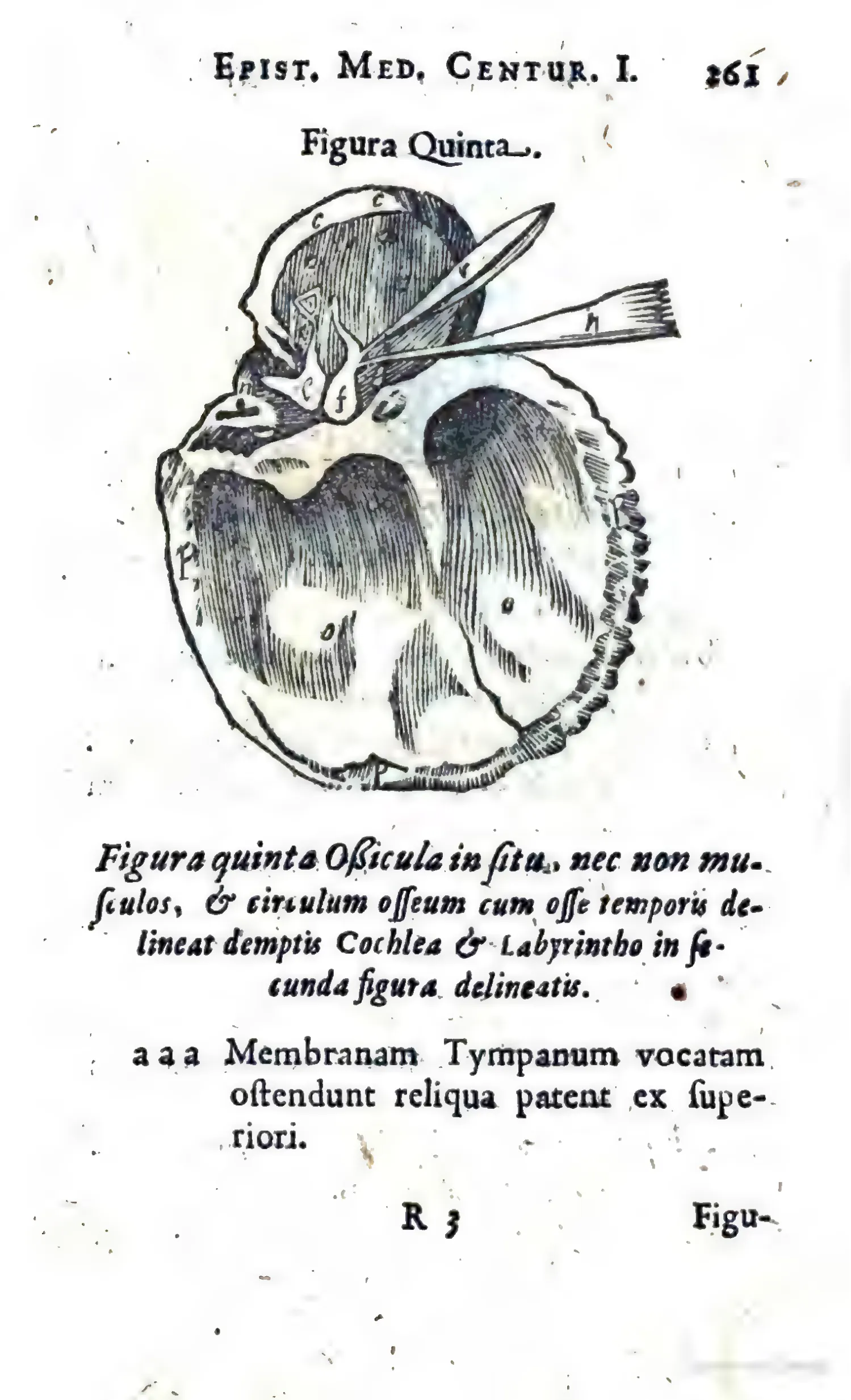
In "Figura Quinta," the ossicles are isolated in situ, the cochlea and labyrinth omitted to give a controlled view of tympanic membrane, malleus, incus, stapes, muscles, and bony ring. The legend's cross-reference to the preceding figure turns technique into argument: novelty becomes credible only when fixed to visible structures. Source ↗.
Where a report resists such showing, the letters record the failure without softening it. Ole Worm's test of the heliotrope root, whose fragment was said to turn of itself in water, ends in a flatly negative protocol: it moved a little at the first motion of the water, but when the water came to rest, it rested too, Sed frustra, ad motum aquæ primo paululum movebatur; sed hac quiescente, quievit & illa. The sentence is doing two things at once. It supplies the control that the marvel's proponents had not: the apparent motion is referred to the disturbance of the medium, not to sympathy between plant and sun. And it makes the negative result publishable, which is the precondition for the norm Worm goes on to invoke, already noticed in this report, that nothing should be brought out in print without an experiment. The deflation of occult sympathy in this correspondence is thus accomplished not by philosophical argument against sympathies as such but by a demand for a repeatable observation, made in a letter that a third party may in turn repeat.
Sacred anatomy and the surgical question
The most demanding application of that discipline is to the sacred body. The long dispute over the water from Christ's side turns on a passage of the pseudo-Hippocratic de Corde, which Girolamo Bardi cites to naturalise the phenomenon: the heart has a tunic surrounding it, and in it a watery humour, so that the heart may be thought to dwell in a bladder, and this was made for the purpose that the sound heart should flourish under guard, Cor, inquit, tunicam circumdantem habet, & in ipsa aqueus humor, ut putari possit in vesica diversari cor, factum est autem ea gratia ut sanum in custodia efflorescat. Bardi's move is to make the lance's wound anatomically legible by locating a standing reservoir of serous fluid exactly where the Evangelist places the effusion, so that the miracle lies in the event and not in the creation of a new substance. Bartholin resists the pericardial localisation, arguing that serous fluid collects in cavities generally and that latus and πλευρά denote the side rather than the heart's covering; but his counter-position obliges him to insist on the fully natural physiology of Christ's body, and he does so without hedging, since one may innocently say this of the Saviour, whom we know to have eaten, drunk, slept, walked, and done everything, so as to submit himself to all human actions that are according to nature, Idq[ue] de Salvatore innoxie dixeris, quem scimus manducasse, bibisse, dormivisse, ambulasse & quid non egisse ut se hominum cunctis actionibus, quæ secundum naturam sunt, submitteret. The adverb innoxie carries the argument's whole risk: the anatomist must claim in advance that his physiological reasoning is harmless to doctrine, because the reasoning requires a Christ whose humours behaved as humours do.
The surgical quaestio on angina in children exhibits the same procedure in a domain where ancient authority is unambiguous and negative. René Moreau reproduces Aretaeus's objection in full force before answering it — whoever, fearing strangulation from angina, have cut the artery so that the breath might be drawn more freely, do not seem to have proved the matter by experiment, Quicumq[ue] inquit, strangulationem ab Angina verentes, quo laxius spiritus duceretur, arteriam secuerunt, non sanè experimento rem comprobasse videntur. The rebuttal is telling because it accepts the ancient criterion and disputes only its application: Aretaeus condemns the operation for want of proof, and Moreau supplies proof in the form of two cases and a step-by-step protocol with a lead or silver tube. Naming is part of the same discipline, since the operation is redescribed as a section of the bronchus rather than of larynx or pharynx, and they placed a not useless remedy in bronchotomy, for so it ought to be called, non inutile auxilium in Bronchotomia (sic enim vocari debet) reposuerunt, the parenthesis asserting that a correct name follows from correct localisation of the incision — the same principle that governs the naming of vessels elsewhere in the correspondence. The Spanish garrotillo, named from judicial strangulation, marks the opposite pole: a vernacular name generated by resemblance to a mode of execution, vivid but diagnostically inert.
Into the second century: licence, replication, and the reception of Pecquet
The policing of who may practise, opened at Salerno, returns at the seam between the centuries. Welcoming Guibert's Medicina Charitativa in the letter to Guy Patin that stands at the head of the new hundred, announced by the internal title identifying the second century of Bartholin's medical letters, TH. BARTHOLINI EPISTOLARUM MEDICINALIUM CENTURIA SECUNDA, Bartholin turns the apothecaries' proper office into an insult: for the most part vain boasters insinuate themselves stealthily into the practice of medicine, and whereas among the sick they ought only to wash out the lower throat, they dare to defile the upper, Plerumq[ue] enim vani ostentatores ad exercendam medicinam furtim se ingerunt, quumq[ue] apud ægros inferius tantum guttur eluere deberent, superius audent inquinare. The wit depends on an anatomical division of labour — the apothecary's business is with the lower orifice, the physician's with speech and counsel — and the furtim recalls the stealth of the Salernitan destroyers.
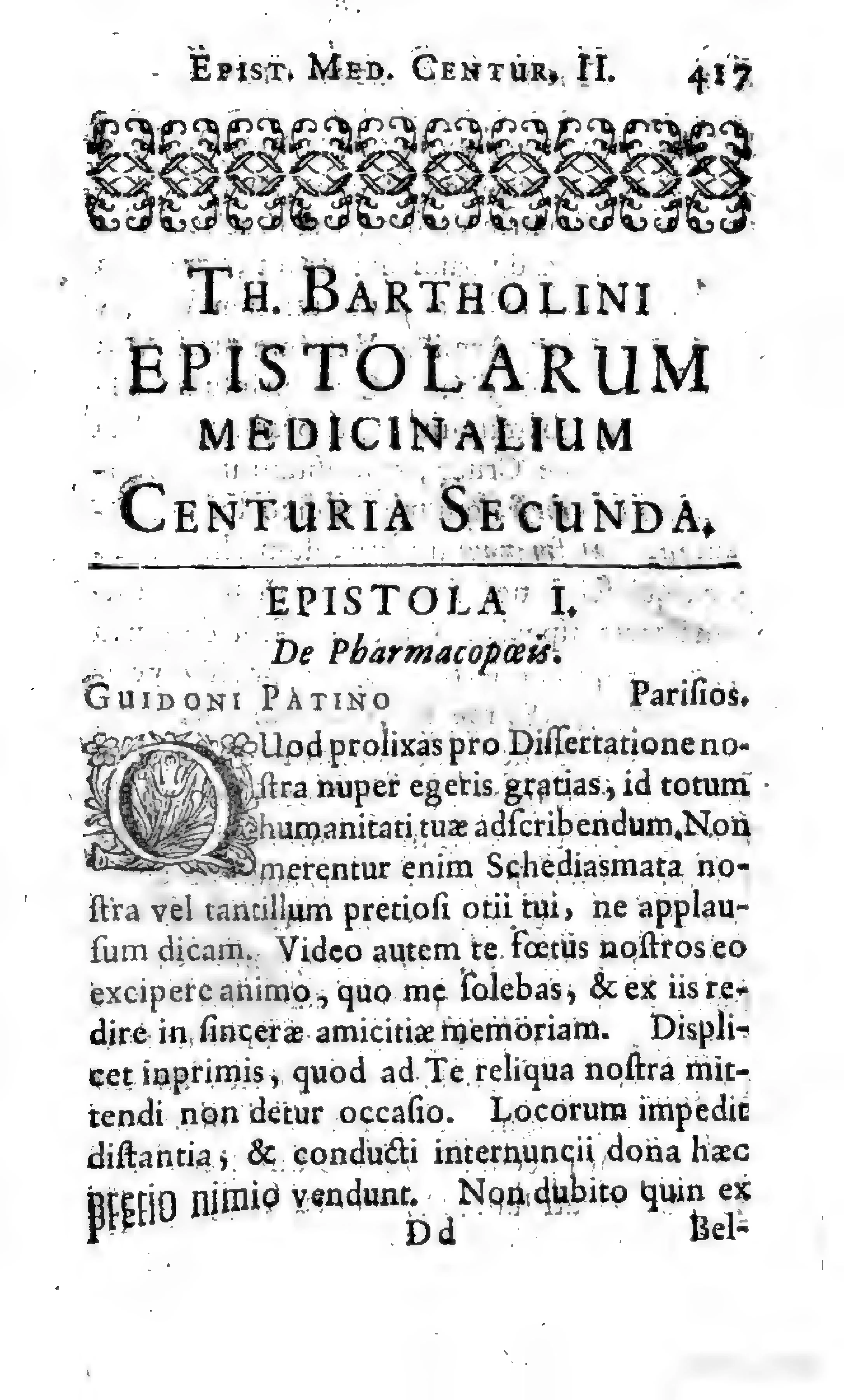
The opening of "TH. BARTHOLINI EPISTOLARUM MEDICINALIUM CENTURIA SECUNDA" marks the seam between the two centuries, where the corpus resumes its concern with regulation of practice. Its first letter, headed "De Pharmacopaeis" and addressed to Guy Patin in Paris, makes professional jurisdiction and the costs of learned exchange a single subject. Source ↗.
The centuries' anatomical climax is reached when Pecquet's discovery arrives from Paris and is not merely reported but redone. Bartholin's dogs yield more than the printed account had shown, since he found everything clearer and certain things not noticed by Pecquet himself, namely a notable cavity of the receptacle situated beneath the left kidney, veni clariora omnia & quædam ab ipso Pecqueto non animadversa, Receptaculi nempe cavitatem insignem, sub rene sinistro sitam. Replication here is simultaneously confirmation and a modest claim of extension, the courteous form in which credit is both granted and shared. The physiological consequence is handled with equal caution, for he would not wish to send the liver wholly into exile but believes it shares the work of sanguification with the heart, because the chyle in the mesentery is more copious than can be conveyed through those new and rather slender thoracic ways alone, unde nolim prorsus in exilium agere epar, sed partiri credo cum corde sanguificationis opus, quia copiosior in mesenterio est chylus quam per folas vias illas novas in thorace satis exiles traducatur. The argument is quantitative rather than authoritative: the calibre of the newly found ducts is set against the observed bulk of chyle, and the ancient hepatic office survives on that measurement alone, not on Galen's word. The letters to Helmstedt keep the withheld announcement of a new kind of vessels in reserve pending repeated trials, and describe the moment in a figure of gathering weather, clouds arising that will end in an abundant rain and irrigate the anatomical field, Nubes oriuntur, in pluviam uberem desituræ, & campum Anatomicum irrigaturæ — an image that makes discovery collective and impending rather than proprietary, and that invites the correspondent to stand as witness to what is about to fall.
Consultation, canonisation, and the limits of demonstration
The second century's letters arrive as a sequence of formally identical printed units — a numbered heading, a rubric in the form De …, an address line naming the destination city, the body, and a dated subscription — and the uniformity of the setting throws into relief how various the matter is that passes through it. The run opens in the orbit of Christina's court at Stockholm, where Pierre Bourdelot reports his water-drinking regimen for the Queen along with the hostility of rival physicians. Bartholin's reply is instructive precisely because it does not simply ratify a colleague's practice: he assembles the authorities for cold water after purgation, Aetius, Mesue, and Ingrassias' cure of the Sicilian viceroy, and then withdraws the prescription from universal application, since, as he puts it, those things do not benefit our stomach which benefit the Sicilian, because both men and sky vary, Nostro enim ventriculo ea non conferunt, quæ Siculo, quia variant & homines & coelum. The concession that precedes it — that something must be granted to habit and to the northern air — makes the logic explicit. A cure documented in print and attested by a famous case is not thereby portable; consuetudo and climate function as conditions on the evidence, so that the testimony of an authority is received but its jurisdiction is narrowed. The epistolary form is what makes this possible: a letter can accept a report as true where it was made and still refuse to generalise it, which a systematic regimen could hardly do.
The letter to Harvey (Epistola XXIV) shifts register from consultation to homage, and in doing so performs an act of public canonisation inside an ostensibly private communication. The praise already discussed above belongs to this letter — that Harvey has earned the votes of all fair men by his circulation of the blood, than which mortal industry could discover nothing more elegant, nothing more useful, nothing truer — and its rising triple negation, ascending through elegance and utility to truth, is calculated epistolary rhetoric; the metaphor of calculi, the voting-pebbles of a tribunal, is not decorative either, since it presents the reception of a doctrine as a poll of qualified judges, exactly the tribunal that the printed collection later convenes on a larger scale. What follows is the structural hinge of the letter. Bartholin declares that he could indeed have wished that the whole of anatomy had been reformed according to these principles by the author and discoverer himself, Optassem equidem ab authore ipso & inventore totam Anatomen juxta hæc principia fuisse Reformatam,. The wish is a warrant. Because the discoverer was hindered, the labour of rebuilding descriptive anatomy on circulation devolves upon another, and the Copenhagen Anatome Reformata is presented not as a rival enterprise but as a delegated one — a distinction on which the whole propriety of a Danish textbook consolidating an English discovery depends. Discovery and its systematic elaboration are thereby separated into distinct kinds of credit, which is the same operation that governs the priority disputes running through this century.
Epistola XXIX takes up the corollary question of what may be printed.
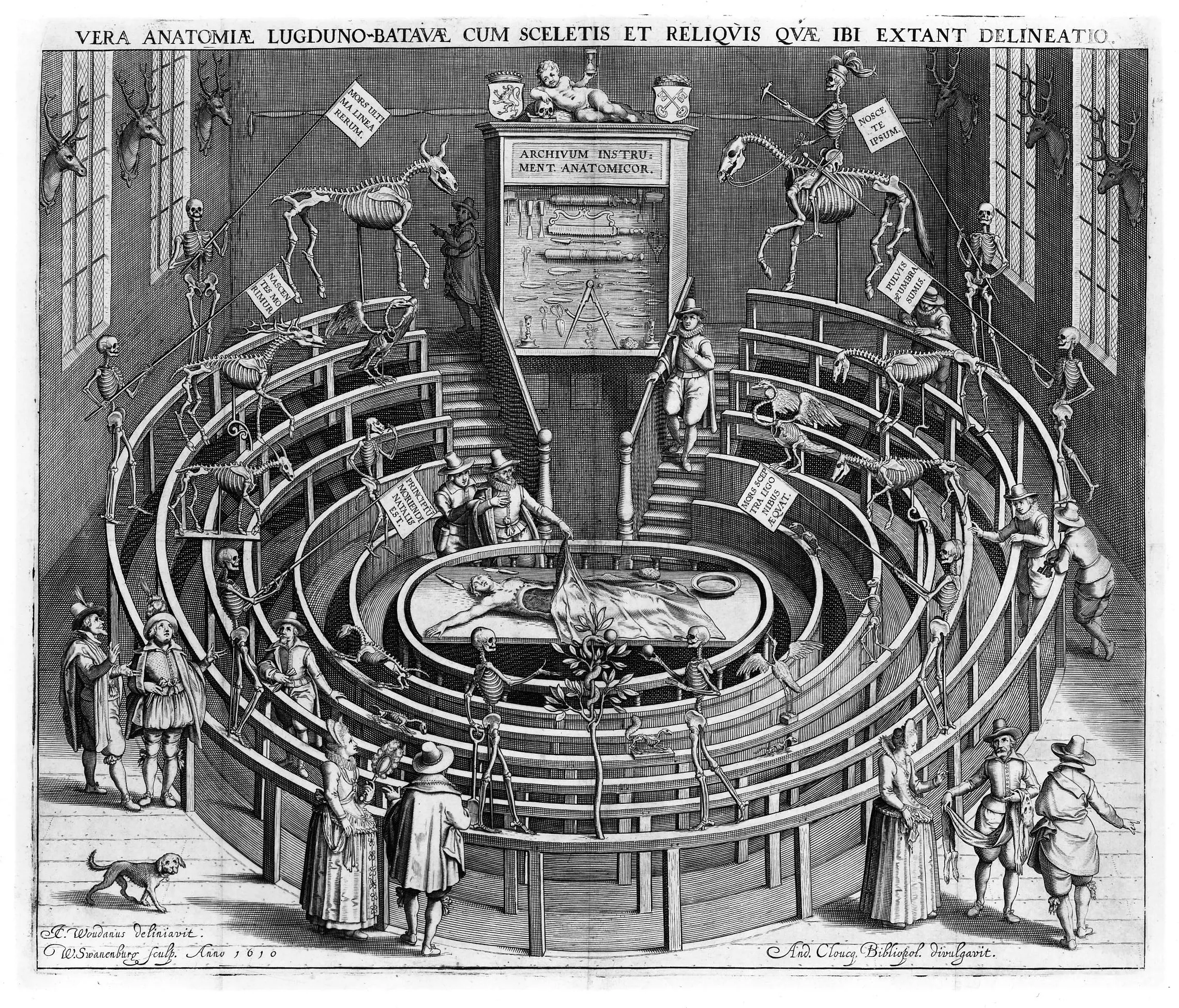
An early seventeenth-century engraving of the Leiden anatomical theatre presents anatomy as a public act of witnessing, the dissecting table at the centre and spectators ranged around it. The scene sets oculata experientia—knowledge authorized by communal seeing—beside the discretion demanded when discoveries left the theatre for print. Source ↗.
Bartholin voices, at length and with full rhetorical apparatus, the case against publishing the anatomist's manual technique — Pythagoras, the Hippocratic oath, Virgil's Iapis — and buttresses it with the argument that publication makes the pilgrimages of the learned superfluous. The argument acquires unexpected weight from present circumstance: no one, he observes, will cross a dangerous sea laden with hostile ships in order to see Harvey in England, Periculosum mare & hostilibus navibus onustum nemo trajiciet, ut in Anglia Harvejum videat. The Anglo-Dutch war intrudes here as a material condition of the peregrinatio academica, and it silently reverses the indictment it was recruited to support: if the sea is shut, then print is not the enemy of travel but its substitute, and secrecy would leave the observation unavailable altogether. The reversal is duly executed when Bartholin blesses Lyser's Culter anatomicus and pronounces that Harpocrates be exiled and thrown out of our theatres, Exulet Harpocrates, Theatrisq; nostris ejiciatur,. The god of silence is the tutelary figure of guild monopoly, and expelling him from the theatrum — a space whose very architecture is designed for witnesses — aligns the anatomical demonstration with the printed book as two modes of the same publicity.
That publicity, however, does not guarantee assent, and the Paduan reports in this run are candid about the failure of demonstration to compel. Lyser describes an opponent who obstinately denied that they were vessels, but fought for their being nerves, making the same claim about the mesenteric lacteals, nor could the liquid flowing out more copiously dissolve his opinion, obstinatè vasa esse negabat, sed pro nervis pugnabat, (idem de lacteis mesentericis statuens) neq[ue] copiosius effluens liquor opinionem ejus diluere paterat:. The verb diluere is chosen with some wit — the flowing liquid cannot dilute a conviction — and the episode exposes the limit of oculata experientia as an arbiter: sight settles nothing between parties who bring incompatible categories to the same exposed structure, since what one names a vessel the other names a nerve. Correspondence is the remedy the collection offers for this impasse, not because it adds a further sense to sight, but because it multiplies the witnesses and dates their testimony.
Priority, marvels, and the claim to jurisdiction
The belatedness of the new vessels is itself made a topic. Langelott relays the Duke's question, wondering how it could have happened that that lacteal duct, more conspicuous than the lymphatics, could have escaped so many lynx-eyes of anatomists, Miratus verò est, quomodo fieri potuerit, ut ductus ille Lacteus conspicuus magis præ Lymphaticis tot Lynceos Anatomicorum oculos effugere potuerit? — and answers it by referring the questioner to chapter 18 of Bartholin's Historia. The Lyncean eye is the period's standing figure for penetrating anatomical vision, and the puzzle is a genuine embarrassment for a discipline that grounds authority in inspection: if the structures were always there and visible, the failure of generations of skilled dissectors requires an account. The letter's recourse is to send the enquirer to a printed chapter, which is a small but telling indication of how the burden of explanation is discharged in this economy — by citation to a published argument that can be checked.
Bartholin's own chronology of the dispute begins from publication rather than from dissection: when his history of the lymphatic vessels was first sent into the light, he writes, there was undoubted hope among the learned that there would be men who, having weighed the matter more accurately, would add the completion of the new observation, Qvum primum Historia mea Vaforum Lymphaticorum in lucem esset emissa, spes erat indubia inter Eruditos fore, qui re accuratius expensa, complementum novæ observationi essent addituri — where the form Vaforum, as it stands in this setting, preserves the press's own confusion of long s and f. The sentence models discovery as inherently incomplete, requiring a complementum supplied by others; and what arrived, on his telling, was a series of anonymous plates from the Netherlands. Against that carefully managed narrative the collection prints a document that undercuts it, namely van Horne's letter, already cited above for the three incompatible gestures it packs into a single period: a complaint that others labour to arrogate to themselves the praise of first discovery, a compliment carefully limited by nobis to what Bartholin is for the Danes, and the admission that Rudbeck was the very first to demonstrate the vessels to him. That Bartholin printed it is the strongest evidence in this run that the corpus's evidentiary discipline is not merely rhetorical, since the same volume that presses his claim also supplies the testimony most damaging to it.
The same discipline is turned outward on the marvels of the materia medica. The exchange with Kyper reduces the unicorn's horn to Greenlandic ivory: it is a whale's tooth, which alone projects from the jaw that Bartholin has seen, and which hitherto all have believed to be a horn, enim est dens, qui unicus ex maxilla, quam vidi, prominet, quemq[ue]; cornu esse crediderunt hactenus omnes. The parenthesis quam vidi does the work: a universal belief is dislodged by a single inspected specimen, whose provenance in the Greenland shipping is stated as part of the proof. Notably, the deflation of the referent leaves both the name and the therapeutic use standing, so that the vocabulary of the apothecary's shelf survives the natural-historical correction — a fissure between nomenclature and substance of exactly the sort that the letters elsewhere try to close by insisting that names follow function.
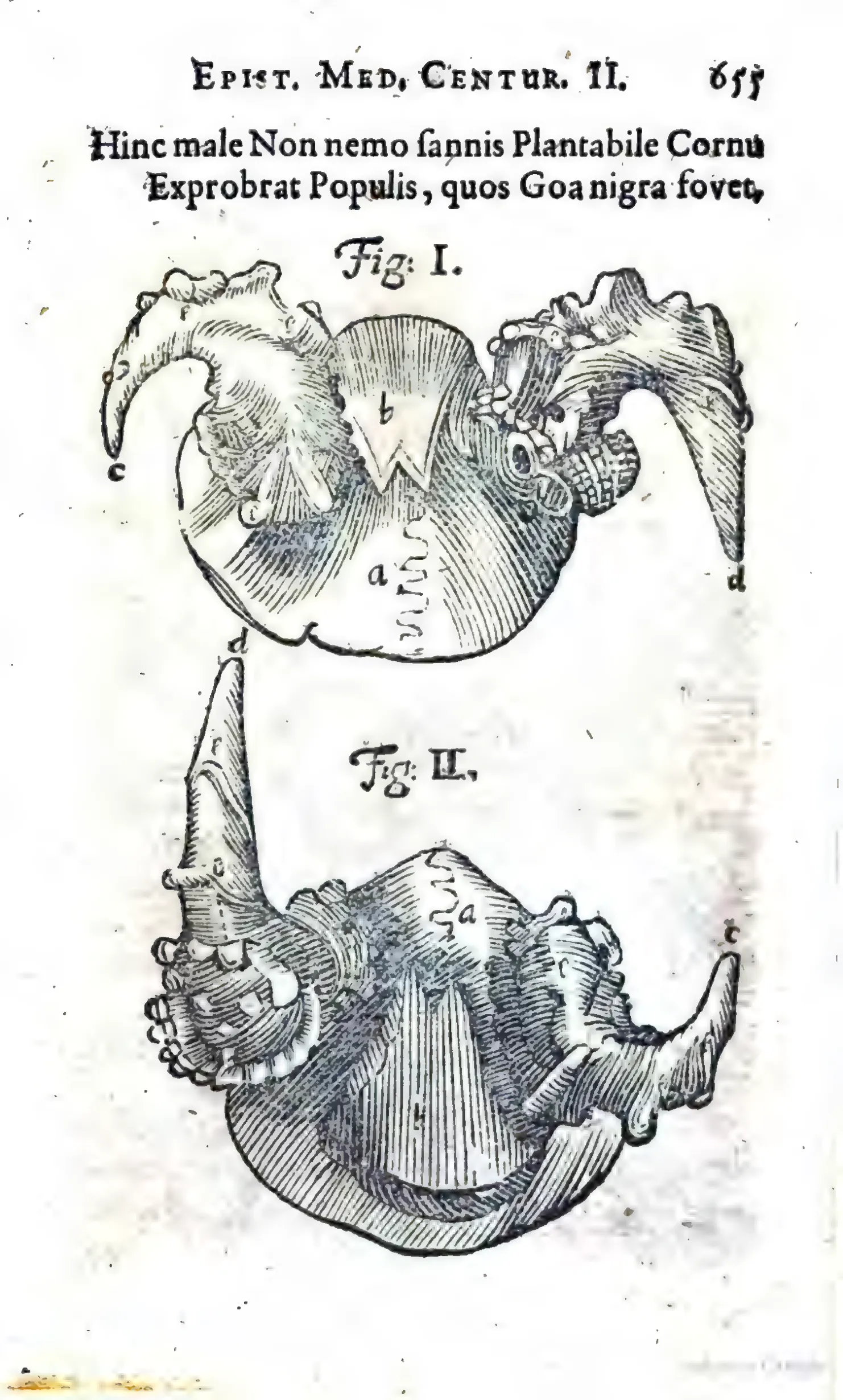
The lettered engravings of the narwhal jaw turn the celebrated unicorn's horn from an occult treasure of the materia medica into an inspectable fact: a single tooth projecting from a whale's jaw. The satirical couplet printed above them sharpens the correction, making mistaken reverence yield to a named specimen and repeatable observation. Source ↗.
Two later letters show how far the reform reaches into institutions. From Padua, Bartholin's own pupil reports Molinetti treating of the liver and asserting that sanguification was taken from it in vain, since it receives chyle through lacteal vessels, which he had also resolved to demonstrate, sangvificationem ipsi frustra detrahi asseruit, quippe quod chylum per lactea recipit vasa, quæ & monstrare decreverat; — and then records that the demonstration failed because the dog had not been fed. The detail is the report's whole value: the defence of the liver's ancient office is not refuted by argument but left unsupported by an accident of preparation, and the correspondent's willingness to record the mishap is what makes the letter usable as testimony. From Bergen, Treubler converts the epistemic standard into a demand for jurisdiction, asking why it should be permitted to anyone with impunity to give medicines and kill nations, when even in the mechanical trades not everyone may be a painter, nor would one who is not a smith take a hammer in hand with impunity, Cur dare medicinas, & gentes interficere, impunè cuiq[ue] permittatur? cum vel in Mechanicis non liceat cuivis pictorem esse, nec malleum in manus impunè sumserit is, qui faber non sit. The comparison with the guild-regulated crafts is the period's own, and its force is to make medical competence a matter of examinable licence; the appeal to the Copenhagen faculty for censure and to the crown for prohibition asks that academic judgement be given coercive effect.
The same ethos governs textual criticism, where a conjecture is tested against the source rather than the taste of the editor: in Marcellus, chapter 33, the correspondent objects, you throw out concicula against all the editions and substitute lenticula, and you will yourself disapprove this, he knows, if you consult Scribonius, no. 233, whom Marcellus transcribed in this place, Marcello cap. 33. ejicis conciculam contra editiones omnes, & substituis lenticulam. Improbabis hoc ipse, scio, si Scribonium n. 233. quem exscripsit h. l. Marcellus, consulueris. The argument is procedural rather than aesthetic: an emendation against the whole printed tradition must answer to the text that the transmitting author had before him, just as an anatomical assertion must answer to the exposed structure. That the letter breaks off unfinished leaves the reader of the printed century with a demonstration in progress, which is the condition in which most of its matter is offered.
Philology, prodigies, and the closing apparatus
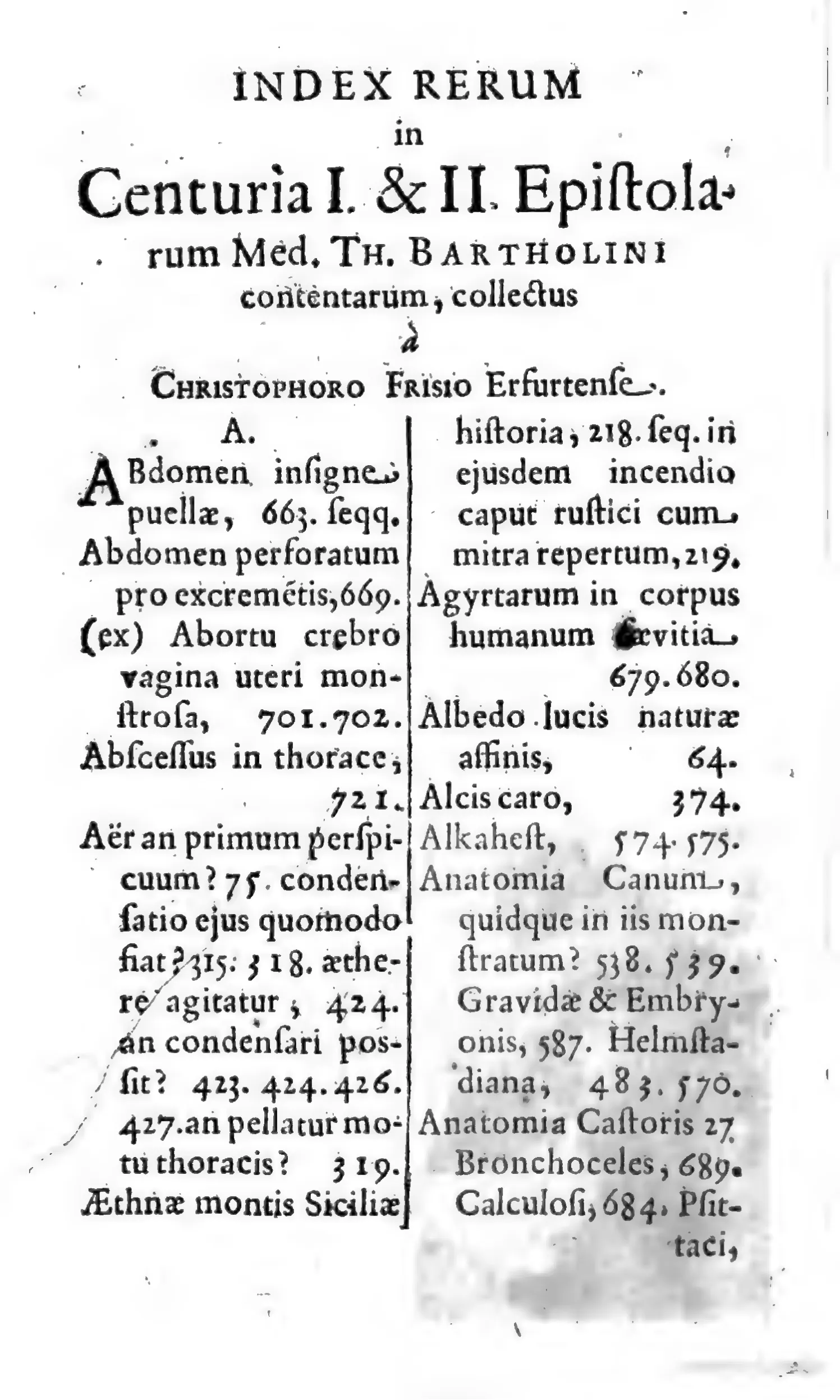
Opening the Index Rerum for Centuries I–II, this page turns an epistolary sequence into a topical apparatus: the heading credits Christophorus Frisius of Erfurt, while double columns gather alkahest, animal anatomy, bronchoceles, and calculi under alphabetized headings. Indexing is itself an editorial act, recasting correspondence as a searchable archive. Source ↗.
The reply to that objection opens the closing stretch of the second century, which begins not on the dissecting table but in the study, with Bartholin answering Thomas Reinesius on the conjecture in Marcellus Empiricus. The reply states its criterion with unusual economy: the greater doubt raised concerns the passage of Marcellus emended in the Corollaria, where for concicula at chapter thirty-three he has restored lenticulam, on the ground that the latter word is often mentioned and the former never, Majus dubium moves de loco Marcelli à me in Corollariis emendato. Pro concicula c. 33. lenticulam reposui, quod hujus sæpe, illius nunquam fiat mentio. The reasoning is lexical rather than palaeographical: the pharmacological corpus itself — Scribonius Largus, Dioscorides — supplies the frequency distribution against which a hapax is judged suspect. That this is emendation ex ingenio is precisely what the letter goes on to worry about, since Bartholin at once reports a collation made in a codex consulted in Isaac Vossius's circle, where Cornarius had first corrected and then restored the transmitted reading, and canvasses Johannes Rhodius's alternative quasi conchis, leaving open whether concha names a measure, Columella's oil-vessel, or an actual shell. The habit of mind on display is the same one the collection applies to bodies: a proposal is advanced, the countervailing witnesses are named, and judgement is suspended where the evidence does not compel. The letter's brevity is excused by the press of the Dispensatorium, a detail that quietly registers how the epistolary hour is carved out of the working life of a professor with books in progress.
Consultative medicine enters in the reply of Johannes Fridericus Treublerus from Bergen, whose structure is that of a scholastic quaestio transposed into correspondence: Bartholin's two questions about a Bergen woman's dilated vagina are restated and answered with a formal Responsio, the deformity attributed to repeated and appallingly laborious stillbirths rather than to a congenital superfluous membrane. On the second question, contralateral convulsion after head injury, Treubler first discharges the obligation of authority, acknowledging that he knows the passage adduced from the Hippocratic book on head wounds, where the author treats of those who are to die of such wounds and adds that if the ulcer be in the left part of the head, convulsion seizes the right part of the body, Notus autem mihi locus quem adducis apud Hippocr. libr. de cap. vulnerib. ubi scilicet agit de illis qui ex vulneribus capitis sunt perituri, hæc addit: si Sinistra capitis parte ulcus fuerit, dextram corporis partem convulsio prehendit:. What follows is the decisive move: the ancients state the phenomenon but nowhere supply its reason, and the absence of a ratio licenses the correspondent to construct one — the wounded side is relieved by haemorrhage and suppuration while the malign vapour is driven to the sound side, an argument braced by the analogy of apoplectic palsy. Authority here fixes the fact and simultaneously exposes the explanatory vacancy that the modern physician is invited to fill.
The most aggrieved letter in the sequence is that of Ludwig Kepler, and it makes visible the institutional violence that can attend a published diagnosis. He writes of the Königsberg academic plague, whose treatise, published by order of the Academic Senate itself, prepared his road into exile, because he exposed the error of the academic professors who from the beginning treated the disease with its true cause neglected, whence within a fortnight some forty youths of the best character miserably perished, quemadmodum etiam de Lue Academica Regiomotana, cujus Tractatus publicatio, jussu ipsius Senatus Academici instituta, viam mihi ad exilium paravit, quia detexi errorem Academicorum Professorum, hunc morbum neglecta causa vera curantium ab initio, undè intrà quatuordecim dies 40. circiter juvenes optimæ Indolis misere periere. The disease-name is itself an indictment, binding an epidemic to the corporation in which it spread; the mortality figure functions forensically, as the quantified consequence of a faculty's error; and the sentence turns the sanctioned act of publication into the cause of banishment, so that the very medium the collection celebrates is shown to carry professional risk. The same letter announces a treatise on the generation of the basilisk from an embryo detected in a hen's egg at Königsberg in 1649 — a prodigy absorbed into ordinary enquiry by being dated and localised — and then turns on the collection's own author. Kepler declares himself stuck as to whether Bartholin sincerely maintains that a cock lays an egg, believing rather otherwise, hæreo enim, an sincere statuas Gallum ovum parere, quin potius credo,, the suspicion being that the observation was written to gratify courtiers. That an imputation of flattery against a printed observation of Bartholin's own first century is preserved in his second is a considerable editorial decision, and it belongs to the same policy that lets unresolved disagreement stand: the corpus prints the objection along with the claim.
The lymphatic analecta addressed to Georg Seger is the closing stretch's methodological centre. Bartholin surveys the disputants and then summarises Jacobus de Back of Rotterdam, who denies the thoracic duct and receptacle to chyle and holds the humour they carry to be, in the formulation already quoted above, not aqueous or lymphatic save as to outward appearance but sanguineous, indeed blood, named not from its colour but from its aptitude for nourishing. The thesis subordinates phenomenal quality to physiological office, and its force in this correspondence is that a naming principle of that kind, if conceded, dissolves the very distinctness of the vessels Bartholin had named. He concedes suspicions of his own and adduces Moinichen's trial of the lymph's coagulation over coals, but on de Back's venous origin of the lymphatics he declines to affirm what he has not seen, writing that he has not yet attained it with the edge of his eyes and that his correspondent, who by the privilege of age discerns more sharply, may look, Ego oculorum acie id necdum sum asseqvutus, Tu videas qui & ætatis privilegio acutius cernis,. Verification is here delegated as a task, not conceded as a defeat: the letter distributes ocular labour across the correspondence and makes the younger eye an instrument of the older anatomist's programme.
Bedside uncertainty receives the same discipline in Michael Lyser's consultation on a noblewoman with a breast tumour of some years' standing, which he doubts whether to call an occult cancer, since neither the colour nor the heat nor the pain proper to cancer are manifestly apprehended, Laborat tumore mammarum à nonnullis annis quem an cancrum occultum dicam ambigo, cum nec color nec calor nec dolor cancro convenientes,. Diagnosis proceeds by the negation of signs, and the category occultus is precisely the name for a disease identified by what cannot be observed — the exact inverse of the ocular criterion that governs the anatomical letters, and a reminder that clinical practice must decide where inspection fails. The therapeutic consequence is candidly weighed as risk: at forty-eight the recall of the menses is judged dangerous, and cautery-issues in the inner thigh are proposed as an equivalent evacuation, with Galen, Fabricius and Scultetus marshalled behind the substitution.
Two letters then press the evidentiary programme against matter that resists it. Peder Schumacher's report from Oxford of a woman hanged for infanticide, taken down alive and revived by venesection, sleep and wine, is not left as a physiological curiosity: when the executioners return at midnight, the prose breaks into asyndeton and a coinage, as they drive, drag and thrust her, hang her on the first unlucky tree that met them, run to another when one branch breaks, and so at last do not eject or expel the poor soul but gallows it out of her, agunt, trahunt, trudunt, & arbori infelici quæ prima obvia erat suspendunt; quin fracto uno ramo ad alium curritur, & ita demum misellam animam non ejiciunt non expellunt sed effurcillant. The invented verb effurcillant does the moral work that no available term would: the observer of a natural marvel becomes a witness against the manner of a judicial killing. Henricus à Moinichen's Roman letter, by contrast, converts a marvel into evidence. Having described the excision at Castel Gandolfo of a thirty-year-old natta from a mason's forehead, whose dissection revealed bony fragments quasi-articulated into a crude infant shape, he offers the fact to the true initiates of Nature, setting the mythologists aside, as abundant material in which their talents and pens may worthily be occupied, Mythologis, veris Naturæ Mystis uberem dabit materiem in qua Ipsorum ingenia & calami dignè occupari poterunt. Minerva's birth from the head of Jove is not denied but reassigned: what myth narrates, anatomy may now exhibit, and jurisdiction over the prodigious passes to the dissector.
Henricus Ernstius's letter from Sorø returns the collection to textual witness, reporting that in the parchment codex he once used one reads veluti colum vinarium, and bidding his correspondent know therefore that in it is read: as it were a wine-strainer, Scias igitur in eo legi: veluti colum vinarium — a variant against the vulgate reading of the Digest passage that Bartholin's forthcoming book on the medical use of snow requires, and one he nevertheless declines to prefer, on the authority of Alciato, Poliziano, Nebrija and Hotman. A medical treatise is thus underwritten by collation, and the reported reading is allowed to stand as evidence without being allowed to settle the question.
The concluding quaestio, answering Ludovicus Pouchius on the horn-like nails of an aged Jutland beggar, pairs the case with Nebuchadnezzar and disposes of two rival explanations at once. The king was not transformed but melancholic, imagining himself changed into a beast; and against Weyer's demonic aetiology Bartholin sets Augustinian permissionism, professing that most truly, with blessed Augustine in the eighteenth book and chapter of the City of God, we believe that almighty God can do all that he wills, whether in punishing or bestowing, and that demons can effect nothing according to the power of their nature save what he has permitted, whose judgements are many hidden, none unjust, Verissimè enim cum B. Augustino Lib. 18. de Civit. Dei. cap. 18. credimus omnipotentem Deum omnia posse facere, quæ voluerit, sive vindicando, sive præstando, nec Dæmones aliquid operari, secundum naturæ suæ potentiam, nisi quod ille permiserit cujus judicia occulta sunt multa, injusta nulla. The theological premise performs a strictly aetiological function: by reserving all efficacy to God and permission alone to demons, it clears the field for humoral pathology, and the atrabilious matter excreted at the extremities can be read as a critical expulsion. Popular practice is then separated from popular reasoning, for our common people, by some scruple he knows not what, do not dare to root the elder out of their gardens, Vulgus quidem nostrum nescio qua religione Sambucum ex hortis non audet eradicare;, and Bartholin keeps the tree for its salutary uses while refusing the grounds on which the vulgar keep it — the elder credited with the healing crisis rather than blamed as an instrument of witches.
The century closes by converting exchange into apparatus, in the heading that presents the index of subjects contained in Centuries I and II of Bartholin's medical epistles, collected by Christophorus Frisius of Erfurt, INDEX RERUM in Centuria I. & II. Epistolarum Med. TH. BARTHOLINI contentarum, collectus à CHRISTOPHORO FRISIO Erfurtense. The attribution to a named compiler is itself evidence of editorial labour, and the double-column alphabet that follows — chyle and lymph beside cardiac polyps, the unicorn beside the alkahest — reorganises a chronological sequence of occasional letters into a body of matter consultable by topic, which is the form in which the correspondence enters learned use.
Frequently Asked Questions
What is Thomas Bartholin's Epistolarum medicinalium a doctis vel ad doctos scriptarum?
It is a printed collection of learned medical letters — written by learned men or addressed to learned men — assembled and arranged for the press rather than a systematic anatomy. Centuries I and II appeared at Hafniae (Copenhagen) in 1663, printed by Matthias Godicchenius at the expense of the academic bookseller Peter Haubold, in octavo; Centuria III followed at Hafniae in 1667, and Centuria IV at The Hague in 1740 from the press of Peter Gosse. Each unit is a numbered EPISTOLA with a subject rubric, an addressee-and-destination line, and a dated subscription, closing with an index of subjects compiled by Christophorus Frisius of Erfurt.
Who was Thomas Bartholin, and why do his printed letters survive when his papers do not?
Thomas Bartholin (1616–1680) was professor of anatomy at Copenhagen and the most conspicuous medical figure of the Danish learned world in the mid-seventeenth century, corresponding with Rudbeck, Riolan, Pecquet, Ole Worm, Martin Bogdan and the Danish translator and scholar Birgitte Thott. His letters preserve travel dates running from Naples and Padua back to Copenhagen. In 1670 a fire at Hagestedgaard destroyed his personal library and unpublished materials, so the printed selection is now largely the only surviving witness to the exchanges behind it — which also makes his editorial shaping of the corpus permanently hard to see behind.
Why do the letters describe the unicorn's horn as a whale's tooth?
In the exchange with Kyper, the celebrated horn is reduced to Greenlandic ivory: it is a tooth, the single one projecting from a jaw Bartholin states he had himself seen, arriving through the Greenland shipping, and which until then all had believed to be a horn. The force of the argument lies in that one inspected specimen dislodging a universal belief. Notably the correction stops at the referent: both the name and the substance's therapeutic use remain standing on the apothecary's shelf, leaving a gap between nomenclature and thing that the letters elsewhere try to close.
What was the quarrel with Olof Rudbeck over the lymphatic vessels, and is it settled?
It remains disputed. Bartholin published on the lymphatics in 1652, Rudbeck in 1653, and an acrimonious sequel followed over who had first made the vessels visible as a distinct system. Modern scholarship divides: Natale, Bocci and Ribatti trace a cumulative differentiation running from Aselli's lacteals through Pecquet's thoracic duct and chyle receptacle, while C. T. Ambrose treats the affair as a priority dispute and weighs Rudbeck's complaint heavily. The letters sustain both readings, since Bartholin prints van Horne's sentence complaining of arrogation, calling him the Danes' first author, and yet admitting Rudbeck demonstrated the vessels to him first.
Is there an English translation of Bartholin's Epistolarum medicinalium?
No English translation of the complete medical-letter corpus has been identified. Charles D. O'Malley's 1961 English translations cover two separate pieces, On the Burning of his Library and On Medical Travel, not the centuries of letters; a Danish translation of Bartholin's lymphatic writing is reported, but no translation of the whole Epistolarum was located. Separately, the Leo edition presents the full transcription together with a complete English translation for the first time. That translation is generated by AI. Leo is an effort to make English translations of every text printed in Latin in early modern Europe, between 1450 and 1750, freely available online at no cost.
This report was generated by an advanced AI assistant that conducted deep research alongside an extensive interpretation of the transcribed original text. Every effort has been made to preserve fidelity to the source and to guard against inaccuracy, but corruption in the text recognition process and model hallucination may nonetheless have entered the text. Treat every claim, quotation, translation, and citation as provisional, and verify each against the original source before relying on or citing it.
Further Reading on Bartholin, the Lymphatic Controversy, and Early Modern Anatomy
- C. T. Ambrose, "Rudbeck's Complaint—A 17th-Century Latin Letter Concerning the Lymphatic System," Scandinavian Journal of Immunology: Ambrose translates and analyses the letter in which Rudbeck states his grievance, and his companion piece on the feud ("Immunology's First Priority Dispute," 2006) treats the affair as the discipline's founding quarrel over credit. Read together, they explain why the conciliatory and self-asserting sentences in Bartholin's correspondence sit so awkwardly in the same paragraph, and why invidia is named in the letters as the expected consequence of having seen something first. The bias runs Rudbeck's way, which makes it the useful corrective to Bartholin's own chronology.
- Niels W. Bruun, "Om Thomas Bartholins redaktionelle principper for udgivelsen af sin korrespondance," Danske Studier: The one located study that treats the centuries as a made book rather than a transparent archive, tracing what Bartholin selected, arranged, and let stand. Anyone puzzled by the decision to print van Horne's damaging admission or Kepler's accusation of courtly flattery should start here. Danish-language and hard to obtain outside Scandinavian libraries, which is part of why the corpus remains under-read.
- Andrew Cunningham, The Anatomical Renaissance: The Resurrection of the Anatomical Projects of the Ancients: Cunningham supplies a broad history of early modern anatomical practice and its intellectual projects. Its framework helps situate Bartholin's appeals to dissection, observation, anatomical authority, and the relation between inherited texts and newly observed bodies without reducing the corpus to a single "discovery." It is a useful companion to the letters' conception of the dissector's duty, where the anatomist, himself the destroyer of an elegant machine, is charged to omit nothing in its restitution that can be preserved from nature, Anatomicus quoq; destructor machinæ elegantis, in ejusdem restitutione omittat nihil quod ex natura servari potest, and to their defence of surgical boldness, since we are often terrified by untried things which, once brought into use, are admitted with the same security with which they are performed with ease, Terremur sæpe rebus inexpertis, quæ in usum semel revocatæ eadem securitate admittuntur qua peraguntur facilitate — both formulations in which the demand for inspected evidence carries an obligation to act as well as to look.
- Gianfranco Natale, Giovanni Bocci, and Domenico Ribatti, "Scholars and Scientists in the History of the Lymphatic System," Journal of Anatomy: The clearest available chronology running from Aselli's lacteals through Pecquet, Bartholin, and Rudbeck, and honest enough to leave the priority question open. Consult it before reading the letters on the thoracic duct and the cisterna chyli, so that the anatomy under dispute is clear before the quarrel about it begins. Freely available in full text, with a bibliography that leads outward into the seventeenth-century pamphlet war.