Ships, Cities Amid the Waves: Giannettasio's Naval Warfare, or On Naval Warfare in Five Books
In 1715, in the year of his death, the Neapolitan Jesuit mathematician Niccolò Partenio Giannettasio published Nicolai Parthenii Giannettasii Neapolitani E Societate Jesu Naumachica: Seu De Bello Navali Libri V, five books of Latin hexameters that teach a fleet commander how to read the wind, order a line of battle, discipline a crew, and site a powder magazine. The compass appears in the verse as a pyxis and in the footnote as La Bussola; fireships are condemned as an invention of heresy on one page and deployed as tactics on the next. It is a working naval manual written in the idiom of Virgil, and the friction between those two purposes is what makes it worth reading.
ExLatinis
August 19, 2026
Contents
In 1715, in the year of his death, the Neapolitan Jesuit mathematician Niccolò Partenio Giannettasio published Nicolai Parthenii Giannettasii Neapolitani E Societate Jesu Naumachica: Seu De Bello Navali Libri V, five books of Latin hexameters that teach a fleet commander how to read the wind, order a line of battle, discipline a crew, and site a powder magazine. The compass appears in the verse as a pyxis and in the footnote as La Bussola; fireships are condemned as an invention of heresy on one page and deployed as tactics on the next. It is a working naval manual written in the idiom of Virgil, and the friction between those two purposes is what makes it worth reading.
Naumachica, seu De Bello Navali Libri V is a five-book Latin poem on naval warfare by the Neapolitan Jesuit Niccolò Partenio Giannettasio (1648–1715), a mathematician who taught at the Society's college in Naples until 1705 and then withdrew to Sorrento for study and writing. It was printed at Naples by Bernardo Michele Raillard in 1715, the year of its author's death, after passing through a licensing process documented in the surviving front matter across 1714. It is not a prose treatise dressed up with verse ornament, nor a pure epic narrative: it is a didactic epic in hexameters, equipped with its own notes, which sets out to teach the conduct of war at sea — the duties of a fleet commander, the ordering of squadrons, the reading of winds, the discipline of crews, the use of ordnance and of the compass — while simultaneously narrating and judging the naval battles of the poet's own century and the century before it.
The intellectual problem the poem confronts is one of commensurability. The naval war Giannettasio wishes to teach is unmistakably modern: it turns on gunpowder magazines, sailing rig, boxed compasses, written signal codes, line-of-battle divisions, incendiary vessels, and an ocean whose geography includes a fourth part of the world unknown to antiquity. Yet he holds that such matter can be dignified, transmitted, and morally assessed only in the learned idiom of Latin epic. His characteristic solution is a double translation. Modern practice is first re-clothed in classical dress — admirals become Prætor, Consul, and Legatus; heavy galleasses become Hepteres; the ciphered orders issued to subordinate captains become tablets written more Laconum, in the Spartan manner; the compass becomes a pyxis; the powder room becomes a pyria cella; fireships become ignivomæ carinæ — and then, in the notes, each term is returned to the working vernacular name a Neapolitan or Venetian seaman would recognize, Galeazze, La Bussola, Santa Barbara, Burlotti. The poem thus operates in two registers at once, as epic and as manual, and the seam between them is where much of its interest lies.
That same operation governs the poem's politics, its confessional stance, and its ethics. Fleets are argued to be the breath or vital spirit of an empire and the bridge that binds separated territories into a single body, with Carthage, Rome, and Venice adduced as historical proof; ships are called cities amid the waves and squadrons provinces of the realm, so that seamanship becomes a branch of statecraft. Where the moderns have surpassed the ancients — in oceanic navigation, in the discovery of new lands and peoples — Giannettasio says so plainly, and refers the achievement to divine providence rather than to human daring alone. Where he judges an innovation impious, above all the fireship, he assigns its invention to schism and heresy and consigns its practitioners to Orcus, while Lepanto, the Knights of Malta, and the crusading ancestry of his dedicatee supply the counter-model of warfare conducted in pietas. The stakes are therefore not narrowly literary: the poem sits at the intersection of Jesuit pedagogy and Neo-Latin didactic poetry, of the seventeenth-century legal controversy over dominion and freedom of the seas, of Catholic confessional polemic against the northern Protestant powers, and of aristocratic patronage in a Naples newly under Habsburg rule.
Several particulars make the volume memorable. Elizabeth I appears as a Monstrum horrendum, at once man and woman; the English revolt from the laws of Latium is made the historical origin of incendiary warfare at sea; Cornelis Tromp's death is read as the punishment of a deserted faith; the battle of Lepanto is rewritten as a lost opportunity to overthrow the Ottoman empire and restore all Greece to Roman rites; the sultan's flagship is described at length as a splendid pageant of barbaric luxury, fitted with celestial and terrestrial globes; and the poet interrupts his own tactical instruction to record a shipwreck he says he watched with his own eyes. The names of the northern admirals arrive Latinized — Opdamus, Trompius, Ruiterus, Sanvichius, Estraeus — and their identification remains a task for line-by-line collation against a reliable text. The book was financed in its entirety by Antonio Rambaldo di Collalto, an imperial court figure with Moravian and Venetian connections, to whom Giannettasio's poetic works were dedicated, and it announces itself as the last item in a long personal catalogue of poems on cosmography, geography, navigation, fishing, the seasons of Sorrento and Herculaneum, land warfare, and Neapolitan history — the naval wreath added, in the poet's declared extreme old age, to a brow already crowned with the laurel of war on land.
What unites the poem's conceptual vocabulary, the circumstances of its production, and its internal argument is this insistence that modern technical and political experience be made to speak Latin without ceasing to be usable. The lexicon translates twice so that the same page may instruct a pilot and satisfy a censor; the licensing circuit through which the volume passed — a Jesuit provincial approbation, an archiepiscopal Imprimatur, and a viceregal licence invoking royal pragmatic — registers the same demand that erudition prove its orthodoxy and its public utility; and the argument of the five books moves from the sciences a commander must master, through the confessional history of naval innovation, to a meditation on mortality and measured haste. Much about the volume remains unsettled. Its place of composition is not securely fixed, the Sorrento retreat and the Neapolitan college both having claims; whether it was issued before or after its author's death in September 1715 is not established by the accessible evidence; no modern critical edition, comprehensive monograph, or verifiably complete scholarly translation has been located; and a reported 1694 issue is not confirmed by the catalogues. These are gaps in the bibliographical record rather than obscurities in the poem, which states its programme with unusual directness.
Read the full text and English translation on Leo
This text was transcribed and translated as part of the ExLatinis project, an effort by Leo to make free English translations of every text published in Latin in early modern Europe (1450–1750) available online. The complete transcription and English translation of this work can be read free of charge:
→ Read the original Latin text and full English translation on Leo
You can save a copy of this document into your Leo account to run deep text searches, conduct further analysis, or cross-reference it with your own research.
Establishing an English Title for Naumachica and Reading Giannettasio's Double Lexicon
Naval Warfare, or On Naval Warfare in Five Books is an editorial English rendering supplied for convenience, not an established modern title. The bibliographically secure Latin title is Nicolai Parthenii Giannettasii Neapolitani E Societate Jesu Naumachica: Seu De Bello Navali Libri V. The author appears in modern usage as Niccolò Partenio Giannettasio, S.J.; Parthenius or Parthenii is the Latinized humanist form associated with Parthenope/Naples, while Giannettasius is the Latin surname form.
Naumachica is a Greek-derived Latin title-form. In Roman usage naumachia could denote both a naval combat and the purpose-built basin or spectacle in which a staged combat was presented. The subtitle seu de bello navali narrows the title's operative sense: the book presents itself not merely as a catalogue of spectacles but as a sustained discourse on naval warfare. The plural neuter form Naumachica can therefore be read as “naval matters” or “things pertaining to naval battle,” while retaining the cultural memory of Roman spectacle and imperial display. That translation is interpretive; the title itself does not establish that every Roman sense is active in every passage.
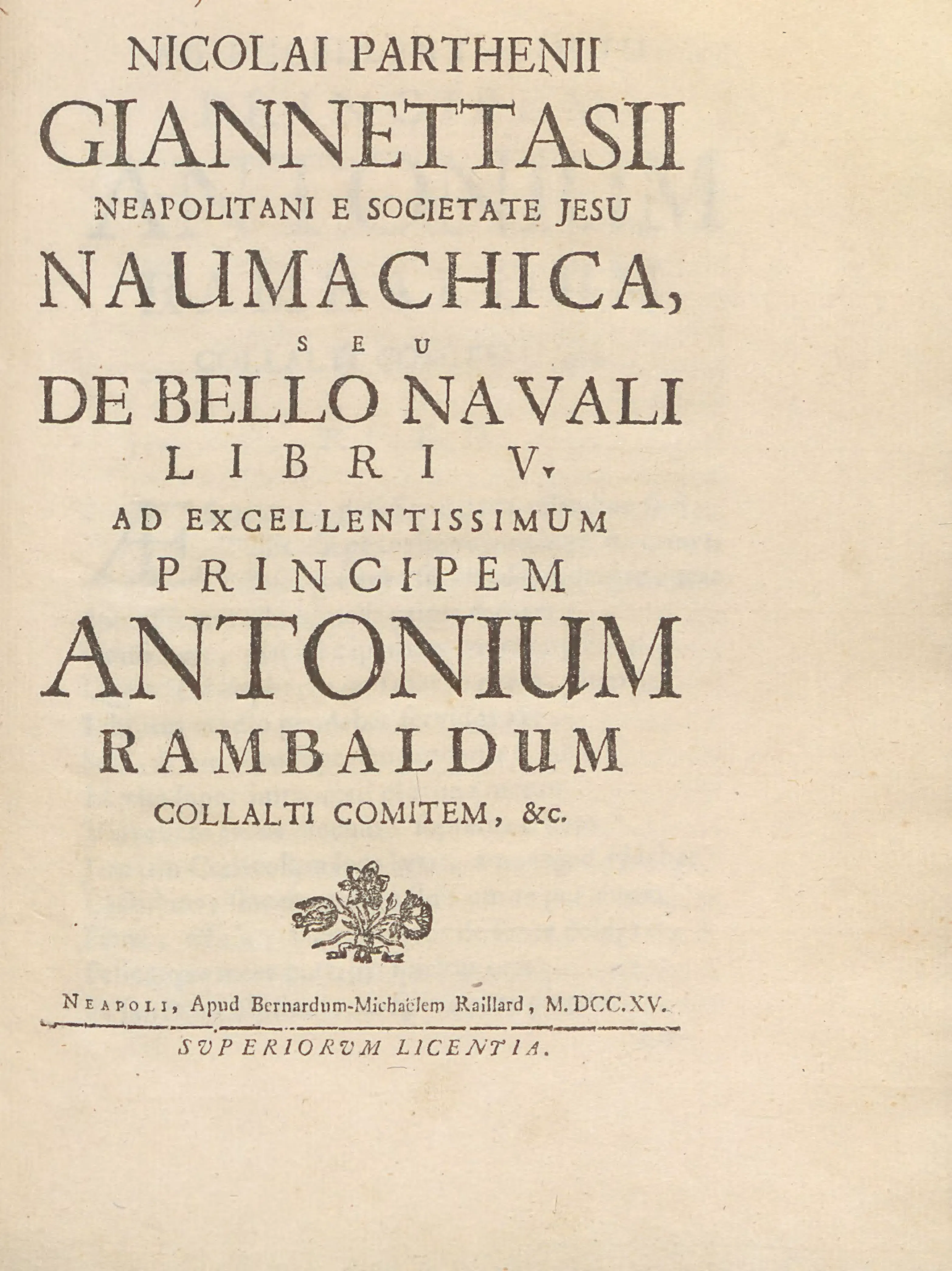
Giannettasio's title page stages the work's identity typographically: Naumachica glossed by seu De Bello Navali Libri V. The same page names Bernardo Michele Raillard's Neapolitan press and Antonio Rambaldo di Collalto as dedicatee, and closes with Superiorum licentia — patronage, printing, and licence made part of the book's self-presentation. Source ↗.
The title's Graeco-Latin surface is continuous with a lexical procedure that runs through the poem's technical exposition, and it is a procedure the verse itself thematizes. Introducing a class of warship, Giannettasio observes that in this age the crowd of lesser Italians calls them by a smaller name, whereas the Greeks of old called them Penteres, Hac ætate vocant Italorum turba minorum, Penteres Graii quondam dixere vocantes, so that the ancient nomenclature is presented not as a euphemism for modern equipment but as its proper and more honourable designation, with the vernacular name acknowledged as the living usage from which the poet has translated upward. The same double motion governs the instruments of navigation. Among the sciences the commander is obliged to master, the poem requires that he thoroughly grasp the nature of the winds, the alternating variation of the sea's tide, and the use of the compass, Ventorum hic teneat naturam plurimus, æstum Et pelagi alternis variantem, & pyxidis usum,, where pyxis — in classical Latin simply a small box — carries the whole burden of the magnetic compass, and is returned in the accompanying annotation to its working name La Bussola. Comparable glossing attaches to the powder room as pyria cella (Santa Barbara) and to incendiary vessels as ignivomæ carinæ (Burlotti). The poem's Latin is thus doubly referential by design: classicizing in the verse, technical and vernacular in the notes.
The Roman coloration extends from ship-types to command structure and staff practice. Fleet officers are named with the vocabulary of Roman magistracy — Prætor, Consul, Legatus — and naval discipline is codified in the manner of law, with provisions on fire, theft, watches, and cowardice. Written signal instructions receive an antiquarian pedigree in the same way: the poet advises that tablets inscribed in the Spartan manner may be handed to each of the commanders, Idcirco, (1) tabulas inscriptas more Laconum Tradere cuique Ducum, poteris, quibus ipse futuri, the note beneath returning the Lacænæ Scytalæ to contemporary practice as Lettere scritte in cifra, letters written in cipher. The Laconian precedent legitimates a modern procedure without concealing it; this is the poem's habitual way of making novelty admissible.
The approbatory language gives pietas a distinctly institutional and confessional force. The reviewer praises the work for preserving “Fidei puritatem” and “morumque sanctimoniam” and for promoting “eruditionis & pietatis.” In this setting pietas is not limited to classical filial duty or private devotion: it joins doctrinal orthodoxy, moral discipline, and learned usefulness. The same approval describes the book as contributing to the adornment of the res publica, a public-utility vocabulary that makes literary erudition legible to ecclesiastical and civic authorities. The poem's own hortatory passages use the cognate vocabulary in the same institutional key, as when the poet turns to address all who hold the sceptres of peoples, charging them anxiously to defend the ancient rites of the Fathers and to ward off new customs and new dogmas, Vos igitur quotquot populorum sceptra tenetis; Solliciti veteres Patrum defendite ritus, Et mores arcete novos, nova dogmata, sanctam. Here ritus and dogmata are not neutral descriptors of religious variety but terms of jurisdiction and obligation, addressed to princes in their capacity as guardians of established observance; the antithesis of veteres ritus and nova dogmata is the confessional counterpart of the poem's antiquarian lexical practice, in which the old name is always the authoritative one.
The poem's northern-war horizon is best placed beside mare clausum and dominium maris. In seventeenth-century legal and political language these were arguments about jurisdiction, sovereignty, navigation, and the right to command or exclude at sea, not merely descriptive terms for enclosed water. The long controversy surrounding Grotius's Mare liberum and Selden's Mare clausum supplies a historically precise frame for reading naval conflict, flag salutes, and claims to maritime dominion. The accessible witnesses do not establish that either phrase occurs verbatim in every relevant passage of Naumachica; the connection is therefore a contextual and philological interpretation rather than a claim about an unverified line of text. What the verse does supply is a figurative equivalent of the exclusive claim: assigning the cause of the northern wars, the poet says that they aimed to hold the foaming reins of the Ocean alone and to range it with great ships, Scilicet Oceani spumantia lora tenere Soli affectabant, magnis & currere Gaulis:. The metaphor of reins (lora) belongs to the vocabulary of governance and mastery rather than of navigation, and the emphatic soli, “alone,” states the exclusionary content that the juridical literature debated under the technical phrases — evidence that the poem participates in the controversy conceptually, whether or not it adopts its terminology.
What Naumachica Is: Author, Date, and the 1715 Neapolitan Imprint
Naumachica, seu De Bello Navali Libri V is best classified as a five-book Neo-Latin didactic epic or poetic treatise on naval warfare. Its author is the Neapolitan Jesuit Niccolò Partenio Giannettasio (Latin: Nicolaus/Nicolaus Parthenius Giannettasius), born at Naples on 5 March 1648. He entered the Society of Jesus on 7 September 1666, taught in several Jesuit institutions, taught mathematics at the Naples college through 1705, and then retired to Sorrento for study. The DBI records his death on 10 September 1715.
That generic classification is also the poem's own. Its opening programme announces that the poet will begin to sing from this point so that he may encircle with a naval wreath the brows already bright with the laurel of war on land, Hinc canere incipiam; terrestri ut fulgida lauro Tempora, navali valeam quoque cingere serto, a formulation that presents the work simultaneously as an epic undertaking, as a sequel to the earlier poem on land warfare, and as the completion of a career-long cycle. The sertum navale is the figure under which the poem's didactic and its heroic ambitions are held together.
The book was printed in Latin at Naples by Bernardo Michele Raillard in 1715. Its subtitle identifies its driving subject as de bello navali, while its didactic mode joins seamanship and naval knowledge to moral, confessional, historical, geographical, and dynastic purposes. The accessible evidence supports preparation and licensing in 1714: a Jesuit approval is dated 21 June 1714 in the surviving OCR, an archiepiscopal review is dated 22 November 1714, and a later secular licence is dated 26 November 1714. The exact place of composition is not securely fixed. Giannettasio's retirement to Sorrento explains the Sorrento association, but the dated approval explicitly comes from the Neapolitan college.
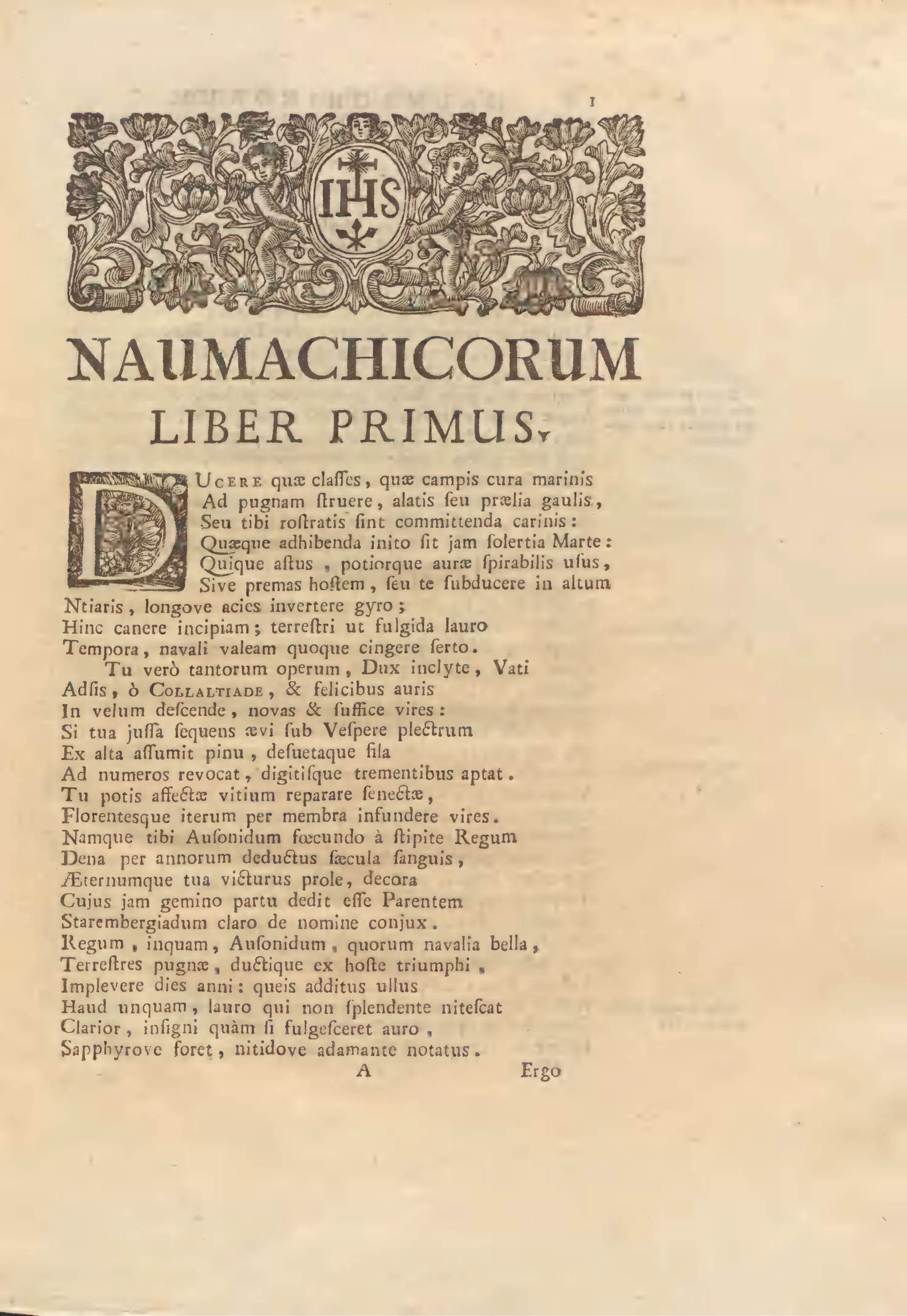
Book I opens beneath a Jesuit IHS headpiece, the confessional frame in which Raillard's 1715 edition presents naval war as learned, morally useful instruction. Its proem moves from the sertum navale — a naval garland crowning earlier land-war poetry — to the invocation of Antonio Rambaldo di Collalto. Source ↗.
The volume appeared in the year of the author's death, but the evidence does not establish its month of publication or prove that it was issued after his death. It is safer to call it a 1715 imprint prepared through 1714 than to label it unequivocally posthumous. The poem's own voice, it should be said, speaks as though composition were a race against mortality: at the threshold of the last book the poet declares that pitiless Clotho already hastens the work and labours to finish the spun thread, looming dark over his neck, Jam maturat opus, fusumque explere laborat Immitis Clotho, & cervicibus imminet atra,. This is a topos of late-life composition consistent with the paratextual description of the poem as written in ultima senectute, and it corroborates a late date of writing; it does not by itself settle the sequence of the author's death and the book's issue.
The language is Latin. No complete, authoritative modern translation was located. A 2025 web article states that Naumachica was translated into English prose with commentary and selected verse translation, but the accessible record does not identify the translator, title, publisher, date, or whether the whole poem was translated. That claim should therefore be treated as provisional rather than as evidence of a completed scholarly translation.
Why Naumachica Matters: Jesuit Poetics, Sea Power, and Confessional Polemic
The poem matters because it brings together several domains that are often studied separately: Jesuit pedagogy, Neo-Latin didactic poetry, the material culture of navigation, the political vocabulary of maritime sovereignty, Catholic confessional polemic, Neapolitan local memory, and aristocratic patronage under Habsburg rule. It is not simply a Latin imitation of Virgil. Its subject makes technical knowledge, naval command, cosmography, and the moral evaluation of warfare part of a learned poetic performance.
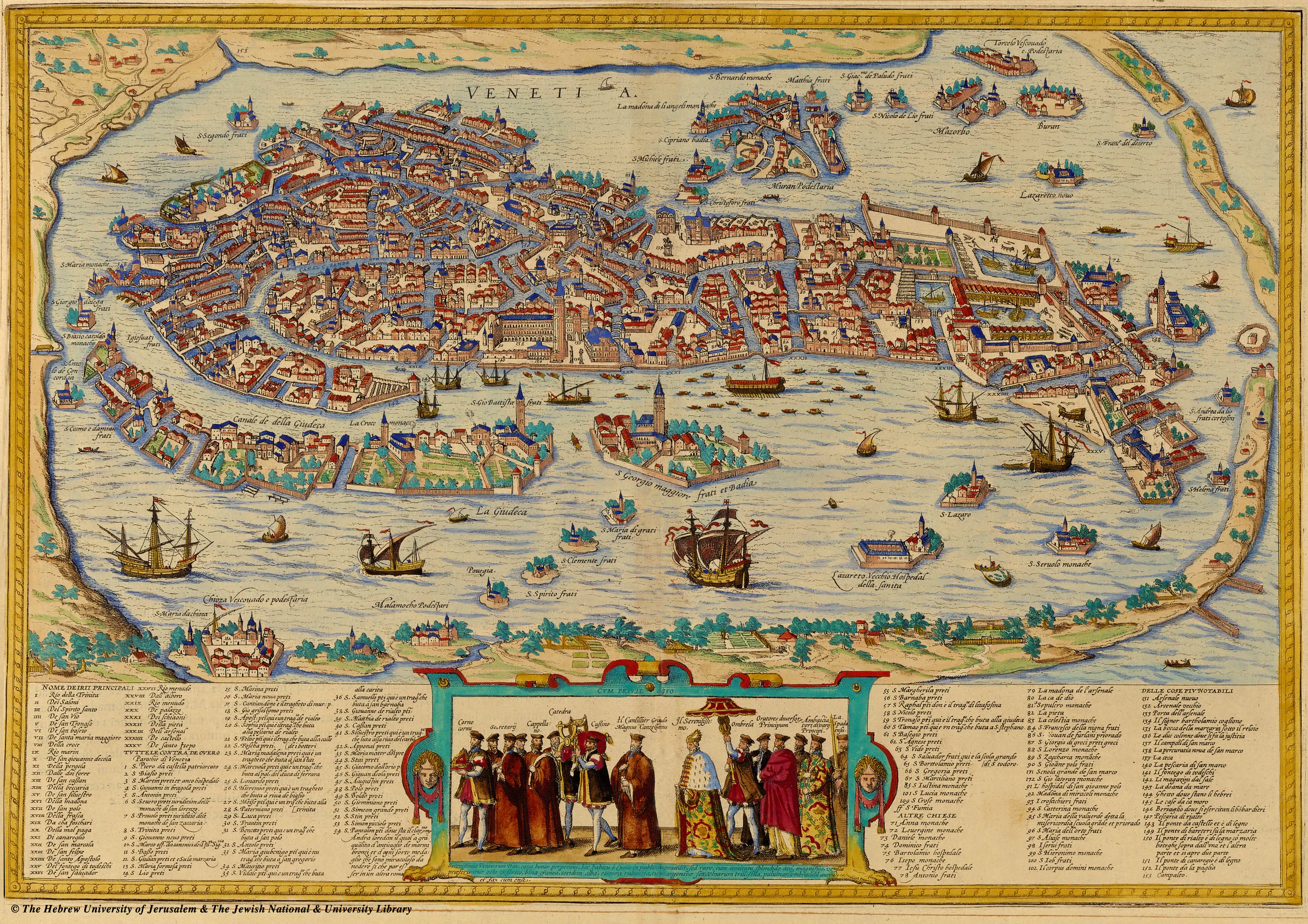
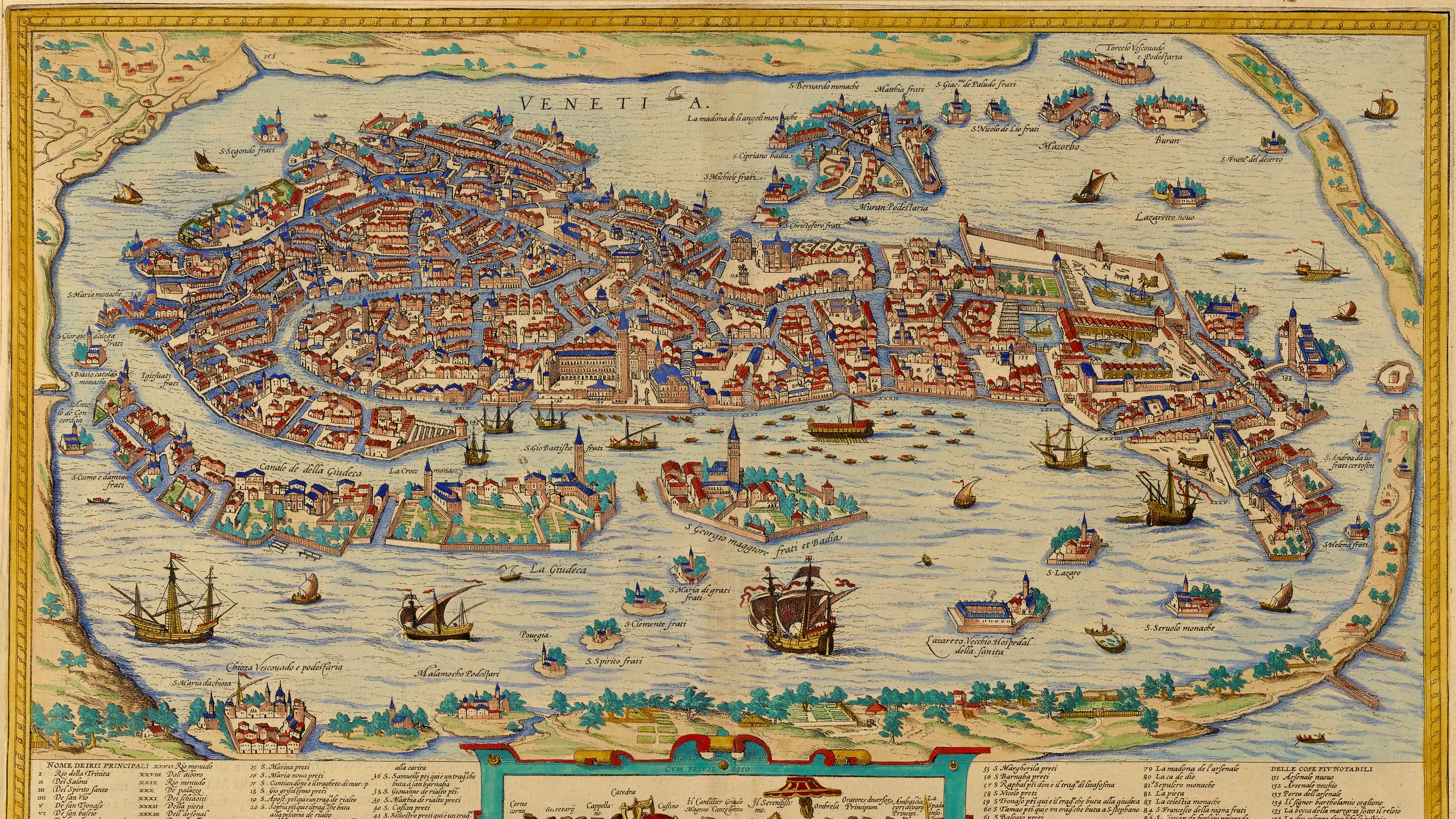
This 1572 city-view holds Venice within its lagoon, dense islands ringed by working water and vessels — the paradox Giannettasio makes central: stability wrested from the unstable sea. It helps explain why Venice could serve as his proof-case that fleets are the breath of empire. Source ↗.

The poem's argument for sea power is stated as a doctrine about the constitution of empire, and it is here that the double translation described above acquires political consequence. Giannettasio first offers an analogy: just as rivers are joined by a bridge laid across them, so that one may freely range over either bank, Nam velut instrato sociantur flumina ponte, Quò liber valeas utramque excurrere ripam,, and then draws the inference that the mass of empire, however vast, will lie torpid and cast down, robbed of its own vigour, if fleets — its very breath — be lacking, Sic etiam Imperii moles, vastissima quamvis, Torpescet dejecta, suo privata vigore, Si classes delint, nimirum spiritus;. The identification of a navy with the spiritus of the body politic imports a physiological and, in a Jesuit register, quasi-animate vocabulary into the discussion of maritime power. Historical proofs follow the doctrine: at no other time, the poem asserts, did the Roman state grow than when it trod the great sea with turreted chariots, Tempore non alio crevit Res Romula, quàm cum Magnum turritis calcavit curribus Æquor, and the reader is directed to behold, in the recess of Adriatic Doris, the city which the Venetians, most illustrious offspring of heroes in war, set amid the shallows and made stable upon the unstable sea itself, Aspice in Adriacæ secessu Doridos Urbem, Quam Veneti Heroum soboles clarissima bello, In mediis posuere vadis; stabilemque sub ipso Instabili fecere mari:. The reciprocal figure completes the argument, since ships are cities in the midst of the waves and every part of a fleet is a province, (Sunt etenim naves mediis in fluctibus urbes, Quælibet & classis pars est Provincia) regni — a formulation that makes the vocabulary of Roman magistracy applied to fleet officers something more than ornament, since a squadron so conceived genuinely requires governing.
Technical instruction is integrated into this frame rather than subordinated to it. The tactical heart of the poem's doctrine, the possession of the weather gauge, is presented as the single decisive variable, with the injunction that the greatest care must always be given to the winds, that nothing is to be observed more attentively, and that the whole victory depends on them, Maxima ventorum idcirco tibi cura adhibenda Semper erit: ventis nec quidquam impensiùs unquam Oblerva; nam tota illis victoria pendet. The formulation illustrates why the poem cannot be read as ornamental classicism: a claim of this kind is answerable to seamanship, and is offered as such.
Claudia Schindler provides the most directly relevant modern interpretation. Her 2016 chapter argues that Giannettasio's poetry helped form a Neapolitan Jesuit “microculture” grounded in local references to the Bay of Naples and its literary inheritance, while remaining saturated with Jesuit doctrine and networks. She reads the apparently secular and mythological surface of the poetry as compatible with the Society's intellectual and religious purposes. Scientific description, in this account, is not an abandonment of devotion: learned investigation becomes a way of displaying the intelligibility of creation and of making Jesuit intellectual culture attractive. Her discussion is strongest for Nautica and the related didactic corpus; the accessible passages do not provide a full Naumachica-specific reading or establish a determinate audience for this volume. Two features of the naval poem sit easily beside her account. The first is its recourse to autopsy in the Campanian setting, the poet reporting that with these very eyes they themselves beheld a horrible shipwreck and ships lost in the whirlwind, when a dreadful night came on, Naufragium horrendum, atque amissas turbine naves Hisce oculis ipsi spectavimus, horrida cùm nox, a local eyewitness claim that grounds technical authority in the harbour the poet knew. The second is the explicitly providential construction placed on human invention and discovery: there is a God, there is indeed, the poem declares, who by sure purpose sets such enterprises in motion, since these things cannot happen without divine power, Est Deus, est, inquit, certo qui numine tanta Orsa movet: Nequeunt namque hæc sine numine fieri. Learned inquiry and devotion are, on this showing, joined rather than merely juxtaposed.
The poem's claim for modernity should be registered alongside its antiquarianism, since the two are not in tension in its own economy. Against the geographical limits of ancient knowledge it observes that bold later men have now furrowed the whole ocean far and wide, have reached new lands, and have found new men and new beasts, At nunc audaces jam sulcavere minores Latè omnem, terrasque novas adiere, novosque Invenere homines, nova bruta, aliasque sub undis. The minores, the later and lesser men, surpass their predecessors in fact while continuing to receive their vocabulary from them; Archimedes remains the Syracosius Magister and Pythagoras the Præceptor Samius even as the fourth part of the world is added to the map.
Yasmin Haskell's Loyola's Bees supplies the wider historiographical framework for Jesuit Latin didactic poetry, especially the relationship between literary production, ideology, institutional labor, and the Catholic Reformation. Haskell's field-level approach helps prevent Naumachica from being treated as an isolated antiquarian exercise. It also encourages attention to the labor of teaching, annotation, compilation, approval, and circulation behind the polished Latin poem. Schindler emphasizes local Neapolitan specificity; Haskell supplies the broader Jesuit literary history. These emphases complement rather than directly contradict one another.
Fernando Navarro Antolín's 2024 study of cohortatio in Giannettasio's Bellica and Naumachica shifts attention toward rhetoric, especially the form and function of martial exhortation. The accessible record confirms the subject and date but not the complete journal citation or page range, so the article is a useful recent lead whose bibliographic details require checking against the published issue. Its importance lies in treating the war poems as structured acts of persuasion rather than as neutral repositories of naval information. The poem offers abundant material for such an approach, and not only in set speeches to fleets: its confessional and ethical apostrophes are exhortations directed past the narrated combatants to the reader. Its ethical maxims work in the same way, as when the poet enjoins the commander always to make haste slowly in the midst of the sand, adding that Caesar, the first who obtained all the government of the world, used sometimes to chant this in Greek speech even amid battles, Idcirco lentè festina semper arena In media; græco quondam sermone solebat Occinere interdum media inter prælia, primus Omnia qui Mundi obtinuit moderamina Cæsar — a maxim transmitted through a chain of translation from Greek proverb to imperial practice to Latin hexameter, and thus a miniature of the poem's whole procedure. The counterweight to martial exhortation is the poet's recoil from what he narrates: Father Apollo shrinks from these spectacles, taking no joy in the dire killing of men nor in shed blood, refugit pater hæc spectacula Apollo; Nec nece dira hominum, fuso nec sanguine gaudet, a disavowal placed within the same books that teach how such slaughter is efficiently produced.
The poem's maritime politics belong to the historiography of early modern oceanic jurisdiction. Martine Julia van Ittersum's work on the debate between Mare liberum and the propriety of the seas clarifies the legal and political genealogy behind claims to maritime freedom, possession, exclusion, and command. J. R. Jones's history of the Anglo-Dutch wars supplies the naval, political, and economic chronology needed to test the poem's allusive historical matter. These works do not prove the identification of every Latin proper name in Naumachica; they establish the contextual fields against which such identifications should be checked. That caution is worth pressing, because the poem's treatment of the northern commanders is confessional as much as it is historical. Of one great captain it says that here that giant, great in valour, went down to Orcus, to suffer in fire the penalties of a deserted Faith, Hic magnus virtute gigas descendit ad Orcum, Desertæ Fidei poenas passurus in igne: valour is conceded, damnation follows from apostasy, and the manner of death by fire is made to answer to the offence. Which commander the passage designates is exactly the sort of identification that requires line-by-line verification against a reliable text rather than inference from the surrounding narrative.
The confessional dimension is not incidental colouring but an explanatory scheme. Incendiary warfare at sea is given a datable origin in the English breach with Rome, introduced by the temporal clause that at that time, when the Britons revolted from the laws of Latium and, loathing the ancient rites, went off into new rites and profane worship, Tempestate illa, qua descivere Britanni Legibus è Latiis, antiquaque sacra perosi In ritus abiere novos, cultusque profanos, so that a technical innovation is made the consequence of a doctrinal one. The polemic descends to personal invective, the poem reporting that above the rest they feared dread Elizabeth, a horrendous monster, at once man and woman, a noble whore, At reliquos supra dira Elisabetha timebat. Monstrum horrendum, eadem vir, foemina, nobile scortum. The Virgilian tag monstrum horrendum here performs the same translating function as the poem's technical lexicon, supplying an epic register for a contemporary confessional judgement.
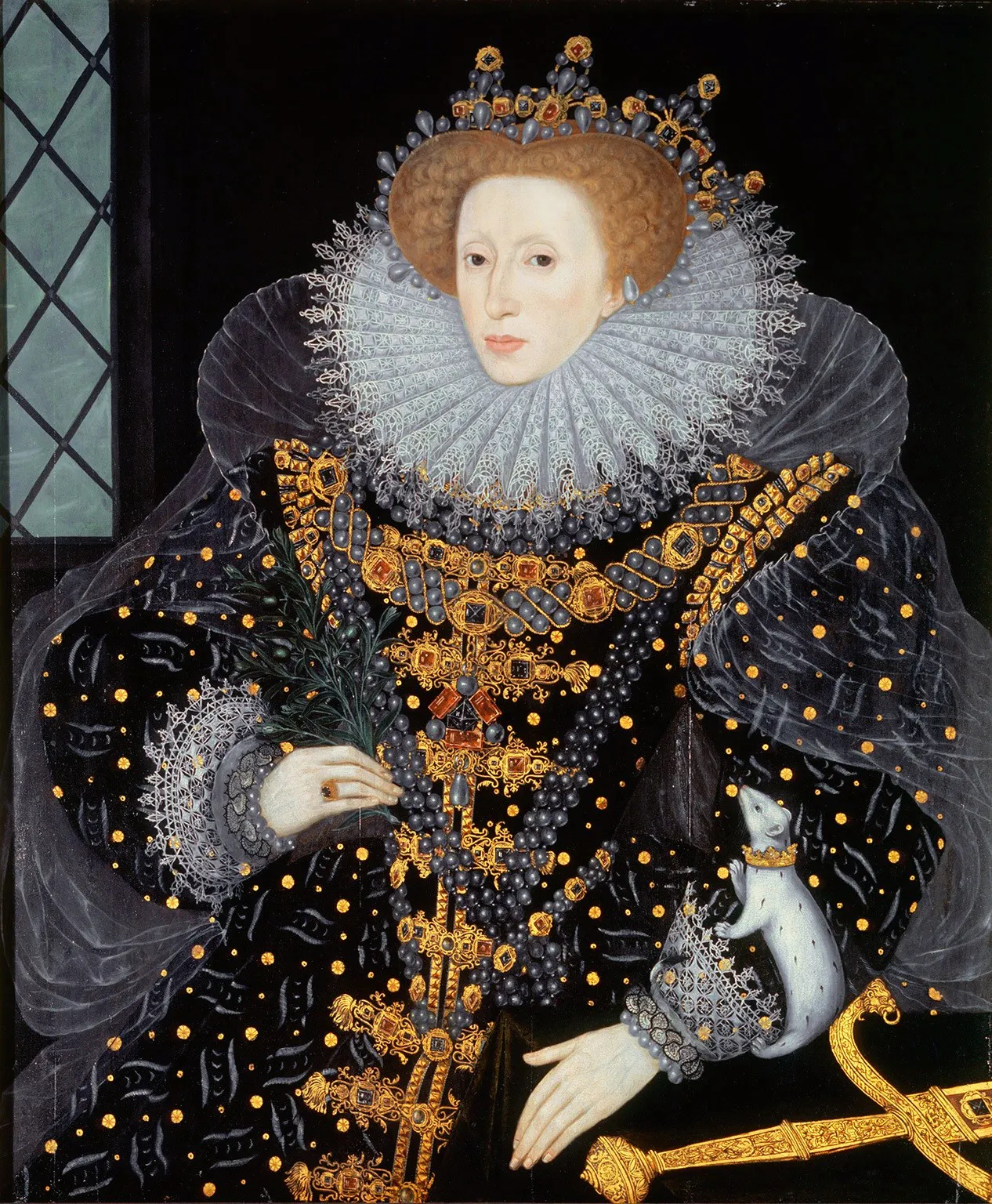
A period portrait of Elizabeth I, presenting the queen in the managed splendour of Tudor royal iconography. Set beside Giannettasio's dira Elisabetha, it measures the distance between that self-fashioning and a poem that makes her reign the confessional origin-point of English fireship warfare. Source ↗.

Against this stands the crusading counter-model, and it is the register in which the poem's Mediterranean and dynastic material is organized. Lepanto is presented as a victory left incomplete, the poem asserting that the empire of the Turks would have been overthrown and all Greece already restored to the ancient rites of the sons of Romulus, Eversum imperium Turcarum, & reddita priscis Romulidum sacris jam Græcia tota fuisset. The Knights of Malta and Rhodes are addressed as the citadel of Italy and the ramparts of Rome, Vos arx Italiæ, vos propugnacula Romæ,, a formulation that assigns to a religious order the defensive function elsewhere attributed to fleets. Ottoman magnificence is admitted only to be classified, the ruler of the East, the Ottoman, having built an immense bulk of a gaulus, a splendid pageant, to be sure, of barbaric luxury, Immensam Gauli molem Regnator Eoi Struxerat Othomanus: Nimirum splendida luxus Barbarici pompa,, where the concessive nimirum allows the splendour while the epithet barbarici denies it moral standing — the ekphrastic globes aboard that vessel notwithstanding.
The patronage history adds a further political dimension. Renzo Derosas's DBI entry states that Antonio Rambaldo di Collalto financed the Raillard publication of Giannettasio's complete poetic works and that the several volumes were dedicated to him. Collalto's imperial and Moravian connections make the dedication an important instance of literary patronage crossing Neapolitan, Venetian, and Habsburg worlds. The inference that the poem consequently promotes a simple Austrian political program would go beyond the evidence. What can be established is a material relationship between a Neapolitan Jesuit poet, a major printer, and an imperial court-connected patron. The poem's Italian patriotism, moreover, is voiced in terms of loss rather than of any single dynastic settlement: it declares that Italian valour lives yet, though torn apart — alas, the fates of the gods and the turns of changeable Fortune, Vivit adhuc, distracta licet, proh Fata Deorum, Fortunæque vices variabilis! Itala virtus:. The lament over distracta Italy is consistent with several political postures and does not by itself license a partisan reading.
The principal historiographical deficiency is bibliographical rather than interpretive. No modern critical edition, complete scholarly translation, or comprehensive monograph devoted solely to Naumachica was located. The exact historical referents of names such as Opdamus, Trompius, Ruiterus, Sanvichius, and Estraeus should therefore remain subject to line-by-line verification against a reliable scan or critical text. The same caution applies to the proposed 1694 edition: the accessible catalogues confirm 1715 but do not independently confirm a 1694 issue.
Tracing the Raillard Imprint: Witnesses, Licensing, and the Collalto Patronage
Bibliographic identity and witnesses. The secure standalone imprint is Nicolai Parthenii Giannettasii Neapolitani E Societate Jesu Naumachica: Seu De Bello Navali Libri V, Neapolis, apud Bernardum Michaëlem Raillard, 1715. The title-page imprint line is itself part of the volume's self-presentation, reading, at Naples, at the press of Bernardo Michele Raillard, 1715, NEAPOLI, Apud BernardumMichaëlem Raillard, M. DCC. XV. The Bayerische Staatsbibliothek/MDZ record identifies the author as Giannettasio, Niccolò Partenio, 1648–1715; gives the digital object identifier bsb10991307, BSB identifier 991043761069707356, and OCLC 643930912; and records a call-number form beginning 4 P.o.lat. Its extent is [8] leaves, pages 1–90, [6] leaves, pages 91–353, and the record says that the item is “bound with (1).” That longer extent belongs to a bound-with object and should not be imposed on every standalone copy.
A University of Seville copy digitized through the Internet Archive is catalogued as A1112126, ark:/13960/t82k6j462. Its catalogue description gives [8], 90 pages, [1] blank leaf, quarto format, signatures []4, b4, A–M4, a typographical mark on the title page, and marginal annotations. The item was contributed by the Biblioteca de la Universidad de Sevilla. The record does not establish an engraved frontispiece or plate for this standalone witness.
The Real Academia Española record 12-II-49 describes a composite quarto volume containing Bellica and Naumachica, with a much more complicated extent and a plate. The recorded plate and dates in that composite description belong to other material in the bound volume and cannot safely be assigned to the 1715 Naumachica. A Mexican catalogue record, Biblioteca del Convento de San Pablo, Yuririahupándaro, also records Naumachica seu de bello navali libri V as a Naples 1715 literary imprint, but it does not replace the fuller physical descriptions above. No USTC or ICCU record with a verified independent collation was located; the OCLC/BSB and Seville witnesses provide the firmest bibliographic footing.
The work is also encountered as the first item in a bound Opera omnia poëtica record. No manuscript predecessor, authorial fair copy, or transmission chain has been established. The digitized objects are facsimiles of printed witnesses, not modern editions.
Printing and licensing. The imprint names Bernardo Michele Raillard. Giovanni Lombardi's 2004 study of the Raillard family enterprise describes the firm as one of the earliest major family enterprises in the Neapolitan publishing market, with a workshop regarded by contemporaries as the principal one in the Kingdom and equipped with a type foundry. Lombardi also warns that the familiar portrayal of Raillard as a French operator arriving in Naples in the 1670s was repeatedly transmitted through a stereotyped historiography and requires closer documentary control. The exact family relationship between the Bernardo Michele named in the 1715 imprint and the Giacomo Raillard central to Lombardi's study, as well as a specific Raillard-Jesuit business relationship, could not be established from the accessible evidence.
The front matter reveals a three-stage approval process, though some institutional details remain illegible. First, the OCR reads “MAURITIUS AB ANTONELLIS” and identifies him as Praepositus Provincialis Soc.; the same passage refers to authority received from P. Michaele Angelo Tamburini. The Latin forms are secure in the OCR. The Italian normalizations Maurizio de Antonellis or degli Antonelli and Michelangelo Tamburini are plausible, but the former was not independently confirmed in a specialist biographical record. The relevant Jesuit approval is associated with a 21 June 1714 date in the OCR.
Second, the archiepiscopal review names Januarius Majellus. It refers to the seminary of the Archiepiscopal institution and to a reviser's report, followed by an Imprimatur. The OCR gives the date as 22 November 1714. “Gennaro Maiello” is a reasonable Italian normalization of Januarius Majellus, but the accessible evidence establishes the Latin form more securely than the vernacular identity.
Third, the secular formula reads, with obvious OCR corruption, “Visa relatione imprimatur” and “Regia Pragmatica.” A later notation is dated 26 November 1714. The phrase is also attested in other Neapolitan imprimatur formulae, but the exact royal pragmatic invoked for this book has not been identified. Neither the name of the Cappellano Maggiore, the Delegato della Real Giurisdizione, nor a viceroy's personal signature is legible in the accessible witness. Tertiary lists place Wirich Philipp von Daun in the Neapolitan viceroyalty from 1713 to 1719, but that does not prove his personal involvement in this licence. The title-page formula Superiorum licentia likewise remains unverified as an exact reading of the surviving scan. There is no evidence of suppression, prohibition, or loss; the surviving printed witnesses and multiple digital records attest continued transmission.
Dedication, patronage, and paratext. The dedicatee is Antonius Rambaldus Collaltius, Antonio Rambaldo di Collalto. The DBI records his birth at San Salvatore di Collalto on 9 March 1681; inheritance of the Moravian estates of Pirnitz, Rudoletz, and Cerna; marriage in Vienna in 1708 to Eleonora Starhemberg; imperial court titles and offices; and death at Pirnitz on 26 December 1740. Most importantly for the book's object biography, the DBI states that Collalto paid the entire cost of the Raillard edition of Giannettasio's poetic works.
The dedicatee is present in the poem as a figure demanded by the genre itself. The verse dedication presents the patron to the Muse in epic terms, announcing that behold, a new and great hero, Collalto, offers himself to you, worthy even of Mantuan song, En novus, en Magnus offert COLLALTIUS Heros Se tibi, Mantoo dignus vel carmine, tantis, the appeal to Virgil (Mantoo carmine) making patronage and poetic succession a single claim. The reciprocal expectation is stated at the poem's close, where the poet asks his patron to receive the homage of his bard together with a fame that will live into the ages, Articulis pulsanda, tui tu suscipe Vatis Obsequium, & nostram victuram in sæcula famam,. The bargain is the conventional one of Latin panegyric — the patron's name preserved by the verse, the verse sustained by the patron — and it sits alongside the Collalto crusading ancestry invoked earlier in the poem, which links the dedication to its Mediterranean and confessional material rather than to any narrowly dynastic program.
The accessible OCR does not securely support the often-repeated dedication date of 1 November 1714 from Sorrento. It gives a Neapolitan college date of 22 November 1714 for one approval, a later licence dated 26 November, and an undated reference to Sorrento in an Italian sonnet. The safest conclusion is that the poem was associated with Giannettasio's Sorrento retreat but passed through a Neapolitan licensing and printing process in late 1714. The OCR also preserves a paratextual list of earlier works—Cosmographia, Geographia, Nautica, Halieutica, Bellica, and Historia Neapolitana—and says that the five-book naval poem was composed in ultima senectute. That paratextual placement is explicit, the notice recording that to these the Naumachica had to be added, in which the author embraced naval war in five books in his extreme old age, and dedicated to Count Collalto, His Naumachica erant adjungenda, quibus Author quinque Bellum Navale libris in ultima senectute complexus est, & Comiti Collalto,. The gerundive erant adjungenda is telling: the naval poem is presented not as a fresh departure but as the completion required by a corpus already extending across cosmography, geography, navigation, fishing, the seasons, land warfare, and Neapolitan history — the same logic of completion the poem itself expresses through the figure of the naval wreath. The exact tetrastichon and all of its footnotes are not sufficiently legible to reconstruct reliably. The approval does, however, praise “Marones” and “Papinios” and explicitly links erudition, faith, morals, and public usefulness. Its terms are worth registering in full: the censor commends five books of naval warfare in which not only the Maros and Statiuses but other supreme poets of the homeland live again in style, Bellicorum Navalium libros quinque, in iisque non modo Marones, Papiniosque, atque alios summos Patriæ nostræ Poëtas redivivos stili. The judgement is generic as well as doctrinal: approval is granted to a work whose stilus is held to revive Virgil and Statius alongside the Neapolitan vernacular and Latin masters, so that the same document that certifies orthodoxy also certifies the poem's classical pedigree — precisely the pairing of eruditio and pietas that the licensing vocabulary makes a condition of publication.
Related works and reception. Tarzia's DBI account lists Piscatoria et nautica (1685), Halieutica (1689), Bellica (1697), the seasonal poems Aestates Surrentinae (1696), Autumni Surrentini (1698), and Ver Herculanum (1704), and notes the later posthumous Annus eruditus (1722). A 2024 article record gives Bellica as 1699, so the date of that related work requires bibliographic reconciliation rather than silent harmonization. The 1715 Naumachica belongs to this expanding sequence of maritime, scientific, seasonal, geographical, and historical writing. The accessible evidence records approbatory praise but no identifiable contemporary refutation, counter-poem, trial, or suppressive proceeding.
The alleged catalogue conflation with Johann Hartmann's Opera omnia medico-chymica cannot be responsibly attributed to a repository. The accessible A1112126 record contains no Hartmann, medical, or Opera omnia medico-chymica linkage, and the BSB/OCLC record likewise yielded no such connection. Separate catalogue records identify Hartmann as a German medical author, 1568–1631, and describe the 1684 Opera omnia medico-chymica as a medical work printed by Balthasar Christoph Wust's press for the Seyler widow. The two bibliographic identities are therefore demonstrably distinct, but the particular repository said to have merged them remains unlocated.
Reading the Five Books: From Mercury's Commission to the Cadmean Victory
The dedicatory frame: vocation on the Sorrentine shore
The volume's argument begins before any doctrine is stated, in a dedicatory poem that is itself a scene of vocation. The aged poet is placed on the Sorrentine shore among the Sirens, where the first of the sisters is Colomelis, Inter Sirenes Cholomelis prima sorores,, meditating on death and immortality until Cyllenian Mercury descends in sleep and orders the plectrum taken up again for a new patron. The mythographic machinery is not merely decorative: by making the commission a divine mandate delivered in the poet's own coastal topography, Giannettasio binds the patronage relation to the shoreline that his earlier Surrentine poems had already made his poetic property, and he answers in advance the objection that a man in extreme old age should be silent. The claimed rejuvenation that follows is then supported in the manner the whole book will use — an erudite excursus on the Indian who renewed his youth for a thousand years on Gangetic herbs and water, footnoted to a named authority, the note reporting that Olympiodorus the Platonist is the source. Verse marvel and prose citation already work as a pair here, and that pairing is the volume's structural signature.
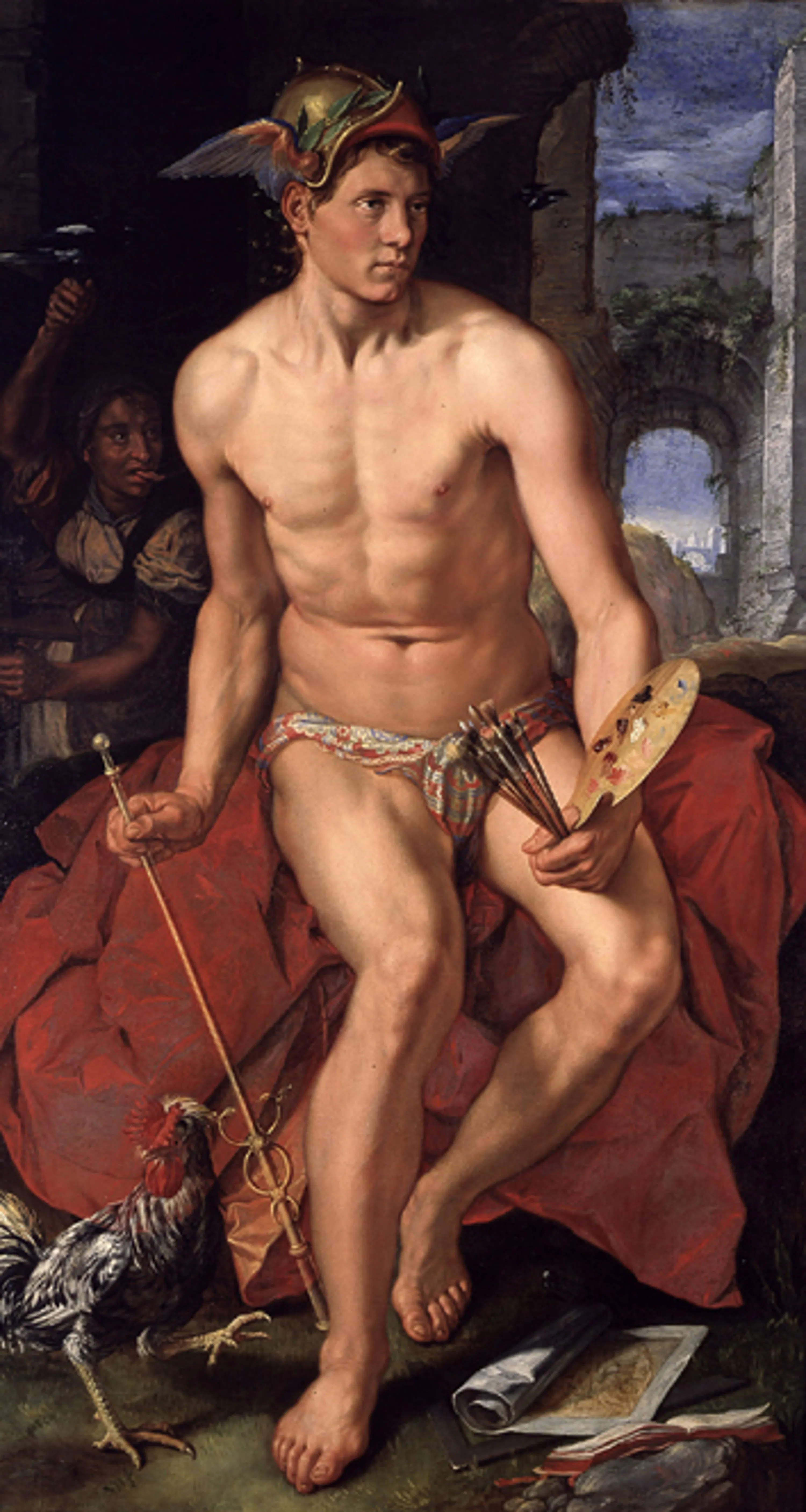
Hendrick Goltzius's Mercury, c. 1611, presents the messenger-god as an agent of motion and command — a fitting counterpart to the Cyllenian deity who descends in the dedicatory dream and orders the aged poet to take up his plectrum again. Source ↗.

Approbation as literary genealogy
The licensing leaves that follow are substantive rather than formulaic, and they show what kind of approval a poem of this sort had to earn. The Jesuit reviser certifies the work by placing it in a specifically Neapolitan humanist genealogy, reporting that at Naples her Sannazaros and Pontanos are not missed, nor the Maros who once dwelt there, Neapoli nec suos desiderari Sannazarios, ac Pontanos, nec veteres olim incolas Marones. The judgement is doubly interested: it certifies orthodoxy, but it does so by asserting a continuity of local literary tenure — Virgil as a former inhabitant of the bay, Pontano and Sannazaro as its later ornaments — which is exactly the claim the poem's own Posillipo and Sorrentine passages advance. Approbation and self-presentation are thus mutually reinforcing, and the two circuits through which the book passed, the Society's internal review with episcopal imprimatur and the viceregal permission subject to royal pragmatic, register the same demand from two jurisdictions: that erudition demonstrate both faith and public usefulness.
The commendatory matter culminates in a quatrain by “Philoparthenius” whose real weight lies beneath the line. Its opening verse announces that the poet teaches the seats of the stars and the limits of the world, Astrorum (2) sedes, & (3) fines edocet Orbis,, with the parenthetical numerals keying each clause to a footnote, and the eight notes together constitute an annotated bibliography of the whole corpus — Cosmographia, Geographia, the Nautica with its piscatory eclogues, the Halieutica, the Surrentine seasonal poems, Ver Herculanum, the Hiemes Puteolanæ, the fifteen books of Bellica, the Historia Neapolitana. The tetrastich is therefore a compression device: four hexameters carry an entire authorial career because the printed page permits the verse to point downward to prose. Within that scheme the naval poem is the last member of a cumulative encyclopedia of sea, land, sky, and city, and the poem's own proem accepts that placement, taking up again the figure already discussed above, the naval wreath to be set about brows bright with the laurel of war on land. The figure is drawn from Roman military decoration rather than from the poetic laurel alone, so that the poet's generic ambition is expressed in the vocabulary of the discipline he is teaching.
Book I: fleets as the breath of empire, and the squadron as province
Book I moves from that programme to a political thesis argued by simile and historical proof: fleets join separated territories as a bridge joins the banks of a river, and without them the bulk of empire lies inert, deprived of the breath that animates it, with Carthage, Rome, and Venice adduced in turn. The thesis reaches its sharpest formulation in the parenthesis noted earlier, where ships are called cities in the midst of the waves and any part of a fleet a province. That parenthesis does real work in the poem's economy. It converts the Roman magistracies applied throughout to naval officers — Prætor, Consul, Legatus — from ornament into consequence: a squadron that is a province must be governed, and what follows is accordingly a codified discipline covering fire, theft of victuals, bilge hygiene, distress lights, watch duties, and the penalties for cowardice, together with councils of war summoned by gun and flag. Statecraft and seamanship are not analogous here; they are the same competence exercised on unstable ground.
The mechanism by which such modern practice is made admissible is visible in the prose apparatus. Written sailing orders receive a Spartan pedigree in the verse, and the note beneath returns the antiquarian formula to current usage, explaining that these are Laconian scytalæ, which the Italians call letters written in cipher, (1) Lacænæ Scy talæ. Itali dicunt Lettere scritte in cifra. The same downward translation governs the poem's most insistent tactical doctrine, that the whole victory depends on the winds; where the hexameters absolutise the principle, the footnotes supply the working idioms of the trade, wind astern, to stand to windward, to maintain, (1) Vento in poppa. (2) Star sopra vento. (3) Mantenere. The direction of movement is worth stressing: the poem does not gloss obscure ancient terms for modern readers, it glosses classicizing coinages by the vernacular phrases a Neapolitan or Venetian seaman already used. Two audiences are addressed on one page without either being told that the other exists.
Book I closes by giving incendiary warfare a mythic and confessional origin, dating it to the English revolt from the laws of Latium and sending the corsair “Draco” north to sacrifice to Dis beneath Hecla, whence the volcano-giant supplies the recipe for powder-laden hulls, so that black Orcus first hammered out that dread invention, the fire-vomiting ships, Sic horrida primùm Ignivomas, inventa, rates niger extudit Orcus. The aetiology is doctrinally efficient — schism produces impiety, impiety produces a weapon that annihilates rather than conquers — but it stands in unresolved tension with the poem's own didactic obligations, since the same books instruct a commander in the deployment of such vessels and in the precautions against them. The tension is not concealed so much as managed by attribution: what is taught as technique is condemned as invention, and the moral hazard is relocated from the user to the inventor.
Books II–III: Lepanto, the case of conscience, and the sultan's globes
The Mediterranean books supply the counter-model. The heavy galleasses are credited with the victory of Lepanto, the poem reporting that by these, as report tells, the palm of Naupactus was won, His, ut fama canit, Naupacti est palma relata: — a judgement in which technical assessment and confessional history coincide, since the same passage argues that concord among the victors would have overthrown the Ottoman empire and restored all Greece to the rites of Romulus's sons. Christian discord, not Ottoman strength, is the explanatory cause, and the Ottoman crescent formations are dismissed as puerile imitation of the moon they venerate. The ethical centre of Book III presses the same distinction into a case of conscience: the defeated barbarian who fires his own magazine reasons that for victor and vanquished to burn on a single pyre is something, is even a victory, Victorem, victumque pyra comburier una, Est aliqua, est etiam victoria, and the note beneath names the space in question by the seaman's term for the powder room. The sentence is given to the enemy in order to be refuted by an ethic of endurance, and the refutation is what distinguishes furor from virtus in a book that otherwise concedes courage freely to its opponents.
That book's showpiece, the ekphrasis of the sultan's flagship and its two artificial globes, is where the poem states its modernity most plainly. Cataloguing the ivory terrestrial sphere, it notes that America besides, the fourth part of things, shone on the opposite side of the globe, Insuper Ammerice, rerum pars quarta nitebat Alterna de parte globi:, and draws from the whole survey the conclusion that bold later men have now furrowed the entire ocean and found new lands, new men, new beasts. The admission that the minores have surpassed the ancients is made on an object of barbaric luxury and immediately subordinated to divine agency, for the exploit that follows — a boy of the Collalto line, called Polenices, terror of the Turks, Turcarum Terror (I) Polenices nomine dictus, riding the yardarm out over the enemy deck — is glossed from the family annals in a note and interpreted by the admiral as proof that God moves such undertakings. The patron's ancestor thus enters the didactic narrative as the inventor of a boarding technique, and providence is made the counter-patent to the infernal one granted at Iceland.
Book IV: dominion of the Ocean and the Cadmean victory
Book IV assigns the northern wars a cause in the claim to exclusive dominion of the sea — the ambition, already discussed, to hold the foaming reins of Ocean alone and range it with great ships — and then narrates the consequence in the poem's most violent image, where at once Opdam's flagship, set alight, leapt whole into the air, a thing pitiable to the eyes, Ilicet Opdami Prætoria tota sub auras Exiliit succensa, oculis miserabile visu — expanded immediately by a Vesuvian simile that assimilates gunpowder catastrophe to the volcanic terrain of the poet's own coast. The verdict on the whole war withholds the satisfaction the narrative has just produced: they conquered, yet it was a Cadmean Victory that shone, Vicerunt: Cadmæa tamen Victoria fulsit,, the Theban topos levelling victor with vanquished and preparing the poet's declaration that Apollo takes no pleasure in such spectacles. Judgement of individual commanders follows the same confessional logic in Book V, where De Ruyter, killed off Palermo, is described as himself given as a victim to harsh Mars among the foremost, carried off dishonourably by Fate and without the honour of a tomb, Ipse vel in primis duro data victima Marti, Sublatus Fato indecore, & sine honore sepulchri: valour in the front rank is conceded, and the denial of burial honours does the polemical work.
Book V: veering winds, measured haste, and the return to the patron
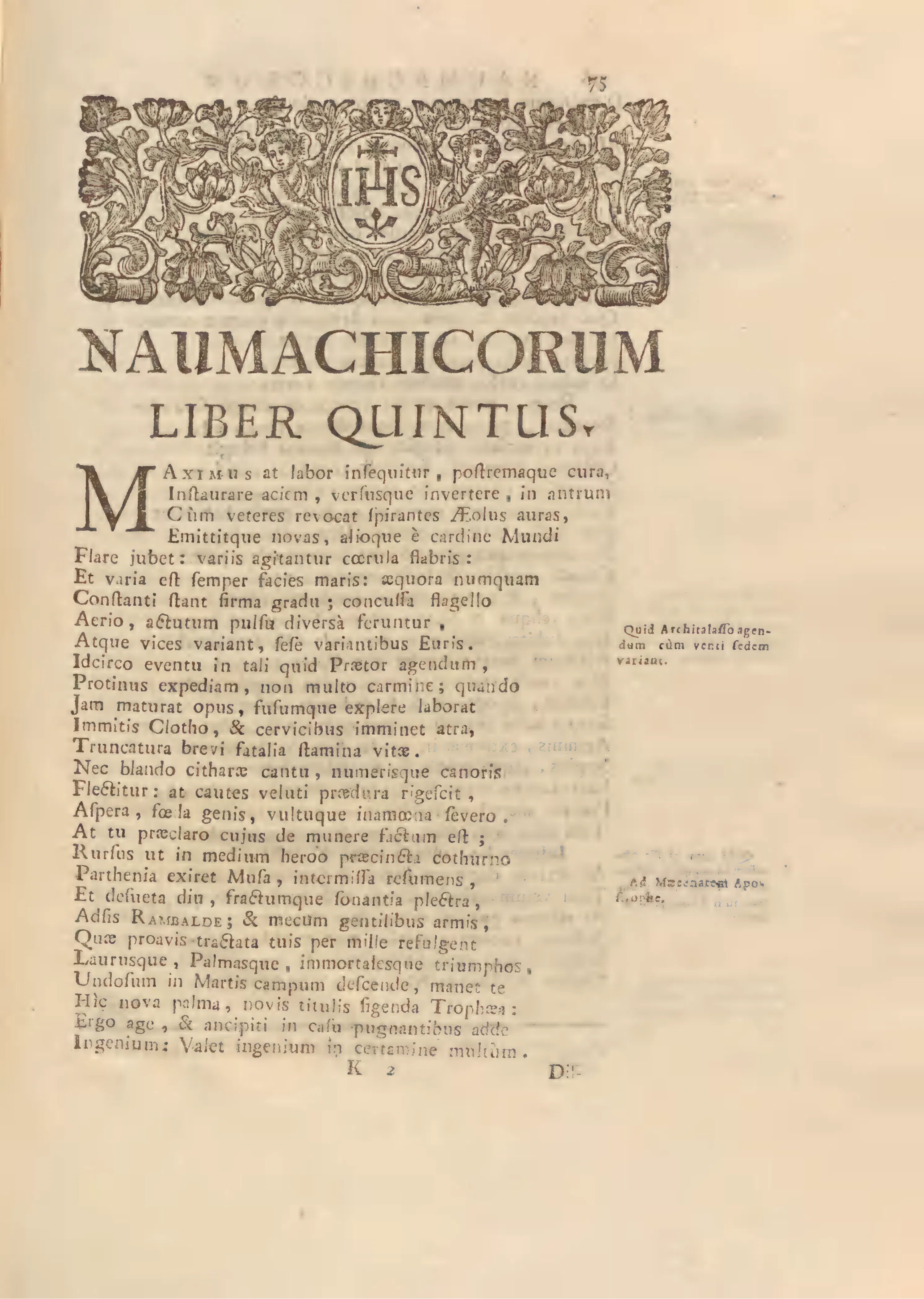
At the threshold of Book V, a Jesuit IHS headpiece and a printed marginal rubric on shifting winds frame the poem's double register: hexameter instruction glossed by prose. The appeal to Clotho and the apostrophe to Rambaldo compress mortality, measured haste, and patronage into a single page. Source ↗.
The last book teaches the re-formation of a line as the wind veers through four, eight, or sixteen rhumbs, authorises deliberate slowness by the Greek maxim Augustus is said to have chanted even in battle, and balances that caution with the doctrine that in narrow straits one must dare. Its closing apostrophe returns the instrument to the hand that commissioned it, asking the patron, in the words considered above, to receive the homage of his bard together with a fame that will live into the ages. The frame opened by Mercury's dream-commission is thereby closed on its own terms: the lyre taken up at divine order is laid down before the man who paid for its printing, and the survival of the naval doctrine is made to depend on the survival of the dedicatee's name.
Frequently Asked Questions
What is Naumachica, seu De Bello Navali Libri V?
It is a five-book Neo-Latin didactic epic on naval warfare, printed at Naples by Bernardo Michele Raillard in 1715. In hexameters equipped with their own footnotes, it teaches a fleet commander how to read the winds, order squadrons into a line of battle, codify discipline against fire, theft and cowardice, site a powder magazine, and use ordnance and the compass, while narrating and judging the sea battles of the poet's own century and the one before it. It is at once a working manual and an epic performance in the idiom of Virgil.
Who was Niccolò Partenio Giannettasio?
A Neapolitan Jesuit mathematician and Latin poet, born at Naples on 5 March 1648, who entered the Society of Jesus on 7 September 1666, taught mathematics at the Society's Naples college until 1705, and then withdrew to Sorrento for study and writing. The Dizionario Biografico degli Italiani records his death on 10 September 1715. Naumachica closes a long cumulative corpus of Latin poems on cosmography, geography, navigation, fishing, the seasons of Sorrento and Herculaneum, land warfare, and Neapolitan history, and was composed, its own paratext says, in extreme old age.
Why does the compass appear as a pyxis in the verse and as La Bussola in the notes?
Because Giannettasio translates twice. Modern practice is first re-clothed in classical dress — the magnetic compass becomes a pyxis, the powder room a pyria cella, fireships ignivomae carinae, heavy galleasses Hepteres, ciphered orders tablets written in the Spartan manner — and then each term is returned in the annotation to the working name a Neapolitan or Venetian seaman would recognize: La Bussola, Santa Barbara, Burlotti, Galeazze, letters written in cipher. The glossing moves downward, from classicizing coinage to living usage, so that a single page can instruct a pilot and satisfy a censor.
Why does the poem condemn fireships as an invention of heresy while also teaching how to use them?
Book I gives incendiary warfare a confessional origin, dating it to the moment when the Britons revolted from the laws of Latium and went off into new rites, and sending the corsair "Draco" north to sacrifice beneath Hecla, so that black Orcus first hammered out the fire-vomiting ships. Yet the same books instruct a commander in deploying such vessels and guarding against them. The contradiction is managed by attribution rather than concealed: what is taught as technique is condemned as invention, and the moral hazard is shifted from the user to the inventor.
Is there an English translation of Naumachica?
No complete, authoritative modern English translation has been identified. A 2025 web article states that the poem was translated into English prose with commentary and selected verse renderings, but no translator, title, publisher, or date can be confirmed from the accessible record, and that claim is better treated as provisional than as evidence of a finished scholarly translation. Separately, the Leo edition presents the full transcription together with a complete English translation for the first time; that translation is generated by AI. Leo works to make free online English translations of every text printed in Latin in early modern Europe between 1450 and 1750.
This report was generated by an advanced AI assistant that conducted deep research alongside an extensive interpretation of the transcribed original text. Every effort has been made to preserve fidelity to the source and to guard against inaccuracy, but corruption in the text recognition process and model hallucination may nonetheless have entered the text. Treat every claim, quotation, translation, and citation as provisional, and verify each against the original source before relying on or citing it.
Critical Further Reading on Giannettasio, Jesuit Latin Poetry, and Maritime War
- Derosas, Renzo, "Collalto, Antonio Rambaldo di," Dizionario Biografico degli Italiani: The essential source for the dedicatee's Moravian and Italian lordships, his Viennese marriage to Eleonora Starhemberg, and his imperial court offices. Decisive for this book's object biography is the plain financial fact it records: Collalto paid the entire cost of the Raillard edition of Giannettasio's poetic works, which makes the closing appeal for undying fame a receipt as much as a compliment.
- Haskell, Yasmin, Loyola's Bees: Ideology and Industry in Jesuit Latin Didactic Poetry: The standard account of Jesuit Latin didactic production and its entanglement with institutional ideology and literary labour, and the surest defence against reading Naumachica as isolated classicizing ornament. Haskell is especially good on the unglamorous machinery — teaching, annotating, compiling, securing approvals — that stands behind a polished hexameter surface, and she is the best guide to the double-register technique by which classicizing verse and vernacular technical glossing serve one another.
- Jones, J. R., The Anglo-Dutch Wars of the Seventeenth Century: Jones reconstructs the naval, political, and economic settings of the conflicts that form the poem's modern historical horizon, and is the necessary control for testing its allusions to battles, commanders, and fleets. It is equally a control on the poem's tactical doctrine, which stakes everything on possession of the weather gauge — the greatest care must always be given to the winds, nothing observed more attentively, for on them the whole victory depends, Maxima ventorum idcirco tibi cura adhibenda Semper erit: ventis nec quidquam impensiùs unquam Oblerva; nam tota illis victoria pendet — a doctrine whose fit with the recorded engagements of the Anglo-Dutch and Franco-Dutch wars can only be assessed against a narrative of that kind.
- Lombardi, Giovanni, Aziende familiari nell'età moderna: i Raillard a Napoli (secc. XVII–XVIII): The indispensable study of the printing house named on the title page, covering the family enterprise, its type foundry, and the commercial conditions of the Neapolitan book trade. Lombardi's warning against recycling an unexamined French-origin narrative for the Raillards is exactly the discipline required when the imprint gives a name and little else.
- Navarro Antolín, Fernando, study of cohortatio in Giannettasio's Bellica and Naumachica (2024): The most promising recent lead on the war poems, treating martial exhortation as a structured rhetorical form rather than as connective tissue between technical passages. Subject and year are confirmed; the journal, volume, and pagination are not, so the citation needs verification against the printed issue before it is repeated.
- Schindler, Claudia, "Exploring the Distinctiveness of Neo-Latin Jesuit Didactic Poetry in Naples: The Case of Nicolò Partenio Giannettasio," Exploring Jesuit Distinctiveness: The indispensable literary-historical starting point, explaining how Campanian topography, Virgilian succession, scientific description, and Jesuit doctrine operate as a single system in Giannettasio's verse. Read against the naval poem, her argument bears directly on the co-presence of eyewitness reporting from the Bay of Naples, providential explanation of invention, and confessional judgement within one didactic design; its coverage is fullest for Nautica, so Naumachica still awaits the same treatment.
- Tarzia, Fabio, "Giannettasio, Nicola Partenio," Dizionario Biografico degli Italiani: The standard biography, and the source for the sequence of published works, the Jesuit teaching career, the retirement to Sorrento, and the September 1715 death that shadows the poem's opening invocation of Clotho. Its record of the posthumous Annus eruditus (1722) is useful for placing the naval poem at the end of a deliberately cumulative corpus rather than at its close.
- van Ittersum, Martine Julia, University of Dundee faculty profile and publications on Grotius and the propriety of the seas: Her work supplies the juridical and political genealogy of claims to maritime freedom, possession, exclusion, and command, without which the poem's assignment of war-guilt to those who would hold the reins of Ocean alone reads as mere abuse. Consult it alongside the Grotius–Selden controversy in its own texts, since Giannettasio argues the exclusion thesis in metaphor rather than in the technical vocabulary of the jurists.