Some Columbus: Gaspar Schott's Curious Technics, or the Marvels of Art
Gaspar Schott's Technica curiosa, sive Mirabilia artis, libris XII comprehensa (1664) is a thousand-page Latin compendium of air-pumps, diving bells, clocks, secret scripts and perpetual-motion machines, assembled by a Jesuit from letters and printed reports sent from across Europe. Beyond its machines, it records a scholastically trained natural philosopher weighing Otto von Guericke's and Robert Boyle's vacuum experiments against Aristotle, publicly changing his mind about the pressure of the air, and still declining to give up the fear of the void. It shows how the seventeenth century decided which wonders of human art deserved belief, and who was allowed to read about them.
ExLatinis
September 26, 2026
Contents
Gaspar Schott's Technica curiosa, sive Mirabilia artis, libris XII comprehensa (1664) is a thousand-page Latin compendium of air-pumps, diving bells, clocks, secret scripts and perpetual-motion machines, assembled by a Jesuit from letters and printed reports sent from across Europe. Beyond its machines, it records a scholastically trained natural philosopher weighing Otto von Guericke's and Robert Boyle's vacuum experiments against Aristotle, publicly changing his mind about the pressure of the air, and still declining to give up the fear of the void. It shows how the seventeenth century decided which wonders of human art deserved belief, and who was allowed to read about them.
In 1664 the Nuremberg house of Johann Andreas Endter and the heirs of Wolfgang Endter the Younger published a Latin compendium by the Jesuit Gaspar Schott, printed by the Würzburg printer Job Hertz. Its title was Technica curiosa, sive Mirabilia artis, libris XII comprehensa, "curious technics, or the marvels of art, comprised in twelve books." It is an illustrated collection of experiments, machines, instruments and notational schemes, dedicated to Johann Philipp von Schönborn, archbishop and elector of Mainz. Its materials reached its author through correspondents and printed reports from across Europe. They include Otto von Guericke's vacuum experiments at Magdeburg, Robert Boyle's pneumatic trials in England, and Torricellian experiments in Italy, France and Poland. Beyond pneumatics the work treats fountains, submarines and diving bells, clocks, claims to perpetual motion, universal scripts, shorthand and cryptography, attempted squarings of the circle, and optical contrivances. In the Getty Research Institute exemplar the work fills more than a thousand quarto pages, with two sequences of engraved plates, a portrait of the author and the arms of the dedicatee.
The work confronts a problem that no seventeenth-century natural philosopher trained in the schools could avoid. Novel artificial phenomena arrived by letter and in print, and some of them seemed to contradict inherited Peripatetic doctrine. The problem was how such phenomena should be received, attributed and judged. Schott's recurring answer has four parts:
- He lets the originators speak, printing or abridging their own reports and marking his own interventions as distinct from theirs.
- He submits their claims to ocular demonstration, the testimony of witnesses and repeated trial.
- Where that evidence compels assent, he concedes openly, even to the point of acknowledging that his own earlier explanations need new principles.
- Where it does not, he holds carefully hedged positions: a true vacuum is denied, a residual "fear of the void" is kept, and perpetual motion found in speculation is distinguished from perpetual motion exhibited in practice.
The stakes were considerable. The vacuum experiments touched one of the oldest questions in natural philosophy, whether nature admits a void. They also raised a newer question: what kind of testimony could make a report of an experiment credible to readers who had not seen it. The title itself registers a further tension. It calls its subjects curiosa in an affirmative sense, although curiositas had long carried a moral charge of undisciplined inquiry. It also locates wonder in the works of human art rather than in the prodigies of nature. For Schott, art is a mirror of divine excellence, distinct from the book of Nature, and the marvels it produces are therefore fit matter for a religious scholar. Within Jesuit natural philosophy, which did not hold a single fixed position on the vacuum, the work shows one learned member of the Order measuring doctrinal commitments against reports of experiment.
What makes the work memorable is how candidly it records movement of mind. Schott declares in so many words that he changed his view in favour of the pressure of the air, because no one should resist a truth clearly known. He also admits that much of what he had explained in earlier writings now calls for different causes. Yet he says he is not persuaded, and does not expect ever to be, that the fear of the void has produced no effect in nature. The book is also frank about the limits on what could be printed. Some inventions are withheld as secrets reserved to a princely house. Others are kept back for readers distinguished by birth as well as by zeal for such curiosities. In one chapter Schott states that its contents came from another work of his that his superiors had ordered not to appear. How that statement relates to the documentary history of the Order's censorship has not been verified.
A single concern links the work's vocabulary, its production and its argument: how marvels of art are made credible and fit to be communicated. The terms curiosa, mirabilia artis, technasmata and ocularis demonstratio name that concern. The web of correspondents, patrons and printers behind the volume was the means by which such marvels travelled. The work's movement from reported experiment to adjudication, concession and reserved judgement is its method for deciding what those marvels prove. Several matters remain open. These include the precise relation of a later imprint dated 1687 to the edition of 1664, the extent of any English translation, and whether Schott's final position on the void is best called a reconciliation. Each still awaits confirmation against the surviving text and records.
Read the full text and English translation on Leo
This text was transcribed and translated as part of the ExLatinis project, an effort by Leo to make free English translations of every text published in Latin in early modern Europe (1450–1750) available online. The complete transcription and English translation of this work can be read free of charge:
→ Read the original Latin text and full English translation on Leo
You can save a copy of this document into your Leo account to run deep text searches, conduct further analysis, or cross-reference it with your own research.
Translating Schott's Technica curiosa: Curiosity, the Marvels of Art and the Vacuum
Curious Technics, or the Marvels of Art is an editorial English title supplied for convenience for Gaspar Schott's Technica curiosa, sive Mirabilia artis, libris XII comprehensa (1664); it is not claimed as an established translation.
Curiosa marks subjects worthy of sustained learned attention. Its affirmative place in the title is significant against the inherited moral suspicion of curiositas as undisciplined inquiry, although the title alone cannot establish that Schott argued for a general rehabilitation of curiosity. The work's own usage shows the positive sense of the word in action. Schott decides to keep a certain rarity back for those eminent not only in the study of technical curiosities but in dignity and splendour of birth: Id verò tanquam rarum quoddam, pro iis qui non tantùm Technicarum curiositatum studio, sed & dignitate, nataliumque splendore plus eminent, peculiariter reservandum duxi. Here the study of technical curiosities is a pursuit that does honour to its devotees. The same sentence, however, subjects the fruits of that study to distinctions of rank. The passage therefore confirms the term's favourable register in this setting without, on its own, amounting to a general defence of curiosity.
Mirabilia artis locates the occasions of wonder in things made or contrived by human skill rather than simply in unusual productions of nature. This is a historically consequential distinction for a collection that places pneumatic experiments alongside other arts and instruments. Schott draws the contrast at the outset in theological terms. The works of Nature were books in which men might legerent DEI excellentiam: Specula ego; that is, they might read God's excellence, whereas the works of Art he would call mirrors. He sets the scope of the collection accordingly: Nunc totidem libris sola Artis Mirabilia pando, non, announcing that in as many books he now sets out the marvels of art alone. The boundary between the two domains is later drawn with scholastic exactness. Artificial motion is defined as that cujus auctor non Natura aut Naturæ Conditor DEUS, sed Ars, whose author is neither Nature nor God the Founder of Nature, but Art. The vocabulary of technasmata, or contrivances, belongs to the same field. It connects the title's keyword directly to the work's recurring task of judging what such contrivances can show about nature.
The related phrase vacuum … stabilire, alij evertere conantur, those attempting to establish or overturn a vacuum, appears in the title of Schott's separate Mechanica hydraulico-pneumatica (1657). It identifies a live dispute rather than proving that either work accepted the void without qualification.
In Technica curiosa the rival formulas all appear, and not with one valence. The text first separates the void from nonbeing: Nihilum propriè voco, quod penitus in rerum natura, "nothing, properly, I call what is wholly not in the nature of things." This definition leaves room for a vacuum that is not simply nothing. In one passage the flight from the void is dismissed outright: fuga vacui erronea imaginatio est, the flight from the vacuum is an erroneous imagination. In the adjudicating book, by contrast, the thesis that nature abhors the void is still defended from experience: Probatur Assertio I. Constat experientiâ quotidianâ, Naturam horreac fugere omnibus modis vacuum,. That is, the first assertion is proved because daily experience establishes that nature abhors and flees the vacuum in every way. Finally, the Peripatetic fear of the void is pressed on a quantitative point, metus enim vacui, prout Peripateticum explicant, non limitatur ad certam altitudinem: as the Peripatetics explain it, that fear is not limited to any fixed height.
These passages show that horror, fuga and metus vacui were in contention within the work itself. The finer distinctions among them, and the precise weight Schott assigns to each across the whole argument, still require passage-level verification.
Summarizing Gaspar Schott's Compendium of Experiments and Machines
Gaspar Schott's Technica curiosa is a Latin, illustrated, twelve-book printed compendium of experiments, instruments and other 'marvels of art.' It was issued in 1664 at Nuremberg by the Endter publishers and printed by Job Hertz of Würzburg.
Among its subjects are the pneumatic experiments associated with Magdeburg and England. The work presents these as a shared achievement that grew from modest origins. It observes that hæc tam mira technasmata, quæ Viri ingeniosissimi, D[omi]n[us] Otto Gericke, & D[omi]n[us] Robertus Boyle exhibuerunt hactenus, ut alia omnia Opera stupenda atque magnifica, levissima habuêre principia,: these marvellous contrivances displayed so far by the most ingenious Otto Gericke and Robert Boyle, like all stupendous and magnificent works, had very slight beginnings.
Schott assembled reports and correspondence within a program of examining and communicating remarkable works of art and natural philosophy. His handling of the vacuum combines open concession to the pressure of the air with retained reservations about the void. The exact character of that combination remains open.
The Getty Research Institute copy digitized under the identifier gri_pgasparissch00scho is catalogued as Technica curiosa (1664), not as the distinct Mechanica hydraulico-pneumatica (1657). The available record does not establish a composite volume or a mismatched title page. An English translation of a portion of Book I is mentioned in scholarship, but publication of a complete translation has not been established.
How Schott Weighed Guericke, Boyle and the Fear of the Void
Technica curiosa matters both as a record of seventeenth-century instruments and as evidence of how reports of experiments traveled among correspondents, patrons and readers.
The work treats that traffic in reports as a question of method as well as of news. It insists that In tenebris ergo venatur, quicunque sine Experimentis: whoever philosophises without experiments therefore hunts in darkness. It also sets the evidence of the eyes against inherited authority in the formula Nam I. Auctoritas Aristotelis, contra ocularem demonstrationem, weighing the authority of Aristotle against ocular demonstration.
The credibility of experiments is tied to their audience. The pneumatic material stresses the presence of spectatores ubiq[ue], ac testes fideles, eosq[ue] eruditissimos,: spectators everywhere, faithful witnesses, and those most learned. The consequences for inherited doctrine are stated plainly: Quæ si vera sunt, næ gravissimè hallucinati sunt veteres,, "if these things are true, then truly the ancients have been gravely deceived."
Schott's earlier Mechanica hydraulico-pneumatica had printed an account of Guericke's vacuum work; the later compendium brought Magdeburg and English pneumatic experiments into the same Latin collection. His letters to Vegelin complicate any portrayal of him as merely repeating settled results: they bear on his gathering of news as well as his difficulties with the vacuum.
The correspondence network behind the compendium crossed confessional lines, and the work states a norm of learned civility suited to it: Qui dissensum in iis, quæ vel DEI, vel veritatis sunt, in aliis non ferunt, indignos illos Amicitiâ censeo bonorum virorum:. Those who cannot bear disagreement from others in matters of God or of truth are judged unworthy of the friendship of good men.
Schott's own words confirm that he did not merely repeat settled results. He acknowledges a change of mind in the plainest terms, mutavimus. Quis enim veritati evidentissimè cognitæ resistat?, "we changed our view; for who would resist a truth most evidently known?" He extends the concession to his own earlier writings. If vera sunt Phænomena & Experimenta, quæ præcedentibus quatuor Libris dedi, ac stabilitum ivi; non pauca eorum, quæ citatis paulò antè Opusculis explicavi, longè aliam explicationem, aliaque principia, & causas exposcunt, then not a few of the things he had explained in his earlier works demand a quite different explanation, principles and causes. He frames the revision so as to preserve the constancy of nature. The task is to accommodate the phenomena novi quidem (Natura enim semper & ubique sibi est similis) at recenter tamen cognito principio accommodare, to a principle not new, since nature is always and everywhere like herself, but only recently known.
A precise claim that Technica curiosa finally reconciled atmospheric pressure with a retained 'fear of the void' would require closer textual evidence than the catalogue and correspondence descriptions establish.
The text itself shows the two positions standing side by side. Beside the recantation, Schott concludes that II. Nullum ergo verum vacuum per hoc Experimentum procurari: no true vacuum, therefore, is produced by this experiment. He also closes with a reservation he expects to keep: Nullum tamen effectum vacui metu hactenus in rerum natura contigisse, nullum adhuc contingere, persuasum nondum est; nec, ut existimo, persuadebitur unquam. He is not yet persuaded that no effect in nature has ever arisen, or still arises, from the fear of the vacuum, and does not think he ever will be. These passages establish that open concession and hedged retention coexist in the work. Whether "reconciliation" is the right name for that coexistence depends on a reading of the whole argument, which has yet to be carried out.
Steven Shapin and Simon Schaffer's study of Boyle and Hobbes makes the authority of experimental testimony and the conduct of experiments central historiographical questions for Schott's English material. Edward Grant's history instead supplies the longer conceptual setting of theories of space and vacuum; these approaches ask different questions and should not be presented as a documented disagreement about Schott. Lorraine Daston and Katharine Park's work on wonder provides a further context for the title's mirabilia artis, while research on Jesuit discussions of vacuum experiments cautions against treating Jesuit natural philosophy as a single, unchanging position.
The extent to which Schott's own formulations answer doctrinal requirements, experimental reports or the expectations of his patron remains an interpretive question. Patronage and princely interest visibly limit what the work will publish. Of one invention it reports that at quia novum, quia oppidò ingeniosum, quia magnis Principibus dignum; censuerunt non evulgandum, sed Sibi, suæq; Augustissimæ Familiæ reservandum. Because it was new, exceedingly ingenious and worthy of great princes, its owners judged that it should not be published but reserved to themselves and their most august family. The passage does not name that family. It shows the limits on printing that run through the collection, which link the circulation of marvels to the claims of rank and patronage.
Specific claims about internal Jesuit censorship and the suppression history of Ioco-seria remain unverified. The text nonetheless carries Schott's own statement on the matter. He writes that what he set down in one chapter he had written word for word in his Ioco-seria, which would not see the light by order of those he acknowledged and revered as interpreters of the divine will, and that he therefore placed it here: Qvæ scripsi toto hoc capite, scripseram etiam totidem verbis in Iocoseriis Naturæ & Artis centuria 2. quæ quia lucem non videbunt, eorum jussu, quos divinæ voluntatis Interpretes agnosco, & veneror; ea hîc reponere volui. This is the author's account within the work. Its correspondence with the documentary record of the Order, and the identities of any officials involved, have not been independently established.
Tracing the 1664 Nuremberg Edition of Technica curiosa and Its Surviving Copies
The 1664 title and imprint identify Technica curiosa as a separate work: Norimbergae, at the expense of Johann Andreas Endter and the heirs of Wolfgang Endter the Younger, printed by Job Hertz, a Würzburg printer.
The Internet Archive record for the Getty Research Institute exemplar (gri_pgasparissch00scho; recorded call number 125534) gives quarto format, [42], 1,044, [16] pages and two numbered sequences of engraved plates, XXXVII and XXI (the latter actually XX), some folded. It records an added engraved title, a portrait of Schott engraved by Johann Friedrich Fleischberger on the title-page verso, and Fleischberger's full-page engraving of the arms of the dedicatee, Johann Philipp von Schönborn, archbishop and elector of Mainz. Its vellum binding has lapped fore-edges, red edges and remnants of two pairs of green cloth ties. Two plates in its first sequence are bound at pages other than those intended, and the catalogue identifies an errata section. These particulars describe that exemplar, not necessarily every surviving copy.
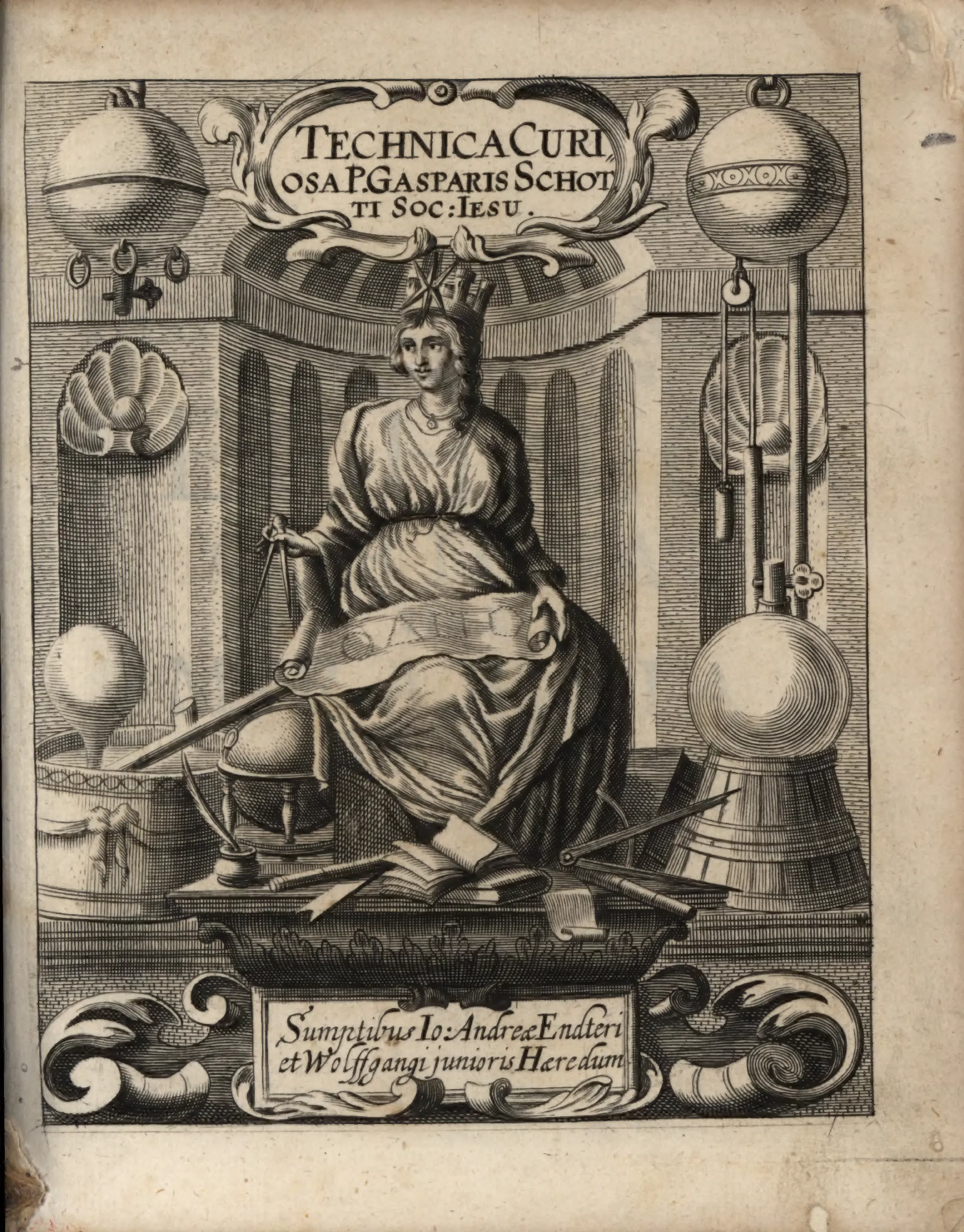
The added engraved title of Schott's Technica curiosa gives the book's "marvels of art" visual form: an allegorical figure holding a balance presides over pneumatic spheres, a glass receiver, globes and instruments. Its cartouches name Schott and the Endter heirs who published the volume. Source ↗.
The Bayerische Staatsbibliothek also makes a copy catalogued as Technica curiosa dated 1687 available digitally (MDZ identifier bsb11110924; call number 999/Philos.2175). The existence of this later imprint is established; its precise relationship of setting, revision or reissue to 1664 has not been determined.
Schott's Mechanica hydraulico-pneumatica was issued in 1657 for the heirs of Johann Gottfried Schönwetter and printed by Heinrich Pigrin at Würzburg. The Library of Congress holds a copy under QC143 .S3; its catalogue gives sixteen preliminary leaves, 488 and [14] pages, one further leaf, illustrations and 56 plates, and notes a half-title dated 1658. A description of another copy counts 46 engraved illustrations on 45 physical plates. Those descriptions must not be collapsed into a single, edition-wide plate count without examining the copies.
The earlier work grew from an account of instruments associated with Athanasius Kircher's Roman museum and appended an early printed account of Otto von Guericke's vacuum experiments. The later compendium again publicized Magdeburg experiments, added English pneumatic material and circulated information obtained through correspondents.
In relaying one such report, Schott states how he will separate his own voice from that of his source: Subinde tamen paucula verba, declarationis ergò, & per breves Notas aut inseremus, aut subjungemus, alio tamen characteris genere, ut facilè ab Auctoris verbis ac sententiis distinguantur. From time to time he will insert or append a few explanatory words and brief notes, but in a different kind of type, so that they may easily be distinguished from the author's words and opinions. This announced practice bears directly on the compendium's method of transmitting others' reports while marking where attribution ends and comment begins. Whether it is applied uniformly throughout the twelve books is not established.
Schott's surviving correspondence with Philipp Ernst Vegelin van Claerbergen is pertinent to that circulation and to his practical and conceptual difficulties concerning the vacuum. The heraldic engraving establishes Schönborn's status as dedicatee of the Getty copy.
The following could not be securely established from the consulted records:
- the name and dates of the relevant Jesuit licensing officials;
- an episcopal imprimatur;
- a particular suppressed passage of Ioco-seria;
- the asserted pseudonym under which that work appeared;
- a German translation;
- any identifiable princely family for a withheld invention.
No specific VD17 identifier, complete signature formula or verified 1664-copy shelfmark beyond the Getty record is asserted.
Following Schott's Argument from the Magdeburg Hemispheres to Perpetual Motion
The Dedication and the Preface
The volume opens with a dedication to Johann Philipp von Schönborn that begins with the ancient and modern wonders of micro-carving. Among them are fifteen pairs of dice cut into a cherry-stone, which Hadrianus Junius saw at Mechelen, and Homer's Iliad enclosed in a nutshell. Schott then applies the topos to his own enterprise. Those who gather the greatest matters into a slender book, he writes, attempt no less: Non minora audent, qui res maximas,. The compendium thus presents itself as a contrivance of art, a technasma of compression that belongs to the same order as the carved stone it describes.
The figure of the miniaturist also redefines the author's role. Schott at once disclaims ownership of the wonders his little vessel contains. They are, in his words, non mea, sed aliena pleraque, quæ, "not mine, but for the most part others'." The pose is conventional, but it has structural consequences for everything that follows. It establishes the Jesuit as curator and adjudicator rather than inventor, the figure through whose hands reports pass on their way to the learned public.
The dedication ties that curatorial office to patronage in a specific place. The heart of the new book, Schott tells the Elector, is fructus est Magdeburgici, the fruit of the Magdeburg experiment. That experiment had been demonstrated more than once in the Elector's own Marienberg fortress above Würzburg. The pneumatic novelty is therefore domesticated from the outset. It reaches the reader already witnessed under princely auspices, and the heraldic ode and Jesuit licences that follow set it within a frame of dynastic praise and religious authorization.
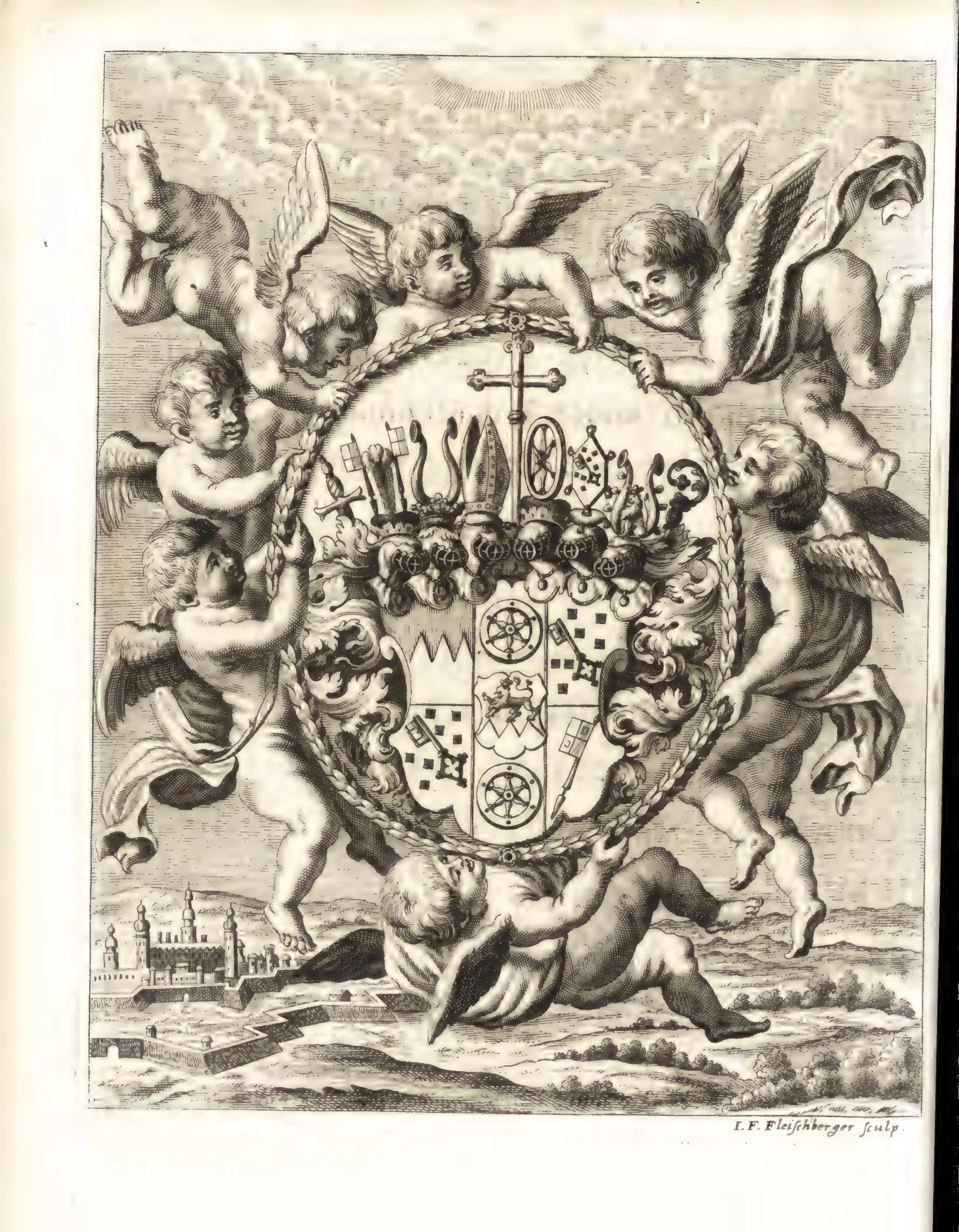
Fleischberger's full-page engraving presents Johann Philipp von Schönborn's quartered arms, with Mainz wheel, Schönborn checks, crossed keys, mitre and archiepiscopal cross, borne by putti. Such heraldry places the book's pneumatic novelty, "the fruit of the Magdeburg experiment," under dynastic and religious auspices. Source ↗.
The Præloquium ad Lectorem supplies the theological charter for this enterprise. Schott recalls the saying of St Antony that the works of Nature are books in which men might read the excellence of God, and, in the passage already cited, he calls the works of Art mirrors. The distinction is delicate. Nature remains the legible text of the Creator. Art reflects back the dignity of the creature who is made in God's image and who, in contriving, imitates divine making. The metaphor lets a religious legitimately linger over pumps and automata: the mirror does not compete with the book but reflects its author at one remove.
On this footing Schott marks off his domain, announcing in the line quoted earlier that in as many books he now lays open the wonders of Art alone. The announcement deliberately pairs the new work with the twelve books of the Physica curiosa on the wonders of nature. He then names the channel through which these contrivances reached him: inventions sent varia ad me ex variis Europa Provinciis, "various things to me from various provinces of Europe."
The preface closes on an ethic of communication. The first half of that ethic is a humility formula, Mare si essem, ut stilla sum; orbem irrigarem: were he the sea, as he is only a drop, he would water the whole world. The second half is an invective against hoarders of knowledge, qui sibi solis canunt: odi qui sibi solis sapiunt, directed at those "who sing to themselves alone," with Schott declaring that he hates "those who are wise for themselves alone." The two gestures belong together. Diminishing the self enlarges the duty to publish, and open circulation becomes a moral obligation rather than a vanity.
Book I: The Programme of Experiment and the Magdeburg Letters
The Proœmium to Book I converts that ethic into a methodological programme. Schott states that the purpose of the first four books is to spur alios ad Experimentalem Philosophiam, "others toward experimental philosophy." He glosses this as a philosophy that ditos sinus penitiùs scrutatur, & Scire cum Posse felici, searching nature's hidden recesses more deeply and joining knowing with being able to do in happy union. The pairing of Scire and Posse matters. It fuses the contemplative end of scholastic scientia with the operative power of the mechanical arts, the very union that the mirror metaphor had already licensed on theological grounds.
From this follows the programme's most uncompromising claim, the sentence already noted in which whoever philosophises without experiments is said to hunt in darkness. Yet the same passage of the Proœmium carries a Monitio that tempers the boldness. It sets out Guericke's thesis that the observed effects arise not vacuimetu, ut Peripatetici loquuntur, sed aëris, "from fear of the void, as the Peripatetics say, but from the air." Schott presents the thesis as a claim to be judged in its place rather than endorsed on the spot. Two commitments thus stand side by side at the threshold of the pneumatic material: a rhetoric that makes experiment the sole light of philosophy, and a practice that defers causal verdicts. This double stance governs the whole of the pneumatic books.
The letters of Otto von Guericke, printed in full in the first part of Book I, show that deferral under pressure from a source who does not defer at all. Guericke states that the pump was never conceived as a mere curiosity: Inventum meum è propriè collimat, ut demonstrem, aërem aliud. His invention, he says, properly aims to demonstrate that the air is nothing other than an exhalation of the Earth with a determinate weight. The experiment is subordinated to a cosmological picture of the terraqueous globe wrapped in a heavy envelope.
Against Kircher's objection that "nothing" cannot resist the piston, Guericke moves the cause out of the evacuated vessel altogether, ego autem eam adscribo externi aëris gravitati, qui trusillum seu, "but I ascribe it to the weight of the external air, which [drives] the piston." He softens the rebuke to the Jesuit polymath with a proverb, Circa quod solùm adverto, errare humanum esse, remarking only that to err is human. That a book licensed by the Society prints this correction of one of its most celebrated members, without suppressing it, is an instance of the policy of letting originators speak.
The same letter carries Guericke's decisive conceptual distinction. His definition of nothing, properly speaking, as what is wholly absent from the nature of things, already cited, is set against Vacuum verò, sive Æther (quæ, ut ego, "but the vacuum, or aether, which as I [hold]." The void ceases to be the scholastic nihil, of which nothing can be predicated. It becomes real space, identical with the aether of the heavens, and the Peripatetic reductio (that a void would be a nothing that acts) loses its purchase. Guericke declines to draw out the consequences in print, closing with nifestandum, non judico. Sapienti satis: he does not judge the matter fit to be made public, and a word to the wise suffices. The reticence is eloquent. The cosmological implications of an aethereal void touched questions of the heavens and of divine immensity that a Lutheran burgomaster writing to a Jesuit had reason to leave unstated.
Where Guericke is reticent about cosmology, he is blunt about method, setting the authority of Aristotle against ocular demonstration in the formula quoted earlier. The maxim is reinforced with a threshing-floor analogy, Excussum stramen flagellari quidem ulteriùs potest,: threshed straw can indeed be flailed further, but yields no more grain. Inherited authority, on this view, is exhausted matter, and the rustic register deflates the dignity of the schools.
The "new" Magdeburg experiments of the second part raise both the spectacle and the claims. Guericke's narrative of the sixteen-horse trial is a drama of repeated failure overcome by exertion. The horses at last parted the hemispheres, he writes, tandem additis clamoribus, minis, ac flagris, hemisphæria, "shouts, threats and whips having been added." The very violence of the effort serves as evidence of the magnitude of the unseen force.
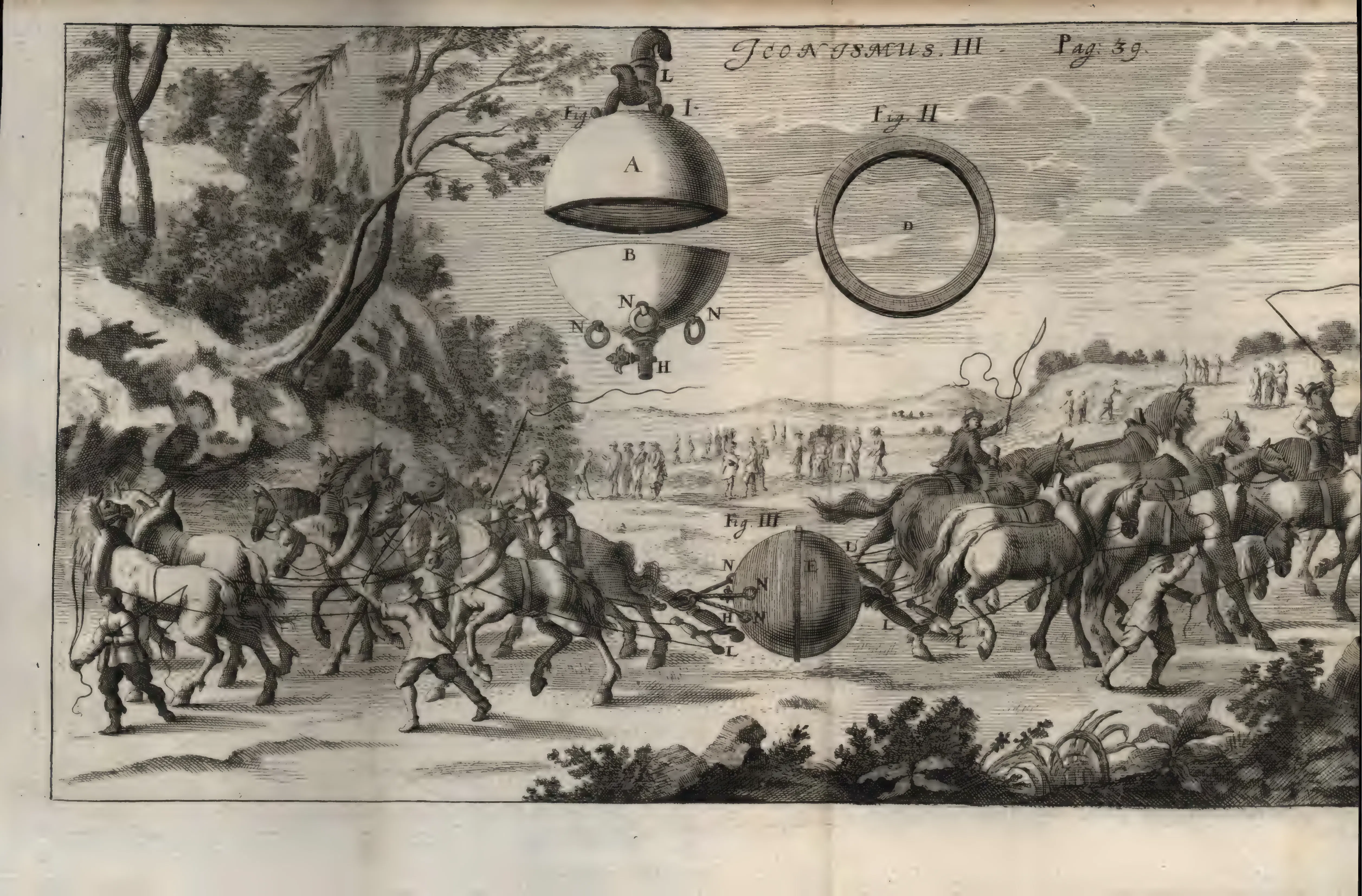
This full-page plate pairs Guericke's apparatus with its staging: above, the hemispheres, sealing ring and valve are isolated as components; below, sixteen horses strain in opposed teams to part the evacuated globe. The violence of "shouts, threats and whips" becomes ocular evidence of an unseen force. Source ↗.
The floating manikin that registers the weight of the air receives a name heavy with contemporary aspiration, Hanc ego appello Semper vivum, "this I call the ever-living." The instrument is at once pressed into meteorological and cosmical service. After correctly foretelling the great storm of 1660, the portion of air torn away is said to have been in visibilem nobis cometam fuit, converted "into a comet visible to us." The movement from a measured prognosis to a speculative account of cometary generation shows how quickly the new instrument was absorbed into the older science of meteors.
Guericke's conclusions against the Peripatetic principle harden accordingly. The rising of water in his tubes occurs not per attractionem, seu fugam vacui, sed verè per aëris pressionem, "by attraction or flight from the void, but truly by the pressure of the air." In the fourth letter the doctrine is dismissed outright, in the sentence already cited that calls the flight from the vacuum an erroneous imagination.
It is at this point that Schott's own voice returns, and it returns dissenting. He takes up Guericke's own material doctrine that effluvia corporum nihil aliud esse, quàm aërem, that the effluvia of bodies are nothing other than air, and turns it against its author. If air is exhalation, then the space above the water in Guericke's tube is filled with aqueous effluvia. Schott concludes, in the passage already quoted, that no true vacuum is therefore procured by this experiment. The manoeuvre is characteristic. Schott does not deny the phenomenon, and he does not invoke Aristotle's authority, which he has just printed Guericke dismissing. He contests the inference by means of the experimenter's own premises, preserving a plenist reserve while publicising the experiments that most strongly threatened it.
Book II: The English Experiments
Book II carries the same double stance into the English material. Schott praises Boyle's procedure, noting, as already quoted, that the English trials had spectators everywhere and faithful and most learned witnesses. The credibility of those trials is thus grounded in the quality of their audience. Yet this recognition of witnessed testimony is followed by a technical judgment in favour of the German machine. Guericke's arrangement is Longè ergo perfectiùs, nec tamen multò operosiùs, "far more perfect, therefore, and yet not much more laborious."
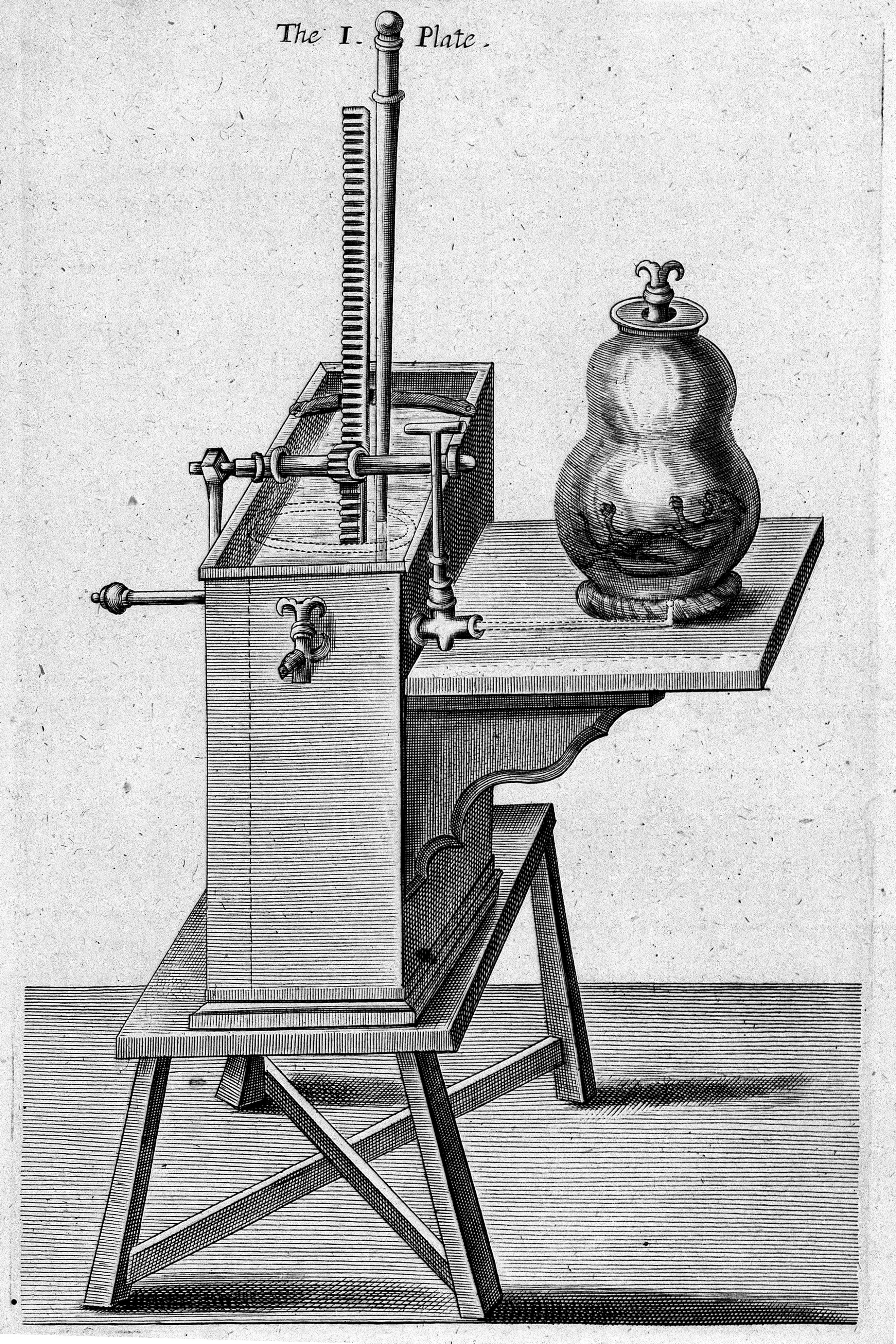
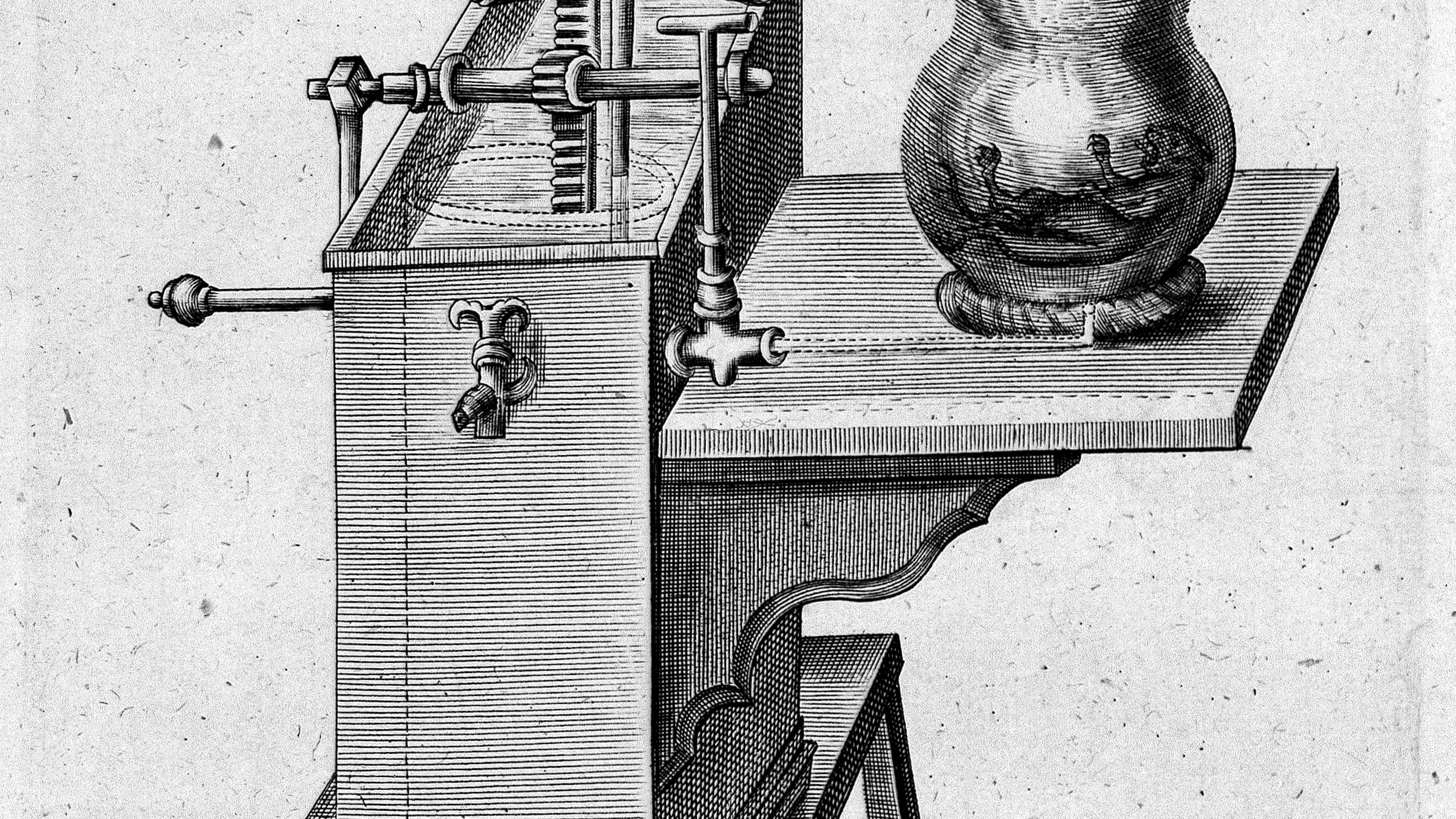
An engraving of Robert Boyle's second air-pump (Wellcome M0010431) represents the English pneumatic programme that Book II both admired and scrutinized, praising Boyle's witnessed procedure while judging Guericke's Magdeburg apparatus the more perfect machine. Source ↗.

Schott also records Boyle's careful limitation of his terms, Notat hîc Auctor, semel pro semper, per vacuum non intelligere: the author notes here, once for all, that by vacuum he does not understand a space wholly void of body. Boyle's operational void, a space merely emptied of air, stands in pointed contrast to Guericke's aethereal space. Placed side by side, the two sources expose how unstable the word vacuum had become. Boyle's "spring of the air" is kept at a similar distance. Schott reports that Multa relato hoc Experimento disputat Auctor de aëris virtute, that after relating this experiment the author disputes at length about the power of the air, and he passes over the disputation rather than adopting its vocabulary.
The criticism of Boyle then takes a sharper turn. Because the English receiver admitted air through its joints, Schott argues, the proportional reckonings built on it collapse: Ergo frustraneus est omnis labor in calculanda, "therefore all labour in calculating is in vain." The criticism clarifies the pattern of these books. Testimony and ocular demonstration are honoured as the ground of experimental philosophy, but the instruments that produce the testimony are held to a standard of tightness and exactness. Whatever falls short of it cannot compel assent to the conclusions its authors drew.
In the closing chapters of the English book, Boyle's air-pump trials appear in a deliberately mediated form. Schott reports them in the third person under the name of the Auctor and appends his own Annotationes to most chapters, so the reader encounters the English experiments already framed by a Jesuit compiler's glosses. What stands out in this material is how often the reported results concern the physical reality of air as a body with weight and effects of its own. The weighing trial is recounted as a conclusion Boyle himself drew, namely that by means of his machine air, like other bodies, could be weighed on a balance, and in its natural and ordinary consistency rather than compressed: suæ Machinæ ope ut alia vulgò corpora, aërem quoque ad bilancem, expendi posse, idque in naturali atque usitata consistentia, & nequaquam condensatum. The final qualification is doing polemical work. It closes off the familiar scholastic evasion that only air forced out of its natural state could show gravity. Air in its ordinary condition, in the element's own place, is thereby conceded weight. The same careful hedging governs the acoustic trial with the watch and bell in the evacuated receiver. From it Boyle infers that air is, if not the only, then the chief medium of sounds, Ex quo colligit ipse, aërem, si non solum, præcipuum tamen esse medium sonorum. The concessive si non solum keeps room for a subtler matter to carry sound where air has been withdrawn. That space later becomes important when Schott defends a qualitative account of sound against a mechanical one.
The compiler's mediation is not merely additive. Schott also removes material. When Boyle describes a "sudden light" appearing in the receiver, a phenomenon that could not be reliably reproduced, Schott declares that he judged it wiser to wrap the whole experiment in silence as of no great moment: Consultius ergo judicavi, totum Experimentum, utpote non magni momenti, silentio involvere. The gesture is small, but it matters for the work's larger concern with what makes a wonder of art credible and fit to be communicated. A phenomenon that yields neither a repeatable trial nor a secure explanation is judged not worth printing. The compendium thus filters its sources according to a standard of demonstrability as well as transmitting them.
The Italian, French and Polish Experiments
The prooemium to the book of Italian, French and other experiments steps back from particular trials to reflect on the nature of the art itself. Schott recalls that printing and navigation grew from humble, often accidental beginnings, and he declares that in pneumatics a vast sea remains to be ploughed, Ingens adhuc sulcandum restat mare;. The navigational figure is apt for a discipline he elsewhere names Pneumatica seu Aerotechnica Scientia,, pneumatics, or the aerotechnical science. That compound places the study of air squarely among the arts, as a science of contrivance and not simply a branch of speculative physics. In the same passage the explanatory principle that will eventually overturn his own earlier views is introduced as something unknown to the ancestors, the principle aëreæ gravitatis ac pressionis,, of the weight and pressure of the air. Schott names it here in a historical register, as a recent discovery, before he submits it to judgement in the book of scrutiny.
The prooemium then takes up the theme of modest origins for the new pneumatics, in the sentence already quoted that traces the contrivances displayed by Gericke and Boyle, like all stupendous and magnificent works, to very slight beginnings. The sentence joins the Lutheran burgomaster of Magdeburg and the English Protestant natural philosopher under a single honorific. In doing so it justifies gathering the scattered Italian, French and Polish trials as the "seeds" from which those technasmata grew. Schott anticipates the charge of antiquarian triviality with the compiler's traditional appeal to future readers, atque despicient coætanei, at laudabunt posteri, contemporaries will despise the labour, but posterity will praise it. On this account the collection preserves the genealogy of discovery.
That genealogy turns out to be contested. The first chapter reproduces at length Roberval's letter against the Capuchin Valeriano Magni and Magni's Narratio Apologetica in reply, so that two parties speak in their own words while the compiler refrains from judging between them. Magni's defence turns on a denial of exposure to Torricelli's circle. He insists that the word itself, "Vacuum," never once sounded in his hearing in that city, sonuit mihi in illa Urbe vox ista, Vacuum. He then shifts the ground of his claim from invention to publication: Sum fortassis primus qui eam typo publicam feci,, "I am perhaps the first who made it public in print." The distinction was significant in the culture of seventeenth-century learned priority. Being first into type was a claim that could be established by dated title pages, whereas being first in thought rested on private testimony. Schott observes that simultaneous discovery is possible and sifts the inconsistent dates in Mousnier's edition of Fabri. By doing so he treats the question as a problem of evidence and chronology rather than of personal merit, and he is content to leave it unresolved.
Book IV: The Physical Scrutiny of the Void
The book of physical scrutiny states its stakes at once. Its prooemium describes pump and siphon effects as phenomena whose cause venerable antiquity, almost down to Schott's own day, recognized as nothing other than the fear of the void: effectus, quorum causam veneranda antiquitas, adhæc usque ferè tempora nostra, aliam non agnovit, quàm vacui metum. Against this the moderns set the pressure and spontaneous dilatation of the air. Schott draws the consequence without softening it, in the conditional already cited: if these things are true, the ancients have been gravely deceived. The verb hallucinari, to wander in mind, is severe, and the conditional form suspends the verdict. The authority of the ancients is made to depend on the outcome of trial, so that each experiment must be weighed on the scale of truth.
Before that weighing Schott lays down four Præludia on the constitution of air. In the course of the fourth, which argues that air is heavy, he prints the full letter of the Groningen physician Anton Deusing. Deusing had denied that air could be weighed within air, and the exchange becomes a small model of learned dispute across confessional lines. The Reformed physician opens with the statement of civility already quoted, judging unworthy of the friendship of good men those who cannot bear disagreement from others in matters of God or of truth. The principle is tested within the same letter. Having restated his own theory of the ether, Deusing frankly confesses that some paralogism underlies his reasonings on the weighing of air, ingenuè fateor, subesse illis Ratiocinationibus meis circa aëris ponderationem paralogismum aliquem; quem tamen Ta. CCtas. He then accepts the thesis he had opposed: Concludo ergo Tecum, Vir Christime, Aerem etiam intra aerem ponderari posse, "I conclude therefore with you, most distinguished man, that air can be weighed even within air." The agreement is limited, since Deusing reaches the conclusion by attributing the effect to the ether's levitation rather than to the weight of the enclosed air. By printing the letter entire and adding only his notes, Schott shows the reader what a concession looks like when the conclusion is shared but the reasons for it differ.
The first Scrutinium shows that Schott's own position is similarly composite. Against the moderns whom he chooses to call Vacuists, Ultimorum, quos Vacuistas nominare placet,, he defends the thesis that no natural vacuum exists. He grounds it in the most traditional formula available, the assertion quoted earlier that daily experience establishes nature's abhorrence and flight from the void in every way. The appeal to experientia quotidiana is significant. Schott meets the experiments of the Vacuists with the older Aristotelian notion of common experience, and he does not give up the empirical ground to them. What fills the apparently empty Torricellian space is ether, which passes through the pores of glass, together with mercurial and aqueous spirits. A marginal heading states the doctrine concisely, Æther replet omnia spatia, ether fills all spaces. The same commitment governs his treatment of sound. He rejects Magnani's explanation of the ringing bell in Berti's tube on the ground that it rests on a false opinion of sound, which is not a tremor of bodies propagated through the air: Sed hæc responsio nititur fallâ sententiâ de sono, qui non est tremor corporum propagatus vel per aërem,. For Schott sound is a quality that requires a subject. If sound is heard, something must be present to bear it, and that requirement keeps the void from being empty.
The decisive turn comes in the second Scrutinium, on the pressure of air upon liquids. Here Schott uses the form of scholastic disputation to state the new physics: Dico II. Vera & genuina causa, cur aqua in tubo Magdeburgico evacuato ascendat semper ad certam ac determinatam altitudinem, est pressio aëris incumbentis aquæ, cui tubus immersus. The true and genuine cause why water in the evacuated Magdeburg tube always rises to a fixed and determinate height, he declares, is the pressure of the air resting on the water in which the tube is immersed. The phrase certam ac determinatam altitudinem carries the argument, because a fear of the void would have no reason to stop at any particular height. The quantitative explanation follows: Aëris ergo cylinder gravitate suâ æquilibratur gravitati, the column of air is balanced by its weight against the weight of the liquid column. The heaviness of air established in the fourth Præludium thus becomes the working cause of the barometric phenomena.
Schott then turns to his own earlier explanation. He admits that he had adhered to the older view and rejected the pressure of the external air because such pressure was not yet known to him from other experiments and so seemed fabulous: His ultimis loco citato adhæsimus, & reliquas sententias, quoad pressionem aëris externi rejecimus, quia nobis ejusmodi pressio per alia Experimenta nondum erat cognita, ideoque in hoc Experimento videbatur fabulosa. The confession states its own epistemology. A single experiment could not make a hitherto unknown cause credible, but independent experiments, the Magdeburg and English trials already reported in the volume, could do so. The recantation follows in the two short sentences already quoted, in which Schott declares that he changed his view, for no one should resist a truth most evidently known. The rhetorical question presents the change of mind as an obligation owed to evidence, not as a defeat. Even so, it stands beside the defence of the horror vacui made in the preceding Scrutinium. Schott grants that pressure explains the rise of liquids, and he continues to hold, through the doctrine of ether and spirits, that nature admits no true void. The result is not a simple conversion. Concession and retention are kept distinct: the new cause governs the effects it has been shown to produce, and the old principle is retained where no trial has yet dislodged it.
The later chapters of the scrutiny press the argument further through a problem in hydrostatics rather than a pronouncement on the void. Working from Emanuel Maignan's double-tube mercury trials, Schott first fixes the baseline against which any further cause must be measured: in hydraulics the contest between liquids is decided not by their quantity but by the vertical height of the column, inhydraulicis verò non aquarum copiâ, sed perpendicularis pugnatur. The martial verb pugnatur matters. It turns equilibrium into a combat of opposed columns, each exerting its momentum, and it prepares the conceptual ground on which air can become a combatant with weight of its own. When he turns to the suction pump, the well's level falls while the water in the tube stays high, so something beyond natural libramentum must be acting. Schott states the alternatives as an exclusive disjunction, Hoc autem vel est metus vacui, vel est pressio aëris aquæ putei superincumbentis; quod nunc determinabimus: "this, however, is either the fear of the vacuum or the pressure of the air lying upon the water of the well, which we shall now determine." The form is eliminative, and it governs the chapters that follow. Every phenomenon is tested by asking which of the two causes can survive the particulars of the case.
The verdict arrives in the apparatus of the schools. Schott's first conclusion states flatly that water is not raised aloft through the pump by fear of the vacuum, Dico I. Aquam per antliam non elevari in altum metu vacui. What gives the argument its edge is the way it takes the Peripatetic concept at its word, through the objection already cited that the fear of the vacuum, as the Peripatetics themselves explain it, is limited to no fixed height. A natural horror is quasi-teleological and admits no measure. The observed effect, however, is bounded, whether one follows Maignan's eighteen cubits, the Magdeburg experimenter's twenty ells, or Digby's forty feet. Schott puts the variant figures down to differing units rather than to any real disagreement, and that move is essential. The refutation depends on there being one ceiling, and a single ceiling is exactly what an unmeasured horror cannot account for. So the Dico, the inherited instrument of scholastic assertion, is made to carry an anti-Peripatetic conclusion. The method of the schools stays in place even as one of their doctrines is set aside.
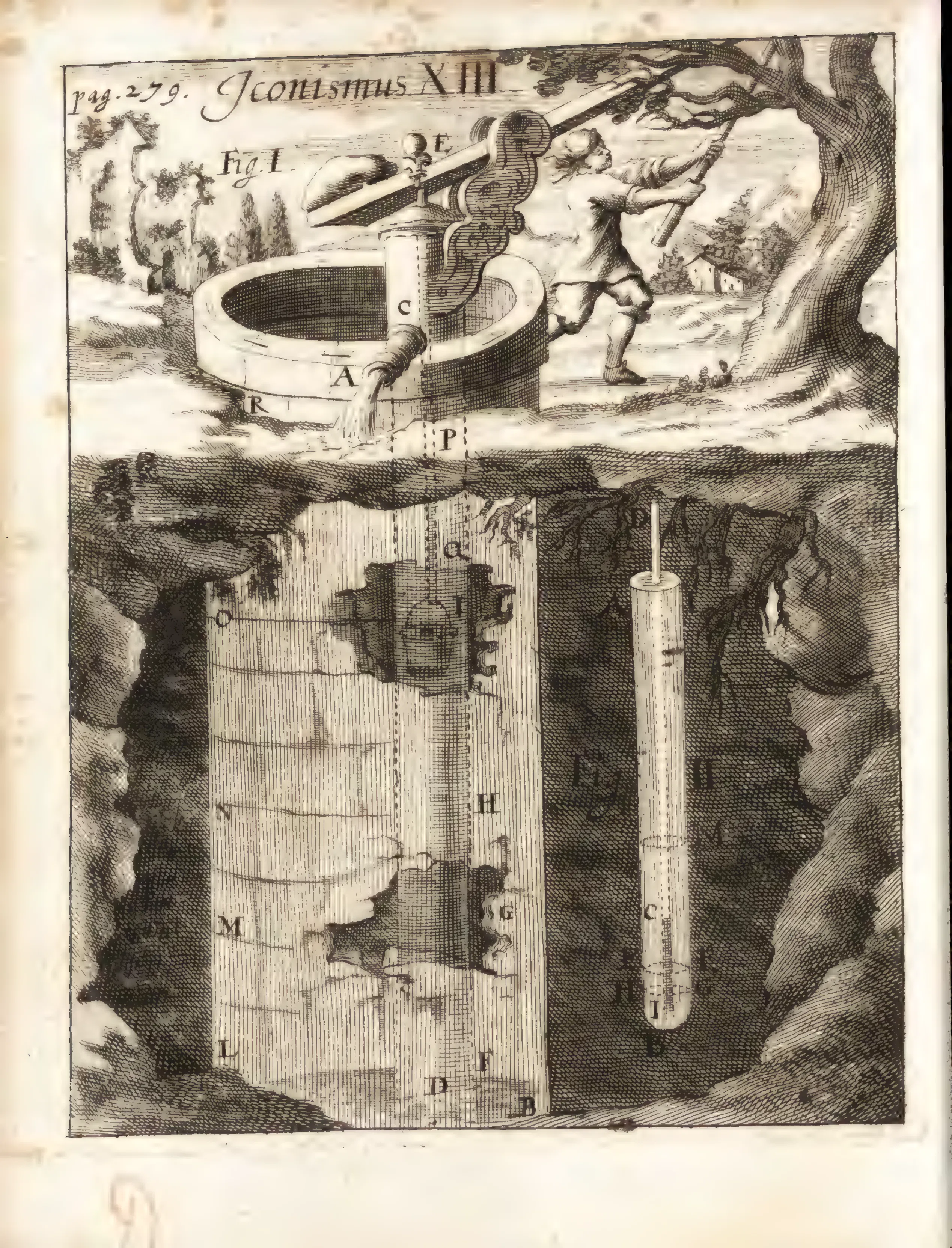
Schott's Iconismus XIII makes the suction pump an adjudicating experiment: wellhead, handle, subterranean tube and bounded water column display the fixed ceiling that a Peripatetic "fear of the vacuum" could not explain. A sealed barometric tube beside it links the pump to the Torricellian and Magdeburg trials. Source ↗.
The ground becomes less secure once Schott asks whether the air presses universally, and in particular whether its upper parts press the lower. Here he departs from the confident Dico and confesses his difficulty openly: Quæstio hæc (ingenuè fateor) diu me tenuit perplexum, & quò magis eam apud me ventilo, eò minùs me extrico, that is, "this question, I frankly confess, long held me perplexed, and the more I turn it over, the less I extricate myself." The admission is more than a modesty topos. The difficulty is real within his own framework. Divers feel no weight of water above them, and weeds on the seabed stand upright, so the analogy between air and water threatens to undo the very pressure he has just affirmed. His way out is corpuscular. Air, unlike water, is made of agitated effluvia and can be compressed. He adds a conceptual distinction between gravitas and gravitatio actualis that separates pressure from motion. Two evenly matched wrestlers, or a cannonball resting against a cliff, press without moving, and the conclusion is compressed into four words, Premuntur ergo; nam prementi resistunt: "they are therefore pressed, for they resist the one pressing." Resistance becomes the evidence of pressure, and a static, invisible force gains standing in natural philosophy on the strength of homely analogies. Tellingly, the chapter ends with a Monitio that cites lack of time and the swelling size of the book as reasons to pursue no further objections. The limits of the printed volume visibly shape how far the argument can be carried.
The treatment of the elater shows the same guarded reception of the Recentiores. Schott sets Boyle's images of the sponge and the fleece beside a Cartesian account in which the particles' elastic power elastica non à forma earum necessariò pendeat, sed à vehementi illa agitatione, depends not necessarily on their shape but on their vehement agitation. The choice between a structural spring and a kinetic whirl is left partly open, but the verdict itself is phrased in the graded vocabulary of probable opinion. He judges it probabilissimum esse, aërem habere virtutem elasticam, seu vim sponte se dilatandi, & consequenter rarefaciendi,, most probable that air has an elastic power, a force of spontaneously dilating and so rarefying itself. The superlative places the new concept in the highest rank of probability without claiming demonstration. The deciding case again works by exclusion. The Magdeburg vessel sealed at the foot of a tower still breathes out air when opened at the top, and this cannot be ascribed to metus vacui, quia nullum adest vacui periculum, sed potiùs adest nimia repletio: not fear of the vacuum, since no danger of a vacuum is present, but rather excessive repletion. When no void threatens, the old cause has nothing to act upon, and only the air's own expansive force is left.
Yet the eliminative method does not always come out against the schools. With cupping-glasses Schott refuses the account of Maignan and Pecquet, on the ground that the enormous external pressure their explanation requires is not felt on the flesh. His conclusion is ergo locum habet metus seu fuga vacui in sensu explicato:, "here, therefore, the fear or flight of the vacuum has its place, in the sense explained." The criterion is consistent with his earlier reasoning, since the testimony of sensation decides here just as the measured ceiling decided in the case of the pump. The result is a divided field, in which each cause holds jurisdiction over particular phenomena rather than one principle replacing the other. The Epilogue gives this division its most quotable form. The pressure explanations are declared clearer than any obstinate Aristotelian can deny, and yet, in the sentence already quoted, Schott remains unpersuaded that no effect has hitherto occurred, or still occurs, in nature through fear of the vacuum, and expects never to be persuaded of it. The future passive persuadebitur is the grammar of a settled reservation. Having yielded most of the ground, Schott marks the rest as closed to further concession.
The letter of Giovanni Battista Baliani to Mersenne, placed at the end of the book, qualifies this reservation from another direction. Baliani had held that pondus, arbitratus sum, non repugnare dari vacuum, at difficillimè dari, nimirum ob aëris gravantis, that is, that it is not repugnant for a vacuum to be given, but that it is given only with great difficulty, because of the weight of the pressing air. Here the void's rarity comes from atmospheric weight rather than from nature's abhorrence. By closing Book IV with an Italian authority dated to 1647, Schott gives the pressure doctrine an older and learned lineage, while leaving the reader to set Baliani's possible vacuum beside his own retained metus.
Books V and VI: Revision and the Rule of Practice
The Prooemium to Book V turns these conclusions back upon Schott's own earlier works, in the concession already quoted: if the phenomena and experiments established in the preceding four books are true, then not a few of the things explained in his earlier writings demand a quite different explanation, other principles and causes. The four principles of his earlier hydraulics were attractive, expulsive, rarefactive and equilibrative, and the first of these is now replaced. It is non videlicet attractionem seu suctionem, sed aëris, aquæ incumbentis pressionem, dictarum Machinarum principium esse & causam: not attraction or suction, but the pressure of the air lying on the water, that is the principle and cause of these machines. The revision is carefully framed so that it touches knowledge and leaves nature unchanged. The phenomena are to be accommodated, as the passage cited earlier puts it, to a principle not new, since Nature is always and everywhere like herself, but only recently known. That parenthetical insistence protects the constancy of creation. The error lay in the philosopher's grasp of the cause, not in any change of nature, and so self-correction can be presented as fidelity to an unchanging order.
The correspondence with Jeremias Mitz of Basel shows the new principle at work in craft practice, where design and execution do not always agree. Mitz's fountain, drawn up according to the rules of hydraulics, failed once it was built: attamen aqua non ascendit in vas superius, ne gutta quidem; aër autem summopere dilatatur,, "yet the water did not rise into the upper vessel, not even a drop; but the air dilated greatly." Schott turns the puzzled report into evidence. The fault lay in air leaking through invisible cracks in solder joining copper, tin and lead, and the crushing of Mitz's lead boxes is assigned to the weight of the external air. In doing so he names his own former error alongside his correspondent's: Quod & nos in Mechanica Hydraulicopneumatica supposuimus, "which we too assumed in the Mechanica Hydraulico-pneumatica." The admission sits inside a letter exchange printed in full, so the reader sees the recantation take place within the exchange of reports itself.
Books V and VI keep returning to the gap between ideal rule and working machine. On the pulley ratios of the Roman self-acting buckets Schott insists that Hæc vera sunt loquendo in rigore mathematico & exclusis, that these things are true speaking in mathematical rigour and excluding the imperfections of pulleys. The same buckets carry a note on the social life of machines. Although they worked, they were destroyed quia motu suo perpetuo ac tumultuoso Fratrum quietem orationis tempore interdiu, & somni noctu interturbabat, destructa fuit, because their perpetual, clattering motion disturbed the friars' quiet at prayer by day and their sleep by night. A mechanical success gave way to the order of the cloister. On perpetual motion, Schott's judgements combine civility with scepticism. Of Wilhelm Schröter's device he praises the author's ingenium, atq[ue] conatum, eòq[ue] magis laudo, quòd suæ opinioni non pertinaciter, ut nonnulli faciunt, inhæret, his ingenuity and effort, and all the more because he does not cling obstinately to his opinion as some do. This is the same virtue of correctability that Schott has just shown in his own recantation. On Grienberger's spiral, reconstructed from papers found in Rome, the verdict is severe: that the wheel always holds a favourable position he judges nec demonstratum esse, nec demonstrari posse existimo, neither demonstrated nor demonstrable.
The Specula Melitensis Appendix
The appended reprint of Kircher's Specula Melitensis Encyclica shifts the wonder of art from mechanics to cosmography and to the self-image of the Order. Kircher's world-time dial was designed so that it monstraret, functiones hujus Ordinis nocte dieq[ue]; ita continuari, ut nunquam interrumpantur, Solemq[ue]; ei nunquam occidere, showing that the Society's functions continue night and day without interruption and that the sun never sets on it. Here the instrument's computation of hours from Malta becomes an emblem of the Society's unceasing devotion across the globe, the reckoning of hours made to bear witness to the Order itself.
Beyond that emblem, the appendix turns a cube-shaped instrument addressed to the Knights of Malta into a compendium of the whole mathematical and physical sciences. Its propositions are terse rules of use: set the rule or index over a given datum, and the answer is read off. The procedure rarely pauses for argument, which gives weight to the moments where it does. The tidal wheel rests on an explicit causal thesis. Schott holds that this reciprocal tide of the sea, continuing its motions by so constant a law, hunc reciprocum maris æstum adeò constanti lege motus suos continuantem, ab alia causa, quàm à Lunæ motu, originem habere non posse, can have its origin from no other cause than the motion of the Moon.
The inference runs from the regularity of an effect to the singularity of its cause. The phrase constanti lege carries the argument: a motion that keeps so fixed a law cannot arise from a multitude of shifting causes. The wheel then embodies that inference. By turning it, the user reads off high water in distant seas from the Moon's rising over the Maltese horizon. The instrument therefore does more than display a doctrine. It makes the doctrine repeatable at a distance, so that anyone who owns the device can apply the claim without having seen the tides it predicts. In this appendix, communicating a wonder of art means building the judgement into the artefact itself.
The same logic extends to what the period called occult philosophy. After a long sequence on the qualities of signs and planets, their friendships, domiciles and exaltations, and the sympathies and antipathies of things ruled by Saturn, Venus and Jupiter, Schott states, in the sentence already quoted, that this wheel teaches the rationale and the most complete method of all natural magic. The terms ratio and methodus matter here. Natural magic appears as a discipline with principles and an order of procedure, reducible to a rotating table of concordant and discordant qualities, rather than as a store of secrets.
The iatromathematical face carries this further, subordinating the whole doctrine of crises to lunar motion. It then grounds remedies that act by similitude in a theology of legible nature: the doctrine, already quoted, that the most wise Author of nature has impressed on each natural thing a character through which, as by a kind of writing, it displays its natures and properties to be read by sagacious minds.
The metaphor is carefully chosen. The signature is a character, the same word the printed book uses for letterforms and ciphers, and nature is described as scriptura. The passage divides agency in a precise way. God impresses the mark, but only sagacia ingenia can read it. The legibility of creation is real, yet it is reserved to a trained interpretive capacity. This pairing of a script available in principle with a competence confined in practice recurs throughout the book on writing that follows.
Book VII: The Wonders of Writing
Liber VII, the Mirabilia Graphica, opens by ranking the means of communication. In the printed text the initial D has dropped out, so the first word reads "Ivinum": Ivinum munus est, loqui; hoc est, latentes animi conceptus, cogitata sua omnia, omnes affectus ac desideria interna verbis exprimere, ac propè adstantibus indicare:. It is a divine gift to speak, that is, to express in words the hidden conceptions of the mind and all its inner affections, and to show them to those standing nearby.
The limiting phrase propè adstantibus already contains the argument of the ascent. Speech reaches only those who are physically present. Writing, which Schott calls more divine, overcomes distance. A single universal speech and script, which he calls most divine, would also overcome the division of tongues. The only precedent he allows for that highest gift is the miracle granted to the Apostles. Every human attempt at a universal script is thereby placed within a sacred hierarchy. Each is measured against a model that no art can fully reach, and each is also licensed as an imitation of it.
Communication soon meets rank. Kircher's linguarum artificium, Schott reports, was examined by Ferdinand III and Archduke Leopold Wilhelm, who, in the passage already quoted, judged that because it was new, exceedingly ingenious and worthy of great princes, it should not be published but reserved to themselves and their most august family.
The paradox is sharp. A device meant to make every language intelligible to every reader was withheld from all readers but one dynasty. Moreover, the three qualities cited as reasons for secrecy, novelty, ingenuity and fitness for princes, are the very qualities for which a curiosum would ordinarily be printed. Schott records the decision without protest. In doing so he registers a limit on his own programme: the circulation of wonders of art gives way before the prerogatives of a princely house.
The printable schemes are judged by different criteria. The anonymous Spanish Jesuit's numerical Nomenclator sorts vocabulary into "Gradus" and "Determinativa", a borrowing of the scholastic apparatus of genus and difference. Schott prints its forty-four classes in full, from the Trinity and the Church through spices and coinage to the honorifics of papal and cardinalatial address. He then delivers a verdict: Ingeniosum est hoc inventum, sed practicatu difficillimum, saltem quod ad scriptionem attinet. Nam impossibile est, non dico omnes, sed etiam præcipuas res, & rerum vocabula, quibus ordinariè in locutionibus & scriptionibus utimur, reducere ad certas classes. The invention, he says, is ingenious but exceedingly difficult in practice, at least as regards writing, since it is impossible to reduce to fixed classes even the principal things and words in ordinary use, let alone all of them.
The judgement is framed as a contrast between ingeniosum and practicatu, between speculative elegance and use. That contrast governs Schott's handling of claims across these books. Ingenuity wins praise, but only performance wins assent.
Becher's Clavis convenientiæ linguarum, which pairs numbered lexica with a numbered table of inflections, fares better. Schott nevertheless marks the point where the numerical correspondence between languages fails. His example is the line Fama fefellit hæredem hilarem, which a German reader decoding word for word renders ridiculously. From this he draws the rule that Sæpe enim contingit, ut vocabula aliqua certo ordine posita, in una lingua bonum, in alia ridiculum sensum efficiant: it often happens that words placed in a certain order make good sense in one language and a ridiculous sense in another. Idiotismus, the particular habit of each tongue, is thus the residue that no numbering of words and inflections can absorb.
Schott then reverses the direction of the device. The same apparatus, he observes, Potest idem artificium, tametsi notum fiat multis, imò omnibus, adhiberi pro Steganographia, seu modo aliis secreta sua pandendi, idque multis modis. Even if the device becomes known to many, indeed to all, it can serve for steganography, a way of disclosing one's secrets to chosen others, and in many ways. A secret constant added to the numbers is enough to turn Abbas cecidit into "Bacchus dama". The passage states outright what the Kircherian episode implied. The combinatorial art that promises universal legibility is also, by its nature, an art of concealment. Publication and secrecy are two uses of one technique, not opposites.
The chapter on ancient shorthand applies the same practical measure to antiquity. The Tironian notes, Schott argues, fell out of use because they are tam à verbis pro quibus supponuntur discrepantes, tamque multiplices, ut divinam memoriam, aut planè exoticam phantasiam seu apprehensivam eum habere oporteat. They are so unlike the words they stand for, and so numerous, that whoever would master them needs a divine memory or an altogether outlandish imagination. The explanation rests on the faculty psychology of the schools, memoria and phantasia taken as powers of the soul with natural limits. It also gives Schott his reason for not having Gruter's notes engraved for the volume. A sign system that exceeds the capacity of the human faculties cannot be communicated, however ingenious it may be.
The optical relay of signals from Mainz to Rome, reported from a correspondent, meets a verdict of the same kind, now set on political ground: Praxis hæc, si speculativè rem consideres, successum habere potest; reipsâ verò minimè, præsertim in longa duorum extremorum terminorum distantia, inter quos interjecta sint loca ad diversos Dominos pertinentia. Considered speculatively, the practice can succeed. In reality it cannot, especially over a long distance between the two ends, where lands belonging to different lords lie between.
The division between speculativè and reipsâ is the one Schott applies elsewhere to perpetual motion. Here, though, the obstacle is the patchwork of jurisdictions across the Empire and Italy rather than any defect in nature. Only where a single ruler holds the whole coast, as with the watchtowers of Sicily and Naples signalling by smoke and fire, does he allow that such signalling can work.

Matthäus Merian's 1648 engraved view of southern Mainz, with its pontoon bridge over the Rhine. Seat of Schott's dedicatee and one end of the proposed signal relay to Rome, Mainz lay within the patchwork of lordships that made such signalling a problem of jurisdiction as much as optics. Source ↗.

The book's closing "physiological disquisition" gathers these practical judgements under a theological thesis. Schott declares that he has judged writing ut non hominum, sed ipsius DEI sapientissimi divinissimum donum judicârim, the most divine gift not of men but of the most wise God himself. Part of the evidence for this is ethnographic. Indos quosdam ævo nostrosque adeo demiratos scribendi artem, ut visâ primùm scripturâ accurrerint ad papyrum loquentem, audiendam: certain Indians of our own age were so astonished at the art of writing that on first seeing script they ran up to hear the paper they supposed was speaking.
The wonder of the unlettered, reported from the missions, is used as testimony to the superhuman character of the art. The argument strains in a telling way. Schott treats as evidence of divine origin the very astonishment that a compendium of mirabilia artis elsewhere sets out to explain.
The question of priority is then settled against Nieremberg. Schott sets out his confrère's case for Moses fairly, including its central distinction between two kinds of script: alias hieroglyphicas & rudes, quæ immediatè significabant res, non voces; alias Alphabeticas & ingeniosiores, quæ non tantùm voces, sed syllabas & quamlibet oris prolationem indicant. On this view, some scripts were hieroglyphic and rude, signifying things directly rather than sounds, while others were alphabetic and more ingenious, indicating sounds, syllables and every utterance of the mouth. The distinction was meant to leave room for pre-Mosaic writing while reserving the alphabet to Moses.
Schott, following Kircher, turns it back on its author, since Egyptian monuments show alphabetic characters mixed among the hieroglyphs. He concludes in two assertions: letters are older than Moses, and very probably derive from Adam. The same division between signs of things and signs of sounds had underpinned the Spanish Jesuit's classes and Becher's numbers. The book on writing thus ends by projecting its own analytic categories back onto sacred history.
Book VIII: Squarings of the Circle
In Liber VIII the referee's role becomes explicitly ironic. Examining an anonymous proof of 1662, Schott recalls his premature delight: jamque mihi ipsi gratulabar, quòd in ea incidissem tempora, quo tot sæculis abstrusum, & tanto virorum doctissimorum conamine investigatum secretum mathematicum, tam facili ac simplici methodo fuisset in lucem deductum. Sed non fuit diuturnum gaudium:. He was already congratulating himself on living in an age when a mathematical secret hidden for so many centuries, and sought with such effort by the most learned men, had been brought to light by so easy and simple a method; but the joy did not last. The self-portrait of credulity checked by examination makes his rejection a matter of honest procedure rather than prejudice, and the misapplied axiom is duly exposed.
Against Don Romeo's revival of Bryson, Schott needs only arithmetic: siquidem 8 & 9. minora sunt quam 10, & eadem majora sunt quàm 7, nec tamen propter hoc 8 & 9 sunt inter se æqualia. Eight and nine are both less than ten and greater than seven, yet they are not for that reason equal to each other. The counterexample works in the way ocular demonstration works in the pneumatic books. It is a single instance that any reader can inspect, and it overturns a general claim however authoritative its pedigree.
Book IX: Chronometry and the Anonymous Friend
The opening of Liber IX brings the standard that recurs throughout these books to bear on the measurement of time. After lamenting that no motion is perfectly uniform, Schott grants a relative advantage: Minori inconstantiæ & errori subjectus est perpendiculi usus, quem Recentiores Mathematici cum Galilæo, Baliano, Mersenne, Honorato Fabry, Ricciolo, aliisque non paucis, invexêre. The use of the pendulum, introduced by the more recent mathematicians with Galileo, Baliani, Mersenne, Honoré Fabri, Riccioli and not a few others, is less subject to inconstancy and error.
The comparative minori is characteristic. Schott endorses the pendulum as an improvement, not a perfection, and his definitions immediately concede that large and small vibrations are not isochronous. The list itself joins a Florentine, a Genoese, a Minim and two Jesuits in a single company of Recentiores, whose findings the compendium receives, weighs and passes on, including their acknowledged limits.
The second half of the chronometric book opens with a claim of practical transformation. The pendulum, retrofitted even to clocks of ordinary construction, is said to make them so accurate that one would scarcely find anything more exact of its kind, adeò reddi possunt accurata, ut quid in eo genere exactius excogitari possit, vix reperias. The sentence comes with a discreet concession that others have observed the same thing. That concession locates the passage in the unsettled years after 1657, when the pendulum clock was spreading through learned and artisanal circles faster than its priority could be fixed. The exposition that follows is kinematic rather than narrative.
The pendulum's swing decays and must be re-impelled. The whole problem is therefore one of converting reciprocal into circular motion and back again. The author's answer is the "interrupted" wheel, whose separated groups of teeth alternately drive two pinions on the pendulum axis. The theoretical charter for this programme is borrowed from the Pseudo-Aristotelian Mechanica. Aristotle, the author writes, boldly but not undeservedly exclaims in his Mechanics, haud immeritò tamen Aristoteles exclamat in Mechanicis suis. What he exclaims is that the circle is the principle of all wonders, Circulum omnium admirabilium esse Principium.
The appeal is revealing. The Peripatetic tradition, which elsewhere in the compendium is weighed against ocular demonstration, is here enlisted as the licensing authority for novelty. The circle becomes the generative source of admirabilia, and so the mirabilia artis of the title are grounded in a canonical text rather than set against it. The oblique discs, the elliptic cylinders and the retrofitting of verge-and-foliot clocks that follow are all presented as elaborations of that single Aristotelian principle.
The chapter on motive powers introduces the distinction that will govern the rest of the chronometric and automatic books. Having divided powers into natural and artificial, finite and perpetual, the author declares that artificial perpetual motion in heavy bodies, though perhaps many have found it speculatively, has not to his knowledge yet been exhibited in practice by anyone: Artificialem Perpetuam in Gravibus saltem, licèt fortasse non pauci Speculativè repererint, Practicè tamen qui exhibuerit, hactenus quod sciam. The hedges carry real weight. In Gravibus saltem restricts the claim to heavy bodies. Fortasse leaves speculative success open. Hactenus quod sciam makes the denial provisional and bounded by the writer's knowledge. The formulation does not declare perpetual motion impossible. It declares it unshown, and in doing so it opens precisely the space that later reports will claim to fill.
The same temper shapes the ten "phenomena of springs," which record behaviour rather than deduce law. The resistance of wound springs, the author observes, is less at the start of winding than at its end, and grows not by a uniform increment proportional to the winding but by some irrational progression not yet explored: Resistentia elasmatum adductorum, minor est in principio adductionis quàm in fine, crescitque non uniformi & proportionali ad motum adductivum incremento, sed alio quodam alogo necdum exploratæ progressionis. The Greek-derived alogos is exact. The progression is not merely unknown but resistant to rational ratio, and the passage names that limit rather than concealing it.
This candour sharpens into polemic against Jan Baptist van Helmont. Helmont had claimed that springs stiffen under the north wind and that doubling a pendulum's length doubles its period. The author dismisses him with a disciplinary jibe: perhaps he was happier in his chemistry than in physico-mathematics, sic ille fortasse felicioerat in suis Chymicis, quàm Physiomathesi. The mixed science of the mathematical mechanic is set against the chymical philosopher, and competence is apportioned by domain.
The empirical standard also cuts against fashion. The old heart-shaped cam regulator, the author notes, is very convenient and less laborious yet hardly used by the moderns, perhaps because it is simpler: Hic modus etsi sit percommodus, & operæ minoris, vix tamen jam à recentioribus adhibetur, fortassis ideò quia simplicior. Experience, not subtlety, is the arbiter.
With the chapters on signals the clock ceases to be merely a measuring engine and becomes an instrument addressed to the senses. The author states that knowledge of time is drawn chiefly through two senses, sight and hearing, the objects of the latter being sounded strokes and of the former visible indices: Duobus potissimùm Sensibus hauritur Temporis notitia, Visu, Audituque: hujus objecta sunt Pulsus sonori, illius Indices conspicui. This scholastic ordering of the senses structures everything that follows. There are indices tracing heraldic figures, hands that turn corners in towers, and nocturnal dials lit by the watchmen's lamp. Touch and smell are later added, so that hours come to be told by scents and by a Piger Henricus furnace.
The justification for such display is avowedly courtly. As variety delights, so rarity allures, without which variety has little charm: UT varietas delectat, sic allicit raritas, sine qua illi parùm gratiæ. This sentence introduces an index running the length of a palace façade, one hour to a window. It gives the title's curiosa its most explicit aesthetic formulation. Rarity is not incidental to the wonder of art but constitutive of its appeal.
The catalogue of ornaments that follows is encyclopaedic in scope. It gathers Saturn's ring, Babylonian and Italian hours, movable feasts, the merchant fairs of Europe and a spagyric calendar. Its effect is to make the dial a summary of the learned world.
In the treatment of pinned music cylinders the printed medium itself becomes a conceptual resource. The author withholds his own rapid method of re-pinning. In its place he proposes that the pins be composed like type: one should have little oblong four-sided pieces made, after the manner of typographic letters cast from tempered lead, tessellas quasdam Quadrilateras oblongas ad instar litterarum Typographicarum ex plumbo temperato fusarum. The analogy is exact within its own horizon. Just as a compositor locks movable letters in a chase to set a page, so the musical sequence is to be set from separable, recombinable units. The craft that produced the compendium thus supplies the model for one of the contrivances it describes.
The first part of the Automaturgica then reveals how firmly the communication of wonders is bounded by rank. The superior method for an accurate portable pendulum clock is the rarity, already discussed in connection with the title's curiosa, that the author decides to reserve especially for those who excel not only in zeal for technical curiosities but in dignity and splendour of birth.
Withholding is not silence, however. The method is announced as set out cryptographically by an anagram, en habet artificium, Cryptographicè per Anagramma propositum, and the cipher is printed in full: RGT, TCO, MME, RIP, NAE, INS, ATE. The anagram lets the inventor stake a claim publicly while restricting its content privately. It is the characteristic seventeenth-century means of securing priority without disclosure. The same gesture that makes the invention public in print keeps its substance within a circle defined by birth.
The concluding chapter on perpetuated clocks returns to the question left open in the chapter on motive powers, and the answer is suspension. Neither the defenders nor the deniers of artificial perpetual motion have proved their case, since neither party has given an inescapable demonstration, cùm neutri Demonstrationem ineluctabilem dederint. Hope is placed instead in future art: Sed erit fortasse tempus, quo Columbus aliquis inopino Technasmate, "but perhaps the time will come when some Columbus, by an unexpected contrivance," will stand the egg upright. The image recasts the problem. Perpetual motion becomes not a metaphysical impossibility but a feat awaiting its moment of simple ingenuity.
Meanwhile the chapter offers a compromise. Clocks may be joined to external natural movers so that they produce a mixed, or physico-mechanical, perpetual motion, motum Mixtum, sive PhysicoMechanicum efficiant. The helping principles are named as helix and pendulum, concurrentibus auxiliariis Helice, & Pendulo. Such perpetuity is conditional. It lasts as long as the ordinary course of Nature supplies wind, river, rain or footfall. Among these movers the author says that Air rightly claims the first place, Aerem meritò principem locum sibi vendicare, on the climatological ground that no year passes without wind. The four elements are then worked through in turn, from chimney fans to city-gate treadles.
The book's Epilogus abruptly reframes all that precedes it. The chronometric contrivances, the author discloses, are those which a Friend most eager to promote the Republic of Letters communicated, less to satisfy himself than to satisfy the author: quæ Amicus Rei Literariæ promovendæ cupidissimus, non tam sibi quàm mihi satisfaciendi desiderio communicavit. The consequence for attribution is considerable. The first-person voice that praised the interrupted wheel, scolded Helmont and reserved the portable clock for the nobly born belongs to the anonymous correspondent. Schott is its editor and transmitter. The same friend cites Schott's Analecta in the third person, which confirms the doubling of voices. The whole of this material thus enacts the compendium's method of letting originators speak. It does so, however, while concealing the originator's name, so that the credibility of the report rests on the editor's vouching rather than on a named witness.
Automata and the Claims of Perpetual Motion
The book on automata begins by fixing its object with scholastic precision, in the definition already quoted: artificial perpetual motion is that whose author is not Nature, nor God the Founder of Nature, but Art. The definition separates the eternal motions of the heavens, and anything proper to divine or natural causation, from what human contrivance may achieve. It thereby makes the inquiry theologically safe.
The first specimen, Johann Joachim Becher's rain-rewound annual clock, is reported through Jeremias Mitz. Schott judges it with a nuanced verdict. In its design it will exhibit perpetual motion, so far as lies in the force of the artifice, motum exhibebit perpetuum, quantum est ex vi artificii. Irregularity is no objection, since constant regularity is required neither for motion nor for its perpetuation, constans regularitas nec ad motum requiritur, nec ad perpetuationem motûs, ut per se patet. The speculative design is thus granted.
The practical outcome is not. Schott insists that the resistances of such a machine cannot be computed in advance: calculum ante experientiam sumptam inire non possumus, we cannot enter into calculation before experience has been taken. Mathematics here waits on trial. Material decay then yields the ironic conclusion. Rust in the water-driven parts would halt the train, so that not perpetual motion but perpetual rest would be procured at all the builder's expense: ergo motum perpetuum, sed perpetuam quietem omnibus tuis sumptibus procuraveris. The irony is softened at once by a maxim of learned civility, that in ingenious and arduous matters even the mere attempt deserves praise, Certè in rebus ingeniosis & arduis vel solus conatus in laude est reponendus. The friend's own rain- and wind-driven machines follow. They stay within the physico-mechanical category and are judged more ingenious still.
The second part moves across the line drawn in the chapter on motive powers. The Polish Jesuit Stanisław Solski, writing from Niepołomice, submits to Schott's judgement his offspring, namely an artificial perpetual motion proven by experience: Motum nimirum perpetuum artificialem experientiâ comprobatum. This is exactly the practical exhibition earlier said to be lacking. Schott's reception contrasts sharply with his treatment of Becher. He read it with great joy, weighed everything carefully according to his capacity, and found nothing illegitimate: Legi ingenti gaudio, & pro modulo ingenii expendi accuratè omnia, nihilque non legitimum deprehendi.
The endorsement is made possible by a definitional adjustment rather than by any abandonment of cosmological principle. It is well known to all philosophers and mathematicians, Schott observes, that nothing under the sun is eternal, nihil esse sub Sole æternum. Perpetual motion is therefore to be understood as self-motion lasting as long as the machine itself lasts. Perpetuity is thus redefined downward to fit the sublunary world. The claim of a fellow member of the Society, vouched for by a demonstration reported at Warsaw in 1661, can then be admitted without conceding anything that Aristotelian cosmology forbids.
The arc of these chapters has a clear shape. It runs from the hedged denial that anyone has yet exhibited perpetual motion in practice, through suspended judgement and the conditional perpetuity of physico-mechanical machines, to the joyful acceptance of a reported practical demonstration. It reproduces in miniature the compendium's broader pattern: reports are received, measured against trial, conceded where they compel assent, and bounded by carefully drawn definitions where they do not.
The pattern is not symmetrical, however. Becher's machine is tested against friction and rust. Solski's is accepted on the strength of a letter, a dated inscription and a demonstration witnessed elsewhere. The difference suggests that the credibility of a wonder of art in these chapters depends not only on ocular demonstration but also on the standing of the correspondent through whom it arrives.
The Polish Perpetual Motion and Its Crisis
Solski's "Polish perpetual mobile" is the most exhaustively documented single machine in the collection, and Schott's handling of it shows the compendium's method under maximum strain. Here a claim of perpetual motion arrives by letter from a fellow Jesuit, carries a formal geometrical proof, and invites the editor to rule on a question that the preface to the automata had framed as the boundary between speculation and practice. Before the machine itself is described, Schott's preliminary notes attend to the material conditions of its transmission. Explaining why the diagram's lettering uses inverted Roman characters, he reports that Solski resorted to reversed letters of the alphabet, capital and small, phabeti, præter erectas, inversis, tam majoribus, quàm minoribus, quòd plerique Poloniæ Typographi careant litteris Græcis, qui, because most Polish printers lacked Greek type. The remark is more than an antiquarian curiosity. Schott keeps the constraint in his own engraved plate rather than silently normalising it, so the lettering of the Nuremberg illustration still bears the typographic poverty of the provincial printing houses in which the invention was first set down. The wonder travels with the marks of its origin still upon it.
The same attention to the printed page governs Schott's statement of editorial procedure: the promise, already considered in the history of the text, to insert or append a few explanatory words and brief notes in a different kind of type, so that they may easily be told apart from the author's words and opinions. Typography becomes an instrument of attribution. Solski is allowed to speak, and Schott's interventions are marked off visibly, in keeping with the compendium's larger habit of letting originators report their own trials. Even the preceding clause, which promises six points but enumerates only five, suggests the haste with which such material was assembled. The distinction of voices is announced as a governing principle all the same.
That the editor is no passive compiler becomes clear in the long construction section, where Schott corrects Solski's own approximation. Solski had said that bucket and outflow would keep pace "almost" exactly. Schott objects that strictly this cannot happen, since the velocity of the bucket's descent keeps increasing while that of the water in the tube keeps decreasing, the height of the column steadily falling: in rigore enim id contingere nequit, cùm velocitas descensus situlæ semper magis ac magis crescat, velocitas verò descensus aquæ intra tubum contentæ decrescat, eò quod semper decrescat perpendiculum,. The phrase in rigore claims the authority of mixed mathematics against loose description. Schott sets an accelerating fall against a flow that slackens as the head of water drops. Yet the correction sharpens the machine's account without threatening it, and this pattern recurs throughout the exposition.
The construction articles also contain an admission that sits uneasily beside the rhetoric of infallibility. Of the braking lever, Solski's principal addition, the text declares that its necessity is so great that without it the motion is interrupted, Necessitas vectis hujus u a W n t est tanta, ut deficiente illo sequatur interruptio motûs. The justification is empirical: experience had shown that the bucket sometimes failed to empty completely. A mechanism offered as self-sustaining by demonstration thus depends on a device introduced to repair observed failure. The perpetuity of the cycle is secured by accretion, one remedy at a time, rather than following cleanly from first principles.
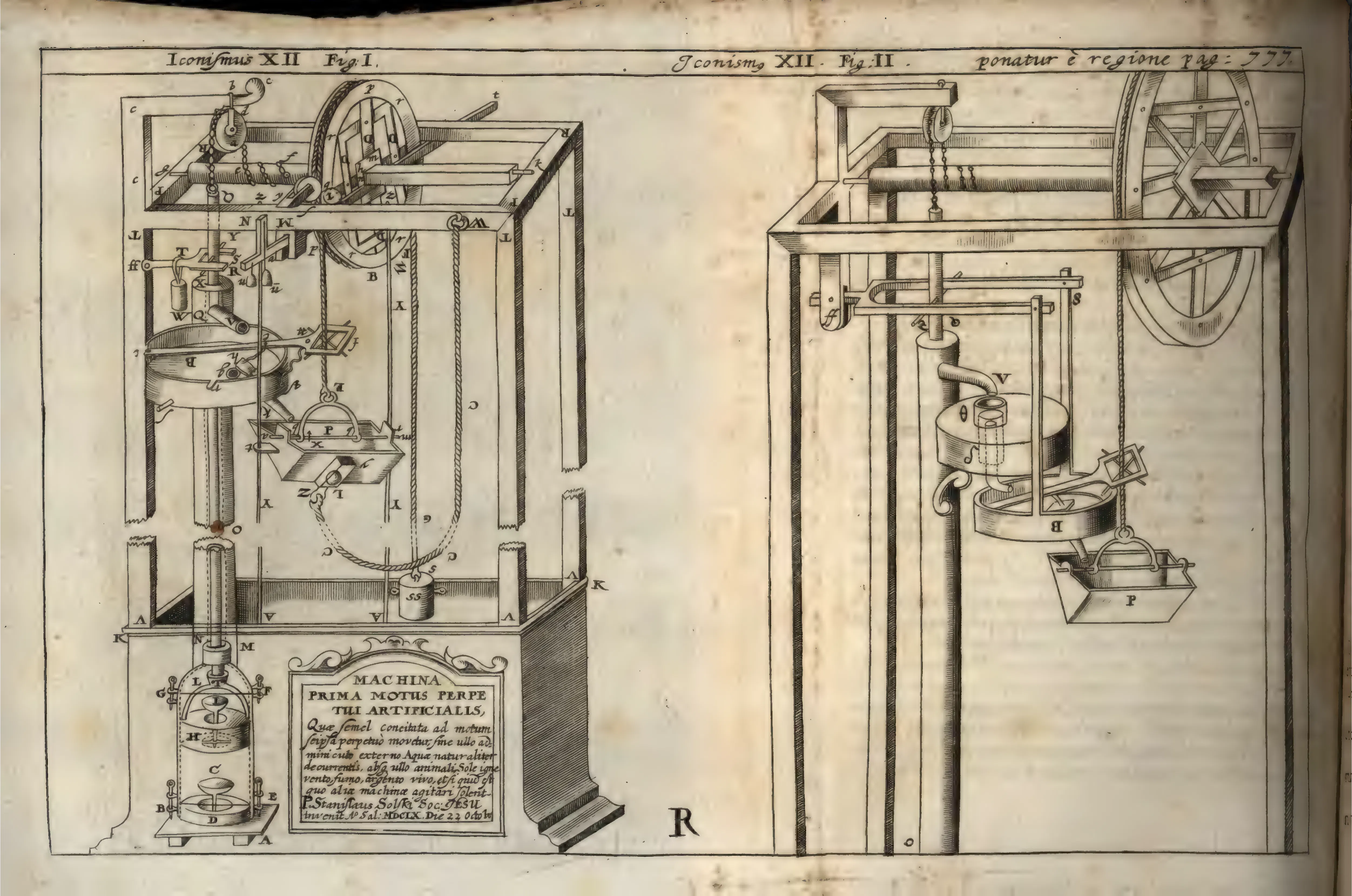
The engraved "Machina Prima Motus Perpetui Artificialis" sets the promise of self-moving perpetuity beside the machine's practical dependencies: cylinder, bucket, pulleys, wheelwork and the braking lever that keeps the cycle from failing. Paired overall and cut-away views show a mechanism sustained by empirical remedy as much as by proof. Source ↗.
The demonstration proper then shifts register decisively, from the workshop to proof. Once the wheel has been turned half a dozen times, the text asserts, the same sequence of opening will occur a third, tenth, hundredth, thousandth time and to infinity, the motion not ceasing until the machine itself is dissolved: & secundam apertionem, contingent tertiò, decimò, centesimò, millesimò, & in infinitum; non priùs cessante motu, quàm solva. The escalating ordinals perform perpetuity in print, and only the corruption of matter is admitted as a limit. Alongside this stands the promise that through the easy and pleasant artifice of the machine the reader will readily believe possible a perpetual motion that for nearly twenty centuries had been thought impossible, motis Machinæ artificio facili & jucundo, facilè credes possibilem motum perpetuum quem prope viginti secula credebant esse impossibilem. The verb credes shows what the demonstration is for. It is meant to produce assent in readers who have never seen the machine. The pleasure of the artifice (jucundo) is placed in the service of belief, and the appeal to the twenty centuries sets the modern invention against the whole inherited consensus of the ancients.
Within this demonstration the pneumatic doctrine of the earlier books reappears at the level of mechanism. Explaining how water enters the cylinder, the text corrects itself toward a new causal agent: when the piston is raised, the water surrounding the cylinder, pressed by the incumbent air, opens the lid and bursts in, vel potiùs, pistillo elevato, aqua modiolum circumstans pressa ab incumbente aêre, aperit operculum C, & irrumpit. The self-correcting vel potiùs, "or rather," compresses in two words the movement of mind that the compendium records elsewhere at length. The corollaries then draw a conclusion calculated to startle. From what has been said, it is not impossible for one lesser weight to recover a greater by artifice; two weights can be so arranged that each is alternately lighter and heavier than the other: Ex dictis Inferes I. non esse impossibile, ut unum pondus minus artificiosè recuperet majus: seu, posse accommodari duo pondera, ut unum altero alternatim sit levius, & gravius. Everything turns on artificiosè. The paradox is presented as an achievement of art, not a violation of nature. This is exactly the terrain the title's mirabilia artis claims, where human contrivance produces effects that nature left to herself does not.
The appended letter from Solski restores the human circumstances that the geometrical apparatus obscures. Writing from Lviv, he explains that for three months he has been exiled from Kraków and wanders through various cities wherever the business of provincial procurator calls him. This, he says, is the only cause of his long silence, and with Poland's affairs thrown into turmoil by universal plague, one would rather die than do anything: Tertium mensem exulo Cracoviâ, variasq[ue] erro per urbes, quò negotia Procuratoris Provinciæ vocant, Silentii mei longioris hæc unica causa. Turbatis rebus Poloniæ ex peste universali &c. mori magis placet, quàm agere aliquid. The letter shows the conditions under which the Society's learned correspondence was actually carried on: epidemic, administrative office and itinerancy. It also shows how fragile the network was that brought such contrivances to print.
Schott's Crisis is the point at which the compendium's method of adjudication is most precisely calibrated. He pronounces the device a machine of perpetual and unfailing motion, if one considers the artifice and theory of the contrivance: most ingeniously coordinated, clearly and distinctly explained, learnedly and solidly demonstrated. He adds that he weighed everything carefully and examined it against the laws of physics, statics and hydrostatics: mus, & technasmatis theoriam) motus, sanè perquam ingeniosè coordinata, clarè ac distinctè explicata, doctè ac solidè demonstrata. Expendi omnia sedulò, & ad Physicæ, Staticæ, Hydrostaticæq[ue] leges ac. The parenthetical restriction to technasmatis theoriam carries the weight of the whole verdict. Approval is granted to the machine as theory, and the practical question is left hanging on experiments that Solski had performed only on a cruder model. When Schott turns to the accumulated rust, vapour and grime that might halt the motion, he answers with a scholastic distinction. Such impediments, he argues, detract nothing from the artifice; they are joined to it accidentally and cannot be avoided in any conceivable machine: Tertiò, hæc & similia impedimenta nil derogare artificio, & per accidens conjuncta esse, nec in ulla Machina excogitabili evitari posse. The distinction between essence and accident protects the ideal mechanism from any empirical failure. A stoppage can always be charged to matter rather than to the design. This defensive move stands in quiet tension with the braking lever, whose necessity had itself been discovered through exactly such practical failure.
The same Crisis completes the pneumatic realignment. The lower valve, Schott insists, does not open spontaneously from fear of the void, as the Peripatetics might say. Nor is the water drawn up by the receding piston pulled upward by the bucket, nor by any other power joined to the machine: patetici dicerent fortassis; nec tractum à pistillo recedente, & sursum à situla tracto; nec ab alia potentia Machinæ conjuncta. By excluding every internal traction, he leaves the external weight of the air as the only agent. Within a perpetual-motion device the doctrine of atmospheric pressure thus becomes a working mechanical premise, not merely a conclusion drawn from the Magdeburg and English trials. The verdict closes by transferring final judgement outward. Addressing the reader directly, Schott writes that he has now given his mind; if the more learned add their vote, the glory of discovering the perpetual motion sought for twenty centuries and more is owed to the Polish nation: Habes meam mentem, Lector. Si doctiores suum quoque calculum adjecerint, nationi Polonicæ debetur reperti Motus perpetui, à viginti & ampliùs sæculis quæsiti, gloria. The conditional si hands the decision to the community of the learned, while the promise of national glory lends the claim a prestige that the verdict itself stops short of confirming.
The second "Polish" machine, the anonymous friend's Paradoxum Mechanicum, receives still more guarded treatment. Its apparatus of Compressio and Appressio, its Euclidean theorem and its riddle in cipher end in Schott's refusal to decide. The problem, he writes, is most ingenious and, if practice corresponds to theory, a seedbed of many inventions; let him make the experiment who has oil and expense, for the author lacked both: Cæterùm Problema, ut dicebam, perquàm ingeniosum est, & si theoria praxis correspondeat, multarum inventionum seminarium. Experientiam faciat, cui oleum & sumptus suppetunt. Auctori utrumq[ue] defuit. The gap between speculation and exhibition, which the Solski verdict had bridged only conditionally, is here named as a matter of labour and money. The trial is delegated to whoever can afford it.
The Miscellanies: Optics, Testimony and Obedience
The opening of the book of miscellanies recasts the whole enterprise as the travelling scholar's compulsion to narrate. Having recalled Pliny's travellers, who delight in recounting what they have seen, Schott admits his own share in the failing: (si vitium est) inficias ire nequeo. Euro, that is, he cannot deny suffering from a similar vice, if vice it is. The hedged parenthesis quietly reclaims curiosity as a virtue of learned exchange, and the naming of correspondents out of gratitude turns the network itself into part of the record.
The long optical polemic that follows shows the same experimental commitments turned against a fellow Jesuit. In the dispute over the camera obscura, Schott sides with those who hold firmly that the species of things received on paper are seen ut quod, and hence that the object of the visual power is not only light and colour but the very species of colours: Sunt enim qui mordicùs tenent, in casu illo species rerum chartâ exceptas videri ut quod, adeoq[ue] visivæ potentiæ objectum non solùm lucem esse, & colorem, sed ipsas etiam colorum species: quibus & nos assentimur. Against an opponent who scorned experiment, he builds a hierarchy of testimony that ends in the reader's own senses. If the reader will not believe the mathematicians, nor so many other eyewitnesses, philosophers, theologians and princes, let him at least believe his own eyes and make the experiment himself, with no one intervening: maticis, si non tot aliis oculatis testibus, Philosophis, Theologis, Principibus; credesaltem oculis tuis, & tute ipse, nullius inter. Ocular demonstration here outranks even princely testimony.
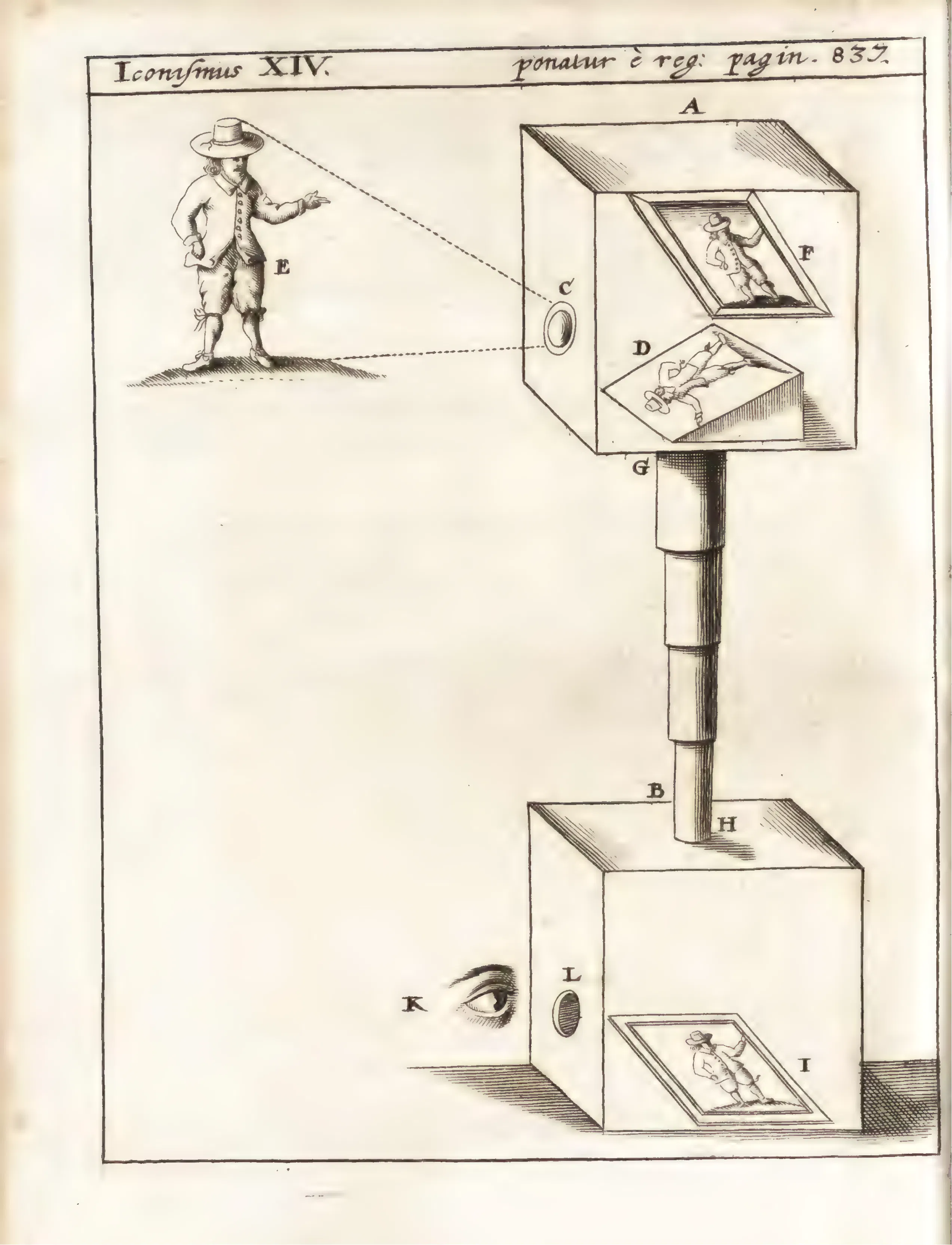
In Iconismus XIV, a two-box camera obscura gives Schott's optical polemic a form the reader can inspect: a standing figure is projected onto internal receiving surfaces while an isolated eye looks into the lower aperture. The disputed "species" appear as an image received within the instrument. Source ↗.
The chapter's closing annotation adds a reminder that the circulation of learning was also bounded by obedience. In the disclosure already quoted, Schott explains that everything in this chapter had been written word for word in the second century of his Ioco-seria, and that, because that work would not see the light by order of those he acknowledges and reveres as interpreters of the divine will, he wished to place it here. The language of submission is complete. Yet the act it accompanies is one of salvage, recovering suppressed matter within a work that was permitted to appear.
Reading Further on Schott, the Air-Pump and Early Modern Wonder
Steven Shapin and Simon Schaffer, Leviathan and the Air-Pump: Hobbes, Boyle, and the Experimental Life (Princeton: Princeton University Press, 1985). Its account of experimental testimony and the dispute over Boyle's air-pump offers a framework for reading the English pneumatic experiments that Schott circulated; it is not a study of Schott himself. The framework is especially pertinent to the compendium's repeated appeal to learned witnesses and ocular demonstration as grounds for accepting reports of experiments.
Edward Grant, Much Ado About Nothing: Theories of Space and Vacuum from the Middle Ages to the Scientific Revolution (Cambridge: Cambridge University Press, 1981). Grant supplies the longer history of arguments about space and the void needed to distinguish a claim about atmospheric pressure from a wholesale abandonment of inherited natural philosophy. That history also illuminates the work's own separation of the void from nothing and its coexisting concession and retention on the fear of the vacuum.
Lorraine Daston and Katharine Park, Wonders and the Order of Nature, 1150–1750 (New York: Zone Books, 1998). Their history of wonder helps situate Schott's mirabilia artis within learned practices of collecting, displaying and explaining the extraordinary. Its account of wonder should not be treated as a close reading of Technica curiosa.
The Kircherian material reproduced in the compendium gives that learned setting concrete form. It presents a device of which Docet proinde hæc rota, totius Magiæ naturalis rationem, & methodum absolutissimam: the wheel teaches the rationale and the most complete method of all natural magic. It grounds that magic in a doctrine of signatures: Est enim singulis rebus naturalibus ab Authore naturæ sapientissimo character quidam impressus, quo veluti scripturâ quâdam naturas, & proprietates suas sagacibus ingeniis legendas exhibent. On each natural thing the most wise Author of nature has impressed a character, through which, as through a kind of writing, such things display their natures and properties to be read by sagacious minds.
Frequently Asked Questions
What is Gaspar Schott's Technica curiosa?
Technica curiosa, sive Mirabilia artis is a Latin compendium in twelve books by the Jesuit Gaspar Schott. It was published at Nuremberg in 1664 by Johann Andreas Endter and the heirs of Wolfgang Endter the Younger, and printed by Job Hertz of Würzburg. The book is dedicated to Johann Philipp von Schönborn, archbishop and elector of Mainz. It gathers wonders of human art reported by correspondents across Europe, including Otto von Guericke's Magdeburg vacuum experiments, Robert Boyle's air-pump trials and Torricellian experiments. It also treats fountains, diving bells, clocks, perpetual-motion claims, universal scripts, shorthand, cryptography and squarings of the circle. The Getty Research Institute copy runs to more than a thousand quarto pages with two sequences of engraved plates.
Did Gaspar Schott accept the vacuum after Guericke's and Boyle's experiments?
Only in part. Schott conceded openly that the pressure of the air, not suction, explains why water in an evacuated tube rises to a fixed height. He declared that he had changed his view because no one should resist a truth clearly known, and he admitted that much in his earlier Mechanica hydraulico-pneumatica of 1657 needed new causes. Yet he denied that any true vacuum was produced, holding that ether and aqueous or mercurial spirits fill the apparently empty space. He also said he was not persuaded, and never expected to be, that the fear of the void had no effect in nature. Whether this combination amounts to a reconciliation remains an open question.
Why were some inventions in Technica curiosa kept out of print?
Rank, patronage and religious obedience limited what the book would publish. Ferdinand III and Archduke Leopold Wilhelm examined Athanasius Kircher's device for making languages mutually intelligible. They judged it too new and ingenious for general release and reserved it to their own family. A method for an accurate portable pendulum clock appears only as a ciphered anagram, reserved for readers distinguished by birth as well as by zeal for such curiosities. Schott also states that one chapter comes from his Ioco-seria, which his superiors had ordered not to appear. How that statement matches the documentary record of the Jesuit order has not been verified.
How does Technica curiosa judge claims of perpetual motion?
It separates perpetual motion found in speculation from perpetual motion exhibited in practice. Schott grants the design of Johann Joachim Becher's rain-rewound clock but warns that rust would produce perpetual rest at the builder's expense. The Polish Jesuit Stanisław Solski's water-and-bucket machine, reportedly demonstrated at Warsaw in 1661, is approved as theory. Its approval depends on perpetuity being redefined as motion lasting as long as the machine itself, since nothing under the sun is eternal. Final judgement is left to more learned readers. One chapter even hopes that some Columbus may one day stand the egg upright by an unexpected contrivance.
Is there an English translation of Technica curiosa?
An English translation of a portion of Book I is mentioned in scholarship, but no complete English translation is known to have been published, and the extent of any existing translation remains uncertain. Separately, the Leo edition presents the full Latin transcription together with a complete English translation generated by AI. Leo is an effort to make English translations of every text printed in Latin in early modern Europe between 1450 and 1750 freely available online, at no cost. Its rendering of Schott's compendium is a distinct, freely accessible, AI-generated translation, independent of any scholarly version.
This report was generated by an advanced AI assistant that conducted deep research alongside an extensive interpretation of the transcribed original text. Every effort has been made to preserve fidelity to the source and to guard against inaccuracy, but corruption in the text recognition process and model hallucination may nonetheless have entered the text. Treat every claim, quotation, translation, and citation as provisional, and verify each against the original source before relying on or citing it.
Bibliography
- Lorraine Daston and Katharine Park, Wonders and the Order of Nature, 1150–1750: The standard history of how learned Europe collected, displayed and tried to explain the extraordinary, and the natural place to test what Schott gains by relocating wonder from nature's prodigies to the mirabilia artis. Daston and Park never pause over the Jesuit's pumps and anagrams, but their account of wonder sliding from devout awe toward suspect vulgarity explains why a compendium that sells rarity as a courtly pleasure still needed a theology of art as a mirror.
- Edward Grant, Much Ado About Nothing: Theories of Space and Vacuum from the Middle Ages to the Scientific Revolution: Grant reconstructs four centuries of scholastic argument about space and the void, which is exactly what a reader needs to see why Schott could concede the pressure of the air on page 335 and still keep a metus vacui on page 383 without contradicting himself. Guericke's equation of the void with aethereal space, and Schott's insistence that ether fills every apparently empty tube, both read differently once one knows how much medieval thought on divine immensity and imaginary space stood behind them. The title's Shakespearean joke is the only frivolous thing in it.
- Steven Shapin and Simon Schaffer, Leviathan and the Air-Pump: Hobbes, Boyle, and the Experimental Life: The book that made witnesses, leaky receivers and the literary reporting of experiments into serious historical subjects, and so the obvious companion to Schott's praise of Boyle's learned spectators and his complaint that air seeping through the joints rendered all calculation vain. Shapin and Schaffer are concerned with Boyle and Hobbes in Restoration England, not with a Jesuit in Würzburg, but reading them alongside Book II shows how the same English trials looked once filtered through a Catholic compiler's Annotationes. The study is also available through JSTOR's digital edition of Leviathan and the Air-Pump.