Nothing So Arduous: Paolo Casati's The Earth Moved by Machines: Geometrical, Mechanical, Physical, and Hydrostatic Dissertations
Archimedes once boasted that he could move the Earth, and for centuries readers took the claim as a lapse of character. In Terra machinis mota, printed at Rome in 1655 and much enlarged in 1658, the Jesuit mathematician Paolo Casati tested that boast with pulleys, geodesy, and hydrostatics, staging the argument as a conversation among the dead Galileo, Mersenne, and Guldin. His verdict is that Archimedes was never arrogant, because the burden was never as heavy as his critics supposed.
ExLatinis
September 25, 2026

Contents
Archimedes once boasted that he could move the Earth, and for centuries readers took the claim as a lapse of character. In Terra machinis mota, printed at Rome in 1655 and much enlarged in 1658, the Jesuit mathematician Paolo Casati tested that boast with pulleys, geodesy, and hydrostatics, staging the argument as a conversation among the dead Galileo, Mersenne, and Guldin. His verdict is that Archimedes was never arrogant, because the burden was never as heavy as his critics supposed.
Paolo Casati published Terra machinis mota at Rome in 1655 and again, much enlarged, in 1658. The title means "the Earth moved by machines." Casati (1617–1707) was a Jesuit mathematician from Piacenza. His Latin work is a dialogue among three learned speakers. Its occasion is one of the most familiar boasts of antiquity: Archimedes' claim that, given the means, he could move the Earth itself. The earlier printing announced two dissertations on the Earth's weight and dimensions. The later one expanded the inquiry into geometrical, mechanical, physical, and hydrostatic dissertations, and its title states the work's purpose outright: to vindicate Archimedes from the suspicion of arrogance that his promise had incurred.
The intellectual problem is whether a boast long read as a moral failing can be shown to be a feasible claim. Casati's recurring move is to dissolve the ethical accusation into a sequence of quantifiable questions, taken up in turn:
- how far composed machines multiply force;
- how large the Earth is;
- how much it weighs;
- how the surrounding medium alters that weight.
Throughout, demonstrative reason is set against inherited authority. Ancient and modern writers, among them Macrobius, Clavius, Biancani, and Porta, are corrected for ungeometrical reasoning, misreading, and miscalculation. That confidence in demonstration is tempered by counsels against rash innovation. The dialogue also airs contrary opinions, on the void and on the Earth's motion, before settling on plenist and geostatic verdicts. The resolution is relational rather than triumphal. Archimedes never had to bear the Earth's entire weight, because the medium carries part of the load. Gravity itself is finally redefined as a body's disposition within the universe, and with that definition the vindication is complete.
The stakes lie in when and where the argument was made. Casati wrote in Rome, within the mathematical culture of the Jesuit colleges, a generation after Galileo's condemnation. Yet he chose as his speakers the recently deceased Galileo, the French Minim Marin Mersenne, and the Jesuit Paul Guldin, who stand respectively for Italian, French, and German mathematics. Rivka Feldhay has read the dialogue as an idealized Collegio Romano occasion. In her reading, the practical mechanics of the engineers is made acceptable within traditional mixed mathematics, while the courteous exchanges expose tensions in Jesuit scientific culture. Hers remains an interpretation rather than an established account of Casati's intentions. Nor has a documented contemporary controversy or chain of printed replies to the book been established. The work's immediate reception therefore remains an open question, not a known episode.

A line engraving of Marin Mersenne, the French Minim whom Casati casts as the voice of French mathematics. A portrait rather than a page of Casati's book, it puts a face to one of the dialogue's three speakers in its exchanges over air, weight, and tides. Source ↗.

What makes the text memorable is the sheer range of learning it draws into one mechanical question. The Earth's weight is computed in pounds to nineteen figures. The globe's size is sought by a dozen methods, including the dip of the horizon seen from the Genoa lighthouse and from the cross atop St Peter's. The fire of hell, lodged at the Earth's centre as the prison of the wicked, is weighed as a factor in the calculation. Algebra's "defective numbers," the negative quantities, are pressed into service to express lightness. Chinese reports of tides are set against a Galilean hypothesis. A letter from Würzburg relays the Magdeburg vacuum trials. Porta's famous mirror on the Pharos of Alexandria is diagnosed as a confusion of specula, a watchtower, with speculum, a mirror. The final reckoning finds that the Earth could be displaced some 267 miles before the surrounding water ceased to assist its movement.
A single throughline joins the work's vocabulary, its printing history, and its argument: a suspicion of character answered by measurement. In the title's diction, suspicio and gravitas move between moral and physical registers, the latter settling firmly on weight. The expansion from two dissertations to a fuller hydrostatic set is the same movement at the level of the book. The medium's share of the load entered the argument, and the vindication of Archimedes rose into the title itself. Much about that history is still unconfirmed. The names and dates of the book's licences, the dedicatee of the later edition, and the existence of any translation have not been established against the surviving evidence.
Read the full text and English translation on Leo
This text was transcribed and translated as part of the ExLatinis project, an effort by Leo to make free English translations of every text published in Latin in early modern Europe (1450–1750) available online. The complete transcription and English translation of this work can be read free of charge:
→ Read the original Latin text and full English translation on Leo
You can save a copy of this document into your Leo account to run deep text searches, conduct further analysis, or cross-reference it with your own research.
Translating Casati's Title: Machines, Suspicion, and Gravitas
The Earth Moved by Machines: Geometrical, Mechanical, Physical, and Hydrostatic Dissertations is an editorial English title supplied for convenience, not an established translation. It designates the expanded Rome edition of 1658. The shorter work printed in 1655 has the different title Terra machinis mota, eiusque gravitas et dimensio and announces two dissertations.
Machinis mota makes the Earth the object of mechanical displacement. It should not silently be rendered as an assertion of terrestrial rotation: the title directs attention to what joined machines could accomplish. The dialogue's first inquiry concerns which ancient machine Archimedes could have meant. It weighs a view that attributes the relevant effects to Hero's toothed-wheel device, vni Glossocomo tribuendas contendebat, that is, "he contended that they should be attributed to a single glossocomus." Against that view it assigns them with emphatic confidence to Archimedes' own contrivance, Pancratio: nullus siquidem dubitandi locus: "to the Pancratium, for there is no room for doubt." The keyword machina is thus from the outset a question about a particular historical device, not merely a figure of speech.
Arrogantiae suspicione likewise matters more precisely than a simple accusation of arrogance. In the expanded title, Archimedes is vindicated from the suspicion of arrogance incurred by promising the Earth's motion. A demonstration of mechanical powers is made to answer a judgment about his intellectual character. In the work's own orthography the clause reads terræ motionem spondens ab arrogantiæ, "promising the Earth's motion, [vindicated] from arrogance." Its verb spondere, to pledge or promise solemnly, casts Archimedes' boast as an undertaking whose fulfilment can be checked. That is precisely the move by which the moral charge is converted into a mechanical and geodetic problem.
Finally, gravitas, paired with the Earth's magnitudo in the expanded title and with its dimensio in the earlier one, denotes the weight or heaviness to be investigated, rather than moral seriousness. The text refines the term considerably as the argument advances:
- Specific weight. It distinguishes weight "according to species," grauia secundùm speciem si in eodem medio: "heavy according to species, if in the same medium." Comparisons of weight thereby become relative to a shared medium.
- Centre of heavy bodies. It separates the point toward which heavy things tend from the Earth's geometrical centre, centro (quod, ne invocabulis laboremus, centrum grauium liceat appellare, cum. The clause renders as "a centre (which, lest we labour over words, may be called the centre of heavy bodies, since...)."
- Lightness as a quantity. It borrows from algebra to express lightness numerically, ab Algebraâ numeros defectiuos, "defective numbers from algebra," meaning the negative quantities.
- Relational definition. It ends by defining gravity relationally, est vis disponendi se in vniuerso in: gravity "is a force of disposing oneself in the universe in [a certain order]."
The polysemy of gravitas is therefore not only lexical but argumentative. The same term that the title makes an object of measurement becomes, by the end, a disposition within an ordered cosmos. That redefinition closes the case for Archimedes.
The conjunction of measurement and mechanics places Archimedes' claim within mixed-mathematical inquiry, even where questions about the physical constitution of the Earth remain open.
Summarizing Terra machinis mota and Casati's Case for Archimedes
Paolo Casati, SJ (1617–1707), wrote a Latin Jesuit mathematical dialogue concerning whether machines could move the Earth and whether Archimedes' promise was defensible. The dialogue's governing conviction, voiced early, is nihil esse tam arduum, quod superari non possit sa: "that nothing is so arduous that it cannot be overcome." That maxim frames the boast as a problem to be solved rather than a vice to be censured.
The bibliographic distinction is consequential:
- 1655. A two-dissertation Terra machinis mota, eiusque gravitas et dimensio was printed at Rome by the heirs of Corbelletti.
- 1658. The expanded Terra machinis mota: dissertationes geometricae, mechanicae, physicae, hydrostaticae, whose title vindicates Archimedes from arrogantiae suspicione, was printed at Rome by Ignazio de Lazaris.
The dialogue stages Galileo Galilei, Marin Mersenne, and the Jesuit Paul Guldin. It introduces them pointedly as men of the present age now dead, (qui diem nostro æuo obierunt) Galilæum, Mersennum,: "(men who died in our own age) Galileo, Mersenne." The three speakers stand for Italian, French, and German mathematics respectively.
The argument moves through the multiplying power of composed machines, the Earth's size, its weight, and the effect of the surrounding medium. It closes by rejecting the premise that made the boast seem extravagant, namely totius telluris pondus debuisse ab Archimede, "that the weight of the whole Earth had to be [sustained] by Archimedes." At one turn, the calculation of lightness is pressed so far that it produces an ironic reversal, opus esset non ad mouendam, sed ad reti: "there would be need not for moving but for holding back [the Earth]."
Rivka Feldhay interprets the work as an idealized representation of a Collegio Romano mathematical occasion and as an accommodation of practical mechanics to Jesuit mixed mathematics. No translation of either edition was verified; the absence of one cannot be established from the consulted records.
Reading Casati after Galileo: Jesuit Science and Its Historians
Casati's dialogue belongs to the mathematical and natural-philosophical culture of the seventeenth-century Jesuit colleges. Its importance lies not simply in a calculation about the Earth but in the choice to let the deceased Galileo, Mersenne, and Guldin discuss mechanical knowledge under Jesuit auspices after Galileo's condemnation. The national characterization of the speakers is explicit in the text. Guldin prefaces a correction of Mersenne's arithmetic with an appeal to his own nation's frankness, Guld. Suspicor Mersenne (detur hoc Germano candori) non tibi rectam pro arcûs: "I suspect, Mersenne (grant this to German candour), that [you have taken] not the correct [value] for the arc."
Feldhay's interpretation, rather than an uncontested statement of authorial intention, is that Casati makes the practical mathematicians' mechanical project acceptable within traditional mixed mathematics, while the dialogue's apparently amicable speakers expose tensions in Jesuit scientific culture. She reads the presentation of Galileo as a deliberate rhetorical accommodation.
Two features of the text are consonant with that reading, though they do not by themselves establish it:
- Hydrostatics praised. Galileo's hydrostatics is warmly endorsed, including his account of bodies that float because they form, tamen vnâ cum aëre sibi adhærescente molem aquâ non grauirem. Illud maximè, "yet, together with the air adhering to it, a mass not heavier than water."
- Tides without rotation. The Galileo persona is made to advance a theory of the tides that dispenses with the Earth's motion, a hypothesis, qua citra omnem celluris verti: "a hypothesis by which, without any turning of the Earth [the tides are explained]." Guldin then rebuts this hypothesis with reports of tides from China.
The Galileo who speaks here is thus a hydrostatician honoured for demonstrated results and a natural philosopher who does not argue from terrestrial rotation. That configuration bears directly on the permissible uses of Galileo's work.
Feldhay's article describes the dialogue as published in 1655; the distinct title and imprint of the expanded five-dissertation printing date that edition to 1658. This is a bibliographic qualification of the article's dating, not evidence that its larger interpretation has been refuted.
The dialogue's methodological posture sharpens the question of accommodation. Demonstration is repeatedly placed above inherited authority. In dispute with the Aristotelian position of De Caelo II, the text dismisses a Peripatetic [auctor]ity as one ritas, cui apodictica ratio aduersatur. Porrò, "[an autho]rity which demonstrative reason opposes." It also traces the errors of earlier estimates to a failure of geometry, di ageometriâ enormis illa magnitudo ori: "from ungeometrical reasoning that enormous magnitude arose."
That charge of ageometria is laid against Macrobius, Clavius, Biancani, and Porta alike. Philology is enlisted in the same corrective spirit. The celebrated mirror of the Pharos is explained as an error of reading, arising where Porta's sources speak pro speculâ in Pharo (insulâ) extructâ, speculum, "for the watchtower built on Pharos (the island), a mirror." The watchtower, specula, has been mistaken for a speculum.
Alongside this confidence stands an insistence on the author's own originality. He says of certain solutions mihi primùm, nemine prælucente, in mentem venerunt: "these things first came into my mind, with no one lighting the way before me." That claim is echoed within the dialogue by the Guldin persona's complaints about priority, Ego quoque, vt vera narrem, sæpiùs doleo, quod veritatem tanquam peregrinam: "I too, to tell the truth, often grieve that [I received] truth as a stranger."
The same demonstrative method extends into theology. The Earth's weight is computed on a cosmology in which the centre is so arranged, disponantur, vt centrum omnium grauissimus ignis impiorum carcer atque, "that the heaviest fire of all, the prison of the wicked, [occupies] the centre." The discussion also reports an opinion on why that fire is restrained, vinculis eo tantùm consilio coërceri existimat, vt sceleratorum carnificinam: "he thinks it is confined by chains for this purpose only, that [it may inflict] the torture of the wicked." Here doctrine becomes a quantity entering the calculation of gravitas, a telling instance of the work's habit of converting every register of learning into measurable weight.
Denise Aricò places Casati among Jesuits concerned with experimental inquiry and reports of pneumatic experiments, and discusses the precautions arising from demands for doctrinal uniformity. The text itself pairs the pursuit of experiment with an explicit check on novelty. It praises the inquirer who tracks nature per experimenta vestigat: sed nec aliquid temerè: "through experiments, but nothing rashly." Aricò's passages provide comparative institutional context rather than a sustained interpretation of Terra machinis mota.
The dialogue consequently bears on scholarly questions about mathematical demonstration, the authority of experiment, the possibility of a void, and the permissible uses of Galileo's mechanical work; no single position on all those questions can be inferred merely from the cast of speakers. On the void, the text itself does more than cast speakers. The Galileo persona pleads that inquiry be allowed to proceed, vt progrediatur Philosophia in Vacuo. Mihi, "that philosophy may advance in the vacuum." The dialogue's verdict, however, is plenist, and its handling of the tides is geostatic. The contrary positions are aired within a text whose resolutions follow the received teaching.
The records consulted did not establish a documented contemporary controversy or chain of printed replies to this particular edition. Claims about its immediate reception, suppression, or a settled scholarly disagreement over its conclusions would therefore exceed the evidence.
Tracing the 1655 and 1658 Roman Editions of Terra machinis mota
Two Roman printings must not be collapsed into a single 1655, five-dissertation book. The 1655 title presents Terra machinis mota, eiusque gravitas et dimensio. Dissertationes duae P. Pauli Casati Placentini Soc. Iesu; a Google Books record gives the heirs of Corbelletti as printer and 52 pages. Its title associates public exposition at the Collegio Romano with Antonio, count de Montfort, and Cardinal Friedrich of Hesse. An Internet Archive reproduction identifies its source as a copy from the Biblioteca Nazionale Centrale di Roma; a shelfmark was not established. The cardinal's appearance in the earlier title does not, without inspection of the later preliminaries, establish him as dedicatee of the 1658 edition.
The expanded edition's catalogue title reads Terra machinis mota dissertationes geometricae, mechanicae, physicae, hydrostaticae in quibus machinarum coniugatarum vires inter se comparantur: multiplici noua methodo Terrae magnitudo & grauitas inuestigatur: Archimedes Terrae motionem spondens ab arrogantiae suspicione vindicatur. Authore Paulo Casato e Societate Iesu (Rome: ex typographia Ignatij de Lazaris, 1658). The title's three clauses set out the argument's programme in sequence: the comparison of joined machines, the investigation of the Earth's size and weight, and the vindication of Archimedes. Each is carried through in the text.
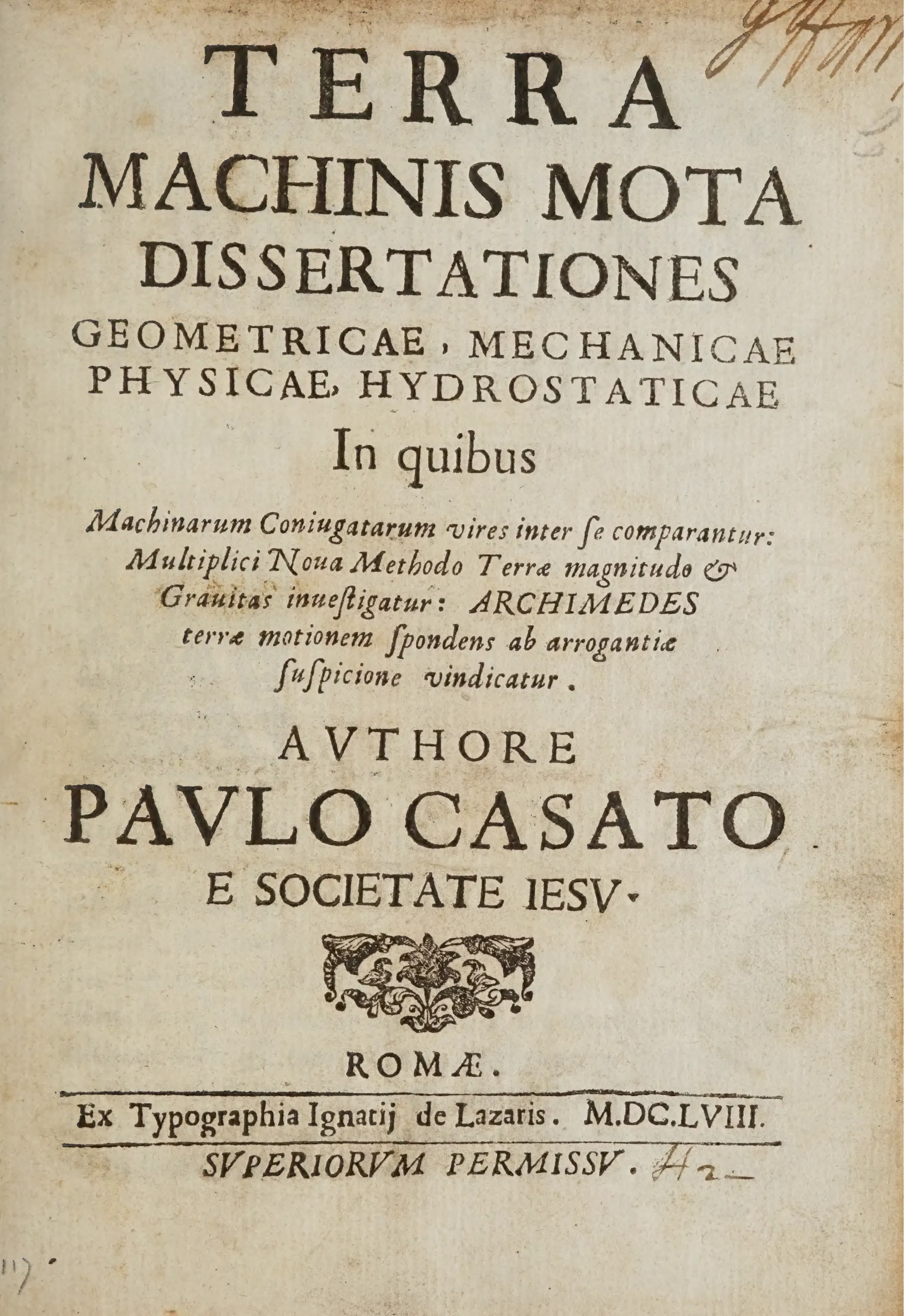
The title page of the 1658 Roman edition announces Casati's expanded programme—joined machines, the Earth's magnitude and gravity, the vindication of Archimedes—ahead of the imprint of Ignazio de Lazaris. Its printed "SVPERIORUM PERMISSV," with later manuscript marks, ties the copy to licensing questions that remain open. Source ↗.
The first clause rests on a principle the dialogue states in compressed form, narum compositio præstet earum augmento: "[that the] composition of [machi]nes surpasses their enlargement." Multiplying power is to be sought by joining machines, not by building a single machine ever larger. The mechanical dissertation reaches its result when a compound arrangement of pulleys is shown to yield a power that reni globi grauitatem superat. Orbiculis ita, one that "exceeds the weight of the terrestrial globe; with sheaves thus [arranged]." The title's movement from joined machines to measured gravitas to the vindication of character is the same movement that organizes the argument, from mechanics through geodesy to hydrostatics.
A German bibliographic record describes a 1658 quarto with four preliminary leaves, 227 pages, two final leaves, and illustrations. A digitized witness is accessible through the Max Planck Institute for the History of Science's ECHO collection. The Biblioteca Braidense catalogue page encountered during this inquiry displays Casati's 1658 title as a related record: its shelfmark LP. 0141 belongs to a different book by Giuseppe Silos and is not a Casati shelfmark. No secure shelfmark for a physical copy of the expanded edition was established here. A separate 1658 printing, translation, or later edition was not demonstrated, nor was a Gallica or Munich digitization securely identified.
The work passed through a Jesuit and Roman printing milieu, but the names and dates of its individual licences and imprimaturs, any censorship proceedings, and its immediate readers' replies were not independently established. Casati's later Mechanicorum libri octo (1684) provides a relevant continuation of his published mechanics. The priority of composition over enlargement is the kind of principle whose afterlife that later treatise invites one to trace, though exact reuse of passages remains to be checked against both books.
The 1710 genealogical Genealogiae viginti illustrium in Italia familiarum associated with Jacob Wilhelm Imhof is unrelated to either Casati printing. A particular catalogue record attaching that title to the dialogue could not be independently confirmed, so the history or extent of any such conflation remains undetermined.
Following Casati's Argument through the Five Dissertations
Dedication and Preface: The Terms of the Defence
Casati's dedication sets the apologetic register before any machine is described. Many readers held Archimedes' boast to be beyond refutation or confirmation, since the feat could not even be attempted. Against that inertia the dedication wants even the less learned to grasp the maxim already noted as the dialogue's governing conviction: that nothing is so arduous that it cannot be overcome by the industry of the wise. The sentence carries more than a pious commonplace. It moves the question of Archimedes' character from the domain of praise and blame into that of ingenuity and labour. His arrogantia thereby becomes a case in which the difficulty of a task has been mistaken for its impossibility. The maxim also belongs to the pedagogical idiom of the Jesuit colleges. There the demonstration of hard things was part of forming the learned man, and the book presents itself as the written form of a public academic exercise.
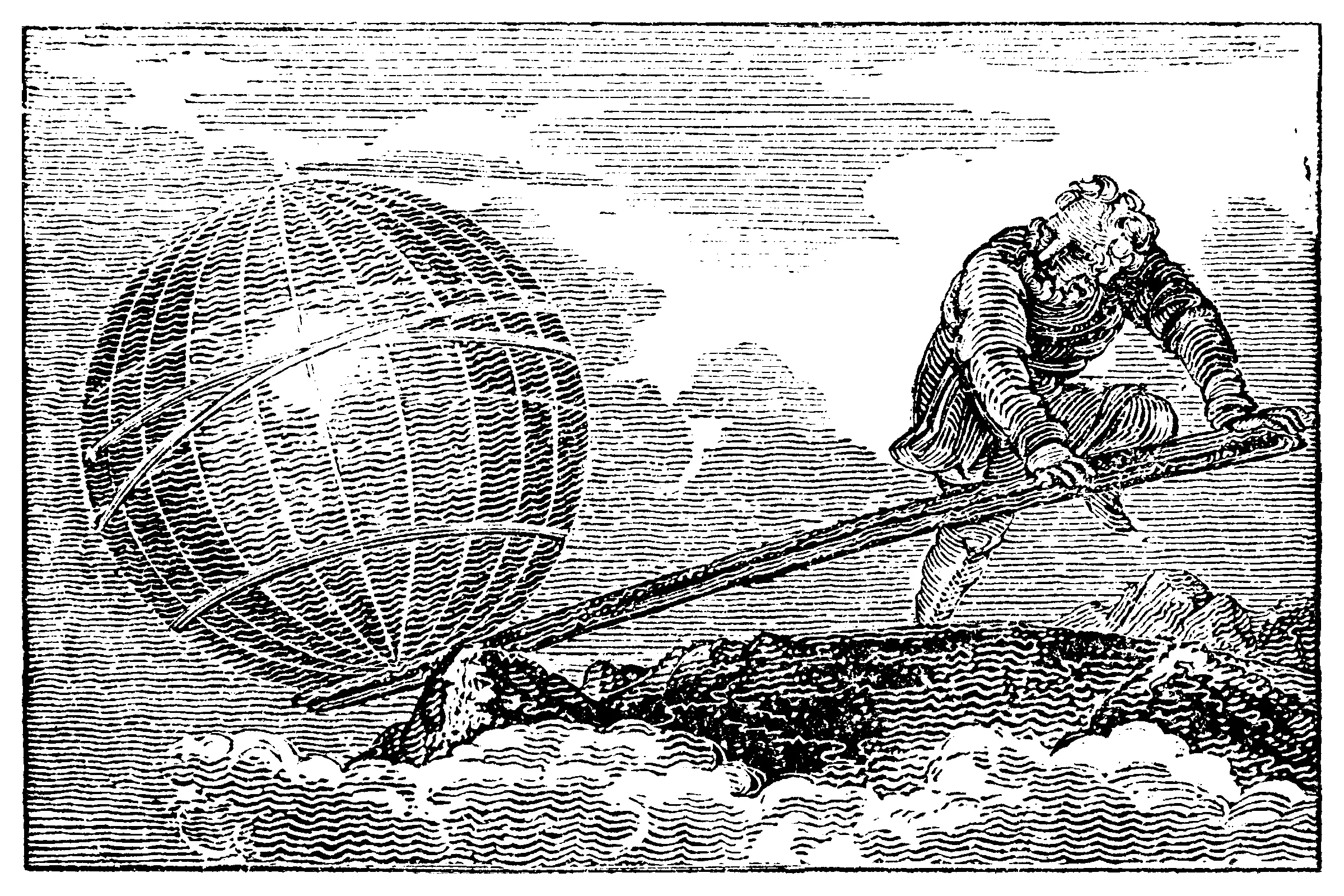
The Archimedean lever, pictured here, gives visual form to the boast Casati set out to defend: not a fantasy of presumption but a problem for mechanical reasoning. It recasts the apparently impossible as the province of disciplined ingenuity—the very move announced in Casati's dedication. Source ↗.
.jpg)
The preface then establishes the author's standing to make such a demonstration. Casati allows that others may have reached similar results. Yet he insists, in the claim of unaided invention already observed, that these solutions first came into his mind with no one lighting the way before him. The claim of independent invention sits uneasily beside a project that defends an ancient against a charge of vainglory. The modern author asserts his own priority in the very book that clears Archimedes of self-assertion.
The same preface justifies the dialogue form by Plato's example. It then names the three interlocutors, in the parenthesis remarked earlier, as men who died in our own age: Galileo and Mersenne, together with Guldin, so that Italian, French and German mathematics might each contribute its light. The parenthesis is doing careful work. Because the speakers are dead, their words are openly the author's fiction. Casati can thus give Galileo a voice under Jesuit licence while holding every opinion put in his mouth at one remove.
The First Dissertation: The Composition of Machines
With the terms of the defence set, the first dissertation opens on an antiquarian dispute over which machine Archimedes meant. The candidates are a combination of the simple powers, a toothed-wheel train, or the fortieth invention that Guldin names the Pancratium. Mersenne's reckonings favour the endless screw. Galileo turns the discussion from conjecture about the ancient device to a general principle. He censures builders who merely enlarge their engines and teaches how far the composition of machines surpasses their enlargement, the principle already set out in connection with the title's first clause.
That principle is the mechanical core of the whole vindication. Enlarging a single machine raises only one ratio. Joining machines multiplies ratio upon ratio, so that force grows geometrically while the apparatus remains modest in scale. The criticism of artisans who spend fortunes on gigantic engines is therefore also a criticism of a way of imagining Archimedes. The boast seemed arrogant only to those who pictured a single colossal lever rather than a train of small powers.
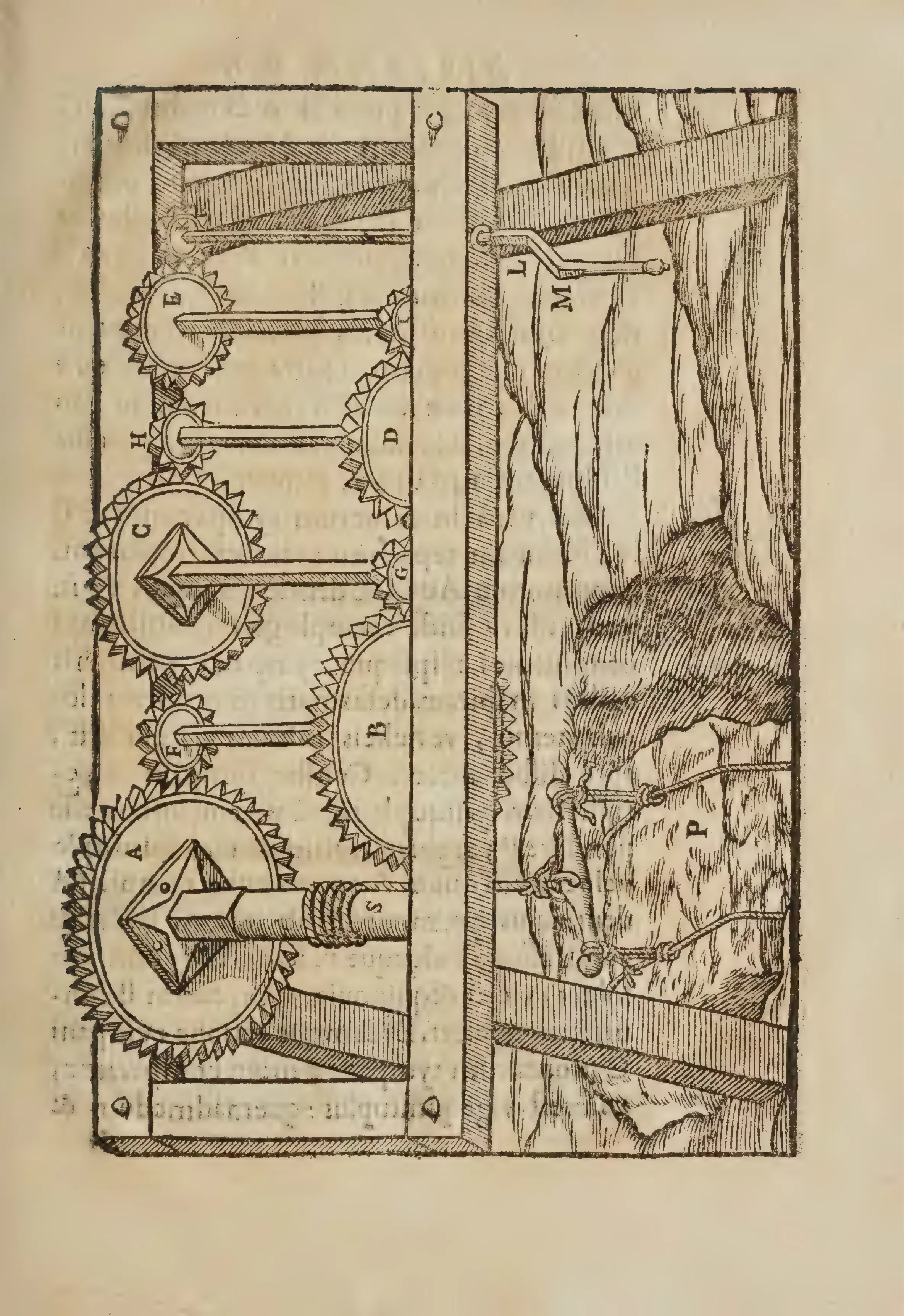
Paired woodcut panels turn Casati's mechanical claim into visual arithmetic. At left, lettered toothed wheels mesh in sequence, each stage compounding the last; at right, ropes and tackle address a massive natural load, resting the vindication of Archimedes on the organized multiplication of small powers. Source ↗.
The dissertation reaches its climax with pulleys. Galileo shows that many small compound pairs outperform a few massive blocks. He then computes that a modest number of sheaves yields the power, already cited, that exceeds the weight of the terrestrial globe. The figure comes to a hundred and six sheaves. It refutes those who had demanded "thousands and myriads" of pulleys, and it answers the charge of extravagance with arithmetic.
The day nevertheless ends on a reservation. Guldin raises the worry, voiced in Greek from the Sand-Reckoner, that the Earth's weight exceeds all nameable number. Mechanics has shown that the power can be multiplied, but it has not yet shown that the load can be counted.
The Second Dissertation: The Weight of the Earth and the Fire at Its Centre
The second dissertation supplies that count. Its handling of the Earth's interior shows how far Casati will carry the conversion of every register of learning into weight. Mersenne treats the globe as clay and defends the average by compensation: metals are offset by water, air and the light exhalations of mines. Guldin then mischievously proposes that hell-fire might lighten the Earth.
In reply Mersenne recounts an unnamed speaker who held fire to be the heaviest element, lodged at the centre as the prison of the damned. That speaker rejected the opinion, discussed earlier, that the fire is held in chains solely to carry out the torture of the wicked. Against such a purely penal reading, he argued that a natural placement better befits divine wisdom, as the rainbow is both a natural effect and a covenant sign. The passage naturalizes eschatology. The place of punishment becomes a place in the order of elements, and its fire a quantity that bears on terrestrial gravitas.
The daring of that speculation is at once checked. Galileo welcomes the philosopher who, in the formula already encountered, investigates through experiments but pronounces nothing rashly. The line is carefully calibrated. It grants Galileo the experimental ethos attached to his name, yet makes him the spokesman for restraint before long-held opinion.
The dissertation then closes with its decisive geometrical point. Displacing the Earth a few miles engages only a spherical segment of its weight, calculated from Archimedes' On the Sphere and Cylinder. It is this that yields the machine of twenty-four axles able to move the Earth with the force needed for three pounds.
The Third Dissertation: Measuring the Globe and Correcting Authority
Once the weight has been reckoned, the third dissertation turns to the globe's magnitude, sought by twelve methods. Here the dialogue's critique of authority is sharpest. Here too the priority anxiety of the preface returns inside the fiction. Guldin reflects, in the lament about priority already noted, that he has often grieved at having welcomed truth as a stranger, on learning that others had reached his results before him. His fear is less that others preceded him than that he might be accused of plagiarism. The image of truth as a peregrina, a foreign guest received without knowing whence she came, casts discovery as hospitality. It lends the author's own claim of independent invention a moral colouring of good faith.
The critical work that follows is both geometrical and philological. Porta's tale that the Pharos of Alexandria could descry ships six hundred miles off is traced to the confusion in his sources already discussed: a mirror has been put in place of the watchtower built on the island of Pharos. Guldin blames the slip of a single letter in the printed transmission. The celebrated optical wonder dissolves into a misreading of specula as speculum, and the history of optics is corrected by the humanist's attention to the letter.

Philip Galle's 1572 engraving imagines the Pharos of Alexandria, the ancient watchtower later burdened with the legend of a miraculous mirror. The marvel Porta repeated was, on Casati's account, no lost feat of catoptrics but a philological slip that turned specula, a lookout, into speculum, a mirror. Source ↗.
_-_1572.jpg)
The same confidence is turned against the Philosopher himself. Guldin sets aside Aristotle's figure for the Earth's circumference in De Caelo II, dismissing it in the phrase already cited as an auctoritas that demonstrative reason opposes. The phrasing is exact. On a quantitative question within mixed mathematics, apodictic demonstration outranks the Philosopher. The concession is made without any general revolt against Peripatetic natural philosophy.
The Fourth Dissertation: The Waters, the Tides, and the Weight of Air
The fourth dissertation turns from the solid globe to its waters, and here the handling of Galileo becomes most pointed. Guldin distinguishes the centre of heavy bodies from the Earth's own centre. The distinction lets the speakers imagine the globe displaced and the seas redistributing. Into this Galileo interjects the tidal hypothesis already noted, which explains the tides without any turning of the Earth through a small oscillation of its centre. In the printed text, celluris stands for telluris.
The historical Galileo had made the tides his principal physical argument for terrestrial motion. The persona here offers a tidal theory from which rotation has been removed. Guldin then refutes even this with Chinese reports of anomalous tides and tidal wells. Galileo's name is kept in the conversation on tides, while the substance associated with it is withdrawn and then answered from the Jesuit mission's geographical intelligence.
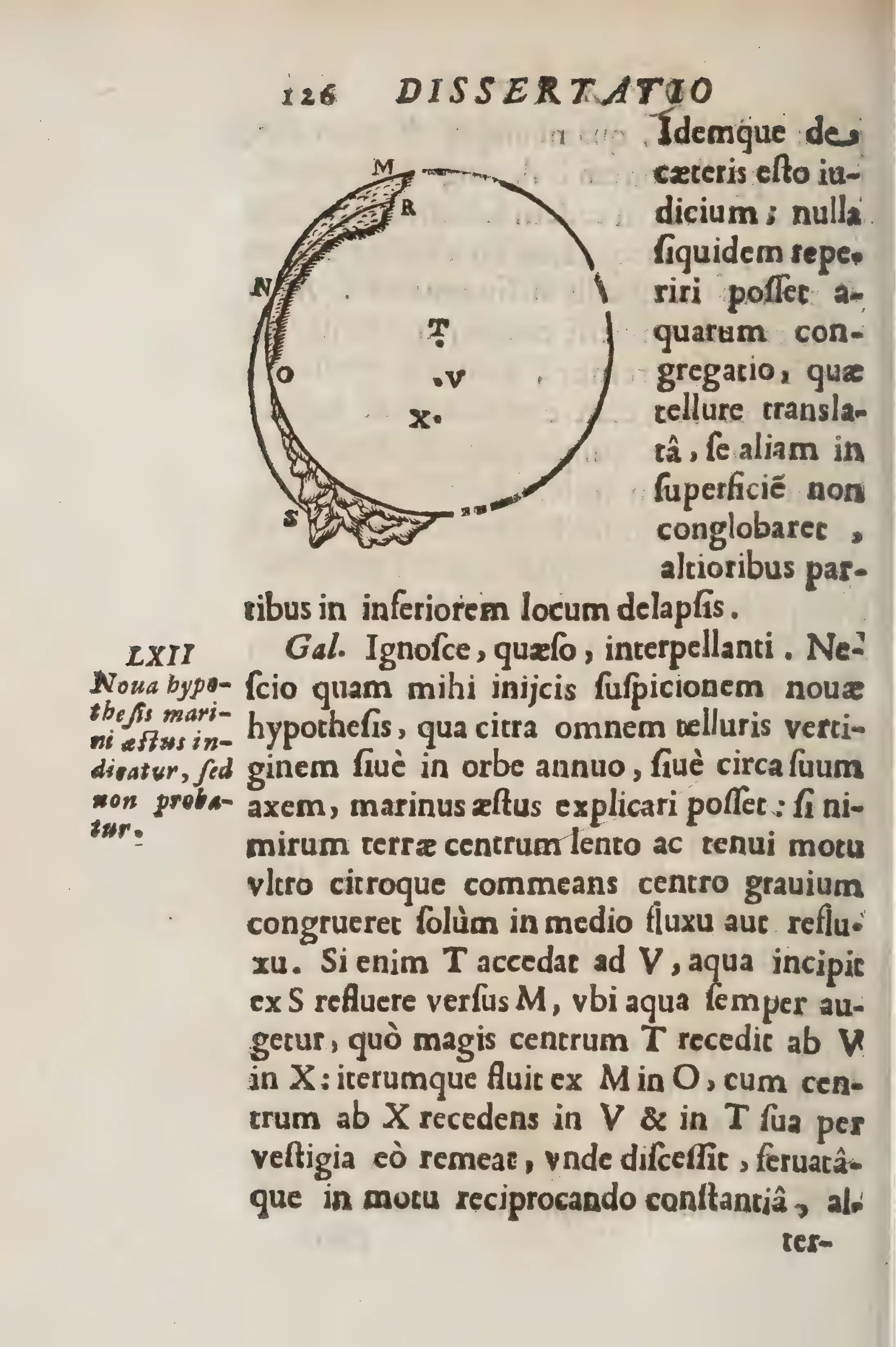
The lettered globe diagram gives visual form to the Galileo persona's geostatic tidal hypothesis: the sea shifts as the Earth's centre oscillates, not because the Earth rotates. A marginal note marking the hypothesis as not proved keeps Galileo in the tidal debate while stripping it of its Copernican force. Source ↗.
The question of whether the displaced Earth might float leads to the weight of air. Mersenne reports his aeolipile experiment with the studied moderation already observed, judging it liberal enough to set air to water in lightness as 1200 to 1. The figure is set against the Galileo persona's lower ratio of four hundred to one. The day does not end in agreement. It closes instead with Guldin's critique that weights in a medium mean nothing unless the counterweight sits in the same medium. The result is a methodological scepticism about the very numbers that the hydrostatic argument requires.
The Fifth Dissertation: The Void, Negative Gravity, and the Final Reckoning
That scepticism carries into the fifth dissertation. It opens with the letter from Würzburg reporting the air-pump trials and stages the book's most sensitive controversy. Galileo speaks for the vacuum and charges the Aristotelians with inventing a "contumacious" rarefied air. Guldin answers wittily that no bodies need be removed for philosophy to advance in the vacuum, turning the phrase already cited against its speaker. The pun makes the Galilean plea a jest about empty progress, and it introduces the plenist reading of every phenomenon in the report.
The official verdict follows. Nothing in the experiment, it concludes, brings even a slight suspicion of a vacuum, in the wording discussed earlier. The noun matters. The book began by lifting a suspicio of arrogance from Archimedes, and here it lifts a suspicio of the void from nature. In both cases a suspicion is weighed against reasoned explanation and set aside.
The same dissertation stretches the vocabulary of weight to its limit. Guldin borrows the algebraists' "defective numbers," the device already noted, so that lightness can be written as negative gravity. The move is conceptually bold. It absorbs the Aristotelian quality of levitas into a single quantitative continuum, since the negative quantity lets lightness and heaviness differ only in sign.
Mersenne promptly shows how dangerous the instrument can be. He takes from Wendelin the claim that the infernal cavern fills a quarter of the globe and assigns its fire a lightness of minus one hundred. On that assumption the Earth floats and even flies off above the air. The result is the ironic reversal already remarked, in which machines would be needed not to move the Earth but to hold it back. The reversal is comic, and it has a demonstrative function: the absurdity discredits the premise. Guldin's correction restores order. If the whole globe has the specific weight of clay, removing the lighter water leaves the remainder heavier, and the Earth cannot float.
The closing geometry of solids withdrawn from vessels yields the final measure. It proceeds through proof by contradiction, algebraic resolution and cube-root extraction. The Earth would have to be displaced some 267 miles before the surrounding water ceased to assist its movement. The vindication is stated as the collapse of the false premise already identified: the assumption that the weight of the whole Earth had to be sustained by Archimedes. A modest displacement never engages the full load, and the displaced water shares the labour. The boast was not arrogant, because the task it named had never been as vast as the accusation supposed.
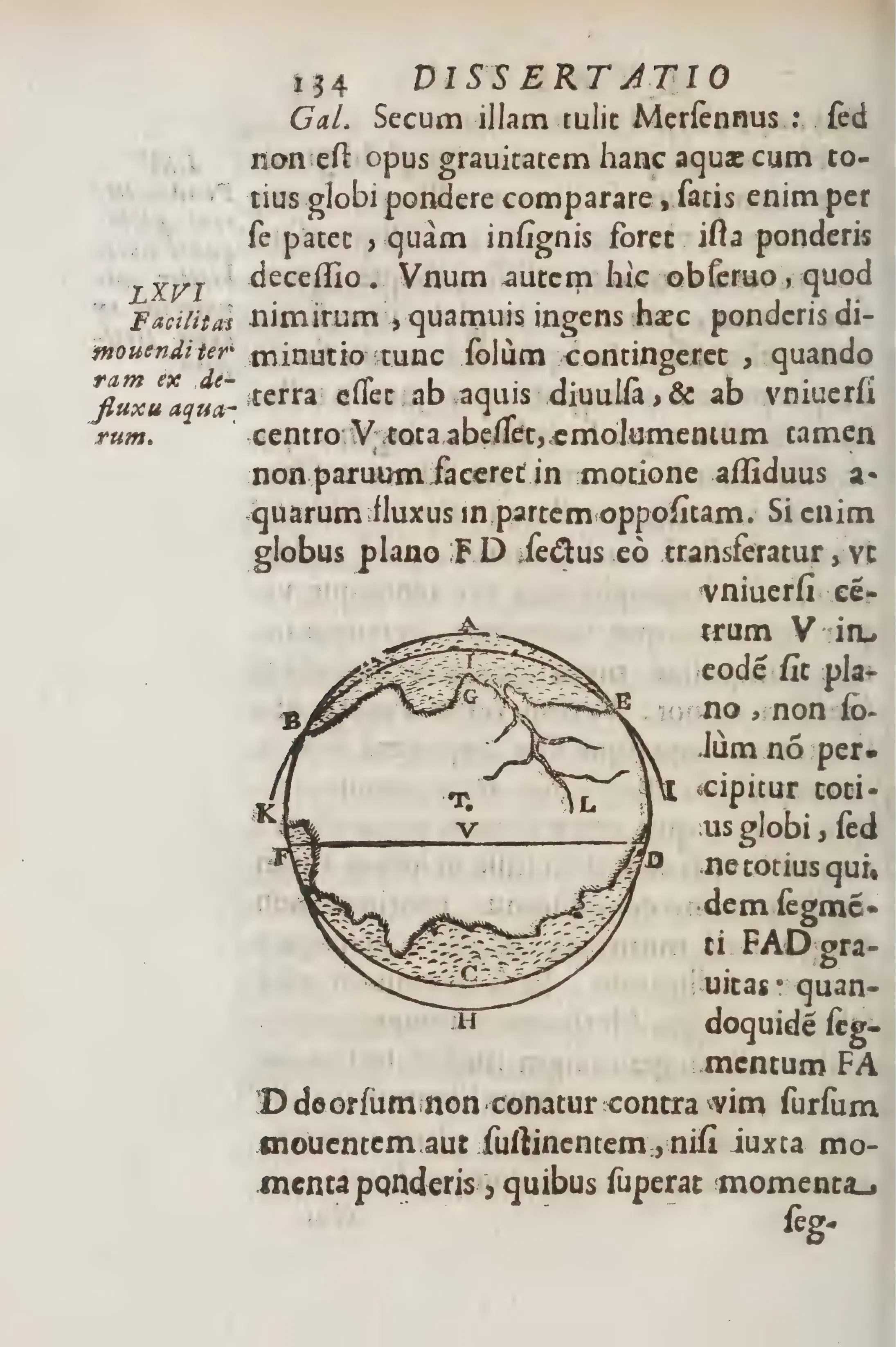
Under the marginal heading "Facilitas mouendi terram ex defluxu aquarum," the globe, cut by plane FD through centre V, becomes a hydrostatic problem: water shifted to the opposite side eases any initial displacement. Only a spherical segment bears the load, so Archimedes never had to sustain the whole Earth. Source ↗.
Guldin's last definition turns that result into doctrine. Gravity, in the relational formula already discussed, is a force of disposing oneself in the universe in one's due place. It arises from a body's difference in specific weight from its medium rather than from any absolute heaviness. The definition completes the hydrostatic turn. Weight is no longer a fixed burden inherent in the globe but a relation within an ordered cosmos. On that relational view, the measured and moral senses of gravitas come to rest together, and Archimedes' promise stands as an undertaking that could have been fulfilled.
Reading Further on Jesuit Mechanics, Pneumatics, and the Void
Frequently Asked Questions
What is Paolo Casati's Terra machinis mota about?
Terra machinis mota, "the Earth moved by machines," is a Latin dialogue by the Jesuit mathematician Paolo Casati (1617–1707) of Piacenza. It tests Archimedes' boast that he could move the Earth. The work was printed at Rome in 1655 as two dissertations and again in 1658, much enlarged, as geometrical, mechanical, physical, and hydrostatic dissertations, and it sets out to clear Archimedes of the suspicion of arrogance. Casati argues that joining machines multiplies force far more than enlarging them, so that 106 pulley sheaves could exceed the Earth's weight. Because the surrounding water shares the load, the globe could be displaced some 267 miles before that assistance ceased.
Why are Galileo, Mersenne, and Guldin the speakers in Casati's dialogue?
Casati chose three recently deceased mathematicians to represent Italian, French, and German mathematics: Galileo, the French Minim Marin Mersenne, and the Jesuit Paul Guldin. Because the speakers were dead, their words were openly the author's fiction. Writing in Rome a generation after Galileo's condemnation, Casati could therefore give Galileo a voice while holding every opinion at one remove. Rivka Feldhay reads the work as an idealized Collegio Romano occasion that makes practical mechanics acceptable within mixed mathematics, though hers remains an interpretation rather than an established account of Casati's intentions. The Galileo persona is praised for his hydrostatics but offers a tidal theory without the Earth's rotation, which Guldin refutes with Chinese tide reports.
How does Casati weigh the fire of hell and "lightness" in calculating the Earth's weight?
Hell-fire enters the calculation as a physical quantity. One reported opinion makes fire the heaviest element, lodged at the Earth's centre as the prison of the wicked. On this view it is placed there naturally rather than chained solely for punishment. Guldin borrows algebra's "defective numbers," the negative quantities, so that lightness becomes negative gravity. Mersenne then follows Wendelin's claim that the infernal cavern fills a quarter of the globe and gives its fire a lightness of minus one hundred. On that assumption the Earth floats away, and machines would be needed to hold it back rather than move it. The absurdity discredits the premise.
What mistake does Casati find in the story of the mirror on the Pharos of Alexandria?
Casati treats the famous mirror as a misreading. Porta told of a mirror on the Pharos that could spot ships six hundred miles off. Casati argues that Porta's sources actually described a watchtower built on the island of Pharos, which had been mistaken for a mirror, and Guldin blames the slip of a single letter in printed transmission. The correction belongs to a broader critique of authority. Macrobius, Clavius, Biancani, and Porta are all charged with ungeometrical reasoning. Aristotle's figure for the Earth's circumference in De Caelo II is set aside as an authority that demonstrative reason opposes, though without any general revolt against Peripatetic philosophy.
Is there an English translation of Terra machinis mota?
No English translation of either the 1655 or the 1658 edition has been identified, although the absence of one has not been proven. A separate resource is the Leo edition, part of an effort to make English translations of every text printed in Latin in early modern Europe between 1450 and 1750 freely available online, at no cost. Its translation is generated by AI. The Leo edition presents the full transcription of Casati's dialogue and a complete, AI-generated English translation for the first time. This gives readers without Latin access to the whole argument, from the composition of machines through the weighing of the Earth to the final hydrostatic reckoning.
This report was generated by an advanced AI assistant that conducted deep research alongside an extensive interpretation of the transcribed original text. Every effort has been made to preserve fidelity to the source and to guard against inaccuracy, but corruption in the text recognition process and model hallucination may nonetheless have entered the text. Treat every claim, quotation, translation, and citation as provisional, and verify each against the original source before relying on or citing it.
Bibliography
- Lea Chalozin-Dovrat, "The History of SPACE: What Can Words Tell Us about Conceptual Change?," Tel Aviv University Faculty of Humanities: A lexical-historical study of how the word "space" shifted in meaning, drawing on Edward Grant's history of void and space among its sources. It is not about Casati, but its method suits a reader who has watched gravitas travel from moral seriousness to specific weight to cosmic disposition within one Latin title. Consult it for the general question the dialogue poses in miniature: when a word changes its job, has the concept changed with it?
- Peter Dear, Discipline and Experience: The Mathematical Way in the Scientific Revolution: Dear's account of how Jesuit and other mathematicians turned experience into demonstrative premises supplies the framework for asking what kind of warrant Casati claims for mechanical reasoning. It illuminates, for instance, the dialogue's defence of treating the lumpy globe as a regular solid because the Earth toreuma non est vndequaque expolitum; sed: "is not a turned work polished on every side, but [its irregularities may be averaged]." Here is the familiar negotiation between geometrical idealization and physical fact, conducted on a planetary scale.
- Rivka Feldhay, "On Wonderful Machines: The Transmission of Mechanical Knowledge by Jesuits," Science & Education: The closest identified study of Casati's dialogue (vol. 15, nos. 2–4, 2006, pp. 151–172), reading the exchange among Galileo, Mersenne, and Guldin as a vehicle for fusing Renaissance practical mechanics with Archimedean mathematics inside the respectable frame of mixed mathematics, and as a carefully managed Jesuit portrait of Galileo. It is the natural starting point for anyone weighing how the acquittal of Archimedes served institutional ends. Read it with one correction in hand: the five-dissertation text it discusses belongs to 1658, not 1655.
- Edward Grant, Much Ado About Nothing: Theories of Space and Vacuum from the Middle Ages to the Scientific Revolution: Grant's long history of arguments over void and space shows how old the plenist commitments were that Casati's fifth dissertation defends against the Magdeburg trials. The verdict there turns on whether the experiments yield anything quod vel leuem inferat Vacui suspicionem;, "that brings even a slight suspicion of a vacuum." The noun suspicio echoes the suspicion of arrogance lifted from Archimedes, and Grant makes clear how many centuries of scholastic argument stood behind the second acquittal.
- Marcus Hellyer, Catholic Physics: Jesuit Natural Philosophy in Early Modern Germany: The standard account of Jesuit natural philosophy in German lands, and the obvious context for a dialogue that receives its news of the air-pump by letter from Würzburg and gives its sharpest lines to the German Guldin. It is contextual reading rather than a study of this edition, but it explains the institutional pressures behind pneumatic claims such as Mersenne's, videor, si dixero aërem ad aquam in leuitate esse vt 1200 ad 1: "I seem [liberal enough] if I say that air is to water in lightness as 1200 to 1." That figure, set against the Galileo persona's lower estimate, is exactly the kind of number Hellyer shows Jesuit colleges learning to handle with caution.
- Sheila J. Rabin, "Early Modern Jesuit Science: A Historiographical Essay," Journal of Jesuit Studies: A compact survey (vol. 1, no. 1, 2014) of how historians moved from dismissing Jesuit science as obedient reaction to treating it as a serious and internally contested enterprise. It helps a reader place Feldhay's reading of Casati within that broader revision and judge how much weight the dialogue's courteous Galileo can bear. It also serves as an efficient map to Hellyer, Dear, and the rest of the shelf, which saves the trouble of rebuilding the historiography from footnotes.