Beautiful Fountain: Gaspar Schott's Hydraulic-Pneumatic Mechanics
In 1657 the Jesuit Gaspar Schott, recently returned from Rome, where he had assisted Athanasius Kircher, published at Würzburg the Mechanica hydraulico-pneumatica, a two-part Latin treatise that first sets out the physics of water and air and then catalogues the fountains, pumps, organs, and automata those elements can drive. Its appendix gave Latin readers one of the first printed accounts of Otto von Guericke's vacuum experiments and the Magdeburg hemispheres, fifteen years before Guericke described them himself. The book shows a Catholic natural philosopher taking up the new experiments, staging the miracle at Cana with a Heronian vessel, and dismissing perpetual-motion schemes, all without letting anyone despise Aristotle.
ExLatinis
September 24, 2026
Contents
In 1657 the Jesuit Gaspar Schott, recently returned from Rome, where he had assisted Athanasius Kircher, published at Würzburg the Mechanica hydraulico-pneumatica, a two-part Latin treatise that first sets out the physics of water and air and then catalogues the fountains, pumps, organs, and automata those elements can drive. Its appendix gave Latin readers one of the first printed accounts of Otto von Guericke's vacuum experiments and the Magdeburg hemispheres, fifteen years before Guericke described them himself. The book shows a Catholic natural philosopher taking up the new experiments, staging the miracle at Cana with a Heronian vessel, and dismissing perpetual-motion schemes, all without letting anyone despise Aristotle.
In 1657 a press at Würzburg issued a Latin quarto by the Jesuit Gaspar Schott (1608–1666). Schott was a Franconian from Königshofen who had spent the years 1652–1655 at the Collegio Romano as assistant to Athanasius Kircher, and the book appeared at the expense of the heirs of the Frankfurt bookseller Johann Gottfried Schönwetter. The Mechanica hydraulico-pneumatica is several kinds of text at once: a treatise of natural philosophy, an illustrated catalogue of machines, and a dispatch from the Republic of Letters. Its first part sets out the principles governing water, air, and their motions and conflicts. Its second describes the fountains, pumps, vessels, organs, and automata those elements could drive. An appended Experimentum novum Magdeburgicum brought before a Latin readership Otto von Guericke's experiments on the vacuum, including the Magdeburg hemispheres. The book was dedicated to Johann Philipp von Schönborn, Elector of Mainz and Prince-Bishop of Würzburg, and illustrated with approximately forty-six engraved plates. It opened a long series of compilations in which Schott, over the following decade, gathered, tested, classified, and disseminated the mathematical and physical arts.
The problem the book confronts is how a Jesuit natural philosopher could give machines moved by water and "spirit" (that is, air) a secure intellectual footing. That footing had to be demonstrable to the eye, practicable for the builder, and orthodox before the theologian. Schott's answer is conjunction. He binds theoria to praxis. Four governing powers organise both his physical explanations and his classification of devices: attraction, expulsion, rarefaction, and natural fall. A handful of geometric hydraulic axioms is set against the autopsy of built machines. Where this union meets resistance, Schott mediates rather than rules. He treats physics as a science of sensible approximation rather than mathematical exactness, and he holds contested conclusions as "more probable" rather than evident. He reassigns marvels from demons and priestly fraud to a natural art that sustains a flagging Nature. And he dissolves claims of perpetual motion by accounting for the time and space through which any machine must work.
The stakes are sharpest in the controversy over the vacuum, and there the mediation is most exposed. The scholastic maxim that Nature abhors a void was bound up with the metaphysics of place and with Eucharistic theology, since the doctrine of accidents persisting without a subject made loose talk about empty space theologically hazardous. By the 1650s the maxim was also under pressure from the tubes of Gasparo Berti and Evangelista Torricelli and from Guericke's pumps. Schott's handling of this material complicates histories of pneumatics centred on Robert Boyle, and it supports the revisionist account of Catholic physics as a practice that appropriated experiment rather than simply obstructing it. His appendix is one of the earliest printed accounts of Guericke's research, preceding Guericke's own Experimenta nova of 1672 by fifteen years. In it he weighs "ocular" demonstration against Peripatetic doctrine and leaves learned judgement free within stated bounds. He suspends his own assent and refuses to let the new evidence become licence to despise Aristotle.
What makes the book memorable is the density of its particulars:
- Sacred marvels: Heronian vessels are shown to be capable of staging the miracle at Cana, and ancient Egyptian priests are exposed as mechanical deceivers.
- Perpetual motion: the seekers of perpetual motion are satirised as architects of rest rather than of motion.
- The patron: the dedicatee is punned upon as a "beautiful fountain."
- Eyewitness claim: the author insists that he reports almost nothing in his practical part that he has not seen with his eyes and handled with his hands, much of it in the orbit of Kircher's Roman museum.
- The afterlife of the copy: even its modern life has a curious turn, for one widely used digitised copy circulates under catalogue metadata belonging to Caspar Sagittarius's Lutheran Introductio in historiam ecclesiasticam, an unrelated work.
A single throughline unites the book's vocabulary, its making, and its argument. The compound hydraulico-pneumatica yokes two technical traditions. The book's production joined a Würzburg printer, a Frankfurt bookselling house, Jesuit authorisation, and a prince-bishop who had acquired Guericke's apparatus and sent it to the Würzburg Jesuit college. The internal argument binds theory to practice and inherited doctrine to observed effect, holding them in a negotiated equilibrium rather than a resolution. Some questions remain open. No Jesuit censorial file bearing on the printing has been located, and no complete translation has been published, so the book remains accessible chiefly in Latin editions and digital facsimiles.
Read the full text and English translation on Leo
This text was transcribed and translated as part of the ExLatinis project, an effort by Leo to make free English translations of every text published in Latin in early modern Europe (1450–1750) available online. The complete transcription and English translation of this work can be read free of charge:
→ Read the original Latin text and full English translation on Leo
You can save a copy of this document into your Leo account to run deep text searches, conduct further analysis, or cross-reference it with your own research.
Translating the Title and Vocabulary of Schott's Mechanica hydraulico-pneumatica
Hydraulic-Pneumatic Mechanics: Water, Air, and Experimental Practice in the Jesuit Republic of Letters is an editorial English title supplied for convenience; it is not presented as an established historiographical title. The Latin original is P. Gasparis Schotti ... Mechanica hydraulico-pneumatica ...: Opus bipartitum. The longer title describes the nature, properties, motive force, and conflict of water and air, together with hydraulic-pneumatic experiments and machines driven by those elements. The work's opus bipartitum is not merely a typographical division. Its first portion is theoretical, while the second becomes a practical catalogue of machines, and the appendix extends the same inquiry into Guericke's experiments on vacuum.
Schott makes the interdependence of the two parts explicit. He argues that theory and practice stand or fall together and that practice alone does not attain its end without theory, vtraque cadat; & nec sola Praxis suam sine Theoria obtineat. The bipartite form is thus the structural expression of the conjunction on which the whole work rests.
The compound hydraulico-pneumatica joins two technical vocabularies that were conventionally distinct. Hydraulica concerns the operations of water, while pneumatica derives from pneuma and names the operations of air or spirit. Schott glosses the Heronian designation for his readers: machines of this kind are, as if one were to say, "Aquatico-Spiritual," that is, animated by water and by spirit or air, quasi dicas, AquaticoSpiritales, hoc est, aqua & spiritu seu aëre. The equivalence spiritu seu aëre registers the polysemy of the Greek term. It also shows Schott fixing that polysemy on its material sense, so that "spirit" here denotes the elastic, weighable air of the pump and the vessel rather than any occult agency.
In Schott's title the compound does not indicate an abstract science detached from devices. It designates a field in which the properties of water and air are demonstrated through constructed instruments, experiments, and mechanical effects. The language of pneumatica also recalls the Heronian tradition of Spiritalia. Schott's usage, however, is materially focused on pumps, vessels, fountains, automata, and other machines rather than on pneumatic marvels as literary curiosities alone.
The inherited vocabulary of horror vacui or fuga vacui supplies the polemical background to the appendix. In Aristotelian and scholastic usage, the phrase could describe nature's supposed resistance to empty space. In seventeenth-century discussions, that resistance was increasingly tested against the behavior of air, water columns, suction devices, and rarefied vessels. Schott begins from the standard scholastic definition, noting that philosophers define the vacuum as a place filled by no body, At Philosophi Vacuum definiunt locum nullo repletum corpore. In the theoretical part he retains a refined form of the maxim rather than discarding it. Nature, he writes, opposes the vacuum by a certain negative resistance, per negativam quandâ obsistentiam vacuo repugnat. That formulation strips the personified "abhorrence" of any positive appetite while preserving its explanatory work.
Schott's procedure shifts the question from a general maxim about Nature's aversion to a vacuum toward an examination of what particular materials and machines can demonstrably do. His hydraulic axioms show this concretely. In hydraulics, he declares, one fights and conquers not by quantity of water but by perpendiculars, IN hydraulicis non aquarum copiâ, sed perpendiculis pugnatur, & vincitur. The height of the water column, not its volume, governs the effect. He presents this law as so constant that Nature can be deceived by no art, no trick, and no experiment, vt Natura falli nulla arte, nullo dolo, nullaq[ue] experientia possit.
The shift should not be described as a clean rejection of scholastic natural philosophy. Schott continues to frame experiment through inherited causal language while allowing observed effects to constrain the interpretation of that language. The personified Nature of the scholastic maxim survives in his prose, but she is now a Nature whose behaviour is fixed by measurable geometry.
Finally, experientia and ocularis demonstratio carry a stronger meaning than the modern word "experiment" when detached from their historical setting. They imply an authorized act of seeing, repeating, reporting, and judging within the Respublica litteraria. Schott can invoke experience as a guide jointly with reason, speaking of both experience, the mistress of philosophy, and reasons, tum experientia Philosophiæ Magistra, tum rationes. The pairing is characteristic, since experience instructs philosophy without displacing argument.
The sharper formulation appears in the appendix, and there it is reported rather than adopted. Schott records a correspondent's claim that, first, the authority of Aristotle is worth nothing against ocular demonstration, Primò enim, inquit, auctoritas Aristotelis contra ocularem demonstrationem nihil valet. The inquit marks the proposition as another's voice, and the distance Schott keeps from it is part of his mediating method.
Schott's method joins testimony, autopsy, mechanical construction, and learned attribution. The book's evidentiary ideal is therefore neither naked appeal to authority nor an untheorized collection of marvels. It is a Jesuit form of natural-philosophical demonstration in which theoria is tested and disciplined by praxis. The credibility of an observation depends upon the named witnesses, places, instruments, and procedures through which it reaches readers.
Summarizing Gaspar Schott's 1657 Treatise on Water, Air, and Machines
Gaspar Schott's Mechanica hydraulico-pneumatica is a Latin Jesuit natural-philosophical and mechanical treatise. It was printed at Würzburg in 1657 by Henricus Pigrin at the expense of the heirs of the Frankfurt bookseller Johann Gottfried Schönwetter. The book is explicitly bipartite. A theoretical section establishes principles concerning water, air, motion, and their interaction; a practical section describes hydraulic, pneumatic, and hydro-pneumatic machines and experiments.
Schott presents this union as the work's claim to novelty. Scarcely anyone before him, he observes, has joined theory with practice, which is what he undertakes, & vix vllus theoriam cum praxi conjunxit; quod nos facimus. The same conjunction governs the work's organisation. The four powers that structure the theoretical explanations also furnish the classes into which the practical machines are sorted: attraction, expulsion, rarefaction, and natural fall.
Its appended Experimentum novum Magdeburgicum presents Otto von Guericke's experiments on vacuum and the Magdeburg hemispheres. This makes Schott's volume an important early printed vehicle for the circulation of Guericke's pneumatic research. It is also the point at which his balancing of observed effect against Peripatetic doctrine is most visibly tested.
Schott was born at Königshofen on 5 February 1608, entered the Society of Jesus in 1627, and studied under Athanasius Kircher. He assisted Kircher at the Collegio Romano from 1652 to 1655 and died at Würzburg on 22 May 1666. The work's dedicatee was Johann Philipp von Schönborn, Elector of Mainz and Prince-Bishop of Würzburg. The book's mechanical descriptions drew substantially on instruments associated with Kircher's Roman museum, while its German context connected Schott to Schönborn's patronage and to Guericke's apparatus.
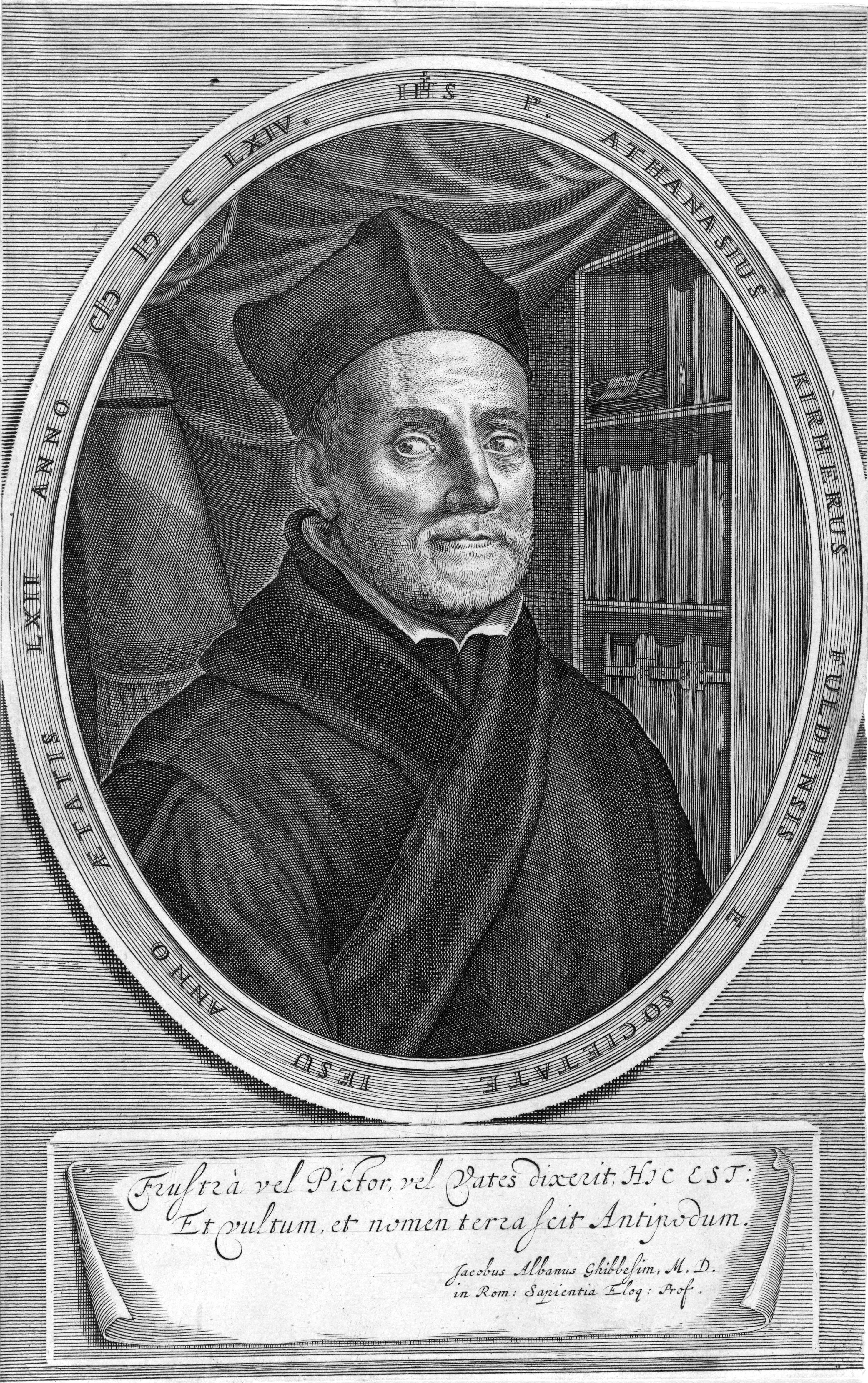
Athanasius Kircher, seen here in an engraved portrait, stood at the centre of Schott’s Roman years: Schott assisted him at the Collegio Romano, and the Mechanica drew substantially on instruments from the Museum Kircherianum. Schott’s German connections would carry that Kircherian repertoire toward Schönborn and Guericke. Source ↗.

The text was composed and printed in Latin, and no complete published translation was located. A 2012 translation project is documented for the Magdeburgicum appendix and for Book 1 of Schott's later Technica curiosa. The available evidence does not, however, establish that a complete translation of the Mechanica or a finished standalone translation of the appendix was published. The work therefore remains primarily accessible through Latin editions and digital facsimiles.
Placing Schott in the Historiography of Jesuit Science and the Vacuum
The Mechanica hydraulico-pneumatica matters because it joins several histories that are often treated separately:
- Jesuit natural philosophy;
- the material culture of instruments;
- the development of pneumatic experimentation;
- the confessional politics of natural knowledge;
- the circulation of technical information through print and correspondence.
Its importance does not rest only on the celebrated Magdeburg hemispheres. The book shows how a Jesuit author could integrate inherited natural-philosophical categories with autopsy, machines, engraved images, reports from correspondents, and practical demonstrations. That integration is the historiographical counterpart of the conjunction of theory and practice on which Schott builds his discipline.
The most influential modern framework for pneumatic experimentation is Steven Shapin and Simon Schaffer's Leviathan and the Air-Pump (1985). Their analysis of Boyle and Hobbes argues that experimental knowledge depended upon social arrangements of witnessing, replication, credibility, and political order. Schott complicates a purely English account of the air-pump by showing that pneumatic knowledge was already circulating through Catholic, German, and Jesuit networks before Boyle's mature program.
The comparison should not erase the differences between Schott's compendious and institutionally authorized natural philosophy and Boyle's experimentally staged public witnessing. Rather, it places both within a wider European field of competing regimes of testimony. Schott's own regime is explicit about its limits. Summing up the Magdeburg controversy, he rules that all learned men should be free to judge and decide the matter, but that there should be no licence to despise Aristotle and the whole Peripatetic School, viris doctis de hac re sentiendi & statuendi judicium liberum esto, Aristotelis tamen & Peripateticæ Scholæ Universæ contemnendæ potestas nè esto. This bounded liberty of judgement is a distinct social settlement of experimental dissent, framed in the juridical cadence of a statute.
Marcus Hellyer's Catholic Physics: Jesuit Natural Philosophy in Early Modern Germany provides the most direct institutional frame for Schott's German setting. Hellyer treats Jesuit physics as a historically specific practice shaped by colleges, curricula, confessional commitments, and negotiations with contemporary natural philosophy. His approach resists the older narrative in which Catholic scholasticism simply obstructed experimental science. Schott's text supports that revision while also showing that Jesuit openness to experiment did not require abandoning Aristotelian or scholastic causal vocabulary.
The text's epistemology bears this out in several ways:
- Physics as approximation. Schott separates the precision of mathematics from the tolerances of natural philosophy, explaining that here one is not in mathematics but in physics, where no account is taken of imperceptibles, quia hic non sumus in Mathematicis, sed in Physicis, ubi non habetur ratio insensibilium.
- Probabilism. He grades his conclusions in the manner of the schools. Of one contested claim he writes that he called it more probable, for it is not evident, whatever others say, Dixi, id esse probabilius: non enim est evidens, quidquid alii dicant:.
- Deference to authorities. He defers to recognised authorities in the learned network, declining to call Mersenne's experiment into doubt because to do so would be improper, in dubium revocare experimentum Mersenni, quoniam id nefas.
- Polemic against innovators. This openness has a polemical edge against innovators. Schott complains that certain moderns grumble, driven by some zeal for novelty, ganniant Neoterici quidam, qui nescio quo novitatis studio incitati,.
Hellyer's framework accommodates this combination of experimental receptivity and resistance to novitas without forcing it into either camp.
Mark A. Waddell's Jesuit Science and the End of Nature's Secrets emphasizes the Jesuit effort to disclose hidden operations of nature through a combination of natural philosophy, experiment, learned communication, and the interpretation of marvels. This perspective is especially apt for Schott's treatment of machines, automata, hydraulic effects, pneumatic vessels, and reports received from other investigators. Schott's experientia is not a bare technical operation. It is embedded in a moral and epistemic economy that distinguishes legitimate disclosure from imposture, prestidigitation, and fraudulent marvel-making.
The governing principle of that economy is compressed into an emblematic formula in the preliminaries: art drinks so that it may prop up languishing Nature, Hinc Ars bibit, ut languentem fulciat Naturam,. Machines complete and sustain nature rather than violating it. The same logic allows Schott to treat sacred history as a field for mechanical demonstration. He notes that by means of a Heronian vessel the miracle of Christ the Saviour performed at Cana in Galilee can be exhibited, eâque ratione potest exhiberi miraculum Christi Salvatoris nostri patratum in Cana Galilæa. The demonstration is offered as reenactment within the bounds of art, not as an explanation of the miracle itself.
Michael John Gorman's work on the Jesuits and the invention of modern science shifts attention toward the Roman College, mathematics, experimentalism, and the institutional production of knowledge. Paula Findlen's studies of Kircher's museum and the Roman College Museum likewise show how collections, instruments, visitors, demonstrations, and the Republic of Letters interacted. Together these approaches illuminate why the Museum Kircherianum is central to Schott's object biography. The Mechanica is not simply a book about machines but a printed reorganization of museum-based knowledge for a dispersed learned readership.
Koen Vermeir's work on Kircher's magical instruments is useful for interpreting Schott's boundary between natural art, mechanical effect, spectacle, and deception. Schott's interest in marvels does not collapse into credulity. Instead, the book repeatedly asks whether an effect proceeds from a natural cause, an ingenious device, human imposture, or a more troubling agency.
Ancient religious fraud is one pole of that inquiry. Describing the concealed hydraulic contrivances of pagan temples, Schott calls them a truly wondrous invention of the priests for perverting the blind hearts of mortals, Mirum sanè ad cæca mortalium pectora pervertenda sacerdotum inventum. The demonic is the other pole. Of the performer Jean Royer, whose feats with water many attributed to the devil, he insists that the said Jean acted not, as many persuade themselves, through hidden tricks of diabolical illusion, memoratum Ioannem, non, uti multi sibi persuadent, per occultas illusionis diabolicæ præstigias. The effect is instead ascribed to natural skill. The category of impostura is therefore part of the epistemic architecture of the work, not an incidental moralizing vocabulary.
Edward Grant's Much Ado about Nothing supplies the longue durée history of arguments about space and vacuum. It helps distinguish the medieval and scholastic conceptual inheritance of void-space debates from the seventeenth-century experimental claims associated with Torricelli, Berti, Guericke, and their interlocutors.
Schott's text shows how immediately the inherited theological dimension of that debate pressed upon the new experiments. He charges the champions of the void with singing triumph before victory. They blurted out much, he writes, that is not only absurd in philosophy but dangerous to the Orthodox faith, boasting that a located thing without place, and accidents without a subject, can subsist naturally, jactatores triumphum ante victoriam canebant, multa effutientes non tantùm in Philosophia absurda, sed & in side Orthodoxa periculosa, vt dum locatum sine loco, accidentia sine subjecto, naturaliter subsistere posse jactitant. The phrase accidentia sine subjecto points directly to Eucharistic doctrine, in which accidents persist miraculously rather than naturally.
Kircher's objection in the appendix states the metaphysical difficulty in its barest form: but who could conceive that nothing offers resistance?, Sed nihilum resistentiam facere, quis concipiat?. The alternative explanation Schott records for why air ceases to be drawn from Guericke's vessel returns the limit to the order of creation. The extraction stops because the air has been drawn out to the ultimate bounds of rarity which Nature and God prescribed for it, cessat ejusdem extractio, quòd ad ultimos fines raritatis, quos ei Natura Deusque præscripsit, est protractus. Grant's longue durée framework is indispensable for reading such passages as continuations of scholastic arguments about rarefaction and divine power rather than as mere evasions.
W. E. Knowles Middleton's The History of the Barometer provides the instrument-centered history of barometric experiments. Charles Webster's 1965 study of Boyle's law and the elasticity of air reconstructs the broader European development of concepts of air pressure and elasticity. These works prevent Schott's appendix from being isolated from the Italian and French experiments that made pneumatic questions technically and philosophically urgent.
Schott's reading of Berti's Roman experiment shows how such evidence could be turned against the void. A bell had been placed within the tube, and he concludes that it is certain that in the part of the tube emptied of mercury and water there was no void. Sound, he reasons, was propagated through that space, which could not have happened in a vacuum, Interim certum est, in tubi parte ab argento & aqua destituta vacuum non fuisse, quandoquidem sonus perspatium illud propagatus fuit; quod in vacuo fieri non potuisset. The same instrumental practice that others read as producing emptiness is here made to testify for plenitude. This illustrates why the barometric experiments were interpretively open rather than self-evidently decisive.
Fritz Krafft's scholarship on Guericke and the 1672 Experimenta nova is important for the later stage of the transmission chain. It helps position Schott's account as an intermediary publication. That account is neither merely a derivative notice nor yet Guericke's own systematic presentation, but a form through which Guericke's apparatus and experiments entered the printed Republic of Letters.
The historiographical disagreement here concerns emphasis:
- one tradition privileges the eventual stabilization of pneumatic knowledge in Boyle's experimental program;
- another emphasizes Jesuit and German institutional continuities;
- a third reconstructs the long history of void arguments and instrument practices.
Schott's book requires all three perspectives without being reducible to any one of them.
The evidence does not support a simple "modern science versus scholasticism" narrative. Schott's experimentalism operates through Jesuit authorization, inherited causal categories, named testimony, mechanical construction, and the practical testing of claims.
The treatment of perpetual motion illustrates that practical testing. Schott satirises the projectors who pursued it as architects of rest rather than of motion, quietis potiùs quàm motionis Architecti. He then answers their arguments with mechanical accounting. He grants their premises as most true but denies that they bear on perpetual motion, because in producing motion by machines one must consider not only weight and power but also the time in which, and the space or interval within which, motion occurs, Respondeo verissima hæc esse, nihil tamen ad motus perpetitatem facere: quia in motu efficiendo per Machinas considerari debet non solùm pondus & potentia, sed etiam tempus in quo, & spacium seu intervallum intra quod fit motus.
The significance of the Mechanica lies precisely in that hybrid configuration. The book records a confessional and scholastic culture actively appropriating instruments, experiments, and mathematical mechanics while continuing to debate the theological and metaphysical consequences of vacuum, rarefaction, and the weight of air.
Tracing the 1657 Würzburg Quarto from Press to Digital Facsimile
The surviving bibliographic and digitized evidence identifies a 1657 Würzburg printing under the authorial form P. Gasparis Schotti. Schott also appears as Kaspar or Gaspar Schottus and, in the title-page tradition, as Regiscurianus or Regis-Curianus.
The principal catalogue records describe the printing as follows:
- Library of Congress. The record gives the imprint as "Francofurti ad M.," funded by the heirs of J. G. Schönwetter, and printed by H. Pigrin, typographer at Herbipolis (Würzburg), in 1657. It describes a Latin quarto with 16 preliminary leaves, 488 pages, fourteen unnumbered pages, a final leaf, illustrations, and plates.
- ETH-Bibliothek Zürich. A digitized record gives the place as "[Frankfurt am Main, Würzburg]" and the date as 1657.
- Google Books. The record identifies the title as Schott's Mechanica hydraulico-pneumatica and its author as Gaspar Schott. It names the heirs of Johann Gottfried Schönwetter as its editor or associated bookseller and gives its length as 488 pages.
The physical description is not fully uniform across catalogues and copies. One record gives "[38], 488, [15] pages," a blank leaf, and "56 [i.e. 46]" engraved plates in quarto. A Christie's description of a particular copy records an additional engraved title and forty-six engraved plates on forty-five plates, some folding. It also records the arms of the dedicatee on the verso of the title and a final leaf of directions to the binder.
The discrepancy between "56" and "46" reflects a cataloguing or counting problem rather than evidence for separate editions. The safer formulation is that the book was a quarto illustrated by approximately forty-six engraved plates, with some plates folded and with plate-count conventions varying among records. The final binder's instruction and reports of copies with differing plate arrangements show that the Iconismi were materially distinct from the ordinary letterpress gatherings. They could be misplaced, omitted, or counted differently during binding.
The production network joined a Würzburg printer, the commercial interests of the Schönwetter heirs, Jesuit institutional authorization, and aristocratic patronage. The title-page tradition dedicates the book to Johann Philipp von Schönborn, whose coat of arms appears in at least one described copy.
The dedicatory apparatus turns the patron's name into a hydraulic conceit. It plays on Schön-born, the "beautiful spring," addressing him as Beautiful Fountain and praying that his waters be channelled to the author's own, meis FONS PULCHER; derivetur. The image makes patronage itself a matter of conduits and flow, fusing the book's subject with its social occasion.
Schönborn's role was not merely ceremonial. A correspondence record reports that, after the 1654 demonstrations at Regensburg, he acquired Otto von Guericke's apparatus and sent it to the Jesuit College at Würzburg. That transfer provided a material bridge between Guericke's experiments, Schott's institutional setting, and the printed Experimentum novum Magdeburgicum.
The book's object biography is inseparable from the Museum Kircherianum. Schott's first work was originally conceived as a guide to hydraulic and pneumatic instruments associated with Kircher's Roman museum. Contemporary descriptions emphasize that many of the machines discussed were represented there. Schott states the evidentiary standard of the practical part in the strongest terms: he brings forward nothing, or almost nothing, in the whole of Part 2 that he has not seen with his eyes and handled with his hands, nihil enim, aut ferè nihil in tota hac Parte 2. affero, quod non oculis vidi, manibus contrectavi,.
The printed volume consequently transformed an institutional collection of instruments, observations, and demonstrations into a portable Latin book supported by engraved images. It also converted correspondence and reported experiments into a durable form of learned testimony. That conversion was governed by an explicit ethic of attribution. Schott affirms that he has sold none of the preceding devices as his own but has always praised their maker, Sicut nullum præcedentium technalmatum pro meo vendidi, sed semper structorem laudavi. The formula registers the credit economy of a Jesuit network extending through Rome, Bologna, Palermo, and Würzburg.
The appendix is an early printed account of Guericke's vacuum research and the Magdeburg hemispheres. The available evidence supports describing it as one of the earliest printed accounts rather than asserting an absolute priority without qualification.
Schott's editorial posture toward the material he transmits is carefully neutral. He describes Guericke's experiments as containing a new mode of philosophising, which he leaves to others to examine, & novum philosophandi modum continent, quem aliis examinandum relinquo. This suspension of assent is part of what makes the appendix an intermediary rather than a verdict.
Schott's account preceded Guericke's own Experimenta nova (ut vocantur) Magdeburgica de vacuo spatio, published at Amsterdam in 1672. Three publications form a recognizable chain of contemporary sources for the transmission and enlargement of Guericke's pneumatic experiments:
- Schott's 1657 account in the Mechanica;
- his expanded treatment in Technica curiosa of 1664;
- Guericke's 1672 book.
The work belongs to the sequence of Schott's larger compilatory and experimental publications:
- Magia universalis naturae et artis (1657–1659);
- Pantometrum Kircherianum (1660);
- Cursus mathematicus (1661);
- Physica curiosa (1662);
- Anatomia physico-hydrostatica fontium ac fluminum (1663);
- Technica curiosa (1664);
- Schola steganographica (1665);
- Organum mathematicum (1668).
Technica curiosa is particularly important because it revisits pneumatic and mechanical marvels and expands the Guericke material. The 1657 Mechanica is therefore both an independent treatise and an early component of Schott's continuing project to compile, test, classify, and disseminate mathematical and physical arts.
No direct Jesuit censorial dossier in the ARSI Fondo Gesuitico or Censurae librorum was located that would document a specific revision, suppression, or post-censorship alteration of this printing. The existence of Jesuit licences and institutional authorization should therefore not be converted into a claim about the contents of an unlocated censorial file. Likewise, no evidence was located for a suppressed edition or manuscript predecessor. The surviving digital and catalogue record instead points to a first edition represented in several institutional and commercial copies.
Documented holdings and surrogates include:
- Library of Congress: Rare Book and Special Collections Division, call number QC143 .S3, LCCN 02024209, and OCLC 2510292.
- ETH-Bibliothek Zürich: a copy digitized through e-rara, persistent link DOI 10.3931/e-rara-31789.
- Bayerische Staatsbibliothek/MDZ: a scan identified as Schott, Kaspar: P. Gasparis Schotti Regiscuriani ... Mechanica Hydraulico-Pnevmatica.
- Google Books/Internet Archive: a surrogate with Google identifier nlzr0l7eXGIC.
The available evidence does not establish complete shelfmarks for every named repository, so unverified shelfmarks are not supplied.
A significant bibliographic conflation affects the Google Books surrogate. The digitized pages and the associated Internet Archive and Google Books metadata identify the physical text as Schott's Latin Mechanica hydraulico-pneumatica, printed in 1657, with Schott named as author and Schönwetter's heirs associated with the imprint. A separate catalogue identity names Caspar Sagittarius's Introductio in historiam ecclesiasticam, a later Lutheran church-historical work. These are unrelated texts.
The proposition supported by the evidence is therefore precise. A digitized copy of Schott's Mechanica hydraulico-pneumatica circulates under metadata belonging to Caspar Sagittarius's Introductio in historiam ecclesiasticam, while the printed text itself is unambiguously Schott's. The conflation is bibliographic metadata error, not evidence of shared authorship, subject, or textual transmission.
Following Schott's Argument from Hydraulic Theory to the Magdeburg Vacuum
Title Page, Dedication, and Frontispiece
The book announces its governing division before any argument begins. The printed title presents an opus bipartitum and states that the first part contains the theory of hydraulic-pneumatic mechanics, Pars I. Mechanicæ Hydraulicopneumaticæ Theoriam continet. The typographical architecture of the quarto thus already encodes the conjunction the preface will later defend. Theory is a separable part of the book, but it is placed in front of, and in service to, the machines of Part II. The imprint closes on the Würzburg press, naming Henricus Pigrin, printer at Würzburg, as the man who struck off the sheets, Excudebat HENRICUS PIGRIN Typographus Herbipoli,. Before the reader reaches a single proposition, the book has declared itself the product of a named workshop and a named city.
The dedication to Johann Philipp von Schönborn turns this material and institutional setting into a hydraulic conceit. Rivers return to their source. In the same way, the fountains which Schott says he produces in the work from the hydrotechnic art for the delight of princes, in Opere produco ex Hydrotechnica Arte ad Principum delectationem,, must seek their spring in the patron. The pun on Schön-born culminates in the prayer to the Beautiful Fountain already noted, that its waters be channelled into the author's own.
The conceit does more than flatter. It makes clientage itself a matter of head and conduit, and it implies that the artificial fountains of the book, like any fountain, fail when their supply is cut off. The phrase ad Principum delectationem also concedes something the theoretical part will never quite retract. These machines are objects of princely pleasure as well as instruments of natural knowledge, and the treatise must justify both functions at once.
Nicolaus Mohr's acroama on the frontispiece enlarges the conceit into a translatio studii. The Greek springs of Helicon have run dry, and learning has migrated north into a Europe in which, the poem declares, one would count not a single Athens, since one sees almost innumerable Athenaea, Quando pæne innumera vides Athenæa,. Mainz and Würzburg, both Schönborn sees, are cast as the new seats of that learning, watered by a spring struck from the ground by the heraldic lion's claw.
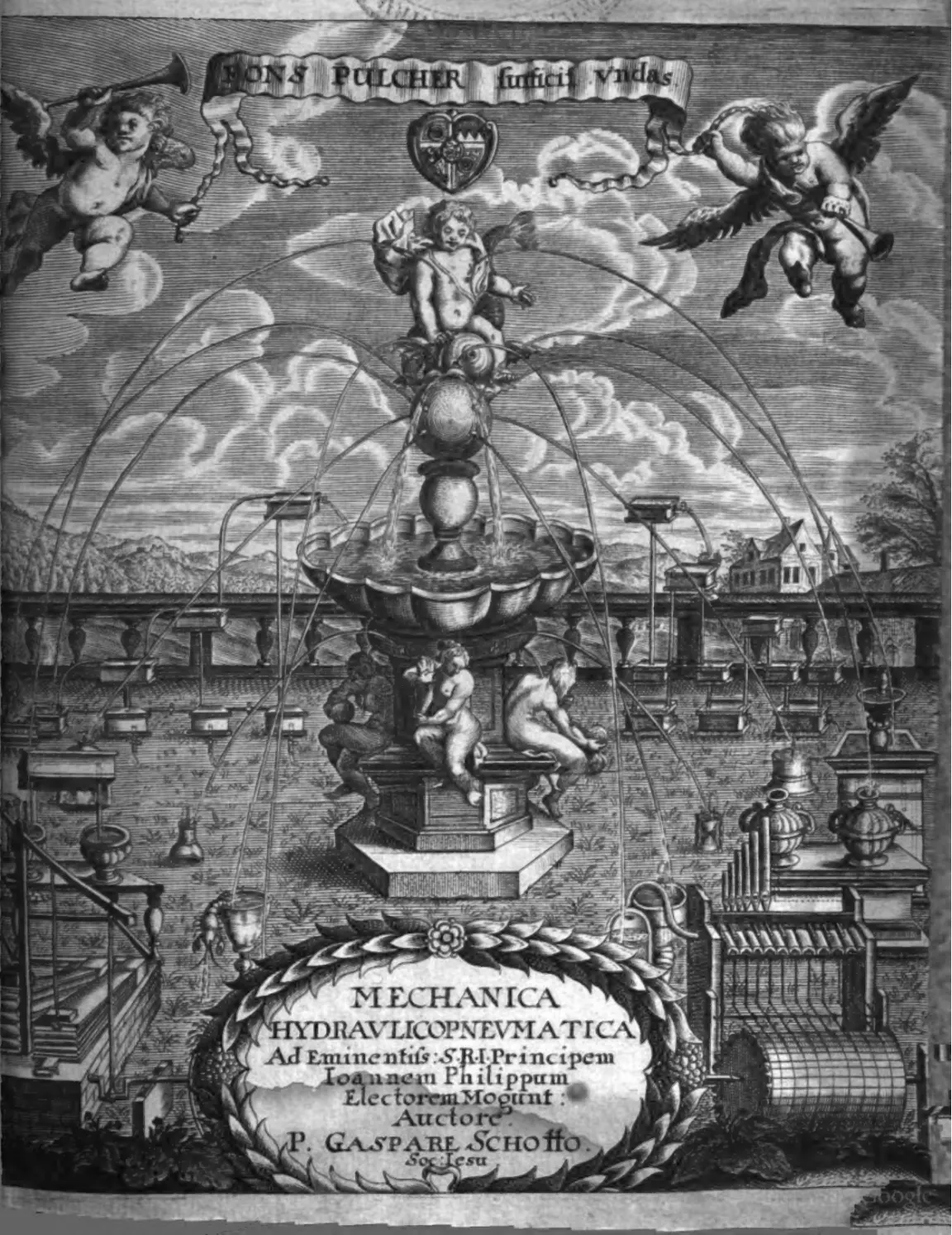
The engraved frontispiece turns Schönborn patronage into hydraulics. Beneath the motto “FONS PULCHER sufficii vndas,” a fountain, heraldic device, and an array of pumps, vessels, pipes, and cylinders make the dedicatee’s “beautiful spring” the source of mechanical knowledge, compressing dedication, Jesuit authorship, and practical demonstration into one visual prologue. Source ↗.
The poem then states, in emblematic compression, the principle on which the whole work rests: the formula, discussed above, of Art drinking so that it may prop up languishing Nature. The clause that follows it, Quod non sola Natura audet, speaks of what Nature alone does not dare, and it specifies the relation precisely. Art does not overrule Nature. It supplements a Nature that is flagging, and it accomplishes jointly with her what she would not venture unaided.
The poem closes by lifting the fountain beyond the whole mechanical order, into the Johannine promise of a spring with which it will leap up into eternal life, QUOCUM SALIET IN VITAM ÆTERNAM. The verb saliet is the same root from which Schott will later take his technical term for water jets, salientes. The liturgical and the hydraulic registers are thereby fused at the lexical level. The last spurt of the ornamental fountain is also a figure of grace, and the pleasure machines of the prince are set beneath an eschatological horizon.
The Praeloquium: Genealogy, Division, and the Distribution of Credit
The Praeloquium shifts from panegyric to method, and its first movement explains the book's genealogy. The volume is an offshoot of a larger Kircherian undertaking, for Schott had formed the intention of composing a Natural Magic, Magiam Naturalem conscribere animus, drawn from Kircher's printed works, his papers, and the machines of his Roman museum. The Mechanica thus presents itself as a fragment detached from a projected encyclopaedia of wonder-working natural causes.
The second movement, under the rubric Divisio, supplies the theoretical justification for the bipartite form. Here Schott develops the argument, already cited in framing the title, that if theory and practice are separated both fall, and that practice alone cannot attain its end without theory. The charge against predecessors follows directly: they transmitted bare practice, whose principles they either did not know or begrudged to others. Against this Schott makes a promise of striking confidence. Part I will deliver the theory by which machines of every kind are to be built with the greatest ease and infallible success, construendas facilitate summâ, successu infallibili. The idiom belongs to the didactic cursus, in which principles are held to guarantee practice. It sits uneasily, however, beside the probabilist caution Schott will adopt elsewhere, and the tension between guaranteed rule and provisional explanation runs through the whole of Part I.
The same preface establishes the book's hostility to the most seductive of mechanical ambitions. It is here that the projectors of perpetual motion are dismissed in the satirical phrase, already encountered, that makes them architects of rest rather than of motion. The class of perpetual-motion machines in Part II is justified purely as deterrence: having seen the vanity of another's attempt, the curious reader may form a judgement of the rest and hold back from similar labour, vt visâ alieni conatus vanitate, curiosus Lector judicium. Failed machines are thus admitted to the catalogue as moral exempla. They guard the curiosus against a vice of curiositas itself.
The critical bibliography that closes the preface reveals the criteria by which Schott distributes credit in the Republic of Letters. Heron, corrected at every turn in Part I, is nonetheless outstandingly deserving of the learned commonwealth, Est nihilominùs ipse de Republica litteraria egregiè meritus, because he alone transmitted ancient hydraulic learning. Primacy, however, goes elsewhere. To Porta, Schott judges, the first place among all writers on pneumatics should be given, Huic ego primas inter omnes Spiritualium Scriptores dandas censeo. The reason is that Porta supplied principles confirmed by long and costly experiment. The ranking enacts the preface's thesis, since the ancient transmitter of bare practice yields to the modern who joined principle to trial. The catalogue therefore ends on Schott's claim to novelty, noted earlier, that scarcely anyone before him has joined theory with practice, as he now undertakes to do.
Part I: The Protheoriae on Attraction, Rarefaction, and Hydrostatics
The first Protheoria puts that conjunction under its heaviest strain, because attraction must be explained through the vexed question of the void. Schott begins by separating vulgar usage from the learned definition of the vacuum as a place filled by no body, the scholastic formula with which the discussion of horror vacui was introduced above. He then sets Heron's disseminated vacuum against the "sounder" view that there is no void, only Nature's abhorrence of emptiness.
The warrant he claims for that view is instructive: it is the pairing, already remarked upon, of experience, the mistress of philosophy, with reasons. The two warrants, however, are not equally handled. Schott promises to adduce a few experiences out of many and to leave the reasons to others, Experientias adducam paucas ex multis; rationes apud alios. The division of labour is deliberate. The mechanician supplies bellows, polished plates, the inverted vessel, and the musket barrel, while the demonstration of the metaphysical doctrine is left to the schools.
The rhetoric then hardens against those who would unsettle the consensus. This is the passage in which, as seen earlier, certain moderns driven by some zeal for novelty are said to grumble against it, and the verb gannire, used of the yelping of dogs, carries the contempt. Yet beneath the polemic lies a pragmatic hedge, for Schott concedes that both theories of the vacuum serve the machine-builder. The conservative doctrine is professed, but the practical art is left indifferent to the outcome of the dispute.
Schott's doctrinal refinements show the same scholastic care. Nature sometimes resists emptiness by no motion or efficient force at all, but by the "negative resistance" already discussed, a formula that empties horror vacui of any positive appetite while preserving its explanatory work. Nature is further endowed with a principle of economy, since in these matters as in all others she studies brevity, men Natura in his, vt in cæteris rebus, co[m]pendio studet.
The empirical core of the Protheoria is the interrupted inverted siphon and the rule of the perpendicular it establishes. That measure, Schott insists in a passage quoted earlier, is so necessary in hydraulic operations that no art, trick, or experiment can deceive Nature. Porta's failed attempts with inclined and helical tubes serve as the proof.
The personification is then generalised into a reciprocity. Just as Nature does not deceive us in her operations, so neither does she wish to be deceived by us, Natura, & vt non fallit nos in suis operationibus, ita nec falli à nobis vult. Here the moral vocabulary of good faith carries a claim about regularity. The same constancy that frustrates the would-be cheat of the perpendicular is what makes the promise of "infallible success" conceivable. Art may prop up Nature, but only on terms Nature herself dictates.
The brief Protheoria on rarefaction moves from principle into the courtly theatre in which such principles were displayed. Schott's glass pellets, filled with vinegar or saltpetre solution by a German lampworker at Rome, burst after roughly the time in which Psalm 50, the Miserere, can be recited, spatium circiter temporis quo Psalmus 50. Miserere mei Deus. The penitential psalm serves as the clock of the experiment. This is an ordinary index of a milieu in which recited prayer was a shared measure of duration, and it shows that no separate instrument of time was thought necessary.
The effect on the audience was theatrical. A prince's servants rushed in astonished, believing a small gun had been fired at their prince, bombardulam in Principem suum explosam credentes. The anecdote returns the reader to the delectatio principum of the dedication. Rarefaction is here demonstrated less as doctrine than as a controlled alarm, a wonder whose natural cause is known to the demonstrator and hidden from the spectators.
The long fourth Protheoria formalises the hydrostatic core of the book in the manner of geometry. Its first axiom, cited above, recasts the rule of the perpendicular in martial idiom, declaring that in hydraulics one fights and conquers not by quantity of water but by perpendiculars. A further axiom states that in hydraulics equal perpendiculars press equally and unequal ones unequally, IN hydraulicis æqualia perpendicula æqualiter premunt, inæqualia. The agonistic verbs pugnare and vincere dramatise a law of pressure as a contest in which height, not mass, decides the victory. The numbered axioms clothe craft knowledge in the authority of Euclidean method.
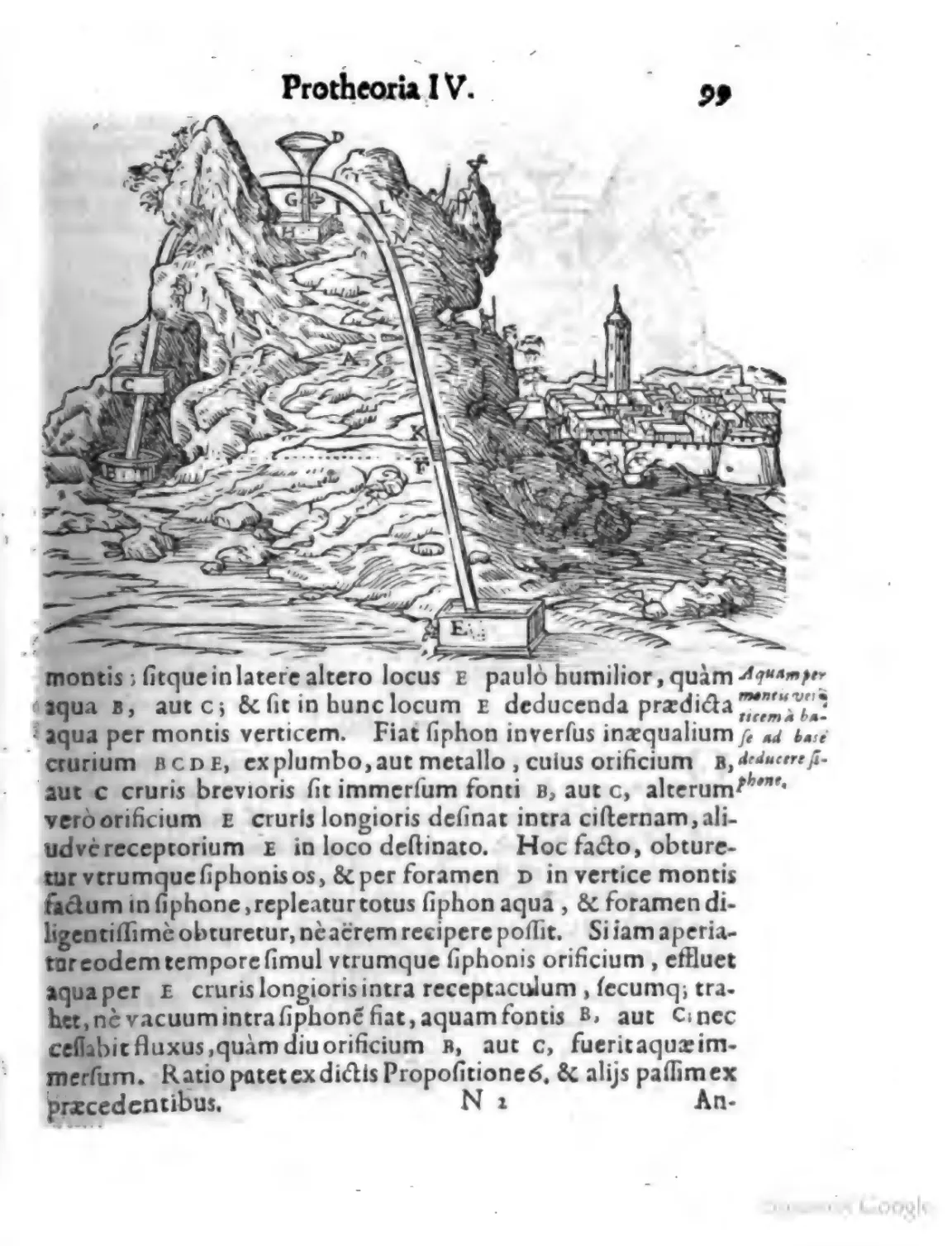
In this page from Protheoria IV, a labelled inverted siphon climbs from a spring or cistern over a mountain summit to a lower receiver. The rule of the perpendicular governs the flow—height, not quantity of water—while priming and sealed orifices keep out the air that would break its plenist continuity. Source ↗.
Where Schott goes beyond his sources, he does so in the idiom of open inquiry. Having noted that Mersenne had raised a difficulty but not solved it, sennus in Phænom. Hydraul. Proposit. 38. sed non solvit, he offers his own account of Heron's fountain as an interrupted erect siphon. He frames it as follows: this is his opinion; whoever has a better one, let him bring it forward, for no one yet has touched the cause, Hæc mea est opinio: cui meliùs quid occurrerit, proferat in medium; nullus. The claim to priority and the invitation to correction arrive together, which is the characteristic posture of a contributor to the learned commonwealth.
The chapter on flow through tubes exposes the book's consciousness of its own medium and of the trust on which its data rest. Standard measures such as the Roman and Paris foot cannot be reliably transmitted in print, Schott warns, because paper first moistened and then dried does not keep the length of printed lines faithfully, quòd chartæ priùs madefactæ. Damp press work shrinks the sheet. The printed book, the very vehicle of the conjunction of theory and practice, is acknowledged as an imperfect carrier of metrology.
Where print distorts, confidence in persons must compensate. Schott declares that he places such faith in Riccioli's observations, Riccioli observationibus tantam ego fidem adhibeo, that he will not weary himself repeating them at Rome. He does so although weights could conveniently be dropped down the spiral staircase of St Peter's in the Vatican, gravibus per cochleatas Divi Petri in Vaticano scalas. The laws of fall are thereby accepted on the testimony of a confrère's experiments at Bologna.
The limit of this economy of trust appears with Mersenne. Paolo Casati had suspected that Mersenne's evacuation experiment was adduced to suit the proposition, an experimentum allatum à Mersennio sit in gratiam Propositionis. Schott refuses to follow the suspicion; in the declaration already noted, he holds it improper to call Mersenne's experiment into doubt. The word nefas moves the question from the order of evidence to that of propriety. Here the conjunction of theory and practice rests finally on a moral settlement among learned men. A reported experiment by a recognised authority is not to be impugned, even when a colleague has named the suspicion that it was shaped to fit its theorem.
The fourth Protheoria then returns to its Euclidean treatment of water issuing through orifices. Its form is strictly geometric: theorems and problems follow one another in the sequence of the Elements, and results about equal and unequal holes, divided and offset orifices, and vessels compared with vertical tubes are derived by proportion. At the point of greatest mathematical exposure Schott adds an Annotatio that sets the epistemic terms of the whole discipline. The incommensurability of certain ratios, he explains, does not matter, and his reason is the principle already cited, that here one is not in mathematics but in physics, where no account is taken of imperceptibles.
The concession is more than a convenience. It marks the boundary that allows Schott to borrow the demonstrative prestige of geometry without accepting its standard of exactness. The Aristotelian division between the scientiae mediae and pure mathematics is here turned to the builder's advantage, since what cannot be sensed need not be accounted for. The law that follows displays the same double register. It states that the velocities of water running out through equal orifices in the same vessel, placed at unequal distances from the top, Velocitates aquæ decurrentis per foramina æqualia eiusdem vasis, inæqualiter distantia à summo vasis, sunt in subduplicata ratione distantiæ, stand in the "subduplicate" ratio of the distance, that is, as the square root of the head. The technical idiom of compounded ratios is Euclidean, but the object is a sensible flow whose tolerances physics alone can adjudicate.
The following chapter, which Schott presents as a parergon serving the pneumatic machines, confronts the most delicate element of his hydro-pneumatic programme: the weight of air. His formulation is a model of conciliatory phrasing, holding that air, though light among the other elements and tending upward by its lightness to lie above earth and water, nonetheless has some gravity mixed in. The concessive tametsi that opens the sentence keeps the Peripatetic hierarchy of natural places in its main clause. The measurable heaviness established by Riccioli's bladder-weighing and Mersenne's aeolipile is admitted only as an admixture, a quality compounded into an element whose nature remains levity.
The deference to experiment is not uncritical. Schott corrects a figure in Mersenne as a printer's slip, and on the maximal rarefaction of air he states his reservation outright: Hæc ex Mersenni sententia; quæ tamen valde incerta mihi videntur,, these things according to Mersenne's opinion, which nevertheless seem to me very uncertain. His grounds are the uncontrolled degree of heating, the loss of water, and the unknown state of the residual air. They are the objections of someone who has handled the apparatus.
The Conclusio of the Protheoria then declines two further questions, the heights of jets from pneumatic fountains and flow in inclined tubes, and defers them to a promised Mechanica Universalis. Of the first Schott offers a sentence of unusual candour: & cùm omnia expertus fueris, dubius adhuc hærebis, when you have tried everything, you will still remain in doubt. Experience here reaches its limit without yielding a law. The theoretical part accordingly ends not in synthesis but in a turn of direction, praxin igitur, missâ theoriâ,, that is, "theory set aside, therefore, to practice." The phrase does not abandon the conjunction of theory and practice. It records a point at which theory has exhausted what it can responsibly claim.
Part II, First Class: Machines Sorted by Motive Principle
The Proœmium to the Pars Secunda, Practica grounds that turn in a classical exemplum. From Vitruvius, Schott recalls how Dinocrates proposed to carve Mount Athos into a colossus bearing a city. Alexander praised the design but rejected the site, because Sciebat nimirum Rex sapientissimus, quantum sæpe sit dissidium praxin inter & theoriam;, the most wise king knew how great the discord between practice and theory often is. The anecdote makes the gap between conception and execution a royal wisdom rather than an artisan's complaint.

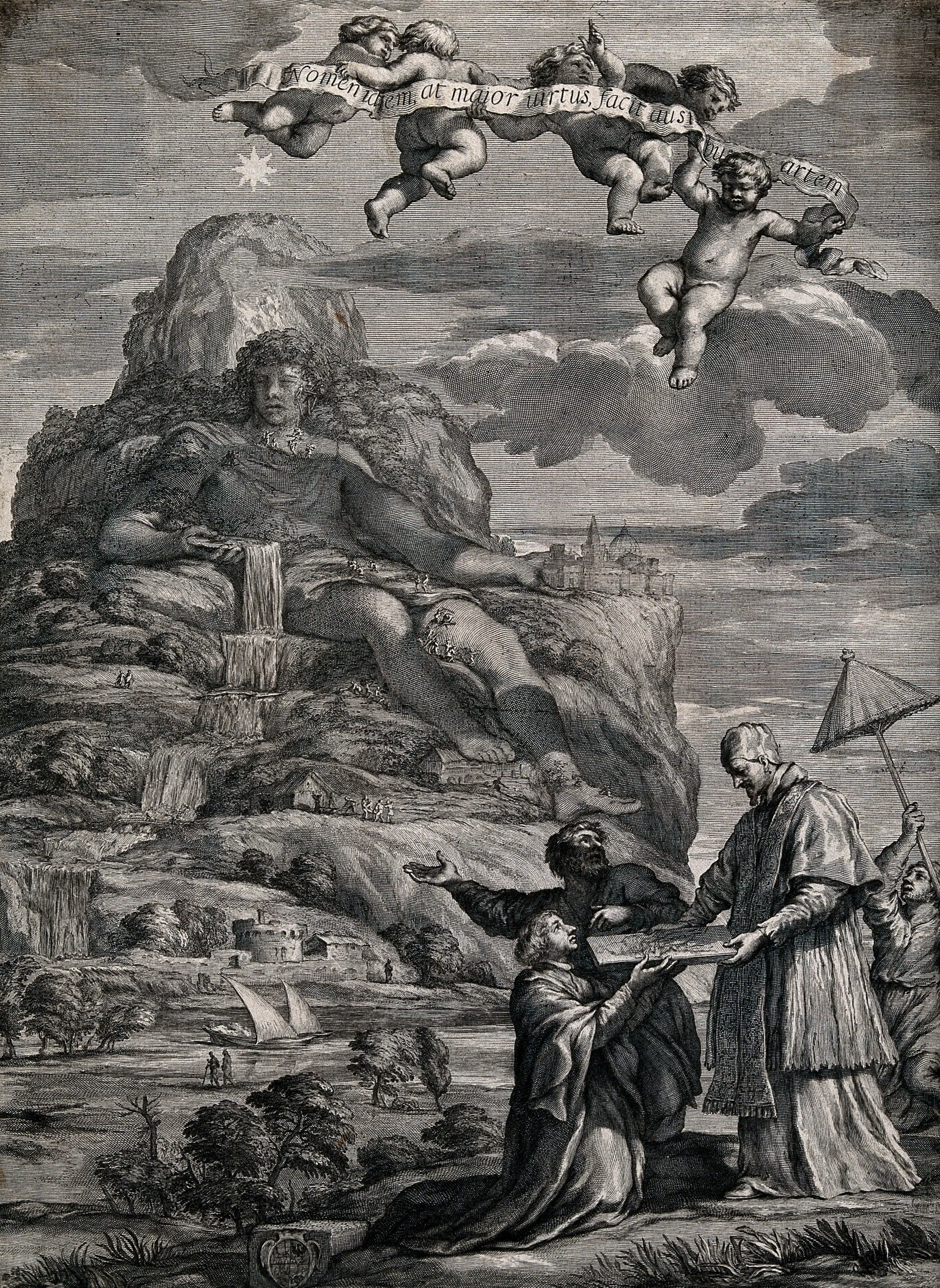
In this Wellcome engraving, a pope is presented with a design by two artists before a colossal mountain figure bearing architectural forms—a scene that recalls the Dinocrates fantasy of carving Athos into a colossus. Setting design before a patron’s judgement, it echoes Schott’s Vitruvian divide between conception and execution. Source ↗.

The anecdote also licenses the evidentiary vow that follows. Schott will describe only machines actually built, chiefly in Kircher's museum, and here makes the declaration already quoted, that he brings forward nothing, or almost nothing, in the whole of Part II that he has not seen with his eyes and handled with his hands. The hedging ferè is characteristic, for the autopsy claim is strong but not absolute. The same Proœmium announces the sceptical purpose of the second class of machines. There Schott will set out hydraulic contrivances quæ motum perpetuum si non verè ac reipsa efficere, certè proximè æmulari creduntur; simulque monstro, nullum, quod promittit, reipsa præstare posse. These are devices believed, if not truly to effect perpetual motion, at least to come very near it, and he will show that none can perform in fact what it promises. The repeated reipsa, "in the thing itself," sets the reality of built effect against the reputation of devices.
The first class is organised not by use but by motive principle, and the opening chapter states the rule: Primum Caput complectetur Machinas, quarum principium est vis Attractiva:, the first chapter will comprise machines whose principle is attractive force. This taxonomy carries the four powers of the theoretical part directly into the catalogue. Every device from the phial fountain to the Tantalus cup therefore becomes a demonstration of a physical cause.
That cause, in the chapter on attraction, is the plenist teleology of the schools. After describing a fountain which, he notes, he had had constructed, Hanc Machinam hîc construi curavi,, Schott exclaims, Vides igitur, quid non moliatur Natura ad vacuum evitandum: "you see, then, what Nature will not attempt in order to avoid a vacuum." The explanatory formula recurs mechanically in the analyses, as in in KA; quæ attractio fit propter metum vacui, where the attraction along a pipe occurs "on account of fear of the void."
Personification here does real work. Nature labours, strives, and fears, yet her striving is exhibited through a machine that Schott himself caused to be built. The plenist maxim is thus made visible in brass and glass, and the machine becomes an argument for the doctrine it presupposes.
The chapter on expulsive or compressive force opens the programme's central category. Of a Heronian fountain Schott rules that Quare machina non est purè hydraulica, sed hydropneumatica, id est, aquæ & aeris ope animata, so the machine is not purely hydraulic but hydro-pneumatic, animated by the help of water and air. The verb animata keeps a vitalist resonance while fixing the agency in two material elements.
In the same context the workshop intrudes. A large glass fountain crepuit me inspectante, non sine Artificis indignatione; quod ad Mechanicorum causelam dictum velim, cracked while he watched, to the craftsman's indignation, a detail he wishes recorded as a warning to mechanics. The glass-maker's anger, the fractured vessel, and the practical warning give the autopsy claim its texture of lived failure.
Against the Heronian tradition Schott then asserts his own criterion, the height of the falling and rising water columns: Quod dixi hîc de perpendiculo aquæ cadentis, & ascendentis, diligenter notandum est in omnibus similibus Machinis: quod tamen à paucis fuit observatum. What he has said of the perpendicular of falling and ascending water must be carefully noted in all similar machines, though few have observed it. The corrective is geometric, not rhetorical. It measures ancient machines by the standard of the perpendiculum.
The same accounting underlies his refusal to grant perpetuity even to his own polysiphonic fountain. It will run in a cyclical and long-continued motion, he insists, Dico cyclicâ, & ad longum tempus continuatâ itatione: non enim perpetua erit, vt aliquis persuadere sibi posset;, but it will not be perpetual, as someone might persuade himself. The scepticism promised for the second class operates already within the first, and it is applied to the author's own devices.
In the discussion of the Ctesibian pump, which Schott glosses in three vernaculars, an empirical datum surfaces that will prove to be the hinge of the vacuum controversy. By the reports of water engineers, Galileo & Gassendo testibus, aqua non ascendit vltra 18. brachia, seu 32. pedescirciter, Galileo and Gassendi being witnesses, water does not rise beyond eighteen braccia, about thirty-two feet. Schott records the limit as an attested fact, framed by named witnesses in the juridical manner of learned testimony, without yet drawing its consequences for the metus vacui he has been invoking. The tension remains unresolved for now: a Nature that will attempt anything to avoid a void nevertheless stops at a measurable height.
The same chapter moves from Roman amusement to sacred history. Heron's vessels for dispensing different liquors are presented with the remark, noted above, that by this means the miracle of Christ at Cana in Galilee can be exhibited. The verb is exhiberi, to be displayed or staged, not to be explained. The mechanical art imitates the visible appearance of the miracle and leaves its supernatural cause untouched, a distinction that becomes decisive when the same technical repertoire is turned against pagan religion.
That turn comes in the chapter on rarefaction, where Egyptian and ancient reconstructions are judged by the vocabulary of impostura. Of the temple doors and libating altars worked by concealed fire and air, Schott concludes that since the crowd did not grasp the hidden machinery, mirum non est, eam Deorum beneficio id contigisse existimasse, it is no wonder they thought it happened by the favour of the gods. The chapter on natural fall sharpens the charge against the many-breasted Mother of the Gods, which Schott calls, in the phrase already encountered, a truly wondrous invention of the priests for perverting the blind hearts of mortals.
The juxtaposition with Cana is ideologically deliberate. The identical mechanism is devout representation in a Christian setting and fraudulent manipulation in a pagan one. What distinguishes the two is not the machine but the truth or falsehood of the religion it is made to serve.
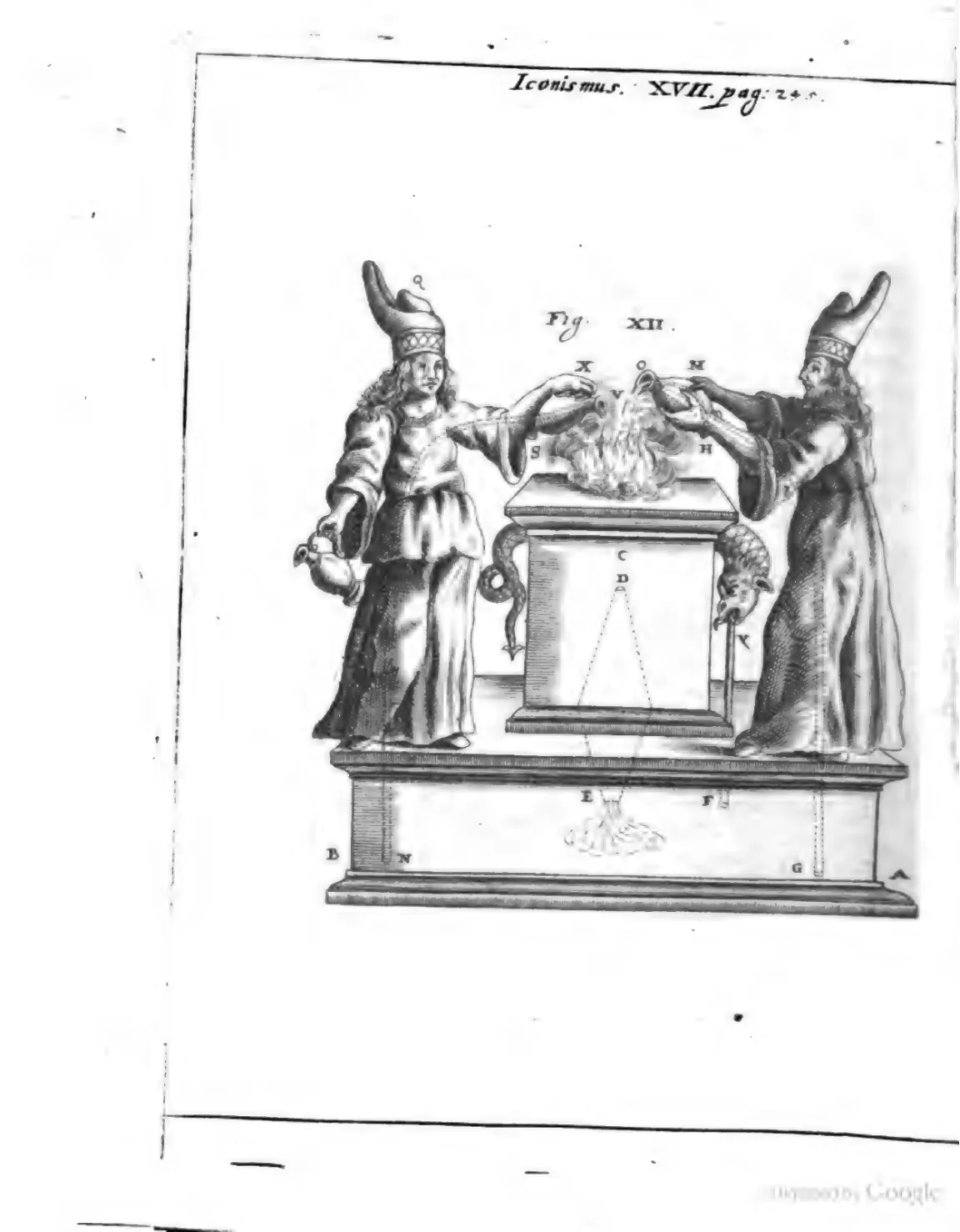
In this engraved plate, priestly figures flank a sacrificial altar whose cutaway pedestal exposes lettered tubes, a serpent-shaped conduit, and a fountain jet—the concealed apparatus behind the staged marvel. Disclosed, the same hydraulic-pneumatic art is natural philosophy; enlisted to make false religion look miraculous, it becomes imposture. Source ↗.
Schott's empirical judgement does not spare his own circle. Of Kircher's solar hydrologium he states flatly, Meo tamen judicio hæc Machina nullum poterit habere usum,, that in his judgement the machine can have no use. The tamen registers the deference owed to Kircherus noster even as the verdict is delivered.
The chapter on mixed principles culminates in the tubus hydrotechnicus, which pairs the Florentine experiment of 1649 with the Roman experiment of the Cartesian diver. Here Schott's probabilism becomes explicit. On the incompressibility of water, which Magiotti had declared "most certain," Schott makes the demurral already cited: he called it more probable, for it is not evident, whatever others say. The scholastic grades of assent are applied to an experimental claim.
Yet the causal analysis of the diver is stated with confidence. The moving cause of the globule is globuli motricem in hoc Experimento aliam non esse, præter compressionem aquæ aliter atque aliter modificatam, none other than the compression of the water, modified now one way, now another. The two stances are compatible within Schott's method. Certainty about a proximate mechanism coexists with suspended assent about the fundamental property of the element.
The miscellaneous final chapter carries this suspension further. Of a sphere held aloft by a jet of air, whose purported demonstration was found among the papers of Clavius and Grienberger, Schott reproduces the argument and withdraws from it: Hæc Author hujus Machinæ, quæ vtrum satisfaciant, doctis relinquo judicandum, this is what the machine's author says, and whether it satisfies he leaves to the learned to judge. The formula leaves assent to the judgement of the learned, sparing the Society's own masters an unfavourable verdict while conferring no endorsement.
The Torricellian Tube and the Tribunal of Wonders
The plenist edifice then meets its most direct challenge. Introducing the Torricelli–Berti tube, Schott sets against the vacuists the philosophers' negando vacuo consensus, quanta est totius Naturæ ad illud impediendum conspiratio, the consensus in denying the void and the great conspiracy of all Nature to prevent it. The word conspiratio, a breathing-together of the whole cosmos, gathers the personified, labouring Nature of the attractive machines into a single concerted agency. It is precisely this agency that the eighteen-braccia limit, recorded earlier without comment, now calls into question.
The close of the Torricellian material in the first class of practical machines brings an abrupt shift of tone from report to polemic. Having described the mercury tube, Schott turns on those who drew the wrong lesson from it: Viso hoc, auditoque Experimento, nonnulli ex Neotericis Philosophastris, quibus volupe est nova quotidie cudere, "once this experiment was seen and heard of, some of the modern philosophasters, who delight in forging new things daily."
The insult is precise. The diminutive Philosophastri denies them the name of philosophers, and the verb cudere, to hammer out at the forge, casts novelty as an artisanal counterfeit rather than a discovery. The charge then escalates from philosophy to faith in the passage already discussed, where the champions of the void are said to have sung triumph before victory, boasting that a located thing without place, and accidents without a subject, could subsist naturally.
The load-bearing word is naturaliter. Accidents persisting without their subject were admitted in Catholic theology only in the Eucharist, and only as a miracle beyond the order of nature. To claim that emptiness could naturally host such anomalies was to naturalise what the Council of Trent had reserved to divine power. The vacuum is thus framed from the outset as a boundary question between physics and sacramental doctrine. Every subsequent move in what follows, including the appendix's studied neutrality, must be read against this opening severity.
The empirical rebuttal follows. Gasparo Berti's lead tube in Rome enclosed a bell struck by a magnet, and Schott treats the audible result as conclusive, declaring, in the passage already examined, that it is certain there was no void in the part of the tube emptied of mercury and water, since sound was propagated through that space.
The register is striking because it is not probabilist. Certum est is the language of demonstration, not of the "more probable." The argument also rests on a premise, that sound requires a medium, which the plenist and his opponents both accepted. The same instrument that the Neoterici read as producing emptiness is made to testify for plenitude. The confident closure recorded here is the benchmark against which the Magdeburg appendix will later reopen the question.
The long section on the "Hydropota," the mountebank water-drinker who brings up wine, vinegar, and scented waters, shifts the inquiry from the void to the classification of wonders. It also reveals the juridical machinery surrounding that classification. Of Blasius Manfredus of Noto, Schott reports that many were astonished and thought the feat done by magic and the Devil's help, until he was seized in France by Cardinal Richelieu and, threatened with the rope, compelled to reveal his art as free of diabolical illusion: Mirabantur multi, & magica id facultate, Daemonisque ope fieri opinabantur, donec in Gallia à Cardinale Richelieu captus, & reste intentato adactus fuit, vt artem proderet, & à diabolicis præstigiis immunem,.
Disclosure here is extracted under coercion. The boundary between natural art and præstigiæ diabolicæ is policed by the secular arm, and the performer's safety depends on showing that his effect proceeds from a natural cause. The case of Jean Royer transposes the same logic into a learned key. Asked for a certificate, Kircher replied that he could not write the desired testimonial unless he knew the method and all the reasons of the art, Kircherus, non posse se desideratum perscribere testimonium, nisi sciret artis modum & rationes omnes.
Where Richelieu used the rope, Kircher uses the conditional nisi sciret. Certification rests on private inspection of modus and rationes, on knowing the cause and not merely witnessing the effect. The Jesuit museum becomes a tribunal of natural causation, and the printed testimonium a licence issued to popular spectacle.
Schott's candour cuts both ways, however. Of Ferdinand III's recipe for regenerating a plant from its seed in a sealed phial, he concedes that neither Kircher nor he made trial of it, being detained by other business, and leaves it to those with more leisure: Experientiam rei nec Kircherus fecit, nec ego, aliis detenti; facient quibus plus otii suppetit. Imperial provenance does not substitute for autopsy, and the untested claim is marked as such.
The moral economy of revealed mechanism reaches its most theological formulation in the story of Kircher's magnetic anemoscope at Malta. Spectators suspected a demon until the hidden apparatus was shown to them. Thereupon, detesting their error, they learned in similar matters thereafter to take their intellect captive: tunc enim errorem suum detestati in similibus imposterum captivare intellectum suum didicerunt.
The Pauline phrase from 2 Corinthians 10:5, which originally describes subjecting every thought to Christ, is redirected. The captive intellect now defers not to revealed mystery but to hidden natural causes the onlooker cannot yet see. Credulity toward demons and presumption of the impossible are corrected by the same discipline. Epistemic humility before art becomes a form of piety.
The Second and Third Classes: Perpetual Motion on Trial and Harmonic Automata
The second class, on machines emulating perpetual motion, is built with scholastic care around a single distinction. Only motion instituted by art is in dispute: Dixi, arte institutus; de hoc enim disceptatur, non de motu perenni naturali, "I said, instituted by art; for it is this that is disputed, not perennial natural motion." The perpetual circuits of heavens and rivers are thus set aside, and the question narrows to human contrivance.
The Prolusio frames that contrivance satirically. So vehement and frequent was the Roman craze, Schott writes, that even blacksmiths and carpenters, an otherwise rude sort of men, dared to claim for themselves the glory of the finished work: tam is est vehemens ac frequens, ut vel ipsi ferrarii & lignarii fabri, rude alioquin hominum genus, perfecti operis gloriam sibi vendicare audeant. The disdain is social as well as intellectual. The faber who claims gloria usurps a dignity belonging to the mathematician, and the verb audeant marks the usurpation as audacity.
Having sided with Kircher's impossibility thesis, Schott answers the projectors' appeal to the lever and the wheel with mechanical accounting. His reply is the one already quoted: he grants that their premises are most true but denies that they bear on perpetual motion, since in producing motion by machines weight and power must be reckoned together with the time and the space through which the motion takes place. The form is disputational, a concession followed by a distinguo, but the content is drawn from the pseudo-Aristotelian and Archimedean tradition of the balance. Every advantage in force is paid for in time and distance, so no machine can multiply motion out of nothing.
The catalogue that follows is justified programmatically. Devices are presented so that either their authors' ingenuity may become known, if they produce anything praiseworthy, or their vanity be exposed, if errors are detected: vel Authorum ingenium, si quid laude dignum proferant, innotescat; vel pateat vanitas, si errores detegantur. The class is thus a trial conducted in print, each machine followed by its Annotatio as sentence follows evidence.
Yet the art/nature boundary proves negotiable. Of Antonio Martini's thermoscopic clock, driven by the daily alternation of heat and cold, Schott rules against an unnamed "great man" that this motion, if it were perpetual and regular, could be counted as the sought-for artificial kind: Ego tamè existimo hunc motum si perpetuus foret, & regularis, artificiali quæsito adnumerari posse. Ingenuity in harnessing a natural cycle is enough to make the motion "artificial." The distinction that organises the class is therefore redrawn from within.
The penultimate device returns perpetual motion to its proper author. With Riccioli, Schott reads the circulation of springs in Ecclesiastes 1 non tanquam proverbium vulgi, sed tanquam divinæ sapientiæ effatum, "not as a proverb of the crowd, but as a pronouncement of divine wisdom." The only true perpetual machine is creation's hydraulic cycle, the work of divine rather than human mathematics.
The final device descends from the divine to the fraudulent. The chymical mobile perpetuum presented to Ferdinand III is traced to Leurechon's Récréations, and Schott concludes that whoever offered it to the Emperor seems to have deceived him when he sold it as his own: Fucum ergo fecisse videtur Cæsari dum id pro suo vendidit, quisquis id Cæsari obtulit. The verb vendidit is then turned into the profession of his own probity already noted, that he has sold none of the preceding devices as his own but has always praised their maker. The juxtaposition is deliberate. Plagiarism at court and attribution in the Republic of Letters are set side by side as vice and virtue of a single credit economy.
The third class, on hydraulic organs and harmonic automata, shifts from refutation to celebration. Here the machine is praised for exceeding the human hand. The pinned cylindrus phonotacticus renders note values so small that, Schott insists, no organist, however skilled and swift in playing, could ever achieve them: Quod certè nullus Organædus quantumvis peritissimus, acque in pullando organo velocissimus, præstare unquam poterit. Art that elsewhere props up a languishing Nature here surpasses human skill itself. The claim is certified by the author's own senses, as in his verdict on Kircher's rosined-wheel keyboard: eâque ego suaviorem nunquam audivi, "and I never heard anything sweeter."
The Experimentum novum Magdeburgicum
The appended Experimentum novum Magdeburgicum reopens what the Berti passage had declared certain. Its title-page formula presents the experiment as one by which some try to establish the void and others to overturn it, Quo vacuum aliqui stabilire, alij evertere conantur;. The reader is positioned as judge rather than pupil.
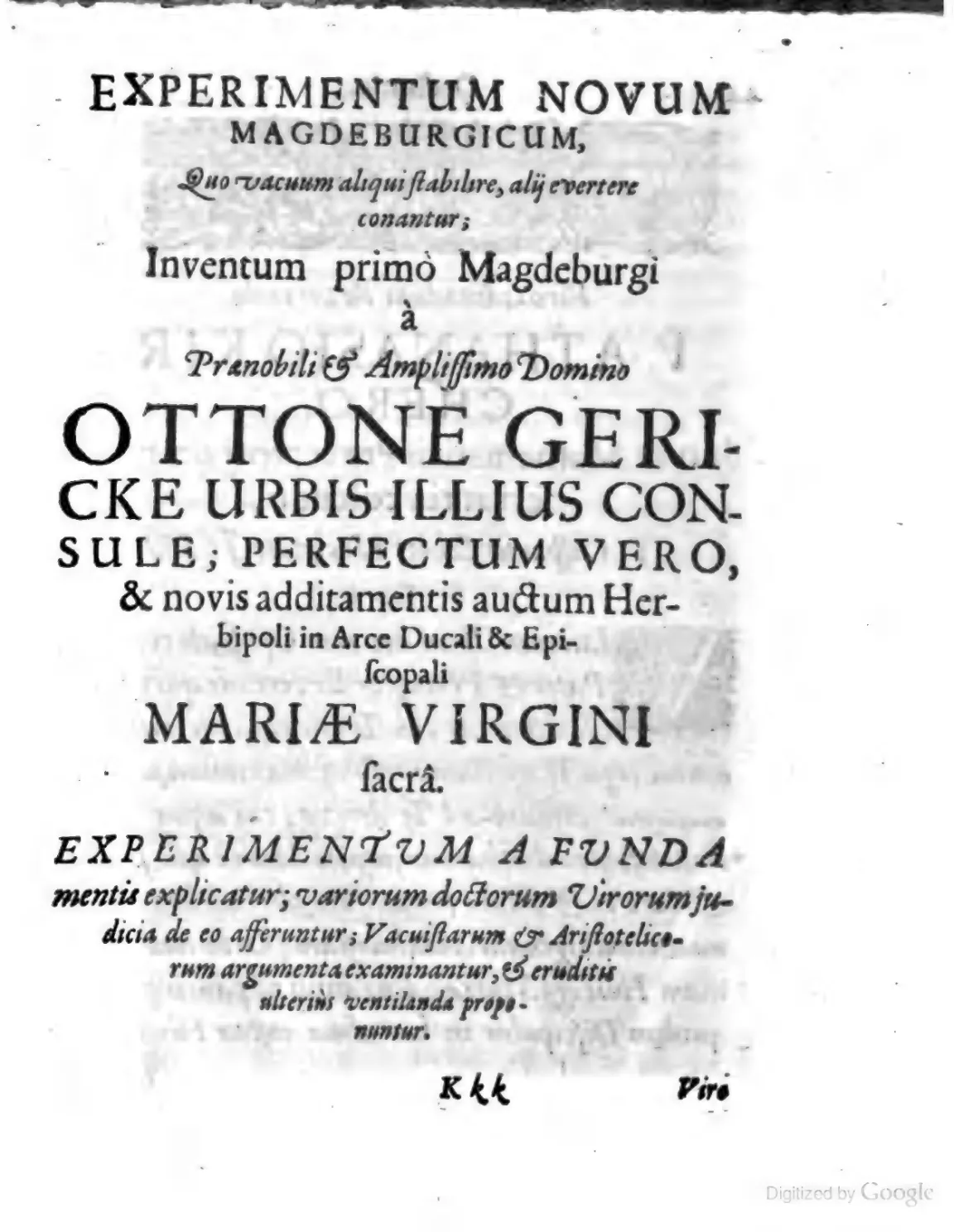
The internal title page of the appended Experimentum novum Magdeburgicum frames Guericke’s apparatus as a contest, with “some” seeking to establish the vacuum and “others” to overturn it. Its Würzburg setting and promise to examine both Vacuist and Aristotelian arguments announce Schott’s controlled suspension of judgement. Source ↗.
Both parties argue from a single apparatus. The Vacuists, aligned with the ancient atomists, reason syllogistically to an actual void, Ergo in vase est actu vacuum. The Peripatetics hold that, if greater force were applied, the vessel must break rather than Nature, which abhors a void, be overcome: aut si majori vi adhibitâ continuetur, frangi oportet vas potiùs, quàm vinci Naturam vacuum abhorrentem. The copper vessel becomes the site of a contest between personified Nature and the pump. Kircher's objection compresses the metaphysical stake into the single question cited earlier, whether anyone could conceive that nothing offers resistance. For him, resistance to the piston must belong to rarefied air, since nothing cannot act.
Against this Schott prints the Magdeburg consul's own voice: the maxim, reported with a marking inquit and discussed above, that the authority of Aristotle is worth nothing against ocular demonstration. That a Jesuit volume carries this maxim at all is significant. Schott's gloss holds it at arm's length, for he describes Guericke's letters as containing a new mode of philosophising which he leaves to others to examine.
The distance travelled within these pages is thus considerable. The void first appears as the boast of philosophasters endangering the faith and is refuted by a bell declared "certain." By the end it has become an open question submitted to learned judgement, with the editor suspending assent rather than issuing a verdict.
Cornaeus's Diatribe: Testimony, Bounded Rarity, and the Balance
Within the same appendix Schott prints the diatribe of Melchior Cornaeus, a Peripatetic account of the Würzburg vacuum trials, which builds its case on a graded hierarchy of testimony. That hierarchy governs everything that follows. Before he argues, Cornaeus sorts what he reports by how he came to know it.
The numbered observations from the Würzburg court begin with measurement. He writes that he saw a receiver of roughly thirty-two measures, Vidi Recipientem, qui 32. circiter mensuras, lose weight on evacuation. He then turns to the lore of the court, relating the tale of a man known at the court of Würzburg who had stood too close, aula Herbipolensi Virum notum, qui, cùm propiùs adstitisset, and had to be held back by bystanders when the air rushed in.
The anecdote is reported, not vouched for. The next observation is explicitly reclassified: what follows, he declares, he himself saw, 6. Id quod sequitur, vidi. Cùm Recipiens evacuatus, eversus ita aquæ, namely the inverted, evacuated receiver plunged into water. The terse vidi separates autopsy from courtly rumour. It matters because the dispute will turn on who may legitimately claim the evidence of the eyes.
The water spurts in like a fountain yet leaves a remainder, twenty-six and three-quarter measures out of twenty-seven. Cornaeus seizes on the Vacuists' own concession that they had never yet brought the matter so far that the receiver was wholly filled, nunquam se hactenus eò rem perduxisse, ut Recipiens ad istum. A shortfall of a quarter-measure becomes the first breach in the case for a void.
The opposing party receives a name that is itself an argument. Cornaeus frames his third doubt as an inquiry into how the Vacuists attempt their proof, D V B, 3. Quomodo Vacuistæ conentur. The label casts the experimenters as a sect defined by a single thesis rather than as fellow philosophers.
Their five arguments are rehearsed as objections voiced in me, "against me." Their load-bearing premise is recorded in their own reported words: air, they say, cannot become rare except by heat and fiery activity, aër, inquiunt, non potest rares fieri nisi calore & igneâ activitate. The inquiunt holds the claim at a distance, exactly as Schott elsewhere holds his own correspondents' boldest propositions. Cornaeus's strategy is already visible here. If rarefaction without heat can be shown, the weight lost by the evacuated globe no longer implies emptiness, and the argument from the balance collapses into the doctrine of rarefaction.
The fourth doubt asks whether there is truly a vacuum in the receiver, and Cornaeus answers that there is not. It opens with the authority of antiquity and the Peripatetic school. His ideological position is compressed into a carefully balanced judgement. He grants the experimenters their skill in searching out the truth but refuses to praise excessive haste in abandoning Aristotle, exploranda veritate solertiam, non laudo nimiam in Aristotele. He caps this with a sententia: novelty pleases, sed veritas antiqua melior, "but ancient truth is better."
The concession of solertia is not rhetorical padding. It separates the manual and experimental competence of the Würzburg operators, which Cornaeus respects, from the philosophical inference they draw, which he resists. The division of labour between workmanship and interpretation is the diatribe's governing distinction. Cornaeus can also afford wit. He reports that one of the Vacuists themselves called the receiver not "evacuated" but rather "infatuated," vel potiùs, ut ipsorummet Vacuistarum quidam dicebat, efatuatum,. The pun on vacuus and fatuus, the empty and the foolish, suggests that the vessel is made silly rather than void.
The fourth probatio explains the pump's growing resistance theologically. Extraction ceases, in the formula already cited, because the air has been drawn out to the furthest bounds of rarity that Nature and God prescribed for it. The pairing Natura Deusque matters. The terminus of the air's expansion is a limit written into creation, not a contingent property of the apparatus. The labour of the two strong men at the pump is thereby redescribed as a contest with an ordained boundary.
The sixth proof then performs a decisive dialectical manoeuvre. The Vacuists attributed residual air to leaking valves, and Cornaeus replies that it suffices for him to demonstrate air in the receiver, whencesoever it came, in Recipiente demonstrare, unde unde ille sit, ut unà contrà obtineam,, so that he wins the contrary thesis at a stroke. The origin of the air, which for the experimenters was a question of workmanship, becomes philosophically irrelevant. The burden of proof falls wholly on those who affirm an absolute void, who must now show not a nearly empty vessel but a perfectly empty one.
The seventh proof appeals to the uniformity of Nature's ends. It asks why Nature, in order to prevent one smaller vacuum in the tube, should admit a larger vacuum in the receiver, impediendum unum vacuum minus in tubo, admittat vacuum. The argument presupposes a Nature acting consistently toward a single purpose, the avoidance of emptiness. It reads suction teleologically, as the operation of metus vacui.
The ninth proof advances Nature's vis retentiva. Its thesis holds that the force of Nature resisting a future vacuity is greater than the pulling strength of all mortals, folle futuræ obsistentis, vis, quàm mortalium omnium in trahendo robur. Cornaeus supports it with a memory reaching back to his youth. He saw at Paderborn thirty-seven years earlier such a victory of Nature, when "our men," that is, the Jesuits of the college, had prepared a well of enormous depth, 37. talem Naturæ victoriam. Paraverant Nostri in Collegio puteum ingentis.
The wooden tubes burst rather than yield. The episode's rhetorical force lies in the word victoria: a failed piece of college engineering is transfigured into a triumph of Nature over human strength. The Nostri locates the testimony securely within the Society's own institutional memory.
The tenth proof reports a new Würzburg apparatus, the cacabus evacuatorius, which extracts water rather than air. Here Cornaeus deploys visual evidence of his own. He describes how, for the whole time, nearly an hour, during which the water flows down, continuous rays as it were of air rise, tempore (per horam pene duravit) quo aqua deorsum meat, continui aëris quasi. The Vacuists' appeal to sight is then turned against them: if they call upon the judgement of the eyes in this business, why not here as well, oculorum judicium in hoc negotio appellant, cur non hîc vel. The contest is therefore not between authority and experience in any simple sense. It is a contest over which ocular testimony counts, and Cornaeus claims the eyes for the Peripatetics.
Only after this sustained negation does Cornaeus state his thesis. Some evacuation of air takes place, but not a complete one, Resp. Aliquam aëris evacuationem fieri, sed non omnimodam. Nam quando per. The residual air rarefies within limits and bounds established by Nature, limites ac terminos à Natura constitutos, intra quos consistere volupe est, &, within which it is pleased to remain.
The phrase volupe est ascribes to air something like a delight in its natural state. This is the familiar Aristotelian vocabulary of inclination, and it gives the elastic restoration of compressed or rarefied air a quasi-appetitive character. The Peripatetic alternative is thus not a denial of the phenomena. It reclassifies them: every observed effect of the pump is absorbed into a doctrine of bounded rarity.
The fifth doubt answers the Vacuists' premise directly. Cornaeus lists four modes of rarefaction without heat: by condensation of an adjacent body, by traction, by the cessation of violent compression, and by freezing. He then adopts the experimenters' own instrument. He took in these days fourteen and a quarter pounds of ice, weighed most exactly on the balance, dies glaciei libras 14 1 / 4 ad bilancem accuratissimè expensas. He adds that the freezing flask was observed with the experiment repeated five and six times with exactly the same outcome, & sexies repetitum experimentum eodem prorsus eventu.
The appeal to accuratissimè and to repetition shows how thoroughly the idiom of weighed and replicated trial had penetrated the scholastic side of the controversy. The balance, the Vacuists' instrument of proof, is here enlisted to defend the doctrine of natural rarefaction.
The sixth doubt addresses the air hidden in water. Cornaeus explains that such air and exhalation dwell in water like fish, with this one difference, ille aër & halitus est in aqua sicut pisces, hoc tantùm discrimine,. The image preserves the impenetrability of bodies. Water is porous and mixed, and it houses air without any interpenetration of dimensions.
The seventh doubt dismantles the five arguments point by point, with homely analogies and artisanal witnesses. Against the argument from lost weight he offers the purse. Whoever takes one gold coin out of it will find the purse lighter, yet no one but a madman will conclude that it is empty of every body, aliqua extrahit unum aureum, reperiet bursam leviorum factam, nemo tamen, nisi amens, inde concludet, bursam ab omni. The analogy reduces the balance's evidence to a logical fallacy, the inference from "less" to "none."
He supplements it with Cardano's lamp, which he had tested for years in Languedoc. He also calls on the vernacular knowledge of labourers: our carters and sailors, he writes, know this mystery of Nature, Nôrunt & hoc Naturæ mysterium aurigæ &, blowing air into sealed casks in order to draw wine. The mysterium is not occult. It is the everyday practice of the road and the ship, now treated as testimony for fuga vacui.
The diatribe closes with the double ruling already cited, granting learned men free judgement on the matter while denying any licence to despise Aristotle and the whole Peripatetic School. The paired imperatives esto … nè esto borrow the cadence of statute law. The piece is signed P. Melchior Cornæus, Father Melchior Cornaeus.
The signature is structurally significant. By printing the rebuttal under its author's name, Schott lets the Peripatetic verdict stand as one voice within the appendix. He neither adopts it nor suppresses it. That editorial posture enacts the bounded liberty the formula prescribes.
The Epilogue, the Republic of Letters, and the Final Apparatus
In the Epilogus Operis Schott resumes in his own person and reviews the machines of the whole book. His criterion remains practical. Of more ingenious devices in other authors he confesses that whether they can be reduced to practice as well as his own, he does not know, an æquè ac nostras in praxin reducibiles, nescio.
He reaffirms that perpetual motion has been shown impossible, impossibilem esse ostenderimus, mirum non est, si technasmata, so that it is no wonder if devices claiming it fail. The book then looks beyond itself toward the market. The forthcoming Magia universalis will see the light in this very year, anno M. DC. LVII. lucem in nundinis autumnalibus Francofurtensibus, at the Frankfurt autumn fair of 1657. It is planned in four parts, of which the second, third, and fourth are Acoustica, III Mathematica, IV Physica, acoustics, mathematics, and physics, following the opening Optics.
The appeal that follows states the economy of credit on which such compilation depended. Schott begs the lovers of the Republic of Letters most earnestly, & Republicæ Litterariæ amatores rogo enixissimè, vt si quid, that if they possess anything worthy, they not be reluctant to communicate it by letter out of zeal for advancing learning, Litterariam promovendi zelo communicare per litteras nè graventur. In return he pledges to hand down the benefactor's name to posterity with a grateful mind, Benefactoris nomen posteritati cum grati animi.
The work concludes with a Christological dedication and the IHS monogram, addressed to the SAPIENTIÆ FONTIS, the fountain of wisdom. The hydraulic metaphor that ran through the dedication to Schönborn is thus resolved into a sacred register. The final apparatus returns to the book as a made object. The errata record faults which escaped partly the author's and partly the corrector's diligence, Qui partim Auctoris, partim Correctoris diligentiam effugerunt. A quadrilingual instruction headed AD BIBLIOPEGUM, that is, to the bookbinder, directs the placing of the copper plates. It ends, as the Society's labours characteristically did, with the dedication of all things to the greater glory of God, Omnia ad majorem DEI gloriam.
Reading Further on Schott, Guericke, and Early Modern Pneumatics
- Shapin, Steven, and Simon Schaffer. Leviathan and the Air-Pump: Hobbes, Boyle, and the Experimental Life. Princeton: Princeton University Press, 1985. This remains indispensable for understanding how air-pump experiments acquired epistemic authority through procedures of witnessing, replication, and public testimony. Its Boyle-centered argument should be supplemented with Schott's Catholic and Jesuit setting. It nonetheless provides the central historiographical framework for reading the Experimentum novum Magdeburgicum as an intervention in experimental culture. That intervention is conducted, on Schott's side, through a bounded liberty of judgement and a deliberate suspension of editorial assent rather than through staged public witnessing.
- Hellyer, Marcus. Catholic Physics: Jesuit Natural Philosophy in Early Modern Germany. Notre Dame: University of Notre Dame Press, 2005. Hellyer's account situates German Jesuit physics within institutional, confessional, and pedagogical structures rather than treating it as a simple resistance to the Scientific Revolution. It is especially useful for interpreting Schott's combination of Aristotelian natural philosophy, experimental practice, and Jesuit authorization, including his probabilist grading of conclusions and his treatment of physics as a science of sensible approximation.
- Waddell, Mark A. Jesuit Science and the End of Nature's Secrets. Farnham: Ashgate, 2015. Waddell analyzes the Jesuit effort to disclose nature's hidden operations through an interplay of natural philosophy, experiment, testimony, and learned communication. The book illuminates Schott's movement between theoria and praxis, his use of reports from other investigators, and his presentation of machines as instruments of natural knowledge. It is equally helpful on his relocation of marvels from demonic or priestly agency to a natural art that sustains Nature.
- Grant, Edward. Much Ado about Nothing: Theories of Space and Vacuum from the Middle Ages to the Scientific Revolution. Cambridge: Cambridge University Press, 1981. Grant supplies the long intellectual history necessary for distinguishing scholastic arguments about void space from the experimental claims advanced by Schott and Guericke. His framework clarifies the inherited meanings of horror vacui, the possibility of rarefaction, and the changing status of vacuum arguments. It also explains the theological weight Schott attaches to the natural subsistence of accidents without a subject.
- Webster, Charles. "The Discovery of Boyle's Law, and the Concept of the Elasticity of Air in the Seventeenth Century." Archive for History of the Exact Sciences 2 (1965): 441–456. Webster reconstructs the wider European development of concepts of air pressure and elasticity, preventing Schott's account from being reduced to a merely local or ancillary report on Guericke. The article is particularly valuable for placing the 1657 text between the Italian and French barometric experiments and Boyle's pneumatic investigations.
Schott's own formulation of the weight of air shows the element theory through which such concepts were first received. Although air is light among the other elements and tends upward by its lightness to be above earth and water, he writes, it nonetheless has some gravity mixed in, Tametsi aër levis sit inter reliqua elementa, suaque levitate sursum tendat, ut sit supra terram & aquam; admixtum tamen habet aliquid gravitatis. This is a characteristically conciliatory statement, accommodating a measurable weight within the Aristotelian doctrine of natural places.
Frequently Asked Questions
What is Gaspar Schott's Mechanica hydraulico-pneumatica?
It is a two-part Latin treatise on the physics of water and air and on the machines those elements can drive. Henricus Pigrin printed it at Würzburg in 1657, at the expense of the heirs of the Frankfurt bookseller Johann Gottfried Schönwetter. Its author, the Jesuit Gaspar Schott (1608–1666) of Königshofen, had assisted Athanasius Kircher at the Collegio Romano from 1652 to 1655. The first part sets out theory. The second catalogues fountains, pumps, organs, and automata, sorted by four powers: attraction, expulsion, rarefaction, and natural fall. The quarto is dedicated to Johann Philipp von Schönborn, Elector of Mainz and Prince-Bishop of Würzburg, and carries approximately forty-six engraved plates.
Why is Schott's book important for the history of Otto von Guericke's vacuum experiments?
Its appendix, the Experimentum novum Magdeburgicum, is one of the earliest printed accounts of Guericke's vacuum research and the Magdeburg hemispheres. It appeared fifteen years before Guericke's own Experimenta nova, published at Amsterdam in 1672. After the 1654 demonstrations at Regensburg, Schönborn acquired Guericke's apparatus and sent it to the Jesuit college at Würzburg. Schott prints rival voices, including the Magdeburg claim that Aristotle's authority counts for nothing against ocular demonstration and Melchior Cornaeus's Peripatetic rebuttal. He suspends his own assent. His ruling leaves learned men free to judge the matter but grants no licence to despise Aristotle.
How does Schott treat the miracle at Cana and the marvels of pagan temples?
He shows that a Heronian vessel dispensing different liquors can exhibit the miracle Christ performed at Cana in Galilee. He offers this as a staged reenactment within the bounds of art, not as an explanation of the miracle. He condemns the same repertoire of concealed fire, air, and water, used in Egyptian and other ancient temples to open doors and pour libations, as a priestly invention for deceiving mortals. The mechanism is identical in both cases. What separates devout display from fraud is the truth of the religion it serves. He likewise clears the water performer Jean Royer of diabolical illusion and ascribes his feats to natural skill.
How does Schott's Mechanica complicate Boyle-centred histories of the air-pump?
It shows pneumatic knowledge already circulating through Catholic, German, and Jesuit networks before Boyle's mature programme. This qualifies the English focus of Shapin and Schaffer's Leviathan and the Air-Pump (1985). The book supports Marcus Hellyer's account of Catholic physics as a practice that appropriated experiment rather than obstructing it. Yet Schott keeps scholastic causal language. Nature resists the void by a "negative resistance," contested claims are graded "more probable" rather than evident, and physics is treated as a science of sensible approximation that takes no account of imperceptibles. His standard of testimony rests on named witnesses, personal inspection of built machines, and deference to authorities such as Mersenne.
Is there an English translation of Gaspar Schott's Mechanica hydraulico-pneumatica?
No complete published English translation has been identified. A 2012 translation project is documented for the Magdeburg appendix and for Book 1 of Schott's later Technica curiosa. The available evidence does not show that a complete translation of the Mechanica, or a finished standalone version of the appendix, was ever published. The work has remained accessible chiefly through Latin editions and digital facsimiles. The Leo edition, a separate undertaking, presents the full Latin transcription and a complete English translation for the first time; that translation is generated by AI. Leo aims to make English translations of every text printed in Latin in early modern Europe between 1450 and 1750 freely available online.
This report was generated by an advanced AI assistant that conducted deep research alongside an extensive interpretation of the transcribed original text. Every effort has been made to preserve fidelity to the source and to guard against inaccuracy, but corruption in the text recognition process and model hallucination may nonetheless have entered the text. Treat every claim, quotation, translation, and citation as provisional, and verify each against the original source before relying on or citing it.
Bibliography
- Edward Grant, Much Ado about Nothing: Theories of Space and Vacuum from the Middle Ages to the Scientific Revolution: Grant traces nothing through four centuries of scholastic argument, and the result is the necessary prehistory for Schott's anxious insistence that accidents cannot subsist naturaliter without a subject. Read it before the Torricellian chapter and the Magdeburg appendix, and Cornaeus's "bounds of rarity which Nature and God prescribed" will stop looking like a dodge and start looking like the late flowering of a medieval debate about divine power. The link leads to the book's review in Science, a useful first report before committing to the volume itself.
- Marcus Hellyer, Catholic Physics: Jesuit Natural Philosophy in Early Modern Germany: This is the institutional study closest to Schott's own desk, covering the German Jesuit colleges, curricula, and censors that framed a Würzburg professor who could print Guericke's claims while forbidding anyone to despise Aristotle. Hellyer shows that such a double stance was policy, not inconsistency. It is the best guide to why Schott grades his conclusions as "more probable" and treats physics as a science that ignores the imperceptible.
- Steven Shapin and Simon Schaffer, Leviathan and the Air-Pump: Hobbes, Boyle, and the Experimental Life: The founding text of the social history of experiment, and the book against which any account of Guericke's pump in a Jesuit quarto must measure itself. Its English protagonists perform their trials before gentlemen witnesses; Schott, by contrast, prints rival verdicts and withholds his own, which makes the comparison instructive in both directions. Readers should bring Schott's esto … nè esto formula with them as a Continental counter-example to Boyle's matters of fact.
- Mark A. Waddell, Jesuit Science and the End of Nature's Secrets: Waddell follows the Jesuit campaign to bring nature's hidden operations into view, which is precisely the work Schott performs when he exposes Egyptian temple machinery, clears Jean Royer of diabolism, and stages Cana with a Heronian vessel. The book explains why a treatise on pumps spends so much time adjudicating marvels. It is the right companion to the chapter in which the Maltese spectators learn to take their intellects captive before a magnet.
- Charles Webster, "The Discovery of Boyle's Law, and the Concept of the Elasticity of Air in the Seventeenth Century," Archive for History of Exact Sciences: Webster reconstructs how Europe came to believe that air has weight and spring, a story in which Schott's reluctant formula, that light air "nonetheless has some gravity mixed in," is an early and characteristically hedged chapter. The article places the 1657 appendix among the Italian and French barometric trials rather than leaving it as a provincial footnote to Magdeburg. It is short, dense, and still cited, which is more than can be said for most perpetual-motion machines.