Sheaves of grain on an Orsini bordure: Philipp Jakob Spener's History of Illustrious Armorial Bearings
Philipp Jakob Spener, the Lutheran pastor whose Pia desideria gave German Pietism its programme, spent the other half of his working life on coats of arms: Historia insignium illustrium, seu Operis heraldici pars specialis, printed at Frankfurt in 1680, is a Latin armorial that treats the shields and pedigrees of the Medici, the Guidi, the Piccolomini, and the Orsini as claims to be proved rather than stories to be repeated. He sets charters, imperial diplomas, and epitaphs against family tradition, discloses how his materials reached him — including from one Florentine gentleman whose name he refuses to print — and states plainly where the documents run out. The result is a book in which an eel winding across a fess and a duchy sold to the Odescalchi in 1696 belong to the same argument.
ExLatinis
September 23, 2026
Contents
Philipp Jakob Spener, the Lutheran pastor whose Pia desideria gave German Pietism its programme, spent the other half of his working life on coats of arms: Historia insignium illustrium, seu Operis heraldici pars specialis, printed at Frankfurt in 1680, is a Latin armorial that treats the shields and pedigrees of the Medici, the Guidi, the Piccolomini, and the Orsini as claims to be proved rather than stories to be repeated. He sets charters, imperial diplomas, and epitaphs against family tradition, discloses how his materials reached him — including from one Florentine gentleman whose name he refuses to print — and states plainly where the documents run out. The result is a book in which an eel winding across a fess and a duchy sold to the Odescalchi in 1696 belong to the same argument.
Philipp Jakob Spener (1635–1705) is remembered today almost entirely as the Lutheran pastor whose Pia desideria gave German Pietism its programme. The Latin folio-scale work described here belongs to the other half of a double career. Historia insignium illustrium, seu Operis heraldici pars specialis — "History of illustrious insignia, or the special part of the heraldic work" — first appears in a Frankfurt am Main issue of 1680, published at the expense of Johann David Zunner and printed by Johann Theodoric Friedgen, and again in a second edition at Frankfurt in 1717. It is a learned armorial and genealogical compendium in Latin: the "special part" of a two-volume heraldic enterprise whose companion, Insignium theoria seu Operis heraldici pars generalis, supplied the general theory. Where the general part treats heraldry as a system, the special part treats particular houses — their arms, their descent, their titles, and the rights attached to both — and presents them through engraved tables of shields and helmets, numbered stemmatic tables, discursive historical exposition keyed to those tables, and an alphabetical index of families and dignities.
The intellectual problem the work confronts is simple to state and difficult to solve: how the descent, rank, and arms of great houses can be established as knowledge rather than repeated as inherited story. Family fame, domestic tradition, panegyric, vernacular family histories, and etymological origin-legends all supply genealogies, and they conflict with one another, flatter their subjects, and conceal what is inconvenient. Spener's recurring move is to convert the claim into evidence that can be tested. He sets charters, imperial diplomas, public instruments, epitaphs, and engraved inscriptions against traditio; he names predecessors in order to correct them rather than to compile them; he discloses the channels through which his materials reached him, including a Florentine informant whose name he declines to print and Antonio Magliabechi as intermediary; and he states plainly where filiation, legitimacy, or etymology remains undecided, and where he has resolved not to go.
The stakes of that procedure were not antiquarian. In late seventeenth-century Europe an armorial bearing was not ornament but argument: shields, helmets, cadency marks, and augmentations encoded rank, jurisdiction, descent, and entitlement, and a stemma that could withstand scrutiny underwrote claims to precedence, succession, and feudal right. To insist that such claims be grounded in authentic documents was to align heraldry and genealogy with the emerging critical practices of diplomatics and charter criticism, and to treat dynastic memory as a field in which error and forgery could be detected. The work therefore sits at a junction that scholarship has only recently begun to occupy: the history of heraldry as an intellectual and publishing discipline, the history of genealogy as an archive-driven research enterprise, and the history of the learned correspondence networks through which notices, manuscripts, and family papers travelled between Florence, Rome, and the German lands.
What a first-time reader is most likely to remember are the particulars. The Medici genealogy is credited to an unnamed Florentine gentleman and reached Spener through Magliabechi's mediation. A report on the paternity of Duke Alessandro de' Medici is offered on the authority of something the author says he heard Grand Duke Cosimo say aloud while reading his own draft to him. The Piccolomini are approached partly through a genealogical sheet the family itself had engraved and published. The Orsini chapters run from the fess in the family arms and its origin-legend, through the rite of homage owed to the king of Naples, to the piecemeal sale of the baronial estates in the 1690s — Vicovaro, Anguillara, Albano, and Bracciano — so that the account of inherited dignity doubles as a record of its liquidation. And the whole is closed by a finding aid built for practical use, in which numerals and the sigla Pr., D., M., and C. route the reader to princely, ducal, marquisal, and comital dignities.
One discipline runs through all of it. The vocabulary — insignia, illustris, stemma, traditio, homagium, regalia — is technical and juridically loaded rather than decorative; the production of the book in Zunner's Frankfurt, with its engraved armorial tables, materializes the claim that arms are evidence to be looked at and compared; and the architecture of numbered tables answered by keyed historical exegesis and an alphabetical index makes the volume an instrument for checking a claim rather than a gallery for admiring one. Much about the work remains unsettled: the surviving text concentrates its detailed treatment on Italian houses even though the title page promises the arms of kings, dukes, princes, counts, and barons across cultivated Europe; the bibliographical description of the 1717 edition is inconsistent in the records; no engraver of the plates has been identified; and no censorship proceeding against the book has been documented. What is not in doubt is that the same Philipp Jakob Spener who wrote the Pietist devotional classics also produced one of the more methodologically self-conscious heraldic-genealogical works of his generation.
Read the full text and English translation on Leo
This text was transcribed and translated as part of the ExLatinis project, an effort by Leo to make free English translations of every text published in Latin in early modern Europe (1450–1750) available online. The complete transcription and English translation of this work can be read free of charge:
→ Read the original Latin text and full English translation on Leo
You can save a copy of this document into your Leo account to run deep text searches, conduct further analysis, or cross-reference it with your own research.
Naming Spener's Heraldic Folio: Insignia, Illustris, and Stemma
Editorial English title supplied for convenience: “History of Illustrious Armorial Bearings: Philipp Jakob Spener’s Special Part of the Heraldic Work.” No established English title for the work was located. The Latin title is Historia insignium illustrium, seu Operis heraldici pars specialis: “History of illustrious insignia, or the special part of the heraldic work.” The title page presents the book as an account of the arms of kings, dukes, princes, counts, and barons in cultivated Europe, accompanied by explanations of individual devices, material concerning family honours, titles, and rights, engraved tables, and indexes.
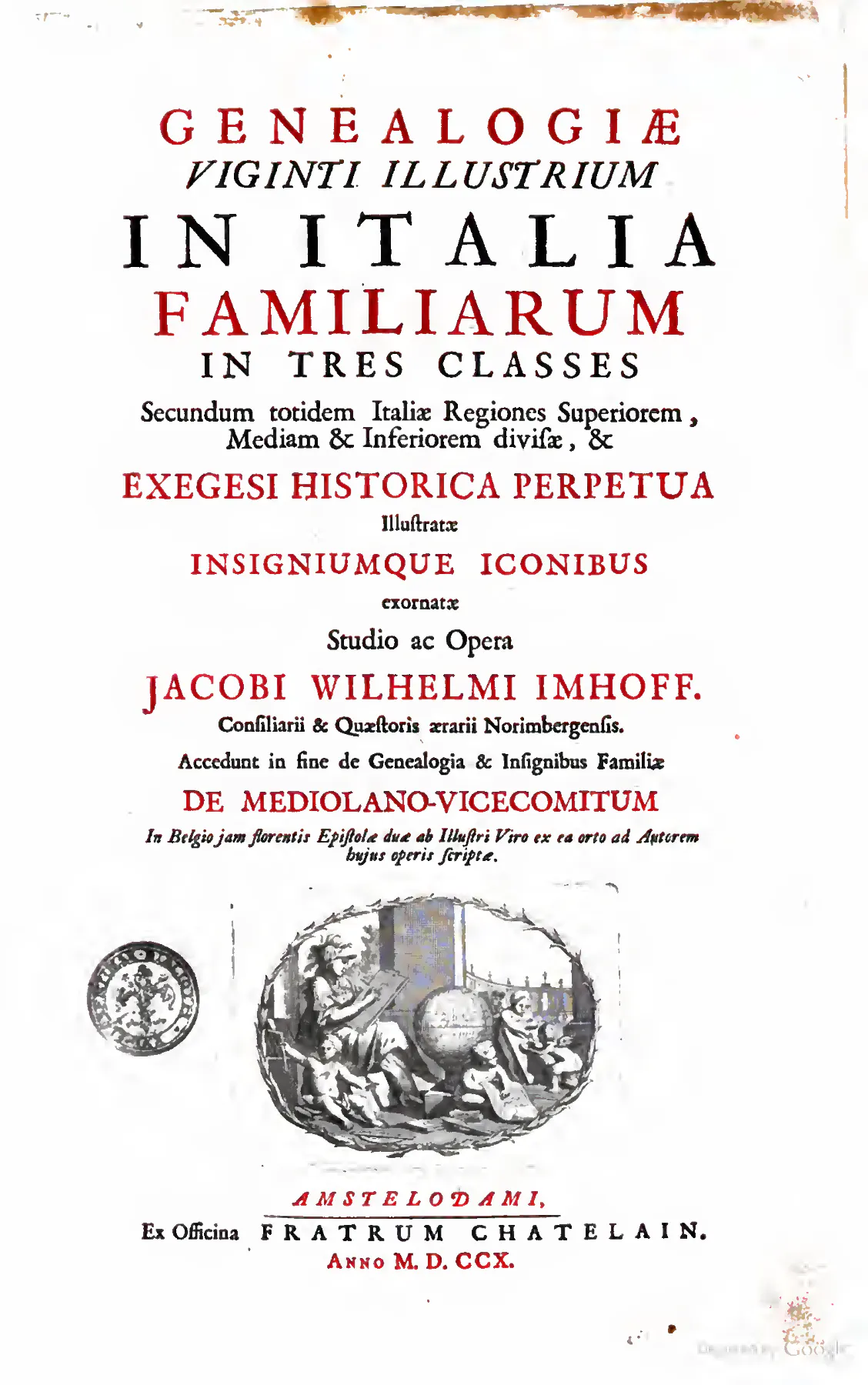
An Amsterdam title page of 1710 for Jacobus Wilhelmus Imhoff’s Genealogiae Viginti Illustrium in Italia Familiarum — a comparator, not Spener’s Historia insignium illustrium. Its advertised “Exegesi Historica Perpetua” and armorial icons echo the same fusion of heraldic device, genealogy, and discursive exposition, while the Châtelain imprint and appended Visconti material sit close to the unresolved bibliographical questions about later Dutch connections to this tradition. Source ↗.
The central noun insignia is technical rather than merely decorative. In the title and in the book’s engraved apparatus it denotes armorial signs—shields, helmets, devices, and their historically transmissible configurations—whose forms are evidence for rank, jurisdiction, descent, and entitlement. The work therefore treats an armorial bearing as a historical object requiring explanation, comparison, and authorization. Its engraved tables of shields and helmets reinforce that material and evidentiary sense. The text’s own handling of a single charge shows how carefully that evidentiary sense is managed: relating that an ancestor was hailed as Father of the Fatherland and his head bound with a jewelled band, and that from this, they say, the golden fess seen in the Orsini arms took its origin, Patrem patriæ salutatum, & gemmea fascia caput redimitnm fuisse, indeque fasciam auream, quæ in Ursinornm digmate conspicitur, originem traxisse, perhibent, the exposition registers the derivation as something reported rather than demonstrated. The charge itself is not in question; the story told to explain it is held at arm’s length, which is precisely the distinction between an armorial sign as evidence and an armorial sign as legend.
Illustris likewise carries more than the modern sense “famous.” In the hierarchical language of early modern Europe, it marks a socially and juridically graduated form of distinction. Spener’s selection of kings, princes, counts, and barons indicates that “illustrious” regulates inclusion: the work is concerned with houses whose rank, titles, rights, and descent place them within the recognized orders of European nobility. The title consequently joins visual heraldry to the legal and ceremonial history of status. The same vocabulary of renown, however, is treated as a datum rather than a credential. The Orsini chapter opens by conceding that scarcely any stock is more celebrated than the Orsini, or more fruitful in men, URSINA stirpe vix alia celebrior, & virorum feracior for, and then proceeds immediately to the inadequacy of the existing accounts of that celebrated house — the movement from acknowledged fame to demanded proof that organizes the work as a whole.
Stemma, in the genealogical vocabulary surrounding the work, signifies an ordered representation of descent rather than a decorative family tree. It connects names, marriages, succession, legitimacy, and title transmission. Read alongside insignia, it shows that Spener’s heraldic project is also a form of dynastic history: arms serve as visible signs of a lineage whose continuity must be narrated and, where necessary, tested against documentary and historical authorities. That testing is conducted in explicitly documentary terms, as when the text weighs the origin of the Guidi counts: on the contrary, the two Scipione Ammirati, father and son, and Eugenio Gamurrini — who wish to be seen as having brought forward nothing except what is certain and supported by the testimony of ancient and authentic records and charters — have asserted that the Guidi counts sprang not from a foreign stock but from Etruscans, E contra è recentiorum auctorum numero Scipiones Admirati, pater ac filius, nec non Eugenius Gamurrinius, qui non nisi certa & veterum atque authenticarum tabularum chartarumque testimoniis fulta in medium protulisse videri volunt, Guidios Comites non peregrina stirpe, sed ex Hetruscis oriundos esse, irene assertum. The criterion invoked is not the standing of the authors but the class of evidence they claim to rest on, veteres atque authenticæ tabulæ chartæque. The available evidence confirms this broad heraldic-genealogical purpose, but it does not permit every technical term in the internal apparatus to be assigned securely to a particular chapter or page.
The philological pressure extends to the names of the houses themselves, where etymology is the point at which civic myth and documentary history most often collide. Of the Medici the text reports that domestic tradition holds the name to have been imposed on the family from a healing applied to the city, when it had used its authority and utmost effort, not sparing its own blood, to purge the city of the tyranny of an over-mighty family, a plague worse than any other, Mediceum verò nomen, genti impositum esse domestica fert traditio à medela civitati adhibita, cum ad eam a tyrannide familiæ alicujus præpotentis, qua peste quavis gravius afflicta erat, purgandam autoritatem maximamque operam illa contulisset, nec sanguinis sui parca. The derivation of Medici from medela, a remedy, is a canting etymology that simultaneously explains a surname, the roundels of the arms, and a family's claim to have healed the commonwealth; the attribution of the story to domestica traditio marks its evidentiary class without yet discarding it. Reading insignia, illustris, and stemma together with such etymological notices shows that the work's keywords are not glossary items but the categories through which a claim about a house is sorted into what has been transmitted and what can be shown.
Frankfurt, 1680: What Spener's Special Part Contains and How It Was Issued
Historia insignium illustrium seu Operis heraldici pars specialis is a learned Latin heraldic and genealogical treatise, not a theological polemic or private letter. It was authored by Philipp Jakob Spener (1635–1705), whose name appears in Latinized form as Philippus Jacobus Spenerus or Philippo Jacobo Spenero. The first securely identified appearance is a Frankfurt am Main issue of 1680, published at the expense of Johann David Zunner and printed by Johann Theodoric Friedgen. The title page dedicates the work to a Georg styled duke of Saxony, Jülich, Cleves, and Berg, together with additional princely and comital titles and the designation “Lord of Ravenstein.”

An engraved full achievement: a quartered shield with lion supporters, crowns, mantling, and flanking standards. Plates on this princely scale are what the title page promises, and they make the argument material — a composite coat condensing lineage, jurisdiction, and rank into a form the exposition asks the reader to inspect and compare. Source ↗.
The book’s purpose is to describe and historically explain the arms of major European ruling and noble houses. Its title explicitly promises discussions of armorial devices, family honours, titles, rights, engraved tables of shields and helmets, and indexes. The work belongs to a larger heraldic enterprise that included the general part, Insignium theoria seu Operis heraldici pars generalis. Catalogue evidence records the general part under Spener’s name with Zunner at Frankfurt and dates a record to the range 1680–1690. Within that programme, the special part’s surviving exposition concentrates its detailed treatment on Italian houses — the Medici, the Guidi counts palatine in Tuscany, the Piccolomini, the Salviati, the Strozzi, and the several Orsini branches — and states the restriction as a principle of method rather than as an accident of coverage, resolving not to wander, as they say, beyond the olive trees, but to hand down things explored and brought to clarity, and to pursue in his own style only the Italian stock of the Orsini, atque extra oleas, quod ajunt, vagar, sed explorata & ad liquidum perducta tradere, atque Italicam tantum Ursinorum stirpem stylo prosequi nostro constitutum est. The title-page promise of the arms of cultivated Europe and this declared self-limitation stand side by side in the surviving witness; how far the remaining parts of the enterprise were meant to take up the houses excluded here is not settled by the catalogue evidence located.
A second edition of the special part is securely recorded for Frankfurt in 1717, identified as editio secunda. The 1717 records are bibliographically inconsistent about the precise printer or issuing house: one record names Iungius, while others associate the issue with Zunner or the Zunnerian office. A commonly repeated third-edition sequence was not confirmed in the records consulted. The 1680 date should therefore be treated as the date of first appearance, not automatically as the date of every surviving copy.
The language of composition is Latin. No complete modern translation of Historia insignium illustrium was located. The existence of English translations of Spener’s theological work, especially Pia desideria, should not be confused with a translation of the heraldic corpus. The precise place of composition is not established by the evidence located; Frankfurt is securely the place of production named in the imprint.
Placing Spener Among Genealogists: Archives, Wappenwissenschaft, and the Magliabechi Network
Historia insignium illustrium matters because it occupies the intersection of heraldry, genealogy, political history, and the history of scholarly evidence. It treats noble identity through the combined media of prose explanation, armorial representation, genealogical ordering, and claims about title and right. The work is consequently more than an illustrated catalogue of coats of arms: it is an attempt to organize European dynastic memory according to the learned procedures available to a late seventeenth-century Lutheran scholar.
Markus Friedrich’s account of genealogy as an archive-driven research enterprise offers the strongest general methodological framework. Friedrich emphasizes that early modern genealogy was a data-intensive practice grounded in the collection, comparison, and ordering of documentary materials. That approach helps move interpretation away from the assumption that genealogies were simply panegyrics. It also clarifies why Spener’s tables, indexes, citations, corrections, and correspondence deserve study as instruments of historical method. The closing apparatus states its own logic of retrieval with unusual economy: the larger number denotes the class, the smaller the page, while the letters Pr., D., M., C. denote the dignities of princes, dukes, marquises and counts, Numerus major classem, minor paginam, literæ vero Pr. D. M. C. dignitates Principum, Ducum, Marchionum & Comitum denotant. An index organized simultaneously by family, by lordship, and by grade of dignity is a device for adjudicating precedence and verifying a claim, which is precisely the use to which such data-intensive compilation was put. The available evidence further indicates that Spener understood part of his activity as the transfer of French heraldic and genealogical knowledge into German lands.
The history of heraldry itself has increasingly been treated as an intellectual and publishing history. The scholarship on sixteenth- and seventeenth-century German heraldic guides examines how publishers and artists represented heraldry as a learned discipline bounded by tradition, inheritance, and claims to authority. That perspective places Spener near the developing German culture of Wappenwissenschaft, while also requiring comparison with French heraldic writers such as Claude-François Ménestrier. The present evidence does not establish a direct scholarly disagreement between Spener and Ménestrier, but it does show that Spener’s work belongs to a period in which heraldry was being systematized, historicized, and linked to genealogy. That the engraved genealogical sheet had itself become an instrument of dynastic self-presentation is registered within the text, which notes that the most illustrious family itself published the genealogy of the Piccolomini, set out in the foregoing tables, most elegantly engraved on a huge and splendid sheet, in which there first meets the eye a tall tree spread out with wide branches, PICCOLOMINEÆ familiæ genealogiam, superioribus exhibitam tabulis, ipsa gens illustrissima edidit, exscriptam scalpro elegantissimè in mappa ingenti & splendida, in qua primariò sub adspectum venit arbor procera, patulis diffusa ramis. A house-published engraving is at once a source and an interested party, and the work's willingness to name it as the origin of its own tables is of a piece with its habit of disclosing where its materials came from.
The Spener historiography is asymmetrical. The major modern scholarship associated with Johannes Wallmann, Martin Brecht, Kurt Aland, Dietrich Blaufuß, and the Philipp Jakob Spener: Briefe editorial project has primarily reconstructed Spener as theologian, pastor, Pietist, and correspondent. The accessible bibliography confirms Wallmann’s work on the edition of Spener’s letters and identifies Blaufuß’s biographical-bibliographical contribution. It also shows why the heraldic corpus deserves a more central place in Spener studies: the recent scholarship explicitly describes him as highly accomplished in genealogy and heraldry, while older theological narratives often treat those interests as peripheral.
Antonio Magliabechi provides the Florentine and transnational dimension. Ingeborg van Vugt’s 2022 study, “Networking in the Republic of Letters: Magliabechi and the Dutch Republic,” reconstructs the librarian’s position within learned correspondence networks. Its relevance lies not in proving every report attributed to Magliabechi in Spener’s text, but in supplying a historically grounded model for understanding how books, notices, manuscripts, and family histories could move through personal intermediaries. The evidentiary status of any specific Magliabechi notice in Historia insignium must still be established by direct inspection of the Latin text and relevant correspondence.
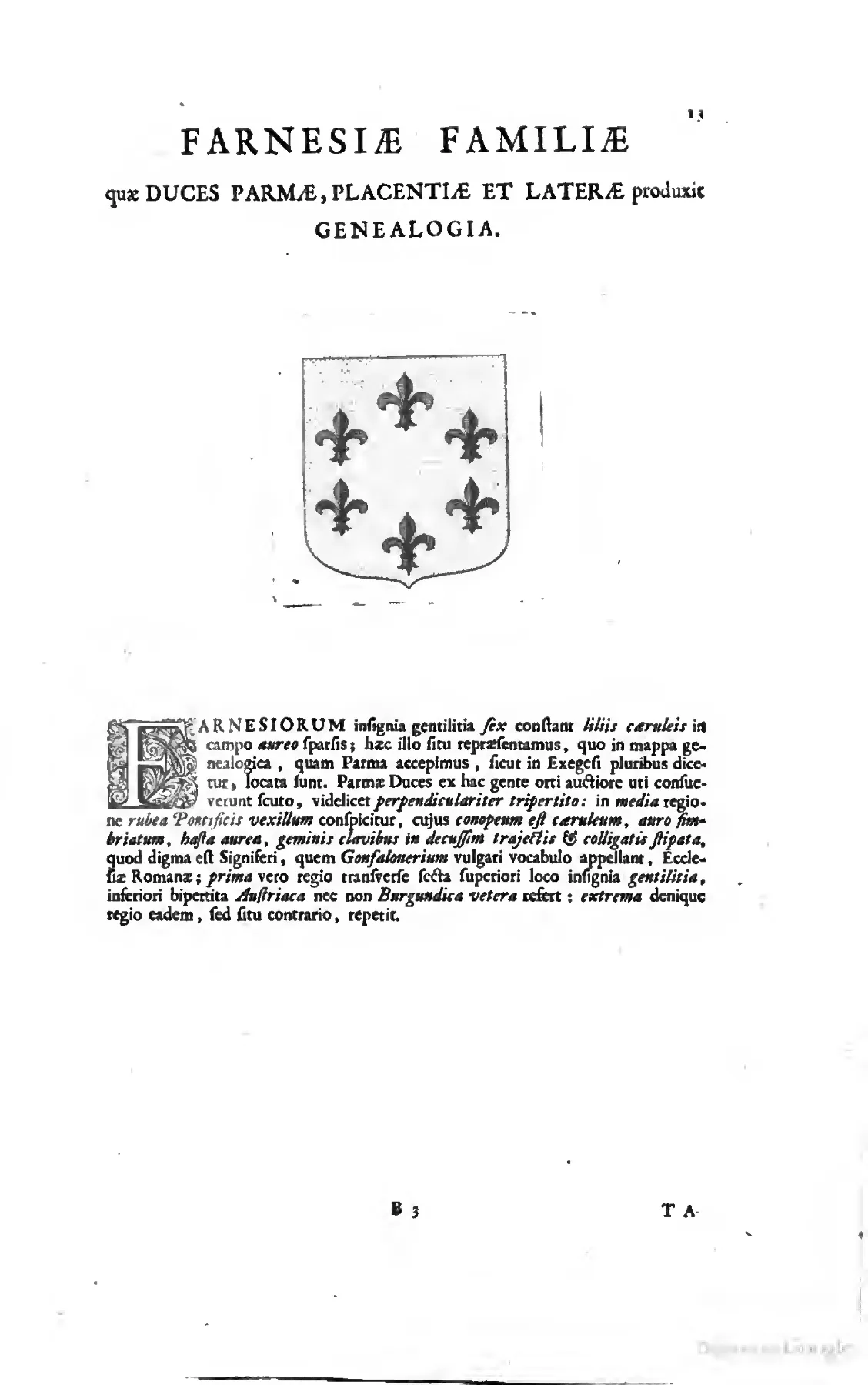
The Farnese genealogy opens with the family arms set above a decorated initial and explanatory blazon, pairing heraldic image with prose argument so that rank and office can be read, checked, and compared. Its printed note that the arrangement follows a genealogical map received from Parma evokes the same world of mediated supply as Magliabechi's Florentine networks: family history travelled through correspondents, manuscripts, and local informants before it became evidence on the page. Source ↗.
Political history enters the work through the same evidentiary discipline. The Medici chapters narrate the conversion of civic standing into princely rule as a sequence of observable steps rather than as destiny: of Cosimo's banishment the text observes that this calamity turned to his greatness and to the consolidation of his rule, since, as it was believed inflicted on an innocent man out of envy, the city's favour was so quickly kindled that, recalled from exile with all who had been driven out with him and received with the greatest joy and auspicious acclamation as Father of his Country, all but the name and right of kingship was conferred on him, Sed hæc calamitas in amplitudinem & stabilimentum dominationis illi vertit: cum enim ea immerenti ex invidia illata crederetur, ita brevi in ipsum accensus est civitatis favot, ut ab exilio cum omnibus, qui secum patria ejecti fuerant, reducto, & maxima omnium lætitia & sausta acclamatione Patris Patriæ excepto, tantum non nomen jusque regni delatum fuerit. The formula tantum non nomen jusque regni is a precise constitutional observation: what was conferred fell just short of the name and the right of kingship. The later transition is registered in the same register of titles and instruments, the text noting that he now confirmed the dominion of his family not, as before, covertly and under fictitious names, but openly under their true appellations, with Alessandro de' Medici established as Duke with supreme power and Margaret, the Emperor's daughter, joined to him in marriage to stabilise the principate, Iam itaque dominatum non, ut antè, tectè, neque fictis nominibus, sed palàm veris appellationibus familiæ suæ firmavit; Alexandro Medice Duce cum summa potestate constituto, eique Margarira Cæsaris filia, stabiliendo Principatui, connubio juncta. Concealed dominatio becoming open principatus, secured by ducal title and imperial marriage, is a genealogical fact with constitutional consequences, and it belongs to the same analysis that governs the arms.
The Roman and Italian context is equally important. The Orsini volume edited by Paolo Alei and Max Grossman interprets Bracciano as a site where architecture, territorial lordship, patronage, and family memory were made visible. Its account of the Orsini financial crisis and the 1696 transfer of the castle to Livio Odescalchi illuminates the historical environment in which claims about inherited arms and noble titles were being recorded against the background of alienated fiefs and changing dynastic fortunes. The broader historiography of the Medici, Orsini, papal fiefs, and Roman baronage remains necessary for testing Spener’s narratives rather than accepting them as transparent fact. The work's interest in feudal right as a documented practice is explicit where it introduces a relation of what reward he obtained from Ferdinand, for that account contains the rite by which the liege men of the Kingdom of Naples are accustomed to perform homage to the king, quidque præmii à Ferdinando tulerit; continet enim ea relatio ritum,. A ceremonial rite of homagium is valued here as a documentary prize, evidence of the juridical relation between crown and baron that the arms and titles of such a house presuppose.
The most productive scholarly tension is therefore methodological rather than a simple disagreement between named historians. Spener’s work participates in dynastic memory and princely legitimation, yet it also displays the archive-oriented, comparative, and corrective tendencies associated with emerging critical genealogy and diplomatics. The evidence located does not permit a definitive judgment about how consistently he exposed forged descent, nor does it confirm every attribution to Alfonso Ceccarelli, Francesco Sansovino, or other authorities named in the wider textual tradition. Such claims require a critical edition or systematic comparison of the 1680 and 1717 witnesses. What can be established is that the work belongs to a learned culture in which heraldry, genealogy, political history, and documentary criticism were increasingly interdependent, and that it conducts its criticism openly, in its own voice, at the point where each house is introduced.
Tracking the Book Itself: Imprints, Engraved Plates, and Learned Informants
The 1680 witness is identifiable from its title-page formula, Latinized author name, Frankfurt imprint, and production credits. The imprint names Johann David Zunner as the person at whose expense the book was issued and Johann Theodoric Friedgen as printer. The title page describes the work as a special part of a heraldic enterprise and specifies engraved tables displaying the shields and helmets discussed in the text. The dedication is addressed to a Georg styled duke of Saxony, Jülich, Cleves, and Berg, with further titles including landgraviate, margraviate, and the lordship of Ravenstein. The exact political identification of the dedicatee should be checked against the original title leaf rather than inferred from the imperfect OCR.
The surviving digital evidence is materially uneven. A full-text scan associated with the 1680 record preserves the title-page wording and imprint but contains substantial OCR corruption. One catalogue-like OCR line appears to combine pagination and plate information, yet the numbers are not sufficiently legible to establish a reliable collation or plate count. The secure material conclusion is therefore limited to the presence of engraved armorial tables; the format, exact pagination, number of plates, signature sequence, and whether plates were integral or inserted remain unverified. The work is often described as a large-format book, but a definitive folio statement was not confirmed.
The general and special parts are related by their titles and catalogue treatment. Insignium theoria is explicitly identified as the pars generalis and is catalogued under Spener’s name with Zunner at Frankfurt in a record covering 1680–1690. Historia insignium illustrium is the pars specialis, devoted to the historical and descriptive treatment of particular arms and noble houses. The available catalogue evidence does not establish the exact order in which every part was printed, nor does it prove the precise textual relationship between these volumes and Spener’s Theatrum nobilitatis Europaeae or Sylloge genealogico-historica. Those works belong to the same genealogical-heraldic field, but claims of direct textual borrowing require comparison of the copies and tables.
The 1717 special-part record is identified as editio secunda and gives Frankfurt am Main as place of publication. WorldCat records OCLC 633666479 for one such entry; another WorldCat record gives OCLC 633391112 and associates the issue with Zunner, while a Stanford record names Jungium. The MDZ/BSB catalogue environment also preserves a record for the general part under VD18 10822178-005 and OCLC 633666345, with B3Kat ID BV010796032. No secure USTC or VD17 number for the special part was located. The 1717 issue is therefore established as a distinct later edition, but its full bibliographical description and relationship to other Frankfurt issues remain to be reconstructed from title-page comparison.
No engraver of the armorial plates was identified in the accessible catalogue evidence. No reliable evidence was located for a separate Utrecht or Amsterdam issue involving Zacharie Châtelain, for the alleged transmission of Milanese or Visconti materials through him in 1707–1708, or for a plate state dated by that channel. Likewise, the research did not confirm a Roman prohibition, suppression, or formal proceeding directed against the work. The book’s treatment of papal, princely, and feudal descent may have been politically sensitive, but sensitivity cannot be converted into a documented censorship history.
The work’s learned network is historically plausible but unevenly documented. Modern scholarship identifies Antonio Magliabechi as a central figure in Florentine and transnational learned correspondence, and van Vugt’s study reconstructs his position within the Dutch Republic of Letters. The text itself is candid about the structure of its dependence, even where it withholds a name: the genealogy of the Medici family, set out in nine tables and with a completeness in which, so far as the author knows, it had not been published before, is owed to a Florentine gentleman outstanding in learning and courtesy, whose name, while he deferentially keeps silent, he most greatly venerates, Genealogiam Mediceæ familiæ, quam exhibui novem explicatam tabulis, eaque perfectione, qua antehac quantum scio edita non est, viro Florentino, doctrina & humanitate præstanti, in acceptis fero, cujus nomen dum obsequenter reticeo, maximè veneror. A second kind of channel is invoked for a delicate point of Medici filiation: the author states that he himself heard the Grand Duke Cosimo say, when he was once reading out to him things written by him and concerning his family in particular, that Alessandro was Clement's son, begotten of a household girl, when his father was only a Knight of Jerusalem, Sed ego Magnum Ducem Cosmum dicentem audivi, cum ei res à me scriptas & familiam ipsius speciatim concetnetes aliquando prælegerem; quòd Alexander Clementis fuerit filius, genitus è puella domestica, cùm pater Eques tantùm esset Hierosolymitanus. Such passages establish that suppressed informants, princely oral testimony, and brokered correspondence are part of the work's own self-presentation and are classified by it as distinct grades of authority. Whether each particular so reported can be corroborated from the uncorrupted Latin text and from contemporary correspondence remains to be established before it is treated as a secure feature of the 1680 issue.
Spener’s heraldic activity is not an accidental appendage to his theological career. Recent scholarship notes that he served Christian II as tutor in 1654–1656 and that this princely relationship helped foster his genealogical and heraldic studies. Johannes Wallmann characterized Spener as a leading German practitioner in both genealogy and heraldry rather than a mere dilettante. At the same time, the major modern Spener editorial tradition has concentrated on theology, Pietism, and correspondence. The heraldic corpus consequently remains under-integrated into the standard biography of the author, even though the same Philipp Jakob Spener wrote both the genealogical-heraldic works and the Pietist writings.
The work’s historical importance is especially clear in relation to noble identity and territorial decline. Alei and Grossman’s study of Bracciano interprets the Orsini castle as a material expression of family identity and records the sale of the castle to Livio Odescalchi in 1696. That context helps explain why a late seventeenth-century heraldic work could function simultaneously as an account of inherited dignity and as a record of changing possession, title, and dynastic power — the same doubleness that makes its index of families and dignities usable both as a monument and as a register of what had been alienated. The precise reuse of Spener’s tables in later eighteenth- and nineteenth-century compilations, however, was not established by the sources located here and requires a separate transmission study.
Reading the Argument House by House: Medici, Guidi, Piccolomini, Orsini
The special part proceeds house by house, and within each house from origin to present possession, so that its argument may be followed as a sequence of movements rather than as a catalogue of blazons. The Medici occupy the first of these movements, and their opening leaves state with unusual clarity how the whole volume sorts a claim: fabulous descent is named and set aside, the classes of admissible record are enumerated, the printed table is declared to begin where certainty begins, and what the documents cannot settle is left standing as unsettled. The passages that follow, drawn from those opening leaves and from the first of the nine Medici tables, mark those operations in turn.
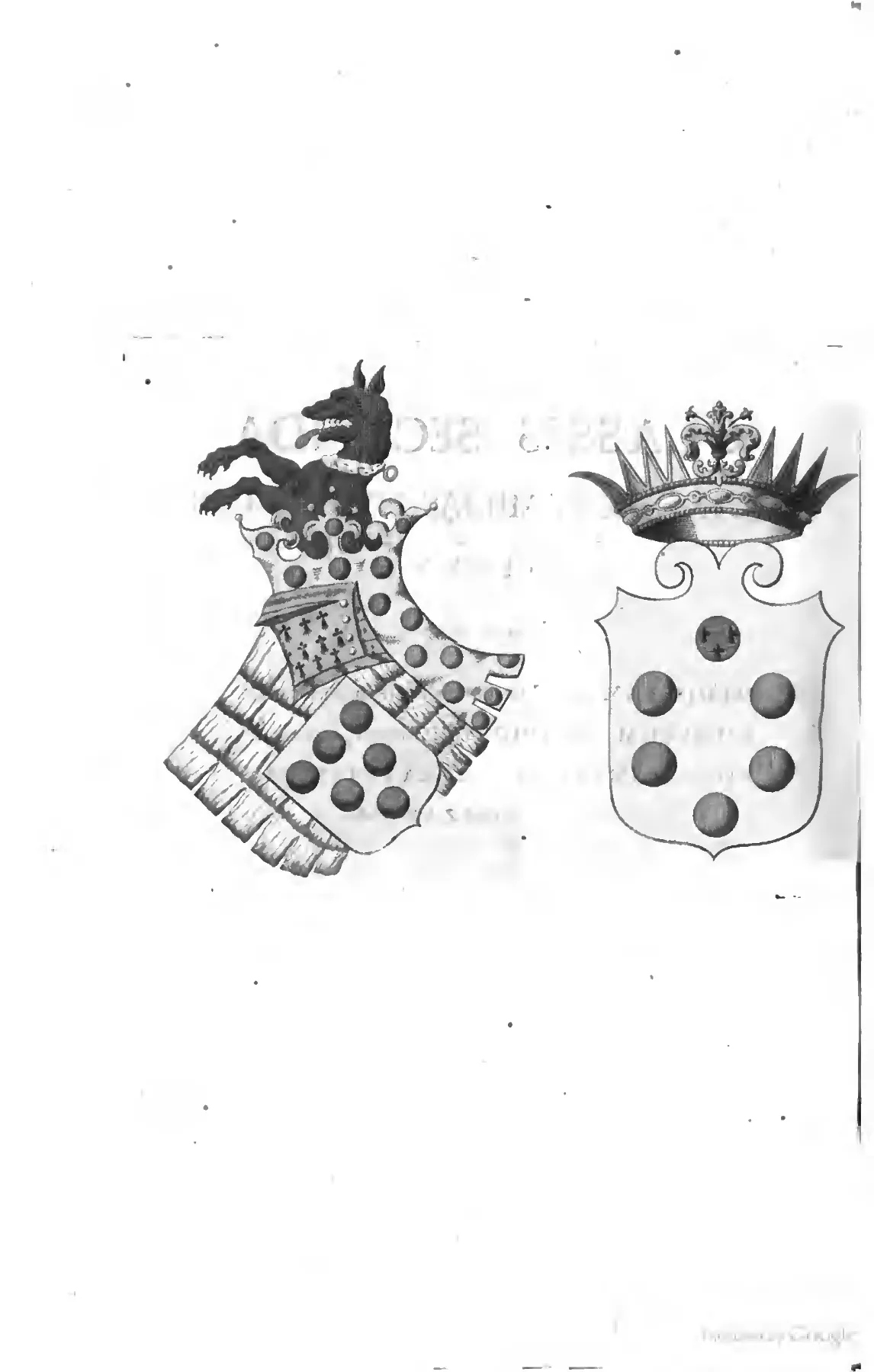
The first Medici table renders the same arms twice: a fully furnished achievement with helm, mantling, and crest, and a crowned shield reduced to the roundels (palle) themselves. The pairing makes the evidentiary method visible, inviting comparison of the charges while keeping legendary explanations — such as domestic traditions about the origin of the balls — distinct from what the engraved forms can actually show. Source ↗.
Sifting the Medici origins
The fabulous material is identified by name and dismissed, with the grade of its witnesses openly stated:
- [fable set aside] The tale of the giant Mugello, playfully got up in the age of Conrad the Great, king of the Franks, is therefore passed over by design — Fabula igitur consilio præteritur de gigante Muglone, quæ in Conradi Magni, Francorum Regis, seculo ludicre confecta est
- [conjecture weighed] for these things rest on conjectures, which are not firm enough to win credit for the remains of antiquity — hæc quippe conjecturæ nituntur, quæ tam firmæ non sunt, quam ut reliquiis vetustatis fidem faciant
- [grade of witness] for no firmer records of the matter exist than what is commonly put about by the peasants of the Mugello and by begging tale-tellers — nec enim ejus rei firmiora exstant monumenta, quàm quæ ex Mugellanis rusticis, & mendicabulis fabulatoribus vulgo essentur
- [limit of inquiry] to search out the remoter roots of so ancient a stock is, like distant clouds, to be placed in uncertainty and in cloud — ulteriores verò tam vetustæ stirpis radices investigare, æque ac remotæ nubes, in incerto ac nube posita esse
Against that dismissal the exposition sets the classes of record on which it will rely, and fixes the generation at which its own table starts:
- [classes of proof] by very many proofs, namely the public registers of the city, sepulchral monuments, inscriptions, houses, contracts, wills, and other most ample specimens drawn from the archive of the Florentine republic — plurimis argumentis, publicis quippe civitatis tabulis, monumentis sepulchralibus, titulis, ædibus, contractibus, testamentis, & aliis speciminibus locupletissimis, ex archivo Reip. Florentinæ depromptis
- [where the table begins] We therefore pass over what has been transmitted in writing about the Medici of the tenth and eleventh Christian centuries — Alessandro the Florentine prefect, Everardo the legate of the Emperor Louis the Bavarian, to be known as Louis IV, and others — and we rest, as upon something certain, on the beginning we have taken in Table I — Præterimus itaque ea quæ de Medicis Christiani seculi decimo & undecimo, Alexandro nempe Præfecto Florentino, & Everardo, Ludovici Bavari Imperatoris, sub nomine Ludovici IV. cognoscendi, Legato, aliisque, litetis prodita sunt; & initio, quod Tabula I. sumsimus, tanquam certo, subsistimus
- [recent nobility conceded] from which it will be plain that the aforenamed were Florentine citizens, sprung indeed from a more recent nobility, yet carried up by the favour of offices and wealth, and from the thirteenth Christian century onward employed in the government of the republic — unde patebit prænominatos cives Florentinos & ex recentiori quidem nobilitate ortos fuisse, honorum tamen & opum favore evectos, & inde à seculo Christiano XIII. in Reipublicæ regimine usurpatos
- [dated civic act] By his exertions that law was established in the Florentine republic in the year 1424, by which it was provided that citizens should pay taxes according to the measure of their riches, and that account should be taken not of persons but of property — Ejus opera anno 1424. lex ista in Repub. Florentina constituta est, qua cautum est, ut cives secundum divitiarum modum tributa penderent, & non rationes personarum, sed rerum haberentur
A third group registers what tradition supplies about the charges of the shield and the family's civic standing, and marks the point at which the record of a paternity divides:
- [common tradition] There is also a common tradition about a certain Averardo, prefect of Charlemagne, from whom some suppose the Medici to have descended — Vulgaris quoque est traditio de Averardo quodam, Caroli Magni Præfecto, à quo Mediceos descendisse quidam autumant
- [origin of the roundels] from the enemy's cuirass, which had been studded with golden bosses, he earned the most splendid ornament of the family arms — ex hostis lorica, quæ aureis bullis distincta fuerat, splendidissimum Gentilium insignium decus meruit
- [indifference to pedigree] he obtained such power in his own country and such fame throughout all Europe that he was little concerned about the origin of his house — tantam in patria potentiam, & totâ Europâ famam adeptus est, ut de origine gentis parum sit sollicitus
- [power without title] he was prince of the Florentine republic, though in name a private man — Reipublicæ Florentinæ Princeps, licet nomine privatus, fuit
- [disputed paternity] Alessandro, natural son of Lorenzo duke of Urbino, as most report, or of Pope Clement VII, as others will have it — Alexander, Laurentii Urbini Ducis filius naturalis, ut plerique tradunt, Clementis VII. Pontificis, ut alii volunt
The Medici chapters: patronage, office, and the borrowed voice
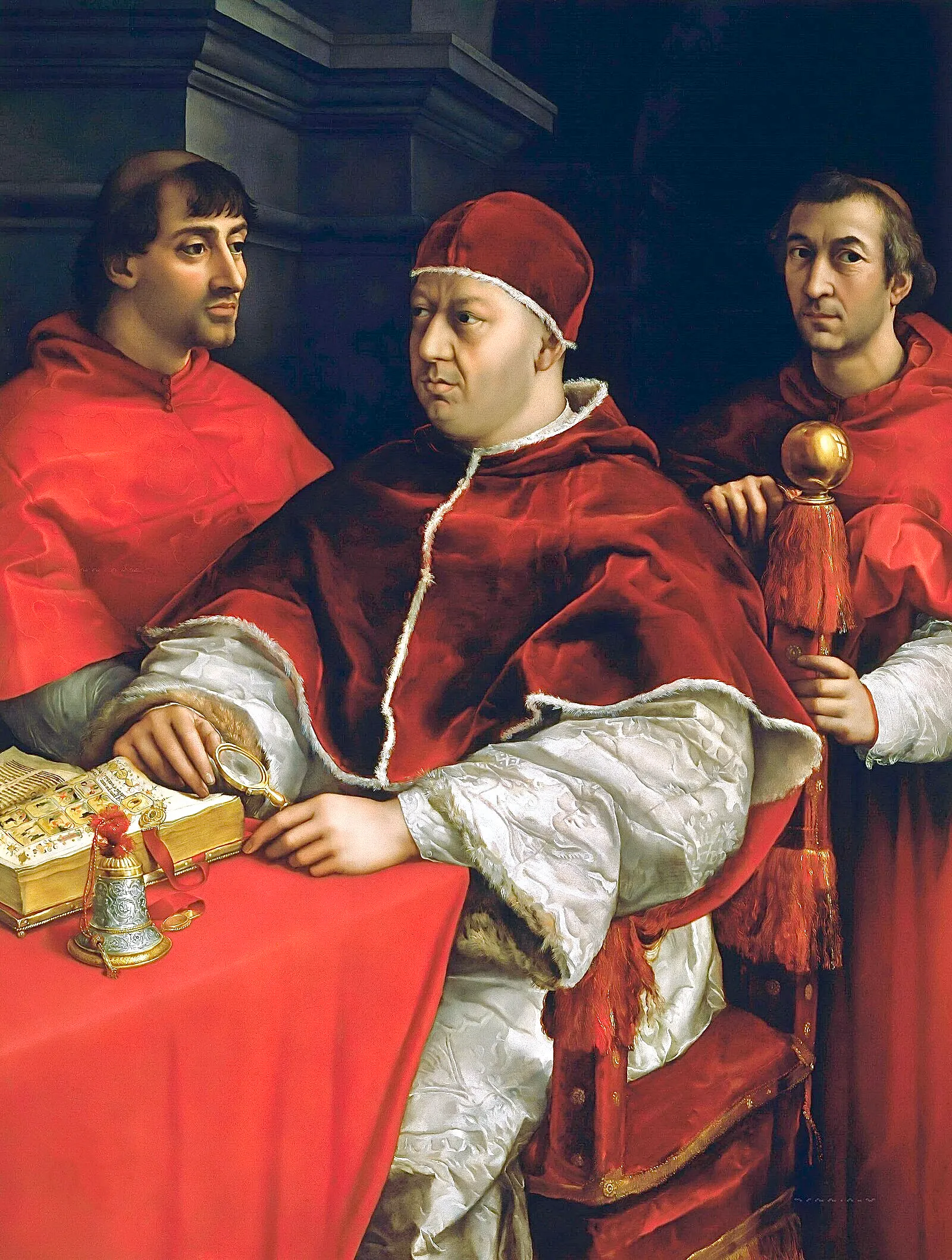
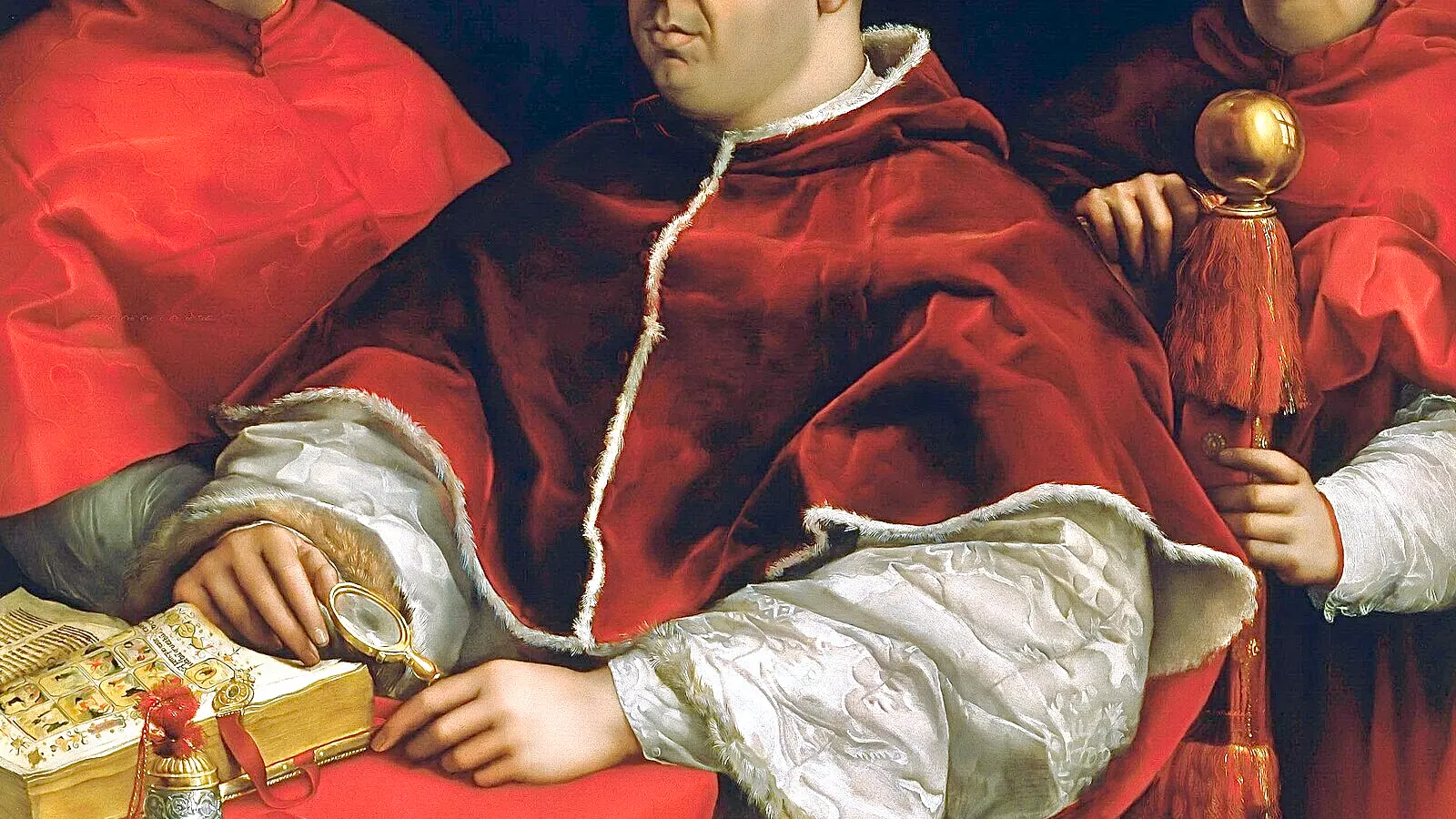
Raphael's portrait of Pope Leo X — Giovanni de' Medici, son of Lorenzo il Magnifico — a fitting image for a treatment of Medici lineage inseparable from ecclesiastical office and patronage. The presence of Cardinal Giulio de' Medici, later Clement VII, also brings into view the family connection at the centre of the disputed paternity of Alessandro de' Medici. Source ↗.
_-_brightened.jpg)
The exposition itself opens not with praise but with the assembling of proofs, and its first move is to convert an ecclesiastical right into a chronological argument: they gather the antiquity of the house from the right of patronage, Vetustatem gentis colligunt ex jure patronatus. The ius patronatus in S. Tommaso, shared with the Sizii, is here not a matter of canon law but a dated instrument: a family that presents to a church must already have been established when the presentation was granted, so patronage functions as a terminus ante quem for vetustas. Beside it stand the fortified houses in the Old Market and Scipione Ammirato's doubt whether the cognomen Medici was borne before 1284 or whether the stock was then styled de Toschi. Against this documentary series the celebrated domestic etymology — the name derived from a medela applied to the sick commonwealth, the red globuli of the shield read as drops of blood shed for the fatherland — is placed in a different evidentiary class by the mere verb fert traditio, and is then met with charters of 1027 and 1220. The compressed constitutional excursus that follows, running from the consuls through the sexpartite division of 1250, the Anziani, the Capitaneus populi and Podestà, the arti, the Fourteen of 1279 and the Priors of 1282 to the institution of the Gonfaloniere di Giustizia in 1292, is not digression but the indispensable grid on which a list of Medici office-holdings becomes historically legible: without the magistracies there is no way to date, rank, or test the family's civic standing.
Within that grid the exposition erects an ethical standard, borrowed from Machiavelli's vernacular history and rendered into Latin: of Giovanni di Bicci it is said that he never sought honours, yet obtained them all; he never approached the Palace unless summoned; he shrank even from the pursuit of money and private advantage, but was most zealous for the public good, Itaque nec honores unquam petiit, omnes tamen adeptus est, Palatium nunquam nisi vocatus accessit; à pecuniæ etiam privatæque utilitatis studio abhorruit, publici verò commodi studiosissimus fuit. Two things deserve notice. The first is the practice of translation itself: an Italian civic historian is made to speak in the learned lingua franca, so that a vernacular authority acquires the same textual status as a charter or an epitaph and can be cited, weighed, and contradicted in the footnote apparatus that keys authorities at the foot of each page. The second is the paradox the elogium encodes — honours unsought yet all obtained, the Palace entered only on summons — which is precisely the description of an authority that operates outside the magistracies while being validated by them. The ethical template thereby doubles as a constitutional diagnosis, and every later member of the house is measured against it.
The same borrowed-voice technique governs the treatment of the Pazzi conspiracy, where the moral argument is carried by liturgical time. To a deed savage in itself, the account runs, they added contempt for sacred things, the time for carrying out the affair being chosen in the very temple and before the altars, while divine service was most solemnly being performed, and the signal for the young men to rise and attack being fixed at the very host, when the priest, raising it above his head, presents it to the people for adoration, Ad sacinus, sua sponte sævum, addidere contemptum sacrorum, ipso in templo atque ante aras, cùm maximè res divina fieret, peragendæ rei delecto tempore, atque ipsa hostia, cùm potissimum eam Sacerdos supra caput attollens adorandam populo præbet, signo exsurgendi aggrediendique juvenis constituto. The elevation of the host, the most solemn instant of the rite, is made the conspirators' watchword, so that the crime is aggravated not by its political object but by its sacramental setting; the borrowed narrative convicts the conspiracy of self-destruction before it reports its failure. The consequence is then given in unsparing terms — so great was the eagerness of those raging and hastening to exact penalties from the guilty that, when the windows themselves could not hold the number of those hanging, they cut the ropes and hurled them, not yet lifeless, into the square, Tantaque sævientium, & sumere desontibus poenas festinantium, avidiras suit, ut cùm non caperent senestræ ipsæ pendentium numerum, restes præciderent, præcipitarentque nondum examines in forum — a scene whose horror is left unmitigated because it serves the argument: the palace windows overflowing with bodies register popular will, and the restoration of the house appears as the city's own act rather than a usurpation. That a Lutheran heraldist should let a Catholic writer's eucharistic outrage and a mob's atrocity stand unglossed indicates how far the exposition is prepared to subordinate its own confessional voice to the authority of its sources.
The willingness to reproduce hostile judgement is a structural feature, not an occasional lapse. Of Leo X the text carries Guicciardini's verdict that in that prince there were many things worthy of great praise, and as many worthy of blame, and that he greatly disappointed expectation of himself when he was raised to the pontificate, for greater prudence appeared in him, but far less probity than all men reckoned, in eo principe multa laude, multa pariter vituperatione digua extiterunt: de se quoque expetiationem, cum ad Poncificatum est assumptus, vehementer fefellit: major enim in illo prudentia, sed longe minor quàm ab omnibus censeretur probitas, apparuit. The antithesis of prudentia and probitas is the standard humanist calculus of princely capacity against princely virtue, and its inclusion in a work dedicated to a reigning duke shows that the exegesis is not a panegyric keyed to the shields it explains.
Nowhere is the evidentiary apparatus more visible than at the disputed paternity of the first duke, already flagged in the table's own laconic entry. That Alessandro de' Medici, first Duke of the Florentines, was begotten by Lorenzo Duke of Urbino, the text reports, not only foreign writers but most of the domestic ones have consistently asserted, and the public letters and records say the same; yet there are those who assert that he was born of Giulio de' Medici, afterwards Pope, ALEXANDRUM Medicem, primum Florentinorum Ducem, à Lautentio Duce Urbinatensi genitum fuisse, non exteri tantum scriptores, sed domesticorum etiam plerique constanter perhibuerunt, idemque publicæ loquuntur literæ tabulæque; dantur tamen, qui Julio Medice, Papa deinde, ceu modo dictum fuit, facto, ortum esse asserunt. The sentence is built as a scale with weights named on both sides: exteri scriptores and domestici on one, publicæ literæ tabulæque — the instruments that would ordinarily settle a filiation — reinforcing them, and against all of these an unquantified dantur tamen, qui. The question is not decided. For a genealogist whose tables must print one line rather than two, leaving the balance open is a costly admission, and it exposes the limit of documentary proof at exactly the point where legitimacy, ducal title, and succession are at stake.
The Medici sequence also shows the exposition handling matter that its own sources had suppressed. Of the Florentine conjugal murders it reports that Eleonora and Isabella were strangled by their husbands on the same night, a noose being thrown over them, and that a rumour was nonetheless spread abroad, as though each had perished of a quinsy contracted from too great a use of mushrooms, Itaque Helionora & Isabella à viris eadem nocte sancia injecta præfocatæ sunt: fama nihilominus sparsa, quasi utraque ex angina, ex nimio bolethorum usu contracta, periisset. The passage is taken from the Thuanus Restitutus, the restored text of de Thou, and the note that such matter stands only in the second edition makes the citation itself a piece of textual criticism: the fama of the mushrooms is identified as a manufactured cover, and the editorial history of the source is what permits the fact to be recovered. The contrast with the house's most recent memorials is deliberate. The death of Cardinal Leopoldo is documented from a private letter of Antonio Magliabechi, rendered into Latin with its writer's leave, which reports that the Lord Prince Cardinal Leopoldo de' Medici, as he always lived with the highest integrity, so he met a most pious death: he had already been ill for some days, but more lightly, so that on last Tuesday the seventh he could sign all his letters with his own hand, Dn. Princeps Cardinalis Leo, poldus de Medicis sicut summa semper integritate vixit, ita piissimam obiit mortem: jam per aliquot dies ægrotarat, sed leviret, ita ut die Martis præteritæ septimæ suapte manu literas omnes subscribere posset. Correspondence here enters the heraldic exposition as primary evidence, dated and attributed, with the detail of the cardinal's own subscribing hand supplying the kind of verifiable particular a charter would supply for an earlier generation.
Guidi regalia, Piccolomini disgrace, Strozzi blazon
In the Guidi section the argument shifts from civic office to feudal right: Frederick I's privilege of 1164 is quoted for its enumeration of regalian concessions — ban, court, district, toll, bannum, placitum, districtum, teloninm. pedagium, ripaticum, — because the regalia are what make the title Comites Palatini in Thuscia a jurisdiction rather than an honorific. The end of that jurisdiction is dramatised in the family's own voice through Machiavelli's oration of the Count of Poppi to Neri Capponi: if I had prudently weighed my own fortune and your power, it would now be permitted me, as a friend, to congratulate you on victory, rather than as an enemy to be a suppliant, Si ego prudenter meam fortunam vestramque potentiam examinassem, mihi quidem modo liceret, amico vobis de victoria gratulari, non inimico supplicem esse. The count's antithesis of fortuna and potentia concedes the whole case: imperial title and ancient regalia count for nothing against the territorial republic, and the same volume that vindicates the Guidi charters records the extinction of what they granted.
The Piccolomini material supplies the counter-case of a name that expands by legal artifice — absorption of Lolli, Todeschini and others into the name and arms — and of a nobility that can be publicly unmade. Of the brigand Alfonso the text records that at the beginning of the year 1591 he underwent a punishment unworthy of the name of so distinguished a family, strangled like a brigand and hung on a hook as a spectacle, indignam familiæ tam insignis nomine poenam subiit, tanquam latro strangulatus, & unco ad spectaculum appensus. The judgement indignam familiæ tam insignis nomine is the compiler's own, and it turns on the theory of arms the whole work presupposes: a penalty is calibrated to status, so the infliction of the brigand's death on a marquis is an offence against the insigne itself, and the notice must be entered precisely because the arms it accompanies cannot be read without it. The template then resets to pure blazon for the next house, where the shield which is here represented designates the arms of the Strozzi, and is gold, distinguished by a red fess, on which three silver crescent moons are inscribed, Scurum, quod hic repræsentatur, Strozzarum insignia designat, estque aureum, fascia distinctum rubea, cui tres lunula crescentes argenteæ inscriptæ sunt — the Latinised technical vocabulary of fascia and lunulae crescentes re-establishing, after the narrative of disgrace, the descriptive precision on which comparison of shields and cadency depends.
The Orsini: tables against Exegesis historica
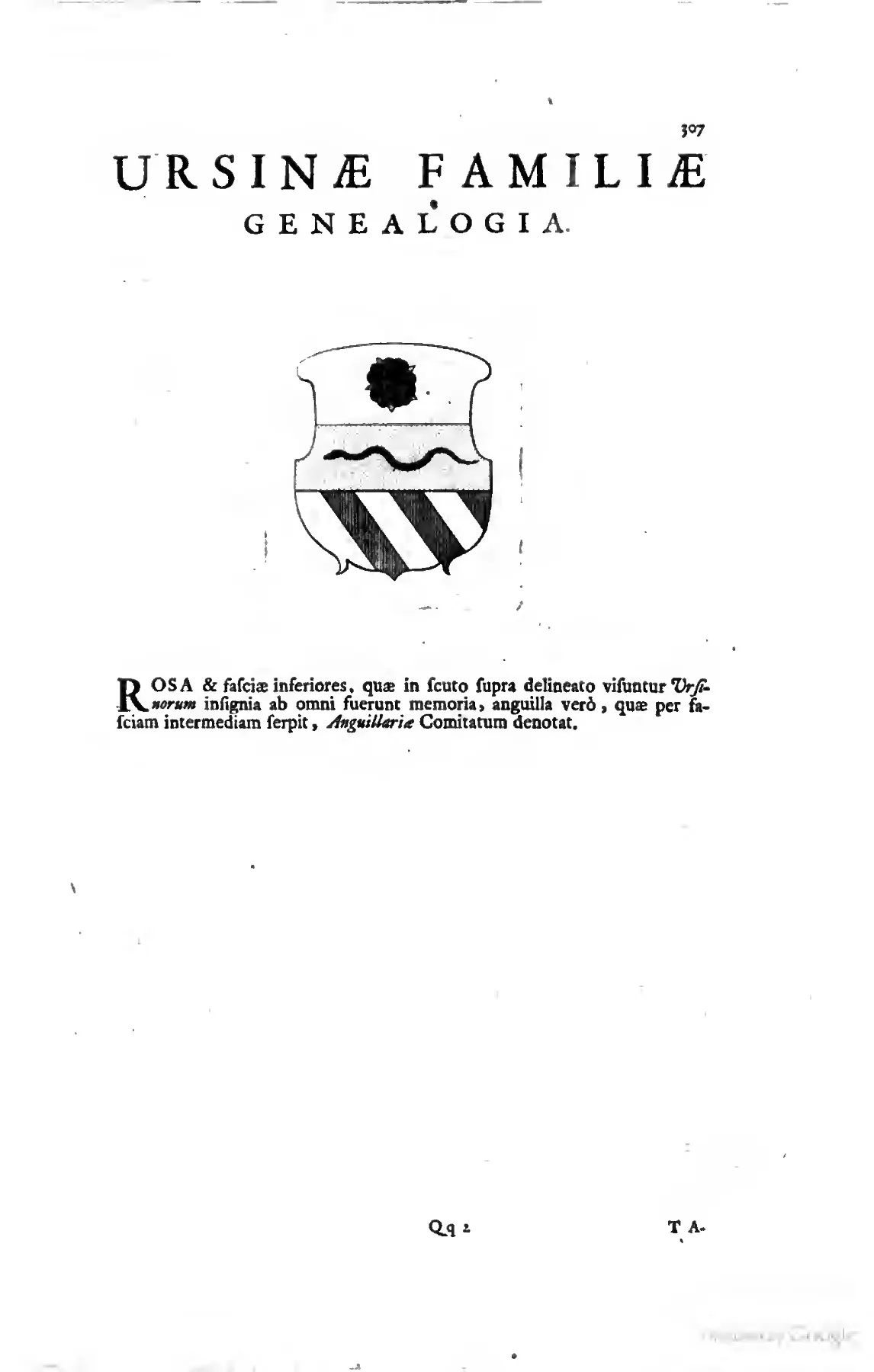
The Orsini section opens under the printed heading “URSINÆ FAMILIÆ GENEALOGIA,” the family shield set beside a Latin gloss distinguishing the rose and lower fesses as ancestral Orsini signs from the eel winding through the middle band as the mark of Anguillara. The page makes the method visible: arms read as layered evidence of territorial acquisition and status rather than as ornament or inherited legend. Source ↗.
The Orsini sequence reaches the reader first as printed apparatus rather than as argument. Successive folio tables set out, in columnar Latin, the dukes of Gravina and S. Gemini and the princes of Solofra and Vallata, each name accompanied by the minimal juridical furniture that makes a stemma usable — uxor, filia, nupta, obiit, a creation date for a cardinalate, a regnal or feudal title. The convention of the table is that it asserts nothing discursively: Ferdinand is seventh duke of Gravina and prince of Vallata in 1626, his two marriages are registered with the paternal descent of each wife, and the reader is left to collate. Cross-references within the tables ("Vid. Tab. III.", "Vid. inf.", "Vid. sup.") turn the plates into a lattice that can be traversed in more than one direction. This apparatus is what the ensuing Exegesis historica exists to defend, and the relation between the two is the structural pivot of the whole Orsini treatment: the tables display a settled order of descent, while the exposition exposes the evidentiary operations by which that order was arrived at, including the places where it could not be secured.
The exposition opens by itemising the grounds of Orsini distinction, declaring that the nobility of the Orsini family is commended in no small degree not only by the antiquity of its origin and by the dominion which it once held in the city of Rome, but also by the Supreme Pontiffs whom it produced and by its alliances with illustrious princes, sought even in the very courts of kings, URSINÆ familiæ nobilitas non tantùm ab vetustate originis, & imperio, quod aliquando penes eam in urbe Roma fuit, sed etiam à Summis Pontificibus, quos genuit, & Principum illustrium affinitatibus, in ipsis quoque Regum aulis quæsitis, non mediocriter commendatur. The sentence is a taxonomy disguised as a compliment: vetustas originis, imperium in the city, pontifical issue, and affinitates with princely houses are four distinct titles to nobilitas, and they are of four different evidentiary kinds. Antiquity of origin rests on etymology and legend; urban dominion on magistracies recorded in registers; papal descent on the succession of pontiffs; marriage alliance on the instruments and dowries that the tables silently encode. The remainder of the exposition works through them in precisely that order of decreasing conjecture.
The first is dismantled at once. Two rival origin-stories are placed side by side — descent from the Ursi, an ancient Roman family, and descent from an Ursio, prince of Germany — and the second is destroyed by argument rather than by preference: many think the family sprang from the Ursi, an ancient Roman family, others from Ursio, a prince of Germany, whose sons came to Rome and were called Ursini from their origin; but Alfonso Ceccarelli warned that the authors of this opinion lack any probable argument and can adduce the authority of no ancient writer, and that how empty this fabrication is may be understood from German history itself, in which no mention at all is made of any prince Ursio, Multi ab Ursis, antiqua Romanorum familia, gentem ortam esse putant, alii ab Ursione, Germaniæ Principe, cujus filii Romam venerint, & ab origine sua, Ursini appellati fuerint; sed autores hujus sententiæ argumento probabili destitui, nec ullam antiqui alicujus scriptoris auctoritatem afferre posse, Alphonsus Ceccarellius (a) monuit, adeoque quam vanum sit hoc commentum, ex ipsa Germanorum historia intelligi posse, in qua nullus omnino Ursionis Principis mentio fiat. Two criteria are stated with unusual crispness: the absence of a probabile argumentum, and the failure to produce the authority of any ancient writer. The decisive move, however, is the third — the argument from silence, run across a second national historiography. Commentum is the technical word for a fabrication, and the marginal citation to Ceccarelli's Venetian Genealogia of 1593 fixes responsibility for the refutation on a named, dated, printed book. That the refuting authority is himself the figure whose genealogical fabrications became notorious in the later tradition is one of the deeper ironies of the chapter's source-economy, and it shows how thin the line between demolition and credulity could be when both were conducted out of the same shelf of Italian genealogical folios.
Heraldry is then subjected to the same discipline, and — remarkably for a work whose title promises the explanation of arms — is found to yield nothing decisive about origin: the Orsini arms themselves would afford some light to those investigating the family's origin, if the intention of the ancients were evident from them, but that lies hidden, for the red fess drawn transversely across a silver field, with a red label of three or four points, which are the most ancient arms of the Orsini family, do not disclose it; a snake or eel was afterwards added to the shield, which winds through the middle of the fess and denotes the County of Anguillara, and lastly a red rose was placed at the top of the shield, Ipsa quoque Ursinorum insignia in gentis originem inquirentibus lucem præberent aliquam, si veterum intentio inde constaret, sed ea delitescit: fascia enim rubea in campo argenteo transversim ducta, cum trium sive quatuor cuspidum labello (lambel) rubeo, quæ vetustissima sunt Ursinæ familiæ insignia, id non produnt: additus postea scuto est anguis sive anguilla, quæ per medium fasciæ serpit, & Comitatum Anguillariæ notat; rosa denique rubea summitati scuti apposita est. The conditional si veterum intentio inde constaret states the hermeneutic problem of all armorial exegesis: a charge is a sign whose meaning depends on an original intention that the sign itself does not record, and here that intention delitescit, lies in hiding. What the blazon can establish is stratigraphy rather than aetiology. The fess and label are marked as vetustissima; the eel is additus postea and is legible because it is territorial, notifying the county of Anguillara; the rose is a still later accretion. The shield is thus read as a dated accumulation, each layer corresponding to an acquisition, and the one charge with a secure meaning is the one that encodes a lordship rather than a legend.
Documentary claims are handled by grade of proximity. Within the extract from Ceccarelli, which the exposition closes with the formula Ita Ceccarellius, the strongest credential offered is autopsy in a private dynastic repository: mention under the name Ursinus continues, in the year 1100, in certain most ancient charters, which we have seen in the most celebrated library of the Orsini family with the Duke of Bracciano, found in the year 1109, ex Ursini nomine pergit, an. 1100. mentio in tabulis quibusdam vetustissimis, quas in Bibliotheca celeberrima Ursini familiæ apud Ducem Bracciani vidimus, repertorum anno 1109 [reading uncertain]. The vidimus is the cited author's, not the compiler's, and the exposition is careful to fence the extract so that the borrowed eyewitness does not silently become its own; immediately after the fence it re-grounds the same claim in the Vatican registers and the list of Orsini prefects, prætors, consuls and dukes preserved there. Charters seen in a ducal library and names read in the pontifical registers are not treated as interchangeable, and the sequence — private muniments reported at second hand, then public registers cited directly — is itself an argument about which kind of tabula can carry weight.
That the stakes were litigious rather than merely antiquarian is made explicit by the Salerno and Nola succession dispute, where the Pignatelli claim through the female line collapsed against documentary proof: but he lost that case, once a firm proof was found of the descent from the Orsini of Nola of the Dukes of Bracciano, whose origin is clearly discerned from the cited tables, agreeing in all points with these, sed eam causam amisit, inventa constanti probatione de origine ex Ursinis Nolæ Ducum Bracciani; quorum origo ex citatis, per omnia hisce concordantibus Tabulis clarè dignoscitur. Constans probatio is forensic vocabulary, and the criterion invoked — that the cited tables agree per omnia with those printed here — converts the book's own stemmata into instruments of verification: concordance across independent tables is what turns a pedigree into proof of a claim to a principality.
Where such concordance fails, the exposition declines to manufacture it. Confronted with Napoleone's issue, it registers the disagreement and stops: some assign him two sons, Francesco and Giordano, others grant him only one, Roberto, whom they make the father of Francesco; but however the matter stands, since the authorities do not agree in these things and the tables communicated to us do not suffice for us to determine anything certain, it will be enough for us to have brought forward those things which seem to us nearer the truth, Nonnulli filios ei duos tribuunt, FRANCISCUM & JORDANUM, alii unum tantum ei concedunt, ROBERTUM, quem Francisco patrem faciunt. Quoquomodo autem se res habeat, quia auctores in his non conveniunt, & tabulæ nobis communicatæ non sufficiunt, ut aliquid certum definiamus, satis nobis erit attulisse ea, quæ nobis videntur veritati proximiora. The formula tabulæ nobis communicatæ non sufficiunt names the dependence on materials supplied by others as a limit on what may be asserted, and veritati proximiora substitutes a graded probability for the certainty the genre habitually claims. The same restraint governs the closing of the account, which refuses further branches on the ground of insufficient evidence: besides these branches of the Orsini others could be added, but because their posterity is not sufficiently established, we have judged that they should be passed over in silence, His prætereà Ursinorum ramis alii adjungi possent, sed quia de illorum posteritate non satis constat, silentio prætereundos judicavimus. Silence here is a verdict, not an omission.
The final Bracciano notice completes the movement from origin-legend to extinction with the flatness of a register entry, recording that Flavio Orsini, fifth duke of Bracciano and S. Gemini, prince of Nerola and of the Holy Roman Empire, died without issue in 1698, with whom the duchy of Bracciano was extinguished in the Orsini family, since it was sold to the Odescalchi, cujus filius FLAVIUS Ursinus, Dux V. de Bracciano & S. Gemini, Princeps de Nerola & S. R. Imp. improlis obiit, anno 1698. cum quo Bracciani Ducatus in Ursinorum familia extinctus est; is nempe Odescalchis venditus fuit. Improlis obiit and venditus fuit are set in a single breath: biological failure and conveyance by sale are recorded as two faces of one event, and the duchy that the preceding pages had traced through papal grant, naval command and imperial princely style ends as a transaction. It is also a dating signal for the witness itself, which carries entries well past the 1680 imprint and names Benedict XIII as the reigning pontiff, so that the Exegesis historica as here transmitted must belong to a state of the text revised in the 1720s. The chapter closes with FINIS immediately after the roll of Orsini popes, cardinals and bishops, leaving the reader with the same duality the tables had encoded in silence: a house whose dignities are exhaustively enumerable and whose principal lordship has passed to other hands.
The closing stemmata, the rite of homage, and the appended letters
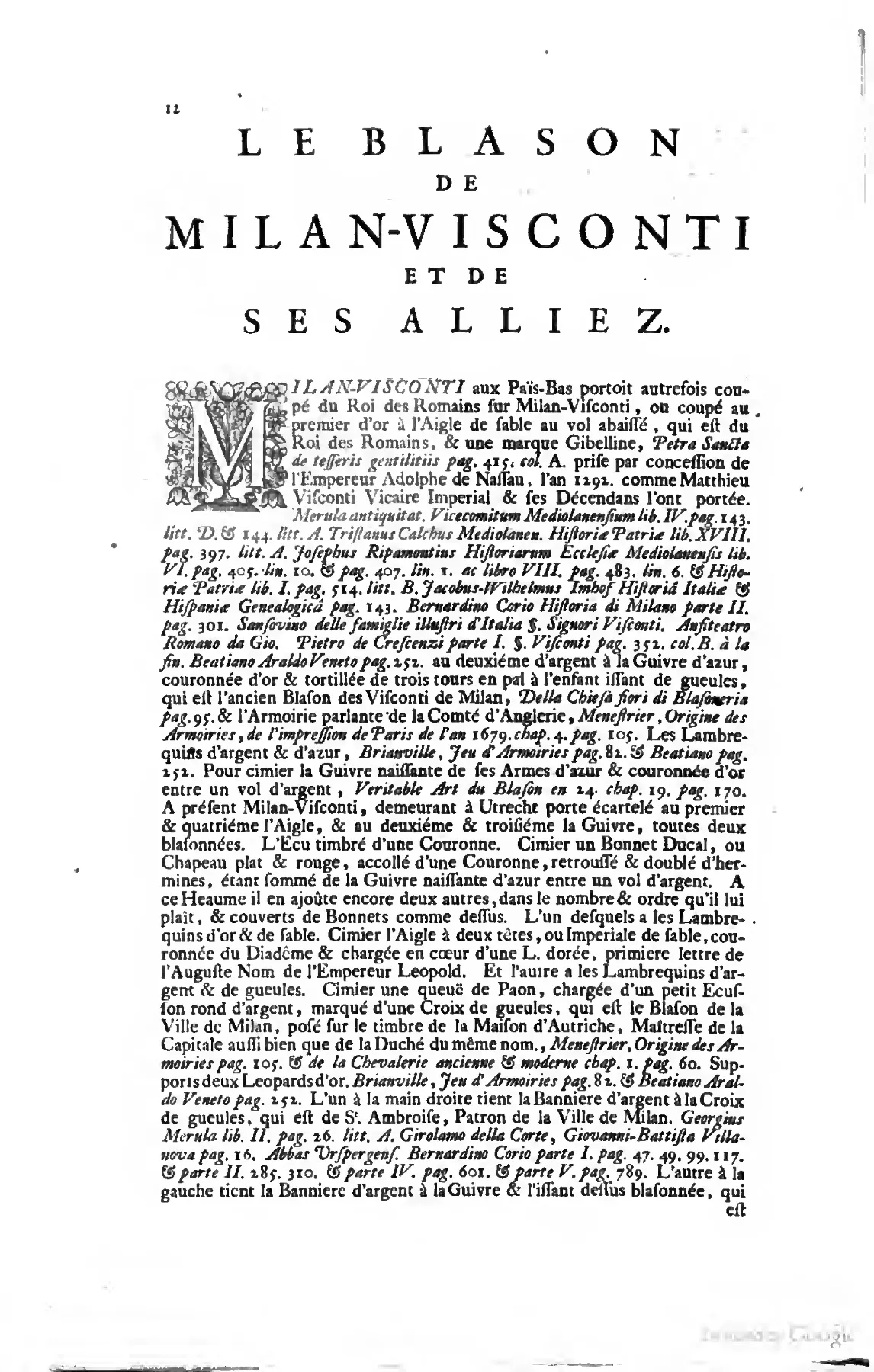
The appended French correspondence opens with the display heading “LE BLASON DE MILAN-VISCONTI ET DE SES ALLIEZ” and a large ornamental initial, marking the turn from genealogical and ritual material into a comparative heraldic dossier. Its crowded printed notes and blazoning language set the Milan-Visconti arms within the Europe-wide culture of authorities, pedigrees, and sovereign claims that the appendix both exploits and strains. Source ↗.
Behind that closing roll stand the plates themselves. The three folding stemmata that close the Orsini series — the counts of Pacentro and Oppido, the dukes of Gravina and Santogemini, and the lords of Monterotondo — present descent stripped to its tabulated essentials: generations, marriages, dates of death, cardinalatial creations, violent ends, and, in the Monterotondo table, a legitimated bastard line carried forward as though it were a natural continuation. The Gravina plate registers a creation of 1672 and marriages of 1671, 1678 and 1683, which is to say that the printed pedigree runs up to the very edge of the volume's own production. Tabular form makes the claim that a house can be set out as ordered data; the discursive commentary that follows exists because it cannot.
That commentary opens with an act of controlled quotation. The author introduces a funeral oration, noting that Giovanni Battista Ferrari heaped up and exaggerated the glories of the house in the oration he delivered at the funeral of Cardinal Alessandro Orsini, Gentis decora congescit & exaggeravit Ioh. Bapt. Ferrarius, in Oratione, quam in funere Alexandri Ursini Cardinalis habuit, verbis sequentibus: Illa. The verb exaggeravit is placed before the extract rather than after it, so that the reader meets the panegyric already classified. What follows is reproduced at length precisely because it is not to be believed: a tally running through thirty-four cardinals, through sixty-two senators of Rome, through four prefects of that same princely city, through six gonfaloniers of the Roman Church, through a hundred military commanders, through consuls, per Purpuratos patres XXXIV. per LXII. Romæ Senatores, per ejnsdem Principis urbis Præfectos quatuor, per Ecclesiæ Romanæ Vexilliferos sex, per centum bellicos Imperatores, per Consules,. The inventory is a compressed taxonomy of what constituted Roman baronial standing — curial purple, municipal magistracy, the banner of the Church, military command — and its rhetorical force lies in its numeracy. Enumeration mimics the form of proof. The commentary's response is not to refute the figures but to refuse to underwrite them, leaving their credit with their author; the panegyric is thereby preserved as a witness to how a great house described itself while being denied the status of evidence for what it was.
Against that, the reconstruction of the name proceeds by an entirely different warrant. It is a most certain opinion that the stock was transferred thence into Latium, but that it drew its own name from a certain man called Urso the author judges to be proved by the fact that in older records those born of that family are styled, in place of a surname, of the sons of Ursus, in Latium translatam certissima est sententia; appellationem verò suam à quodam, cui nomen Urso fuit, traxisse id argumenti instar esse censeo, quod. The formula id argumenti instar esse censeo is the language of weighed inference rather than assertion, and the ground of the inference is chancery usage: the patronymic de Filiis Ursi in bulls and diplomas. Onomastics is thus removed from the domain of civic etymological fancy and lodged in the domain of documentary formulae, where a scribal habit becomes a datum. The contrast with the origin-legend of the golden fess, which the same commentary records under the distancing perhibent, is deliberate: what charters transmit and what report transmits are kept in separate evidentiary classes even when both are printed on the same leaf.
The heraldic core of the enterprise surfaces where descent and device are made to check one another. Finally, the author remarks, perhaps it should not be passed over that the counts of Manoppello distinguished the ancestral arms of the Orsini by a bordure strewn with sheaves of grain, deniqne non præterendum fortassis est Comites Manuppellenses gentilitia Ursinorum insignia limbo distinxisse, manipulis spicarum sparso. The apologetic non præterendum fortassis understates what is methodologically decisive: a cadet line is identified not only by the filiation reconstructed from authors but by a visible, comparable mark of difference borne on the shield. The gentilitia insignia remain constant as the sign of the stock; the limbus records the branching. Cadency is here treated as a species of testimony contemporaneous with the event it records, which is exactly what the tangled Orsini pedigrees, transmitted through partisan and homonymous authorities, so often lack.
The same evidentiary logic governs the extended transcription from Pontano of the Neapolitan rite of liege homage, which the commentary justifies not by the interest of the anecdote but by the constitutional information the ritus preserves. The oath is printed as a notarial instrument would print it, in the first person and with the vassal's lordships recited: and he followed it thus, I, Orso Orsini, count of Nola and Atripalda, of Ascoli, que ea est secutus: Ursus ego Ursinus, Nolæ & Atripaldi Comes, Asculi,. Homage is territorially specified before it is sworn, so that the bond attaches to an enumerated patrimony rather than to a person in the abstract — which is why the later confiscations and sales recorded in the same commentary are legible as constitutional events and not merely as misfortunes. The formula closes with an explicit guarantee of freedom: these things are to be rendered to the king, and I call God, best and greatest, to witness them, and by these most holy Gospels, knowing, willing and freely, I swear in the words set down, sunt Regi. Deumque bis Optimum Maximum testem invoco, perque sacrosancta hæc Evangelia sciens, volens, libensque verbis conceptis juro. The triad sciens, volens, libens is the standard juridical safeguard distinguishing an oath from an extortion, and its retention alongside the physical gestures of the rite — the interlocking of thumbs from which the text derives ligius — shows the compiler collecting the ceremonial and the notarial together as two registers of a single obligation.
What the commentary documents with equal care is dissolution. The botanical metaphor that organizes the whole Exegesis is not ornamental but classificatory: with his son Alessandro II extinguished by poison at Naples, this branch of the Orsini stock came to its end, cum gnato Alexandro II. Neapoli veneno extincto, hic Ursinæ stirpis ramus. A stirps persists while its rami wither; extinction is a local event within a continuing stock, which is precisely the conceptual apparatus a genealogist needs if he is to record failure without conceding that the house has failed. Loss of possession is analysed with the same precision. Alexander VI is reported as holding that by a sale made without consulting him the pontifical majesty had been not slightly diminished, and that those castles had by right and by law devolved to the papal see, ea venditione se inconsulto facta Pontificiam majestatem non mediocriter imminutam, atque adeò Castella illa jure & legibus ad pontificiam sedem esse devoluta censentem,. This is a compact statement of the doctrine of devolution governing alienated papal fiefs, and it converts a baronial property transaction into a question of superior lordship — the juridical premise beneath every Orsini title the plates record.
The corrective mode reaches its sharpest formulation where authorities are weighed against one another. But when Ughelli called Fulvio a cardinal he was mistaken, and confused him with a namesake of the family sprung from the stock of the dukes of Gravina, vocavit Ughellus, falsus est, eumque cum gentili homonymo è Ducum Graviensium stirpe sato confudit;. The error is not merely noted but diagnosed: within a clan that repeats its baptismal names across branches for generations, homonymy is the structural cause of genealogical corruption, and the correction works by reconstructing how the confusion became possible. Naming Italia Sacra as mistaken, rather than silently emending it, is the same procedure applied earlier to vernacular family history.
The appended correspondence on the Milan-Visconti extends these criteria into French and into another jurisdiction, and in doing so exposes their limits. The correspondent aligns himself with the critical dating of armory, being of the same opinion as the late Monsieur Menestrier, who proves in his book on the origin of coats of arms that blazons were not so commonly in use before the year one thousand, même opinion, que feu Monsieur Menestrier, qui prouve dans son Livre, de l'origine des Armoiries, que les Blasons n'ont pas été si communément en usage avant l'an mille,. A chronological terminus is here used as a solvent: any coat claimed for a pre-millennial ancestor is thereby fabulous, and the serpent of the Visconti is reassigned to the canting arms of Angera. Yet the letters simultaneously transcribe Leopold I's grant, with its shield divided crosswise, the upper part of the escutcheon gold charged with a black eagle, the symbol of the Ghibelline party, versim sectum, superiori clypei parte aureum Aquila nigra insignitum, partium Gibellinarum symbolum; — imperial chancery language in which a faction badge is formally blazoned as a component of a granted coat — and with it a descent traced to Duke Eimenulsus, prince of an illustrious family, and to Desiderius his son, king of the Lombards, illustris prosapiæ Principem, & ad Desiderium filium ejus Longobardorum Re. The most extravagant claim in the appendix is thus advanced not on a scholar's authority but on a sovereign's, and it is exempted from the very criterion just applied to rival arms. The contradiction is partly acknowledged: the same letters observe, on Hertius, that by a rare example the Emperor Charles V conferred on Stephanus Pratis and his posterity the title and dignity of knighthood and of the equestrian order in the year 1538, raro exemplo Stephano Pratis & ejus posteris titulum ac dignitatem Militiæ & Equestris Ordinis contulit ann. 1538, and then concede that nobles are now called knights indiscriminately. A document whose purpose is to secure status admits, in passing, that the currency of status has been debased — an admission that belongs to the same critical culture as the correction of Ughelli, and that sits uneasily beside a stemma reckoned from the last Lombard king.
Frequently Asked Questions
What is Historia insignium illustrium by Philipp Jakob Spener?
It is a learned Latin armorial and genealogical compendium, the "special part" of a two-volume heraldic enterprise whose companion, Insignium theoria seu Operis heraldici pars generalis, supplied the general theory. It first appears in a Frankfurt am Main issue of 1680, published at the expense of Johann David Zunner and printed by Johann Theodoric Friedgen, with a second edition at Frankfurt in 1717. It combines engraved tables of shields and helmets, numbered stemmatic tables, discursive exposition keyed to those tables, and an alphabetical index of families and dignities. Its detailed treatment concentrates on Italian houses: the Medici, the Guidi counts, the Piccolomini, the Salviati, the Strozzi, and the Orsini branches.
Who was Philipp Jakob Spener, and why did a Lutheran pastor write about coats of arms?
Philipp Jakob Spener (1635–1705) is remembered chiefly as the Lutheran pastor whose Pia desideria gave German Pietism its programme, but heraldry and genealogy occupied the other half of his working life. He served Christian II as tutor in 1654–1656, a princely relationship that recent scholarship credits with fostering those studies, and Johannes Wallmann characterized him as a leading German practitioner of both fields rather than a dilettante. The major modern editorial tradition has concentrated on his theology, Pietism, and correspondence, so the heraldic corpus remains under-integrated into the standard account of his life.
How does the work distinguish documentary proof from family tradition?
By naming the class of evidence behind every claim. The tale of the giant Mugello is passed over by design, since no firmer records of it exist than what Mugello peasants and begging tale-tellers put about, while the Medici are grounded instead in the public registers of the city, sepulchral monuments, inscriptions, contracts, wills, and other specimens drawn from the archive of the Florentine republic. Where documents run out, the question stays open: the paternity of Duke Alessandro is left undecided, and Orsini branches whose posterity is not sufficiently established are passed over in silence. The channels of supply are disclosed too, including a Florentine gentleman whose name is withheld and Antonio Magliabechi as broker.
Why does a book about noble arms record the Orsini selling their estates in the 1690s?
Because arms and titles were claims to jurisdiction and property, so their alienation belongs to the same account. Vicovaro was sold in 1692 to Count Bolognetti, Anguillara in 1693 to Grillo, a Genoese patrician, Albano in 1696 to the Papal Chamber, and Bracciano to the Odescalchi, with Livio Odescalchi receiving the castle in 1696. Flavio Orsini, fifth duke of Bracciano and S. Gemini, died without issue in 1698, and the duchy was extinguished in the family. Entries running well past the 1680 imprint, with Benedict XIII named as reigning pontiff, indicate that the historical exposition as transmitted belongs to a state revised in the 1720s.
Is there an English translation of Historia insignium illustrium?
No complete modern translation of Historia insignium illustrium has been identified. English versions of Spener's theological writings, above all Pia desideria, are readily available, but they should not be mistaken for a translation of the heraldic corpus, which remains in its original Latin. Separately, the Leo edition presents the full transcription together with a complete English translation, generated by AI, for the first time. Leo is an effort to make freely available online, at no cost, English translations of every text printed in Latin in early modern Europe between 1450 and 1750.
This report was generated by an advanced AI assistant that conducted deep research alongside an extensive interpretation of the transcribed original text. Every effort has been made to preserve fidelity to the source and to guard against inaccuracy, but corruption in the text recognition process and model hallucination may nonetheless have entered the text. Treat every claim, quotation, translation, and citation as provisional, and verify each against the original source before relying on or citing it.
Further Reading on Spener, Heraldry, and Early Modern Genealogy
- Alei, Paolo, and Max Grossman, eds., Building Family Identity: The Orsini Castle of Bracciano from Fiefdom to Duchy (1470–1698): The volume reads Bracciano as the physical form of Orsini self-assertion — architecture, patronage, lordship, and memory working as one instrument — and it carries the sale of the castle to Livio Odescalchi in 1696 through to its consequences. Read against Spener's Orsini chapters, it explains why a heraldic book compiled in the 1680s and revised in the 1720s reads simultaneously as an inventory of dignities and as a liquidation notice. The work records the surrounding dispersal of the baronial estate in the same ledger-like manner, noting that he therefore sold Vicovaro in 1692 to Count Bolognetti, Anguillara in 1693 to Grillo, a Genoese patrician, and Albano in 1696 to the Papal Chamber, itaque Vicovarum an. 1692. Comiti Bolognettio, Anguillariam anno 1693. Grillio Patritio Genuensi: Albanum an. 1696. Cameræ Pontificiæ,; dated transactions of this kind, naming purchaser and property, are the documentary counterpart to the heraldic and genealogical account, and they show the work registering the contraction of a lordship with the same precision it applies to its ascent.
- Friedrich, Markus, "Genealogy as Archive-Driven Research Enterprise in Early Modern Europe," Osiris: Friedrich treats early modern genealogy as a data-intensive craft dependent on collection, collation, and the management of contradictory paper, which is the single most useful corrective to reading such books as flattery in folio. It supplies the terms in which Spener's tables, sigla, indexes, and named corrections can be assessed as research instruments rather than decoration. The criteria by which a predecessor's compilation could be judged insufficient are stated in the work itself, which reports of one such author that he brought the affairs of the Orsini into a history in Italian, interspersed with one or two genealogical schemes, but that these are maimed, gaping, in no part complete, and not even free of errors, Historiam contulit, uno alteroque schematismo interpolatam genealogico; verùm manci hi sunt, hiulci, & nulla ex parte perfecti, neque etiam ab erroribus vacui;; the charge of incompleteness and error levelled at vernacular family history is exactly the complaint that motivates an archive-driven reconstruction, though which earlier writers are meant in each instance still requires verification against the text and the wider tradition.
- van Vugt, Ingeborg, "Networking in the Republic of Letters: Magliabechi and the Dutch Republic," The Journal of Interdisciplinary History: Van Vugt maps the Florentine librarian's correspondence as a working distribution system for books, rumours, manuscripts, and obituaries, which is precisely the function he performs in Spener's Medici chapters. The article is the best available check on the temptation to treat a Magliabechi notice as self-authenticating simply because it is signed. The text's own naming of him fits that description closely: it declares that it would be a sin to have passed over in silence the name of the intermediary whom the author happily used in that business, namely Antonio Magliabechi, a name most celebrated throughout the whole cultivated world, proxenetæ verò, quo eo in negotio feliciter usus sum, nempè Antonii Magliabechii, nomen toto orbe cultiore celeberrimum, silentio præteriisse nefas foret. The term proxeneta, a broker or go-between, is the vocabulary of mediation rather than of authorship, and naming the broker is itself part of the work's practice of disclosing how its evidence arrived.
- Wallmann, Johannes, "Zur Edition der Briefe Philipp Jakob Speners," Pietismus und Neuzeit 38 (2012), listed in Bibliographie zu Philipp Jakob Spener: Wallmann's account of the letter edition is the shortest route into the documentary culture that shaped Spener's scholarly habits, and the hosting bibliography of the Spener-Briefe project is the standard finding aid for everything written about him. It also makes the imbalance plain: a corpus of criticism devoted almost wholly to the theologian, with the heraldist appearing chiefly as a biographical footnote. Since the heraldic work depends on named and unnamed correspondents at every turn, the epistolary scholarship and the armorial folio belong to the same inquiry, whether or not the bibliographies have noticed.