Dictating the Manichaeans: Kaspar Sagittarius's An Introduction to Ecclesiastical History and Its Several Parts
Kaspar Sagittarius, professor of history at Jena, died in March 1694 leaving behind not a narrative of the Church but an inventory of the men who wrote it: Introductio in historiam ecclesiasticam et singulas eius partes, sive Notitia scriptorum veterum atque recentium qui vel historiam ecclesiasticam universam vel regnorum aliarumque provinciarum historiam illustrant, printed in two Jena volumes in 1718 by his colleague Johann Andreas Schmidt. Every author in it is weighed — parentage, chairs, editions, continuators — and then judged genuine or forged, annalistic or fabulous, honest about his sources or silently helping himself to them. In an age when the papacy's claims stood or fell on whether a given document was authentic, a bibliography of this kind was an argument in disguise, and Sagittarius made it one by letting Catholic scholars pronounce the verdicts against Catholic forgeries.
ExLatinis
September 22, 2026
Contents
Kaspar Sagittarius, professor of history at Jena, died in March 1694 leaving behind not a narrative of the Church but an inventory of the men who wrote it: Introductio in historiam ecclesiasticam et singulas eius partes, sive Notitia scriptorum veterum atque recentium qui vel historiam ecclesiasticam universam vel regnorum aliarumque provinciarum historiam illustrant, printed in two Jena volumes in 1718 by his colleague Johann Andreas Schmidt. Every author in it is weighed — parentage, chairs, editions, continuators — and then judged genuine or forged, annalistic or fabulous, honest about his sources or silently helping himself to them. In an age when the papacy's claims stood or fell on whether a given document was authentic, a bibliography of this kind was an argument in disguise, and Sagittarius made it one by letting Catholic scholars pronounce the verdicts against Catholic forgeries.
Kaspar Sagittarius (1643–1694) spent the last two decades of his life teaching history at Jena, and the book that carries his name into the eighteenth century is not a narrative of the Church but a guide to the writers through whom the Church can be known. Its Latin title announces the double character of the enterprise: Introductio in historiam ecclesiasticam et singulas eius partes, sive Notitia scriptorum veterum atque recentium — an introduction to ecclesiastical history and its several parts, or a register of the writers, ancient and recent, who illuminate it. Born at Lüneburg, trained at Helmstedt, doctor at Jena and from 1675 professor of history there, Sagittarius died in March 1694; the bibliographical record associates the project with that year, while the fully documented witness is the two-volume Jena edition of 1718, seen through the press by Johann Andreas Schmidt and printed by Johann Felix Bielckius. Whether a separate 1694 issue circulated remains unresolved, since no independent catalogue record for one has been traced. The work is thus, in genre, neither annal nor chronicle but a notitia scriptorum: a critical inventory of authors, editions, manuscripts, and continuators, composed in Latin for students.
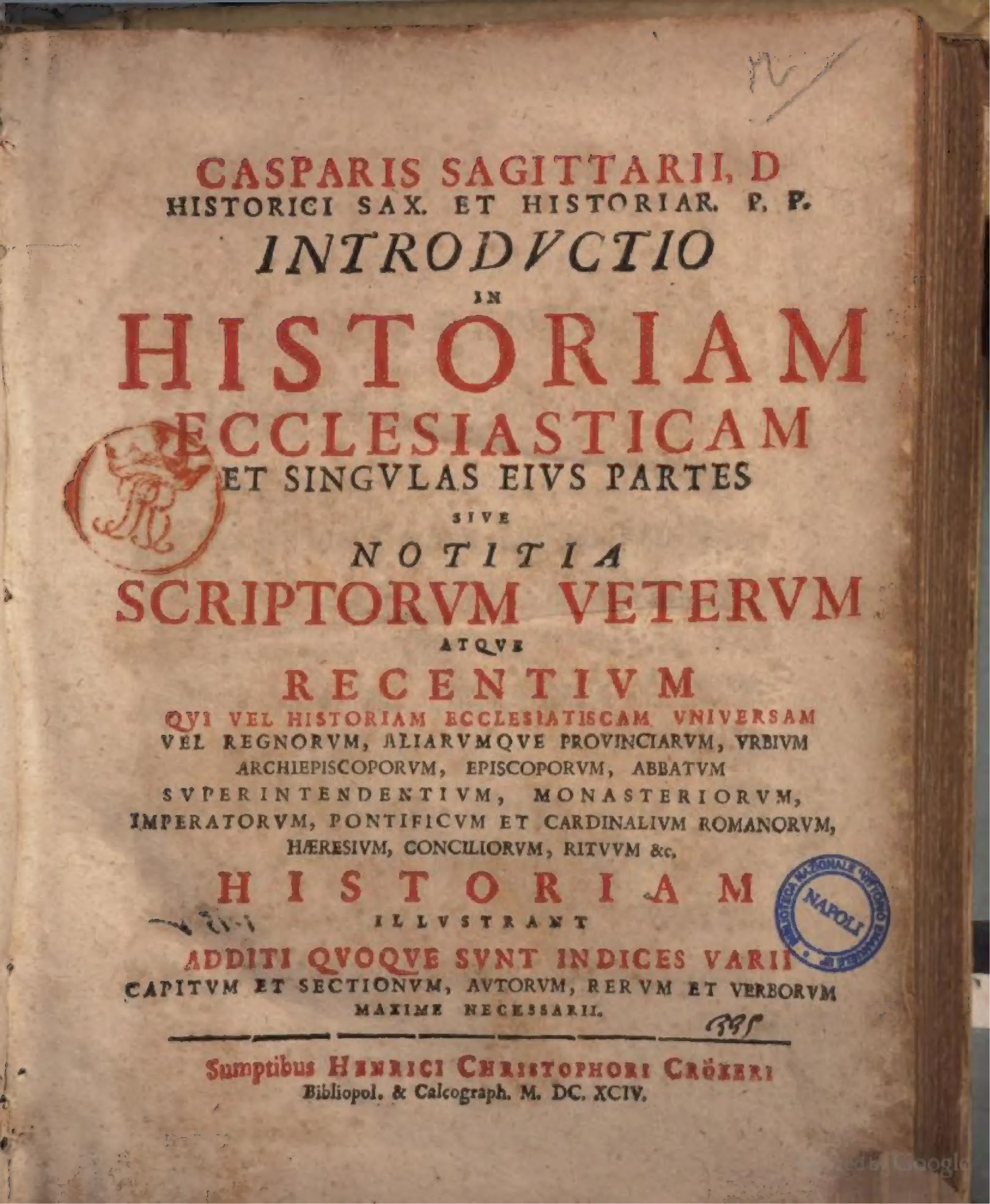
Sagittarius's title page presents the work as both Introductio in historiam ecclesiasticam and Notitia scriptorum, narrowing from the universal Church to categories of offices, institutions, controversies, and rites. The promised indices varii and Heinrich Christoph Cröker's imprint name the finding-apparatus and book trade on which the unresolved 1694 question turns. Source ↗.
The problem it confronts is the one the confessional age bequeathed to anyone who wished to write the history of Christianity: the sources are a thicket. Pseudepigrapha circulate under apostolic names, annals are written to prove a thesis, printed editions go uncollated, and manuscript authorities are dispersed, mutilated, or lost. Sagittarius's answer is to make the writers themselves the object of study before any history is attempted. Each author is set inside a fixed frame — parentage, schooling, chairs held, date of death, works, editions, epitomators and continuators — and then subjected to a verdict: genuine or supposititius, annalistic or fabulous, honest in naming his authorities or silently concealing them. The characteristic and most consequential turn of that procedure is confessional restraint under polemical pressure: the judgement that a text is spurious is repeatedly secured by quoting Catholic scholars — Baronius, Bellarmine, Sixtus of Siena, Melchior Cano — against Catholic claims, so that philology, rather than party, appears to deliver the sentence. Bibliography here does the work of argument.
The stakes of that method were high and immediate. After the Reformation the history of the Church had itself become contested ground: the Magdeburg Centuries had organised the Christian past into chronological centuriae worked up by an organised team of collectors and composers, and Cesare Baronio's Annales Ecclesiastici had answered with a documentary universal history whose archival claims Protestant scholars could contest, mine, or turn against their author. Questions such as the primacy of the Roman pontiff, whether Peter was ever at Rome and whether he was its bishop, the authenticity of the Donation of Constantine, and the translatio imperii were not antiquarian curiosities but the hinges on which ecclesiastical legitimacy turned, and they were decided — when they could be decided at all — by acts of textual criticism. To compile a register of writers in this environment was to take a position on what counted as evidence, and on who was entitled to say so.
Several features make the book memorable in its own right. Its order is a descending taxonomy that converts bibliography into a map of the Church: universal history first, then kingdoms and provinces, cities, monasteries, bishops and abbots, emperors, popes and cardinals, and finally haeresiologia — after which, at a declared pivot, the geographical arrangement gives way to six thematic heads (emperors and German kings, Roman pontiffs, heretics, councils, doctors and ecclesiastical writers, rites and ceremonies). The heresiology is alphabetical, and its alphabet is startling: Basilides, the Carpocratians, the Donatists, the Ebionites and the Iconoclasts stand in the same sequence as Hussites, Böhmists, Cartesians, Cocceians, Jansenists, Labadists, Quietists, Arminians, and Chiliasts, so that the living confessional quarrels of the 1690s are set into the inherited grammar of ancient heresy. Equally distinctive is the book's candour about the material conditions of learning: book-fair deadlines and a bookseller's pressure, the scarcity of books, patronage and alms-funded research, printing privileges and censorship, the destruction of libraries in war, and the organised workshops in which Protestant church history had actually been produced. Several of the most arresting particulars associated with the work — a subscription of 30 April 1694, an internal date of 17 January 1695, a Brandenburg privilege, the dictation of the section on the Manichaeans in extremis — belong to its preliminary and editorial matter rather than to the catalogue record, and their bearing on an earlier issue awaits inspection of the preliminaries themselves.
What holds these elements together is a single conviction about how the Church's past is accessible: only through writings, and therefore only through a criticism of writings. The technical vocabulary of the book — veritas historica, supposititius, apocryphus, autographum, codices mss., anilibus fabulis, interpolatores — is the vocabulary of that conviction; the conditions of the book trade, patronage, and censorship are treated as part of the same historical-critical question rather than as accidents of publication; and the internal architecture, descending from the universal Church to the individual sect, is designed so that a student can be told not merely what happened but which author to read, in what edition, with what degree of trust. Modern scholarship devoted to Sagittarius's Introductio specifically is thin, and much of what follows must therefore be read against the wider literature on Flacian church history, Catholic annalism, confessional historical method, forgery criticism, and early modern learned bibliography rather than against an established consensus about the man himself.
Read the full text and English translation on Leo
This text was transcribed and translated as part of the ExLatinis project, an effort by Leo to make free English translations of every text published in Latin in early modern Europe (1450–1750) available online. The complete transcription and English translation of this work can be read free of charge:
→ Read the original Latin text and full English translation on Leo
You can save a copy of this document into your Leo account to run deep text searches, conduct further analysis, or cross-reference it with your own research.
What Sagittarius's Title Promises: Notitia Scriptorum and the Language of Historical Truth
Editorial English title: An Introduction to Ecclesiastical History and Its Several Parts: A Critical Register of Ancient and Recent Writers Who Illustrate the Universal History of the Church and the Histories of Kingdoms and Provinces. This is a scholarly translation supplied for convenience, not an established English title. The catalogue title is Introductio in historiam ecclesiasticam et singulas eius partes, sive Notitia scriptorum veterum atque recentium qui vel historiam ecclesiasticam universam vel regnorum aliarumque provinciarum historiam illustrant. The work is therefore not simply an ecclesiastical narrative. Its subtitle identifies it as a notitia scriptorum: a learned register of writers and writings whose value lies in their capacity to illuminate church history and related political or territorial histories. Notitia carries the sense of informed notice, knowledge, or critical account; in this setting it marks a bibliographical and bio-critical genre distinct from historia proper, even though the two genres overlap. The title-page itself displays the descending series that governs the whole, naming writers who illustrate either the whole of ecclesiastical history, or that of kingdoms, of other provinces, of cities, QVI VEL HISTORIAM ECCLESIASTISCAM VNIVERSAM VEL REGNORVM, ALIARVMQVE PROVINCIAVRVM, VRBIVM, so that the taxonomy of the Church and the taxonomy of its literature are announced in a single breath.
The word introductio likewise signals a propaedeutic work: it promises an ordered entrance into a field, its authorities, subdivisions, and technical vocabulary. That pedagogical intent is stated as a practical instruction to the student — whoever desires to learn ecclesiastical history with profit should, before all else, read and re-read the Acts of the Apostles with study, cum fructu cupit addiscere, ante omnia Acta Apostolica cum studio legat atq; — which places the canonical narrative at the head of the reading programme before any register of later writers is opened. Singulae eius partes does not merely mean miscellaneous topics. It presents ecclesiastical history as a structured totality whose component parts can be surveyed, classified, and assigned to particular writers. The title's pairing of veteres atque recentiores also gives the book a deliberately longue durée: ancient authorities and recent controversial or scholarly writers belong to one critical field, but they are not thereby made equivalent.
The critical vocabulary in which that field is policed is worth isolating, since it is the same vocabulary through which the work's confessional judgements are delivered. Veritas historica functions as a standard against which a writer may be found wanting even when his style and arrangement are praised: although he used a not inelegant diction and arranged his histories in no inconvenient order, since nevertheless he committed no small errors and befouled historical truth with many fables, Etsi autem dictione usus non invenusta, nec ordine incommodo historias digessit; qvia tamen errores non exiguos commisis, ac veritatem historicam multis conipurcavit fabulis. Beside this substantive criterion stands a procedural one, the demand that a compiler declare his sources, expressed as a regret rather than an accusation even where the writers concerned are the most venerable of the Wittenberg tradition: this one thing I regret, that both Melanchthon and Peucer too rarely named the writers from whom they drew their material, Illud doleo, qvod & Melanchthon, & Peucerus rarius laudaverint scriptores, unde sua hauserint:. The evenhandedness of that complaint — directed at Lutheran authorities as readily as at Roman ones — is itself part of the book's method.
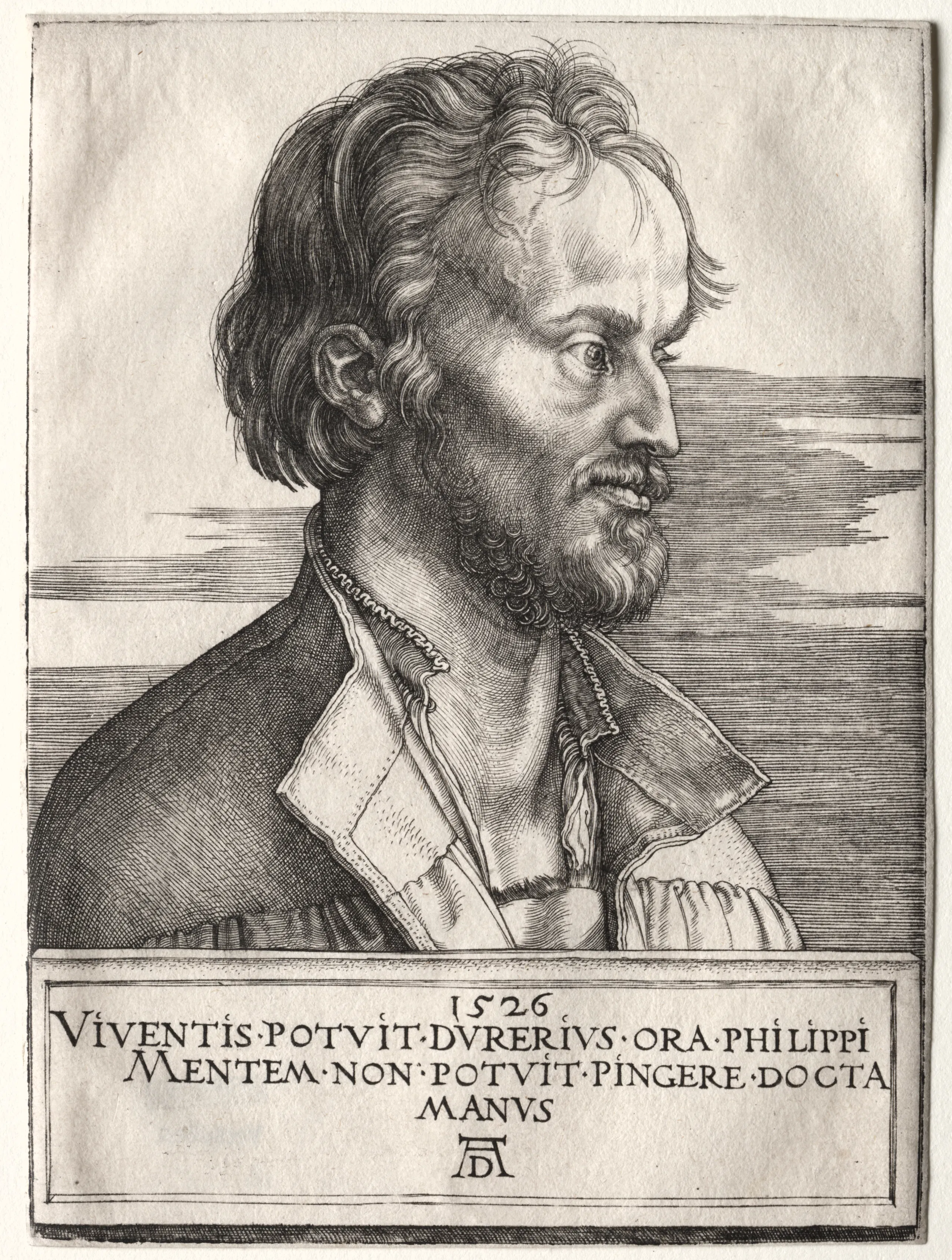
Albrecht Dürer's 1526 engraved likeness of Philipp Melanchthon presents the Wittenberg humanist as a figure of learned Reformation authority — the very authority Sagittarius subjects to method. Regretting that even Melanchthon too rarely named his sources, the register turns confessional prestige into a test of veritas historica. Source ↗.

The historiographical vocabulary surrounding the book is best understood through centuria and haeresiologia. In Protestant church history, centuria denotes a chronological unit of historical organization, most famously in the Magdeburg Centuries; it is not simply a calendar period but a device for arranging doctrinal, institutional, and evidentiary material. Haeresiologia, by contrast, names the systematic treatment of heresies and sectarian deviations. In Sagittarius's program it appears to extend the bibliographical and institutional survey into a confessional taxonomy that can place early Christian groups beside contemporary formations such as Cartesians, Cocceians, Jansenists, Labadists, and Quietists. That extension is historically significant: the register treats classification itself as an instrument of ecclesiastical judgment, while still presenting the work as a guide to authors, books, and historical evidence rather than as a purely dogmatic catalogue.
Sagittarius's Introductio at a Glance: Author, Editions, and Design
The work is a Latin Protestant scholarly introduction to ecclesiastical history combined with a critical register of ancient and recent writers. Its author is Caspar or Kaspar Sagittarius (1643–1694), the Lüneburg-born historian who became professor of history at Jena. The bibliographical record associates the project with 1694, the year of Sagittarius's death, while the extant catalogue and digitized witnesses securely document a two-volume Jena edition of 1718, edited by Johann Andreas Schmidt and printed by Johann Felix Bielckius. The work's precise relationship to a separate 1694 issue remains unresolved: no independent catalogue record for such an issue was located, and the 1718 edition should not be silently retrojected into a confirmed 1694 imprint.
The title and the index program present ecclesiastical history as a descending order of subjects: universal church history, kingdoms and provinces, cities, monasteries, bishops and abbots, emperors, popes and cardinals, and finally heresiology. The project also announces a movement from geographical organization toward thematic capita, including Roman emperors and German kings, Roman pontiffs, heretics, councils, doctors and ecclesiastical writers, and rites and ceremonies — a reduction the text performs explicitly, stating that although the heads of this history are various, most may nevertheless be reduced to the following six: first, on the Roman emperors and kings of Germany; second, on the Roman pontiffs; third, on heretics; fourth, on councils; fifth, on doctors and ecclesiastical writers; sixth, on rites and ceremonies, Etsi autem varia hujus Historiæ sunt capita, pleraqve tamen ad sex seqventia licuerit revocare: ut primum sit de Imperatoribus Romanis, ac Regibus Germaniæ: alterum de Pontificibus Romanis: tertium, de Hæreticis: qvartum, de Conciliis: qvintum, de Doctoribus & Scriptoribus Ecclesiasticis: sextum, de Ritibus & Ceremoniis. These features make the book a hybrid of church history, learned bibliography, historical prosopography, and confessional reference work. The recurring unit is not merely an event but the author or text capable of furnishing historical knowledge; the implied template combines identity, chronology, writings, editions, authorities, and critical evaluation. The criterion by which writers earn a place is stated in the same terms, at the close of the survey of the Byzantine historians: and so we have treated, in compendium, the chief Greek writers of Constantinopolitan history who observed annalistic order, from whom very much indeed pertaining to knowledge of Eastern ecclesiastical history may be drawn, §. XXII. Atqve ita per compendium egimus de præcipuis Historiæ Constantinopolitanæ scriptoribus Græcis, qvi qvidem annalem observarunt ordinem: ex qvibus plurima sane ad Historiæ Ecclesiasticæ Orientalis notitiâ pertinentia licuerit haurire — annalistic order and yield for church history together determining inclusion, and by implication exclusion.
The work was composed and transmitted in Latin. No independent evidence of a complete translation into English, German, French, or another modern language was located. The catalogue records identify the 1718 volumes as Latin books, while the author's Nucleus historiae Germanicae is separately reported as having received a French translation; that fact should not be transferred to the Introductio. Claims concerning the 30 April 1694 subscription, the internal date of 17 January 1695, deathbed dictation of the section on the Manichaeans, the Brandenburg privilege, weekly news-sheets, alms-funded research, and named patrons require verification against a complete scan or manuscript witness and are not established by the catalogue records consulted here.
Why the Introductio Matters: Confessional Historiography from the Magdeburg Centuries to Baronius
Sagittarius's project matters because it stands at the intersection of ecclesiastical historiography, confessional polemic, historical bibliography, and the institutional history of learned labor. Its importance does not rest only on the information it gives about earlier church historians. The form of the work makes historical knowledge itself an object of classification: writers, books, editions, manuscript authorities, councils, offices, sects, and doctrinal disputes are arranged into a usable intellectual apparatus for students and scholars. That apparatus rests on a first principle about the transmission of sacred history, namely that by the prompting of the Holy Spirit, for the eternal salvation of the Church and its perpetual remembrance, they consigned it to the monuments of letters, instinctu Spiritus Sancti, in æternam Ecclesiæ salutem, ac perennem memoriam, literarum monumentis consignarunt; if the Church's memory subsists in literarum monumenta, then the criticism of monuments is not ancillary to ecclesiastical history but constitutive of it.
The principal historical background is the confessional partition of church history after the Reformation. The work itself makes that partition the origin of its own discipline, asserting that it is certain that this branch of study was more carefully unfolded only from that purgation of the papal religion effected through Luther, and the vehement dissension and immense crisis born of it, Iam certum utiqve est, hanc studiorum partem, ab illa demum Pontificiæ religionis, facta per Lutherum ejus repurgatione, ac nata inde vehementi dissensione, & ingenti discrimine, sollicitius explicatam, — a genealogy in which controversy is the engine of critical method rather than its enemy. The Magdeburg Centuries constituted the first comprehensive Lutheran church history and organized material chronologically by centuriae and internally by theological and institutional headings. The Herzog August Bibliothek's account emphasizes both the universal Protestant ambition of the Centuries and their networked working method. G. B. Lyon's study of the plan involving Matthias Flacius and François Baudouin further shows that the Centuries were not the product of an isolated author but of distributed collection, selection, digestion, composition, and inspection. Sagittarius's treatment preserves a description of precisely that organisation in its own words: we have so far maintained ten workmen, and the division of labours is arranged in three ranks: first, seven learned students devote themselves solely to collection, according to the norm of the method, from the best authors, Alumus autem hactenus operarios decem: est qve laborum ratio distributa in tres ordines. Primum septem eruditi Studiosi tantum collectioni, juxta normam methodi, ex optimis autoribus, vacant,. That collaborative precedent illuminates Sagittarius's own interest in cataloguing writers and dividing the history of the church into manageable heads, and it belongs to the same conviction that the conditions under which learning is organised are themselves part of the critical question.
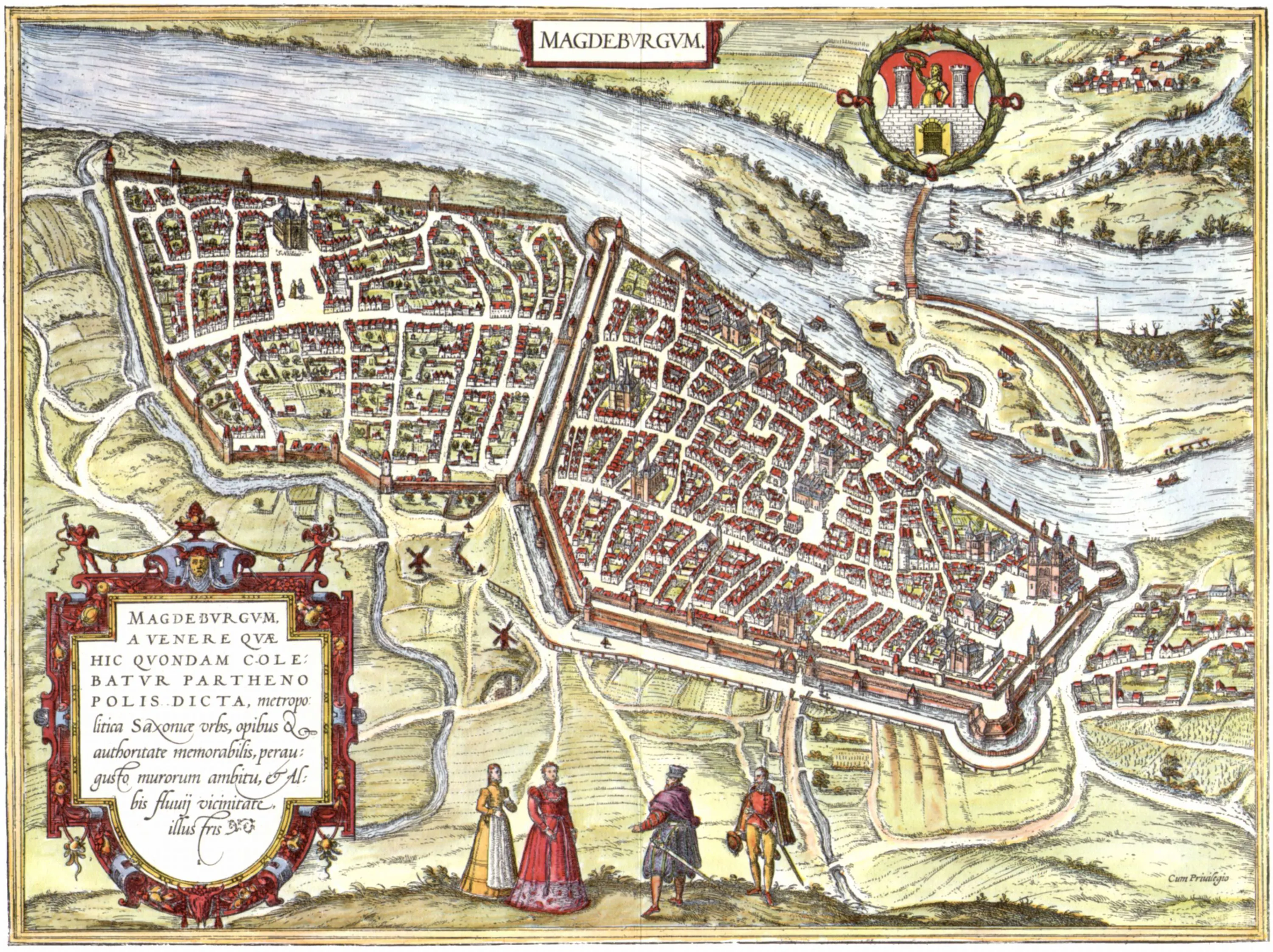
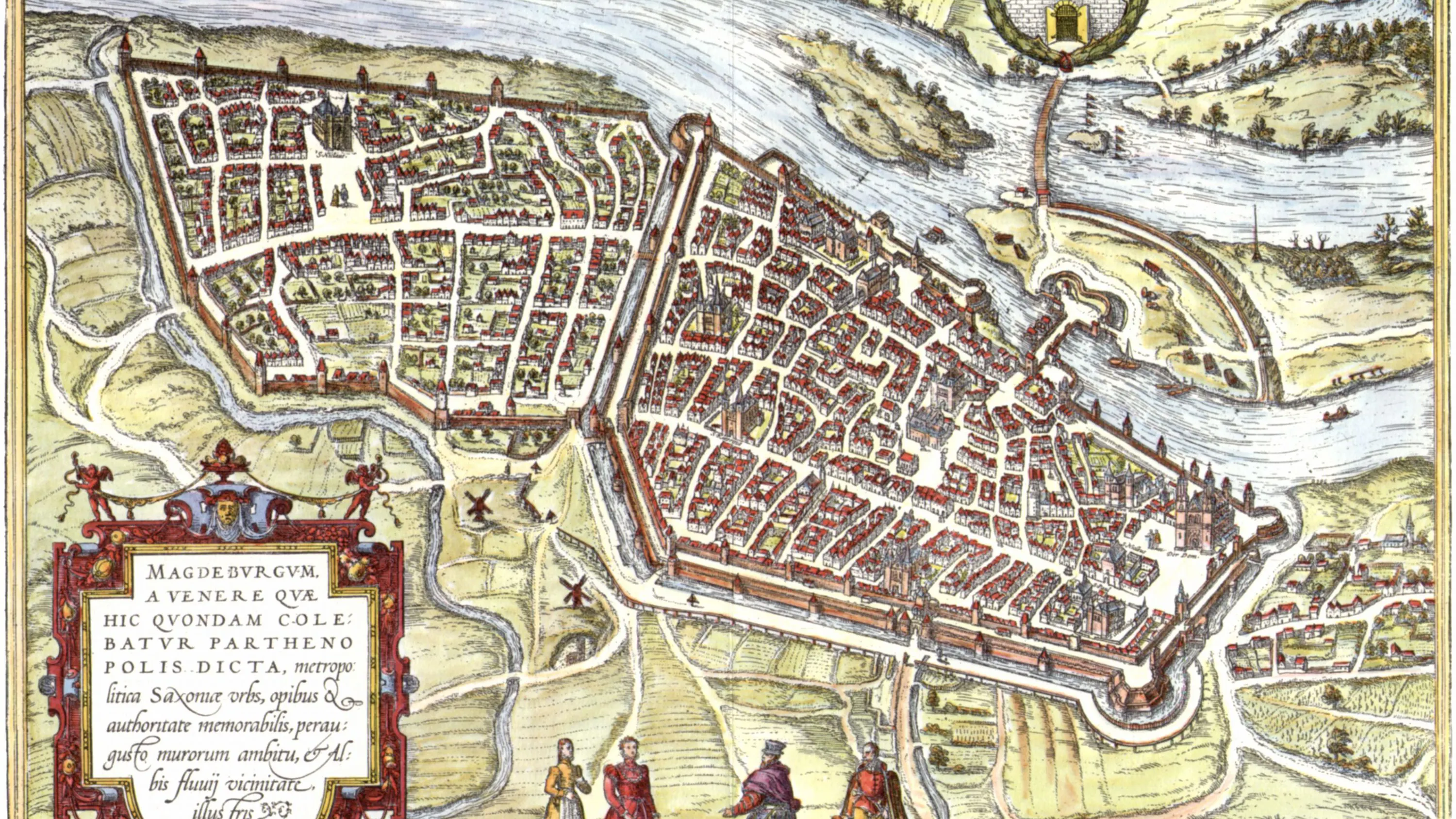
Engraved for the Braun and Hogenberg city atlases in 1572, this view presents the city that gave the Magdeburg Centuries their name and institutional setting — the civic and confessional world in which Reformation controversy turned church history into a collaborative labour of collection, ordering, and inspection. Source ↗.

Irena Backus provides the strongest general framework for the confessional problem. Her Historical Method and Confessional Identity examines how Protestant and Catholic scholars handled ancient Christian history and demonstrates that source criticism, patristic citation, and historical method were inseparable from confessional identity. Sagittarius's juxtaposition of Protestant, Catholic, ancient, and contemporary authorities belongs to this tradition. Catholic historiography, above all Cesare Baronius's Annales Ecclesiastici, supplied the major rival model: a universal church history whose documentary claims could be contested, mined for hostile testimony, or reinterpreted by Lutheran scholars. The sharpest form of that contest is preserved as a reported mot on the real subject of the Annales — he is said to have remarked that the true name for them would be not Ecclesiastical Annals but On the Power of the Pope, Non Annalium Ecclesiasticorum, sed de potestate Papæ verum nomen ipsis futurum — a verdict which reframes Baronius's monumental documentation as an argument about jurisdiction. The disputes over Roman primacy, the Donation of Constantine, Petrine authority, papal succession, and the evidentiary value of early Christian texts are therefore not peripheral controversies but central to the intellectual world in which a Protestant notitia scriptorum acquired its polemical force; the Petrine question is set out in the text as a pair of discrete historical propositions, two questions especially being agitated in controversy between us and the Papists: first, whether Peter was ever at Rome; second, whether he was bishop of the city, and so the first of the Roman pontiffs, Duæ autem qvæstiones potissimum inter nos & Pontificios controversæ agitantur: prima, An unqvam Petrus Romæ fuerit: altera, An Vrbis fuerit Episcopus, adeoq[ue] Pontificum Romanorum primus, a formulation that converts a doctrinal claim about primacy into two answerable questions of evidence.
Anthony Grafton's work on scholarship and forgery supplies a second major historiographical lens. The vocabulary of supposititius, apocryphus, fictitius, interpolators, autographs, and manuscript codices belongs to a culture in which establishing the identity and integrity of a text was itself a historical argument. Grafton's account of the relationship between forgery and learned criticism helps explain why bibliography, textual authentication, and ecclesiastical controversy could not be sharply separated. Sagittarius's handling of the early pseudepigrapha shows the tactic that recurs throughout the register, a verdict of spuriousness underwritten by the admissions of Catholic scholarship itself: but all these and others of the kind are supposititious and deservedly to be reckoned among the apocryphal books of ecclesiastical history, as was long ago shown to learned men — not even the Papists themselves, among them Baronius in the Ecclesiastical Annals, Bellarmine on ecclesiastical writers, Sixtus of Siena in the Bibliotheca Sacra, Melchior Cano in the Loci Communes, dared to deny it, 5. IV. At enim hæc omnia, aliaqve ejus generis supposititia esse, & inter apocryphos Historiæ Ecclesiasticæ libros merito computanda, jam pridem doctis viris est ostensum: nec ipsimet Pontificii, & inter illos, Baronius in Annal. Ecclesiasticis, Bellarminus de Scriptoribus Ecclesiasticis, Sixtus Senensis in Bibliotheca Sacra, Melchior Canus in Locis Communibus id ausi sunt negare. The rhetorical economy of that move — letting the adversary's own authorities carry the philological judgement — is the mechanism by which the register claims to judge by criticism rather than by confession.
The alphabetical heresiology extends this method into the post-Reformation present. By arranging Cartesians, Cocceians, Jansenists, Labadists, and Quietists beside ancient Christian groups, the work historicizes current confessional conflict through the inherited grammar of heresiology. Where a doctrinal boundary is at stake the classification also states the author's own communion's position, as in the distinction drawn against a Eutychian reading of Christ's flesh, from which heresy our Evangelical Church is furthest removed, teaching that the flesh of Christ is deified (for so blessed Gerhard and others of our theologians speak), to be eaten indeed with the bodily mouth, but in a supernatural manner, a qva hæresi Evangelica nostra Ecclesia longissime abest, docens, Carnem CHRISTI esse Deificatam, (sic enim B. Gerhardus aliiqve Nostratium Theologorum loqvuntur) manducandam qvidem ore corporis, sed modo supernaturali — the taxonomy of sects thus doubling as a position-statement within Lutheran sacramental theology. Yet the precise rhetoric of each entry, the treatment of Catholic authorities, the six-part thematic division, and the criteria for inclusion and exclusion require direct analysis of the complete text. A specialist monograph devoted solely to Sagittarius's Introductio was not located. Its modern historiography is therefore still thin, and interpretation must proceed through the wider scholarship on Flacian church history, Catholic annalism, confessional historical method, forgery criticism, and early modern learned bibliography rather than through an established consensus about Sagittarius himself.
Tracing the 1718 Jena Edition: Printers, Editors, and a Miscatalogued Heraldic Book
The secure bibliographical object is the Jena edition of 1718. HathiTrust's MARC record gives the full title beginning Casparis Sagittarii Introductio in historiam ecclesiasticam et singulas eius partes, sive Notitia scriptorum veterum atque recentium..., identifies Sagittarius as author, Johann Andreas Schmidt as editor, and records the imprint “Jenæ: apud Ioh. Felicem Bielckium, 1718.” It describes the set as two volumes measuring 20 cm. The same record identifies volume 2 as Sagittarianae introductionis in historiam ecclesiasticam tomus II, exhibens supplementa tomi primi... curante Io. Andr. Schmidio, making the posthumous editorial and supplementary character of the second volume explicit.
The Bavarian State Library digital record for volume 1 gives the imprint as Jenae: Bielckius, 1718, in quarto, with 1,181 pages. It identifies VD18 numbers 15516504-001 and 80491472-001, OCLC 632481288, BSB-ID 991092295169707356, and digital object BSB11227274; the associated holding is Augsburg, Staats- und Stadtbibliothek, shelfmark 4 Th H 2307-1. The Google Books record for volume 2 gives Bielckius, 1718, and 1,608 pages, with OCLC 632481417; the record identifies the originating institution as the Bavarian State Library/Augsburg, Staats- und Stadtbibliothek. WorldCat records volume 2 as Casparis Sagittarii Introductio... 2, Ienae, Bielcki, 1718, and reports holdings at Universitätsbibliothek Leipzig, Bibliotheca Albertina, and Universität Konstanz. HathiTrust records Princeton holdings for both volumes under shelfmarks njp.32101074872043 and njp.32101074872050.
Caspar Sagittarius's biographical record gives his life as 23 September 1643, Lüneburg, to 9 March 1694, Jena. It records his studies at Helmstedt, his doctorate at Jena, and his appointment in 1675 to the Jena chair of history. The same record lists the Introductio under 1694 and states that it was expanded in volumes 1 and 2 in 1718. This supports a distinction between the project or initial bibliographical date of 1694 and the fully documented two-volume edition of 1718. The independent 1694 imprint, its printer, format, collation, privilege wording, and exact relation to the 1718 text remain unconfirmed.
The material and institutional agents securely visible in the 1718 record are Sagittarius as author, Schmidt as editor and completer, and Bielckius as Jena printer or bookseller. Heinrich Christoph Cröker, named in some accounts as the Jena bookselling and printing-house figure behind the undertaking, was not independently confirmed in the catalogue evidence located here; he should not replace Bielckius in the description of the 1718 edition. Likewise, the reported Brandenburg privilege and its attribution to Friedrich III, later King Frederick I in Prussia, require inspection of the preliminaries. The same caution applies to the reported fair deadlines, penuria librorum, alms-funded research, novellae hebdomadariae, patrons, deathbed dictation, and dated subscriptions: they may belong to the physical preliminaries of an earlier issue or to the editorial narrative, but they are not established by the catalogue records alone. On the last of these, the editorial narrative transmitted with the text does carry such an account in the completer's own voice, recalling of his dying colleague that on the day on which I had often visited him, early in the morning, at the section on the Manichaeans, when hand and foot could not at all, and eye and ear not aptly enough, perform their office, yet with the full powers of his mind, by dictating he set the last hand to it, die, quo eum sæpius conveneram, summo mane sectioni de Manichæis, cum & manus & pes plane non, oculus & auris non satis apte suum amplius præstarent officium, plenis tamen ingenii viribus dictitando ultimam imposuit manum; the text itself thus reads that the Manichaean section was dictated in Sagittarius's last illness, which documents the presence of the story in the work's own preliminary matter without settling the bibliographical questions surrounding an earlier issue, its privilege, or its subscriptions.
The conditions of learned labour are, in this work, treated as part of its historical-critical subject rather than as background, and they extend to the freedom of the historian himself, as in the notice of a writer who saw himself placed in such a position that he need neither fear hatreds and offences nor purchase hope of favour at the cost of truth, Tum eo se loco positum cernens, ut nec odia offensas qve metuere, nec gratiæ spem dispendio veritatis redimere opus esset — a formulation that measures historiography by the patronage, censorship, and enmities under which it is produced, and that stands in evident relation to the work's attention to privileges, suppressions, and the pressures of the book trade.
The conflation with Silvestro Pietrasanta's Tesserae gentilitiae is bibliographically untenable. Pietrasanta's independent work is a Roman heraldic book of 1638: Tesserae gentilitiae a Silvestro Petra Sancta... ex legibus Fecialium descriptae, printed at Rome by the heirs of Francesco Corbelletti. Its material profile is wholly different: Latin text in double columns, heraldic etchings with French marginal blazons, an engraved title by Matthäus Greuter after Francesco Romanelli, and a full-page dedication image for Taddeo Barberini, prefect of Rome. The recorded signatures are a⁴(-a2) b⁴ A–4S⁴ 4T⁸. Its date, Roman imprint, Jesuit author, heraldic subject, and illustrated folio-like production distinguish it from Sagittarius's Jena Latin ecclesiastical bibliography. The miscataloguing appears to have resulted from an incorrect association of the digital object or catalogue heading with the wrong bibliographical identity; the catalogue evidence supports treating the two works as separate objects. No direct evidence was located for a contemporary reply, censorship proceeding, or complete reception history of the Introductio.
Reading the Introductio Front to Back: From the Acts of the Apostles to the Alphabet of Sects
The book's movements can be followed in the order in which a reader meets them, from the preliminaries and the analytic table of chapters, through the chronological survey of universal historians, down the geographical descent to dioceses and cloisters, and so to the thematic heads under which the work breaks off in its alphabet of sects.
The title-page, the preface, and the table of chapters
The printed title-page already performs the book's double claim on the reader's attention, since alongside the descending sequence of subjects it advertises the finding-apparatus that makes a register usable, ADDITI QVOQVE SVNT INDICES VARII — various indices have also been added — and it names the Jena bookseller at whose cost the sheets were set, Sumptibus HENRICI CHRISTOPHORI CRÜKERI. Genre, apparatus, and commerce are declared in one breath: a notitia scriptorum is only as good as its indices, and it exists because a publisher undertook the risk.
Johann Andreas Schmidt's address to the reader makes that commercial substrate explicit rather than decorous. Having explained how the plan swelled from a general chapter on heresiographers into a recensio specialis of individual sects, and having recorded that the section on the Manichaeans was dictated on the last morning of his colleague's life, Schmidt accounts for the volume's abrupt truncation in the plainest terms, noting that the bookseller was pressing, hurrying to the fair, and various other matters besides, Vrgebat enim bibliopola ad nundinas properans, & varia alia,. The nundinae here are not background colour but a cause with intellectual consequences: which heretics appear in tome one and which are postponed to a second is settled by the rhythm of the fairs and by the penuria librorum Schmidt also pleads. A register that judges other men's compilations for haste thus opens by confessing the same constraint, and the candour is itself methodological — the conditions of production belong to the critical description of a book. The same preface discloses a second and more delicate pressure. Schmidt laments an age than which no other is more fertile in heretics, whether truly so or through the fault of certain men who, seized by blind zeal or rather fury, bark from their chairs or in writings against opinion that is in fact orthodox, Ex seculo hoc, quo hæreticorum feracius non est aliud, (sive ex vero sive ex culpa quorundam, qui coeco fervore an furore correpti orthodoxam sæpe sententiam in cathedris adlatrant vel scriptis,. The parenthesis is a remarkable concession from within the Lutheran professoriate of the 1690s: the proliferation of heresy may be an artefact of accusation, and the cathedra itself can be the seat of the furor. The heresiological project that the volume undertakes is therefore launched with an internal warning against its own instrument.
The analytic table of chapters that follows converts the title-page's programme into an itinerary, from Acts and the supposititious writers of the first three centuries, through Eusebius and the Greek and Latin chroniclers, to the confessional partition of universal church history and thence to the particular histories of kingdoms, cities, monasteries, and prelates. Two features of this table deserve notice. It records its own material imperfection with a printed corrective, NB. Error Typographi in capitibus numerandis, a note on the compositor's error in numbering the chapters which shows the book treating its own typographic accidents as data the user must be told about — the same instinct that elsewhere demands collation of printed texts against manuscripts. And it displays the heresiology as an alphabet rather than a chronology, opening at Sectio I. Acephali 824; by ordering sects by name, the arrangement suspends the historical distance between ancient and contemporary formations and makes the alphabet, not the century, the principle of access.
From the Acts of the Apostles to the supposititious writers
The treatise proper begins by grounding the whole bibliographical labour in a theology of written monuments, and only then descends to human authors. Its first practical move is the sorting of commentators on Acts by communion, and the Lutheran file is enumerated as such, among whom, indeed, are to be mentioned Justus Jonas, Justus Menius, Erasmus Sarcerius, quidem, commemorandi veniunt, Iustus Ionas, Iustus Menius, Erasmus Sarcerius,. The tripartition into ancients, Evangelico-Lutherani, Pontificii, and Reformati is not a polemical ranking but a filing system: confession functions as a bibliographical attribute, like date or edition, enabling the student to know from what quarter a reading comes before weighing it.
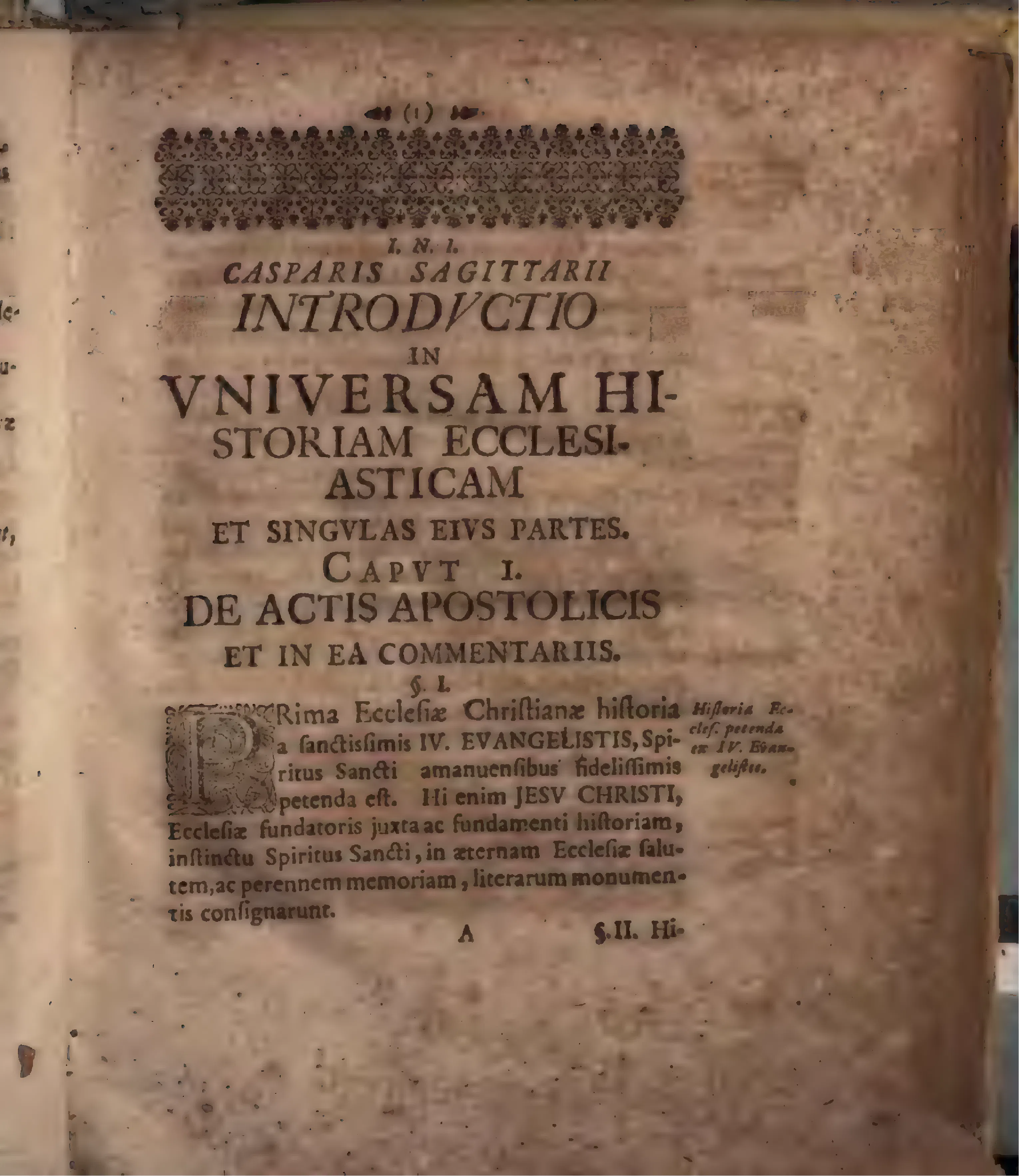
A foliate headpiece and ornate initial mark the opening of Caput I, “De Actis Apostolicis,” before any catalogue of commentators appears. The printed marginal cue “Historia Eccles. petenda ex IV. Evangelistis” and the appeal to the Evangelists' written monuments set the premise: ecclesiastical history begins in preserved texts. Source ↗.
Chapter II confronts the evidentiary silence after Paul's arrival at Rome, and does so by turning an archival deficiency into providence: the apostolic generation left little written as eyewitnesses, and perhaps this was not done without God's most holy providence, lest — as happened all too much in later ages — things written by men be more esteemed than things written by God, ut testes oculati, conceperint. Ac forte non sine sanctissima Dei id factum providentia, ne (qvod nimiùm contigit posterioribus seculis) plus æstimentur humanitus, qvam divinitus scripta. The theological consolation carries an anti-traditionalist edge, since the abuse it names — human writings preferred to divine — is precisely the charge Protestant controversy levelled at the authority of unwritten tradition. The silence of the sources thus becomes an argument, and the pseudepigrapha that rushed to fill it (Prochorus, Abdias, Linus, the Acta Pauli et Theclae) are dispatched under the rubric the chapter heading supplies, SUPPOSITITIIS SCRIPTORIBVS.
The Greek and Latin chronographers
In the long Byzantine chapter the register's discriminating work is done twice over, once lexically and once by exclusion. The court titles that clutter the Greek historians are translated into the vocabulary of Latin chancery practice, as when a career culminates in the office of grand logothete, that is, supreme chancellor, magnus demum Logotheta, hoc est, supremus Cancellarius evasit: — an equivalence that renders the Eastern administrative world legible to a German academic reader without which the prosopography would be unusable. The boundary of the chapter is then drawn by an explicit negative: Laonicus Chalcocondyles is passed over on purpose, because he is occupied as far as possible with Turkish affairs, however these were waged against the Constantinopolitan empire, nos id propter omissimus, qvia qvam maxime in Turcorum rebus, utut adversus imperium Constantinopolitanum gestis occupatur. Neither language nor period disqualifies him; subject-matter does. Inclusion is governed by yield for ecclesiastical history, which is why secular annalists of Constantinople are admitted while a historian of the Ottoman wars is not.
The hinge from East to West is given to Nicephorus Callistus, and the justification offered for treating him at all is a small sociology of reading: before descending from the East to the West, it seemed fair to say something of that notorious writer of ecclesiastical history to whom those commonly resort who know no better, or who are not at liberty to consult older writers, Prius ex Oriente qvam in Occidentem, & ab Ecclesia Græca ad Latinam descendamus, æqvum judicavimus aliqva afferre de Nicephoro, famoso illo Historiæ Ecclesiasticæ scriptore, ad qvem plerumque solent confugere, qvi meliores non noverunt, aut qvibus non est integrum vetustiores consulere. The diagnosis is material as much as intellectual: inferior authorities dominate because better ones are unknown or physically unavailable — the very penuria librorum the preface confessed. The Introductio exists to remedy that condition, which makes the demolition of Nicephorus's credit, secured with the verdicts of Beza, Daneau, and Casaubon, an act of bibliographical redirection rather than mere censure.
Among the Latin chronographers the criteria sharpen into recognisable humanist tests. Pseudo-Dexter is undone by anachronistic idiom, Selden's objection being that very many things are in it which do not savour of Dexter's age, plurima in eo esse, quæ seculum Dextri non sapiant; the argument is internal and stylistic, requiring no external testimony, and it is the same instrument that condemns the Spanish "Liutprand." Against that destructive test stands a constructive one, the appeal to unprinted witnesses, as where a manuscript copy of Regino is reported to survive in the imperial library, worthy to be compared with the printed texts, Manuscriptum exemplar in Bibliotheca Cæsarea exstat, dignum, qvod cum impressis conferatur. Collation is held out as an unfinished duty, and the register's function is to tell a future editor where the work remains to be done.
Toward the close of the medieval chapters the book permits its subjects to state their own standard. Engelhus's chronicle ends with an ancient plea, that the reader humbly be asked, if he finds things set down otherwise than truth holds, not to impute it to the author, for the true law of history is to commit to letters, for the instruction of posterity, those things gathered from common report, Lectorem suppliciter obsecro, ut si qva in his, qvæ scripsimus aliter, qvam se veritas habet, posita repererit, non hoc nobis impures; qvia vera lex historiæ est, simul ea, qvæ fama vulgante collegimus,. The Bedan formula defines historical fidelity as fidelity in transmission, not in verification — and it sits uneasily beside the severity the Introductio elsewhere applies to fabulists, so that the two conceptions of vera lex historiae confront each other within the register itself. Pius II's judgement on Blondus states the newer standard without mercy: Blondus was far from ancient eloquence, nor did he examine carefully enough what he wrote, for he took care not how true but how many things he wrote, Procul Blondus ab eloqventia prisca fuit; neqve satis diligenter, qvæ scripsit, examinavit: non qvam vera, sed qvam multa scriberet, curam habuit. The antithesis quam vera / quam multa is the fulcrum on which the whole register turns: copiousness is not erudition, and a compiler who does not weigh is not a historian.
The chronographers of the last age and of the present
The chapter on the previous century's chronographers applies that fulcrum to the Reformation's own historians. Sleidan's authority is vindicated by reducing his achievement to documentary transcription, Antonius Wollius reporting that he did almost nothing else than clothe in Latinity the reports, protocols, letters, and acts found in the Strasbourg archives, Sleidanus poene nihil aliud egit, qvam qvod relationes, protocolls, literas & acta, in tabulariis Argentoratensibus reperta Latinitate donaverit. What a rhetorical age might have counted as a diminishment is here the highest commendation available: the historian's invisibility before his documents is the guarantee of his truthfulness. The converse case is Laurentius Surius, in whom the register finds not scholarship but an incredible slanderousness and an immoderate itch for abuse, so that he is deservedly called by the illustrious Seckendorf, in the History of Lutheranism, blind and barking with canine rage, sed potius incredibilis maledicentia, & convitiandi pruritus immodicus: sic ut merito Illustri Seckendorfio in Historia Lutheranismi, (c) audiat, cæcus & canina latrans rabie:. The image of barking recurs from Schmidt's preface, where it described zealots within the orthodox camp; applied now to a Catholic continuator of Sleidan, it shows how readily the bibliographical mode passes into invective when confessional stakes are direct, and how the same vocabulary of rabies polices both sides of the divide.
The register's demand that compilers document themselves is finally turned on the Lutheran canon, in the regret that Melanchthon and Peucer too rarely named the writers from whom they drew, and the proposal of a source-index for the Chronicon Carionis. The movement then opens the century of the author's own teachers and contemporaries under a heading that promises a survey of the chronographers and writers of universal history of the present age, DE CHRONOGRAPHIS, ET HISTORIÆ VNIVERSALIS SCRIPTORIBVS PRÆSENTIS SECVLII, where the roll-call from Calvisius and de Thou to Petavius, Boxhorn, and Lambecius is set out as a programme — the register reaching the present at the moment when the death recorded in the preface arrested it.
Within that roll-call the unit is not an event but a man with a book, and the paragraph that contains him is built to a fixed pattern. Christoph Pezel is entered as a native of Plauen who was first cantor in his homeland, then doctor of theology and professor at Wittenberg, finally professor of the Bremen gymnasium, dead in that year, and who compiled a Mellificium Historicum on the plan of Sleidan's epitome of the four supreme empires, Christophorus Pezelius, PlaviaNariscus, primo in patria Cantor, postea Theol. D. & Prof. VVittebergensis, demum Bremensis Gymnasi Professor, anno ciciv. mortuus, Mellificium Historicum ad ductum Epitomes Sleidani de IV. summis Imperii congressit. Six elements are delivered in a single period — toponymic origin, ecclesiastical and academic cursus, death-date, title, and the authorising predecessor whose scheme the work inherits — and the last of these is the operative one for the register's purposes. A chronologer is placed not only in a biography but in a filiation: to write ad ductum Epitomes Sleidani is to accept the Danielic four-monarchy grid as the periodising armature of universal history, and the entry therefore doubles as a statement about which framework a student will encounter when he opens the book. The serial § numbering and the printed marginal labels that gloss each unit make the reader's use of the catalogue explicit; one does not read it through so much as consult it at the name one needs.
What gives this portion of the register its peculiar candour is that the compilatory genre is permitted to confess its own procedure. Of the Mellificium it is recorded that in the epilogue the author acknowledges that he assembled a patchwork rather than a thread of history out of various writers, according to the supply of books available to him, in cujus epilogo agnoscit Auctor, se centonem potius, qvam filum historiæ ex diversis scriptoribus adornasse, juxta copiam scriptorum sibi factam. The opposition of cento to filum historiæ is precise and unflattering: a cento is a poem stitched from another poet's verses, whereas the thread of history implies continuity and causal connection supplied by the historian himself. That the admission is reported without reproach, and with the mitigating clause about the copia scriptorum available to the author, shows the criterion the register actually applies to compilers — not originality but the honest declaration of dependence, coupled with an account of the material conditions under which the work was made. The same logic governs the notice of Matthäus Dresser, whose preface to Erik Sparre asks that a fault-finder first collate the matter with the authorities from which the several items were excerpted, aut cum authoribus, unde qvæqve decerpta sunt, contulerit; the plea is allowed to stand, with the qualification that Dresser sometimes followed authors of little standing. Responsibility for error is thus distributed along the chain of transmission, and the reader is instructed to test the compilation by recourse to its sources — the same demand for named authorities that the register makes throughout.
Confessional position is rarely argued in these entries; it is carried by a parenthesis. Orazio Torsellino's Loreto book is registered with the observation that he composed a history of the house of St Mary, translated, as the papists will have it, by divine agency from Galilee into Dalmatia and thence into Italy to Loreto, printed at Cologne and elsewhere, against which Matthias Bernegger set his Idolum Lauretanum, Tursellinus Historiam Lauretanam composuit, hoc est, Domus S. Mariæ, divinitus (ut volunt Pontificii) ex Galilæa in Dalmatia, ac inde in Italiam Lauretum translatae, Coloniæ anno & alibi excusam: cui Mathias Berneccerus Idolum Lauretanum opposuit. The bibliographical form is impeccably neutral — title, subject, imprint, controversial reply — and the whole judgement is lodged in the three words ut volunt Pontificii, which convert a miracle into a party opinion without the register having to adjudicate it in its own voice. Attaching Bernegger's refutation to the entry completes the operation: the student is told what the book claims, whose claim it is, and where the answer may be found, so that the bibliography itself discharges the polemical function.
Positive authority is conferred by the same means, through the letters of the learned. Sethus Calvisius' Opus Chronologicum is validated by a dossier of Scaliger's correspondence, including the compliment that by immense labour he has achieved this, that because he first seized this glory he alone possesses it, nor can anyone snatch it from him, Iam eximo labore id consecutus es, ut qvia primus hanc gloriam arripiisti, solus eam possideas; neqve qvisqvam tibi præripere eam possit. The vocabulary of primus, solus, and possidere is proprietary: glory in chronology is seized by priority and held exclusively, and the letter that says so, cited with its addressee, place, and date, becomes the documentary warrant for the work's standing. The register thereby records not only what a chronologer wrote but how his reputation was constituted within the republic of letters, treating a private letter as a citable instrument of judgement on a par with an edition.
The de Thou article turns from reputation to the external constraints on historical writing, and here suppression is entered as a bibliographical fact: we still do not have a complete de Thou, for the last part of the work, fearing the offence of the age, has hitherto been carefully suppressed either by the Thuanus heirs or by royal decree, and it is unknown whether it will ever come to light, Ceterum nondum habemus integrum Thuanum: nam operis pars ultima offensam seculi metuens, hactenus sollicite vel ab hæredibus Thuanis, vel ex decreto etiam regali fuit suppressa, nescio annon aliqvando proditura in lucem. The phrase nondum habemus integrum Thuanum states an incompleteness in the available corpus, not a defect in the author, and the alternative agents named — heirs acting from prudence, or the crown acting by decree — leave the mechanism of the loss undetermined while insisting that it happened. Placed in a recension that has already enumerated the Paris, Frankfurt, and Genevan printings, collations, and the Thuanus restitutus, the notice makes censorship one more variable in the transmission of a text, to be reported with the editions rather than deplored apart from them.
A conceptual pivot within the genre is registered in the notice of Boxhorn, whose letter to the reader is quoted for his purpose: his chief concern has been, passing over or merely touching in passing most of what is commonly known and everywhere available, to display above all the origins, that is, as it were the sources and causes, De proposito suo in epistola ad lectorem disserit, ex qva nonnulla afferam: Mibi id potissimum nunc curæ fuit, plerisque eorum, qvæ vulgo nota, & passim obvia, vel omisis, vel obiter tantum narratis, exhibere inprimis origines, hoc est, fontes veluti ac causas,. The programme sets itself against the very copiousness that the chronographic genre cultivates: what is vulgo nota is to be omitted, and the space thus freed given to origines, glossed by the double metaphor of fontes and causae, springs and causes at once. The ambiguity is productive, since fons is both the textual source from which a narrative is drawn and the origin of the thing narrated; a historiography organised around origins is simultaneously a historiography organised around documents.
Universal church history divided: the Centuries and the Annals
With the chapter on the Magdeburg Centuries the register turns from tables and epochs to the confessional history of the Church, and it begins by explaining the title as a description of method: they took this name from the fact that each book contains a hundred years, and so the deeds of each several century are had, hoc nomen inde acceperunt, qvod qvolibet libro centum anni, adeoq[ue] singulis singulorum seculorum res gestæ habeantur. The centuriating principle is thus presented as the innovation that produced both the structure and the name of the work, an organisational decision raised to the level of a discovery. The chapter then documents how the material for such books was actually procured, quoting Flacius' instruction to his travelling agent that in the common name he enjoins him to collect nothing bearing on history after the thousandth year from Christ's birth, Porro communi nomine injungit: ne qvicqvam colligat, qvod faciat ad historiam post millesimum a nato CHRISTO annum. The directive is a strategic calculation made in advance of the evidence: the first millennium is the terrain on which the argument from antiquity can be won, and the collectors are told, in the collective voice of the enterprise, not to waste labour beyond it. The fragility of what they gathered is registered in Spangenberg's letter to Marcus Wagner, where he readily believes that in that recent siege of Gotha, through the fury of the soldiery, even the most distinguished manuscript codices in Wagner's library were partly scattered, partly handed to Vulcan, partly carried off by force, Facile credo, inqvit, in ista proxima obsidione Gothana in Bibliotheca tua per militum furores etiam præclarissimos mss. codices partim dispersos, partim Vulcano traditos, partim vi ablatos. The tricolon distributes the loss into dispersal, burning, and plunder, and the periphrasis Vulcano traditos gives the fire a classicising dignity that does nothing to soften the point: the documentary base of church history is exposed to siege warfare, and a register of writers must therefore also be a record of what has been destroyed.
The answering chapter treats Baronius' Annales through their genesis in devotional practice, quoting his own account that when the whole of ecclesiastical history had already been gone through by him seven times in order of time over thirty years, it happened that, at the exhortation of friends and of his own accord, he began seriously to think of weaving together ecclesiastical annals, Sicqve cum jam sex lustris ipsa Ecclesiastica historia fuerit a me septies ordine temporum repetita, accidit, ut amicorum cobortatione, & mea sponte de Annalibus Ecclesiasticiis pertexendis serio cogitarem. The Oratory's repeated readings are thus credited as the matrix of the work, and pertexere, to weave to the end, claims exactly the continuity that the chronographic cento disclaimed. Against that self-presentation the chapter sets Casaubon's verdict that Baronius so conducted himself through all twelve tomes of his Annals that he would not have it doubted that his chief aim was to establish, amplify, and exalt to heaven the papal monarchy, Deniqve ita se gessit Baronius totus XII. suorum Annalium comis ut qvi dubitari nollet, præcipuum sibi scopum fuisse, Papalem Monarchiam stabulire, amplificare, & ad cælum usqve evebere. The rising triad of verbs answers the annalist's own claim to have merely woven what he read, and the point is reinforced by Baronius' reply to the Sicilian viceroy, that Peter has seen it, Peter has approved it, and fixed on this rock, indeed on this crag, he has no fear of being moved from his place or shaken, Petrus vidit, Petrus approbavit. Huic petra atqve adeo rupi infixus minime vereor, ne loco moveri, aut concuti possum — a sentence in which scholarly authority and papal jurisdiction are made one, and which the register cites not to refute but to let the identification speak.
The decisive move of the chapter, and the one most characteristic of the register's procedure, is to conclude the Baronian dossier with a Catholic witness against a Catholic continuator: Herwart von Hohenburg finds Bzovius not merely ignorant of affairs but destitute of every part of the historian's craft, and many openly so pronounce, for in him there is no skill in tracking the truth, no memory of what he has said as he proceeds, little diligence in writing, slight fidelity, and the greatest partisanship, Bzoviumqve non ignarum solum rerum, sed omnibus Historici partibus destitutum, non modo deprehendunt, Verum etiam palam complures censent: qvippe cui solertia verum indagandi nulla; memoria dictorum in progressu nulla; diligentia scribendi parva; fides exigua; affectus partium plurimus. The list is a negative definition of the historian's office — solertia verum indagandi, consistency, diligence, fides, and freedom from affectus partium — and it comes from within the communion whose annalist is under examination, so that the judgement appears as the verdict of criticism rather than of party. The five faults enumerated are precisely the virtues by which every writer in this stretch of the register has been measured, from the compiler who confessed his patchwork to the chronologer whose glory rested on priority alone.
From provinces and cities to monasteries and prelates
Bibliographical criticism does not pause at the level of place. The geographical descent carries the register through the churches of Italy — Venice, Padua, Verona, Milan, Ravenna, Naples, and the island sees of Sicily and Sardinia — where the writers of diocesan histories, civic chronicles, and Acta Sanctorum are graded by the question already put to the universal historians, whether their matter was drawn from the archives (ex tabulariis) or from fables. Rome occupies a space out of all proportion to the rest, as both the city's centrality to church history and the confessional stakes of its antiquities require: the basilicas, churches, cemeteries, and catacombs are documented out of Baronius, Bosio, Aringhi, Ciampini, Ciacconius, Panvinius, and Severanus, and the literature of Roma subterranea is registered as evidence for the practice of the primitive Church, with the excavations themselves treated as an evidentiary and not merely an antiquarian question. The survey then turns from place to institution.
The episcopal chapter that this portion takes up in mid-course proceeds by the strictest of alphabetical disciplines — Laon, Limoges, Liège, Lübeck, Lyon, Magdeburg, Mainz, Metz, on through Würzburg and the Northern sees — and each entry is built to the same specification: the diocese set in majuscules, its historians named with office and religious order, the imprint relegated to lettered footnotes. What prevents this from becoming a mere finding-list is the critical caveat that intrudes wherever the medieval succession-lists are transmitted. Of Placentius's catalogue of the bishops of Tongres the register observes that into this catalogue many things drawn from old wives' tales have been carried over, adding that Hubert Thomas of Liège nevertheless excuses him in the preface to his commentary on the Tungri and Eburones, on the ground that he handed down things just as he found them, At vero in hunc Catalogum multa ex anilibus fabulis relata sunt: qvo nomine tamen Placentium excusat Hubertus Thomas Leodius, in præfatione Commentarii de Tungris & Eburonibus: (b) eo qvod, uti repererit, ita & tradiderit. The sentence performs in miniature the distinction on which the whole compilation rests: anilibus fabulis condemns the matter, while the excusing clause preserves the compiler's integrity by separating transmission from warranty. A writer who reports faithfully what he found is not thereby a liar; he is a witness to a tradition, and the historian's task is to grade the tradition, not to suppress the witness. That is precisely the licence under which the register itself catalogues legendary and devotional literature — the recurrent parenthesis uti volunt Pontificii attached to miracle-reports at Halle in Hainaut, Loreto, and Maastricht is the same manoeuvre reduced to a formula.
Twice in the episcopal sequence the impersonal apparatus gives way to the compiler's own voice, and both intrusions are documentary rather than merely vain. Under Magdeburg he records that after he had composed, in the year '84, the Antiquities of the Archbishopric of Magdeburg, distinguished by very many never-before-published diplomas of Otto I and papal bulls, he afterwards composed with great labour and study — let it be said without boasting — a complete history of all the archbishops, Ipse etiam postqvam anno Lxxxiv. Antiquitates Archiepiscoparus Magdeburgensis, qvampiurimis nunqvam antea editis Occonis I. diplomastibus bullisque Pontificiis distinctam conscripsi, possea integram Archiepiscoporum omnium Historiam magno (qvod absqve jactantia dixerim) studio & labore composui. The parenthetical absqve jactantia is the standard modesty topos of the learned preface, but the credential it shields is evidentiary: unpublished Ottonian diplomas and papal bulls, the very species of document by which episcopal succession and jurisdiction are established or overturned. Immediately upon this follows one of the frankest statements in the register about the conditions under which learning reaches print, that since the most potent Elector of Brandenburg has long since most clemently permitted by special decree that this work be published, he will perhaps shortly record in a separate little writing what has hitherto delayed the edition, Hoc opus, ut in Iucem edatur, qvia Potentissimus Elector Brandenburgensis singulari decreto jam pridem clementissime permisit, qvid hactenus editionem moretur, peculiari forsan scriptiuncula brevi commemorabo. Privilege secured, press stalled: the promised scriptiuncula announces a grievance without stating it, and the reader is left to infer that the obstacle lies not with the censor but somewhere in the economy of the book trade. That such a notice stands inside the catalogue, and not in a preface, is itself characteristic — the material history of a book is treated as part of its bibliographical description.
The chapter on the religious orders and their houses brings with it the great annalists of the ordines monastici — Mabillon for the Benedictines, Wadding for the Franciscans, Bzovius, Orlandinus for the Jesuits — together with the polemical literature for and against them, and it commends, as it had commended the chronographers, the assembling of much that is worth knowing out of scattered authorities: who mixed together not a few things, and worthy of knowing, drawn from the various writers hitherto brought to light concerning them, qvi diversorum scriptorum de illis hactenus erutis non pauca, & digna cognitu miscuit. The monastic chapter defines its genre by the position of the writer rather than by subject matter, monastic chroniclers being those who narrate the house they themselves inhabited or governed while mixing in much other ecclesiastical and civil matter; that concession is what admits them to a general register at all. The chapter's long enumerations of German houses, drawn from Brusch and from Stengel's Monasteriologia and glossed with vernacular forms in parentheses, appear at first to be bare lists, yet even there the compiler's diplomatic criticism surfaces, as in the parenthesis on St Peter's in Erfurt, whose Dagobertine diploma he has demonstrated to be forged in his Thuringian Antiquities, S. Petri, in Erphurdia (cujus tamen Diploma Dagobertinum in Antiqvitatibus Thuringicis confictum esse demonstravi:). A single relative clause inserted into an alphabetical run cancels a foundation charter; the enumerative form is thus never neutral, since every name in it carries, potentially, a verdict.
The pivot from place to theme: emperors and pontiffs
The decisive structural turn arrives when the geographical descent — province, diocese, city, monastery — is declared complete and a thematic principle substituted for it: now it is his intention, with Almighty God favouring, to proceed further and to show particularly who have illuminated certain specific heads of ecclesiastical history, Nunc animus est, Deo Opt. Max. favente, pergere ulterius, ac singulariter ostendere, qvinam certa aliqva Historiæ Ecclesiasticæ capita illustraverint. The pious formula does real architectural work, converting a topographical survey into the set of capita to which, as the reduction quoted earlier announces, the various heads of the history may be brought back — emperors and kings of Germany first, then Roman pontiffs, heretics, councils, doctors and ecclesiastical writers, rites and ceremonies. The ordering is not indifferent. Placing the emperors ahead of the popes states a priority of jurisdiction before any argument is made, and setting the heretics third, in advance of the councils, reproduces the polemical architecture inherited from the Lutheran centuriators, in which the definition of error precedes the assemblies convened to define it.
Within the imperial chapter the register defends the very class of source it is obliged to catalogue. Quoting Hadrianus Valesius with approval on the Frankish annalists, it holds that we owe much to those dry and arid writers, because according to the measure of their mediocrity, and as those times bore, they composed annals of some sort, and what they had received from their elders they handed down to posterity as it were from hand to hand, compressed into an epitome, and left us not a few things worthy of record, Multum jejunis istis aridusqve scriptoribus debemus, qvod pro captu mediocritatis sux, & ut illa ferebant tempora, Annales qvalescunqve composuerunt, & qvæ ex majoribus natu acceperant, utcunqve in epitomen coacta posteris velut per manus tradiderunt, nobisqve haud pauca memoratu digna reliqverunt. The image of transmission velut per manus makes the value of a source independent of its eloquence: what the annalist contributes is a link in a chain of custody, and the criterion of judgement shifts from style to fidelity of conveyance. Against this general licence stands the highest evidentiary grade, personal inspection of an original, which the compiler claims sparingly and with full circumstantiation: the very autograph of Thietmar, in which however some leaves have been cut away at the beginning, is kept in the Dresden archive, and in the year '76 the most distinguished man Anton Weck, Electoral Secretary, showed it to him, Ipsum Ditmari avtographum, in qvo tamen ab initio aliqvot folia resecta sunt, habetur in archivo Dresdensi, mihiqve anno LXXVI. commonstravit Vir Amplissimus, Antonius Weckius, Electoralis Secretarius. Date, repository, named intermediary, and even the physical mutilation of the opening leaves are supplied, so that the claim of autopsy can itself be tested.
The chapter on individual emperors converts these principles into open controversy. Constantine's dossier gathers the whole exposure-literature of the grant to Sylvester, always hedged by ut volunt, and issues its sentence on this fictitious and fabricated donation, Fictitiam commentitiamq[ue] hanc Donationem. The Henry IV entry is more instructive still, because there the compiler must defend a Protestant scholar against a charge of forgery rather than bring one. Noting how many ancient editions of the little book survive, he remarks that it is astonishing what came into Cardinal Baronius's mind in suspecting that Reineccius had first invented it, from which suspicion Heinrich Meibom the Younger has recently vindicated him excellently, Tot igitur hujus libelli vetustas cum habeamus editiones, mirum qvid Baronio Cardinali in mentem venerit, suspicanti, ac si Reineccius eundem primum sit commentus: a qua suspicione egregie nuper Reineccium vindicavit Vir summus, Henricus Meibomius Iunior, in Introductione ad Historiam Saxonicam. The rebuttal is conducted entirely through the history of the printed transmission: an enumeration of early impressions, not an argument from content, disposes of the imputation, so that the press itself becomes the guarantor of authenticity. The same entry then enlists a Catholic-trained philologist of unimpeachable standing, transcribing Casaubon's judgement that of all the writers contained in the volume none is in any respect to be compared with the author who described the life of that greatest prince, the Emperor Henry IV, and that in the little book he knows not what to admire first, the elegance of style astonishing for those times, or the weight of the sentiments, or the piety which was immense in that author, Ex omnibus scriptoribus, qvi hoc volumine continentur, nullus conferendus ulla ex parte cum eo. qvi vitam maximi Principis Imp. Henrici IV. descripsit. Qvo in libello qvid prius admirer, nescio: elegantiam sermonis illis temporibus stupendam; an sententiarum gravitatem; an pietatem, qvæ fuit ingens in eo auctore. Praise of the antagonist of Gregory VII, delivered in another's voice and on purely literary grounds, reinforces a reading of the Investiture Contest without arguing it; and the compiler draws the pedagogical conclusion at once, that the eulogy of so great a man ought deservedly to rouse studious youth to read this writing through with care, Qvod tanti viri elogium merito excitare deberet Iuventutem Studiosam, hoc scriptum cum cura ut perlegat. The register is here unmistakably a reading programme for an academic audience, assigning texts as well as grading them.
The papal chapters open with a summary verdict on the biographers, that very many have written on the lives of the Roman pontiffs, but few accurately enough, De vitis Pontificum Romanorum plurimi scripserunt, sed pauci satis accurate; and the exceptions to that stricture include a Catholic antiquarian commended without reserve as Onofrio Panvinio of Verona, Augustinian, a man most deeply versed in ecclesiastical antiquity, Onuphrius Panvinius, Veronensis, Augustinianus, vir in antiquitate Ecclesiastica versatissimus — the approval of the antiquarian's competence carrying, as ever in this register, no endorsement of the conclusions he drew from it. The same criticism is then applied to the foundational document of pontifical history. Dislodging the attribution of the Liber Pontificalis to Damasus, the argument proposes that it is exceedingly probable that the work took its origin and growth from various catalogues of the Roman pontiffs, according to the varying fortune of the times and the ingenuity of the interpolators, Ex variis igitur Pontificum Romanorum Catalogis, pro varia temporum sorte, & interpolatorum ingenio, ortum & incrementa accepisse, vero admodum est simile. The reasoning is philological — accretion from multiple catalogues, growth conditioned by circumstance — while the single word interpolatorum carries the confessional charge, since a succession-list that grew by interpolation cannot serve as an unbroken title-deed. From this the sequence moves through Anastasius, Liudprand, Bonizo, and Platina, whose imprisonment and fetters under Paul II are recounted at length, to the terminal statement of what the whole apparatus has been assembled to decide: the two questions, noticed above, agitated in controversy between the author's party and the Papists, whether Peter was ever at Rome, and whether he was bishop of the city and so the first of the Roman pontiffs. The formulation is exact in its division of labour: one question of fact about residence, one of office and order of succession, each answerable by testimony and each severed from the dogmatic claim of primacy it would otherwise be asked to support. The catalogue of writers, having descended from provinces to cities to cloisters and then reassembled itself under thematic heads, arrives at the point where bibliography and controversy are no longer distinguishable, and where the only admissible arbiter remains the criticism of documents.
The alphabetical heresiology
The alphabetical heresiology works by a template so regular that its departures become the most informative thing about it. Each section opens with an eponymous derivation, proceeds to a résumé of doctrine cast almost entirely in indirect discourse, marshals the patristic witnesses by book and chapter, and closes with a notice of recent monographs whose imprints are relegated to footnote letters. The close of the Arminian section already displays the etiological interest that governs the rest: party names are treated as historical events with documentary causes, since his disciples and followers, because they presented a writing under the name of a Remonstrance, were called Remonstrants, against whom others, who tendered a Counter-Remonstrance, received the name of Contra-Remonstrants, Ejus discipuli & sectatores, qvia sub nomine Remonstrantiæ scriptum promiserunt, Remonstrantes dicti sunt: contra qvos alii, qvi Contra-Remonstrantiam obtulerunt, Contra-Remonstrantium nomen acceperunt.. A confessional label is here derived not from a founder's person but from a submitted text, which is precisely the move a notitia scriptorum is built to make: the history of a sect is accessible because the sect produced writings, and the counter-sect is named from its answering document. What follows in the same entry is not refutation but bibliography — Hoornbeek's aphorisms, his Summa controversiarum, the three-volume Socinianismus confutatus whose last volume appeared after the author's death, Hottinger of Zurich on the fates of the doctrine of predestination, and, expressly ex Nostratibus, Nicolaus Hunnius — so that the reader is handed a reading list with the state of each undertaking noted, including posthumous completion.
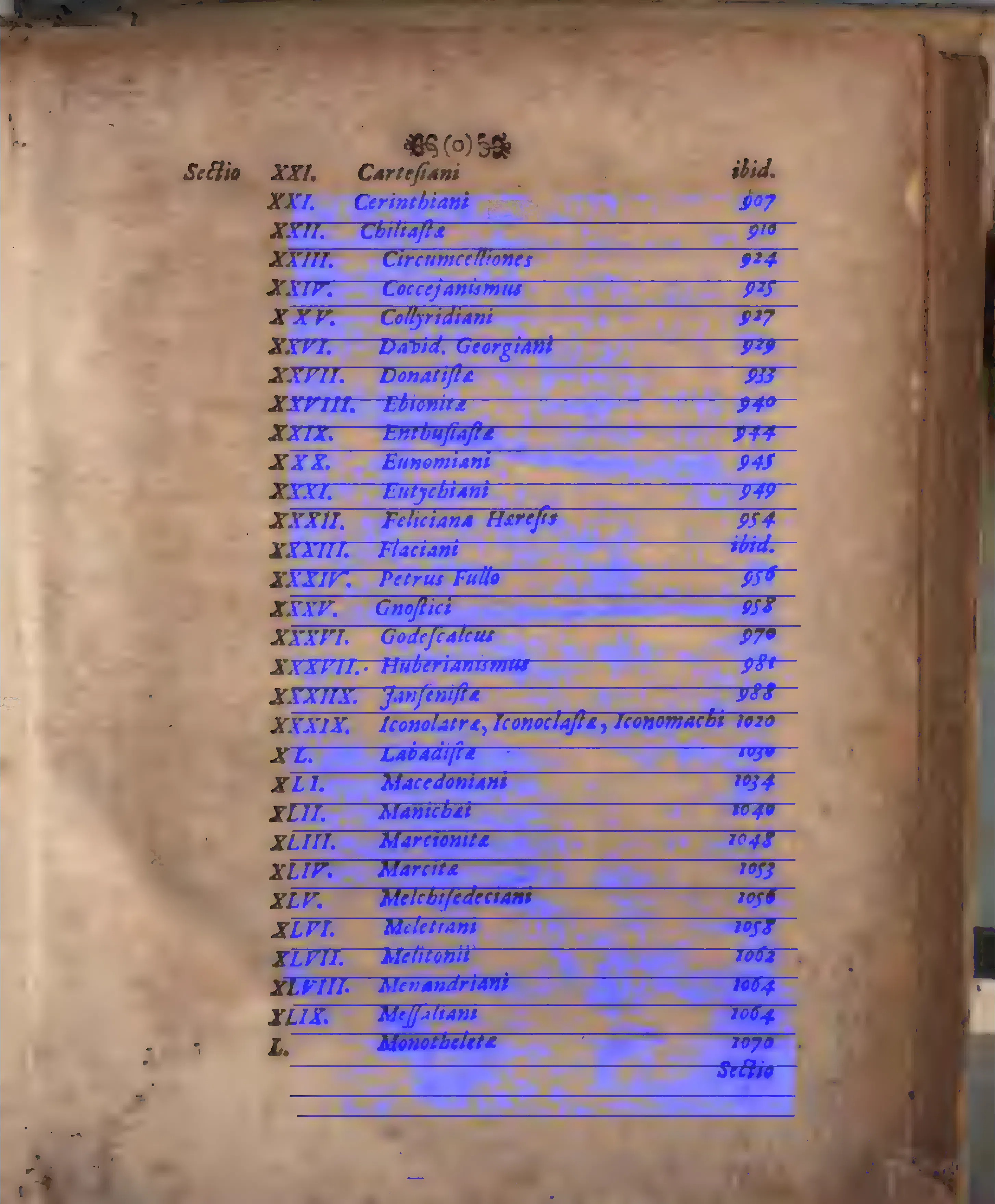
This leaf of the printed chapter table compresses the alphabetical heresiology into one sequence, setting Cartesiani, Coccejanismus, Jansenistae, and Labadistae beside Circumcelliones, Donatistae, Eutychiani, and Gnostici. It also records the book's making: Manichaeai fixed as §XLII, and §XXXIX assigned twice — the numbering error the printed corrective flags. Source ↗.
The ancient entries apply the same instrument to claims about tradition. Artemon's characteristic argument was an appeal to unbroken prior preaching, and in support of this he boasted, on the testimony of Eusebius in book five, chapter twenty-eight, that for all the years down to Victor at any rate it had been preached just as they themselves maintained, proqve eo teste Eusebio lib. V. cap. XXVIII. jactavit, omnes sibi annos usqve ad Victorem qvidem, ita fuisse prædicatum, qvemadmodum ipsi asseruerint.. The verb jactavit marks the assertion as vaunting rather than demonstration, and Eusebius is then credited with refuting this most impudent vanity and with placing Artemon among those whom the Apostle called the likes of Hymenaeus. The structure of the case is the structure of the confessional disputes the work elsewhere confronts: a claim of antiquity and continuous transmission met by an appeal to a historical witness who can be dated and cited. Heresy, on this account, is characteristically an argument about the past, and it is defeated by better philology rather than by anathema.
The Beguard section shows how far the register will go in reproducing documentary evidence drawn from the adversary's own archive. The eight errors are quoted from the Clementines, that is, from papal canon law, and the third is the hinge of the whole indictment: that those who stand in the aforesaid degree of perfection and in the spirit of liberty are not subject to human obedience nor bound by any precepts of the Church, because, as they assert, where the Spirit of the Lord is, there is liberty, III. Qvod illi, qvi sunt in prædicto gradu perfectionis, & spiritu libertatis, non sunt humanæ subjecti obedientiæ, nec ad aliqva præcepta Ecclesiæ obligantur: qvia, ut asserunt, ubi spiritus Domini, ibi libertas.. The interposed ut asserunt is doing careful work: the Pauline text is left in the mouths of the accused, so that the scriptural warrant is neither conceded nor contested but attributed. Perfectionist antinomianism, with its corollary that fasting and prayer cease and the body may be granted whatever pleases it, is thereby documented in the vocabulary of a Roman juridical condemnation which a Lutheran compiler can use as evidence without adopting its jurisdiction. The section then executes a taxonomic correction by the same evidentiary logic: those who wish to number them among the Waldensians are refuted not only by these depraved doctrines but also by this argument, that Peter Zwicker, provincial of the Celestines, who flourished in 1415, in a little book against the Waldensians distinguishes them in express words from the Beguards and holds the Waldensians to be far worse than the Beguards, Qvi volunt eos Waldensibus adnumerare, non solum his pravis dogmatibus, sed & hoc argumento refelluntur, quod Petrus Zwicker, Coelestinorum Provincialis, qvi an. CICCCXV. florebat, in libello contra Waldenses, illos a Beguardis disertis verbis distingvat, & Waldenses Beguardis longe pejores esse statuat.. Two orders of proof are explicitly distinguished — doctrinal incompatibility and the testimony of a hostile contemporary — and the witness chosen is an inquisitor of the Waldensians, whose very animus makes his differentiation of the two groups probative. That the same hostile source rates the Waldensians the worse of the two is reported without embarrassment, although Protestant historiography had an interest in the Waldensian pedigree; the citation is allowed to say what it says.
That interest surfaces immediately afterward, handled with modal restraint. Of the Bohemian Brethren the entry says only that they are said to be remnants of the Hussites, though they may perhaps have an older origin, Hos Hussitarum reliqvias esse dicunt, licet vetustiorem originem forte habeant.. The impersonal dicunt quarantines the received genealogy as opinion, while forte keeps open the possibility of a deeper antiquity — a question of consequence, since a pre-Hussite descent would furnish evidence of continuous witness against Rome. The claim is not pressed; the reader is instead directed to Lasitius, Aeneas Sylvius, Cochlaeus, and Comenius, with the Constitutions of Ferdinand II against the Brethren appended, so that the apologetic and the persecutory records stand side by side.
The chiliast section is the most exacting test of the method, because the doctrine is held both by revered Fathers and by the author's own communion. The solution is a distinction between the Church's opinion and its dogma: meanwhile the teaching of both Justin and Irenaeus was drawn from nothing more than the opinion of the Church, which does not prevent either of them, and Irenaeus especially, from refuting the chiliasm of the Jews, Interea vero tam Iustini, qvam Irenæi dogma non nisi ex Ecclesiæ opinione ductum est: qvod non impedit, quo minus Iudæorum Chiliasmum uterque, & præsertim Irenæus, refellat.. Patristic authority is thus neither invoked to license the doctrine nor discarded: what the Fathers held is classed as opinio, historically conditioned and separable from their polemical competence, and a further partition isolates a Jewish millenarianism which those same Fathers opposed. The ancient error having been graded rather than simply condemned, the entry turns to the recent past and does not spare the author's own side: so too in our own age certain men, and these indeed from among our own, have undertaken to assert those thousand years anew, Sic quoque nostro ævo aliqvi, & hi quidem ex Nostratibus, mille illos annos rursus asserere aggressi sunt.. The phrase ex Nostratibus, used earlier to introduce a Lutheran refuter of the Arminians, now designates Lutheran chiliasts, and the fault charged against Piscator and Alstedius is exegetical rather than merely doctrinal — that they referred passages of the Apocalypse intelligible only of the Church militant to the Church triumphant. Diagnosis by misapplied hermeneutics, followed by the bibliography of Schade and Jäger, keeps the verdict inside the register's competence.
The Donatist section grounds schism in passion rather than doctrine: they took their name thus from Donatus, who, being deacon of the church of Carthage, out of envy against Caecilianus, bishop of Carthage of that same church, formed a conspiracy against him and the rest of the Catholics and began to rend and disturb the Church in the year 311, Ita nomen accepere ab Donato, qvi cum Ecclesiæ Carthaginensis Diaconus esset, ob invidiam adversus Cæcilianum, ejusdem Ecclesiæ Episcopum Carthaginensem, contra eum & reliqvos Catholicos conjuratione facta, Ecclesiam scindere & turbare coepit anno CCCXI.. Invidia and conjuratio are the vocabulary of faction, and the ensuing narrative is institutional and legal — councils at Carthage, in Illyria, and at Arles, an appeal to Constantine turned to abuse when the case went badly, the armed bands of the Circumcellions, and the imperial edicts partly preserved in the Theodosian Code. The entry then becomes frankly bibliographical: the errors compiled from Augustine by Daneau, Chamier's countervailing attempt to acquit the Donatists of several dogmas imputed to them by Augustine, the six books of Optatus of Milevis first published by Cochlaeus and then annotated by Balduinus and by Albaspinaeus from a royal codex with a disputed seventh book, and finally the full catalogue of Augustine's anti-Donatist titles. An ancient African schism is thus handed to the student as a problem in edition history and attribution, with a Reformed scholar's revisionist reading registered rather than suppressed.
One section breaks the eponymous pattern altogether and so exposes the compiler's own hand in the taxonomy: by this name we understand all those who, vaunting dreams and visions and other phantasms, boasted that they had obtained revelations from God and held conversations with him, Hoc nomine intelligimus eos omnes, qvi jactatis somniis & visionibus, ac aliis phantasticis, se divinitus revelationes impetraffe, ac cum Deo colloqvia habere, jactitarunt [reading uncertain]. Fanatici has no heresiarch and no dated origin; it is a class constructed by the historian, defined by a claimed mode of access to revelation, and populated entirely by modern bibliography — Hoornbeek on enthusiasts, Kortholt's history of them, Faber on enthusiastic spirits, Fecht on the Erfurt colloquy. The adjacent section on the Flagellants supplies the medieval counterpart, its doctrines diagnosed as substituting the outpouring of the penitents' blood for the power of Christ's, treating scourging as baptism and laver, and so rendering the sacraments, confession, and absolution superfluous — a sequence in which the error is traced to a soteriological displacement rather than to a personal founder.
The Gnostic section discloses the cost, and the management, of alphabetical order. The name itself is made the charge: these heretics were so called from the fact that they laid claim to knowledge as something proper to themselves and not shared with others, though they falsely attributed it to themselves, Sic isti hæretici dicti, ex eo qvod prætenderent cognitionem, tanqvam sibi propriam, & aliis non communem: cum tamen falso illam sibi tribuerent:. Refutation is folded into the etymology, and the entry then reassembles under one head the Simonians, Nicolaitans, Menandrians, Saturnines, Carpocratians, Cerdonians, Valentinians, Basilidians, Cainites, and Ophites whom the alphabet has scattered across separate sections, with Cave, Ittig, and Grabe's prolegomena to Irenaeus supplied for the genealogy. Alphabetical arrangement, convenient for consultation, dissolves filiation; the Gnostic entry restores it by cross-reference, as the Helvidian, Heracleonite, and Hieracite sections restore the exegetical and ascetic grounds of their several errors, and as the sections on the Hussites and the Iconoclasts reduce vast controversies to the handful of historians in whom they may be studied.
Read a second time for what it does with jurisdiction rather than with names, the stretch of the lexicon running from the Arminian controversy to the Chiliasts puts the register's method under its heaviest pressure, because here the objects of classification are not long-dead sects but living confessional parties whose partisans were still publishing. The Arminian article, whose nomenclatural opening has already been noticed, begins not with doctrine but with the record of how the dissenters offered a petition to the States, and, since they had given it the name of a Remonstrance, were thereafter called REMONSTRANTS from it, ac Ordinibus suplicem libellum offerebant: cui cum Remonstrantiæ nomen imposuissent, ab eodem postea REMONSTRANTES fuerunt appellati. The observation is philological before it is polemical: the eponymous labels Arminiani and Gomaristae, which derive a party from a professor, are displaced by a name generated out of a procedural act of petition to a civil magistracy. That the compiler notices the displacement is itself characteristic, since the same nomenclatural attention governs the last article in this run, where the competing patristic and medieval designations for the millenarian error are catalogued before any of its tenets are described. Naming, in this lexicon, is a datable event with documentary evidence behind it, and the historian's first task is to establish which name belongs to which document.
The narrative of the Synod of Dordrecht is then compressed with remarkable economy into a single judgement about what a synod did, in which not only was the dogma of the absolute decree established and confirmed, but also the dissenting Remonstrants were removed from their places, while certain politicians favouring Remonstrantism, though under other pretexts, were in part punished capitally, in qva non modo de absoluto decreto dogma stabilitum ac confirmatum, verum etiam, dissentientes Remonstrantes loco moti, Politici autem quidam Remonstrantismo faventes, sed sub prætextibus etiam aliis, partim plexi capite. The doctrinal and the disciplinary are yoked by a non modo … verum etiam that makes deposition and execution the continuation of dogmatic definition by other means, and the parenthetical sub prætextibus etiam aliis does the insinuating work: the capital sentences were nominally for other causes, but the compiler's syntax places them inside the synod's achievement. Conviction that the trials were confessional in substance is thus conveyed without an assertion that could be answered, a restraint that the register practises elsewhere by attributing hostile characterisations to their authors and prefacing them with a conditional of credence rather than adopting them.
A period engraving, whose source records variously title it the opening of the Synod of Dordrecht in 1618 and the Donation of Constantine, accompanies the register's compressed verdict on Dordrecht — doctrine confirmed, Remonstrants deposed, and sympathetic politicians punished as parts of one confessional event. Source ↗.

The procedural heart of the entry is the Remonstrant refusal of the synod's jurisdiction, reported in the vocabulary of forensic disqualification: when the Contra-Remonstrants declared through the mouth of their President that they had assembled not to confer but to judge, these men, premising a protest that they could not acknowledge as a lawful judge of controversies a synod consisting for the most part of enemies who had already condemned them, prepared to set forth and defend their own opinion, At cum se, non ad conferendum, sed ad judicandum convenisse, Contra Remonstrantes, Præsidis sui ore dicerent, hi præmissa protestatione, qvod Synodum, utpote maximam parrem ex hostibus constantem, qvi se jam ante damnassent, pro legitimo controversiarum judice non possent agnoscere. The antithesis conferre / judicare names the whole constitutional quarrel: a colloquy presumes parity and revisable formulas, a tribunal presumes a completed norm and a defendant. The Remonstrant recusatio — that judges already parties cannot be legitimus judex — is a maxim of civil procedure imported into ecclesiastical assembly, and it is precisely on this terrain that the compiler, a Lutheran writing about a quarrel internal to the Reformed, can intervene without pronouncing on predestination at all. The sequel is recorded in the same register of jurisdiction rather than of doctrine, with the sentence executed by the officers of the States and the deposed ministers conveyed beyond the frontiers of the confederated provinces in carriages after eight months' detention, so that synodal judgement is visibly enforced by the secular arm.
That is why the Lutheran compiler's own verdict, when it comes, is framed as a legal rather than a theological objection, observing how unjustly, and contrary to the laws of a free synod as these are reported by the Reformed themselves, the Remonstrants were dealt with, as has already been shown by others, Qvam iniqve vero & contra liberæ Synodi leges, qvatenus ab ipsis Reformatis feruntur, actum cum Remonstrantibus fuerit, jam ab aliis est ostensum. Two devices of the register's confessional restraint operate together in one sentence. The standard applied is the adversary's own — liberae Synodi leges, qvatenus ab ipsis Reformatis feruntur — so that the sentence is delivered out of Reformed synodal law rather than out of Lutheran conviction; and the demonstration is credited to others, jam ab aliis est ostensum, which converts a partisan charge into a bibliographical report on an existing literature. The same manoeuvre licenses the surrounding catalogue of anti-Remonstrant polemic, divided between works ex Reformatis and works ex Nostratibus, in which the compiler's declared willingness to find Arminius's doctrine, once stripped of Socinian admixture, largely concordant in fundamento with Lutheran teaching sits beside his protest at the procedure. Bibliography here is not an appendix to the judgement; it is the form the judgement takes.
The alphabetical grid then absorbs the contemporary Catholic world on identical terms. Antoine Arnauld's thesis of Petrine and Pauline parity is introduced with the announcement that a new sect has not long since emerged among the papists, presenting to us a two-headed visible Church, Nova non ita pridem secta inter Pontificios emersit, bicipitem visibilem Ecclesiam nobis sistens. The classification is doubly aggressive: secta applies the vocabulary of ancient schism to a quarrel internal to the Roman communion, and the monstrous epithet biceps turns the two-headed visible Church into a portent, the teratological idiom in which heresy had been described since Irenaeus. What follows, however, is not invective but a dossier — French titles with Latin renderings, the Jesuit respondents, the papal bull, and an academic disputation on Arnaldismus — so that the sect exists in the register chiefly as a bibliographical cluster.
Contemporaneity becomes explicit in the article on the atheists, whose long survey of practical and speculative unbelief opens onto the compiler's own present. He interrupts the catalogue to report that since yesterday — and he writes this, he says, on 17 January of the incoming year 1695 — it had become known through the weekly newspapers what had been done at Berlin with this writing and its author, Interea qvoniam heri (hæc scribo xvii. Ianuarii anni ineuntis ciclic CXCV.) per novellas hebdomadarias. Two kinds of temporality collide in the sentence: the alphabetical, atemporal order of the lexicon, in which Basilides and the Cartesians are equally available as headings, and the dated, perishable knowledge of the novellae hebdomadariae, which enters the compilation as a source with the same standing as a conciliar act. The proceedings against a clandestine atheistic writing prompt a complaint about the trade that circulates such things, that he greatly wonders the utterly reckless licence of certain printers and booksellers greedy for base gain is not restrained with greater rigour, id tamen impense miror, turpiluericupidorum qvorundam typographorum ac bibliopolarum licentiam summe temerariam majori rigore non coerceri. Heresy is diagnosed as a condition of the book market: its vector is the press, its motive turpe lucrum, and its remedy magisterial rigor, a remedy immediately personified in the encomium of the Elector of Brandenburg's religious care that follows. The register's candour about the conditions of learning thus turns, at this point, into an argument for their regulation.
The medieval articles show the same instruments applied to older evidence. The Berengarian dossier assembles Lanfranc, Guitmund, Adelmann, and the successive synods, and its centrepiece is the recantation itself, given verbatim as beginning thus: I, Berengar, believe in my heart and confess with my mouth that the bread and wine which are placed on the altar are, through the mystery of the sacred prayer and the words of our Redeemer, substantially converted into the true and proper and life-giving flesh and blood of our Lord, Initium ejus tale: Ego Berengarius corde credo, & ore confiteor, panem & vinum, qvæ ponuntur in altari, per mysterium sacræ orationis, & verba nostri Redemptoris substantialiter converti in veram & propriam ac vivificam carnem & sangvinem Domini nostri. The formula is transcribed with its incipit flagged as such, in the manner of a documentary source, and then at once qualified by the judgement that it is highly probable he acted under compulsion — a critical observation about the evidentiary value of extorted subscription which is, in effect, the same point urged against Dordt's demand for signature by oath. The coerced confession is quoted in full precisely so that its authority can be measured against the circumstances of its production.
The article on the Böhmists carries that criticism into a living movement. Beneath the social condescension with which the Görlitz cobbler and idiota is introduced, and beneath the reported verdict that the Aurora is understood by nobody, not even by its author, the decisive move is a demand addressed to the disciples rather than to the master: if that is so, why do the Böhmists not agree in distinguishing the genuine from the spurious, Qvod si ita est, cur non conveniunt Böhmistæ in discernendis genuinis & supposititiis?. The terminology of genuinum and supposititium, elsewhere deployed against apostolic pseudepigrapha, is turned upon a corpus barely two generations old, and made the precondition of any ecclesiastical verdict: until the canon is settled, the doctrine cannot be judged. Criticism of texts precedes censure of persons.
The same discipline produces the notably moderate close of the run. The Chiliast article insists that a careful distinction be made between those who asserted a carnal and corporeal kingdom and those who held it visible yet spiritual and free of all carnal pleasure, and on the strength of that distinction it can enlist Jerome's refusal to condemn, that though we do not follow these things, we cannot condemn them, because many churchmen and martyrs said them, and let each abound in his own sense, and let all things be reserved to the Lord's judgement, Qvæ licet non seqvamur, damnare tamen non possumus, qvia multi Ecclesiasticorum Virorum, & Martyrum, ista dixerunt, & unusqvisqve in suo sensu abundet, & Domini cuncta judicio reserventur. A lexicon of heresies here reaches the limit of its own genre and marks it: where the tradition itself abstained from anathema, the register abstains, and the deferral of sentence to the Lord's judgement stands as the counterweight to the alphabetical machinery that had just placed Arnauld, Descartes, and Jacob Böhme in the company of Basilides.
Frequently Asked Questions
What is Kaspar Sagittarius's Introductio in historiam ecclesiasticam?
It is a Latin guide to ecclesiastical history that is also a critical register of the writers through whom that history can be known. Its subtitle calls it a notitia scriptorum — a learned account of writers — and it surveys ancient and recent authors, their editions, manuscripts, epitomators and continuators, judging each genuine or spurious, annalistic or fabulous, honest about his sources or silently concealing them. Its order descends from universal church history through kingdoms, provinces, cities, monasteries, bishops, emperors and popes to an alphabetical treatment of heresies.
Who was Kaspar Sagittarius, and when was the work printed?
Caspar or Kaspar Sagittarius (23 September 1643, Lüneburg – 9 March 1694, Jena) studied at Helmstedt, took his doctorate at Jena, and from 1675 held the Jena chair of history. The bibliographical record associates the Introductio with 1694, the year of his death, while the securely documented witness is the two-volume Jena edition of 1718, edited by Johann Andreas Schmidt and printed by Johann Felix Bielckius. Whether a separate 1694 issue circulated remains unresolved; no independent catalogue record for one has been traced.
Why does the book quote Catholic scholars against Catholic texts?
Because letting the adversary's own authorities deliver the verdict makes the judgement look like philology rather than party feeling. Condemning the early pseudepigrapha as supposititious and apocryphal, the register observes that not even the Catholics themselves dared deny it, naming Baronius in the Annales Ecclesiastici, Bellarmine on ecclesiastical writers, Sixtus of Siena in the Bibliotheca Sacra, and Melchior Cano in the Loci Communes. The same restraint runs through the book: the complaint that Melanchthon and Peucer too rarely named their sources falls on Lutheran authorities with equal weight.
Is it true that the section on the Manichaeans was dictated on Sagittarius's deathbed?
The editorial narrative transmitted with the text carries such an account in Johann Andreas Schmidt's own voice: visiting his dying colleague early one morning, he describes him at the section on the Manichaeans, hand and foot no longer serving and eye and ear serving poorly, yet with his mind's full powers setting the last hand to it by dictation. The story is demonstrably present in the work's preliminary matter, though it does not settle the bibliographical questions about an earlier issue, its privilege, or its dated subscriptions.
Is there an English translation of Sagittarius's Introductio in historiam ecclesiasticam?
No complete translation into English, German, French, or any other modern language has been identified; the catalogue records describe the 1718 Jena volumes as Latin books, and the French translation reported for Sagittarius's Nucleus historiae Germanicae should not be transferred to this work. Separately, the Leo edition presents the full transcription together with a complete English translation for the first time. That translation is generated by AI. Leo is an effort to make freely available online, at no cost, English translations of every text printed in Latin in early modern Europe between 1450 and 1750.
This report was generated by an advanced AI assistant that conducted deep research alongside an extensive interpretation of the transcribed original text. Every effort has been made to preserve fidelity to the source and to guard against inaccuracy, but corruption in the text recognition process and model hallucination may nonetheless have entered the text. Treat every claim, quotation, translation, and citation as provisional, and verify each against the original source before relying on or citing it.
Further Reading on Sagittarius, Confessional Historiography, and Learned Bibliography
- Irena Backus, Historical Method and Confessional Identity in the Era of the Reformation (1378–1615): The indispensable framework for reading Sagittarius's register as confessional criticism rather than neutral antiquarian stocktaking, since Backus shows how patristic citation and source evaluation were never separable from the confession of the man doing the citing. Her account clarifies exactly what Sagittarius is doing when he lets Baronius and Bellarmine deliver the verdict on Catholic forgeries, and it supplies the measure against which his claim that critical church history was born out of the Lutheran conflict can be tested.
- Anthony Grafton, Defenders of the Text: The Traditions of Scholarship in an Age of Science, 1450–1800: Grafton explains why forgery and philology grew up together, which is precisely the culture in which supposititius, apocryphus, autographum, and interpolatores function as arguments rather than adjectives. It is the natural companion to a register in which a writer may be praised for style and arrangement and condemned in the same sentence for having befouled historical truth with many fables, ac veritatem historicam multis conipurcavit fabulis.
- Herzog August Bibliothek, The Historical Method and Working Process Used for the Magdeburger Zenturien: A digital research project on the institutional machinery behind the Centuries — the chronological division by centuriae, the theological headings, and the network of collectors and correspondents who fed it. Read it alongside Sagittarius's own transcription of the Magdeburg workshop's three ranks of ten workmen, which he reproduces as though describing a factory floor, because that is roughly what it was.
- G. B. Lyon, "Baudouin, Flacius, and the Plan for the Magdeburg Centuries," Journal of the History of Ideas: Lyon reconstructs the planning documents behind the first Protestant church history and shows how collection, selection, digestion, composition, and inspection were parcelled out among salaried hands. For a reader of the Introductio, whose second volume was itself finished by another man against a book-fair deadline, this is the clearest available evidence that Protestant church history was a collaborative trade long before it was a professorial one.