A Shield Left Blank: Silvestro Pietrasanta's Armorial Tokens According to the Laws of the Fetials
Silvestro Pietrasanta, a Roman Jesuit writing in the orbit of the Barberini court, published in 1638 a folio of some 678 pages, Tesserae gentilitiae a Silvestro Petra Sancta Romano Societatis Iesu ex legibus Fecialium descriptae, which set out to give heraldry what it did not yet possess: a Latin technical vocabulary, an account of where armorial signs came from, and rules firm enough to decide hard cases. Its most durable legacy is a printer's solution — gold shown by dots, silver by untouched paper, red by vertical lines — the monochrome code by which an engraving without colour can still name colours. At the very end of the book he left a shield complete with helm and mantling but entirely empty, for any reader whose family he had failed to include.
ExLatinis
September 20, 2026
Contents
Silvestro Pietrasanta, a Roman Jesuit writing in the orbit of the Barberini court, published in 1638 a folio of some 678 pages, Tesserae gentilitiae a Silvestro Petra Sancta Romano Societatis Iesu ex legibus Fecialium descriptae, which set out to give heraldry what it did not yet possess: a Latin technical vocabulary, an account of where armorial signs came from, and rules firm enough to decide hard cases. Its most durable legacy is a printer's solution — gold shown by dots, silver by untouched paper, red by vertical lines — the monochrome code by which an engraving without colour can still name colours. At the very end of the book he left a shield complete with helm and mantling but entirely empty, for any reader whose family he had failed to include.
Silvestro Pietrasanta — a Roman Jesuit, born in 1590 and dead in 1647, who had served in Cologne with Cardinal Pier Luigi Carafa, published at Liège under the pseudonym Coelius Servilius, and returned to Italy to work close to the papal court — published in 1638 a folio of some 678 pages under the title Tesserae gentilitiae a Silvestro Petra Sancta Romano Societatis Iesu ex legibus Fecialium descriptae. It came from the Roman press of the heirs of Francesco Corbelletti, carried an engraved title and a full-page plate of the arms of its dedicatee, Taddeo Barberini, Prefect of the City and nephew of the reigning pope, and was written throughout in Latin. It is not a handbook for practitioners. It is a learned treatise that sets out to give heraldry what it did not yet possess: a technical vocabulary fit for scholarly Latin, a demonstrable account of where armorial signs came from, and a body of stateable rules capable of deciding difficult cases.
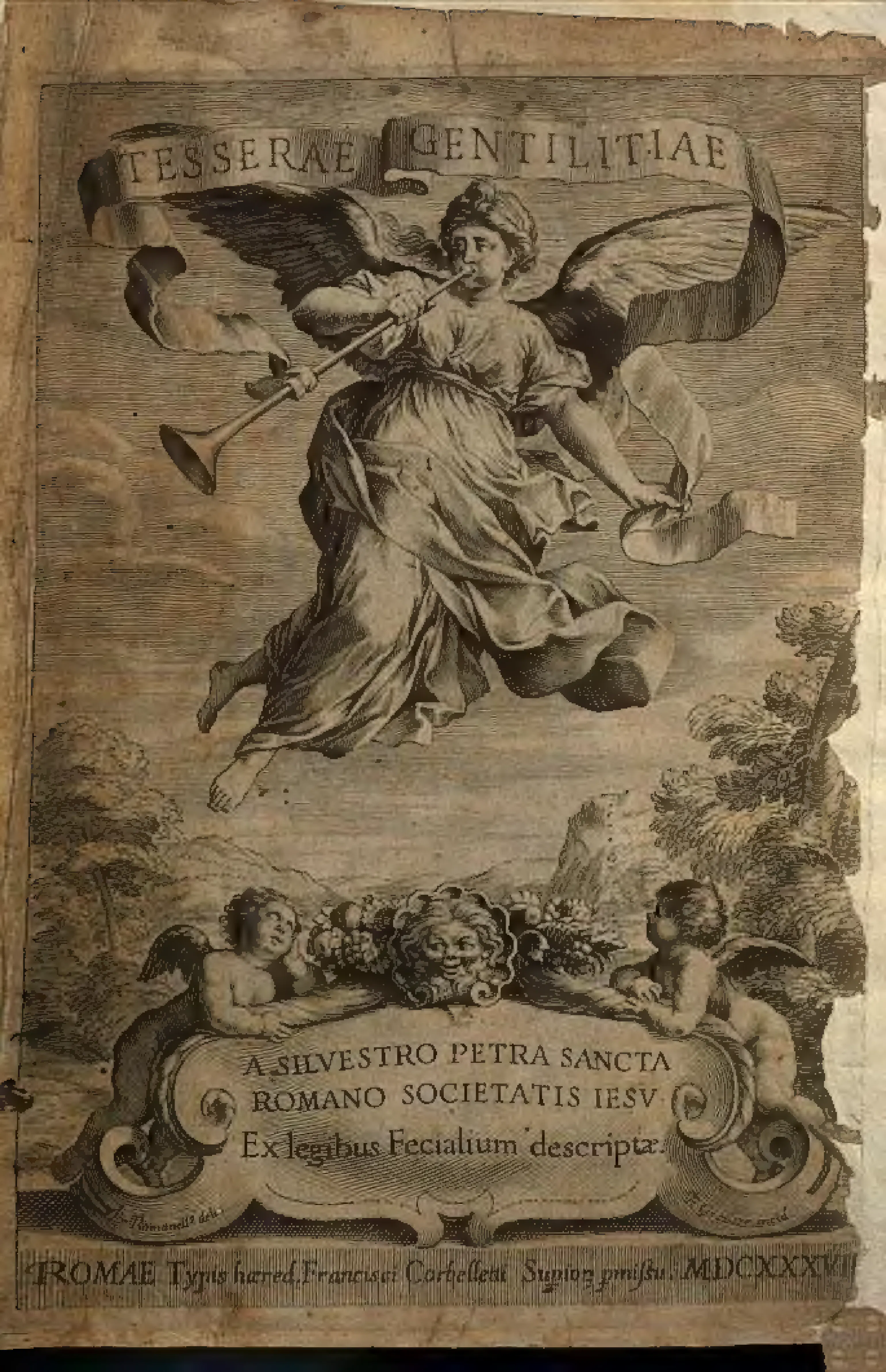
The engraved title page of the Tesserae gentilitiae: Fame trumpets a banner bearing the title, above a cartouche naming the Jesuit author and his claim to describe heraldic signs from the laws of the fetials. The imprint dated MDCXXXVII fixes the book in licensed Roman production. Source ↗.
That triple ambition follows from a single difficulty. Armorial practice in the 1630s was vernacular, customary, and fragmented by polity — French blazon differed from British, Spanish and Italian usage from both, and the terms of art existed chiefly in languages that no learned European readership shared. Pietrasanta's response works along two axes at once. Historically, he refuses the derivations his predecessors offered — the ancestral wax portraits of the Roman nobility, the painted shields of the legions — and argues instead that the tokens of families descend from the ornament of dress, an origin announced in his tenth chapter, pressed against its own hardest objection (cloth does not contain gold and silver), openly conceded to rest on conjecture alone, and restated at the very end of the book as a closing ring. Systematically, he coins or repurposes a Latin lexicon (tessera gentilitia for the coat of arms, clypeus tesserarius for the heraldic shield), fixes an invariant set of seven tinctures — two metals, five colours — against the rival fashion for blazoning by gems and planets, maps the nine points of the field onto the parts of the human body as a mnemonic, and then tests his laws against the cases that strain them: sovereigns who stand above the rules, metal laid on metal, creatures such as the two-headed imperial eagle that nature never produced, and the lines that mark a bastard's descent.
The stakes of that undertaking were not merely taxonomic. Armorial signs in seventeenth-century Catholic Europe organized claims about descent, legitimacy, precedence, sovereignty, and public honour; to state their laws was to state, in visible form, who ranked where and by what right. Pietrasanta's appeal to the Feciales, the Roman priestly college of treaties and declarations, lends the modern herald the authority of Roman ius, and his juridical vocabulary — marks of diminution, the seat of honour, spurious birth, majesty — places the shield squarely within the law of status. The book belongs equally to the history of Jesuit emblematics, where his 1634 Antwerp De symbolis heroicis libri IX, printed by Balthasar Moretus, stands as its indispensable companion, and to the history of printing, since the problem of representing colour in an uncoloured medium was for him a problem of method rather than of ornament.
What a first reader is most likely to remember is that solution. Pietrasanta is conventionally credited with the monochrome hatching code by which gold is dotted, silver left bare, and red scored with vertical lines — the convention by which armorial colours can be shown in an engraving that has none. The credit requires qualification: Jan Baptist Zangrius had produced a hatching chart at Leuven in 1600, Marcus Vulson de la Colombière published a competing table in 1639 and in 1644 accused Pietrasanta of theft, and the surviving evidence supports priority, transmission, and independent codification as three separate questions rather than one settled story of invention. Around that technical core the volume gathers a remarkable range of matter: the Barberini bees addressed in verse, the lilies of France derived from a messenger sent from heaven to Clovis, the papal tiara read as a constitutional statement of three offices, an alphabetical ordering of families adopted expressly to avoid quarrels over precedence, a closing confession of the author's own errors and omissions, and a blank shield, complete with helm and mantling, left at the end of the book for any reader whose family he had failed to include. A Marian coda closes the work on a confessional note. Certain of the volume's closing features — a gallery of cardinals' arms among them — remain to be confirmed against a page-image witness rather than assumed from the catalogue record.
The unity of the book lies in the fact that these apparently disparate things are the same argument in different registers. The clothing-origin thesis is what licenses the reading of the ordinaries as garments — the fess is the military belt, the chief the diadem of the head — so that the antiquarian history and the technical system explain one another; the Latinizing programme is what makes a French or British art transmissible to a European republic of letters; the engraved hatching is what allows a Roman press to carry that art abroad without colour; and the dedication to a Barberini prefect under Urban VIII is what situates the whole enterprise within a court where heraldic display was itself an instrument of rule. The work's conceptual vocabulary, its production, and its internal architecture answer to one another, which is why its history cannot be told as a history of technique alone.
Read the full text and English translation on Leo
This text was transcribed and translated as part of the ExLatinis project, an effort by Leo to make free English translations of every text published in Latin in early modern Europe (1450–1750) available online. The complete transcription and English translation of this work can be read free of charge:
→ Read the original Latin text and full English translation on Leo
You can save a copy of this document into your Leo account to run deep text searches, conduct further analysis, or cross-reference it with your own research.
Translating Tesserae gentilitiae: The Latin Title, the Technical Lexicon, and the Laws of the Fetials
Editorial English title supplied for convenience: Armorial Tokens According to the Laws of the Fetials: Silvestro Pietrasanta’s Tesserae gentilitiae.
The Latin title, Tesserae gentilitiae a Silvestro Petra Sancta Romano Societatis Iesu ex legibus Fecialium descriptae, is best rendered as “Heraldic Tokens Described According to the Laws of the Fetials.” The translation is necessarily interpretive. Tessera in classical Latin can denote a token, countersign, tablet, or sign of recognition; in Pietrasanta’s title it is pressed into a learned heraldic usage that joins the sign-bearing force of the token to gentilitia, the social and juridical world of the gens, lineage, and nobility. The phrase therefore does more than translate vernacular armes or “coat of arms”: it presents armorial bearings as intelligible signs governed by a learned vocabulary of descent, distinction, and public recognition. The glossary preserved in the volume, including entries for tessera, stemma, and related armorial terms, confirms that this terminology was being worked out as a technical lexicon rather than used casually. The author states the programme in his own words: since the French and the British, once virtue and nobility sought display, transferred it into an art of families cultivated with wondrous study and genius, he resolved to hand down that art and its precepts in Latin, Ad hæc quoniam Galls, & Britanni, postquam virtus & nobilitas pompam quæsiuerunt, traduxerunt ad artem, studio & ingenio miro excultam, familiarum: hanc ego artem etiam, eiusque præcepta Latinè tradere deliberans — a statement that identifies the vernacular and national fragmentation of blazon as the precise obstacle the Latin lexicon is built to overcome.
The lexical work runs deeper than nomenclature. Pietrasanta also underwrites the ordinary Latin word for armorial bearings by appeal to juristic authority, invoking André Tiraqueau: Tiraqueau subscribes to this view of mine, that insignia are called by the name of arms, because such insignia used to be engraved on arms in ancient and in our own times, so that armed men with covered faces might be recognized, Subscriber sententia hæc mea Tiraquellius, Insignia, inquit, aut rum nomine unncupantur, quoniam p[er] e rumq; hac insignia in armis in culp., & antiquis & nostri semperibus solebant: vt hinc armari, sacre aperta, dignoscerentur, the transcription here being imperfect at several points. The etymological argument is thus made to rest on a jurist rather than on a grammarian, which is characteristic of the volume’s method throughout. A second device of the technical apparatus is mnemonic rather than etymological: the lettered points of the field are explained on the ground that these characters refer to each of the parts of the human body, quandoquidem antedicti characteres, ad partes quasque corporis humani referuntur, so that the shield is learned as an anatomy and its regions named by analogy with head, flank, and foot.
The appeal to the Feciales is equally programmatic. The fetials were a Roman priestly college associated in classical historiography with treaties, declarations of war, restitution, and the formal religious law of relations between communities. Ex legibus Fecialium does not demonstrate that ancient Rome possessed modern heraldry. It appropriates the prestige of Roman ius in order to authorize the modern herald as a learned custodian of signs, precedence, legitimacy, and public honor. The antiquarian Roman term is consequently made to perform a post-classical institutional task: it supplies a Roman genealogy for a discipline whose actual vocabulary and practice were medieval and early modern.
The juridical language surrounding tincture, sovereignty, and birth extends the same operation. Expressions such as supra leges frame the sovereign as capable of standing above ordinary rules, including the rule that tinctures should be distinguished according to heraldic convention; the point is made through a named case, where Barthélemy de Chasseneuz judges that Godfrey of Bouillon was permitted to compose his badge of golden characters and crosslets on a silvered field of the shield, because he was a king and above the laws, Icvisse Goderino Bullionæ telseram suam pangere, ex aureis & characteribus & cruculis, in argentata scuti areola, existimat Bartholomæus Chalaneus, quia Rex erat, & supra leges. Conversely, notae diminuentes and formulas concerning illegitimate or defective birth place armorial difference within the law of status, and the distinction is drawn with juristic precision: these marks lie within the glory of legitimate birth and indicate no defect of the marriage-bed, since they run from the dexter angle; it is otherwise if the baton or diagonal line be drawn from the sinister angle, for these are always evidence of spurious birth, Verum hæ quidem notæ sunt intra gloriam legitimorum natalium, nec thorn vitium vllum iudicant; siquidem fluunt ab dextero angulo. Secus si ducantur ab angulo stantro, seu vectis, seu linea diagonalis: sunt enim semper argumentum spurioru[m] natalium. The same juridical ordering reaches the accessories of the shield, where rank is rendered in material: only noble helmets are fitted to heraldic shields, gilt for the Emperor and for kings, silvered for dukes, princes, marquises and counts, and for others of the equestrian order, of polished steel, tantummodo nobiles cassides aptar sur gentilicijs parmulis, auratæ nimium pro Cæsare, pro Regibus; argento illulæ pro Ducibus, pro Principibus, pro Marchionibus, pro Comitibus: & pro alijs, qui sunc Equestres ordinis, ex poliro chalybe. Such expressions should not be reduced to decorative Latin. They mark the point at which the shield becomes an instrument for ordering legitimate descent, political rank, and the visible privileges of persons and houses. The volume’s Latinizing strategy thus converts heraldry into a hybrid discipline: antiquarian in its appeal to Rome, juridical in its treatment of status, and emblematic in its assumption that visible signs disclose moral and genealogical meaning.
Summarizing the 1638 Folio: Pietrasanta, the Corbelletti Imprint, and the Work's Two Famous Claims
Tesserae gentilitiae is a learned Neo-Latin treatise on heraldry and armorial signification by the Roman Jesuit Silvestro Pietrasanta, also styled Silvester Petra Sancta. The surviving bibliographic record assigns it to Rome, the heirs of Francesco Corbelletti, 1638. Pietrasanta is identified as a Roman Jesuit born in 1590 and deceased in 1647; the most substantial recent biographical discussion places him in Cologne with Cardinal Pier Luigi Carafa, records his Liège publications under the pseudonym Coelius Servilius, and follows his return to Loreto and Rome, where he maintained close ties with the papal court.
The work is a comprehensive heraldic and emblematic compendium rather than a short practical manual. Its opening investigates the antiquity and origin of signs, including the relation between armorial bearings, clothing, ancient standards, heroic signs, and Roman precedents. The central matter treats shields, tinctures, divisions, ordinaries, charges, family signs, and the broader apparatus of heraldic display. The later materials address terminology, indexes, corrections, and armorial exempla. An accessible OCR preserves numbered chapters, an index, a substantial Latin–Italian glossary, and an errata section, but it does not permit the complete eighty-six-chapter architecture or every closing feature to be verified securely. Claims concerning a final self-censure, a cardinal gallery, a deliberately blank escutcheon, and a Marian peroration should therefore be checked against a page-image witness rather than treated as fully established by the catalogue record alone. Three of these four features do appear in the accessible text, in readings whose transcription is imperfect but whose sense is unambiguous. The author closes with a confession that he is conscious and guilty of many things, whether what he has done amiss or what he has left out, ever since he himself unrolled the work hitherto printed and weighed each item, and that he cannot now dissemble these and pass them by without correction or at least excuse, Onsciviam & reus multoru[m], seu quæ commisi perperam, seu quæ omisi; ex quo videlicet Opus, exculum hactenus, euolui egomet, arque æstimandi singula: non possum ea nunc dissimulare, ac sine castigatione vel excusatione saltem præterire. He likewise invites the reader to supply what he has omitted: whoever does not find the arms of his own family in this book of his, him he earnestly begs to inscribe it kindly upon the escutcheon which he therefore appends furnished with helmet and mantling, but blank and without any figure, Ceterum quisquis in codice hoc meo, sui generis stemma non reperit, hunc ego impensè perrogauerum, illud vt beneuolè adscribat in parmula, quam ideo calside instructam & corimbis, puram verò arque iconis expertem adijcio:. And the work ends on a Marian invocation, Dos sua Virgo pia hæc est: quare rege Maria, that is, “This, holy Virgin, is her dower: therefore, Mary, rule her.” The cardinals’ armorial gallery remains, on the accessible evidence, unconfirmed.
Two propositions account for the work’s later reputation. The first is its explanation of armorial signs through the ornament of clothing, ex prisco ornatu rei vestiariae; the accessible text explicitly links the origin of gentilitial signs to ancient vestimentary ornament, and the chapter that carries the thesis is headed accordingly, announcing that the origin of family arms is sought from the ornament of clothing, Ex vestium ornare petrar origo gentilium tesserarum. Cap. X. The second is the association of Pietrasanta with the systematic monochrome representation of tinctures by engraved lines and dots, conventionally called the Petra Sancta hatching system. The often-cited formulation “to show colours although they are not expressed” is central to the later description of the method, but that exact wording was not securely recoverable from the accessible OCR and should not be presented as a verified verbatim quotation without consulting the scan. A closely corresponding statement of the twin difficulty does appear in the preliminary matter, where the author explains that most difficult of all is to render in Latin and utter with a Roman mouth what is expressed in the heralds’ words, and to show colours even where they are not expressed, teaching with the pen what the brush should follow, difficilimum, Latina facere, ac proferre ore Romano ea, quæ Feciatrum verbis enunciuncur, & ostendere colores, licet non exprimancur, quidue debeat penicillus sequi, calamo docere. Sic ipse; the transcription is corrupt in several letters, so the precise orthography of the phrase still awaits confirmation against a page image, but the sentence shows the Latinizing programme and the colour-in-monochrome problem stated together as a single task.
The language of composition is Latin. The physical object is multilingual in a more limited sense: French blazons appear in the margins, while the volume contains a glossary giving Italian equivalents for Latin heraldic terminology. That apparatus is bilingual or trilingual paratext, not a translation of the treatise. No complete modern translation of Tesserae gentilitiae was located. The known modern access points are digitized facsimiles or scans, including the Internet Archive copy, the Google Books copy derived from a Lyon public-library original, and a HathiTrust full-view record associated with the Getty Research Institute; no critical modern edition was identified.
Placing Pietrasanta in the Scholarship: Jesuit Emblematics, Juridical Heraldry, and the Hatching Dispute
The work matters because it shows heraldry becoming a learned, juridical, antiquarian, and emblematic discipline in seventeenth-century Catholic Europe. Armorial signs are not treated merely as battlefield identifiers. They organize claims about noble descent, legitimacy, precedence, sovereignty, memory, and the moral interpretation of visible forms. Pietrasanta’s Roman setting is crucial: a Jesuit author writes for a Barberini dedicatee under Urban VIII while presenting heraldic knowledge through the prestige of Roman antiquity and the institutional vocabulary of the fetials. The book consequently belongs to the history of nobility and political culture as much as to the history of heraldic technique.
The work’s treatment of origins participates in a larger contest between competing genealogies of arms. The appeal to Roman standards, heroic signs, biblical precedents, and ancient insignia provides antiquarian authority: the author aligns himself with Justus Lipsius in holding that the beginnings of these signs must be sought entirely from the heroic ages, Vt in ea Iusti Lipsijs sententia, vt credam horu[m] signorum initia ex heroicis réporibus omninino peti debere, and he adduces the Mosaic camp as scriptural warrant for hereditary ensigns, that the sons of Israel shall encamp each by their companies, standards, and ancestral houses, around the tabernacle of the covenant, Singuli per , signa, atque vexilla, & domos cognationum suarum, enstramecabuntur filij Israel, per gyrum cabernaculi foderis. Against this background the argument from vestimentary ornament offers a different account of how signs became attached to families and persons, and it is constructed by elimination as much as by demonstration. The derivation from the imagines maiorum is rejected on the ground that the two things coexisted: for another reason he thinks the origin of armorial tesserae less fittingly sought from the ancestral images, namely because at Rome both long remained together — the Torquati and Cincinnati retained at once their ancestors’ statues and their emblems, the torque and the lock of hair, Quocirca ex alio capite reor minùs congrue ab veterum imaginibus peti originem testeratum gentilitiarum: nimirum quia simul Romæ vtraque diu manserunt: Torquati enim, & Cincinnati, simul Auorum statuas, simul eorum sternamata, hoc est torquem illi, & hi crinem, reclinuerunt. The resulting history is not modern source criticism. It is a learned genealogy designed to make contemporary armory appear continuous with prestigious antiquity.
The clothing thesis is nonetheless argued with unusual candour about its own weakness. Pietrasanta raises the strongest objection against himself — that someone could doubt why he asserted that armorial icons were born from cloth, since in them are found, besides colours, metals, hardly suited to clothing, and that the difficulty is quite pertinent and serious, Viditare quis posset, cur natas ex panno affirmaverim icones tesserarias, siquidem in eis inveni[n]tur præter colores metalla, vnicque paru[m] accommodata rei vestiarum? Difficultas hæc admodum est pertinent, & grauis — and he declines to claim demonstrative force for his answer, confessing nonetheless that he deals only in conjectures, and that it can happen that there is error in having pronounced thus on the origin of these tesserae, Fateor tamen, inter solas nos colecturas versant, & posse contingere, vt error sit; ita de haru in tesserarum origine pronunciasse. The methodological posture is worth registering: the historical half of the book is offered as probable reconstruction, while the systematic half is offered as law. The sartorial thesis nevertheless continues to do interpretive work inside the technical system, since the ordinaries are themselves read as garments — this band occupies the middle region of the shield and fills there the third part of the field, and it represents the military belt, just as the chief of the shield represents the diadem of the head, ÆNIA hæc mediam scuti regionem occupat, certiamque ibi areæ partem implet: refert verò militarem cingulum, quemad nodum securaria coronis refert capitis diadema — so that the antiquarian argument and the classification of charges reinforce one another. Its juridical passages similarly connect heraldic practice to legitimate birth, marks of diminution, sovereign exception, imperial majesty, and the visible ordering of dynastic rank.
That systematizing drive is most visible in the treatment of tinctures, where custom is converted into stated law. It is a received law, he writes, that from the metals only two are employed, namely gold and silver, in the delineation of the armorial art, Est lex recepta, vt ex metallis dūtaxat v[er]surgentur duo, nempè aurum arque argentum, in rei tesserariæ delineatione; and against the courtly fashion for blazoning princely arms by gems and planets he insists that in these metals and colours the sevenfold number is followed and their names are not varied, whether the arms be those of a mere knight, or of a magnate, or even of a king, Nihilominus in his metallis coloribusque numerum seprenarium secuneri, nec variari eorum nomina, constat: siue sic solum Equeltris ordinis, siue aliquis ex Magnabius, imò ex Regibus ille, eius gentilia insignia circumscribuntur. The invariance is itself a disciplinary claim: a single nomenclature across all ranks is what makes the art teachable and comparable between polities.
The hatching question must be separated from the broader significance of the book. Pietrasanta is often called the inventor of the modern hatching system because his books gave a systematic printed form to the representation of tinctures in monochrome, and the convention is stated in the text with the brevity of a rule: the schemes will make it plain, for what is dotted will be gold; silver, what is free of all engraving; red, what is scored with little lines drawn from top to bottom, Schemata id manifestum reducter. etenim quod punctum inciderur, id aureum erit: argenteum, quod fuerit exper[iment] omnis sculpturæ, puniceum, quod cæsium & ductis ab summo ad immu[m] lineolis exaltitur, the transcription being defective at several words. The chronology, however, is contested. Jan Baptist Zangrius produced a hatching chart at Leuven in 1600, establishing significant prior art. Pietrasanta’s system appears in the 1634 emblematic work and is associated with the 1638 Roman heraldic treatise. Marcus Vulson de la Colombière published a competing table in 1639 and later claimed that Pietrasanta had copied him. The surviving summaries indicate that the principal technical difference among the systems concerned the treatment of sable; the evidence supports priority, transmission, and independent codification as separate questions. It does not support an unqualified statement that Pietrasanta invented the entire practice ex nihilo.
Earlier practices further complicate the story. Tricking, written color abbreviations, and other systems for conveying tincture were already in use, and the historiography points to figures such as Vincenzo Borghini and Erycius Puteanus in the prehistory of color designation. Pietrasanta’s importance lies less in the first imaginable use of graphic differentiation than in the authoritative, repeatable, and widely transmissible codification of a system within a major Latin heraldic treatise. The later French heraldic tradition, including Claude-François Ménestrier, should be understood as a subsequent phase of systematization and interpretation rather than as a direct source for the 1638 book.
The emblematic context is equally important. Brill’s overview of Jesuit emblematics distinguishes spiritual, didactic, and heroic emblem books; Pietrasanta’s De symbolis heroicis belongs centrally to the heroic and dynastic mode. Peter Daly and G. Richard Dimler’s large bibliography of Jesuit emblems places such works within a European corpus of at least 1,525 printed Jesuit emblem books. Bartłomiej Czarski’s 2025 study is especially valuable because it treats Pietrasanta as a Christian humanist whose numismatic, emblematic, heraldic, and moral projects belong together. It identifies the 1634 De symbolis heroicis as the principal work under discussion while treating the 1638 Tesserae gentilitiae as Pietrasanta’s comprehensive heraldic treatise. This scholarship helps resist the older tendency to isolate heraldry from Jesuit pedagogy, antiquarianism, and moralized visual culture. The emblematic habit of reading is unmistakable in the treatise itself, where charges are given historical and moral construction rather than merely described: the moon, he observes, is never found full-orbed in these badges of the gentry, which Marcus Gilbertus rightly wonders at, and that same Auditor thinks these frequent heraldic moons are indications and monuments of victories over the Thracians and over the Moors or Africans, attamen numquam orbe pleno, in symbolis ijs gentilium inuenitur: quod sane miratur meritò Marcus Gilbertus. Atq[ue] is etiam Auditor putat, hacte tam erebras lunas tesserarias, el[em]e indicia & monumenta victoriarum, de Thracibus, deque Mauritis, vel Afris. The “Marcus Gilbertus” named here is the author cited elsewhere in the volume as Marcus Gilbertus Devarennius, and the proposed identification of that figure with Vulson de la Colombière remains insufficiently secure in the evidence consulted; the treatise cites him as an authority in his own right, and the citation should not be silently converted into a reference to Vulson.
The political theology of signs runs through the same material. Dynastic myth is reported as received fact — golden lilies sown without number, in a field of sapphire colour, are the ancient badge of the kings of France, given by the starry messenger from heaven to King Clovis, Sata sine numero aurea lilia, in areo, la coloris sapphirini, sunt vetus tesser a Regum Galliæ, per Sydereum Nuncium cælæus data Regi Clodo uxo — and then subjected to juridical explanation, since Charles VI preferred three of these royal lilies rather than a field sown with them as before, for painted in that abundance they were the common badge of other kindred princes and even of foreign kings, and therefore had to be restricted in number for distinction’s sake to the supreme majesty of the kings of France alone, post quam Carolus VI. basilicos hælice flores, numero tres adamauit potius, quàm consitos, vti antea fuerant, manu liberaliore. Hac enim copia picti, erant tessera communis aliorum consanguineorum Principum, ac Regum etiam externorum: debueruntque ideo laco illustrandi numero arctari ad solam Regum Galliæ supremam maiestatem, ei que singulariter dedicari. The same logic makes an ecclesiological argument out of an ornament: the tiara, illustrious with a triple royal fillet and gemmed, with a golden Cross above, is the crowning summit of the Roman Pontiff, that is, of his heraldic badge, for those three crowns proclaim him to the Christian world as supreme Bishop, Judge and Legislator, Tiara, triplici regio redimiculo inclyra & gemmata, cum Cruce aurea luperné, diffusilq[ue] interné infusis, Cruce pariter signaris, est coronarium fastigium ROMANI PONTIFICIS, seu cesserariæ iconis eius. Supremum autem Amistatem, Iudicem, ac Legislatorum eum, coronæ i.æ tres, renunciant Christiano Orbi. Where the stated laws collide with sovereignty, the laws yield, and the concession is formulated as a matter of crimen maiestatis: who would dare utterly to forbid these things, and not at the same time fear being summoned to law for it before Caesar’s tribunal as guilty of treason? For what then? Shall the double-headed eagle of the Empire, such as nature does not spontaneously beget, be struck out of the badge of him who is highest of princes and fount of all nobility?, Nihilominus prohibere omnino ista, quis tandem audeat, & non simul metuat, ne in ius propterea sic vocandus, ad Cæsaris tribunal, quippe reus Maiestatis? Quid enim? Aquila Imperij biceps, qualem sponte haud natura progenerat, an ideo debebit expungi ex tessera illius, qui summus Principum est, ac fons rotios nobilitatis?. The casuistry of hard cases is thus continuous with the juridical vocabulary examined above: the rule of naturalism, like the rule of tincture, is stated in order to be qualified where majesty is at stake.
Barberini patronage supplies the political setting. Taddeo Barberini’s office as Prefect of Rome, the family’s papal connections, the bees, and the armorial dedication place the book within the visual economy of Urban VIII’s court. Documentary work on Barberini inventories and patronage provides the appropriate method for reconstructing this setting, while studies of seventeenth-century Roman censorship by Marco Cavarzere and L. Spruit clarify the institutional environment in which licenses, permissions, and revisions operated. The presence of a permission formula should not be converted automatically into evidence of censorship, expurgation, or suppression. For Pietrasanta’s particular volume, the accessible records do not yet establish the complete licensing chain or any post-publication intervention.
The historiography remains uneven. Jesuit emblematics and Pietrasanta’s intellectual profile now have useful recent syntheses, but the specific reception history of Tesserae gentilitiae, its print circulation, and its relationship to named heraldic opponents remains thin. The hatching controversy is better documented as a sequence of competing claims than as a settled story of invention. The alleged identity of “Marcus Gilbertus Devarennius” with Vulson de la Colombière also remains insufficiently secure in the evidence consulted and should not be silently normalized. The central scholarly task is therefore bibliographic as well as interpretive: to distinguish the Roman armorial treatise, the Antwerp emblem book, Taisnier’s Cologne chiromantic compendium, and unrelated catalogue records before reconstructing influence or priority.
Tracing the Book as Object: Corbelletti's Press, the Barberini Dedication, and the Surviving Copies
The secure bibliographic identity is Tesserae gentilitiae a Silvestro Petra Sancta Romano Societatis Iesu ex legibus Fecialium descriptae, Rome, typis haeredum Francisci Corbelletti, 1638. HathiTrust records the author as Silvestro Pietrasanta, 1590–1647, and gives the physical description as [28], 678, [34] pages, illustrated, 35 cm, folio. Its collation is recorded as a⁴(-a2) b⁴ A–4S⁴ 4T⁸. The same record describes an engraved title by Matthäus Greuter after Francesco Romanelli, full-page engraved arms of Taddeo Barberini, head- and tail-pieces, initials, double-column Latin typography, etched coats of arms, French marginal blazons, an index, errata, and a glossary of Latin heraldic terms with Italian equivalents. WorldCat additionally associates Giovanni Francesco Romanelli, Johann Friedrich Greuter, and Michel Natalis with the production of the illustrated book. These catalogue attributions establish an illustrated Roman production, although they do not by themselves resolve the division of labor among designer, draughtsman, engraver, and printer.
The dedication is to Taddeo Barberini, identified as Almae Urbis Praefectus. The opening of the digitized text discusses the Barberini arms and the family’s three bees, making the dedication part of the book’s visual and political argument rather than a merely formal address; the bees return later in a Virgilian conceit that binds patronage to the promise of enduring fame — thus you make honey, O Bees, but not for yourselves: may these royal Bees continue their work, so sweet and so fortunate, and procure for the Barberini race a fame better than honey and everlasting, unto the longest day; thus the Muses, thus with the author the Graces desire, Sic vos non vobis mellificatis APES. O pergant vnumam hæ Ar & Regiæ, opificioram suavi, tam felici, non neu melle melius, tamamque æternam Gentis BARBERINAE, in diem longissimum, comparare ita Mulæ, ita mecum Charites desiderant. Pietrasanta’s relation to the Barberini court is consistent with the biographical evidence that, after his return from the Low Countries, he was posted to Rome, maintained close ties with the papal court, and later became apostolic visitator of the Piarist order. The 1634 Antwerp De symbolis heroicis libri IX, printed by Balthasar Moretus in the Plantinian workshop, is the necessary companion: the two books belong to the same intellectual movement from emblematic and numismatic signs toward a learned theory of noble and dynastic representation.
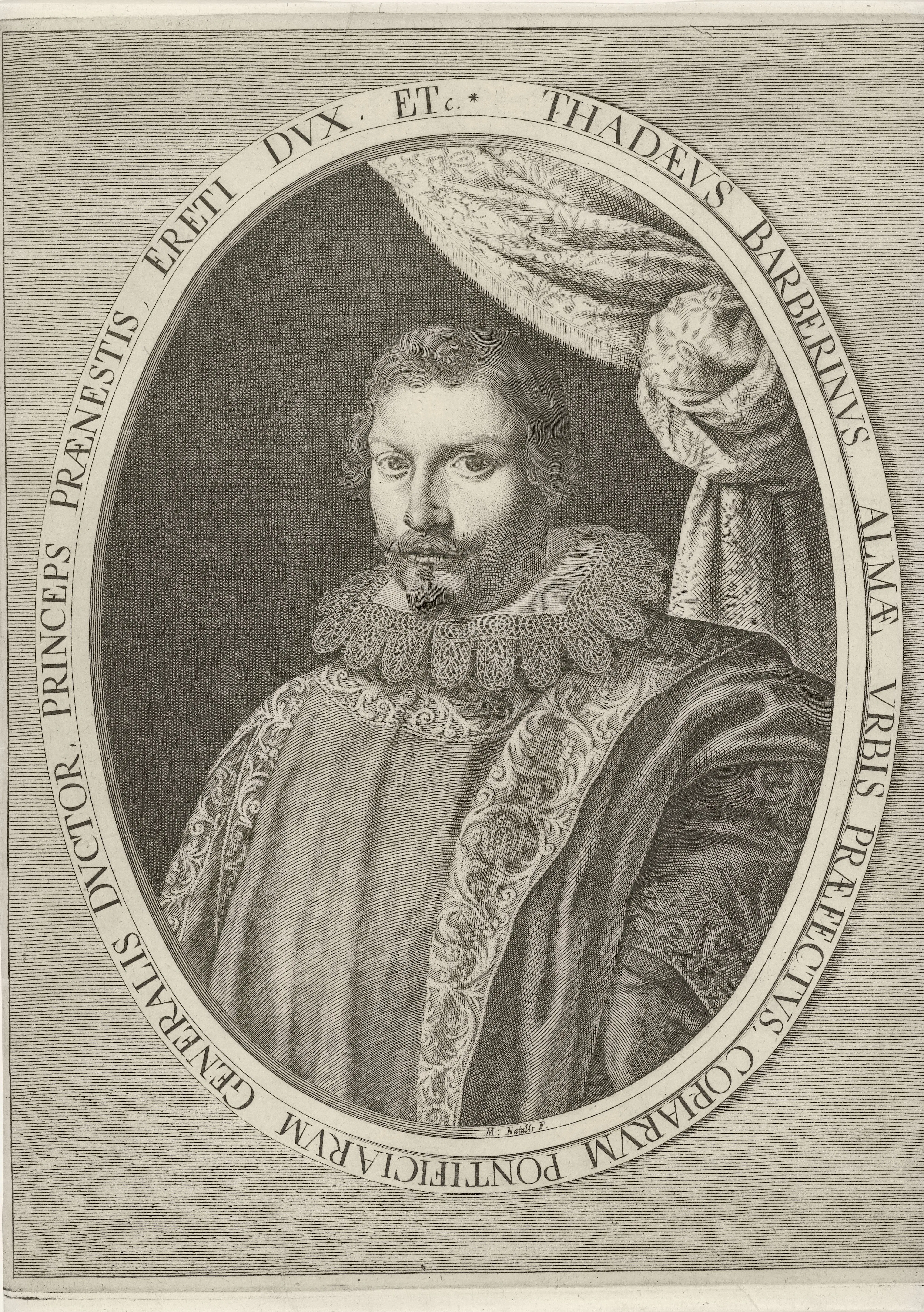
Engraved portrait of Taddeo Barberini, Pietrasanta's dedicatee, in the visual language of rank, office, and lineage that the 1638 folio converts into heraldic argument. Framed by titulature, it shows why Barberini patronage was no perfunctory address but part of the book's claim that dynastic signs secure political memory. Source ↗.

The material record contains important discrepancies. Union-catalogue data encountered for Chronologicarum demonstrationum libri tres—a 1600 work by Johannes Temporarius printed at La Rochelle—must not be assigned to Pietrasanta. Similarly, the MDZ record for a 1596 Chronologicarum demonstrationum is a different book. The independent records for Pietrasanta and Jean Taisnier remain distinct. Google Books identifies the Tesserae copy by Pietrasanta, Corbelletti, Rome, 1638, as 678 pages, originally from the Lyon Public Library and digitized in 2013. The separate Google Books record for Taisnier identifies Opus mathematicum as a work by Jean Taisnier, published by Birckmann and Richwin in 1562, from the Bavarian State Library, with 624 pages. The Internet Archive record supplies an independent 1583 Taisnier witness, describing the work as a Latin compendium concerned with palmistry, physiognomy, and astrology. The two books therefore differ in author, subject, date, printer, physical extent, and bibliographic identity.
A Google Books/Bayerische Staatsbibliothek route for a direct cataloguing conflation could not be demonstrated from the accessible records. The records show parallel and independent identities rather than a single scan whose title was conclusively replaced by Taisnier’s. The responsible conclusion is consequently limited: a conflation may have arisen in a digitization or metadata chain, but the specific transfer of identity remains unproven. The same caution applies to the supposed 1637 title-page/1638 colophon sequence. Catalogue records consistently expose the 1638 publication date, while the accessible OCR does not securely recover the title page, colophon, licenses, or the names of Muzio Vitelleschi, Niccolò Riccardi, and Giovanni Luigi Confalonieri. Their presence should be verified from page images before being used as evidence for a completed Jesuit and papal licensing chain.
The object biography is nevertheless recoverable in outline. The Internet Archive scan was digitized in 2014 from a Getty Research Institute copy; the record identifies old calfskin and sprinkled goatskin bindings for two copies and notes that one copy lacks the plate with the Barberini arms. HathiTrust links a Getty full-view copy, while Google Books identifies a Lyon public-library original. WorldCat record OCLC 56710384 gives the full title, printer, date, and author and reports twelve editions in sixty-six libraries, but the accessible record does not expose a complete shelfmark list. No secure evidence was located for print run, paper stock, Corbelletti account books, imported plates, censorship expurgation, suppression, or the effect of the book’s confessional polemic on circulation in Protestant territories. The hatching system’s later reception is better documented than its immediate readership: the priority dispute places Jan Baptist Zangrius’s 1600 chart before Pietrasanta, associates Pietrasanta with the 1634 and 1638 publications, and places Marcus Vulson de la Colombière’s competing table in 1639. In La Science Heroïque (1644), Vulson claimed that Pietrasanta had copied his method; the claim is part of the controversy, not a settled demonstration of priority.
As a composed book rather than an object, the volume is closed by a deliberate return to its opening argument, which confirms that the sartorial thesis was intended as the structural spine of the whole and not as a passing antiquarian excursus: finally, to confirm what he said in the opening of the work, namely that arms were given their most ample and most ancient origin from the fashion of garments at home and abroad, Demùm vt in exordio Opestis confirmem id, quod in illius exordio dixi: nempe gentilicis tesseris plurimus & vetustissimus esse originem datam, ex vestium cultu domi forisque. The ring-composition is a compositional fact about the treatise, and it bears directly on how its closing apparatus — errata, indexes, and the invitation to the reader — should be read: as the deliberate termination of an argument rather than as an accumulation of back matter.
Reading the Treatise in Sequence: From the Clothing Thesis to the Blank Escutcheon
Imprint, Dedication, and the Barberini Bees
The letterpress title announces the book's Roman production in the abbreviated formula of the licensed press, ROMAE Types hæred. Francisci Corbessedi Supior[um] præmissu. MDCXXXVII — at Rome, from the types of the heirs of Francesco Corbelletti, by permission of superiors, 1637 — while the dedicatory epistle closes with a subscription dated the following year, Ita voueo, Romæ VIII Kal. Iunij MDCXXXVIII, "thus I vow it, at Rome, the eighth day before the Kalends of June, 1638." The discrepancy is not a bibliographic puzzle but the ordinary trace of how a folio of this size was made: the sheets of the body were set and worked off under a title dated to the year of composition, while the preliminaries — dedication, address to the reader, licences, glossary — were printed last and carry the later date. The dedication itself is addressed Illustrissimo, & Excellentissimo Principi THADAEO BARBERINO ALMAE VRBIS PRAEFECTO, to the most illustrious and most excellent prince Taddeo Barberini, prefect of the nurturing City, and it is constructed as a heraldic argument rather than a courtesy: Pietrasanta explains that he withheld all his earlier books from this patron until he had matter proper to a prefect, since the three golden bees of the Barberini shield already signify at once lineage, felicity, and virtue, and he asks that they serve as his own garrison, vt armarentur BARBERINAE, pro me præsidiarę Apes, that the Barberini bees be armed as a guard on his behalf. The conceit fuses the two senses in which a tessera operates in this book — as the sign of a house and as a token of protection — and it does so before a single rule of the art has been stated.
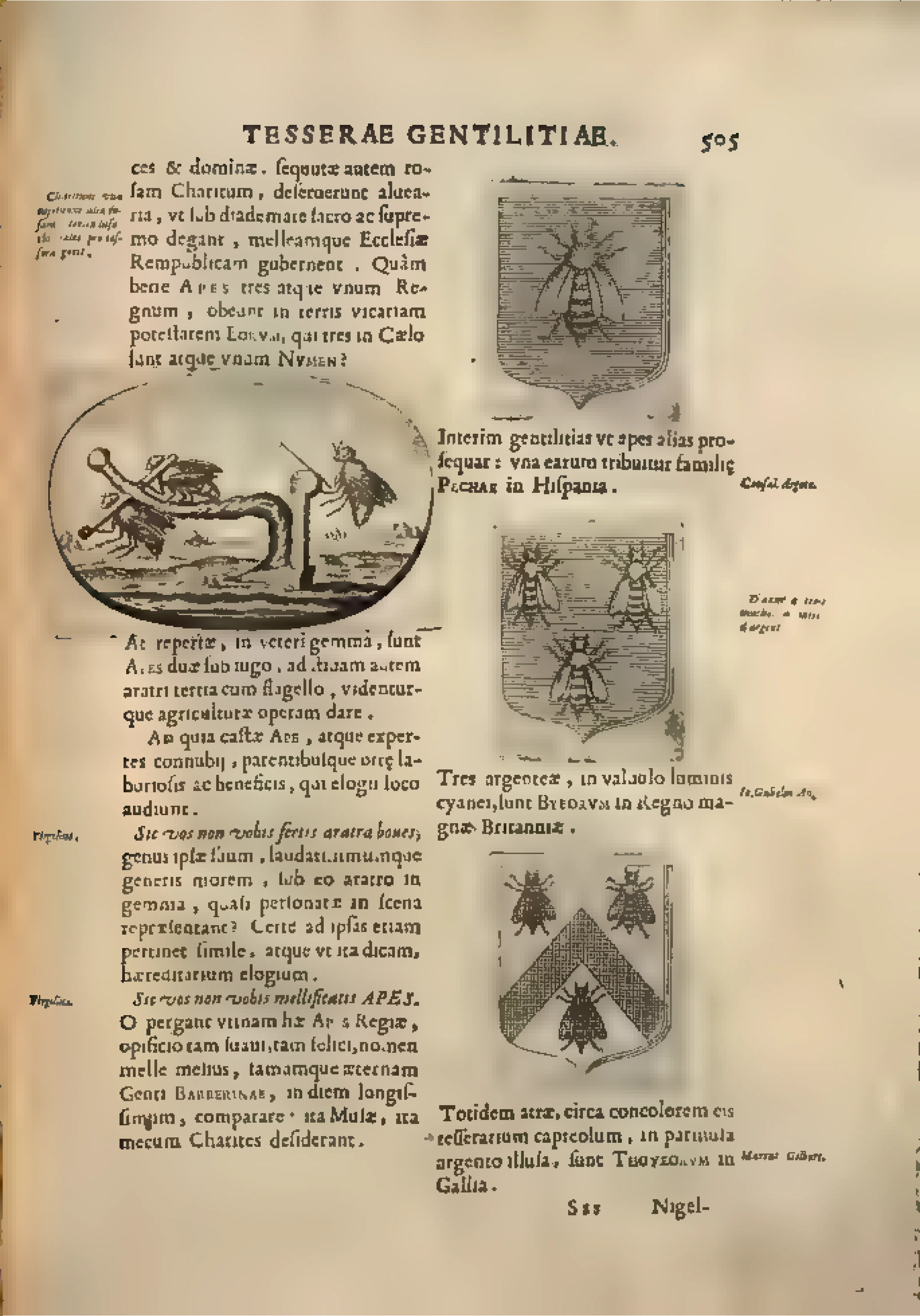
Here the Barberini bees pass from dedicatory compliment into heraldic method: an oval engraving and three bee-bearing shields set the patronal emblem beside Spanish, British, and French comparanda in one Latin frame. Letterpress and small engravings together mark the Corbelletti folio as a manufactured Roman object. Source ↗.
The Address to the Reader, the Licences, and the Glossary
The address LECTORI states the undertaking as a double difficulty, and it does so in borrowed words: the sentence quoted from Erycius Puteanus and already examined above, in which the hardest part of such a project is said to be the rendering into Latin, with a Roman mouth, of what the heralds express in their own words, and the showing of colours even where they are not physically expressed, teaching with the pen what the brush ought to follow. The sentence is worth dwelling on because it makes the technical and the lexical problem one problem. Heraldry as Pietrasanta found it was doubly untransmissible: its terms lived in vernaculars, and its substance lived in pigment. A learned readership could not read gules or azur, and an engraved plate could not print them. The solution to both is a translation into a medium of general currency — Latin for the words, incised line for the colours — and the verb docere, to teach, governs both halves. The pen instructs the brush; the treatise does not merely describe armorial practice but legislates for a craft it intends to place under a written discipline. The transnational rationale follows immediately, in the declaration already cited of his resolve to hand down in Latin the art of families, with its precepts, which the French and the British had cultivated with wondrous study and genius once virtue and nobility began to seek display. The diagnosis embedded there is sociological before it is philological: display (pompa) is what converted virtue into an art, and the art thereafter belonged to the polities that had cultivated it. Latin is the instrument for expropriating a Franco-British specialism on behalf of a European commerce in learning, and the same preface applies the logic to the Italian theory of impresa, which travels in the opposite direction by the same road.
Two pieces of apparatus make the programme operational. The first is institutional: the internal Jesuit permission of the General, subscribed at Rome in April 1636, is followed by the papal palace licence in the standard formula, Imprimatur. Fr. Nicolaus Riccardius Sacr. Apost. Palatij Magist. Ord. Præd, the Master of the Sacred Apostolic Palace of the Order of Preachers authorizing the printing. The chain is thus visible in the book itself — order, reviewer, vicegerent, palace — and its presence documents a routine licensing sequence rather than any intervention in the text. The second is lexical: the preliminaries close with a bilingual vocabulary of the harder terms, headed ARTIS TESSERARIAE Vocabula quædam difficiliora Italicè redduntur, certain more difficult words of the armorial art rendered in Italian. That a Latin treatise should require a vernacular glossary is the clearest admission of what the Latinizing enterprise costs: the author's Fecialis, tessera, lemma, sabulum, and cyaneus are not words an Italian herald would recognize, and the glossary is the bridge back from the learned coinage to the working craft it claims to codify.
The Books of Origins: Elimination, Objection, and the Confession of Conjecture
The theoretical chapters proceed largely by elimination, and their most instructive moments are the ones in which Pietrasanta declines to claim more than he can show. Having rejected descent from the Roman ancestral images on the ground that both survived together at Rome, and having weighed the legionary shield-colours, he states his own derivation in the heading of the tenth chapter already quoted, which seeks the origin of family tokens from the ornament of garments. The thesis is then subjected to the objection that most nearly destroys it, and the objection is voiced without softening — the doubt, registered above, as to why icons said to have been born from cloth should contain metals hardly suited to the business of clothing, a difficulty the author grants to be entirely to the point and serious. The answer he offers is analogical rather than evidentiary — the lorica began as linen or hide and only later became iron, so a garment-derived object may acquire metal without ceasing to be garment-derived — and the form of the reply is scholastic disputation transposed into antiquarian history. What follows is more unusual. Searching for corroboration, he reports having found a single authority, lighting only upon those words of Nicholas of Lyra, that proper signs are on garments and on shields, by which combatants recognize one another and distinguish their own men from their adversaries, incidisse dumtaxat in ea Lyrani verba, Signa propria sunt in vestibus & sentis, quibus bellatores mutuò se cognoscunt, & suos ab aduersarijs distingaunt. A medieval biblical commentator, adduced for a phrase that couples vestes and scuta in a single clause, is the whole of his confirming testimony, and he says so. The consequence is drawn at once, in the confession already noticed that he moves among conjectures alone and that error is possible in having pronounced thus upon the origin of these tokens, to which he adds the shrewd observation that falsehoods sometimes wear a more probable face than truths and that a man's own inventions bewitch him. The epistemic asymmetry that structures the whole volume is established here: the history of arms is offered as probable reconstruction, subject to correction; the art of arms will be offered as law.
From Probable History to Stated Law: Tinctures, Hatching, and the Ordinaries as Dress
That shift of register is abrupt and deliberate. The tinctures are introduced not as usage but as statute, in the declaration cited above that it is a received law that from the metals only two are employed, gold and silver, in the delineation of the armorial art. Lex recepta is a juristic phrase, and it converts an observed regularity into a binding rule that can be cited against dissent — here against Vincenzio Borghini's objection that white and yellow are simply colours and no metals at all. The same legislative impulse governs the refusal to let nomenclature vary with rank, against the courtly fashion of blazoning princes by gems and planets and kings by yet a third register. Its practical pay-off is the passage on which the book's later fame rests, already given: the rule set out with the brevity of a specification, that what is engraved with dots will be gold, that silver is what is free of all cutting, and that red is what is scored with little lines drawn from top to bottom. Three things deserve notice. Silver is defined privatively, by the absence of any cutting, so that the blank of the paper becomes a positive value within the code rather than an unmarked ground; gold is given the only non-linear mark, dots, and so cannot be confused with any of the five colours, all of which are systems of lines; and the remaining tinctures are distinguished by the direction of hatching alone, azure horizontal, green and violet by opposed diagonals, black by crossing — a scheme whose economy depends on the burin's natural repertory. The engraver's tool, not the painter's, supplies the grammar. The promise of the preface, to show colours although they are not expressed, is redeemed by making the absence of colour into a notation.
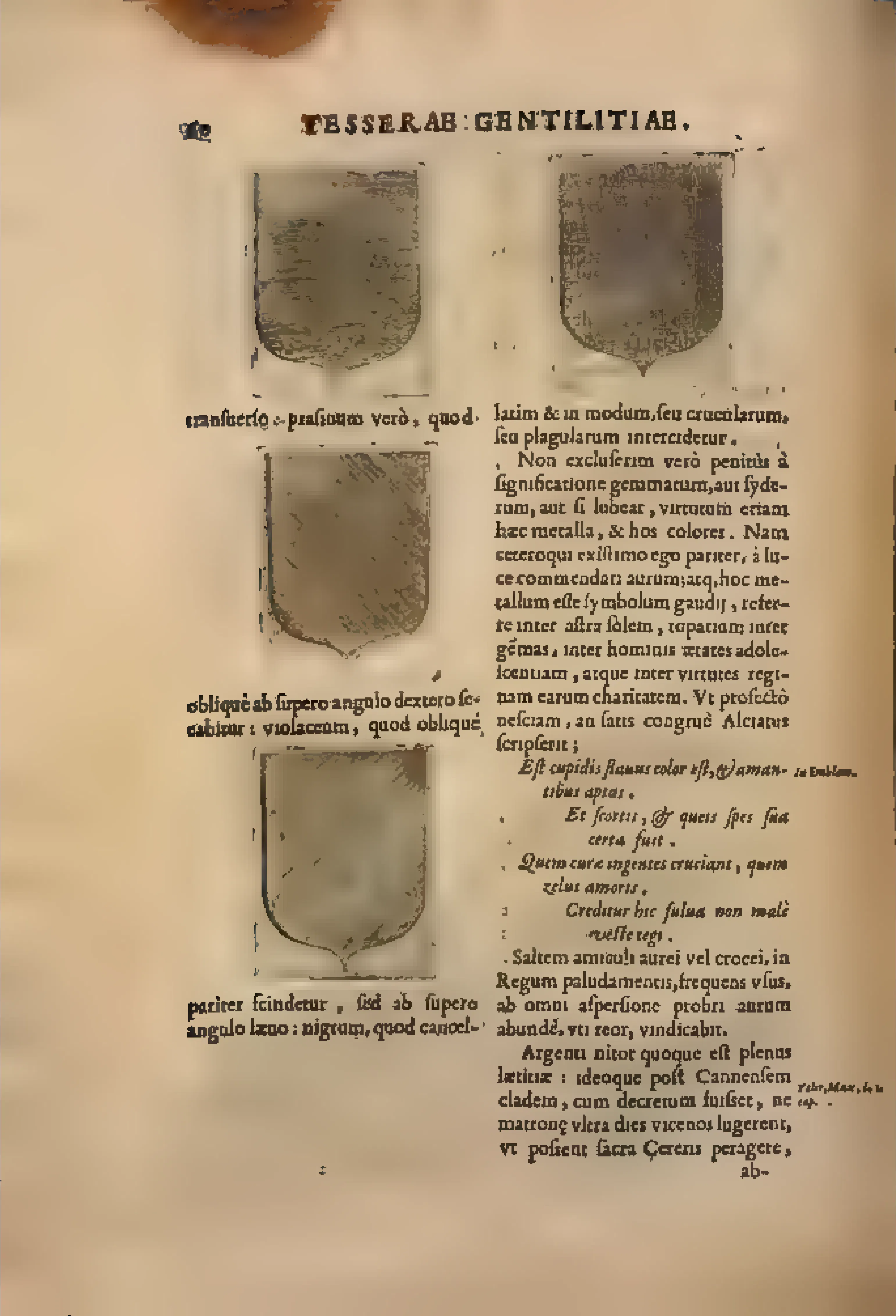
An interior page of the Tesserae gentilitiae: three engraved shields translate tincture into line—dots, opposed diagonals, crosshatching—so that the burin carries colour where pigment is absent. The adjacent Latin passes from these graphic rules to the claims of gems and stars, disciplining nomenclature while admitting symbolic resonance. Source ↗.
The systematic half also keeps faith with the sartorial history it claims not to have proved. When the ordinaries are catalogued, they are explained as items of dress and equipment, in the passage examined above where the band that occupies the middle region of the shield is said to represent the military belt exactly as the chief represents the diadem of the head. The fess is a cingulum, the chief a diadema; the field has already been lettered A to I on the analogy of head, neck, breast, belly, and legs, so that the shield is at once a body and the clothing of a body. A conjecture the author declined to press as demonstration thus returns as the governing metaphor of the descriptive vocabulary, supplying names, proportions, and hierarchies of honour to the very figures whose geometry could have been described without it.
The Armorial Roll: Birds, the Blazoning Formula, and Combinatorial Identity
The systematic chapters then give way to the long roll of arms, in which that vocabulary is put to work across many hundreds of folios. Within the sequence of chapters devoted to birds, the treatise passes from the raptors to the small, legless birds of French blazon, and its first concern is not with any individual house but with the form itself, defined as a rule of depiction: their shape, in our heraldic matter, extends only as far as head and breast, with the wings nonetheless folded and as it were composed, without legs, Forma autem earum, an in re nostra hæraldica, est capite & pectore tenus, cum alis ramen commissis, ac veluti compositis, absque cruribus; nec ubijs villis in cypho [reading uncertain]. The transcription is corrupt in its final clause, but the doctrine is unmistakable, and it is characteristic of the whole systematic enterprise. What defines the charge is not a species recognizable to the naturalist but a convention of drawing: a bird truncated at the breast and deprived of legs, a creature which, like the double-headed eagle admitted elsewhere in the volume on grounds of majesty, nature does not spontaneously produce. The qualifying phrase in re nostra hæraldica is equally telling. It marks off a domain with its own rules of predication — a technical order in which "form" means the licensed manner of representation rather than natural morphology — and it does so in a Latin adjective coined from the vernacular office of the herald, standing alongside the Latinizing vocabulary of tessera and parmula that the treatise elsewhere prefers. The lexical programme announced in the prefatory matter is here at work in its least conspicuous and most consequential form: the fixing of a single Latin description that can stand for what French, British, and Italian practice each named differently.
The catalogue does not present these blazons as the author's own observation. At the margin of the hawk entries stands the bare citation Marcus Gilberti., the abbreviated form of the authority named at length elsewhere in the volume as Marcus Gilbertus Devarennius. The marginal apparatus performs, for the armorial roll, the same function that the citation of jurists performs for the etymological and juridical arguments: it converts a compilation of family bearings into a documented body of learning, in which each blazon can in principle be traced to a named source. That the identity of this authority remains contested in the modern literature does not alter what the page shows about method — the arms of the French houses are transmitted matter, received under a name, not the fruit of heraldic fieldwork.
The individual entries then proceed by a rigid formula whose grammar repays attention. Thus symbolic blackbirds, that is three blue merlettes, in the silver hollow of the shield, are those of the Belloti in France, Itaque merulæ symbolicæ, seu aues multæ tres cyaneæ, in argenteo scuti alveolo, sunt in Gallia BELLOTORVM.. The blazon is compressed into a nominal clause: charge in the nominative with its tincture adjective, field in the ablative of place, the family in the genitive plural set in capitals, the polity in a prepositional phrase. Nothing is predicated of the family except the sign; the sign simply is the house. The Latin also discloses the difficulty of the undertaking, since the field must be named again and again without stylistic monotony, and the treatise accordingly rotates a whole series of diminutives for the surface of the shield — alveolus, parmula, laterculus, areola, valvulum — while the colours are rendered through a luxuriant chromatic vocabulary drawn from dyestuffs and gems, cyaneus, venetus, sapphirinus, prasinus, puniceus, conchyliatus. Against the systematic chapters, where the tinctures are declared sevenfold and their names invariable across every rank, this proliferation of synonyms marks a real strain: elegance of Latin composition pulls against the terminological fixity that makes the art teachable, and the reader must recognize the same blue under three names according to the cadence of the sentence.
The economy of the formula also exposes what constitutes armorial identity. Two houses may share a charge, a disposition, and a field, and be distinguished only by a single added element: or in a shield of Venetian blue, with a small golden piece set in the midst of them, they are the arms of the Bourdonii in France, and with a golden band rather inserted and drawn across the middle of that shield, those of the Blanchavi in the same place, Aut in parmula coloris veneti, cum adiecta in medio ipsarum rescella aurea, sunt BOVRDONIORVM in Gallia, & cum insita potius aurea, per mediam eam parmulam traducta, sunt ibidem BLANCHAVORVM.. The transcription falters over the name of the small golden charge, but the logic is plain and it is juridical rather than decorative. Distinctness of houses is secured by a minimal differentia within an otherwise identical scheme, exactly as the marks of cadency and of diminution treated elsewhere secure distinctness of line within a single house. The anaphoric Aut … Aut … Aut that governs whole columns of the catalogue is therefore not mere listing: it is the serial exhibition of a combinatorial system in which a finite stock of tinctures, dispositions, and small charges is made to yield an indefinite number of unrepeatable identities.
The fifty-ninth chapter, turning from raptors to the lesser and domestic birds, opens with a justification that introduces a criterion of a quite different order: I come now to those other ornaments which have birds either smaller, or such as are kept for household use, or at any rate such as by song, by colour, and by other marks are objects of the greatest wonder, because animate tokens are always reckoned more excellent than those which are made by art itself, or are lifeless, VENIO iam ad decoras alteras, quæ aues aut minores habent, aut ad domesticum vsum paratas, aut certè quæ cantu, colore, aliaque nota, admiratione sunt maxima quia semper animatæ sunt tesseræ, prælantoresque videatur, quàm quæ ex arte fiunt ipsius, aut inanimæ., the transcription being defective at several words. A hierarchy of charges is here asserted on grounds neither juridical nor antiquarian but natural-philosophical and aesthetic: the living outranks the artificial and the inanimate, and admiratio — the wonder excited by song, plumage, and distinctive marking — is admitted as a reason for a creature's presence on a shield. This is the emblematic habit of the Jesuit symbolum entering the armorial roll, where the worth of a sign is measured by its capacity to arrest and instruct the eye.
That criterion governs the order of presentation as well as its content. The peacock therefore, as the most conspicuous of all winged creatures, whose wings lie open all gemmed and in whose tail stars seem to shine, shall begin this census, Pauo igitur, veluti volucrum omnium spectatissimus, & cui gemmantes patent alæ, ac sydera velut in cauda fulgent, hunc censum inchoabit.. Two things deserve notice. The first is the principle of precedence: the birds are marshalled by natural dignity, the most splendid taking the head of the file, so that the chapter is ordered by a ranking of creatures rather than by the alphabetical arrangement adopted elsewhere in the volume to forestall quarrels among families. The second is the noun census, the Roman term for the magisterial registration of citizens by rank and estate. Applied to a roll of birds, it belongs to the same Romanizing strategy as the appeal to the fetial college in the title: the enumeration of charges is presented as a censorial act, an authoritative registering of the members of a visible commonwealth.
The entry on the cock then produces one of the most revealing turns in the chapter, because it withholds the very reading one expects: the cock follows, not as a watchman, nor as valiant in its crowing and therefore sacred to Mars, but only as useful about the house, and among birds not to be despised, Insequitur gallus, non vt vigil, aut clangore fortis, & Marti ideo sacer; sed tantùm vt domi vtilis, & ex alitibus non spernendus.. The sentence rehearses the martial and vigilant lore attached to the cock precisely in order to set it aside, a praeteritio that permits the traditional symbolism to be seen while denying it the work of classification. The admission is candid and slightly awkward, since the criterion of selection stated elsewhere in the treatise is that only matter consonant with the shield, that is with arms and military ornaments, be reported; here a charge is retained on the frankly domestic ground of usefulness at home. The tension is instructive rather than incoherent: the roll of actually borne arms constrains the system, and where families have in fact taken a barnyard bird for their token the compiler must find a rationale that the heroic register cannot supply.
The bearing of the cock in Italian usage closes the sequence by exhibiting a further principle of signification that the formulaic syntax does not otherwise disclose. A silver cock, on a shield of murex purple, is the badge of the Galli at Venice, Argenteus gallus, seu in parmula conchyliata, est GALLORVM Venetijs. — the line recurring mechanically down the column of the accessible machine-read text, a defect of that transcription rather than of the printed page. The arms are canting: gallus on the shield speaks the name Galli, so that the token recognizes its bearer by a pun, and the classical sense of tessera as a countersign by which a person is identified is realized in the most literal way available to the art. It is also the point at which the catalogue's geographical reach becomes an argument in itself. Within these few columns the houses adduced are of France, of Venice, of Silesia, of Meissen, of Sweden, and of the Rhineland, each blazoned in the same Latin formula with the same stock of tinctures and field-nouns. The claim implicit in that uniformity is precisely the one made in the preface: that a body of usages fragmented among vernaculars and polities can be stated once, in the learned tongue, and so be read and compared across the whole of Europe.
Charges Ordered by Natural Kind: Parts, Stars, Flowers, and Implements
The catalogue of charges that occupies the central stretch of these chapters is ordered not by the conventions of blazon — not by ordinary, subordinary, and charge — but by the natural kinds it inventories, and the joints between its divisions are marked by short transitional theses that state the principle of subdivision explicitly. Having worked through hawks, doves, crows, the cock, parrots, and quails, the author turns to the parts of birds with a sentence that formalizes the move: birds, he writes, consecrate to these badge-symbols not only themselves but their wings and even their feathers, Sed enim aures, non se ipsas dumcaxat, verum & alas & plumas etiam consecrant his tesserus symbolis. The logic is meristic: a natural kind is admitted whole, then dismembered into its bearable parts, and the same operation recurs much later when the human figure is reduced to hearts, hands, arms, legs, and bones. The consequence for the treatise's governing claim is considerable. If the repertoire of charges is generated by an ontology of things rather than by an inherited grammar of blazon, then the system can be stated as a set of intelligible rules rather than transmitted as a vernacular custom — and the admission, at this same juncture, of corporate bearers such as Corpus Christi College, Cambridge, shows how far the tessera gentilitia has been stretched beyond the gens that names it.
The celestial chapter demonstrates the double register in which the whole catalogue operates. The Sun, first among the bright symbols as leader and prince of the stars, unfolds the pomp of its splendour as the eye and lamp of the world, yet is always painted with twelve rays about it, partly straight, partly wavy and sinuous, Sol hyderum & Dux & Princeps, licuti pac est, inter aba, quæ nunc , lucida symbola, primus oritur, huique nutoris pompam explcat, quippe Mudi oculus & lampas: pingitur verò semper radi s circumhales duodenis, ulque parum rectis, partim autem cruparis & simosis; the transcription is defective at several words, but the structure of the sentence is unmistakable. A cosmological panegyric and a draughtsman's specification occupy a single period, joined by verò: the charge is at once a moral emblem and a measurable graphic object with a fixed ray-count and an alternation of straight and wavy lines. This is precisely the conjunction the treatise needs if heraldry is to become a Latin science, since the emblematic reading supplies the dignity and the numerical prescription supplies the rule. That the same chapter should devote its longest stretch to disputing whether stars take five, six, eight, or sixteen rays confirms that such prescriptions were genuinely contested and that the author understood himself to be legislating among alternatives rather than recording a settled practice.
The flower chapter opens with a paradox offered as a thesis: our heroes seem almost to carry gardens with them into battle, so crowded are very many of their heraldic shields with the loveliest flowers, Ortos propemodum, secum in prælia ferre, Heroes nostri videantur; adeò sur refertæ, floribus polcherrimis, gentiltriè complures eorum parmula. The wit is not decorative. The incongruity between martial shield and blossom is exactly what the sartorial derivation of arms is designed to dissolve, since flowers belong natively to the embroidered and woven ornament of dress rather than to the equipment of war; the paradox is raised in order to be discharged by the origin-thesis that governs the volume as a whole. Within the same chapter the treatise reaches its most juridically explicit moment. After reporting the semé of golden lilies as the ancient badge of the kings of France, the author explains the reduction of the charge as an act of sovereign self-differentiation, in the passage examined above: Charles VI preferred three royal lilies to a field sown with them by a more generous hand, because painted in that abundance they were the common badge of kindred princes and even of foreign kings, and had therefore to be restricted in number, for distinction's sake, to the supreme majesty of the kings of France alone. The reasoning is that of the law of status rather than of design: a charge shared with collaterals and foreigners fails of its office, which is to individuate majesty, and numerical restriction is the remedy. It is at this point, and not incidentally, that the notae diminuentes are introduced, so that the borders, labels, and bendlets of cadency appear as the correlative instrument — the means by which lesser bearers are held distinct from the sovereign whose arms they share.
Two programmatic statements, set some pages apart, disclose an unresolved tension in the corpus the author is assembling. Justifying the admission of spades, sieves, harps, and cauldrons into an aristocratic iconography, he writes that these ornaments of families reckon nothing alien to themselves among those things which contribute to human life and happiness, ORNAMENTA hæc familiarum, nihil ab se alienum ducut ex iis, quæ conferunt ad humanam vitam & felicitatem, the Terentian cadence lending philosophical dignity to what might otherwise read as a descent into the mechanical arts. Yet when he reaches the human figure the criterion inverts, in the declaration already cited that he deliberately passes over such matter, and omits boys and girls alike, whether rustic or of urban dress, so as to report only what seems more consonant with a heraldic shield, that is with arms and military ornaments. The shield is thus defined twice over, once by an expansive anthropology in which no useful human thing is foreign to family ornament, and once by a restrictive military decorum that excludes the rustic and the childish. The contradiction is instructive rather than careless: the implement is admitted because it is an instrument of civil utility, while the figure is excluded because it lacks martial dignity, which means the criterion of admission shifts with the ontological class of the charge. The clypeus tesserarius remains, in the last analysis, an armed object, and the catalogue's inclusiveness stops where the appearance of nobility is at risk.
Difference, Legitimacy, and the Hard Cases
The four chapters on difference convert this concern with distinction into a technical apparatus, and they do so comparatively rather than dogmatically. On ordering the symbols of diminution within the arms of several children, for the distinction of their posterity, Barthélemy de Chasseneuz judges that this must be observed, that the second-born have a label with pendants and the third-born a plain bordure, that is, suffused with another tincture, whether metal or colour, Porrò in ijs ordinandis diminutionum symbolis, intra liberorum complurium gentilicias tesseras, ad discrimen posteritatis eorum, existimar Bartholomæus Chassanæus id seruari debere; vt secundogeniti pedatum tigillum, tertio geniti marginem simplicem, hoc est also lumine, aut metalis, aut coloris perfusum. Setting a French jurist's scheme beside the English heralds' sequence of crescent, mullet, annulet, and martlet, and beside Marcus Gilbertus's refusal of any fixed order at all, the author leaves cadency standing as customary and polity-specific rather than as a law of nature — a significant concession in a volume that elsewhere states its rules as leges receptae. What is not left to custom is the boundary of legitimacy. These marks, as we have already seen him insist, lie within the glory of legitimate birth and indicate no defect of the marriage-bed because they run from the dexter angle, whereas a baton or diagonal drawn from the sinister angle is always evidence of spurious birth. The adverb semper marks the one place in the apparatus of difference where the author declines all comparative latitude — and he immediately qualifies it in practice by adducing Jean de Dunois, the Bastard of Orléans, on whom Charles VII conferred a dexter silver baton, a case in which royal grace rewrites the direction of a line and with it the visible status of a birth.
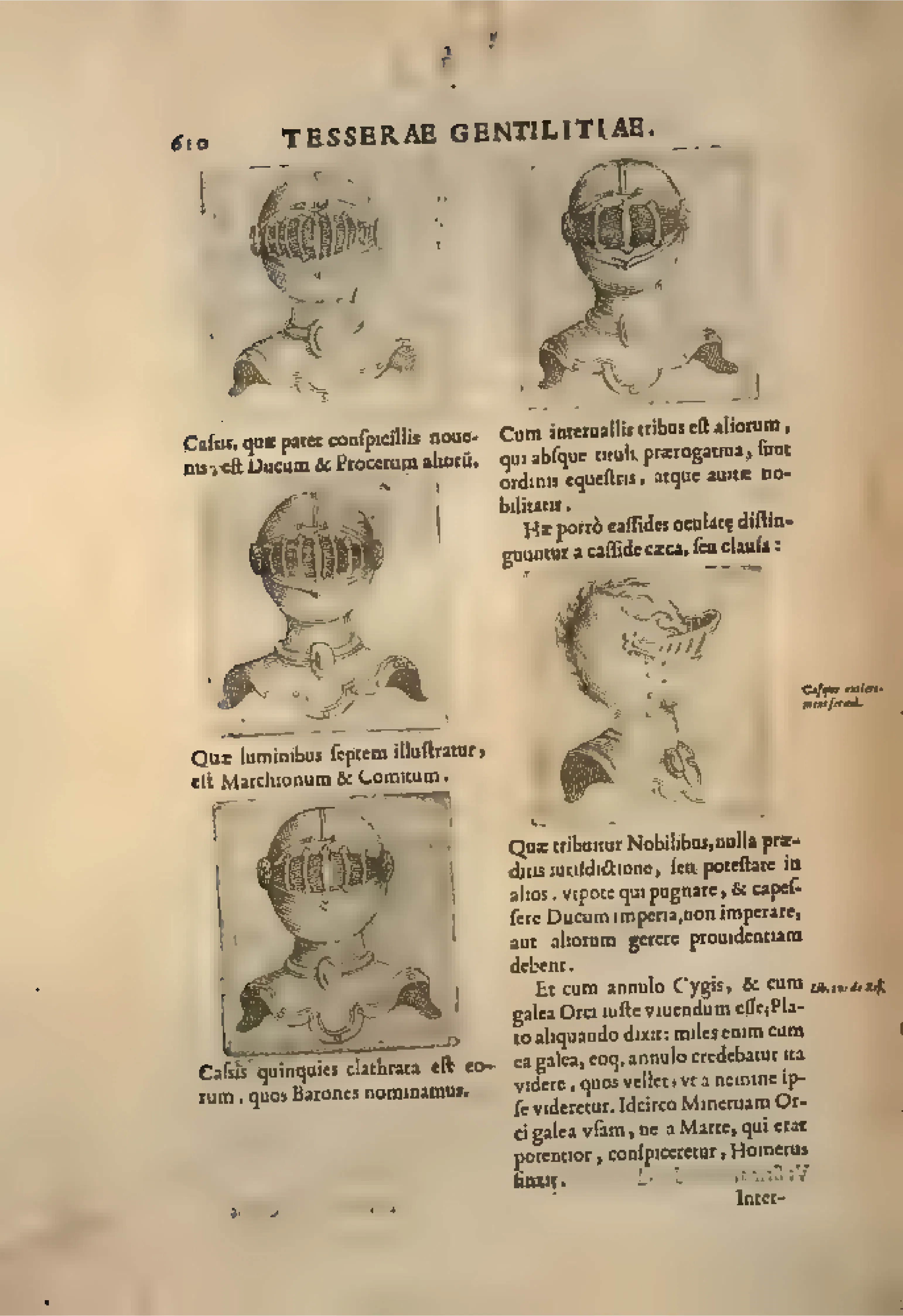
Five engraved cassides make heraldic hierarchy a matter of visible equipment, each helmet paired with a Latin caption assigning it to dukes, counts, barons, or other grades of nobility. Set beside the chapters on cadency, the page turns small graphic distinctions into public signs of descent and rank. Source ↗.
That pattern — a rule stated absolutely, then bent where sovereignty intervenes — culminates in the casuistical chapters, where the requirement that heraldic figures be naturalistic collides with the imperial eagle. The challenge quoted earlier is the pivot: who would dare utterly to forbid such things without fearing to be summoned before Caesar's tribunal as guilty of treason, and is the double-headed eagle of the Empire, such as nature does not spontaneously beget, therefore to be struck from the badge of him who is highest of princes and fount of all nobility? The refutation proceeds by invoking the single most august charge in Christendom, and the invocation of crimen maiestatis registers, with some rhetorical relish, that heraldic doctrine touches matters where an incautious legislator might find himself a defendant.
The closing self-audit exposes the material conditions on which the whole enterprise rested. Confessing himself conscious and guilty of many things after unrolling his own printed sheets, the author pleads the limits of access rather than of diligence: it is not always easy to draw each thing from its own sources, and where the necessary codices or plates are not to hand, to set out at once for the regions themselves so as to survey everything well, Etenim haud semper promptum est, singula ex fontibus suis hauntre, atque vbi non suppetunt codices necessarij, vel cabulæ; statum adire regiones, vt benedominos, omniaq[ue] perlustrare. Armorial evidence had to be gathered from written armorials, engraved plates, and informants scattered across the polities whose usages the treatise claims to harmonize; the confession of error is thus also an implicit account of method, and it explains why blame is distributed among engraver and chalcographer for misplaced plates as well as assumed by the author for misassigned tinctures. The volume then closes its argument where its dedication began, with the roll of cardinals' arms giving way to THADAEVS BARBERINIVS, CAROLI Fratris VRBANI VIII. Pont. Max. filius, Almaræ Vrbis Præfectus, & generalis Ductor coprarum Pontificiarum, the dedicatee named with his descent, his urban prefecture, and his command of the pontifical forces — the three registers of lineage, office, and arms that the treatise has spent its length teaching its reader to read from a shield.
The Final Gathering: Capitoline Roll, Blank Shield, and the Closing Ring
The final gathering of the treatise opens still in the midst of a catalogue, the roll of arms of the sitting Capitoline magistracy, and the specimens there show the Latinizing programme operating at its most routine and therefore most revealing level. A single magistrate is dispatched in one clause: Caesar, Count Montecatini, on whose little shield, divided six times silver and purple, is a blue bend sown with three golden lilies, CAESAR Comes MONTECATINIVS, in cuius parmula, sexies argento atque ostro segmentata, est balreus cyaneus, consitus terois auratis lilijs. Every substantive here has been drawn out of the classical vocabulary of dress and dyestuff rather than out of French blazon: parmula, the small buckler; balteus, the military belt, for the bend; ostrum, the purple of the murex, for gules; cyaneus, the dark blue of the lapis, for azure. The choice is not merely lexical fastidiousness. A nomenclature assembled from the words for cloth, girdle and dye enacts in miniature the historical thesis the book exists to defend, so that even a perfunctory blazon of a Roman count silently argues that armory is a descendant of costume. The same page also registers an augmentation conferred from outside the lineage, where Marius Mattei bears in the chief of his shield a token of Empire, cum telsera Imperij, in eius coronide scutaria, a notation that quietly imports the juridical distinction between what a family holds by descent and what it holds by grant.
That roll is then dated with a precision that sits oddly in an antiquarian folio: and these are the Roman magistrates whom they hold at Rome for this spring quarter, namely the Conservators and the one whom they call Prior, Arque hi Magistrarum Romanum, hoc Verno trimestr. (nempe CONSERVATORIS IES, arque vnus PRIOR, quos appellant) Romæ gerunt. The transmitted text garbles Conservatores tres, but the sense is secure, and the gesture is deliberate: a work that has spent eighty-odd chapters deriving arms from heroic antiquity ends its armorial gallery on a body of officers whose tenure will expire within three months. The effect is to bind the learned reconstruction of the leges Fecialium to the living municipal government of Barberini Rome, and to date the book's last folios as a public record does. It also concedes, structurally, that an armorial compilation is perishable by its very completeness.
Precisely that concession is made explicit in the device that follows, where Pietrasanta issues the invitation already quoted above: any reader who fails to find the arms of his own house in the book is earnestly begged to inscribe them himself upon the escutcheon appended for the purpose, furnished with helmet and mantling but blank and without any figure. The printed void is more carefully specified than it first appears. The helm and the mantling are supplied by the author because, on his own account, these externals are governed by general law and by rank — the gilt, silvered or steel casque belongs to the order of the bearer, not to the peculiarity of his blood — whereas the field is left empty because charges are proper to a single lineage and cannot be legislated into existence. The blank shield is thus not a printer's ornament but the visible residue of the distinction between what the herald can state as rule and what he can only record as fact. It also converts the folio from a closed monument into a working instrument, and admits without embarrassment that exhaustive coverage of the European nobility was never attainable.
The peroration proper returns the reader to the book's first premise, in the sentence already examined, which declares that the close of the work confirms what its opening said — that arms were given their most ample and most ancient origin from the fashion of garments at home and abroad. The ring-composition is announced as such, and the two exhibits that follow are chosen as ocular demonstration rather than as further testimony from authorities. The first is a marble sepulchral effigy of a soldier in a garment quartered between lily-patterned and wavy cloth, whose epitaph the author transcribes after warning that it is inscribed in semi-barbarous fashion, Inscribitur verò semibarbarè:. The judgement is characteristic of the humanist antiquary and internally awkward: the Latinity of the monument is graded as defective by the standards of the Roman mouth the preface promised to speak with, yet the monument is admitted as probative evidence precisely because it is medieval and therefore near the period in which figured dress hardened into hereditary device. The inscription reads: here lies Angeloctus, a prudent and learned man, who in defence of the Republic at the Ponte Salario was killed by the Bretons, in the year of the Lord one thousand three hundred and seventy-eight, on the tenth feast-day, Hic iacet Angeloctus, Vir prudens & doctus; qui ob defensionem Respublicæ, apud Pontem Salarium, à Brixtonibus ruin mortuus, anno Domini Millesimo CCC.LXXVIII. die festo decimo. A dated Roman tomb from the year the Schism began, commemorating a death at the hands of the Breton companies on the Aniene, supplies what the preceding chapters could not: a fixed point at which patterned cloth and family sign are documented together on one body.
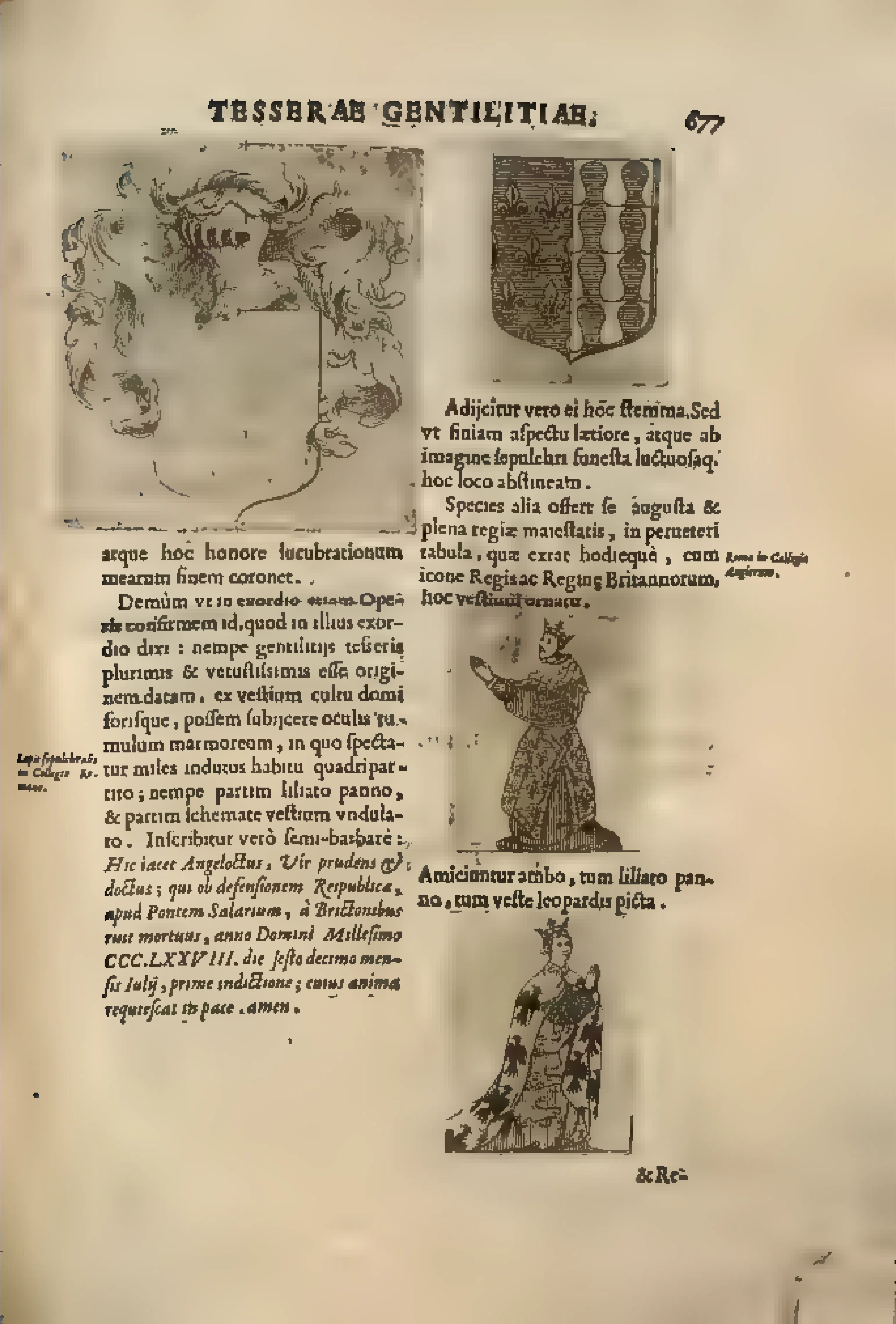
On this closing page, helm, quartered arms, and crowned royal figures make the return to the clothing-origin thesis cumulative rather than merely declarative. Set beside the discussion of Angeloctus's dated tomb, the heraldic vestments render patterned cloth and family sign mutually legible as historical documents. Source ↗.
The pivot to the second exhibit is governed not by evidence but by decorum, and the author says so: and this coat of arms is added to it. But, so that I may end with a more cheerful sight, and abstain in this place from the grim and mournful image of a tomb, Adijcitur vero ei hoc stemma. Sed vt finiam aspectu lætiore, atque ab imagine sepulchri funesta luctuosaq[ue] hoc loco abstineat[ur]. A treatise that has laboured to make heraldry a matter of stateable law here allows affective propriety to select its closing demonstration, a reminder that the volume belongs as much to the rhetorical culture of Jesuit letters as to armorial jurisprudence.
The happier exhibit is a very old painted panel of a king and queen robed in lily-cloth and leopard-figured stuff, the consort additionally mantled in eagles and gold, and Pietrasanta dates it by its heraldry alone: they appear to be Richard II, king, who reigned next after King Edward, from whom the French lilies began to be joined to the British leopards, and Anne of Bohemia his wife, Videtur ij esse Riccardus II. Rex: qui proximus regnant ab Edoando Rege, à quo corpta sunt Francica lilia rungi leopardis Britannis; arque ANNA Bohema vxor eius. The inference runs from the quartering of France with England, and from the Wenceslas eagles on the queen's mantle, to a reign; iconography is made to serve as chronology, which is the strongest possible vindication of the book's claim that armorial signs are documents rather than ornaments. The panel also does double service, since what identifies the sovereigns is what they wear, not what they carry. The scene is then described in its devotional aspect: they cling kneeling, while meanwhile, with St John as intercessor, they offer the royal island of Britain to the Virgin Mother of God, with this epigraph inscribed, Hrent vero nixi genibus, dum interim, interprete Diuo Ioanne, Regiam Inulam Britannæ offerant Driparae Virginis, cum adscripta ea epigraphe,, the epigraph itself being the medieval formula of England as the Virgin's dower, already quoted above, in which the holy Virgin is told that this realm is her dower and asked therefore to rule it. The choice made for cheerfulness thus turns, for a Roman Jesuit writing in 1638, into a lament over a kingdom now held by heretical depravity, the transmitted adjective being corrupt, quarum dictat iam ibi pranitas hærescos Catuibianæ [reading uncertain]. The treatise then closes not upon its Barberini dedicatee but upon a votive act: at least I embrace this with a like resolve, and to that same Virgin Mother of God I utterly give over and dedicate these labours of mine, such as they are, and my very self, Pintam ego saltem cum adsimili plectare, arque eidem Virginis Deiparae has qualecumque lucubrationes meas, meq[ue] ipsum penitus dedo ac dico:. The author imitates in his own person the gesture he has just described in the panel, so that the final heraldic act of the book is the offering of an author instead of a shield.
The Wilton Diptych, in which Richard II kneels before the Virgin and Child amid heraldic signs—quartered royal arms, the angels' white-hart badges, the Cross of St George. Pietrasanta's closing appeal depends on exactly this fusion of piety and armory, where garments and badges serve as chronological documents. Source ↗.

Index, Errata, and Colophon
The chapter-index that follows makes the book's dialectic visible at a glance. The origins books are preserved in their interrogative form — whether armorial bearings took their origin from the portrait-busts of the ancients, An tesseræ gentilitia originem habuerint ex veteru[m] imaginibus — and resolved in the declarative heading of the tenth chapter, that the origin of family arms is sought from the ornament of garments, Ex vestium ornatu petitur origo gentilium tesserarum. Cap. X. 32. Hypotheses entertained and dismissed, then a thesis and its objections answered: the conspectus exhibits a scholastic order of proof that the running text distributes across dozens of folios. The closing chapters are indexed in an unmistakably juridical register, as when the eighty-fourth undertakes what must be determined concerning certain other laws of the heralds, Quid statuendum sit, de aliquot alijs Legibus Fecialium. Cap LXXXIV. 649, the verb statuendum treating armory as positive law admitting of determination; and the sequence ends in the author's own tribunal, a censure and purgation of the whole work, with some excuse also on the author's part, Operis totius censura & repurgatio, cum excausatione aliqua etiam Authoris. Cap. LXXXVI. 652. Self-censura and self-repurgatio borrow the technical idiom of ecclesiastical review and apply it reflexively, a topos of modesty that also forestalls the correction of others.
The printed apparatus closes with corrections whose content is itself philological evidence: page 36, column 1, line 14: for arctus read arcus; page 76, column 2, near the end: for militarium Signorum read militarium Sectorum, Pag. 36. col. 1. versu 14. arctus lege arcus. pag. 76. 2 circa finem, militarium Signorum. lege militarium Sectorum. The list gathers exactly the vocabulary the treatise had to import or coin — clamys for chlamys, Bizantij for Byzantij, and, most tellingly, seciales for feciales, the very term the title-page makes the book's warrant. A compositor's slip in the Graecizing and antiquarian lexicon is the material trace of the difficulty the author had claimed as his hardest task, and it registers the cost of building a learned Latin technical language in a workshop whose cases were not stocked for it. The register then notes the gathering structure, that all are quaternions except the final ternion, Omnes sunt Duerniones, præter Tttt Ternionem, and the colophon fixes press, year and authorization, from the press of the heirs of Francesco Corbelletti, 1638, by permission of the superiors, Typis Hæredum Francisci Corbelletti. MDCXXXVIII. SUPERIORVM PERMISSV — the last formula the standard notice of religious-order and Roman approbation, and the plainest statement in the volume of the institutional order within which its laws of the shield were allowed to be published.
Frequently Asked Questions
What is Silvestro Pietrasanta's Tesserae gentilitiae?
It is a Latin folio on heraldry of some 678 pages, printed at Rome in 1638 by the heirs of Francesco Corbelletti under the title Tesserae gentilitiae a Silvestro Petra Sancta Romano Societatis Iesu ex legibus Fecialium descriptae. Rather than a practical manual, it aims to supply heraldry with a scholarly Latin vocabulary, an account of the origin of armorial signs, and rules capable of deciding hard cases. It carries an engraved title and a full-page plate of the arms of its dedicatee, Taddeo Barberini, Prefect of the City, and it ends with a shield left deliberately blank for any reader whose family was omitted.
Who was Silvestro Pietrasanta?
A Roman Jesuit, born in 1590 and dead in 1647, also styled Silvester Petra Sancta. He served in Cologne with Cardinal Pier Luigi Carafa, published at Liège under the pseudonym Coelius Servilius, and returned to Italy, to Loreto and then Rome, where he kept close ties with the papal court and later became apostolic visitator of the Piarist order. Besides the 1638 heraldic folio, he published at Antwerp in 1634 the emblematic De symbolis heroicis libri IX, printed by Balthasar Moretus, a work recent scholarship treats as part of a single enterprise joining coins, emblems, heraldry, and moral instruction.
Did Pietrasanta invent the system of hatching that shows heraldic colours in black and white?
He is conventionally credited with it, and the rule is stated plainly in his text: gold is dotted, silver left free of all engraving, red scored with lines drawn from top to bottom. The credit needs qualification. Jan Baptist Zangrius had produced a hatching chart at Leuven in 1600; Marcus Vulson de la Colombière issued a competing table in 1639 and in his 1644 La Science Heroïque accused Pietrasanta of copying him. The surviving evidence supports priority, transmission, and independent codification as three separate questions, not one settled story of invention.
Why did Pietrasanta derive coats of arms from clothing, and how confident was he?
His tenth chapter seeks the origin of family tokens in the ornament of garments, against the rival derivations from the Roman ancestral images and from legionary shields. He states the strongest objection against himself — cloth does not contain the gold and silver found in arms — grants the difficulty to be serious, and answers only by analogy with the breastplate, once linen or hide and later iron. Finding just one corroborating authority, a phrase in Nicholas of Lyra coupling garments and shields, he confesses he deals in conjectures alone and may have erred. The thesis nonetheless governs the system: the fess is read as a military belt, the chief as a diadem.
Is there an English translation of Tesserae gentilitiae?
No complete modern translation of Tesserae gentilitiae has been identified, and no critical modern edition was located; the known access points are digitized facsimiles, including copies associated with the Internet Archive, Google Books from a Lyon public-library original, and a HathiTrust full-view record tied to the Getty Research Institute. Separately, the Leo edition presents the full transcription together with a complete English translation for the first time. That translation is generated by AI. Leo works to make freely available online, at no cost, English translations of every text printed in Latin in early modern Europe between 1450 and 1750.
This report was generated by an advanced AI assistant that conducted deep research alongside an extensive interpretation of the transcribed original text. Every effort has been made to preserve fidelity to the source and to guard against inaccuracy, but corruption in the text recognition process and model hallucination may nonetheless have entered the text. Treat every claim, quotation, translation, and citation as provisional, and verify each against the original source before relying on or citing it.
Critical Further Reading on Pietrasanta, Jesuit Emblems, and Barberini Rome
- Marco Cavarzere, "The Workings of a Papal Institution: Roman Censorship and Italian Authors in the Seventeenth Century," Praktiken der Frühen Neuzeit: Cavarzere reconstructs how the Holy Office, the Index, and the Master of the Sacred Palace actually processed books, which is the framework needed to read the Imprimatur of Niccolò Riccardi in Pietrasanta's preliminaries as bureaucratic routine rather than as drama. Read alongside his monograph La prassi della censura nell'Italia del Seicento (Rome, 2011), it supplies the distinction the treatise itself blurs: between correction imposed from outside and the author's own closing censura et repurgatio.
- Bartłomiej Czarski, "Silvestro Pietrasanta (1590–1647) on Ancient Coins: Symbols of Nobility and Moral Education," Journal of Jesuit Studies: The most directly relevant recent study of the author, tracing his Jesuit career, his Cologne and Liège years under the pseudonym Coelius Servilius, and his Roman connections. Czarski's insistence that the numismatic, emblematic, and heraldic projects form one enterprise is precisely what makes Tesserae gentilitiae legible next to De symbolis heroicis rather than as an eccentric folio about shields.
- Peter M. Daly and G. Richard Dimler, S.J., The Jesuit Emblem in the European Context: A large-scale bibliography and typology of the Jesuit emblem corpus, dividing it into spiritual, didactic, and heroic modes and counting well over fifteen hundred printed books. Consult it to see why a heraldic compendium could rank charges by admiratio and then close on a Marian vow without any sense of generic trespass.
- Marilyn Aronberg Lavin, Seventeenth-Century Barberini Documents and Inventories of Art: Two volumes of transcribed household and collection documents from the family whose three bees open and underwrite Pietrasanta's folio. It is the archival counterweight to the dedicatory rhetoric, showing what Barberini patronage cost, commissioned, and catalogued while the treatise was being set in type.
- Michel Pastoureau, L'art héraldique au Moyen Âge: Pastoureau's medieval survey, like his English Heraldry: Its Origins and Meaning (London, 2004), separates how arms actually formed in the twelfth and thirteenth centuries from how seventeenth-century antiquaries reconstructed that formation, which is exactly the gap Pietrasanta fills with conjecture. That reconstruction is prescriptive as well as descriptive, as Pietrasanta’s account of his own selection principles shows: he deliberately passes these over, and likewise omits boys and girls, whether rustic or of urban dress, so as to report only those things which seem more consonant with a heraldic shield, that is, with arms and military ornaments, Ego de industria hæc prætereo: pueroq[ue] & puerlas, seu rusticolas, seu ex urbano cultu, pariter omittor, vt ea referâ damtaxat, quæ e ypes tesserarius, hoc est armis & milicis ornamentia contentanea magis esse videantur. Supplement him with specialist work on monochrome hatching, since no general history settles the Zangrius–Pietrasanta–Vulson priority quarrel.