Ashes Instead of Coals: Johann Lange's A Miscellany of Medical Letters
Johann Lange, physician to five successive Counts Palatine of the Rhine, spent four decades of stolen hours assembling eighty-three Latin letters — Medicinalium epistolarum miscellanea, printed at Basel by Oporinus in 1554 — that argue a single case: who may be trusted to practise medicine, and on what proof. His targets are the uroscopist reading a disease from a glass like a crone with a crystal, the silk-robed impostor with rings and a red cap, the apothecary's unpronounceable compound and the almanac that fixes the day for bleeding; his instruments are philologically restored Greek texts and tested experience. What survives that double tribunal — sympathy as a property of substance, contagion carried by seedbeds, distillation without gold-making — he keeps, and the remainder he reassigns to fraud, to corrupt translation, or to superstition.
ExLatinis
August 12, 2026
Contents
Johann Lange, physician to five successive Counts Palatine of the Rhine, spent four decades of stolen hours assembling eighty-three Latin letters — Medicinalium epistolarum miscellanea, printed at Basel by Oporinus in 1554 — that argue a single case: who may be trusted to practise medicine, and on what proof. His targets are the uroscopist reading a disease from a glass like a crone with a crystal, the silk-robed impostor with rings and a red cap, the apothecary's unpronounceable compound and the almanac that fixes the day for bleeding; his instruments are philologically restored Greek texts and tested experience. What survives that double tribunal — sympathy as a property of substance, contagion carried by seedbeds, distillation without gold-making — he keeps, and the remainder he reassigns to fraud, to corrupt translation, or to superstition.
Johann Lange, born at Löwenberg in Silesia in 1485 and dead at Heidelberg on 21 June 1565, spent the better part of four decades as a physician to the Counts Palatine of the Rhine, having taken the medical doctorate at Pisa in 1522 according to the biographical record. The book by which he is chiefly known is not a treatise but a gathering: Medicinalium epistolarum miscellanea, printed at Basel by Johannes Oporinus in August 1554, a quarto carrying an imperial privilege for five years and opening, after a verse address to the friendly reader and an autobiographical preface, onto an analytic table of eighty-three numbered letters. The letters are Latin, thick with Greek, and studded with German disease-names; they range from the crisis-days of fevers to the pallor of unmarried girls, from the vapours in mine-shafts to the metals in water-pipes, from lycanthropy to the antiquity of the pox, from amulets and horoscopes to the alchemical furnace, from the drug-shops of the apothecaries to the Atlantic voyages of the Phoenicians. Under the conventions of the genre, each is addressed to a correspondent and argues a case; collectively they compose something closer to a manifesto than to an archive.
What holds so heterogeneous a body of writing together is a single, insistently repeated problem: the custody of medicine — who is entitled to practise it, on what warrant, and by what standard of proof. Lange writes from a position in which, on his own account, no law punishes lethal ignorance, magistrates tolerate the unlicensed, and the press itself circulates regimens that kill. His recurring move in response is to refer every disputed matter — a fever's crisis, a virgin's pallor, a prognosis read from urine, the lethality of a wound, an amulet, a horoscope, a claim of transmutation, the true referent of a drug's name — back to a double tribunal: philologically restored ancient texts, with Greek preferred to Arabic and Galen and Hippocrates preferred to their translators and their apothecary-interpreters, and tested experience. He then declares what that tribunal excludes. The result is less a blanket denial of the occult and the marvellous than a re-partitioning of them. What can be naturalised is retained — sympathy understood as a property of substance, astronomy without judicial prediction, distillation without gold-making, contagion carried by seedbeds — while the remainder is reassigned to fraud, to corrupt textual transmission, or to superstition.
The stakes of that operation were at once jurisdictional and intellectual. In the German lands of the mid-sixteenth century the boundary between the university-trained medicus and the empiric, the agyrta, the seplasiarius, the itinerant circulator, or the practitioner condemned as unauthorised was not fixed by any single authority, and the vocabulary in which the boundary was drawn was itself a weapon: the same healer could be described as a physician or as an impostor depending on who claimed the right to judge. Lange's polemical lexicon — pseudomedici, empirici, agyrtae, logiatri, and, in terms that belong to the persecutory environment of Reformation Germany rather than to any neutral description, Jewish practitioners and apostate clerics — is therefore part of the argument, not decoration around it. So too is his philology. To insist that Avicenna and Mesue misread Galen because the Arabic transmission was corrupt is at once a textual claim and a claim about who may be trusted to compound a medicine.
Several features of the volume are likely to strike a first-time reader most sharply. There is Lange's account of the morbus virgineus, the disease of virgins, later drawn into the long history of green sickness and reported in the twenty-first letter by the older historiography, a category that binds symptoms to age, sex, virginity and marriage expectation and that should not be silently converted into a modern diagnosis. There is his insistence that the French disease, the Neapolitan or Spanish pox, is old rather than new, propagated by seedbeds of contagion and made fierce again by the constitution of the heavens and air around 1490. There is his rejection of lead pipes for aqueducts in favour of glazed earthenware, argued from Vitruvius and Galen; his description of the maladies of miners breathing the virulent vapour of the veins; his medicalising of lycanthropy as a disease of wolfish black bile rather than the effect of charms; his demolition of judicial astrology, complete with the retraction he ascribes to Ficino; his history of distillation that grants alchemy an ancient pedigree while promising the seeker of transmutation only ashes in his furnace; his defence of Phoenician and Carthaginian priority over Vespucci in the Atlantic; and, running through all of it, a patriotic humanism that answers Galen's dismissal of Germans as barbarians by claiming for them a capacity for good letters second to no nation. The eighty-three-letter count of the first collection is supported by the volume's own analytic table, though the surviving evidence does not by itself establish a one-to-one correspondence between every entry and every printed text. The collection grew after Lange's death into the tripartite recensions of 1589 and 1605, and no complete modern translation has been located.
The same throughline runs through the book's conceptual vocabulary, its making, and its internal architecture. The vocabulary is jurisdictional: to name a practitioner an agyrta, or a disease morbus uirgineus, or a prognosis a piece of divination, is already to allocate competence. The making is courtly and commercial at once: an Oporinus imprint with a five-year privilege, produced by a physician to the Palatine princes who was later made minister and privy councillor, addressed to a learned readership across the German lands and beyond, and prefaced by a verse that sets the gilded promises of booksellers against a wholesome doctrine. And the architecture enacts the argument: the preface opens with physicians who pronounce on internal causes from a glass of urine like prophesying crones, and the last letter of the eighty-three returns to that same quarrel, holding that diagnostics precedes therapeutics by a long interval. The volume begins and ends, that is, with the question of who can be trusted to know.
Read the full text and English translation on Leo
This text was transcribed and translated as part of the ExLatinis project, an effort by Leo to make free English translations of every text published in Latin in early modern Europe (1450–1750) available online. The complete transcription and English translation of this work can be read free of charge:
→ Read the original Latin text and full English translation on Leo
You can save a copy of this document into your Leo account to run deep text searches, conduct further analysis, or cross-reference it with your own research.
Supplying an English Title for Lange's Miscellany of Medical Letters
Editorial English title supplied for convenience, not an established historical translation: A Miscellany of Medical Letters: Johann Lange of Löwenberg and Learned Medicine at the Palatine Court. The title translates the catalogued Medicinalium epistolarum miscellanea while making explicit the authorial and institutional frame that the Latin title leaves in the author line.
The noun miscellanea is important. In the sixteenth-century title it denotes an assembled body of heterogeneous learned matter, not a private archive of letters in the modern documentary sense. The subtitle promises material valuable not only to students of medicine but also to students of natural history; the volume therefore presents epistolary writing as a vehicle for philology, natural inquiry, learned disputation, and professional self-positioning.
The opening contents identify pseudomedicos, while the prefatory verse also uses the polemical vocabulary of the agyrtae. These are not neutral occupational descriptions. They mark the boundary between the licensed, book-trained medicus—and, in Lange's courtly biography, the archiater—and itinerant or therapeutically unauthorized pretenders whose authority is represented as theatrical, venal, or superstitious. The text makes the theatrical charge explicit, describing how those pseudo-physicians, adorned with silken robe, rings and red cap, claim for themselves before the ignoble crowd and the unlearned nobility the title and the person of a physician by a false and feigned display of art, sic illi pseudomedici ueste oloserica, annulis, rubro que pileo decori, falsa & ficta artis ostetatione apud ignobile uulgus, indoctosq[ue] proceres, titulum personamq[ue] Medici sibi uendicant:, where costume and audience together carry the argument: the impostor is defined by the credulity of those who accept his self-presentation as much as by any deficiency of learning. The force of the terms is rhetorical and jurisdictional: the same practitioner could be described differently according to who claimed the right to judge medical competence, and the vocabulary is thus the first instrument by which the volume adjudicates the custody of medicine.
The philological register extends from persons to diseases. Where a popular explanation is available, Lange characteristically substitutes a Greek-derived nosological term and supplies its etymology, holding that men are turned into wolves not by the sorcery of charms or herbs but by a savagery of disposition and a disease of wolfish black bile, which the Greeks name from λύκος, that is the wolf, Ego uerò non carminum aut herbarum ueneficio, sed ferinis animi uitij, ac atræ bilis lupinæ morbo, quem Græci à λυκῶ, id est lupo, lycaonem & lycanthropia[m] appellant, in lupos mutari arbitror. The etymological gloss is not ornamental: naming the condition in Greek is what transfers it from the jurisdiction of the sorcerer to that of the physician. The same conviction governs the volume's handling of the Arabic-Latin tradition, where discrepancy among authorities is diagnosed as an artefact of transmission rather than of doctrine — one may easily conjecture, Lange writes, that Avicenna and Averroes, and Mesue too, could not always attain Galen's true meaning, perhaps because of a corrupted rendering of Galen into the Arabic tongue, just as we cannot attain theirs, Ex his facilè conijcere potes, Auicennam & Auerroim, forsan ob deprauatam Galeni in Arabicam lingua[m] uersione[m], adde q[uæ]q[uam] & ipsum Mesue, non ob id semper uera[m] Galeni sententiam assequi potuisse: quemadmodu[m] nec nos illorum. The reciprocal clause is worth registering: the failure of understanding is admitted to run in both directions, which tempers the polemic even as it grounds the preference for the Greek text.
Lange's morbus virgineus, reported in the twenty-first letter by the older historiography, likewise names a historical nosological construction rather than an invariant biological object. "Disease of virgins" links symptoms to age, sex, sexuality, and reproductive expectation; febris alba ("white fever"), where used as a related designation, belongs to that period vocabulary and should not be silently equated with a modern diagnosis. A comparable construction governs the volume's account of love-sickness, defined as a passion of the concupiscible soul, residing in the liver and the heart, conceived within the mind through the eyes from desire and the image of the beloved object, Et est sanè hic amens amoris affectus, animæ concupiscibilis passio, in epate ac corde residens, à desiderio & rei amatæ simulacro, per oculos intra mentem concepta:, a definition that locates an affective state in specific organs and thereby brings it within the physician's competence. Helen King's history of green sickness is especially useful because it traces continuity in the category while showing how its meanings changed. The volume's terminology thus participates in a medical humanism that reclassified bodies through inherited Latin and Greek authorities while simultaneously making social distinctions appear as medical ones.
Identifying the 1554 Basel Miscellany: Johann Lange, Not Giovanni Manardo
The object is a printed Latin miscellany of learned medical letters, combining epistolary consultation, medical polemic, natural history, philological commentary, and autobiographical self-defence. The author states the occasion in his own terms: in order that he might rescue the wretched sick from the butchery and fraudulent impostures of such practitioners, though nearly buried under a heap of business and distracted on many sides by the wearisome care of patients, he wrote in passing the medical letters the reader sees, ut igitur miseros hos ægros ab illorum carnificina & fraudulentis imposturis asserere possem, quamuis negotiorum cumulo penè obrutus, & erumnosis ægroru[m] curis multifariam districtus has quas uides Medicinales epistolas obiter co[n]scripsi,; the topos of the overburdened court physician writing obiter is conventional, but it frames the collection from the outset as an intervention in the custody of practice rather than as a repository of remedies. It is Johann Lange's collection, not Giovanni Manardo's: Lange was born at Löwenberg in Silesia in 1485, received the medical doctorate at Pisa in 1522 according to the biographical record, served as a Palatine court physician and Leibarzt, and died at Heidelberg on 21 June 1565.
The securely identified first collection is Medicinalium epistolarum miscellanea: varia ac rara cum eruditione, tum rerum scitu dignissimarum explicatione referta, Basel, per Johannem Oporinum, August 1554.
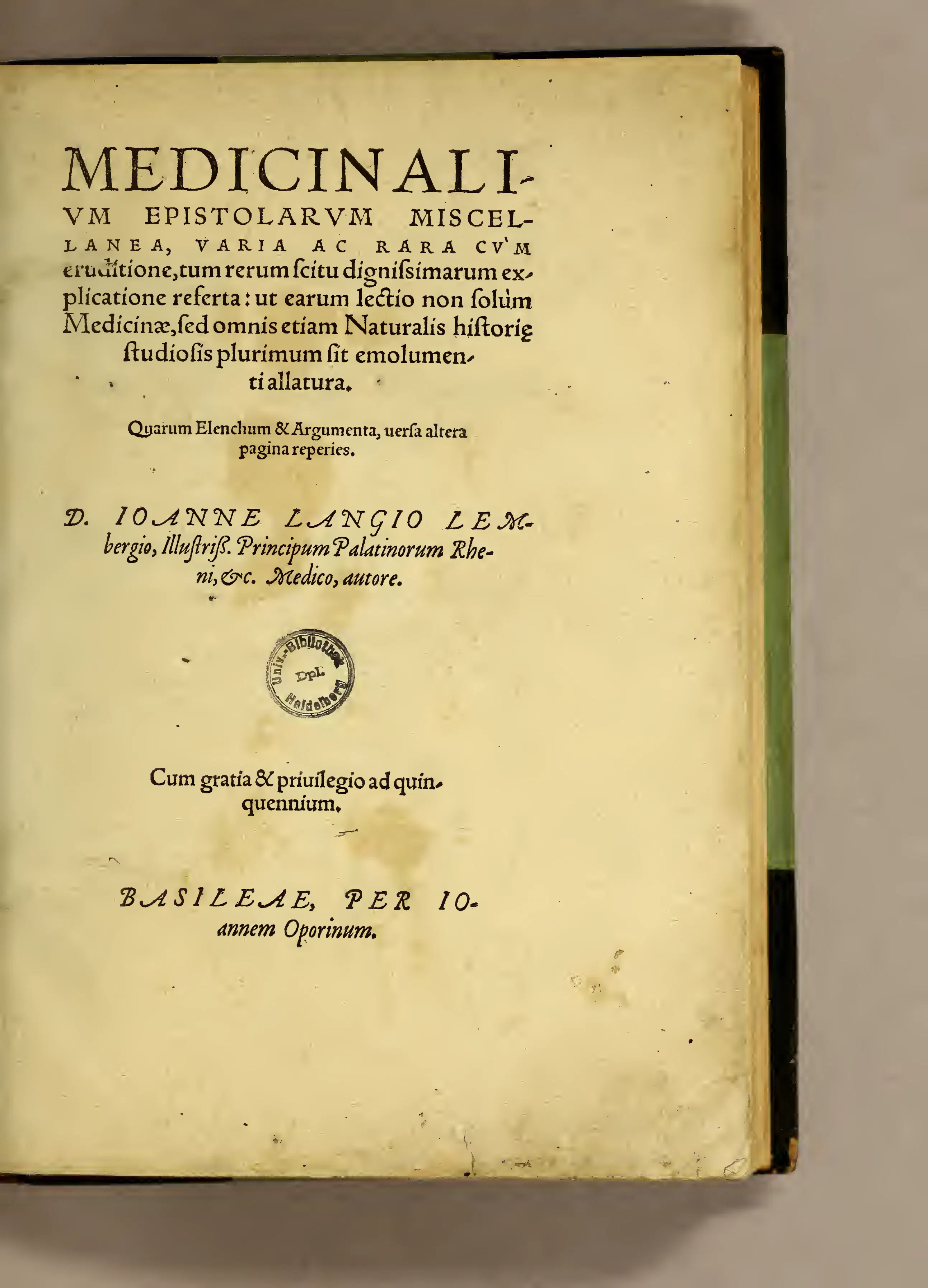
The 1554 Basel title page fixes the collection's public identity at the meeting point of learned medicine, Palatine court service, and the Oporinus press. Lange is named physician to the Princes Palatine of the Rhine; the five-year privilege formula and a later Heidelberg library stamp frame the volume's authority both juridically and materially. Source ↗.
The Wellcome catalogue describes an online reproduction of four unnumbered leaves and 383 pages in quarto; WorldCat supplies the long title, the Oporinus imprint, and the August 1554 date. The title page identifies Lange as physician to the Palatine princes of the Rhine and announces Cum gratia & privilegio ad quinquennium. Its Elenchus et Argumenta begins with an epistle In pseudomedicos and reaches an entry numbered 83. That contents evidence supports the conventional description of an 83-letter first collection, although the accessible machine-readable text of the scan does not by itself establish a one-to-one correspondence between every contents entry and every surviving text or resolve the reported duplication of LXXIII.
The production site is Basel; the composition places and dates of individual letters require a diplomatic reading of the copies. The language is Latin. Greek passages are visibly present in the scan, and German disease expressions are embedded in the work's medical vocabulary, although a complete diplomatic inventory of the vernacular glosses has not been made. That linguistic layering is bound up with an explicit national argument. Lange presents his undertaking as a response to the standing of German learning, professing that he knew well that the Germans either surpass the Greeks in manly courage and bodily strength, or at the least are not their inferiors, and that in gifts of intellect for the pursuit of good letters they are second to no nation, Cæterum quum Germanos uirilis animi fortitudine, ac corporis robore Græcis uel præstare, uel saltem non impares esse, ingenijq[ue] præclaris dotibus ad bonas capessendas literas nullis nationibus esse secundos, probè; and one of the letters takes as its very question the puzzle put to him by a correspondent, who wonders how it comes about that the name of the physicians of Germany is less celebrated among foreigners, MIRARIS mi compater, quî fiat, ut Medicoru[m] Germaniæ nomen apud exteros minus celebre sit,. The disrepute of German medicine abroad is thus not incidental to the polemic against unlicensed practice but its complement: the impostor damages the reputation of the discipline in the very nation whose learned credentials Lange is concerned to assert. No complete modern translation, or a verified modern anthology containing the green-sickness, sweating-sickness, lycanthropy, or lead-pipe letters, was located in the catalogues and bibliographies searched; that negative result is not proof that no isolated translation exists.
Manardo's Epistolarum medicinalium libri duodeviginti with the Annotationes et censurae on the simple and compound medicines of Mesue is a separate Giovanni Manardo object, printed at Basel in 1535. Its record identifies Manardo, 1462–1536, gives a folio extent of 28 unnumbered pages, 467 pages, and one unnumbered page, and names Hieronymus Artolphus as editor. The shared genre and Basel publishing milieu make confusion understandable, but the concrete catalogue records located distinguish Manardo from Lange by author, date, title, and format; no particular library record demonstrably attaching Manardo's title to the 1554 Lange volume was found.
Placing Lange's Medical Letters in the Historiography of Renaissance Medicine
Lange's miscellany matters because it places learned medicine at the intersection of print, court service, humanist philology, and professional jurisdiction. Its letters do not merely preserve isolated treatments. The title, preface, contents, marginal authorities, and polemical vocabulary present medical knowledge as something assembled from reading, consultation, observation, and adjudication. The first collection is therefore a valuable witness to how a German physician claimed learned authority while addressing the unstable boundary between the university-trained medicus and the empiric, agyrta, apothecary, uroscopist, or other practitioner condemned as unauthorized. The juridical vacuum in which that boundary had to be argued is stated bluntly: by this indulgence of the magistrates, Lange writes, it has come about that there is no law, as Pliny attests, which punishes the capital ignorance of physicians, and to the physician alone it is permitted with impunity to kill a man, and to Jews to make experiments through deaths upon the bodies of Christians, hac magistratuum indulgentia effectum est, ut nulla sit lex (teste Plinio) quæ capitalem Medicorum inscitiam puniat: soliq[ue] Medico hominem occidere, & ludæis in corporibus Christianorum experimenta per mortes agere, impunè liceat; the Plinian topos of the physician's impunity is here fused with an anti-Jewish accusation whose confessional and juridical setting is discussed below and which cannot be read as description. Against that vacuum Lange sets an ancient model of statutory regulation, reporting the Egyptian rule that if anyone, following the norm of the sacred book, has been unable to heal the sick man, he is free of all blame, but that if he has treated him otherwise than as the books contain, he is punished with death, Si quis normam sacri libri sequutus, infirmum sanare nequiverit, omni caret crimine. Si præter ea quæ libris continentur, curauerit illum, morte punitur. The interest of the model for Lange's argument lies in its criterion: liability is measured not by outcome but by conformity to an authoritative text, which is precisely the standard his double tribunal of restored authorities and tested experience is designed to supply.
Nancy G. Siraisi's history of Renaissance epistolary medicine is the most directly pertinent modern historiography: its second chapter treats the Heidelberg court physician Johann Lange and his Epistolae medicinales. That placement makes Lange central to the history of learned medical correspondence rather than an incidental compiler. The older essay by Ralph H. Major remains useful for the biography and for identifying topics such as the disease of virgins, lead pipes, and the enlarged body of epistles, but its rhetoric and its count of 150 epistles show why it must be checked against the 1554 object and later recensions.
The volume also intersects with several larger debates. Its attack on pseudomedici belongs to the history of professional closure and the social policing of medical competence in the German lands. Its reliance on classical, Greek, and Arabic-Latin authorities belongs to medical humanism's campaign to repair texts and names rather than simply to discard non-Greek learning. Its discussions of the French disease, sweating sickness, green sickness, lycanthropy, erotic melancholy, toxic substances, mining and water, astrology, amulets, chymia, and polypharmacy make it a rich index of competing explanations, but individual claims require direct verification against the primary text; the accessible contents and machine-readable text do not justify treating every topic listed in the historical description as a fully reconstructed argument. Several of these discussions are nonetheless legible in outline. On the pox, Lange offers a causal account of persistence in which, after the acute phase has passed, only the seedbeds of this foul disease are left behind in our bodies, tum modò sola huius tetri morbi seminaria sunt in corporibus nostris derelicta, a formulation whose relation to Fracastorian seminaria deserves examination rather than assumption. On the sweating sickness he ties aetiology to a dated meteorological record, holding that in the year 1528 from the birth of Christ of the inviolate Virgin, when this sweating contagion first grew severe in Germany, the whole summer of that year was wet, and that these are the causes of the fever, quibus anno à Christo ex illibata uirgine nato 1528, quo primùm in Germania hæc sudoris contagio incrudescebat, tota illius anni æstas maduit, esse huius febris causas:. On the disorders of extractive labour he reports that these same evils and many others frequently befall the diggers of metals, whose principles are sulphur and quicksilver, from the virulent vapour of minerals lurking within the veins in the mine-shafts, Hæc eadem & plura alia mala fossoribus metallorum, quorum sul phur & argentum uium sunt principia, ex uirulento mineralium uapore, in scaptensulis intra uenas delitescen te, crebrò accidere. And the campaign against polypharmacy is given a commercial genealogy: afterwards, he writes, the frauds of men and the traps of clever wits invented those shops in which each man's life is promised him for sale, whereupon inexplicable compositions and mixtures are chanted and Arabia and India are held in esteem, Postea fraudes hominu[m], & ingenioru[m] capturæ, officinas inuenere istas, in quibus sua cuiq[ue] homini uenalis promittit uita. Statim co[m]positio[n]es & mixturæ inexplicabiles decantantur. Arabia atq[ue] India in medio æstimantur. The exotic drug-name and the compound recipe are, on this account, instruments of the same imposture as the silken robe, which is why the philological correction of nomenclature and the policing of practice are for Lange a single undertaking.
The volume's boundary-work with magic, astrology, and alchemy belongs to the same project and is among its most historiographically productive material. Lange's complaint is that the art has been contaminated at its foundations: by these trifles of magic, he writes, medicine has been so befouled that there is no art which teems so thickly with errors and superstitions as that medicine given to us from heaven, His Magiæ nugis Medicina adeò defædata est, ut nulla sit artium, quæ adeò confertim erroribus & superstitionibus scateat, ac illa nobis coelitùs data Medicina; and he adopts the Plinian genealogy according to which magic, most fraudulent of the arts, having embraced three others most imperious over the human mind, has reduced them into itself alone, and that no one doubts it was born first of medicine, Magia, inquit, fraudulentissima artiu[m], sola tres alias imperiosissimas humanæ mentis complexa, in se unam redegit. Natam primùm è medicina, nemo dubitat:. The consequence is not wholesale rejection but re-partition. Amulets are retained on a materialist construction, on Galen's authority: taught by experience of these things, Galen says that one should so judge concerning amulets that it is their substance, and not the words of the magicians' incantation, that helps, Vnde Galenus experientia horum edoctus: Periaptis (inquit) sic considere oportet, ut substantia illorum, & non incantationis magorum uerba, iuuet. Judicial astrology, by contrast, is attacked precisely where it touches therapeutic decision — that they dare to determine on what day it is fitting to evacuate the body by drugs, by venesection, or by the application of cupping-glasses, a crime deserving the lash, by which they destroy countless patients, quo die pharmacis aut uenarum sectione, cucurbitularu[m] applicatione, corpus euacuare co[m]petat, statuere audet. O flagris dignum facinus, quo innumeros perdunt ægros — and Lange marshals the authority of the astrologisers themselves against the practice, reporting that Ficino candidly confesses that he had collected these observations of the astrologers as in some way conducive to the preservation of life, not in order to approve them, but rather, with Plotinus, that gravest interpreter of Plato, to deride them, ingenuè fatetur, has astrologoru[m] obseruationes, ut quomodolibet ad uitæ conseruatione[m] profuturas, se cogessisse, non ut eas probaret, sed potius cum Plotino grauissimo Platonis interprete derideret; whether that reading of Ficino is sustainable is a separate question from its rhetorical function here. Alchemy receives the same treatment: its antiquity is conceded and its operations described, while its promise is withheld, the letter closing with the warning that he has recounted as briefly as he could the ancient origin of distillation and alchemy, and that if the reader seeks the perfection of that art, its ministers, for the most part runaways, will leave him ashes instead of coals and glittering embers of ashes instead of metals and gold in his furnace — farewell, and beware, Ita tibi, quàm breuissimè potui, uetustam distillationis & alchymiæ originem recensui: cuius artis perfectionem si quæsiueris, eius ministri ut plurimum fugitiui, pro carbonibus cineres, pro metallis & auro cineru[m] fauillas micantes, tibi in furnorelinquent. Vale, & caue. The antiquarian and cosmographical excursus operate by the same logic of learned custody, the physician's competence being made coextensive with textual and natural knowledge at large; so, for instance, Lange undertakes to show, and to convince his correspondent by reason and by witnesses, that the Phoenicians and Carthaginians, more or less two thousand years before Vespucci and the other pilots of the kings of Portugal, sailed through the Atlantic sea, even beyond the Fortunate Isles, southwards, simulq[ue] docebo, & ratione testibusq[ue] co[n]uincam, Phoenices & Carthaginese plus minus duobus millibus annorum ante Vesputium, & alios regum Portugalliæ naucleros, per mare Atlanticum, etiam ultra Fortunatas insulas, meridiem uersus, ad has navigasse.
Helen King's work on green sickness is particularly important because it refuses a simple opposition between an early-modern "real disease" and a modern diagnosis: it tracks the continuity of the category while showing how puberty and virginity became medicalized. Arrizabalaga, Henderson, and French provide the necessary historiographical setting for the morbus Gallicus debate by treating the French disease as a historically named and contested object in Renaissance Europe; the accessible catalogue record verifies the book, although its detailed argument should be consulted in the volume itself. Martin Steinmann's study of Oporinus supplies the specialized press history needed to interpret the Basel production context. R. Po-chia Hsia's account of ritual-murder accusations shows how claims about Jews, magic, and Christian children operated within persecution in Reformation Germany; it is the proper control against reading Lange's anti-Jewish polemic as neutral ethnography. Alisha Rankin's work on poison, experiment, evidence, and authority illuminates the volume's toxicological disputes, though it is not a study of Lange specifically.
These scholars do not all ask the same historical question. King's emphasis on changing categories and social meanings complicates retrospective disease identification; the Great Pox scholarship resists a single origin story and reconstructs competing names and etiologies; Hsia interprets ritual-murder material as a history of accusation and persecution rather than as evidence for the alleged events; and Steinmann shifts attention from authorial ideas to the shop, press, and material conditions of transmission. Together they prevent Lange from being reduced either to a precursor of modern medicine or to a transparent spokesman for "Renaissance medicine." The historiography is thin on Lange's direct contemporary reception, the exact censorship history, and the full correspondence network; those absences are themselves limits on what can presently be claimed.
Tracing Oporinus's 1554 Quarto Through Its Later Recensions
The 1554 Basel edition is the first securely identified collection in the transmission history.
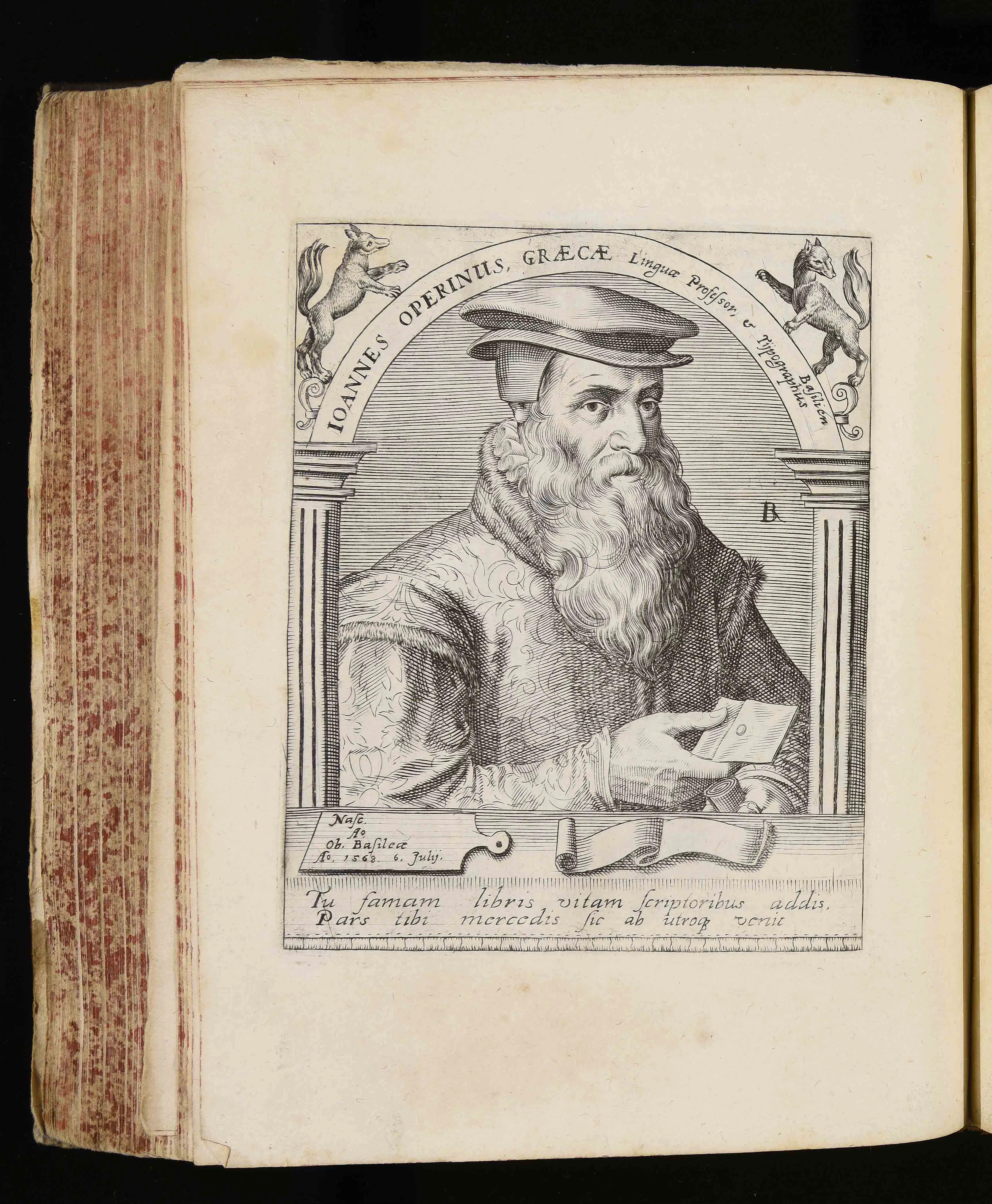
An engraved portrait of Johannes Oporinus, the Basel humanist printer whose shop issued the 1554 quarto that opens the collection's transmission history. Placing Lange's epistles in Oporinus's press frames the edition not simply as a medical text but as a product of Basel's learned print economy, with its privileges, scholarly networks, and commercial reach. Source ↗.

The Internet Archive copy records the colophon-derived publication date, irregular pagination, the call number J554b .L274m, and the signature statement "a-z⁴ A-2C⁴ (a4 and 2C4 versos blank)." The Wellcome record preserves an electronic reproduction of an original in the Wellcome Library, London; the Internet Archive scan is credited to the John Carter Brown Library. The physical-description record gives four unnumbered leaves and 383 pages in quarto, while the scan's internal pagination reaches 377 before FINIS, a difference consistent with preliminaries and irregular pagination but requiring examination of the paper copy for a definitive collation.
The primary scan preserves an unusually informative paratextual sequence: the title page, the verse address "Ioan. Langius lectori amico salutem," a Praefatio explaining Lange's occasion for writing medical epistles, and the analytic Elenchus et Argumenta. The contents page supplies page references and ends with an entry numbered 83. The printed pages show running heads such as EPISTOLAE MEDICINAL. and IOAN. LANGII, display capitals, Greek type, and marginal references to authorities including Galen, Pliny, Vitruvius, and the Epidemics. The scan ends with "377 FINIS." These observations establish the material presence of the apparatus; they do not establish a complete catchword inventory, the printer's device, the identity of Oporinus's correctors, or all press states. The alleged compositorial duplication of letter number LXXIII was not demonstrated by the accessible machine-readable text and should remain a copy-specific collation question.
The paratext and the closing letters frame the collection around a single controversy, which gives the volume a discernible architecture independent of the sequence of individual consultations. The preface introduces the adversary through the practice of uroscopic prognosis, recording that Lange found certain physicians, puffed up with a wondrous ostentation of art, who from the mere inspection of putrid urine, like prophesying crones with a crystal, dared to pronounce rashly upon the substance and the internal cause of a disease, comperi quosdam Medicos, mira artis ostentatione elatos, ex solius putridi lotij inspectione, uelut uatidicas ex crystallo anus, de substantia & interna morbi causa temere pronunciare ausos:; the comparison to female divination is the polemical hinge, converting a diagnostic technique into an unlicensed prophetic performance. The same quarrel returns at the end of the collection, where Lange reports that they visit him and, as he hears, also mutter against him — those barbarous and criminal impostors in medicine — because he has condemned their raving and plainly rash judgement of diseases from urine, Visitant, & ut audio obmurmurant quoque, barbari & scelerati illi in re medica impostores, quòd delirum ac planè temerarium eorum in discernendis morbis ex urina iudiciu[m] damnauerim, and grounds the condemnation in a hierarchy of the parts of the art, that more excellent part of medicine preceding therapeutics by a long interval, since without diagnostics therapeutics is of no use or profit, quæ medicinæ præstantior pars, longo interuallo Therapeuticam præcedit, quæ sine Diagnostica nullius frugi est, aut usus. That the volume's opening apologia and its final letters converge on the same jurisdictional question supports reading the collection as an ordered polemical whole rather than an accumulation, though the internal arrangement of the intervening letters remains to be established from the text itself.
The title-page privilege is visible only in the formula Cum gratia & privilegio ad quinquennium. No imperial chancery record or fuller privilege wording was located. Similarly, the author line securely establishes Lange's Palatine connection, but the accessible preliminaries do not yield a separate formal dedication to Ottheinrich, Friedrich II, or Ludwig V. The Palatine court is therefore a documented institutional setting, not a formally proven dedicatee. The biographical record states that Lange served the Palatine elector and four successors, and that Otto Heinrich later made him minister and privy councillor; this explains the courtly frame without converting the affiliation into a dedication.
The later transmission is clearer in broad outline than in exact issue history. A 1560 second-volume record appears in the Gutenberg Capture catalogue under Basel and Brylinger, but its relation to the 1554 first volume requires a census of copies. The 1589 Frankfurt record is explicitly titled Epistolarum medicinalium volumen tripartitum, denuo recognitum et dimidia sua parte auctum and names the heirs of Andreas Wechel, Claude de Marne, and Jean Aubry; its catalogue description gives an octavo resource of 32 unnumbered pages and 1,131 pages. A 1605 record under Wechelianis confirms a further tripartite recension, but the accessible record does not establish its full collation, issue state, or the precise relation of every title-page variant. The biographical notice correctly places the enlargement after Lange's death and describes the later form as two books supplemented by a third.
The object biography is consequently partly digital and partly institutional: a Wellcome reproduction, a John Carter Brown scan, and MDZ/BSB records for Lange's multi-volume transmission are identifiable, while complete shelfmark and provenance data for Basel, Heidelberg, the British Library, the BnF, the National Library of Medicine, Wolfenbüttel, and Florence were not recovered at record level. No provenance marks, expurgated leaves, or physical evidence of suppression were established. An accessible Index-related excerpt likewise did not identify a specific Roman or Spanish Index entry, title, or date for Lange; no edition-level censorship claim is warranted.
The network around the book is visible chiefly through the text's polemical categories and the medical authorities cited in its margins. The first contents entry attacks pseudomedici, and the verse attacks agyrtae; the older medical historiography associates the collection with discussions of the disease of virgins, lead pipes and healthy water, and the antiquity of disease. Two of those topics can be matched to explicit statements in the text. On water supply, Lange concludes that, relying on such distinguished testimonies and on reason, he does not approve pipes or siphons of lead for aqueducts, but far prefers earthenware tubes carefully glazed by the potter, lest the slime of the waters adhere to them, Quare ta[m] præclaris testimoniis & ratione fretus, sistulas aut siphones ex plumbo, ad aquæductus non probo: sed fictiles tubos, à plaste diligenter uitreatos, ne aquaru[m] limus illis adhæreat, longè præfero, a judgement whose authorities are the Vitruvian and Galenic ones visible in the margins rather than any independent trial. On the antiquity of disease, the rhetorical question is put with maximum emphasis — who, he asks, will deny that this disease is old and has again grown fierce in our times? no one, by Hercules, no one, quis obsecro hunc morbu[m] esse uetere[m], & rursus nostris te[m]porib[us] incruduisse denuò negabit? Nemo mehercule, nemo. Ralph H. Major's 1935 essay is useful as an early historiographical witness, but it describes a much larger body of 150 epistles and therefore must not be used uncritically to count the 1554 volume. That essay also points to earlier scholarship on Lange, including work by V. Fossel, and to the later surgical extraction Themata aliquot chirurgica associated with Conrad Gesner. A complete chain of citation by Sennert, Zwinger, Schenck von Grafenberg, Haller, or later bibliographers was not verified.
Manardo's 1535 folio, with its eighteen books and Mesue annotations, belongs to the same Renaissance culture of printed medical letters but remains a distinct object. Lange's volume belongs to the broader humanist lineage associated with Leoniceno, Manardo, Brasavola, Cop, and Ruel: medical authority is made through letters, textual criticism, classical and Arabic-Latin authorities, case narration, and claims about who may legitimately practice. Within that lineage the volume also urges movement beyond the library, arguing that since diseases are cured not only by remedies born at home within the town's bounds but often require exotic ones, it is better for physicians to search out the native soil of those remedies than to grow old at home in the schools, as the physicians of Alexandria did, uerum quum no[n] tantu[m] remedijs domi in pomoerio natis morbi curentur, sed crebro exoticis opus sit: præstat medicorum horum natale solum scrutari, quàm domi in scholis (ut Medicos Alexandriæ) consenescere — a claim that sits in productive tension with the volume's textual method and helps explain the presence of geographical and ethnographic matter in a collection of medical letters. The exact extent to which Lange's named correspondents, opponents, and later readers formed a traceable reply network remains open until the full text and copy history are collated.
Reading the Eighty-Three Letters: From the Privilege to the Last Word on Urine
The opening apparatus: privilege, verse, and analytic table
The volume announces its jurisdictional programme before a single case is narrated. Its opening apparatus is a sequence of graduated commitments: a title-page claim to Palatine service and to a licence granted with grace and privilege for a five-year term, Cum gratia & privilegio ad quin, set beneath the imprint that names Basel and its press, BASILEAE, PER IO; then a set of elegiacs in which the book is deliberately stripped of the commercial ornament of the trade and presented as graced by no splendour of title, Iste liber nullo tituli splendore decorus,, and offered as dogma salubre, a wholesome doctrine, instead of the Hesperidean apples and Pactolan sands with which booksellers gild their wares; then an analytic table whose very first entry fixes the adversary, letter one being directed against pseudo-physicians who by their impostures bring sacred medicine into disrepute, Epistola 1 In pseudomedicos, qui suis imposturis sacram Medicinam infamant. 7. The gradation matters. The privilege supplies external warrant, the verse repudiates the marketplace, and the table converts a heterogeneous miscellanea into a polemical sequence. That the table runs from anti-empiric invective through physiology, epidemic disease, gynaecology and cerebral nosology to a compact block on magic, amulets, judicial astrology and prodigies, and only then to materia medica, exotica and philological curiosities, shows that the assembled letters were arranged rather than merely accumulated.
The preface then performs the conversion narrative that licenses the whole.
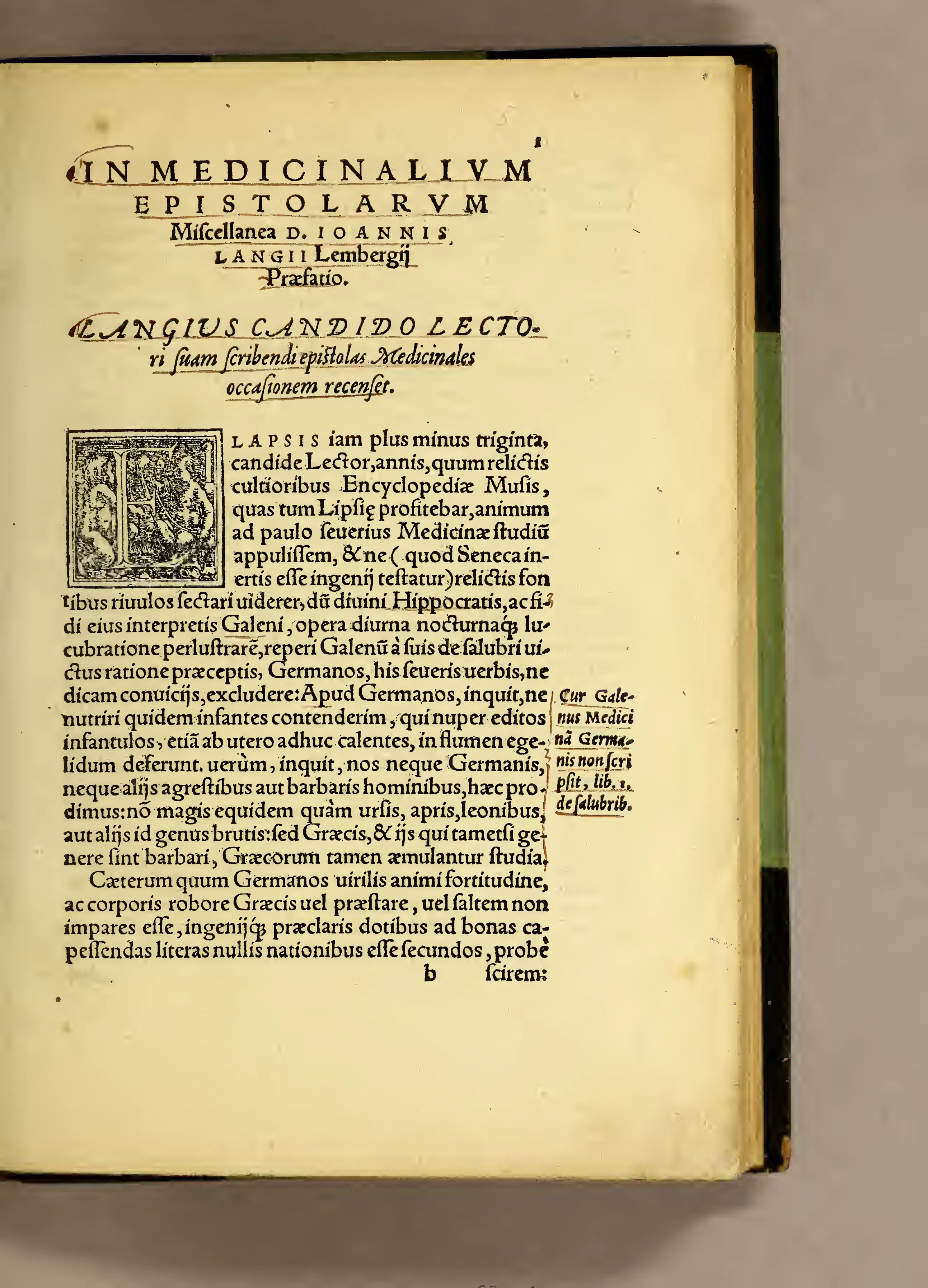
The opening leaf of Lange's Praefatio, where his move from the humanist arts to medicine becomes a rebuttal to Galen's exclusion of Germans from medical counsel. The printed marginal note on why Galen did not write medicine for Germans marks the hinge of the argument, turning a classical objection into a claim that German learning could equal any nation's. Source ↗.
Lange recounts abandoning the cultiores Encyclopediae Musae he had professed at Leipzig for medicine, and reports his discovery that Galen had explicitly refused to legislate on diet for Germans as barbarians who plunge their newborns into cold rivers. The rejoinder, quoted earlier in this report, is national and unembarrassed: he had well known that the Germans either match or surpass the Greeks in courage and bodily strength and are second to no nation in the gifts of intellect required for good letters. The rhetorical economy here is worth pausing over. Lange does not deny Galen's report; he relocates the barbarism from German nature to a German custom, and in doing so establishes the interpretative technique that governs the collection — a difficulty in an ancient authority is resolved by distinguishing the accidental from the essential, never by discarding the authority. The book itself becomes the remedy for Galen's refusal: what the Greek would not write for Germans, a German physician writes.
The two faces of the adversary: divination and costume
The preface's substantive grievance is diagnostic, and it is framed so as to make a learned technique indistinguishable from popular soothsaying. In the sentence already discussed, physicians puffed up with a wondrous ostentation of art pronounce rashly on the substance and internal cause of a disease from the inspection of putrid urine alone, like prophesying crones with a crystal. Three moves are compressed into that single period. The urine is putridum, so the material basis of the inference is degraded; the practitioner is elatus, so the fault is moral; and the comparison to the crystal-gazing anus transfers the operation into a female, illiterate, and divinatory register wholly outside the university. Uroscopy was of course a legitimate part of the Galenic semeiotic; the polemic does not argue that urine is uninformative but that inspection alone usurps the office of the whole art. The charge is therefore about sufficiency and jurisdiction, not about the sign.
The first letter supplies the complementary image, and it is theatrical rather than prophetic. Hippocrates, Lange observes, rightly likened such men to masked actors in tragedy, and the simile is then filled out in the passage examined above, where the pseudo-physician's silken robe, rings and red cap secure him the title and person of a physician before the ignoble crowd and the unlearned nobility. The vocabulary is legal as much as scenic — uendicare is a claim of title, persona a mask and a juristic standing at once — and the two audiences named, the base crowd and the unlettered nobility, indict credulity at both ends of the social order. There is an unresolved tension in the image, since the silk, rings and doctoral cap are precisely the insignia to which Lange's own doctorate entitles him; the argument can only be saved by insisting that costume without learning is imposture, which is to concede that costume alone cannot adjudicate. The letter is staged, significantly, at a garden banquet, where the conuiuium is itself classed as a remedy: it is truly the fellowship of comrades, the food of cheerfulness of mind, the love-charm of friendship, and the parent of goodwill, Est sanè conuiuiu[m] co[m]militonum homelia, alacritatis animi pabulum, amicitiæ philtrum, & beneuolentiæ parens. Sober conviviality is thus not a frame around the argument but an instance of it: the physician belongs at table because regimen extends to the affections, and the reform of medicine can accordingly be launched from a dinner party among learned friends.
Print, law, and the forensic tribunal
The preface's most arresting charge, already cited in this report, is directed not at bedside practice but at publication: the criminal surgeon who, Lange asks the reader to believe, killed thousands by his abominable method for curing the sweating fever, rashly published at the very outset of an unknown disease. The aggravating circumstances are precisely temporal and typographic: in morbi ignoti principio and inuulgauerat. Harm is multiplied because a regimen was fixed in type before the disease was understood and diffused faster than correction could follow — an argument that sits in evident tension with Lange's own recourse to the same medium, and one he can only meet by claiming that his own publication is the antidote. That claim is duly made in the compositional apology noticed above, where the letters are said to have been written obiter, in passing, by a man nearly buried under a heap of business and distracted by the wearisome care of patients, in order that he might rescue the wretched sick from butchery and fraudulent imposture. The obiter is generic modesty, but it also does argumentative work: interstitial writing by a practising court physician is offered as evidentially superior to the systematic treatise of a man with leisure and no patients.
Why, then, does the abuse persist? The second letter locates the cause in the absence of penal sanction, in the passage on the indulgence of the magistrates and the Plinian complaint that no law punishes the capital ignorance of physicians, discussed in an earlier section of this report, where the classical topos is fused with an accusation belonging to the persecutory repertoire of Reformation Germany. The fusion is not incidental: impunity is presented as the single condition that shelters a whole population of unlicensed healers, catalogued in a deliberately Horatian sweep — relying on this impunity, he writes, monks, apostates, mountebanks, guilds of flute-girls, buffoons and old women enchantresses, Hac impunitate freti monachi, apostatæ, agyrtæ, ambubaiarum collegia, balatrones, anus in cantatrices,. Monk, apostate, vagrant, flute-girls' guild, buffoon and incantatrix are made members of one juridical class defined solely by their exemption from penalty.
Against this vacuum, the letters make a positive institutional claim. The consultation on an occult skull fracture reports that, since the jurisconsult had ruled that learned physicians must be consulted not only concerning a ten-month birth but also concerning the lethal character of a wound, the kinsmen of the dead man appealed from the empiric to physicians proper, Et quum Iurisconsultus non tantum de partu decem mestri, sed & de lethalis conditione uulneris Medicos doctos consulendos statuisset, affines interempti, ab Empirico medicos physicos appellasse. This is the sharpest formulation of the tribunal Lange is building. Legal procedure supplies what medicine lacks: a forum in which the medicus physicus is constituted as expert against the empiricus, and in which liability is apportioned between assailant and surgeon. Competence is here certified by a court rather than by costume, which resolves the difficulty the theatrical simile had left open. The same letter's closing anecdote shows what is at stake technically as well as institutionally: at a dinner with empirics boasting of their instruments, one of them said, tandem unus ait: Langi doctor, frustra quæris in Germania abaptista. No enim chirurgicorum instrumenta nobiscum, sed campanæ & pueri baptisantur — "Doctor Lange, you look in vain in Germany for an abaptista; for with us it is not surgeons' instruments that are baptized, but bells and children." The joke documents the absence of the non-perforating trepan north of the Alps while displacing ignorance onto ritual, and Lange answers it with his Roman training under Giovanni da Vigo in the pontificate of Leo X — southern studia against German improvisation.
The diagnostic quarrel returns as an explicitly national question in the letter already noticed, which opens by wondering how it comes about that the name of the physicians of Germany is less celebrated among foreigners. German letters flourish, but medicine alone lies despised, and the cause assigned is the neglect of the diagnostic part in favour of the urine-glass. The letter closes on an image of corporate parasitism, the interlopers creeping ut fuci in aliena apum aluearia, irrepse, like drones into the hives of other bees. The metaphor is telling: the hive is a body with a boundary and a common store, and the argument is for closure rather than merely for better technique.
Naming, vernacular error, and the nosological categories
The polemic against practitioners is inseparable from a polemic against words. Lange's taxonomy of illicit healers is itself a lexical performance: the roll-call quoted below, in which no city and no village fails to nourish some utterly unskilled empiric, some garrulous λογίατρος, some perfidious Jew or some parish apostate ignorant of the whole of philosophy, mints a Greek coinage meaning "word-doctor" precisely to convert fluency into a diagnosis of emptiness, and sets it beside confessional slurs that do the same jurisdictional work.
The vernacular disease-names receive the same treatment, and here the argument is genuinely philological rather than merely abusive. The German surgeons call the ichor of an apostemated joint joint-water, quem glidwasser appellat:, and Lange's objection is that the name embeds a false theory of the substance which then licenses plugging the wound; they suppose causon to be something else and name it, from the blackness of the tongue, the burning, arbitrantur, die breün appellant:, naming a disease from an accident and treating the accident. The most elaborate case is erysipelas, whose German names are traced through the cult of St Anthony and the votive bells hung upon his image, so that it comes about, he writes, that this disease too is called by the Germans bell-fire and, from the red colour of the affected place, the red running, accidit, ut hic quoque morbus à Germanis glogfeüer, & ob rubeu[m] affecti loci colorem, das rothlauff appelletur. The etymology is a piece of aetiological criticism: once the name is shown to descend from a shrine rather than from the sacer ignis of the Latins, the therapeutic rule attached to it — lifelong prohibition of washing — loses its warrant.
Lange's own coinages are not exempt from historical scrutiny. The disease of virgins is given a regional synonym drawn from lay female authority, quem Brabantinorum matronæ, febrem albam, ob faciei pallorem, & amatoriam appellare solet: — which the matrons of Brabant are accustomed to call the white fever, from the pallor of the face, and the amatory fever. The double name binds pallor to desire, and the consultation accordingly ends not with a drug but with a social prescription: Quare bonosis animo, filiam tuam elocato: nuptijs quoq[ue] ego libens interero, be of good cheer, marry off your daughter, and I shall gladly attend the wedding too. Venesection and deobstruents remain adjuvants; the cure proper is marriage, and the physician's authority thereby reaches into the family's disposal of its daughter. The parallel letter on erotic affect performs the same annexation for the passions, in the definition already examined, which lodges the passion of the concupiscible soul in the liver and the heart and has it conceived within the mind through the eyes from desire and the image of the beloved thing. Assigning the affect to named organs is what makes its fluctuating pulse a legible sign and its treatment a physician's business.
Epidemic disease is layered rather than reduced. Divine causation is stated first — there are indeed three scourges, famine, the sword and pestilence, by which by the just judgment of the God of Israel, Tria sunt certè flagella, fames, gladius, & pestis: quibus iusto Dei Israel iudicio — and secondary causes are then derived without contradiction, since the aer and the stars are instruments. The English sweat is assimilated to an ancient category, no one denying, he insists, that this plague of the British sweat is a species of typhoid fever, hanc Britannici sudoris luem, febris typhoideos esse speciem negabit:, and is then pinned to a datable German season by the meteorological record already cited, the wet summer of 1528 in which the sweating contagion first grew severe. The novelty of a disease is thus dissolved into an old genus plus a particular constitution of the air — the same manoeuvre applied to Galen's Germans, and the same refusal to let unprecedented experience overturn inherited taxonomy.
Re-partitioning the occult
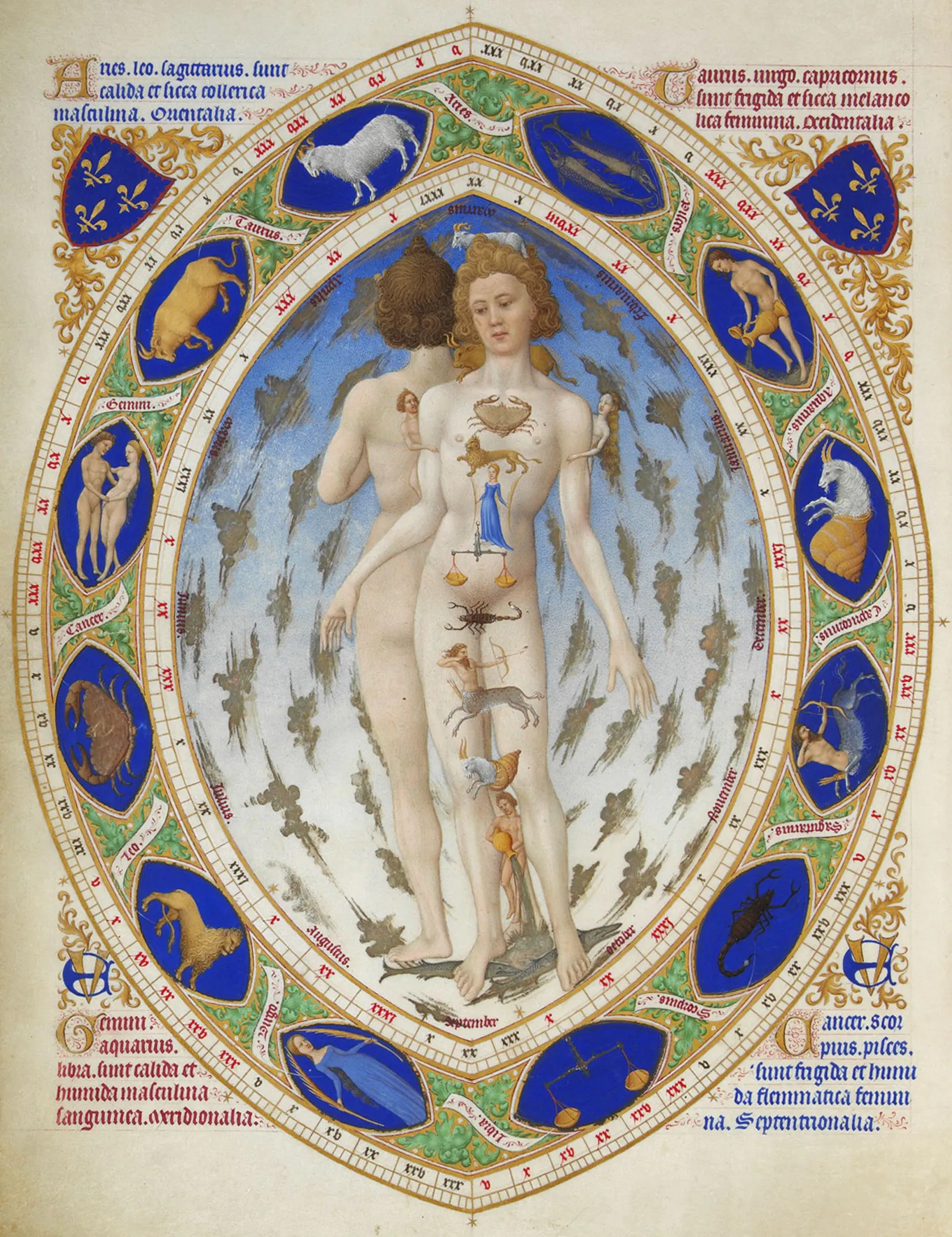
In this early fifteenth-century "zodiac man" from the Très Riches Heures, the signs encircle a human body and assign celestial governance to its parts — the visual logic behind timing bloodletting, purging, and cupping by almanac. Lange's attack on judicial astrology aimed to sever learned medicine from precisely this melothesic framework. Source ↗.

The magical letters do not deny occult action; they relocate the criterion of judgement. The diagnosis is stated with maximum severity in the complaint, examined above, that by these trifles of magic medicine has been so befouled that no art teems so thickly with errors and superstitions as the medicine given to us from heaven, and its genealogy is borrowed from the Plinian dictum, also already quoted, that magic, most fraudulent of the arts, embraced three others most imperious over the human mind and reduced them into itself alone, having been born first of medicine. Magic is thus a parasite upon the very triad Lange must defend, medicine, religion and mathematics, which explains why his response is partition rather than proscription.
What is retained is the doctrine of substance: there is inborn in all things of the universe a property of consortium or discord with one another, by which even without visible contact they mutually affect and alter one another, Incît sanè cunctis uniuersi rebus congenita inter se consortij aut dissidij proprietas, qua etiam citra uisibilem contactu[m] mutuò afficiuntur, & alterantur. Sympathy so understood explains magnet, amber and unison strings, and licenses amulets on the strictly material construction discussed earlier, where Galen, taught by experience, holds that it is the substance of the amulet and not the words of the magicians' incantation that helps. What is expelled is the efficacy of language and sign, and the wager is that the boundary between substance and word can be held. Judicial astrology is attacked where it touches the hand of the operator — in the passage on determining the day for evacuating the body by drugs, venesection or cupping-glasses, a crime deserving the lash by which countless patients are destroyed — because printed almanacs interpose delay between physician and acute disease. The strongest modern authority is then disarmed from within by the confession Lange ascribes to Ficino, quoted above, that he had gathered the astrologers' observations not to approve them but, with Plotinus, to deride them.
The partition is not uniformly sceptical, and its asymmetries are instructive. Contemporary voyaging is enlisted as confirmation of demonic rule abroad: that this is true even today the New Islands, discovered under the auspices of the kings of Portugal, bear witness, whose kings obey the commands of the magi and their abominable sacrifices, and serve the cult of demons, Quod uel hodie uerum esse, Nouæ insulæ, auspicio regum Portugalliæ repertæ, testantur: quorum reges magorum iussis, & nepharijs illorum sacrificijs obtemperant, & dæmonum cultui parent. And the letter on prodigies deploys the full apparatus of learned proof — named witnesses, a named village, a public dissection — on behalf of demonic agency: in the peasant's opened stomach were found a round and oblong piece of wood, four steel knives, some sharp, some toothed like a saw, and two rough irons, in quo lignu[m] teres & oblongum, qua tuor ex chalybe cultros, partim acutos, partim instar serræ dentatos, ac duo ferramēta aspera reperta fueru[m],. The evidentiary standards that convict the uroscopist here certify a prodigy, and the prescribed remedy is exorcism on the model of Solomon and Eleazar. The same double tribunal that expels the almanac from the sickroom thus admits the demon to the autopsy — not an inconsistency by Lange's own lights, since demons act upon substance, but a precise measure of where his line between nature and superstition actually fell.
Two further passages show that the tribunal cuts against Lange's own resources as readily as against his opponents'. The first is epistemic: for Hippocrates too, the coryphaeus of physicians, was not ashamed to confess that he had been deceived by the sutures of the skull, Nam & Hippocrates, ille Medicorum corypheus, se suturis crani deceptum fuisse, fateri non erubuit: — avowed error is made a mark of the great, and its refusal the signature of the sciolus. The second is material and philological at once: since the Armenian bole is unknown to us, he writes, he has no confidence in the spurious sort we use, Bolus ex Armenia quum sit nobis ignotus, ei quo utimur notho nihil confido. A celebrated plague remedy is suspended not because the ancients erred but because the identity of the ancient simple cannot be presumed of the modern commodity. Here the restoration of texts and the policing of the drug-trade converge in a single act of judgement: to doubt the name is to doubt the substance, and to doubt the substance is to withhold the prescription.
Pain, contagion, and the labours of the mine
The middle stretch of the collection carries that manner of judgement into the physiological letters, and it opens mid-argument, on retained menses relieved by the vomiting of blood. The reasoning offered there — that the same vessels by which the liver draws chyle upward can carry humours back to the stomach — establishes at once the register in which the whole sequence operates: a shared vascular economy in which one evacuation substitutes for another, warranted by Hippocratic Prognostica and Aphorisms and illustrated by cases of spontaneous bleeding in the aged. Even the excursus on why the corpses of the slain are said to bleed in the presence of their killer is handled by reaching for Lucretius on the direction of spurting blood rather than for any occult sympathy of vengeance. The pattern is characteristic of the letters that follow: a marvel or a disputed particular is admitted as a question, then referred to authorities read in their best available text and to what the physician claims to have seen.
That double reference becomes explicit method in the letter on the primary causes of pain, where Lange announces his procedure before making any substantive claim, promising to settle the controversy more exactly than Peter of Abano the Conciliator had done by teaching first what pain is and then what Galen's true opinion on the cause of pain was, briefly and also clearly, Sed ut hanc controuersiam exactius, quàm Petrus de Appano conciliator, dirimere possis: primu[m] quid sit dolor, deinde quæ fuerit uera de causa doloris Galeni sententia, ut breuiter, ita quoque clarè docebo. The polemical target is precise. The Conciliator stood for a scholastic technique of harmonising discrepant authorities by distinction; Lange proposes instead to fix a definition and then to recover an author's uera sententia, and the two adverbs breuiter and clarè carry the whole humanist programme of the letter in miniature. What follows is a definition rather than a distinction: pain is a sorrowful affection in the sense of touch, produced suddenly by the intemperies of a part and by the sundering of continuity, Est itaq[ue] dolor, tristis in sensu tactus affectio, à membri intêperie & cōtinuitatis diuortio subitò facta. The rhetorical economy here deserves notice, because the dispute between the Arabic commentators — whether continuitatis solutio alone, or intemperies alone, or both together cause pain — is decided in advance by a definition that installs both causes and adds the qualifier subitò, making suddenness rather than kind the criterion. The adjudication is thus not a compromise between Avicenna and Averroes but a displacement of the terms in which they quarrelled; and when Lange comes to excuse their divergence, he does so by reassigning doctrinal error to the history of translation, so that a disagreement in natural philosophy is converted into a defect in the transmission of the Greek text. Philology absorbs the dispute, and with it the authority to close it.
The same instinct governs the long letter on the pains and bony apostemes of the French disease, whose historical thesis is delivered with the maximum of oratorical pressure in the doubled nemo already quoted, where none, by Hercules none, will deny that this disease is old and has again grown fierce in our times. That flourish seals an argument built not from clinical observation but from a catalogue of ancient and recent outbreaks — elephantiasis in Egypt before Pompey, mentagra under Tiberius carried from Asia, carbuncle in Narbonensis under named censors — the point of which is that novelty in a disease is an artefact of nomenclature and of the annual constitution, not of nature. Northern maladies enter the same catalogue on the same footing, including the affliction which, he reports, the common people call Scherbock and say is rife, quem uulgus Scherbock appellat, grassari, set beside Pliny's herba Britannica so that a German vernacular disease-name acquires an ancient text to be read against. The manoeuvre is double-edged: it dignifies contemporary German experience by finding it already recorded in antiquity, and it simultaneously denies the empirics any claim to have encountered something the books do not cover. Nothing is new; therefore nothing lies outside the competence of the learned reader.
The letter to Michael the mine-owner on the virulence of quicksilver shows the other half of the tribunal at work, since here the textual authorities are used to underwrite a prescription about present labour. Lange reports of antiquity that not without reason did those who dug minium, or made quicksilver from it, and boiled cinnabar from this with added sulphur, bind their faces with loose bladders, lest they should breathe in this deadly vapour or powder, Quare nô temerè, qui minium effodiebat, uel ex eo hydrargyrum, & huic addito sulfure cinnabarim decoquebant, ne exitiale[m] hunc uaporem aut puluerem inspiraret, laxis uesicis faciem obliga bant. The Plinian detail of the bladder-mask is recovered as a usable technique, and the loosened teeth, caries, tremor and paralysis of gilders and diggers are gathered into a single aetiology grounded in the sulphur-and-mercury principles of the metals and in the mineral exhalation of the shafts, for which Lange adopts Lucretius' scaptensulae as a technical term and admits the miners' own word for the damp into the margin. Extractive labour is thereby constituted as a proper object of the physician's jurisdiction — a claim the letters press further when they set against the tunnels of avarice a very different Iberian profit.
Sympathy, distillation, and the reach of the physician's competence
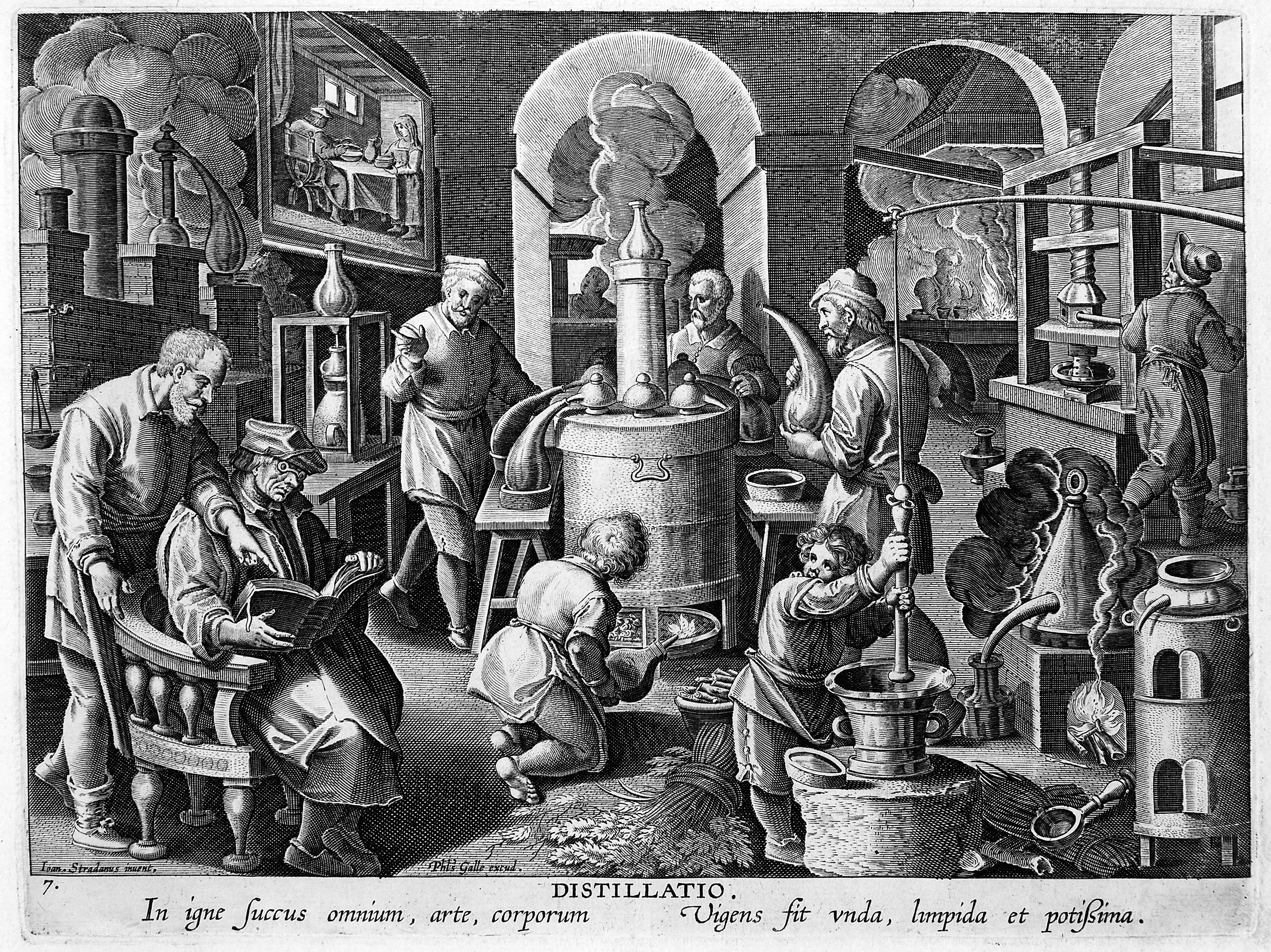
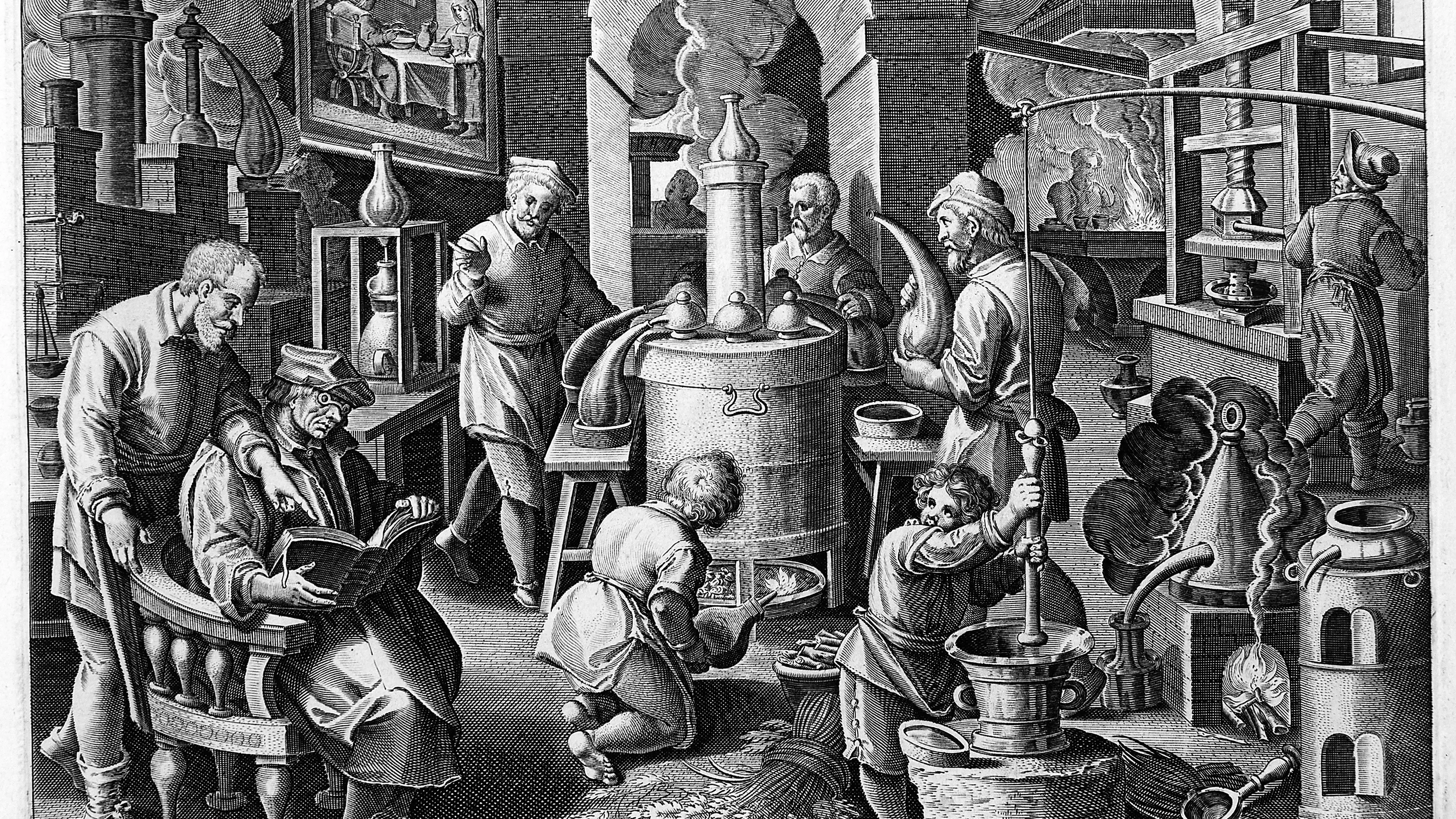
Stradanus and Galle's late-sixteenth-century engraving of a distillation laboratory crowds the scene with furnaces, glass vessels, and an alembic still — the practical equipment behind learned debates over what medicine could rightly claim to do. Set beside Lange's treatment of distillation and alchemy, its busy workshop helps explain the force of his warning that the transmutation seeker may end with "ashes instead of coals." Source ↗.

Where a phenomenon resists reduction to humour and vapour, Lange does not abandon it but naturalises it. Asked why cantharides, taken by a Bolognese student as an aphrodisiac, should attack the bladder specifically, he answers that there is a property innate in certain drugs from their specific form, by which, as iron suspended in a compass is drawn by the loadstone and by the star of the arctic pole, so their poison seeks out certain organs of the body, as if dedicated to them by a natural sympathy from celestial influx, Quibus tum respondi, congenitam esse quibusdam pharmacis à forma specifica proprietatem, qua ut ferrum in composto pendulum, magnete confucatum, poli arctici sidus: sic illoru[m] uirus, certa corporis uiscera, quasi illis per sympathiam naturalem ex coelesti influxu dicata, peteret. Sympathy is here a property of substances, demonstrable by a familiar operation of the loadstone, and not an occult agency invoked by an operator; the celestial influx is a cause in nature, not a rite. This is precisely the partition on which the volume's rejection of charms and of judicial prognostication depends, and it explains why so much can be conceded without conceding anything to the practitioners the letters condemn.
Distillation is subjected to the same discrimination, and the sceptical work is done not by denunciation but by a comparative trial: water extracted through the alembic from colocynth or rhubarb cannot move the bowels, although an infusion of them, steeped only for some hours, will easily do so, unde aqua per alembicu[m] de colocinthide aut rheobarbo extracta, aluum subducere nequit: quum tamen illarum dilutum, in quo saltem aliquot horas macerantur, id facilè præstabit. The argument is pharmacological rather than metaphysical — the virtue of the drug does not pass over with the vapour, and what remains in the receiver is accompanied by the burnt quality Aristotle named empyreuma — and it is a rare instance in which the appeal to experience is framed as a repeatable comparison rather than as a remembered case. The letter can therefore grant the chemical art an ancient Egyptian pedigree, describe the alembic, the balneum Mariae and distillation by descent, and still withhold the transmutatory promise; the apparatus is retained, the expectation discarded.
The geographical letters justify their presence in a medical collection on jurisdictional grounds, since it greatly concerns both physicians and commanders of wars to know such things, Nam & hæc scire Medicos, & bellorum duces, magni refert, a Hippocratic appeal to airs, waters and places that widens the physician's competence to the whole description of the earth. Within that widened remit the Iberian voyages are evaluated by a specifically medical measure: by the labour and expense of those kings, Lange writes, that most salutary wood guaiacum, lately brought to us from the islands of the Southern Ocean, has come, by which one thing alone they have brought more advantage to wretched mortals than all those tunnels of avarice, the diggers of metals of silver and gold, quo rum opera & expensis saluberrimum illud lignu[m] Guaiacu[m], quod nuper ab Australis Oceani insulis nobis allatum est: quo uno plus comodi miseris mortalibus attulerunt, quàm omnes illi auriciæ cumculi, metalloru[m] argenti & auri fossores. The judgement coheres exactly with the mining letter: the shaft that poisons its diggers yields bullion, the ocean voyage yields a remedy, and the physician is the one competent to strike the balance.
The materia medica letters that close the run make the philological stake in such traffic plain, for exotic drugs arrive with unstable names. Lange records having found that commonly, through ignorance of the name, minium is put into medicines in place of Indian cinnabar, Coperi uulgò pro cinnabari Indica in medicam[m]eta miniu[m] addi, inscitia nominis — a lexical confusion with lethal issue, since the substitute is a poison, and the correction is furnished by authentic specimens of true dragon's blood produced by a travelling correspondent. Nomenclature is thus not a scholar's ornament but the condition of safe compounding, which is why the shops and their compound recipes are so persistently suspect. The same procedure dissolves a celebrated marvel when Pliny is invoked on the incombustible flax: there has been found, he says, a flax which is not consumed by fire, they call it living, and we have seen napkins made of it burning in the hearths at banquets, shining, their filth burnt away, more by fire than they could be by water, Inuētu[m] est, inquit, linu[m], quod ignib[us] no[n] absumitur: uiuum id uocât, ardentemq[ue] in focis co[n]uiuioru[m] ex eo uidimus mappas, sordib[us] exustis splendesc[en]tes, igni magis quàm possent aquis. The cloths shown at Rome as woven from salamander wool are returned to the mineral kingdom as amianthus, and the wonder survives only as a fact of stone. Across these letters the operation is consistent: the marvellous is not denied but relocated — into the properties of substances, the corruption of texts, or the ignorance of names — and each relocation leaves the learned physician holding the instruments by which the question can be settled.
The Venetian convivium and the philology of the drug-shops
The last third of the collection opens in a register that a reader of the earlier consultations might not expect: not a bedside report but a convivium. The closing pages of the sixty-sixth letter stage a Venetian banquet at which the second course of confections licenses an extended disquisition on the exotic fruits of the drug-shops, and the dialogue form does real argumentative work. Under the cover of table-talk the letter conducts an exercise in the philological policing of the materia medica, tracing a chain of transmitted error from Dioscorides through Averroes and Avicenna to the compilers whose names stood on the apothecaries' shelves, so that where Mesue dares all the more boldly to write that Dioscorides taught that rue helps epileptics but celery provokes epilepsy, unde Mesue eo audacius scribere audet, Dioscoridem tradidisse, rutam prodesse epilepticis, apium uerò epilepsiam excitare: cum Dioscorides nusquam hoc nos admonuerit — though Dioscorides nowhere warned us of this. The charge is precise and characteristic: not that the Arabic-Latin authority erred in his own person, but that he fathered a doctrine upon a Greek source which does not contain it, and that the fabricated attribution then hardened into a rule of practice. Correcting the citation is thus not scholarly fastidiousness but therapeutic hygiene, and it is the same operation the volume performs when it prefers Galen's Greek to his translators.
The second limb of the double tribunal appears in the same scene, and its placement is rhetorically deliberate. The programmatic maxim quoted below — that the powers of medicines must be searched out not by reason alone but by experience, since, as Pliny records, the true nature of any simple can be foreknown only by its effect in practice — is spoken not by "Langius" but by an anonymous Venetian physician of the company. Two things follow from that ventriloquism. The empirical thesis emerges as the consensus of learned conversation rather than as the author's assertion, which suits the epistolary genre's fiction of collegial adjudication; and the appeal against the sufficiency of authority is itself made on the authority of Pliny, whom the surrounding pages celebrate as the library of the ancient writers. The tension is not concealed so much as structural: experientia in these letters is almost never trial detached from text, but the confirmation, correction, or disambiguation of a textual claim by handling the thing itself.
What handling means is shown with unusual concreteness in the following letter, where the writer describes going down to the quayside when a spice ship from Alexandria had docked and, while the merchants were unloading, counting out Venetian marcelli in his hand in exchange for leaves of malabathrum, Præterita hebdomada cu[m] ex Alexandria nauis aromatibus onusta Venetias appulisset, accurrebam: & dum nauis à mercatoribus exoneraretur, numeratos in manu marcellos, p[er]ferebâ, proquibus malobathri folia petij. The scene inverts the customary hierarchy of learned and mercantile knowledge. The leaves offered fail the Plinian description, whereupon the physician instructs the merchants where in the Erythraean trade the true drug is to be had: the book supplies the standard, the market supplies the specimen, and the medicus claims competence over both. Read against the volume's campaign against the seplasiarius and the exotic compound, the episode is also a jurisdictional claim. If drug-names are corrupt and the goods that answer to them are misidentified on the wharf, then the apothecary cannot be the arbiter of what he sells, and the naming of substances belongs to the philologically trained physician.
Poison, transmutation, and the limits of the partition
The toxicological letters extend the same competence into the domain of war and confessional conflict. The stated occasion of the enquiry into hunting- and arrow-poisons is that the fierce emperor of the Turks assails Christians with the support of the most savage nations — Parthians, Scythians, Arabs, Egyptians, Dalmatians and Dacians — ferocem illum Turcaru[m] imperatorem, truculentissimarum gentium, Parthorum, Scytharum, Arabum, Aegyptiorum, Dalmatarum ac Dacorum subsidio, nos Christicolas oppugnare. The list is antiquarian rather than descriptive: ethnographic categories drawn from Greek and Latin poisons-literature are mapped directly onto the Ottoman threat of the sixteenth century, so that the ancient learning on toxicum — a word the letter derives from the barbarian smearing of arrows — becomes usable military medicine. The physician's task is thereby enlarged from the sickbed to the frontier, and the reading of Nicander and Celsus is presented as the provision of antidotes for wounded Christian soldiers. The letter that follows dissolves the substantial notion of poison altogether: whatever, altered by heat or by a property of the body innate or acquired through habit, is digested into the body's nourishment cannot be a poison to what it nourishes, Quidquid enim calore, aut congenita uel ex consuetudine acquisita corporis proprietate alteratum, in corporis alimonia[m] digerit, id alito uenenu[m] esse no[n] potest. Poison here is relational, a matter of proportion between agent and recipient rather than a fixed malignity in the substance, which is what licenses the verdict that quails fattened on hellebore may be eaten while the living seedbeds of contagion remain far more dangerous than any roasted flesh.
The letter on metamorphosis applies an equally deflationary metaphysics to the transmutation claims of the furnace.
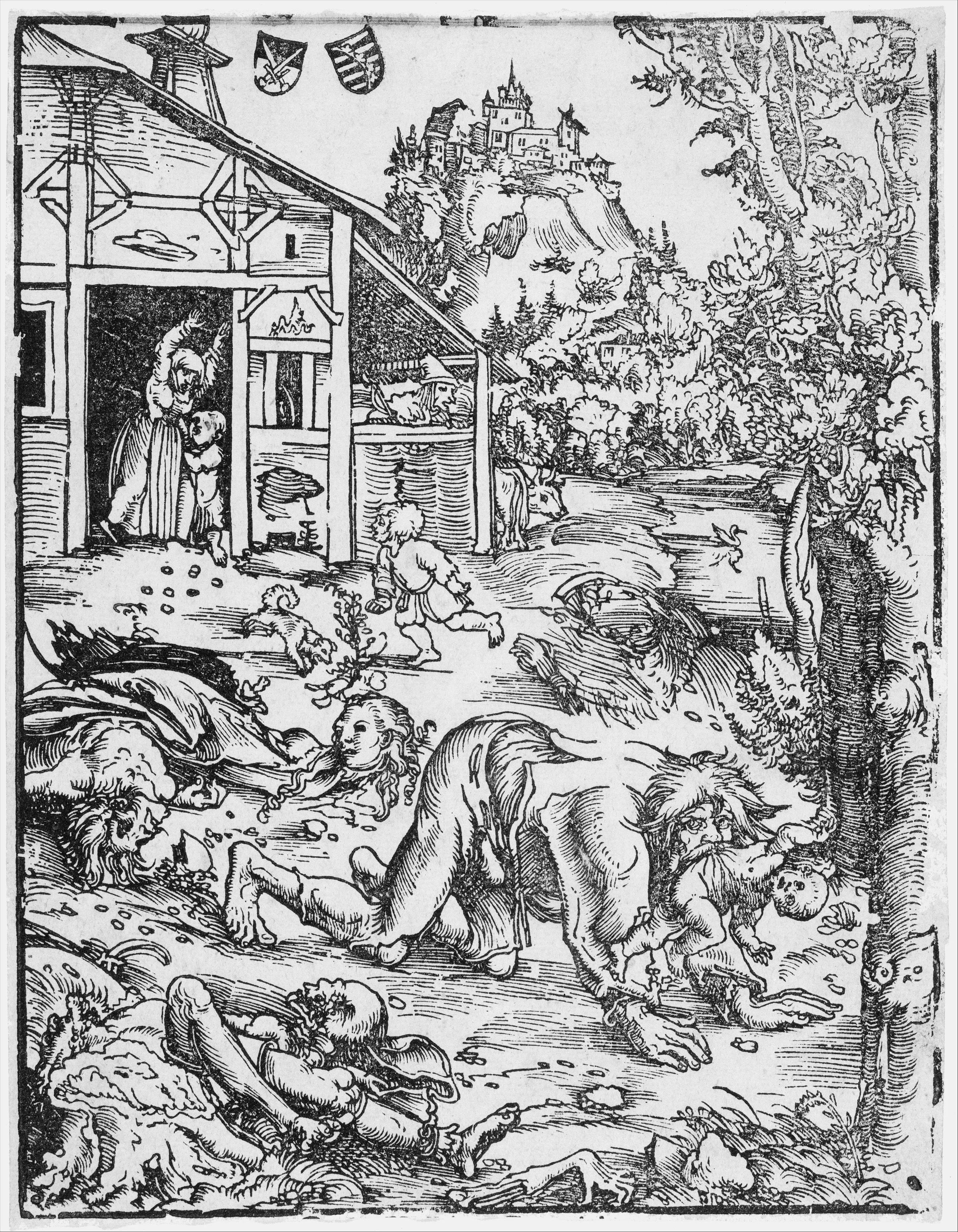
Lucas Cranach's early-sixteenth-century woodcut presents the wolf-man not as an abstract curiosity but as a scene of bodily violence, a savage human figure amid dismembered victims and a distant settlement. As a contemporary German image of werewolf anxiety, it sharpens the stakes of Lange's effort to strip metamorphosis of magical causation and relocate such marvels within natural philosophy and learned medicine. Source ↗.

Neither the alchemists nor nature herself, the thesis runs, can transmute the substantial forms of things except into neighbouring and cognate species, substantiales tamen rerum formas nec ipsi, nec natura, nisi in proximas & co[n]generes species, transmutare possunt. The formulation is exact in its concessions: change is real, and the letter documents it copiously from Theophrastan agronomy and from the caterpillar's becoming a butterfly, but it is bounded by kinship of species, and the boundary is what excludes the making of gold. The same instrument then disenchants the werewolf. Those seized by lycanthropy, the text reports, go out of doors by night and imitate wolves in every respect until daybreak, Quilycāthropia correpti sunt, nocte domu[m] egressi, lupos, donec illuxerit, per omnia imitantur — imitation, not transformation, being the whole of the phenomenon, and the pathognomonic signs catalogued from Paul of Aegina supplying the melancholic aetiology. Metamorphosis, poison and transmutation are all handled by one manoeuvre: the marvellous is retained as a phenomenon and reassigned to the physician's causal vocabulary.
That partition does not operate uniformly, and the seventy-first letter is where its limits show. Set as reported conversation at Mirandola with Giovanni Francesco Pico, prompted by the shrine of the boy Simon at Trent, and framed by a eulogy of the newly dead Reuchlin and a compliment to Melanchthon, the letter proceeds to a hostile genealogy of Kabbalah and the Schemhamphoras and a catalogue of alleged ritual murders — praising, that is, the Hebraist whose defence of Jewish books had lately divided the German schools while condemning the tradition he had defended. Within it the text preserves the contemporary sceptical explanation in order to refute it, noting that there are those who take the part of Jewish impiety and assert that these crimes were fabricated so that their goods might be confiscated and the judges enriched, At, ut audio, no[n] desunt qui ludæoru[m] impietati patrocinentur, & hæc de lud[us]is c[on]ficta fuisse crimina affirmet, ut eoru[m] bona c[on]fiscerent, & iudices ditesceret. The dissenting voice is admitted and immediately overridden by an argument from the alleged need of necromancy for blood; the passage is evidence of the accusation's contestation in its own moment, not of the events alleged. Its terminus is professional, translating polemic into positive law: wisely and piously, the letter concludes, have the decrees of the pontiffs provided under pain of deposition or excommunication that no Christian, cleric or lay, should dine or bathe with Jews, or summon them to the sick, or accept medicine from them, Prudenter igitur & sanctè Pontificum decreta, sub poena exauctorationis, aut excommunicationis cauerunt, ne quis Christianus sacris initiatus, uel laicus, cu[m] ludæis conuietur, lauet, aut eos ad infirmos accersat, aut medicinam ab eis accipiat. Canon law is here made to perform the exclusion that the empirical tribunal cannot: the disqualification is not argued from failure in trial or in text but asserted from confessional status, and it sits beside the letter's complaint that such practitioners drain both purses and vital faculties.
Simples, compounds, and the closing of the collection
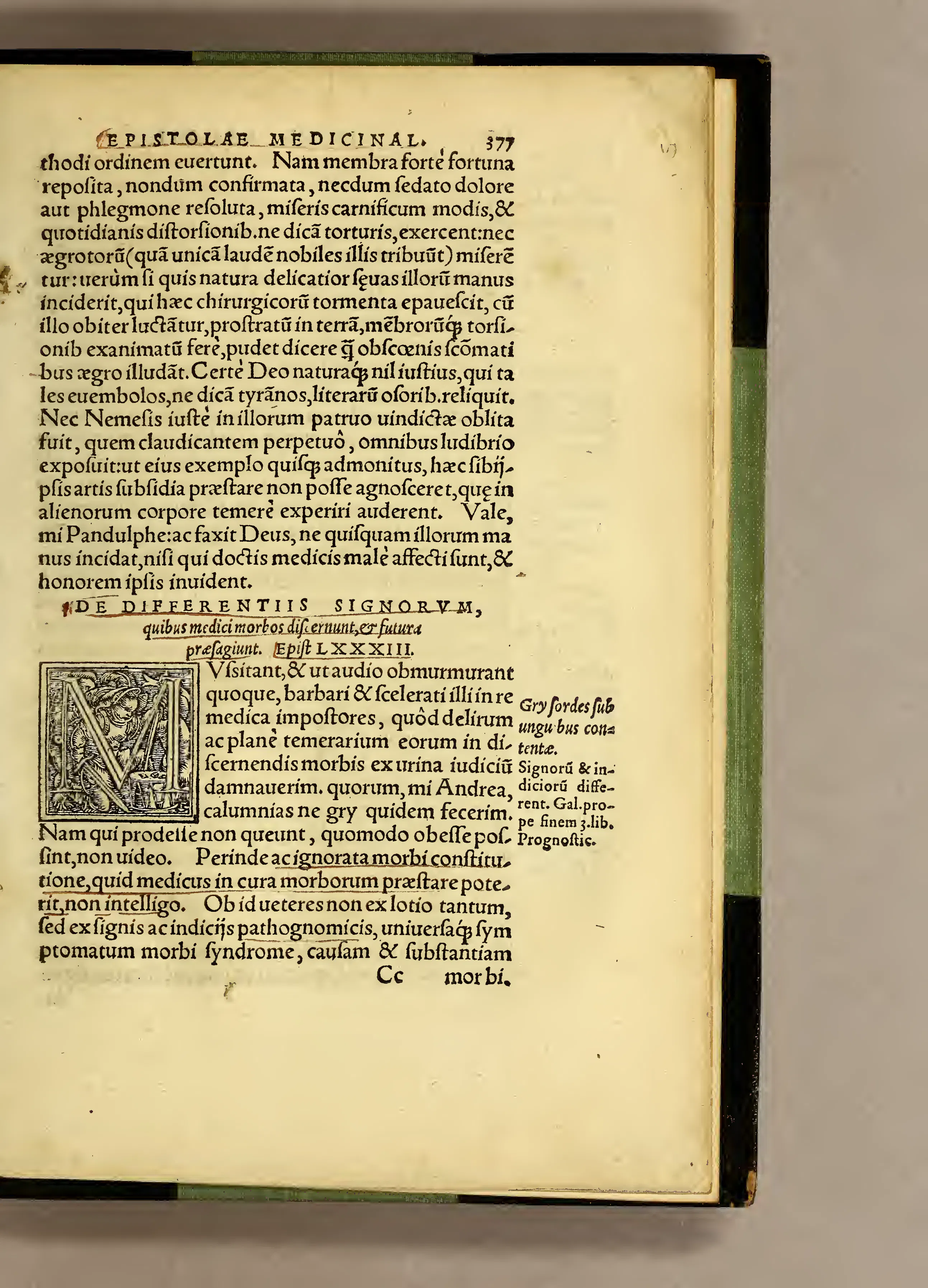
Page 377 marks the collection's final turn: after the close of the preceding letter, the display heading "DE DIFFERENTIIS SIGNORVM" and a large historiated initial launch Epistola LXXXIII, on the signs by which physicians distinguish disease and prognosis. Its printed shoulder-notes and running head make the apparatus of learned verification visible, while the opening attack on uroscopic impostors returns the miscellany to the question posed at the outset. Source ↗.
The letters on simples and compounds return to method. Against the logiatri who heap ingredients for the vain display of plurality, the manifesto against polypharmacy supplies a positive procedure — let the physician select a simple medicine, such as the indications of reason require, as base and foundation of the rest, Sic Medicus seligat simplex medicamentum, quale cum rationis indicationes postulant, tanquam basim, & aliorum fundamentum — with correctives for defect and excess, agents directed to the affected part, and correctives of taste built upon it. Indication, not accumulation, is the principle, and the worked example of the bitumen wound-plasters that follows, with its recollection of the writer's teaching at Amberg, shows the method applied to a single class of remedies. The same demand for articulated method governs the volume's close. The final letter does not deny that urine signifies; it restricts what it can signify, allowing that no one will deny such urine to be the proper and recognisable accident of diabetes, which the Greeks call pathognomonic, Tale uerò lotium, diabetes esse proprium & cognobile morbi accidens, quod Græci pathognomonicum appellant, nemo inficiabitur. The concession is the sharp edge of the argument: because a sign proper and inseparable to one disease exists, the uroscopist's universal inference from the glass stands convicted not of using a false sign but of misclassifying a limited one — a semiotic error, remediable only by the taxonomy of signs the letter sets out and by the methodus diagnostica it promises should leisure allow. After FINIS the sheet gives the imprint, at Basel from the workshop of Johannes Oporinus in the year of human salvation 1554, BASILEAE, EX OFFICINA IOANNIS Oporini, Anno Salutis humanæ M.D. LIIII, closing a sequence whose printed apparatus — numbered headings, running heads, shoulder-notes citing Galen and Pliny at nearly every opening, signature marks running to Cc, and the compositor's slip that gives two consecutive letters the number LXXIII — is itself part of how the collection presents its learning as verifiable.
Frequently Asked Questions
Who was Johann Lange?
Johann Lange was a German physician, born at Löwenberg in Silesia in 1485 and dead at Heidelberg on 21 June 1565, who served for the better part of four decades as physician to five successive Counts Palatine of the Rhine. He took the medical doctorate at Pisa in 1522 according to the biographical record, and was later made minister and privy councillor by Otto Heinrich. He had studied at Rome under Giovanni da Vigo in the pontificate of Leo X, and had earlier professed the liberal arts at Leipzig before turning to medicine.
What is Medicinalium epistolarum miscellanea, and when and where was it printed?
It is a Latin collection of learned medical letters by Johann Lange, printed at Basel by Johannes Oporinus in August 1554 as a quarto carrying an imperial privilege for five years. The title page names Lange as physician to the Palatine princes of the Rhine; the volume opens with a verse address to the friendly reader, an autobiographical preface, and an analytic table whose first entry attacks pseudo-physicians and whose last is numbered 83. That table supports the conventional count of eighty-three letters, though it does not by itself establish a one-to-one match between every entry and every printed text.
What did Lange conclude about alchemy and the promise of transmutation?
He granted the art an ancient pedigree and withheld its promise. His letter on distillation traces the practice to Egypt, describes the alembic, the bath of Mary and distillation by descent, then warns that whoever seeks the perfection of that art will find its ministers, for the most part runaways, leaving ashes instead of coals and glittering embers of ashes instead of metals and gold in his furnace: farewell, and beware. Elsewhere he holds that neither alchemists nor nature can transmute substantial forms except into neighbouring and cognate species, and notes that water drawn through the alembic from colocynth or rhubarb will not move the bowels, though a few hours' infusion easily will.
What did Lange mean by the morbus virgineus, the "disease of virgins"?
It names a period nosological category, reported in the twenty-first letter by the older historiography, that binds pallor and related symptoms to age, sex, virginity and the expectation of marriage. Lange records a regional synonym drawn from lay female authority: the matrons of Brabant call it the white fever, from the pallor of the face, and also the amatory fever. Venesection and deobstruents are adjuvants only; the consultation ends with the advice to be of good cheer and marry off the daughter, the physician promising to attend the wedding. The category should not be silently converted into a modern diagnosis.
Is there an English translation of Medicinalium epistolarum miscellanea?
No complete modern English translation has been identified, and no verified modern anthology containing the letters on green sickness, sweating sickness, lycanthropy, or lead pipes was found in the catalogues and bibliographies searched; that negative result does not prove none exists. Separately, the Leo edition now presents the full transcription of the 1554 Basel quarto together with a complete English translation, generated by AI, for the first time. Leo is an effort to make freely available online, at no cost, English translations of every text printed in Latin in early modern Europe between 1450 and 1750.
This report was generated by an advanced AI assistant that conducted deep research alongside an extensive interpretation of the transcribed original text. Every effort has been made to preserve fidelity to the source and to guard against inaccuracy, but corruption in the text recognition process and model hallucination may nonetheless have entered the text. Treat every claim, quotation, translation, and citation as provisional, and verify each against the original source before relying on or citing it.
Critical Further Reading and Contextual Resources
- Jon Arrizabalaga, John Henderson, and Roger French, The Great Pox: The French Disease in Renaissance Europe: The standard account of how the pox was named, explained, and treated across Italian and northern European practice, and the proper control on Lange's insistence that the disease is ancient rather than novel. Set their reconstruction of competing period etiologies beside his own compound definition: this Neapolitan plague, he writes, is an epidemic disease heaped together out of every kind of ulcer from the varied putrefaction of the humours of both biles, and especially from sluggish and rotten phlegm, with apostemes about the bones, muscles and membranes, and at length propagated by the contagion of Venus to most nations of the world, Est sanè huius Neapolitanęluis morbus epidemialis, omnigenis, ex uaria, humoru[m] utriusq[ue] bilis putredine, ulceribus, ac præcipuè ex lenta & marcida pituita, circa ossa & lacertos ac panniculos, apostematibus coacernatus, & tandem Veneris contagione ad plerasque orbis nationes propagatus. Their refusal of a single origin story is far more useful here than any attempt to identify the entity retrospectively.
- R. Po-chia Hsia, The Myth of Ritual Murder: Jews and Magic in Reformation Germany: Traces the accusation itself — its shrines, trials, and print circulation — from the mid-fifteenth century to the early seventeenth, which is exactly the material Lange's seventy-first letter recycles as though it were evidence. Read it before reading his taxonomy of illicit healers, where he asks what city, indeed what village, does not nourish some utterly unskilled empiric in medicine, some garrulous λογίατρος, some perfidious Jew, or some parish apostate ignorant of the whole of philosophy, Quæ enim ciuitas, quis denique pagus, imperitissimum in remedica empiricum, λογίατρον garrulum, perfidum Iudæum, aut parrochianum, totius Philosophiæ ignarum apostatam, non alit:. Hsia makes visible what the letter conceals: that confessional slur and professional slur are performing one and the same act of exclusion.
- Helen King, The Disease of Virgins: Green Sickness, Chlorosis and the Problems of Puberty: King follows the category from antiquity to the twentieth century while declining to convert it into iron-deficiency anaemia, which is precisely the discipline required for Lange's morbus uirgineus and its Brabantine synonym, the white fever. Her account of how puberty and virginity were turned into medical conditions explains why his consultation ends with a wedding rather than a prescription. It bears equally on the volume's neighbouring letters on uterine suffocation and erotic affect.
- Alisha Rankin, The Poison Trials: Wonder Drugs, Experiment, and the Battle for Authority in Renaissance Science: Rankin reconstructs how sixteenth-century physicians and princes tested antidotes on condemned criminals and animals, which supplies the working meaning of "experience" in Lange's toxicological letters. Her theme is the second limb of his tribunal, stated in the Venetian convivium: the powers of medicines, he writes, must be searched out not by reason only but by experience, for, as Pliny records, the true nature of any simple medicine can be foreknown only by its effect in practice, Medicamentoru[m], ait, uires no[n] ratione tantu[m], sed experie[n]tia scrutari oportet. Nam, ut Plin. tradit, uera cuiusq[ue] simplicis medicamenti natura non nisi medico effectu prænosci potest. Lange is not her subject, which makes the comparison all the more instructive about how rarely his own appeals to trial are actually repeatable.
- Nancy G. Siraisi, Communities of Learned Experience: Epistolary Medicine in the Renaissance: The indispensable starting point, since its second chapter is given over to the Heidelberg court physician Johann Lange and his Epistolae medicinales. Siraisi shows how the published medical letter turned a private consultation into a public adjudication of competence, which is the mechanism at work from Lange's preface to his final epistle. Her framing also rescues him from the older habit of mining the letters for isolated "firsts."
- Martin Steinmann, Johannes Oporinus: Ein Basler Buchdrucker um die Mitte des 16. Jahrhunderts: The specialist study of the shop that produced the 1554 quarto, and the correct place to begin any question about correctors, Greek type, privileges, or press practice in Basel. Its relevance is not merely bibliographical, since Lange treats print itself as an instrument of slaughter, calling the reader's good faith to witness and asking how many thousands of men he thinks that criminal surgeon killed by his abominable method of curing that sweating fever, which at the very outset of an unknown disease he rashly published, the number defying all belief, Tuam, Lector, obtestor fidem, dic quæso, quot hominum milia credis illum sceleratum chirurgicum occidisse, sua nephanda curadæ febris illius sudorulentæ Methodo, quam in morbi ignoti principio, temerario ausu, inuulgauerat: Numerus omnem fidem superat. A charge like that deserves to be read with the press ledger open.