Saffron, Nearly Triangular: Giovanni Manardo's Eighteen Books of Medical Epistles, with Annotations and Censures on Mesue; and Niccolò Massa's Treatise on Pestilential Fever
Giovanni Manardo of Ferrara spent the last fifteen years of his life converting his medical correspondence into a printed book, the Epistolarum medicinalium libri duodeviginti, in which a consultation on gout or plague stands beside a collation of Greek codices as though the two were one job — which, for him, they were. A Greek superlative turned into a positive by a careless translator is a dose silently altered, and an apothecary's adulterated camphor is as dangerous as an interpolated word printed under an ancient name. What emerges is a physician who ranks his authorities out loud, prints the sigla by which a reader can audit him, and tells his students to credit no one, living or dead, above reasons and the truth.
ExLatinis
August 10, 2026
Contents
Giovanni Manardo of Ferrara spent the last fifteen years of his life converting his medical correspondence into a printed book, the Epistolarum medicinalium libri duodeviginti, in which a consultation on gout or plague stands beside a collation of Greek codices as though the two were one job — which, for him, they were. A Greek superlative turned into a positive by a careless translator is a dose silently altered, and an apothecary's adulterated camphor is as dangerous as an interpolated word printed under an ancient name. What emerges is a physician who ranks his authorities out loud, prints the sigla by which a reader can audit him, and tells his students to credit no one, living or dead, above reasons and the truth.
Giovanni Manardo of Ferrara (1462–1536) — catalogued variously as Manardi, Johannes or Ioannes Manardus, and Mainardi — was a physician trained in the humanist orbit of Niccolò Leoniceno and Giovanni Pico della Mirandola, a teacher in the northern Italian medical centres, and for a period court physician to the Jagiellonian kings in Buda. Over the last decades of his life he assembled a body of Latin letters on medical questions, the Epistolarum medicinalium libri, which grew from six books at Ferrara in 1521 to the eighteen-book state printed at Basel in 1535, and finally to twenty books in 1540, after his death. To that eighteen-book collection are joined his Annotationes on the simple medicines of Mesue and a Censura of the compounds — philological and pharmacological commentary that shares the volume with the letters and is announced on its title page. A second and quite separate item, Niccolò Massa's Liber de febre pestilentiali, printed at Venice in 1556, has been associated with the Manardo volume in catalogue and research contexts; the evidence establishes two distinct printed records rather than one combined publication.
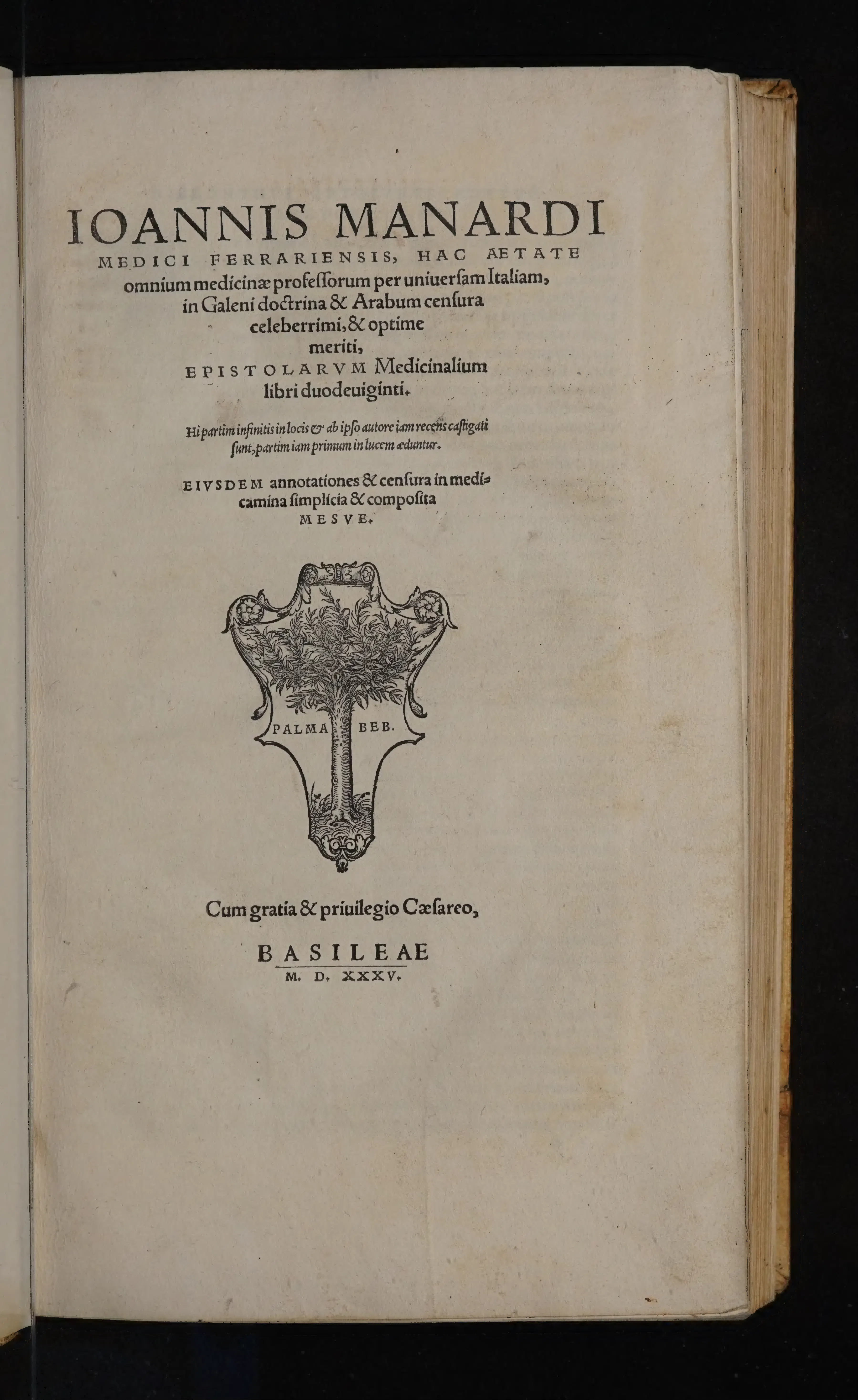
The 1535 Basel title page presents the eighteen-book state as both bibliographical object and manifesto: Johann Bebel's "PALMA BEB." device and imprint anchor the edition, while the title advertises Manardo's Galenic learning and his censure of Arabic medical tradition, with the Mesue annotations named on the same page. Source ↗.
What holds the letters together is a problem that was acute for a physician of Manardo's generation and formation. The practice of medicine rested on a library — Greek, Arabic, and scholastic — that had reached the sixteenth century through chains of translation, abbreviation, and compositorial error, while the diseases, drugs, and bodies actually in front of the physician did not always answer to what those books described. Manardo's characteristic move is to refuse the separation of the two difficulties. A bedside question is converted into a textual and rational one, and then back again: he enumerates a patient's accidentia, distinguishes morbi from symptomata, asks whether an affection is primary or arises per consensum, and then tests the governing definition — melancholy as desipientia absque febre, concoctio in its Aristotelian sense — against Greek originals, collated codices, and the communis lectio, restoring the reading before he prescribes. An interpolated word is treated as a hazard to the patient, and translation ethics, apothecary adulteration, the metrology of a spoonful, and the practices of the printing house are therefore continuous with therapy rather than preliminary to it.
Authority in this scheme is ranked but never absolute, and the ranking is stated with unusual bluntness. Galen's judgement outweighs a thousand ancient codices in deciding what Dioscorides meant, yet Galen was a man and not everywhere free of error; Avicenna's great book is described as material heaped together and never given its final ordering; Mesue is not to be held as an oracle. The arbiters of last resort are ratio and experientia — the latter meaning tested professional observation rather than anything resembling a modern controlled trial: cultivation trials on plants, dosages carried beyond what the books allow, senna's action on phlegm, guaiac wood against the lues Gallica, regimens and inunctions against plague. Students are charged to credit no one, living or dead, above reasons and the truth.
The particulars are vivid and often startling. Manardo prints his own editorial rules: the offending phrase is flagged, the siglum `MAN.` prefixed, the correction appended, so that a reader can always see where an ancient author ends, a translator intrudes, and the annotator speaks. He collates a codex to recover a lost diagram of the pulse; he complains of corrupt printed Greek in Galen; he weighs Arabic text against Latin version. He dismisses judicial astrology while conceding a general celestial influx by motion and light, invoking both Picos; he rejects demonological claims made for jet oil as unbecoming a Christian; he reads Mesue as an alchemist and describes the balneum Mariae, the descensorium, and the oleum philosophorum; he attacks the seplasiarii over adulterated terra sigillata, spodium, and camphor, and dismisses gems and gold leaf in compound medicines as display. He relishes controversy in the Hesiodic manner, in which the loser gains more than the winner, and there is a declared practice of withholding publication until an adversary's death, though neither the adversary's identity nor the circumstances have been independently confirmed. Massa's plague treatise brings a different world into view: the Venetian Health Office, the College of Physicians, and the mid-century dispute over whether an epidemic was plague or giandussa.
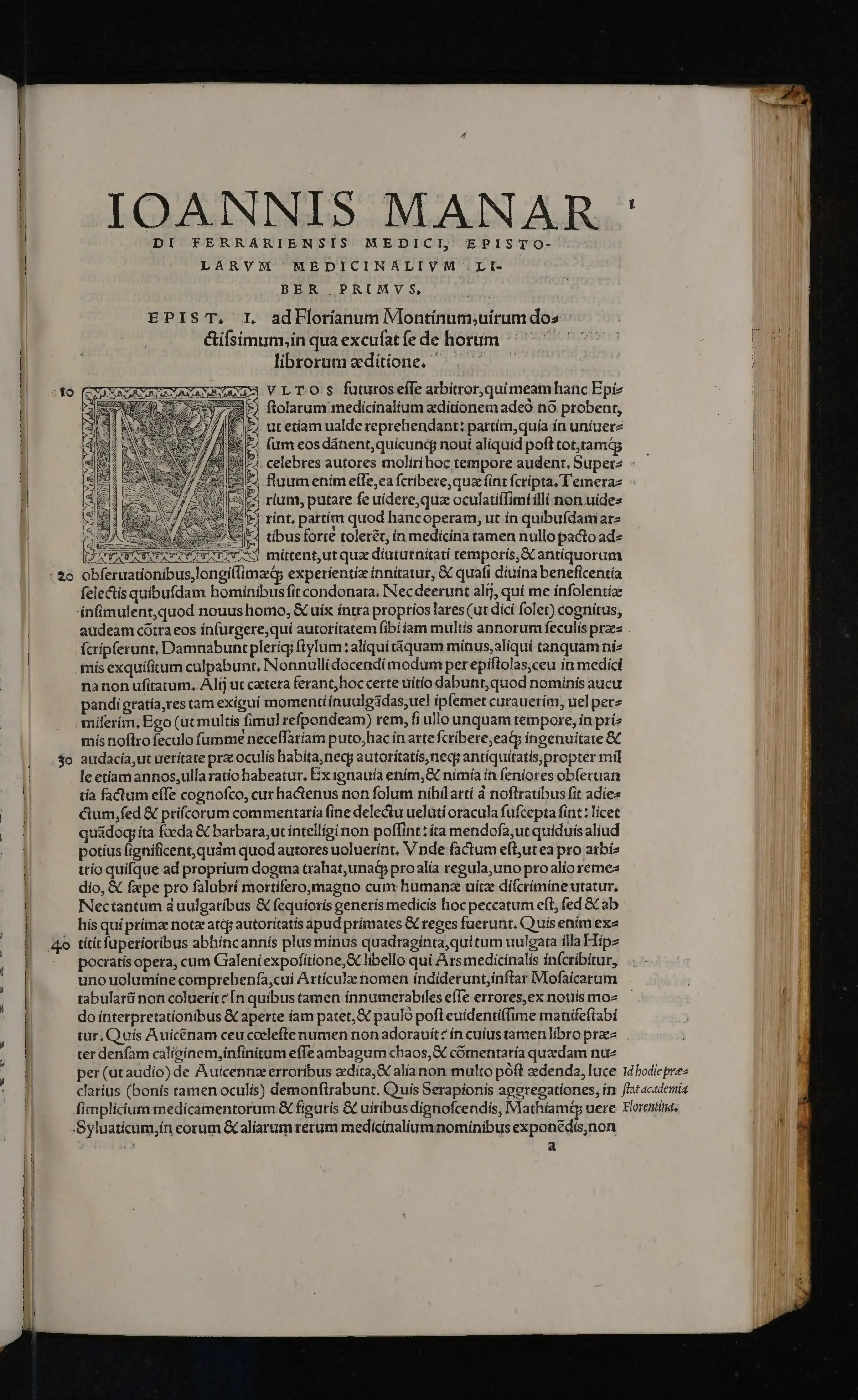
Book I opens with the epistle to Florianus Montinus, where a large pictorial initial launches Manardo's justification for printing letters that weigh inherited authority against reason and truth. The display typography marks the collection as a deliberate, ordered intervention rather than a bundle of occasional notes. Source ↗.
The unity of the enterprise is easiest to see where its vocabulary, its production, and its argument converge. Experientia, interpretis officium, and concoctio are not ornamental terms but load-bearing ones, each marking a place where reading and practice have to be reconciled; the apparatus of sigla and flagged lemmata exists to make that reconciliation auditable in type; and the alternation of consilium with philological disputation is the same labour performed on two materials, a sick body and a damaged text. Much remains open. No modern critical edition or annotated translation of the complete Epistolae medicinales has been located, English-language scholarship devoted specifically to Manardo is thin, and the editorial responsibility for the 1535 Basel issue is reported differently in different records. A digital facsimile of that issue exists, but a facsimile is not an edition, and several of the corpus's most tempting themes still await systematic study against the full printed text.
Read the full text and English translation on Leo
This text was transcribed and translated as part of the ExLatinis project, an effort by Leo to make free English translations of every text published in Latin in early modern Europe (1450–1750) available online. The complete transcription and English translation of this work can be read free of charge:
→ Read the original Latin text and full English translation on Leo
You can save a copy of this document into your Leo account to run deep text searches, conduct further analysis, or cross-reference it with your own research.
Titling Manardo's Medical Epistles and Construing His Working Vocabulary
Giovanni Manardo's Eighteen Books of Medical Epistles, with Annotations and Censures on Mesue; and Niccolò Massa's Treatise on Pestilential Fever is an editorial English title supplied for convenience, not an established English title. It preserves the two bibliographical objects that have been associated in catalogue and research contexts without assuming that they were issued as one trade publication. The first is Giovanni Manardo's Epistolarum medicinalium libri duodeviginti, with the author's annotations and censures on Mesue's simple and compound medicines; the second is Niccolò Massa's Liber de febre pestilentiali, a separate Venetian plague treatise recorded for 1556.
Manardo's experientia belongs to the learned medical vocabulary of observation, practice, and repeatedly tested professional judgment. It is not equivalent to the modern methodological category of controlled experiment. In the printed text experience appears beside, and sometimes as a check upon, the authority of named authors: the title material itself joins experience to Theophrastus's authority, while the epistolary discussions invoke experience as confirmation. In botanical matters the check can be decisive, as when Manardo sets the record of the auctores aside on the question of cultivated plants, holding that whatever these or others may have written, experience itself in our own time teaches that cultivation does not cause degeneration but renders the plant more excellent, and that what now surpasses the rest is not the wild kind, Quicquid tamen uel ipsi uel alij scripserint, experie[n]tia ipsa nostro tempore docet cultu non degenerare, sed excellentius reddi, & quod nunc cæteris præstat, non esse syluestre. The term therefore marks a negotiated relation between book learning and medical practice rather than a simple rejection of the auctores: the written record is not discarded but overruled at the point where sustained observation contradicts it. The letters' practical cases and their textual corrections are two forms of the same medical humanist labor: inherited doctrine must be read accurately, but it must also answer to what a physician has encountered.
The phrase interpretis officium makes the ethics of that labor explicit. Manardo's apparatus distinguishes the words of an interpreter from those of Dioscorides and marks an addition with MAN. or with a statement that the interpreter supplied it. The point is not merely stylistic correction. It assigns responsibility for a printed reading, prevents a translator's interpolation from masquerading as an ancient authority, and makes the boundary between author, translator, and annotator visible on the page. The standard is exacting even in matters that might look merely grammatical, since, as Manardo puts it, a faithful interpreter, in his judgement, would not turn a positive into a superlative, or conversely a superlative into a positive, Fidelis enim meo iudicio interpres, positiuum in superlatiuum, aut econtrario, hoc in positiuum, non conuerteret — a grade shifted in translation is a dosage or an indication silently altered. The related distinction between interpreting and expounding should consequently be understood as a rule of textual accountability, not as permission for a free paraphrase.
Concoctio retains its inherited Aristotelian-Galenic physiological sense: the maturation or preparation of bodily matter by natural heat before evacuation or therapeutic intervention. In the letters, the timing of purgation is consequently a physiological question; medicinal matter may be purged before its full concoction, and a syrup supplied by an apothecary is not thereby granted the intrinsic power of calor naturalis. Manardo states the restriction in the strongest terms, holding that, properly and truly speaking, none of the so-called syrups commonly found made up has the power of concocting, since that office and privilege is owed to natural heat alone, dicimus, si proprie & uerè loquamur, nullum ex uocatis syru pis, qui uulgò confecti inueniuntur, uim habere concoquendi: hoc siquidem munus & priuilegium, soli calori naturali debetur, which converts a question about the apothecary's shelf into one about the body's own faculties. The therapeutic corollary is stated with equal directness — material is for the most part to be purged before concoction, dicimus, materiâ magna ex parte ante co[n]coctionem purgâdam — a position argued against the received sense of the Hippocratic aphorism on concocted matter. The accessible evidence supports this doctrinal setting, but does not by itself establish a line-by-line citation of Meteorologica IV. The term is thus best read as a historical medical concept governing regimen and dosage, not as a synonym for a modern chemical process.
What the 1535 Basel Volume Contains: Letters, Mesue Appendices, and Massa's Separate Plague Book
The principal work is a printed Latin collection of medical letters by Giovanni Manardo of Ferrara (1462–1536), also catalogued as Giovanni Manardi, Johannes or Ioannes Manardus, and Mainardi. Its composition stretches across a professional life that included Ferrara, the northern Italian medical centers, and service at the Jagiellonian court in Buda; its eighteen-book state was printed at Basel in 1535. The collection is neither only private correspondence nor only a systematic treatise. Its first genre is the consilium: a response to a physician's or patient's medical problem, commonly involving diagnosis, regimen, dosage, and treatment; the individual letters are numbered and carry place-and-date subscriptions. Its second is a philological-pharmacological disputation, in which a lemma, translation, or received drug identification becomes the occasion for textual criticism and medical argument. The two genres alternate, and the same standard of accountability governs both.
The appendices belong materially and intellectually to the Manardo state represented by the 1535 Basel copy: the title records Annotationes and censura on Mesue's medicamenta simplicia et composita, and the printed pages preserve the distinction between a source text, an interpreter's wording, and Manardo's correction. That distinction is not left for the reader to infer, since Manardo sets out his procedure as one of marking, that is, the words of Marcellus that have seemed to require correction, and then, with the first letter of his surname prefixed, adding what seems right to him, uerba uidelicet Marcelli quæ castigationem desiderare uisa fuerint, signando: dehinc prima litera mei cognominis præsignata, addere quæ, mihi uidentur, the Marcellus in question being Marcello Virgilio Adriani, translator and commentator of Dioscorides. The earliest point at which every Mesue appendix and every related Dioscoridean annotation entered the transmission cannot yet be established from the accessible evidence.
The work is in Latin, with Greek lemmata and the Arabic-derived technical nomenclature characteristic of late medieval and Renaissance pharmacology. No securely documented Italian passage in the pharmaceutical or dedicatory material was located in the accessible records. No modern critical edition or annotated translation of the complete Epistolae medicinales was located. A digital facsimile of the 1535 Basel copy is available through the Internet Archive from the Wellcome Library digitization, but a digital facsimile is not a critical edition.
Massa's Liber de febre pestilentiali is a separate work and a separate bibliographical record. It is a Latin plague treatise, not part of Manardo's authorship: the 1556 record gives Niccolò Massa as author and Andrea Arrivabene as printer in Venice. Its purpose is practical and nosological—defining and treating pestilential fever and related eruptions, abscesses, and epidemic conditions, and discussing the preservation of bodies from plague. The evidence currently supports coexistence in the history of cataloguing, not a demonstrated single trade issue combining Massa and Manardo.
Placing Manardo in the Historiography of Medical Humanism
The Manardo corpus matters because it shows medical humanism operating simultaneously as source criticism, clinical consultation, and pharmaceutical judgment. The letters do not simply replace Arabic and scholastic authorities with an abstract return to antiquity. They test the received medical inheritance by comparing Greek and Latin witnesses, scrutinizing translators, identifying simples, and asking how an authoritative formulation behaves in practice. The result is a bounded Galenism: ancient and medieval authorities remain indispensable, but none is immune from philological correction or from the physician's considered experience. Both halves of that formula are stated outright in the text. On the one hand Galen functions as the highest interpretative authority, since in reading and understanding Dioscorides, Galen's authority weighs more with Manardo than a thousand ancient codices, Plus potest apud me in legendo & intelligendo Dioscoride, Galeni autori tas, quàm mille antiqui codices; on the other, that authority is explicitly finite, for great indeed was Galen, but a man, and therefore not everywhere, unless Manardo is mistaken, immune from error, pe Galenus fuit, homo tamen, & ideo non ubi[us], ni fallor, ab errore immunis. The ranking of authorities, rather than their abolition, is the operative principle throughout, and it is the same principle that governs the treatment of a corrupt lemma or a doubtful simple.
Daniela Mugnai Carrara's reconstruction places Manardo within the Ferrara humanist milieu associated with Niccolò Leoniceno and Pico and establishes the unusual mobility and flexibility of the epistolary form. Nancy G. Siraisi's account of Renaissance epistolary medicine supplies the wider genre history: printed medical letters recorded learned exchange, case advice, controversy, and the formation of professional communities. Read together, Carrara and Siraisi explain why the Epistolae can move from a regimen for an individual case to a dispute over Mesue, Dioscorides, Galen, or a drug name without ceasing to be a coherent medical genre. Vivian Nutton's study of Ferrara provides the broader institutional and intellectual setting for the rise of medical humanism. Dorothea Heitsch's study specifically places Manardo in the controversy over John Mesue's medical substances, making it especially relevant to the Annotationes and Censura.

Dosso Dossi's portrait, identified as Niccolò Leoniceno, shows the Ferrarese physician with an open printed volume: learned medicine as a textual practice. This is the world in which Manardo's epistolary medicine took shape — Galenic authority, humanist correction, and controversy mediated through Leoniceno's Ferrara circle. Source ↗.
Several major frictions are securely visible at the level of the corpus and its documented contexts. The attack on faulty translation and poorly identified simplicia concerns the authority of Arabic-mediated pharmacology and the status of Mesue in medical teaching, and Manardo is careful to distinguish criticism from repudiation: he would not say this, he explains, because he wishes those remedies rejected, but so that it may be recognised that so much is not to be attributed to this Mesue that whatever he wrote should be held as an oracle without further inquiry, as many do, Nec hoc dixerim, quod ea præsidia uelim respui: sed ut cognoscatur, tantum huic Mesue non esse attribuendum, ut quicquid scripsit, absq[ue] alia indagine, (quod multi faciunt) pro oraculo habeatur. A comparable judgement, aimed at the compilatory character of a text rather than at its remedies, governs the treatment of Avicenna, from which, Manardo writes, it may easily be gathered what he is often accustomed to say, that Avicenna never put a final hand to his book of medicine, but heaped into one volume whatever came to hand, taken from various authors, meaning to arrange it at leisure had he been allowed, ligi facile potest, id quod ego sæpe soleo dicere, Auicennam suo de medicina libro ultimam manum non apposuisse: sed quæ occurrebant, à uarijs autoribus sumpta, in unum uolumen congestisse, digesturus per ocium, silicuisset. The treatment of Galen and other authorities is critical without being anti-medical: textual authority is ranked, corrected, and delimited rather than discarded. The genre also illuminates the social history of the consilium, because a printed letter could preserve a response originally prompted by a colleague, student, practitioner, or patient's physician and could convert a local consultation into a durable scholarly intervention.
The same interlocking of definition and diagnosis appears in the corpus's nosological polemics, where a received definition is used as an instrument for excluding a diagnostic category: since therefore all the Greeks and Arabs alike define melancholy as madness without fever, and divide it, so defined, into three species, Cum igitur omnes tam Græci quàm Arabes melancholiam definiunt desipientiam absque febre, cumq[ue] sic definitam in tres secant species, — the argument proceeding from the shared definition against affections that fail to satisfy it. Themes of this kind, together with the corpus's treatment of the morbus gallicus and its remedies, are among those that require direct reading of the complete printed text. On the latter, the letters register the novelty of both disease and cure in providential terms, God having ordered that from a world unknown to the ancients, for the cure of an unknown disease, a certain wood be brought, which has not undeservedly been called holy by those men, incognito antiquis orbe, ad incogniti morbi curatione[m], lignum quoddam iussit afferri, quod sanctu[m] haud immeritò ab his nuncupatu[m] est, the lignum sanctum or guaiacum whose administration the letters discuss at length.
The Massa material adds a distinct Venetian public-health dimension. The documented 1555–56 debates involved the Venetian Health Office, the College of Physicians, and the question whether an epidemic was plague or giandussa. Massa's interpretation remained Galenic. R. J. Palmer's history of plague control places such writings within a longer northern Italian history of quarantine, public authority, air, contagion, and practical epidemic management; the surviving historiographical evidence shows tension between explanations based on corruption of the air and those emphasizing contagion. Manardo's own letters likewise carry plague material, though of a consultative and prophylactic rather than an administrative cast, as in the account of a preparation now made with old oil, with many simple medicines praised against poisons added, marvellous in plague and in all poisons, of which Manardo reports knowing a man who, armed with this alone, made nothing of the fiercest plague, and preserved unharmed not only himself but also the servants who went with him to visit those stricken with plague, Paratur nunc cum oleo antiquo, additis multis simplicibus medicamentis ad uenena laudatis: estq[ue] mirabile in pestilentia & uenenis omnibus. Scio ego hominem qui hoc solo munitus, sæuissimam quâtumuis pestilentiam nihil facit: nec solum seipsum, sed & famulos secum ad uisendos pestilentia affectos accedentes, incolumes conseruat — testimony offered in the register of reported experientia rather than of civic regulation. Manardo's letters and Massa's plague writings therefore illuminate related but non-identical medical publics: Ferrarese philological and consultative humanism on one side, and mid-century Venetian epidemic administration on the other.
The English-language scholarship devoted specifically to Manardo remains thin. Carrara is the essential modern bibliographical study; Italian biographical scholarship and the Dizionario Biografico degli Italiani supply important contextual material; Nutton, Siraisi, Heitsch, and Palmer provide the larger frames. A comprehensive account of every theme associated with the corpus—melancholy, purgation, guaiacum and the morbus gallicus, chymical operations, judicial astrology, forensic wounds, apothecary regulation, and censorship—requires direct reading of the complete printed text and specialized scholarship not all of which was located in the present investigation. No reliable chain of contemporary replies, academic proceedings, or counter-texts to the whole Epistolae was established. The declared practice of delaying publication until an opponent's death, and the identity of the opponent in that passage, also remain unverified, even though the corpus elsewhere makes controversy itself a declared good.
Tracing the Editions from Ferrara 1521 to Basel 1535 and the Physical Volume b33551303
The edition sequence reconstructed by Carrara is as follows. Ferrara, 1521, apud Bernardinum de Odonino, contained Books I–VI. Paris, 1528, was printed by Christian Wechel; Strasbourg, 1529, by Johann Schott under Hubert Barland's editorial direction. A Strasbourg 1532 second tome, associated with Sebastian Gryphius and François Rabelais, transmitted Books VII–XII and included a dedication to André Tiraqueau. Basel, 1535, apud Ioannem Bebelium, presents Books I–XVIII. Basel, 1540, printed by Michael Isingrinus, is the first complete I–XX state in Carrara's reconstruction; the final two books had not been published before Manardo's death, and the insertion of the unfinished De morbis interioribus affects the numbering. Later derivatives include Venice and Lyon issues, a Venice 1557 issue, and the Hanau 1611 collection. Individual letters also circulated appended to works by other authors.

Merian's 1642 view of Basel is a later but still early modern image of the Rhine city whose presses issued Manardo's letters in their eighteen-book form in 1535. It evokes the civic and commercial setting behind the imprint apud Ioannem Bebelium rather than the Bebel workshop itself. Source ↗.
The 1535 digital object identified as b33551303 is a Manardo volume, not Massa's 1556 plague book. Its title page names Joannis Manardi Epistolarum medicinalium libri duodeviginti and the Annotationes and censura on Mesue. The digitization's bibliographical metadata gives Basel and 1535, describes 28 unnumbered pages, 467 numbered pages, and one final unnumbered page, and records a folio volume approximately 32 cm high. A Johann Bebel device appears on the title page and final page. Internet Archive identifies the contributing institution as the Wellcome Library. The accessible record does not expose a Wellcome shelfmark, a complete binding description, provenance marks, or a reliable list of manuscript annotations; those details therefore remain unavailable rather than inferable. The scan's object-level evidence does not establish a Massa section bound before the Manardo text.
There is an unresolved editorial discrepancy. Carrara describes the Basel 1535 issue as printed by Johann Bebel, edited by Johannes Senf, and revised by Manardo, whereas the Internet Archive metadata credits Hieronymus Artolphus as editor. This should be settled by comparing the title page, preliminaries, colophon, and exemplars rather than by silently choosing one catalogue formulation. The exact wording of the terminal colophon of the epistolary section was not recovered from the accessible OCR.
The 1556 Massa record is independently attested. Edit16 gives Venetiis: apud Andream Arrivabenum, ad signum Putei, 1556 and includes the advertised index rerum notabilium; a WorldCat record independently gives Massa, Latin, Venice, and Arrivabene in 1556. Accessible catalogue interfaces did not provide a dependable format, collation, full colophon transcription, or copy-level holding list for that 1556 issue. A National Library of Medicine record for Massa's 1540 edition—shelfmark WZ 240 M413L 1540—does provide 76 leaves and a 22 cm format, but it is not evidence for the 1556 physical state.
The bibliographical proposition is therefore deliberately limited: the accessible evidence establishes two separate printed records, a 1535 Basel Manardo volume and a 1556 Venetian Massa volume. It does not establish a single trade issue combining them, and it does not prove that b33551303 is a Sammelband containing Massa first and Manardo second. A catalogue conflation or an unidentified composite elsewhere remains possible, but it is not demonstrated by the records and digitized copy examined. The index rerum notabilium is attested by the Massa title record, while its internal arrangement has not been inspected. No secure evidence of censorship, expurgation, suppression, or Index listing was located. Likewise, no documented contemporary reply-chain to Manardo's letters, and no securely identified adversary behind the publication-delay passage, was established.
The transmission nevertheless places the author in a substantial network: Ferrara humanism associated with Leoniceno and Pico, service to the Jagiellonian rulers Vladislaus II and Louis II, and communication with physicians and learned correspondents through the flexible epistolary form. The printed book is also understood within the text itself as an instrument of teaching rather than merely of publication, the addresses prefixed to the Mesue material charging students that they credit the authority of no one, dead or living, more than reasons and the truth, nullius magis uel mortui uel uiuentis autoritati, quàm rationibus, & ueri — a pedagogical charge that carries into type the same ranking of ratio above authority that governs the letters, and that explains why the declared apparatus of flagged phrase and prefixed siglum belongs to the argument and not only to the workshop. Massa's later medical letters and his writings on the Venetian epidemics belong to the same broad culture of printed consultation, but they are not evidence that Massa authored Manardo's eighteen books.
Following the Argument Through the Eighteen Books and the Mesue Commentary
The close of Book V: a plague regimen and its grounds
The exposition may begin inside the closing movement of a long plague-and-preservation consilium addressed to a magnate in Book V, from which the collection passes without pause into the whole first stretch of the Liber sextus, Epistles I–VII. The structural logic is a descent from the general to the particular: a comprehensive regimen against pestilence, followed by short consultative letters each fixed upon a single question — cacochymia, the victus ratio of a jurist, the definition of morbus vehemens, lethal wounds, jaundice, the preservation of an aged scholar's health, and gout.
The therapeutic core of the plague letter closes with the pilulae Rusi and a pointed self-correction on the dose of diagridium, the resin of scammony: this dose, and it is to be noted, comes out three times smaller than the one given in the first epistle of the first book, the reason being that there the drug was shown as to be given by itself, as Dioscorides and Mesue write, whereas here it is given with many others, Fit hæc dosis diagridij (quod notandum) minor triplo, quàm ea quam prima epistola primi libri diximus. Cuius causa est, quoniam illic per se dandum monstrabatur, sicuti à Dioscoride Mesueq[ue] scribitur: hic uero cum multis alijs. The parenthetical quod notandum is an editorial gesture inside a therapeutic letter: Manardo interrupts a prescription to make his reader collate two places in his own printed corpus. The reason given is pharmacodynamic — a drug given per se requires a different quantity than the same drug given cum multis alijs — and the authorities are cited not as the ground of the dose but as the source of the isolated dose, that is, as describing one case among two. This is the same manoeuvre observed above in the philological letters, but performed on quantity rather than on a lemma: the authority is preserved, its scope delimited. It also shows that the letters were designed to be read as a cross-referenced book rather than as a bundle of occasional notes.
The next step in administration is warranted in the same manner, by tested outcome rather than by an authority's word: it has been established through the experience of the ancients that if warm water is not drunk after the purgative, the drugs both work badly and sometimes produce loathing and the greatest distress, Habitum enim est per antiquorum experientiam, quod si tepida aqua non superbibitur, & pha[r]maca male operantur, & fastidium quandoq[ue] ac molestiam maximam faciunt. Here experientia is attributed to the ancients rather than claimed for the present, and what it warrants is not a doctrine but a procedural detail. The consequence clause is double: the drug works badly, and the patient suffers loathing and distress, so that both patient comfort and drug efficacy are treated as outcomes verifiable by accumulated practice. This is precisely the sense of experientia set out above — tested professional judgement — and its appearance in so humble a matter is evidence that the category is operative at every level of the text, not reserved for polemical set-pieces.
The prophylactic frame is then keyed to place and season. In temperate localities an annual spring purgation and phlebotomy suffice; but should the addressee be caught in a plague, or be obliged to remain in infected places, blood-letting and purgation are to be performed whatever the season of the year may be — regimen overridden by epidemic circumstance. Prevention of new superfluities proceeds by attenuating the diet and by strengthening the membra principia, whose offices are stated with an economy that verges on the schematic: to the heart belongs life; to the liver, the distribution of nourishment; to the brain, sense and motion and counsel; to the stomach, whose office is to digest food, cordis quidem, cui pertinet uita: hepatis, cui alimentum distribuere: cerebri, cui sensus & motus, & consilium: uentriculi, cuius munus est cibum digerere. Each organ is reduced to a single munus, and notable is the inclusion of consilium among the brain's offices — the same word that names the genre of the letter itself. The physician's consilium and the brain's consilium are the same term, and the letter's whole labour is to protect the organ that produces it. The stomach then receives an additional clause: the operations of the other members follow its good working as they follow its bad, which makes digestion the hinge of the entire prophylactic programme and grounds the long dietetic catalogue that follows.
That catalogue is graded and material: bread, water, wine, flesh, herbs, fruit. Water is judged by physical tests, whether it breaks bread easily, cooks legumes, heats and cools quickly; northern water is best; rain water is not bad but corrupts; snow and ice water are wholly condemned. The governing principle emerges in a single essentialist verdict: all sweet things are blamed, as inclining of their own nature toward putrefaction, Vituper[an]tur uero omnia dulcia, ceu suapte natura ad putredinem uergentia. The condemnation is not empirical but deductive. Since plague in this letter is a disease of putrefaction, the dietary rule follows from the nosology, and its converse governs the whole list — sorrel, endive, unripe pears, pomegranate, citron, verjuice, the acid juices of narantia. The regimen is therefore not an inventory of foods but a single qualitative thesis, that acidity resists putrefaction, elaborated across every class of aliment.
Management of the air and of behaviour follows the same logic: fumigations of cinnamon, cloves, aloeswood, frankincense, mastic, storax, sandalwood and mace, pomanders, aspersion of the chamber with rose-vinegar; habitation high and away from crowds; avoidance of intense motion, dust, baths, sexual intercourse, sleep by day and sleep after food; and even a prescribed sleeping posture, beginning on the right side and ending on the left or prone. Into this practical sequence Manardo inserts the most methodologically aggressive sentence of the whole letter, a refusal of the standard diagnostic triad: nor are the indications of signs taken from the conditions of urine, pulse and excrement to be considered in this matter, because he is speaking of a disease that arises from corruption of the air, where there is no matter in the veins, Nec sunt hac in re considerandæ signorum indicationes, quæ ex cōditionibus urinæ, pulsuum ac excrementorum sumuntur: quia loquor de morbo qui contingit à corruptione aëris, ubi non est materia in uenis. The ground of the exclusion is aetiological: a disease arising from corrupted air does not deposit its matter in the veins, so the signs that read the veins have nothing to read. The physician does not thereby become blind; he transfers attention to what the air-borne disease does show, petechiae and buboes. The passage exhibits the corpus's central discipline: a received instrument is not attacked in general but denied jurisdiction in a specified case, on a stated causal ground.
The surgical management of the bubo proceeds by unction, a purge of manna, and then phlebotomy from the vein of the affected quarter — cephalic for jaw, ear and neck, basilic for the axilla, saphena for the groin. Having laid out these doctrinally correct correspondences, Manardo abandons their topography on grounds of what the body will actually yield: because these veins are almost always closed and little blood comes out, he chooses the one that can bleed and that stands out more, in the arm, Quia autem hæ uenæ ferè semper sunt clausæ, & paucus sanguis exit: eligo eam quæ potest exire, & quæ magis prominet, in brachio. The first-person eligo is the hinge: the doctrine of derivation is retained in principle, since the requirement of the same side as the apostema is preserved as binding, while its topographical detail yields to the operator's hand. The two conditions that follow — same side, and repetition within two hours if no relief ensues — show that what replaces doctrinal exactitude is not improvisation but a rule of observed effect. Cupping glasses then prevent the matter from retreating inward, drawing plasters are applied, and the swelling is opened when ripe.
The cordials and boluses that close the programme are four numbered recipes compounding bolus armenus, terra Lemnia, terra sigillata, camphor, saffron, sorrel seed, thlaspi, emerald, hyacinth and theriac, and their rationale is explicitly qualitative: the reason why these medicines are praised at the outset is that nature is strengthened by them and that, being aromatic, they have the power of consuming bad and venomous qualities, Ratio autem cur ista medicamina in principio laudentur, est quia natura fortificantur, & habent, cum sint aromatica, uirtutem consumandi malas ac uenenosas qualitates. The sentence opens with the formula that recurs wherever the letters justify rather than merely prescribe, and it supplies the theoretical licence for the whole apparatus of theriac, bolus, earth and gem that the recipes deploy — including the gem-based cordials whose use in compound medicines Manardo elsewhere dismisses as display, as noted above, a tension internal to the corpus rather than a lapse.
Book VI: seven letters and the range of the consilium
The sixth book then displays the range of the genre within a very short compass. Its first epistle is a consilium on preventing cacochymia for a friend, organised around the diagnostic accidentia of yellow bile — bitterness of the mouth, thirst, dry tongue, thin citrine urine. The second, addressed to the Ferrarese jurist Petro Bonio Cadutrio, announces a form before it prescribes anything: he has taken care not to explain these things at somewhat fuller length in words but to subjoin them here in order, since in observations of this kind brevity avails most, non uerbis fusius paulò explicare, sed ordine subiungere hîc studui: siue quia in eiuscemodi obseruationibus, breuitas plurimum ualet. What follows is indeed a sequence of short Placet and Laudo clauses, each a self-standing precept, and the stated theory of genre is paired with a compliment to the addressee's learning, brevity availing much with the erudite. Form is thus calibrated to reader, and the epistolary medium is consciously handled as an instrument of instruction.
The third epistle, to Antonio Musa Brasavola, contains no prescription whatever. Its question is how many ways a disease is called vehemens or mortalis, and the answer is a scholastic division: he does not see in what way the matter could be more fittingly divided and distinguished than that the distinction be made according as the two terms are said in two ways, Ego non uideo quo id pacto congruentius diuidi distinguirè possit, quàm ut duobus modis dicantur, uehemens uidelicet & mortalis, siat distinctio. The division proceeds first from the two significations of the words themselves, then from the side of the cause — the nature and species of the disease, the accompanying accidentia, the part affected — and mortalis is split between what induces death and what merely threatens it, with the further discrimination that in the first mode no interval of time is considered and in the second it is. That a physician of Manardo's reputation devotes an entire published letter to the semantics of two adjectives bears out the account given above of a corpus in which textual-conceptual precision and bedside judgement are one enterprise: an imprecise mortalis is a mismanaged prognosis.
The fourth epistle, to Federico Manfredo, treats lethal wounds and names its institutional setting at once, for many things are said about these matters which seem highly ambiguous, and especially in those that require the physician's determination, as in criminal cases, nam de his multa dicuntur, qua ambigua ualde uidentur: & maximè in his quæ requirūt medici determinationem, ut in criminalibus. The ambiguity complained of is textual and doctrinal, and the remedy is an anatomically ordered taxonomy: the noble members and their coverings, the great vessels lying too deep for ligature, the nervous parts liable to convulsion, and then a graded series of parts that do not readily consolidate. The explanation offered for the intestines is doubly physiological, since they cannot be consolidated, being nervous, and because there is a continual transmutation of the food itself, by which consolidation is impeded, quia ipsa non possunt confolidari, cum sint neruosa, & cum sit ipsa continua ipsius cibi transmutatio, ex qua consolidatio impeditur. The kidneys follow, for the passage and mordancy of urine and the softness of their substance, and the lung for its motion and hardness. The taxonomy is thus not a list of dangerous places but a theory of consolidation, in which healing fails wherever function will not hold still. A Greek technical term is then imported and defined by paraphrase before being applied: if by a pathognomonic sign we understand a sign that pertains to the affection, then it exists where the affection is in the heart, or in those very members in which there is an operation properly their own, Et dico quod si per signum pathognomonicum, intelligimus signum quod pertinet ad passionem, tunc existit, ut si sit in corde, uel in ipsis membris in quibus est operatio, quæ proprie corum existit. The criterion is that a pathognomonic sign exists where a member's proper operation is such that it cannot be injured without a corresponding lesion following, and the move is characteristic: terminological precision is not display but the instrument that lets a forensic question be answered.
The fifth epistle, to Antonio Costabili, treats jaundice and disapproves of the addressee's earlier recourse to baths, and it registers the patient's endurance as a therapeutic variable, because this sickness, being long, its medicines are wont to become hateful, quia hæc ægritudo cum sit longa, ipsius medicamenta odiosa esse solent. This is why the burden of cure is shifted onto the victus ratio, a diet being sustainable where repeated purges are not; compliance is treated as a medical fact. The sixth, to Jacob Ziegler the Bavarian, sets out the preservation of health for the aged and weak. The seventh, to Hieronymus Passarottus, concerns the diet of the gouty, and grades its topicals by the phase of the disease, for in these too he does not praise repercussive things but rather things that dissolve the matter itself, nam & in ipsis non laudo res repercutientes, sed potius res quæ ipsam materiam dissoluunt. The general rule is immediately qualified: at the very beginning, while the matter is still flowing, repercussives such as rose oil with vinegar and chamomile oil are approved; once the matter has settled in the member, dissolvents take over — marshmallow ointment, chamomile and laurel oils, a cataplasm of bean flour. Therapy is indexed to the phase rather than to the disease-name, which is the practical counterpart of the definitional care displayed in the third epistle.
Taken together, these letters show the Epistolae at their most practical and, precisely there, at their most argumentative. Every element of the plague programme carries its ground, and two of those grounds are strikingly revisionary: the semiotic triad of urine, pulse and excrement is denied jurisdiction in a disease arising from corrupted air, and the doctrinal vein-site is set aside for the vein that will actually bleed. The seven letters of Book VI then run from a bile-purging regimen and an aphoristic victus ratio with its explicit theory of brevity, through a purely definitional letter containing no prescription at all and a forensic letter organised as a theory of why certain parts cannot consolidate, to a jaundice letter that treats weariness of medicines as a clinical datum and a gout letter that grades topicals by phase. Across all of them the constant is not a doctrine but a habit: the physician states the reason for what he orders, and where doctrine and practice conflict, he says which he is following and why.
Adjudicating Dioscorides: saffron and thlaspi
The disputational mode that the letter to Brasavola displays in miniature governs whole letters further into the collection. One such stretch of disputation works two Dioscoridean lemmata in succession — saffron and thlaspi — and it does so in the second person, addressing an interlocutor whose readings are quoted back at him and tested for internal consistency. The genre is not commentary in the continuous scholastic sense but adjudication: a word, a translation, and a drug's observable behaviour are placed side by side, and the physician decides which of them must yield.
The saffron discussion opens by refusing an analogy that would have seemed natural to anyone who kept a well-stocked store, namely that a costly aromatic improves with keeping. Manardo forecloses it, warning that no one should suppose saffron to be better the longer it is preserved, as happens with wines, oils, and many other things, or at least not to become worse, whereas in fact its vigour perishes with time itself, according to Dioscorides and the consensus of all the rest of the physicians: ne quis putet crocum quo lo[n]giore tepore adseruetur, meliorem esse, sicut in uinis, oleis, & multis alijs contingit, aut saltem no[n] fieri deteriorem: cum tamen tempore ipso pereat eius uigor, iuxta Diosc. & reliquorum medicorum omnium consensum. Two things are worth noticing in the construction of the argument. The first is the term uigor, which does the work of a pharmacological faculty rather than of a sensory quality: what perishes is not merely the appearance of the drug but its active power, so that the question of storage is not a matter of household economy but of whether the physician who prescribes saffron is in fact administering saffron. The second is the appeal to consensus. Manardo does not settle the point by counting a single authority's words; he invokes Dioscorides together with the agreement of the whole body of physicians, a form of proof that ranks a converging tradition above an isolated dictum, and one that will shortly be deployed again when Galen and Paulus of Aegina are enlisted on the side of a Greek etymology.
From the doctrine of decay follows a decision about translation, and here the epistle enacts in miniature the ethics of the interpretis officium. Manardo aligns himself with Ermolao Barbaro, declaring that he would accordingly render the phrase with Hermolaus, so that the saffron be fresh, of pleasant smell, and moderately fading toward whiteness, Sic igitur cum Hermolao uerterem, ut recens & odore grato & modice ad candorem fugiente sit. The Greek term at issue, he explains, signifies nothing other than that the saffron does not so preserve its own best glowing colour — the very colour for which it is most commended — as to admit no whiteness at all. The move is subtle and characteristic: a whitening that a careless reader might take for a defect, or a translator might convert into a positive requirement of pallor, is redefined as the natural limit of the drug's chromatic excellence, a symptom of the same temporal decline already established on physiological grounds. Translation is thus not a preliminary to the pharmacological argument but its instrument, and it is corroborated from a Latin quarter, since the same thing, in Manardo's judgement, is what Pliny meant when he said that fresh saffron is commended for a colour inclining to gold, Quod idem meo iudicio uoluit Plinius, dicens crocum recens com[m]endari colore ad aurum inclinante. Greek lexis, Latin natural history, and the physician's criterion of freshness are made to converge on a single description of what good saffron looks like at the moment of purchase.
Against this, the opponent's alternative is dismantled not by counter-authority but by demonstrating that it cannot be held together with itself. Manardo turns the interlocutor's own specification against a statement made only a little earlier in the same discussion, observing that as for what you say, that it ought to be long and thin and free of mould, he does not know how that coheres with what was written a little above, that the head is white; for if white, why not also free of mould, or if not free of mould, in what manner white: Nam quod tu dicis, longum & tenue ac situ carens esse debere: nescio quomodo cum eo cohæret, quod paulò supra scripsit, capitulum esse album. Nam si album, quare & non situ carens: uel si non situ carens, quo pacto album. The dilemma is formally constructed — whiteness and freedom from mould are treated as mutually entailing, so that asserting one as a separate requirement betrays that the other was not meant in the sense claimed. The philological point is that a description of a drug must be a coherent description of one object; incompatible predicates signal that a text or its construal has gone wrong, and the reader is invited to audit the incoherence for himself.
The refutation then leaves the page for the specimen. Nor indeed, Manardo writes, does he see in what manner saffron can be called long, except where we are speaking of the little heads, since the shape of the whole saffron is nearly triangular, Nec sanè quo pacto crocum longum dici possit, nisi ubi de capitulis loquimur, uideo, quum totius croci figura ferè triangularis existat. This is the pivot on which the whole passage turns. An epithet transmitted in the descriptive tradition is checked against the morphology of the drug as the physician handles it, and the triangular configuration of the stigma is allowed to constrain what the word longum can legitimately be taken to describe. The hedging ferè is not a weakness in the argument but a mark of its register: the shape is reported as it presents itself to inspection, not idealized into a geometrical claim. Textual criticism and the inspection of simplicia are here a single operation, and the direction of correction runs from the object to the lemma.
The thlaspi entry repeats the procedure on a question of etymology, which in this pharmacological setting is never merely antiquarian. The disputed derivation would have the seed named from a hollowness in some part of itself; Manardo rejects it, holding that the name too was made not from concavity but from crushing, Nomen quoque non à concauitate, sed à quassatione factum, and he supports the reading by noting that Dioscorides, having described the seed, adds that it is bruised in a certain part of itself, from which, he says, it took its name, with Galen and Paulus agreeing in calling the seed of this herb by the term that means concussum. The argument rests finally on Greek usage, the operative word signifying crushed and not hollow among the Greeks — an appeal that treats the source language as the court of last resort against a Latin descriptive tradition, and that quietly disqualifies the competing account of the seed's resemblance to a hollow dish.
The Hippocratic objection is then dispatched by a distinction of exactly the kind that governs the letters elsewhere. To the claim that Hippocrates makes no mention of thlaspi in the chapter adduced, Manardo answers that no mention is made of that matter, but of some faculty of it, neq[ue] enim mentio ea de re fit, sed de aliqua eius facultate. Silence about a name is not silence about a power; and once that distinction is granted, it is no longer incongruous for Dioscorides, speaking from the mind of Hippocrates, to attribute to the herb a power of promoting birth, since Hippocrates does employ it in remedies of that sort. The chain of authority is thereby repaired without any authority being either abolished or made oracular.
What follows is the therapeutic conclusion, and it is stated with a double hedge that measures precisely how far the philology has carried the argument: from these things it nearly follows, and almost all other physicians confirm it, that thlaspi has a power both of purging and of provoking, yet not so great as also to expel the birth, or if it does expel it, only when given in the greatest quantity, Ex his fere illud sequitur, quod & alij fere omnes medici confirmant, thlaspi uim habere & purgandi & prouocandi, non tamen tantam ut & partum expellat, uel si expellit, non nisi in maxima quantitate exhibita. The faculty is affirmed and simultaneously bounded, and the bounding is quantitative rather than essential. Manardo forecloses the natural objection in advance: nor is there reason for you to say that this is against the nature of the seed, since there are many things which, administered in a small quantity, effect nothing, but in a greater display the greatest power, Nec est quod dicas, hoc esse contra naturam seminis, cum multæ res sint, quæ in exigua quantitate exhibitæ, nihil efficiant, in maiore uero uim maximam ostendant. The principle detaches the identity of a simple from any single observed effect and lodges its action in the relation between substance and dose, so that apparent contradictions between authorities who reported a power and practitioners who observed none can be resolved without impugning either. Etymology, the consensus of the Greeks, and the metrology of the dose thus close the case together, and the drug's capacity to act upon a pregnancy is decided not by pronouncing on its nature but by specifying the quantity at which its nature becomes manifest.
The collation of Marcellus and the close of Book VIII
The same adjudicative habit hardens into a procedure in the closing stretch of Book VIII, which proceeds not as continuous argument but as a serial audit: for each chapter of Dioscorides in turn, the Greek is cited, Marcello Virgilio Adriani's Latin is set beside it, an objection is lodged, and a better rendering is proposed. What gives this apparently mechanical procedure its intellectual shape is the set of rules Manardo applies when Greek witness and Latin version diverge, and the first of these is a presumption in favour of the received text. Where the myrrh chapter tempts a conjectural emendation, he declines it on the ground that the common reading does not seem to need altering, lest one be driven to concede that Galen dissents from Dioscorides, Mutâda ergo non uidetur com [reading uncertain]. The formulation exposes a tension the collation never fully resolves. The conservative principle is textual — do not disturb the communis lectio on the strength of an inference — but the reason offered for it here is doctrinal: emendation is refused because it would fracture the concord of the two supreme pharmacological authorities. Textual criticism is thus performed within a prior commitment to the coherence of the Greek medical canon, and the codices are protected not simply as witnesses but as guarantors of that coherence. The same instinct explains why Manardo will elsewhere defend transmitted place-names and forms against learned correction drawn from Pliny or from the improbability of Saracens in Dioscorides's century: the burden of proof lies on the emender, and it is not discharged by plausibility alone.
The corrections that matter most to him, however, are those in which a lexical slip becomes a therapeutic one, and here the philological register turns clinical without any change of tone. A recurrent target is the collapse of arteria into the throat, which Manardo blocks by insisting on the anatomical referent, since the arteria trachea, that is, the one called rough, is the channel of the breath, carrying air to and from the lungs, whereas the fauces belong to the mouth, siquide[m] arteria trachêa, id est aspera uocata, est canalis animæ, aërem ultro citroq[ue] ad pulmones ferens: fauces ad os pertine[n]t. Because the error is not confined to a single chapter but reproduces itself wherever the word recurs, a single mistranslation redistributes an entire class of indications from the windpipe to the pharynx; the correction is therefore not pedantry but the repair of a pharmacopoeia's addressing system. The same demand for species-level precision governs the nosological entries, which are at their most compact in the discussion of glandular swellings: Galen writes that buboes, phymata and phygethla are affections of the glands, differing in that a bubo is absolutely a phlegmone, a phyma grows from the very beginning and tends to suppuration, and a phygethlon is either an erysipelatous phlegmone or a phlegmonous erysipelas, BVBONES, phymata, & phygethla, adenum esse affectiones, scribit Galenus, eo inter se differentes, quod bubo phlegmone absolute est: Phyma statim ab initio augescens, ad suppurationes tendit: Phygethlon uero est uel phlegmone erysipelatodes, uel erysipelas phlegmonodes. Each name encodes a compositional ratio between blood and bile and a predicted course, so that a Latin term which flattens the three into "swellings" destroys precisely the information on which prognosis and the choice between repelling and maturing remedies depend. The vocabulary is the same that plague writers of the following decades would need, and it is worth noticing that Manardo secures it here not from bedside observation but from a Galenic differential that he treats as recoverable by accurate reading.
The second epistle, answering a defender of Marcellus, opens with a deliberate performance of defeat: at the first encounter, he says, he was so terrified and laid low that he contemplated surrender, or rather flight, rather than a defence, Quibus primo congressu adeò deterritus prostratus e[ss]e sum, ut deditionem uel fugam potius, quàm defensionem cogitarem. The military conceit, closed at the end of the letter with the sounding of the retreat, is a courtesy that concedes nothing: the humanist decorum of disputation is enacted at the level of figure while the substance is retracted at no point. Within that frame the strongest arguments are natural-philosophical rather than citational. Against the inference that a drug credited with breaking the stone must break the hardest stone, Manardo answers with a homely proportion, that a feeble old man can carry a pound of lead who could not carry ten thousand, and that gums, being feeble in this power, can break a stone of the kidneys but not of the bladder, Potest enim imbecillis senex libellam plumbi ferre, qui non poterit myriadem. Possunt gummi in hac ui imbecilles calcu lum renum confringere, non tamen uesicæ. The refusal of the a fortiori step is a refusal to let logical form substitute for graduated efficacy, and it prepares the harshest verdict of the epistle, that he who, reading in Dioscorides that gum breaks the stone, adds the most difficult case, namely that of the bladder, therefore errs, legens, Gummi calculum perfringi, adijcit id quod difficillimu[m], scilicet uesicæ. The interpolated genitive is a philological event with a patient at the end of it: a remedy promoted beyond its power detains the sick from the surgeon's hand. This is where the collation's premise becomes fully visible — an added word is not a stylistic blemish but a false indication printed under an ancient name.
The third epistle, addressed to Bartolomeo Tingo of Pistoia, supplies the etiquette that had governed publication and the design that governs everything that follows. Manardo explains that after the most sorrowful news of Marcellus's death was received, he could no longer refuse his insistent friends, but read through the rest of the book and annotated whatever he read or understood otherwise than his adversary had, Postquam uero moestissimum de illius morte nunciu[m] accepimus, negare itidem efflagitatibus amicis no[n] amplius potui, quin residuo libri perlecto, quæ secus ac ille uel legebâ, uel intelligebam, annotare. The passage discloses a rule of learned conduct in which restraint is owed to a living, ailing opponent and truth-telling becomes permissible only over his grave; the mourning is not perfunctory, since the plea that follows is that Marcellus's shade would approve, truth having been the shared object. It also marks a change of gear, for the remaining books are treated in a drastically compressed apparatus in which a Marcellan phrase is flagged, the initial of the annotator's surname prefixed, and the correction appended. The result is legible in hundreds of entries of a single line, of which the reproach over the interpolated adjective for dogs is typical, Rabidorum canum.} MAN. simpliciter canum scripsit Dioscorides. The typographic form carries the argument: three elements — lemma, siglum, emendation — keep visible on the page exactly where the Greek author ends and where the modern annotator begins, so that the reader may adjudicate rather than receive, and the collation, dated in January 1523, closes as an open dossier rather than a verdict.
Book IX: from Hippocratic meteorology to a melancholic patient
Book IX transfers the same standards from Dioscorides to Hippocrates and to a far more delicate adversary, Manardo's own teacher. Answering Leoniceno's apologia point by point, he plants the whole case on a semantic refusal, that serenum and tranquillum do not signify the same thing, nor are to be reckoned synonymous words, as Leoniceno says, which he both thought and thinks, Serenum & tranquillum non significare eandem rem, neque existimandas esse synonymas uoces, ut Leonicenus dicit, ego & putaui, & puto. The doubled verb, past and present, converts a lexical claim into a declaration of constancy under pressure, and the wedge it drives is meteorological as much as verbal: if serenity entails dryness, it cannot be predicated of a winter that Hippocrates describes as southerly and rainy, and the disputed word must be deleted. Textual decision here follows from natural philosophy rather than from manuscript tally — the mirror image of the conservatism practised on Dioscorides, and a sign that Manardo's method is not a single rule but a ranking of considerations applied case by case.
The consilium on melancholy that follows shows the same ranking at work on a body rather than a text. It begins by separating what is certain from what is at issue: it cannot be doubted that this Reverend man is afflicted by the disease physicians call melancholy or black bile, and consequently that his brain, in which all the principal faculties have their seat, is necessarily afflicted, yet it is very doubtful whether the brain itself suffers by a primary affection or by some communication, Icuti ambigi no[n] potest Reuerendum hunc uiru[m] eo morbo affici, quæ melancholiam, siue atram bilem uocat medici, atq[ue] ut sequens est, eius cerebru[m], in quo omnes principales potestates sedem habet, necessariò affligi: ita ualde dubiu[m] est, an primaria affectione cerebru[m] ipsum patiatur, uel per cõmunicatione[m] quandam. The disjunction between affectio primaria and affection per consensum is not a scholastic ornament: the entire therapeutic sequence — evacuation in the body, then in the head, then alteration toward hot and moist, then venesection — hangs on which limb is chosen, and the patient's white complexion and corpulence are adduced as evidence against the hypochondriac and whole-body alternatives. The argument then reaches its doctrinal climax in an open breach with the dominant teaching, since, moved by these reasons and armed with Galen's shield, he will not fear to depart from Avicenna and the common opinion of the moderns, and to recognize no black bile made from phlegm, the whitest of humours, either by adustion or by congelation, Galeni clypeo munitus, non uerebor ab Auicennæ & commu ni recentiorum sentetia abscedere, nullamq[ue] atram bilem ex albissimo inter humores phlegmate, neq[ue] per exustionem, neque per congelationem factam agnoscere. The chivalric idiom of shield and combat is the consilium's counterpart to the military figures of the second epistle, and it performs the same double gesture: a confrontation staged with maximum rhetorical relief, immediately qualified by the offer to yield if refuted. What licenses the breach is not novelty but a stricter Galenism, supported by an appeal to the chemists' sequence of colours toward the caput Corui as evidence about what combustion can and cannot produce — the same alliance of ranked authority, reasoned proportion, and observed practice that governs the philological pages, applied now to the pathology of a single sick man.
Simples, weights, and the timing of purgation: from Book IX to Book XIII
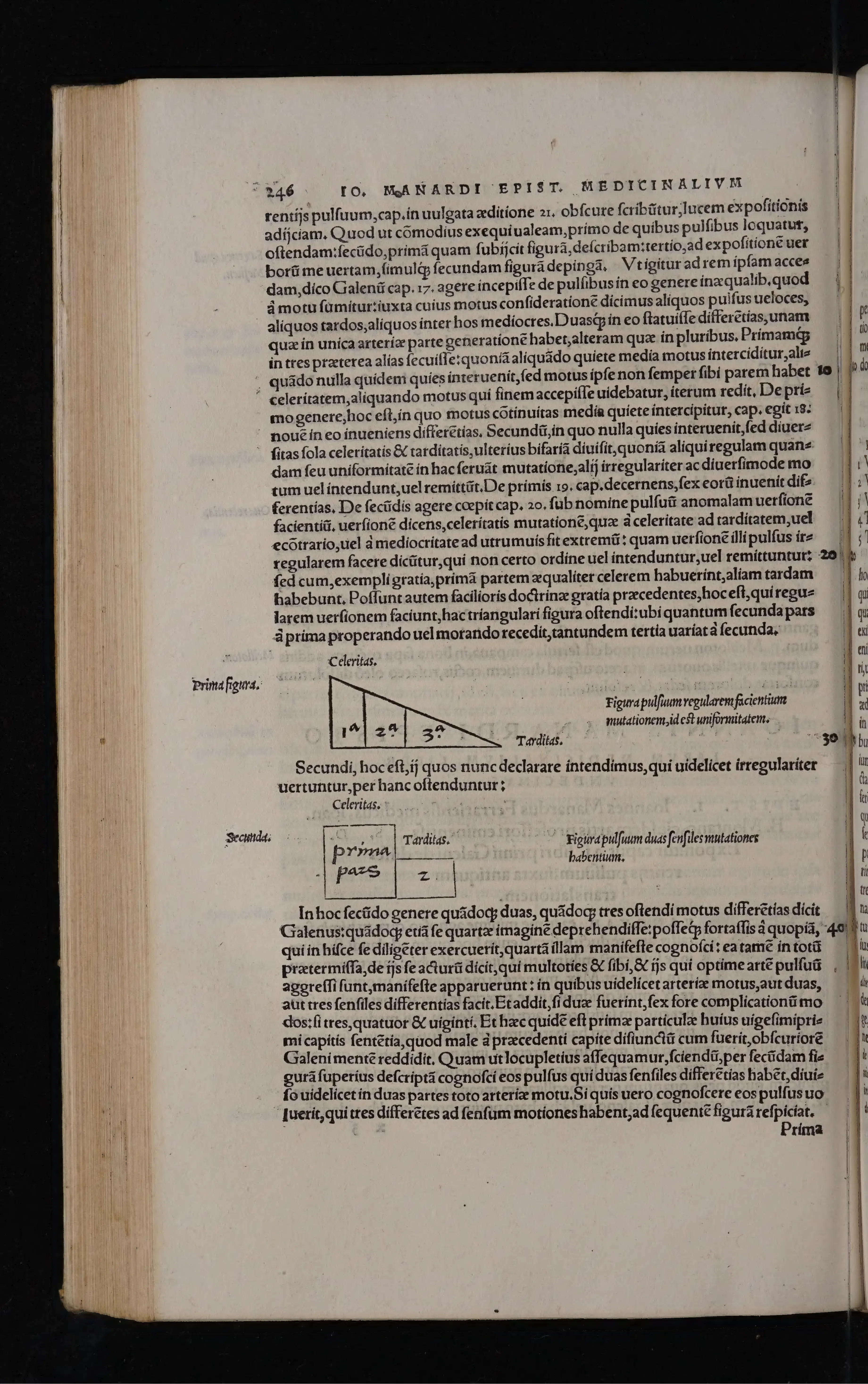
In the Book XI letter on Galen's pulses, the page does more than report a collation: two schematic figures are set into the argument itself, turning a reading recovered from a single codex into instruction the practitioner can carry to the wrist. Source ↗.
The books that follow, from the close of Book IX through Book XIII, display the alternation of consilium and philological disputation at its most regular, and they do so without ever letting the two modes fall apart: the letters carry place-and-date subscriptions from Ferrara across the decade 1522–1532, they are numbered within each book, and their margins are furnished with printed finding-notes that flag an error of Mesue or an emended passage of Avicenna, so that the reader of the folio can locate a correction as easily as a remedy. The first polemical set-piece arises directly out of a therapeutic sequence. Having worked through venesection, provocation through the haemorrhoids, purgation by epithymum, aloe and whey, and having declared his own preference for senna over all of them, Manardo turns on the authority under which senna had been recommended for the head, and refutes it by exhaustive reading: so foreign is the doctrine to Galen, he writes, that he could affirm on oath that there is no mention of senna in Galen's books, Quod tam alienum est à Galeno, ut iureiurando affirmare possim, nullam esse in Galeni libris Senæ mentione. The oath is not rhetorical bluster but a claim about method: an attribution is treated as a proposition about a bounded corpus, refutable by someone who has read the whole of it, and the refutation is registered in the same letter that prescribes the drug. Bibliographical verification and bedside decision occupy one continuous argumentative surface, which is why the conclusion Manardo draws is disciplinary rather than merely textual — that Mesue is not to be held for an oracle.
The long letter to Girolamo Carezzano on the simples then converts that standard into a working botanical practice. Its catalogue of contested identifications — nascaphthon, halimon, ramnus, lotos, chondrilla, tragopogon, thlaspi, opopanax and dozens more — is organised not by the order of the herbal but by what Manardo has himself inspected, and it is punctuated by credentials of place and service, as when he dates an observation to the time when he was serving the health of Vladislaus, king of the Pannonias, dum Vladislai Pannoniarum regis saluti inseruirem. Court physicianship in Hungary functions here as an evidentiary warrant: it licenses statements about plants of the Tisza and the Danube that no Italian library could supply. What makes the letter more than a connoisseur's list, however, is its willingness to record the failure of autopsy. On the paliurus he refuses both affirmation and denial, since if he says he has seen it he will say what is not certain to him, and if he says he has not seen it, what is ambiguous, Paliurum si dixero me uidisse, dicam quod certum mihi non est: si non uidisse, id quod est ambiguum. The sentence is the epistemological hinge of the whole genre of Renaissance drug-identification. Ocular inspection is the arbiter, yet the eye cannot certify a match between a specimen and a description written in another language a millennium and a half earlier; Manardo's response is neither to fabricate certainty nor to retreat into the auctores, but to print the doubt itself, so that the reader inherits an accurately bounded ignorance rather than a spurious identification.
The same analytic rigour governs the dispute with Vincenzo Caprili over sugar, where Manardo declines to argue from names and argues instead from causes: the whole point of his earlier letter, he explains, was that the ancient physicians did not write of this vulgar sugar of ours, and that it is a thing wholly different from the ancients' sugar, differing in its matter, which in the new is the juice of a certain plant and in the ancient dew, sed quod tota ea epistola uolui, hoc fuit, de uulgarî hoc nostro antiquos medicos non scripsisse, esseq[ue] hoc rem omnino ab antiquorum saccharo diuersam, utpote differête Materia, quæ in nouo est succus certæ plantæ: in antiquo ros. To distinguish two substances by matter, form, efficient cause and end is to import the apparatus of natural philosophy into materia medica, and the therapeutic consequence is severe: virtues recorded of the ancient saccharum cannot be transferred to the modern loaf simply because the word has survived. Nomenclatural continuity is exposed as the mechanism by which false indications propagate through the pharmacopoeia.
In Book X the register shifts back to the consultative, and with it the social texture of the letters becomes visible. Advising a vertiginous priest, Manardo aligns the two jurisdictions that bind his patient, noting that the use of venereal things is in this case no less forbidden by the physicians' canons than it has always been forbidden to Western priests by the sacred canons, Venereorum usus, non minus in hoc casu, à medicoru[m] canonibus interdicitur, quàm à sacris canonibus est semper sacerdotibus occidentalibus interdictus. The pun on canones is precise rather than merely witty: regimen is issued in the idiom of law, and the patient's estate is treated as a datum of the case, the physician's prohibition reinforcing an ecclesiastical one and borrowing something of its force. The long consultation for a monk in the same book shows the diagnostic counterpart of this discipline, since Manardo dismantles his colleagues' label by testing it against its own definition, reporting that Paul of Aegina defines that affection thus, melancholy is a derangement without fever, produced by the melancholic humour, occupying the brain and the intelligence, Sic enim eam affectione[m] Paulus Aegineta desinit: Melancholia est desipientia absq[ue] febre, à melancholico humore facta, cerebrum atq[ue] intelligentia[m] occupante. Since he observes no desipientia, the criterion excludes the diagnosis, and the patient's sadness and love of solitude are referred instead to monastic leisure, letters, and a bad temperament of the stomach with obstruction of spleen and kidneys. The definition is thus not an ornament of learning but an instrument of exclusion, and the argument runs from the shared inheritance of Greeks and Arabs against a fashionable nosological label.
Book XI opens with the most technically demanding editorial performance in this stretch. Expounding Galen's De differentiis pulsuum, Manardo reports supplying a passage and a figure which are wanting not only in the copies current among us but in most of the Greek ones too, together with some words preceding it that disturb the whole sense, found hitherto in a single codex at the house of SS. Giovanni e Paolo at Venice, quæ non solum in istis nostratibus exemplaribus, sed in plerisque etiam Græcis deest: simulq[ue] n[on]nulla ante eam uerba, totum intellectum interturbantia, in uno tantum codice, hactenus apud ædes S. Ioannis & Pauli Venetijs inuenta, subijciam. Three distinct operations are compressed into one clause — the census of witnesses, the recovery of a unique reading, and the restitution of a diagram — and all three are then discharged typographically, since the letter is accompanied in print by pulse diagrams and a table of complications. Textual criticism here is inseparable from the resources of the press: only a workshop able to set Greek and to cut figures can carry a collation from the library into the hands of a practitioner who must recognise a pulse at the wrist.
The metrological duel of Book XII makes explicit why such precision is not scholarly vanity. Against Caprili on the cochlear and the acetabulum, Manardo marshals Dioscorides, Galen, Pliny, Paul of Aegina and a manuscript tract on weights in Lazzaro Bonamico's codex, and reduces the dispute to statements of the form that the oxybaphum, which is the fourth part of a cotyla, holds two and a half ounces, Oxybaphum, quod est quarta pars cotylæ, capit uncias binas semis. A confusion between such units is not a lapse in erudition but a miscalculated dose, and the equation is offered as the terminal point of a philological argument whose stake is the patient's safety.
Book XIII's opening letter is the most sustained theoretical argument in the sequence, and it proceeds by first repairing a word. Manardo fixes the sense of digestio philosophically before applying it, holding that in Aristotle digestion seems to be nothing other than a certain operation of natural heat upon the passive qualities, Nihil igitur aliud uidetur apud Aristotelem esse digestio, quàm operatio quædam caloris naturalis in qualitates passiuas — a definition that names concoction as an operation of innate heat rather than a state of the matter, and thereby withdraws the term from the prepared syrups of the shops. Having secured the concept, he then historicises the aphorism that had governed the timing of purgation, observing that in this age of ours human bodies incur diseases far more replete than in the times of Hippocrates, for the ancients ate little or nothing in the morning, stro hoc seculo corpora humana longe magis quàm Hippocratis temporibus reple ta morbos incurrunt. Antiqui enim, uel parum, uel nihil mane comedebant. This is the strongest non-textual argument in the sequence: a rule framed for a soberer regimen does not bind bodies formed by a fuller one, so that a change in diet, rather than a corrupt reading, becomes grounds for revising doctrine. The clinching evidence is dated and local, drawn from what he saw at other times and in the years '25 and '28 above fifteen hundred, ranging through his own city before the great pestilence with the greatest slaughter of mortals and especially of the nobility, Hanc & aliàs quandoque, & annis quinto & uigesimooctauo, supra millesimum quin gentesimum, uidimus ante magnam pestilentiam in hac nostra ciuitate, cum maxima mortalium, & præsertim nobilium strage peruagari, the fever's deceptively mild onset and near-normal urine giving way to sudden collapse, delirium, and eruptions over the whole skin — a nosography whose function in the argument is to establish a class of disease in which waiting for concoction is fatal.
The philological and the surgical converge once more when Manardo settles a dispute over bleeding in synochus by recovering a usage, faulting his opponent for not having noticed that by manus physicians sometimes mean not only that extreme part of the arm divided into five fingers, palm, wrist and metacarpus, but the whole of what projects from the shoulders outside the thorax, ut non aduerterit, per ma nu[m] interdum apud medicos significari non solum extremâ illam brachij partem, quæ in quincq[ue] digitos, palmam, carpumq[ue], & metacarpum diuiditur: sed totum id quod ab humeris extra thoracem prominet. Whether a lancet may be laid to the small veins of the hand, or must seek the larger vessels of the arm, turns on the extension of a single noun, adjudicated by collating the Arabic against the common Latin edition and by Avicenna's own enumeration of the veins of the "hand." The word is the instrument, and mistaking it is a surgical error.
Regimen and a Pannonian disputation on nutmeg
Further on, the exposition may be resumed inside the closing movement of a consultative letter, where prescription has already passed from compounding to regimen. The unguent under construction is built up by proportional parts — marjoram, chamomile, wormwood, stoechas, bay berries, wild or garden rue — macerated in rose water for three days, boiled in a double vessel until the water is spent, then strained and thickened with terebinth, mastic, olibanum, cerussa, and myrrh in equal portions calculated as roughly a quarter of the bulk of what had first been laid in, and finally bound with a little wax. What the recipe exhibits is not merely a formula but a habit of quantification: every ingredient is fixed either by numbered partes or by a ratio to the whole, and the double vessel governs the heat so that the aqueous vehicle can be driven off without scorching the resins. The same discipline continues into the non-pharmaceutical half of the regimen, where the sex res non naturales are addressed in order — thin and sparing food, wine diluted but not harsh, vegetables and above all cabbage retained rather than forbidden, sleep neither too long nor too deep, bodily motion after eating avoided, and violent or sudden passions of the mind ruled as foreign to the meal as any indigestible dish. Manardo then insists that the belly be emptied daily through the winter if it will not act of itself, and he grades the means: first suppositories and clysters, then mild vegetal laxatives such as mercurialis, beet, and mallow, and only afterwards somewhat sharper medicaments — the solutive syrup of roses in which no more senna is to be steeped than suffices to produce the evacuation. That last clause is where the letter's therapeutic reasoning is most concentrated, since the dose is defined not by a weight but by a function, the physician calibrating the drug to the effect required rather than transcribing a fixed quantity from a book; and it is precisely that calibration, tied to the timing of evacuation, which the corpus elsewhere argues out as a question about concoctio and the office of natural heat. The letter closes with the promise that the patient, if he perseveres in everything as described, will be helped at once and in time wholly cured, and with the place-and-date subscription from Ferrara in 1530 that gives the consilium its documentary character as a dated act of counsel rather than an undated precept.
The seam that follows is one of the clearest structural demonstrations of how the collection alternates its two genres. A running head, a book title, and a new numbered epistle succeed the regimen immediately, and the reader passes from a sickbed to a quaestio about the temperament of a simple: the seventeenth book opens with a letter addressed to Georgius Perkam, a Bohemian correspondent, on the qualities of nutmeg and mace. The shift of register is total, yet the standard of judgement does not change, and the letter's opening establishes the evidentiary scene with a precision worth noting — when he was in Pannonia, now twenty-five years since, it happened that in a certain conversation mention was made of nutmeg, CVM in Pannonia essem, iam annis abhinc uigintiquin que, contigit ut in colloquio quodam de nuce moschata mentio fieret. The temporal marker places the episode around 1508, within the years of the author's service in the Jagiellonian orbit, and it converts a printed epistle into a piece of retrospective testimony: the letter of 1533 does not argue the case afresh so much as report, under the author's own name and with a datable setting, a disputation held in company a quarter of a century earlier. The colloquium is thus preserved in type, and the printed collection becomes the medium through which an oral occasion acquires the durability of a citable authority — the same operation the corpus performs when it prints a consultation given to a single patient.
The substance of the dispute is a disagreement about a drug's temperamentum, and Manardo's intervention takes the form of a distinction rather than a verdict. Some in the company praised the nut as hot, others condemned it as bringing on intolerable headache; against both he divides the question, having both approved and disapproved it, but on different grounds, approving it indeed from its powers, which he recognised as truly hot and moderately astringent, but disapproving it on two counts, namely the coarseness of its substance and its odour, which always seemed to him unpleasant and oppressive, Ego uero & probaui & improbaui, sed ex diuersis causis: probaui quidem ex uiribus, quas uere calidas & modice adstringentes agnoui: improbaui uero ex duobus, ex substantiæ scilicet crassitie, & odore, qui mihi semper insuauis atque grauis apparuit. The analytical move is to refuse the terms in which the company had framed the problem. The quarrel had been conducted wholly within the qualitative grid of hot and cold in degrees, the standard apparatus by which the Arabic-Latin pharmacopoeia classified simples; Manardo grants that grid its due, affirming heat and a moderate astringency as the nut's uires, and then declines to let the grid settle the therapeutic question, because a drug's harmfulness may reside in properties the grid does not register. Crassities substantiae, the density or grossness of the material, and odor belong to a different order of description — one concerned with what a substance does mechanically in the vessels and how it affects the sensitive faculties — and by insisting on both Manardo makes the classification of a simple a compound judgement rather than a single entry in a table of degrees. The clinical stakes are made explicit in what follows: because the use of nutmeg in seasoning food is exceedingly frequent among both Italians and Pannonians, daily experience teaches that it cannot be used too often without manifest harm, an observation which draws the evidence for a pharmacological doctrine out of the ordinary culinary practice of two populations rather than out of the medical corpus.
When one of the bystanders escalates the charge, reporting that he had heard from certain physicians that the nut was cold and moreover poisonous, the reply is framed in exactly the pair of terms that governs the collection's method: being furnished with both reasons and experiments, he denied it, and asserted that if it was not poisonous, it was nonetheless of immense coarseness and of a most oppressive odour, Ego uero, & rationibus & experimentis instructus, negaui, & si non uenenosam, immensæ tamen crassitiei esse, & odoris grauissimi asserui. The conjunction of rationes and experimenta is not decorative. Hearsay attributed to unnamed physicians is met neither by a counter-authority nor by simple denial but by the two instruments the corpus everywhere elevates above the auctores, and the answer preserves the earlier distinction intact: the charge of poison is refused while the charge of harmfulness is upheld on the ground already staked out. Manardo concedes nothing to his opponents' conclusion and yet takes over their clinical observation, showing how a false explanation and a true report of harm can be separated.
The scene then turns on a coincidence that the letter narrates with unmistakable relish. A courier arrives with bundles of letters from Italy; the first opened is from Niccolò Leoniceno, and it happens to treat the very drug in dispute, whereupon Manardo announces to the bystanders, in a forensic idiom, that friends, a witness is at hand to absolve him of their accusation, Amici, adest testis qui me à uobis accusatum absoluat. The vocabulary of accusation, witness, and absolution converts a learned disagreement into a trial in which a letter serves as deposition, and the deposition itself is then transcribed: from frequent use of nutmeg Leoniceno had seen a certain great man, and most dear a friend to him, fall into grave afflictions, since by its coarseness it obstructed the veins and the passages of the blood, Ex frequenti nucis moschatæ usu, uirum quendam magnum, & mihi amicissimum uidi in graues incidere maculos, quum ex crassitie sua uenas & sanguinis meatus obturaret. The testimony is decisive precisely because it is not an authority's dictum but a reported case, and because its explanatory mechanism — obstruction of the vessels by gross matter — is the mechanism Manardo had already deduced from the drug's substance rather than from its qualities. That the witness is Leoniceno situates the whole episode within the Ferrarese milieu in which Manardo's philological and clinical formation was acquired, and the letter records that the opponent, faced with an opinion that agreed with Manardo's and was strengthened by Leoniceno's authority, came over to both and rewarded Manardo with some modest gifts.
What the remainder of the letter then does is submit the settled opinion to the ranked authorities in turn. Neither Avicenna and the other Arabs, who call the nut hot and dry in the second degree, nor Serapion, who names it poisonous, nor Mesue, who found its odour sweet, is allowed to disturb a conclusion resting on reasons and experience — and in each case the refutation is drawn from the authority's own text or from common sensation: the Arabs themselves confess the nut to be gross, Serapion in the same chapter recounts its good powers, and the odour that Mesue praised appears heavy and nearly nauseating both to Manardo and to many others. Mace, coming from the same fruit, receives a nearly identical judgement, distinguished only by a finer substance and a less oppressive smell, which is why it is preferred to the nut wherever a hot and moderately astringent agent is required. The letter ends by inviting correction, asking Perkam to admonish him by letter should he judge otherwise, since nothing is more welcome than to be taught by learned friends — a closing that makes the epistolary form itself a continuation of the disputation it narrates, and dates the invitation from Ferrara in 1533.
Definition, guaiacum, and the boundaries of celestial influence
A consultation addressed to the physicians of Mantua follows in the same book, and it is also a lesson in method. Writing on behalf of Aurelio Recordati, Manardo first disarms his correspondents — they are men who ought to teach rather than be taught, and his own hand is crippled by chiragra — and then subjects the case to an ordinatio of unusual severity: the reported affections are enumerated, supplemented from the patient's own account with tinnitus, gastric cold, a leaping sensation toward the umbilicus, obtuse frontal pain and pulsation at the coronal sutures, and then sorted twice, first into morbi and symptomata, then by the region affected. Only after this grid is in place does the argument turn on its hinge. Manardo has laid down three dialectical axioms — nothing is called by a term whose definition it lacks, removing the genus removes the definition, and what falls outside the genus falls outside its species — and supplies the major premise from the definition of melancholy as desipientia absque febre that all the Greeks and Arabs alike accept, together with its division into three species, the formulation already quoted above. The refutation of "hypochondriac melancholy" that follows is not clinical but logical: the patient has never been desipiens, so the genus fails, and with it the species. The consilium thus corrects practitioners on the terrain of the arts course, and it does so with materials that both parties concede — the shared definition, not a new observation, does the destructive work.
Destruction obliges reconstruction, and the substitute diagnosis is stated with a candour that registers the limits of the enumerative method: no other affection occurs to him, Manardo writes, to which these should rather be referred than a cold and moist intemperies of the stomach, Nullus autem mihi occurrit, in quem potius referenda uideantur, quàm frigida & humida uentriculi intemperies,. The formula nullus mihi occurrit concedes that the identification rests on exhaustion of alternatives rather than on demonstration, yet its consequences are immediate and practical: rumbling, eructation, hypochondriac distension and the left-sided leaping are traced to phlegm partly pooled in the cavity and partly adhering to the stomach walls, and the therapeutic order is thereby fixed — stomach first, liver second, head third. Relocating the disease from the higher faculties to a digestive organ also converts a formidable prognosis into a manageable one; the dialectical operation on a definition has a direct issue in regimen, in the choice of vomit by agaric with oxymel, and in the sequence of caputpurgia and gargarisms that follows.
The same book supplies the corpus's most concentrated statement of the providential frame within which a drug unknown to the ancients could be received. Introducing the guaiac letter written for the Cracow circle, Manardo describes, in the passage already discussed above, how God, having permitted the French disease to rage for the offences of the human race, ordered a certain wood to be brought from a world unknown to the ancients for the cure of an unknown disease, a wood not undeservedly called holy by those who benefited from it. The chiasmus of incognito orbe and incogniti morbi is deliberate and load-bearing: it converts the humanist embarrassment that neither disease nor remedy appears in Dioscorides or Galen into a positive argument, since the silence of antiquity is exactly what the schema predicts. Sanctity, moreover, is presented as a name conferred by the cured rather than by a physician or a text, which is a claim about how nomenclature legitimately arises. The letter then dissolves the pious opening into technique — three kinds of wood distinguished by density and weight, a forty-day protocol of decoctions in decupled and twentyfold water, six ounces of coarse bread, graduated reintroduction of food and wine — and submits the whole to the physicians on the spot.
That deference is a settled posture rather than a courtesy. Reviewing the rival consilia written for the Bishop of Kraków under the name of Italian doctors, Manardo itemises five disagreements, rebuts one with a verbatim Latin rendering of De locis affectis 6, and then hands over judgement: it will be theirs, the physicians of Kraków, to refer both sets of statements to the balance of reason and to weigh skilfully which scale inclines, V estru[m] autem erit, Cracouienses medici, ad æquilibriu[m] rationis utraeq[ue] dicta referre, & quæ lanx inter uergat solerter pensitare. The image of the scale recurs in the Thurzó consilium, and it defines the epistemic structure of consultation at a distance: the absent physician supplies reasons and their weights, while the verdict belongs to those with the patient before them. It also makes controversy productive rather than merely combative, since two competing consilia become the two pans of a single instrument.
The eighteenth book turns the same discriminating habit on the heavens and on materia medica. Against a physician-astrologer of Faenza, Manardo concedes precisely as much as the post-Pico settlement allows — that the heavenly bodies alter these lower things by a certain general influx, through motion and light, corpora uidelicet coelestia generali quodam influxu per motu & lumen hæc inferiora permutare — while denying to the stars, and to the great authorities alleged for them, any particular power over life, death, wit, wealth, fame or love. The concession is not a compromise but a boundary drawn by physical causality: motion and light are agents a natural philosopher can specify, whereas the particular determinations of judicial astrology are not. The same operation, performed on a substance rather than a heaven, produces the letter's most arresting philological note: that the nitre now used everywhere in engines of war is a different thing from what was formerly gathered in nitre-beds, Nitrû quo nunc passim in bellicis tormentis utuntur, aliam rem esse ab eo quod. Ancient name and modern substance are prised apart by evidence, with Ermolao Barbaro and Marcello Virgilio cited as allies; the remark also quietly admits gunpowder into the pharmacological field as a fact requiring nomenclatural discipline.
The Mesue commentary: addresses, Annotationes, and the Censura
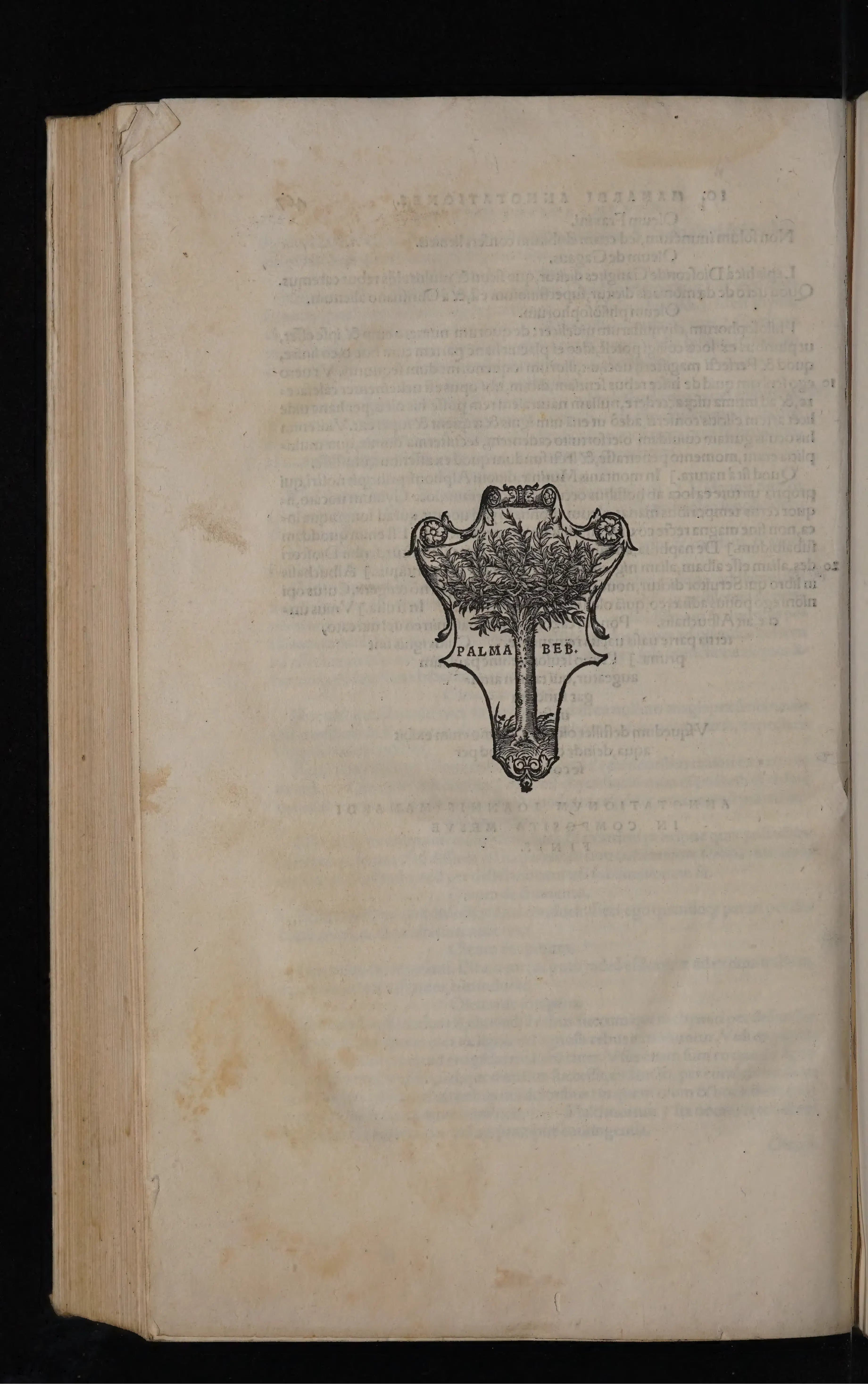
Johann Bebel's palm device, printed as "PALMA BEB.", marks a sectional seam in the volume, closing one block of text before the display heading that opens the annotations "IN COMPOSITA MESVE". The printer's emblem here helps announce the shift into the Censura of compound medicines. Source ↗.
With the eighteen books closed, the addresses prefixed to the Mesue commentary expose the conditions of the printed enterprise itself. Manardo explains that public teaching has been stopped by war and private teaching by illness, so that what remains is to instruct through those who print books with types, per eos facerem qui libros formis excudunt — publication presented not as ambition but as the residue of two failed channels, and the press treated as a lecture hall of last resort in a season of tumultus bellici. The fee he stipulates for the labour is the didactic charter of the whole undertaking, namely the charge already noted above, that in judging his writings the students credit the authority of no one, dead or living, more than reasons and truth, followed by the warning that nothing in life is more harmful than the common persuasion by which the decrees of the elders are held indiscriminately as oracles. The Annotationes that follow are, on their own account, an accident of private study: these are the things he once noted in Pannonia in the margin of a handbook-format Mesue of his own on the simple medicines, Hæc sunt quæ in Panonnia olim margini simplicium medicamentorum cu, released only because they would profit students he could not otherwise reach, with the request that the learned correct him in writing rather than in speech.
Within the lemmata, the characteristic argumentative shape is a three-term sequence: ancient dose, Arabic dose, personal trial. On scammony, Dioscorides' whole drachm and Paul's four oboli are set against Mesue's five to twelve grains, and Manardo interposes himself — though he has never dared give so much, he has not feared to exceed twelve grains, Ego licet nuncq[ue] sim ausus tatu[m] dare, duodecim tame[n] grana trâscedere — before reporting that some have taken a whole scruple unharmed. The physician's own hand thus becomes a witness placed between the authorities, neither overruling them wholesale nor accepting their arithmetic. Where the drug is one the Greeks did not know, the same instrument works without any textual pedigree at all: that senna can purge phlegm he has learned by experience that it can, Senam posse purgare pituitam. Ego experientia didici, quod potest, a flat contradiction of Averroes registered without apparatus, and extended in the same lemma to the disease called Gallic.
The second address and the Censura transpose this from philology to the economy of the shops. Sketching five centuries in which compounding passed from physicians to shopkeepers, Manardo delivers the verdict that it thus came about that the blind, following guides yet more blind, Et propterea factum sit, ut cæci, duces etiam ma — a gospel figure enlisted to describe a division of pharmaceutical labour, in which the Speciarii hold the materials while the knowledge that should govern them has migrated elsewhere. Having failed, by his own account, to substitute Greek compositions for Arabic ones, he settles for clarifying what the shops in fact keep, and the criticism turns on cost as much as on efficacy: the ancients did not use gems in antidotes, nor does he willingly use them, Gemmis enim in antidotis non sunt usi antiqui: nec ego libenter utor, the appeal to ancient practice and the appeal to his own converging on the same expensive ingredient. The ethics of prescribing receives its sharpest formulation at the head of the distinctio on opiates, where the use of these demands a very prudent physician, not so bold as to employ them where there is no need, Vsus horum admodu[m] prudentem desiderat medicu[m], non adeò audacem, ut ubi opus non est, eis utatur: — prudence defined, as throughout the commentary, by the interval between audacity and timidity rather than by a rule any formulary could supply.
The closing distinctiones of the antidotary
The closing distinctiones of the Mesuan antidotary are transmitted not as continuous argument but as a chain of drug-headings, each printed as a display line and each followed by a note in which the annotator identifies an Arabic or Greek term, reports whether the preparation is in fact made in the shops, proposes a substitution, or delivers a verdict from his own practice. The form is that of the pharmacological apparatus, but the voice that intrudes into it is the same first-person clinical voice that governs the letters, and it emerges most sharply where a received caution is set aside: for his part, Manardo writes, he does not fear mildly astringent medicines in diseases of the chest, Ego enim no[n] formido in morbis pectoris, medicinas modice adstringentes. The construction is worth noting — not a citation, not a syllogism, but ego non formido, the physician's own nerve offered as the operative warrant against a prevailing timidity about astringents in pectoral cases. What the commentary annotates is a text; what it repeatedly appeals to in adjudicating that text is a body of tested handling.
That appeal becomes programmatic when the seventh distinction turns to decoctions and infusions, where Manardo both praises the class and declares his freedom from its published recipes: decoctions of this sort are very useful, and he has profited greatly by using them many times, yet he compounds them at will according to the indications that present themselves, Decoctiones huiusmodi multum sunt utiles, & ego usus eis multoties, multu[m] profeci; quas tamen compono ad libitum, secundum intentiones occurrentes. The concessive tamen carries the whole methodological weight. The antidotary's fixed formulae are not repudiated — they retain their standing as utiles — but they are demoted from prescription to guide, and the intentiones occurrentes, the therapeutic aims arising in the individual case, become the compounding principle. This is the pharmacological form of the ranking that governs the letters: authority holds, but ratio applied to the case before the physician holds above it.
Alongside this practical licence runs an unrelenting lexical discipline, applied to whole pharmaceutical classes as it is elsewhere applied to single lemmata. The eighth distinction opens by unpacking the very name of its subject, since trochisci or cyclisci in Greek and pastilli in Latin take their name among the Greeks from their shape, and of them some are drunk, others inserted, some rubbed on, Trochisci uel cyclisci Græce, Latine pastilli, à figura apud Græcos nomen habere: quorum aliqui bibuntur, alij inijciuntur, nonnulli inunguntur. Etymology and route of administration are established in a single move: the name records a physical form, and the form is what permits the three modes of use. Nomenclature is treated here as evidence about the thing named, so that a philological observation is simultaneously a piece of practical instruction.
The same distinction supplies the most striking instances of an authority that neither Greek text nor Arabic compendium can settle, because the drug in question is one the ancients did not handle in the state in which it now arrives. Of camphor Manardo writes that it is a new thing, which they call a gum of trees and think very cold, whereas he judges the specimen brought to us to be an artificial product, and hot, Res noua, quam gummi arborum dicunt, & putant ualde frigidam. Ego eam quæ ad nos defertur rem factitiam puto, & calidam. The phrase quæ ad nos defertur is the pivot: the object of judgement is not the camphor of the books but the commodity actually delivered, and once the identity of the delivered substance is in doubt, the inherited assignment of qualities — the cold degree on which its whole therapeutic use depends — collapses with it. Commerce can supply positive testimony as well as suspicion, as when dragon's blood is re-identified on the strength of contemporary report, it now being brought by the Portuguese and said by them to be the sap of certain trees, Nunc defertur à Lusitanis, diciturq[ue] ab eis esse succus quarundâ arboru[m]. Merchants' information is admitted as evidence against Serapion and Avicenna, but the camphor entry shows that it is admitted as evidence and not as authority: the res factitia verdict is precisely a refusal to take the trade's own description of its goods at face value.
Where the commodity is variable rather than merely misdescribed, the danger becomes quantitative, and Manardo converts it into a rule of professional conduct. Of the colocynth trochisci he insists that it must be diligently ascertained from the man who prepared them how much colocynth he put in, for some take more and others less, to the patient's harm, if the physician is ignorant of it, Diligenter autem cognoscendum ab eo qui hosce parauit, quantum colocynthidis in eis posuerit: alij enim plus, alij minus accipiunt, cum ægrotantium detrimento, si id medicus ignorauerit. The clause si id medicus ignorauerit locates the fault not with the compounder's licence but with the prescriber's incuriosity: the physician who does not interrogate the preparation has consented to an unknown dose. The structural parallel with the commentary's textual ethics is exact — an unexamined quantity in a purgative is hazardous in the same way as an unmarked interpolation in a translated text, and in both cases the remedy is to make the intervening hand declare itself.
Elsewhere the difficulty is that the intervening market supplies nothing at all. Of the pills of Armenian stone the note is flat: these are not prepared, since we lack Armenian stone; they are described after Alexander and are most highly commended, Non parâtur hæ, quoniâ lapide Armeno caremus. Ab Alexâdro describunt, & summopere cōmendantur. The juxtaposition of summopere commendantur with non parantur states without comment the condition of a learned pharmacy whose most praised formulae are inoperable; the commendation persists in the books precisely because nothing in the books registers that the simple has ceased to arrive. Bibliography and supply have come apart, and the commentary's function is to record the gap rather than to paper over it.
The eleventh distinction is prefaced by a historicisation of the very words it will use, the ancients having called unguents only those things made from aromatic substances, plasters those made from metallic ones, cerates those from oil and wax, Illi enim unguêta ea duntaxat uocabant, quæ ex odoratis rebus co[n]ficiebâtur: emplastra, quæ ex metallicis: cerota, quæ ex oleo & cera. Once terminology is dated, a formula can be dated by its ingredients, and the sharpest application of that principle among these entries is a question put to an ascription: how can it be in rose-water, if it is Galen's, since in his time these waters of ours had not been invented — one may understand a decoction, Quomodo in aqua rosarum, si Galeni? quum eius tempore non fuerint inuentæ nostræ hæ aquæ, potes decoctum intelligere. Here material history performs the work of source criticism: distilled waters belong to the moderns, so their appearance in a purportedly Galenic recipe convicts the transmission, and the emendation offered — read decoctum — restores a preparation available to the second century. The same editorial reflex operates on grounds of internal genre when a wound-draught is found among the plasters, Manardo confessing that he does not know by what accident this mixture crept into this place, since it is a draught, not a plaster, Nescio tamen quo casu hæc mixtura in hunc locum irrepserit, siquidem potus est, non emplastrum. The verb irrepserit assigns the intrusion to the history of the book rather than to Mesue, and the criterion invoked is neither a codex nor a communis lectio but the incoherence of the item with its own heading.
Practical caution receives an equally moral formulation where the remedies bite. Applying escharotics, the physician is told to act warily and inspect the place frequently, since Manardo himself has sometimes seen most intractable ulcers produced by a delay of less than three hours, to the patient's harm and the operator's shame, Caute agat medicus ubi admouet huiuscemodi urentia, crebroq[ue] locu[m] inspiciat. Vidi ego quandoque ex minore quàm trium horarum mora, difficillima facta ulcera, cum patientis damno & agentis uerecundia. The paired nouns damnum and uerecundia place injury and disgrace on one axis: an iatrogenic ulcer is at once a harm to the sick and a public exposure of the operator's negligence, and the three-hour measure converts that reputational stake into a monitoring interval.
The twelfth distinction, on oils, is the longest movement and the one that admits an alien expertise into the commentary. Of the Mesuan tripartition Manardo remarks that the third kind, the most efficacious of all, few know how to draw off, but only those skilled in the art called chymice, Tertium inter omnia efficacissimum, pauci norunt elicere, sed hi tantum qui artem chymicen uocatam callent. The concession is double-edged: superiority of effect is granted to a preparation the learned physician cannot himself make, while the distancing uocatam keeps the practitioners' own name for their art at arm's length. That ambivalence resolves into a philological judgement about the annotated author himself, for the oil of the philosophers means of the chymists, since Mesue was of their number, as can be gathered from many places, and it therefore pleased him to end this part with this oil, which he also called the Perfect Magistery, following their manner of speaking, Philosophorum, chymistarum uidelicet: de quorum numero cum & ipse esset, ut pluribus ex locis colligi potest, ideo ei placuit hanc partem cum hoc oleo finire, quod & Perfecti magisterij uocauit, illorum loquendi modum sequutus. The argument is drawn from idiom — a loquendi modus pervading many places identifies its speaker's affiliation — and it reclassifies the antidotary's author rather than merely a heading within it.
The tolerance extended to chymical technique does not extend to the claims made for its products. Of the powers attributed to jet oil Manardo rules that what is said about demoniacs is superstitious, and foreign to a Christian, Quod uero de daemoniacis dicitur, superstitiosum est, & à Christiano alienum: the objection is confessional as much as naturalistic, drawing a line through the received virtues of a simple that neither trade report nor distilling skill may cross. Immediately thereafter the apparatus closes upon itself with the printed formula announcing the end of Giovanni Manardo's annotations on the compounds of Mesue, ANNOTATIONVM IOANNIS MANARDI IN COMPOSITA MESVE FINIS, the commentator's name and his subject set out in the terminal line so that the reader leaves the compound medicines knowing exactly whose corrections he has been reading.
Frequently Asked Questions
Who was Giovanni Manardo of Ferrara?
Giovanni Manardo (1462–1536) was an Italian physician trained in the humanist circle around Niccolò Leoniceno and Giovanni Pico della Mirandola, a teacher in the northern Italian medical centres, and for a period court physician to the Jagiellonian rulers Vladislaus II and Louis II in Buda. He is catalogued variously as Manardi, Johannes or Ioannes Manardus, and Mainardi. Over the last decades of his life he assembled his Latin correspondence on medical questions into a printed book, treating a consultation on gout or plague and the collation of Greek codices as one and the same professional task.
What is the Epistolarum medicinalium libri duodeviginti?
It is Manardo's Latin collection of medical letters, printed in its eighteen-book state at Basel in 1535. The collection grew from six books issued at Ferrara in 1521 and reached twenty books in 1540, after his death. Two genres alternate throughout: the consilium, a dated response on diagnosis, regimen and dosage, and philological-pharmacological disputation over a lemma, a translation, or a drug identification. Joined to it are his Annotationes on Mesue's simple medicines and a Censura of the compounds. Niccolò Massa's Liber de febre pestilentiali, Venice 1556, is a separate printed record, associated with the Manardo volume only in cataloguing.
How did Manardo mark his corrections to translators of Dioscorides and Mesue?
He printed his editorial rules and applied them visibly: the offending phrase of Marcello Virgilio Adriani is flagged, the siglum MAN. is prefixed, and the correction follows, so a reader can always see where the ancient author ends, the translator intrudes, and the annotator speaks. Behind the procedure lies the interpretis officium, the translator's duty: a faithful interpreter, on Manardo's judgement, would never turn a positive into a superlative or the reverse, since a grade shifted in translation is a dosage or an indication silently altered. Hundreds of one-line entries carry lemma, siglum and emendation.
What did Manardo make of substances the ancient physicians never handled?
He judged them by reason and tested handling rather than by inherited entries. Guaiac wood, the lignum sanctum, is presented as brought from a world unknown to the ancients for an unknown disease, the silence of antiquity thus explained rather than embarrassing. The camphor actually delivered to Europe he took to be an artificial product and hot, not the cold gum of the books. Dragon's blood he re-identified on Portuguese report as the sap of certain trees, and he observed that the nitre used in engines of war differed from what had once been gathered in nitre-beds.
Is there an English translation of Manardo's medical epistles?
No modern critical edition or annotated English translation of the complete Epistolae medicinales has been identified; English-language scholarship devoted specifically to Manardo remains thin, and a digital facsimile of the 1535 Basel issue is a facsimile rather than an edition. Separately, the Leo edition presents the full transcription together with a complete English translation, generated by AI, for the first time. Leo is an effort to make freely available online, at no cost, English translations of every text printed in Latin in early modern Europe between 1450 and 1750.
This report was generated by an advanced AI assistant that conducted deep research alongside an extensive interpretation of the transcribed original text. Every effort has been made to preserve fidelity to the source and to guard against inaccuracy, but corruption in the text recognition process and model hallucination may nonetheless have entered the text. Treat every claim, quotation, translation, and citation as provisional, and verify each against the original source before relying on or citing it.
Further Reading on Manardo, Medical Humanism, and Renaissance Plague
- Daniela Mugnai Carrara, "Per lo studio degli Epistolarum medicinalium libri XX di Giovanni Mainardi," Medicina nei Secoli: The indispensable starting point for the edition sequence, the growth from six books to eighteen and then twenty, the successive editorial states, and Manardo's Ferrara–Pico–Hungarian contexts. Anyone tempted to trust a single catalogue record about the 1535 Basel issue should read Carrara first and then look at the title page again.
- Dorothea Heitsch, "Giovanni Manardo and Jacques Dubois on John Mesuë's Medical Substances," Arts et Savoirs: A focused study of the Annotationes and Censura as interventions in the Renaissance reception of Mesue, medical substances, and the relation between philology and pharmacology. It is the precise juncture at which Manardo's refusal to treat Mesue as an oracle stops being a critical gesture and becomes a pharmacological position with consequences at the counter.
- Vivian Nutton, "The Rise of Medical Humanism: Ferrara, 1464–1555," Renaissance Studies: Nutton supplies the institutional and intellectual history needed to situate Manardo among Ferrara's physicians, humanists, and reformers of medical reading. The programme Nutton describes finds its slogan in Manardo's own characterization of that community, whose members do not serve the words of the barbarians like slaves, but, relying on reason and experiment, desire to draw medicine's decrees from the founts themselves rather than from turbid pools, non barbarorum uerbis ueluti mancipia seruiunt, sed rationi & experime[n]to nixi, medicinæ decreta ex ipsis potius fontibus, quàm ex turbidis lacunis haurire desiderant, a formulation in which philological recovery and tested practice are named in a single breath.
- R. J. Palmer, The Control of Plague in Venice and Northern Italy 1348–1600: A doctoral thesis that remains the fullest account of the political, institutional, and medical machinery of northern Italian epidemic control. It is the book to consult for distinguishing Manardo's Ferrarese consultative humanism from Massa's Venetian world of health boards and jurisdictional quarrels, and for the contemporary tension between atmospheric and contagionist explanations.
- Nancy G. Siraisi, Communities of Learned Experience: Epistolary Medicine in the Renaissance: Siraisi's analysis of printed medical letters as vehicles of case advice, controversy, professional reputation, and learned community clarifies how Manardo's consilia and philological interventions coexist within one epistolary medium. Manardo's own account of disputation belongs to that frame, since, as he writes, he does nothing more gladly than contend in that most beautiful Hesiodic strife, approved by Galen too, in which the loser's condition is far better than the victor's, Nihil enim li bentius facio, quàm cum pulcherrima illa Hesiodia lite, à Galeno etiam probata, decerto, in qua longe melior est uicti, quàm uincentis conditio — controversy presented as a shared search for truth rather than as a contest for reputation, though the corpus's documented reply-chain, as noted above, remains unestablished.